ROLE 0F NUCLEIC ACID MICROARRAYS,PROTEIN MICROARRAYS,ANTISENSENSE
TECHNOLOGIES
Abdullah
M.Pharm(Pharmacology)
Sem-II, Roll no-242577
Central University of
Haryana, Jant-Pali,
Mahendergarh, Haryana
1
INTRODUCTION:-
❑ WHAT IS MICROARRAY?
➢ A microarray is a laboratory tool used to detect the expression of thousands of genes at the same
time.
➢ Microarray helps in analyzing large amount of samples which have either been recorded previously or
new samples.
➢ The microarray technique is been sub-classified based on the sample to be analyte:-
▪ DNA microarray
▪ Protein microarray
▪ Transfection microarray
▪ Antibody microarray
▪ Tissue microarray
▪ Chemical compound microarray
2
❑ DNA MICROARRAY:-
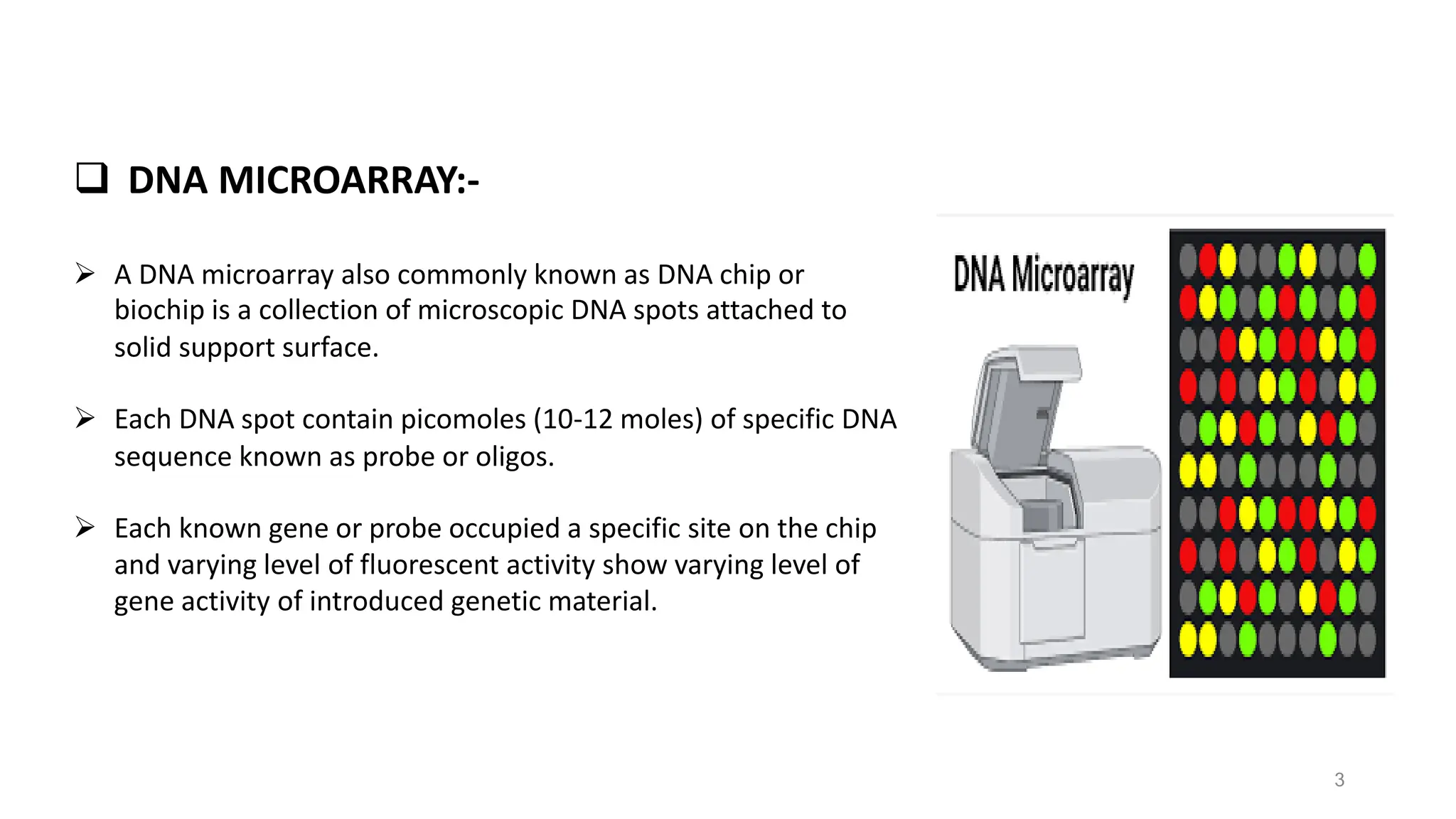
➢ A DNA microarray also commonly known as DNA chip or
biochip is a collection of microscopic DNA spots attached to
solid support surface.
➢ Each DNA spot contain picomoles (10-12 moles) of specific DNA
sequence known as probe or oligos.
➢ Each known gene or probe occupied a specific site on the chip
and varying level of fluorescent activity show varying level of
gene activity of introduced genetic material.
3
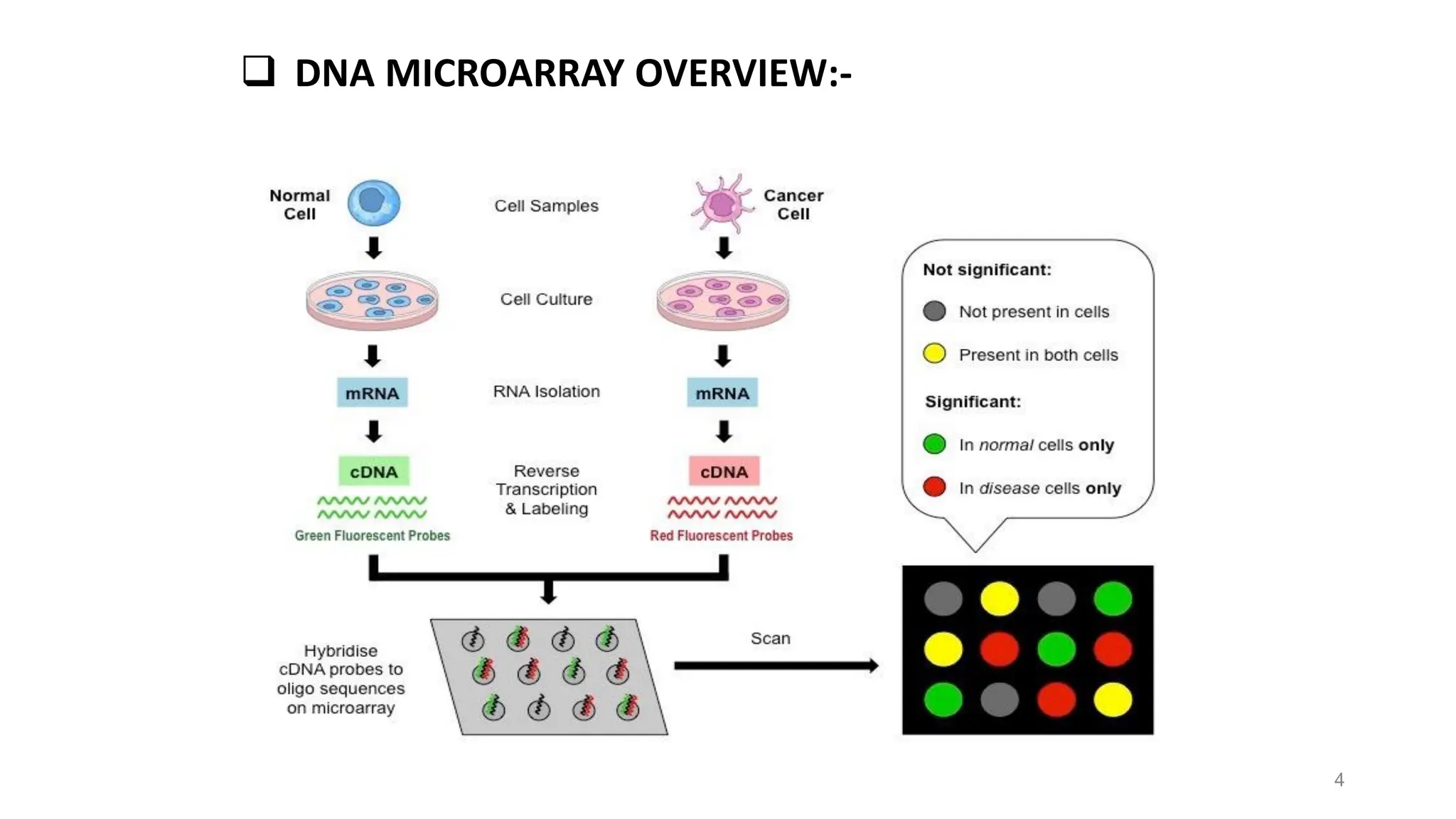
❑ DNA MICROARRAY OVERVIEW:-
4
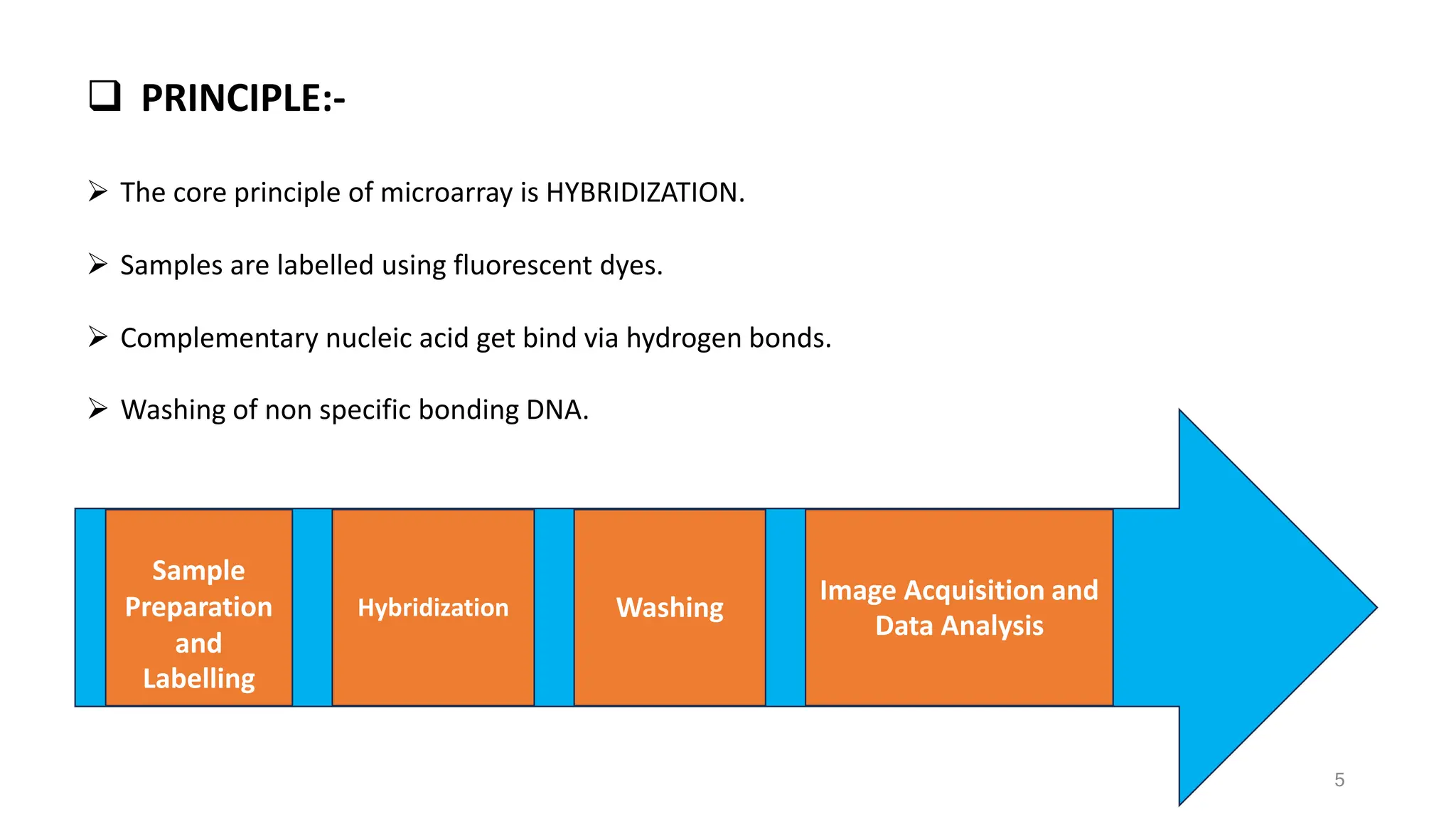
❑ PRINCIPLE:-
➢ The core principle of microarray is HYBRIDIZATION.
➢ Samples are labelled using fluorescent dyes.
➢ Complementary nucleic acid get bind via hydrogen bonds.
➢ Washing of non specific bonding DNA.
Sample
Preparation
and
Labelling
Hybridization Washing
Image Acquisition and
Data Analysis
5
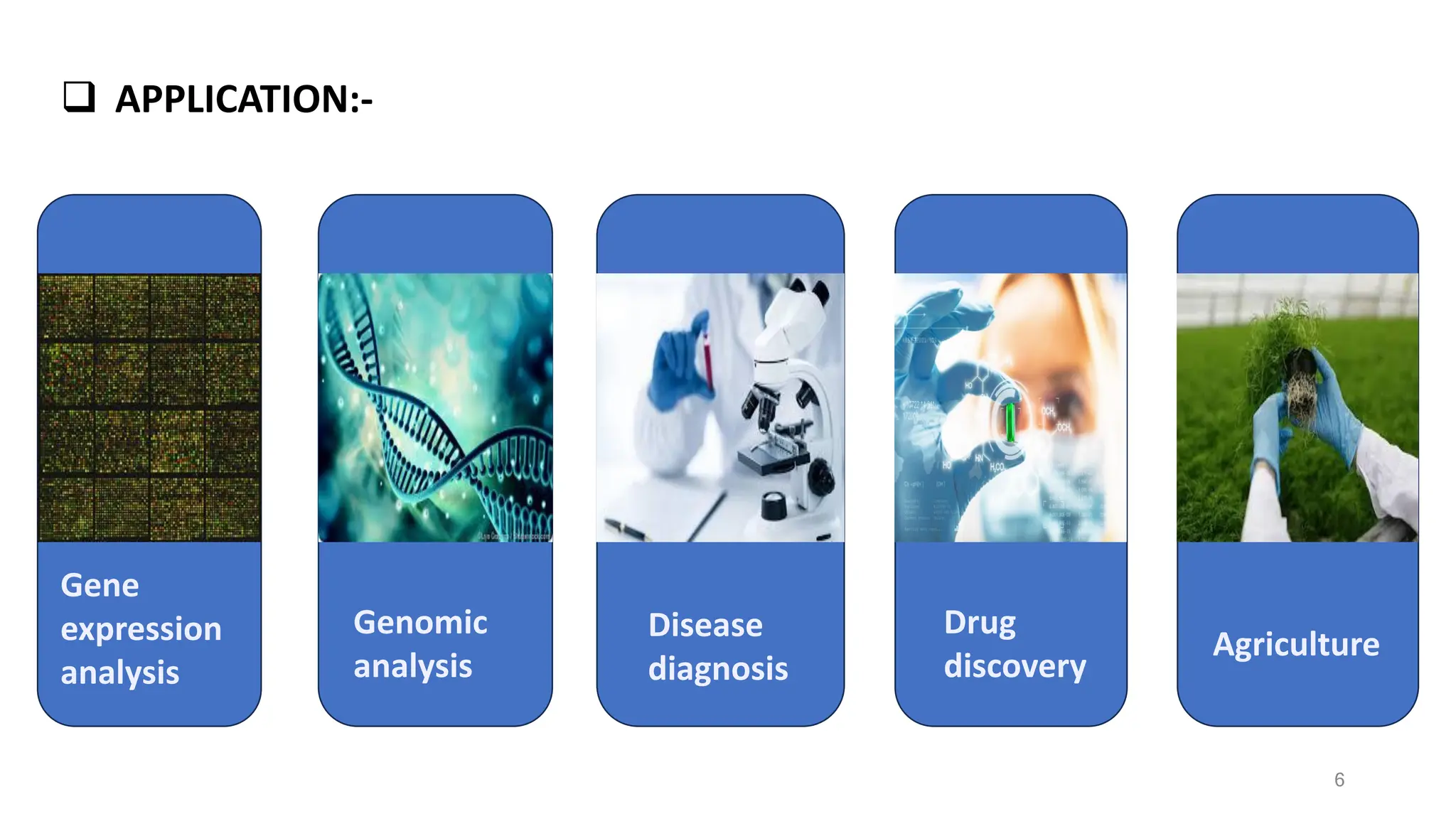
❑ APPLICATION:-
Disease
diagnosis
Drug
discovery
Gene
expression
analysis
Genomic
analysis
Agriculture
6
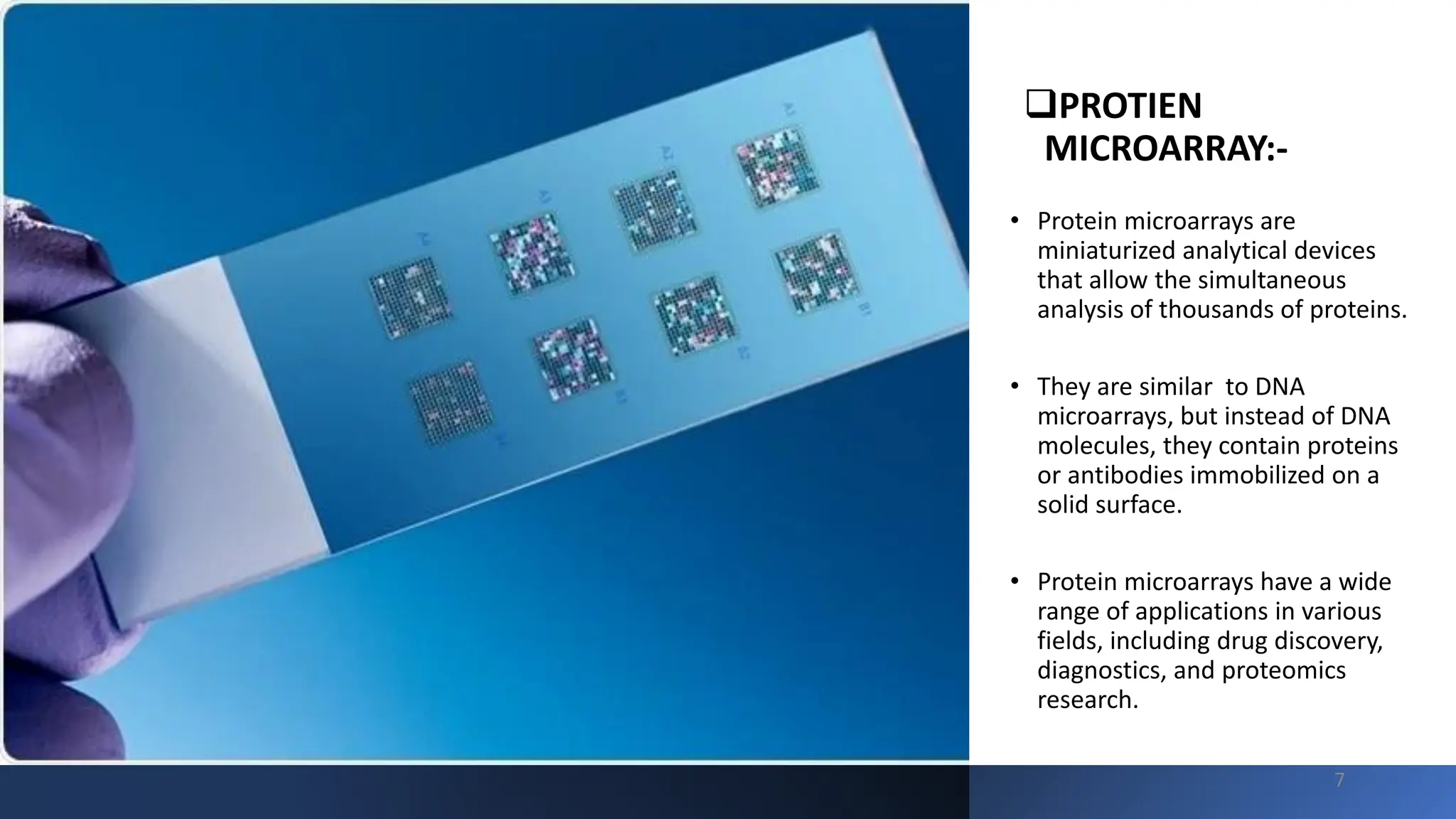
❑PROTIEN
MICROARRAY:-
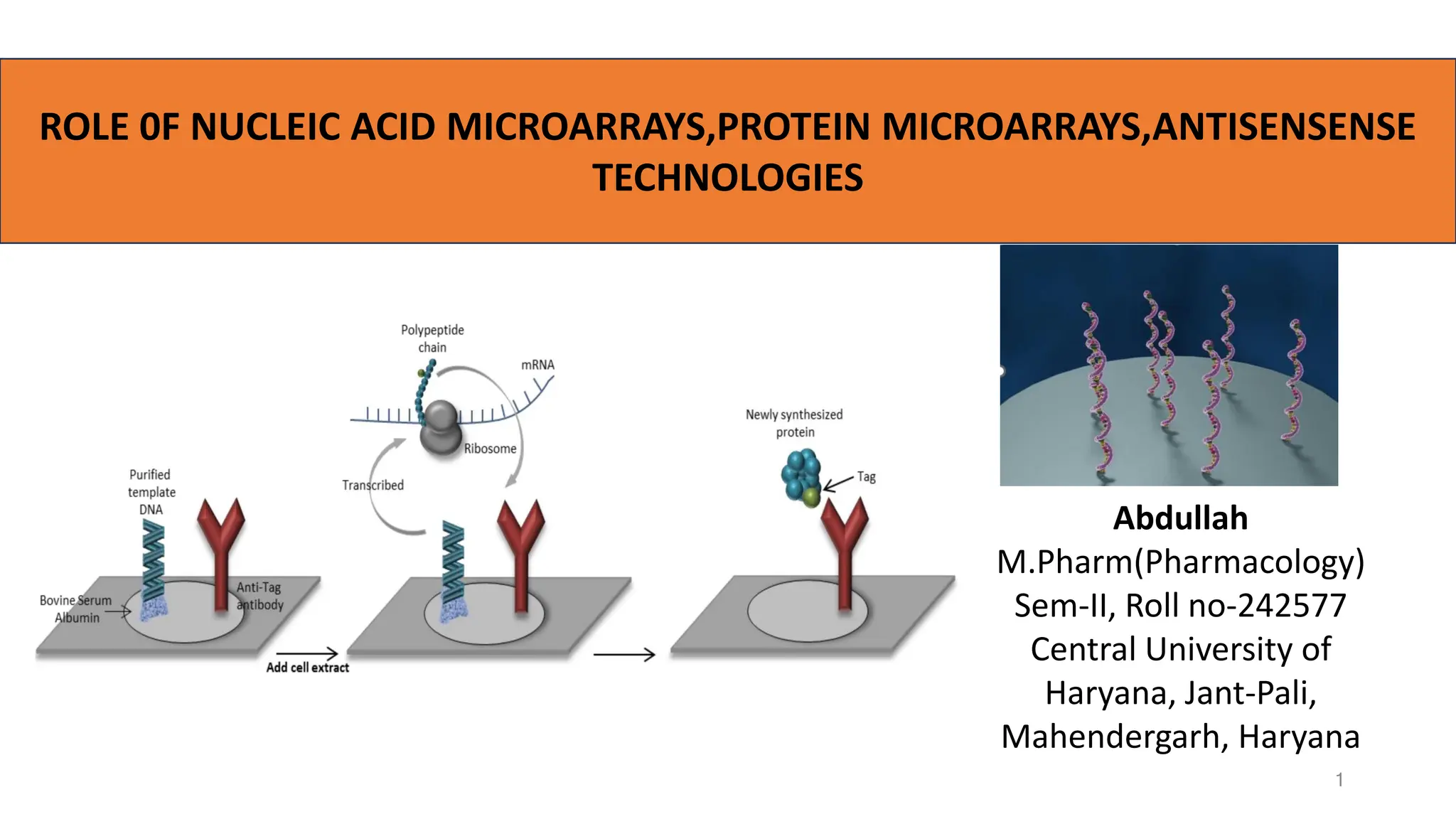
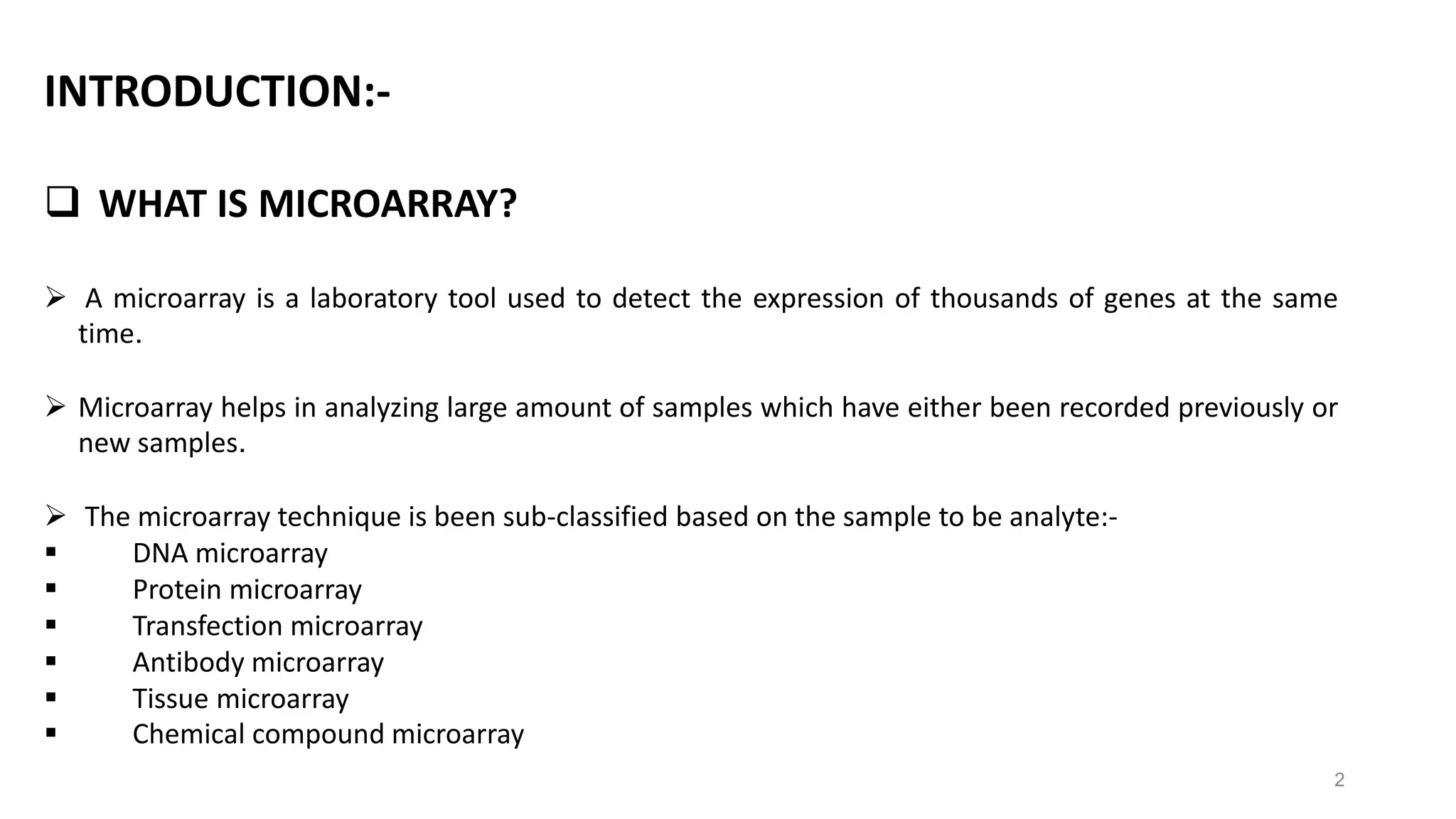
• Protein microarrays are
miniaturized analytical devices
that allow the simultaneous
analysis of thousands of proteins.
• They are similar to DNA
microarrays, but instead of DNA
molecules, they contain proteins
or antibodies immobilized on a
solid surface.
• Protein microarrays have a wide
range of applications in various
fields, including drug discovery,
diagnostics, and proteomics
research.
7
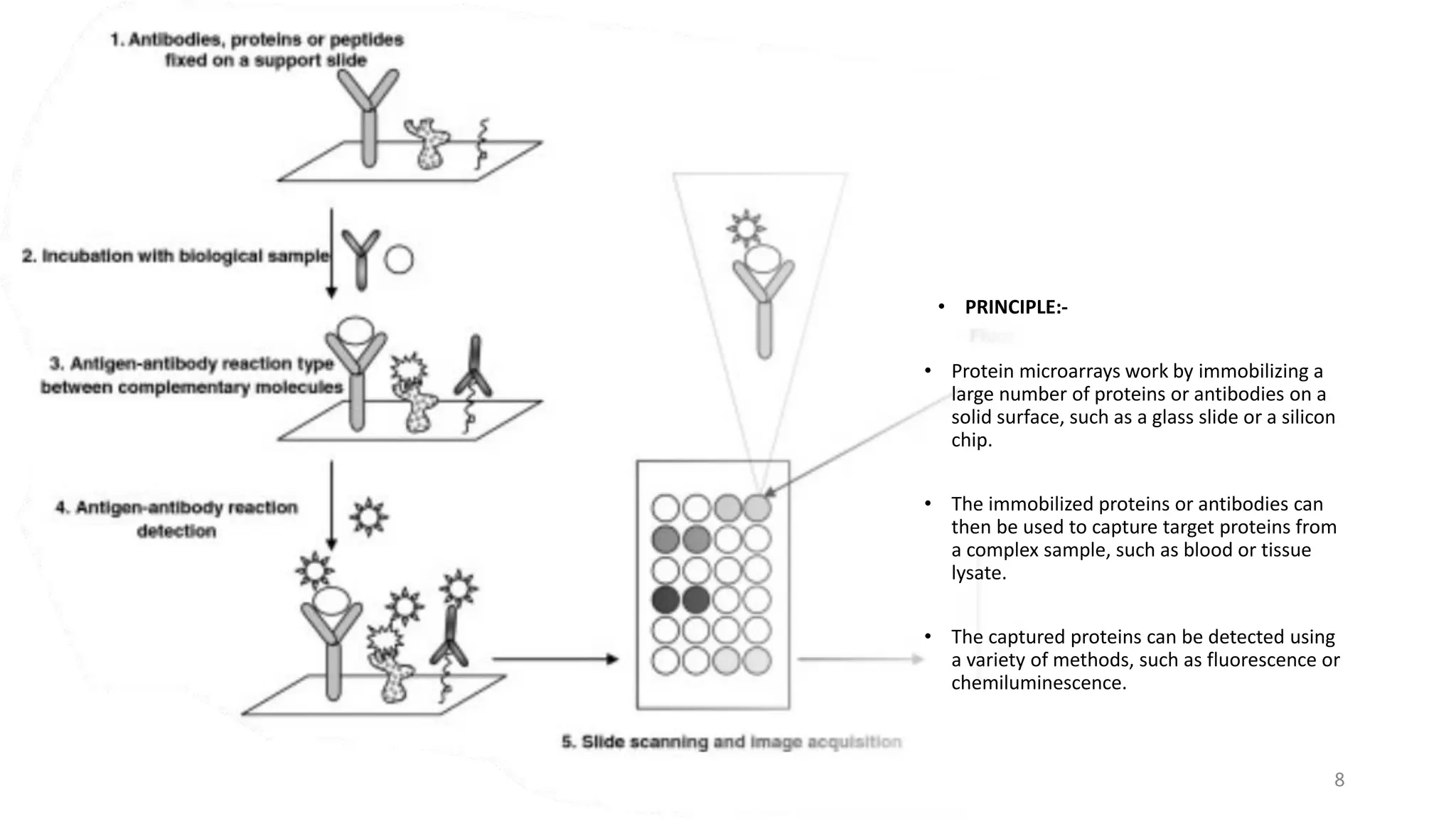
• PRINCIPLE:-
• Protein microarrays work by immobilizing a
large number of proteins or antibodies on a
solid surface, such as a glass slide or a silicon
chip.
• The immobilized proteins or antibodies can
then be used to capture target proteins from
a complex sample, such as blood or tissue
lysate.
• The captured proteins can be detected using
a variety of methods, such as fluorescence or
chemiluminescence.
8
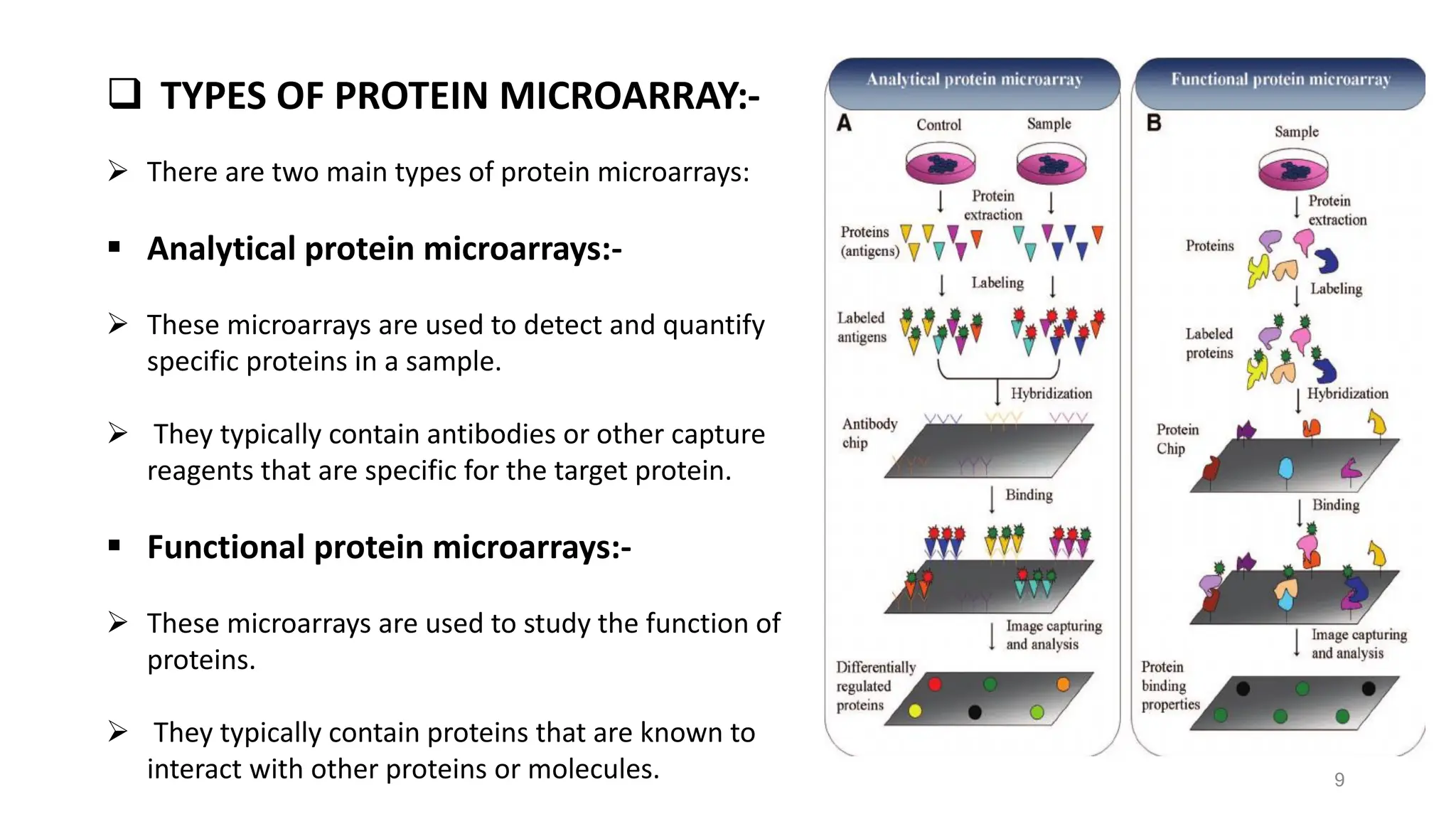
❑ TYPES OF PROTEIN MICROARRAY:-
➢ There are two main types of protein microarrays:
▪ Analytical protein microarrays:-
➢ These microarrays are used to detect and quantify
specific proteins in a sample.
➢ They typically contain antibodies or other capture
reagents that are specific for the target protein.
▪ Functional protein microarrays:-
➢ These microarrays are used to study the function of
proteins.
➢ They typically contain proteins that are known to
interact with other proteins or molecules. 9
APPLICATION:-
Drug discovery: Protein microarrays can be used to
identify new drug targets and to screen for
potential drug candidates.
Diagnostics: Protein microarrays can be used to
diagnose diseases and to monitor the progression
of diseases.
Proteomics research: Protein microarrays can be
used to study the expression and function of
proteins in cells and tissues.
Antibody characterization: Protein microarrays can
be used to characterize the specificity and affinity
of antibodies.
10
ANTISENSE TECHNOLOGIES: A
REVOLUTIONARY APPROACH
TO GENE EXPRESSION
❑ INTRODUCTION:-
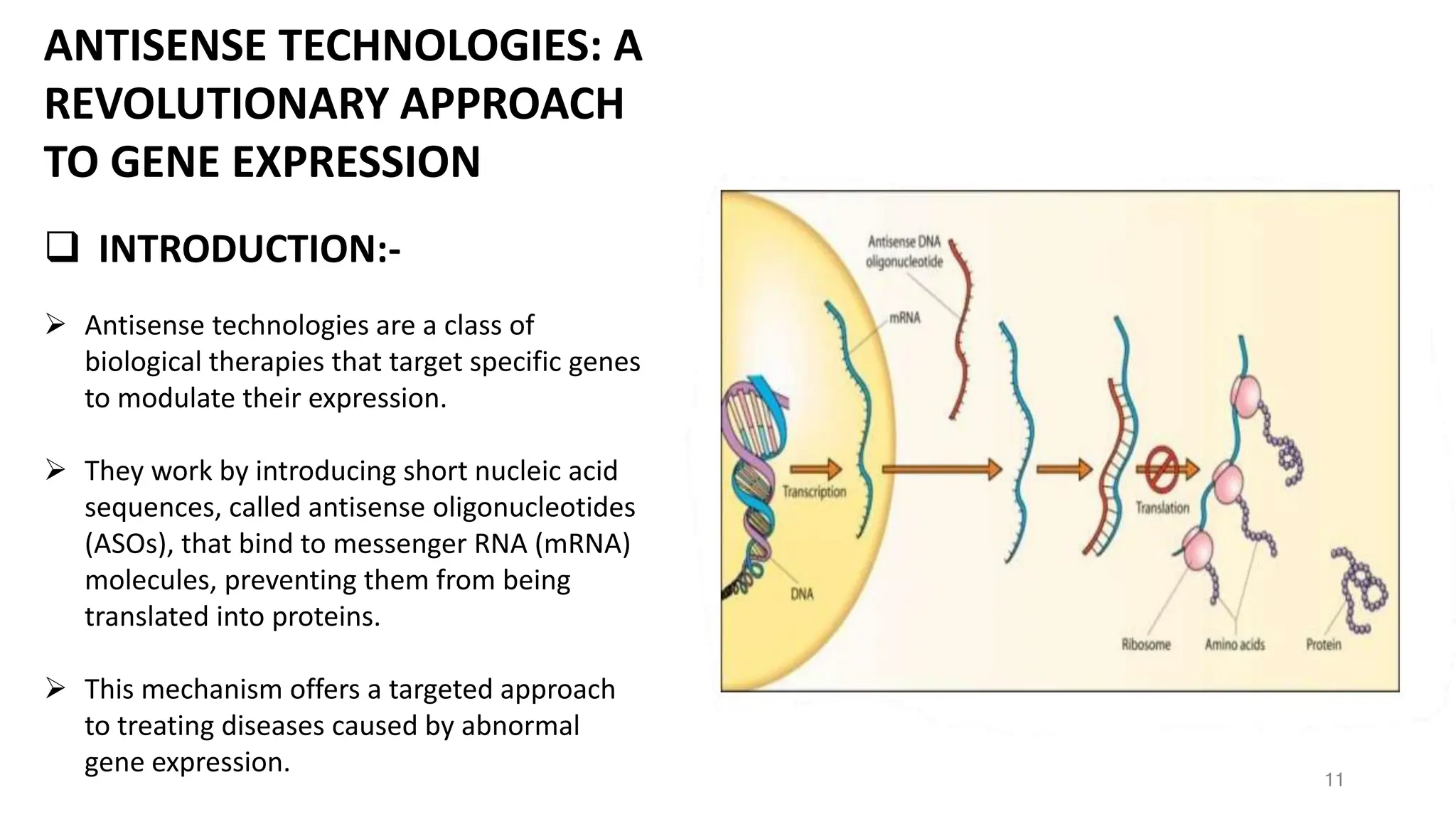
➢ Antisense technologies are a class of
biological therapies that target specific genes
to modulate their expression.
➢ They work by introducing short nucleic acid
sequences, called antisense oligonucleotides
(ASOs), that bind to messenger RNA (mRNA)
molecules, preventing them from being
translated into proteins.
➢ This mechanism offers a targeted approach
to treating diseases caused by abnormal
gene expression. 11
How Antisense
Technologies
Work:-
Target
Identification:
The first step is
to identify the
specific gene
involved in a
disease.
ASO Design:
Antisense
oligonucleotides
are designed to
be
complementary
to a specific
mRNA sequence.
Delivery: ASOs
are delivered to
the target cells,
often through
modified
chemical
backbones or
delivery vehicles
like
nanoparticles.
Binding: Once
inside the cell,
the ASO binds to
the target
mRNA, forming a
double-stranded
structure.
Inhibition: This
binding can
block
translation,
leading to
reduced protein
production.
Alternatively, it
can trigger the
degradation of
the mRNA by
cellular
enzymes.
12
❑ Types of Antisense Technologies:-
• Antisense Oligonucleotides (ASOs):
These are short, synthetic DNA or RNA
molecules that bind to mRNA.
• Ribozymes: These are RNA molecules
with catalytic activity that can cleave
mRNA.
• Small Interfering RNA (siRNA): These
are short double-stranded RNA molecules
that trigger the degradation of mRNA
through RNA interference (RNAi).
13
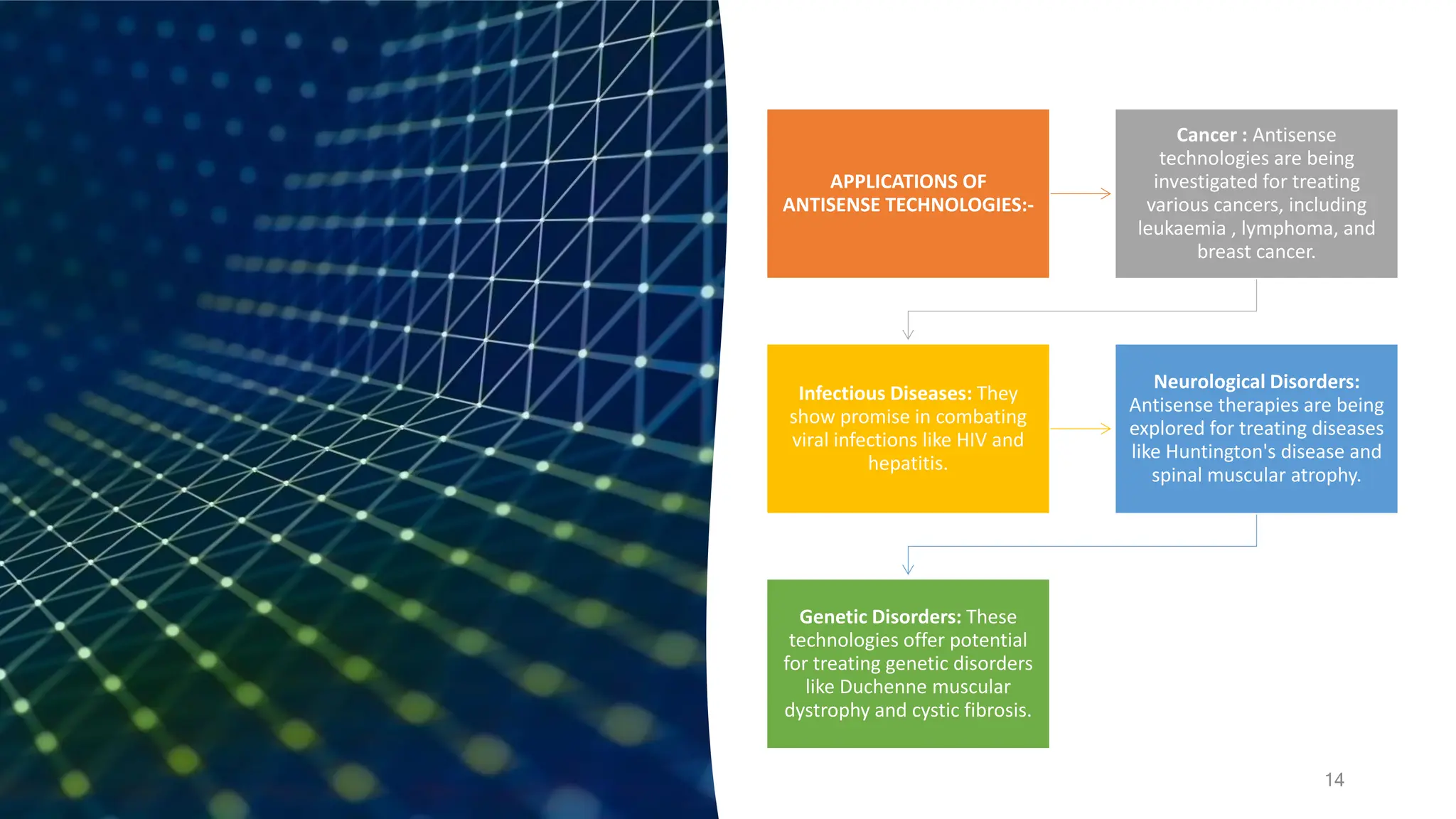
APPLICATIONS OF
ANTISENSE TECHNOLOGIES:-
Cancer : Antisense
technologies are being
investigated for treating
various cancers, including
leukaemia , lymphoma, and
breast cancer.
Infectious Diseases: They
show promise in combating
viral infections like HIV and
hepatitis.
Neurological Disorders:
Antisense therapies are being
explored for treating diseases
like Huntington's disease and
spinal muscular atrophy.
Genetic Disorders: These
technologies offer potential
for treating genetic disorders
like Duchenne muscular
dystrophy and cystic fibrosis.
14
15

Role of nucleic acid (DNA) microarrays, Protein microarrays and Antisense Technologies.pdf

  • 1.
    ROLE 0F NUCLEICACID MICROARRAYS,PROTEIN MICROARRAYS,ANTISENSENSE TECHNOLOGIES Abdullah M.Pharm(Pharmacology) Sem-II, Roll no-242577 Central University of Haryana, Jant-Pali, Mahendergarh, Haryana 1
  • 2.
    INTRODUCTION:- ❑ WHAT ISMICROARRAY? ➢ A microarray is a laboratory tool used to detect the expression of thousands of genes at the same time. ➢ Microarray helps in analyzing large amount of samples which have either been recorded previously or new samples. ➢ The microarray technique is been sub-classified based on the sample to be analyte:- ▪ DNA microarray ▪ Protein microarray ▪ Transfection microarray ▪ Antibody microarray ▪ Tissue microarray ▪ Chemical compound microarray 2
  • 3.
    ❑ DNA MICROARRAY:- ➢A DNA microarray also commonly known as DNA chip or biochip is a collection of microscopic DNA spots attached to solid support surface. ➢ Each DNA spot contain picomoles (10-12 moles) of specific DNA sequence known as probe or oligos. ➢ Each known gene or probe occupied a specific site on the chip and varying level of fluorescent activity show varying level of gene activity of introduced genetic material. 3
  • 4.
    ❑ DNA MICROARRAYOVERVIEW:- 4
  • 5.
    ❑ PRINCIPLE:- ➢ Thecore principle of microarray is HYBRIDIZATION. ➢ Samples are labelled using fluorescent dyes. ➢ Complementary nucleic acid get bind via hydrogen bonds. ➢ Washing of non specific bonding DNA. Sample Preparation and Labelling Hybridization Washing Image Acquisition and Data Analysis 5
  • 6.
  • 7.
    ❑PROTIEN MICROARRAY:- • Protein microarraysare miniaturized analytical devices that allow the simultaneous analysis of thousands of proteins. • They are similar to DNA microarrays, but instead of DNA molecules, they contain proteins or antibodies immobilized on a solid surface. • Protein microarrays have a wide range of applications in various fields, including drug discovery, diagnostics, and proteomics research. 7
  • 8.
    • PRINCIPLE:- • Proteinmicroarrays work by immobilizing a large number of proteins or antibodies on a solid surface, such as a glass slide or a silicon chip. • The immobilized proteins or antibodies can then be used to capture target proteins from a complex sample, such as blood or tissue lysate. • The captured proteins can be detected using a variety of methods, such as fluorescence or chemiluminescence. 8
  • 9.
    ❑ TYPES OFPROTEIN MICROARRAY:- ➢ There are two main types of protein microarrays: ▪ Analytical protein microarrays:- ➢ These microarrays are used to detect and quantify specific proteins in a sample. ➢ They typically contain antibodies or other capture reagents that are specific for the target protein. ▪ Functional protein microarrays:- ➢ These microarrays are used to study the function of proteins. ➢ They typically contain proteins that are known to interact with other proteins or molecules. 9
  • 10.
    APPLICATION:- Drug discovery: Proteinmicroarrays can be used to identify new drug targets and to screen for potential drug candidates. Diagnostics: Protein microarrays can be used to diagnose diseases and to monitor the progression of diseases. Proteomics research: Protein microarrays can be used to study the expression and function of proteins in cells and tissues. Antibody characterization: Protein microarrays can be used to characterize the specificity and affinity of antibodies. 10
  • 11.
    ANTISENSE TECHNOLOGIES: A REVOLUTIONARYAPPROACH TO GENE EXPRESSION ❑ INTRODUCTION:- ➢ Antisense technologies are a class of biological therapies that target specific genes to modulate their expression. ➢ They work by introducing short nucleic acid sequences, called antisense oligonucleotides (ASOs), that bind to messenger RNA (mRNA) molecules, preventing them from being translated into proteins. ➢ This mechanism offers a targeted approach to treating diseases caused by abnormal gene expression. 11
  • 12.
    How Antisense Technologies Work:- Target Identification: The firststep is to identify the specific gene involved in a disease. ASO Design: Antisense oligonucleotides are designed to be complementary to a specific mRNA sequence. Delivery: ASOs are delivered to the target cells, often through modified chemical backbones or delivery vehicles like nanoparticles. Binding: Once inside the cell, the ASO binds to the target mRNA, forming a double-stranded structure. Inhibition: This binding can block translation, leading to reduced protein production. Alternatively, it can trigger the degradation of the mRNA by cellular enzymes. 12
  • 13.
    ❑ Types ofAntisense Technologies:- • Antisense Oligonucleotides (ASOs): These are short, synthetic DNA or RNA molecules that bind to mRNA. • Ribozymes: These are RNA molecules with catalytic activity that can cleave mRNA. • Small Interfering RNA (siRNA): These are short double-stranded RNA molecules that trigger the degradation of mRNA through RNA interference (RNAi). 13
  • 14.
    APPLICATIONS OF ANTISENSE TECHNOLOGIES:- Cancer: Antisense technologies are being investigated for treating various cancers, including leukaemia , lymphoma, and breast cancer. Infectious Diseases: They show promise in combating viral infections like HIV and hepatitis. Neurological Disorders: Antisense therapies are being explored for treating diseases like Huntington's disease and spinal muscular atrophy. Genetic Disorders: These technologies offer potential for treating genetic disorders like Duchenne muscular dystrophy and cystic fibrosis. 14
  • 15.