RESEARCH METHODOLOGY
ROLE OF IOT(INTERNET OF THINGS)
SERVICES AND DEVICES IN THE
DEVELOPMENT OF SMART CITIES
Smart City
A Smart City is one that is able to link physical capital with social one,
and to develop better services and infrastructures. It is able to bring
together technology, information, and political vision, into a coherent
program of urban and service improvements.
Smart City is a city well performing in six characteristics:
- Smart Economy
- Smart Mobility
- Smart Environment
- Smart People
- Smart Living
- Smart Governance
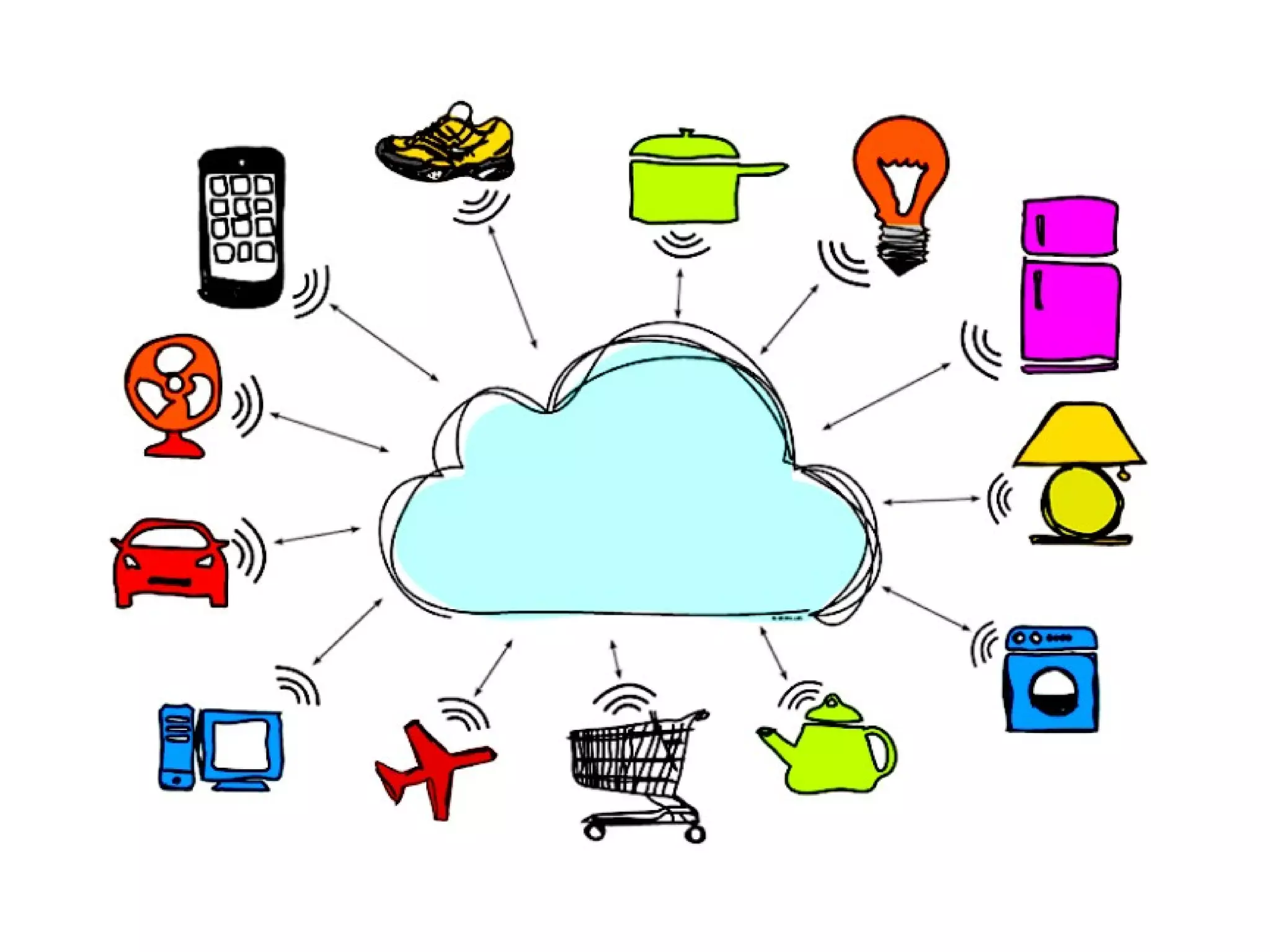
IOT(Internet Of Things)
INTERNET + THINGS = INTERNET of THINGS (IoT)
INTERNET
Internet is “a global network connecting millions of embedded
hardware devices (computer, smartphones, tablets) providing a
variety of information and communication facilities, consisting of
interconnected networks using standardized communication
protocols.”
THINGS
“Things refers to any physical objects with a device that has its
own IP address and can connect to a network also send/receive
data via a network.”
IOT
IOT
A network of physical objects or ‘things’ that can interact with each other to share
information and take action.
or
The Internet of Things (IoT) is the interconnection of uniquely identifiable
embedded computing devices within the existing Internet infrastructure.
Internet of Things involves three distinct stages:
1. the sensors which collect data (including identification and addressing the
sensor/device),
2. an application which collects and analyzes this data for further consolidation and,
3. Decision making and the transmission of data to the decision-making server.
Analytical engines and Big data may be used for the decision making process.
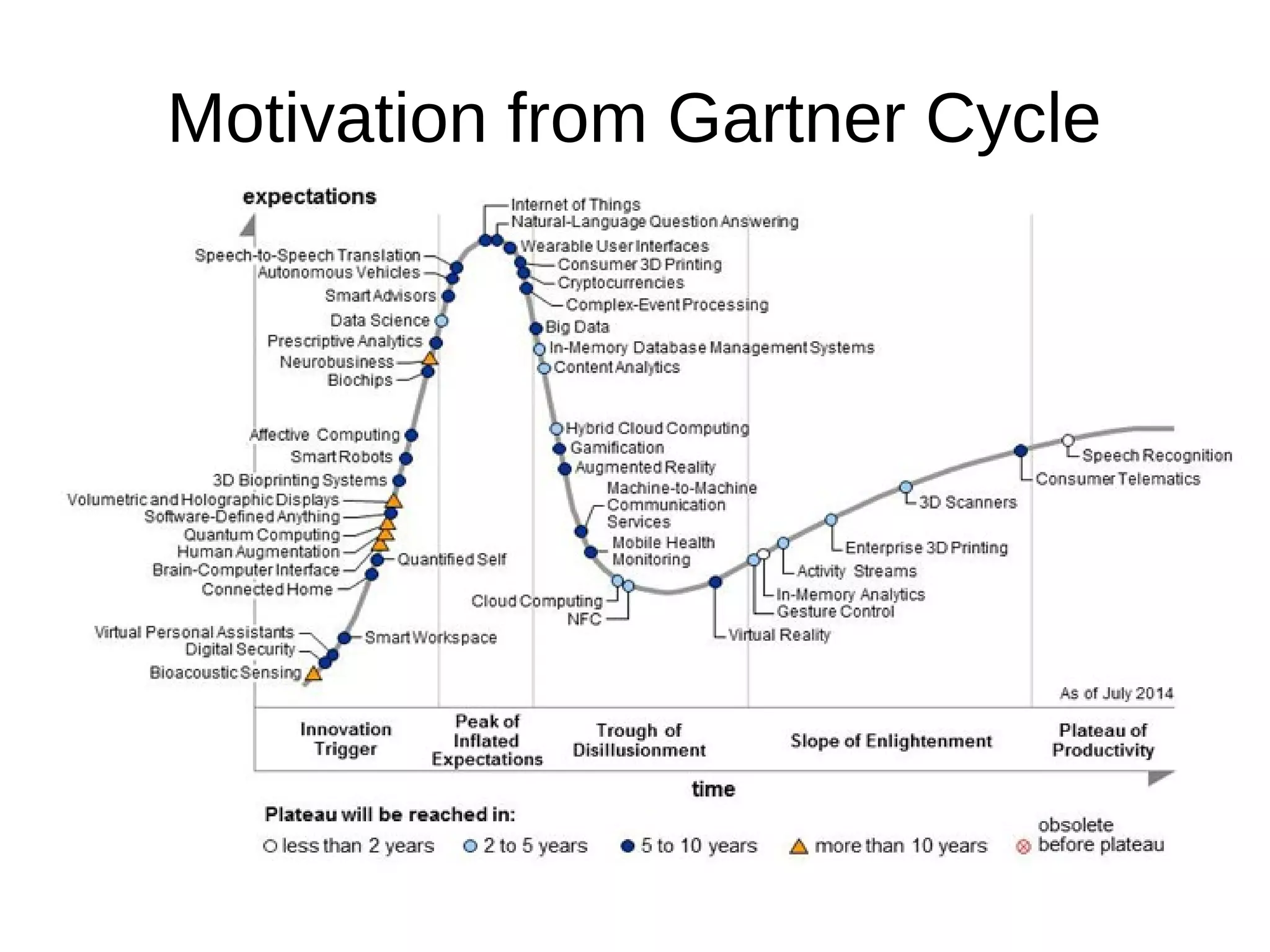
Motivation from Gartner Cycle
Problem Statement
It is necessary to use technological solution for Sustainable
development of Cities.
Objective
To study capabilities of presently available devices and services for the
development.
Hypothesis
Are existed IOT devices and services will enough to cater the needs and
demands of smart cities.
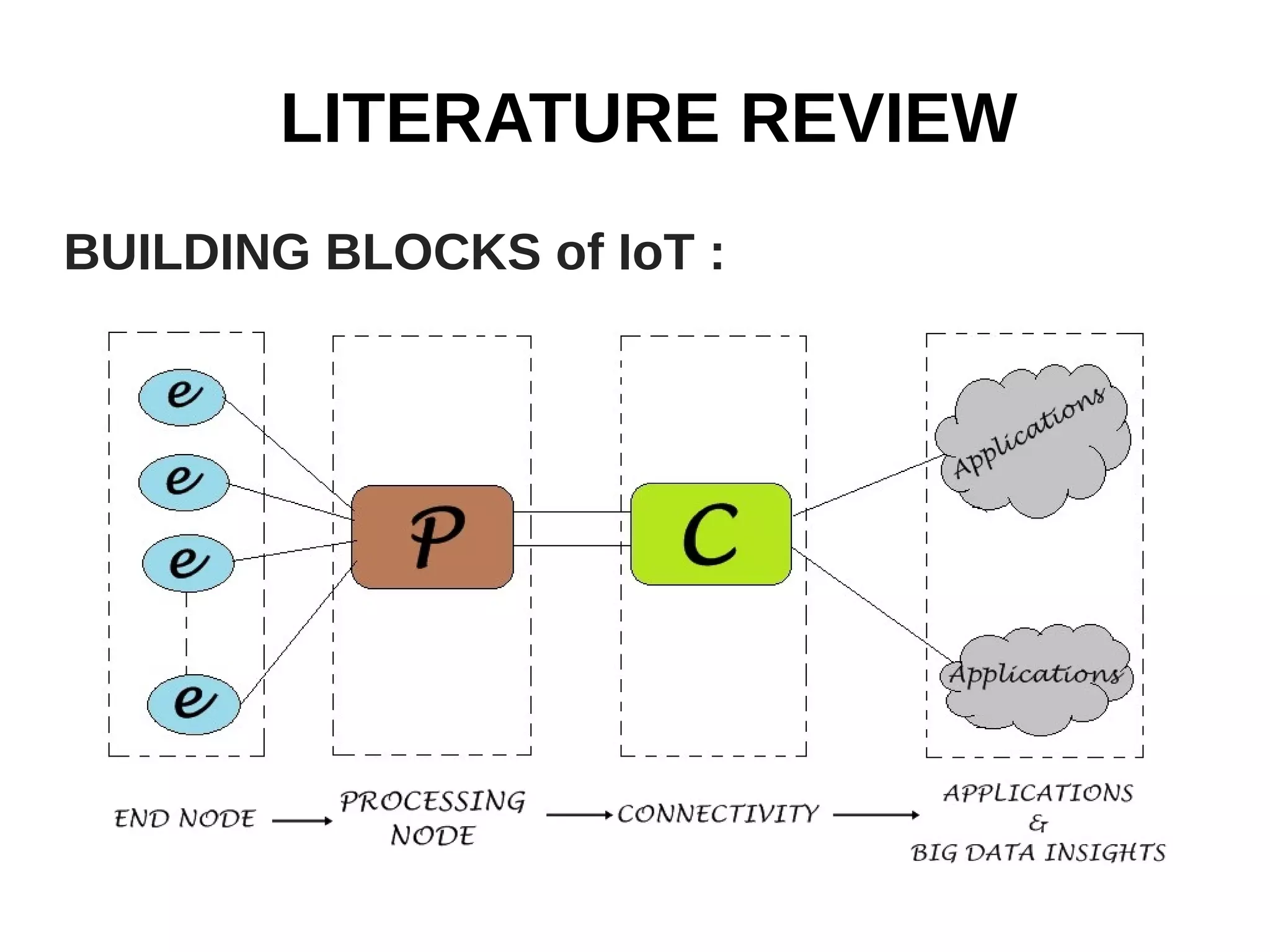
LITERATURE REVIEW
BUILDING BLOCKS of IoT :
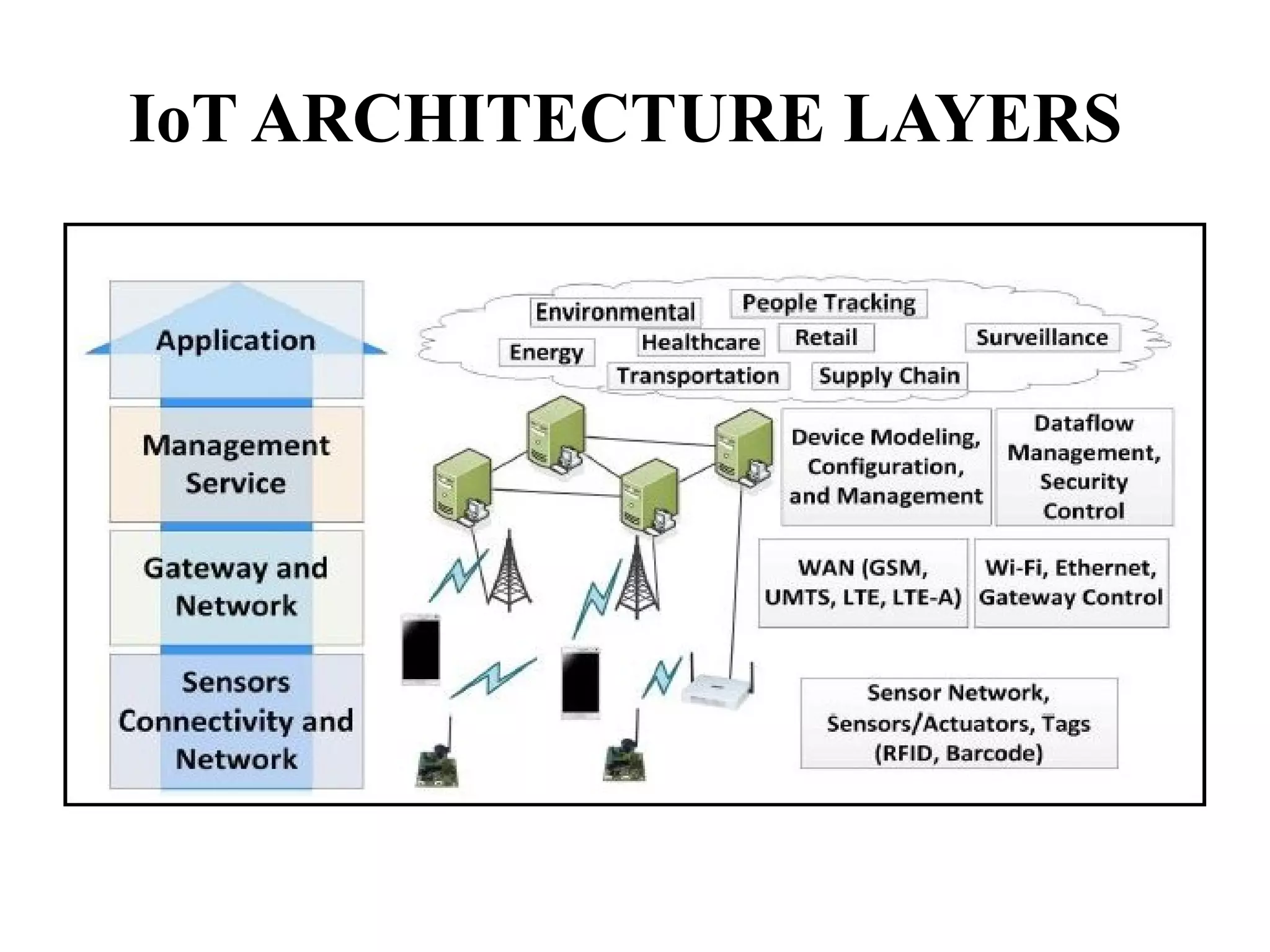
IoT ARCHITECTURE LAYERS
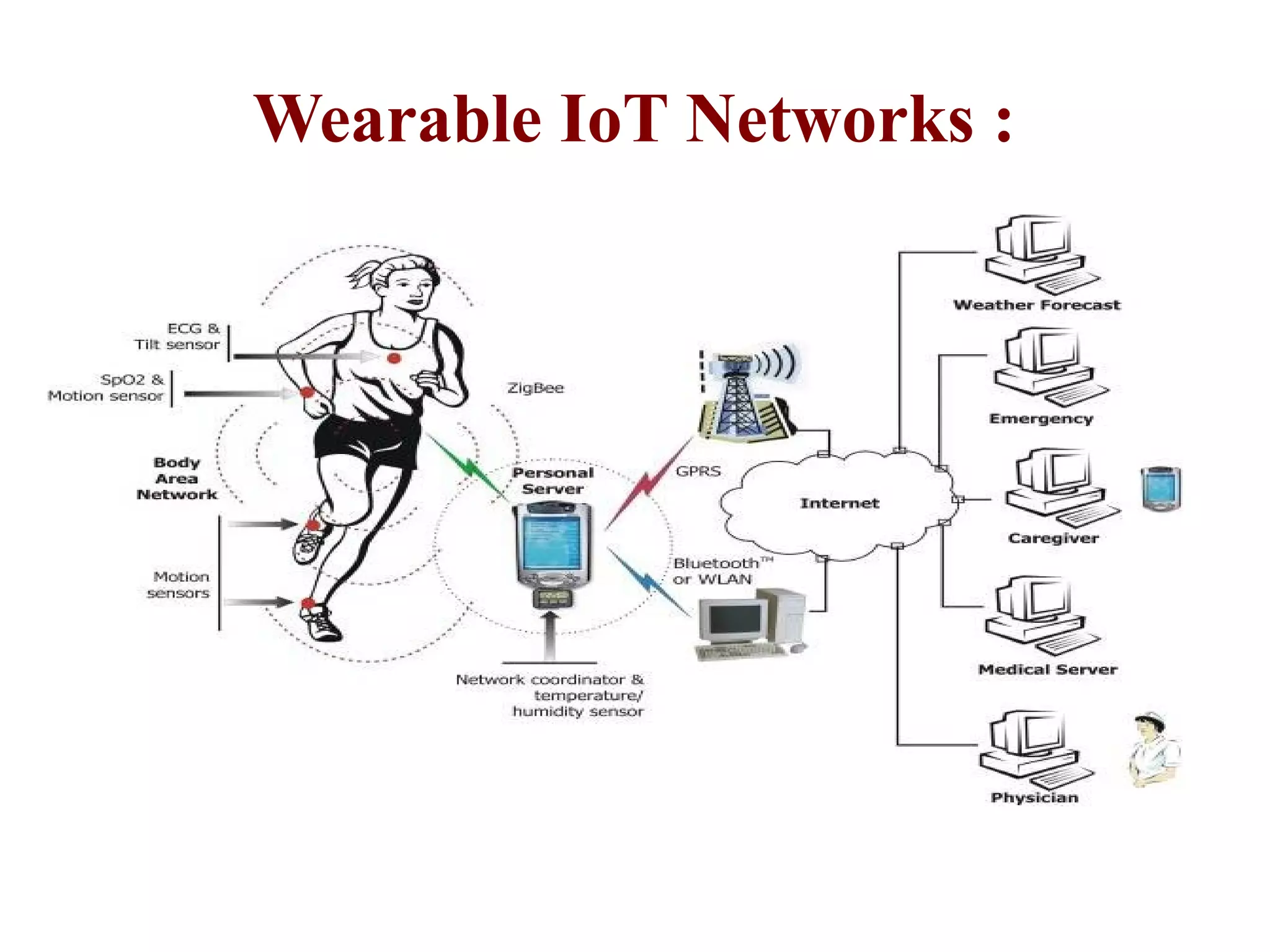
Wearable IoT Networks :
METHODOLOGY
Problem Statement :- It is necessary to use IOT solutions for
Sustainable development of Cities.
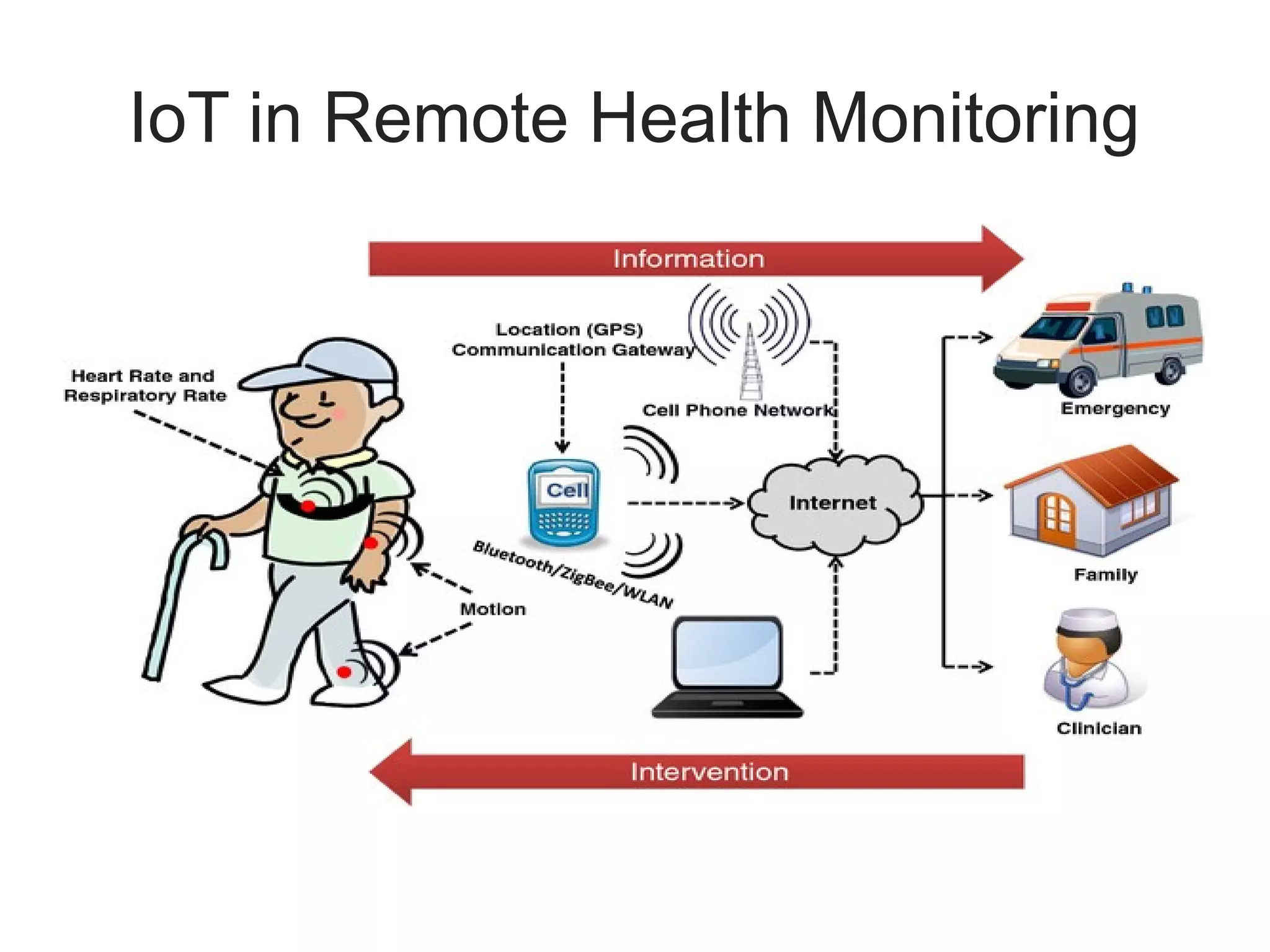
Internet of Things (IoT) have a key role to play in the development of
urbanization context because they can be applied to solve a variety of
cross-sectoral urban problems, and most of the time they do not require
large, expensive capital infrastructure. Potential urban uses of IoT
include geospatial tools for spatial planning, simulation and visualization
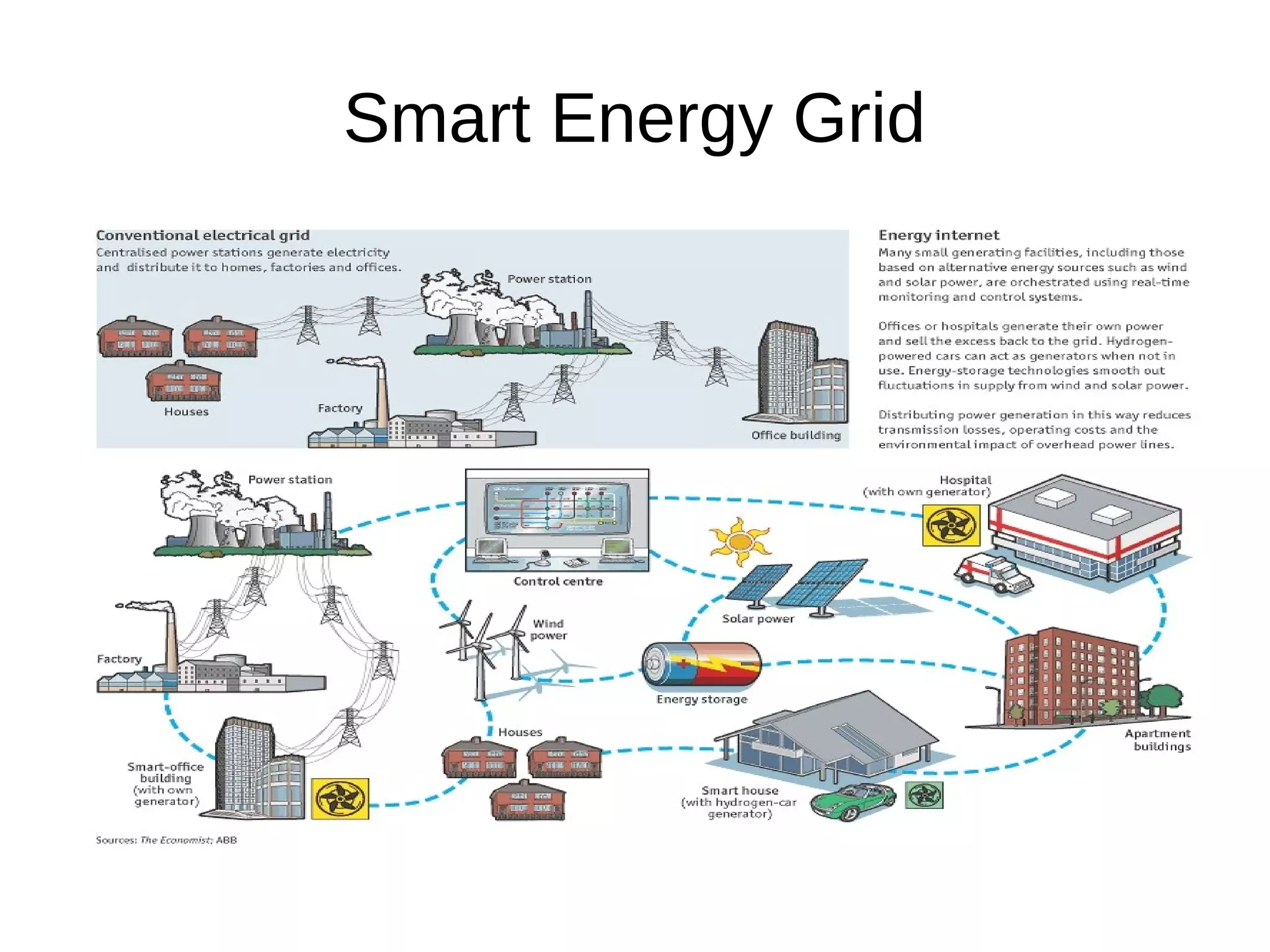
modelling, mobility tools, solutions for optimizing energy and water
management, disaster monitoring and response, and social inclusion.
IoT in Remote Health Monitoring
Smart Energy Grid
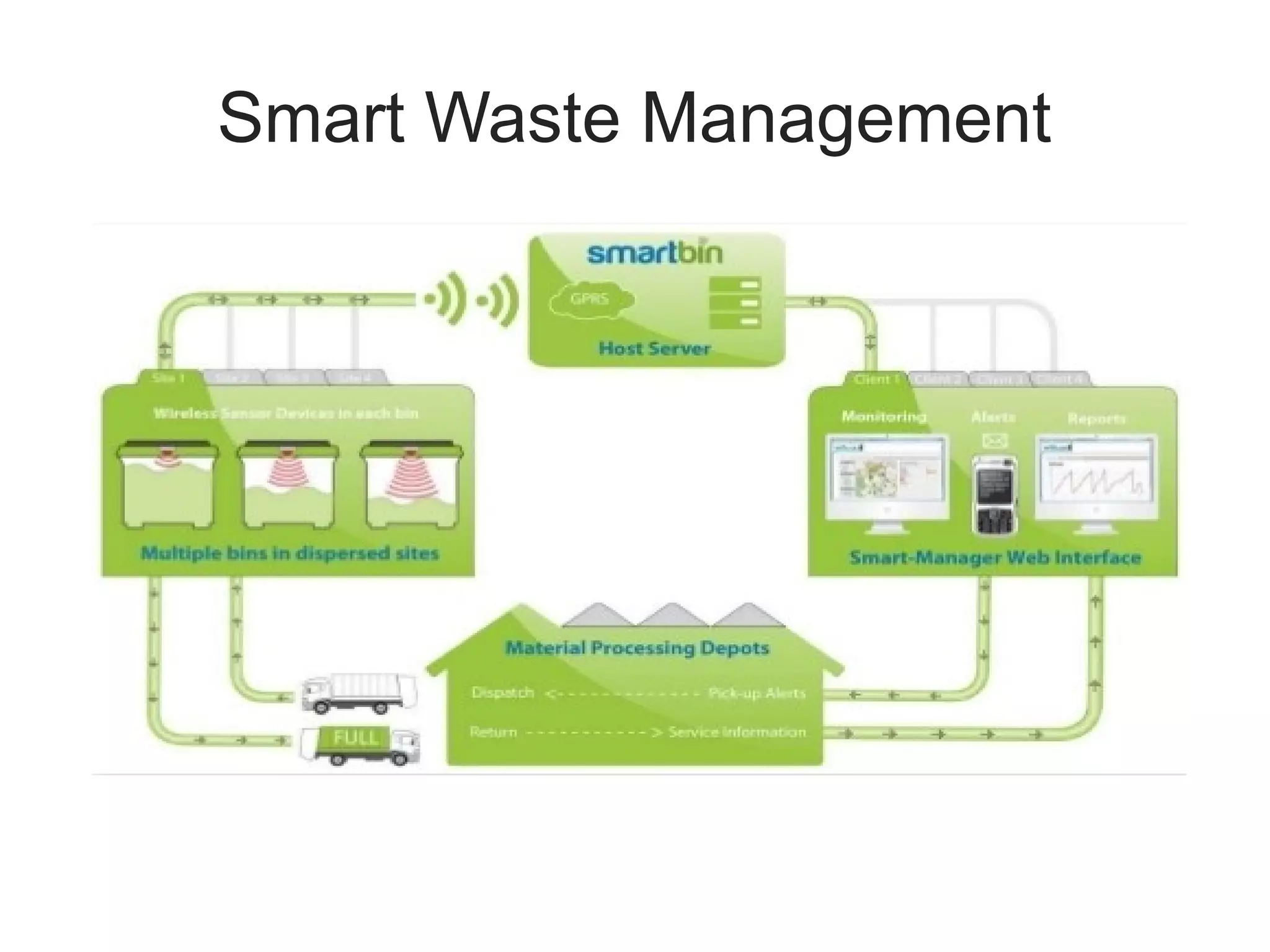
Smart Waste Management
Smart Devices
Objective
To study capabilities of presently available devices and services for the
development.
A smart device is an electronic device, generally connected to
other devices or networks via different wireless protocols such as
Bluetooth, NFC, WiFi, 3G, etc., that can operate to some extent
interactively and autonomously.“
Some of the smart devices are smartphones, tablets, smartwatches,
smart bands and smart key chains. The term smart device can also refer
to a ubiquitous computing device: a device that exhibits some properties
of ubiquitous computing.
Characteristics of smart devices
● A set of system hardware & software ICT (Information and Communication
Technology) resources. This set is usually static fixed at design time.
● Dynamic component-oriented resource extensions & plug-ins (Plug and
Play) of some hardware resources.
● Remote external service access and execution.
● Local, internal autonomous service execution.
● Access to specific external environments: human interaction, physical
world interaction and distributed ICT / virtual computing interaction.
IoT TECHNOLOGIES
● RFID (Radio Frequency Identification)
● WSN (Wireless Sensor Networks)
● IoT Cloud Computing Support
● Cloud Computing :
IoT applications will need support from a reliable, fast, and agile computing platform.
IoT devices can overcome lack of Software, Firmware, Memory Storage, Hardware, Data
Processing capability through Cloud computing.
Cloud service models –
SaaS (Software as a Service)
PaaS (Platform as a Service)
IaaS (Infrastructure as a Service)
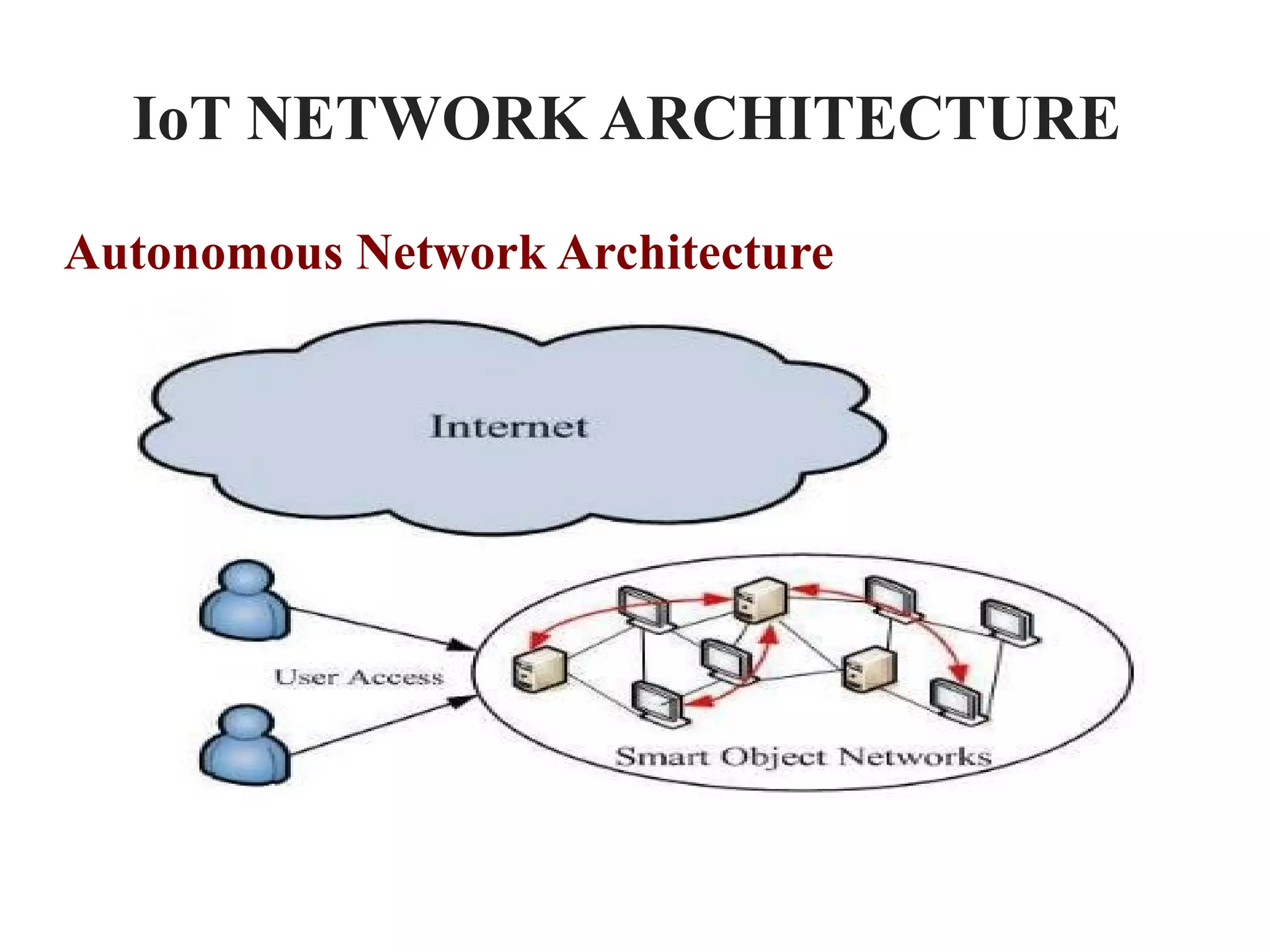
IoT NETWORK ARCHITECTURE
Autonomous Network Architecture
Study of Various Available Devices
● HC-05/HC-06
● BlueSMiRF HID
● CC3000 Wi-fi Breakout
● ESP8266 Wi-fi
● Electric Imp
● Xbee Wifi S6B
● Rasberry Pi
Major Players in Cloud Services
 Temboo
 TempoIQ
 Xively
 IBM Bluemix
 AWS for IOT
 Google cloud services for IOT and many more
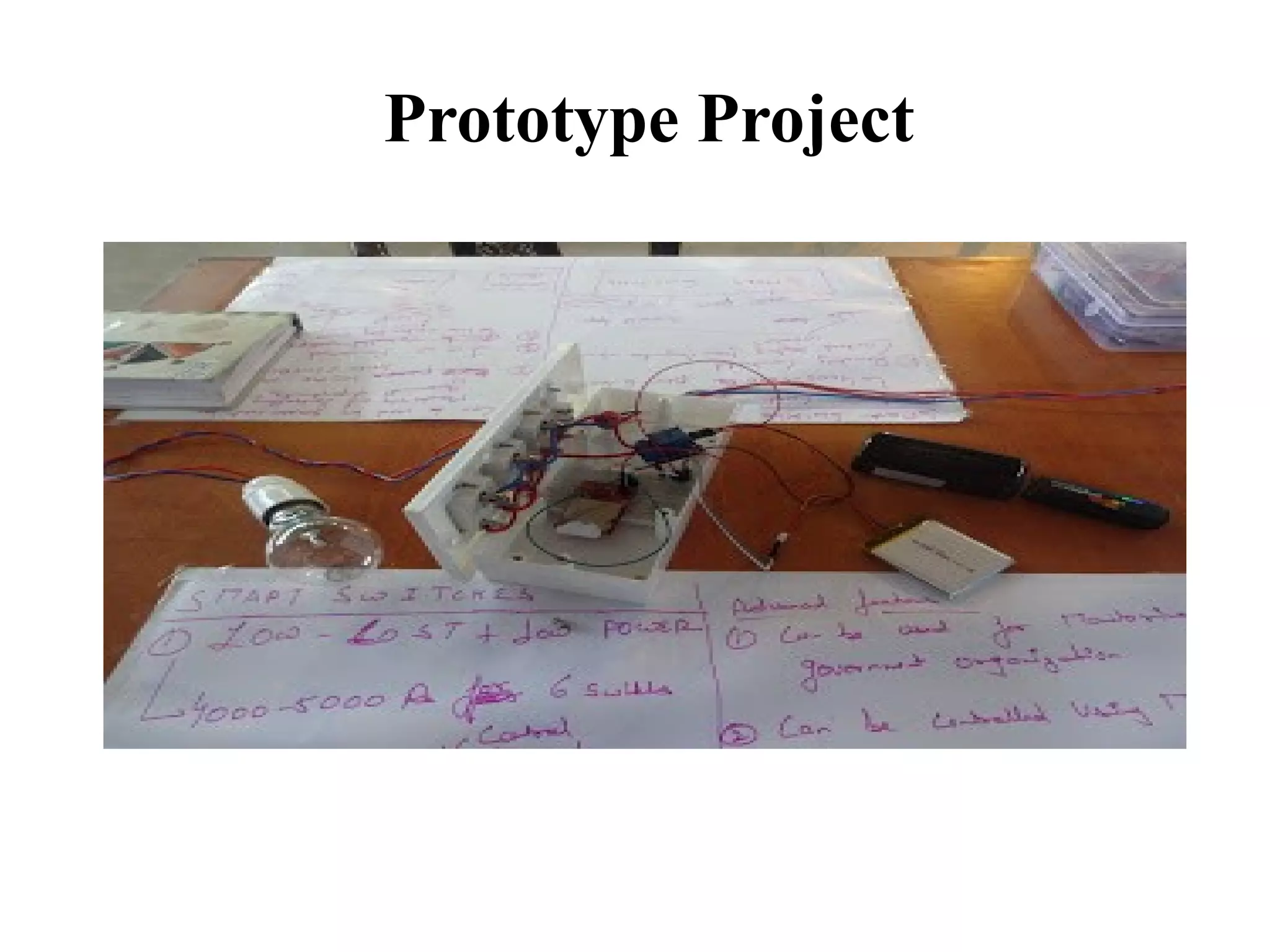
Prototype Project
● By 2020, 20% of the computers will learn not only to process
but also work and manage things like humans.
● By 2017, 65% of data center capacity will be private.
Companies will compete across industry borders – which
means, companies are going to compete with their rivals
outside industries as well.
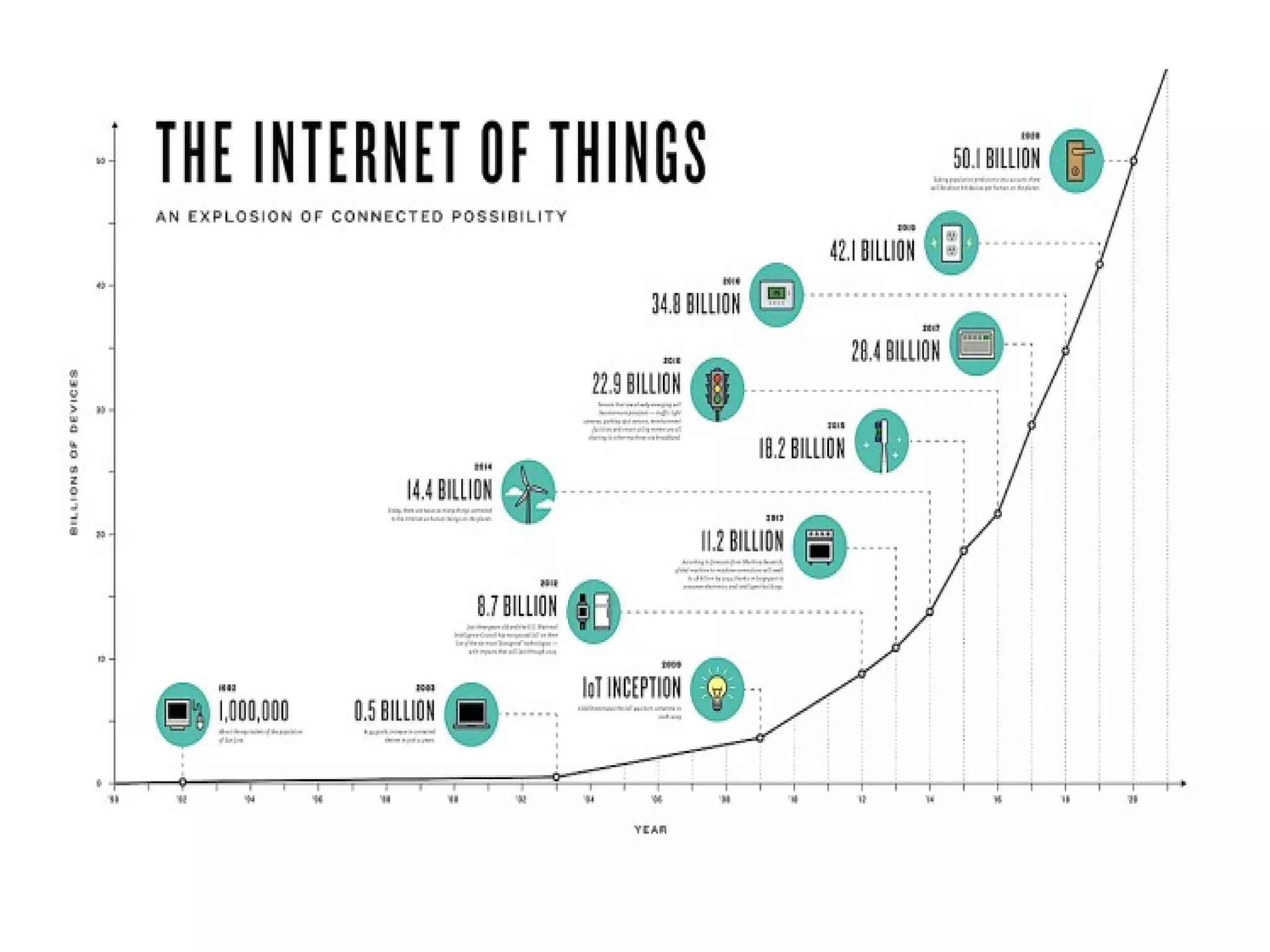
● By 2020, around 50 billion devices are going to be
connected.
References
1. Internet of Things (IoT): A vision, architectural elements, and future directions
Jayavardhana Gubbia, Rajkumar Buyyab,∗, Slaven Marusica, Marimuthu Palaniswami
Future Generation Computer Systems 29 (2013) 1645–1660
2. Commission on Science and Technology for Development, Sixteenth session
Geneva, 3–7 June 2013, United Nations Economic and Social Council
E/CN.16/2013/2
3 IoT Policy Document by deity, Government of India
4. https://opentechdiary.wordpress.com/2015/07/15/a-walk-through-internet-of-things-
iot-basics-part-1/
5. https://learn.sparkfun.com/tutorials/electric-imp-breakout-hookup-guide
6. http://www.forbes.com/sites/janakirammsv/2015/04/13/6-iot-startups-that-make-
connecting-things-to-the-cloud-a-breeze/

Role of IOT devices and servcies in the development of smart cities.

  • 1.
    RESEARCH METHODOLOGY ROLE OFIOT(INTERNET OF THINGS) SERVICES AND DEVICES IN THE DEVELOPMENT OF SMART CITIES
  • 2.
    Smart City A SmartCity is one that is able to link physical capital with social one, and to develop better services and infrastructures. It is able to bring together technology, information, and political vision, into a coherent program of urban and service improvements. Smart City is a city well performing in six characteristics: - Smart Economy - Smart Mobility - Smart Environment - Smart People - Smart Living - Smart Governance
  • 3.
    IOT(Internet Of Things) INTERNET+ THINGS = INTERNET of THINGS (IoT) INTERNET Internet is “a global network connecting millions of embedded hardware devices (computer, smartphones, tablets) providing a variety of information and communication facilities, consisting of interconnected networks using standardized communication protocols.” THINGS “Things refers to any physical objects with a device that has its own IP address and can connect to a network also send/receive data via a network.”
  • 5.
    IOT IOT A network ofphysical objects or ‘things’ that can interact with each other to share information and take action. or The Internet of Things (IoT) is the interconnection of uniquely identifiable embedded computing devices within the existing Internet infrastructure. Internet of Things involves three distinct stages: 1. the sensors which collect data (including identification and addressing the sensor/device), 2. an application which collects and analyzes this data for further consolidation and, 3. Decision making and the transmission of data to the decision-making server. Analytical engines and Big data may be used for the decision making process.
  • 6.
  • 7.
    Problem Statement It isnecessary to use technological solution for Sustainable development of Cities. Objective To study capabilities of presently available devices and services for the development. Hypothesis Are existed IOT devices and services will enough to cater the needs and demands of smart cities.
  • 8.
  • 9.
  • 10.
  • 11.
    METHODOLOGY Problem Statement :-It is necessary to use IOT solutions for Sustainable development of Cities. Internet of Things (IoT) have a key role to play in the development of urbanization context because they can be applied to solve a variety of cross-sectoral urban problems, and most of the time they do not require large, expensive capital infrastructure. Potential urban uses of IoT include geospatial tools for spatial planning, simulation and visualization modelling, mobility tools, solutions for optimizing energy and water management, disaster monitoring and response, and social inclusion.
  • 13.
    IoT in RemoteHealth Monitoring
  • 14.
  • 15.
  • 16.
    Smart Devices Objective To studycapabilities of presently available devices and services for the development. A smart device is an electronic device, generally connected to other devices or networks via different wireless protocols such as Bluetooth, NFC, WiFi, 3G, etc., that can operate to some extent interactively and autonomously.“ Some of the smart devices are smartphones, tablets, smartwatches, smart bands and smart key chains. The term smart device can also refer to a ubiquitous computing device: a device that exhibits some properties of ubiquitous computing.
  • 17.
    Characteristics of smartdevices ● A set of system hardware & software ICT (Information and Communication Technology) resources. This set is usually static fixed at design time. ● Dynamic component-oriented resource extensions & plug-ins (Plug and Play) of some hardware resources. ● Remote external service access and execution. ● Local, internal autonomous service execution. ● Access to specific external environments: human interaction, physical world interaction and distributed ICT / virtual computing interaction.
  • 18.
    IoT TECHNOLOGIES ● RFID(Radio Frequency Identification) ● WSN (Wireless Sensor Networks) ● IoT Cloud Computing Support ● Cloud Computing : IoT applications will need support from a reliable, fast, and agile computing platform. IoT devices can overcome lack of Software, Firmware, Memory Storage, Hardware, Data Processing capability through Cloud computing. Cloud service models – SaaS (Software as a Service) PaaS (Platform as a Service) IaaS (Infrastructure as a Service)
  • 19.
  • 20.
    Study of VariousAvailable Devices ● HC-05/HC-06 ● BlueSMiRF HID ● CC3000 Wi-fi Breakout ● ESP8266 Wi-fi ● Electric Imp ● Xbee Wifi S6B ● Rasberry Pi
  • 21.
    Major Players inCloud Services  Temboo  TempoIQ  Xively  IBM Bluemix  AWS for IOT  Google cloud services for IOT and many more
  • 22.
  • 24.
    ● By 2020,20% of the computers will learn not only to process but also work and manage things like humans. ● By 2017, 65% of data center capacity will be private. Companies will compete across industry borders – which means, companies are going to compete with their rivals outside industries as well. ● By 2020, around 50 billion devices are going to be connected.
  • 25.
    References 1. Internet ofThings (IoT): A vision, architectural elements, and future directions Jayavardhana Gubbia, Rajkumar Buyyab,∗, Slaven Marusica, Marimuthu Palaniswami Future Generation Computer Systems 29 (2013) 1645–1660 2. Commission on Science and Technology for Development, Sixteenth session Geneva, 3–7 June 2013, United Nations Economic and Social Council E/CN.16/2013/2 3 IoT Policy Document by deity, Government of India 4. https://opentechdiary.wordpress.com/2015/07/15/a-walk-through-internet-of-things- iot-basics-part-1/ 5. https://learn.sparkfun.com/tutorials/electric-imp-breakout-hookup-guide 6. http://www.forbes.com/sites/janakirammsv/2015/04/13/6-iot-startups-that-make- connecting-things-to-the-cloud-a-breeze/