Internet das Coisas e
          Smart Cities
Gustavo Henrique Rodrigues Pinto Tomas (ghrpt@cin.ufpe.br)
      Welington Manoel da Silva (wms4@cin.ufpe.br)
Agenda
•   Internet das coisas
    o   Paradigma IoT
    o   Tecnologias
    o   Arquitetura de middleware
    o   Aplicações
    o   Desafios
•   Smart Cities
    o   O que é?
    o   Estrutura de uma Smart City
    o   Smart Community
    o   Smar Home
    o   Desafios
•   IoT e Smart Cities
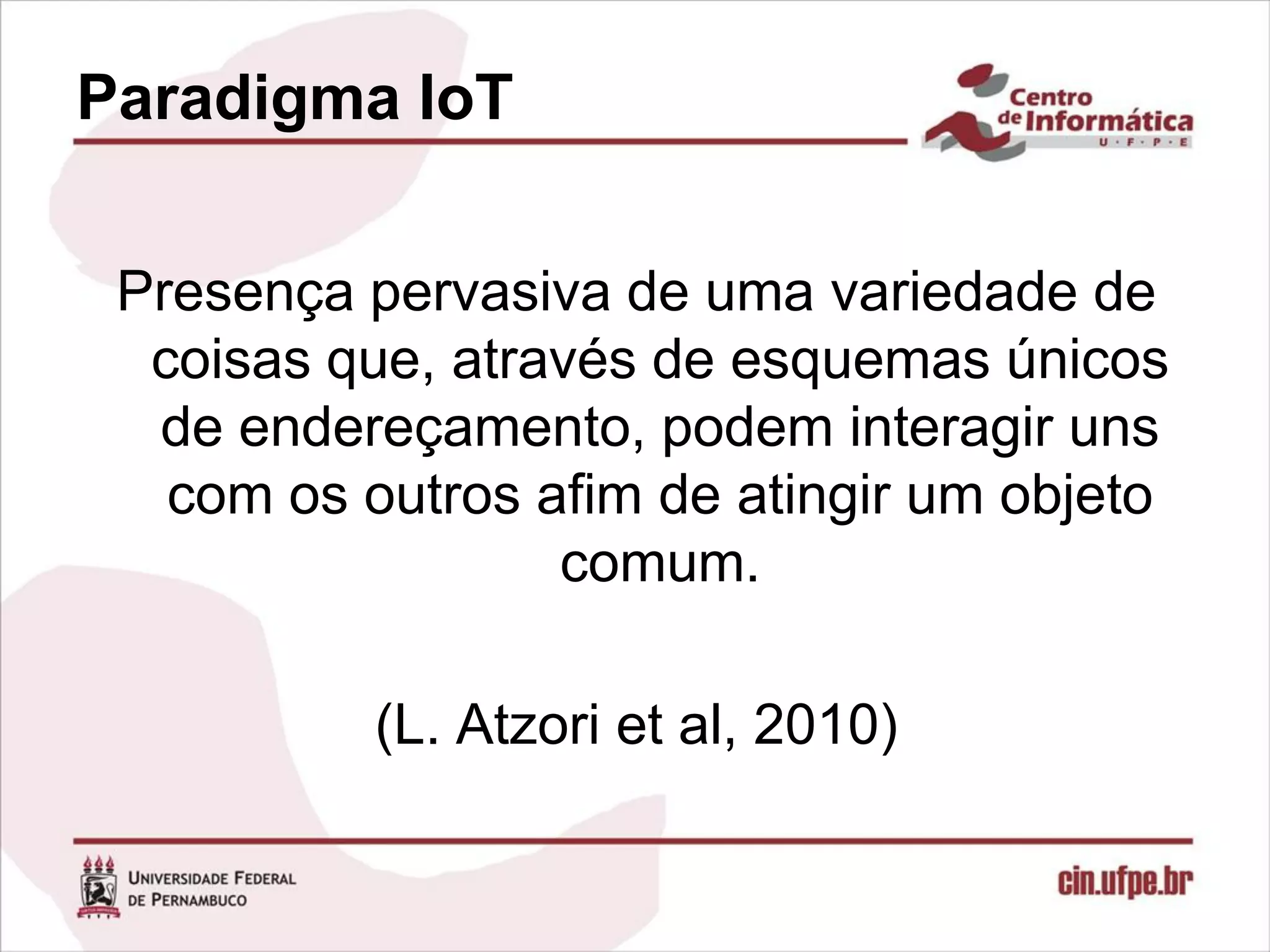
Paradigma IoT


 Presença pervasiva de uma variedade de
  coisas que, através de esquemas únicos
  de endereçamento, podem interagir uns
   com os outros afim de atingir um objeto
                  comum.

           (L. Atzori et al, 2010)
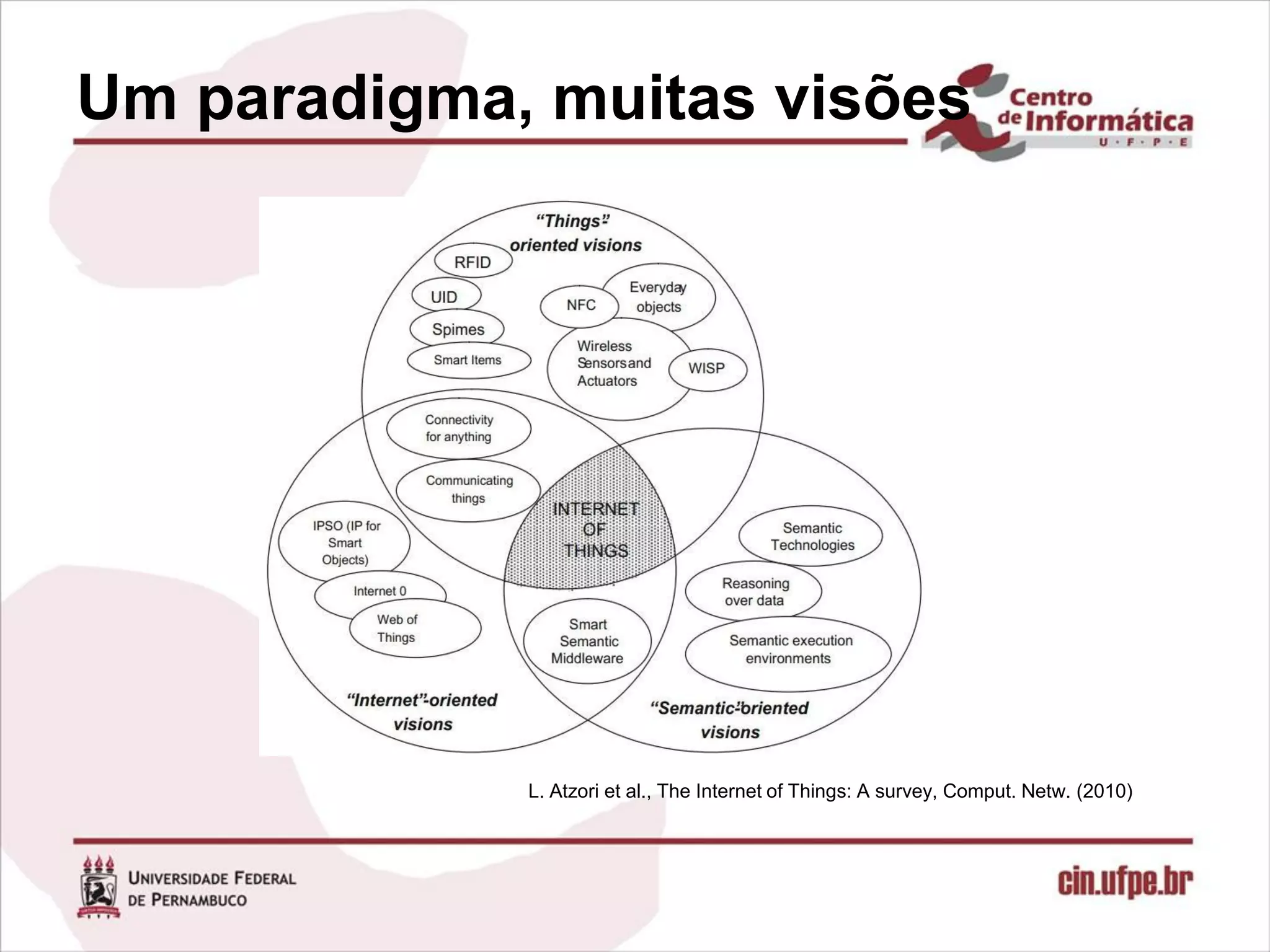
Um paradigma, muitas visões


             L. Atzori et al., The Internet of Things: A survey, Comput. Netw. (2010)
Tecnologias
•   Identificação, sensoriamento e comunicação
    o   RFID
    o   Rede de Sensores
          ZigBee
          ...
    o   IEEE 802.14.4
    o   ...
•   Middleware
    o Service Oriented Architecture
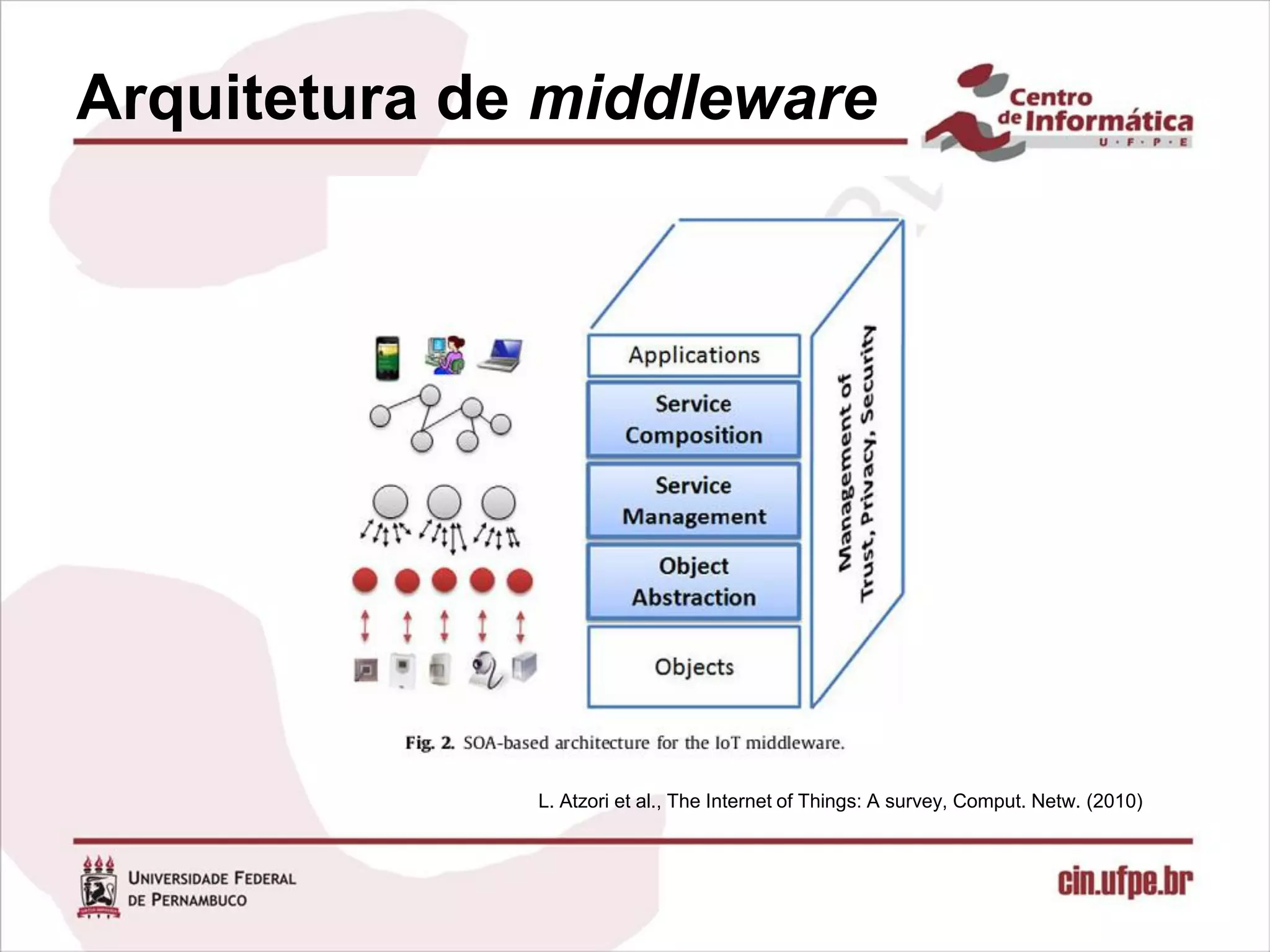
Arquitetura de middleware


              L. Atzori et al., The Internet of Things: A survey, Comput. Netw. (2010)
Aplicações
• Transporte
• Logística
• Saúde
• Sensoriamento
• Qualidade de vida
• ...
Desafios
• Segurança
  o Ataque físico
  o Ataque wireless
  o Baixo poder computacional

• Privacidade
  o Legislação de cada país
  o "Problema enquanto os usuários não usam"
  o Quem vai coletar o dado? Quando?
Smart Cities
Smart City - O que é?
       "The next generation information technology to
    all walks of life..." - Samuel Palmisano – IBM, 2009
                                                 (SU; LI; FU, 2011)


  "Smart city as the use of information and communication
       technology to sense, analyze and integrate the key
   information of core systems in running cities. At the same
   time, smart city can make intelligent response to different
    kinds of needs, including daily livelihood, environmental
    protection, public safety and city services, industrial and
                      commercial activities."
                                              (QIN; LI; ZHAO, 2010)
Smat City - O que é?

"A Smart City provides ubiquitous connectivity, future-proof
         broadband capacity and total wireless fidelity,
     with IP-enabled devices communicating and being
   managed through a control center, allowing tenants,
       residents, and visitors’ real-time access to key
   information about their environment from anywhere."
                             (International Data Corporation)
                                             (PAN et al,2011)
Smart, porém simples

  "Cities must use new technologies to transform their
  systems to optimize the use of finite resources. The
    topics of the optimization include Transportation,
 Public Safety, Energy/Utilities, Healthcare, Education,
                   and Developments."
                                                       (IBM)
                                           (PAN et al,2011)
Quão smart?


•   Smart Environment
•   Smart Business
•   Smart Citizens
•   Smart Government
           (PAN et al, 2011)
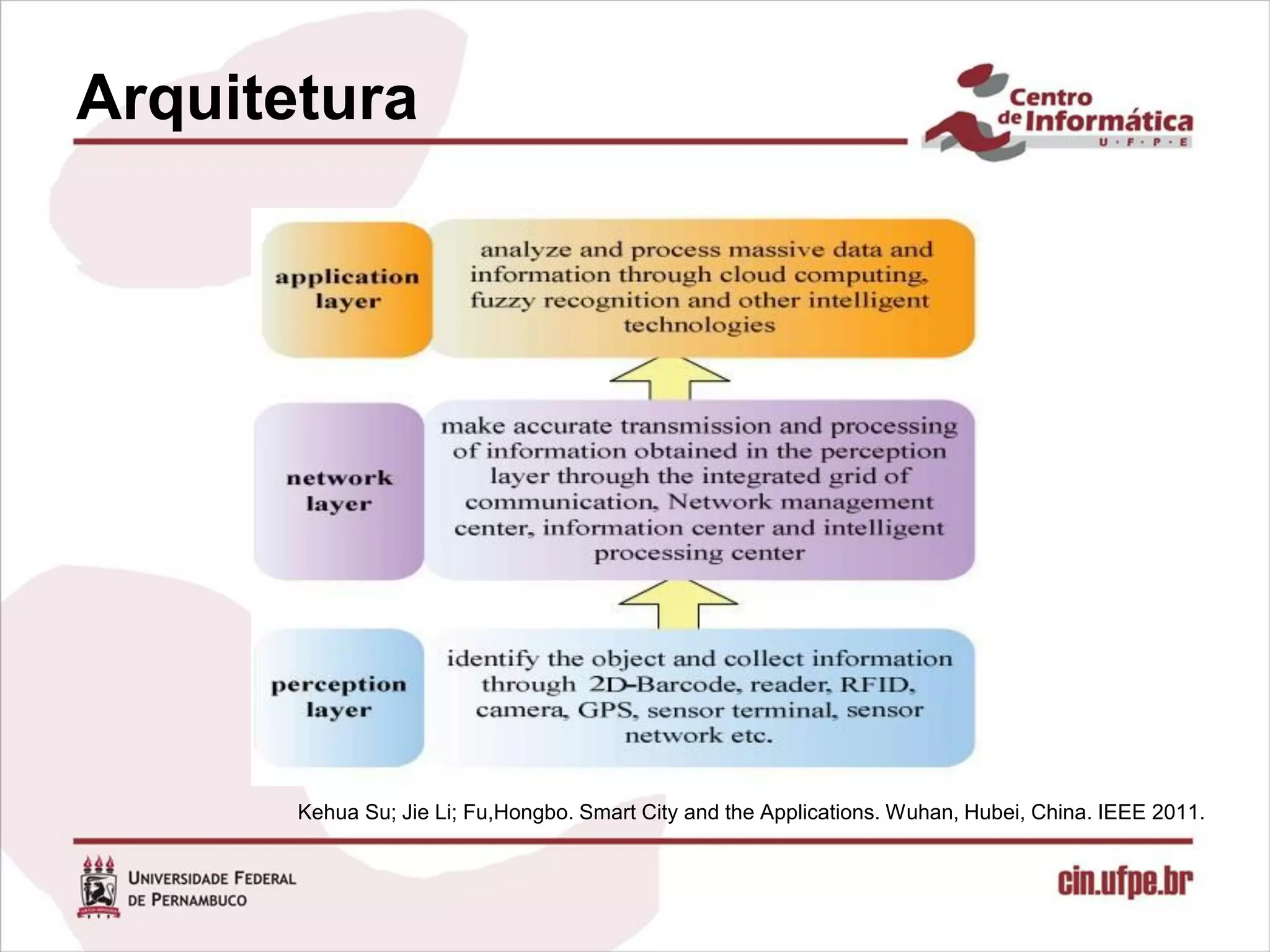
Arquitetura


       Kehua Su; Jie Li; Fu,Hongbo. Smart City and the Applications. Wuhan, Hubei, China. IEEE 2011.
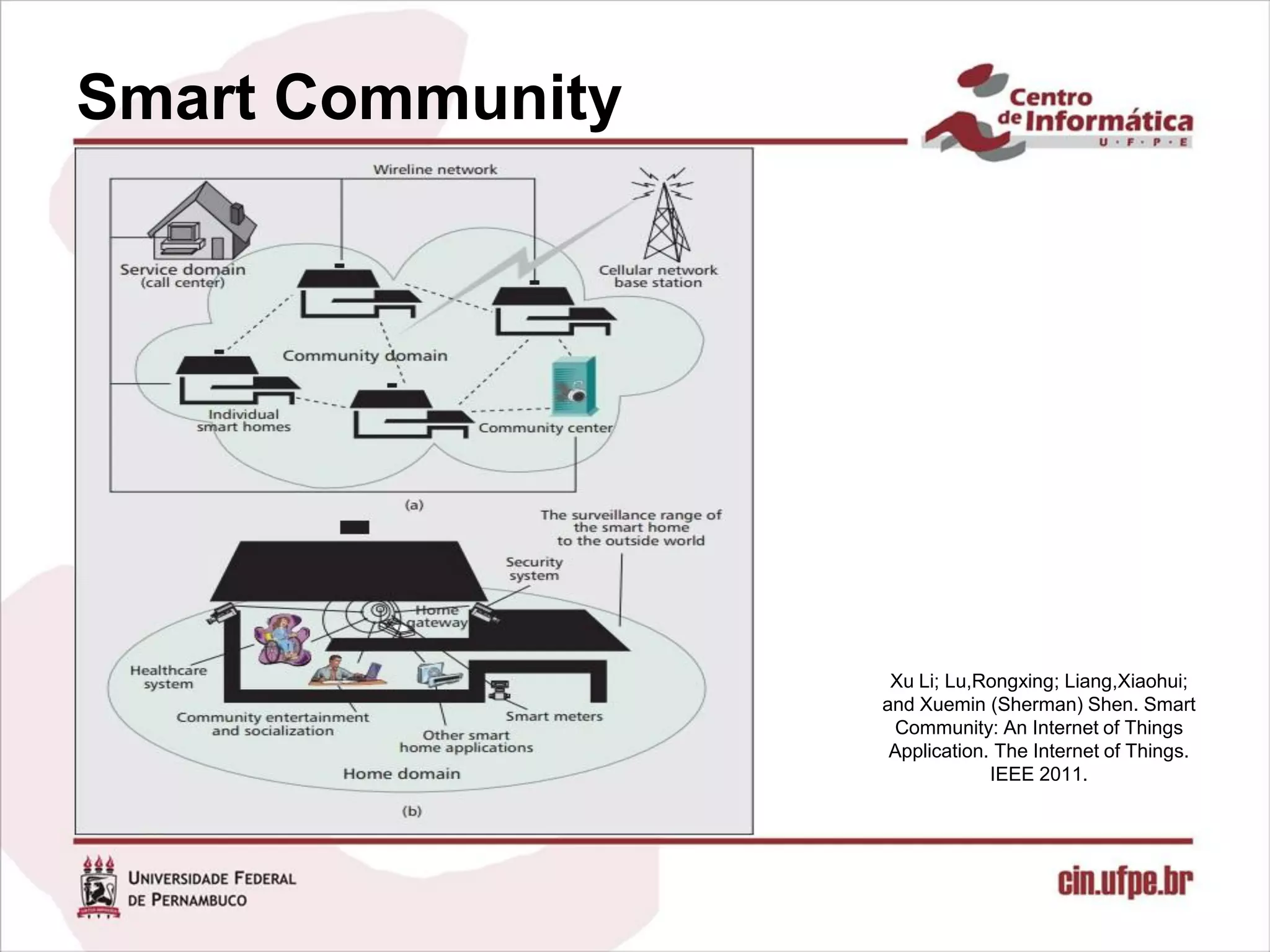
Smart Community


                   Xu Li; Lu,Rongxing; Liang,Xiaohui;
                  and Xuemin (Sherman) Shen. Smart
                   Community: An Internet of Things
                   Application. The Internet of Things.
                               IEEE 2011.
Smart Homes


"[A building with implemented passive energy efficiency
measures], [central computer operated infrastructure
systems], [networked appliances, advanced energy
management and renewable energy sources]."
                            (LUGARIC; KRAJCAR; SIMIC, 2010)
Composição de Smart homes
• Sensores
• Atuadores
• Controladores
• Unidade Central
• Interface
• Rede
• Medição inteligente
                    (LUGARIC; KRAJCAR; SIMIC, 2010)
Smart Grids


  "...integration of actions of generators, transmission
   and distribution system operators, monitoring and
   control centers, suppliers and consumers through
           exchange of information in real time."
                             (LUGARIC; KRAJCAR; SIMIC, 2010)
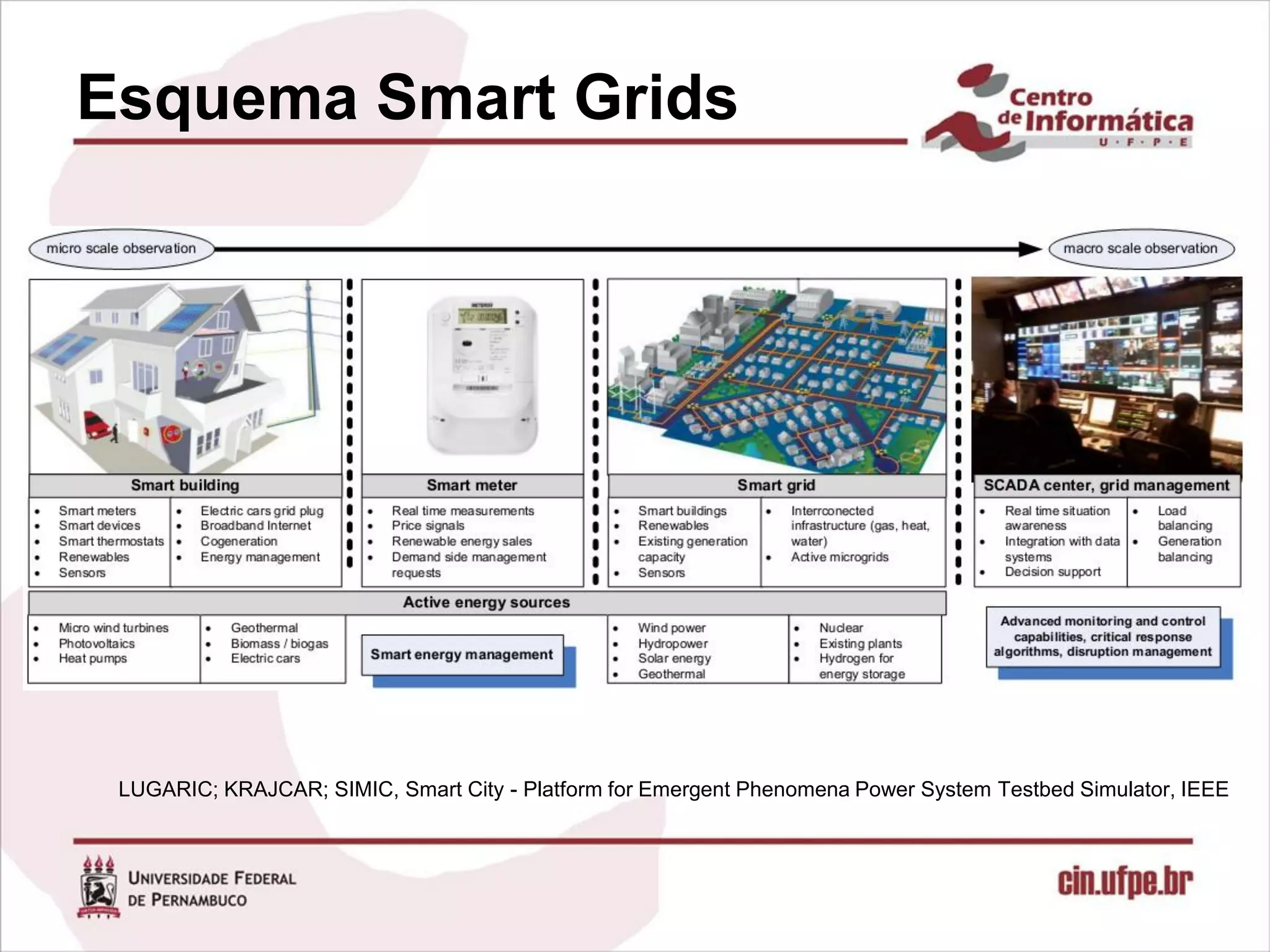
Esquema Smart Grids


 LUGARIC; KRAJCAR; SIMIC, Smart City - Platform for Emergent Phenomena Power System Testbed Simulator, IEEE
A tecnologia envolvida


   "Modem systems will have to act more anticipatory:
     weather forecasts, room bookings, energy prices
   and other aspects that can - certain error probabilities
  assumed - be predicted will be used for both increasing
                 comfort and efficiency."
                        (BACH; WILHELMER; PALENSKI, 2010)
Desafios
• Investimento em sensores e formas de
    atuadores;
•   Interoperabilidade:
    o Dispositivos;
    o Serviços;

• Processamento;
• Controle de privacidade;
• Mobilidade;
                             (Haubensak, 2011)
IoT e Smart Cities
• IoT contribui para a implementação de
  Smart Cities;

• "Internet das Coisas + Internet = Cidade
  inteligente" (Kehua, 2011);
Conclusão
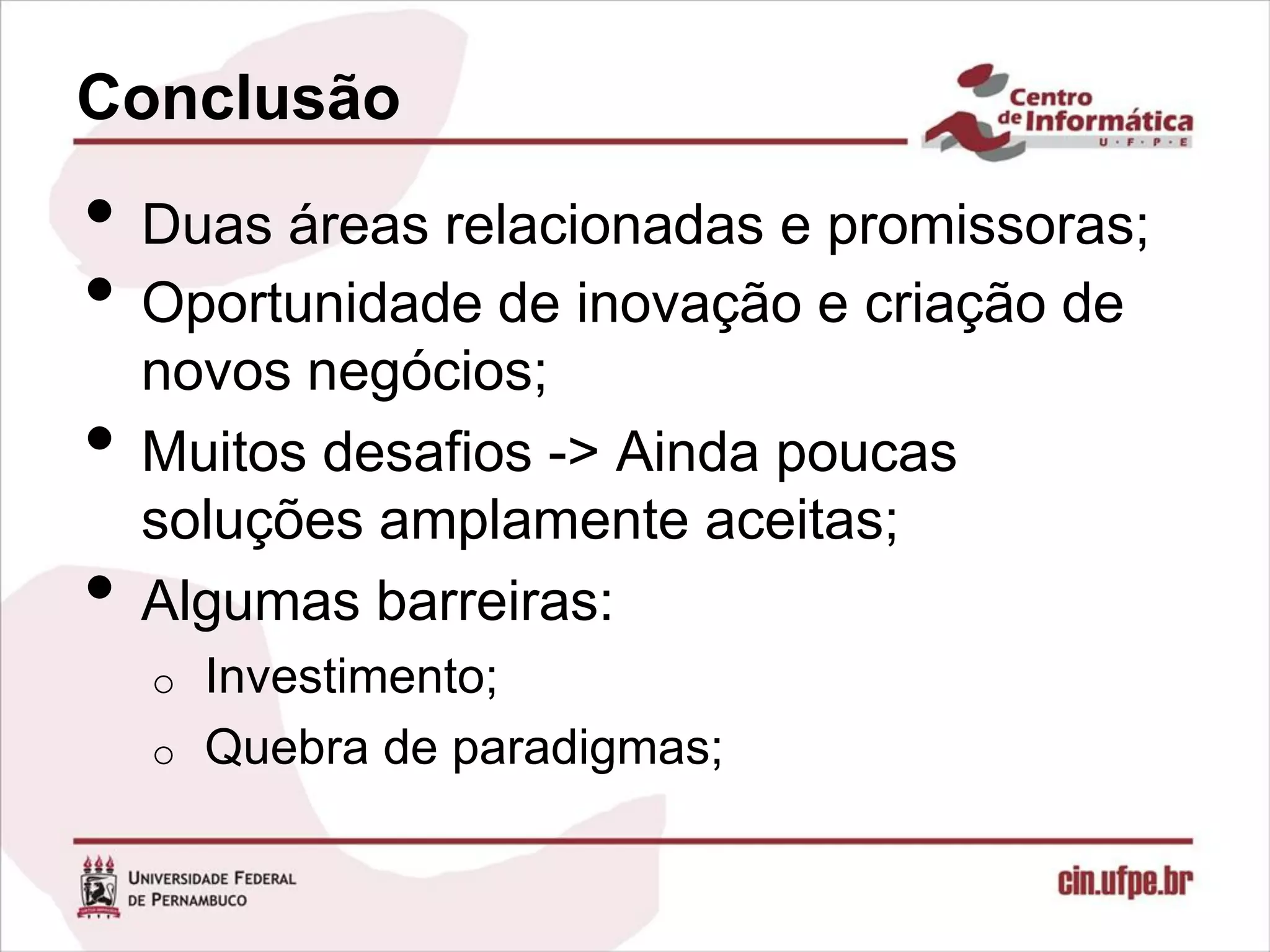
• Duas áreas relacionadas e promissoras;
• Oportunidade de inovação e criação de
    novos negócios;
•   Muitos desafios -> Ainda poucas
    soluções amplamente aceitas;
•   Algumas barreiras:
    o Investimento;
    o Quebra de paradigmas;
Referências
•   Kehua, Su; Jie Li; Fu,Hongbo. Smart City and the Applications. Wuhan, Hubei, China. IEEE 2011.
•   Xu, Li; Lu,Rongxing; Liang,Xiaohui; and Xuemin (Sherman) Shen. Smart Community: An Internet of Things Application. The
    Internet of Things. IEEE 2011.
•   Pan, Jin-Gu; Lin, Yu-Fa; Chuang, Su-Yi; Kao, Yu-Chia. From Governance to Service- Smart City Evaluations in Taiwan. International
    Joint Conference on Service Sciences. IEEE.2011
•   Lugaric, Luka; Krajcar, Slavko; Simic, Zdenko. Smart City - Platform for Emergent Phenomena Power System Testbed Simulator.
    IEEE
•   Bach, Brigitte; Wilhelmer, Doris; Palensky, Peter. Smart buildings, smart cities and governing innovation in the new millennium.
    IEEE. 2010.
•   Wu, Miao, et al. Research on the Architecture of Internet of Thing. International Conference on Advanced Computer Theory and
    Engineering. 2010, 3. School of Economics and Management.
•   Tan, Lu e Wang, Neng. Future Internet: Internet of Things. Internation Conference on Advanced Computer Theory and Engineering.
    2010, 3. Computer Science and Technology Department.
•   Lee, Sang Ho, et al. Towards ubiquitous city: concept, planning, and experiences in the Republic of Korea. Information Science
    Reference. 2008, pp. 148-169.
•   RFID Working Group Of The European Technology Plataform on Smart Systems Integration (EPOSS). Internet of Things in
    2020. 2008.
•   Atzori, Luigi, Iera, Antonio e Morabito, Giacomo. The Internet of Things: A survey. Computer Networks. 2010.
•   Al-Kuwari, Ali Mohammed A. H., et al. User Friendly Smart Home Infrastructure: BeeHouse. International Conference on Digital
    Ecosystems and Technologies. 5th, 2011.
•   Haubensak, Oliver. Smart Cities and Internet of Things. Business Aspects of the Internet of Things, Seminar of Advanced Topics.
    2011.
•   Palaniswami, M. Towards Sustainable Smart Cities. ARC Research Network on Intelligent Sensors, Sensor Networks and Information
    Processing (ISSNIP). 2010.
•   Qin, Li, Zhao. Development Status of Domestic and Foreign Smart City, 2010(9): 50-52.
Obrigado!

Gustavo Henrique Rodrigues Pinto Tomas (ghrpt@cin.ufpe.br)
      Welington Manoel da Silva (wms4@cin.ufpe.br)

Internet of Things and Smart Cities

  • 1.
    Internet das Coisase Smart Cities Gustavo Henrique Rodrigues Pinto Tomas (ghrpt@cin.ufpe.br) Welington Manoel da Silva (wms4@cin.ufpe.br)
  • 2.
    Agenda • Internet das coisas o Paradigma IoT o Tecnologias o Arquitetura de middleware o Aplicações o Desafios • Smart Cities o O que é? o Estrutura de uma Smart City o Smart Community o Smar Home o Desafios • IoT e Smart Cities
  • 3.
    Paradigma IoT Presençapervasiva de uma variedade de coisas que, através de esquemas únicos de endereçamento, podem interagir uns com os outros afim de atingir um objeto comum. (L. Atzori et al, 2010)
  • 4.
    Um paradigma, muitasvisões L. Atzori et al., The Internet of Things: A survey, Comput. Netw. (2010)
  • 5.
    Tecnologias • Identificação, sensoriamento e comunicação o RFID o Rede de Sensores  ZigBee  ... o IEEE 802.14.4 o ... • Middleware o Service Oriented Architecture
  • 6.
    Arquitetura de middleware L. Atzori et al., The Internet of Things: A survey, Comput. Netw. (2010)
  • 7.
    Aplicações • Transporte • Logística •Saúde • Sensoriamento • Qualidade de vida • ...
  • 8.
    Desafios • Segurança o Ataque físico o Ataque wireless o Baixo poder computacional • Privacidade o Legislação de cada país o "Problema enquanto os usuários não usam" o Quem vai coletar o dado? Quando?
  • 9.
  • 10.
    Smart City -O que é? "The next generation information technology to all walks of life..." - Samuel Palmisano – IBM, 2009 (SU; LI; FU, 2011) "Smart city as the use of information and communication technology to sense, analyze and integrate the key information of core systems in running cities. At the same time, smart city can make intelligent response to different kinds of needs, including daily livelihood, environmental protection, public safety and city services, industrial and commercial activities." (QIN; LI; ZHAO, 2010)
  • 11.
    Smat City -O que é? "A Smart City provides ubiquitous connectivity, future-proof broadband capacity and total wireless fidelity, with IP-enabled devices communicating and being managed through a control center, allowing tenants, residents, and visitors’ real-time access to key information about their environment from anywhere." (International Data Corporation) (PAN et al,2011)
  • 12.
    Smart, porém simples "Cities must use new technologies to transform their systems to optimize the use of finite resources. The topics of the optimization include Transportation, Public Safety, Energy/Utilities, Healthcare, Education, and Developments." (IBM) (PAN et al,2011)
  • 13.
    Quão smart? • Smart Environment • Smart Business • Smart Citizens • Smart Government (PAN et al, 2011)
  • 14.
    Arquitetura Kehua Su; Jie Li; Fu,Hongbo. Smart City and the Applications. Wuhan, Hubei, China. IEEE 2011.
  • 15.
    Smart Community Xu Li; Lu,Rongxing; Liang,Xiaohui; and Xuemin (Sherman) Shen. Smart Community: An Internet of Things Application. The Internet of Things. IEEE 2011.
  • 16.
    Smart Homes "[A buildingwith implemented passive energy efficiency measures], [central computer operated infrastructure systems], [networked appliances, advanced energy management and renewable energy sources]." (LUGARIC; KRAJCAR; SIMIC, 2010)
  • 17.
    Composição de Smarthomes • Sensores • Atuadores • Controladores • Unidade Central • Interface • Rede • Medição inteligente (LUGARIC; KRAJCAR; SIMIC, 2010)
  • 18.
    Smart Grids "...integration of actions of generators, transmission and distribution system operators, monitoring and control centers, suppliers and consumers through exchange of information in real time." (LUGARIC; KRAJCAR; SIMIC, 2010)
  • 19.
    Esquema Smart Grids LUGARIC; KRAJCAR; SIMIC, Smart City - Platform for Emergent Phenomena Power System Testbed Simulator, IEEE
  • 20.
    A tecnologia envolvida "Modem systems will have to act more anticipatory: weather forecasts, room bookings, energy prices and other aspects that can - certain error probabilities assumed - be predicted will be used for both increasing comfort and efficiency." (BACH; WILHELMER; PALENSKI, 2010)
  • 21.
    Desafios • Investimento emsensores e formas de atuadores; • Interoperabilidade: o Dispositivos; o Serviços; • Processamento; • Controle de privacidade; • Mobilidade; (Haubensak, 2011)
  • 22.
    IoT e SmartCities • IoT contribui para a implementação de Smart Cities; • "Internet das Coisas + Internet = Cidade inteligente" (Kehua, 2011);
  • 23.
    Conclusão • Duas áreasrelacionadas e promissoras; • Oportunidade de inovação e criação de novos negócios; • Muitos desafios -> Ainda poucas soluções amplamente aceitas; • Algumas barreiras: o Investimento; o Quebra de paradigmas;
  • 24.
    Referências • Kehua, Su; Jie Li; Fu,Hongbo. Smart City and the Applications. Wuhan, Hubei, China. IEEE 2011. • Xu, Li; Lu,Rongxing; Liang,Xiaohui; and Xuemin (Sherman) Shen. Smart Community: An Internet of Things Application. The Internet of Things. IEEE 2011. • Pan, Jin-Gu; Lin, Yu-Fa; Chuang, Su-Yi; Kao, Yu-Chia. From Governance to Service- Smart City Evaluations in Taiwan. International Joint Conference on Service Sciences. IEEE.2011 • Lugaric, Luka; Krajcar, Slavko; Simic, Zdenko. Smart City - Platform for Emergent Phenomena Power System Testbed Simulator. IEEE • Bach, Brigitte; Wilhelmer, Doris; Palensky, Peter. Smart buildings, smart cities and governing innovation in the new millennium. IEEE. 2010. • Wu, Miao, et al. Research on the Architecture of Internet of Thing. International Conference on Advanced Computer Theory and Engineering. 2010, 3. School of Economics and Management. • Tan, Lu e Wang, Neng. Future Internet: Internet of Things. Internation Conference on Advanced Computer Theory and Engineering. 2010, 3. Computer Science and Technology Department. • Lee, Sang Ho, et al. Towards ubiquitous city: concept, planning, and experiences in the Republic of Korea. Information Science Reference. 2008, pp. 148-169. • RFID Working Group Of The European Technology Plataform on Smart Systems Integration (EPOSS). Internet of Things in 2020. 2008. • Atzori, Luigi, Iera, Antonio e Morabito, Giacomo. The Internet of Things: A survey. Computer Networks. 2010. • Al-Kuwari, Ali Mohammed A. H., et al. User Friendly Smart Home Infrastructure: BeeHouse. International Conference on Digital Ecosystems and Technologies. 5th, 2011. • Haubensak, Oliver. Smart Cities and Internet of Things. Business Aspects of the Internet of Things, Seminar of Advanced Topics. 2011. • Palaniswami, M. Towards Sustainable Smart Cities. ARC Research Network on Intelligent Sensors, Sensor Networks and Information Processing (ISSNIP). 2010. • Qin, Li, Zhao. Development Status of Domestic and Foreign Smart City, 2010(9): 50-52.
  • 25.
    Obrigado! Gustavo Henrique RodriguesPinto Tomas (ghrpt@cin.ufpe.br) Welington Manoel da Silva (wms4@cin.ufpe.br)