INTERNET OF THINGS
FOR SMART CITIES
by:
T.V.S Raghu Ram
13121A04F2
Department of ECE
It is about...
Introduction
Different architectures
Web Service Approach
Wireless Connectivity
WSN requirements
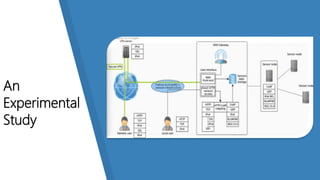
An experimental Study
Internet of things
& its need
•The transformation of Paradigm
•Extending network to “Things"
•Making network more Pervasive
•Application limited only by
imagination
Smart city Concept
•Efficient and effortless administration
•Quality of service
•Quality of living
•Communication infrastructure
Areas of exploiting IoT
▸Structural Health
▸Waste Management
▸Air quality
▸Noise Monitoring
▸Traffic Congestion
▸City Energy consumption
▸Smart lighting
“
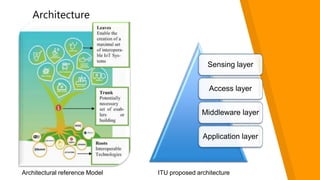
Architecture
Sensing layer
Access layer
Middleware layer
Application layer
Architectural reference Model ITU proposed architecture
Web Service Approach
▸Representational State Transfer
`
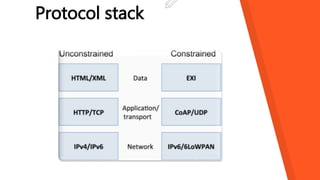
Protocol stack
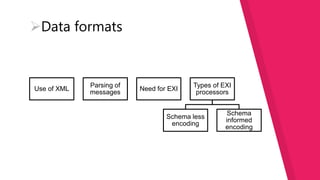
Use of XML
Parsing of
messages
Need for EXI
Types of EXI
processors
Schema less
encoding
Schema
informed
encoding
Data formats
Application and Transport layers
▸Problem with HTTP
▸Need for CoAP
Network layer
▸Present addressing scheme
▸IPV6 addressing scheme
o Frequency bands and worldwide
regulations
o Communication Protocols
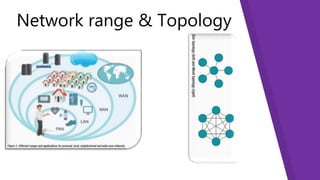
o Network Range
o Network Topology
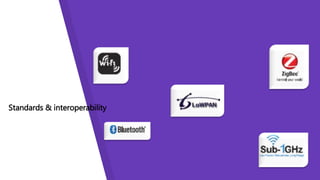
o Standards and interoperability
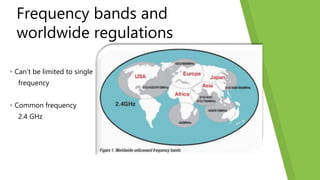
Frequency bands and
worldwide regulations
▸Can’t be limited to single
frequency
▸Common frequency
2.4 GHz
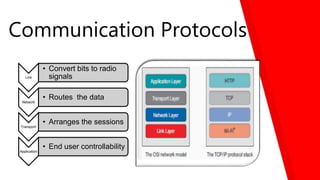
Communication Protocols
Link
• Convert bits to radio
signals
Network
• Routes the data
Transport
• Arranges the sessions
Application
• End user controllability
Network range & Topology
Standards & interoperability
Device framework
•Backend servers
•Gateways
•IoT peripheral Nodes
An
Experimental
Study
“
▸Collecting environmental data
▸Monitoring Public street lighting
Places where IoT
is incorporated
Smart Environment
&Street lighting system
▸Geographical localization
▸Sensors used-Photometer sensors
▸Form 6LoWPAN multihop cloud
▸IPV6 routing protocol provided
▸WSN gateway
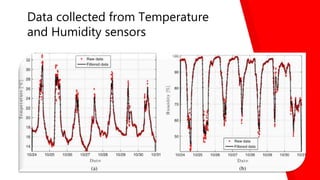
A glance at temperature and humidity data
Data collected from Temperature
and Humidity sensors
“
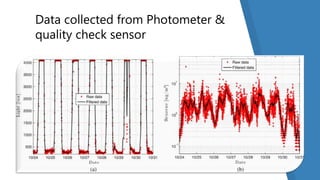
Data collected from Photometer &
quality check sensor
Conclusion
Target of different companies
 Aims at shaping a better future
References:
• A paper on IoT for smart cites IEEE INTERNET OF THINGS JOURNAL, VOL. 1,
NO. 1, FEBRUARY 2014
•White paper by TEXAS Instruments on wireless connectivity
•IoT a literature review Journal of Computer and Communications, 2015, 3,
164-173

Internet of Things for smart cities