SILIGURI INSTITUTE OF TECHNOLOGY
DEPARTMENT OF ELECTRICAL ENGINEERING
Presentation on: "The Internet of Things (IoT): Connecting a Smarter World”
Course Name: Internet of Things Course Code: OE-EE701B
Presented by
Name : ARNAB CHAKRABORTY
Roll : 11901621017
Department : ELECTRICAL ENGINEERING
Semester : 7th SEMESTER
Topics
Introduction
Evolution of IoT
How IoT Works?
Application Areas of IoT
Characteristics of IoT
Things possible in IoT
IoT Stack
Functionalities of each layer
Benefits of IoT
Challenges and Risks
Future of IoT
Conclusion
References
Introduction
What is IoT
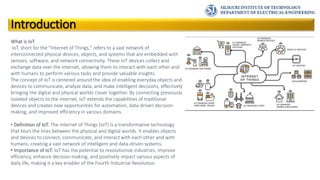
IoT, short for the "Internet of Things," refers to a vast network of
interconnected physical devices, objects, and systems that are embedded with
sensors, software, and network connectivity. These IoT devices collect and
exchange data over the internet, allowing them to interact with each other and
with humans to perform various tasks and provide valuable insights.
The concept of IoT is centered around the idea of enabling everyday objects and
devices to communicate, analyze data, and make intelligent decisions, effectively
bringing the digital and physical worlds closer together. By connecting previously
isolated objects to the internet, IoT extends the capabilities of traditional
devices and creates new opportunities for automation, data-driven decision-
making, and improved efficiency in various domains.
• Definition of IoT: The Internet of Things (IoT) is a transformative technology
that blurs the lines between the physical and digital worlds. It enables objects
and devices to connect, communicate, and interact with each other and with
humans, creating a vast network of intelligent and data-driven systems.
• Importance of IoT: IoT has the potential to revolutionize industries, improve
efficiency, enhance decision-making, and positively impact various aspects of
daily life, making it a key enabler of the Fourth Industrial Revolution.
Evolution of IoT
• Historical Background: The concept of interconnecting devices can be
traced back to the early days of the internet. However, the idea of IoT
gained momentum with the increasing availability of affordable sensors,
the advancement of wireless communication technologies, and the
emergence of cloud computing.
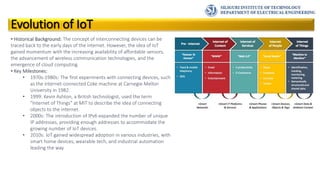
• Key Milestones:
• 1970s-1980s: The first experiments with connecting devices, such
as the internet-connected Coke machine at Carnegie Mellon
University in 1982.
• 1999: Kevin Ashton, a British technologist, used the term
"Internet of Things" at MIT to describe the idea of connecting
objects to the internet.
• 2000s: The introduction of IPv6 expanded the number of unique
IP addresses, providing enough addresses to accommodate the
growing number of IoT devices.
• 2010s: IoT gained widespread adoption in various industries, with
smart home devices, wearable tech, and industrial automation
leading the way
How IoT Works?
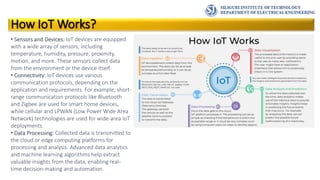
• Sensors and Devices: IoT devices are equipped
with a wide array of sensors, including
temperature, humidity, pressure, proximity,
motion, and more. These sensors collect data
from the environment or the device itself.
• Connectivity: IoT devices use various
communication protocols, depending on the
application and requirements. For example, short-
range communication protocols like Bluetooth
and Zigbee are used for smart home devices,
while cellular and LPWAN (Low Power Wide Area
Network) technologies are used for wide-area IoT
deployments.
• Data Processing: Collected data is transmitted to
the cloud or edge computing platforms for
processing and analysis. Advanced data analytics
and machine learning algorithms help extract
valuable insights from the data, enabling real-
time decision-making and automation.
Application Areas of IoT
• Smart Home: IoT transforms homes into smart, connected environments. Examples include smart thermostats that learn user preferences
and adjust temperatures accordingly, smart lighting systems that can be controlled remotely or automated based on occupancy, and smart
security systems with cameras and motion sensors.
• Industrial IoT (IIoT): In industries, IoT plays a pivotal role in revolutionizing manufacturing, supply chain management, and asset tracking. It
enables predictive maintenance to minimize downtime and optimize production processes, resulting in cost savings and increased
productivity.
• Healthcare: IoT is revolutionizing healthcare through remote patient monitoring, wearable devices that track vital signs, and telemedicine
solutions that facilitate remote consultations with healthcare professionals. These applications improve patient outcomes and reduce the
burden on healthcare facilities.
• Agriculture: IoT-powered precision agriculture maximizes crop yields and resource efficiency. Farmers can monitor soil moisture,
temperature, and nutrient levels in real-time, enabling them to optimize irrigation schedules and apply fertilizers precisely where needed.
• Smart Cities: IoT solutions are transforming cities into smarter and more sustainable environments. Smart traffic management systems
reduce congestion and optimize traffic flow, while smart waste management systems use sensors to optimize waste collection schedules,
reducing operational costs and environmental impact.
• Transportation: IoT-enabled connected vehicles enhance road safety by providing real-time data on traffic conditions, weather, and
potential hazards. Additionally, autonomous vehicles, enabled by IoT technologies, have the potential to revolutionize transportation in the
future.
• Retail: In the retail industry, IoT is used to create personalized shopping experiences. RFID technology allows retailers to track inventory in
real-time, enabling efficient supply chain management and reducing out-of-stock instances.
Characteristics of IoT
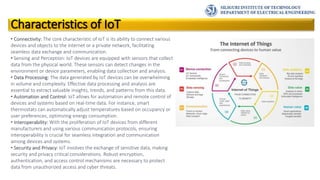
• Connectivity: The core characteristic of IoT is its ability to connect various
devices and objects to the internet or a private network, facilitating
seamless data exchange and communication.
• Sensing and Perception: IoT devices are equipped with sensors that collect
data from the physical world. These sensors can detect changes in the
environment or device parameters, enabling data collection and analysis.
• Data Processing: The data generated by IoT devices can be overwhelming
in volume and complexity. Effective data processing and analysis are
essential to extract valuable insights, trends, and patterns from this data.
• Automation and Control: IoT allows for automation and remote control of
devices and systems based on real-time data. For instance, smart
thermostats can automatically adjust temperatures based on occupancy or
user preferences, optimizing energy consumption.
• Interoperability: With the proliferation of IoT devices from different
manufacturers and using various communication protocols, ensuring
interoperability is crucial for seamless integration and communication
among devices and systems.
• Security and Privacy: IoT involves the exchange of sensitive data, making
security and privacy critical considerations. Robust encryption,
authentication, and access control mechanisms are necessary to protect
data from unauthorized access and cyber threats.
Things possible in IoT
• Real-time Monitoring: IoT enables real-time monitoring of various parameters,
such as environmental conditions, equipment status, and user behavior. For
example, wearable fitness trackers continuously monitor heart rate and activity
levels, providing users with immediate feedback on their health and fitness.
• Automation and Efficiency: IoT applications in industries and homes allow for
automation of repetitive tasks, reducing human intervention and increasing
operational efficiency. For instance, smart home systems can automate lighting
and HVAC systems based on user preferences and occupancy patterns, leading
to energy savings.
• Predictive Maintenance: IoT data analytics and machine learning algorithms
can predict potential equipment failures before they occur, allowing businesses
to perform maintenance proactively. This predictive approach minimizes
unplanned downtime and reduces maintenance costs.
• Data-Driven Insights: IoT generates vast amounts of data, and analyzing this
data provides valuable insights for businesses and organizations. For example,
retailers can use IoT data to understand customer behavior and preferences,
enabling personalized marketing strategies and targeted promotions.
• Remote Control: IoT empowers users to remotely control devices and systems
through mobile applications or web interfaces. For example, users can remotely
adjust home temperatures, lock or unlock doors, and even monitor security
cameras from their smartphones.
IoT Stack
The IoT stack, also known as the IoT technology stack or IoT architecture, represents the various layers of technologies and components that
work together to enable the functioning of an Internet of Things (IoT) system. It organizes the different elements required for the creation,
deployment, and management of IoT applications. The IoT stack is designed to facilitate communication, data processing, and control among
the interconnected devices and systems within an IoT ecosystem.
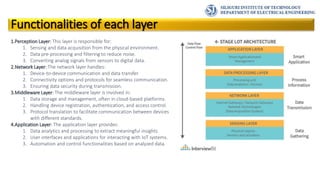
•Perception Layer: The perception layer consists of physical devices equipped with sensors and actuators. It is the "eyes and ears" of the IoT
system, capturing data from the environment and performing actions based on the processed data.
• Network Layer: The network layer facilitates communication between IoT devices, the cloud, and other devices or systems. It includes
various communication protocols and technologies, ensuring reliable and secure data transfer over short and long distances.
• Middleware Layer: The middleware layer serves as a bridge between the perception layer and the application layer. It handles tasks such as
data filtering, aggregation, protocol translation, and device management. Middleware solutions provide abstraction and interoperability
among diverse devices and protocols.
• Application Layer: The application layer is the topmost layer where end-users or other systems interact with the IoT solution. It includes
user interfaces, dashboards, and applications that enable users to control and monitor IoT devices. Data analytics and artificial intelligence
may also be part of this layer to provide actionable insights.
Functionalities of each layer
1.Perception Layer: This layer is responsible for:
1. Sensing and data acquisition from the physical environment.
2. Data pre-processing and filtering to reduce noise.
3. Converting analog signals from sensors to digital data.
2.Network Layer: The network layer handles:
1. Device-to-device communication and data transfer.
2. Connectivity options and protocols for seamless communication.
3. Ensuring data security during transmission.
3.Middleware Layer: The middleware layer is involved in:
1. Data storage and management, often in cloud-based platforms.
2. Handling device registration, authentication, and access control.
3. Protocol translation to facilitate communication between devices
with different standards.
4.Application Layer: The application layer provides:
1. Data analytics and processing to extract meaningful insights.
2. User interfaces and applications for interacting with IoT systems.
3. Automation and control functionalities based on analyzed data.
Benefits of IoT
• Improved Efficiency: IoT optimization of processes and resource
utilization leads to increased efficiency and reduced waste. For
example, in smart agriculture, IoT-based irrigation systems can
precisely deliver water to crops, minimizing water usage while
maximizing crop yields.
• Enhanced Decision Making: Data-driven insights provided by IoT
enable businesses to make informed decisions quickly. For example,
manufacturers can use real-time data from IoT sensors to optimize
production processes, reducing costs and improving product quality.
• Cost Savings: Predictive maintenance and automation in IoT can
result in significant cost savings. For instance, in the energy sector, IoT-
based smart grids can efficiently distribute electricity, reducing energy
wastage and operational costs.
• Increased Convenience: IoT brings convenience and ease of use to
users. For example, in smart homes, users can control appliances,
lighting, and security systems remotely via smartphone apps,
enhancing comfort and security.
• Improved Safety: IoT applications improve safety in various industries
and environments. For example, in smart cities, connected traffic
signals and real-time traffic data can enhance road safety by reducing
accidents and traffic congestion.
Challenges and Risks
• Security Concerns: IoT devices and networks can be susceptible to security breaches and cyberattacks. Manufacturers and users must
prioritize security measures and implement encryption, authentication, and secure data transmission protocols to safeguard IoT systems.
• Privacy Issues: The vast amount of data collected by IoT devices raises concerns about user privacy. Proper data anonymization, consent
management, and data retention policies are essential to protect user privacy and comply with data protection regulations.
• Interoperability: The diversity of IoT devices and protocols poses challenges in ensuring seamless integration and communication among
devices and systems. Standardization efforts are necessary to promote interoperability and drive widespread IoT adoption.
• Complexity: The complexity of IoT deployments, involving numerous devices, data sources, and cloud services, can be challenging to
manage and maintain. Proper planning and management strategies are required to handle scalability and complexity effectively.
• Energy Efficiency: Many IoT devices operate on battery power or have limited energy resources. Optimizing energy consumption in IoT
devices is crucial to prolong battery life and reduce environmental impact.
Future of IoT
• Emerging Technologies: The future of IoT will be shaped by
emerging technologies like 5G, which will enable faster and
more reliable data transmission, and edge computing, which
will bring processing closer to the data source, reducing latency
and bandwidth requirements.
• Industry Impact: IoT is expected to revolutionize various
industries, such as healthcare, transportation, agriculture, and
manufacturing, leading to improved services, products, and
customer experiences.
• Growth and Adoption: IoT is projected to experience rapid
growth and widespread adoption in the coming years. The
number of connected devices is expected to increase
exponentially, creating new opportunities and challenges for
businesses, governments, and consumers.
Conclusion
• Recap of IoT's significance in connecting physical objects and improving various sectors.
• Emphasize the potential benefits and challenges of IoT implementation.
• Encourage further exploration and investment in IoT technologies and applications to harness its full potential and create a smarter and
more connected world.
References
https://www.techtarget.com/iotagenda/definition/Internet-of-Things-IoT
https://en.wikipedia.org/wiki/Internet_of_things
https://www.zdnet.com/article/what-is-the-internet-of-things-everything-you-need-to-know-about-the-iot-right-now/
https://www.oracle.com/in/internet-of-things/what-is-iot/
https://www.ibm.com/topics/internet-of-things

PPT Format for CA1.pptx

  • 1.
    SILIGURI INSTITUTE OFTECHNOLOGY DEPARTMENT OF ELECTRICAL ENGINEERING Presentation on: "The Internet of Things (IoT): Connecting a Smarter World” Course Name: Internet of Things Course Code: OE-EE701B Presented by Name : ARNAB CHAKRABORTY Roll : 11901621017 Department : ELECTRICAL ENGINEERING Semester : 7th SEMESTER
  • 2.
    Topics Introduction Evolution of IoT HowIoT Works? Application Areas of IoT Characteristics of IoT Things possible in IoT IoT Stack Functionalities of each layer Benefits of IoT Challenges and Risks Future of IoT Conclusion References
  • 3.
    Introduction What is IoT IoT,short for the "Internet of Things," refers to a vast network of interconnected physical devices, objects, and systems that are embedded with sensors, software, and network connectivity. These IoT devices collect and exchange data over the internet, allowing them to interact with each other and with humans to perform various tasks and provide valuable insights. The concept of IoT is centered around the idea of enabling everyday objects and devices to communicate, analyze data, and make intelligent decisions, effectively bringing the digital and physical worlds closer together. By connecting previously isolated objects to the internet, IoT extends the capabilities of traditional devices and creates new opportunities for automation, data-driven decision- making, and improved efficiency in various domains. • Definition of IoT: The Internet of Things (IoT) is a transformative technology that blurs the lines between the physical and digital worlds. It enables objects and devices to connect, communicate, and interact with each other and with humans, creating a vast network of intelligent and data-driven systems. • Importance of IoT: IoT has the potential to revolutionize industries, improve efficiency, enhance decision-making, and positively impact various aspects of daily life, making it a key enabler of the Fourth Industrial Revolution.
  • 4.
    Evolution of IoT •Historical Background: The concept of interconnecting devices can be traced back to the early days of the internet. However, the idea of IoT gained momentum with the increasing availability of affordable sensors, the advancement of wireless communication technologies, and the emergence of cloud computing. • Key Milestones: • 1970s-1980s: The first experiments with connecting devices, such as the internet-connected Coke machine at Carnegie Mellon University in 1982. • 1999: Kevin Ashton, a British technologist, used the term "Internet of Things" at MIT to describe the idea of connecting objects to the internet. • 2000s: The introduction of IPv6 expanded the number of unique IP addresses, providing enough addresses to accommodate the growing number of IoT devices. • 2010s: IoT gained widespread adoption in various industries, with smart home devices, wearable tech, and industrial automation leading the way
  • 5.
    How IoT Works? •Sensors and Devices: IoT devices are equipped with a wide array of sensors, including temperature, humidity, pressure, proximity, motion, and more. These sensors collect data from the environment or the device itself. • Connectivity: IoT devices use various communication protocols, depending on the application and requirements. For example, short- range communication protocols like Bluetooth and Zigbee are used for smart home devices, while cellular and LPWAN (Low Power Wide Area Network) technologies are used for wide-area IoT deployments. • Data Processing: Collected data is transmitted to the cloud or edge computing platforms for processing and analysis. Advanced data analytics and machine learning algorithms help extract valuable insights from the data, enabling real- time decision-making and automation.
  • 6.
    Application Areas ofIoT • Smart Home: IoT transforms homes into smart, connected environments. Examples include smart thermostats that learn user preferences and adjust temperatures accordingly, smart lighting systems that can be controlled remotely or automated based on occupancy, and smart security systems with cameras and motion sensors. • Industrial IoT (IIoT): In industries, IoT plays a pivotal role in revolutionizing manufacturing, supply chain management, and asset tracking. It enables predictive maintenance to minimize downtime and optimize production processes, resulting in cost savings and increased productivity. • Healthcare: IoT is revolutionizing healthcare through remote patient monitoring, wearable devices that track vital signs, and telemedicine solutions that facilitate remote consultations with healthcare professionals. These applications improve patient outcomes and reduce the burden on healthcare facilities. • Agriculture: IoT-powered precision agriculture maximizes crop yields and resource efficiency. Farmers can monitor soil moisture, temperature, and nutrient levels in real-time, enabling them to optimize irrigation schedules and apply fertilizers precisely where needed. • Smart Cities: IoT solutions are transforming cities into smarter and more sustainable environments. Smart traffic management systems reduce congestion and optimize traffic flow, while smart waste management systems use sensors to optimize waste collection schedules, reducing operational costs and environmental impact. • Transportation: IoT-enabled connected vehicles enhance road safety by providing real-time data on traffic conditions, weather, and potential hazards. Additionally, autonomous vehicles, enabled by IoT technologies, have the potential to revolutionize transportation in the future. • Retail: In the retail industry, IoT is used to create personalized shopping experiences. RFID technology allows retailers to track inventory in real-time, enabling efficient supply chain management and reducing out-of-stock instances.
  • 7.
    Characteristics of IoT •Connectivity: The core characteristic of IoT is its ability to connect various devices and objects to the internet or a private network, facilitating seamless data exchange and communication. • Sensing and Perception: IoT devices are equipped with sensors that collect data from the physical world. These sensors can detect changes in the environment or device parameters, enabling data collection and analysis. • Data Processing: The data generated by IoT devices can be overwhelming in volume and complexity. Effective data processing and analysis are essential to extract valuable insights, trends, and patterns from this data. • Automation and Control: IoT allows for automation and remote control of devices and systems based on real-time data. For instance, smart thermostats can automatically adjust temperatures based on occupancy or user preferences, optimizing energy consumption. • Interoperability: With the proliferation of IoT devices from different manufacturers and using various communication protocols, ensuring interoperability is crucial for seamless integration and communication among devices and systems. • Security and Privacy: IoT involves the exchange of sensitive data, making security and privacy critical considerations. Robust encryption, authentication, and access control mechanisms are necessary to protect data from unauthorized access and cyber threats.
  • 8.
    Things possible inIoT • Real-time Monitoring: IoT enables real-time monitoring of various parameters, such as environmental conditions, equipment status, and user behavior. For example, wearable fitness trackers continuously monitor heart rate and activity levels, providing users with immediate feedback on their health and fitness. • Automation and Efficiency: IoT applications in industries and homes allow for automation of repetitive tasks, reducing human intervention and increasing operational efficiency. For instance, smart home systems can automate lighting and HVAC systems based on user preferences and occupancy patterns, leading to energy savings. • Predictive Maintenance: IoT data analytics and machine learning algorithms can predict potential equipment failures before they occur, allowing businesses to perform maintenance proactively. This predictive approach minimizes unplanned downtime and reduces maintenance costs. • Data-Driven Insights: IoT generates vast amounts of data, and analyzing this data provides valuable insights for businesses and organizations. For example, retailers can use IoT data to understand customer behavior and preferences, enabling personalized marketing strategies and targeted promotions. • Remote Control: IoT empowers users to remotely control devices and systems through mobile applications or web interfaces. For example, users can remotely adjust home temperatures, lock or unlock doors, and even monitor security cameras from their smartphones.
  • 9.
    IoT Stack The IoTstack, also known as the IoT technology stack or IoT architecture, represents the various layers of technologies and components that work together to enable the functioning of an Internet of Things (IoT) system. It organizes the different elements required for the creation, deployment, and management of IoT applications. The IoT stack is designed to facilitate communication, data processing, and control among the interconnected devices and systems within an IoT ecosystem. •Perception Layer: The perception layer consists of physical devices equipped with sensors and actuators. It is the "eyes and ears" of the IoT system, capturing data from the environment and performing actions based on the processed data. • Network Layer: The network layer facilitates communication between IoT devices, the cloud, and other devices or systems. It includes various communication protocols and technologies, ensuring reliable and secure data transfer over short and long distances. • Middleware Layer: The middleware layer serves as a bridge between the perception layer and the application layer. It handles tasks such as data filtering, aggregation, protocol translation, and device management. Middleware solutions provide abstraction and interoperability among diverse devices and protocols. • Application Layer: The application layer is the topmost layer where end-users or other systems interact with the IoT solution. It includes user interfaces, dashboards, and applications that enable users to control and monitor IoT devices. Data analytics and artificial intelligence may also be part of this layer to provide actionable insights.
  • 10.
    Functionalities of eachlayer 1.Perception Layer: This layer is responsible for: 1. Sensing and data acquisition from the physical environment. 2. Data pre-processing and filtering to reduce noise. 3. Converting analog signals from sensors to digital data. 2.Network Layer: The network layer handles: 1. Device-to-device communication and data transfer. 2. Connectivity options and protocols for seamless communication. 3. Ensuring data security during transmission. 3.Middleware Layer: The middleware layer is involved in: 1. Data storage and management, often in cloud-based platforms. 2. Handling device registration, authentication, and access control. 3. Protocol translation to facilitate communication between devices with different standards. 4.Application Layer: The application layer provides: 1. Data analytics and processing to extract meaningful insights. 2. User interfaces and applications for interacting with IoT systems. 3. Automation and control functionalities based on analyzed data.
  • 11.
    Benefits of IoT •Improved Efficiency: IoT optimization of processes and resource utilization leads to increased efficiency and reduced waste. For example, in smart agriculture, IoT-based irrigation systems can precisely deliver water to crops, minimizing water usage while maximizing crop yields. • Enhanced Decision Making: Data-driven insights provided by IoT enable businesses to make informed decisions quickly. For example, manufacturers can use real-time data from IoT sensors to optimize production processes, reducing costs and improving product quality. • Cost Savings: Predictive maintenance and automation in IoT can result in significant cost savings. For instance, in the energy sector, IoT- based smart grids can efficiently distribute electricity, reducing energy wastage and operational costs. • Increased Convenience: IoT brings convenience and ease of use to users. For example, in smart homes, users can control appliances, lighting, and security systems remotely via smartphone apps, enhancing comfort and security. • Improved Safety: IoT applications improve safety in various industries and environments. For example, in smart cities, connected traffic signals and real-time traffic data can enhance road safety by reducing accidents and traffic congestion.
  • 12.
    Challenges and Risks •Security Concerns: IoT devices and networks can be susceptible to security breaches and cyberattacks. Manufacturers and users must prioritize security measures and implement encryption, authentication, and secure data transmission protocols to safeguard IoT systems. • Privacy Issues: The vast amount of data collected by IoT devices raises concerns about user privacy. Proper data anonymization, consent management, and data retention policies are essential to protect user privacy and comply with data protection regulations. • Interoperability: The diversity of IoT devices and protocols poses challenges in ensuring seamless integration and communication among devices and systems. Standardization efforts are necessary to promote interoperability and drive widespread IoT adoption. • Complexity: The complexity of IoT deployments, involving numerous devices, data sources, and cloud services, can be challenging to manage and maintain. Proper planning and management strategies are required to handle scalability and complexity effectively. • Energy Efficiency: Many IoT devices operate on battery power or have limited energy resources. Optimizing energy consumption in IoT devices is crucial to prolong battery life and reduce environmental impact.
  • 13.
    Future of IoT •Emerging Technologies: The future of IoT will be shaped by emerging technologies like 5G, which will enable faster and more reliable data transmission, and edge computing, which will bring processing closer to the data source, reducing latency and bandwidth requirements. • Industry Impact: IoT is expected to revolutionize various industries, such as healthcare, transportation, agriculture, and manufacturing, leading to improved services, products, and customer experiences. • Growth and Adoption: IoT is projected to experience rapid growth and widespread adoption in the coming years. The number of connected devices is expected to increase exponentially, creating new opportunities and challenges for businesses, governments, and consumers.
  • 14.
    Conclusion • Recap ofIoT's significance in connecting physical objects and improving various sectors. • Emphasize the potential benefits and challenges of IoT implementation. • Encourage further exploration and investment in IoT technologies and applications to harness its full potential and create a smarter and more connected world.
  • 15.