IOT Demystified
Future & Emerging Technologies Community
06/06/2018
V1.0
The potential market
 A 2017 report said that worldwide spending on the IoT is
set to reach $772.5 billion in 2018, almost 15% increase
over the $674 billion that will be spent in 2017.
 The global IoT market is expected to have a compound
annual growth rate (CAGR) of nearly 27% from 2018 to
2024.
 Overall, the market is expected to grow to $6.5 trillion in
2024.
And this is a conservative estimation
Definition
 Internet of Things (IoT) is an integrated part of Future Internet and
can be defined as a dynamic global network infrastructure with self
configuring capabilities connected on standard and interoperable
communication protocols where physical and virtual things have
identities, physical attributes and virtual personalities and use
intelligent interfaces and are autonomously integrated into the
information network. In the IoT, "things" are expected to behave as
active participants' in business, information and social processes
where they are enabled to interact and communicate amongst
themselves and with the environment by exchanging data and
information retried about that environment, while reacting
autonomously to the physical world events and influencing it by
running process that trigger actions and create services with or
without direct human interaction interfaces in the form of services to
facilitate interactions with these "smart things" over the internet,
query and change their state and any information associated with
them ,taking in account security and privacy issues.
Cisco (2017)
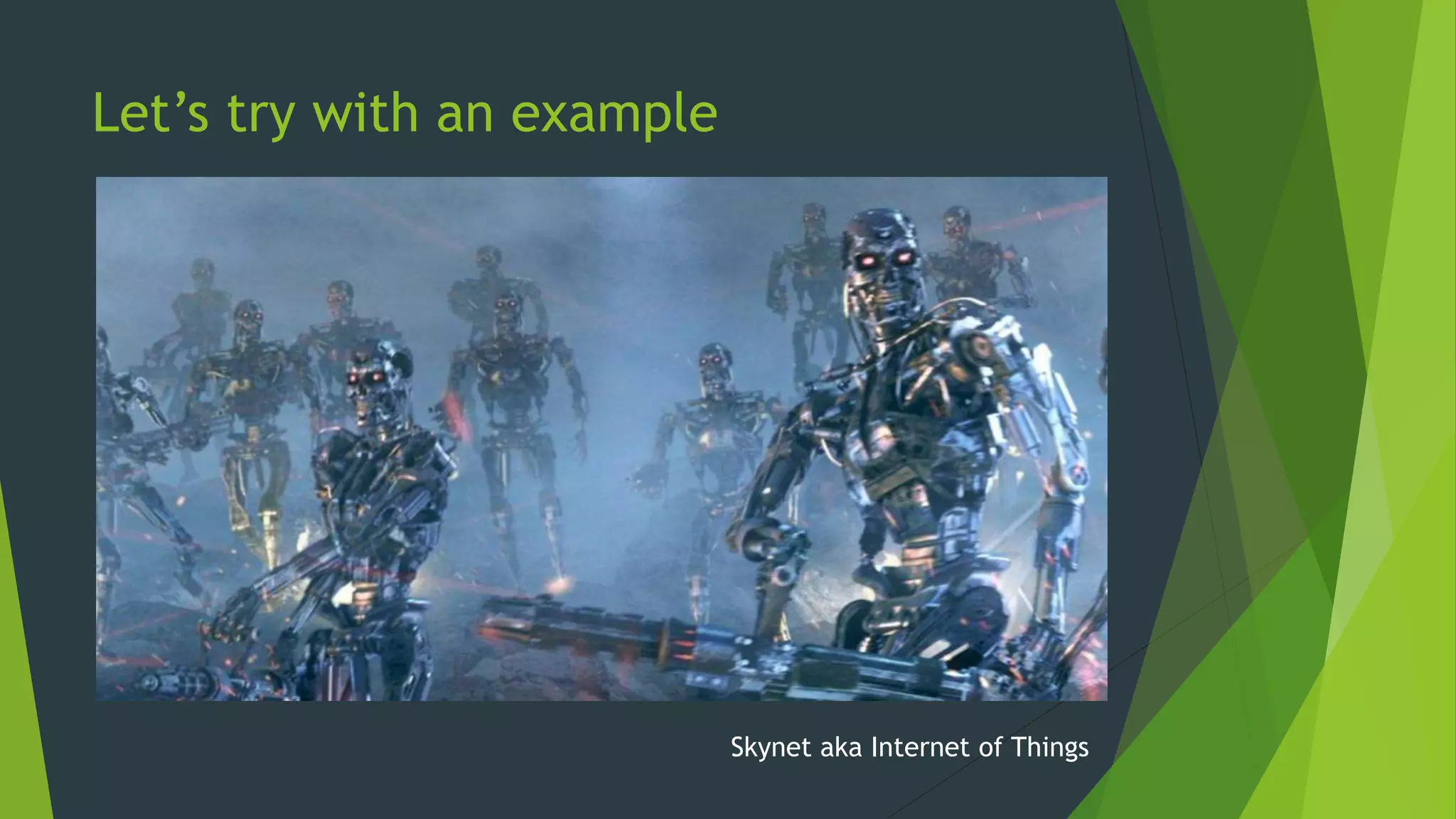
Let’s try with an example
Skynet aka Internet of Things
Let’s try this again …
 The Internet of Things (IoT) is the network of physical devices,
vehicles, home appliances and other items embedded with
electronics, software, sensors, actuators, and connectivity
which enables these objects to connect and exchange data.
Each thing is uniquely identifiable through its embedded
computing system but is able to inter-operate within the
existing Internet infrastructure.
 In simple words, Internet of Things (IoT) is an ecosystem of
connected physical objects that are accessible through the
internet.
 It is also referred to as Machine-to-Machine (M2M), Skynet or
Internet of Everything
What are the things ?
 Things", can refer to a wide variety of devices such as
 Household appliances
 Smartphones
 Heart monitoring implants
 Biochip transponders on farm animals
 Cameras streaming live feeds of wild animals in coastal waters,
 Automobiles with built-in sensors
 DNA analysis devices for environmental/food/pathogen
monitoring,
 Field operation devices that assist firefighters in search and rescue
operations
 …
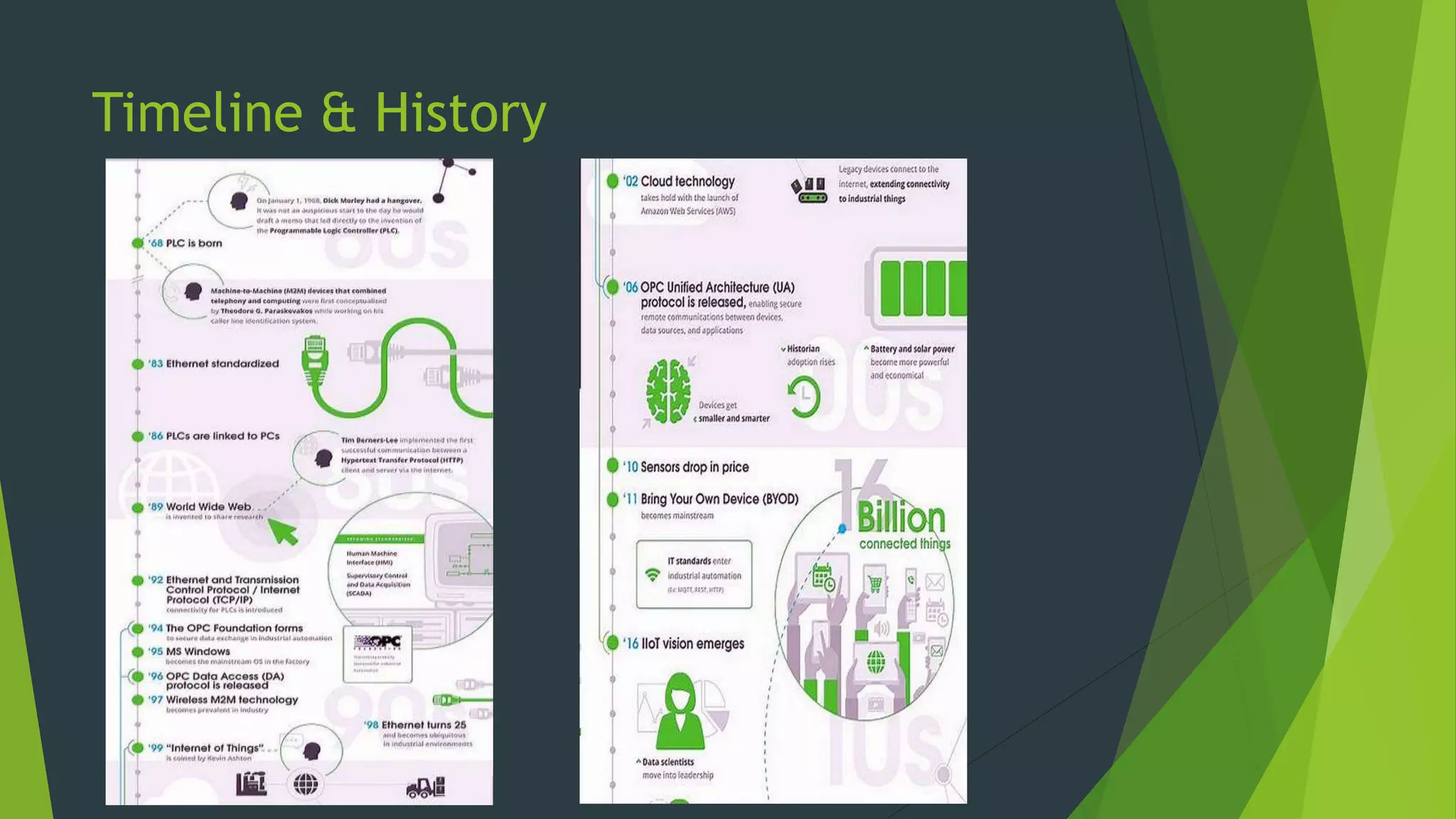
Timeline & History
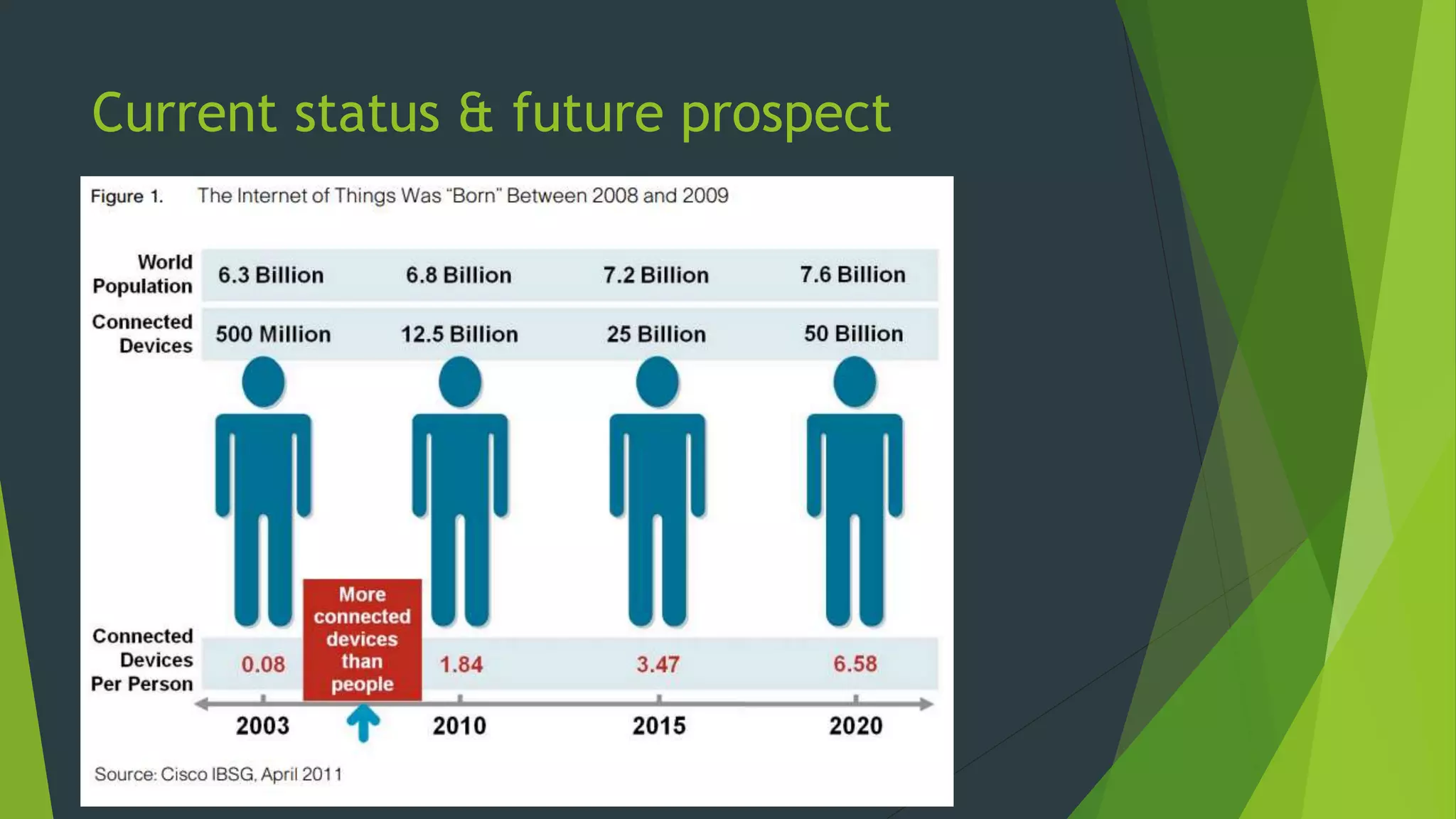
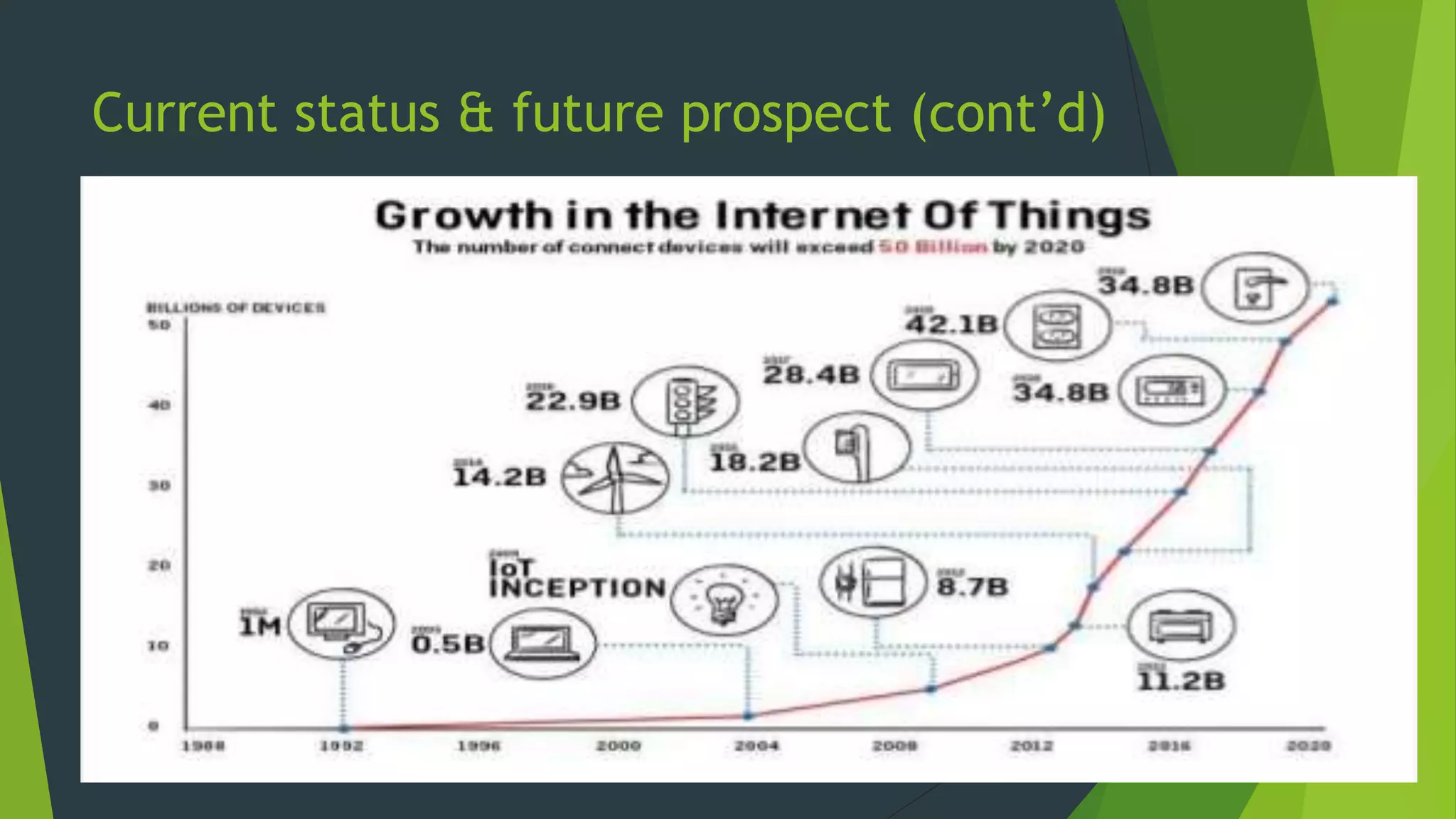
Current status & future prospect
Current status & future prospect (cont’d)
IoT is everywhere
A (limited) scope of IOT
How can IoT help
 Internet of Things can connect devices embedded in
various systems to the internet. When devices/objects can
represent themselves digitally, they can be controlled
from anywhere
 IoT platforms can help organizations to capture more data
from more places, reducing cost through improved process
efficiency, asset utilization and productivity
 The growth and convergence of data, processes and things
on the internet would make such connections more
relevant and important, creating more opportunities for
people, businesses and industries
Components of IoT
 Smart Systems and Internet of Things are driven by a
combination of :
 Sensors & Actuators
 Connectivity
 People & Processes
 Interaction between these entities are creating new types
of smart applications and services
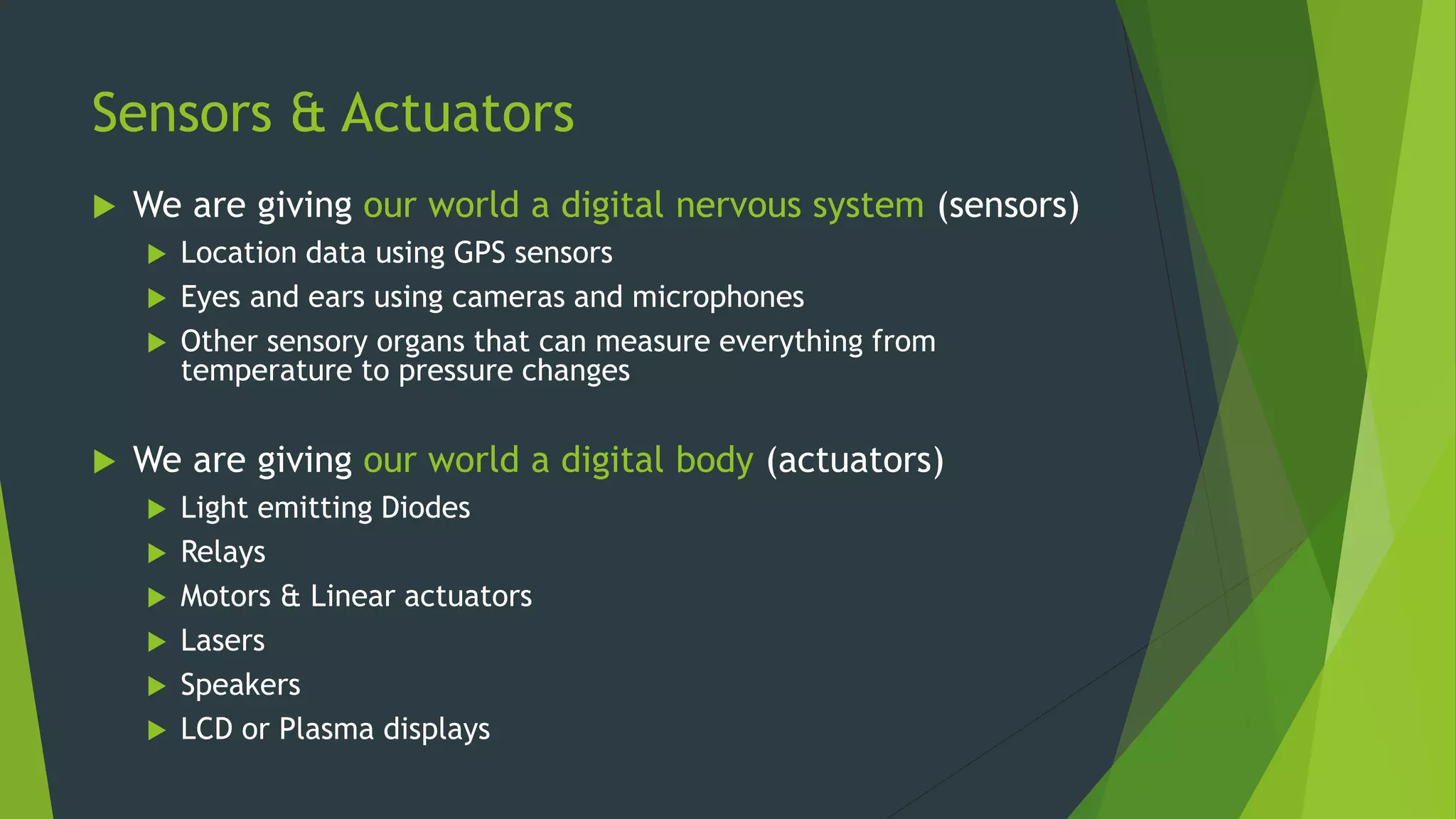
Sensors & Actuators
 We are giving our world a digital nervous system (sensors)
 Location data using GPS sensors
 Eyes and ears using cameras and microphones
 Other sensory organs that can measure everything from
temperature to pressure changes
 We are giving our world a digital body (actuators)
 Light emitting Diodes
 Relays
 Motors & Linear actuators
 Lasers
 Speakers
 LCD or Plasma displays
Connectivity
 The embedded systems can use a range of connectivity to
connect with other devices or the internet
 WiFi
 Bluetooth
 RFID
 ZIGBEE
 NFC
 Ethernet
 LTE
 3G
 GSM
 CDMA
People & Processes
 The information transmitted can be used by people and
processes to take action or re-transmit the info to a
different embedded system to be used to perform an
action using actuators
 A home security system detects intrusion, a call is placed to the
authorities and owners alerted. Help is dispatched
 Load sensor can initiate a communication to the supplier to send
more stock enabling the supply chain management automation
 Car can send the diagnostics to the service center and the service
center schedules a repair
 Your IoT thermostat sends the information to the cloud which can
then be analyzed by to manage your energy expenditure
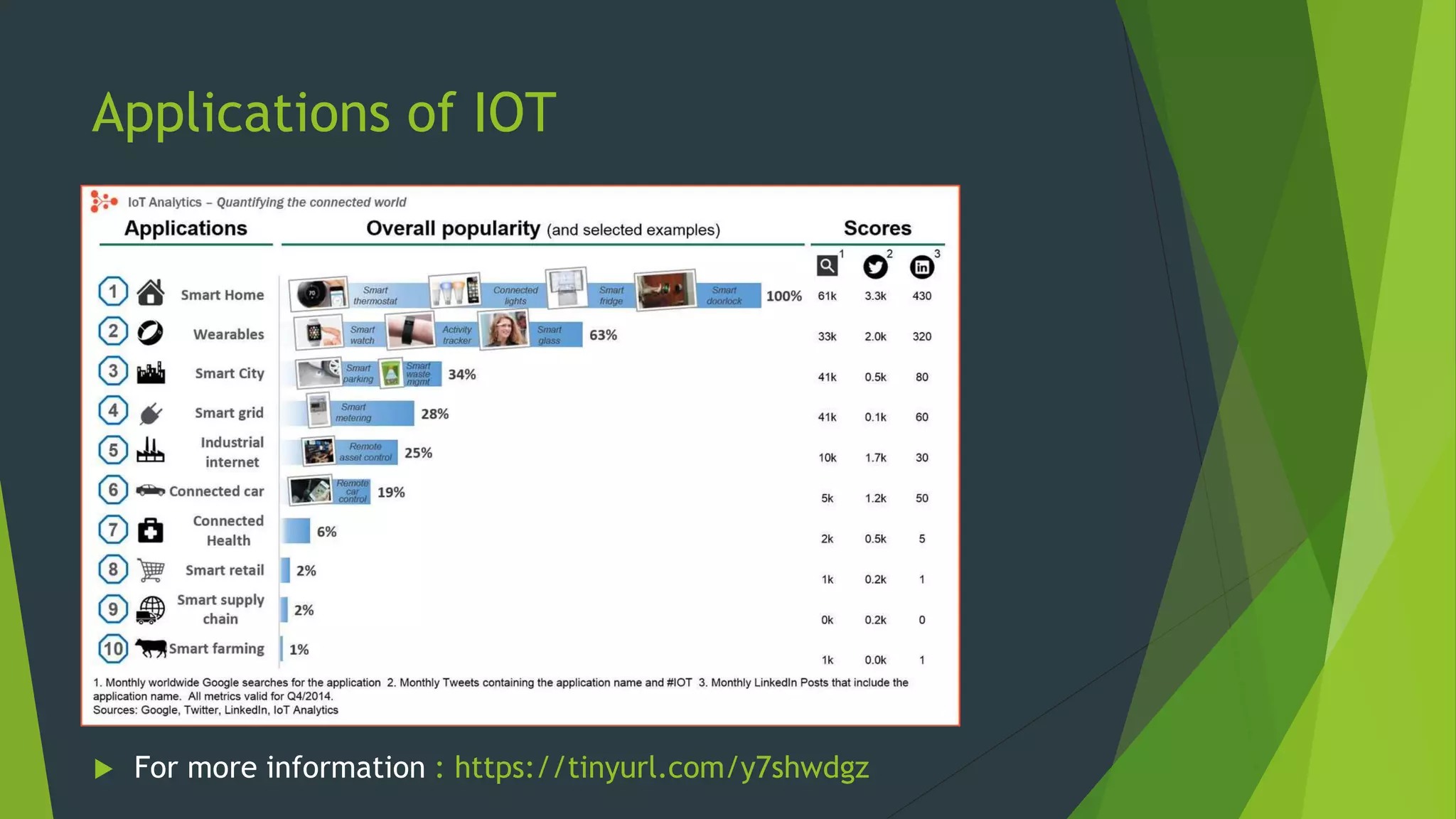
Applications of IOT
 For more information : https://tinyurl.com/y7shwdgz
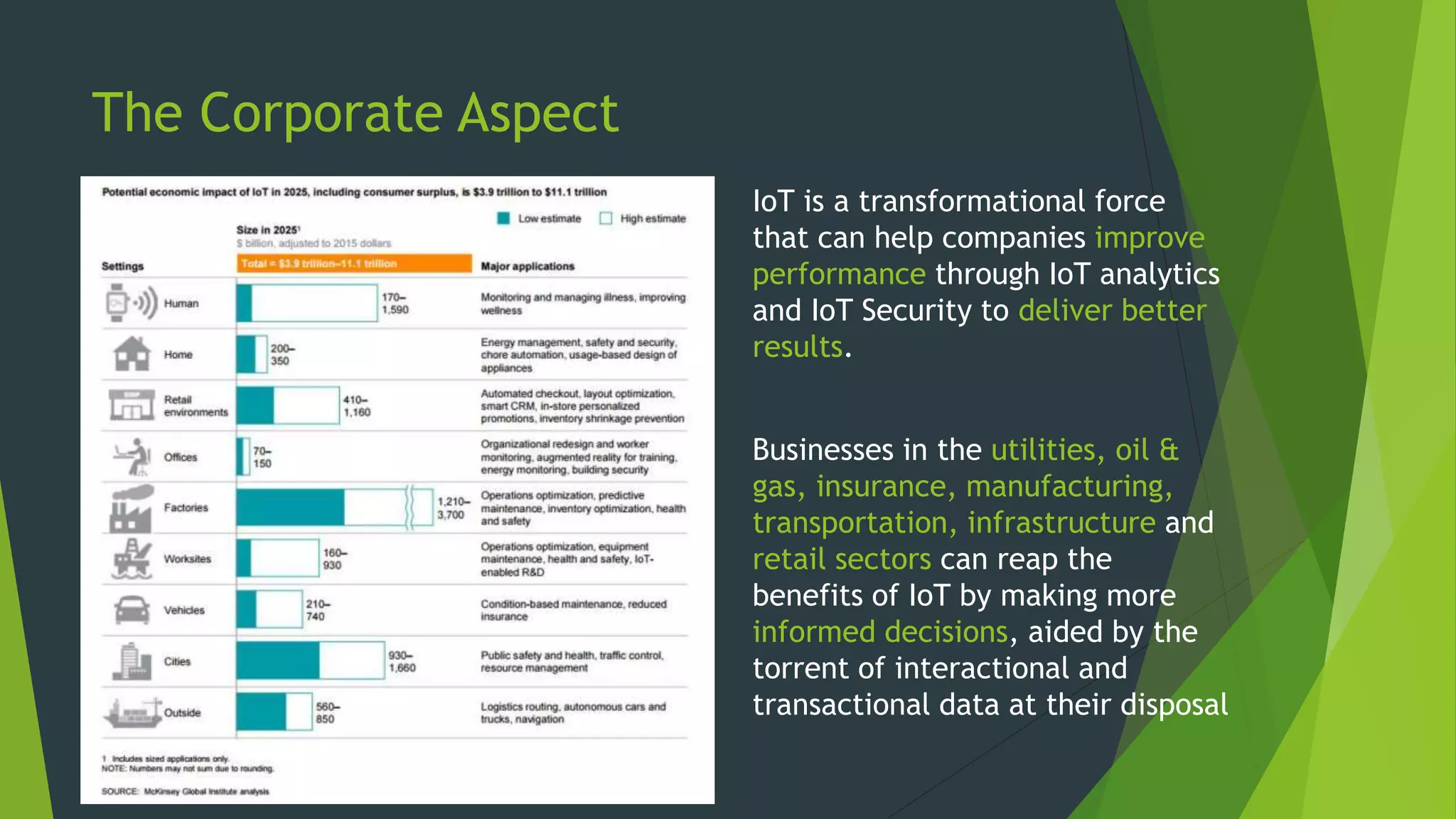
The Corporate Aspect
IoT is a transformational force
that can help companies improve
performance through IoT analytics
and IoT Security to deliver better
results.
Businesses in the utilities, oil &
gas, insurance, manufacturing,
transportation, infrastructure and
retail sectors can reap the
benefits of IoT by making more
informed decisions, aided by the
torrent of interactional and
transactional data at their disposal
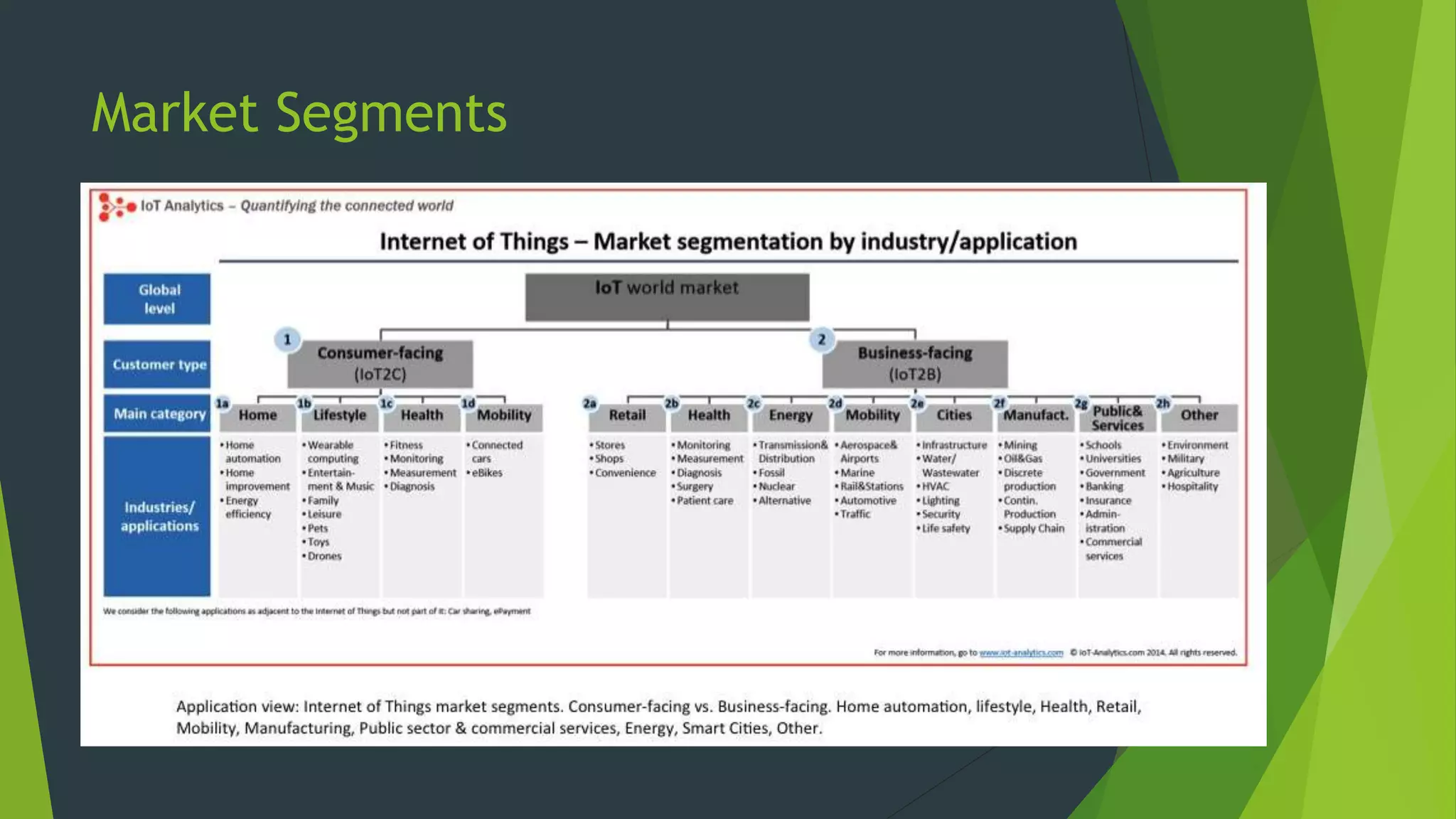
Market Segments
New business models
 Things as a Service
 Things when you need it, as long as you need it
 Cost when you use it, as long as you use it
 Maintenance is always included
Challenges faced by IoT
 At present IoT is faced with many challenges, like
 Scalability
 Security
 Technical requirements (power consumption, …)
 Technological standardization
 Software complexity
Solutions to the challenges
 Several solutions are proposed to overcome the problems
 Overcoming compatibility issues is a significant IoT hurdle, but
emerging
 Companies are starting to enable increased interoperability
through open-source development
 Governments and industry bodies need to set standards and
regulations for the various industries to ensure that data is not
misused.
 IoT needs strong authentication methods, encrypted data and a
platform that can track irregularities on a network
Conclusion
 Projections for the impact of IoT on the Internet and
economy are impressive, with some anticipating as many
as 100 billion connected IoT devices and a global
economic impact of more than $11 trillion by 2025
 The potential economic impact of IoT is huge, but the
journey to IoT adoption is not a seamless one. There are
many challenges that face companies looking to
implement IoT solutions. However, the risks and
disadvantages associated with IoT can be overcome
Use Cases
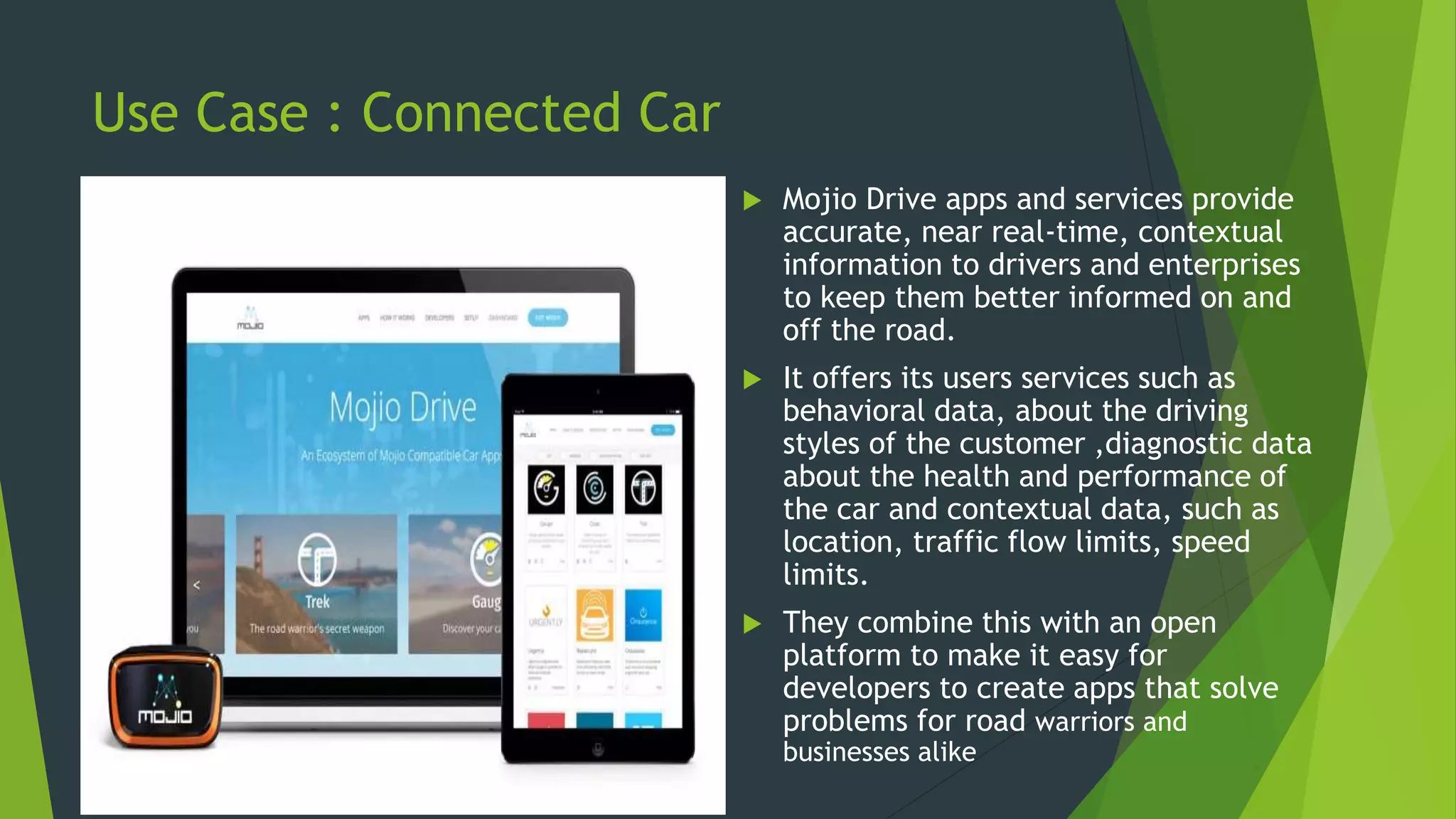
Use Case : Connected Car
 Mojio Drive apps and services provide
accurate, near real-time, contextual
information to drivers and enterprises
to keep them better informed on and
off the road.
 It offers its users services such as
behavioral data, about the driving
styles of the customer ,diagnostic data
about the health and performance of
the car and contextual data, such as
location, traffic flow limits, speed
limits.
 They combine this with an open
platform to make it easy for
developers to create apps that solve
problems for road warriors and
businesses alike
Use Case : Wearables
Use Case : Smart Home
Use Case : Supply Chain Management
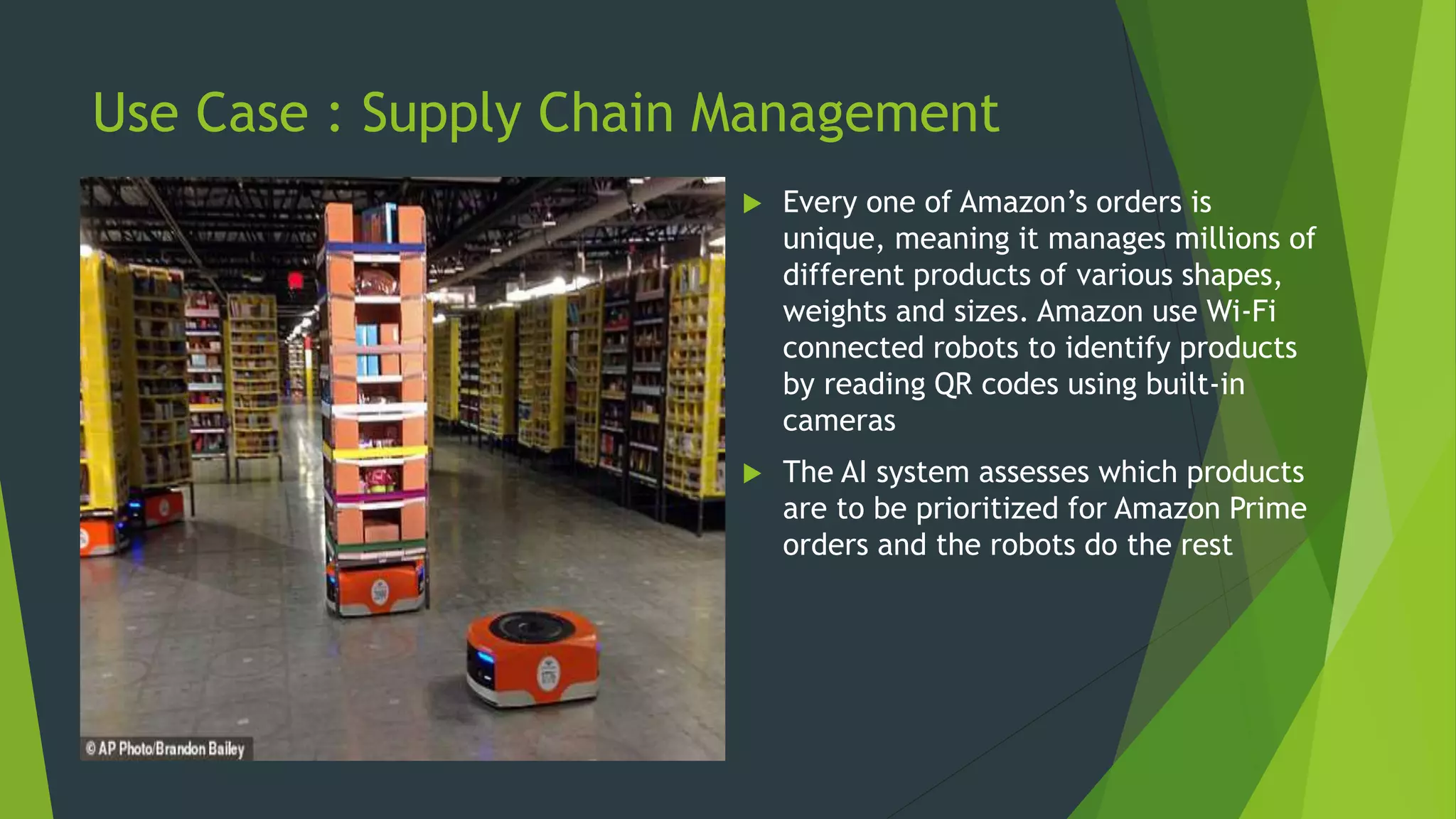
 Every one of Amazon’s orders is
unique, meaning it manages millions of
different products of various shapes,
weights and sizes. Amazon use Wi-Fi
connected robots to identify products
by reading QR codes using built-in
cameras
 The AI system assesses which products
are to be prioritized for Amazon Prime
orders and the robots do the rest
Use Case : Smart Cities
References
 https://www.nebula.co.za/2016/11/11/risks-disadvantages-iot-
overcome/
 https://www.internetsociety.org/doc/iot-overview
 http://www.happiestminds.com/Insights/internet-of-things
 https://iot-analytics.com/
 https://github.com/hortonworks-gallery/iot-truck-streaming
Thank you & Questions

IOT Demystified

  • 1.
    IOT Demystified Future &Emerging Technologies Community 06/06/2018 V1.0
  • 2.
    The potential market A 2017 report said that worldwide spending on the IoT is set to reach $772.5 billion in 2018, almost 15% increase over the $674 billion that will be spent in 2017.  The global IoT market is expected to have a compound annual growth rate (CAGR) of nearly 27% from 2018 to 2024.  Overall, the market is expected to grow to $6.5 trillion in 2024. And this is a conservative estimation
  • 3.
    Definition  Internet ofThings (IoT) is an integrated part of Future Internet and can be defined as a dynamic global network infrastructure with self configuring capabilities connected on standard and interoperable communication protocols where physical and virtual things have identities, physical attributes and virtual personalities and use intelligent interfaces and are autonomously integrated into the information network. In the IoT, "things" are expected to behave as active participants' in business, information and social processes where they are enabled to interact and communicate amongst themselves and with the environment by exchanging data and information retried about that environment, while reacting autonomously to the physical world events and influencing it by running process that trigger actions and create services with or without direct human interaction interfaces in the form of services to facilitate interactions with these "smart things" over the internet, query and change their state and any information associated with them ,taking in account security and privacy issues. Cisco (2017)
  • 4.
    Let’s try withan example Skynet aka Internet of Things
  • 5.
    Let’s try thisagain …  The Internet of Things (IoT) is the network of physical devices, vehicles, home appliances and other items embedded with electronics, software, sensors, actuators, and connectivity which enables these objects to connect and exchange data. Each thing is uniquely identifiable through its embedded computing system but is able to inter-operate within the existing Internet infrastructure.  In simple words, Internet of Things (IoT) is an ecosystem of connected physical objects that are accessible through the internet.  It is also referred to as Machine-to-Machine (M2M), Skynet or Internet of Everything
  • 6.
    What are thethings ?  Things", can refer to a wide variety of devices such as  Household appliances  Smartphones  Heart monitoring implants  Biochip transponders on farm animals  Cameras streaming live feeds of wild animals in coastal waters,  Automobiles with built-in sensors  DNA analysis devices for environmental/food/pathogen monitoring,  Field operation devices that assist firefighters in search and rescue operations  …
  • 7.
  • 8.
    Current status &future prospect
  • 9.
    Current status &future prospect (cont’d)
  • 10.
  • 11.
  • 12.
    How can IoThelp  Internet of Things can connect devices embedded in various systems to the internet. When devices/objects can represent themselves digitally, they can be controlled from anywhere  IoT platforms can help organizations to capture more data from more places, reducing cost through improved process efficiency, asset utilization and productivity  The growth and convergence of data, processes and things on the internet would make such connections more relevant and important, creating more opportunities for people, businesses and industries
  • 13.
    Components of IoT Smart Systems and Internet of Things are driven by a combination of :  Sensors & Actuators  Connectivity  People & Processes  Interaction between these entities are creating new types of smart applications and services
  • 14.
    Sensors & Actuators We are giving our world a digital nervous system (sensors)  Location data using GPS sensors  Eyes and ears using cameras and microphones  Other sensory organs that can measure everything from temperature to pressure changes  We are giving our world a digital body (actuators)  Light emitting Diodes  Relays  Motors & Linear actuators  Lasers  Speakers  LCD or Plasma displays
  • 15.
    Connectivity  The embeddedsystems can use a range of connectivity to connect with other devices or the internet  WiFi  Bluetooth  RFID  ZIGBEE  NFC  Ethernet  LTE  3G  GSM  CDMA
  • 16.
    People & Processes The information transmitted can be used by people and processes to take action or re-transmit the info to a different embedded system to be used to perform an action using actuators  A home security system detects intrusion, a call is placed to the authorities and owners alerted. Help is dispatched  Load sensor can initiate a communication to the supplier to send more stock enabling the supply chain management automation  Car can send the diagnostics to the service center and the service center schedules a repair  Your IoT thermostat sends the information to the cloud which can then be analyzed by to manage your energy expenditure
  • 17.
    Applications of IOT For more information : https://tinyurl.com/y7shwdgz
  • 18.
    The Corporate Aspect IoTis a transformational force that can help companies improve performance through IoT analytics and IoT Security to deliver better results. Businesses in the utilities, oil & gas, insurance, manufacturing, transportation, infrastructure and retail sectors can reap the benefits of IoT by making more informed decisions, aided by the torrent of interactional and transactional data at their disposal
  • 19.
  • 20.
    New business models Things as a Service  Things when you need it, as long as you need it  Cost when you use it, as long as you use it  Maintenance is always included
  • 21.
    Challenges faced byIoT  At present IoT is faced with many challenges, like  Scalability  Security  Technical requirements (power consumption, …)  Technological standardization  Software complexity
  • 22.
    Solutions to thechallenges  Several solutions are proposed to overcome the problems  Overcoming compatibility issues is a significant IoT hurdle, but emerging  Companies are starting to enable increased interoperability through open-source development  Governments and industry bodies need to set standards and regulations for the various industries to ensure that data is not misused.  IoT needs strong authentication methods, encrypted data and a platform that can track irregularities on a network
  • 23.
    Conclusion  Projections forthe impact of IoT on the Internet and economy are impressive, with some anticipating as many as 100 billion connected IoT devices and a global economic impact of more than $11 trillion by 2025  The potential economic impact of IoT is huge, but the journey to IoT adoption is not a seamless one. There are many challenges that face companies looking to implement IoT solutions. However, the risks and disadvantages associated with IoT can be overcome
  • 24.
  • 25.
    Use Case :Connected Car  Mojio Drive apps and services provide accurate, near real-time, contextual information to drivers and enterprises to keep them better informed on and off the road.  It offers its users services such as behavioral data, about the driving styles of the customer ,diagnostic data about the health and performance of the car and contextual data, such as location, traffic flow limits, speed limits.  They combine this with an open platform to make it easy for developers to create apps that solve problems for road warriors and businesses alike
  • 26.
    Use Case :Wearables
  • 27.
    Use Case :Smart Home
  • 28.
    Use Case :Supply Chain Management  Every one of Amazon’s orders is unique, meaning it manages millions of different products of various shapes, weights and sizes. Amazon use Wi-Fi connected robots to identify products by reading QR codes using built-in cameras  The AI system assesses which products are to be prioritized for Amazon Prime orders and the robots do the rest
  • 29.
    Use Case :Smart Cities
  • 30.
    References  https://www.nebula.co.za/2016/11/11/risks-disadvantages-iot- overcome/  https://www.internetsociety.org/doc/iot-overview http://www.happiestminds.com/Insights/internet-of-things  https://iot-analytics.com/  https://github.com/hortonworks-gallery/iot-truck-streaming
  • 31.
    Thank you &Questions

Editor's Notes

  • #30 Guanergy delivers real-time 3D mapping of pedestrians and vehicles day and night, rain or shine via their LiDAR sensors.