


PREPARED BY –C A ANNIE STEPHEN
INTRODUCTION
 Finance is an essential and indispensable part of any organization.
 It is difficult for organizations, whether profit-making or otherwise, to
sustain themselves for long without proper finances.
 Not just that, the efficient management of these financial resources is
essential to be sustainable and viable in the long-run. Financial management
helps organizations to do so.
 Moreover the main aim of any business unit is to make profits.
 In order to ensure that the objectives of the enterprise are established,
Financial Management is essential.
 Moreover the business is surrounded by various risks and uncertainties' and
competitors too pose a major risk.
 The complex nature of the business houses, changing markets, government
interference, misuse and misappropriation of funds warrant the need for
management of Financial resources
What is Financial Management
 Financial Management means planning, organizing,
directing and controlling the financial activities such as
procurement and utilization of funds of the enterprise.
 It means applying general management principles to
financial resources of the enterprise.
 Financial management and financial managers play a
crucial role in making financial decisions and exercising
control over finances in the organization. They make use of
techniques like ratio analysis, financial forecasting, profit
and loss analysis, etc.
 Financial Management involves planning of financial activities and
resources in the organization. To this end, they use available data to
understand the needs and priorities of the organization as well as the overall
economic situation and make plans and budgets for the same.
 It means estimation of the capital requirements of the organization from time
to time, determines the capital structure and composition and makes the
choice of source of funding for the capital needs.
 Financial management ensures that all financial resources of the
organizations are used and invested effectively and efficiently so that the
organization is profitable, sustainable and viable in the long-run.
 Financial management tracks the cash outflows and the inflows and also
helps in cash management
 It also involves preparation of reports which can be used for preparing
financial forecasts and planning financial activities.
 Sound financial management prepares the organization to forecast risks,
meet unforeseen risks and emergencies effectively.
 The ability to face the threats of competition can be made possible with
Financial Management
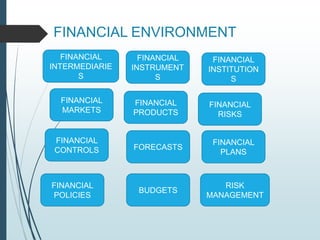
FINANCIAL ENVIRONMENT
FINANCIAL
MARKETS
FINANCIAL
CONTROLS
FINANCIAL
INTERMEDIARIE
S
FORECASTS
FINANCIAL
RISKS
FINANCIAL
INSTITUTION
S
FINANCIAL
PLANS
FINANCIAL
POLICIES
FINANCIAL
INSTRUMENT
S
FINANCIAL
PRODUCTS
BUDGETS
RISK
MANAGEMENT
DEFINITION
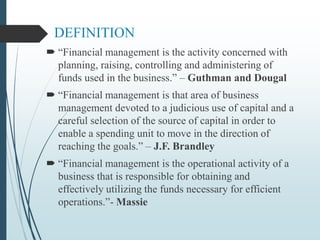
 “Financial management is the activity concerned with
planning, raising, controlling and administering of
funds used in the business.” – Guthman and Dougal
 “Financial management is that area of business
management devoted to a judicious use of capital and a
careful selection of the source of capital in order to
enable a spending unit to move in the direction of
reaching the goals.” – J.F. Brandley
 “Financial management is the operational activity of a
business that is responsible for obtaining and
effectively utilizing the funds necessary for efficient
operations.”- Massie
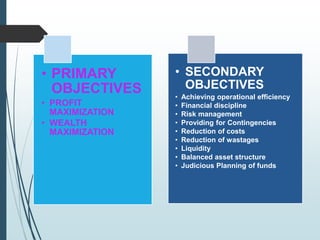
OBJECTIVES
PRIMARY OBJECTIVES
SECONDARY OBJECTIVES
• PRIMARY
OBJECTIVES
• PROFIT
MAXIMIZATION
• WEALTH
MAXIMIZATION
• SECONDARY
OBJECTIVES
• Achieving operational efficiency
• Financial discipline
• Risk management
• Providing for Contingencies
• Reduction of costs
• Reduction of wastages
• Liquidity
• Balanced asset structure
• Judicious Planning of funds
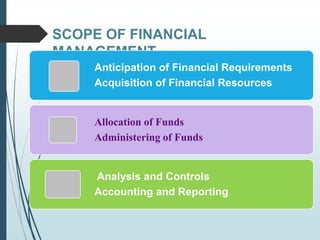
SCOPE OF FINANCIAL
MANAGEMENT
Anticipation of Financial Requirements
Acquisition of Financial Resources
Allocation of Funds
Administering of Funds
Analysis and Controls
Accounting and Reporting
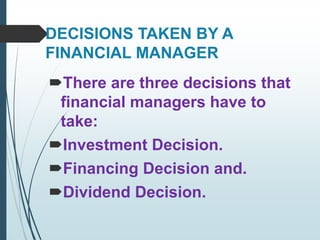
DECISIONS TAKEN BY A
FINANCIAL MANAGER
There are three decisions that
financial managers have to
take:
Investment Decision.
Financing Decision and.
Dividend Decision.
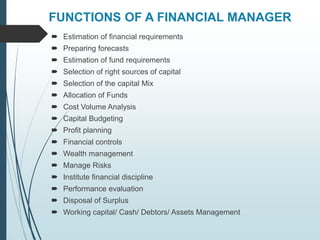
FUNCTIONS OF A FINANCIAL MANAGER
 Estimation of financial requirements
 Preparing forecasts
 Estimation of fund requirements
 Selection of right sources of capital
 Selection of the capital Mix
 Allocation of Funds
 Cost Volume Analysis
 Capital Budgeting
 Profit planning
 Financial controls
 Wealth management
 Manage Risks
 Institute financial discipline
 Performance evaluation
 Disposal of Surplus
 Working capital/ Cash/ Debtors/ Assets Management
APPROACHES
 TRADITIONAL APPROACH
 MODERN APPROACH
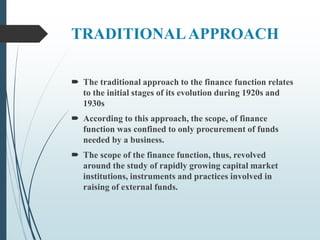
TRADITIONALAPPROACH
 The traditional approach to the finance function relates
to the initial stages of its evolution during 1920s and
1930s
 According to this approach, the scope, of finance
function was confined to only procurement of funds
needed by a business.
 The scope of the finance function, thus, revolved
around the study of rapidly growing capital market
institutions, instruments and practices involved in
raising of external funds.
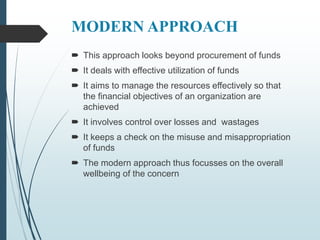
MODERN APPROACH
 This approach looks beyond procurement of funds
 It deals with effective utilization of funds
 It aims to manage the resources effectively so that
the financial objectives of an organization are
achieved
 It involves control over losses and wastages
 It keeps a check on the misuse and misappropriation
of funds
 The modern approach thus focusses on the overall
wellbeing of the concern

Financial management basics

  • 1.
    PREPARED BY –CA ANNIE STEPHEN
  • 2.
    INTRODUCTION  Finance isan essential and indispensable part of any organization.  It is difficult for organizations, whether profit-making or otherwise, to sustain themselves for long without proper finances.  Not just that, the efficient management of these financial resources is essential to be sustainable and viable in the long-run. Financial management helps organizations to do so.  Moreover the main aim of any business unit is to make profits.  In order to ensure that the objectives of the enterprise are established, Financial Management is essential.  Moreover the business is surrounded by various risks and uncertainties' and competitors too pose a major risk.  The complex nature of the business houses, changing markets, government interference, misuse and misappropriation of funds warrant the need for management of Financial resources
  • 3.
    What is FinancialManagement  Financial Management means planning, organizing, directing and controlling the financial activities such as procurement and utilization of funds of the enterprise.  It means applying general management principles to financial resources of the enterprise.  Financial management and financial managers play a crucial role in making financial decisions and exercising control over finances in the organization. They make use of techniques like ratio analysis, financial forecasting, profit and loss analysis, etc.
  • 4.
     Financial Managementinvolves planning of financial activities and resources in the organization. To this end, they use available data to understand the needs and priorities of the organization as well as the overall economic situation and make plans and budgets for the same.  It means estimation of the capital requirements of the organization from time to time, determines the capital structure and composition and makes the choice of source of funding for the capital needs.  Financial management ensures that all financial resources of the organizations are used and invested effectively and efficiently so that the organization is profitable, sustainable and viable in the long-run.  Financial management tracks the cash outflows and the inflows and also helps in cash management  It also involves preparation of reports which can be used for preparing financial forecasts and planning financial activities.  Sound financial management prepares the organization to forecast risks, meet unforeseen risks and emergencies effectively.  The ability to face the threats of competition can be made possible with Financial Management
  • 5.
  • 6.
    DEFINITION  “Financial managementis the activity concerned with planning, raising, controlling and administering of funds used in the business.” – Guthman and Dougal  “Financial management is that area of business management devoted to a judicious use of capital and a careful selection of the source of capital in order to enable a spending unit to move in the direction of reaching the goals.” – J.F. Brandley  “Financial management is the operational activity of a business that is responsible for obtaining and effectively utilizing the funds necessary for efficient operations.”- Massie
  • 7.
  • 8.
    • PRIMARY OBJECTIVES • PROFIT MAXIMIZATION •WEALTH MAXIMIZATION • SECONDARY OBJECTIVES • Achieving operational efficiency • Financial discipline • Risk management • Providing for Contingencies • Reduction of costs • Reduction of wastages • Liquidity • Balanced asset structure • Judicious Planning of funds
  • 9.
    SCOPE OF FINANCIAL MANAGEMENT Anticipationof Financial Requirements Acquisition of Financial Resources Allocation of Funds Administering of Funds Analysis and Controls Accounting and Reporting
  • 10.
    DECISIONS TAKEN BYA FINANCIAL MANAGER There are three decisions that financial managers have to take: Investment Decision. Financing Decision and. Dividend Decision.
  • 11.
    FUNCTIONS OF AFINANCIAL MANAGER  Estimation of financial requirements  Preparing forecasts  Estimation of fund requirements  Selection of right sources of capital  Selection of the capital Mix  Allocation of Funds  Cost Volume Analysis  Capital Budgeting  Profit planning  Financial controls  Wealth management  Manage Risks  Institute financial discipline  Performance evaluation  Disposal of Surplus  Working capital/ Cash/ Debtors/ Assets Management
  • 12.
  • 13.
    TRADITIONALAPPROACH  The traditionalapproach to the finance function relates to the initial stages of its evolution during 1920s and 1930s  According to this approach, the scope, of finance function was confined to only procurement of funds needed by a business.  The scope of the finance function, thus, revolved around the study of rapidly growing capital market institutions, instruments and practices involved in raising of external funds.
  • 14.
    MODERN APPROACH  Thisapproach looks beyond procurement of funds  It deals with effective utilization of funds  It aims to manage the resources effectively so that the financial objectives of an organization are achieved  It involves control over losses and wastages  It keeps a check on the misuse and misappropriation of funds  The modern approach thus focusses on the overall wellbeing of the concern