OBJECTIVES:
The learners should be able to:
1. define Finance
2. describe who are responsible for financial
management within an organization.
BUSINESS
FINANCE
“Finance as the
science and art of
managing money.”
(Gitman &
Zutter, 2012)
FINANCE
The study of how
the players in the
financial system acquire,
spend, manage, and
make other sound
financial decisions
concerning money and
other financial resources.
Why study
finance?
According to Cayanan and Borja (2017),
“Financial management deals with decisions
that are supposed to maximize the value of
shareholders’ wealth.” Financial management is a
decision-making process that includes planning,
analysis, utilization, and acquisition of funds in order
to achieve the desired goals of the business. Risk
and return are part of managing a business. A
thorough plan and analysis should be done to avoid
or reduce risks and to have a good return.
Finance
Finance helps students understand the
difference between value and price and
its role and impact in the business
decisions we take in our day to day lives.
It also helps us create value and
understand the future effects of value
today.
To make sound and economic decisions
Decisions being made by individuals, businesses, and governments affect the entire
economy.
To make sound personal and business investment decisions
Investors in businesses should make prudence decisions
To manage money and financial resources
Money is a resource where everything starts, it is limited and scarce.
Why study Finance?
To be able to understand the career path available to
finance professionals
Knowing finance entails knowing as well the job opportunities available to finance
professionals
Financial
Management
Means planning, organizing, directing and controlling
the financial activities such as procurement and
utilization of funds of the enterprise. It means
applying general management principles to financial
resources of the enterprise.
If you have cash,
does it mean that
you manage your
finances?
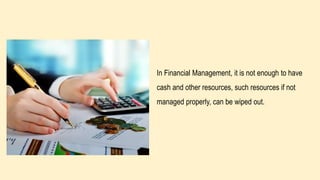
In Financial Management, it is not enough to have
cash and other resources, such resources if not
managed properly, can be wiped out.
The goal of financial
management is to maximize the wealth of
the shareholders. Its aim is to make
money and add value to the investors
and to the firm. Investors buy stocks
because they want something in return.
More investors will create more funds and
more jobs.
Maximizing the shareholders’ wealth is not
that easy; a lot of things should be considered, and
they need to satisfy different stakeholders. To gain
profit, the business should make customers happy.
They must treat their employees well like customers to
become more productive and trustworthy. They should
pay their financial obligations with their creditors and
suppliers on time so they can establish a good
relationship. They must pay their financial obligation
on time.
Firms must also pay attention
to the government and environmental
issues. They must comply with the
government and legal requirements. They
must see that they will not have a bad
effect on the environment.
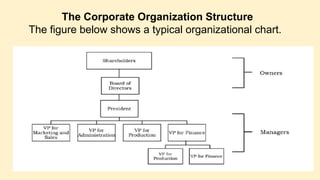
The Corporate Organization Structure
The figure below shows a typical organizational chart.
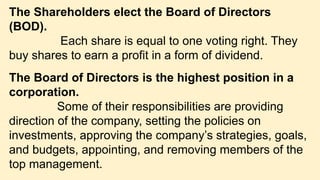
The Shareholders elect the Board of Directors
(BOD).
Each share is equal to one voting right. They
buy shares to earn a profit in a form of dividend.
The Board of Directors is the highest position in a
corporation.
Some of their responsibilities are providing
direction of the company, setting the policies on
investments, approving the company’s strategies, goals,
and budgets, appointing, and removing members of the
top management.
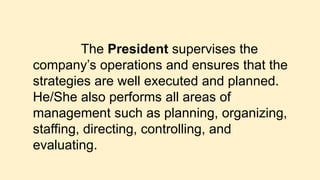
The President supervises the
company’s operations and ensures that the
strategies are well executed and planned.
He/She also performs all areas of
management such as planning, organizing,
staffing, directing, controlling, and
evaluating.
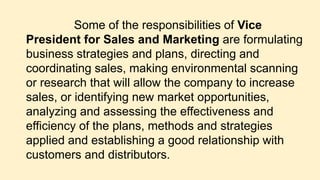
Some of the responsibilities of Vice
President for Sales and Marketing are formulating
business strategies and plans, directing and
coordinating sales, making environmental scanning
or research that will allow the company to increase
sales, or identifying new market opportunities,
analyzing and assessing the effectiveness and
efficiency of the plans, methods and strategies
applied and establishing a good relationship with
customers and distributors.
The Vice President for Administration is
responsible for the coordination of the different
departments, providing assistance to the other
department by determining the staff needed and
assisting other departments in hiring employees and in
payroll preparation.
The Vice President for Production makes
sure that the production meets the demand, finds ways
to minimize cost in producing a competitive quality
product, maximizes the utilization of the production
facilities and solves production issues.
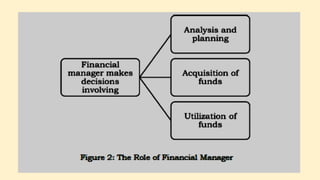
The Vice President for Finance
makes decisions including planning,
acquiring and utilization of funds. The
functions of the Finance Manager are
investing decisions, financing decisions,
operating decisions, and declaring
dividends.
• Investing decisions deals with
managing the assets of the firms. Some of
the examples of investment decisions are
the allocation of funds, determination of
the funds that a firm can put into
investment, evaluation, and selection of
capital investment proposal.
• Financing decisions includes making
decisions on how to finance the long-term
investments (expansions or acquisition of new
land) and working capital which deals with the
day-to-day operations of the company
(payment of rent and utilities, purchase of raw
materials). The finance manager must
determine the right capital structure of the
company. Capital structure refers to how much
the total asset is financed by the debt (like
loans) or equity (like stocks or bonds).
• Operating decisions deals
with working capital management.
Working capital refers to short-term
assets and short-term liabilities.
Inventory, receivables, cash, and
short-term investments are
examples of short-term assets.
• Declaration of dividends refers
to the determination of how much
dividends are to be distributed to the
shareholders, frequency of payments
and amounts to be retained by the firm.
Dividend is a portion of profit or
payment made by a corporation to its
shareholders.
There are certain conditions
before a company can declare dividends:
(1) The company must have enough
retained earnings (accumulated profits)
to support cash dividend declaration. (2)
They must have enough cash.
Both the treasurer and the
controller report to the Vice President for
Finance. The treasurer is responsible in
managing the cash and credit, financial
planning and capital expenditures. The
controller handles tax payments, financial
accounting and management information
systems.
The organizational structure of the
firm depends on the size and nature of the
firm. Every department in the organization
needs funds to function well. Since finance
is needed in all parts of the organization,
the finance manager must communicate
with other department managers to
achieve the goals of the company.
The Role of the
Finance Manager
According to Cabrera (2017), “In
striving to maximize owners’ or
shareholders’ wealth, the financial
manager makes decisions involving
planning, acquiring, and utilizing funds
which involve a set of risk-return trade-
offs.”
Those risks or returns would have an impact on
the market value of the firm that will lead to the
shareholder’s wealth maximization or downfall of the firm if
no proper decisions were made, but some of the factors
that affect the market’s price of the firm’s shares are
beyond the control of the management. Thus, it is the
responsibility of the financial manager to make decisions in
allocating the funds or resources properly, finding the best
alternatives for funding the company, and creating a policy
in distributing the dividends of the investors in line with the
organization’s objectives.
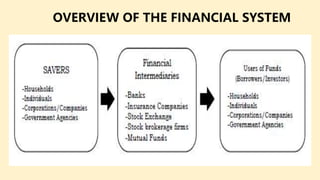
OVERVIEW OF THE FINANCIAL SYSTEM
The financial system links the
savers and the users of funds. Savings can
come from households, individuals,
companies, government agencies, or any
other entity whose cash inflows are greater
than their cash outflows. The financial
system through financial intermediaries
provides a mechanism by which these
savings can be channelled to users of funds,
borrowers, and investors.
Some of the financial
instruments issued by users of
funds such as the shares of stocks
and corporate bonds of publicly
listed companies and the debt
securities issued by the National
Government has traded.
DIFFERENTIATE THE
FINANCIAL INSTRUMENTS,
FINANCIAL INSTITUTIONS
AND
FINANCIAL MARKETS
1. Financial institutions - are companies in
the financial sector that provide a broad range
of business and services including banking,
insurance, and investment management.
Identify examples of financial
institutions/Intermediaries:
a. Commercial Banks - Individuals
deposit funds at commercial banks, which
use the deposited funds to provide
commercial loans to firms and personal
loans to individuals, and purchase debt
securities issued by firms or government
agencies.
b. Insurance Companies - Individuals purchase
insurance (life, property and casualty, and health)
protection with insurance premiums. The insurance
companies pool these payments and invest the
proceeds in various securities until the funds needed
to pay off claims by policyholders. Because they
often own large blocks of a firm’s stocks or bonds,
they frequently attempt to influence the management
of the firm to improve the firm’s performance, and
ultimately, the performance of the securities they
own.
c. Mutual Funds - Mutual funds owned by
investment companies that enable small
investors to enjoy the benefits of investing in a
diversified portfolio of securities purchased on
their behalf by professional investment
managers. When mutual funds use money from
investors to invest in newly issued debt or equity
securities, they finance new investment by
firms.
d. Pension Funds - Financial
institutions that receive payments from
employees and invest the proceeds on
their behalf.
Other financial institutions
include pension funds like Government
Service Insurance System (GSIS) and
Social Security System (SSS), unit
investment trust fund (UITF), investment
banks, and credit unions, among others.
2. Financial Instruments-is a real or
a virtual document representing a legal
agreement involving some sort of monetary
value. These can be debt securities like
corporate bonds or equity like shares of stock.
When a financial instrument issued, it gives
rise to a financial asset on one hand and a
financial liability or equity instrument on the
other.
a. A Financial Asset is any asset that is:
• Cash
• An equity instrument of another entity
• A contractual right to receive cash or another
financial asset from another entity.
• A contractual right to exchange instruments with
another entity under conditions that are potentially
favorable. (IAS 32.11)
Examples: Notes Receivable, Loans Receivable,
Investment in Stocks, Investment in Bonds
b. A Financial Liability is any liability that is a
contractual obligation:
• To deliver cash or other financial instrument to
another entity.
• To exchange financial instruments with another
entity under conditions that are potentially
unfavorable. (IAS 32)
Examples: Notes Payable, Loans Payable, Bonds
Payable
c. An Equity Instrument is any contract
that evidences a residual interest in the
assets of an entity after deducting all
liabilities. (IAS 32)
• Examples: Ordinary Share Capital,
Preference Share Capital
• Identify common examples of Debt and
Equity Instruments.
d. Debt Instruments generally have
fixed returns due to fixed interest
rates.
Examples of debt instruments are as
follows:
• Corporate Bonds issued by publicly
listed companies. These bonds usually have
higher interest rates than Treasury bonds.
However, these bonds are not risk free. If the
company issued the bonds goes bankrupt, the
holder of the bonds will no longer receive any
return from their investment and even their
principal investment has wiped out.
e. Equity Instruments generally have
varied returns based on the performance of
the issuing company. Returns from equity
instruments come from either dividends or
stock price appreciation.
The following are types of equity
instruments:
•Preferred Stock has priority over
a common stock in terms of claims over the
assets of a company. This means that if a
company has liquidated and its assets have
to be distributed, no asset be distributed to
common stockholders unless all the claims
of the preferred stockholders has given.
• Holders of Common Stock on the other hand
are the real owners of the company. If the
company’s growth is encouraging, the common
stockholders will benefit on the growth.
Moreover, during a profitable period for which a
company may decide to declare higher
dividends, preferred stock will receive a fixed
dividend rate while common stockholders
receive all the excess.
3. Financial Market - refers to a marketplace,
where creation and trading of financial assets,
such as shares, debentures, bonds,
derivatives, currencies, etc. take place.
Classify Financial Markets into comparative
groups:
Primary vs. Secondary Markets
• To raise money, users of funds will go to a primary
market to issue new securities (either debt or
equity) through a public offering or a private
placement.
• The sale of new securities to the public referred to
as a public offering and the first offering of stock
named an initial public offering. The sale of new
securities to one investor or a group of investors
(institutional investors) is referred to as a private
placement.
• However, suppliers of funds or the holders of
the securities may decide to sell the securities
that have purchased. The sale of previously
owned securities takes place in secondary
markets.
• The Philippine Stock Exchange (PSE) is both
a primary and secondary
market.
BUS2_D1_Introduction.pptx

BUS2_D1_Introduction.pptx

  • 1.
    OBJECTIVES: The learners shouldbe able to: 1. define Finance 2. describe who are responsible for financial management within an organization.
  • 2.
  • 4.
    “Finance as the scienceand art of managing money.” (Gitman & Zutter, 2012)
  • 5.
    FINANCE The study ofhow the players in the financial system acquire, spend, manage, and make other sound financial decisions concerning money and other financial resources.
  • 6.
  • 7.
    According to Cayananand Borja (2017), “Financial management deals with decisions that are supposed to maximize the value of shareholders’ wealth.” Financial management is a decision-making process that includes planning, analysis, utilization, and acquisition of funds in order to achieve the desired goals of the business. Risk and return are part of managing a business. A thorough plan and analysis should be done to avoid or reduce risks and to have a good return.
  • 8.
    Finance Finance helps studentsunderstand the difference between value and price and its role and impact in the business decisions we take in our day to day lives. It also helps us create value and understand the future effects of value today.
  • 9.
    To make soundand economic decisions Decisions being made by individuals, businesses, and governments affect the entire economy. To make sound personal and business investment decisions Investors in businesses should make prudence decisions To manage money and financial resources Money is a resource where everything starts, it is limited and scarce. Why study Finance? To be able to understand the career path available to finance professionals Knowing finance entails knowing as well the job opportunities available to finance professionals
  • 10.
    Financial Management Means planning, organizing,directing and controlling the financial activities such as procurement and utilization of funds of the enterprise. It means applying general management principles to financial resources of the enterprise.
  • 11.
    If you havecash, does it mean that you manage your finances?
  • 12.
    In Financial Management,it is not enough to have cash and other resources, such resources if not managed properly, can be wiped out.
  • 13.
    The goal offinancial management is to maximize the wealth of the shareholders. Its aim is to make money and add value to the investors and to the firm. Investors buy stocks because they want something in return. More investors will create more funds and more jobs.
  • 14.
    Maximizing the shareholders’wealth is not that easy; a lot of things should be considered, and they need to satisfy different stakeholders. To gain profit, the business should make customers happy. They must treat their employees well like customers to become more productive and trustworthy. They should pay their financial obligations with their creditors and suppliers on time so they can establish a good relationship. They must pay their financial obligation on time.
  • 15.
    Firms must alsopay attention to the government and environmental issues. They must comply with the government and legal requirements. They must see that they will not have a bad effect on the environment.
  • 16.
    The Corporate OrganizationStructure The figure below shows a typical organizational chart.
  • 17.
    The Shareholders electthe Board of Directors (BOD). Each share is equal to one voting right. They buy shares to earn a profit in a form of dividend. The Board of Directors is the highest position in a corporation. Some of their responsibilities are providing direction of the company, setting the policies on investments, approving the company’s strategies, goals, and budgets, appointing, and removing members of the top management.
  • 18.
    The President supervisesthe company’s operations and ensures that the strategies are well executed and planned. He/She also performs all areas of management such as planning, organizing, staffing, directing, controlling, and evaluating.
  • 19.
    Some of theresponsibilities of Vice President for Sales and Marketing are formulating business strategies and plans, directing and coordinating sales, making environmental scanning or research that will allow the company to increase sales, or identifying new market opportunities, analyzing and assessing the effectiveness and efficiency of the plans, methods and strategies applied and establishing a good relationship with customers and distributors.
  • 20.
    The Vice Presidentfor Administration is responsible for the coordination of the different departments, providing assistance to the other department by determining the staff needed and assisting other departments in hiring employees and in payroll preparation. The Vice President for Production makes sure that the production meets the demand, finds ways to minimize cost in producing a competitive quality product, maximizes the utilization of the production facilities and solves production issues.
  • 21.
    The Vice Presidentfor Finance makes decisions including planning, acquiring and utilization of funds. The functions of the Finance Manager are investing decisions, financing decisions, operating decisions, and declaring dividends.
  • 22.
    • Investing decisionsdeals with managing the assets of the firms. Some of the examples of investment decisions are the allocation of funds, determination of the funds that a firm can put into investment, evaluation, and selection of capital investment proposal.
  • 23.
    • Financing decisionsincludes making decisions on how to finance the long-term investments (expansions or acquisition of new land) and working capital which deals with the day-to-day operations of the company (payment of rent and utilities, purchase of raw materials). The finance manager must determine the right capital structure of the company. Capital structure refers to how much the total asset is financed by the debt (like loans) or equity (like stocks or bonds).
  • 24.
    • Operating decisionsdeals with working capital management. Working capital refers to short-term assets and short-term liabilities. Inventory, receivables, cash, and short-term investments are examples of short-term assets.
  • 25.
    • Declaration ofdividends refers to the determination of how much dividends are to be distributed to the shareholders, frequency of payments and amounts to be retained by the firm. Dividend is a portion of profit or payment made by a corporation to its shareholders.
  • 26.
    There are certainconditions before a company can declare dividends: (1) The company must have enough retained earnings (accumulated profits) to support cash dividend declaration. (2) They must have enough cash.
  • 27.
    Both the treasurerand the controller report to the Vice President for Finance. The treasurer is responsible in managing the cash and credit, financial planning and capital expenditures. The controller handles tax payments, financial accounting and management information systems.
  • 28.
    The organizational structureof the firm depends on the size and nature of the firm. Every department in the organization needs funds to function well. Since finance is needed in all parts of the organization, the finance manager must communicate with other department managers to achieve the goals of the company.
  • 29.
    The Role ofthe Finance Manager
  • 30.
    According to Cabrera(2017), “In striving to maximize owners’ or shareholders’ wealth, the financial manager makes decisions involving planning, acquiring, and utilizing funds which involve a set of risk-return trade- offs.”
  • 31.
    Those risks orreturns would have an impact on the market value of the firm that will lead to the shareholder’s wealth maximization or downfall of the firm if no proper decisions were made, but some of the factors that affect the market’s price of the firm’s shares are beyond the control of the management. Thus, it is the responsibility of the financial manager to make decisions in allocating the funds or resources properly, finding the best alternatives for funding the company, and creating a policy in distributing the dividends of the investors in line with the organization’s objectives.
  • 33.
    OVERVIEW OF THEFINANCIAL SYSTEM
  • 34.
    The financial systemlinks the savers and the users of funds. Savings can come from households, individuals, companies, government agencies, or any other entity whose cash inflows are greater than their cash outflows. The financial system through financial intermediaries provides a mechanism by which these savings can be channelled to users of funds, borrowers, and investors.
  • 35.
    Some of thefinancial instruments issued by users of funds such as the shares of stocks and corporate bonds of publicly listed companies and the debt securities issued by the National Government has traded.
  • 36.
    DIFFERENTIATE THE FINANCIAL INSTRUMENTS, FINANCIALINSTITUTIONS AND FINANCIAL MARKETS
  • 37.
    1. Financial institutions- are companies in the financial sector that provide a broad range of business and services including banking, insurance, and investment management. Identify examples of financial institutions/Intermediaries:
  • 38.
    a. Commercial Banks- Individuals deposit funds at commercial banks, which use the deposited funds to provide commercial loans to firms and personal loans to individuals, and purchase debt securities issued by firms or government agencies.
  • 39.
    b. Insurance Companies- Individuals purchase insurance (life, property and casualty, and health) protection with insurance premiums. The insurance companies pool these payments and invest the proceeds in various securities until the funds needed to pay off claims by policyholders. Because they often own large blocks of a firm’s stocks or bonds, they frequently attempt to influence the management of the firm to improve the firm’s performance, and ultimately, the performance of the securities they own.
  • 40.
    c. Mutual Funds- Mutual funds owned by investment companies that enable small investors to enjoy the benefits of investing in a diversified portfolio of securities purchased on their behalf by professional investment managers. When mutual funds use money from investors to invest in newly issued debt or equity securities, they finance new investment by firms.
  • 41.
    d. Pension Funds- Financial institutions that receive payments from employees and invest the proceeds on their behalf.
  • 42.
    Other financial institutions includepension funds like Government Service Insurance System (GSIS) and Social Security System (SSS), unit investment trust fund (UITF), investment banks, and credit unions, among others.
  • 43.
    2. Financial Instruments-isa real or a virtual document representing a legal agreement involving some sort of monetary value. These can be debt securities like corporate bonds or equity like shares of stock. When a financial instrument issued, it gives rise to a financial asset on one hand and a financial liability or equity instrument on the other.
  • 44.
    a. A FinancialAsset is any asset that is: • Cash • An equity instrument of another entity • A contractual right to receive cash or another financial asset from another entity. • A contractual right to exchange instruments with another entity under conditions that are potentially favorable. (IAS 32.11) Examples: Notes Receivable, Loans Receivable, Investment in Stocks, Investment in Bonds
  • 45.
    b. A FinancialLiability is any liability that is a contractual obligation: • To deliver cash or other financial instrument to another entity. • To exchange financial instruments with another entity under conditions that are potentially unfavorable. (IAS 32) Examples: Notes Payable, Loans Payable, Bonds Payable
  • 46.
    c. An EquityInstrument is any contract that evidences a residual interest in the assets of an entity after deducting all liabilities. (IAS 32) • Examples: Ordinary Share Capital, Preference Share Capital • Identify common examples of Debt and Equity Instruments.
  • 47.
    d. Debt Instrumentsgenerally have fixed returns due to fixed interest rates. Examples of debt instruments are as follows:
  • 48.
    • Corporate Bondsissued by publicly listed companies. These bonds usually have higher interest rates than Treasury bonds. However, these bonds are not risk free. If the company issued the bonds goes bankrupt, the holder of the bonds will no longer receive any return from their investment and even their principal investment has wiped out.
  • 49.
    e. Equity Instrumentsgenerally have varied returns based on the performance of the issuing company. Returns from equity instruments come from either dividends or stock price appreciation. The following are types of equity instruments:
  • 50.
    •Preferred Stock haspriority over a common stock in terms of claims over the assets of a company. This means that if a company has liquidated and its assets have to be distributed, no asset be distributed to common stockholders unless all the claims of the preferred stockholders has given.
  • 51.
    • Holders ofCommon Stock on the other hand are the real owners of the company. If the company’s growth is encouraging, the common stockholders will benefit on the growth. Moreover, during a profitable period for which a company may decide to declare higher dividends, preferred stock will receive a fixed dividend rate while common stockholders receive all the excess.
  • 52.
    3. Financial Market- refers to a marketplace, where creation and trading of financial assets, such as shares, debentures, bonds, derivatives, currencies, etc. take place. Classify Financial Markets into comparative groups:
  • 53.
    Primary vs. SecondaryMarkets • To raise money, users of funds will go to a primary market to issue new securities (either debt or equity) through a public offering or a private placement. • The sale of new securities to the public referred to as a public offering and the first offering of stock named an initial public offering. The sale of new securities to one investor or a group of investors (institutional investors) is referred to as a private placement.
  • 54.
    • However, suppliersof funds or the holders of the securities may decide to sell the securities that have purchased. The sale of previously owned securities takes place in secondary markets. • The Philippine Stock Exchange (PSE) is both a primary and secondary market.

Editor's Notes

  • #3 We will try to enhance your knowledge or have a recognition of what you are going to face with this subject, but don’t worry, we’ll make it easy
  • #5 Ask their dream job or why they took ABM then explain that this subject will be significant to their dreams
  • #6 Ask what they can notice about the picture (elements of the picture)
  • #7 Ask first if they think money is part of their lives as abm students Ask on why they think finance is part of their subject. In finance they will be able to know how to manage their money.
  • #10 Scarce - deficient in quantity or number compared with the demand : not plentiful or abundant. Economy - the wealth and resources of a country or region, especially in terms of the production and consumption of goods and services. Prudent- cautious
  • #11 Ask the key elements of the picture. “Money is a key element in financial management”
  • #12 Ask students to raise hands if yes or no
  • #13 From the perspective of a corporation, Financial Management deals with decisions that are supposed to maximize the value of shareholder’s wealth. This means maximizing the market value of the shares of stocks.