S.S. Afemikhe Consulting
Financial Management for the ace school
2
Table of Content
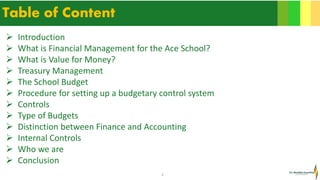
 Introduction
 What is Financial Management for the Ace School?
 What is Value for Money?
 Treasury Management
 The School Budget
 Procedure for setting up a budgetary control system
 Controls
 Type of Budgets
 Distinction between Finance and Accounting
 Internal Controls
 Who we are
 Conclusion
3
Introduction
What are schools set up to typically do?
The core business of schools is teaching and learning. Schools
exist so that students can learn and the central activity of schools
is instruction. The efficiency and effective management of fiscal
and physical resources can enhance instructional programmes.
Drake and Roe (1994).
What is Management for the Ace School?
Ace - an ace school is a sustainable and viable institution that has
the capacity to produce a leader with a vision and clear cut
direction to change his world; this will be measured by both
moral and academic standards.
Management as it regards to education is defined as ‘a process of
relating resources to objectives required in organisations which
explicitly exist to provide education (Paisley, 1992)
4
What is Financial Management for the Ace School?
Financial Management is seeing to it that schools have the funds it requires to meet its goals in its quest to
becoming a sustainable and viable institution and that value for money is gained for such funds expended.
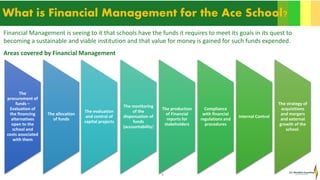
Areas covered by Financial Management
The
procurement of
funds –
Evaluation of
the financing
alternatives
open to the
school and
costs associated
with them
The allocation
of funds
The evaluation
and control of
capital projects
The monitoring
of the
dispensation of
funds
(accountability)
The production
of Financial
reports for
stakeholders
Compliance
with financial
regulations and
procedures
Internal Control
The strategy of
acquisitions
and mergers
and external
growth of the
school.
5
What is Financial Management for the Ace School?
Effective financial management ensures
that:
• all financial regulations and procedures
are complied with
• all financial transactions are recorded
accurately,
• adequate controls are in place to
ensure that expenditures do not
exceed income,
• only authorised expenditures are
incurred.
What is your role as education managers?
Your major role as the education manager is
to create an environment in the school that
will facilitate effective and successful
teaching and learning. This is done through
the effective management of the schools’
human, material and financial resources.
It is, therefore, important to stress that
financial management is one of your major
functions as education manager. Without
good financial management practices,
schools would find it difficult to achieve their
goals.
6
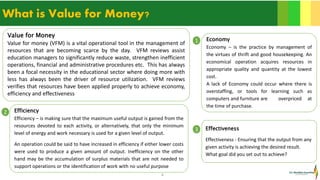
What is Value for Money?
Value for Money
Value for money (VFM) is a vital operational tool in the management of
resources that are becoming scarce by the day. VFM reviews assist
education managers to significantly reduce waste, strengthen inefficient
operations, financial and administrative procedures etc. This has always
been a focal necessity in the educational sector where doing more with
less has always been the driver of resource utilization. VFM reviews
verifies that resources have been applied properly to achieve economy,
efficiency and effectiveness
Economy
Economy – is the practice by management of
the virtues of thrift and good housekeeping. An
economical operation acquires resources in
appropriate quality and quantity at the lowest
cost.
A lack of Economy could occur where there is
overstaffing, or tools for learning such as
computers and furniture are overpriced at
the time of purchase.
Efficiency
Efficiency – is making sure that the maximum useful output is gained from the
resources devoted to each activity, or alternatively, that only the minimum
level of energy and work necessary is used for a given level of output.
An operation could be said to have increased in efficiency if either lower costs
were used to produce a given amount of output. Inefficiency on the other
hand may be the accumulation of surplus materials that are not needed to
support operations or the identification of work with no useful purpose
Effectiveness
Effectiveness - Ensuring that the output from any
given activity is achieving the desired result.
What goal did you set out to achieve?
1
2
3
7
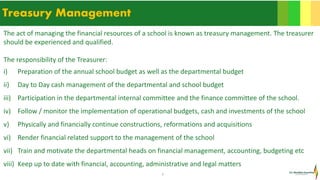
Treasury Management
The act of managing the financial resources of a school is known as treasury management. The treasurer
should be experienced and qualified.
The responsibility of the Treasurer:
i) Preparation of the annual school budget as well as the departmental budget
ii) Day to Day cash management of the departmental and school budget
iii) Participation in the departmental internal committee and the finance committee of the school.
iv) Follow / monitor the implementation of operational budgets, cash and investments of the school
v) Physically and financially continue constructions, reformations and acquisitions
vi) Render financial related support to the management of the school
vii) Train and motivate the departmental heads on financial management, accounting, budgeting etc
viii) Keep up to date with financial, accounting, administrative and legal matters
8
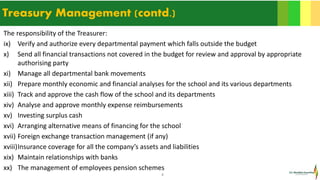
Treasury Management (contd.)
The responsibility of the Treasurer:
ix) Verify and authorize every departmental payment which falls outside the budget
x) Send all financial transactions not covered in the budget for review and approval by appropriate
authorising party
xi) Manage all departmental bank movements
xii) Prepare monthly economic and financial analyses for the school and its various departments
xiii) Track and approve the cash flow of the school and its departments
xiv) Analyse and approve monthly expense reimbursements
xv) Investing surplus cash
xvi) Arranging alternative means of financing for the school
xvii) Foreign exchange transaction management (if any)
xviii)Insurance coverage for all the company’s assets and liabilities
xix) Maintain relationships with banks
xx) The management of employees pension schemes
9
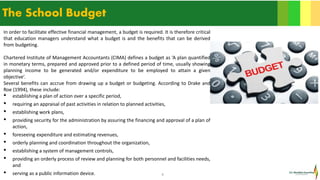
The School Budget
In order to facilitate effective financial management, a budget is required. It is therefore critical
that education managers understand what a budget is and the benefits that can be derived
from budgeting.
Chartered Institute of Management Accountants (CIMA) defines a budget as ‘A plan quantified
in monetary terms, prepared and approved prior to a defined period of time, usually showing
planning income to be generated and/or expenditure to be employed to attain a given
objective’.
Several benefits can accrue from drawing up a budget or budgeting. According to Drake and
Roe (1994), these include:
• establishing a plan of action over a specific period,
• requiring an appraisal of past activities in relation to planned activities,
• establishing work plans,
• providing security for the administration by assuring the financing and approval of a plan of
action,
• foreseeing expenditure and estimating revenues,
• orderly planning and coordination throughout the organization,
• establishing a system of management controls,
• providing an orderly process of review and planning for both personnel and facilities needs,
and
• serving as a public information device.
10
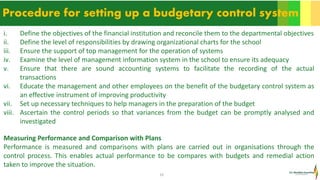
Procedure for setting up a budgetary control system
i. Define the objectives of the financial institution and reconcile them to the departmental objectives
ii. Define the level of responsibilities by drawing organizational charts for the school
iii. Ensure the support of top management for the operation of systems
iv. Examine the level of management information system in the school to ensure its adequacy
v. Ensure that there are sound accounting systems to facilitate the recording of the actual
transactions
vi. Educate the management and other employees on the benefit of the budgetary control system as
an effective instrument of improving productivity
vii. Set up necessary techniques to help managers in the preparation of the budget
viii. Ascertain the control periods so that variances from the budget can be promptly analysed and
investigated
Measuring Performance and Comparison with Plans
Performance is measured and comparisons with plans are carried out in organisations through the
control process. This enables actual performance to be compares with budgets and remedial action
taken to improve the situation.
11
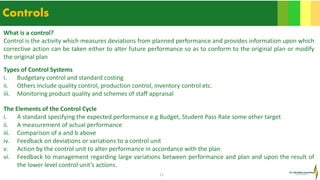
Controls
What is a control?
Control is the activity which measures deviations from planned performance and provides information upon which
corrective action can be taken either to alter future performance so as to conform to the original plan or modify
the original plan
Types of Control Systems
i. Budgetary control and standard costing
ii. Others include quality control, production control, inventory control etc.
iii. Monitoring product quality and schemes of staff appraisal
The Elements of the Control Cycle
i. A standard specifying the expected performance e.g Budget, Student Pass Rate some other target
ii. A measurement of actual performance
iii. Comparison of a and b above
iv. Feedback on deviations or variations to a control unit
v. Action by the control unit to alter performance in accordance with the plan
vi. Feedback to management regarding large variations between performance and plan and upon the result of
the lower level control unit’s actions.
12
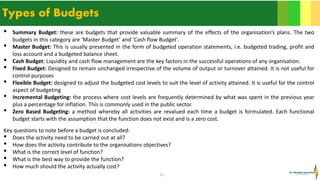
Types of Budgets
• Summary Budget: these are budgets that provide valuable summary of the effects of the organisation’s plans. The two
budgets in this category are ‘Master Budget’ and ‘Cash flow Budget’.
• Master Budget: This is usually presented in the form of budgeted operation statements, i.e. budgeted trading, profit and
loss account and a budgeted balance sheet.
• Cash Budget: Liquidity and cash flow management are the key factors in the successful operations of any organisation.
• Fixed Budget: Designed to remain unchanged irrespective of the volume of output or turnover attained. It is not useful for
control purposes
• Flexible Budget: designed to adjust the budgeted cost levels to suit the level of activity attained. It is useful for the control
aspect of budgeting
• Incremental Budgeting: the process where cost levels are frequently determined by what was spent in the previous year
plus a percentage for inflation. This is commonly used in the public sector.
• Zero Based Budgeting: a method whereby all activities are revalued each time a budget is formulated. Each functional
budget starts with the assumption that the function does not exist and is a zero cost.
Key questions to note before a budget is concluded:
• Does the activity need to be carried out at all?
• How does the activity contribute to the organisations objectives?
• What is the correct level of function?
• What is the best way to provide the function?
• How much should the activity actually cost?
13
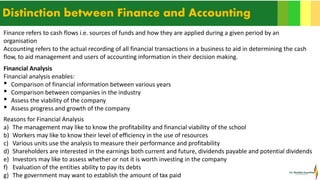
Distinction between Finance and Accounting
Finance refers to cash flows i.e. sources of funds and how they are applied during a given period by an
organisation
Accounting refers to the actual recording of all financial transactions in a business to aid in determining the cash
flow, to aid management and users of accounting information in their decision making.
Financial Analysis
Financial analysis enables:
• Comparison of financial information between various years
• Comparison between companies in the industry
• Assess the viability of the company
• Assess progress and growth of the company
Reasons for Financial Analysis
a) The management may like to know the profitability and financial viability of the school
b) Workers may like to know their level of efficiency in the use of resources
c) Various units use the analysis to measure their performance and profitability
d) Shareholders are interested in the earnings both current and future, dividends payable and potential dividends
e) Investors may like to assess whether or not it is worth investing in the company
f) Evaluation of the entities ability to pay its debts
g) The government may want to establish the amount of tax paid
14
Internal Controls
Internal control is a process for assuring the achievement of organisations objectives in operational effectiveness and
efficiency, reliable financial reporting, and compliance with laws, regulations and policies by controlling risks to the
organisation. It plays an important role in detecting and preventing fraud and protecting the organisation’s tangible and
intangible resources.
The main controls that can be found in a school are:
i. Organisation: Enterprises should plan their organisations defining and allocating responsibilities or duties and
identify lines of reporting. The delegation of authority and responsibility should be clearly defined.
ii. Segregation of duties: Ensures that a whole task is not completed by one person
iii. Physical: ensures that financial instruments such as cheque books are physically secure
iv. Authorisation and approval: All transactions should be approved by the relevant authority
v. Arithmetical and Accounting: these ensure that all recordings are correct. These checks are exercised by officers
other than those who recorded the transactions
vi. Personnel: Procedures should ensure that personnel have capabilities commensurate with their responsibilities
vii. Supervision: Any system of internal control should include supervision by responsible official
viii. Management: These are controls exercised by management outside the day-t-day routine of the system e.g overall
supervision, review of management accounts and comparing them with budgets, internal audit function etc.
ix. Acknowledgement of performance : this implies that any officer responsible for carrying out an activity must
append his/her signature as an acknowledgement of performance of such activity
15
Who we are
S.S. Afemikhe Consulting is a professional services consultancy that is passionate about its clients’
success. The company was incorporated in 2003 (CAC registration number 482453) as the business
advisory arm of the highly respected firm of Chartered Accountants, S.S. Afemikhe & Co, itself registered
in 1986.
Since inception, S.S. Afemikhe Consulting has worked actively to deliver value adding business solutions
in an efficient and effective manner to our clients.
We believe strongly in the power of collaboration. We partner with private and public organisations in
their quest to enhance their corporate performance, deliver optimal service or products at reduced total
cost of ownership and maximize stakeholders’ value.
Working with our wide network of local and international associates, SS Afemikhe Consulting cumulates
years of professional expertise to deliver value driven services powered by deeply rooted culture, beliefs
and goals entrenched in our quest to positively contribute to the success of our clients and the public
wellbeing.
16
Who we are
Our Vision
Our vision is to become the most admired indigenous and independent financial and
management consulting firm of choice in Nigeria by 2020.
Our Mission
Our mission is to deliver high quality and value-adding consulting services to our clients.
We will achieve this by our wide breath of experience and engaging the expertise of our
wide network of indigenous and international partners whose knowledge and technical
expertise gives a combination that gives our clients superior value and the opportunity
to maximise resources and effectively manage and minimise their business risks.
Our Values
Our philosophy, culture and beliefs are embodied in our:
Pursuit of excellence
Dedication to service
Teamwork and harmony
Respect for the individual
Equity and fairness.
17
Who we are
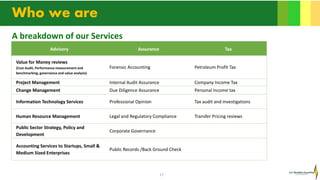
A breakdown of our Services
Advisory Assurance Tax
Value for Money reviews
(Cost Audit, Performance measurement and
benchmarking, governance and value analysis)
Forensic Accounting Petroleum Profit Tax
Project Management Internal Audit Assurance Company Income Tax
Change Management Due Diligence Assurance Personal Income tax
Information Technology Services Professional Opinion Tax audit and investigations
Human Resource Management Legal and Regulatory Compliance Transfer Pricing reviews
Public Sector Strategy, Policy and
Development
Corporate Governance
Accounting Services to Startups, Small &
Medium Sized Enterprises
Public Records /Back Ground Check
18
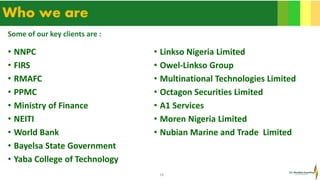
Who we are
• NNPC
• FIRS
• RMAFC
• PPMC
• Ministry of Finance
• NEITI
• World Bank
• Bayelsa State Government
• Yaba College of Technology
• Linkso Nigeria Limited
• Owel-Linkso Group
• Multinational Technologies Limited
• Octagon Securities Limited
• A1 Services
• Moren Nigeria Limited
• Nubian Marine and Trade Limited
Some of our key clients are :
19
Conclusion
Wherever schools are established, wise managers must be
provided. The wise managers are those entrusted with the
financial management of our educational institutions. They
must allow no carelessness in the expenditure of means and
must ensure Value for Money is at the heart of any financial
decision that is taken.
20

Financial management for the ace school

  • 1.
    S.S. Afemikhe Consulting FinancialManagement for the ace school
  • 2.
    2 Table of Content Introduction  What is Financial Management for the Ace School?  What is Value for Money?  Treasury Management  The School Budget  Procedure for setting up a budgetary control system  Controls  Type of Budgets  Distinction between Finance and Accounting  Internal Controls  Who we are  Conclusion
  • 3.
    3 Introduction What are schoolsset up to typically do? The core business of schools is teaching and learning. Schools exist so that students can learn and the central activity of schools is instruction. The efficiency and effective management of fiscal and physical resources can enhance instructional programmes. Drake and Roe (1994). What is Management for the Ace School? Ace - an ace school is a sustainable and viable institution that has the capacity to produce a leader with a vision and clear cut direction to change his world; this will be measured by both moral and academic standards. Management as it regards to education is defined as ‘a process of relating resources to objectives required in organisations which explicitly exist to provide education (Paisley, 1992)
  • 4.
    4 What is FinancialManagement for the Ace School? Financial Management is seeing to it that schools have the funds it requires to meet its goals in its quest to becoming a sustainable and viable institution and that value for money is gained for such funds expended. Areas covered by Financial Management The procurement of funds – Evaluation of the financing alternatives open to the school and costs associated with them The allocation of funds The evaluation and control of capital projects The monitoring of the dispensation of funds (accountability) The production of Financial reports for stakeholders Compliance with financial regulations and procedures Internal Control The strategy of acquisitions and mergers and external growth of the school.
  • 5.
    5 What is FinancialManagement for the Ace School? Effective financial management ensures that: • all financial regulations and procedures are complied with • all financial transactions are recorded accurately, • adequate controls are in place to ensure that expenditures do not exceed income, • only authorised expenditures are incurred. What is your role as education managers? Your major role as the education manager is to create an environment in the school that will facilitate effective and successful teaching and learning. This is done through the effective management of the schools’ human, material and financial resources. It is, therefore, important to stress that financial management is one of your major functions as education manager. Without good financial management practices, schools would find it difficult to achieve their goals.
  • 6.
    6 What is Valuefor Money? Value for Money Value for money (VFM) is a vital operational tool in the management of resources that are becoming scarce by the day. VFM reviews assist education managers to significantly reduce waste, strengthen inefficient operations, financial and administrative procedures etc. This has always been a focal necessity in the educational sector where doing more with less has always been the driver of resource utilization. VFM reviews verifies that resources have been applied properly to achieve economy, efficiency and effectiveness Economy Economy – is the practice by management of the virtues of thrift and good housekeeping. An economical operation acquires resources in appropriate quality and quantity at the lowest cost. A lack of Economy could occur where there is overstaffing, or tools for learning such as computers and furniture are overpriced at the time of purchase. Efficiency Efficiency – is making sure that the maximum useful output is gained from the resources devoted to each activity, or alternatively, that only the minimum level of energy and work necessary is used for a given level of output. An operation could be said to have increased in efficiency if either lower costs were used to produce a given amount of output. Inefficiency on the other hand may be the accumulation of surplus materials that are not needed to support operations or the identification of work with no useful purpose Effectiveness Effectiveness - Ensuring that the output from any given activity is achieving the desired result. What goal did you set out to achieve? 1 2 3
  • 7.
    7 Treasury Management The actof managing the financial resources of a school is known as treasury management. The treasurer should be experienced and qualified. The responsibility of the Treasurer: i) Preparation of the annual school budget as well as the departmental budget ii) Day to Day cash management of the departmental and school budget iii) Participation in the departmental internal committee and the finance committee of the school. iv) Follow / monitor the implementation of operational budgets, cash and investments of the school v) Physically and financially continue constructions, reformations and acquisitions vi) Render financial related support to the management of the school vii) Train and motivate the departmental heads on financial management, accounting, budgeting etc viii) Keep up to date with financial, accounting, administrative and legal matters
  • 8.
    8 Treasury Management (contd.) Theresponsibility of the Treasurer: ix) Verify and authorize every departmental payment which falls outside the budget x) Send all financial transactions not covered in the budget for review and approval by appropriate authorising party xi) Manage all departmental bank movements xii) Prepare monthly economic and financial analyses for the school and its various departments xiii) Track and approve the cash flow of the school and its departments xiv) Analyse and approve monthly expense reimbursements xv) Investing surplus cash xvi) Arranging alternative means of financing for the school xvii) Foreign exchange transaction management (if any) xviii)Insurance coverage for all the company’s assets and liabilities xix) Maintain relationships with banks xx) The management of employees pension schemes
  • 9.
    9 The School Budget Inorder to facilitate effective financial management, a budget is required. It is therefore critical that education managers understand what a budget is and the benefits that can be derived from budgeting. Chartered Institute of Management Accountants (CIMA) defines a budget as ‘A plan quantified in monetary terms, prepared and approved prior to a defined period of time, usually showing planning income to be generated and/or expenditure to be employed to attain a given objective’. Several benefits can accrue from drawing up a budget or budgeting. According to Drake and Roe (1994), these include: • establishing a plan of action over a specific period, • requiring an appraisal of past activities in relation to planned activities, • establishing work plans, • providing security for the administration by assuring the financing and approval of a plan of action, • foreseeing expenditure and estimating revenues, • orderly planning and coordination throughout the organization, • establishing a system of management controls, • providing an orderly process of review and planning for both personnel and facilities needs, and • serving as a public information device.
  • 10.
    10 Procedure for settingup a budgetary control system i. Define the objectives of the financial institution and reconcile them to the departmental objectives ii. Define the level of responsibilities by drawing organizational charts for the school iii. Ensure the support of top management for the operation of systems iv. Examine the level of management information system in the school to ensure its adequacy v. Ensure that there are sound accounting systems to facilitate the recording of the actual transactions vi. Educate the management and other employees on the benefit of the budgetary control system as an effective instrument of improving productivity vii. Set up necessary techniques to help managers in the preparation of the budget viii. Ascertain the control periods so that variances from the budget can be promptly analysed and investigated Measuring Performance and Comparison with Plans Performance is measured and comparisons with plans are carried out in organisations through the control process. This enables actual performance to be compares with budgets and remedial action taken to improve the situation.
  • 11.
    11 Controls What is acontrol? Control is the activity which measures deviations from planned performance and provides information upon which corrective action can be taken either to alter future performance so as to conform to the original plan or modify the original plan Types of Control Systems i. Budgetary control and standard costing ii. Others include quality control, production control, inventory control etc. iii. Monitoring product quality and schemes of staff appraisal The Elements of the Control Cycle i. A standard specifying the expected performance e.g Budget, Student Pass Rate some other target ii. A measurement of actual performance iii. Comparison of a and b above iv. Feedback on deviations or variations to a control unit v. Action by the control unit to alter performance in accordance with the plan vi. Feedback to management regarding large variations between performance and plan and upon the result of the lower level control unit’s actions.
  • 12.
    12 Types of Budgets •Summary Budget: these are budgets that provide valuable summary of the effects of the organisation’s plans. The two budgets in this category are ‘Master Budget’ and ‘Cash flow Budget’. • Master Budget: This is usually presented in the form of budgeted operation statements, i.e. budgeted trading, profit and loss account and a budgeted balance sheet. • Cash Budget: Liquidity and cash flow management are the key factors in the successful operations of any organisation. • Fixed Budget: Designed to remain unchanged irrespective of the volume of output or turnover attained. It is not useful for control purposes • Flexible Budget: designed to adjust the budgeted cost levels to suit the level of activity attained. It is useful for the control aspect of budgeting • Incremental Budgeting: the process where cost levels are frequently determined by what was spent in the previous year plus a percentage for inflation. This is commonly used in the public sector. • Zero Based Budgeting: a method whereby all activities are revalued each time a budget is formulated. Each functional budget starts with the assumption that the function does not exist and is a zero cost. Key questions to note before a budget is concluded: • Does the activity need to be carried out at all? • How does the activity contribute to the organisations objectives? • What is the correct level of function? • What is the best way to provide the function? • How much should the activity actually cost?
  • 13.
    13 Distinction between Financeand Accounting Finance refers to cash flows i.e. sources of funds and how they are applied during a given period by an organisation Accounting refers to the actual recording of all financial transactions in a business to aid in determining the cash flow, to aid management and users of accounting information in their decision making. Financial Analysis Financial analysis enables: • Comparison of financial information between various years • Comparison between companies in the industry • Assess the viability of the company • Assess progress and growth of the company Reasons for Financial Analysis a) The management may like to know the profitability and financial viability of the school b) Workers may like to know their level of efficiency in the use of resources c) Various units use the analysis to measure their performance and profitability d) Shareholders are interested in the earnings both current and future, dividends payable and potential dividends e) Investors may like to assess whether or not it is worth investing in the company f) Evaluation of the entities ability to pay its debts g) The government may want to establish the amount of tax paid
  • 14.
    14 Internal Controls Internal controlis a process for assuring the achievement of organisations objectives in operational effectiveness and efficiency, reliable financial reporting, and compliance with laws, regulations and policies by controlling risks to the organisation. It plays an important role in detecting and preventing fraud and protecting the organisation’s tangible and intangible resources. The main controls that can be found in a school are: i. Organisation: Enterprises should plan their organisations defining and allocating responsibilities or duties and identify lines of reporting. The delegation of authority and responsibility should be clearly defined. ii. Segregation of duties: Ensures that a whole task is not completed by one person iii. Physical: ensures that financial instruments such as cheque books are physically secure iv. Authorisation and approval: All transactions should be approved by the relevant authority v. Arithmetical and Accounting: these ensure that all recordings are correct. These checks are exercised by officers other than those who recorded the transactions vi. Personnel: Procedures should ensure that personnel have capabilities commensurate with their responsibilities vii. Supervision: Any system of internal control should include supervision by responsible official viii. Management: These are controls exercised by management outside the day-t-day routine of the system e.g overall supervision, review of management accounts and comparing them with budgets, internal audit function etc. ix. Acknowledgement of performance : this implies that any officer responsible for carrying out an activity must append his/her signature as an acknowledgement of performance of such activity
  • 15.
    15 Who we are S.S.Afemikhe Consulting is a professional services consultancy that is passionate about its clients’ success. The company was incorporated in 2003 (CAC registration number 482453) as the business advisory arm of the highly respected firm of Chartered Accountants, S.S. Afemikhe & Co, itself registered in 1986. Since inception, S.S. Afemikhe Consulting has worked actively to deliver value adding business solutions in an efficient and effective manner to our clients. We believe strongly in the power of collaboration. We partner with private and public organisations in their quest to enhance their corporate performance, deliver optimal service or products at reduced total cost of ownership and maximize stakeholders’ value. Working with our wide network of local and international associates, SS Afemikhe Consulting cumulates years of professional expertise to deliver value driven services powered by deeply rooted culture, beliefs and goals entrenched in our quest to positively contribute to the success of our clients and the public wellbeing.
  • 16.
    16 Who we are OurVision Our vision is to become the most admired indigenous and independent financial and management consulting firm of choice in Nigeria by 2020. Our Mission Our mission is to deliver high quality and value-adding consulting services to our clients. We will achieve this by our wide breath of experience and engaging the expertise of our wide network of indigenous and international partners whose knowledge and technical expertise gives a combination that gives our clients superior value and the opportunity to maximise resources and effectively manage and minimise their business risks. Our Values Our philosophy, culture and beliefs are embodied in our: Pursuit of excellence Dedication to service Teamwork and harmony Respect for the individual Equity and fairness.
  • 17.
    17 Who we are Abreakdown of our Services Advisory Assurance Tax Value for Money reviews (Cost Audit, Performance measurement and benchmarking, governance and value analysis) Forensic Accounting Petroleum Profit Tax Project Management Internal Audit Assurance Company Income Tax Change Management Due Diligence Assurance Personal Income tax Information Technology Services Professional Opinion Tax audit and investigations Human Resource Management Legal and Regulatory Compliance Transfer Pricing reviews Public Sector Strategy, Policy and Development Corporate Governance Accounting Services to Startups, Small & Medium Sized Enterprises Public Records /Back Ground Check
  • 18.
    18 Who we are •NNPC • FIRS • RMAFC • PPMC • Ministry of Finance • NEITI • World Bank • Bayelsa State Government • Yaba College of Technology • Linkso Nigeria Limited • Owel-Linkso Group • Multinational Technologies Limited • Octagon Securities Limited • A1 Services • Moren Nigeria Limited • Nubian Marine and Trade Limited Some of our key clients are :
  • 19.
    19 Conclusion Wherever schools areestablished, wise managers must be provided. The wise managers are those entrusted with the financial management of our educational institutions. They must allow no carelessness in the expenditure of means and must ensure Value for Money is at the heart of any financial decision that is taken.
  • 20.