
B-MRS 2016, Campinas, September 29, 2016
The Versatility of Mesoscopic Solar Cells
Anders Hagfeldt
Laboratory of Photomolecular Sciences (LSPM)
Dyenamo AB
www.dyenamo.se
Materials, research equipment, consultancy, etc, for solar cells and solar fuels.
Welcome to Lausanne!
• Dye-sensitized solar cells
• Minimizing internal potential losses
• Cu-complex redox species
• Perovskite solar cells
• Mixed compositions
• Planar devices > 20%
• The quadrupole
• Stable perovskite solar cells
• Towards GaAs ?
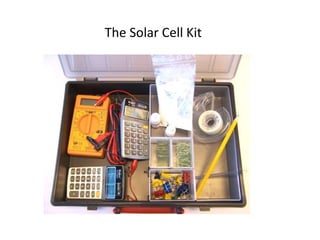
The Solar Cell Kit
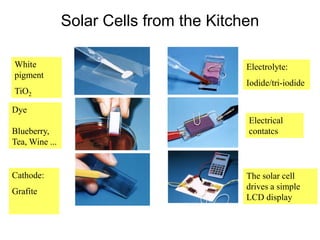
Solar Cells from the Kitchen
White
pigment
TiO2
Dye
Blueberry,
Tea, Wine ...
Cathode:
Grafite
Electrolyte:
Iodide/tri-iodide
Electrical
contatcs
The solar cell
drives a simple
LCD display
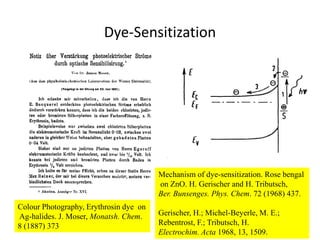
Dye-Sensitization
Colour Photography, Erythrosin dye on
Ag-halides. J. Moser, Monatsh. Chem.
8 (1887) 373
Mechanism of dye-sensitization. Rose bengal
on ZnO. H. Gerischer and H. Tributsch,
Ber. Bunsenges. Phys. Chem. 72 (1968) 437.
Gerischer, H.; Michel-Beyerle, M. E.;
Rebentrost, F.; Tributsch, H.
Electrochim. Acta 1968, 13, 1509.
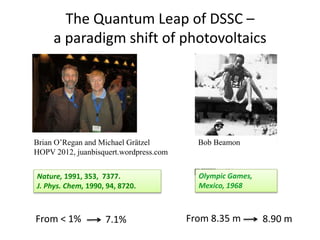
The Quantum Leap of DSSC –
a paradigm shift of photovoltaics
Nature, 1991, 353, 7377.
J. Phys. Chem, 1990, 94, 8720.
Olympic Games,
Mexico, 1968
From 8.35 m 8.90 mFrom < 1% 7.1%
Brian O’Regan and Michael Grätzel
HOPV 2012, juanbisquert.wordpress.com
Bob Beamon
TiO2
Light
e-e-
E
I- /
I3
-
e
-
DyeTCO
Electrolyte
e
-
hn
e
-
e
-
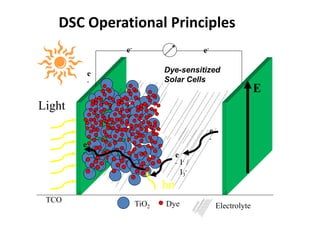
Dye-sensitized
Solar Cells
DSC Operational Principles
Why are the electrons moving in the right direction?
Kinetic model
fs
ns - ms
ns - ms
ms
e-
e-
e- Ru
N
N
N
N
N
N
C
C
S
S
HOOC
HOOC
COOH
COOH
+
+
Excited dye
Semiconductor Dye Electrolyte
e
Charge separation due to the molecular architecture
of the dye/oxide interaction
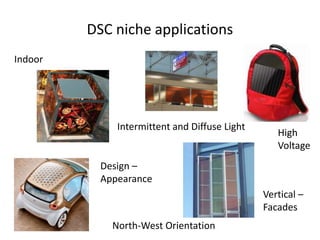
DSC niche applications
Vertical –
Facades
North-West Orientation
Intermittent and Diffuse Light
Design –
Appearance
Indoor
High
Voltage
10
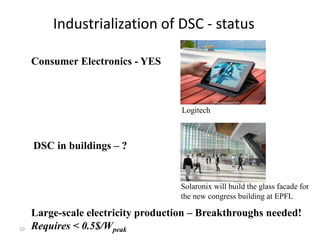
Industrialization of DSC - status
Consumer Electronics - YES
Large-scale electricity production – Breakthroughs needed!
Requires < 0.5$/Wpeak
DSC in buildings – ?
Logitech
Solaronix will build the glass facade for
the new congress building at EPFL
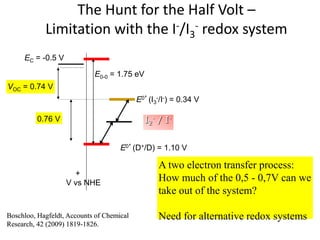
The Hunt for the Half Volt –
Limitation with the I-/I3
- redox system
E0’(I3
-/I-) = 0.34 V
E0’(D+/D) = 1.10 V
0.76 V
E0-0 = 1.75 eV
EC = -0.5 V
VOC = 0.74 V
V vs NHE
+
I2
- / I-
A two electron transfer process:
How much of the 0,5 - 0,7V can we
take out of the system?
Need for alternative redox systemsBoschloo, Hagfeldt, Accounts of Chemical
Research, 42 (2009) 1819-1826.
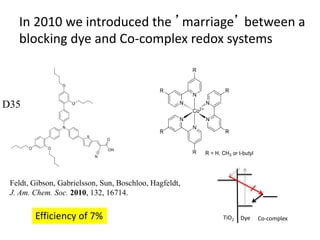
In 2010 we introduced the ’marriage’ between a
blocking dye and Co-complex redox systems
D35
Feldt, Gibson, Gabrielsson, Sun, Boschloo, Hagfeldt,
J. Am. Chem. Soc. 2010, 132, 16714.
Efficiency of 7% TiO2 Dye Co-complex
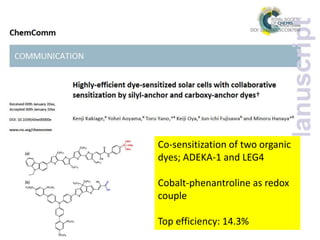
Co-sensitization of two organic
dyes; ADEKA-1 and LEG4
Cobalt-phenantroline as redox
couple
Top efficiency: 14.3%
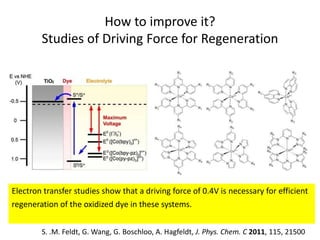
How to improve it?
Studies of Driving Force for Regeneration
S. .M. Feldt, G. Wang, G. Boschloo, A. Hagfeldt, J. Phys. Chem. C 2011, 115, 21500
Electron transfer studies show that a driving force of 0.4V is necessary for efficient
regeneration of the oxidized dye in these systems.
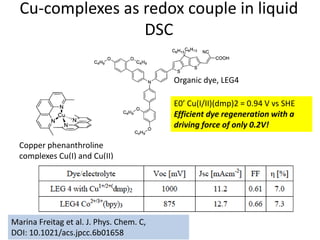
Cu-complexes as redox couple in liquid
DSC
Copper phenanthroline
complexes Cu(I) and Cu(II)
Organic dye, LEG4
Marina Freitag et al. J. Phys. Chem. C,
DOI: 10.1021/acs.jpcc.6b01658
E0’ Cu(I/II)(dmp)2 = 0.94 V vs SHE
Efficient dye regeneration with a
driving force of only 0.2V!
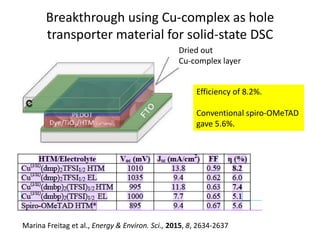
Breakthrough using Cu-complex as hole
transporter material for solid-state DSC
Dried out
Cu-complex layer
Efficiency of 8.2%.
Conventional spiro-OMeTAD
gave 5.6%.
Marina Freitag et al., Energy & Environ. Sci., 2015, 8, 2634-2637
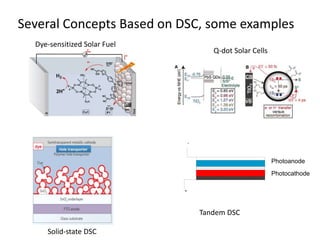
Several Concepts Based on DSC, some examples
-
+
Photoanode
Photocathode
Q-dot Solar Cells
Dye-sensitized Solar Fuel
Solid-state DSC
Tandem DSC
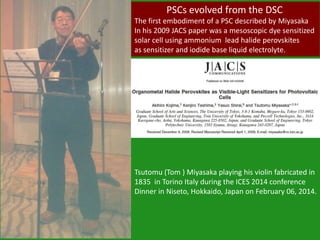
Tsutomu (Tom ) Miyasaka playing his violin fabricated in
1835 in Torino Italy during the ICES 2014 conference
Dinner in Niseto, Hokkaido, Japan on February 06, 2014.
PSCs evolved from the DSC
The first embodiment of a PSC described by Miyasaka
In his 2009 JACS paper was a mesoscopic dye sensitized
solar cell using ammonium lead halide perovskites
as sensitizer and iodide base liquid electrolyte.
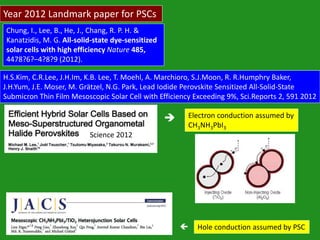
Chung, I., Lee, B., He, J., Chang, R. P. H. &
Kanatzidis, M. G. All-solid-state dye-sensitized
solar cells with high efficiency Nature 485,
4478?6?–4?8?9 (2012).
Year 2012 Landmark paper for PSCs
Electron conduction assumed by
CH3NH3PbI3

Hole conduction assumed by PSC
H.S.Kim, C.R.Lee, J.H.Im, K.B. Lee, T. Moehl, A. Marchioro, S.J.Moon, R. R.Humphry Baker,
J.H.Yum, J.E. Moser, M. Grätzel, N.G. Park, Lead Iodide Perovskite Sensitized All-Solid-State
Submicron Thin Film Mesoscopic Solar Cell with Efficiency Exceeding 9%, Sci.Reports 2, 591 2012
Science 2012
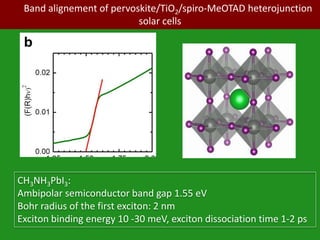
CH3NH3PbI3:
Ambipolar semiconductor band gap 1.55 eV
Bohr radius of the first exciton: 2 nm
Exciton binding energy 10 -30 meV, exciton dissociation time 1-2 ps
!
Band alignement of pervoskite/TiO2/spiro-MeOTAD heterojunction
solar cells
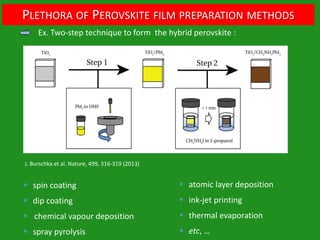
PLETHORA OF PEROVSKITE FILM PREPARATION METHODS
Ex. Two-step technique to form the hybrid perovskite :
 spin coating
 dip coating
 chemical vapour deposition
 spray pyrolysis
J. Burschka et al. Nature, 499, 316-319 (2013)
 atomic layer deposition
 ink-jet printing
 thermal evaporation
 etc, …
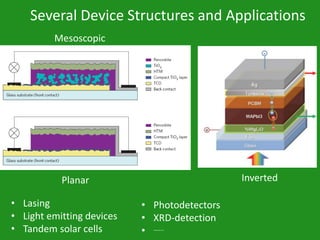
Several Device Structures and Applications
Planar
Mesoscopic
Inverted
• Lasing
• Light emitting devices
• Tandem solar cells
• Photodetectors
• XRD-detection
• …...
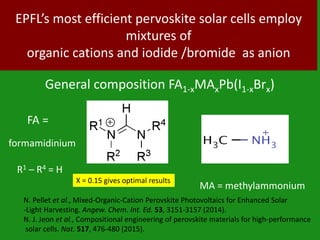
EPFL’s most efficient pervoskite solar cells employ
mixtures of
organic cations and iodide /bromide as anion
General composition FA1-xMAxPb(I1-xBrx)
FA =
R1 – R4 = H
formamidinium
MA = methylammonium
X = 0.15 gives optimal results
N. Pellet et al., Mixed-Organic-Cation Perovskite Photovoltaics for Enhanced Solar
-Light Harvesting. Angew. Chem. Int. Ed. 53, 3151-3157 (2014).
N. J. Jeon et al., Compositional engineering of perovskite materials for high-performance
solar cells. Nat. 517, 476-480 (2015).
Electroluminescent PSCs with PCE = 20.8 based on tailored mixed
cation perovskites use stochiometric excess of PbI2
Dongqin Bi, Wolfgang Tress, M. Ibrahim Dar, Peng Gao, Jingshan Luo, Clémentine Renevier, Kurt Schenk,
Antonio Abate, Fabrizio Giordano, Juan-Pablo Correa Beana, Jean- David Decoppet, Shaik M. Zakeeruddin,
M.Khaja Nazeeruddin, Michael Grätzel and Anders Hagfeldt
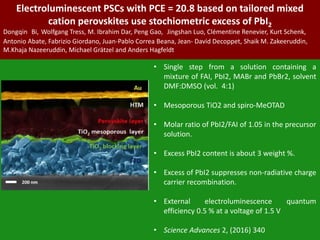
• Single step from a solution containing a
mixture of FAI, PbI2, MABr and PbBr2, solvent
DMF:DMSO (vol. 4:1)
• Mesoporous TiO2 and spiro-MeOTAD
• Molar ratio of PbI2/FAI of 1.05 in the precursor
solution.
• Excess PbI2 content is about 3 weight %.
• Excess of PbI2 suppresses non-radiative charge
carrier recombination.
• External electroluminescence quantum
efficiency 0.5 % at a voltage of 1.5 V
• Science Advances 2, (2016) 340
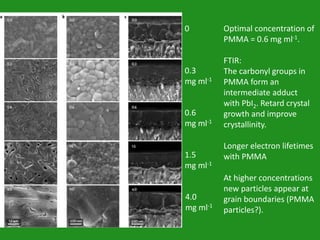
”During spin-coating we introduce PMMA in a
chlorobenzene/toluene mixture to template crystal formation and
growth of the perovskite. The PMMA serves as a support to induce
nucleation of small perovskite crystals and directs the growth of
these crystals.”DOI: 10.1038/NENERGY.2016.142
0
0.3
mg ml-1
0.6
mg ml-1
1.5
mg ml-1
4.0
mg ml-1
Optimal concentration of
PMMA = 0.6 mg ml-1.
FTIR:
The carbonyl groups in
PMMA form an
intermediate adduct
with PbI2. Retard crystal
growth and improve
crystallinity.
Longer electron lifetimes
with PMMA
At higher concentrations
new particles appear at
grain boundaries (PMMA
particles?).
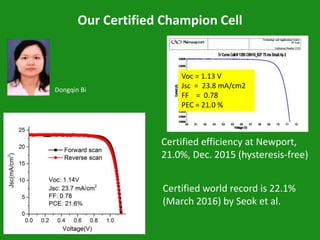
Dongqin Bi
Certified efficiency at Newport,
21.0%, Dec. 2015 (hysteresis-free)
Voc = 1.13 V
Jsc = 23.8 mA/cm2
FF = 0.78
PEC = 21.0 %
Our Certified Champion Cell
Certified world record is 22.1%
(March 2016) by Seok et al.
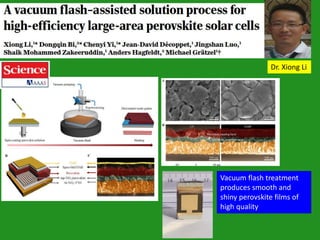
Dr. Xiong Li
2016
Vacuum flash treatment
produces smooth and
shiny perovskite films of
high quality
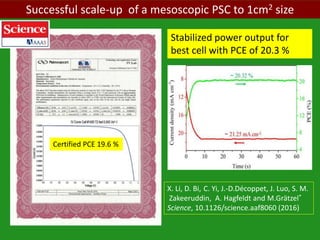
Successful scale-up of a mesoscopic PSC to 1cm2 size
Certified PCE 19.6 %
Stabilized power output for
best cell with PCE of 20.3 %
X. Li, D. Bi, C. Yi, J.-D.Décoppet, J. Luo, S. M.
Zakeeruddin, A. Hagfeldt and M.Grätzel*
Science, 10.1126/science.aaf8060 (2016)
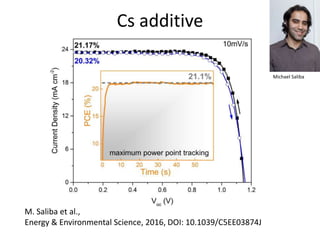
Cs additive
Michael Saliba
M. Saliba et al.,
Energy & Environmental Science, 2016, DOI: 10.1039/C5EE03874J
2016-03-01 Michael Saliba, Triple Cations for Stability, Reproducibility and High Efficiency (submitted)
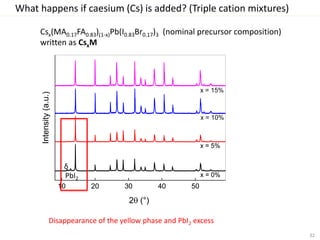
What happens if caesium (Cs) is added? (Triple cation mixtures)
32
Disappearance of the yellow phase and PbI2 excess
10 20 30 40 50
x = 15%
x = 10%
x = 5%
Intensity(a.u.)
2 (°)
x = 0%
δ
PbI2
10 20 30 40 50
x = 15%
x = 10%
x = 5%
Intensity(a.u.)
2 (°)
x = 0%
Csx(MA0.17FA0.83)(1-x)Pb(I0.83Br0.17)3 (nominal precursor composition)
written as CsxM
2016-03-01 Michael Saliba, Triple Cations for Stability, Reproducibility and High Efficiency (submitted)
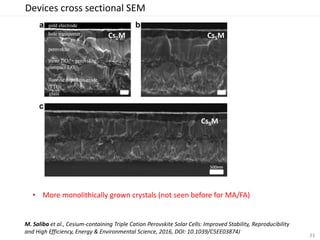
Devices cross sectional SEM
33
Cs0M Cs5M
Cs5M
• More monolithically grown crystals (not seen before for MA/FA)
Cs5M
M. Saliba et al., Cesium-containing Triple Cation Perovskite Solar Cells: Improved Stability, Reproducibility
and High Efficiency, Energy & Environmental Science, 2016, DOI: 10.1039/C5EE03874J
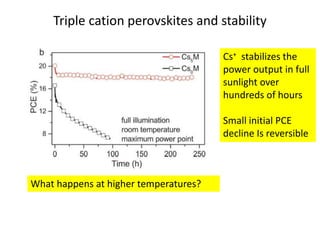
Triple cation perovskites and stability
Cs+ stabilizes the
power output in full
sunlight over
hundreds of hours
Small initial PCE
decline Is reversible
What happens at higher temperatures?
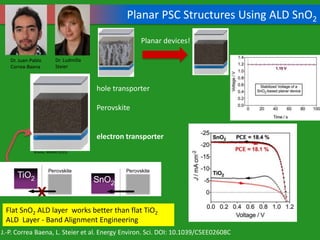
Planar PSC Structures Using ALD SnO2
Dr. Ludmilla
Steier
Dr. Juan-Pablo
Correa-Baena
Flat SnO2 ALD layer works better than flat TiO2
ALD Layer - Band Alignment Engineering
hole transporter
Perovskite
electron transporter
Planar devices!
J.-P. Correa Baena, L. Steier et al. Energy Environ. Sci. DOI: 10.1039/C5EE02608C
Stranks, NNANO (2015)
TiO2 SnO2
X
Perovskite Perovskite
HTL
Au
36
37
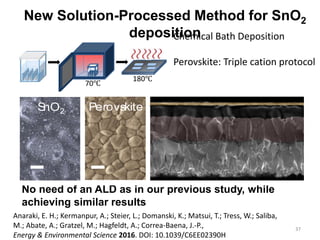
New Solution-Processed Method for SnO2
deposition
No need of an ALD as in our previous study, while
achieving similar results
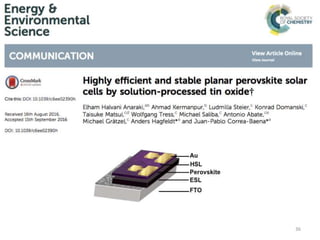
Anaraki, E. H.; Kermanpur, A.; Steier, L.; Domanski, K.; Matsui, T.; Tress, W.; Saliba,
M.; Abate, A.; Gratzel, M.; Hagfeldt, A.; Correa-Baena, J.-P.,
Energy & Environmental Science 2016. DOI: 10.1039/C6EE02390H
-25
-20
SnO2 Perovskite
70℃
180℃
Chemical Bath Deposition
Perovskite: Triple cation protocol
38
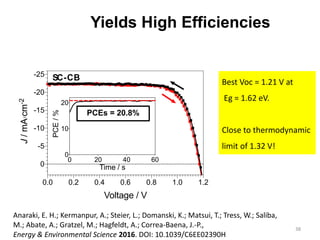
Yields High Efficiencies
PCEs = 20.8%
0.0 0.2 0.4 0.6 0.8 1.0 1.2
-25
-20
-15
-10
-5
0
Voltage / V
J/mA×cm-2
SC-CB
0 20 40 60
0
10
20
Time / s
PCE/%
Anaraki, E. H.; Kermanpur, A.; Steier, L.; Domanski, K.; Matsui, T.; Tress, W.; Saliba,
M.; Abate, A.; Gratzel, M.; Hagfeldt, A.; Correa-Baena, J.-P.,
Energy & Environmental Science 2016. DOI: 10.1039/C6EE02390H
Best Voc = 1.21 V at
Eg = 1.62 eV.
Close to thermodynamic
limit of 1.32 V!
2016-09-13, Michael Saliba, Multication perovskites
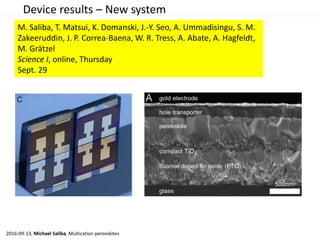
Device results – New system
M. Saliba, T. Matsui, K. Domanski, J.-Y. Seo, A. Ummadisingu, S. M.
Zakeeruddin, J. P. Correa-Baena, W. R. Tress, A. Abate, A. Hagfeldt,
M. Grätzel
Science I, online, Thursday
Sept. 29
40
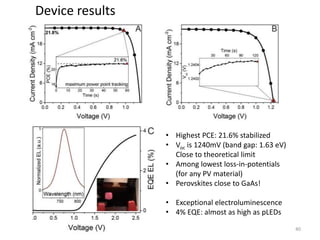
Device results
• Highest PCE: 21.6% stabilized
• Voc is 1240mV (band gap: 1.63 eV)
Close to theoretical limit
• Among lowest loss-in-potentials
(for any PV material)
• Perovskites close to GaAs!
• Exceptional electroluminescence
• 4% EQE: almost as high as pLEDs
41
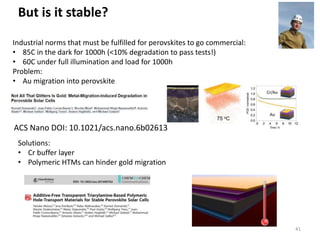
Industrial norms that must be fulfilled for perovskites to go commercial:
• 85C in the dark for 1000h (<10% degradation to pass tests!)
• 60C under full illumination and load for 1000h
Problem:
• Au migration into perovskite
Solutions:
• Cr buffer layer
• Polymeric HTMs can hinder gold migration
But is it stable?
ACS Nano DOI: 10.1021/acs.nano.6b02613
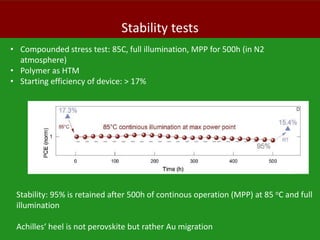
Stability tests
Stability: 95% is retained after 500h of continous operation (MPP) at 85 oC and full
illumination
Achilles‘ heel is not perovskite but rather Au migration
• Compounded stress test: 85C, full illumination, MPP for 500h (in N2
atmosphere)
• Polymer as HTM
• Starting efficiency of device: > 17%
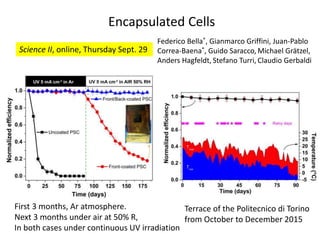
First 3 months, Ar atmosphere.
Next 3 months under air at 50% R,
In both cases under continuous UV irradiation
Terrace of the Politecnico di Torino
from October to December 2015
Encapsulated Cells
Science II, online, Thursday Sept. 29
Federico Bella*, Gianmarco Griffini, Juan-Pablo
Correa-Baena*, Guido Saracco, Michael Grätzel,
Anders Hagfeldt, Stefano Turri, Claudio Gerbaldi
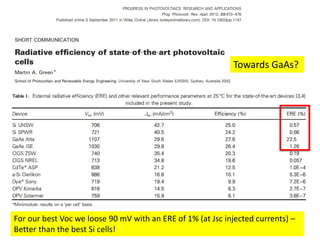
For our best Voc we loose 90 mV with an ERE of 1% (at Jsc injected currents) –
Better than the best Si cells!
Towards GaAs?
The EPFL team
Michael
Grätzel
LSPM
Dongqin Bi
Juan Pablo Correa-Baena
Marina Freitag
Somayyeh Gholipour
Elham Halvani Anaraki
Jeannette Kadro Medina
Kazuteru Nonomura
Pan Linfeng
Yasemin Saygili
Nick Vlachopoulos
LPI
Shaik M. Zakeeruddin
Wolfgang Tress
Michael Saliba
Konrad Domanski
Antonio Abate
Xiong Li
Chenyi Yi
….

The Versatility of Mesoscopic Solar Cells.

  • 1.
    B-MRS 2016, Campinas,September 29, 2016 The Versatility of Mesoscopic Solar Cells Anders Hagfeldt Laboratory of Photomolecular Sciences (LSPM) Dyenamo AB www.dyenamo.se Materials, research equipment, consultancy, etc, for solar cells and solar fuels.
  • 2.
    Welcome to Lausanne! •Dye-sensitized solar cells • Minimizing internal potential losses • Cu-complex redox species • Perovskite solar cells • Mixed compositions • Planar devices > 20% • The quadrupole • Stable perovskite solar cells • Towards GaAs ?
  • 3.
  • 4.
    Solar Cells fromthe Kitchen White pigment TiO2 Dye Blueberry, Tea, Wine ... Cathode: Grafite Electrolyte: Iodide/tri-iodide Electrical contatcs The solar cell drives a simple LCD display
  • 5.
    Dye-Sensitization Colour Photography, Erythrosindye on Ag-halides. J. Moser, Monatsh. Chem. 8 (1887) 373 Mechanism of dye-sensitization. Rose bengal on ZnO. H. Gerischer and H. Tributsch, Ber. Bunsenges. Phys. Chem. 72 (1968) 437. Gerischer, H.; Michel-Beyerle, M. E.; Rebentrost, F.; Tributsch, H. Electrochim. Acta 1968, 13, 1509.
  • 6.
    The Quantum Leapof DSSC – a paradigm shift of photovoltaics Nature, 1991, 353, 7377. J. Phys. Chem, 1990, 94, 8720. Olympic Games, Mexico, 1968 From 8.35 m 8.90 mFrom < 1% 7.1% Brian O’Regan and Michael Grätzel HOPV 2012, juanbisquert.wordpress.com Bob Beamon
  • 7.
  • 8.
    Why are theelectrons moving in the right direction? Kinetic model fs ns - ms ns - ms ms e- e- e- Ru N N N N N N C C S S HOOC HOOC COOH COOH + + Excited dye Semiconductor Dye Electrolyte e Charge separation due to the molecular architecture of the dye/oxide interaction
  • 9.
    DSC niche applications Vertical– Facades North-West Orientation Intermittent and Diffuse Light Design – Appearance Indoor High Voltage
  • 10.
    10 Industrialization of DSC- status Consumer Electronics - YES Large-scale electricity production – Breakthroughs needed! Requires < 0.5$/Wpeak DSC in buildings – ? Logitech Solaronix will build the glass facade for the new congress building at EPFL
  • 11.
    The Hunt forthe Half Volt – Limitation with the I-/I3 - redox system E0’(I3 -/I-) = 0.34 V E0’(D+/D) = 1.10 V 0.76 V E0-0 = 1.75 eV EC = -0.5 V VOC = 0.74 V V vs NHE + I2 - / I- A two electron transfer process: How much of the 0,5 - 0,7V can we take out of the system? Need for alternative redox systemsBoschloo, Hagfeldt, Accounts of Chemical Research, 42 (2009) 1819-1826.
  • 12.
    In 2010 weintroduced the ’marriage’ between a blocking dye and Co-complex redox systems D35 Feldt, Gibson, Gabrielsson, Sun, Boschloo, Hagfeldt, J. Am. Chem. Soc. 2010, 132, 16714. Efficiency of 7% TiO2 Dye Co-complex
  • 13.
    Co-sensitization of twoorganic dyes; ADEKA-1 and LEG4 Cobalt-phenantroline as redox couple Top efficiency: 14.3%
  • 14.
    How to improveit? Studies of Driving Force for Regeneration S. .M. Feldt, G. Wang, G. Boschloo, A. Hagfeldt, J. Phys. Chem. C 2011, 115, 21500 Electron transfer studies show that a driving force of 0.4V is necessary for efficient regeneration of the oxidized dye in these systems.
  • 15.
    Cu-complexes as redoxcouple in liquid DSC Copper phenanthroline complexes Cu(I) and Cu(II) Organic dye, LEG4 Marina Freitag et al. J. Phys. Chem. C, DOI: 10.1021/acs.jpcc.6b01658 E0’ Cu(I/II)(dmp)2 = 0.94 V vs SHE Efficient dye regeneration with a driving force of only 0.2V!
  • 16.
    Breakthrough using Cu-complexas hole transporter material for solid-state DSC Dried out Cu-complex layer Efficiency of 8.2%. Conventional spiro-OMeTAD gave 5.6%. Marina Freitag et al., Energy & Environ. Sci., 2015, 8, 2634-2637
  • 17.
    Several Concepts Basedon DSC, some examples - + Photoanode Photocathode Q-dot Solar Cells Dye-sensitized Solar Fuel Solid-state DSC Tandem DSC
  • 18.
    Tsutomu (Tom )Miyasaka playing his violin fabricated in 1835 in Torino Italy during the ICES 2014 conference Dinner in Niseto, Hokkaido, Japan on February 06, 2014. PSCs evolved from the DSC The first embodiment of a PSC described by Miyasaka In his 2009 JACS paper was a mesoscopic dye sensitized solar cell using ammonium lead halide perovskites as sensitizer and iodide base liquid electrolyte.
  • 19.
    Chung, I., Lee,B., He, J., Chang, R. P. H. & Kanatzidis, M. G. All-solid-state dye-sensitized solar cells with high efficiency Nature 485, 4478?6?–4?8?9 (2012). Year 2012 Landmark paper for PSCs Electron conduction assumed by CH3NH3PbI3  Hole conduction assumed by PSC H.S.Kim, C.R.Lee, J.H.Im, K.B. Lee, T. Moehl, A. Marchioro, S.J.Moon, R. R.Humphry Baker, J.H.Yum, J.E. Moser, M. Grätzel, N.G. Park, Lead Iodide Perovskite Sensitized All-Solid-State Submicron Thin Film Mesoscopic Solar Cell with Efficiency Exceeding 9%, Sci.Reports 2, 591 2012 Science 2012
  • 20.
    CH3NH3PbI3: Ambipolar semiconductor bandgap 1.55 eV Bohr radius of the first exciton: 2 nm Exciton binding energy 10 -30 meV, exciton dissociation time 1-2 ps ! Band alignement of pervoskite/TiO2/spiro-MeOTAD heterojunction solar cells
  • 21.
    PLETHORA OF PEROVSKITEFILM PREPARATION METHODS Ex. Two-step technique to form the hybrid perovskite :  spin coating  dip coating  chemical vapour deposition  spray pyrolysis J. Burschka et al. Nature, 499, 316-319 (2013)  atomic layer deposition  ink-jet printing  thermal evaporation  etc, …
  • 22.
    Several Device Structuresand Applications Planar Mesoscopic Inverted • Lasing • Light emitting devices • Tandem solar cells • Photodetectors • XRD-detection • …...
  • 24.
    EPFL’s most efficientpervoskite solar cells employ mixtures of organic cations and iodide /bromide as anion General composition FA1-xMAxPb(I1-xBrx) FA = R1 – R4 = H formamidinium MA = methylammonium X = 0.15 gives optimal results N. Pellet et al., Mixed-Organic-Cation Perovskite Photovoltaics for Enhanced Solar -Light Harvesting. Angew. Chem. Int. Ed. 53, 3151-3157 (2014). N. J. Jeon et al., Compositional engineering of perovskite materials for high-performance solar cells. Nat. 517, 476-480 (2015).
  • 25.
    Electroluminescent PSCs withPCE = 20.8 based on tailored mixed cation perovskites use stochiometric excess of PbI2 Dongqin Bi, Wolfgang Tress, M. Ibrahim Dar, Peng Gao, Jingshan Luo, Clémentine Renevier, Kurt Schenk, Antonio Abate, Fabrizio Giordano, Juan-Pablo Correa Beana, Jean- David Decoppet, Shaik M. Zakeeruddin, M.Khaja Nazeeruddin, Michael Grätzel and Anders Hagfeldt • Single step from a solution containing a mixture of FAI, PbI2, MABr and PbBr2, solvent DMF:DMSO (vol. 4:1) • Mesoporous TiO2 and spiro-MeOTAD • Molar ratio of PbI2/FAI of 1.05 in the precursor solution. • Excess PbI2 content is about 3 weight %. • Excess of PbI2 suppresses non-radiative charge carrier recombination. • External electroluminescence quantum efficiency 0.5 % at a voltage of 1.5 V • Science Advances 2, (2016) 340
  • 26.
    ”During spin-coating weintroduce PMMA in a chlorobenzene/toluene mixture to template crystal formation and growth of the perovskite. The PMMA serves as a support to induce nucleation of small perovskite crystals and directs the growth of these crystals.”DOI: 10.1038/NENERGY.2016.142
  • 27.
    0 0.3 mg ml-1 0.6 mg ml-1 1.5 mgml-1 4.0 mg ml-1 Optimal concentration of PMMA = 0.6 mg ml-1. FTIR: The carbonyl groups in PMMA form an intermediate adduct with PbI2. Retard crystal growth and improve crystallinity. Longer electron lifetimes with PMMA At higher concentrations new particles appear at grain boundaries (PMMA particles?).
  • 28.
    Dongqin Bi Certified efficiencyat Newport, 21.0%, Dec. 2015 (hysteresis-free) Voc = 1.13 V Jsc = 23.8 mA/cm2 FF = 0.78 PEC = 21.0 % Our Certified Champion Cell Certified world record is 22.1% (March 2016) by Seok et al.
  • 29.
    Dr. Xiong Li 2016 Vacuumflash treatment produces smooth and shiny perovskite films of high quality
  • 30.
    Successful scale-up ofa mesoscopic PSC to 1cm2 size Certified PCE 19.6 % Stabilized power output for best cell with PCE of 20.3 % X. Li, D. Bi, C. Yi, J.-D.Décoppet, J. Luo, S. M. Zakeeruddin, A. Hagfeldt and M.Grätzel* Science, 10.1126/science.aaf8060 (2016)
  • 31.
    Cs additive Michael Saliba M.Saliba et al., Energy & Environmental Science, 2016, DOI: 10.1039/C5EE03874J
  • 32.
    2016-03-01 Michael Saliba,Triple Cations for Stability, Reproducibility and High Efficiency (submitted) What happens if caesium (Cs) is added? (Triple cation mixtures) 32 Disappearance of the yellow phase and PbI2 excess 10 20 30 40 50 x = 15% x = 10% x = 5% Intensity(a.u.) 2 (°) x = 0% δ PbI2 10 20 30 40 50 x = 15% x = 10% x = 5% Intensity(a.u.) 2 (°) x = 0% Csx(MA0.17FA0.83)(1-x)Pb(I0.83Br0.17)3 (nominal precursor composition) written as CsxM
  • 33.
    2016-03-01 Michael Saliba,Triple Cations for Stability, Reproducibility and High Efficiency (submitted) Devices cross sectional SEM 33 Cs0M Cs5M Cs5M • More monolithically grown crystals (not seen before for MA/FA) Cs5M M. Saliba et al., Cesium-containing Triple Cation Perovskite Solar Cells: Improved Stability, Reproducibility and High Efficiency, Energy & Environmental Science, 2016, DOI: 10.1039/C5EE03874J
  • 34.
    Triple cation perovskitesand stability Cs+ stabilizes the power output in full sunlight over hundreds of hours Small initial PCE decline Is reversible What happens at higher temperatures?
  • 35.
    Planar PSC StructuresUsing ALD SnO2 Dr. Ludmilla Steier Dr. Juan-Pablo Correa-Baena Flat SnO2 ALD layer works better than flat TiO2 ALD Layer - Band Alignment Engineering hole transporter Perovskite electron transporter Planar devices! J.-P. Correa Baena, L. Steier et al. Energy Environ. Sci. DOI: 10.1039/C5EE02608C Stranks, NNANO (2015) TiO2 SnO2 X Perovskite Perovskite HTL Au
  • 36.
  • 37.
    37 New Solution-Processed Methodfor SnO2 deposition No need of an ALD as in our previous study, while achieving similar results Anaraki, E. H.; Kermanpur, A.; Steier, L.; Domanski, K.; Matsui, T.; Tress, W.; Saliba, M.; Abate, A.; Gratzel, M.; Hagfeldt, A.; Correa-Baena, J.-P., Energy & Environmental Science 2016. DOI: 10.1039/C6EE02390H -25 -20 SnO2 Perovskite 70℃ 180℃ Chemical Bath Deposition Perovskite: Triple cation protocol
  • 38.
    38 Yields High Efficiencies PCEs= 20.8% 0.0 0.2 0.4 0.6 0.8 1.0 1.2 -25 -20 -15 -10 -5 0 Voltage / V J/mA×cm-2 SC-CB 0 20 40 60 0 10 20 Time / s PCE/% Anaraki, E. H.; Kermanpur, A.; Steier, L.; Domanski, K.; Matsui, T.; Tress, W.; Saliba, M.; Abate, A.; Gratzel, M.; Hagfeldt, A.; Correa-Baena, J.-P., Energy & Environmental Science 2016. DOI: 10.1039/C6EE02390H Best Voc = 1.21 V at Eg = 1.62 eV. Close to thermodynamic limit of 1.32 V!
  • 39.
    2016-09-13, Michael Saliba,Multication perovskites Device results – New system M. Saliba, T. Matsui, K. Domanski, J.-Y. Seo, A. Ummadisingu, S. M. Zakeeruddin, J. P. Correa-Baena, W. R. Tress, A. Abate, A. Hagfeldt, M. Grätzel Science I, online, Thursday Sept. 29
  • 40.
    40 Device results • HighestPCE: 21.6% stabilized • Voc is 1240mV (band gap: 1.63 eV) Close to theoretical limit • Among lowest loss-in-potentials (for any PV material) • Perovskites close to GaAs! • Exceptional electroluminescence • 4% EQE: almost as high as pLEDs
  • 41.
    41 Industrial norms thatmust be fulfilled for perovskites to go commercial: • 85C in the dark for 1000h (<10% degradation to pass tests!) • 60C under full illumination and load for 1000h Problem: • Au migration into perovskite Solutions: • Cr buffer layer • Polymeric HTMs can hinder gold migration But is it stable? ACS Nano DOI: 10.1021/acs.nano.6b02613
  • 42.
    Stability tests Stability: 95%is retained after 500h of continous operation (MPP) at 85 oC and full illumination Achilles‘ heel is not perovskite but rather Au migration • Compounded stress test: 85C, full illumination, MPP for 500h (in N2 atmosphere) • Polymer as HTM • Starting efficiency of device: > 17%
  • 43.
    First 3 months,Ar atmosphere. Next 3 months under air at 50% R, In both cases under continuous UV irradiation Terrace of the Politecnico di Torino from October to December 2015 Encapsulated Cells Science II, online, Thursday Sept. 29 Federico Bella*, Gianmarco Griffini, Juan-Pablo Correa-Baena*, Guido Saracco, Michael Grätzel, Anders Hagfeldt, Stefano Turri, Claudio Gerbaldi
  • 44.
    For our bestVoc we loose 90 mV with an ERE of 1% (at Jsc injected currents) – Better than the best Si cells! Towards GaAs?
  • 45.
    The EPFL team Michael Grätzel LSPM DongqinBi Juan Pablo Correa-Baena Marina Freitag Somayyeh Gholipour Elham Halvani Anaraki Jeannette Kadro Medina Kazuteru Nonomura Pan Linfeng Yasemin Saygili Nick Vlachopoulos LPI Shaik M. Zakeeruddin Wolfgang Tress Michael Saliba Konrad Domanski Antonio Abate Xiong Li Chenyi Yi ….

Editor's Notes

  • #41 Thanks you for your attention.
  • #42 Thanks you for your attention.