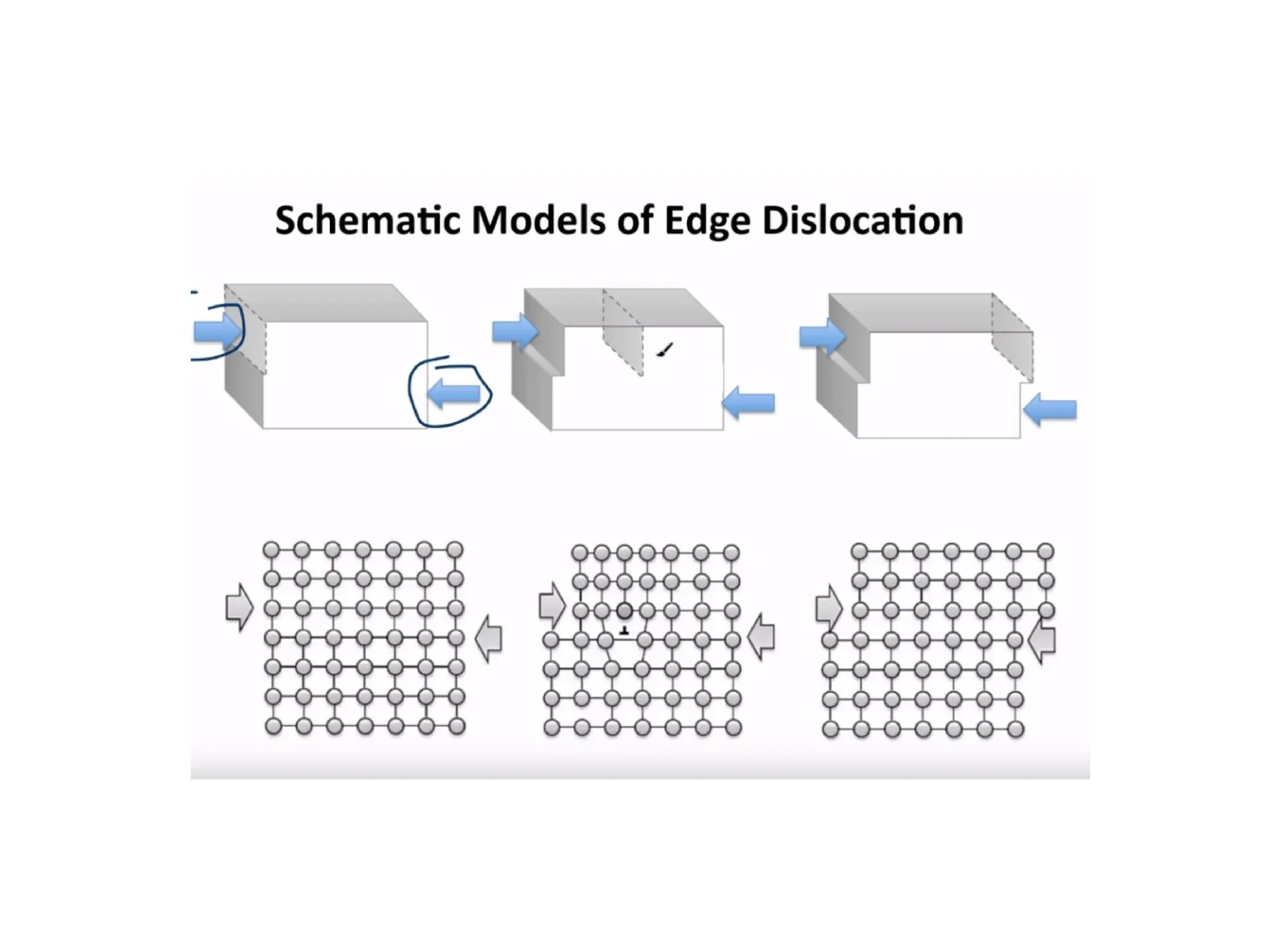
MM102: Introduction to Engineering Materials. Spring Semester 2019
Course Instructors: Dr. Shanza Rehan, Eng. Ali Afraz & Dr. Fida Mohammad
1. Text Book: Materials Science and Engineering: An Introduction
Callister and Rethwisch. 9th
Edition, 2014
2.Reference: Foundation of Materials Science and Engineering,
Smith & Hashemi. 4th
Edition 2006
Chapter 1 for self study
Chapter 2: Two Lect.: Grading policy & Introduction
Chapter 3: Eight Lect. Crystal structure
Chapter 4: Five Lect Crystals are imperfect
Chapter 5: Four Lect Diffusion in solids
Chapter 6. Four Lect. Mechanical properties of metals
Chapter 7: Four Dislocations and strengthening
Chapter 8. Three Lect. Failure of metals
Chapter 9: Seven Lect Phase diagrams (Sect 9.13, to 9.17 are not included)
Chapter 10: not included
Chapter 11: Not included Application and processing of metals
Chapter 12: Three Lect. Ceramics [ Note: Section 12.9 is not included ]
Chapter 13: Not included Application/processing of ceramics
Chapter 14. Three Lect Structure of polymers
Chapter 15: Not included Characterization of polymers
Chapter 16. Two Lect. Composites
Total = 45 Lectures
Grading Policy / Requirements
1. Mid: 30 %
2. Final 42 %
3. Six Quizzes each carrying 4 points i.e 24 %
4. Two Assignments each carrying 2 points i.e 4 %
You are required to:
Buy a copy of the text book either 2nd hand or new
Have 80 % attendance. Absence justified in writing
Come within the first five minutes of the class
Not to sleep, talk, or make disturbance in the class
Note down your own attendance
Not to proxy for any one
Understand problems either solved in the book or solved on CD
Explore CD for additional help ( Animation etc )
Understand and Practice drawing charts, graphs, diagrams
Derive mathematical expressions
Be precise, to the point, brief, explicit in examination
Use dimensions and units
READ LEARNING OBJECTIVES WRITTEN IN THE Book
You can contact us for help from 8 am to 5 pm daily on working days
How to miss C-
and below→☺
Start from today:
►Read the book
► Practice writing what you read
►Ask questions in and outside the class
►Tell others what you think you know
(Discus)
Materials & lifestyle
Make a list of materials which were
MM102 develops your skills and knowledge for
the production and manipulating of materials so that
the properties of materials can be improved
Available to ancient people for use
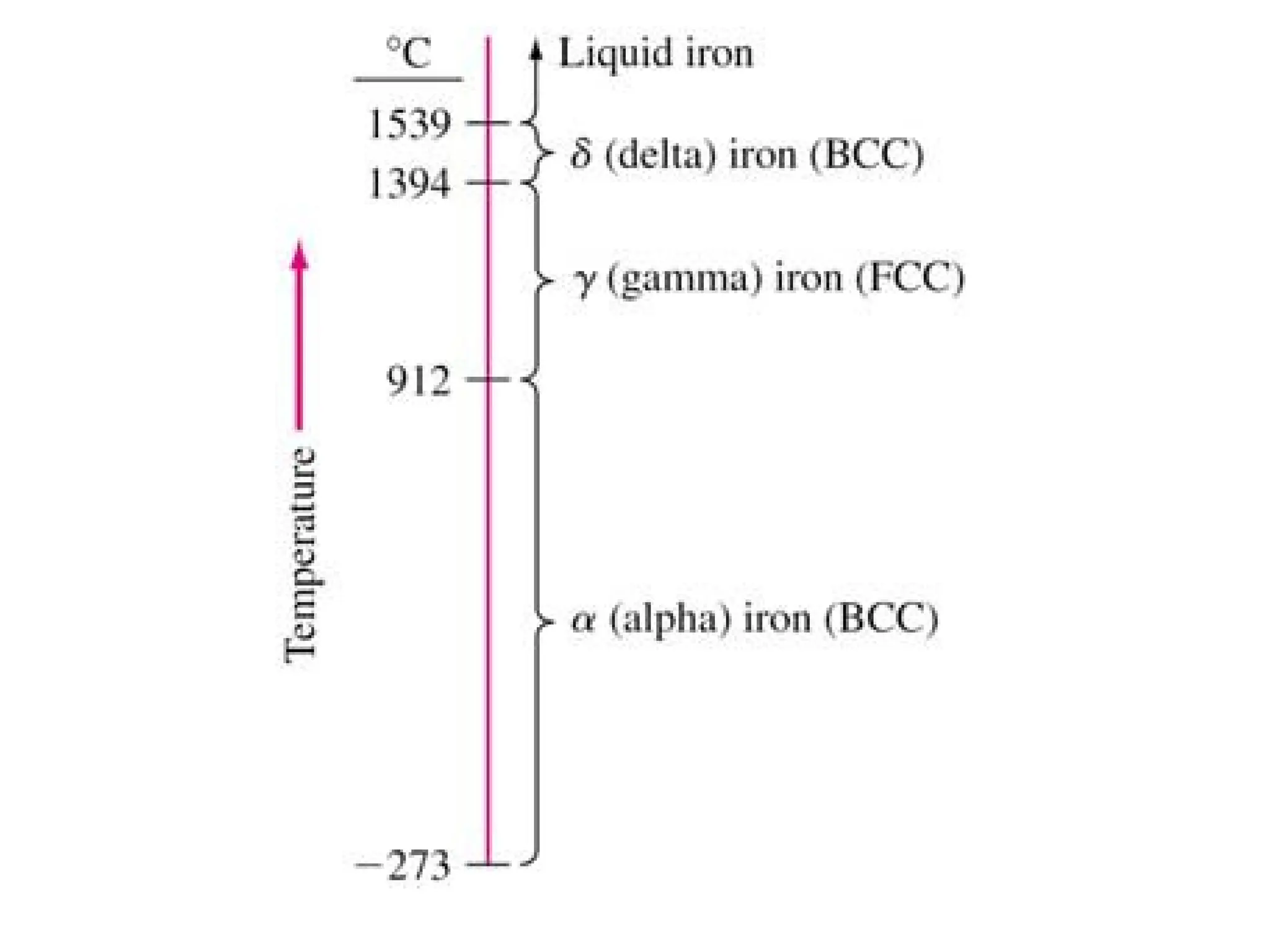
Low Carbon Steels
( 99.75wt% Iron + 0.25wt% Carbon )
Important considerations:
1.Iron available abundantly from earth crust (7%)
2. Iron deforms easily compared to glass or stone
3. Iron is Tougher than Stone, glass, china ware
4. Machine-able compared to what?
5. Weld-able easily (compared to what?)
7. Do you know of an undesirable property of Iron?
Which properties of materials are useful for
improving our life style?
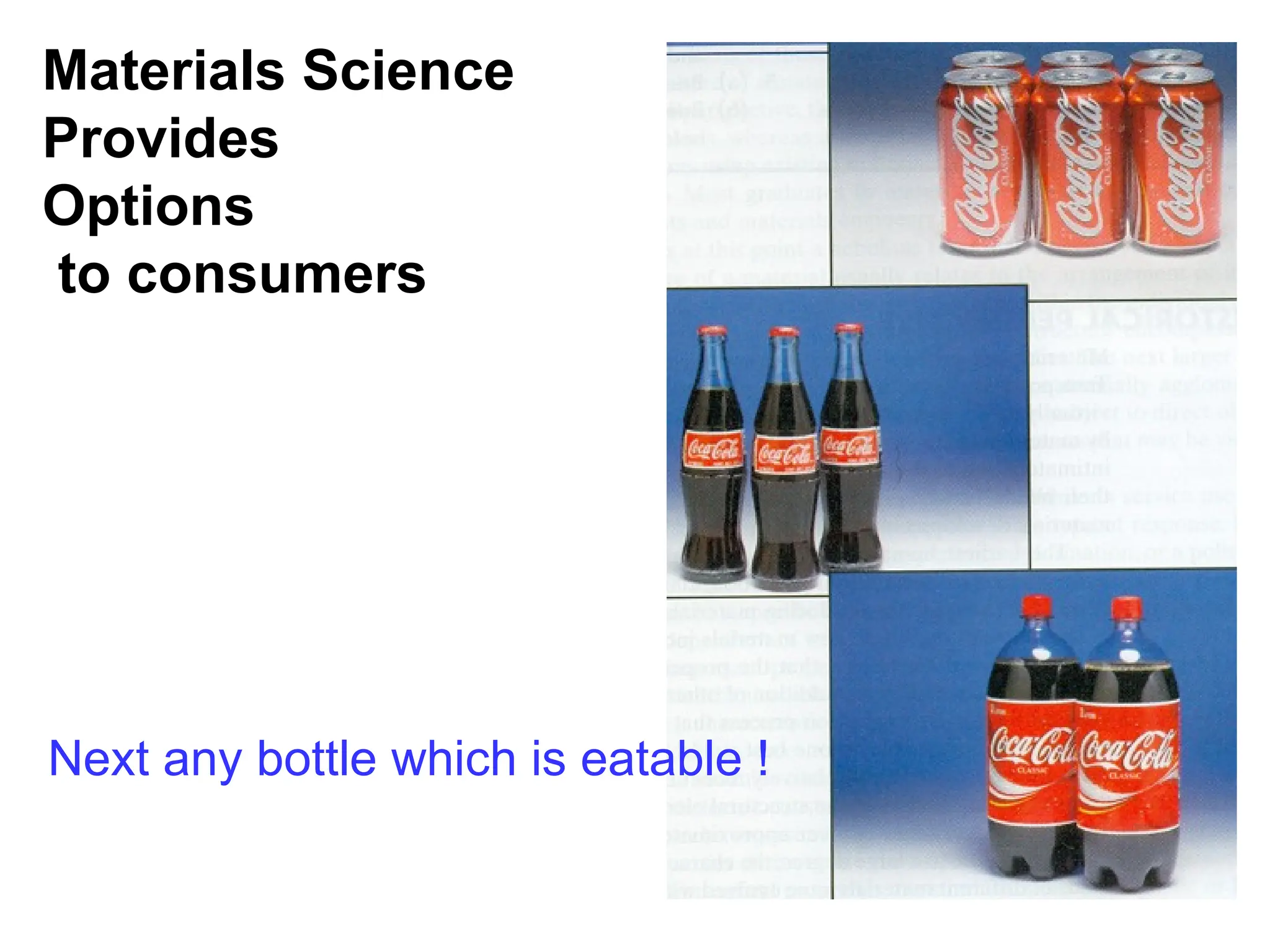
Materials Science
Provides
Options
to consumers
Next any bottle which is eatable !
Materials Science And Engineering deal with:
Mechanical; Thermal; Electrical; Magnetic; Optical; Chemical Properties.
Give examples of each type
For this purpose knowledge of:
Chemistry, Physics, Mechanics, English, Math
along with experience + Imagination
Is required
History:
Stone, Bronze, Iron, Polymer, Si, Li. What
next?
Note: Nanotechnology is emerging
Materials: Metals/Alloys; Ceramics; Polymers; Composites
How do materials respond when they are
subjected to:
► mechanical forces
►electrical fields
►magnetic fields
►optical fields
►temperature gradients
►corrosive (chemical) environments
We design materials such
that they behave according to our
needs and wishes
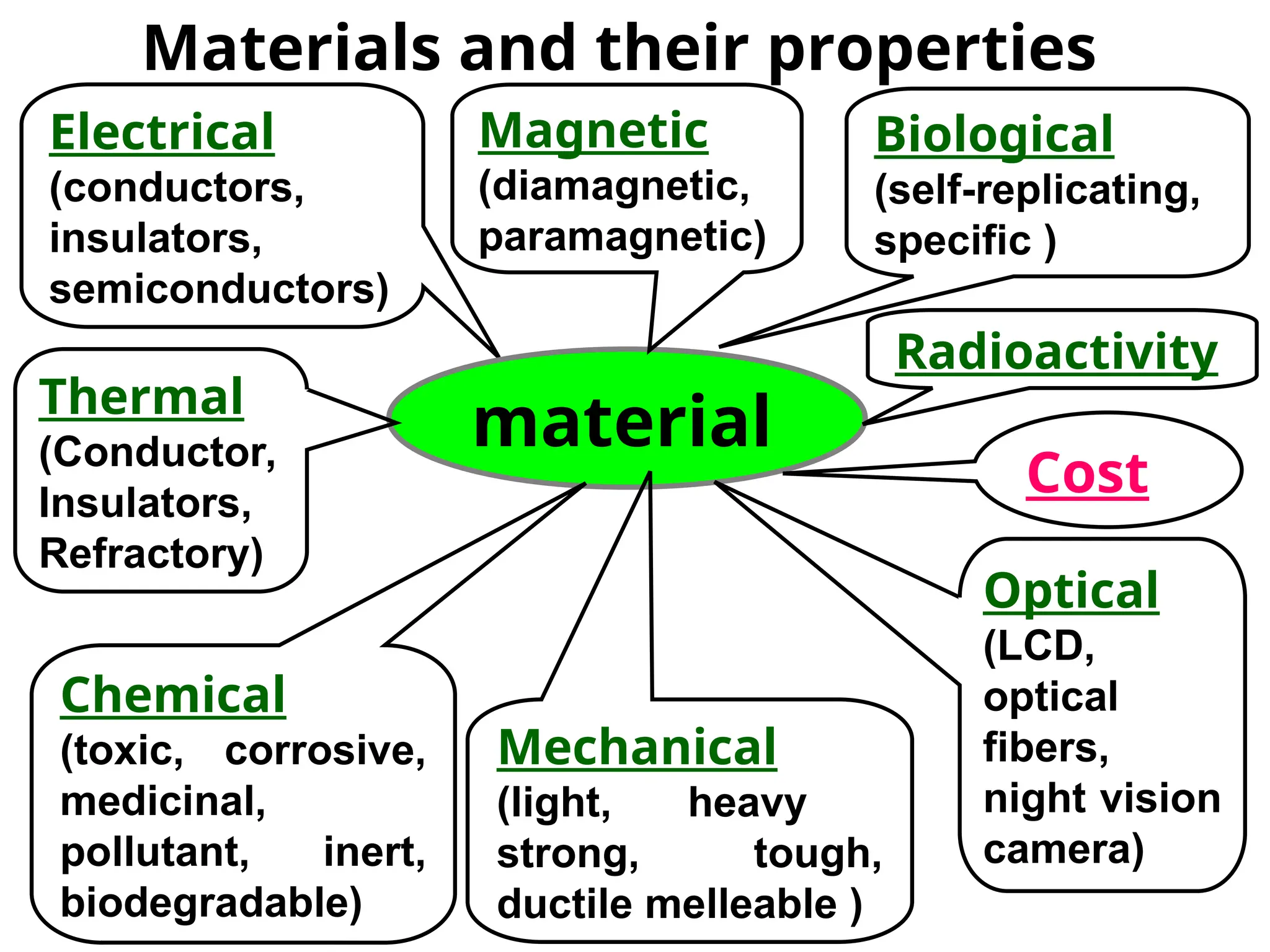
Materials and their properties
Electrical
(conductors,
insulators,
semiconductors)
material
Magnetic
(diamagnetic,
paramagnetic)
Optical
(LCD,
optical
fibers,
night vision
camera)
Thermal
(Conductor,
Insulators,
Refractory)
Chemical
(toxic, corrosive,
medicinal,
pollutant, inert,
biodegradable)
Mechanical
(light, heavy
strong, tough,
ductile melleable )
Cost
Biological
(self-replicating,
specific )
Radioactivity
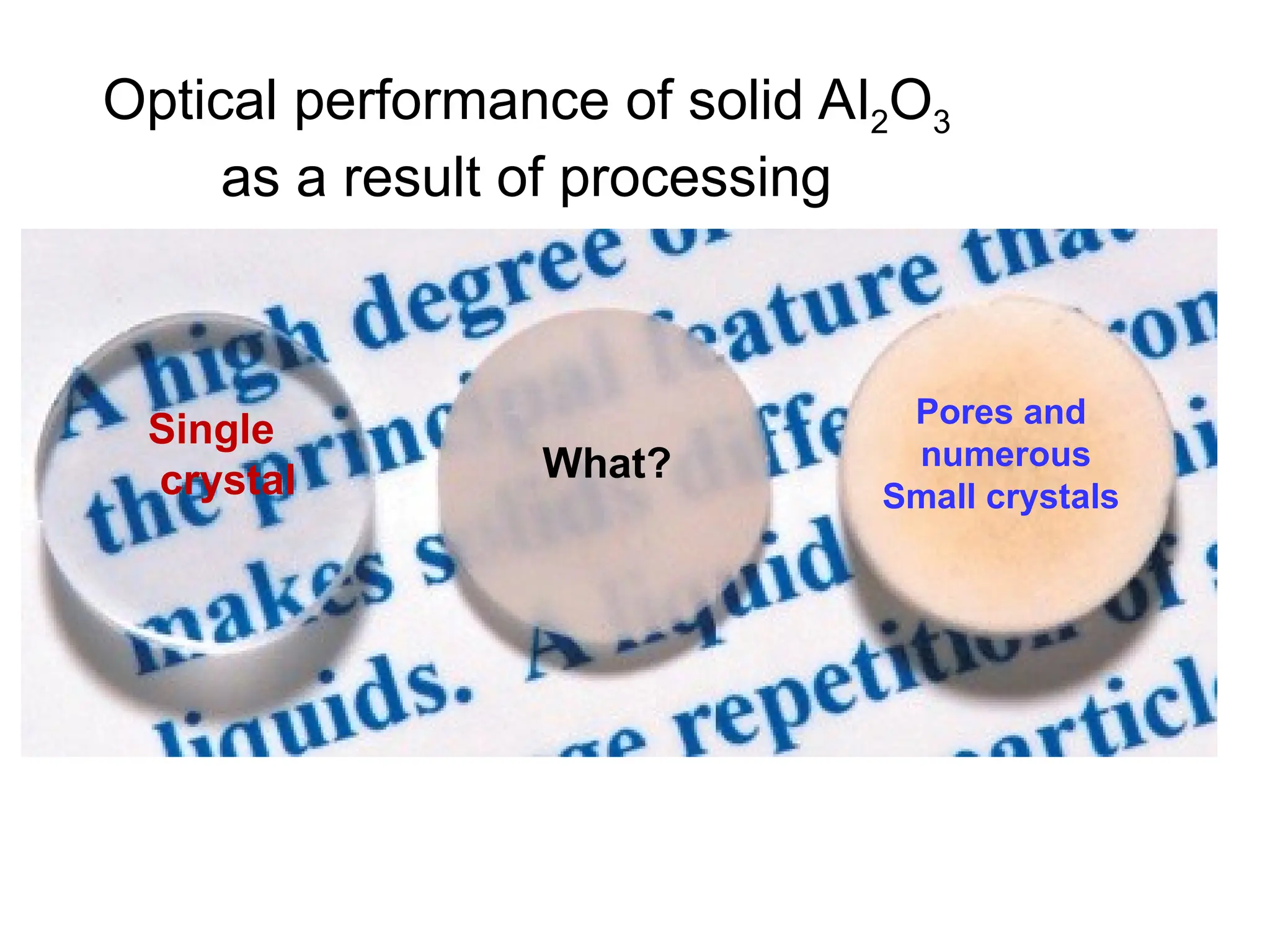
Optical performance of solid Al2O3
as a result of processing
Single
crystal
Pores and
numerous
Small crystals
What?
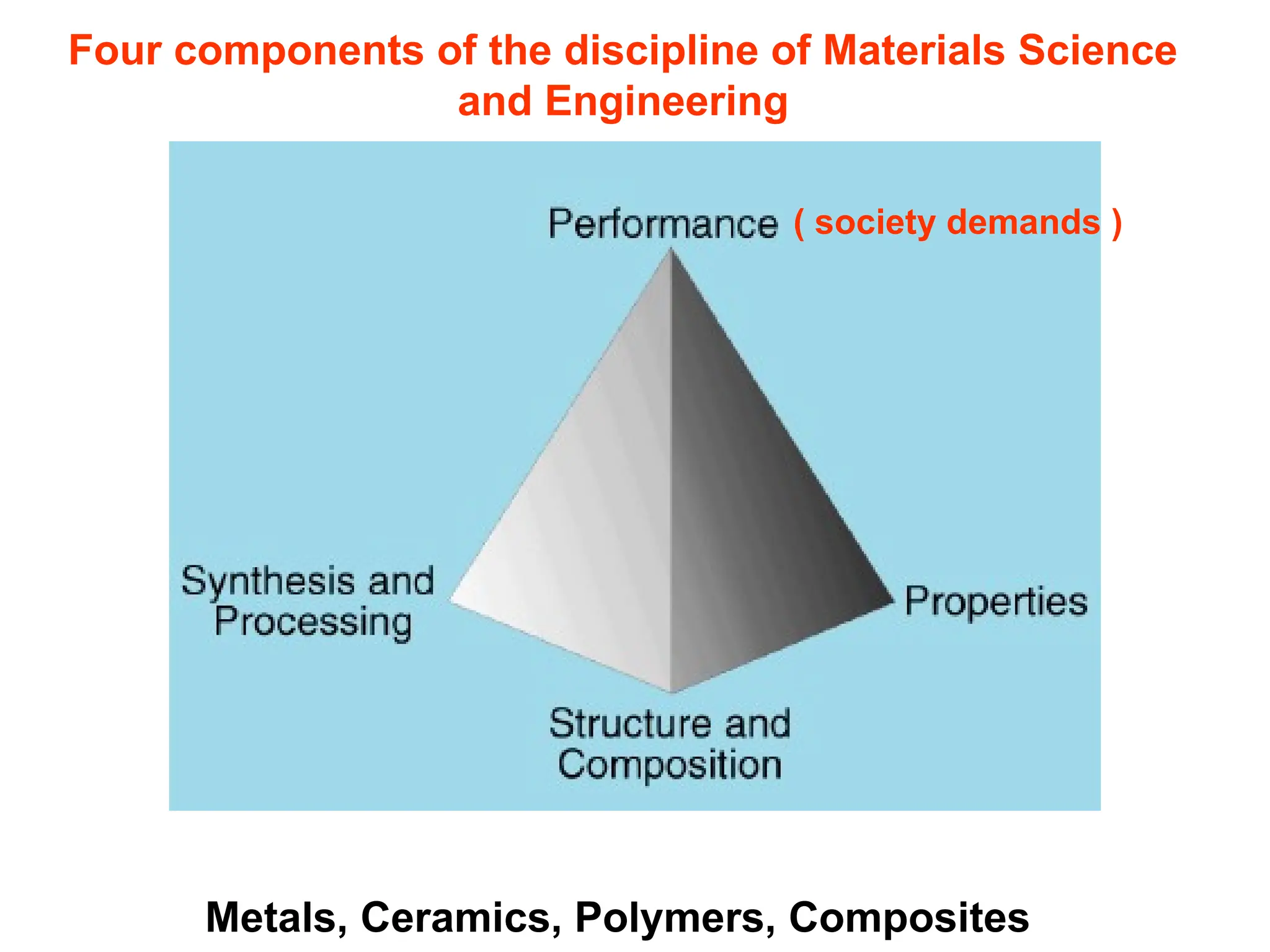
Four components of the discipline of Materials Science
and Engineering
Metals, Ceramics, Polymers, Composites
( society demands )
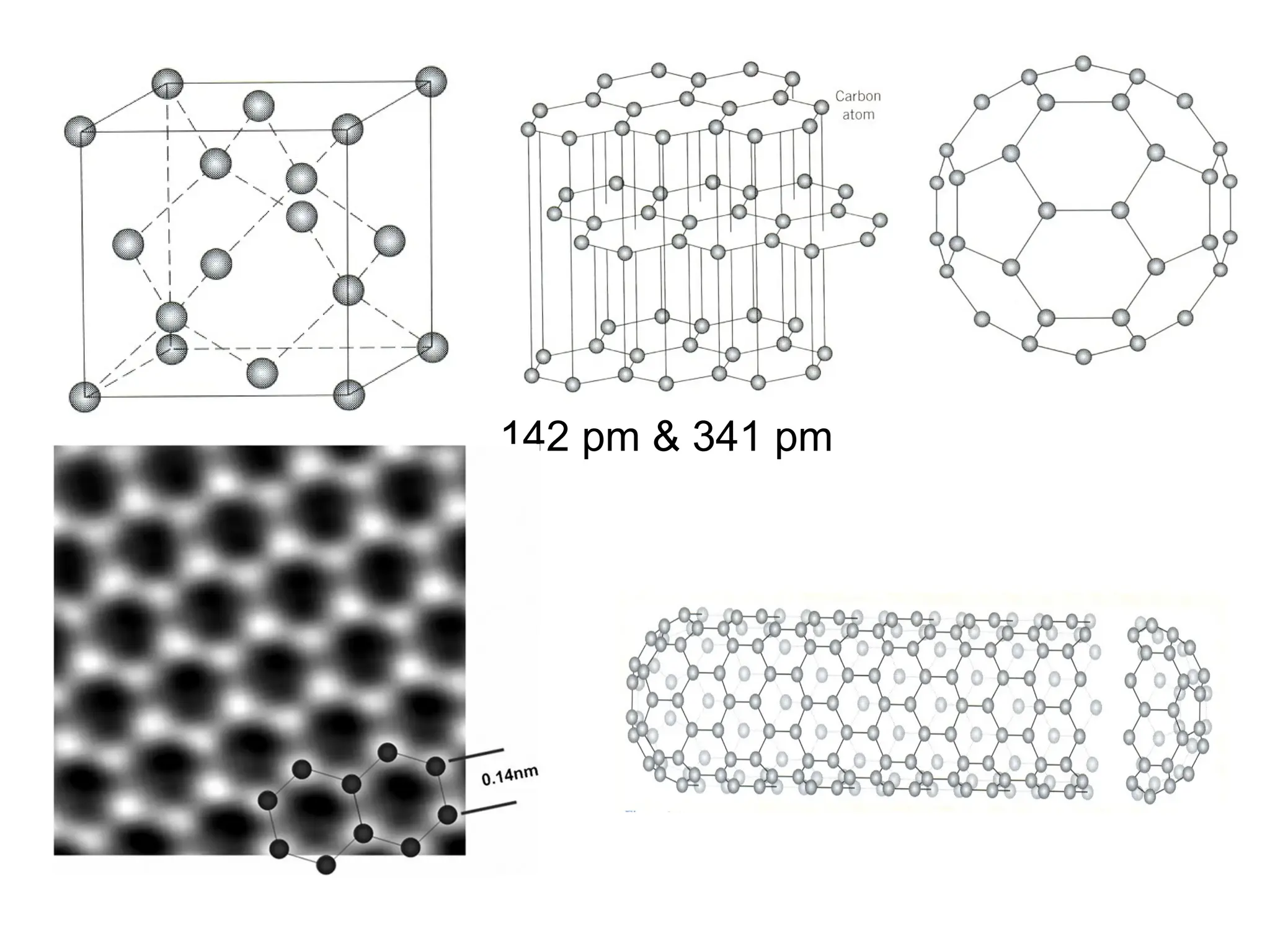
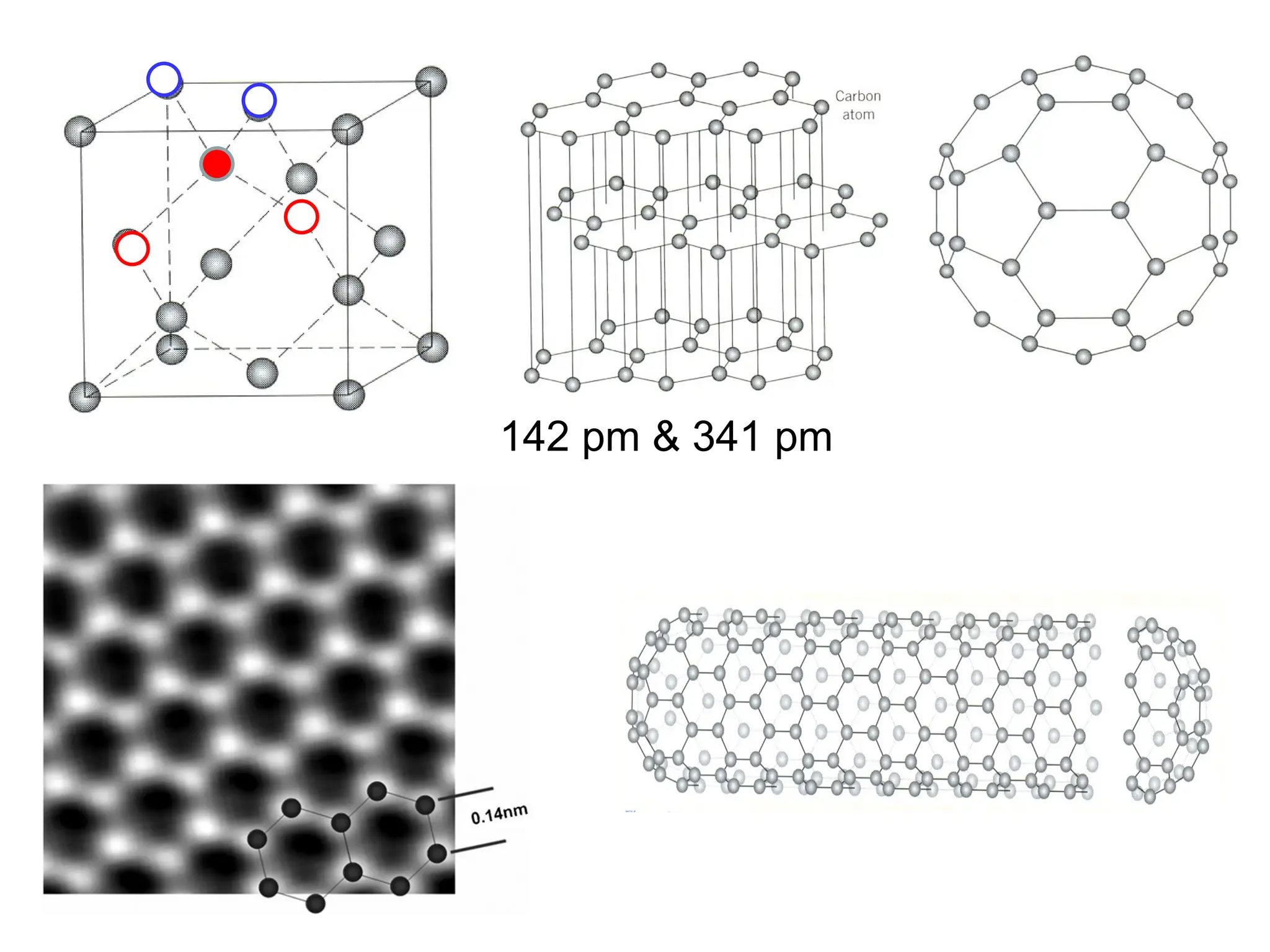
142 pm & 341 pm
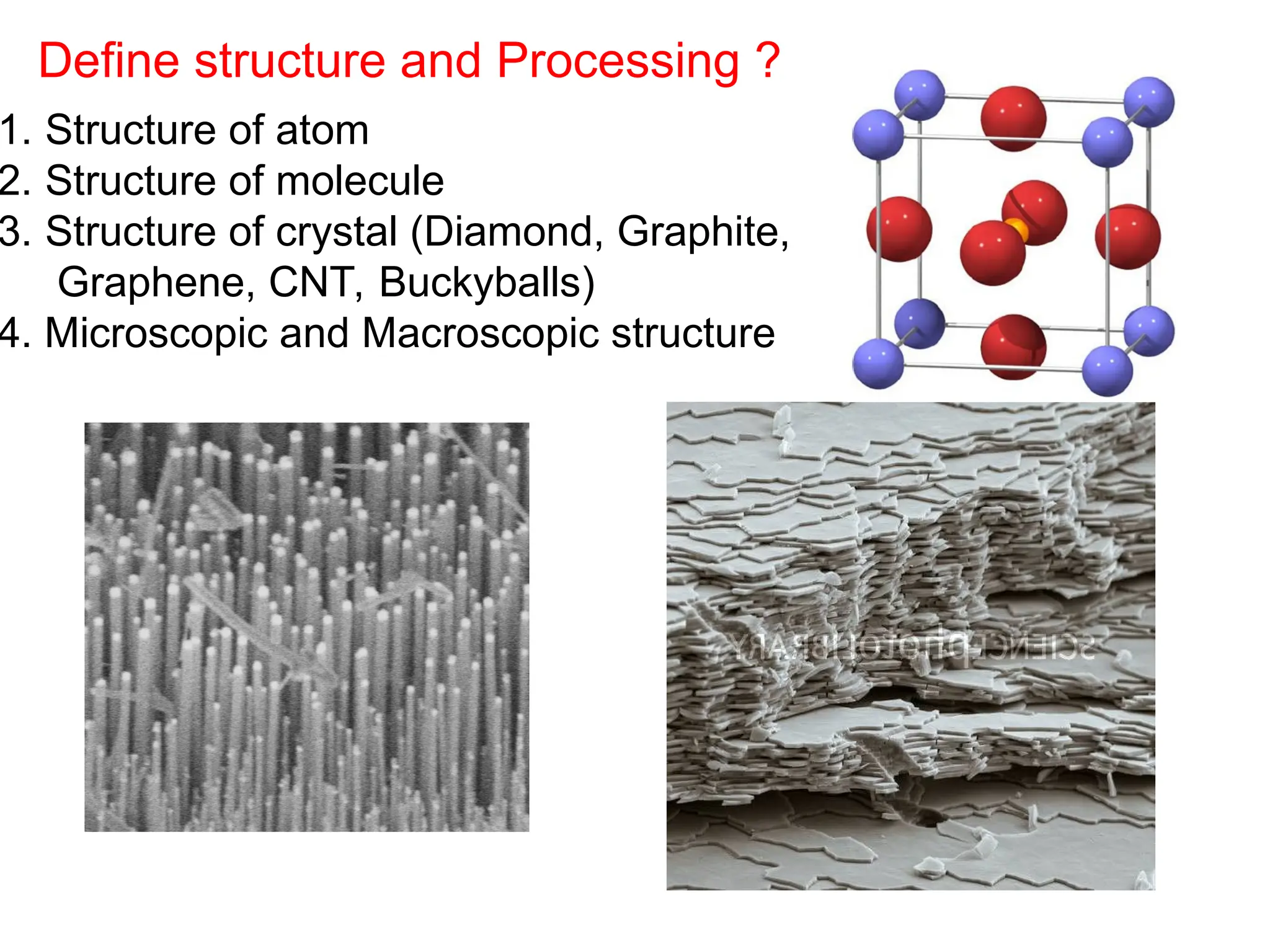
Define structure and Processing ?
1. Structure of atom
2. Structure of molecule
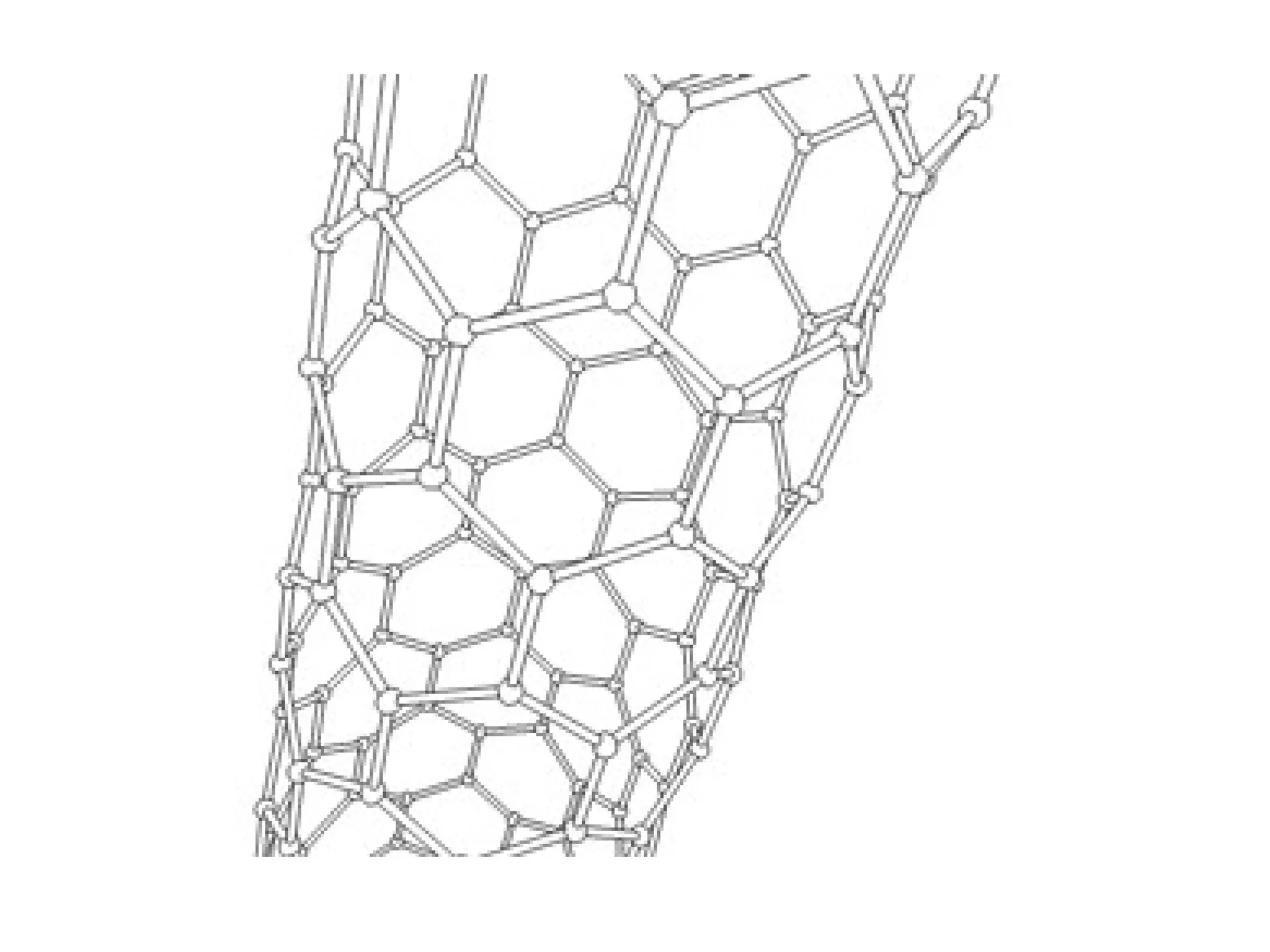
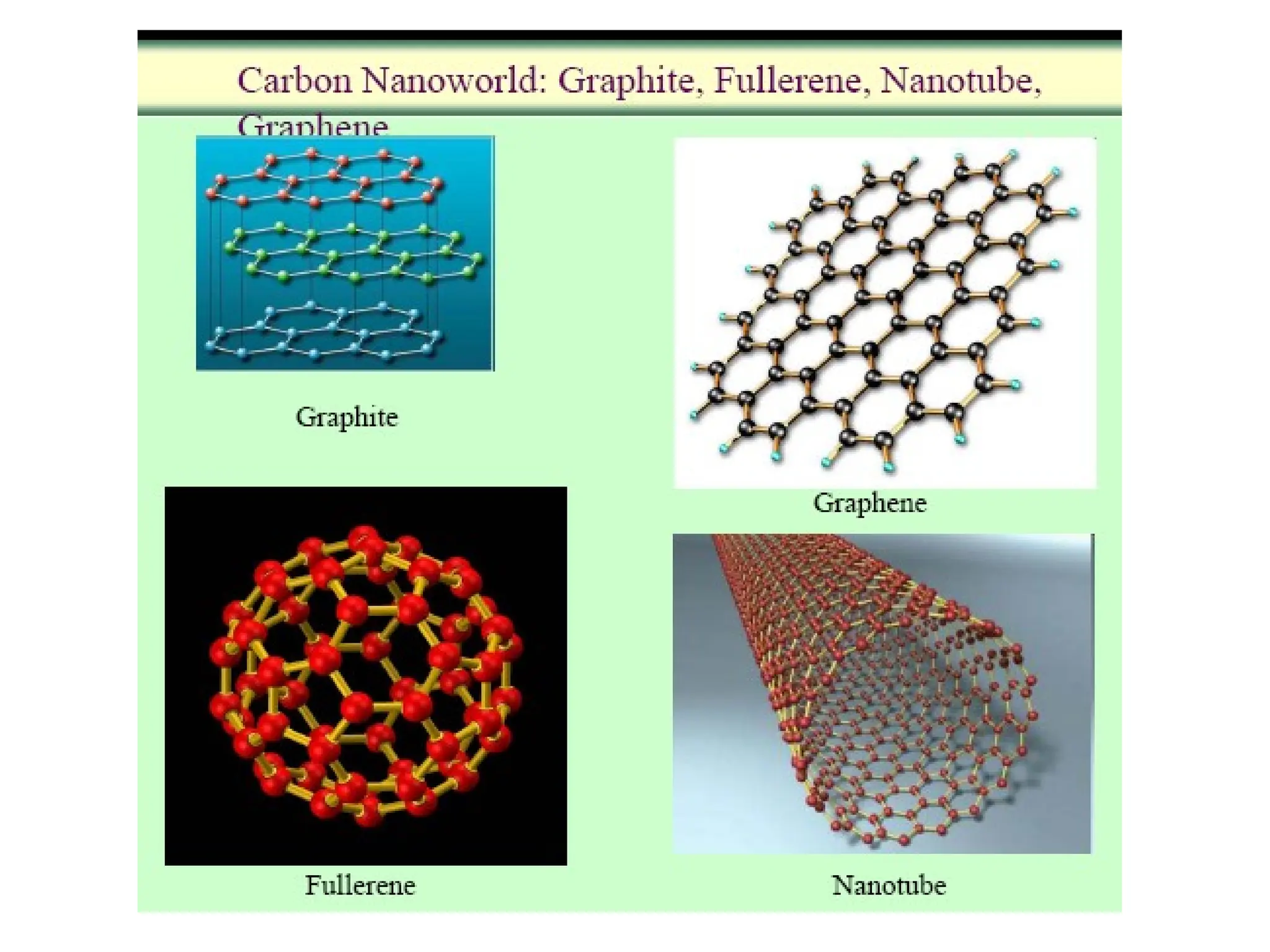
3. Structure of crystal (Diamond, Graphite,
Graphene, CNT, Buckyballs)
4. Microscopic and Macroscopic structure
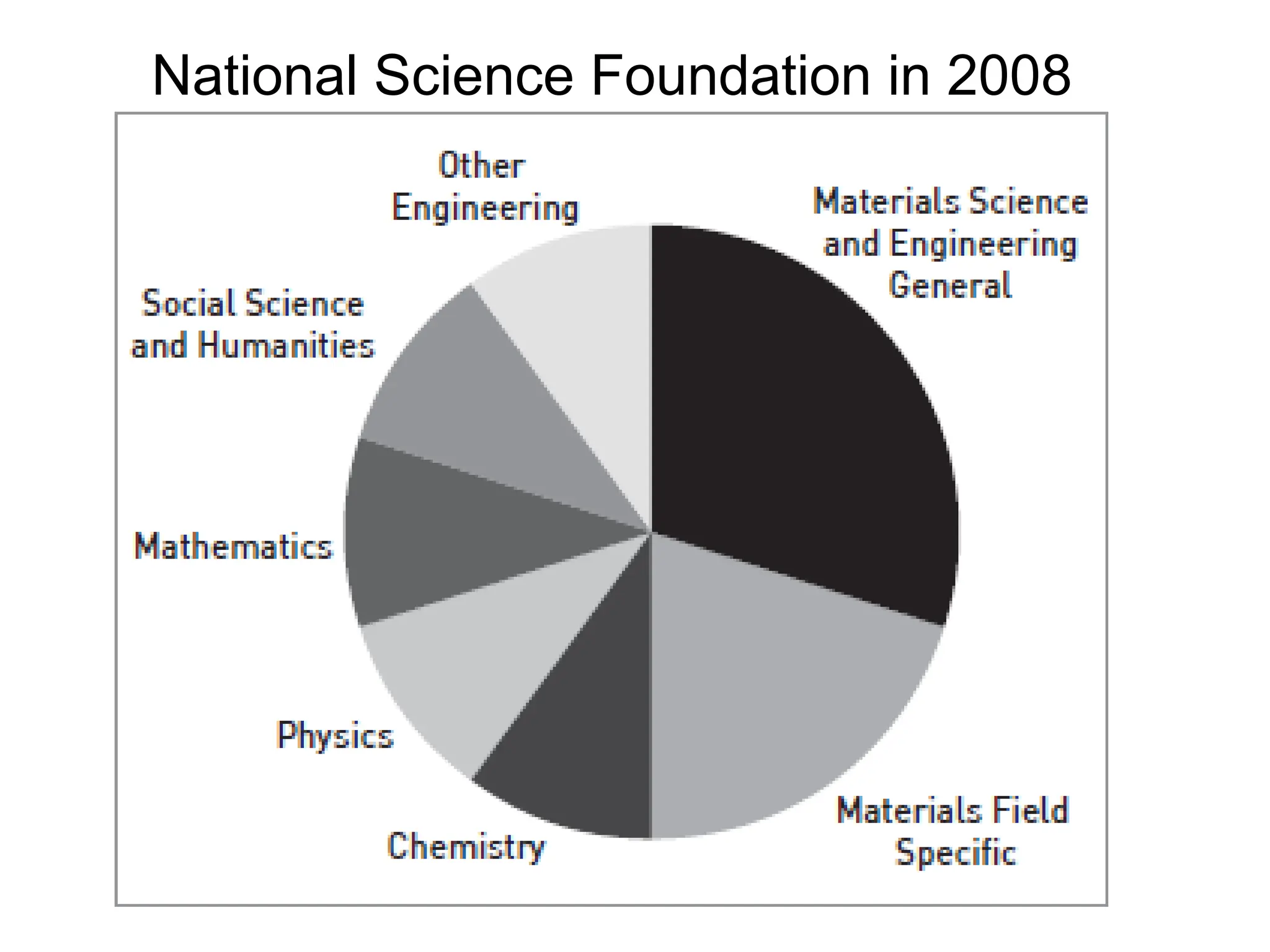
National Science Foundation in 2008
Interaction between atoms, ions, molecules
And
physical states of matter
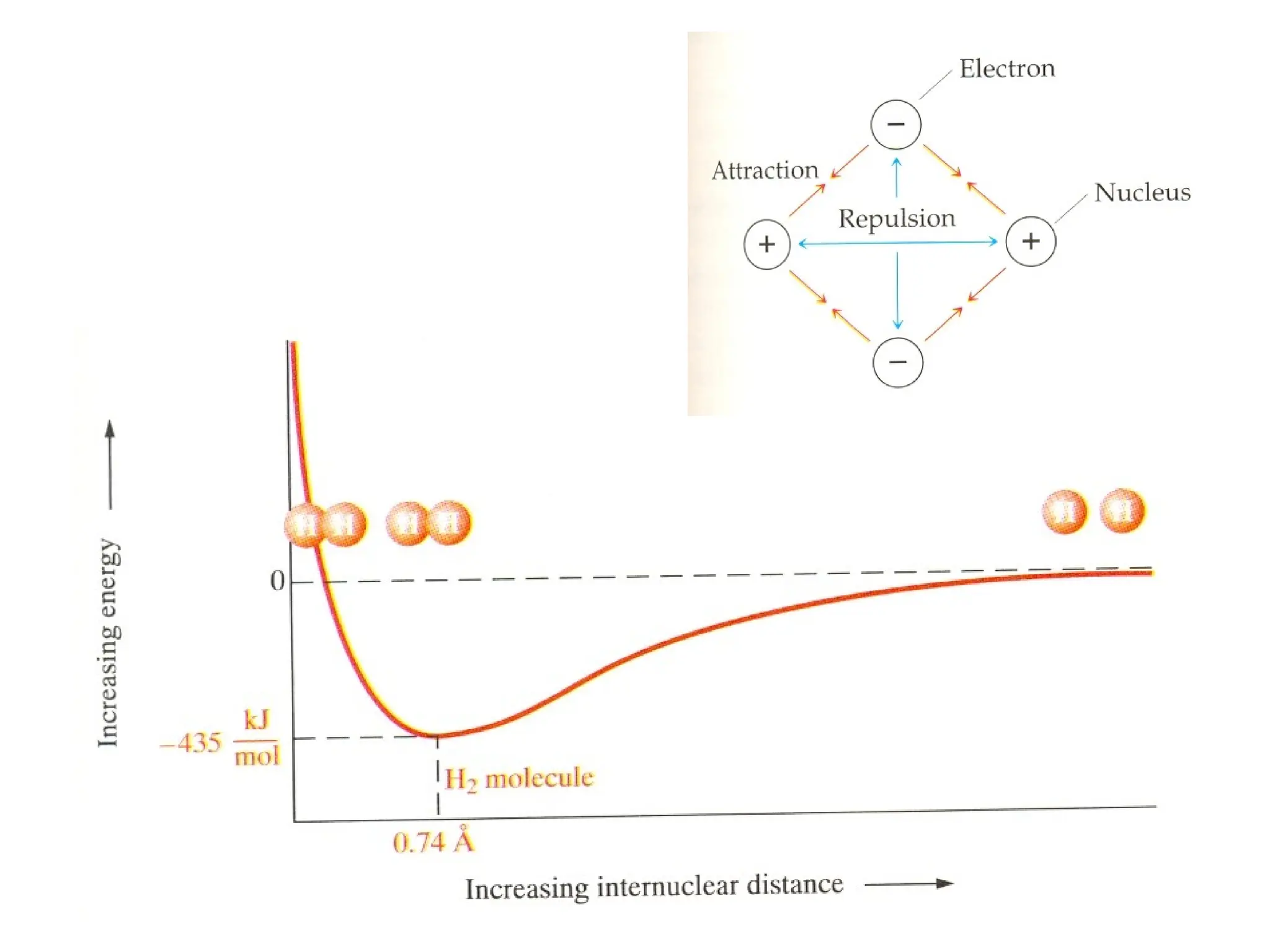
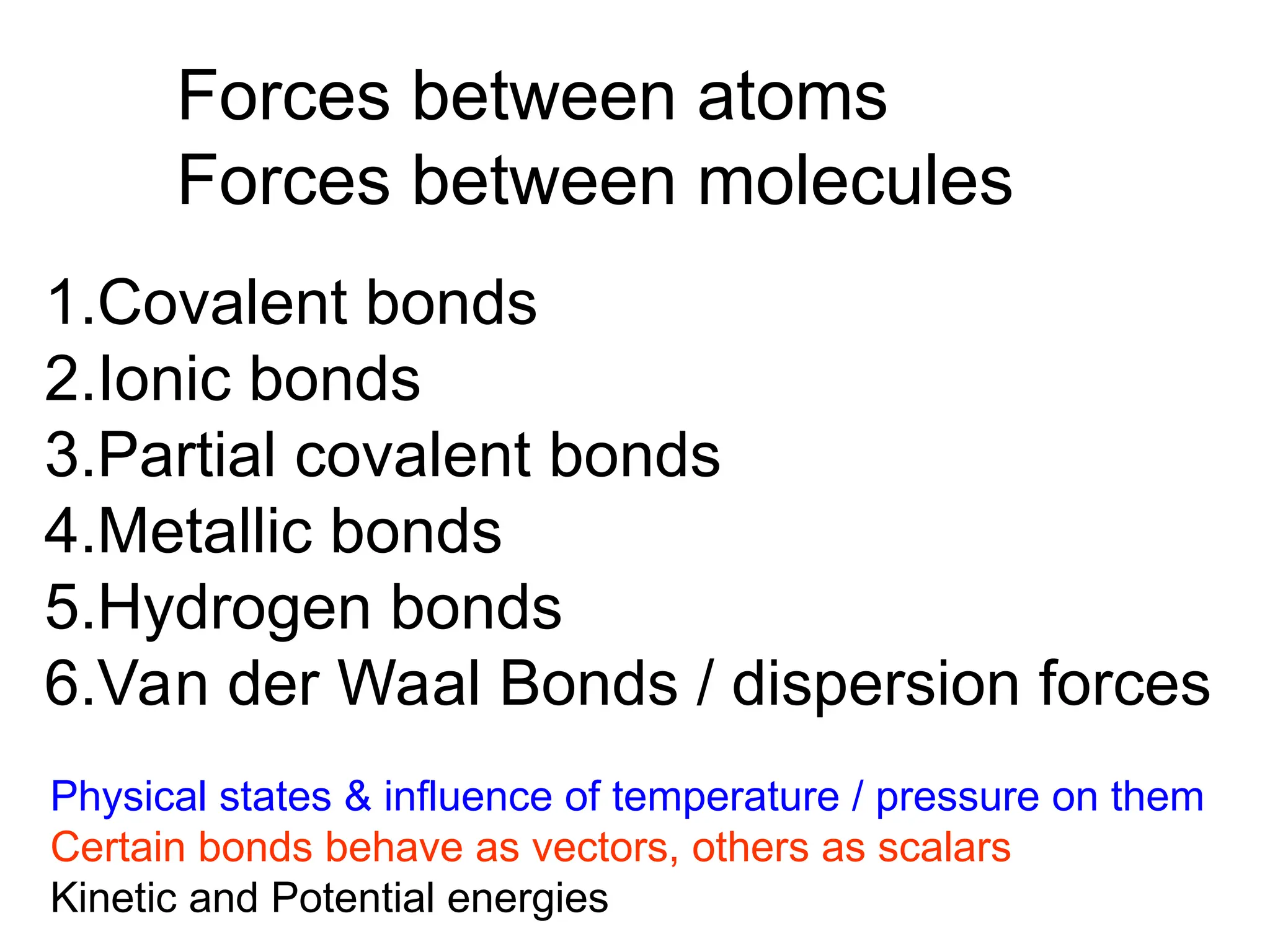
Forces between atoms
Forces between molecules
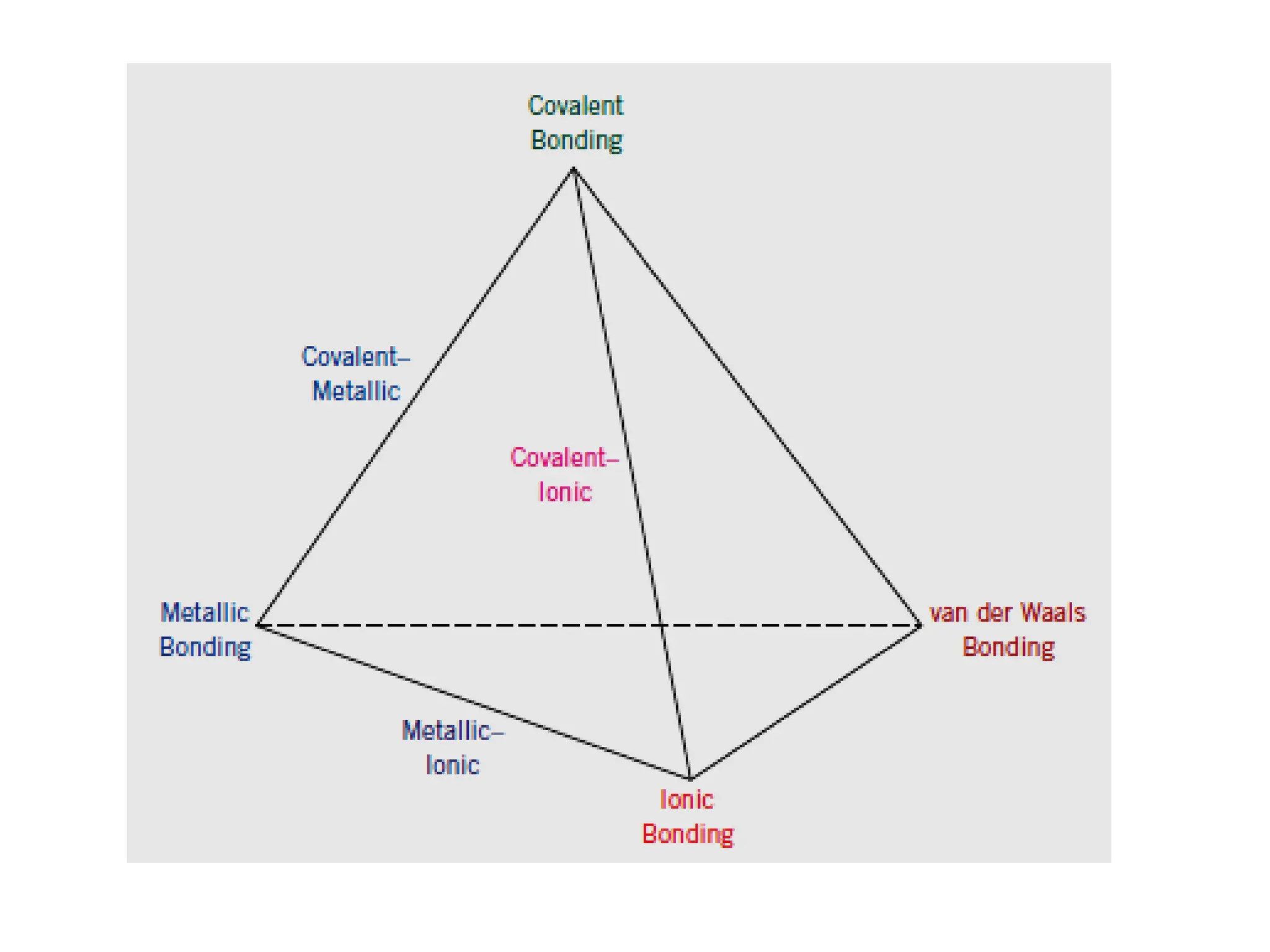
1.Covalent bonds
2.Ionic bonds
3.Partial covalent bonds
4.Metallic bonds
5.Hydrogen bonds
6.Van der Waal Bonds / dispersion forces
Physical states & influence of temperature / pressure on them
Certain bonds behave as vectors, others as scalars
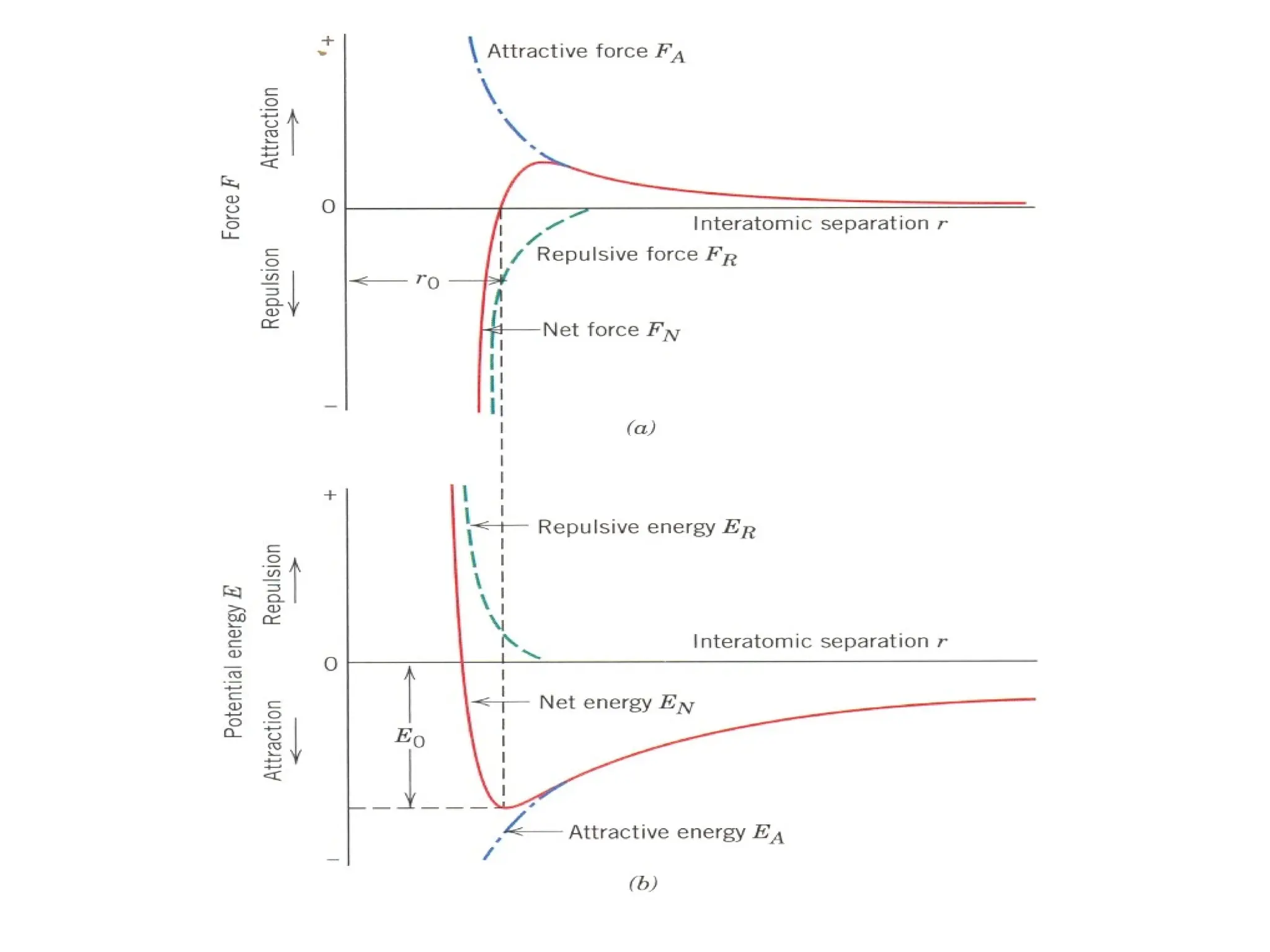
Kinetic and Potential energies
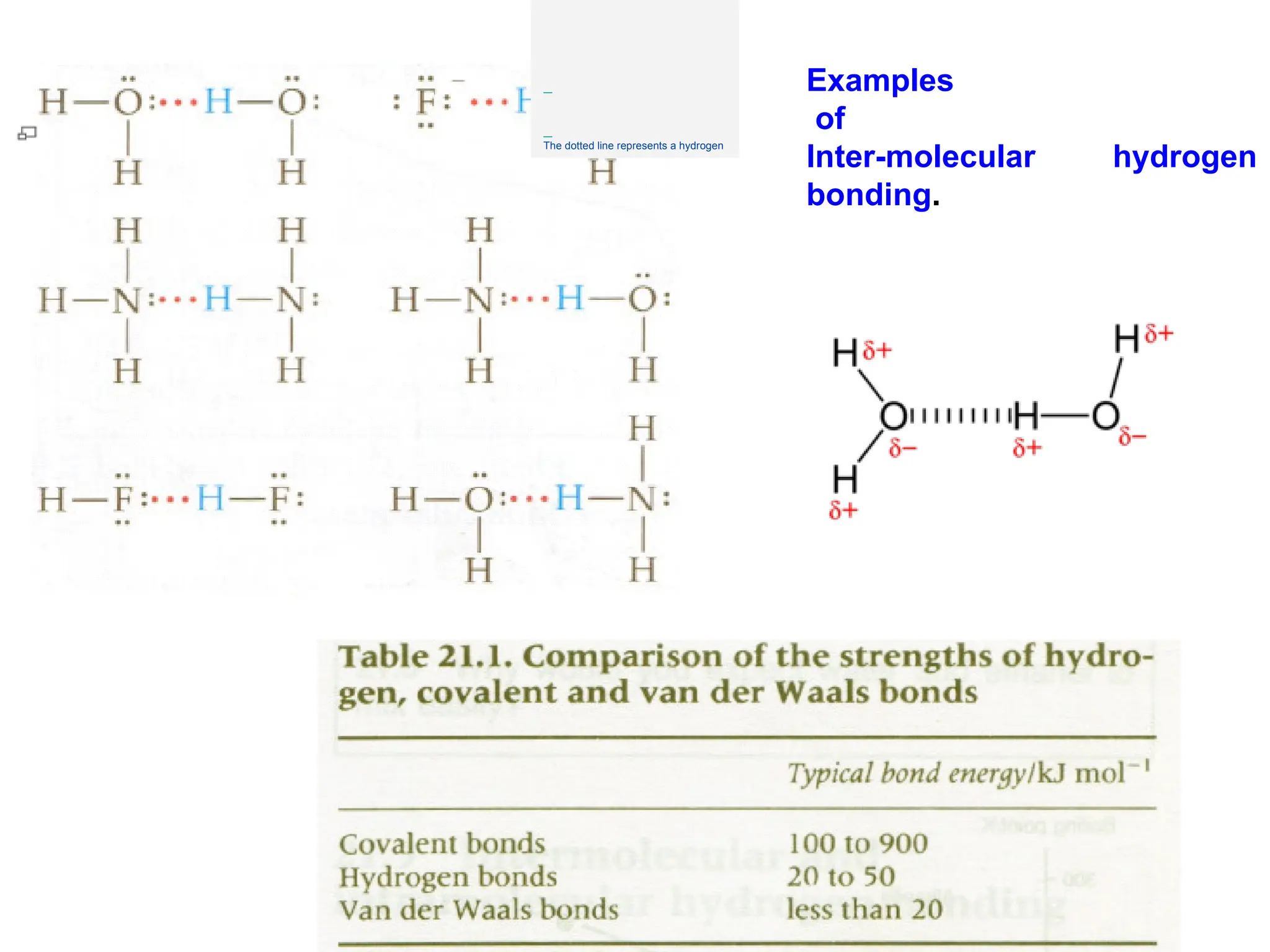
Examples
of
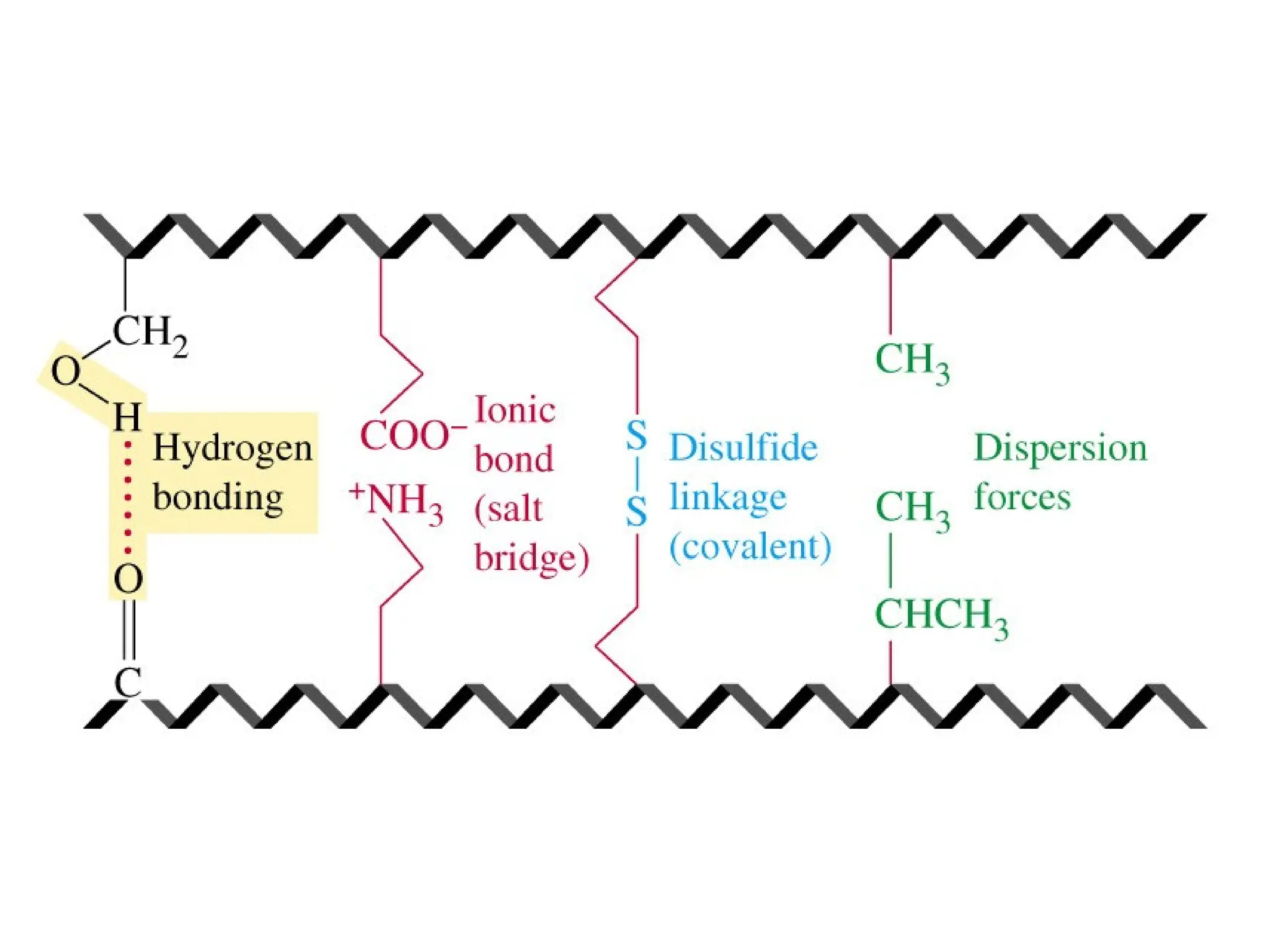
Inter-molecular hydrogen
bonding.
The dotted line represents a hydrogen
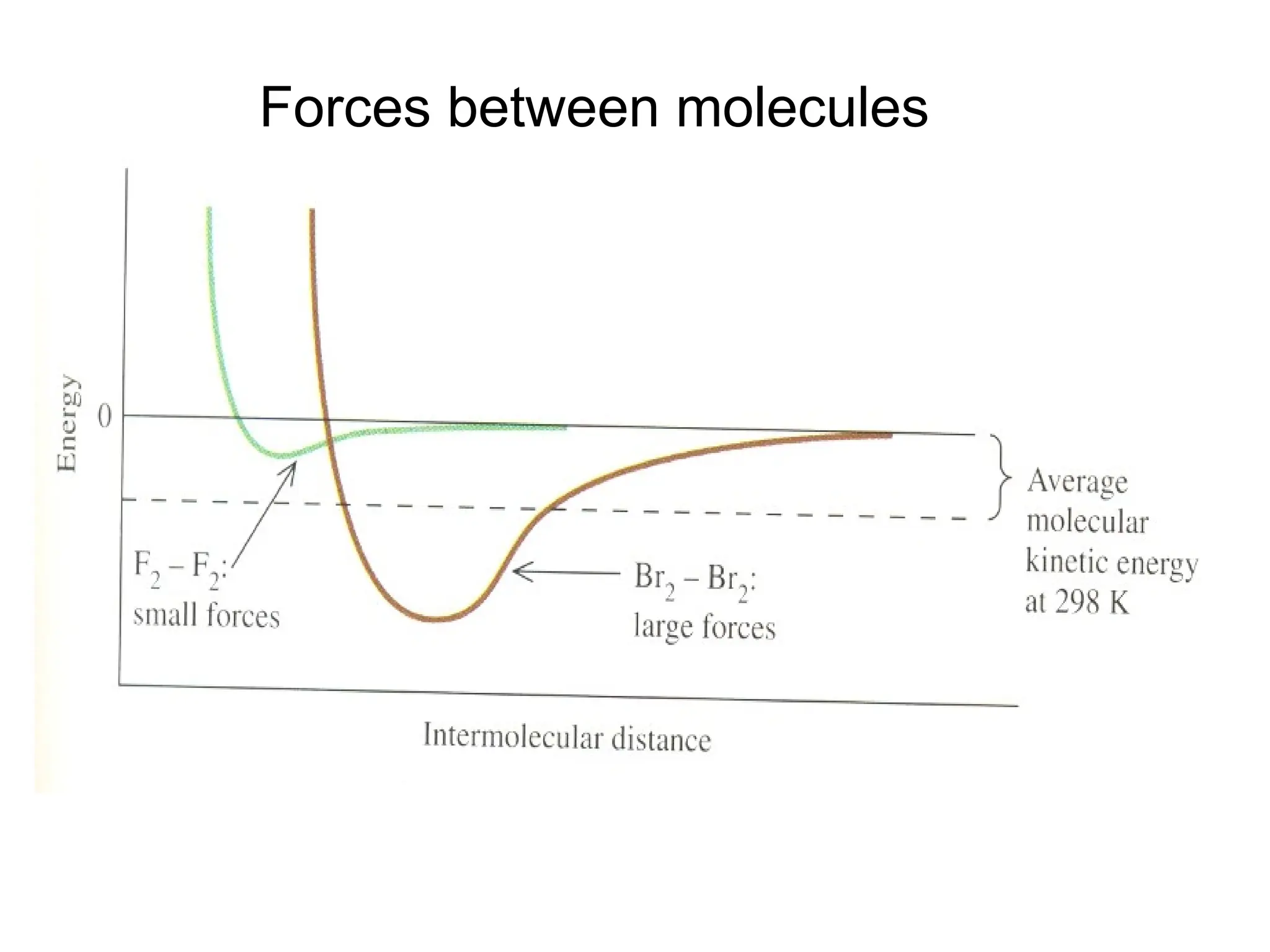
Forces between molecules
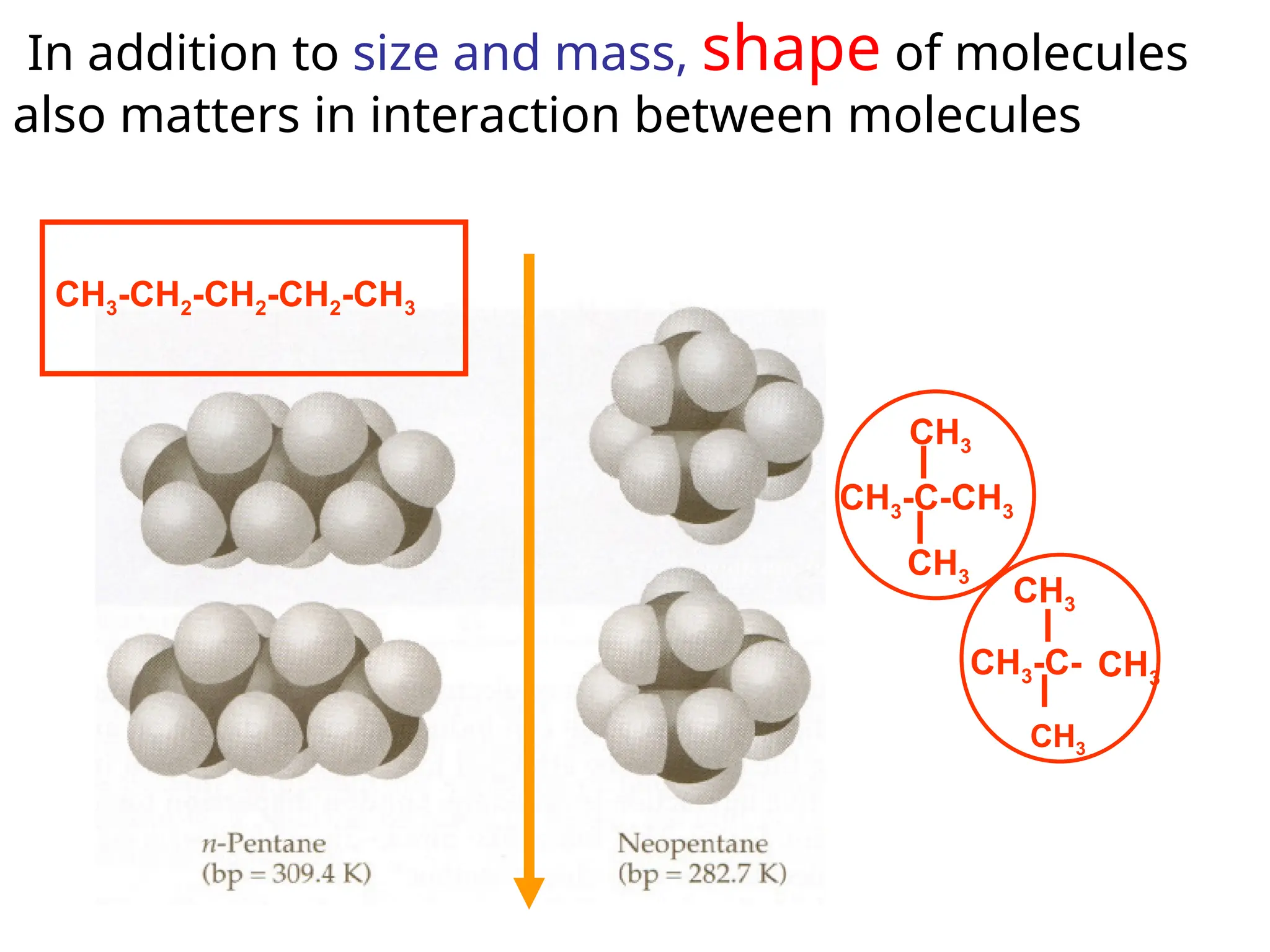
In addition to size and mass, shape of molecules
also matters in interaction between molecules
CH3-CH2-CH2-CH2-CH3
CH3-C-CH3
CH3
CH3
CH3-C-
CH3
CH3
CH3
In this course we will focus on solids only
Specifically
Crystalline Solids
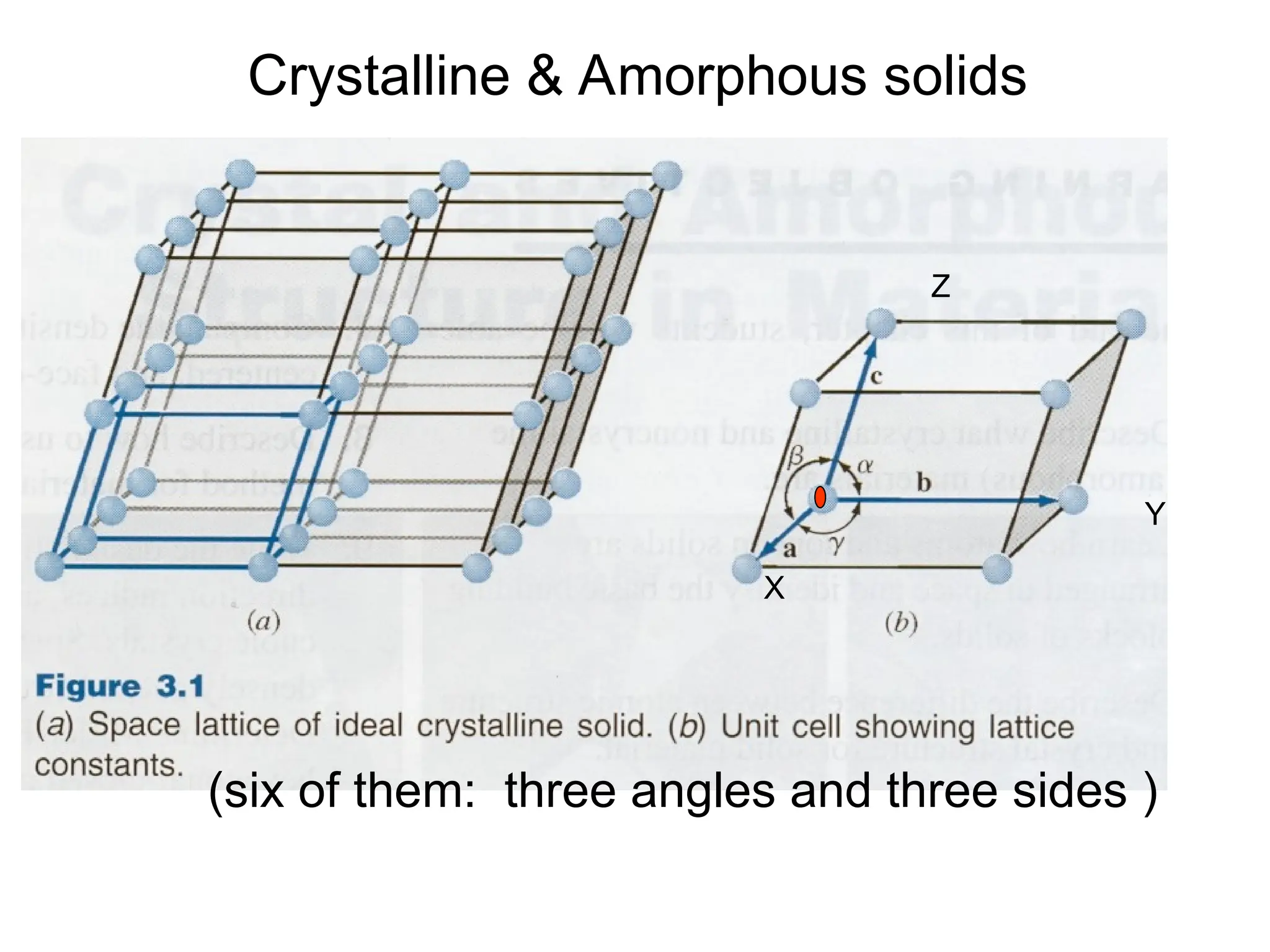
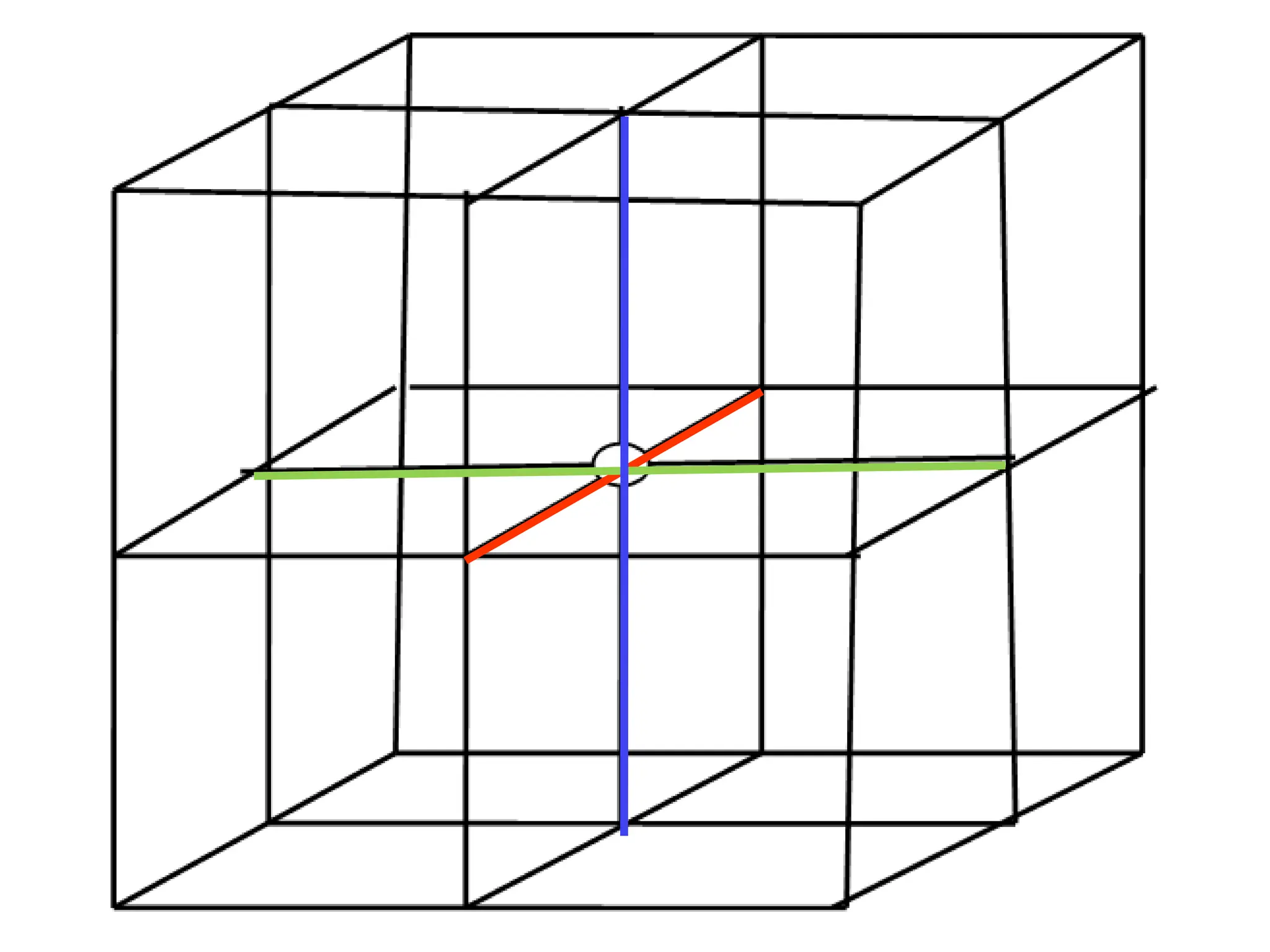
X
Y
Z
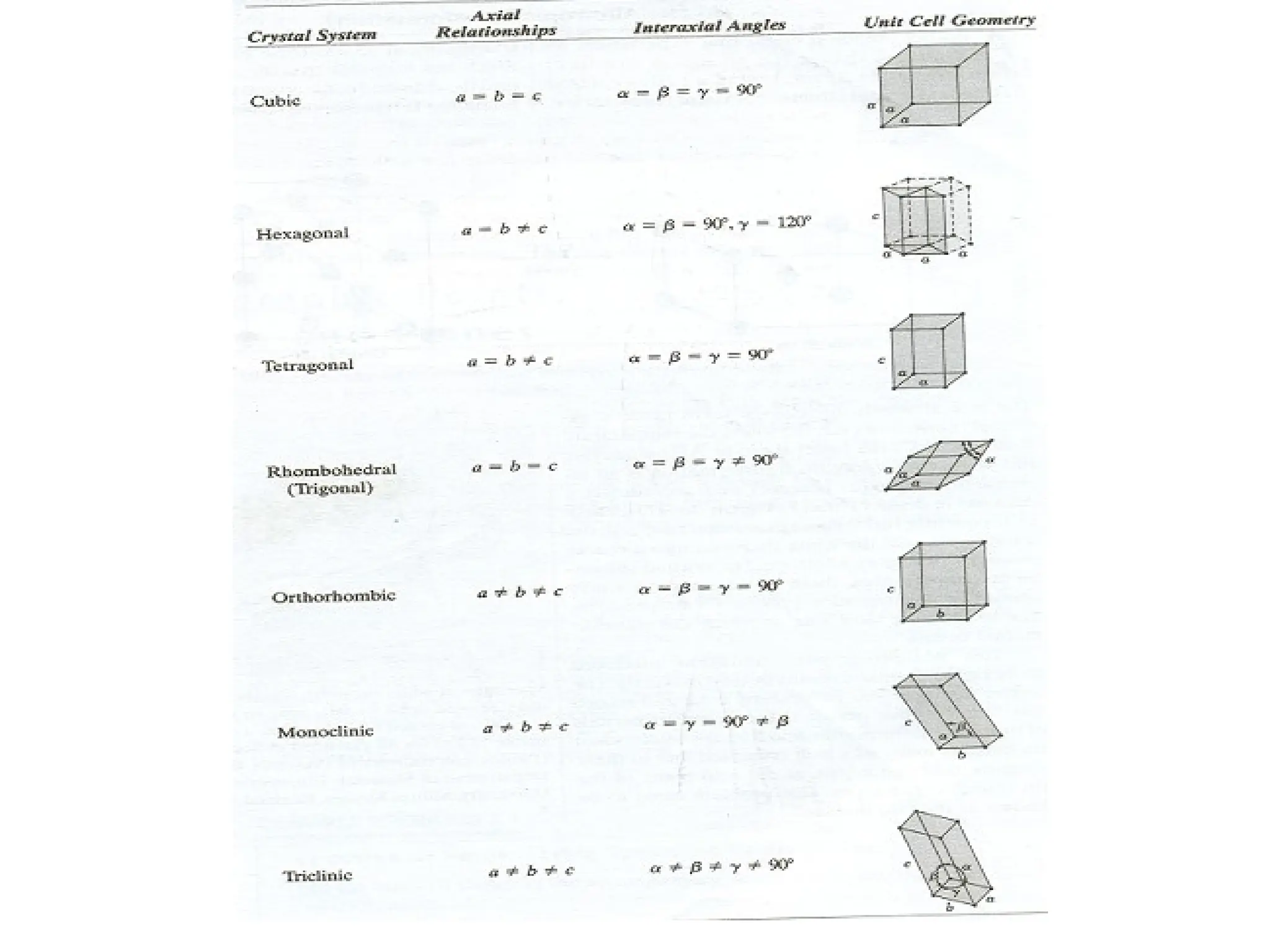
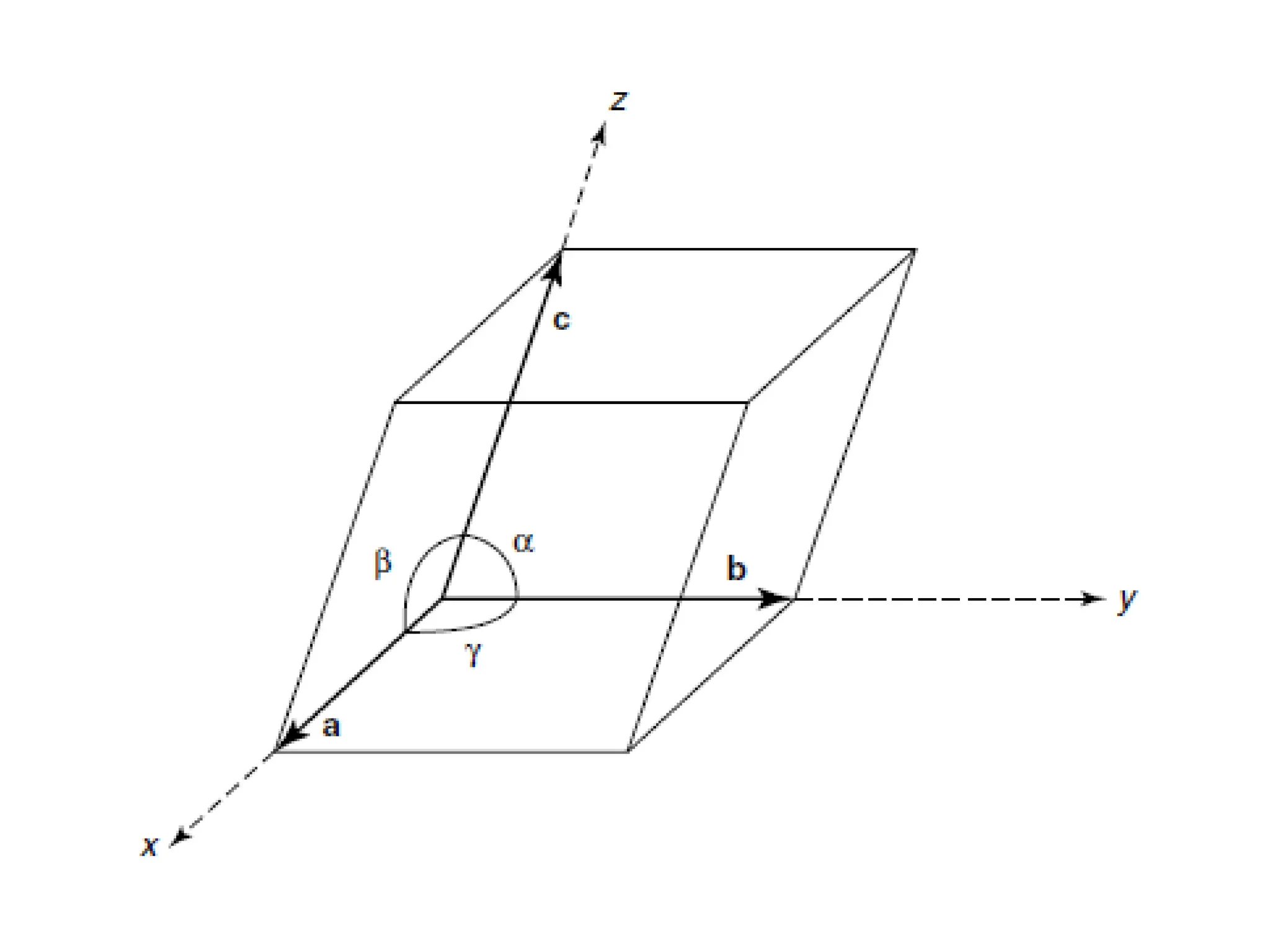
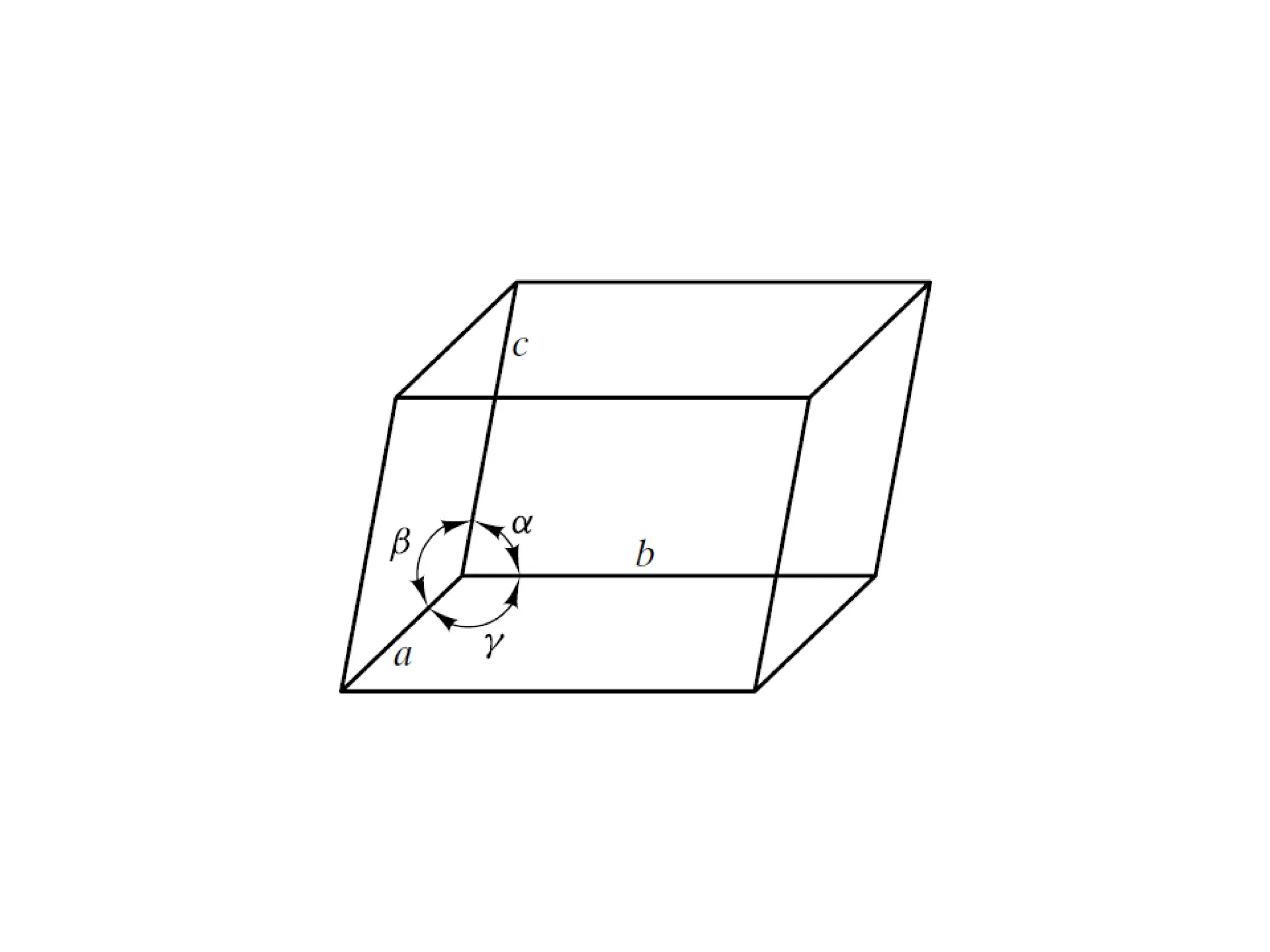
(six of them: three angles and three sides )
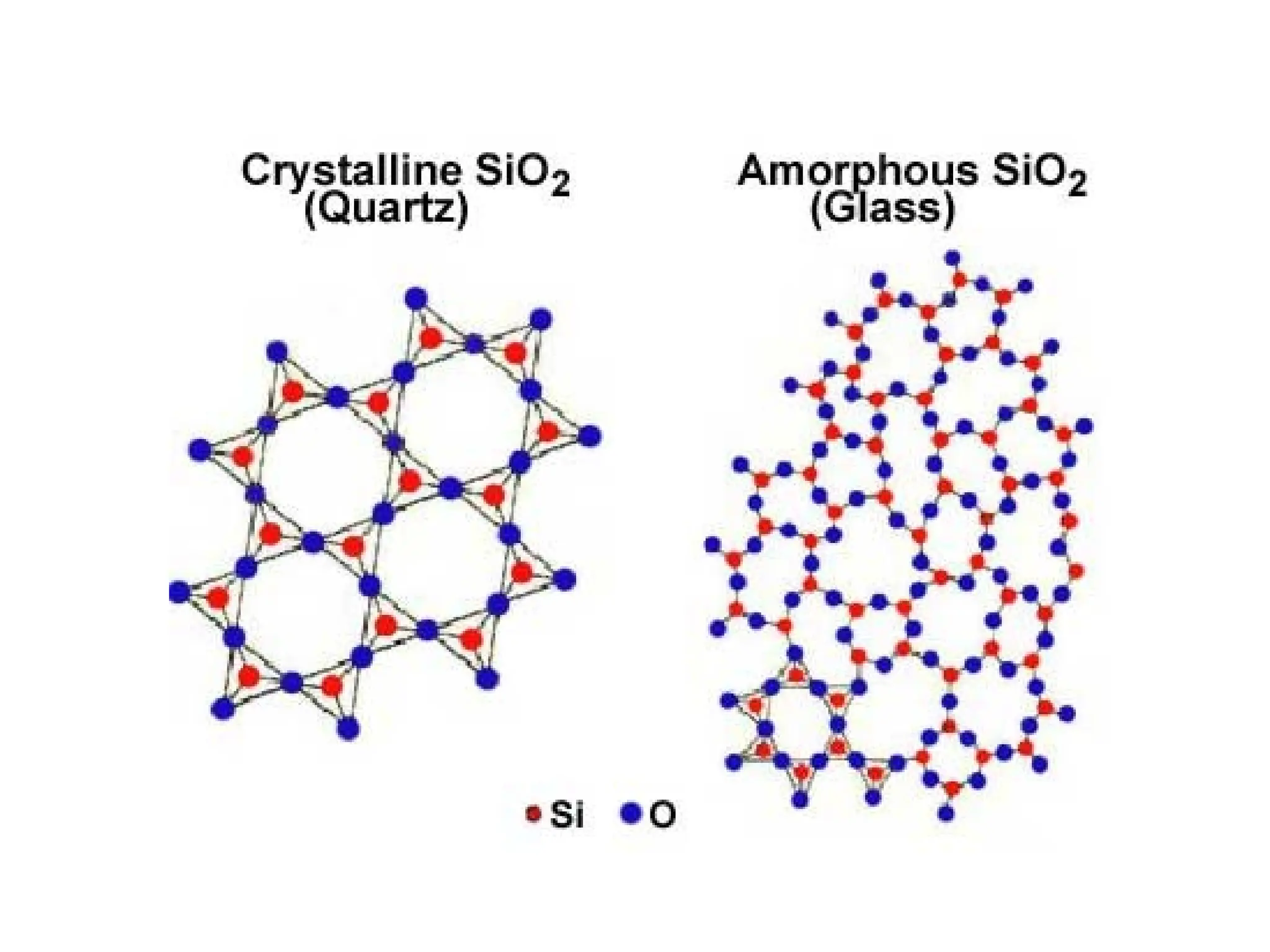
Crystalline & Amorphous solids
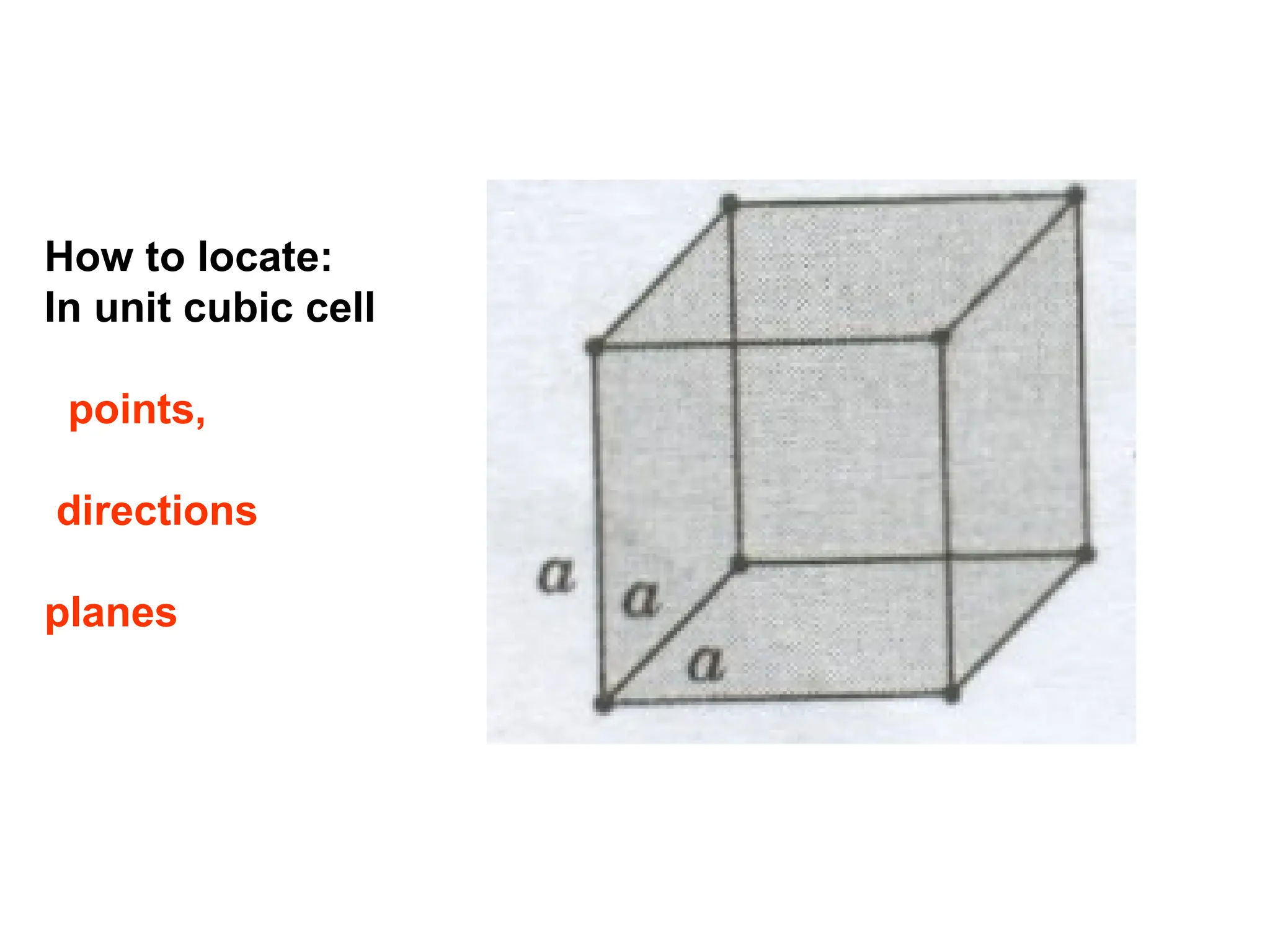
How to locate:
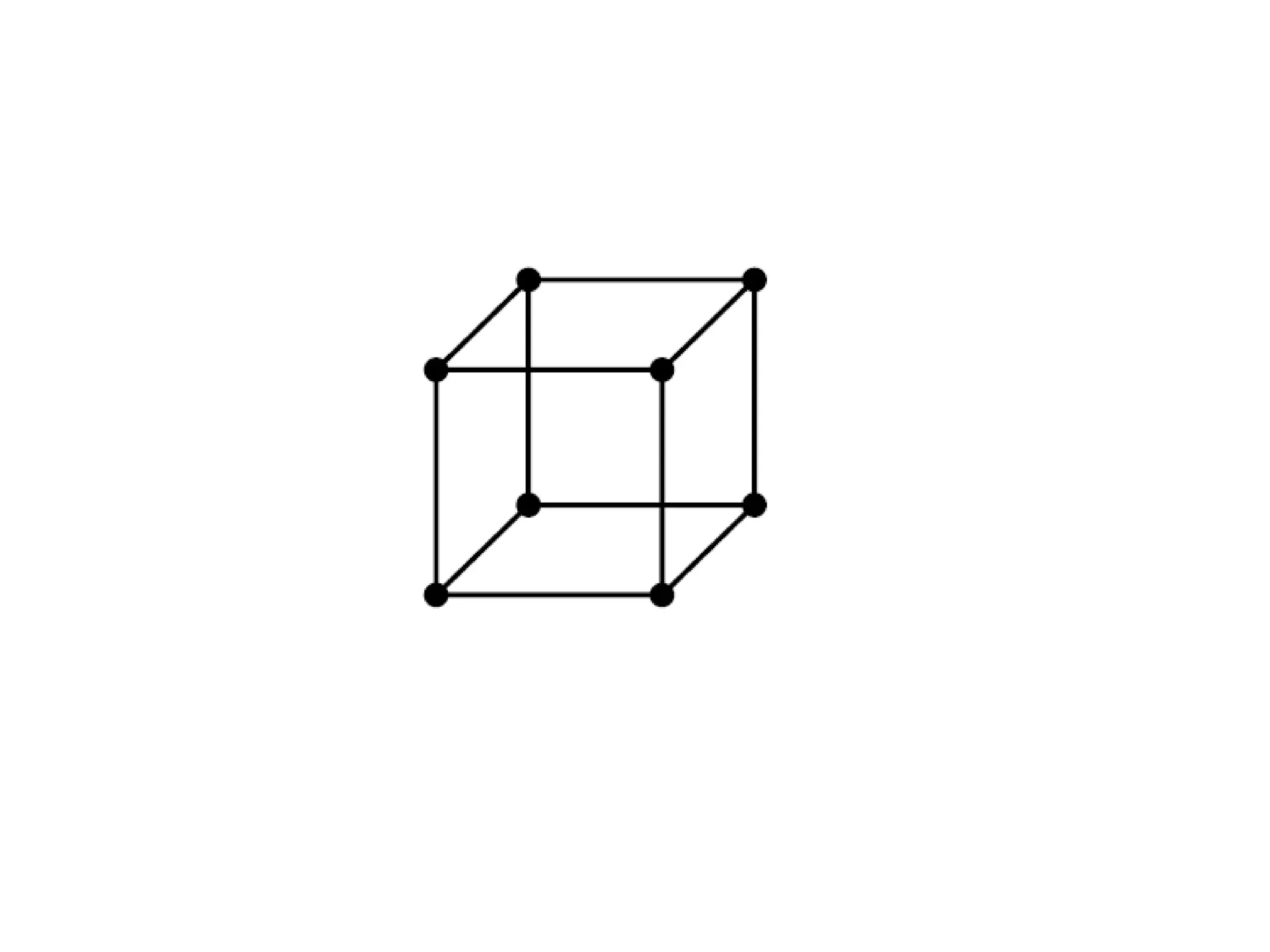
In unit cubic cell
points,
directions
planes
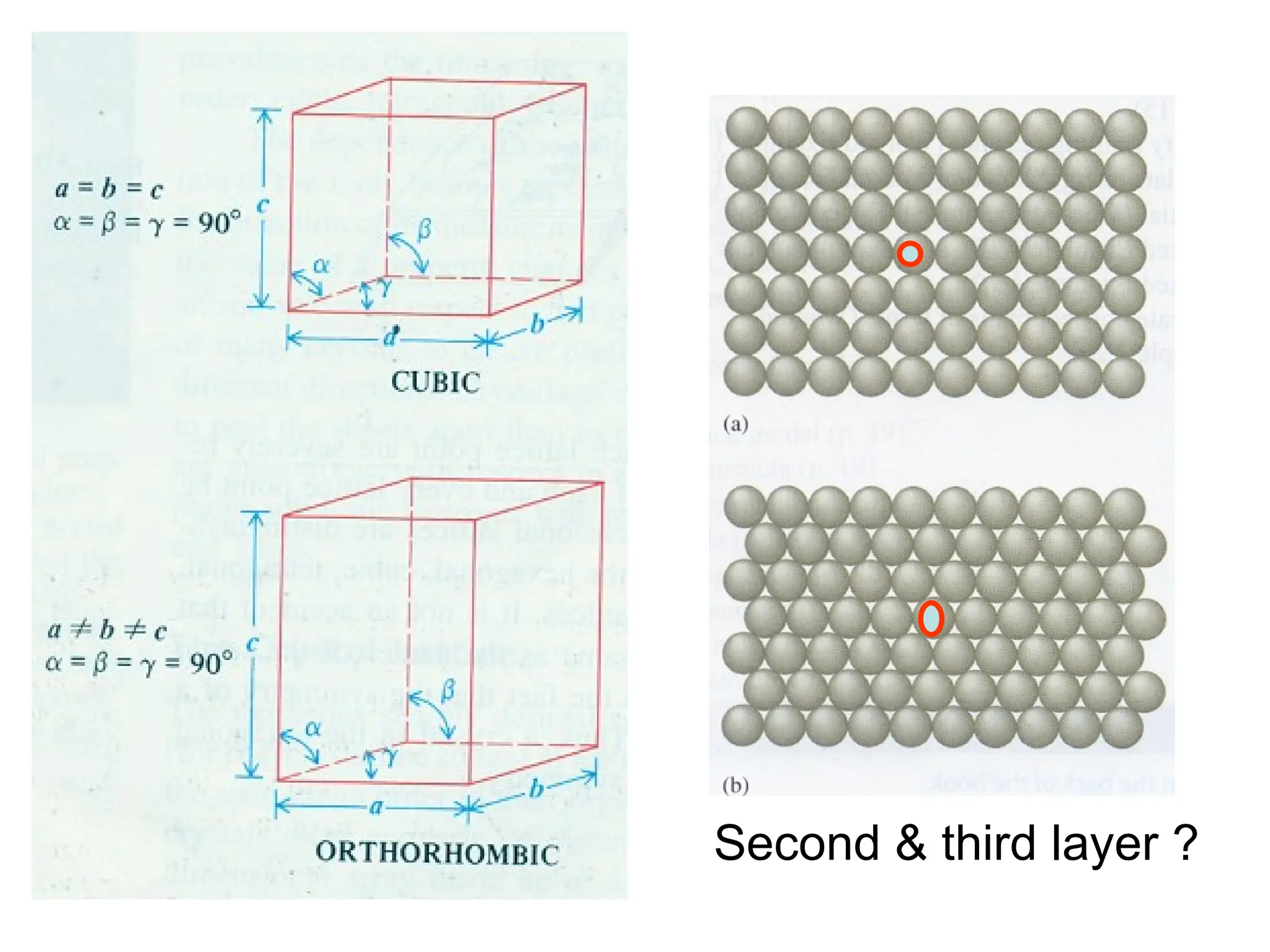
Second & third layer ?
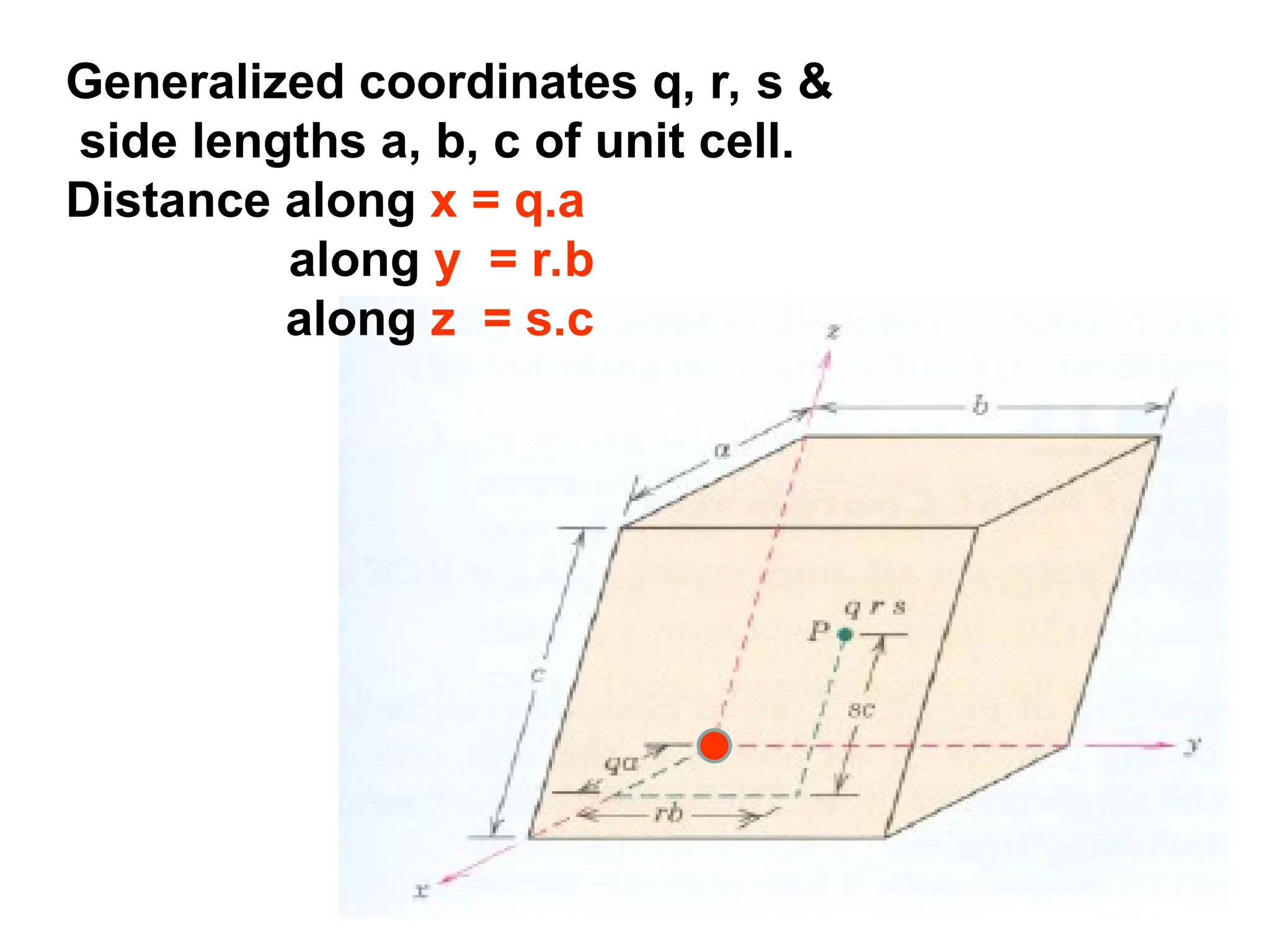
Generalized coordinates q, r, s &
side lengths a, b, c of unit cell.
Distance along x = q.a
along y = r.b
along z = s.c
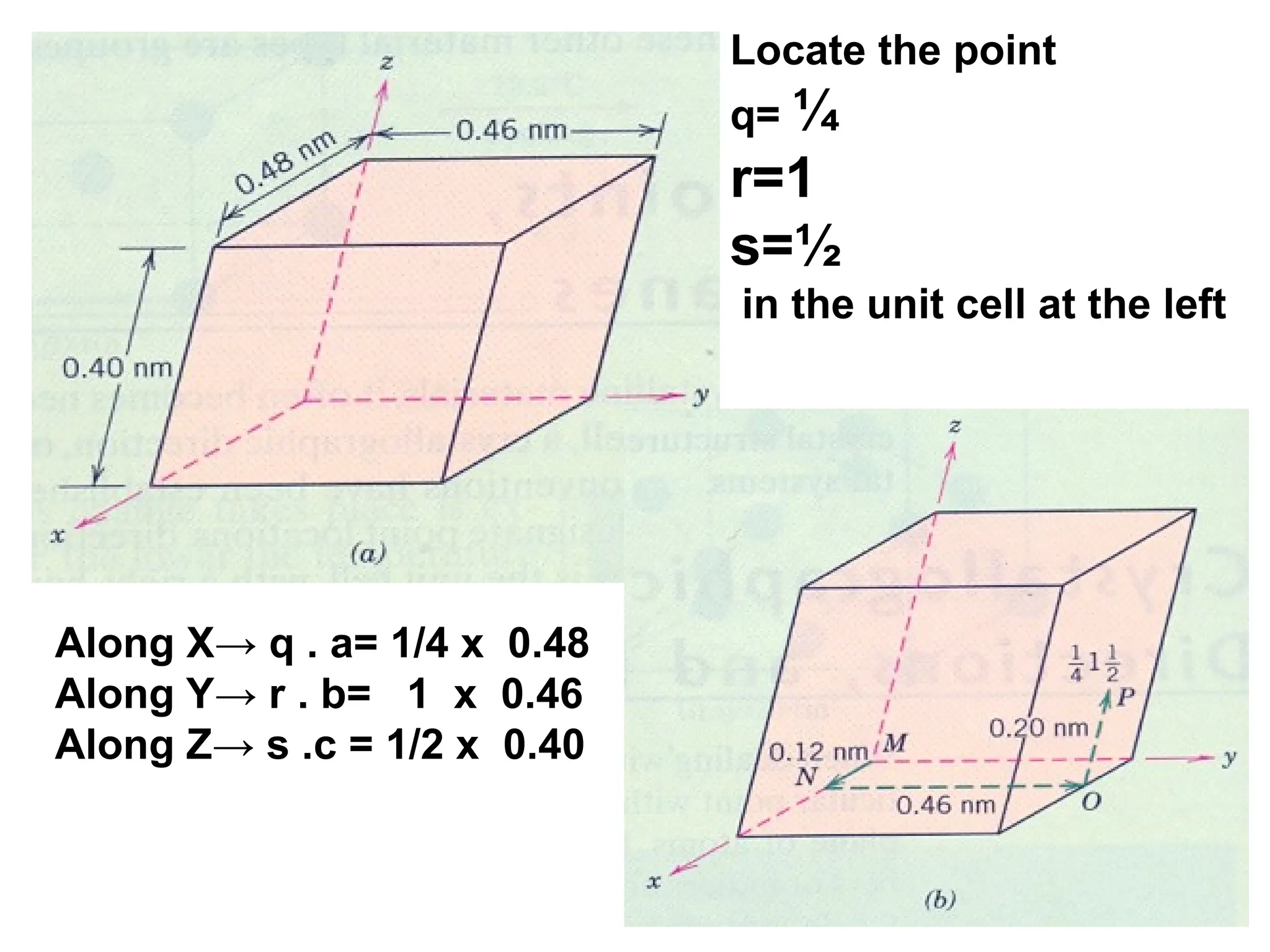
Locate the point
q= ¼
r=1
s=½
in the unit cell at the left
Along X→ q . a= 1/4 x 0.48
Along Y→ r . b= 1 x 0.46
Along Z→ s .c = 1/2 x 0.40
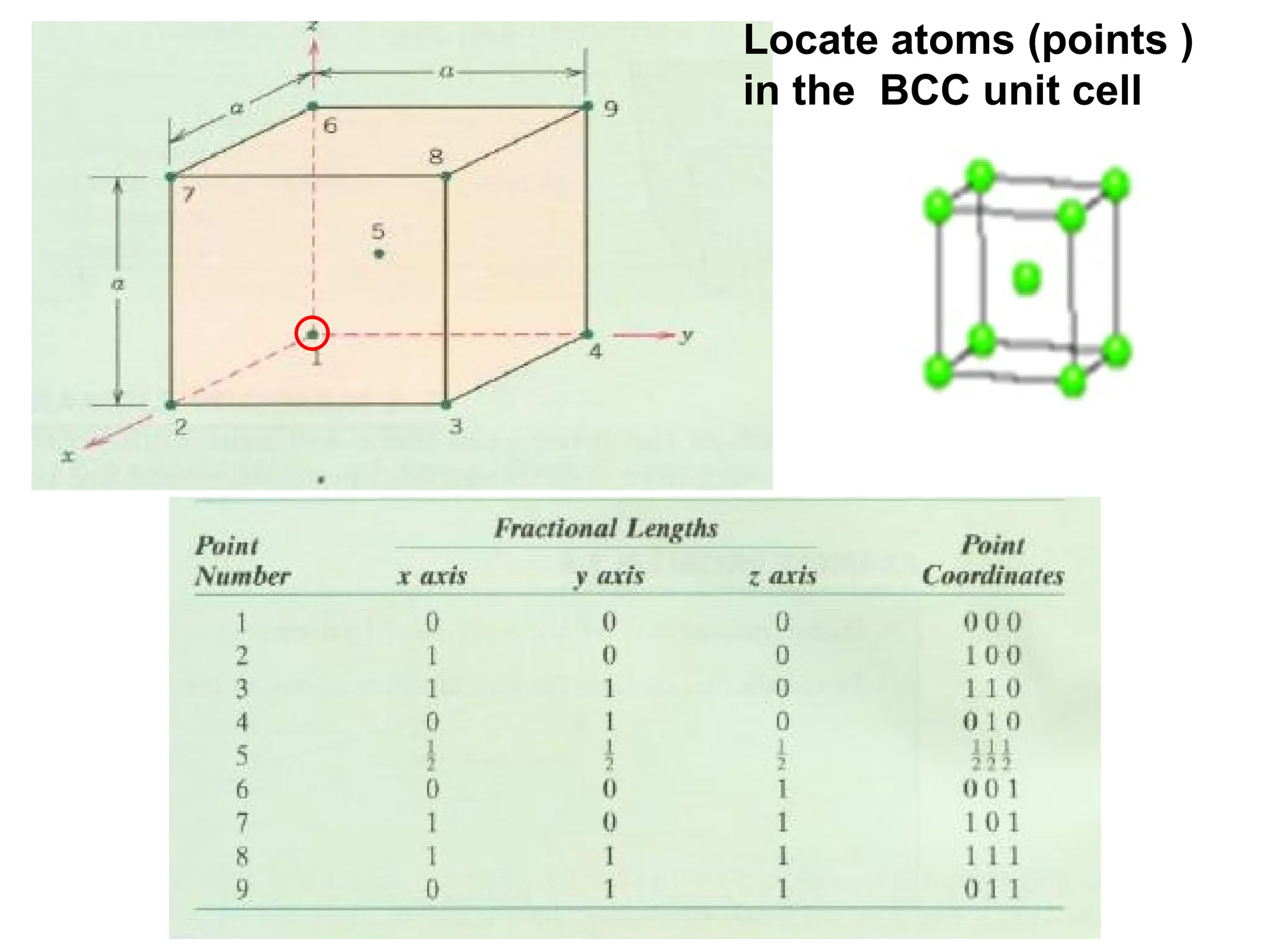
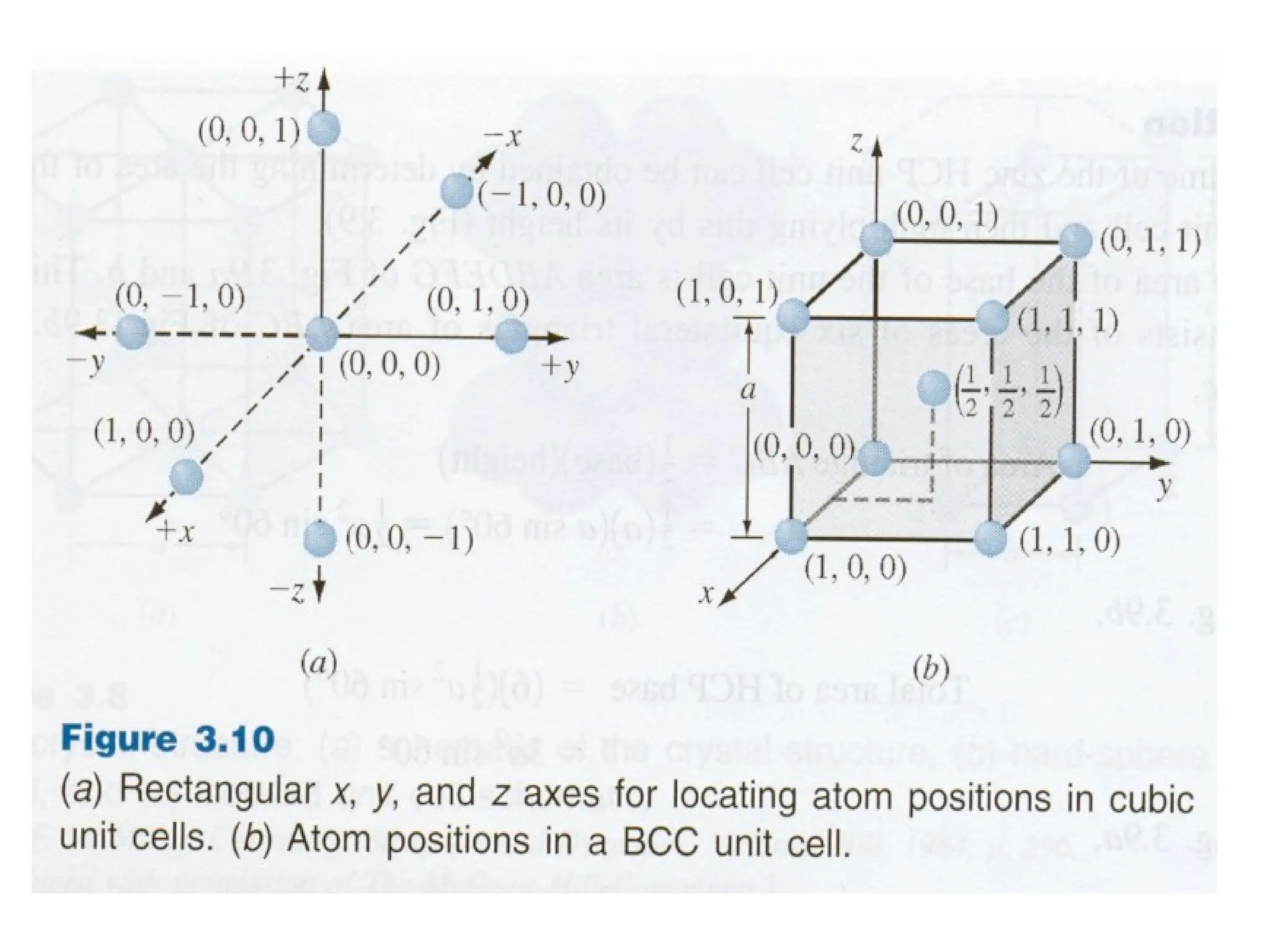
Locate atoms (points )
in the BCC unit cell
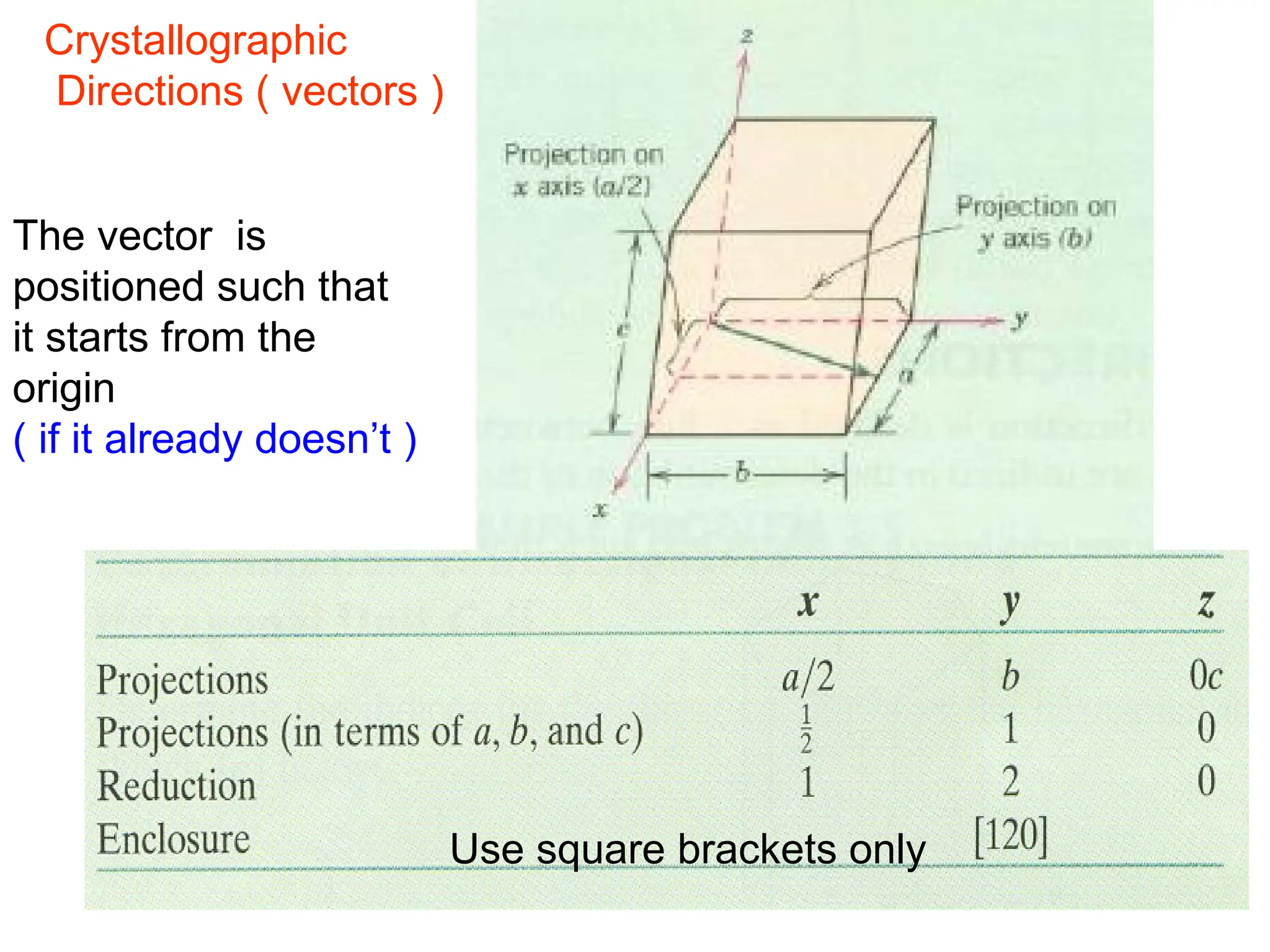
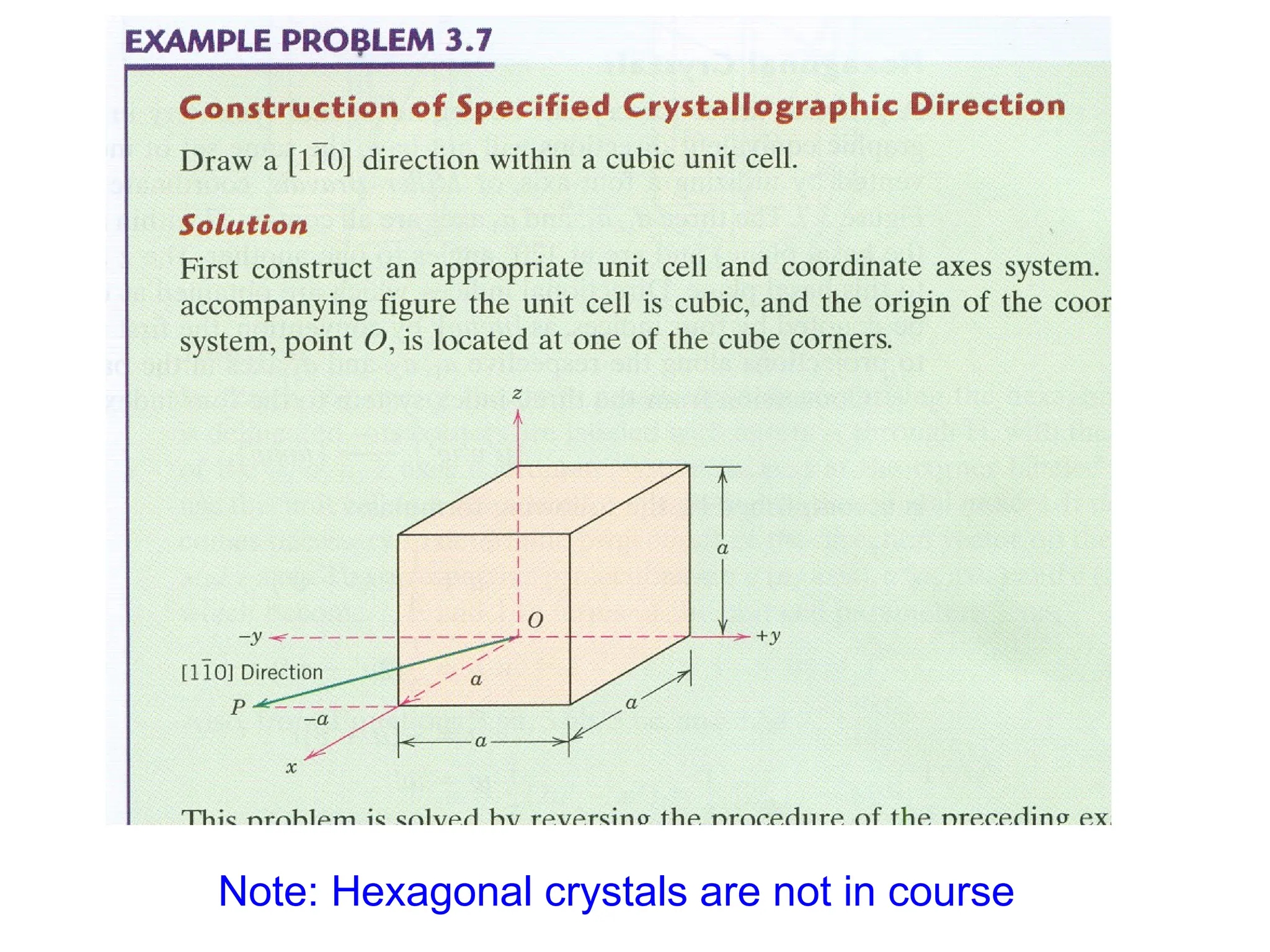
Crystallographic
Directions ( vectors )
The vector is
positioned such that
it starts from the
origin
( if it already doesn’t )
Use square brackets only
Crystallographic Directions
1. Position vector through the
origin ( translate if necessary )
2. Measure its projections along
x, y, z & divide by a, b, c
3. Convert values from step 2
into smallest whole numbers
4. Write whole numbers from
step 3 as [uvw]
Note: Hexagonal crystals are not in course
For cubic Crystals:
Equivalent Directions are defined
[100], [100], [010], [010], [001], [001] are all equivalent directions
because atoms are spaced in the same way.
We write set of equivalent directions as: ‹100›
[123] & [213] →
same indices without regard for
sign or order
are also equivalent
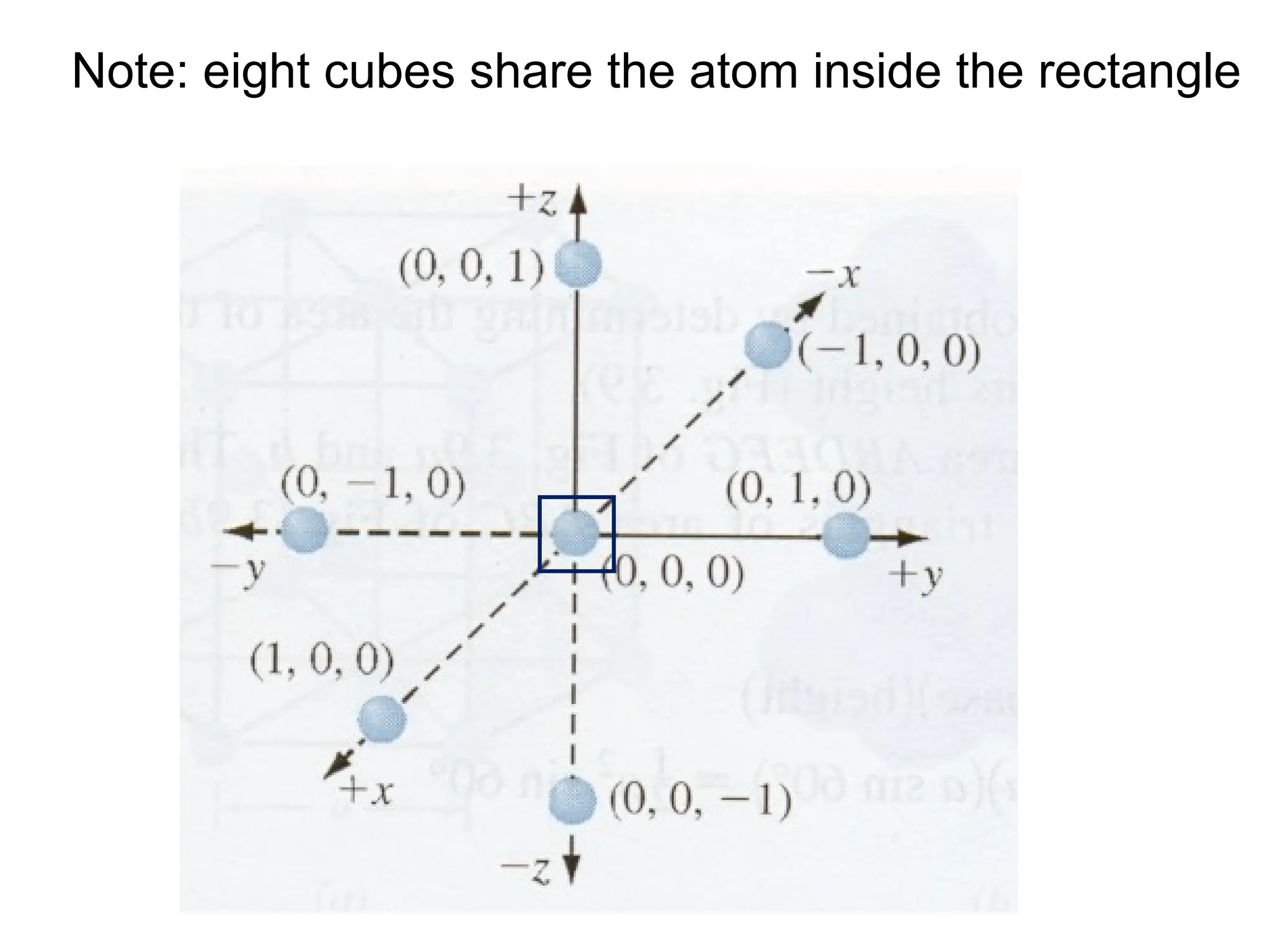
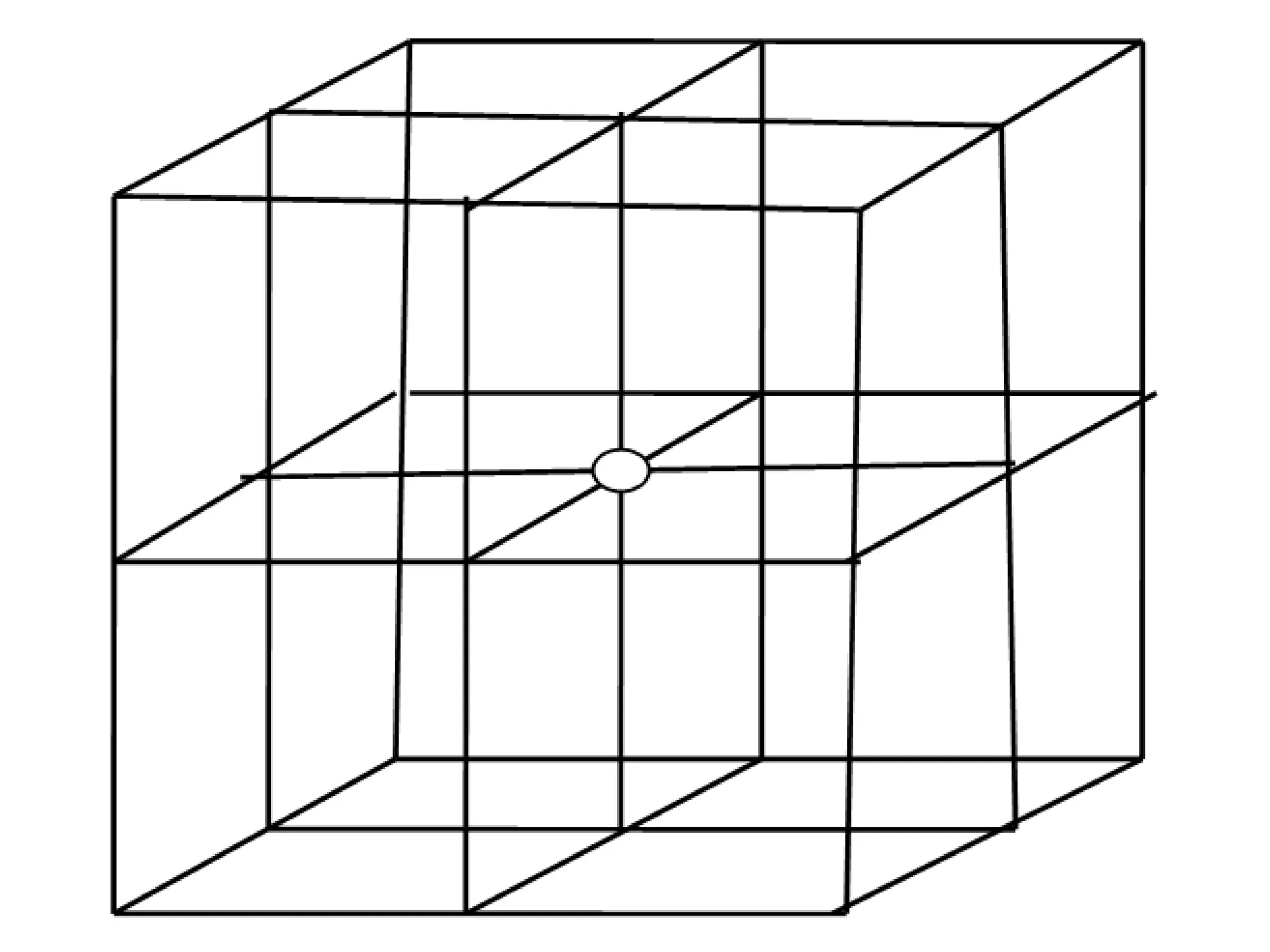
Note: eight cubes share the atom inside the rectangle
Show that A is [3 3 1], B is [4 0 3], C is [3 6 1] and D is [1 1 1]
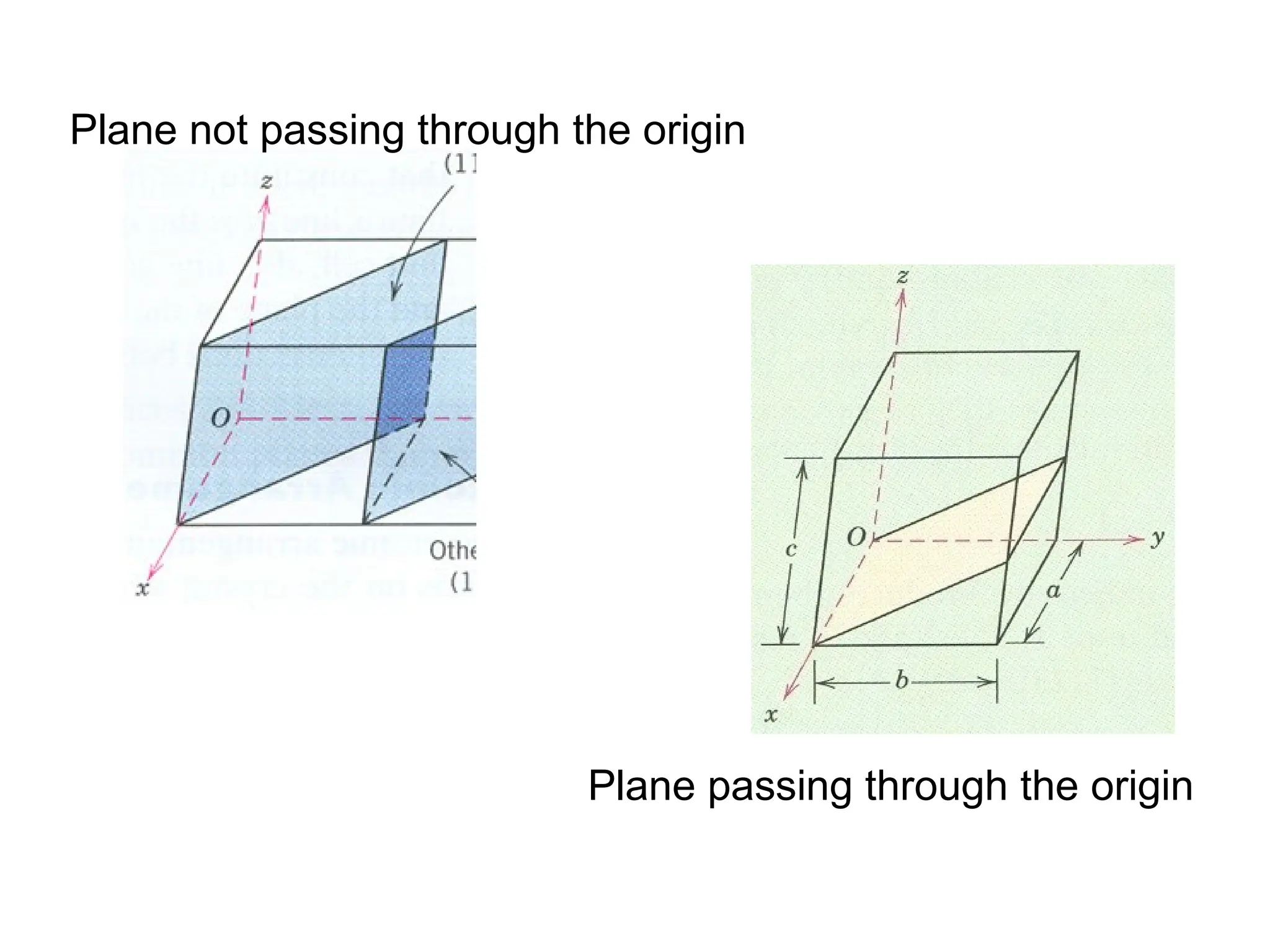
Plane not passing through the origin
Plane passing through the origin
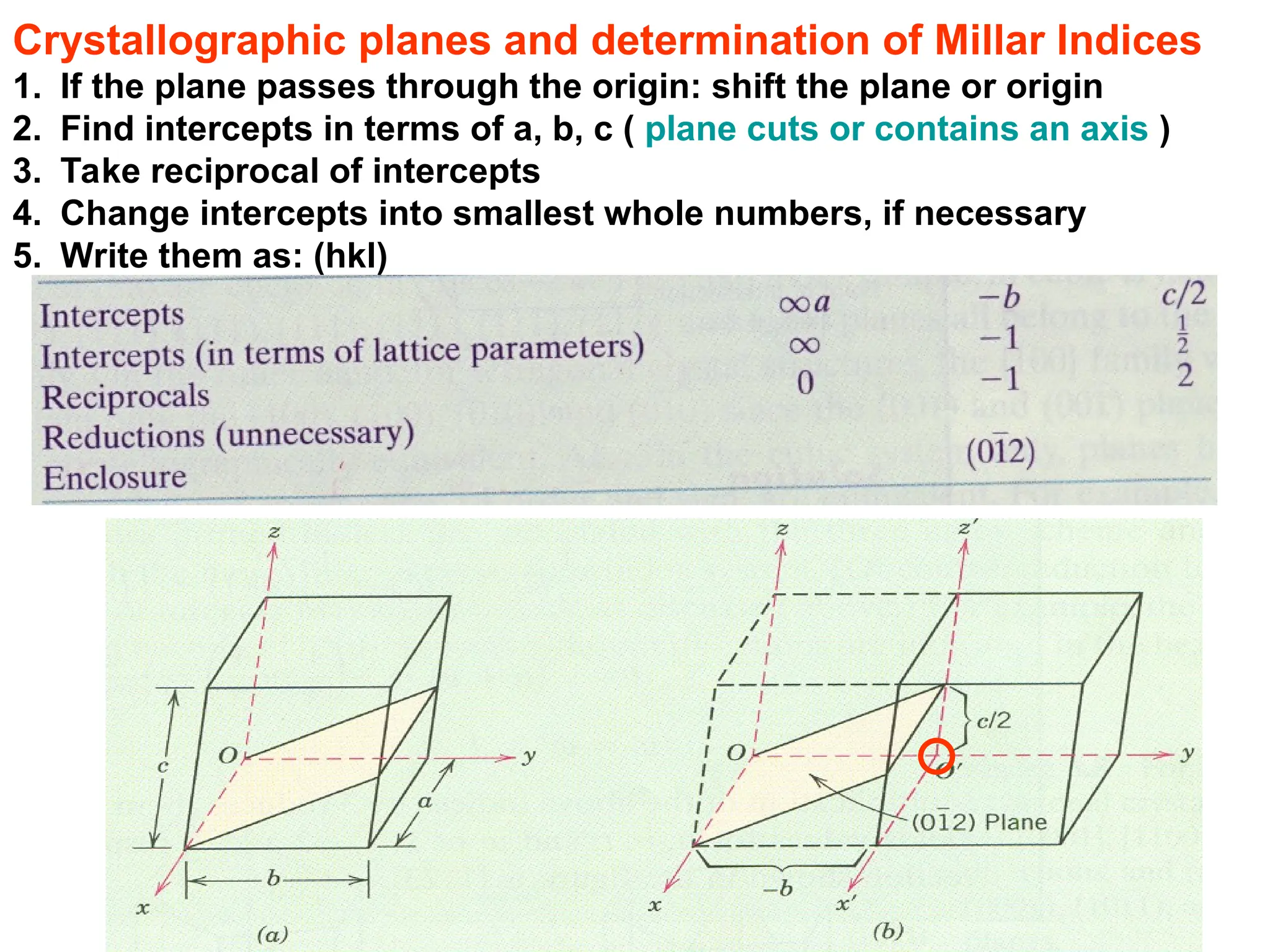
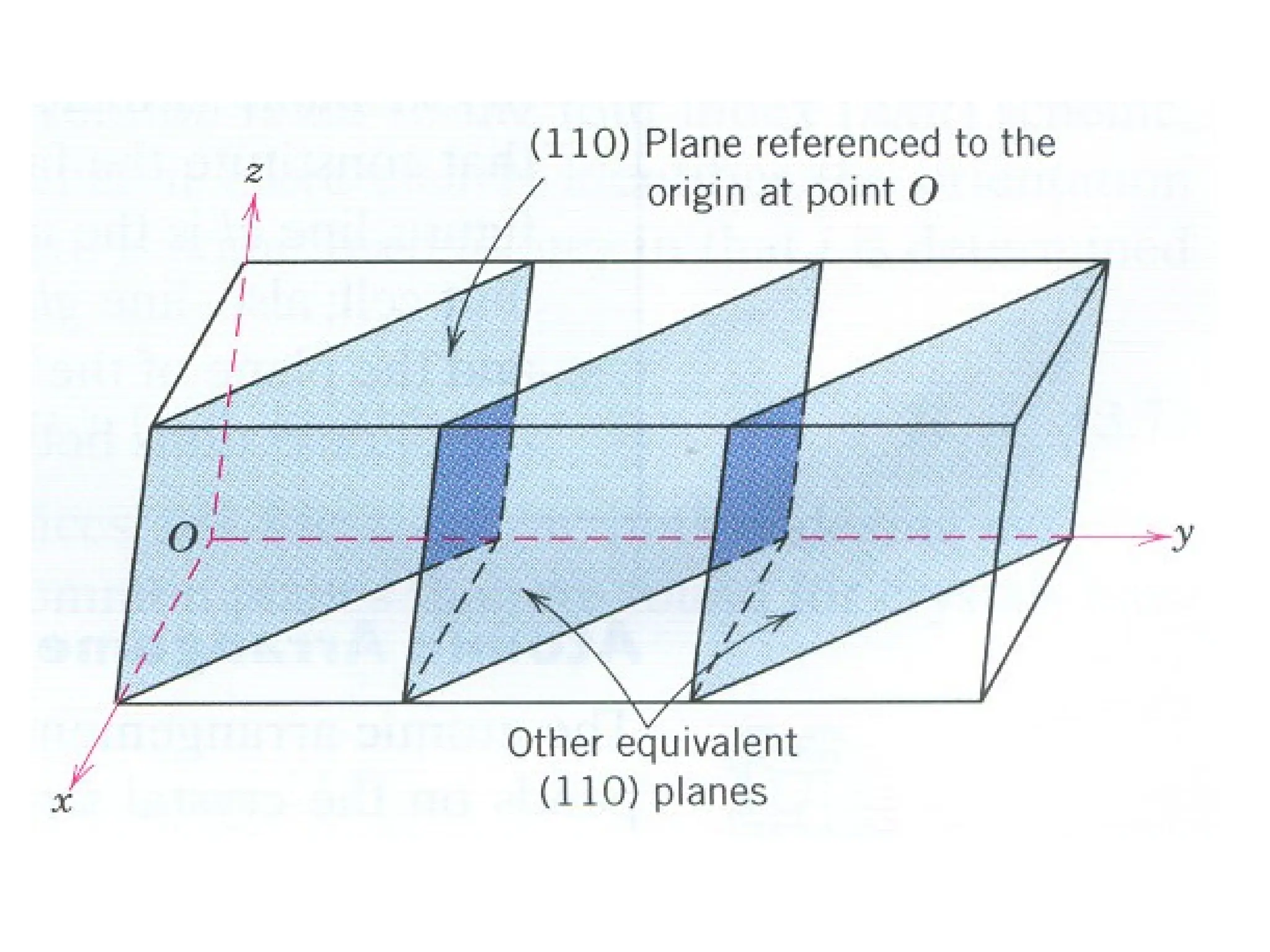
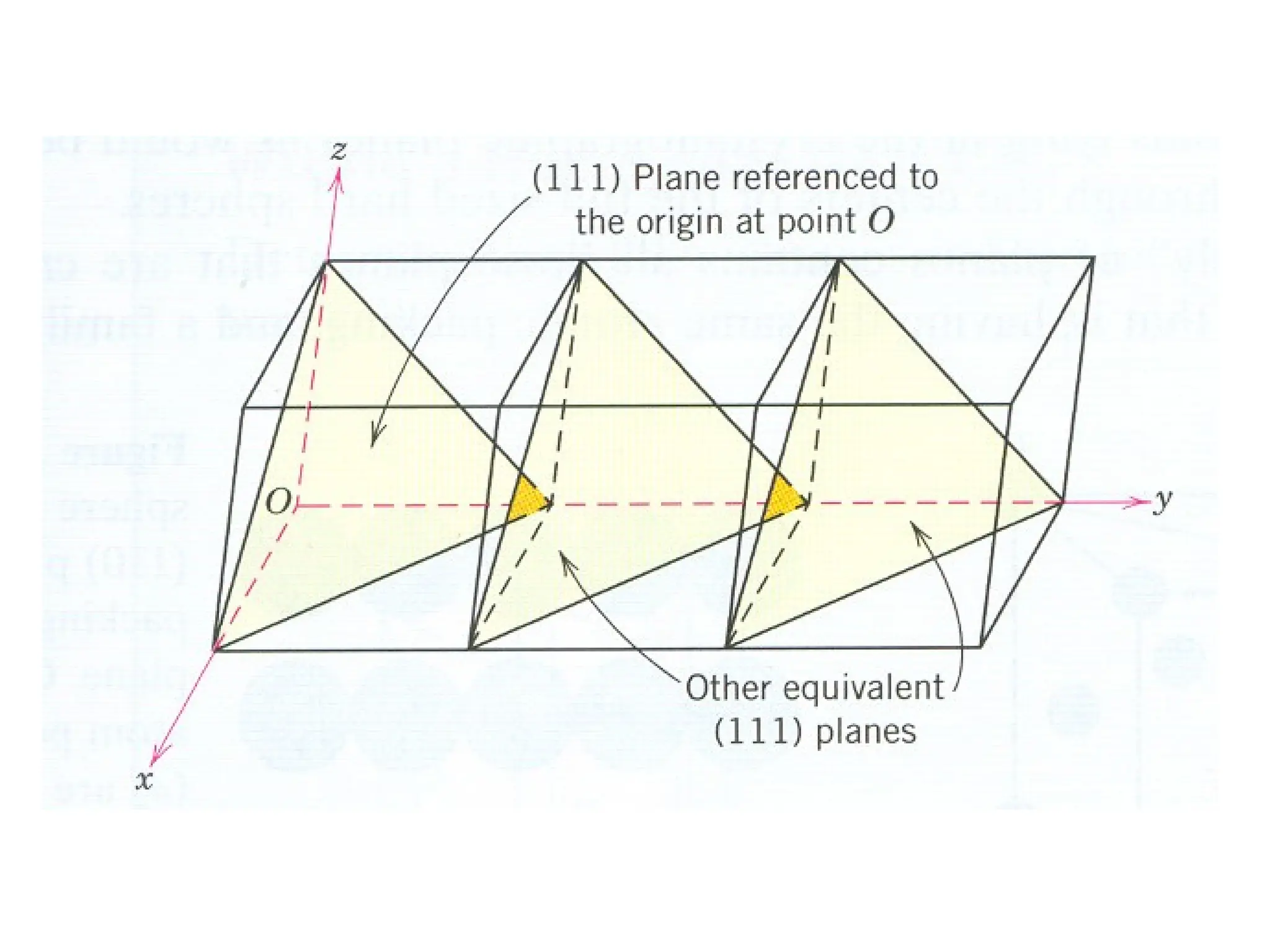
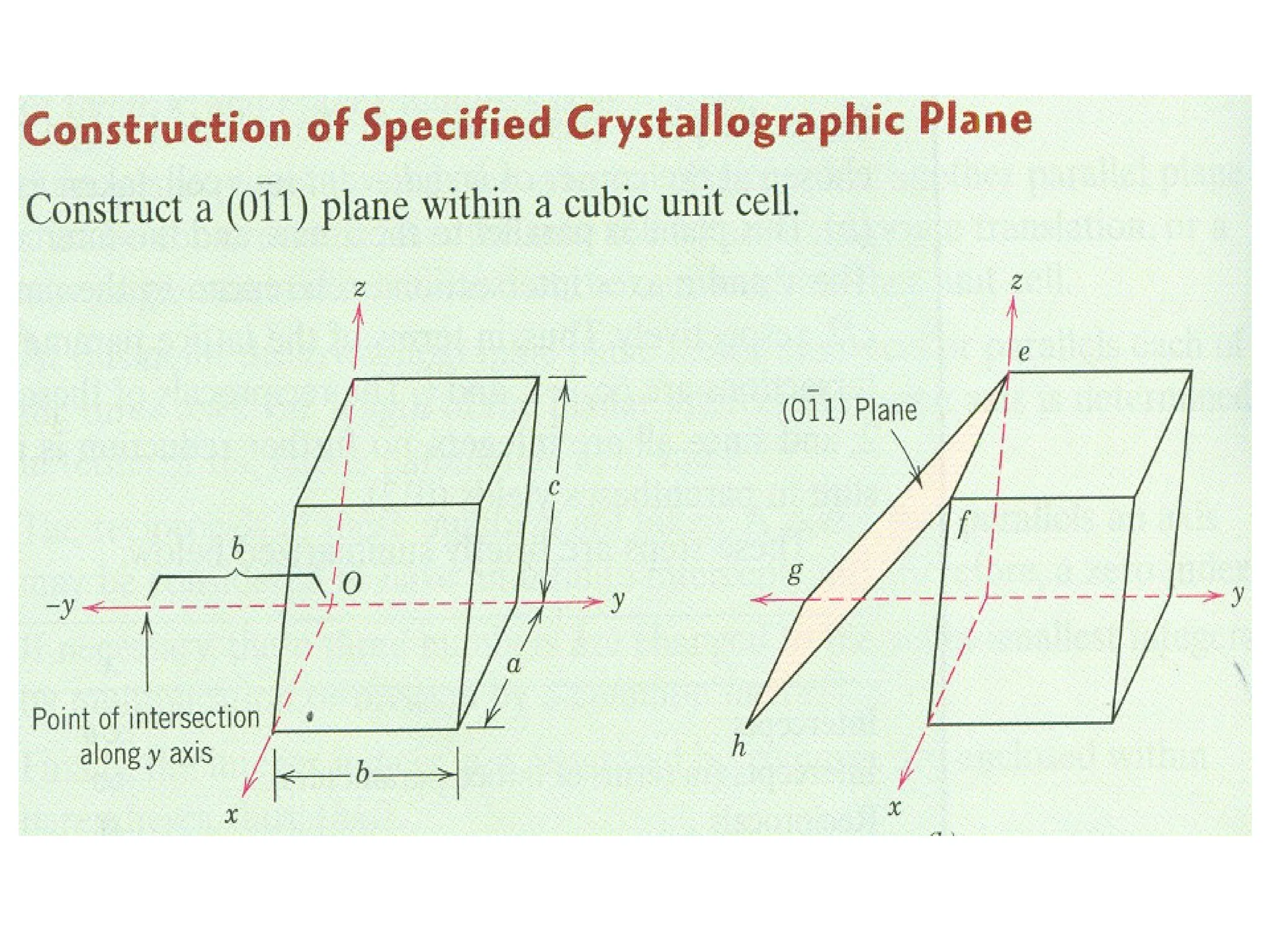
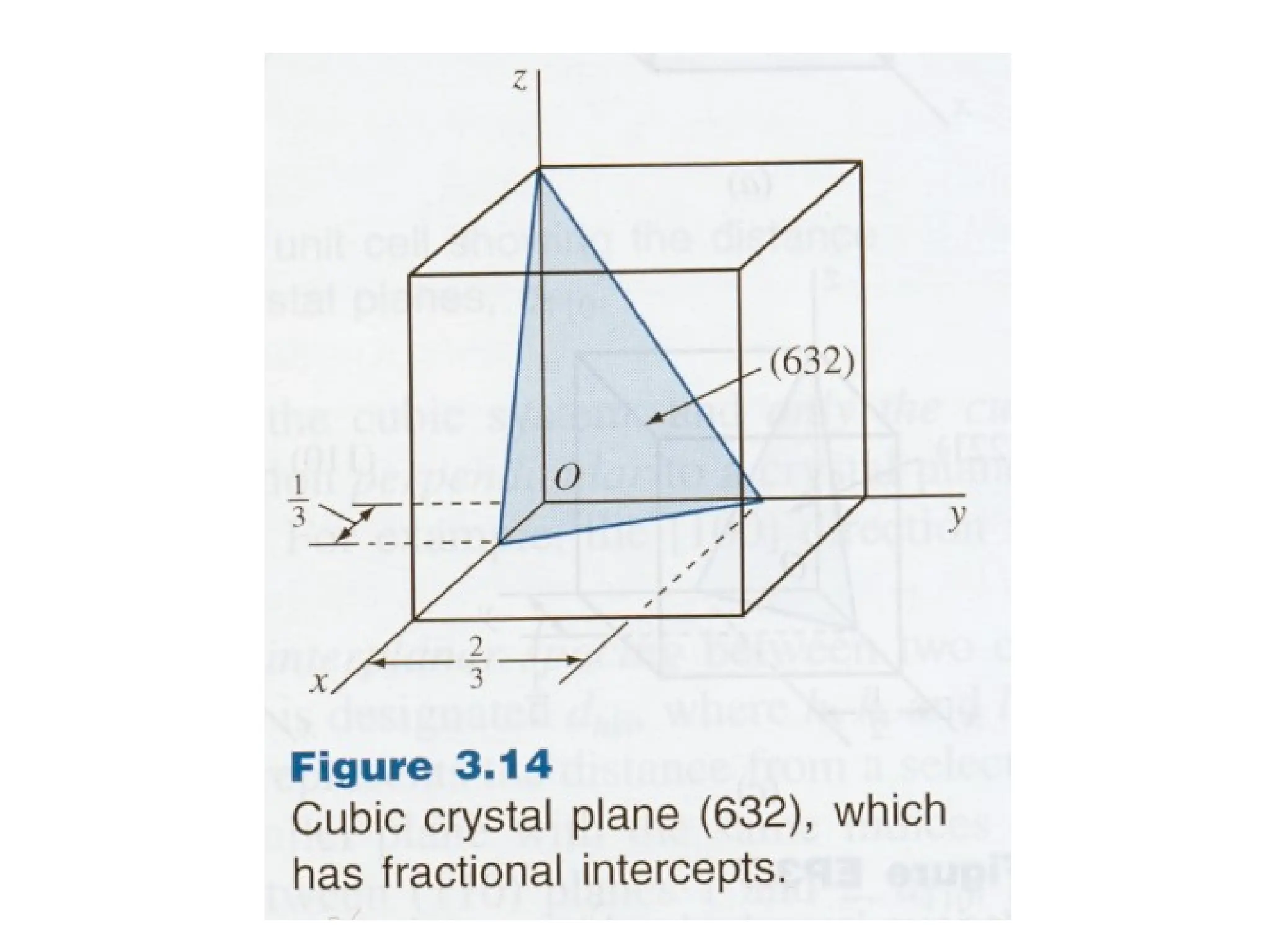
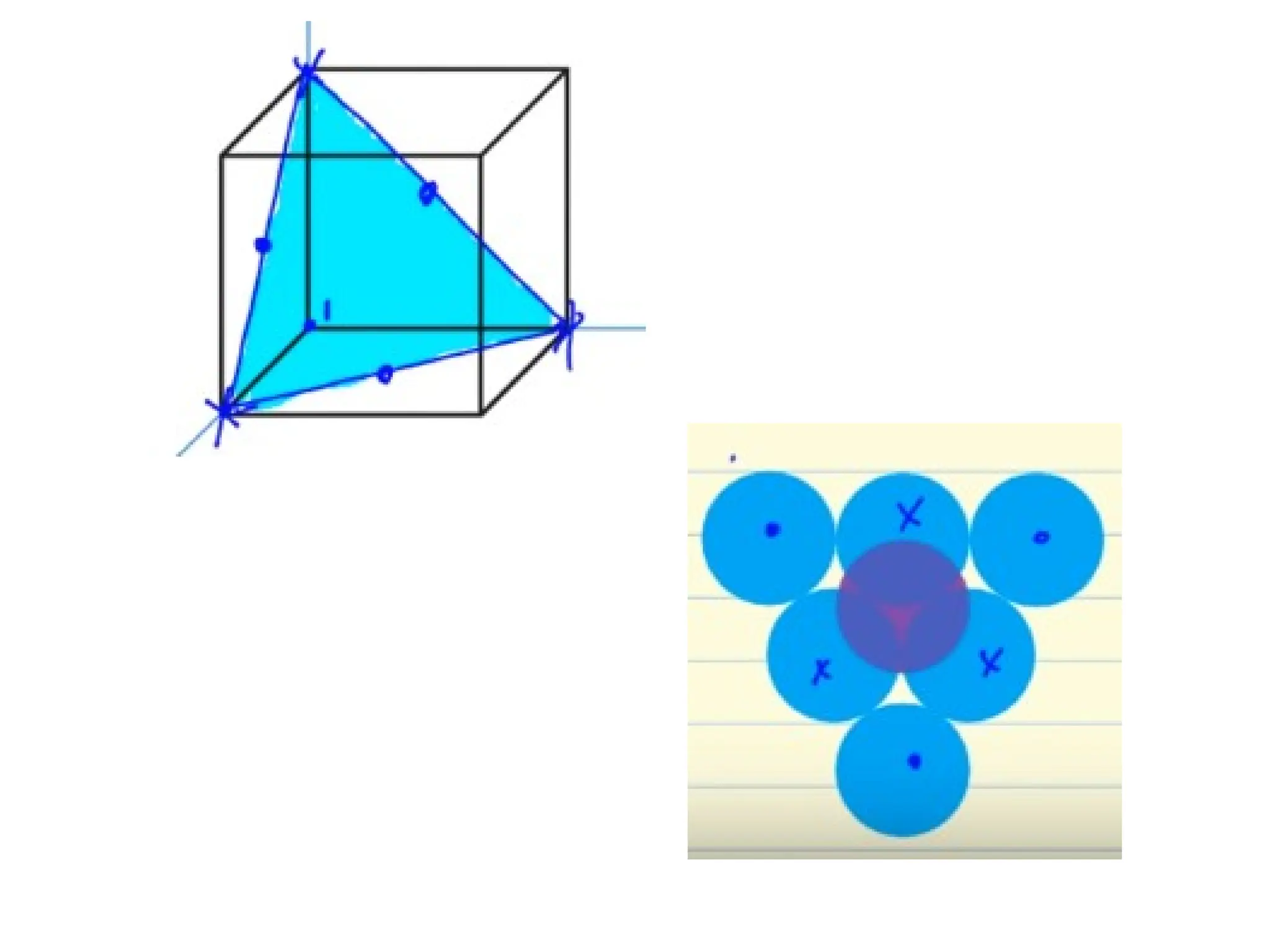
Crystallographic planes and determination of Millar Indices
1. If the plane passes through the origin: shift the plane or origin
2. Find intercepts in terms of a, b, c ( plane cuts or contains an axis )
3. Take reciprocal of intercepts
4. Change intercepts into smallest whole numbers, if necessary
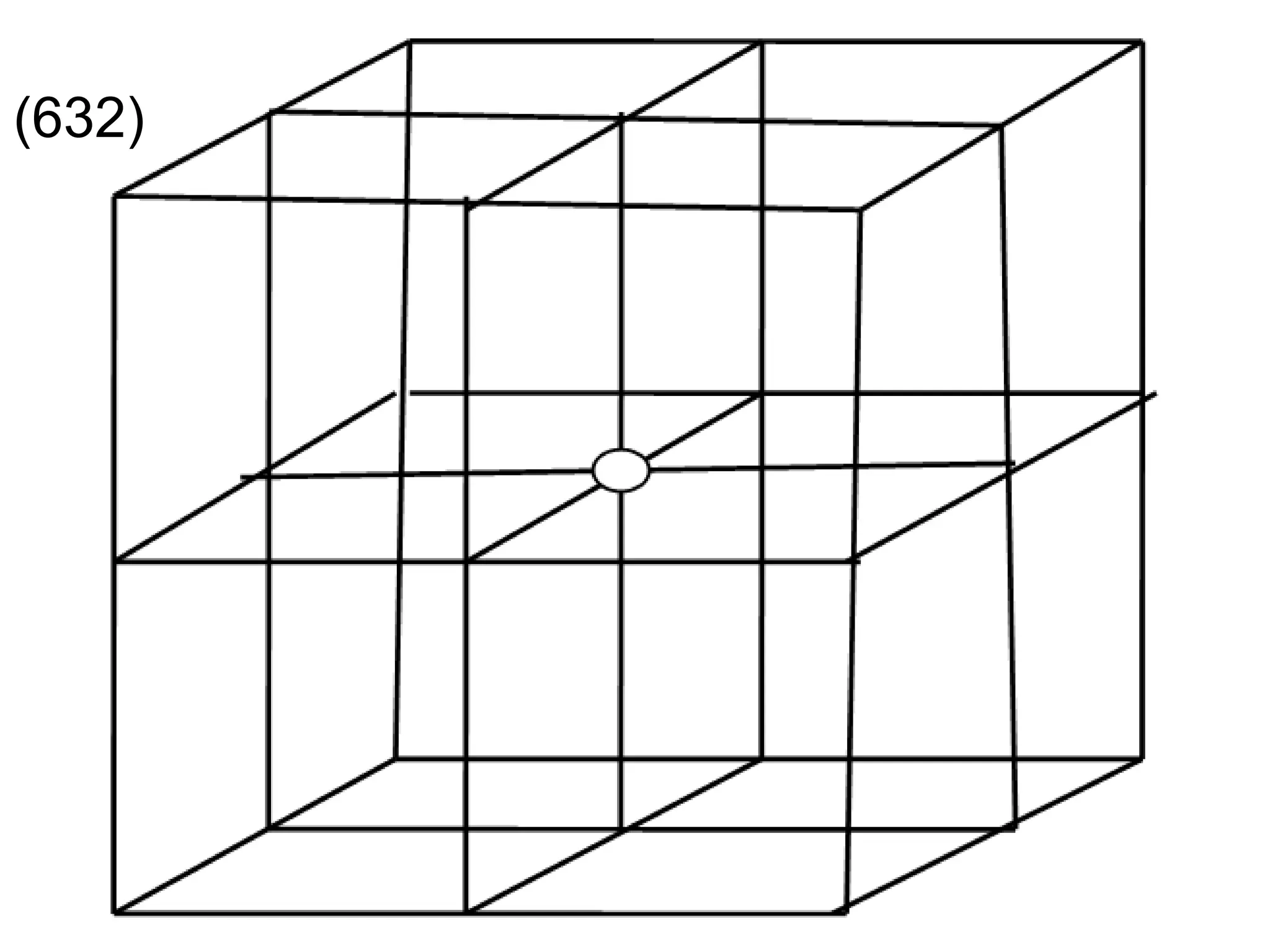
5. Write them as: (hkl)
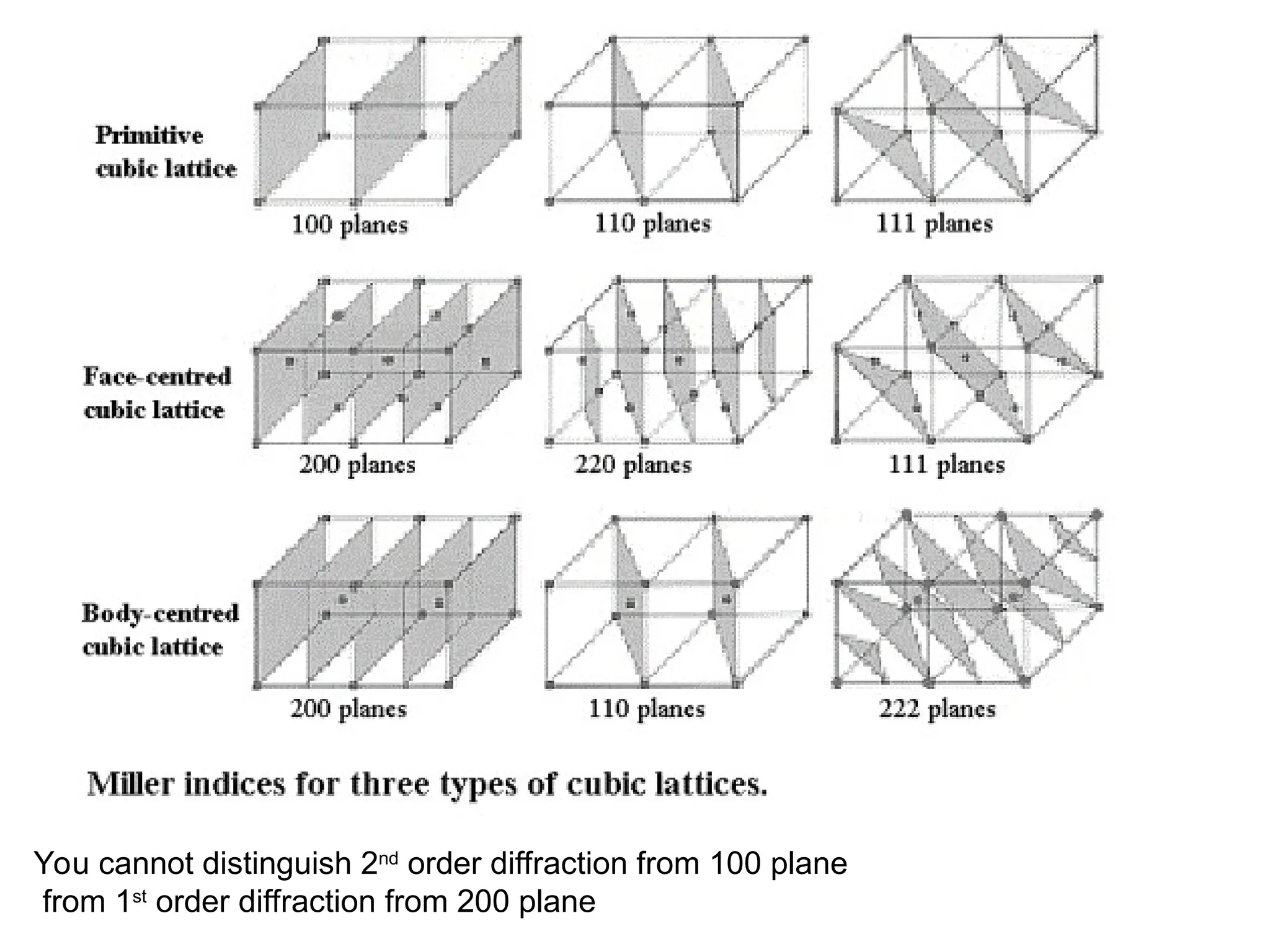
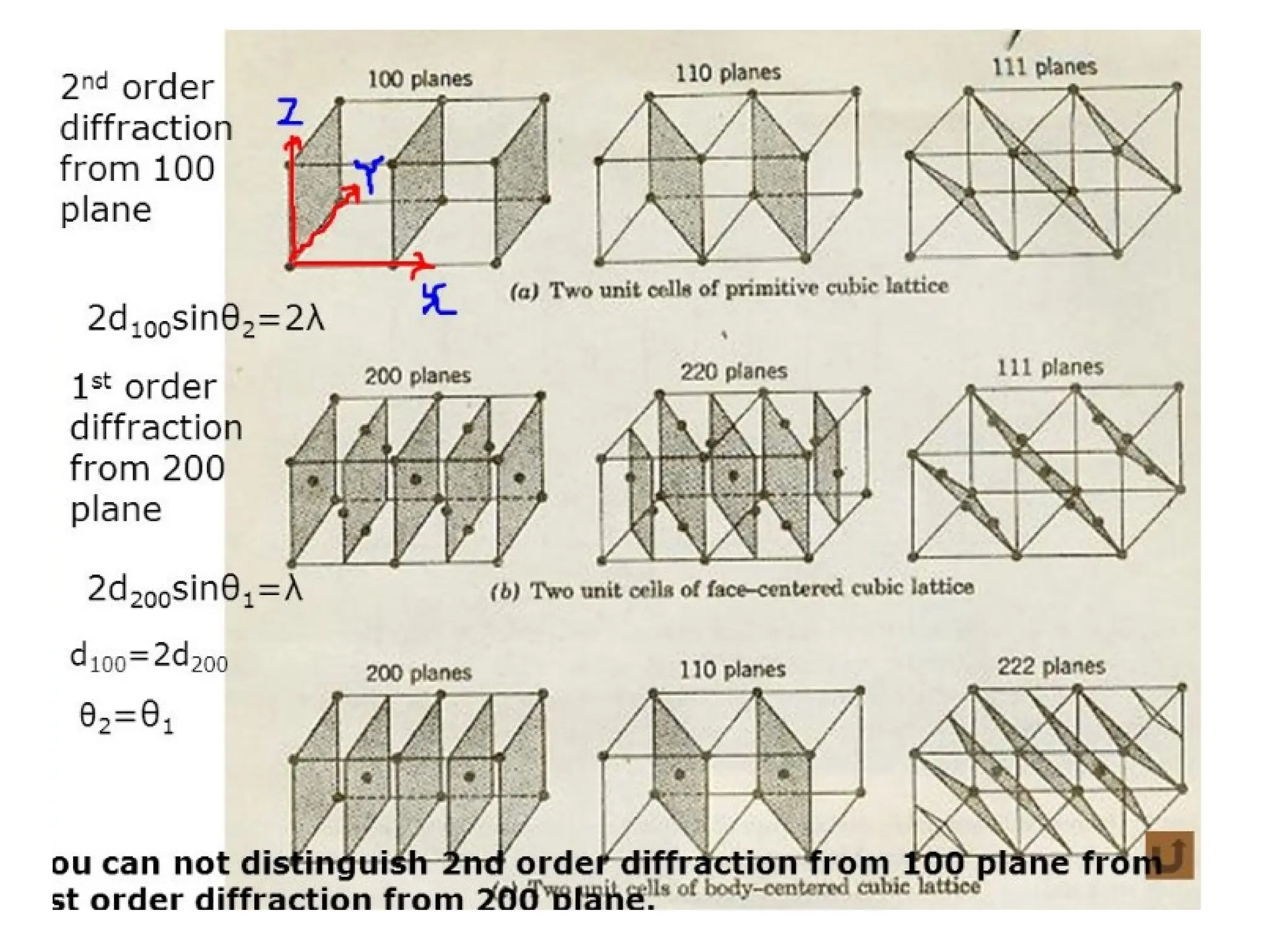
You cannot distinguish 2nd
order diffraction from 100 plane
from 1st
order diffraction from 200 plane
(632)
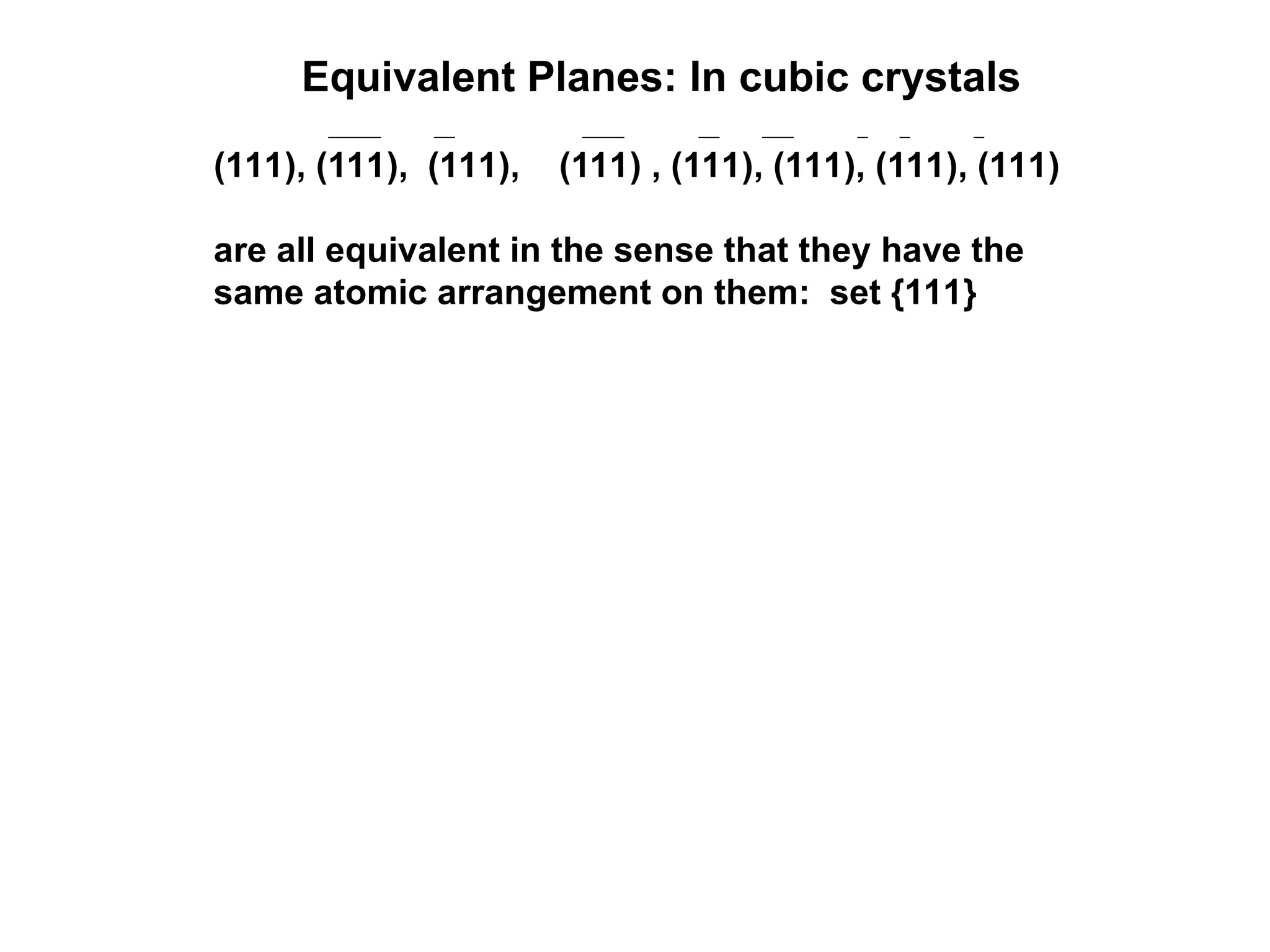
Equivalent Planes: In cubic crystals
(111), (111), (111), (111) , (111), (111), (111), (111)
are all equivalent in the sense that they have the
same atomic arrangement on them: set {111}
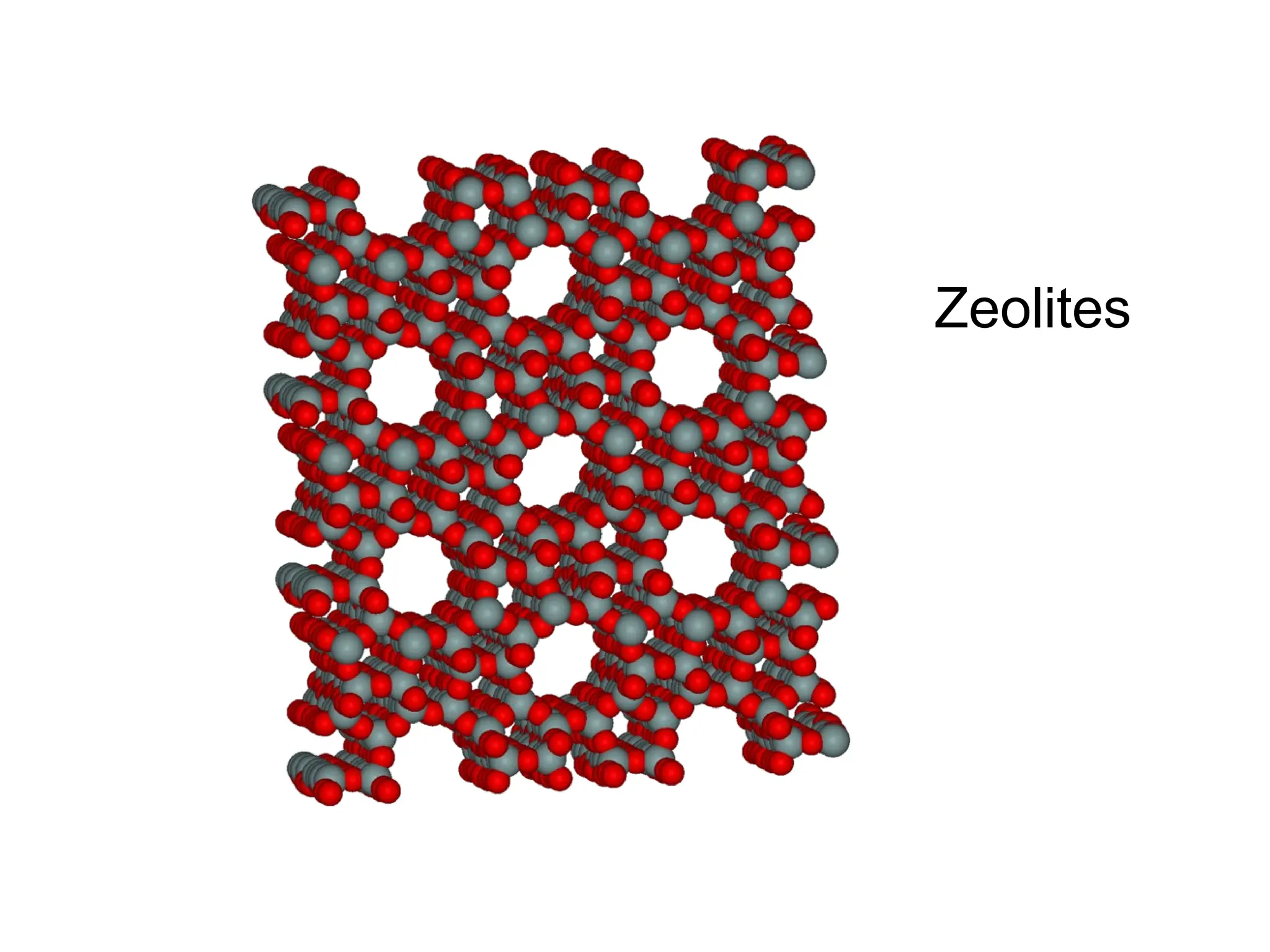
Zeolites
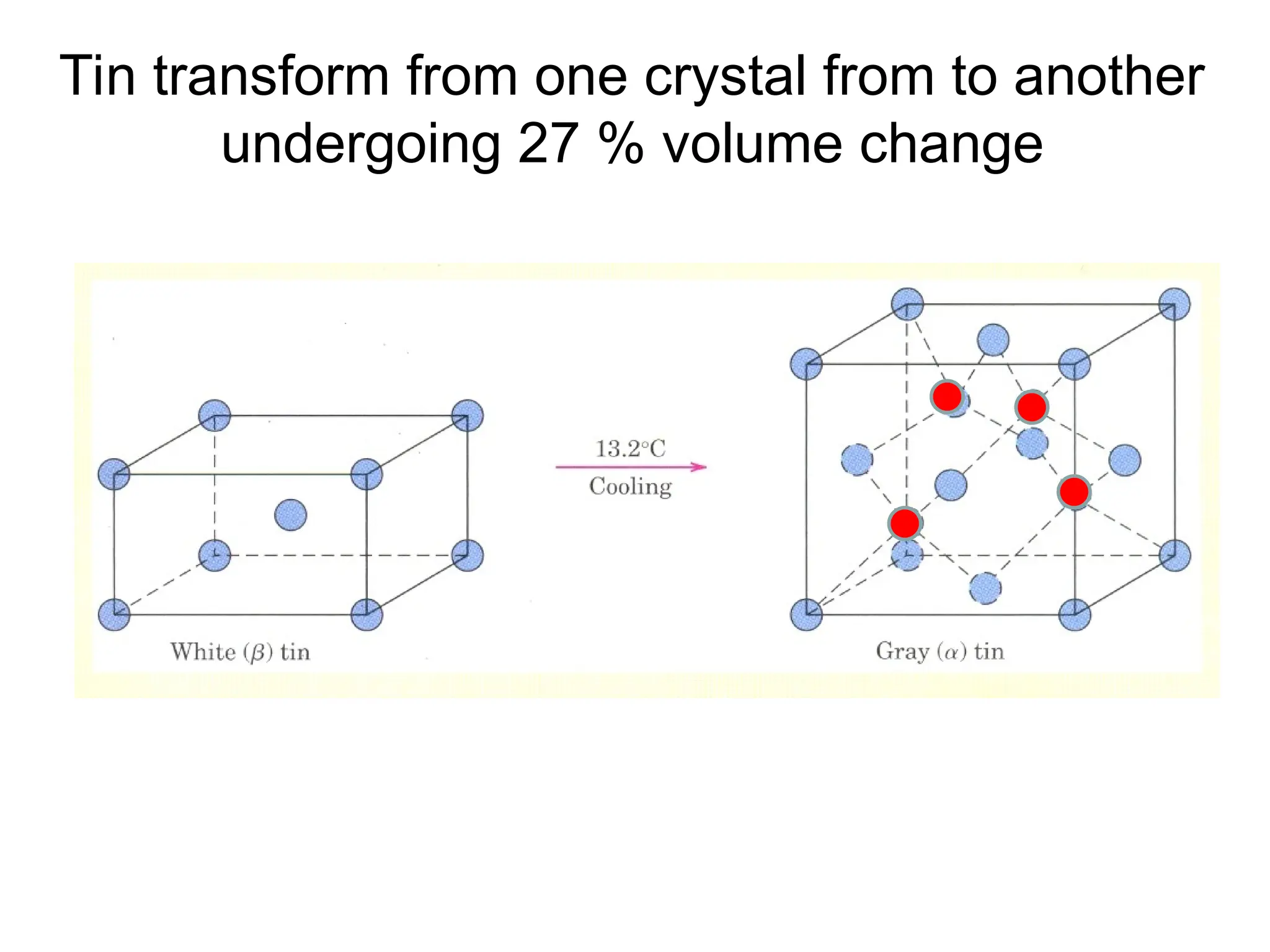
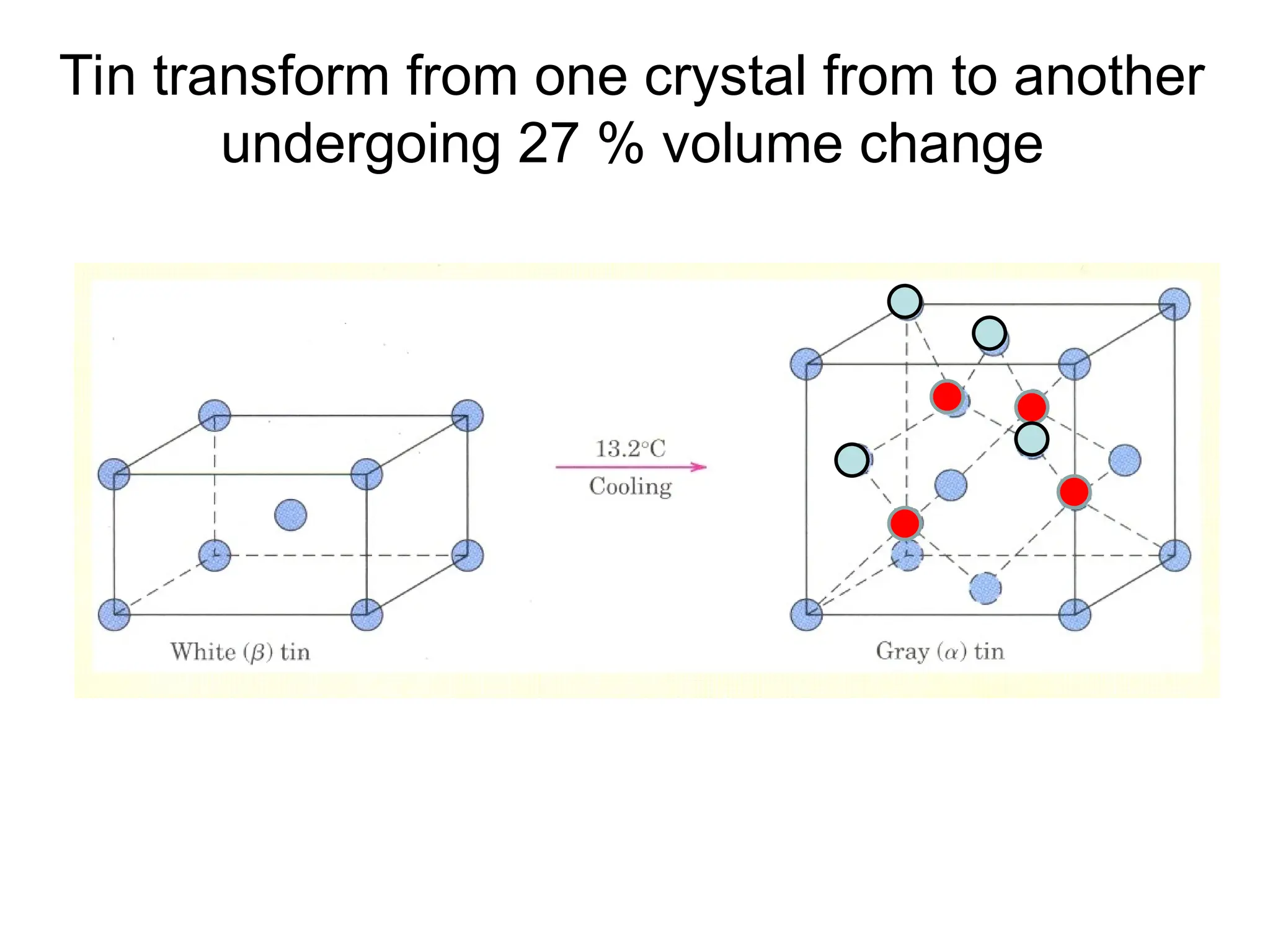
Tin transform from one crystal from to another
undergoing 27 % volume change
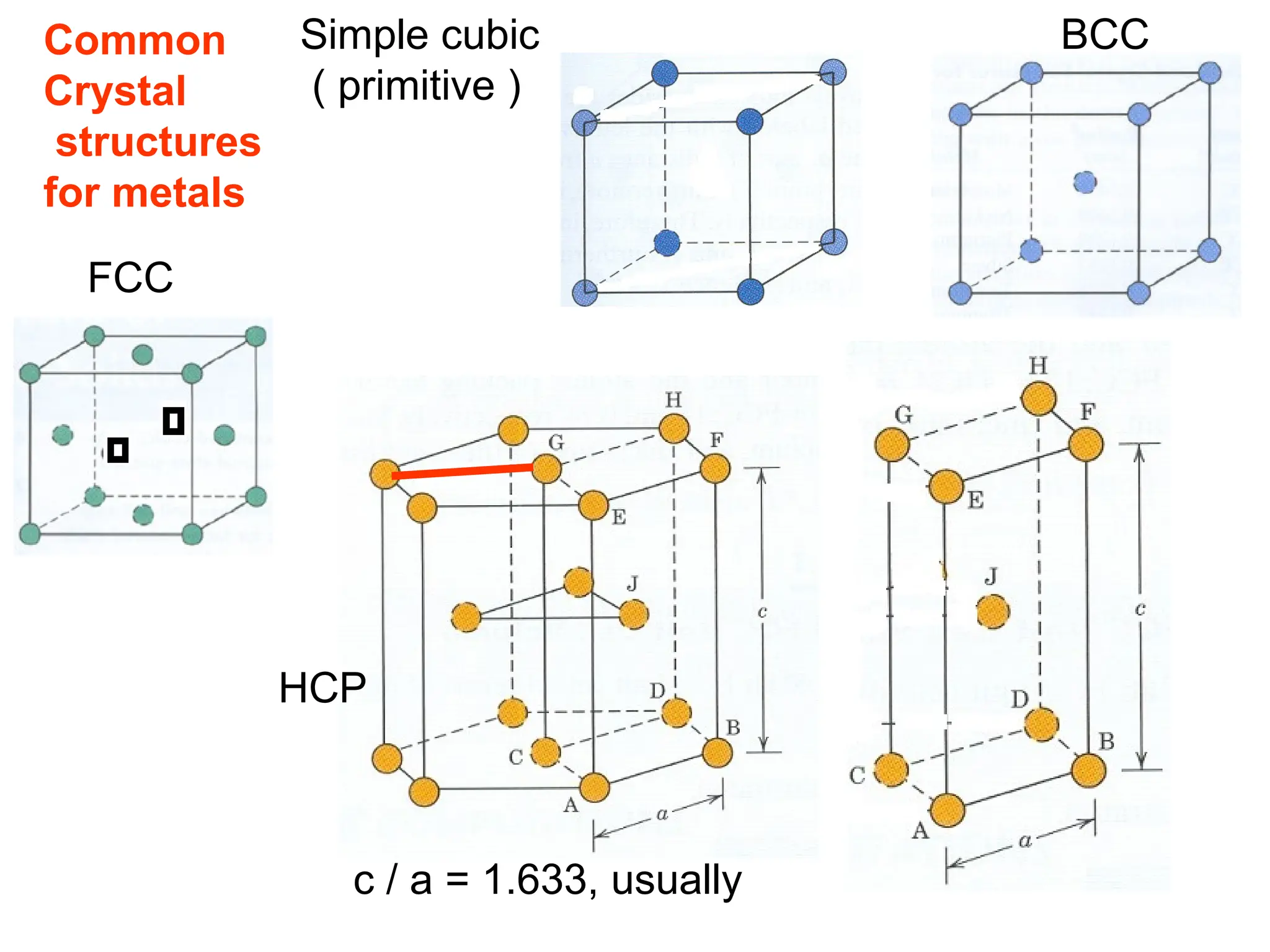
Common
Crystal
structures
for metals
BCC
FCC
HCP
Simple cubic
( primitive )
c / a = 1.633, usually
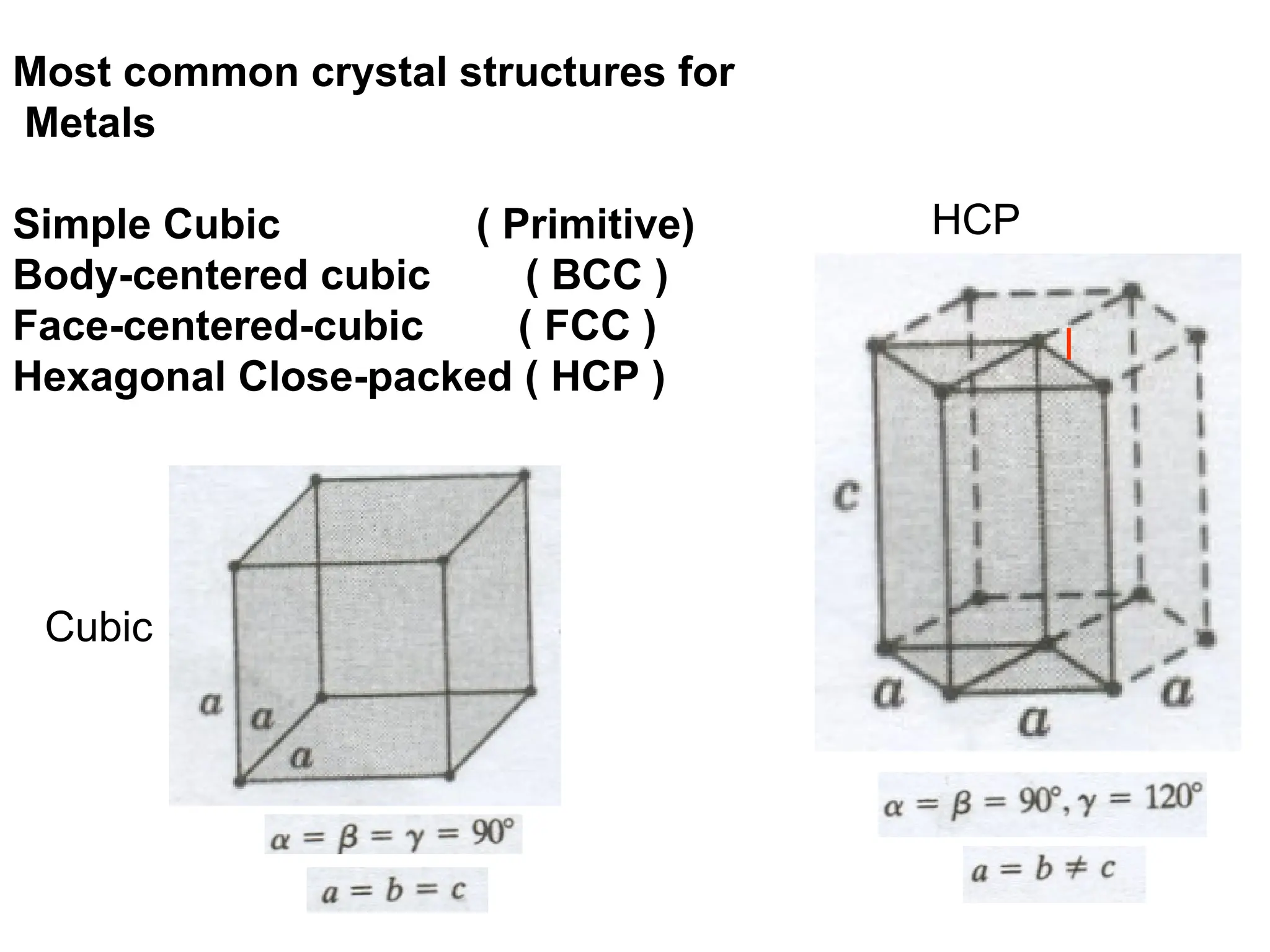
Most common crystal structures for
Metals
Simple Cubic ( Primitive)
Body-centered cubic ( BCC )
Face-centered-cubic ( FCC )
Hexagonal Close-packed ( HCP )
HCP
Cubic
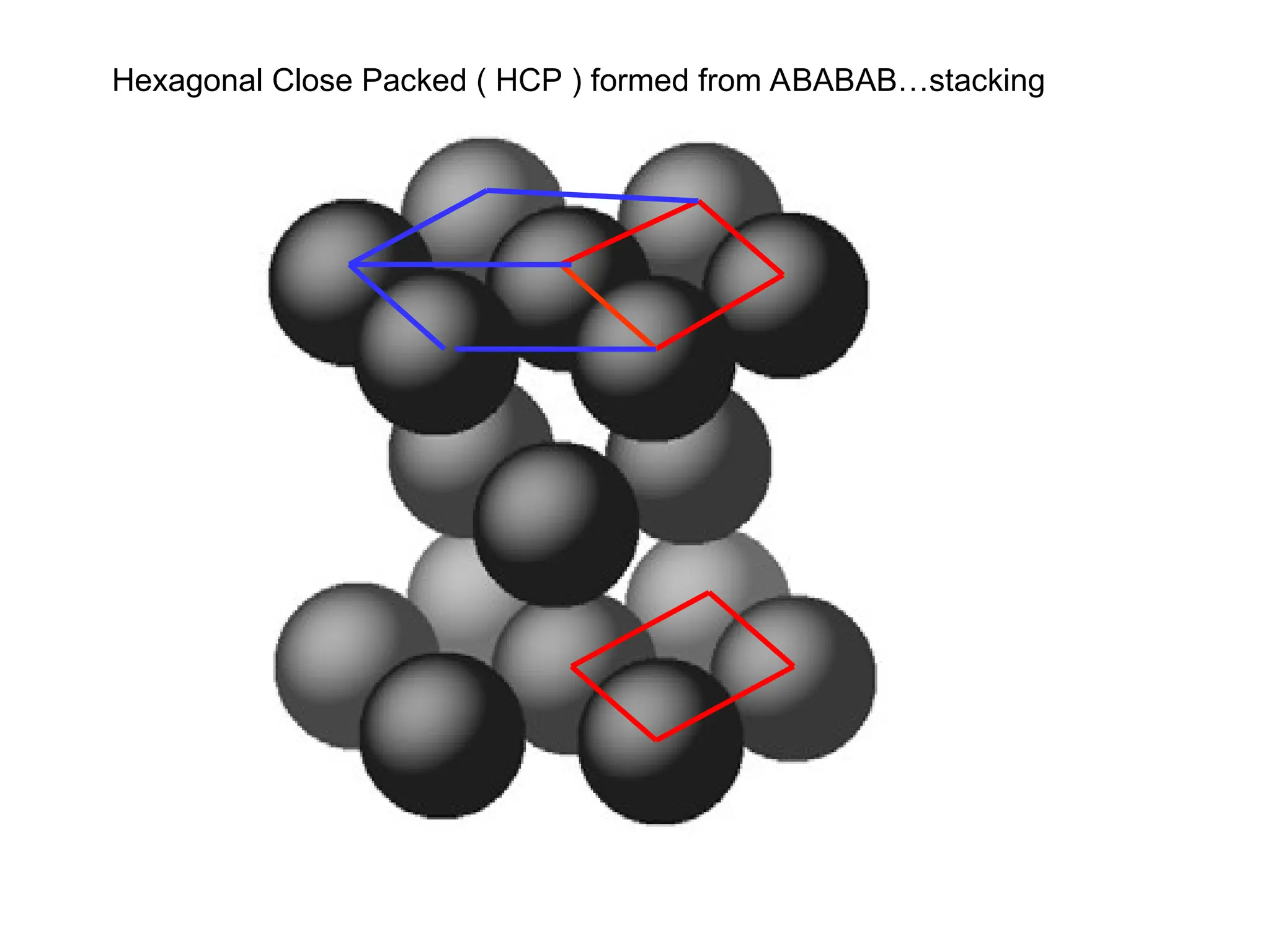
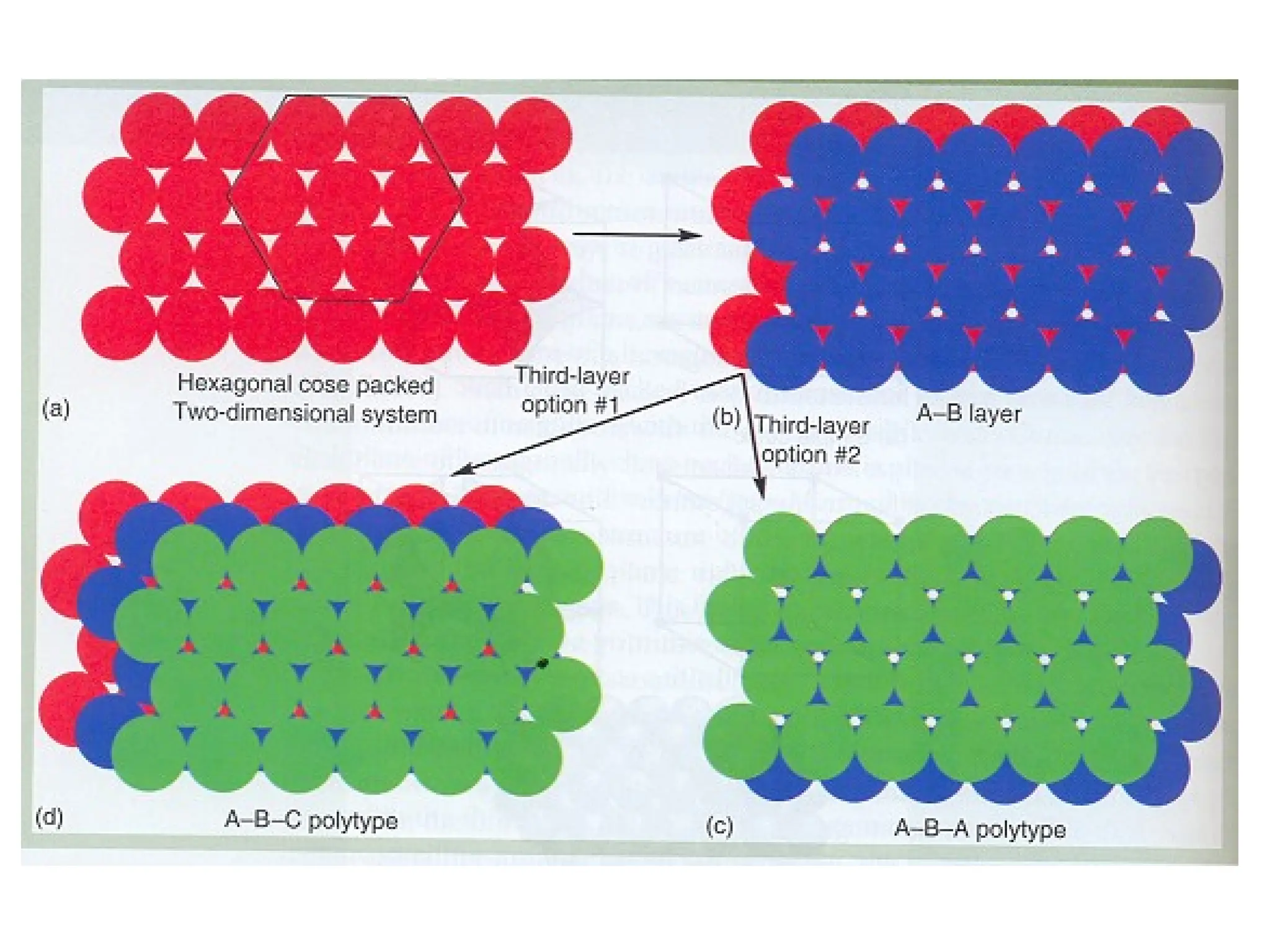
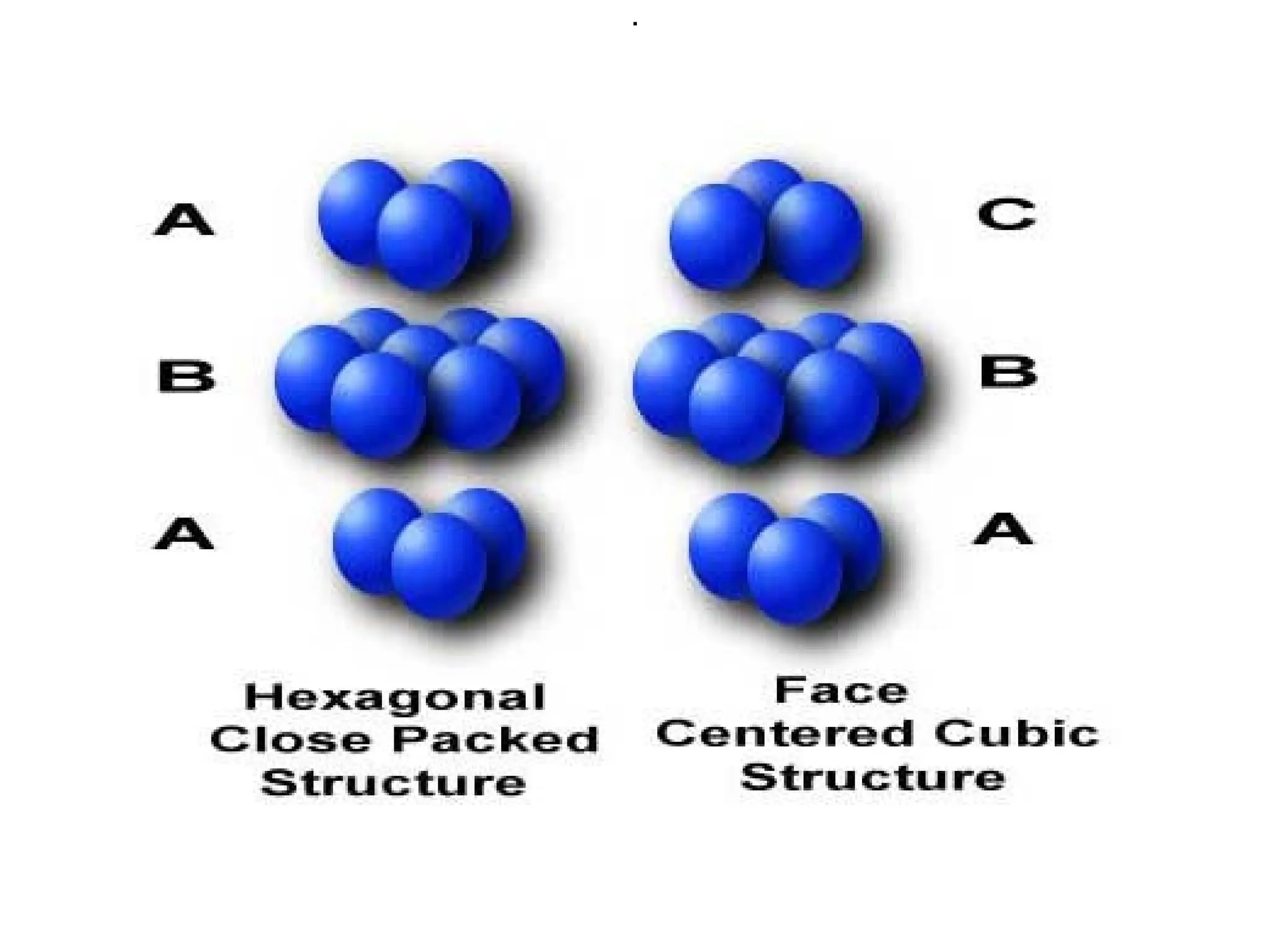
Hexagonal Close Packed ( HCP ) formed from ABABAB…stacking
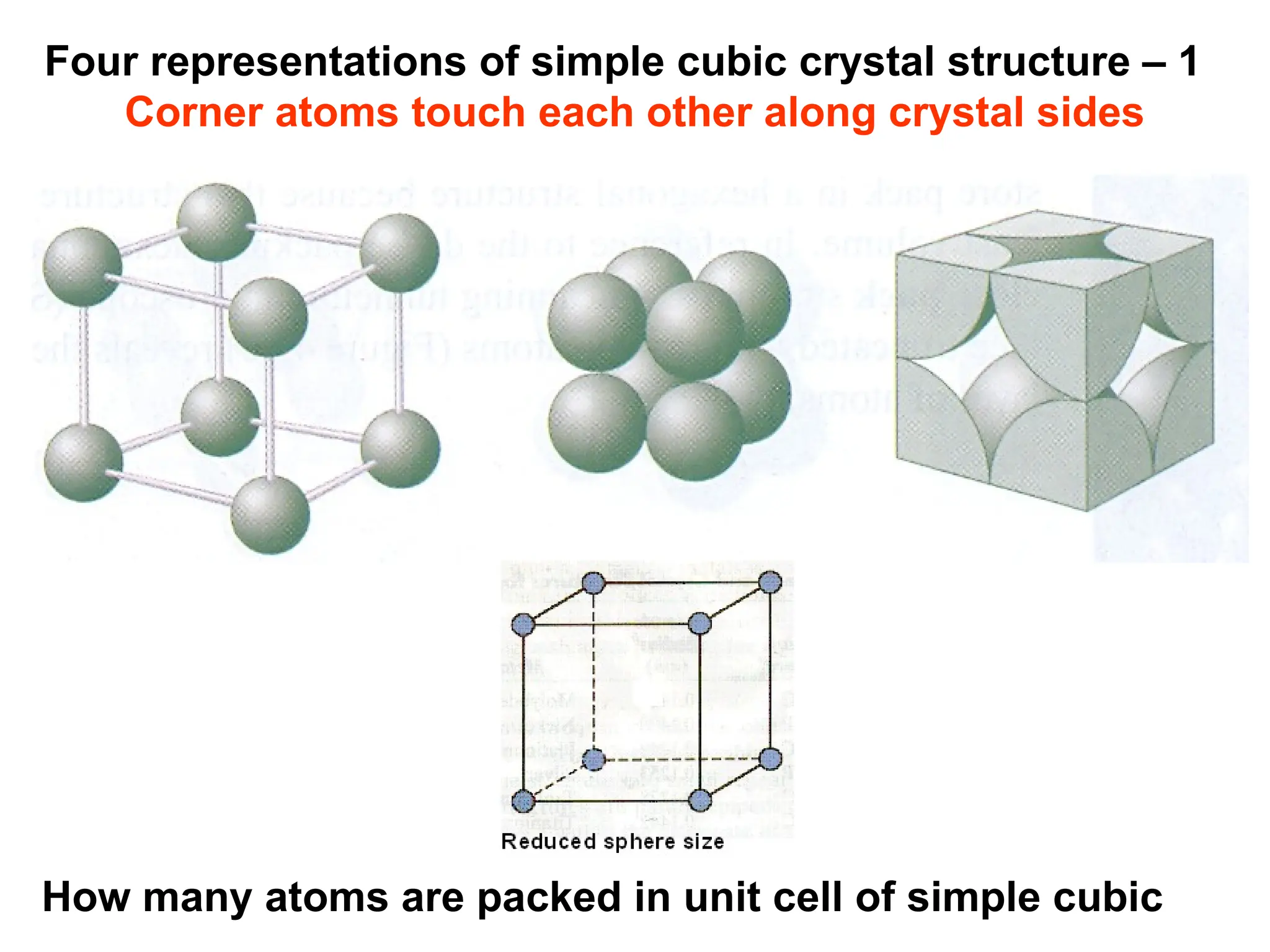
Four representations of simple cubic crystal structure – 1
Corner atoms touch each other along crystal sides
How many atoms are packed in unit cell of simple cubic
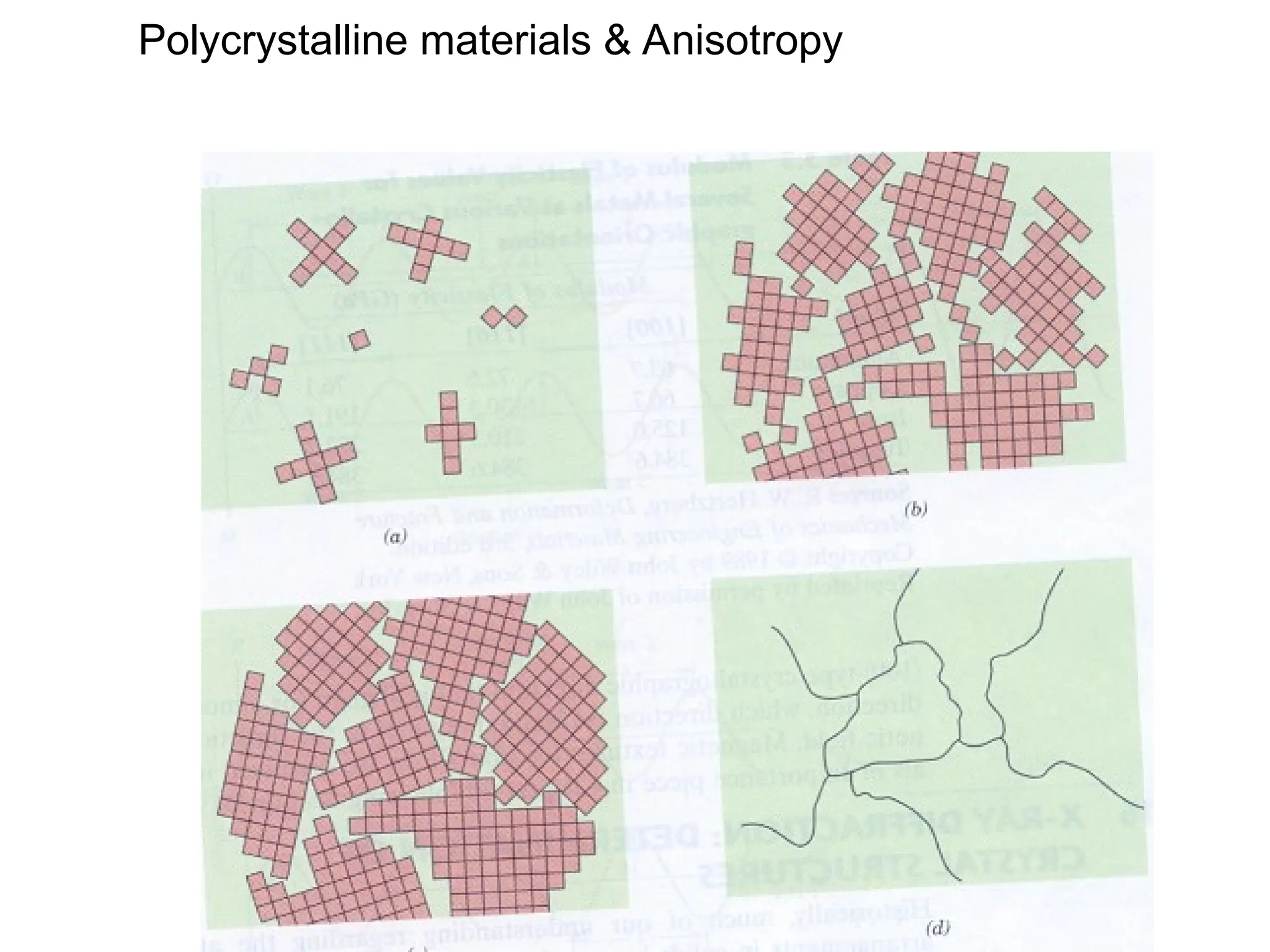
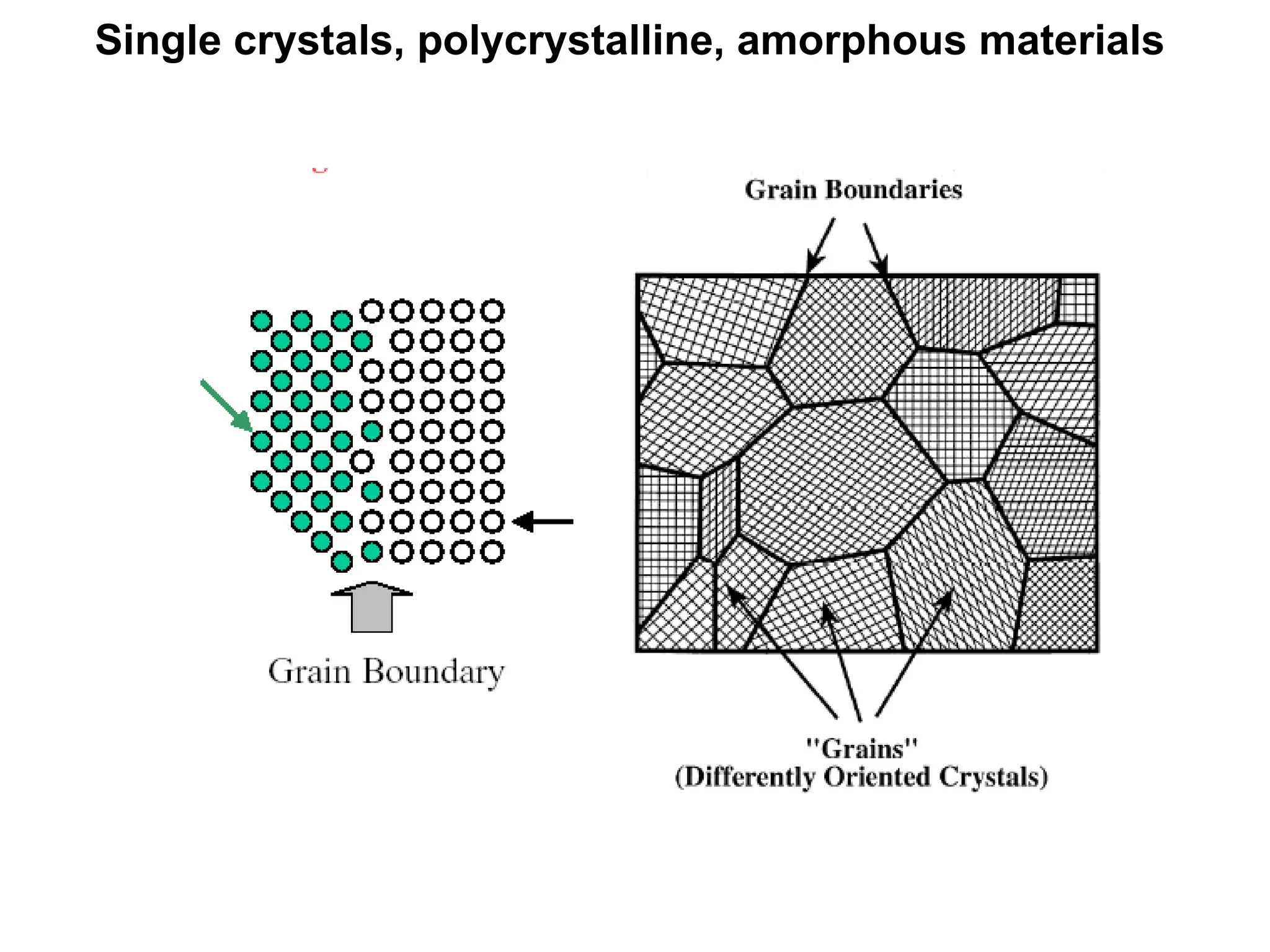
Polycrystalline materials & Anisotropy
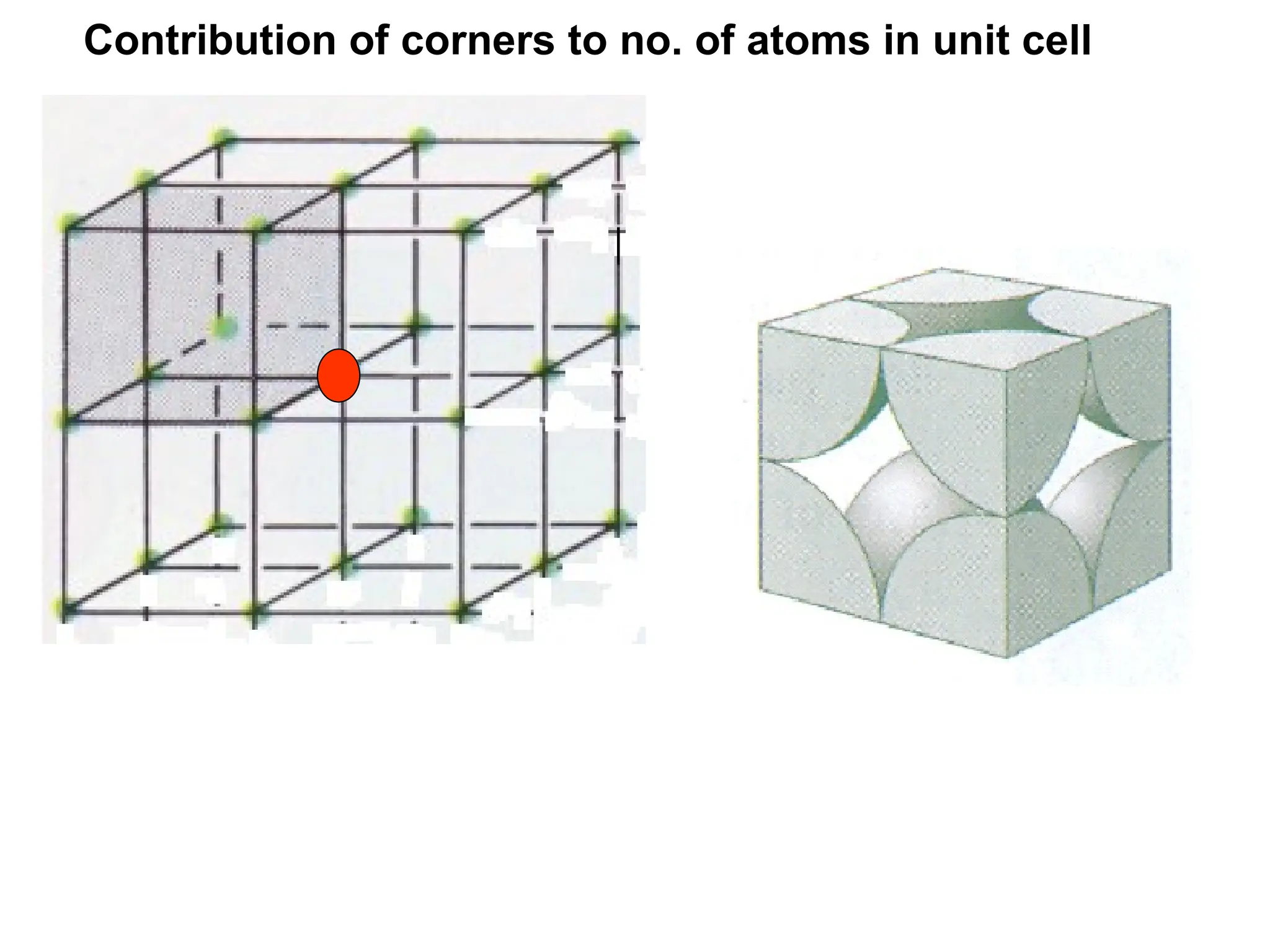
Contribution of corners to no. of atoms in unit cell
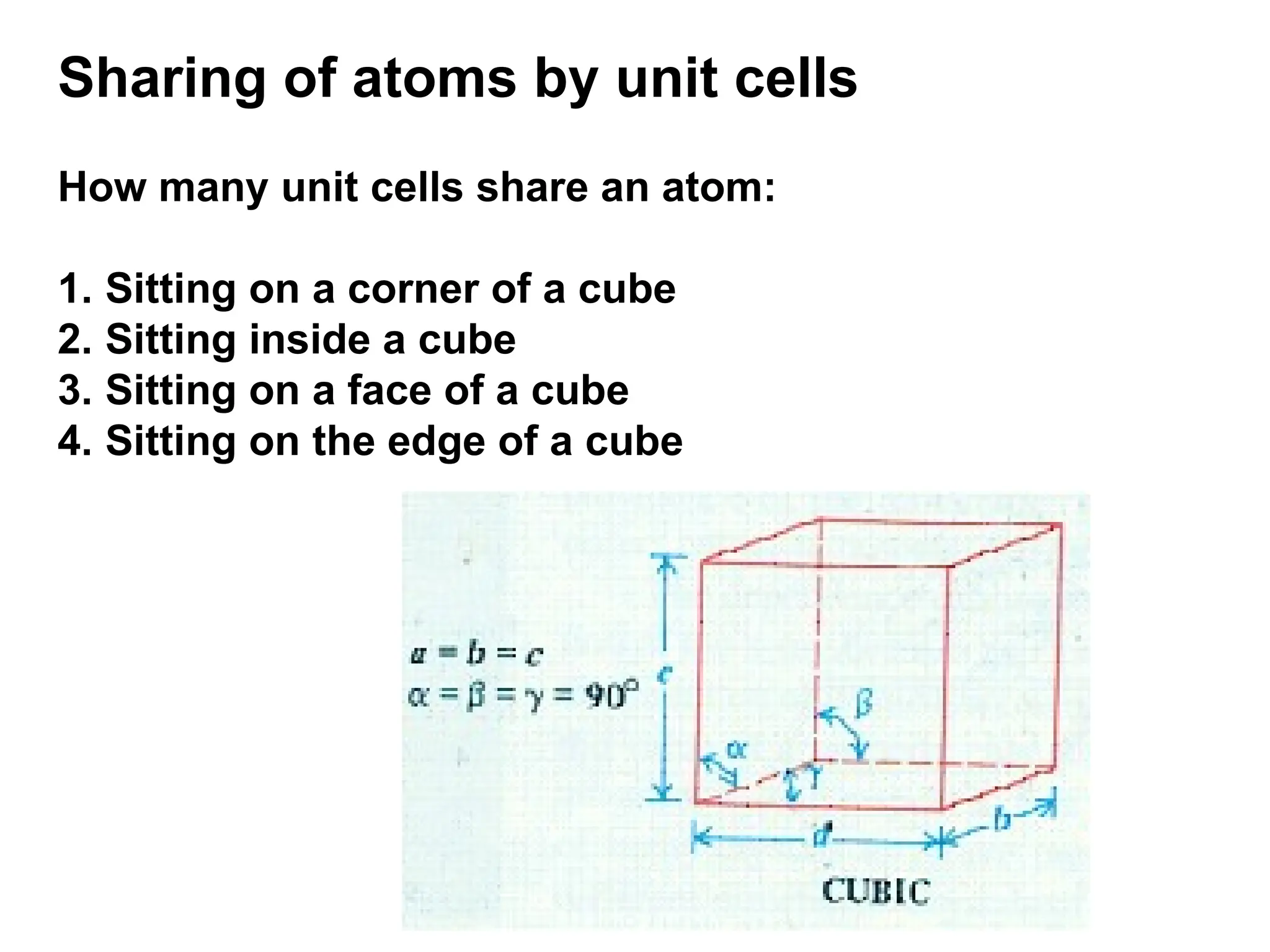
Sharing of atoms by unit cells
How many unit cells share an atom:
1. Sitting on a corner of a cube
2. Sitting inside a cube
3. Sitting on a face of a cube
4. Sitting on the edge of a cube
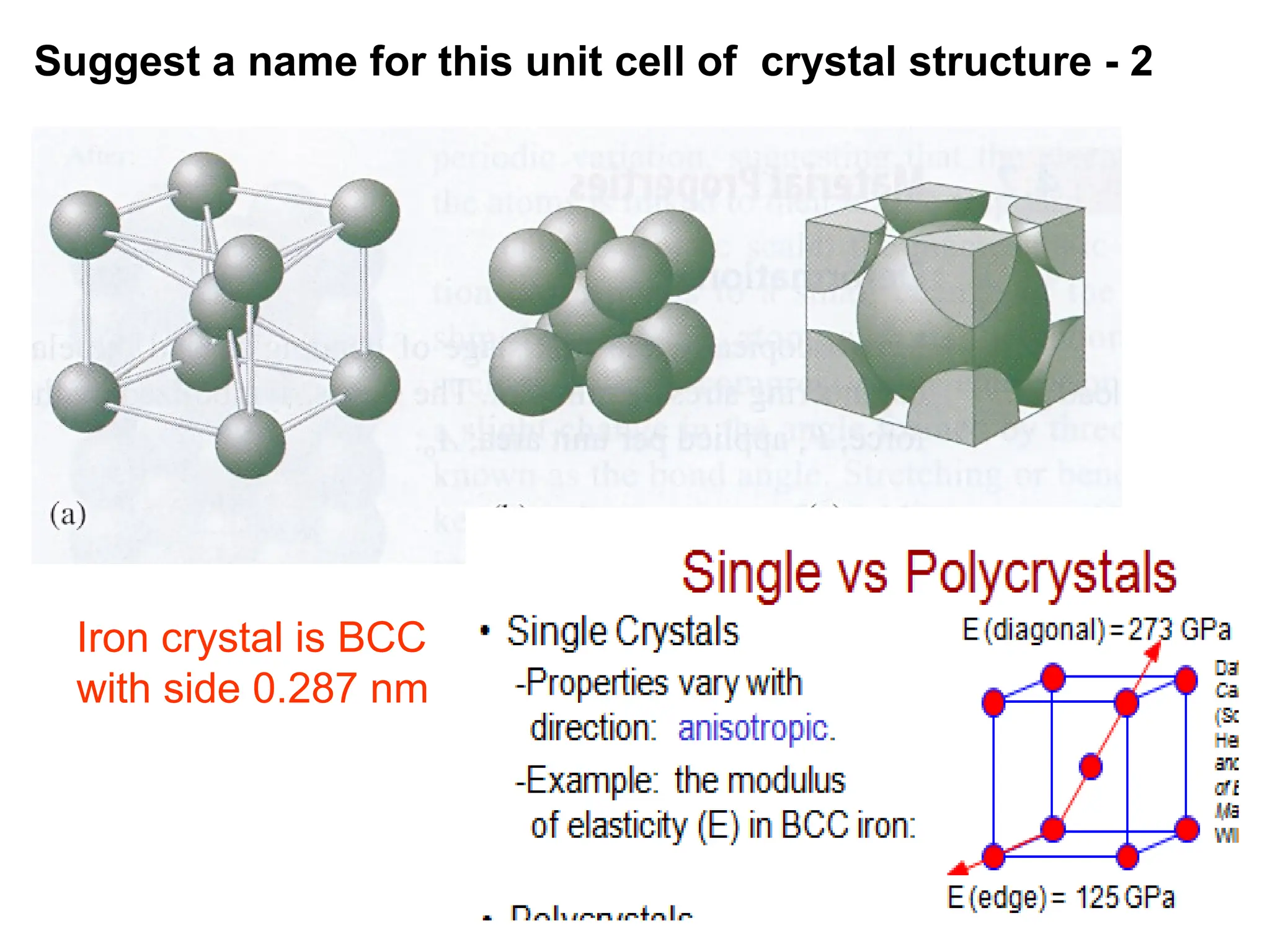
Suggest a name for this unit cell of crystal structure - 2
Iron crystal is BCC
with side 0.287 nm
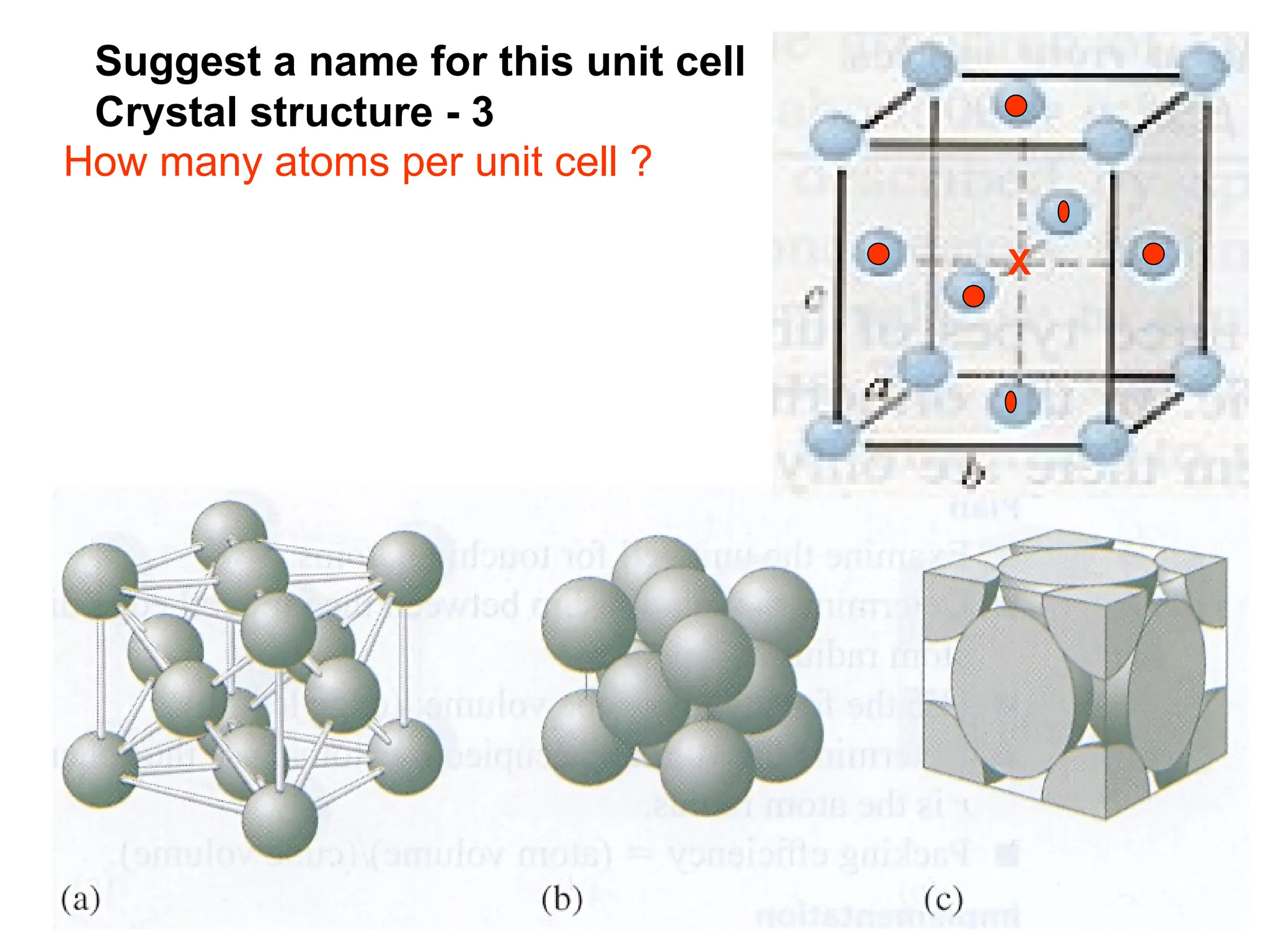
Suggest a name for this unit cell
Crystal structure - 3
How many atoms per unit cell ?
X
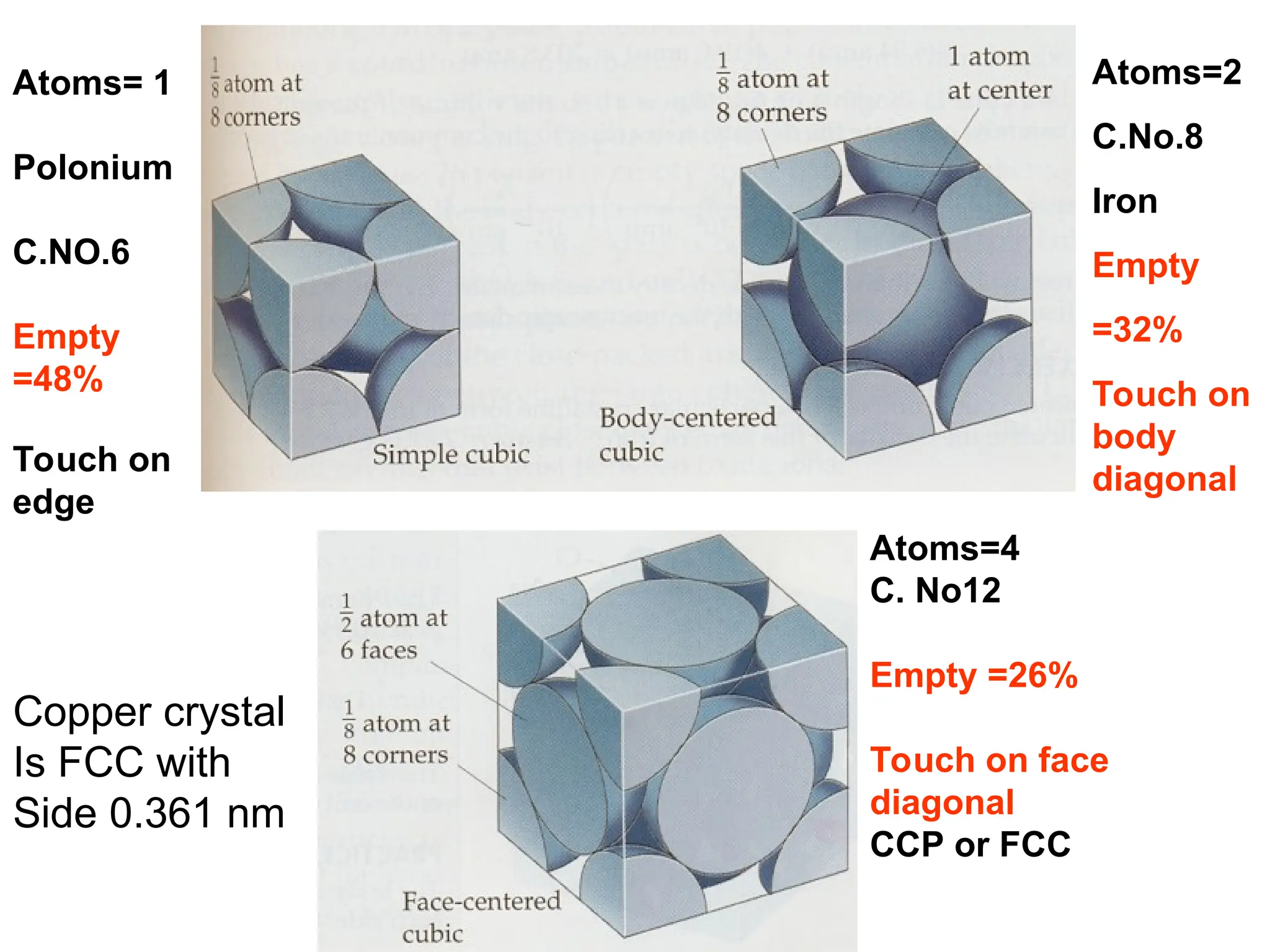
Atoms= 1
Polonium
C.NO.6
Empty
=48%
Touch on
edge
Atoms=2
C.No.8
Iron
Empty
=32%
Touch on
body
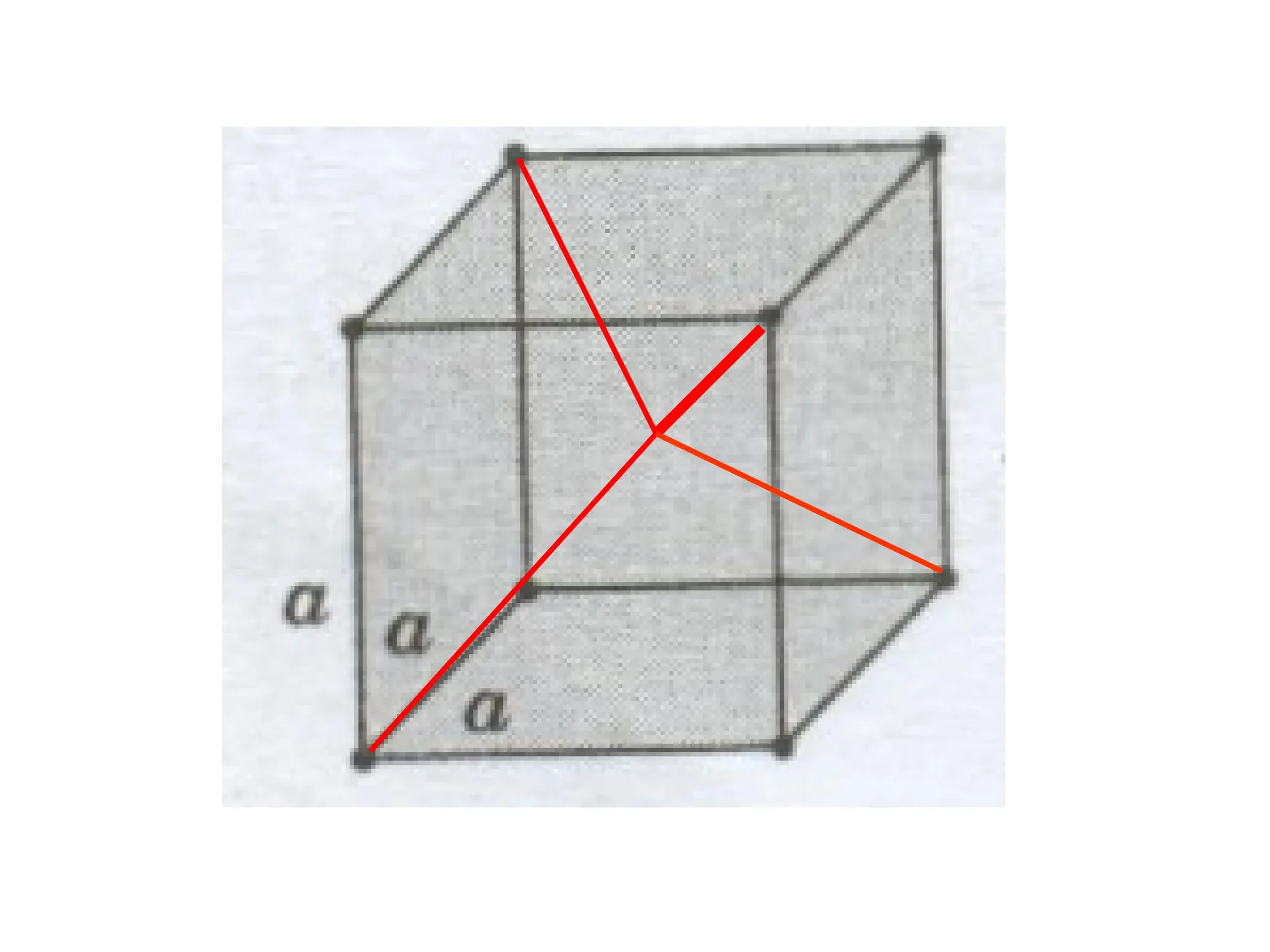
diagonal
Atoms=4
C. No12
Empty =26%
Touch on face
diagonal
CCP or FCC
Copper crystal
Is FCC with
Side 0.361 nm
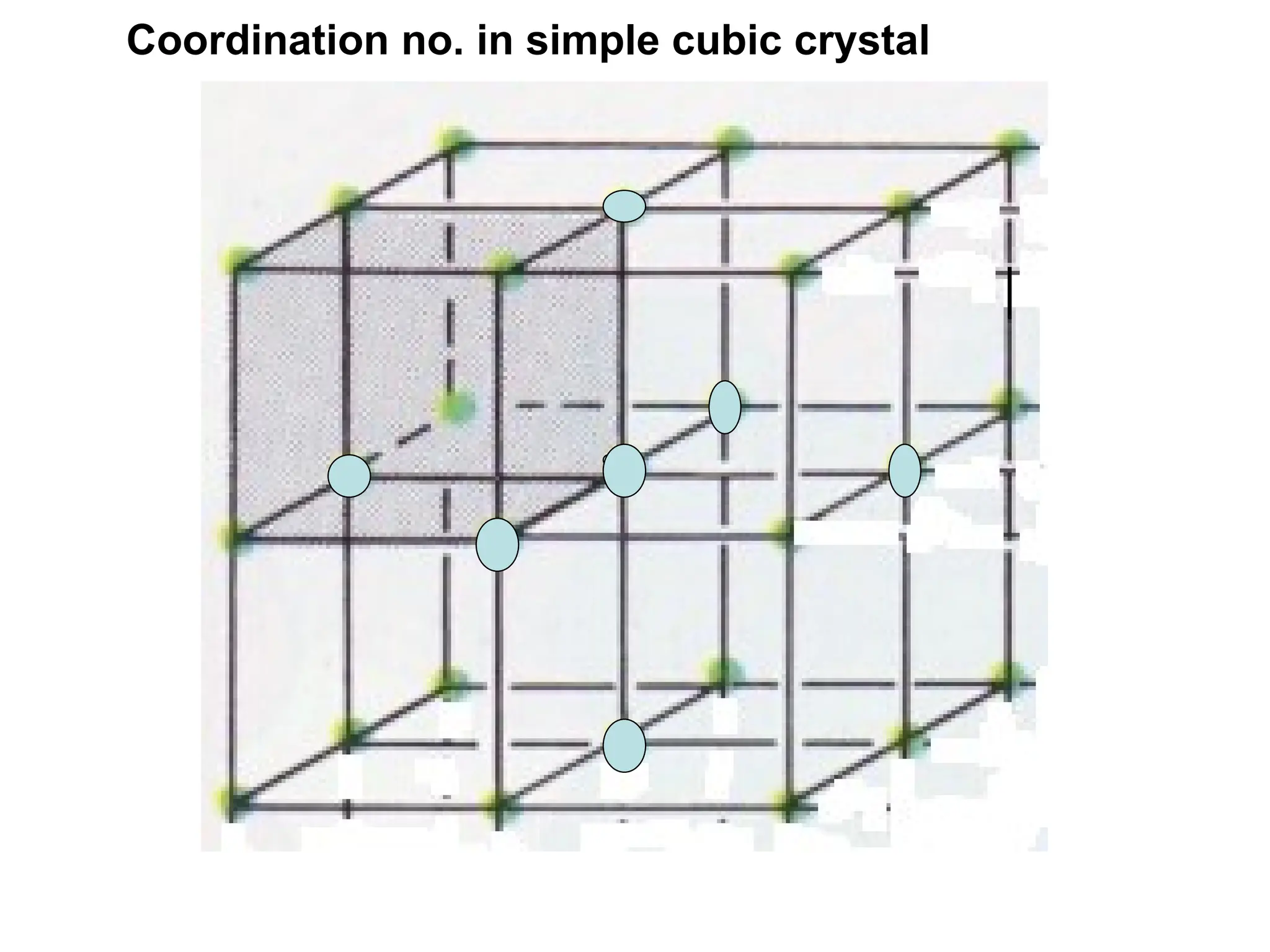
Coordination no. in simple cubic crystal
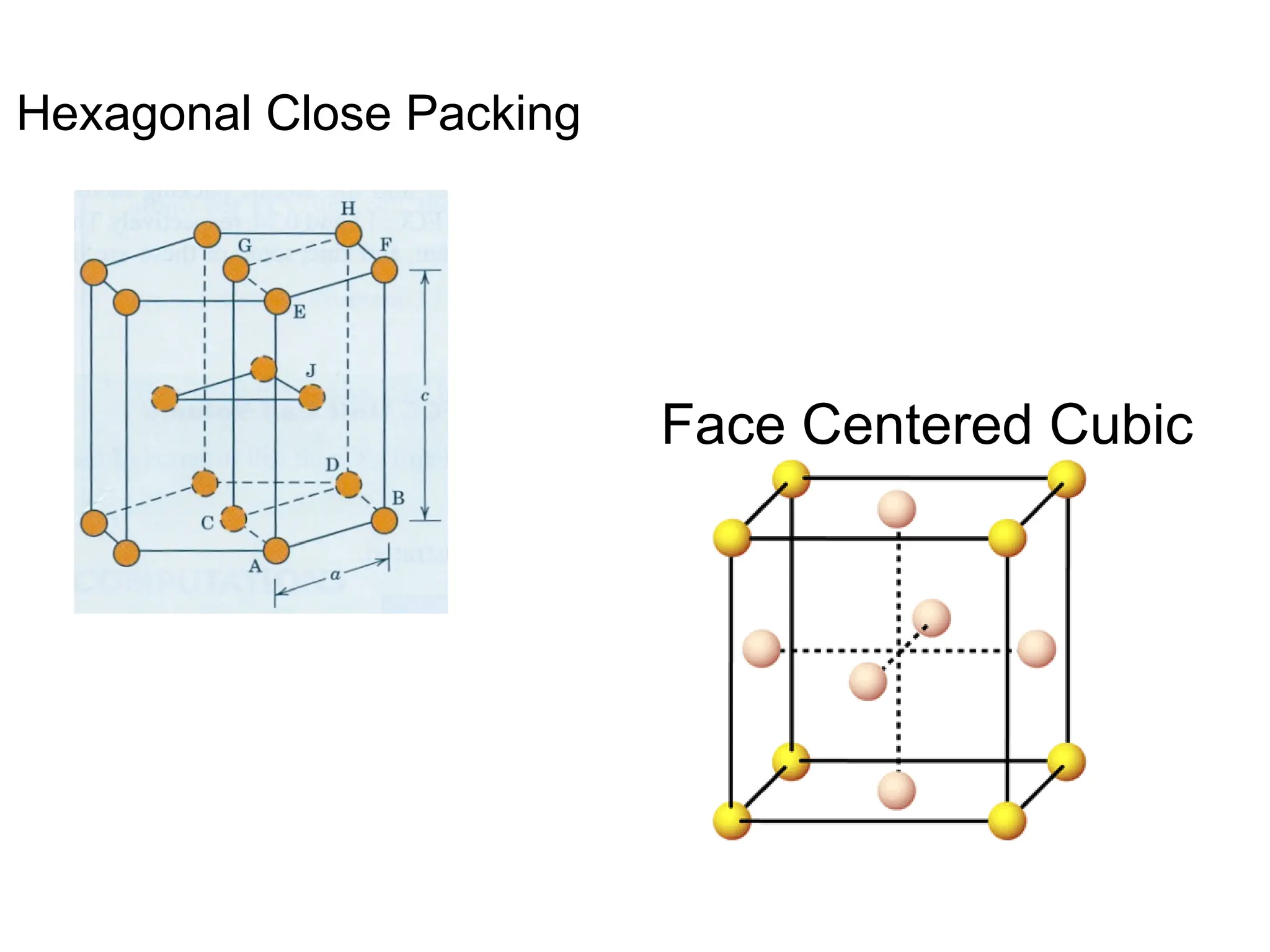
Hexagonal Close Packing
Face Centered Cubic
Tin transform from one crystal from to another
undergoing 27 % volume change
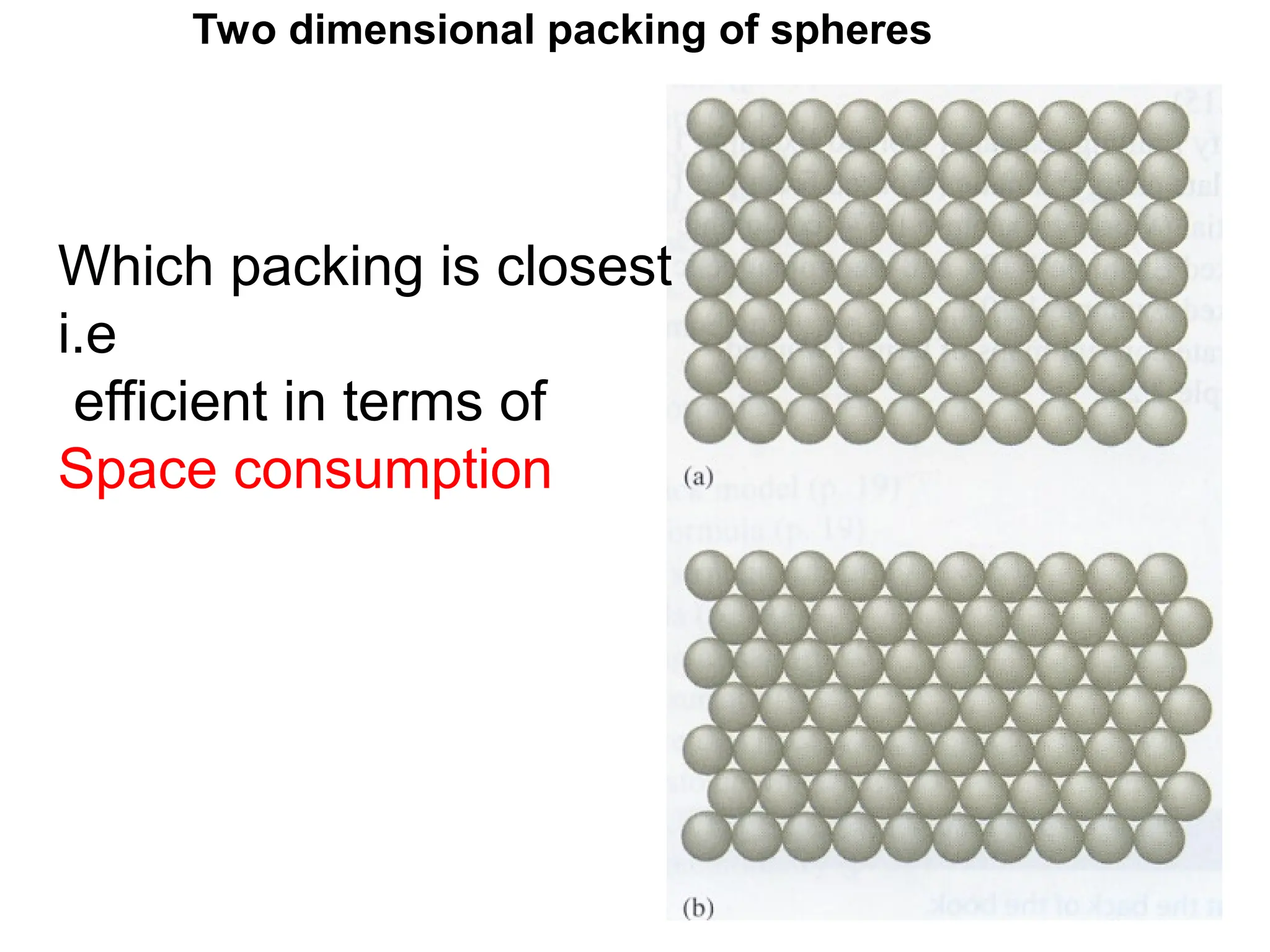
Two dimensional packing of spheres
Which packing is closest
i.e
efficient in terms of
Space consumption
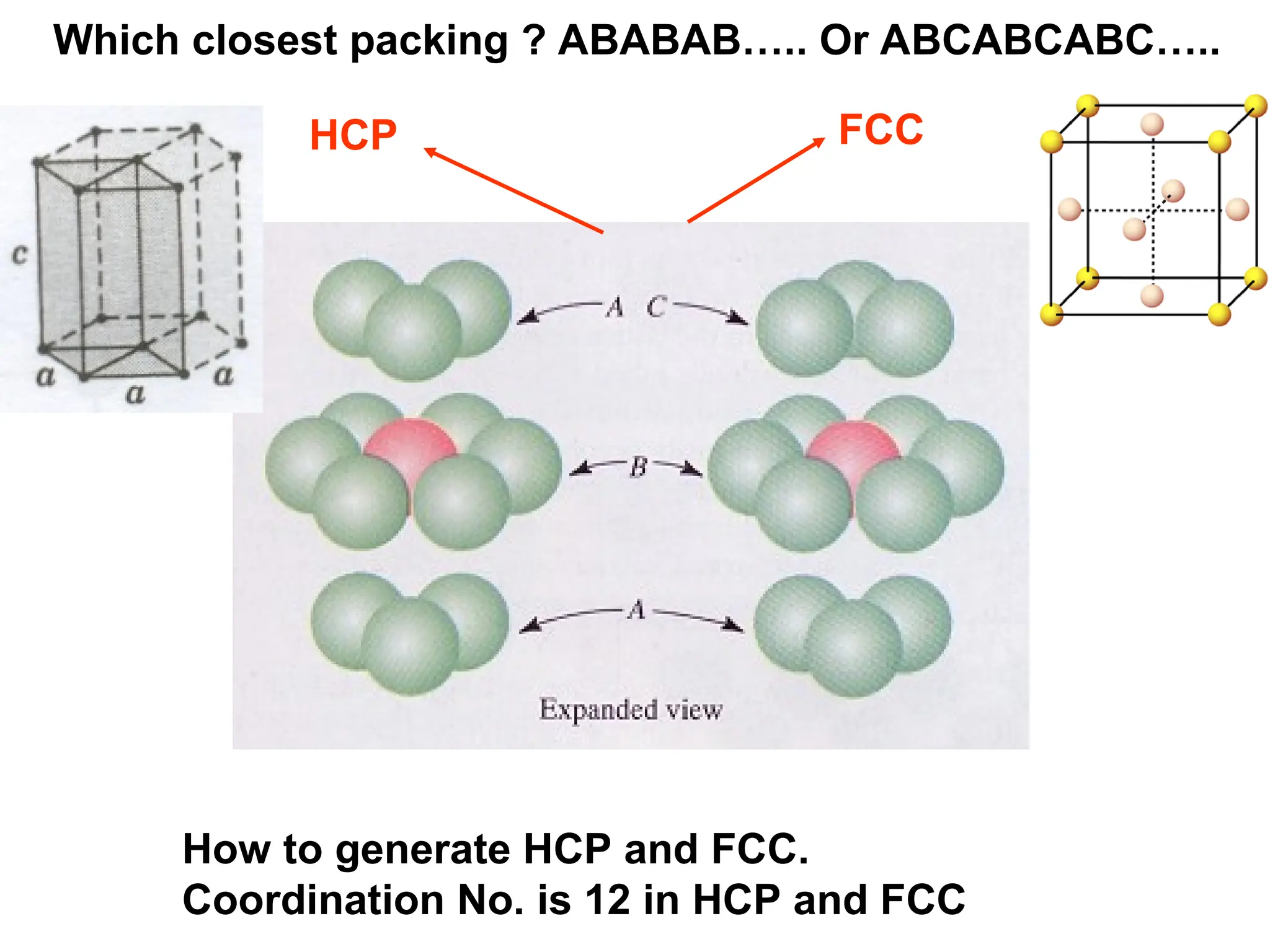
Which closest packing ? ABABAB….. Or ABCABCABC…..
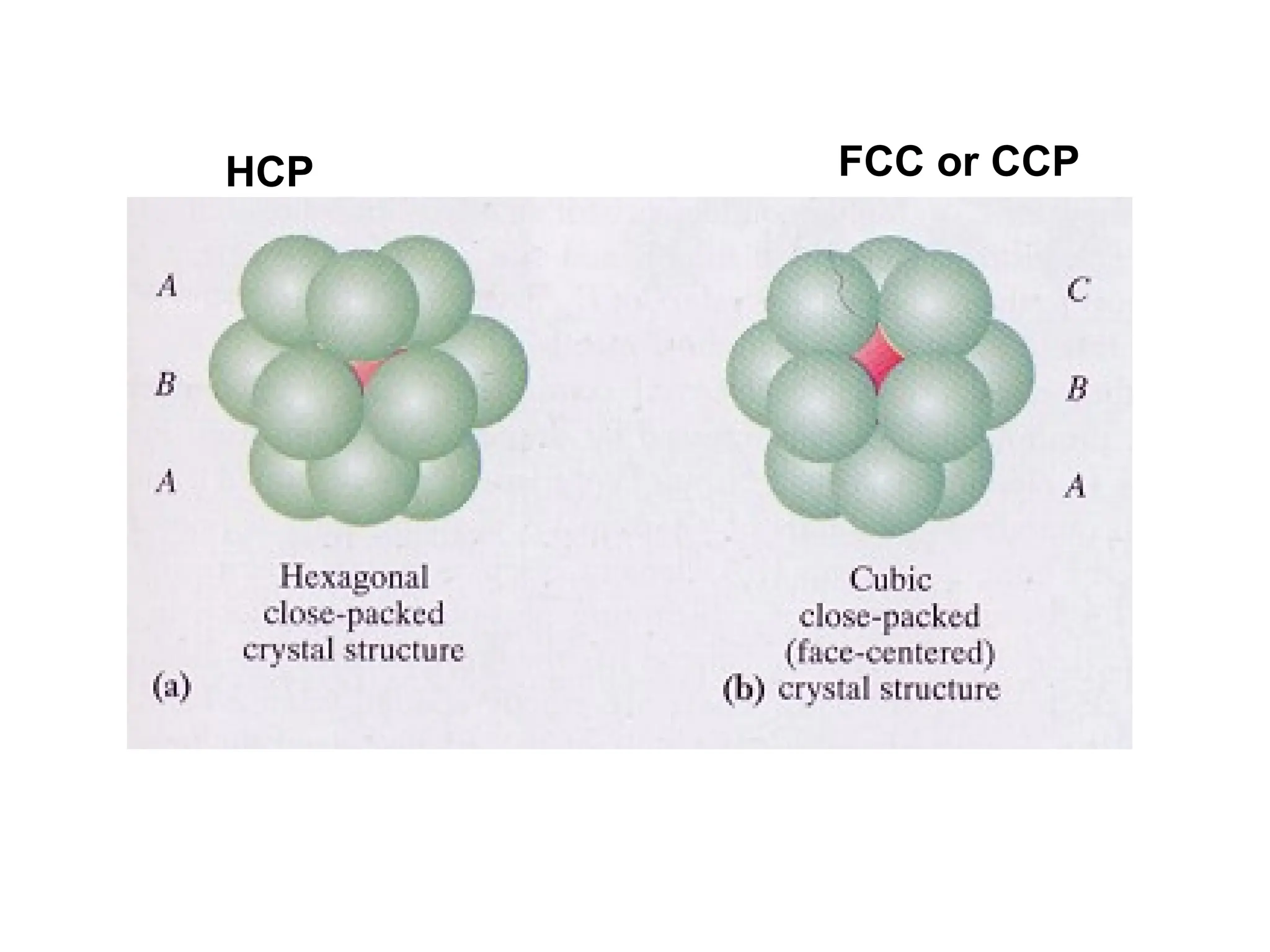
HCP FCC
How to generate HCP and FCC.
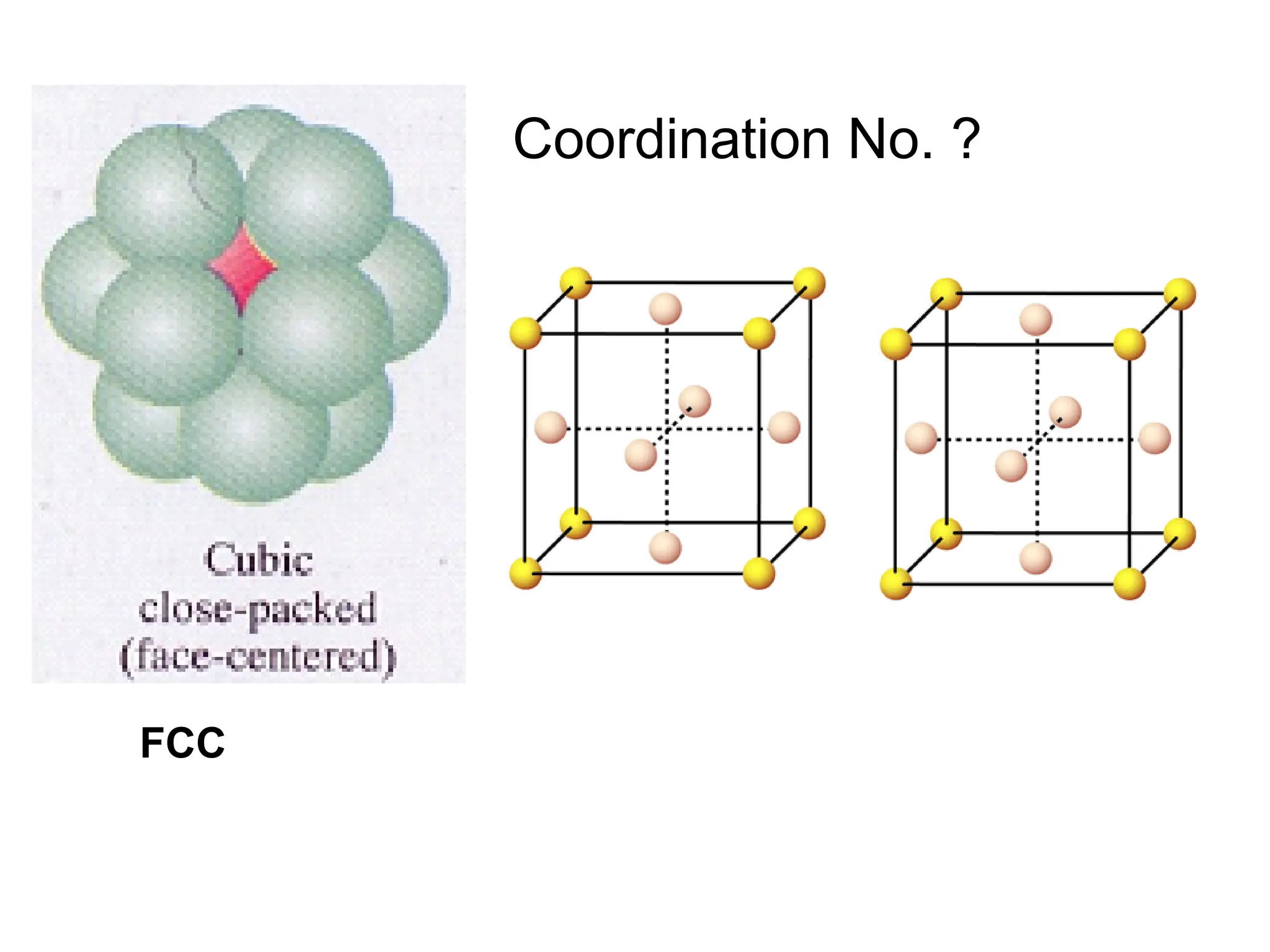
Coordination No. is 12 in HCP and FCC
HCP FCC or CCP
.
FCC
Coordination No. ?
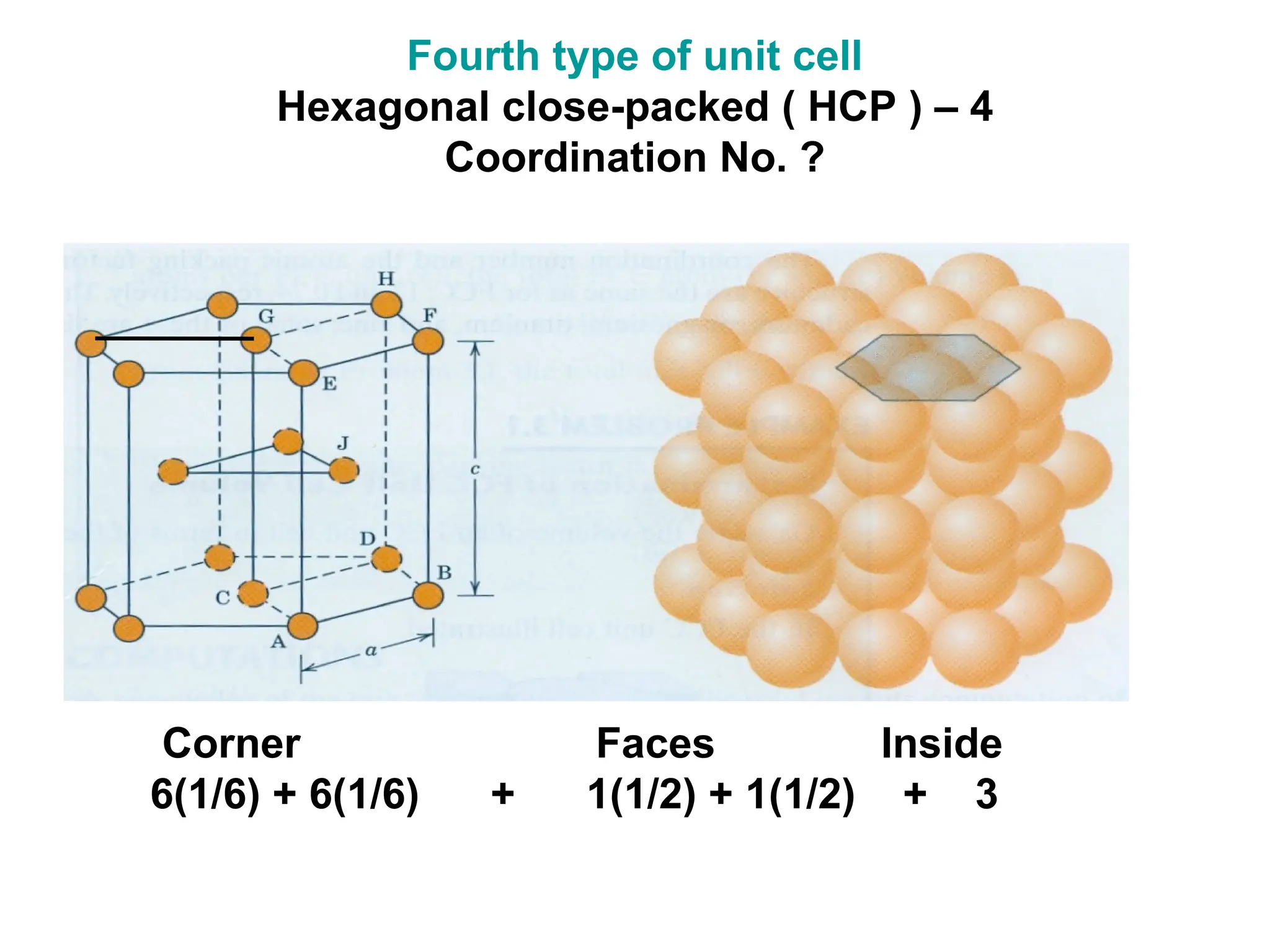
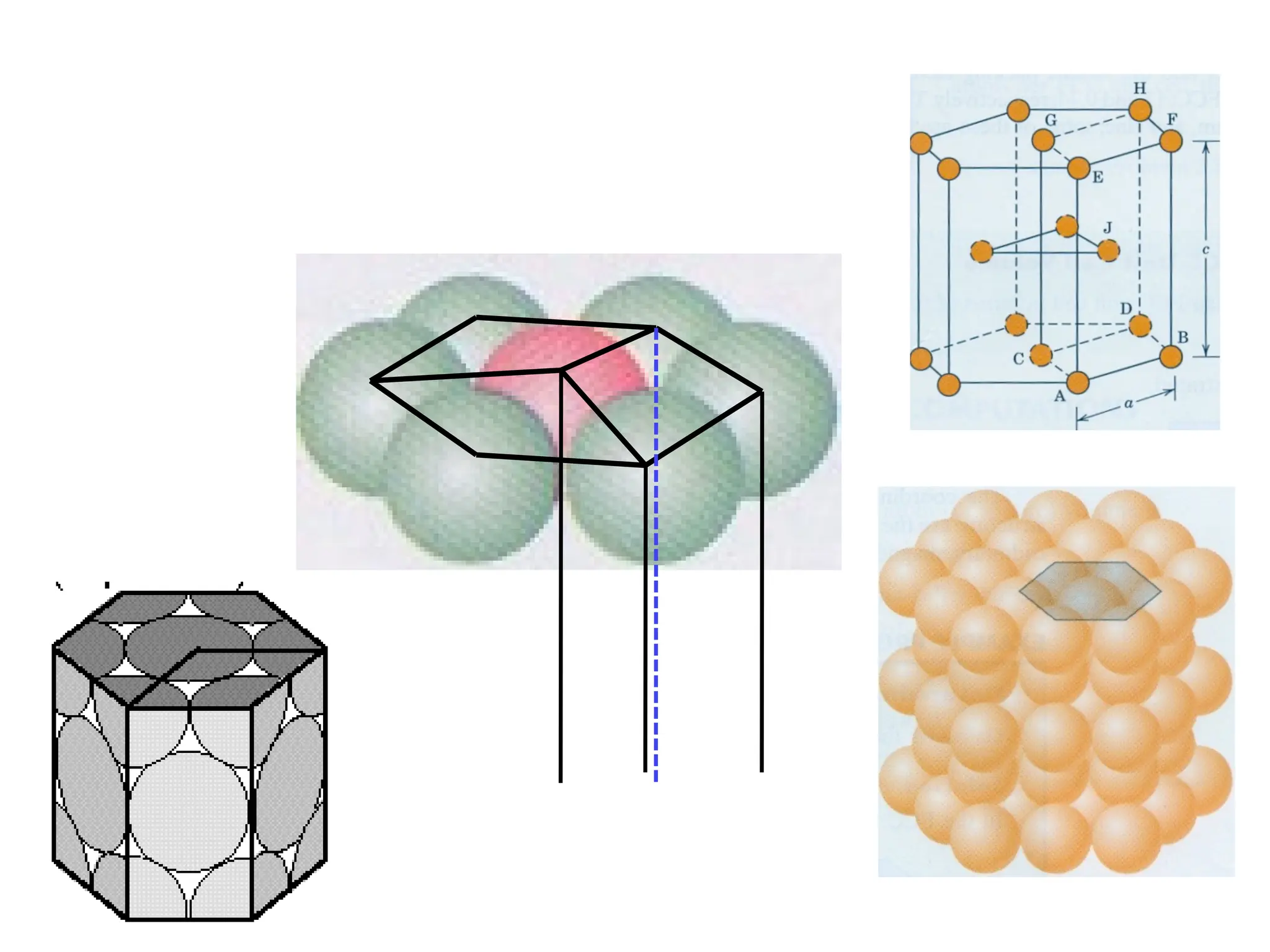
Fourth type of unit cell
Hexagonal close-packed ( HCP ) – 4
Coordination No. ?
Corner Faces Inside
6(1/6) + 6(1/6) + 1(1/2) + 1(1/2) + 3
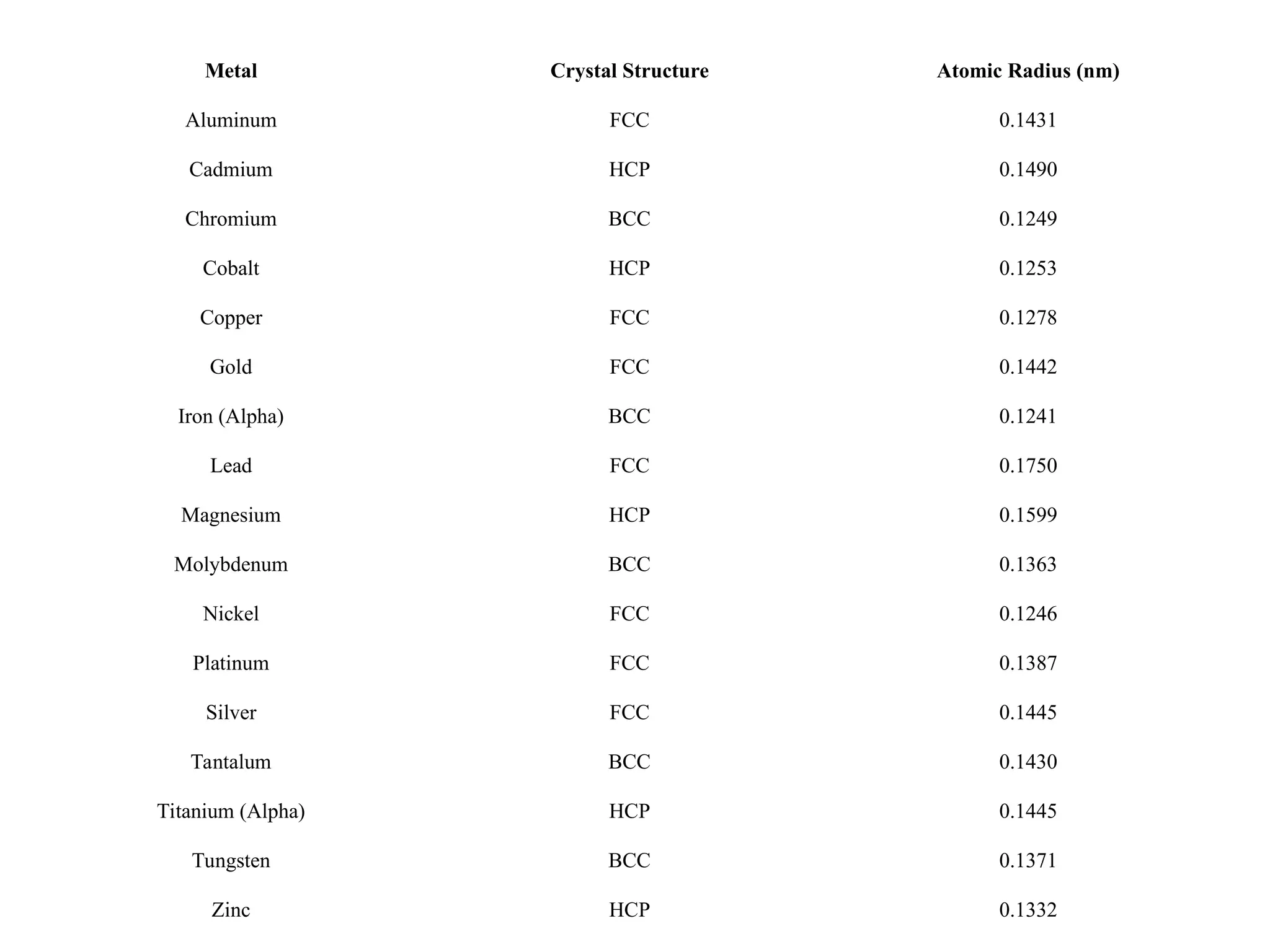
Metal Crystal Structure Atomic Radius (nm)
Aluminum FCC 0.1431
Cadmium HCP 0.1490
Chromium BCC 0.1249
Cobalt HCP 0.1253
Copper FCC 0.1278
Gold FCC 0.1442
Iron (Alpha) BCC 0.1241
Lead FCC 0.1750
Magnesium HCP 0.1599
Molybdenum BCC 0.1363
Nickel FCC 0.1246
Platinum FCC 0.1387
Silver FCC 0.1445
Tantalum BCC 0.1430
Titanium (Alpha) HCP 0.1445
Tungsten BCC 0.1371
Zinc HCP 0.1332
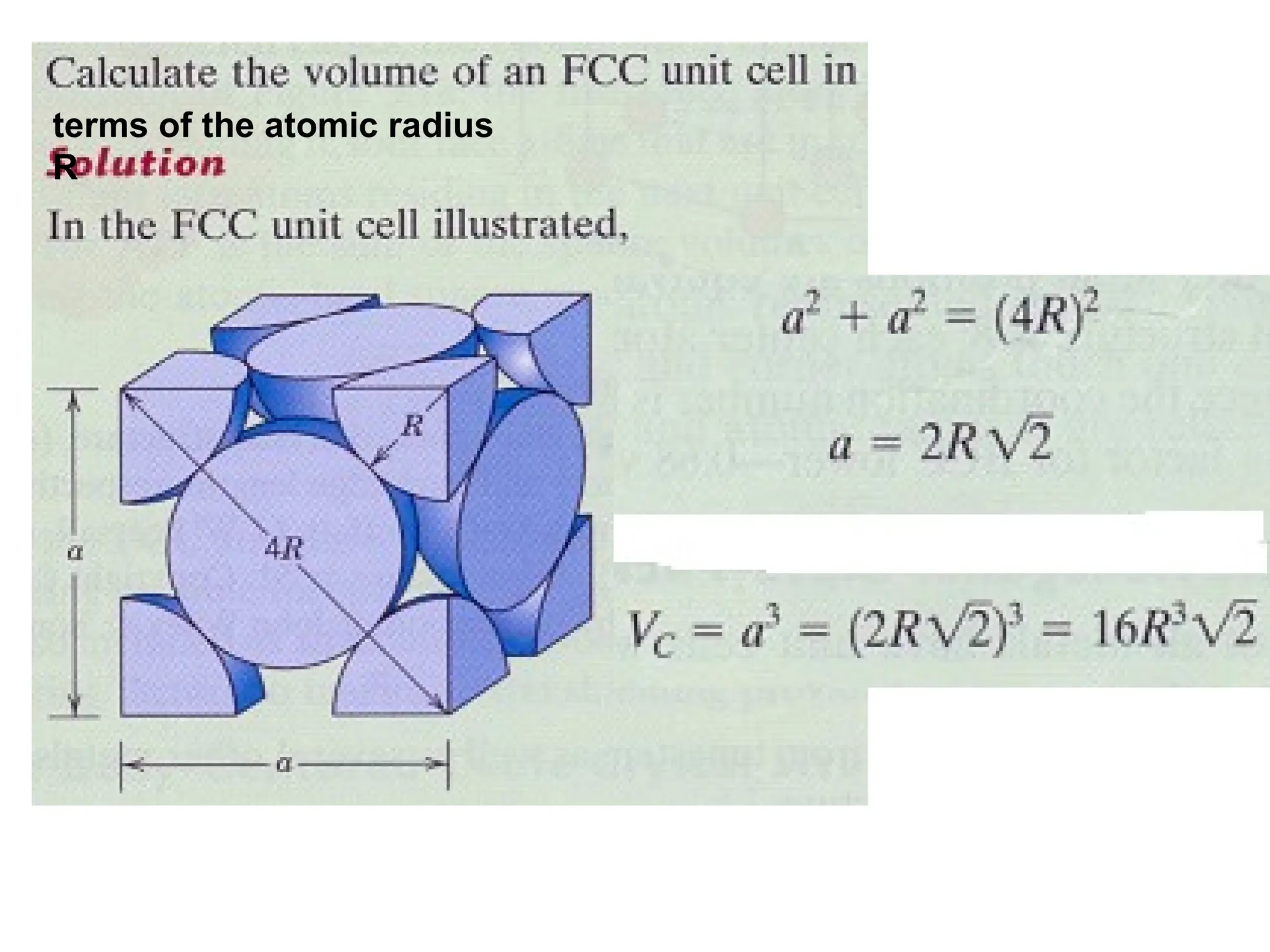
terms of the atomic radius
R
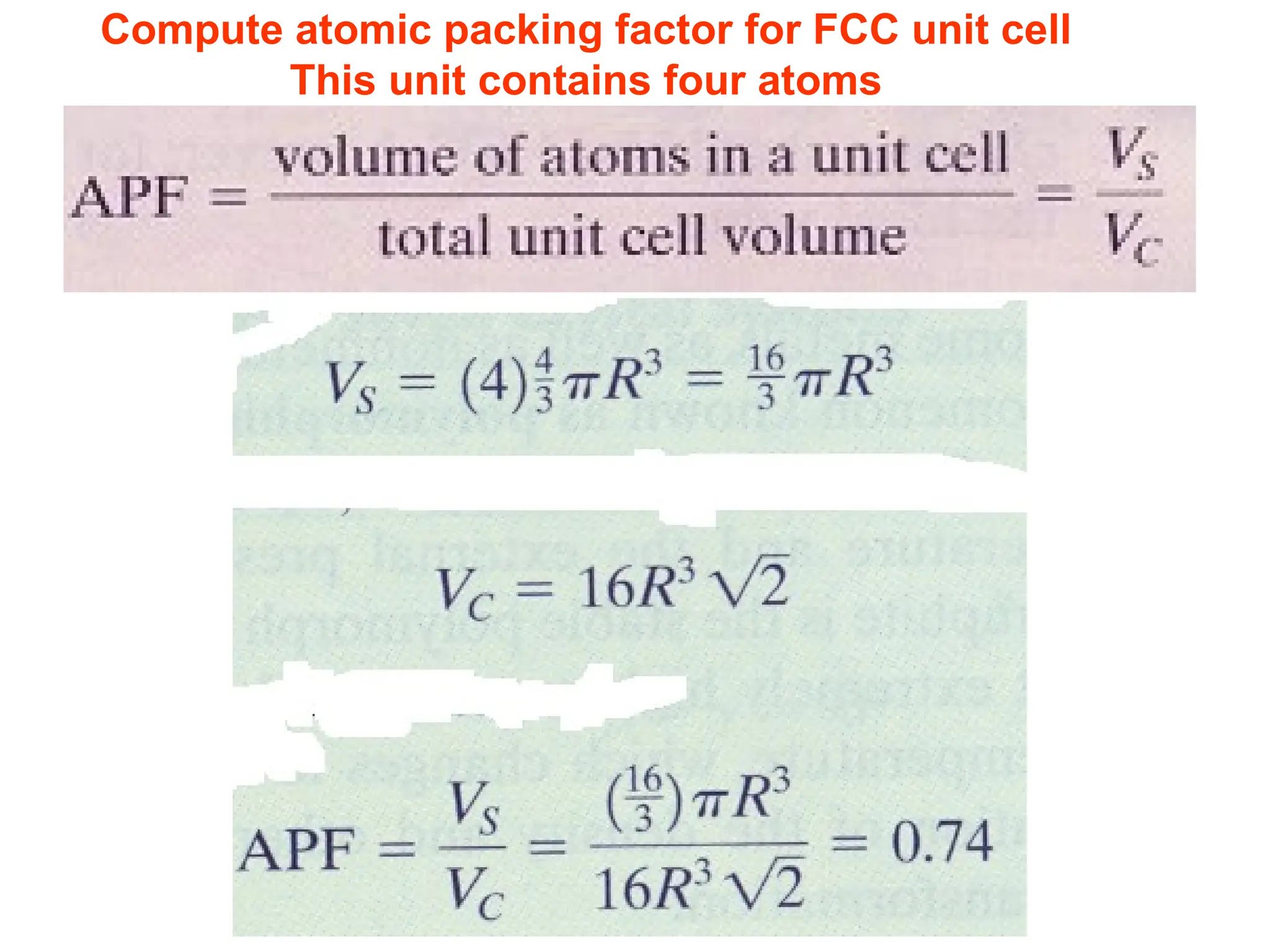
Compute atomic packing factor for FCC unit cell
This unit contains four atoms
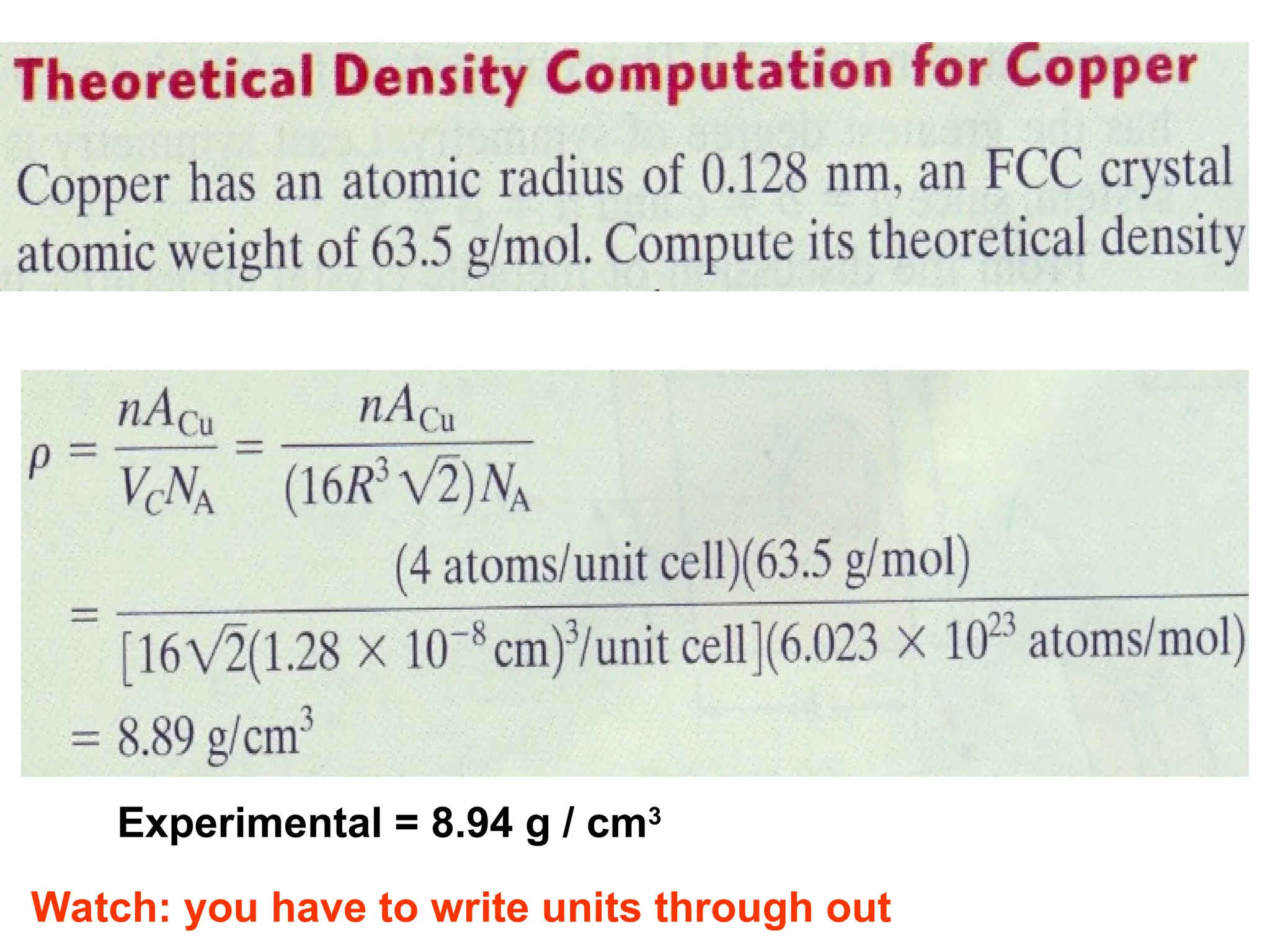
Experimental = 8.94 g / cm3
Watch: you have to write units through out
See Animation from Smith
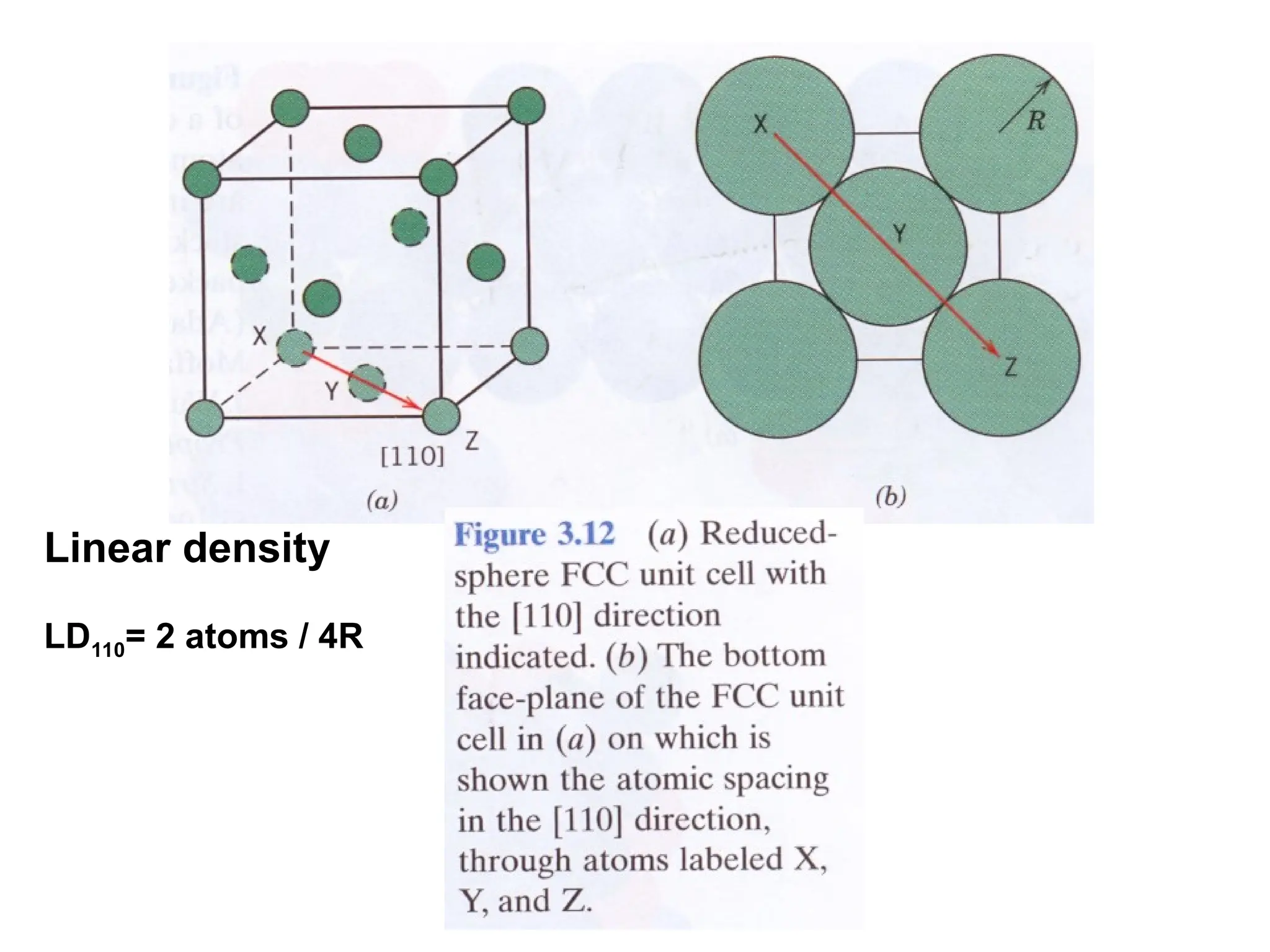
Linear density
LD110= 2 atoms / 4R
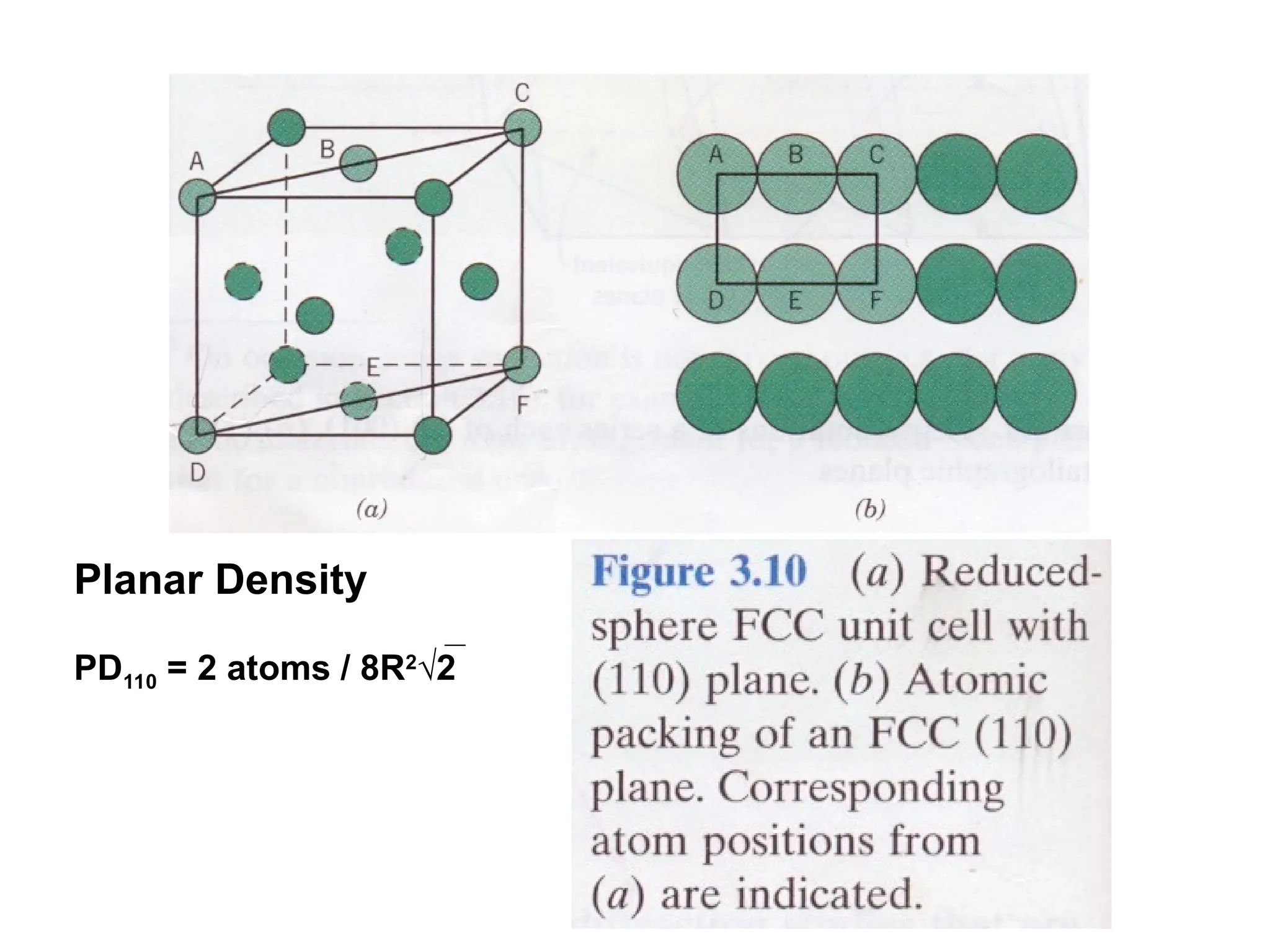
Planar Density
PD110 = 2 atoms / 8R2
√2
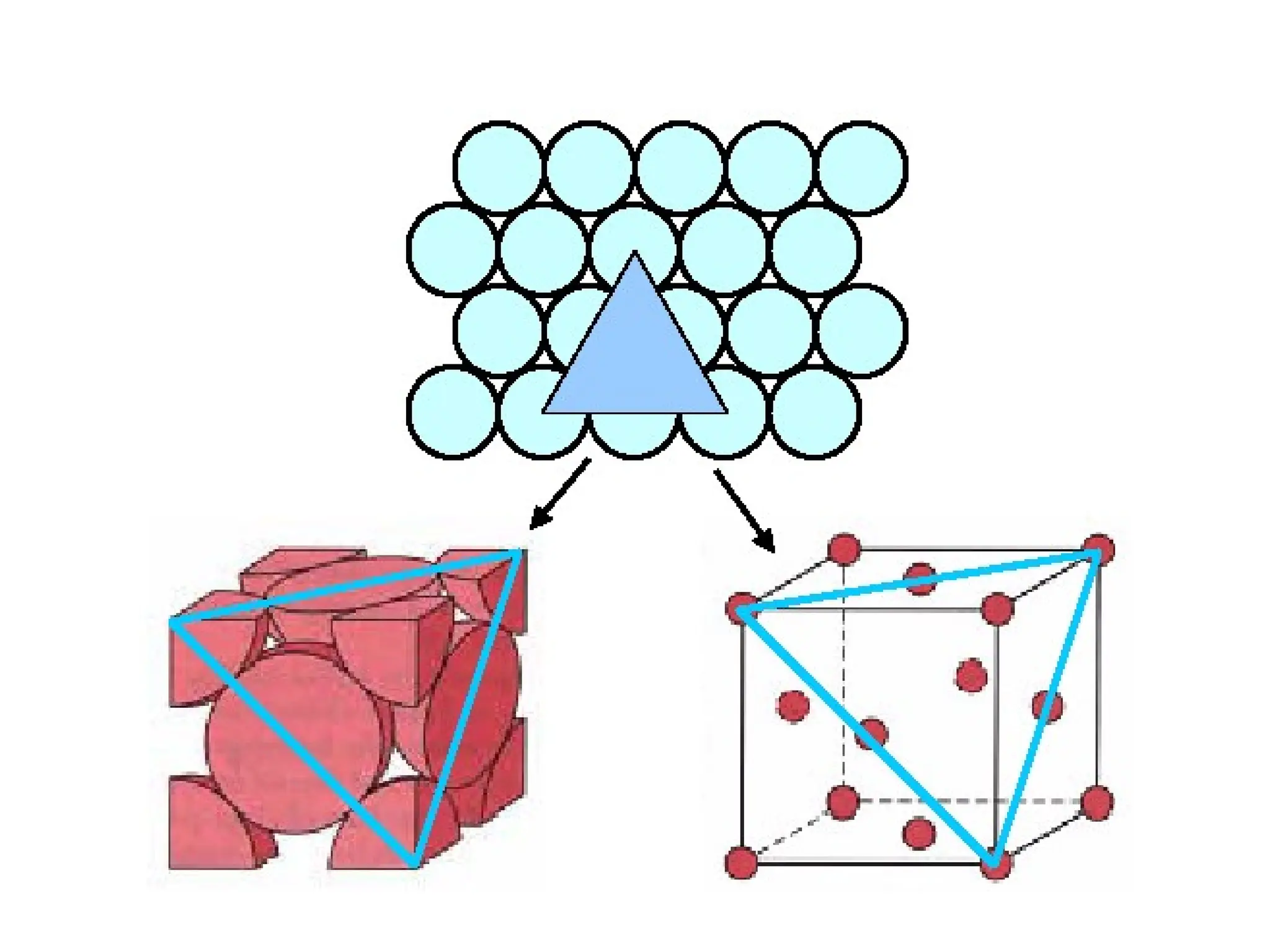
PD110 =
(2 atoms / [(16√2 R2
)/3]
Area =
Face diagonal x side
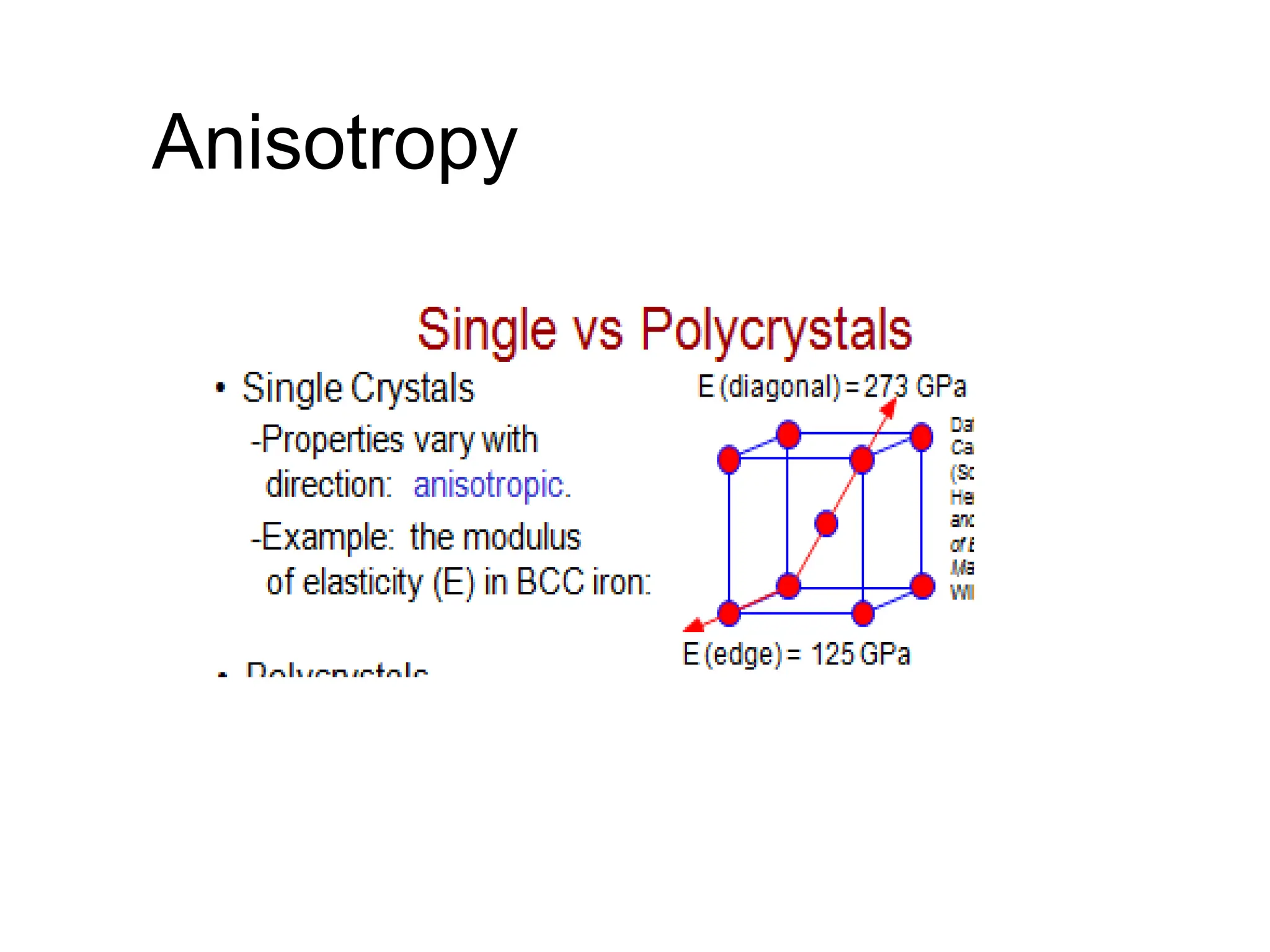
Anisotropy
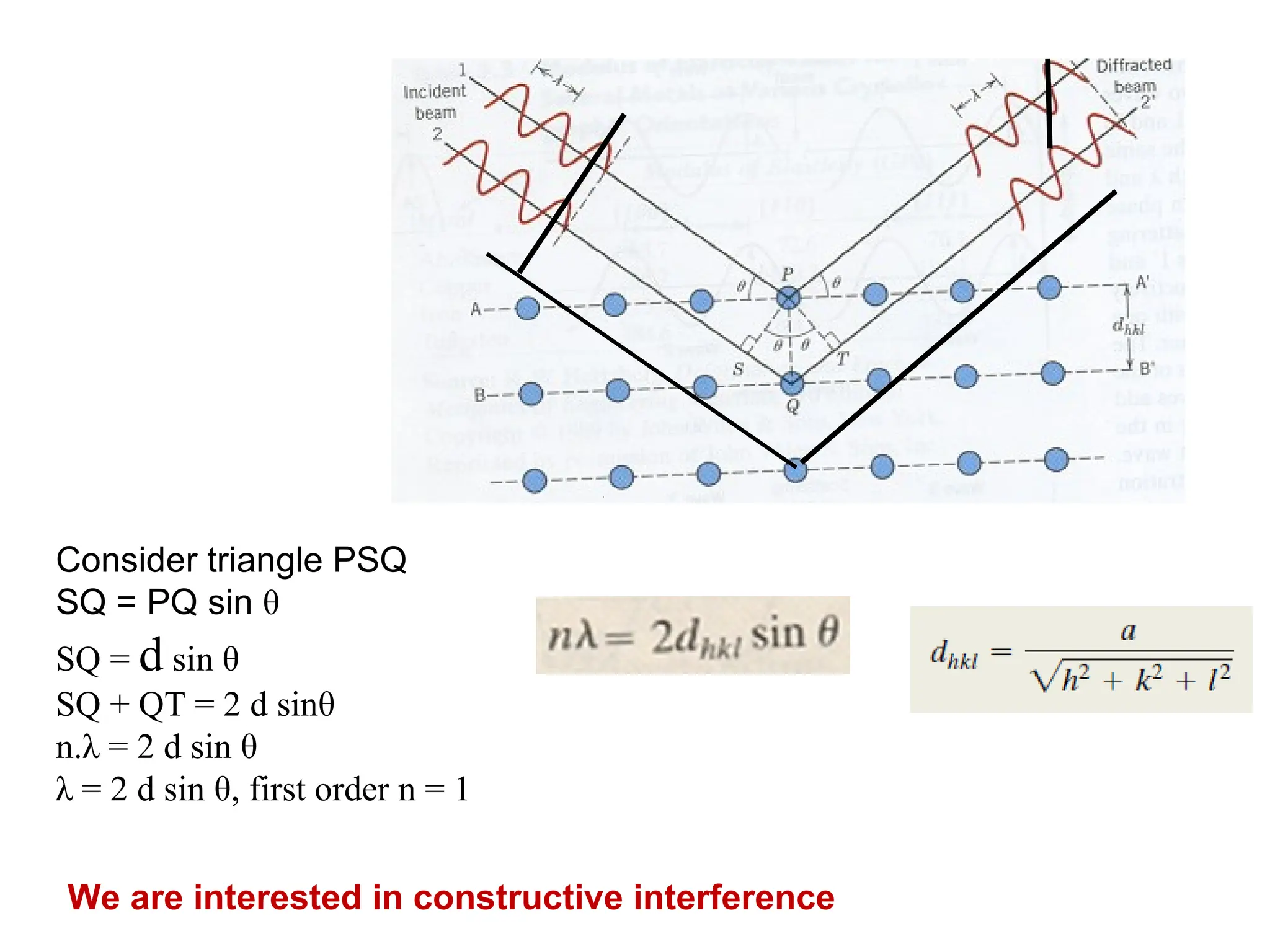
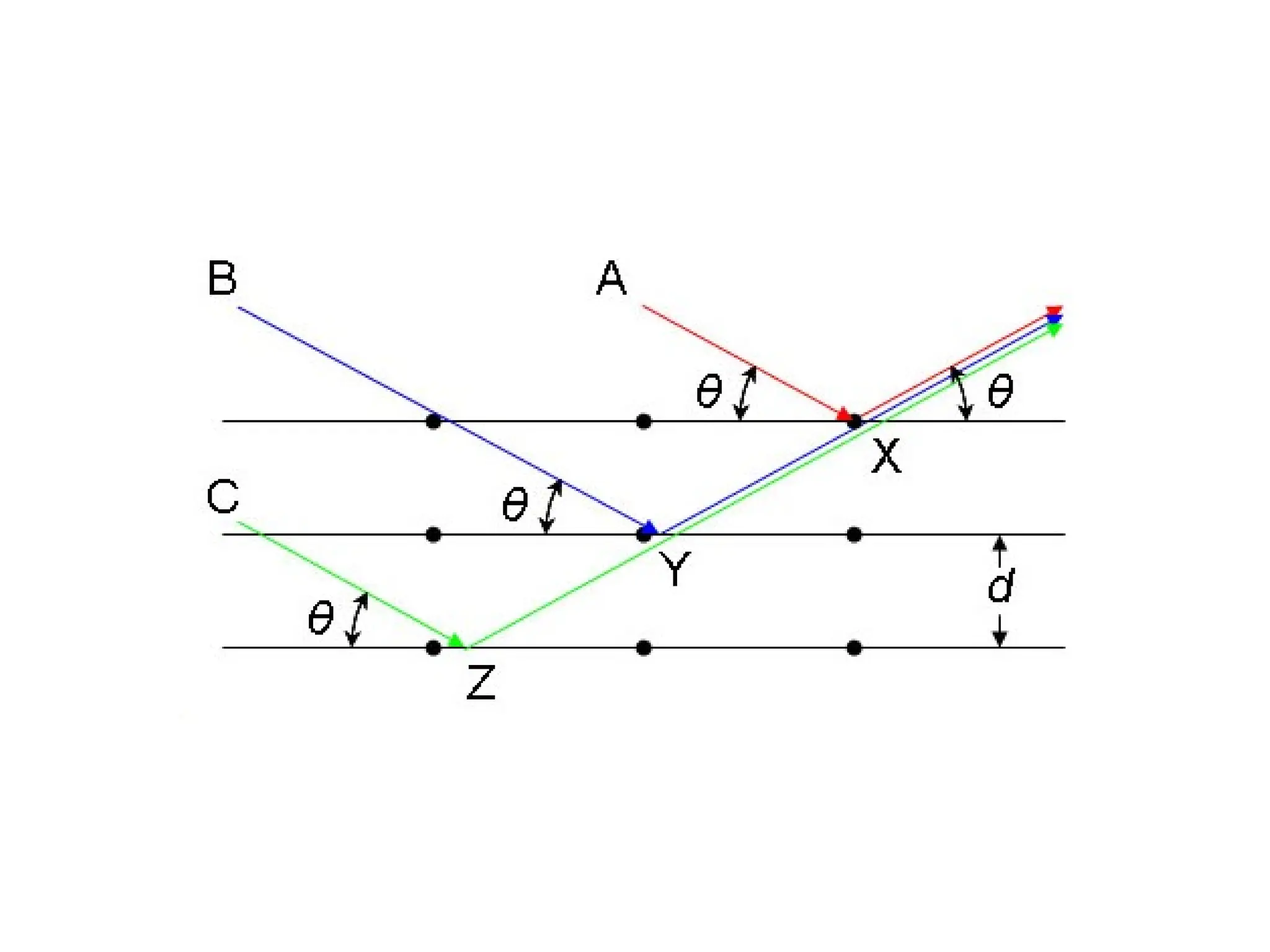
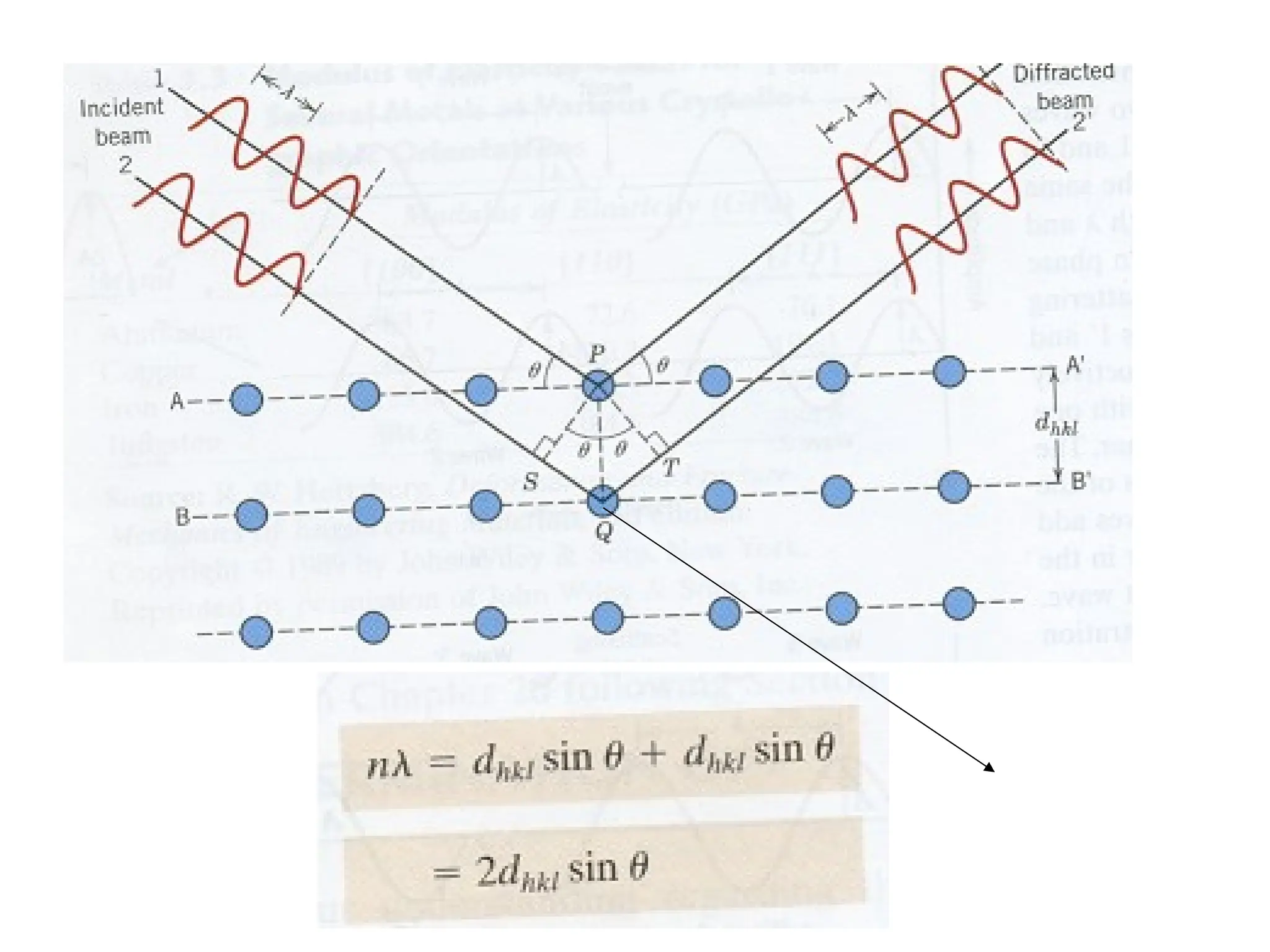
Consider triangle PSQ
SQ = PQ sin θ
SQ = d sin θ
SQ + QT = 2 d sinθ
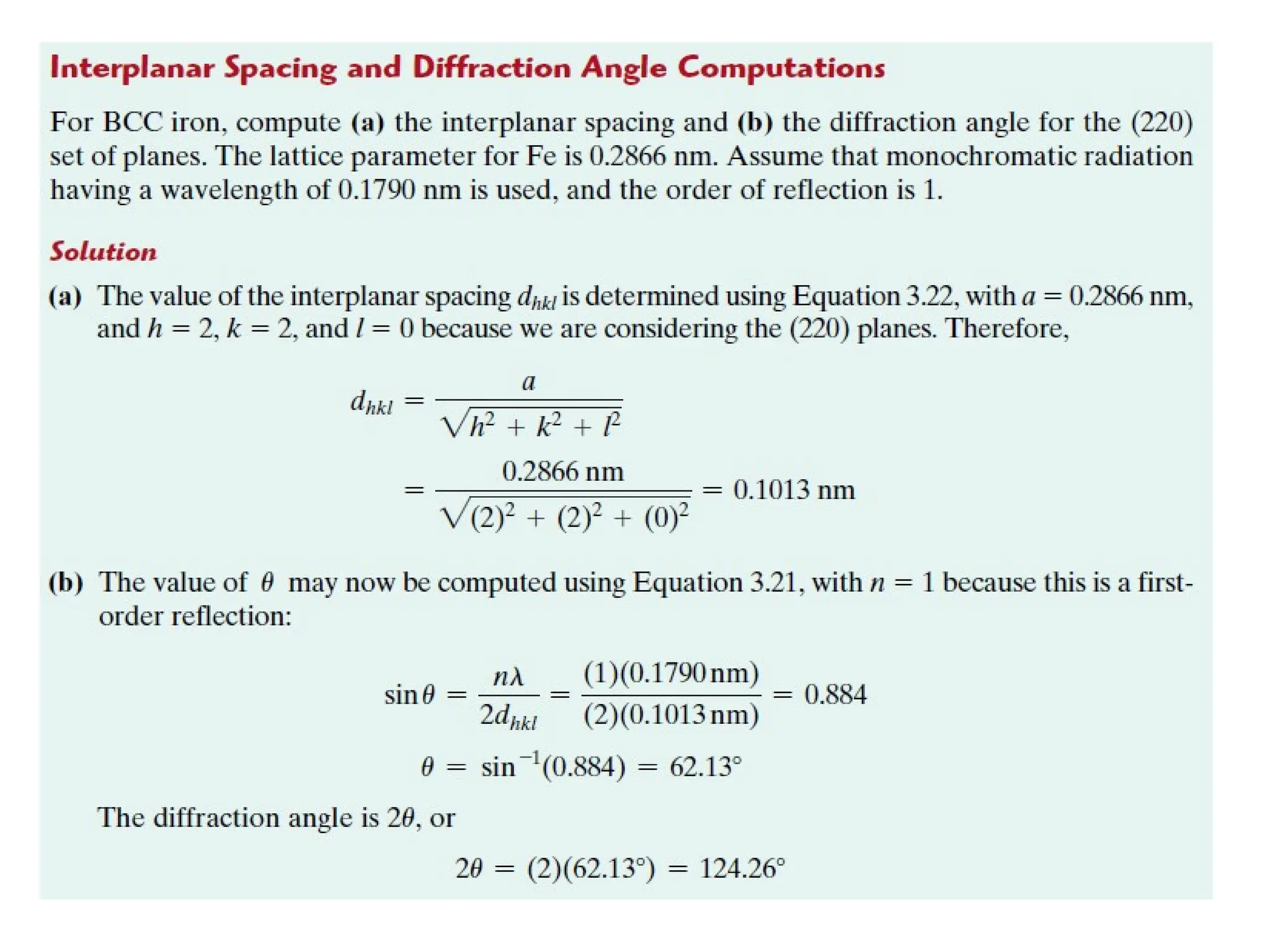
n.λ = 2 d sin θ
λ = 2 d sin θ, first order n = 1
We are interested in constructive interference
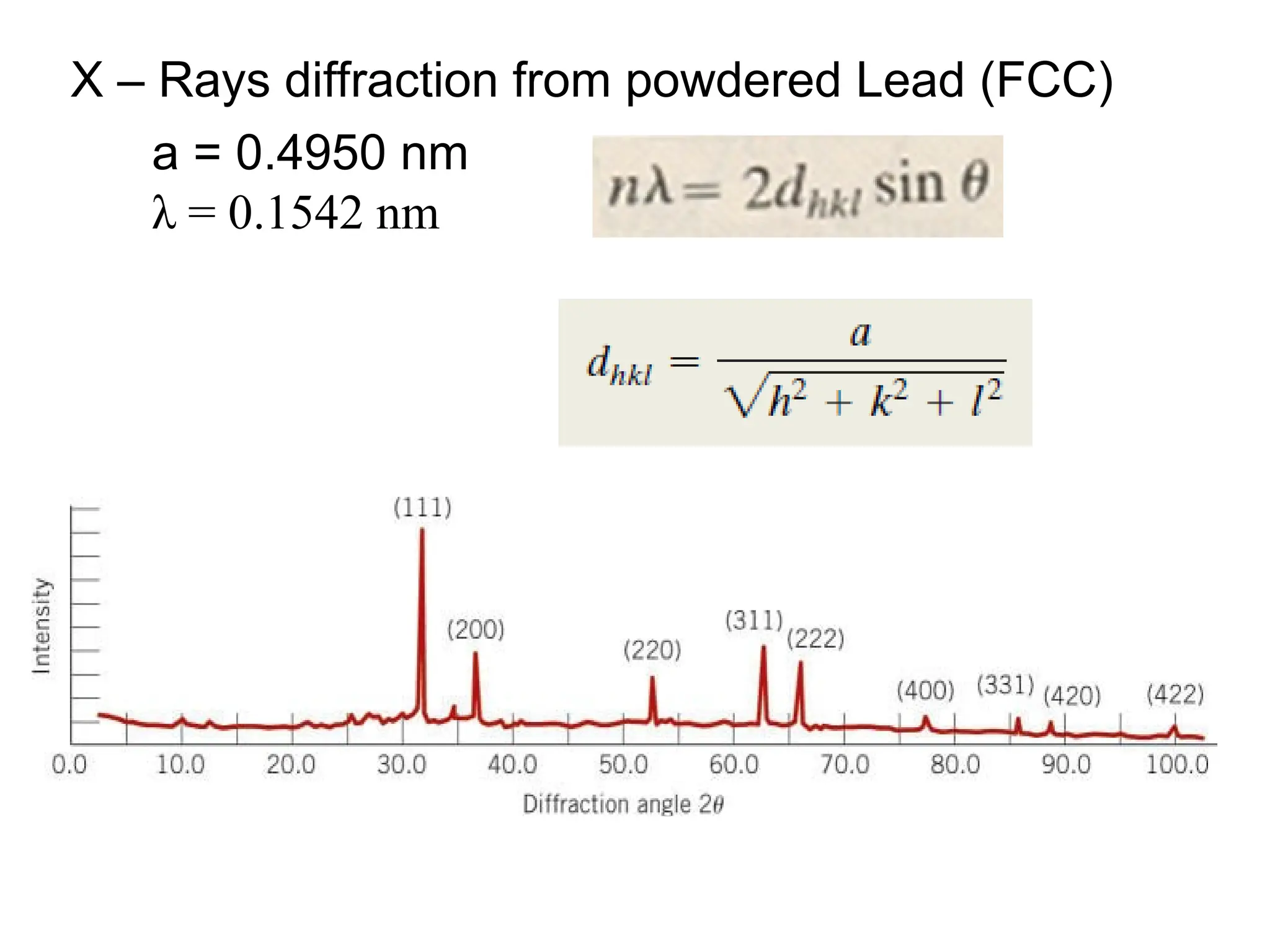
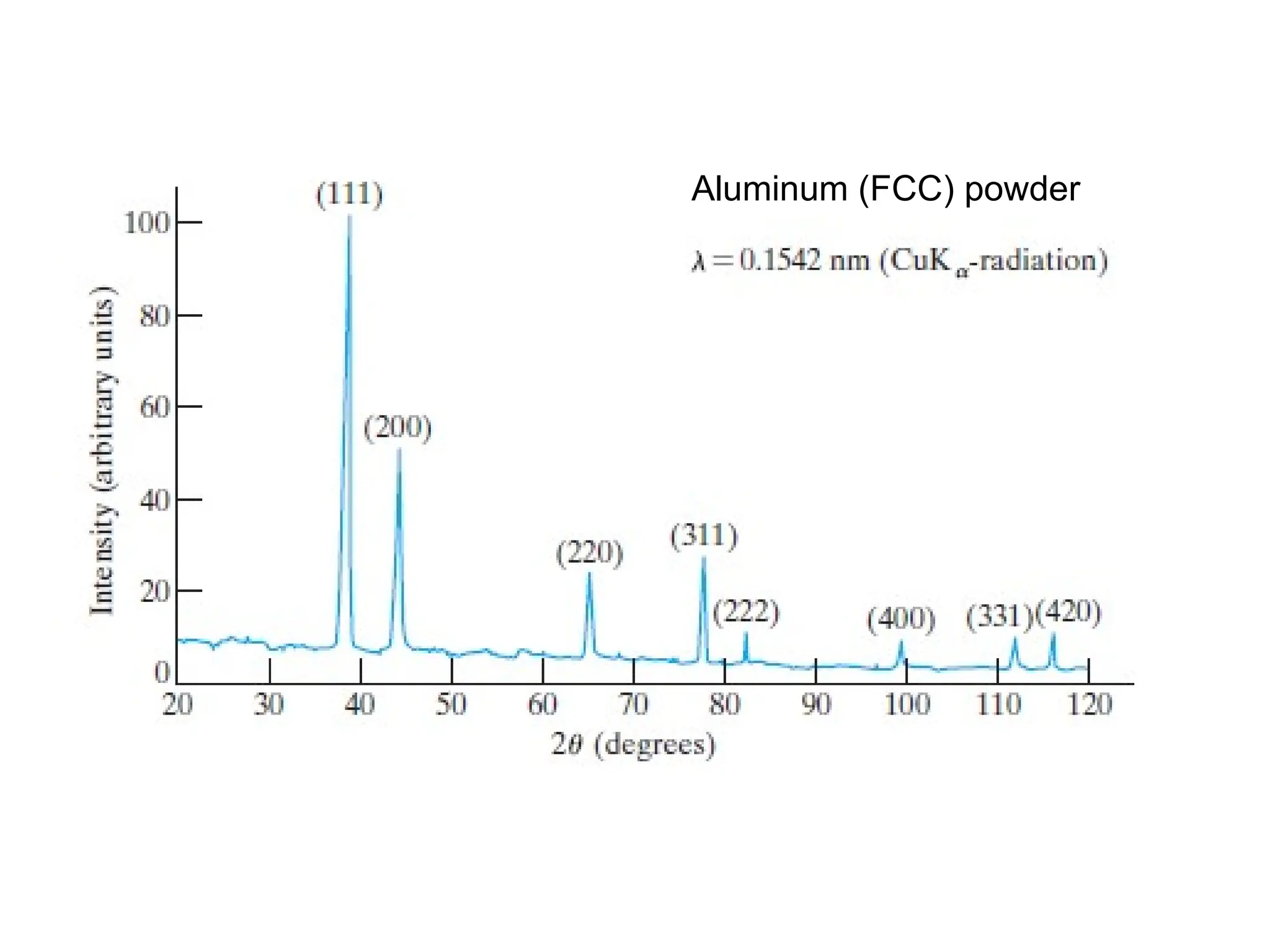
X – Rays diffraction from powdered Lead (FCC)
a = 0.4950 nm
λ = 0.1542 nm
Aluminum (FCC) powder
•.
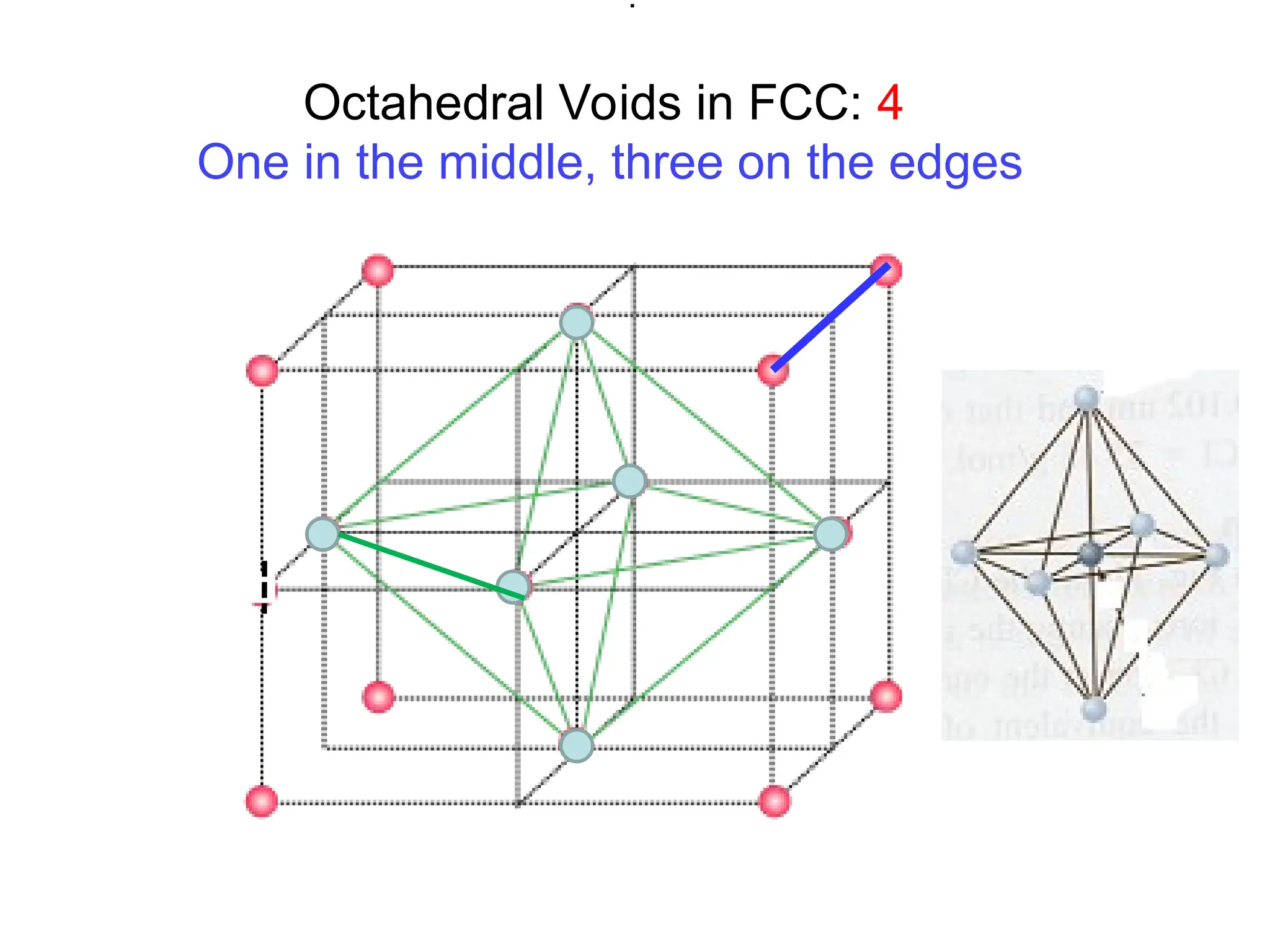
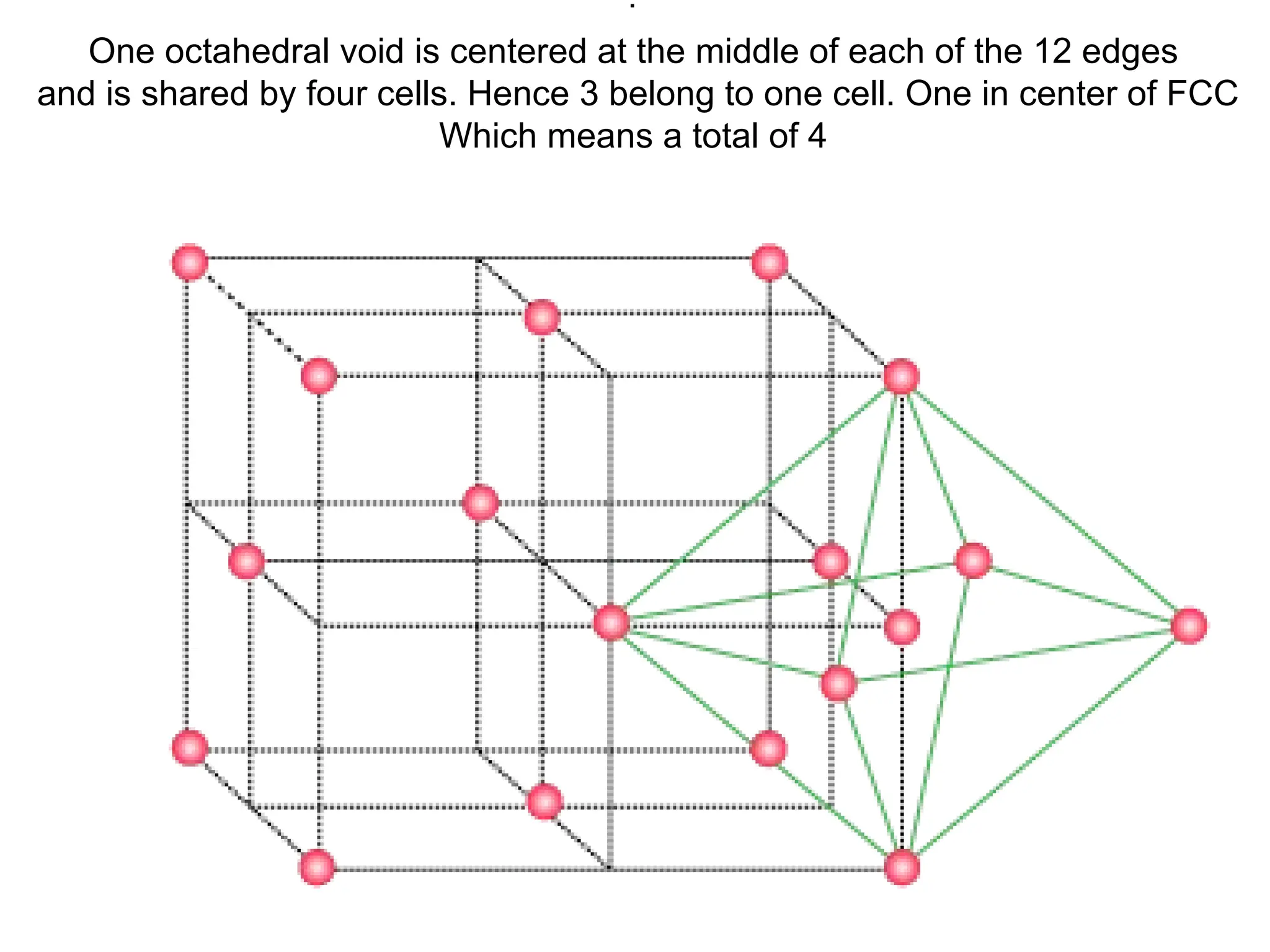
Octahedral Voids in FCC: 4
One in the middle, three on the edges
•.
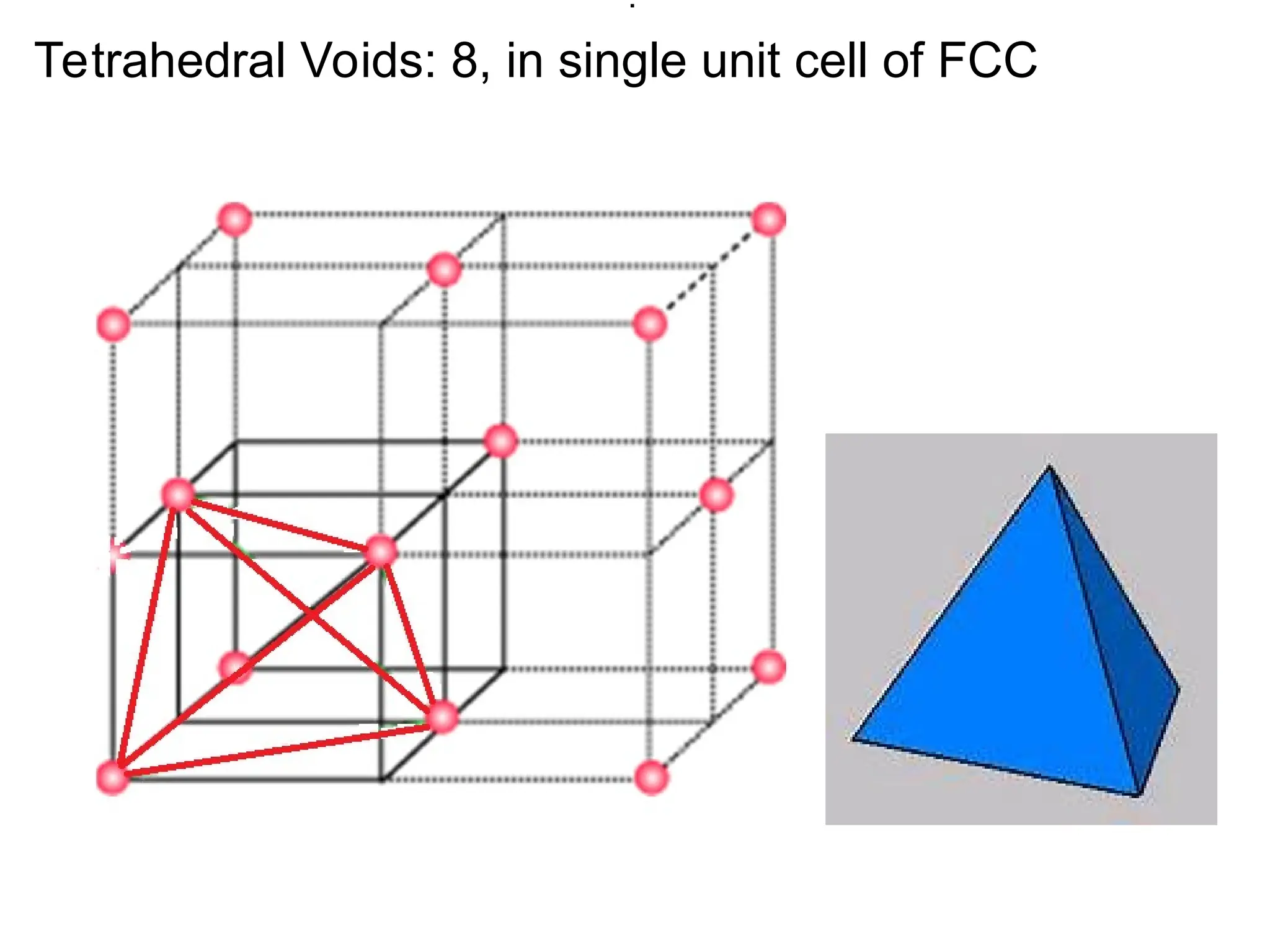
Tetrahedral Voids: 8, in single unit cell of FCC
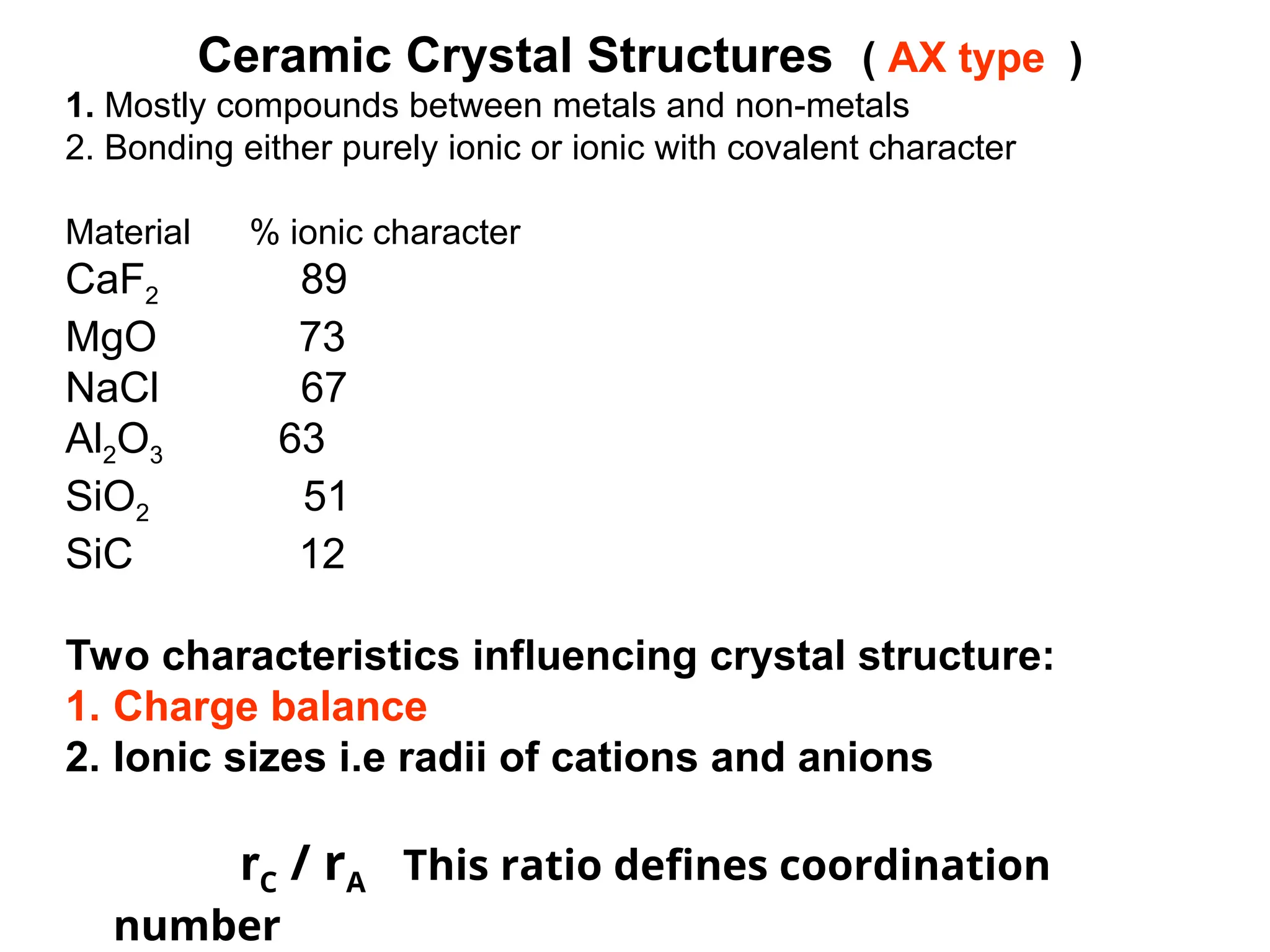
Ceramic Crystal Structures ( AX type )
1. Mostly compounds between metals and non-metals
2. Bonding either purely ionic or ionic with covalent character
Material % ionic character
CaF2 89
MgO 73
NaCl 67
Al2O3 63
SiO2 51
SiC 12
Two characteristics influencing crystal structure:
1. Charge balance
2. Ionic sizes i.e radii of cations and anions
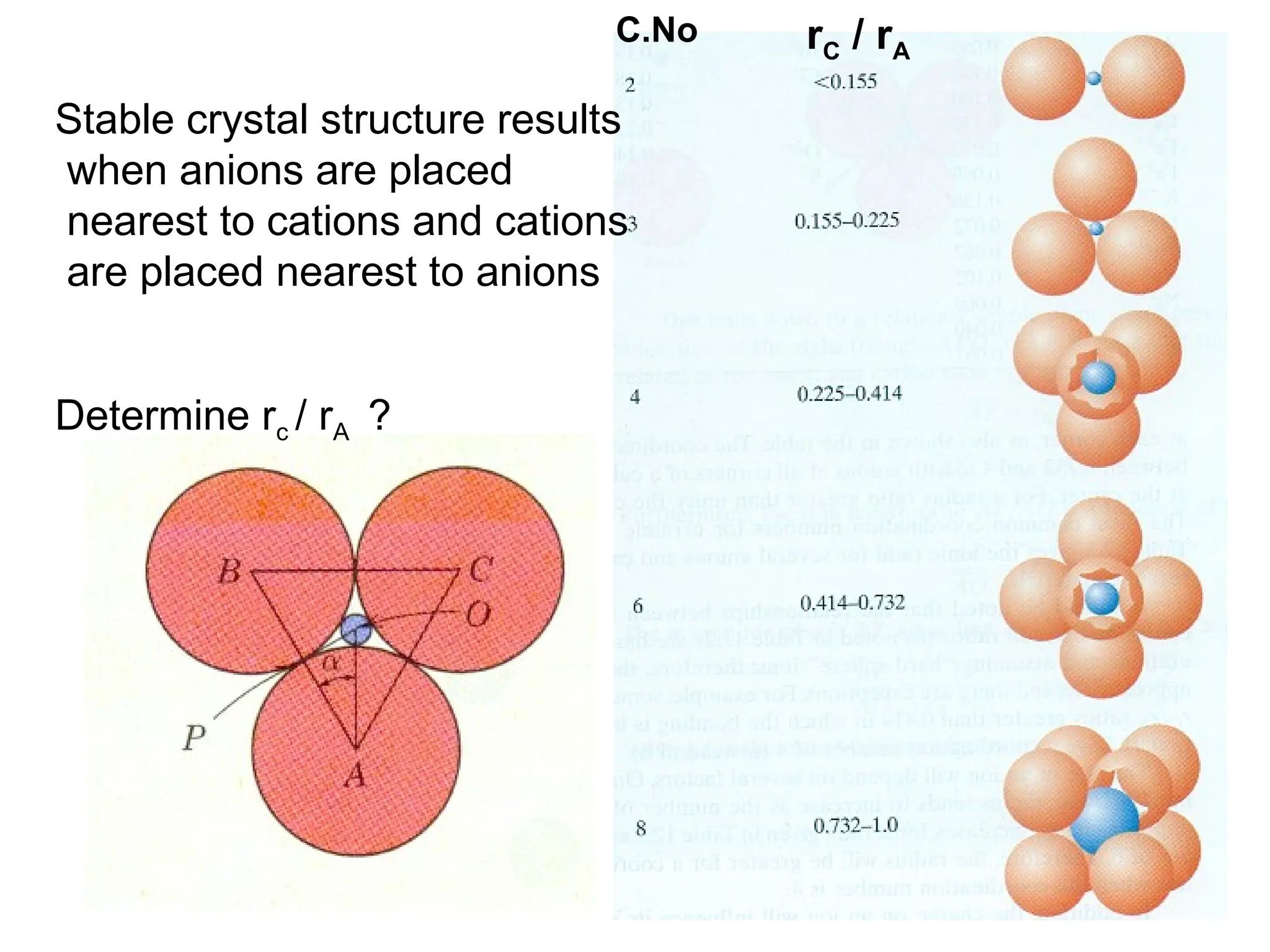
rC / rA This ratio defines coordination
number
rC / rA
C.No
Stable crystal structure results
when anions are placed
nearest to cations and cations
are placed nearest to anions
Determine rc / rA ?
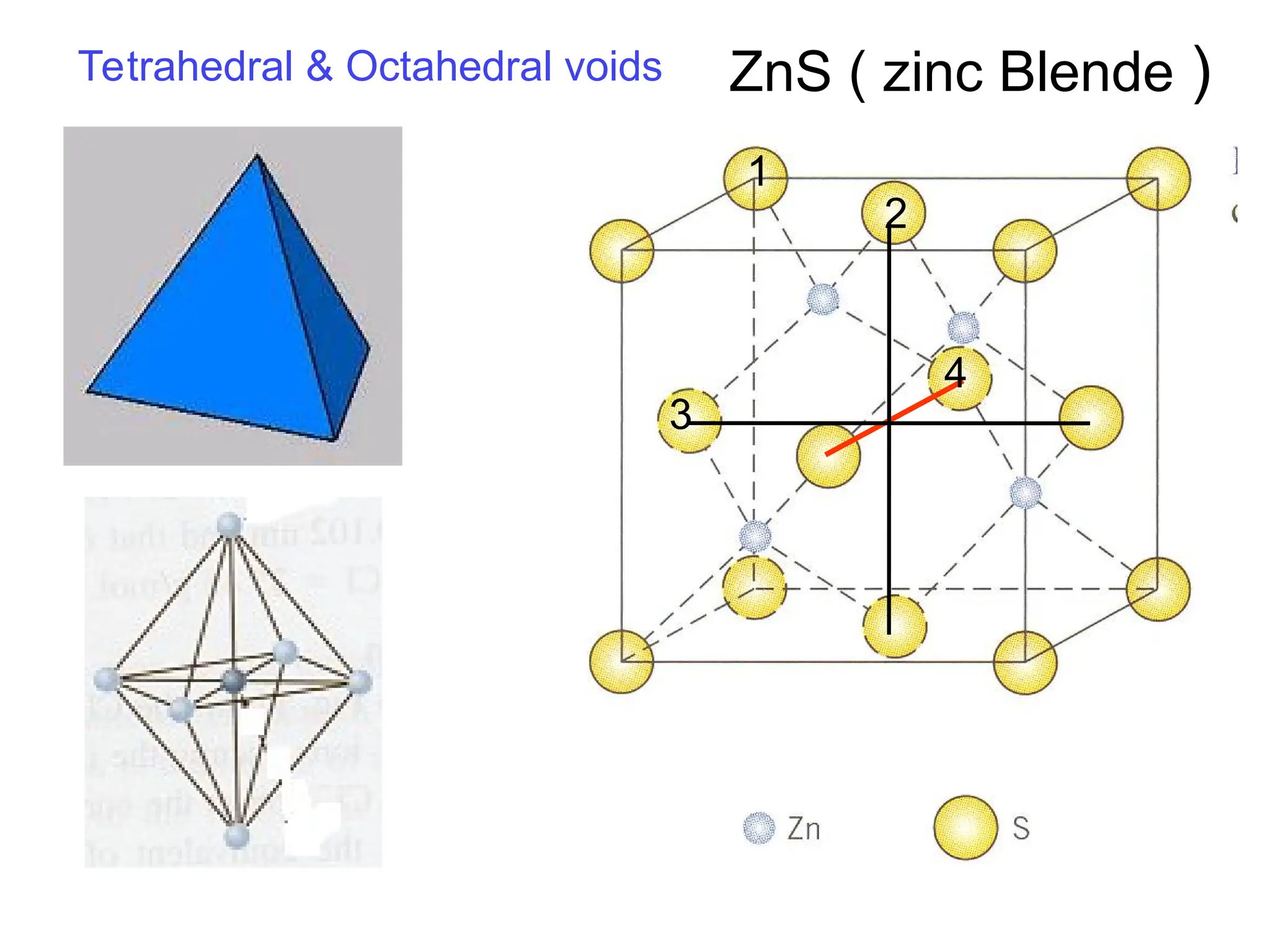
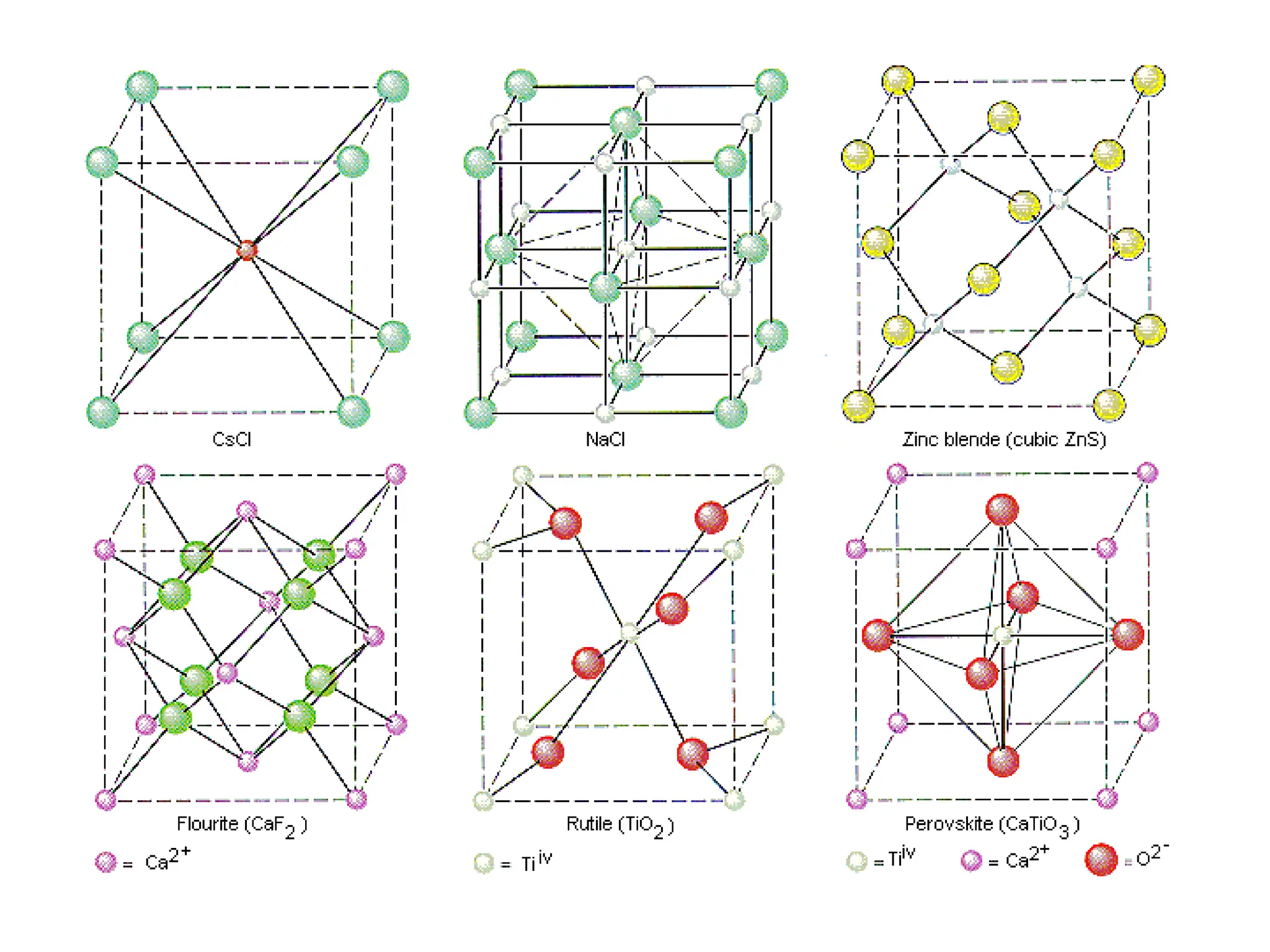
ZnS ( zinc Blende )
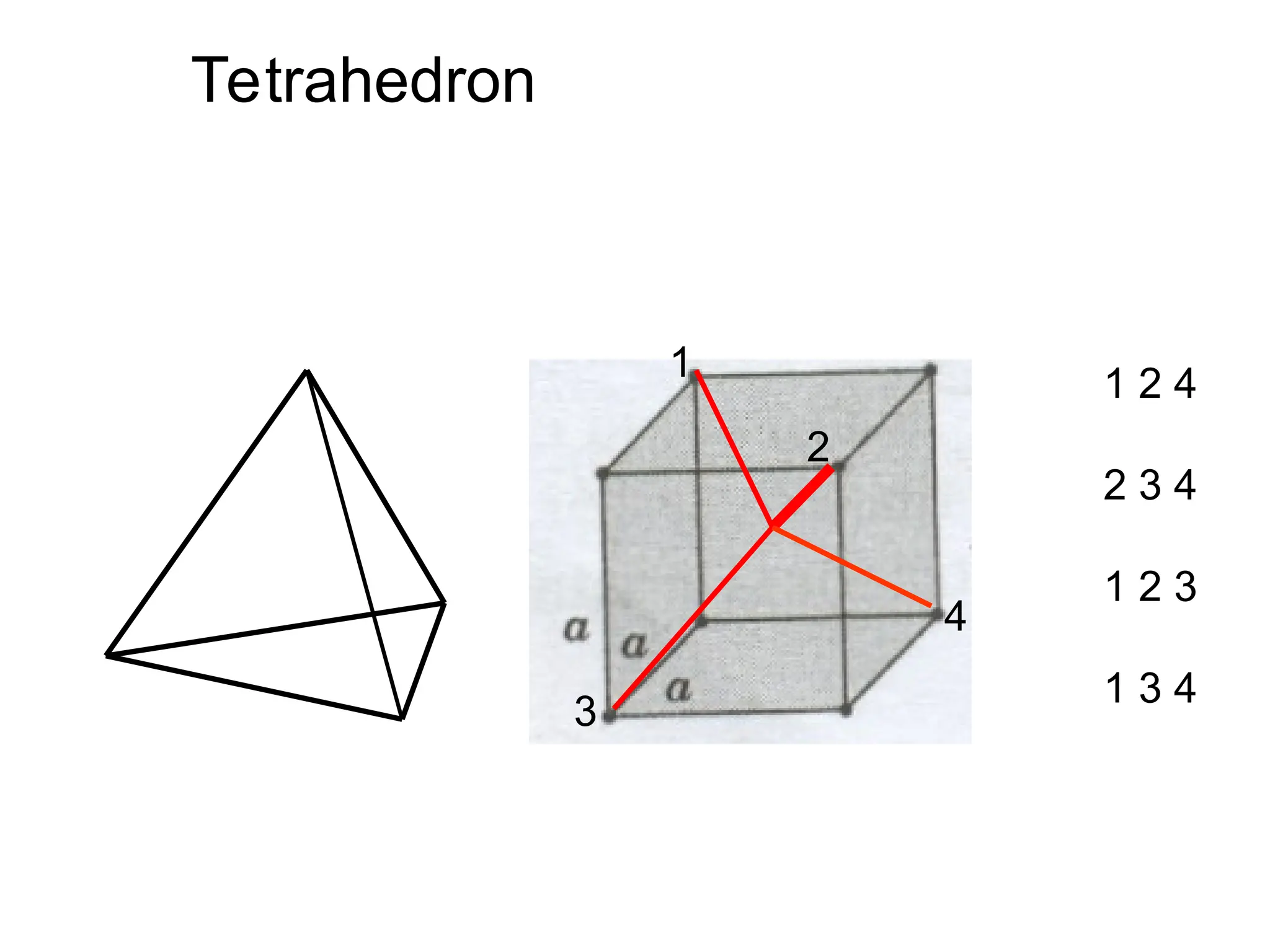
Tetrahedral & Octahedral voids
1
2
4
3
1 2 4
2 3 4
1 2 3
1 3 4
Tetrahedron
1
2
4
3
•.
One octahedral void is centered at the middle of each of the 12 edges
and is shared by four cells. Hence 3 belong to one cell. One in center of FCC
Which means a total of 4
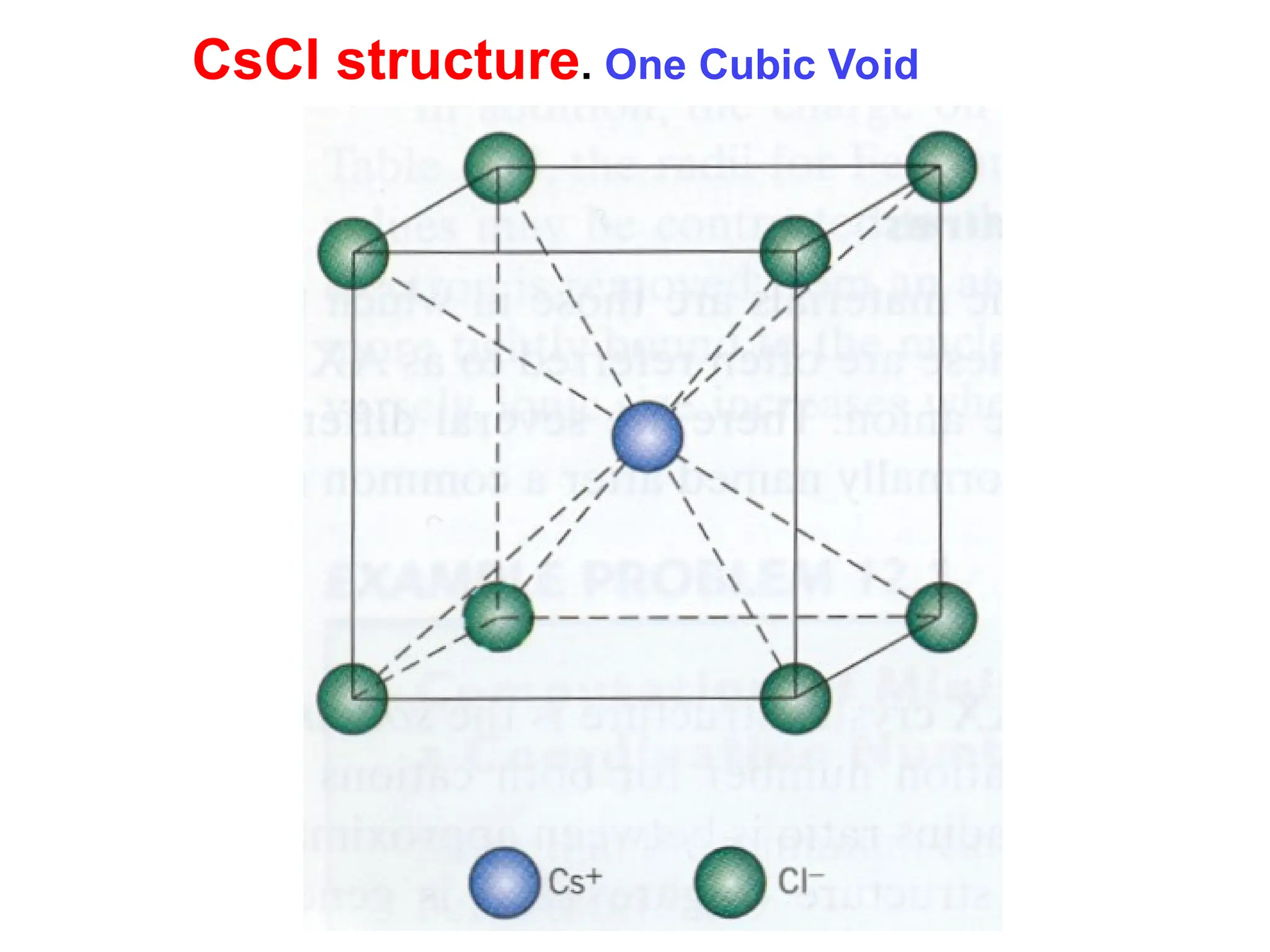
CsCl structure. One Cubic Void
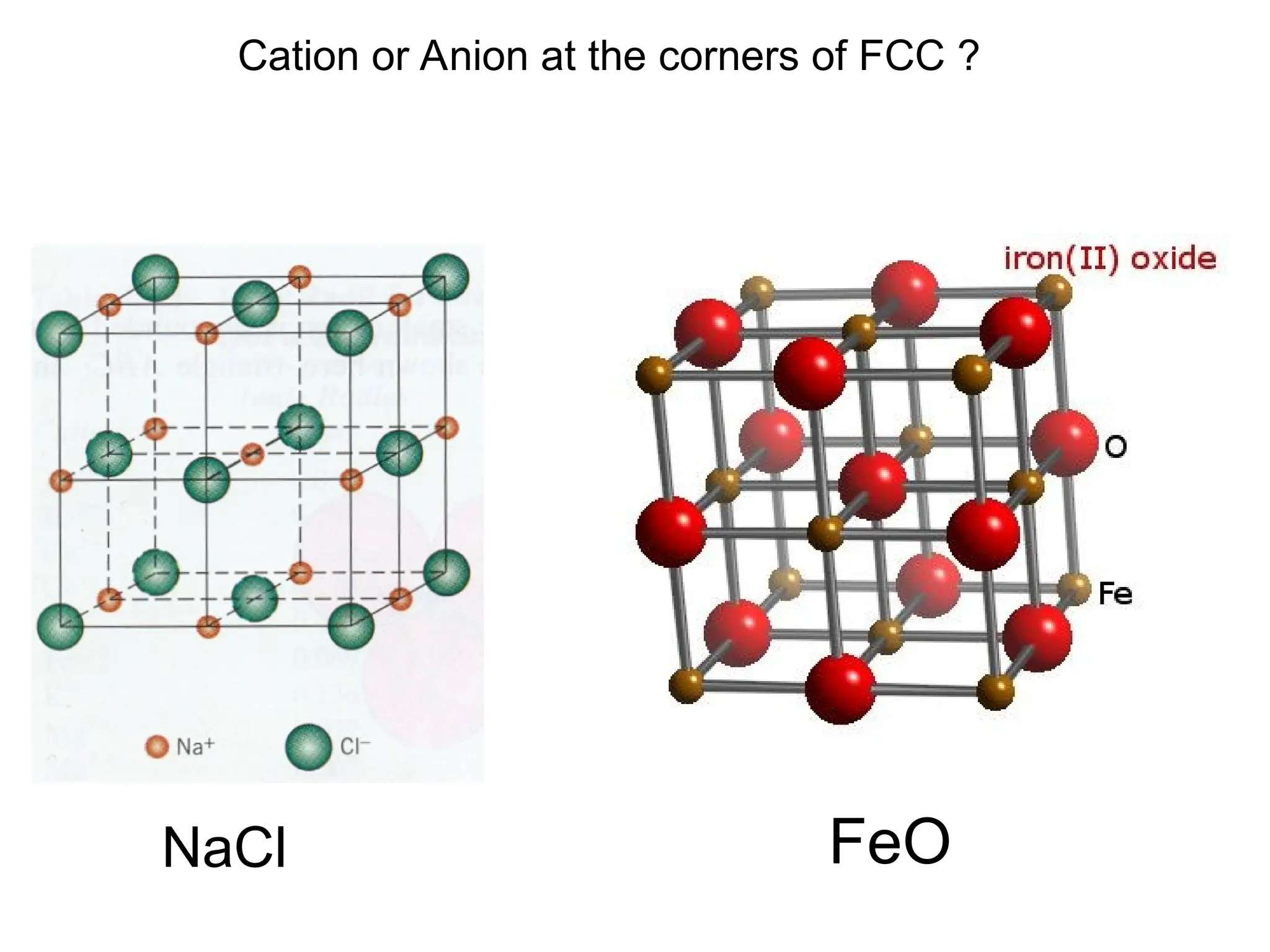
Cation or Anion at the corners of FCC ?
FeO
NaCl
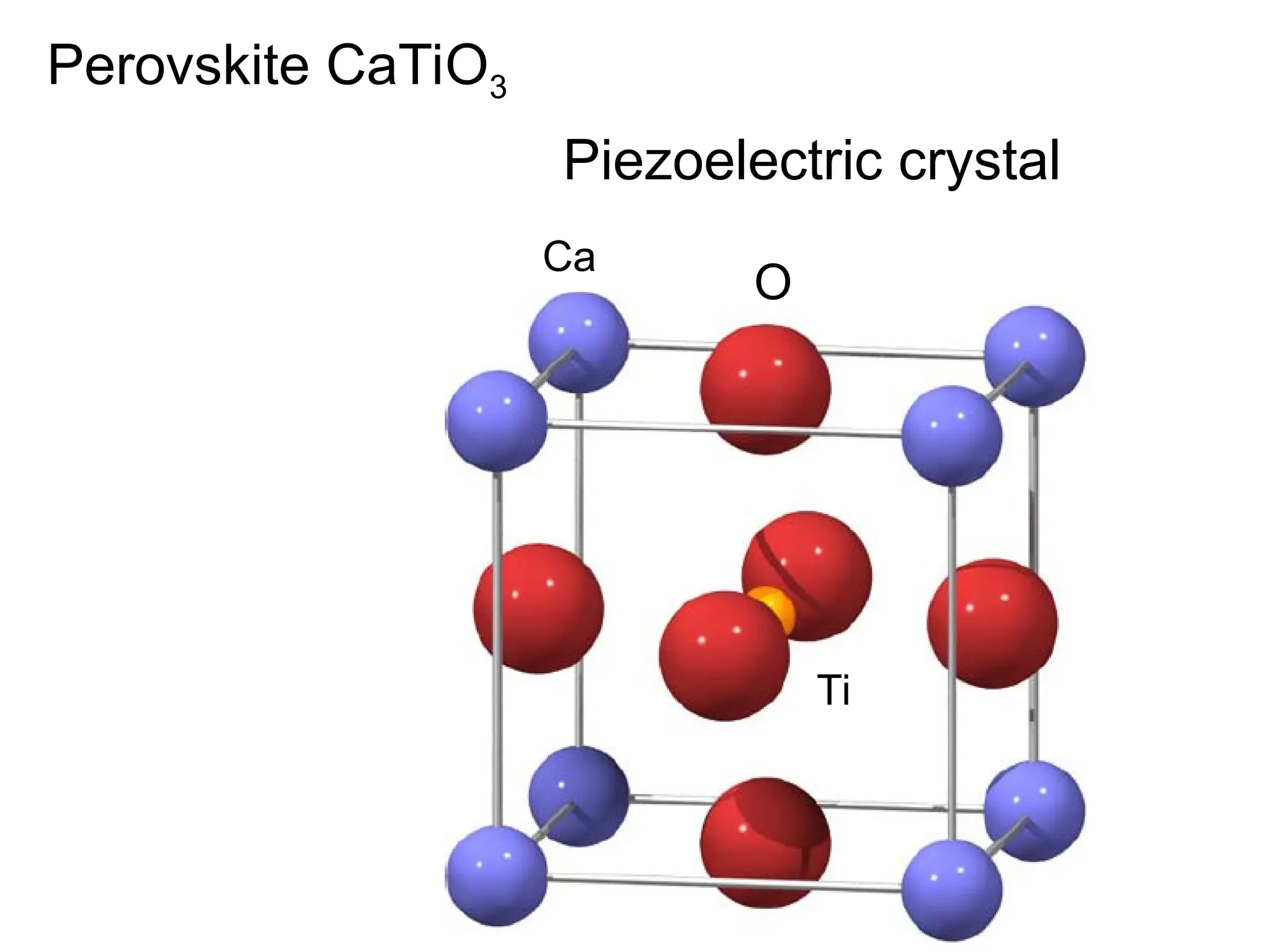
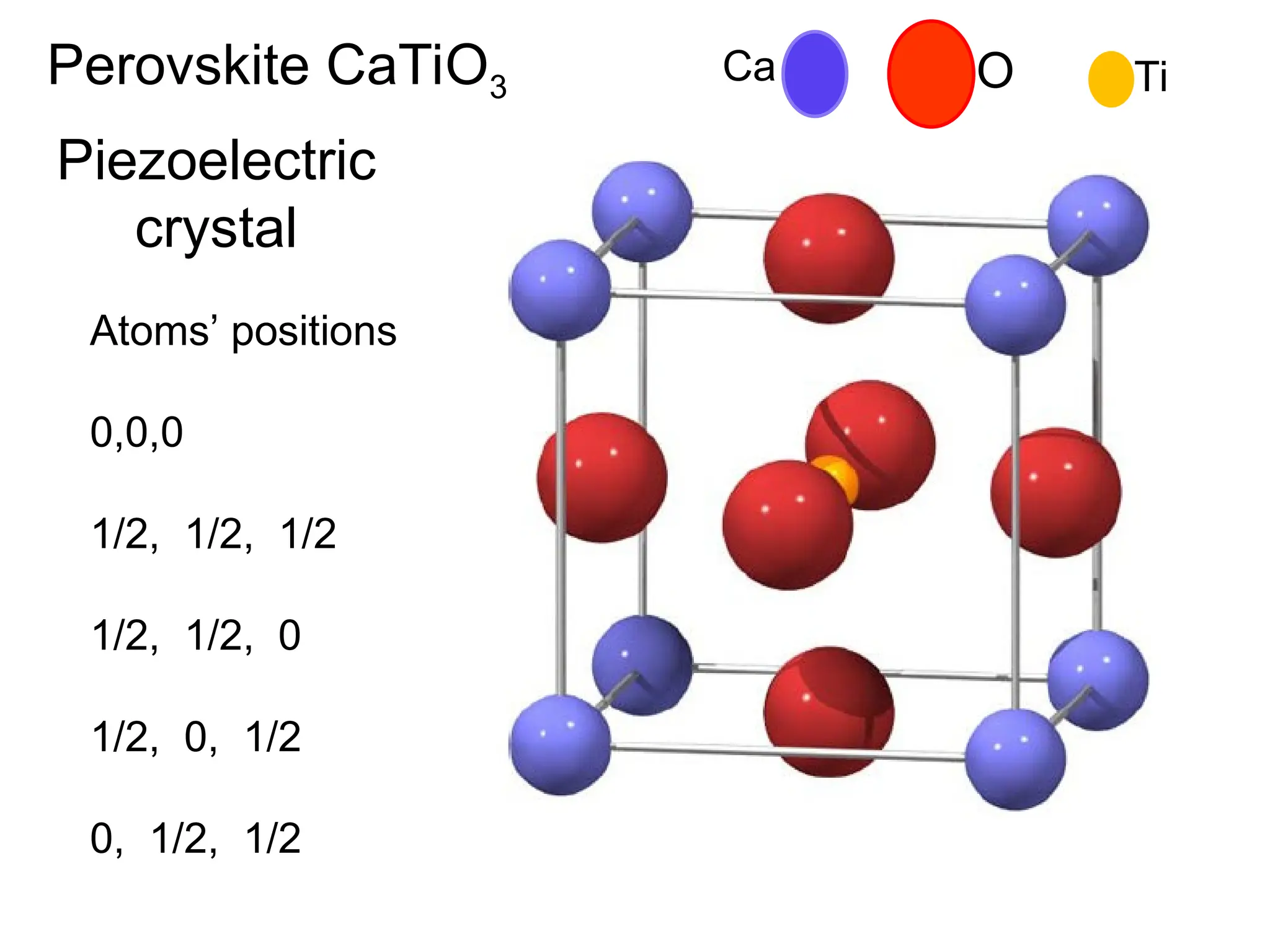
Perovskite CaTiO3
Piezoelectric crystal
Ca
Ti
O
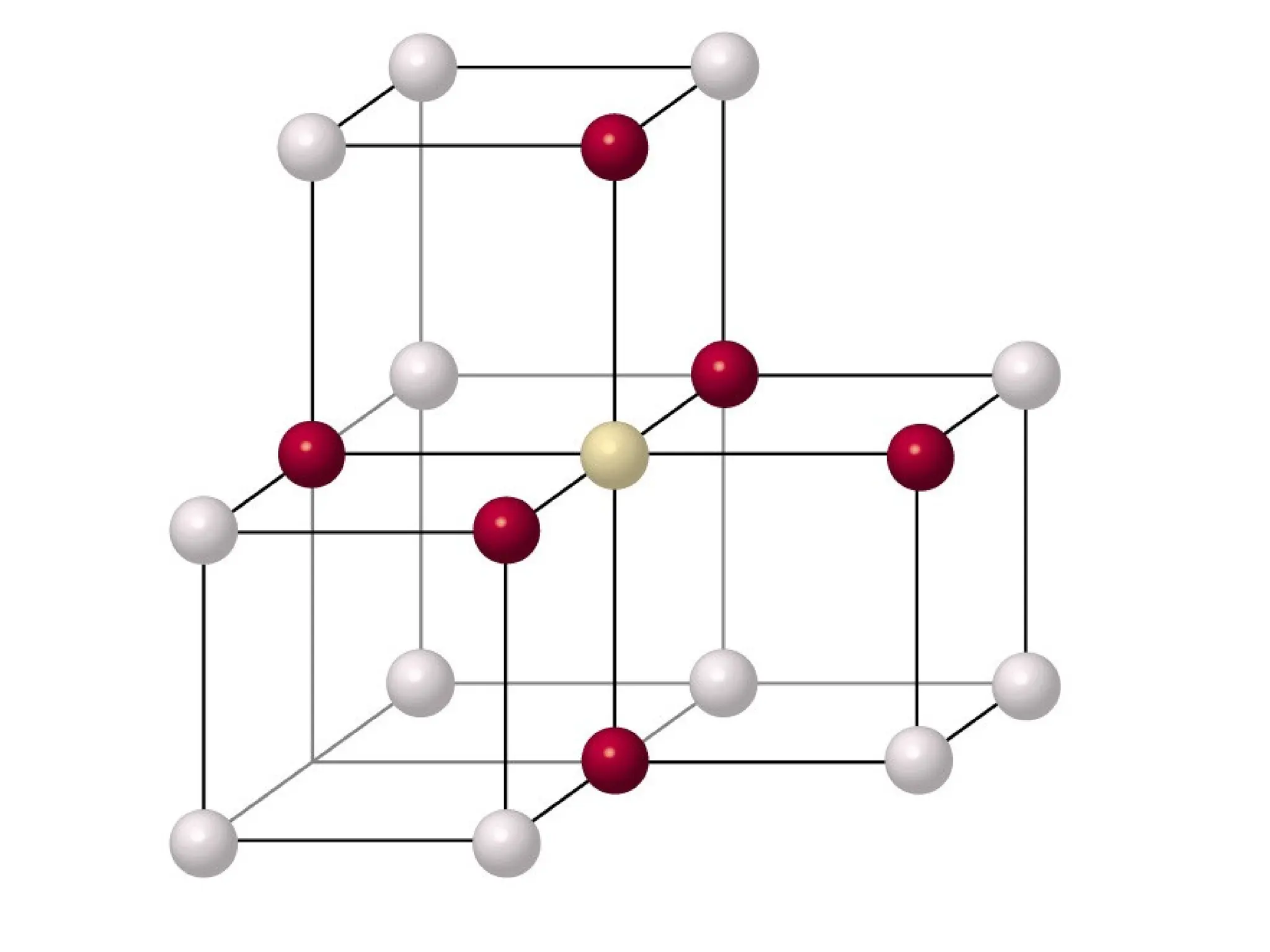
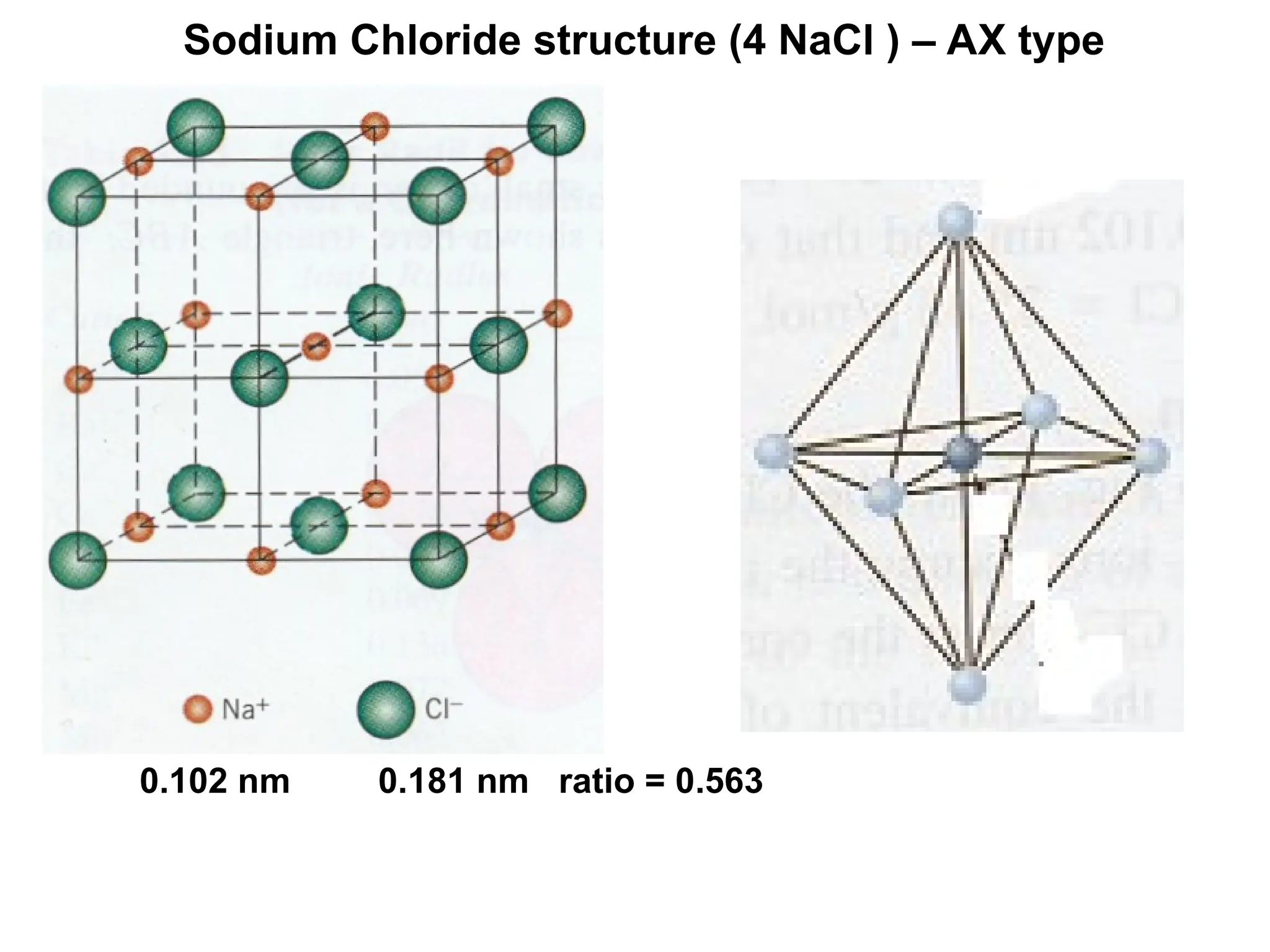
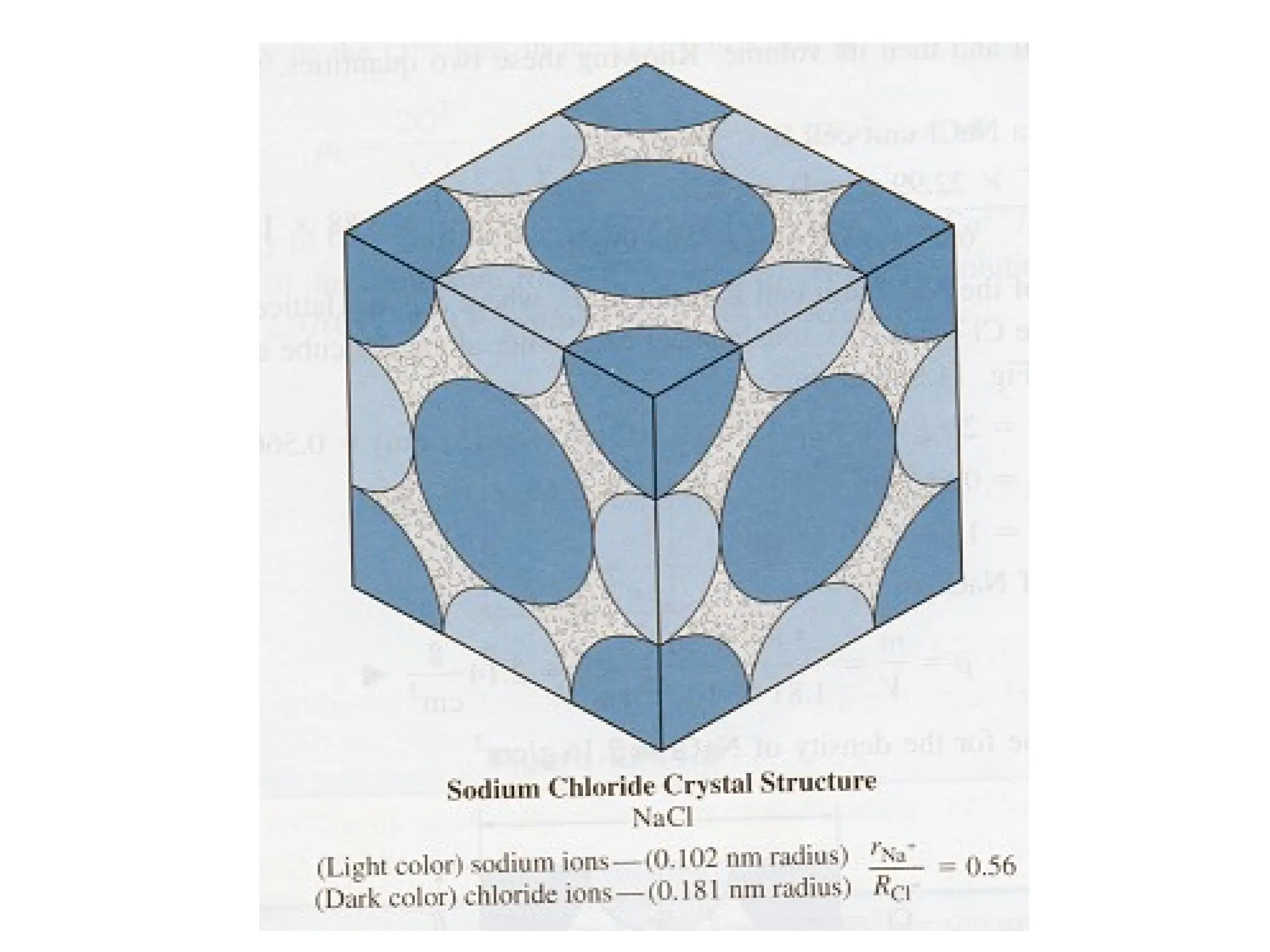
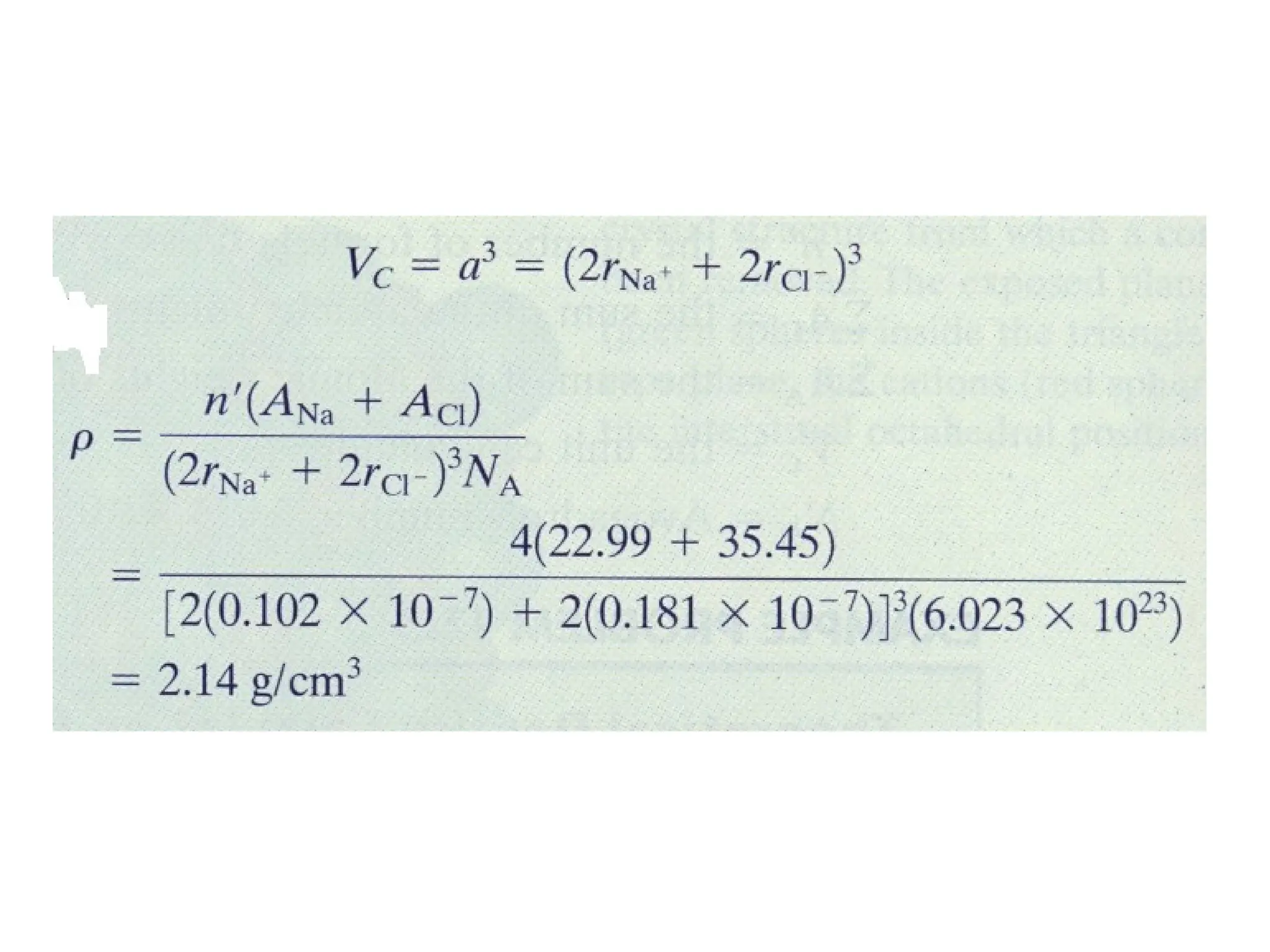
0.102 nm 0.181 nm ratio = 0.563
Sodium Chloride structure (4 NaCl ) – AX type
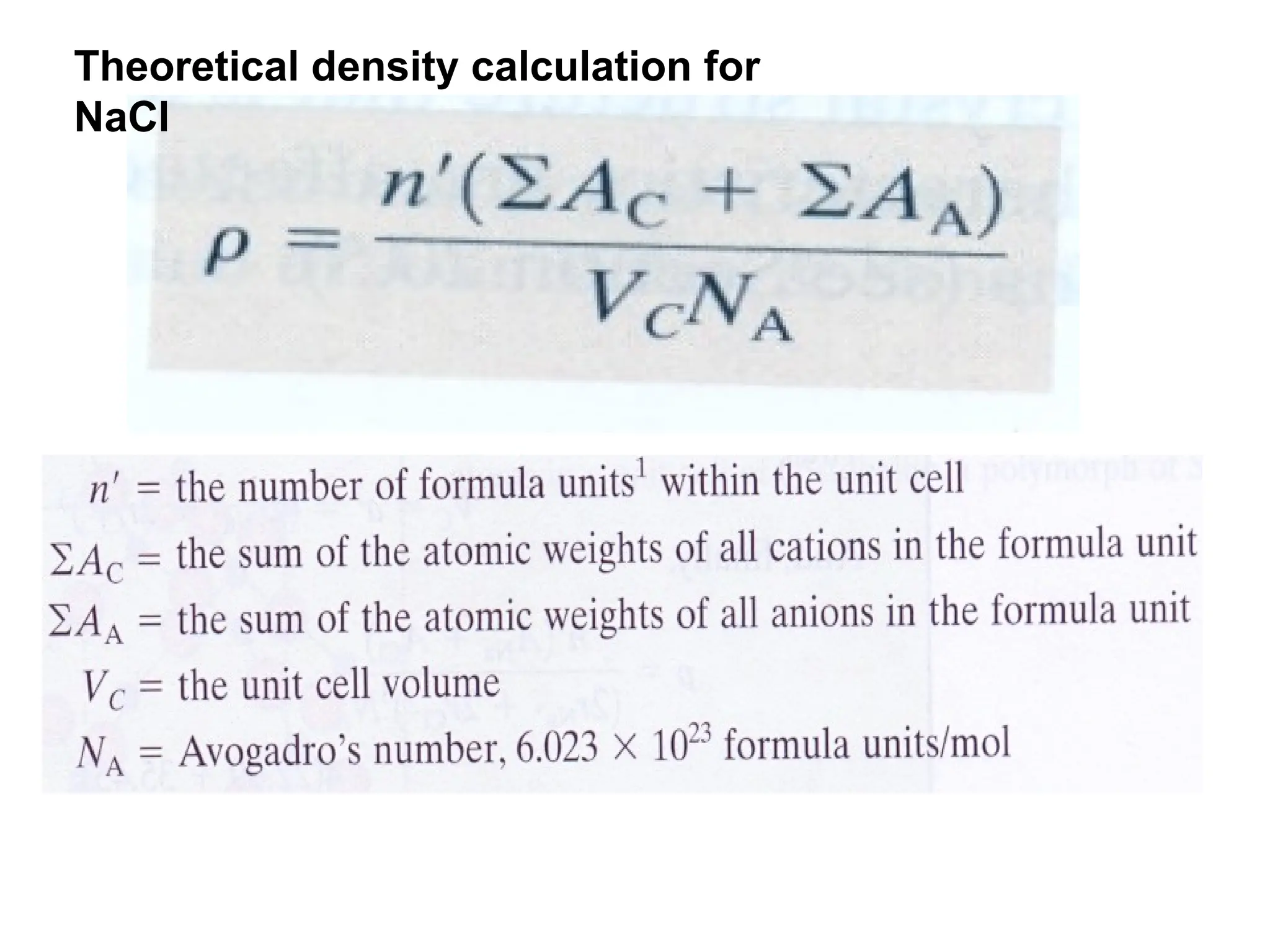
Theoretical density calculation for
NaCl
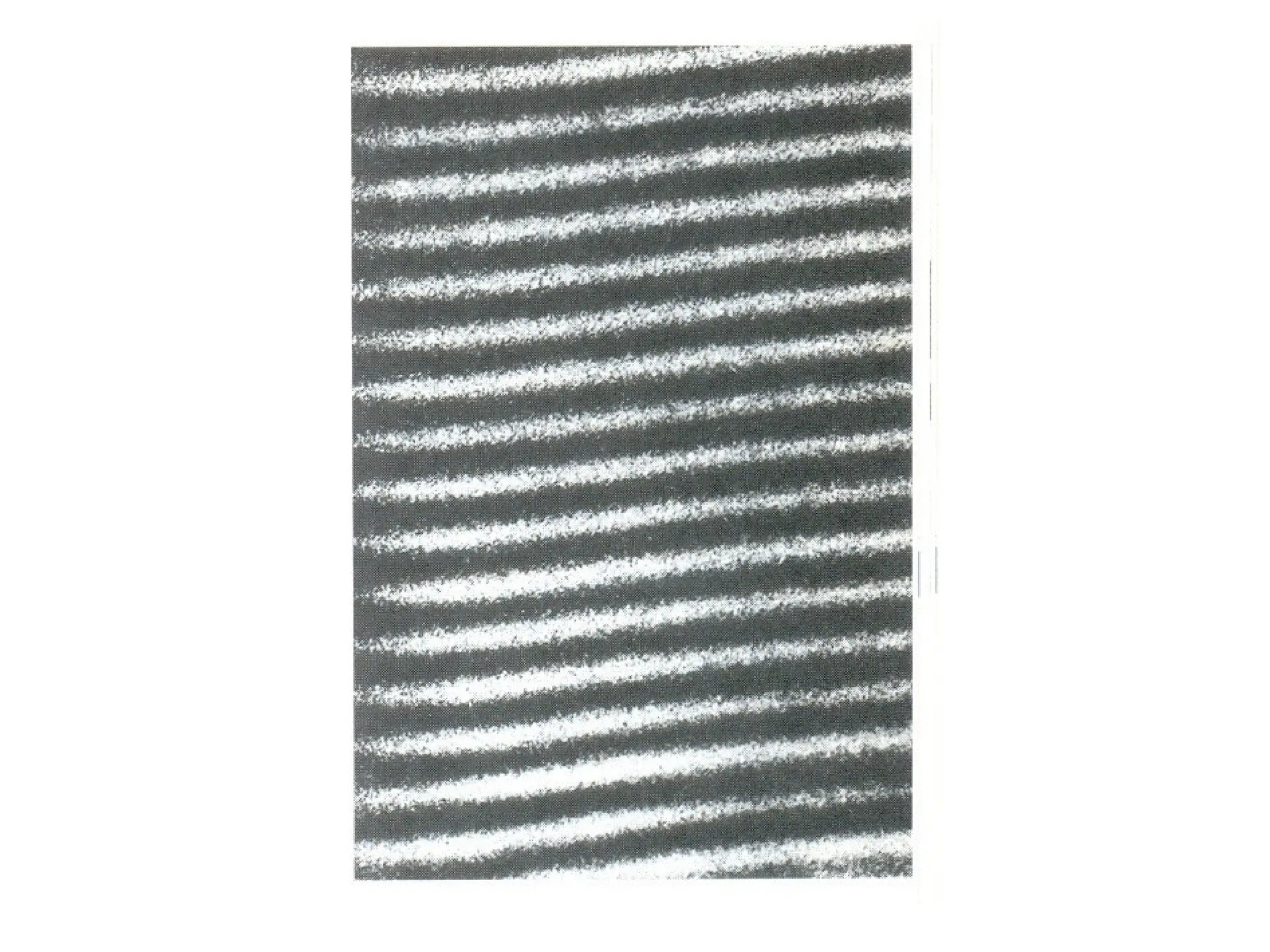
142 pm & 341 pm
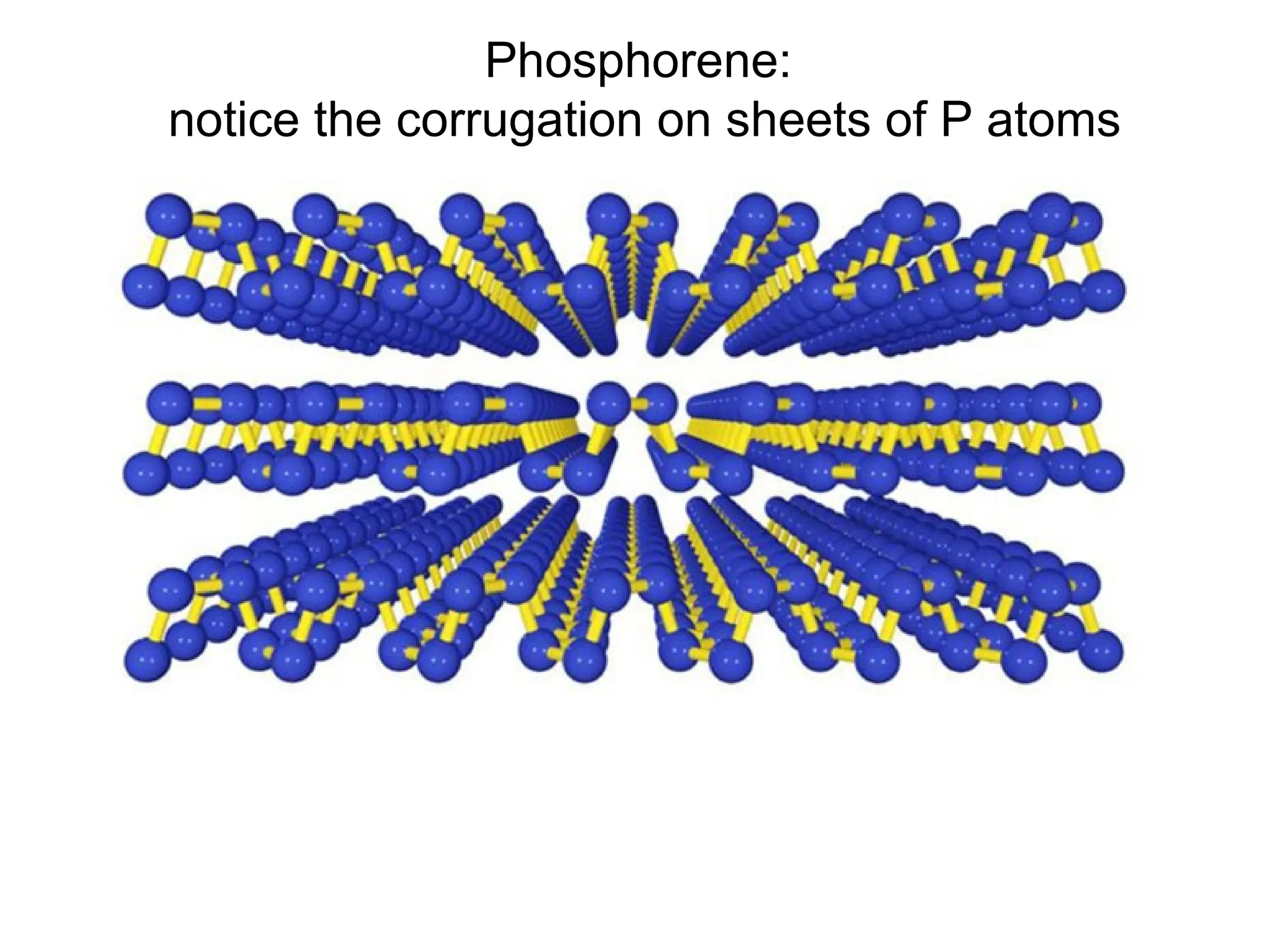
Phosphorene:
notice the corrugation on sheets of P atoms
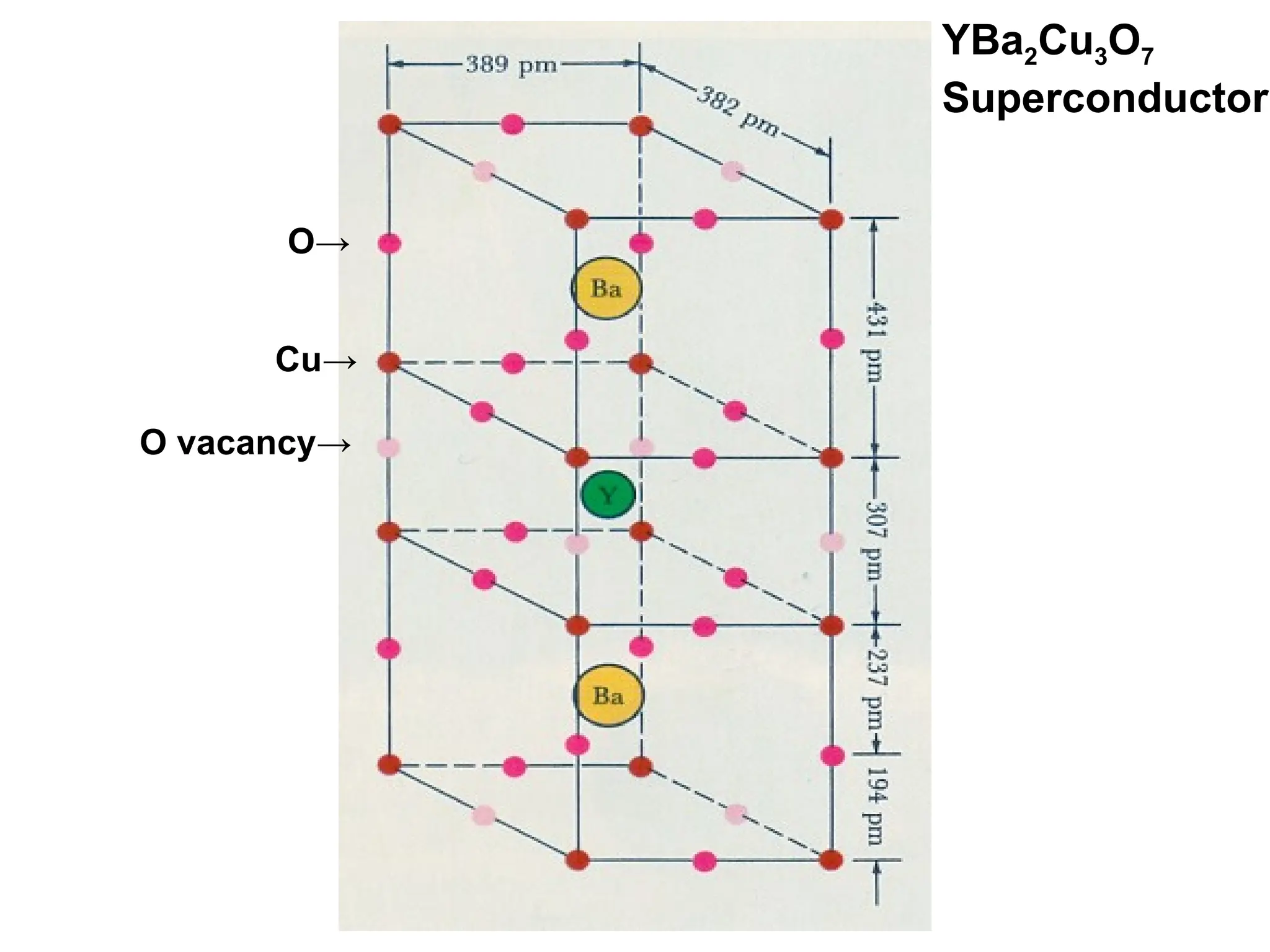
Cu→
O→
O vacancy→
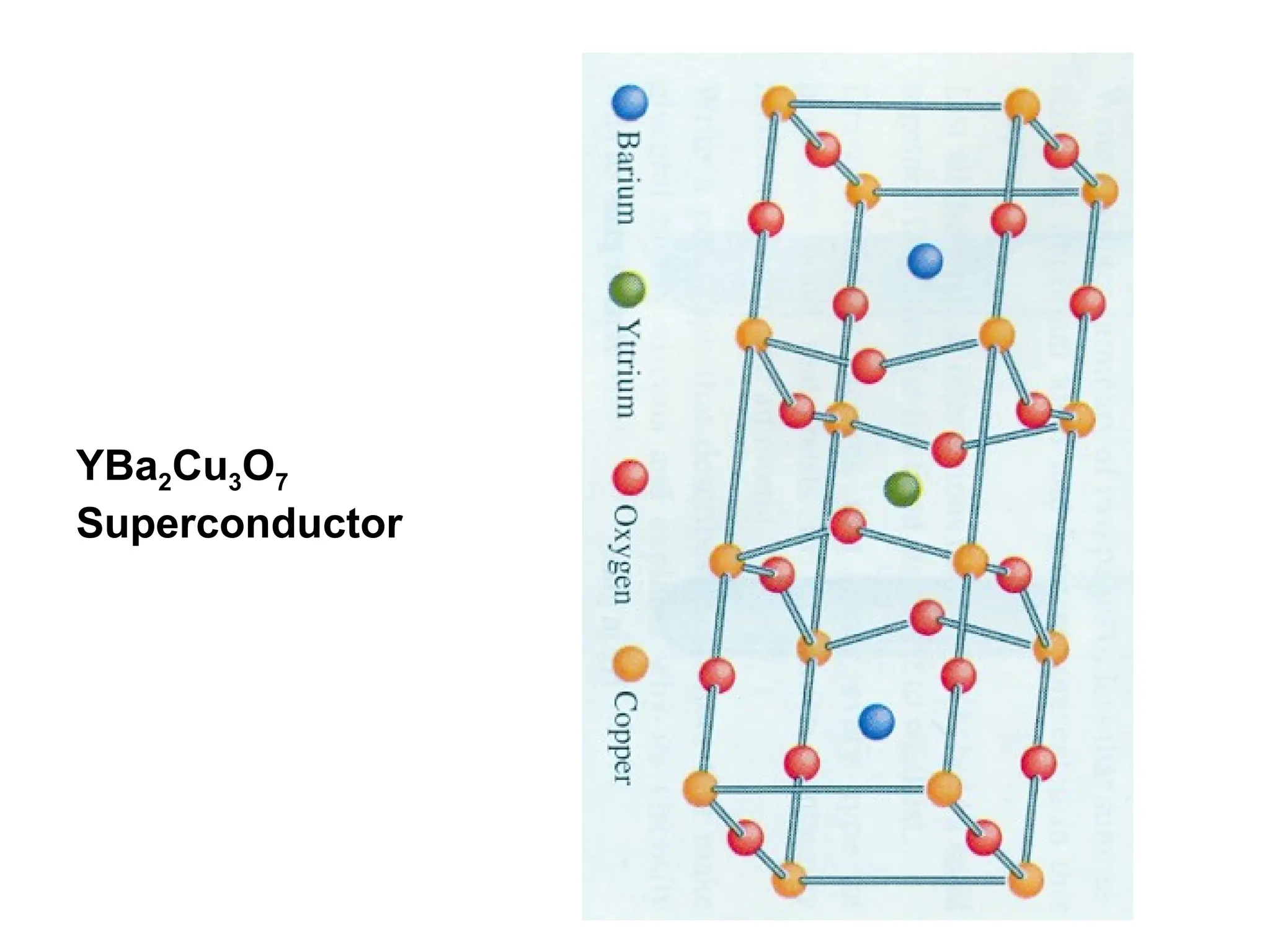
YBa2Cu3O7
Superconductor
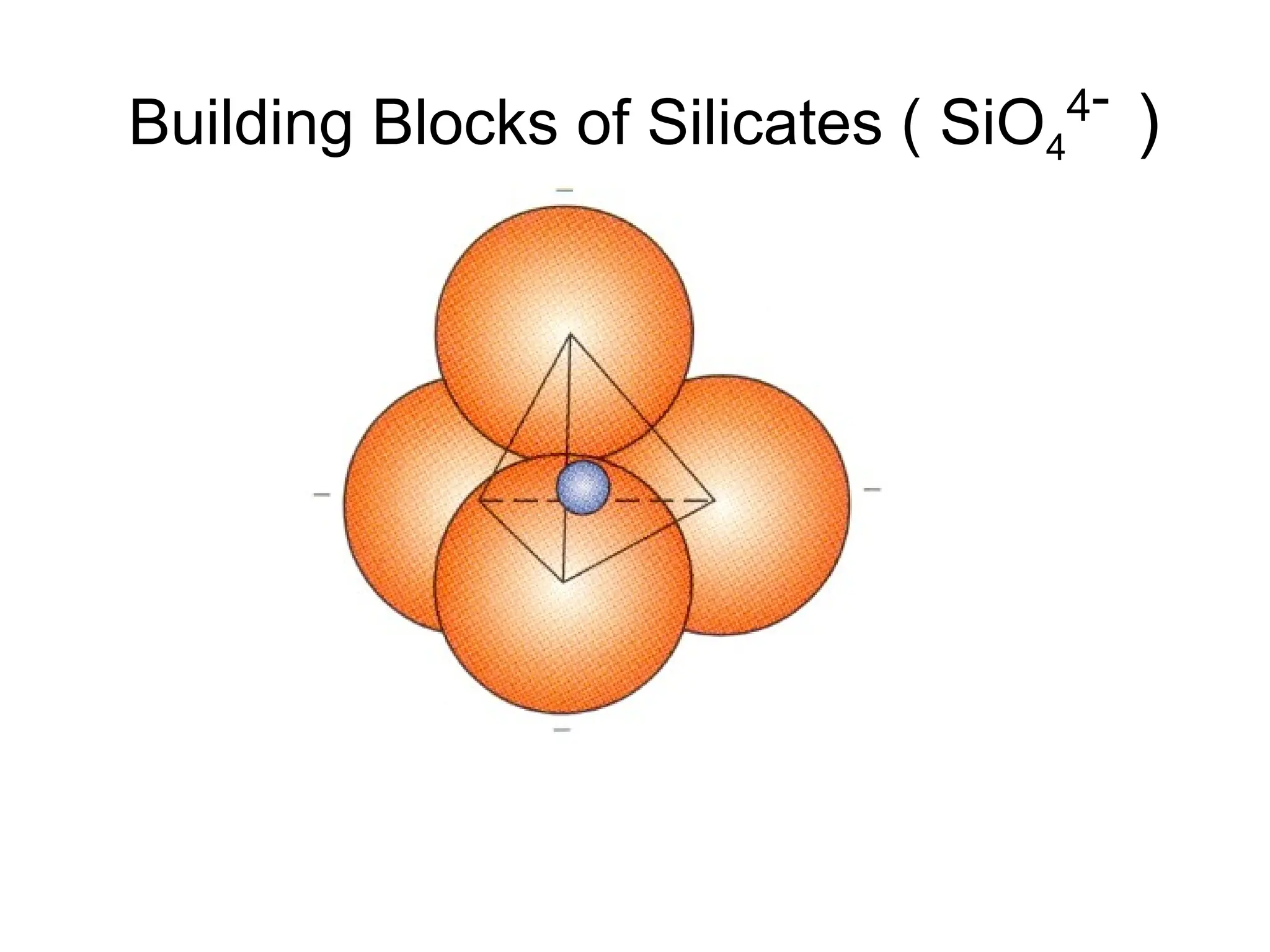
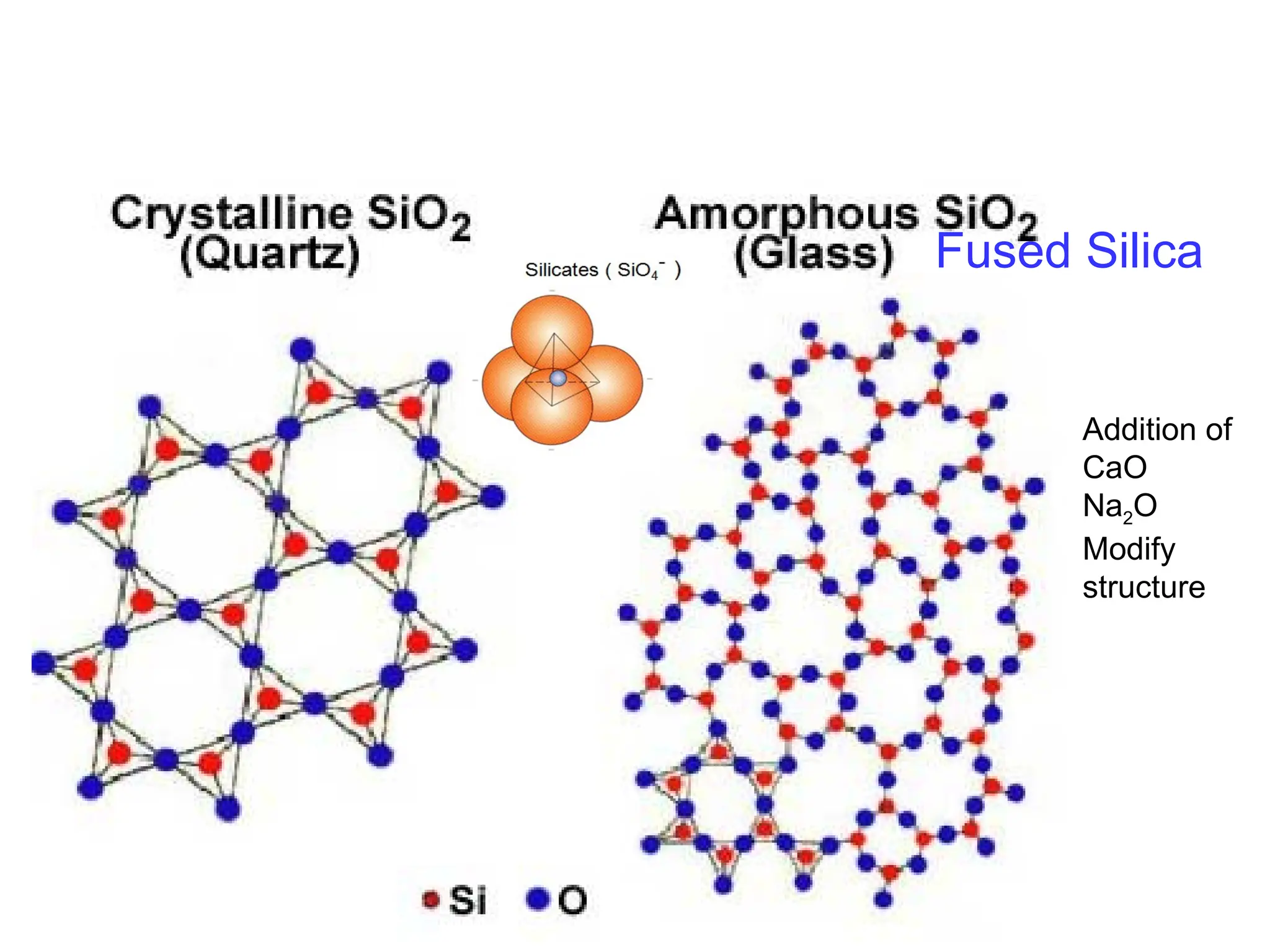
Building Blocks of Silicates ( SiO4
4-
)
Fused Silica
Addition of
CaO
Na2O
Modify
structure
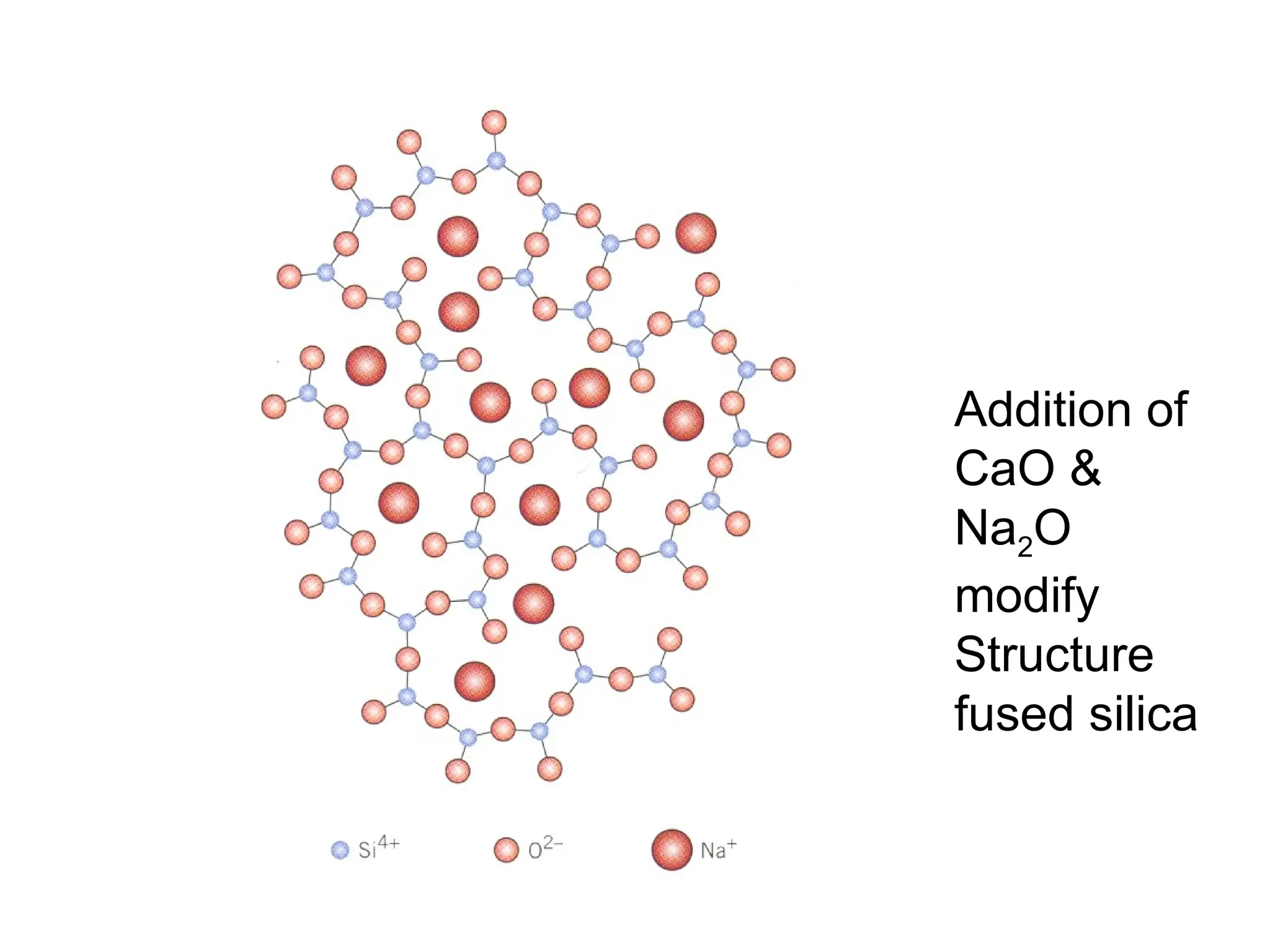
Addition of
CaO &
Na2O
modify
Structure
fused silica
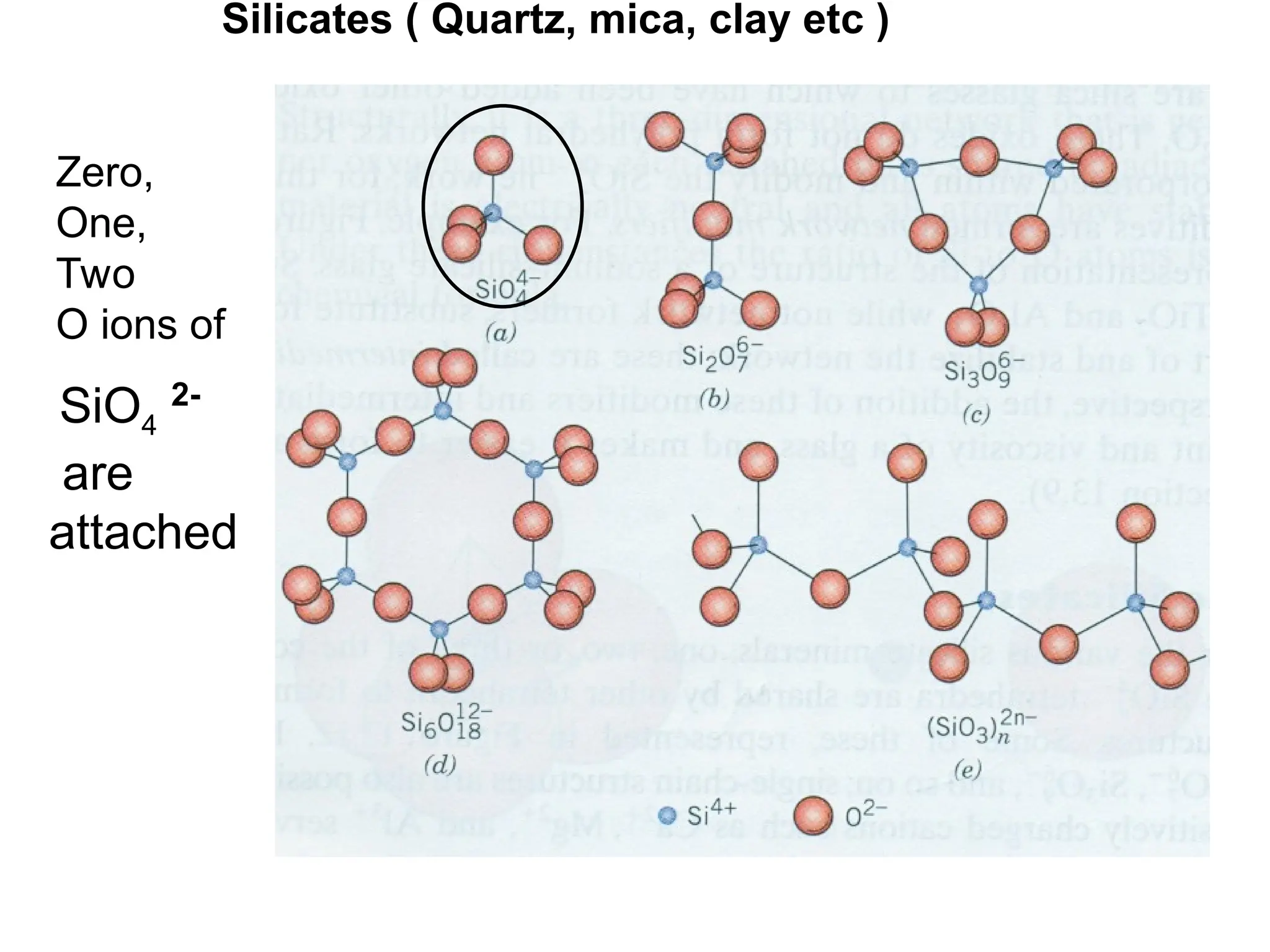
Silicates ( Quartz, mica, clay etc )
Zero,
One,
Two
O ions of
SiO4
2-
are
attached
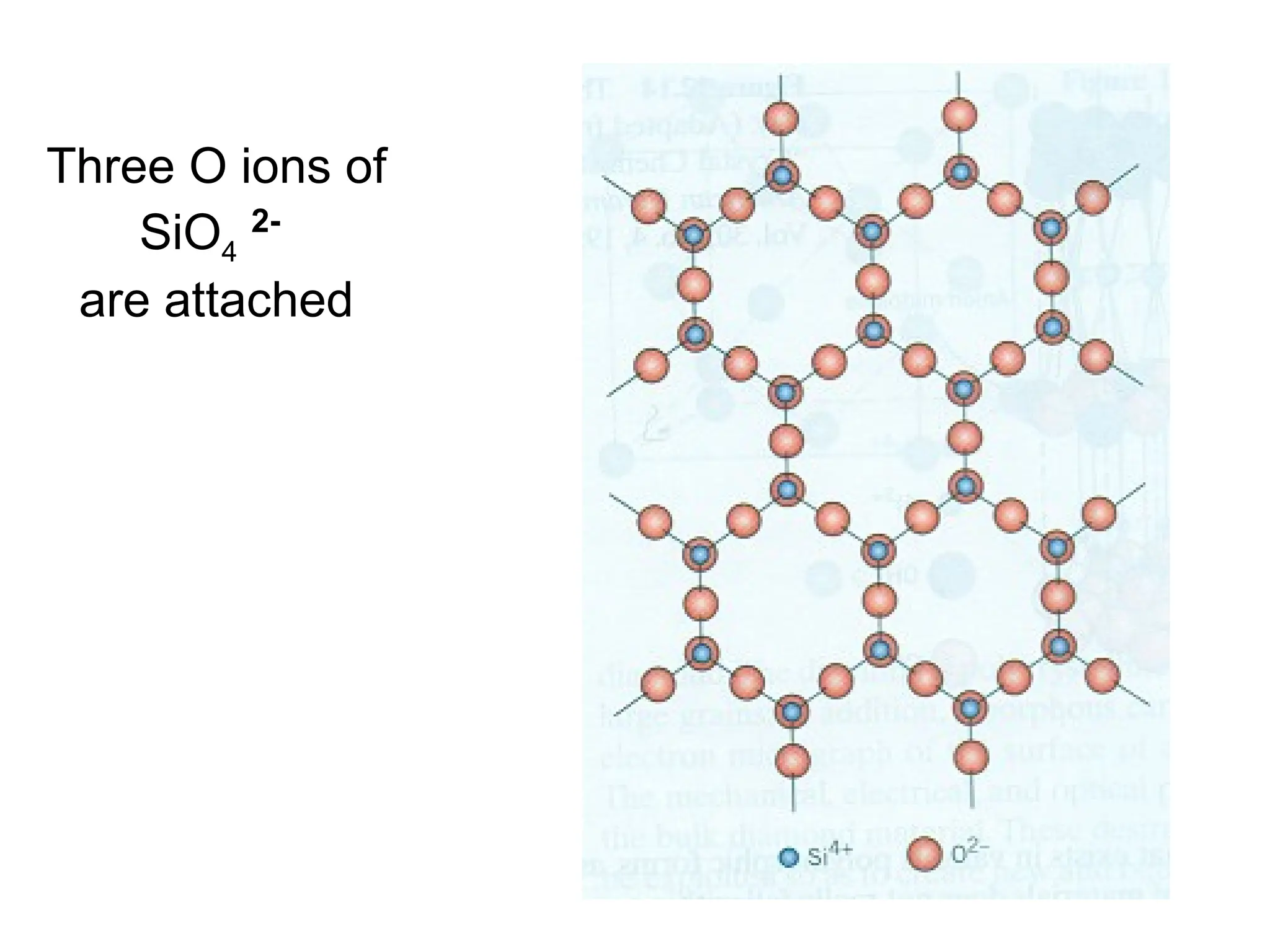
Three O ions of
SiO4
2-
are attached
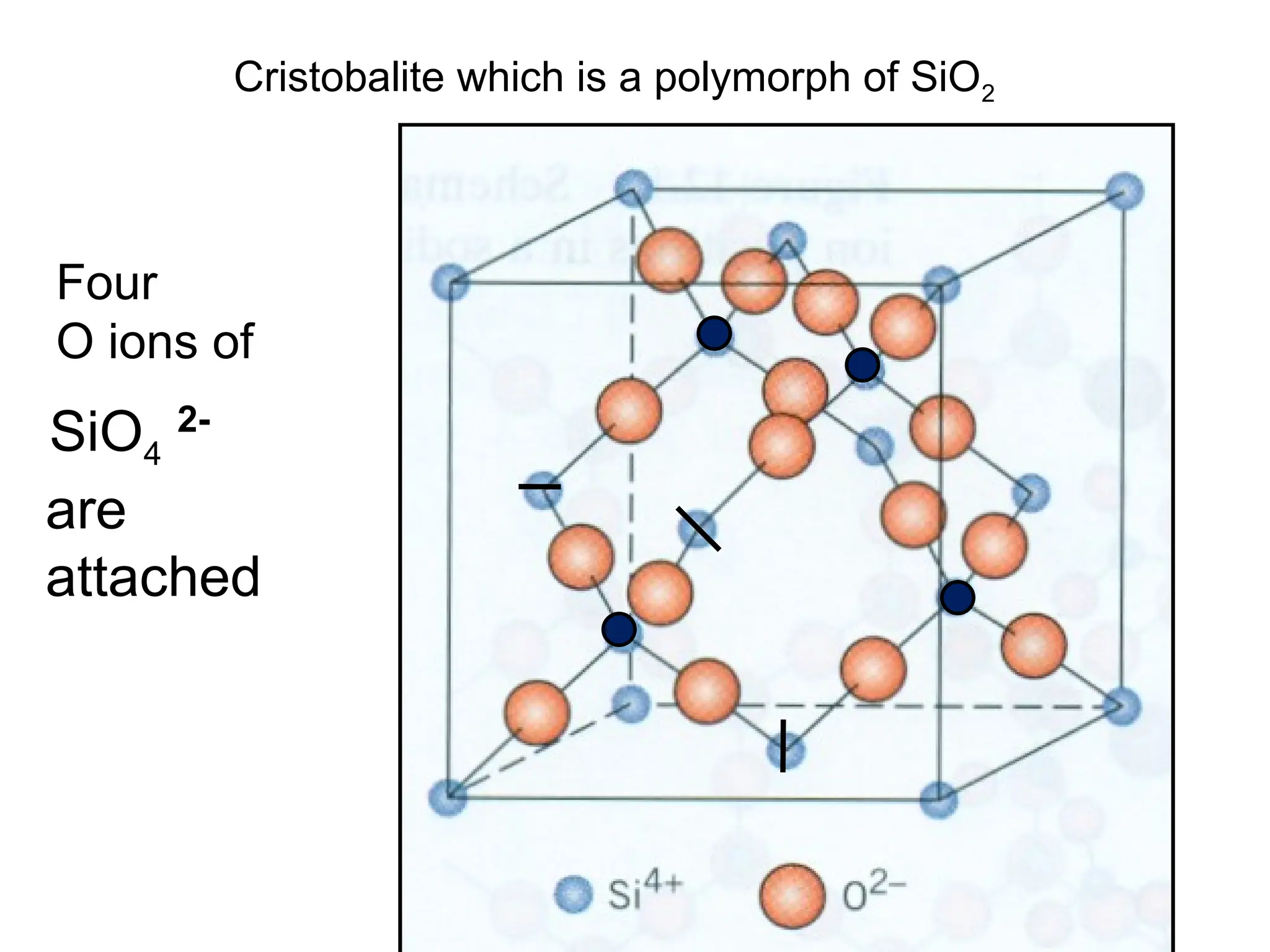
Cristobalite which is a polymorph of SiO2
Four
O ions of
SiO4
2-
are
attached
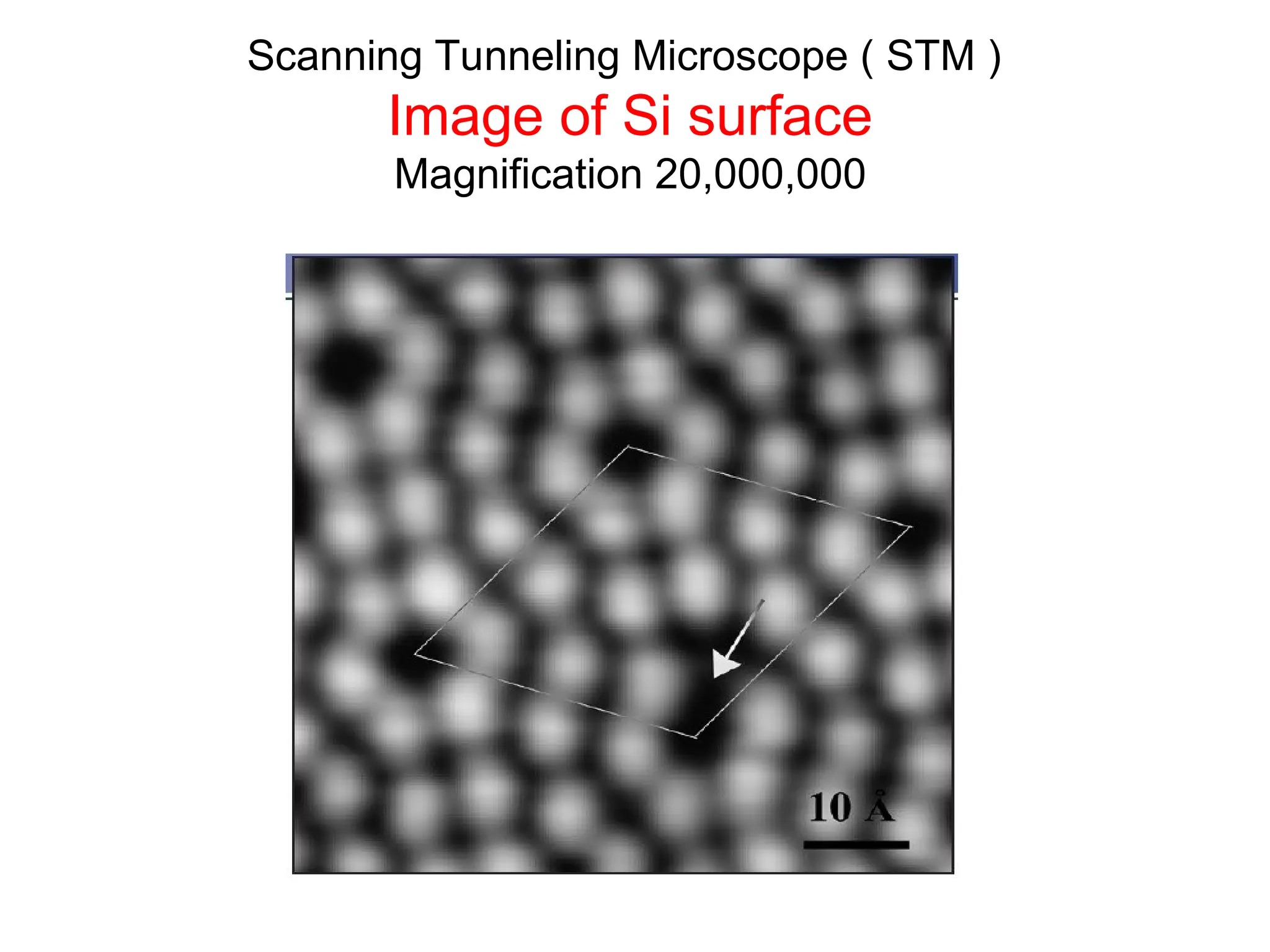
Scanning Tunneling Microscope ( STM )
Image of Si surface
Magnification 20,000,000
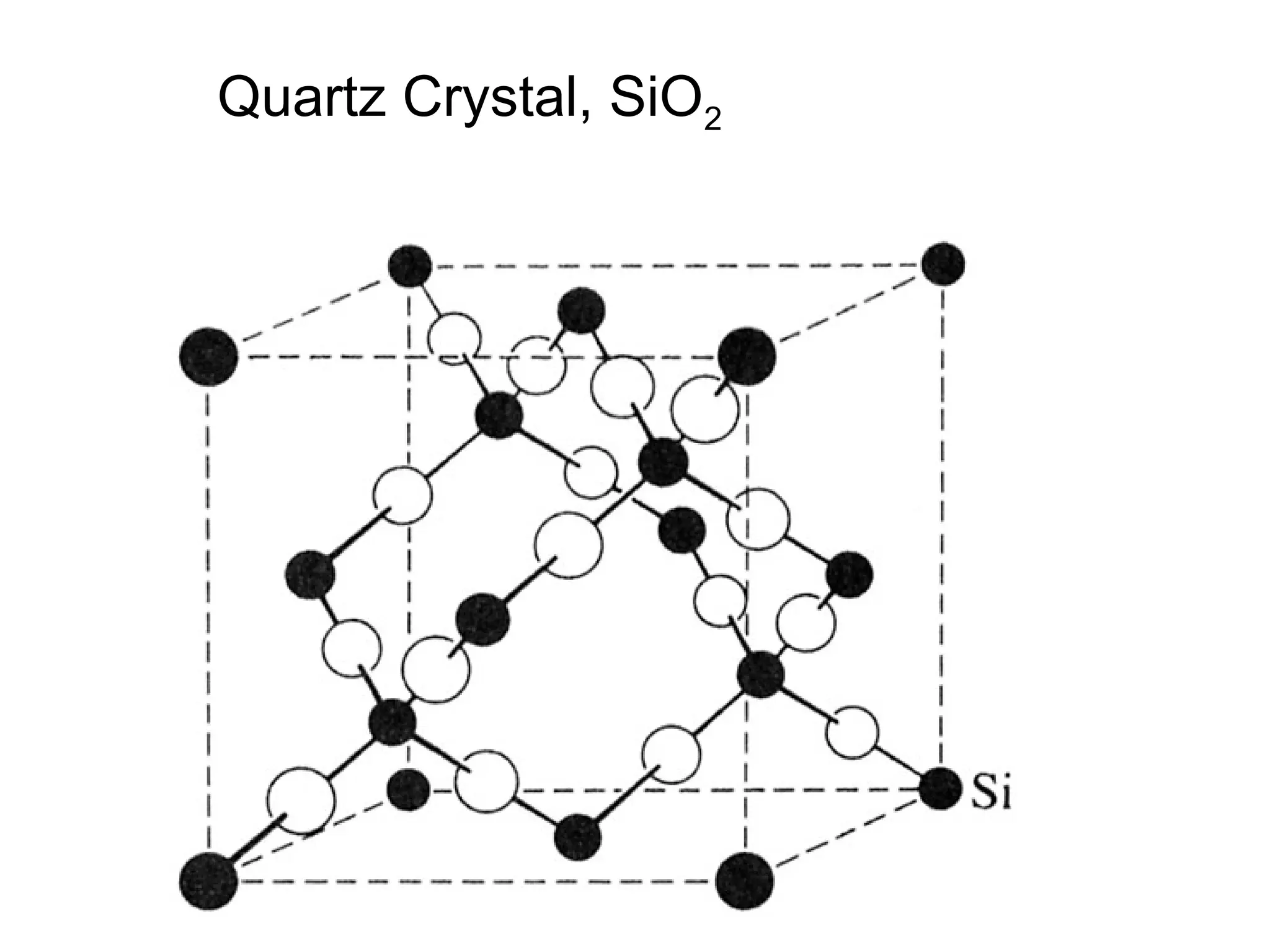
Quartz Crystal, SiO2
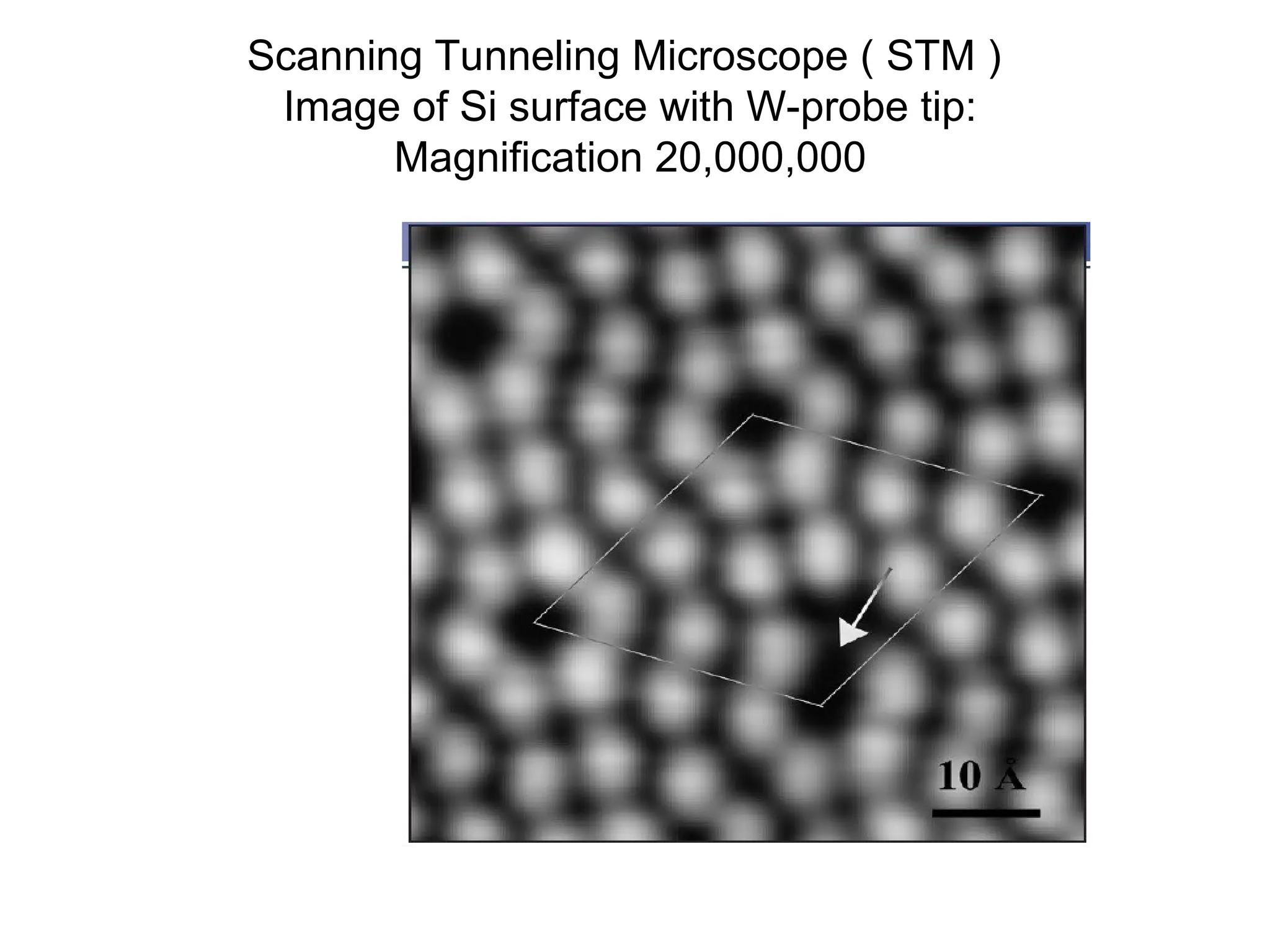
Scanning Tunneling Microscope ( STM )
Image of Si surface with W-probe tip:
Magnification 20,000,000
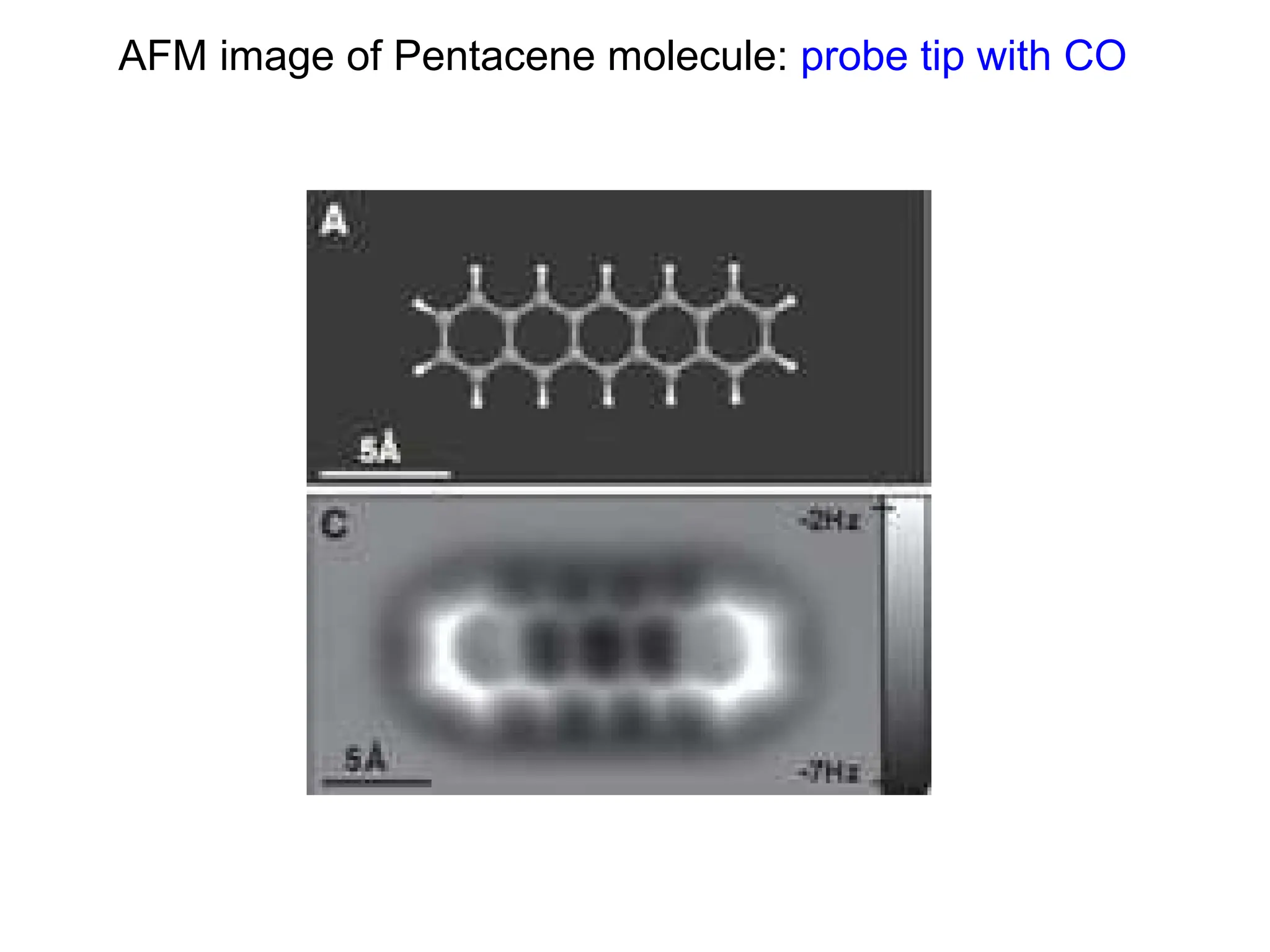
AFM image of Pentacene molecule: probe tip with CO
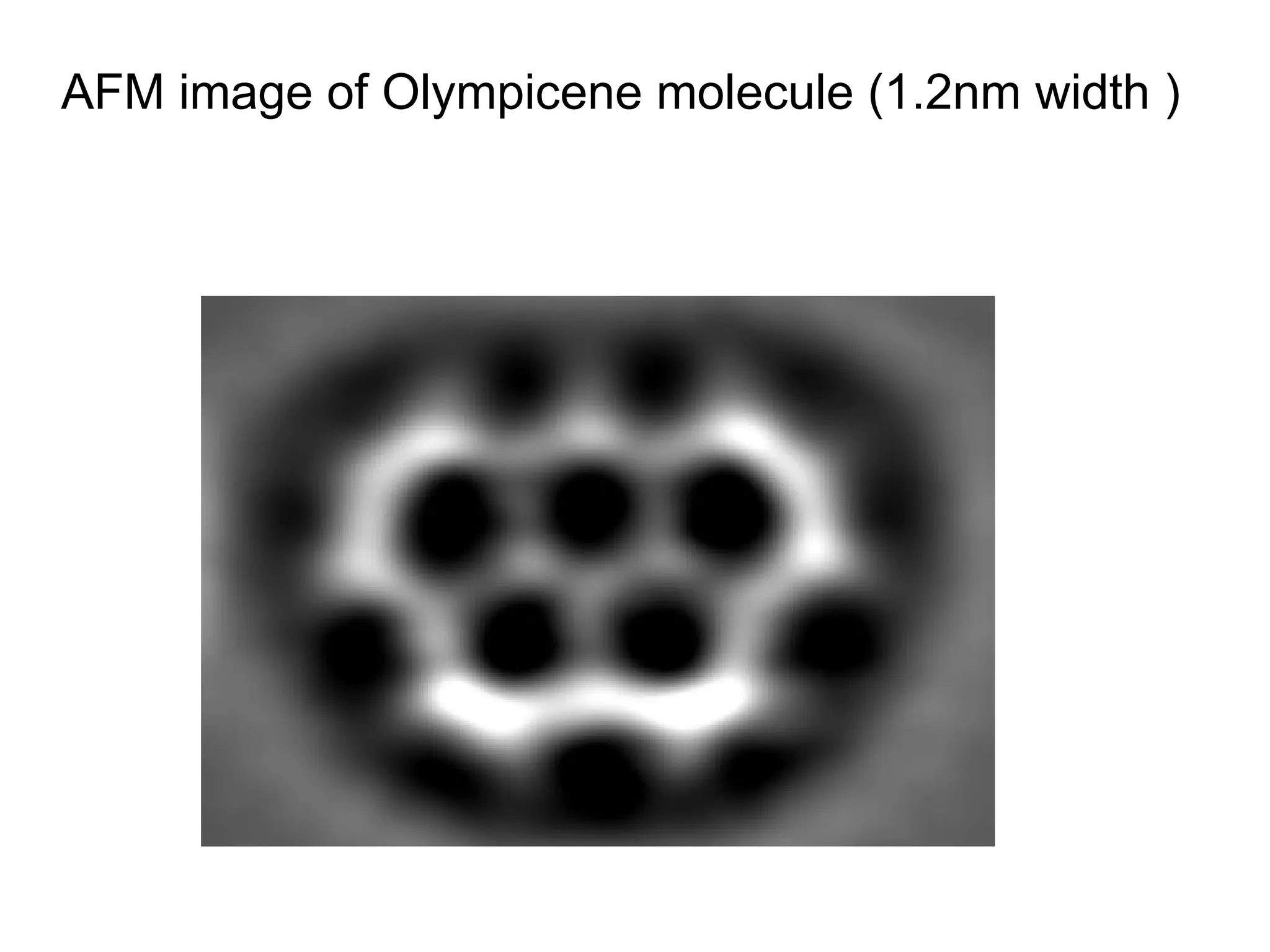
AFM image of Olympicene molecule (1.2nm width )
Perovskite CaTiO3
Piezoelectric
crystal
Atoms’ positions
0,0,0
1/2, 1/2, 1/2
1/2, 1/2, 0
1/2, 0, 1/2
0, 1/2, 1/2
Ca Ti
O
YBa2Cu3O7
Superconductor
Single crystals, polycrystalline, amorphous materials
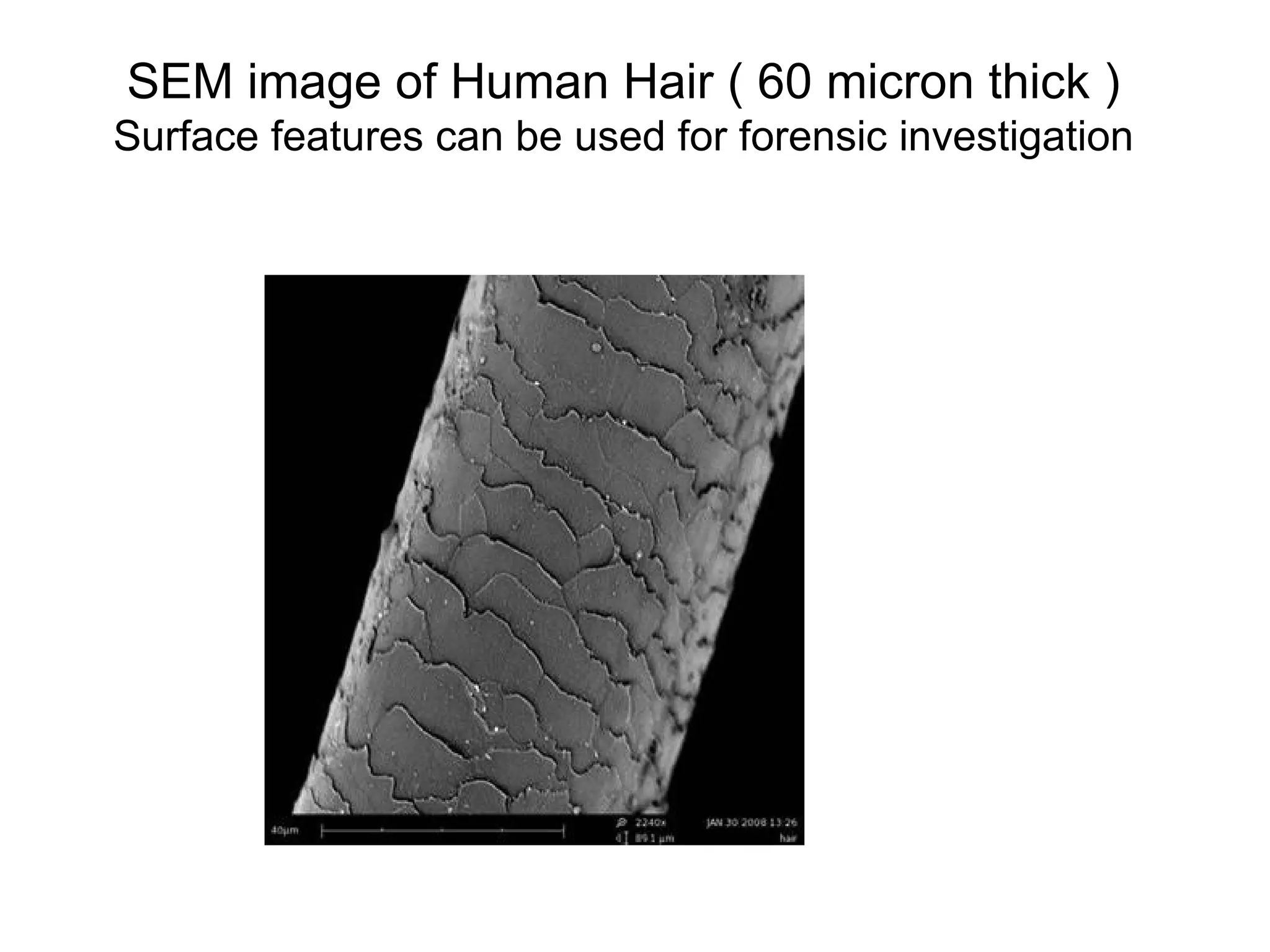
SEM image of Human Hair ( 60 micron thick )
Surface features can be used for forensic investigation
AFM image of double stranded DNA molecule, 2009
Ch. 1, 2, 3-Spr 19 Material engineering.ppt

Ch. 1, 2, 3-Spr 19 Material engineering.ppt

  • 1.
    MM102: Introduction toEngineering Materials. Spring Semester 2019 Course Instructors: Dr. Shanza Rehan, Eng. Ali Afraz & Dr. Fida Mohammad 1. Text Book: Materials Science and Engineering: An Introduction Callister and Rethwisch. 9th Edition, 2014 2.Reference: Foundation of Materials Science and Engineering, Smith & Hashemi. 4th Edition 2006 Chapter 1 for self study Chapter 2: Two Lect.: Grading policy & Introduction Chapter 3: Eight Lect. Crystal structure Chapter 4: Five Lect Crystals are imperfect Chapter 5: Four Lect Diffusion in solids Chapter 6. Four Lect. Mechanical properties of metals Chapter 7: Four Dislocations and strengthening Chapter 8. Three Lect. Failure of metals Chapter 9: Seven Lect Phase diagrams (Sect 9.13, to 9.17 are not included) Chapter 10: not included Chapter 11: Not included Application and processing of metals Chapter 12: Three Lect. Ceramics [ Note: Section 12.9 is not included ] Chapter 13: Not included Application/processing of ceramics Chapter 14. Three Lect Structure of polymers Chapter 15: Not included Characterization of polymers Chapter 16. Two Lect. Composites Total = 45 Lectures
  • 3.
    Grading Policy /Requirements 1. Mid: 30 % 2. Final 42 % 3. Six Quizzes each carrying 4 points i.e 24 % 4. Two Assignments each carrying 2 points i.e 4 % You are required to: Buy a copy of the text book either 2nd hand or new Have 80 % attendance. Absence justified in writing Come within the first five minutes of the class Not to sleep, talk, or make disturbance in the class Note down your own attendance Not to proxy for any one Understand problems either solved in the book or solved on CD Explore CD for additional help ( Animation etc ) Understand and Practice drawing charts, graphs, diagrams Derive mathematical expressions Be precise, to the point, brief, explicit in examination Use dimensions and units READ LEARNING OBJECTIVES WRITTEN IN THE Book You can contact us for help from 8 am to 5 pm daily on working days
  • 4.
    How to missC- and below→☺ Start from today: ►Read the book ► Practice writing what you read ►Ask questions in and outside the class ►Tell others what you think you know (Discus)
  • 5.
    Materials & lifestyle Makea list of materials which were MM102 develops your skills and knowledge for the production and manipulating of materials so that the properties of materials can be improved Available to ancient people for use
  • 6.
    Low Carbon Steels (99.75wt% Iron + 0.25wt% Carbon ) Important considerations: 1.Iron available abundantly from earth crust (7%) 2. Iron deforms easily compared to glass or stone 3. Iron is Tougher than Stone, glass, china ware 4. Machine-able compared to what? 5. Weld-able easily (compared to what?) 7. Do you know of an undesirable property of Iron? Which properties of materials are useful for improving our life style?
  • 7.
  • 8.
    Materials Science AndEngineering deal with: Mechanical; Thermal; Electrical; Magnetic; Optical; Chemical Properties. Give examples of each type For this purpose knowledge of: Chemistry, Physics, Mechanics, English, Math along with experience + Imagination Is required History: Stone, Bronze, Iron, Polymer, Si, Li. What next? Note: Nanotechnology is emerging Materials: Metals/Alloys; Ceramics; Polymers; Composites
  • 9.
    How do materialsrespond when they are subjected to: ► mechanical forces ►electrical fields ►magnetic fields ►optical fields ►temperature gradients ►corrosive (chemical) environments We design materials such that they behave according to our needs and wishes
  • 10.
    Materials and theirproperties Electrical (conductors, insulators, semiconductors) material Magnetic (diamagnetic, paramagnetic) Optical (LCD, optical fibers, night vision camera) Thermal (Conductor, Insulators, Refractory) Chemical (toxic, corrosive, medicinal, pollutant, inert, biodegradable) Mechanical (light, heavy strong, tough, ductile melleable ) Cost Biological (self-replicating, specific ) Radioactivity
  • 11.
    Optical performance ofsolid Al2O3 as a result of processing Single crystal Pores and numerous Small crystals What?
  • 12.
    Four components ofthe discipline of Materials Science and Engineering Metals, Ceramics, Polymers, Composites ( society demands )
  • 13.
    142 pm &341 pm
  • 14.
    Define structure andProcessing ? 1. Structure of atom 2. Structure of molecule 3. Structure of crystal (Diamond, Graphite, Graphene, CNT, Buckyballs) 4. Microscopic and Macroscopic structure
  • 15.
  • 16.
    Interaction between atoms,ions, molecules And physical states of matter
  • 19.
    Forces between atoms Forcesbetween molecules 1.Covalent bonds 2.Ionic bonds 3.Partial covalent bonds 4.Metallic bonds 5.Hydrogen bonds 6.Van der Waal Bonds / dispersion forces Physical states & influence of temperature / pressure on them Certain bonds behave as vectors, others as scalars Kinetic and Potential energies
  • 21.
  • 22.
  • 23.
    In addition tosize and mass, shape of molecules also matters in interaction between molecules CH3-CH2-CH2-CH2-CH3 CH3-C-CH3 CH3 CH3 CH3-C- CH3 CH3 CH3
  • 25.
    In this coursewe will focus on solids only Specifically Crystalline Solids
  • 27.
    X Y Z (six of them:three angles and three sides ) Crystalline & Amorphous solids
  • 29.
    How to locate: Inunit cubic cell points, directions planes
  • 30.
  • 31.
    Generalized coordinates q,r, s & side lengths a, b, c of unit cell. Distance along x = q.a along y = r.b along z = s.c
  • 32.
    Locate the point q=¼ r=1 s=½ in the unit cell at the left Along X→ q . a= 1/4 x 0.48 Along Y→ r . b= 1 x 0.46 Along Z→ s .c = 1/2 x 0.40
  • 33.
    Locate atoms (points) in the BCC unit cell
  • 35.
    Crystallographic Directions ( vectors) The vector is positioned such that it starts from the origin ( if it already doesn’t ) Use square brackets only
  • 36.
    Crystallographic Directions 1. Positionvector through the origin ( translate if necessary ) 2. Measure its projections along x, y, z & divide by a, b, c 3. Convert values from step 2 into smallest whole numbers 4. Write whole numbers from step 3 as [uvw]
  • 37.
    Note: Hexagonal crystalsare not in course
  • 38.
    For cubic Crystals: EquivalentDirections are defined [100], [100], [010], [010], [001], [001] are all equivalent directions because atoms are spaced in the same way. We write set of equivalent directions as: ‹100› [123] & [213] → same indices without regard for sign or order are also equivalent
  • 39.
    Note: eight cubesshare the atom inside the rectangle
  • 41.
    Show that Ais [3 3 1], B is [4 0 3], C is [3 6 1] and D is [1 1 1]
  • 45.
    Plane not passingthrough the origin Plane passing through the origin
  • 46.
    Crystallographic planes anddetermination of Millar Indices 1. If the plane passes through the origin: shift the plane or origin 2. Find intercepts in terms of a, b, c ( plane cuts or contains an axis ) 3. Take reciprocal of intercepts 4. Change intercepts into smallest whole numbers, if necessary 5. Write them as: (hkl)
  • 49.
    You cannot distinguish2nd order diffraction from 100 plane from 1st order diffraction from 200 plane
  • 55.
  • 56.
    Equivalent Planes: Incubic crystals (111), (111), (111), (111) , (111), (111), (111), (111) are all equivalent in the sense that they have the same atomic arrangement on them: set {111}
  • 57.
  • 58.
    Tin transform fromone crystal from to another undergoing 27 % volume change
  • 59.
  • 60.
    Most common crystalstructures for Metals Simple Cubic ( Primitive) Body-centered cubic ( BCC ) Face-centered-cubic ( FCC ) Hexagonal Close-packed ( HCP ) HCP Cubic
  • 61.
    Hexagonal Close Packed( HCP ) formed from ABABAB…stacking
  • 64.
    Four representations ofsimple cubic crystal structure – 1 Corner atoms touch each other along crystal sides How many atoms are packed in unit cell of simple cubic
  • 66.
  • 67.
    Contribution of cornersto no. of atoms in unit cell
  • 69.
    Sharing of atomsby unit cells How many unit cells share an atom: 1. Sitting on a corner of a cube 2. Sitting inside a cube 3. Sitting on a face of a cube 4. Sitting on the edge of a cube
  • 70.
    Suggest a namefor this unit cell of crystal structure - 2 Iron crystal is BCC with side 0.287 nm
  • 71.
    Suggest a namefor this unit cell Crystal structure - 3 How many atoms per unit cell ? X
  • 72.
    Atoms= 1 Polonium C.NO.6 Empty =48% Touch on edge Atoms=2 C.No.8 Iron Empty =32% Touchon body diagonal Atoms=4 C. No12 Empty =26% Touch on face diagonal CCP or FCC Copper crystal Is FCC with Side 0.361 nm
  • 73.
    Coordination no. insimple cubic crystal
  • 74.
  • 75.
    Tin transform fromone crystal from to another undergoing 27 % volume change
  • 76.
    Two dimensional packingof spheres Which packing is closest i.e efficient in terms of Space consumption
  • 78.
    Which closest packing? ABABAB….. Or ABCABCABC….. HCP FCC How to generate HCP and FCC. Coordination No. is 12 in HCP and FCC
  • 79.
  • 80.
  • 81.
  • 82.
    Fourth type ofunit cell Hexagonal close-packed ( HCP ) – 4 Coordination No. ? Corner Faces Inside 6(1/6) + 6(1/6) + 1(1/2) + 1(1/2) + 3
  • 84.
    Metal Crystal StructureAtomic Radius (nm) Aluminum FCC 0.1431 Cadmium HCP 0.1490 Chromium BCC 0.1249 Cobalt HCP 0.1253 Copper FCC 0.1278 Gold FCC 0.1442 Iron (Alpha) BCC 0.1241 Lead FCC 0.1750 Magnesium HCP 0.1599 Molybdenum BCC 0.1363 Nickel FCC 0.1246 Platinum FCC 0.1387 Silver FCC 0.1445 Tantalum BCC 0.1430 Titanium (Alpha) HCP 0.1445 Tungsten BCC 0.1371 Zinc HCP 0.1332
  • 85.
    terms of theatomic radius R
  • 86.
    Compute atomic packingfactor for FCC unit cell This unit contains four atoms
  • 87.
    Experimental = 8.94g / cm3 Watch: you have to write units through out
  • 88.
  • 89.
  • 90.
    Planar Density PD110 =2 atoms / 8R2 √2
  • 91.
    PD110 = (2 atoms/ [(16√2 R2 )/3] Area = Face diagonal x side
  • 93.
  • 94.
    Consider triangle PSQ SQ= PQ sin θ SQ = d sin θ SQ + QT = 2 d sinθ n.λ = 2 d sin θ λ = 2 d sin θ, first order n = 1 We are interested in constructive interference
  • 97.
    X – Raysdiffraction from powdered Lead (FCC) a = 0.4950 nm λ = 0.1542 nm
  • 98.
  • 100.
    •. Octahedral Voids inFCC: 4 One in the middle, three on the edges
  • 101.
    •. Tetrahedral Voids: 8,in single unit cell of FCC
  • 103.
    Ceramic Crystal Structures( AX type ) 1. Mostly compounds between metals and non-metals 2. Bonding either purely ionic or ionic with covalent character Material % ionic character CaF2 89 MgO 73 NaCl 67 Al2O3 63 SiO2 51 SiC 12 Two characteristics influencing crystal structure: 1. Charge balance 2. Ionic sizes i.e radii of cations and anions rC / rA This ratio defines coordination number
  • 104.
    rC / rA C.No Stablecrystal structure results when anions are placed nearest to cations and cations are placed nearest to anions Determine rc / rA ?
  • 105.
    ZnS ( zincBlende ) Tetrahedral & Octahedral voids 1 2 4 3
  • 106.
    1 2 4 23 4 1 2 3 1 3 4 Tetrahedron 1 2 4 3
  • 107.
    •. One octahedral voidis centered at the middle of each of the 12 edges and is shared by four cells. Hence 3 belong to one cell. One in center of FCC Which means a total of 4
  • 109.
  • 110.
    Cation or Anionat the corners of FCC ? FeO NaCl
  • 111.
  • 112.
    0.102 nm 0.181nm ratio = 0.563 Sodium Chloride structure (4 NaCl ) – AX type
  • 114.
  • 117.
    142 pm &341 pm
  • 120.
  • 121.
  • 122.
    Building Blocks ofSilicates ( SiO4 4- )
  • 123.
  • 124.
  • 125.
    Silicates ( Quartz,mica, clay etc ) Zero, One, Two O ions of SiO4 2- are attached
  • 126.
    Three O ionsof SiO4 2- are attached
  • 127.
    Cristobalite which isa polymorph of SiO2 Four O ions of SiO4 2- are attached
  • 129.
    Scanning Tunneling Microscope( STM ) Image of Si surface Magnification 20,000,000
  • 130.
  • 132.
    Scanning Tunneling Microscope( STM ) Image of Si surface with W-probe tip: Magnification 20,000,000
  • 133.
    AFM image ofPentacene molecule: probe tip with CO
  • 134.
    AFM image ofOlympicene molecule (1.2nm width )
  • 138.
    Perovskite CaTiO3 Piezoelectric crystal Atoms’ positions 0,0,0 1/2,1/2, 1/2 1/2, 1/2, 0 1/2, 0, 1/2 0, 1/2, 1/2 Ca Ti O
  • 139.
  • 141.
  • 145.
    SEM image ofHuman Hair ( 60 micron thick ) Surface features can be used for forensic investigation
  • 146.
    AFM image ofdouble stranded DNA molecule, 2009