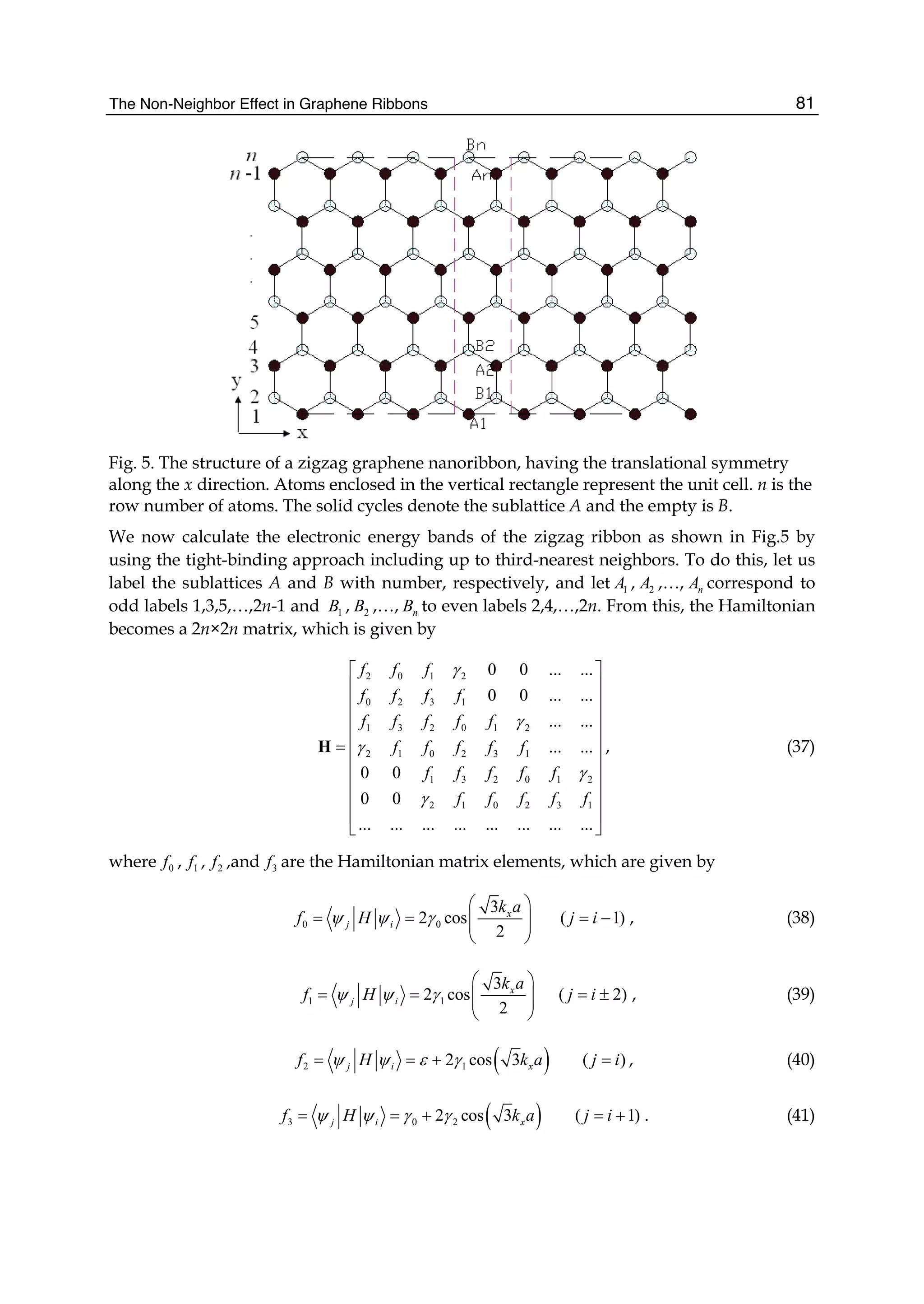
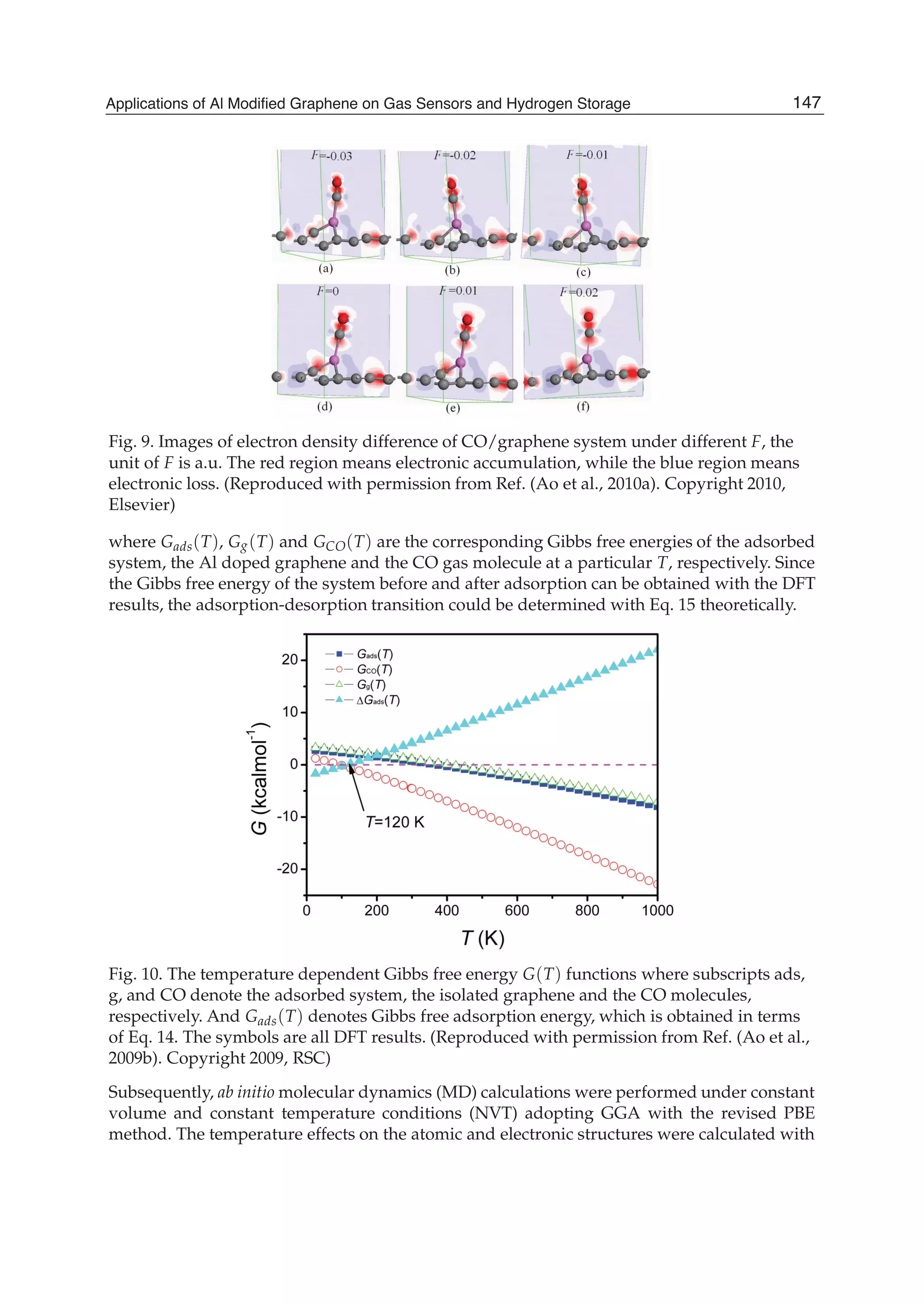
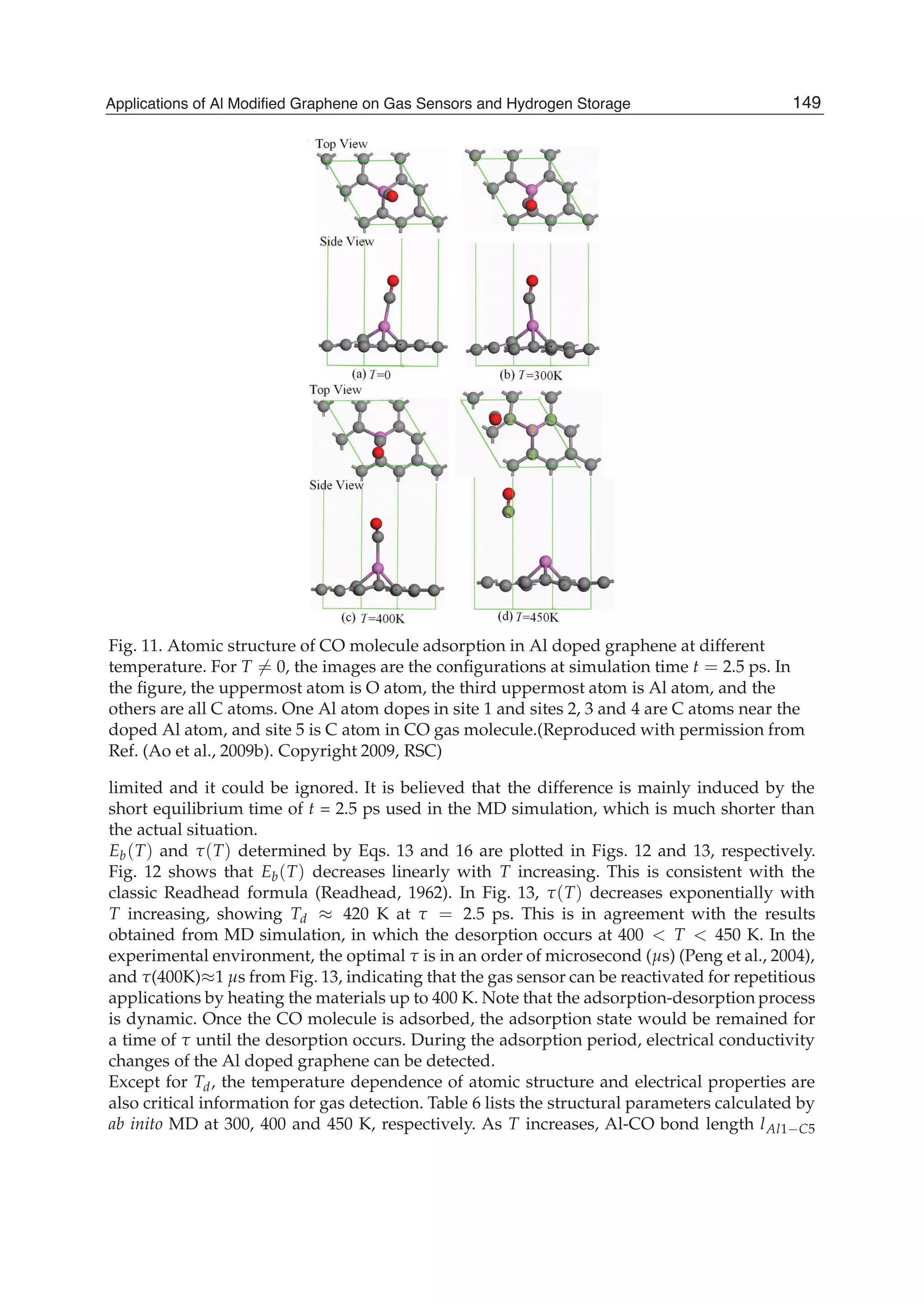
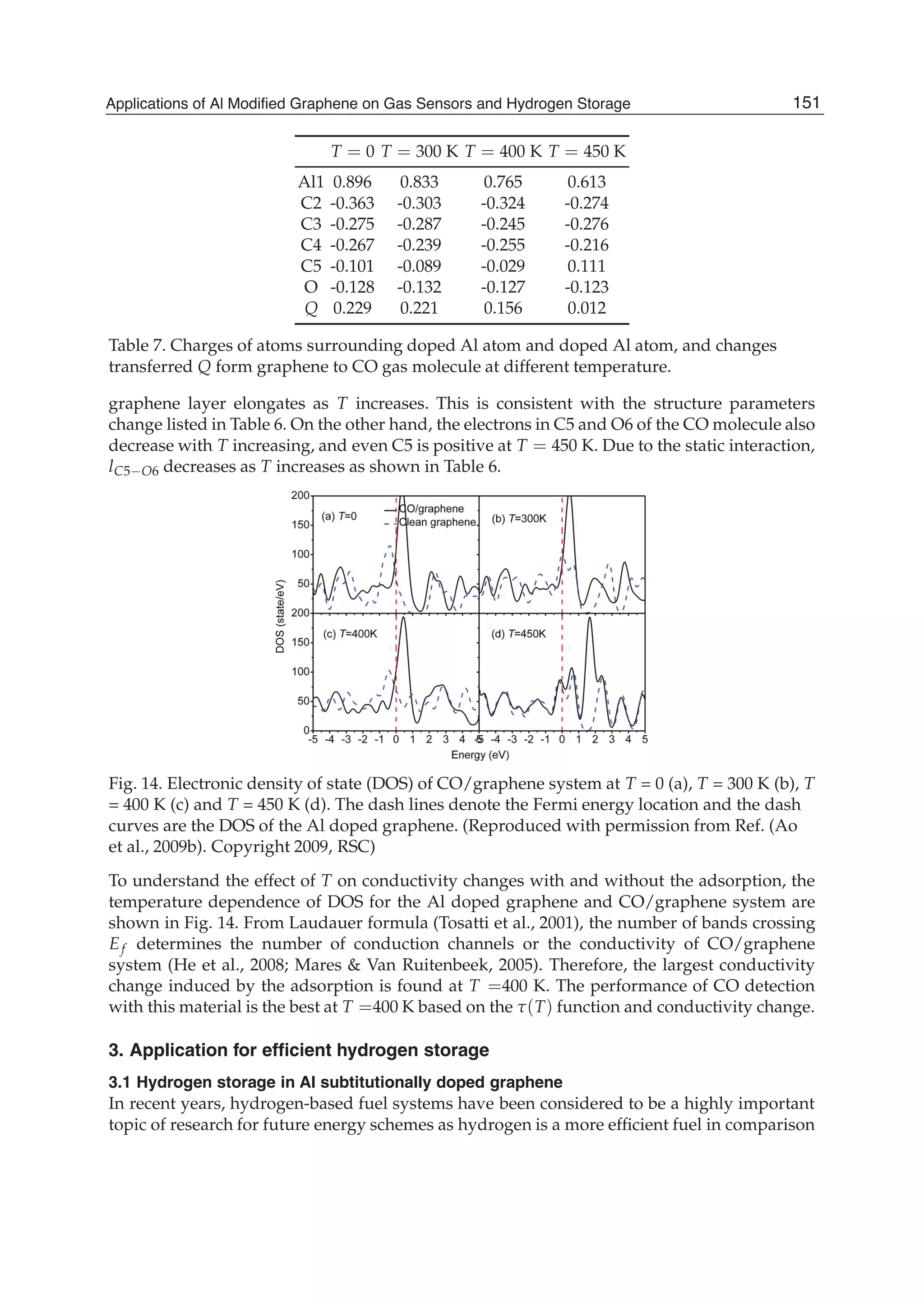
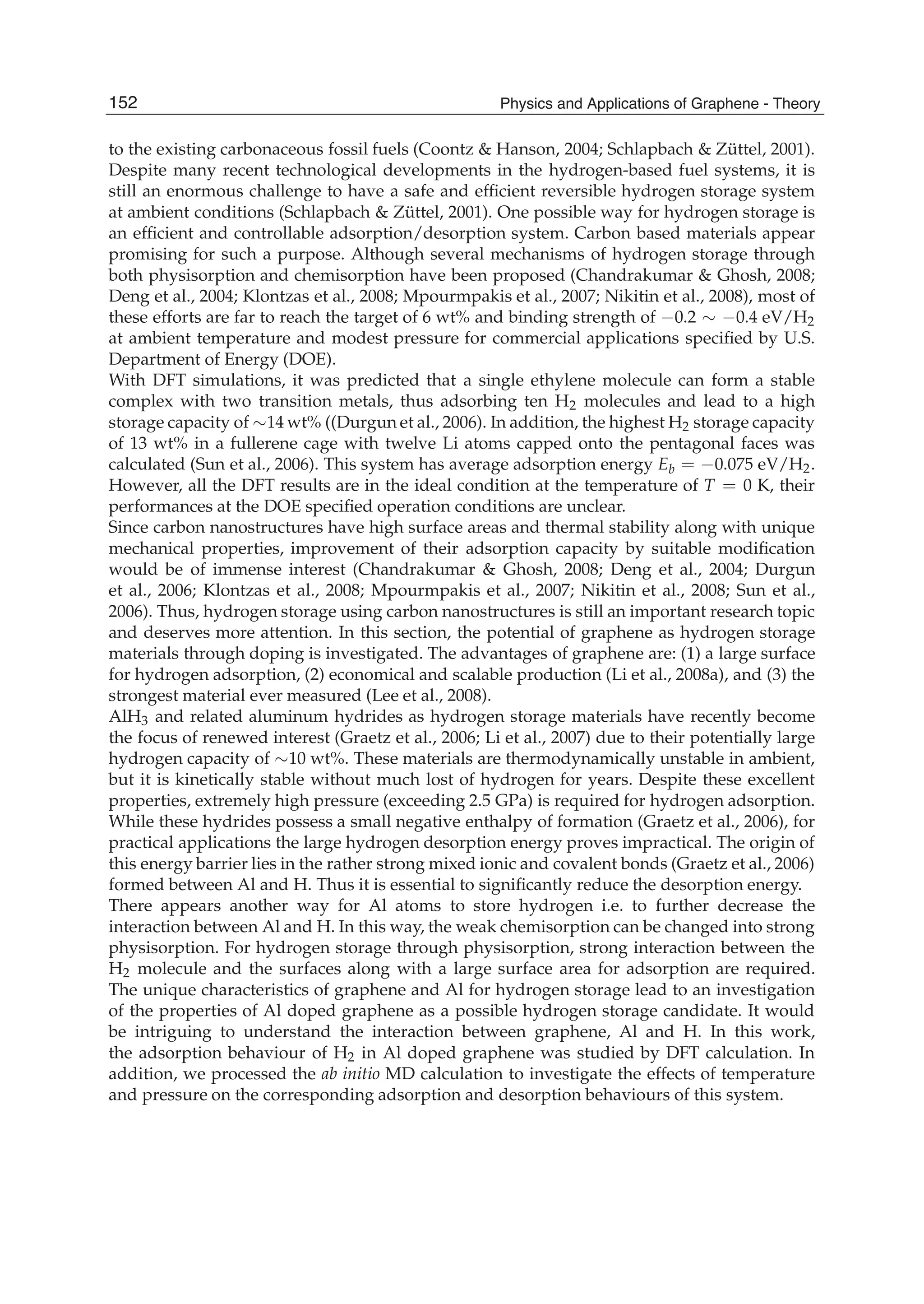
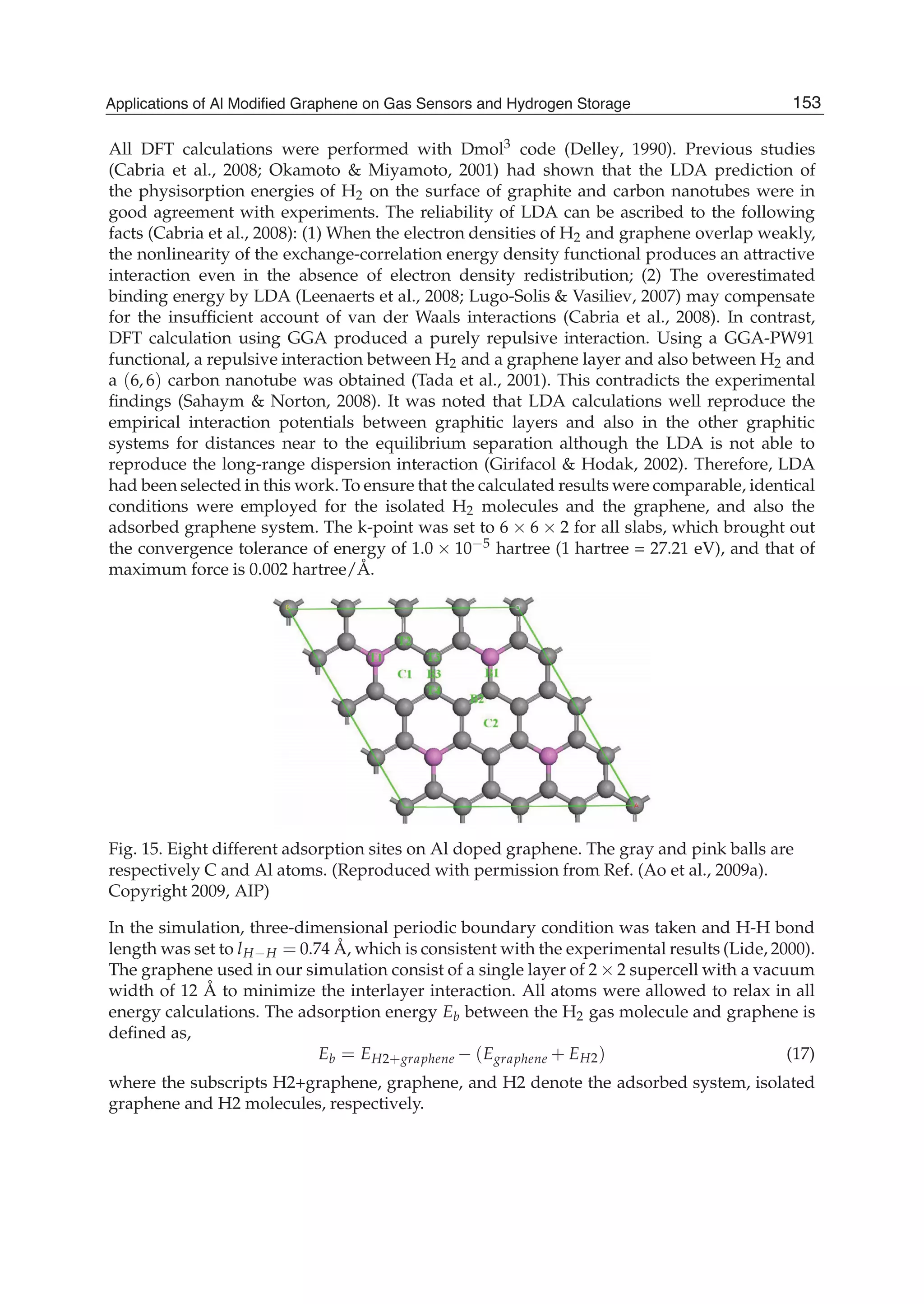
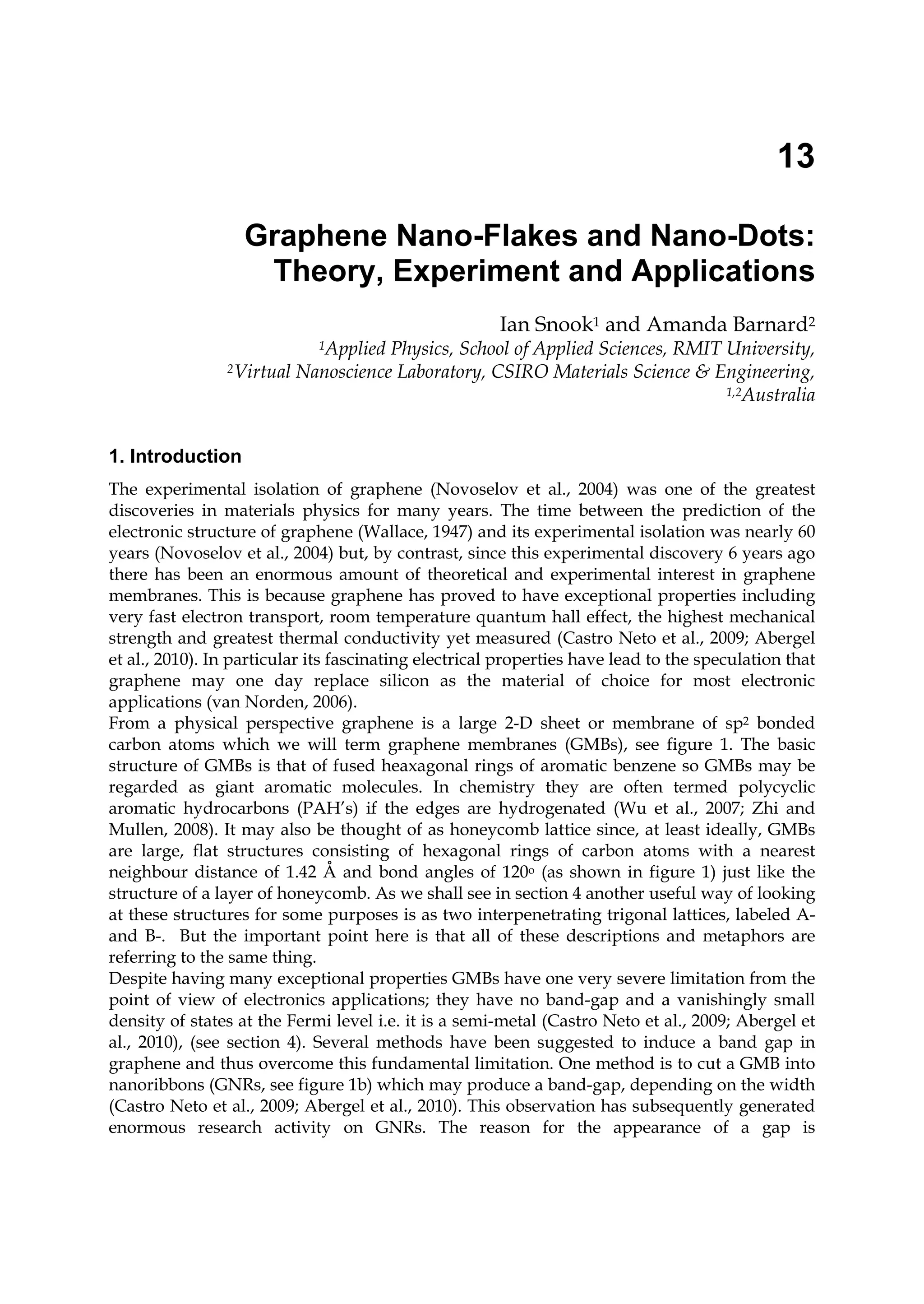
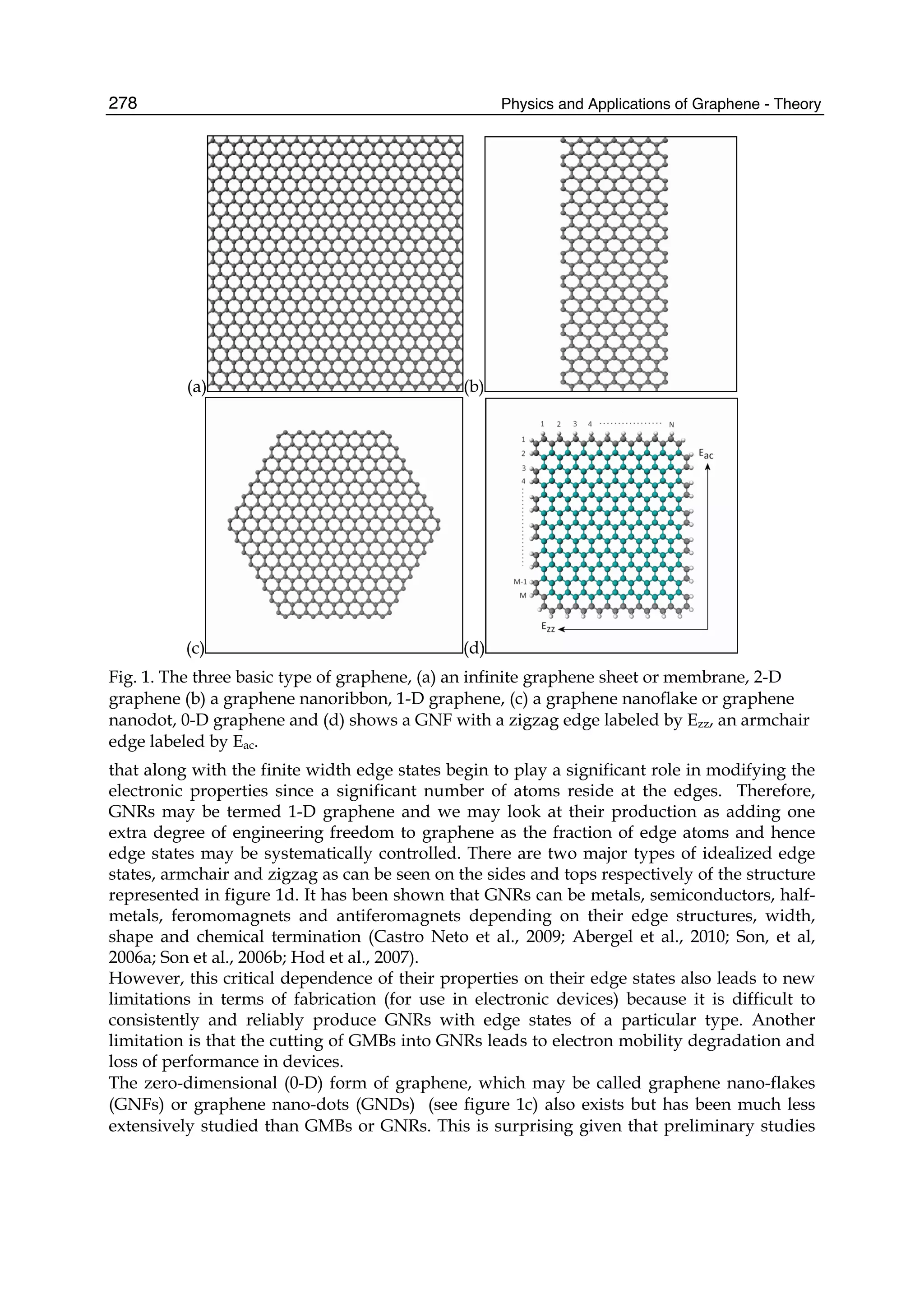
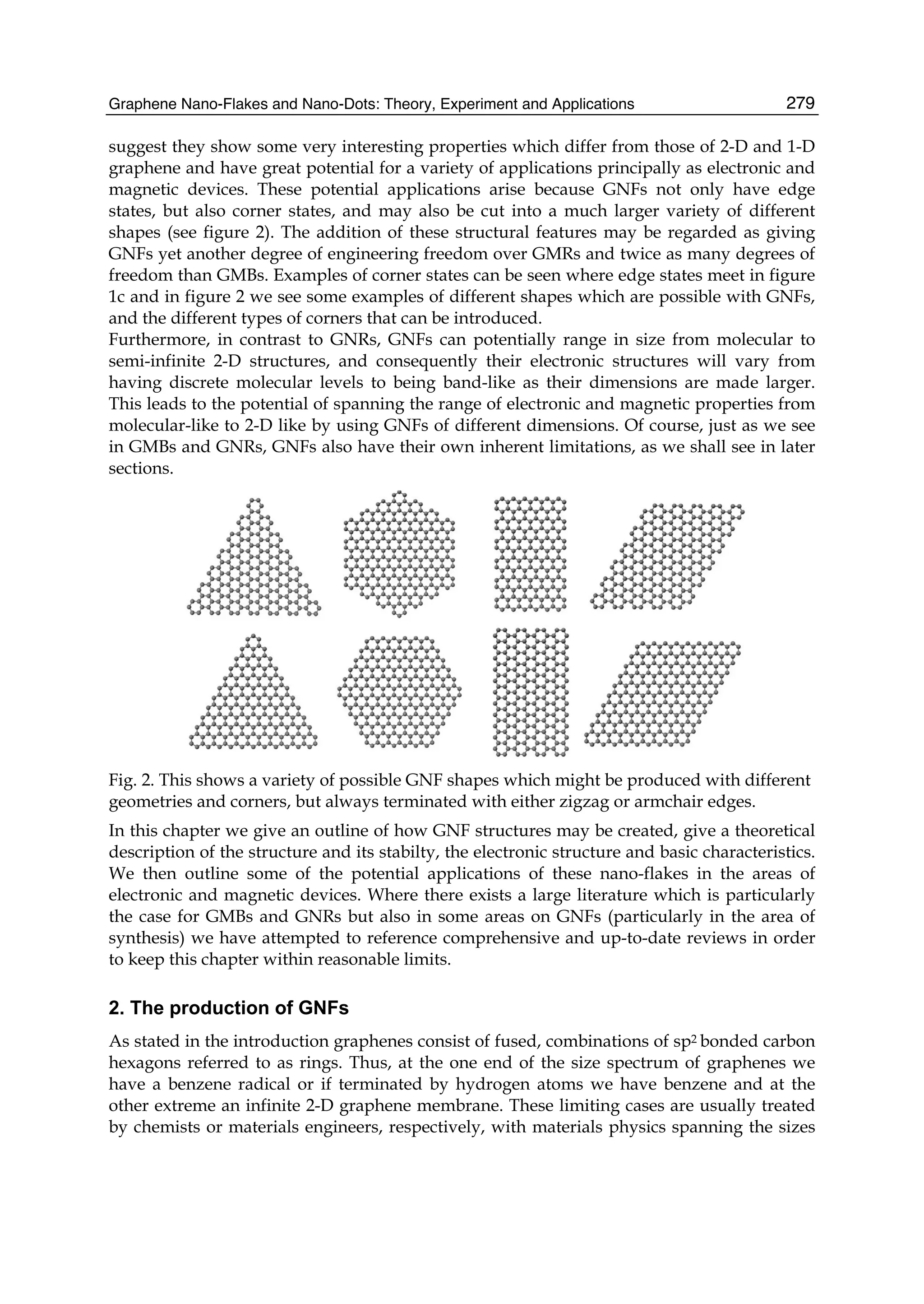
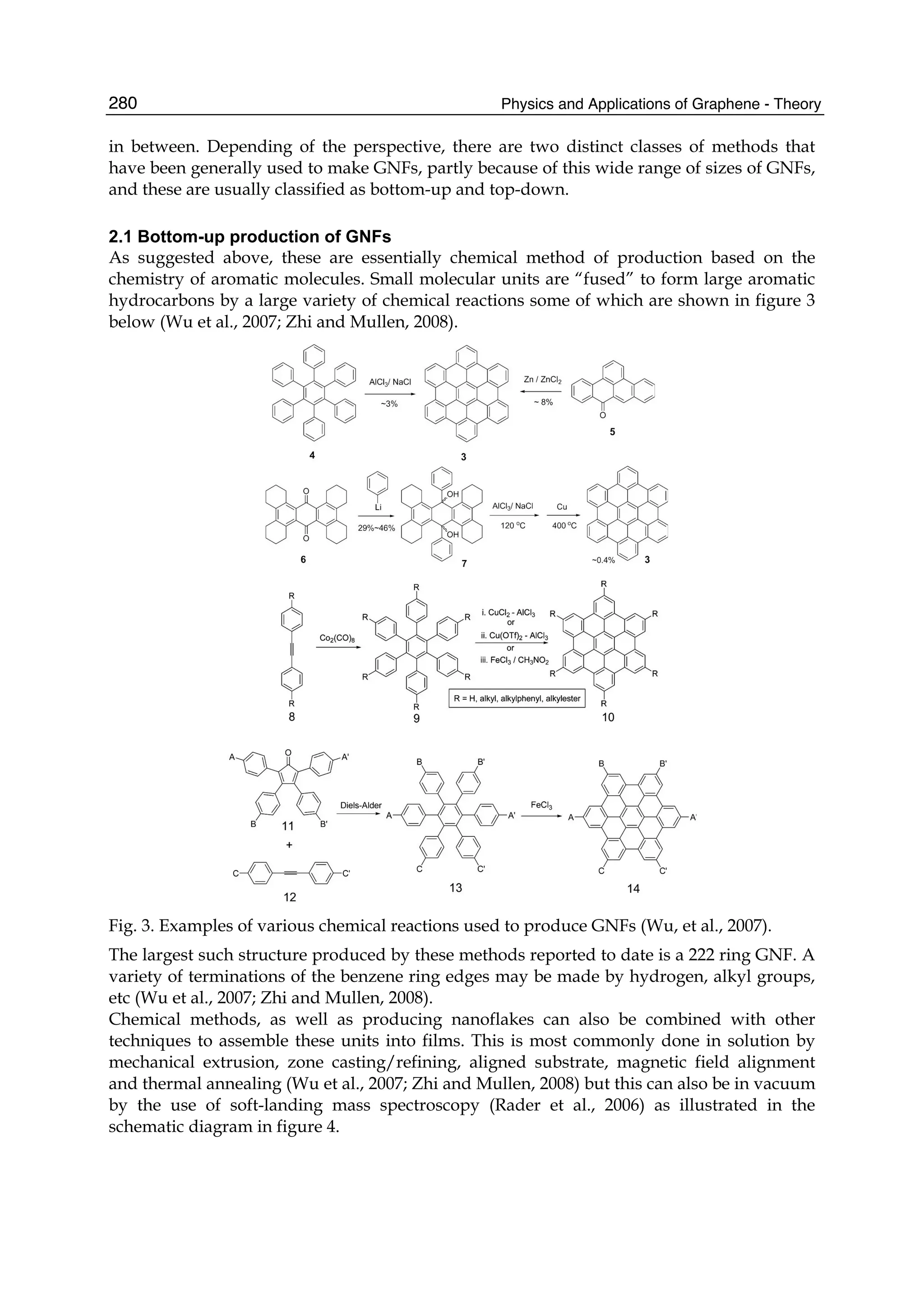
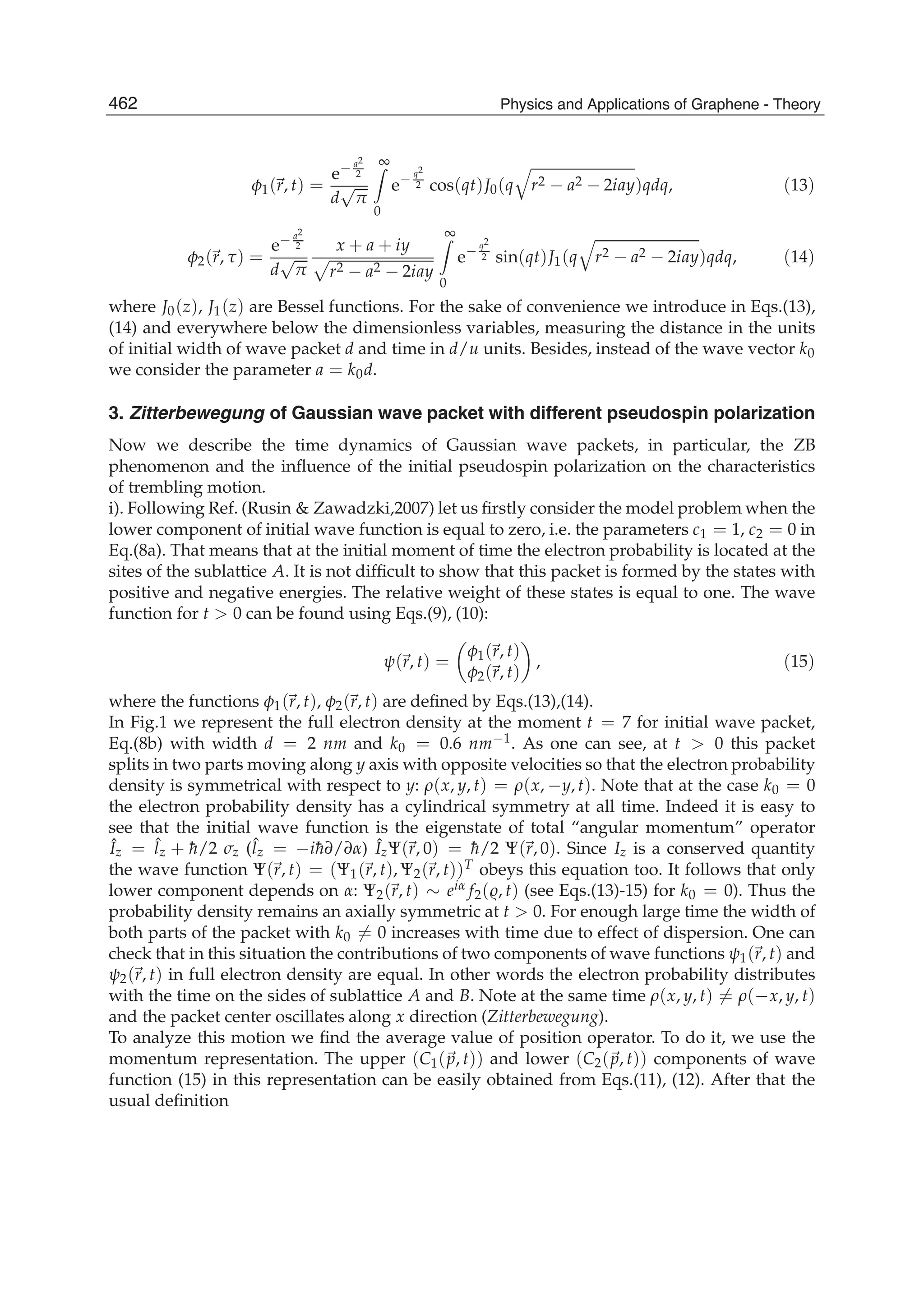
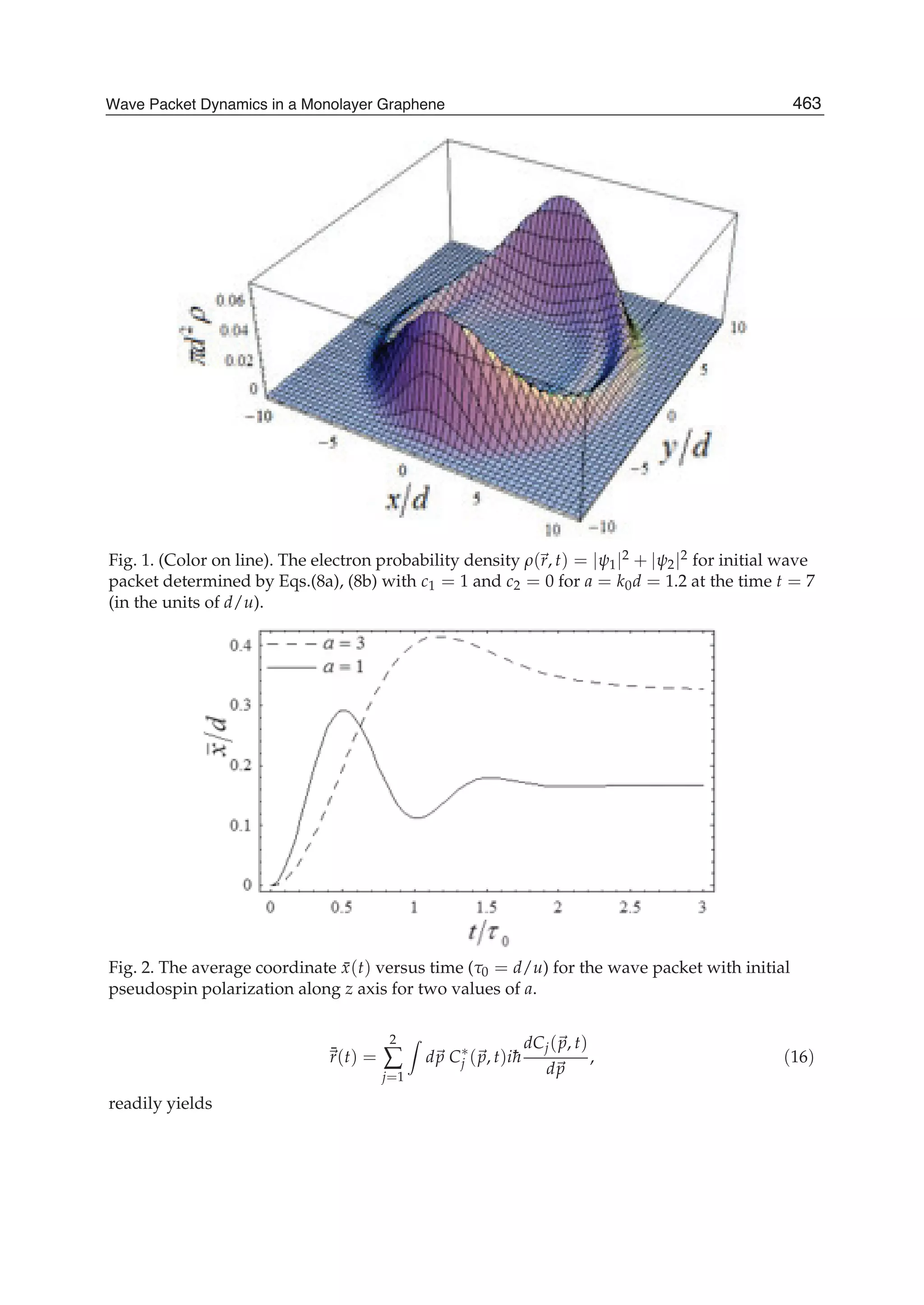
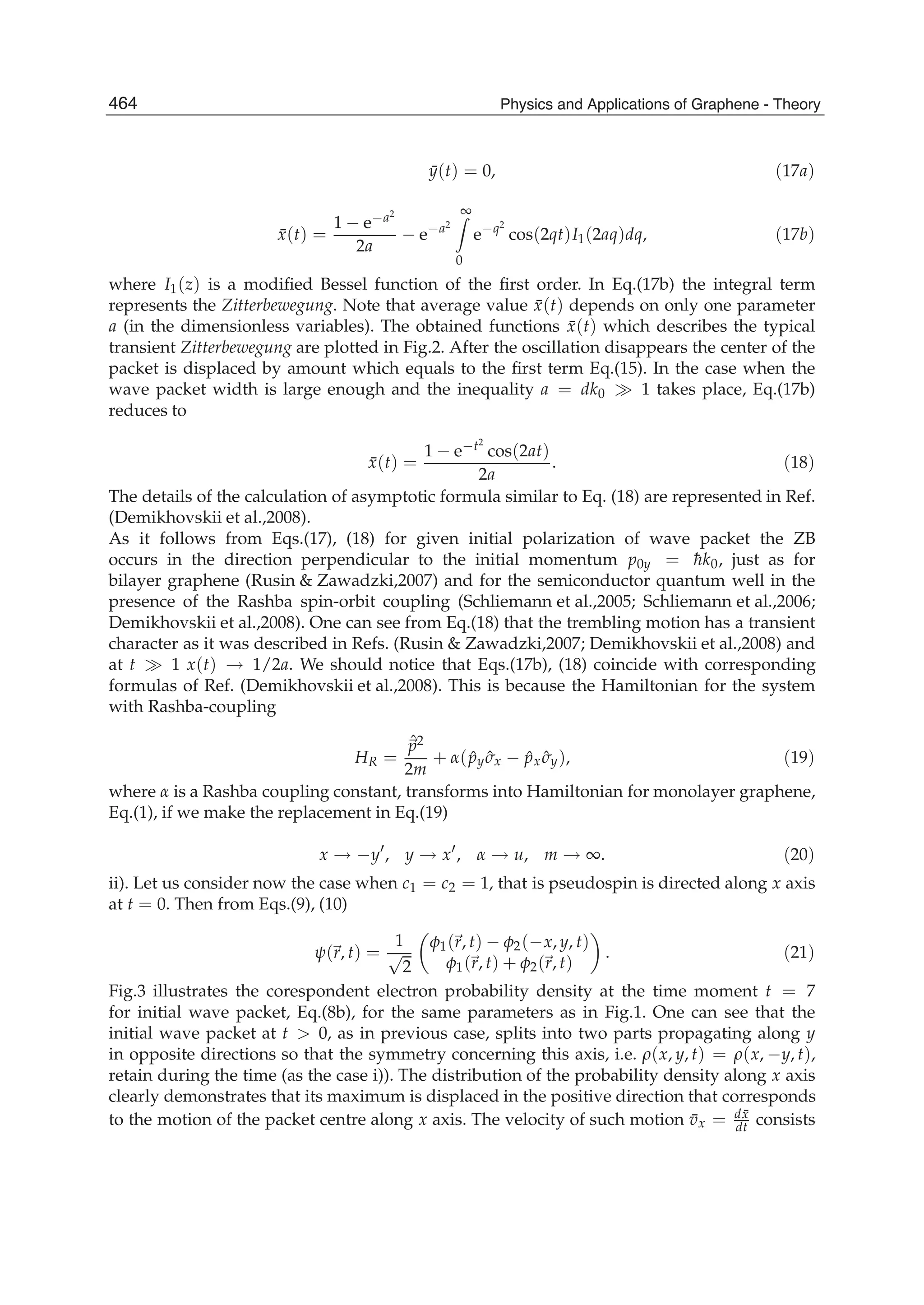
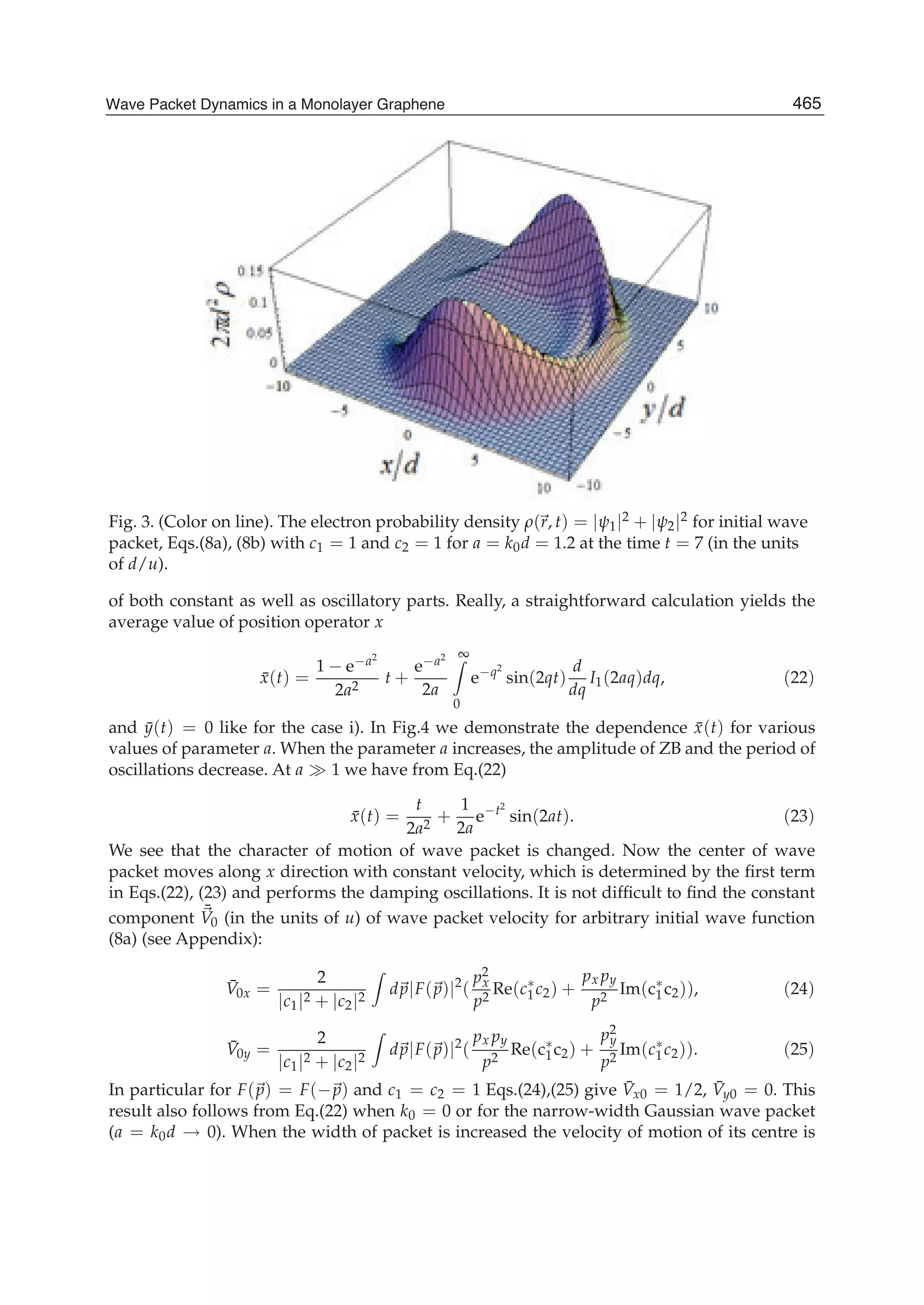
PHYSICS AND
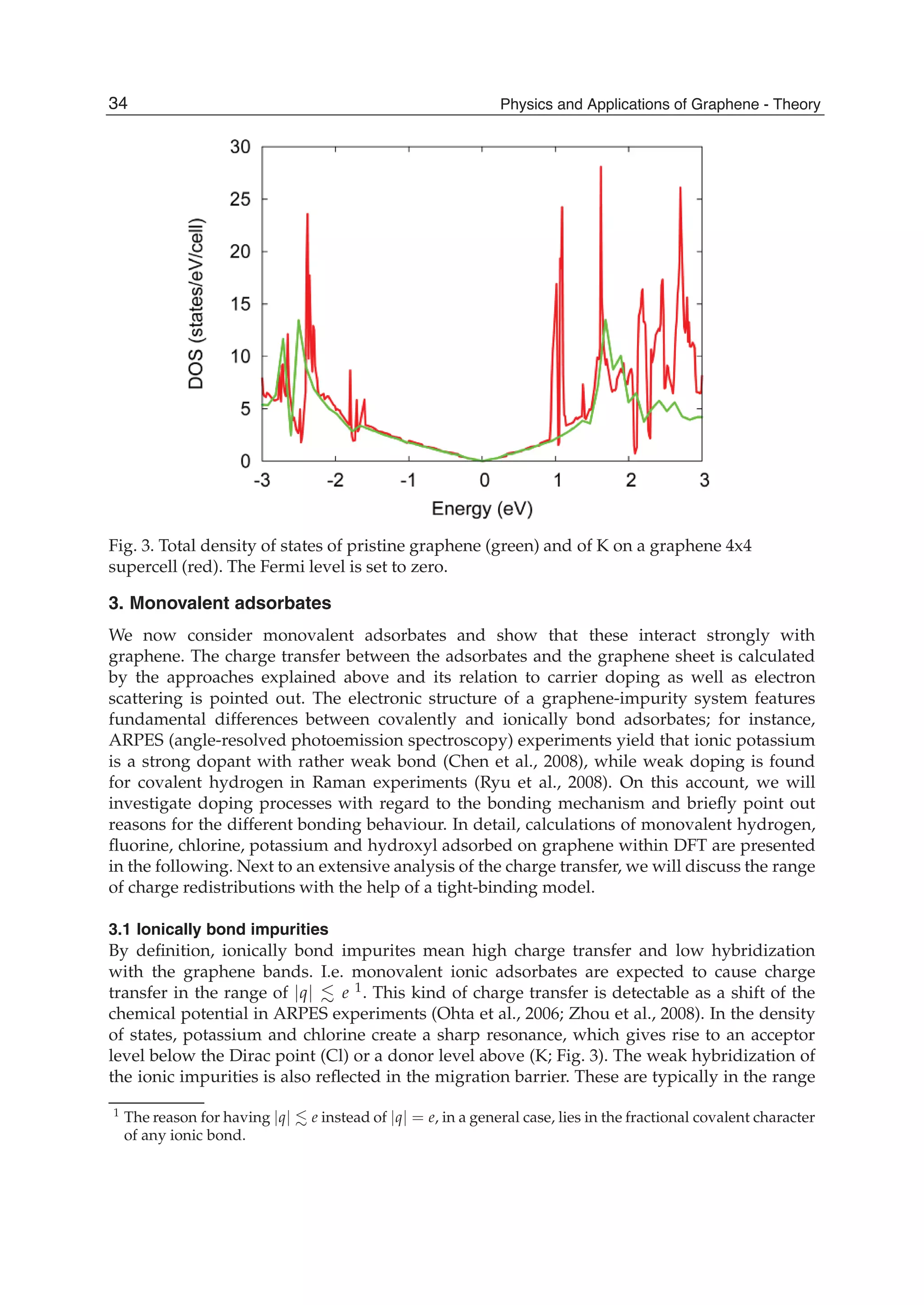
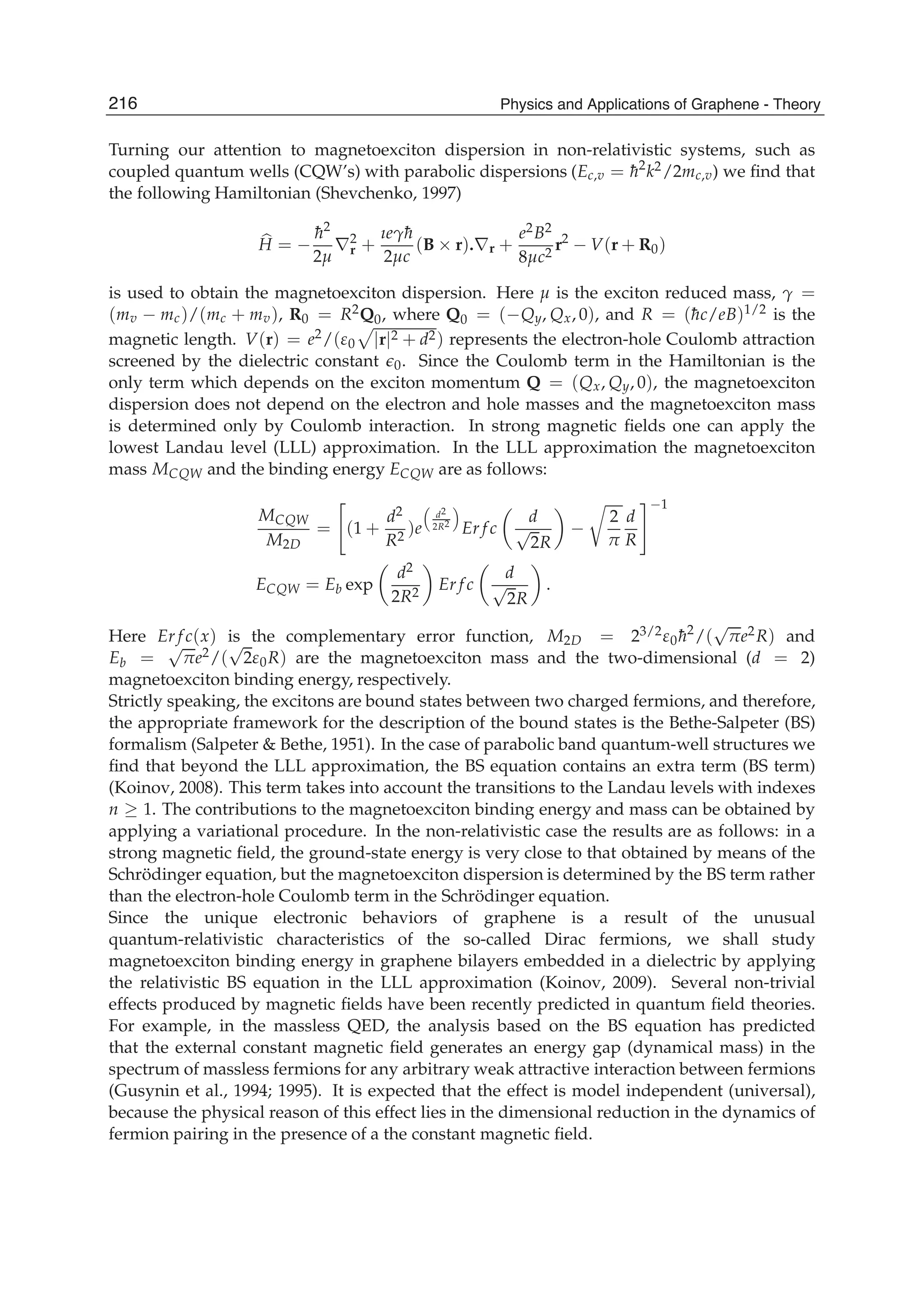
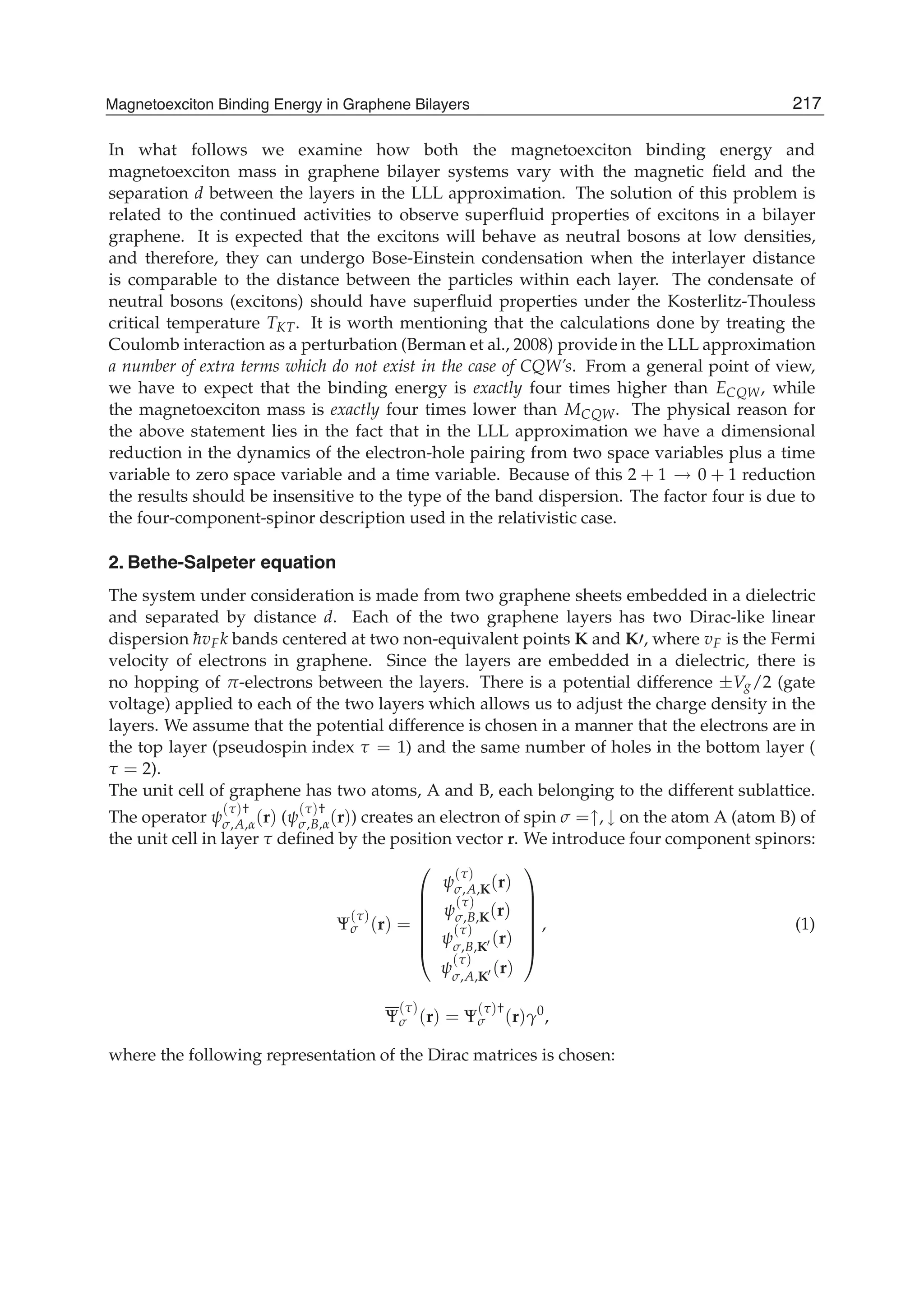
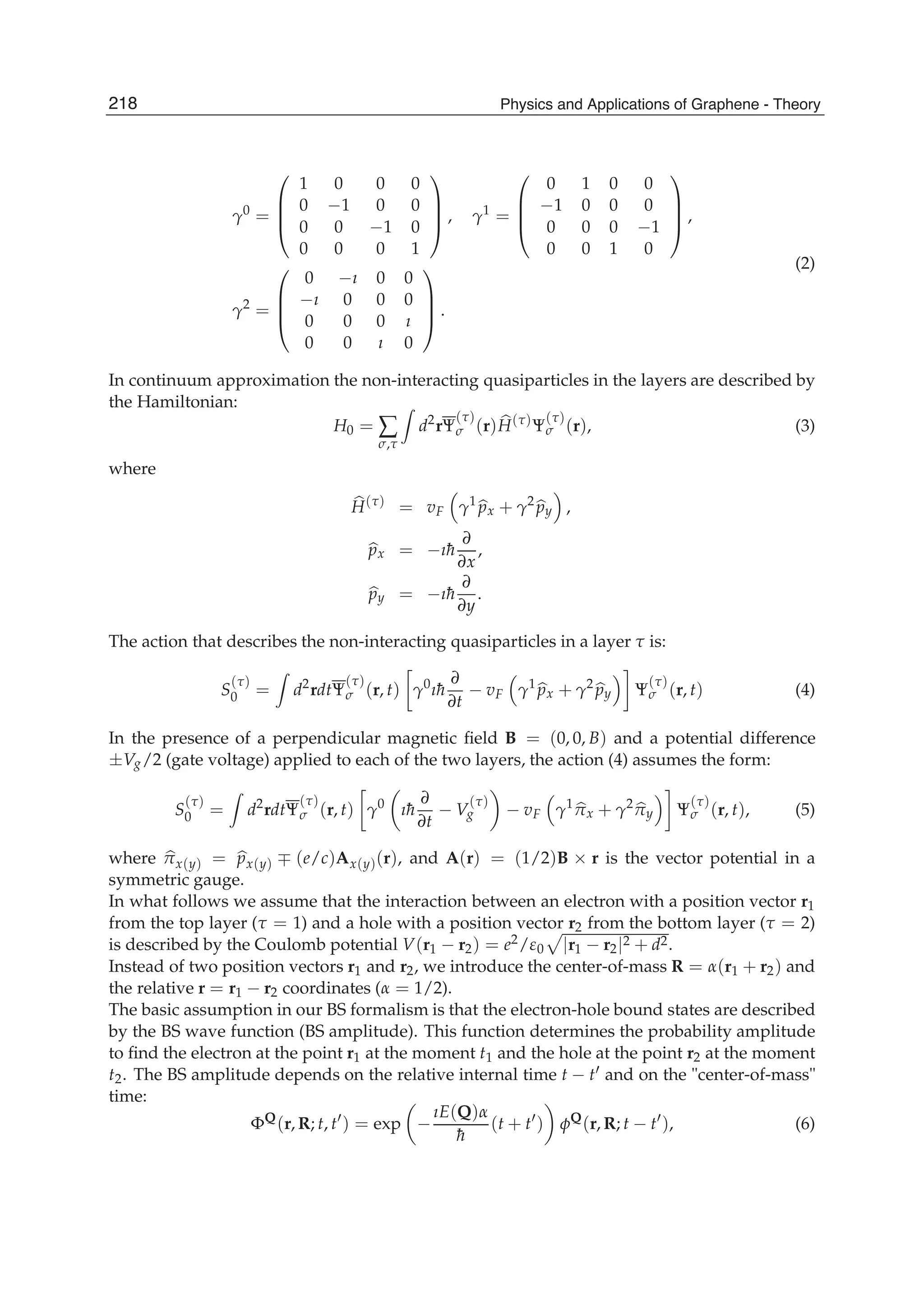
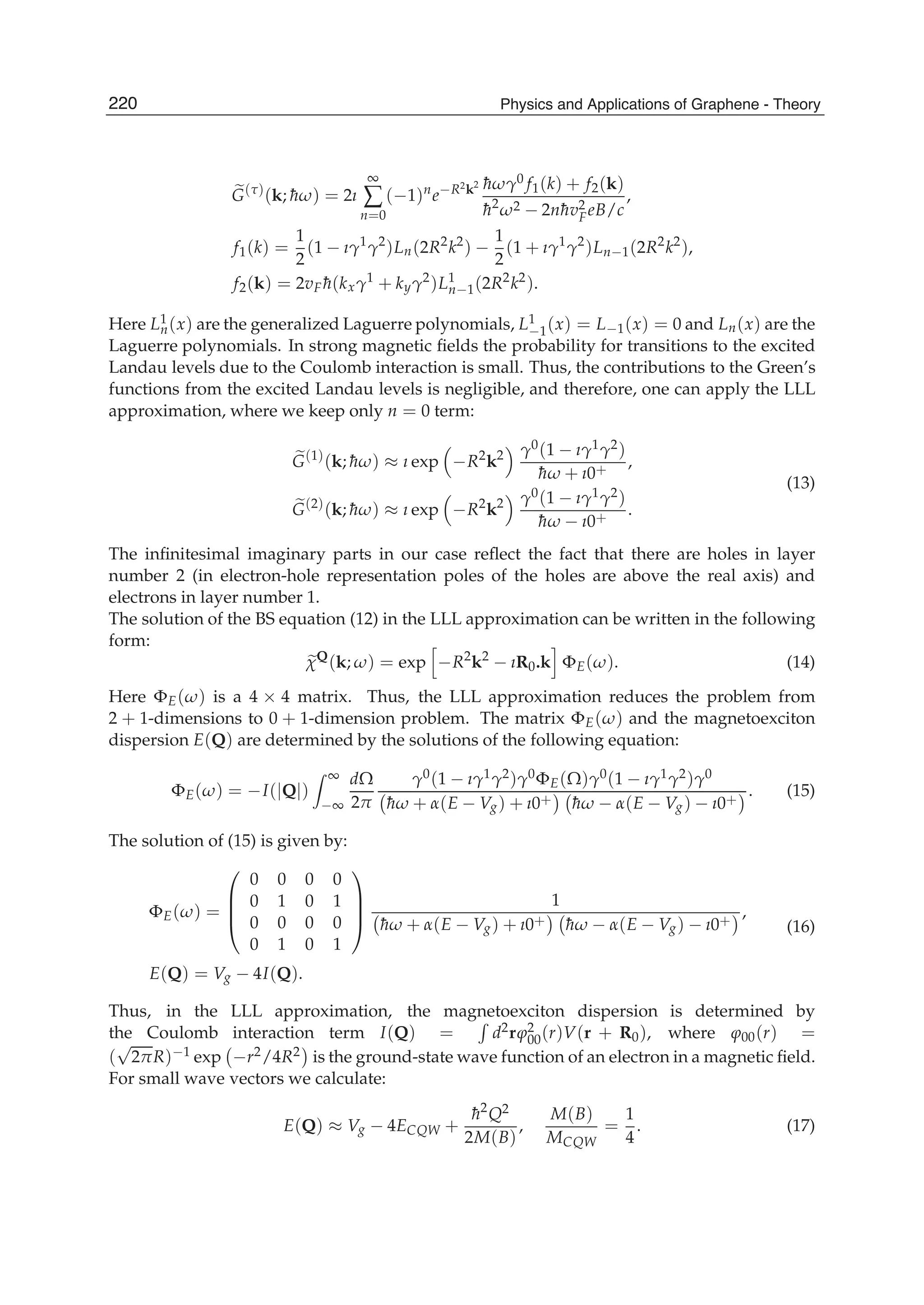
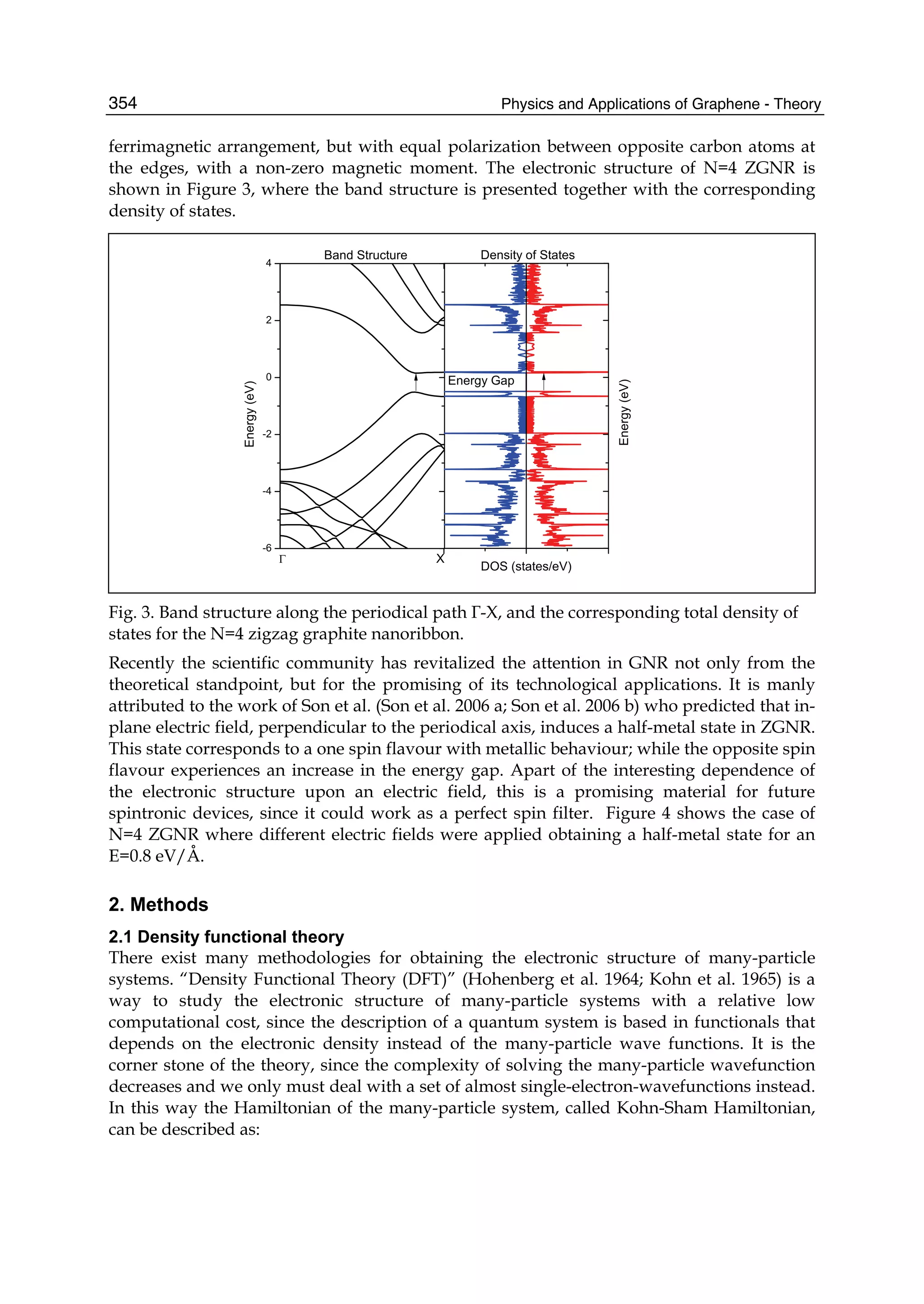
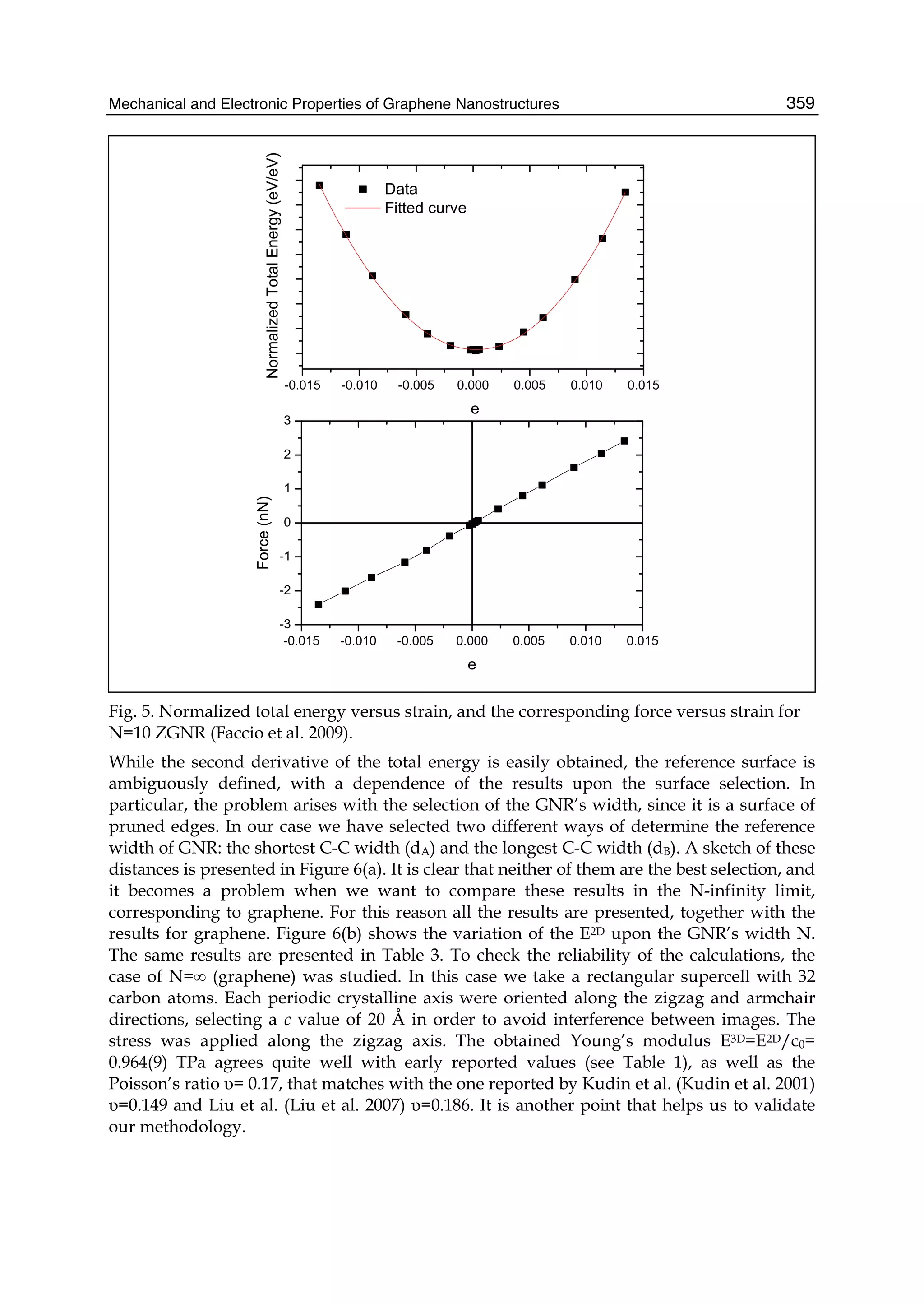
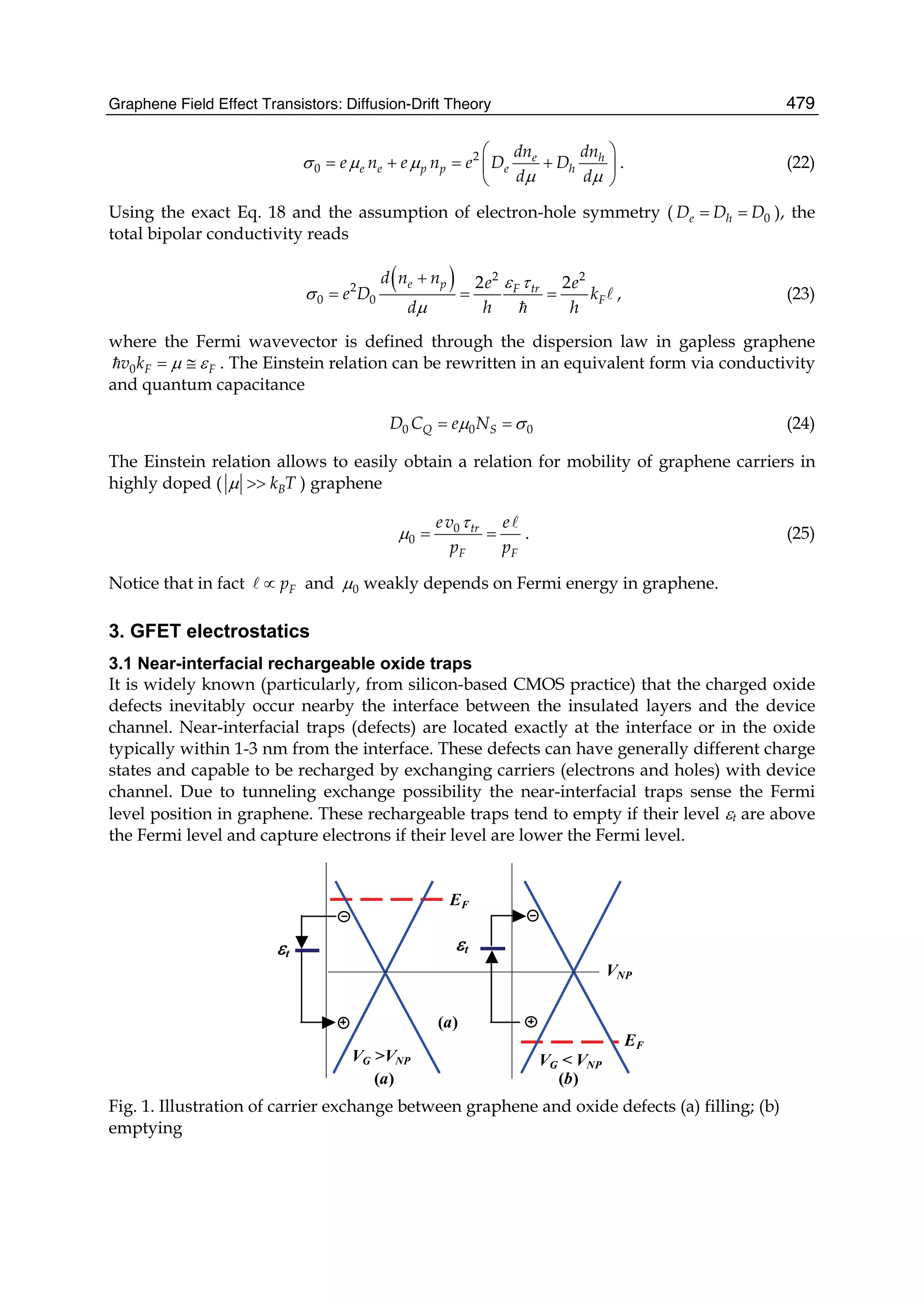
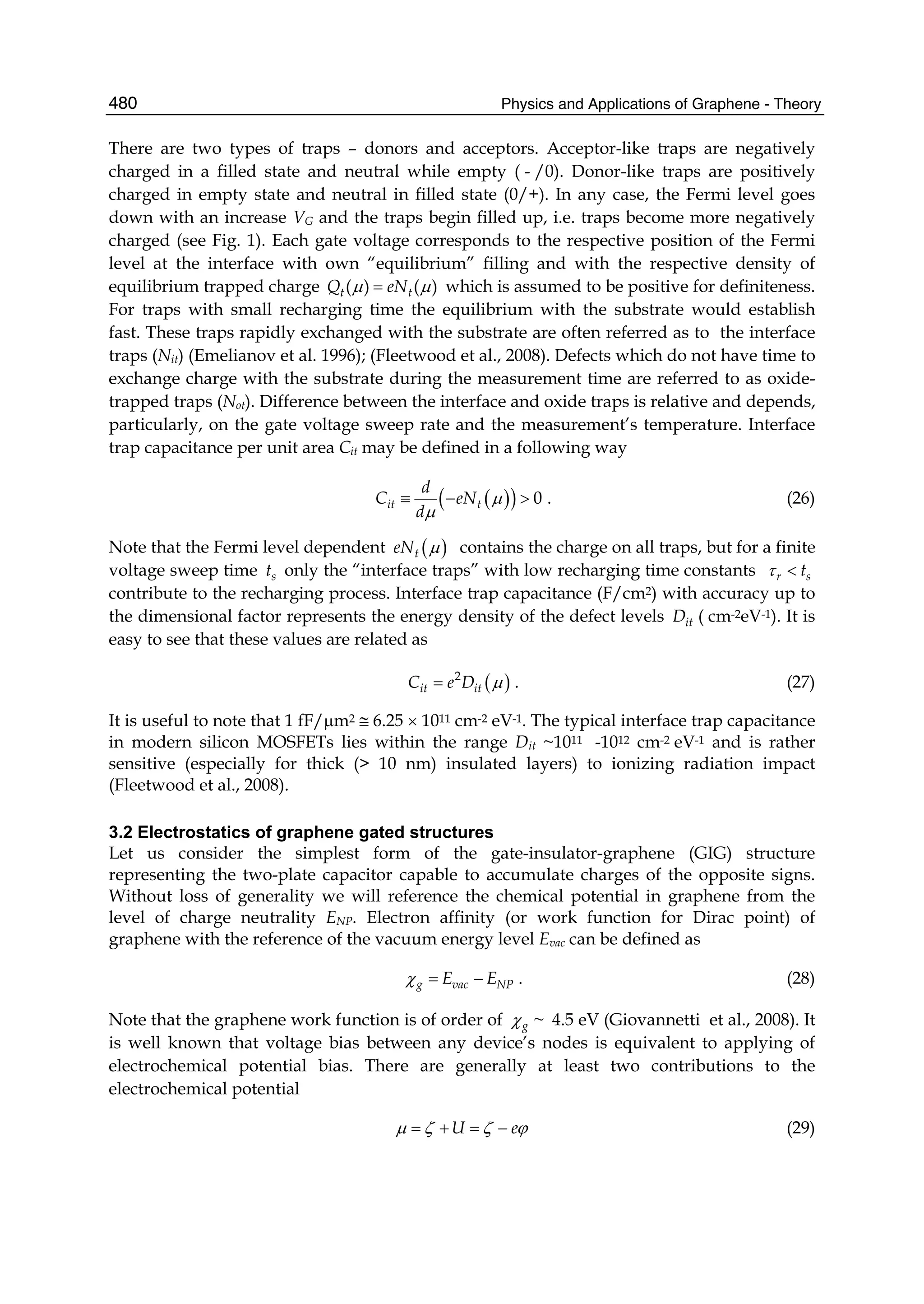
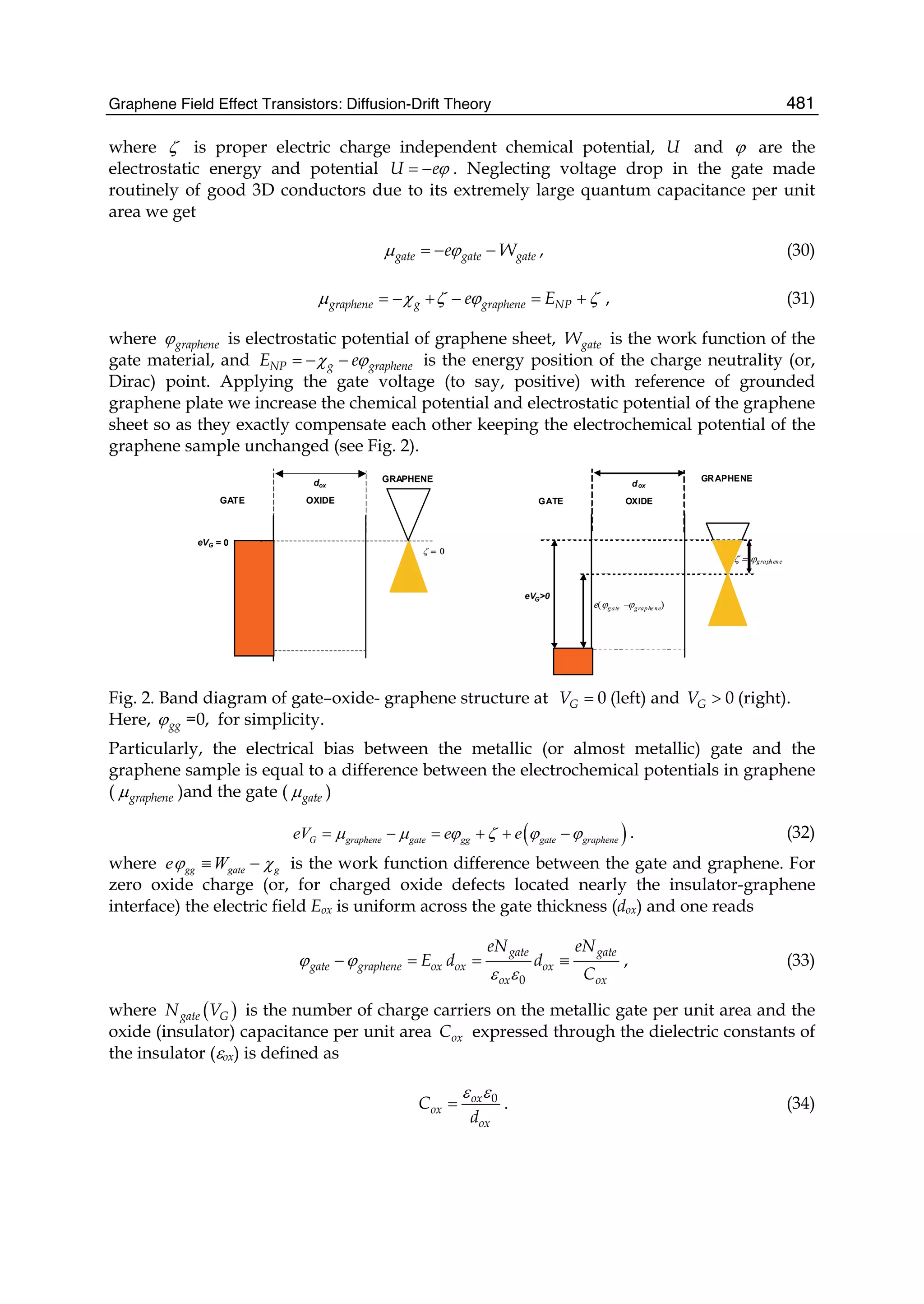
APPLICATIONS
OF GRAPHENE
THEORY
Edited by Sergey Mikhailov
Physics and Applications of Graphene - Theory
Edited by Sergey Mikhailov
Published by InTech
Janeza Trdine 9, 51000 Rijeka, Croatia
Copyright © 2011 InTech
All chapters are Open Access articles distributed under the Creative Commons
Non Commercial Share Alike Attribution 3.0 license, which permits to copy,
distribute, transmit, and adapt the work in any medium, so long as the original
work is properly cited. After this work has been published by InTech, authors
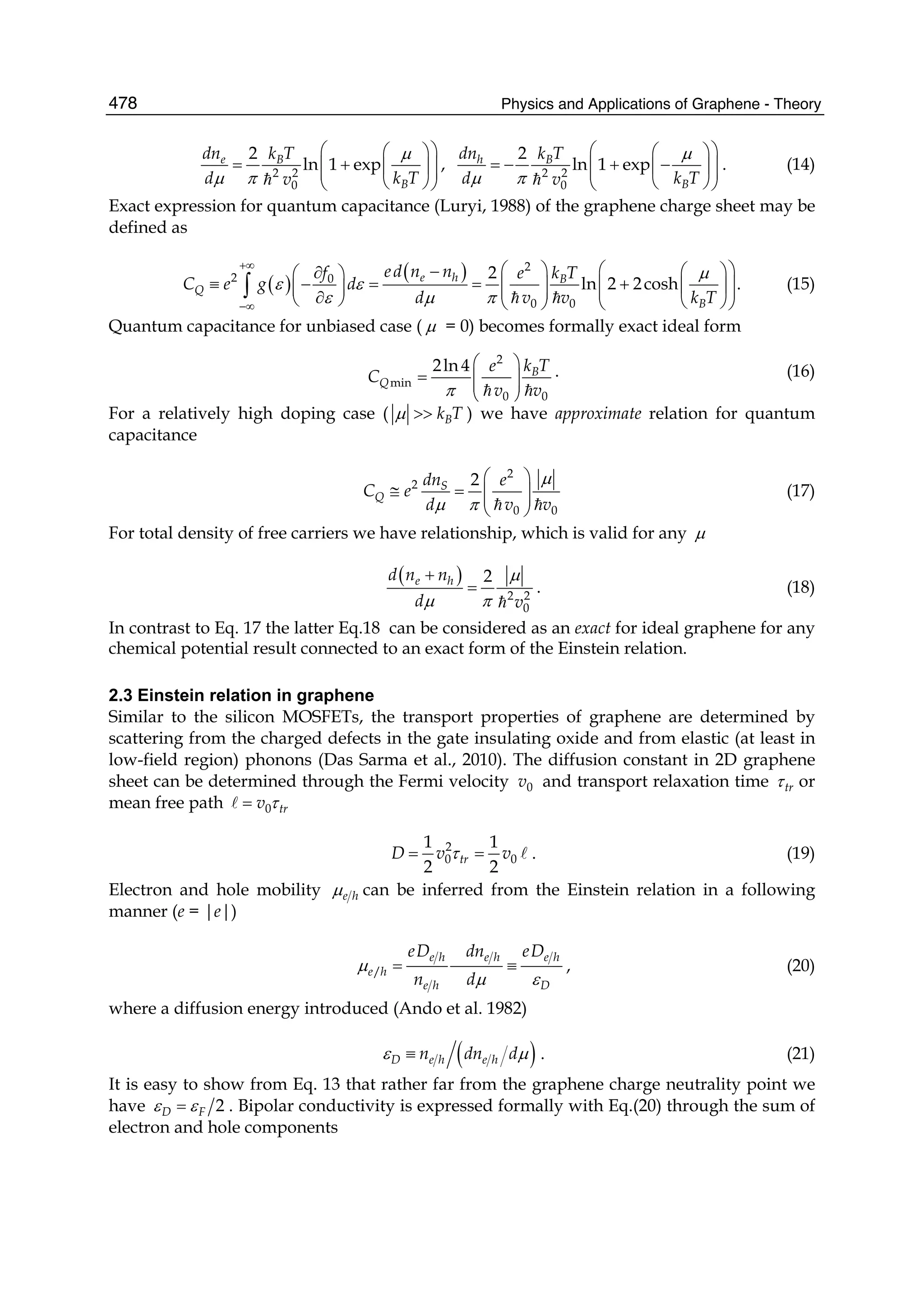
have the right to republish it, in whole or part, in any publication of which they
are the author, and to make other personal use of the work. Any republication,
referencing or personal use of the work must explicitly identify the original source.
Statements and opinions expressed in the chapters are these of the individual contributors
and not necessarily those of the editors or publisher. No responsibility is accepted
for the accuracy of information contained in the published articles. The publisher
assumes no responsibility for any damage or injury to persons or property arising out
of the use of any materials, instructions, methods or ideas contained in the book.
Publishing Process Manager Ivana Lorkovic
Technical Editor Teodora Smiljanic
Cover Designer Martina Sirotic
Image Copyright ARTSILENSEcom, 2010. Used under license from Shutterstock.com
First published March, 2011
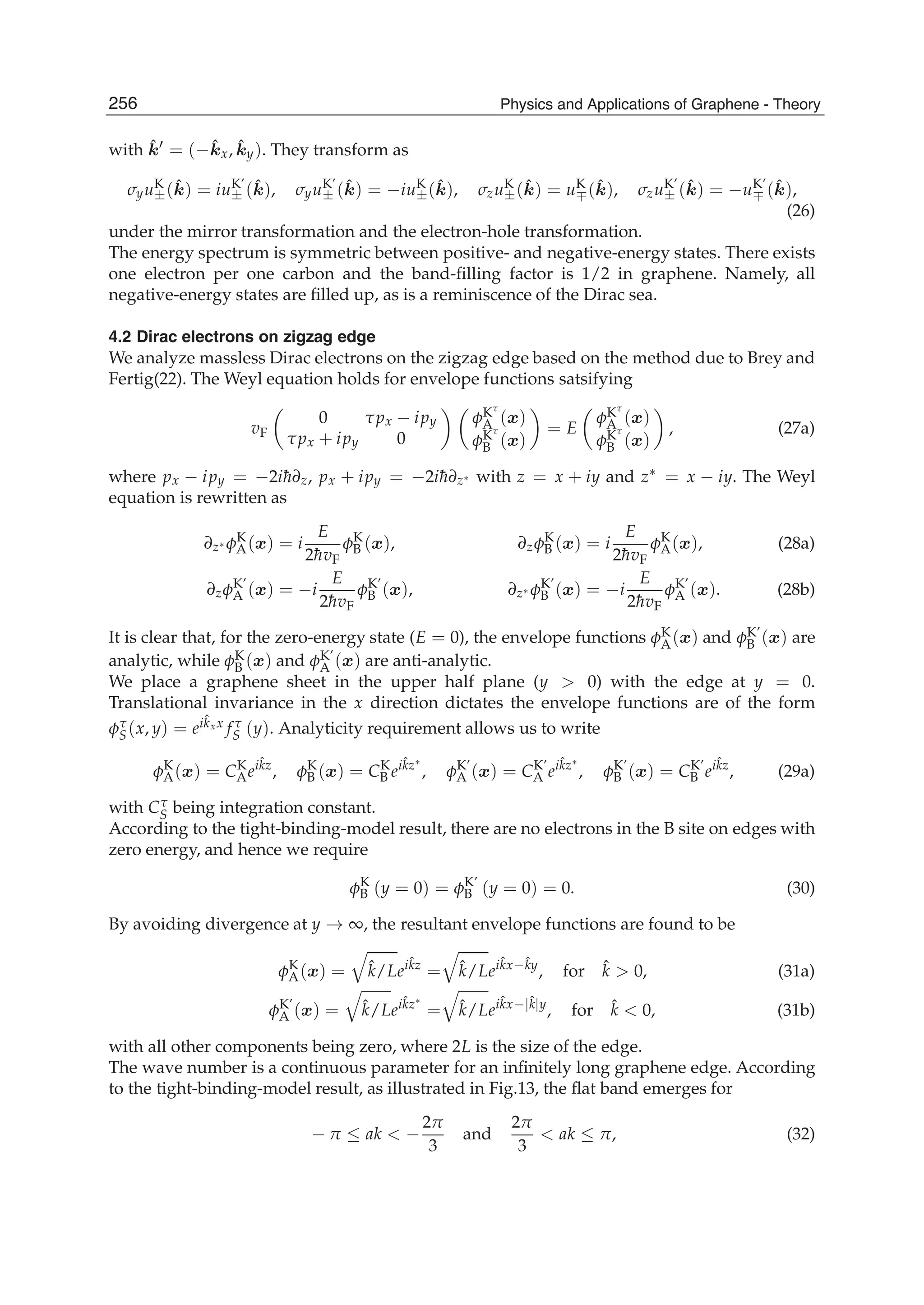
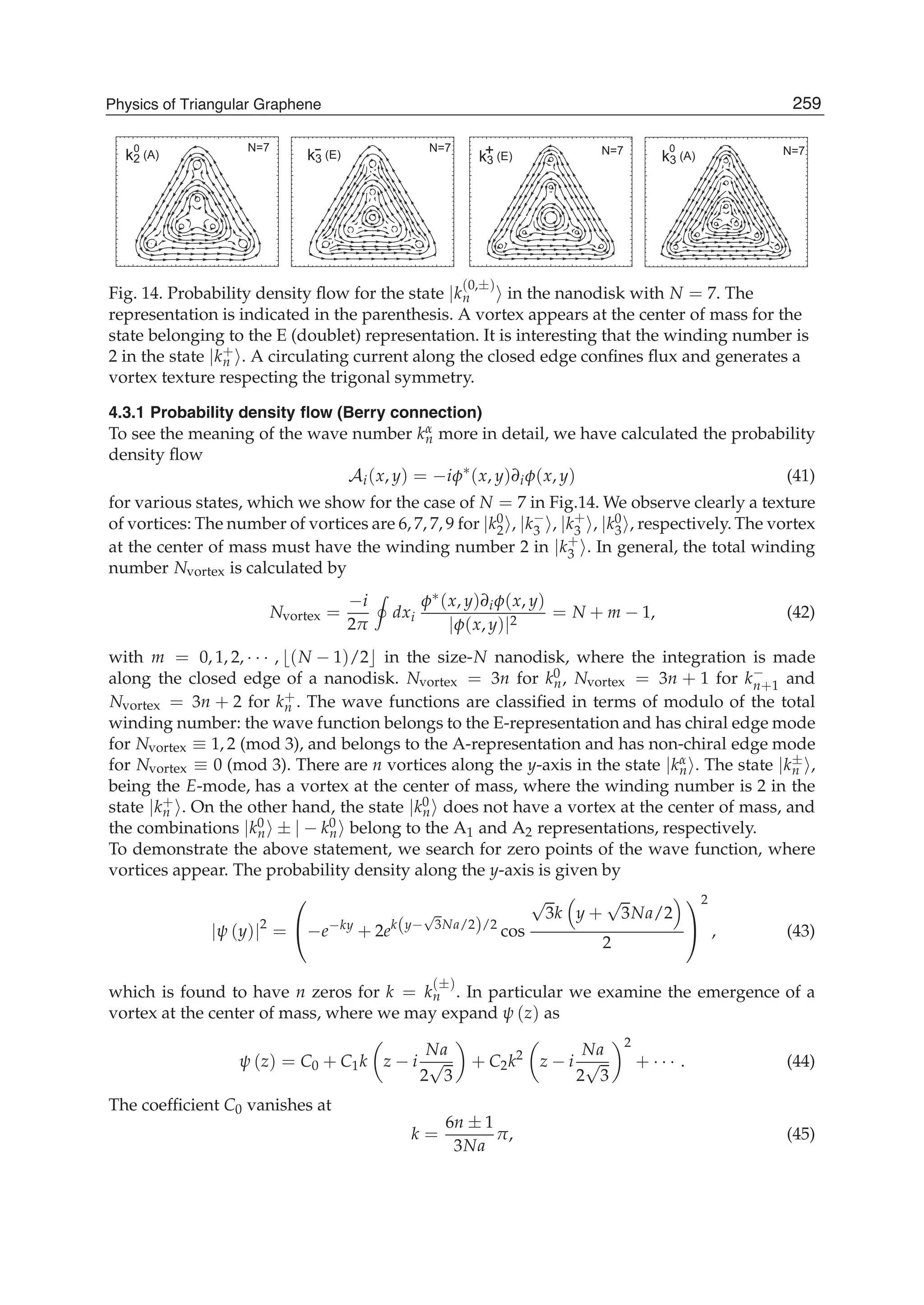
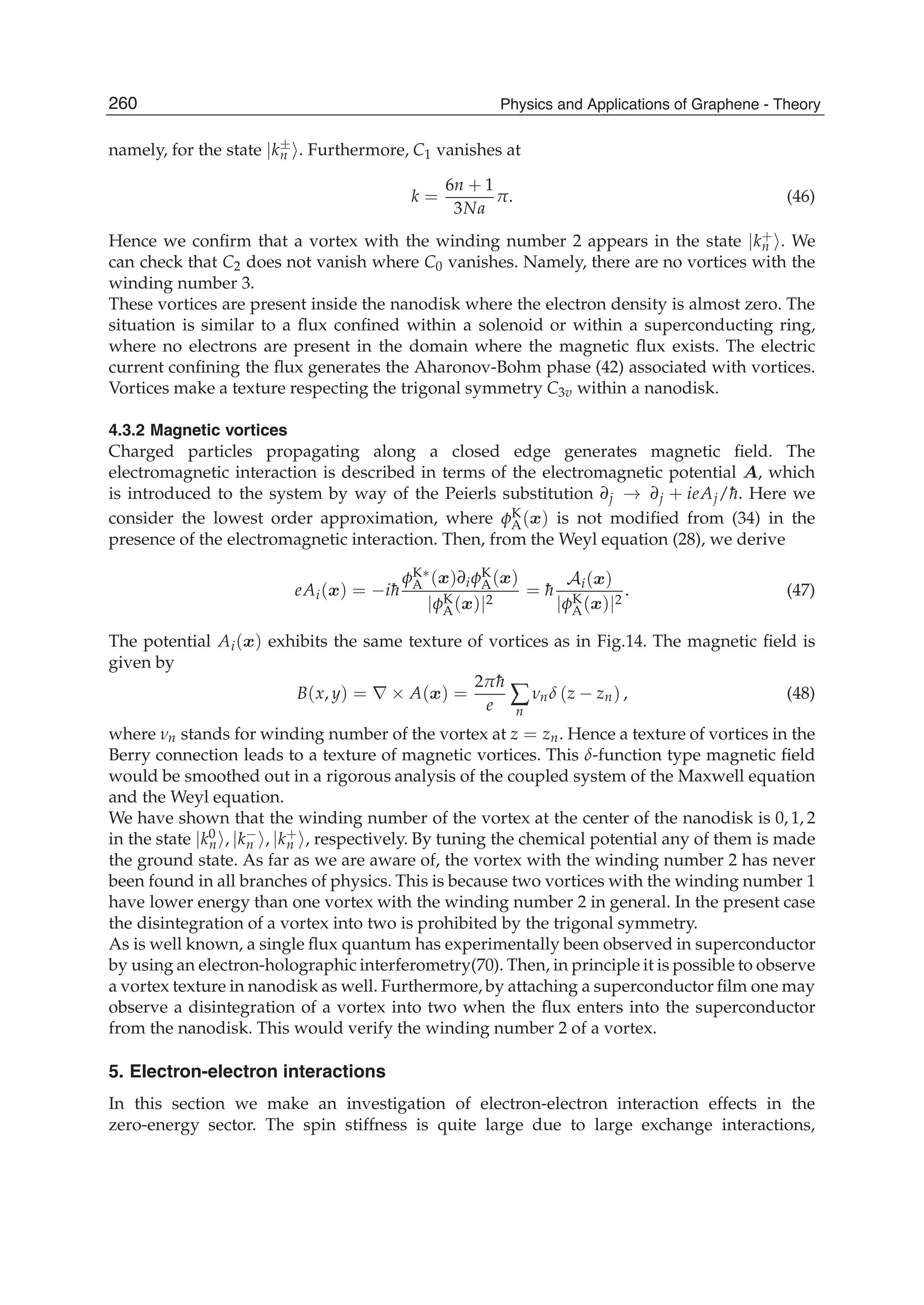
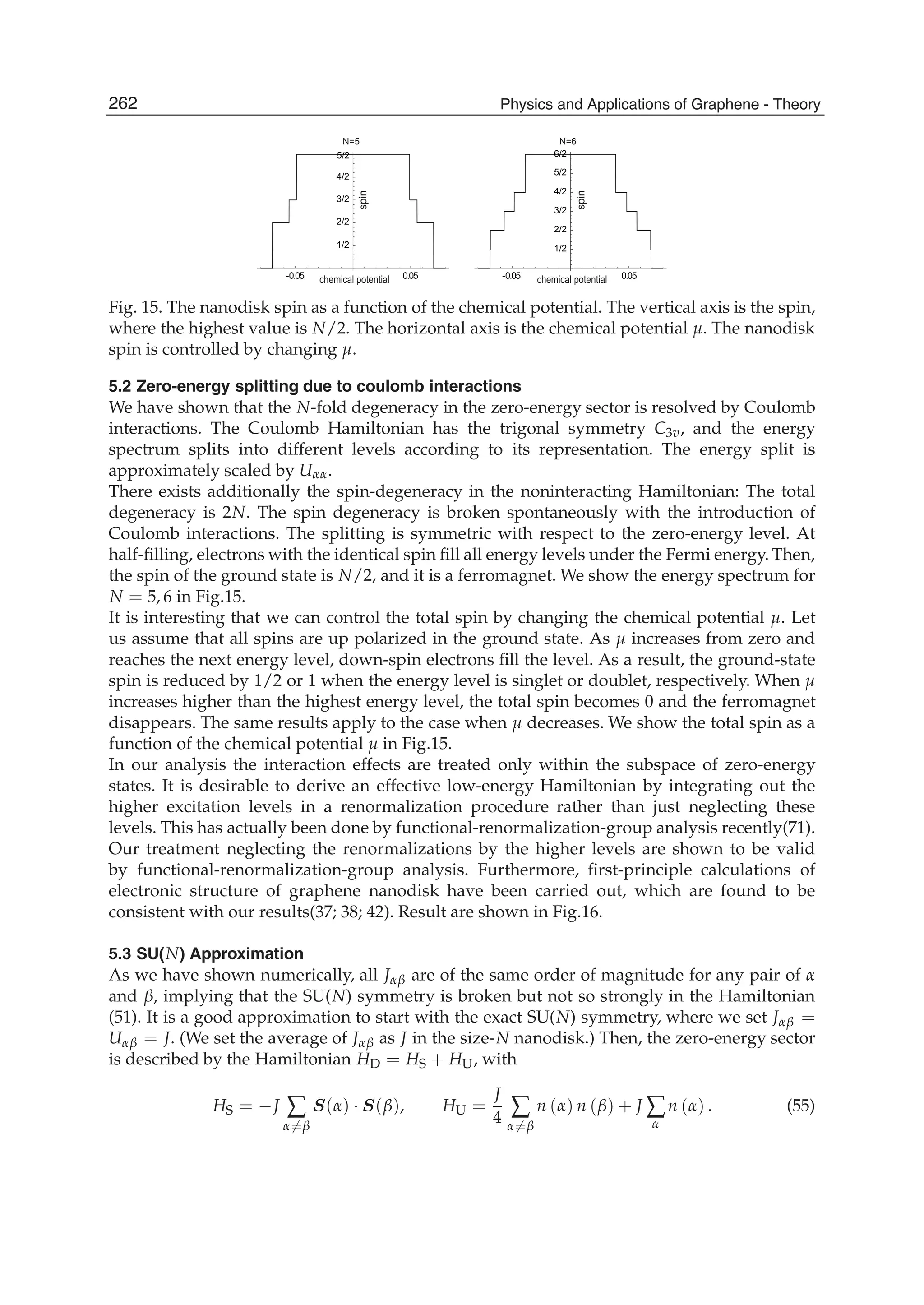
Printed in India
A free online edition of this book is available at www.intechopen.com
Additional hard copies can be obtained from orders@intechweb.org
Physics and Applications of Graphene - Theory, Edited by Sergey Mikhailov
p. cm.
ISBN 978-953-307-152-7
free online editions of InTech
Books and Journals can be found at
www.intechopen.com
Part 1
Chapter 1
Chapter 2
Chapter 3
Chapter 4
Chapter 5
Chapter 6
Chapter 7
Chapter 8
Preface IX
Electronic Structure and Defects 1
Theoretical Studies on Formation, Property
Tuning and Adsorption of Graphene Segments 3
R.Q. Zhang and Abir De Sarkar
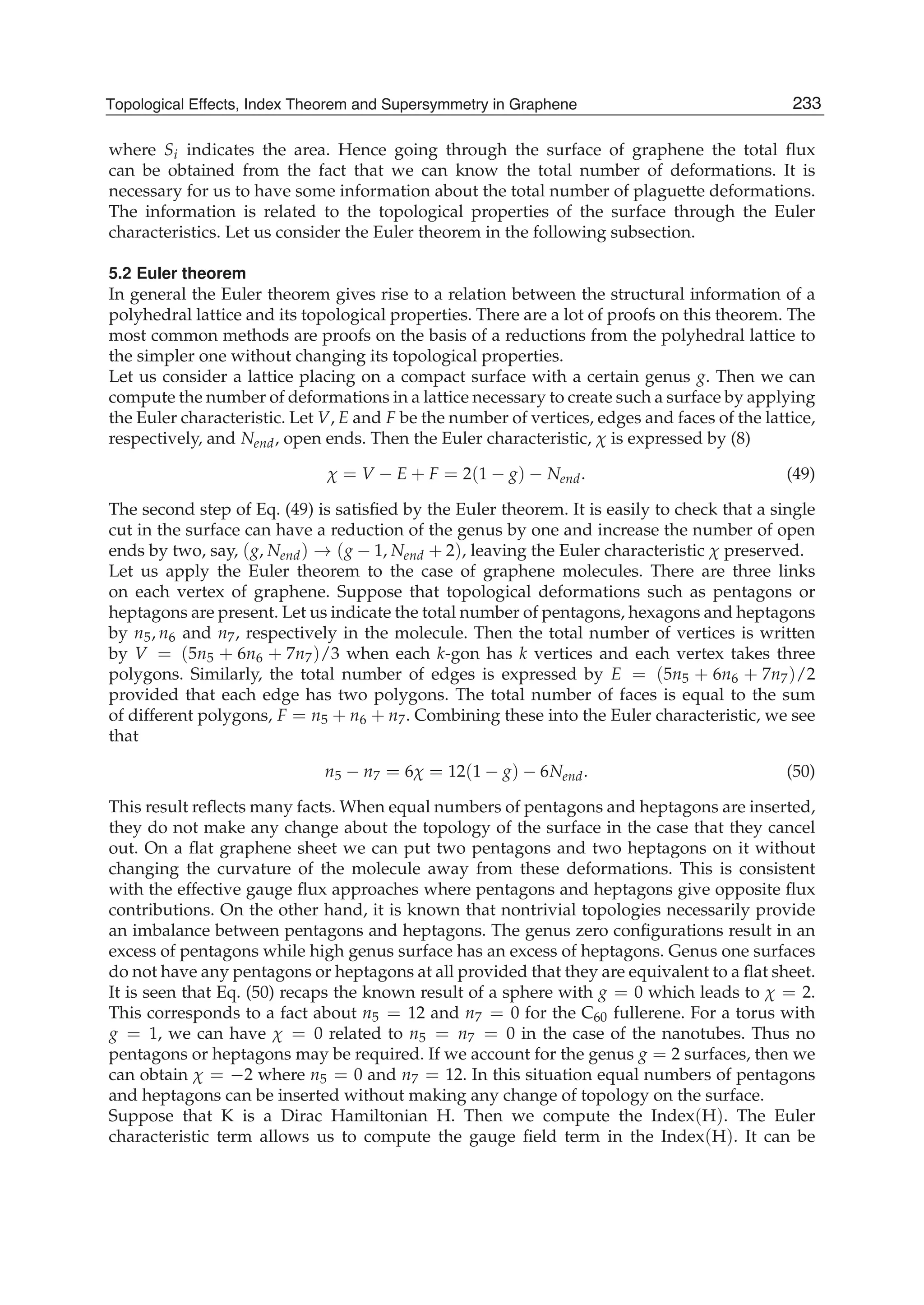
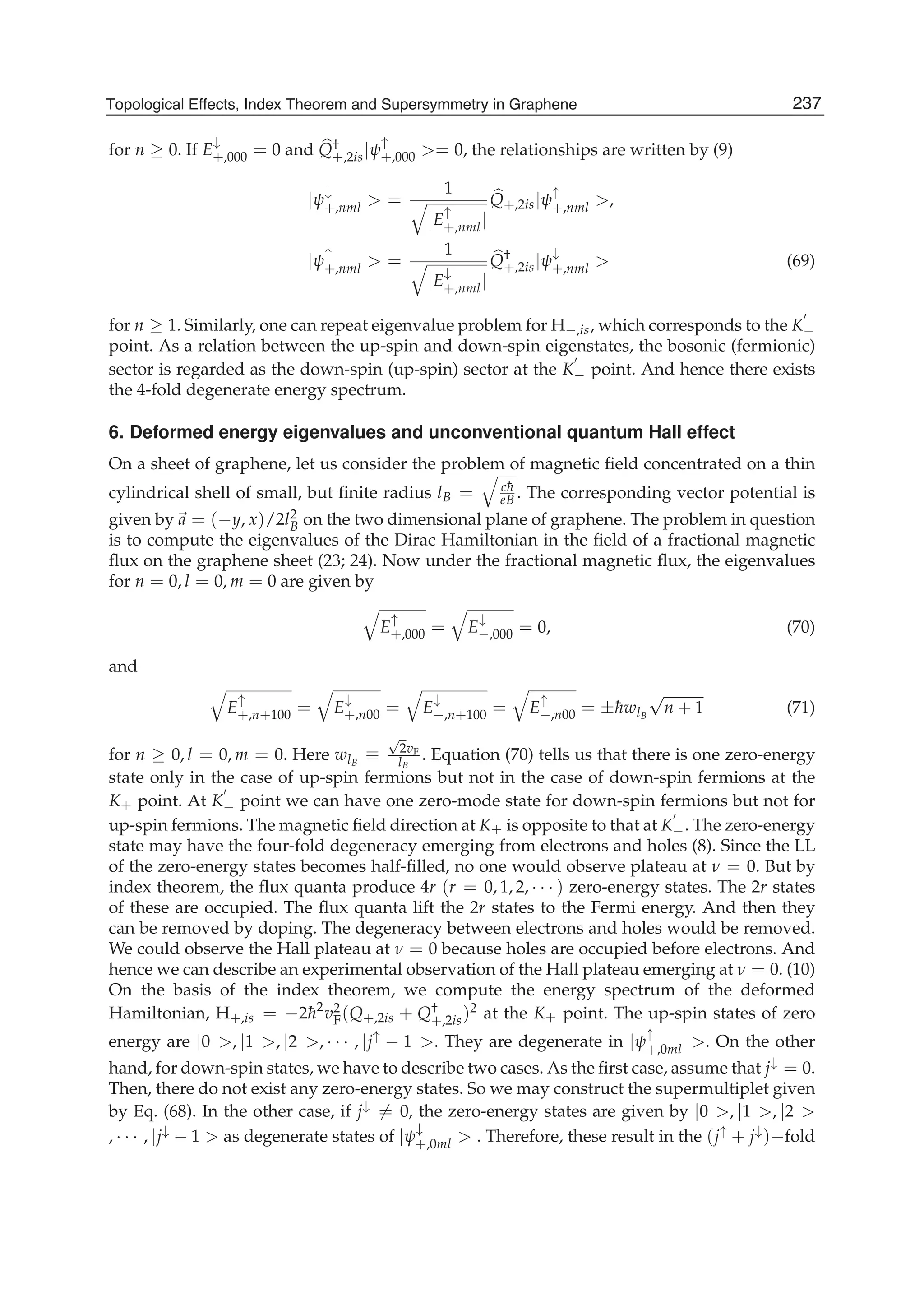
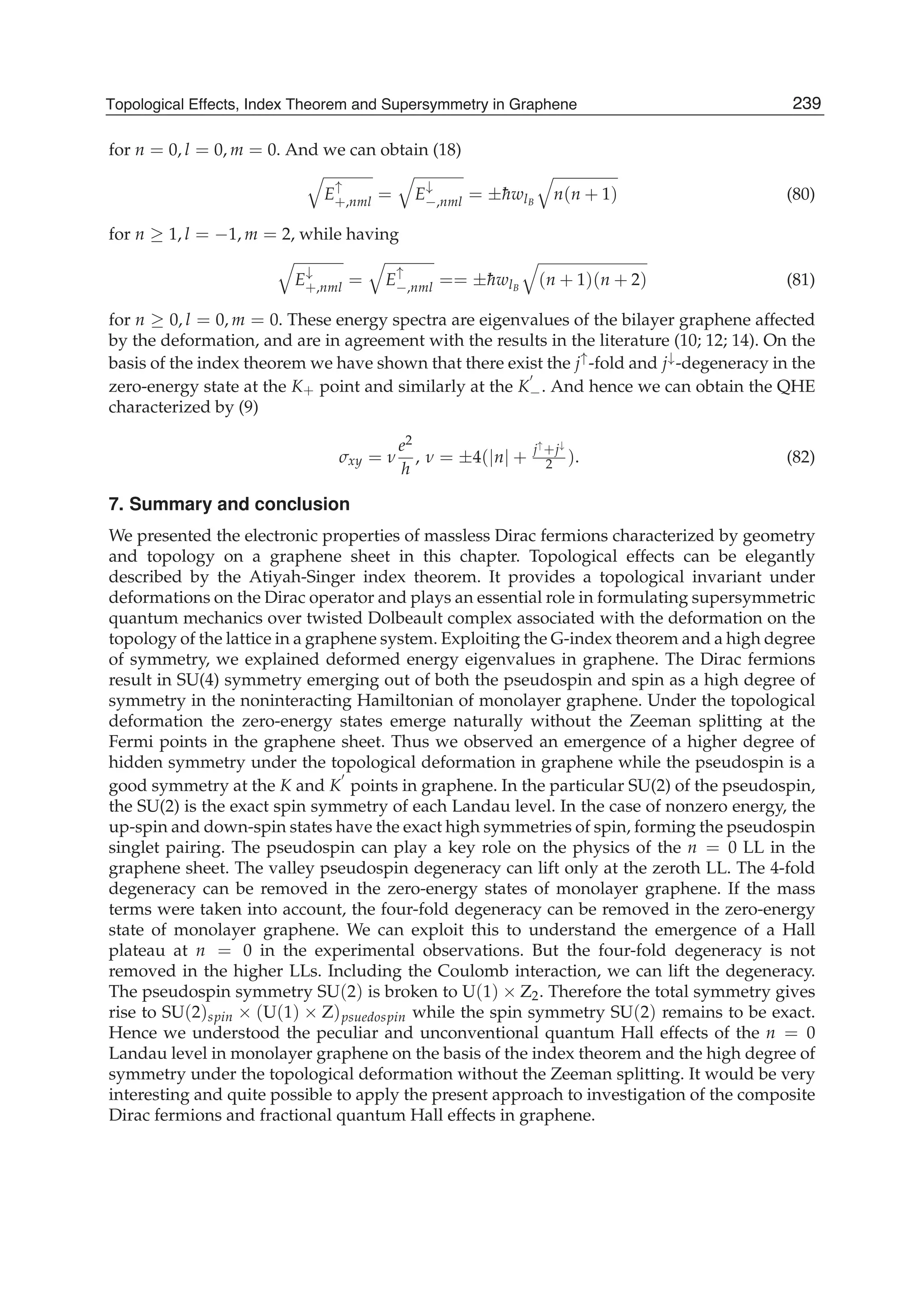
Theory of Doping: Monovalent Adsorbates 29
B. Sachs, T.O. Wehling,
A. I. Lichtenstein and M. I. Katsnelson
The Effect of Atomic-Scale Defects
and Dopants on Graphene Electronic Structure 45
Rocco Martinazzo, Simone Casolo and Gian Franco Tantardini
The Non-Neighbor Effect in Graphene Ribbons 71
Tong Guo-Ping
Quasi-Particle Spectra on Substrate
and Embedded Graphene Monolayers 93
Alexander Feher, Eugen Syrkin, Sergey Feodosyev,
Igor Gospodarev and Kirill Kravchenko
Structural and Electronic Properties
of Hydrogenated Graphene 113
Duminda K. Samarakoon and Xiao-Qian Wang
Applications of Al Modified Graphene
on Gas Sensors and Hydrogen Storage 133
Zhimin Ao, Jack Yang and Sean Li
Graphene-Based Devices Based
on Topological Zero Modes
and Pseudospin Degree of Freedom 175
J. C. Martinez, M. B. A. Jalil and S. G. Tan
Contents
ContentsVI
Simulated Nanoscale Peeling Process
of Monolayer Graphene Sheet
- Effect of Edge Structure and Lifting Position 195
Naruo Sasaki, Hideaki Okamoto, Shingen Masuda,
Kouji Miura and Noriaki Itamura
Magnetoexciton Binding Energy
in Graphene Bilayers 215
Zlatko Koinov
Topological Effects, Index Theorem
and Supersymmetry in Graphene 223
K.-S. Park
Graphene Nano-dots and Nanoribbons 241
Physics of Triangular Graphene 243
Motohiko Ezawa
Graphene Nano-Flakes and Nano-Dots:
Theory, Experiment and Applications 277
Ian Snook and Amanda Barnard
Finite-Size Effects in Graphene Nanostructures 303
Antonio Monari and Stefano Evangelisti
Quantum Computation
with Graphene Nanostructure 319
Zhi-Rong Lin, Guo-Ping Guo, Tao Tu,
Qiong Ma and Guang-Can Guo
Graphene Nanoribbons: Geometric,
Electronic, and Magnetic Properties 331
Erjun Kan, Zhenyu Li and Jinlong Yang
Mechanical and Electronic Properties
of Graphene Nanostructures 349
Ricardo Faccio, Luciana Fernández-Werner, Helena Pardo,
Cecilia Goyenola, Pablo A. Denis and Álvaro W. Mombrú
Fracture Behaviors of Graphene Sheets
and Carbon Nanotubes 367
J. R. Xiao and J. W. Gillespie Jr.
Magnetic Properties 393
Orbital Magnetism of Graphenes 395
Mikito Koshino
Chapter 9
Chapter 10
Chapter 11
Part 2
Chapter 12
Chapter 13
Chapter 14
Chapter 15
Chapter 16
Chapter 17
Chapter 18
Part 3
Chapter 19
Contents VII
Transport Properties 415
Electronic and Transport Properties
of Defected Graphene Nanoribbons 417
Narjes Gorjizadeh, Yoshiyuki Kawazoe and Amir A. Farajian
Propagation of Electron Waves in Monolayer
Graphene and Optical Simulations with
Negative-Zero-Positive Index Metamaterials 433
Xi Chen and Li-Gang Wang
Wave Packet Dynamics in a Monolayer Graphene 459
G. M. Maksimova, V. Ya. Demikhovskii, and E. V. Frolova
Graphene Field Effect Transistors:
Diffusion-Drift Theory 475
G.I. Zebrev
Optical Properties 499
Photo-Induced Carrier Density, Optical
Conductance and Transmittance in Graphene
in the Presence of Optic-Phonon Scattering 501
W. Xu and H.M. Dong
Frequency Mixing Effects in Graphene 519
Sergey Mikhailov
Part 4
Chapter 20
Chapter 21
Chapter 22
Chapter 23
Part 5
Chapter 24
Chapter 25
Preface
The Stone Age, the Bronze Age, the Iron Age ... Every global epoch in the history of the
mankind is characterized by materials used in it. In 2004 a new era in the material sci-
ence was opened: the era of graphene or, more generally, of two-dimensional materials
[K. Novoselov, A. Geim et al. Science 306, 666 (2004)]. Graphene is the one-atom thin
layer of sp2
-bonded carbon atoms arranged in a honey-comb lattice. It possesses the
unique physical properties: graphene is the strongest and the most stretchable known
material, has the record thermal conductivity and the very high intrinsic mobility and
is completely impermeable. The charge carriers in graphene are the massless Dirac
fermions and its unique electronic structure leads to a number of interesting physical
effects, such as the minimal electrical conductivity, anomalous quantum Hall effect,
Klein tunneling, the universal optical conductivity and the strong nonlinear electro-
magnetic response. Graphene offers and promises a lot of different applications, in-
cluding conductive ink, terahertz transistors, ultrafast photodetectors, bendable touch
screens, strain tensors and many other. In 2010 Andre Geim and Konstantin Novoselov
were awarded the Nobel Prize in Physics “for groundbreaking experiments regarding
the two-dimensional material graphene”.
Nowadays, graphene is in the focus of research activity of condensed matter physi-
cists in the whole world. Research articles reporting on different aspects of graphene
studies are collected in the present two volumes “Physics and Applications of Gra-
phene”. These books cover a broad spectrum of experimental and theoretical studies
of graphene and present contributions from research groups and laboratories from the
North and South America, Europe, Asia and Australia.
The contributed articles are presented in two volumes. The readers interested in ex-
perimental studies of graphene are referred to the first volume. The second volume
contains theoretical contributions, divided into five Sections. In Part I ab initio studies
of the electronic structure of graphene in the presence of defects and impurities are
described. In Part II the theory of graphene nano-flakes and nano-ribbons is presented.
The magnetic properties of grapheme are discussed in Part III and the transport prop-
erties are studied in Part IV. The last Part of the volume is devoted to the linear and
nonlinear optical properties of graphene.
Sergey Mikhailov
University of Augsburg
Germany
Part 1
Electronic Structure and Defects
1
Theoretical Studies on Formation, Property
Tuning and Adsorption of Graphene Segments
R.Q. Zhang and Abir De Sarkar
City University of Hong Kong,
Department of Physics and Materials Science, Hong Kong SAR,
China
1. Introduction
A single graphene sheet is a planar monolayer of sp2-bonded carbon atoms arranged on a
two-dimensional honeycomb lattice made of hexagonal rings. Graphene is the basic
structural element of some carbon allotropes including graphite, carbon nanotubes and
fullerenes. Planar polycyclic aromatic hydrocarbons (PAHs) with only benzenoid hexagonal
rings can be viewed as fragments of a graphene sheet with the peripheral atoms saturated
with hydrogen, and thus provide molecular models of graphene segments. Graphene
segments are of paramount importance both from scientific and technological perspectives.
Moreover, the PAHs or graphene segments themselves are of great research interest per se,
since they are widely found in the residues of domestic and natural combustion of coal,
wood, and other organic materials, and their unique electronic properties provide
opportunities for novel functionalized nanomaterials and nanodevices (Wu, Pisula et al.
2007). Understanding the mechanism of formation of graphene segments is necessary to
control its formation and in turn, to meet its application requirements. In our work, we have
elucidated the role played by H during CVD growth of carbon materials (Zhang, Chu et al.
2000) including graphene and diamond. Graphene materials are endowed with a wealth of
properties, including luminescence; which has been frequently reported in various CVD
Diamond or a-C:H films (Bergman, McClure et al. 1994; Kania and Oelhafen 1995; Rusli,
Amaratunga et al. 1995; Bourée, Godet et al. 1996; Liu, Gangopadhyay et al. 1997). Visible
photoluminescence (PL) has been observed in carbon nanoclusters embedded in SiO2 matrix
(Zhang, Bayliss et al. 1996) and from C60 thin films (Gapozzi, Casamassima et al. 1996).
Unlike a-Si:H, the PL efficiency of a-C:H film is high and it shows luminescence even at
room temperatures (Wagner and Lautenschlager 1986; Fang 1991; Schütte, Will et al. 1993;
Xu, Hundhausen et al. 1993; Nevin, Yamagishi et al. 1994). A clear understanding of the
luminescence phenomenon would help to produce high-quality luminescent films by a
proper control of the experimental conditions. Correspondingly, the structure property
relationship responsible for broadband luminescence in a:C-H films and carbon
nanostructures was clearly pinpointed in our work (Zhang, Bertran et al. 1998; Feng, Lin et
al. 2009). To the best of our knowledge, size-dependent PL mechanism was first reported by
us (Zhang, Bertran et al. 1998).
The intermolecular, weak π-π interactions are of utmost importance for understanding the
various properties of graphene sheets (Novoselov, Geim et al. 2004; Feng, Lin et al. 2010)
Physics and Applications of Graphene - Theory4
and other carbon-related nanostructures, including hydrogen-terminated graphene
nanoribbons with a finite nanosize width (Barone, Hod et al. 2006). The role of π-π
interactions in benzene dimers (Feng, Lin et al. 2010) and in the stacking of graphene sheets
(or graphene multilayers) have been thoroughly addressed in our detailed theoretical
studies (Feng, Lin et al. 2009). In our investigations (Lin, Zhang et al. 2007; Fan, Zeng et al.
2009), the weak van der Waal’s (vdW) interactions were also found to be of pivotal
significance in binding bio-molecules to carbon nanotubes (CNTs) from the viewpoints of
important biological applications and bio-compatibility. These non-covalent, weak
interactions do not affect the chemical and conductive properties of carbon nanotubes unlike
covalent bonds and thereby aid an efficient retention of its pristine properties during their
actual practical applications.
Water is a universal solvent and plays a crucial role in the mechanism of a variety of
chemical and biological processes. The properties of water molecules or clusters in different
ambiences can be a lot different from that of its bulk phase. To shed light on that, we have
probed theoretically into the interaction of water clusters with graphite (Lin, Zhang et al.
2005). Single-walled carbon nanotubes (SW-CNTs) have novel structural, mechanical, and
electronic properties but are hydrophobic. Water encapsulated within hydrophobic SW-
CNTs, commonly known as ice nanotubes (INT), provide important clues to the
functionality of biological nanopores (Sansom and Biggin 2001). Moreover, INTs have been
found to exhibit novel properties such as proton conduction, hydrogen-bond network,
phase transitions, etc (Maniwa, Kumazawa et al. 1999; Hummer, Rasaiah et al. 2001; Koga,
Gao et al. 2001; Martí and Gordillo 2001; Noon, Ausman et al. 2002; Mann and Halls 2003;
Martí and Gordillo 2003; Mashl, Joseph et al. 2003; Wang, Zhu et al. 2004). Through a
systematic investigation, we have revealed the geometrical structure adopted by INTs
within SW-CNT and the signatures in its vibrational spectra (Feng, Zhang et al. 2007).
Hydrogen is one of the most promising energy fuels for automobiles and can be potentially
exploited in smaller portable devices. Due to the large surface area, carbon-based
nanostructures, such as CNTs, appear to be ideal storage materials for the hydrogen storage.
There is an ongoing debate within the experimental community with regard to the viability
of CNTs as hydrogen storage materials. Our effective predictive modelling (Fan, Zhang et
al. 2009) provides important and useful pointers to experimentalists on this. The chapter
systematically organizes our computational findings pertaining to graphene segments into
different sections, which is intended to provide a deep insight into the properties of
graphene segments and useful guidance to future research and applications.
2. Graphene synthesis
A scientifically clear understanding of the different methods for graphene synthesis is
essential to realize the optimum potentiality of graphene in a large variety of its
applications. The size and quality of the graphene produced depends on the techniques
used and the next sub-sections are devoted to some of the commonly used methods, their
merits and demerits.
2.1 Chemical Vapor Deposition (CVD) approach
Synthesis of graphene by CVD has been introduced recently (Sutter, Flege et al. 2008; Li, Cai
et al. 2009; Li, Zhu et al. 2009; Reina, Jia et al. 2009; Reina, Thiele et al. 2009). Graphene
acquired from the CVD process has demonstrated large area, high quality, controllable
Theoretical Studies on Formation, Property Tuning and Adsorption of Graphene Segments 5
number of layers and low defects. CVD approach has been found to be by far the most
effective technique to produce high quality, large scale graphene that can be compatibly
integrated into the Si device flows.
The CVD based graphene synthesis process typically involves a thin layer of a transition
metal (usually a few hundred nanometers thick) deposited on a substrate e.g. SiO2. The
substrate is then put into a furnace to be heated up to about 1000º C in a hydrocarbon gas
(e.g. methane and hydrogen) environment. The transition metallic layer catalyzes the
decomposition of hydrocarbon gas and the dissociated carbon atoms gradually absorbs into
the metal layer or diffuses/remains on the metal surface depending on the metal.
Experimentally, many different transition metal catalysts, (e.g. Ru, Ir, Pd, Ni, Cu) have been
used to synthesize graphene and two distinct growth mechanisms have been proposed (Li,
Cai et al. 2009). (I) Precipitated growth, in which decomposed C atoms dissolve into the
catalyst first and then precipitate to the metal surface to form graphene during the
subsequent cooling. This is because the solubility of carbon in the metal decreases with
temperature and the concentration of carbon decrease exponentially from the surface into
the bulk. The follow-up cooling process helps the carbon atoms to segregate to the metal
surface to form graphene. (II). Diffusive mechanism, in which the decomposed C atoms
remain or diffuse on the metal surface and then incorporate into graphene directly.
Mechanism I corresponds to those metals that interact strongly with C atoms and has the
binary phase of metal carbide (e.g., Ni) and growth mechanism II corresponds to those
which have no metal carbide phase (e.g., Cu). For mechanism I, continuous precipitation of
C from the interior of catalysts normally leads to the non-uniform, multilayer formation of
graphene layer as carbon prefers to segregate at the nickel grain boundaries (Yu, Lian et al.
2008). This problem is alleviated in mechanism II (Li, Cai et al. 2009) and it is known to be
the best for the synthesis of monolayer graphene. Notably, inch-sized graphene has been
demonstrated and synthesized on the Cu foil surface (Li, Cai et al. 2009; Li, Zhu et al. 2009).
A rapid cooling rate in mechanism I can aid the suppression of preferential segregation of
carbon at grain boundaries of the metal (e.g Ni) and thereby control the number of graphene
layers (Kim, Zhao et al. 2009), as demonstrated by Kim et al. Graphene segregation during
cooling is a non-equilibrium process (mechanism I). Non-equilibrium segregation in general
involves the transport of vacancy-impurity (vacancy-carbon in this case) complexes to sinks,
such as grain boundaries and surfaces during cooling, and strongly depends on the cooling
rate (Thuvander and Andrén ; Yu, Lian et al. 2008). Different cooling rates lead to different
segregation behaviors. Extremely fast cooling rate results in a quench effect in which the
solute atoms lose the mobility before they can diffuse. A finite amount of carbon is found to
segregate at the surface at medium cooling rates, which is found to be optimal. The
extremely slow cooling rate allows carbon with enough time to diffuse into the bulk, so
there will not be enough carbon segregated at the surface. Roughness of the metal substrates
affects the uniformity of graphene layers synthesized by CVD (Yu, Lian et al. 2008). Thinner
and more uniform graphene can be synthesized on smoother Ni substrates.
Metal-catalyzed graphene synthesis has been very well studied. Yet, the role of H2 in the
growth atmosphere, which is also very crucial for graphene growth, needs to be addressed
duly.
2.1.1 Role of H2 during CVD growth
It is well-known that hydrogen gas plays a key role for CVD diamond growth, while it acts
as an etchant for amorphous carbon. A hydrogen molecule is very stable at temperatures up
Physics and Applications of Graphene - Theory6
to 1000 °C. However, in the presence of a metal catalyst, at about 450 °C, the molecule
dissociates and becomes reactive. Dissociation of the H2 molecules in the presence of Ni and
other metals was clearly demonstrated in an experiment done by Haluška et al. (Haluska,
Hirscher et al. 2004). Atomic hydrogen then acts as an etching agent reducing preferably
amorphous carbon that contains unsaturated dangling bonds. The role of etching by
hydrogen during CVD is discussed in the following sub-section.
2.1.1.1 Etching by hydrogen during CVD
Diamond deposition with CVD has been successfully demonstrated using hydrogen as an
etchant to remove the non-diamond phase. The selectivity of hydrogen in etching the two
carbon phases, graphite and diamond, is considered the key factor for success in the
synthesis of high-quality diamond films. The preferential etching of the sp2 phase over the
sp3 phase by atomic hydrogen has been extensively reported. The role of atomic hydrogen
both as sp2 etchant and sp3 promoter during the diamond growth is therefore well
recognized experimentally and theoretically (Loh, Foord et al. 1996; Mendes, Corat et al.
1997). In addition, the etching selectivity of hydrogen has also been used to control the
preferential growth orientation for obtaining oriented diamond crystals (Zhang, Jiang et al.
1997).Our comprehensive theoretical study based on Hartree-Fock (HF) molecular orbital
approaches (Zhang, Chu et al. 2000) revealed the role of hydrogen species during the CVD
growth and clarified the etching effect of the hydrogen species on sp2 phase of carbon.
The overlap between the Highest Occupied Molecular Orbital (HOMO) of one molecule and
the Lowest Unoccupied MO (LUMO) of another (also known as electron delocalization)
determines the nature of chemical reaction between the two molecules (Hoffmann 1988;
Fukui and Fujimoto 1997). Because the extent of electron delocalization is inversely
proportional to the energy difference between these MOs, a small energy difference between
the HOMO of one molecule (electron donor) and the LUMO of the other (electron acceptor)
indicates a favorable reaction. This energy difference between HOMO of the electron donor
and LUMO of the electron acceptor is hereafter referred to as the HOMO−LUMO difference
of the reacting system. The frontier orbitals (HOMO and LUMO) were determined in this
work using HF and configuration interaction (CI) instead of density functional theory (DFT)
because the latter theory provides too close occupied and unoccupied states to analyze.
Under typical CVD conditions of diamond growth, hydrogen exists as various species of
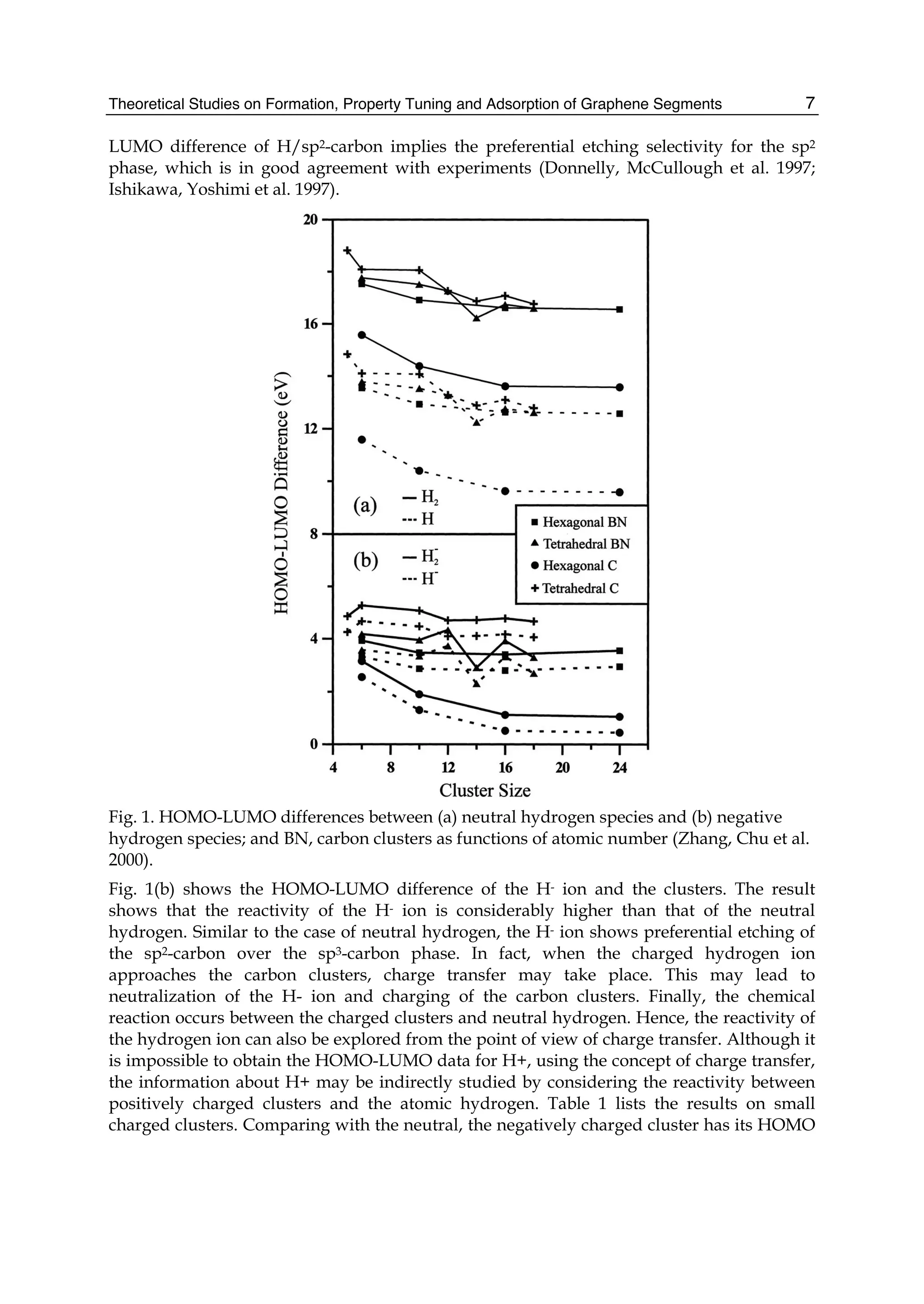
neutrals and ions. The HOMO-LUMO difference (with hydrogen as electron donor) as a
function of the cluster size of two types of clusters is shown in Fig. 1. Each curve displays an
overall tendency to decrease as the cluster size increases. This result is consistent with our
earlier report (Zhang, Bertran et al. 1998) that the HOMO-LUMO gap of the same silicon or
carbon cluster decreases as the cluster size increases and levels off when the cluster size
reaches about 30 atoms. Thus, the reactivity of hydrogen species is less sensitive to the
cluster size for larger clusters. The HOMO-LUMO differences between neutral hydrogen
and all the clusters are illustrated in Figure 1(a), in which molecular hydrogen shows larger
HOMO-LUMO differences and thus exhibits a lower reactivity than the atomic hydrogen.
This relatively low reactivity of molecular hydrogen gives rise to the well-known small
etching effect of molecular hydrogen in CVD processes (Harris, Doll et al. 1995). Being an
abundant species in some CVD processes, atomic hydrogen is considered to act as the phase
etchant. As illustrated in Figure 1(a), the HOMO-LUMO difference of H/sp2-carbon is
significantly different from that of H/sp3-carbon, indicating that the reactivity of atomic
hydrogen with the two carbon phases should be considerably different. The smaller HOMO-
Theoretical Studies on Formation, Property Tuning and Adsorption of Graphene Segments 7
LUMO difference of H/sp2-carbon implies the preferential etching selectivity for the sp2
phase, which is in good agreement with experiments (Donnelly, McCullough et al. 1997;
Ishikawa, Yoshimi et al. 1997).
Fig. 1. HOMO-LUMO differences between (a) neutral hydrogen species and (b) negative
hydrogen species; and BN, carbon clusters as functions of atomic number (Zhang, Chu et al.
2000).
Fig. 1(b) shows the HOMO-LUMO difference of the H- ion and the clusters. The result
shows that the reactivity of the H- ion is considerably higher than that of the neutral
hydrogen. Similar to the case of neutral hydrogen, the H- ion shows preferential etching of
the sp2-carbon over the sp3-carbon phase. In fact, when the charged hydrogen ion
approaches the carbon clusters, charge transfer may take place. This may lead to
neutralization of the H- ion and charging of the carbon clusters. Finally, the chemical
reaction occurs between the charged clusters and neutral hydrogen. Hence, the reactivity of
the hydrogen ion can also be explored from the point of view of charge transfer. Although it
is impossible to obtain the HOMO-LUMO data for H+, using the concept of charge transfer,
the information about H+ may be indirectly studied by considering the reactivity between
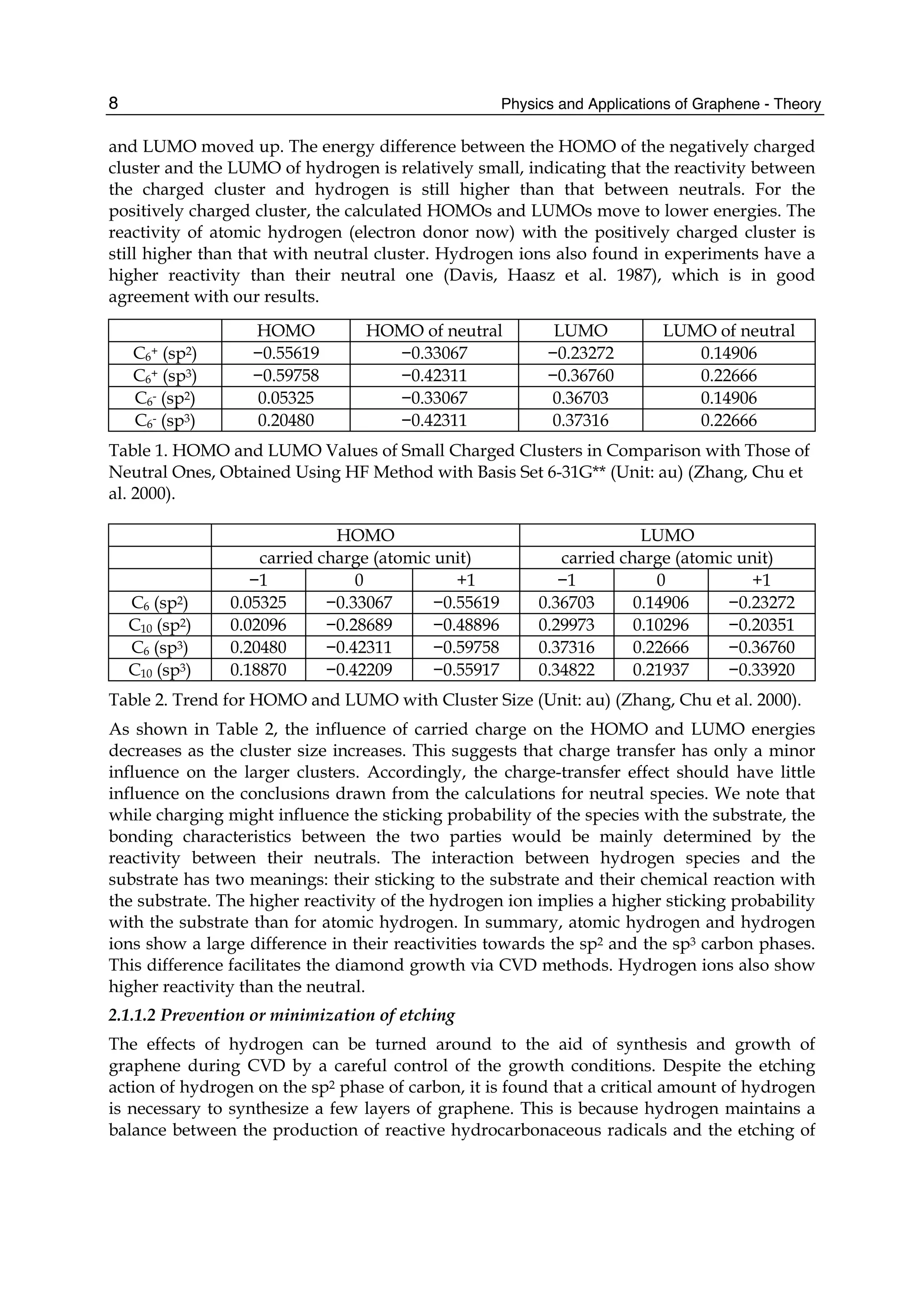
positively charged clusters and the atomic hydrogen. Table 1 lists the results on small
charged clusters. Comparing with the neutral, the negatively charged cluster has its HOMO
Physics and Applications of Graphene - Theory8
and LUMO moved up. The energy difference between the HOMO of the negatively charged
cluster and the LUMO of hydrogen is relatively small, indicating that the reactivity between
the charged cluster and hydrogen is still higher than that between neutrals. For the
positively charged cluster, the calculated HOMOs and LUMOs move to lower energies. The
reactivity of atomic hydrogen (electron donor now) with the positively charged cluster is
still higher than that with neutral cluster. Hydrogen ions also found in experiments have a
higher reactivity than their neutral one (Davis, Haasz et al. 1987), which is in good
agreement with our results.
HOMO HOMO of neutral LUMO LUMO of neutral
C6
+ (sp2) −0.55619 −0.33067 −0.23272 0.14906
C6
+ (sp3) −0.59758 −0.42311 −0.36760 0.22666
C6
- (sp2) 0.05325 −0.33067 0.36703 0.14906
C6
- (sp3) 0.20480 −0.42311 0.37316 0.22666
Table 1. HOMO and LUMO Values of Small Charged Clusters in Comparison with Those of
Neutral Ones, Obtained Using HF Method with Basis Set 6-31G** (Unit: au) (Zhang, Chu et
al. 2000).
HOMO LUMO
carried charge (atomic unit) carried charge (atomic unit)
−1 0 +1 −1 0 +1
C6 (sp2) 0.05325 −0.33067 −0.55619 0.36703 0.14906 −0.23272
C10 (sp2) 0.02096 −0.28689 −0.48896 0.29973 0.10296 −0.20351
C6 (sp3) 0.20480 −0.42311 −0.59758 0.37316 0.22666 −0.36760
C10 (sp3) 0.18870 −0.42209 −0.55917 0.34822 0.21937 −0.33920
Table 2. Trend for HOMO and LUMO with Cluster Size (Unit: au) (Zhang, Chu et al. 2000).
As shown in Table 2, the influence of carried charge on the HOMO and LUMO energies
decreases as the cluster size increases. This suggests that charge transfer has only a minor
influence on the larger clusters. Accordingly, the charge-transfer effect should have little
influence on the conclusions drawn from the calculations for neutral species. We note that
while charging might influence the sticking probability of the species with the substrate, the
bonding characteristics between the two parties would be mainly determined by the
reactivity between their neutrals. The interaction between hydrogen species and the
substrate has two meanings: their sticking to the substrate and their chemical reaction with
the substrate. The higher reactivity of the hydrogen ion implies a higher sticking probability
with the substrate than for atomic hydrogen. In summary, atomic hydrogen and hydrogen
ions show a large difference in their reactivities towards the sp2 and the sp3 carbon phases.
This difference facilitates the diamond growth via CVD methods. Hydrogen ions also show
higher reactivity than the neutral.
2.1.1.2 Prevention or minimization of etching
The effects of hydrogen can be turned around to the aid of synthesis and growth of
graphene during CVD by a careful control of the growth conditions. Despite the etching
action of hydrogen on the sp2 phase of carbon, it is found that a critical amount of hydrogen
is necessary to synthesize a few layers of graphene. This is because hydrogen maintains a
balance between the production of reactive hydrocarbonaceous radicals and the etching of
Theoretical Studies on Formation, Property Tuning and Adsorption of Graphene Segments 9
the graphene layer during the CVD process. If the ratio of methane to hydrogen is too low,
the etching reaction becomes much faster than the formation of graphene layers. This was
also experimentally proved in a recent work of Kong’s group (Reina, Thiele et al. 2009). As a
result, the ratio of gas mixture between methane and hydrogen needs to be optimized in
order to obtain a continuous, homogeneous and uniform graphene layer(s) (Park, Meyer et
al. 2010).
2.1.1.3 Beneficial effects of H2
If the growth conditions are properly adjusted, H2 may be utilized to promote the synthesis
and growth of graphene during CVD. H2 in growth atmosphere influences the uniformity of
graphene layers synthesized by CVD (Yu, Lian et al. 2008). With a high dosage of H2
introduced 1 h before introducing the hydrocarbon gases, the uniformity of graphene is
significantly enhanced, which suggests an annealing effect of H2. It is believed that H2 can
eliminate certain impurities (such as S and P) that may cause local variations in the carbon
dissolvability in the metal substrates (Angermann and Hörz 1993). In addition, atomic H can
remove defects in carbon (and anneal dangling bonds) at elevated temperatures.
2.1.2 Improvisations on CVD
In general, graphene synthesized by CVD has a high quality and a large area. Yet, they are
multi-crystalline in structure (Li, Cai et al. 2009). This is attributable to multiple factors: the
epitaxial growth mechanism of graphene on transition metal surfaces, the multi-crystalline
nature of the catalyst substrate, and the simultaneous nucleation of C atoms from multiple
sites of the substrate surface. Therefore, further scientific research is required for fabricating
high quality graphene with large single crystal domains. The recent experimental
observation clearly showed the domain formation of CVD synthesized graphene and the
defects are lined along the boundaries of the domains (Li, Cai et al. 2009). There are many
experimental studies on the growth mechanism of graphene on the catalyst surface
(Loginova, Bartelt et al. 2008; Gruneis, Kummer et al. 2009; Loginova, Bartelt et al. 2009;
McCarty, Feibelman et al. 2009; Starodub, Maier et al. 2009). McCarty and his co-workers
(Loginova, Bartelt et al. 2008; Loginova, Bartelt et al. 2009; McCarty, Feibelman et al. 2009;
Starodub, Maier et al. 2009) have highlighted the significance of C dimer super-saturation on
the metal surface to initiate the nucleation of graphene. They have also shown that graphene
nucleation preferentially occurs at metal steps rather than at terraces. While theoretical
studies in this nucleation are still scarce, Chen and his co-workers have recently studied the
formation of carbon monomer and dimer on transition metal terraces and steps to probe the
epitaxial growth of graphene (Chen, Zhu et al. 2010).
The methods of graphene synthesis which preceded CVD are briefly mentioned below.
2.2 Exfoliation method
One of the earliest and simplest methods consisted in micromechanical exfoliation or
cleavage of graphite (Novoselov, Geim et al. 2004; Novoselov, Geim et al. 2005; Novoselov,
Jiang et al. 2005). Layer(s) of graphene are peeled off mechanically from highly ordered
graphite using a Scotch tape and then deposited on a substrate e.g. SiO2. This is a simple yet
efficient method, as graphene is obtained from highly ordered graphite crystals. Graphene
extracted by microexfoliation shows very good electrical and structural quality. However,
the shortcoming of this most elementary method is its non-scalability and production of
uneven graphene films with small area.
Physics and Applications of Graphene - Theory10
2.3 Epitaxial growth
Graphene is also synthesizable by annealing of SiC crystal (Berger, Song et al. 2004; Berger,
Song et al. 2006) at a very elevated temperature (~2000 K) in ultra-high vacuum. Thermal
desorption of Si from the top layers of SiC crystalline wafer yields a multilayered graphene
structure that behaves like graphene. The number of layers can be controlled by limiting
time or temperature of the heating treatment. The quality and the number of layers in the
samples depend on the SiC face used for their growth (Castro Neto, Guinea et al. 2009) (and
references therein). Although the produced structure has a larger area than that obtainable
by the exfoliation technique, still the coverage or area is way below the size required in
electronic applications. Moreover, it is difficult to functionalize graphene obtained by this
route.
2.4 Wet-chemistry approach
Wet-chemistry based approach is also employed to synthesize graphene by reduction of
chemically synthesized graphene oxide (Stankovich, Dikin et al. 2007; Eda, Fanchini et al.
2008; Pichon 2008) (and references therein). Graphite is transformed into acid-intercalated
graphite oxide by a severe oxidative treatment in sulphuric and nitric acid (Hummers and
Offeman 1958). The intercalant is then rapidly evaporated at elevated temperatures,
followed by its exposure to ultrasound or ball milling. Exfoliation of the graphite oxide
readily occurs in aqueous medium due to the hydrophilicity of the former. Subsequent
reduction of exfoliated graphite oxide sheets by hydrazine results in the precipitation of
graphene owing to its hydrophobicity (Stankovich, Dikin et al. 2007). It is more versatile
than the methods comprising exfoliation and epitaxial growth on SiC and easier to scale up.
Yet, it has a poor control on the number of layers of graphene produced. Graphene
synthesized by this method may remain partially oxidized, which potentially changes its
electronic, optical, and mechanical properties.
3. Properties of graphene
The distinctive electronic, thermal and mechanical properties of graphene make it a very
promising candidate for a wide range of applications in nanoscience and nanotechnology.
The versatile properties of graphene are very well documented in the exponentially growing
scientific literature. Some of its interesting properties and its technological implications are
discussed hereafter.
3.1 Electronic properties
Graphene has immense potential for electronics for its extraordinarily high mobility of its
charge carriers at room temperature. When Si-based technology is approaching its
fundamental limits, graphene seems to be an ideal candidate to take over from silicon (Geim
and Novoselov 2007). Yet, graphene is semi-metallic with no band gap, which severely
limits its applications in electronics (Wei, Wang et al. 2010) due to its high leakage current in
many applications. The electronic band gap plays a central role in modern device physics
and technology and controls the performance of semiconductor devices. Moreover, it is a
property inherent to semiconductors and insulators which considerably govern their
transport and optical properties (Zhang, Tang et al. 2009). It has been possible to open and
tune the band gap of graphene bilayers by applying an electric field (Zhang, Tang et al.
2009) or by doping (Ohta, Bostwick et al. 2006). These results have profound implications for
Theoretical Studies on Formation, Property Tuning and Adsorption of Graphene Segments 11
potential utilization of graphene in electronics. The structure of graphene can be tailored to
change its electronic properties (spectrum) by several means discussed in the next sub-
section. The structural manipulation may induce optical properties (i.e band-gap opening),
which in turn gets incorporated into it, resulting in its potential for opto-electronic
applications.
3.2 Optical properties
Quantum size effects show up when the π electrons in graphene are confined laterally e.g. in
graphene segments (Zhang, Bertran et al. 1998; Feng, Lin et al. 2009) or graphene
nanoribbons (GNR) (Han, Ouml et al. 2007). An energy gap opens up when carriers are
confined to a quasi-one dimensional system like GNR. GNR shows optical properties which
are sensitive to their width, family, crystallographic orientation and edge termination
(Nakada, Fujita et al. 1996; Wakabayashi, Fujita et al. 1999); similar to the CNTs. The energy
gap of lithographically patterned GNR structures has been found to scale inversely with the
ribbon width, which demonstrates the possibility to engineer the band gap of graphene
nanostructures by lithographic processes (Han, Ouml et al. 2007). An alternative route to
induce the formation of a band gap is through the hydrogenation of graphene (Elias, Nair et
al. 2009; Guisinger, Rutter et al. 2009; Samarakoon and Wang 2010). The modification of the
carbon bonds associated with the hydrogenation preserves the crystalline order of the lattice
but leads to rehybridization of the carbon atoms from a planar sp2 to a distorted sp3 state
(Sofo, Chaudhari et al. 2007). Recent experimental studies have demonstrated reversible
hydrogenation through heating (Elias, Nair et al. 2009). Our theoretical findings relevant to
structure and size dependent PL in carbon nanostructures (Zhang, Bertran et al. 1998; Feng,
Lin et al. 2009) are discussed in the following sub-section.
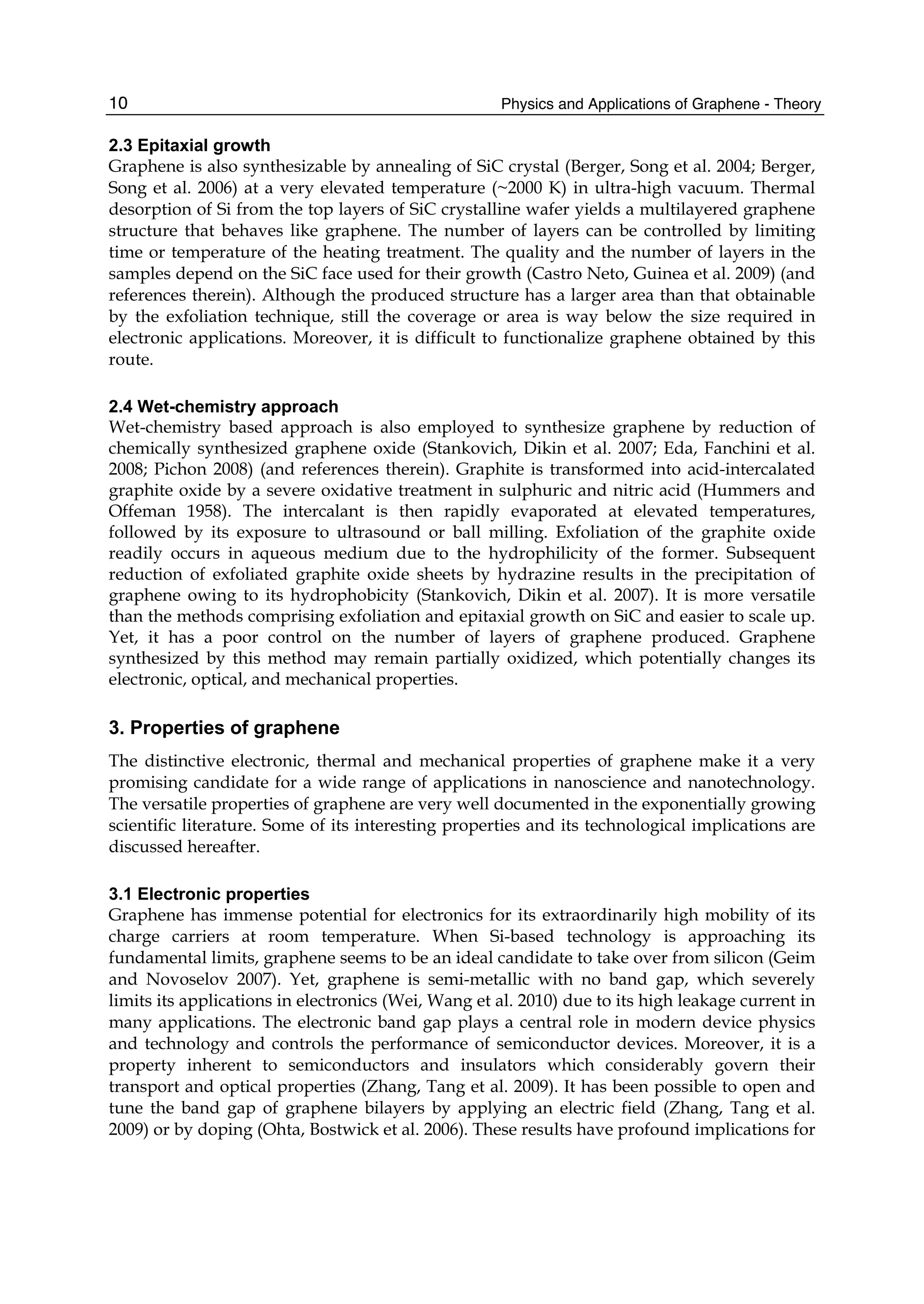
Fig. 2. Models for hexagonal clusters (or graphene segments): (a) C6H6, (b) C10H8, (c) C16H10,
(d) C24H12, (e) C32H14, (f) C42H16, (g) C54H18 and (h) C66H18. The terminated bonds indicate the
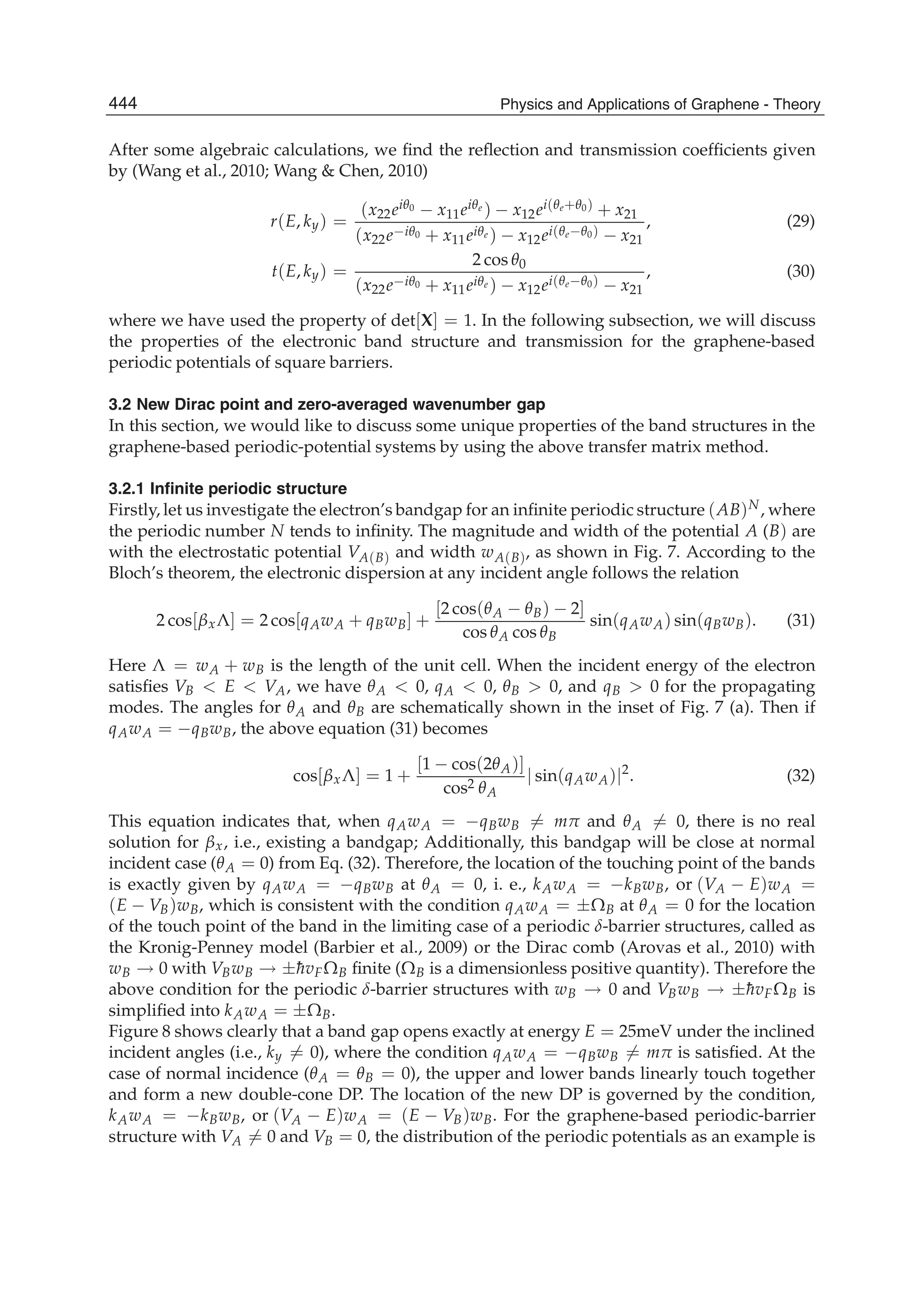
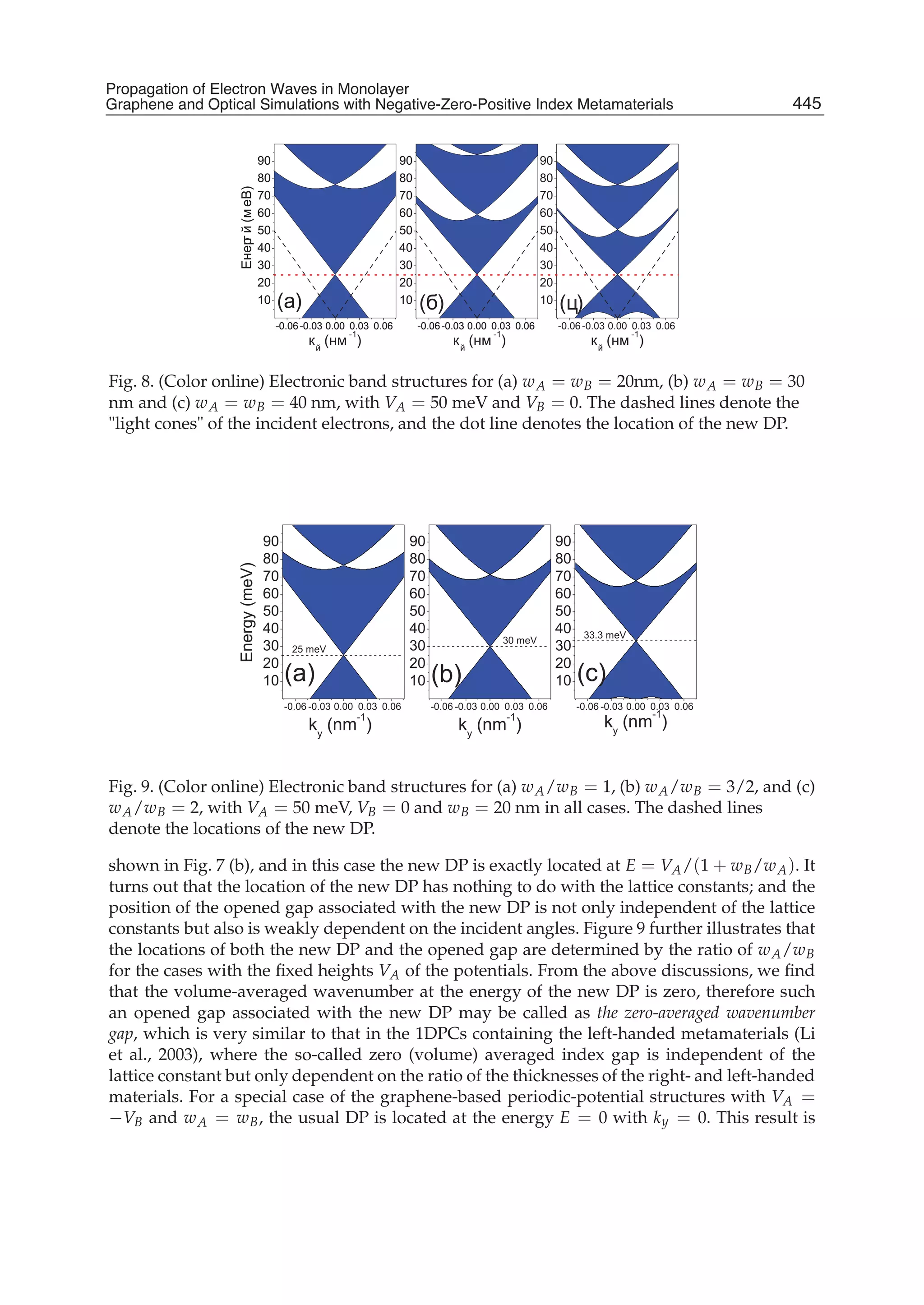
sites of boundary hydrogen atoms (Zhang, Bertran et al. 1998).
Physics and Applications of Graphene - Theory12
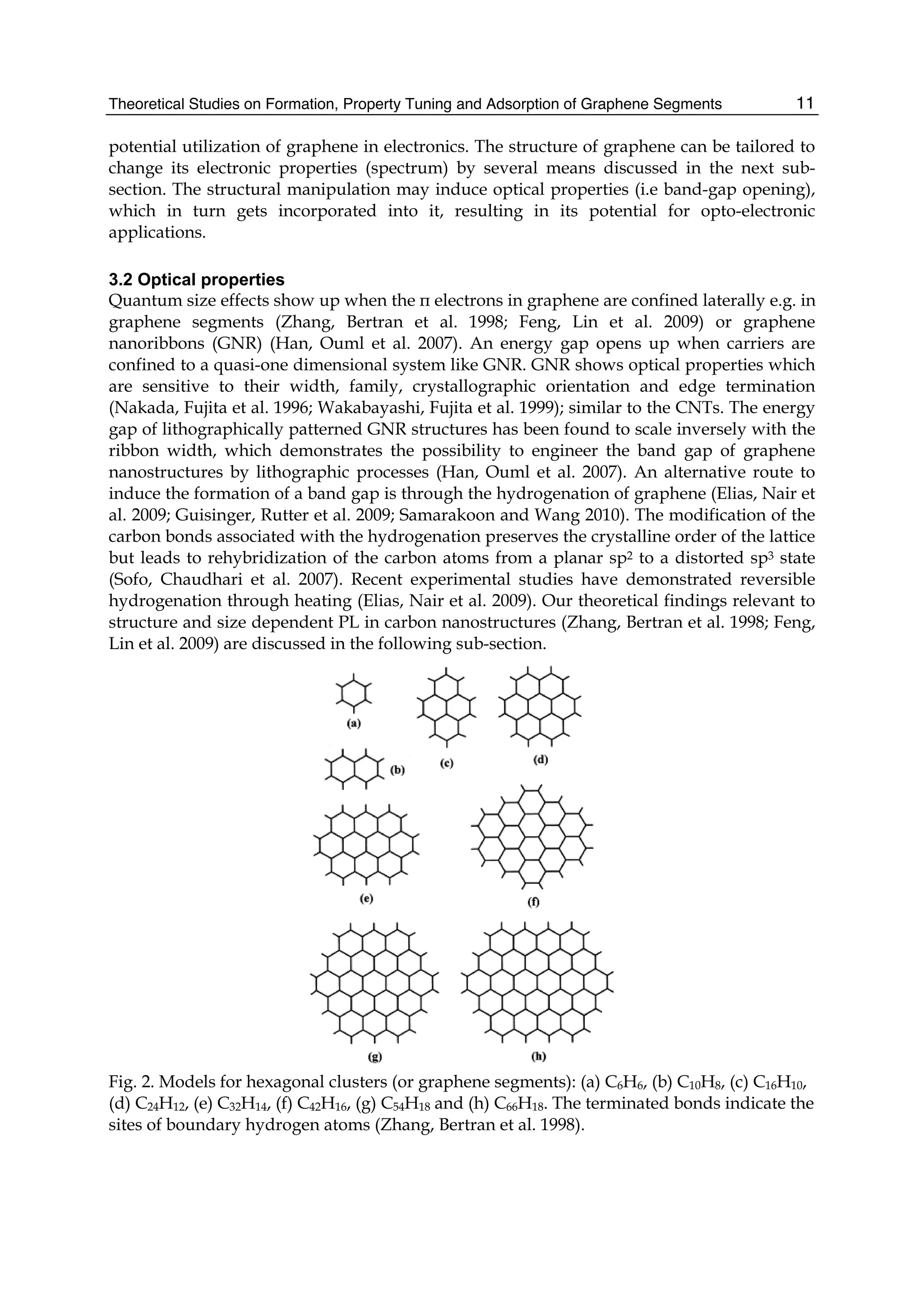
Fig. 3. Schematic diagram illustrates the distribution of band-gap states in a-C:H materials.
A solid line indicates the total density of states (DOS); a dashed line represents the
unlocalized states; and the dash-dotted line shows the localized states (Zhang, Bertran et al.
1998).
The broadband luminescence between 1.5 and 2.5 eV from carbon-based films has been
attributed to the presence of a sp2 amorphous phase or graphite phase (Badzian, Badzian et
al. 1988; Nemanich, Glass et al. 1988). The distribution of states within the energy gap
introduced by an sp2 disordered phase in CVD diamond film has been considered as the
origin of the broadband luminescence (Bergman, McClure et al. 1994), based on the theory
of amorphous material (Street 1984). Further, the mechanism of luminescence and
recombination in a-C:H and its alloys has been proposed (Robertson 1996 (a); Robertson
1996 (b); Silva, Robertson et al. 1996) to be due to a modification of the band edges in
hydrogenated amorphous silicon. The band-tail states were assumed to arise from clusters
of sp2 sites. The π-bonding sp2 phase has frequently been related to the origin of the
luminescence (Rusli, Amaratunga et al. 1995; Bourée, Godet et al. 1996; Liu, Gangopadhyay
et al. 1997). The broadband luminescence is commonly believed to be related to the gap/tail
states produced from small sp2 clusters with various sizes and/or shapes. A new
photoluminescence model taking account of individual cluster has presented a convincing
mechanism (Demichelis, Schreiter et al. 1995). Still, clear pictures of which structures or
shapes of sp2 carbon-clusters contribute to the highly efficient luminescence were missing.
For a crystal diamond that is also a pure sp3-bonded material, the gap is not only indirect
but also wide (5.49 eV at 77 K (Collins 1993)). The gap of a nano-structural diamond-like
crystallite may be even larger, and thus may not relate to the luminescence that is presently
concerned in the range 1.5~2.5 eV generated by means of optical transition between band
states. On the other hand, the π-bonding states of graphite lie closest to the Fermi level, so it
does not seem realistic to relate the gap formed by these states to the luminescence between
1.5 and 2.5 eV, too. However, a nano-sized π-bonding sp2 cluster may show a fairly wide
energy gap in comparison with that of the graphite material, as shown in our work (Zhang,
Bertran et al. 1998), which coincides with the size-dependence rule that normally holds for
many other materials. This feature has actually been seen in the calculations with a Hückel
approximation for several sp2 carbon clusters (Robertson and O'Reilly 1987; Robertson
1995). However, the previous study was only qualitative and did not distinguish the
Theoretical Studies on Formation, Property Tuning and Adsorption of Graphene Segments 13
different features of states in the gap-tail caused by the individual sp2 carbon clusters due to
their different sizes and/or shapes. Such a distinction, in our opinion, is very important for
understanding the origin of highly efficient luminescence from carbon-based materials.
For the carbon-based materials described here, it is widely believed that both the size and
shape determine the energy gap and the broadband luminescence (Demichelis, Schreiter et
al. 1995; Robertson 1996 (a); Robertson 1996 (b); Silva, Robertson et al. 1996). However, any
structural deviation from the stable configurations (for carbon, the stable structures are
tetrahedral or sp3 and hexagonal or sp2) may produce localized states so that the energy gap
is influenced. Obviously, the localized states do not relate to the efficient, room temperature
luminescence. Thus, the small clusters with structures such as a fivefold ring, sevenfold ring
and off-plane hexagonal that are not the stable hexagonal structures are doubtful for the
main contribution to the efficient broadband luminescence. Also, the main source for such
luminescence would be the stable hexagonal carbon clusters. We carried out calculations for
a series of tetrahedral and hexagonal atomic clusters, shown in Fig 2 based on semi-
empirical molecular orbital and density functional theories to determine the size-
dependence effect of the energy gap in such clusters. We have classified the band-tail states
into localized and confined, as shown in Fig 3 in order to emphasize the role of hexagonal
planar shape of carbon-clusters in the broad band visible PL. The localized states result from
the structural deviation from graphite-like configuration, and the associated luminescence
may be described by using the conventional theory for amorphous materials. The confined
states are generated due to the existence of stable graphite-like local structures with various
sizes shown in Fig. 2 and are the main factor for giving efficient, room-temperature
luminescence. Our calculations of a series of small hexagonal carbon clusters shown in Fig. 2
demonstrate that the energy-gap distribution, due to the difference in size, is considerably
broad, which explains the broadband feature of luminescence. Weak π-π interaction enables
multilayer stacking of graphene sheets in different possible ways shown in Fig 4 (Feng, Lin
et al. 2009) and thereby helps the formation and stability of large-sized sp2 C-H films. Our
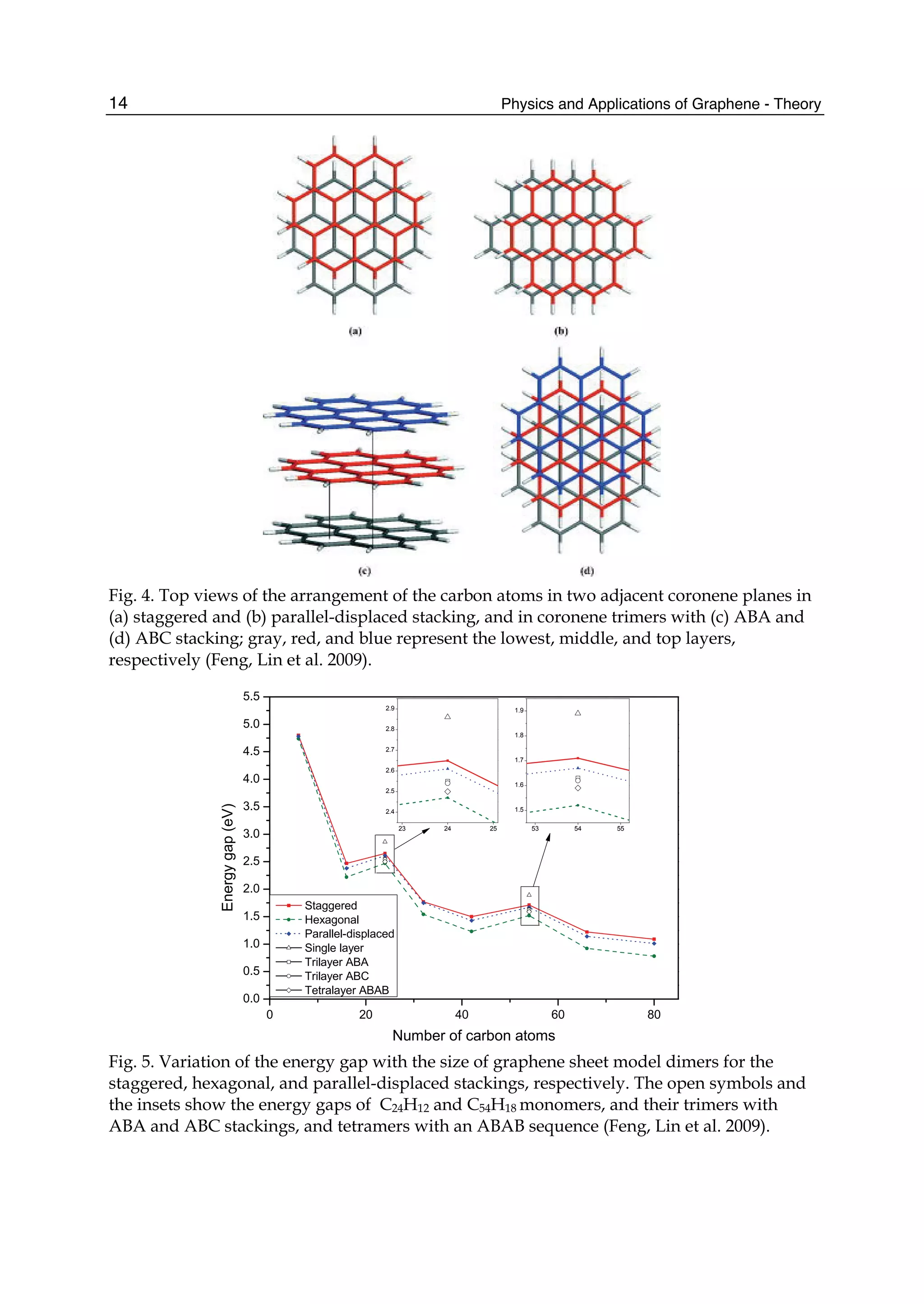
calculations show that the energy gaps of graphene are strongly dependent on their sizes
(Feng, Lin et al. 2009), while the stacking order and the number of stacked layers have a
minor influence. The energy gap is found to decrease with the increasing size, as shown in
Fig 5. It turns out that by controlling the formation of graphene during CVD, it would be
possible to control the size of the growing graphene and thereby tune its luminescent
properties by utilizing our results on the size dependence of energy gap.
3.3 Non-covalent binding properties
The weak, intermolecular, vdW, π-π interactions (Hunter and Sanders 1990) play a crucial
role in the crystal packing of organic molecules containing aromatic rings (Desiraju and
Gavezzotti 1989; Hunter, Lawson et al. 2001), the intercalation of certain drug molecules into
DNA (Brana, Cacho et al. 2001), the binding affinities of host-guest complexes (Muehldorf,
Van Engen et al. 1988; Ferguson, Sanford et al. 1991; Chipot, Jaffe et al. 1996), as well as the
three-dimensional structures of biological systems, including proteins and nucleic acids, and
their molecular organization and recognition processes (Burley and Petsko 1985; Blundell,
Singh et al. 1986; Hobza, Selzle et al. 1994). Graphene sheets can be stacked into bilayers and
multilayers by virtue of π-π interactions between the neighboring sheets. The electronic
properties of graphene multilayers vary with the stacking order, and rapidly evolve with
the number of layers, approaching the 3D limit of graphite (Geim and Novoselov 2007;
Castro Neto, Guinea et al. 2009).
Physics and Applications of Graphene - Theory14
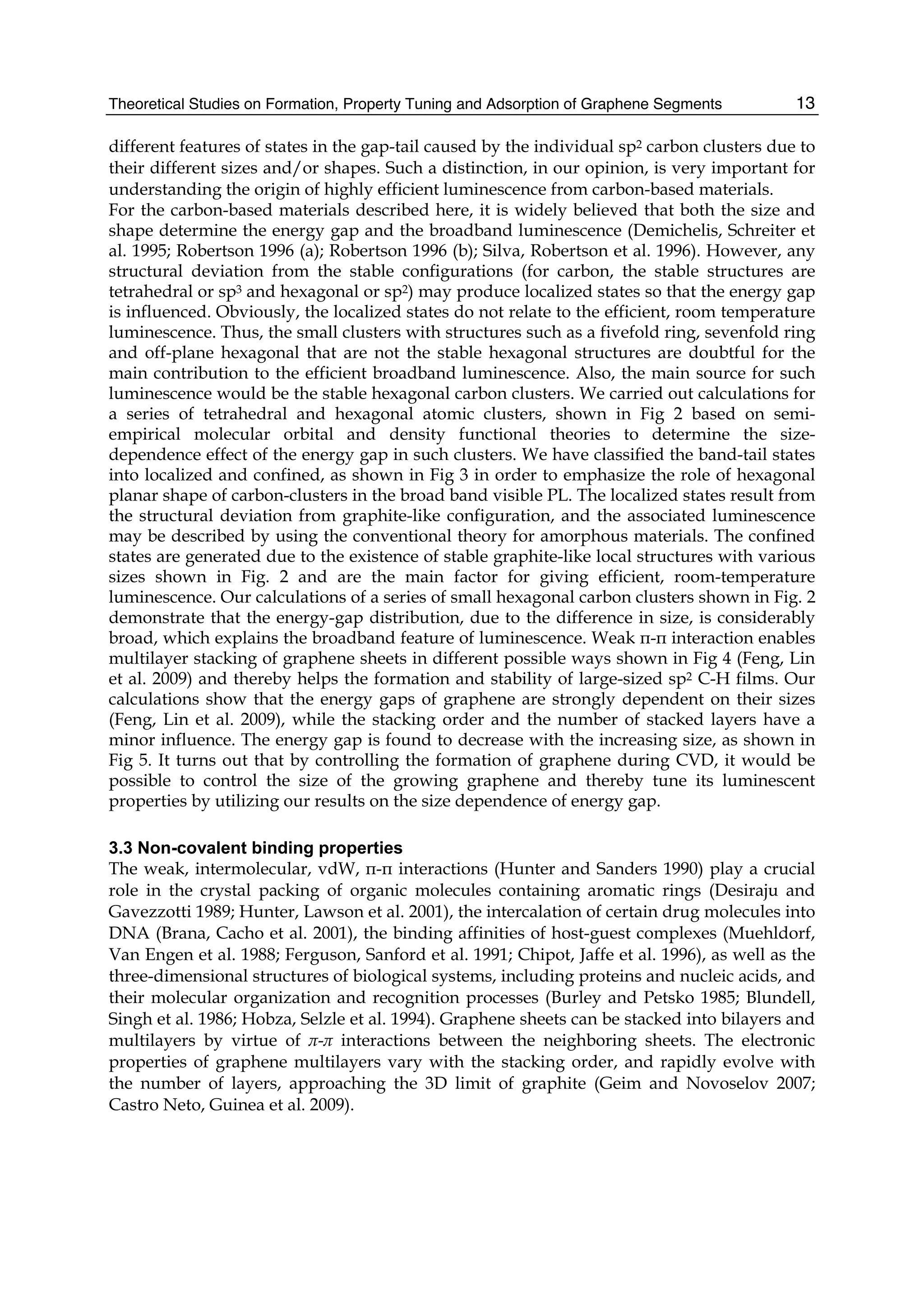
Fig. 4. Top views of the arrangement of the carbon atoms in two adjacent coronene planes in
(a) staggered and (b) parallel-displaced stacking, and in coronene trimers with (c) ABA and
(d) ABC stacking; gray, red, and blue represent the lowest, middle, and top layers,
respectively (Feng, Lin et al. 2009).
0 20 40 60 80
0.0
0.5
1.0
1.5
2.0
2.5
3.0
3.5
4.0
4.5
5.0
5.5
23 24 25
2.4
2.5
2.6
2.7
2.8
2.9
53 54 55
1.5
1.6
1.7
1.8
1.9
Energygap(eV)
Number of carbon atoms
Staggered
Hexagonal
Parallel-displaced
Single layer
Trilayer ABA
Trilayer ABC
Tetralayer ABAB
Fig. 5. Variation of the energy gap with the size of graphene sheet model dimers for the
staggered, hexagonal, and parallel-displaced stackings, respectively. The open symbols and
the insets show the energy gaps of C24H12 and C54H18 monomers, and their trimers with
ABA and ABC stackings, and tetramers with an ABAB sequence (Feng, Lin et al. 2009).
Theoretical Studies on Formation, Property Tuning and Adsorption of Graphene Segments 15
Theoretically, it is challenging to model weak vdW interaction with the conventional DFT
unless an appropriate, correction term for vDW interaction is incorporated. With such a
treatment, we have shown in our work that the stacked graphene segments can be held
together in different orientations by π-π interactions and the binding energy is strongly
dependent on the size of the PAH, on stacking order, and on the number of stacked layers
(Feng, Lin et al. 2009). A graphene bilayer has very unusual electronic properties, such as
the anomalous integer quantum Hall effect that significantly changes with respect to a single
layer (McCann and Fal'ko 2006; Novoselov, McCann et al. 2006; Malard, Nilsson et al. 2007),
and which can be used to distinguish between a graphene bilayer and a monolayer.
Moreover, as already mentioned in a preceding sub-section, the band-gap of graphene
bilayer is tunable in different ways (Ohta, Bostwick et al. 2006; Zhang, Tang et al. 2009). The
importance of graphene bilayers emphasizes the need to understand the binding between
the two sheets in graphene bilayers. We have shown in our work using dimer, bilayer
models that the binding energy increases with size until it saturates when it reaches the size
of about 80 atoms (Feng, Lin et al. 2009). A clear understanding of the weak vdW
interactions discussed in the section is relevant to some potential applications of graphene.
4. Physisorption and related applications
4.1 Water physisorption and novel ice structure formation
A water cluster adsorbed on a graphite surface is a prototypical weakly bound vdW π-system
that involves water-graphite and water-water interactions. Our investigations show that the
binding energy of water clusters interacting with graphite is dependent on the number of
water molecules that form hydrogen bonds, but is independent of the water cluster size.
Furthermore, we have found that these physically adsorbed or physisorbed water clusters
show little change in their IR peak position and leave an almost perfect planar graphite surface
(Lin, Zhang et al. 2005). SW-CNTs provide a well-defined nanoscale cylindrical pore that can
serve as a nanometer-sized capillary in the fabrication of quasi-one-dimensional (Q1D)
materials by filling SW-CNTs with chosen materials (Saito, Dresselhaus et al. 1998; Ugarte,
Stoeckli et al. 1998). Even though water has been extensively studied, some of its properties
remain partially unknown. A significant number of them are related to the behavior of water
under confinement within nanoscale Q1D channels such as SW-CNTs, and the confined water
is expected to exhibit different physical properties from its bulk counterparts. Since many
similar scientifically relevant systems can be found in nature, this issue is of great interest to
biology, geology, and materials science (Sansom and Biggin 2001).
We have systematically studied using a self-consistent charge density-functional tight-
binding method complemented with an empirical vdW force correction to show that water
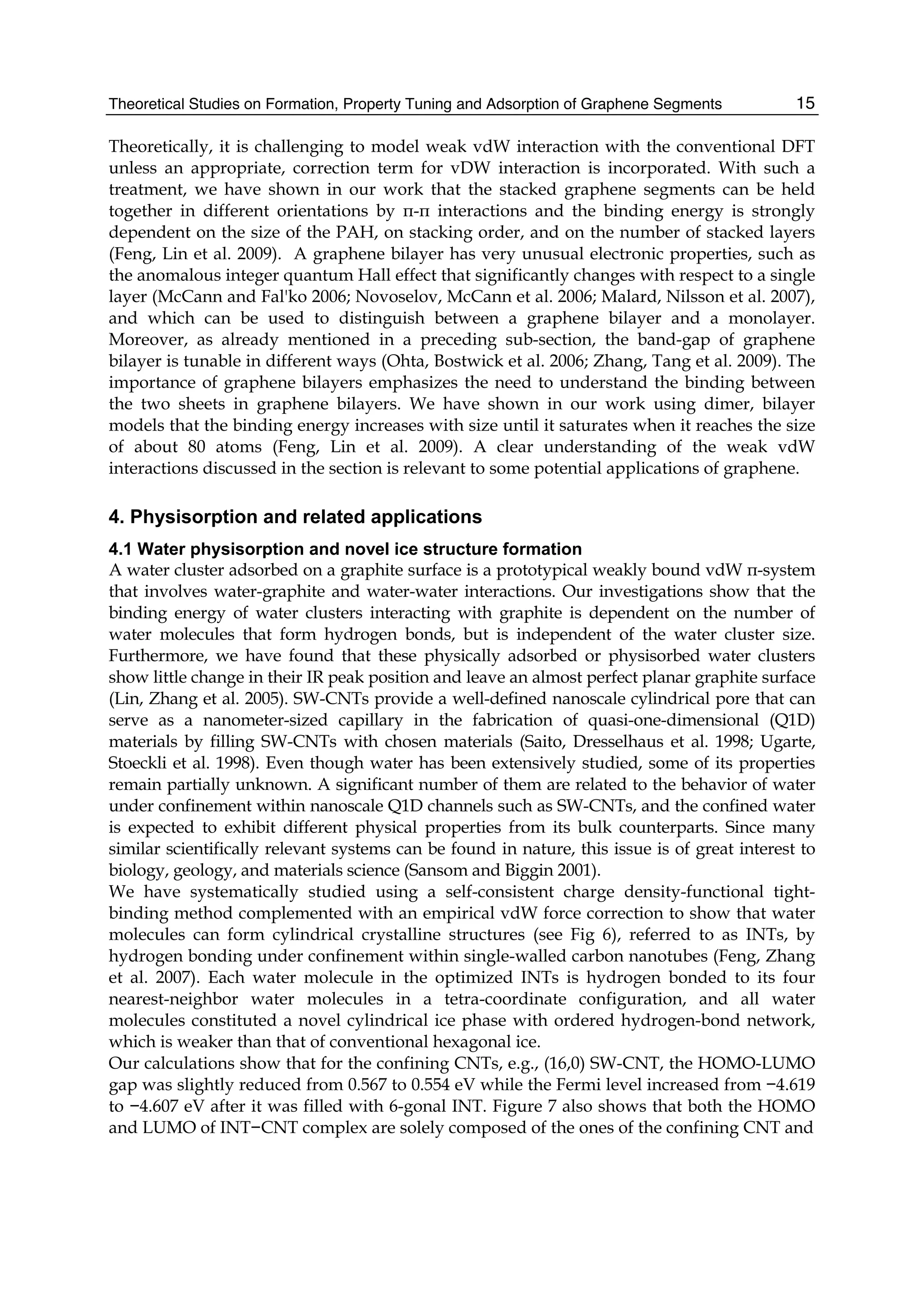
molecules can form cylindrical crystalline structures (see Fig 6), referred to as INTs, by
hydrogen bonding under confinement within single-walled carbon nanotubes (Feng, Zhang
et al. 2007). Each water molecule in the optimized INTs is hydrogen bonded to its four
nearest-neighbor water molecules in a tetra-coordinate configuration, and all water
molecules constituted a novel cylindrical ice phase with ordered hydrogen-bond network,
which is weaker than that of conventional hexagonal ice.
Our calculations show that for the confining CNTs, e.g., (16,0) SW-CNT, the HOMO-LUMO
gap was slightly reduced from 0.567 to 0.554 eV while the Fermi level increased from −4.619
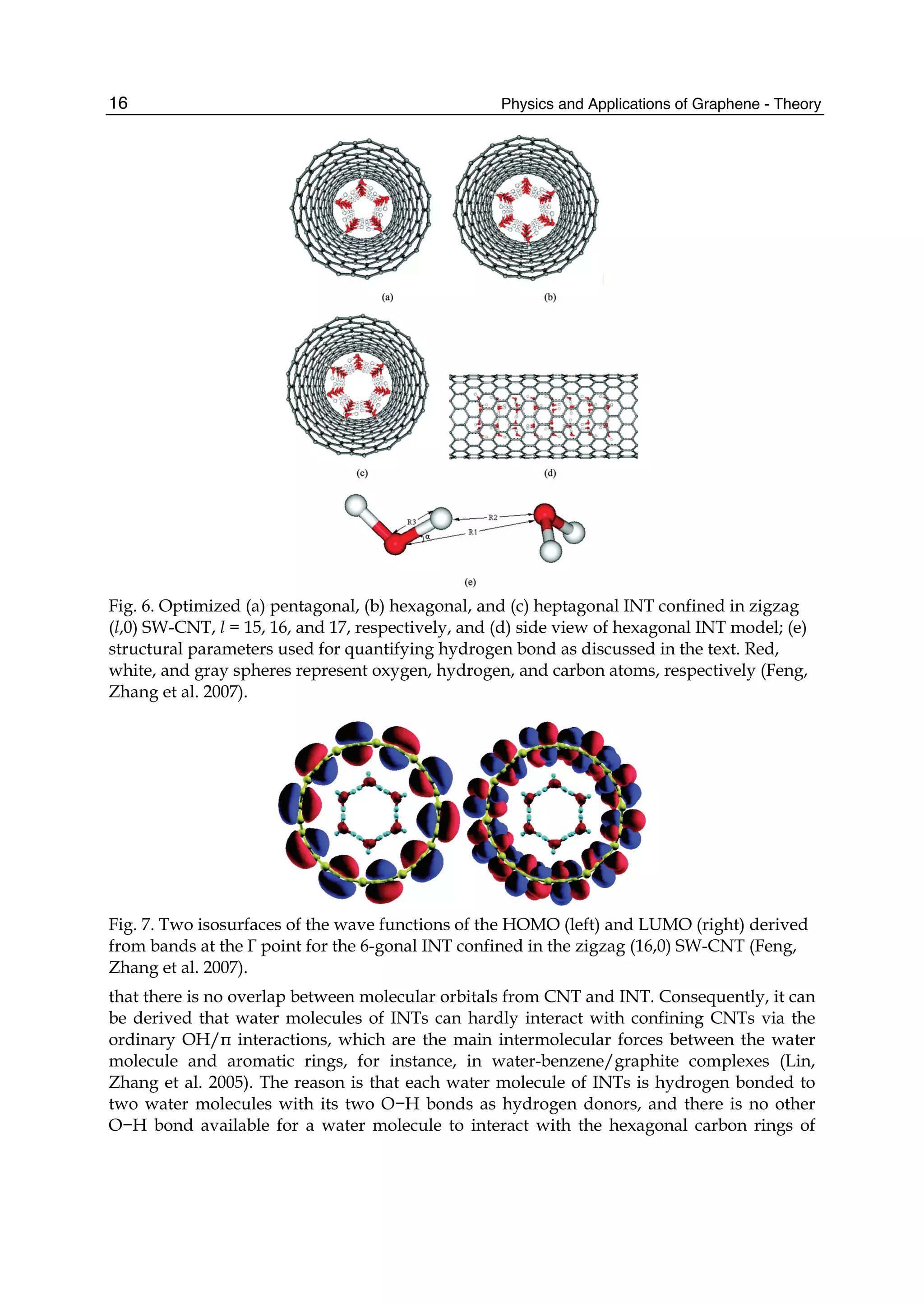
to −4.607 eV after it was filled with 6-gonal INT. Figure 7 also shows that both the HOMO
and LUMO of INT−CNT complex are solely composed of the ones of the confining CNT and
Physics and Applications of Graphene - Theory16
Fig. 6. Optimized (a) pentagonal, (b) hexagonal, and (c) heptagonal INT confined in zigzag
(l,0) SW-CNT, l = 15, 16, and 17, respectively, and (d) side view of hexagonal INT model; (e)
structural parameters used for quantifying hydrogen bond as discussed in the text. Red,
white, and gray spheres represent oxygen, hydrogen, and carbon atoms, respectively (Feng,
Zhang et al. 2007).
Fig. 7. Two isosurfaces of the wave functions of the HOMO (left) and LUMO (right) derived
from bands at the Γ point for the 6-gonal INT confined in the zigzag (16,0) SW-CNT (Feng,
Zhang et al. 2007).
that there is no overlap between molecular orbitals from CNT and INT. Consequently, it can
be derived that water molecules of INTs can hardly interact with confining CNTs via the
ordinary OH/π interactions, which are the main intermolecular forces between the water
molecule and aromatic rings, for instance, in water-benzene/graphite complexes (Lin,
Zhang et al. 2005). The reason is that each water molecule of INTs is hydrogen bonded to
two water molecules with its two O−H bonds as hydrogen donors, and there is no other
O−H bond available for a water molecule to interact with the hexagonal carbon rings of
Theoretical Studies on Formation, Property Tuning and Adsorption of Graphene Segments 17
confining CNTs via OH/π interaction. We have revealed that the unique crystalline
structures of INTs are mainly due to the steric hindrance effect induced by the confining
CNT rather than the ordinary OH/π interaction between INT and CNT.
4.2 Hydrogen molecule physisorption and storage
Hydrogen physisorption by carbon-based nanostructures, which has potential for hydrogen
storage, still remains challenging. The current preparative methods for CNTs generate
heterogeneous tubes varying in length, diameter, and chirality. The presence of multiply (n,
m) chiral SW-CNTs in a given sample poses a major barrier towards realizing many
potential applications of CNTs. It may also contribute to the many inconsistencies in the
experimental results.
The interaction between H2 and CNT is a typical π-involved weak interaction. Using an
approximate density functional method augmented with a vdW dispersion term, we have
systematically investigated the role of CNT’s curvature and chirality on the physisorption of
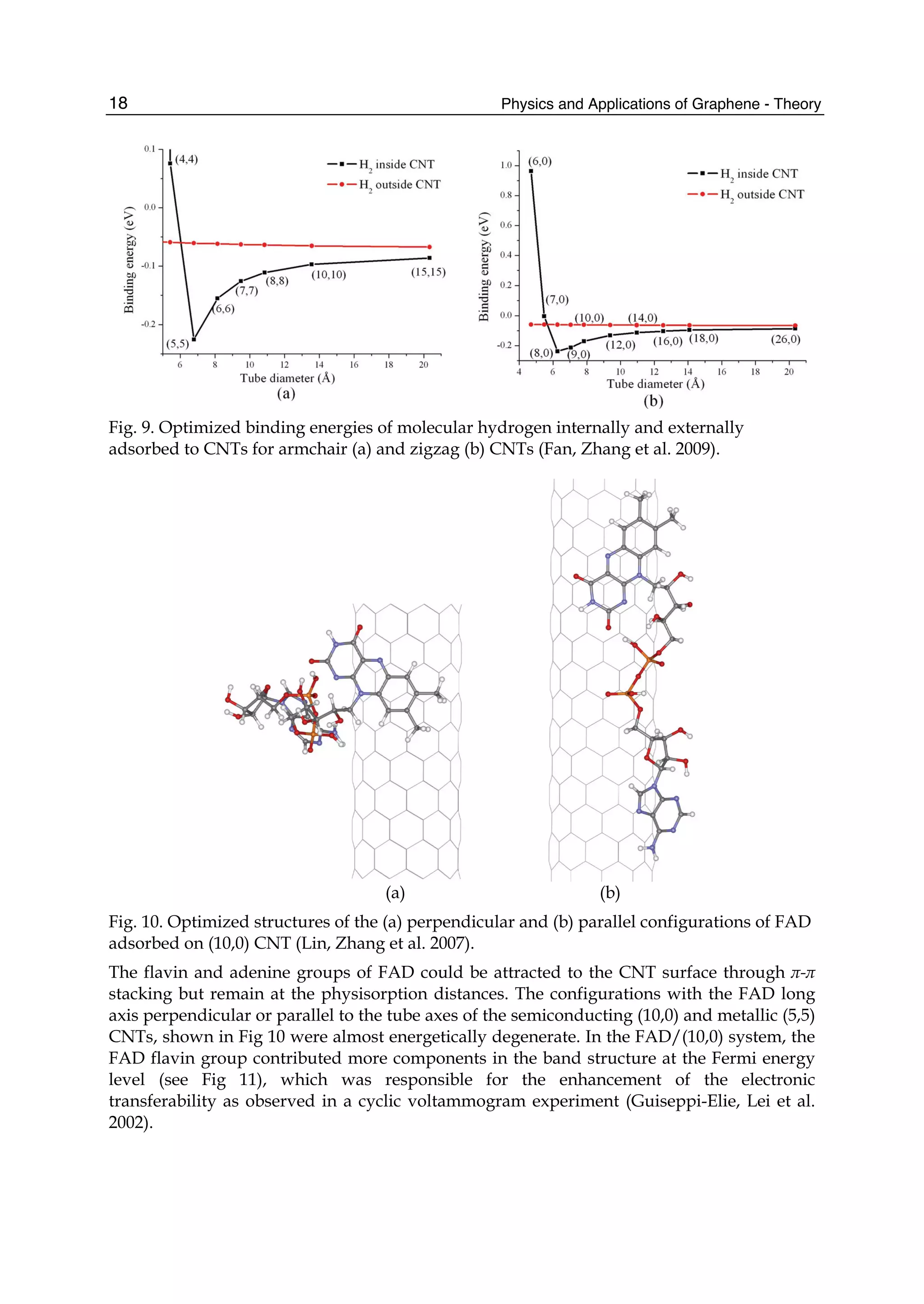
H2. In our work, we have explored the different possible physisorption sites for H2 molecule
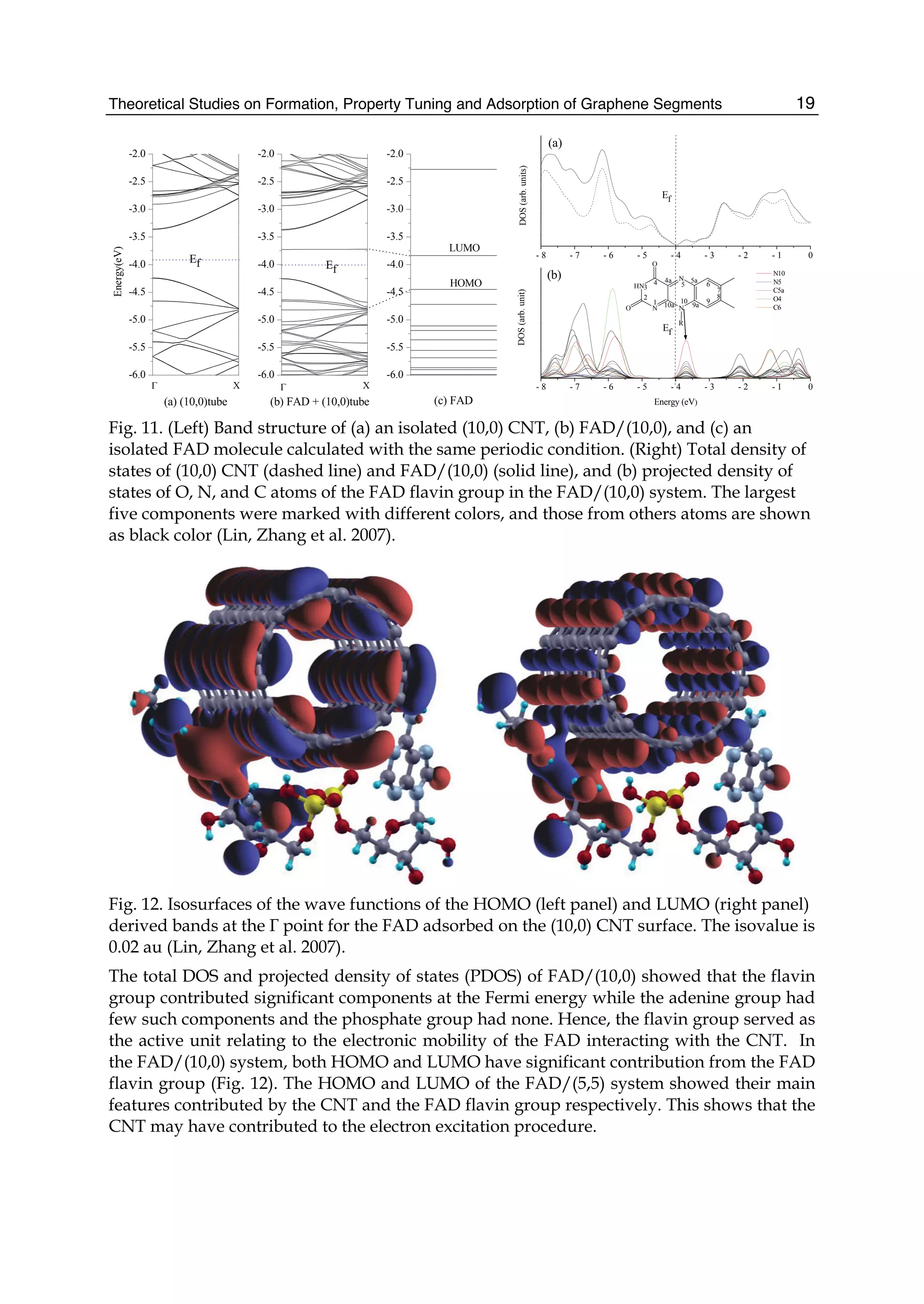
on SW-CNT, as shown in Fig 8. Based on our results shown in Fig 9, we propose that CNTs
with diameter of 6–7 Å, such as (5, 5), (8, 0), and (6, 3) tubes, are energetically optimal
candidates for physisorption of H2. In this relatively narrow range of diameters, the internal
adsorption binding energies are around −0.22 eV, which is three times as large as that of H2
on graphene surface; for external adsorption, the binding energy of −0.061 eV is just 18%
below that of H2 on graphene surface. It is conceivable that the inconsistencies in the
experimental results (in terms of the hydrogen storage capacities of CNTs) were caused in
part by the varying diameters of the as-prepared CNT samples used. We have found that
nanotube’s curvature plays an important role in the physisorption process of hydrogen,
while the chirality of the tube has a negligible effect.
Fig. 8. Different adsorption sites for a hydrogen molecule on a segment of armchair SW-
CNTs (Fan, Zhang et al. 2009).
4.3 Interaction with bio molecules, its relevance to biosensing
4.3.1 Flavin Adenine dinucleotide (FAD)
FAD is in the redox active group of flavoenzymes that catalyzes important biological redox
reactions and is perhaps the most versatile of all of the redox coenzymes. We simulated the
adsorption procedure of the FAD on the semiconducting (10,0) and the metallic (5,5) carbon
nanotubes (CNTs) using a density functional tight binding method with the inclusion of an
empirical dispersion term in total energy.
Physics and Applications of Graphene - Theory18
Fig. 9. Optimized binding energies of molecular hydrogen internally and externally
adsorbed to CNTs for armchair (a) and zigzag (b) CNTs (Fan, Zhang et al. 2009).
(a) (b)
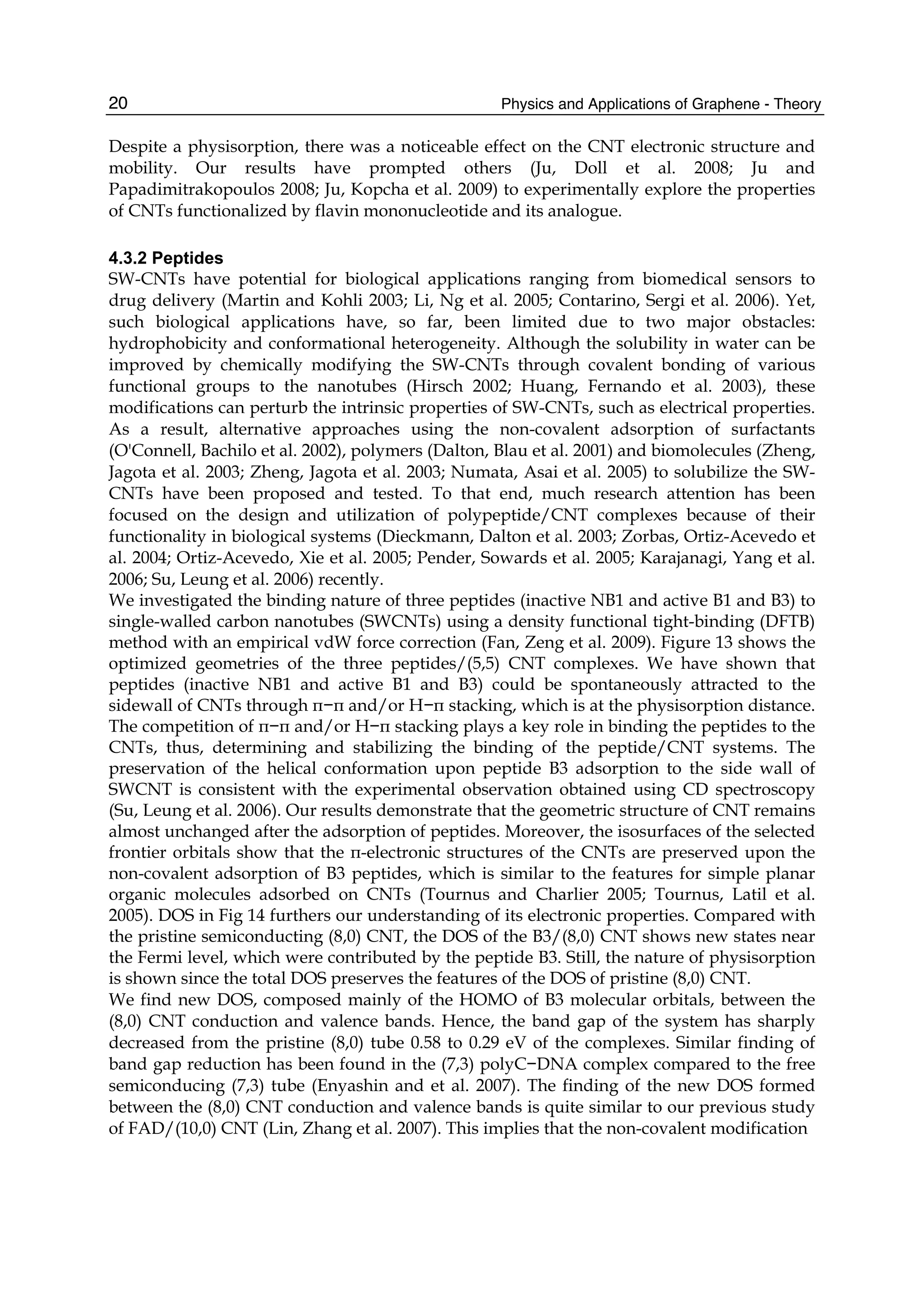
Fig. 10. Optimized structures of the (a) perpendicular and (b) parallel configurations of FAD
adsorbed on (10,0) CNT (Lin, Zhang et al. 2007).
The flavin and adenine groups of FAD could be attracted to the CNT surface through π-π
stacking but remain at the physisorption distances. The configurations with the FAD long
axis perpendicular or parallel to the tube axes of the semiconducting (10,0) and metallic (5,5)
CNTs, shown in Fig 10 were almost energetically degenerate. In the FAD/(10,0) system, the
FAD flavin group contributed more components in the band structure at the Fermi energy
level (see Fig 11), which was responsible for the enhancement of the electronic
transferability as observed in a cyclic voltammogram experiment (Guiseppi-Elie, Lei et al.
2002).
Theoretical Studies on Formation, Property Tuning and Adsorption of Graphene Segments 19
-6.0
-5.5
-5.0
-4.5
-4.0
-3.5
-3.0
-2.5
-2.0
-6.0
-5.5
-5.0
-4.5
-4.0
-3.5
-3.0
-2.5
-2.0
ΧΓ
Ef
Energy(eV)
(a) (10,0)tube
Ef
Γ Χ
-6.0
-5.5
-5.0
-4.5
-4.0
-3.5
-3.0
-2.5
-2.0
(b) FAD + (10,0)tube (c) FAD
HOMO
LUMO
- 8 - 7 - 6 - 5 - 4 - 3 - 2 - 1 0
- 8 - 7 - 6 - 5 - 4 - 3 - 2 - 1 0
N
N
HN
N
O
O
1
2
3
4 4a
5
5a
6
7
8
9
9a
10
10a
R
N10
N5
C5a
O4
C6
(b)
Ef
DOS(arb.unit)
Energy (eV)
(a)
Ef
DOS(arb.units)
Fig. 11. (Left) Band structure of (a) an isolated (10,0) CNT, (b) FAD/(10,0), and (c) an
isolated FAD molecule calculated with the same periodic condition. (Right) Total density of
states of (10,0) CNT (dashed line) and FAD/(10,0) (solid line), and (b) projected density of
states of O, N, and C atoms of the FAD flavin group in the FAD/(10,0) system. The largest
five components were marked with different colors, and those from others atoms are shown
as black color (Lin, Zhang et al. 2007).
Fig. 12. Isosurfaces of the wave functions of the HOMO (left panel) and LUMO (right panel)
derived bands at the Γ point for the FAD adsorbed on the (10,0) CNT surface. The isovalue is
0.02 au (Lin, Zhang et al. 2007).
The total DOS and projected density of states (PDOS) of FAD/(10,0) showed that the flavin
group contributed significant components at the Fermi energy while the adenine group had
few such components and the phosphate group had none. Hence, the flavin group served as
the active unit relating to the electronic mobility of the FAD interacting with the CNT. In
the FAD/(10,0) system, both HOMO and LUMO have significant contribution from the FAD
flavin group (Fig. 12). The HOMO and LUMO of the FAD/(5,5) system showed their main
features contributed by the CNT and the FAD flavin group respectively. This shows that the
CNT may have contributed to the electron excitation procedure.
Physics and Applications of Graphene - Theory20
Despite a physisorption, there was a noticeable effect on the CNT electronic structure and
mobility. Our results have prompted others (Ju, Doll et al. 2008; Ju and
Papadimitrakopoulos 2008; Ju, Kopcha et al. 2009) to experimentally explore the properties
of CNTs functionalized by flavin mononucleotide and its analogue.
4.3.2 Peptides
SW-CNTs have potential for biological applications ranging from biomedical sensors to
drug delivery (Martin and Kohli 2003; Li, Ng et al. 2005; Contarino, Sergi et al. 2006). Yet,
such biological applications have, so far, been limited due to two major obstacles:
hydrophobicity and conformational heterogeneity. Although the solubility in water can be
improved by chemically modifying the SW-CNTs through covalent bonding of various
functional groups to the nanotubes (Hirsch 2002; Huang, Fernando et al. 2003), these
modifications can perturb the intrinsic properties of SW-CNTs, such as electrical properties.
As a result, alternative approaches using the non-covalent adsorption of surfactants
(O'Connell, Bachilo et al. 2002), polymers (Dalton, Blau et al. 2001) and biomolecules (Zheng,
Jagota et al. 2003; Zheng, Jagota et al. 2003; Numata, Asai et al. 2005) to solubilize the SW-
CNTs have been proposed and tested. To that end, much research attention has been
focused on the design and utilization of polypeptide/CNT complexes because of their
functionality in biological systems (Dieckmann, Dalton et al. 2003; Zorbas, Ortiz-Acevedo et
al. 2004; Ortiz-Acevedo, Xie et al. 2005; Pender, Sowards et al. 2005; Karajanagi, Yang et al.
2006; Su, Leung et al. 2006) recently.
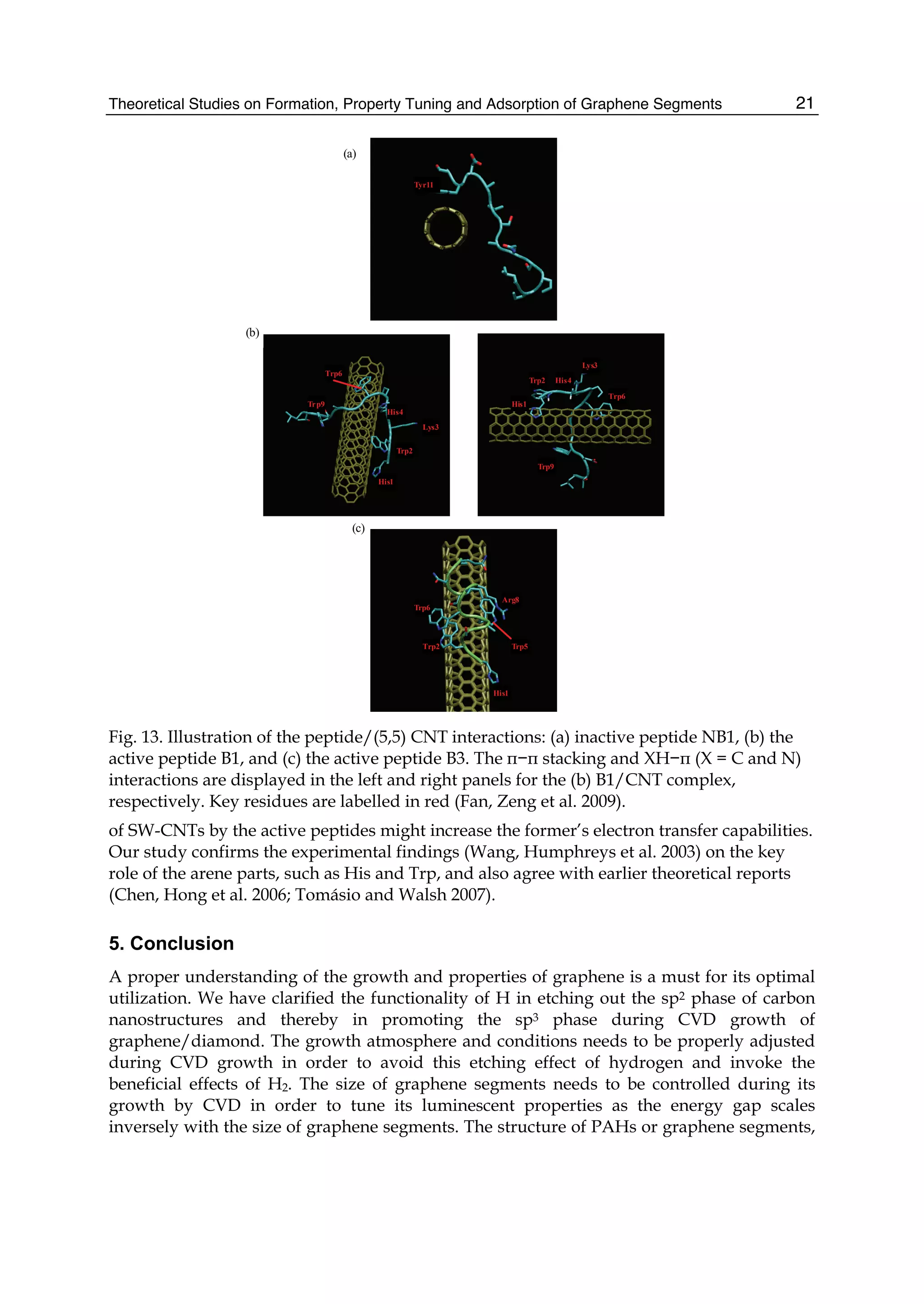
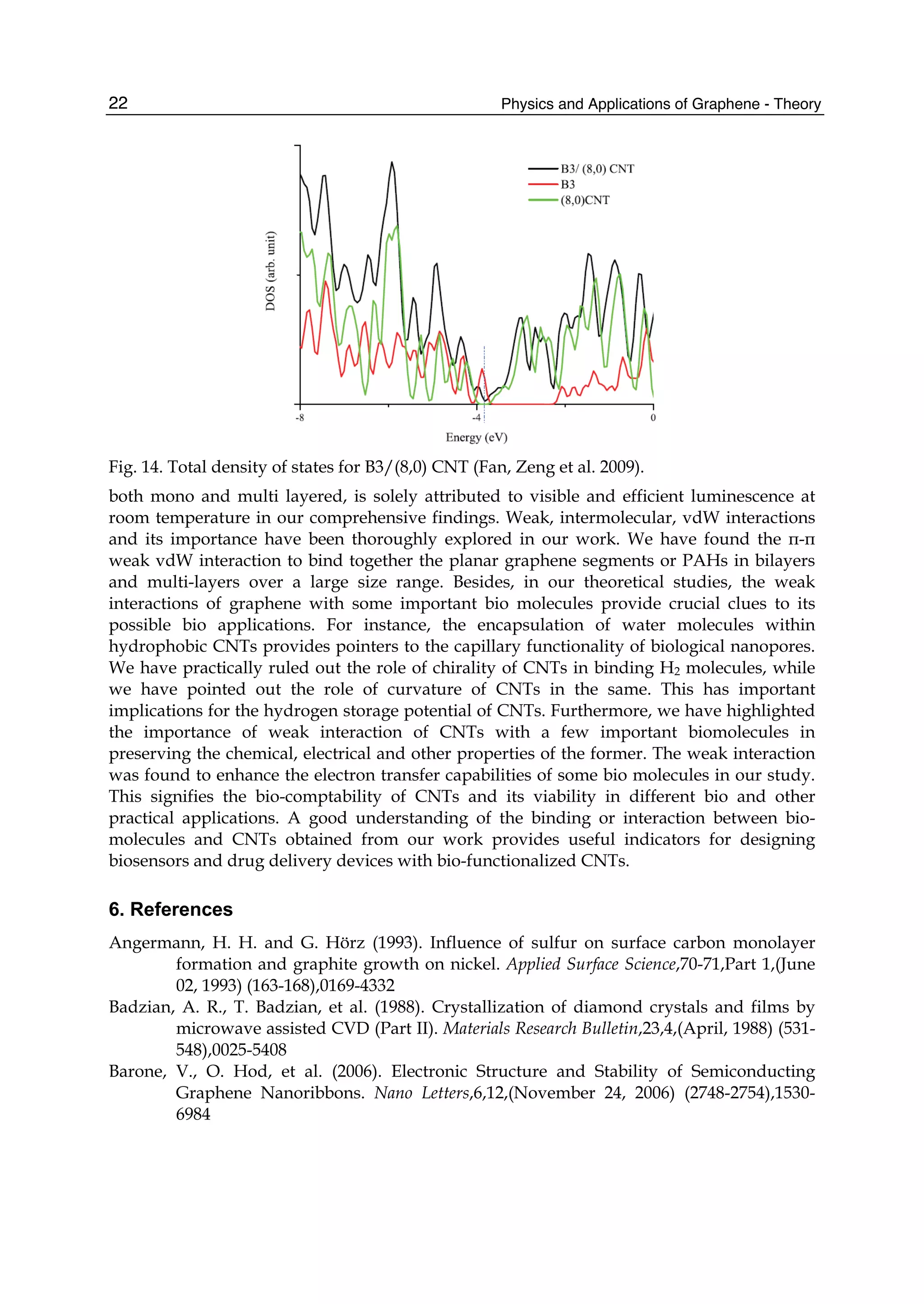
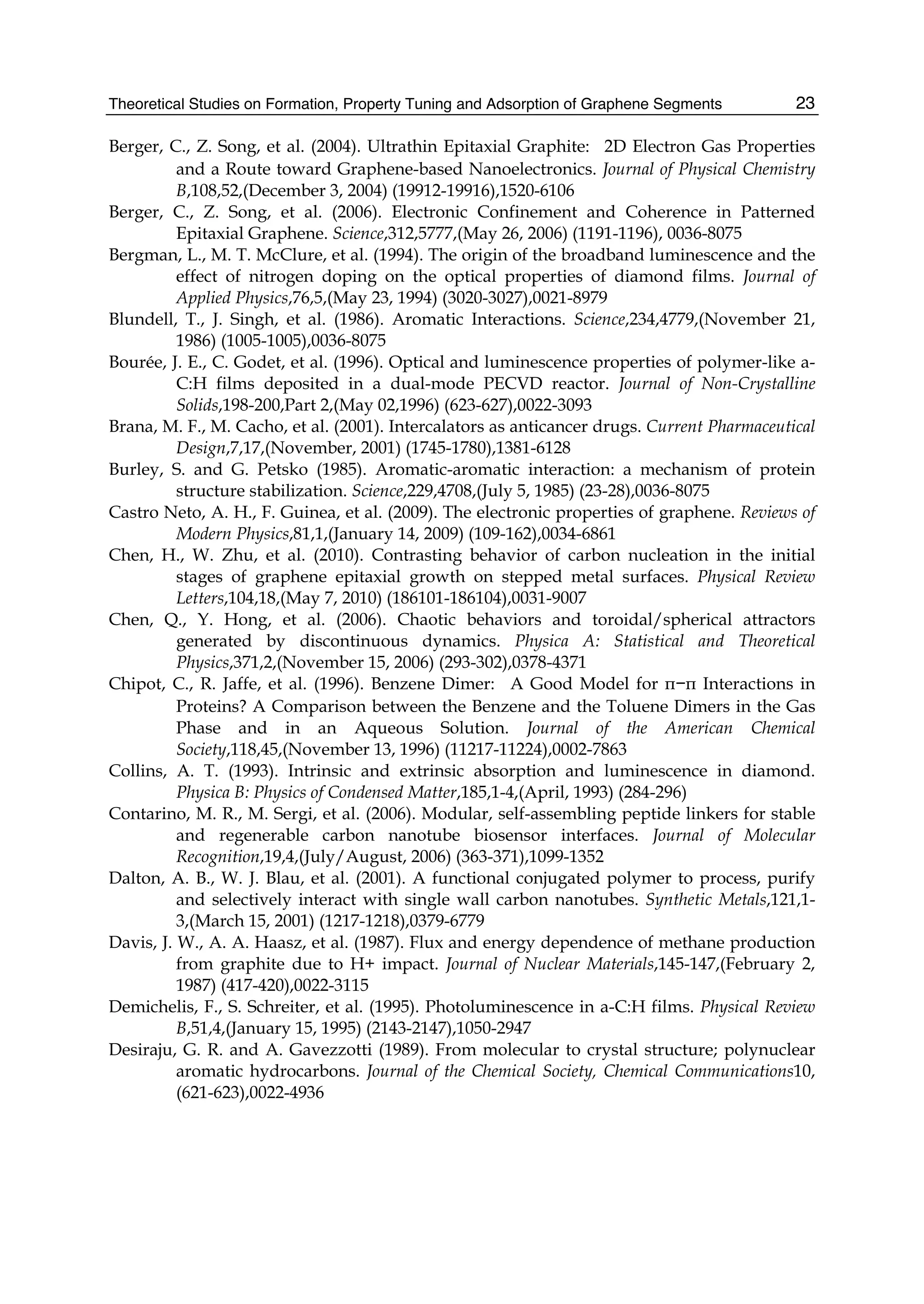
We investigated the binding nature of three peptides (inactive NB1 and active B1 and B3) to
single-walled carbon nanotubes (SWCNTs) using a density functional tight-binding (DFTB)
method with an empirical vdW force correction (Fan, Zeng et al. 2009). Figure 13 shows the
optimized geometries of the three peptides/(5,5) CNT complexes. We have shown that
peptides (inactive NB1 and active B1 and B3) could be spontaneously attracted to the
sidewall of CNTs through π−π and/or H−π stacking, which is at the physisorption distance.
The competition of π−π and/or H−π stacking plays a key role in binding the peptides to the
CNTs, thus, determining and stabilizing the binding of the peptide/CNT systems. The
preservation of the helical conformation upon peptide B3 adsorption to the side wall of
SWCNT is consistent with the experimental observation obtained using CD spectroscopy
(Su, Leung et al. 2006). Our results demonstrate that the geometric structure of CNT remains
almost unchanged after the adsorption of peptides. Moreover, the isosurfaces of the selected
frontier orbitals show that the π-electronic structures of the CNTs are preserved upon the
non-covalent adsorption of B3 peptides, which is similar to the features for simple planar
organic molecules adsorbed on CNTs (Tournus and Charlier 2005; Tournus, Latil et al.
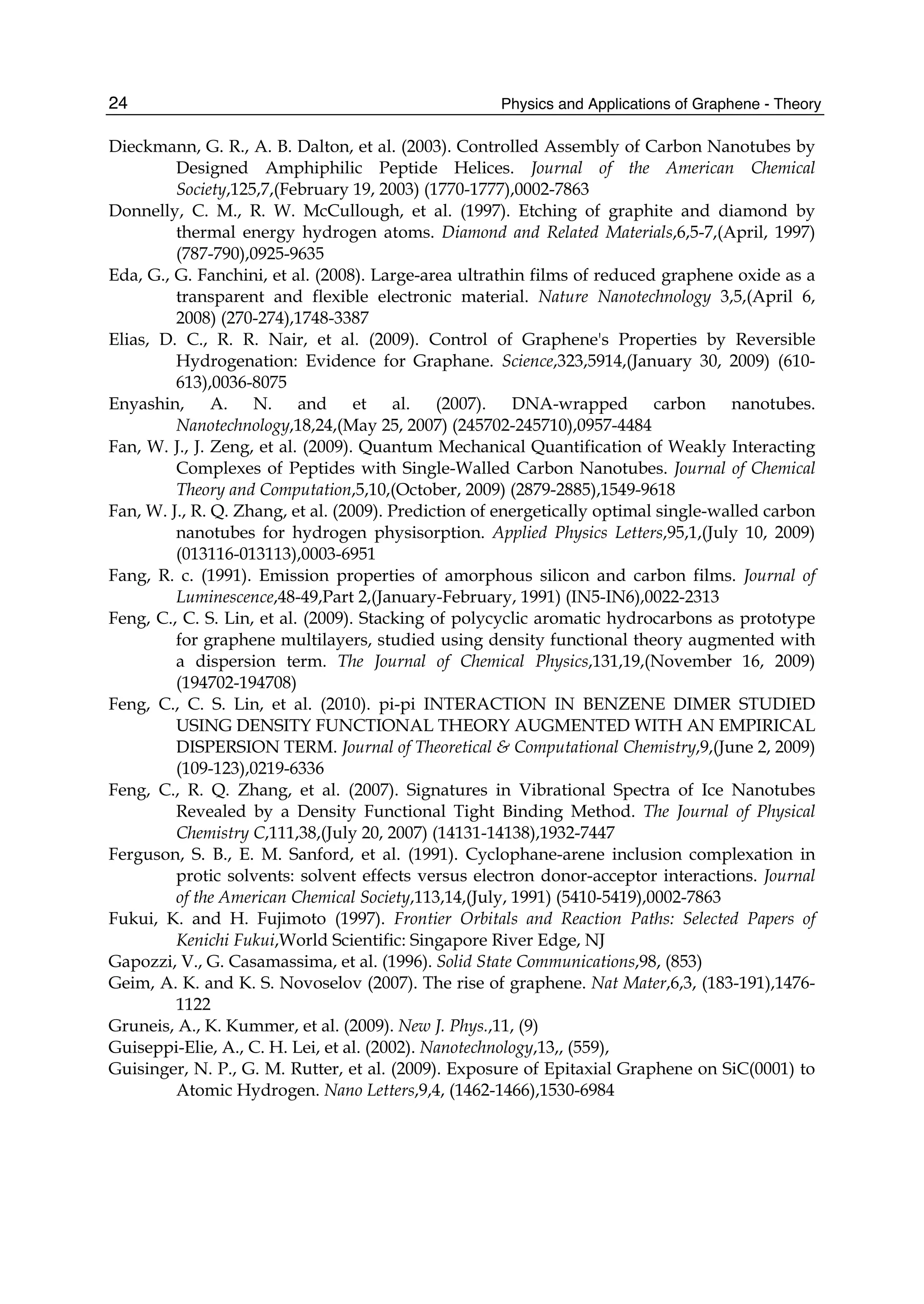
2005). DOS in Fig 14 furthers our understanding of its electronic properties. Compared with
the pristine semiconducting (8,0) CNT, the DOS of the B3/(8,0) CNT shows new states near
the Fermi level, which were contributed by the peptide B3. Still, the nature of physisorption
is shown since the total DOS preserves the features of the DOS of pristine (8,0) CNT.
We find new DOS, composed mainly of the HOMO of B3 molecular orbitals, between the
(8,0) CNT conduction and valence bands. Hence, the band gap of the system has sharply
decreased from the pristine (8,0) tube 0.58 to 0.29 eV of the complexes. Similar finding of
band gap reduction has been found in the (7,3) polyC−DNA complex compared to the free
semiconducing (7,3) tube (Enyashin and et al. 2007). The finding of the new DOS formed
between the (8,0) CNT conduction and valence bands is quite similar to our previous study
of FAD/(10,0) CNT (Lin, Zhang et al. 2007). This implies that the non-covalent modification
Theoretical Studies on Formation, Property Tuning and Adsorption of Graphene Segments 21
(a)
(c)
(b)
Tyr11
Trp9
Trp6
Trp2
His1
His4
His1
Trp2 His4
Trp6
Trp9
Lys3
Lys3
His1
Trp2
Trp6
Trp5
Arg8
Fig. 13. Illustration of the peptide/(5,5) CNT interactions: (a) inactive peptide NB1, (b) the
active peptide B1, and (c) the active peptide B3. The π−π stacking and XH−π (X = C and N)
interactions are displayed in the left and right panels for the (b) B1/CNT complex,
respectively. Key residues are labelled in red (Fan, Zeng et al. 2009).
of SW-CNTs by the active peptides might increase the former’s electron transfer capabilities.
Our study confirms the experimental findings (Wang, Humphreys et al. 2003) on the key
role of the arene parts, such as His and Trp, and also agree with earlier theoretical reports
(Chen, Hong et al. 2006; Tomásio and Walsh 2007).
5. Conclusion
A proper understanding of the growth and properties of graphene is a must for its optimal
utilization. We have clarified the functionality of H in etching out the sp2 phase of carbon
nanostructures and thereby in promoting the sp3 phase during CVD growth of
graphene/diamond. The growth atmosphere and conditions needs to be properly adjusted
during CVD growth in order to avoid this etching effect of hydrogen and invoke the
beneficial effects of H2. The size of graphene segments needs to be controlled during its
growth by CVD in order to tune its luminescent properties as the energy gap scales
inversely with the size of graphene segments. The structure of PAHs or graphene segments,
Physics and Applications of Graphene - Theory22
Fig. 14. Total density of states for B3/(8,0) CNT (Fan, Zeng et al. 2009).
both mono and multi layered, is solely attributed to visible and efficient luminescence at
room temperature in our comprehensive findings. Weak, intermolecular, vdW interactions
and its importance have been thoroughly explored in our work. We have found the π-π
weak vdW interaction to bind together the planar graphene segments or PAHs in bilayers
and multi-layers over a large size range. Besides, in our theoretical studies, the weak
interactions of graphene with some important bio molecules provide crucial clues to its
possible bio applications. For instance, the encapsulation of water molecules within
hydrophobic CNTs provides pointers to the capillary functionality of biological nanopores.
We have practically ruled out the role of chirality of CNTs in binding H2 molecules, while
we have pointed out the role of curvature of CNTs in the same. This has important
implications for the hydrogen storage potential of CNTs. Furthermore, we have highlighted
the importance of weak interaction of CNTs with a few important biomolecules in
preserving the chemical, electrical and other properties of the former. The weak interaction
was found to enhance the electron transfer capabilities of some bio molecules in our study.
This signifies the bio-comptability of CNTs and its viability in different bio and other
practical applications. A good understanding of the binding or interaction between bio-
molecules and CNTs obtained from our work provides useful indicators for designing
biosensors and drug delivery devices with bio-functionalized CNTs.
6. References
Angermann, H. H. and G. Hörz (1993). Influence of sulfur on surface carbon monolayer
formation and graphite growth on nickel. Applied Surface Science,70-71,Part 1,(June
02, 1993) (163-168),0169-4332
Badzian, A. R., T. Badzian, et al. (1988). Crystallization of diamond crystals and films by
microwave assisted CVD (Part II). Materials Research Bulletin,23,4,(April, 1988) (531-
548),0025-5408
Barone, V., O. Hod, et al. (2006). Electronic Structure and Stability of Semiconducting
Graphene Nanoribbons. Nano Letters,6,12,(November 24, 2006) (2748-2754),1530-
6984
Theoretical Studies on Formation, Property Tuning and Adsorption of Graphene Segments 23
Berger, C., Z. Song, et al. (2004). Ultrathin Epitaxial Graphite:  2D Electron Gas Properties
and a Route toward Graphene-based Nanoelectronics. Journal of Physical Chemistry
B,108,52,(December 3, 2004) (19912-19916),1520-6106
Berger, C., Z. Song, et al. (2006). Electronic Confinement and Coherence in Patterned
Epitaxial Graphene. Science,312,5777,(May 26, 2006) (1191-1196), 0036-8075
Bergman, L., M. T. McClure, et al. (1994). The origin of the broadband luminescence and the
effect of nitrogen doping on the optical properties of diamond films. Journal of
Applied Physics,76,5,(May 23, 1994) (3020-3027),0021-8979
Blundell, T., J. Singh, et al. (1986). Aromatic Interactions. Science,234,4779,(November 21,
1986) (1005-1005),0036-8075
Bourée, J. E., C. Godet, et al. (1996). Optical and luminescence properties of polymer-like a-
C:H films deposited in a dual-mode PECVD reactor. Journal of Non-Crystalline
Solids,198-200,Part 2,(May 02,1996) (623-627),0022-3093
Brana, M. F., M. Cacho, et al. (2001). Intercalators as anticancer drugs. Current Pharmaceutical
Design,7,17,(November, 2001) (1745-1780),1381-6128
Burley, S. and G. Petsko (1985). Aromatic-aromatic interaction: a mechanism of protein
structure stabilization. Science,229,4708,(July 5, 1985) (23-28),0036-8075
Castro Neto, A. H., F. Guinea, et al. (2009). The electronic properties of graphene. Reviews of
Modern Physics,81,1,(January 14, 2009) (109-162),0034-6861
Chen, H., W. Zhu, et al. (2010). Contrasting behavior of carbon nucleation in the initial
stages of graphene epitaxial growth on stepped metal surfaces. Physical Review
Letters,104,18,(May 7, 2010) (186101-186104),0031-9007
Chen, Q., Y. Hong, et al. (2006). Chaotic behaviors and toroidal/spherical attractors
generated by discontinuous dynamics. Physica A: Statistical and Theoretical
Physics,371,2,(November 15, 2006) (293-302),0378-4371
Chipot, C., R. Jaffe, et al. (1996). Benzene Dimer:  A Good Model for π−π Interactions in
Proteins? A Comparison between the Benzene and the Toluene Dimers in the Gas
Phase and in an Aqueous Solution. Journal of the American Chemical
Society,118,45,(November 13, 1996) (11217-11224),0002-7863
Collins, A. T. (1993). Intrinsic and extrinsic absorption and luminescence in diamond.
Physica B: Physics of Condensed Matter,185,1-4,(April, 1993) (284-296)
Contarino, M. R., M. Sergi, et al. (2006). Modular, self-assembling peptide linkers for stable
and regenerable carbon nanotube biosensor interfaces. Journal of Molecular
Recognition,19,4,(July/August, 2006) (363-371),1099-1352
Dalton, A. B., W. J. Blau, et al. (2001). A functional conjugated polymer to process, purify
and selectively interact with single wall carbon nanotubes. Synthetic Metals,121,1-
3,(March 15, 2001) (1217-1218),0379-6779
Davis, J. W., A. A. Haasz, et al. (1987). Flux and energy dependence of methane production
from graphite due to H+ impact. Journal of Nuclear Materials,145-147,(February 2,
1987) (417-420),0022-3115
Demichelis, F., S. Schreiter, et al. (1995). Photoluminescence in a-C:H films. Physical Review
B,51,4,(January 15, 1995) (2143-2147),1050-2947
Desiraju, G. R. and A. Gavezzotti (1989). From molecular to crystal structure; polynuclear
aromatic hydrocarbons. Journal of the Chemical Society, Chemical Communications10,
(621-623),0022-4936
Physics and Applications of Graphene - Theory24
Dieckmann, G. R., A. B. Dalton, et al. (2003). Controlled Assembly of Carbon Nanotubes by
Designed Amphiphilic Peptide Helices. Journal of the American Chemical
Society,125,7,(February 19, 2003) (1770-1777),0002-7863
Donnelly, C. M., R. W. McCullough, et al. (1997). Etching of graphite and diamond by
thermal energy hydrogen atoms. Diamond and Related Materials,6,5-7,(April, 1997)
(787-790),0925-9635
Eda, G., G. Fanchini, et al. (2008). Large-area ultrathin films of reduced graphene oxide as a
transparent and flexible electronic material. Nature Nanotechnology 3,5,(April 6,
2008) (270-274),1748-3387
Elias, D. C., R. R. Nair, et al. (2009). Control of Graphene's Properties by Reversible
Hydrogenation: Evidence for Graphane. Science,323,5914,(January 30, 2009) (610-
613),0036-8075
Enyashin, A. N. and et al. (2007). DNA-wrapped carbon nanotubes.
Nanotechnology,18,24,(May 25, 2007) (245702-245710),0957-4484
Fan, W. J., J. Zeng, et al. (2009). Quantum Mechanical Quantification of Weakly Interacting
Complexes of Peptides with Single-Walled Carbon Nanotubes. Journal of Chemical
Theory and Computation,5,10,(October, 2009) (2879-2885),1549-9618
Fan, W. J., R. Q. Zhang, et al. (2009). Prediction of energetically optimal single-walled carbon
nanotubes for hydrogen physisorption. Applied Physics Letters,95,1,(July 10, 2009)
(013116-013113),0003-6951
Fang, R. c. (1991). Emission properties of amorphous silicon and carbon films. Journal of
Luminescence,48-49,Part 2,(January-February, 1991) (IN5-IN6),0022-2313
Feng, C., C. S. Lin, et al. (2009). Stacking of polycyclic aromatic hydrocarbons as prototype
for graphene multilayers, studied using density functional theory augmented with
a dispersion term. The Journal of Chemical Physics,131,19,(November 16, 2009)
(194702-194708)
Feng, C., C. S. Lin, et al. (2010). pi-pi INTERACTION IN BENZENE DIMER STUDIED
USING DENSITY FUNCTIONAL THEORY AUGMENTED WITH AN EMPIRICAL
DISPERSION TERM. Journal of Theoretical & Computational Chemistry,9,(June 2, 2009)
(109-123),0219-6336
Feng, C., R. Q. Zhang, et al. (2007). Signatures in Vibrational Spectra of Ice Nanotubes
Revealed by a Density Functional Tight Binding Method. The Journal of Physical
Chemistry C,111,38,(July 20, 2007) (14131-14138),1932-7447
Ferguson, S. B., E. M. Sanford, et al. (1991). Cyclophane-arene inclusion complexation in
protic solvents: solvent effects versus electron donor-acceptor interactions. Journal
of the American Chemical Society,113,14,(July, 1991) (5410-5419),0002-7863
Fukui, K. and H. Fujimoto (1997). Frontier Orbitals and Reaction Paths: Selected Papers of
Kenichi Fukui,World Scientific: Singapore River Edge, NJ
Gapozzi, V., G. Casamassima, et al. (1996). Solid State Communications,98, (853)
Geim, A. K. and K. S. Novoselov (2007). The rise of graphene. Nat Mater,6,3, (183-191),1476-
1122
Gruneis, A., K. Kummer, et al. (2009). New J. Phys.,11, (9)
Guiseppi-Elie, A., C. H. Lei, et al. (2002). Nanotechnology,13,, (559),
Guisinger, N. P., G. M. Rutter, et al. (2009). Exposure of Epitaxial Graphene on SiC(0001) to
Atomic Hydrogen. Nano Letters,9,4, (1462-1466),1530-6984
Theoretical Studies on Formation, Property Tuning and Adsorption of Graphene Segments 25
Haluska, M., M. Hirscher, et al. (2004). Interaction of hydrogen isotopes with carbon
nanostructures. Materials Science and Engineering B: Solid-State Materials for Advanced
Technology,108,1-2, (130-133)
Han, M. Y., Ouml, et al. (2007). Energy Band-Gap Engineering of Graphene Nanoribbons.
Physical Review Letters,98,20, (206805)
Harris, S. J., G. L. Doll, et al. (1995). Appl. Phys. Lett.,67,, (2314),
Hirsch, A. (2002). Functionalization of Single-Walled Carbon Nanotubes. Angewandte Chemie
International Edition,41,11, (1853-1859),1521-3773
Hobza, P., H. L. Selzle, et al. (1994). Structure and Properties of Benzene-Containing
Molecular Clusters: Nonempirical ab Initio Calculations and Experiments. Chemical
Reviews,94,7, (1767-1785),0009-2665
Hoffmann, R. (1988). Rev. Mod. Phys.,60,, (601),
Huang, W., S. Fernando, et al. (2003). Preferential Solubilization of Smaller Single-Walled
Carbon Nanotubes in Sequential Functionalization Reactions. Langmuir,19,17,
(7084-7088),0743-7463
Hummer, G., J. C. Rasaiah, et al. (2001). Water conduction through the hydrophobic channel
of a carbon nanotube. Nature,414,6860, (188-190),0028-0836
Hummers, W. S. and R. E. Offeman (1958). Preparation of Graphitic Oxide. Journal of the
American Chemical Society,80,6, (1339-1339),0002-7863
Hunter, C. A., K. R. Lawson, et al. (2001). Aromatic interactions. Journal of the Chemical
Society, Perkin Transactions 25, (651-669),1472-779X
Hunter, C. A. and J. K. M. Sanders (1990). The nature of .pi.-.pi. interactions. Journal of the
American Chemical Society,112,14, (5525-5534),0002-7863
Ishikawa, Y., H. Yoshimi, et al. (1997). Jpn. J. Appl. Phys., Part 1,36,, (1233),
Ju, S.-Y., J. Doll, et al. (2008). Selection of carbon nanotubes with specific chiralities using
helical assemblies of flavin mononucleotide. Nat Nano,3,6, (356-362),1748-3387
Ju, S. Y., W. P. Kopcha, et al. (2009). Brightly Fluorescent Single-Walled Carbon Nanotubes
via an Oxygen-Excluding Surfactant Organization. Science,323,5919,(Mar) (1319-
1323),0036-8075
Ju, S. Y. and F. Papadimitrakopoulos (2008). Synthesis and redox behavior of flavin
mononucleotide-functionalized single-walled carbon nanotubes. Journal of the
American Chemical Society,130,2,(Jan) (655-664),0002-7863
Kania, P. and P. Oelhafen (1995). Photoluminescence study of <100> textured CVD
diamonds. Diamond and Related Materials,4,4, (425-428),0925-9635
Karajanagi, S. S., H. Yang, et al. (2006). Protein-Assisted Solubilization of Single-Walled
Carbon Nanotubes. Langmuir,22,4, (1392-1395),0743-7463
Kim, K. S., Y. Zhao, et al. (2009). Large-scale pattern growth of graphene films for stretchable
transparent electrodes. Nature,457,7230, (706-710),0028-0836
Koga, K., G. T. Gao, et al. (2001). Nature,412,, (802),
Li, J., H. T. Ng, et al. (2005). Methods Mol. Bio.,300, (191)
Li, X., W. Cai, et al. (2009). Large-Area Synthesis of High-Quality and Uniform Graphene
Films on Copper Foils. Science,324,5932,(June 5, 2009) (1312-1314)
Li, X., W. Cai, et al. (2009). Nano Lett.,9, (4268-4272)
Li, X., Y. Zhu, et al. (2009). Nano Lett.,9, (4359-4363)
Lin, C. S., R. Q. Zhang, et al. (2005). Simulation of Water Cluster Assembly on a Graphite
Surface. The Journal of Physical Chemistry B,109,29, (14183-14188),1520-6106
Physics and Applications of Graphene - Theory26
Lin, C. S., R. Q. Zhang, et al. (2007). Geometric and Electronic Structures of Carbon
Nanotubes Adsorbed with Flavin Adenine Dinucleotide:  A Theoretical Study. The
Journal of Physical Chemistry C,111,11, (4069-4073),1932-7447
Liu, S., S. Gangopadhyay, et al. (1997). Photoluminescence studies of hydrogenated
amorphous carbon and its alloys. Journal of Applied Physics,82,9, (4508-4514)
Loginova, E., N. C. Bartelt, et al. (2008). New J. Phys.,10, (16)
Loginova, E., N. C. Bartelt, et al. (2009). New J. Phys.,11, (20)
Loh, K. P., J. S. Foord, et al. (1996). Diamond Relat. Mater.,5, (231)
Malard, L. M., J. Nilsson, et al. (2007). Probing the electronic structure of bilayer graphene by
Raman scattering. Physical Review B,76,20, (201401)
Maniwa, Y., Y. Kumazawa, et al. (1999). Jpn. J. Appl. Phys.,38, (668)
Mann, D. J. and M. D. Halls (2003). Phys. Rev. Lett.,90, (195503)
Martí, J. and M. C. Gordillo (2001). Phys. Rev. E,64, (21504)
Martí, J. and M. C. Gordillo (2003). J. Chem. Phys.,119, (12540)
Martin, C. R. and P. Kohli (2003). The emerging field of nanotube biotechnology. Nat Rev
Drug Discov,2,1, (29-37),1474-1776
Mashl, R. J., S. Joseph, et al. (2003). Nano Lett.,3, (589)
McCann, E. and V. I. Fal'ko (2006). Landau-Level Degeneracy and Quantum Hall Effect in a
Graphite Bilayer. Physical Review Letters,96,8, (086805)
McCarty, K. F., P. J. Feibelman, et al. (2009). Carbon,47, (1806)
Mendes, R. C., E. J. Corat, et al. (1997). Diamond Relat. Mater.,6,, (490),
Muehldorf, A. V., D. Van Engen, et al. (1988). Aromatic-aromatic interactions in molecular
recognition: a family of artificial receptors for thymine that shows both face-to-face
and edge-to-face orientations. Journal of the American Chemical Society,110,19, (6561-
6562),0002-7863
Nakada, K., M. Fujita, et al. (1996). Edge state in graphene ribbons: Nanometer size effect
and edge shape dependence. Physical Review B,54,24, (17954)
Nemanich, R. J., J. T. Glass, et al. (1988). Raman scattering characterization of carbon
bonding in diamond and diamondlike thin films. Journal of Vacuum Science &
Technology A: Vacuum, Surfaces, and Films,6,3, (1783-1787)
Nevin, W. A., H. Yamagishi, et al. (1994). Emission of blue light from hydrogenated
amorphous silicon carbide. Nature,368,6471, (529-531)
Noon, W. H., K. D. Ausman, et al. (2002). Chem. Phys. Lett.,355, (445)
Novoselov, K. S., A. K. Geim, et al. (2005). Nature,438, (197-200)
Novoselov, K. S., A. K. Geim, et al. (2004). Electric Field Effect in Atomically Thin Carbon
Films. Science,306,5696,(October 22, 2004) (666-669)
Novoselov, K. S., D. Jiang, et al. (2005). Proc. Natl. Acad. Sci. USA 102, (10451-10453)
Novoselov, K. S., E. McCann, et al. (2006). Unconventional quantum Hall effect and Berry/'s
phase of 2[pi] in bilayer graphene. Nat Phys,2,3, (177-180),1745-2473
Numata, M., M. Asai, et al. (2005). Inclusion of Cut and As-Grown Single-Walled Carbon
Nanotubes in the Helical Superstructure of Schizophyllan and Curdlan (β-1,3-
Glucans). Journal of the American Chemical Society,127,16, (5875-5884),0002-7863
O'Connell, M. J., S. M. Bachilo, et al. (2002). Band Gap Fluorescence from Individual Single-
Walled Carbon Nanotubes. Science,297,5581,(July 26, 2002) (593-596)
Ohta, T., A. Bostwick, et al. (2006). Controlling the Electronic Structure of Bilayer Graphene.
Science,313,5789,(August 18, 2006) (951-954)
Theoretical Studies on Formation, Property Tuning and Adsorption of Graphene Segments 27
Ortiz-Acevedo, A., H. Xie, et al. (2005). Diameter-Selective Solubilization of Single-Walled
Carbon Nanotubes by Reversible Cyclic Peptides. Journal of the American Chemical
Society,127,26, (9512-9517),0002-7863
Park, H. J., J. Meyer, et al. (2010). Growth and properties of few-layer graphene prepared by
chemical vapor deposition. Carbon,48,4, (1088-1094),0008-6223
Pender, M. J., L. A. Sowards, et al. (2005). Peptide-Mediated Formation of Single-Wall
Carbon Nanotube Composites. Nano Letters,6,1, (40-44),1530-6984
Pichon, A. (2008). Graphene synthesis: Chemical peel. Nat Chem,1755-4330
Reina, A., X. T. Jia, et al. (2009). Nano Lett.,9, (30-35)
Reina, A., S. Thiele, et al. (2009). Nano Research,2,6, (509-516)
Robertson, J. (1995). Structural models of a-C and a-C:H. Diamond and Related Materials,4,4,
(297-301)
Robertson, J. (1996) (a). Photoluminescence mechanism in amorphous hydrogenated carbon.
Diamond and Related Materials,5,3-5, (457-460)
Robertson, J. (1996) (b). Recombination and photoluminescence mechanism in hydrogenated
amorphous carbon. Physical Review B,53,24, (16302)
Robertson, J. and E. P. O'Reilly (1987). Electronic and atomic structure of amorphous carbon.
Physical Review B,35,6, (2946)
Rusli, G. A. J. Amaratunga, et al. (1995). Photoluminescence in amorphous carbon thin films
and its relation to the microscopic properties. Thin Solid Films,270,1-2, (160-
164),0040-6090
Saito, R., G. Dresselhaus, et al. (1998). Physical Properties of Carbon Nanotube,Imperial College
Press,London
Samarakoon, D. K. and X.-Q. Wang (2010). Tunable Band Gap in Hydrogenated Bilayer
Graphene. ACS Nano,4,7, (4126-4130),1936-0851
Sansom, M. S. P. and P. C. Biggin (2001). Biophysics: Water at the nanoscale.
Nature,414,6860, (156-159),0028-0836
Schütte, S., S. Will, et al. (1993). Electronic properties of amorphous carbon (a-C:H). Diamond
and Related Materials,2,10, (1360-1364),0925-9635
Silva, S. R. P., J. Robertson, et al. (1996). Structure and luminescence properties of an
amorphous hydrogenated carbon. Philosophical Magazine B: Physics of Condensed
Matter; Statistical Mechanics, Electronic, Optical and Magnetic Properties,74,4, (369-386)
Sofo, J. O., A. S. Chaudhari, et al. (2007). Graphane: A two-dimensional hydrocarbon.
Physical Review B,75,15, (153401)
Stankovich, S., D. A. Dikin, et al. (2007). Carbon,45, (1558-1565)
Starodub, E., S. Maier, et al. (2009). Phys. Rev. B,80, (8)
Street, R. A. (1984). In: Semiconductors and Semimetals. J. I. Pankove,(Ed.). Vol. 84, (197),
Academic Press New York.
Su, Z., T. Leung, et al. (2006). Conformational Selectivity of Peptides for Single-Walled
Carbon Nanotubes. The Journal of Physical Chemistry B,110,47, (23623-23627),1520-
6106
Sutter, P. W., J. I. Flege, et al. (2008). Nat. Mater.,7, (406-411)
Thuvander, M. and H. O. Andrén APFIM Studies of Grain and Phase Boundaries: A Review.
Materials Characterization,44,1-2, (87-100),1044-5803
Physics and Applications of Graphene - Theory28
Tomásio, S. D. M. and T. R. Walsh (2007). Atomistic modelling of the interaction between
peptides and carbon nanotubes. Molecular Physics: An International Journal at the
Interface Between Chemistry and Physics,105,2, (221 - 229),0026-8976
Tournus, F. and J. C. Charlier (2005). Ab initio study of benzene adsorption on carbon
nanotubes. Physical Review B,71,16, (165421)
Tournus, F., S. Latil, et al. (2005). pi -stacking interaction between carbon nanotubes and
organic molecules. Physical Review B,72,7, (075431)
Ugarte, D., T. Stoeckli, et al. (1998). Appl. Phys. A.,7, (101)
Wagner, J. and P. Lautenschlager (1986). Hard amorphous carbon studied by ellipsometry
and photoluminescence. Journal of Applied Physics,59,6, (2044-2047)
Wakabayashi, K., M. Fujita, et al. (1999). Electronic and magnetic properties of nanographite
ribbons. Physical Review B,59,12, (8271)
Wang, J., Y. Zhu, et al. (2004). Phys. Chem. Chem. Phys.,6, (829)
Wang, S., E. S. Humphreys, et al. (2003). Peptides with selective affinity for carbon
nanotubes. Nat Mater,2,3, (196-200),1476-1122
Wei, Z., D. Wang, et al. (2010). Nanoscale Tunable Reduction of Graphene Oxide for
Graphene Electronics. Science,328,5984,(June 11, 2010) (1373-1376)
Wu, J., W. Pisula, et al. (2007). Graphenes as Potential Material for Electronics. Chemical
Reviews,107,3, (718-747),0009-2665
Xu, S., M. Hundhausen, et al. (1993). Influence of substrate bias on the properties of a-C:H
films prepared by plasma CVD. Journal of Non-Crystalline Solids,164-166,Part 2,
(1127-1130),0022-3093
Yu, Q., J. Lian, et al. (2008). Graphene segregated on Ni surfaces and transferred to
insulators. Applied Physics Letters,93,11, (113103-113103)
Zhang, Q., S. C. Bayliss, et al. (1996). The stable blue and unstable UV photoluminescence
from carbon nanoclusters embedded in SiO2 matrices. Solid State
Communications,99,12, (883-886),0038-1098
Zhang, R. Q., E. Bertran, et al. (1998). Size dependence of energy gaps in small carbon
clusters: the origin of broadband luminescence. Diamond and Related Materials,7,11-
12, (1663-1668),0925-9635
Zhang, R. Q., T. S. Chu, et al. (2000). A Theoretical Study on the Interactions of Hydrogen
Species with Various Carbon and Boron Nitride Phases. The Journal of Physical
Chemistry B,104,29, (6761-6766),1520-6106
Zhang, W. J., X. Jiang, et al. (1997). J. Appl. Phys.,82, (1896)
Zhang, Y., T.-T. Tang, et al. (2009). Direct observation of a widely tunable bandgap in bilayer
graphene. Nature,459,7248, (820-823),0028-0836
Zheng, M., A. Jagota, et al. (2003). DNA-assisted dispersion and separation of carbon
nanotubes. Nat Mater,2,5, (338-342),1476-1122
Zheng, M., A. Jagota, et al. (2003). Structure-Based Carbon Nanotube Sorting by Sequence-
Dependent DNA Assembly. Science,302,5650,(November 28, 2003) (1545-1548)
Zorbas, V., A. Ortiz-Acevedo, et al. (2004). Preparation and Characterization of Individual
Peptide-Wrapped Single-Walled Carbon Nanotubes. Journal of the American
Chemical Society,126,23, (7222-7227),0002-7863
0
Theory of Doping: Monovalent Adsorbates
B. Sachs1, T. O. Wehling1, A. I. Lichtenstein1 and M. I. Katsnelson2
1 I. Institut für Theoretische Physik, Universität Hamburg, Jungiusstraße 9,
D-20355 Hamburg
2Radboud University of Nijmegen, Institute for Molecules and Materials,
Heijendaalseweg 135,
6525 AJ Nijmegen
1Germany
2The Netherlands
1. Introduction
The discovery of graphene (Novoselov et al., 2004) and its remarkable electronic properties
(Castro Neto et al., 2009; Geim & Novoselov, 2007; Katsnelson, 2007) initiated great research
interest in this material. Particularly prospective for applications is its extraordinarily high
charge carrier mobility (Bolotin et al., 2008; Du et al., 2008; Novoselov et al., 2004).
Realistic graphene samples are subject to disorder including ripples, impurities, edges
or strains. While these present undesirable obstacles when trying to minimize electron
scattering, controlled external perturbations recently evoked broad interest in the context of
functionalization of graphene (Elias et al., 2009).
Impurities on a graphene sample are imaginable in various ways. While lattice imperfections
like vacancies do not exist in noticeable concentrations unless they are not created artificially
(Chen et al., 2009), adatoms or molecules from the experimental environment can be seen as
a frequent source of electron scattering. The impact of adsorbate-induced scattering processes
on the transport properties has been subject of ongoing discussion since the first fabrication
of single graphene sheets in 2004 (see Peres (2010) for a review).
Transport experiments with chemically doped graphene samples yield different results
regarding the strength of electron scattering due to the dopants: While room temperature
experiments with NO2, e.g., reported chemical doping without significant loss of carrier
mobility (Schedin et al., 2007), the deposition of K at cryogenic temperatures clearly reduced
the electron mobility (Chen et al., 2008). Correspondingly, the role of charged impurity
scattering as compared to, e.g., scattering by resonant impurities or ripples has been
controversially debated: Depending on experimental details both, charged impurities (Adam
et al., 2007; Chen et al., 2008; Hwang et al., 2007; Nomura & MacDonald, 2006; Tan et al.,
2007), as well as resonant impurities were discussed as dominant scattering sources (Katoch
et al., 2010; Katsnelson & Novoselov, 2007; Ni et al., 2010; Ostrovsky et al., 2006; Stauber et al.,
2007). Understanding charge redistributions in realistic graphene-adsorbate systems is hence
crucial.
The high sensitivity of graphene to adsorbate-induced doping has been proven in numerous
experiments (Bostwick et al., 2006; Ohta et al., 2006; Zhou et al., 2008). The two-dimensional
nature maximizes surface effects, which even allows the detection of single adsorption events.
2
Using exfoliated graphene on a SiO2 substrate with Ti/Au contacts, Schedin et al. (2007)
visualized events of single molecule adsorption on graphene. Recently developed gas sensors
(Collins et al., 2000; Kong et al., 2000; Robinson, Perkins, Snow, Wei & Sheehan, 2008) raise
hope for a future realization of marketable single molecule detectors.
The natural concentration of impurities in graphene devices depends crucially on the sample
preparation and the experimental setup. Meyer et al. (2008) reported the detection of single
hydrogen adsorbates on graphene on a SiO2 substrate by transmission electron microscopy
(TEM). Under atmospheric conditions at room temperature they estimated the adsorbate
concentration to 0.3%, which relates to about one impurity per 10nm2.
Especially hydrogenation, as demonstrated by Elias et al. (2009), provides a good prospect
for controlled design of graphene’s electronic properties. Hence, there is wide interest in
fractionally and fully hydrogenated graphene, the graphane. Attaching hydrogen on graphene
from both sides leads to a change from sp2 to sp3 hybridization, which opens a band gap.
Through annealing, hydrogenation turns out to be reversible, i.e. the electronic properties of
pristine graphene can be restored. Several theoretical works (Lebègue et al., 2009; Liu & Shen,
2009; Sofo et al., 2007) found a band gap of graphane between 3.5eV and 5.4eV. While this is
slightly too high for electronic applications, partially hydrogenated graphene might be useful
(Xiang et al., 2009). Hence, understanding of the adsorption mechanisms of atomic hydrogen
is essential in search of new paths towards functionalization.
Equally, fluorination of graphene promises a route towards a graphene-based wide band gap
semiconductor (Cheng et al., 2010; Nair et al., 2010; Robinson et al., 2010). At coverages of
70% or more, graphene-fluorine systems with reversible modification of the conductivity by
several orders of magnitudes has been achieved.
Motivated by these recent and promising experiments on impurity effects in graphene, a
theoretical investigation of doping effects in graphene is given in this chapter; in particular,
monovalent adsorbates are considered. Extensive density functional theory (DFT) calculations
are presented to derive a theory of doping and charge redistributions in graphene and to
identify simple models describing these effects realistically. We concentrate on two issues:
charge transfer as relevant for doping, i.e. changes in the number of mobile carriers, as well
as charge transfer as relevant for Coulomb scattering. For hydrogen, fluorine, hydroxyl,
chlorine and potassium adsorbates we determine the amount of the charge transfer by means
of different electrostatic models and compare to band structure based methods (section
(3)). Furthermore, by means of a tight-binding model, impurities are illustrated to lead to
long-range doping of graphene such that even ultra-low concentrations of contamination do
affect the carrier concentration. We investigate the effects of long range Coulomb interaction
in this context and show that the Coulomb repulsion plays a minor role in the process of
charge redistribution for impurity concentrations higher than 0.007%.
2. Calculation of charge transfer
The investigation of adsorption processes rises the question of the doping and Coulomb
scattering due to single adsorbates. For instance, theoretical transport calculations predict a
strong dependence of the scattering cross section on the amount of charge transferred between
adsorbates and graphene (Robinson, Schomerus, Oroszlány & Fal’ko, 2008). A priori charge
transfer is an ambiguous quantity as it comes back to defining the spacial extent of individual
30 Physics and Applications of Graphene - Theory
atoms within a solid. Therefore, several concepts for the description of charge transfer will
be taken into consideration, carefully compared and their implications for experimental
observables like doping or scattering properties will be discussed.
2.1 Population analysis and partitioning of the electron density
A widely employed class of approaches to charge transfer analysis like the Mulliken, Bader
or Hirshfeld analysis aims at directly partitioning the electronic charge density among the
atoms of the system. To this end, a DFT calculation is performed which yields the electronic
density and the Kohn-Sham wave functions. Partitioning schemes using projections of the
Kohn-Sham wavefunctions onto localized atomic orbitals (Löwdin or Mulliken analysis, see,
e.g., Segall et al. (1996)) as well as schemes dealing with the electronic density (Hirshfeld
or Bader analysis, see, e.g., Meister & Schwarz (1994)) have been employed in the context
of graphene adsorbate systems. While ionically bond systems are likely well suited to be
correctly described by this kind of charge transfer analysis, the interpretation of Mulliken,
Bader or Hirshfeld charges in physisorbed graphene-impurity systems (Leenaerts et al., 2008)
or strongly covalent systems (see section 3.2) can be ambiguous. In the latter case, e.g., charge
is smeared out in covalent bonds, and therefore a partition of the interstitial region in solids is
hard.
In general, we expect conventional space partition methods to be more precise for ionic than
for covalent adsorbates. The Bader analysis (Bader, 1991) of covalently and ionically bond
adatoms presented in sections 3.1 and 3.2 will confirm this presumption. On that account,
methods to obtain charge transfer based on electrostatic potentials or the band structure will
be explained in the following.
2.2 Electrostatic approaches to charge transfer
An alternative way to describe the amount of charge transfer is to utilize electrostatic models
and to apply them on output from electronic structure methods like density functional theory.
In this sense, the DFT results can be seen as ”experimental data” being analysed by theoretical
tools and models.
The DFT calculations presented, here, were performed by means of the Vienna Ab-initio
Simulation Package (Kresse & Furthmüller, 1996a;b) (VASP) with PW91-GGA functionals;
the geometric structure was modelled by a three-dimensional supercell and an interlayer
spacing of about 25Å in order to prevent interaction. The Brillouin zones were sampled within
the tetrahedron and the Methfessel-Paxton method in combination with carefully chosen
k-meshes and cut-off energies. Geometries were relaxed until all forces were smaller than
0.02eV/Å per atom.
Electrostatic potential landscapes, experimentally investigated on graphene in EFM
experiments (Moser et al., 2008), can be extracted from DFT simulations (Fig. 1, left) and
used to determine impurity induced charge transfer. From the point of view that (doped)
graphene is metallic, the sheet can be considered as a grounded metal plate of infinite size,
such that — in the simplest model — charged adsorbates can be described by means of
an image charge model: the adatoms are assumed as partial point charges which induces
image charges in graphene. This model is valid at length scales above the screening length of
the doped graphene sheet (Katsnelson (2006)). Then, the electrostatic potential, V(r), in the
vacuum region above the graphene sheet and the impurity can be modelled as
V(r) = Ve(z) +
1
4π 0
∑
i=1
qi
1
| r − ri |
−
1
| r − ri |
. (1)
31Theory of Doping: Monovalent Adsorbates
Fig. 1. Left: Periodic 4x4 graphene supercell with fluorine adsorbates (red dots). The contour
plot shows the electrostatic potential (in eV) in a height of z = 2agr (with agr ≈ 2.46Å the
graphene lattice constant). To calculate the charge transfer, several paths through the cell are
considered for different heights z and the image charge potential (Eqn. (1)) is fitted to the
data by optimization of the parameters qi. Right: Potential along paths connecting two
adjacent chlorine adatoms on graphene 4x4 for heights z = 3agr (red), z = 4agr (green),
z = 5agr (blue) and fitted curves in units of the lattice constant; the curves are vertically
shifted to the x-axis. Small noise occurs for certain x where a carbon atom is located.
The fitting parameters of this model are the adsorbate point charges qi and an offset Ve(z); the
charges are centered at the positions of the impurity atoms, ri = (xi, yi, zi), and their mirror
images ri = (xi, yi, −zi). The offset is given by Ve(z) = V0 + E0z, where V0 is a constant
and E0 a constant electric field in z-direction due to the three-dimensional periodicity of the
supercell.
The method proves well-suited to fit the charge values for all atomic adsorbates regarded.
Merely for adsorbate groups like hydroxyl, additional dipole fields make the fitting procedure
error-prone (sec. 3.2). Determining partial charges based on Eq. (1) is similar to analysing
dipole moments obtained from the charge density as, e.g., performed for metal adatoms on
graphene by Chan et al. (2008).
An alternative approach to charge transfer based on electrostatic potential is to analyse core
potential shifts of the carbon atoms. These core level shifts arise from charge rearrangement
around the impurity in the graphene sheet and can be calculated within VASP. The analysis of
core level shifts allows estimates of the impurity charge and gives qualitative insight into the
range of redistributions (Fig. 2). Within VASP, the averaged core potential for an atom sitting
at position Rn is determined by (Kresse, 2010)
Vn = VDFT(r)ρtest(|r − Rn|)d3
r, (2)
where VDFT denotes the electrostatic potential from DFT and ρtest a test charge with norm 1 in
the core region of each atom. This approach is similar to Adessi et al. (2006), where also atom
centered test charges have been employed. The shift of these averaged core potentials, ΔV, as
function of the distance to the bonding C atom is illustrated in Fig. 2.
Assuming screening within the linear response regime, the analysis of the core potentials
allows to obtain the relative strength of charge transfer between the different adsorbates and
graphene. If the charge transfer for one reference system is known, also absolute values for the
charge transfer of all systems can be obtained. Additionally, the core potential shifts allow to
32 Physics and Applications of Graphene - Theory
qualitatively characterize the spacial extent of doped regions. A detailed discussion of these
issues will be given in sections 3.1, 3.2 and 3.3.
Fig. 2. Average core potential shift with respect to a C atom at large distance from the
impurity as function of the in-plane distance for hydrogen and fluorine. The maximum
distance considered, here, is about half the way through the supercell (here 4.5 lattice
constants). It is visible that the doping of hydrogen is opposite to fluorine.
2.3 Band structure and density of states based determination of charge transfer
Spectroscopy experiments are a common tool to study the electronic structure of solids; in
particular, these allow the determination of the density of states of graphene samples. Doping
adsorbates donate or accept electrons from the graphene sheet, which leads to a shift of the
Fermi level. This shift, the difference between the Fermi level EF and the Dirac point energy
ED, is denoted by
ΔEF = EF − ED. (3)
Note that in the case of pristine graphene, EF = ED, such that ΔEF = 0; the sign of ΔEF
denotes p- or n-type doping. Integrating the total density of states per unit cell of pristine
graphene from ED to ED + ΔEF
Δq = e
ED+ΔEF
ED
D(E)dE, (4)
hence yields the charge transfer between the adsorbate and the graphene sheet which
corresponds to a change in the number of mobile carriers. This method relies in the
assumption that the adatoms do not change the density of states in the integration interval.
While covalently bond adsorbates induce resonances in the DOS near the Dirac point (sec.
3.2), the method is well legitimate to apply for ionically bond impurities, where resonances
only occur far away from the Dirac point (ΔEF ≤ 1.5eV; Fig. 3).
33Theory of Doping: Monovalent Adsorbates
Fig. 3. Total density of states of pristine graphene (green) and of K on a graphene 4x4
supercell (red). The Fermi level is set to zero.
3. Monovalent adsorbates
We now consider monovalent adsorbates and show that these interact strongly with
graphene. The charge transfer between the adsorbates and the graphene sheet is calculated
by the approaches explained above and its relation to carrier doping as well as electron
scattering is pointed out. The electronic structure of a graphene-impurity system features
fundamental differences between covalently and ionically bond adsorbates; for instance,
ARPES (angle-resolved photoemission spectroscopy) experiments yield that ionic potassium
is a strong dopant with rather weak bond (Chen et al., 2008), while weak doping is found
for covalent hydrogen in Raman experiments (Ryu et al., 2008). On this account, we will
investigate doping processes with regard to the bonding mechanism and briefly point out
reasons for the different bonding behaviour. In detail, calculations of monovalent hydrogen,
fluorine, chlorine, potassium and hydroxyl adsorbed on graphene within DFT are presented
in the following. Next to an extensive analysis of the charge transfer, we will discuss the range
of charge redistributions with the help of a tight-binding model.
3.1 Ionically bond impurities
By definition, ionically bond impurites mean high charge transfer and low hybridization
with the graphene bands. I.e. monovalent ionic adsorbates are expected to cause charge
transfer in the range of |q| e 1. This kind of charge transfer is detectable as a shift of the
chemical potential in ARPES experiments (Ohta et al., 2006; Zhou et al., 2008). In the density
of states, potassium and chlorine create a sharp resonance, which gives rise to an acceptor
level below the Dirac point (Cl) or a donor level above (K; Fig. 3). The weak hybridization of
the ionic impurities is also reflected in the migration barrier. These are typically in the range
1
The reason for having |q| e instead of |q| = e, in a general case, lies in the fractional covalent character
of any ionic bond.
34 Physics and Applications of Graphene - Theory
Type Size (conc.) Image Charges Core levels Bader analysis Fermi level shifts
K 4x4 (3.1%) +0.68 +0.83 +0.64
9x9 (0.6%) +0.80 +0.80 (ref) +0.91 +0.97
Cl 4x4 (3.1%) -0.40 -0.50 -0.38
9x9 (0.6%) -0.54 -0.56 -0.57 -0.65
Table 1. Charge transfer between potassium / chlorine and graphene for the image charge
model, the averaged core potential method, Bader analysis and the Fermi energy shifts in the
DOS (all values in units of e) and two different supercell sizes (impurity concentrations). The
value named "ref" for potassium is the charge value from the image charge method. It is used
as a reference value to be able to extract absolute values for the charges of chlorine,
hydrogen, fluorine and hydroxyl from the core levels.
of less than 0.1eV and therefore about one order smaller than for neutral covalent impurities
(Wehling et al., 2009b).
We calculated charge transfer of potassium and chlorine adatoms by means of Bader analysis,
in both electrostatic models and from Fermi level shifts. To this end, we fully relaxed the
graphene adsorbate systems and obtained the minimum energy adsorption geometries (c.f.
Wehling et al. (2009b)). Chlorine favours a top site (T) bonding (on top of a carbon atom) at
2.7Å above the graphene sheet, whereas potassium prefers the hollow site (H) in the middle
of a carbon ring at a height of about 2.6Å.
In table 1 we present the charge transfer for both adsorbates obtained within the different
approaches and as function of impurity concentration (supercell size). The signs of the partial
charges show that potassium acts as a donor while chlorine behaves as an acceptor. The results
for potassium are in rough agreement with Chan et al. (2008); they found a value of 0.76e for
a 4x4 supercell, as well from Fermi level shifts. Similar findings were published by Lugo-Solis
& Vasiliev (2007).
Obviously, the amount of charge transfer is concentration dependent: the strength of the
doping decreases with the impurity concentration. This trend is consistently obtained within
all methods to calculate charge transfer, here.
For the two ionic impurities all approaches are qualitatively consistent with each other.
Depending on the experimental observable to be modelled either the electrostatic potential
based methods or the Fermi level shifts should be considered. The values derived from the
electrostatic potential should be most useful to discuss contribution to Coulomb scattering
while the Fermi level shifts should yield quantitatively the best estimate of doping. The
Bader results for ionically bond impurities tend to yield slightly higher charge values than the
electrostatic models; covalent adsorbates, presented in the next section, are more problematic
within this method.
3.2 Covalently bond impurities
In contrast to ionically bond impurities, covalent adsorbates show strong hybridization with
graphene orbitals leading to a formation of stable states with strong bonds. The local density
of states (LDOS) of covalently bond impurities is broad and constitutes a midgap state at the
Fermi level as well as characteristic resonances at high energies (Wehling et al., 2009b).
All covalent monovalent adsorbates prefer top-site bonding and create impurity states that
are localized at the adsorbate and the nearest neighbours of the bonding C atom (Fig. 4).
35Theory of Doping: Monovalent Adsorbates
Type Size (conc.) Image Charges Core level shifts Bader analysis
H 4x4 (3.1%) +0.18 +0.04
5x5 (2.0%) +0.16 +0.03
7x7 (1.0%) +0.14 +0.02
9x9 (0.6%) +0.15 +0.12 +0.01
F 4x4 (3.1%) -0.39 -0.58
5x5 (2.0%) -0.39 -0.59
6x6 (1.4%) -0.38 -0.58
9x9 (0.6%) -0.39 -0.52 -0.57
OH 4x4 (3.1%) -0.43
5x5 (2.0%) -0.45
9x9 (0.6%) -0.44 -0.45
Table 2. Charge transfer between hydrogen / fluorine / hydroxyl and graphene for the image
charge model, the averaged core potential method and the Fermi energy shifts in the DOS
and different different supercell sizes (impurity concentrations). All values in units of e.
The bonding partner of the impurity is decoupled from graphene’s Dirac bands and scatters
electrons similarly to vacancies. The universality of midgap states in graphene has been
investigated by several groups (Boukhvalov & Katsnelson, 2009; Casolo et al., 2009; Wehling
et al., 2008; 2009a;b).
We now turn to the description of charge redistributions due to covalent adsorbates. Their
contribution to Coulomb scattering is directly related to changes in the electrostatic potential
and consequently to the partial charges derived from the core level shifts or the image
charge model. Our results for charge transfer within different models between graphene and
hydrogen, fluorine, and hydroxyl adsorbates are given in table 2.
For hydrogen we obtain modulations in the electrostatic potential and the core levels
corresponding to a ”charge” as relevant for Coulomb scattering on the order of 0.1 − 0.2e.
Fig. 4. Local density of states (LDOS) of hydrogen, the bonding partner, and the nearest
neighbour on a 4x4 supercell (from Wehling et al. (2009b)).
36 Physics and Applications of Graphene - Theory
Bader analysis yields a hydrogen partial charge of q = 0.01 − 0.04e. This is qualitatively
consistent with the electrostatic models, as |q| e in both cases, but using the Bader charge in
the context of Coulomb scattering would lead to an underestimation of the scattering strength.
A hydrogen charge |q| e has also been obtained within Mulliken population analysis by
Zhu et al. (2005).
Experimentally, the contribution of H adatoms on graphene to Coulomb scattering has not
yet been determined. Ryu et al. (2008) investigated hydrogen doping effects by means of
Raman spectroscopy. They estimate, under a hydrogen contamination saturating about 13%
of carbon bonds (corresponding to approximately one hydrogen atom per 2x2 supercell), a
charge donation of 0.003e per hydrogen atom. This is qualitatively in line with |q| e as
obtained in the context of Coulomb scattering from DFT. However, it also demonstrates that
an effective electrostatic charge on the order of 0.1 − 0.2e does not necessarily imply doping
of the graphene bands by the same amount. As the LDOS in the vicinity of the Fermi level is
significantly altered by the covalent adsorbates, Eq. (4) cannot be used to extract the doping
from the DFT calculations.
Fluorine adatoms show covalent bonding, in contrast to the other groups VII elements
(Wehling et al., 2009b). Due to the strong hybridization, the bonding carbon atom is lifted
in z-direction by around 0.5Å. The fluorine adatom sits in a height of z ≈ 1.6Å. Consistent
with the large eletronegativity of F, the partial charge obtained within the electrostatic models
(−0.4 — −0.5e) as well as by Bader analysis (∼ −0.6e) is significantly bigger than for H
and correspondingly stronger Coulomb scattering due to F adsorbates is expected. The same
holds for hydroxyl adsorbates which have been analysed within Bader and the averaged core
potential method. Long range charge redistributions due to hydroxyl and fluorine will be
further investigated within a tight-binding model in sec. 3.3.
Our charge analysis shows that the (electrostatic) charge of covalently bond adsorbates is
rather constant in the range of impurity concentrations between 0.6% and 3%. This is in
contrast to the ionically bond impurities, where charge transfer has been proven to increase
with the supercell size.
3.3 Charge redistributions and coulomb interactions in a tight-binding model
To learn more about charge redistributions induced by covalent impurities in graphene
we investigate this problem within a tight-binding (TB) model. For pristine graphene a
TB model has been first considered by Wallace (1947). Concerning the question of charge
rearrangement, the key benefit of this method lies in the possibility to calculate at much lower
impurity concentrations than possible in full-potential DFT simulations. Supercells of a size
up to around 100x100, thus concentrations of 0.005%, could be taken into account in our TB
simulations.
Omitting the spin index and restricting to nearest-neighbour hopping, t ≈ 2.7eV, the
tight-binding Hamiltonian of pristine graphene reads
H0 = −t ∑
i,j
a†
i bj + h.c. . (5)
Here, ai(a†
i ) and bi(b†
i ) are the annihilation(creation) operators acting on electrons on site Ri in
sublattice A or B.
37Theory of Doping: Monovalent Adsorbates
In order to take impurity states into account, we extend the Hamiltonian by an orbital with
on-site energy imp which is coupled to a carbon atom orbital via the hopping V:
H = H0 + V a†
i o + h.c. + impo†
o. (6)
Here, o† (o) denotes the creation (annihilation) operator of an impurity adsorbed at a carbon
atom of sublattice A on site Ri .
In order to simulate realistic impurities, one has to find accurate values for V and imp first.
This can be done by a fit of the tight-binding band structure to the DFT band structure of
the considered graphene-impurity system (see e.g. Wehling et al. (2010)). In this section, we
consider impurities with the parameters V = 4.0eV and imp = −2.0eV which roughly fit,
both, the hydroxyl and the fluorine band structures from Wehling et al. (2009b). To investigate
different adsorbate concentrations we simulate supercells of size d × d containing 2d2 carbon
π orbitals and one impurity.
With the number operator ni = a†
i ai and ni = b†
i bi for i belonging to sublattice A and
B, respectively, we consider the on-site occupancies ρi = 2 ni (the factor 2 is due to spin
degeneracy) and its deviation
qi = e(ρi − 1) (7)
from the pristine graphene value. Analogously, we define for the impurity occupation ρimp =
2 o†o and charge qimp = e(ρi − 1).
Table 3 gives the impurity charges, qimp, obtained for different concentrations; it increases only
slightly with the supercell size and saturates around −0.6e.
Partial impurity charge qimp in units of e
5x5 7x7 11x11 23x23 37x37 61x61 83x83
-0.341 -0.344 -0.431 -0.536 -0.573 -0.588 -0.591
Table 3. Charge transfer to the hydroxyl group within tight-binding.
The impurity charges obtained in the TB model mimicking hydroxyl or fluorine are in
qualitative agreement with the strength of the Coulomb potentials extracted from core
potential shifts in section (3.2).
The lateral extent of the doped regions can be studied by constructing a circular disk of radius
rd around the impurity and summing up all partial charges of the atoms within the disk,
including the impurity. The total disk charge is given by
qdisk = qimp + ∑
i∈{|R0−Ri|≤rd}
qi (8)
where R0 is the lateral position of the impurity, Ri the position of the carbon atom at site i.
For different disk radii, the total charge can be obtained from the model and the range of
redistributions estimated (Fig. 5, right).
In the region of the impurity, the sign of the on-site partial charge allows clear distinction
between the sublattices (Fig. 5, left). With impurity binding to a sublattice A atom, the A
sublattice is hole-doped, while the B sublattice is electron-doped near the impurity and
slightly hole-doped far away. In close proximity to the impurity, the disk is charged by the
adatom and a maximum in the disk charge due to the midgap impurity state occurs within
38 Physics and Applications of Graphene - Theory
Fig. 5. Hydroxyl in nn TB: Partial charges of graphene atoms on sublattice A (red) and B
(green) for a 23x23 supercell as function of the distance (left) together with a zoom (inset).
The total disk charge for several supercell sizes is shown right.
some lattice constants off the impurity. For larger supercells, i.e. lower concentrations of
impurities, the maximum disk charge increases (Fig. 5, right); the slope of the disk charge is
simply given by the single partial charges (Fig. 5, left) which show small Friedel oscillations.
Far away from the impurity, the B sublattice is charged negatively such that the total disk
charge decreases almost linearly. We note that the range of charge redistributions (region with
linear slope in Fig. 5, right) is on the order of the inter impurity distance even for impurity
concentrations as low as 0.007% corresponding to the 83 × 83 supercell.
Concerning long-range doping, the question of a possible oversimplification of the TB
model arises. In reality, the Coulomb energy cost might suppress long range charge
redistributions. Therefore, we extend the Hamiltonian (6) by an additional term, taking
electrostatic interaction between all N electrons into account (Castro Neto et al., 2009):
HC =
1
2 ∑
i,j
Ui,jninj. (9)
The term Ui,j describes the Coulomb repulsion
Ui,j =
e2
4π 0|Ri − Rj|
(10)
between two electrons on different sites (Ri = Rj). The on-site repulsion was chosen to
Uii = 15eV. We solve the Hamiltonian H + HC within the Hartree approximation, wherein
the many-body electron-electron interaction (9) is replaced by the electrostatic potential from
charge distribution in the system. Hence, we replace (9) by the Hartree Hamiltonian
HH =
N
∑
i
Vini (11)
with
Vi =
N
∑
j
Ui,j nj . (12)
39Theory of Doping: Monovalent Adsorbates
The problem is solved self-consistently; after the initial determination of an eigensystem
from Hamiltonian (6), the Coulomb part (11) is calculated and the eigensystem updated; this
procedure is repeated until a converged solution is obtained.
Fig. 6. Charge of the disk around the adsorbate as function of the radius for OH on graphene.
The plot shows curves for different supercell sizes A (see legend); “TB” calculations are
performed in nn tight-binding without Coulomb repulsion, “TB+H” curves are from nn
tight-binding with Coulomb interaction in Hartree approximation.
The results for the impurity with V = 4.0eV and imp = −2.0eV show that the long range
Coulomb interaction does not significantly affect the charge distribution in the doped region
(Fig. 6). For supercells larger than 23x23, the Coulomb repulsion tends to slightly reduce
the disk charges, whereas for small supercells, i.e. high concentrations, the charges slightly
increase. The transfer between adsorbate and graphene layer only changes insignificantly,
such that Coulomb interactions keep charge transfer and redistribution almost unaffected in
the window of investigated impurity concentrations from 0.007% to 2%.
4. Conclusions
In this chapter we investigated adsorption processes under the general aspect of charge
transfer. Charge transfer can either refer to doping, i.e. from electrons transferred from states
localized at the impurity to the host bands, or to the redistribution of charge density associated
electrostatic potentials. These two types of charge transfer have to be carefully distinguished.
The electrostatic potentials due to charge redistributions are particularly important in the
context of Coulomb scattering. We investigated charge transfer of realistic monovalent
adsorbates on graphene by electrostatic means, i.e. the image charge method and core level
shifts, and derived the effective charge q of the impurities to be used in the context of Coulomb
scattering. For ionic impurities we find effective charges on the order of |q| ∼ 0.5 − 1e
40 Physics and Applications of Graphene - Theory
and for covalent impurities |q| in the range of 0.0 − 0.5e. Hydrogen adatoms which are of
particular experimental importance create electrostatic fields corresponding to a partial charge
of q ≈ 0.1e.
For the ionic impurities the graphene bands remain mainly intact and the doping can be
estimated from the position of the Fermi level with respect to the Dirac point. Qualitatively, the
impurity charges obtained in this method for K and Cl coincide with the respective effective
charges in the context of Coulomb scattering. Moreover, the charge transfer of ionic potassium
and chlorine proved to be similarly and consistently sensitive to the impurity concentration,
both, in the context of doping as well as Coulomb scattering. There are, however, quantitative
differences between the charge as relevant for Coulomb scattering and for doping. The latter
turned out to be up to 20% bigger than the former.
Further investigated charge redistributions within the graphene sheet by means of a
tight-binding describe impurities like hydroxyl or fluorine. The model illustrates that even
far away from the impurity and for low impurity concentrations rearrangement of electrons
is detectable. These results hold true if Coulomb repulsion is taken into account. The impurity
charge in the TB model is in qualitative agreement with the charge transfer obtained from the
core potential method applied to the DFT data of hydroxyl or fluorine adsorbates.
In the future, the contribution of different realistic adsorbates to minimum carrier
concentrations achievable in graphene would be worth to investigate. Moreover, interfacing
the charge transfer with electron transport theory would be desirable and might be a key to a
realistic first-principles based theory of electron transport in graphene.
5. Acknowledgement
Support from SFB 668 (Germany), the Cluster of Excellence “Nanospintronics” (LExI
Hamburg), the DFG via Priority Programme 1459 "Graphene", FOM (The Netherlands), and
computer time at HLRN (Germany) are acknowledged.
6. References
Adam, S., Hwang, E., Galitski, V. & Das Sarma, S. (2007). A self-consistent theory for graphene
transport, Proceedings of the National Academy of Sciences 104(47): 18392.
Adessi, C., Roche, S. & Blase, X. (2006). Reduced backscattering in potassium-doped
nanotubes: Ab initio and semiempirical simulations, Physical Review B 73(12): 125414.
Bader, R. (1991). A quantum theory of molecular structure and its applications, Chemical
Reviews 91(5): 893–928.
Bolotin, K. I., Sikes, K. J., Jiang, Z., Klima, M., Fudenberg, G., Hone, J., Kim, P. & Stormer,
H. L. (2008). Ultrahigh electron mobility in suspended graphene, Solid State Commun.
146: 351.
Bostwick, A., Ohta, T., Seyller, T., Horn, K. & Rotenberg, E. (2006). Quasiparticle dynamics in
graphene, Nature Physics 3(1): 36–40.
Boukhvalov, D. & Katsnelson, M. (2009). Enhancement of chemical activity in corrugated
graphene, The Journal of Physical Chemistry C 113(32): 14176–14178.
Casolo, S., Løvvik, O., Martinazzo, R. & Tantardini, G. (2009). Understanding adsorption of
hydrogen atoms on graphene, The Journal of chemical physics 130: 054704.
Castro Neto, A., Guinea, F., Novoselov, K. & Geim, A. (2009). The electronic properties of
graphene, Rev. Mod. Phys. 81(1): 109.
41Theory of Doping: Monovalent Adsorbates
Chan, K., Neaton, J. & Cohen, M. (2008). First-principles study of metal adatom adsorption
on graphene, Phys. Rev. B 77(23): 235430.
Chen, J.-H., Cullen, W. G., Jang, C., Fuhrer, M. S. & Williams, E. D. (2009). Defect scattering in
graphene, Phys. Rev. Lett. 102(23): 236805.
Chen, J.-H., Jang, C., Adam, S., Fuhrer, M., Williams, E. D. & Ishigami, M. (2008).
Charged-impurity scattering in graphene, Nature Physics 4(5): 377–381.
Cheng, S.-H., Zou, K., Okino, F., Gutierrez, H. R., Gupta, A., Shen, N., Eklund, P. C., Sofo, J. O.
& Zhu, J. (2010). Reversible fluorination of graphene: Evidence of a two-dimensional
wide bandgap semiconductor, Phys. Rev. B 81(20): 205435.
Collins, P., Bradley, K., Ishigami, M. & Zettl, A. (2000). Extreme oxygen sensitivity of electronic
properties of carbon nanotubes, Science 287(5459): 1801.
Du, X., Skachko, I., Barker, A. & Andrei, E. Y. (2008). Approaching ballistic transport in
suspended graphene, Nat. Nano. 3: 491–495.
Elias, D., Nair, R., Mohiuddin, T., Morozov, S., Blake, P., Halsall, M., Ferrari, A., Boukhvalov,
D., Katsnelson, M., Geim, A. et al. (2009). Control of graphene’s properties by
reversible hydrogenation: evidence for graphane, Science 323(5914): 610.
Geim, A. & Novoselov, K. (2007). The rise of graphene, Nature Materials 6(3): 183–191.
Hwang, E., Adam, S. & Das Sarma, S. (2007). Carrier transport in two-dimensional graphene
layers, Phys. Rev. Lett. 98(18): 186806.
Katoch, J., Chen, J., Tsuchikawa, R., Smith, C., Mucciolo, E., Ishigami, M., Chung, S., Qi, X.,
Maciejko, J., Zhang, S. et al. (2010). Uncovering the dominant scatterer in graphene
sheets on SiO2, Phys. Rev. B 82(8): 81417.
Katsnelson, M. (2006). Nonlinear screening of charge impurities in graphene, Physical Review
B 74(20): 201401.
Katsnelson, M. (2007). Graphene: carbon in two dimensions, Materials Today 10(1-2): 20 – 27.
Katsnelson, M. & Novoselov, K. (2007). Graphene: new bridge between condensed matter
physics and quantum electrodynamics, Solid State Communications 143(1-2): 3–13.
Kong, J., Franklin, N., Zhou, C., Chapline, M., Peng, S., Cho, K. & Dai, H. (2000). Nanotube
molecular wires as chemical sensors, Science 287(5453): 622.
Kresse, G. (2010). VASP the GUIDE. http://cms.mpi.univie.ac.at/vasp/vasp/
LVTOT_tag_core_level_shifts.html, accessed 24-Sept-2010.
Kresse, G. & Furthmüller, J. (1996a). Efficiency of ab-initio total energy calculations for metals
and semiconductors using a plane-wave basis set, Computational Materials Science
6(1): 15–50.
Kresse, G. & Furthmüller, J. (1996b). Efficient iterative schemes for ab initio total-energy
calculations using a plane-wave basis set, Phys. Rev. B 54(16): 11169–11186.
Lebègue, S., Klintenberg, M., Eriksson, O. & Katsnelson, M. I. (2009). Accurate electronic
band gap of pure and functionalized graphane from GW calculations, Phys. Rev. B
79(24): 245117.
Leenaerts, O., Partoens, B. & Peeters, F. (2008). Paramagnetic adsorbates on graphene: A
charge transfer analysis, Applied Physics Letters 92: 243125.
Liu, L. & Shen, Z. (2009). Bandgap engineering of graphene: A density functional theory
study, Applied Physics Letters 95: 252104.
Lugo-Solis, A. & Vasiliev, I. (2007). Ab initio study of K adsorption on graphene and carbon
nanotubes: Role of long-range ionic forces, Phys. Rev. B 76(23): 235431.
Meister, J. & Schwarz, W. H. E. (1994). Principal Components of Ionicity, J. Phys. Chem.
98: 8245–8252.
42 Physics and Applications of Graphene - Theory
Meyer, J., Girit, C., Crommie, M. & Zettl, A. (2008). Imaging and dynamics of light atoms and
molecules on graphene, Nature 454(7202): 319–322.
Moser, J., Verdaguer, A., Jiménez, D., Barreiro, A. & Bachtold, A. (2008). The environment of
graphene probed by electrostatic force microscopy, Applied Physics Letters 92: 123507.
Nair, R. R., Ren, W. C., Jalil, R., Riaz, I., Kravets, V. G., Britnell, L., Blake, P., Schedin, F.,
Mayorov, A. S., Yuan, S., Katsnelson, M. I., Cheng, H. M., Strupinski, W., Bulusheva,
L. G., Okotrub, A. V., Grigorieva, I. V., Grigorenko, A. N., Novoselov, K. S. & Geim,
A. K. (2010). Fluorographene: Two Dimensional Counterpart of Teflon, ArXiv preprint
arXiv:1006.3016 .
Ni, Z., Ponomarenko, L., Nair, R., Yang, R., Grigorieva, S., Schedin, F., Shen, Z., Hill, E.,
Novoselov, K. & Geim, A. (2010). On resonant scatterers as a factor limiting carrier
mobility in graphene, Arxiv preprint arXiv:1003.0202 .
Nomura, K. & MacDonald, A. H. (2006). Quantum hall ferromagnetism in graphene, Phys.
Rev. Lett. 96(25): 256602.
Novoselov, K., Geim, A., Morozov, S., Jiang, D., Zhang, Y., Dubonos, S., Grigorieva, I. &
Firsov, A. (2004). Electric Field Effect in Atomically Thin Carbon Films, Science
306(5696): 666–669.
Ohta, T., Bostwick, A., Seyller, T., Horn, K. & Rotenberg, E. (2006). Controlling the electronic
structure of bilayer graphene, Science 313(5789): 951.
Ostrovsky, P. M., Gornyi, I. V. & Mirlin, A. D. (2006). Electron transport in disordered
graphene, Phys. Rev. B 74(23): 235443.
Peres, N. M. R. (2010). Colloquium: The transport properties of graphene: An introduction,
Rev. Mod. Phys. 82(3): 2673–2700.
Robinson, J., Perkins, F., Snow, E., Wei, Z. & Sheehan, P. (2008). Reduced graphene oxide
molecular sensors, Nano letters 8(10): 3137–3140.
Robinson, J., Schomerus, H., Oroszlány, L. & Fal’ko, V. (2008). Adsorbate-Limited
Conductivity of Graphene, Phys. Rev. Lett. 101(19): 196803.
Robinson, J. T., Burgess, J. S., Junkermeier, C. E., Badescu, S. C., Reinecke, T. L., Perkins, F. K.,
Zalalutdniov, M. K., Baldwin, J. W., Culbertson, J. C., Sheehan, P. E. & Snow, E. S.
(2010). Properties of fluorinated graphene films, Nano Letters 10(8): 3001–3005.
Ryu, S., Han, M., Maultzsch, J., Heinz, T., Kim, P., Steigerwald, M. & Brus, L. (2008). Reversible
basal plane hydrogenation of graphene, Nano Lett 8(12): 4597–4602.
Schedin, F., Geim, A., Morozov, S., Hill, E., Blake, P., Katsnelson, M. & Novoselov, K.
(2007). Detection of individual gas molecules adsorbed on graphene, Nature materials
6(9): 652–655.
Segall, M. D., Pickard, C. J., Shah, R. & Payne, M. C. (1996). Population analysis in plane wave
electronic structure calculations, Mol. Phys. 89: 571.
Sofo, J., Chaudhari, A. & Barber, G. (2007). Graphane: A two-dimensional hydrocarbon, Phys.
Rev. B 75(15): 153401.
Stauber, T., Peres, N. M. R. & Guinea, F. (2007). Electronic transport in graphene: A
semiclassical approach including midgap states, Phys. Rev. B 76(20): 205423.
Tan, Y., Zhang, Y., Bolotin, K., Zhao, Y., Adam, S., Hwang, E., Das Sarma, S., Stormer, H. & Kim,
P. (2007). Measurement of scattering rate and minimum conductivity in graphene,
Phys. Rev. Lett. 99(24): 246803.
Wallace, P. (1947). The Band Theory of Graphite, Phys. Rev. 71(9): 622–634.
Wehling, T., Balatsky, A., Tsvelik, A., Katsnelson, M. & Lichtenstein, A. (2008). Midgap states
in corrugated graphene, EPL (Europhysics Letters) 84: 17003.
43Theory of Doping: Monovalent Adsorbates
Wehling, T., Katsnelson, M. & Lichtenstein, A. (2009a). Adsorbates on graphene: Impurity
states and electron scattering, Chemical Physics Letters 476(4-6): 125 – 134.
Wehling, T., Katsnelson, M. & Lichtenstein, A. (2009b). Impurities on graphene: Midgap states
and migration barriers, Phys. Rev. B 80(8): 085428.
Wehling, T., Yuan, S., Lichtenstein, A., Geim, A. & Katsnelson, M. (2010). Resonant scattering
by realistic impurities in graphene, Phys. Rev. Lett. 105(5): 056802.
Xiang, H., Kan, E., Wei, S., Whangbo, M. & Yang, J. (2009). “Narrow” Graphene Nanoribbons
Made Easier by Partial Hydrogenation, Nano letters 9(12): 4025–4030.
Zhou, S., Siegel, D., Fedorov, A. & Lanzara, A. (2008). Metal to Insulator Transition in Epitaxial
Graphene Induced by Molecular Doping, Phys. Rev. Lett. 101(8): 086402.
Zhu, Z., Lu, G. & Wang, F. (2005). Why H atom prefers the on-top site and alkali metals
favor the middle hollow site on the basal plane of graphite, J. Phys. Chem. B
109(16): 7923–7927.
44 Physics and Applications of Graphene - Theory
1. Introduction
Graphene, thanks to its extraordinary electronic and mechanical properties, is a potential
candidate for a number of applications. Being one-atom thick, it is extremely sensitive to the
presence of adsorbed atoms and molecules (either physisorbed or chemisorbed on the surface)
and, more generally, to defects such as vacancies, holes and/or substitutional dopants. This
property, apart from being directly usable in molecular sensor devices, can also be employed
to tune graphene electronic properties.
In this Chapter we review that basic features of atomic-scale defects that can be useful for
material design. After a brief introduction (Section 2) of the main properties determining
the peculiar electronic structure of graphene, and the experimental realisation of defective
substrates (Section 3), we focus in Section 4 on isolated “pz defects” such as atom vacancies
or adsorbed species which covalently bind carbon atoms. In particular, we discuss in
detail the formation of so-called midgap states and the microscopically ordered magnetic
structures which give rise to. In Section 5 we analyse the electronic structure of multiple
defective graphene substrates and show, in particular, how it is possible to use simple rules
to predict the presence of magnetic moments and midgap states by looking at the defect
locations on the lattice. Subsequently, we analyse the more complicated situation where the
electronic structure, as modified by the presence of some defects, affects chemical reactivity
of the substrate towards adsorption (chemisorption) of atomic/molecular species, leading
to a preferential sticking on specific lattice positions. In Section 6 we consider the reverse
problem, that is how to use defects (vacancies, adsorbed species, substitutional dopants,
etc..) to engineer graphene electronic properties. This is possible nowadays since recent
advances in lithographic and self-assembling techniques allow one to produce well-ordered
structures and thus ‘tune’ the electronic bands. In this context, we show for instance how it is
possible to open a band-gap in graphene and preserve at the same time the pseudo-relativistic
behaviour of its charge carriers. We further analyse the case of substitutional dopants
(group IIIA/VA elements) which, if periodically arranged, may show a gapped quasi-conical
structure corresponding to massive Dirac carriers. All these possible structures might find
important technological applications in the development of novel graphene-based logic
transistors.
The Effect of Atomic-Scale Defects and
Dopants on Graphene Electronic Structure
Rocco Martinazzo, Simone Casolo and Gian Franco Tantardini
Dipartimento di Chimica Fisica ed Elettrochimica and CIMaINa
Università degli Studi di Milano, Milan
Italy
3
a1
Μ
Κ
Κ’
Γ
a*1 a*2
δ
δ
δ
δ
δ
δ
δ
δ
’
’
’
’
’1
1
3
2
2
3
4
5
δ6
’
a2
Aδ δB
Fig. 1. Left panel: graphene unit cell (a1, a2), along with the vectors joining nearest- and
next-to nearest neighbours, δi and δi respectively. Also indicated the position vectors δA and
δB for A and B sites. The Wigner-Seitz cell is one the hexagons. Right: first Brillouin zone
with the highest symmetry point indicated. The arrows are the reciprocal lattice vectors.
2. The π-electron gas
Carbon atoms in graphene are arranged to form a honeycomb lattice tightly held by strong
σ bonds between sp2 orbitals which form occupied σ bands at energies well below the Fermi
level. The remaining valence electrons (one for each carbon atom) populate a π band which
localises above and below the lattice with a node on the surface plane. An ‘antibonding’ π∗
band is empty when the system is at T = 0 K and charge-neutral, but can easily be occupied,
e.g. by applying a gate potential in a typical field-effect transistor (FET) configuration. Such
π/π∗ band system governs the low-energy (say up to ∼ 2 eV) behaviour of charge carriers in
graphene and is responsible for most of the extraordinary properties of this material. This “π
cloud” is the focus of this section, where we introduce the main theoretical tools used in this
Chapter.
2.1 Tight-binding Hamiltonian
In building up a simple, one-electron model for these π electrons only one writes the wave
function as a linear combination of two Wannier basis functions built with pz orbitals, one for
each sublattice (Wallace, 1947),
ψk(r) = cAψA
k (r) + cBψB
k (r) (1)
ψA
k (r) =
1
√
N
∑
j∈S
e−ikr
pz(r − RA
j ) ψB
k (r) =
1
√
N
∑
j∈S
e−ikr
pz(r − RB
j ) (2)
where the sums run over lattice vectors Rj within a large supercell S including N graphene
unit cells, RA
j = Rj + δA is the position of A site in the j-th cell, and analogously for RB
j .
Equivalently, in second-quantized form
ˆHTB
= −t1 ∑
<i,j>
∑
σ
ˆa†
i,σ
ˆbj,σ + h.c. − t2 ∑
<<i,j>>
∑
σ
ˆa†
i,σ ˆaj,σ − t2 ∑
<<i,j>>
∑
σ
ˆb†
i,σ
ˆbj,σ + etc. (3)
where ˆa†
i,σ (ˆb†
i,σ) creates an electron with spin σ =↑, ↓ on the i-th lattice site of the A(B)
sublattice, the first two sums run over nearest neighbouring sites (t1 is the hopping energy)
46 Physics and Applications of Graphene - Theory
and the second ones over sites which are nearest neighbours in each sublattice (t2 is the
corresponding hopping) 1. In absence of magnetic fields the hoppings can be chosen real,
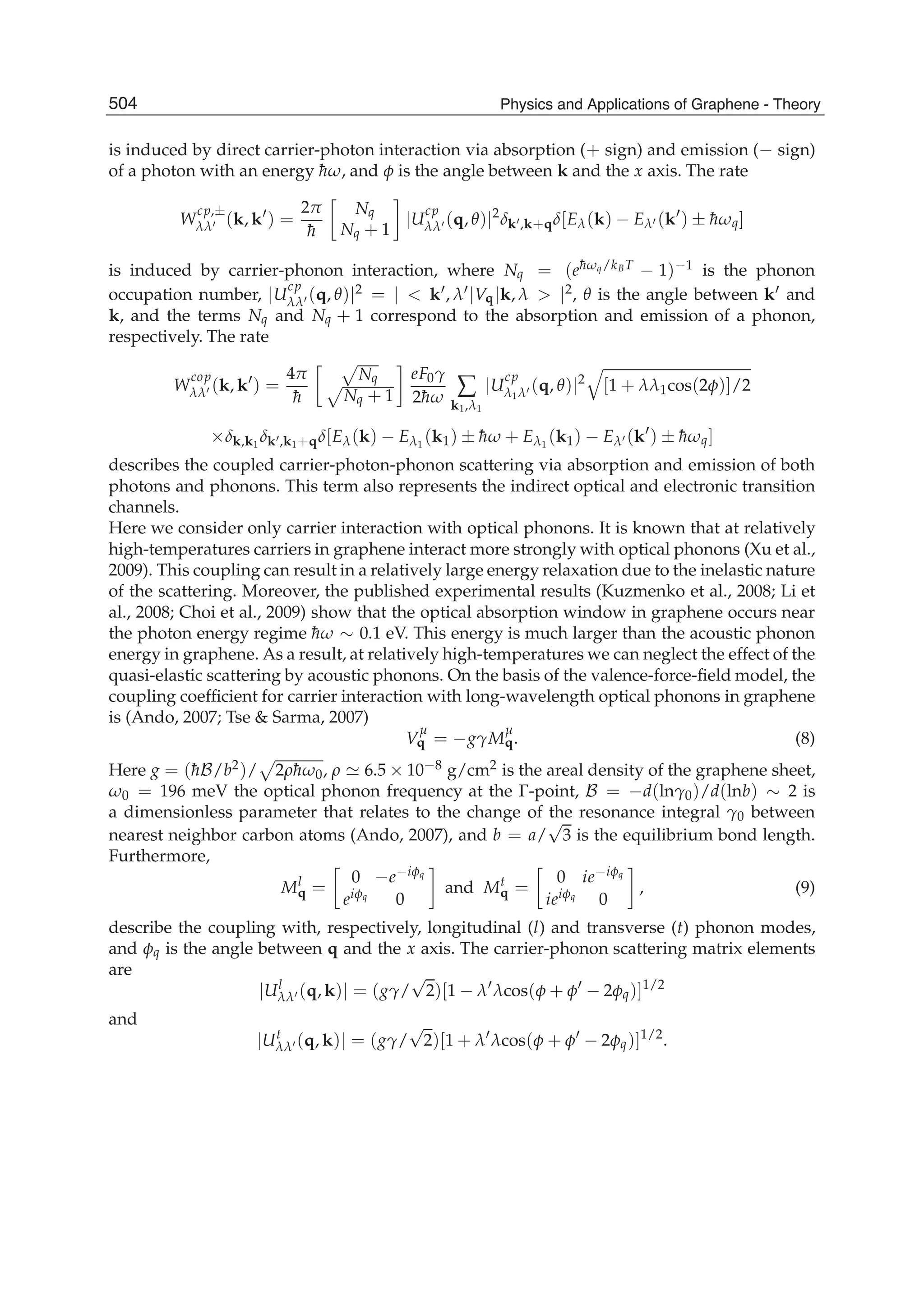
and the accepted value for t1 is ∼ 2.7 eV while |t2| << t1 depends on the parametrization
used. Neglecting overlap between orbitals on different C atoms, the usual anticommutation
rules [ˆc†
i,σ, ˆc j,σ ]+ = δc,c δi,jδσ,σ (c = a, b) hold; hence, introducing the Fourier transformed
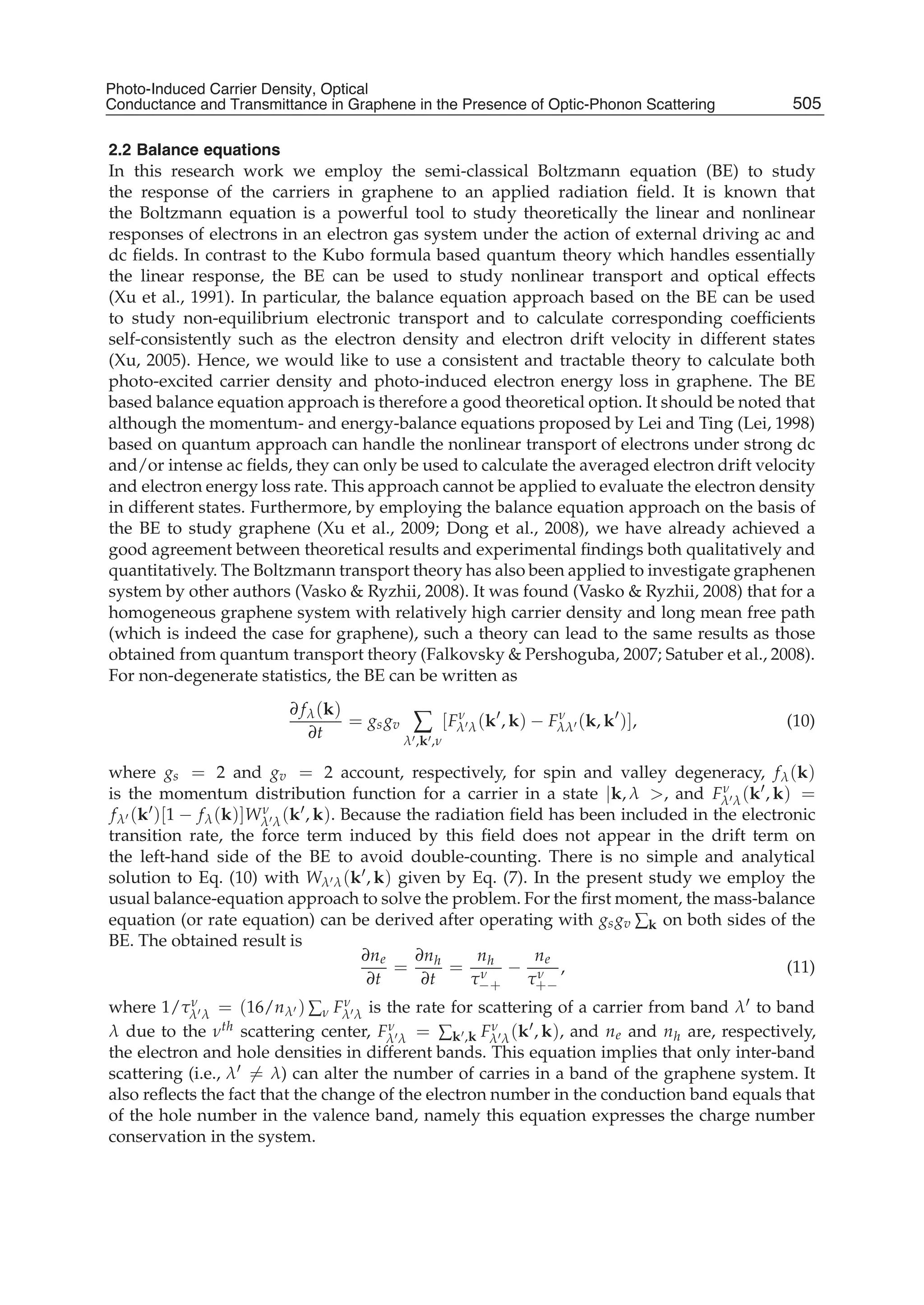
operators ˆak,σ according to
ˆai,σ =
1
√
N
∑
k∈BZ
e−ikRi ˆak,σ (4)
where the sum runs over k points in the first Brillouin zone (BZ) (analogously for ˆbk,σ) the
above Hamiltonian can be rewritten as
ˆHTB
= −t1 ∑
k,σ
f (k)ˆa†
k,σ
ˆbk,σ + h.c. − t2 ∑
k,σ
g(k)ˆa†
k,σ ˆak,σ − t2 ∑
k,σ
g(k)ˆb†
k,σ
ˆbk,σ (5)
or, in matrix notation,
ˆHTB
= − ∑
k,σ
ˆa†
k,σ, ˆb†
k,σ
t2g(k) t1 f (k)
t1 f ∗(k) t2g(k)
ˆak,σ
ˆbk,σ
Here f (k) and g(k) are ‘structure factors’ for the nearest- and next-nearest neighbours,
f (k) = ∑
i=1,3
e−ikδi
g(k) = ∑
i=1,6
e−ikδi
Diagonalization is trivial and gives the energy bands,
(k)± = −t2g(k) ± t1|f (k)| = −t2g(k) ± t1 3 + g(k) (6)
where |f (k)|2 = 3 + g(k) has been used and the minus (plus) sign solution correspond to the
π (π∗) band (see e.g. Bena & Montambaux (2009); Castro Neto et al. (2009); Wallace (1947)).
Close to the K(K ) point |f (K + q)|2 ∼ v2
Fq2 and the dispersion is conical, giving rise to the
so-called Dirac cones. Here vF =
√
3
2 a = 3
2 d, where d is the carbon-carbon distance, ∼ 1.42
Å, and a the lattice constant. Consequently, the density-of-states (DOS) is linearly vanishing
at zero energy, ρ( ) ∼ 2| |/π
√
3t2, one of the fingerprints of massless Dirac electrons. Its
vanishing value challenges one’s intuition since experiments find a finite, non-zero minimum
conductivity at this energy (Peres, 2010).
Albeit simple, this tight-binding model is accurate enough to correctly represent graphene π
bands, at least close to the high symmetry points K and K . The latter control the low-energy
physics of charge carriers, and are the source of the exceptional interest in graphene. If only
nearest-neighbours interaction is allowed the two sublattices form two disjoint sets where
A-type sites connect to B-type sites only and vice versa. The Hamiltonians is said bipartitic
and displays an interesting symmetry: for each non-zero energy level and eigenfunction
1 Notice that the on-site energies (the energy of carbon pz orbitals) have been set equal to zero, but
additional terms of the form ∑i i ˆc†
i ˆci would appear if graphene were subjected to an inhomogeneous
external potential.
47The Effect of Atomic-Scale Defects and Dopants on Graphene Electronic Structure
σd
σv
AC CB
C6
2I C
σd
C3
K
K K
Fig. 2. Left panel: Point symmetry elements in graphene lattice. Reflection planes orthogonal
to the page, σv and σd, are replicated by the six-fold rotation axis C6, along with the two-fold
rotation axis on the page plane, C2. I is the inversion center, at the center of the Wigner-Seitz
cell (solid line). The page plane is, of course, a reflection plane (σh). Right panel: symmetry
elements of the k-group at the K point (D3h). Black dots mark the K point and its images.
|ψ+ = cA |A + cB |B (where |A /|B is non-zero on A/B lattice sites only), there exists a
‘conjugate’ level with energy − and wavefunction |ψ− = cA |A − cB |B . This is called
electron-hole (e − h) symmetry since at half-filling (as it is case of graphene with one electron
per site), the Fermi level lies at zero energy, and the above symmetry relates electron and
holes. For a proof, just apply a phase-change to one of the two sets of sublattices states 2, e.g.
ˆbi,σ → −ˆbi,σ, as this converts H into −H.
C2v
D3h
D2h
sC
D6h
Γ K Μ Γ
-10.0
-5.0
0.0
5.0
10.0
(ε−εF
)/eV
NN only
TB fit to DFT data
D6h
D3h
C2v
D2h
A2u
B2
E"
B2g
A2
B2g
C2v
B2
B2
B1u
A2
B2
C2v
B2g
A2u
Fig. 3. Left panel: point-symmetry classification of Bloch states in graphene. k-groups are
color coded as indicated. Right panel: symmetry labels for graphene electronic states on the
highest-symmetry lines of the BZ.
Electron-hole symmetry, as we shall see in the following, plays an important role in
graphene, even if it holds only approximately (i.e. with nearest-neighbour interaction only
and neglecting orbital overlap). Here we just notice that, because of such symmetry, the
2 Interestingly, this operation corresponds to an operator ˆπ, ˆπ ˆci,σ = (−)τ ˆci,σ ˆπ (τ = 1, 2 for c = a, b),
which reduces to the z component of the pseudospin in spinor notation.
48 Physics and Applications of Graphene - Theory
band-structure is expected to have a gap at the Fermi level unless there are specific reasons
for having energy levels exactly at zero. As we now show, the specific reason is provided by
the spatial symmetry of the substrate.
Graphene lattice is highly symmetric. Its Wigner-Seitz unit cell has the same point symmetry
of benzene, namely it belongs to the D6h point group, see fig.2, which is the point group for
symmetry operations in real-space. For Bloch electronic states with k-vector k, symmetry
is reduced to that subgroup of D6h which either leaves k invariant or transform it into
one its images, i.e. k → k + G with G a reciprocal lattice vector (Mirman, 1999). Such
subgroup is known as k-group at k, G(k), and determines the possible symmetry of the
electronic states. For instance, at the K point the k-group is D3h since only three-fold
rotation axes and σd planes transform the K images into themselves 3. A full analysis of
the symmetry properties of Bloch electrons is given in fig.3, left panel, where the k-groups
are color-coded, grey for Cs, black for C2v, green for D2h, blue for D3h and red for D6h. The
main point here is that graphene is sufficiently symmetric that allows for k-groups supporting
two-dimensional irreducible representations (E irreps), namely D6h at Γ and D3h at K, K . As
spatial symmetry is (almost) compatible with e − h symmetry, a zero energy state results
whenever the electronic wavefunctions span a two-dimensional irreducible representation
(odd in number, in general), i.e. they give rise to a doubly-degenerate level. This is exactly
the case of the K (K ) point, where Wannier functions built with pz orbitals of the A and
B sublattice span the E irrep of the above D3h k-group. Notice also that this symmetry
argument is enough to explain the conical dispersion of the energy at the K (K ) point which
makes graphene so attractive: without an inversion center, degeneracy is lifted already at first
order in k · p perturbation theory when moving away from the BZ corners.
While spatial symmetry is exact, e − h symmetry holds in the nearest-neighbour
approximation only. Nevertheless, since inclusion of higher order hopping terms does not
modify the level ordering (i.e. the minimum of the π∗ band lies always above the top of the
π band) the Fermi level at charge neutrality matches exactly the energy where the E irrep is
found (called Dirac point as it is the cone apex).
2.2 Hubbard Hamiltonian
The tight-binding (TB) Hamiltonian is a model in which each electron moves independently
from the others. Despite it represents a good approximation for graphene energy spectrum,
such a simple picture will necessarily fail in computing spin properties in all but the simplest
situations. A simple way to include electron-electron interactions is given by the Hubbard
model
ˆH = ˆHTB
+ U ∑
i
ˆni,↑ ˆni,↓ (7)
where ˆHTB is the tight-binding Hamiltonian of eq.3, the sum runs over all carbon sites and
ˆni,σ = ˆc†
i,σ ˆci,σ are the corresponding number operators. This Hamiltonian combines the
tendency of electrons to delocalize onto the lattice due to their kinetic (hopping) energy
together with an “on-site” Coulomb repulsion that tends (for U > 0) to localize them to
minimize double orbital occupation.
The Hubbard model is a very useful tool for the study of magnetism in complex materials.
3 The remaining symmetry elements determine the so-called star of the given k point, which is the set of
points generated by these elements once applied to k. Such set of physically distinct points in k space
are degenerate in energy; this is the case of K and K, for instance, since they belong to the star of each
other.
49The Effect of Atomic-Scale Defects and Dopants on Graphene Electronic Structure
It has long been used in the chemical community4 -and proved to be rather accurate for
such systems- to investigate excitation spectra in polycyclic aromatic hydrocarbons (today,
graphene dots). Though simple, the model requires quite a large effort for its solution.
Therefore, one often resorts to its mean-field approximation,
ˆHm f
= ˆHTB
+ U ∑
i
ˆni,↑ < ˆni,↓ > +U ∑
i
< ˆni,↑ > ˆni,↓ − U ∑
i
< ˆni,↑ >< ˆni,↓ > (8)
where the average occupation number of one spin-species at given site tunes an effective
on-site energy for the other spin-species, e.g.
e f f
i,↑ = +U < ˆni,↓ >. This is essentially
equivalent to an (unrestricted) Hartree-Fock approach to the π electrons and is useful, as
compared with density functional theory (DFT) methods applied to the exact Hamiltonian, to
study very large systems, of dimension comparable to those experimentally realized. Though
we will not solve the Hubbard model in the following, there are some exact, analytic results
that can be obtained from it and that turn out to be an important tool in discussing defects in
graphene.
2.3 Valence bond picture
An alternative, easy-to-use way of looking at graphene electronic structure is provided by the
‘chemical picture’. With this we mean the traditional picture of chemical bonds as given by
the Lewis structures and modified to account for the ‘chemical resonance’. In this picture,
electrons are mostly localized on atomic orbitals (usually hybridzed) of the atoms forming
the molecule, and couple in singlet pairs to form bonds and lone-pairs. For carbon atoms
in graphene the three sp2 orbitals (with one electron each) are singlet-coupled with electrons
in sp2 orbitals of neighbouring sites. The remaining electron (the one described by the TB
Hamiltonian above) can couple with its counterpart of one of the three neighbours. The state
of the system is a superposition of these different ways of binding, and the system gains
energy from such a resonance phenomenon.
This naïve picture finds its root in the Valence Bond (VB) theory of chemical bond, which
developed from the Heitler-London study of the H2 molecule, soon after the foundation of
quantum mechanics. The theory, as intensively pushed forward by Slater and Pauling, is
a practical way of looking at the chemical bond and at the bond-breaking, bond-forming
processes which are essential for chemical reactivity. It can also be turned into a variational
method for the many-electron problem which uses a correlated wavefunction ansatz and
captures the important part of the electron correlation 5(Cooper, 2002; Cooper et al., 1987;
Raimondi et al., 1985; Shaik & Hiberty, 2007). In many respects, it has to be considered
complementary to the Molecular Orbital (MO) approach, though the latter proved to be more
efficient.
Valence Bond theory focuses on spin and builds the singlet wavefunction of an
even-numbered ground-state molecule as a ‘product’ of singlet pairs, one for each bond
(pairs of orbitals), thereby identifying a chemical formula. For less standard species such
as graphene, different products are equally likely and the correct wavefunction is the linear
combinations of all the possible structures. For instance, let us look at the benzene molecule
4 In the chemical community is dubbed Parisier-Parr-Pople approximation, after Pariser-Parr and Pople
who first introduced it in the early fifties.
5 This is so because even the simplest VB wavefunctions can be re-written as linear combinations of Slater
determinants, and include the so-called ‘static’ correlation. The latter is essential for describing bond
formation and near-degeneracies; in extended systems is responsible for Mott transitions.
50 Physics and Applications of Graphene - Theory
Fig. 4. The five possible perfect pairing Rumer diagrams for the benzene molecule with their
correspondence with Kekulé (1-2) and Dewar (3-5) resonance structures.
as prototypical case of aromatic compounds. Considering only the six π electrons localized
in their respective pz orbitals, the possible linearly independent (“perfect pairing”) functions
can be schematically depicted as in figure 4; for six electron and an overall singlet state there
are five couplings6. In the graphical representation of Fig.4, known as Rumer diagrams, one
represents each atomic center with a dot and uses a line for singlet coupling between them.
The chemical picture (bottom row of the same figure) uses only the 2 Kekulé structures on
the left, since the 3 Dewar structures gives a negligible contribution to the energy, as can be
guessed from the bond pattern.
Notice that VB theory is closely related to the Hubbard model discussed in the previous
section: the atomic orbitals housing the electrons need not be those of the free atoms. If they
are ’polarized’ by the environment (e.g. they are linear combinations of free-atomic orbitals)
the VB ansatz accounts both for localization and band-like behaviour, as in the Hubbard
model. It is not hard to show, indeed, that the Hubbard model for the H2 molecule can
be obtained from a simple7 VB ansatz to the two-electron wavefunction. In the following
we will make a qualitative use of this chemical picture, as it provides insights into defect
formation and properties; see also Wassmann et al. (2010) for its role in interpreting details of
STM pictures.
3. Defect formation
In this Section we describe defect formation8. As we shall see in the following, even though
vacancies and adatoms turn out to have very similar effects on the π electron system, we
distinguish them here according to their preparation methods, i.e. high (e−, ions, etc.) vs. low
(neutrals) energy beams. The reason is that only in the first case defects can be considered
randomly arranged. Adatoms at all but very low concentration tend to cluster on the surface,
and understanding this phenomenon requires knowledge of how the electronic structure of
the substrate is modified upon formation of the very first defects.
Notice, however, that defects are also naturally present in graphene as in any common
6 The number of linearly independent spin-function for N electrons in the S spin state, usually denoted as
f N
S , can be easily obtained by angular momentum coupling rules. The properties of the corresponding
spin spaces stem from their deep connection to the group of permutations of N objects.
7 It is enough to consider the so-called Coulson-Fisher wavefunction.
8 With this we mean point defects, i.e. adatoms, substituted or displaced atoms. It should be noticed,
however, that other defects may also be important for the transport properties.
51The Effect of Atomic-Scale Defects and Dopants on Graphene Electronic Structure
material. Adatoms as hydrogen or hydrocarbons, for instance, can be introduced by
the preparation method, while other point defects affecting transport properties, e.g.
charge-impurities, local potentials, etc., may result from imperfections on the substrates where
graphene is accommodated.
3.1 Electron and ion bombardment
The irradiation by high energy particles is the main tool for creating defects in graphene
and in other carbon nanostructures. When the projectile particle impinges on the structure
it transfers energy to the lattice. In bulk materials (e.g. in graphite) energy dissipation is
rather effective, up to eventually stop the projectile, and it occurs through nuclear and electronic
stopping mechanisms. Nuclear stopping is due to the collisions between the projectile
and the carbon nuclei, an essentially classical process governed by momentum transfer and
Coulomb interaction. On the other hand, (inelastic) electronic stopping occurs by the many
possible electron transitions in the material, hence promotion into conduction band (hot
electrons), ionizations, but also through plasmon excitations, photoemissions, etc. The relative
importance of the two mechanisms depends on the beam energy, on the projectile mass
and on the electronic structure of the target material. Nevertheless a microscopic theory of
energy dissipation in nanostructures is still under study since the models developed for bulk
materials cannot be easily applied in a reduced dimensionality material such as graphene
(Krasheninnikov & Nordlund, 2010).
The mechanism for the defect formation has been studied intensively in the last decade.
In brief, when the energy transferred to an atom is larger than the so-called displacement
threshold (∼20 eV in case of graphite) this can leave its equilibrium position and move trough
the bulk to form, for instance, a Frenkel pair or, for single layer graphene, a vacancy. Large
ions can produce multiple vacancies up to small holes in the lattice depending on their size.
Electron beams produced in transmission electron microscopes (TEM) can instead be focused
down to scales comparable to the carbon-carbon distance, giving a precise control of the
induced damage up to form single vacancies. Moreover TEMs allow a real-time imaging of
the damage process and of the chemical reaction that follows the vacancies formation (Meyer
et al., 2008; 2010).
The formation a single vacancy in graphene leaves three σ dangling bonds and it removes a
π electron. The first span a low-energy, one-dimensional irreducible representation (A irrep
in the following) of the (local) D3h point group and an E irrep. Therefore, the ground-state
is degenerate and undergoes a Jahn-Teller distortion: the closure of two dangling bonds
to form a pentagon, with an energy gain of about 0.2 eV. The strain induced by the other
hexagons in the lattice prevents further distortions of the third unsaturated atom out of plane
(El-Barbary et al., 2003) and the final magnetic moment for such a structure has been reported
to be between 1.0 and 1.5 μB (Lehtinen et al., 2004; Yazyev & Helm, 2007), localized on the
unpaired site. When exposed to a hydrogen flux, the vacancy rapidly saturates its dangling
bonds, with H atoms pointing slightly out of the graphene plane (Lehtinen et al., 2004).
In the case of neutral-atom bombardment, the projectile can also react to form a covalent bond
with a carbon atom. This is what happens by irradiating samples with low energies hydrogen
atoms. It has been shown that at very low densities the chemisorbed H atom defect produces
STM images very similar to the single vacancy case. As already mentioned, at higher densities
H atoms tend instead to cluster in dimers or larger structures due to electronic effects that will
be discussed in the following. Nevertheless, when considering π electrons only, vacancy and
singly-bond chemisorbed species are equivalent, since a single electron is removed from the
52 Physics and Applications of Graphene - Theory
Diabatic path
Adiabatic path
Fig. 5. Left Panel: chemisorption curves for a H atom on a graphene top site as obtained from
periodic DFT calculations using a 2x2 supercell. In the adiabatic path (black) the carbon atom
is allowed to relax at each C-H distance, while in the diabatic path (blue) the top site is kept
fixed in the puckered geometry. z is the adsorbate height on the surface. The inset on the
bottom shows the equilibrium geometry. Right panel: map of potential energy surface as a
function of the heights of H and C atoms above the surface, for a collinear geometry. Also
indicated the diabatic and adiabatic paths. Units are eV and Å.
aromatic network of graphene. As an example, chemisorption of a single H atom is detailed
in the following section.
3.2 Sticking of atomic and molecular species
A hydrogen atom impinging on graphene with a low collision energy can either physisorb
or chemisorb. The physisorption regime has long been probed with the help of
selective-adsorption resonances in H atom scattering off graphite (Ghio et al., 1980). The
extrapolated value for the physisorption binding energy (∼40 meV) to a single layer is in very
good agreement with recent theoretical studies (Bonfanti et al., 2007). Physisorbed species
are highly mobile and easily desorb from the surface since they couple only weakly with the
substrate. For this reason, chemisorption turns to be more interesting for graphene electronic
structure engineering.
Chemisorption of single H atoms on graphite has been studied since the first theoretical
works of Jeloaica & Sidis (1999) and Sha & Jackson (2002), who first showed that it indeed
occurs if the substrate is allowed to relax. Among the four possible adsorption sites the
hollow and bridge were found not binding while the two kinds of atop sites (with or without an
carbon atom on the layer underneath for graphite) give essentially the same behaviour, since
graphene layers in graphite lay ∼ 3.4 Å apart. This implies that the (surface) chemistry of
graphene is very similar to that of graphite.
Adsorption on the top site induces a surface reconstruction (‘puckering’). Such a
reconstruction consists in the outward motion of the carbon atom beneath the adsorbed
hydrogen, and occurs as a consequence of sp2 − sp3 re-hybridization of the carbon valence
orbitals needed to form the CH bond. The re-hybridization induces a change in geometry
of the substrate site, from a planar (sp2) to a tetrahedral (sp3) form, thereby leading to the
surface puckering. The energy required for such a process, defined as the energy difference
53The Effect of Atomic-Scale Defects and Dopants on Graphene Electronic Structure
between the relaxed and the puckered configuration, is substantial (∼ 0.8 eV) and this explains
why binding energies to graphene are typically smaller than for other carbon species. If the
graphene layer is kept flat the carbon - hydrogen bond is metastable only (Casolo et al., 2010;
Sha & Jackson, 2002), while allowing surface relaxation chemisorption becomes an activated
process with stable products (∼ 0.80 eV).
When the hydrogen atom collides on a carbon site already puckered, i.e. already in the
sp3 form, chemisorption is a barrierless process. Otherwise, following an adiabatic path
(hence allowing the carbon atom relaxation to its equilibrium position at every point along
the reaction coordinate) an energy barrier ∼0.2 eV high is found, as a consequence of the
re-hybridization. These adsorption curves are shown in fig.5. The barrier (which is also
present when the substrate is kept planar) has an important, purely electronic origin. Indeed,
it has been shown (Bonfanti et al., 2008) that it results from an avoided crossing between
a repulsive interaction with the Kekulé-like ground-state and an attractive interaction with
the low-lying, Dewar-like excited state (see Fig.4 in Casolo et al. (2009a)). This can be nicely
understood in terms of the chemical picture above since the Kekulé-like structures do not have
unpaired electrons which can readily couple with that of the incoming H atom.
The overall binding picture of H atoms has found substantial experimental proof for graphite
surfaces. Hot hydrogen atoms produced by dissociating H2 molecules at ∼ 2000 K are
required to overcome the barrier and observe sticking. Thus, chemisorption is under kinetic
control9, in marked contrast with vacancy formation through e−/ion bombardment discussed
above. Indeed, as we show below, H atoms do not adsorb completely random on the surface.
A number of TPD, AES, EELS and HREELS spectroscopy data (Andree et al., 2006; Güttler
et al., 2004a;b; Zecho et al., 2004; 2002) is available, along with detailed kinetic Monte Carlo
simulations (Cuppen & Hornekær, 2008; Gavardi et al., 2009) of TP desorption curves and
accurate studies of vibrational relaxation dynamics (Sakong & Kratzer, 2010) and reaction
dynamics to form H2 (Casolo et al., 2009b; Jackson & Lemoine, 2001; Martinazzo & Tantardini,
2005; 2006a;b; Morisset et al., 2004; 2005). Notice that even though we focused here on
adsorption of H atoms the same holds for other simple, monovalent chemical species.
4. Low density: π-defect structure
4.1 The appearance of midgap state
The effect of atomic scale defects in graphite, and later on in graphene, has been
experimentally studied since the late eighties, when scanning tunneling microscopy (STM)
allowed to capture images on solid surfaces at atomic scale resolution. It appeared
immediately that when a vacancy was created by irradiating the sample, a bright
√
3x
√
3R30◦
charge density reconstruction appears (Mizes & Foster, 1989; Ruffieux et al., 2000; Ugeda et al.,
2010).
A carbon vacancy or a defect in the π-network due to a monovalent chemisorbed species
creates in graphene an imbalance between the number of sites in each sublattices. This
lowers the overall lattice symmetry, up to eventually remove the Dirac cones and open a
band gap. Looking at the tight-binding Hamiltoninan in equation 3 the introduction of a
π-defect in the graphene lattice reads as the removal of the basis function corresponding
to the defect site, and the system eigenstates become necessarily odd-numbered. Therefore,
in the nearest-neighbour approximation, because of the electron-hole symmetry, one of the
eigenvalues in the energy spectrum necessarily lies at the Fermi level. This zero-energy state
9 H diffusion is largely impeded by electronic/geometrical effects, see below.
54 Physics and Applications of Graphene - Theory
is a singly occupied molecular orbital called midgap state, even when a gap is not really
present. When relaxing the nearest-neighbour approximation such states move from the
Fermi level, but remain close to it. Their presence is important for the transport properties
being responsible for resonant scattering mechanisms.
The appearance of midgap states in bipartitic systems has been intensively studied in solid
state physics because of the implications they have for the appearance of magnetism. Inui et
al. (Inui et al., 1994) formulated a useful theorem for bipartitic tight-binding models with a
sublattice imbalance. According to their result, in any bipartite lattice in which the numbers of
sublattices sites NA and NB are not equal, there are at least η = |nA − nB| linearly independent
eigenfunctions of the Hamiltonian at zero energy, all with null amplitudes on the minority
sublattice sites. The proof is simple: for let NA > NB and |ψ = ∑i αi |ai be a trial solution
at zero energy. The coefficients αi need to satisfy ∑i bj|H|ai αi = 0 for j = 1, ..NB which is a
set of NB equations for the NA > NB coefficients, with η linearly independent solutions. This
also shows that ψ’s localize on the A lattice sites.
Analogous results have been already known in hydrocarbon chemistry for some time. The
tight-binding approach described above has been used for decades in quantum chemistry
to study aromatic hydrocarbons, under the name of Hückel method. The mathematical
properties of the Hückel Hamiltonian have been formalized in a series of theorems and
corollaries in a famous book of Dewar (Dewar, 1969). Bipartite lattices were listed there as
“alternant” hydrocarbons, and the emergence of midgap states formally predicted in case of
odd-numbered alternant hydrocarbons.
Calculations, both at tight-binding and at higher levels of theory (DFT), confirm these
expectations: in graphene the zero-energy states originated in this way correspond to
semilocalized modes around the defect which decay slowly with the distance, i.e. with a
r−1 power law (Pereira et al., 2006; 2008), a result which has been recently confirmed by
experiments (Ugeda et al., 2010). Pereira et al. (2008) performed a comprehensive analysis
of the effect low-density defects have on the graphene DOS, by using numerical tight-binding
calculations for ∼ 4x10⁶ lattice sites and analytic results. Analogous results have been found
in DFT studies10 of isolated vacancies (Yazyev & Helm, 2007) and adatoms (Boukhvalov et al.,
2008; Casolo et al., 2009a).
4.2 Chemical resonance formula
In the case of a single π-defect, or a random distribution of them, the appearance of midgap
states may be easily understood by applying the resonance-based VB picture described in
Section 2. Considering benzene as the simplest building block of graphene, it is easy to realize
how adsorption of a H atom breaks the aromatic network and leaves one unpaired electron
free to move on the lattice by bond switching: spin-recoupling with a neighbouring double
bond creates an unpaired electron in one every two lattice sites. Ab-initio VB calculations
(Bonfanti et al., 2008) show that this indeed the case: the 5 π electrons have 5 different ways of
couplings (Fig.6) but only those with the unpaired electron in the so-called ortho and para
positions are relevant; an electron in meta position would involve a Dewar-like structure,
which has a high energy bond-pattern (see Fig.6). The bond switching mechanism is very
useful and well known in basic organic chemistry, where it easily allows predictions for
orientation effects, e.g. in electrophilic aromatic substitutions. In contrast to the full analysis
10 The approach used is intrinsically periodic. Therefore, the results are best viewed as referring to defects
which are periodically arranged on superlattices with large unit cells.
55The Effect of Atomic-Scale Defects and Dopants on Graphene Electronic Structure
0.225 0.5120.225 0.019 0.019
Fig. 6. Valence Bond model for the binding of a radical species (a H atom) on benzene. The
numbers give the weights of the corresponding VB structures (Bonfanti et al., 2008). The
resulting unpaired electron localizes mostly in ortho (two leftmost structures on the top row)
and para (mid panel) position, as emphasized by the bond-switching mechanism reported in
the chemical formula of the bottom row.
of possible spin-couplings, exporting this model to graphene is rather straightforward11. A
picture of the mechanism is shown in fig.7 for a coronene model, that is meant to represent
the whole graphene lattice. The itinerant electron hops between sites of one type only,
thereby occupying a delocalized state which is the midgap state described previously in the
tight-binding (MO) picture.
Whatever picture we use the result is a spin density (magnetization) localized close to
the defect, on the sites of the hexagonal sublattice not housing it 12. At low density,
where hybridization does not occur, such spin-density thus determines the appearance of
(microscopic) magnetically ordered domains. It further influences reactivity of the substrate
with foreign species, which can readily ‘saturate’ (singlet-couple) this electron if they land on
the correct sites, as will be shown in the next section.
Before concluding this Section, we can now understand why simple adatoms do not move on
the surface. Indeed, for the H atom to hop on the neighbouring site the unpaired spin has
to move from one sublattice to the other and this requires breaking completely the existing
CH bond and forming a new one: the barrier to diffusion, then, matches the desorption
Fig. 7. Itinerant electron model for the pz-vacancy-induced midgap state
11 This amounts to consider Kekulé structures only, which are much fewer than the whole set of f N
S
couplings for all but small N values.
12 It can also be turned into a charge-density by addition/removal of one electron.
56 Physics and Applications of Graphene - Theory
Fig. 8. Molecules with no sublattice imbalance. The first two molecules on the left are
di-radical species, i.e. they have two midgap states. The Schlenk-Brauns hydrocarbon shown
in the middle panel differs from the Chichibabin hydrocarbon shown in the right panel by
the connectivity only. Nevertheless, the latter does not present unpaired electrons. In the first
two molecules, the largest set of non-adjacent sites is marked by red dots.
energy. This explains the experimental observation that H atoms are immobile on the surface
(Hornekær et al., 2006b). For more complex species, e.g. O atoms, spin-recoupling on the
adatom may help the diffusion (isomerization) process via formation of a ‘bridge‘ between the
two sites. This would explains why DFT computed barriers for diffusion of OH species are
definitely smaller than the desorption energy (Ghaderi, 2010).
5. High density: spin-ordering, clustering and related issues
5.1 Predicting midgap states and magnetism
The very simple counting rule for midgap states introduced above usually works fine for
graphene, but fails to be predictive for some class of finite size graphenes or analogous
(complementary) holes on the graphene sheet. For instance, the first two molecules in Fig.8
have no sublattice imbalance (being symmetric) but are radical species, i.e. they necessarily
have midgap states (Pogodin & Agranat, 2003). To a closer inspection, sublattice imbalance is
indeed only a sufficient condition for midgap states to appear.
To rationalize the situation, it is necessary to introduce the concept of non-adjacent sites in
a N-site bipartitic system. We say that two sites are non-adjacent if they are not bound
(connected) to each other; for instance, two sites on the same sublattice are non-adjacent.
Clearly, there exists a maximal set of non-adjacent sites and we call α the sites in this set,
and β the remaining ones (Nα, Nβ = N − Nα in number, respectively). Each site α binds at
least to one site β, otherwise it would represent a completely isolated site. Arranging one
electron per site α, however, we can form at most Nβ bonds at a time, and therefore we are left
with η = Nα − Nβ = 2Nα − N unpaired electrons, i.e. midgap states. The case of a sublattice
imbalance discussed above is a special result of this rule: when NA > NB, since the A lattice
sites are always non-adjacent and Nα ≥ NA, we have η ≥ NA − NB. Fig.8 shows molecules
having η > 0 and no sublattice imbalance, with the indicated α sets. As it is evident from
its derivation, this result can be equivalently re-phrased by defining η to be the number of
unpaired electrons in the Lewis structure(s) with the maximum number of π (i.e. double)
bonds.
Notice that, since the spectrum of the Hamiltonian is determined by the system topology
the whole set of counting rules for midgap states can be derived entirely from graph theory.
In particular, midgap states appears as zeros of the characteristic polynomial of the adjacency
matrix A, that defines the connectivity of the graph (Bonchev & Rouvray, 1991; Randi´c, 2003)).
57The Effect of Atomic-Scale Defects and Dopants on Graphene Electronic Structure
In this context, the above result is known as graph nullity theorem.
Having derived the exact conditions determining the appearance of midgap states, the
question arises of how spins couple when a number η of unpaired electrons are present.
The determination of the spin state cannot come, of course, from the simple tight-binding
Hamiltonian, since in these open-shell configurations energy ordering is mainly determined
by electron correlation. At first glance, it can be guessed that electrons occupying
quasi-degenerate midgap states tend to keep their spins parallel, in a sort of molecular
Hund’s rule, as this reduces Coulomb repulsion, i.e. system’s total spin should always be η/2
(Longuet-Higgins, 1950). This is actually the case only when midgap states originate from
a sublattice imbalance, since in such instance they are forced to stay on the same sublattice.
When midgap states (unpaired electrons) lie on different sublattice they best couple at low
spin. This result can be shown to be exact for the realistic model provided by the (repulsive)
Hubbard Hamiltonian: Lieb (1989) showed that for any bipartitic system at half-filling the
ground-state spin S is given by the sublattice imbalance S = 1
2 |NA − NB|. This is a subtle effect
of electron correlation, which would lead to an energetically unfavourable spin polarization
of the remaining occupied orbitals if the above Hund rule were followed in absence of
sublattice imbalance 13. From a different perspective, it has been associated with the most
“spin-alternant” structure (Ovchinnikov’s rule, Ovchinnikov (1978)).
According to the rules above it is now possible to predict the number of midgap states and the
spin state of a number of complex graphene structures without relevant exceptions. We only
note that the theorems stated above for bipartite lattices do not apply for topological defects
that destroy bipartitism. Nevertheless, it has been noticed that the Ovchinnikov’s rule can be
usually extended to non-bipartite systems (Shaik & Hiberty, 2007), although some care has to
be paid (López-Sancho et al., 2009). For instance, the ground-state multiplicity of Stone-Wales
defects is correctly predicted to be zero by this rule.
5.2 Preferential sticking
When adsorbing hydrogen atoms on graphite or graphene under kinetic control STM images
clearly show the formation of dimers and clusters (Hornekær et al., 2006b). Since H atoms are
immobile on the surface this must be due to a preferential sticking mechanism. This mechanism
was first suggested by (Hornekær et al., 2006b) who looked at the STM images formed
by exposing Highly Oriented Pyrrolitic Graphite (HOPG) samples to a H atom beam, and
observed formation of stable pairs, also confirmed by first-principles calculations (Hornekær
et al., 2006b; Rogeau et al., 2006). Later Casolo et al. (2009a) showed that the preference for
certain lattice sites comes from the spin density localized on one of the two sublattices (the
midgap state), as generated by the first adsorbate.
The overall picture (Casolo et al., 2009a) is consistent with the VB chemical model: when
a first H atom is on an A-type site, the unpaired electron localizes on the B sublattice
and bond formation easily occurs on its sites. An “AB dimer” (which has no sublattice
imbalance) is formed and a singlet ground-state is obtained where aromaticity is partially
restored. Conversely, if adsorbtion occurs on the same sublattice, i.e. to form “A2” dimers, the
incoming H atom does not make use of the available spin-density, and adsorption energies are
comparable to that of the first H atom. Furthermore, as another electron is set free on the same
B sublattice occupied by the unpaired electron, the ground state is a triplet (η = NB − NA = 2).
13 Notice that for two electrons in different zero energy state, first-order perturbation theory always gives
a triplet ground-state. The nature of the midgap states and the ensuing interactions with the doubly
occupied orbitals play a decisive role.
58 Physics and Applications of Graphene - Theory
Fig. 9. Left panel: Binding energies for secondary H adsorption as a function of the
site-integrated magnetization (MSI), for AB ( circles) and A2 (squares) dimers. Both singlet
(red) and triplet (blue) solutions are shown in red and blue respectively. Also shown the data
point for single H adsorption (black diamond) and a linear fit to the data set (solid line).
Right panel: corresponding barrier energies for secondary atom adsorption (ground-state
only). Data point at MSI=0 is for single H adsorption.
The results of DFT calculations (Casolo et al., 2009a) on a number of dimers are shown in Fig.9
as function of the site-integrated magnetization, i.e. the average number of unpaired electrons
in each site as results from the first adsorption event. It should be noted that substrate
relaxation effects, though substantial (∼ 0.8 eV), are site-independent for all but the ortho
dimer14; thus the curves in the graphs of Fig. 9 reflects purely electronic effects. Binding and
barrier energies both depend linearly on the local magnetization, thereby implying a linear
relationship between them; this is a common tendency in activated chemical reactions known
as Brønsted-Evans-Polayni rule. An exception is provided by the ortho dimer (rightmost
data point in the graphs of Fig. 9), whose formation requires further rearrangement in the
first C-H neighbourhood. This is shown in figure 10 where the equilibrium geometry of the
dimer is reported in the left panel. It is clear from the figure that the two H atoms point in
opposite directions (as in a H-C-C-H eclipsed conformation of an alkane), which suggests that,
despite their proximity, they would not easily desorb to form H2 upon heating the substrate.
This is indeed what has been found by a combined theoretical and experimental study by
Hornekær et al. (2006a): upon heating, the ortho dimer prefers to isomerize to the para dimer,
which dehydrogenates easier (i.e. at a lower temperature). The highest temperature peak
in the TPD spectra corresponds then to this isomerization process. The para dimer itself,
whose equilibrium geometry is shown in the right panel of Fig.10, forms abundantly when
exposing graphene to a H atom beam, since its formation is barrierless (see fig.9). This forms
the basis for the preferential sticking mechanism first suggested by Hornekær et al. (2006b),
which is here summarized with the results of fig.9, namely formation of AB dimers is both
thermodynamically and kinetically favoured over formation of A2 dimers and single atom
adsorption.
14 Surface puckering upon adsorption, to a good approximation, involves nearest neighbouring C atoms
only.
59The Effect of Atomic-Scale Defects and Dopants on Graphene Electronic Structure
Fig. 10. Equilibrium geometry for ortho (left) and para (right) dimer structures.
Unfortunately15, the preferential sticking mechanism above works only for dimers. Once
an AB dimer is formed (A2 is unfavoured) there are no further unpaired electrons available,
and no bias on the adsorption of additional H atoms. This is confirmed by DFT calculations
(Casolo et al., 2009a) on a number of larger A2B2, A2B, A3B1 and A3 clusters. As expected from
the VB model above, adsorption of a third hydrogen atom to a stable AB dimer parallels that of
the first H, with essentially no preference towards any specific sublattice position, and always
produce doublet structures (M = 1 μB) (see fig.11). Similar conclusions hold when adding a
third H atom to the (magnetic) meta dimer A2: adsorption on B lattice sites is strongly favoured
(Ebind = 1.2 − 1.9 eV) and produces doublet structures (M = 1 μB), whereas H atoms bind to A
lattice sites with an energy ∼ 0.7 − 0.8 eV and produce highly magnetic structures (M = 3 μB)
(see fig.11). Energy barriers to adsorption follow the same trend: calculations show that, with
few exceptions, barriers to sticking a third H atom compare rather well with that for single H
atom adsorption for the processes AB→A2B and A2 →A3, and may be considerably smaller
for A2 →A2B ones. These three-atom clusters, similarly to the single H atom, necessarily bias
the adsorption of a fourth atom. The computed binding and barrier energies for this process
have been found to compare rather well with the dimer values, actually they nicely fit to the
same linear trends shown in Fig.9. Finally, all the considered A2B2, A2B, A3B1 and A3 clusters
have been found to have 0, 1, 2 and 3 unpaired electrons in their ground-state, respectively, in
agreement with expectations (i.e. either the VB model or the Lieb theorem).
Few exceptions to this picture are for compact clusters where substrate relaxation does play
some role, see e.g. the structures on the right of fig. 11. Compared to other trimers, these
structures are favoured because of the substrate softening occurring after formation of the para
dimer, which is in a typical boat configuration (fig.10). Such softening is expected to reduce the
relaxation energy needed for the binding of the additional atom, with a gain of some tenths of
eV on the overall energetic balance16. This would explain why experiments at intense H atom
flux do not find a random distribution of dimers, as would be expected on basis of electronic
effects only, rather clusters made up of a number of atoms (Ferro et al., 2009; Hornekær et al.,
2007). Though a detailed analysis would require the knowledge of the adsorption barrier for
a rather large number of clusters, the linear relationship shown above may help in making
educated guesses on the basis of the binding energies only.
15 There is a long open search for efficient pathways leading to H2 formation on graphitic surfaces, because
of its importance in explaining the observed abundance of molecular hydrogen in the interstellar
medium.
16 Remember that the relaxation energy for the single H atom (∼ 0.8 eV) has the same magnitude as the
overall binding energy, i.e. about half of the bond formation energy is spent for relaxing the substrate.
60 Physics and Applications of Graphene - Theory
3A
3A
H AB
0.847 eV
0.727 eV
para−dimer
H
H
H
H
H H
H
H
H
H
H
H
H
H
H
H
H
H
H
0.820 eV
1.301 eV
1.516 eV
0.971 eV
1.959 eV
0.794 eV
0.620 eV
2
A B
H
H
H
H
H
H
A2
meta−dimer
H H
H
H
H
Fig. 11. Some of the possible hydrogen trimers structures obtainable from the AB para dimer
(left diagram) and from the A2 meta dimer (right). Binding energies are also shown.
5.3 A route to graphane?
Graphane is a novel two-dimensional material, namely the fully hydrogenated graphene sheet.
The structure is still bipartitic and each sublattice bears all hydrogens on the same side of the
lattice plane (in meta to each other), in such a way to have a chair-like configuration as in
cyclohexane. It is an insulating material with no π electrons (Lebègue et al., 2009; Sofo et al.,
2007), that might have been recently obtained by simply exposing graphene to cold hydrogen
plasma (Elias et al., 2009). This result is very interesting in light of what has been shown in the
previous sections. In order to produce graphane by simple hydrogen exposure it is necessary
that either H atoms adsorb selectively on one sublattice only for a given graphene face or
hydrogen diffuses (isomerize) to occupy the sites on the right face.
According to the discussion of previous section, formation of meta dimers is unlikely, ortho,
para positions being highly favoured for adsorption. According to DFT calculations on
free-standing graphene (Casolo, 2009), this is true both for the syn- (on the same face) and
the anti- (on opposite faces) dimers. However, even if hydrogen atoms were likely to form
anti-para dimers also in supported graphene (and they are required for graphane production)
an efficient syn- to anti- conversion mechanism would be needed to convert those dimers
already formed on the same graphene face. Unfortunately, as we have seen in the previous
section, even in this case, no true preferential sticking can occur after dimer formation and
it will be very unlikely that all the other hydrogens will chemisorbed in the correct sites
and face. Indeed, recent molecular dynamics simulations showed that disordered, frustrated
hydrogenated domains would rather form (Flores et al., 2009).
If graphane has been really formed by hydrogen exposure some other effect has to play a
role. Curved graphene areas might help this process. Graphene is a very elastic membrane
that naturally exhibit ripples that tend to lay down along steps and kinks of the supporting
substrate on which it was grown. Indeed recent experimental findings suggested that
hydrogen chemisorbs more efficiently on the ridges of the silicon carbide substrate surface
onto which graphene usually lays (Balog et al., 2009). Moreover, it has been also shown
that hydrogenation of single-layer graphene is easier than for many-layer graphene, likely
as a consequence of the higher corrugation displayed by the graphene surface (Jung et al.,
2009; Luo et al., 2009). This is reasonable, as for nanotubes the curvature reduces the pz-pz
61The Effect of Atomic-Scale Defects and Dopants on Graphene Electronic Structure
overlap, i.e. aromaticity, thereby lowering the barrier energies for H chemisorption (Ruffieux
et al., 2002a;b). Still, there is no clear evidence that local curvature plays a role in graphane
formation, and more investigations in this direction are needed.
6. Defect-based material design
When it comes to device fabrication only few of the many extraordinary properties of
graphene are relevant, at least for the chip-makers (Schwierz, 2010). Among them, its
thickness allows the thinnest possible gate-controlled regions in transistors and, according
to scaling theories, should reduce electrostatic problems if short channels have to be built.
Mobility is an important factor as it allows for instance high-performance interconnects
and fast response to external (gate) potentials. It becomes of secondary importance in
short channels, where high fields builds up and carrier velocity saturates, but also in this
respect graphene proved to have superior properties than conventional materials. Indeed,
high-performance transistors for frequency applications have been realized (Lin et al., 2010),
and record cut-off frequencies are being continuously scored. However, for its usage in logic
applications the absence of a band-gap is a major problem (Avouris et al., 2007; Schwierz,
2010): even when the Fermi level crosses the charge neutrality point a non-zero residual
conductivity avoids the complete current pinch-off 17. The absence of a band-gap, indeed,
prevents the achievement of the high current on-off ratios required for logic operations.
Graphene can be turned into a true semiconductor by properly engineering it. Electron
confinement, though in general not trivial for massless, pseudorelativistic carriers, can be
obtained by cutting large-area graphene to form narrow nanoribbons. Apart from related
fabrication issues, one main drawback of such an approach is the removal of the Dirac
cones and the resulting band-bending. This is expected to increase the effective mass of the
carriers, thereby reducing their mobility. Indeed, it has been generally found that mobility
is a decreasing function of the gap (Schwierz, 2010), and this is an undesirable by-side effect
worth considering with such a traditional approach. Alternatively, symmetry breaking is known
to turn the massless Dirac carriers into massive (yet pseudorelativistic) carriers. This can be
realized by depositing or growing graphene on a substrate that renders inequivalent the two
sublattice positions. For instance, boron nitride has the same honeycomb lattice as graphene
and a similar cell parameter, but presents two inequivalent sublattices. When graphene is
in contact with such a surface B and N interact differently with the carbon atoms of the
graphene sheet, breaking its sublattice equivalence and lifting the degeneracy of the two
bands. A similar situation is achieved for graphene grown on silicon carbide surfaces, where a
gap has been observed by angle-resolved photoemission spectroscopy though subtle electron
correlation effects may play a role in such case (Bostwick et al., 2007; Zhou et al., 2007).
In the following sections we describe alternative possibilities for opening a gap in graphene
band structure, namely those offered by superlattices of defects and dopants. One interesting
finding in this context is the proof that a band-gap can be opened in graphene without breaking
its symmetry, with the advantage the new Dirac cones (massless carriers) appear right close
to the gapped region (Martinazzo et al., 2010). For this reason we start introducing some
symmetry considerations, extending the arguments given in section 2.
17 The defects discussed in this chapter, along with charged scatterer, are ascending as the most likely
origin of the conductivity minimum (Peres, 2010). The counter-intuitive role of defects in increasing the
conductivity finds its origin in the modification of the graphene DOS close to the Dirac point.
62 Physics and Applications of Graphene - Theory
Fig. 12. Left: counting the number of irreps generated by the atomic basis in a 4x4 supercell:
indicated are the irreps generated by the atoms at the center of the half-cells (red balls) and by
green triangles. Right: a simple “supergraphene”, the simplest defective 14x14 honeycomb.
6.1 Symmetry considerations
As we have seen in section 2 graphene’s unconventional electronic properties are strictly
related to its D6h point symmetry. The k-group at the K-K’ high-symmetry points (D3h) allows
for doubly degenerate irreducible representations, and Bloch functions built with pz orbitals
of A and B sublattices span just one of its two-dimensional irreps. As e − h symmetry does
not mix one- (A) and two- (E) dimensional representation this level has to lie at zero energy,
where the Fermi level ( F) is located.
Were not there such degenerate level, graphene would be, as any other bipartitic system at
half-filling, semiconducting. Graphene can be forced to be so by either lowering the symmetry
(i.e. changing the k group at K(K’) to a simpler one), or changing the number of E irreps at the
special points while keeping the overall symmetry. In the latter, more intriguing case, since
the overall point symmetry is preserved, degeneracies may still occur at energies different
from F, and new Dirac cones are to be expected. The “recipe” for doing that is very simple
(Martinazzo et al., 2010): nxn graphene superlattices have the same symmetry properties and
2n2 atoms per cell; by symmetrical removing a number of C atoms 18 is possible to change
the number of irreps and turn, in particular, the E ones to be even at every, highly symmetric
special point (Γ, K, K ). With few exceptions of residual accidental degeneracies, this opens a
gap in the band structure.
The approach is made effective by counting the number of irreps generated by 2n2 atoms in
a nxn unit supercell. The results of this calculation (Martinazzo et al., 2010) can be grouped
into three different sequences, n = 3m, 3m + 1, 3m + 2 (m integer), according to the BZ folding
properties. In two thirds of the cases, i.e. when n = 3m + 1, 3m + 2 , removal of the atoms at
the center of the two-half cells (red balls in the left panel of fig.12) is sufficient for opening a
gap. Figure 12 (right panel) shows one of the simplest resulting semiconducting superlattice,
namely with simple, atomic-scale defects arranged in a honeycomb lattice. Because of their
nature, they are best considered as supergraphenes.
6.2 Superlattices of vacancies or holes
Tight-binding and DFT calculations on the simple structures identified in the previous section
show indeed a sizable band-gap. The gap size approximately scales as vF/ln where vF is
18 As shown in the previous sections one can equivalently introduce either a vacancy or an adatom.
63The Effect of Atomic-Scale Defects and Dopants on Graphene Electronic Structure
Fig. 13. Energy gaps in simple supergraphenes made with pz vacancies. Left: results of TB
calculations as functions of 1/n. The symbols are for different parameters of the TB
hamiltonian, and the solid line is the result of a perturbative calculation at the K point. See
Martinazzo et al. (2010) for details. Middle: tight-binding (red) vs. DFT (black) results. In the
latter case, defects have been modelled as H atoms. Stars represent the results for asymmetric
dimers placed in the same nxn supercells. Right: energy bands for the n = 13, 14
supergraphenes.
the Fermi velocity in pristine graphene and ln is the distance between defects (ln = na/
√
3),
as can be guessed from a dimensional analysis or obtained from a perturbative calculation
within the tight-binding approach (Martinazzo et al., 2010). Both the size and the scaling
compare favourably with the gap in armchair nanoribbons (Son et al., 2006). However, one
distinctive feature of such structures is the additional presence of new Dirac cones right close
to the gapped region (blue circle in fig.13). This might be important in charge transport, since
they can sustain massless carriers when the Fermi level, as tuned by a gate potential, is swept
across the gap.
In practice, it is still experimentally challenging to realize the atomic-scale patterned structures
introduced above. It is however sufficient to consider similar superlattices of holes analogously
to the graphene antidots superlattices investigated by Fürst et al. (2009); Liu et al. (2009);
Pedersen et al. (2008). The resulting structures are honeycombs antidots as the one shown in
fig.14 They are experimentally feasible, as Bai et al. (2010); Eroms & Weiss (2009); Fischbein
& Drndic (2008); Shen et al. (2008) have shown that is possible to create circular holes with
diameters as small as 2 − 3 nm and periodicity ∼ 5 nm. Analogous patterns of H adatoms
have also been realized thanks to the interaction between graphene and an underlying metal
surface that creates Moire patterns activating chemisorption in specific areas (Balog et al.,
2010).
Tight-binding calculations on the honeycomb antidots show that the band-gap is quite large
for reasonable values of the superlattice constant and of the hole diameter and, as before, new
Dirac cones appear at low energies, close to the gapped region (Martinazzo et al., 2010). The
gap size is even larger than for the simplest structures considered above, though the latter
remain optimal in this context: when the gap size is renormalized to the number of defects per
unit cell, honeycombs such as that reported in fig. 12 prove to be “magic”.
Notice that previously suggested antidot superlattices (Fürst et al., 2009; Pedersen et al., 2008)
show comparable gaps, and are therefore equally valid candidates for turning graphene into a
true semiconductor. The only difference is a subtle symmetry-related issue. These hexagonal
superlattices are all of
√
3nx
√
3n type, hence with the same D6h symmetry of the honeycomb
lattices considered here, and this would suggest that exactly the same results hold for them. A
64 Physics and Applications of Graphene - Theory
Fig. 14. A honeycomb antidot superlattice presenting a gap by the symmetry preserving
approach discussed in the text.
closer inspection, however, reveals that in the
√
3nx
√
3n case, the K, K’ points of pristine
graphene always fold to Γ. This is advantageous for the band-gap opening, since these
structures are generally semiconducting if sufficiently defective19. However, as in Γ the k
group has the inversion symmetry, residual degeneracies at = F, is not lifted at first order,
and therefore no linear dispersion is present.
6.3 Superlattices of substitutional atoms
Symmetry arguments similar to the one given above apply as well to the case where C atoms
are replaced (rather than removed) by other species, in such a way to form superlattices
substitutional of dopants. The only difference is that now foreign species are present and point
symmetry can be altered. Here we focus on group IIIA and VA elements, mainly because of
the fast progresses in methods for the controlled synthesis of N- and B- doped graphenes.
For instance, Panchakarla et al. (2009) have recently shown how it is possible to insert B or
N dopants in graphene by adding the correct precursors in the arc discharge chamber, while
Ci et al. (2010) have reported the synthesis of large islands of boron nitride embedded in
graphene by atomic layer deposition techniques. Methods to selectively replace C atoms from
graphene lattice have also been proposed by Pontes et al. (2009).
Substitutional defects behave similarly to pz vacancies (to which they reduce when the
hoppings become zero) but introduce impurity bands which partially hybridize with those
of the substrate. In addition, the diagonal disorder they introduce breaks e − h symmetry
giving rise to a Fermi level shift, i.e. to p− and n− doping for group IIIA and VA elements,
respectively. If superstructures are only weakly defective, however, the Fermi level shift scales
as 1/n, since the linear-energy dispersion implies EF = vF
√
πne (here ne is the electron (hole)
excess density, ne ∝ 1/n2). Thus, analogously to the superlattices of the previous section,
the defect-induced perturbation affects the electronic structure close to the Fermi level, and
symmetry arguments may be used to establish whether degeneracy occurs at the special
points in the important low-energy region.
It has been shown that, depending on the overall symmetry, superlattices of N and B defects
(and mixture thereof) can either preserve the Dirac cones (D6h superlattices) or open a band
gap (D3h) (Casolo et al., 2011). For instance, honeycomb superlattices of B (or N) dopants only
(D6h symmetry) are found to preserve the Dirac cones, and to be only p− (n−) doped (the
cone-apex shift being ∝ 1/n). Indeed, the low-energy band structure in these superlattice is
19 The number of E irreps is always even because of the ‘coalescence’ of the two valleys. Thus, one only
needs to remove the accidental degeneracy created by such folding.
65The Effect of Atomic-Scale Defects and Dopants on Graphene Electronic Structure
very similar to that of graphene, with a group velocity at the shifted Dirac cones depending
linearly on 1/n too. As the Fermi level can be tuned by a gate potential, these systems offer
the possibility of investigating the role that the effective speed of light (the above velocity
at the Dirac cones) has on the transport and optical properties of graphene. Conversely,
BN-honeycomb superlattices (D3h symmetry), thanks to the balanced doping, are found to
develop a gap right at the Fermi level. The resulting dispersion relation is found to be
quasi-conical, corresponding to massive Dirac fermions. The resulting gaps are found sizable
and, furthermore, the effective rest masses are rather small, m∗ ∼ 0.01me or smaller. This
suggests that these structures might have good field-switching and transport properties.
7. References
Andree, A., Le Lay, M., Zecho, T. & Küppers, J. (2006). Pair formation and clustering of d on
the basal plane of graphite, Chem. Phys. Lett. 425: 99.
Avouris, P., Chen, Z. & Perebeinos, V. (2007). Carbon based electronics, Nat. Nanotech. 2: 605.
Bai, J. W., Zhong, X., Jiang, S., Y, Y. H. & Duan, X. F. (2010). Graphene nanomesh, Nature
Nanotech. 5: 190.
Balog, R., Jorgensen, B., Nilsson, L., Andersen, M., Rienks, E., Bianchi, M., Fanetti, M.,
Laegsgaard, E., Baraldi, A., Lizzit, S., Sljivancanin, Z., Besenbacher, F., B, B. H.,
Pedersen, T. G., Hofmann, P. & Hornekær, L. (2010). Bandgap opening in graphene
induced by patterned hydrogen adsorption, Nat. Mater. 4: 315.
Balog, R., Jørgensen, B., Wells, J., Lægsgaard, E., Hofmann, P., Besenbacher, F. & Hornekær, L.
(2009). Atomic hydrogen adsorbate structures on graphene, J. Am. Chem. Soc. 25: 131.
Bena, C. & Montambaux, G. (2009). Remarks on the tight binding model for graphene, New J.
Phys. 11: 095003.
Bonchev, D. & Rouvray, D. H. (eds) (1991). Chemical Graph Theory, Gordon and Breach,
chapter 6.
Bonfanti, M., Casolo, S. & Martinazzo, R. (2008). Unpublished.
Bonfanti, M., Martinazzo, R., Tantardini, G. F. & Ponti, A. (2007). Physisorption and diffusion
of hydrogen atoms on graphite from correlated calculations on the h-coronene model
system, J. Phys. Chem. C 111: 5825.
Bostwick, A., Ohta, T., Seyller, T., Horn, K. & Rotenberg, E. (2007). Quasi-particle dynamics in
graphene, Nat. Phys. 3: 36.
Boukhvalov, D. W., Katsnelson, M. I. & Lichtenstein, A. I. (2008). Hydrogen on graphene:
Electronic structure, total energy, structural distortions and magnetism from
first-principles calculations, Phys. Rev. B 77: 035427.
Casolo, S. (2009). Adsorption, Clustering and reaction of H atoms in graphene, PhD thesis,
University of Milan.
Casolo, S., Flage-Larsen, E., Løvvik, O. M., Darling, G. R. & Tantardini, G. F. (2010). The role
of self-interaction error in computing radical adsorption on graphene, Phys. Rev. B
81: 205412.
Casolo, S., Løvvik, O. M., Martinazzo, R. & Tantardini, G. F. (2009)a. Understanding
adsorption of hydrogen atoms on graphene, J. Chem. Phys. 130: 054704.
Casolo, S., Martinazzo, R., Bonfanti, M. & Tantardini, G. F. (2009)b. Quantum dynamics of
the eley-rideal hydrogen formation reaction on graphite at typical interstellar cloud
conditions, The Journal of Physical Chemistry A 113(52): 14545–14553.
Casolo, S., Martinazzo, R. & Tantardini, G. F. (2011). Band Gap engineering in graphene with
substitutional defects superlattices. In press .
66 Physics and Applications of Graphene - Theory
Castro Neto, A. H., Guinea, F., Peres, N. M. R., Novoselov, K. S. & Geim, A. K. (2009). The
electronic properties of graphene, Rev. Mod. Phys. 81: 109.
Ci, L., Song, L., Jin, C., Jariwala, D., Wu, D., Li, Y., Srivastava, A., Wang, Z. F., Storr, K., Balicas,
L., Liu, F. & Ajayan, P. M. (2010). Atomic layers of hybridized boron nitride and
graphene domains, Nature Mater. 9: 430.
Cooper, D. L. (2002). Valence Bond Theory - Theoretical and computational chemistry 10, Elsevier.
Cooper, D. L., Gerratt, J. & Raimondi, M. (1987). Modern valence bond theory, in K. P. Lawley
(ed.), Ab initio methods in quantum chemistry II, John Wiley & Sons Ltd.
Cuppen, H. M. & Hornekær, L. (2008). Kinetic monte carlo studies of hydrogen abstraction
reaction from graphite, J. Chem. Phys. 128: 174707.
Dewar, M. J. S. (1969). The Molecular Orbital theory of organic chemistry, McGraw-Hill.
El-Barbary, A. A., Telling, R. H., Ewels, C. P. & nd P R Briddon, M. I. H. (2003). Structure and
energetics of the vacancy in graphite, Phys. Rev. B 68: 144107.
Elias, D. C., Nair, R. R., Mohiuddin, T. M. G., Morozov, S. V., Blake, P., Halsall, M. P.,
Ferrari, A. C., Boukhvalov, D. W., Katsnelson, M. I., Geim, A. K. & Novoselov, K. S.
(2009). Control of graphene’s properties by reversible hydrogenation: Evidence for
graphane, Science p. 5914.
Eroms, J. & Weiss, D. (2009). Weak localization and transport gap in graphene antidot lattices,
New J. Phys. 11: 095021.
Ferro, Y., Morisset, S. & Allouche, A. (2009). Evidence of hydrogenated hexamers on graphene,
Chem. Phys. Lett. 478: 42.
Fischbein, M. D. & Drndic, M. (2008). Electron beam nanosculpting of suspended graphene
sheets, Appl. Phys. Lett. 93: 113107.
Flores, M. Z. S., Autreto, P. A. S., Legoas, S. B. & Galvao, D. S. (2009). Graphene to graphane:
a theoretical study, Nanotechnology 20: 465704.
Fürst, J. A., Pedersen, T. G., Brandbyge, M. & Jauho, A.-P. (2009). Density functional study
of graphene antidot lattices: Roles of geometrical relaxation and spin, Phys. Rev. B
80(11): 115117.
Gavardi, E., Cuppen, H. M. & Hornekær, L. (2009). A kinetic monte carlo study of desorption
of h2 from graphite (0001), Chem. Phys. Lett. 477: 285.
Ghaderi, N. (2010). Private communication.
Ghio, E., Mattera, L., Salvo, C., Tommasini, F. & Valbusa, U. (1980). Vibrational spectrum
of h and d on the (0001) graphite surface from scattering experiment, J. Chem. Phys.
73: 556.
Güttler, A., Zecho, T. & Küppers, J. (2004a). Adsorption of d(h) atoms on ar ion bombarded
(0001) graphite surfaces, Surf. Sci. 570: 218.
Güttler, A., Zecho, T. & Küppers, J. (2004b). A leed and stm study of h(d) adsorption on c(0001)
surfaces, Chem. Phys. Lett. 395: 171.
Hornekær, L., Sljivanˇcanin, Ž., Xu, W., Otero, R., Rauls, E., Stensgaard, I., Lægsgaard, E.,
Hammer, B. & Besenbacher, F. (2006)a. Metastable structure and recombination
pathways for atomic hydrogen on the graphite (0001) surface, Phys. Rev. Lett.
96: 156104.
Hornekær, L., Xu, W., Otero, R., Lægsgaard, E. & Besenbacher, F. (2007). Long range
orientation of metastable atomic hydrogen adsorbate clusters on the graphite (0001)
surface, Chem. Phys. Lett. 446: 237.
67The Effect of Atomic-Scale Defects and Dopants on Graphene Electronic Structure
Hornekær, L., Rauls, E., Xu, W., Šljivancanin, Ž., Otero, R., Stensgaard, I., Laegsgaard, E.,
Hammer, B. & Besenbacher, F. (2006)b. Clustering of chemisorbed h(d) atoms on the
graphite (0001) surface due to preferential sticking, Phys. Rev. Lett. 97: 186102.
Inui, M., Trugman, S. A. & Abrahams, E. (1994). unusual properties on midband states with
off diagonal disorder, Phys. Rev. B 49: 3190.
Jackson, B. & Lemoine, D. (2001). Eley-rideal reactions between h atoms on metal and graphite
surfaces: The variation of reactivity with substrate, J. Chem. Phys. 144: 474.
Jeloaica, L. & Sidis, V. (1999). Dft investigation of the adsorption of atomic hydrogen on a
cluster-model graphite surface, Chem. Phys. Lett. 300: 157.
Jung, N., Kim, N., Jockusch, S., Turro, N. J., Kim, P. & Brus, L. (2009). Reversible basal plane
hydrogenation of graphene, Nano Lett. 8: 4597.
Krasheninnikov, A. V. & Nordlund, K. (2010). Ion and electron irradiation-induced effects in
nanostructured materials, J. Appl. Phys. 107: 071301.
Lebègue, S., Klintenberg, M., Eriksson, O. & Katsnelson, M. I. (2009). Accurate electronic
band gap of pure and functionalized graphane from gw calculations, Phys. Rev. B
79: 245117.
Lehtinen, P. O., Foster, A. S., Ma, Y., Krasheninnikov, A. V. & Nieminen, R. M. (2004).
Irradiation induced magnetism in graphene: a density functional study, Phys. Rev.
Lett. 93: 187202.
Lieb, E. H. (1989). Two theorems on the hubbard model, Phys. Rev. Lett. 62: 1201.
Lin, Y.-M., Dimitrakopoulos, C., Jenkins, K. A., Farmer, D. B., Chiu, H.-Y., Grill, A. &
Avouris, P. (2010). 100-GHz Transistors from Wafer-Scale Epitaxial Graphene, Science
327(5966): 662–.
Liu, W., Wang, Z. F., Shi, Q. W., Yang, J. & Liu, F. (2009). Band-gap scaling of graphene
nanohole superlattices, Phys. Rev. B 80: 233405.
Longuet-Higgins, H. C. (1950). Some studies in molecular orbital theory i. resonance
structures and molecular orbitals in unsaturated hydrocarbons, J. Chem. Phys. 18: 265.
López-Sancho, M. P., de Juan, F. & Vozmediano, M. A. H. (2009). Magnetic moments in the
presence of topological defects in graphene, Phys. Rev. B 79: 075413.
Luo, Z., Yu, T., Kim, K., You, Y., Lim, S., Shen, Z., Wang, S. & Lin, J. (2009). Thickness
dependent reversible hydrogenation graphene layers, ACS Nano 3: 1781.
Martinazzo, R., Casolo, S. & Tantardini, G. F. (2010). Symmetry-induced band-gap opening in
graphene superlattices, Phys. Rev. B 81: 245420.
Martinazzo, R. & Tantardini, G. F. (2005). Quantum effects in an exoergic barrierless reaction
at high collision energies, J. Phys. Chem. A 109: 9379.
Martinazzo, R. & Tantardini, G. F. (2006a). Quantum study of eley-rideal reaction and cid of
hydrogen on a graphite surface. i chemisorbed case, J. Chem. Phys. 124: 124702.
Martinazzo, R. & Tantardini, G. F. (2006b). Quantum study of eley-rideal reaction and cid of
hydrogen on a graphite surface. ii physisorbed case, J. Chem. Phys. 124: 124703.
Meyer, J. C., Girit, C. O., Crommie, M. F. & Zettl, A. (2008). Hydrocarbon lithography on
graphene membranes, Appl. Phys. Lett. 92: 123110.
Meyer, J. C., Kisielowski, C., Erni, R., Rossell, M. D., Crommie, M. F., & Zettl, A. (2010). Direct
imaging of lattice atoms and topological defects in graphene membranes, Nano Lett.
8: 3582.
Mirman, R. (1999). Point groups, space groups, crystals, molecules, World Scientific, Ltd,
Singapore.
68 Physics and Applications of Graphene - Theory
Mizes, H. A. & Foster, J. S. (1989). Long-range electronic perturbations caused by defects using
stm, Science 244: 559.
Morisset, S., Aguillon, F., Sizun, M. & Sidis, V. (2004). Quantum dynamics of h2 formation
on a graphite surface through the langmuir hinshelwood mechanism, J. Chem. Phys.
121: 6493.
Morisset, S., Aguillon, F., Sizun, M. & Sidis, V. (2005). Wave-packet study of h2 formation
on a graphite surface through the langmuir-hinshelwood mechanism, J. Chem. Phys.
122: 194702.
Ovchinnikov, A. A. (1978). Multeplicity of the ground state of large alternant organic
moleculaes with conjugated bonds, Theoret. Chim. Acta 47: 297.
Panchakarla, L. S., Subrahmanyam, K. S., Saha, S., Govindaraj, A., Krishnamurthy, H. R.,
Wagmre, U. V. & Rao, C. N. R. (2009). Synthesis, structure and propertie of boron
and nitrogen doped graphene, Adv. Mater. 21: 4726.
Pedersen, T. G., Flindt, C., Pedersen, J., Mortensen, N. A., Jauho, A. & Pedersen, K. (2008).
electronic properties graphene antidot lattice, Phys. Rev. Lett. 100: 136804.
Pereira, V. M., Guinea, F., Lopes dos Santos, J. M. B., Peres, N. M. R. & Castro Neto, A. H.
(2006). Disorder localized states in graphene, Phys. Rev. Lett. 96: 036801.
Pereira, V. M., Lopes dos Santos, J. M. B. & Castro Neto, A. H. (2008). Modeling disorder in
graphene, Phys. Rev. B 77: 115109.
Peres, N. M. R. (2010). The transport properties of graphene: an introduction, Rev. Mod. Phys.
82, 2673.
Pogodin, S. & Agranat, I. (2003). Clar goblet and related non-kekulé benzenoid lpahs. a
theoretical study, J. Org. Chem. 68: 2720.
Pontes, R. B., Fazzio, A. & Dalpian, G. M. (2009). Barrier-free substitutional doping of
graphene sheets with boron atoms: ab initio calculations, Phys. Rev. B 79: 033412.
Raimondi, M., Simonetta, M. & Tantardini, G. F. (1985). Ab initio valence bond theory, Comp.
Phys. Rep. 2: 171.
Randi´c, M. (2003). Aromaticity of polycyclic conjugated hydrocarbons, Chem. Rev. 103: 3449.
Rogeau, N., Teillet-Billy, D. & Sidis, V. (2006). Double h atom adsorpition on a cluster model
of a graphite surface, Chem. Phys. Lett. 431: 135.
Ruffieux, P., Gröning, O., Bielmann, M., Mauron, P., Schlapbach, L. & Gröning, P. (2002a).
Hydrogen adsorption on sp2-bonded carbon: Influence of the local curvature, Phys.
Rev. B 66: 245416.
Ruffieux, P., Gröning, O., Bielmann, M., Mauron, P., Schlapbach, L. & Gröning, P. (2002b).
hydrogen adsorption on sp2 bonded carbon: the effect of local curvature, Phys. Rev.
Lett. 66: 245416.
Ruffieux, R., Gröning, O., Schwaller, P. & Schlapbach, L. (2000). Hydrogen atoms cause long
range electronic effects on graphite, Phys. Rev. Lett. 84: 4910.
Sakong, S. & Kratzer, P. (2010). Hydrogen vibrational modes on graphene and relaxation of the
c-h stretch excitation from first-principles calculations, The Journal of Chemical Physics
133(5): 054505.
Schwierz, F. (2010). Graphene transistors, Nature Nanothech. 5: 487.
Sha, X. & Jackson, B. (2002). First-principles study of the structural and energetic properties
of h atoms on a graphite (0001) surface, Surf. Sci. 496: 318.
Shaik, S. & Hiberty, P. C. (2007). A chemist’s guide to valence bond theory, Wiley.
69The Effect of Atomic-Scale Defects and Dopants on Graphene Electronic Structure
Shen, T., Wu, Y. Q., Capano, M. A., Rokhinson, L. P., Engel, L. W. & Ye, P. D. (2008).
Magnetoconductance oscillations in graphene antidot arrays, Appl. Phys. Lett.
93: 122102.
Sofo, J. O., Chaudhari, A. S. & Barber, G. D. (2007). Graphane: A two-dimensional
hydrocarbon, Phys. Rev. B 75: 153401.
Son, Y.-W., Cohen, M. L. & Louie, S. G. (2006). Energy gaps in graphene nanoribbons, Phys.
Rev. Lett. 97(21): 216803.
Ugeda, M. M., Brihuega, I., Guinea, F. & Gómez-Rodríguez, J. M. (2010). Missing atom as a
source of carbon magnetism, Phys. Rev. Lett. 104: 096804.
Wallace, P. R. (1947). The band theory of graphite, Phys. Rev. 71: 622.
Wassmann, T., Seitsonen, A. P., Saitta, A. M., Lazzeri, M. & Mauri, F. (2010). Clar’s Theory,
pi-Electron Distribution, and Geometry of Graphene Nanoribbons, J. Am. Chem. Soc.
132(10): 3440–3451.
Yazyev, O. V. & Helm, L. (2007). Defect induced magnetism in graphene, Phys. Rev. B
75: 125408.
Zecho, T., Güttler, A. & Küppers, J. (2004). A tds study of d adsorption on terraces and edges
of graphite surface, Carbon 42: 609.
Zecho, T., Güttler, A., Sha, X., Jackson, B. & Küppers, J. (2002). Adsorption of hydrogen and
deuterium atoms on (0001) graphite surface, J. Chem. Phys. 117: 8486.
Zhou, S. Y., Gweon, G.-H., Fedorov, A. V., First, P. N., de Heer, W. A., Lee, D.-H., Guinea,
F., Castro Neto, A. H. & Lanzara, A. (2007). Substrate-induced bandgap opening in
epitaxial graphene, Nat. Mater. 6: 770.
70 Physics and Applications of Graphene - Theory
4
The Non-Neighbor Effect in Graphene Ribbons
Tong Guo-Ping
Zhejiang Normal University
People’s Republic of China
1. Introduction
Graphene is the name given to a flat monolayer of carbon atoms tightly packed into a two-
dimensional honeycomb lattice (Novoselov et al., 2004), and is a rapidly rising star on the
horizon of materials science and condensed matter physics. This two-dimensional material
exhibits exceptionally high crystal and electronic quality and has already revealed a
cornucopia of new physics and potential applications. Charge transport properties in
graphene are greatly different from that of conventional two-dimensional electronic systems
as a consequence of the linear energy dispersion relation near the charge neutrality point
(Dirac point) in the electronic band structure (Geim & Novoselov, 2007; Novoselov et al.,
2005; Zhang et al., 2005).
Theoretically, the energy band structure of a graphite monolayer had been investigated
using the tight-binding approximation (Wallace, 1947). In the work of Wallace, the nearest-
and next-nearest-neighbor interaction for the 2pz orbitals in graphene were considered, but
the wave function overlap between carbon atoms was neglected. Since his aim is to show
how the π-electron distribution is related to the electrical conductivity of graphite, he did
not attempt to draw the band distribution. In 1952, Coulson & Taylor considered the overlap
integrals between atomic orbitals in studying the band structure of the graphite monolayer.
Their work suggested that the overlap was important for the electronic density of states and
referred mainly to the π states, leading to a description of the conduction band (Coulson &
Taylor, 1952). To study the valence bands in graphene, Lomer used the group-threoretical
method to deal with the electronic energy bands based on the three atomic orbitals 2s, 2px,
and 2py (Lomer, 1955). Because there are two atoms per unit cell, there are six basis functions
to be considered, and in general the tight binding model must lead to a 6×6 determinantal
secular equation for the energy. The method used group theory is able to solve it easily.
Slonczewski and Weiss found that the Lomer’s work can be simplified greatly by a different
choice of the location of the origin (Slonczewski & Weiss, 1958). A better tight-binding
description of graphene was given by Saito et al. (Saito et al., 1998), which considers the
nonfinite overlap between nearest neighbors, but includes only interactions between nearest
neighbors. To understand the different levels of approximation, Reich et al. started from the
most general form of the secular equation, the tight binding Hamiltonian, and the overlap
matrix to calculate the band structure (Reich et al., 2002). But their work did not involve the
effect of the non-nearest-neighbor interaction on the band structure. This work will be
discussed in details in Section 2.
Because there is no energy gap, perfect graphene sheets are metallic. How open the gap of
graphene? According to the quantum size effect, graphene nanoribbons maybe achieve this
Physics and Applications of Graphene - Theory72
goal. Early in 1996, Fujita et al. started to study the electronic structure of graphene ribbons
(Fijita et al.,1996; Nakada et al., 1996) by the numerical method. For perfect graphene
ribbons, the armchair shaped edge ribbons can be either semiconducting (n=3m and
n=3m+1, where m is an integer) or metallic (n=3m+2) depending on their widths. First-
principles calculations show that the origin of the gaps for the armchair edge nanoribbons
arises from both quantum confinement and the deformation caused by edge dangling bonds
(Son et al., 2006; Rozhkov et al., 2009). In low-energy approximation, the analytical
electronic states of the nanoribbons are studied based on the Dirac equation (Brey & Fertig,
2006). In 2007, Zheng et al. got an analytical expression of the electronic structure, including
the boundary relaxation, for the armchair nanoribbon by the tight-binding approximation
and hard-wall boundary condition, which only involves the nearest-neighbor hopping
integrals (Zheng et al., 2007). In this chapter, we focus on the effects of the non-nearest-
neighbor hopping integrals and atomic wave function overlap on the electronic structure,
and on the competition between the non-neighbor interaction and edge deformation. The
tight-binding energy dispersion relations of graphene nanoribbons, including up to third
neighbors, are introduced in section 3. In Section 4, the competition of both is discussed. The
stretching deformation of graphene ribbons based on the elastic theory is presented in last
section.
2. The non-nearest-neighbor effect in graphene sheets
In this section the tight-binding method is used to study the band structure of the π
electrons in graphene. Although this method is simple, it provides a lot of important
information for understanding the π electronic band structure. The first tight-binding
description for graphene was given by Wallace (Wallace, 1947). He considered nearest- and
next-nearest-neighbor interaction for the graphene 2pz orbitals, but neglected the overlap
between wave functions centred at different atoms. To compensate for the lack of this work,
the non-finite overlap between the basis functions was considered (Saito et al., 1998), but the
interaction between nearest neighbors was taken only into account. A better tight-binding
description including up to third-nearest neighbors for graphene was given by Reich et al.
(Reich et al., 2002).
Let us now consider the band structure from the viewpoint of the tight-binding
approximation. The structure of graphene is composed of two types of sublattices A and B
as shown in Fig.1. If ( )ϕ r is the normalized orbital 2pz wave function for an isolated carbon
atom, then the wave function of graphene has the form
A A B BC Cψ ψ ψ= + , (1)
where
1
( )Ai
A A
A
e
N
ψ ϕ⋅
= −∑ k R
r R ,
and
1
( )Bi
B B
B
e
N
ψ ϕ⋅
= −∑ k R
r R . (2)
The Non-Neighbor Effect in Graphene Ribbons 73
The first sum is taken over A and all the lattice points generated from it by primitive lattice
translation; the second sum is similarly over the points generated from B. Here AC and BC
are coefficients to be determined, AR and BR are the positions of atoms A and B, respectively,
and N is the number of the unit cell in a graphene sheet.
Fig. 1. Structure of a graphene sheet, consisting of sublattices A and B. a1 and a2 are the unit-
cell vectors of graphene with a lattice constant a = 0.246 nm. A carbon atom A0 has three
nearest neighbors B1i, six next-nearest neighbors A2i, and three second-nearest neighbors
B3i.(Reich et al., 2002)
Under the tight-binding approximation, the Hamiltonian of the perfect system is
0 1 2
( , ) (( , )) ((( , )))i i j i j i j
H i i i j i j i jε γ γ γ= − − −∑ ∑ ∑ ∑ , (3)
where ( , )i j , (( , ))i j , and ((( , )))i j denote the nearest, next-nearest, and third neighbors,
respectively, ε is the self-energy of the site atom, and 0γ , 1γ , and 2γ are the nearest-, next-
nearest-, and third-neighbor hopping energies. Substituting Eq. (1) in
H Eψ ψ= , (4)
and carrying out a simple derivation and finishing, we obtain the secular equation
* *
( ) ( ) ( ) ( ) ( ) ( )
0
( ) ( ) ( ) ( ) ( ) ( )
AA AA AB AB
AB AB AA AA
H E S H E S
H E S H E S
− −
=
− −
k k k k k k
k k k k k k
, (5)
where ( )E k are the electronic energy eigenvalues and S is the overlap matrix. In Eq.(5), we
have made use of the equivalence of the A and B carbon atoms in the graphene sheet. The
solution to Eq.(5) is
2
0 1 0 1 2 3
3
( 2 ) ( 2 ) 4
( )
2
E E E E E E
E
E
±
− − + ± − + −
=k , (6)
with
Physics and Applications of Graphene - Theory74
0 ,AA AAE H S= * *
1 ,AB AB AB ABE S H H S= +
2 *
2 ,AA AB ABE H H H= − 2 *
3 .AA AB ABE S S S= − (7)
The plus sign denotes the conduction band and the minus sign is the valence band. To
calculate the Hamiltonian and overlap matrix elements, we derive the third-neighbor tight-
binding description. We see from Fig.1 that a carbon atom A has three nearest neighbors 1iB ,
six next-nearest neighbors 2iA , and three second-nearest neighbors 3iB , all of which belong
to the other sublattice.
For third-neighbor interaction the Hamiltonian matrix element AAH can be written as
{ }3 5 61 2 4
( )
1
1
( ) ( )
1
( ) ( )
1
( ) ( )
1
A A
A A
A
Ai
A Ai
A A AA A A
A
AA A A
i
A A
R R
A A
i
A A Ai
i i ii i i
H H
e H
N
H
N
e H
N
e e e e e e
N
ψ ψ
ϕ ϕ
ϕ ϕ
ϕ ϕ
ε γ
′⋅ −
′
⋅
⋅ ⋅ ⋅⋅ ⋅ ⋅
=
′= − −
= − −
+ − − −
= + + + + + +
∑ ∑
∑
∑
∑
k R R
R
k R
R ,R
k R k R k Rk R k R k R
R
r R r R
r R r R
r R r R R
(8)
where AiR is the position vectors of six next-nearest neighbor atoms iA with respect to atom
A. Here ε is called the 2 p orbital energy, or self-energy, of the site atom, which is given by
( ) ( )A AHε ϕ ϕ= − −r R r R , (9)
and 1γ is the next-nearest-neighbor hopping integral ofπ electrons and defined as follows
1 ( ) ( )A A AiHγ ϕ ϕ= − − −r R r R R , =( 1,2,3,4,5,6)i . (10)
In Eq.(8) the maximum contribution to the matrix element AAH is the first term, which
comes from the orbital energy of A A
′ =R R . The next order contribution to AAH is the second
term coming from terms of A A
′ = + AiR R R . The other order contribution to this matrix
element is very small compared to the first term, which can be neglected. If we define the
function
π π π
= ⋅ + ⋅ + ⋅ −
= + + −
1 2 1 2
1 2 1 2
( ) 2cos 2cos 2cos ( )
2cos2 2cos2 2cos2 ( ),
u
k a k a a k k
k k a k a k a a
(11)
where 2i ik π= ⋅k a are the components of a wave vector k in units of the reciprocal lattice
vectors 1k and 2k , and 1 2 0.246= = =a a a nm is the lattice constant of graphene, then Eq.(8)
can be rewritten as
1 ( )AAH uε γ= + k . (12)
The Non-Neighbor Effect in Graphene Ribbons 75
Let us next calculate ABH . For this, we shall consider interactions between nearest, and third
neighbors in the lattice, the nearest and third neighbors of atoms of type A being always
atoms of type B. Therefore, the matrix element ABH is
ψ ψ
ϕ ϕ
γ γ
⋅ −
⋅ ⋅ ⋅ ⋅⋅ ⋅
=
= − −
= + + + + +
∑ ∑ k R R
R R
k R k R k R k Rk R k R 13 31 32 3311 12
( )
0 2
1
( ) ( )
( ) ( ),
B A
A B
B B B BB B
AB A B
i
A B
i i i ii i
H H
e H
N
e e e e e e
r R r R (13)
where the hopping energies are given by
γ ϕ ϕ= − − −0 1( ) ( )A A B iHr R r R R =( 1,2,3)i , (14)
γ ϕ ϕ= − − −2 3( ) ( )A A B iHr R r R R =( 1,2,3)i . (15)
Here 1B iR and 3B iR are the vectors pointing from atom A to atoms 1iB and 3iB , respectively.
Using the same treatment we can obtain the overlap matrix element
2
( )
2
1
1
( ) ( )
1
1 ( ) ( )
1 ( )
A A
A A
A i
A
AA A A
i
A A
i
A A A i
S
e
N
e
N
s u
ψ ψ
ϕ ϕ
ϕ ϕ
′⋅ −
′
⋅
=
′= − −
= + − − −
= +
∑ ∑
∑ ∑
k R R
R R
k R
R i
r R r R
r R r R R
k
(16)
with
1 2( ) ( )A A A is ϕ ϕ= − − −r R r R R ( 1,2,3,4,5,6)i = , (17)
where 2A iR are the vectors pointing from atom A to atoms 2iA , and 1s is the overlap of atomic
wave functions between next-nearest neighbors. Similarly, we have
ψ ψ
ϕ ϕ⋅ −
⋅ ⋅ ⋅ ⋅⋅ ⋅
=
= − −
= + + + + +
∑ ∑ k R R
R R
k R k R k R k Rk R k R 13 31 32 3311 12
( )
0 2
1
( ) ( )
( ) ( ),
B A
A B
B B B BB B
AB A B
i
A B
i i i ii i
S
e
N
s e e e s e e e
r R r R (18)
where 0s and 2s are the overlap integrals between nearest, and third neighbors, which are
given by
ϕ ϕ= − − −0 1( ) ( )A A B is r R r R R =( 1,2,3)i , (19)
and
ϕ ϕ= − − −2 3( ) ( )A A B is r R r R R =( 1,2,3)i . (20)
Substituting Eqs.(12), (13), (16), and (18) into Eq.(7) yields
Physics and Applications of Graphene - Theory76
0 1 1[ ( )][1 ( )]E u s uε γ= + +k k , (21)
1 0 0 0 2 2 0 2 22 [3 ( )] ( ) ( ) 2 [3 (2 )]E s u s s g s uγ γ γ γ= + + + + +k k k , (22)
2 2 2
2 1 0 0 2 2[ ( )] [3 ( )] ( ) [3 (2 )]E u u g uε γ γ γ γ γ= + − + − − +k k k k , (23)
2 2 2
3 1 0 0 2 2[1 ( )] [3 ( )] ( ) [3 (2 )]E s u s u s s g s u= + − + − − +k k k k , (24)
where
1 2 1 2( ) 2 ( ) (2 , 2 )g u u k k k k= + − −k k .
Inserting 0E to 3E into Eq.(6) we can obtain the tight-binding energy dispersion relation in the
third-neighbor approximation.
To give the numerical results of energy dispersion, we must know the values of the hopping
energies and overlap integrals. We take the parameters 0.28ε = − eV, 0 2.97γ = − eV,
1 0.073γ = − eV, 2 0.33γ = − eV, 0 0.073s = , 1 0.018s = , and 2s =0.026 (Reich et al., 2002). The
computed results for some high-symmetry points (KΓM) are shown in Fig. 2, where the solid
line denotes the nearest-neighbor result, the dashed line represents the next-nearest-
neighbor, and the dotted line is the third-neighbor. It is clear that the next-nearest-neighbor
hopping integrals and overlap between atomic wave functions will play an important role
on the band width at Γ point, which can largely reduce the bandwidth, and the third-
neighbor interaction can slightly enhance the bandwidth. But the role of both is just opposite
for M point. It is worth pointing out that when we take only into account the nearest
neighbor hopping integral and let both the overlap s0 and the site energy ε be zero, the
energy bands are symmetric with respect to the Fermi level. The nearest neighbor result in
Fig. 2 is to include the overlap s0, so the energy bands become asymmetric, leading to the
Fig. 2. Tight-binding energy bands of graphene for high-symmetry points. The solid line
denotes the nearest neighbor, the dashed line represents the next-nearest neighbor, and the
dotted line is the third neighbor.
The Non-Neighbor Effect in Graphene Ribbons 77
Fermi level down slightly. This means that the overlap integral is important for the band
structure. Hence, the non-nearest neighbor hopping and overlap integral need to be
considered in calculations of the energy band. Since there is no energy gap at K point (Dirac
point), the graphene sheet is metallic.
3. The non-nearest-neighbor effect in graphene nanoribbons
3.1 Armchair nanoribbons
As mentioned in Section 2, for a graphene sheet there are no energy gaps at the Dirac points.
How to open the energy gaps of graphene? One method is to deduce the size of graphene
and let it become a narrow ribbon, compared to the length of the ribbon. From this, the band
gaps will change with their widths (Son et al., 2006), and the more narrow the width is, the
larger the gap. Another effective approach is to change the bond length of graphene by
exerting a strain force. Besides, we can also open the gap by using absorption atoms on
graphene or doping impurity in. For an armchair ribbon, the analytical solution of electronic
dispersion has been given based on the tight-binding approach, but the dispersion obtained
is in the framework of the nearest-neighbor interaction (Zheng et al, 2007). In this section we
only discuss the electronic dispersion of perfect graphene nanoribbons without any edge
deformation within the tight-binding approximation and the third-neighbor interaction is
taken into account.
We choose the ribbon to be macroscopically large along the x direction but finite in the y
direction, which leads to a graphene nanoribbon with armchair edges. Since the ribbon is
very long compared to its width and has the translational symmetry along the x direction,
we can choose the plane-wave basis along the x direction and take the stationary wave in
the y direction because the electronic bahavior is limited to the space between two edges.
The structure of armchair nanoribbons consists of two types of sublattices A and B, and the
unit cell contains n A-type carbon atoms and n B-type atoms as illustrated in Fig.3.
Fig. 3. Structure of an armchair graphene ribbon with sublattices A (empty) and B (solid).
The ribbon width is denoted by numbers n. Every unit cell has n numbers of A and B
sublattices. Assume that the edges of the ribbon are a hard wall.
Physics and Applications of Graphene - Theory78
Within the tight-binding approximation, the wave functions of A and B sublattices can be
written as
1
1
( ) ( )
x Aj
j
Aj
n
ik x
A A A
j xA
e j
N
ψ φ ϕ
=
= −∑ ∑ r R , (25)
1
1
( ) ( )
x Bj
j
Bj
n
ik x
B B B
j xB
e j
N
ψ φ ϕ
=
= −∑ ∑ r R , (26)
where AN and BN are the normalized coefficients, ( )A jφ and ( )B jφ are the components for A
and B sublattices in the y direction and satisfy the following hard-wall boundary conditions
(0) (0) 0A Bφ φ= = ,
( 1) ( 1) 0A Bn nφ φ+ = + = . (27)
Assume that the stationary wave has the form
1
( ) ( ) sin 3
2
A B yj j ak jφ φ
⎛ ⎞
= = ⎜ ⎟
⎝ ⎠
, ( 1,2, , )j n= ⋅⋅⋅ (28)
leading to a discretized wave vector in the y direction
2
( )
3 ( 1)
y
q
k q
a n
π
=
+
, ( 1,2, , )q n= ⋅⋅⋅ . (29)
To find out the normalized coefficients in Eqs.(25) and (26), we introduce the normalization
condition
1A A B Bψ ψ ψ ψ= = , (30)
from which, we get
( 1) 2A B xN N N n= = + ,
where xN is the number of unit cells along the x direction. Therefore, the total wave function
of the graphene ribbon can be written as
( )
( )
1
1
2
sin 3 2 ( )
( 1)
2
sin 3 2 ( ) .
( 1)
x Aj
j
Aj
x Bj
j
Bj
A A B B
n
ik x
A y A
j xx
n
ik x
B y B
j xx
C C
C e j k a
N n
C e j k a
N n
ψ ψ ψ
ϕ
ϕ
=
=
= +
= −
+
+ −
+
∑ ∑
∑ ∑
r R
r R
(31)
Substituting Eqs.(3) and (31) into the Schrodinger equation leads to an energy dispersion
relation of the form
The Non-Neighbor Effect in Graphene Ribbons 79
2
0 1 0 1 2 3
3
( 2 ) ( 2 ) 4
( , )
2
x
E E E E E E
E k q
E
±
− − + ± − + −
= , (32)
where
0 1 1( , ) { [ ( , ) 3]}{[1 [ ( , ) 3]}x x xE k q f k q s f k qε γ= + − + − , (33)
1 0 0 0 2 2 0 2 2( , ) 2 ( , ) ( ) ( , ) 2 ( , )x x x xE k q s f k q s s g k q s h k qγ γ γ γ= + + + , (34)
2 2 2
2 1 0 0 2 2( , ) { [ ( , ) 3]} ( , ) ( , ) ( , )x x x x xE k q f k q f k q g k q h k qε γ γ γ γ γ= + − − − − , (35)
2 2 2
3 1 0 0 2 2( , ) {1 [ ( , ) 3]} ( , ) ( , ) ( , )x x x x xE k q s f k q s f k q s s g k q s h k q= + − − − − , (36)
and
23
( , ) 1 4cos cos 4cos
1 2 1
x
x
q k a q
f k q
n n
π π⎛ ⎞ ⎛ ⎞ ⎛ ⎞
= + +⎜ ⎟ ⎜ ⎟ ⎜ ⎟
+ +⎝ ⎠ ⎝ ⎠ ⎝ ⎠
,
( ) 22 2
( , ) 1 4cos cos 3 4cos
1 1
x x
q q
h k q k a
n n
π π⎛ ⎞ ⎛ ⎞
= + +⎜ ⎟ ⎜ ⎟
+ +⎝ ⎠ ⎝ ⎠
,
3 3 3 3
( , ) 2 ( , ) 2cos 2cos 2cos(3 ) 6
2 1 2 1
x x
x x x
k a q k a q
g k q f k q k a
n n
π π⎛ ⎞ ⎛ ⎞
= + + + − + −⎜ ⎟ ⎜ ⎟
+ +⎝ ⎠ ⎝ ⎠
.
The electronic dispersion given by Eq. (32), in form, is exactly the same as that found for a
graphene sheet, but both have the difference in nature (Jin et al., 2009). The
region 3 3π π− ≤ ≤xk a is within the first Brillouin zone. These results are valid for various
energy ranges.
Since the electronic structure of perfect armchair graphene nanoribbons depends strongly
on the width of the ribbon, the system, for instance, is metallic when n=3m+2 (m is an
integer) and is insulating otherwise. To give a graph of energy bands, we still use the same
parameter values as taken in a graphene sheet. The electronic energy bands of the armchair
nanoribbons with three different widths are plotted in Fig.4, where (a) is n=3m=6, (b)
n=3m+1=7, and (c) n=3m+2=8. Labels (1), (2), and (3) denote the nearest, next-nearest, and
third neighbors, respectively. As 6=n and 7=n , the armchair ribbons appear insulating.
Fig.4 shows that the next-nearest-neighbor hopping and overlap integral would give rise to
change of the energy band width. This is because the energy levels of the conduction band
top are squeezed, which correspond to the stationary waves with small q values. The third
neighbors not only affect the energy gaps, such as n=6 and n=7, but also the band widths.
The influence on the band width mainly is because the bands related to the standing waves
with small q values in conduction and valence band produce a larger bend and this effect
was particularly evident when n=7,8. However, the effect on the energy gaps is because the
bands corresponding to larger q go down slightly. It is worth noting that when 7n = , there
is a flat conduction or valence band, taking not into account the third neighbors, which
corresponds to the quantum number q=(n+1)/2. Such a flat band is independent of wave
vector kx and in general exists only when n is equal to odd. As for 8=n , the lowest
Physics and Applications of Graphene - Theory80
conduction band and the upmost valence band touch at Dirac point, which leads to the
metallic behavior of the armchair ribbon.
Fig. 4. Energy bands of perfect armchair graphene nanoribbons with widths (a) n=6, (b) n=7,
and (c) n=8. Labels (1), (2), and (3) represent the nearest, next-nearest, and third neighbors,
respectively.
3.2 Zigzag nanoribbons
The spectrum of graphene nanoribbons depends on the nature of their edges: zigzag or
armchair. In Fig. 5, we show a honeycomb lattice having zigzag edges along the x direction
and armchair edges along the y direction, where the solid cycles denote the sublattice A and
the empty is B. If we choose the ribbon to be infinite in the x direction, we produce a
graphene nanoribbon with zigzag edges. It is interesting to note that the atoms at each edge
are of the same sublattice (B on the top edge of Fig. 5 and A on the bottom).
The Non-Neighbor Effect in Graphene Ribbons 81
Fig. 5. The structure of a zigzag graphene nanoribbon, having the translational symmetry
along the x direction. Atoms enclosed in the vertical rectangle represent the unit cell. n is the
row number of atoms. The solid cycles denote the sublattice A and the empty is B.
We now calculate the electronic energy bands of the zigzag ribbon as shown in Fig.5 by
using the tight-binding approach including up to third-nearest neighbors. To do this, let us
label the sublattices A and B with number, respectively, and let 1A , 2A ,…, nA correspond to
odd labels 1,3,5,…,2n-1 and 1B , 2B ,…, nB to even labels 2,4,…,2n. From this, the Hamiltonian
becomes a 2n×2n matrix, which is given by
2 0 1 2
0 2 3 1
1 3 2 0 1 2
2 1 0 2 3 1
1 3 2 0 1 2
2 1 0 2 3 1
0 0 ... ...
0 0 ... ...
... ...
... ...
0 0
0 0
... ... ... ... ... ... ... ...
f f f
f f f f
f f f f f
f f f f f
f f f f f
f f f f f
γ
γ
γ
γ
γ
⎡ ⎤
⎢ ⎥
⎢ ⎥
⎢ ⎥
⎢ ⎥
= ⎢ ⎥
⎢ ⎥
⎢ ⎥
⎢ ⎥
⎢ ⎥
⎣ ⎦
H , (37)
where 0f , 1f , 2f ,and 3f are the Hamiltonian matrix elements, which are given by
0 0
3
2 cos
2
x
j i
k a
f Hψ ψ γ
⎛ ⎞
= = ⎜ ⎟⎜ ⎟
⎝ ⎠
( 1)j i= − , (38)
1 1
3
2 cos
2
x
j i
k a
f Hψ ψ γ
⎛ ⎞
= = ⎜ ⎟⎜ ⎟
⎝ ⎠
( 2)j i= ± , (39)
( )2 12 cos 3j i xf H k aψ ψ ε γ= = + ( )j i= , (40)
( )3 0 22 cos 3j i xf H k aψ ψ γ γ= = + ( 1)j i= + . (41)
Physics and Applications of Graphene - Theory82
0γ , 1γ , and 2γ are the nearest-, next-nearest-, and third-neighbor electronic hopping
amplitudes, respectively. Similarly, the overlap matrix S can be written as
2 0 1 2
0 2 3 1
1 3 2 0 1 2
2 1 0 2 3 1
1 3 2 0 1 2
2 1 0 2 3 1
0 0 ... ...
0 0 ... ...
... ...
... ...
0 0
0 0
... ... ... ... ... ... ... ...
g g g s
g g g g
g g g g g s
S s g g g g g
g g g g g s
s g g g g g
⎡ ⎤
⎢ ⎥
⎢ ⎥
⎢ ⎥
⎢ ⎥
= ⎢ ⎥
⎢ ⎥
⎢ ⎥
⎢ ⎥
⎢ ⎥
⎣ ⎦
, (42)
where
0 0
3
2 cos
2
x
j i
k a
g sψ ψ
⎛ ⎞
= = ⎜ ⎟⎜ ⎟
⎝ ⎠
( 1)j i= − , (43)
1 1
3
2 cos
2
x
j i
k a
g sψ ψ
⎛ ⎞
= = ⎜ ⎟⎜ ⎟
⎝ ⎠
( 2)j i= ± , (44)
( )2 11 2 cos 3j i xg s k aψ ψ= = + ( )j i= , (45)
( )3 0 22 cos 3j i xg s s k aψ ψ= = + ( 1)j i= + . (46)
Here 0s , 1s , and 2s are the nearest-, next-nearest-, and third-neighbor overlap integrals
between the 2 zp orbitals, respectively. Substituting Eqs.(36) and (37) into the following
secular equation
[ ]det 0E− =H S , (47)
we can obtain all n eigenvalues of Ei (kx) (i=1,…,2n) for a given wave vector kx. The electronic
dispersion relations (or energy bands) of zigzag nanoribbons are shown in Fig. 6.
In order to conveniently compare with the third-neighbor result, we also give the nearest-
and next-nearest-neighbor electronic energy bands together with it. In Fig. 6(a) and (b), the
left is the nearest-neighbor result, the middle is the next-nearest-neighbor, and the right is
the third-neighbor for the ribbon widths n=4 and n=10. We see from Fig.6 that the zigzag
graphene nanoribbons are metallic and the energy bands are wide (more than 10eV), and
the spacing between the energy bands is decreased as increasing of the width n. When the
nearest neighbor interaction is taken only into account, the energy band structure is
symmetrical (see Fig.6 (1)). But the next-nearest-neighbor hopping and overlap can make the
energy bands become nonsymmetrical, i.e. the conduction band becomes narrowed and the
valence band is widened. It is obvious that the top of the conduction band is pressed
downward and the bottom of the valence band is pulled downward. However, the effect of
the third neighbors on the band structure is the same as that of the next-nearest neighbors,
but the latter is stronger than the former.
The Non-Neighbor Effect in Graphene Ribbons 83
Fig. 6. Energy bands of zigzag nanoribbons with widths (a) n=4 and (b) n=10. Labels (1), (2),
and (3) refer to the nearest, next-nearest, and third neighbors, respectively.
On the other hand, we see that the highest valence band state and the lowest conduction
band state for the zigzag ribbons are always degenerate at kx = 1.277. A pair of almost flat
bands appears within the region of 0.851≤|kx|≤ 1.277 where the bands sit in the very
vicinity of the Fermi level. This phenomenon arises only in the nearest neighbor result and
does not occur in the non-nearest neighbor case. The degeneracy of the center bands at kx =
1.277 does not originate from the intrinsic band structure, and the corresponding wave
functions are completely localized on the edge sites (Nakada et al., 1996).
Based on the above discussion, we conclude that the effect of the third-neighbor terms on
the energy band of the zigzag ribbon is large compared to that of the next-nearest-neighbor
terms. Therefore, it is important to include the third neighbors when we calculate the bands.
This is because the distance between the next-neighbor carbon atoms is very close to that
between the third-neighbor atoms.
4. Competition between the non-neighbor interaction and edge deformation
4.1 Energy gaps in armchair nanoribbons
We now discuss the change of the energy gaps in armchair graphene nanoribbons. The
results of first-principles calculations (Son et al., 2006) show that the differences among three
widths (n=3m, n=3m+1, and n=3m+2) are quite apparent.
Our aim is to take into account the non-neighbor hopping integral and overlap and to
understand their contribution to the band gap. To do this, we need to derive the formulas of
the band gaps from Eq. (31). After a simple derivation, we easily obtain the following band
gap formulas (Jin et al., 2009)
Physics and Applications of Graphene - Theory84
2
0 00
2
0
2 ( )
1
s f
s f
γ ε− +
Δ = −
−
, (48)
2
0 1 1 0 0 1 0 0 1 01
2 2 2 2 2
1 1 1 1 1 0
2 ( 3 3 )
6 2 9 6 1
f fs s s f s s f
s f fs fs s s s f
γ γ ε γ γ γ+ − − − +
Δ = −
− + + − + −
, (49)
2 2 2 2 2 2
1 2 1 2 5 5 1 0 0 2 2 2 32
2
2 3
4 4 4( )( )
( )
u u u u u u u f g h u u
u u
γ γ γ γ− + − − − − −
Δ =
−
, (50)
where
1 1( 3)u fε γ= + − ,
Fig. 7. The variation of band gaps of armchair graphene nanoribbons for n=3m as a function
of width m. (a) Band gap curves for the nearest, next nearest, and third neighbors. (b) Band
gap differences between the nearest and next nearest, and third neighbors.
The Non-Neighbor Effect in Graphene Ribbons 85
2 11 ( 3)u s f= + − ,
2 2
3 0 0 2 2u s f s s g s h= + + ,
4 0 2 2 0( )u s s gγ γ= + ,
5 0 0 4 2 22 2u s f u s hγ γ= + + .
Here 0
Δ , 1
Δ , and 2
Δ represent the band gaps of the nearest-, next-nearest-, and third-
neighbor interaction, respectively. Quantities f, h, and g have been defined in Section 3. Since
f, h, and g depend on the ribbon width n, the different width has the different band gap.
In order to illustrate the problem, we take n=3m as an example to discuss the change of the
gap with width. The results are summarized as function of width m, as shown in Fig.7,
where the energy gap differences between the nearest and next-nearest neighbors and third
neighbors are given together with. If we only consider the second-nearest-neighbor hopping
and overlap, the difference between the nearest and next nearest neighbors is small for large
m, but larger for small m. However, when we account to third neighbors, their contribution
to the energy gap is large compared to that of the second neighbor, especially for small m.
4.2 Effect of the edge deformation on the energy gap
Because every carbon atom on the edge has one dangling bond unsaturated, the edge atoms of
armchair nanoribbons are passivated by hydrogen atoms in general so that the σ bonds
between hydrogen and carbon and the on-site energies of the carbons at the edges would be
different from those in the middle of the ribbon. The bonding distances and angles between
carbon atoms at the edges are also expected to change dramatically, which leads to
considerable variations of electronic structure, especially within the low-energy range (Son et
al., 2006). The bond lengths between carbon atoms at the edges are predicted to vary about 3-
4% when hydrogenerated. Correspondingly, the hopping integral increases about 12%
extracted from the analytical tight-binding expression (Son et al., 2006; Porezag et al., 1995).
To see the consequence of such effects more clearly, we introduce a simpler edge-deformed
model, in which the Hamiltonian of the ribbon with deformation on the edge can be written as
0 0 1 1 2 2
( , ) (( , )) ((( , )))
( ) ( ) ( )i ij ij ij
i i j i j i j
H i i i j i j i jε γ δγ γ δγ γ δγ= − + − + − +∑ ∑ ∑ ∑ . (51)
As mentioned above, the variation of the next-nearest and third neighbor hopping integrals
can be neglected for smaller deformation, i.e., 1 2 0ij ijδγ δγ= = . Let the variation of the
hopping integral and the on-site energy of the ith carbon atom be 0ijδγ and iε , respectively.
Therefore, Eq.(51) cab be rewritten as
0i iH H H= + , (52)
where
0 0 1 2
( , ) (( , )) ((( , )))
i i
i i j i j i j
H i i i j i j i jε γ γ γ= − − −∑ ∑ ∑ ∑ , (53)
Physics and Applications of Graphene - Theory86
0
( , )
i ij
i j
H i jδγ= −∑ . (54)
The energy dispersion relation corresponding to the Hamiltonian 0iH still is the same as
Eq.(32) in form, whereε is replaced by iε . For convenience, we rewrite Eq.(32) as follows
0
( , )xE k q α λ± = ± , (55)
whereα and λ are dependent of the parameters iε , 0γ , 0s , 1γ , 1s , and so on. Since iH is
small compared to 0iH , we can solve Eq.(52) by using the perturbation approach. Thus, a
new dispersion relation is
( , )xE k q β λ δλ± = ± + , (56)
where β is the energy shift originating from the variation of the on-site energy andδλ is the
shift originating in the hopping integral variation. If the nearest neighbor interaction is
involved only (Zheng et al., 2007), then β andδλ are given by
2
1
2
sin
1 1
n
i
i
q
i
n n
π
β ε
=
⎛ ⎞
= ⎜ ⎟
+ +⎝ ⎠
∑ , (57)
2
0 ( ) ( )
1
/ 2
0 ( ) ( 1)
/ 2
0 ( ) ( 1)
2
sin
1 1
sin sin ( 1)
1 1
sin sin ( 1)
1 1
x
x
x
n
ik a
A i B i
i
ik a
A i B i
ik a
A i B i
q
i e
n n
q q
i i e
n n
q q
i i e
n n
π
δλ δγ
π π
δγ
π π
δγ
−
=
−
+
⎡ ⎛ ⎞
= − ⎜ ⎟⎢+ +⎝ ⎠⎣
⎛ ⎞ ⎛ ⎞
+ −⎜ ⎟ ⎜ ⎟
+ +⎝ ⎠ ⎝ ⎠
⎤⎛ ⎞ ⎛ ⎞
+ +⎜ ⎟ ⎜ ⎟ ⎥+ +⎝ ⎠ ⎝ ⎠ ⎦
∑
. (58)
These results are valid for small edge deformations, atoms or molecules attached to edge
carbon atoms. As long as given the deformation distribution function, we can obtain the
energy dispersion relation of the edge deformation.
Assume that the deformation is very small and localized along two edges (Son et al., 2006),
from Eqs.(55) and (56), we can obtain the differences between the energy gaps to the first
order in 0δγ andε for different width ribbons as follows(Son et al., 2006; Zheng et al., 2007)
0 20
3 3 3
8
sin
3 1 3 1
e m m m
m
m m
δγ π
Δ = Δ − Δ = −
+ +
, (59)
0 20
3 1 3 1 3 1
8 ( 1)
sin
3 2 3 2
e m m m
m
m m
δγ π
+ + +
+
Δ = Δ − Δ =
+ +
, (60)
0 0
3 2 3 2 3 2
2
1
e m m m
m
δγ
+ + +Δ = Δ − Δ =
+
. (61)
The Non-Neighbor Effect in Graphene Ribbons 87
Fig. 8. The energy gap differences before and after deformation for armchair graphene
ribbons. Solid, dashed, and dotted lines are the results of n=3m+1, n=3m, and n=3m+2,
respectively.
Here the energy gap refers to the difference between the lowest conduction band and the
highest valence band. 0
3mΔ , 0
3 1m+Δ , and 0
3 2m+Δ are the energy gaps of non-deformed ribbons.
This result shows that all armchair graphene ribbons with edge deformation have nonzero
energy gaps.
For smaller deformation, we set the hopping integral change 0 0 0.12δγ γ = (Son et al.,
2006). A graph of the gap difference vs. width m is shown in Fig.8. This implies that the 12%
increase of the hopping integrals between carbon atoms at the edges opens the gaps of the
(3m+2) armchair ribbons and decreases (increases) the gaps of 3m-armchair ribbons ((3m+1)-
armchair ribbons). In order to facilitate comparison, we take n=3m as an example. By
comparing Fig.8 with Fig.7 (b), we see that the next-nearest neighbor effect is able to make
the gap increase slightly with respect to the nearest neighbor case and the third-neighbor
interaction would lead to decrease of the gap, and the smaller edge deformation would
reduce the gap. Therefore, the competition results of both are that the effect of the boundary
relaxation opposes the change of the next-nearest-neighbor interaction and strengthens the
change of the third-neighbor interaction. The n=3m+1 situation is just opposite to the n=3m.
For n=3m+2, the non-neighbor interaction does not change the gap and keeps this zero gap
unchanged. Hence, there is no competition between the both. In fact, the edge deformation
would have a penetration depth (Zheng et al., 2007). Since the depth is very small, our
conclusions obtained above still are valid for this case.
5. Stretching deformation of graphene ribbons
In this section, we discuss the deformation of graphene due to an external force and effect of
the deformation on the band gap. Assume that the length L of a graphene sheet is long
compared to its width W, i.e. L > W, a wider ribbon satisfying translational symmetry in the
length and width directions, and the force between carbon atoms satisfies Hook’s law. We
exert a tension force on the two edges of the graphene, as illustrated in Fig.9.
Physics and Applications of Graphene - Theory88
Fig. 9. Force on wider graphene ribbons with (a) zigzag and (b) armchair edges.
Let the force on each atom and lattice spring constant be f and k, respectively. The bond
lengths and angles will change with the force and thereby lead to the change of hopping
integrals, which causes the variation or opening of the energy gap. For zigzag edge ribbons,
when an external force is much less than the stationary spring force between two neighbor
atoms, the relation between the force f on each atom and bond half-angle α can be obtained
0
3cot 2cosN
f
f
kd
α α= = − (62)
Here 0d is the original bond length, Nf is the dimensionless force on each atom. For small
deformation, the bond half-angle is given by
23
(1 ) 1 14
3 6
N N Nf f f
π
α ⎡ ⎤= + + − + +
⎣ ⎦
. (63)
Based on elastic mechanics, the deformed bond lengths are written as
1 0 (1 )Nd d f= + ,
2
2 3 0
3 3
sin (1 ) 1 14
2 3 6
N N Nd d d f f f
π⎛ ⎞⎡ ⎤= = + + − + +⎜ ⎟⎜ ⎟⎣ ⎦⎝ ⎠
. (64)
Here 1d is the bond length parallel to the direction of force f. Similarly, for armchair edge
ribbons, we have
1 0
1
(1 )
6
Nd d f′ = − ,
20
2 3
1
cos ( 3 2 ) ( 3 2 ) 8 3
2 3 2
N N N
d
d d f f f
π⎛ ⎞⎡ ⎤′ ′= = − + − + +⎜ ⎟⎢ ⎥⎣ ⎦⎝ ⎠
. (65)
The Non-Neighbor Effect in Graphene Ribbons 89
0 0.02 0.04 0.06 0.08 0.1
0
0.05
0.1
0.15
0.2
0.25
fN
Gapvalue(eV)
Zigzag edges
0 0.02 0.04 0.06 0.08 0.1
0
0.02
0.04
0.06
0.08
0.1
0.12
0.14
0.16
0.18
fN
Gapvalue(eV)
Armchair edges
(a) (b)
Fig. 10. Energy gaps of wider graphene ribbons with (a) zigzag and (b) armchair edges at K
points as function of the dimensionless tensile force fN.
Here 1d′ is the bond length perpendicular to the direction of force f. To calculate hopping
integrals, we choose the hydrogen-like atom wave functions as 2pz orbitals, which is given
by
5
( ) cos r
r e λλ
ϕ θ
π
−
=r . (66)
Physics and Applications of Graphene - Theory90
Here λ is the Slater orbital index, taken to be 2.18 in calculations. Substituting Eq.(66) into
Eqs. (10), (14), (15), (17), (18) and (19) and noting that the bond lengths between carbon
atoms are different from the undeformed graphene, we can obtain the analytical expressions
for the hopping and overlap integrals (Wei & Tong, 2009). Because the bond lengths are
dependent of force f, the hopping and overlap integrals depend on the force. Fig.10 shows
the change of the energy gap with tensile force fN at Dirac points K, where the third neighbor
is included. The Dirac points will vary with the force, for zigzag ribbons given by
2
2
2 1 2 2 1
sin
,
cos 2 sin 2( cos )
d
K
d d d d d
π π π α
α α α
⎞⎛
⎟= −⎜ ⎟+ +⎝ ⎠
,
2
2
2 1 22 1
sin
,
cos 2 sin2( cos )
d
K
d d dd d
π π α π
α αα
⎞⎛
′ ⎟= −⎜ ⎟+ +⎝ ⎠
. (67)
It is clear that a pulling force may make Dirac points opening an energy gap, and which
varies nonlinearly as the force. When the force is small, the change of the gap nearly is
linear. But as the force becomes large, this change appears nonlinear. By comparison, we see
that the gap of zigzag edges is more than that of armchair edges under the same force. This
means that the gap of wider graphene ribbons with zigzag shaped edges is easily opened by
an external force with respect to the armchair edges.
6. Conclusion
In this chapter, we study in details the electronic energy dispersion relations of graphene
and its nanoribbons within the tight binding model, including up to the third-neighbor
interaction. For a graphene sheet, there are no energy gaps at high-symmetry points K. The
next-nearest-neighbor hopping integrals and wave function overlap between carbon atoms
impact strongly on the bandwidth, i.e., their effects make the bandwidth become narrow
with respect to the nearest neighbor result. The third neighbors can increase the bandwidth
slightly and decrease the energy difference between the lowest conduction and highest
valence bands greatly. The electronic dispersion of armchair edge graphene nanoribbons is
given analytically based on the tight binding approach and hard-wall boundary condition.
For the armchair nanoribbon, different widths have different dispersion relations. When
n=3m and n=3m+1, the second neighbor terms are able to reduce the bandwidth and slightly
increase the band gap at Γ point. In general, smaller quantum number q impacts on the
bandwidth and larger q affects the band gap. The effect of the third neighbor interaction is
opposite to that of the second neighbor, but a flat band disappears when we involve the
third neighbors. As for n=3m+2, the non-neighbor interaction can not open the gap at Dirac
point. We also evaluate the influence of the edge deformation on this ribbon and compare
the competition between both the non-neighbor interaction and edge deformation in energy
gaps. For zigzag nanoribbons, there is no energy gap and the non-neighbor interaction
impacts only on the bandwidth. In addition, the energy gaps of graphene ribbons with
armchair or zigzag edges can be opened by an external force. Opening the gap of the zigzag
edge ribbon is easier with respect to the armchair ribbon.
The Non-Neighbor Effect in Graphene Ribbons 91
The problem we discussed above is the ideal graphene nanoribbons. If we consider the
warping of the edges and the non-flat ribbon, the energy dispersion would how to change?
These issues are worthy of further study.
7. References
Brey, L. & Fertig, H. A. (2006). Electronic states of graphene nanoribbons studied with the
Dirac equation. Phys. Rev. B73, 23, 235411(1-5), 1550-235x
Castro Neto, A. H.; Guinea, F.; Peres, N. M. R.; Novoselov, K. S. & Geim, A. K. (2009). The
electronic properties of graphene. Reviews of Modern Physics, 81, 1, 109-162, 1539-
0756
Fujita, M.; Wakabayashi, K.; Nakada, K. & Kusakabe, K. (1996). Peculiar localized state at
zigzag graphite edge. J. Phys. Soc. Jpn., 65, 7, 1920-1923
Geim, A. K. & Novoselov, K. S. (2007). The rise of graphene. Nature Materials , 6, 183-191,
1476-4660
Jin, Z. F.; Tong, G. P. & Jiang, Y. J. (2009). Effect of the non-nearest-neighbor hopping on the
electronic structure of armchair graphene nanoribbons. Acta Physica Sinica, 58, 12,
8537-8543, 1000-3290
Lomer, W. M. (1955). The Valence Bands in Two-Dimensional Graphite. Proc. Roy. Soc.
(London), A227, 1170, 330-349, 1471-2946
McClure, J. W. (1956). Diamagnetism of graphite. Phys. Rev. 104, 3, 666-671,
Nakada, K.; Fujita, M.; Dresselhaus, G. & Dresselhaus, M. S. (1996). Edge state in graphene
ribbons: Nanometer size effect and edge shape dependence. Phys. Rev. B54, 24,
17954-17961, 1550-235x
Novoselov, K. S.; Geim, A. K.; Morozov, S. V.; Jiang, D.; Zhang, Y.; Dubonos, S. V.;
Grigorieva, I. V. & Firsov , A. A. (2004) . Science, 306, 5696, 666-669, 1095-9203
Novoselov, K. S.; Geim, A. K.; Morozov, S. V.; Jiang, D.; Katsnelson, M. I.; Grigorieva, I. V.;
Dubonos, S. V. & Firsov, A. A. (2005). Two-dimensional gas of massless Dirac
fermions in graphene. Nature, 438, 197-200, 0028-0836
Porezag, D.; Frauenheim, T.; Kohler, T.; Seifert, G. & Kaschner, R. (1995). Construction of
tight-binding-like potentials on the basis of density-functional theory: Application
to carbon. Phys. Rev. B51, 19, 12947-12957, 1550-235x
Reich, S; Maultzsch, J. & Thomsen, C. (2002). Tight-binding description of graphene. Phys.
Rev. B66, 3, 035412(5), 1550-235x
Rozhkov, A. V.; Savel’ev, S. & Nori, F. (2009). Electronic properties of armchair graphene
nanoribbons. Phys. Rev., B79, 12, 125420(10), 1550-235x
Saito, R.; Dresselhaus, D. & Dresselhaus, M. S. (1998). Physical Properties of Carbon Nanotubes,
Imperial College Press, 1-86094-093-5, London
Slonczewski, J.C. & Weiss, P.R. (1958). Band structure of graphite. Phys. Rev. 109, 2, 272-279,
Son, Y. W.; Cohen, M. L. & Louie, S. G. (2006). Energy gaps in graphene nanoribbons. Phys.
Rev. Lett., 97, 21, 216803(1-4), 1079-7114
Wallace, P. R. (1947). The band theory of graphite. Phys. Rev. 71, 9, 622-634
Wei, Y. & Tong, G. P. (2009). Effect of the tensile force on the electronic energy gap of
graphene sheets. Acta Physica Sinica, 58, 3, 1931-1934, 1000-3290
Physics and Applications of Graphene - Theory92
Zheng, H. X.; Wang, Z. F.; Luo, T.; Shi, Q. W. & Chen, J. (2007). Analytical study of electronic
structure in armchair graphene nanoribbons. Phys. Rev. B75, 16, 165411(1-6), 1550-
235x
5
Quasi-Particle Spectra on Substrate and
Embedded Graphene Monolayers
Alexander Feher1, Eugen Syrkin2, Sergey Feodosyev2,
Igor Gospodarev2 and Kirill Kravchenko2
1Centre of Low Temperature Physics Faculty of Science P. J. Šafárik University &
Institute of Experimental Physics SAS,
2B.I.Verkin Institute for Low Temperature Physics and Engineering NASU,
1Slovakia
2Ukraine
1. Introduction
Graphite, graphene, and compounds based on them are of great interest both as objects of
fundamental research and as some of the most promising materials for modern
technologies. The two-dimensional form of graphite – graphene - was prepared only very
recently, immediately attracting a great deal of attention. Graphene can be deposited on
solid substrates and has been shown to exhibit remarkable properties including large
thermal conductivity, mechanical robustness and two-dimensional electronic properties.
Note that electrons in graphene obey linear dispersion relation resulting in the observation
of a number of very peculiar electronic properties. These properties are essentially changed
when different defects are introduced into material. Special interest is devoted to graphite
intercalated by metals, since in such graphitic systems the temperature of superconducting
transition essentially depends on the type of intercalating metal. Besides, the discovery
of superconductors as MgB2 and iron pnictides intensified the search for high-temperature
superconductivity in materials other than copper oxides. It is known that in the formation of
the superconducting state the electron-phonon interaction plays a crucial role (according to
the Bardeen-Cooper-Schrieffer theory). Therefore it is necessary to analyze in detail the
phonon spectra of pure graphite and to find out how these spectra are influenced by
different defects and by intercalation.
This chapter consists of three sections. The first section is devoted to the calculation of the
local electronic density of graphene containing a substitutional impurity, vacancy defects
due to the substrate surface roughness and adsorbed atoms. The local densities of states for
atoms of the sublattice which not contains the vacancy show sharp peaks at energy Fε ε=
( Fε is the energy of the Dirac singularity for ideal graphene). Local spectral densities of
atoms of the sublattice which contains the vacancy conserve the same Dirac singularity as is
observed in an ideal graphene.
The second section will present our model, which allows to quantitatively describe the
phonon spectrum of graphite and to determine the relaxation of force constants for the
formation of the surface of the sample and the formation of thin films (bigraphene,
Physics and Applications of Graphene - Theory94
trigraphene, etc.). Bending stiffness is calculated at the microscopic level for graphene
monolayers, the characteristic features of the phonon density of states are identified and
atomic displacements along the graphene monolayers and perpendicularly to them are
determined. The mean square amplitude of atomic vibrations will be calculated, allowing us
to make conclusions on the stability of the bigraphene lattice up to room temperatures. Note
that the phonon spectra of graphene monolayers deposited on the substrate are determined
by the substrate and they bear very little information on the vibrational characteristics of the
carbon atoms.
Finally, the third section will deal with the changes introduced into phonon spectrum of
graphite intercalated by different metals. In graphite the spectral density of phonons
polarized along the c-axes shows a V-type singularity analogous to the so-called Dirac
singularity typical for the graphene electron density states. We study the appearance of the
quasilocalized states which increase the number of phonons near this singularity. Our
investigations make it possible to predict the general properties of phonon and electron
spectra for graphite intercalated with different metals. In addition, analyzing the changes in
phonon spectra of graphite intercalated with various metals, using the BCS theory, we have
proposed, taking into account dynamic properties of these layered systems, a possible way
leading to the increase of Tc.
2. Electronic spectra of graphene with defects
It is well known (Kossevich, 1999) that in flat monoatomic layers the mean-square
amplitudes of the atoms in the normal direction to the layer plane diverge even at T=0.
Therefore, graphene monolayers can not exist as a flat formation in the free state. From the
substrate only small scales can break off, which immediately become crimped (Meyer et al.,
2007). So we can study and practically apply only such a graphene, which is deposited on a
certain substrate, which provides for the stability of the plane graphene monolayers
(Novoselov et al., 2005; Castro et al., 2009; Peres et al., 2007). In the study of the electronic
properties of graphene a dielectric (often silicon) substrate is used, since it does not change
its electronic spectrum, but greatly increases the possibility of introducing different kind of
defects into it. For example, in graphene spray-deposited on silicon, the vacancies can
appear (Shangduan et al., 2008), whereas in graphite (a set of weakly interacting graphene
monolayers) and carbon nanotubes vacancies are “healed”, forming a stacking fault with
local fivefold symmetry axis (Chen et al., 2007).
This section presents the results of the calculations of local electron densities of atoms of
graphene containing a substitutional impurity, vacancy defects due to the irregularities of
the substrate and adsorbed atoms.
According to its electronic properties graphene is a two-dimensional semiconductor with
zero gap. The fact that the charge carriers in graphene are formally described by the Dirac
equation rather than the Schrödinger equation is caused by the symmetry of the crystal
lattice of graphene, which consists of two equivalent carbon sublattices A and B (left part of
Fig. 1). Electronic subbands formed by the combination of symmetric and antisymmetric
wave functions for the two sublattices intersect at the edge of the Brillouin zone, which leads
to a cone-shaped energy spectrum near the Dirac points K and K’ (right part of Fig. 1), so
that the dynamics of electrons is described by the linear dependence of energy on the quasi-
momentum (in ordinary metals and semiconductors the dispersion dependence is
parabolic).
Quasi-Particle Spectra on Substrate and Embedded Graphene Monolayers 95
Fig. 1. Structure of the crystal lattice of graphene (left) and its first Brillouin zone (right)
The electronic spectrum of graphene can be described in the strong coupling approximation,
taking into account only the interaction of nearest neighbours (Castro et al., 2009; Peres et
al., 2007; Skrypnyk & Loktev, 2006; Skrypnyk & Loktev, 2008; Bena & Kivelson, 2005). The
corresponding Hamiltonian has the form
,
i ij
i i j
H i i J i jε= −∑ ∑ , (1)
where the indices i and j denote the sites of a two-dimensional lattice, iε is the energy of a
particle at the i site, and ijJ is the so-called overlap integral. Fig. 2a presents the density of
electronic states of graphene (curve 1, red line) and the real part of the Green's function
(curve 2, blue line). These calculations were made using the method of Jacobi matrices
(Peresada et al., 1975). Note that in a perfect graphene, due to the physical equivalence of
the atoms of both sublattices, the local Green's function ( ) ( )
1
ˆ ˆ,G i i I H iε ε
−
= − coincides
with the full function ( ) ( )
1
1
1 ˆ ˆlim
N
N
i
G i I H i
N
ε ε
−
→∞
=
= −∑ .
A feature on the density of states for ( )Kε ε= (namely, that the value ( )Kε corresponds to
Fε which is the Fermi energy in graphene) determines the behavior of the real part of the
Green's function in the vicinity of Fε . For a wide class of perturbations caused by defects we
can find quasilocalized states, using the Lifshits equation in the interval ( ) ( ),M Mε ε⎡− ⎤⎣ ⎦ (in
this model ( )M Jε = ) (Lifshits, 1945). This equation, which determines their energy, can be
written as (Kossevich, 1999; Peresada et al., 1975)
( ) ( )Re , ikG Sε ε= Λ , (2)
where the ( ), ikS ε Λ function is determined by the operator of the perturbation ˆΛ ( ikΛ are
matrix elements of this operator on defined basis).
Physics and Applications of Graphene - Theory96
Fig. 2. (a) Density of states (curve 1) and real part of the Green's function (curve 2) in ideal
graphene, curves 3 and 4 represent functions ( )S ε for substitutional impurities of nitrogen
and boron; (b) and (c) are spectral densities of nitrogen and boron impurities, respectively
(curves 1), curves 2 in these figures are the densities of states for ideal graphene
Fig. 2a illustrates the graphic solutions of the Lifshits equation for graphene containing
isolated substitutional impurities, namely the atoms of nitrogen and boron. Local spectral
densities ( ) ( )i
0
1
, limIm ,i G i
γ
ρ ε ε γ
π ↓
≡ + of impurity atoms are calculated in (Peres et al.,
2007). For an isolated substitutional impurity, different from the host lattice atom, the
energy of the impurity site 0i = ( 0ε ε= ) and the overlap integral ( )0 1iJ Jη= + , the function
( ), ,S ε ε η has the form
( )
( )
( )
2
1
, ,
2
S
η
ε ε η
ε εη η
+
=
+ +
. (3)
For nitrogen impurity (according to (Peres et al., 2007) in such a case ( ) 0.525K Jε ε− ≈ − , and
0.5η ≈ − (the dependence ( )S ε is shown in Fig. 2a, curve 3). For equation (2), as seen from
the figure, the solution for interval ( ) ( ),M Kε ε⎡− ⎤⎣ ⎦ is point 1qε and for interval
Quasi-Particle Spectra on Substrate and Embedded Graphene Monolayers 97
( ) ( ),K Mε ε⎡ ⎤⎣ ⎦ it is the point 2qε . Local densities of states ( ),iρ ε of nitrogen impurities
calculated in (Peres et al., 2007) have quasi-local maxima in both of these intervals (Fig. 2b).
Although, because of differences in these intervals, the imaginary part of the Green's
function is different from zero, the location of quasi-local maxima are different from 1qε and
2qε , and the presence or absence of solutions of the Lifshits equation in the interval under
the given parameters of the defect determines the presence or absence of quasilocalized
states in this interval.
So, as discussed in (Peres et al., 2007), for the impurity boron ( ( ) 0.525K Jε ε− ≈ ; 0.5η ≈ ) the
quasilocalized states are absent in the interval ( ) ( ),M Mε ε⎡− ⎤⎣ ⎦ , as seen in Fig. 2c. In this case
equation (2) also has no solutions in the interval ( ) ( ),M Mε ε⎡− ⎤⎣ ⎦ (corresponding
dependence ( )S ε is shown in Fig. 2a as curve 4). Local Green's function of the boron
impurity has a peculiarity outside the band of quasi-continuous spectrum, corresponding to
a so-called local level in the energy spectrum. Therefore, the area under the curve 2 is
smaller than the area under the curve 1, the difference being the residue at local level, what
is clearly seen in Fig. 2c.
The function ( )ReG ε allows us to conclude that the solution of equation (2) in the interval
( ) ( ),M Mε ε⎡− ⎤⎣ ⎦ exists for a wide class of perturbations. Fig. 3 shows the local density of
states of an atom adsorbed on a graphene monolayer for different values ε and η ,
characterizing the interaction of this atom with carbon atoms. It is clear that the weakening
of the adsorbed atom interaction with its nearest neighbors causes that on the local density
of states sharp resonance peaks are formed near the Fε ε= .
Fig. 3. Local density of states of atoms adsorbed on graphene film: (a) 0.5 ,Jε = − 0.5;η = −
(b) 0.5 , 0.9;Jε η= − = − dashed lines represent the density of states of ideal graphene
Thus, the behaviour of the real part of the Green's function in graphene for
( ) ( )M Mε ε ε− ≤ ≤ shows high sensitivity of the density of states at given energies to
various perturbations caused by defects and other changes in the crystal structure, in
particular, the possible formation of localized excitations with energies close to the Fermi
energy. Generally speaking, it is not important whether this perturbation is degenerate
Physics and Applications of Graphene - Theory98
(function ( ), ikS ε Λ can be written explicitly) or nondegenerate: then quasilocalized states
will arise enriching the electronic spectrum near Fε ε= . As an example of the influence of
such nondegenerate perturbation we consider the local spectral density of atoms of different
coordination spheres at an isolated vacancy in the graphene monolayer.
The calculation results are partially presented in Fig. 4, showing the local density ( ),iρ ε of
states for the nearest, second, seventh and tenth neighbours of vacancies (Feher et al., 2009).
Fig. 4. Local density of electronic states of neighboring vacancies (curves 1); (a) the nearest,
(b) the second, (c) the seventh, (d) the tenth; curve 2 (dashed lines) represent the density of
electronic states of perfect graphene
Odd neighbours of a vacancy belong to the sublattice which does not contain vacancies (let
this be the sublattice B in Fig.1). In the local densities of atoms of this sublattice ( ),Bρ ε a
sharp peak occurs at ( ) FKε ε ε= = . Local density of states in the sublattice A retains, for
( ) FKε ε ε= = , the same Dirac singularity as in the perfect graphene. This was proved in
(Feher et al., 2009) by using the formula obtained in (Kotlyar & Feodosyev, 2006), which
relates an arbitrary matrix element of the Green's function ( ),G iε in the formalism of the
Quasi-Particle Spectra on Substrate and Embedded Graphene Monolayers 99
method of Jacobi matrices to the first diagonal element of this function, i.e. to the local
Green's function ( ),Aρ ε . Interaction with second neighbours would change the local
density of states ( ),Aρ ε near Fε ε= , but the magnitude of this change is in the order of the
interaction, which is small.
The surface roughness of the substrate may cause the anisotropy of the interatomic
interaction, since the overlap integrals ikJ will be different for the interaction of the same
atom with its various neighbours. Note that in models of "anisotropic graphene" (when the
anisotropy of overlap integrals is retained over long-range order) a gap between the bands
of the electronic spectrum as well as the formation of additional logarithmic singularities
due to the displacement of the intersection of electronic branches inside the first Brillouin
zone may appear. Here we consider the case when the atom with the anisotropy of the
overlap integrals is an isolated defect.
Fig. 5. Local density of states of an isolated defect in lattice of carbon atoms with an
anisotropic interaction between nearest neighbours: (a) 0.5;η = (b) 0.5;η = − dashed lines
are density of states of a perfect isotropic graphene
Let the interaction of the atom with one of the nearest neighborus be described by the
overlap integrals J and ( )1J Jη= + . Fig. 5 shows the corresponding local densities of states
of the atom. Fig. 5a shows the density of states for 0.5η = , corresponding to the enhanced
that is, the interaction increased. In this case the electronic spectrum contains, along with the
quasi-continuous part, also two symmetric discrete levels ( )
3.0698l Jε
±
≈ ± (quasi-continuous
band of spectrum in this case is 3 3J Jε− ≤ ≤ ). The values of ( )
lε
±
denote the local levels of
spectra. Residues at these points (so-called intensities of discrete levels) are ( )
0.139lμ
±
≈ .
The area under the curve ( )ρ ε is in this case less than unity, the rest being in the sum of the
intensities of discrete levels. For 0.5η = − the electronic states of an anisotropic defect lie in
the band of a quasi-continuous spectrum and the interval ( ) ( )M Mε ε ε− ≤ ≤ contains
essentially more electronic states as compared to the perfect isotropic graphene. Thus,
controlling the roughness of the substrate could be a promising method for tuning the
electronic spectrum of graphene.
Physics and Applications of Graphene - Theory100
3. Phonon spectra and vibrational characteristics of carbon nanolayers
The phonon spectra of graphene monolayers deposited on the substrate are determined by
the substrate and have very little value for the determination of the vibrational
characteristics of carbon atoms. At the same time, carbon nanofilms, consisting of several
graphene monolayers (starting with two, i.e. bigraphene) are stable up to room temperature.
This section describes the phonon spectra and vibrational characteristics of bulk samples of
graphite and their transformation for decreasing number of layers, down to carbon
nanofilms. It outlines our model which allows to quantitatively describe the phonon
spectrum of graphite and to determine the relaxation of the force constants in the formation
of the sample surface and the formation of ultrathin films (bigraphene, trigraphene, etc.).
Flexural stiffness was calculated at the microscopic level for graphene monolayers, as well
as the characteristic features of the phonon density of states and the contributions to the
atomic displacements along the graphene monolayers and in the perpendicular direction to
them were identified. We also calculated the mean square amplitudes of atomic vibrations,
explaining the reason of the stability of the lattice bigraphene up to the room temperature.
It is known that the crystal of graphite is a strongly anisotropic layered crystal. Strong
anisotropy is, on the one hand, due to a significant difference in the interatomic distances
between nearest neighbours in the layer plane and in adjacent layers, and, on the other
hand, due to different types of force bonds (covalent, metallic and van der Waals bonds).
Graphite consists of graphene monolayers, the atoms of which form a regular hexagon. The
atoms of one of the sublattices are located in the centers of the triangles of the other
sublattice. Bravais vectors, lying in the basal plane, can be selected as follows:
1 0
3 1
; ;0
2 2
R a
⎛ ⎞
= ⎜ ⎟⎜ ⎟
⎝ ⎠
and 2 0
3 1
; ;0
2 2
R a
⎛ ⎞
= −⎜ ⎟⎜ ⎟
⎝ ⎠
, where 0 2.45a ≈ Å. The period of the graphite
lattice along the axis c, in the direction perpendicular to the graphene layers, is equal to
twice the interlayer distance, i.e. 3 0(0;0;1)R c= , the parameter 0 6.7c ≈ Å (Fig. 6). The atoms
of different sublattices of the graphite basal plane are differently situated with respect to the
atoms of neighboring planes, leading to the differences in the interaction between atoms
belonging to different sublattices and to their physical inequivalence. Thus, there will be
different local Green’s functions corresponding to these atoms and determining their
vibrational characteristics, such as the mean-square displacements of atoms along different
crystallographic directions.
Strong anisotropy of interatomic interaction causes a number of typical distinguishing features
in the behaviour of the phonon spectra and vibrational characteristics (Kosevich et al., 1994).
For example, the elastic moduli C33 and C44 associated with displacements along the c axis and
determining the speed of sound propagating or polarized along this direction, are from about
30 for about 300 times smaller than the elastic moduli C11 and C66, determining the speed of
sound propagating and polarized in the basal planes (Nicklow et al., 1972; Belen’kii, et al.,
1988). Therefore, if the propagation of the vibrations polarized along c in the basal ab plane
would have the nature of a sound wave and not a quasi-flexural wave, the mean-square
displacements of atoms in a given direction would attain, even at low temperatures, the values
corresponding to the melting of the crystal. That is, the mere existence of solid graphite at
room temperature indicates that the fluctuations are essentially determined by the restoring
forces acting on the atom from other atoms, lying in the same layer. These restoring forces are
due to the noncentral interatomic interaction and indicate the presence of elastic stresses in the
graphene layers that form the crystal lattice of graphite.
Quasi-Particle Spectra on Substrate and Embedded Graphene Monolayers 101
Fig. 6. The structure of the crystal lattice of graphite
In the long-wave region the dispersion law of the transverse phonon mode (TA) of a
strongly anisotropic layered crystal, whose frequency vanishes at 0k = and which
corresponds to the waves propagating in the ab plane and polarized along c (i.e. quasi-
flexural mode) has the form
3
2 2 444
( )T
C
k k k
m
κ
ω
ρ
= + . (4)
Here ρ is the density of graphite, m is the mass of the carbon atom and the coefficient κ
characterizes the bending stiffness of layers. The deviation described by the second term of
(4), characterising quasi-flexural wavelength of the (TA) dispersion curve is clearly seen on
dispersion curves obtained from inelastic neutron scattering data (Kosevich et al., 1994).
The fact that we can examine each layer of graphite as plane means that in the crystal the
condition
0iz iznσ = (5)
is fulfilled, where the coordinate z is chosen along the c axis and the coordinates x and y in
the basal plane.
Bending stiffness of flat graphene monolayers, which provides a characteristic distortion of
the dispersion curve (Kosevich et al., 1994), does not depend on the interlayer interaction
and can be determined from the consideration of only one isolated graphene monolayer.
When the condition of equilibrium of a flat layer, which has for an isolated graphene
Physics and Applications of Graphene - Theory102
monolayer the form 1 2 36 4 0zβ β β+ + = , is fulfilled, the bending stiffness κ can be written
as (Syrkin et al., 2009)
2
0 3 1 3
1 3
6 6
8
z
z
a
m
β β β
κ
β β
+⎛ ⎞
= ⎜ ⎟
+⎝ ⎠
. (6)
In (Syrkin et al., 2009) the expressions for the flexural rigidity in some other layered
structures are also given. For the layered hexagonal close-packed crystal
( )2
1 2
3
2
2
z zaκ β β= + . (7)
In the layered tetragonal lattice the flexural rigidity is anisotropic (depending on the
direction of propagation of flexural waves in the layer plane)
2
2
1 2 1 2( 2 ) 2( 4 )sin 2
2
z z z z
a
κ β β β β φ
⎛ ⎞
= − + − +⎜ ⎟
⎝ ⎠
, (8)
where φ is the polar angle in the basal plane, measured from the x-axis in the
counterclockwise direction.
Therefore, when describing the intralayer interaction in the graphite, the central and
noncentral interactions between atom and its first, second and third neighbours must be
considered. Accounting for more distant neighbours in the basal plane has no meaning as to
the accuracy of the adiabatic approximation. In describing the weak interlayer interaction it
is natural to limit of only to the interaction between atoms from neighbouring layers, being
at distances 4r or 5r , where the value 5r is only slightly larger than 4r (see Fig. 6). For the
nearest neighbours in the basal plane ( 1rΔ = ), whose interaction is determined by the
superposition of covalent and metallic bonds, the force matrix is characterized by all three
parameters of interaction. The bond between more distant neighbours ( 2 3 4 5, , ,r r r rΔ = ) can
be regarded as a van der Waals one and described by an isotropic pair potential.
The proposed model involves eleven force constants. These constants can be found using
follows data: four moduli of elasticity, the condition of symmetry of these moduli under the
permutation of pairs of indices, the neutron diffraction data (Kosevich et al., 1994), the
inelastic X-ray scattering data (Maultzsch et al., 2004) and the Raman scattering data
(Dresselhaus et al., 2002). The values of force constants (see Table 1) that characterize the
interaction between the atoms of graphite can be thus unambiguously obtained and
checked.
Δ
1r 2r 3r 4r 5r
.103 N/m 337.882 50.476 19.647 2,581 0.371
βx = 170.864
β.103 N/m
βy = 96.375
10.149 8.661 0.0654 0.0353
Table 1. The force constants of graphite
Quasi-Particle Spectra on Substrate and Embedded Graphene Monolayers 103
Interlayer van der Waals interaction can be described by the Lennard-Jones potential, which
allows, together with the help of expressions for C33 and C44, to find constants responsible
for the interaction between the nearest atoms of neighbouring layers. Moreover, from the
values of force constants the parameters of this potential can be determined, which is
important for the calculations of the surface relaxation in graphite ( 3.092σ ≈ Å, 152.3ε ≈ K).
It is obvious that the flat form of a free graphene monolayer is not stable. Therefore, we
analysed the phonon spectrum and the rms (root mean squares) amplitudes of
displacements in the films consisting of two and three graphene monolayers. Results of the
experimental studies of graphene bilayer films are given in (Morozov & Firsov, 2009).
It was shown that in the graphite the interlayer interaction contains both central and
noncentral forces, therefore the formation of the surface can not be described by the Lifshitz-
Rosenzweig model (as a solution of the stochastic boundary problem) and will be
characterized by the reconstruction and relaxation processes. At the same time, it is natural
to assume that the breakage of weak interlayer van der Waals bonds will change neither the
distance between atoms in graphene layers nor the force constants that characterize the
intralayer interaction.
In fact, the surface reconstruction and relaxation will lead to changes in the interlayer
distances and force constants 4α , 4β , 5α and 5β characterizing the interlayer interaction.
Condition (5) leads to the same ratio between the force constants and lattice parameters as
the condition C13 = C31. For thin films with N monolayers this condition takes the form
(Gospodarev et al., 2010)
( )2 2 2
1 2 3 4 4 1 4 52
2
6 4 9 2
1 3
N
r r r
N a
β β β β β⎡ ⎤+ + = − −
⎣ ⎦−
. (9)
From the parameters of the Lennard-Jones potential for the considered graphite thin films
the interlayer distance and the force constants describing the interlayer interaction can be
easily found:
for two-layer film (bigraphene):
4 3.636r ≈ Å; α4 ≈ 0.373 N/m; β4 ≈ 0.0035 N/m;
5 3.902r ≈ Å; α4 ≈ - 0.009 N/m; β4 ≈ 0.004 N/m;
for three-layer film (trigraphene):
4 3.453r ≈ Å; α4 ≈ 1.585 N/m; β4 ≈ - 0.0015 N/m;
5 3.713r ≈ Å; α4 ≈ 0.016 N/m; β4 ≈ 0.004 N/m.
Fig. 7 presents the phonon densities of states of bigraphene (Fig. 7a) as well as the
contributions to them from the atomic displacements along the layers (Fig. 7b) and
perpendicular to them (Fig. 7c).
In each figure the dashed line shows the corresponding characteristics of an infinite graphite
sample (Gospodarev et al., 2009). Densities of states of the film and bulk samples are
practically the same, significant differences were observed only in the frequency range in
which the phonon spectrum of graphite resembles that of a three-dimensional system and
the interaction between the vibrational modes polarized in the plane of the layers and
perpendicularly to the layers is sufficiently large.
Physics and Applications of Graphene - Theory104
Fig. 7. The phonon density of states of a thin film of graphite, consisting of two graphene
monolayers (a) ; the partial contributions to it from the atomic displacement along the basal
plane and perpendicular to its direction (b, c, respectively); (d) is low frequency part of (b).
In bigraphene, the transverse phonon modes TA and TO, typical for graphite, degenerate
into two discrete levels corresponding to the symmetrical and antisymmetrical
displacements of layers. The frequencies of these levels are marked in Fig. 7d as ( )
ω −
and
( )
ω +
. The frequency ( )
ω +
in bigraphene corresponds to the same atomic displacements as
the frequency ( )TOω Γ on bulk sample, a lower value of ( )
ω +
as compared with ( )TOω Γ is
caused by the surface relaxation. The bigraphene spectral density ( )abρ ω (Fig. 7d) shows
kinks at ( )
ω ω −
= and ( )
ω ω +
= . For ( )
ω ω +
> the spectral density acquires the characteristic
two-dimensional appearance ( ) ~abρ ω ω .
Starting from very low frequencies, the spectral density ( )cρ ω acquires the form
characteristic of a two-dimensional scalar model, leading to very high values of the mean-
square displacements of atoms in the direction perpendicular to layers.
Fig. 8 shows the temperature dependence of the rms amplitudes of atomic displacements of
bigraphene (2c), trigraphene (3c for surface layers, 3c' for central layer) and bulk sample ( ∞ c)
in the perpendicular direction to the layers, and it also shows that the amplitude of atomic
displacements along the graphene layers is almost independent of sample thickness (ab).
Quasi-Particle Spectra on Substrate and Embedded Graphene Monolayers 105
The rms amplitude of atomic displacements along the c axis strongly increases with the
decreasing film thickness. At room temperature the amplitude of transverse vibrations of an
atom of the trigraphene central layer (curve 3c') is about twice the value for the bulk sample
(curve ∞ c).
Fig. 8. Temperature dependence of the mean amplitudes of atoms along different
crystallographic directions in the films of graphite, consisting of two and three graphene
monolayers
The horizontal dashed line in Fig. 8 indicates the mean value of the amplitude of atomic
vibrations along the c axis for bulk graphite at T ≈ 3000 K. This temperature is about 1000 K
below the melting temperature of graphite ( 3800 50T ≈ ± K), therefore at T ≈ 3000 K the
crystal lattice of graphite still has sufficient margin of stability. Bigraphene and trigraphene
also have a sufficient margin of stability at room temperature, since the mean square
amplitudes of their atomic vibrations are markedly below the dashed line.
4. Phonon and electron spectra of metal intercalated graphite
Special interest has been devoted to graphite intercalated by metals, since in such graphitic
systems the superconducting transition temperature cT essentially depends on the type of
intercalated metal. For example cT for C6Yb is 6.5 K, while for C6Ca it is 11.5 K (Weller et al.,
2005; Emery et al., 2005). It is known that for the formation of the superconducting state the
electron-phonon interaction plays crucial role. Since the electronic spectra of these
compounds probably do not depend on the type of intercalated metal, cT variations in such
compounds are dominantly determined by the peculiarities of their phonon spectra.
Therefore it is necessary to analyse in detail the phonon spectra of pure graphite (see section
2) and to find out how these spectra vary due to the intercalation with various metals and to
determine how these variations depend on the dynamic parameters of both carbon and
intercalating metal.
Physics and Applications of Graphene - Theory106
Both structures mentioned above consist of graphite monolayers between which two
dimensional triangle lattices of metals with period a 3 are placed. The lattice constant in
the direction perpendicular to layers is, in both compounds, c‫׳‬ = 4.5 Å (Weller et al., 2005;
Emery et al., 2005). The absence of data about acoustical, optical and other properties, which
would enable to determine the parameters of interatomic interactions, prompted us to make
some assumptions about the values of these interactions. We neglect the carbon-carbon and
metal-metal interactions across layers. The interaction of metal atoms within one layer will
be considered as a central force, i.e. matrices of force constants have form given in (Feher et
al., 2009).
The distance between nearest atoms of metal and carbon is equal to
C Me
2 2
2.66
2 3
c a
r A−
′⎛ ⎞
≡ + ≈⎜ ⎟
⎝ ⎠
i.e. it is larger than the distance between second nearest carbon neighbours in graphene
monolayer (a ≈ 2.45 Å), but shorter than between third neighbours ( 2 2.83
3
a A≈ ). It can
be therefore assumed that the potential describing this interaction may be considered as pair
and isotropic, i.e. the force constants of interatomic interaction fulfill condition β z(r C-Me) =
β x(r C-Me) = β (r C-Me). Since interatomic distances in graphene monolayer do not change
due to intercalation, force constants also do not change. Therefore the value of β (rC-Me) may
be found from the condition of the symmetry of the elastic modulus tensor with respect to a
transposition of index pair. This condition has form
( )
2
C-Me
2 1
6 4 2 (r )
2 33 3
a a c
a
a
β β β β
⎡ ⎤′⎛ ⎞ ⎛ ⎞ ⎛ ⎞
+ + = −⎢ ⎥⎜ ⎟ ⎜ ⎟ ⎜ ⎟
⎝ ⎠⎝ ⎠ ⎝ ⎠ ⎢ ⎥⎣ ⎦
.
From this condition we get β (r C-Me) ≈ 0.31 N/m, both for carbon-ytterbium and carbon-
calcium interactions. Unfortunately, we do not have any data from which force constant α
(r C-Me), characterizing central interaction between metal and carbon atoms, may be directly
determined. However, on the basis of the values of distances between carbon and metal
atoms we estimated that the force constant value lies somewhere in the range from α (r C-
Me) ≈ 20 N/m to α (r C-Me) ≈ 50 N/m (Syrkin et al., 2009). We picked up four α (r C-Me)
values: 20, 30, 40, and 50 N/m .
Fig. 9 shows the frequency dependences of partial contributions to the density of phonon
states from displacements of metal and carbon atoms in the direction perpendicular to
layers. The areas below dependences corresponding to intercalating metal are hatched. In
Fig. 9, the left set show dependences for C6Ca, the right one for C6Yb, the force constant α (r
C-Me) increases from top to bottom. We see that for C6Ca sharp resonance peaks appear on
partial contributions from both intercalating metal and carbon. These peaks are shifted, with
the increase of α (r C-Me), towards the centre of the frequency range, leading to the increase
of density of phonon states near the Brillouin zone’s K-point, through which the Fermi level
of electrons in graphene passes. For the C6Yb compound (Yb has more than four times larger
atomic mass than Ca) the resonance peaks appear at lower frequencies and an apparent
Quasi-Particle Spectra on Substrate and Embedded Graphene Monolayers 107
Fig. 9. The partial contributions to the phonon density of states of intercalated graphite (blue
lines) from the displacements along the c axis of the carbon atoms and the metal (red lines
with hatched area under the curves). Top to bottom ( )C-Merα = 20, 30, 40, 50 N/m. Green
lines in all the fragments correspond to pure graphite.
Physics and Applications of Graphene - Theory108
increase of the phonon states density at frequencies near the Brillouin zone’s K-point is
observed only for anomalously large values of α (r C-Me )≈ 40 ÷ 50 N/m (note that Tc for C6Ca
is almost 1.8 times higher than that for C6Yb). Note that the sharp resonance peaks in the
density of states, which are characteristic for states localized near the isolated impurity
atom, appear for metal atoms which form periodic structure. Such a behavior of the spectral
densities is due to the weakness of the interaction between remotely spaced atoms. The
interatomic distances within the metal layers differ slightly from distances between the
atoms of neighbouring layers.
Fig. 10 presents the total phonon density of states for both C6Ca (left) and C6Yb (right) and
partial contributions from intercalating metal (hatched area).
Fig. 10. The phonon density of states of intercalated graphite (blue lines) and the contribution
to them of metal atoms (red lines with hatched area under the curves) for α = 50 N/m. Green
lines are the phonon density of states of pure graphite.
Unconventional behavior of phonon subsystem in graphite containing metal intercalated
layers may substantially influence its electronic properties and the electron-phonon
interaction (EPI), including the superconducting transition temperature. At present time
there is much convincing evidence that EPI is principal mechanism of the transition into the
superconducting state and this interaction should be taken into account for developing a
consistent theory for the description of superconductivity in different types of compounds,
including high-Tc superconductors (Maksimov, 2008). It follows from the BCS theory
(Bardeen et al., 1957) (see also (Maksimov & Dolgov, 2007)) that the value of Tc depends on
the basic characteristics of electron and phonon spectra in the following way
1
expc phT ω
λ
⎛ ⎞
∝ −⎜ ⎟
⎝ ⎠
, (10)
where phω is the mean phonon frequency and λ is the EPI constant, which is
proportional to the density of electron states on the Fermi surface.
Microscopic analysis of EPI was not performed within this work, but we note that a
consistent many-particle theory of EPI already exists, describing both normal and
superconducting states of metals (Rainer, 1986; Allen & Mitrovic, 1982; Maksimov &
Quasi-Particle Spectra on Substrate and Embedded Graphene Monolayers 109
Dolgov, 2007). However, we can state that to increase Tc high phonon frequencies phω ,
large values of the constant of the interaction of electrons with these phonons λ and high
density of electron states on the Fermi surface are needed. Such properties are manifested
by, for example, compounds of metals with light elements, such as hydrides (Ashcroft, 2004;
Tse et al., 2007), borides (Nagamutsi et al., 2001) carbides and nitrides (Maksimov et al.,
2007), since their phonon spectra show high-frequency modes corresponding to the
vibrations of light atoms (H, B, C, N). For graphene doped by hydrogen Tc above the boiling
point of liquid nitrogen was recently predicted using the BCS theory (Savini et al., 2010).
Moreover, a detailed analysis has been carried out (see review Maksimov, 2008), showing
that electrons in MgB2 exhibit very strong interaction with quasi-flexural modes. This is very
interesting for describing the evolution of temperature of superconducting transition in the
intercalating graphite.
Indeed, the frequency phω decreases at intercalating the graphite by metals which have
atomic masses essentially larger than carbon. So, the temperature of superconducting
transition for graphite intercalated by Li is 1.9 K, which is lower than for graphite
intercalated by Ca or Yb. At the same time the intercalation by Yb and Ca increases the mean
vibration frequency of quasi-flexural branch. Besides, it is especially interesting that the
intercalation by Ca and Yb leads to an essential increase of the quasi-flexural phonons
number. The quasi-momentum of these phonons corresponds to the K point of the first
Brillouin zone, in the vicinity of which the Fermi level is lying in the electron spectra.
The role of defects is very important for the electron-phonon interaction formation, and
consequently, for superconducting properties in three dimensional layered crystals. So, in a
new type of high temperature layered superconductors ROFeAs (where R is rare-earth
element) both the superconductive state and Tc are determined by defects (Hosono, 2008).
These materials are characterized by layered structure consisting of alternating molecular
layers R-O and Fe-As. The superconductivity in such compounds originates from electron
doping by F or hole doping by introducing oxygen vacancies (Sadovskii, 2008; Izyumov
&Kurmaev, 2008; Ivanovskii, 2008).
5. Conclusion
The results of this chapter allow us to draw following conclusions concerning the electronic
spectrum of graphene with defects, the phonon quasi-particle spectra of graphene,
bigraphene and metal-intercalated graphite:
i. It was shown that a vacancy in graphene conserves the Dirac singularity of the local
density of electronic states in one of the sublattices. Moreover, a quasi-Dirac singularity
was also observed in phonon spectra of graphene for atom displacements in the
direction perpendicular to layers.
ii. Calculations and description of the phonon spectrum and vibrational characteristics of
the bulk graphite and carbon nanofilms (bigraphene and trigraphene) lead to the
explanation of the plane shape stability of bigraphene and trigraphene nanofilms at
room temperatures.
iii. Analyzing the changes in phonon spectra of graphite intercalated with various metals,
using the BCS theory, we have proposed, taking into account dynamic properties of
these layered systems, a possible way leading to the increase of Tc.
Physics and Applications of Graphene - Theory110
Graphite and metallic compounds on its basis seem to be very attractive for complex
investigations of electron and phonon spectra, the electron-phonon interaction, and for the
study of superconductive transition conditions. The reasons for this attractiveness are,
among other:
i. well pronounced flexural modes of graphite, practically coincident (in the same value
of quasi-momentum) with the Dirac peculiarities in phonon and electron spectra;
ii. an increased quantity of phonon and electron states near the Fermi level caused by
intercalating metals, and
iii. the existence of highly frequency phonon modes, pointing out to their attractiveness.
It should be noted, that in the review (Maksimov, 2008) author argues that in the MgB2
compound electrons most strongly interact with flexural modes. This seems to be very
interesting for the description of the evolution of the superconducting transition
temperature in intercalated graphite, since flexural modes play an essential role in graphite
phonon spectra.
Finally, for further analysis of the mechanism of superconducting transition in graphite
intercalated with metals more complex investigations of the phonon and electron spectra
and of the dependence of the electron-phonon interaction on intercalating metal are needed.
6. Acknowledgments
This work was supported by the grants of the Ukrainian Academy of Sciences under the
contracts No. 23/07-H, No. 4/10-H and No. 4119 UNTS and by the grants of the Slovak
Research and Development Agency under No. APVV-VVCE-0058-07, No. APVV-0006-07
and VEGA No. 1/0159/09.
7. References
Allen, P.B. & Mitrovic, B. (1982). Theory of Superconducting Tc. In: Solid State Physics, Seitz,
F.; Turnbull, D. & Ehrenreich, H., (Ed.), 1 - 92 Academic, New York
Ashcroff, N.W. (2004). Hydrogen Dominant Metallic Alloys: High Temperature
Superconductors? Phys. Rev. Lett., Vol. 92, (2004) 187002 - 6
Bardeen, J.; Cooper, J. L.N. & Schriffer, J.R. (1957). Theory of Superconductivity. Phys. Rev.,
Vol. 108, (1957) 1175 - 1204
Belen‘kii, G.L.; Belen’kii, E.L.; Salaev, E.Yu. & Suleimanov, R.A. (1988). Deformation effects in
layer crystals. Physics-Uspekhi (Advances in Physical Science) Vol. 31, (1988) 434 - 456
Bena, C. & Kivelson, S.A. (2005). Quasiparticle scattering and local density of states in
graphite. Phys. Rev. B.,Vol. 72, (2005) 125432 - 7
Castro Neto, A.H.; Guinea, F.; Peres, N.M.; Novoselov, K.S. & Geim, A.K. (2009).
The electronic properties of graphene. Rev. Mod. Phys.,Vol 81, (2009) 110 -155
Chen, Li; Zhang, Y. & Shen, Yui (2007). Self-healing in defective carbon nanotubes: a
molecular dynamic study. J. Phys.: Cond. Matter, Vol. 19, (2007) 386212-38616
Dresselhaus, M. S. & Dresselhaus, G. (2002). Intercalation Compounds of Graphite. Adv. in
Phys.,Vol. 51, (2002) 1 - 186
Emery, N.; Herold, C.; d'Astuto, M.; Garcia, V.; Bellina, Ch.; Mareche, J.F.; Lagrange, P. &
Loupias, G. (2005). Superconductivity of Bulk CaC6 . Phys. Rev. Lett., Vol. 95, (2005)
087003 - 7
Quasi-Particle Spectra on Substrate and Embedded Graphene Monolayers 111
Ivanovskii, A.L. (2008). New high-temperature superconductors based on rare-earth and
transition metal oxyarsenides and related phases. Physics-Uspekhi (Advances in
Physical Science), Vol. 51, (2008) 1229 - 1260
Izyumov, Yu.A. & Kurmaev, E.Z. (2008). FeAs systems: a new class of high-temperature
superconductors . Physics-Uspekhi (Advances in Physical Science), Vol. 51, (2008) 1261
- 1286
Feher, A.; Gospodarev, I. A.; Grishaev, V. I.; Kravchenko, K. V.; Manzheli , E. V. & Syrkin, E.
S. (2009). Effect of defects on the quasiparticle spectra of graphite and graphene.
Low Temp. Phys., Vol. 35, (2009) 679 – 686
Gospodarev, I. A.; Eremenko V. V.; Kravchenko, K. V.; Sirenko V. A.; Syrkin, E. S. &
Feodosyev, S. B. (2010). Vibrational characteristics of niobium diselenide and
graphite nanofilms. Low Temp. Phys., Vol. 36, (2010) 344 - 350
Gospodarev, I. A.; Kravchenko, K. V.; Syrkin, E. S. & Feodosyev, S. B. (2009). Quasi-two-
dimensional features in the phonon spectrum of graphite. Low Temp. Phys., Vol. 35,
(2009) 589 - 595
Hosono, H. (2008). Layered Iron Pnictide Superconductors: Discovery and Current Status. J.
Phys. Soc. Japan, Suppl. C, Vol. 77, (2008) 1 - 8
Kosevich, A.M.; Syrkin, E.S. & Feodosyev, S.B. (1994). Peculiar Features of Phonon
Spectra of Low-Dimensional Crystals. Phys. Low-Dim. Struct., Vol. 3, (1994) 47 - 51
Kossevich, A.M. (1999). The Crystal Lattice (Phonons, Solitons, Dislocations), WILEY-VCH
Verlag Berlin GmBH, Berlin
Kotlyar, A.V. & Feodosyev, S.B. (2006). Local oscillations in crystal lattices with a single
connected region of the quasi-continuous phonon spectrum. Low Temp. Phys.,Vol.
32, (2006) 256 - 262
Lifshits, I.M. (1945). On the theory of regular pertubations. Reports of AS SSSR, Vol. 48,
(1945) 83 - 86
Maksimov, E.G. (2008). Room-temperature superconductivity: myth or reality? Physics-
Uspekhi (Advances in Physical Science), Vol. 51, (2008) 167 - 170
Maksimov, E.G. & Dolgov, O.V. (2007). A note on the possible mechanisms of high-
temperature superconductivity. Physics-Uspekhi (Advances in Physical Science), Vol.
50, (2007) 933 – 937
Maksimov, E.G.; Ebert S.V.; Magnitskaya M.V. & Karakozov, A. E. (2007). Ab-initio
calculations of the physical properties of transition metal carbides and nitrides and
possible routes to high-Tc superconductivity. J. Exp. Theor. Phys., Vol. 105, (2007)
642 – 651
Maultzsch, J.; Reich, S.; Thomsen, C.; Requardt, H. & Ordejön, P. (2004). Phonon Dispersion
in Graphite. Phys. Rev. Lett., Vol. 92, (2004) 075501 - 4
Meyer, J. C.; Geim, A. K.; Katsnelson, M. I.; Novoselov, K. S.; Booth, T. J. & Roth, S. (2007).
The structure of suspended graphene sheets. Nature, Vol. 446, (2007) 60 - 63
Morozov, S.V. & Firsov, A.A. (2009). Transport properties of bigraphene, Abstract of Reports
on the 35th Conference on Low-Temperature Physics, 198. Chernogolovka, Russia,
September 29 - October 2, 2009
Nagamutsu, J.; Nagakawa, N.; Muranaka, T.; Zenitani, Y. & Akimutsu J. (2001).
Superconductivity at 39 K in magnesium diboride. Nature, Vol. 410, (2001) 63 - 65
Nicklow, R.; Wakabayashi, N. & Smith, H.G. (1972). Lattice Dynamics of Pirolitic Graphite.
Phys. Rev. B, Vol. 5, (1972) 4951 – 4962
Physics and Applications of Graphene - Theory112
Novoselov, K. S.; Geim, A. K.; Morozov S. V.; Diang, D.; Katsnelson, M. I.; Grigorieva, I. V.;
Dubonos, S. V. & Firsov, A. A. (2005). Two-dimensional gas of massless Dirac
fermions in graphine. Nature, Vol. 438, (2005) 197 - 201
Peresada, V.I.; Afanasyev, V.N. & Borovikov, V.S. (1975). On calculation of density of states
of single-magnon perturbations in ferromagnetics. Sov. Low Temp. Phys., Vol. 1,
(1975) 227 - 232 (and see references here)
Peres, N.M.R; Klironomos, F.D.; Tsai, S.-W.; Lopes dos Santos, J.M.D. & Castro-Neto, A.H.
(2007). Electrom waves in chemistry substituted graphene. Europhys. Lett., Vol. 80,
(2007) 67007 - 67012
Rainer, D. (1986). Principles of ab-initio calculations of superconducting transition
temperatutes, In: Progress in Low Temperature Physics Vol. X, Brewer, D. F. (Ed.),
371 – 421 Elsevier Science Publisher B.V., Amsterdam
Sadovskii, M.V. (2008). High-temperature superconductivity in iron-based layered
compounds. Physics-Uspekhi (Advances in Physical Science), Vol. 51, (2008) 1201 –
1227
Savini, G.; Ferrari, A.C. & Giustino, F. (2010). First-Principles Prediction of Doped Graphane
as a High-Temperature Electron-Phonon Superconductor. Phys. Rev. Lett., Vol. 105,
037002 - 4
Skrypnyk, Yu.V. & Loktev, V.M. (2006). Impurity effects in a two-dimensional systems with
the Dirac spectrum. Phys. Rev. B, Vol. 73, (2006) 241402 - 6
Skrypnyk, Yu.V. & Loktev, V.M. (2008). Spectral function of graphene with short-range
impurity centers. Low Temp. Phys., Vol. 34, (2008) 818 - 825
Shangduan Wu; Lei Jing; Qunxiang Li; Shi Q. W.; Chen, Jie; Xiaoping Wang & Jinlong Ya
(2008). Average Density of States in Disordered Graphene Systems. Phys. Rev. B,
Vol. 77, (2008) 195411 - 7
Syrkin, E. S.; Feodosyev, S. B.; Kravchenko, K. V.; Eremenko, A. V.; Kantor, B. Ya. &
Kosevich, Yu. A. (2009). Flexural rigidity of layers and its manifestation in the
vibrational characteristics of strongly anisotropic layered crystals. Low Temp.
Physics, Vol. 35, (2009) 158 - 162
Tse, J.S.; Yao, Y. & Tanaka, K. (2007). Novel Superconductivity in Metallic SnH4 . Phys. Rev.
Lett., Vol. 98, (2007) 117004 - 8
Weller, T.E.; Ellerby, M.; Saxena, S.S.; Smith, R.P. & Skipper, N.T. (2005). Superconductivity
in the intercalated graphite compounds C6Yb and C6Ca. Nat. Phys., Vol. 1, (2005 )
39 - 41
Duminda K. Samarakoon and Xiao-Qian Wang
Department of Physics and Center for Functional Nanoscale Materials, Clark Atlanta
University, Atlanta, Georgia 30314
USA
1. Introduction
1.1 Overview
Graphane is a two-dimensional system consisting of a single planar layer of fully saturated
carbon atoms, which has recently been realized experimentally through hydrogenation
of graphene membranes. In this chapter, we categorize theoretical approaches using the
first-principles calculations, and we discuss in some detail our applications of calculation
approaches to graphane systems. Specifically, we have studied the stability of chair, boat, and
twist-boat graphane structures. Our results indicate that locally stable twist-boat membranes
significantly contribute to the experimentally observed lattice contraction. The band gaps of
graphane nanoribbons decrease monotonically with the increase of the ribbon width and are
insensitive to the edge structure. We have also studied the electronic structural characteristics
in a hydrogenated bilayer graphene under a perpendicular electric bias. The bias voltage
applied between the two hydrogenated graphene layers allows continuously tuning the band
gap and leads a transition from semiconducting to metallic state. Desorption of hydrogen
from one layer in the chair conformation yields a ferromagnetic semiconductor with tunable
band gap. Finally, we offer some views on the strength and weakness of the approaches that
are discussed, and touch upon some of the challenging problems that need to be addressed in
the future.
1.2 Graphene and graphane
Graphene, a single layer of all-carbon hexagonal network, is an emerging material for
applications in electronics and photonics Berger et al. (2006); Geim & Novoselov (2007);
Geim et al. (2007); Gilje et al. (2007); Novoselov et al. (2005); Wang et al. (2008); Zhang
et al. (2006). As a truly two-dimensional system and a zero-gap semiconductor where the
carriers behave as massless fermions, graphene possesses a number of outstanding electronic
properties such as tunable carrier type and density Berger et al. (2006), exceptionally high
carrier mobility Zhang et al. (2006), quantization of the conductivity Novoselov et al. (2005),
and fractional quantum Hall effect (QHE) even at room temperature Zhang et al. (2005).
These phenomena, particulary the QHE Zhang et al. (2005), have elucidated many important
aspects of quantum many-body systems Zhang et al. (2005). The corresponding electronic
states in graphene promote theoretical advances Ciftja & Fantoni (1996); Halperin et al. (1993);
Jain (1989); Laughlin (1983) in studying strongly correlated Dirac fermions. Functionalizing
Structural and Electronic Properties
of Hydrogenated Graphene
6
graphene by reversible hydrogenation can change the electronic properties from metallic
to semiconducting owing to the induced changes of functionalized carbon from sp2 to
sp3 hybridization Geim et al. (2007); Gilje et al. (2007); Wang et al. (2008). The resultant
hydrocarbon compound, graphane, can be modified into new materials, fine tuning its
electronic properties, and has opened up increasingly fertile possibilities in hydrogen storage
and two dimensional electronics Berger et al. (2006); Geim & Novoselov (2007); Geim et al.
(2007); Gilje et al. (2007); Novoselov et al. (2005); Wang et al. (2008); Zhang et al. (2006).
1.3 Energy gaps
To develop increasingly small and fast transistors, it is desirable to have an energy gap
Berger et al. (2006); Zhang et al. (2006). In contrast to complicated graphene-based structures
like quantum point contacts and quantum dots, chemical derivatives of graphene provide
a unique tool for controlling electronic properties Gilje et al. (2007). In order to utilize
their remarkable electronic characteristics, it would be highly desirable to understand the
associated electronic structures. Based on first-principles density-functional calculations, the
stability and semiconducting behavior of graphane, an extended two dimensional fully
saturated hydrocarbon derived from a single graphene sheet Boukhvalov et al. (2008); Sofo
et al. (2007), was predicted. Recent experiments Elias et al. (2009) demonstrated the graphane
formation by exposing pristine graphene to atomic hydrogen. There exist drastic changes
in the crystal structure of graphane such that the lattice spacing shrinks by as much as 5%
whereas the hexagonal symmetry remains intact.
The experimentally observed lattice spacing Elias et al. (2009) has a significantly broader
variation than theoretically studied conformations of graphane Boukhvalov et al. (2008); Sofo
et al. (2007). Theoretical work has considered two conformations: a chair like conformer in
which hydrogen atoms are alternating on both sides of the plane, and a boat like conformer in
which hydrogen atoms are alternating in pairs Boukhvalov et al. (2008); Sofo et al. (2007). In
the ground state chair conformation of graphane, hydrogen attaches to graphene sublattices
from two opposite sides and carbon atoms in the sublattices move out of the plane that yields
the shrinkage of the in-plane periodicity. However, the change in hybridization from sp2 to
sp3 leads to longer C-C bonds, which surpasses the lattice shrinkage by chair membrane
buckling. The experimental observation of more compressed areas implies the existence
of alternative membranes in the crystal structures of graphane, which results in stronger
membrane buckling and shorter in-plane lattice spacing Elias et al. (2009).
We have performed a comprehensive investigation of structural and electronic properties
of the graphane and graphane nanoribbons. We employ a combination of classical
molecular dynamics Tersoff (1988) and first-principles density-functional approach. Kresse
& Furthmuller (1996) Classical molecular dynamics was used to pre-screen molecular
geometries, and first-principles calculations were employed to determine the electronic
structure. Our results indicate that the locally stable twist-boat membranes lead to
pronounced lattice shrinkage, and thus contribute to the broader distribution of lattice spacing
observed experimentally Elias et al. (2009). The incorporation of twist-boat membranes into
the crystal structure of graphane is shown to preserve the semiconducting feature of graphane.
Furthermore, a systematic study of the graphane nanoribbons shows the band gaps of
graphane nanoribbons decrease monotonically with the increase of the ribbon width and are
insensitive to the edge structure.
114 Physics and Applications of Graphene - Theory
1.4 Bilayer graphane
Graphene is a one-layer sheet of carbon with a structure that resembles chicken wire.
Graphene has proven to possess unique electronic and physical properties, such as the
unconventional quantum Hall effect Zhang et al. (2006), and high carrier mobility at room
temperature Berger et al. (2006); Neto et al. (2009); Novoselov et al. (2004), thereby holding
potential for a wide range of applications including graphene transistors, integrated circuits,
and biosensors Berger et al. (2006); Neto et al. (2009); Novoselov et al. (2004); Zhang et
al. (2006). The quantum-Hall effect Tsui et al. (1982) and the associated strongly correlated
electron systems have generated a tremendous impetus on the development of novel ideas in
many-body physics like the existence of fractionally charged quasiparticles Laughlin (1983),
topological quantum numbers Thouless (1998), chiral Luttinger liquids Wen (1990; 1991),
composite fermion particles Ciftja (2000); Jain (1989), and Chern-Simmons effective-field
theories Ciftja & Wexler (2001); Halperin et al. (1993). Bringing graphene up to the level of
technologically relevant material, however, depends on improved understanding and control
of the structural and electronic properties. Specifically, an energy gap can be engineered by
introducing lateral confinement such as in graphene nanoribbons Li et al. (2008); Nduwimana
& Wang (2009), hydrogenated graphene Elias et al. (2009); Guisinger et al. (2009); Sofo et al.
(2007), or in biased bilayer graphene Castro et al. (2007; 2008); Mak et al. (2009); McCann
(2006); Min et al. (2007); Nilsson et al. (2008); Ohta et al. (2006); Oostinga et al. (2008); Zhang
et al. (2009). The engineering of band gaps generates a pathway for possible graphene-based
nanoelectronic and nanophotonic devices.
The extremely high carrier mobility makes graphene an ideal material for nanoelectronic
applications, especially in field effect transistors Berger et al. (2006); Neto et al. (2009);
Novoselov et al. (2004). Although graphene nanoribbon field effect transistors have been
shown to exhibit excellent properties Li et al. (2008), mass production of graphene
nanoribbon-based devices is beyond the capability of current lithography technology Nilsson
et al. (2008). An alternative route to induce the formation of a band gap is through the
hydrogenation of graphene Elias et al. (2009); Guisinger et al. (2009). The modification of the
carbon bonds associated with the hydrogenation preserves the crystalline order of the lattice,
but leads to re-hybridization of the carbon atoms from a planar sp2 to a distorted sp3 state
Sofo et al. (2007). Recent experimental studies have demonstrated reversible hydrogenation
through heating and proceeding with de-hydrogenation of the graphane to graphene Elias et
al. (2009). On the other hand, bilayer graphene has attracted a great deal of attention recently.
In bilayer graphene, the low energy excitations are one of the characteristics of massive
chiral fermions, unlike Dirac fermions in graphene Novoselov et al. (2005). Most importantly,
bilayer graphene can have a tunable gap via chemical doping or by applying an external gate
voltage. In lieu of the increasing amount of experimental and theoretical studies of the bilayer
graphene transistors Xia et al. (2010), the exploration of various modified bilayer systems
could play a crucial role in future nanoelectronics applications.
Experimental advances have motivated our study of what could emerge if bilayer graphene
were subjected to hydrogenation and electric bias. We have investigated the corresponding
bilayer systems based on first-principles density-functional calculations. Fully-hydrogenated
bilayer graphene is similar to the one-layer graphane in that the electronic properties change
from metallic to the semiconductive due to the induced changes of functionalized carbon from
sp2 to sp3 hybridization, and the interlayer chemical bonding that stabilizes the hydrogenated
structure Leenaerts et al. (2009). We show that with applied electric bias, the resultant energy
gap can be tuned. Of particular interest are the effects associated with symmetry breaking
due to the presence of an external electric field perpendicular to the hydrogenated bilayer
115Structural and Electronic Properties of Hydrogenated Graphene
graphene. Our theoretical study suggests a unique opportunity to tune the band gap of
a ferromagnetic semiconductor with desorption of hydrogen from one layer in the chair
conformation.
The chapter is organized as follows. In Section 2 we discuss the first-principles calculation
method employed. In Section 3, we describe in detail the study of lattice contraction observed
experimentally, through careful examinations of chair, boat, and twist-boat membranes. We
then investigate the effect of electric bias on the bilayer graphane. Finally, in Section 4 we
summarize our theoretical simulation work.
2. Method
2.1 First-principles calculations
Although first-principle methods are generally more reliable than the empirical methods, they
are currently limited to small systems (a few hundred atoms). Recently, several groups have
developed methods for performing first-principles electronic structure calculations that scale
linearly with system size (the O(N) methods). These methods are now applicable to systems
that could only be studied by means of empirical and semi-empirical methods a decade
ago. Moreover, the relative reduction in computational cost enables the molecular-dynamics
simulations and therefore the investigation of complicated physical and chemical systems.
Recent advances in ab initio methods have experienced a considerable amount of success in
predicting ground-state structural and cohesive properties of condensed-matter systems. The
pioneering work of Car and Parrinello based on dynamical simulated annealing promoted
a new type of approach applicable to density-functional theory within the local-density
approximation (LDA). Density-functional molecular dynamics (Car-Parrinello) and other
iterative methods based on plane-wave basis have made such calculations possible for
systems consisting of several hundred atoms.
Most of contemporary LDA calculations are based on the Kohn-Sham formulation. LDA
provides structural and elastic data in good agreement with experiment; lattice constants,
bulk modules, elastic constants and phonon frequencies are usually predicted within 5%
of experimental values. For binding energies, LDA consistently overestimates experimental
values by approximately 10-20%. This error is attributed to the incomplete cancelation of
errors within the LDA method. While these methods have been very successful, several
difficulties arise when they are extended to systems with large length scales or those
containing transition-metal atoms.
The first-principles methods based on plane-wave basis sets require many components in the
expansion to keep track of the locality of the electronic wave functions. In the plane-wave
basis, the kinetic energy operator is diagonal while the potential energy matrix is not
sparse. In contrast, both the kinetic energy and potential energy matrix are approximately
band-diagonal in the wavelet basis. Moreover, the wavelet transform, along with the
associated multiresolution analysis, does not involve long-range operations and is thus
particularly suitable for parallelization and wave-function-based O(N) algorithms, since
every operation can be partitioned into hierarchical real-space domains. In the following, we
briefly discuss the density functional theory, the first-principles molecular dynamics, code
developments, and the wavelet bases for electronic structure calculations.
2.2 Density functional theory
To properly handle a many-electron system so that one can derive its various properties from
fundamental quantum mechanics is a constant challenge in theoretical physics and chemistry.
116 Physics and Applications of Graphene - Theory
Although the interaction between electrons is well known, the facts that electrons, with a spin
quantum number of 1/2, have to obey specific statistical rules and that one normally has to
deal with quite a few of them at the same time make this problem immensely formidable. One
approach that has become the standard one for large-scale electronic simulations is the density
functional theory in the so-called Kohn-Sham framework. It is based on a theorem stating that
the ground-state energy of a many-electron system can be represented as a functional of the
electron density only. As a result, one can obtain the electronic energy without dealing with
the many-body wave function which is highly multidimensional with the notorious property
of being antisymmetric with respect to particle exchange. Being a scalar in the real space,
the electron density is a much simpler quantity to manage, making it possible to investigate
more complex systems. By minimizing the energy functional with respect to possible density
distributions one can then determine the ground-state electronic energy for a given atomic
arrangement.
The energy minimization procedure is most conveniently carried out by a mapping of the
truly interacting system to an auxiliary system of noninteracting particles with the same
density distribution. The resulting total-energy functional
E[n] = T0[n] + d3
r vext(r) n(r) + Eh[n] + Exc[n] (1)
includes the kinetic energy functional of the noninteracting system T0[n], external potential
energy, Hartree energy Eh[n], and the so-called exchange-correlation energy functional Exc[n].
Exc[n] includes all the many-body effect as well as the difference in the kinetic energies of the
interacting and noninteracting systems.
The direct variation of energy with respect to the density is replaced by finding the
noninteracting orbitals self-consistently in the local Kohn-Sham equations
(
¯h2
2m
2
+ Vext + Ve f f ) i = i i , (2)
where the effective one-particle potential Ve f f includes the Hartree potential and the
exchange-correlation potential derived from a functional derivative Vxc = Exc/ n. The
density is calculated from all occupied one-particle orbitals. The fact that the effective
potential is a simple local function makes a tremendous difference in practical calculations.
Other quantum-chemistry schemes such as the Hartree-Fock method commonly involves
nonlocal operators which require much more computational resources. It is ok that the
density-functional theory has become the prevailing approach in modern electronic-structure
calculations with wide applications in quantum chemistry and materials physics.
Inarguably one could not have solved the exact many-body problem by regrouping energy
terms. As a matter of fact, although the existence of the exchange-correlation energy functional
Exc is fully established, its exact form remains unknown and contains integrals of nonlocal
quantities. It is therefore a challenging many-body problem to investigate this important
quantity in real materials. In practical calculations, approximations to the energy functional
Exc are required. Commonly used ones include the local-density approximation (LDA), in
which the density is assumed to be locally uniform and the result for a homogeneous
electron gas is used point by point based on the local density, and the generalized gradient
approximation (GGA), in which the gradient correction to the LDA is added.
In order to study systems of hundreds of atoms, one focuses on the properties of the
valence electrons and employ norm-conserving pseudopotentials to model the effects of core
electrons. The one-particle orbitals will be expanded in terms of plane waves to eliminate
117Structural and Electronic Properties of Hydrogenated Graphene
any bias in the basis functions. The self-consistent solution of the corresponding Kohn-Sham
orbitals will be carried out by evaluating relevant quantities in either the real space or
momentum space.
We have performed first-principles calculations for various graphane structures. The structure
and electronic properties of all conformations were investigated using first-principles
density-functional calculations. Perdew-Burke-Ernzerhofparametrization Perdew et al. (1996)
of the generalized gradient approximation were used in all the calculations. A kinetic energy
cutoff of 280 eV in the plane-wave basis and appropriate Monchorst-Pack k-points (6 6 1
for graphane and 10 1 1 for graphane nanoribbons) were sufficient to converge the
grid integration of the charge density. Although the first-principles approach systematically
underestimates the band gaps Yang et al. (2008), we are interested primarily in the general
feature of the conformations or membranes. The initial search for stable structures was carried
out through classical molecular dynamics by means of Tersoff potential Tersoff (1988). The
obtained local energy-minimum structures were further optimized through first-principles
calculations with forces less than 0.01 eV/Å.
The structural and electronic properties were investigated using first-principles
density-functional calculations DMol3 (2010). Our first-principles calculations are based
on spin-polarized density functional theory with local density approximation (LDA) for
exchange-correlation potential Vosko et al. (1980). A supercell with a vacuum space of 16
Å normal to graphene plane was used. A kinetic energy change of 3 10 4 eV in the orbital
basis and appropriate Monchorst-Pack k-point grids of 6 6 1 were sufficient to converge
the integration of the charge density. The optimization of atomic positions proceeds until the
change in energy is less than 1 10 6 eV per cell. Although the LDA approach systematically
underestimates the band gaps, we are primarily interested in the relative stability of the
conformations and the electric field effects. While calculations based on hybrid functionals
or many-body GW approaches can rectify the gaps (the rectified gap is 5.2 5.4 eV vs. the
LDA result of 3.6 eV for graphane) Samarakoon & Wang (2009); Zhang et al. (2009), the
implementation of the corresponding electric-field effect is cumbersome. The LDA approach
is expected to provide qualitatively correct pictures and remains the popular choice for
investigations of electric-field effects Zhang et al. (2009). Another reason for choosing LDA is
attributed to the fact that generalized-gradient-approximation (GGA) leads to weak bonding
between graphene layers and yields excessively large values of bilayer distance. By contrast,
LDA calculation gives rise to a bilayer distance of 3.3 Å in good conformity with the results
of graphite Partoens & Peeters (2006).
3. Results and discussion
3.1 Cyclohexane membranes
In order to effectively search for stable crystal structures of graphane, it is instructive to
make reference to distinctive configurations of cyclohexane (see top panel of Figure 1)
referred to as chair, boat, twist-boat and chair-twist-boat, respectively. Due to the inherent
tendency of the sp3 hybridization on tetravalent carbons, cyclohexane does not form a
planar hexagonal arrangement. The chair isomer is the ground state configuration, while
twist-boat is the second lowest-energy isomer. The chair conformation changes in the
ring-flipping process, leading to the axial hydrogens becoming equatorial. Between the two
stable chair states (with D3d symmetry), the twist-boat (with D2 symmetry), boat (with C2v
symmetry), and chair-twist-boat isomers can be constructed. The boat and chair-twist-boat
forms are metastable states of the twist and chair forms, respectively. The twist-boat form
118 Physics and Applications of Graphene - Theory
Fig. 1. Top panel: top view of chair, boat, twist-boat, and chair-twist-boat conformations of
cyclohexane. Carbon atoms are shown as gold and hydrogen atoms are white. Middle and
bottom panels: top and side views of graphane conformations for (A) chair, (B) boat, (C)
twist-boat, and (D) twist-boat-chair, respectively. Reprinted with permission from Ref.
Samarakoon & Wang (2009), Copyright © 2009 American Chemistry Society.
may be isolable because like the chair form it stands for an energy minimum. The boat
conformation is free from angle strain, but has a higher energy than the chair form due to steric
strain in connection to the flagpole interaction. The torsional strain in the boat conformation
has a maximum value since two of the carbon bonds are fully eclipsed. This is to be contrasted
to the chair conformer in which all bonds are staggered and complete absence of torsional
strain, while the twist-boat has four partially eclipsed bonds.
3.2 Chair, boat, and twist-boat conformations in graphane
The counterparts of chair, boat, and twist-boat conformers of cyclohexane in two-dimensional
structures of graphane can be constructed accordingly. We illustrate in Figure 1 the structures
of chair, boat, and twist-boat conformations of graphane, along with a twist-boat-chair
structure. The chair and boat structures coincide with configurations previously obtained
using density functional calculations Boukhvalov et al. (2008); Sofo et al. (2007). The unit cell of
chair and boat conformation has P¯3m1 and Pmmn symmetry, respectively. Consistent with the
energy order of cyclohexane, the chair configuration is lower in energy and has less membrane
buckling than those of boat conformer.
The twist-boat configuration of graphane has more in-plane shrinkage than either chair or
boat conformation. However, the twist-boat structure becomes not stable against the boat
conformation in geometry optimization using first-principles calculations. Closer scrutiny
of the geometry optimization process from a twist-boat structure of graphane to the boat
configuration reveals that the additional energy cost is attributed to the fact that all carbon
119Structural and Electronic Properties of Hydrogenated Graphene
Fig. 2. The number of counts (collected from a sample with 42 lattice spacings) of in-plane
lattice spacing for chair (green), boat (yellow), and twist-boat-chair (red) conformations of
graphane, respectively. The vertical solid line corresponds to theoretical in-plane lattice
spacing of graphene. Reprinted with permission from Ref. Samarakoon & Wang (2009),
Copyright © 2009 American Chemistry Society.
Structure EB (eV) Eg (eV) a (Å) a0 (Å) d (Å)
Graphene -8.57 0 1.42 1.42 2.47
Chair -12.23 3.5 1.54 1.47 2.55
Boat -12.06 3.5 1.54, 1.58 1.40, 1.58 2.51, 2.54
TB-Chair -11.97 3.8 1.53-1.57 0.89-1.51 2.45-2.60
Table 1. Calculated binding energy per carbon atom EB, band gap Eg, the bond length a and
the associated planar projection a0, the in plane lattice spacing d for chair, boat,
twist-boat(TB)-chair conformations of graphane, respectively. Reprinted with permission
from Ref. Samarakoon & Wang (2009), Copyright © 2009 American Chemistry Society.
atoms in the unit cell participate in the bond twisting process. By contrast, in cyclohexane only
four out of six carbon atoms mimicking a pair of twist bonds are involved in the optimization
between boat and twist-boat forms.
3.3 Lattice contraction in graphane
It becomes clear that the experimentally observed graphane is unlikely to be in the single
crystal form of chair, boat, or twist-boat, since each of those structures has only one
or two distinctive in-plane lattice spacing, in contrast to a wide range of distribution
observed experimentally Elias et al. (2009). Moreover, the twist-boat configuration is no
longer stable against the boat structure. However, the instability of the twist-boat crystal
structure does not preclude the existence of locally stable twist-boat membranes. To pursue
this scenario, we show in Figure 1 a twist-boat-chair configuration, which consists of
adjacent twist-boat and chair membranes. Our first-principles calculation shows that the
twist-boat-chair configuration is a stable structure of graphane, although the energy is slightly
higher than the boat and chair conformations. Summarized in Table I are the structural
and electronic properties of the conformation as compared to those for graphene as well
as chair and boat conformations of graphane. It is worth noting that in the twist-boat-chair
configuration, locally stable twist-boat membranes are favored over boat ones since two
carbon atoms in the membrane serve as linkage atoms for the neighbor chair membranes. The
unit cell of twist-boat-chair structure has a P2/c symmetry with monoclinic angle = 138.5 .
120 Physics and Applications of Graphene - Theory
Fig. 3. Calculated band structure for (A) chair, (C) boat, and (E) twist-boat-chair
conformations of graphane, and their counterparts (B), (D), and (F) for one-side
half-hydrogenated graphene (graphone), respectively. The red and blue curves represent
spin-up and down components, respectively. For chair conformation, K=( /3a, 2 /3a),
M=(0, /2a), where a = 2.55 Å. For boat conformation, R=( /2b1, /2b2), T=( /2b1, 0),
where b1 = 2.55 Å and b2 = 4.33 Å. For twist-boat-chair conformation, Z=(0, /2c2),
A=( /2c1, 0), D=( /2c1, /2c2), where c1 = 6.63 Å and c2 = 4.92 Å. The valence band
maximum is set to 0 eV. Reprinted with permission from Ref. Samarakoon & Wang (2009),
Copyright © 2009 American Chemistry Society.
121Structural and Electronic Properties of Hydrogenated Graphene
An important ramification of our investigation of various graphane crystal structures is that
the low energy conformations have no more than one parallel aligned nearest neighbor
hydrogens, as the hydrogen in chair and boat has zero and one parallel aligned neighbor,
respectively. On the other hand, the chair membranes in the twist-boat-chair structure may
have two neighboring hydrogens. This trend is also observable for various other stable
structures of graphane. We depict in Figure 2 the distribution of lattice spacing for various
crystal structures of graphane. For the chair conformation, there exists only one distinctive
lattice spacing. For the boat conformer, there are two distinctive in-plane lattice spacings. The
twist-boat-chair conformation has a broad range of in-plane lattice spacings from 2.45 2.60
Å. The lowest lattice spacing of 2.45 Å is about 1% of lattice contraction as compared with
the value obtained for graphene (2.47 Å), which is about 5% contraction of the value for chair
(2.55 Å). This contraction can be correlated to short in-plane bond lengths which can be as
small as 0.89 Å (see Table 1).
The transformation among various graphane structures amounts to flipping hydrogens from
one side of the plane to another, along with the associated strain relaxation for the carbon
atoms attached. The transition states are characterized with distortions of the hexagonal
network with elongated carbon bonds in order to accommodate hydrogens that are in
the network plane during the flipping process. This implies that once the hydrogens are
absorbed onto graphene with fully saturation, it becomes difficult for the system to adopt
the ground-state chair conformation. As a result, the sequence of alternating hydrogens on
both sides of the plane is broken, introducing other type of membranes into the crystal
structure of graphane. Consequently, this leads to out of plane distortions that induce in-plane
shrinkage and results in a decrease of the in-plane lattice spacing in relation to that of the chair
conformation.
We believe that the experimentally observed broad distribution of lattice spacings can be
attributed, to a large extent, to the existence of membranes other than the chair form. In
this regard, locally stable twist-boat membrane, as exemplified in twist-boat-chair, is the
prototype of low energy configurations with paralleled aligned nearest-neighbor hydrogens.
Furthermore, as exemplified in the twist-boat-chair structure, the twist-boat conformer serves
as effective link to neighboring chair conformers.
3.4 Electronic band structures
The band gap of the twist-boat-chair structure, together with that of the chair and boat
conformations can be extracted from the corresponding band structures illustrated in Figure
3. The band structure for twist-boat-chair resembles an interpolation of those of chair and
boat ones, and the corresponding band gap of 3.8 eV is very close to those obtained for chair
and boat structures Boukhvalov et al. (2008); Sofo et al. (2007). In all the cases, the graphane
structures have direct gaps at the band center ( point).
3.5 Graphone
Recently, structures with one-sided hydrogenation that are reminiscent of hydrogenation on
epitaxial graphene Guisinger et al. (2009) or graphene on a substrate have attracted a great
deal of attention Elias et al. (2009). Of particular interest is the recent theoretical prediction
that semi-hydrogenated graphene (graphone) becomes a ferromagnetic semiconductor with a
small indirect gap. Zhou et al. (2009) The half-hydrogenation in the chair conformation breaks
the delocalized bonding network of graphene, leaving the electrons in the unhydrogenated
carbon atoms localized and unpaired. While the idea of a ferromagnetic semiconducting
graphone is extremely provocative, a careful examination of various graphone configurations
122 Physics and Applications of Graphene - Theory
Fig. 4. Calculated band gaps of nanoribbons of graphane with zigzag (top panel) and
armchair (bottom panel) edges, respectively. Insets: extracted charge density distribution at
the band center ( point) of the corresponding CBM and VBM states, respectively. Reprinted
with permission from Ref. Samarakoon & Wang (2009), Copyright © 2009 American
Chemistry Society.
is necessary. Our calculation of the chair, boat, and twist-boat-chair conformations of graphone
reveals that the ferromagnetic state with an indirect gap of 0.51 eV (see Figure 3B) is very
fragile. An implication is that spin-polarized valence band maximum states show long-range
correlations and thus depend on the size of the unit cell studied. On the other hand, the
ground state of boat and twist-boat-chair conformations is nonmagnetic (Figures 3D and
3F). Moreover, in contrast to graphane in that the chair configuration is the lowest energy
configuration, the energy for boat-graphone of -9.88 eV is lower than that of -9.42 eV for
chair-graphone.
3.6 Graphane nanoribbons
The reason for a band gap opening up in hydrogenated graphene can be attributed to the
changes from sp2 bonded C atoms to sp3 bonded ones Sofo et al. (2007). We have found that
all the fully saturated graphane structures have a wide gap, including graphane nanoribbons.
Shown in Figure 4 is the dependence of band gaps on the width of the graphane nanoribbon
with armchair and zigzag edges. The naming of the armchair and zigzag nanoribbons follows
the edge structure nomenclature, such that an armchair (zigzag) tube unfolds into a zigzag
(armchair) ribbon Baron et al. (2006); Son et al. (2006). The ribbons involved in the present
study were constructed based on chair conformations and were neutral bond saturated with
hydrogen passivation at edges.
As is readily observable in Figure 4, the gaps of the ribbon decrease with increasing width w
in an approximate 1/w fashion. The extracted charge density distribution of the conduction
band minimum (CBM) and valence band maximum (VBM), as seen from insets of Figure 4,
indicates predominantly confined electrons and holes in the proximity of ribbon center. The
123Structural and Electronic Properties of Hydrogenated Graphene
Fig. 5. Charge density distributions of near gap conduction and valence states for armchair
(left panels) and zigzag (right panels) edged graphane nanoribbons, respectively. The sign of
the wave function is indicated by light blue and yellow regions, respectively. The isovalue is
0.025 au. Reprinted with permission from Ref. Samarakoon & Wang (2009), Copyright © 2009
American Chemistry Society.
calculated gaps are insensitive to the details of the ribbon edge geometry and termination, in
sharp contrast to sp2 bonded graphene nanoribbons (GNRs). The band gap of ultra-thin GNR
with armchair edges generally opens up due to the quantum confinement and the edge bond
relaxation. The oscillatory band gap for GNR with armchair edges can be explained by the
Fermi wavelength in the direction normal to the ribbon direction Baron et al. (2006); Son et al.
(2006). Similar to zigzag SWNTs, the band gaps of AGNRs are divided into three groups, with
the 3p + 2, 3p + 1, and 3p group (p is a positive integer) having a small, medium, and large
gap, respectively Baron et al. (2006); Son et al. (2006). It is worth noting that the oscillatory
behavior of sp2 bonded GNRs completely disappears for sp3 bonded graphane nanoribbons
Li et al. (2009). Furthermore, our calculations based on spin-polarized calculations confirmed
that the ground state of graphane nanoribbons with zigzag edges is not magnetic, in contrast
to the staggered antiferromagnetic state for zigzag GNRs Son et al. (2006).
The extracted density distribution of holes and electrons for graphane nanoribbons with
zigzag and armchair edges is illustrated in Figure 5. For conduction bands, the near gap
states exhibit s, p, d, ... characters, in conformity with predictions from one-dimensional
particle-in-a-box model Nduwimana et al. (2008). The s, p, d, ... features are also observable for
valence states, but for a pair of nearly degenerate (at the band center) valence bands. The close
resemblance of the charge distributions for zigzag and armchair edged graphane nanoribbons
indicates that edge effect becomes dormant for sp3 bonded ribbons. These results suggest
that by tailoring the effective ribbon width it is feasible to design semiconductor graphane
nanoribbons with a tunable band gap, which is advantageous over GNRs in that one can
124 Physics and Applications of Graphene - Theory
Fig. 6. Top panel: top and side views of (a) fully hydrogenated and (b) semi-hydrogenated
chair conformations of bilayer graphene. Bottom panels: top and side views of (c) fully
hydrogenated and (d) semi-hydrogenated boat structures of bilayer graphene. Carbon atoms
on top and on bottom layers are colored with gold and blue, respectively. Hydrogen atoms
are colored with white. Reprinted with permission from Ref. Samarakoon & Wang (2009),
Copyright © 2009 American Chemistry Society.
avoid the daunting task of identifying the edge structures. Accordingly, the control of proper
nanostructures may offer avenues for the design of highly effective nanodevices.
3.7 Patterned hydrogenation
The approach described in the present work can be employed to investigate hydrogenated
graphene systems, such as patterned graphene nanoroads Singh & Yakobson (2009) that
are composed of GNRs with fully saturated hydrogenation at the edges and well-defined
sharp interfaces between sp2 and sp3 bonded membranes. Of particular interest is the
interplay between sp2 and sp3 hybridizations that can be systematically investigated via
band alignment analysis. The band alignment for patterned graphene nanoroads is based
on the lineup of charge neutrality levels Nduwimana & Wang (2009) for sp2 and sp3
bonded components. Since sp3 hybridization leads to wide gap semiconducting behavior, the
electronic properties of patterned nanoroads are primarily determined by the sp2 components.
For instance, for graphene nanoroads with armchair edges, the band gaps are in accordance
with results of GNRs with the effective sp2 width and show oscillatory behavior Singh &
Yakobson (2009).
3.8 Bilayer graphane
While the opening and external tuning of energy gap between valence and conduction bands
in Bernal stacking bilayer graphene McCann (2006); Ohta et al. (2006) hold great potential
for logic applications, switching off the conduction to a desirable level remains challenging
in epitaxial graphene Neto et al. (2009). In this regard, it is of interest to investigate bilayer
hydrogenated graphene that is semiconducting from the onset. Figure 6 depicts the fully
and half hydrogenated chair and boat conformations. As can be seen from Figure 6, for the
125Structural and Electronic Properties of Hydrogenated Graphene
Structure EB (eV) Eg (eV) l (Å)
Fully-hydrogenated Chair -12.00 3.24 1.54
Fully-hydrogenated Boat -11.93 2.92 1.54
Semi-hydrogenated Chair -10.55 0.54 1.65
Semi-hydrogenated Boat I -10.79 2.35 1.63
Semi-hydrogenated Boat II -10.85 0.50 3.26
Table 2. Calculated binding energy per carbon atom EB, band gap Eg, and the inter-layer
bond length l for chair and boat conformations of fully hydrogenated and
semi-hydrogenated graphene, respectively. Label I and II refers to boat conformations with
and without interlayer bonding, respectively. Reprinted with permission from Ref.
Samarakoon & Wang (2010), Copyright © 2009 American Chemistry Society.
fully-hydrogenated structures a chemical bonding between the A B sites stabilizes both
chair and boat conformations. In the latter case, the chemical bonding induces a structural
transformation that deviates from the pattern of Bernal stacking.
3.9 Structural properties of bilayer graphane
The geometry details are listed in Table 2 along with the calculated binding energy and
band gap. Analogous to graphane from the one-layer fully-hydrogenated graphene, the
chair conformation Flores et al. (2009); Samarakoon & Wang (2009) is the lowest energy
conformation for fully hydrogenated bilayer, in agreement with previous first-principles
density-functional predictions Sofo et al. (2007). Furthermore, the corresponding chemical
bonding between the bilayer remains stable with the desorption of hydrogen in one layer,
resulting in a slight increase of the inter-layer bonding distance from 1.54 Å to 1.65 Å (Table
2). It is important to remark that while the inter-layer chemical bonding remains intact
after desorption of hydrogens in one layer, the lowest energy configuration for one-sided
hydrogenation is a boat conformation without the chemical bonding (Table 2). The crucial
difference between the hydrogen desorption in one layer and the one-sided hydrogenation
should be of particular interest in the forthcoming discussions.
3.10 Electronic properties of bilayer graphane under electric bias
There have been a number of theoretical studies on opening up a band gap in the gapless
bilayer graphene if an electric field is applied perpendicularly Avetisyan et al. (2009); Grüneis
et al. (2008); Liu & Shen (2009). The effect of the electric field can be studied by adding a
potential via the nuclear charges. Our calculations show that the bilayer graphene opens
a gap of 0.23 eV by an electric bias of 0.51 V/Å. This is in agreement with other
theoretical predictions and experimental observations Avetisyan et al. (2009); Zhang et al.
(2009). However, when the electric bias is further increased, the gap in the bilayer system
collapses, and the system turns back to metallic with induced interlayer bonding A B
reminiscent of the hydrogenated bilayer graphene. We show in Figure 7 the calculated band
structures for bilayer graphane for chair conformation. As is readily observable from Figure
7, the band gap decreases monotonically from about 3.24 to 0 eV with increase of electric bias.
The critical bias for the semiconducting to metallic transition is estimated to be 1.05 V/Å.
Shown in Figure 8 are the corresponding charge densities. In the absence of bias, the
charge density distributions are symmetrical both in conduction and valence bands. With the
application of an electric bias, charges transfer in the conduction and valence bands acts in
126 Physics and Applications of Graphene - Theory
Fig. 7. Calculated band structure of fully-hydrogenated graphene in chair conformation with
(a) no electric bias, (b) 0.39 V/Å electric bias, and (c) 1.03 V/Å electric bias, respectively. K
=( /3a, 2 /3a), M =(0, /2a), where a = 2.50 Å. The valence band maximum is set to 0 eV.
Reprinted with permission from Ref. Samarakoon & Wang (2010), Copyright © 2009
American Chemistry Society.
Fig. 8. Calculated dependence of band gap on perpendicular applied electric bias for the
bilayer graphane in chair conformation: (a) no bias, (b) 0.39 V/Å electric bias, and (c) 1.03
V/Å electric bias, respectively. Insets: extracted charge density distribution at the band
center ( point) of the corresponding conduction and valence band states. The isovalue is
0.025 au. Reprinted with permission from Ref. Samarakoon & Wang (2010), Copyright © 2009
American Chemistry Society.
a concerted fashion, resulting in charge accumulation and depletion in the conduction and
valence bands, respectively.
3.11 Bilayer graphone
It is worth noting that there is no explicit magnetic states in fully-hydrogenated bilayer
graphene. This indicates that the chemical bonds and the electric-field induced dipole-dipole
interaction do not lead to unpaired spins. The unpaired spins can be generated through
desorption of the hydrogen in one layer or through one-sided absorption. The latter
scenario is particulary interesting in that one can take advantage of the electric field that
generates chemical bonding prior to the hydrogenation. However, the chemical bonding is
127Structural and Electronic Properties of Hydrogenated Graphene
Fig. 9. Calculated band structure for semi-hydrogenated bilayer graphene in chair
conformation with (a) -0.26 V/Å electric bias, (b) no electric bias, and (c) 0.39 V/Å electric
bias, respectively. The red and blue curves represent spin-up and down components,
respectively. Reprinted with permission from Ref. Samarakoon & Wang (2010), Copyright
© 2009 American Chemistry Society.
simultaneously breaking when the electric bias is switched off. We have carefully studied
both scenarios. The desorption of the fully-hydrogenated chair conformation can be readily
confirmed. However, the one-sided hydrogenation is much more involved due to the crucial
dependence of the hydrogenation patterns, which favors a boat conformation at large
hydrogen coverage that is non-magnetic.
Hydrogenation of graphene is reversible, providing the flexibility to manipulate its coverage
Elias et al. (2009). The desorption of the hydrogen atoms from one side of graphane will
result in a semi-hydrogenated bilayer graphene which is the counterpart of the monolayer
“graphone” Zhou et al. (2009). Graphone is a ferromagnetic semiconductor with a small
indirect gap attributed to the breaking of the delocalized -bonding network of graphene
delocalization, which is associated with localized and unpaired electrons Boukhvalov et al.
(2008); Zhou et al. (2009). Shown in Figure 9 are the calculated band structures for one side
hydrogenated bilayer graphene under electric bias. For semi-hydrogenated bilayer graphene
there is an indirect band gap about 0.54 eV (Figure 9b). This changes to metallic for biased
voltages bellow -0.26 V/Å (Figure 9a) or above 0.39 V/Å (Figure 9c).
Our results show that the bilayer counterpart of graphone is ferromagnetic. Partial
saturation of carbon atoms in hydrogenated graphene breaks its -bonding network resulting
in localized and unpaired electrons Zhou et al. (2009). The magnetic moments couple
ferromagnetically with the semi-hydrogenated chair conformation. Electronic structure
changes by partial hydrogenation as well. The semi-hydrogenated graphene of chair
conformation is an indirect band gap semiconductor with a small band gap, very different
from the original graphene and graphane. We illustrate in Figure 10 the dependence of
the spin-polarized bands of semi-hydrogenated bilayer graphene with the positive and
negative bias. The energy gap decreases monotonically with the electric field by characterizing
the properties from magnetic semiconductor with a small gap, to a metal with a zero
gap. In contrast to fully-hydrogenated bilayer graphene, the changes in the gap are no
longer symmetrical with the negative and positive bias. Apart from the partial shifts of
the spin density to the bottom layer, closer scrutiny reveals a paucity of modifications of
the spin-density distribution, when the applied electric field goes from negative to positive
bias. In connection to the spin density shift, the band dispersion changes from nearly flat to
128 Physics and Applications of Graphene - Theory
Fig. 10. Calculated band gaps of semi-hydrogenated bilayer graphene in chair structure with
(a) -0.26 V/Å electric bias, (b) no bias, and (c) 0.39 V/Å electric bias, respectively. Insets:
extracted spin density distribution at the band center ( point) of the corresponding
conduction and valence states. The isovalue is 0.025 au. Reprinted with permission from Ref.
Samarakoon & Wang (2010), Copyright © 2009 American Chemistry Society.
pronounced dispersion near the band edge at K, which leads to the change of the indirect
gaps.
4. Conclusion
4.1 Chair, boat, and twist-boat membranes in graphane
We have studied various stable crystal structures of graphane and demonstrated that locally
stable twist-boat membranes significantly contribute to the experimentally observed lattice
contraction. The first-principles results shed considerable light on the electronic characteristics
associated with the sp3 hybridization. Moreover, the first-principles approach can be
employed to structural and electronic properties of hydrogenated graphene derivatives. The
understanding of structural and electronic stability thus provides a useful means for future
development of graphane-based nanodevices.
4.2 Bilayer graphane under electric bias
We have studied the electronic characteristics of biased bilayer graphane. The resultant
hydrocarbon compound, bilayer graphane, can be modified into new materials, fine-tuning its
electronic properties. These studies have revealed increasingly fertile possibilities in hydrogen
storage and two-dimensional electronics. These novel semiconducting behaviors result from a
peculiar, effective transformation of sp2 to sp3 carbon and allow a continuously tunable band
gap in biased bilayer graphane. A bilayer version can deliver yet another interesting feature
of tunable band gap. This discovery paves the way for new electronic devices, from lasers that
change color to electronic circuits that can rearrange themselves. The tunable band gap, which
generally determines transport and optical properties, will enable flexibility and optimization
of graphene-based nanodevices. Moreover, our proposed desorption of hydrogen from one
layer, coupled with controlled hydrogen-vacancy distribution and patterned hydrogenation,
could provide a promising route to realize a ferromagnetic semiconductor in view of the
crucial structural difference between monolayer graphone and the bilayer semi-hydrogenated
graphene.
129Structural and Electronic Properties of Hydrogenated Graphene
5. References
a. Avetisyan, A. A.; Partoens, B.; Peeters, F. M. (2009). Electric Field Tuning of the Band Gap in
Graphene Multilayers, Phys. Rev. B 79 (3): 035421 – 035427.
b. Avetisyan, A. A.; Partoens, B.; Peeters, F. M. (2009). Electric-Field Control of the Band Gap
and Fermi Energy in Graphene Multilayers by Top and Back Gates, Phys. Rev. B 80
(19): 195401 – 195421.
Barone, V.; Hod, O.; Scuseria, G. E. (2006). Electronic Structure and Stability of Semiconducting
Graphene Nanoribbons, Nano. Lett. 6 (12): 2748 – 2754.
Berger, C.; Song, Z.; Li, X.; Wu, X.; Brown, N.; Naud, C.; Mayou, D.; Li, T.; Hass, J.; Marchenkov,
A. N.; Conrad, E. H; First, P. N.; de Heer, W. A. (2006). Electronic Confinement and
Coherence in Patterned Epitaxial Graphene, Science 312 (5777): 1191 – 1196.
Boukhvalov, D. W.; Katsnelson, M. I.; Lichtenstein, A. I. (2008). Hydrogen on graphene:
Electronic Structure, Total Energy, Structural Distortions and Magnetism from
First-Principles Calculations, Phys. Rev. B 77 (3): 035427 – 035433.
Castro, E. V.; Novoselov, K. S.; Morozov, S. V.; Peres, N. M. R.; dos Santos, J. M. B. L.;
Nilsson, J.; Guinea, F.; Geim, A. K.; Neto, A. H. C. (2007). Biased Bilayer Graphene:
Semiconductor with a Gap Tunable by the Electric Field Effect, Phys. Rev. Lett. 99 (21):
216802-216805f.
Castro, E. V.; Peres, N. M. R.; dos Santos, J. M. B. L.; Guinea, F.; Neto, A. H. C. (2008). Bilayer
Graphene: Gap Tunability and Edge Properties, J. Phys.: Conf. Ser. 129 (1): 012002.
Ciftja, O. & Fantoni, S. (1996). A New Hypernetted-Chain Treatment for Laughlin Quantum
Hall States, Europhys. Lett. 36 (9): 663 – 667.
Ciftja, O. (2000). The Fermi-Sea-Like Limit of the Composite Fermion Wave Function, Eur.
Phys. J. B 13 (4): 671 – 677.
Ciftja, O. & Wexler, C. (2001). Energy Gaps for Fractional Quantum Hall States Described by a
Chern-Simons Composite Fermion Wavefunction, Eur. Phys. J. B 23 (4): 437 – 440.
DMol3 (2010). Accelrys Software Inc., San Diego, CA.
Elias, D. C.; Nair, R. R.; Mohiuddin, T. M. G.; Morozov, S. V.; Blake, P.; Halsall, M. P.; Ferrari, A.
C.; Boukhvalov, D. W.; Katsnelson, M. I.; Geim, A. K.; Novoselov, K. S. (2009). Control
of GrapheneŠs Properties by Reversible Hydrogenation: Evidence for Graphane,
Science 323 (5914): 610 – 613.
Flores, M. Z. S.; Autreto, P. A. S.; Legoas, S. B.; Galvao, D. S. (2009). Graphene to Graphane: a
Theoretical Study, Nanotechnology 20 (46): 465704 – 465709.
a. Geim, A. K. & Novoselov, K. S. (2007). The Rise of Graphene, Nature Mater. 6: 183 – 191.
b. Geim, A. K.; Morozov, S.V.; Hill, E. W.; Blake, P.; Katsnelson, M. I.; Novoselov, K. S. (2007).
Detection of Individual Gas Molecules Adsorbed on Graphene, Nat. Mater. 6: 652 –
655 .
Gilje, S.; Han, S.; Wang, M., Wang, K. L.; Kaner, R. B. (2007). A Chemical Route to Graphene
for Device Applications, Nano Lett. 7 (11): 3394 – 3398.
Giovannetti, G.; Khomyakov, P. A.; Brocks, G.; Kelly, P. J.; van den Brink, J. (2007).
Substrate-Induced Band Gap in Graphene on Hexagonal Boron Nitride: Ab Initio
Density Functional Calculations, Phys. Rev. B 76 (7): 073103 – 073106.
Guisinger, N. P.; Rutter, G. M.; Crain, J. N.; First, P. N.; Stroscio, J. A. (2009). Exposure of
Epitaxial Graphene on SiC(0001) to Atomic Hydrogen, Nano Lett. 9 (4): 1462 – 1466.
Grüneis, A.; Attaccalite, C.; Wirtz, L.; Shiozawa, H.; Saito, R.; Pichler, T.; Rubio, A.
(2008). Tight-Binding Description of the Quasiparticle Dispersion of Graphite and
Few-Layer Graphene, Phys. Rev. B 78 (20): 205425 – 205440.
130 Physics and Applications of Graphene - Theory
Halperin, B.; Lee, P. A.; Read, N. (1993). Theory of the Half-Filled Landau Level, Phys. Rev. B
47 (12): 7312 – 7343.
Jain, J. K. (1989). Composite-Fermion Approach for the Fractional Quantum Hall Effect, Phys.
Rev. Lett. 63 (2): 199-202.
Kresse, G. & Furthmuller, J. (1996). Efficient Iterative Schemes for Ab Initio Total-energy
Calculations Using a Plane-wave Basis Set, Phys. Rev. B 54 (16): 11169 – 11186.
Laughlin, R. B. (1983). Anomalous Quantum Hall Effect: An Incompressible Quantum Fluid
with Fractionally Charged Excitations, Phys. Rev. Lett. 50 (18): 1395 – 1398.
Leenaerts, O.; Partoens, B.; Peeters, F. M. (2009). Hydrogenation of Bilayer Graphene and the
Formation of Bilayer Graphane from First Principles, Phys. Rev. B 80 (24): 245422 –
245427 .
Li, X.; Wang, X.; Zhang, L.; Lee, S.; Dai, H. (2008). Chemically Derived, Ultrasmooth Graphene
Nanoribbon Semiconductors, Science 319 (5867): 1229 – 1232.
Li, Y.; Zhou, Z.; Shen, P.; Chen, Z. (2009). Structural and Electronic Properties of Graphane
Nanoribbons, J. Phys. Chem. C 113 (33): 15043 – 15045.
Liu, L. & Shen, Z. (2009). Bandgap Engineering of Graphene: A Density Functional Theory
Study, Appl. Phys. Lett. 95 (25): 252104 – 252107.
Mak, K. F.; Lui, C. H.; Shan, J.; Heinz, T. F. (2009). Observation of an Electric-Field-Induced
Band Gap in Bilayer Graphene by Infrared Spectroscopy, Phys. Rev. Lett. 102 (25):
256405 – 256408.
McCann, E. (2006). Asymmetry Gap in the Electronic Band Structure of Bilayer Graphene,
Phys. Rev. B 74 (16): 161403 – 161406.
Min, H.; Sahu, B.; Banerjee, S. K.; MacDonald, A. H. (2007). Ab Initio Theory of Gate Induced
Gaps in Graphene Bilayers, Phys. Rev. B 75 (15): 155115 – 155121.
Nduwimana, A.; Musin, R. N.; Smith, A. H.; Wang, X.-Q. (2008). Spatial Carrier Confinement
in Core-Shell and Multishell Nanowire Heterostructures, Nano Lett. 8 (10): 3341 –
3344.
Nduwimana, A. & Wang, X.-Q. (2009). Charge Carrier Separation in Modulation Doped
Coaxial Semiconductor Nanowires, Nano Lett. 9 (1): 283 – 286.
Nduwimana, A. & Wang, X.-Q. (2009). Energy Gaps in Supramolecular Functionalized
Graphene Nanoribbons, ACS Nano 3 (7): 1995 – 1999.
Neto, A. H. C.; Guinea, F.; Peres, N. M. R.; Novoselov, K. S.; Geim, A. K. (2009). The Electronic
Properties of Graphene, Rev. Mod. Phys. 81: 109 – 162.
Nilsson, J.; Neto, A. H. C.; Guinea, F.; Peres, N. M. R. (2008). Electronic Properties of Bilayer
and Multilayer Graphene, Phys. Rev. B 78(4): 045405 – 045438.
Novoselov, K. S.; Geim, A. K.; Morozov, S. V.; Jiang, D.; Zhang, Y.; Dubonos, S. V.; Grigorieva, I.
V.; Firsov, A. A. (2004). Electric Field Effect in Atomically Thin Carbon Films, Science
306 (5696): 666 – 669.
Novoselov, K. S.; Geim A. K.; Morozov, S. V.; Jiang, D.; Katsnelson, M. I.; Grigorieva, I. V.;
Dubonos, S. V.; Firsov, A. A. (2005). Two-dimensional Gas of Massless Dirac Fermions
in Graphene, Nature 438: 197-200.
Ohta, T.; Bostwick, A; Seyller, T.; Horn, K.; Rotenberg, E. (2006). Controlling the Electronic
Structure of Bilayer Graphene, Science 313 (5789): 951 – 954.
Oostinga, J. B.; Heersche, H. B.; Liu, X.; Morpurgo, A. F.; Vandersypen, L. M. (2008).
Gate-Induced Insulating State in Bilayer Graphene Devices, Nat. Mater. 7 : 151- 157.
Partoens, B. & Peeters, F. M. (2006). From Graphene to Graphite: Electronic Structure Around
the K Point, Phys. Rev. B 74 (7): 075404 – 075414.
131Structural and Electronic Properties of Hydrogenated Graphene
Perdew, J. P.; Burke, K.; Ernzerhof, M. (1996). Generalized Gradient Approximation Made
Simple, Phys. Rev. Lett. 77 (18): 3865 – 3868.
Samarakoon, D. K. & Wang, X.-Q. (2009). Chair and Twisted-Boat Membranes in
Hydrogenated Graphene, ACS Nano 3 (12): 4017 – 4022.
Samarakoon, D. K. & Wang, X.-Q. (2010). Tunable Band Gap in Hydrogenated Bilayer
Graphene, ACS Nano 4 (7): 4126 – 4130.
Singh, A. K. & Yakobson, B. I. (2009). Electronics and Magnetism of Patterned Graphene
Nanoroads, Nano Lett. 9 (4): 1540 – 1543.
Sofo, J. O.; Chaudhari, A. S.; Barber, G. D. (2007). Graphane: A Two-Dimensional
Hydrocarbon, Phys. Rev. B 75 (15): 153401 – 153404.
Son, Y.-W.; Cohen M. L.; Louie, S. G. (2006). Energy Gaps in Graphene Nanoribbons, Phys. Rev.
Lett. 97 (21): 216803 – 216806.
Tersoff, J. (1988). New Empirical Approach for the Structure and Energy of Covalent Systems,
Phys. Rev. B 37(12): 6991 – 7000.
Thouless, D. J. (1998). Topological Quantum Numbers in Nonrelativistic Physics, World Scientic,
Singapore.
Tsui, D. C.; Stormer, H. L.; Gossard, A. C. (1982). Two-Dimensional Magnetotransport in the
Extreme Quantum Limit, Phys. Rev. Lett. 48 (22): 1559 – 1562.
Vosko, S. H.; Wilk, L.; Nusair, M. (1980). Accurate Spin-Dependent Electron Liquid Correlation
Energies for Local Spin Density Calculations: a Critical Analysis, Can. J. Phys. 58 (8):
1200 – 1211.
Wang, X.; Zhi, L.; Mullen, K. (2008). Transparent, Conductive Graphene Electrodes for
Dye-Sensitized Solar Cells, Nano Lett. 8 (1): 323 – 327.
Wen, X. G. (1990). Electrodynamical Properties of Gapless Edge Excitations in the Fractional
Quantum Hall States, Phys. Rev. Lett. 64 (18): 2206 – 2209.
Wen, X. G. (1991). Gapless Boundary Excitations in the Quantum Hall States and in the Chiral
Spin States, Phys. Rev. B 43 (13): 11025 – 11036.
Xia, F.; Farmer, D. B.; Lin, Y.-M.; Avouris, P. (2010). Graphene Field-Effect Transistors with
High On/Off Current Ratio and Large Transport Band Gap at Room Temperature,
Nano Lett. 10 (2): 715 – 718.
Yang, L.; Cohen, L. M.; Louie, G. S. (2008). Magnetic Edge-State Excitons in Zigzag Graphene
Nanoribbons, Phys. Rev. Lett. 101 (18): 186401 – 186404.
Zhang, Y.; Tan, Y. W.; Stormer, H. L.; Kim, P. (2005). Experimental Observation of the Quantum
Hall Effect and Berry’s Phase in Graphene, Nature 438: 201 – 204.
Zhang, Y.; Jiang, Z.; Small, J. P.; Purewal, M. S.; Tan, Y.-W.; Fazlollahi, M.; Chudow, J. D.;
Jaszczak, J. A.; Stormer, H. L.; Kim, P. (2006). Landau-Level Splitting in Graphene
in High Magnetic Fields, Phys. Rev. Lett. 96 (13): 136806 – 136809.
Zhang, Y.; Tang, T.-T.; Girit, C.; Hao, Z.; Martin, M. C.; Zettl, A.; Crommie, M. F.; Shen,
Y. R.; Wang, F. (2009). Direct Observation of a Widely Tunable Bandgap in Bilayer
Graphene, Nature 459: 820-823.
Zhou, J.; Wang, Q.; Sun, Q.; Chen, X. S.; Kawazoe Y.; Jena P. (2009). Ferromagnetism in
Semihydrogenated Graphene Sheet, Nano Lett. 9 (11): 3867 – 3870.
132 Physics and Applications of Graphene - Theory
Zhimin Ao, Jack Yang and Sean Li
School of Materials Science and Engineering,
The University of New South Wales, NSW 2052
Australia
1. Introduction
Graphene is a single layer of graphite with a hexagonal structure, or an individual sheet of
sp2-hybridized carbon bound in two dimensions. It was experimentally fabricated for the first
time through mechanical exfoliation of small mesas from highly oriented pyrolytic graphite
(HOPG) in 2004 and subsequently was found with excellent electrical properties (Novoselov
et al., 2004). This discovery has triggered enormous amount of interest on graphene both
in fundamental and applied research. Graphene has shown promising applications as
ultra-sensitive gas sensors, transparent electrodes in liquid crystal display devices, and large
capacity electrodes in Li batteries (Rao et al., 2009).
Various methods have been reported for the synthesis of single-layer graphene: (1) Mechanical
exfoliation from HOPG (Novoselov et al., 2004; Zhang et al., 2005), which is deposited on to
a silicon substrate. This method is low cost, but the graphene produced is of poor quality
with the limited area. It is particularly difficult and time-consuming to synthesize single-layer
graphene in large scale with this method (Yuan et al., 2009). (2) Chemical exfoliation from
bulk graphite (Li et al., 2008a;b). In this case, oxidized graphite (by using strong acids) was
cleaved via rapid thermal expansion or ultrasonic dispersion, and subsequently the graphene
oxide sheets were reduced to graphene. A serious drawback of this method is that the
oxidation process induces a variety of defects which would degrade the electronic properties
of graphene. (3) Epitaxial growth on an insulator surface (such as SiC) (Zhou et al., 2007).
The graphene obtained showed poor uniformity and contained a multitude of domains. (4)
Chemical vapour deposition (CVD) on the surfaces of metals (e.g., Ni) (Reina et al., 2009).
Recently, N substitutionally doped graphene was first synthesized by a CVD method with the
presence of CH4 and NH3 (Wei et al., 2009). As doping accompanies with the recombination of
carbon atoms into graphene in the CVD process, dopant atoms can be substitutionally doped
into the graphene lattice, which is hard to realize by other synthetic methods.
Several unique electronic properties associated with these 2D crystals have been discovered
(Beenakker, 2008). In addition, it is known that carbon nanotubes have good sensor properties
(Geim & Novoselov, 2007). Recently, graphenes as highly sensitive gas sensors were also
reported (Ao et al., 2008; Bunch et al., 2005; Yang et al., 2010). It was shown that the increase in
graphene charge carrier concentration induced by adsorbed gas molecules could be utilized
to make highly sensitive sensors, even with the possibility of detecting individual molecules.
The sensing property is based on the changes in the resistivity due to molecules adsorbed on
Applications of Al Modified Graphene
on Gas Sensors and Hydrogen Storage
7
graphene sheet that act as donors or acceptors. The sensitivity of NH3, CO, and H2O up to
1 ppb (parts per 109) was demonstrated, and even the ultimate sensitivity of an individual
molecule was suggested for NO2. Furthermore, the preliminary works (Ao et al., 2009a)
indicated that graphene have promising physisorption properties for hydrogen.
With state-of-art computer simulations, it is believed that the properties of condensed matters
can be understood at the atomic level. In the simulation, the simulator builds a model of a real
system and explores its properties. In many ways, simulation studies share the same mentality
as experimental ones. However, simulations allow absolute control over the experimental
parameters and access to the outcomes in details. These strengths have been exploited for the
last fifty years since the introduction of computation algorithms that allows one to calculate
the properties of materials based on the first-principles in light of fundamental physics
outlined in Schrödinger equation without free parameters. In this chapter, the applications
of Al modified graphene as gas sensor and hydrogen storage materials are developed and
optimized with density functional theories (DFT).
2. Application for ultra-sensitive carbon oxide detection
2.1 Emerging ultra-high sensitive CO detection
It was reported that the detectable range and sensitivity of the single wall carbon nanotubes
(SWCNTs) can be widened and enhanced substantially through either doping technology
or surface engineering (Kong et al., 2001; Peng & Cho, 2003; Wei et al., 2004). For example,
SWCNT coated with Pb nanoparticles has high sensitivity to H2 (Kong et al., 2001),
SnO2/SWCNTs hybrid material shows an enhanced sensitivity to NO2 (Wei et al., 2004).
The high sensitivity of boron doped SWCNT to CO and H2O absorptions has been also
demonstrated (Peng & Cho, 2003). Most recently, Al-cluster and Al doped SWCNT assembly
were suggested to be promising systems for novel molecular sensors to NH3 (Zhao et al.,
2005) and CO (Wang et al., 2007), and the B doped SWCNTs are highly sensitive to the gaseous
cyanide and formaldehyde molecules (Zhang et al., 2006). However, the devices with higher
sensitivity to these toxic gases are apparently required for environmental safety issues both in
workplaces and residential areas, especially in some industrial and military fields.
Graphene based device may be a solution for ultra-high sensitivity gas sensor (Leenaerts
et al., 2008; Schedin et al., 2007; Wehling et al., 2008). Similar to CNT, the working principle
of graphene devices as gas sensors is based on the changes of their electrical conductivity
induced by surface adsorbates, which act as either donors or acceptors associated with their
chemical natures and preferential adsorption sites (Collins et al., 2000; Kong et al., 2000;
Moseley, 1997). Graphene is considered to be an excellent sensor material and the sensitivity
of Al doped graphene system to CO gas detection is investigated using DFT calculations.
2.2 Rationale for choosing Al as candidate dopant: a quantum field theoretical perspective
Since graphene is a stable 2D structure, gas molecules tend to be adsorbed onto pristine
graphene weakly through physisorption. This has brought a large disadvantage for using
pristine graphene to adsorb toxic gases such as CO. By introducing substituent impurities
into graphene through chemical doping, the local electronic structures around the dopants
could be modified. Typically, as confirmed by the first principle studies in the next section,
incorporating Al into graphene will cause a distortion to the electron density distribution
around the dopant. In this case, C-atoms surrounding the Al dopant will attract electrons due
to their high electron affinity, whereas on the Al dopant, a decrease in electron density can be
observed. The charge redistribution makes the Al to be an active site for CO adsorption. This
134 Physics and Applications of Graphene - Theory
Fig. 1. The honecomb graphene lattice with a substituting atom replacing a carbon atom. The
substituent changes the local hopping parameter from t to t t0. The honeycomb lattice is
can be considered as made up with two sublattices with atomic types A and B. In this case,
an A-type atom has been substituted with an impurity atom.
charge re-distribution effect can be confirmed with advanced field theoretical methods (Peres
et al., 2006; 2007; 2009).
Here, the electronic properties caused by a single dopant in graphene layer can also be studied
with the field theory.
Under the tight-binding model, the graphene honeycomb lattice can be considered as being
constructed from unit cells consisting two types of atoms A and B (Fig. 1). The unit cell vectors
in Cartesian coordinates are a1 = a0
2 (3, 3) and a2 = a0
2 (3, 3), with a0 to be the unit cell
parameter. n (n = 1, 2, 3) are vectors connecting a given atom to its three direct neighbours.
Introducing a phase factor (k) = 3
i=1 eik i , the tight-binding Hamiltonian for graphene, with
a single impurity substituting an A-type atom, can be expressed as
ˆ = t
k,
(k)ˆa†
k,
ˆbk, + h.c. +
t0
Nc k,k ,
(k )ˆa†
k,
ˆbk , + h.c. +
k
0
Nc
ˆa†
k, ˆak, , (1)
in the reciprocal space. In the above Hamiltonian,ˆa†
k, (ˆb†
k, ) and ˆak, (ˆbk, ) creates and destroys
an electron with wavevector k and spin on A(B) lattice site, respectively. Nc is the number
of atoms in a unit cell. The spin degree of freedom is summed over spin index . The
hopping parameter between two neighboring C atoms is t, where upon dopant substitution,
the hopping parameters between the dopant and its neighboring C atoms are changed to
t t0. The dopant atom also introduces a local potential 0. By changing the impurity hopping
parameters and local potential, different impurity types can be modeled, which will become
apparent later.
Our aim is to calculate the electronic density of states (DOS) on the impurity and its nearest
neighboring sites. This requires the knowledge of the system’s Green’s function. Under the
Matsubara formalism, it reads
G ( n, k, p) =
Gaa( n, k, p) Gab( n, k, p)
Gba( n, k, p) Gbb( n, k, p)
, (2)
135Applications of Al Modified Graphene on Gas Sensors and Hydrogen Storage
in which the matrix elements G ( n, k, p) are defined as the Fourier transforms of
G (k, p, ) = T ˆ†
k ( ) ˆp(0) with a, = a, b. k and p denotes the electronic wavevectors
is the complex time variable and n are the fermionic Matsubara frequencies.
The system Green’s function (Eq. 2) can be solved from the equations-of-motion derived
based on Hamiltonian (Eq. 1). The rationale behind the solution procedure is to seek for the
relationship behind G ( n, k, p) and G0( n, k). the Matsubara Green’s function for pristine
graphene, where the later can be expressed analytically as (Peres et al., 2006):
G0
( n, k) =
G0
aa( n, k) G0
ab( n, k)
G0
ba( n, k) G0
bb( n, k)
=
j= 1
1/2
i n j (k)
1 jei (k)
je i (k) 1
, (3)
with ei (k) = (k)/ (k) .
Since we are interested in the electronic DOS on the impurity (A) site and its
nearest-neighboring (B) sites, therefore, it would be sufficient to solve for Gaa( n, k, p) and
Gbb( n, k, p) in Eq. 2. The electronic DOS can then be found from the imaginary parts of
the retarded Green’s functions Gr
aa( , k, p) and Gr
bb( , k, p) through analytical continuation of
the Matsubara Green’s functions. The presence of both diagonal and nondiagonal disorders
means that the solutions will be of a more complex form than the usual T-matrix for a single
Anderson impurity scattering problem, and the results are
Gaa( n, k, p) = k,pG0
aa( n, k) + g( n) + h( n) G0
aa( n, k) + G0
aa( , p)
+ Gaa( n, k)T( n)G0
aa( n, p), (4)
Gbb( n, k, p) = k,pG0
bb( n, k) +
t2 (k) (p)
(i )2
G0
bb( n, k)T( n)G0
bb( n, p), (5)
where
g( n) = t2
0
¯G0
aa( n)/[NcD( n)], (6)
h( n) = t0(t t0)/[NcD( 0)], (7)
and
T( n) = [i nt0(2t t0) 0t2
]/[NcD( n)], (8)
with
D( n) = (t t0)2
+ i nt0(t t0) 0t2 ¯G0
aa( n), (9)
and
¯G0
aa( n) =
1
Nc k
G0
aa( n, k). (10)
The important term is the g( n whose double Fourier transform gives Gaa( n, 0, 0) which is
the return (back-scattering) amplitude of the electron wave to the impurity site. Its magnitude,
which depends on D( n) , depicts the electronic DOS on the impurity sites.
In the case of Al doping, where the dopant has a larger atomic radius than carbon, we can let
t0 = t, with 0 0, as a limiting case. This gives,
g1( n) =
¯G0( n)
(4 4i n ¯G0( n)) + (i n 0
¯G0( n))
. (11)
136 Physics and Applications of Graphene - Theory
Fig. 2. Local density of states (LDOS) on the impurity atom at A site and surrounding carbon
atoms at B sites for the case where t0 = 1, t = 1, mimicking the situation of Al doping in
graphene. (Reproduced with permission from Ref. (Peres et al., 2009). Copyright 2009, APS)
On the other hand, for a dopant with smaller ionic radius, we would have 0 0 and t0 = t.
The most interesting case is for a physisorbed species on graphene layer, in which t0 = t ,
indicating that the molecule would have no interaction with the graphene layer. Under such
a condition, the Matsubrara Green’s function for a free particle can be reclaimed as,
g2( n) =
1
i n 0
. (12)
Fig. 2 shows the resulting electronic DOS on the impurity site and its neighboring carbon
atoms with t0 = t . In this case, the 0 is chosen to be zero, whereas a nonzero 0 will simply
modify the DOS diagram by destroying the particle-hole symmetry. It is hence evident from
Fig. 2 that effect of an Al–like dopant is to deplete electrons from the impurity and causing
electron accumulation in the surrounding atoms ( A B).
2.3 CO adsorption effects on atomic configuration, electronic energy and bond lengthes of
Al doped graphene
Above analysis established a solid theoretical framework for further investigation of the
Al doped graphene for application of CO sensor with DFT calculations. In this work, all
DFT calculations were performed in Dmol3 code (Delley, 1990). It is widely known that
calculations limited at the local density approximation (LDA) overestimate bond energy
Eb and underestimate equilibrium distances (Jeloaica & Sidis, 1999; Lugo-Solis & Vasiliev,
2007). Thus, a GGA with the RPBE method is used as the exchange correlation function
(Hammer et al., 1999). The DFT semicore pseudopotential (DSPP) core treatment (Delley, 2002)
was implemented for relativistic effects, which replaces core electrons by a single effective
potential. To ensure that the results of the calculations were comparable, identical conditions
had been employed for the isolated CO molecule, the original Al doped graphene and also
the adsorbed graphene system. The k-point was set to 6 6 2 for all slabs, which brought
out the convergence tolerance of energy of 1.0 10 5 hartree (1 hartree = 27.21 eV), and that
of maximum force of 0.002 hartree.
In the simulation, three-dimensional periodic boundary condition had been adopted and C-O
bond length was set to lC O = 1.13Å, which is consistent with experimental results (Lide,
2000). For the graphene, a single layer 2 2 supercell with a vacuum width of 12 Å above had
been constructed, which ensured that the interaction between repeated slabs in a direction
137Applications of Al Modified Graphene on Gas Sensors and Hydrogen Storage
normal to the surface was small enough. All atoms were allowed to relax for all energy
calculations. The adsorption energy Eb between the CO gas molecule and graphene is defined
as,
Eb = ECO+graphene (Egraphene + ECO), (13)
where the subscripts CO+graphene, graphene, and CO denote the adsorbed system, isolated
graphene and CO molecules, respectively.
Fig. 3. Twelve available binding sites for CO adsorbed on intrinsic graphene (top and below
images show the top and side view, respectively). (a) T-B-T, (b) T-H-T, (c) H-T-H, (d) H-B-H,
(e) B(C atom)-T-H, (f) B(O atom)-T-H, (g) T-(O atom upward), (h) B (O atom upward), (i) H
(O atom upward), (j) T (C atom upward), (k) B (C atom upward), (l) H (C atom upward). T, B
and H denote top site of C atoms, bridge site of C-C bond and hollow site of carbon hexagon,
respectively. Gray, pink and red spheres are denoted as C, Al and O atoms, respectively.
(Reproduced with permission from Ref. (Ao et al., 2008). Copyright 2008, Elsevier)
To search for the most stable structure between a CO molecule and the intrinsic graphene, Eb
described in Eq. 13 and the binding distance, d, for all possible configurations were calculated.
Twelve possible binding sites for the CO adsorbed on graphene layer were considered as
initial structures as shown in Fig. 3(a)-(l). After full structural relaxation, no distinctive
structural change has been found. All of the results are displayed in Table 1. It is found
that adsorption configuration shown in Fig. 3(f) has the smallest d value and the largest Eb
value among all the possible configurations. This indicates that the configuration shown in
Fig. 3(f) is the most stable atomic arrangement with the strongest interaction between CO and
graphene with Eb = 0.016 eV and d = 3.768 Å, which are consistent with the other simulation
138 Physics and Applications of Graphene - Theory
results of Eb = 0.014 eV and d = 3.740 Å (Leenaerts et al., 2008). However, in this particular
adsorption configuration, the Eb value is still considered to be too small and d too large,
even though they are the most favorable one for adsorption, reflecting that CO undergoes
weak physisorption on the intrinsic graphene. This indicates that the intrinsic graphene is
insensitive to CO molecules.
Intrinsic graphene Al doped graphene
Initial binding configurations Eb(eV) d(Å) Eb(eV) l(Å)
CO graphene T-B-T -0.011 3.839 -4.978 1.964
T-H-T -0.012 3.805 -4.973 1.968
H-T-H -0.014 3.826 -4.613 3.755
H-B-H -0.009 3.857 -4.599 3.814
B(C atom)-T-H -0.011 3.855 -4.609 3.800
B(O atom)-T-H -0.016 3.768 -4.616 3.821
CO graphene T(O upwards) -0.007 3.938 -4.979 1.961
B(O upwards) -0.007 3.935 -4.978 1.964
H(O upwards) -0.003 3.982 -4.975 1.965
T(C upwards) -0.004 3.952 -4.629 3.781
B(C upwards) -0.003 3.981 -4.607 3.783
H(C upwards) -0.005 3.942 -4.609 3.457
Table 1. Summary of results for CO adsorption on intrinsic graphene and Al doped graphene
on different adsorption sites. The meaning of T, B and H are given in the caption of Fig. 3. In
the table headings, d represents the distance between CO gas molecule and graphene layer, l
represents the bond length of Al and C atom in CO gas molecule.
Upon substituting one carbon atoms by Al, the geometric structure of the doped graphene
changes dramatically, as shown in Fig. 4. Figs. 4(a) and 4(b) represent the geometries of
intrinsic and Al doped graphene after relaxation. As shown in Table 2 and Fig. 4(b), the Al
doping results in l elongation from lC C = 1.420 Å to lAl C=1.632 Å. This is associated with the
distortion of hexagonal structures adjacent to the larger Al atom, similar to the restructuring
in Al doped SWCNTs (Wang et al., 2007).
When a CO molecule is adsorbed on the Al-substituted graphene, there also exists twelve
possible adsorption sites similar to the CO absorption on intrinsic graphene shown in Fig. 3.
These are taken as initial configurations. After relaxation, the configuration in Fig. 3(d) has the
most stable relaxed structure. The adsorption of CO causes a structure change in the Al doped
graphene dramatically, resulting in an expansion of lAl1 C2 from 1.632 to 1.870 Å while lAl1 C4
elongates from 1.632 to 1.915 Å. The corresponding distance between the CO molecule and Al
atom in the Al doped graphene is 1.964 Å, being much shorter than 3.767 Å in the intrinsic
graphene system. Moreover, the Eb of CO in the Al doped graphene system is 4.979 eV, which
is over 60 times larger than that of CO in the intrinsic graphene system. Comparing with the
Eb in other systems, such as Eb = 1.280 eV for CO adsorbed in the Al doped SWCNT systems
(Wang et al., 2007), Eb = 0.986 eV in the B doped SWCNT systems (Wang et al., 2007) and Eb
= 0.201 eV for CO adsorbed in B doped graphene etc, the Al doped graphene is energetically
more favorable for CO adsorption. In other words, the Al doped graphene is much more
sensitive to the CO adsorption among the aforementioned systems.
139Applications of Al Modified Graphene on Gas Sensors and Hydrogen Storage
Fig. 4. Atomic configurations of intrinsic graphene and Al doped graphene before and after
adsorption of CO gas molecule where one Al atom dopes in site 1, and sites 2, 3 and 4 are C
atoms near the doped Al atom. (a) and (b) are the relaxed configurations of intrinsic graphene
and Al doped graphene without adsorption. (c) and (d) are the preferred configurations after
CO adsorption for intrinsic graphene and Al doped graphene, respectively. (Reproduced
with permission from Ref. (Ao et al., 2008). Copyright 2008, Elsevier)
Fig. 5. Images of the electronic density difference for intrinsic graphene (a), Al doped
graphene (b), CO-graphene system with preferred configuration (c) and CO-Al doped
graphene system with preferred configuration (d). The red region shows the electron
accumulation, while the blue region shows the electron loss. (Reproduced with permission
from Ref. (Ao et al., 2008). Copyright 2008, Elsevier)
Furthermore, in order to investigate the changes of electronic structures in graphenes caused
by the physi- or chemisorption of CO molecule, the net electron transfer (Q) from either the
140 Physics and Applications of Graphene - Theory
System Configuration Bond Bond length l (Å) Q (e)
Intrinsic graphene Fig. 4(a) C1-C2 1.420
C1-C3 1.420
C1-C4 1.420
Fig. 4(c) C1-C2 1.420 0.003
C1-C3 1.421
C1-C4 1.421
Al doped graphene Fig. 4(b) Al1-C2 1.632
Al1-C3 1.632
Al1-C4 1.632
Fig. 4(d) Al1-C2 1.870 0.027
Al1-C3 1.910
Al1-C4 1.915
Table 2. Some structure parameters of intrinsic graphene and Al doped graphene before and
after adsorption of CO molecule. Q denotes electrons transferred from the graphene layer to
CO molecule, measured in the electronic charge e.
intrinsic or the Al doped graphene to the polar CO molecules had been calculated by Mulliken
analysis, where Q is defined as the charge variation caused by the CO absorption. As listed
in Table 2, Q = 0.027 e in the Al doped graphene is almost an order of magnitude larger
than 0.003 e in the intrinsic graphene. This supports the notion that the Al doping influences
the electronic properties of graphene substantially. This can also be verified by the difference
of electronic densities between the intrinsic and Al doped graphenes with and without the
CO adsorption as shown in Fig. 5. In the figure, the red and blue regions represent the areas
of electron accumulation and the electron loss, respectively. Fig. 5(a) indicates the bond in the
intrinsic graphene is of covalent nature because the preferential electron accumulation sites are
mainly located within the bond rather than heavily centered on a particular atom. However,
the electron density distribution along the covalent Al-C bonds has been significantly altered
due to the difference in electron affinity of Al and C atom [Fig. 5(b)]. Physisorption of
CO on the intrinsic graphene does not alter the electron distribution for both CO molecule
and graphene, implying the weak bonding characteristics. It is discernable that electronic
polarization is induced by the preferential accumulation of electrons on O in CO molecules
[Fig. 5(c)]. As distinct from the CO absorption on the intrinsic graphene, the chemisorption
of CO on Al doped graphene leads to significant electron transfer from the graphene to CO
molecule [Fig. 5(d)]. In this case, the electrons not only accumulate on the O atom but also
on the C atom of the molecule bond with the doped Al atom. The final position of Al atom
in the chemisorbed CO-Al-graphene complex is thus a direct consequence of the maximized
degree of sp3 orbital hybridization with neighboring C atoms from both the graphene layer
and CO molecule. This is evidential because the red lobes around C atoms in Fig. 5(d) are both
pointing towards Al atom.
To further determine the effects of CO absorption on electrical conductivity, DOS for the both
systems with and without the absorption were calculated. As shown in Figs. 6(a) and (b), the
Al doping in graphene enhances its electrical conductivity by shifting the highest DOS peak to
just below the Fermi level Ef , which also leads to the reduction of band gap Eg. This indicates
that the doped Al atom induces shallow acceptor states in graphene like B atom in SWCNs,
thus enhancing its extrinsic conductivity (Peng & Cho, 2003). When the CO molecule adsorbed
141Applications of Al Modified Graphene on Gas Sensors and Hydrogen Storage
on the intrinsic and doped graphene surfaces, the total DOSs are shown in Figs. 6(c) and 6(d).
In the intrinsic graphene, the DOS of CO-graphene system near Ef have no distinct change,
and the conductivity change is barely observable. It implies that the intrinsic graphene would
not be an ideal CO gas sensor. However, for the Al doped graphene with the most stable
chemisorbed CO configuration [Fig. 6(d)], not only the highest DOS peak shifts over the Ef ,
but also the DOS value increases dramatically. This results in an Eg closure [Fig. 6(d)] where
Eg of the Al doped graphene is 0.18 eV without adsorption and the Eg becomes zero with
adsorption. It suggests that extra number of shallow acceptor states have been introduced
when the Al doped graphene interacts with the highly polar CO molecule. As a result, the
chemisorbed CO on the Al doped graphene gives rise to a large increase in the electrical
conductivity of the doped graphene layer. By detecting the conductivity change of the Al
doped graphene systems before and after the adsorption of CO, the presence of this toxic
molecule can be detected sensitively. Therefore, the Al doped graphene is a promising sensor
material for detecting CO molecules. However, desorption of CO molecule from the Al doped
graphene is difficult due to the strong bonding of Al-CO (Peng et al., 2004). This can be solved
by applying an electric field F to reactivate the sensor materials (Hyman & Medlin, 2005).
Fig. 6. Electronic density of state (DOS) of intrinsic graphene (a), Al doped graphene (b),
CO-graphene system with preferred configuration (c) and CO-Al doped graphene system
with preferred configuration (d).(Reproduced with permission from Ref. (Ao et al., 2008).
Copyright 2008, Elsevier)
2.4 The effect of electric field on the adsorption/desorption behaviours of CO molecules
The first theoretical work with quantum mechanical calculations on electric field F inducing
adsorption/desorption was studied for N2 molecule on Fe(111) surface (Tomanek et al., 1985).
Recent simulation works on the effects of F on: (1) the adsorption and dissociation of oxygen
on Pt(111) (Hyman & Medlin, 2005), (2) electronic structure of Au-XO(0,-1,+1) (X = C, N and
O) (Tielens et al., 2007), and (3) vibrational frequencies of CO on Pt(111) (Lozovoi & Alavi,
2007) showed that F could induce some new physical phenomena by changing their electronic
properties (McEwen et al., 2008).
Therefore, it is of interest to investigate how F influences the adsorption/desorption
behaviours of CO on Al-doped graphene. Here, the favorable adsorption configurations of
CO on Al-doped graphene under different F had been determined by DFT calculation, and
the effects of F on the corresponding interaction between CO and Al-doped graphene will
be further discussed. All DFT calculations were performed using Dmol3 code with the same
settings as above in the section 2.3 (Delley, 1990; 2000).
142 Physics and Applications of Graphene - Theory
Fig. 7. The favorite adsorption configurations under different F. Atomic structures when
F = 0.03 a.u. (a), F = 0.02 a.u. (b),F = 0.01 a.u. (c),F = 0 (d), F = 0.01 a.u. (e), F = 0.02
a.u. (f), (g) stable structure cannot be gotten when F = 0.03 a.u. and this structure is the
configuration after 200 geometry optimization steps. The direction of the positive F is
pointed out by the arrow. In the figure, gray, pink and red spheres are C, Al and O atoms,
respectively. One Al atom dopes in site 1 and sites 2, 3 and 4 are C atoms near the doped Al
atom, sites 5 and 6 are C and O atoms in the CO molecule. (Reproduced with permission
from Ref. (Ao et al., 2010a). Copyright 2010, Elsevier)
In the calculations, all atoms were allowed to relax. Al-doped graphene structures were
obtained through substituting one C atom in the graphene supercell by an Al atom as
shown in Fig. 7. In this case, the concentration of the doped Al in graphene is 12.5% atomic
ratio. For CO adsorption on Al-doped graphene, there are two highly symmetric adsorption
configurations: (1) CO molecule resides parallel to the graphene surface, and (2) CO molecule
resides perpendicular to the graphene surface. The detailed structures are similar as in the
literature [Fig. 1 in Ref. (Ao et al., 2008)]. The Eb(F) of CO molecule on Al-doped graphene
under F can be determined by (Acharya & Turner, 2007),
Eb(F) = ECO+graphene(F) [Eprot(F) + ECO(F)]. (14)
where the subscripts CO+graphene, prot, and CO denote the adsorbed system, the initial
isolated graphene with Al atom protruding from the graphene surface and the CO molecule,
respectively. In the simulation, F had been chosen in the range of -0.03 0.03 a.u. (1 a.u. = 51
V/Å) and its positive direction is pointed out by the arrow in Fig. 7. Note that the length of
the vacuum layer along the direction of normal to the graphene layer in the simulation system
is about 15 Å. Thus, the maximum voltage required to induce the electric field with intensity
of 0.03 a.u. is about 23 V, which can be easily realized in actual applications.
Eb of the CO/graphene systems with all possible adsorption configurations in the presence of
F is listed in Table 3. Based on the calculated Eb values, the corresponding favourite adsorption
configurations under different F are present in Fig. 7 where the CO molecule always takes
143Applications of Al Modified Graphene on Gas Sensors and Hydrogen Storage
F (a.u.)
Initial configurations -0.03 -0.02 -0.01 0 0.01 0.02
CO graphene T-B-T -0.966 -0.740 -0.631 -0.654
T-H-T -0.906 -0.773 -0.664 -0.559 -0.370
H-T-H -0.977 -0.746 -0.566 -0.199 -0.354
H-B-H -0.952 -0.740 -0.618 -0.185 -0.356
B(C atom)-T-H -0.865 -0.719 -0.650 -0.195
B(O atom)-T-H -0.982 -0.692 -0.580 -0.202 -0.354
CO graphene T(O upwards) -0.895 -0.692 -0.593 -0.565 -0.379 -0.291
B(O upwards) -0.958 -0.776 -0.664 -0.564 -0.419 -0.280
H(O upwards) -0.968 -0.763 -0.648 -0.561 -0.372
T(C upwards) -0.171 0.066 0.212 -0.215 -0.389
B(C upwards) -0.242 0.068 0.253 -0.193
H(C upwards) -0.245 0.111 -0.208 -0.195 -0.416
Table 3. Summary of adsorption energy Eb of CO adsorption in eV on Al-doped graphene
with different adsorption sites under different F where an Al atom replaces one C atom of the
unit cell. There are twelve possible configurations for CO adsorption on Al-doped graphene,
similar as in Ref. (Ao et al., 2008). T, B and H denote top site of C atoms, bridge site of C-C
bond and hollow site of carbon hexagon, respectively. The blank space in the table denotes
that there is no equilibrium structure in this situation.
the top site of the doped Al atom. From Table 3, the most stable structures were obtained
from the initial arrangements of T-B-T, H-T-H, H-B-H, B(O atom)-T-H, B(O upwards) and
H(O upwards) when F = -0.03 a.u., T-B-T, T-H-T, H-T-H, H-B-H, B(C atom)-T-H, B(O upwards)
and H(O upwards) when F = -0.02 a.u., T-B-T, T-H-T, H-B-H, B(C atom)-T-H, B(O upwards)
and H(O upwards) when F = -0.01 a.u., T-B-T, T-H-T, T(O upwards), B(O upwards) and H(O
upwards) when F = 0, H-T-H, H-B-H, B(O atom)-T-H and B(O upwards) when F = 0.01 a.u.,
T(O upwards) and B(O upwards) when F = 0.02 a.u. where the letters T, B and H denote
the sites of atom and CO molecule center on the graphene ring, respectively. Note that in
Table 3, the error range of Eb for the favourite adsorption configurations from different initial
arrangements above under a given F is within 5%.
F = 0.03 F = 0.02 F = 0.01 F = 0 F = 0.01 F = 0.02
lAl1 C2 1.863 1.911 1.913 1.872 1.883 1.898
lAl1 C3 1.930 1.907 1.907 1.910 1.915 1.930
lAl1 C4 1.883 1.861 1.865 1.916 1.922 1.921
lAl1 C5 2.046 2.009 1.985 1.964 1.950 1.950
lO6 C5 1.136 1.145 1.153 1.164 1.174 1.188
Table 4. Structure parameters of the favorite adsorption configuration under different F
shown in Fig. 7. The unit of F and bond length l are respectively a.u. and Å, which is not
shown in the table for clarity.
The corresponding parameters of the stable atomic structures after adsorption in Fig. 7 are
listed in Table 4. The results show that the field induces slight atom structure deformation
and the top site of the doped Al atom is always the favourable adsorption site. However, the
144 Physics and Applications of Graphene - Theory
desorption of CO from the Al-doped graphene occurs when F = 0.03 a.u. due to the large
upward force on CO molecule induced by electrical field as shown in Fig. 7(g), while the Al
atom goes below the graphene layer due to the downward force on the positive charged Al
atom. The configuration in Fig. 7(g) was obtained after 200 geometry optimization steps to
demonstrate the desorption configuration.
Fig. 7 presents that the Al atom protrudes from the graphene surface after CO adsorption.
However, the Al-doped graphene was found as a planer configuration before the adsorption.
After the final adsorption configuration for CO on the Al-doped graphene was obtained, we
removed the adsorbed CO and optimized the geometry of the Al-doped graphene. The result
showed that the protruded Al-doped graphene layer could not return to the initial planar
state and has a lower energy. This means that the planar Al-doped graphene is metastable,
and there should be an energy barrier that prevents the Al-doped graphene transiting from
the planer state to the protruding configuration. A force in the vertical direction would induce
the transition. In this way, the adsorption energies of CO on Al-doped graphene layer in the
presence of different electrical field intensities are defined as Eq. 14 and are given in Fig. 8.
Fig. 8. Eb(F) function of CO molecule adsorbed on Al-doped graphene. The squares are DFT
results and the line is the fitted line to guide the eyes. (Reproduced with permission from
Ref. (Ao et al., 2010a). Copyright 2010, Elsevier)
In Fig. 8, Eb(F) increases nearly linearly as F increases. Therefore, the adsorption can be
significantly strengthened by the negative F, while be weakened by the positive F. As F further
increases, such as when F 0.03 a.u., desorption occurs due to the electrostatic interaction as
shown in Fig. 7(g). The approximate linear relationship between Eb and F can be explained by
the first-order Stark effect (Hyman & Medlin, 2005). Thus, the highly positive F can be used
to reactivate the sensor material for repetitious application.
On the other hand, in Table 4, as F increases, bond length lO6 C5 increases while lAl1 C5
reduces where the atom index is shown in Fig. 7. Such variations can be explained by
Blyholder model (Koper & van Santen, 1999). The isolated CO molecule is bonded through
spz hybrid orbital of a C atom and pz orbital of an O atom. Therefore, a bond is formed
while the interaction between px and py orbitals of the C and O atoms produces two bonds
(Blyholder, 1964). However, a lone pair of electrons on the O 2s orbital and a lone pair in the
C spz hybrid orbital are left, forming a coordinate bond in a complex with a suitable acceptor
orbital such as a p orbital on Al with a bond. It is believed that the back donation from a
metal p orbital to the antibonding molecular orbital of the CO ligand stabilizes the bond by
removing the excess electrons. Such a orbital can be considered to be a bonding orbital for
145Applications of Al Modified Graphene on Gas Sensors and Hydrogen Storage
C-O, but as an antibonding orbital for the Al-CO bond. Therefore, depopulating this orbital
(donation) elongates lO6 C5 but shortens lAl1 C5. In general, Fermi level Ef of a neutral Al lies
between and levels of CO (Wang et al., 2007). Applying a positive F lowers the energy
levels of CO comparing to those of the Al-doped graphene (Lozovoi & Alavi, 2007), resulting
in the energy level moving towards Ef , whereas the level moves away. Thus, a positive
F suppresses donation but enhances back donation, leading to a smaller lAl1 C5 and a larger
lO6 C5.
F = 0.03 F = 0.02 F = 0.01 F = 0 F = 0.01 F = 0.02
Al1 0.968 0.957 0.927 0.896 0.866 0.829
C2 -0.341 -0.313 -0.286 -0.363 -0.358 -0.332
C3 -0.362 -0.317 -0.294 -0.275 -0.260 -0.229
C4 -0.323 -0.370 -0.370 -0.267 -0.249 -0.267
C5 -0.040 -0.056 -0.076 -0.101 -0.124 -0.147
O6 0.078 0.008 -0.058 -0.128 -0.197 -0.273
Q 0.038 -0.048 -0.144 -0.229 -0.312 -0.410
Table 5. Charges of atoms near the doped Al atom in CO/graphene system as well as charge
transfer Q between the graphene and the CO molecules under different F, obtained by
Mulliken analysis. The unit of the atom charge is one electron charge e and that of F is a.u.
Table 5 lists: (1) the charges of C and Al atoms as well as the CO molecule, and (2) the charge
transfer Q between the graphene and the CO molecule under different F obtained by Mulliken
analysis. As F increases, the electron numbers of Al1, C5, and O6 increase while those of atoms
C2, C3, and C4 decrease. This is because electrons flow from the C atoms in the graphene layer
to atoms of Al1, C5 and O6 above the graphene layer with increasing F. This agrees with the
reported phenomena where the negative F enhances adsorption while the positive F has a
counter effect (Hyman & Medlin, 2005). As F increases, the effects result in a shorter lAl1 C5,
and a longer lO6 C5 due to the reduction of the attraction between C5 and O6. The trends of
lAl1 C5 and lO6 C5 variations are consistent to the results shown in Table 4.
The electronic distribution under different F is displayed in Fig. 9. The bond between the
CO and the graphene system in the figure is covalent because the preferential electron
accumulation sites mainly localize in the bond rather than centralize on a particular atom.
However, due to the different electronegativity of C, Al and O atoms, electrons lean to the
C atom for Al1-C5 bond and O atom for C5-O6 bond. Furthermore, with increasing F, more
electrons transfer from the doped graphene to the CO where the lost electrons are all from Al
(Table 5). The images in Fig. 9, where the red regions around CO become larger and thicker,
also confirm that Q increases with increasing F.
2.5 The effect of temperature on the adsorption/desorption behaviours of CO molecules
The favourable CO adsorption site on the Al doped graphene was identified through DFT
calculations (Ao et al., 2008). But it was still far to be optimized for actual applications.
In particular, the effect of temperature T on the adsorption/desorption behaviours on the
CO/graphene system is still unclear. Based on the DFT results and thermodynamic analysis
at 0 K, the adsorption phase diagrams can be established. The Gibbs free energy of adsorption,
Gads can be expressed as:
Gads(T) = Gads(T) Gg(T) GCO(T), (15)
146 Physics and Applications of Graphene - Theory
Fig. 9. Images of electron density difference of CO/graphene system under different F, the
unit of F is a.u. The red region means electronic accumulation, while the blue region means
electronic loss. (Reproduced with permission from Ref. (Ao et al., 2010a). Copyright 2010,
Elsevier)
where Gads(T), Gg(T) and GCO(T) are the corresponding Gibbs free energies of the adsorbed
system, the Al doped graphene and the CO gas molecule at a particular T, respectively. Since
the Gibbs free energy of the system before and after adsorption can be obtained with the DFT
results, the adsorption-desorption transition could be determined with Eq. 15 theoretically.
Fig. 10. The temperature dependent Gibbs free energy G(T) functions where subscripts ads,
g, and CO denote the adsorbed system, the isolated graphene and the CO molecules,
respectively. And Gads(T) denotes Gibbs free adsorption energy, which is obtained in terms
of Eq. 14. The symbols are all DFT results. (Reproduced with permission from Ref. (Ao et al.,
2009b). Copyright 2009, RSC)
Subsequently, ab initio molecular dynamics (MD) calculations were performed under constant
volume and constant temperature conditions (NVT) adopting GGA with the revised PBE
method. The temperature effects on the atomic and electronic structures were calculated with
147Applications of Al Modified Graphene on Gas Sensors and Hydrogen Storage
a time step of 1 fs at the temperatures from 300 to 450 K with an interval of 50 K. The
simulation time t at the particular temperature was 2.5 ps where the total energy fluctuated
in the range of 0.01%. MD calculation was based on the velocity Verlet algorithm (Verlet,
1967) for integration of the equation of motion. The implemented algorithm performs the
Yoshida-Suzuki multiple-step numerical integration of varying quantity, depending on the
choice of interpolation parameters (Suzuki, 1991; Yoshida, 1990). A key parameter in the
integration algorithms is the integration time step. A common rule-of-thumb used to set the
time step is that the highest frequency vibration should be sampled between 10 and 20 times
in one cycle. In this system, the frequency is in the order of 1013 Hz, the time step was thus
set as 1 fs within a reasonable range (Seitsonen et al., 2001). The temperature was controlled
by algorithm of Nose (Nose, 1984). The thermostate employs a feedback loop between the
instantaneous kinetic energy and the set temperatures. The rate of feedback is determined by
the mass parameter, Q (Q = 2) (Loffreda, 2006; Spencer & Yarovsky, 2007; Todorova et al.,
2007).
With the thermal desorption method, T dependent desorption time (T) function can be
expressed as (Peng et al., 2004; Raaen & Ramstad, 2005)
(T) = 1
0 exp[ Eb(T)/kBT] (16)
where kB is the Boltzmann’s constant (8.62 10 5 eV/K), and 0 is the attempt frequency
of 1013 Hz for CO (Seitsonen et al., 2001). This thermal desorption method is close to the
experimental conditions and it can be used to determine the thermodynamical properties of
the adsorption systems (Raaen & Ramstad, 2005).
With the adsorption structures determined by the DFT calculations at an ideal condition, the
phase diagram of adsorption/desorption for the CO adsorbed on the Al doped graphene as
a function of temperature can be established with the atomistic thermodynamics described in
Eq. 15. Such a simple approach allows the exploration of Gads(T) in an actual condition with
respect to experiments. Gads(T), Gads(T), Gg(T) and GCO(T) functions are plotted in Fig. 10.
The results show that Gads(T) increases as T increases, and eventually becomes positive at
Td = 120 K where Td is defined as the desorption temperature. In another word, the desorption
of CO from the Al doped graphene occurs when Td 120 K at the ideal state with .
T = 0 T = 300 K T = 400 K T = 450 K
lAl1 C2 1.872 1.880 1.946 1.973
lAl1 C3 1.910 1.961 1.972 1.993
lAl1 C4 1.916 1.923 1.929 1.989
lAl1 C5 1.964 1.982 2.097 4.590
lC5 O 1.164 1.161 1.159 1.157
Table 6. Some structure parameters of CO molecule adsorbed on Al doped graphene at
different temperature, where l is bond length in Å.
However, with ab initio MD calculation at T = 300, 350, 400 and 450 K for 2.5 ps to reach
the equilibrium at each temperature, it was found that the desorption occurred at 450 K.
The atomic configurations at the different temperatures are shown in Fig. 11 and their
corresponding atomic structural parameters are listed in Table 6. The results show that Td is
between 400 and 450 K. Since both the data for MD simulation and atomistic thermodynamics
come from the simulation, the difference of Td caused by the simulation methodologies is
148 Physics and Applications of Graphene - Theory
Fig. 11. Atomic structure of CO molecule adsorption in Al doped graphene at different
temperature. For T = 0, the images are the configurations at simulation time t = 2.5 ps. In
the figure, the uppermost atom is O atom, the third uppermost atom is Al atom, and the
others are all C atoms. One Al atom dopes in site 1 and sites 2, 3 and 4 are C atoms near the
doped Al atom, and site 5 is C atom in CO gas molecule.(Reproduced with permission from
Ref. (Ao et al., 2009b). Copyright 2009, RSC)
limited and it could be ignored. It is believed that the difference is mainly induced by the
short equilibrium time of t = 2.5 ps used in the MD simulation, which is much shorter than
the actual situation.
Eb(T) and (T) determined by Eqs. 13 and 16 are plotted in Figs. 12 and 13, respectively.
Fig. 12 shows that Eb(T) decreases linearly with T increasing. This is consistent with the
classic Readhead formula (Readhead, 1962). In Fig. 13, (T) decreases exponentially with
T increasing, showing Td 420 K at = 2.5 ps. This is in agreement with the results
obtained from MD simulation, in which the desorption occurs at 400 T 450 K. In the
experimental environment, the optimal is in an order of microsecond ( s) (Peng et al., 2004),
and (400K) 1 s from Fig. 13, indicating that the gas sensor can be reactivated for repetitious
applications by heating the materials up to 400 K. Note that the adsorption-desorption process
is dynamic. Once the CO molecule is adsorbed, the adsorption state would be remained for
a time of until the desorption occurs. During the adsorption period, electrical conductivity
changes of the Al doped graphene can be detected.
Except for Td, the temperature dependence of atomic structure and electrical properties are
also critical information for gas detection. Table 6 lists the structural parameters calculated by
ab inito MD at 300, 400 and 450 K, respectively. As T increases, Al-CO bond length lAl1 C5
149Applications of Al Modified Graphene on Gas Sensors and Hydrogen Storage
Fig. 12. Temperature dependent adsorption energy of CO molecule in Al doped graphene
Eb(T) function. The symbol is the MD simulation result at T =0, 300, 350, 400, 450 K. The
solid line is the fitted linear function with the calculated data. (Reproduced with permission
from Ref. (Ao et al., 2009b). Copyright 2009, RSC)
Fig. 13. Temperature dependent desorption time function (T) in terms of Eq. 16 where
Eb(T) function needed is from Fig. 12. The two temperatures 398 and 420 K are
corresponding desorption temperature in MD simulation and actual situation.(Reproduced
with permission from Ref. (Ao et al., 2009b). Copyright 2009, RSC)
increases, or the corresponding bond strength decreases. This is also evidenced by the Eb(T)
declination as shown in Fig. 12. When T further increases, the desorption of CO from the Al
doped graphene occurs [Fig. 11(d)] where bond length of lAl1 C5 changes sharply from 2.097
Å at 400 K to 4.590 Å at 450 K.
In order to better understand the results, Table 7 lists the charges of C atoms surrounding the
doped Al atom, the doped Al atom and the CO molecule as well as charge transformation
Q between the doped graphene and the CO molecule, which were obtained by Mulliken
analysis. It exhibits that Q decreases as T increases and the Al atom loses electrons. The
negative charges of the C atoms surrounding the doped Al also decrease. It results in the
charge difference between the C and Al atoms decreases and the Al-C bond length in the
150 Physics and Applications of Graphene - Theory
T = 0 T = 300 K T = 400 K T = 450 K
Al1 0.896 0.833 0.765 0.613
C2 -0.363 -0.303 -0.324 -0.274
C3 -0.275 -0.287 -0.245 -0.276
C4 -0.267 -0.239 -0.255 -0.216
C5 -0.101 -0.089 -0.029 0.111
O -0.128 -0.132 -0.127 -0.123
Q 0.229 0.221 0.156 0.012
Table 7. Charges of atoms surrounding doped Al atom and doped Al atom, and changes
transferred Q form graphene to CO gas molecule at different temperature.
graphene layer elongates as T increases. This is consistent with the structure parameters
change listed in Table 6. On the other hand, the electrons in C5 and O6 of the CO molecule also
decrease with T increasing, and even C5 is positive at T = 450 K. Due to the static interaction,
lC5 O6 decreases as T increases as shown in Table 6.
Fig. 14. Electronic density of state (DOS) of CO/graphene system at T = 0 (a), T = 300 K (b), T
= 400 K (c) and T = 450 K (d). The dash lines denote the Fermi energy location and the dash
curves are the DOS of the Al doped graphene. (Reproduced with permission from Ref. (Ao
et al., 2009b). Copyright 2009, RSC)
To understand the effect of T on conductivity changes with and without the adsorption, the
temperature dependence of DOS for the Al doped graphene and CO/graphene system are
shown in Fig. 14. From Laudauer formula (Tosatti et al., 2001), the number of bands crossing
Ef determines the number of conduction channels or the conductivity of CO/graphene
system (He et al., 2008; Mares & Van Ruitenbeek, 2005). Therefore, the largest conductivity
change induced by the adsorption is found at T =400 K. The performance of CO detection
with this material is the best at T =400 K based on the (T) function and conductivity change.
3. Application for efficient hydrogen storage
3.1 Hydrogen storage in Al subtitutionally doped graphene
In recent years, hydrogen-based fuel systems have been considered to be a highly important
topic of research for future energy schemes as hydrogen is a more efficient fuel in comparison
151Applications of Al Modified Graphene on Gas Sensors and Hydrogen Storage
to the existing carbonaceous fossil fuels (Coontz & Hanson, 2004; Schlapbach & Züttel, 2001).
Despite many recent technological developments in the hydrogen-based fuel systems, it is
still an enormous challenge to have a safe and efficient reversible hydrogen storage system
at ambient conditions (Schlapbach & Züttel, 2001). One possible way for hydrogen storage is
an efficient and controllable adsorption/desorption system. Carbon based materials appear
promising for such a purpose. Although several mechanisms of hydrogen storage through
both physisorption and chemisorption have been proposed (Chandrakumar & Ghosh, 2008;
Deng et al., 2004; Klontzas et al., 2008; Mpourmpakis et al., 2007; Nikitin et al., 2008), most of
these efforts are far to reach the target of 6 wt% and binding strength of 0.2 0.4 eV/H2
at ambient temperature and modest pressure for commercial applications specified by U.S.
Department of Energy (DOE).
With DFT simulations, it was predicted that a single ethylene molecule can form a stable
complex with two transition metals, thus adsorbing ten H2 molecules and lead to a high
storage capacity of 14 wt% ((Durgun et al., 2006). In addition, the highest H2 storage capacity
of 13 wt% in a fullerene cage with twelve Li atoms capped onto the pentagonal faces was
calculated (Sun et al., 2006). This system has average adsorption energy Eb = 0.075 eV/H2.
However, all the DFT results are in the ideal condition at the temperature of T = 0 K, their
performances at the DOE specified operation conditions are unclear.
Since carbon nanostructures have high surface areas and thermal stability along with unique
mechanical properties, improvement of their adsorption capacity by suitable modification
would be of immense interest (Chandrakumar & Ghosh, 2008; Deng et al., 2004; Durgun
et al., 2006; Klontzas et al., 2008; Mpourmpakis et al., 2007; Nikitin et al., 2008; Sun et al.,
2006). Thus, hydrogen storage using carbon nanostructures is still an important research topic
and deserves more attention. In this section, the potential of graphene as hydrogen storage
materials through doping is investigated. The advantages of graphene are: (1) a large surface
for hydrogen adsorption, (2) economical and scalable production (Li et al., 2008a), and (3) the
strongest material ever measured (Lee et al., 2008).
AlH3 and related aluminum hydrides as hydrogen storage materials have recently become
the focus of renewed interest (Graetz et al., 2006; Li et al., 2007) due to their potentially large
hydrogen capacity of 10 wt%. These materials are thermodynamically unstable in ambient,
but it is kinetically stable without much lost of hydrogen for years. Despite these excellent
properties, extremely high pressure (exceeding 2.5 GPa) is required for hydrogen adsorption.
While these hydrides possess a small negative enthalpy of formation (Graetz et al., 2006), for
practical applications the large hydrogen desorption energy proves impractical. The origin of
this energy barrier lies in the rather strong mixed ionic and covalent bonds (Graetz et al., 2006)
formed between Al and H. Thus it is essential to significantly reduce the desorption energy.
There appears another way for Al atoms to store hydrogen i.e. to further decrease the
interaction between Al and H. In this way, the weak chemisorption can be changed into strong
physisorption. For hydrogen storage through physisorption, strong interaction between the
H2 molecule and the surfaces along with a large surface area for adsorption are required.
The unique characteristics of graphene and Al for hydrogen storage lead to an investigation
of the properties of Al doped graphene as a possible hydrogen storage candidate. It would
be intriguing to understand the interaction between graphene, Al and H. In this work,
the adsorption behaviour of H2 in Al doped graphene was studied by DFT calculation. In
addition, we processed the ab initio MD calculation to investigate the effects of temperature
and pressure on the corresponding adsorption and desorption behaviours of this system.
152 Physics and Applications of Graphene - Theory
All DFT calculations were performed with Dmol3 code (Delley, 1990). Previous studies
(Cabria et al., 2008; Okamoto & Miyamoto, 2001) had shown that the LDA prediction of
the physisorption energies of H2 on the surface of graphite and carbon nanotubes were in
good agreement with experiments. The reliability of LDA can be ascribed to the following
facts (Cabria et al., 2008): (1) When the electron densities of H2 and graphene overlap weakly,
the nonlinearity of the exchange-correlation energy density functional produces an attractive
interaction even in the absence of electron density redistribution; (2) The overestimated
binding energy by LDA (Leenaerts et al., 2008; Lugo-Solis & Vasiliev, 2007) may compensate
for the insufficient account of van der Waals interactions (Cabria et al., 2008). In contrast,
DFT calculation using GGA produced a purely repulsive interaction. Using a GGA-PW91
functional, a repulsive interaction between H2 and a graphene layer and also between H2 and
a (6, 6) carbon nanotube was obtained (Tada et al., 2001). This contradicts the experimental
findings (Sahaym & Norton, 2008). It was noted that LDA calculations well reproduce the
empirical interaction potentials between graphitic layers and also in the other graphitic
systems for distances near to the equilibrium separation although the LDA is not able to
reproduce the long-range dispersion interaction (Girifacol & Hodak, 2002). Therefore, LDA
had been selected in this work. To ensure that the calculated results were comparable, identical
conditions were employed for the isolated H2 molecules and the graphene, and also the
adsorbed graphene system. The k-point was set to 6 6 2 for all slabs, which brought out
the convergence tolerance of energy of 1.0 10 5 hartree (1 hartree = 27.21 eV), and that of
maximum force is 0.002 hartree/Å.
Fig. 15. Eight different adsorption sites on Al doped graphene. The gray and pink balls are
respectively C and Al atoms. (Reproduced with permission from Ref. (Ao et al., 2009a).
Copyright 2009, AIP)
In the simulation, three-dimensional periodic boundary condition was taken and H-H bond
length was set to lH H = 0.74 Å, which is consistent with the experimental results (Lide, 2000).
The graphene used in our simulation consist of a single layer of 2 2 supercell with a vacuum
width of 12 Å to minimize the interlayer interaction. All atoms were allowed to relax in all
energy calculations. The adsorption energy Eb between the H2 gas molecule and graphene is
defined as,
Eb = EH2+graphene (Egraphene + EH2) (17)
where the subscripts H2+graphene, graphene, and H2 denote the adsorbed system, isolated
graphene and H2 molecules, respectively.
153Applications of Al Modified Graphene on Gas Sensors and Hydrogen Storage
For the Al doped graphene, the concentration of Al is 12.5 at% with the additional constrain
that there is only one Al atom per graphene hexagonal ring (Fig. 15) to avoid Al atoms
clustering on graphene (Krasnov et al., 2007). For H2 adsorption on the Al doped graphene,
there are 4 top sites of T1, T2, T3 and T4, and 3 bridge sites of B1, B2 and B3, and 2 center sites of
C1 and C2, as shown in Fig. 15. (In this figure, a larger simulation cell is given in order to better
display the different adsorption sites on the Al doped graphene. Fig. 16 reflects the actual
simulation cell size.) At each adsorption site, there are two highly symmetrical adsorption
configurations, namely H2 molecule resides parallel or perpendicular to the graphene surface.
Therefore, a total of 18 adsorption configurations for H2 on the Al doped graphene are present.
Fig. 16. The favorite adsorption configurations with 1 H2 molecule adsorbed in intrinsic
graphene (a), and in Al doped graphene (b). The white balls are H atoms. (Reproduced with
permission from Ref. (Ao et al., 2009a). Copyright 2009, AIP)
Due to the periodicity of H2 adsorbed in intrinsic graphene or Al doped graphene systems,
we had selected the unit cell with the following conditions: eight C atoms and one H2, or
seven C atoms, one Al atom and one H2 (see Fig. 16). If we placed a H2 at any location of
the cell, the distance from this H2 to other H2 molecules in the nearest cells is 4.920 Å. This
large separation, compared to the bond length of H2 (0.740 Å), would ensure that there is no
interaction between H2 molecules in the different cells (Arellano et al., 2000).
To calculate the H2 adsorption capability of Al doped graphene at room temperature and
modest pressure, we performed ab initio MD calculation with CASTEP (Cambridge Sequential
Total Energy Package) code based on the structure obtained by DFT above, which utilizes
plane-wave pseudopotential to perform the first principle quantum mechanics calculations
(Degall et al., 2002). LDA with the Ceperley-Alder-Perdew-Zunger(CAPZ) function (Ceperley
& Alder, 1980; Perdew & Zunger, 1981) was employed as exchange-correlation functions,
cutoff energy Ec = 280 eV and k-points is 6 6 2. In this work, the k-points of 6 6 2 for
all slabs have the energy convergence tolerance of 1.0 10 6 eV/atom. Such energy tolerance
is small enough to ensure establishment of the actual equilibrium structure.
Each MD simulation was performed in NPT statistical ensemble, i.e. constant numbers of
atoms N, pressure P and T, with T = 300 K and P = 0.0001 1 GPa. Time step of 1
fs was selected and simulation time t at a particular T was 2.5 ps where the total energy
154 Physics and Applications of Graphene - Theory
fluctuation was in the range of 0.01%. The same t was selected for H2S dissociation on the
Fe(110) surface (Spencer & Yarovsky, 2007). A Verlet algorithm (Verlet, 1967) was used to
integrate the equations of motion, with T controlled by algorithm of Nose (Nose, 1991), and P
was controlled according to the Parrinello-Rahaman algorithm (Parrinello & Rahaman, 1981).
Intrinsic graphene Al doped graphene
Initial configurations Eb (eV) d (Å) Eb (eV) l (Å) d (Å)
T1 -0.136 2.845 -0.209 2.762
T2 -0.34 2.526 2.682
T3 -0.407 2.588 2.486
T4 -0.361 2.942 2.537
H2 graphene B1 -0.139 2.817 -0.21 2.757
B2 -0.411 2.527 2.575
B3 -0.411 2.506 2.563
C1 -0.159 2.635 -0.427 2.083 2.073
C2 -0.188 2.657
T1 -0.141 2.615 -0.153 2.622
T2 -0.284 2.427 2.749
T3 -0.406 2.367 2.524
T4 -0.33 2.976 2.179
H2 graphene B1 -0.142 2.620 -0.206 2.271 3.732
B2 -0.412 2.468 2.595
B3 -0.426 3.196 2.074
C1 -0.148 2.425 -0.426 2.092 2.104
C2 -0.24 3.117 2.468
Table 8. Summary of results for H2 adsorption on intrinsic graphene and Al doped graphene
on different adsorption sites. For H2 adsorption on intrinsic graphene, there are 6 different
adsorption sites as listed in the table. For H2 adsorption on Al doped graphene, there are 18
different adsorption configurations as shown in Fig. 15. l represents the distance between Al
and H2. d represents the distance between H2 molecule and graphene or Al-doped graphene.
After geometry relaxation, Eb values and the corresponding structural parameters of the 18
adsorption configurations for H2 adsorbed in the intrinsic graphene are listed in Table 8. It was
found that the most favorable configuration is H2 adsorbed on the center site of the carbon
ring with Eb = -0.159 eV as shown in Fig. 16(a) and the distance between H2 and the graphene
d = 2.635 Å. The results are consistent with other reported results of Eb = 0.133 eV and
d 2.8 Å (Okamoto & Miyamoto, 2001). The small magnitude of Eb ( 0.1 eV) shows that
the system is in the weak physisorption regime. It indicates that the intrinsic graphene is not
suitable for hydrogen storage.
For the adsorption of H2 on the Al doped graphene, the corresponding results are also
listed in Table 8. In light of Table 8, the most favourable position with Eb = 0.427 eV
for the H2 molecule is shown in Fig. 16(b). The distance between H2 and the doped Al,
l = 2.083Å while that between H2 and carbon layer, d = 2.073Å. As seen from Table
8, the interaction reaches the strongest when both l and d are minimized. The adsorption
of H2 in the Al doped graphene is much larger than that in other systems, such as Eb =
-0.41 eV/H2 in Ti-C2H4-graphene system (Durgun et al., 2006), and Eb = 0.08 eV/H2 in
155Applications of Al Modified Graphene on Gas Sensors and Hydrogen Storage
12-Li-doped fullerene (Sun et al., 2006). However, it still falls into the physisorption regime
as the long distance between the doped graphene and the adsorbed H2. Therefore, this
strong physisorption interaction would be ideal for hydrogen storage, which adsorbs more
H2 molecules.
Fig. 17. Electronic density of states (DOSs) of adsorbed H2, doped Al and graphene for both
the H2/graphene and H2/Al-doped-graphene systems as shown in panel (a) and panel (b),
respectively.(Reproduced with permission from Ref. (Ao et al., 2009a). Copyright 2009, AIP)
To understand the enhancement effect of the doped Al on the H2 adsorption, the
DOSs of the adsorbed H2, the doped Al and the C atoms in both H2/graphene and
H2/Al-doped-graphene systems were plotted and shown in Fig. 17. Fig. 17 (a) shows the
DOSs of H2+graphene system. The main peaks of H2 are located at -4.37 eV and 6.92 eV.
However, the main peaks of intrinsic graphene are located between 9 and 13 eV. Therefore,
the interaction between H2 molecule and the intrinsic graphene is very weak because of
non-overlapping of electrons in these substances, where Eb is small. On the other hand, for the
H2/Al-doped-graphene system shown in Fig. 17(b), the main peaks of H2 are located at -8.15
eV, 5.74 eV, 6.52 eV, and 7.51 eV, respectively. The bands of H2 interact with both the doped Al
and the C atoms synchronously at the positions indicated by the dash lines, showing a strong
interaction between H2 and the Al doped graphene where Eb is the largest. In addition, the
doped Al changes the electronic structures of both H2 and the graphene, and both their DOSs
shift towards the lower energy. It exhibits that the H2/Al-doped-graphene configuration is a
much more stable system.
156 Physics and Applications of Graphene - Theory
Atom Intrinsic graphene Al doped graphene
Al1(C1) 0.001 0.292
C2 -0.002 -0.228
C3 0 -0.193
C4 0 -0.193
H5 -0.001 -0.001
H6 -0.001 0.021
Q -0.002 0.019
Table 9. Charges of atoms in H2 adsorbed in graphene system as well as charge transfer Q
between graphene and H2 molecule, obtained by Mulliken analyse. The unit of the atom
charge is one electron charge e, which is elided here for clarity.
Table 9 shows the charge distribution in both the H2/graphene and H2/Al-doped-graphene
systems using Mulliken analysis. Before and after H2 adsorption, the charge variation for the
former is little while it is significant for the latter. In addition, H6 has much more positive
charge than H5. Thus, the interaction between H2 and the Al doped graphene is mainly
achieved through H6. The interaction between the band at the location of the highest peak
of DOS plot of H2 and that of C atoms implies a strong interaction between the H2 and C
atoms, as shown in Fig. 17(b).
Fig. 18. Electron density distributions in the H2/graphene [panel (a)] and H2/Al-doped-
graphene [panel (b)] systems. (Reproduced with permission from Ref. (Ao et al., 2009a).
Copyright 2009, AIP)
The illustrations of electron density distribution for the H2/graphene and
H2/Al-doped-graphene systems are shown in Fig. 18. In the system of H2/graphene
[Fig. 18(a)], no electron exists in the region between H2 and C layer while some electrons
appear in the region among H2, Al atom and C layer in the system of H2/Al-doped-graphene
[Fig. 18(b)]. This supports the notion that the H2/Al-doped-graphene possesses a much
stronger H2 adsorption ability.
After understanding the mechanism of the enhancement for H2 adsorption in the Al doped
graphene, it is important to determine how much H2 molecules can be adsorbed on the 2 2
layer surface. We constructed an adsorption configuration with 3 H2 molecules adsorbed
in the three favourable C1 adsorption positions on the topside of the doped system. After
geometry relaxation, the atomic structure is shown in Fig. 19(a). It has Eb = 0.303 eV/H2,
which satisfies the requirement of Eb = 0.20 0.40 eV/H2 at room temperature
(Chandrakumar & Ghosh, 2008; Deng et al., 2004; Klontzas et al., 2008; Mpourmpakis et al.,
157Applications of Al Modified Graphene on Gas Sensors and Hydrogen Storage
Fig. 19. Atomic configurations H2/Al-doped-graphene system at different temperature and
pressure. (a) In the ideal condition with T = 0 K, (b) in the condition with T = 300 K and
P =0.1 GPa, (c) in the condition with T =300 K and P =0.0001 GPa, and (d) in the condition
with T =300 K and P =1 GPa. (Reproduced with permission from Ref. (Ao et al., 2009a).
Copyright 2009, AIP)
2007) set by DOE although the value of 5.1 wt% of H2 adsorbed is slightly below the DOE’s 6
wt% target.
In order to understand the effect of the adsorbed H2 molecule number on the Eb, the
configuration with 6 H2 molecules adsorbed in the Al doped graphene in the favorable C1
adsorption positions on both sides was calculated. It is found that Eb = 0.164 eV/H2, which
is almost half of the Eb for above the case where the Al doped graphene adsorbed 3 H2 on one
side of graphene. In addition, the adsorption with 8 H2 molecules in the Al doped graphene
was also calculated, and it is found 2 H2 molecules were released. In the other words, the
interaction between H2 molecules would weaken the adsorption on the doped graphene and
the saturated number of H2 molecules adsorption is 6. Note that Eb for the cases of 3 H2 and 6
H2 are respectively -0.303 eV/H2 and -0.164 eV/H2, which is about twice for the case of 3 H2
comparing with the case of 6 H2. This is because H2 molecules were very weakly adsorbed
below the graphene layer where the doped Al atom locates above the graphene layer.
It is well known that T and P have essential effects on hydrogen storage, where increasing
P and decreasing T enhance the capacity of hydrogen storage. Thus, most studied systems
are either under high P or at very low T (Sahaym & Norton, 2008), which may not be viable
for mobile applications. For example, a storage capacity of 8 wt% for purified single wall
carbon nanotubes (SWNTs) at 80 K with a hydrogen pressure of 13 Mpa (Ye et al., 1999) and
a lower hydrogen storage capacity of 2.3 wt% at 77 K were reported (Panella et al., 2005).
The hydrogen storage capacities in other carbon related materials, such as activated carbon
(AC), single walled carbon nanohorn, SWNTs, and graphite nanofibers (GNFs) were also
investigated (Xu et al., 2007). Although the AC had a capacity of 5.7 wt% at 77 K with P = 3
MPa, its capacity is 1% at 300 K (Xu et al., 2007). Recent experimental results demonstrated
that the intrinsic graphene has hydrogen storage capacity of 1.7 wt% under 1 atm at 77 K, and
3 wt% under 100 atm at 298 K (Ghosh et al., 2008). Thus, to meet the DOE target, it is necessary
to study the adsorption and desorption behaviours of H2 in the Al doped graphene at T = 300
K with different P. Therefore, the adsorption behaviours of 3H2/Al-doped-graphene and
6H2/Al-doped- graphene systems were calculated under 0.0001, 0.01, 0.1 and 1 GPa using
ab initio MD simulation. For both the 3H2/Al-doped-graphene and 6H2/Al-doped- graphene
systems, we found that all H2 molecules were released at 0.0001 GPa [Fig. 19(c)]. However,
there was only one H2 molecule adsorbed in both the systems at 0.01 GPa, while the structure
158 Physics and Applications of Graphene - Theory
of the doped graphene was completely destroyed with H and Al forming covalent bond at 1
GPa [Fig. 19(d)]. When P = 0.1 GPa, there are three H2 left on the top side of the two Al doped
systems [Fig. 19(b)]. Therefore, the Al doped graphene for hydrogen storage capacity at room
temperature and 0.1 GPa is 5.13 wt% with Eb = 0.260 eV/H2, satisfying the requirements of
actual application. In addition, all the adsorbed H2 molecules can be released when P = 0.0001
GPa.
3.2 Hydrogen storage in graphene with Al atom adsorption
Very recently, based on DFT calculations, Ca atoms adsorbed on graphene layers and
fullerenes were found to result in high-capacity hydrogen storage mediums, which could
be recycled at room temperature (Ataca et al., 2009; Yoon et al., 2008). In these systems, the
adsorbed Ca atoms become positively charged and the semimetallic graphene changes into
a metallic state, while the hydrogen storage capacity (HSC) can be up to 8.4 wt %. However,
a recent report claimed that DFT calculations overestimated significantly the binding energy
between the H2 molecules and the Ca+1 cation centers (Cha et al., 2009). On the other hand,
Al-doped graphene where one Al atom replaces one C atom of a graphene layer was reported
as a promising hydrogen storage material at room temperature with HSC of 5.13 wt % (Ao
et al., 2009a).
In this work, DFT was applied for studying the hydrogen adsorption on graphene with Al
atom adsorption. The favourite adsorption configuration of Al atoms on single side and on
both sides of a graphene layer have been determined. The obtained materials were studied
for adsorption of H2 molecules and we discuss its hydrogen storage properties.
Fig. 20. Three different sites for an Al atom adsorbed on graphene. H, B and T denote the
hollow of hexagon, bridge of C-C bond and top site of C atom, respectively. In addition, the
charges of atoms near the adsorbed Al atom are also given, where the unit of charge is one
electron charge e which is not given in the figure for clarity. The gray and pink balls in this
figure and figures below are C and Al atoms, respectively. (Reproduced with permission
from Ref. (Ao & Peeters, 2010b). Copyright 2010, APS)
LDA was used for all the calculations in this section. All DFT calculations were performed
using the Dmol3 code (Delley, 1990). Double Numerical Plus polarization (DNP) was taken
as the basis set. In this case, three-dimensional periodic boundary conditions were applied
and the H-H bond length was set to lH H = 0.74 Å identical to the experimental value (Lide,
2000). The computational unit cell consists of a 2 2 graphene supercell with a vacuum width
of 18 Å to minimize the interlayer interaction. As shown in Fig. 20, the supercell contains 8 C
atoms. All atoms were allowed to relax in all calculations.
159Applications of Al Modified Graphene on Gas Sensors and Hydrogen Storage
The binding energy of Al atoms onto graphene Eb Al is defined as,
Eb Al = [EnAl graphene (Egraphene + nEAl)]/n (18)
where EnAl graphene, Egraphene and EAl are the energy of the system with n Al atoms adsorbed
on the graphene layer, the energy of the pristine graphene layer and the energy of one Al atom
in the same slab, respectively. The binding energy of H2 molecules onto Al-adsorbed graphene
layer Eb H2 is defined as,
Eb H2 = [EiH2+Al graphene (EAl graphene + iEH2)]/i (19)
where the subscripts iH2+Al-graphene, Al-graphene, and H2 denote the system with i H2
molecules adsorbed, isolated Al-adsorbed graphene and a H2 molecule, respectively.
Fig. 21. A cluster model for 2 H2 molecules adsorbed on graphene with an Al atom adsorbed
on its one side. The white balls are hydrogen atoms in this figure and figures below.
(Reproduced with permission from Ref. (Ao & Peeters, 2010b). Copyright 2010, APS)
To investigate the potential effects of different methodologies on our results, a calculation
using the cluster model was carried out with both LDA and wave function approaches with
the Møller-Plesset second order perturbation (MP2) within the Gaussian modules where the
6 331 + +G basis set was taken and maximum step size was set to 0.15 Å. Note that the
cluster configuration shown in Fig. 21 was used because of the requirement of Gaussian
modules, and the system was recalculated by LDA for purposes of comparison. In this
calculation, a cluster with 24 carbon atoms and with 1 Al atom and 2 H2 molecules adsorbed
over the carbon surface was simulated where the dangling bonds of the C atoms at the
boundary are terminated with H atoms.
On the basis of the published results, one may assume that the uptake capacity of hydrogen
would increase if more metal atoms were adsorbed on the surface of a graphene nanostructure
(Ataca et al., 2009; Liu et al., 2009). Furthermore, the binding between metal atoms and a
surface would be strengthened if more charge is transferred between the metal atoms and
the graphene nanostructure. Obviously, the binding can also be enhanced by adding more
metal atoms with concomitant additional charges available for electronic transfer. However,
metal atoms intend to aggregate into clusters when their concentration is large due to their
high cohesive energies compared with those of metal atoms adsorbed on graphene, which
160 Physics and Applications of Graphene - Theory
may significantly reduce the hydrogen uptake (Krasnov et al., 2007). For the Al, the cohesive
energy is 3.39 eV (Gaudoin et al., 2002). To examine the validity of this assumption, a unit
cell with eight C atoms and one Al atom was used in the present study, which is shown in Fig.
20. The ratio Al:C = 1:8 is quite moderate and moreover strictly obeys the doping rules for high
coverage metals (Froudakis, 2001; Gao et al., 1998), which makes it possible for us to achieve
a relatively high storage capacity. This rule ensures that the Al-Al distance is sufficiently large
avoiding clustering of Al on graphene.
The favourite adsorption position of this Al atom on graphene is then determined. There
are three different adsorption sites as shown in Fig. 20, which are the hollow of the carbon
hexagon (H), the bridge of C-C bond (B), and the top site of the C atom (T), respectively.
The Al-Al interaction is indeed negligible owing to the large distance of about 4.92 Å. It is
found that the Al adsorbed at the H site has the lowest energy and is therefore the favourite
adsorption configuration with a binding energy of -0.824 eV and the distance between Al and
the graphene layer d1 is about 2.079 Å. In Fig. 20, the charges of atoms near the adsorbed
Al atom are given, which were obtained by Mulliken analysis. The adsorbed Al atom has a
positive 0.266 e charge, while each C atom nearby has a negative charge 0.049 e. Note that
the other two C atoms in the simulation cell contribute the rest of the electron charge to the
negative C atoms. Therefore, the long distance of Al-Al, the relative strong bonding between
the Al atom and the graphene layer, and the Coulomb repulsion between the Al atoms prevent
metal aggregation on graphene.
Fig. 22. Six different adsorption sites for the second Al atom on the other side of the graphene
layer. The charges of atoms near the adsorbed Al atoms are also given, where the unit of
charge is one electron charge e. (Reproduced with permission from Ref. (Ao & Peeters,
2010b). Copyright 2010, APS)
Due to the positive charge on the Al atoms and the negative charge on the carbon atoms,
an electric field is induced between the Al atoms and the graphene layer, which in turn
leads to a back transfer of charge from the graphene layer to the Al atom. Hence, by
increasing Al coverage, adsorbed Al atoms would become less positively charged, which
would decrease the Coulomb repulsion between the Al atoms, and eventually this may lead
to metal aggregation. This also agrees with the doping rules (Froudakis, 2001; Gao et al., 1998).
To further confirm the stability of Al atoms on graphene, the diffusion behavior of an Al
atom on graphene was studied by the transition search (TS) method in order to obtain the
diffusion barrier. It has been shown above that the most stable configuration of an Al atom on
graphene corresponds to adsorption on the H site of graphene. Consequently, the diffusion
scenario of an Al atom on graphene between two H sites is considered in order to study
surface diffusion. Based on the TS calculation, it is found that the classical barrier for surface
161Applications of Al Modified Graphene on Gas Sensors and Hydrogen Storage
diffusion is 0.104 eV. Notice that the calculated diffusion barrier corresponds only to a classical
hopping model of diffusion. In practical cases, quantum tunneling effects should also be
considered (Wu et al., 2009). In addition, because only a single Al atom is involved in the
simulation cell, the Al-Al distance is kept unchanged. While in actual diffusion, the Al-Al
distance would be shortened and repulsive Coulomb interaction among positively charged
Al atoms would increase, leading to a significant increase of the diffusion barrier, which will
prevent aggregation of adsorbed Al atoms on graphene.
Next the adsorption of Al atoms on both sides of the graphene layer is considered in order
to increase the available surface area for hydrogen storage, since the charged metal atoms
are the nucleation centres for hydrogen adsorption (Ataca et al., 2009; Liu et al., 2009; Yoon
et al., 2008). As shown in Fig. 22, there are six different sites for the second Al atom to be
positioned on the other side of the graphene layer. After geometry optimization of the six
configurations, we found that the lowest energy configuration is realized for the second Al
atom adsorbed on the H2 site with energy Eb Al = 1.096 eV and the average Eb Al for
the two Al atoms is 0.960 eV. As shown in Fig. 22, the two Al atoms are positioned on
two shoulder-by-shoulder carbon hexagons but on opposite sides of the graphene layer. The
repulsive Coulomb interaction between the positively charged Al atoms on the upper and
lower parts of the graphene plane is screened by the negative charge on the C-atoms. The
graphene layer is now more negatively charged as compared to the previous single Al atom
case, while the adsorbed Al atoms are more positively charged (the charges of the atoms on
the Al and C atoms are given in Fig. 22). It leads to a stronger binding energy for the Al atoms
on the graphene. In addition, d1 2.138 Å which is slightly larger as compared to the case of
single side adsorption which is counter intuitive. The reason is that the small increase of d1 is
a result of the Coulomb repulsion between the two positively charged Al atoms located above
and below the graphene layer, which is screened by the charged graphene layer.
For the case of one H2 molecule adsorbed on graphene with Al atoms adsorbed on a single
side of graphene, the configuration after relaxation is shown in Fig. 23(a) where a 4 4
supercell is taken in order to better display the atomic structure, especially the adsorption site
of the H2 molecule. It indicates that the H2 molecule would take the center site of equilateral
triangles formed by adsorbed Al atoms. The vertical distance between the H2 molecules and
the graphene layer is d2 = 2.830Å, while d1 decreases slightly to 2.060 Å, and the adsorption
energy for the first H2 molecule is Eb H2 = 0.182 eV/H2. In the figure, it shows that a
parallelogram formed by the adsorbed Al atoms has two centre sites of equilateral triangles.
However, due to the limitation of interaction among adsorbed H2 molecules, H2 would take
just one of the two centre sites. When more H2 molecules are adsorbed, the two centre sites
would be both occupied as shown in Fig. 23(b) where two H2 molecules are adsorbed. The
adsorption energy for the second H2 molecule is Eb H2 = 0.273 eV/H2, which gives an
average adsorption energy for the two H2 molecules of 0.227 eV/H2. Fig. 23(c) gives the
atomic structure of three adsorbed H2 molecules. Two H2 molecules take the two centre sites
as in Fig. 23(b), the other H2 molecule would take the top site of the Al atom. The distance
of the three H2 to the Al atom are respectively 2.786, 2.879 and 2.903 Å with average binding
energy of -0.176 eV/H2. If we further increase the number of H2 molecules, after relaxation,
the result shows that the fourth H2 molecule cannot be adsorbed. Therefore, it is concluded
that the maximum number of H2 molecules adsorbed on a single side of a 2 2 graphene unit
cell is three.
For the cases of one and two adsorbed H2 molecules, it was found that the H2 molecules are
parallel to the graphene layer and all H2 molecules are equidistant from the Al atoms. Once
162 Physics and Applications of Graphene - Theory
Fig. 23. Atomic structures of H2 molecules adsorbed on Al-adsorbed graphene. (a) One H2
molecule adsorbed on graphene with Al adsorbed on the single side, (b) two H2 molecules
adsorbed on graphene with Al adsorbed on a single side of graphene, (c) three H2 molecules
adsorbed on graphene with Al adsorbed on one side of graphene, (d) four H2 molecules
adsorbed on each side of graphene with Al adsorbed on its both sides, (e) six H2 molecules
adsorbed on each side of graphene with Al adsorbed on its both sides. In this figure, 4 4
supercells are plotted to better display the adsorption sites of the H2 molecules. In (d) and
(e), due to the Al atoms and H2 molecules adsorbed on both sides of graphene, Al atoms and
H2 molecules below the graphene layer are shown as orange and yellow, respectively.
Meanwhile, in order to show the two-layer adsorption arrangement of H2 molecules, initial
simulation cells of side view are also given in the nether part of (d) and (e). (Reproduced
with permission from Ref. (Ao & Peeters, 2010b). Copyright 2010, APS)
the number of H2 absorbed on each Al atom exceeded two, the absorbed H2 molecules tend
to tilt towards the Al atoms because of the increased positive charge of the Al atoms and the
symmetry of the bonding configuration of the H2 molecules. This phenomenon is similar to
the case of adsorption of H2 molecules on Ca-adsorbed graphene (Ataca et al., 2009).
In addition, it was noted that the Eb H2 of the second H2 molecule is much larger than that
of the first one, i.e. it is about 50% larger. In order to understand this enhancement, PDOS of
Al, C atoms and H2 molecules are plotted and shown in Fig. 24. It was reported that the band
broadening of the molecular level of H2 below the Fermi energy indicates a significant H2-H2
interaction that in turn increases its binding energy to the substrate (Ataca et al., 2009). In this
work, the same mechanism is found where the band broadening of about 6 eV appears in
Fig. 24. In fact, the binding energy of the first H2 molecule to the Al atom which prefers to be
parallel to the graphene layer is generally small (Ataca et al., 2009).
Figure 25 displays the electron density of the system with one and two adsorbed H2 molecules.
Notice that there is non-zero electron density in the region between the graphene layer and
the adsorbed Al atom. This is the reason why Al atoms are strongly adsorbed on the graphene
163Applications of Al Modified Graphene on Gas Sensors and Hydrogen Storage
Fig. 24. PDOS of Al, H2 and C in the systems of one and two H2 molecules adsorbed on
graphene with Al adsorbed on the single side. The Fermi level is at 0. (Reproduced with
permission from Ref. (Ao & Peeters, 2010b). Copyright 2010, APS)
Fig. 25. Electron density distribution in the systems of one and two H2 molecules adsorbed
on graphene with Al adsorbed on a single side of graphene. (Reproduced with permission
from Ref. (Ao & Peeters, 2010b). Copyright 2010, APS)
layer. In addition, some electronic distribution also appears among the H2 molecules, the
Al atom and the graphene layer. For H2 molecules adsorbed on pristine graphene, no
electron density was found between the H2 molecules and the graphene layer (Ao et al.,
2009a). Therefore, H2 adsorption is enhanced in the Al-adsorbed graphene system due to the
adsorbed Al atoms that act as bridges to link the electron clouds of the H2 molecules and
the graphene layer. Furthermore, Fig. 25(b) also shows that there is some electron distribution
between the two adsorbed H2 molecules. This means that the interaction between the H2
molecules will change the electron distribution and may induce an enhancement of the
adsorption energy as found in Fig. 24.
Very recently, the mechanism of H2 adsorption onto Ca cation centers was investigated using
both DFT and wave function approaches (Cha et al., 2009). It was found that DFT calculations
overestimated the binding energy between the H2 molecules and the Ca1+ cation centers
significantly. Similarly, a calculation was carried out on 2 H2 molecules adsorbed on an Al
coated graphene using the cluster model with both LDA and wave function approaches with
MP2 within the Gaussian modules. The average binding energies for H2 in this cluster system
were found to be 0.196 and 0.185 eV/H2 with LDA and MP2, respectively. Thus the two
values differ by less than 6% giving some credibility to our numerical obtained binding energy.
164 Physics and Applications of Graphene - Theory
In other words, the significant overestimation by DFT as found earlier for the binding of H2
molecules onto Ca1+ system does not occur for our system.
In addition, in order to investigate the effect of the simulation cell size on the results
calculations were also performed using a 4 4 supercell with H2 molecules adsorbed as
shown in Fig. 23(a). We found almost the same results as obtained with the 2 2 supercell. In
the 4 4 system, the H2 molecules are adsorbed on the center sites of the equilateral triangles
of Al atoms, as shown in Fig. 23(a). The distance between the H2 molecules and the graphene
surface are, respectively, 2.884 and 2.825 Å in 2 2 and 4 4 systems, while Eb H2 in 4 4
system is 0.190 eV/H2 and Eb H2 = 0.182 eV/H2 in 2 2 system.
For the case of hydrogen adsorption on Al that is adsorbed on both sides of graphene, the
situations of one, two and three H2 molecules adsorbed on each side of graphene are rather
similar to the above case of adsorption on a single side of graphene. In other words, two H2
molecules will take the center sites of equilateral triangles formed by the adsorbed Al atoms
as shown in Figs. 23(a) and 23(b), and the third H2 will take the top site of the Al atom as
in Fig. 23(c). Previously, it is shown that a maximum of three H2 molecules per 2 2 unit
cell can be adsorbed on one side of graphene. However, for the case of adsorption on both
sides of the graphene layer, each side can absorb more than 3 H2 molecules. In Fig. 23(d)
with 4 H2 molecules adsorbed on each side, we show a 4 4 supercell. Two of them take
the centre sites of equilateral triangles, and the other two are located on the bridge sites of
two Al atoms. However, the four H2 molecules are in two different planes with distances to
the graphene layer being 2.672 and 4.675 Å. The distances of the four H2 molecules to the Al
atom are respectively 2.444, 2.531, 2.918, and 2.947 Å. The average Eb H2 is -0.209 eV/H2. If
further increasing the number of H2 molecules, the two H2 molecules in the center sites of
the equilateral triangles will hop to the bridge sites of the two Al atoms while keeping the
two-layer structure. Therefore, each Al atom can absorb a maximum of six H2 molecules, due
to the two-layer adsorption structure and each Al atom has six nearest Al atoms with each
adsorbed H2 molecule shared by two Al atoms.
Fig. 23(e) gives the corresponding atomic structure with H2 molecules fully adsorbed. It shows
that all the H2 molecules are located at the bridge sites of Al-Al and are arranged into two
layers on each side of graphene. Note that the adsorption of H2 on both sides of graphene
will automatically change the sites of adsorbed Al atoms from the centre site of the carbon
hexagon to nearly the bridge site of the C-C bond as shown in Figs. 23(d) and 23(e). The
different location of the Al atoms in the presence of adsorbed H2 for single side and both
sides of graphene is a consequence of: (1) the different charges of Al atoms adsorbed on one
side of graphene and on both sides of graphene, and (2) the different number of adsorbed H2
molecules. Therefore, HSC is up to 13.79 wt% with an average Eb H2 = 0.193 eV/H2. Note
that the obtained HSC is in excess of 6 wt%, surpassing DOE’s target, and the obtained Eb H2
is almost within the required range of 0.2 to 0.4 eV/H2 (Li et al., 2003).
For the practical purpose, Eb H2 is required to be a weak function of the adsorption coverage
X of H2 molecules on graphene, so that the adsorbed H2 molecules can be desorbed to almost
zero X. In this work, Eb H2 is about -0.2 eV/H2 and it is found that the amount of coverage
has only a weak effect on Eb H2. The coverage dependence of Eb H2(X) is shown in Fig. 26
with Eb H2(X) varying within 15%. Note that Eb H2 is the lowest when 4 H2 molecules were
adsorbed. This is because adsorption is strongest when H2 molecules are located on the centre
sites of equilateral triangles formed by the adsorbed Al atoms. This was confirmed above
in Fig. 23(a) where one H2 molecule was first adsorbed at the centre sites of the equilateral
triangles. Due to the interaction between the H2 molecules as shown in the Figs. 24, 25 and
165Applications of Al Modified Graphene on Gas Sensors and Hydrogen Storage
Fig. 26. X dependent average adsorption energy Eb H2(X) of H2 on graphene with Al
adsorbed on both sides of graphene. (Reproduced with permission from Ref. (Ao & Peeters,
2010b). Copyright 2010, APS)
discussed above, adsorption with 2 H2 molecules on each side on the centre sites of equilateral
triangles is strongest.
When 12 H2 molecules are adsorbed on both sides of a 2 2 supercell of graphene, the H2
molecules on each side of graphene will be arranged into two layers as shown in Fig. 23(e),
the distances of each layer to the graphene surface are respectively about 2.5 and 5.0 Å, while
d1 is about 2.2 Å. As discussed above, the adsorption energy Eb Al for adsorption on both
sides of graphene is larger than that for single side adsorption. At the same time, the Al atoms
are more positively charged, and the C atoms are more negatively charged when the Al atoms
are adsorbed on both sides of graphene. As found previously hydrogen adsorption is mainly
induced by charged metal atoms, and the strength of the adsorption depends on the amount
of the transferred charge (Liu et al., 2009; Sun et al., 2006). Thus, the graphene layer when Al
is adsorbed on both sides of graphene has a larger capacity for H2 storage. However, due to
the limited space between the Al atoms and the repulsive interaction between the adsorbed
H2 molecules, some adsorbed H2 molecules move upwards, over the Al atoms. This is also
the reason why H2 molecules can form a two-layer arrangement in the case of Al adsorbed
on both sides of graphene, only a single H2 layer is found for the corresponding single side
system.
To test the stability of the hydrogen storage system, ab initio MD simulations was performed
on a 12H2-Al-graphene system which is shown in Fig. 23(e). The MD simulation in the NVT
ensemble, i.e., constant number of atoms N, volume V, and temperature T, was performed
over a time of 1 ps with a massive GGM thermostat at 300 K and without external pressure.
We found that only the outer 2 H2 molecules are escaping from each side of the graphene layer,
because they are more weakly bound than the other H2 molecules. For example, the first H2
molecule that is released has a binding energy of 0.129 eV. In this case, the HSC becomes
9.64 wt%, which is still much higher than DOE’s target. While ab initio MD simulation is quite
computationally time consumption, 1 ps is not enough to get statistically meaningful values
for the desorption temperature. However, it does suggest that the system keeps a rather high
hydrogen storage capacity at room temperature. This is even the case in the absence of external
pressure, and it is thus possible to release H2 molecules without removing the Al atoms. Note
166 Physics and Applications of Graphene - Theory
that the system stability of hydrogen storage in Ti-decorated carbon nanotubes was tested
in similar conditions, where the MD calculations lasted 1.5 ps (Yildirim & Ciraci, 2005). In
addition, the release of H2 molecules can be further prevented by decreasing the temperature
or increasing the pressure of storage to increase its HSC.
Fig. 27. The configuration of H2 molecules adsorbed in a 4 supercell system. (Reproduced
with permission from Ref. (Ao & Peeters, 2010b). Copyright 2010, APS)
To investigate the effect of the concentration of adsorbed Al atoms on its hydrogen storage
capacity, a 4 4 graphene supercell was considered with one Al atom on the centre site of
the carbon hexagon above and below the graphene layer. It is found that each Al atom can
maximally adsorb 6 H2 molecules with average Eb H2 = 0.172 eV/H2 resulting in a HSC of
5.19 wt%. The adsorption configuration is shown in Fig. 27. Note that the HSC is much lower
than 13.79 wt% found for the 2 2 supercell system above. In the case of H2 adsorbed in the
2 2 system, the H2 molecules are adsorbed on the bridge sites of Al-Al and are arranged into
a two layer configuration. Thus, each adsorbed H2 molecule interacts with the nearest two Al
atoms. In the 4 4 system, which corresponds to a lower density of adsorbed Al, the distance
between two Al atoms is very long, up to 9.84 Å. Thus, each H2 interacts with one Al atom and
the graphene layer, and there is more space available for the adsorbed H2 molecules which are
located in a single layer. The corresponding adsorption energies Eb H2 also decrease slightly
as the Al-Al distance increases. For single H2 molecule and two H2 molecules adsorbed on a
4 4 supercell, Eb H2 are 0.169 and -0.178 eV/H2. In case of a 2 2 supercell we found that
Eb H2 are 0.182 and 0.227 eV/H2, respectively.
For the practical applications, it is desirable to know the exact charge status of the hydrogen
storage material. From it the information whether the hydrogen storage material is fully
charged or the adsorbed H2 molecules are completely released can be obtained. The charge
exchanged with the graphene layer can be determined by the conductivity of the graphene
layer, which is strongly determined by the DOS at the Fermi level (He et al., 2008; Schedin
et al., 2007). The X-dependence of the latter quantity is given in Fig. 28. The result shows that
the DOS at the Fermi level decreases as X increases and this dependence becomes weaker at
high X.
4. Conclusion
A principle of CO adsorption enhancement was developed theoretically by using density
functional theory through doping Al into graphene. The results show that the Al doped
graphene has strong chemisorption of CO molecule by forming Al-CO bond, where CO
onto intrinsic graphene remains weak physisorption. Furthermore, the enhancement of
167Applications of Al Modified Graphene on Gas Sensors and Hydrogen Storage
Fig. 28. X dependent number of band states at the Fermi level. (Reproduced with permission
from Ref. (Ao & Peeters, 2010b). Copyright 2010, APS)
CO sensitivity in the Al doped graphene is determined by a large electrical conductivity
change after adsorption, where CO absorption leads to increase of electrical conductivity
via introducing large amount of shallow acceptor states. Therefore, this newly developed
Al doped graphene would be an excellent candidate for sensing CO gas. After that, the
correlation of the applied electric field F and adsorption/desorption behaviors of CO molecule
in the Al doped graphene was studied. The results indicate that the positive F reduces the
adsorption energies Eb of the CO adsorbed onto the doped graphene, while Eb increases
under the negative F. Furthermore, desorption commences when a large positive F (F 0.03
au) is applied. Finally, the thermal stability of interaction between the CO molecules and
the Al doped graphene is studied with ab initio molecular dynamics calculation to reveal the
adsorption/desorption behaviours of the system. Based on the results of the calculations, the
adsorption/desorption phase diagram was established by the atomic thermodynamics and
the temperature dependent desorption time (T) was determined with thermal desorption
method. The results show that the optimal desorption temperature is 400 K. Meanwhile, the
effect of T on atomic structure parameters and electrical properties were analyzed, and the
results show that the greatest conductivity change before and after adsorption is at T = 400
K. Therefore, this sensor material has the best sensing performance with appropriate and
the biggest conductivity change at 400 K.
Furthermore, the promising hydrogen storage mediums, Al-modified graphenes, are
proposed through density functional theory calculations. Hydrogen molecule is predicted
to be strongly physically adsorbed on Al substitutionally doped graphene with adsorption
energy -0.427 eV/H2 that is in a reasonable range, so that hydrogen storage can be recycled
at near ambient conditions, while a graphene layer with Al adsorbed on both sides can store
hydrogen up to 13.79 wt% with a two-layer arrangement of H2 molecules formed on each
side. Its hydrogen storage capacity is in much excess of 6 wt% of DOE’s target. In the Al
substitutionally doped graphene system, it is believed that the doped Al alters the electronic
structures of both C and H2, and the bands of H2 overlapping with those of Al and C
simultaneously are the underlying mechanism of the hydrogen adsorption enhancement from
-0.159 eV/H2 in pristine graphene. In the Al adsorbed on both sides of graphene system, this
168 Physics and Applications of Graphene - Theory
high-capacity hydrogen storage is due to the adsorbed Al atoms that act as bridges to link
the electron clouds of the H2 molecules and the graphene layer. In addition, we find that the
H2 concentration in the hydrogen storage medium can be measured by the change in the
conductivity of the graphene layer.
There has been an explosion of ideas that suggest graphene for potential applications.
This is often led by analogies with carbon nanotubes that continue to serve a guide in
searching for new applications. Except for its excellent electronic properties, graphene also
displays several unusual attributions. Graphene is a giant aromatic macromolecule that
conducts both electricity and heat well in two dimensions. Their mechanical strength of
graphene is comparable to that of CNTs, while CNTs can be considered as a rolled up
graphene. The shape, size, and chemical structure of graphene sheets can be further modified
by engineering. Nonetheless, research toward the application of graphene-based materials
has just begun. Many challenges and opportunities remain. For examples, applications for
batteries and supercapacitors, in separation technologies, as supports for catalysts, and filler
for composition materials, and so on, are widely expected in the recent future.
5. Acknowledgement
This work was financially supported by the Vice-Chancellor’s postdoctoral research
fellowship program of the University of New South Wales (SIR50/PS19184) and the
Australian Research Council Discovery Programs (DP1096769 and DP0988687).
6. References
Acharya, C. & Turner, C. (2007). Effect of an electric field on the adsorption of metal clusters
on boron-doped carbon surfaces, J. Phys. Chem. C 111: 14804–14812.
Ao, Z., Jiang, Q., Zhang, R., Tan, T. & Li, S. (2009a). Al doped graphene: A promising material
for hydrotgen storage at room temperature, J. Appl. Phys. 105: 074307–074312.
Ao, Z., Li, S. & Jiang, Q. (2009b). Thermal stability of interaction between the co molecules
and the al doped graphene, Phys. Chem. Chem. Phys. 11: 1683–1687.
Ao, Z., Li, S. & Jiang, Q. (2010a). Correlation of the applied electrical field and
CO adsorption/desorption behavior on al-doped graphene, Solid State Commun.
150: 680–683.
Ao, Z. & Peeters, F. (2010b). High-capacity hydrogen storage in Al-adsorbed graphene, Phys.
Rev. B 81: 205406–205412.
Ao, Z., Yang, J., Li, S. & Jiang, Q. (2008). Enhancement of CO detection in Al doped graphene,
Chem. Phys. Lett. 461: 276–279.
Arellano, J., Molina, L., Rubio, A. & Alonso, J. (2000). Density functional study of molecular
hydrogen on graphene layers, J. Chem. Phys. 112: 8114–8119.
Ataca, C., Aktürk, E. & Ciraci, S. (2009). Hydrogen storage of calcium atoms adsorbed on
graphene: First-principle plane wave calculations, Phys. Rev. B 79: 041406–041409.
Beenakker, C. (2008). Colloquium: Andreev reflection and Klein tunneling in graphene, Rev.
Mod. Phys. 80: 1337–1354.
Blyholder, G. (1964). Molecular orbital view of chemisorbed carbon monoxide, J. Phys. Chem.
68: 2772–2777.
169Applications of Al Modified Graphene on Gas Sensors and Hydrogen Storage
Bunch, J., Yaish, Y., Brink, M., Bolotin, K. & McEuen, P. (2005). Coulomb oscillations and hall
effect in quasi-2D graphite quantum dots, Nano Lett. 5: 287–290.
Cabria, I., LóPez, M. & Alonso, J. (2008). Hydrogen storage in pure and Li-doped
carbon nanopores: Combined effects of concavity and doping, J. Chem. Phys.
128: 144704–144711.
Ceperley, D. & Alder, B. (1980). Ground state of the electron gas by a stochastic method, Phys.
Rev. Lett. 45: 566–569.
Cha, J., Lim, S., C.H., C., Cha, M.-H. & Park, N. (2009). Inaccuracy of density functional theory
calculations for dihydrogen binding energetic onto Ca cation centers, Phys. Rev. Lett.
103: 216102–216105.
Chandrakumar, K. & Ghosh, S. (2008). Alkali-metal-induced enhancement of hydrogen
adsorption in C60 fullerence: An ab initio study, Nano Lett. 8: 13–19.
Collins, P., Bradley, K., Ishigami, M. & Zettl, A. (2000). Extreme oxygen sensitivity of electronic
properties of carbon nanotubes, Science 287: 1801–1804.
Coontz, R. & Hanson, B. (2004). Not so simple, Science 305: 957.
Degall, M., Lindan, P., Probert, M., Pickard, C., Hasnip, P., Clark, S. & Payne, M. (2002).
First-principles simulation: ideals, illustrations and the CASTEP code, J. Phys.:
Condens. Matter 14: 2717–2744.
Delley, B. (1990). An all-electron numerical method for solving the local density functional for
polyatomic molecules, J. Chem. Phys. 92: 508–517.
Delley, B. (2000). From molecules to solids with the DMol3 approach, J. Chem. Phys.
113: 7756–7764.
Delley, B. (2002). Hardness conserving semilocal pseudopotentials, Phys. Rev. B 66: 155125.
Deng, W., Xu, X. & Goddard, W. (2004). New alkali doped pillared carbon materials designed
to achieve practical reversible hydrogen storage for transportation, Phys. Rev. Lett.
92: 166103–166106.
Durgun, E., Ciraci, S., Zhou, W. & Yildirim, T. (2006). Transition-metal-ethylene complexes as
high-capacity hydrogen-storage media, Phys. Rev. Lett. 97: 226102–226105.
Froudakis, G. (2001). Why alkali-metal-doped carbon nanotubes possess high hydrogen
uptake, Nano Lett. 1: 531–533.
Gao, G., Gagin, T. & Goddard, I. W. (1998). Inaccuracy of density functional theory
calculations for dihydrogen binding energetic onto Ca cation centers, Phys. Rev. Lett.
80: 5556–5559.
Gaudoin, R., Foulkes, W. & Rajagopal, G. (2002). Ab initio calculations of the cohesive energy
and the bulk modulus of aluminium, J. Phys.: Condens. Matter 14: 8787–8793.
Geim, A. & Novoselov, K. (2007). The rise of graphene, Nat. Mater. 6: 183–191.
Ghosh, A., Subrahmanyam, K., Krishna, K., Datta, S., Govindaraj, A., Pati, S. & Rao, C. (2008).
Uptake of H2 and CO2 by graphene, J. Phys.Chem. C 112: 15704–15707.
Girifacol, L. & Hodak, M. (2002). Van der waales binding energies in graphitic structures,
Phys. Rev. B 65: 125404–125408.
Graetz, J., Chaudhuri, S., Lee, Y., Vogt, T., Muckerman, J. & Reilly, J. (2006). Pressure-induced
structural and electronic changes in -AlH3, Phys. Rev. B 74: 214114–214120.
170 Physics and Applications of Graphene - Theory
Hammer, B., Hansen, L. & Nørskov, J. (1999). Improved adsorption energetics within
density-functional theory using revised perdew-burke-ernzerhof functionals, Phys.
Rev. B 59: 7413–7421.
He, C., Zhang, P., Zhu, Y. & Jiang, Q. (2008). Structures and quantum conduction of copper
nanowires under electric field using first principles, J. Phys. Chem. C 112: 9045–9049.
Hyman, M. & Medlin, J. (2005). Theoretical study of the adsorption and dissociation of
oxygen on Pt(111) in the presence of homogeneous electric fields, J. Phys. Chem. B
109: 6304–6310.
Jeloaica, L. & Sidis, V. (1999). DFT investigation of the adsorption of atomic hydrogen on a
cluster-model graphite surface, Chem. Phys. Lett. 300: 157–162.
Klontzas, E., Mavrandonakis, A., Tylianakis, E. & Froudakis, G. (2008). Improving hudrogen
storage capacity of MOF by functionalization of the organic linker with lithium
atoms, Nano Lett. 8: 1572–1576.
Kong, J., Chapline, M. & Dai, H. (2001). Functionalized carbon nanotubes for molecular
hydrogen sensors, Adv. Mater. 13: 1384–1386.
Kong, J., Franklin, N., Zhou, C., Chapline, M., Peng, S., Cho, K. & Dai, H. (2000). Nanotube
molecular wires as chemical sensors, Science 287: 622–625.
Koper, M. & van Santen, R. (1999). Electric filed effects on CO and NO adsorption at the
Pt(111) surface, J. Electroanal. Chem. 476: 64–70.
Krasnov, P., Ding, F., Singh, A. & Yakobson, B. (2007). Clustering of Sc on SWNT and
reduction of hydrogen uptake: Ab-initio all electron calculations, J. Phys. Chem. C
111: 17977–17980.
Lee, C., Wei, X., Kysar, J. & Hone, J. (2008). Measurement of the elastic properties and intrinsic
strength of monolayer graphene, Science 321: 385–388.
Leenaerts, O., Partoens, B. & Peeters, F. (2008). Adsorption of H2O, NH3, CO, NO2, and NO
on graphene: A first-principles study, Phys. Rev. B 77: 125416–125422.
Li, D., Müller, M., Gilje, S. & Kaner, R. (2008a). Processable aqueous dispersions of graphene
nanosheets, Nat. Nanotechnol. 3: 101–105.
Li, J., Furuta, T., Goto, H., Ohashi, T., Fujiwara, Y. & Yip, S. (2003). Theoretical evaluation
of hydrogen storage capacity in pure carbon nanostructures, J. Chem. Phys.
119: 2376–2385.
Li, X., Grubisic, A., Stokes, S., Cordes, J., Ganteför, G., Bowen, K., Kiran, B., Willis, M., Burgert,
P. & Schnöckel, H. (2007). Unexpected stability of Al4H6: A borane analog?, Science
315: 356–358.
Li, X., Wang, X., Zhang, L., Lee, S. & Dai, H. (2008b). Chemically derived, ultrasmooth
graphene nanoribbon semiconductors, Science 319: 1229.
Lide, D. (2000). CRC Handbook of Chemistry and Physics, CRC Press, Boca Raton, FL.
Liu, W., Zhao, Y., Li, Y., Jiang, Q. & Lavernia, E. (2009). Enhanced hydrogen storage on
Li-dispersed carbon nanotubes, J. Phys. Chem. C 113: 2028–2033.
Loffreda, D. (2006). Theoretical insight of adsorption thermodynamics of multifunctional
molecules on metal surfaces, Surf. Sci. 600: 2103–2112.
Lozovoi, A. & Alavi, A. (2007). Vibrational frequencies of CO on Pt(111) in electric field: A
periodic DFT study, J. Electroanal. Chem. 607: 140–146.
171Applications of Al Modified Graphene on Gas Sensors and Hydrogen Storage
Lugo-Solis, A. & Vasiliev, I. (2007). Ab initio study of K adsorption on graphene and carbon
nanotubes: Role of long-range ionic forces., Phys. Rev. B 76: 235431–235438.
Mares, A. & Van Ruitenbeek, J. (2005). Observation of shell effects in nanowires for the noble
metals Cu, Ag, and Au, Phys. Rev. B 72: 205402–205408.
McEwen, J.-S., Gaspard, P., Mittendorfer, F., Visart de Bocarmé, T. & Kruse, N. (2008).
Field-assisted oxidation of rhodium, Chem. Phys. Lett. 452: 133–138.
Moseley, P. (1997). Solid state gas sensors, Meas. Sci. Technol. 8: 223–227.
Mpourmpakis, G., Tylianakis, E. & Froudakis, G. (2007). Carbon nanoscrolls: A promising
material for hydrogen storage, Nano Lett. 7: 1893–1897.
Nikitin, A., Li, X., Zhang, Z., Ogasawara, H., Dai, H. & Nilsson, A. (2008). Hydrogen storage in
carbon nanotubes through the formation of stable C-H bonds, Nano Lett. 8: 162–167.
Nose, S. (1984). A molecular dynamics method for simulations in the canonical ensemble,
Mol. Phys. 52: 255–268.
Nose, S. (1991). Constant temperature molecular dynamics methods, Prog. Theor. Phys.
Supplement 103: 1–46.
Novoselov, K., A.K., G., Morozov, S., Jiang, D., Zhang, Y., Dubonos, S., Grigorieva, I. & Firsov,
A. (2004). Electric field effect in atomically thin carbon films, Science 306: 666–669.
Okamoto, Y. & Miyamoto, Y. (2001). Ab initio investigation of physisorption of molecular
hydrogen on planar and curved graphenes, J. Phys. Chem. B 105: 3470–3474.
Panella, B., Hirscher, M. & Roth, S. (2005). Hydrogen adsorption in different carbon
nanostrcutures, Carbon 43: 2209–2214.
Parrinello, M. & Rahaman, A. (1981). Polymorphic transitions in single crystals: A new
molecular dynamics method., J. Appl. Phys. 52: 7182–7190.
Peng, S. & Cho, K. (2003). Ab initio study of doped carbon nanotubes sensors, Nano Lett.
3: 513–517.
Peng, S., Cho, K., Qi, P. & Dai, H. (2004). Ab initio study of CNT NO2 gas sensor, Chem. Phys.
Lett. 387: 271–276.
Perdew, J. & Zunger, A. (1981). Self-interaction correction to density-functional
approximations for many-electrons systems, Phys. Rev. B 23: 5048–5079.
Peres, N., Guinea, F. & Castro Neto, A. (2006). Electronic properties of disordered
two-dimensional carbon, Phys. Rev. B 73: 125411.
Peres, N., Klironomos, F., Tsai, S.-W., Santos, J., Lopes dos Santos, J. & Castro Neto, A. (2007).
Electron waves in chemically substituted graphene, Euro. Phys. Lett. 87: 67007.
Peres, N., Tsai, S.-W., Santos, J. & Ribeiro, R. (2009). Scanning tunneling microscopy currents
on locally disordered graphene, Phys. Rev. B. 7879: 155442.
Raaen, S. & Ramstad, A. (2005). Monte-Carlo simulations of thermal desorption of adsorbed
molecules from metal surface, Energy 30: 821–830.
Rao, C., Sood, A., Subrahmanyam, K. & Govindaraj, A. (2009). Graphene: The new
two-dimensional nanomaterial, Angew. Chem. Int. Ed. 48: 7752–7778.
Readhead, P. (1962). Thermal desorption of gases, Vacuum 12: 203–211.
Reina, A., Jia, X., Ho, J., Nezich, D., Son, H., Bulovic, V., Dresselhaus, M. & Kong, J. (2009).
Large area, few-layer graphene films on arbitrary substrates by chemical vapor
deposition, Nano Lett. 9: 30–35.
172 Physics and Applications of Graphene - Theory
Sahaym, U. & Norton, M. (2008). Advances in the application of nanotechnology in enabling
a ´Shydrogen economyŠ, J. Mater. Sci. 43: 5395–5429.
Schedin, F., G. A., Morozov, S., Hill, E., Blake, P., Katasnelson, M. & Novoselov, K. (2007).
Detection of individual gas molecules adsorbed on graphene, Nat. Mater. 6: 652–655.
Schlapbach, L. & Züttel, A. (2001). Hydrogen-storage materials for mobile applications,
Nature 414: 353–358.
Seitsonen, A., Kim, Y., Knapp, M., Wendt, S. & Over, H. (2001). CO adsorption on the reduced
RuO2(110) surface: Energetics and structure, Phys. Rev. B 65: 035413–035421.
Spencer, M. & Yarovsky, I. (2007). Ab initio molecular dynamics study of H2S dissociation on
the Fe(110) surface, J. Phys. Chem. C 111: 16372–16378.
Sun, Q., Jena, P., Wang, Q. & Marquez, M. (2006). First-principles study of hydrogen storage
on Li12C60, J. Am. Chem. Soc. 128: 9741–9745.
Suzuki, M. (1991). General theory of fractal path integrals with applications to many-body
theories and statistical physics, J. Math. Physics 32: 400–407.
Tada, K., Furuya, S. & Watanabe, K. (2001). Ab initio study of hydrogen adsorption to
single-walled carbon nanotubes, Phys. Rev. B 63: 155405–155408.
Tielens, F., Gracia, L., Polo, V. & Andrés, J. (2007). A theoretical study on the electronic
structure of Au-XO(0, 1,+1) (X=C, N, and O) complexes: effect of an external electric
field, J. Phys. Chem. A 111: 13255–13263.
Todorova, N., Spencer, M. & Yarovsky, I. (2007). Ab initio study of s dynamics on iron surface,
Surf. Sci. 601: 665–671.
Tomanek, D., Kreuzer, H. & Block, J. (1985). Tight-binding approach to field desorption: N2
on Fe(111), Surf. Sci. 157: L315–322.
Tosatti, E., Prestipino, S., Kostlmeier, S., Dal Corso, A. & Di Tolla, F. (2001). String tension and
stability of magic tip-suspended nanowires, Science 291: 288–290.
Verlet, L. (1967). Computer experiments on classical fluids. I. thermodynamical properties of
Lennard-Jones molecules, Phys. Rev. 159: 98–103.
Wang, R., Zhang, D., Sun, W., Han, Z. & Liu, C. (2007). A novel aluminum-doped carbon
nanotubes sensor for carbon monoxide, J. Molecular Struc.: Theochem. 806: 93–97.
Wehling, T.O., N. K., Morozov, S., Vdovin, E., Katsnelson, M., Geim, A. & Lichtenstein, A.
(2008). Molecular doping of graphene, Nano Lett. 8: 173–175.
Wei, B., Hsu, M., Su, P., Lin, H., Wu, R. & Lai, H. (2004). A novel SnO2 gas sensor doped with
carbon nanotubes operating at room temperature., Sensor Actuat. 101: 81–89.
Wei, D., Liu, Y., Wang, Y., Zhang, H., Huang, L. & Yu, G. (2009). Synthesis of N-doped
graphene by chemical vapor deposition and its electrical properties, Nano Lett.
9: 1752–1758.
Wu, G., Zhang, J., Wu, Y., Li, Q., Chou, K. & Bao, X. (2009). Adsorption and dissociation of
hydrogen on MgO surface: A first-principles study, J. Alloy Compd. 480: 788–793.
Xu, W., Takahashi, K., Matsuo, Y., Hattori, Y., Kumagai, M., Ishiyama, S., Kaneko, K. & Iijima,
S. (2007). Inverstigation of hydrogen storage capacity of various carbon materials,
Int. J. Hydrogen Energy 32: 2504–2512.
Yang, W., Rantinac, K., Ringer, S., Thordarson, P., Gooding, J. & Braet, F. (2010). Carbon
nanomaterials in biosensors: Should you use nanotubes or graphene?, Angew. Chem.
Int. Ed. 49: 2114–2138.
173Applications of Al Modified Graphene on Gas Sensors and Hydrogen Storage
Ye, Y., Ahn, C., Witham, C., Fultz, B., Liu, J., Rinzler, A., Colbert, D., Smith, K. & Smalley,
R. (1999). Hydrogen adsorption and cohensive energy of single-walled carbon
nanotubes, Appl. Phys. Lett. 74: 2307–2309.
Yildirim, T. & Ciraci, S. (2005). Titanium-decorated carbon nanotubes as a potential high
˝Ucapacity hydrogen storage medium, Phys. Rev. Lett. 94: 177501–177504.
Yoon, M., Yang, S., Hicke, C., Wang, E. & Zhang, Z. (2008). Calcium as the superior coating
metal in functionalization of carbon fullerences for high-capacity hydrogen storage.,
Phys. Rev. Lett. 100: 206806–206809.
Yoshida, H. (1990). Construction of higher order symplectic integrators, Phys. Lett. A
150: 262–268.
Yuan, G., Zhang, W., Yang, Y., Tang, Y., Li, Y., Wang, J., Meng, X., He, Z., Wu, C., Bello, I.,
Lee, C. & Lee, S. (2009). Graphene sheets via microwave chemical vapor deposition,
Chem. Phys. Lett. 467: 361–364.
Zhang, Y., Tan, Y. & Stormer, H. (2005). Experimental observation of the quantum hall effect
and berryŠs phase in graphene, Nature 438: 201–204.
Zhang, Y., Zhang, D. & Liu, C. (2006). Novel chemical sensor for cyanides: Boron-doped
carbon nanotubes, J. Phys. Chem. B 110: 4671–4674.
Zhao, Q., Nardelli, M., Lu, W. & Bernholc, J. (2005). Carbon nanotube-metal cluster
composites: A new road to chemical sensors?, Nano Lett. 5: 847–851.
Zhou, S., Gweon, G.-H., Fedorov, A., First, P., de Heer, W., Lee, D.-H., Guinea, F., Castro, A. &
Lanzara, A. (2007). Substrate-induced bandgap opening in epitaxial graphene, Nat.
Mater. 6: 770–775.
174 Physics and Applications of Graphene - Theory
8
Graphene-Based Devices Based on Topological
Zero Modes and Pseudospin Degree of Freedom
J. C. Martinez1, M. B. A. Jalil1,3 and S. G. Tan2,3
1Information Storage Materials Laboratory,
Electrical and Computer Engineering Department, National University of Singapore,
2Data Storage Institute, A*STAR (Agency for Science, Technology and Research),
3Computational Nanoelectronics and Nano-device Laboratory,
Electrical and Computer Engineering Department, National University of Singapore,
Singapore
1. Introduction
Lately we have witnessed a resurgence of interest in some exotic but hitherto unobserved
predictions of relativistic quantum mechanics, particularly in the phenomena of
zitterbewegung (Schliemann et al., 2006) and the Klein paradox (Katsnelson et al., 2006). In
the former case this interest has been fueled by the realization that bound electrons in
suitable semiconductor nanostructures are expected to display zitterbewegung at much
lower frequencies and with much larger amplitudes than free electrons. In the latter case,
the recently established conducting properties of graphene, an atomic layer of graphite,
point to charge carriers moving at speeds close to the Fermi speed ( 6 1
10 ms−
) which plays
the role of light speed for this system (Kane, 2005). In pursuit of these tantalizing
developments one might also consider the possibility of harnessing the novel features of
graphene for device applications. In this article, we will introduce two concepts which are
unique to graphene systems which we believe could be potentially useful for nanodevices.
a. Topological Zero Modes
b. Pseudospin Orbital Coupling
1.1 Topological zero modes
We conjecture that with present day technologies, one might be able to observe the
interactions between particle and antiparticle in the low-energy context of bilayer graphene.
To introduce the phenomenon we wish to describe let us think for a moment of the game of
bowling. One can enjoy it in two ways: a normal person can hurl the ball and be thrilled by
strikes and spares, while a child can gently slide the ball on the sidetrack and watch it roll
back from the return rack. But another possibility occurs if the ball neither goes for the pins
nor comes back but stays put somewhere. Paradoxically this scenario can be more
intriguing as one tries to analyze the resting position of the ball. An analogous situation
occurs in quantum mechanical tunneling, where electrons are either transmitted or reflected
if their kinetic energies are greater or less than the strength of the step-potential barrier they
Physics and Applications of Graphene - Theory176
are incident upon [Landau & Lifshitz, 1968]. However in relativistic quantum mechanics, a
third scenario can theoretically arise, namely, spatially-bound particles due to the
interaction between particle and antiparticle. Such interplay is unknown in semi-classical or
non-relativistic quantum mechanics, and is rarely observed even in relativistic quantum
mechanics since the requisite electric fields far exceed available technologies. In this article
we will show in Section 3 that this effect can be reproduced in bilayer graphene in the
presence of an antisymmetric potential kink.
1.2 Pseusospin orbital coupling
It is well known that electron spin is coupled to its momentum due to the spin orbit
coupling effect which can be understood via classical electrodynamics or relativistic
quantum mechanics. Dirac’s equation predicts that in the presence of electromagnetic
fields, a single spin particle experiences the Zeeman and the spin orbit coupling effects. In
the latter, one can visualize that an electron traveling with a non-vanishing speed in the
electric field, will in its rest frame “see” an effective magnetic field. The magnetic field
strength depends on the angle between the momentum and the electric field in the plane
which contains both and the field direction is perpendicular to this plane. It is only natural
to envisage that the electron spin will precess about this effective magnetic field and that the
spin precession would be tightly coupled to electron scattering, due to the dependence of
the field strength on the electron motion. What follows is the realization that this
phenomenon has useful device properties; indeed, in the last twenty years, numerous
transistor designs based upon the Rashba and Dresselhaus spin orbit coupling in
semiconductors (Supriyo Datta & B. Das, 1988) have emerged. Bilayer graphene has a
Hamiltonian that resembles the massive Dirac system. This led to the idea that an analogy
of the above might lead to the design of devices similar to spintronics but in the context of
graphene. However, in graphene our focus lies in the pseudospin rather than the real
electron spin. A scientific imperative here is to theoretically ascertain the possible existence
of such pseudospin orbit coupling and details of this would be presented in Section 4 of this
article.
2. Brief introduction to bilayer dynamics
Much has been said about the novelty of graphene which promises new electronics with
applications wild and aplenty. The reduced Hamiltonian of bilayer graphene has been the
center stage for trapping the “bowling ball” and generating a slew of topological dynamics, as
described in Section 1. We will begin with a brief introduction to the full bilayer graphene
Hamiltonian leading to its reduced form. As is well known, the bilayer graphene comprises
two monolayer graphene stacked vertically and has a more complicated energy structure. The
bilayer graphene Hamiltonian (McCann & Fal’ko, 2006) has been expressed as:
1
2
1 1
2
1
2 03
03
0 /2
0 2
A
B
A
B
u / v π cπ
v π u / 2 cπ
H ψ
cπ u t
cπ t u /
ϕ
ϕ
ϕ
ϕ
+⎛ ⎞ ⎛ ⎞⎜ ⎟ ⎜ ⎟⎜ ⎟+ ⎜ ⎟−⎜ ⎟= ⎜ ⎟⎜ ⎟ ⎜ ⎟+⎜ ⎟− ⎜ ⎟⎜ ⎟ ⎝ ⎠⎝ ⎠
(1)
Graphene-Based Devices Based on Topological Zero Modes and Pseudospin Degree of Freedom 177
where x yπ p ip= + and γεt = . In graphene it is known that interlayer coupling between A1
and B2 is strong. Subscripts A, B refer to the sublattice index, while 1, 2 refer to the layer
index. Alternatively there are different versions of the Hamiltonian found in the literature.
The differences arise mainly from symmetry as well as variations due to approximations.
Table 1. Hamiltonian of the bilayer graphene resembles the massive Dirac Hamiltonian
The spinor wavefunction of (1) in Table I above is different from those in (2) and (3). A
transformation can be performed as follows
+
====→=
⎟
⎟
⎟
⎟
⎠
⎞
⎜
⎜
⎜
⎜
⎝
⎛
⎟⎟
⎟
⎟
⎟
⎠
⎞
⎜⎜
⎜
⎜
⎜
⎝
⎛
⎟⎟
⎟
⎟
⎟
⎠
⎞
⎜⎜
⎜
⎜
⎜
⎝
⎛
UU,Uψψ'
ψ
ψ
ψ
ψ
ψ
B
A
B
A
B
A
B
A
0010
0100
1000
0001
where
2
2
1
1
1
2
2
1
ϕ
ϕ
ϕ
ϕ
(2)
It is not hard to see that U defined above has the property of: Hermicity, i.e. += UU and
Unitarity, i.e. 1=+UU . The Hamiltonian can then be transformed using +
= UHUH t
. In
summary we have
1 1
2 1
1 1
2 2
1 2
/ 2 0 / 2 03 3
/ 2 02 03
1 1
0 / 20 /
0 / 20 / 2 3
A A
B B
A A
B B
u v π cπ u cπ v π
cπ u tv π u / cπ t tH ψ H ψ
t u cπcπ u 2 t
v π cπ ucπ t u
φ φ
φ φ
φ φ
φ φ
+⎛ ⎞ +⎛ ⎞⎛ ⎞ ⎛ ⎞⎜ ⎟ ⎜ ⎟⎜ ⎟ ⎜ ⎟⎜ ⎟ ⎜ ⎟+ ⎜ ⎟ ⎜ ⎟−⎜ ⎟ ⎜ ⎟= → =⎜ ⎟ ⎜ ⎟⎜ ⎟ +⎜ ⎟⎜ ⎟ ⎜ ⎟−+⎜ ⎟− ⎜ ⎟⎜ ⎟ ⎜ ⎟⎜ ⎟ ⎜ ⎟−⎝ ⎠ ⎝ ⎠⎝ ⎠⎝ ⎠
(3)
The Hamiltonian t
H
1
is identical to
3
H and is very close to that of
2
H (see Table 1) except
that πv
3
and +πv
3
have been dropped in
2
H . It will be interesting to inspect if the above
Hamiltonian fit the Dirac’s equation exactly, which in its standard form is given by
Physics and Applications of Graphene - Theory178
E mc
ψ 0
E mc
− − ⋅⎛ ⎞
=⎜ ⎟
⋅ − +⎝ ⎠
σ p
σ p
(4)
To achieve greater transparency, we manipulate the Dirac’s equation slightly by simply
multiplying both sides of the Hamiltonian mcpγ
c
i
+⋅=
∂0
0
α with ,0γ which then leads to
mcγγmcγpγγ
c
i
0500
0
+∂⋅=+⋅=
∂
σ . Recalling that
⎟
⎠
⎞
⎜
⎝
⎛
−
==
I
I
γ
0
0
00
α , ;1
00
=γγ ⎟
⎠
⎞
⎜
⎝
⎛
=
01
10
5
γi , one could obtain straightforwardly that
⎟
⎠
⎞
⎜
⎝
⎛
⋅
⋅
=+⋅
mc-
mc
mcγiγ
pσ
pσ
05
pσ . The energy equation can thus be written as follows
0
-
-
=
+⋅
⋅
⎟
⎠
⎞
⎜
⎝
⎛
ψ
mcE
mc-E
pσ
pσ
(5)
which seems to be a closer fit with
1
H . The above shows that bilayer graphene Hamiltonian
mimics that of the massive Dirac systems to some extent. Future nanofabrication
technologies, which afford us greater control over the various interlayer and sublattice
coupling strengths, might allow us to produce a graphene-like system with closer
correspondence to the massive Dirac system.
Reduction of the Bilayer Graphene Hamiltonian
In bilayer graphene, the 4x4 Hamiltonian is cumbersome, and one often uses a 2x2
simplified form. We will in this section simplify the larger bilayer graphene Hamiltonian.
We will use
3
H as an example
1 1 2
1
1 1 21
3 3
2
1 2 2
2
1 2 2
3/2 0 2
3
/2 0 2
0 /2
2
0 /2
3
3 2
A B B
A
A B AB
A
B A B
B
A A B
u cπ v π
-u cπ v π
ucπ tcπ -u t
H ψ
ut u cπ t cπ
v π cπ u uv π cπ
ϕ ϕ ϕ
ϕ
ϕ ϕ ϕϕ
ϕ ϕ φ ϕ
ϕ
ϕ ϕ ϕ
+⎛ ⎞− + ++⎛ ⎞ ⎜ ⎟⎛ ⎞⎜ ⎟ ⎜ ⎟⎜ ⎟
⎜ ⎟ − +⎜ ⎟⎜ ⎟
⎜ ⎟ ⎜ ⎟⎜ ⎟= =
+⎜ ⎟ +⎜ ⎟⎜ ⎟ + +⎜ ⎟ ⎜ ⎟⎜ ⎟
⎜ ⎟+ ⎜ ⎟ ⎜ ⎟⎜ ⎟ +⎝ ⎠ + +⎜ ⎟⎝ ⎠
⎝ ⎠
(6)
where u is the applied electrical voltage between the two layers; t is the interlayer coupling.
One assumes here that in the limit of strong interlayer coupling, i.e. t >> u, occupancy at
sites A2 and B1 become zero. It thus follows from Eq. (6) that
1 1 2
1 1
1 1 2 1
2
1 2 2
22
1 2 2
32
02
0
2
3 2
A B B
A A
A B A B
A
B A B
BB
A A B
u cπ v π
ucπ t
E E
ut cπ
uv π cπ
ϕ ϕ ϕ
ϕ ϕ
ϕ ϕ ϕ ϕ
ϕϕ ϕ ϕ
ϕϕ
ϕ ϕ ϕ
+⎛ ⎞− + +
⎜ ⎟ ⎛ ⎞ ⎛ ⎞
⎜ ⎟ ⎜ ⎟ ⎜ ⎟− +⎜ ⎟ ⎜ ⎟ ⎜ ⎟
⎜ ⎟ ⎜ ⎟= = ⎜ ⎟+⎜ ⎟ ⎜ ⎟+ + ⎜ ⎟
⎜ ⎟ ⎜ ⎟ ⎜ ⎟⎜ ⎟⎜ ⎟ ⎝ ⎠+ ⎝ ⎠+ +⎜ ⎟
⎝ ⎠
(7)
Graphene-Based Devices Based on Topological Zero Modes and Pseudospin Degree of Freedom 179
resulting in the following set of equations: 1 1 22
u
A B Acπ t 0ϕ ϕ ϕ− + = and
1 2 22
u
B A Bt cπ 0ϕ ϕ ϕ+
+ + = . Solving these in the limit of t >> u, one obtains:
1 2 1 2
2 12 2
;
2 2
A B A B
A B
2c π t cπ u c πu 2cπ t
-
t t
ϕ ϕ ϕ ϕ
φ φ
+ +
+ −
= = (8)
and with proper substitution, one obtains:
2 2 2 2
1 3 22 1
1
2
2 22 2
2
1 3 1 22
(1 )
2 t
(1 )
2
A B2 B A
B
A
B
A A B
c p c πu v π
t
0
E
0
c pc π uv π
t t
ϕ
ϕ ϕ ϕ ϕ
ϕ
ϕ
ϕ
ϕ ϕ+
+⎛ ⎞
⎜ ⎟− − − + ⎛ ⎞⎜ ⎟ ⎜ ⎟
⎜ ⎟ ⎜ ⎟
⎜ ⎟ ⎜ ⎟=
⎜ ⎟ ⎜ ⎟
⎜ ⎟ ⎜ ⎟
⎜ ⎟ ⎜ ⎟
⎝ ⎠− + + −⎜ ⎟⎜ ⎟
⎝ ⎠
(9)
which leads to the simplified Hamiltonian for 33ψH of
⎟⎟
⎟
⎟
⎟
⎠
⎞
⎜⎜
⎜
⎜
⎜
⎝
⎛
⎟
⎟
⎟
⎟
⎟
⎟
⎟
⎠
⎞
⎜
⎜
⎜
⎜
⎜
⎜
⎜
⎝
⎛
−++−
+
+
−−−
=
2
1
2
22
3
22
3
22
2
22
1
2
0
0000
0000
1
2
33
B
A
t
pcu)πv
t
πc
π)v
t
πc
t
pcu
SψSH
ϕ
ϕ
0
0
)(0(
(00)(
(10)
from which one could write in 2x2 form
⎟⎟
⎠
⎞
⎜⎜
⎝
⎛
⎟
⎟
⎟
⎟
⎟
⎠
⎞
⎜
⎜
⎜
⎜
⎜
⎝
⎛
⎟⎟
⎠
⎞
⎜⎜
⎝
⎛
−++−
+
+
−−−
=
2
1
2
22
3
22
3
22
2
22
2
1
1
2
1
2
B
A
B
A
t
pcu)πv
t
πc
π)v
t
πc
t
pcu
H
ϕ
ϕ
ϕ
ϕ
)((
()(
(11)
The energy equation of the reduced bilayer graphene can now be written as
⎟⎟
⎠
⎞
⎜⎜
⎝
⎛
+⎟⎟
⎠
⎞
⎜⎜
⎝
⎛
−
−−⎟
⎟
⎠
⎞
⎜
⎜
⎝
⎛
− +
+
=
0
0
10
01
)(
0
0
π
π
v
t
pc
π
π
t
c u
32
22
22
22
1E (12)
The approximation which has been adopted above is related to present-day fabrication
technologies. Future advances in technologies might allow us to engineer the various
coupling parameters in graphene. It is conceivable that we may be able to pre-design a
useful Hamiltonian and employ the nanofabrication technologies to realize that desired
form of Hamiltonian. The Hamiltonian above has been used to understand the presence of
topological objects like monopoles in graphene and their associated Berry’s phase which
may have great implications to electron, or perhaps we may just call them (Dirac) particle
dynamics or conductance (Novoselov, et al.,2006; Tan, et al, 2010).
Physics and Applications of Graphene - Theory180
3. Topological zero mode device
The phenomenon we briefly described in Section 1 requires a particle-antiparticle pair to be
held apart by an external electrostatic field and yet be strongly correlated. For Dirac
electrons the typical energy is )( 2
mcO and the corresponding correlation length is the
Compton wavelength /mc (Itzykson & Zuber, 1980), implying a restraining electric field of
the order of 17
10 V 1
m
−
, a field far beyond present-day capabilities. But we may use bilayer
graphene whose top speed is 300 times smaller than c and the excitation mass one-twentieth
of the electron’s (Castro Neto et al. 2009). (As we will explain below, here chiral pairs
replace particle-antiparticle pairs.) Then the electric field needed is 10 orders of magnitude
smaller, or 7
10 V 1
m
−
, which is accessible with present technology. Monolayer graphene
under these circumstances would generate a different mechanism, more akin to the Zener
breakdown, and quite unrelated to our purpose (Martinez et al. 2010).
We therefore study a gated bilayer graphene configuration with an impressed voltage kink
V to provide a restraining potential for a particle and its chiral partner. Such kinks can be
produced for instance in a graphene p-n junction (Abanin & Levitov, 2007). Recently it has
been shown that such configurations can support zero modes and chiral states in the vicinity
of the domain wall separating the insulating regions (Martin et al., 2008). If the bias V(x) in
the form of a kink is applied between the layers then the motion in the y-direction is that of a
free particle and the dynamics in the x-direction will be the one of interest. We will show
that a charged particle with energy less than the bias will not undergo total reflection as
expected quantum mechanically but will remain in the vicinity of the kink and can manifest
itself as charge bound to the kink. The system turns out to be able to support zero modes,
occurring always at the same value of the particle’s y-momentum, and the Hall conductivity
plateaus in its vicinity correspond to those of the graphene monolayer. Moreover we find
other bound states as well as scattering states as the energy of the particle is raised above the
kink strength. All these imply that the kink introduces new and unexpected features into the
bilayer dynamics which are externally adjustable. Due to the relativistic and topological
nature of our results, we expect them to be of general interest in other non-graphene areas of
investigation, e.g., particle physics (Horava, 2005) and superconductivity (Lu & Yip, 2008).
As we saw in Section 2 the low-energy Hamiltonian for the graphene bilayer is a 4 ×4
matrix in the space spanned by the four-component wave function. It can be reduced further
into a reasonably accurate effective 2 ×2 matrix if we are interested only in the lowest-
energy bands, i.e., when the interlayer hopping between nearest neighbors is much larger
than the electron energy (measured from zero momentum). If we model the kink potential
as an anti-symmetric tanh profile imposed by the electrostatic bias and introduce
appropriate scales, the effective 2 ×2 wave equation is (Martin et al., 2008; cf. Eq. (12))
( )
( )
0
tanh
)tanh(
2
2
=
−−−
++−
⎟
⎠
⎞
⎜
⎝
⎛
⎟⎟
⎟
⎠
⎞
⎜⎜
⎜
⎝
⎛
v(x)
u(x)
x)r(ep
pxre
ydx
d
ydx
d
, (13)
where r ( 10 ≤≤ r ) denotes the bias and py the particle momentum in the y-direction, e a
scaled energy (Fig. 1). In this section only e denotes energy. This effective Hamiltonian
involves the atomic sites )B,(A 21 . Thus the ‘spinor’ structure of Eq. (13) has nothing to do
with spin; rather it refers to the electron occupancy at these atomic sites. The qualification
Graphene-Based Devices Based on Topological Zero Modes and Pseudospin Degree of Freedom 181
‘chiral’ is thus applied to this case. We will refer to the equations obtained from Eq. (13) as
the first and second component equations, respectively. Formally Eq. (13) can be reduced
into a single equation because it is clear that one component converts to the other through
the replacement xx −→ . Thus, a possible set of solutions to Eq. (13) can be obtained, in
which their two components are related by x)v(u(x) −±= . Equation (13) has been treated as
two separate problems, one for T
x))u((u(x),Ψ −= and another for T
x))u((u(x),Φ −−= .
However, we will not adopt this approach here, since the resulting solutions would appear
to imply a nonlocal relation between u(x) and u(-x) for the entire range of x: in other words,
we would obtain differential equations involving u(x) and u(-x) (and similarly for v(x))
simultaneously and for every x. In this system, as defined by Eq. (13), there is no underlying
symmetry to support such a relation. In the absence of bias (r = 0), the above system can
easily be solved using local relations. In the presence of bias, which is local as well, there is
no reason to introduce a nonlocality whereby the dynamics at +x (for given x) is directly
related to that at –x, and for all x. Thus, we follow an alternative method below, in which
local relations (i.e. occurring at the same spatial point) between u(x) and v(x) will suffice to
obtain an exact solution: hence all dynamical relations will connect phenomena at the same
spatial point. This point will be reinforced at several places in this section. Hence, our result
differs from those of Martin et al. (2006).
Fig. 1. Views of the bilayer system top (left) and side (right) with kink potential V(x) = r tanh x.
To solve Eq. (13) exactly we introduce the ansatz for 0≥x :
⎟⎟
⎠
⎞
⎜⎜
⎝
⎛
=⎟⎟
⎠
⎞
⎜⎜
⎝
⎛ −
V(x)
U(x)
e
v
u xξ
, (14)
where ξ is a complex number and we replace x with the auxiliary variable x
ez 2−
−= . Our
focus is principally, though not exclusively, on the intragap solutions, re ≤ , and we give
explicit expressions for r = 1. We obtain for the first component of Eq. (13):
02
1111 =−+−−+− UV'ξ)p(z)('V'zz)( y , (15)
where ‘ denotes d/dz. In arriving at Eq. (15) we had imposed the eigenvalue
relation 0=+−− U)(eVξ)y(p 12
, whose consistency will be verified later. Plugging this
Physics and Applications of Graphene - Theory182
relation for U into Eq. (15) we obtain a hypergeometric equation for V(x) alone with the
solution (Abramowitz & Stegun, 1964)
)(12 zc,b,a,FV(x) = , (16)
ξpc
e
e
(ξ)pb
e
e
ξ)(pa yyy +−=
+
−
−−−=
+
−
+−−= 1),
1
1
1(),
1
1
1( 2
1
2
1 , and z)c,b,(a,F12 is the
Gauss hypergeometric series and the parameters a, b, c depend only on the energy and yp .
(Useful properties of the hypergeometric equation are listed in the Appendix.) The second
equation can be solved similarly:
z)C,B,(A,F
e
ξ)(p
V(x)
2
y
12
1−
+
= , (17)
ξpC
e
e
ξ)(pB
e
e
ξ)(pA yyy ++=
−
+
−−+=
−
+
+−+= 1),
1
1
1(),
1
1
1( 2
1
2
1 , with corresponding
eigenvalue relation 01 =−−+ V)(eUξ)y(p
2
. (A technical point is in order: when solving
the second equation one finds the roles of U and V reversed. This is a veiled signal that
locality is crucial because any assumed nonlocal relation, except possibly for overall sign,
invoked for the first equation would not generally be consistent for the second.) Together
the two relations yield a consistency condition implying an independent equation
relating ξ , e and yp : writing βiαξ += , we solve this equation to obtain α(β) =
1/221/224
])()1[(
2
1
yy pep −+−+ . This ensures the consistency of the ansatz (14) and the
eigenvalue relations: any dependence on x, U, or V has now been eliminated in favor of an
algebraic one involving e and yp alone. Implicit in the above development is the locality of
all the intervening relations, that is, all dynamical relations between u and v occur at the
same spatial point x. The complex conjugates of (16) and (17) are easily seen to be solutions
of Eq. (15) also so we can form a linear combination of these to arrive at the complete
( 0≥x ) solution. Next the above procedure can be repeated for x < 0. Replacing ξ with - ξ
in the ansatz (14) and employing a new auxiliary variable,
x
ey
2
−= , we discover that the
solutions are exactly the same ones (15) and (17) above but with the order reversed and z
replaced by y. The numbers α and β are given by the same relation above. (Thus there are
four solutions of which, for 0≥x ( 0≤x ), we choose α positive (negative). There is no such
restriction on β ). We summarize these results: corresponding to Eq. (16)
0),(12 <= x,c',b',a'FV(x) y (16a)
ξpc'
e
e
(ξpb'
e
e
(ξpa' yyy ++=
−
+
−+=
−
+
++= 1),
1
1
1)(),
1
1
1)( 2
1
2
1 , and to Eq. (17),
Graphene-Based Devices Based on Topological Zero Modes and Pseudospin Degree of Freedom 183
0
1
<
+
−
= xy),,C',B',(A'F
e
ξ)(p
V(x)
y
12
2
, (17a)
ξpC'
e
e
ξ)(pB'
e
e
ξ)(pA' yyy +−=
+
−
−−−=
+
−
+−−= 1),
1
1
1(),
1
1
1( 2
1
2
1 . Once again the
eigenvalue relations enforce a local connection between V(x) and U(x). With these, we have
evaluated the complete intragap solutions for e < 1.
A glance at Eq. (17) suggests that it may not be valid for e = 1. However, on writing the
eigenvalue relation in the form ξ)/(peξp yy −−=+ 12
, we note that as −
→ 1e , both sides
approach zero. Employing this result to carry out a limiting procedure on Eq. (17), we
obtain the e = 1 solution: z),p,pFe yy
xp
p
y
y
1,1/2(1/212
2
1
2 − . For this solution to remain
bound for 0≥x we must have 0<yp , which can be verified later once the dispersion
graphs have been obtained (see Fig. 1).
There remains the problem of enforcing continuity between the 0≥x and 0≤x solutions.
Restricting to the first equation, we form the linear combination (x)g>
)ece(cz)c,b,(a,Fe xiβxiβxα −−
+= 2112 , for 0≥x and c1 and c2 complex constants; a similar
expression, (x)g< , holds for 0≤x with the signs of x reversed, α replaced by α- , and with
coefficients c3 and c4 instead. As intragap solutions, these functions are normalizable, and
the coefficients ci are determined by demanding that (x)g> , (x)g< and their first three
derivatives be continuous at x = 0. These yield four homogeneous simultaneous equations
and we use the requirement that the determinant of the system must vanish to derive the
dispersion relation, )(pee y= . Clearly, the only independent dynamical parameter is the
energy, e. The same procedure is repeated for the second equation (parameters a, b, c are
exchanged with A, B, C and vice versa), in which case we use the label h(x) instead of g(x),
and we obtain a pair of complete solutions for the two components of Eq. (13), respectively
which we write in schematic form (for 0≥x )
⎟
⎟
⎠
⎞
⎜
⎜
⎝
⎛ +−
>=⎟⎟
⎠
⎞
⎜⎜
⎝
⎛
1
1)/(eξ)(p
(x)g
v(x)
u(x) 2
, ⎟⎟
⎠
⎞
⎜⎜
⎝
⎛
−+> )/(eξ)(p
(x)h
1
1
2 . (18)
The procedure outlined above produced two pairs (18) but there is really only one pair of
solutions. Examining these solutions, we notice that one set can be obtained from the other
by the formal substitution yy pp −→ and ee −→ and multiplying the spinors by yiσ− . (We
had also made use of the symmetry of the hypergeometric solutions given in the Appendix.)
Hence the solutions (18) are really chiral conjugates of the each other. This can be shown
formally by transforming Eq. (13) into its chiral conjugate form, wherein the sign of the
energy and yp are reversed. First we write Eq. (13) as
⎟⎟
⎠
⎞
⎜⎜
⎝
⎛
=⎟⎟
⎠
⎞
⎜⎜
⎝
⎛
⎟
⎟
⎠
⎞
⎜
⎜
⎝
⎛−
−
+
v(x)
u(x)
e
v(x)
u(x)
(x)π
π(x)
ϕ
ϕ
2
2
(19)
Physics and Applications of Graphene - Theory184
where (x)ϕ denotes the kink potential and ypd/dxπ ±=±
. Now we multiply both sides by
yσ and cast the result in the form
⎟⎟
⎠
⎞
⎜⎜
⎝
⎛
−=⎟⎟
⎠
⎞
⎜⎜
⎝
⎛
⎟
⎟
⎠
⎞
⎜
⎜
⎝
⎛−
+
−
v(x)
u(x)
e)
v(x)
u(x)
σ
(x)π
π(x)
y
(
ϕ
ϕ
2
2
(20)
This tells that T
vu ),( is conjugate to yσ
T
vu ),( , in the sense that one is obtained from the
other by the substitution yy pp −→ and ee −→ , consistent with the results above. By virtue
of the electron-hole symmetry of the graphene Hamiltonian, this results in the chiral
symmetry between the solutions.
Recall that the original graphene Hamiltonian was derived within the tight-binding model
(Gonzalez et al., 1993). One can view our system in terms of a set of coupled oscillators, so
the states T
)1,1( and TT
)1,1()1,1( −− =yiσ represent the two distinct and independent normal
modes, one being symmetric, the other antisymmetric. These symmetries are global and
affect the entire system. The procedure outlined above to solve Eq. (13) assumes no global
symmetry. The conclusion from this comparison is not a relation between u(x) and u(-x)
(implying nonlocality) but the chiral nature of these solutions (which is local). This harks
back at the local ‘spinor’ structure of Eq. (13).
3.1 Discussion
We have plotted the dispersion relations )e(pe y= in Fig. 2. Notice the
yy ppe,e −→−→ symmetry of the curves. In Fig. 2 (a) the two initial (r = 0) parabolic bands
of the bilayer have the form 2
ype ±= and these are separated as the biasing potential grows
(Fig. 2 (b) and (c)) thus creating a gap between the bands. The parabolic bands then take the
form 24
rpe y +±= . As we will see below these separated bands correspond to over-barrier
scattering states which do not decay on account of the potential. For the intragap states,
two zero modes appear symmetrically about the origin. A more detailed examination of the
zero modes in Fig. 2(b) and (c) suggests that they occur at the same py value for any non-zero
bias 0)≠(r . This is indeed correct and can be shown explicitly by making use of the method
presented in Section 3. We can give for instance the zero-mode wave functions V obtained
from the first equation for any value of r
cczξ,p,e
ξp
,e
ξp
Fec(x)V y
/iyiπyxξ0e
++−= −−−−=
> )1( 43
2
/43
2121
π
cczξ,p,e
ξp
,e
ξp
Fec(x)V y
/iyiπyxξ0e
+++= −++−=
< )1/1( 2
2
/2
2123
π
(21)
where 0.1255±=yp , cc denotes the complex conjugate of the function to the left of it and
ξ is defined in Section 2. Although there is no r dependence in Eq. (21), we find that the
expressions for U, namely, )()21 xVξp(x) )(y)( (r
U <><> ±= ∓ , contain an r-dependence.
Graphene-Based Devices Based on Topological Zero Modes and Pseudospin Degree of Freedom 185
(a)
1.5 1.0 0.5 0.0 0.5 1.0 1.5
2
1
0
1
2
e
(b)
1.5 1.0 0.5 0.0 0.5 1.0 1.5
1.0
0.5
0.0
0.5
1.0
e
(c)
1.5 1.0 0.5 0.0 0.5 1.0 1.5
2
1
0
1
2
py
e
Fig. 2. Dispersion relations for (a) r = 0, (b) r = ½ and (c) r = 1. Zero modes occur at e = 0,
0.1255yp = ± . Note that the e = 1 solution has yp < 0. The brown curves correspond to over-
barrier scattering states.
The zero modes of our system are not Dirac fermions but chiral modes specific to the
bilayer. The fact that these modes occur provided a bias of any strength is present is an
indication of the topological character of the kink. That a kink is dynamically necessary is
clear because the decay of the wave functions as ±∞→x requires the chiral pair to be close
to each other near the origin. Each particle of the pair in turn is held in place by this
electrostatic bias (with opposite signs on both sides of x = 0) along with the interaction with
its conjugate. We can check the consistency of the above from a computation of the
topological charge of the Fermi point. Writing the Hamiltonian (13) (without e) as σx),p( ⋅ϕ ,
this topological charge is given by (Volovik, 2003)
Physics and Applications of Graphene - Theory186
∫ ∂∂= Σ
c
p
b
p
ak
ijk
abc
φφφdSεε
π
N ji
ˆˆˆ
8
1
3 (22)
where Σ is a surface enclosing the origin of the p-plane and may be taken to be two infinite
planes parallel to the yx pp − plane, one to the right and the other to the left of the origin
(the separation between the planes being infinitesimal). See Fig. 3. This charge gives the
difference between the number of right-moving and left-moving zero modes. Then, N3 = 2,
since we must sum the contributions from the right side and left sides of Σ . This is clearly
consistent with our results. The existence of the zero modes can be exploited in some
applications, as we will point out below.
pz
nˆ
nˆ
px
py
px
py
Σ
Σ
Fig. 3. Two views of the surface Σ with outward normals nˆ shown. Note that the zp -
separation between planes is non-zero provided 0≠r . The contribution to the integrand
(22) vanishes as ±∞→yx p,p .
We can show that the Hamiltonian (13) reduces to the monolayer case in the vicinity of the
zero mode, i.e., 1<<e . Take for definiteness U = V and assume U = f g, f being the zero-
mode solution. g is a slowly varying function of e which has the value of 1 at e = 0, and varies
over a length scale which is much larger than the kink width. If we substitute U into the Eq.
(13) we obtain fg)p(ip yx
2
+ 2
)x yg(ip p f= + + )gp)f(ipp(ip yxyx ++2 + g)ypxf(ip 2
+ . The
first term, when combined with the kink potential gfV− , vanishes for the zero mode f. The
second contains the factor =+ )fp(ip yx .)(
)ec,b,(a,Fe))fi(α(p 2x
dx
dxi
y
−±−
+±− 12
βα
β We can
neglect the derivative because it will yield an additional factor x
e 2−
(which is small over the
length scale of g), while the eigenvalue condition allows us to replace ))i(αpy β±− with
unity for a zero mode. Thus the Hamiltonian for g is ⎟⎟
⎠
⎞
⎜⎜
⎝
⎛
+−
+
0
0
ypxip
ypxip
correct to )O(e2
,
which is of the form ⊥⋅ pσ , where ⊥p is perpendicular to the zero-mode momentum. Thus, at
the vicinity of the zero mode (around e = 0), the Hamiltonian mimics that of monolayer
graphene, with its energy spectrum having the characteristic N signature (Li & Andrei, 2007;
Gusynin & Sharapov, 2005).
Graphene-Based Devices Based on Topological Zero Modes and Pseudospin Degree of Freedom 187
(a)
4 2 0 2 4
0
0.3
0.6
ImV
(b)
6 3 0 3 6
0
0.3
0.6
ReV
(c)
4 2 0 2 4
0.5
1
x
ReV
Fig. 4. Wave functions. (a) Imaginary part of the intragap wave function (unnormalized) for
r = 1: thick blue (e = 0, yp = 0.1255, i.e. the zero mode); dashed, blue (e = - 0.8, yp = 1.03); red
(e = 0.28, yp = - 0.58). The real parts are much smaller (about a tenth) than the imaginary
parts. (b) Real part of wave functions for the r = 1, e > 1, bound case: dashed blue (e = 1.1, yp
= -1.2); red (e = 2.1, yp = - 1.69); thick blue (e = 2.2, yp = 1.73). (c) Over-barrier scattering
wave functions (unnormalized): black (e = 2.5, yp = 1.514); red (e = 2, yp = 1.316), blue,
dashed (e = 1.5, yp = 1.057). The imaginary parts are very small.
Graphs of the dominant (real or imaginary) part of the wave functions are shown in Fig. 4.
These figures imply that both the real and imaginary parts of the wave function are
important. (By contrast, Martin et al. (2008) only find real wave functions.) As displayed in
Physics and Applications of Graphene - Theory188
Fig. 4, the intragrap states appear to always penetrate into the potential so their maxima are
found inside it. Although all the intragap states are always bound, they are not the only
bound states. In general, whenever the kinematic inequality 1
24
−≠ ep holds, we have
bound states because in this case what we really have is 1
24
−> ep : this is always the case
for the intragap states, but it is also true of the blue and red 1>e spiral arms in Figs. 2(b)
and (c), a consequence of the fact that not enough of the total energy has been allotted to the
motion in the x-direction. For these bound 1>e states we see in Fig. 4 that their maxima
lie to the left of the origin: these states do not penetrate into the kink as deeply as the
intragap states do.
When 1>e and 124
−= ep , the particles have sufficient energy to overcome the barrier
and we have the overbarrier scattering case (the particles go ±∞→x ). The same procedure
for intragap states can be applied, with the factor xξ
e−
in Eq. (14) excluded since we are
looking for undamped solutions. Some wave functions of this type are given in Fig. 4(c).
One can calculate the transmission and reflection amplitudes for them. These suggest
greater transmission than reflection.
Because any negative energy eigenstate is related to a positive energy eigenstate by a
unitary transformation, the local density of states )e'δ(e(r)ψ(r)ψρ(r) e e'e −= ∑ +
is symmetric
about e = 0 and the negative and positive energy eigenstates contribute equally. Including
the zero modes, the conservation of the total number of states implies that the difference in
densities with and without the kink δρ is
∫ ⎟
⎠
⎞⎜
⎝
⎛
∫ +=
−
∞−
0 2
0
2
20 (r)ψe)deδρ(r,rd (23)
The two zero modes are normalized, so the integral of δρ over energy and space is – 1.
Taking electron spin into account this means a charge of – 2e and total spin zero for the
valence band. If the zero modes are unoccupied, the charge and spin for the kink are,
respectively, Q = -2e and S = 0; if the zero modes are singly (doubly) occupied, then Q = -e
(0), S = ½ (0). These serve as the signature of the presence of charge and the confinement of
the chiral pair in the vicinity of the kink. Since the zero modes occur in pairs we do not see
charge fractionalization here (Hou et al., 2007). Moreover, we need not be concerned here
with a violation of Kramer’s theorem (Su et al., 1980).
4. Pseudospin orbit coupling (pseudo-SOC) device
By the Dirac equation, spin orbit coupling can be derived in the vacuum with applied
electric fields; one thus visualizes that similar effects should arise for the pseudospin of
graphene particles governed by the Dirac equations. Thus pseudo-spin orbit coupling (Tan
et al, 2010) can be derived by applying external electric field to a system governed by the
graphene Hamiltonian. We will start with H3 which is not a comparable form to standard
Dirac Hamiltoninan. But by transformation e. g. using a unitary matrix U, one can obtain a
more compatible form (McCann, E et al, 2006) of H1
Graphene-Based Devices Based on Topological Zero Modes and Pseudospin Degree of Freedom 189
⎟⎟
⎟
⎟
⎟
⎠
⎞
⎜⎜
⎜
⎜
⎜
⎝
⎛
⎟⎟
⎟
⎟
⎟
⎟
⎠
⎞
⎜⎜
⎜
⎜
⎜
⎜
⎝
⎛
⎟⎟
⎟
⎟
⎟
⎠
⎞
⎜⎜
⎜
⎜
⎜
⎝
⎛
⎟
⎟
⎟
⎟
⎟
⎠
⎞
⎜
⎜
⎜
⎜
⎜
⎝
⎛
+
+
+
=→
+
+
+
=
B1
A
B2
A
B
A
B
A
tcπ
tcπ
cππv
cππv
ψH
cππv
cπt
tcπ
πvcπ
ψH
ϕ
ϕ
ϕ
ϕ
ϕ
ϕ
ϕ
ϕ
2
1
11
2
2
1
1
33
00
00
00
3
0
3
0
00
3
00
00
3
00
(24)
The transformation which has been performed by U determines the type of pseudo-spin to be
investigated, e.g. by the above method which results in 1 2 )T
(A Bχ = pseudo-spin is defined by
the linear superposition of wavefunction amplitude between site A1 and B2. In application to
particles which mimic Dirac fermions due to material bandstructure, it would be instructive to
replace the coupling mass term of mc2 for particles in vacuum with a coupling term Δ which
arises due to material bandstructure but plays the same role as the mass term, as far as the
Dirac matrix is concerned. The coupling term Δ gives rise to the energy dispersion where the
effective mass of particles in the materials can be derived; in other words, particle effective
mass is a function of Δ but not vice versa. For monolayer graphene, Δ vanishes and it can be
derived from the energy dispersion relation that particles behave like massless Dirac fermions.
In graphene-like materials, χ can be described as a pseudo-spin which consists of a linear
combination of waves due to different sub-lattice sites. The above is, however, merely one
example of graphene-like materials which can also be written as
0=⋅
Δ−⋅
⋅Δ
⎟
⎠
⎞
⎜
⎝
⎛
⎟⎟
⎠
⎞
⎜⎜
⎝
⎛
θ
χ
b
Ec
c
a
-E
pσ-
pσ-
(25)
where in this specific case,
3
3
0
0
v
a v
π
π +
⎛ ⎞
⎜ ⎟Δ =
⎜ ⎟
⎝ ⎠
and
0
0
t
b t
⎛ ⎞
Δ = ⎜ ⎟
⎝ ⎠
Multiplying by 0
γ to the left,
one obtains the graphene Hamiltonian comparable in form to the general Dirac equation
0
(E - eV ) - c
a
c -(E - eV )
b
χ
θ
Δ ⋅⎛ ⎞ ⎛ ⎞
⎜ ⎟⋅ =⎜ ⎟
⎜ ⎟⋅ + Δ ⎝ ⎠⎝ ⎠
-σ p
σ p
(26)
where V is the external potential.
The above can be written in terms of Dirac matrices as follows
0μ
μγ D R− = (27)
where 0 1 0
0 1
γ
⎛ ⎞
= ⎜ ⎟
−⎝ ⎠
,
0
0
j
j
j
σ
γ
σ
⎛ ⎞
⎜ ⎟=
⎜ ⎟−⎝ ⎠
,
0
0
a
b
R
Δ
Δ⎛ ⎞
= ⎜ ⎟
−⎝ ⎠
, and ie
μ μ μD A= ∂ − . Multiplying the
above to the left with μ
μγ D R+ yields
2 2 2
2 2 2
0
2
a
2
b
(E - eV ) - p c - -ie c
-ie c (E - eV) - p c -
χ
θ
⎛ ⎞Δ ⋅ ⎛ ⎞⎜ ⎟
⋅ =⎜ ⎟⎜ ⎟
⎝ ⎠⎜ ⎟⋅ Δ
⎝ ⎠
σ
σ
E
E
(28)
Physics and Applications of Graphene - Theory190
where j
j
A/c 0−∂=E is the electric field. We provide the above to merely illustrate the close
connection between the bilayer graphene and the vacuum Dirac Hamiltonian, such that
useful analogies of pseudo-spin orbit coupling to the vacuum spin orbit coupling can be
drawn. Thus, to simplify matter, we temporarily disregard the fact that
3
3
0
0
v
a v
π
π +
⎛ ⎞
⎜ ⎟Δ =
⎜ ⎟
⎝ ⎠
and
0
0
t
b t
⎛ ⎞
Δ = ⎜ ⎟
⎝ ⎠
. Rather we replace
2
32
2
3
( ) 0
0 ( )
a
v p
v p
⎛ ⎞
⎜ ⎟Δ = ⎜ ⎟
⎜ ⎟
⎝ ⎠
with
⎟
⎟
⎠
⎞
⎜
⎜
⎝
⎛
=Δ
2
2
2
0
0
mc
mc
a
so that one can write 2
aΔ ΔI= where 2
Δ mc= . We make an even more
drastic assumption that one can write
2
2
0
0
b
mc
ΔI
mc
⎛ ⎞
⎜ ⎟Δ = =
⎜ ⎟
⎝ ⎠
. With this, Eq.(26) can be
reduced to
χ
Δ-eE
c
θ
b ][V−
⋅
=
pσ
(29)
where ΔΔΔ ab == ][][ 2
. The relativistic energy equation which could be used to describe
the analogous effect of pseudo spin orbit coupling, i.e. the coupling of pseudo spin to
particle momentum in the presence of electric fields, for Dirac fermions in graphene-like
material systems is thus
0)(
][][
)(
b
2
b
2
2222
=
⎥
⎥
⎦
⎤
⎢
⎢
⎣
⎡
×⋅
−−
−⋅
−−
−−− χ
ΔeE
ce
ΔeE
cie
cpΔe-E a pσp EE
VV
V (30)
To avoid excessive details into the material science and band structure of graphene, we will
take the liberty of assuming that the relation II ΔΔΔΔ ba == ;22
is satisfied in bilayer
graphene or, at least, can be realized by material engineering.
We will now investigate the effects of pseudo SO coupling on the pseudo spin χ . As is well-
known, a particle in a SO coupling system experiences an effective magnetic field
E×= pBΕ which couples directly to its momentum vector, thus preserving time-reversal
symmetry. In the technology-relevant field of spintronics, such ΕB can be used to control
the precession of spin when coupled with appropriate momentum constraints (e.g. single
mode one-dimensional ballistic transport), similar to gate bias-controlled spin precession via
Rashba or Dresselhaus SO coupling in the so-called Datta-Das spin transistor (Supriyo,
Datta et al, 1989). On the other hand, spin relaxation is related to electron precession about
ΕB (D’yakonov, M.I. et al, 1971), which suggests that pseudospin relaxation can be analyzed
in analogy to spin relaxation under spin orbit coupling, but in the relativistic limit. In
typical graphene-like materials, ][][ 2
ba ΔΔΔ == is small (10-300 meV for massive
fermion, 0 meV for massless fermion). Since kinetic energy KE << Δ (5 order of magnitude
smaller) for the non-relativistic approximation to apply, the corresponding number of non-
Graphene-Based Devices Based on Topological Zero Modes and Pseudospin Degree of Freedom 191
relativistic particles is very small. For particles confined to energy range 1-2 order of
magnitude smaller than Δ, we consider these particles as relativistic; this prompts the need
to analyze the pseudo SO effect in the relativistic limit. One could visualize the pseudo spin
precessing about an effective magnetic field which could only be “seen” by the pseudo spin,
at a precessional frequency which could be deduced from ])/(2
bΔEep [−= cEω . With
the average velocity given by
][ 2
a
22
2
Δcp
pc
μ χvχ
+
= , the precession angle over the Bloch
sphere of the pseudospin, for a unit of particle travel length in the relativistic regime is given
by:
2
)pcΔ(E
Δc(pe
χvχ
ω
l
Ω
b
a
22
μ ][
])[ 2
−
+
==
E
(31)
A series of pseudospin relaxation has been predicted and analyzed for different energy
regimes. In summary, it has been studied that Dirac particles in the energy range
of 1≈pc meV (which although is relatively small compared to the energy gap of ≈Δ 200 –
300 meV, it is large enough to be within the relativistic regime), Eq. (31) reduces
to 3
cp
Ee
l
Ω Δ
= . Increasing particle’s momentum reduces the precessional angle for a fixed
travel length. By contrast, in the ultra-relativistic limit (i.e. massless Dirac particle), Eq.(31)
reduces to c/eE=Ω l/ , which predicts that massless Dirac particle has a constant l/Ω .
This can be understood as typically, massless particle travels at the effective speed of light in
the medium. In this limit, pseudo spin relaxation becomes independent of particle
momentum. In the non-relativistic limit, where
εχχ =
⎟
⎟
⎠
⎞
⎜
⎜
⎝
⎛
×⋅++ )(
Δ
ec
Ve
2m
p
pσ E2
22
4
, it is found that pχHχ nr
SC E2
2
4Δ
= ce . The average
particle velocity can be approximated as p/mχvχ μ = , and in a similar manner, the
precession angle Ω per unit travelling distance is given by Δ=Ω 4/eEl/ , which is
independent of particle momentum. Therefore in both non-relativistic and ultra-relativistic
limits, l/Ω is independent of the particle momentum. But in the former, l/Ω depends
inversely on Δ ; such a dependence obviously cannot exist in the ultra-relativistic limit
where the coupling mass term vanishes.
Based on the above understanding, we briefly propose that a nanoscale device which
consists of a graphene ring and a charged nano-sized dot at the centre would be a suitable
platform to utilize the pseudospin orbit coupling of the graphene Dirac particles. The
pseudospin orbit strength can be calculated in the relativistic and low energy limits in
analogy to spin orbit coupling in semiconductors. Pseudospin orbit coupling strength can
be enhanced by accelerating the Dirac particles around the ring, due to the small energy gap
in graphene and the large radial electric field due to the charged quantum dot.
Physics and Applications of Graphene - Theory192
5. Conclusions
The zero modes (21) may find possible application in two ways: (a) one can take advantage
of the relation (18) applied to the zero modes as a switching indicator and (b) in so far as
zero modes are of two types associated with the chiral functions T
)1,1( and T
)1,1(− , they
might store information much as binary bits do. The topological properties of the charge
and spin of these zero modes confer a certain degree of robustness to these binary states.
Even the presence of some disorder would not alter this conclusion provided the kink
retains its topological character. An indication of this is that the zero modes appear even for
small r value. Further application of the zero modes can be derived from utilizing the valley
degree of freedom (or “valleytronics” (Rycerz et al., 2007), which can be modified along the
kink direction. Our results would also be of interest in brane theory (Horava, 2005) and
superconductivity (Lu & Yip, 2008). We also describe another relativistic effect in graphene,
namely, pseudospin orbit coupling (pseudo-SOC) effect. Potentially the pseudo-SOC effect
can be used for pseudospin field effect transistor (FET) in much the same way that the
physical spin orbit coupling is used for semiconductor spin-FET. The pseudospin orbit
coupling strength has to be further enhanced for it to be comparable to the conventional
semiconductor-based Rashba effect. Future work which focuses on modifying the graphene
structure can potentially enhance this useful pseudo-SOC effect within experimentally
accessible parameters.
The support of NRF/NUS under Grants Nos. R-143-000-357-281 and R-263-000-482-112 are
gratefully acknowledged.
Appendix
The hypergeometric differential equation is (in general z is complex)
0]1[(1 2
2
=−++−+− wab
dz
dw
)zb(ac
dz
wd
z)z ,
whose solution is the Gauss series
n!
z
z)c;a,(b,Fz)c;b,(a,F
n
n n)Γ(c
n)n)Γ)ΓΓ(a
Γ(a)Γ(b)
Γ(c)
∑==
∞
= +
++
0
1212
with circle of convergence on the unit circle 1=z . The series is not defined when c = 0 or a
negative integer. We also have applied the useful differential relation
)1111212 z,c,b,(aFz)c,b,(a,F
c
ab
dz
d
+++=
When c – a – b is an integer (as in overbarrier scattering), extra care is required to solve the
hypergeometric equation. In this case the following is true: two linearly independent
solutions of
0(1(1(1
2
1
=−−+− − wqp)z)z)z
dz
dw
dz
wd
2
2
,
Graphene-Based Devices Based on Topological Zero Modes and Pseudospin Degree of Freedom 193
are the pair
z)p,),2qp(p),2qp(p(F −−−−+− − 122
12 2
1
2
1 ,
z)p,),2qp(p),2qp(p(Fz p
+−+−−− 1)( 22
12 2
1
2
1 .
6. References
Abanin, D. A. & Levitov, L. S. (2007) Quantized transport in graphene p-n junctions in a
magnetic field Science, 317, 5838 (August, 2007) 641 – 643, ISSN 0036-8075
Abramowitz, M. & Stegun, I. (1964) Handbook of Mathematical Functions, Dover, New York.
Castro Neto, A. H., Guinea, F., Peres, N. M. R., Novoselov, K. S. & Geim, A. K.
(2009) The electronic properties of graphene Rev. Mod. Phys. 81, 1 (January, 2009)
109-162, ISSN 0034-6861
D’yakonov M.I., Perel V.I., 1971, Zh. Eksp. Teor. Fiz. 60, 1954 (Sov. Phys. JETP 38, 1053
(1971) ISSN 0038-5648).
Gonzalez, J., Guinea, F. & Vozmediano, M. A. H. (1993) The electronic spectrum of
fullerenes from the Dirac equation, Nucl. Phys. B 406, 3 (October, 1993) 771 – 794,
ISSN 0550-3213
Gusynin, V. P. & Sharapov, S. G. (2005) Unconventional integer quantum Hall effect in
graphene, Phys. Rev. Lett. (for McCann Edward) 95, 14 (September, 2005) 146801,
ISSN 0031-9007
Horava, P. (2005) Stability of Fermi surfaces and K theory, Phys. Rev. Lett. (for McCann
Edward) 95, 1 (July, 2005) 016495, ISSN 0031-9007
Hou, C.-Y. , Chamon, C. & Mudry, C. (2007) Electron fractionalization in two-dimensional
graphenelike structures, Phys. Rev. Lett. (for McCann Edward) 98, 18 (May, 2007)
186809, ISSN 0031-9007
Itzykson, C. & Zuber, J.-B. (1980) Quantum Field Theory, Dover, 10: 0486445682 New York.
Kane, C. L. (2005) Erasing electron mass, Nature 438, 7065 (November, 2005) 168 –
170 ISSN 0028-0836
Katsnelson, M. I., Novoselov, K. S. & Geim, A. K. (2006) Chiral tunneling and the Klein
paradox in graphene, Nature Phys. (for Noveselov) 2, 9 (September, 2006) 620 – 625,
ISSN 1745-2473
Landau, L. D. & Lifshitz, E. M. (1968). Quantum Mechanics, Elsevier-Science, 0 7506 3539 8,
London.
Li, G. & Andrei, E. (2007) Observation of Landau levels of Dirac fermions in graphite, Nature
Phys. 3, 9 (September 2007) 623 – 627, ISSN 1745-2473
Lu, C.-K. & Yip, S. (2008) Zero-energy vortex bound state in noncentrosymmetric
superconductors, Phys. Rev. (for Manes) B78, 13 (October, 2008) 132502, ISSN 1098-
0121
Manes J.L. et al., (2007) Existence and topological stability of Fermi points in multi-layer
graphene, Phys. Rev. (for Manes) B 75 (April, 2007) 155424, ISSN 1098-0121
Physics and Applications of Graphene - Theory194
Martin, I, Blanter, Ya. M. & Morpurgo, A. F. (2008) Topological confinement in bilayer
graphene Phys. Rev. Lett. (for McCann Edward) 100, 3 (January, 2008) 036804, ISSN
0031-9007
Martinez, J. C., Jalil, M. B. A. & Tan, S. G. (2010) Klein tunneling and zitterbewegung and the
formation of a polarized p-n junction, Appl. Phys. Lett. 97, 6 (August, 2010) 062111,
ISSN 0003-6951
McCann Edward, Fal’ko Vladimir I., Landau-level degeneracy and quantum Hall effect in a
graphite bilayer, Phys. Rev. Lett. 96 (March 2005), 086805, ISSN 0031-9007.
Novoselov, K. S., McCann, E., Morozov, S. V., Fal'ko, V. I., Katsnelson, M. I., Zeitler, U.,
Jiang, D., Schedin, F. & Geim, A. K. (2006) Unconventional quantum Hall effect and
Berry’s phase of 2π in bilayer graphene, Nature Phys. (for Noveselov) 2, 3 (March,
2006) 177- 180, ISSN 1745-2473.
Rycerz, A., Tworzydlo, J. & Beenaker, C. W. J. (2007) Valley filter and valley valve in
graphene, Nature Phys. (for Noveselov) 3, 3 (March, 2007) 172 – 175, ISSN 1745-
2473
Schliemann, J., Loss, D. & Westervelt, R. M. (2006) Zitterbewegung of electrons and holes in
III-V semiconductors quantum wells, Phys. Rev. (for Manes) B 73, 8 (February, 2006)
085323, ISSN 1098-0121
Su, W. P., Schrieffer, J. R. & Heeger, A. J. (1980) Soliton excitations in polyacetylene, Phys.
Rev. B 22, 4 (August, 1980), 2099 – 2111, ISSN 1098-0121.
Supriyo Datta & B. Das, Electronic analog of the electro-optic modulator (1989), Appl. Phys.
Lett. 56 (December, 1989) 665 – 667, ISSN 0003-6951.
Tan S. G. et al. (2010) Pseudospin-orbital coupling for pseudospntronic device in graphene,
Magnetism and Mag. Materials (August, 2010) 322, 2390 – 2394, ISSN 0304-8853.
Tan. S. G., Jalil, M. B. A., & Fujita, T. (2010) Monopole and topological electron dynamics in
adiabatic spintronic and graphene systems, Ann. Phys. (N.Y.) 325, 8 (August, 2010)
1537-1549, ISSN 0003-4916
Volovik, G. E. (2003). The Universe in a Helium Droplet, Oxford, ISBN 13: 978-0-19-956484-2,
Clarendon
9
Simulated Nanoscale Peeling Process of
Monolayer Graphene Sheet
- Effect of Edge Structure and Lifting Position
Naruo Sasaki1, Hideaki Okamoto, Shingen Masuda,
Kouji Miura* and Noriaki Itamura
Seikei University,
*Aichi University of Education,
Japan
1. Introduction
Adhesion and peeling phenomena play important roles for connecting two objects
regardless of whether they are inorganic, organic or biological materials, which contributes
to buliding up microscopic devices. The carbon nanostructures such as carbon nanotube
(CNT) and graphene have recently attracted great interests as the components of the
electronic, magnetic and optical devices. We have so far studied the peeling mechanics of
the carbon nanotube (CNT) adsorbed onto the graphite surface both theoretically (Sasaki et
al., 2006, 2008, 2009b) and experimentally (Ishikawa et al., 2008, 2009). It is clarified that the
transition from the line- to the point-contact between the CNT and the graphite surface
occurs during the peeling process. The CNT on the sub-microscale has the same size as the
spatulae of the microscopic hairs aligned on the gecko foot (Autumn et al., 2000, 2002).
Therefore the study of the peeling process of the nano-scale objects such as CNT is useful for
not only developing the gecko-foot-mimic adhesives (Qu et al., 2008) but also understanding
the elementary process of adhesion.
On the other hand, since the success of its experimental isolation (Novoselov et al., 2004), the
potential of various application of the graphene such as the components of the electronic
devices (Novoselov et al., 2005, Geim et al., 2007), has been discussed by many researchers.
There is also a possibility that its adhesion with the substrate is applied to the adhesive tape
at nanoscale. Therefore the peeling mechanics of the graphene sheet is very important,
which can be regarded as the elementary process of the macroscopic sticky tape such as the
gecko-foot-mimic adhesives (Autumn et al., 2000, 2002, Qu et al., 2008), or that of the
microscopic extension of the crack in the fracture process. In our preliminary experiments,
we have already succeeded in peeling the multilayered graphene plate with a thickness of
several μm by using atomic-force microscopy tip. Here the two-component epoxy resin
adhesive is used to bond the graphene plate to the AFM tip. Here the standard Si3N4 tip for
the contact AFM experiment is used. The junction formed between the AFM tip and the
graphene should be mechanically rigid enough to measure the elasticity of the graphene
1Corresponding author: naru@st.seikei.ac.jp
Physics and Applications of Graphene - Theory196
sheet during the peeling process. The two-component epoxy resin adhesive satisfies the
above condition. If the thickness of the peeled graphene plate is reduced, the comparison
between the present simulation and the experiment will become possible.
Therefore, in this chapter, ahead of experiment, we have theoretically reported the
nanoscale peeling behaviors of the monolayer graphene sheet based on the molecular
mechanics simulation (Sasaki et al., 2009a, 2010). The peeling force curve exhibits the
nanoscale change of the graphene shape from the surface to the line contact. The center
position and the left edge are chosen as the lifting position. In Section 3, the peeling of the
monolayer graphene sheet with the armchair edge for lifting the center position is discussed.
In Secs. 4 and 5, the peeling of the monolayer graphene sheet with the armchair- and zigzag-
edge for lifting the edge position is discussed, respectively.
2. Model and method of simulation
In the simulation, a rectangular-shaped monolayer graphene sheet with each side of 38 Å ×
20 – 21 Å, comprised of 310 carbon atoms, is peeled from the rigid rectangular graphene
sheet (which is called, the ’graphite surface,’ hereafter) with each side of 164-165 Å × 58 Å,
comprised of 3536 carbon atoms [Fig. 1(a)]. First, both the above graphene sheets are
separately optimized by minimizing the covalent bonding energy described by the Tersoff
potential energy (Tersoff, 1988), Vcov, using the Polak-Rebiere-type conjugate gradient (CG)
method (Press et al., 1999). Here the convergence criterion is set so that the maximum of
absolute value of all the forces acting on the movable atoms, becomes lower than 10-5 eV/Å.
Next, the graphene sheet is put and adsorbed onto the graphite surface, so that the AB
stacking registry between the graphene sheet and the graphite surface is satisfied as shown
in Figs. 1(b) and 1(c). Here the green-colored six-membered ring at the center position or the
outermost left edge of the graphene sheet is assumed to be attached to the AFM tip apex
[Fig. 1(a)], and then it is gradually moved upward along the z direction, parallel to the
[0001] axis, by 0.1 Å. For each lifting position of the graphene sheet, z, the total energy Vtotal
=Vcov + VvdW, is minimized using the CG method, where VvdW is the nonbonding vdW
interaction described by the modified Lennard-Jones (LJ) potential energy (Lu et al., 1988,
Stoddard and Ford, 1973), acting between the graphene sheet and the graphite surface. Thus
the optimized positions of the movable carbon atoms of the graphene sheet, (x, y, z), the
vertical peeling force Fz, and the lateral sliding forces Fx and Fy, acting on the lifting center,
are calculated during the peeling process. In this paper, the graphene sheets with armchair-
[Fig. 1(b)] and zigzag-edges [Fig. 1(c)] are discussed.
3. Center-lifting case of armchair-edge graphene
When the six-membered ring located at the center position of the monolayer graphene sheet
is lifted, the graphene sheet exhibits the characteristic transition of its shape during the
peeling process within the x-z plane as illustrated in Figs. 2A-2J, corresponding to Figs. 3A-
3J, the vertical force acting on the lifting center position Fz plotted as a function of the
displacement from the initial position along z-direction, z. At first the monolayer graphene
sheet takes an initial planar structure parallel to the rigid graphite surface [Fig. 2A: z = 0 Å].
Here the surface contact is formed between the graphene sheet and the graphite surface. The
vertical force Fz is zero [Fig. 3A]. Just after the beginning of the peeling [Fig. 2B: z = 2.0 Å],
the attractive interaction force takes the minimum value, –3.1eV/Å [Fig. 3B].
Simulated Nanoscale Peeling Process of Monolayer Graphene Sheet-
Effect of Edge Structure and Lifting Position 197
164 Å
x
y
z x
y
x
y
z x
y
58 Å 21 Å
38 Å
Rigid rectangular
graphite surface:
3536 atoms
Armchair edge
x
y
z x
y
x
y
z x
y
165 Å
58 Å
38 Å
20 Å
Rectangular monolayer
graphene sheet: 310 atoms
Rigid rectangular
graphite surface:
3536 atoms
Zigzag edge
Rectangular monolayer
graphene sheet: 310 atoms
(b)
(c)
free edge
(outermost array)
lifting edge
2nd arraylifting edge
free edge
(outermost array)2nd array
lifting center
164 -165 Å
58 Å
38 Å
20-21Å[0001]
z y
x
z y
x Graphite surface
Graphene sheet
Peeling
lifting
center
AFM tip apex
(a)
z z
lifting
edge
Fig. 1. (a) The schematic illustration of the model of the monolayer graphene sheet
physically adsorbed onto the rigid graphite surface used in the simulation. The green-
colored six-membered ring at the center position or left edge of the graphene sheet is
assumed to be adsorbed onto the atomic force miroscopy tip apex indicated by broken lines,
and it is moved upward along the z (or [0001]) direction, by z = 0.1 Å. Initial AB stacking
registry of the red-colored graphene sheet with (b) armchair and (c) zigzag edge adsorbed
onto the blue-colored graphite surface within the x - y plane.
Physics and Applications of Graphene - Theory198
A 0.0 B 2.0 C 2.1 D 2.4 E 2.5
x
z
surface contact surface contact
F 5.0 G 7.3
surface contact line contact
H 10.0
line contact line contact
I
14.8
peeling
J 14.9
Fig. 2. The transition of the shape of the monolayer graphene sheet during the peeling
process from A to J within the x - z plane. The red-colored graphene sheet and blue-colored
graphite surface are shown. The displacement of the lifting center position from the initial
position, z [Å], is indicated on the upper-right positions of each picture.
Fig. 3. The vertical force, Fz, acting on the center six-membered ring, plotted as a function of
the lifting displacement z. The positions A-J correspond to those of Fig.2.
Between z = 2.0 Å and 2.1 Å, the first discrete partial peeling of the graphene occurs [Figs.
2B →2C], which produces the 1st discontinuous jump in the force curve [Figs. 3B →3C].
The partial peeled area around the lifting center of the graphene is shown in Figs. 4B →4C.
Then, between z = 2.4 Å and 2.5 Å, the second discrete partial peeling of the graphene occurs
[Figs. 2D →2E], which produces the 2nd discontinuous jump in the force curve [Figs.
3D →3E]. The partial peeled area of the graphene is shown in Figs. 4D →4E. Which of
these two areas is peeled first is expected to be actually the stochastic process under the
Simulated Nanoscale Peeling Process of Monolayer Graphene Sheet-
Effect of Edge Structure and Lifting Position 199
room temperature condition. Now the surface contact region is split into the left and right
sections [Fig. 2E]. After the two discrete jumps, Fz increases as the peeling proceeds, since
the attractive surface contact region gradually decreases [Fig. 2F: z = 5.0 Å]. Then the surface
contact continuously turns into the line contact at z = 7.3 Å [Fig. 2G]. Here the ’line contact’
is defined by the following two criteria: 1) The carbon atoms on the left and right outermost
arrays of the graphene sheet [Fig. 1(b)] receive the repulsive interaction force from the
graphite surface. 2) The carbon atoms on the second arrays [Fig. 1(b)] next to the outermost
arrays receive the attractive interaction force. As illustrated in Fig. 5, the average forces
acting on one carbon atom on the outermost and the second arrays satisfy the above criteria
at z = 7.3 Å, which corresponds to Fig. 2G.
B
2.0
C
2.1
D
2.4
E
2.5
I
14.8
J
14.9
Peeled area
Peeled area
Fig. 4. The atomic structures of the graphene sheet just before and after the discrete change,
B →C, D →E, and I →J. The regions surrounded by dotted ellipses show the partial
peeled areas.
Fig. 5. The averaged forces acting on one atom on the left and right outermost arrays (red-
colored) and those on the left and right second arrays (blue-colored), as a function of the
displacement of the lifting center position from the initial position, z [Å].
Physics and Applications of Graphene - Theory200
Once the line contacts are formed between the free edges (outermost arrays) of the peeled
graphene sheet and the graphite surface, they clearly slide on the graphite surface as
indicated by a circle in Figs. 2G →2H →2I with a rapid increase of the bending of the
graphene sheet. Within x-y plane, the right outermost array of the graphene sheet slides
nearly straightforward along -x direction, not so sensitive to the lattice structure of the
surface as illustrated in Figs. 6(a) and 6(b), which show the trajectories of the two carbon
atoms on the right outermost array illustrated in Fig. 1(b). The sliding of the outermost
arrays during G and I appears much more clearly than that during A and G, During H and I,
the decrease of Fz [Figs. 3H and 3I] can be explained by the decrease of the repulsive force
acting on the carbon atoms on the left and right edges of the graphene sheet as shown in
Fig. 5, that’s to say, the relative increase of the effect of the attractive interaction force.
10 15 20
0
2
(a)
x [Å]
y [Å]
I H G F A
19.9 20 20.1 20.2
0
1
2
(b)
ABCD
E
x [Å]
y [Å]
Fig. 6. The trajectory of the two carbon atoms on the right free edge (outermost array)
indicated by white circles in Fig. 1(b). (a) The whole trajectory A →I, and (b) the part of the
trajectory A →E, including the discrete jumps, B →C and D →E, are indicated. White
circles mean carbon atoms of the graphite surface. The indices A – I correspond to those in
Fig. 2.
Fig. 7. The lateral force, Fy, acting on the center six-membered ring, plotted as a function of
the displacement z. The positions A-J correspond to those of Fig. 2.
Simulated Nanoscale Peeling Process of Monolayer Graphene Sheet-
Effect of Edge Structure and Lifting Position 201
When the bending of the graphene sheet becomes larger than a certain range, both the left
and right line contacts break and the graphene sheet is completely peeled from the surface
[Figs. 2I →2J: z = 14.8 Å →14.9 Å], which produces the 3rd discontinuous jump in the force
curve [Figs. 3I →3J]. As illustrated in Figs. 2I →2J, and Figs. 4I →4J, the graphene sheet
exhibits the transition from the arched shape to the planer shape.
Thus the vertical peeling force Fz exhibits the characteristic shape as shown in Fig. 3, which
reflects the transition from the surface to the line contact between the graphene sheet and
the graphite surface. On the other hand, the lateral sliding force Fx is zero due to the
structural symmetry of the system. However, the lateral sliding force Fy shows a finite value
with an oscillation whose period and amplitude decreases as z increases. This oscillation of
Fig. 7 reflects the trajectory of the graphene edges illustrated in Fig. 6 at the graphene -
substrate interface during the peeling process. The maximum lateral force Fy ≈ 0.1 eV/Å
which is only about 3 % of the absolute value of the maximum adhesion force |Fz|= 3.1
eV/Å.
4. Edge-lifting case of armchair-edge graphene
4.1 Nano-scale peeling along vertical direction
When the left edge of the monolayer graphene sheet with armchair edge [Fig. 1(b)] is lifted,
the shape of the graphene sheet markedly changes during the peeling process within the x-z
plane as illustrated in Figs. 8A-8J, corresponding to Figs. 9(a)A-9(a)J, the vertical force acting
on the lifting edge Fz plotted as a function of the edge height z.
A 0.0 6.1C D1.1B E 31.2
GF 31.3 33.9 J 38.4
surface contact surface contactsurface contact surface contact surface contact
line contact line contact
x
z
x
z
18.3
line contact
37.9 38.0H I
Fig. 8. The transition of the shape of the monolayer graphene sheet with free edge of
armchair-type during the peeling process from A to J within the x - z plane. The red-colored
graphene sheet and blue-colored graphite surface are shown. The height of the lifting left
edge z [Å] are indicated on the upper-right positions of each picture.
Surface-contact region At first the monolayer graphene sheet takes an initial planar structure
parallel to the rigid graphite surface [Fig. 8A: z = 0 Å], and the vertical force Fz is zero
[Fig. 9(a)A], which means the graphene sheet completely takes the surface contact with the
graphite surface. Just after the start of the peeling [Fig. 8B: z = 1.1 Å], the attractive interaction
force |Fz| becomes the maximum, 0.74 eV/Å [Fig. 9(a)B]. After that the surface contact area
gradually decreases as the peeling proceeds [Figs. 8C-8E], where Fig. 9(a) exhibits the atomic-
scale zigzag structures [Figs. 9(a)C-E], which will be explained in Section 4.2.
Physics and Applications of Graphene - Theory202
0 20 40
–0.6
–0.4
–0.2
0
Forceactingonthe
liftingedgeFz[eV/Å]
A
B
D
C
E
F
G
I
H
J
(a)
line
contact
surface contact
I: 38.0F: 31.3
I II III IV V VI VII
0 20 40
0
0.05
The outermost
array
The second
array
(b)
E
F
E
F
line
contact
surface contact
I
H
H
I
Forceactingonthe
liftingedgeFz[eV/Å]
Lifting edge height z [Å]
Fig. 9. (a) The vertical force Fz acting on the lifting edge, plotted as a function of the lifting
edge height z for the graphene with armchair-type free edge. The indices A-J correspond to
those of Fig. 8. (b) The red-colored averaged force per one atom acting on the outermost
array, and the blue-colored one acting on the second array, as a function of the lifting edge
height z [Å]. The indices E, F, H and I correspond to those of Figs. 8 and 9(a).
Line-contact region After the surface contact vanishes, the line contact appears [Fig. 8F]. Here
the ’line contact’ is defined by the following two criteria similar to the case of the center-
lifting peeling: 1) The outermost array of the free edge of the graphene sheet [Fig. 1(b)]
receives the averaged repulsive interaction force per one carbon atom from the graphite
surface. 2) The second array next to the outermost array [Fig. 1(b)] receives the averaged
attractive interaction force per one carbon atom. As illustrated in Fig. 9(b), the edge height z
= 31.3 Å satisfies the above criteria [Fig. 8F]. Here the free edge adsorbed onto the graphite
surface is nearly fixed even if the left edge is lifted [Fig. 8F →Fig. 8G: z = 33.9 Å]. As a result
the in-plane bending of the graphene sheet markedly decreases, and|Fz| decreases to zero
Simulated Nanoscale Peeling Process of Monolayer Graphene Sheet-
Effect of Edge Structure and Lifting Position 203
[Figs. 9(a)F-G]. After that the free edge slides on the surface until the graphene sheet takes
planar structure within the y-z plane [Fig. 8H: z = 37.9 Å], where |Fz| increases again
[Fig. 9(a)H].
Toward complete peeling Then the graphene sheet is continuously moved upward [Fig. 8I: z =
38.0 Å → Fig. 8J: z = 38.4 Å], and is completely peeled from the surface. It is noted the line
contact clearly vanishes at z = 38.0 Å [Fig. 9(b)I]. The attractive interaction force |Fz|
increases to take the maximum value [Figs. 9(a)I →J], and then it gradually decreases to
zero toward the complete peeling.
4.2 Atomic-scale sliding within lateral plane
Fig. 9(a) shows the atomic-scale zigzag structures within the surface- and line-contact
regions, which can be explained by the following atomic-scale sliding motions of the
graphene sheet within the x-y plane.
Surface-contact region During the surface contact region between C and E in Fig. 9(a), z-Fz
curve takes the atomic-scale zigzag structures from I to VII. The zigzag behaviors exhibit the
transition from the continuous [Figs. 10(a)I - II] to the sawtooth shapes [Figs. 10(a)III - VII].
First Figs. 10(a)1 →2 →3 →4 →5 correspond to Figs. 10(b) 1 →2 →3 →4 →5, which
show that the graphene sheet continuously slides passing over the nearest neighboring AB
stacking sites with the graphite surface. The trajectories of the graphene sheet exhibit the
continuous zigzag paths as shown in Fig. 10(b)5. Next Figs. 10(a) 6 →7 →8 →9 →10
correspond to Figs. 10(c) 6 →7 →8 →9 →10 which show that the graphene sheet takes
the zigzag stick-slip motions between the nearest neighboring AB stacking sites. Just before
the slip, the graphene sheet deviates quite a little from the AB-stacking site [Fig. 10(c)6: z =
17.3 Å]. Then it discretely jumps or slips to the neighboring AB-stacking site [Fig. 10(c)7: z =
17.4 Å]. As the peeling proceeds, the graphene sheet continuously slides quite a little
[Fig. 10(c)8: z = 18.2 Å], then it discretely slips again to the neighboring AB stacking site
[Fig. 10(c)9: z = 18.3 Å]. After that the graphene sheet continuously slides quite a little again
[Fig. 10(c)10: z = 20.1 Å] until the next slip toward the neighboring AB stacking site occurs.
As a result the trajectories of the graphene sheet exhibit the discrete zigzag paths connecting
the nearest neighboring AB-stacking sites as shown in Fig. 10(c)10. The period of the zigzag
behavior of the Fz curve decreases from 3.7Å to 2.5 Å as shown in Fig. 10(a) as the peeling
proceeds. The lattice spacing of the graphite surface, 2.5 Å, appears in the peeling force
curve particularly for the stick-slip region.
Line-contact region During the line contact region between G and H in Fig. 9(a), z-Fz curve
takes another atomic-scale zigzag structures as shown in Fig. 11(a). One of the zigzag
behaviors in the force curve [Figs. 11(a) 1 →2 →3] corresponds to the stick-slip sliding
motions of the graphene sheet [Figs. 11(b) 1 →2 →3]. Here the free edge of the graphene
sheet slides with nearly the straight stick-slip motions. One of the carbon atoms on the free
edge passes over the carbon-carbon bonds as shown in Figs. 11(b)1 and 3.
5. Edge-lifting case of zigzag-edge graphene
Recently it has been reported that the edge structure of the graphene sheet plays quite an
important role in electronic, magnetic and optical properties of graphene, which can be also
expected to give influences on the mechanical properties such as the peeling process.
Therefore, in this section, the peeling process of the graphene sheet with zigzag edge is
Physics and Applications of Graphene - Theory204
10 20 30
–0.5
–0.4
–0.3
x
y
z x
y
z
1
2
4
3
5
(a)
(b)
Lifting edge height z [Å]
Forceactingonthe
liftingedgeFz[eV/Å]
1: 7.5Å 2: 8.6Å
3: 8.9Å 4: 9.8Å
5: 11.2Å
3.7Å
x
y
z x
y
z
(c) 6: 17.3Å 7: 17.4Å
8: 18.2Å 9: 18.3Å
10: 20.1Å
slip
slip
‘Continuous
sliding’
6
7
8
9=D
‘Stick-slip
sliding’
3.1Å 3.0Å 2.7Å 2.7Å 2.6Å 2.5Å
C 10
stick
continuous stick-slip
I II III IV V VI VII
2.5Å
2.5Å
Fig. 10. (a) Enlargement of part of the z - Fz curve (Fig. 9(a)) corresponding to the continuous
and stick-slip process during the surface contact. (b) The trajectories of the two carbon atoms
on the free edge from 1 to 5 indicated in (a). (c) The trajectories of the two carbon atoms on
the free edge from 6 to 10 indicated in (a).
Simulated Nanoscale Peeling Process of Monolayer Graphene Sheet-
Effect of Edge Structure and Lifting Position 205
36 37 38
–0.1
0
x
y
z x
y
z
1
2
H
3
(a)
(b) 1: 35.9Å 3: 36.7Å2: 36.6Å
stick
stick
slip
slip over the
carbon bond
Lifting edge height z [Å]
Forceactingonthe
liftingedgeFz[eV/Å]
0.6Å 0.5Å0.8Å
0.2Å
slip over the
carbon bond
‘Nearly straight stick-slip sliding’
Fig. 11. (a) Enlargement of part of the z - Fz curve (Fig. 9(a)) corresponding to the nearly
straight stick-slip region during the line contact. (b) The trajectories of the two carbon atoms
on the free edge from 1 to 3 indicated in (a).
discussed. In the simulation, the model obtained by rotating Fig. 1(b) by 30° is used
[Fig. 1(c)], and the left zigzag edge is lifted to simulate the peeling process, while the right
free edge is zigzag type. As a result, the nanoscale peeling process within the x-z plane and
the global shape of the force curve [Fig. 12] is similar to Figs. 8 and 9, respectively. The
qualitative tendency of the decrease of the period and amplitude of the force curve [Fig. 12I-
IV] is similar to that for Fig. 9(a)I-VII. However the details of the atomic-scale mechanics of
the zigzag edge are clearly different from those of the armchair edge as follows:
During the surface contact, the graphene sheet first takes zigzag [Figs. 13(b)1-6] and then
straight stick-slip motions [Figs. 13(c)7-11], passing over the nearest neighboring AB-
stacking site along [1010] direction. It is noted, to avoid AA-stacking registry, the graphene
sheet takes zigzag slip toward the nearest neighboring AB-stacking site as shown in
Fig. 13(b)1 →2, although it then takes straight slip as shown in Fig. 13(c)7 →8. The
minimum period of the force curve of 4.4 Å [Fig. 13(a)IV] reflects the lattice period of the
graphite surface along the [1010] direction, while 2.5 Å for the armchair-type edge
[Fig. 10(a)VII] reflects that along the [1230] direction. Thus the edge structure gives the
marked effects on the atomic-scale dynamics depending on the lattice orientation of the
surface.
Physics and Applications of Graphene - Theory206
Lifting edge height z [Å]
Forceactingonthe
liftingedgeFz[eV/Å]
0 20 40
–0.6
–0.4
–0.2
0
line
contact
surface contact
I II III
IV
38.032.8
Fig. 12. The vertical force Fz acting on the lifting edge, plotted as a function of the lifting
edge height z for the graphene with zigzag-type free edge
During the line contact, the difference between the armchair- and zigzag-type edge is
enhanced. Fig. 14(a) reflects the zigzag stick-slip motion of the graphene sheet [Figs. 14(b)1-
9] unlike nearly the straight stick-slip motion [Figs. 10(b)1-3]. Important point of the line-
contact sliding is that each carbon atom on the free edge takes stick-slip motion between the
nearest neighboring six-membered rings. When each atom is located on the hollow site of
the six-membered ring, the graphene sheet does not deform along the y direction
[Figs. 14(b)1, 4-5, and 8-9]. However, when each atom is located a little far from the hollow
site or near the carbon bond, the graphene sheet bends toward the y direction to decrease
the total interaction energy [Figs. 14(b)2-3 and 6-7]. Thus, in the case of the zigzag-type edge,
collective motion of the single carbon ’atom’ on the free edge nearly dominates the graphene
mechanics together with its deformation. On the other hand, for the armchair-type edge,
collective motion of the single carbon ’bond’ is dominant.
6. Discussions and conclusions
In this chapter molecular mechanics study of the nanoscale peeling of the monolayer
graphene sheet has been performed. The peeling force curve clearly exhibits the change of
the graphene shape from the surface- to the line-contact.
In Section 3, the peeling of the monolayer graphene sheet with the armchair edge for lifting
the center position is discussed. It is noted that the maximum lateral sliding force Fx ≈
0.1 eV/Å is only about 3 % of the absolute value of the maximum adhesion force |Fz|≈
3.1 eV/Å. This small sliding force Fx is derived from the superlubricity at the interface
between the graphene sheet and the graphite surface (Sasaki et al., 2007) and atomic-scale
wear (Sasaki et al., 2009c). There is possibility that such anisotropy between the vertical
Simulated Nanoscale Peeling Process of Monolayer Graphene Sheet-
Effect of Edge Structure and Lifting Position 207
10 20 30
–0.5
–0.4
–0.3
x
y
z x
y
z
1
2
4
3
5
(a)
(b)
Lifting edge height z [Å]
Forceactingonthe
liftingedgeFz[eV/Å]
x
y
z x
y
z
(c)
6
7
8
9
10
1: 11.5Å 2: 11.6Å 3: 12.0Å
4: 12.1Å 5: 14.0Å 6: 14.2Å
7: 17.1Å 8: 17.2Å
9: 19.0Å 10: 19.1Å
11: 22.1Å
slip
stick
slip
stick
‘Zigzag
stick-slip
sliding’
4.4Å
slip
stick slip
‘Straight
stick-slip
sliding’
5.6Å 5.0Å 4.4Å
I II III IV
11
6.9Å
4.4Å
Fig. 13. (a) Enlargement of part of the z - Fz curve (Fig. 12(b)) corresponding to the zigzag
and straight stick-slip process during the surface contact. (b) The trajectories of the two
carbon atoms on the free edge from 1 to 6 indicated in (a). (c) The trajectories of the two
carbon atoms on the free edge from 7 to 11 indicated in (a).
Physics and Applications of Graphene - Theory208
35 36 37 38
–0.25
0
x
y
z x
y
z
(a)
(b)
stick
slip
Lifting edge height z [Å]
Forceactingonthe
liftingedgeFz[eV/Å]
1: 35.6Å 2: 35.7Å 3: 36.1Å
4: 36.2Å 5: 36.9Å 6: 37.0Å
7: 37.2Å 8: 37.3Å 9: 37.8Å
slip stick slip
stickslip
stick slip
‘Zigzag stick-slip sliding’
1
2 3
0.9Å1.3Å
4
5
6
7 8
9
Fig. 14. (a) Enlargement of part of the z - Fz curve (Fig. 12(b)) corresponding to the zigzag
stick-slip process during the line contact. (b) The trajectories of the two carbon atoms on the
free edge from 1 to 9 indicated in (a).
Simulated Nanoscale Peeling Process of Monolayer Graphene Sheet-
Effect of Edge Structure and Lifting Position 209
force Fz and the lateral sliding force Fx can be applied to the adhesives, which can be
strongly adhered to the substrate but can easily slide on it. Our AFM measurement exhibits
that the maximum pull-off force is about several hundreds of nN, which is clearly much
larger than the binding force, 3 eV/Å≈ 4.8 nN, assumed in our simulation.
In Secs. 4 and 5, the peeling of the monolayer graphene sheet with the armchair- and zigzag-
edge for lifting the edge position is discussed, respectively. The atomic-scale sliding motion
of the monolayer graphene sheet during the peeling process is found. For the graphene
sheet with armchair edge, the transition from the continuous to the stick-slip motion of the
graphene sheet is found, which can be explained as follows: The peeling process induces the
increase of the peeled area of the graphene sheet, and the decrease of the surface contact
area. Considering the peeled area of the graphene sheet acts as an effective spring as shown
in Fig. 15, the increase of the peeled area makes the effective spring softer, and the decrease
of the surface contact area decreases the energy barrier to slide the graphene sheet. Finally
the peeling process induces the transition from the continuous to the stick-slip sliding
motion of the graphene sheet, together with the decrease of the period and amplitude of the
z-Fz curve. Important point is that the period of the peeling force curve for the armchair-
edge graphene for the surface contact region corresponds to the lattice spacing of the
graphite surface along [1230] direction, 2.5 Å. On the other hand, for the zigzag-edge
graphene, the period becomes the lattice spacing along [1010] direction, 4.4 Å. This means
the sliding length of the graphene sheet along x direction becomes nearly equal to the peeled
length along z direction. The zigzag structures of the peeling force curve with the same
period of about several Å have been also observed by our preliminary experiments using
the multilayered graphene, which will be reported elsewhere. Of course, if the number of
the peeled graphene sheets is reduced, the direct comparison between the present
simulation and the experiment will become possible.
As a result, the center-lifting case requires the largest attractive peeling force, -3.1 eV/ Å, in
order to peel the graphene sheet as shown in Fig. 16(a). On the other hand, the edge-lifting
case requires only -0.74 eV/Å, about 20 % of that for the center-lifting case as shown in
Figs. 16(b) and 16(c). The edge structures give little influences on the basic features of the
force curve. However, the sliding direction and the edge structure clearly gives marked
influences on the surface- and line-contact regions, respectively.
Another important point is that the behavior of the lateral force curve Fx(z) is qualitatively
the same as that of the vertical force curve Fz(z) during the surface contact as shown in
Fig. 9(b). Therefore it can be said that the peeling force curve, Fz(z), directly reflects the
atomic-scale friction force, Fx(z), which decreases to 0.019 eV/Å≈ 30 pN for z = 27.8 Å
[Fig. 9(b)]. This ultralow friction force Fx is derived from the superlubricity at the interface
between the graphene sheet and the graphite surface (Sasaki et al., 2007, 2009c, Itamura
2009a, 2009b) . Furthermore effect of the edge structure on the peeling process is clarified by
comparison of the free edge between the armchair- and zigzag-types. As mentioned above,
the atomic-scale structure of the force curve during the surface contact reflects the lattice
spacing of the graphite surface. So the minimum period of the atomic-scale structure of the
force curve can tell us the atomic-scale lattice orientation and structure of the free edge of
graphene. Such information can be used for the control of the electronic properties of the
graphene sheet adsorbed onto the substrate. Therefore this paper indicates the possibility of
the identification of the lattice orientation and the edge structure of the graphene sheet.
Physics and Applications of Graphene - Theory210
10 20 30
–0.1
0
0.1
0.3
0.4
0.5
6.1C
D
surface contact
surface contact
18.3
Fz
Fx
Fx
Fz
Fx
Fx
(a)
(b)
Fx
[eV/Å]
-Fz
[eV/Å]
Lifting edge height z [Å]
I II III IV V VI VII
0.019 eV/Å
I II III IV V VI VII
Fig. 15. (a) Schematic illustration of the increase of the peeled area and the decrease of the
surface contact area from C (z = 6.1 Å) to D (z = 18.3 Å) for the graphene sheet with
armchair-type free edge. (b) – Fz and Fx plotted as a function of the edge height z, show
qualitatively the same behavior to each other for the graphene sheet with armchair-type free
edge.
In this chapter, we discussed the importance of the dynamics of the free edge during the
peeling process. On the other hand, we also found the importance of the shape of the graphene
sheet. Additional simulated model and results are shown in Fig. 17. As shown in Fig. 17(a),
rectangular graphene sheet whose aspect ratio is different from that of the graphene
Simulated Nanoscale Peeling Process of Monolayer Graphene Sheet-
Effect of Edge Structure and Lifting Position 211
0 20 40
–3
–2
–1
0
Lifting height z [Å]
VerticalpeelingforceFz[eV/Å]
(a) Center lifting case of
armchair-edge graphene
(b) Edge lifting case of
armchair-edge graphene
(c) Edge lifting case of
zigzag-edge graphene
(a)
(b)
(c)
Fig. 16. Comparison of the vertical forces, Fz, among (a) center-lifting case of the armchair-
edge graphene sheet, (b) edge-lifting case of the armchair-edge graphene sheet, and (c)
edge-lifting case of the zigzag-edge graphene sheet.
sheet of Fig. 1(b) is used. The basic shape of the vertical force curve, Fig. 17(b), is similar to
that of Fig. 3. However the armchair type edge is peeled first for Fig. 17(a), although the
zigzag type edge is peeled first for Fig. 1(b) as discussed in Section 3. This means that the
shape of the graphene sheet plays an important role for deciding which edge is peeled first.
Effect of the graphene shape on the peeling process will be discussed in detail somewhere in
the near future.
Lastly it should be noted that the peeling process discussed in this chapter is closely related
to the atomic-scale wear of the graphite and the graphene tip formation in the friction force
microscopy (Sasaki et al., 2009c). When the tip is pushed onto the surface for less than the
critical tip height, the outermost graphene layer is attached to the FFM tip, which results in
the formation of the graphene tip. In that case, the graphene sheet takes the surface contact
with the second layer graphene, and it takes the two-dimensional stick-slip motion.
However it is difficult to observe directly the stick-slip motion during the scan process, due
to the very small gap between the FFM tip and the graphite surface. On the other hand, if
the peeling process is used, it can be expected that the contact at the AFM tip/graphite
interface has a wider space to be observed directly by ex. Transmission Electron Microscopy
(TEM). This paper indicates the possibility of a direct observation of the stick-slip motion of
the graphene sheet, that’s to say, the elementary process of the atomic-scale friction or
superlubricity which occurs at the tip/graphite surface interface.
This research was supported by a Grant-in-Aid for Scientific Research (B) (No. 20360022)
and for Specially Promoted Research (No. 21000008) from the Japan Society for the
Promotion of Science. This work was also supported by the Ministry of Education, Culture,
Sports, Science and Technology through a Grant-in-Aid for Building Strategic Research
Infrastructures.
Physics and Applications of Graphene - Theory212
Graphite surface
x
y
z x
y
x
y
z x
y
Armchair
edge
lifting center
Zigzag
edge
164 Å
58 Å
21 Å
13 Å
(a)
(b)
0 10 20
–1
0
Displacement z [Å]
ForceactingontheliftingedgeFz[eV/Å]
Fig. 17. (a) The model of the red-colored monolayer graphene sheet physically adsorbed
onto the blue-colored rigid graphite surface within the x – y plane. The green-colored six-
membered ring at the center position is moved upward along the z (or [0001]) direction, by z
= 0.1 Å. Initial AB stacking registry of the red-colored graphene sheet with the blue-colored
graphite surface is assumed. (b) The vertical force Fz acting on the center six-membered ring,
plotted as a function of the lifting displacement z.
7. References
Autumn, K., Liang, Y. A., Hsieh, S. T., Zesch, W., Chan, W. P., Kenny, T. W., Fearing, R., &
Full, R. J. (2000). Adhesive force of a single gecko foot-seta. Nature, Vol. 405, No. 6
(June, 2000) 681-685, ISSN 0028-0836 (print), 1476-4687 (online)
Autumn, K., Sitti, M., Liang, Y. A., Peattie, A. M., Hansen, W. R., Sponberg, S., Kenny, T.
W., Fearing, R., Israelachvili, J. N. & Full, R. J. (2002). Evidence for van der Waals
Simulated Nanoscale Peeling Process of Monolayer Graphene Sheet-
Effect of Edge Structure and Lifting Position 213
adhesion in gecko setae. Proc. Natl. Acad. Sci. U.S.A., Vol. 99, No. 19 (September,
2002) 12252-12256
Geim, A. K. and Novoselov, K. S. (2007). The rise of graphene. Nature Mat., Vol. 6, No. 3
(March, 2007) 183-191, ISSN 1476-1122 (print), 1476-4660 (online)
Ishikawa, M., Kato, M., Harada, R., Sasaki, N. & Miura, K. (2008). Visualization of nanoscale
peeling of carbon nanotube on graphite. Appl. Phys. Lett., Vol. 93, No. 8 (August,
2008) 0831221-0831223, ISSN 0003-6951 (print), 1077-3118 (online)
Ishikawa, M., Harada, R., Sasaki, N. & Miura, K. (2009). Adhesion and peeling forces of
carbon nanotubes on a substrate. Phys. Rev. B., Vol. 80, No. 19 (November, 2009)
1934061-1934064, ISSN 1098-0121 (print), 1550-235x (online)
Itamura, N., Miura, K., & Sasaki, N., (2009a). Analysis of Mechanism of Low Lateral
Stiffness of Superlubric C60 Bearing System. Jpn. J. of Appl. Phys., Vol. 48, (March,
2009) 0302141-0302143, ISSN 0021-4922 (print), 1347-4065 (online)
Itamura, N., Miura, K., & Sasaki, N., (2009b). Simulation of Scan-Directional Dependence of
Superlubricity of C60 Molecular Bearings and Graphite. Jpn. J. of Appl. Phys., Vol.
48, (June, 2009) 0602071-0602073, ISSN 0021-4922 (print), 1347-4065 (online)
Lu, J. P., Li, X. -P. & Martin, R. M. (1988). Ground state and phase transitions in solid C60.
Phys. Rev. Lett., Vol. 68, No. 10 (March, 1992) 1551-1554, ISSN 0031-9007 (print),
1079-7114 (online)
Novoselov, K. S., Geim, A. K., Morozov, S. V., Jiang, D., Zhang, Y., Dubonos, S. V.,
Grigorieva, I. V. & Firsov, A. A. (2004). Electric Field Effect in Atomically Thin
Carbon Films. Science, Vol. 306, No. 5696 (October, 2004) 666-669, ISSN 0036-8075
(print), 1095-9203 (online)
Novoselov, K. S., Geim, A. K., Morozov, S. V., Jiang, D., Katsnelson, M. I., Grigorieva, I. V.,
Dubonos, S. V. & Firsov A. A. (2005). Two-dimensional gas of massless Dirac
fermions in graphene. Nature, Vol. 438, No. 11 (November, 2005) 197-200, ISSN
0028-0836 (print), 1476-4687 (online)
Press, W. H., Teukolsky, S. A., Vetterling, W. T. & Flannery, B. P. (1999). Sec. 10.6
Minimization or Maximization of Functions, In: Numerical Recipes in FORTRAN :
The Art of Scientific Computing, 2nd ed., 413-418, Cambridge Univ. Press, ISBN 0-521-
43064-X, New York
Qu, L., Dai, L., Stone, M., Xia, Z. & Wang, Z. L. (2008). Carbon Nanotube Arrays with Strong
Shear Binding-On and Easy Normal Lifting-Off. Science, Vol. 322, No. 5899
(October, 2008) 238-242, ISSN 0036-8075 (print), 1095-9203 (online)
Sasaki, N., Toyoda, A., Saitoh, H., Itamura, N., Ohyama, M. & Miura, K., (2006). Theoretical
Simulation of Atomic-Scale Peeling of Single-Walled Carbon Nanotube from
Graphite Surface. e-J. Surf. Sci. Nanotech., Vol. 4, (January, 2006) 133-137, ISSN 1348-
0391
Sasaki, N., Itamura, N. & Miura, K. (2007). Simulation of Atomic-Scale Ultralow Friction of
Graphite/C60/Graphite Interface along [1010] Direction. Jpn. J. of Appl. Phys., Vol.
46, No. , (December, 2007) L1237-L1239, ISSN 0021-4922 (print), 1347-4065 (online)
Sasaki, N., Toyoda, A., Itamura, N. & Miura, K., (2008). Simulation of Nanoscale Peeling and
Adhesion of Single-Walled Carbon Nanotube on Graphite Surface. e-J. Surf. Sci.
Nanotech., Vol. 6, (February, 2008) 72-78, ISSN 1348-0391
Physics and Applications of Graphene - Theory214
Sasaki, N., Okamoto, H., Itamura, N. & Miura, K., (2009a). Peeling of Graphene Sheet -
Simulation Study. e-J. Surf. Sci. Nanotech., Vol. 7, (July, 2009) 783-786, ISSN 1348-
0391
Sasaki, N., Saitoh, H., Itamura, N. & Miura, K., (2009b). Analysis of Lateral Orientation of
Single-Walled Carbon Nanotube on Graphite. e-J. Surf. Sci. Nanotech., Vol. 7,
(January, 2009) 48-52, ISSN 1348-0391
Sasaki, N., Saitoh, H., Terada, K., Itamura, N. & Miura, K., (2009c). Simulation of Atomic-
Scale Wear of Graphite - Nanotip Induced Graphene Formation. e-J. Surf. Sci.
Nanotech., Vol. 7, (March, 2009) 173-180, ISSN 1348-0391
Sasaki, N., Okamoto, H., Itamura, N. & Miura, K., (2010). Atomic-Scale Friction of
Monolayer Graphenes with Armchair- and Zigzag-Type Edges During Peeling
Process. e-J. Surf. Sci. Nanotech., Vol. 8, (March, 2010) 105-111, ISSN 1348-0391
Stoddard, S. D. and Ford, J. (1973). Numerical Experiments on the Stochastic Behavior of a
Lennard-Jones Gas System. Phys. Rev. A, Vol. 8, No. 3 (September, 1973) 1504-1512,
ISSN 1050-2947 (print), 1094-1622 (online)
Tersoff, J., (1988). Empirical Interatomic Potential for Carbon, with Applications to
Amorphous Carbon. Phys. Rev. Lett., Vol. 61, No. 25 (December, 1988) 2879-2882,
ISSN 0031-9007 (print), 1079-7114 (online)
Zlatko Koinov
The University of Texas at San Antonio
San Antonio, Texas, USA
1. Introduction
A lot of experimental and theoretical studies in recent years are focusing on the unusual
relativistically, kinematic properties of the electronic states in graphene predicted theoretically
decades ago (Haldane, 1988; Semenoff, 1984). Later, it was confirmed that the graphitic
monolayer have anomalous relativistically properties (Novoselov et al., 2005; 2004). Because
electrons and holes in a graphene behave like massless Dirac particles, there is a number
of unusual properties, such as high charge carrier mobility (Novoselov et al., 2005), the
graphene’s conductivity never falls below a minimum value (Nomura & MacDonald, 2007;
Ziegler, 2006), and an anomalous quantum Hall effect.(Zhang et al., 2005)
Bilayer graphene systems, where carriers in one layer are electrons and carriers in the other
are holes, have been considered as ideal candidates for observing superfluid properties at
room temperatures (Lozovik & Sokolik, 2008; Min et al., 2008; Zhang & Jorlecar, 2008). It is
expected that the excitons will behave as neutral bosons at low densities, and therefore, they
can undergo Bose-Einstein condensation (BEC) when the interlayer distance is comparable to
the distance between the particles within each layer. However, when we separate electrons
and holes by introducing a dielectric between them we reduce the exciton binding energy, and
so the critical temperature for condensation decreases. A possible way to increase the binding
energy is to apply magnetic field perpendicular to the layers. As we shall see, the calculations
predict the existence of a condensate of magnetoexcitons with superfluid properties under the
Kosterlitz-Thouless critical temperature TKT which in graphene bilayers decreases in the limit
of large interlayer separation as TKT ∼ B−2 (as TKT ∼ B−1/2 in the limit of small interlayer
separation).
Magnetoexcitons are bound states between two charged fermions (an electron from the
conductive band and a hole from the valence band) in the presence of a magnetic field.
The calculations are much more complicated compare to the corresponding calculations in
the absence of a magnetic field because even a small transverse exciton velocity (or small
transverse wave vector Q) will induce an electric field in the rest frame of the exciton. This
electric field will push the electron and the hole apart, so the magnetoexciton binding energy
must decrease as the transverse velocity increases. In other words, the magnetic field induces
a coupling between the center-of-mass and the relative internal motions, and therefore, the
correct description of excitons in a strong magnetic field should take into account this coupling
effect.
Magnetoexciton Binding Energy
in Graphene Bilayers
10
Turning our attention to magnetoexciton dispersion in non-relativistic systems, such as
coupled quantum wells (CQW’s) with parabolic dispersions (Ec,v = ¯h2
k2/2mc,v) we find that
the following Hamiltonian (Shevchenko, 1997)
H = −
¯h2
2μ
∇2
r +
ıeγ¯h
2μc
(B × r).∇r +
e2B2
8μc2
r2
− V(r + R0)
is used to obtain the magnetoexciton dispersion. Here μ is the exciton reduced mass, γ =
(mv − mc)/(mc + mv), R0 = R2Q0, where Q0 = (−Qy, Qx, 0), and R = (¯hc/eB)1/2 is the
magnetic length. V(r) = e2/(ε0 |r|2 + d2) represents the electron-hole Coulomb attraction
screened by the dielectric constant 0. Since the Coulomb term in the Hamiltonian is the
only term which depends on the exciton momentum Q = (Qx, Qy, 0), the magnetoexciton
dispersion does not depend on the electron and hole masses and the magnetoexciton mass
is determined only by Coulomb interaction. In strong magnetic fields one can apply the
lowest Landau level (LLL) approximation. In the LLL approximation the magnetoexciton
mass MCQW and the binding energy ECQW are as follows:
MCQW
M2D
= (1 +
d2
R2
)e
d2
2R2
Er f c
d
√
2R
−
2
π
d
R
−1
ECQW = Eb exp
d2
2R2
Er f c
d
√
2R
.
Here Er f c(x) is the complementary error function, M2D = 23/2ε0¯h2
/(
√
πe2R) and
Eb =
√
πe2/(
√
2ε0R) are the magnetoexciton mass and the two-dimensional (d = 2)
magnetoexciton binding energy, respectively.
Strictly speaking, the excitons are bound states between two charged fermions, and therefore,
the appropriate framework for the description of the bound states is the Bethe-Salpeter (BS)
formalism (Salpeter & Bethe, 1951). In the case of parabolic band quantum-well structures we
find that beyond the LLL approximation, the BS equation contains an extra term (BS term)
(Koinov, 2008). This term takes into account the transitions to the Landau levels with indexes
n ≥ 1. The contributions to the magnetoexciton binding energy and mass can be obtained by
applying a variational procedure. In the non-relativistic case the results are as follows: in a
strong magnetic field, the ground-state energy is very close to that obtained by means of the
Schrödinger equation, but the magnetoexciton dispersion is determined by the BS term rather
than the electron-hole Coulomb term in the Schrödinger equation.
Since the unique electronic behaviors of graphene is a result of the unusual
quantum-relativistic characteristics of the so-called Dirac fermions, we shall study
magnetoexciton binding energy in graphene bilayers embedded in a dielectric by applying
the relativistic BS equation in the LLL approximation (Koinov, 2009). Several non-trivial
effects produced by magnetic fields have been recently predicted in quantum field theories.
For example, in the massless QED, the analysis based on the BS equation has predicted
that the external constant magnetic field generates an energy gap (dynamical mass) in the
spectrum of massless fermions for any arbitrary weak attractive interaction between fermions
(Gusynin et al., 1994; 1995). It is expected that the effect is model independent (universal),
because the physical reason of this effect lies in the dimensional reduction in the dynamics of
fermion pairing in the presence of a the constant magnetic field.
216 Physics and Applications of Graphene - Theory
In what follows we examine how both the magnetoexciton binding energy and
magnetoexciton mass in graphene bilayer systems vary with the magnetic field and the
separation d between the layers in the LLL approximation. The solution of this problem is
related to the continued activities to observe superfluid properties of excitons in a bilayer
graphene. It is expected that the excitons will behave as neutral bosons at low densities,
and therefore, they can undergo Bose-Einstein condensation when the interlayer distance
is comparable to the distance between the particles within each layer. The condensate of
neutral bosons (excitons) should have superfluid properties under the Kosterlitz-Thouless
critical temperature TKT. It is worth mentioning that the calculations done by treating the
Coulomb interaction as a perturbation (Berman et al., 2008) provide in the LLL approximation
a number of extra terms which do not exist in the case of CQW’s. From a general point of view,
we have to expect that the binding energy is exactly four times higher than ECQW, while
the magnetoexciton mass is exactly four times lower than MCQW. The physical reason for
the above statement lies in the fact that in the LLL approximation we have a dimensional
reduction in the dynamics of the electron-hole pairing from two space variables plus a time
variable to zero space variable and a time variable. Because of this 2 + 1 → 0 + 1 reduction
the results should be insensitive to the type of the band dispersion. The factor four is due to
the four-component-spinor description used in the relativistic case.
2. Bethe-Salpeter equation
The system under consideration is made from two graphene sheets embedded in a dielectric
and separated by distance d. Each of the two graphene layers has two Dirac-like linear
dispersion ¯hvFk bands centered at two non-equivalent points K and K , where vF is the Fermi
velocity of electrons in graphene. Since the layers are embedded in a dielectric, there is
no hopping of π-electrons between the layers. There is a potential difference ±Vg/2 (gate
voltage) applied to each of the two layers which allows us to adjust the charge density in the
layers. We assume that the potential difference is chosen in a manner that the electrons are in
the top layer (pseudospin index τ = 1) and the same number of holes in the bottom layer (
τ = 2).
The unit cell of graphene has two atoms, A and B, each belonging to the different sublattice.
The operator ψ
(τ)†
σ,A,α(r) (ψ
(τ)†
σ,B,α(r)) creates an electron of spin σ =↑, ↓ on the atom A (atom B) of
the unit cell in layer τ defined by the position vector r. We introduce four component spinors:
Ψ
(τ)
σ (r) =
⎛
⎜
⎜
⎜
⎜
⎜
⎝
ψ
(τ)
σ,A,K(r)
ψ
(τ)
σ,B,K(r)
ψ
(τ)
σ,B,K
(r)
ψ
(τ)
σ,A,K
(r)
⎞
⎟
⎟
⎟
⎟
⎟
⎠
, (1)
Ψ
(τ)
σ (r) = Ψ
(τ)†
σ (r)γ0
,
where the following representation of the Dirac matrices is chosen:
217Magnetoexciton Binding Energy in Graphene Bilayers
γ0
=
⎛
⎜
⎜
⎝
1 0 0 0
0 −1 0 0
0 0 −1 0
0 0 0 1
⎞
⎟
⎟
⎠ , γ1
=
⎛
⎜
⎜
⎝
0 1 0 0
−1 0 0 0
0 0 0 −1
0 0 1 0
⎞
⎟
⎟
⎠ ,
γ2
=
⎛
⎜
⎜
⎝
0 −ı 0 0
−ı 0 0 0
0 0 0 ı
0 0 ı 0
⎞
⎟
⎟
⎠ .
(2)
In continuum approximation the non-interacting quasiparticles in the layers are described by
the Hamiltonian:
H0 = ∑
σ,τ
d2
rΨ
(τ)
σ (r)H(τ)
Ψ
(τ)
σ (r), (3)
where
H(τ)
= vF γ1
px + γ2
py ,
px = −ı¯h
∂
∂x
,
py = −ı¯h
∂
∂y
.
The action that describes the non-interacting quasiparticles in a layer τ is:
S
(τ)
0 = d2
rdtΨ
(τ)
σ (r, t) γ0
ı¯h
∂
∂t
− vF γ1
px + γ2
py Ψ
(τ)
σ (r, t) (4)
In the presence of a perpendicular magnetic field B = (0, 0, B) and a potential difference
±Vg/2 (gate voltage) applied to each of the two layers, the action (4) assumes the form:
S
(τ)
0 = d2
rdtΨ
(τ)
σ (r, t) γ0
ı¯h
∂
∂t
− V
(τ)
g − vF γ1
πx + γ2
πy Ψ
(τ)
σ (r, t), (5)
where πx(y) = px(y) ∓ (e/c)Ax(y)(r), and A(r) = (1/2)B × r is the vector potential in a
symmetric gauge.
In what follows we assume that the interaction between an electron with a position vector r1
from the top layer (τ = 1) and a hole with a position vector r2 from the bottom layer (τ = 2)
is described by the Coulomb potential V(r1 − r2) = e2/ε0 |r1 − r2|2 + d2.
Instead of two position vectors r1 and r2, we introduce the center-of-mass R = α(r1 + r2) and
the relative r = r1 − r2 coordinates (α = 1/2).
The basic assumption in our BS formalism is that the electron-hole bound states are described
by the BS wave function (BS amplitude). This function determines the probability amplitude
to find the electron at the point r1 at the moment t1 and the hole at the point r2 at the moment
t2. The BS amplitude depends on the relative internal time t − t and on the "center-of-mass"
time:
ΦQ
(r, R; t, t ) = exp −
ıE(Q)α
¯h
(t + t ) φQ
(r, R; t − t ), (6)
218 Physics and Applications of Graphene - Theory
where E(Q) is the exciton dispersion. The BS equation for the equal-time BS amplitude in the
center-of-mass and reduced coordinates is (Kouzakov & Studenikin, 2005):
ΦQ
(r, R; t, t) = d2
r d2
R dt G(1)
(R + αr, R + αr ; t − t )γ0
×
G(2)
(R − αr , R − αr; t − t)γ0
V(r )ΦQ
(r , R ; t , t ).
(7)
The Fourier transforms of the electron and hole propagators G(τ)(r, r ; t) are define in terms of
the Dirac four component spinors ψκ(r) and the corresponding eigenvalues En = ¯hvF
√
2n/R
(Kouzakov & Studenikin, 2005):
G(τ)
(r, r ; ω) = ∑
κ
ψκ(r)ψ
κ
(r )
¯hω − En ± ı0+ (8)
Here we keep only the positive energy pole contributions, n = 0, 1, 2, ..., and κ = (n, jz, σ),
where jz is the z component of the total angular momentum.
When the translation symmetry is broken by the magnetic field, the Green’s functions can be
written as a product of phase factors and translation invariant parts. The phase factor depends
on the gauge. In the symmetric gauge the Green’s functions are:
G(τ)
(r, r ; ω) = exp ı
e
¯hc
r.A(r ) G(τ)
(r − r ; ω). (9)
The broken translation symmetry requires a phase factor for the BS amplitude:
φQ
(r, R; Ω) = exp ı
e
¯hc
r.A(R) χQ
(r, R; Ω). (10)
The BS equation (7) admits translation invariant solution of the form:
χQ
(r, R; ω) = exp [−ı (Q.R)] χQ
(r; ω). (11)
The Fourier transform of the function χQ(r; ω) satisfies the following BS equation:
χQ
(k; ω) =
d2q
(2π)2
d2p
(2π)2
d2
R
∞
−∞
dΩ
2π
e−ı(q+Q).R
G(1) 1
2
q + k −
e
¯hc
A(R); ¯hω + α(E − Vg) γ0
×
G(2)
−
1
2
q + k −
e
¯hc
A(R); ¯hω − α(E − Vg) γ0
V p − k −
2e
¯hc
A(R) χQ(p; Ω),
(12)
where G(τ) (k; ¯hω) are the Fourier transforms of G(τ) (r; ¯hω).
In the effective-mass approximation the exact fermion Green’s functions G(τ) are replaced by
the corresponding propagator of the free fermions. The translation invariant parts of the free
fermion propagators can be decomposed over the Landau level poles (Gorbar et al., 2002):
219Magnetoexciton Binding Energy in Graphene Bilayers
G(τ)
(k; ¯hω) = 2ı
∞
∑
n=0
(−1)n
e−R2
k2 ¯hωγ0 f1(k) + f2(k)
¯h2
ω2 − 2n¯hv2
FeB/c
,
f1(k) =
1
2
(1 − ıγ1
γ2
)Ln(2R2
k2
) −
1
2
(1 + ıγ1
γ2
)Ln−1(2R2
k2
),
f2(k) = 2vF ¯h(kxγ1
+ kyγ2
)L1
n−1(2R2
k2
).
Here L1
n(x) are the generalized Laguerre polynomials, L1
−1(x) = L−1(x) = 0 and Ln(x) are the
Laguerre polynomials. In strong magnetic fields the probability for transitions to the excited
Landau levels due to the Coulomb interaction is small. Thus, the contributions to the Green’s
functions from the excited Landau levels is negligible, and therefore, one can apply the LLL
approximation, where we keep only n = 0 term:
G(1)
(k; ¯hω) ≈ ı exp −R2
k2 γ0(1 − ıγ1γ2)
¯hω + ı0+ ,
G(2)
(k; ¯hω) ≈ ı exp −R2
k2 γ0(1 − ıγ1γ2)
¯hω − ı0+ .
(13)
The infinitesimal imaginary parts in our case reflect the fact that there are holes in layer
number 2 (in electron-hole representation poles of the holes are above the real axis) and
electrons in layer number 1.
The solution of the BS equation (12) in the LLL approximation can be written in the following
form:
χQ
(k; ω) = exp −R2
k2
− ıR0.k ΦE(ω). (14)
Here ΦE(ω) is a 4 × 4 matrix. Thus, the LLL approximation reduces the problem from
2 + 1-dimensions to 0 + 1-dimension problem. The matrix ΦE(ω) and the magnetoexciton
dispersion E(Q) are determined by the solutions of the following equation:
ΦE(ω) = −I(|Q|)
∞
−∞
dΩ
2π
γ0(1 − ıγ1γ2)γ0ΦE(Ω)γ0(1 − ıγ1γ2)γ0
¯hω + α(E − Vg) + ı0+ ¯hω − α(E − Vg) − ı0+
. (15)
The solution of (15) is given by:
ΦE(ω) =
⎛
⎜
⎜
⎝
0 0 0 0
0 1 0 1
0 0 0 0
0 1 0 1
⎞
⎟
⎟
⎠
1
¯hω + α(E − Vg) + ı0+ ¯hω − α(E − Vg) − ı0+
,
E(Q) = Vg − 4I(Q).
(16)
Thus, in the LLL approximation, the magnetoexciton dispersion is determined by
the Coulomb interaction term I(Q) = d2rϕ2
00(r)V(r + R0), where ϕ00(r) =
(
√
2πR)−1 exp −r2/4R2 is the ground-state wave function of an electron in a magnetic field.
For small wave vectors we calculate:
E(Q) ≈ Vg − 4ECQW +
¯h2
Q2
2M(B)
,
M(B)
MCQW
=
1
4
. (17)
220 Physics and Applications of Graphene - Theory
In graphene bilayer structures the magnetoexciton mass (binding energy) is four times lower
(higher) than the corresponding magnetoexciton mass (binding energy) in coupled quantum
wells with parabolic dispersion and the same d, ε0 and B. In the limit of very small interlayer
separation d << R the asymptotical values of the binding energy and the effective magnetic
mass of magnetoexciton in bilayer graphene are 4Eb and Msmall(B) = M2D/4 ∝ B1/2,
respectively. In the limit of large interlayer separation d >> R the asymptotical values of
the magnetic mass is Mlarge(B) = M2Dπ1/2d3/(27/2R3) ∝ B2. As we mentioned above,
under the certain critical temperature Tc a Bose-Einstein condensation might be expected
to occur. The condensate of magnetoexcitons should have superfluid properties under
the Kosterlitz-Thouless critical temperature TKT (Kosterlitz & Thouless, 1973). A possible
verification of our predictions could be based on the fact that at a fixed superfluid density
the phase stiffness and the KT critical temperature, both are inversely proportional to the
magnetoexciton mass, i.e. TKT ∝ M−1(B). Since the effective mass increases as a function
of the magnetic field, one should expect that at a fixed superfluid density the KT critical
temperature decreases in the limit of large interlayer separation as TKT ∝ B−2 (as TKT ∝ B−1/2
in the limit of small interlayer separation).
3. Conclusion
We have applied the relativistic BS formalism to the magnetoexcitons in a graphene structures.
In the regime of a strong magnetic field the electrons and holes are confined primarily to
the lowest Landau Level (LLL), and the Coulomb energy is much smaller than the exciton
cyclotron energy. The LLL approximation greatly simplify the calculations, but we may ask
whether the magnetoexciton dispersion will be significantly affected by the contributions from
the infinity number of Landau levels with indexes n ≥ 1 neglected in the LLL approximation.
Going beyond the LLL approximation is an ambitious task (see, e.g. (Shabad & Usov, 2006))
which will be left as a subject of our future research.
4. References
Berman, O. L., Lozovik, Y. E. & Gumbs, G. (2008). Phys. Rev. B Vol. 77: 155433.
Gorbar, E. V., Gusynin, V. P., Miransky, V. A. & Shovkovy, I. A. (2002). Phys. Rev. B Vol.
66: 045108.
Gusynin, V. P., Miransky, V. A. & Shovkovy, I. A. (1994). Phys. Rev. Lett. Vol. 73: 3499.
Gusynin, V. P., Miransky, V. A. & Shovkovy, I. A. (1995). Phys. Rev. D Vol. 52: 4718.
Haldane, F. D. M. (1988). Phys. Rev. Lett. Vol. 61: 2015.
Koinov, Z. G. (2008). Phys. Rev. B Vol. 77: 165333.
Koinov, Z. G. (2009). Phys. Rev. B Vol. 79: 073409.
Kosterlitz, J. M. & Thouless, D. J. (1973). J. Phys. C Vol. 6: 1181.
Kouzakov, K. A. & Studenikin, A. I. (2005). Phys. Rev. C Vol. 72: 015502.
Lozovik, Y. E. & Sokolik, A. A. (2008). Pisma Zh. Eksp. Teor. Fiz. Vol. 87: 61.
Min, H., Bistritzer, R., Su, J.-J. & MacDonald, A. H. (2008). Phys. Rev. B Vol. 78: 121401(R).
Nomura, K. & MacDonald, A. H. (2007). Phys. Rev. Lett. Vol. 98: 076602.
Novoselov, K. S., Geim, A. K., Morozov, S. V., Jiang, D., Katsnelson, M. I., Grigorieva, I. V.,
Dubonos, S. V. & Firsovl, A. A. (2005). Nature (London) Vol. 438: 197.
Novoselov, K. S., Geim, A. K., Morozov, S. V., Jiang, D., Zhang, Y., Dubonos, S. V., Grigorieva,
I. V. & Firsov, A. A. (2004). Science Vol. 306: 666.
221Magnetoexciton Binding Energy in Graphene Bilayers
Salpeter, E. E. & Bethe, H. A. (1951). Phys. Rev. Vol. 84: 1232.
Semenoff, G. W. (1984). Phys. Rev. Lett. Vol. 53: 2449.
Shabad, A. E. & Usov, V. V. (2006). Phys. Rev. D Vol. 73: 125021.
Shevchenko, S. I. (1997). Phys. Rev. B Vol. 56: 10355.
Zhang, C.-H. & Jorlecar, Y. N. (2008). Phys. Rev. B Vol. 77: 233405.
Zhang, Y., Tan, Y.-W., Stormer, H. L. & Kim, P. (2005). Nature Vol. 438: 201.
Ziegler, K. (2006). Phys. Rev. Lett. Vol. 97: 266802.
222 Physics and Applications of Graphene - Theory
K.-S. Park
Department of Electrical and Computer Engineering, Pohang University of Science and
Technology, San 31 Hyoja-Dong Nam-Gu, Pohang, Kyungbuk 790-784
Korea
1. Introduction
Carbon provides a fundamental material for all life and physical science. Carbon-based
systems reveal a variety of structures with a great deal of physical properties. These physical
properties result from the dimensionality of the structures among systems with carbon atoms.
For a long time, in material science, both experimentalists and theorists have sought for the
existence of a true two-dimensional (2D) material with the thickness of a single atom, or a
membrane of atomic thickness. This 2D material was theoretically first studied on a monolayer
of graphite by Wallace (1). Experimentally in the year 2004, a group led by A. K. Geim at the
University of Manchester, U. K., realized such a 2D material under the name of graphene (2; 3).
Graphene is composed of carbon atoms placed at the vertices of a two dimensional
honeycomb lattice. It is regarded as a large molecule of carbon atoms which become strongly
bound together on the sites of the honeycomb lattice. For each carbon atom on the lattice,
three of the four outer electrons get strongly bond with its neighboring atoms by σ orbitals.
The 2pz orbital of the fourth electron produces a π bond with a neighboring carbon atom. The
σ bonds form the covalent structure with a honeycomb geometry. The bond strength furnishes
the flexibility and robustness for the lattice geometry. On the other hand, the π bonds generate
the intrinsic electronic structure of graphene. Each π bond yields the half-filled electrons of
p orbital to tunnel from a carbon atom to the neighboring one. Thus graphene should be
regarded as a many body system on which electrons can get correlated from site to site,
resulting in a rich collective behavior. The correlated behavior can be represented by quantum
effects which can influence on graphene’s electronic properties (2).
The electronic structure can be described by 2D massless relativistic fermions(4–7) in
graphene. The massless fermions enable us to study topological effects on electronic
properties of graphene. Topological effects are represented by the global properties of
geometrical objects rather than their local ones. By varying the geometry, we can produce
topologically different configurations such as a sphere or a torus on which the effective
Dirac operators of massless fermions are well defined. Described by the Dirac fermions,
graphene can have extraordinary properties of stability obtained in terms of geometry and
topology of the underlined lattice. Apart from the robust structure of geometry, the topological
properties can emerge due to long range quantum coherence in graphene. It follows that we
can move electrons coherently through the whole graphene molecule, resulting in its detection
of geometry or topology. This allows us to study a great deal of physical properties revealed
by interplay between geometry and topology, and quantum effects(8; 9).
Topological Effects, Index Theorem
and Supersymmetry in Graphene
11
As quantum effects, there exist unconventional quantum Hall effects (QHE) which form a
series of filling factors ν = ±2, ±6, ±10, · · · as the four-fold degeneracy combined by spin and
sublattice valley ones (6; 7). The energy dispersion shows a linear spectrum by the massless
Dirac fermions with a Fermi velocity vF ≈ 106m/s. The 4-fold degeneracy of the Landau
level (LL) is lifted into 4 sublevels in the presence of an external high magnetic field. In
the case of the tilted high magnetic field to the graphene plane, the spin degeneracy can be
lifted at the firsr LL, resulting in the filling factor ν = 4 QHE of monolayer graphene (10).
Furthermore for bilayer graphene, the LL spectrum is composed of eightfold degenerate states
at the zero energy and fourfold ones at finite energies under the high magnetic field. This can
allows us to observe the quantum Hall plateaus at a seris of ν = ±4, ±8, ±12, · · · (11–13).
The charge carriers are chiral massive fermions which produce a parabolic energy band. The
chiral fermions offer the unconventional integer QHE of the zero-LL anomaly which exhibits
metallic behavior under the condition of low carrier densities and high magnetic fields in
contrast to the conventional insulating phenomena (6; 7; 9–14).
Topological configurations can produce a crucial effect on the quantum states of a system.
In particular, they can provide the possible quantum ground states which a system can
have. This remarkable result is described in terms of the index theorem initiated by Atiyah
and Singer (15). It gives the relationship between the analytic properties of the operator
and the topological characteristic of the manifold upon which the operator is defined. The
Dirac operator can be related to topological effects which is elegantly illuminated by the
Atiyah-Singer index theorem in graphene (8). It leads to a topological invariant under
deformations on a Dirac operator and plays an essential role in formulating supersymmetric
quantum mechanics (SUSY QM) on the graphene sheet (9; 16).
In a theoretical sense, there has been at least the quantum mechanics (QM) of particles
described by both fermionic and bosonic degrees of freedom. The SUSY QM may be hidden
in the quantum mechanics of a particle acting on a group manifold which can be represented
by a high degree of symmetry (17). As an example, a spin precessing in a magnetic field can
have the hidden SUSY. In particular, under the uniform magnetic field the LL for an electron
can be expressed by the spectrum of the SUSY oscillator which is composed of fermionic and
bosonic ones. It is remarkable that this SUSY QM can possibly emerge in graphene with low
carrier concentration and high mobility. The supersymmetry is built up over the Dolbeault
complex due to the topological deformation on the lattice in a graphene system (9; 17; 18).
We exploit the G-index theorem and a high degree of symmetry to understand unusual
quantum Hall effects of the n = 0 Landau level in graphene. The Dirac fermion results in SU(4)
symmetry as a high degree of symmetry in the noninteracting Hamiltonian of the monolayer
graphene. The high symmetries in graphene sheets can not couple to an external magnetic
field. In the absence of the magnetic field the index theorem can provide a relation between
the zero-energy state of the graphene sheet and the topological deformation of the compact
lattice. Under the topological deformation the zero-energy states emerge naturally without the
Zeeman splitting at the Fermi points in the graphene sheet. In the case of nonzero energy, the
up-spin and down-spin states have the exact high symmetries of spin, forming the pseudospin
singlet pairing. We describe the peculiar and unconventional quantum Hall effects of the n = 0
Landau level in monolayer graphene on the basis of the index theorem and the high degree of
symmetry (9; 18).
This chapter is written as follows. We explain basic properties of graphene in section II. In
section III, we discuss a path integral of coherent states in brief. In section IV, supersymmetry
is introduced in graphene. In the following section, we investigate the Atiyah-Singer index
theorem and topological properties. The G index theorem and deformation is covered. In
224 Physics and Applications of Graphene - Theory
section VI, SUSY QM and higher spin symmetry are described. Next we illuminate the low
energy spectrum and unconventional quantum Hall effects in monolayer graphene. And
finally we come to summary and conclusion.
2. Basic properties of graphene
Graphene is a molecule that is composed of carbon atoms placed on a two dimensional
honeycomb lattice. The basic plaquette of the lattice has a hexagon and the atoms are located at
the sites of the lattice. Electronic properties of graphene can be described by the tight binding
model on which spinless electrons move from site to site along the links of the lattice without
interaction each other. Under the tight-binding approximation graphene can be expressed by a
simple Hamiltonian of coupled fermions on a hexagonal lattice (2; 19). The model Hamiltonian
is a form given by
H = −
2vF
3 ∑
<i,j>
c†
i cj, (1)
where < i, j > indicates nearest neighbors on the lattice. c†
i and ci are the creation and
annihilation operators of the fermions located at site i with anticommuation relation {ci, c†
j } =
δij.
In order to calculate the spectrum of Hamiltonian (1), we account for a periodicity of
honeycomb lattice which leads to a Fourier transformation. The periodic structure provides
the energy eigenvalue problem for the Hamiltonian in a unit cell. The unit cell consists of
two neighboring carbon atoms called A and B. They can be expressed by the three vectors
ui, ∀i = 1, 2, 3. Under the Fourier transformation of c(p) = ∑i eip·ui ci, the Hamiltonian is
rewritten in terms of
H = −
2vF
3
d2
p c†
A(p), c†
B(p)
0 ∑3
i=1 eip.ui
∑3
i=1 e−ip.ui 0
cA(p)
cB(p)
, (2)
where cA(p) and cB(p) denote the Fourier transformed operators corresponding to the carbon
atoms A and B, respectively.
Now it is easy to take the eigenvalue of the energy for electrons of graphene. The dispersion
energy is given by (8; 9; 19)
E(p) = ±
2vF
3
1 + 3 cos2
√
3py
2
+ 4 cos
3px
2
cos
3py
2
(3)
where the lattice distance between atoms becomes normalized to the unity. From the
dispersion relation obtained above, graphene can have two independent Fermi points, p =
K± = ±2π
3 (1, 1√
3
). We can expand it and then linearize it near the conical singularities of
the Fermi points. Corresponding to the K+ and K− at the half-filling case, the Hamiltonian is
expressed by the Dirac operators
H±
= ±vF ∑
μ=x,y
γμ
pμ, (4)
where pμ = −i¯h∂μ is the covariant momentum and the Dirac matrices γμ indicate the Pauli
matrices γμ = σμ. Hence the low energy theory of graphene is described by means of free
fermions.
225Topological Effects, Index Theorem and Supersymmetry in Graphene
The Hamiltonian can be written in the matrix form (8; 9)
H±
=
0 D±
D± 0
. (5)
Here D± is a Dirac operator given by
D± = ±vF(σx
px + σy
py), = ∓2i¯hvF
0 ∂z
∂¯z 0
. (6)
Here we have expressed D± in terms of ∂z = 1
2 (∂x − i∂y) and ∂¯z = 1
2 (∂x + i∂y). On the
complex coordinates we can write
∇2
= 4∂z∂¯z. (7)
So far, we have discussed the collective behavior of graphene electrons that can be governed
by the Dirac equation. In particular, the velocity of the electrons is effectively 300 times smaller
than the speed of light.
Next let us describe a curved graphene. On the curved surface of graphene the low energy
physics can be illuminated by the Dirac equation that is defined on the corresponding curved
manifold. The curvature generates an gauge field of magnetic flux going through the curved
graphene. This yields to a picture about how to interact gauge fields with Dirac fermions. In
order to have the way associated with the gauge fields, let us take into account a good method
to include curvature to graphene. The simplest way is that we cut a π
3 piece of triangle from a
graphene sheet and then glue the opposite ends of the lattice. This process results in a single
pentagon at the apex of the generated cone while all the other plaquette keep a hexagon.
Due to the minimal geometrical distortion, the honeycomb lattice has a positive curvature.
The curvature can be obtained by calculating a circular tangent vector, V, around the apex by
V · dr = π
3 . The generation of a single pentagon gives rise to a dramatic effect on the spinor,
resulting in deformation of the lattice. If the spinor is parallel transported around the apex by
an angle 2π, it is forced at some point to make a jump from a site A to a site A while every
site A takes only B neighborhoods or vice versa. This motion enables us to have the effect
that the magnetic field gives on the wave function of a particle moving on a closed path. A
full circulation provides accumulation of all phase factors to the particle wave function, and
so generates the enclosed magnetic flux. This flux allows us to observe the Aharonov Bohm
effect. Quantum mechanically, it can provide a discontinuity. Thus we have simultaneously
to describe it through the wave function of the particle in the processes of being static or
moving along the closed trajectory. This produces a vector potential term in the Hamiltonian
that leaves the theory to be consistent.
By similar procedures made on the curved graphene that compensates the jump in the
components of the spinor, we should take into account a nonabelian vector potential A in
the effective Hamiltonian. Around the apex we can take the circulation of A along a path. It
is expressed by γ A · dr = π
2 τ2, where τ2 denotes the second Pauli matrix which couples the
K+ to the K− components of the spinor. The effective gauge theory can be emerged due to
the geometric deformation on geometric variants of graphene as topological effects. In next
section we describe a path integral of the coherent states for geometrical and topological
properties.
226 Physics and Applications of Graphene - Theory
3. Path integral of coherent states
Let us construct a path integral of the coherent states on a group manifold. Following the
Stone’s approach (17), we discuss the coherent states on a general group G. Let us take D(g),
any g ∈ G, as an irreducible representation of the group. Assume that |0 > is some state in the
space of representation. Then one can define |g > by
|g >= D(g)|0 > . (8)
On the basis of the irreducible representation, Shur’s lemma holds that
1
V(G)
d[g]|g >< g| = 1 (9)
where 1
V(G)
is the volume of the group manifold. In the expression of Eq. (9) d[g] is the Haar
measure on the group.
Let us compute a thermodynamic partition function
Z = Tr(e−βH
) (10)
where β is the imaginary time. In the procedure of calculating the partition function, the
trace is constrained to the representation space on which D(g) acts. Dividing the Matsubara
time-interval β into n parts, and using the Shur’s lemma of Eq. (9), we can write down an
iterated integral
Tr(e−βH) = const. (d[g]d[g ] · · · ) < g|e−βH/n|g >< g |e−βH/n · · · |g > . (11)
where const. is the constant value taken on the representation space. When taking into account
short time intervals, one can express g g + δg, and δg O(δt), so that
< g|e−δtH|g >
≈ 1+ < g|δg > + < g|(−δtH)|g > +O(δt2).
(12)
On taking into consideration up to order O(δt), we can write down the formal path-integral
expression
Tr(e−βH)
= 1
V(G)
d[g]exp( < g|δg > −
β
0 dt < g|H|g >).
(13)
Here d[g] is regarded as the path-integral measure given by the Haar measure at each time
step.
The path-integral expression can be identified as a path integration over a quotient space of
the group. In particular it is noted that a set of the |g > can be different from only a phase so
that the integrand is not sensitive to the phase factor. Now suppose that H is the subgroup
of G, constructed from exponentiating a maximal commuting set of generator, i.e., a maximal
torus. Then |0 > is expressed by an eigenstate of the generators of H which means a state of
definite weight. The |g > are represented by all phase multiples of one another in any one
coset of G/H. And hence the coherent states can be described in terms of a bundle over G/H
with the maximal torus as the gauge group, and the integration is made over the path in G/H.
Let us express the integrand in the coherent-state path integral without any choice of
representatives. In order to make a natural procedure on the independent choice of the
representatives, we define the projection operators as
P(g) = |g >< g|. (14)
227Topological Effects, Index Theorem and Supersymmetry in Graphene
They can be directly projected onto the physically distinct states since they do not have any
phase ambiguity. In the integrand, the first term < g|δg > can be taken to be a gauge
invariant form by using Stokes theorem
Γ=∂Ω
< g|dg >=
Ω
d < g|dg > . (15)
Making use of the identity form
d < g|dg >=< dg|dg >= −Tr(dPPdP), (16)
the first term yields
Γ=∂Ω
< g|dg >= −
Ω
Tr(dPPdP). (17)
The second term in the integrand can be rewritten by
< g|H|g >= Tr(P(g)H). (18)
Hence combination of Eqs. (17) and (18) leads us to the path integral given by (17)
Tr(e−βH
) =
1
V(G/H)
d[g]exp −
Ω
Tr(dPPdP) −
Γ
Tr(P(g)H) . (19)
It is noted that the elements of G/H can only contribute to the integrand, so that the volume
factor of the gauge group H gets out of the path integral.
There are certain subgroups corresponding to the Lie algebra G of a Lie group G. Let us
describe some basic facts about semisimple Lie algebra in brief. Then it is known that the
generators of the G can have a decomposition into a maximally commuting set H = {Hi}, i.e.,
the Cartan subalgebra, and a set of ladder operators, Eα, one for each root vector α ∈ R. The
ladder operators are needed for complexifing the algebra to Gc which results from the group
parameters to get the complex values. The Hi and the Eα hold that
[Hi, Eα] = αiEα. (20)
Assume that |λ > is an eigenvector of the Hi with eigenvalues λi such as
Hi|λ >= λi|λ > . (21)
Then
Eα|λ >= |λ + α > . (22)
The roots may be classified into two sets by an arbitrary hyperplane on a root space. On one
set the root objects are positive roots indicated by α ∈ R+ as increasing the weights while the
others are negative roots, by α ∈ R+ as decreasing the weights. And thus we can take the
greatest weight as a state which is annihilated by all Eα, α ∈ R+.
This decomposition of the Lie algebra is made on some kinds of special subgroup. The Borel
subgroups B± are constructed by exponentiating the algebras B± which are spanned by the
Eα, Hi; α ∈ R±, Hi ∈ Hc. Any g ∈ G can be decomposed into the gaussian factors
g = ζ−hζ+; ζ− ∈ Z−, ζ+ ∈ Z+, h ∈ Hc
+, (23)
228 Physics and Applications of Graphene - Theory
where the Z± are the groups obtained by exponentiating the Eα, α ∈ R±. As an example, the
gaussian factor ζ− can be written as
ζ− = exp( ∑
α∈R−
zα
Eα). (24)
When the representation matrix D(g) is applied to a greatest weight, the factor ζ+ is regarded
as the identity. The zα can be taken as complex coordinates for the coset space Gc/B+. It
follows that the set of physically distinct states can have an one-to-one correspondence to
the Gc/B+. For a complex manifold we can choose complex coordinates on the manifold
with holomorphic functions. And constructed on non-greatest weight states, coherent states
are described by nonholomorphic functions of ¯z. In the next section, after introducing
supersymmetry on the complex manifold in brief, we will describe supersymmetric quantum
mechanics in graphene (9; 16).
4. Supersymmetry in graphene
Let us use the methods of Witten to introduce fermionic creation operators ψx† and ψy† which
correspond to the differential forms dx and dy (9; 16)
dx ↔ ψx†
|0 >, dy ↔ ψy†|0 > . (25)
In more detail ψx† performs the operation of exterior multiplication by dx while the adjoint,
ψx, does that of interior multiplication by the vector dual to dx, say, ∂x
ı : ∂x → ψx, E : dx → ψx†, ı : ∂y → ψy, E : dy → ψy†
. (26)
The fermionic operators satisfy the anticommutation relations
{ψμ, ψν†
} = δν
μ, μ, ν = x, y. (27)
On the basis of these definitions let us set up
1
2
(ψx − iψy) = ψz =
1
2
ψ¯z
,
1
2
(ψx + iψy) = ψ¯z =
1
2
ψz
. (28)
while holding the Hermitian conjugate relations.
Now let us describe a supersymmetry over the complex K¨ahler manifold. On the complex
manifold we take two supercharges
Q1 = ∂ = ψ†z
∂z, Q†
1 = δ = −ψ¯z∂¯z,
Q2 = ¯∂ = ψ†¯z
∂¯z, Q†
2 = ¯δ = −ψz∂z. (29)
Making use of anticommutation relations for fermions, these supercharge operators allows us
to express
∂δ + δ∂ = Q1Q†
1 + Q†
1Q1 = −
1
2
∇2
,
¯∂ ¯δ + ¯δ¯∂ = Q2Q†
2 + Q†
2Q2 = −
1
2
∇2
. (30)
Here it is easy to check that the cross terms such as
∂ ¯δ + ¯δ∂ = Q1Q†
2 + Q†
2Q1 = 0, (31)
229Topological Effects, Index Theorem and Supersymmetry in Graphene
do not have any contributions.
In terms of the two supercharge operators, the Dirac operators D± in graphene is given by
D± = ∓i¯hvF(Q1 + Q2), ≡ Q±. (32)
The Dirac operators can be described by means of the sum of the two supercharges which is
the ordinary exterior derivative, d. And Q± become the supercharge of N = 1 supersymmetric
quantum mechanics. It is not hard to check up that D± = Q± + Q†
± is given by
Q± + Q†
± = ∓2i¯hvF
0 ∂z
∂¯z 0
(33)
which are equivalent to Eq. (6). Furthermore the square of Eq. (33) can lead to
(Q± + Q†
±)2
= −4(¯hvF)2 ∂z∂¯z 0
0 ∂¯z∂z
= −¯h2
v2
F∇2
, (34)
where we have exploited Eq. (7). And hence in the sense of SUSY QM the Hamiltonian of
graphene may be recapped in terms of the following form
H ≡ 2(Q± + Q†
±)2
= −2¯h2
v2
F∇2
, ≡ −
¯h2
∇2
2m∗ , (35)
provided that the mass, m∗ were defined by m∗ = 1
4v2
F
in the last expression of the eq. (17).
The Witten index is given by
Index(d) = Tr (−1)F
e−tH
(36)
which accounts for the Euler number of the manifold as the exterior calculus of the de-Rham
complex. In order to build up the supersymmety over the Dolbeault complex (22), we need
one of the supercharges, Q2 = ¯∂. On the manifold of real dimension 2n, the index of the
Dolbeault complex is given by
Index(¯∂) = Tr (−1)F
e−t(Q2+Q†
2)2
(37)
This index is more interested in the the SUSY QM over twisted Dolbeault complex which
is associated with deformation of the topology of the lattice on a graphene system . And
in the next section we build the Atiyah-Singer and G index theorem as well as the energy
eigenvalues on the deformation of the compact manifold.
5. Index theorem in graphene
Let us describe the index theorem which gives an insight on the spectrum structure of
certain operators such as the Dirac operators. In graphene this theorem enables us to have
physical properties associated with the topology and geometry of the space in which the
Dirac operators are defined. It provides the relationship between the analytic properties of
the operator and the topological characteristics of the manifold.
230 Physics and Applications of Graphene - Theory
5.1 The Atiyah-Singer index theorem in graphene
We illuminate the Atiyah-Singer index theorem by the method employed to the heat kernel
expansion. The theorem furnishes a relation between zero eigenvalues of the Dirac operator
of graphene and the total flux which goes through its surface. If the latter is connected to the
genus of the surface through the Euler characteristic, we can find a close relation between the
zero modes and the topology of the surface on a graphene system.
Let us start with a Dirac operator given by
K =
0 D†
D 0
. (38)
Here D means an operator that maps a space M+ onto a space M− while D† is a map from
M− to M+. If D is an n × m matrix, D† becomes a m × n matrix. M+ and M− are the space of n
and m dimensional vectors, respectively. Because we are focusing on the zero modes of K such
that the solutions of the equations KΨ = 0, let us define the number of different eigenstates
of D with zero eigenvalue as η+ and the ones of D† as η−. As a bookkeeping of chirality, the
chirality operator γ5 is defined as
γ5 =
1 0
0 −1
. (39)
Its eigenstates can have eigenvalue ± provided that they act on M±.
In order to calculate the number of zero eigenstates in which we are interested, we take into
account the operator K2 that has the same number of zero modes as K. The K2 can be given
by a diagonal form
K2
=
D†D 0
0 DD† . (40)
It is claimed that the operators D†D and DD† get the same non-zero eigenvalues. To prove
this statement, assume that DD†ψ = λψ for eigenvalue λ = 0. Then it follows that
DD†
ψ = λψ −→ D†
D(D†
ψ) = λ(D†
ψ). (41)
This means that the operator D†D gives the same eigenvalue, λ, which corresponds to the
eigenstate D†ψ. But it is not necessary to hold the case for λ = 0 when D†ψ might be zero by
itself.
Let us compute the trace of γ5e−tK2
as followings:
Tr(γ5e−tK2
) = Tr(e−tD†
D
) − Tr(e−tDD†
) = ∑
λ+
e−tλ+
− ∑
λ−
e−tλ−
, (42)
where λ+ and λ− indicate the eigenvalues of the operators D†D and DD†, respectively, and t
is an arbitrary parameter. In the first step of the above procedures, γ5 acts on the exponential
so that it provides a +1 to the eigenvectors of D†D when they are placed in M+, and a −1
to the ones of DD† when they belong to M−. In the last step the trace is evaluated by a sum
over all the eigenvalues of the corresponding operators. Every non-zero eigenvalue of D†D is
a one-to-one correspondence to an eigenvalue of DD†. Therefore all paired terms of non-zero
eigenvalues cancel out each other. There are left over the zero eigenvalues of each operators,
resulting in
Tr(γ5e−tK2
) = η+ − η−. (43)
231Topological Effects, Index Theorem and Supersymmetry in Graphene
In general we cannot determine difference between the number of zero modes. It is seen that
the above result is independent of t owing to the cancelation of the non-zero eigenvalue term.
Actually we should evaluate Index(K). In order to calculate it practically, we take an
alternative method of heat expansion for calculating Tr(γ5e−tK2
). It says that for general ˆΓ
and ˆD on a two dimensional compact manifold we can expand
Tr(ˆΓe−t ˆD
) =
1
4πt ∑
l≥0
t
l
2 bl(ˆΓ, ˆD), (44)
where Tr indicates the trace of matrices and the integration over coordinates of space. bl denote
expansion coefficients. For ˆΓ = γ5 and ˆD = K2, we have to return to an expression that
is t-independent. For this t-independence, the expansion coefficients should vanish for all l
except for l = 2 under the condition that all the t contributions is canceled out each other.
This allows us to determine the coefficient b2 from the first order term in t in the series of
expansion. For the evaluation, let us take D as D = −ie
μ
ν σν(∇μ − ieAμ). Here e
μ
ν indicates the
zweibein of curved surface metric gμν that defines a local flat frame ηαβ = e
μ
α eν
βgμν while σμ is
the Pauli matrix. Aμ denotes a gauge field. It follows that
K2
= −gμν
∇μ∇ν +
1
4
[γμ
, γν
]Fμν −
1
4
R (45)
where R is curvature, and Fμν = ∂μ Aν − ∂ν Aμ means the field strength. ∇μ indicates a
covariant derivative with respect to gauge and reparametrization transformation.
It is easy to see that the non-zero expansion coefficient b2 is written by
b2 = Tr[γ5(
i
4
[γμ
, γν
]Fμν −
1
4
R)] = 2 B · dS, (46)
where B is the magnetic field given by Bl = 1
2
lμνFμν. The integration has been over the whole
surface. These two independent ways for calculating Tr(γ5e−tK2
) allows u to arrive at the final
formula of the index theorem (8)
Index(K) = ν+ − ν− =
1
2π
B · dS. (47)
It states that the total flux which goes out of the surface is related to the number of zero
modes of the K operator. The curvature doesn’t contribute to the index formula because γ5 is
a traceless operator. Particularly no contribution of curvature is to show an intrinsic property
of two dimensional surfaces. The index theorem leads to an integer number on the compact
surfaces. Therefore B · dS produces the total magnetic monopole charge in discrete values
inside the surface under the Dirac quantization condition of magnetic monopoles.
Using the index theorem, we observe the topological characteristics of graphene. Let us apply
it to graphene and its geometric variants. In a certain configuration of graphene we have to
account for the effective magnetic field on the graphene surface. Some plaquette deformations
give rise to a specific circulation of the vector potential around a loop trajectory. Stokes’s
theorem helps us to have a relation between the circulation of the gauge potential around
a loop γi and the flux of the corresponding magnetic field
γi
A · dr =
Si
B · dS, (48)
232 Physics and Applications of Graphene - Theory
where Si indicates the area. Hence going through the surface of graphene the total flux
can be obtained from the fact that we can know the total number of deformations. It is
necessary for us to have some information about the total number of plaguette deformations.
The information is related to the topological properties of the surface through the Euler
characteristics. Let us consider the Euler theorem in the following subsection.
5.2 Euler theorem
In general the Euler theorem gives rise to a relation between the structural information of a
polyhedral lattice and its topological properties. There are a lot of proofs on this theorem. The
most common methods are proofs on the basis of a reductions from the polyhedral lattice to
the simpler one without changing its topological properties.
Let us consider a lattice placing on a compact surface with a certain genus g. Then we can
compute the number of deformations in a lattice necessary to create such a surface by applying
the Euler characteristic. Let V, E and F be the number of vertices, edges and faces of the lattice,
respectively, and Nend, open ends. Then the Euler characteristic, χ is expressed by (8)
χ = V − E + F = 2(1 − g) − Nend. (49)
The second step of Eq. (49) is satisfied by the Euler theorem. It is easily to check that a single
cut in the surface can have a reduction of the genus by one and increase the number of open
ends by two, say, (g, Nend) → (g − 1, Nend + 2), leaving the Euler characteristic χ preserved.
Let us apply the Euler theorem to the case of graphene molecules. There are three links
on each vertex of graphene. Suppose that topological deformations such as pentagons or
heptagons are present. Let us indicate the total number of pentagons, hexagons and heptagons
by n5, n6 and n7, respectively in the molecule. Then the total number of vertices is written
by V = (5n5 + 6n6 + 7n7)/3 when each k-gon has k vertices and each vertex takes three
polygons. Similarly, the total number of edges is expressed by E = (5n5 + 6n6 + 7n7)/2
provided that each edge has two polygons. The total number of faces is equal to the sum
of different polygons, F = n5 + n6 + n7. Combining these into the Euler characteristic, we see
that
n5 − n7 = 6χ = 12(1 − g) − 6Nend. (50)
This result reflects many facts. When equal numbers of pentagons and heptagons are inserted,
they do not make any change about the topology of the surface in the case that they cancel
out. On a flat graphene sheet we can put two pentagons and two heptagons on it without
changing the curvature of the molecule away from these deformations. This is consistent
with the effective gauge flux approaches where pentagons and heptagons give opposite flux
contributions. On the other hand, it is known that nontrivial topologies necessarily provide
an imbalance between pentagons and heptagons. The genus zero configurations result in an
excess of pentagons while high genus surface has an excess of heptagons. Genus one surfaces
do not have any pentagons or heptagons at all provided that they are equivalent to a flat sheet.
It is seen that Eq. (50) recaps the known result of a sphere with g = 0 which leads to χ = 2.
This corresponds to a fact about n5 = 12 and n7 = 0 for the C60 fullerene. For a torus with
g = 1, we can have χ = 0 related to n5 = n7 = 0 in the case of the nanotubes. Thus no
pentagons or heptagons may be required. If we account for the genus g = 2 surfaces, then we
can obtain χ = −2 where n5 = 0 and n7 = 12. In this situation equal numbers of pentagons
and heptagons can be inserted without making any change of topology on the surface.
Suppose that K is a Dirac Hamiltonian H. Then we compute the Index(H). The Euler
characteristic term allows us to compute the gauge field term in the Index(H). It can be
233Topological Effects, Index Theorem and Supersymmetry in Graphene
given by including additionally the contributions from the surplus of pentagons or heptagons.
Hence the total flux of the effective gauge field can lead to
Index(H) =
1
2π Si
B · dS =
1
2π ∑
n5−n7
γi
A · dr
=
1
2π
π
2
(n5 − n7) = 3(1 − g) −
3
2
Nend. (51)
The total number of zero modes is equivalent to the sum contributed from each subsector of
a Dirac operator. As a consequence, by adding the two contributions, we arrive at the index
of the Dirac Hamiltonian that describes the graphene molecule. The Index(H) is expressed by
(8)
Index(H) = ν+ − ν− = 6(1 − g) − 3Nend (52)
which is consistent with the exact number of the zero modes if ν+ = 0 or ν− = 0. Therefore
we have obtained the theorem which relates the number of zero modes existed in a certain
graphene molecule to the topological characteristics of its surface.
This result provides the number of zero modes for the familiar cases of graphene molecules.
For example, since a fullerene takes g = 0 and Nend = 0, it is expected that it has six zero
modes which correspond to the two triplets of C60 and of similar large molecules. For the
case of nanotubes, we have g = 0 and Nend = 0. This results in ν+ − ν− = 0 which is in
agreement with previous theoretical and experimental results (20; 21). The index theorem
gives rise to a surprising relation between the topology and the presence of magnetic flux
which is effectively inserted in graphene molecules by geometrical deformations. The number
of these deformations can be associated with the general topological characteristics of the
lattice surface. They are related to the zero modes of a general graphene molecule with the
genus and the number of open faces of its surface.
5.3 G index theorem
To build up supersymmetry over the Dolbeault complex which are associated with
deformation on topology of the lattice (22), we need one of the supercharges, Q2 = ¯∂.
The index theorem leads to a topological invariant under deformations on Q2 and plays an
essential role in formulating the SUSY QM over the twisted Dolbeault complex caused by the
deformation in a graphene system.
Let us describe the general statement of the G-index theorem. Suppose that Q and Q† are
supercharges which have a map from a space of bosonic states to a space of fermionic states
and vice versa. Further let us take a Lie group G generated by Gi. Gi satisfies the commutation
relations with Q and Q† such that (17) where
[Gi, Gj] = i f k
ijGk, [Q, Gi] = 0, [Q†, Gi] = 0, (53)
where f k
ij are structure constants. Gi has also a commutation relation with the Hamiltonian of
Eq. (5)
[Gi, H] = 0. (54)
A supercharacter can be expressed as a supertrace of the group elements
Ξ(eiθi
Gi
) = Tr (−1)F
eiθi
Gi
e−tH
. (55)
234 Physics and Applications of Graphene - Theory
The ordinary trace requires us to take a limit of t → 0. But Eq. (55) does not have any
dependence on t because the non-zero energy levels can not make contributions due to
canceling in pairs between the bosonic and fermionic sectors. But the zero-energy levels can
only give contributions. And these are not dependent on t.
The character is topologically invariant under deformations of the operators Q and Q†. On
deformation let us consider the supersymmetry generator Q of the ordinary N = 1 SUSY QM
on a manifold. In locally geodesic coordinates Q is expressed by
Q = d = ψμ†
∂μ. (56)
When deforming Q, it is changed into the new operator
Qs = d + sιK = ψμ†
∂μ + sKμ
ψμ, (57)
where K denotes a Killing vector field. And then the deformed Hamiltonian is given by
Hs ≡ 2(Qs + Q†
s )2
,
= −∂2
+ s2
|K|2
−
1
2
s[ψ†
μ, ψ†
ν]∂μKν −
1
2
s[ψμ, ψν]∂νKμ. (58)
Now suppose that we decompose the deformed N = 1 SUSY operator into holomorphic and
antiholomorphic sectors because of d = ∂ + ¯∂. Then the G-index theorem can be associated
with a high degree of symmetry on a graphene molecule. Let us take a Lie group G generated
by Gi which satisfies the commutation relations with Q2 and Q†
2 such that
[Gi, Gj] = i f k
ijGk, [Q2, Gi] = 0, [Q†
2, Gi] = 0 (59)
where f k
ij mean structure constants. On graphene, there exists the Hamiltonian H such that
H ≡ −2¯h2
v2
F(Q2 + Q†
2)2
, [Gi, H] = 0. (60)
On deforming Q2, this can be changed into a new operator
Q2s = ψ†¯z
∂¯z + sK¯z
ψ¯z, (61)
where s is a real parameter. K denotes a Killing vector field associated with the deformation.
In the complex coordinates z and ¯z, the Killing vector field is given by K = −y∂x + x∂y =
i(z∂z − ¯z∂¯z).
Under the deformation let us consider a graphene system corresponding to the K+. Then we
can obtain a deformed Hamiltonian H+,s on the Dolbeault complex. For convenience, after
replacing s by is, the deformed Hamiltonian is given by (9; 17)
H+,is = −2¯h2
v2
F(Q+,2is + Q†
+,2is)2
= −2¯h2
v2
F −2∂2
¯zz + |s|2
|z|2
− 2¯h2
v2
F s[ψ†¯z
, ψ¯z] + s(¯z∂¯z − z∂z) . (62)
This operator gives rise to eigenvalues (9; 17)
E+,nml = −2¯h2
v2
F |s| (n +
1
2
) + (m +
1
2
+ sl + s(±1) . (63)
235Topological Effects, Index Theorem and Supersymmetry in Graphene
Depending on the choice of s > 0 or s < 0, we can consider two cases for zero eigenvalues
satisfying the topological invariance imposed by the index theorem. First if s > 0, we should
take −1 for the [ψ†¯z, ψ¯z]. Now we get in the bosonic sector. We can have zero eigenvalues in
the case of l = 0, −1, −2, · · · . Second if s < 0, we have to choose +1 for [ψ†¯z, ψ¯z]. And then we
can get zero eigenvalues for l = 0, 1, 2, · · · .
According to the choice of s, let us take two Hamiltonians H
↑
+,is = Q†
+,2isQ+,2is and H
↓
+,is =
Q+,2isQ†
+,2is as two superpartners which imply the Z2 grading over the Hilbert space. Here we
have expressed Q+,2is = −i
√
2¯hvF(Q+,2is + Q†
+,2is). Then we want to calculate the eigenvalues
for the up-spin and down-spin components
H
↑↓
+,is|ψ
↑↓
+,nml >= E
↑↓
+,nml|ψ
↑↓
+,nml >, (64)
where E
↑↓
+,n+1ml > E
↑↓
+,nml ≥ E
↑↓
+,000. Suppose that E
↑
+,000 is zero. Then making use of the
relations
Q+,i2sH
↑
+,is = Q+,2isQ†
+,2isQ+,2is = H
↓
+,isQ+,2is, (65)
we can have
H
↓
+,isQ+,2is|ψ
↑
+,nml > = Q+,2isH
↑
+,is|ψ
↑
+,nml >
= E
↑
+,nmlQ+,2is|ψ
↑
+,nml > . (66)
This means that if E
↑
+,nml = 0, Q+,2is|ψ
↑
+,nml > is an eigenstate of H
↓
+,is. And similarly
H
↑
+,isQ†
+,2is|ψ
↓
+,nml > = Q†
+,2isH
↓
+,is|ψ
↓
+,nml >
= E
↓
+,nmlQ†
+,2is|ψ
↓
+,nml > . (67)
If E
↓
+,nml = 0, Q†
+,2is|ψ
↓
+,nml > is an eigenstate of H
↑
+,is. Therefore, for non-zero eigenvalues
there exist the up-spin and down-spin eigenstates in pair. They form a supermultiplet
connected by the supercharge Q+,2is. The up-spin (down-spin) sector may be described as
the bosonic (fermionic) sector at the K+ point.
In the case of the zero eigenvalues for the down-spin sector, we should investigate both
E
↓
+,000 = 0 and E
↓
+,000 = 0 separately. Let us assume that E
↓
+,000 = 0. Then the lowest
eigenstate of H
↓
+,is is expressed as |ψ
↓
+,000 > ∝ Q+,2is|ψ
↑
+,1ml > . Hence, there exists a
supermultiplet between the states |ψ
↑
+,n+1ml > and |ψ
↓
+,nml >, which have the same energy
E
↑
+,n+1ml = E
↓
+,nml, and we obtain energy eigenstates (9)
|ψ
↓
+,nml > =
1
|E
↑
+,n+1ml|
Q+,2is|ψ
↑
+,n+1ml >,
|ψ
↑
+,n+1ml > =
1
|E
↓
+,nml|
Q†
+,2is|ψ
↓
+,nml > (68)
236 Physics and Applications of Graphene - Theory
for n ≥ 0. If E
↓
+,000 = 0 and Q†
+,2is|ψ
↑
+,000 >= 0, the relationships are written by (9)
|ψ
↓
+,nml > =
1
|E
↑
+,nml|
Q+,2is|ψ
↑
+,nml >,
|ψ
↑
+,nml > =
1
|E
↓
+,nml|
Q†
+,2is|ψ
↓
+,nml > (69)
for n ≥ 1. Similarly, one can repeat eigenvalue problem for H−,is, which corresponds to the K−
point. As a relation between the up-spin and down-spin eigenstates, the bosonic (fermionic)
sector is regarded as the down-spin (up-spin) sector at the K− point. And hence there exists
the 4-fold degenerate energy spectrum.
6. Deformed energy eigenvalues and unconventional quantum Hall effect
On a sheet of graphene, let us consider the problem of magnetic field concentrated on a thin
cylindrical shell of small, but finite radius lB = c¯h
eB . The corresponding vector potential is
given by a = (−y, x)/2l2
B on the two dimensional plane of graphene. The problem in question
is to compute the eigenvalues of the Dirac Hamiltonian in the field of a fractional magnetic
flux on the graphene sheet (23; 24). Now under the fractional magnetic flux, the eigenvalues
for n = 0, l = 0, m = 0 are given by
E
↑
+,000 = E
↓
−,000 = 0, (70)
and
E
↑
+,n+100 = E
↓
+,n00 = E
↓
−,n+100 = E
↑
−,n00 = ±¯hwlB
√
n + 1 (71)
for n ≥ 0, l = 0, m = 0. Here wlB
≡
√
2vF
lB
. Equation (70) tells us that there is one zero-energy
state only in the case of up-spin fermions but not in the case of down-spin fermions at the
K+ point. At K− point we can have one zero-mode state for down-spin fermions but not for
up-spin fermions. The magnetic field direction at K+ is opposite to that at K−. The zero-energy
state may have the four-fold degeneracy emerging from electrons and holes (8). Since the LL
of the zero-energy states becomes half-filled, no one would observe plateau at ν = 0. But by
index theorem, the flux quanta produce 4r (r = 0, 1, 2, · · · ) zero-energy states. The 2r states
of these are occupied. The flux quanta lift the 2r states to the Fermi energy. And then they
can be removed by doping. The degeneracy between electrons and holes would be removed.
We could observe the Hall plateau at ν = 0 because holes are occupied before electrons. And
hence we can describe an experimental observation of the Hall plateau emerging at ν = 0. (10)
On the basis of the index theorem, we compute the energy spectrum of the deformed
Hamiltonian, H+,is = −2¯h2
v2
F(Q+,2is + Q†
+,2is)2 at the K+ point. The up-spin states of zero
energy are |0 >, |1 >, |2 >, · · · , |j↑ − 1 >. They are degenerate in |ψ
↑
+,0ml >. On the other
hand, for down-spin states, we have to describe two cases. As the first case, assume that j↓ = 0.
Then, there do not exist any zero-energy states. So we may construct the supermultiplet given
by Eq. (68). In the other case, if j↓ = 0, the zero-energy states are given by |0 >, |1 >, |2 >
, · · · , |j↓ − 1 > as degenerate states of |ψ
↓
+,0ml > . Therefore, these result in the (j↑ + j↓)−fold
237Topological Effects, Index Theorem and Supersymmetry in Graphene
degeneracy in the zero-energy state for fermions at the K+ point. This degeneracy implies the
exact correspondence between j↑ fermions and j↓ fermions under deformation. Similarly, we
can investigate the energy spectrum of the zero-energy states at the K− point.
In order to generate the up-spin and down-spin states of zero energy the deformed
superoperators are written, in terms of the original supercharges, by
Q+,2is = Q
†j↓
+,2isQ
j↑
+,2is, Q†
+,2is = Q
†j↑
+,2isQ
j↓
+,2is, (72)
where j↑ and j↓ are integers such as j↑ > j↓. In terms of the Q†
+,2is the state |n > is given by
|n >=
1
√
n!
(Q†
+,2is)n
|0 > . (73)
Now, let us calculate the deformed eigenvalues by using Eq. (73) and solving the eigenvalue
problems of Eq. (64) for the up-spin and down-spin components. In the bosonic sector, the
deformed energy eigenvalues are expressed by
E
↑
+,000 = E
↓
−,000 = 0, (74)
for n = 0, l = 0, m = 0. And we can have
E
↑
+,nml = E
↓
−,nml = ±¯hwlB
(n + j↑ − 1)!(n + j↓ − 1)!
[(n − 1)!]2
(75)
for n ≥ 1, l = −(j↑ − 1), m = 2(j↑ − 1). In the case of the fermionic sector, if j↓ = 0, the
deformed eigenvalues are
E
↓
+,nml = E
↑
−,nml = ±¯hwlB
(n + j↓)!(n + j↑)!
[(n)!]2
(76)
for n ≥ 0, l = j↓, m = 2j↓. If j↓ = 0, the eigenvalues are given by
E
↓
+,000 = E
↑
−,000 = 0, (77)
for n = 0, l = 0, m = 0. And we obtain
E
↑
+,n+1ml = E
↑
−,n+1ml = ±¯hwlB
(n + j↓ − 1)!(n + j↑ − 1)!
[(n − 1)!]2
(78)
for n ≥ 1, l = j↓ − 1, m = 2(j↓ − 1). We can check up that there exists 4(j↑ + j↓)-fold
degeneracy in the zero-energy states and 4-fold one in all other states.
Among the energy spectrum given above, let us account for the special cases of j↑ = 1, and
j↓ = 0 and j↑ = 2, and j↓ = 0. In the case of j↑ = 1, and j↓ = 0 it is not hard to check up
that the energy eigenvalues are given by Eqs. (77) and (78). These results correspond to the
spectrum of the monolayer graphene. For the case of j↑ = 2, and j↓ = 0, the energy spectra
are expressed in terms of
E
↑
+,000 = E
↓
−,000 = 0, (79)
238 Physics and Applications of Graphene - Theory
for n = 0, l = 0, m = 0. And we can obtain (18)
E
↑
+,nml = E
↓
−,nml = ±¯hwlB
n(n + 1) (80)
for n ≥ 1, l = −1, m = 2, while having
E
↓
+,nml = E
↑
−,nml == ±¯hwlB
(n + 1)(n + 2) (81)
for n ≥ 0, l = 0, m = 0. These energy spectra are eigenvalues of the bilayer graphene affected
by the deformation, and are in agreement with the results in the literature (10; 12; 14). On the
basis of the index theorem we have shown that there exist the j↑-fold and j↓-degeneracy in the
zero-energy state at the K+ point and similarly at the K−. And hence we can obtain the QHE
characterized by (9)
σxy = ν
e2
h
, ν = ±4(|n| +
j↑+j↓
2 ). (82)
7. Summary and conclusion
We presented the electronic properties of massless Dirac fermions characterized by geometry
and topology on a graphene sheet in this chapter. Topological effects can be elegantly
described by the Atiyah-Singer index theorem. It provides a topological invariant under
deformations on the Dirac operator and plays an essential role in formulating supersymmetric
quantum mechanics over twisted Dolbeault complex associated with the deformation on the
topology of the lattice in a graphene system. Exploiting the G-index theorem and a high degree
of symmetry, we explained deformed energy eigenvalues in graphene. The Dirac fermions
result in SU(4) symmetry emerging out of both the pseudospin and spin as a high degree of
symmetry in the noninteracting Hamiltonian of monolayer graphene. Under the topological
deformation the zero-energy states emerge naturally without the Zeeman splitting at the
Fermi points in the graphene sheet. Thus we observed an emergence of a higher degree of
hidden symmetry under the topological deformation in graphene while the pseudospin is a
good symmetry at the K and K points in graphene. In the particular SU(2) of the pseudospin,
the SU(2) is the exact spin symmetry of each Landau level. In the case of nonzero energy, the
up-spin and down-spin states have the exact high symmetries of spin, forming the pseudospin
singlet pairing. The pseudospin can play a key role on the physics of the n = 0 LL in the
graphene sheet. The valley pseudospin degeneracy can lift only at the zeroth LL. The 4-fold
degeneracy can be removed in the zero-energy states of monolayer graphene. If the mass
terms were taken into account, the four-fold degeneracy can be removed in the zero-energy
state of monolayer graphene. We can exploit this to understand the emergence of a Hall
plateau at n = 0 in the experimental observations. But the four-fold degeneracy is not
removed in the higher LLs. Including the Coulomb interaction, we can lift the degeneracy.
The pseudospin symmetry SU(2) is broken to U(1) × Z2. Therefore the total symmetry gives
rise to SU(2)spin × (U(1) × Z)psuedospin while the spin symmetry SU(2) remains to be exact.
Hence we understood the peculiar and unconventional quantum Hall effects of the n = 0
Landau level in monolayer graphene on the basis of the index theorem and the high degree of
symmetry under the topological deformation without the Zeeman splitting. It would be very
interesting and quite possible to apply the present approach to investigation of the composite
Dirac fermions and fractional quantum Hall effects in graphene.
239Topological Effects, Index Theorem and Supersymmetry in Graphene
8. Acknowledgments
This work was supported by the National Research Laboratory Program
(R0A-2005-001-10152-0), by Basic Science Research Program (2009-0083512), and by Priority
Research Centers Program (2009-0094037) through the National Research Foundation of
Korea funded by the Ministry of Education, Science and Technology, and by the Brain Korea
21 Project in 2010.
9. References
[1] P. R. Wallace, Phys. Rev. 71, 622 (1947).
[2] A. H. Castro Neto, et al., Rev. Mod. Phys. 81, 109 (2009).
[3] K. S. Novoselov et al., Science 306, 66 (2004).
[4] G. W. Semenoff, Phys. Rev. Lett. 53, 2449 (1984).
[5] F. D. H. Haldane, Phys. Rev. Lett. 61, 2015 (1988).
[6] K. S. Novoselov et al., Nature (London ) 438, 197 (2005).
[7] Y. Zhang et al., Nature ( London )438, 201 (2005).
[8] J. K. Pachos and M. Stone, Int. J. Mod. Phys. B 21, 5399 (2007).
[9] K.-S. Park et al., Int. J. Mod. Phys. B,23, 4801 (2009); K.-S. Park et al., J. Korean Phys.
Soc. 50, No 6 (2007).
[10] Y. Zhang et al., Phys. Rev. Lett. 96, 136806 (2006).
[11] K. S. Novoselov et al., Nature Physics 2, 177 (2006).
[12] B. E. Feldman et al., Nature Phys. 5, 889 (2009).
[13] Y. Zhao, Phys. Rev. Lett. 104, 066801 (2010).
[14] E. McCann et al., Phys. Rev. Lett. 96, 086805 (2006).
[15] M. F. Atiyah and I. M. Singer, Ann. Math. 87, 485 (1968).
[16] E. Witten, Nucl. Phys. B 185, 513 (1981); Nucl. Phys. B 202, 253 (1982); J. Differential
Geometry 17, 661 (1982).
[17] M. Stone, Nucl. Phys. B 314, 557 (1989).
[18] M. Ezawa, Phys. Lett. B 372, 924 (2008).
[19] J. Gonz´alez et al., Nucl. Phys. B 406, 77 (1993).
[20] S. Reich, C. Thomsen and P. Ordejon, Phys. Rev. B 65, 155411 (2002).
[21] R. Saito, M. Fujita, G. Dresselhuas, and M. S. Dresselhaus, Phys. Rev. B 46, 1804 (1992).
[22] T. Eguchi et al., Phys. Rep. 66, 213 (1980).
[23] R. Jackiw and P. Rossi, Nucl. Phys. B 190, 681 (1981).
[24] S. Das Sarma and K. Yang, arXiv: 0906.2209v2 (2009).
[25] S. Kim, K.-S. Park, and K. S. Yi, J. Korean Phys. Soc. 49, S575 (2006).
240 Physics and Applications of Graphene - Theory
Part 2
Graphene Nano-dots and Nanoribbons
0
Physics of Triangular Graphene
Motohiko Ezawa
Department of Applied Physics, The University of Tokyo
Japan
1. Introduction
Carbon forms many allotropic forms with different dimensionality: three-dimensional
diamond, quasi-two-dimensional graphite(1; 2), one-dimensional nanotubes(3–10) and
zero-dimensional fullerenes(11). These materials are well known to exhibit remarkable
electronic properties depending on their geometry. There exists another form of carbon
material, graphene, which is a monolayer graphite. Graphene can theoretically be considered
the basic material for the other forms of carbon that can be obtained from it either by stacking
(graphite), wrapping (nanotubes), or creation of topological defects (fullerenes). Furthermore,
there are many derivatives in these graphene related materials. Their electrical properties,
such as carrier type (particle or hole), can be continuously controlled by the application of
external gate voltage(12).
Graphite is made out of stacks of graphene layers that are weakly coupled by van der
Waals forces. A pencil is a typical graphite. When we use it, we are actually producing
graphene stacks on a sheet of paper, which may well contain individual graphene layers.
Nevertheless, it was only in 2004 when graphene was experimentally isolated(12). They
produced high quality, large (up to 100 μm in size) graphene crystallites, which immediately
triggered enormous theoretical and experimental studies. Moreover, the quality of the samples
produced are so good that ballistic transport(12) and quantum Hall effects (QHE) have been
observed(13; 14). For a recent review on graphene, see ref. (15).
Edge states of graphene show a very remarkable feature. There are three type of edges; zigzag
edge, armchair edge and Klein edge(16). Graphene with a zigzag edge has the half-filled flat
band at the zero-energy level and exhibits edge ferromagnetism(17). These edge states can be
observed by STM(18; 19).
Among graphene derivatives, graphene nanoribbons(17; 20; 21) constitute a fascinating object
due to a rich variety of band gaps, from metals to wide-gap semiconductors. In particular, the
half-filled zero-energy states emerge in all zigzag nanoribbons and hence they are metallic.
Such a peculiar band structure, as recognized by the pioneering work(17) in 1996 and
revisited(21) in 2006, has motivated many researchers to investigate their electronic and
magnetic properties. Now there are a profusion of papers on them, among which we cite
some of early works(22–31). Important works on nanoribbons have been summarized into a
map(32) as Essential Science Indicators by Tomson-Reuter in late 2008. Nanoribbons can be
manufactured by patterning based on nanoelectronic lithography methods(26; 27; 33).
Another basic element of graphene derivatives is a graphene nanodisk(35; 36). It is
a nanometer-scale disk-like material which has a closed edge. It is also referred to
as nanoisland(37), nanoflake(38–40), nanofragment(41) or graphene quantum dot(42; 43).
12
(a) (b) (c) (d) (e)
Fig. 1. Basic configurations of typical graphene nanodisks. (a) Benzene. (b) Trigonal zigzag
nanodisk (phenalene). (c) Trigonal armchair nanodisk (triphenylene). (d) Hexagonal zigzag
nanodisk (coronene). (e) Hexagonal armchair nanodisk (hexa benzocoronene)(34).
Nanoribbons and nanodisks correspond to quantum wires and quantum dots, respectively.
They are candidates of future carbon-based nanoelectronics and spintronics alternative to
silicon devices. A merit is that a nanoribbon-nanodisk complex can in principle be fabricated,
embodying various functions, only by etching a graphene sheet.
There are many types of nanodisks, as displayed in Fig.1. It is possible to manufacture them by
etching a graphene sheet by Ni nanoparticles(44). Among them, trigonal zigzag nanodisks are
prominent in their electronic property because there exist half-filled zero-energy states in the
non-interacting regime(36). This novel electric property was revealed first by the tight-binding
model(36) in 2007, and then by first-principle calculations by other groups(37; 38; 45). Various
remarkable properties of nanodisks have been investigated extensively in a series of works(36;
46–48).
Although there are yet only a few works on nanodisks, an experimental realization(44) must
accelerate both experimental and theoritical studies on them. In this sense, the study of
graphene nanodisk is very timely.
It has long been known(49–51) that the physics of electrons near the Fermi energy is
described by the massless two-component Dirac equation or the Weyl equation in graphene.
Graphene nanoribbons were successfully analyzed based on the Weyl equation in 2006(22).
It is straightforward to generalize the method to investigate the structure of the zero-energy
states in graphene nanodisks(48). Wave functions are explicitly constructed, which exhibits a
texture of magnetic vortices peculiar to the representation of the trigonal symmetry group C3v.
We show the emergence of a vortex carrying the winding number 2. Such a vortex is highly
unusual in all branches of physics. An analytic form of wave functions makes it possible to
explore deep physics of graphene nanodisks.
The inclusion of Coulomb interactions provides the ground state with a finite spin
proportional to the edge length according to the following argument. Hund’s rule is well
known in atomic physics, according to which the ground state of atoms has the maximum
spin. Thus, assuming N-fold degenerate zero-energy states, the spin of the ground state is
N/2. On the other hand, there exists Lieb’s theorem applicable to flat-band ferromagnetism,
according to which the sublattice imbalance N = |LA − LB| per unit cell leads to the polarized
ground state with spin N/2. Both theorems are relevant to graphene nanodisks, by assuring
the emergence of the polarized ground state with spin N/2.
The nanodisk-spin system undergoes a quasi-phase transition between the quasiferromagnet
and the parramagnet(47), which is a precursor of an actual phase transition. Graphene
nanodisks can be interpleted as quantum dots made of graphene, as already noticed. In
this point of view, it is natural to expect Coulomb blockades(46) and Kondo effects(47) by
connecting a nanodisk with leads.
On the other hand, the study of spin-dependent transport phenomena has recently attracted
much attention(52; 53). It has opened the way to the field of spintronics(54–57), literally spin
244 Physics and Applications of Graphene - Theory
electronics, where new device functionalities exploit both the charge and spin degrees of
freedom. There are various approaches in this sphere. For instance, the use of a quantum-dot
setup(58; 59) has been proposed, which can be operated either as a spin filter to produce
spin-polarized currents or as a device to detect and manipulate spin states. However, there
are difficulties of spintronics based on conventional materials, since spin directions are quickly
relaxed and coherence is easily lost due to spin-orbit interactions. In graphene, spin relaxation
length is as large as 2μm due to small spin-orbit interactions(60), as has been confirmed by
spin precession measurement. Long spin relaxation length has motivated spintronics based
on graphene(60–63) recently. Nevertheless, there exists a key issue how to generate and
manipulate spin currents. Localized spins are necessary for this purpose. It can be solved
by a new type of materials, graphene nanodisks. Some application to spintronics, such as a
spin filter, a spin valve and a spin switch has been proposed(64–66).
This work is organized as follows. In Section 3, we summarize the basic nature of trigonal
zigzag nanodisks. We introduce the size parameter N for trigonal zigzag nanodisks. There
exists N-fold degenerate zero-energy states, implying that the zero-energy sector has the
SU(N) symmetry. We classify them according to the representation of the trigonal symmetry
group C3v. In Section 4, we analyze these zero-energy states based on the Dirac theory of
graphene. They are shown to be edge modes indexed by the edge momentum and grouped
according to the representation of the trigonal symmetry group C3v. Wave functions are
explicitly constructed as analytic functions around the K point and as anti-analytic functions
around the K’ point. By evaluating the probability density flow we find a texture of magnetic
vortices perpendicular to the nanodisk plane. It is intriguing that a vortex with the winding
number 2 emerges in the state belonging to the E (doublet) representation. In Section 5,
we make an investigation of electron-electron interaction effects in the zero-energy sector.
We derive explicitly the direct and exchange interactions, which break the SU(N) symmetry
but not so strongly. We show that the spin stiffness is quite large due to large exchange
interactions, which means that a nanodisk is a rigid ferromagnet. The system is well described
by the infinite-range Heisenberg model within the SU(N) approximation, which is exactly
solvable. We explore thermodynamical properties. Constructing the partition function, we
calculate the specific heat, the entropy, the magnetization and the susceptibility. A sharp
peak emerges at a certain temperature (T = Tc) in the specific heat, which we interpret as a
quasi-phase transition between the quasiferromagnet and quasiparamagnet states. In Section
6, we argue that our analysis based on the zero-energy sector stands as it is even if the size
of the nanodisk is large. In Section 8.0.0.3, we make an investigation of the spin current, the
spin-filter effects. We first analyze how the spin of a nanodisk filters the spin of the current
by assuming that the nanodisk is a rigid ferromagnet. However, the nanodisk is actually not a
rigid ferromagnet but a quasiferromagnet. Hence an intriguing reaction phenomenon occurs:
Namely, the spin of the nanodisk can be controlled by the spin of the current. We analyze
the reaction to the spin of the nanodisk from the spin of electrons in the current. In Section
8, we propose a rich variety of spintronic devices made of nanodisks and leads, such as spin
memory, spin amplifier, spin valve, spin-field-effect transistor, spin diode and spin switch.
Graphene nanodisks could well be basic components of future nanoelectronic and spintronic
devices.
2. Sample
It is possible to manufacture graphene nanoribbon and nanodisk by etching a graphene
sheet. Here we review a method to produce crystallographically oriented cuts in single-layer
245Physics of Triangular Graphene
(b) (c) (d)(a)
.
Fig. 2. (a) Key features of etching in SLG are chirality-preserving angles of 60 and 120,
avoided crossing of trenches leaving ∼10 nm spacing between adjacent trenches and
producing connected nanostructures, and trenches and nanoparticles with uniform width <
10 nm. (b) AFM phase image of etched SLG with produced geometric nanostructures. The
phase image obscures small details, making adjacent trenches appear to merge together. (c)
AFM height image of equilateral triangle connected to three nanoribbons. (d) artoon of a Ni
particle etching a graphene sheet (not to scale). Ni nanoparticles absorb carbon from
graphene edges which then reacts with H2 to create methane. These figures are taken from
the work of Campos et al. (44)
graphene (SLG) which effectively has all cuts oriented with the same edge-chirality based
on the work of Campos et al. (44). By using this method nanoribbons, equilateral triangles
(trigonal nanodisks), and other graphene nanostructures are fabricated, which could feature
novel electronic behavior resulting from their specific edge orientations.
During the high-temperature etching stage, the Ni nanoparticles etch the graphene through
catalytic hydrogenation of carbon, where carbon atoms from exposed graphene edges
dissociate into the Ni nanoparticle, and then react with H2 at the Ni surface. This process
is summarized by the chemical reaction
Ni + Cgraphene + 2H2 → Ni + CH4, (1)
where carbon from the graphene is hydrogenated into methane by the Ni nanoparticle
catalyst. The same reaction can also be understood as the effective reverse of catalytic carbon
nanotube (CNT) growth, and indeed it is found that the growth of CNTs competes with the
desired etching results in graphene. This occurs because at high concentrations of carbon
the Ni nanoparticles become supersaturated with carbon and can begin to expel carbon
nanotubes. It is for this reason that extra precaution is necessary during preparation to avoid
organic contaminants which can act as carbon sources and saturate the Ni nanoparticles.
In addition, methane produced by the etching process itself can supersaturate the Ni
nanoparticles if the amount of Ni on the substrate is too low.
The etching process produces a mosaic of clearly defined cuts across the SLG surface, as
measured by atomic force microscopy [Fig.2(b,c)]. These continuous trenches left behind by
individual nanoparticles run along straight lines, intermittently deflecting from their path
or reflecting away from previously etched trenches. These deflections and reflections show
a surprising regularity, with measured angles between any pair of trenches of either 60◦ or
120◦ [Fig. 2(a)]. Trenches forming edges at angles of 60◦ and 120◦ preserve the chirality of the
edges, indicating that nearly all the cuts in our samples run along the same crystallographic
orientation.
3. Electronic properties of nanodisks
In this section we summarize the basic nature of trigonal zigzag nanodisks(36). There exists
N-fold degenerate zero-energy states, implying that the zero-energy sector has the SU(N)
246 Physics and Applications of Graphene - Theory
symmetry. All these states are classified into singlets (A representation) and doublets (E
representation) according to the representation of the trigonal symmetry group C3v. Wave
functions are constructed explicitly by diagonalizing the Hamiltonian.
3.1 Classification of nanodisks
We first explore the electronic and magnetic properties of graphene nanodisks. It is a
nanometer-scale disk-like graphene derivative which has a closed edge. There are many
type of nanodisks, where typical examples are displayed in Fig.1. Graphene nanodisks are
classified by the edge and shape. Typical edges are zigzag edge and armchair edge, while
typical shapes are trigonal shape and hexagonal shape.
3.2 Energy Spectrum of nanodisks
We calculate the energy spectra of graphene derivatives based on the nearest-neighbor
tight-binding model, which has been successfully applied to the studies of carbon nanotubes
and graphene nanoribbons. The Hamiltonian is given by
H = ∑
i
εic†
i,σci,σ + ∑
i,j
tijc†
i,σcj,σ, (2)
where εi is the site energy, tij is the transfer energy, and c†
i,σ is the creation operator of the π
electron with spin σ at site i. The sum is taken over all nearest-neighboring sites i, j . Owing to
their homogeneous geometrical configuration, we may take constant values for these energies,
εi = εF (Fermi energy) and tij = t ≈ 2.70eV. Then, the diagonal term in (2) yields just a
constant, εFNC, where NC is the number of carbon atoms in the system. The Hamiltonian (2)
yields the Weyl electrons for graphene(12; 13; 67), as we review in Section 4.1. There exists one
electron per one carbon and thus the band-filling factor is 1/2. It is customarily chosen as the
zero-energy level of the tight-binding Hamiltonian (2) at this point so that the energy spectrum
is symmetric between the positive and negative energy states. Therefore, the system is metallic
provided that there exists zero-energy states in the spectrum. It is understood that carbon
atoms at edges are terminated by hydrogen atoms. We carry out the calculation together with
this condition.
In analyzing a nanodisk containing NC carbon atoms, the Hamiltonian (2) is reduced to an
NC × NC matrix. It is possible to exactly diagonalize the Hamiltonian to determine the energy
spectrum Ei together with its degeneracy gi for each nanodisk. The density of state is given by
D (ε) =
NC
∑
i=1
giδ (ε − Ei) . (3)
We have explicitly diagonalized the Hamiltonian (2) for several nanodisks with trigonal
zigzag shape, trigonal armchair shape and hexagonal zigzag shape. It is remarkable that there
exist zero-energy states only in trigonal zigzag nanodisks. We have also checked explicitly
the absence of the zero-energy state in a series of nanodisks with hexagonal armchair type.
Actually there exist general arguments for the number of zero-energy states: See Section 3.4.2
with the use of the electron-hole symmetry and Section 3.4.4 with the use of the graph theory.
We comment on the validity of the tight-binding model. Although the model may be viewed
as too naive, it actually gives quite good results in the graphene system for the following
reasons. First, the graphene is composed of a single kind of atoms, namely, carbons. It is
a "super-clean material", as is the He liquid. Accuracy of the tight-binding model increases
247Physics of Triangular Graphene
0 1 3 5 7
0
2 4 6
-3
-2
-1
1
2
3
(b)(a) (c) E(N)E(N)
N
1 3 5 7 9 11 13
0.2
0.4
0.6
0.8
1.0
N
Fig. 3. (a) Geometric configuration of trigonal zigzag nanodisks. We define its size N by
N = Nben − 1 with Nben the number of benzenes on one side of the trigon. Here,
N = 1, 2, 3, 4, 5. The number of carbon atoms are related as NC = N2 + 6N + 6. (b) Density of
states of the N-trigonal nanodisk for N = 0, 1, 2, · · · , 7. The horizontal axis is the size N and
the vertical axis is the energy ε(N) in units of t = 2.7eV. Segments in each energy level
indicate the degeneracy of the level. (c) The excitation gap ε as a function of the size N. It is
approximately proportional to N−1.
as the number of involved elements becomes lower. For instance, it is hard to determine
the energy spectrum by the simple tight-binding model in transition metal oxides, since
it contains many elements. Second, carbon is a light element, and there are only a few
electrons in the shell. Especially in carbon there are only s and p orbitals. Furthermore, it
is possible to neglect spin-orbit couplings since they are very small. Third, the graphene
consists of the sp2 orbital and the π orbital, where sp2 orbitals contribute to make a rigid
skeleton of the graphene structure, while π orbitals spread out in graphene and behave as free
electrons. These two energy levels are well separated. Consequently, the simple tight-binding
Hamiltonian presents a very good description of the graphene system by treating π electrons
as free electrons.
3.3 Trigonal zigzag nanodisks
We shall investigate trigonal zigzag nanodisks in more details since they have zero-energy
states. We define the size N of a nanodisk by N = Nben − 1, where Nben is the number
of benzenes on one side of the trigon as in Fig.3(a). We show the density of state for N =
1, 2, · · · , 5 in Fig.3(b).
It can be shown that the determinant associated with the Hamiltonian (2) has such a factor as
det [εI − H (NC)] ∝ εN
, (4)
implying N-fold degeneracy of the zero-energy states. Since there exist half-filled zero-energy
states for N ≥ 1, these nanodisks are "metallic". The gap energy between the first-excitation
and the ground states decreases as the size becomes larger [Fig.3(c)].
3.4 Zero-energy sector
The size-N nanodisk has N-fold degenerate zero-energy states, where the gap energy is
as large as a few eV. Hence it is a good approximation to investigate the electron-electron
interaction physics only in the zero-energy sector, by projecting the system to the subspace
made of those zero-energy states. The zero-energy sector consists of N orthonormal states
| fα , α = 1, 2, · · · , N, together with the SU(N) symmetry. We can expand the wave function of
the state | fα as
fα(x) = ∑
i
ωα
i ϕi(x), (5)
248 Physics and Applications of Graphene - Theory
0
0.002
0.004
0.006
0.008
0.010
5 10 15 20
E representation (doublet)
A representation (singlet)
N
Fig. 4. Zero-energy states split into several nonzero-energy states by edge modifications. The
horizontal axis is size N and the vertical axis is energy in units of t = 2.7eV. We take
εi = ε + Δε for all edge carbons with Δε = 0.027eV. States are grouped according to the
representation of the trigonal symmetry C3V. Doublet states (red) obey the E representation.
Singlet states (blue) appear in pairs; the upper (lower) states obey the A1 (A2) representation.
where ϕi(x) is the Wannier function localized at the site i. The operator ci in the tight-binding
Hamiltonian (2) annihilates an electron in the state described by the Wannier function ϕi(x).
3.4.1 Trigonal symmetry
We are able to calculate the amplitude ωi for zero-energy states in the trigonal zigzag
nanodisk. In so doing it is necessary to select the N orthonormal states | fα according to the
representation theory of group. The symmetry group of the trigonal nanodisk is C3v, which is
generated by the 2π/3 rotation c3 and the mirror reflection σv. It has the representation {A1,
A2, E}. The A1 representation is invariant under the rotation c3 and the mirror reflection σv.
The A2 representation is invariant under c3 and antisymmetric under σv. The E representation
acquires ±2π/3 phase shift under the 2π/3 rotation. The A1 and A2 are 1-dimensional
representations (singlets) and the E is a 2-dimensitional representation (doublet). These
properties are summarized in the following character table:
C3v e 2c3 3σv
A1 1 1 1
A2 1 1 −1
E 2 −1 0
(6)
The N orthonormal states | fα together with the amplitude ωi are constructed as follows.
First, by requiring the mirror symmetry, we can explicitly construct the wave functions,
all of which are found to be real. Next, we make appropriate linear combinations of these
states to satisfy the trigonal symmetry C3v. For this purpose, we resolve the degeneracy by
applying C3v-invariant perturbation to the size-N trigonal nanodisk. We note that all their
wave functions are nonvanishing on edge sites and that they penetrate into the bulk with
different penetration depth. Hence, if we apply an identical bias voltage to all edge carbons,
we expect that the energy of the mode increases, as the penetration depth decreases. We
take εi = ε + Δε for all edge carbons. We show how the zero-energy states split by taking
Δε = 0.01t = 0.027eV in Fig.4 for N = 1, 2, · · · , 20. All zero-energy states are found to
acquire positive energy and they become singlets or doublets. Singlet states obey the A1
or A2 representation, while appropriate linear combinatations of doublet states obey the E
representation. There exists a nondegenerate state which has the highest energy for a nanodisk
with N =odd, which is argued to belong A2 representation. There are no such wave functions
for nanodisks with N =even.
249Physics of Triangular Graphene
(a) (b) (d)(c) (e)|fa> |fb> |fc> |fd> |fe>
Fig. 5. (a)∼(e) The zero-energy states of the trigonal nanodisk with size N = 5. They are
symmetric under the mirror reflection with respect to the vertical axis. The solid (open) circle
denotes the positive (negative) amplitude ωi. The amplitude is proportional to the radius of
circle. Electrons are localized on edges in the state (a). When the site energy εi is increased at
edges equally, the degeneracy is partially resolved, as illustrated in Fig.4. The state (a) has the
highest energy and is a singlet in the A2 representation of the symmetry group Cv3. The states
(b) and (c) are degenerate; the states (d) and (e) are degenerate and have the lowest energy.
Let us explain the above scheme by taking an example of the nanodisk with size N = 5.
First, we present 5 orthonormal states | fα in Fig.5, where the solid (open) circle denotes
the positive (negative) amplitude ωi with |ωi| being proportional to the radius of the
circle. Second, the wave function | fa is entirely localized on edge sites as in Fig.5(a). Since
it is invariant under the 2π/3 rotation c3 and antisymmetric under the mirror reflection
σv, it is a singlet state obeying the A2 representation. Third, we find two sets of states
(| fb , | fc ) and (| fd , | fe ) are degenerate under the C3v-invariant perturbation. Thus, we have
identified 5 states in the spectrum of Fig.4. From the mirror symmetric states we construct
the trigonal symmetric states by making a linear combination within each doublet, |g± =
1√
2
(| fb ± i| fc ), |h± = 1√
2
(| fd ± i| fe ). Each sets of complex wave functions, (|g+ , |g− )
and (|h+ , |h− ), transform properly under the E representation. We shall present an analytic
approach to investigate these states based on the Dirac theory in Section 4.3. In the instance
of N = 5, (|g+ , |g− ) and (|h+ , |h− ) correspond to (| + k+
2 , | − k+
2 ) and (| + k−
2 , | − k−
2 ),
respectively, with k±
n being defined in (38).
3.4.2 Electron-hole symmetry
We have shown that the zero-energy sector of the trigonal zigzag nanodisk has the N-fold
degeneracy by diagonalizing the Hamiltonian (2) explicitly. We wish to derive this fact from
a general point of view. First, we appeal to the electron-hole symmetry of the tight-binding
Hamiltonian (2). The Hamiltonian is invariant under the electron-hole transformation, cσ,A →
c†
σ,A, cσ,B → −c†
σ,B. As a result, the band structure is symmetric between the positive-energy
states and the negative-energy states, as is explicitly seen in Fig.3(b). The number of the
positive-energy state ν+ and the negative-energy state ν− are equal ν+ = ν−. On the other
hand, the number of the total states is equal to the number of carbon atoms, NC = N2 + 6N +
6. Hence, the number of the zero-enegy state η is given by η = NC − ν+ − ν−. Now, the number
of the positive or negative-energy state is less than 2 min [NA, NB], ν± ≤ 2 min [NA, NB], where
NA and NB are the numbers of sites in sublattices A and B, respectively [see Fig.6]. We obtain
η ≥ |NA − NB|. It is easy to see NA = (N + 1)(N + 6)/2, NB = (N + 2)(N + 3)/2 for the
trigonal zigzag nanodisk, and hence η ≥ N for the size-N nanodisk.
3.4.3 Bipartite lattice
We have derived the lower limit for the dimension of the zero-energy sector, η ≥ N. It is a
characteristic feature of the tight-binding Hamiltonian on the bipartite lattice that it can be
250 Physics and Applications of Graphene - Theory
B-siteA-site
●
●
A
B
A
B
A
B
A
B
A
B
A
B
a1
a2
(a) (b) (c)
Fig. 6. (a) The two-dimensional honeycomb lattice is made of two trigonal sublattices
generated by the two basis vectors a1 and a2 from the two base points A and B in primitive
cell (dotted rectangle). (b,c) The A-sites and B-sites of a trigonal nanodisk. Electrons exist
only in A sites.
represented in the form of
H =
0 TAB
TBA 0
. (7)
The wave function is decomposed into two parts describing the A sites and B sites, |f =
( fA, fB)t
. The rank of the matrix (7) is 2NB at the highest, but it is 2NB for connected lattices.
As a result the number of the zero-energy eigenvalues of the (NA + NB)-dimensional matrix
(7) is given by η = NA − NB = N, where the last equality holds for the zigzag trigonal
nanodisk with (??).
Furthermore, we are able to show that the wave function takes a nonzero value only on the
A-site. The matrix TBA is NB × NA dimensional. Let us choose NA-dimensional eigenvectors
satisfying TBA | fA = 0. The number of such eigenvectors is N = NA − NB > 0, as we have
just shown. We now consider the (NA + NB)-dimensional vector, | fA = ( fA, 0)t
. It is trivial
to see that it is the eigenvector of H, H | fA = (0, TBA fA)t
= 0. We have proved that there are
N zero-energy eigenvalues whose wave functions vanish on all B sites. See Fig.5 and Fig.6.
3.4.4 Graph theory
There is another way to see the dimension of the zero-energy sector. The spectrum of the
tight binding Hamiltonian of a honeycomb system can also be analyzed on the basis of a
mathematically rigorous approach of the benzenoid graph theory(68). According to this graph
theory, the number of zero-energy states is equal to the graph’s nullity, η = 2α − NC, where
NC is the total number of sites and α is the maximum number of non-adjacent sites. Here, we
have η = N, since α = NA for the trigonal zigzag nanodisk [Fig.6].
3.5 Robustness against randomness and lattice defects
In actual application, however, it is important to discuss how stable the previous results are
against lattice defects and randomness in transfer energy. We study three types of randomness:
randomness in transfer energy, randomness in site energy and lattice defects. The modified
Hamiltonian is
H0 = ∑
i
(εi + δεi) c†
i,σci,σ + ∑
i,j
tij + δtij c†
i,σcj,σ, (8)
where we take random values for δεi and δtij.
First of all the total spin of the ground state is determined by Lieb’s theorem although transfer
randomness and lattice defects are included. (See Section 5.5 for Lieb’s theorem.) The total
251Physics of Triangular Graphene
siterandommness
clean
transferrandomness
latticedefects
Fig. 7. Energy level with randomness. (a) Clean nanodisks. (b) Site energy randomness,
δεi/t ∼ ±0.1. (c) Transfer energy randomness, δtij/t ∼ ±0.1. (d) Lattice defects with thre site
at a corner. See Fig.8(a).
Fig. 8. Wave function with lattice defects. (a) Three atoms are absent at one corner. (b) One
atom is absent at one edge. For both case the probability density drastically reduces near the
lattice defects. The number of the zero-energy states reduces from N to N − 1 for both cases.
spin is given by the difference of the A site and the B site, S = 1
2 |NA − NB − δA + δB|, with the
number of lattice defects at A (B) site δA (δB), where NA and NB are number of A site and B site
without lattice defects. The total spin does not change by introducing randomness in transfer
energies. On the other hand, the number of the zero-energy states changes by the number
of lattice defects. When site randomness is included, we can not resort to Lieb’s theorem in
the strict sense because the lattice is no longer bipertite. However, when the split due to the
site randomness is smaller than that due to the Coulomb interaction, the total spin does not
change.
We show the energy spectrum with the randomness in Fig.7, where we have taken rather
large random values for δεi and δtij: We have generated uniform random numbers in the
region |δεi|/t ≤ ±0.1 and |δtij|/t ≤ ±0.1. The zero energy remains as it is even when we
introduce lattice defects. However the zero-energy states split by the randomness in transfer
energy. The wave functions also change by the lattice defect and the randomness in site and
transfer energies. The changes are proportional to the site (transfer) modification δεi (δtij), but
slight in site and transfer randomness.
On the other hand, the wave functions drastically change by introducing lattice defects, as
shown in Fig.8. We find the density reduces drastically near the lattice defects.
4. Dirac electrons in graphene
In this section we analyze the zero-energy states based on the Dirac theory of graphene(48).
We explicitly construct wave functions as analytic functions around the K point and as
anti-analytic functions around the K’ point. They are indexed by the edge momentum and
grouped according to the representation of the trigonal symmetry group C3v. By evaluating
the probability density flow we reveal a novel texture of magnetic vortices perpendicular to
252 Physics and Applications of Graphene - Theory
the nanodisk plane. It is intriguing that a vortex with the winding number 2 emerges in the
state belonging to the E (doublet) representation.
4.1 Weyl equations
Electrons obey the massless two-component Dirac equation, or the Weyl equation, in
graphene(49–51). We start with a review how Dirac electrons arise from the one-particle
electronic states in the honeycomb lattice [Fig.9]. We take the basis vectors a1 and a2 as
a1 = (1, 0) a, a2 = 1/2,
√
3/2 a, with a the lattice constant (a ≈ 2.46Å). The honeycomb
lattice has two different atoms per primitive cell, which we call the A and B sites. There
are three B sites adjacent to an A site, which are specified by the three vectors ri with
r1 = 0, −1/
√
3 a, r2 = 1/2, 1/ 2
√
3 a, r3 = −1/2, 1/ 2
√
3 a. The basis vectors bi
of the reciprocal lattice are given by solving the relations bi · aj = 2πδij. The Brillouin zone is
a hexagon in the reciprocal lattice with opposite sides identified.
We rewrite the tight-binding Hamiltonian (2) as
H = t ∑
x,i
c†
A (x) cB (x + ri) + c†
B (x + ri) cA (x) , (9)
where cS and c†
S are the annihilation and creation operators for electrons localized at the S site
(S =A,B). It describes a transfer of an electron between neighboring A and B sites without
changing its spin. We introduce the Fourier transform of the electron annihilation operator
cS (x),
cS (x) =
d2k
2π
eik·x
cS (k) . (10)
The Hamiltonian (9) reads
H = t d2
k c†
A, c†
B
0 f (k)
f ∗ (k) 0
cA
cB
(11)
in the momentum space, where
f (k) = e−ikya/
√
3
+ 2eikya/2
√
3
cos
kxa
2
. (12)
●
●
● ●
A
K
K
K’
K’
B
A
A
B
A
B
A
A
B
a1
b2
ky
kx
b1
a2
x
(a) (b)
Fig. 9. (a) The two-dimensional honeycomb lattice is made of two triangular sublattices
generated by the two basis vectors a1 and a2 from the base points A and B in a primitive cell
(a dotted rectangle in yellow). (b) The reciplocal lattice is also a honeycomb lattice with the
basis vectors b1 and b2. We take the Brillouin zone as indicated by a dotted rectangle in
yellow. As two inequivalent points we take K and K’ as indicated.
253Physics of Triangular Graphene
9 eV
- 9 eV
0 eV
1.5 eV
E
ky
kx
K’
K
(a) (b)
Fig. 10. (a) The overall valley structure of the dispersion relation (13) is illustrated. (b) A
schematic diagram of the low-energy dispersion relation (13) near the Dirac points (K and K’
points) in the Brillouin zone. Only two Dirac cones are inequivalent to one another.
● ●
K K K
K
K’
K’
K’
ky
kx
(b)(a) (c)
(b)
(c)
1 2 3 3.02.51.50.5-3 -2 -1
9eV
-9eV
6eV
-6eV
3eV
-3eV
9eV
-9eV
6eV
-6eV
3eV
-3eV
Fig. 11. Linear dispersion near the Brillouin zone corner. The linear region of the band is
found to be dependent on the direction in the k space. In one of the direction (c) the linearity
is good more than 3 eV.
The eigenvalues are found to be ±E (k) with
E (k) = t 1 + 4 cos
√
3kya
2
cos
kxa
2
+ 4 cos2 kxa
2
. (13)
The dispersion relation (13) implies that the Fermi level at E (k) = 0 is reached by six corners
of the first Brillouin zone, among which there are only two inequivalent points due to the
periodicity of the reciprocal lattice. We take them as
K+
= 2π/3, 2π/
√
3 /a, K−
= −2π/3, 2π/
√
3 /a, (14)
and call them the K and K’ points [Fig.9(b) and Fig.10]. They endow graphene with a
two-component structure, corresponding to two independent Fermi points. It is notable that
the dispersion relation (13) has a valley structure around the K and K’ points.
The band dispersion (13) is linear in these Dirac valleys [Fig.10],
Eκ (k) = ¯hvF|k − Kτ
| for k Kτ
, (15)
where τ = ± is the valley index and vF =
√
3ta/ (2¯h) is the Fermi velocity. We show two
sections of the band in Fig.11, where the linear region of the band is found to be dependent
on the direction in the k space. In one of the section the linearity prevails more than 3 eV, as
in Fig.11(c). This linear behavior has been confirmed experimentally(69) up to 3eV.
We may expand f (x) as
f (x)
(−1)−1/3
√
3
2
τ (kx − Kτ
) − i ky − Kτ
(16)
254 Physics and Applications of Graphene - Theory
for k Kτ. It is convenient to introduce the reduced wave number ˆk by
k = Kτ
+ ˆk, (17)
and rewrite the dispersion relation as
E(ˆkx, ˆky) = ¯hvF
ˆk2
x + ˆk2
y (18)
near the K and K’ points.
It is clear from the dispersion relation illustrated in Fig.10 that the contribution to low-energy
physics comes only from the regions around the two Fermi points, k Kτ. We make the
change of variable as in (17), and express the wave function ψτ
S(x) near the Fermi point k
Kτ as
ψτ
S(x) = eiKτ
·x
φτ
S(x), (19)
where φτ
S(x) is called the envelope function.
The dispersion relation (18) is that of ‘relativistic’ Dirac fermions. Indeed, we rewrite the
Hamiltonian (11) as
H = ¯hvF d2 ˆk cK†
A , cK†
B
0 ˆkx − iˆky
ˆkx + iˆky 0
cK
A
cK
B
+¯hvF d2 ˆk cK’†
A , cK’†
B
0 −ˆkx − iˆky
−ˆkx + iˆky 0
cK’
A
cK’
B
, (20)
where cτ
S is the annihilation operator for an electron at site S in the Dirac valley τ (= K, K ).
The quantum-mechanical Hamiltonian consists of two parts, H = HK + HK’, where
Hτ
= vF(τσx px + σy py) = vFσ · pτ
, (21)
with pτ = (τpx, py) = −i¯h(τ∂x, ∂y). The Hamiltonian acts on the two-component envelope
function,
Φτ
(x) = (φτ
A(x), φτ
B(x))t
. (22)
The Weyl equations read
i¯h∂tΦτ
(x) = vFσ · pτ
Φτ
(x). (23)
Each Hamiltonian describes the two-component massless Dirac fermion, or the Weyl fermion.
The symmetries of the system are as follows. First, we note that HK’ = σy HKσy, where σy
is the generator of the mirror symmetry. It transforms the K point into the K’ point. Next,
σz HKσz = −HK, and σz HK’σz = −HK’, where σz is the generator of the electron-hole
symmetry. It transforms the positive-energy state into the negative-energy state.
Eigenfunctions of the Hamiltonian (21) are readily obtained,
Φτ
±(x) = ei ˆk·x
uτ
±( ˆk) (24)
for the positive-energy state Φτ
+(x) and the negative-energy state Φτ
−(x), where
uK
±( ˆk) =
1
√
2
1 ±
σ · ˆk
|k|
1
0
, uK’
± ( ˆk) =
1
√
2
1 ±
σ · ˆk
|k |
0
1
, (25)
255Physics of Triangular Graphene
with ˆk = (− ˆkx, ˆky). They transform as
σyuK
±( ˆk) = iuK’
± ( ˆk), σyuK’
± ( ˆk) = −iuK
±( ˆk), σzuK
±( ˆk) = uK
∓( ˆk), σzuK’
± ( ˆk) = −uK’
∓ ( ˆk),
(26)
under the mirror transformation and the electron-hole transformation.
The energy spectrum is symmetric between positive- and negative-energy states. There exists
one electron per one carbon and the band-filling factor is 1/2 in graphene. Namely, all
negative-energy states are filled up, as is a reminiscence of the Dirac sea.
4.2 Dirac electrons on zigzag edge
We analyze massless Dirac electrons on the zigzag edge based on the method due to Brey and
Fertig(22). The Weyl equation holds for envelope functions satsifying
vF
0 τpx − ipy
τpx + ipy 0
φKτ
A (x)
φKτ
B (x)
= E
φKτ
A (x)
φKτ
B (x)
, (27a)
where px − ipy = −2i¯h∂z, px + ipy = −2i¯h∂z∗ with z = x + iy and z∗ = x − iy. The Weyl
equation is rewritten as
∂z∗ φK
A(x) = i
E
2¯hvF
φK
B (x), ∂zφK
B (x) = i
E
2¯hvF
φK
A(x), (28a)
∂zφK’
A (x) = −i
E
2¯hvF
φK’
B (x), ∂z∗ φK’
B (x) = −i
E
2¯hvF
φK’
A (x). (28b)
It is clear that, for the zero-energy state (E = 0), the envelope functions φK
A(x) and φK’
B (x) are
analytic, while φK
B (x) and φK’
A (x) are anti-analytic.
We place a graphene sheet in the upper half plane (y > 0) with the edge at y = 0.
Translational invariance in the x direction dictates the envelope functions are of the form
φτ
S(x, y) = eiˆkxx f τ
S (y). Analyticity requirement allows us to write
φK
A(x) = CK
Aeiˆkz
, φK
B (x) = CK
B eiˆkz∗
, φK’
A (x) = CK’
A eiˆkz∗
, φK’
B (x) = CK’
B eiˆkz
, (29a)
with Cτ
S being integration constant.
According to the tight-binding-model result, there are no electrons in the B site on edges with
zero energy, and hence we require
φK
B (y = 0) = φK’
B (y = 0) = 0. (30)
By avoiding divergence at y → ∞, the resultant envelope functions are found to be
φK
A(x) = ˆk/Leiˆkz
= ˆk/Leiˆkx−ˆky
, for ˆk > 0, (31a)
φK’
A (x) = ˆk/Leiˆkz∗
= ˆk/Leiˆkx−|ˆk|y
, for ˆk < 0, (31b)
with all other components being zero, where 2L is the size of the edge.
The wave number is a continuous parameter for an infinitely long graphene edge. According
to the tight-binding-model result, as illustrated in Fig.13, the flat band emerges for
− π ≤ ak < −
2π
3
and
2π
3
< ak ≤ π, (32)
256 Physics and Applications of Graphene - Theory
● ● ●● ●●
●
●
●
●
●
●
●
●
●
●
●
●
Fig. 12. The electron density is found to be localized along the edges of a trigonal nanodisk.
in terms of the original wave number k, or
−
π
3
≤ aˆk < 0 and 0 < aˆk ≤
π
3
, (33)
in terms of the reduced wave number ˆk, around the K’ and K points, respectively. The
boundary point ak = −π of the K’ point is simultaneously the boundary point ak = π of
the K point in another Brillian zone, as illustrated in Fig.13: They are physically the same
point and to be identified.
4.3 Dirac electrons in triangular Graphene
Our main purpose is to apply the above result to the analysis of the zero-energy sector of
the trigonal zigzag nanodisk [Fig.12]. The envelope function of the trigonal zigzag nanodisk
can be constructed by making a linear combination of envelope functions for three trigonal
corners. We consider the trigonal region whose corners are located at z1 = (L, 0), z2 = (−L, 0),
z3 = 0,
√
3L . As the boundary conditions we impose φ (z1) = φ (z2) = φ (z3) = 0. The
resultant envelope function is obtained around the K point (ˆk > 0) as
φ (z) = eiˆkz
− eiˆkL
eiˆk(z−L)exp[−2πi/3] − e−iˆkL
eiˆk(z+L)exp[2πi/3] (34)
up to a normalization constant. The envelope function around the K’ point (ˆk < 0) is given by
φ (z∗). We display the density of the wave function |φ (z)|2
in Fig.12.
The wave number is quantized for a finite edge such as in the trigonal nanodisk. We can
determine it as follows. We focus on the wave function ψτ
A (x) at one of the A sites on an
edge. There are N links along one edge of the size-N trigonal nanodisk. We can show that
the correction terms are exactly cancelled out for these N links, and we obtain precisely
Θτ(a/2, N) = Nak. On the other hand, the phase shift is π at the corner. The total phase
shift is 3Nak + 3π, when we encircle the nanodisk once. For the single-valueness of the wave
function it is necessary that 3Nak + 3π = 2nπ, or
ˆkn = ±
(2n + 1) π
3Na
, 0 ≤ n ≤
N − 1
2
, (35)
with an integer n. The allowed region of the wave number is given by (32). The wave number
is quantized as
kn = ±
2n + 1
3N
+
2
3
π
a
, 0 ≤ n ≤
N − 1
2
. (36)
When N is even, there are N/2 states for kn > 0 and N/2 states for kn < 0. When N is odd,
there are (N − 1)/2 states for kn > 0 and (N − 1)/2 states for kn < 0. Additionally, there seem
257Physics of Triangular Graphene
kx
kx
ky
Energy Level
K
K
K
K’
K’
K’
p-p
(a)
(b)
Fig. 13. (a) The energy spectrum in an infinitely long graphene edge. The flat band appears in
the region indicated in red. (b) We take the Brillouin zone as indicated in yellow. The flat
band appears in the region indicated in red. The boundary points at ±π are identified.
to appear two states with kn = ±π/a at n = (N − 1)/2. However, they are identified with
one another, since they are located at the boundary of the Brillouin zone [13].
As we have reviewed in Section 3.4, the symmetry group of the trigonal nanodisk is C3v,
whose properties are summarized in the table (6). The mirror symmetry is equivalent to the
exchange of the K and K’ points. With respect to the rotation there are three elements c0
3, c3,
c2
3, which correspond to 1, e2πi/3, e4πi/3. Accordingly, the phase shift of one edge is 0, 2π/3,
4π/3. They are determined by the conditions
Nakn + π = 2nπ, Nakn + π = 2nπ +
2π
3
, Nakn + π = 2nπ +
4π
3
, (37a)
with an integer n, respectively. It follows that the state, indexed by the edge momentum kn
as in (36), are grouped according to the representation of the trigonal symmetry group C3v as
follows,
A1 (singlet) : |k0
n + | − k0
n ,
A2 (singlet) : |k0
n − | − k0
n ,
k0
n =
6n + 3
3Na
π,
E (doublet) : |k±
n , | − k±
n , k±
n =
6n ± 1
3Na
π,
(38)
where the momentum kα
n is subject to the condition (32). It follows that
N + 1
3
≤ n ≤
N
2
, (39)
where a denotes the maximum integer equal to or smaller than a, and a denotes the
minimum integer equal to or larger than a. The numbers of doublets (E-mode) and singlets
(A1-mode or A2-mode) are given by
N + 1
3
, N − 2
N + 1
3
, (40)
respectively.
258 Physics and Applications of Graphene - Theory
N=7 N=7 N=7 N=7k2 (A) k3 (E) k3 (A)+k3 (E)
-0 0
Fig. 14. Probability density flow for the state |k
(0,±)
n in the nanodisk with N = 7. The
representation is indicated in the parenthesis. A vortex appears at the center of mass for the
state belonging to the E (doublet) representation. It is interesting that the winding number is
2 in the state |k+
n . A circulating current along the closed edge confines flux and generates a
vortex texture respecting the trigonal symmetry.
4.3.1 Probability density flow (Berry connection)
To see the meaning of the wave number kα
n more in detail, we have calculated the probability
density flow
Ai(x, y) = −iφ∗
(x, y)∂iφ(x, y) (41)
for various states, which we show for the case of N = 7 in Fig.14. We observe clearly a texture
of vortices: The number of vortices are 6, 7, 7, 9 for |k0
2 , |k−
3 , |k+
3 , |k0
3 , respectively. The vortex
at the center of mass must have the winding number 2 in |k+
3 . In general, the total winding
number Nvortex is calculated by
Nvortex =
−i
2π
dxi
φ∗(x, y)∂iφ(x, y)
|φ(x, y)|2
= N + m − 1, (42)
with m = 0, 1, 2, · · · , (N − 1)/2 in the size-N nanodisk, where the integration is made
along the closed edge of a nanodisk. Nvortex = 3n for k0
n, Nvortex = 3n + 1 for k−
n+1 and
Nvortex = 3n + 2 for k+
n . The wave functions are classified in terms of modulo of the total
winding number: the wave function belongs to the E-representation and has chiral edge mode
for Nvortex ≡ 1, 2 (mod 3), and belongs to the A-representation and has non-chiral edge mode
for Nvortex ≡ 0 (mod 3). There are n vortices along the y-axis in the state |kα
n . The state |k±
n ,
being the E-mode, has a vortex at the center of mass, where the winding number is 2 in the
state |k+
n . On the other hand, the state |k0
n does not have a vortex at the center of mass, and
the combinations |k0
n ± | − k0
n belong to the A1 and A2 representations, respectively.
To demonstrate the above statement, we search for zero points of the wave function, where
vortices appear. The probability density along the y-axis is given by
|ψ (y)|2
=
⎛
⎝−e−ky
+ 2ek(y−
√
3Na/2)/2
cos
√
3k y +
√
3Na/2
2
⎞
⎠
2
, (43)
which is found to have n zeros for k = k
(±)
n . In particular we examine the emergence of a
vortex at the center of mass, where we may expand ψ (z) as
ψ (z) = C0 + C1k z − i
Na
2
√
3
+ C2k2
z − i
Na
2
√
3
2
+ · · · . (44)
The coefficient C0 vanishes at
k =
6n ± 1
3Na
π, (45)
259Physics of Triangular Graphene
namely, for the state |k±
n . Furthermore, C1 vanishes at
k =
6n + 1
3Na
π. (46)
Hence we confirm that a vortex with the winding number 2 appears in the state |k+
n . We
can check that C2 does not vanish where C0 vanishes. Namely, there are no vortices with the
winding number 3.
These vortices are present inside the nanodisk where the electron density is almost zero. The
situation is similar to a flux confined within a solenoid or within a superconducting ring,
where no electrons are present in the domain where the magnetic flux exists. The electric
current confining the flux generates the Aharonov-Bohm phase (42) associated with vortices.
Vortices make a texture respecting the trigonal symmetry C3v within a nanodisk.
4.3.2 Magnetic vortices
Charged particles propagating along a closed edge generates magnetic field. The
electromagnetic interaction is described in terms of the electromagnetic potential A, which
is introduced to the system by way of the Peierls substitution ∂j → ∂j + ieAj/¯h. Here we
consider the lowest order approximation, where φK
A(x) is not modified from (34) in the
presence of the electromagnetic interaction. Then, from the Weyl equation (28), we derive
eAi(x) = −i¯h
φK∗
A (x)∂iφK
A(x)
|φK
A(x)|2
= ¯h
Ai(x)
|φK
A(x)|2
. (47)
The potential Ai(x) exhibits the same texture of vortices as in Fig.14. The magnetic field is
given by
B(x, y) = ∇ × A(x) =
2π¯h
e ∑
n
νnδ (z − zn) , (48)
where νn stands for winding number of the vortex at z = zn. Hence a texture of vortices in the
Berry connection leads to a texture of magnetic vortices. This δ-function type magnetic field
would be smoothed out in a rigorous analysis of the coupled system of the Maxwell equation
and the Weyl equation.
We have shown that the winding number of the vortex at the center of the nanodisk is 0, 1, 2
in the state |k0
n , |k−
n , |k+
n , respectively. By tuning the chemical potential any of them is made
the ground state. As far as we are aware of, the vortex with the winding number 2 has never
been found in all branches of physics. This is because two vortices with the winding number 1
have lower energy than one vortex with the winding number 2 in general. In the present case
the disintegration of a vortex into two is prohibited by the trigonal symmetry.
As is well known, a single flux quantum has experimentally been observed in superconductor
by using an electron-holographic interferometry(70). Then, in principle it is possible to observe
a vortex texture in nanodisk as well. Furthermore, by attaching a superconductor film one may
observe a disintegration of a vortex into two when the flux enters into the superconductor
from the nanodisk. This would verify the winding number 2 of a vortex.
5. Electron-electron interactions
In this section we make an investigation of electron-electron interaction effects in the
zero-energy sector. The spin stiffness is quite large due to large exchange interactions,
260 Physics and Applications of Graphene - Theory
which means that a nanodisk is a rigid ferromagnet. The system is well described by
the infinite-range Heisenberg model, which is exactly solvable. Constructing the partition
function, we explore thermodynamical properties(47; 65). A sharp peak emerges at a certain
temperature in the specific heat, which we interpret as a quasi-phase transition between
quasiferromagnetic and paramagnetic states.
5.1 Exchange interactions
Let us include the Coulomb interaction between electrons in the zero-energy sector. We take
two states | fα and | fβ , α = β, each of which can accommodate two electrons with up and
down spins at most. The two-state system is decomposed into the spin singlet χS and the spin
triplet χT with the normalized wave functions,
fSS
αβ(x, x ) =
1
√
2
fα(x) fβ(x ) + fα(x ) fβ(x) χS, (49a)
fST
αβ (x, x ) =
1
√
2
fα(x) fβ(x ) − fα(x ) fβ(x) χT. (49b)
The Coulomb energies are summarized as
f SS
αβ|HC| f SS
αβ = Uαβ + Jαβ, f ST
αβ |HC| f ST
αβ = Uαβ − Jαβ, (50)
where Uαβ and Jαβ are the direct and exchange energies. In the many-state system the effective
Hamiltonian is derived as
HD = ∑
α≥β
Uαβn (α) n (β) −
1
2 ∑
α>β
Jαβ[4S(α) · S(β) + n (α) n (β)], (51)
where n (α) = d†
σ(α)dσ(α) is the number operator and S(α) = 1
2 d†
σ(α)τσσ dσ (α) is the spin
operator, with dσ(α) the annihilation operator of electron with spin σ =↑, ↓ in the zero-energy
state | fα : τ is the Pauli matrix. Note the existence of the on-state Coulomb term Uααn (α) n (α)
in the effective Hamiltonian (51).
We expand Uαβ and Jαβ in terms of the Wannier functions with the use of (5),
Uαβ = ∑
s
ωα
i ωα
j ω
β
k ω
β
l d3
xd3
y ϕ∗
i (x)ϕj(x)V(x − y)ϕ∗
k (y)ϕl(y), (52a)
Jαβ = ∑
s
ωα
i ωα
j ω
β
k ω
β
l d3
xd3
y ϕ∗
i (x)ϕj(y)V(x − y)ϕ∗
k (y)ϕl(x). (52b)
The dominant contributions come from the on-site Coulomb terms with i = j = k = l both for
the direct and exchange energies. We thus obtain
Uαβ Jαβ U ∑
i
(ωα
i ω
β
i )2
, (53)
with
U ≡
e2
4πε
d3
xd3
y ϕ∗
i (x)ϕi(x)
1
|x − y|
ϕ∗
i (y)ϕi(y). (54)
The Coulomb energy U is of the order of 1eV because the lattice spacing of the carbon atoms is
∼ 1Å in graphene. The nearest neighbor Coulomb interaction vanishes since no electrons exist
in B sites: See Fig.6. It is straightforward to take into account higher order corrections but the
effects are only to enhance the ferromagnetic order. The essential properties of the Coulomb
interactions are well described only by taking the on-site terms.
261Physics of Triangular Graphene
spin
spin
chemical potential chemical potential-0.05 0.05
1/2
2/2
3/2
4/2
5/2
5/2 6/2
-0.05 0.05
1/2
2/2
3/2
4/2
N=5 N=6
Fig. 15. The nanodisk spin as a function of the chemical potential. The vertical axis is the spin,
where the highest value is N/2. The horizontal axis is the chemical potential μ. The nanodisk
spin is controlled by changing μ.
5.2 Zero-energy splitting due to coulomb interactions
We have shown that the N-fold degeneracy in the zero-energy sector is resolved by Coulomb
interactions. The Coulomb Hamiltonian has the trigonal symmetry C3v, and the energy
spectrum splits into different levels according to its representation. The energy split is
approximately scaled by Uαα.
There exists additionally the spin-degeneracy in the noninteracting Hamiltonian: The total
degeneracy is 2N. The spin degeneracy is broken spontaneously with the introduction of
Coulomb interactions. The splitting is symmetric with respect to the zero-energy level. At
half-filling, electrons with the identical spin fill all energy levels under the Fermi energy. Then,
the spin of the ground state is N/2, and it is a ferromagnet. We show the energy spectrum for
N = 5, 6 in Fig.15.
It is interesting that we can control the total spin by changing the chemical potential μ. Let
us assume that all spins are up polarized in the ground state. As μ increases from zero and
reaches the next energy level, down-spin electrons fill the level. As a result, the ground-state
spin is reduced by 1/2 or 1 when the energy level is singlet or doublet, respectively. When μ
increases higher than the highest energy level, the total spin becomes 0 and the ferromagnet
disappears. The same results apply to the case when μ decreases. We show the total spin as a
function of the chemical potential μ in Fig.15.
In our analysis the interaction effects are treated only within the subspace of zero-energy
states. It is desirable to derive an effective low-energy Hamiltonian by integrating out the
higher excitation levels in a renormalization procedure rather than just neglecting these
levels. This has actually been done by functional-renormalization-group analysis recently(71).
Our treatment neglecting the renormalizations by the higher levels are shown to be valid
by functional-renormalization-group analysis. Furthermore, first-principle calculations of
electronic structure of graphene nanodisk have been carried out, which are found to be
consistent with our results(37; 38; 42). Result are shown in Fig.16.
5.3 SU(N) Approximation
As we have shown numerically, all Jαβ are of the same order of magnitude for any pair of α
and β, implying that the SU(N) symmetry is broken but not so strongly in the Hamiltonian
(51). It is a good approximation to start with the exact SU(N) symmetry, where we set Jαβ =
Uαβ = J. (We set the average of Jαβ as J in the size-N nanodisk.) Then, the zero-energy sector
is described by the Hamiltonian HD = HS + HU, with
HS = −J ∑
α=β
S(α) · S(β), HU =
J
4 ∑
α=β
n (α) n (β) + J ∑
α
n (α) . (55)
262 Physics and Applications of Graphene - Theory
(a) (b) (c)
080604
0
2
4 TB+HF
TB
DFT
Energy[eV]
Eigenstate index
TB+HF DFT
DFTTB+HF
dgate
(a)
(b)
Gate charge
Graphene island
Fig. 16. The first-principle calculation of graphene nanodisdks. Fig. (a) is taken from the work
of Fernández-Rossier et. al (37), Fig. (b) is taken from the work of Wang et. al (38) and Fig. (c)
is taken form the work of Güçlü et al.(42).
The term HS is known as the infinite-range Heisenberg model. We rewrite them as
HS = −JS2
tot +
3
4
Jntot, HU =
J
4
(n2
tot + 1), (56)
where ntot = ∑α n (α) is the total electron number.
The ground states of nanodisks are half filled. We restrict the Hilbert space to the half-filling
sector, where n (α) = n↑ (α) + n↓ (α) = 1. The Hamiltonian (56) is reduced to the Heisenberg
model,
HS = −JStot · Stot, (57)
where we have neglected an irrelevant constant term, (3/4)JN. This is exactly diagonalizable,
HS|Ψ = Es|Ψ , with Es = −Js(s + 1), where s takes values from N/2 down to 1/2 or 0,
depending on whether N is odd or even, s = N
2 , N
2 − 1, N
2 − 2, · · · , s ≥ 0. The Hilbert
space is diagonalized, H = ⊗NH1/2 = ⊕gN(s)Hs, where Hs denotes the (2s + 1) dimensional
Hilbert space associate with an irreducible representation of SU(2). The multiplicities gN (s)
satisfies the recursion relation coming from the spin synthesizing rule, gN (s) = gN−1(s −
1
2 ) + gN−1(s + 1
2 ). We solve this as gN(1
2 N − q) =N Cq −NCq−1. The total degeneracy of the
energy level Es is (2s + 1) gN(s). At half filling, the eigenstate of the Hamiltonian HD is labeled
as |Ψ = |ntot, s, m , where s is the total spin and m is its z-component.
5.4 Thermodynamical properties
We have a complete set of the eigenenergies together with their degeneracies. The partition
function of the nanodisk with size N is exactly calculable(47). According to the standard
procedure we can evaluate the specific heat C(T), the entropy S(T), the magnetization
S2
tot and the susceptibility χ = S2
z,tot − Sz,tot
2
/ (kBT)from this partition function.
The ground-state value of the total spin is Sg = (N/2) (N/2 + 1). The entropy is given
by S (0) = kB log(N + 1) at zero temperature. We display them in Fig.17 for size N =
1, 2, 22, · · · 210.
There appear singularities in thermodynamical quantities as N → ∞, which represent a phase
transition at Tc between the ferromagnet and paramagnet states, Tc = JN/ (2kB). For finite
263Physics of Triangular Graphene
(a) (c)
(d)(b)
1.0
0.8
0.6
0.4
0.2
4
3
2
1
1.0
0.8
0.6
0.4
0.2
1.0
1.2
0.8
0.6
0.4
0.2
0.2 0.4 0.6 0.8 1.0
0.2 0.4 0.6 0.8 1.0 0.2 0.4 0.6 0.8 1.0
Tc
Specificheat(C/kBN)Entropy(S/kBNlog2)
Magnetization(/Sg)
Susceptibility(c/Sg)
2
S2
tot
Temperature (T/(JN/kB))
0.2 0.4 0.6 0.8 1.0
Temperature (T/(JN/kB))
1
1
2
2
1
1
4
4
8
8
4
2
8
4
16
16
16
16 64
32
256
10241024
1024
1024
1024
Fig. 17. Thermodynamical properties of the nanodisk-spin system. (a) The specific heat C in
unit of kBN. (b) The entropy S in unit of kBN log 2. (c) The magnetization S2
tot in unit of S2
g.
(d) The susceptibility χ in unit of Sg. The size is N = 1, 2, 22, · · · 210. The horizontal axis
stands for the temperature T in unit of JN/kB. The arrow represents the phase transition
point Tc in the limit N → ∞.
N, there are steep changes around Tc, though they are not singularities. It is not a phase
transition. However, it would be reasonable to call it a quasi-phase transition between the
quasiferromagnet and paramagnet states. Such a quasi-phase transition is manifest even in
finite systems with N = 100 ∼ 1000.
The specific heat and the magnetization take nonzero-values for T > Tc [Fig.17(a),(c)], which
is zero in the limit N → ∞. The entropy for T > Tc is lower than that of the paramagnet
[Fig.17(b)]. These results indicate the existence of some correlations in the paramagnet state.
As shown in Fig.17(d), the susceptibility χ always shows the Curie-Weiss low χ ∝ 1/T near
T = 0, and exhibits also a behavior showing a quasi-phase transition at T = Tc. In the
finite system, the expectation value of Sz,tot is always zero because there is no spontaneous
symmetry breakdown in the finite system, and the behavior is that of paramagnet.
5.5 Lieb’s theorem
We make some remarkable observations on the spin of a nanodisk. Due to the exchange
interaction in the Hamiltonian (51), all spins are spontaneously polarized into a single
direction. Since the exchange energy is as large as the direct energy, which is the order of a
few hundred meV, the spin stiffness Jαβ is quite large, implying that nanodisks are almost
rigid ferromagnets. We refer to the total spin of a nanodisk, Stot = ∑α S (α), as the nanodisk
spin. The size-N nanodisk spin is 1
2 N in the ground state.
This is consistent with Lieb’s theorem(72) valid for the Hubbard model. As far as only
the on-site Coulomb interactions are taken into account, the electron-electron interaction is
approximated by the Hubbard model,
HU = U ∑
i
d†
i↑di↑d†
i↓di↓, (58)
where U is given by (54): It is estimated(73) that U ≈ t. Lieb’s theorem states that, in the case
of repulsive electron-electron interactions (U > 0), a bipartite system at half-filling has the
ground state whose total spin is Stot = 1
2 |NA − NB|, where NA and NB are the numbers of
264 Physics and Applications of Graphene - Theory
sites in sublattices A and B, respectively [Fig.6]. They are given by (??), and hence Stot = 1
2 N
for the size-N nanodisk.
6. Large size triangular graphene
In this appendix we argue that our analysis based on the zero-energy sector is essentially
correct, even if the size N of the nanodisk is large and the band gap becomes very narrow.
In this case, the DOS of the nanodisk is decomposed into the DOS due to the edge, which is
δ-function like, and the DOS due to the bulk, which is almost continuous. The correction to
the magnetization from the bulk part is shown to be of the order of 1/N with respect to the
one from the edge part in the zero-temperature limit.
6.1 Density of states
It is possible to derive an analytical expression for the density of states of graphene per unit
cell(74), which has the form
ρ (ε) =
4
π2
|ε|
t2
1
√
Z0
K
Z1
Z0
, (59)
with
Z0 = 1 + ε
t
2
− (ε/t)2
− 1
2
/4; −t ≤ ε ≤ t
4 |ε/t| ; −3t ≤ ε ≤ −t ∨ t ≤ ε ≤ 3t
, (60a)
Z1 =
4 |ε/t| ; −t ≤ ε ≤ t
1 + ε
t
2
− (ε/t)2
− 1
2
/4; −3t ≤ ε ≤ −t ∨ t ≤ ε ≤ 3t
, (60b)
where K (x) is the complete elliptic integral of the first kind. Thus, near the Dirac point we
find
ρ (ε) =
2Ac
πv2
F
|ε| , (61)
where Ac is the unit cell area, Ac = 3
√
3a2/2.
For large N nanodisks, the band gap decreases inversely proportional to the size. One may
wonder if our analysis based on only the zero-energy sector is relevant. Indeed, the size of
experimentally available nanodisks is as large as N = 100 ∼ 1000. We would like to argue
that our analysis of the zigzag trigonal nanodisk captures the basic nature of nanodisks even
for such a large size system.
It is important to remark that each energy level is at most two-fold degenerate except for the
states at ε = 0 and ε = t irrespective to its size N, as illustrated in Fig.18. The degeneracy is
governed by the representation (6) of the trigonal symmetry group C3v. Hence, in the limit
N → ∞, the density of state (DOS) of the zigzag trigonal nanodisk reflects the following two
aspects; one is that there appear van-Hove singularities at ε = 0 and ε = t. The other is
that the DOS shows a continuous and dense structure, which has the same structure of the
bulk graphene [Fig.18] except for the contributions from these singularities. Namely, near the
Fermi energy, the DOS consists of that of the bulk graphene and an additional peak at the
zero-energy states due to the edge states for N 1, as illustrated in Fig.18. Hence, together
with spin degrees of freedom, it behaves as
D (ε) = 2cNc |ε| + 2Nδ (ε) , (62)
265Physics of Triangular Graphene
-3 0 3 -3 0 3-3 0 3
D(E) D(E) D(E)
E E
(a) (b) (c)
Fig. 18. The density of state of a (a) graphene, (b) graphene nanoribbon and (c) graphene
nanodisk. The horizontal axis is the energy ε.
with c = 2Ac/πv2
F. The linear term is due to the bulk states as given by (61), and the Dirac
delta function term is due to the edge states. The important point is that the edge-state peak
is clearly distinguished from the DOS due to the bulk part. It is enough to take into account
only the zero-energy sector to analyze physics near the Fermi energy, since the contribution
from the edge states is dominant.
6.2 Magnetism
For definiteness we explicitly calculate the magnetization of a nanodisk when its size is large.
We start with the Hubbard Hamiltonian,
H = ∑
ijσ
tijc†
iσciσ + U ∑
i
c†
i↑ci↑c†
i↓ci↓ = ∑
kσ
ε (k) c†
kσckσ + U ∑
kk q
c†
k+q↑c†
k −q↓ck ↓ck↑. (63)
In the Hartree-Fock approximation the Hamiltonian is transformed into
HMF = ∑ εk +
U
2NC
n + σΔ c†
kσckσ − NCU n↑ n↓ ,
where NC = N2 + 6N + 6,
Δ =
U
2NC
m +
h
2
, (64)
with the external magnetic field h and nσ = 1
2 ( n + σ m ), or n = n↑ + n↓ , m =
n↑ − n↓ . The statistical mean values n and m are determined self-consistently as
n = dερ (ε) [f (ε − Δ) + f (ε + Δ)] , (65)
m = dερ (ε) [f (ε − Δ) − f (ε + Δ)] , (66)
with the Fermi distribution function f (x) = 1/ (exp [(x − μ) /kBT] + 1). We can rewrite (66)
into
m = dερ (ε) tanh
β (ε + Δ)
2
− tanh
β (ε − Δ)
2
. (67)
Substituting the formula (62) of the DOS into the Storner equation (66), we obtain
m = N tanh
βΔ
2
+ cNc Δ2
+
1
β2
π2
3
+ 4Li2 −e−βΔ
, (68)
with the dilogarithm function Li2 (x). It is difficult to solve this equation for m
self-consistently at general temperature T. We examine two limits, T → 0 and T → ∞.
266 Physics and Applications of Graphene - Theory
E(eV)
0.0
-0.1
-0.2
-0.3
0.3
0.2
0.1
1u
2u 2d
1d
d1u2u1 2d
(a) (b)
(c)
left right
(a) (b)
Fig. 19. (a) Clar goblet or bow-tie shaped graphene nanodisk. (b) Fractal sturucture of star of
David graphene nanodisk. Fig (a) is taken from the work of Wang et. al (39), and Fig. (b) is
taken from the work of Wang et al (38).
For the zero temperature (T → 0) we obtain
m = N + c
U2
4NC
m 2
+
cUh
2
m + O(h2
). (69)
The magnetization m is determined by solving (69). Because | m | ≤ N, it follows that
m = N + O(1). The contribution from the bulk gives a negligible correction to the total
magnetization. Hence the magnetization is m = N, and the ground state is fully poralized
whenever U = 0. Ferromagnetism occurs irrespective of the strength of the Coulomb
interaction.
The magnetization is propotional not to Nc but N. In this sence the ground state of nanodisk
is not bulk ferromagnet but surface ferromagnet, which is consistent with the previous result.
We next investigate the high temperatuer limit (T → ∞). Using the Taylor expansion of the
dilogarithm function,
Li2 −e−βΔ
= −
π2
12
+ βΔ log 2 −
β2Δ2
4
+
β3Δ3
24
+ · · · , (70)
we find
m = N tanh
βΔ
2
+ cNc
4Δ
β
log 2 +
βΔ3
6
+ · · · . (71)
The leading term is the second term, and hence the main contribution comes from the bulk.
The solution is only m = 0 for which Δ = 0. There is no magnetization at high temperature.
7. Complex structure of nanodisk
7.1 Bowtie-shaped graphene nanodisk
A bowtie-shaped graphene nanodisk is proposed by Wang et. al(39). A bowties-shaped
graphene nanodisk is composed of two trigonal graphene nanodisks sharing one hexagon:
See Fig.19. Lieb’s theorem predicts the ground state with S = 0. On the other hand, there are
degenerate zero-energy states predicted from the graph theory(68). To satisfy the spin-singlet
ground state, the ground electronic configuration exhibits antiferromagnetic ordering.
267Physics of Triangular Graphene
3 2 1 1 2 3
2
1
1
2
(a) (b)
Fig. 20. (a) Illustration of nanodisk array. (b) Band structure.
7.2 “Star of David” graphene nanodisk
A “Star of David” shape graphene nanodisk is proposed by Wang et. al(38). The structure
is fractal and generated by repeatedly overlapping two triangles in opposite directions and
removing the overlap portion: See Fig.19. The structure has a fractal dimension,
log 1/6
log 1/3
= 1.62. (72)
The total spin increases exponentially with the fractal level q as Sq = S02q, where S0 is the
spin of the initial graphene triangle(38). The increase of the total spin is due to the increase of
the boundary length, a hallmark of fractal structures.
7.3 Nanodisk array
We investigate nanodisk arrays, which are materials that nanodisks are connected in
one-dimention. We show an example of trigonal zigzag nanodisk array in Fig.20(a). We show
the corresponding band structure in Fig.20(b). It is intriguing that there are N-fold degenerate
perfect flat band in the nanodisk with size N. This fact is also confirmed by the Leib theorem.
Each nanodisk has spin N/2 and make ferromagnetic coupling between two nanodisks. In the
same way we can make two-dimensional nanodisk arrays.
7.4 Nanomechanical switching
We can construct a nanomechanical switching contacting two graphene trigonal corners. We
assume the angle between two corners is θ. The conductance is determined by the overlap
integral of pi electrons between two corners, which is given by
pz cos θ + py sin θ |pz = cos2
θ. (73)
When the two planes are parallel (θ = 0), the overlap takes the maximum value and
pi-electrons can go through the contact. This is the on state. When the two planes are
orthogonal (θ = π/2), the overlap takes the minimum value and pi-electrons can not go
through the contact. This is the off state. The angle is changed by nanomechanically. In this
sence this system acts as a nanomechanical switch. This system could detect the angle very
sensitively and be useful for detect nanomechanical oscillations.
8. Spintronic devices
We anticipate graphene derivatives to be the key elements of future nanoelectronics and
spintronics. First of all, graphene is common material and ecological. In graphene, spin
relaxation length is as large as 2μm due to small spin-orbit interactions. Long spin relaxation
length has motivated spintronics based on graphene recently. Nevertheless, there exists a key
issue yet to be resolved, that is, how to generate and manipulate spin currents. Graphene
268 Physics and Applications of Graphene - Theory
On state Off state
Fig. 21. Nanomechanical switching. (a) On state. (b) Off state.
nanodisks with size N = 10 ∼ 100 would be ideal for this purpose, where localized spins are
stored. In the rest of this section we shall propose a rich variety of spintronic devices made of
nanodisks and leads, such as spin memory, spin valve, spin-field-effect transistor, spin diode
and spin switch.
8.0.0.1 Basic properties
We summarize the relation between the spin properties of a nanodisk and an incoming electric
current. First of all, being a quasiferromagnet, the nanodisk has a definite polarization. With
respect to the incoming electric current there are three cases. (1) The polarized current, where
all electrons have a definite polarization, rotates the nanodisk spin to that of the incoming
current. (2) The unpolarized current, where the polarization of each electron is completely
random, does not induce any effective magnetic field. Hence it is filtered so that the outgoing
current is polarized to that of the nanodisk. (3) The partially polarized current, where the
polarization of each electron is at random but the averaged polarization has a definite
direction, induces a net effective magnetic field. Hence it rotates the nanodisk spin to that of
the incoming current, and then is filtered so that the outgoing current is completely polarized
to the averaged polarization of the incoming current. Furthermore, it is possible to control the
nanodisk spin externally by applying magnetic field. Then the outgoing current has the same
polarization as that of the nanodisk, irrespective of the type of incoming current. Using these
properties we propose some applications of graphene nanodisks for spintronic devices.
8.0.0.2 Spin memory
The first example is a spin memory(58). For a good memory device three conditions are
necessary: (i) It keeps a long life time information; (ii) Information stored in the memory can be
read out without changing the information stored; (iii) It is possible to change the information
arbitrarily.
First, since the life time of the nanodisk quasiferromagnet is very long compared to its size,
we may use the nanodisk spin as an information. Next, we can read-out this information by
applying a spin-unpolarized current. The outgoing current from a nanodisk is spin-polarized
to the direction of the nanodisk spin. Thus we can obtain the information of the nanodisk
spin by observing the outgoing current. Finally, the direction of the nanodisk spin can be
controlled by applying a spin-polarized current into the nanodisk. Thus, the nanodisk spin
satisfies the conditions as a memory device. The important point is that the size is of the order
of nanometer, and it is suitable as a nanodevice.
269Physics of Triangular Graphene
(a)
(b)
spin filter
L
M
R
M
Fig. 22. (a) An electron tunnels from the left lead to the nanodisk and then to the right lead.
Only electrons with the same spin direction as the nanodisk spin can pass through the
nanodisk freely. As a result, when we apply a spin-unpolarized current to the nanodisk, the
outgoing current is spin polarized to the direction of the nanodisk spin. Consequently, this
system acts as a spin filter. (b) The system is a reminiscence of a metal-ferromagnet-metal
junction.
8.0.0.3 Spin filter
We make an investigation of the spin-filter effects(64). We first analyze how spin of a nanodisk
filters spin of the current by assuming that the nanodisk is a rigid ferromagnet. However, since
the nanodisk is not a rigid ferromagnet but a quasiferromagnet, its spin can be controlled by
the spin of the current. We analyze the reaction to the spin of the nanodisk from the spin of
electrons in the current.
We go on to investigate applications of nanodisks to spintronics. The basic one is a spin
filter(75). We consider a lead-nanodisk-lead system, where an electron makes a tunnelling
from the left lead to the nanodisk and then to the right lead. This system is a reminiscence of a
metal-ferromagnet-metal junction (Fig.22). If electrons in the lead has the same spin direction
as the nanodisk spin, they can pass through the nanodisk freely. However, those with the
opposite direction feel a large Coulomb barrier and are blocked (Pauli blockade)(64). As a
result, when we apply a spin-unpolarized current to the nanodisk, the outgoing current is
spin polarized to the direction of the nanodisk spin. Consequently, this system acts as a spin
filter.
8.0.0.4 Spin valve
A nanodisk can be used as a spin valve, inducing the giant magnetoresistance effect(76–78).
We set up a system composed of two nanodisks sequentially connected with leads [Fig.23].
We apply external magnetic field, and control the spin direction of the first nanodisk to be
|θ = cos θ
2 |↑ + sin θ
2 |↓ , and that of the second nanodisk to be |0 = |↑ . We inject an
unpolarized-spin current to the first nanodisk. The spin of the lead between the two nanodisks
is polarized into the direction of |θ . Subsequently the current is filtered to the up-spin one by
the second nanodisk. The outgoing current from the second nanodisk is
Iout
↑ = I cos
θ
2
. (74)
We can control the magnitude of the up-polarized current from 0 to I by rotating the external
magnetic field. The system act as a spin valve.
8.0.0.5 Spin switch
We consider a chain of nanodisks and leads connected sequentially (Fig.22). Without external
magnetic field, nanodisk spins are oriented randomly due to thermal fluctuations, and a
270 Physics and Applications of Graphene - Theory
(a)
(b)
(c)
spin valve
RL
M M M
RL
Fig. 23. Illustration of spin valve. (a) The spin valve is made of two nanodisks with the same
size, which are connected with leads. (b) The system is analogous to the one made of metals
and ferromagnets. (c) Applying external magnetic field, we control the spin direction of the
first nanodisk to be |θ , and that of the second nanodisk to be |0 = |↑ . The incomming
current is unpolarized, but the outgoing current is polarized, Iout
↑ = I cos θ
2 , Iout
↓ = 0. Its
magnitude can be controlled continuously. This acts as a spin valve.
M M M
M M M M M
M M
RL
without magnetic field
spin switch
with magnetic field
Fig. 24. A chain of nonodisks and leads acts as a spin switch. Without external magnetic field,
nanodisk spins are oriented randomly due to thermal fluctuations, and a current cannot go
through the chain. However, as soon as a uniform magnetic field is applied to all nanodisks,
the direction of all nanodisk spins become identical and a current can go through.
current cannot go through the chain. However, when and only when a uniform magnetic field
is applied to all nanodisks, the direction of all nanodisk spins become identical and a current
can go through. Thus the system acts as a spin switch, showing a giant magnetoresistance
effect. The advantage of this system is that a detailed control of magnetic field is not necessary
in each nanodisk.
8.0.0.6 Spin-field-effect transistor
We again set up a system composed of two nanodisks sequentially connected with leads
[Fig.25]. We now apply the same external magnetic field to both these nanodisks, and fix
their spin direction to be up, |0 = |↑ . As an additional setting, we use a lead acting as a
spin rotator with the spin-rotation angle θ. The outgoing current from the second nanodisk
is Iout
↑ = I cos θ
2 . It is possible to tune the angle θ by applying an electric field. Hence we
can control the magnitude of the up-polarized current. The system acts as a spin-field-effect
transistor(79).
271Physics of Triangular Graphene
(a)
(b)
spin-field-effect transisitor
RL
RL
spin rotator
(a)
(b)
spin diode
RL
RL
spin rotator
(c)
RL
Fig. 25. (Left) Illustration of spin-field-effect transistor made of two nanodisks with the same
size. Two nanodisks are connected with a rotator. We set the spin direction of the two
nanodisks to be up by magnetic field. The incomming current is unpolarized, but the
outgoing current is polarized and given by Iout
↑ = I cos θ
2 , Iout
↓ = 0. The up-spin current is
rotated by the angle θ within the central lead ascting as a rotator. Illustration of spin diode
made of two nanodisks with different size. By controlling the bias voltage Δμ, the current
flows from the left lead to the right lead (Δμ > 0), or in the opposite way (Δμ < 0). The
incoming current is unpolarized, which is made polarized by the first nanodisk. The electron
spin in the central lead is rotated by the Rashba-type interaction. (Right) Illustration of spin
diode made of two nanodisks with different size. By controlling the bias voltage Δμ, the
current flows from the left lead to the right lead (Δμ > 0), or in the opposite way (Δμ < 0).
The incoming current is unpolarized, which is made polarized by the first nanodisk. The
electron spin in the central lead is rotated by the Rashba-type interaction.
8.0.0.7 Spin diode
The third example is a spin diode [Fig.25]. We set up a system composed of two nanodisks
sequentially connected with leads, where two nanodisks have different sizes. The left
nanodisk is assumed to be larger than the right nanodisk. Then the relaxation time of the left
nanodisk τL(≡ τL
filter) is larger than that of the right nanodisk τR(≡ τR
filter), τL > τR. Second,
the applied magnetic field is assumed to be so small that the nanodisk spin can be controlled
by a polarized current. For definiteness we take the direction of the magnetic field to be up.
Third, the lead is assumed to have the Rashba-type interaction(80),
HR =
λ
¯h
pxσy
− pyσx
. (75)
Spins make precession while they pass through the lead. The spin-rotation angle is given(55)
by
Δθ =
2λm∗L
¯h
, (76)
where m∗ is the electron effective mass in the lead and L is the length of the lead. We can
control Δθ by changing the coupling strength λ externally by applying electric field(81).
When no currents enter the nanodisk, the direction of two nanodisk spins is identical due to
the tiny external magnetic field, which is up. When we inject the current in this state, the net
outgoing current is very small,
Iout
= cos Δθ 0 for Δθ ≈ π. (77)
272 Physics and Applications of Graphene - Theory
This is the "off" state of the spin diode.
Let us inject an unpolarized pulse square current to the system, starting at t = ti and finishing
at t = tf ,
Iσ (t) = Iin
θ(t − ti)θ(tf − t), (78)
where σ denotes the spin. The system become the "on" state by the pulse. When the bias
voltage is such that Δμ > 0, the current flows into the left nanodisk and then into the right
nanodisk. The left nanodisk acts as a spin filter. The current in the central lead is initially
up-polarized but is rotated by the angle Δθ due to the Rashba-type coupling effect. Then it
enters the right nanodisk. This rotation angle acts as the initial phase for the second nanodisk.
On the other hand, when Δμ < 0, the current enters the right nanodisk and goes out from the
left nanodisk. Since the relaxation time is τL, the total spin-dependent charge is given by the
above formulas but with the replacement of τR by τL. Because the sizes of two nanodisks are
different, these two currents behave in a different way.
The important result is that the system acts as a rectifier so that the up-spin current flows from
the left to the right, or the large nanodisk to the small nanodisk. We may call it "spin diode".
9. Discussions
The physics of graphene related materials is currently one of the most active and attractive
research areas in condensed matter physics. Among these graphene derivatives nanoribbons
and nanodisks are mainly focused. They correspond to wires and quantum dots, respectively.
There are a profusion of papers on nanoribbons, but there are yet only a few works on
nanodisks. This may be because nanodisks are difficult to manufacture. However, nanodisks
are experimentally isolated recently by the Ni etching techniques. An experimental realization
must accelerate both experimental and theoritical studies on nanodisks.
In this paper we have reported the results on the electronic and magnetic properties of
nanodisks. The trigonal zigzag nanodisk has N-fold degenerate zero-energy states when
its size is N. The low-energy physics near the Fermi energy is well described by this
zero-energy sector. Wave functions are explicitly constructed and classified according to the
symmetry group C3v. The emergence of a quasi-phase transition has been found between the
quasi-ferromagnet and the paramagnet as a function of temperature even for samples with
N ≈ 100. We have also studied nanodisk-lead systems. In the intermediate coupling regime,
as the chemical potential increases, a salient series of Coulomb blockade peaks develops in the
conductance, reflecting the energy spectrum of nanodisk with a broken SU(N) symmetry. An
appropriate size to observe Coulomb blockades is N = 2 ∼ 10. In the strong coupling regime,
by investigating the spin-spin correlation, we present some indications of many-spin Kondo
effects. An appropriate size to observe Kondo effects is N = 2 ∼ 4.
10. Acknowledgements
I am very much grateful to Professors N. Nagaosa, T. Ando, S. Tarucha, Y. Takada, H.
Tsunetsugu, A. Oshiyama, M. Ueda, S. Hasegawa, P. Kim, P.J. Herrero, B. Nikolic and C.
Honerkamp for fruitful discussions on the subject and reading through the manuscript. This
work was supported in part by Grants-in-Aid for Scientific Research from the Ministry of
Education, Science, Sports and Culture 20840011, No. 20940011 and No. 22740196.
273Physics of Triangular Graphene
11. References
[1] M. S. Dresselhaus, G. Dresselhaus, K. Sugihara, I. L. Spain and H. A. Goldberg, Graphite
Fibers and Filaments, Springer Series in Material Science Vol 5 (Springer-Verlag, Berlin,
1988).
[2] J. W. McClure, Phys.Rev. 104, 666 (1956).
[3] S. Iijima, Nature (London) 354, 56 (1991).
[4] N. Hamada, S. I. Sawada, and A. Oshiyama, Phys. Rev. Lett. 68, 1579 (1992).
[5] R. Saito, M. Fujita, G. Dresselhaus, and M. S. Dresselhaus, Appl. Phys. Lett. 60, 18 (1992).
[6] J. W. Mintmire, B. I. Dunlap, and C. T. White, Phys. Rev. Lett. 68, 631 (1992).
[7] R. Saito, G. Dresselhaus, and M. S. Dresselhaus, Physical Properties of Carbon Nanotubes,
Imperial College Press, 1998, London.
[8] J. W. G. Wildöer, L. C. Venema, A. G. Rinzler, R. E. Smalley, and C. Dekker, Nature
(London) 391, 59 (1998).
[9] A. Jorio, R. Saito, J. H. Hafner, C. M. Lieber, M. Hunter, T. McClure, G. Dresselhaus, and
M. S. Dresselhaus, Phys. Rev. Lett. 86, 1118 (2001).
[10] M. Ouyang, J. L. Huang, C. M. Lieber, Ann. Rev. Phys. Chem 53, 201 (2002).
[11] H. W. Kroto, J. R. Heath, S. C. O’Brien, R. F. Curl, R. E. Smalley, Nature (London) 318, 167
(1985).
[12] K.S. Novoselov, A. K. Geim, S. V. Morozov, D. Jiang, Y. Zhang, S. V. Dubonos, I. V.
Grigorieva, and A. A. Firsov, Science 306, 666 (2004).
[13] K.S. Novoselov, A. K. Geim1, S. V. Morozov, D. Jiang1, M. I. Katsnelson, I. V. Grigorieva,
S. V. Dubonos and A. A. Firsov, Nature 438, 197 (2005).
[14] Y. Zhang, Yan-Wen Tan, Horst L. Stormer and Philip Kim, Nature 438, 201 (2005).
[15] A. H. Castro Neto, F. Guinea, N. M. R. Peres, K. S. Novoselov and A. K. Geim, Rev. Mod.
Phys. 81, 109 (2009).
[16] D. J. Klein, Chem. Phys. Lett. 217, 261 (1994).
[17] M. Fujita, K. Wakabayashi, K. Nakada, and K. Kusakabe, J. Phys. Soc. Jpn. 65, 1920 (1996).
[18] Y. Niimi, T. Matsui, H. Kambara, K. Tagami, M. Tsukada, and H. Fukuyama. Appl. Surf.
Sci. 241, 43 (2005). Y. Kobayashi, K. Fukui, T. Enoki and K. Kusakabe, Phys. Rev. B, 73,
125415 (2006).
[19] O. E. Andersson, B. L. V. Prasad, H. Sato, T. Enoki, Y. Hishiyama, Y. Kaburagi, M.
Yoshikawa and S. Bandow, Phys. Rev. B, 58, 16387 (1998).
[20] K. Kusakabe and M. Maruyama, Phys. Rev. B, 67, 092406 (2003).
[21] M. Ezawa, Physical Review B, 73, 045432 (2006).
[22] L. Brey, and H. A. Fertig, Phys. Rev. B, 73, 235411 (2006).
[23] F. Muñoz-Rojas, D. Jacob, J. Fernández-Rossier, and J. J. Palacios, Phys. Rev. B, 74, 195417
(2006).
[24] Y. -W Son, M. L. Cohen, and S. G. Louie, Phys. Rev. Lett., 97, 216803 (2006).
[25] V. Barone, O. Hod, and G. E. Scuseria, Nano Lett., 6, 2748 (2006).
[26] M. Y. Han, B. Oezyilmaz, Y. Zhang, and P. Kim, Phys. Rev. Lett., 98, 206805 (2007).
[27] Z. Chen, Y. -M. Lin, M. J. Rooks, and P. Avouris, Physica E, 40, 228 (2007).
[28] Z. Xu and Q. -S. Zheng, Appl. Phys. Lett. 90, 223115 (2007).
274 Physics and Applications of Graphene - Theory
[29] B. Özyilmaz, P. Jarillo-Herrero, D. Efetov and P. Kim, Appl. Phys. Lett. 91, 192107 (2007).
[30] Y.W. Son, M.L. Cohen and S.G. LouieSon, Nature 444, 347 (2006).
[31] O.Hod, V. Barone, J.E. Peralta and G.E. Scuseria, Nano Lett. 7, 2295 (2007).
[32] See http://sciencewatch.com/ana/st/graphene/.
[33] C. Berger, Z. Song, X. Li, X. Wu, N. Brown, C. Naud, D. Mayou, T. Li, J. Hass, A.N.
Marchenkov, E. H. Conrad, P.N. First and W. A. de Heer, Science 312, 119 (2006).
[34] H. J. Räder, A. Rouhanipour, A. M. Talarico, V. Palermo, P. Samorì, and K. Müllen, Nature
materials 5, 276 (2006).
[35] M. Ezawa, Physica Status Solidi (c) 4, No.2, 489 (2007).
[36] M. Ezawa, Phys. Rev. B 76, 245415 (2007): M. Ezawa, Physica E 40, 1421-1423 (2008).
[37] J. Fernández-Rossier, and J. J. Palacios, Phys. Rev. Lett. 99, 177204 (2007).
[38] W. L. Wang, S. Meng, and E. Kaxiras, Nano Lett 8, 241 (2008).
[39] W. L. Wang, Oleg V. Yazyev, S. Meng, and E. Kaxiras, Phys. Rev. Lett. 102, 157201 (2009).
[40] J. Akola, H. P. Heiskanen, and M. Manninen, Phys. Rev. B 77, 193410 (2008).
[41] O. V. Yazyev, Rep. Prog. Phys 73, 5 (2010).
[42] A. D. Güçlü, P. Potasz, O. Voznyy, M. Korkusinski, and P. Hawrylak, Phys. Rev. Lett. 103,
246805 (2009).
[43] P. Potasz, A. D. Güçlü and P. Hawrylak, Phys. Rev. B 81, 033403 (2010).
[44] L. C. Campos, V. R. Manfrinato, J. D. Sanchez-Yamagishi, J. Kong and P. Jarillo-Herrero,
Nano Lett., 9, 2600 (2009).
[45] O. Hod, V. Barone, and G. E. Scuseria, Phys. Rev. B 77, 035411 (2008).
[46] M. Ezawa, Phys. Rev. B 77, 155411 (2008).
[47] M. Ezawa, Phys. Rev. B 79, 241407(R) (2009).
[48] M. Ezawa, Phys. Rev. B 81, 201402(R) (2010).
[49] J.C. Slonczewski and P.R. Weiss, Phys. Rev. 109, 272 (1958).
[50] G. W. Semenoff, Phys. Rev. Lett. 53, 2449 (1984).
[51] H. Ajiki and T. Ando, J. Phys. Soc. Jpn., 62, 1255 (1993); T. Ando, Y. Zheng and H. Suzuura,
Microelectronic Engineering, 63, 167 (2002).
[52] S. Murakami, N. Nagaosa, S.-C. Zhang, Science 301, 1348 (2003).
[53] Y. Ohno, D. K. Young, B. Beschoten, F. Matsukura, H. Ohno and D. D. Awschalom, Nature
402, 790 (1999).
[54] See, e.g., Realizing Controllable Quantum States: Mesoscopic Superconductivity and
Spintronics, edited by H. Takayanagi and J. Nitta, World Scientific, Singapore, 2005,
and references therein.
[55] I. Zˇuti´c, J. Fabian and S. Das Sarma, Rev. Mod. Phys., 76, (2004), and references therin.
[56] S. A. Wolf, D. D. Awschalom, R. A. Buhrman, J. M. Daughton, S. von Molnár, M.L.Roukes,
A. Y. Chtchelkanova and D. M. Treger, Science 294, 1488 (2001), and references therin.
[57] G. A. Prinz, Science 282, 1660 (1998), and references therin.
[58] P. Recher, E. V. Sukhorukov and D. Loss, Phys. Rev. Lett., 85, 1962 (2000).
[59] J. A. Folk, R. M. Potok, C. M. Marcus and V. Umansky, Science 299, 679 (2003).
[60] N. Tombros, C. Jozsa, M. Popinciuc, H. T. Jonkman, B. J. van Wees, Nature 448, 571 (2007).
275Physics of Triangular Graphene
[61] V. M. Karpan, G. Giovannetti, P. A. Khomyakov, M. Talanana, A. A. Starikov, M.
Zwierzycki, J. van den Brink, G. Brocks, P. J. Kelly, Phys Rev Lett 99, 176602 (2007).
[62] L.Brey, H.A.Fertig, Phys. Rev. B 76, 205435 (2007).
[63] M. Wimmer, N. Adagideli, S. Berber, D. Tománek, and K. Richter, Phys. Rev. Lett., 100,
177207 (2008).
[64] M. Ezawa, Eur. Phys. J. B 67, 543 (2009).
[65] M. Ezawa, New J. Phys., 11, 095005 (2009).
[66] M. Ezawa, Physica E 42, 703-706 (2010).
[67] K.S. Novoselov, E. McCann, S. V. Morozov, V. I. Fal’ko, M. I. Katsnelson, U. Zeitler, D.
Jiang, F. Schendini and A. K. Geim, Nature Phys. 2, 177 (2006).
[68] S. Fajtlowicz, P. E. John, and H. Sachs, Croat. Chem. Acta 78, 195. (2005).
[69] S.Y. Zhou, G.-H. Gweon, J. Graf, A. V. Fedorov, C. D. Spataru, R. D. Diehl, Y. Kopelevich,
D.-H. Lee, S.G. Louie, A. Lanzara, Nature Phys. 2, 595 (2006).
[70] T. Matsuda, S. Hasegawa, M. Igarashi, T. Kobayashi, M. Naito, H. Kajiyama, J. Endo, N.
Osakabe and A. Tonomura, Phys. Rev. Lett. 62, 2519 (1989).
[71] M. Kinza, J. Ortlo, and C. Honerkamp, cond-mat/arXiv:1002.2513
[72] E. H. Lieb, Phys. Rev. Lett. 62, 1201 (1989).
[73] L. Pisani, J.A. Chan, B. Montanari and N.M. Harrison, Phys. Rev. B 75, 64418 (2007).
[74] J. P. Hobson and W. A. Nierenberg, Phys. Rev. 89, 662 (1953).
[75] T. Koga, J. Nitta, H. Takayanagi and S. Datta, Phys. Rev. Lett. 88, 126601 (2002).
[76] M. N. Baibich, J. M. Brot, A. Fert, N. V. Dau and F. Petroff, Phys. Rev. Lett. 61, 2472 (1988).
[77] G. Binasch, P. Grunberg, F. Saurenbach and W. Zinn, Phys. Rev. B 39, 4828 (1989).
[78] Y. M. Lee, J. Hayakawa, S. Ikeda, F. Matsukura and H. Ohno, Appl. Phys. Lett. 90, 212507
(2007).
[79] S. Datta and B. Das, Appl. Phys. Lett. 56, 665 (1990).
[80] E. I. Rashba, Fiz. Tverd. Tela (Leningrad) 2, 1224 (1960) [Sov. Phys. Solid State 2, 1109
(1960)]; Y. A. Bychkov and E. I. Rashba, J. Phys. C 17, 6039 (1984).
[81] J. Nitta, T. Akazaki, and H. Takayanagi, Phys. Rev. Lett. 78, 1335 (1997).
276 Physics and Applications of Graphene - Theory
13
Graphene Nano-Flakes and Nano-Dots:
Theory, Experiment and Applications
Ian Snook1 and Amanda Barnard2
1Applied Physics, School of Applied Sciences, RMIT University,
2Virtual Nanoscience Laboratory, CSIRO Materials Science & Engineering,
1,2Australia
1. Introduction
The experimental isolation of graphene (Novoselov et al., 2004) was one of the greatest
discoveries in materials physics for many years. The time between the prediction of the
electronic structure of graphene (Wallace, 1947) and its experimental isolation was nearly 60
years (Novoselov et al., 2004) but, by contrast, since this experimental discovery 6 years ago
there has been an enormous amount of theoretical and experimental interest in graphene
membranes. This is because graphene has proved to have exceptional properties including
very fast electron transport, room temperature quantum hall effect, the highest mechanical
strength and greatest thermal conductivity yet measured (Castro Neto et al., 2009; Abergel
et al., 2010). In particular its fascinating electrical properties have lead to the speculation that
graphene may one day replace silicon as the material of choice for most electronic
applications (van Norden, 2006).
From a physical perspective graphene is a large 2-D sheet or membrane of sp2 bonded
carbon atoms which we will term graphene membranes (GMBs), see figure 1. The basic
structure of GMBs is that of fused heaxagonal rings of aromatic benzene so GMBs may be
regarded as giant aromatic molecules. In chemistry they are often termed polycyclic
aromatic hydrocarbons (PAH’s) if the edges are hydrogenated (Wu et al., 2007; Zhi and
Mullen, 2008). It may also be thought of as honeycomb lattice since, at least ideally, GMBs
are large, flat structures consisting of hexagonal rings of carbon atoms with a nearest
neighbour distance of 1.42 Å and bond angles of 120o (as shown in figure 1) just like the
structure of a layer of honeycomb. As we shall see in section 4 another useful way of looking
at these structures for some purposes is as two interpenetrating trigonal lattices, labeled A-
and B-. But the important point here is that all of these descriptions and metaphors are
referring to the same thing.
Despite having many exceptional properties GMBs have one very severe limitation from the
point of view of electronics applications; they have no band-gap and a vanishingly small
density of states at the Fermi level i.e. it is a semi-metal (Castro Neto et al., 2009; Abergel et
al., 2010), (see section 4). Several methods have been suggested to induce a band gap in
graphene and thus overcome this fundamental limitation. One method is to cut a GMB into
nanoribbons (GNRs, see figure 1b) which may produce a band-gap, depending on the width
(Castro Neto et al., 2009; Abergel et al., 2010). This observation has subsequently generated
enormous research activity on GNRs. The reason for the appearance of a gap is
Physics and Applications of Graphene - Theory278
(a) (b)
(c) (d)
Fig. 1. The three basic type of graphene, (a) an infinite graphene sheet or membrane, 2-D
graphene (b) a graphene nanoribbon, 1-D graphene, (c) a graphene nanoflake or graphene
nanodot, 0-D graphene and (d) shows a GNF with a zigzag edge labeled by Ezz, an armchair
edge labeled by Eac.
that along with the finite width edge states begin to play a significant role in modifying the
electronic properties since a significant number of atoms reside at the edges. Therefore,
GNRs may be termed 1-D graphene and we may look at their production as adding one
extra degree of engineering freedom to graphene as the fraction of edge atoms and hence
edge states may be systematically controlled. There are two major types of idealized edge
states, armchair and zigzag as can be seen on the sides and tops respectively of the structure
represented in figure 1d. It has been shown that GNRs can be metals, semiconductors, half-
metals, feromomagnets and antiferomagnets depending on their edge structures, width,
shape and chemical termination (Castro Neto et al., 2009; Abergel et al., 2010; Son, et al,
2006a; Son et al., 2006b; Hod et al., 2007).
However, this critical dependence of their properties on their edge states also leads to new
limitations in terms of fabrication (for use in electronic devices) because it is difficult to
consistently and reliably produce GNRs with edge states of a particular type. Another
limitation is that the cutting of GMBs into GNRs leads to electron mobility degradation and
loss of performance in devices.
The zero-dimensional (0-D) form of graphene, which may be called graphene nano-flakes
(GNFs) or graphene nano-dots (GNDs) (see figure 1c) also exists but has been much less
extensively studied than GMBs or GNRs. This is surprising given that preliminary studies
Graphene Nano-Flakes and Nano-Dots: Theory, Experiment and Applications 279
suggest they show some very interesting properties which differ from those of 2-D and 1-D
graphene and have great potential for a variety of applications principally as electronic and
magnetic devices. These potential applications arise because GNFs not only have edge
states, but also corner states, and may also be cut into a much larger variety of different
shapes (see figure 2). The addition of these structural features may be regarded as giving
GNFs yet another degree of engineering freedom over GMRs and twice as many degrees of
freedom than GMBs. Examples of corner states can be seen where edge states meet in figure
1c and in figure 2 we see some examples of different shapes which are possible with GNFs,
and the different types of corners that can be introduced.
Furthermore, in contrast to GNRs, GNFs can potentially range in size from molecular to
semi-infinite 2-D structures, and consequently their electronic structures will vary from
having discrete molecular levels to being band-like as their dimensions are made larger.
This leads to the potential of spanning the range of electronic and magnetic properties from
molecular-like to 2-D like by using GNFs of different dimensions. Of course, just as we see
in GMBs and GNRs, GNFs also have their own inherent limitations, as we shall see in later
sections.
Fig. 2. This shows a variety of possible GNF shapes which might be produced with different
geometries and corners, but always terminated with either zigzag or armchair edges.
In this chapter we give an outline of how GNF structures may be created, give a theoretical
description of the structure and its stabilty, the electronic structure and basic characteristics.
We then outline some of the potential applications of these nano-flakes in the areas of
electronic and magnetic devices. Where there exists a large literature which is particularly
the case for GMBs and GNRs but also in some areas on GNFs (particularly in the area of
synthesis) we have attempted to reference comprehensive and up-to-date reviews in order
to keep this chapter within reasonable limits.
2. The production of GNFs
As stated in the introduction graphenes consist of fused, combinations of sp2 bonded carbon
hexagons referred to as rings. Thus, at the one end of the size spectrum of graphenes we
have a benzene radical or if terminated by hydrogen atoms we have benzene and at the
other extreme an infinite 2-D graphene membrane. These limiting cases are usually treated
by chemists or materials engineers, respectively, with materials physics spanning the sizes
Physics and Applications of Graphene - Theory280
in between. Depending of the perspective, there are two distinct classes of methods that
have been generally used to make GNFs, partly because of this wide range of sizes of GNFs,
and these are usually classified as bottom-up and top-down.
2.1 Bottom-up production of GNFs
As suggested above, these are essentially chemical method of production based on the
chemistry of aromatic molecules. Small molecular units are “fused” to form large aromatic
hydrocarbons by a large variety of chemical reactions some of which are shown in figure 3
below (Wu et al., 2007; Zhi and Mullen, 2008).
Fig. 3. Examples of various chemical reactions used to produce GNFs (Wu, et al., 2007).
The largest such structure produced by these methods reported to date is a 222 ring GNF. A
variety of terminations of the benzene ring edges may be made by hydrogen, alkyl groups,
etc (Wu et al., 2007; Zhi and Mullen, 2008).
Chemical methods, as well as producing nanoflakes can also be combined with other
techniques to assemble these units into films. This is most commonly done in solution by
mechanical extrusion, zone casting/refining, aligned substrate, magnetic field alignment
and thermal annealing (Wu et al., 2007; Zhi and Mullen, 2008) but this can also be in vacuum
by the use of soft-landing mass spectroscopy (Rader et al., 2006) as illustrated in the
schematic diagram in figure 4.
Graphene Nano-Flakes and Nano-Dots: Theory, Experiment and Applications 281
Fig. 4. Schematic diagram of the soft-landing set-up used with typical molecules shown as
are the van der Waals dimensions of these molecule obtained by molecular modelling
(Rader et al. , 2006).
2.2 Top-down production of GNFs
These methods start with a large piece of graphene sheet or graphene related material such
as graphene oxide and cut GNFs directly from the sheets. These methods usually produce
graphene islands in a membrane of graphene, which are effectively non-free standing GNFs
that are often quite large. Such structures are then usually referred to as graphene quantum
dots (GQDs).
Naturally, this method requires that one first produce large sheets (GMBs) and this has been
done by a variety of methods, micromechanical cleavable of a graphite single crystal
(Novoselov et al., 2004) by chemical means e.g. by starting from graphite oxide (Park &
Ruoff, 2006) or by chemically “unzipping” carbon nanotubes (CNTs) (Terrones, 2009).
Presumably some or all of these techniques could be adapted to produce graphene GNFs. A
possible adaption of the “unzipping” methods may be to directly “unroll” small fullerenes
such as bucky-balls, nanohorns or small pieces of CNTs to produce free-standing GNFs.
This does not seem to have been reported at the time of writing, but if such methods prove
to be feasible it would open-up the possibility of transferring GNFs to a variety of substrates
rather than just making them on graphene.
Graphene layers have also been produced on surfaces, either by removal of layers from a
SiC crystal surface (Hass et al., 2008) or by chemical vapour deposition (Obraztov, 2009)
Physics and Applications of Graphene - Theory282
These methods might also be adaptable to the production of GNFs especially in light of
recent work which showed that dome-shaped carbon nanoislands may be produced on the
(111) surface of Ir (Lacovig et al., 2009).
Once sheets of 2-D graphene are produced, GNFs have to be “cut” from them which has
currently been done by a variety of methods; combined e-beam lithography and plasma
etching (Berger et al., 2006; Schedin et al., 2007; Stampfer et al., 2008; Neubeck el al., 2010),
chemical stripping (Li et al., 2008), scanning tunneling microscope lithography (Tapaszto et
al., 2008) and atomic force microscope lithography (Neubecket al., 2010), hydrocarbon
lithography (Meyer et al., 2008) and catalytic cutting by atoms (Datta et al., 2008; Ci et al.,
2008; Ci et al. 2009; Campos et al., 2009).
Fig. 5. An illustration of catalytic “cutting”of graphene. From Chi, L., Xu, Z., Wang, L., Gao,
G., Ding, F., Kelly, F, Yakobso, I. & Ajayan, P (2008). Controlled nanocutting of graphene.
Nano Research, Vol. 1 (2008) pp. 116-122
Standard e-beam lithography methods seem to be limited to producing features of greater
than 10’s of nanometers but scanning tunneling microscope lithography can produce much
smaller features with pre-determined crystallographic orientations (Tapaszto et al., 2008).
Catalytic cutting seems particularly well suited to the production of GNFs as it can produce
a variety of “cuts” giving very clean edges with definite edge geometries. This method was
first developed using Fe atoms for multi-layered structures (Datta et al., 2008) and later
Graphene Nano-Flakes and Nano-Dots: Theory, Experiment and Applications 283
adapted (Ci et al., 2008; Ci et al., 2009; Campos et al., 2009) to produce single layer
nanostructures (see figure 5). Being able to produce definite edge geometries is very
important in determining the properties of GNFs so these techniques look very promising.
2.3 Functionalization
Graphene is hydrophobic and is therefore difficult to solubilize or disperse in most liquids,
which limits their easy processability by many traditional methods. Thus, chemists have
spent considerable effort in functionalizing graphenes so that they may be more readily
solubilized or dispersed, especially in water. The bottom-up approach outlined in section 2.1
has the advantage that GNFs produced in this manner may be constructed from organic
molecules which have solubilizing groups already attached before the GNF is synthesized.
However, methods have been developed to make larger GNFs (as well as GMBs and GNRs)
more soluble in a variety of solvents such as water and tetrahydrofurane (Loh et al., 2010).
One study demonstrated that during the chemical production of graphenes one can avoid
using graphene oxide (Salzmann et al., 2010). This is important as most chemical methods of
producing GMBs are harsh, and often leave many defects and unwanted chemical groups
attached. Groups such as carboxyl epoxy and hydroxyl are commonly used to solubilize in
water and long alkyl chains make GNFs soluble in many organic solvents.
Unfortunately, many of these methods produce heterogeneous, non-stoichiometric
functionalized products which contain defects. As a consequence of this is that, of course,
their properties are modified by the attached chemical groups themselves. All these effects
usually lead to a degradation of the properties of the graphenes produced in this way, but in
some cases they may lead to the new and interesting behavior. For example, the optical
properties of GNFs may be tailored by use of different attached groups, and this may open
up the possibility of using graphene in optical applications (Loh et al., 2010).
2.4 Production of GNFs by confinement
As an alternative to producing regions of a material with actual physical boundaries as
discussed in section 2.2, one of the standard methods of producing semiconducting
nanodots is to confine a region of a bulk material by using an electrostatic potential (a gate
potential) to produce a confined structure. This has been used for such system as GaAs. The
confinement of electrons in such regions of graphene by use of potentials is not
straightforward as the relativistic nature of the electronic excitations leads to Klein tunneling
where these electrons can tunnel unimpeded through such barriers (Castro Neto et al., 2009;
Abergel et al., 2010). Methods other than the straightforward use of “cutting” have been
suggested to overcome this problem. This includes, creating a confinement potential within
the graphene layer to trap an electron for a finite time, the introduction of a finite gap by
coupling with the substrate or by using a bilayer, or the use of a magnetic confinement
potential, the review by Abergel et al. gives an excellent and comprehensive summary and
explanation of such methods (Abergel et al., 2010).
3. Structure and stability of GNFs in practice
In the introduction we discussed the idealized structures of GNFs, however, in practice real
structures may differ considerable from these idealizations. In this section we will discuss
some more realistic features of the structure of GNFs.
Physics and Applications of Graphene - Theory284
Fig. 6. The initial (ideal) structures on the left and final relaxed structures on the right for all
symmetric (SYM) and asymmetric (ASYM) structures obtained by DFT (Barnard & Snook,
2008).
3.1 Edge reconstructions
The first factor one must consider when studying realistic GNFs is that, if the GNF is un-
terminated then reconstructions at edges will occur, in order to break aromaticity, and lower
the total energy of the flake. This is evident on the right-most structures in figure 6 where
the edges of the relaxed structures of the asymmetric GNFs obtained by density functional
theory (DFT) calculations (Barnard & Snook, 2008) show several types of reconstructions.
As we shall outline in section 4 the edges of GNFs (and of GNRs) play a very important role
in determining their properties, and in particular their electronic and magnetic structure. As
stated in the Introduction there are two basic types of edges in graphenes zigzag and
armchair edges as illustrated in figures 1, 2 and 6. Note that the atoms on opposite zigzag
edges belong to different A- and B- sub-lattices. However, other types of edge state are
possible, if less numerous, such as reconstructed zigzags and armchairs (Gass et al., 2008;
Koskinen et al., 2008; Koskinen et al., 2009) and those arising from unconventional
“cuttings”(Wu & X.C. Zeng, 2008), as well as corner states which are formed where two
Graphene Nano-Flakes and Nano-Dots: Theory, Experiment and Applications 285
edges meet. Reconstructed corners can also be seen in the relaxed structure on the right
hand side of figure 6. In fact as we mentioned in section 1, and shall see in section 4, GNFs
offer the potential to tailor the edge states by cutting different shaped GNFs which is much
more versatile than in GNRs and can lead to interesting advantages in using GNFs in
electronic and magnetic applications.
3.2 Defects, adsorption, impurities and doping
In addition to edges and corners defects are another deviation from structural ideality. It
was also recognized early on that defects can occur in GMBs, GNRs and GNFs and that they
may have an important effect on the properties of these materials (Gass et al., 2008;
Kraheninikov et al., 2009). In many cases the effect of defects may be detrimental as they
often degrade the properties of graphene but in some cases may be useful, as they may
introduce new properties such as magnetism, or may even increase the mechanical strength
(Kraheninikov et al., 2009). Some of the earliest types of defects identified were point defects
and Stone-Wales (SW) defects (Ma et al., 2009) consisting of two pentagons and two
heptagons. Several types of defects have been subsequently predicted and/or observed in
graphenes some of which are shown schematically in figure 7 (Carr & Lusk, 2010). One of
the most interesting recent developments is the suggestion that an extended one-
dimensional defect made of paired pentagons and octagons may function as a conducting
nano-wire which would be of use in making graphene electronics (Carr & Lusk, 2010).
Defects may also be of use in creating spintronic devices (see section 4), making microfluidic
channels, forming porous membranes and offering active sites where controlled chemical
reactions could take place. There is also theoretical and experimental evidence that SW-type
represent preferred sites for atomic and molecular attachment and may be of benefit in
modifying the properties of pure graphene structures. This may very well be a way of
increasing the capacity of graphene to adsorb hydrogen and, thus, lead to a solution to the
long standing question of providing a viable way of storing hydrogen to be used as a fuel.
Defects may be deliberately produced by electron or ion beam irradiation as well as by their
inadvertent introduction as a consequence of the fabrication processes, or through
interaction with the substrate and with the environment.
Other related “defects” are adsorbed atoms and molecules (which, as mentioned above, may
“decorate” defect sites) and dopants. There is a growing literature on defects, doping and
adsorption in graphene but most of this is concerned with GMBs and GNRs and not with
GNFs so there is a need and an opportunity for new research in this area. In particular, since
GNFs are of finite size, the properties of a defect can dominate the structure, depending on
the size and defect density. If the GNF is small, a high fraction of atoms will either
participate in (or be in the vicinity of) a defect, and this may have a consequence for the
thermal/chemical stability and structural integrity. In addition to this, while the
opportunities for traditional defect patterning of GNFs (as per example in figure 7) may be
limited by the finite size, new opportunities are introduced when one considers
combinations of defects, edges and corners.
One may also regard the attachment of functional groups to the periphery (or to defect sites)
of graphenes as an “impurity”, particularly when they are non-functional, as they have the
potential to quell the properties of pure graphene structures as mentioned in section 2.3. It
should also be highlighted that adsorbates, defects and the attachment of functional groups
to graphenes may change their structure and/or lead to non-planarity of the system. This
will be particularly severe for small GNFs as is illustrated in figure 7d.
Physics and Applications of Graphene - Theory286
Fig. 7. A representation of defects which may occur in graphenes calculated by means of
DFT (Carr & Lusk, 2010)
3.3 Vibrational states and ripples
When researching the properties and applications of graphenes, one must also remember
that the structures outlined above are static, or represent a statistical average, and that
vibrational states occur around these values. These states have been well studied in GMBs
and in GNRs (Ferrari et al, 2006; Ni et al., 2008) but do not appear to have been extensively
studied for GNFs. This is a problem that needs to be addressed as these vibrational states
lead to Raman and/or infrared spectra which are very useful in identifying the structure of
graphenes. The characteristic Raman G-band of graphene has been extensively used to
differentiate single, double and multi-layer graphenes (Ferrari et al, 2006; Ni et al., 2008) as
has the low frequency breathing modes of CNTs. These are considered signatures of these
materials.
Another importance feature of vibrational effects is their contribution to the thermal
conductivity of graphene. This is, possible, more important for GMBs as, because of their
large thermal conductivity, they have been suggested as being useful for use as heat sinks.
Nevertheless, the importance for GNFs remains largely unexplored.
Finally at finite temperature (T), not only do normal modes occur, but graphene structures
develop ripples (Meyer et al., 2007; Castro Neto et al., 2009; Abergel et al., 2010). This was
Graphene Nano-Flakes and Nano-Dots: Theory, Experiment and Applications 287
first seen in GMBs, and is another departure from ideality. Now as has been shown
theoretically (Mermin, 1968) that a truly 2-D crystal with harmonic forces is unstable for T >
0K, so this rippling is presumably the mechanism by which this instability is overcome.
Although these structures are still composed of a single layer of C atoms, planarity is no
longer preserved, and the structures are no longer mathematically 2-D. It has also been
shown by ab initio molecular dynamics calculations that similar large scale vibrational
modes occur in GNFs (Snook et al., 2005; Barnard & Snook, 2008) as shown in figure 8. More
recently similar modes have been predicted theoretically in boron nitride nanoflakes
(Topsakal et al., 2009) and boron nitride nanoribbons (Kan et al., 2008).
Fig. 8. Examples of the saddle-like distortions of the symmetric C24 flake, annealed at 900K.
A dynamical rocking between these structures is observed following equilibration (Barnard
& Snook, 2008)
4. Electronic structure and magnetic behavior of GNFs
One of the initial and, indeed, continuing interests with graphene membranes is in their
fascinating electronic properties which we will only briefly outline here as there exists a
large and growing literature on this topic (Castro Neto et al., 2009; Abergel et al., 2010). In
fact because this literature is so vast and growing we will only give a brief outline of some of
the fundamental aspects of electronic structure and their consequences for the particular
case of GNFs.
4.1 The electronic structure of GMBs
As mentioned in section 1 the 2-D hexagonal lattice structure of GMBs may be looked on as
two triangular lattices A- and B- , the reason for this is shown in figure 9. Wallace used a
tight binding (or Huckel) model (Wallace, 1947) to show that the highest electronic states
could be described by occupied π and unoccupied π* bands which meet only at the K and
K* points in reciprocal space on the Fermi surface as shown in figure 11. This is why no
band gap exists and as there is also a vanishing density of states at these points this makes 2-
D graphene a semi-metal (or zero-bandgap semiconductor). The elementary excited
electronic states show a linear dispersion relationship similar to massless, chiral, relativistic
particles and are now termed “Dirac Fermions”. This leads to the electron intrinsic mobility
being much higher than in silicon (Castro Neto et al., 2009), and suggests that faster
electronics can be made from graphene (than from Si). However, the zero-gap means that
GMBs cannot be used for the construction of current types of Si-based electronic devices.
Physics and Applications of Graphene - Theory288
Fig. 9. (a) the graphene lattice (b) the π and π* bands and (c) the dispersion relation close to
the K± points of the first Brillouin zone, a “Dirac cone” (from Cresti, A., Nemec, N., Biel, B.,
Neibler, G., Triozon, F., Cunerberti, G. & Roche, S. (2008). Charge transport in disordered
graphene-based low dimensional materials. Nano Research, Vol. 1 (2008) pp. 361-394)
4.2 The effect of edges on the electronic structure of graphene
As previously outlined the simplest way to modify the electronic structure of GMBs is the
introduction of edges and corners which has been most extensively studied in GNRs (Son, et
al, 2006a; Son et al., 2006b; Hod et al., 2007; Castro Neto et al., 2009; Abergel et al., 2010).
Although the properties of GNRs may be tailored using their edge states, edge states are
actually even more important in GNFs than in GNRs as the fraction of atoms in edges can be
made very large. In contrast, although corner states are unique to GNFs, and are likely to be
invaluable for a variety of purposes, far fewer atoms reside at or near corners, and even in
complicated shapes the corner-to-edge ratio is very low. Therefore, it is important to
understand the effect of edges on electronic states of graphene nanostructures if we are to
engineer designer GNFs in the near future.
As we know there are two basic types of edge structures, zigzag (ZZ) and armchair (AC) as
displayed in figures 1 and 2, and that these edges contain dangling (“unsatisfied”) bonds.
This introduces a mixture of sp2 and sp hybridization into the basic sp2 graphene lattice
unless the edges are chemically bonded to non-carbon atoms or functional groups (see
figure 1d). Therefore, both un-terminated and terminated edge structures can alter the basic
electronic structure of graphene and play a crucial role in determining the electronic and
magnetic properties of finite structures. The effect of edge states on electronic and magnetic
behaviour has been most extensively studied for GNRs, so at this stage we will selectively
summarize some findings of relevance to GNFs (Son, et al, 2006a; Son et al., 2006b; Hod et
al., 2007; Castro Neto et al., 2009; Abergel et al., 2010),
• GNRs with either ZZ edges or AC edges have a finite band gap and are semiconducting
although the origin of the gap is different in each case.
• It has also been found theoretically that AC edged GNRs can be metallic but this has
been suggested to be due to the limitations of the tight binding model used in these
studies to describe their electronic structure.
• ZZ edges introduce localized states as is illustrated in figure 12. As opposite edges of
such a GNR belong to different sublattices so the spin ordering is different on each
edge.
• ZZ edges can create ferromagnetic (FM) or antiferromagnetic (AFM) phases.
• There are no localized states at AC edges which is illustrated in figure 12.
Graphene Nano-Flakes and Nano-Dots: Theory, Experiment and Applications 289
• Large magnetic moments occur at ZZ edges but there are none for AC edges.
• Functionalization (“passivation”) of edges can significantly change the properties of
GNRs with either AC or ZZ edges and in the latter case this can generate a fully spin
polarized state.
• In an applied electric field ZZ terminated GNRs can produce a ½ metallic state.
An interesting consequence of the effect of edges on the spin state of GNRs is that ZZ
terminated GNRs may be useful in the field of spintronics, whereas AC edges may not.
Fig. 10. The spatial distribution of populations of the HOMO level for GNFs having on the left
zigzag edges and on the right having armchair edges (adapted from Stein & Brown, 1987).
4.3 The transition from discrete to band-like electronic states in GNFs
Small GNFs have discrete, molecular electronic energy levels, so the energy of the highest
occupied molecular orbital (HOMO) takes the place of the Fermi Energy (Ef) and the
difference in the energies of the HOMO and that of the lowest unoccupied molecular orbital
(LUMO) corresponds to the energy gap (Eg). GNFs only have a continuous band structure
when their dimensions are very large (see section 5) and a representation of this transition is
shown in figure 11 (Chen & Tao, 2009). Along with this basic change in the nature of the
electronic level, there is also a consequent change in electrical character from insulator to
semiconductor, and then to a small or zero energy gap material (see figure 11).
Furthermore, for small GNFs the details of this discrete electronic structure can vary
strongly with their shape and dimensions as illustrated in figure 12 and can be heavily
influenced by termination i.e. passivation or functionalization.
4.4 Some general comments concerning the electronic states of GNFs
There have been a small but growing number of studies of the electronic states of GNFs
using a variety of techniques such as tight binding models (TBMs), Hubbard models (HM),
density functional theory (DFT) and the Dirac equation (DE). In these studies a variety of
different shapes have been investigated including squares, rectangles, circles, triangles,
disks, hexagons, polygons and non-symmetric shapes.
As outlined in section 4.2 it has been found that the electronic state and magnetic properties
of GNFs are strongly influenced by the presence of edges and for small GNFs the effect is
more pronounced than GMBs and GNRs.
Physics and Applications of Graphene - Theory290
Fig. 11. Molecular structures, energy diagrams, and electrochemical gate effects of
benzenedithiol, PTCDI, and a graphene sheet: (a) Benzenedithiol (containing a single
benzene ring) has a large LUMO-HOMO gap (5.1 eV) and is “insulating” with a weak gate
effect (b). (c) The LUMO-HOMO gap of PTCDI (containing seven rings) is ~2.5 eV, and the
molecule is “semiconducting” with a large gate effect (d). (e) Graphene (containing a large
number of rings) has a zero energy gap between the conduction and valence bands and
shows semimetallic behavior with a weak gate effect (f).” (Chen & Tao, 2009).
4.5 Some interesting results for simple geometric shapes
4.5.1 Squares and rectangles
It has been shown for square and rectangular shaped GNFs (GNRs of finite length) that the
band gap may be readily manipulated by altering the width of the GNF (Jing et al., 2007).
The smallest rectangular GNFs consisting of a chain of n- fused single benzene rings
(acenes) have been shown to have an AFM ground state for n > 7 (Jing & Sheng, 2008).
Interestingly a study GNFs with AC edges showed that unlike infinite GNRs they can be
metallic (Shemella et al., 2007) and half-metallic states have also been predicted by DFT
calculations with ZZ edges in the presence of an electric field ( Hod et al., 2008; Zheng &
Duley, 2008b).
The effect of functionalization and doping rectangular GNFs by the H, N, O, F, V atoms and
by groups such as –OH, -CH3 has also been studied by means of DFT calculations which
showed that the electronic and magnetic properties of GNFs may be readily manipulated by
these means (Zheng & Duley, 2008a; Sahin & Senger, 2008; Berashevich & Chakraborty,
2009; Olivi-Tran, 2010). This leads to the expectation that they may be extremely useful in
areas such as spintropics, sensors and transistors.
Graphene Nano-Flakes and Nano-Dots: Theory, Experiment and Applications 291
4.5.2 Nanodisks
Fig. 12. The electronic energy level diagrams for some GNFs whose shapes are shown beside
the energy level diagram (Ezawa, 2008).
The electronic structure of a variety of compact structures based on highly symmetrical shapes
such as large PAHs, triangular, hexagonal and other polygonal shapes, which are often termed
nanodisks, have been studied by several groups (Stein & Brown, 1987; Banerjee &
Bhattacharyya, 2008; Ezawa, 2007; Ezawa, 2008; Heiskanen et al., 2008; Kuc & Heine, 2010).
The results show that their electronic and magnetic structure may be varied considerably by
changing the shape and size of the nanodisk and also by functionalizing them, once again
suggesting that they may be extremely useful in fields such as spintronics. An example of
the change in the electronic energy levels of some small graphene nanodisks with size and
shape changes are shown in figure 12.
4.5.3 Some results for more complex shapes
The interesting magnetic properties of graphene arise from the properties of edge states
which suggests the possibility to engineer materials with very interesting magnetic
properties by using shapes other than the simple geometric ones mentioned above. Some
research has begun into investigating the properties of more complicated shapes (Wang et
al., 2008; Yazyev et al. , 2008 ; Yu et al. 2008) and because of the variety of shapes that GNFs
can exist in they are ideal candidates for such studies.
A complication arises, however, as the relative energies of the various possible phases
(AFM, FM, metal, semiconducting, ½ metal, non-magnetic) have to be worked out in order
to find the most stable state. This is usually done by means of extensive and time consuming
calculations so to try to circumvent this problem there have been various methods
suggested to find simple rules to predict these stabilities (Yu et al. 2008; Dias, 2008; Potasz
et al. 2010; Wang et al., 2009; Fernandez & Palacios, 2007). These methods are based on
Physics and Applications of Graphene - Theory292
considering the underlying geometry and topology of the graphene structures e.g. the fact
that graphene may be pictured as two sublattices A- and B- as pointed out in the
Introduction. Such methods should prove of great value in helping design GNF structures
with the optimum magnetic behavior for applications such as spintropics (Trauzettel et al.,
2007; Tombros, et al., 2007; Fal’ko, 2007; Rycerz et al, 2007). This prospect is enhanced by
work that shows that the magnetic behavior of GNFs is very robust to disorder (Bhowmick
& Shenoy, 2008; Wimmer et al., 2010).
5. Graphene and graphane nanoflakes
We have already introduced the simplest GNF; benzene, which is a planar six membered
ring of C atoms each being terminated by a single H atom (monohydride). However, there is
another stable six membered ring of C atoms; cyclohexane, which is a non-planar structure
in which the C atoms are terminated by two H atoms (dihydride). If a GMB is completely
hydrogenated on all carbon atoms on both sides of the sheet then the resulting structure,
called graphane, is non-planar and consists entirely of sp3 bonded carbon atoms and two
sigma bonded hydrogen atoms per C atom. This structure was predicted theoretically by
means of DFT calculations (Sofo et al., 2007) and discovered experimentally (Ryu et al., 2008;
Elias et al., 2009) only quite recently. As graphane is an insulator it may be an ideal material
to use in combination with graphene to form hybrid graphene/graphane integrated
electronic devices and detectors. However, there remains the problem of how to “connect”
these two materials together in an integrated hybrid device. Two recent theoretical studies
have suggested ways that this might be achieved.
In one study (Barnard & Snook, 2010a), tight binding density functional theory (DFTB) was
used to show that if a graphene nanoflake were anionically charged by adding excess
electrons (for example by means of an electron beam) then beyond a certain level of added
charge regions of the GNF would transform into hydrogen-less graphane. These results are
shown in figure 13, where we can see that the graphene/graphane ratio, and the graphane
distribution is dependent on the level of charge and the shape of the flake, but in each case
this produces graphene/graphane boundaries and leaves the graphane regions ripe for
functionalization by atoms or functional groups. Further work revealed that the charge-
induced graphene to graphane can be predicted if the mass and the structure of the flake is
known (or can be estimated) and identified by way of the shift in the Fermi level (Barnard &
Snook, 2010 b). If this can be realized experimentally then it will enable structures consisting
of co-existing regions of graphene and graphane to be produced spontaneously, and in the
absence of volatile or expensive chemical environments.
As a follow-up to simulating “nanoroads” of graphene in graphane sheets (long strips of
graphene in a graphane sheet) as an alternative to GNRs Yakobson et al. used DFT and DFTB
methods to simulate graphene nanodots of various sizes embedded in a graphane sheet
(Singh et al., 2010) as shown in figure 16 below. In this study it was found that the size n, shape
and stability of the simulated dots were governed by the aromaticity of the dot and the
interface between the two regions. Sizes corresponding to stable embedded aromatic
molecules such as benzene and coronene were predicted to be stable and for larger dots
hexagonal clusters are favoured i.e. structures congruent with the lattice hexagons which have
armchair edges. Clusters had large band gaps of about 15/√n eV with the size dependence
being characteristic of confined Dirac fermions (see figure 14). The largest dots have an
electronic spectrum of GMBs (see section 4). The authors also simulated some arrays of dots
and found that the band gaps of these structures are similar to that of isolated dots.
Graphene Nano-Flakes and Nano-Dots: Theory, Experiment and Applications 293
Fig. 13. Structure and distribution of charges in C90 C96 and C98 anionic graphene nanoflakes
at different stages of electron injection (Barnard & Snook, 2009).
Fig. 14. Hexagonal GNF formed by removing atoms from a graphane sheet and the energy
gap Eg as a function of the size of the GNF as a function of the size n (adapted from Singh et
al, 2010).
6. Potential uses of graphene/graphane nanoflakes
Potential applications have been mentioned previously in this chapter particularly in section
4 but here we will review how some of these ideas have resulted in real device prototypes
being made. Since GNFs may range in size from molecular to mesoscopic they have the
potential to bridge the gap between molecular electronics and nano-electronics, and to
integrate with existing technologies. Here we will give just two examples which will
illustrate the extreme limits.
An example of the former class of devices is the use of coronenes to make a graphene field-
effect transistor (FET) a “circuit diagram” of which is shown in figure 15. This device
consists of a coronene molecule with wires to the source and drain electrodes consisting of
linker molecules which behaved electrically as a FET and thus this is a molecular graphene
transistor.
Physics and Applications of Graphene - Theory294
Fig. 15. Single HBC molecule FET ( Diez-Perez et al., 2010).
At the other end of the size scale there has been considerable interest in building devices
such as single electron transistors (Ponomarenko et al. 2008 and Stampfer et al., 2008).
Figure 16 shows an SEM image and an artistic view of just such a transistor which was cut
from GNRs to create a GQD by use of a combination of electron beam lithography and
reactive plasma etching.
Fig. 16. An SEM image and an artistic impression of a single electron transistor (Novoselov
& Geim, http://www.condmat.physics.manchester.ac.uk/pictures/).
Currently the features of devices such as these are around 10 nm and so the GQD is quite
large but it has been projected that dimensions should be able to be reduced to 1 nm in the
future (Ponenmarkenov et al., 2008).
The work outlined above, and that of others (see for example Stampfer et al., 2008a and
Stampfer et al., 2008b) shows that it is indeed possible to fabricate working electronic
devices from graphene which contain GNFs and GQDs and this is set to become a growing
area of research in the future.
7. Some other areas of future interest
Previous sections of this chapter have outlined what we belief have been the major areas of
interest in GNFs up until the present and those that we believe will continue to be of major
Graphene Nano-Flakes and Nano-Dots: Theory, Experiment and Applications 295
interest in the future. However, there are several other areas which we feel deserve more
attention in light of their potential for yielding new scientific discoveries and technological
applications.
7.1 The role of GNFs in the synthesis of CNTs
CNTs continue to be of great importance particularly for many applications and occur in
two forms (either semiconducting or metallic) which have quite different properties and
uses. However, most syntheses produce a mixture of these different types of CNTs and it is
very hard to separate them especially on the large scale needed for use in industrial
applications. Recently it has been shown that GNFs may be directly converted to CNTs
which involves GNFs containing between 60 and 100 atoms. This leads to the possibility of
understanding at least one mechanism of formation of CNTs and it suggests that it may be
possible to use this type of route to directly synthesis CNTs with specific chirality. This is
potentially a very interesting area for increased activity combining scientific insight with
practical applications.
7.2 The possible production of other nano-carbon flakes
The main thrust of research involving materials consisting of large aromatic carbon rings
has been those where the rings are fused i.e. structures of the type shown in figures 1 and 2.
However, the bottom-up methods which have been used to produce GNFs are also capable
of producing nanoflakes of a different type.
For example it is already possible to combine small pieces of GNFs with various chemical
groups (Wu et al., 2007; Zhi and Mullen, 2008) to produce interesting properties both similar
and dissimilar to GNFs depending upon the mixing and configurations. An example might
be to “hard-wire” together several different GNFs in much the same way that the single
coronene molecule shown in figure 17 is hard-wired into a transistor circuit.
It may also be possible to make NFs of other aromatic molecules containing other atoms as
well as carbon and from other planar systems containing no carbon atoms at all, such as
boron nitride sheets. This could lead to even more interesting and versatile NF properties
and applications.
7.3 Multiple layers and stacks of GNFs
In this review we have ignored few layered GNFs and large stacks of GNFs both of which
have been the subject of theoretical and experimental interest. Such structures can have
properties which differ from those of single GNFs, and of graphite nanocrystals, often in a
beneficial way (Jackel et al., 2006; Abergel et al., 2010). An example of this is that bilayer
GNDs have a different band gap than single layer GNDs and electrons in such structures
may be confined with potential barriers in contrast to single layer GNFs (Abergel et al,
2010).
7.4 Optical properties
It has been shown experimentally that GMBs, graphene oxide and GNFs (Gokus, et al., 2009;
Luo et al., 2009; Sun eta al., 2008; Loh, et al., 2010) have interesting optical properties when
functionalized. This leads to the interesting possibility of developing graphenes with optical
properties which may be tuned by changing the functional groups (Loh et al., 2010). Indeed
it has been suggested that graphene composites may be used commercially for optical
Physics and Applications of Graphene - Theory296
applications such as saturable absorbers for laser applications before they are used for
electronic ones. Thus it may well be a promising area to investigate the optical properties of
GNFs both theoretically and experimentally. In fact it has already been shown theoretically
that GNFs of different shapes can have a significant second hyperpolarizability which may
be of use in non-linear optics applications (Nagai et al., 2010).
8. Conclusions
As we can see from the descriptions here, and throughout this book, graphene has already
proved to be an extremely exciting new material which has many fascinating properties.
Much of the research on graphene has been concerned with 2-D graphene (graphene
membranes, GMBs) and 1-D graphene (graphene nanoribbons, GNRs), because of their
interesting and potentially very useful properties have been relatively simple to isolate and
address. Indeed it has already been shown that it is feasible to make working devices (albeit
only at the laboratory level) using GMBs and GNRs for applications such as transistors,
molecule detectors and flexible electrodes.
Less well studied is the 0-D form of graphene (graphene nanoflakes, GNFs or graphene
nanodots, GNDs) which presents a greater degree of complexity, but offers a greater
potential for flexibility and selectivity (both literally and figuratively). In this chapter we
have attempted to show that GNFs share many useful features in common with these 2-D
and 1-D forms of graphene, but also have unique additional properties such as interesting
electronic and magnetic states and also many potential applications in electronics and
detectors. Many of these additional features arise because GNFs may be engineered to form
many more shapes than GMBs and GNRs and, as has been pointed out, GNFs can also span
the dimensional scale from molecular to 2-D enabling potentially great versatility in many
applications. A very promising area of future applications appears to lie in the area of
spintronics and perhaps quantum computing as the magnetic properties of GNFs are not
only comparable with those of GNRs which have previously been suggested for these
applications but they may be manipulated and altered in a wide variety of ways.
Aside from the currently known features of GNFs, readers will undoubtedly be left with a
range of questions. Far from being a failure, this serves to highlight that there is obviously
great potential to further explore and exploit many of their properties, and so much more to
be learned. The most obvious of these is their functional and optical properties which hold
much promise for making optical devices.
Furthermore, GNFs also offer many challenges to refine existing scientific knowledge of
their preparation and properties including, their improved synthesis and assembly by
bottom-up and top-down methods, the refinement of confinement methods for GNDs and
the exploration of their properties such as their vibrational spectra and magnetic behavior.
9. References
Abergel, D.; Apalkov, V.; Berashevich, J.; Zieler, K. & Chakraborty, T. (2010). Properties of
graphene: a theoretical perspective. Advances in Physics, Vol. 59 (4) (July 2010)
pp.261-482
Banerjee, S. & Bhattacharyya, D. (2008) Electronic properties of nano-graphene sheets
calculated by quantum chemical DFT. Computational Materials Science, Vol. 44
(March, 2008) pp. 41-45
Graphene Nano-Flakes and Nano-Dots: Theory, Experiment and Applications 297
Barnard, A. & Snook, I. (2008). Thermal stability of graphene edge structure and graphene
nanoflakes. Journal of Chemical Physics, Vol. 128 (9) (March 2008) pp. 094707-1 –
094707-7
Barnard, A. & Snook, I. (2010). Transformation of graphene into graphane in the absence of
hydrogen. Carbon, Vol. 48 ( November 2009) pp. 981-986
Barnard, A. & Snook, I. (2010). Size- and Shape- dependence of the graphene to graphane
transformation in the absence of hydrogen. Journal of Materials Chemistry, Vol. 20
(2010) pp. 10459-10464
Barone, V.; Hod, O. & Scuseria, G.(2006). Electronic structure and stability of
semiconducting graphene nanoribbons. Nano Letters, Vol. 6(12) (November 2006)
pp. 2748-2754
Berashevich, J. & Chakraborty, T. (2009). Impurity-induced spin gap asymmetry in
nanoscale graphene. Physical Review B, Vol. 80 (September, 2009) pp. 115430 – 1-6
Berger, C.; Song, Z.; Li, X.; Wu, X.; Brown, N.; Naud, C.; Mayou, D.; Li, T.; Hass, J.;
Marchenkov, A.; Conrad, E.; First, P. & de Heer, W. (2006). Electronic confinement
and coherence in patterned epitaxial graphene. Science, Vol. 312 (May 2006) pp.
1191-1196
Bhowmick, S. & Shenoy, V. (2008). Edge magnetism of single layer graphene nanostructures.
The Journal of Chemical Physics, Vol. 128 (June, 2008) pp. 244717 -1 – 244717-7
Campos, L., Manfrinato, V., Sanchez-Yamagishi, J., Kong, J. & Jarillo-Herrero, P. (2009).
Anisotropic etching and nanoribbons formation in single-layer graphene. Nano
Letters, Vol. 9(7) (2009 June) pp. 2600-2604
Carr, L. & Lusk, M. (2010). Graphene gets designer defects. Nature Nanotechnology , 5 (May
2010) pp. 316-317
Castro Neto, A.; Guinea, F.; Peres, N.; Novoselov, K. & Geim, A. (2009). The electronic
properties of graphene. Reviews of Modern Physics, Vol. 81 (January 2009) pp. 109-
162
Chen, F. & Tao, N. (2009). Electron transport in single molecules: From Benzene to
Graphene. Accounts of Chemical Research, Vol. 42 (2009) 429-438
Ci. L.; Xu, Z.; Wang, L.; Gao, W..; Ding, F.; Kelly, K.; Yakobson, B. and Ajayan, P. (2008).
Controlled Nanocutting of Graphene. Nano Research, Vol. 1 (2008) pp. 116-122
Ci, L.; Song, L.; Jariwala, D.; Elias, A.; Gao, W.; Terrones, M. & Ajayan, P. (2009). Graphene
shape control by multistage cutting and transfer. Advanced Materials, Vol. 21 (2009)
pp. 4487-4491
Chuvilin, A.; Kaiser, U.; Bichoutskaia, E.; Besley, N. & Khlobystov, A. (2010). Direct
transformation of graphene to fullerene. Nature Chemistry, Vol. 2 (June 2010) pp.
450-453
Cresti, A.; Nemec, N.; Biel, B.; Niebler, G.; Triozon, F.; Cuniberti, G. & Roche, S. (2008).
Charge transport in disordered graphene-based low dimensional materials. Nano
Research, Vol. 1 (2008) pp. 361-394
Datta, S.; Strachan, D.; Khamis, S. and Johnson, A. (2008). Crystallographic etching of few-
layer graphene. Nano Letters,Vol. 8 (7) (June 2008) pp.1912-1915
Dias, J. (2008). Resonance-theoretical calculations of the ground state spin density
Physics and Applications of Graphene - Theory298
of the pπ-system of edge atoms on graphene nanodots and nanoribbons. Chemical
Physics Letters, Vol. 467 (November, 2008) pp. 200-203;
Diez-Perez, I.; Li, Z.; Hihath, J.; Li, J.; Zhang, C.; Yang, X; Zang, L.; Dai, Y.; Feng, X.; Mullen,
K. and Tao, N. (2010). Gate-controlled electron transport in coronenes as a bottom-
up approach towards graphene transistors. Nature Communications, Vol. 1 (June,
2010) pp. 1-5
Elias, D.; Nair, R.; Mohiuddin, T.; Morozov S.; Blake, P.; Halsall, M., Ferrari, A.; Boukhvalov,
D.; Katsnelson, M.; Geim, A. & Novoselov, K. (2009). Control of graphene’s
properties by reversible hydrogenation: Evidence for graphane. Science, Vol. 323
(January 2009) pp. 610-613
Ezawa, M. (2007). Metallic graphene nanodisks: Electronic and magnetic properties.
Physical Review B, Vol. 76 (December, 2007) pp. 245415 -1 – 6
Ezawa, M. (2008). Graphene Nanoribbon and Graphene Nanodisk. Physica E, Vol. 40
(September, 2008) pp. 1421-1423
Fal’ko, V. (2007). Quantum information on chicken wire. Nature Physics, Vol. 3 (March,
2007) pp. 151-152
Fernandez-Rossier, J. & Palacios,J. (2007). Magnetism in graphene nanoislands. Physical
Review Letters, Vol. 99 (October, 2007) pp. 177204 – 1- 4
Ferrari, A.; Meyer, J.; Scardaci, V.; Casiraghi, C.’; Lazzeri, M.; Mauri, F.; Piscanec, S.; Jiang,
D.; Novoselov, K.; Roth, S. & Geim, A. (2006). Raman spectrum of graphene and
graphene layers. Physical Review Letters, Vol. 97 (18) (November 2006) pp. 187401-1
– 187401-4
Gass, M.; Bangert, U.; Bleloch, A.; Wang, P.; Nair, R. & Geim, A. (2008). Free-standing
graphene at atomic resolution. Nature Nanotechnology, Vol. 3 (November, 2008) pp.
676 - 681
Gokus, T.; Nair, R.; Bonetti, A.; Bohmler, M.; Lombardo, A.; Novoselov, K.; Geim, A.;
Ferrari, A. & Hartschuh, A. (2009). Making graphene luminescent by oxygen
plasma treatment. ACS Nano, Vol. 3 (12) (2009) pp. 3963-3968
Hass, J.; de Heer, W. & Conrad, E. (2008). The growth and morphology of epitaxial
multilayer graphene. Journal of Physics: Condensed Matter, Vol. 20 (July 2008) pp.
323202-1 – 323202-27
Heiskanen, H.; Manninen, M. & Akola, J. (2008). Electronic structure of triangular,
hexagonal and round graphene flakes near the Fermi level. New Journal of Physics,
Vol. 10 (October, 2008) pp. 103015 – 1-14
Hod, O.; Barone, V.; Peralta, J. & Scuseria, G. (2007). Enhanced half-metallicity in edge-
oxidized graphene nanoribbons. Nano Letters,Vol. 7(8) (July, 2006) pp. 2295-2299
Hod, O.; Barone, V. & Scuseria, G. (2008); Half-metallic graphene nanodots: A
comprehensive first principles theoretical study. Physical Review B, Vol. 77
(January, 2008) pp. 035411 1-6
Jackel, F., Watson, M., Mullen, K. & Rabe, J. (2006). Tunneling through nanographene
stacks. Physiical Review B, Vol. 73 (January 2006) pp. 045423 - 1-6
Jiang, D.; Sumpte, D. & Dai, S. (2007). First principles study of magnetism in
nanographenes. Journal of Chemical Physics , Vol. 127 (September, 2007) pp. 124703 –
1-5
Graphene Nano-Flakes and Nano-Dots: Theory, Experiment and Applications 299
Jing, D. & Sheng, D., (2008). Electronic structure of higher acenes. Journal of Physical
Chemistry A, Vol. 112 (October, 2008) pp. 332-335
Kan, E.-J.; Wu. X.; Li, Z.; Zeng. X.; Yang, J. & Hou, J. (2008). Half-metallicity in hybrid BCN
nanoribbons. Journal of Chemical Physics, Vol. 129 (August 2008) pp. 084712-1 –
084712-5
Koskinen, P.; Malola, S. & Hakkinen, H. (2009). Self-passivating edge reconstructions of
graphene. Physical Review Letters, Vol. 101 (September, 2009) pp. 115502-1 -4
Koskinen, P.; Malola, S. & Hakkinen, H. (2009). Evidence for graphene edges beyond zigzag
and armchair. Physical Review B, Vol. 80 (2009) pp. 073401-1 073401-3
Krasheninnikov, A.; Berber, S. & Tomanek,D. (2009). Computational Studies of Defects in
Nanoscale Carbon Materials. CECAM-HQ-EPFL, Lausanne, Switzerland. May
2009.
http://ww.cecam.org/workshop-0-313.html MSU Home Page:
http://nanotube.msu.edu/dnc09/
Kuc, A. & Heine, T. & Seifert, G. (2010). Structural and electronic properties of graphene
nanoflakes. Physical Review B, Vol. 81 (February, 2010) pp. 085430 – 1- 7
Lacovig, P.; M. Pozzo, M; Alfe, D.; Vilmercati, P.; Baraldi,A. & Lizzit, S. (2009). Growth of
Dome-Shaped Nanoislands on Ir (111): The Intermediate between Carbidic Clusters
and Quasi-Free-standing Graphene. Physical Review Letters, Vol. 103 (October 2009)
166101-1 – 166101-4
Li, X.; Wang, X.; Zhang, L.; Lee, S. & Dai, H. (2008). Chemically derived, ultrasmooth
graphene nanoribbons semiconductors . Science, Vol. 319 ( February 2008) pp. 1229-
1232
Libisch, F.; Stampfer, C. & Burgdorfer, J. (2009). Graphene quantum dots: Beyond a Dirac
billiard. Physical Review B, Vol. 79 (2009) 115423-1 – 115423-6
Loh, K.; Bao, Q.; Ang, P. & Yang, J. (2010). The chemistry of graphene. Journal of Materials
Chemistry, Vol. 20 (January 2010) pp. 2277-2289
Luo, Z.; Vora, P.; Mele, E.; Johnson, A. & Kikkawa, J. (2009). Photoluminescence and band
gap modulation in graphene oxide. Applied Physics Letters, Vol. 94 (March 2009) pp.
11909 1-3
Ma, J.; Alfe, D.; Michaelides, A. and Wang, E. (2009). Stone-Wales defects in
graphene and other planar sp2 – bonded materials. Physical Review B, Vol. 80 (July,
2009) pp. 033407 – 1 - 4
Mermin, N. (1968). Crystalline order in two dimensions. Physical Review, Vol. 176 (1)
(December, 1968) pp. 250-254
Meyer, J; Geim, A.; Katsnelson, M.; Novoselov, K.; Booth, T. & Roth, S. (2007). The structure
of suspended graphene sheets. Nature, Vol. 446 (March 2007) pp. 60 - 63
Meyer, J.; Girit, C.; Crommie, M. & Zettl, A. (2008). Hydrocabon lithography on graphene
membranes. Applied Physics Letters, 92 (March, 2008) pp. 123110 -1 – 123110-3
Nagai, H.; Nakano, M.; Yoneda, K.; Kishi, R.; Takahashi, H.; Shimizu, A.; Kubo, T.; Kamada,
K.; Ohta, K.; Botek, E.; & Champagne, B. (2010) . Signature of multiradical character
in second hyperpolarizabilities of rectangular graphene nanoflakes. Chemical
Physics Letters, Vol. 489 (March, 2010) pp. 212–218
Neubeck, S. ; Ponomarenko, L. ; Freitag, F.; Giesbers, A. ; Zeitler, U.; Morozov, S.; Blake, P.;
Physics and Applications of Graphene - Theory300
Geim, A. and Novoselov, K. (2010). From One Electron to One Hole: Quasiparticle
Counting in Graphene Quantum Dots Determined by Electrochemical and Plasma
Etching, Small, Vol. 6 (14) (June, 2010) pp. 1469–1473
Ni, Z.; Wang, Y.; Yu, T. & Shen, Z. (2008). Raman spectroscopy and imaging of graphene.
Nano Research, Vol. 1 (2008) pp. 273-291
Novoselov, K.; Geim, A.; Morozov, S.; Jiang, D.; Zhang, Y., Dubonos, S.; Grigorieva, I. &
Firsov, A. (2004). Electric Field Effect in Atomically Thin Carbon Films. Science, Vol.
306 (October, 2004) pp. 666-669
Obraztsov, A. (2009). Making graphene on a large scale. Nature Nanotechnology, Vol. 4,
(April, 2009) pp. 212-213
Olivi-Tran, N. (2010). Pure, Si and sp3 – C- doped graphene nanoflakes: A numerical study
of density of states. Physica B, Vol. 405 (2010), pp. 2749-2752
Park, S. & Ruoff, R. (2009). Chemical methods for the production of graphenes. Nature
Nanotechnology, Vol. 4 (March, 2009) pp. 217-224
Ponomarenko, L.; Schedin, F.; Katsnelson, M.; Yang, R.; Hill, E.; Novoselov, K. & Geim, A.
(2008). Chaotic Dirac billiard in graphene quantum dots. Science, Vol. 320 (April ,
2008) pp. 356 – 358
Potasz, P.; Guclu, A. & Hawrylak, P. (2010). Zero-energy states in triangular and trapezoidal
graphene structures. Physical Review B, Vol. 81 (January, 2010) pp. 033403 – 1- 4
Rader, H.; Rouhanipour, A.; Talarico, A.; Palermo, V. ; Samori, P. & Mullen, K. (2006).
Processing of giant graphene molecules by soft-landing mass spectroscopy. Nature
Materials, Vol. 5 (April, 2006) pp. 276 – 280
Rycerz, A.; Tworzdlo, J. & Beenakker, C. (2007). Valley filter and valley valve in graphene.
Nature Physics, Vol. 3 (March, 2007) pp. 172-175
Ryu, S.; Han, M.; Maultzsch, J.; Heinz, T.; Kim, P.; Steigerwald, M. & Brus, L. (2008).
Reversible basal plane hydrogenation of graphene. Nano Letters,Vol. 8 (12) (2008)
pp. 4597-4602
Sahin, H. & Senger, R. (2008). First-principles calculations of spin-dependent conductance of
graphene nanoflakes. Physical Review B, Vol. 78 (November, 2008) pp. 205423 1- 8
Salzmann, C., Nicolosi, V. and Green, M. (2010). Edge-carboxylated graphene nanoflakes
from nitric acid oxidized arc-discharge materials. Journal of Materials Chemistry, Vol.
20 (2010) pp. 314-319
Schedin, F.; Geim, A.; Morozov, S.; Hill, E.; Blake, P.; Katsnelson, M. & Novoselov, K.
(2007). Detection of individual gas molecules adsorbed on graphene. Nature
Materials, Vol. 6 (September, 2007) pp. 652 -655
Shemella, P.; Zhang, Y. & Mailman, M.; Ajayan, P. & Nayak, S. (2007). Energy gaps in zero-
dimensional graphene nanoribbons. Applied Physics Letters, Vol. 91 (July, 2007) pp.
042101 – 1- 3
Singh, A., Penev, E. & Yakobson, B. (2010). Vacancy clusters in graphane as quantum dots.
ACS Nano, Vol. 4 (6) (May, 2010) pp. 3510-3514
Snook, I.; Barnard, A.; Russo, S.; Springal, R. & Srbinovsky, J. (2005). Simulating nano-
carbon materials. Molecular Simulation, Vol. 31 (6-7) (May, 2005) pp. 495 – 504
Sofo, J.; Chaudhari, A. & Barber, G. (2007). Graphane: A two-dimensional hydrocarbon.
Physical Review, Vol. 75 (April , 2007) pp. 153401-1 – 153401-4
Graphene Nano-Flakes and Nano-Dots: Theory, Experiment and Applications 301
Son, Y.; Cohen, M. & Louie, S. (2006). Half-metallic graphene nanoribbons. Nature, Vol. 444
(November, 2006) pp. 347-349
Son, Y.; Cohen, M. & Louie, S. (2006). Energy gaps in graphene nanoribbons. Physical Review
Letters, Vol. 97 (November, 2006) pp. 216803-1 – 216803-4
Stampfer, C; Schurtenberger, E.; Molitor, F.; Guttinger, J.; Ihn, T. & Ensslin, K. (2008).
Tunable Graphene single electron transistor. Applied Physics Letters, Vol. 8 (8) (July,
2008) pp. 2378-2383
Stampfer, C; Guttinger, J.; Molitor, F.; Graf. D.; Ihn, T. & Ensslin, K. (2008). Tunable
Coulomb blockage in nanostructured graphene. Nano Letters, Vol. 92 (2008) pp.
012102- 1- 012102-3
Stein, S. and Brown, R. (1987). π-Electron Properties of Large Condensed Polyaromatic
Hydrocarbons. Journal of the American Chemical Society, Vol. 109 (1987) pp. 3721-3729
Sun, X.; Liu, Z.; Welsher, K.; Robinson, J.; Goodwin, A.; Zaric, S. & Dai, H. (2008). Nano-
graphene oxide for cellular imaging and drug delivery. Nano Research,Vol. 1 (2008)
pp. 203-212
Tapaszto, L.; Dobrik, G.; Lambin, P. & Biro, L. Tailoring the atomic structure of graphene
nanoribbons by scanning tunneling microscope lithography. Nature Nanotechnolgy,
Vol. 3 (July, 2008) pp. 397-401
Terrones, M. (2009). Nanotubes unzipped. Nature, 458 (April 2009) pp. 845-846
Tombros, N.; Jozsa, C.; Popinciuc, M.; Jonkman. H. & van Wees, B. (2007). Electronic spin
transport and spin precession in single graphene layers at room temperature.
Nature, Vol. 448 (August, 2007) pp. 571-574
Topsakal, M; Aktürk, E. & Ciraci, S. (2009). First-principles study of two- and one-
dimensional honeycomb structures of boron nitride. Physical Review B, Vol. 79
(March, 2009) 115442- 1- 115442-11
Trauzettel, B.; Bulaev, D.; Loss, D. & Burkard, G. (2007). Spin qubits in graphene
quantum dots. Nature Physics, Vol. 3 (March, 2007) pp. 192 - 196
Van Noorden, R. (2006). Moving towards a graphene world. Nature, Vol. 442 (July, 2006)
pp. 228-229
Wallace, P. (1947). The Band Theory of Graphite. The Physical Review, Vol. 71(9) (May, 1947)
pp. 622- 634
Wang, W.; Meng, S. & Kaxiras, E. (2008). Graphene nanoflakes with large spin. Nano Letters,
Vol. 8 (1) (December, 2007) pp. 241-245
Wang, W.; Yazyev, O. ; Meng, S. & Kaxiras, E. (2009). Topological frustration in graphene
nanoflakes: Magnetic order and spin logic devices; Physical Review Letters, Vol. 102
(April, 2009) pp. 157201 1 – 4
Wimmer, M.; Akhmerov. A.& Guinea, F. (2010). Robustness of edge states in
graphene quantum dots. Physical Review B, Vol. 82 (July, 2010) pp. 045409-1 –
045409- 9
Wu, J.; Pisula, W. & Mullen, K. (2007). Graphenes as potential material for electronics.
Chemical Reviews, Vol. 107(3) (October, 2007) pp. 718-747
Wu, X. & Zeng, X. (2008). Sawtooth-like graphene nanoribbons. Nano Research, 1(2008) pp.
40-45
Yazyev, O.; Wang, W.; Meng, S. & Kaxiras, E. (2008). Comment on Graphene nanoflakes
Physics and Applications of Graphene - Theory302
with large spin: Broken symmetry states. Nano Letters, Vol. 8 (2) (January, 2008) pp.
766
Yu, D.; Lupton, E.; Gao, H.; Zhang, C. & Liu, F. (2008). A unified geometric rule for
designing nanomagnetism in graphene. Nano Research, Vol. 1 (2008) pp. 497-501
Zheng, H. & Duley, W. (2008). First-principles study of edge chemical modifications in
graphene nanodots. Physical Review B, Vol. 78 (July, 2008) pp. 045421 -1 – 5
Zheng, H. & Duley, W. (2008). Field effects on the electronic and spin properties of undoped
and doped graphene nanodots. Physical Review B, Vol. 78 (October, 2008) pp.
155118 -1 – 7
Zhi, L. & Mullens, K. (2008). A bottom-up approach from molecular nanographenes to
unconventional materials. Journal of Materials Chemistry, Vol. 18 (February, 2008)
pp. 1472-1484
1. Introduction
Since its characterization in 2004 [Novoselov et al. (2004; 2005)] graphene has emerged as a
material showing somehow rather unusual and particular characteristics [Castro Neto et al
(2009); Geim (2009); Katselnson et al. (2006)]. In October 2010 A. Geim and K. Novoselov
have been awarded the Physics Nobel Prize for the characterization of graphene. Much of
this particular behavior is due to its nature of a pure two dimensional (2-D) materials made
up of Carbon atoms in a honeycomb lattice. Moreover graphene, can be thought not only
as the constituting material of the well known graphite (made up of a series of graphene
stacks kept together by weak van der Waals bonds), but also as the constituent of other
carbon-based nanomaterial. For instance the well known carbon nanotubes [Charlier et al.
(2007)] can be considered as a rolled-up graphene sheet where edges have been joined.
Fullerene [Andreoni (2000)] on the other hand can be seen as graphene with the presence of
pentagonal defects responsible for the positive curvature that leads to the spherical geometry.
Despite its importance, and despite the fact that graphene sheets could be produced every
time someone uses a graphite-pencil, graphene was isolated and characterized only very
recently, due to the technically difficulties in evidencing its formation. Moreover, even if
theoretical considerations on the electronic structures of a single graphite sheets date back
to the work of Pauling in 1950s [Pauling (1972)], the existence of a purely 2-D systems
was considered as impossible until recently. However, soon afterwards its characterization
graphene has open the way to an impressive mole of experimental and theoretical studies
(see for instance Castro Neto et al (2009) and reference therein), in particular because of
its remarkable electronic properties that make graphene a very important material to be
exploited in the field of molecular and nano-electronics. Technical applications of graphene, or
graphene-based devices, can go from single molecule detection [Schedin et al. (2007)], to field
effect transistors [Novoselov et al. (2004)] and quantum information processing [Trauzettel et
al. (2007)]. One should also cite that the robustness of the σ skeleton of graphene makes it one
of the strongest materials ever tested [Lee et al. (2008)], and this fact obviously suggest the
possible use of carbon-fiber reinforcements in novel composite materials. Although our work
will not focus mainly on the properties of infinite graphene sheets, let us cite that graphene
also proved to be a zero gap semi-metal, characterized by a very high electron mobility.
Moreover, graphene is able to show unusual linearly dispersing electronic excitations: the
electronic excitations in the vicinity of the Fermi level remind those of massless Dirac
fermions. Graphene, therefore, allowed predictions of quantum electrodynamics to be tested
in a solid-state system. It is also noteworthy to cite that many of these findings have been
Antonio Monari1,2 and Stefano Evangelisti1
1Laboratoire de Chimie et Physique Quantiques. Université de Toulouse et CNRS.
2 Equipe de Chimie et Biochimie Théoriques, SRSMC, CNRS, Nancy-Université
France
Finite-Size Effects in Graphene Nanostructures
14
anticipated in the framework of independent electrons band theory by Wallace back in 1947
[Wallace (1947)]. Since then, even if theoretical works have become much more accurate
and have benefit of the possibility to compare to experiments, the role of electron-electron
correlation in graphene has been still an object of intense debate [Castro Neto et al (2009)].
Another very interesting problems, strongly related to electronic properties and to the Dirac
fermions, concerns the influence and effects produced by disorder in the physics of electrons
in graphene as well as its transport properties. Some of the parameters developed in the
following of this Chapter, and in particular the localization tensor, could be of seminal
importance in elucidating these effects.
If, as we have briefly recalled, infinite graphene presents absolutely remarkable properties,
also finite-size systems (nano ribbons or nano islands) show a behavior that needs a careful
investigation [Berger et al. (2006)]. In particular the geometry of the islands, and especially
the form of edges, can module the properties of the system in a very impressive way
[Castro Neto et al (2009)]. We would like to stress that in the near past the control over the
nano-islands geometry was rather poor, due to the fact that graphene was produced by a
top-down approaches by stripping away sheets from graphite. Today, on the other hand,
with the emergence of bottom-up approaches, based on controlled deposition on metallic
surfaces (for instance Ruthenium), the control of the final system geometry has significantly
improved, and it is now possible to produce nano-islands of different size and forms with
atomically defined edges [Fernandéz-Rossier & Palacios (2007)], ranging from the quasi-one
dimensional ribbons to the zero-dimension dots. One of the first and better known and studied
finite-size effect on graphene is the emergence of edge-states in the case of nano-ribbons
[Son et al. (2004)]. From a physical points of view this means that the electrons close to
the Fermi level tend to preferentially occupy regions of space that are close to the borders
of the ribbon. This feature has been observed experimentally and has been predicted with
high level ab initio computations for instance by Hod et al. (2008; 2007). It is also known that
the behavior of the nano-ribbon strongly depends on the type of edges, giving rise to the
two well known classes of "zig-zag" and "armchair" edges. More complex structures, such as
hexagonal, rhomboidal and triangular ones, will show an even more complex behavior and
can also give rise to open shell, high multiplicity ground states [Fernandéz-Rossier & Palacios
(2007); Yu et al. (2008); Ezawa (2007)]. This could result in the possibility of rationally design
advanced nano-magnets, also exploiting the connection of different multiplicity sub-units (see
for instance the works of Yu et al. (2008); Trinquier et al. (2010)). In the same way, as suggest
by Fürst et al (2009) the possibility to create antidot graphene lattices, in which graphene
can be artificially periodically perforated to create a precise arrangement of holes, appears
very promising to further control and module electronic properties. All this attempts can be
seen as steps toward the production of metametarials [Pendry et al. (1996)], i.e. materials
that derive their properties from their artificial, man-made, periodic small-scale structure.
Anyway it is noteworthy to cite also all the attempts made to enhance physically properties
of graphene-like structures by their interaction with atoms or small molecules, for instance
following the procedure of the spin doping.
1.1 Magnetic properties of graphene nano-systems
An important feature to rationalize the relation between structure and electronic properties,
and more generally, to study finite size effects on graphene nano-structures, is to recognize
that the honeycomb graphene is composed by a bipartite lattice [Fernandéz-Rossier & Palacios
(2007)], with two compenetrating triangular sublattices A and B. Each atom constituting the
304 Physics and Applications of Graphene - Theory
graphene can be associated to one of the two sublattices, one can therefore speak of A and B
graphene atoms or centers. Moreover, each A atom will only have B nearest neighborings and
viceversa. So for instance, zig-zag edges are composed of atoms that all belong to the same
sublattices, while the same does not hold for armchair edges. Moreover in order to rationalize
the emergence of magnetic properties in graphene nanosystems one can recall the Lieb’s
theorem [Lieb (1989)]. This theorem, also known as the theorem of itinerant magnetism and
usually applied within the framework of the Hubbard one-orbital model, is indeed intended
to predict the total spin of the ground state in bipartite lattices. In particular one can see that
an imbalance on the number of atom in one sublattice will yeld a magnetic ground state with
spin
S =
|NA − NB|
2
(1)
where NA and NB are the numbers of atoms of A and B type respectively. Moreover, in a
Hückel type approximation, |NA − NB| will also be the number of eigenvalues equals to zero.
It is also important to note that the magnetization originating from localized edge-states give
also rise to a high density of states at the Fermi level which in turn can determine a spin
polarization instability. Moreover the relation between the unbalanced number of atoms and
the ground state spin implies that two centers will be ferromagnetically coupled if they belong
to the same sublattice and antiferromagnetically coupled if they do not [Yu et al. (2008)].
If now we will consider triangular type nanoislands (as will be evident in the following
sections) one can see that the two sublattices are unbalanced, i.e. NA = NB. For this reason,
the fundamental ground state will be a magnetic one, as was confirmed for instance by
Fernandéz-Rossier & Palacios (2007). When, on the other hand, one deals with hexagonal
coronene-like structures NA = NB, the ground state will be a closed shell singlet. In particular,
in the latter case no eigenvalue of the Hückel Hamiltonian will be equal to zero. In reality,
since even if a gap still exist at the Fermi level, increasing the size of the hexagonal island will
diminish the difference between the highest occupied and the lowest unoccupied molecular
orbitals (HOMO, LUMO), thus favoring an open-shell solution. Indeed a quantum phase
transition has been predicted for hexagonal structures leading to a compensated ferrimagnet
[Yu et al. (2008)].
In the following, we will rationalize the relation between magnetic and electronic properties
of graphene nanostructures, presenting also a comparison between the simple Hückel,
tight-binding, Hamiltonian and more sophisticated multireference ab initio ones.
1.2 Modern theory of conductivity: Polarizability and localizability
Graphene and graphene nano-ribbons are known to exhibit a very particular and in some
cases exotic electronic properties [Castro Neto et al (2009)]. Graphene, for instance, is very
well known for being a zero-gap semiconductor, characterized by an infinite electron mobility.
Finite graphene nanoribbons, or Graphene Nano Islands (GNI), on the other hand show
electronic properties that can vary drastically with the geometrical structure and shape [Castro
Neto et al (2009); Fernandéz-Rossier & Palacios (2007); Yu et al. (2008)]. For these reasons, a
study of electronic properties of GNI in the framework of the modern theory of conductivity
[Resta (1998); Resta & Sorella (1999)] can be of valuable importance in order to elucidate the
characteristic of these systems, as well as their correlation with the shape, as was recently
pointed out by Evangelisti et al. (2010).
For readers’ convenience, we report here a brief review of the so called modern theory
of conductivity, explicitating the most relevant quantities appearing in this formalism to
305Finite-Size Effects in Graphene Nanostructures
discriminate between a metal and an insulator.
Modern theory of conductivity first emerged in a well established way with the seminal
works of Kohn in 1964 [Kohn (1964)]. In this work, for the first time, the character of an
insulating state was related not only to the few electronic states close to the Fermi level, as
it was customary on the "classic" theory, but indeed to the ground state as a whole. To use
Kohn’s words, "insulator behavior does not appear to depend on the notion of a filled band, but rather
reflects a certain type of organization of the electrons". Going even further, Kohn affirms that in
the insulating state the electrons "so organize themselves as to satisfy a many electron localization
condition".
Therefore, one can understand that, in this framework, the emergence of a metallic or insulator
behavior is no more related to the opening or closing of a gap at Fermi level but indeed to the
emergence of electron localization or delocalization [Resta & Sorella (1999); Kohn (1964)].
Different authors contributed to the development of the theory in the last years, and in
particular the localization condition invoked by Kohn was given a quantitative indicator
by means of the localization tensor, as defined by Resta and Sorella [Resta (1998); Resta &
Sorella (1999); Aoki & Imamura (1995)]. Although this theory was first derived within Periodic
Boundary Condition, its extension to the case of finite systems is possible, and is clearly much
more appropriate for the systems we want to investigate here [Resta (2005; 2006)].
Suppose we consider an electronic wavefunction |Ψ >, and indicate by ˆri the position operator
of the i-th electron (the position operator being a vector quantity of Cartesian components x,
y, z). Then ˆrβ will be one Cartesian component of the total position operator
ˆr =
n
∑
i=1
ri (2)
It will be possible to define the localization tensor (or localizability) of the state associated to
|Ψ > as the cumulant of the second-order momentum with respect of the operator ˆr i.e. the
quadratic fluctuation of the position
< rβrγ >c =
1
n
(< Ψ|ˆrβ ˆrγ|Ψ > − < Ψ|ˆrβ|Ψ >< Ψ|ˆrγ|Ψ >) (3)
Notice that the 1
n factor has been introduced in order to eliminate the dependence on the
number of electrons n in the case of identical non interacting subsystems. In the following,
for the sake of simplicity of notation, the locality-tensor components < rβrγ >c will be simply
indicated as ρβγ and the definition of Localizability will be used in analogy with polarizability.
As shown by Resta [Resta & Sorella (1999)]in the case of a metallic system the locality ρ will
diverge, while for insulators it will converge to a finite value. We will also remind that the
locality has been directly related to the macroscopic conductivity σ(ω) by Souza et al. (2000)
ραβ = δαβ
V
n
¯h
πe2
∞
0
dω
ω
σ(ω) (4)
An equivalent, in the case of a complete expansion space, and in some instances
more convenient expression of the localization tensor can be obtained by invoking the
sum-over-states or spectral resolution formalism as:
ραβ =< Ψ0|(rβ− < rβ >)|(rγ− < rγ >)|Ψ0 >= ∑
k>0
< Ψ0|rβ|Ψk >< Ψk|rγ|Ψ0 > (5)
306 Physics and Applications of Graphene - Theory
Here the vectors |Ψk > are the (excited) eigenvectors of the system while |Ψ0 > represents the
ground state. In this formalism the relation between polarizability and locality becomes much
more evident if one recall the spectral resolution form of the (static) polarizability:
αβγ = 2 ∑
k>0
< Ψ0|rβ|Ψk >< Ψk|rγ|Ψ0 >
Ek − E0
(6)
where Ek are the eigenvalues corresponding to the Ψk eigenvector, E0 being the ground state
energy. We will also recall that for conducting systems too the polarizability will diverge,
implying, from a more physical point of view, and infinite possibility of deformation of the
electronic cloud of the systems.
Hence, the metallic or insulator characteristic of a system can be investigated by three criteria:
1. Zero energy gap.
2. Infinite per-atom polarizability.
3. Infinite fluctuation of the position operator (Localizability).
Anyway, it has to be pointed out that while the energy gap relates the metallic behavior of
a system only to the states close to the Fermi level the polarizability and the Localizability
are able to-take into account the properties of the whole system as it is clear from the
spectral-resolution formalism.
We would also like to remind that, strictly speaking, since we are dealing with finite systems, it
is clearly impossible to obtain a true metallic behavior. However, the divergent or convergent
behavior of the Localizability (and of the per-atom - or Specific - Polarizability) can be clearly
evidenced. Therefore, one can reasonably speak of a sort of metalicity, or at least of the
presence of “precursors” of metallic characters.
Fig. 1. The (7|3, 2, 1) HGNI. Note that the triangles eliminated from the original
hypertriangulene structure have been represented with dots
The previous formalism has already been applied to the study of metal insulator transition in
different systems, both at ab initio [Vetere et al. (2008)] and tight binding level [Evangelisti et al.
(2010); Monari et al. (2008); Bendazzoli et al. (2010)] and it has been shown that the equivalence
of the previous cited criteria does not always hold. For instance, disordered [Bendazzoli et al.
307Finite-Size Effects in Graphene Nanostructures
(2010)] systems are gapless while being insulator, and graphene nano-ribbons [Evangelisti et
al. (2010)] can show a divergent polarizability and a convergent localizability. For this reason,
modern theory of conductivity proves its uselfullness in giving the possibility of a deeper
characterization of the metallic and insulator states.
2. Hexagonal Graphene Nanoislands
In this section, a possible classification of GNI is proposed and illustrated. We will limit
ourselves to Hexagonal GNI (or HGNI), which are defined as the convex structures that have a
(a priori irregular) hexagonal shape. Because of the hexagonal structure of the building block of
graphene, the hexagonal motifs representing HGNI will have angles of 60, 120 or 180 degrees.
In order to establish a classification of HGNI, we will start from a hypertriangulene having
a side containing Λ hexagons. The most general HGNI that can be derived from it well be
obtained by deleting three triangular patterns out of the triangulene vertices (see Figure 1).
Each one of these three triangles will be uniquely identified by the number of elementary
hexagons of its side, λi, with i = 1, 2, 3. Notice that, in some cases, some of the λi can be zero.
The resulting HGNI will then be indicated by (Λ|λ1, λ2, λ3). In order to avoid any ambiguity,
we will assume
λ1 ≥ λ2 ≥ λ3
Fig. 2. The A "lateral" (dark blue) and B "apical" (dark red) sublattice sites of various HGNI.
Notice in light blue and light red the eliminated lateral and apical sites, respectively, when
λ = 0. Left the (7|0, 0, 0) triangulene, with a lateral-apical sites difference equal to Λ − 1 = 6.
Center the (7|2, 0, 0) characterized by a lateral-apical sites difference of Λ − λ1 − 1 = 4. Right
the (7|2, 2, 2) coronene that exhibits a lateral-apical sites difference of Λ − ∑i λi − 1 = 0
Notice that, in our notation, the small triangles are not allowed to overlap. This implies that
the sum of two different λ’s must be smaller than (or at most equal to) Λ. Because of the
ordering we have assumed, this condition is automatically fulfilled if we have
λ1 + λ2 ≤ Λ
As we said in the Introduction, Graphene is a bipartite lattice. Therefore, HGNI also are
obviously bipartite lattices. This implies that, at the Hückel level, the number of zero-energy
orbitals is given by the difference between the two types of lattices.
Let us consider a triangulene structure. With our previous notation, it will be described as
(Λ| 0, 0, 0). The lattice sites will be called “lateral” (blue in Figure 2) or “apical” (red in Figure
2). In particular, lateral sites will be defined as the Carbon atoms on one of the three edges in
the (Λ| 0, 0, 0) triangulene, while the three terminal atoms will be apical.
308 Physics and Applications of Graphene - Theory
Fig. 3. HGNI obtained from the (7|0, 0, 0) triangulene. Left the (4|0, 0, 0) triangulene. Center
the (7|2, 2, 2) coronene. Right the (7|2, 2, 0) pyrene. Eliminated triangles represented with
dots
If one looks at Figure 2, it is straightforward to note that the difference between A and B sites
is equal to the difference between lateral and apical sites. On the other hand it is also evident
that the lateral sites outnumber the apical ones by Λ − 1.
When a triangular portion is cut at a triangulene vertex, the difference between the lateral
and apical sites is reduced by λ. As a general result, we obtain that the difference between the
lateral and apical sites (referred to the original triangulene structure) is given by
Λ −
3
∑
i=1
λi − 1
The modulus of this quantity gives the number of zero-energy orbitals of the system if treated
at the Hückel level, n0.
It is useful to consider some special cases (see Figure 3):
• Triangulenes: They are described by the pattern (Λ| 0, 0, 0), and have n0 = Λ − 1. They can
also be obtained by cutting three identical triangular portions having side λ out an original
triangulene having side equal to 2λ + 1: (2λ + 1|λ, λ, λ) = (λ + 1| 0, 0, 0).
• Coronenes: They are characterized by the pattern (3λ + 1|λ, λ, λ), which implies that n0 =
0.
• Pyrenes: The are characterized by the pattern (2λ + 1|λ, λ, 0), which also implies that n0 =
0.
Finally, we notice that HGNI having a D3h symmetry are obtained if and only if the three λi
are equal: (Λ|λ, λ, λ), which gives n0 = |Λ − 3λ − 1| It is possible to start from a triangular
structure and, by adding hexagons on the sides, to pass through a series of D3h shapes, finally
ending up with a larger triangulene:
(2λ + 1|λ, λ, λ)
(2λ + 1|λ − 1, λ − 1, λ − 1)
(2λ + 1|λ − 2, λ − 2, λ − 2)
...
(2λ + 1|0, 0, 0)
If λ is an integer multiple of 3, the series will pass from the coronene (2λ + 1|2
3 λ, 2
3 λ, 2
3 λ).
309Finite-Size Effects in Graphene Nanostructures
3. Computational details
In this Section, we will recall the computational details and strategies used in the present
work. In particular the details concerning both the ab initio and the tight binding approach will
be discussed.
3.1 Tight binding
All the computation at the tight binding (Hückel in the language of Chemists) level have been
performed by using a specific home-made code [Evangelisti et al. (2010)]. In particular, the
diagonalization of the Hückel Hamiltonian, in order to get the eigenvectors and eigenvalues,
have been performed by using high efficiency BLAS and Lapack [lapack (1999)] subroutines.
The Hückel Hamiltonian has been constructed starting from the connectivity of each carbon
atoms in each HGNI, defining
i| ˆH|i = α = 0 (7)
and
i| ˆH|j = βγij (8)
where γij is 1 if i and j are different sites connected in the HGNI skeleton, and 0 otherwise.
We remind that −β is sometimes called the hopping integral t in physical literature. In HGNI,
due to a more complex connectivity, the Hückel Hamiltonian matrix will not be a tridiagonal
one, as it is customary in model linear systems (polyacetilene).
As will be discussed in the next section for some systems by diagonalization of the
Hamiltonian we obtained some strictly zero eigenvalues, in that case we considered the
system as an open shell one, and each zero eigenvector was considered as a half filled orbital.
Polarizability and Localizability have been computed by direct application of equations 4 and
5, anyway we would like to stress that since we are dealing also with open shell systems it
was necessary to compute separately the contribution coming from spin up and spin down (α
and β) electrons.
3.2 Ab initio
All the ab initio calculations have been performed by using the MOLPRO [Knowles & Werner
(2002)] Quantum-Chemistry package. The nanostructures investigated at ab initio level have
at least a D3h symmetry. Coronene islands are more symmetric, having a D6h point-group
symmetry. However, most ab initio codes (and MOLPRO is one of these) are able to treat only
abelian subgroups. Because of this symmetry constraint, calculations have been performed in
C2v and D2h instead of D3h and D6h, respectively. All HGNI edges have been saturated with
Hydrogens atoms.
In ab initio calculations, all the angles concerning connected atoms have been fixed to the ideal
value of 120 degrees. The internuclear C-C distance between connected atoms was fixed at 1.4
Å, while the corresponding C-H distance was fixed at 1.0 Å.
The atomic basis set is the minimal STO-3G [Hehre et al. (1969)] contracted gaussian basis for
both Carbon and Hydrogen. Although this basis set is certainly too small to give quantitatively
reliable results, it is known to reproduce correctly the qualitative behavior of many organic
and inorganic systems. Its reduced size, on the other hand, permits to investigate at a
correlated ab initio level systems whose size is relatively large.
310 Physics and Applications of Graphene - Theory
-3
-2
-1
0
1
2
3
0 0.2 0.4 0.6 0.8 1
(3|0,0,0)
-3
-2
-1
0
1
2
3
0 0.2 0.4 0.6 0.8 1
(3|0,0,0)
(5|0,0,0)
-3
-2
-1
0
1
2
3
0 0.2 0.4 0.6 0.8 1
(3|0,0,0)
(5|0,0,0)
(7|0,0,0)
-3
-2
-1
0
1
2
3
0 0.2 0.4 0.6 0.8 1
(3|0,0,0)
(5|0,0,0)
(7|0,0,0)
(4|0,0,0)
-0.8
-0.6
-0.4
-0.2
0
0.2
0.4
0.6
0.8
0.46 0.48 0.5 0.52 0.54
-3
-2
-1
0
1
2
3
0 0.2 0.4 0.6 0.8 1
(4|1,1,1)
-3
-2
-1
0
1
2
3
0 0.2 0.4 0.6 0.8 1
(4|1,1,1)
(7|2,2,2)
-0.6
-0.4
-0.2
0
0.2
0.4
0.6
0.46 0.48 0.5 0.52 0.54
Fig. 4. The tight binding energy spectrum of some triangulene (left panel) and coronene
(right panel) structures. In the boxes see a zoom of the Fermi level
The systems have been studied at Complete Active Space Self Consistent Field (CAS-SCF)
level [Roos et al. (1980)], and Multi-Reference Perturbation-Theory level by using the
n-electrons valence perturbation theory (NEVPT2) formalism [Angeli et al. (2001; 2002; 2007)].
In all the CAS-SCF calculations, the active space has been selected by choosing the orbitals
that are strictly degenerated at Hückel level. The orbitals have been optimized at RHF level
for the high-spin wavefunction. These same orbitals have been then frozen for the CAS-SCF
calculations on the other spin multiplicities. In this way, our calculations are actually of
CAS-CI type. The NEVPT2 formalism has then be applied to these CAS-CI wavefunctions
in order to recover the dynamic correlation.
4. Results and discussion
The different behavior of Coronenes and triangulene finite size graphene structure will be
illustrated in this Section. In particular we will first consider the tight binding approximation,
before switching to an ab initio approach that allows us to better analyze the magnetic behavior
of such systems.
4.1 Tight binding
Even if the tight-binding approach represents a crude approximation of a chemical systems,
it can be important to sketch out some general tendencies, and to elucidate the behavior of
different classes of compounds. This is particularly true since it allows the treatment of very
large systems due to its extremely reduced computational cost.
The tight binding (Hückel) calculations of the different HGNI show, first of all, a quite
different behavior between the triangulene and coronene classes. This difference is another
confirmation of the very important role played by the finite size effects in graphene
nano-islands. The energy spectra of some Triangulenes are shown in the left panel of Figure 4,
while Coronenes are shown in the right panel (Notice that the spectra have been normalized
with respect to the number of carbon atoms, and therefore with respect to the number of
eigenvalues for graphical reasons). If the tail of the spectra looks similar between the two
classes of compounds and between islands of different size, a remarkable difference can
be seen at the Fermi level. As expected, [Fernandéz-Rossier & Palacios (2007); Yu et al.
(2008)] Coronenes show a gap at the Fermi level, while Triangulenes shows the presence of
some degenerate energy eigenvalues at the Fermi level. As can be seen on Table 1, where
311Finite-Size Effects in Graphene Nanostructures
system nC Nf αx ρx
(4|1,1,1) 24 0 0.37321 0.48330
(7|2,2,2) 54 0 0.62249 0.59056
(3|0,0,0) 22 2 0.40466 0.48802
(5|0,0,0) 46 4 0.53029 0.55306
(7|0,0,0) 78 6 0.64423 0.59801
(4|0,0,0) 33 3 0.46865 0.52370
(7|1,1,1) 69 3 0.71761 0.61768
Table 1. Localizability (ρ) and Specific Polarizability (α), in arbitrary units, for the
tight-binding approximation; nC indicates the number of Carbon atoms; n0 represents the
number of states at the Fermi level, i.e. having an eigenvalue exactly zero.
the number of zero level is reported, the Lieb theorem is exactly respected, as well as our
empirical formula. Moreover the Lieb theorem appears also to be respected for intermediate
structures like the (7|1,1,1) island, which present three zero-energy levels again as predicted
from our formula. The magnetic levels arise from orbitals concentrated at the edge of the
structure (edge states). This will induce a concentration of the spin density at the border of the
island, as can be seen in Figure 5, where the Hückel spin density for the (7|0,0,0) triangulene
has been shown. The spin density has been obtained by using Hückel eigenvectors and
considering an occupation equal to one of the degenerate zero-energy eigenvalues. For
graphical reasons, an arbitrary totally symmetric gaussian function has been placed on each
Carbon center.
Finally if one enlarges the island the effect imposed by the different edges, and by the
unbalancement of apical and lateral sites becomes less important. The HGNI energy spectrum
is expected to converge toward the infinite graphene structure. In Figure 6 we report the
spectra of the (121|40,40,40) coronene and of the (95|0,0,0) triangulene (both structures
having about 10,000 carbon atoms). The two spectra are nearly superposable, even if a slight
difference still remains in the close vicinity of the Fermi level. Indeed even if coronene will
present a gap, while triangulene will be gapless, the energy difference between occupied
and unoccupied orbitals in the first system will become smaller and smaller with the system
size, tending to the gapless spectrum of infinite graphene. This fact can be considered as
the origin of the spin instability of large coronene systems, for which the ground state will
be an open shell one instead of a closed shell. In Table 1 we also report the values of the
specific (i.e. per atom) polarizability and Localizability of the different classes of compounds.
We can see that for small size HGNI the two parameters behave in a similar way with the
312 Physics and Applications of Graphene - Theory
Fig. 5. The tight binding spin density of the (7|0,0,0) triangulene (septuplet state)
system size, and within the different classes of compounds although polarizability appears to
have a slightly higher value than Localizability. In Figure 7 we report the behavior of specific
polarizability and Localizability for triangulenes of different sizes up to the (100|0,0,0) HGNI.
If Localizability appears to converge to a value close to 1, specific polarizability diverges
linearly (implying an overall quadratic divergence of the polarizability). These results, which
shows a qualitatively different behavior of the two indicators, can be considered to be in
coherence with the observation that extended graphene is a semiconductor with infinite
electronic mobility.
4.2 Ab initio
In Table 2, we report CAS-SCF and NEVPT2 computations on different graphene nano-island.
In particular, as stated in Computational Details, we included in the active space the orbitals
that give rise to the degenerate zero-energy manifold at tight-binding level. This choice
assures to obtain a Multi-Configurational wavefunction that is able to correctly represent
the physics of the problem, without presenting an explosive size of the configuration space.
As it was already evident at Hückel level, the splitting of the different levels follows
quite remarkably the Lieb theorem for a Hubbard bipartite lattice. Indeed, in the case of
Triangulenes, the electronic state with multiplicity coherent with the Lieb theorem (n0 + 1,
where n0 is the difference between apical and lateral sites) is the ground state. The same is
true for the (7|1,1,1) intermediate system. In a similar way, Coronenes, at least for the size of
the ones investigated here, show always a singlet ground state.
313Finite-Size Effects in Graphene Nanostructures
-3
-2
-1
0
1
2
3
0 0.2 0.4 0.6 0.8 1
(121|40,40,40)
(95|0,0,0)
-0.3
-0.2
-0.1
0
0.1
0.2
0.3
0.49 0.495 0.5 0.505 0.51
Fig. 6. The tight binding energy spectrum of (121|40,40,40) coronene and (95|0,0,0)
triangulene both tending to the infinite graphene spectrum
The same effects can be seen on the left and right panel of the Figure 8, where we report the
energy of the different multiplicity state, with respect to the highest multiplicity ground state,
of different odd Triangulenes at CAS-SCF and NEVPT2 level.
As far as the effect of the size of the island is concerned, one can easily see that the energy
splitting is large in larger structures. Therefore, one can assume that enlarging the structure
will tend to favor the ferromagnetic coupling of the unpaired electrons. Rather interestingly,
on the other hand, the inclusion of the dynamic correlation (at NEVPT2 level) determines a
very strong lowering of the ferromagnetic coupling, up to a factor of one half in the case of odd
Triangulenes. Probably this means that the relaxation of the other π double occupied orbitals
induce a rather important stabilization of the low spin states. We would like to stress that, to
such a magnitude, this phenomenon is quite uncommon in the magnetic spectrum of organic
and inorganic magnetic materials, thus suggesting a peculiar role played by the graphene-like
electronic structure.
5. Conclusion
We have reported a tight binding and ab initio study of graphene triangular and hexagonal
nano structures. In particular, we proposed a general classification of these structures based
on an index Λ and three indices λi. We showed how Coronene and Triangulene classes of
HGNI can be easily identified within this classification via an opportune choice of the indices.
By using the Lieb theorem and considering that graphene is actually a bipartite lattices, we
showed how it is possible to guess the magnetic properties of these nano-structures from the
values of Λ and λi. This heuristic findings have been confirmed also by high level ab initio
computations. We also showed how the magnetic properties of Triangulenes structures are
314 Physics and Applications of Graphene - Theory
0
1
2
3
4
5
6
0 10 20 30 40 50 60 70 80 90 100
Lambda
polarizability
localizability
Fig. 7. The specific polarizability and Localizability of different Triangulenes (Λ|0, 0, 0) as a
function of Λ
-0.02
0
0.02
0.04
0.06
0.08
0.1
0 1 2 3 4 5 6 7 8
De
Lambda
Singlet
Triplet
Quintet
Septuplet
-0.02
0
0.02
0.04
0.06
0.08
0.1
0 1 2 3 4 5 6 7 8
De
Lambda
Singlet
Triplet
Quintuplet
Septuplet
Fig. 8. The CAS-SCF (left panel) and NEVPT2 (right panel) magnetic spectrum for the odd
Triangulenes with respect to the highest multiplicity ground state. Energy in hartree
given by edge states and orbitals, giving rise to a concentration of the spin density at the
border. However, we underlined how the particular nature of graphene induces a specific
behavior of the magnetic spectrum. In particular, the ferromagnetic coupling is very strongly
reduced by the inclusion of dynamical correlation.
The behavior of graphene nano-islands has also been studied in the framework of the modern
theory of conductivity, in particular by using the localization tensor (Localizability) and the
polarizability. We showed how, in the limit of an extended graphene sheet, the two indicators
of a metal-insulator transition behave in a qualitatively different way: while polarizability
diverges Localizability shows a convergence. This fact can be ascribed to the nature of
315Finite-Size Effects in Graphene Nanostructures
system nC nH S ECAS−CI ENEVPT2
(4|1,1,1) 24 12 1 0.00000000 0.00000000
(7|2,2,2) 54 18 1 0.00000000 0.00000000
(3|0,0,0) 22 12 3 0.00000000 0.00000000
1 0.07504935 0.03331113
(5|0,0,0) 46 18 5 0.00000000 0.00000000
3 0.03924909 0.01935507
1 0.08033144 0.03242700
(7|0,0,0) 78 24 7 0.00000000 0.00000000
5 0.02271725 0.01135881
3 0.04009214 0.02078559
1 0.04647274 0.02467302
(4|0,0,0) 33 15 4 0.00000000 0.00000000
2 0.03632651 0.02469043
(7|1,1,1) 69 21 4 0.00000000 0.00000000
2 0.00466476 0.00624823
Table 2. Relative Energies (hartree) of nanoislands species, computed at ab initio level:
extended graphene, that is known to behave like a gapless semi conductor with infinite
electron mobility. These results also confirm how the use of modern theory of conductivity
can be of valuable importance in the study of exotic materials.
6. Acknowledgments
The authors would like to kindly acknoweldge support from the University of Toulouse and
Nancy and from the French CNRS, also under the PICS action 4263. Support from European
Union under the Cost in Chemistry Actions D37 (GRIDCHEM) and CM0702 is also gratefully
acknoweldged.
7. References
K. S. Novoselov, A. k. Geim, S. V. Morozov, D. Jang, Y. Zhang, S. V. Dubonos, I. V. Grigorieva,
A. A. Firsov"Electric Field Effect in Atomically Thin Carbon Films" Science 306 666
(2004).
K. S. Novoselov, A. K. Geim, S. V. Morozov, D. Jang, M. I. Katselnov, I. V. Grigorieva,
S. V. Dubonov, A. A. Firsov "Two-dimensional gas of massless Dirac fermions in
graphene" Nature 438 197 (2005).
316 Physics and Applications of Graphene - Theory
A. H. Castro Neto, F. Guinea, N. M. R. Peres, K. S. Novoselov, A. K. Geim, "The electronic
property of graphene" Rev. Mod. Phys. 81 109 (2009).
A. K. Geim "Graphene: Status and Prospects" Science 324 1530 (2009).
M. I. Katselnson, K. S. Novoselov, A. K. Geim "Chiral tunnelling and the Klein paradox in
graphene" Nat. Phys. 2 620 (2006).
J. C. Charlier, X. Blase, S. Roche "Electronic and transport properties of nanotubes" Rev. Mod.
Phys. 79, 677 (2007)
W. Andreoni "The physics of Fullerene-Based and Fullerene Related Materials" Springer Berlin
(2000).
L. Pauling "The nature of chemical bond" Cornell University Press, Ithaca, NY (1972).
F. Schedin, A. K. Geim, S. V. Morozov E. W. Hill, P. Blake, M. I. Katselson, K. S. Novoselov
"Detection of individual gas molecules adsorbed on graphene" Nat. Mater. 6 652
(2007)
B. Trauzettel, D. V. Bulaev, D. Loss, G. Burkard "Spin qubits in graphene quantum dots" Nat.
Phys. 3 192 (2007).
C. Lee, X. Wei, J. W. Kysar, J. Hone "Measurement of the Elastic Properties and Intrinsic
Strength of Monolayer Graphene" Science 321 385 (2008).
P. R. Wallace "The Band Theory of Graphite" Phys. Rev. 71, 622 (1947).
C. Berger, Z. Song, X. Li, X. Wu, N. Brown, C. Naud, D. Mayou, T. Li, J. Hass, A. N.
Marchenkov, E. H. Conrad, P. N. First, W. A. de Heer "Electronic Confinement and
Coherence in Patterned Epitaxial Graphene" Science 312 1191 (2006).
J. Fernandéz Rossier, J. J. Palacios "Magnetism in Graphene Nanoislands" Phys. Rev. Lett. 99,
177204 (2007).
Y.-W. Son, M. L. Cohen, S. G. Louie "Half-metallic graphene nanoribbons" Nature 444, 347
(2006).
O. Hod, V. Barone, G. E. Scuseria "Half-metallic graphene nanodots: A comprehensive
first-principles theoretical study" Phys. Rev. B 77, 035411 (2008).
D. Yu, E. M. Lupton, H. J. Gao, C. Zhang, F. Liu. "A unified rule for designing nanomagnetism
in graphene" Nano Res. 1 497 (2008).
G. Trinquier, N. Suaud, J.-P. Malrieu, "Theoretical study of high-spin polycyclic hydrocarbons"
Chem. Europ. J. 16 8762 (2010).
M. Ezawa "Metallic graphene nanodisk: Electronic and magnetic properties" Phys. Rev. B 76,
245415 (2007).
J. A. Fürst, J. G. Pederson, C. Flindt, N. A. Mortensen, M. Brandbyge, T. G. Pedersen, A.-P.
Jauho "Electronic Properties of graphene antidot lattice" J. of Phys. 11 095020 (2009).
J. B. Pendry, A. J. Holden, W. J. Stewart I. Youngs "Extremely Low Frequency Plasmons in
Metallic Mesostructures" Phys. Rev. Lett. 76 4773 (1996).
O. Hod, J. E. Peralta, G. E. Scuseria Phys. Rev. B "Edge effects in finite elongated graphene
nanoribbons" 76, 233401 (2007).
E. H. Lieb "Two theorems on the Hubbard model" Phys. Rev. Lett. 62 1201 (1989)
R. Resta, "Quantum-Mechanical Position Operator in Extended Systems" Phys. Rev. Lett. 80,
1800 (1998).
R. Resta and Sorella, "Electron Localization in the Insulating State" Phys. Rev. Lett. 82, 370
(1999).
S. Evangelisti, G. L. Bendazzoli and A. Monari "Electron localizability and polarizability in
tight-binding graphene nanostructures", Theor. Chem. Acc. 126, 257 (2010)
W. Kohn, "Theory of the Insulating State" Phys. Rev. 133, A171 (1964)
317Finite-Size Effects in Graphene Nanostructures
Y.Aoki and A. Imamura, "An analytical Hückeltype approach to the relationship between
Peierls instability in polyenes and interchain interaction" J. Chem. Phys., 103, 9726
(1995).
R. Resta, "Electron Localization in the Quantum Hall Regime", Phys. Rev. Lett. 95, 196805
(2005).
R. Resta, J. Chem. Phys. "Kohns theory of the insulating state: A quantum-chemistry
viewpoint" 124, 104104 (2006).
I. Souza, T. Wilkens, and R. M. Martin, "Polarization and localization in insulators: Generating
function approach" Phys. Rev. B 62, 1666 (2000).
V. Vetere, A. Monari, G.L. Bendazzoli, S. Evangelisti, and B. Paulus, "Full configuration
interaction study of the metal-insulator transition in model systems: LiN linear chains
(N = 2,4,6,8)" J. Chem. Phys. 128, 024701 (2008).
A. Monari, G. L. Bendazzoli, S. Evangelisti, "The metal-insulator transition in dimerized
Hückel chains" J. Chem. Phys. 129, 134104 (2008)
G. l. Bendazzoli, S. Evangelisti, A. Monari, R. Resta, "Kohns localization in the insulating state:
One-dimensional lattices, crystalline versus disordered" J. Chem. Phys. 133, 064703
(2010)
http://www.netlib.org/lapack/
Molpro quantum chemistry package, by P. Knowles and H. J. Werner http://www.molpro.net
W.J. Hehre, R.F. Stewart and J.A. Pople, "SelfConsistent MolecularOrbital Methods. I. Use of
Gaussian Expansions of SlaterType Atomic Orbitals" J. Chem. Phys. 51 2657 (1969).
B. O. Roos, P. R.Taylor, P. E. M. Sieghbahn "A complete active space SCF method (CASSCF)
using a density matrix formulated super-CI approach" Chem. Phys. 48, 157 (1980).
C. Angeli, R. Cimiraglia, S. Evangelisti, T. Leininger, and J.-P. Malrieu, "Introduction of
n-electron valence states for multireference perturbation theory" J. Chem. Phys., 114,
10252, (2001).
C. Angeli, R. Cimiraglia, J.-P. Malrieu, "n-electron valence state perturbation theory: A spinless
formulation and an efficient implementation of the strongly contracted and of the
partially contracted variants" J. Chem. Phys., 117, 9138, (2002)
C. Angeli, M. Pastore, R. Cimiraglia, Theor. Chem. Acc., "New perspectives in multireference
perturbation theory: the n -electron valence state approach" 117, 743 (2007).
318 Physics and Applications of Graphene - Theory
Zhi-Rong Lin, Guo-Ping Guo, Tao Tu, Qiong Ma and Guang-Can Guo
Key Laboratory of Quantum Information, University of Science and Technology of China,
Chinese Academy of Sciences, Hefei, 230026
P.R.China
1. Introduction
Quantum computers which can efficiently simulate complex quantum systems and solve
certain classes of hard mathematical problems are of great interest and importance. However,
practical implementation of a large-scale quantum computer represents a formidable
challenge. One significant obstacle is combining good access to the quantum system with
high degree isolation from the environment in a scalable system.
The spin qubit proposal is a promising approach to address the central issues (Loss et al.,
1998). The electron spin is a two-level system which is a natural candidate for realization
of a quantum bit. Spin qubits in semiconductor nanostructures can be accessed and scaled
easily. After the original spin-qubit proposal, there has been enormous research effort in
implementing the spin-based information processing and the major breakthroughs in basic
proof-of-principle experiments have been achieved in GaAs/AlGaAs quantum dots. First, the
single-shot measurement of an individual electron spin has been realized (Elzerman et al.,
2004). Second, the demonstrations of the
√
SWAP-gate on two-electron spin states (Petta et al.,
2005) and single spin rotations (Koppens et al., 2006; Nowack et al., 2007; Pioro-Ladrière et al.,
2008) suffice to universal quantum operations of spin qubits. By now all parts of the original
Loss-DiVincenzo proposal have been demonstrated in the proof-of-principle experiments. To
build a scalable quantum computer requires that the gate error should be smaller than the
threshold and the decoherence time should be 104 times longer than the operation time.
However because of interaction with the nuclei environment in the host GaAs/AlGaAs
material via both lattice-mediated spin-orbit interactions and hyperfine interactions, the
decoherence times are not long enough compared to the single qubit operations. Because
of the completely eliminated hyperfine interactions in graphene, there is great potential
for electron spin qubits in a nuclear-spin-free quantum world (Trauzettel et al., 2007). It is
highly desirable to propose an efficient architecture made with graphene nanostructures to
implement the quantum information processing (QIP) (Pedersen et al., 2008).
Owing to the special band structure of graphene (Castro Neto et al., 2009), its low-energy
quasi-particles behave as Dirac fermions, and the Klein tunneling and Chiral effect make it
non-trivial to form well controllable quantum dots in graphene. There are several ways in
which one could localize electrons (holes) in graphene; by using suitable transverse states
in Graphene nanoribbon (GNR) (Trauzettel et al., 2007; Silvestrov et al., 2007), by electrical
confinement in bilayer graphene (Peeters et al., 2007), or by using the topological structure
Quantum Computation with
Graphene Nanostructure
15
(Wang et al., 2007). In the chapter, we propose two alternative approaches that the localized
states can exist in the zigzag region of a GNR with a sequence of Z-shaped structures (Guo
et al., 2009) or substrate modulated graphene quantum dot (Ma et al., 2009). The localized
electron (hole) spin states can be used, as the physical qubit. For the GNR quantum dot chain,
the interaction between qubits is found to be of the always-on Heisenberg form. Moreover,
for a practical quantum computer to operate, it is essential to properly tailor the disturbing
environment. An important technique for doing this is the use of quantum bang-bang (BB)
control strategy and the decoherence-free subspaces (DFS) encoding method, both of which
are traditionally discussed in the context of atomic, molecular and optical setup (Morton et
al., 2006; Kwiat et al., 2000; Kielpinski et al., 2001; Viola et al., 2001; Zhang et al., 2004). In this
chapter, these ideas will be introduced to construct an effective quantum information circuit
in new graphene nanostructure below.
2. Electron localization in graphene quantum dots
2.1 Quantum dots on a graphene nanoribbon
It is difficult to form a conventional-type quantum dot inside an infinite graphene because
of Klein tunneling which wound induce charge transmission through the interface of p-n
junctions. Trauzettel, Bulaev, Loss and Burkard firstly introduced a method to overcome such
difficulties and form spin qubits in quantum dots based on GNR with armchair boundaries
in 2007 (Trauzettel et al., 2007). For the semiconducting armchair boundary conditions, both
sublattices of graphene’s hexagonal structure will be terminated equally on both side which
result in the emergence of a gap and destruction of the valley degeneracy. The charge carriers
can be confined on the quantum dot regions between two barrier regions in which electric
potential can be tuning by applying a appropriate local gate voltage. Since all the bound
states are non-degenerate in valley space, the spin qubits are proposed in this graphene
nanostructure. The two spin qubits are coupled via an exchange coupling and the exchange
coupling is controlled by the tunnel barrier between the dots. In combination with single
spin operations, universal quantum gates can be achieved. The interest idea of the proposal
is non-local electron spins in any two of dots can be coupled with the others being decoupled
by detuning. Therefore long-distance quantum gates in graphene quantum dots are feasible.
2.2 Substrate modulated graphene quantum dot
In this section, we concentrate on a new method to use gapped graphene as barrier to confine
electrons in gapless graphene and form a good quantum dot, which can be realized on an
oxygen-terminated SiO2 substrate partly H-passivated. Further, this method can be upgraded
to form two-dimensional quantum dot arrays. We systematically investigate two-dimensional
system and find that the coupling strength between neighboring dots can be uniquely
anisotropic. The ability to achieve more complex and scalable pattern in our proposal suffice
to design a large-scale quantum computer in principle.
Recently, it was discussed that the electronic energy spectrum of the monolayer graphene
depended strongly on the surface characteristic of the substrate (Zhou et al., 2007; Shemella
et al., 2009). For example, if a single layer graphene is deposited onto a SiO2 surface, a
finite energy gap will open between conduction and valence bands for an oxygen-terminated
surface, but close when the oxygen atoms on the substrate are passivated with hydrogen
atoms. The confinement can be achieved by a gapless nanoscale graphene regions connecting
with gapped regions, which serve as barriers, as shown in Fig 1. The devices are realizable
in experiment. In an oxygen terminated SiO2 substrate, we use protective stuff to cover the
320 Physics and Applications of Graphene - Theory
(a)
q3
q
0
q2
q
1
E
k
(b)
Fig. 1. (a) Schematic of a single quantum dot. A GNR is deposited on a SiO2 substrate. The
dark part is the dot region, which is fully hydrogen-passivated and gapless. The light part is
the barrier region, which is non hydrogen-passivated or slightly hydrogen-passivated and
gapped. (b) Energy bands of this system.
barrier regions and the dot region is fully exposed to hydrogen atoms atmosphere. Then
a single layer graphene is deposited on this substrate and the bound states exit in the
hydrogen-passivated regions. Compared to the approach of forming quantum dots on GNR
with semiconducting armchair boundary conditions (Trauzettel et al., 2007), the realization
of quantum dot will not depend much on the boundary conditions. Since ferromagnetic
insulators deposited on graphene can induce ferromagnetic correlations in graphene, we
consider adding ferromagnetic insulator such as EuO upon the two gapped graphene barriers.
The induced exchange interaction is estimated to achieve 5 meV by using EuO (Haugen et al.,
2008).
The electron waves in graphene system are usually described by four component spinor
envelop wavefunction Ψ = (ψ
(K)
A , ψ
(K)
B , −ψ
(K )
A , −ψ
(K )
B ). The behaviors of low energy electron
can be described by 4 × 4 Dirac equation for massless or massive particles, which can be
written as (Recher et al., 2009): in the dot region (where 0 ≤ y ≤ L),
− i¯hvF
σx∂x + σy∂y 0
0 −σx∂x + σy∂y
Ψ = EΨ, (1)
and in the barrier region (where y < 0 or y > L),
− i¯hvF
σx∂x + σy∂y 0
0 −σx∂x + σy∂y
Ψ + Δ
σz 0
0 σz
Ψ − ηVσΨ = EΨ, (2)
where ¯h is the Planck constant, vF ≈ 106 m/s is the Fermi velocity, σx, σy, σz are Pauli matrices
acting on two-spinor states related to the two triangular sublattices of graphene, η = ±1
stands for the two spin indexes (spin up and spin down). 2Δ is the gap induced by the
substrate, 2Vσ is the spin splitting energy due to the correlation with ferromagnetic contacts.
We consider metallic armchair shaped GNR with the quantized transverse momentum qn =
n π
W and the wave vectors in the y direction should satisfy different conditions as
E = ± (¯hvFqn)2 + (¯hvFk)2, (3)
321Quantum Computation with Graphene Nanostructure
in the dot and
E = ± (¯hvFqn)2 + (¯hvFk )2 + Δ2 − ηVσ, (4)
in the barriers, where k is the wave vector in the dot and k in the ferromagnetic barrier with
± signs referring to conduction band (+) and valence band (−) respectively. The bound state
requires that k is a pure imaginary, which means the bound state energy should satisfy
|E| ¯hvF|qn|, |E + ηVσ| < (¯hvFqn)2 + Δ2. (5)
The energy levels of the bound states can be obtained by matching the wavefunctions at y = 0
and y = L. We use 1/L as the unit of qn and the characteristic energy ¯hvF/L as the energy
unit. In Fig. 2, we show the energy spectrum as a function of the substrate induced interaction
Δ for different transverse momentums (qn) where Vσ is assumed to be 5 meV (Haugen et al.,
2008). As shown in Fig. 2, when Δ increases, the number of bound states is increasing at the
same time, which can be deduced from Eq. 5.
0 5 10 15 20 25
−8
−4
0
4
8
Δ
Energy
Fig. 2. Bound-state energy levels of a substrate modulated graphene quantum dot with
Vσ = 5meV for qn = 0, 1, 2, 3 and η = 1, black: qn = 0, green: qn = 1, blue: qn = 2, red: qn = 3.
Both axe labels are in the characteristic energy unit of ¯hvF/L. The length L and width W of
dot are assumed to be 100 nm and 300 nm respectively.
Our approach can be easily developed to more complex and scalable pattern. Here we study a
two-dimensional quantum dot array as shown in Fig. 3a. Instead of forming transverse modes
of nanoribbon, the wavefunctions must match between dot and barrier along both x and y
directions. The energy spectrum of this system has been plotted in Fig. 3b. The neighboring
dots are coupled by the exchange coupling J. We obtain J by calculating the exchange coupling
J = 4t2/U according to Hubbard approximation. Here U is onsite Coulomb energy and
t = ε ϕ†
1(r1)ϕ2(r2) is tunnelling matrix element between two neighboring quantum dots,
where ε is the single-particle bound state energy and ϕ1(r) and ϕ2(r) are the wavefunctions
of two neighboring or next-nearest neighboring dots. We estimate U ≈ 10 meV for the dot
size L ≈ 30 nm and the characteristic energy unit of this system ¯hvF/L is about 22 meV. Fig.
4 shows the nearest coupling strength (J1) and the next-nearest coupling strength (J2) of the
ground state versus the opened gap Δ in the barrier region (when d = 3L), from which we
322 Physics and Applications of Graphene - Theory
(a)
0 2 4 6 8 10
0
2
4
6
8
10
Δ
Energy
(b)
Fig. 3. (a) Schematic drawing of two-dimensional quantum dot arrays. The dot regions (dark
regions) are defined by the gapped barrier regions (light regions). (b) The bound-state energy
levels of this two-dimensional system with L = 30 nm and d = 3L. Both axe labels are in the
characteristic energy unit of ¯hvF/L.
find that the nearest coupling strength decreases sharply when the opened gap increases. We
also find that the nearest coupling both along the x direction and y direction are the same for
the ground state, and coupling strengths between the nearest and next-nearest neighboring
dots are anisotropic for excited states.
Fig. 4. Coupling strength of the nearest (J1) and next-nearest (J2) dots as a function of the
opened gap Δ in the barrier region for the ground state.
2.3 Graphene nanoribbon quantum dot chain
In this section, we introduce a graphene quantum system in which the proposed GNR consists
of an array of Z-shaped structures and each Z-shaped structure includes a central region
with zigzag edge connecting to two regions with armchair edge, as presented in Fig. 5d.
323Quantum Computation with Graphene Nanostructure
Using the π orbital tight-binding(TB) approximation, the density of states and the spectrum
of the zigzag region in this GNR system can be obtained by the direct diagonalization with
periodic boundary conditions. We find that there are several localized states with electron-hole
symmetry around the zero energy point, as shown in Fig.5a. Considering higher-order
hopping terms, we calculated the DOS and the spectrum using a third nearest-neighbor TB
model instead of nearest-neighbor TB model with the second and third neighbor interaction
energies γ1 = −0.12eV and γ2 = −0.068eV (Reich et al., 2002; Son et al., 2006). As shown in
Fig. 5a and Fig. 6, higher-order hopping terms destroy the electron-hole symmetry, but don’t
destroy the confined states in each zigzag region. Hence we can choose to get one localized
electron or hole in the zigzag region by adjusting the Fermi level through the individual top
gates. Furthermore, in the calculations we find that the spectrum of GNR depends very much
on the nature of their geometry. There are no localized states in the zigzag regions when the
width of this GNR N = 3m − 1 or N = 2m (unit cells), as shown in Fig. 6. Here m is an integer.
We now discuss two coupled Z-shaped quantum dots, which are connected with armchair
GNR. Fig. 5b shows the spatial distribution of local probability density of a typical GNR with
two Z-shaped structures, and N = 7, L = 4, D = 6 for E0 = ±0.3 eV discrete states. As shown
in Fig. 5c, each zigzag region (quantum dot) confines one electron and these two electrons
are coupled by the exchange interaction J1. J1 can be obtained by calculating the exchange
interaction J1 = 4t2/U. Obviously, the exchange coupling J1 is determined by the geometry
of the nanoribbon. For each N and L, J1 depends on the distance between two neighboring
dots D (unit cells), as shown in Fig. 7.
The spin of the localized charge carrier is used as the physical qubit and the GNR with a
sequence of Z-shaped structures forms an one-dimensional spin qubit chain as shown in
Fig. 5d. In this chapter, we neglect the magnetic effect of GNR edge (Son et al., 2009). The
neighboring qubits in this chain have an always-on Heisenberg interaction H = J1S1 · S2. Here
S1 and S2 are the spin operators of the neighboring localized charge carrier. For a sequence of
Z-shaped structure GNR with parameters as N = 7, L = 4, D = 18, the Hamiltonian of the
system can be expressed as
HI = ∑
i,j
Ji,j(σx
i ⊗ σx
j + σ
y
i ⊗ σ
y
j + σz
i ⊗ σz
j ), (6)
where σ
x,y,z
i,j are the spin Pauli operators of the localized charge carrier in the quantum dots,
i, j represent two nearest neighboring dots.
3. Quantum-noise control in graphene nanoribbon quantum dot chain
The main challenges for solid-state QIP are achieving the high accuracy of gate operation
and tailoring the disturbing environment. In our one-dimensional spin qubit chain, the
quantum information is disturbed by the charge noise, the nuclear spins in substrate and
inherent spin-spin interaction. Therefore achieving noise control is indispensable. A variety
of strategies have been devised to meet this challenge, no single method can suppress the
complex noise and decoherence. Rather, constructing a reliable QIP scheme depends crucially
on the errors that happen. First, to avoid the spin qubits to entangle with the environment,
we can apply a BB operation Uz = exp(−iσzπ/2) to each quantum dot region. Such rotation
operations can be implemented through the electrically driven single-electron spin resonance
by localized a.c. electric field pulses if ferromagnetic strips are integrated on top of the
graphene quantum dots, which has been successfully realized in GaAs/AlGaAs quantum dot
324 Physics and Applications of Graphene - Theory
L LD
N
......
Phycial qubits
Logical qubits
(a)
(b)
(c)
(q)
0-1 1
2E0
E1
DOS(a.u.)
Eyergy (eV)
O y
O x
O z
L1 L2 L3
1 2 3 4 5 6
yearest yb. TB
thirq yb. TB
{
{
{
Fig. 5. Schematic illustration of the proposed architecture of GNR quantum dot chain. (a) The
density of states of the GNR are calculated by nearest neighbor TB approximation and third
nearest-neighbor TB approximation with the second and third neighbor interaction energies
γ1 = −0.12eV and γ2 = −0.068eV. (b) The spatial distribution of local probability density of
GNR with two coupled quantum dots, and N = 7, L = 4, D = 6 for ground states. (c) Two
coupled graphene quantum dots in which each dot is filled with a single electron. The
physical qubit is encoded into the spin of the confined electron. (d) The proposed periodic
architecture with three logical qubits as a unit for quantum computation. Physical qubits 1
and 2 form logical qubit L1; physical qubits 3 and 4 form logical qubit L2; physical qubits 5
and 6 form logical qubit L3. The Gz , Gx, Gy are the BB operation sets of L1, L2 and L3
respectively. The cyan ribbon indicates the micromagnet integrated on top of the GNR
structure to apply an slanting magnetic field. The GNR and micromagnet are isolated by an
insulating layer. Each zigzag region has a nearby gate. The nearby gates are not outlined for
clarity.
325Quantum Computation with Graphene Nanostructure
4 6 8 10
0
0.1
0.2
0.3
0.4
0.5
L(unit cell)
E
0
(eV)
nearest nb. TB
N=7
N=9
N=11
N=13
N=15
N=17
third nb. TB
N=7
N=9
N=11
N=13
N=15
N=17
Fig. 6. The ground-state energy E0 of the quantum dot in the GNR chain versus length of
quantum dot region L (unit cells) for different width of the nanoribbon N (unit cells).
10 20 30 40
10
−14
10
−10
10
−6
10
−2
D(unit cell)
J1
(eV)
N=7,L=3
N=7,L=4
N=7,L=5
N=7,L=6
N=9,L=3
N=9,L=4
Fig. 7. The coupling energy J1 of two nearest neighboring dots in GNR quantum dot chain
versus the distance between two dots D (unit cells) for different size of quantum dot region.
326 Physics and Applications of Graphene - Theory
experiment recently (Pioro-Ladrière et al., 2008). Next, to counteract the phase decoherence,
we can use DFS encoding (Duan et al., 1997; Lidar et al., 1998; Benjamin et al., 2003). For a
simply DFS encoding, two physical qubits can encode a logical qubit:
|0 L = | ↑1↓2 , |1 L = | ↓1↑2 . (7)
As shown in Fig. 5c, localized electron spins in the two neighboring zigzag regions can be
used to form a logical qubit.
Furthermore, a special encoding method and a nonsynchronous BB pulse operations are
exploited to overcome the untunable spin-spin interactions between two neighboring physical
qubits (Zhang et al., 2004). We proposed a GNR quantum dot chain architecture, which forms
a periodic structure L1L2L3L1L2L3 · · · with three logical qubits as a unit, as shown in Fig. 5d.
L1 represents a logical qubit encoded as Eq. (7). L2 is a logical qubit encoded as
|0 L2 =
1
2
(| ↑ 3 + | ↓ 3)(| ↑ 4 − | ↓ 4), (8)
|1 L2 =
1
2
(| ↑ 3 − | ↓ 3)(| ↑ 4 + | ↓ 4). (9)
And L3 is a logical qubit encoded as
|0 L3 =
1
2
(| ↑ 5 + i| ↓ 5)(| ↑ 6 − i| ↓ 6), (10)
|1 L3 =
1
2
(| ↑ 5 − i| ↓ 5)(| ↑ 6 + i| ↓ 6). (11)
With this periodic architecture, we need to apply nonsynchronous BB pulse operations
respectively to L1, L2, L3 from the operation sets Gz = {I, Uz, Rz}, Gx = {I, Ux, Rx},
Gy = {I, Uy, Ry}, where Uz = −σz
1 ⊗ σz
2 , Rz = −iIz
1 ⊗ σz
2, Ux = −σx
1 ⊗ σx
2 , Rx = −iI1 ⊗ σx
2 ,
Uy = −σ
y
1 ⊗ σ
y
2 , and Ry = −iI1 ⊗ σ
y
2 . Thus we obtain a quantum computation system with
entirely decoupled logical qubits.
4. Universal quantum gates in GNR quantum dot chain
In this section, we discuss the scheme to perform universal set of quantum gates on encoded
qubits. Since arbitrary single-qubit rotations can be constructed from the two elementary logic
operations ¯X and ¯Z, we show how to implement the two gate operations in the GNR quantum
dot chain. For logical qubit L1, ¯X = 1
2 (σx
1 ⊗ σx
2 + σ
y
1 ⊗ σ
y
2 ), ¯Z = 1
2 (σz
1 − σz
2 ). ¯X gate can be easily
achieved by adjusting the BB pulses of both qubits 1 and 2 to be synchronous. The operation
time is Δt = ¯hπ/4J = 0.2 ns, for N = 7, L = 4, D = 18. ¯Z gate can be achieved by localized
pluses on the two physical qubits respectively. The operation time of ¯Z gate can be nanosecond
scale when a slanting magnetic field with large field gradient is applied onto each quantum
dot region (Pioro-Ladrière et al., 2008). The fidelity of the ¯X gate is limited by fluctuations in
the qubit splitting J caused by charge noise, such as 1/ f noise. The accuracy of the ¯Z gate is
dominated by spin dephasing due to the nuclear field fluctuations. The fidelity of the ¯Z gate
can be very high due to the small nuclear field in graphene system.
Combined with the arbitrary single-qubit rotation, two-qubit CNOT gate on any two logical
qubits is required to complete our universal set of quantum gates. For example, we construct
CNOT gate between two neighboring logical qubits, L1 and L2. It is shown that CNOT gate
can be implemented by W gate W = eiθ ¯Z⊗ ¯Z conjugating Hadamard operation. It has been
327Quantum Computation with Graphene Nanostructure
known that W gate is equivalent to a controlled rotation about the z axis: W = eiθ ¯Z⊗ ¯Z =
|0 0| ⊗ I + |1 1| ⊗ e2iθ ¯Z (Bremner et al., 2002). By performing Hadamard transformation to
the two physical qubits of the second logical qubit L2 and changing the BB control pulse to be
the same with L1, we can recouple the two neighboring logical qubits and implement W gate
of logical qubits of L1 and L2.
The spin decoherence time of graphene quantum dot has been predicted to be more than 10
μs in the nature carbon material (Trauzettel et al., 2007; Fischer et al., 2009). This decoherence
time is 4 orders longer than the gate operation time of the present scheme and the gate error
might meet the required threshold in principle. This combined DFS and BB control method is
a useful approach to offer the possibility for coherent controlling spin qubits on graphene.
5. Conclusion
To conclude, we have discussed the potential to implement spin-based quantum computation
on graphene nanostructures. Several approaches have been introduced to achieved quantum
confinement of charge carriers. To overcome the dependence on the boundary conditions of
GNR, we proposed a method to form quantum dots in substrate modulated graphene. We
presented the theoretical proposals for forming logical qubit encoding in a DFS subspace and
achieving noise control by BB control strategy in a GNR quantum dot chain with always-on
Heisenberg interaction. Furthermore, universal set of quantum gates on encoded qubits has
been achieved by a sequence of pulse control. Recently, the experimental breakthroughs in
few electrons or holes graphene quantum dots (Neubeck et al., 2010) open an avenue for
realization of spin qubit in graphene nanostructure.
6. Acknowledgments
This work was supported by the National Science Foundation (ECS-0601478), the National
Basic Research Program of China (Grants No. 2011CBA00200), and the National Natural
Science Foundation of China (Grants 10804104, 10874163, and 10934006).
7. References
Loss D. & DiVincenzo D. P. (1998). Quantum computation with quantum dots, Physical Review
A, Vol. 57, Issue 1, pp. 120-126.
Elzerman J. M.; Hanson R.; Willems Van Beveren L. H.; Witkamp B.; Vandersypen L. M. &
Kouwenhoven L. P. (2004). Single-shot read-out of an individual electron spin in a
quantum dot, Nature, Vol. 430, No. 6998, pp. 431-435.
Petta J. R.; Johnson A. C.; Taylor J. M.; Laird E. A.; Yacoby A.; Lukin M. D.; Marcus C. M.;
Hanson M. P. & Gossard A. C. (2005) Coherent manipulation of coupled electron
spins in semiconductor quantum dots, Science, Vol. 309, No. 5744, pp. 2180-2184.
Koppens F. H.; Buizert C.; Tielrooij K. J.; Vink I. T.; Nowack K. C.; Meunier T.; Kouwenhoven
L. P. & Vandersypen L. M. (2006) Driven coherent oscillations of a single electron spin
in a quantum dot, Nature, Vol. 442, No. 7104, pp. 766-771.
Nowack K. C.; Koppens F. H. L.; Nazarov Yu. V. & Vandersypen L. M. K. (2007) Coherent
control of a single electron spin with electric fields , Science, Vol. 318, No. 5855, pp.
1430-1433.
Pioro-Ladrière M.; Obata T.; Tokura Y.; Shin Y. S.; Kubo T.; Yoshida K.; Taniyama T. & Tarucha
S. (2008) Electrically driven single-electron spin resonance in a slanting Zeeman field,
Nature Physics, Vol. 4, Issue 10, pp. 776-779.
328 Physics and Applications of Graphene - Theory
Trauzettel B.; Bulaev D. V.; Loss D. & Burkard G. (2007) Spin qubits in graphene quantum
dots, Nature Physics, Vol. 3, Issue 3, pp. 192-196.
Pedersen T. G.; Flindt C.; Pedersen J.; Mortensen N. A.; Jauho A. P. & Pedersen K. (2008)
Graphene antidot lattices: designed defects and spin qubits, Physical Review Letters,
Vol. 100, Issue 13, pp. 136804.
Castro Neto A. H.; Guinea F.; Peres N. M. R.; Novoselov K. S. & Geim A. K. (2009) The
electronic properties of graphene, Reviews of Modern Physics, Vol. 81, Issue 1, pp.
109-162.
Silvestrov P. G. & Efetov K. B. (2007) Quantum dots in graphene, Physical Review Letters, Vol.
98, Issue 1, pp. 016802.
Pereira J. M. Jr.; Vasilopoulos P.; & Peeters F. M. (2007) Tunable quantum dots in bilayer
graphene, Nano Lett., Vol. 7, Issue 4, pp. 946-949.
Wang Z. F.; Shi Q. W.; Li Q. X.; Wang X. P.; Hou J. G.; Zheng H. X.; Yao Y. & Chen J. (2007)
Applied Physics Letters, Vol. 91, Issue 5, pp. 053109.
Guo G. P.; Lin Z. R.; Tu T.; Cao G.; Li X. P. & Guo G. C. (2009) Quantum computation with
graphene nanoribbon, New Journal of Physics, Vol. 11, pp. 123005.
Ma Q.; Lin Z. R.; Tu T.; Guo G. C. & Guo G. P.(2009) Substrate modulated graphene quantum
dot, arxiv, 0910.4708.
Morton J. J. L.; Tyryshkin A. M.; Ardavan A.; Benjamin S. C.; Porfyrakis K.; Lyon S. A. &
Briggs G. A. D. (2006) Bang-bang control of fullerene qubits using ultrafast phase
gates, Nature Physics, Vol. 2, Issue 1, pp. 40-43.
Kwiat P. G.; Berglund A. J.; Altepeter J. B. & White A. G. (2000) Experimental Verification of
Decoherence-Free Subspaces, Science, Vol. 290, No. 5491, pp. 498-501.
Kielpinski D.; Meyer V.; Rowe M. A.; Sackett C. A.; Itano W. M.; Monroe C. & Wineland D. J.
(2001) A Decoherence-Free Quantum Memory Using Trapped Ions, Science, Vol. 291,
No. 5506, pp. 1013-1015.
Viola L.; Fortunato E. M.; Pravia M. A.; Knill E.; Laflamme R. & Cory D. G. (2001) Experimental
realization of noiseless subsystems for quantum information processing, Science, Vol.
293, No. 5537, pp. 2059-2063.
Zhang Y.; Zhou Z. W.; Yu B. & Guo G. C. (2004) Concatenating dynamical decoupling with
decoherence-free subspaces for quantum computation, Physical Review A, Vol. 69,
Issue 4, pp. 042315.
Zhou S. Y.; Gweon G.-H.; Fedorov A. V.; First P. N.; de Heer W. A.; Lee D.-H.; Guinea F.; Castro
Neto A. H. & Lanzara A. (2007) Substrate-induced bandgap opening in epitaxial
graphene, Nature Materials, Vol. 6, Issue 10, pp. 770-775.
Shemella P. & Nayak S. K. (2009) Electronic structure and band-gap modulation of graphene
via substrate surface chemistry, Applied Physics Letters, Vol. 94, Issue 3, pp. 032101.
Recher P.; Nilsson J.; Burkard G. & Trauzettel B. (2009) Bound states and magnetic field
induced valley splitting in gate-tunable graphene quantum dots Physics Reiview B,
Vol. 79, Issue 8, pp. 085407.
Haugen H.; Huertas-Hernando D. & Brataas A. (2008) Spin transport in proximity-induced
ferromagnetic graphene, Physics Reiview B, Vol. 77, Issue 11, pp. 115406.
Reich S.; Maultzsch J. & Thomsen C. (2002) Tight-binding description of graphene, Physics
Reiview B, Vol. 66, Issue 3, pp. 035412.
Son Y. W.; Cohen M. L. & Louie S. G. (2006) Energy gaps in graphene nanoribbons, Physics
Reiview Letters, Vol. 97, Issue 21, pp. 216803.
329Quantum Computation with Graphene Nanostructure
Mu˝noz-Rojas F.; Fernández-Rossier J. & Palacios J. J. (2009) Giant magnetoresistance in
ultrasmall graphene based devices, Physics Reiview Letters, Vol. 102, Issue 13, pp.
136810.
Duan L. M. & Guo G. C. (1997) Preserving coherence in quantum computation by pairing
quantum bits, Physics Reiview Letters, Vol. 79, Issue 10, pp. 1953-1956.
Lidar D. A.; Chuang I. L. & Whaley K. B. (1998) Decoherence-free subspaces for quantum
computation, Physics Reiview Letters, Vol. 81, Issue 12, pp. 2594-2597.
Benjamin S. C. & Bose S. (2003) Quantum computing with an always-On Heisenberg
interaction, Physics Reiview Letters, Vol. 90, Issue 24, pp. 247901.
Bremner M. J.; Dawson C. M.; Dodd J. L.; Gilchrist A.; Harrow A. W.; Mortimer D.; Nielsen
M. A. & Osborne T. J. (2002) Practical scheme for quantum computation with any
two-Qubit entangling gate, Physics Reiview Letters, Vol. 89, Issue 24, pp. 247902.
Fischer J.; Trauzettel B. & Loss D. (2009) Hyperfine interaction and electron-spin decoherence
in graphene and carbon nanotube quantum dots, Physics Reiview B, Vol. 80, Issue 15,
pp. 155401.
Neubeck, S.; Ponomarenko, L. A.; Freitag, F.; Giesbers, A. J. M.; Zeitler, U.; Morozov, S. V.;
Blake, P.; Geim, A. K. & Novoselov, K. S. (2010). From One Electron to One Hole:
Quasiparticle Counting in Graphene Quantum Dots Determined by Electrochemical
and Plasma Etching, Small, Vol. 6, Issue 14, pp. 1469-1473.
330 Physics and Applications of Graphene - Theory
16
Graphene Nanoribbons: Geometric,
Electronic, and Magnetic Properties
Erjun Kan, Zhenyu Li and Jinlong Yang
University of Science and Technology of China,
China
1. Introduction
Graphene nanoribbons (GNRs) have one-dimensional structures with hexagonal two-
dimensional carbon lattices, which are stripes of graphene. Their structures and their
electronic and magnetic properties have been intensively studied both experimentally and
theoretically. Due to their various edge structures, GNRs present different electronic
properties ranging from normal semiconductors to spin-polarized half metals, which opens
the possibility of GNRs as electric devices.
In this chapter, the geometric, electronic, and magnetic properties of GNRs are discussed.
First, the electronic and magnetic properties of pristine GNRs are understood with their
special structures. We emphasize the importance of one-dimensional quantum confinement
effect and edge states. Secondly, since GNRs have large surface-volume ratio and special
edge states, their properties can be modified by many methods, such as doping and
adsorption. The electronic property and its response to modulation are described in detail.
Finally, the experimental realizations of GNRs are introduced, which provide substantial
bases to theoretical prediction of GNRs’ electronic and magnetic properties. Possible future
research directions are also discussed.
2. Magnetic and electronic properties of pristine GNRs
After the successful isolation of graphene, its amazing properties make it become a rising
star of current materials research. However, as we know, graphene is a zero-gap
semiconductor. To extend the real applications, an energy gap is needed, which enables the
basic electric logic states: on and off. Besides, carbon-based magnetic materials are very
important, which have small spin scattering and large potential to be immigrated into future
electric devices. Due to the modern technology, etching or patterning graphene in some
special direction has been realized. When graphene is etched or patterned along one specific
direction, a novel quasi one-dimensional (1D) structure is obtained, which is a strip of
graphene, referred as graphene nanoribbon (GNR). There are some critical questions about
such GNRs: How do they organize the structures? Do they have energy gaps? And is there
any magnetic state in these GNRs?
2.1 Geometric structures of pristine GNRs
The typical width of GNR is of nanometers. Different with 2D graphene, the termination in
one direction introduces important quantum confinement effect (QCE), which endows GNR
Physics and Applications of Graphene - Theory332
various attractive properties. Depends on the termination style, normally, nonchiral GNR
can be divided into two kinds: Armchair and Zigzag (Fig. 1 shows the structures of
Armchair and Zigzag GNRs). Adopting the standard convention, the width of armchair
GNRs is classified by the number of dimer lines (Na) across the ribbons. Likewise, the one of
zigzag GNRs is classified by the number of zigzag chains (Nz) across the ribbons.
Perpendicular to the direction of defined width, GNRs repeat their geometric structures,
and form one-dimensional periodic structures.
Fig. 1. Structure of armchair and zigzag nanoribbons
Since GNRs are stripes of graphene, edge atoms are not saturated. Active edge states
become an important factor to determine the edge structures. For armchair GNRs, there is
no any edge rescontructions, and the planar patterns are kept. While for zigzag GNRs, it is
unexpectedly found that the zigzag edge is metastable, and reconstructions spontaneously
take place at high temperature. Some special structures have been proposed as possible
reconstructed patterns (Koskinen et al., 2008), however the detailed reconstructions still
need to be further studied. To keep the planar structures of zigzag GNRs, hydrogen atoms
are introduced to saturate the edge atoms of GNRs. Besides, in most of the reported
structures in experiments, GNRs are found no reconstructions. Thus, most theoretical
research has taken the saturated GNRs as the starting point. In the following context, edge
atoms of GNRs are saturated by hydrogen atoms without special notation.
2.2 Electronic properties of Armchair GNRs
Many theoretical studies have been devoted into investigating the electronic properties of
Armchair GNRs, such as tight-binding calculations, density functional theory (DFT)
calculations, and many-electron green’s function approach within GW approximation.
Among those methods, DFT calculations adopt parameter-free self consistent field
calculations, and their reliability has been broadly proved in solid state field and nano-scale
systems. Thus, most of the theoretical investigations have been carried out with DFT
calculations. However, it is well established that DFT calculations underestimate band gaps.
Graphene Nanoribbons: Geometric, Electronic, and Magnetic Properties 333
Other methods, such GW approximation, have been adopted to correct DFT calculations,
and get the reliable band gaps. In the following discussions, both DFT and GW results are
included.
As shown in the Fig. 1, armchair GNRs are defined by the number of dimer lines (Na) across
the ribbons. Their electronic structures have been carefully investigated by DFT calculations
(Son et al. 2006a). Their results show that all armchair GNRs are semiconductors with
energy gaps, which decrease as a function of increasing ribbon widths. No magnetism has
been found in armchair GNRs. As seen from Fig. 2., the energy gaps as a function of ribbon
width are well separated into three different kinds: Na = 3p, 3p+1, 3p+2 (p is integer).
Moreover, the gap size hierarchy is well separated. Na = 3p+1 categories has the largest
energy gap, while the Na = 3p+2 series is the smallest one.
Fig. 2. The variation of band gaps of armchair GNRs with DFT calculations (Son et al.
2006a).
Armchair GNRs show semiconducting behaviours with a direct energy gap. The
determining factor comes from the quantum confinement effect (QCE), which can be
characterized by [energy gaps] versus [width]-1. Besides the QCE, son et al. has pointed that
the edge effects play an important role to force the armchair GNRs to be semiconductors
(Son et al. 2006a). As discussed in the previous parts, the edge carbon atoms of armchair
GNRs are passivated by hydrogen atoms, which leads to the bonding of carbon atoms at the
edges different with other carbon atoms. As a consequence, the bond lengths of carbon
atoms at the edges are shorter than that in the middle of ribbons, and open the energy gaps
of armchair GNRs.
Although armchair GNRs have three typical families (corresponding to Na = 3p, 3p+1, 3p+2,
respectively) with distinguished energy gaps, they have similar band shapes. As an
example, the band structure of armchair GNR with Na = 13 is shown in Fig. 3. (Sun et al.
2008), there are four important subbands which dominate the electronic behaviors of
armchair GNRs. These subbands are constituted by the π bonds of carbon atoms, and have
different shapes, which provide the possibility of external modulations, such as strain.
On the other hand, although DFT calculations can provide the correct qualitative pictures,
the accurate energy gaps of armchair GNRs are needed. To solve the band-gap problems, Li
et al. have performed first-principles calculations using many-electron Green’s function
approach within the GW approximation, which is treated as one of the most accurate
methods to predict the energy gaps. It is clear that GW calculations give the same hierarchy
Physics and Applications of Graphene - Theory334
Fig. 3. Band structure and the space charge distribution of armchair GNRs (Na = 13) (Sun et
al. 2008).
as those obtained in DFT calculations. But the GW corrections to the band gaps of armchair
GNRs are significant. The corrections are from 0.5 to 3 eV for the GNRs with width from 1.6
to 0.4 nm (Li et al. 2007). Thus, GW calculations show that armchair GNRs can have large
energy gaps with limited widths.
Fig. 4. The variation of band gaps of armchair GNRs with GW calculations (Li et al. 2007).
2.3 Electronic and magnetic properties of zigzag GNRs
For nanoribbons with zigzag shaped edges, without considering spin states, DFT
calculations have shown that a set of doubly degenerate flat edge-state bands at Fermi level
(EF) (Son et al. 2006a; Wu et al. 2009), which give rise to a very large density of states (DOS)
at EF. This DOS peak at EF is half filled, which therefore provides Stoner instability leading
to magnetic states.
By inclusion of the spin degrees of freedom within DFT methods, the zigzag GNRs have
been predicted to have a magnetic insulating ground state with ferromagnetic ordering at
each zigzag edge, and antiparallel spin orientation between the two edges (Son et al. 2006a;
Wu et al. 2009). Different with armchair GNRs, the zigzag GNRs have the same hierarchy of
band gap-width relationship.
Graphene Nanoribbons: Geometric, Electronic, and Magnetic Properties 335
In Fig. 5., the spin-density plot clearly shows that spin moments are mainly distributed at
the edge carbon atoms. Compared with the nonspin-polarized solutions, spin-polarized
edge states are more favoured, and the total energy difference between these states increases
with the width of GNRs. For example, the energy difference is 20 meV per edge carbon
atoms for Nz= 8, while becomes 24 meV for Nz = 16 (Son et al. 2006a; Wu et al. 2009).
Moreover, the spin-polarized states are further stabilized by ferromagnetic coupling at the
edge, while antiferromagnetic coupling between the two edges. However, the energy
difference between ferromagnetic and antiferromagnetic coupling is very small, and
decreases as width of ribbons increases. When the width is significantly larger than the
decay length of the spin-polarized edge states, antiferromagnetic and ferromagnetic states
almost have the same stability(Son et al. 2006a; Wu et al. 2009).
Fig. 5. (a) Spin density for zigzag GNRs with Nz = 12, red and blue mean different spin
direction. (b) The band gaps of zigzag GNRs with Nz = 12, spin-up channel is degenerate
with spin-down channel in all energy bands. (c) The variation of band gap and energy
splitting as function of the width of zigzag GNRs. (Son et al. 2006a).
GW approach has large effect on such localized states in zigzag GNRs. Li et al’s results show
that the magnitudes of the corrections to the DFT energy gaps in zigzag GNRs are similar to
those in AGNRs (Li et al., 2007). As plotted in Fig. 6., the corrections enlarge the band gap
by roughly 1 eV for the studied ribbons. On the other hand, the spin-polarized edge states
are kept.
Based on the above results, it is clear that DFT method can correctly predict the qualitative
properties of zigzag GNRs, namely, spin-polarized edge states and semiconducting with
direct energy gaps. However, GW approach and similar methods can provide better
quantitative results. In this sense, DFT calculations as a simple method will provide reliable
physical pictures in most cases, and satisfy our requirements in studying GNRs.
3. Magnetic and electronic properties of GNRs under external modulations
As discussed above, both armchair and zigzag GNRs have direct band gaps. Compared with
graphene, which is a zero-gap semiconductor, the insulating behaviour of GNRs is very
important. It is well known that two distinguished states, metallic and insulating states, are
necessary to develop reliable electric devices. Thus, for the potential applications based on
graphene, GNRs greatly extend the functionality of graphene.
Physics and Applications of Graphene - Theory336
Fig. 6. Calculated band structure of zigzag GNRs with Nz =12 for (a) DFT calculations and
(b) GW calculations, respectively. (c) and (d) represent the variation of direct band gap and
energy gap at the zone boundary with the width of zigzag GNRs (Li et al. 2007).
On the other hand, because of the existence of edges in GNRs, there are many possibilities of
external modulations to modify the electronic and magnetic properties of GNRs, such as
applying electric field, strain, and edge modifications. Besides, the special geometric and
electronic structures of GNRs provide the potential possibilities of producing graphene-
based spintronics. As we know, zigzag GNRs have the spontaneous spin-polarized edge
states. Thus, how to manipulate the electronic and magnetic properties of GNRs becomes a
very interesting topic.
In the following part, we will discuss the reported external modulations on the armchair
and zigzag GNRs. Since the pristine armchair GNRs are non spin-polarized materials, we
discuss the reported results of armchair GNRs under external modulations first. While for
zigzag GNRs, the situations are more complicated and interesting because of the spin-
polarized solutions.
3.1 Armchair GNRs
3.1.1 Applying strain
Armchair GNRs show semiconducting behaviours with a direct energy gap, and are well
separated into three categories. To build future nano devices based on GNRs, the capability
to control GNRs’ electronic properties is highly desirable. One of the possible and effective
ways is to apply external strain. Thus, how are the geometric structures and the related
electronic structures deformed under external strain becomes interesting problems.
Sun et al. have carried out comprehensive DFT studies to investigate those problems (Sun et
al. 2008). To clearly indicate such effect, the deformation of armchair GNRs can be
Graphene Nanoribbons: Geometric, Electronic, and Magnetic Properties 337
represented by the strain (ε), defined as ε= (r-r0)/r0, where r and r0 are the deformed and
initial equilibrium lattice constants (r0= 4.287 Å) along the periodic direction of armchair
GNRs. As we know, the structures of armchair GNRs are deformed to release the strain
energy by applying external strain. In order to describe the vibration of C-C bonds in GNRs,
four representative C-C bonds are selected in armchair GNRs with Na = 13 (sketched in Fig.
7.). It is clear that the C-C separations change almost linearly with the strain, and the
deformation leads to the largest change in the inner C-C bond length (a1). As reported in the
pristine armchair GNRs, the C-C bonds (a3 and a4) are shorted because of the edge effect.
Therefore, the stronger C-C bonds (a3 and a4) have smaller response under the same external
strain tensor. Here we should note all armchair GNRs have the same tendency, which
represents the general physical picture of armchair GNRs under external strain.
Fig. 7. The top one is the schematic of armchair GNRs with Na = 13, four representative C-C
bonds are shown, while the bottom one is the vibrations of C-C bong lengths under external
strain (Sun et al. 2008).
Next, let us turn to the energy gap modification. Because armchair GNRs have three
different categories, Sun et al. have selected Na = 12, 13, 14 as the representative ones to
investigate this issue. As shown in Fig. 8., the calculated maximal energy gaps for the
armchair GNRs with Na = 12, 13, 14 appear at ε= 5.0%, -0.8%, and 9.5%, respectively. While
the minimal energy gaps occur at ε= -4.5%, 7.3%, and 1.3%, respectively. The shapes of the
calculated curves display a zigzag feature for Na = 12, 13, 14, which indicate that the energy
gap is sensitive to the external strain.
To extend the studied widths, the variations of the energy gaps of three families of structures
with different widths are plotted in Fig. 8. Sun et al. have summarized several features: (1) The
minimal energy gaps of all deformed armchair GNRs are of the order of several meV. (2) The
zigzag feature is observed in all deformed armchair GNRs (Sun et al. 2008).
Physics and Applications of Graphene - Theory338
Fig. 8. (a) Variation of the energy gaps as a function of strain for the armchair GNRs with Na
= 12, 13, 14. (b), (c), and (d) are variation of energy gaps for three different categories (Sun et
al. 2008).
3.1.2 Chemical adsorption
Armchair GNRs are non-spin-polarized semiconductors, therefore, how to produce
armchair GNRs-based spintronics becomes an interesting question. Similar with carbon
nanotubes, chemical adsorption of transition-metal (TM) atoms may be a possible solution.
Kan et al. have proposed that armchair GNRs can be adsorbed by one-dimensional TM
chains, leading to the desired magnetism (Kan et al. 2007a).
During their studies, they selected Na= 10, 11, 12 to represent the three different categories,
and titanium chains are taken as the source of magnetism. To investigate the adsorptive
behaviours, three different concentrations of adsorption have been considered, namely, one,
two, and four Ti atoms per two unit cell. As shown in Fig. 9, Ti atoms are found to prefer
the hollow sites near the edges, and form zigzag atomic chain (Kan et al. 2007a). The same
tendency is observed for all three categories of GNRs. Their results indicate that Ti atoms
will spontaneously produce one-dimensional atomic chains on GNRs under thermal
equilibrium.
Since atomic Ti chains can form stable adsorption on GNRs, there are two natural questions:
Do the hybrid structures have magnetic signals? And do they have special electronic
structures? To answer these questions, Kan et al. have performed comprehensive theoretical
studies within the DFT framework. The following results show all the hybrid structures
(three different concentrations) are spin polarized with ferromagnetic coupling. For
example, in the case of four Ti atoms per two unit cell, ferromagnetic states are lower in
energy than antiferromagnetic states by 0.16, 0.16, and 0.14 eV for Na = 10, 11, and 12,
respectively. The large energy difference of different magnetic coupling ensures the survival
of ferromagnetism under high temperature.
Graphene Nanoribbons: Geometric, Electronic, and Magnetic Properties 339
Fig. 9. (a) The geometric structures of armchair GNRs adsorbed by Ti chains under three
concentrations, namely, (a) one Ti atom per two unit cell, (b) two Ti atoms per two unit cell,
and (c) four Ti atoms per two unit cell. Black balls are C atoms, sapphire balls are H atoms,
and white balls are Ti atoms (Kan et al. 2007a).
In Fig. 10., the calculated band structures of the hybrid structures are plotted. It is clear that
their electronic structures show spin-selective characters. Especially, for Na =10, and 11, the
band structures show perfect half-metallic behaviours.
Fig. 10. Band structures of Ti atoms adsorptive GNRs for (a) Na =10, (b) Na =11, and (c) Na
=12, respectively. The adsorptive structures are sketched in Fig. 9c. Solid lines represent
spin-up channel, while dot lines mean spin-down channel (Kan et al. 2007a).
To find the tendency of electronic structures, Kan et al. have extended their research in
hybrid GNRs with different widths. They concluded that all the adsorbed Ti chains are
ferromagnetic, and the hybrid structures show metallic character. Moreover, they found that
hybrid structures of GNRs and Ti chains present the half-metallic properties when the width
of ribbons is smaller than 2.1 nm. Thus, this research paves a new way to explore spintronics
at the nanometer scale based on GNRs.
3.2 Zigzag GNRs
3.2.1 Applying electric field
It is now well known that zigzag GNRs are semiconductors with two localized electronic
edge states. These two states are ferromagnetically ordered at each edge, and
Physics and Applications of Graphene - Theory340
antiferromagnetically coupled each other, which means the total spin of zigzag GNRs is
zero. Since these states are edge states, the effects of external transverse fields are expected
to be significant.
Son et al. have investigated the aforementioned problems by performing DFT calculations.
In their research, the external transverse fields are simulated by a periodic saw-tooth-type
potential, which is perpendicular to the direction of the ribbons edge. Taking Nz =16 as a
representative model, Son found that the valence and conduction bands associated with one
spin orientation becomes closer, and eventually close their gap under strong enough
external electric fields. Whereas band gaps of the other spin orientation are widen. As
shown in Fig. 11, spin-degenerate band structures become spin-selective, and eventually
changed into half metals by applying external electric fields (Son et al, 2006b).
Fig. 11. From left to right, the spin-resolved band structures of zigzag GNRs with Nz = 16
under electric fields 0.0, 0.05 and 0.1 V/Å, respectively. The red and blue lines denote bands
of different spin channels (Son et al, 2006b).
Fig. 12. (a) Schematic density-of-states diagram of the zigzag GNRs without external electric
field. L-region (R-region) means the left (right) side of GNRs, and α and β are two spin
channels. (b) Density-of-states diagram under applied electric field (Son et al, 2006b).
The half-metallic property originates from the fact that the applied electric fields induce
energy-level shifts of edge states. Based on the analysis of density of states, Son et al. have
Graphene Nanoribbons: Geometric, Electronic, and Magnetic Properties 341
used a simple model to explain the appearance of half-metallic property. As shown in Fig.
12, the spin-polarized states localized at two edges (left and right edges) are well spatially
separated and degenerate in energy without applying electric fields. Since both occupied
and unoccupied states of one special spin channel are located at the opposite sides of the
zigzag GNRs, the effect of external electric field on them is different, namely, raising the
energy-level of occupied, while lowering the one of unoccupied. Consequently, the energy
gaps of one spin channel will be closed by external electric field, while leaving the other
ones insulating. Thus, the half-metallicity comes from the relative movement in energy of
edge states under electrostatic potential (Son et al, 2006b).
However, for any potential applications, the strength of critical electric field is very
important. As we know, the semilocal DFT theory can only predict the qualitative band
gaps. Thus, how strong does the electric field need to induce the half-metallicity becomes a
mysterious. To solve the problems, Kan et al. have performed hybrid density functional
calculations (B3LYP), which is viewed as one of the most accurate methods to get the
quantitative results (Kan et al, 2007b). Their B3LYP calculations reproduce the half-
metallicity under electric fields, but the critical electric fields are much higher than those
from normal DFT calculations.
Fig. 12. Left: Band gaps of zigzag GNRs against external electric fields, n means the width of
ribbons. The line with squares are spin-up channel, while filled circles are spin-down one.
Right: The critical electric fields (Et) to achieve half-metallicity and the range of electric field
strength to keep half-metallicity (Kan et al, 2007 b).
As shown in Fig. 12, the critical electric fields decrease with the increasing of ribbon widths.
However, it is still too high for applications. On the other hand, the electric field range at
which zigzag GNRs remain half-metallic increases with the ribbon width. All these results
indicate that the half-metallicity induced by electric fields is robust, and independent on the
theoretical methods adopted. Thus, the only problem is how to overcome the obstacle of
high critical electric field in applications.
3.2.2 Edge modifications
Since spin-polarized edge states dominate the electronic and magnetic properties of zigzag
GNRs, the edge modifications play an important role. To achieve the amazing half-
metallicity, Kan et al. have proposed that edge modifications by chemical groups can
overcome the obstacle of high electric field (Kan et al, 2008a). The designs are neat and
simple as sketched in Fig. 13.
Physics and Applications of Graphene - Theory342
Fig. 13. (a) Structures of the H-saturated zigzag GNRs and schematic energy diagram for the
edge states. (b) Schematic edge-state energy diagram of zigzag GNRs with different
chemical modifications at two edges. (Kan et al, 2008a).
As we know, when zigzag GNRs are symmetrically saturated by hydrogen atoms at two
edges, the spin-polarized edge states are degenerated in energy. One edge is occupied by
spin-down electrons, while the other one is occupied by spin-up electrons. However, when
the two edges are anti-symmetrically modified with different chemical groups, as shown in
Fig. 13b, the induced potential shifts at two edges are different, which breaks the
degenerancy of energy level of two edge states. Therefore, the modified ribbons become
spin selective. Once the induced potential difference is large enough, the energy gap of one
spin channel is closed, and zigzag GNRs are expected to become half metals.
Fig. 14. The band gaps of zigzag GNRs with edge modifications. (Kan et al, 2008a).
To confirm the above predictions, Kan et al. performed DFT calculations to study the effect
of different chemical groups (Kan et al, 2008a). NO2 and CH3 are selected as the typical
groups achieving the half-metallicity. In order to study the effect of chemical modifications,
two concentrations are considered, namely, fully and half modifications. As the definition,
fully modifications mean that all the carbon atoms at one edge are modified by NO2, while
Graphene Nanoribbons: Geometric, Electronic, and Magnetic Properties 343
the carbon atoms at the other edge are saturated by CH3. For half modifications, the selected
chemical groups and hydrogen atoms alternatively saturate the carbon atoms at two edges.
As plotted in Fig. 14, the calculated band gaps show perfect spin-selective behaviours. For
both fully and half modifications, half-metallicity can be achieved with enough width.
Similar with Kan et al’s works, Wu et al. reported that half-metallicity can be obtained by
other chemical groups, such as OH groups at one edge, while NO2 or SO2 at the other edge
(Wu et al, 2010). They have studied many chemical groups, and given many possibilities to
future research. Thus, edge-modification has been viewed as a powerful tool to tail the
electronic structures of GNRs.
Fig. 15. The atomic structures of hybrid BCN nanoribbons. Green, pink, gray, and sapphire
balls denote carbon, boron, nitrogen, and hydrogen atoms, respectively (Kan et al, 2008b).
3.2.3 Chemical doping
Since half-metallicity can be achieved with anti-symmetrical potential at two edges, doping
boron and nitrogen atoms in zigzag GNRs becomes one possible way. Kan et al. has
proposed one interesting model, as shown in Fig. 15 (Kan et al, 2008b). BN chains are
integrated into zigzag GNRs, and each BN chain is well separated by n carbon chains (n = 1,
2, 3). As we know, boron and nitrogen atoms provide holes and electrons when they are
separately doped into zigzag GNRs. Therefore, the effect on the edge states of boron and
nitrogen atoms definitely are different, which may induce half-metallicity.
To confirm their proposal, Kan et al. carefully studied the electronic structures of such
hybrid BCN nanoribbons with DFT methods (Kan et al, 2008b). As the direct index, spin-
resolved energy gaps are sketched in Fig. 16. There are three significant characters: firstly,
all studied hybrid BCN nanoribbons, namely, C1BN, C2BN, and C3BN, are spin-selective
materials when Nz is larger than 8. Secondly, all the studied BCN nanoribbons become half
metals with enough width of ribbons. Thirdly, the critical width realizing half-metallicity is
different. For C1BN, the critical width is Nz = 12, while 10 and 8 for C2BN, and C3BN,
respectively. In another words, the critical width decreases with the increasing of
intervened carbon chains. These results mean that half-metallicity in hybrid BCN ribbons
can be easily realized by controlling the doping methods of BN chains.
Similar with Kan et al’s results, Dutta et al. have proposed that doping boron and nitrogen
atoms into zigzag GNRs can lead to half-metallicity (Dutta et al, 2009). Slightly different
with Kan et al’s idea, Dutta et al. suggested that doped BN chains are perpendicular to the
periodic direction. However, the electronic behaviours of doped BN chains are similar with
the reported results of Kan et al.
Physics and Applications of Graphene - Theory344
Fig. 16. The spin-resolved band gaps of hybrid BCN nanoribbons (Kan et al, 2008b).
3.2.4 Chemical adsorptions
Although the half-metallicity can be obtained by many methods, such as the electric field,
edge modifications, and doping, we should keep in mind that the whole nanoribbons have
no net magnetic moments. In applications of nano devices and spintronics, large net
magnetic moments are sometimes desirable. On the other hand, transition-metal free
magnetism is also interesting because of the weak spin-orbit coupling. Thus, the next
important question is how to get large magnetic moments in such nanoribbons without
magnetic atoms. To handle this problem, Kan et al. have theoretically suggested that zigzag
nanoribbons have a large magnetic moment by adsorbing main-group atoms. In their
studies, they used boron, carbon, and nitrogen atoms as adatoms (Kan et al, 2010).
Fig. 17. (a) The possible adsorptive sites of zigzag GNRs. (b) The edge structures of pristine
zigzag GNRs. The adsorptive structures for (c) boron (carbon) and (d) nitrogen adatoms
(Kan et al, 2010)
As we know, zigzag GNRs are antiferromagnetic coupling between two edges, leading to
net magnetic moments as zero. By adsorbing atoms, the bonding of pristine zigzag GNRs is
broken, which may result in local states. Thus, the first question is how these adatoms bond
with the zigzag GNRs. Using DFT calculations, Kan et al. found that the preferred
adsorptive sites are near the edges. As shown in Fig. 17, they took zigzag GNRs with Nz = 6
Graphene Nanoribbons: Geometric, Electronic, and Magnetic Properties 345
as an example, and considered all possible adsorptive sites. For boron and carbon, the
adatoms prefer the site labelled as “A” in the figures, and push the original carbon atoms
out of the plane of ribbons, while for the nitrogen atom, it prefers the site 1, which gives the
lowest energy. The different adsorptive behaviours can be due to the strong tendency of sp3
hybridization in boron and carbon atoms.
The next question is whether adatoms can induce large magnetic moments. Luckily, the
following studies give a positive answer. As seen in Fig. 18, the plotted spin density clearly
shows that antiferromagnetic distributions of pristine have been switched into
ferromagnetic distributions after carbon adsorption, which leads to a net magnetic moment
of 2 µB per carbon adatom. While for boron and nitrogen adatoms, they have the same
tendency with carbon adatoms, but the inducing magnetic moments are 1 µB per adatom.
Fig. 18. Spin density of zigzag GNRs before and after adsorption. Red means spin-up
density, while the blue means spin-down density (Kan et al, 2010).
Although they have answered the question whether adatoms can induce magnetic
moments, there are still two critical questions: Whether do the magnetic moments survive
with multi-adatoms? And whether all the zigzag GNRs have the same situations? To solve
these questions, Kan et al. investigated the case with two adatoms. They found that two
adatoms prefer the ferromagnetic coupling, and give a sum of induced magnetic moments
of individual adatoms. By extending the studied model to other nanoribbons, they also
found that all zigzag GNRs have the same results. Thus, their studies present an important
way to manipulate the magnetism of zigzag GNRs.
4. Experimental realizations of GNRs
Although theoretical works have proposed and predicted many interesting properties of
GNRs, the experimental realizations of GNRs are still not easy. According to the fabricated
methods, we can divide them into chemical and physical realizations. Normally, chemical
methods are assembling the small molecules into GNRs, while physical methods are tailing
the large graphene or nanotube into GNRs.
Many groups have reported the chemical fabrication of GNRs with small molecules. Yang et
al. reported that the 1,4-diiodo-2,3,5,6-tetraphenylbenzene and 4-bro-mophenylboronic acid
with other catalyst can produce GNRs with lengths of up to 12 nm (Yang et al, 2008).
Recently, Cai et al. have reported atomically precise bottom-up fabrication of GNRs (Cai et
al, 2010). In their research, they used surface-assisted coupling of molecular precursors into
Physics and Applications of Graphene - Theory346
linear polyphenylenes and their subsequent cyclodehydrogenation. Therefore, the topology,
width and edge periphery of the GNRs products are defined by the structure of the
precursor monomers, which can be designed to a wide range of different GNRs (Cai et al,
2010). However, accurate controlling the edge structures, width, and lengths of produced
GNRs is still not easy for chemists.
Fig. 19. Representation of the gradual unzipping of one wall of a carbon nanotube to form a
nanoribbon (Kosynkin et al, 2009)
In this sense, cutting graphitic materials (Li et al, 2009) to form GNRs provides an
alternative solution to partially overcome the obstacle. However, how to open the strong C-
C bonding is a big challenge. As shown in Fig. 19, Kosynkin et al. have creatively proposed
that using solution-based oxidative process to break the C-C bonds of carbon nanotubes.
Their experimental results show a nearly 100% yield of nanoribbon structures (Kosynkin et
al, 2009). On the other hand, Jiao et al. have proposed an approach to making GNRs by
unzipping multiwalled carbon nanotubes by plasma etching of nanotubes partly embedded
in a polymer film (Jiao et al, 2009), which is a completely physical method.
5. Summary
In this chapter, the geometric, electronic, and magnetic properties of GNRs are carefully
discussed in both experiment and theory. Theoretical studies have shown that there are
energy gaps in GNRs, due to the edge effects and quantum confinement effect. These results
have well confirmed by experimental observations. However, the amazing magnetic
property predicted in zigzag GNRs has never been observed in experiment. Several factors,
such as carriers concentrations, edge structures, and thermal dynamic under limited
temperature, are responsible for this situation. Thus, one very imporant question is how to
make the magnetism more robust.
On the other hand, the experimantal realization of GNRs are far away from the satisfaction.
Since both edge structures, width, and length of GNRs are difficult to control, finding an
effective way to overcome these problems becomes more and more important, both for
acadamic research and industry applications.
Graphene Nanoribbons: Geometric, Electronic, and Magnetic Properties 347
6. References
Cai, J.; Ruffieux, P.; Jaafar, R.; Bieri, M.; Braun, T.; Blankenburg, S.; Muoth, M.; Seitsonen, A.;
Saleh, M.; Feng, X.; Mullen, K. & Fasel, R. (2010). Atomically precise bottom-up
fabrication of graphene nanoribbons. Nature, Vol. 466, No.22, 470-474, ISSN: 0028-
0836
Dutta, S.; Manna, A. & Pati, S. (2009). Intrinsic half-metallicity in modified graphene
nanoribbons. Physical Review Letters, Vol. 102, No. 9, 096601, ISSN: 0031-9007
Jiao, L.; Zhang, L.; Wang, X.; Diankov, G. & Dai, H. (2009). Narrow graphene nanoribbons
from carbon nanotubes. Nature, Vol. 458, No.16, 878-880, ISSN: 0028-0836
Kan, E; Xiang, H.; Yang, J. & Hou, J. (2007a). Electronic structures of atomic Ti chains on
graphene nanoribbons : A first-principles study. The Journal of Chemical Physics, Vol.
127, No. 16, 164706, ISSN: 0021-9606
Kan, E; Li, Z.; Yang, J. & Hou, J. (2007b). Will zigzag graphene nanoribbon turn to half metal
under electric field ? Applied Physics Letters, Vol. 91, No. 24, 243116, ISSN: 0003-6951
Kan, E; Li, Z.; Yang, J. & Hou, J. (2008a). Half-metallicity in edge-modified zigzag graphene
nanoribbons. Journal of the American Chemical Society, Vol. 130, No. 13, 4224, ISSN:
0002-7863
Kan, E; Wu, X.; Li, Z.; Zeng, X.; Yang, J. & Hou, J. (2008b). Half-metallicity in hybird BCN
nanoribbons. The Journal of Chemical Physics, Vol. 129, No. 8, 084712, ISSN: 0021-
9606
Kan, E.; Xiang, H.; Wu, F; Lee, C.; Whangbo, M. & Yang, J. (2010). Ferrimagnetism in zigzag
graphene nanoribbons induced by main-group adatoms. Applied Physics Letters,
Vol. 96, No. 10, 102503, ISSN: 0003-6951
Koskinen, P; Malola, S. & Hakkinen, H. (2008). Self-passivating edge reconstructions of
graphene. Physical Review Letters, Vol. 101, No.11, 115502, ISSN: 0031-9007
Kosynkin, D.; Higginbotham, A.; Sinitskii, A.; Lomeda, J.; Dimiev, A.; Price, B. & Tour, J.
(2009). Longitudinal unzipping of carbon nanotubes to form graphene
nanoribbons. Nature, Vol. 458, No.16, 872-876, ISSN: 0028-0836
Li, Y.; Park, C.; Son, Y; Cohen, M. & Louie, S. (2007). Quasiparticle energies and band gaps
in graphene nanoribbons. Physical Review Letters, Vol. 99, No.18, 186801, ISSN: 0031-
9007
Li, Z; Zhang, W; Luo, Y; Yang J; Hou JG. (2009) How Graphene Is Cut upon Oxidation?
Journal of the American Chemical Society, Vol. 131, No. 18, 6320, ISSN: 0002-7863
Son, Y; Cohen, M. & Louie, S. (2006a). Energy gaps in graphene nanoribbons. Physical Review
Letters, Vol. 97, No.21, 216803, ISSN: 0031-9007
Son, Y; Cohen, M. & Louie, S. (2006b). Half-metallic graphene nanoribbons. Nature, Vol. 444,
No.16, 347-349, ISSN: 0028-0836
Sun , L; Li, Q.; Ren, H.; Su, H.; Shi, Q & Yang, J. (2008). Strain effect on electronic structures
of graphene nanoribbons : A first-principles study. The Journal of Chemical Physics,
Vol. 129, No. 7, 074704, ISSN: 0021-9606
Wu, F; Kan, E.; Xiang, H.; Wei, S.; Whangbo, M. & Yang, J. (2009). Magnetic states of zigzag
graphene nanoribbons from first principles . Applied Physics Letters, Vol. 94, No. 22,
223105, ISSN: 0003-6951
Physics and Applications of Graphene - Theory348
Wu, M; Wu, X. & Zeng, X. (2010). Exploration of half metallicity in edge-modified graphene
nanoribbons. Journal of Physical Chemistry C, Vol. 114, No. 9, 3938, ISSN: 1932-7447
Yang, X.; Dou, X.; Rouhanipour, A.; Zhi, L.; Rader, H. & Muller, K. (2008). Two-dimensional
graphene nanoribbons. Journal of the American Chemical Society, Vol. 130, No. 13,
4216, ISSN: 0002-7863
17
Mechanical and Electronic Properties of
Graphene Nanostructures
Ricardo Faccio, Luciana Fernández-Werner, Helena Pardo,
Cecilia Goyenola, Pablo A. Denis and Álvaro W. Mombrú
Centro NanoMat, DETEMA, Polo Tecnológico de Pando, Facultad de Química,
Cryssmat-Lab, DETEMA, Facultad de Química,
CINQUIFIMA, Espacio Interdisciplinario,
Universidad de la República, Facultad de Química,
Uruguay
1. Introduction
Quite recently a new carbon nanostructure, called graphite nanoribbon (GNR), has
emerged, taking the attention of the scientific community because of its promising use in
spintronics. It is manly attributed to the work of Son et al. (Son et al. 2006 a; Son et al. 2006
b), who predicted that in-plane electric field, perpendicular to the periodic axis, induces a
half-metal state in zigzag nanoribbons (ZGNR). This state corresponds to a one spin flavour
with metallic behaviour, while the opposite spin flavour experiences an increase in the
energy gap. Apart from the interesting dependence of the electronic structure upon an
electric field, this is a promising material for future spintronic devices, since it could work as
a perfect spin filter. Very recently Campos-Delgado et al. (Campos-Delgado et al. 2008)
reported a chemical vapour deposition route (CVD) for the bulk production of long, thin,
and highly crystalline graphene ribbons (less than 20-30 μm in length), with widths from 20
to 300 nm and small thicknesses (2 to 40 layers). In addition, the bottom up synthesis of
these nanostructures may be feasible as noted by Hoheisel and collaborators (Hoheisel et al.
2010). This experimental advance further increases the expectations for the use of these
materials in high-tech devices. In parallel there is an increased interest in the physical
properties of carbon nanostructures in general, due to their outstanding mechanical and
electronic properties. Recently, Lee et al. (Lee et al. 2008) measured the mechanical
properties of a single graphene layer, demonstrating that graphene is the hardest material
known, since the elastic modulus reaches a value of 1.0 TPa. Besides, many efforts have been
dedicated to study the electronic properties of graphene, because creating a gap could allow
the use of graphene in field effect transistors. Many mechanisms have been proposed with
that purpose: nano-pattering, creating quantum dots, using multilayer, doping with
heteroatoms such as sulphur (Denis et al. 2009), covalent functionalization (Bekyarova et al.
2009) and applying mechanical stress (Pereira et al. 2009; Gui et al. 2008). Recently Gui (Gui
et al. 2008) proposed that graphene under a symmetrical strain distribution always leads to
a zero band-gap semiconductor, and the pseudogap decreases linearly with the strain
strength in the elastic linear regime. However, asymmetrical strain induces an opening of
Physics and Applications of Graphene - Theory350
band gaps at the Fermi level. The evidence presented above clearly points that it is
important to know how the electronic properties of ZGNR depend on stress, in order to
predict its performance in future devices (e.g. gates). The bibliography shows a few works
related with the study of strain in graphene nanoribbons (Sun et al. 2008; Xu et al. 2009; Su
et al. 2008), neither of them informing the Young’s modulus of GNR. The main conclusions
from those works indicates that there is no important variation of the electronic properties
of zigzag nanoribbons upon stress-strain effects (i.e. energy gaps and local magnetic
moments), while there is no information regarding the mechanical properties of this
nanostructure. Recently our group (Faccio et al. 2009) presented the first systematic
determination of the Young’s modulus, Poisson’s ratio and calculated Shear modulus for
graphene nanoribbons.
1.1 Theoretical background
The Young’s modulus can be considered a measure of the stiffness of a solid. It is widely
used for isotropic and continuous media, in which, the elastic parameters together defines
the mechanical properties of the material. These parameters are: the Young’s modulus E3D,
the shear modulus G and the Poisson’s ratio υ. These three parameters are related by simple
expressions that allows the calculation of one of them if two are known. For a three
dimensional (3D) solid they can be defined as:
0
2
3
2
0
1D x S
x x E
E
E
V
σ
ε ε
⎛ ⎞∂
= = ⎜ ⎟⎜ ⎟∂⎝ ⎠
(1.1)
0
2
3
2
0
1xyD S
xy xy E
E
G
V
σ
ε ε
⎛ ⎞∂
⎜ ⎟= =
⎜ ⎟∂⎝ ⎠
(1.2)
y z
x x
ε ε
υ
ε ε
= − = − (1.3)
3
3
2(1 )
D
D E
G
υ
=
+
(1.4)
The Young’s modulus represents the ratio between the uniaxial stress σx and the uniaxial
strain εx, and can be easily calculated in terms of the strain energy ES, the tensile strain εx,
and the equilibrium volume V0. The shear modulus is also defined in terms of the shear
components of the strain and stress tensors. Finally, the Poisson’s ratio υ relates the axial
strain εx with the transversal strain εy or εz.
In the case of graphene it has more sense to define the in-plane stiffness instead of the
classical 3D Young’s modulus, because of the reduced dimensionality of this material. For
this reason in graphite the elastic properties can be considered independent of the interlayer
distance between graphene layers, c0=3.35 Å, and the constants can be described as follows:
0
2
2 3
02
0
1D DS
x E
E
E E c
A ε
⎛ ⎞∂
= =⎜ ⎟⎜ ⎟∂⎝ ⎠
(2.1)
Mechanical and Electronic Properties of Graphene Nanostructures 351
x σxx=σx
y
Fig. 1. Lateral contraction produced by an axial stress
0
0
y
x
l w
w l
ε
υ
ε
∂
= − = −
∂
(2.2)
where A0 corresponds to the equilibrium reference area of the 2D material, with length l0
and width w0. The in-plane stiffness of graphite is obtained considering an axial load
applied over graphene. The value obtained in this case is E3D=1.02(3) TPa (Blakslee et al.
1970). It allows us to obtain E2D= 3.41(9) TPaÅ. This value is almost the same as that the one
obtained experimentally for graphene, E2D=3.42(30) TPaÅ (Lee et al. 2008) using nano
indentation with atomic force microscope. This result is in agreement with those reported by
Kudin et al. (Kudin et al. 2001) and Van Lier et al. (Lier et al. 2000). Using Ab initio methods
they reported Young’s modulus of E3D= 1.02 TPaÅ (Kudin et al. 2001) and 1.11 TPaÅ (Lier et
al. 2000). The Poisson’s ratio is unambiguously defined in terms of the transversal ratio over
the longitudinal variation with a value of υ= 0.149.
Some reports based on another theoretical approach; using Brenner potentials, show wide
scattered results, with strong dependence on the equilibrium adjustment yield used in the
calculation (Reddy et al. 2006). The results obtained by this method correspond to Young’s
modulus of E3D=0.7 TPa and 1.11 TPa, with Poisson’s ratio of υ=0.40 and 0.25,with the use of
modified and non-modified potential respectively. Many representative results, based on
Reddy et al. (Reddy et al. 2006), are presented in Table 1.
Single-walled carbon nanotubes (SWCNT) are an example of a one dimensional system
described in terms of 2D property E2D, since two parameters must be informed, the tube
length (L) and the tube radius (r), in order to gain independence of size effects. Several
expressions have been published for their mechanical properties in terms of
multidimensional Young’s modulus as: E3D, E2D, etc (Wu et al. 2008, Bogár et al. 2005). The
values reported show a wide variation on experimental EnD’s values, up to an order of
magnitude of difference. This is mainly due to the difficulty in determining the precise
structure of nanotubes under study, the presence of defects, chirality, etc. Recently, Wu et al.
(Wu et al. 2008) used a combined optical characterization of individual SWCNT, coupled
with magnetic actuation technique, to measure the Young’s modulus of nanotubes with
known chirality. The Young’s modulus obtained was E3D=0.97(16) TPa, assuming a wall
thickness of c=3.4 Å corresponding to the interlayer spacing in graphite. No dependence on
the nanotube’s chiral index within the experimental accuracy was found. This result agrees
quite well with theory, in particular with the values reported by Bogár et al. (Bogár et al.
2005). Employing an all electron DFT method, they reported E2D for different tubes radius,
Physics and Applications of Graphene - Theory352
Reference E3D (TPa) υ Remarks
Graphene
Kudin et al. 2001 1.02 0.149 Graphene (Ab initio)
Lier et al. 2000 1.11 - Graphene (Ab initio)
Reddy et al. 2006 1.012 0.245 Graphene (Brenner**)
Reddy et al. 2006 0.669 0.416 Graphene (Brenner*)
Arroyo et al. 2004 0.694 0.412 Graphene (Brenner)
Reddy et al. 2005 1.11 0.45 Graphene (Truss model)
Faccio et al. 2009 0.96 0.17 Graphene (Ab initio)
Carbon Nanotubes
Zhang et al. 2002 0.694 - SWNT (Brenner)
Lu et al. 1997 0.97 0.28 SWNT (Empirical model)
Shen et al. 2004 0.213–2.08 0.16 SWNT (MM)
Yu et al. 2000 0.32–1.47 - SWNT (Experiments)
Sammalkorpi et al. 2004 0.7 - SWNT (MD)
Yoon et al. 2005 1.0 0.25 DWNT (Vibrations)
Wu et al. 2008 0.81–1.13 - SWNT (Experiments)
Bogár et al. 2005(***) 0.8-1.05 - SWNTS (Ab initio)
Bogár et al. 2005 1.05 - SWNT (5,5) - (Ab initio)
Faccio et al. 2009 1.01 - SWNT (5,5) - (Ab initio)
(*) Minimized potential and (**) Non-minimized Potential
(***) This result was converted to E3D for comparison purposes, using: E3D=E2Dc0.
Table 1. Representative results for different carbon nanostructures.
that ranges from r=1.32 Å to 4.11 Å. They concluded that there is no dependence between
the Young’s modulus and the chirality of the nanotube.
1.2 Electronic and geometrical structure of graphene nanoribbons
In graphene nanoribbons, the presence of different types of boundary shapes, called edges,
modifies the electronic structure of the material. The major effects are observed at the Fermi
level, displaying unusual magnetic and transport features (Palacio et al. 2005). There are two
typical shapes for graphite edges, with quite opposite consequences, zigzag and armchair.
The zigzag edges present electronic localized states at the boundaries, corresponding to non-
bonding states that appear at the Fermi level as a large peak in the density of states. It gives
rise to important effects on the magnetic and transport properties of nanographite. These
localized states are totally absent in the case of armchair edges. For these reasons the more
interesting case correspond to nanographite with zigzag edges.
A graphite nanoribbon consists of strips of graphene; it is created by cutting the sheet along
two parallel lines. The direction of these lines defines the type of edge, while the distance
between them defines its width. This kind of structures was first introduced by Fujita et al.
(Fujita et al. 1996; Nakada et al. 1996; Wakabayashi et al. 1999) who studied its electronic
structure using tight-binding models over graphite. They found that the typical diamagnetic
ordering of graphene is disrupted because of the presence of zigzag edges, as mentioned
earlier, that breaks the delocalized π-bands creating an instability that is resolved via
electronic spin polarization; see Figure 2(b). In order to study size and edge effects in carbon
nanoribbons Fujita & Wakabayashi (Palacio et al. 2005) proposed a simple model that
consists in N dimmers that establish the nanoribbon’s width; the edges are terminated with
Mechanical and Electronic Properties of Graphene Nanostructures 353
(a) (b)
N=1 N=2 N=3 N=4
a
Fig. 2. (a) Graphite nanoribbon with N=4, displaying its smallest unit cell; the arrow shows
the periodic direction a . (b) Spin density map, showing the antiferromagnetic arrangement
between opposite edges.
hydrogen atoms, while the translational invariance of graphene is kept along the direction
perpendicular to the width, see Figure 2(a). Regarding the electronic structure, the non-
magnetic solution has many states at the Fermi level, which produces a strong instability
that can be resolved by spin polarization or geometrical distortion. Due to the non-bonding
character of the zigzag localized edge states, the geometrical reconstruction is unlikely to
happen (Miyamoto et al. 1999) and another mechanism should be explored for this purpose.
The other alternative mechanism consists in a spin polarization of the electronic density, in
particular with an antiparallel arrangement between near carbon atoms, with a zero total
magnetization. The local magnetic moments increase at the edges; they couple oppositely
with their near neighbours carbon atoms, and damp inwards the ribbons. Since opposite
carbon atoms at the edges always belong to different sublattices the net magnetization is
zero. Another important consequence of the spin polarization of the electronic density is the
aperture of a gap in ZGNR, yielding a Slater insulator (Pisani et al. 2007). The opening of the
gap is related with the ZGNR width, since it is a consequence of the interaction between
edges. For this reason wider ribbons, with longer distances between opposite edges,
recovers the graphene geometry with a gap equal to zero. The tendency observed
corresponds to an exponential decay of the energy gaps when increasing the nanoribbon’s
width (N). Table 2 shows the results for N=4, 5, 6, 7, 8, 9 and 10.
Width (N) Energy Gap (eV)
4 0.63
5 0.59
6 0.54
7 0.50
8 0.46
9 0.43
10 0.40
Table 2. Energy gaps for different zigzag graphene nanoribbons
The antiferromagnetic arrangement is always the ground state, having lower energy than
the nonmagnetic and ferromagnetic solution. The ferromagnetic solution refers to a local
Physics and Applications of Graphene - Theory354
ferrimagnetic arrangement, but with equal polarization between opposite carbon atoms at
the edges, with a non-zero magnetic moment. The electronic structure of N=4 ZGNR is
shown in Figure 3, where the band structure is presented together with the corresponding
density of states.
Fig. 3. Band structure along the periodical path Γ-X, and the corresponding total density of
states for the N=4 zigzag graphite nanoribbon.
Recently the scientific community has revitalized the attention in GNR not only from the
theoretical standpoint, but for the promising of its technological applications. It is manly
attributed to the work of Son et al. (Son et al. 2006 a; Son et al. 2006 b) who predicted that in-
plane electric field, perpendicular to the periodical axis, induces a half-metal state in ZGNR.
This state corresponds to a one spin flavour with metallic behaviour; while the opposite spin
flavour experiences an increase in the energy gap. Apart of the interesting dependence of
the electronic structure upon an electric field, this is a promising material for future
spintronic devices, since it could work as a perfect spin filter. Figure 4 shows the case of
N=4 ZGNR where different electric fields were applied obtaining a half-metal state for an
E=0.8 eV/Å.
2. Methods
2.1 Density functional theory
There exist many methodologies for obtaining the electronic structure of many-particle
systems. “Density Functional Theory (DFT)” (Hohenberg et al. 1964; Kohn et al. 1965) is a
way to study the electronic structure of many-particle systems with a relative low
computational cost, since the description of a quantum system is based in functionals that
depends on the electronic density instead of the many-particle wave functions. It is the
corner stone of the theory, since the complexity of solving the many-particle wavefunction
decreases and we only must deal with a set of almost single-electron-wavefunctions instead.
In this way the Hamiltonian of the many-particle system, called Kohn-Sham Hamiltonian,
can be described as:
Mechanical and Electronic Properties of Graphene Nanostructures 355
[ ] [ ] [ ] [ ] [ ]0 ee xc extE T V V Vρ ρ ρ ρ ρ= + + + (3.1)
where T0 corresponds to the kinetic energy functional, Vee is the inter-electronic repulsion,
Vext is the external potential coming from the nucleus arrangement, and finally Vxc is the
exchange and correlation potential. While T0, VH and Vext can be easily incorporated in the
Hamiltonian, since they are well know because of its universal expressions, the Vxc is not
known in an exact form and must be estimated or approximated.
[ ] [ ] [ ] [ ] [ ]0 ee xc extE T V V Vρ ρ ρ ρ ρ= + + + (3.2)
The exchange and correlation effects must be incorporated in the equations because the
universal functionals T0 and Vee do not take into account the fermionic behaviour of the
electronic wavefunction, and fail to describe instantaneously electron-electron interactions,
and it is attributed to the mean field form of the handled expressions. This justifies the
incorporation of an additional term into the Hamiltonian, called the exchange-correlation
potential Vxc, with the purpose to deal with the limitations early mentioned.
The incorporation of the Vxc term represents an additional problem, since there is no
knowledge about the exact form of the functional and approximations should be made in
order to estimate its value.
Fig. 4. Density of states for N=4 ZGNR under different applied electric fields (a) 0.2 V/Å, (b)
0.4 V/Å and (c) 0.8 V/Å.
2.2 Exchange-correlation functionals and dispersive interactions
The last section described the philosophy behind DFT and the origin of the exchange-
correlation potential (xc-potential). The first and most widely used xc-potential is the so
called “Local Density Approximation (LDA)” introduced by W. Kohn and L. J. Sham. The
model assumes that the exchange-correlation energy of a particular density ρ(r) can be
Physics and Applications of Graphene - Theory356
obtained with the help of the results obtained for an interacting homogeneous electron gas.
The total density of the material is divided in infinitesimal portions of constant density δρ(r)
each. Then the exchange correlation energy is added by an amount equal to the one
corresponding to a uniform interacting electron gas of density ρEG(r) = δρ(r) that occupies
the same piece of volume (Perdew et al. 1981; Ceperley et al. 1980). This model clearly
neglects the fact that true densities are not homogeneous, but the results obtained are
surprisingly good either for slowly varying or strongly varying densities either. The next
step points towards the description of non homogeneous electron density, building a Vxc
that accounts for the density of the neighbour pieces of volume. This is the Generalized
Gradient Approximation (GGA), and because there is no a unique way to incorporate the
density gradient in it, there exist many versions of this functional. While GGA gives better
description of geometrical and electronic issues than LDA under particular circumstances
(Konahoff et al. 2002), both systematically underestimate electronic band gaps, and
generally tends to delocalise the electronic density. A possible solution to these problems
consist in building hybrid xc-potentials that allow us to join the advantages of DFT and
Hartree-Fock formalism together in one functional. Probably, the most widely used hybrid
functional is called B3LYP (Becke et al. 1993; Lee et al. 1988; Vosko et al. 1980; Stephens et al.
1994). It is based on the original idea from Becke (Becke et al. 1993), where the functional is
assembled with the correlation term suggested by Lee, Yang and Parr (LYP) (Lee et al. 1988),
and the exchange term is a weighted sum of three terms that includes the Hartree-Fock
term. The three empirical parameters were determined by fitting the predicted values to a
set of atomization energies, ionization potentials, proton affinities, and total atomic energies
(Stephens et al. 1994). Since B3LYP includes in some amount the Hartree-Fock exact-
exchange this functional can be considerer as a non-local, and its implementation at the
moment is done for localized basis set codes. This is main the reason why LDA and GGA
are still widely used, including for Van der Waals materials, and the selection depends on
the particular interest over the system under study.
While LDA, GGA and B3LYP functionals perform reasonably well describing metallic,
covalent and ionic bonds; Van der Waals interaction is still a missing aspect within DFT
implementations. This kind of binding is explained in terms of dynamical dipole-dipole
correlations, which is inherently a non-local interaction and therefore neglected within
LDA/GGA schemes. Recently there have been serious efforts to solve this problem with
significant results (Khon et al. 1998; Rydberg et al. 2003; Dion et al. 2004). Román-Pérez
(Román-Pérez et al. 2009) proposed an efficient implementation of the Van der Waals
functional proposed by Dion (Dion et al. 2004) in the SIESTA code (Ordejón et al. 1996; Soler
et al. 2002), with really promising results. They found an overhead in total computational
cost, in comparison with semilocal functionals, very moderate for medium and large
systems. For these reasons LDA and GGA exchange-correlation functionals are still used for
describing Van der Waals solids such as graphite. The use of one over the other depends on
the physical property to be assessed. LDA is widely used for graphite simulations since it
gives good geometrical parameters and energy differences, in particular the calculated
interlayer distance between graphene seems to be in good agreement with experiment
(Tournus et al. 2005; Charlier et al. 1994). At first, would seem that LDA describes quite well
the Van der Waals interactions in graphite, but what really happens is a fortuitous
cancellation of errors (Tournus et al. 2005). A detailed analysis shows that the electron
density determined by the LDA method is not adequate, offering a poor description of the
Mechanical and Electronic Properties of Graphene Nanostructures 357
topology of the electron density in particular in the direction perpendicular to graphene
(Strocov et al. 2000).
Moreover GGA xc-potential offers better geometrical reconstruction in the graphene plane,
with better C-C distances (Konstantinova et al. 2006; Zhang et al. 2007) and better in-plane
phonon frequencies (Wirtz et al. 2004). Furthermore GGA reproduces qualitatively the
corrugation of the crystal potential (Strocov et al. 2000), but the energy involved in the π···π
interactions is totally underestimated, leading to an increase of the interlayer distance of
cGGA=8.20 Å which is about 20% higher than the corresponding experimental value
cGGA=6.70 Å (Trucano et al. 1975). This is the main reason why LDA is preferred over GGA,
when π···π interactions are involved. Thus the results of these approximations can be
interpreted as the upper and lower bound for the interaction strength.
2.3 Basis Sets and DFT codes for Ab initio simulations
Ab initio methods can be selected in terms of the basis set used to generate the KS orbitals.
The more representative methods correspond to plane wave expansion and localized basis
sets. Each method has its advantages and pitfalls. The plane-wave methods are the most
accurate within DFT. They are asymptotically complete allowing for systematic convergence
and offering for spatially unbiased wave-functions. The main disadvantage is the
computational cost, since many wave-functions per atom are needed for a good accuracy.
Additionally the methods led to very high total energies, thus energy differences are very
small and thus sensitive to the converged basis set. On the other hand the localized basis
sets are in general very efficient, since the number of basis functions per atom is very small,
reducing the computational cost. The physical interpretation of many properties is
straightforward, since the basis sets are based on atomic like functions. In difference to plane
waves methods localized basis set shows systematic lack for convergence and previous
knowledge is needed for an accurate treatment of the basis sets.
2.4 Simulation of carbon nanoribbons
The theoretical study of the uniaxial stress on different ZGNR is based on the First
Principles – Density Functional Theory (Hohenberg et al. 1964, Kohn et al. 1965) which we
successfully used to study, bulk graphene, thioepoxidated SWCNTs and sulfur doped
graphene (Denis et al. 2009; Faccio et al. 2008; Denis et al. 2008). The simulations are
performed using the SIESTA code (Ordejón et al. 1996; Sánchez-Portal et al. 1997; Soler et al.
2002) which adopts a linear combination of numerical localized atomic-orbital basis sets for
the description of valence electrons and norm-conserving non-local pseudopotentials for the
atomic core. The pseudopotentials were constructed using the Trouiller and Martins scheme
(Troullier et al. 1991) which describes the interaction between the valence electrons and
atomic core. We selected a split-valence double-ζ basis set with polarization orbitals for all
the carbon atoms. The extension of the orbitals is determined by cutoff radii of 4.994 a.u. and
6.254 a.u. for s and p channels respectively, as obtained from an energy shift of 50 meV due
to the localization. The total energy was calculated within the Perdew–Burke–Ernzerhof
(PBE) form of the generalized gradient approximation GGA xc-potential (Perdew et al. 1996
(a), 1997 (b)). The real-space grid used to represent the charge density and wavefunctions
was the equivalent of that obtained from a plane-wave cutoff of 230 Ry. The atomic
positions were fully relaxed in all the cases using a conjugate-gradient algorithm (Press et al.
1986) until all forces were smaller than 10 meV/Å was reached. A Monkhorst Pack grid
Physics and Applications of Graphene - Theory358
(Monkhorst et al. 1976) of 300x2x2 supercell, defined in terms of the actual supercell, was
selected to obtain a mesh of 600 k-points in the full Brillouin Zone. All these parameters
allow the convergence of the total energy. In order to validate our methodology we
calculated the Young’s modulus of (5,5) SWCNT, for which the literature shows several
results from Ab initio methods (see Table 1). The smallest unit cell contains a total of 20
carbon atoms. With the purpose to study the dependence on the number of carbon atoms,
we simulated the case 40 carbon atoms per unit cell. The Young’s modulus obtained are
E3D=1.03(2) and E3D=1.01(3) TPa, for 20 and 40 carbon atoms in the unit cell respectively. The
results are consistent within the uncertainty which was estimated from the variance
obtained from the adjustment of the second order fitting of the energy upon unitary
deformation. Therefore one can conclude that the results are not affected by the number of
supercells used, in particular along the periodic direction. Additionally the results are in
good agreement with the reported in the bibliography see Table 1, in particular with an
excellent agreement with those from Bogár et al. (Bogár et al. 2005). Regarding geometry in
graphene nanoribbons, we can distinguish two C-C bond orientations: the bond
perpendicular to the crystalline periodic direction d(|) and the bond diagonal to the normal
direction d(/). The bond distances differ from the inner part of the ribbon (bulk) respecting
the atoms at the edge. In the case of bulk C-C distances we found d(|)bulk= 1.44 Å and
d(/)bulk=1.44 Å, while at the edge of the ribbon we found d(|)edge= 1.46 Å, and
d(/)edge=1.43 Å. This result agrees with the tendency observed by Pisani et al. (Pisani et al.
2007), where the perpendicular bond elongates at the edge, contracting the corresponding
diagonal bond at the edge. It promotes an increase of the zigzag C-C-C angle from 120° at
the bulk to 121.9° at the edge. This trend is observed for the whole un-stressed studied
ribbons. For all of these reasons, we can unequivocally conclude that our methodology is
valid.
3. Results and discussion
The selected ZGNR for simulation correspond to N=4, 5, 6, 7, 8, 9 and 10. Since the code
handled was designed for three dimensional materials, we designed special unit cells. All
the cells were orthogonal, with the GNR placed in the ab plane, and oriented with the
periodic direction along the a axis, see Figure 1 for the ZGNR N=4 sketch. In order to avoid
interference between symmetry images, vacuum regions of 15 Å were added along b and c
directions. In the case of the smallest unit cell, the a axis value for every cell is approximately
a0= 2.495 Å, with a total number of atoms of 2N+2. With the purpose of increase the number
of degrees of freedom in each case, the cells were expanded in four units along the a axis
(a=4a0), it allows us to multiply by four the number of atoms inside the supercells according
to 8N+8. The total number of atoms in each case is: 40, 48, 56, 64, 72, 80 and 88. The stress-
strain curves are obtained applying different stress to the GNR, allowing full atomic
relaxation together with full unit cell parameters optimization, until the desired stress tensor
is reached. Since we are considering uniaxial strain only, the Voigt tensor has only one non-
zero component: [σx, σy, σz, σxy, σxz, σyz]→[σx, 0, 0, 0, 0, 0]. The selected stress components of
the Voigt tensor allow us to establish strains in the range of εx= ±0.020 for the whole series,
which assures a linear stress regime (Liu et al. 2007, Khare et al. 2007). It corresponds to a
quadratic dependence of the total energy upon the strain. The most important features of
the data treatment are presented in Figure 5 for N=10 ZGNR.
Mechanical and Electronic Properties of Graphene Nanostructures 359
Fig. 5. Normalized total energy versus strain, and the corresponding force versus strain for
N=10 ZGNR (Faccio et al. 2009).
While the second derivative of the total energy is easily obtained, the reference surface is
ambiguously defined, with a dependence of the results upon the surface selection. In
particular, the problem arises with the selection of the GNR’s width, since it is a surface of
pruned edges. In our case we have selected two different ways of determine the reference
width of GNR: the shortest C-C width (dA) and the longest C-C width (dB). A sketch of these
distances is presented in Figure 6(a). It is clear that neither of them are the best selection, and
it becomes a problem when we want to compare these results in the N-infinity limit,
corresponding to graphene. For this reason all the results are presented, together with the
results for graphene. Figure 6(b) shows the variation of the E2D upon the GNR’s width N.
The same results are presented in Table 3. To check the reliability of the calculations, the
case of N=∞ (graphene) was studied. In this case we take a rectangular supercell with 32
carbon atoms. Each periodic crystalline axis were oriented along the zigzag and armchair
directions, selecting a c value of 20 Å in order to avoid interference between images. The
stress was applied along the zigzag axis. The obtained Young’s modulus E3D=E2D/c0=
0.964(9) TPa agrees quite well with early reported values (see Table 1), as well as the
Poisson’s ratio υ= 0.17, that matches with the one reported by Kudin et al. (Kudin et al. 2001)
υ=0.149 and Liu et al. (Liu et al. 2007) υ=0.186. It is another point that helps us to validate
our methodology.
Physics and Applications of Graphene - Theory360
N dA dB E2D
A E2D
B
Å TPaÅ
4 05.80 07.19 5.04 4.07
5 08.66 09.35 4.21 3.90
6 10.12 11.51 4.27 3.76
7 12.98 13.68 3.88 3.68
8 14.45 15.83 4.08 3.72
9 17.30 18.00 3.84 3.69
10 18.77 20.16 3.91 3.64
∞ - 3.23
Table 3. Final E2D’s Young modulus obtained from the different GNR width (di’s)
Fig. 6. The N=5 ZGNR sketching the distances: dA(square-black) and dB (circle-red); and the
E2D’s Young modulus according to the different distances considered in the model which are
expressed in terms of the ribbon’s width (N). The horizontal blue line corresponds to the
graphene results.
The results show E2D
A and E2D
B decreases while N increases, always having a Young’s
modulus higher than the graphene one. We can argue that ZGNR are harder than graphene.
This tendency is the opposite of the case for carbon nanotubes, and the reason can be easily
explained in terms of graphene bending. The curvature of CNTs softens the rolled-up
graphene sheet because of the lost of overlapping between of the sp2 orbitals, with a
pronounced effect for smaller tubes (Bogár et al. 2005). In the case of GNR the sheet is
always plane, with a perfect sp2 overlapping and strong stiffness. At first, this result would
Mechanical and Electronic Properties of Graphene Nanostructures 361
not be expected, but the response could be understood qualitatively in terms of two
opposing effects: the curvature of graphene and geometrical edge reconstruction. The
highest curvature corresponds with the lowest the orbital overlap, and hence with the
lowest hardness. Furthermore our results indicate that the energy necessary to deform the
ribbons (strain energy), expressed as energy per atom, is lower when more carbon atoms are
involved, thus fewer atoms hardness of the material. The origin of this effect lies in the
geometrical reconstruction of the C-C bonds positioned at the edge. As was mentioned in
the introduction, the diagonal C-C distances of GNT at the edges contracts ~ 0.02 Å at the
same time that the zigzag C-C-C angle increases ~2°, orientating the stronger C-C diagonal
bonds more parallel to the periodic direction of the nanostructure and hardening the bonds.
This effect is more evident in the case of thin GNR since there are few C-C bulk bonds, and
as the GNR width increases, the bulk bonds prevails diluting the effect of the harder C-C
bonds at the edge. In the case of nanotubes the relaxation effect on the edge does not exist,
and therefore the curvature effect prevails.
Fig. 7. The υ’s dependence upon the GNR’s width (N). The horizontal blue line corresponds
to graphene results.
The Poisson’s ratio presents a similar tendency to the one observed for the Young’s
modulus. The results are shown in Figure 7 and Table 4, where the (i=A & B) values are
presented together with the value for graphene. The tendency between υ and N corresponds
to a damped oscillation in the case of υA, while the dependency is smoother for the case of
υB. In an extrapolated limit the infinite widths the ratios υi are: υA= 0.18 and υB= 0.22.
As was expressed in section 2, the shear modulus (G3D), can be obtained employing
equation 1.4 and taken the calculated values for Young’s modulus and the Poisson’s ratio.
For graphene we obtained G3D= 0.408 TPa. This value agrees with G3D=0.384 TPa reported
by Reddy et al. (Reddy et al. 2006), but differs in almost two times with those reported for
Sakhaee-Pour (Sakhaee-Pour et al. 2009). Employing a force field method for finite graphene
sheets, with different edge terminations, he obtained G values that range from 0.21 to 0.23
TPa. It is important to note that the corresponding Poisson’s ratio reported by Sakhaee-Pour
was obtained using equation 1.4. However our results are more similar to those reported for
Physics and Applications of Graphene - Theory362
N υA υB GA GB
4 0.129 0.261 0.667 0.482
5 0.204 0.250 0.522 0.466
6 0.150 0.230 0.555 0.456
7 0.207 0.223 0.480 0.449
8 0.156 0.216 0.526 0.457
9 0.200 0.226 0.478 0.450
10 0.190 0.216 0.490 0.447
∞ 0.179 0.408
Table 4. Poisson’s ratio and estimated shear modulus for dA and dB models
SWCNT (Li et al. 2003; Tserpes et al. 2005) for which there have been reported G3D values
ranging from 0.250 to 0.485 TPa. This is a valid reference for our results, since in this case the
mechanical load involves only a single graphene layer. This is the main reason why shear
modulus of SWCNT are higher than MWCNT, since in this last case there exist sliding effect
between nanotubes that reduces the shear modulus. In one hand, this discrepancy can be
attributed to the different nature of the methods used for the simulation. On the other hand
our results were estimated for two independent parameters, assuming equation 1.4 being
valid. Regarding the dependence of shear modulus upon ribbon width, see Figure 8 and
Table 4, what we found is a similar dependence to Young’s modulus vs. N. This is an
expected result since equation 1.4 is dominated by its numerator, corresponding to the
Young’s modulus, while the denominator remains almost constant, since the Poisson’s ratio
remains almost constant. Further simulations, including shear deformation, should be done
in order to shed more light on this subject.
Regarding electronic structure features of GNR we found no significant dependence of its
properties upon strain. These results agree to those early reported (see Table 1.), whereas for
the case of zigzag GNRs it has been found a small variation of energy gaps and local
magnetic moments, with no variation in the ordering of the occupied-bands. In our case the
energy gaps increases in δEgap=0.02 eV for a positive strain of ε= 0.02, and reduces in δEgap=
-0.02 eV for compressive strain ε= -0.02. These results are valid for all the studied GNR’s
widths. Similar results are obtained for local magnetic moments at the carbon edges, in all
the cases the variation are in the order of ± 3% for the same strain range studied.
4. Conclusions
In summary, the electronic and mechanical properties of stressed ZGNR were calculated
using Ab initio Density Functional Theory. The proposed models allowed us to obtain the
corresponding Young’s modulus, shear modulus and Poisson’s ratio for ZGNR with
different width. In all the cases the GNR present higher constants than graphene, but they
approximate to this value when the GNR’s width is increased. All of this indicates that the
narrowest GNR could be one of the strongest materials. This effect could be explained in
terms of the hardness of the C-C bonds positioned at the edges of the GNR, due to observed
geometrical reconstruction. This property could lead to important consequences regarding
the structure of the edge of this nanostructure because chemical substitution, the appearance
of defects, and chemical doping could soft or stiff the edges. All these possibilities could
lead to an important variation of the mechanical properties of GNR, in particular for the case
of shorter GNR of low dimensional systems. It would be interesting to simulate the presence
Mechanical and Electronic Properties of Graphene Nanostructures 363
Fig. 8. Shear modulus G3D for GNR indicating the estimated value for graphene.
of strong donating and strong acceptor groups as functional groups substituting the
presence of the single H atoms. Regarding the mechanical properties it has been observed a
first order dependency of stress upon strain in the region from ε= -0.02 to ε= +0.02. A non-
linear dependence is found for higher strain. Electronic structure features are not sensitive
to strain in this linear elastic regime, being an additional promise for the using of carbon
nanostructures in nano-electronic devices in the near future.
5. Acknowledgments
The authors thank the PEDECIBA Química, CSIC and Agencia Nacional de Investigación e
Innovación (ANII) -Uruguayan organizations- for financial support.
6. References
Arroyo, M. & Belytschko, T. (2004). Finite crystal elasticity of carbon nanotubes based on the
exponential Cauchy-Born rule. Phys. Rev. B, 69, 115415.
Becke, A. D. (1993). Density-functional thermochemistry. III. The role of exact exchange. J.
Chem. Phys., 98, 5648.
Bekyarova, E.; Itkis, M. E.; Ramesh, P.; Berger, C.; Sprinkle, M.; de Heer, W. A.; Haddon, R.
C. (2009). Chemical Modification of Epitaxial Graphene: Spontaneous Grafting of
Aryl Groups. J. Am. Chem. Soc., 131(4), 1336-1337.
Blakslee, O. L. (1970). J. Appl. Phys., 41, 3373.
Bogár, F.; Mintmire, J. W.; Bartha, F.; Mezo, T. & Van Alsenoy, C. (2005). Density-functional
study of the mechanical and electronic properties of narrow carbon nanotubes
under axial stress. Phys. Rev. B, 72, 085452.
Campos-Delgado, J. ; Romo-Herrera, J. M. ; Jia, X. T. ; Cullen, D. A. ; Muramatsu, H. ; Kim,
Y. A. ; Hayashi, T. ; Ren, Z. F. ; Smith, D. J. ; Okuno, Y. ; Ohba TKanoh, H. ; Kaneko,
K.; Endo, M. ; Terrones, H. ; Dresselhaus, M. S. &Terrones, M. (2008). Bulk
production of a new form of sp(2) carbon: Crystalline graphene nanoribbons. Nano
Letters, 8 (9), 2773-2778.
Physics and Applications of Graphene - Theory364
Ceperley, D. M. and Alder, B. J. (1980). Ground State of the Electron Gas by a Stochastic
Method. Phys. Rev. Lett., 45, 566-569.
Charlier, J.-C.; Gonze, X. & Michenaud, J.-P. (1994). First-principles study of the stacking
effect on the electronic properties of graphite(s). Carbon, 32, 289-299.
Denis, P. A.; Faccio, R. (2008). Theoretical characterization of thioepoxidated single wall
carbon nanotubes. Chem. Phys Lett., 460, 486-491.
Denis, P. A.; Faccio, R.; Mombrú, A. W. (2009). Is It Possible to Dope Single-Walled Carbon
Nanotubes and Graphene with Sulfur? ChemPhysChem, 10, 715-722.
Dion, M.; Rydberg, H.; Schröder, E.; Langreth, D. C. & Lundqvist, B. I. (2004). Van der Waals
Density Functional for General Geometries. Phys. Rev. Lett., 92, 246401.
Faccio, R.; Pardo, H.; Denis, P.A.; Yoshikawa-Oreiras, R.; Araújo-Moreira, F. M.; Verisimo-
Alves, M. & Mombrú, A. W. (2008). Magnetism induced by single carbon vacancies
in a three-dimensional graphitic network. Phys. Rev. B., 77, 035416.
Faccio, R.; Denis, P.; Pardo, H.; Goyenola, C. & Mombrú, A. W. (2009). Mechanical
properties of graphene nanorribons. J. Phys: Cond. Matt., 21(8), 285304.
Friesecke, G. & Theil, F. (2002). Validity and failure of the Cauchy-Born hypothesis in a two-
dimensional mass-spring lattice. J. Nonlinear Sci., 12, 445-478.
Fujita, M.; Wakabayashi, K.; Nakada, K. & Kusakabe, K. (1996). Peculiar Localized State at
Zigzag Graphite Edge. J. Phys. Soc. Jpn., 65, 1920-1923.
Gui, G.; Li, J. & Zhong, J. (2008). Band structure engineering of graphene by strain: First-
principles calculations. Phys. Rev. B, 78, 075435.
Hoheisel, T. N.; Schrettl, S.; Szilluweit, R. & Frauenrath, H. (2010). Nanostructured
Carbonaceous Materials from Molecular Precursors. Angew. Chem. Int. Ed., 49, 6496
– 6515
Hohenberg, P. & Kohn, W. (1964). Inhomogeneous Electron Gas. Phys. Rev., 136, B864-B871.
Khare, R.; Mielke, S. L.; Paci, J. T.; Zhang, S.; Ballarini, R.; Schatz, G. C. & Belytschko, T.
(2007). Coupled quantum mechanical/molecular mechanical modeling of the
fracture of defective carbon nanotubes and graphene sheets. Phys. Rev. B, 75,
075412.
Kohn, W. & Sham, L. J. (1965). Self-Consistent Equations Including Exchange and
Correlation Effects. Phys. Rev., 140, A1133-A1138.
Khon, W.; Meir, Y. & Makarov, D. E. (1998). van der Waals Energies in Density Functional
Theory. Phys. Rev. Lett., 80, 4153-4156.
Kohanoff, J. and Gidopoulos, N. I. (2002). Density Functional Theory: Basics, New Trends
and Applications - The Handbook of Molecular Physics and Quantum Chemistry,
Ed. S. Wilson, Molecular Electronic Structure, John Wiley & Sons, ISBN 0471623741,
Chichester.
Konstantinova, E.; Dantas, S. O. & Barone, P. M. V. B. (2006). Electronic and elastic
properties of two-dimensional carbon planes. Phys. Rev. B, 74, 035417.
Kudin, K. N.; Scuseria, G. E. & Yakobson, B. I. (2001). C2F, BN, and C nanoshell elasticity
from Ab initio computations. Phys. Rev. B, 64, 235406.
Lee, C.; Yang, W. & Parr, R. G. (1988). Development of the Colle-Salvetti correlation-energy
formula into a functional of the electron density. Phys. Rev. B, 37, 785-789.
Lee, C.; Wei, X.; Kysar, J. W.; Hone, J. (2008). Measurement of the Elastic Properties and
Intrinsic Strength of Monolayer Graphene. Science, 321, 385-388.
Li, C.; Chou, T.-W. (2003). A structural mechanics approach for the analysis of carbon
nanotubes. Int. J. Solid Struct., 40, 2487-2499.
Mechanical and Electronic Properties of Graphene Nanostructures 365
Lier, G. V.; Alsenoy, C. V.; Doren, V. V. & Greelings, P. (2000). Ab initio Study of the Elastic
Properties of Single-Walled Carbon Nanotubes and Graphene". Chem. Phys. Lett.,
326, 181.
Liu, F.; Ming, P. M. & Li, J. (2007). Ab initio calculation of ideal strength and phonon
instability of graphene under tension. Phys. Rev. B, 76, 064120.
Lu, J. P. (1997). Elastic Properties of Carbon Nanotubes and Nanoropes. Phys. Rev. Lett., 79,
1297-1300.
Miyamoto, Y.; Nakada, K. & Fujita, M. (1999). First-principles study of edge states of H-
terminated graphitic ribbons. Phys. Rev. B, 59, 9859.
Monkhorst, H. J. & Pack, J. D. (1976). Special points for Brillouin-zone integrations. Phys.
Rev. B, 13, 5188-5192.
Nakada, K.; Fujita, M.; Dresselhaus, G. & Dresselhaus, M. S. (1996). Edge state in graphene
ribbons: Nanometer size effect and edge shape dependence. Phys. Rev. B, 54, 17954.
Ordejón, P.; Artacho, E. & Soler, J.M. (1996). Self-consistent order-N density-functional
calculations for very large systems. Phys. Rev. B, 53, R10441
Palacio, F. & Makarova, T. (2005). Carbon-based Magnetism, ISBN 13:978.0.444.51947-4,
Elsevier. B. V., Amsterdam, The Netherlands.
Perdew, J. P. and Zunger, A. (1981). Self-interaction correction to density-functional
approximations for many-electron systems. Phys. Rev. B, 23, 5048-5079.
Perdew, J. P.; Burke, K.; and M. Ernzerhof, (1996). Generalized Gradient Approximation
Made Simple. Phys. Rev. Lett., 77, 3865;
Perdew, J. P.; Burke, K.; and M. Ernzerhof (1997). Generalized Gradient Approximation
Made Simple [Phys. Rev. Lett. 77, 3865 (1996)]. Phys. Rev. Lett., 78, 1396-1396.
Pereira, V. M.; Castro Neto, A. H. & Peres, N. M. R. (2009). Tight-binding approach to
uniaxial strain in graphene. Phys. Rev. B, 80, 045401.
Press, W. H.; Flannery, B. P.; Teukolsky, S. A.; Vetterling, W. T. (1986). New Numerical
Recipes, Cambridge University Press, New York.
Pisani, L.; Chan, J.A.; Montanari, B. & Harrison, N.M. (2007). Electronic structure and
magnetic properties of graphitic ribbons. Phys. Rev. B, 75, 064418.
Reddy, C. D.; Rajendran, S. & Liew, K. M. (2005). Equivalent continuum modeling of
graphene sheet. Int. J. Nanosci., 4, 631-636.
Reddy, C. D.; Rajendran, S. & Liew, K. M. (2006).Equilibrium configuration and elastic
properties of finite graphene. Nanotechnology, 17, 864-870.Xu, Z. (2009). Graphene
Nano-Ribbons Under Tension. Journal of Computational and Theoretical Nanoscience,
6, 1-3.
Román-Pérez, G. & Soler, J. M. (2009). Efficient Implementation of a van der Waals Density
Functional: Application to Double-Wall Carbon Nanotubes. Phys. Rev. Lett., 103,
096102.
Rydberg, H.; Dion, M.; Jacobson, N.; Schröder, E.; Hyldgaard, P.; Simak, S. I.; Langreth, D.
C. & Lundqvist, B. I. (2003). Van der Waals Density Functional for Layered
Structures. Phys. Rev. Lett., 91, 126402.
Sakhaee-Pour, A. (2009). Elastic properties of single-layered graphene sheet. Solid State
Communications, 149, 91-95.
Sammalkorpi, M.; Krasheninnikov, A.; Kuronen, A.; Nordlund, K. & Kaski, K. (2004)
Mechanical properties of carbon nanotubes with vacancies and related defects.
Phys. Rev. B 70, 245416.
Sánchez-Portal, D.; Ordejón, P.; Artacho, E.; Soler, J.M. (1997). Density-functional method for
very large systems with LCAO basis sets. Int. J. Quantum Chem., 65, 453-461.
Physics and Applications of Graphene - Theory366
Shen, L. & Li, J. (2004). Equilibrium structure and strain energy of single-walled carbon
nanotubes. Phys. Rev. B, 69, 045414.
Soler, J. M.; Artacho, E.; Gale, J.; D. García, A.; Junquera, J.; Ordejón, P.; Sánchez-Portal, D.
(2002). The SIESTA method for Ab initio order-N materials simulation. J. Phys.:
Condens. Matter, 14, 2745-.
Stephens, P. J.; Devlin, F. J.; Chabalowski, C. F. & Frisch, M. J.(1994). Ab initio Calculation of
Vibrational Absorption and Circular Dichroism Spectra Using Density Functional
Force Fields. J. Phys. Chem., 98, 11623-11627.
Strocov, V. N.; Blaha, P.; Starnberg, H. I.; Rohlfing, M.; Claessen, R.; Debever, J.-M. &
Themlin, J.-M. (2000). Three-dimensional unoccupied band structure of graphite:
Very-low-energy electron diffraction and band calculations. Phys. Rev. B, 61, 7,
4994-5001.
(a) Son, Y.-W.; Cohen, M. L. & Louie, S. G. (2006). Half-metallic graphene nanoribbons.
Nature (London) 444, 347-349.
(b) Son, Y.-W.; Cohen, M. L. & Louie, S. G. (2006). Energy Gaps in Graphene. Phys. Rev. Lett.
97, 216803.
Su, W. S.; Wu, B. R. & Leung, T. C. (2008). The Deformation Effect on the Electronic
Structure of the Graphite Nanoribbon Arrays, cond-mat/0810.4582
Sun, L.; Li, Q.; Ren, H.; Su, H.; Shi, Q. W. & Yang, J. (2008). Strain effect on electronic
structures of graphene nanoribbons: A first-principles study. J. Chem. Phys., 129,
074704.
Tournus, F. ; Charlier, J. C. ; Mélinon, P. (2005). Mutual orientation of two C60 molecules : an
Ab initio study. J. Chem. Phys., 122, 094315.
Troullier, N.; Martins, J.L. (1991).Efficient pseudopotentials for plane-wave calculations.
Phys. Rev. B, 43, 1993-2006.
Trucano, P. & Chen, R. (1975). Structure of graphite by neutron diffraction. Nature (London),
258, 136-137.
Tserpes, K. I.; Papanikos, P. (2005). Composites Part B: Engineering, 36(5), 468-477.
Vosko, S. H.; Wilk, L. & Nusair, M. (1980). Accurate spin-dependent electron liquid
correlation energies for local spin density calculations: a critical analysis". Can. J.
Phys., 58(8), 1200-1211.
Wakabayashi, K.; Fujita, M.; Ajiki, H. & Sigrist, M. (1999). Electronic and magnetic
properties of nanographite ribbons. Phys. Rev. B, 59, 8271.
Wirtz, L. & Rubio, A. (2004). The phonon dispersion of graphite revisited. Solid State
Communications, 131, 141-152.
Wu, Y.; Huang, M.; Wang, F.; Henry Huang, X. M.; Rosenblatt, S.; Huang, L.; Yan, H.;
O’Brien, S. P.; Hone, J. & Heinz, T. F. (2008). Determination of the Young’s Modulus
of Structurally Defined Carbon Nanotubes. Nano Letters, 8(12), 4158–4161.
Yoon, J.; Ru, C. Q. & Mioduchowski, A. (2005). Terahertz Vibration of Short Carbon
Nanotubes Modeled as Timoshenko Beams. J. Appl. Mech., 72(1), 10-17.
Yu, M. F.; Files, B. S.; Arepalli, S. & Ruoff, R. S. (2000). Tensile Loading of Ropes of Single
Wall Carbon Nanotubes and their Mechanical Properties. Phys. Rev. Lett., 84, 5552-
5555.
Zhang, P.; Jiang, H.; Huang, Y.; Geubelle, P. H. & Hwang, K. C. (2002). The elastic modulus
of single-wall carbon nanotubes: a continuum analysis incorporating interatomic
potentials. Int. J. Solids Struct. 39, 3893-3906.
Zhang, Y.; Talapatra, S.; Kar, S.; Vajtai, R.; Nayak; S. K. and Ajayan, P. M. (2007). First-
Principles Study of Defect-Induced Magnetism in Carbon. Phys. Rev. Lett., 99,
107201.
18
Fracture Behaviors of Graphene Sheets
and Carbon Nanotubes
J. R. Xiao1* and J. W. Gillespie Jr.1,2,3**
1Center for Composite Materials,
2Department of Materials Science and Engineering,
3Department of Civil and Structural Engineering,
University of Delaware,
USA
1. Introduction
Graphene sheet is a one-atom-thick planar sheet of sp2-bonded carbon atoms that are
densely packed in a hexagonal crystal lattice. Graphene is the basic structural element of
some carbon allotropes including graphite, carbon nanotubes and fullerenes. Carbon
nanotubes (CNTs) (Iijima, 1991) exhibit exceptional physical properties: small size, low
density, high stiffness, high strength and excellent electronic and thermal properties
(Dresselhaus et al., 1996; Wong et al., 1997; Che et al., 2000; Yakobson and Avouris, 2001;
Thostenson et al., 2001). These exceptional mechanical and physical properties along with
low weight of CNTs and recent improvements in their synthesis and purification techniques
make CNTs excellent candidates for use in tailoring properties of composites (Wagner et al.,
1998; Cadek et al., 2002; Dalton et al., 2003).
Molecular mechanics/dynamics and ab initio methods are suitable for studying the
mechanical properties and fracture behaviors of grapheme sheet and nanotubes but are
limited in scale and are computationally expensive. Recently, continuum mechanics based
models for CNTs have been developed using the harmonic energy potential (Li and Chou,
2003; Chang and Gao, 2003). These models reduce computational cost significantly, but can
only be used to investigate elastic properties, such as the Young’s modulus or Poisson’s
ratio. To fully predict the stress-strain relationship and failure mechanism of CNTs, these
methods are not sufficient. The Brenner potential function (Brenner, 1990) is considered
more accurate and versatile. It can handle changes in atom hybridization and bonds with
atoms other than carbon. A continuum mechanics approach directly incorporating the
Brenner potential function has been developed by Huang’s group (Zhang et al., 2002; Jiang
et al., 2003) to model elastic properties and stress-strain relationships of carbon nanotubes
based on a modified Cauchy-Born rule. Based on the modified Morse potential function
(Belytschko et al., 2001), which is simpler than the Brenner potential, the authors have
developed models for perfect and defective CNTs (Xiao et al., 2005; Xiao et al., 2009). The
developments have the ability to predict the ultimate stress and other mechanical
properties, including nanotube’s nonlinear stress-strain relationship. The analytical model
(Xiao et al., 2005) has been extended to solve mechanical responses of defect-free single- and
Physics and Applications of Graphene - Theory368
multi-walled CNTs under internal and external pressure loadings (Xiao et al., 2006; Xiao and
Gillespie, 2006a) as well as aligned nanotube-composites (Xiao and Gillespie, 2006b). The
analytical model not only provides simple closed-form solutions but also presents a better
insight of the role of the atomic networks.
The present work discusses the atomistic based finite bond element model and its
application to study the effects of Stone-Wales (5-7-7-5) defects on mechanical properties
and fracture behaviors of graphene sheets and carbon nanotubes. The element formulation
includes eight degrees of freedom reducing computational cost compared to the 12 degrees
of freedom used in other FE type models. The coefficients of the elements are determined
based on the analytical molecular structural mechanics model developed by the authors.
The model uses the modified Morse potential to predict the Young’s modulus and stress-
strain relationship of perfect and defective nanotubes and graphene sheets. Research
involving the Stone-Wales defect preformed by Tserpes, and Papanikos (2007) using the
Finite Element (FE) based model does not include the deformation of the original nanotube
structure around the nucleation site, which may not be true in general as atoms redistribute
to minimize energy. The authors (Xiao et al., 2009) proposed a simple way to simulate the
formation of a Stone-Wales (5-7-7-5) defect using an interaction mechanics method to
calculate the deformations caused by the formation of a Stone-Wales.
The variation of ultimate stress, strain at failure, and Young’s modulus values of carbon
nanotubes and graphene sheets has been examined as a function of the distance between
two defects aligned in the axial and hoop directions has been studied. The fracture failure
patterns will be presented and discussed. The mechanical properties as a function of the
number of defects in the hoop direction are also studied. It is found that the moduli are
sensitive to the tube lengths when the total tube length is used to compute the overall
effective axial strain. If one uses a characteristic length based on the size of the local
perturbation in the deformation fieldcreated by the defect to define the strain, a size
independent modulus can be obtained for the defective region. The diameter of the affected
region (2nm) from a single defect is defined as the defective length and is used for all
different tube lengths examined in the present study. The effects of defect density on
mechanical properties of tubes of any lengths are also discussed. Progressive failure in the
post failure region is investigated and a few computational examples are discussed. The
predictions compare favorably to the corresponding published results from experiments
and numerical calculations (i.e tight binding or molecular dynamics) for armchair and
zigzag carbon nanotubes.
2. An atomistic based finite bond element model
A single-walled carbon nanotube can be viewed as a hollow cylinder rolled from a graphene
sheet, composed of carbon hexagons. The diameter of the nanotube can be calculated as
2 2
1 2 1 23( ) /d n n n n π= + + , where a = 0.142 nm is the C-C bond length, and the pair of
integers (n1, n2) are indices to represent its helicity such as armchair (n1 = n2) and zigzag (n2
= 0) nanotubes.
There are several different potential functions available (Brenner, 1990; Abell, 1985; Tersoff,
1988) for describing C-C bond interaction other than simple harmonic functions. Among
them, the modified Morse potential function (Belytschko et al., 2001) is simple and is used in
the present study. The modified Morse potential function was correlated to the Brenner
potential function for strains below 10%. In this paper, a new term Etorsion is added to
Fracture Behaviors of Graphene Sheets and Carbon Nanotubes 369
consider the bond energy due to angle variation of bond twisting Δφ which has been found
to be negligible for defect-free tubes (Li and Chou, 2003) and was neglected in earlier studies
(Chang and Gao, 2003; Xiao et al., 2005; Xiao et al., 2006; Xiao and Gillespie, 2006a; Xiao and
Gillespie, 2006b). However, this term may play a more important role in defective tubes. The
energy potential function is given as follow:
torsionanglestretch EEEE ++= (1)
where Estretch is the bond energy due to bond stretch Δr, and Eangle is the bond energy due to
bond angle variation Δθ, and
2
)(
2
1
φφ Δ= kEtorsion
(2)
The parameters associated with the terms Estretch and Eangle can be seen in Ref (Belytschko et
al., 2001). The force constant associated with the term (2) is taken as (Li and Chou, 2003;
Cornell et al., 1995; Jorgensen and Severance, 1990) kφ = 0.278 2
/ radnmnN − .
The stretch force, the angle-variation moment and the torsional moment can be obtained
from differentiations of Eq. (1) as functions of bond stretch, bond angle variation and torsion
angle variation, respectively:
( ) rr
e eeDrF Δ−Δ−
−=Δ ββ
β 12)( (3a)
[ ]4
)(31)( θθθ θ Δ+Δ=Δ sextickkM (3b)
φφ φφ Δ=Δ kM )( (3c)
A constant bond torsional stiffness is implied by Eq. (3c). The stretch stiffness and the angle-
variation stiffness can be further obtained from differentiations of Eqs. (3a-3b) as functions
of bond stretch and bond angle variation, respectively:
( ) rr
er eeDrk ΔβΔβ
βΔ −−
−= 212)(
2
(4)
[ ]4
)(151)( θΔθΔ θθ sextickkk += (5)
Analytical solutions for predicting nonlinear mechanical behaviors of defect-free SWCNTs
have been investigated by using an effective “stick-spiral” model based on a unit cell
approach (Xiao et al., 2005). The effective “stick-spiral” model uses a stick with Eq. (3a) to
model the force-stretch relationship of the C-C bond and a spiral spring with Eq. (3b) to
model the angle bending moment resulting from an angular variation of bond angle. The
stick is assumed to have an infinite bending stiffness and finite torsional stiffness. One can
include the torsional term by using the stick with Eq. (3c).
For a defective nanotube with loss of local symmetry, the unit cell approach becomes
inappropriate, and a generalized molecular mechanics (MM) model (Sears and Batra, 2004)
or a finite element (FE) type model (Li and Chou, 2003) are needed to include the entire
molecular structure system of the defective nanotube in order to consider the effect of
Physics and Applications of Graphene - Theory370
defects on its mechanical response. In this paper, we propose a new FE type model for
nanotubes based on the effective “stick-spiral” model. Bond elements are developed for
simulating deformation modes of the chemical bonds.
Typically the FE type model (Li and Chou, 2003) uses a beam element (Kanchi 1993) with
sectional stretch stiffness for the force-stretch relationship of the C-C bond, sectional flexural
rigidity for the angle bending moment (Eq. 3b), and sectional torsional stiffness for the
torsional moment (Eq. 3c). Each element has 12 degrees of freedom. The major differences
between the FE type model and the effective “stick-spiral” model are the assumptions made
with respect to the bending stiffness (flexible vs rigid). The bond element used in the present
paper has infinite bending stiffness (the stick) with finite bending stiffness of the two end
joints (the spirals) indicated by the square box shown in Fig. 1. Each of the three molecular
deformation modes (stretching, angle variation, and angle torsion) are represented by
tension, bending and torsion of a bond element with 8 degrees of freedom
][ jzjyjxjiziyixie uuuuuuu φφ= . The element can be stretched (pure tension) and
torqued (pure torsion) along its axial direction and bent by relative transverse displacement
without angle changes at the two ends. The bond angle variation of the bond element can be
associated with the relative transverse displacement (e) between the two ends as dθ = e/a
(Fig. 1c). The present approach, designated the finite bond element model, is expected to
give the same solution as the “stick-spiral” model (Xiao et al., 2005; Chang and Gao, 2003)
for defect-free CNTs. The stick-spiral model with infinite bending stiffness represents the
true physical deformation modes and is able to predict both in-plane stiffness (Young’
modulus) and Poisson’s ratio of CNTs accurately.
For the bond element defined in Fig. 1 in a three-dimensional space, the elemental
equilibrium equation can be established for every bond element. The final system of
equations with appropriate boundary conditions imposed can be solved by the
displacement-control Newton-Raphson method. A MATLAB program has been written
based on finite bond element method for SWCNTs subjected to tensile loadings.
3. Validation on defect-free SWCNTs
The calculations based on our FE-based finite bond element model will be validated by
comparing with the results obtained from the analytical model (Xiao et al., 2005) for defect-
free CNTs. The initial equilibrium state of the atomistic system of a CNT is created based on
the ab initio calculations (Ye et al., 2001) where the approximate expressions of angle α and β
of armchair nanotubes are taken as 3/2πα ≈ and β = π - arcos [0.5cos(π/2n1)], respectively.
The angle α and β for zigzag nanotubes as 3/2πα ≈ and β = arcos [0.25-0.75cos(π/n1)]. The
displacement boundary conditions for the simulations are shown in Figure 2. The atoms on
the bottom edge of the tube are fixed in the axial (z) direction. One atom is fully fixed in all
three (x-, y- and z) directions to prevent rigid body rotations. The other end of the CNT was
axially displaced incrementally to introduce load into the tube.
The interatomic force per atom (f) is calculated for all atoms along the end of the nanotube
where the displacement is prescribed. For defect-free nanotubes, the force is identical for all
atoms on the end. The axial strain of the CNT is computed as ε = ΔL/L0, where L0 is the
initial length of the CNT. The force-strain relationship of nanotubes is predicted using the
procedures outlined above. Fig. 3 shows the computed force-strain relationships for
Fracture Behaviors of Graphene Sheets and Carbon Nanotubes 371
(d) Tension
(c) Torsion
(b) Angle variation
NN
TT
(a) Stretching
0r
0θ
M
M
θΔ
e
0θ
MM Modes FE Modes
(e) Bending with relative transverse
displacement
(f) Torsion
Fig. 1. Molecular mechanics modes are compared with finite bond element method
a (10, 10) nanotube a (16, 0) nanotube
Fig. 2. Atomistic armchair and zigzag nanotubes (blue bar denotes constrained displacement
and red bar indicates prescribed displacement)
Physics and Applications of Graphene - Theory372
armchair and zigzag nanotubes. Only two different types of nanotubes (i.e. a (12, 12)
armchair and a (20, 0) zigzag) are presented for illustration purpose.
The numerical procedure is able to give the post failure behavior (i.e. beyond the inflection
point where the maximum of the interatomic force occurs) as shown in Fig. 3. Similar
predictions have been reported in the study (Jiang et al., 2003). However, the accuracy of the
predicted post failure response (dash lines) is limited to the strains shown in Fig. 3 (vertical
solid line) since the simple interatomic potential function used is not capable of describing
the behavior of the nanotube after the bonds are broken where the formation of new bonds,
rehybridization and structural transformations may occur.
0
2
4
6
8
10
0 0.1 0.2 0.3 0.4 0.5
Armchair (12, 12)
Zigzag (20, 0)
Strain
TensileForce,f(nN)
Fig. 3. Tensile force-strain curves for armchair and zigzag nanotubes
From the experimental (Yu et al., 2000) and theoretical (Belytschko et al., 2001) studies on
the tensile behavior of nanotubes, it was found that the stress exhibits a sudden drop to zero
when stress reaches the tensile strength and the fracture is brittle. The predicted maximum
load corresponding to the inflection point is taken as the tensile capacity of the defect free
nanotube in the present study which is highlighted in Fig. 3.
It should be noted that the present method does not require a tube thickness to be defined.
However, in order to compare the results with published data, conventional moduli and
strengths can be calculated using an assumed wall thickness for CNTs (e.g. t = 0.34 nm is
used in the literature). The total force carried by the CNTs can be given as F = 2n1f, and then
the stress can be computed as σ = F/πdt and the Young’s modulus as
0LL
dtF
E
Δ
π
= ,
respectively. It is not surprising that the predicted tensile behaviors are almost identical to
those of the analytical molecular mechanics model (Xiao et al., 2005) because the coefficients
used in the present atomistic based FE model are the same as those used in the analytical
model. The negligible difference (less than 0.5%) is attributed partially to the effects of the
torsional mode and numerical round-off error. Consequently, the present study also
confirmed that the torsional term in the potential energy is negligible when the defect free
tubes are subjected to tensile loading which justifies the assumptions made in other studies.
Fracture Behaviors of Graphene Sheets and Carbon Nanotubes 373
The size-dependent feature of in-plane stiffness and Poisson’s ratio can also be captured by
the present model. The Young’s moduli for both armchair and zigzag nanotubes decrease
with decreasing tube diameter and approach the predicted graphite value (383 J/m2,
corresponding to a Young’s modulus of 1.13 TPa with thickness of 0.34nm) when the tube
diameter is increased. The Poisson’s ratios for both armchair and zigzag tubes decrease with
increasing tube diameter and approach the limit value of 0.20 for graphene sheet, which
agrees with both molecular dynamics simulations and experimental values. It should be
noted that the similar FE based model (Li and Chou 2003) predicted a very low value (<0.08)
for the Poisson’s ratios of graphene sheets and nanotubes. Consequently, the present
formulation overcomes this limitation in previous work. In the context of the present study,
accurate modeling of Poisson interactions in the prediction of defect formation is important
as shown in the next section.
The predicted nonlinear behaviors of nanotubes are very similar to results calculated from
molecular dynamics (Belytschko et al., 2001). The predicted strengths and failure strains are
significantly higher than the experimental values (11 ~ 63 GPa for strength and 10% ~ 13%
for failure strain) (Yu et al., 2000). This difference can be partially explained by the presence
of defects that reduce stiffness and strength. The mechanical behavior of defective
nanotubes is studied in the following section.
4. Progressive failure of defective SWCNTs
4.1 Stone-wales defect formation
Various types of defects exist in CNTs, such as vacancies and topological defects (5-7-7-5).
The Stone–Wales 5-7-7-5 defect involves the 90o rotation of a carbon bond with a new
configuration as shown in Fig. 4. The effect of the SW defect on the configuration is believed
to be local and limited to atoms in the neighborhood of the defect. Atoms far away from the
defect undergo uniform deformation and their geometry configurations are the same as the
defect-free tubes. For atoms near the defect, an interaction (similar to contact) mechanics
concept is used to determine their initial equilibrium positions, which is possible by treating
the defect formation as the result of interaction between two deformable ‘bodies’ as shown
in Fig. 5. ‘Inserting’ the body b of a zigzag unit into the body a with an armchair hole as
90o90o
Fig. 4. SW defect generated by rotating the C–C bond
Physics and Applications of Graphene - Theory374
defined in Fig. 5 and forcing them to be coincident at four specific locations will cause re-
configuration of the system within a localized region because of the geometrical distortions
that exist at the four locations. Assuming the same in-plane properties for each body
(governed by the same potential function), self-equilibrating ‘residual’ or internal forces will
be generated between disturbed atoms if we assume that there is no net atomic force
between atoms at equilibrium state of defect-free region (reference state). The resulting
configuration corresponds to the minimized energy state of a defective graphene sheet and
CNT.
The finite bond element method is used for describing atomistic force-displacement
interaction for both bodies to study how the two regions conform to each other. The two
deformable bodies Ωe (e = a, b) are shown in Fig. 5. The interaction sites (contact ‘surface’)
consists of four atoms (1, 2, 3 and 4) that exist in both bodies with prescribed displacements
along e
uΓ and tractions applied on e
tΓ (e = a, b). If the initial gap along the interaction
surface of the two bodies is denoted by g (= (uxi uyi uzi), i = 1,2,3,4) the interaction condition
can be described in the form of inequalities as:
Fc ≤ 0 g ≥ 0 (8a)
g Fc = 0 (8b)
where Fc )( ziyixi FFF is the interaction force vector of the four interfacial atoms. For each
body, displacement and force fields are determined by the molecular mechanics and can be
written in the following condensed matrix form:
⎭
⎬
⎫
⎩
⎨
⎧ −
=
⎭
⎬
⎫
⎩
⎨
⎧
⎥
⎦
⎤
⎢
⎣
⎡
c
ct
b
a
b
a
F
FF
u
u
K
K
0
0 (9)
in which ua and ub are components of the displacement vector (same size as the gap vector g)
of the four atoms in the body a and b, respectively. Ft is the applied external force vector. Ka
is the condensed stiffness matrix of the body a with the displacements ua as the basic
unknowns and contents of stiffness contributions from all elements of the body a. Kb is the
condensed stiffness matrix of the body b. By introducing the following transformation:
⎭
⎬
⎫
⎩
⎨
⎧
⎥
⎦
⎤
⎢
⎣
⎡
=
⎭
⎬
⎫
⎩
⎨
⎧
g
u
I
II
u
u a
b
a
0
(10)
where [I] is the identity matrix. Eq. (9) can be easily transformed to:
cFFKg += (11)
in which
[ ] abaaa KKKKKK 1−
+−= (12a)
[ ] tbaat FKKKFF 1−
+−= (12b)
So that the force Fc, which is required to close the gap to achieve coincident atom locations,
can be calculated from Eq. (11) for the initial ( 0=F ) and/or loaded states as:
Fracture Behaviors of Graphene Sheets and Carbon Nanotubes 375
FKgFc −−= (13)
The gap function is generated by aligning nodes 1 and 1′ of two bodies in Fig. 5. The
boundary condition applied to the system matrix in Eqs. 11 and 12 is that node 1 is fixed.
With the force cF known one can determine the equilibrium positions of atoms in the
defective system which corresponds to the minimized system energy. It should be noted
that the proposed analysis involves a nonlinear procedure since the modified Morse
potential energy function is used. The formation energy can be calculated as
1
0.5 ( )i i i
c ci
F dg F dg dg +
≈ +∑∫ or simply calculated as 0.5 cF g without significant loss of
accuracy.
The formation energy of a single SW defect occurring at the center of nanotubes is slightly
different for various tube diameters examined. A typical value of 2.86eV for a (12, 12) tube
agrees with the range of published values (2.5~3.5eV) (Nardelli et al., 1998; Pan et al., 2000).
Generally the larger diameter requires the higher formation energy with a plateau value of
2.97eV for a graphene sheet based on the present model as shown in Fig. 6. The calculation of
the defect formation energy is more complicated than the approximate method presented in
this work. However, we have compared our simple approach to predict the defect formation
energy and found reasonable accuracy with published molecular dynamic simulations. The
formation of SW defect causes elongation of the local tube structure along the axial direction,
but also shrinking along the hoop direction. Fig. 7 shows the affected area and configuration
due to the formation of the SW defect in a graphene sheet and the (12, 12) CNT. The shrinking
can be seen from the side view of the defective tube as shown in Fig. 7.
1 2
3 4
1'
2'
3'
4'
1 2
3 4
1 2
3 4
1'
2'
3'
4'
1'
2'
3'
4'
(a) Ideal armchair configuration with a hole (b) A zigzag unit
Fig. 5. Modeling of atom position rearrangements due to SW defect formation
Based on our simulations, the affected region in a tube/sheet is localized and covers four
neighboring rings (hexagons) around the defect. The affected area is slightly sensitive to the
tube diameter when the tube diameter is smaller than 2 nm and becomes insensitive for
larger diameters. The molecular structure outside the region remains undisturbed. All
chemical bonds within the affected region are preloaded by the presence of the SW defect.
Physics and Applications of Graphene - Theory376
With the application of external tensile force on the tube ends, the defect region becomes the
weakest point and will serve as a damage nucleation site for progressive failure as given in
the following section.
1.0
1.5
2.0
2.5
3.0
3.5
0.5 1.0 1.5 2.0 2.5
Zigzag nanotubes
Armchair nanotubes
Nanotube Diameter (nm)
FormationEnergy(eV)
Fig. 6. Formation energy of SW defect vs nanotube diameter
Graphene sheet Front view Side view
Fig. 7. Formation of SW defect in a graphene sheet and a (12, 12) SWCNT
4.2 Progressive failure analysis
After the defect formation in a graphene sheet or nanotube, one can apply further load
(tension) onto the defective sheet and tube as shown in Fig. 7, where the load and boundary
conditions are applied in the same fashion as described above. The tube length is taken as 6
nm for all simulations.
Fracture Behaviors of Graphene Sheets and Carbon Nanotubes 377
The bond breaking criterion brings an important issue in simulating fracture of solids. Very
often, a cut-off distance rcf is used in atomistic simulations. Such distance-based criterion is
adopted in the present study. In our analytical study (Xiao et al., 2005), the inflection point
(corresponding to a rcf = 0.168 nm) was used. In the present study the effect of the cut-off
distances on the fracture and failure of defective graphene sheets and nanotubes will be
investigated.
0.85
0.90
0.95
1.00
1.05
1.10
1.15
1.20
0.4 0.8 1.2 1.6 2.0 2.4
Defective Armchair
Defective Zigzag
Defect-free Armchair
Defect-free Zigzag
Nanotube Diameter (nm)
Young'sModuli(TPa)
Fig. 8. Young’s moduli of carbon nanotubes vs tube diameter
Different cut-off distances have been suggested (Xiao et al., 2005; Lu and Bhattacharya, 2005;
Huhtala et al., 2004; Xia et al., 2002; Dumitrica et al., 2003). It has been found that there is no
significant change in the critical bond-breaking force with values ranging from 0.17 nm to 0.19
nm. Clearly, the cut-off distance used in our analytical study (Xiao et al., 2005) is close to this
range. A value of rcf = 0.175 nm is adopted in the present study unless otherwise stated. As
shown in the study (Belytschko, et al., 2003), the force field shape of the modified Morse
potential function is essentially the same as that of the Brenner potential function before the
inflection point (i.e. the maximum of the interatomic force) and totally different after the
inflection point. Belytschko, et al. (2003) reported that the fracture is essentially independent of
the separation energy and depends primarily on the inflection point of the interatomic
potential, i.e. the shape of the potential function after the inflection point is not important to
fracture behavior. Consequently, any cut-off distances beyond the inflection point will not
affect the fracture response but will significantly increase the computational cost.
Fig. 8 shows the calculated Young’s modulus of defective nanotubes (open points)
compared with defect-free tubes (solid lines). It can be seen that the Young’s moduli are size
dependent for both defective and defect-free tubes, and the Young’s moduli of defective
tubes are reduced because of the presence of SW defect, particularly for small diameter
tubes (10% reduction for diameters ranging from 0.4-0.6 nm). Such reduction becomes
insignificant for larger diameter (> 2nm) tubes simply because the ratio of the affected
region (almost constant) over the whole area along the hoop direction decreases as the tube
diameter increases.
Physics and Applications of Graphene - Theory378
0
30
60
90
120
150
0 0.05 0.10 0.15 0.20 0.25
Defect-free Armchair (12, 12)
Defective Armchair (12, 12)
Defect-free Zigzag (20, 0)
Defective Zigzag (20, 0)
Strain
TensileStress(GPa)
Fig. 9. Tensile force-strain curves of carbon nanotubes
Fig. 9 shows the calculated stress-strain relationships for armchair and zigzag nanotubes
with and without 5-7-7-5 (SW) defect at the center. Again, only two different types of
nanotubes ((12, 12) armchair and (20, 0) zigzag with diameter around 1.6 nm) are presented.
As can be seen from Fig. 9, the predicted tensile strength (85.9 GPa) of defective armchair
nanotubes is much less than that (126.2 GPa) of defect-free armchair nanotubes (reduced
32%). Whereas, the effect of the SW defect on the failure strength of zigzag tubes is less
significant for armchair tubes because of nanotube chirality. The failure strength of defective
(20, 0) zigzag tube is 83.3 GPa, which is 12% reduced from the pristine value of 94.5 GPa.
The predicted failure strains in the present study are 9.8% for the defective (12, 12) armchair
nanotube (23.1% for the defect-free), and 11.0% for the defective (20, 0) zigzag nanotube
(15.6% for the defect-free). All these predictions agree well with the MD results (Belytschko,
et al., 2003). It should be noted that the predicted strengths are still significantly higher than
the experimental values (11 ~ 63 GPa) of Yu et al. (2000) though the predicted failure strains
are comparable to the measured results (10% ~ 13%) (Yu et al., 2000). This issue can be
partially explained by the present of multiple SW defects (Lu, B. Bhattacharya, 2005;
Dumitrica et al., 2003) as well as other types of defects (Xiao and Hou, 2006).
Tubes are found to exhibit brittle behavior at fracture. Once the tube deformation reaches a
critical level (corresponding to the bond cutoff distance), atomic bonds break successively
and lead to a complete fracture with little strain applied. The effect of the cutoff distance on
the progressive failure has been examined with three different cutoff values (0.168, 0.175
and 0.185 nm) used. It is found that the ultimate strengths and failure strains are almost
identical (difference is less than 0.1%) for all three values examined and the failure is brittle
no matter what value is used for the cutoff distance. However, the computing time with rcf
= 0.185 nm is much longer than those with other two smaller values. The effect of the
torsional term on the mechanical behaviors of defective tubes was also assessed. The present
study shows that the torsional term in the potential energy still plays a minor role when the
defective tubes are subjected to tensile loading.
Fracture Behaviors of Graphene Sheets and Carbon Nanotubes 379
9.69% 9.23%
9.75% 9.35%
9.86% 9.45%
Physics and Applications of Graphene - Theory380
9.99% 9.60%
10.03% 9.65%
(a) a grahpene sheet (b) a (10, 10) armchair nanotube
Fig. 10. Fractured profiles at different strains of a defective graphene sheet and a defective
nanotube under tension
Fig. 10 shows the crack evolution (elimination of failed bond elements based on the cutoff
distance failure criterion) at different strain levels for a graphene sheet and an (10, 10)
armchair CNT. Similar failure patterns can be seen between the graphene sheet and CNT
which exhibits diagonal crack paths. The failure pattern in the CNT wraps around the tube
in the π/4 direction along its circumference, which is similar to MD simulations (Belytschko,
et al., 2003; Lu and Bhattacharya, 2005).
4.3 Effects of multiple stone-wales defects
The present study also considers CNTs with multiple defects along its axial direction and
hoop direction, respectively. The effect of the distance between adjacent defects and the
number of defects on the mechanical behaviors of defective graphene sheets and CNTs will
be examined. The developed MATLAB program of the finite bond element model has been
further improved to be able to form several Stone-Wales defects randomly at multiple points
in the CNT structure. The present method for creating multiple defects on a nanotube is
similar to creating a single defect. Once the first defect is created at a given location, any
Fracture Behaviors of Graphene Sheets and Carbon Nanotubes 381
deformations of the tube are taken into account for the next defect. The defects are therefore
created at specific locations sequentially, not simultaneously. The effect of randomly
distributed multiple defects on mechanical properties of nanotubes has been studied by Lu
and Bhattacharya [17] using MD. Predictions on mechanical properties of CNTs with
multiple defects based on continuum mechanics based models have not been well studied.
The present study provides understanding of the effects of multiple defects on the Young’s
modulus, ultimate strength, and strain at failure of the defective CNTs. After defect
formations in a graphene sheet or nanotube, one can apply further load (tension) onto the
defective sheet and tube as shown in Fig. 11, where the load and boundary conditions are
applied in the same fashion as described above. Different tube lengths are examined.
(a) Graphene sheet
(b) CNT
Fig. 11. Fracture pattern of a graphene sheet and tube with two defects along its axial
direction
4.3.1 Effects on young’s modulus
From our simulations, it has been found that graphene sheets and CNTs with multiple
defects along its axial direction (with separation distance larger than 2nm) show similar
moduli and strengths as those with single defect, because the determining factor is the
weakest cross-section. It should be noted that there is no defect interactions when the
separation distance is greater than 2nm. The present study focuses on the effects of two
Physics and Applications of Graphene - Theory382
defects located at the same axial location but separated by a prescribed angle around the
circumference. We look at a (20, 20) CNT with a diameter of 2.71 nm. Based on our previous
study (Xiao et al., 2005), the Young’s moduli of nanotubes with a diameter larger than 2nm
are insensitive to their diameters. Fig. 12 compares the calculated Young’s Moduli of the
CNT with different angles (in degree) between the two defects for 4 different tube lengths.
The effect that the difference in angle between defects has on the modulus is negligible for
angles > 70 degree (around 2 nm separation). Similar studies carried out on (10,10), (17,0),
and (35,0) tubes of varying lengths yield similar results. It is also noticed that the shorter the
tube length is, the lower Young’s Modulus, because the ratio of the affected area over the
total length is larger for a short tube length. This is a consequence of how axial strain of the
tube is defined. In our study we have adopted the definition commonly used in
experimental studies.
1115
1120
1125
1130
1135
0 40 80 120 160
L = 11.85nm
L = 7.9nm
L = 6nm
L = 4.0 nm
Angle between Defects (°)
Young'sModulus(GPa)
Fig. 12. Young's modulus vs. angle between two defects for (20,20) CNTs with different
lengths (Young's modulus calculated using total tube length)
To better understand these local effects on modulus one can separate the defective tubes
into two different regions, i.e. the affected region which is about 2nm long (correlates to the
failure pattern of a single defect as shown in Xiao, et al., (2009), and unaffected region (total
length minus 2nm). In the unaffected region the Young’s modulus is the same as the defect-
free tubes reported previously (Xiao et al., 2005). In the affected region, local strains are
defined as ε = ΔLD /LD0, where LD0 is the initial length of the affected region (i.e. 2nm) and
ΔLD is the change in length of the affected region. Consequently, two different moduli can be
defined, i.e. (a) apparent modulus Etotal based on the total length as shown in Fig. 12, and (b)
defective modulus Elocal based on the local affected length as shown in Fig. 13.
In Fig. 12, a plateau modulus is reached for separation angles greater than 72 degrees for all
tube lengths. The magnitude of this plateau modulus increases as the tube length increases.
For infinitely long tubes, the plateau modulus approaches the modulus of the defect free
tube. For angles less than 72 degrees, modulus decreases from the associated plateau level
due to defect interactions (i.e. distance between defects is less than 2nm affected zone).
Fracture Behaviors of Graphene Sheets and Carbon Nanotubes 383
1100
1105
1110
1115
1120
0 40 80 120 160
L = 11.85nm
L = 7.9 nm
L = 6.0 nm
L = 4.0 nm
Angle between Defects (°)
Young'sModulus(GPa)
Fig. 13. Young's modulus vs. angle between two defects for (20,20) CNTs with different
lengths (Young's modulus calculated using local length of 2nm)
In Fig. 13, it can be seen that Elocal also exhibits a plateau modulus but is insensitive to the
tube length. Results for all tube lengths collapse to a single curve. For angles less than 72
degrees, we see the same drop-off in modulus due to defect interaction. It should be noted
that one can use different defective lengths other than 2nm to obtain different defective
moduli Elocal. We chose 2nm as the size of the affected area based on the study on single
defect formation (Xiao, et al., 2009) as the defective length.
The relationship between Young’s modulus and defect angle in Figs. 12 and 13 indicates that
two defects start to interact when their distance (hoop direction) is smaller than 2 nm (about
72 degree defect angle). In Fig. 14, we study defect interactions by increasing the number of
defects at a given axial location to look at the effects of defect number on the Young’s
Modulus. In this case we have considered multiple defects that are spaced at uniform
angular increments around the circumference (e.g. 4 defects correspond to a separation
angle of 90 degrees). Fig. 14 illustrated the difference between our two moduli definitions
(Etotal and Elocal) computed from original tube lengths and local defective length (2 nm) for
the four- and eight-defect cases. The local modulus which is insensitive to overall tube
length shows that the modulus drops from the defect-free value as the number of defects
increases (4 and 8 defects reduce the modulus by 3 and 6%, respectively). For the case of
apparent modulus (Etotal) at a given tube length, an increase in the number of defects in the
hoop direction reduces the modulus. As the tube length increases, the modulus
monontonically increases and approaches the defect-free level. As explained above, this is a
consequence of defining strain as change in axial length over initial length. Local
deformations around the defect are identical but contribute less to the overall deformation
as length increases. One concludes from Fig. 14 that for a given defect pattern, one may take
the local modulus (red lines) as the lower bound of the apparent modulus (blue lines) and
the defect-free modulus (black line) as the upper bound as the tube length varies.
Physics and Applications of Graphene - Theory384
1040
1060
1080
1100
1120
1140
2 4 6 8 10 12 14
Defect-free
Using Total Length (4 defetcs)
Using Defective Length 2 nm (4 defects)
Using Total Length (8 defects)
Using Defective Length 2 nm (8 defetcs)
Tube Length (nm)
Young'sModulus(GPa)
Fig. 14. Young's moduli of (20,20) CNTs with different lengths (4 or 8 defects uniformly
distributed along the hoop direction)
The computed moduli of tubes with higher number of defects ranging from 1 to 20 along its
hoop direction are presented in Fig. 15. Similar trends are observed where modulus
reductions increase with increasing number of defects that are interacting. The local
modulus provides a lower bound and the apparent modulus increases with tube length.
The results converge to the defect-free result as the number of defects approach zero and the
tube length increases. At these higher levels of defects, modulus reductions are quite
significant (e.g. local modulus decreases by 30% for the case of 20 circumferential defects).
One may now generalize the present results to study nanotubes with defects uniformly
distributed along both the hoop and axial directions of the tube. Consider each combination
of defect number and tube length in Fig. 15 as a unit cell taken from a longer tube with a
periodic defect pattern along the tube length. For instance, the calculated Young’s modulus
of the 6mn long tube with 8 defects uniformly distributed along its hoop direction, as shown
in Fig. 15, can be treated as that of any longer tubes with the 8 hoop defects distributed
every 6nm along its axial direction. Consequently, one can define defect density as the
number of defects per unit surface area within the unit cell of interest. This approach is,
based on the assumption that defects exist with equal probability along the entire length of
the tube. By following this approach, modulus as a function of defect density is calculated as
shown in Fig. 16. Results are now independent of tube length (i.e. local and apparent moduli
are equivalent for a given defect density). As the defect density approaches zero, the
modulus approaches the defect-free value as expected. Interestingly a linear relationship is
observed with modulus decreasing with increasing defect density. A family of curves are
presented in Fig. 16 that illustrate the effects of defect interaction for a given defect density.
As the separation angle decreases (i.e. interaction increases), the negative slope of the
modulus reduction versus defect density increases. The modulus results presented in Fig.
16 are expected to apply to nanotubes of larger diameter than considered in this study
(>2.71 nm) including graphene sheets. The effects of defects on nanotube strength are
considered next.
Fracture Behaviors of Graphene Sheets and Carbon Nanotubes 385
800
850
900
950
1000
1050
1100
1150
0 2 4 6 8 10 12 14 16 18 20
L = 11.85 nm
L = 7.9 nm
L = 6nm
L = 4nm
Elocal
Number fo Defects
Young'sModulus(GPa)
Fig. 15. Young's modulus vs. number of defects for (20,20) CNTs with different lengths
800
850
900
950
1000
1050
1100
1150
0 0.2 0.4 0.6 0.8 1.0 1.2
> 72
o
60
o
45
o
36
o
24
o
18
o
Defect Density (N/Surface Area nm
2
)
Young'sModulus(GPa)
Fig. 16. Young's modulus vs. defect density for a (20,20) CNT
4.3.2 Effects on ultimate strength
The effects of isolated defects (i.e. no interactions) on strength are first examined for a 4nm
long (10,10) nanotube. The ultimate strengths for a defect free tube, a tube with one defect
and a tube with two defects along the axial direction at different hoop locations are 124 GPa,
84.8 GPa, and 84.2 GPa respectively. In contrast to the modulus results discussed above,
single defects significantly reduce failure strength (approximately 30%). Despite having two
Physics and Applications of Graphene - Theory386
defects along the axial direction, failure strength is effectively the same as a single defective
tube, because the determining factor for ultimate strength is the weakest cross-section. These
results illustrate that multiple defects that are sufficiently separated such that there are no
interactions between them have comparable strength.
To study the effects of multiple interacting defects, let us focus on tubes with defects
distributed around their hoop direction. Similar to the Young’s modulus study, simulations
were conducting using (10,10), (20,20), (17,0), and (35,0) nanotubes with different lengths of
4, and 6 nanometers. It should be noted that a (10,10) tube has about the same diameter as a
(17,0) tube, and the same is true for (20,20) and (35,0). In each simulation, the tube was
loaded quasi-statically in tension under prescribed displacement until failure. For failure of
a bond to occur, the individual strain of the bond had to reach 18.5%. This value is
consistent with published data as an inflection point for a C-C bond. The simulations
predict that once a single initial bond has broken, the stress would drop abruptly under
displacement controlled loading. The basic nanotube structure will still be intact and have
some post-failure properties. In our simulations, the ultimate strength is defined as the
maximum stress the tube reaches. Also, the strain at failure is the strain that corresponds to
this ultimate stress.
In Fig. 17, we consider the armchair cases with two defects at the same axial location as a
function of separation angle. At angles greater than approximately 70 degrees a strength
plateau is established equal to the ultimate strength of a single defect mentioned above.
When the angle drops below 70 degrees (0.83 nm distance for a (20, 20) CNT, which is about
the same size of the defective area), the defects begin to interact and a dramatic reduction in
strength is predicted. For the case of 18 degree separation angle, the strength has dropped
58% of the defect-free ultimate strength. Results from the (10, 10) CNT simulation follow the
same trend. In contrast to the modulus results, it should be noted that the computed
strengths are not sensitive to tube length.
70
75
80
85
90
0 45 90 135 180
L = 6nm
L = 4nm
Angle between Defect (degree)
UltimateStrength(GPa)
Fig. 17. Ultimate strength vs. angle between two defects for (20, 20) CNTs with different
lengths
Fracture Behaviors of Graphene Sheets and Carbon Nanotubes 387
50
60
70
80
90
0 2 4 6 8 10 12 14 16 18 20
L = 6nm
L = 4nm
Number fo Defects
UltimateStrength(GPa)
Fig. 18. Ultimate strength vs. Number of defects for (20,20) CNTs with different lengths
The effect of multiple defects at the same axial location on the ultimate strength is
considered next. In the armchair configuration, increasing the amount of defects present
around the circumference decreases the ultimate strength as shown in Fig. 18 from the
plateau strength corresponding to a single defect. At approximately 4-6 defects, the
separation angle drops below 70 degrees and significant interactions between multiple
defects develop. In the case of multiple defects, the strength drops to the same level as the
results for 2 defects separated by the same angle. For example, 20 defects have a separation
angle of 18 degrees and one observes the same strength reduction as shown in Fig. 18 (i.e.
58% of the defect-free tube). One concludes that the strength of a tube with multiple defects
is determined by the degree of interaction indicated by the separation distance.
0
20
40
60
80
100
0 2 4 6 8 10
20 defects
10 defects
8 defects
4 defects
Strain
Stress(GPa)
Fig. 19. Stress-strain curves of a 6nm (20, 20) CNT with multiple defects equally spaced
around the circumference at the middle section
Physics and Applications of Graphene - Theory388
Fig. 19 gives the computed stress-strain relationships of a 6nm (20, 20) tube with different
number of defects spaced uniformly around the circumference at the same axial location
(about the middle section of the tube). Based on the discussion above, the initial modulus
decreases as the number density of defects increases. In addition, the strength and strain to
failure decreases as the separation angle between defects decreases. In this figure, the 20
defect curve has both the lowest modulus and lowest ultimate strength and strain to failure.
The failure patterns of the 6nm (20, 20) tube with 4 and 8 defects equally spaced around the
circumference direction under tension loading are shown in Fig. 20. It can be seen that the
failure of the tube with 8 defects (Fig. 20b) is extremely localized with no diagonal crack
propagation as seen in the tube with less hoop defects (see Fig. 11 and Fig. 20a).
(a) With 4 defects
(b) With 8 defects
Fig. 20. Failure patterns of a 6nm (20, 20) CNT with multiple defects equally spaced around
the circumference at the middle section
Fracture Behaviors of Graphene Sheets and Carbon Nanotubes 389
5. Conclusions
By incorporating the modified Morse potential function into a novel atomistic finite bond
element molecular structural mechanics model, the mechanical responses of graphene sheet
and single-walled nanotubes under tension conditions are investigated. The finite bond
element has 8 degrees of freedom (DOF) which is used to simulate the interatomic
connections in CNTs. Compared to other similar finite element approaches (12DOFs) the
computational cost of the present method is reduced. The coefficients in the finite bond
element model are taken from the analytical molecular mechanics model (Xiao et al., 2005).
The present approach is capable of predicting Young’s moduli, Poisson’s ratios, and stress-
strain relationships of graphene sheets and nanotubes with or without a SW defect. An
interaction mechanics approach is introduced to model the formation of a 5-7-7-5 SW defect
in CNTs which reasonably captures the physical phenomena in terms of reconfiguration,
local deformation and formation energy. Consequently, effects of the SW defect on the
Young’s moduli, fracture and progressive failure of defective CNTs have been investigated.
Using the present approach, it is feasible to model multiple defects and their interaction in
both SWCNT and MWCNT since the present approach is much simpler and
computationally efficient than the classical molecular dynamics model.
A methodology to create multiple defects in a CNT at given locations has been implemented
into our MATLAB code. Consequently, the effect and interaction of multiple defects on a
SWCNT were studied. The resulting simulations were able to predict the Young’s modulus,
ultimate strength, and strain at failure. The influence of single and multiple defects on
mechanical properties were studied. In the case of Young’s modulus, increasing the number
of defects along the hoop direction can change its properties dramatically, particularly when
the defect distance is smaller than 2 nm (defect interaction). It is also found that moduli are
sensitive to the tube lengths when the total tube length is used to compute the strain. This
finding has major implications for comparing experimental data from tests on different tube
lengths. A local defective length (2 nm) is introduced to separate the overall deformation
into two different regions: defective and defect-free. By doing so, a size independent
modulus has been obtained for the defective region, which can be treated as the minimum
modulus for a given defective tube of any length larger than 2nm.
In addition, results were generalized to consider defect density (number of defects per unit
surface area). Stiffness reductions were found to be linearly related to defect density
(number of defects per unit surface area) and to become independent of tube length. It was
found that further reductions occur when the defects interact with each other (typically
when the distance between defects is smaller than 2 nm). The effects of single and multiple
defects on ultimate strength were considered. Significant strength reductions are predicted
to occur by the presence of single defects. Further strength reductions are predicted for
cases where adjacent defects are interacting. In this case the ultimate strength is governed
more by the separation distance than the defect density. Finally the overall stress-strain
response has been predicted as a function of number of defects. Results including the effects
of defects more closely match experimental data reported in the literature. It should be
noted that this present model has a more simple approach than quantum or the classical
molecular dynamics model and is less computationally expensive.
6. References
Abell GC. (1985). Empirical chemical pseudopotential theory of molecular and metallic
bonding. Physical Review B, Vol. 31, pp.6184-6196.
Physics and Applications of Graphene - Theory390
Belytschko T.; Xiao SP.; Schatz GC.; & Ruoff RS. (2002). Atomistic simulations of nanotube
fracture. Physical Review B, Vol. 65, pp.235430.
Brenner DW. (1990). Empirical potential for hydrocarbons for use in simulating the chemical
vapor-deposition of diamond films. Physical Review B, Vol. 42, pp.9458–9471.
Cadek M.; Coleman JN.; Barron V, et al., (2002). Morphological and mechanical properties of
carbon-nanotube-reinforced semicrystalline and amorphous polymer composites.
Appl. Phys. Lett.; Vol. 81, pp.5123-5125
Chang T.; & Gao H. (2003). Size-dependent elastic properties of a single-walled carbon
nanotube via a molecular mechanics modelnanotubes. J. the Mech. Phys. Solids,
Vol.51, pp.1059 –1074.
Che J, Cagin T, & Goddard WA, (2000). Thermal conductivity of carbon nanotubes.
Nanotechnology, Vol. 11, pp. 65–69.
Cornell WD.; Cieplak P, Bayly CI, et al., (1995). A second generation force field for the
simulation of proteins, nucleic acids, and organic molecules. American Chem. Soc..
Vol.117, pp.5179-5197.
Dalton AB.; Collins S.; Munoz E.; et al., (2003). Super-tough carbon-nanotube fibres - These
extraordinary composite fibres can be woven into electronic textiles. Nature
(London). Vol. 423, pp.703-703.
Dresselhaus MS.; Dresselhaus G.; & Eklund PC, (1996). Science of fullerenes and carbon
nanotubes, Academic Press, San Diego.
Dumitrica T.; Belytschko T.; Yakobson BI, (2003). Bond-breaking bifurcation states in carbon
nanotube fracture. J. Chem. Phys. Vol.118(21), pp.9485–9488.
Kanchi MB. (1993). Matrix Methods of Structural Analysis, John Willey & Sons,.
Huhtala M, Krasheninnikov AV, Aittoniemi J, et al., (2004). Improved mechanical load
transfer between shells of multiwalled carbon nanotubes. Physical Review B,
vol.70(4), pp.045404
Huxtable ST, Cahill DG, Shenogin S, et al., (2003). Interfacial heat flow in carbon nanotube
suspensions. Nat. Mater. Vol. 2, pp.731-734.
Iijima S. (1991). Helical microtubes of graphitic carbon. Nature, Vol. 354, pp. 56–58.
Jiang H, Feng XQ, Huang Y, et al., (2004). The effect of nanotube radius on the constitutive
model for carbon nanotubes. Comput. Methods Appl. Mech. Engrg. Vol.193,
pp.3419-3429.
Jiang H, Zhang P, Liu B, Huang Y, et al., (2203). The effect of nanotube radius on the
constitutive model for carbon nanotubes. Computational Material Science. Vol. 28,
pp.429-442.
Jorgensen WL. & Severance DL, (1990). Aromatic aromatic interactions - free-energy profiles
for the benzene dimer in water, chloroform, and liquid benzene. American Chem.
Soc. Vol.112, pp.4768-4774.
Li CY. & Chou TW, (2003). A structural mechanics approach for the analysis of carbon
nanotubes. Int. J. Solids Struct. Vol.40, pp.2487–2499.
Lu Q & Bhattacharya B, (2005). Fracture resistance of zigzag single walled carbon nanotubes.
Nanotechnology. Vol.16, pp.555-566.
Fracture Behaviors of Graphene Sheets and Carbon Nanotubes 391
Lu Q & Bhattacharya B, (2005). The role of atomistic simulations in probing the small-scale
aspects of fracture - a case study on a single-walled carbon nanotube. Eng. Fract.
Mech. Vol.72, pp.2037–2071.
Nardelli MB, Yakobson BI, & Bernholc J, (1998). Mechanism of strain release in carbon
nanotubes. Physical Review B, Vol.57, pp.R4277
Pan C, Yang WS, & Yang J, (2000). Formation energies of topological defects in carbon
nanotubes. Physical Review B, Vol.62, pp.12652.
Sears A, Batra RC, (2004). Macroscopic properties of carbon nanotubes from molecular-
mechanics simulations. Physical Review B, Vol. 69, pp.235406.
Stone AJ, Wales DJ, (1986). Theoretical studies of icosahedral c60 and some related species.
Chem. Phys. Lett. Vol.128, pp.501-503.
Tersoff J, (1988). Empirical interatomic potential for carbon, with applications to amorphous-
carbon.Phys. Rev. Let. Vol.61, pp.2872–2879.
Thostenson ET, Ren Z, Chou TW. (2001). Advances in the science and technology of carbon
nanotubes and their composites: a review. Composites Sci. Tech.Vol.61, pp.1899–
1912.
Tserpes KI, Papanikos P, (2007). The effect of Stone-Wales defect on the tensile behavior and
fracture of single-walled carbon nanotubes. Comp. Struct. Vol. 79, pp.581-589.
Wagner HD, Lourie O, Feldmann Y, & Tenne R, (1998). Stress-induced fragmentation of
multiwall carbon nanotubes in a polymer matrix. Appl Phys Lett. Vol. ;72, pp.188-
190.
Wong EW, Sheehan PE, & Lieber CM, (1997). Nanobeam mechanics: elasticity, strength, and
toughness of nanorods and nanotubes. Science. Vol. 277, pp.1971–1975.
Xia Y, Zhao M, Ma Y, et al., (2002). Tensile strength of single-walled carbon nanotubes with
defects under hydrostatic pressure. Physical Review B, Vol. 65, pp.155415.
Xiao JR, Gama BA, & Gillespie JW, (2005). An analytical molecular structural mechanics
model for the mechanical properties of carbon nanotubes. Int. J. Solids Struct.;vol.
42, pp.3075-3092.
Xiao JR, Lopatnikov S, Gama BA, & Gillespie JW, (2006) Nanomechanics on the deformation
of single- and multi-walled carbon nanotubes under radial pressure. Materials
Science and Engineering A. Vol. 416, pp.192-204.
Xiao JR & Gillespie JW. ( 2006a). Nonlinear deformation and progressive failure of
multiwalled carbon nanotubes under internal radial pressure Physical Review B,
Vol. 74, pp.155404
Xiao JR & Gillespie JW. (2006b). Nanomechanics of single-walled carbon nanotubes as
composite reinforcement. Polymer Eng. Sci.; Vol. 46, pp.1051-1059.
Xiao SP & Hou WY. (2006). Studies of nanotube-based resonant oscillators through
multiscale modeling and simulation. Physical Review B, Vol. 73, pp.115406.
Yakobson BI & Avouris P. (2001). In Carbon Nanotubes. Topics in Applied Physics, Dresselhaus,
M.S., Dresselhaus, G., Avouris, P. (Eds.), Springer Verlag, Berlin-Heidelberg,
Germany. V. 80, p.287.
Ye LH, Liu BG, & Wang DS, (2001). Ab initio molecular dynamics study on small carbon
nanotubes. Chinese Phys. Lett., Vol. 18, pp.1496–1499.
Physics and Applications of Graphene - Theory392
Yu MF, Files BS, Arepalli S, & Ruoff RS, (2000). Strength and breaking mechanism of
multiwalled carbon nanotubes under tensile load. Phys. Rev. Lett.; vol. 84, pp.5552-
5555.
Zhang P, Huang Y, Geubelle PH, et al., (2002). The elastic modulus of single-wall carbon
nanotubes: a continuum analysis incorporating interatomic potentials. International
Journal of Solids Structures, Vol. 39, pp.3893–3906.
Zhang S, Mielke SL, Khare R, et al., (2005). Mechanics of defects in carbon nanotubes:
Atomistic and multiscale simulations. Physical Review B, Vol. 71, pp.115403
Part 3
Magnetic Properties
0
Orbital Magnetism of Graphenes
Mikito Koshino
Department of Physics, Tohoku University
Sendai, 980-8578
Japan
1. Introduction
The magnetism of conventional metal is composed of two different contributions, the Pauli
paramagnetism due to the spin magnetic moment, and the Landau diamagnetism due to the
orbital motion of electrons. In a free electron system, the magnitude of the spin component
is larger than the orbital component so that the system exhibits paramagnetism in total. In
a condensed matter system, on the other hand, the orbital magnetism sensitively depends
on the detail of the band structure, and sometimes largely deviates from the conventional
Landau diamagnetism. Particularly, narrow gap materials such as graphite(1–3) or bismuth
(4–6) possess a strong orbital diamagnetism which overcomes the spin paramagnetism.
Graphene monolayer (7–9) is an extreme case, in which the conduction and valance bands
stick together with zero gap and a linear dispersion analogous to massless Dirac fermions.
(1; 10–13) Accordingly, the orbital susceptibility has a strong singularity at band touching
point (Dirac point), which has a Fermi energy dependence at zero temperature as (1; 14–25)
χ(εF) ∝ δ(εF). (1)
This anomalous behavior can be understood as a zero-mass limit of conventional magnetism
for massive Dirac electron, in which the pseudo-spin magnetic moment associated valleys
(K and K ) gives an essential contribution (25). Monolayer graphene exhibits a non-trivial
response also to non-uniform magnetic fields. Owing its scale-less electronic structure,
graphene works as a magnetic mirror, where the response current creates a mirror magnetic
field which mimics any external field distributions. (24)
The orbital magnetism was also studied for graphene-based materials, such as graphite
intercalation compounds,(14–17) and multilayer graphenes. (26–28) Those systems have
strong diamagnetism as well, while the delta-function singularity is strongly modified by
the electronic coupling between different graphene layers. Bilayer graphene (29–32) has a
zero-gap structure with a finite mass in contrast to massless band in monolayer (33–41).
This leads to a less singular, logarithmic peak of the susceptibility.(15; 21) In graphene stacks
with more than three layers, the Hamiltonian and thus susceptibility can be decomposed into
contributions from sub-systems equivalent to monolayer or bilayer graphene.(21)
In this chapter, we review those anomalous properties of the orbital magnetism in graphene
and related materials. In Sec. 2, we discuss the susceptibility of the monolayer graphene. We
describe the origin of the delta function singularity at the Dirac point, and also a peculiar
response to non-uniform magnetic field. We argue the orbital magnetism of bilayer graphene
19
in Sec. 3, and of general graphene stacks in Sec. 4. In Sec. 5, we extend the analysis to a
three-dimensional Dirac system, which is known to give an effective model for bismuth.
2. Monolayer graphene
2.1 Magnetic susceptibility of graphene
Electronic states of graphene in the vicinity of K and K points in the Brillouin zone are
well described by the effective mass approximation. (1; 10–13) Let |A and |B be the Bloch
functions at the K point, corresponding to A and B sublattices, respectively. In a basis
(|A , |B ), the Hamiltonian for the monolayer graphene around the K point becomes
HK
=
Δ vπ−
vπ+ −Δ
, (2)
where v ≈ 1 × 10⁶ m/s is the band velocity (8; 9), π± = πx ± iπy, and π = −i¯h∇ + (e/c)A
with vector potential A giving external magnetic field B = ∇ × A. In the following, we
neglect the spin Zeeman energy because the spin splitting is much smaller than Landau-level
separations. The Hamiltonian at the K point is obtained by exchanging π± in Eq. (2).
The diagonal terms ±Δ represent the potential asymmetry between A and B sites, which
opens an energy gap at the Dirac point. Although A and B are intrinsically symmetric in
usual graphene, the asymmetry can arise in a sample placed on a certain substrate material,
where the interaction between the graphene and the substrate lattice produces different
potentials between A and B. (42; 43) Theoretically, the singular behavior in ideal graphene
with vanishing gap is intuitively understood by taking the limit Δ → 0, as will be shown
below. We can safely assume Δ ≥ 0 without loss of generality. The energy band at B = 0 is
given by
εs(p) = s v2 p2 + Δ2, (s = ±1) (3)
with electron momentum p = (px, py) and p = p2
x + p2
y. The density of states is
D(ε) =
gvgs|ε|
2π¯h2
v2
θ(|ε| − Δ), (4)
where gs = 2 and gv = 2 represent the degrees of freedom associated with spin and valley,
respectively, and θ(t) is a step function, defined by
θ(t) =
1 (t > 0);
0 (t < 0).
(5)
The Landau-level spectrum can be found using the relation π+ = (
√
2¯h/lB)a† and π− =
(
√
2¯h/lB)a, where lB = c¯h/(eB) is magnetic length and a† and a are raising and lowering
operators for usual Landau-level wave functions, respectively. The eigenfunction of the
Hamiltonian at K point is written as (c1φn−1, c2φn) with integers n ≥ 0, where φn is the usual
Landau-level wave function and φn of n < 0 is regarded as 0. The Hamiltonian matrix for
(c1, c2) becomes
HK
=
Δ ¯hωB
√
n
¯hωB
√
n −Δ
. (6)
396 Physics and Applications of Graphene - Theory
For n = 0, the eigenvector (c1, c2) = (1, 0), corresponding to the eigenvalue Δ, is not
associated with any real eigenstates since the first component of wavefunction φ−1 is zero.
Similarly, the eigenfunction of K point is written as (c1φn, c2φn−1), and the eigenvector (0, 1)
of n = 0, corresponding to the eigenvalue −Δ, is not a real state. From these arguments, we
obtain the eigen energies,
εK
n = sgn−(n) (¯hωB)2|n| + Δ2,
εK
n = sgn+(n) (¯hωB)2|n| + Δ2 (7)
with n = 0, ±1, ±2, · · · , ¯hωB =
√
2¯hv/lB, lB =
√
¯h/eB, and
sgn±(n) =
⎧
⎨
⎩
+1 (n > 0);
±1 (n = 0);
−1 (n < 0).
(8)
The Landau levels of n = 0 are doubly degenerate between the K and K valleys, while those
of n = 0 are not. Figure 1(a) shows an example of energy levels at ¯hωB = 2Δ.
The thermodynamical potential at temperature T becomes
Ω = −
1
β
gvgs
2πl2
B
∑
s=±
∞
∑
n=0
ϕ εs((¯hωB)2
n) 1 −
δn0
2
, (9)
where β = 1/kBT, εs(x) = s
√
x + Δ2, ϕ(ε) = log 1 + e−β(ε−ζ) with ζ being the chemical
potential, and gs = 2 and gv = 2 represent the degrees of freedom associated with spin and
valley, respectively. The magnetic susceptibility is defined by
χ = −
∂2Ω
∂B2 ζ B=0
. (10)
In weak magnetic field, using the Euler-Maclaurin formula, the summation in n in Eq. (9) can
be written as an integral in continuous variable x and a residual term proportional to B2. At
zero temperature, we have (25)
χ(εF) = −gvgs
e2v2
6πc2
1
2Δ
θ(Δ − |εF|). (11)
In the limit of Δ → 0, this approaches
χ(εF) = −gvgs
e2v2
6πc2
δ(εF). (12)
The susceptibility of Eq. (11) and the density of states of Eq. (4) are shown in Fig. 1 (b).
The susceptibility is not zero in the gap, because the completely filled valence band gives
a constant diamagnetic susceptibility. When the Fermi energy enters the conduction band, the
susceptibility jumps downs to zero, resulting in zero total magnetism.
Because the Hamiltonian is equivalent to that of a Dirac electron with a nonzero mass, the
magnetic susceptibility around the band edge should correspond to that of a conventional
electron. This is clearly illustrated by the effective Hamiltonian expanded in the vicinity of
397Orbital Magnetism of Graphenes
0
1
2
3
4
Susceptibility(unitsof−gv
gs
e2
v2
/6πc2
|Δ|)
0
0.2
0.4
0.6
0.8
DOS(unitsofgv
gs
|Δ|/2πh2
v2
)
-3 -2 -1 0 1 2 3
Energy (units of |Δ|)
K K’
-4
-2
0
2
4
Energy(inunitsofΔ)
(a) (b)
Susceptibility
Density of states
0 +
1 +
2 +
0 −
1 −
2 −
3 −
4 −
3 +
0 +
1 +
2 +
0 −
1 −
2 −
3 −
3 +
4 +
n’ s n’ s
1
2
3
0
−1
−2
−3
−4
4
n
1
2
3
0
−1
−2
−3
−4
4
n
Fig. 1. (a) Landau-level energies of gapped monolayer graphene for ¯hωB = 2Δ. (b) Orbital
susceptibility (solid) and density of states (dashed) of monolayer graphene with asymmetric
potential Δ. For susceptibility, the upward direction represents negative (i.e., diamagnetic).
k = 0.(25) For the conduction band, the effective Hamiltonian for the A site near the band
bottom (ε = Δ) is written apart from the constant energy as
HK
≈
v2
2Δ
π−π+ =
π2
2m∗ +
1
2
g∗
μBB, (13)
HK
≈
v2
2Δ
π+π− =
π2
2m∗ −
1
2
g∗
μBB, (14)
where μB = e¯h/(2mc) is the Bohr magneton with m being the free electron mass, and we
defined m∗ = Δ/v2, g∗ = 2m/m∗. For instance, the g factor is estimated at g∗ ∼ 60 at
Δ = 0.1 eV, and diverges as ∝ Δ−1 as the gap decreases. The last term in each Hamiltonian
can be regarded as the pseudo-spin Zeeman term, where the different valleys K and K serve
as pseudo-spin up (ξ = +1) and down (ξ = −1), respectively. This agrees with the Zeeman
energy expected for an intrinsic magnetic moment, that originates from the self-rotation of the
wave packet in Bloch electron. (44; 45)
Obviously, the pseudo-spin Zeeman term gives the Pauli paramagnetism and the first term
containing π2 gives the Landau diamagnetism in the usual form as
χP(ε) =
g∗
2
2
μ2
BD(ε), (15)
χL(ε) = −
1
3
m
m∗
2
μ2
BD(ε), (16)
with density of states D(ε) = gvgsm∗/(2π¯h2
) θ(ε). The total susceptibility χP + χL actually
agrees with the amount of the jump at the conduction band bottom in χ of Eq. (11). Because
g = 2m/m∗ in the present case, we have χL = −χP/3 ∝ 1/m∗ as in the free electron, giving
the paramagnetic susceptibility in total. Therefore the susceptibility exhibits a discrete jump
toward the paramagnetic direction when the Fermi energy moves off the Dirac point.
398 Physics and Applications of Graphene - Theory
In the original Hamiltonian, the Landau-level energies in Eq. (7) can be rewritten as
εξ,s,n = s (¯hωB)2 n +
1
2
+
ξs
2
+ Δ2
(n = 0, 1, 2, · · · ). (17)
Figure 1(a) shows energy levels for ¯hωB = 2Δ and the relationship between the different
labeling schemes of Eqs. (7) and (17). For the conduction band, the levels of the same n with
opposite pseudo-spins ξ = ±1 share the same Landau level function labeled by n on the A
site, on which the states near the conduction-band bottom (ε = Δ) have most of the amplitude.
For the valence band, similarly, n describes the index of the Landau-level function at the B
site.
2.2 Response to non-uniform magnetic field
We extend the argument to spatially modulated magnetic fields. The graphene in a
non-uniform magnetic field was studied in the context of the electron confinement, (46–48)
the peculiar band structures in superlattice, (49; 50) transport,(51) and the quantum Hall
effect.(52; 53) In the following, we introduce a linear response theory to general field
distributions. (24) We consider an isotropic 2D system, under a magnetic field given by
B(r) = [∇ × A(r)]z with vector potential A(r). Here r = (x, y) denotes 2D position on the
graphene. We define j(r) = (jx, jy) as the 2D electric current density induced in the system.
Within the linear response, the Fourier-transforms of j(r) and A(r) satisfy
jμ(q) = ∑
ν
Kμν(q)Aν(q), (18)
with response function Kμν. The gauge invariance for A requires ∑ν Kμν(q) qν = 0, and the
continuous equation, ∇ · j(r) = 0, imposes another constraint ∑μ qμ Kμν(q) = 0. To meet both
requirements, tensor Kμν needs to be in the form,
Kμν(q) = K(q) δμν −
qμqν
q2
. (19)
On the other hand, because ∇ · j(r) = 0, we can express j(r) as jx = c ∂m/∂y, jy = −c ∂m/∂x,
with m(r) being the local magnetic moment perpendicular to the layer. In the linear response,
its Fourier transform is written as
m(q) = χ(q)B(q), (20)
with the magnetic susceptibility χ(q). Equations (18) and (20) are complementary, and both
response functions χ(q) and K(q) are related by
χ(q) =
1
cq2
K(q). (21)
We apply the above formulation to graphene without gap, i.e., Δ = 0. The eigenstates at zero
magnetic field are labeled by (s, k) with s = +1 and −1 being the conduction and valence
bands, respectively, and wave vector k. The eigen energy is given by εsk = s¯hvk, and the
corresponding wavefunction is ψsk(r) = eik·r Fsk/
√
S with Fsk =
1
√
2
eiθ
s
, where k and θ
are defined by (kx, ky) = k(cos θ, sin θ) and S is the system area.
399Orbital Magnetism of Graphenes
0 1 2 3 4 5
0
0.2
0.4
0.6
0.8
1
-1 -0.5 0 0.5 1
0
0.5
1
1.5
−χ[unitsofgv
gs
e2
v/(16πhc2
2kF
)]
q/(2kF
)
(a) (b)
−χ[unitsofgv
gs
e2
v/(16πhc2
q)]
εF
/ hvq
Fig. 2. Magnetic susceptibility χ(q ; εF) in graphene plotted against (a) q with fixed εF, and (b)
εF with fixed q. Dotted line in (a) represents the undoped case, Eq. (24).
The local current density at r0 is calculated as the expectation value of current-density operator
ˆj(r0) = ev σ δ(r − r0) over the occupied states. In the first order perturbation in A, we have
Kμν(q) = −
gvgse2
c
1
S ∑
ss k
f (εsk) − f (εs k+q)
εsk − εs k+q
(F†
sk vν Fs k+q) (F†
s k+q vμ Fsk), (22)
where vμ = vσμ.
At the zero temperature, this can be explicitly calculated as
χ(q ; εF) = −
gvgse2v
16¯hc2
1
q
θ(q − 2kF) 1 +
2
π
2kF
q
1 −
2kF
q
2
−
2
π
sin−1 2kF
q
, (23)
where kF = |εF|/(¯hv) is the Fermi wave number. Significantly, χ vanishes in range q < 2kF,
i.e., no current is induced when the external field is smooth enough compared to the Fermi
wavelength. At εF = 0, particularly, we have
χ(q; 0) = −
gvgse2v
16¯hc2
1
q
. (24)
We plot χ(q ; εF) against (a) q and (b) εF in Fig. 2. As a function of q, the susceptibility suddenly
starts from zero at q = 2kF, and rapidly approaches the universal curve (24). As a function of
εF with fixed q, it is nonzero only in a finite region satisfying |εF| < ¯hvq/2, and its integral
over εF becomes constant −gvgse2v2/(6πc2). Thus, in the limit of q → 0 it goes to the previous
result Eq. (12). The susceptibility of the carbon nanotube to a uniform field perpendicular
to the axis has the equivalent expression of Eq. (24) where q is replaced by 2π/L with tube
circumference L. (54; 55)
The undoped graphene (εF = 0) has a special property in which the counter magnetic field
induced by the response current has a spacial distribution similar to that of external magnetic
field, regardless of its length scale (24). Let us assume that a sinusoidal external field B(r) =
B cos qx is applied to undoped graphene. With the susceptibility Eq. (24), the response current
is calculated as jy(r) = −[gvgse2vB/(16¯hc)] sin qx. The current induces a counter magnetic
field which reduces the original field. The z component of the induced field on graphene
becomes
Bind(r) = −αgB(r), αg =
2πgvgse2v
16¯hc2
≈ 4×10⁻⁵
. (25)
400 Physics and Applications of Graphene - Theory
Because the ratio is independent of q, Eq. (25) is actually valid for any external field B(r), i.e.,
the magnetic field on the graphene is always reduced by the same factor 1 − αg. This property
holds whenever χ(q) is written as C/q with constant C.
The argument of the magnetic field screening can be extended in the three dimensional field
distribution. Let us suppose a situation when a certain magnetic object is placed above the
undoped graphene (z > 0), which produces an external magnetic field B(ρ) in 3D space
ρ = (x, y, z). Then, the followings are concluded: (i) On the other side of the graphene (z < 0),
the induced field becomes −αgB(ρ), i.e., the external field is screened by the factor 1 − αg. (ii)
On the same side (z > 0), the induced field is given by αgRz[B(x, y, −z)], where Rz is the
vector inversion with respect to z = 0. Namely, this is equivalent to a field of the mirror image
of the original object reflected with respect to z = 0, and reduced by αg.
Using the property of magnetic mirroring, we can easily estimate the magnetic repulsive
force which works between undoped graphene and magnetic objects. If we put on the top
of graphene the permanent magnet with surface magnetic flux σm, the repulsive force per unit
area is given by 2παgσ2
m, which is a force between a sheet with magnetic monopole density σm
and its mirror image with αgσm. At σm which amounts to the surface flux 1T (e.g., neodymium
magnet),(56) this is as large as 0.16 gram weight /cm2, which is surprisingly large as a force
generated by a thin film only one atom thick.
The 1/q dependence of χ(q), which is responsible for peculiar diamagnetic responses argued
above, is a characteristic property common to general k-linear Hamiltonian. This can be shown
using the scaling argument as follows. We consider an isotropic two-dimensional system, in
which Hamiltonian H contains only terms linear in πx and πy. The velocity operator vμ =
∂H/∂πμ is then a constant matrix independent of π. Similarly to graphene, the eigen energy
and the wavefunction are written as εn,k and ψn,k(r) = eik·r Fn,k/
√
S, respectively, with the
subband index n and the wavenumber k. The response function Kμν(q) can then be written
in the same form as Eq. (22), with index s replaced with n.
If we change the energy and wave number scales by an arbitrary factor α as
ε = α˜ε, ki = α˜ki, (26)
then the Hamiltonian becomes formally identical under that transformation, since the
coefficients of k-linear terms in the Hamiltonian remain unchanged. The eigen energy and
eigen function obey εn, ˜k = εn,k/α and Fn, ˜k = Fn,k. Using them, we can show that the response
function Kμν(q) scales at zero temperature and at zero Fermi energy as
Kμν
q
α
=
Kμν(q)
α
, (27)
which allows us to write as K(q) = Cq with certain number C. With Eq. (21), the susceptibility
χ becomes
χ(q) =
C
cq
. (28)
Similar scaling argument also applies to χ(εF) at q = 0, leading to χ(εF) ∝ δ(εF) in any
k-linear Hamiltonian.(26)
3. Bilayer graphene
Bilayer graphene is a pair of graphene layers arranged in AB (Bernal) stacking and includes A1
and B1 atoms on layer 1 and A2 and B2 on layer 2.(33–41) The schematics of the AB stacked
401Orbital Magnetism of Graphenes
B1, A2
A1
B2
A1
B2
A2
B3
A3
γ0
B1
γ1
Fig. 3. Atomic structure of AB (Bernal)-stacked multilayer graphene
graphite is illustrated in Figure 3, and the only layer 1 and 2 exist in bilayer graphene. The
Hamiltonian at the K point for the basis (|A1 , |B1 , |A2 , |B2 ) is given by
HK
=
⎛
⎜
⎜
⎝
Δ vπ− 0 0
vπ+ Δ γ1 0
0 γ1 −Δ vπ−
0 0 vπ+ −Δ
⎞
⎟
⎟
⎠ , (29)
and that for K point is obtained by exchanging π±. The parameter γ1 ≈ 0.39 eV (57)
represents vertical coupling between B1 and A2 (33; 34; 60), and Δ describes potential
asymmetry between layer 1 and 2 (not A and B sites), which gives rise to an energy gap.
(33–37; 39; 60; 61) Experimentally the potential asymmetry can be induced by applying an
electric field perpendicular to the layer, (30–32; 62; 63) and the energy gap as large as 0.2 eV
was actually observed in spectroscopic measurements. (30; 62; 63) Several interlayer coupling
parameters other than γ1 were introduced for the description of the band structure of bulk
graphite, (58; 59) while they do not change the qualitative feature of the low-energy spectrum
(59) and will be neglected in the following arguments.
The energy band at B = 0 is given by (37)
εsμ(p)=s
γ2
1
2
+ v2
p2
+ Δ2
+ μ
γ4
1
4
+ v2
p2
(γ2
1 + 4Δ2
)
1/2 1/2
, (30)
with s = ±1 and μ = ±1. The index μ = +1 and −1 give a pair of bands further and closer
to zero energy, respectively, and s = +1 and −1 in each pair represent the electron and hole
branches, respectively. The band-edge energies corresponding to p = 0 are given by |ε| = ε±
for μ = ±1, where
ε+ = γ2
1 + Δ2, ε− = |Δ|. (31)
For μ = −1, the band minimum becomes
ε0 =
γ1|Δ|
γ2
1 + 4Δ2
, (32)
which corresponds to an off-center momentum.(34) The density of states diverges here as
D(ε) ∝ (ε − ε0)−1/2. The energy bands and the density of states with several Δ’s are plotted
402 Physics and Applications of Graphene - Theory
0
1
2
n
Energy(inunitsofγ1
)
K (ξ = +) K’ (ξ = −)
0
1
2
2
1
0
2
1
0
j = 4
(+,+)
j = 3
(+,−)
j = 2
(−,−)
j = 1
(−,+)
-1
0
1
-2 -1 0 1 2
(a) Band structure
Δ / γ1
0.2
0.5
0
Momentum (units of γ1
/v)
ε+
ε−
ε0
(b) Landau level structure
Energy(inunitsofγ1
)
-1
0
1
Fig. 4. (a) Band structure of bilayer graphenes with the asymmetry gap Δ/γ1 = 0, 0.2, and
0.5. Horizontal lines indicate the energies of ε0, ε− and ε+ for Δ/γ1 = 0.5. (b) Landau-level
energies of bilayer graphene given by Eq. (39) with Δ = 0.2γ1 and ¯hωB = 0.5γ1. At each
valley, an energy level indicated as broken bar represents the Landau level which originally
belongs to n = −1 at opposite valley. The quantum number (s, μ) is indicated below j.
in Figs. 5 (a) and (b), respectively. Vertical lines in (a) indicate the energies of ε0, ε−, and ε+ for
Δ = 0.5γ1.
In a magnetic field, the eigenfunction of the Hamiltonian at the K point is written as (c1φn−1,
c2φn, c3φn, c4φn+1) with integer n ≥ −1. For n ≥ 1, the Hamiltonian matrix for (c1, c2, c3, c4)
becomes(25; 34; 64)
HK
n≥1 =
⎛
⎜
⎜
⎝
Δ ¯hωB
√
n 0 0
¯hωB
√
n Δ γ1 0
0 γ1 −Δ ¯hωB
√
n + 1
0 0 ¯hωB
√
n + 1 −Δ
⎞
⎟
⎟
⎠ , (33)
For n = 0, the first component does not actually exist because φ−1 = 0. The matrix for
(c2, c3, c4) becomes
HK
0 =
⎛
⎝
Δ γ1 0
γ1 −Δ ¯hωB
0 ¯hωB −Δ
⎞
⎠ . (34)
For n = −1, only the component c4 survives and the Hamiltonian is
HK
−1 = −Δ. (35)
For the K point, the eigenfunction is written as (c1φn+1, c2φn, c3φn, c4φn−1). For n ≥ 1, the
Hamiltonian matrix for (c1, c2, c3, c4) is
HK
n≥1 =
⎛
⎜
⎜
⎝
Δ ¯hωB
√
n + 1 0 0
¯hωB
√
n + 1 Δ γ1 0
0 γ1 −Δ ¯hωB
√
n
0 0 ¯hωB
√
n −Δ
⎞
⎟
⎟
⎠ . (36)
403Orbital Magnetism of Graphenes
For n = 0, the matrix for (c1, c2, c3) becomes
HK
0 =
⎛
⎝
Δ ¯hωB 0
¯hωB Δ γ1
0 γ1 −Δ
⎞
⎠ , (37)
and for n = −1, that for c1 is
HK
−1 = Δ. (38)
If we extend the definition of the matrix of Eq. (33) to n = 0, its three eigenvalues agree with
those of HK
0 and the rest with that of HK
−1. Similarly, the matrix of Eq. (36) with n = 0 gives
eigenvalues of HK
0 and HK
−1. Thus we can use Eqs. (33) and (36) with n ≥ 0 to produce the
full spectrum. By introducing the pseudo-spin variable ξ = ±1, the Hamiltonian is combined
into a single expression,
H
ξ
n =
⎛
⎜
⎜
⎝
Δ
√
xn− 0 0
√
xn− Δ γ1 0
0 γ1 −Δ
√
xn+
0 0
√
xn+ −Δ
⎞
⎟
⎟
⎠ , (39)
with
xn± = xn ±
1
2
ξδ, (40)
and
xn = n +
1
2
δ, δ = (¯hωB)2
. (41)
We write the eigenvalues of H
ξ
n as
εj(xn, ξδ) (j = 1, 2, 3, 4), (42)
in the ascending order in energy (j = 1 and 2 for valence bands and j = 3 and 4 for
the conduction bands). The second argument in εj(xn, ξδ) represents the dependence on B
which are not included in xn. Figure 4 shows the example of the Landau-level spectrum at
Δ/γ1 = 0.2 and ¯hωB/γ1 = 0.5, where the thick dashed lines represent the Landau level which
originally belongs to n = −1 at opposite valleys. The correspondence between quantum
numbers j and (s, μ) are indicated in the figure.
The thermodynamic potential becomes
Ω = −
1
β
gs
2πl2
B
∑
ξ,j
∞
∑
n=0
ϕ εj(xn, ξδ)
= −
1
β
gs
4π¯h2
v2 ∑
ξ,j
∞
0
ϕ εj(x, ξδ) dx +
δ2
24
∂ϕ[εj(x, 0)]
∂x x=0
+ O(δ3
), (43)
where we used the Euler-Maclaurin formula in the second equation. The first term in the
bracket can be transformed by changing the integral variable from x to ε as
1
β
∞
0
ϕ εj(x, ξδ) dx =
∞
−∞
f (ε) nj(ε, ξδ)dε, (44)
404 Physics and Applications of Graphene - Theory
where we used ϕ (ε) = −β f (ε) with f (ε) being the Fermi distribution function, and defined
nj(ε, ξδ) ≡ sj(ε, ξδ)xj(ε, ξδ), (45)
where xj(ε, ξδ) is a real and positive solution of ε = εj(x, ξδ) and
sj(ε, ξδ) ≡ sgn
∂xj(ε, ξδ)
∂ε
. (46)
If there are more than one solution of xj, we regard nj as their sum. The quantity
nj(ε, ξδ)/(4π¯h2
v2) represents the electron density below ε for the conduction band and the
hole density above ε for the valence band. By expanding
nj(ε, ξδ) = n
(0)
j (ε) + n
(1)
j (ε) ξδ +
1
2
n
(2)
j (ε) δ2
+ · · · , (47)
we can further expand Ω of Eq. (43) in terms of δ ∝ B. We have (25)
χ(ε) = gsgv
e2v2
πc2 ∑
j
ε
−∞
n
(2)
j (ε )dε −
1
12
θ ε − εj(0, 0)
∂εj(x, 0)
∂x x=0
. (48)
For the Hamiltonian of Eq. (39), the eigenequation det(ε − H
ξ
n) = 0 can be solved for x (≡ xn)
as
x± = ε2
+ Δ2
±
1
2
(4εΔ − ξδ)2 + 4γ2
1(ε2 − Δ2), (49)
which gives xj(ε, ξδ) when being real and positive. At symmetric bilayer, Δ = 0, the
susceptibility can be explicitly calculated as
χ(ε) = −
gvgs
4πc2
e2γ2
¯h2
θ(γ1−|εF|)
γ1
−ln
|εF|
γ1
−
1
3
, (50)
agreeing with the previous results (15; 21). The susceptibility diverges logarithmically toward
εF = 0, becomes slightly positive for |εF| <∼ γ1, and vanishes for |εF| > γ1 where the
higher subband enters. The integration of χ in Eq. (50) over the Fermi energy becomes
−(gvgs/3π)(e2γ2/¯h2
) independent of γ1, which is exactly twice as large as that of the
monolayer graphene Eq. (12).
For finite asymmetry Δ, we can analytically argue several important properties as follows. (25)
Let us first consider the case ε > ε+, where two conduction bands are occupied by electrons.
In this case x± are both real and positive and we have x1 = x2 = 0, x3 = x+, and x4 = x−.
Then, we have
∑
j
nj(ε, ξδ) = x+ + x− = 2(ε2
+ Δ2
), (51)
independent of ξδ. Therefore, ∑j n
(2)
j (ε) identically vanishes, resulting in susceptibility
independent of energy in the region ε > ε+ regardless of the value of Δ. The same is true
for ε < −ε+. Because χ = 0 for ε = ±∞, i.e., in the case of empty or filled band, we can
conclude that the susceptibility vanishes for ε > ε+ and ε < −ε+ independent of interlayer
interaction γ1 and asymmetry Δ.
405Orbital Magnetism of Graphenes
-0.5
0
0.5
1
-1.5 -1 -0.5 0 0.5 1 1.5
0
2
4
6
8
(a) DOS (b) Susceptibility
Δ / γ1
0.2
0.5
0
Δ / γ1
0.2
0.5
0
DOS(unitsofgv
gs
γ1
/4πh2
v2
)
Susceptibility(unitsof−gv
gs
e2
v2
/πc2
γ1
)
Energy (units of γ1
)
-1.5 -1 -0.5 0 0.5 1 1.5
Energy (units of γ1
)
ε+
ε−
ε0
ε+
ε−
ε0
Fig. 5. (a) Density of states, and (b) magnetic susceptibility of bilayer graphenes with the
asymmetry gap Δ/γ1 = 0, 0.2, and 0.5. Arrows indicate the energies of ε0, ε− and ε+ for
Δ/γ1 = 0.5. In (b), upward direction represents negative (i.e., diamagnetic) susceptibility.
In the energy region −ε− < ε < −ε0 near the top of the valence band, both x+ and x− are
real and positive, giving the states at outer and inner equi-energy circle of the band j = 2,
respectively. Then we have
n
(2)
2 (ε) =
∂2
∂δ2
(−x+ + x−)
δ=0
=
γ2
1(Δ2 − ε2)
2[(4Δ2 + γ2
1)(ε2 − ε2
0)]3/2
. (52)
When the energy approaches to −ε0 from the negative side, the integral of n
(2)
2 (ε), thus the
susceptibility, diverges in positive direction as ∝ (ε + ε0)−1/2 in the same manner as the
density of states. The same divergence occurs at the bottom of the conduction band, +ε0,
because of the electron-hole symmetry.
In the vicinity of the bottom of the excited conduction band, ε = ε+, we have
n
(2)
4 (ε) =
∂2
∂δ2
x−θ(x−)
δ=0
=
∂2x−
∂δ2
θ(x−) +
∂x−
∂δ
2
δ(x−)
δ=0
, (53)
where we used x−δ(x−) = 0 and x−δ (x−) = −δ(x−). Using Eq. (48), we find that the
susceptibility makes a discrete jump at ε+ as
χ(ε+ + 0) − χ(ε+ − 0) = gvgs
e2v2
πc2
Δ2 Δ2 + γ2
1
γ2
1(2Δ2 + γ2
1)
−
2Δ2 + γ2
1
12γ2
1 Δ2 + γ2
1
, (54)
where the first term in the bracket comes from the integral of the delta function in Eq. (53) and
the second term from the step function in Eq. (48).
Near ε+, the eigenstates are given primarily by the dimer states composed of |B1 and |A2 .
The effective Hamiltonian is described by the second order in interband interaction with the
conduction-band bottom |A1 and the valence-band top |B2 , where each process gives a term
∝ π+π− or ∝ π−π+. In symmetric bilayer with Δ = 0, the terms π+π− and π−π+ have the
same coefficient and the pseudo-spin Zeeman term identically vanishes. When Δ becomes
nonzero, the two coefficients shift from each other linearly in Δ because of the band-gap
406 Physics and Applications of Graphene - Theory
opening, leading to a nonzero Zeeman term. The resulting effective Hamiltonian is given by
Eqs. (13) and (14) with
m∗
=
γ2
1 Δ2 + γ2
1
2v2(2Δ2 + γ2
1)
, g∗
=
4Δ Δ2 + γ2
1
2Δ2 + γ2
1
m
m∗ . (55)
In the region Δ γ1, the typical magnitude of the effective mass m∗ is of the order of ∼
γ1/(2v2) ≈ 0.035m.
The susceptibility is written as Pauli and Landau magnetism in Eqs. (15) and (16), respectively,
which together give a susceptibility jump of Eq. (54). The paramagnetic component χP is
zero at Δ = 0 and monotonically increases as Δ becomes larger. At g∗ = (2/
√
3)(m/m∗)
or Δ ≈ 0.34γ1, χP exceeds χL and the susceptibility step changes from diamagnetic to
paramagnetic. In the limit Δ → ∞, we have g∗ = 2m/m∗ as in the monolayer. This is to be
expected, because the bilayer graphene in this limit can be regarded as a pair of independent
monolayer graphenes, where interlayer coupling γ1 opens an energy gap at each Dirac point.
Similar argument also applies to the behavior around ε−.
Figure 5 (c) plots the susceptibility for Δ = 0, 0.2, and 0.5. In accordance with the above
analytic consideration, we actually observe that the susceptibility vanishes in the region ε >
ε+ and ε < −ε+ and that the susceptibility step at ε = ε+ changes from diamagnetic to
paramagnetic with increasing Δ. We also see that the susceptibility for Δ = 0 diverges in the
paramagnetic direction at ε = ±ε0.
4. Multilayer graphenes
We consider a multilayer graphene composed of N layers of a carbon hexagonal network,
which are arranged in the AB (Bernal) stacking. A unit cell contains Aj and Bj atoms on
the layer j = 1, · · · , N. If the basis is taken as |A1 , |B1 ; |A2 , |B2 ; · · · ; |AN , |BN , the
Hamiltonian for the multilayer graphene around the K point becomes (26; 34–36; 40; 41)
H =
⎛
⎜
⎜
⎜
⎝
H0 V
V† H0 V†
V H0 V
...
...
...
⎞
⎟
⎟
⎟
⎠
, (56)
with
H0 =
0 vπ−
vπ+ 0
, V =
0 0
γ1 0
, (57)
where π± = πx ± iπy with π = −i¯h∇ + eA and the vector potential A. Here we do not
consider the interlayer potential asymmetry. The effective Hamiltonian for K is obtained by
exchanging π+ and π−.
Let us define functions
fm(j) =
2
√
N + 1
sin
π
2
j cos
mπ
2(N + 1)
j , (58)
gm(j) =
2
√
N + 1
cos
π
2
j sin
mπ
2(N + 1)
j . (59)
407Orbital Magnetism of Graphenes
Here j = 1, 2, · · · , N is the layer index, and m is the subsystem index which ranges as
m =
1, 3, 5, · · · , N − 1, N = even
0, 2, 4, · · · , N − 1, N = odd
(60)
Obviously fm(j) is zero at even j, while gm(j) is zero at odd j. We construct the basis by
assigning fm(j), gm(j) to each cite as
|φ
(A,odd)
m = fm(1)|A1 + fm(3)|A3 + · · ·,
|φ
(B,odd)
m = fm(1)|B1 + fm(3)|B3 + · · ·,
|φ
(A,even)
m =gm(2)|A2 + gm(4)|A4 + · · ·,
|φ
(B,even)
m =gm(2)|B2 + gm(4)|B4 + · · ·. (61)
The superscript such as (A, odd) indicates that the wavefunction has an amplitude only on
|Aj with odd j’s.
In the basis of Eq. (61), the Hamiltonian (56) is decomposed into independent blocks labeled
by m. (26) The subspace of m = 0 is special in that gm(j) is identically zero, so that only two
bases {|φ
(A,odd)
0 , |φ
(B,odd)
0 } survives in Eq. (61). The Hamiltonian matrix projected on this
subspace is written as
H0 =
0 vπ−
vπ+ 0
, (62)
which is equivalent to the Hamiltonian of the monolayer graphene. Note that m = 0 only
exists when the total layer number N is odd as shown in Eq. (60). For m = 0, the projected
matrix on {|φ
(A,odd)
m , |φ
(B,odd)
m , |φ
(A,even)
m , |φ
(B,even)
m } becomes
Hm =
⎛
⎜
⎜
⎝
0 vπ− 0 0
vπ+ 0 λγ1 0
0 λγ1 0 vπ−
0 0 vπ+ 0
⎞
⎟
⎟
⎠ , (63)
where λ ≡ λm, is defined by
λm = 2 cos κm, κm =
π
2
−
mπ
2(N + 1)
. (64)
Eq. (63) is equivalent to the Hamiltonian of a bilayer graphene, except that interlayer-coupling
parameters γ1 are multiplied by λ. An odd-layered graphene with N = 2M + 1 is composed
of one monolayer-type and M bilayer-type subsystems, while even-layered graphene with
N = 2M is composed of M bilayers but no monolayer. Figure 6 shows the low-energy band
structures in the multilayer graphenes with N = 3, 4, and 5.
The eigenstate of a finite-layered graphene can be regarded as a part of a standing wave in 3D
limit, which is a superposition of opposite traveling waves with ±kz. The quantity κ(= κm)
in our representation corresponds to the 3D wave number via κ = |kz|d, with d being the
distance between adjacent layers. Thus the monolayer-type subsystem κ = π/2 is related to
H-point in the 3D Brillouin zone and κ = 0 is to K-point.
Using the decomposition of the Hamiltonian, the magnetization of the N-layered graphene
can be written as a summation over each sub-Hamiltonian.(26) The contribution from
408 Physics and Applications of Graphene - Theory
N = 3 N = 4
ε/γ1
ε/γ1
vp / γ1
vp / γ1
6 8
N = 5
π/2 π/4 2π/5 π/5
π/2 π/3 π/6
0
-2
-1
0
1
2
0
-2
-1
0
1
2
2 2-2 -24 4
ε/γ1
-2
-1
0
1
2
vp / γ1
0 2-2 4
Fig. 6. Band structures of multilayer graphenes of N = 3, 4, and 5. The energy bands are
shown separately for each of subsystems with a horizontal shift. The number represents κ.
m = 0 is exactly equivalent to the susceptibility of a monolayer graphene, Eq. (12), which
is proportional to delta function of εF. Thus, the odd-layer graphene always has a large
diamagnetic peak at zero energy. The susceptibility of a bilayer-like graphene becomes Eq.
(50) with γ1 replaced with λγ1. Figure 7 shows χ(εF) of graphenes with layer number from
N = 1 to 5, where we include a constant energy broadening Γ as a phenomenological disorder
effect. We can see that odd-layered graphenes exhibit a particularly large peak, which mainly
comes from the monolayer-type band.
5. Three dimensional Dirac system
The results of graphene can be directly extended to three-dimensional Dirac Hamiltonian,
which approximately describes the electronic structure of bismuth. (4–6; 65) The Hamiltonian
is given by
H =
⎛
⎜
⎜
⎝
Δ 0 vπz vπ−
0 Δ vπ+ −vπz
vπz vπ− −Δ 0
vπ+ −vπz 0 −Δ
⎞
⎟
⎟
⎠ , (65)
where four bases correspond to two orbital and two spin degrees of freedom. The anisotropy
of the velocity present in bismuth is ignored for simplicity, as we focus on the parallel
argument to its 2D counterpart. The orbital susceptibility was previously calculated for
realistic Hamiltonian retaining the anisotropy and other factors. (6)
409Orbital Magnetism of Graphenes
0 0.1
0
5
10
15
0 0.1
0
5
10
15
0 0.1
0
5
10
15
0 0.1
0
5
10
15
0 0.1
0
5
10
15Susceptibility(unitsof−gv
gs
e2
v2
/πc2
γ1
)
Energy (units of γ1
)
Γ/ γ1
=
N = 5N = 4N = 3N = 2N = 1
0.02
0.1
0.005
Fig. 7. Susceptibility of multilayer graphenes with layer numbers N = 1 to 5, plotted against
the Fermi energy. Results shown for several disorder strengths specified by constant
scattering rate Γ.
The density of states at zero magnetic field is
D(ε) =
gvgs
π2¯h3
v3
|ε| ε2 − Δ2 θ(ε2
− Δ2
), (66)
where gv is the valley degeneracy allowing the presence of different k points described by the
above Hamiltonian in the first Brillouin zone. The Landau levels in a uniform magnetic field
in z direction are given by (25)
εs,n,σ = s (¯hωB)2 n +
1
2
+
σ
2
+ v2 p2
z + Δ2 (n = 0, 1, 2, · · · ), (67)
with ¯hωB =
√
2¯hv/lB, s = ±1, and σ = ±1. This is equivalent to the two-dimensional
Dirac system, Eq. (17), when the term Δ2 is replaced with Δ2 + v2 p2
z. The susceptibility χ(ε) is
calculated by integrating Eq. (11) in pz as
χ(ε)=−
gvgse2v2
6πc2
dpz
2π¯h
θ(Δ2 + v2 p2
z − ε2)
2 Δ2 + v2 p2
z
=−
gvgse2v
12π2¯hc2
⎧
⎪⎪⎨
⎪⎪⎩
log
2εc
|Δ|
(|ε| < |Δ|);
log
2εc
|ε| +
√
ε2 − Δ2
(|ε| > |Δ|),
(68)
where εc is a cut-off energy. In the limit of Δ → 0, the susceptibility at zero energy
logarithmically diverges.
410 Physics and Applications of Graphene - Theory
DO
 physics and_applications_of_graphene_-_theory
 physics and_applications_of_graphene_-_theory
 physics and_applications_of_graphene_-_theory
 physics and_applications_of_graphene_-_theory
 physics and_applications_of_graphene_-_theory
 physics and_applications_of_graphene_-_theory
 physics and_applications_of_graphene_-_theory
 physics and_applications_of_graphene_-_theory
 physics and_applications_of_graphene_-_theory
 physics and_applications_of_graphene_-_theory
 physics and_applications_of_graphene_-_theory
 physics and_applications_of_graphene_-_theory
 physics and_applications_of_graphene_-_theory
 physics and_applications_of_graphene_-_theory
 physics and_applications_of_graphene_-_theory
 physics and_applications_of_graphene_-_theory
 physics and_applications_of_graphene_-_theory
 physics and_applications_of_graphene_-_theory
 physics and_applications_of_graphene_-_theory
 physics and_applications_of_graphene_-_theory
 physics and_applications_of_graphene_-_theory
 physics and_applications_of_graphene_-_theory
 physics and_applications_of_graphene_-_theory
 physics and_applications_of_graphene_-_theory
 physics and_applications_of_graphene_-_theory
 physics and_applications_of_graphene_-_theory
 physics and_applications_of_graphene_-_theory
 physics and_applications_of_graphene_-_theory
 physics and_applications_of_graphene_-_theory
 physics and_applications_of_graphene_-_theory
 physics and_applications_of_graphene_-_theory
 physics and_applications_of_graphene_-_theory
 physics and_applications_of_graphene_-_theory
 physics and_applications_of_graphene_-_theory
 physics and_applications_of_graphene_-_theory
 physics and_applications_of_graphene_-_theory
 physics and_applications_of_graphene_-_theory
 physics and_applications_of_graphene_-_theory
 physics and_applications_of_graphene_-_theory
 physics and_applications_of_graphene_-_theory
 physics and_applications_of_graphene_-_theory
 physics and_applications_of_graphene_-_theory
 physics and_applications_of_graphene_-_theory
 physics and_applications_of_graphene_-_theory
 physics and_applications_of_graphene_-_theory
 physics and_applications_of_graphene_-_theory
 physics and_applications_of_graphene_-_theory
 physics and_applications_of_graphene_-_theory
 physics and_applications_of_graphene_-_theory
 physics and_applications_of_graphene_-_theory
 physics and_applications_of_graphene_-_theory
 physics and_applications_of_graphene_-_theory
 physics and_applications_of_graphene_-_theory
 physics and_applications_of_graphene_-_theory
 physics and_applications_of_graphene_-_theory
 physics and_applications_of_graphene_-_theory
 physics and_applications_of_graphene_-_theory
 physics and_applications_of_graphene_-_theory
 physics and_applications_of_graphene_-_theory
 physics and_applications_of_graphene_-_theory
 physics and_applications_of_graphene_-_theory
 physics and_applications_of_graphene_-_theory
 physics and_applications_of_graphene_-_theory
 physics and_applications_of_graphene_-_theory
 physics and_applications_of_graphene_-_theory
 physics and_applications_of_graphene_-_theory
 physics and_applications_of_graphene_-_theory
 physics and_applications_of_graphene_-_theory
 physics and_applications_of_graphene_-_theory
 physics and_applications_of_graphene_-_theory
 physics and_applications_of_graphene_-_theory
 physics and_applications_of_graphene_-_theory
 physics and_applications_of_graphene_-_theory
 physics and_applications_of_graphene_-_theory
 physics and_applications_of_graphene_-_theory
 physics and_applications_of_graphene_-_theory
 physics and_applications_of_graphene_-_theory
 physics and_applications_of_graphene_-_theory
 physics and_applications_of_graphene_-_theory
 physics and_applications_of_graphene_-_theory
 physics and_applications_of_graphene_-_theory
 physics and_applications_of_graphene_-_theory
 physics and_applications_of_graphene_-_theory
 physics and_applications_of_graphene_-_theory
 physics and_applications_of_graphene_-_theory
 physics and_applications_of_graphene_-_theory
 physics and_applications_of_graphene_-_theory
 physics and_applications_of_graphene_-_theory
 physics and_applications_of_graphene_-_theory
 physics and_applications_of_graphene_-_theory
 physics and_applications_of_graphene_-_theory
 physics and_applications_of_graphene_-_theory
 physics and_applications_of_graphene_-_theory
 physics and_applications_of_graphene_-_theory
 physics and_applications_of_graphene_-_theory
 physics and_applications_of_graphene_-_theory
 physics and_applications_of_graphene_-_theory
 physics and_applications_of_graphene_-_theory
 physics and_applications_of_graphene_-_theory
 physics and_applications_of_graphene_-_theory
 physics and_applications_of_graphene_-_theory
 physics and_applications_of_graphene_-_theory
 physics and_applications_of_graphene_-_theory
 physics and_applications_of_graphene_-_theory
 physics and_applications_of_graphene_-_theory
 physics and_applications_of_graphene_-_theory
 physics and_applications_of_graphene_-_theory
 physics and_applications_of_graphene_-_theory
 physics and_applications_of_graphene_-_theory
 physics and_applications_of_graphene_-_theory
 physics and_applications_of_graphene_-_theory
 physics and_applications_of_graphene_-_theory
 physics and_applications_of_graphene_-_theory
 physics and_applications_of_graphene_-_theory
 physics and_applications_of_graphene_-_theory
 physics and_applications_of_graphene_-_theory
 physics and_applications_of_graphene_-_theory
 physics and_applications_of_graphene_-_theory
 physics and_applications_of_graphene_-_theory
 physics and_applications_of_graphene_-_theory
 physics and_applications_of_graphene_-_theory
 physics and_applications_of_graphene_-_theory
 physics and_applications_of_graphene_-_theory

physics and_applications_of_graphene_-_theory

  • 1.
  • 2.
    Physics and Applicationsof Graphene - Theory Edited by Sergey Mikhailov Published by InTech Janeza Trdine 9, 51000 Rijeka, Croatia Copyright © 2011 InTech All chapters are Open Access articles distributed under the Creative Commons Non Commercial Share Alike Attribution 3.0 license, which permits to copy, distribute, transmit, and adapt the work in any medium, so long as the original work is properly cited. After this work has been published by InTech, authors have the right to republish it, in whole or part, in any publication of which they are the author, and to make other personal use of the work. Any republication, referencing or personal use of the work must explicitly identify the original source. Statements and opinions expressed in the chapters are these of the individual contributors and not necessarily those of the editors or publisher. No responsibility is accepted for the accuracy of information contained in the published articles. The publisher assumes no responsibility for any damage or injury to persons or property arising out of the use of any materials, instructions, methods or ideas contained in the book. Publishing Process Manager Ivana Lorkovic Technical Editor Teodora Smiljanic Cover Designer Martina Sirotic Image Copyright ARTSILENSEcom, 2010. Used under license from Shutterstock.com First published March, 2011 Printed in India A free online edition of this book is available at www.intechopen.com Additional hard copies can be obtained from orders@intechweb.org Physics and Applications of Graphene - Theory, Edited by Sergey Mikhailov p. cm. ISBN 978-953-307-152-7
  • 3.
    free online editionsof InTech Books and Journals can be found at www.intechopen.com
  • 5.
    Part 1 Chapter 1 Chapter2 Chapter 3 Chapter 4 Chapter 5 Chapter 6 Chapter 7 Chapter 8 Preface IX Electronic Structure and Defects 1 Theoretical Studies on Formation, Property Tuning and Adsorption of Graphene Segments 3 R.Q. Zhang and Abir De Sarkar Theory of Doping: Monovalent Adsorbates 29 B. Sachs, T.O. Wehling, A. I. Lichtenstein and M. I. Katsnelson The Effect of Atomic-Scale Defects and Dopants on Graphene Electronic Structure 45 Rocco Martinazzo, Simone Casolo and Gian Franco Tantardini The Non-Neighbor Effect in Graphene Ribbons 71 Tong Guo-Ping Quasi-Particle Spectra on Substrate and Embedded Graphene Monolayers 93 Alexander Feher, Eugen Syrkin, Sergey Feodosyev, Igor Gospodarev and Kirill Kravchenko Structural and Electronic Properties of Hydrogenated Graphene 113 Duminda K. Samarakoon and Xiao-Qian Wang Applications of Al Modified Graphene on Gas Sensors and Hydrogen Storage 133 Zhimin Ao, Jack Yang and Sean Li Graphene-Based Devices Based on Topological Zero Modes and Pseudospin Degree of Freedom 175 J. C. Martinez, M. B. A. Jalil and S. G. Tan Contents
  • 6.
    ContentsVI Simulated Nanoscale PeelingProcess of Monolayer Graphene Sheet - Effect of Edge Structure and Lifting Position 195 Naruo Sasaki, Hideaki Okamoto, Shingen Masuda, Kouji Miura and Noriaki Itamura Magnetoexciton Binding Energy in Graphene Bilayers 215 Zlatko Koinov Topological Effects, Index Theorem and Supersymmetry in Graphene 223 K.-S. Park Graphene Nano-dots and Nanoribbons 241 Physics of Triangular Graphene 243 Motohiko Ezawa Graphene Nano-Flakes and Nano-Dots: Theory, Experiment and Applications 277 Ian Snook and Amanda Barnard Finite-Size Effects in Graphene Nanostructures 303 Antonio Monari and Stefano Evangelisti Quantum Computation with Graphene Nanostructure 319 Zhi-Rong Lin, Guo-Ping Guo, Tao Tu, Qiong Ma and Guang-Can Guo Graphene Nanoribbons: Geometric, Electronic, and Magnetic Properties 331 Erjun Kan, Zhenyu Li and Jinlong Yang Mechanical and Electronic Properties of Graphene Nanostructures 349 Ricardo Faccio, Luciana Fernández-Werner, Helena Pardo, Cecilia Goyenola, Pablo A. Denis and Álvaro W. Mombrú Fracture Behaviors of Graphene Sheets and Carbon Nanotubes 367 J. R. Xiao and J. W. Gillespie Jr. Magnetic Properties 393 Orbital Magnetism of Graphenes 395 Mikito Koshino Chapter 9 Chapter 10 Chapter 11 Part 2 Chapter 12 Chapter 13 Chapter 14 Chapter 15 Chapter 16 Chapter 17 Chapter 18 Part 3 Chapter 19
  • 7.
    Contents VII Transport Properties415 Electronic and Transport Properties of Defected Graphene Nanoribbons 417 Narjes Gorjizadeh, Yoshiyuki Kawazoe and Amir A. Farajian Propagation of Electron Waves in Monolayer Graphene and Optical Simulations with Negative-Zero-Positive Index Metamaterials 433 Xi Chen and Li-Gang Wang Wave Packet Dynamics in a Monolayer Graphene 459 G. M. Maksimova, V. Ya. Demikhovskii, and E. V. Frolova Graphene Field Effect Transistors: Diffusion-Drift Theory 475 G.I. Zebrev Optical Properties 499 Photo-Induced Carrier Density, Optical Conductance and Transmittance in Graphene in the Presence of Optic-Phonon Scattering 501 W. Xu and H.M. Dong Frequency Mixing Effects in Graphene 519 Sergey Mikhailov Part 4 Chapter 20 Chapter 21 Chapter 22 Chapter 23 Part 5 Chapter 24 Chapter 25
  • 9.
    Preface The Stone Age,the Bronze Age, the Iron Age ... Every global epoch in the history of the mankind is characterized by materials used in it. In 2004 a new era in the material sci- ence was opened: the era of graphene or, more generally, of two-dimensional materials [K. Novoselov, A. Geim et al. Science 306, 666 (2004)]. Graphene is the one-atom thin layer of sp2 -bonded carbon atoms arranged in a honey-comb lattice. It possesses the unique physical properties: graphene is the strongest and the most stretchable known material, has the record thermal conductivity and the very high intrinsic mobility and is completely impermeable. The charge carriers in graphene are the massless Dirac fermions and its unique electronic structure leads to a number of interesting physical effects, such as the minimal electrical conductivity, anomalous quantum Hall effect, Klein tunneling, the universal optical conductivity and the strong nonlinear electro- magnetic response. Graphene offers and promises a lot of different applications, in- cluding conductive ink, terahertz transistors, ultrafast photodetectors, bendable touch screens, strain tensors and many other. In 2010 Andre Geim and Konstantin Novoselov were awarded the Nobel Prize in Physics “for groundbreaking experiments regarding the two-dimensional material graphene”. Nowadays, graphene is in the focus of research activity of condensed matter physi- cists in the whole world. Research articles reporting on different aspects of graphene studies are collected in the present two volumes “Physics and Applications of Gra- phene”. These books cover a broad spectrum of experimental and theoretical studies of graphene and present contributions from research groups and laboratories from the North and South America, Europe, Asia and Australia. The contributed articles are presented in two volumes. The readers interested in ex- perimental studies of graphene are referred to the first volume. The second volume contains theoretical contributions, divided into five Sections. In Part I ab initio studies of the electronic structure of graphene in the presence of defects and impurities are described. In Part II the theory of graphene nano-flakes and nano-ribbons is presented. The magnetic properties of grapheme are discussed in Part III and the transport prop- erties are studied in Part IV. The last Part of the volume is devoted to the linear and nonlinear optical properties of graphene. Sergey Mikhailov University of Augsburg Germany
  • 11.
  • 13.
    1 Theoretical Studies onFormation, Property Tuning and Adsorption of Graphene Segments R.Q. Zhang and Abir De Sarkar City University of Hong Kong, Department of Physics and Materials Science, Hong Kong SAR, China 1. Introduction A single graphene sheet is a planar monolayer of sp2-bonded carbon atoms arranged on a two-dimensional honeycomb lattice made of hexagonal rings. Graphene is the basic structural element of some carbon allotropes including graphite, carbon nanotubes and fullerenes. Planar polycyclic aromatic hydrocarbons (PAHs) with only benzenoid hexagonal rings can be viewed as fragments of a graphene sheet with the peripheral atoms saturated with hydrogen, and thus provide molecular models of graphene segments. Graphene segments are of paramount importance both from scientific and technological perspectives. Moreover, the PAHs or graphene segments themselves are of great research interest per se, since they are widely found in the residues of domestic and natural combustion of coal, wood, and other organic materials, and their unique electronic properties provide opportunities for novel functionalized nanomaterials and nanodevices (Wu, Pisula et al. 2007). Understanding the mechanism of formation of graphene segments is necessary to control its formation and in turn, to meet its application requirements. In our work, we have elucidated the role played by H during CVD growth of carbon materials (Zhang, Chu et al. 2000) including graphene and diamond. Graphene materials are endowed with a wealth of properties, including luminescence; which has been frequently reported in various CVD Diamond or a-C:H films (Bergman, McClure et al. 1994; Kania and Oelhafen 1995; Rusli, Amaratunga et al. 1995; Bourée, Godet et al. 1996; Liu, Gangopadhyay et al. 1997). Visible photoluminescence (PL) has been observed in carbon nanoclusters embedded in SiO2 matrix (Zhang, Bayliss et al. 1996) and from C60 thin films (Gapozzi, Casamassima et al. 1996). Unlike a-Si:H, the PL efficiency of a-C:H film is high and it shows luminescence even at room temperatures (Wagner and Lautenschlager 1986; Fang 1991; Schütte, Will et al. 1993; Xu, Hundhausen et al. 1993; Nevin, Yamagishi et al. 1994). A clear understanding of the luminescence phenomenon would help to produce high-quality luminescent films by a proper control of the experimental conditions. Correspondingly, the structure property relationship responsible for broadband luminescence in a:C-H films and carbon nanostructures was clearly pinpointed in our work (Zhang, Bertran et al. 1998; Feng, Lin et al. 2009). To the best of our knowledge, size-dependent PL mechanism was first reported by us (Zhang, Bertran et al. 1998). The intermolecular, weak π-π interactions are of utmost importance for understanding the various properties of graphene sheets (Novoselov, Geim et al. 2004; Feng, Lin et al. 2010)
  • 14.
    Physics and Applicationsof Graphene - Theory4 and other carbon-related nanostructures, including hydrogen-terminated graphene nanoribbons with a finite nanosize width (Barone, Hod et al. 2006). The role of π-π interactions in benzene dimers (Feng, Lin et al. 2010) and in the stacking of graphene sheets (or graphene multilayers) have been thoroughly addressed in our detailed theoretical studies (Feng, Lin et al. 2009). In our investigations (Lin, Zhang et al. 2007; Fan, Zeng et al. 2009), the weak van der Waal’s (vdW) interactions were also found to be of pivotal significance in binding bio-molecules to carbon nanotubes (CNTs) from the viewpoints of important biological applications and bio-compatibility. These non-covalent, weak interactions do not affect the chemical and conductive properties of carbon nanotubes unlike covalent bonds and thereby aid an efficient retention of its pristine properties during their actual practical applications. Water is a universal solvent and plays a crucial role in the mechanism of a variety of chemical and biological processes. The properties of water molecules or clusters in different ambiences can be a lot different from that of its bulk phase. To shed light on that, we have probed theoretically into the interaction of water clusters with graphite (Lin, Zhang et al. 2005). Single-walled carbon nanotubes (SW-CNTs) have novel structural, mechanical, and electronic properties but are hydrophobic. Water encapsulated within hydrophobic SW- CNTs, commonly known as ice nanotubes (INT), provide important clues to the functionality of biological nanopores (Sansom and Biggin 2001). Moreover, INTs have been found to exhibit novel properties such as proton conduction, hydrogen-bond network, phase transitions, etc (Maniwa, Kumazawa et al. 1999; Hummer, Rasaiah et al. 2001; Koga, Gao et al. 2001; Martí and Gordillo 2001; Noon, Ausman et al. 2002; Mann and Halls 2003; Martí and Gordillo 2003; Mashl, Joseph et al. 2003; Wang, Zhu et al. 2004). Through a systematic investigation, we have revealed the geometrical structure adopted by INTs within SW-CNT and the signatures in its vibrational spectra (Feng, Zhang et al. 2007). Hydrogen is one of the most promising energy fuels for automobiles and can be potentially exploited in smaller portable devices. Due to the large surface area, carbon-based nanostructures, such as CNTs, appear to be ideal storage materials for the hydrogen storage. There is an ongoing debate within the experimental community with regard to the viability of CNTs as hydrogen storage materials. Our effective predictive modelling (Fan, Zhang et al. 2009) provides important and useful pointers to experimentalists on this. The chapter systematically organizes our computational findings pertaining to graphene segments into different sections, which is intended to provide a deep insight into the properties of graphene segments and useful guidance to future research and applications. 2. Graphene synthesis A scientifically clear understanding of the different methods for graphene synthesis is essential to realize the optimum potentiality of graphene in a large variety of its applications. The size and quality of the graphene produced depends on the techniques used and the next sub-sections are devoted to some of the commonly used methods, their merits and demerits. 2.1 Chemical Vapor Deposition (CVD) approach Synthesis of graphene by CVD has been introduced recently (Sutter, Flege et al. 2008; Li, Cai et al. 2009; Li, Zhu et al. 2009; Reina, Jia et al. 2009; Reina, Thiele et al. 2009). Graphene acquired from the CVD process has demonstrated large area, high quality, controllable
  • 15.
    Theoretical Studies onFormation, Property Tuning and Adsorption of Graphene Segments 5 number of layers and low defects. CVD approach has been found to be by far the most effective technique to produce high quality, large scale graphene that can be compatibly integrated into the Si device flows. The CVD based graphene synthesis process typically involves a thin layer of a transition metal (usually a few hundred nanometers thick) deposited on a substrate e.g. SiO2. The substrate is then put into a furnace to be heated up to about 1000º C in a hydrocarbon gas (e.g. methane and hydrogen) environment. The transition metallic layer catalyzes the decomposition of hydrocarbon gas and the dissociated carbon atoms gradually absorbs into the metal layer or diffuses/remains on the metal surface depending on the metal. Experimentally, many different transition metal catalysts, (e.g. Ru, Ir, Pd, Ni, Cu) have been used to synthesize graphene and two distinct growth mechanisms have been proposed (Li, Cai et al. 2009). (I) Precipitated growth, in which decomposed C atoms dissolve into the catalyst first and then precipitate to the metal surface to form graphene during the subsequent cooling. This is because the solubility of carbon in the metal decreases with temperature and the concentration of carbon decrease exponentially from the surface into the bulk. The follow-up cooling process helps the carbon atoms to segregate to the metal surface to form graphene. (II). Diffusive mechanism, in which the decomposed C atoms remain or diffuse on the metal surface and then incorporate into graphene directly. Mechanism I corresponds to those metals that interact strongly with C atoms and has the binary phase of metal carbide (e.g., Ni) and growth mechanism II corresponds to those which have no metal carbide phase (e.g., Cu). For mechanism I, continuous precipitation of C from the interior of catalysts normally leads to the non-uniform, multilayer formation of graphene layer as carbon prefers to segregate at the nickel grain boundaries (Yu, Lian et al. 2008). This problem is alleviated in mechanism II (Li, Cai et al. 2009) and it is known to be the best for the synthesis of monolayer graphene. Notably, inch-sized graphene has been demonstrated and synthesized on the Cu foil surface (Li, Cai et al. 2009; Li, Zhu et al. 2009). A rapid cooling rate in mechanism I can aid the suppression of preferential segregation of carbon at grain boundaries of the metal (e.g Ni) and thereby control the number of graphene layers (Kim, Zhao et al. 2009), as demonstrated by Kim et al. Graphene segregation during cooling is a non-equilibrium process (mechanism I). Non-equilibrium segregation in general involves the transport of vacancy-impurity (vacancy-carbon in this case) complexes to sinks, such as grain boundaries and surfaces during cooling, and strongly depends on the cooling rate (Thuvander and Andrén ; Yu, Lian et al. 2008). Different cooling rates lead to different segregation behaviors. Extremely fast cooling rate results in a quench effect in which the solute atoms lose the mobility before they can diffuse. A finite amount of carbon is found to segregate at the surface at medium cooling rates, which is found to be optimal. The extremely slow cooling rate allows carbon with enough time to diffuse into the bulk, so there will not be enough carbon segregated at the surface. Roughness of the metal substrates affects the uniformity of graphene layers synthesized by CVD (Yu, Lian et al. 2008). Thinner and more uniform graphene can be synthesized on smoother Ni substrates. Metal-catalyzed graphene synthesis has been very well studied. Yet, the role of H2 in the growth atmosphere, which is also very crucial for graphene growth, needs to be addressed duly. 2.1.1 Role of H2 during CVD growth It is well-known that hydrogen gas plays a key role for CVD diamond growth, while it acts as an etchant for amorphous carbon. A hydrogen molecule is very stable at temperatures up
  • 16.
    Physics and Applicationsof Graphene - Theory6 to 1000 °C. However, in the presence of a metal catalyst, at about 450 °C, the molecule dissociates and becomes reactive. Dissociation of the H2 molecules in the presence of Ni and other metals was clearly demonstrated in an experiment done by Haluška et al. (Haluska, Hirscher et al. 2004). Atomic hydrogen then acts as an etching agent reducing preferably amorphous carbon that contains unsaturated dangling bonds. The role of etching by hydrogen during CVD is discussed in the following sub-section. 2.1.1.1 Etching by hydrogen during CVD Diamond deposition with CVD has been successfully demonstrated using hydrogen as an etchant to remove the non-diamond phase. The selectivity of hydrogen in etching the two carbon phases, graphite and diamond, is considered the key factor for success in the synthesis of high-quality diamond films. The preferential etching of the sp2 phase over the sp3 phase by atomic hydrogen has been extensively reported. The role of atomic hydrogen both as sp2 etchant and sp3 promoter during the diamond growth is therefore well recognized experimentally and theoretically (Loh, Foord et al. 1996; Mendes, Corat et al. 1997). In addition, the etching selectivity of hydrogen has also been used to control the preferential growth orientation for obtaining oriented diamond crystals (Zhang, Jiang et al. 1997).Our comprehensive theoretical study based on Hartree-Fock (HF) molecular orbital approaches (Zhang, Chu et al. 2000) revealed the role of hydrogen species during the CVD growth and clarified the etching effect of the hydrogen species on sp2 phase of carbon. The overlap between the Highest Occupied Molecular Orbital (HOMO) of one molecule and the Lowest Unoccupied MO (LUMO) of another (also known as electron delocalization) determines the nature of chemical reaction between the two molecules (Hoffmann 1988; Fukui and Fujimoto 1997). Because the extent of electron delocalization is inversely proportional to the energy difference between these MOs, a small energy difference between the HOMO of one molecule (electron donor) and the LUMO of the other (electron acceptor) indicates a favorable reaction. This energy difference between HOMO of the electron donor and LUMO of the electron acceptor is hereafter referred to as the HOMO−LUMO difference of the reacting system. The frontier orbitals (HOMO and LUMO) were determined in this work using HF and configuration interaction (CI) instead of density functional theory (DFT) because the latter theory provides too close occupied and unoccupied states to analyze. Under typical CVD conditions of diamond growth, hydrogen exists as various species of neutrals and ions. The HOMO-LUMO difference (with hydrogen as electron donor) as a function of the cluster size of two types of clusters is shown in Fig. 1. Each curve displays an overall tendency to decrease as the cluster size increases. This result is consistent with our earlier report (Zhang, Bertran et al. 1998) that the HOMO-LUMO gap of the same silicon or carbon cluster decreases as the cluster size increases and levels off when the cluster size reaches about 30 atoms. Thus, the reactivity of hydrogen species is less sensitive to the cluster size for larger clusters. The HOMO-LUMO differences between neutral hydrogen and all the clusters are illustrated in Figure 1(a), in which molecular hydrogen shows larger HOMO-LUMO differences and thus exhibits a lower reactivity than the atomic hydrogen. This relatively low reactivity of molecular hydrogen gives rise to the well-known small etching effect of molecular hydrogen in CVD processes (Harris, Doll et al. 1995). Being an abundant species in some CVD processes, atomic hydrogen is considered to act as the phase etchant. As illustrated in Figure 1(a), the HOMO-LUMO difference of H/sp2-carbon is significantly different from that of H/sp3-carbon, indicating that the reactivity of atomic hydrogen with the two carbon phases should be considerably different. The smaller HOMO-
  • 17.
    Theoretical Studies onFormation, Property Tuning and Adsorption of Graphene Segments 7 LUMO difference of H/sp2-carbon implies the preferential etching selectivity for the sp2 phase, which is in good agreement with experiments (Donnelly, McCullough et al. 1997; Ishikawa, Yoshimi et al. 1997). Fig. 1. HOMO-LUMO differences between (a) neutral hydrogen species and (b) negative hydrogen species; and BN, carbon clusters as functions of atomic number (Zhang, Chu et al. 2000). Fig. 1(b) shows the HOMO-LUMO difference of the H- ion and the clusters. The result shows that the reactivity of the H- ion is considerably higher than that of the neutral hydrogen. Similar to the case of neutral hydrogen, the H- ion shows preferential etching of the sp2-carbon over the sp3-carbon phase. In fact, when the charged hydrogen ion approaches the carbon clusters, charge transfer may take place. This may lead to neutralization of the H- ion and charging of the carbon clusters. Finally, the chemical reaction occurs between the charged clusters and neutral hydrogen. Hence, the reactivity of the hydrogen ion can also be explored from the point of view of charge transfer. Although it is impossible to obtain the HOMO-LUMO data for H+, using the concept of charge transfer, the information about H+ may be indirectly studied by considering the reactivity between positively charged clusters and the atomic hydrogen. Table 1 lists the results on small charged clusters. Comparing with the neutral, the negatively charged cluster has its HOMO
  • 18.
    Physics and Applicationsof Graphene - Theory8 and LUMO moved up. The energy difference between the HOMO of the negatively charged cluster and the LUMO of hydrogen is relatively small, indicating that the reactivity between the charged cluster and hydrogen is still higher than that between neutrals. For the positively charged cluster, the calculated HOMOs and LUMOs move to lower energies. The reactivity of atomic hydrogen (electron donor now) with the positively charged cluster is still higher than that with neutral cluster. Hydrogen ions also found in experiments have a higher reactivity than their neutral one (Davis, Haasz et al. 1987), which is in good agreement with our results. HOMO HOMO of neutral LUMO LUMO of neutral C6 + (sp2) −0.55619 −0.33067 −0.23272 0.14906 C6 + (sp3) −0.59758 −0.42311 −0.36760 0.22666 C6 - (sp2) 0.05325 −0.33067 0.36703 0.14906 C6 - (sp3) 0.20480 −0.42311 0.37316 0.22666 Table 1. HOMO and LUMO Values of Small Charged Clusters in Comparison with Those of Neutral Ones, Obtained Using HF Method with Basis Set 6-31G** (Unit: au) (Zhang, Chu et al. 2000). HOMO LUMO carried charge (atomic unit) carried charge (atomic unit) −1 0 +1 −1 0 +1 C6 (sp2) 0.05325 −0.33067 −0.55619 0.36703 0.14906 −0.23272 C10 (sp2) 0.02096 −0.28689 −0.48896 0.29973 0.10296 −0.20351 C6 (sp3) 0.20480 −0.42311 −0.59758 0.37316 0.22666 −0.36760 C10 (sp3) 0.18870 −0.42209 −0.55917 0.34822 0.21937 −0.33920 Table 2. Trend for HOMO and LUMO with Cluster Size (Unit: au) (Zhang, Chu et al. 2000). As shown in Table 2, the influence of carried charge on the HOMO and LUMO energies decreases as the cluster size increases. This suggests that charge transfer has only a minor influence on the larger clusters. Accordingly, the charge-transfer effect should have little influence on the conclusions drawn from the calculations for neutral species. We note that while charging might influence the sticking probability of the species with the substrate, the bonding characteristics between the two parties would be mainly determined by the reactivity between their neutrals. The interaction between hydrogen species and the substrate has two meanings: their sticking to the substrate and their chemical reaction with the substrate. The higher reactivity of the hydrogen ion implies a higher sticking probability with the substrate than for atomic hydrogen. In summary, atomic hydrogen and hydrogen ions show a large difference in their reactivities towards the sp2 and the sp3 carbon phases. This difference facilitates the diamond growth via CVD methods. Hydrogen ions also show higher reactivity than the neutral. 2.1.1.2 Prevention or minimization of etching The effects of hydrogen can be turned around to the aid of synthesis and growth of graphene during CVD by a careful control of the growth conditions. Despite the etching action of hydrogen on the sp2 phase of carbon, it is found that a critical amount of hydrogen is necessary to synthesize a few layers of graphene. This is because hydrogen maintains a balance between the production of reactive hydrocarbonaceous radicals and the etching of
  • 19.
    Theoretical Studies onFormation, Property Tuning and Adsorption of Graphene Segments 9 the graphene layer during the CVD process. If the ratio of methane to hydrogen is too low, the etching reaction becomes much faster than the formation of graphene layers. This was also experimentally proved in a recent work of Kong’s group (Reina, Thiele et al. 2009). As a result, the ratio of gas mixture between methane and hydrogen needs to be optimized in order to obtain a continuous, homogeneous and uniform graphene layer(s) (Park, Meyer et al. 2010). 2.1.1.3 Beneficial effects of H2 If the growth conditions are properly adjusted, H2 may be utilized to promote the synthesis and growth of graphene during CVD. H2 in growth atmosphere influences the uniformity of graphene layers synthesized by CVD (Yu, Lian et al. 2008). With a high dosage of H2 introduced 1 h before introducing the hydrocarbon gases, the uniformity of graphene is significantly enhanced, which suggests an annealing effect of H2. It is believed that H2 can eliminate certain impurities (such as S and P) that may cause local variations in the carbon dissolvability in the metal substrates (Angermann and Hörz 1993). In addition, atomic H can remove defects in carbon (and anneal dangling bonds) at elevated temperatures. 2.1.2 Improvisations on CVD In general, graphene synthesized by CVD has a high quality and a large area. Yet, they are multi-crystalline in structure (Li, Cai et al. 2009). This is attributable to multiple factors: the epitaxial growth mechanism of graphene on transition metal surfaces, the multi-crystalline nature of the catalyst substrate, and the simultaneous nucleation of C atoms from multiple sites of the substrate surface. Therefore, further scientific research is required for fabricating high quality graphene with large single crystal domains. The recent experimental observation clearly showed the domain formation of CVD synthesized graphene and the defects are lined along the boundaries of the domains (Li, Cai et al. 2009). There are many experimental studies on the growth mechanism of graphene on the catalyst surface (Loginova, Bartelt et al. 2008; Gruneis, Kummer et al. 2009; Loginova, Bartelt et al. 2009; McCarty, Feibelman et al. 2009; Starodub, Maier et al. 2009). McCarty and his co-workers (Loginova, Bartelt et al. 2008; Loginova, Bartelt et al. 2009; McCarty, Feibelman et al. 2009; Starodub, Maier et al. 2009) have highlighted the significance of C dimer super-saturation on the metal surface to initiate the nucleation of graphene. They have also shown that graphene nucleation preferentially occurs at metal steps rather than at terraces. While theoretical studies in this nucleation are still scarce, Chen and his co-workers have recently studied the formation of carbon monomer and dimer on transition metal terraces and steps to probe the epitaxial growth of graphene (Chen, Zhu et al. 2010). The methods of graphene synthesis which preceded CVD are briefly mentioned below. 2.2 Exfoliation method One of the earliest and simplest methods consisted in micromechanical exfoliation or cleavage of graphite (Novoselov, Geim et al. 2004; Novoselov, Geim et al. 2005; Novoselov, Jiang et al. 2005). Layer(s) of graphene are peeled off mechanically from highly ordered graphite using a Scotch tape and then deposited on a substrate e.g. SiO2. This is a simple yet efficient method, as graphene is obtained from highly ordered graphite crystals. Graphene extracted by microexfoliation shows very good electrical and structural quality. However, the shortcoming of this most elementary method is its non-scalability and production of uneven graphene films with small area.
  • 20.
    Physics and Applicationsof Graphene - Theory10 2.3 Epitaxial growth Graphene is also synthesizable by annealing of SiC crystal (Berger, Song et al. 2004; Berger, Song et al. 2006) at a very elevated temperature (~2000 K) in ultra-high vacuum. Thermal desorption of Si from the top layers of SiC crystalline wafer yields a multilayered graphene structure that behaves like graphene. The number of layers can be controlled by limiting time or temperature of the heating treatment. The quality and the number of layers in the samples depend on the SiC face used for their growth (Castro Neto, Guinea et al. 2009) (and references therein). Although the produced structure has a larger area than that obtainable by the exfoliation technique, still the coverage or area is way below the size required in electronic applications. Moreover, it is difficult to functionalize graphene obtained by this route. 2.4 Wet-chemistry approach Wet-chemistry based approach is also employed to synthesize graphene by reduction of chemically synthesized graphene oxide (Stankovich, Dikin et al. 2007; Eda, Fanchini et al. 2008; Pichon 2008) (and references therein). Graphite is transformed into acid-intercalated graphite oxide by a severe oxidative treatment in sulphuric and nitric acid (Hummers and Offeman 1958). The intercalant is then rapidly evaporated at elevated temperatures, followed by its exposure to ultrasound or ball milling. Exfoliation of the graphite oxide readily occurs in aqueous medium due to the hydrophilicity of the former. Subsequent reduction of exfoliated graphite oxide sheets by hydrazine results in the precipitation of graphene owing to its hydrophobicity (Stankovich, Dikin et al. 2007). It is more versatile than the methods comprising exfoliation and epitaxial growth on SiC and easier to scale up. Yet, it has a poor control on the number of layers of graphene produced. Graphene synthesized by this method may remain partially oxidized, which potentially changes its electronic, optical, and mechanical properties. 3. Properties of graphene The distinctive electronic, thermal and mechanical properties of graphene make it a very promising candidate for a wide range of applications in nanoscience and nanotechnology. The versatile properties of graphene are very well documented in the exponentially growing scientific literature. Some of its interesting properties and its technological implications are discussed hereafter. 3.1 Electronic properties Graphene has immense potential for electronics for its extraordinarily high mobility of its charge carriers at room temperature. When Si-based technology is approaching its fundamental limits, graphene seems to be an ideal candidate to take over from silicon (Geim and Novoselov 2007). Yet, graphene is semi-metallic with no band gap, which severely limits its applications in electronics (Wei, Wang et al. 2010) due to its high leakage current in many applications. The electronic band gap plays a central role in modern device physics and technology and controls the performance of semiconductor devices. Moreover, it is a property inherent to semiconductors and insulators which considerably govern their transport and optical properties (Zhang, Tang et al. 2009). It has been possible to open and tune the band gap of graphene bilayers by applying an electric field (Zhang, Tang et al. 2009) or by doping (Ohta, Bostwick et al. 2006). These results have profound implications for
  • 21.
    Theoretical Studies onFormation, Property Tuning and Adsorption of Graphene Segments 11 potential utilization of graphene in electronics. The structure of graphene can be tailored to change its electronic properties (spectrum) by several means discussed in the next sub- section. The structural manipulation may induce optical properties (i.e band-gap opening), which in turn gets incorporated into it, resulting in its potential for opto-electronic applications. 3.2 Optical properties Quantum size effects show up when the π electrons in graphene are confined laterally e.g. in graphene segments (Zhang, Bertran et al. 1998; Feng, Lin et al. 2009) or graphene nanoribbons (GNR) (Han, Ouml et al. 2007). An energy gap opens up when carriers are confined to a quasi-one dimensional system like GNR. GNR shows optical properties which are sensitive to their width, family, crystallographic orientation and edge termination (Nakada, Fujita et al. 1996; Wakabayashi, Fujita et al. 1999); similar to the CNTs. The energy gap of lithographically patterned GNR structures has been found to scale inversely with the ribbon width, which demonstrates the possibility to engineer the band gap of graphene nanostructures by lithographic processes (Han, Ouml et al. 2007). An alternative route to induce the formation of a band gap is through the hydrogenation of graphene (Elias, Nair et al. 2009; Guisinger, Rutter et al. 2009; Samarakoon and Wang 2010). The modification of the carbon bonds associated with the hydrogenation preserves the crystalline order of the lattice but leads to rehybridization of the carbon atoms from a planar sp2 to a distorted sp3 state (Sofo, Chaudhari et al. 2007). Recent experimental studies have demonstrated reversible hydrogenation through heating (Elias, Nair et al. 2009). Our theoretical findings relevant to structure and size dependent PL in carbon nanostructures (Zhang, Bertran et al. 1998; Feng, Lin et al. 2009) are discussed in the following sub-section. Fig. 2. Models for hexagonal clusters (or graphene segments): (a) C6H6, (b) C10H8, (c) C16H10, (d) C24H12, (e) C32H14, (f) C42H16, (g) C54H18 and (h) C66H18. The terminated bonds indicate the sites of boundary hydrogen atoms (Zhang, Bertran et al. 1998).
  • 22.
    Physics and Applicationsof Graphene - Theory12 Fig. 3. Schematic diagram illustrates the distribution of band-gap states in a-C:H materials. A solid line indicates the total density of states (DOS); a dashed line represents the unlocalized states; and the dash-dotted line shows the localized states (Zhang, Bertran et al. 1998). The broadband luminescence between 1.5 and 2.5 eV from carbon-based films has been attributed to the presence of a sp2 amorphous phase or graphite phase (Badzian, Badzian et al. 1988; Nemanich, Glass et al. 1988). The distribution of states within the energy gap introduced by an sp2 disordered phase in CVD diamond film has been considered as the origin of the broadband luminescence (Bergman, McClure et al. 1994), based on the theory of amorphous material (Street 1984). Further, the mechanism of luminescence and recombination in a-C:H and its alloys has been proposed (Robertson 1996 (a); Robertson 1996 (b); Silva, Robertson et al. 1996) to be due to a modification of the band edges in hydrogenated amorphous silicon. The band-tail states were assumed to arise from clusters of sp2 sites. The π-bonding sp2 phase has frequently been related to the origin of the luminescence (Rusli, Amaratunga et al. 1995; Bourée, Godet et al. 1996; Liu, Gangopadhyay et al. 1997). The broadband luminescence is commonly believed to be related to the gap/tail states produced from small sp2 clusters with various sizes and/or shapes. A new photoluminescence model taking account of individual cluster has presented a convincing mechanism (Demichelis, Schreiter et al. 1995). Still, clear pictures of which structures or shapes of sp2 carbon-clusters contribute to the highly efficient luminescence were missing. For a crystal diamond that is also a pure sp3-bonded material, the gap is not only indirect but also wide (5.49 eV at 77 K (Collins 1993)). The gap of a nano-structural diamond-like crystallite may be even larger, and thus may not relate to the luminescence that is presently concerned in the range 1.5~2.5 eV generated by means of optical transition between band states. On the other hand, the π-bonding states of graphite lie closest to the Fermi level, so it does not seem realistic to relate the gap formed by these states to the luminescence between 1.5 and 2.5 eV, too. However, a nano-sized π-bonding sp2 cluster may show a fairly wide energy gap in comparison with that of the graphite material, as shown in our work (Zhang, Bertran et al. 1998), which coincides with the size-dependence rule that normally holds for many other materials. This feature has actually been seen in the calculations with a Hückel approximation for several sp2 carbon clusters (Robertson and O'Reilly 1987; Robertson 1995). However, the previous study was only qualitative and did not distinguish the
  • 23.
    Theoretical Studies onFormation, Property Tuning and Adsorption of Graphene Segments 13 different features of states in the gap-tail caused by the individual sp2 carbon clusters due to their different sizes and/or shapes. Such a distinction, in our opinion, is very important for understanding the origin of highly efficient luminescence from carbon-based materials. For the carbon-based materials described here, it is widely believed that both the size and shape determine the energy gap and the broadband luminescence (Demichelis, Schreiter et al. 1995; Robertson 1996 (a); Robertson 1996 (b); Silva, Robertson et al. 1996). However, any structural deviation from the stable configurations (for carbon, the stable structures are tetrahedral or sp3 and hexagonal or sp2) may produce localized states so that the energy gap is influenced. Obviously, the localized states do not relate to the efficient, room temperature luminescence. Thus, the small clusters with structures such as a fivefold ring, sevenfold ring and off-plane hexagonal that are not the stable hexagonal structures are doubtful for the main contribution to the efficient broadband luminescence. Also, the main source for such luminescence would be the stable hexagonal carbon clusters. We carried out calculations for a series of tetrahedral and hexagonal atomic clusters, shown in Fig 2 based on semi- empirical molecular orbital and density functional theories to determine the size- dependence effect of the energy gap in such clusters. We have classified the band-tail states into localized and confined, as shown in Fig 3 in order to emphasize the role of hexagonal planar shape of carbon-clusters in the broad band visible PL. The localized states result from the structural deviation from graphite-like configuration, and the associated luminescence may be described by using the conventional theory for amorphous materials. The confined states are generated due to the existence of stable graphite-like local structures with various sizes shown in Fig. 2 and are the main factor for giving efficient, room-temperature luminescence. Our calculations of a series of small hexagonal carbon clusters shown in Fig. 2 demonstrate that the energy-gap distribution, due to the difference in size, is considerably broad, which explains the broadband feature of luminescence. Weak π-π interaction enables multilayer stacking of graphene sheets in different possible ways shown in Fig 4 (Feng, Lin et al. 2009) and thereby helps the formation and stability of large-sized sp2 C-H films. Our calculations show that the energy gaps of graphene are strongly dependent on their sizes (Feng, Lin et al. 2009), while the stacking order and the number of stacked layers have a minor influence. The energy gap is found to decrease with the increasing size, as shown in Fig 5. It turns out that by controlling the formation of graphene during CVD, it would be possible to control the size of the growing graphene and thereby tune its luminescent properties by utilizing our results on the size dependence of energy gap. 3.3 Non-covalent binding properties The weak, intermolecular, vdW, π-π interactions (Hunter and Sanders 1990) play a crucial role in the crystal packing of organic molecules containing aromatic rings (Desiraju and Gavezzotti 1989; Hunter, Lawson et al. 2001), the intercalation of certain drug molecules into DNA (Brana, Cacho et al. 2001), the binding affinities of host-guest complexes (Muehldorf, Van Engen et al. 1988; Ferguson, Sanford et al. 1991; Chipot, Jaffe et al. 1996), as well as the three-dimensional structures of biological systems, including proteins and nucleic acids, and their molecular organization and recognition processes (Burley and Petsko 1985; Blundell, Singh et al. 1986; Hobza, Selzle et al. 1994). Graphene sheets can be stacked into bilayers and multilayers by virtue of π-π interactions between the neighboring sheets. The electronic properties of graphene multilayers vary with the stacking order, and rapidly evolve with the number of layers, approaching the 3D limit of graphite (Geim and Novoselov 2007; Castro Neto, Guinea et al. 2009).
  • 24.
    Physics and Applicationsof Graphene - Theory14 Fig. 4. Top views of the arrangement of the carbon atoms in two adjacent coronene planes in (a) staggered and (b) parallel-displaced stacking, and in coronene trimers with (c) ABA and (d) ABC stacking; gray, red, and blue represent the lowest, middle, and top layers, respectively (Feng, Lin et al. 2009). 0 20 40 60 80 0.0 0.5 1.0 1.5 2.0 2.5 3.0 3.5 4.0 4.5 5.0 5.5 23 24 25 2.4 2.5 2.6 2.7 2.8 2.9 53 54 55 1.5 1.6 1.7 1.8 1.9 Energygap(eV) Number of carbon atoms Staggered Hexagonal Parallel-displaced Single layer Trilayer ABA Trilayer ABC Tetralayer ABAB Fig. 5. Variation of the energy gap with the size of graphene sheet model dimers for the staggered, hexagonal, and parallel-displaced stackings, respectively. The open symbols and the insets show the energy gaps of C24H12 and C54H18 monomers, and their trimers with ABA and ABC stackings, and tetramers with an ABAB sequence (Feng, Lin et al. 2009).
  • 25.
    Theoretical Studies onFormation, Property Tuning and Adsorption of Graphene Segments 15 Theoretically, it is challenging to model weak vdW interaction with the conventional DFT unless an appropriate, correction term for vDW interaction is incorporated. With such a treatment, we have shown in our work that the stacked graphene segments can be held together in different orientations by π-π interactions and the binding energy is strongly dependent on the size of the PAH, on stacking order, and on the number of stacked layers (Feng, Lin et al. 2009). A graphene bilayer has very unusual electronic properties, such as the anomalous integer quantum Hall effect that significantly changes with respect to a single layer (McCann and Fal'ko 2006; Novoselov, McCann et al. 2006; Malard, Nilsson et al. 2007), and which can be used to distinguish between a graphene bilayer and a monolayer. Moreover, as already mentioned in a preceding sub-section, the band-gap of graphene bilayer is tunable in different ways (Ohta, Bostwick et al. 2006; Zhang, Tang et al. 2009). The importance of graphene bilayers emphasizes the need to understand the binding between the two sheets in graphene bilayers. We have shown in our work using dimer, bilayer models that the binding energy increases with size until it saturates when it reaches the size of about 80 atoms (Feng, Lin et al. 2009). A clear understanding of the weak vdW interactions discussed in the section is relevant to some potential applications of graphene. 4. Physisorption and related applications 4.1 Water physisorption and novel ice structure formation A water cluster adsorbed on a graphite surface is a prototypical weakly bound vdW π-system that involves water-graphite and water-water interactions. Our investigations show that the binding energy of water clusters interacting with graphite is dependent on the number of water molecules that form hydrogen bonds, but is independent of the water cluster size. Furthermore, we have found that these physically adsorbed or physisorbed water clusters show little change in their IR peak position and leave an almost perfect planar graphite surface (Lin, Zhang et al. 2005). SW-CNTs provide a well-defined nanoscale cylindrical pore that can serve as a nanometer-sized capillary in the fabrication of quasi-one-dimensional (Q1D) materials by filling SW-CNTs with chosen materials (Saito, Dresselhaus et al. 1998; Ugarte, Stoeckli et al. 1998). Even though water has been extensively studied, some of its properties remain partially unknown. A significant number of them are related to the behavior of water under confinement within nanoscale Q1D channels such as SW-CNTs, and the confined water is expected to exhibit different physical properties from its bulk counterparts. Since many similar scientifically relevant systems can be found in nature, this issue is of great interest to biology, geology, and materials science (Sansom and Biggin 2001). We have systematically studied using a self-consistent charge density-functional tight- binding method complemented with an empirical vdW force correction to show that water molecules can form cylindrical crystalline structures (see Fig 6), referred to as INTs, by hydrogen bonding under confinement within single-walled carbon nanotubes (Feng, Zhang et al. 2007). Each water molecule in the optimized INTs is hydrogen bonded to its four nearest-neighbor water molecules in a tetra-coordinate configuration, and all water molecules constituted a novel cylindrical ice phase with ordered hydrogen-bond network, which is weaker than that of conventional hexagonal ice. Our calculations show that for the confining CNTs, e.g., (16,0) SW-CNT, the HOMO-LUMO gap was slightly reduced from 0.567 to 0.554 eV while the Fermi level increased from −4.619 to −4.607 eV after it was filled with 6-gonal INT. Figure 7 also shows that both the HOMO and LUMO of INT−CNT complex are solely composed of the ones of the confining CNT and
  • 26.
    Physics and Applicationsof Graphene - Theory16 Fig. 6. Optimized (a) pentagonal, (b) hexagonal, and (c) heptagonal INT confined in zigzag (l,0) SW-CNT, l = 15, 16, and 17, respectively, and (d) side view of hexagonal INT model; (e) structural parameters used for quantifying hydrogen bond as discussed in the text. Red, white, and gray spheres represent oxygen, hydrogen, and carbon atoms, respectively (Feng, Zhang et al. 2007). Fig. 7. Two isosurfaces of the wave functions of the HOMO (left) and LUMO (right) derived from bands at the Γ point for the 6-gonal INT confined in the zigzag (16,0) SW-CNT (Feng, Zhang et al. 2007). that there is no overlap between molecular orbitals from CNT and INT. Consequently, it can be derived that water molecules of INTs can hardly interact with confining CNTs via the ordinary OH/π interactions, which are the main intermolecular forces between the water molecule and aromatic rings, for instance, in water-benzene/graphite complexes (Lin, Zhang et al. 2005). The reason is that each water molecule of INTs is hydrogen bonded to two water molecules with its two O−H bonds as hydrogen donors, and there is no other O−H bond available for a water molecule to interact with the hexagonal carbon rings of
  • 27.
    Theoretical Studies onFormation, Property Tuning and Adsorption of Graphene Segments 17 confining CNTs via OH/π interaction. We have revealed that the unique crystalline structures of INTs are mainly due to the steric hindrance effect induced by the confining CNT rather than the ordinary OH/π interaction between INT and CNT. 4.2 Hydrogen molecule physisorption and storage Hydrogen physisorption by carbon-based nanostructures, which has potential for hydrogen storage, still remains challenging. The current preparative methods for CNTs generate heterogeneous tubes varying in length, diameter, and chirality. The presence of multiply (n, m) chiral SW-CNTs in a given sample poses a major barrier towards realizing many potential applications of CNTs. It may also contribute to the many inconsistencies in the experimental results. The interaction between H2 and CNT is a typical π-involved weak interaction. Using an approximate density functional method augmented with a vdW dispersion term, we have systematically investigated the role of CNT’s curvature and chirality on the physisorption of H2. In our work, we have explored the different possible physisorption sites for H2 molecule on SW-CNT, as shown in Fig 8. Based on our results shown in Fig 9, we propose that CNTs with diameter of 6–7 Å, such as (5, 5), (8, 0), and (6, 3) tubes, are energetically optimal candidates for physisorption of H2. In this relatively narrow range of diameters, the internal adsorption binding energies are around −0.22 eV, which is three times as large as that of H2 on graphene surface; for external adsorption, the binding energy of −0.061 eV is just 18% below that of H2 on graphene surface. It is conceivable that the inconsistencies in the experimental results (in terms of the hydrogen storage capacities of CNTs) were caused in part by the varying diameters of the as-prepared CNT samples used. We have found that nanotube’s curvature plays an important role in the physisorption process of hydrogen, while the chirality of the tube has a negligible effect. Fig. 8. Different adsorption sites for a hydrogen molecule on a segment of armchair SW- CNTs (Fan, Zhang et al. 2009). 4.3 Interaction with bio molecules, its relevance to biosensing 4.3.1 Flavin Adenine dinucleotide (FAD) FAD is in the redox active group of flavoenzymes that catalyzes important biological redox reactions and is perhaps the most versatile of all of the redox coenzymes. We simulated the adsorption procedure of the FAD on the semiconducting (10,0) and the metallic (5,5) carbon nanotubes (CNTs) using a density functional tight binding method with the inclusion of an empirical dispersion term in total energy.
  • 28.
    Physics and Applicationsof Graphene - Theory18 Fig. 9. Optimized binding energies of molecular hydrogen internally and externally adsorbed to CNTs for armchair (a) and zigzag (b) CNTs (Fan, Zhang et al. 2009). (a) (b) Fig. 10. Optimized structures of the (a) perpendicular and (b) parallel configurations of FAD adsorbed on (10,0) CNT (Lin, Zhang et al. 2007). The flavin and adenine groups of FAD could be attracted to the CNT surface through π-π stacking but remain at the physisorption distances. The configurations with the FAD long axis perpendicular or parallel to the tube axes of the semiconducting (10,0) and metallic (5,5) CNTs, shown in Fig 10 were almost energetically degenerate. In the FAD/(10,0) system, the FAD flavin group contributed more components in the band structure at the Fermi energy level (see Fig 11), which was responsible for the enhancement of the electronic transferability as observed in a cyclic voltammogram experiment (Guiseppi-Elie, Lei et al. 2002).
  • 29.
    Theoretical Studies onFormation, Property Tuning and Adsorption of Graphene Segments 19 -6.0 -5.5 -5.0 -4.5 -4.0 -3.5 -3.0 -2.5 -2.0 -6.0 -5.5 -5.0 -4.5 -4.0 -3.5 -3.0 -2.5 -2.0 ΧΓ Ef Energy(eV) (a) (10,0)tube Ef Γ Χ -6.0 -5.5 -5.0 -4.5 -4.0 -3.5 -3.0 -2.5 -2.0 (b) FAD + (10,0)tube (c) FAD HOMO LUMO - 8 - 7 - 6 - 5 - 4 - 3 - 2 - 1 0 - 8 - 7 - 6 - 5 - 4 - 3 - 2 - 1 0 N N HN N O O 1 2 3 4 4a 5 5a 6 7 8 9 9a 10 10a R N10 N5 C5a O4 C6 (b) Ef DOS(arb.unit) Energy (eV) (a) Ef DOS(arb.units) Fig. 11. (Left) Band structure of (a) an isolated (10,0) CNT, (b) FAD/(10,0), and (c) an isolated FAD molecule calculated with the same periodic condition. (Right) Total density of states of (10,0) CNT (dashed line) and FAD/(10,0) (solid line), and (b) projected density of states of O, N, and C atoms of the FAD flavin group in the FAD/(10,0) system. The largest five components were marked with different colors, and those from others atoms are shown as black color (Lin, Zhang et al. 2007). Fig. 12. Isosurfaces of the wave functions of the HOMO (left panel) and LUMO (right panel) derived bands at the Γ point for the FAD adsorbed on the (10,0) CNT surface. The isovalue is 0.02 au (Lin, Zhang et al. 2007). The total DOS and projected density of states (PDOS) of FAD/(10,0) showed that the flavin group contributed significant components at the Fermi energy while the adenine group had few such components and the phosphate group had none. Hence, the flavin group served as the active unit relating to the electronic mobility of the FAD interacting with the CNT. In the FAD/(10,0) system, both HOMO and LUMO have significant contribution from the FAD flavin group (Fig. 12). The HOMO and LUMO of the FAD/(5,5) system showed their main features contributed by the CNT and the FAD flavin group respectively. This shows that the CNT may have contributed to the electron excitation procedure.
  • 30.
    Physics and Applicationsof Graphene - Theory20 Despite a physisorption, there was a noticeable effect on the CNT electronic structure and mobility. Our results have prompted others (Ju, Doll et al. 2008; Ju and Papadimitrakopoulos 2008; Ju, Kopcha et al. 2009) to experimentally explore the properties of CNTs functionalized by flavin mononucleotide and its analogue. 4.3.2 Peptides SW-CNTs have potential for biological applications ranging from biomedical sensors to drug delivery (Martin and Kohli 2003; Li, Ng et al. 2005; Contarino, Sergi et al. 2006). Yet, such biological applications have, so far, been limited due to two major obstacles: hydrophobicity and conformational heterogeneity. Although the solubility in water can be improved by chemically modifying the SW-CNTs through covalent bonding of various functional groups to the nanotubes (Hirsch 2002; Huang, Fernando et al. 2003), these modifications can perturb the intrinsic properties of SW-CNTs, such as electrical properties. As a result, alternative approaches using the non-covalent adsorption of surfactants (O'Connell, Bachilo et al. 2002), polymers (Dalton, Blau et al. 2001) and biomolecules (Zheng, Jagota et al. 2003; Zheng, Jagota et al. 2003; Numata, Asai et al. 2005) to solubilize the SW- CNTs have been proposed and tested. To that end, much research attention has been focused on the design and utilization of polypeptide/CNT complexes because of their functionality in biological systems (Dieckmann, Dalton et al. 2003; Zorbas, Ortiz-Acevedo et al. 2004; Ortiz-Acevedo, Xie et al. 2005; Pender, Sowards et al. 2005; Karajanagi, Yang et al. 2006; Su, Leung et al. 2006) recently. We investigated the binding nature of three peptides (inactive NB1 and active B1 and B3) to single-walled carbon nanotubes (SWCNTs) using a density functional tight-binding (DFTB) method with an empirical vdW force correction (Fan, Zeng et al. 2009). Figure 13 shows the optimized geometries of the three peptides/(5,5) CNT complexes. We have shown that peptides (inactive NB1 and active B1 and B3) could be spontaneously attracted to the sidewall of CNTs through π−π and/or H−π stacking, which is at the physisorption distance. The competition of π−π and/or H−π stacking plays a key role in binding the peptides to the CNTs, thus, determining and stabilizing the binding of the peptide/CNT systems. The preservation of the helical conformation upon peptide B3 adsorption to the side wall of SWCNT is consistent with the experimental observation obtained using CD spectroscopy (Su, Leung et al. 2006). Our results demonstrate that the geometric structure of CNT remains almost unchanged after the adsorption of peptides. Moreover, the isosurfaces of the selected frontier orbitals show that the π-electronic structures of the CNTs are preserved upon the non-covalent adsorption of B3 peptides, which is similar to the features for simple planar organic molecules adsorbed on CNTs (Tournus and Charlier 2005; Tournus, Latil et al. 2005). DOS in Fig 14 furthers our understanding of its electronic properties. Compared with the pristine semiconducting (8,0) CNT, the DOS of the B3/(8,0) CNT shows new states near the Fermi level, which were contributed by the peptide B3. Still, the nature of physisorption is shown since the total DOS preserves the features of the DOS of pristine (8,0) CNT. We find new DOS, composed mainly of the HOMO of B3 molecular orbitals, between the (8,0) CNT conduction and valence bands. Hence, the band gap of the system has sharply decreased from the pristine (8,0) tube 0.58 to 0.29 eV of the complexes. Similar finding of band gap reduction has been found in the (7,3) polyC−DNA complex compared to the free semiconducing (7,3) tube (Enyashin and et al. 2007). The finding of the new DOS formed between the (8,0) CNT conduction and valence bands is quite similar to our previous study of FAD/(10,0) CNT (Lin, Zhang et al. 2007). This implies that the non-covalent modification
  • 31.
    Theoretical Studies onFormation, Property Tuning and Adsorption of Graphene Segments 21 (a) (c) (b) Tyr11 Trp9 Trp6 Trp2 His1 His4 His1 Trp2 His4 Trp6 Trp9 Lys3 Lys3 His1 Trp2 Trp6 Trp5 Arg8 Fig. 13. Illustration of the peptide/(5,5) CNT interactions: (a) inactive peptide NB1, (b) the active peptide B1, and (c) the active peptide B3. The π−π stacking and XH−π (X = C and N) interactions are displayed in the left and right panels for the (b) B1/CNT complex, respectively. Key residues are labelled in red (Fan, Zeng et al. 2009). of SW-CNTs by the active peptides might increase the former’s electron transfer capabilities. Our study confirms the experimental findings (Wang, Humphreys et al. 2003) on the key role of the arene parts, such as His and Trp, and also agree with earlier theoretical reports (Chen, Hong et al. 2006; Tomásio and Walsh 2007). 5. Conclusion A proper understanding of the growth and properties of graphene is a must for its optimal utilization. We have clarified the functionality of H in etching out the sp2 phase of carbon nanostructures and thereby in promoting the sp3 phase during CVD growth of graphene/diamond. The growth atmosphere and conditions needs to be properly adjusted during CVD growth in order to avoid this etching effect of hydrogen and invoke the beneficial effects of H2. The size of graphene segments needs to be controlled during its growth by CVD in order to tune its luminescent properties as the energy gap scales inversely with the size of graphene segments. The structure of PAHs or graphene segments,
  • 32.
    Physics and Applicationsof Graphene - Theory22 Fig. 14. Total density of states for B3/(8,0) CNT (Fan, Zeng et al. 2009). both mono and multi layered, is solely attributed to visible and efficient luminescence at room temperature in our comprehensive findings. Weak, intermolecular, vdW interactions and its importance have been thoroughly explored in our work. We have found the π-π weak vdW interaction to bind together the planar graphene segments or PAHs in bilayers and multi-layers over a large size range. Besides, in our theoretical studies, the weak interactions of graphene with some important bio molecules provide crucial clues to its possible bio applications. For instance, the encapsulation of water molecules within hydrophobic CNTs provides pointers to the capillary functionality of biological nanopores. We have practically ruled out the role of chirality of CNTs in binding H2 molecules, while we have pointed out the role of curvature of CNTs in the same. This has important implications for the hydrogen storage potential of CNTs. Furthermore, we have highlighted the importance of weak interaction of CNTs with a few important biomolecules in preserving the chemical, electrical and other properties of the former. The weak interaction was found to enhance the electron transfer capabilities of some bio molecules in our study. This signifies the bio-comptability of CNTs and its viability in different bio and other practical applications. A good understanding of the binding or interaction between bio- molecules and CNTs obtained from our work provides useful indicators for designing biosensors and drug delivery devices with bio-functionalized CNTs. 6. References Angermann, H. H. and G. Hörz (1993). Influence of sulfur on surface carbon monolayer formation and graphite growth on nickel. Applied Surface Science,70-71,Part 1,(June 02, 1993) (163-168),0169-4332 Badzian, A. R., T. Badzian, et al. (1988). Crystallization of diamond crystals and films by microwave assisted CVD (Part II). Materials Research Bulletin,23,4,(April, 1988) (531- 548),0025-5408 Barone, V., O. Hod, et al. (2006). Electronic Structure and Stability of Semiconducting Graphene Nanoribbons. Nano Letters,6,12,(November 24, 2006) (2748-2754),1530- 6984
  • 33.
    Theoretical Studies onFormation, Property Tuning and Adsorption of Graphene Segments 23 Berger, C., Z. Song, et al. (2004). Ultrathin Epitaxial Graphite:  2D Electron Gas Properties and a Route toward Graphene-based Nanoelectronics. Journal of Physical Chemistry B,108,52,(December 3, 2004) (19912-19916),1520-6106 Berger, C., Z. Song, et al. (2006). Electronic Confinement and Coherence in Patterned Epitaxial Graphene. Science,312,5777,(May 26, 2006) (1191-1196), 0036-8075 Bergman, L., M. T. McClure, et al. (1994). The origin of the broadband luminescence and the effect of nitrogen doping on the optical properties of diamond films. Journal of Applied Physics,76,5,(May 23, 1994) (3020-3027),0021-8979 Blundell, T., J. Singh, et al. (1986). Aromatic Interactions. Science,234,4779,(November 21, 1986) (1005-1005),0036-8075 Bourée, J. E., C. Godet, et al. (1996). Optical and luminescence properties of polymer-like a- C:H films deposited in a dual-mode PECVD reactor. Journal of Non-Crystalline Solids,198-200,Part 2,(May 02,1996) (623-627),0022-3093 Brana, M. F., M. Cacho, et al. (2001). Intercalators as anticancer drugs. Current Pharmaceutical Design,7,17,(November, 2001) (1745-1780),1381-6128 Burley, S. and G. Petsko (1985). Aromatic-aromatic interaction: a mechanism of protein structure stabilization. Science,229,4708,(July 5, 1985) (23-28),0036-8075 Castro Neto, A. H., F. Guinea, et al. (2009). The electronic properties of graphene. Reviews of Modern Physics,81,1,(January 14, 2009) (109-162),0034-6861 Chen, H., W. Zhu, et al. (2010). Contrasting behavior of carbon nucleation in the initial stages of graphene epitaxial growth on stepped metal surfaces. Physical Review Letters,104,18,(May 7, 2010) (186101-186104),0031-9007 Chen, Q., Y. Hong, et al. (2006). Chaotic behaviors and toroidal/spherical attractors generated by discontinuous dynamics. Physica A: Statistical and Theoretical Physics,371,2,(November 15, 2006) (293-302),0378-4371 Chipot, C., R. Jaffe, et al. (1996). Benzene Dimer:  A Good Model for π−π Interactions in Proteins? A Comparison between the Benzene and the Toluene Dimers in the Gas Phase and in an Aqueous Solution. Journal of the American Chemical Society,118,45,(November 13, 1996) (11217-11224),0002-7863 Collins, A. T. (1993). Intrinsic and extrinsic absorption and luminescence in diamond. Physica B: Physics of Condensed Matter,185,1-4,(April, 1993) (284-296) Contarino, M. R., M. Sergi, et al. (2006). Modular, self-assembling peptide linkers for stable and regenerable carbon nanotube biosensor interfaces. Journal of Molecular Recognition,19,4,(July/August, 2006) (363-371),1099-1352 Dalton, A. B., W. J. Blau, et al. (2001). A functional conjugated polymer to process, purify and selectively interact with single wall carbon nanotubes. Synthetic Metals,121,1- 3,(March 15, 2001) (1217-1218),0379-6779 Davis, J. W., A. A. Haasz, et al. (1987). Flux and energy dependence of methane production from graphite due to H+ impact. Journal of Nuclear Materials,145-147,(February 2, 1987) (417-420),0022-3115 Demichelis, F., S. Schreiter, et al. (1995). Photoluminescence in a-C:H films. Physical Review B,51,4,(January 15, 1995) (2143-2147),1050-2947 Desiraju, G. R. and A. Gavezzotti (1989). From molecular to crystal structure; polynuclear aromatic hydrocarbons. Journal of the Chemical Society, Chemical Communications10, (621-623),0022-4936
  • 34.
    Physics and Applicationsof Graphene - Theory24 Dieckmann, G. R., A. B. Dalton, et al. (2003). Controlled Assembly of Carbon Nanotubes by Designed Amphiphilic Peptide Helices. Journal of the American Chemical Society,125,7,(February 19, 2003) (1770-1777),0002-7863 Donnelly, C. M., R. W. McCullough, et al. (1997). Etching of graphite and diamond by thermal energy hydrogen atoms. Diamond and Related Materials,6,5-7,(April, 1997) (787-790),0925-9635 Eda, G., G. Fanchini, et al. (2008). Large-area ultrathin films of reduced graphene oxide as a transparent and flexible electronic material. Nature Nanotechnology 3,5,(April 6, 2008) (270-274),1748-3387 Elias, D. C., R. R. Nair, et al. (2009). Control of Graphene's Properties by Reversible Hydrogenation: Evidence for Graphane. Science,323,5914,(January 30, 2009) (610- 613),0036-8075 Enyashin, A. N. and et al. (2007). DNA-wrapped carbon nanotubes. Nanotechnology,18,24,(May 25, 2007) (245702-245710),0957-4484 Fan, W. J., J. Zeng, et al. (2009). Quantum Mechanical Quantification of Weakly Interacting Complexes of Peptides with Single-Walled Carbon Nanotubes. Journal of Chemical Theory and Computation,5,10,(October, 2009) (2879-2885),1549-9618 Fan, W. J., R. Q. Zhang, et al. (2009). Prediction of energetically optimal single-walled carbon nanotubes for hydrogen physisorption. Applied Physics Letters,95,1,(July 10, 2009) (013116-013113),0003-6951 Fang, R. c. (1991). Emission properties of amorphous silicon and carbon films. Journal of Luminescence,48-49,Part 2,(January-February, 1991) (IN5-IN6),0022-2313 Feng, C., C. S. Lin, et al. (2009). Stacking of polycyclic aromatic hydrocarbons as prototype for graphene multilayers, studied using density functional theory augmented with a dispersion term. The Journal of Chemical Physics,131,19,(November 16, 2009) (194702-194708) Feng, C., C. S. Lin, et al. (2010). pi-pi INTERACTION IN BENZENE DIMER STUDIED USING DENSITY FUNCTIONAL THEORY AUGMENTED WITH AN EMPIRICAL DISPERSION TERM. Journal of Theoretical & Computational Chemistry,9,(June 2, 2009) (109-123),0219-6336 Feng, C., R. Q. Zhang, et al. (2007). Signatures in Vibrational Spectra of Ice Nanotubes Revealed by a Density Functional Tight Binding Method. The Journal of Physical Chemistry C,111,38,(July 20, 2007) (14131-14138),1932-7447 Ferguson, S. B., E. M. Sanford, et al. (1991). Cyclophane-arene inclusion complexation in protic solvents: solvent effects versus electron donor-acceptor interactions. Journal of the American Chemical Society,113,14,(July, 1991) (5410-5419),0002-7863 Fukui, K. and H. Fujimoto (1997). Frontier Orbitals and Reaction Paths: Selected Papers of Kenichi Fukui,World Scientific: Singapore River Edge, NJ Gapozzi, V., G. Casamassima, et al. (1996). Solid State Communications,98, (853) Geim, A. K. and K. S. Novoselov (2007). The rise of graphene. Nat Mater,6,3, (183-191),1476- 1122 Gruneis, A., K. Kummer, et al. (2009). New J. Phys.,11, (9) Guiseppi-Elie, A., C. H. Lei, et al. (2002). Nanotechnology,13,, (559), Guisinger, N. P., G. M. Rutter, et al. (2009). Exposure of Epitaxial Graphene on SiC(0001) to Atomic Hydrogen. Nano Letters,9,4, (1462-1466),1530-6984
  • 35.
    Theoretical Studies onFormation, Property Tuning and Adsorption of Graphene Segments 25 Haluska, M., M. Hirscher, et al. (2004). Interaction of hydrogen isotopes with carbon nanostructures. Materials Science and Engineering B: Solid-State Materials for Advanced Technology,108,1-2, (130-133) Han, M. Y., Ouml, et al. (2007). Energy Band-Gap Engineering of Graphene Nanoribbons. Physical Review Letters,98,20, (206805) Harris, S. J., G. L. Doll, et al. (1995). Appl. Phys. Lett.,67,, (2314), Hirsch, A. (2002). Functionalization of Single-Walled Carbon Nanotubes. Angewandte Chemie International Edition,41,11, (1853-1859),1521-3773 Hobza, P., H. L. Selzle, et al. (1994). Structure and Properties of Benzene-Containing Molecular Clusters: Nonempirical ab Initio Calculations and Experiments. Chemical Reviews,94,7, (1767-1785),0009-2665 Hoffmann, R. (1988). Rev. Mod. Phys.,60,, (601), Huang, W., S. Fernando, et al. (2003). Preferential Solubilization of Smaller Single-Walled Carbon Nanotubes in Sequential Functionalization Reactions. Langmuir,19,17, (7084-7088),0743-7463 Hummer, G., J. C. Rasaiah, et al. (2001). Water conduction through the hydrophobic channel of a carbon nanotube. Nature,414,6860, (188-190),0028-0836 Hummers, W. S. and R. E. Offeman (1958). Preparation of Graphitic Oxide. Journal of the American Chemical Society,80,6, (1339-1339),0002-7863 Hunter, C. A., K. R. Lawson, et al. (2001). Aromatic interactions. Journal of the Chemical Society, Perkin Transactions 25, (651-669),1472-779X Hunter, C. A. and J. K. M. Sanders (1990). The nature of .pi.-.pi. interactions. Journal of the American Chemical Society,112,14, (5525-5534),0002-7863 Ishikawa, Y., H. Yoshimi, et al. (1997). Jpn. J. Appl. Phys., Part 1,36,, (1233), Ju, S.-Y., J. Doll, et al. (2008). Selection of carbon nanotubes with specific chiralities using helical assemblies of flavin mononucleotide. Nat Nano,3,6, (356-362),1748-3387 Ju, S. Y., W. P. Kopcha, et al. (2009). Brightly Fluorescent Single-Walled Carbon Nanotubes via an Oxygen-Excluding Surfactant Organization. Science,323,5919,(Mar) (1319- 1323),0036-8075 Ju, S. Y. and F. Papadimitrakopoulos (2008). Synthesis and redox behavior of flavin mononucleotide-functionalized single-walled carbon nanotubes. Journal of the American Chemical Society,130,2,(Jan) (655-664),0002-7863 Kania, P. and P. Oelhafen (1995). Photoluminescence study of <100> textured CVD diamonds. Diamond and Related Materials,4,4, (425-428),0925-9635 Karajanagi, S. S., H. Yang, et al. (2006). Protein-Assisted Solubilization of Single-Walled Carbon Nanotubes. Langmuir,22,4, (1392-1395),0743-7463 Kim, K. S., Y. Zhao, et al. (2009). Large-scale pattern growth of graphene films for stretchable transparent electrodes. Nature,457,7230, (706-710),0028-0836 Koga, K., G. T. Gao, et al. (2001). Nature,412,, (802), Li, J., H. T. Ng, et al. (2005). Methods Mol. Bio.,300, (191) Li, X., W. Cai, et al. (2009). Large-Area Synthesis of High-Quality and Uniform Graphene Films on Copper Foils. Science,324,5932,(June 5, 2009) (1312-1314) Li, X., W. Cai, et al. (2009). Nano Lett.,9, (4268-4272) Li, X., Y. Zhu, et al. (2009). Nano Lett.,9, (4359-4363) Lin, C. S., R. Q. Zhang, et al. (2005). Simulation of Water Cluster Assembly on a Graphite Surface. The Journal of Physical Chemistry B,109,29, (14183-14188),1520-6106
  • 36.
    Physics and Applicationsof Graphene - Theory26 Lin, C. S., R. Q. Zhang, et al. (2007). Geometric and Electronic Structures of Carbon Nanotubes Adsorbed with Flavin Adenine Dinucleotide:  A Theoretical Study. The Journal of Physical Chemistry C,111,11, (4069-4073),1932-7447 Liu, S., S. Gangopadhyay, et al. (1997). Photoluminescence studies of hydrogenated amorphous carbon and its alloys. Journal of Applied Physics,82,9, (4508-4514) Loginova, E., N. C. Bartelt, et al. (2008). New J. Phys.,10, (16) Loginova, E., N. C. Bartelt, et al. (2009). New J. Phys.,11, (20) Loh, K. P., J. S. Foord, et al. (1996). Diamond Relat. Mater.,5, (231) Malard, L. M., J. Nilsson, et al. (2007). Probing the electronic structure of bilayer graphene by Raman scattering. Physical Review B,76,20, (201401) Maniwa, Y., Y. Kumazawa, et al. (1999). Jpn. J. Appl. Phys.,38, (668) Mann, D. J. and M. D. Halls (2003). Phys. Rev. Lett.,90, (195503) Martí, J. and M. C. Gordillo (2001). Phys. Rev. E,64, (21504) Martí, J. and M. C. Gordillo (2003). J. Chem. Phys.,119, (12540) Martin, C. R. and P. Kohli (2003). The emerging field of nanotube biotechnology. Nat Rev Drug Discov,2,1, (29-37),1474-1776 Mashl, R. J., S. Joseph, et al. (2003). Nano Lett.,3, (589) McCann, E. and V. I. Fal'ko (2006). Landau-Level Degeneracy and Quantum Hall Effect in a Graphite Bilayer. Physical Review Letters,96,8, (086805) McCarty, K. F., P. J. Feibelman, et al. (2009). Carbon,47, (1806) Mendes, R. C., E. J. Corat, et al. (1997). Diamond Relat. Mater.,6,, (490), Muehldorf, A. V., D. Van Engen, et al. (1988). Aromatic-aromatic interactions in molecular recognition: a family of artificial receptors for thymine that shows both face-to-face and edge-to-face orientations. Journal of the American Chemical Society,110,19, (6561- 6562),0002-7863 Nakada, K., M. Fujita, et al. (1996). Edge state in graphene ribbons: Nanometer size effect and edge shape dependence. Physical Review B,54,24, (17954) Nemanich, R. J., J. T. Glass, et al. (1988). Raman scattering characterization of carbon bonding in diamond and diamondlike thin films. Journal of Vacuum Science & Technology A: Vacuum, Surfaces, and Films,6,3, (1783-1787) Nevin, W. A., H. Yamagishi, et al. (1994). Emission of blue light from hydrogenated amorphous silicon carbide. Nature,368,6471, (529-531) Noon, W. H., K. D. Ausman, et al. (2002). Chem. Phys. Lett.,355, (445) Novoselov, K. S., A. K. Geim, et al. (2005). Nature,438, (197-200) Novoselov, K. S., A. K. Geim, et al. (2004). Electric Field Effect in Atomically Thin Carbon Films. Science,306,5696,(October 22, 2004) (666-669) Novoselov, K. S., D. Jiang, et al. (2005). Proc. Natl. Acad. Sci. USA 102, (10451-10453) Novoselov, K. S., E. McCann, et al. (2006). Unconventional quantum Hall effect and Berry/'s phase of 2[pi] in bilayer graphene. Nat Phys,2,3, (177-180),1745-2473 Numata, M., M. Asai, et al. (2005). Inclusion of Cut and As-Grown Single-Walled Carbon Nanotubes in the Helical Superstructure of Schizophyllan and Curdlan (β-1,3- Glucans). Journal of the American Chemical Society,127,16, (5875-5884),0002-7863 O'Connell, M. J., S. M. Bachilo, et al. (2002). Band Gap Fluorescence from Individual Single- Walled Carbon Nanotubes. Science,297,5581,(July 26, 2002) (593-596) Ohta, T., A. Bostwick, et al. (2006). Controlling the Electronic Structure of Bilayer Graphene. Science,313,5789,(August 18, 2006) (951-954)
  • 37.
    Theoretical Studies onFormation, Property Tuning and Adsorption of Graphene Segments 27 Ortiz-Acevedo, A., H. Xie, et al. (2005). Diameter-Selective Solubilization of Single-Walled Carbon Nanotubes by Reversible Cyclic Peptides. Journal of the American Chemical Society,127,26, (9512-9517),0002-7863 Park, H. J., J. Meyer, et al. (2010). Growth and properties of few-layer graphene prepared by chemical vapor deposition. Carbon,48,4, (1088-1094),0008-6223 Pender, M. J., L. A. Sowards, et al. (2005). Peptide-Mediated Formation of Single-Wall Carbon Nanotube Composites. Nano Letters,6,1, (40-44),1530-6984 Pichon, A. (2008). Graphene synthesis: Chemical peel. Nat Chem,1755-4330 Reina, A., X. T. Jia, et al. (2009). Nano Lett.,9, (30-35) Reina, A., S. Thiele, et al. (2009). Nano Research,2,6, (509-516) Robertson, J. (1995). Structural models of a-C and a-C:H. Diamond and Related Materials,4,4, (297-301) Robertson, J. (1996) (a). Photoluminescence mechanism in amorphous hydrogenated carbon. Diamond and Related Materials,5,3-5, (457-460) Robertson, J. (1996) (b). Recombination and photoluminescence mechanism in hydrogenated amorphous carbon. Physical Review B,53,24, (16302) Robertson, J. and E. P. O'Reilly (1987). Electronic and atomic structure of amorphous carbon. Physical Review B,35,6, (2946) Rusli, G. A. J. Amaratunga, et al. (1995). Photoluminescence in amorphous carbon thin films and its relation to the microscopic properties. Thin Solid Films,270,1-2, (160- 164),0040-6090 Saito, R., G. Dresselhaus, et al. (1998). Physical Properties of Carbon Nanotube,Imperial College Press,London Samarakoon, D. K. and X.-Q. Wang (2010). Tunable Band Gap in Hydrogenated Bilayer Graphene. ACS Nano,4,7, (4126-4130),1936-0851 Sansom, M. S. P. and P. C. Biggin (2001). Biophysics: Water at the nanoscale. Nature,414,6860, (156-159),0028-0836 Schütte, S., S. Will, et al. (1993). Electronic properties of amorphous carbon (a-C:H). Diamond and Related Materials,2,10, (1360-1364),0925-9635 Silva, S. R. P., J. Robertson, et al. (1996). Structure and luminescence properties of an amorphous hydrogenated carbon. Philosophical Magazine B: Physics of Condensed Matter; Statistical Mechanics, Electronic, Optical and Magnetic Properties,74,4, (369-386) Sofo, J. O., A. S. Chaudhari, et al. (2007). Graphane: A two-dimensional hydrocarbon. Physical Review B,75,15, (153401) Stankovich, S., D. A. Dikin, et al. (2007). Carbon,45, (1558-1565) Starodub, E., S. Maier, et al. (2009). Phys. Rev. B,80, (8) Street, R. A. (1984). In: Semiconductors and Semimetals. J. I. Pankove,(Ed.). Vol. 84, (197), Academic Press New York. Su, Z., T. Leung, et al. (2006). Conformational Selectivity of Peptides for Single-Walled Carbon Nanotubes. The Journal of Physical Chemistry B,110,47, (23623-23627),1520- 6106 Sutter, P. W., J. I. Flege, et al. (2008). Nat. Mater.,7, (406-411) Thuvander, M. and H. O. Andrén APFIM Studies of Grain and Phase Boundaries: A Review. Materials Characterization,44,1-2, (87-100),1044-5803
  • 38.
    Physics and Applicationsof Graphene - Theory28 Tomásio, S. D. M. and T. R. Walsh (2007). Atomistic modelling of the interaction between peptides and carbon nanotubes. Molecular Physics: An International Journal at the Interface Between Chemistry and Physics,105,2, (221 - 229),0026-8976 Tournus, F. and J. C. Charlier (2005). Ab initio study of benzene adsorption on carbon nanotubes. Physical Review B,71,16, (165421) Tournus, F., S. Latil, et al. (2005). pi -stacking interaction between carbon nanotubes and organic molecules. Physical Review B,72,7, (075431) Ugarte, D., T. Stoeckli, et al. (1998). Appl. Phys. A.,7, (101) Wagner, J. and P. Lautenschlager (1986). Hard amorphous carbon studied by ellipsometry and photoluminescence. Journal of Applied Physics,59,6, (2044-2047) Wakabayashi, K., M. Fujita, et al. (1999). Electronic and magnetic properties of nanographite ribbons. Physical Review B,59,12, (8271) Wang, J., Y. Zhu, et al. (2004). Phys. Chem. Chem. Phys.,6, (829) Wang, S., E. S. Humphreys, et al. (2003). Peptides with selective affinity for carbon nanotubes. Nat Mater,2,3, (196-200),1476-1122 Wei, Z., D. Wang, et al. (2010). Nanoscale Tunable Reduction of Graphene Oxide for Graphene Electronics. Science,328,5984,(June 11, 2010) (1373-1376) Wu, J., W. Pisula, et al. (2007). Graphenes as Potential Material for Electronics. Chemical Reviews,107,3, (718-747),0009-2665 Xu, S., M. Hundhausen, et al. (1993). Influence of substrate bias on the properties of a-C:H films prepared by plasma CVD. Journal of Non-Crystalline Solids,164-166,Part 2, (1127-1130),0022-3093 Yu, Q., J. Lian, et al. (2008). Graphene segregated on Ni surfaces and transferred to insulators. Applied Physics Letters,93,11, (113103-113103) Zhang, Q., S. C. Bayliss, et al. (1996). The stable blue and unstable UV photoluminescence from carbon nanoclusters embedded in SiO2 matrices. Solid State Communications,99,12, (883-886),0038-1098 Zhang, R. Q., E. Bertran, et al. (1998). Size dependence of energy gaps in small carbon clusters: the origin of broadband luminescence. Diamond and Related Materials,7,11- 12, (1663-1668),0925-9635 Zhang, R. Q., T. S. Chu, et al. (2000). A Theoretical Study on the Interactions of Hydrogen Species with Various Carbon and Boron Nitride Phases. The Journal of Physical Chemistry B,104,29, (6761-6766),1520-6106 Zhang, W. J., X. Jiang, et al. (1997). J. Appl. Phys.,82, (1896) Zhang, Y., T.-T. Tang, et al. (2009). Direct observation of a widely tunable bandgap in bilayer graphene. Nature,459,7248, (820-823),0028-0836 Zheng, M., A. Jagota, et al. (2003). DNA-assisted dispersion and separation of carbon nanotubes. Nat Mater,2,5, (338-342),1476-1122 Zheng, M., A. Jagota, et al. (2003). Structure-Based Carbon Nanotube Sorting by Sequence- Dependent DNA Assembly. Science,302,5650,(November 28, 2003) (1545-1548) Zorbas, V., A. Ortiz-Acevedo, et al. (2004). Preparation and Characterization of Individual Peptide-Wrapped Single-Walled Carbon Nanotubes. Journal of the American Chemical Society,126,23, (7222-7227),0002-7863
  • 39.
    0 Theory of Doping:Monovalent Adsorbates B. Sachs1, T. O. Wehling1, A. I. Lichtenstein1 and M. I. Katsnelson2 1 I. Institut für Theoretische Physik, Universität Hamburg, Jungiusstraße 9, D-20355 Hamburg 2Radboud University of Nijmegen, Institute for Molecules and Materials, Heijendaalseweg 135, 6525 AJ Nijmegen 1Germany 2The Netherlands 1. Introduction The discovery of graphene (Novoselov et al., 2004) and its remarkable electronic properties (Castro Neto et al., 2009; Geim & Novoselov, 2007; Katsnelson, 2007) initiated great research interest in this material. Particularly prospective for applications is its extraordinarily high charge carrier mobility (Bolotin et al., 2008; Du et al., 2008; Novoselov et al., 2004). Realistic graphene samples are subject to disorder including ripples, impurities, edges or strains. While these present undesirable obstacles when trying to minimize electron scattering, controlled external perturbations recently evoked broad interest in the context of functionalization of graphene (Elias et al., 2009). Impurities on a graphene sample are imaginable in various ways. While lattice imperfections like vacancies do not exist in noticeable concentrations unless they are not created artificially (Chen et al., 2009), adatoms or molecules from the experimental environment can be seen as a frequent source of electron scattering. The impact of adsorbate-induced scattering processes on the transport properties has been subject of ongoing discussion since the first fabrication of single graphene sheets in 2004 (see Peres (2010) for a review). Transport experiments with chemically doped graphene samples yield different results regarding the strength of electron scattering due to the dopants: While room temperature experiments with NO2, e.g., reported chemical doping without significant loss of carrier mobility (Schedin et al., 2007), the deposition of K at cryogenic temperatures clearly reduced the electron mobility (Chen et al., 2008). Correspondingly, the role of charged impurity scattering as compared to, e.g., scattering by resonant impurities or ripples has been controversially debated: Depending on experimental details both, charged impurities (Adam et al., 2007; Chen et al., 2008; Hwang et al., 2007; Nomura & MacDonald, 2006; Tan et al., 2007), as well as resonant impurities were discussed as dominant scattering sources (Katoch et al., 2010; Katsnelson & Novoselov, 2007; Ni et al., 2010; Ostrovsky et al., 2006; Stauber et al., 2007). Understanding charge redistributions in realistic graphene-adsorbate systems is hence crucial. The high sensitivity of graphene to adsorbate-induced doping has been proven in numerous experiments (Bostwick et al., 2006; Ohta et al., 2006; Zhou et al., 2008). The two-dimensional nature maximizes surface effects, which even allows the detection of single adsorption events. 2
  • 40.
    Using exfoliated grapheneon a SiO2 substrate with Ti/Au contacts, Schedin et al. (2007) visualized events of single molecule adsorption on graphene. Recently developed gas sensors (Collins et al., 2000; Kong et al., 2000; Robinson, Perkins, Snow, Wei & Sheehan, 2008) raise hope for a future realization of marketable single molecule detectors. The natural concentration of impurities in graphene devices depends crucially on the sample preparation and the experimental setup. Meyer et al. (2008) reported the detection of single hydrogen adsorbates on graphene on a SiO2 substrate by transmission electron microscopy (TEM). Under atmospheric conditions at room temperature they estimated the adsorbate concentration to 0.3%, which relates to about one impurity per 10nm2. Especially hydrogenation, as demonstrated by Elias et al. (2009), provides a good prospect for controlled design of graphene’s electronic properties. Hence, there is wide interest in fractionally and fully hydrogenated graphene, the graphane. Attaching hydrogen on graphene from both sides leads to a change from sp2 to sp3 hybridization, which opens a band gap. Through annealing, hydrogenation turns out to be reversible, i.e. the electronic properties of pristine graphene can be restored. Several theoretical works (Lebègue et al., 2009; Liu & Shen, 2009; Sofo et al., 2007) found a band gap of graphane between 3.5eV and 5.4eV. While this is slightly too high for electronic applications, partially hydrogenated graphene might be useful (Xiang et al., 2009). Hence, understanding of the adsorption mechanisms of atomic hydrogen is essential in search of new paths towards functionalization. Equally, fluorination of graphene promises a route towards a graphene-based wide band gap semiconductor (Cheng et al., 2010; Nair et al., 2010; Robinson et al., 2010). At coverages of 70% or more, graphene-fluorine systems with reversible modification of the conductivity by several orders of magnitudes has been achieved. Motivated by these recent and promising experiments on impurity effects in graphene, a theoretical investigation of doping effects in graphene is given in this chapter; in particular, monovalent adsorbates are considered. Extensive density functional theory (DFT) calculations are presented to derive a theory of doping and charge redistributions in graphene and to identify simple models describing these effects realistically. We concentrate on two issues: charge transfer as relevant for doping, i.e. changes in the number of mobile carriers, as well as charge transfer as relevant for Coulomb scattering. For hydrogen, fluorine, hydroxyl, chlorine and potassium adsorbates we determine the amount of the charge transfer by means of different electrostatic models and compare to band structure based methods (section (3)). Furthermore, by means of a tight-binding model, impurities are illustrated to lead to long-range doping of graphene such that even ultra-low concentrations of contamination do affect the carrier concentration. We investigate the effects of long range Coulomb interaction in this context and show that the Coulomb repulsion plays a minor role in the process of charge redistribution for impurity concentrations higher than 0.007%. 2. Calculation of charge transfer The investigation of adsorption processes rises the question of the doping and Coulomb scattering due to single adsorbates. For instance, theoretical transport calculations predict a strong dependence of the scattering cross section on the amount of charge transferred between adsorbates and graphene (Robinson, Schomerus, Oroszlány & Fal’ko, 2008). A priori charge transfer is an ambiguous quantity as it comes back to defining the spacial extent of individual 30 Physics and Applications of Graphene - Theory
  • 41.
    atoms within asolid. Therefore, several concepts for the description of charge transfer will be taken into consideration, carefully compared and their implications for experimental observables like doping or scattering properties will be discussed. 2.1 Population analysis and partitioning of the electron density A widely employed class of approaches to charge transfer analysis like the Mulliken, Bader or Hirshfeld analysis aims at directly partitioning the electronic charge density among the atoms of the system. To this end, a DFT calculation is performed which yields the electronic density and the Kohn-Sham wave functions. Partitioning schemes using projections of the Kohn-Sham wavefunctions onto localized atomic orbitals (Löwdin or Mulliken analysis, see, e.g., Segall et al. (1996)) as well as schemes dealing with the electronic density (Hirshfeld or Bader analysis, see, e.g., Meister & Schwarz (1994)) have been employed in the context of graphene adsorbate systems. While ionically bond systems are likely well suited to be correctly described by this kind of charge transfer analysis, the interpretation of Mulliken, Bader or Hirshfeld charges in physisorbed graphene-impurity systems (Leenaerts et al., 2008) or strongly covalent systems (see section 3.2) can be ambiguous. In the latter case, e.g., charge is smeared out in covalent bonds, and therefore a partition of the interstitial region in solids is hard. In general, we expect conventional space partition methods to be more precise for ionic than for covalent adsorbates. The Bader analysis (Bader, 1991) of covalently and ionically bond adatoms presented in sections 3.1 and 3.2 will confirm this presumption. On that account, methods to obtain charge transfer based on electrostatic potentials or the band structure will be explained in the following. 2.2 Electrostatic approaches to charge transfer An alternative way to describe the amount of charge transfer is to utilize electrostatic models and to apply them on output from electronic structure methods like density functional theory. In this sense, the DFT results can be seen as ”experimental data” being analysed by theoretical tools and models. The DFT calculations presented, here, were performed by means of the Vienna Ab-initio Simulation Package (Kresse & Furthmüller, 1996a;b) (VASP) with PW91-GGA functionals; the geometric structure was modelled by a three-dimensional supercell and an interlayer spacing of about 25Å in order to prevent interaction. The Brillouin zones were sampled within the tetrahedron and the Methfessel-Paxton method in combination with carefully chosen k-meshes and cut-off energies. Geometries were relaxed until all forces were smaller than 0.02eV/Å per atom. Electrostatic potential landscapes, experimentally investigated on graphene in EFM experiments (Moser et al., 2008), can be extracted from DFT simulations (Fig. 1, left) and used to determine impurity induced charge transfer. From the point of view that (doped) graphene is metallic, the sheet can be considered as a grounded metal plate of infinite size, such that — in the simplest model — charged adsorbates can be described by means of an image charge model: the adatoms are assumed as partial point charges which induces image charges in graphene. This model is valid at length scales above the screening length of the doped graphene sheet (Katsnelson (2006)). Then, the electrostatic potential, V(r), in the vacuum region above the graphene sheet and the impurity can be modelled as V(r) = Ve(z) + 1 4π 0 ∑ i=1 qi 1 | r − ri | − 1 | r − ri | . (1) 31Theory of Doping: Monovalent Adsorbates
  • 42.
    Fig. 1. Left:Periodic 4x4 graphene supercell with fluorine adsorbates (red dots). The contour plot shows the electrostatic potential (in eV) in a height of z = 2agr (with agr ≈ 2.46Å the graphene lattice constant). To calculate the charge transfer, several paths through the cell are considered for different heights z and the image charge potential (Eqn. (1)) is fitted to the data by optimization of the parameters qi. Right: Potential along paths connecting two adjacent chlorine adatoms on graphene 4x4 for heights z = 3agr (red), z = 4agr (green), z = 5agr (blue) and fitted curves in units of the lattice constant; the curves are vertically shifted to the x-axis. Small noise occurs for certain x where a carbon atom is located. The fitting parameters of this model are the adsorbate point charges qi and an offset Ve(z); the charges are centered at the positions of the impurity atoms, ri = (xi, yi, zi), and their mirror images ri = (xi, yi, −zi). The offset is given by Ve(z) = V0 + E0z, where V0 is a constant and E0 a constant electric field in z-direction due to the three-dimensional periodicity of the supercell. The method proves well-suited to fit the charge values for all atomic adsorbates regarded. Merely for adsorbate groups like hydroxyl, additional dipole fields make the fitting procedure error-prone (sec. 3.2). Determining partial charges based on Eq. (1) is similar to analysing dipole moments obtained from the charge density as, e.g., performed for metal adatoms on graphene by Chan et al. (2008). An alternative approach to charge transfer based on electrostatic potential is to analyse core potential shifts of the carbon atoms. These core level shifts arise from charge rearrangement around the impurity in the graphene sheet and can be calculated within VASP. The analysis of core level shifts allows estimates of the impurity charge and gives qualitative insight into the range of redistributions (Fig. 2). Within VASP, the averaged core potential for an atom sitting at position Rn is determined by (Kresse, 2010) Vn = VDFT(r)ρtest(|r − Rn|)d3 r, (2) where VDFT denotes the electrostatic potential from DFT and ρtest a test charge with norm 1 in the core region of each atom. This approach is similar to Adessi et al. (2006), where also atom centered test charges have been employed. The shift of these averaged core potentials, ΔV, as function of the distance to the bonding C atom is illustrated in Fig. 2. Assuming screening within the linear response regime, the analysis of the core potentials allows to obtain the relative strength of charge transfer between the different adsorbates and graphene. If the charge transfer for one reference system is known, also absolute values for the charge transfer of all systems can be obtained. Additionally, the core potential shifts allow to 32 Physics and Applications of Graphene - Theory
  • 43.
    qualitatively characterize thespacial extent of doped regions. A detailed discussion of these issues will be given in sections 3.1, 3.2 and 3.3. Fig. 2. Average core potential shift with respect to a C atom at large distance from the impurity as function of the in-plane distance for hydrogen and fluorine. The maximum distance considered, here, is about half the way through the supercell (here 4.5 lattice constants). It is visible that the doping of hydrogen is opposite to fluorine. 2.3 Band structure and density of states based determination of charge transfer Spectroscopy experiments are a common tool to study the electronic structure of solids; in particular, these allow the determination of the density of states of graphene samples. Doping adsorbates donate or accept electrons from the graphene sheet, which leads to a shift of the Fermi level. This shift, the difference between the Fermi level EF and the Dirac point energy ED, is denoted by ΔEF = EF − ED. (3) Note that in the case of pristine graphene, EF = ED, such that ΔEF = 0; the sign of ΔEF denotes p- or n-type doping. Integrating the total density of states per unit cell of pristine graphene from ED to ED + ΔEF Δq = e ED+ΔEF ED D(E)dE, (4) hence yields the charge transfer between the adsorbate and the graphene sheet which corresponds to a change in the number of mobile carriers. This method relies in the assumption that the adatoms do not change the density of states in the integration interval. While covalently bond adsorbates induce resonances in the DOS near the Dirac point (sec. 3.2), the method is well legitimate to apply for ionically bond impurities, where resonances only occur far away from the Dirac point (ΔEF ≤ 1.5eV; Fig. 3). 33Theory of Doping: Monovalent Adsorbates
  • 44.
    Fig. 3. Totaldensity of states of pristine graphene (green) and of K on a graphene 4x4 supercell (red). The Fermi level is set to zero. 3. Monovalent adsorbates We now consider monovalent adsorbates and show that these interact strongly with graphene. The charge transfer between the adsorbates and the graphene sheet is calculated by the approaches explained above and its relation to carrier doping as well as electron scattering is pointed out. The electronic structure of a graphene-impurity system features fundamental differences between covalently and ionically bond adsorbates; for instance, ARPES (angle-resolved photoemission spectroscopy) experiments yield that ionic potassium is a strong dopant with rather weak bond (Chen et al., 2008), while weak doping is found for covalent hydrogen in Raman experiments (Ryu et al., 2008). On this account, we will investigate doping processes with regard to the bonding mechanism and briefly point out reasons for the different bonding behaviour. In detail, calculations of monovalent hydrogen, fluorine, chlorine, potassium and hydroxyl adsorbed on graphene within DFT are presented in the following. Next to an extensive analysis of the charge transfer, we will discuss the range of charge redistributions with the help of a tight-binding model. 3.1 Ionically bond impurities By definition, ionically bond impurites mean high charge transfer and low hybridization with the graphene bands. I.e. monovalent ionic adsorbates are expected to cause charge transfer in the range of |q| e 1. This kind of charge transfer is detectable as a shift of the chemical potential in ARPES experiments (Ohta et al., 2006; Zhou et al., 2008). In the density of states, potassium and chlorine create a sharp resonance, which gives rise to an acceptor level below the Dirac point (Cl) or a donor level above (K; Fig. 3). The weak hybridization of the ionic impurities is also reflected in the migration barrier. These are typically in the range 1 The reason for having |q| e instead of |q| = e, in a general case, lies in the fractional covalent character of any ionic bond. 34 Physics and Applications of Graphene - Theory
  • 45.
    Type Size (conc.)Image Charges Core levels Bader analysis Fermi level shifts K 4x4 (3.1%) +0.68 +0.83 +0.64 9x9 (0.6%) +0.80 +0.80 (ref) +0.91 +0.97 Cl 4x4 (3.1%) -0.40 -0.50 -0.38 9x9 (0.6%) -0.54 -0.56 -0.57 -0.65 Table 1. Charge transfer between potassium / chlorine and graphene for the image charge model, the averaged core potential method, Bader analysis and the Fermi energy shifts in the DOS (all values in units of e) and two different supercell sizes (impurity concentrations). The value named "ref" for potassium is the charge value from the image charge method. It is used as a reference value to be able to extract absolute values for the charges of chlorine, hydrogen, fluorine and hydroxyl from the core levels. of less than 0.1eV and therefore about one order smaller than for neutral covalent impurities (Wehling et al., 2009b). We calculated charge transfer of potassium and chlorine adatoms by means of Bader analysis, in both electrostatic models and from Fermi level shifts. To this end, we fully relaxed the graphene adsorbate systems and obtained the minimum energy adsorption geometries (c.f. Wehling et al. (2009b)). Chlorine favours a top site (T) bonding (on top of a carbon atom) at 2.7Å above the graphene sheet, whereas potassium prefers the hollow site (H) in the middle of a carbon ring at a height of about 2.6Å. In table 1 we present the charge transfer for both adsorbates obtained within the different approaches and as function of impurity concentration (supercell size). The signs of the partial charges show that potassium acts as a donor while chlorine behaves as an acceptor. The results for potassium are in rough agreement with Chan et al. (2008); they found a value of 0.76e for a 4x4 supercell, as well from Fermi level shifts. Similar findings were published by Lugo-Solis & Vasiliev (2007). Obviously, the amount of charge transfer is concentration dependent: the strength of the doping decreases with the impurity concentration. This trend is consistently obtained within all methods to calculate charge transfer, here. For the two ionic impurities all approaches are qualitatively consistent with each other. Depending on the experimental observable to be modelled either the electrostatic potential based methods or the Fermi level shifts should be considered. The values derived from the electrostatic potential should be most useful to discuss contribution to Coulomb scattering while the Fermi level shifts should yield quantitatively the best estimate of doping. The Bader results for ionically bond impurities tend to yield slightly higher charge values than the electrostatic models; covalent adsorbates, presented in the next section, are more problematic within this method. 3.2 Covalently bond impurities In contrast to ionically bond impurities, covalent adsorbates show strong hybridization with graphene orbitals leading to a formation of stable states with strong bonds. The local density of states (LDOS) of covalently bond impurities is broad and constitutes a midgap state at the Fermi level as well as characteristic resonances at high energies (Wehling et al., 2009b). All covalent monovalent adsorbates prefer top-site bonding and create impurity states that are localized at the adsorbate and the nearest neighbours of the bonding C atom (Fig. 4). 35Theory of Doping: Monovalent Adsorbates
  • 46.
    Type Size (conc.)Image Charges Core level shifts Bader analysis H 4x4 (3.1%) +0.18 +0.04 5x5 (2.0%) +0.16 +0.03 7x7 (1.0%) +0.14 +0.02 9x9 (0.6%) +0.15 +0.12 +0.01 F 4x4 (3.1%) -0.39 -0.58 5x5 (2.0%) -0.39 -0.59 6x6 (1.4%) -0.38 -0.58 9x9 (0.6%) -0.39 -0.52 -0.57 OH 4x4 (3.1%) -0.43 5x5 (2.0%) -0.45 9x9 (0.6%) -0.44 -0.45 Table 2. Charge transfer between hydrogen / fluorine / hydroxyl and graphene for the image charge model, the averaged core potential method and the Fermi energy shifts in the DOS and different different supercell sizes (impurity concentrations). All values in units of e. The bonding partner of the impurity is decoupled from graphene’s Dirac bands and scatters electrons similarly to vacancies. The universality of midgap states in graphene has been investigated by several groups (Boukhvalov & Katsnelson, 2009; Casolo et al., 2009; Wehling et al., 2008; 2009a;b). We now turn to the description of charge redistributions due to covalent adsorbates. Their contribution to Coulomb scattering is directly related to changes in the electrostatic potential and consequently to the partial charges derived from the core level shifts or the image charge model. Our results for charge transfer within different models between graphene and hydrogen, fluorine, and hydroxyl adsorbates are given in table 2. For hydrogen we obtain modulations in the electrostatic potential and the core levels corresponding to a ”charge” as relevant for Coulomb scattering on the order of 0.1 − 0.2e. Fig. 4. Local density of states (LDOS) of hydrogen, the bonding partner, and the nearest neighbour on a 4x4 supercell (from Wehling et al. (2009b)). 36 Physics and Applications of Graphene - Theory
  • 47.
    Bader analysis yieldsa hydrogen partial charge of q = 0.01 − 0.04e. This is qualitatively consistent with the electrostatic models, as |q| e in both cases, but using the Bader charge in the context of Coulomb scattering would lead to an underestimation of the scattering strength. A hydrogen charge |q| e has also been obtained within Mulliken population analysis by Zhu et al. (2005). Experimentally, the contribution of H adatoms on graphene to Coulomb scattering has not yet been determined. Ryu et al. (2008) investigated hydrogen doping effects by means of Raman spectroscopy. They estimate, under a hydrogen contamination saturating about 13% of carbon bonds (corresponding to approximately one hydrogen atom per 2x2 supercell), a charge donation of 0.003e per hydrogen atom. This is qualitatively in line with |q| e as obtained in the context of Coulomb scattering from DFT. However, it also demonstrates that an effective electrostatic charge on the order of 0.1 − 0.2e does not necessarily imply doping of the graphene bands by the same amount. As the LDOS in the vicinity of the Fermi level is significantly altered by the covalent adsorbates, Eq. (4) cannot be used to extract the doping from the DFT calculations. Fluorine adatoms show covalent bonding, in contrast to the other groups VII elements (Wehling et al., 2009b). Due to the strong hybridization, the bonding carbon atom is lifted in z-direction by around 0.5Å. The fluorine adatom sits in a height of z ≈ 1.6Å. Consistent with the large eletronegativity of F, the partial charge obtained within the electrostatic models (−0.4 — −0.5e) as well as by Bader analysis (∼ −0.6e) is significantly bigger than for H and correspondingly stronger Coulomb scattering due to F adsorbates is expected. The same holds for hydroxyl adsorbates which have been analysed within Bader and the averaged core potential method. Long range charge redistributions due to hydroxyl and fluorine will be further investigated within a tight-binding model in sec. 3.3. Our charge analysis shows that the (electrostatic) charge of covalently bond adsorbates is rather constant in the range of impurity concentrations between 0.6% and 3%. This is in contrast to the ionically bond impurities, where charge transfer has been proven to increase with the supercell size. 3.3 Charge redistributions and coulomb interactions in a tight-binding model To learn more about charge redistributions induced by covalent impurities in graphene we investigate this problem within a tight-binding (TB) model. For pristine graphene a TB model has been first considered by Wallace (1947). Concerning the question of charge rearrangement, the key benefit of this method lies in the possibility to calculate at much lower impurity concentrations than possible in full-potential DFT simulations. Supercells of a size up to around 100x100, thus concentrations of 0.005%, could be taken into account in our TB simulations. Omitting the spin index and restricting to nearest-neighbour hopping, t ≈ 2.7eV, the tight-binding Hamiltonian of pristine graphene reads H0 = −t ∑ i,j a† i bj + h.c. . (5) Here, ai(a† i ) and bi(b† i ) are the annihilation(creation) operators acting on electrons on site Ri in sublattice A or B. 37Theory of Doping: Monovalent Adsorbates
  • 48.
    In order totake impurity states into account, we extend the Hamiltonian by an orbital with on-site energy imp which is coupled to a carbon atom orbital via the hopping V: H = H0 + V a† i o + h.c. + impo† o. (6) Here, o† (o) denotes the creation (annihilation) operator of an impurity adsorbed at a carbon atom of sublattice A on site Ri . In order to simulate realistic impurities, one has to find accurate values for V and imp first. This can be done by a fit of the tight-binding band structure to the DFT band structure of the considered graphene-impurity system (see e.g. Wehling et al. (2010)). In this section, we consider impurities with the parameters V = 4.0eV and imp = −2.0eV which roughly fit, both, the hydroxyl and the fluorine band structures from Wehling et al. (2009b). To investigate different adsorbate concentrations we simulate supercells of size d × d containing 2d2 carbon π orbitals and one impurity. With the number operator ni = a† i ai and ni = b† i bi for i belonging to sublattice A and B, respectively, we consider the on-site occupancies ρi = 2 ni (the factor 2 is due to spin degeneracy) and its deviation qi = e(ρi − 1) (7) from the pristine graphene value. Analogously, we define for the impurity occupation ρimp = 2 o†o and charge qimp = e(ρi − 1). Table 3 gives the impurity charges, qimp, obtained for different concentrations; it increases only slightly with the supercell size and saturates around −0.6e. Partial impurity charge qimp in units of e 5x5 7x7 11x11 23x23 37x37 61x61 83x83 -0.341 -0.344 -0.431 -0.536 -0.573 -0.588 -0.591 Table 3. Charge transfer to the hydroxyl group within tight-binding. The impurity charges obtained in the TB model mimicking hydroxyl or fluorine are in qualitative agreement with the strength of the Coulomb potentials extracted from core potential shifts in section (3.2). The lateral extent of the doped regions can be studied by constructing a circular disk of radius rd around the impurity and summing up all partial charges of the atoms within the disk, including the impurity. The total disk charge is given by qdisk = qimp + ∑ i∈{|R0−Ri|≤rd} qi (8) where R0 is the lateral position of the impurity, Ri the position of the carbon atom at site i. For different disk radii, the total charge can be obtained from the model and the range of redistributions estimated (Fig. 5, right). In the region of the impurity, the sign of the on-site partial charge allows clear distinction between the sublattices (Fig. 5, left). With impurity binding to a sublattice A atom, the A sublattice is hole-doped, while the B sublattice is electron-doped near the impurity and slightly hole-doped far away. In close proximity to the impurity, the disk is charged by the adatom and a maximum in the disk charge due to the midgap impurity state occurs within 38 Physics and Applications of Graphene - Theory
  • 49.
    Fig. 5. Hydroxylin nn TB: Partial charges of graphene atoms on sublattice A (red) and B (green) for a 23x23 supercell as function of the distance (left) together with a zoom (inset). The total disk charge for several supercell sizes is shown right. some lattice constants off the impurity. For larger supercells, i.e. lower concentrations of impurities, the maximum disk charge increases (Fig. 5, right); the slope of the disk charge is simply given by the single partial charges (Fig. 5, left) which show small Friedel oscillations. Far away from the impurity, the B sublattice is charged negatively such that the total disk charge decreases almost linearly. We note that the range of charge redistributions (region with linear slope in Fig. 5, right) is on the order of the inter impurity distance even for impurity concentrations as low as 0.007% corresponding to the 83 × 83 supercell. Concerning long-range doping, the question of a possible oversimplification of the TB model arises. In reality, the Coulomb energy cost might suppress long range charge redistributions. Therefore, we extend the Hamiltonian (6) by an additional term, taking electrostatic interaction between all N electrons into account (Castro Neto et al., 2009): HC = 1 2 ∑ i,j Ui,jninj. (9) The term Ui,j describes the Coulomb repulsion Ui,j = e2 4π 0|Ri − Rj| (10) between two electrons on different sites (Ri = Rj). The on-site repulsion was chosen to Uii = 15eV. We solve the Hamiltonian H + HC within the Hartree approximation, wherein the many-body electron-electron interaction (9) is replaced by the electrostatic potential from charge distribution in the system. Hence, we replace (9) by the Hartree Hamiltonian HH = N ∑ i Vini (11) with Vi = N ∑ j Ui,j nj . (12) 39Theory of Doping: Monovalent Adsorbates
  • 50.
    The problem issolved self-consistently; after the initial determination of an eigensystem from Hamiltonian (6), the Coulomb part (11) is calculated and the eigensystem updated; this procedure is repeated until a converged solution is obtained. Fig. 6. Charge of the disk around the adsorbate as function of the radius for OH on graphene. The plot shows curves for different supercell sizes A (see legend); “TB” calculations are performed in nn tight-binding without Coulomb repulsion, “TB+H” curves are from nn tight-binding with Coulomb interaction in Hartree approximation. The results for the impurity with V = 4.0eV and imp = −2.0eV show that the long range Coulomb interaction does not significantly affect the charge distribution in the doped region (Fig. 6). For supercells larger than 23x23, the Coulomb repulsion tends to slightly reduce the disk charges, whereas for small supercells, i.e. high concentrations, the charges slightly increase. The transfer between adsorbate and graphene layer only changes insignificantly, such that Coulomb interactions keep charge transfer and redistribution almost unaffected in the window of investigated impurity concentrations from 0.007% to 2%. 4. Conclusions In this chapter we investigated adsorption processes under the general aspect of charge transfer. Charge transfer can either refer to doping, i.e. from electrons transferred from states localized at the impurity to the host bands, or to the redistribution of charge density associated electrostatic potentials. These two types of charge transfer have to be carefully distinguished. The electrostatic potentials due to charge redistributions are particularly important in the context of Coulomb scattering. We investigated charge transfer of realistic monovalent adsorbates on graphene by electrostatic means, i.e. the image charge method and core level shifts, and derived the effective charge q of the impurities to be used in the context of Coulomb scattering. For ionic impurities we find effective charges on the order of |q| ∼ 0.5 − 1e 40 Physics and Applications of Graphene - Theory
  • 51.
    and for covalentimpurities |q| in the range of 0.0 − 0.5e. Hydrogen adatoms which are of particular experimental importance create electrostatic fields corresponding to a partial charge of q ≈ 0.1e. For the ionic impurities the graphene bands remain mainly intact and the doping can be estimated from the position of the Fermi level with respect to the Dirac point. Qualitatively, the impurity charges obtained in this method for K and Cl coincide with the respective effective charges in the context of Coulomb scattering. Moreover, the charge transfer of ionic potassium and chlorine proved to be similarly and consistently sensitive to the impurity concentration, both, in the context of doping as well as Coulomb scattering. There are, however, quantitative differences between the charge as relevant for Coulomb scattering and for doping. The latter turned out to be up to 20% bigger than the former. Further investigated charge redistributions within the graphene sheet by means of a tight-binding describe impurities like hydroxyl or fluorine. The model illustrates that even far away from the impurity and for low impurity concentrations rearrangement of electrons is detectable. These results hold true if Coulomb repulsion is taken into account. The impurity charge in the TB model is in qualitative agreement with the charge transfer obtained from the core potential method applied to the DFT data of hydroxyl or fluorine adsorbates. In the future, the contribution of different realistic adsorbates to minimum carrier concentrations achievable in graphene would be worth to investigate. Moreover, interfacing the charge transfer with electron transport theory would be desirable and might be a key to a realistic first-principles based theory of electron transport in graphene. 5. Acknowledgement Support from SFB 668 (Germany), the Cluster of Excellence “Nanospintronics” (LExI Hamburg), the DFG via Priority Programme 1459 "Graphene", FOM (The Netherlands), and computer time at HLRN (Germany) are acknowledged. 6. References Adam, S., Hwang, E., Galitski, V. & Das Sarma, S. (2007). A self-consistent theory for graphene transport, Proceedings of the National Academy of Sciences 104(47): 18392. Adessi, C., Roche, S. & Blase, X. (2006). Reduced backscattering in potassium-doped nanotubes: Ab initio and semiempirical simulations, Physical Review B 73(12): 125414. Bader, R. (1991). A quantum theory of molecular structure and its applications, Chemical Reviews 91(5): 893–928. Bolotin, K. I., Sikes, K. J., Jiang, Z., Klima, M., Fudenberg, G., Hone, J., Kim, P. & Stormer, H. L. (2008). Ultrahigh electron mobility in suspended graphene, Solid State Commun. 146: 351. Bostwick, A., Ohta, T., Seyller, T., Horn, K. & Rotenberg, E. (2006). Quasiparticle dynamics in graphene, Nature Physics 3(1): 36–40. Boukhvalov, D. & Katsnelson, M. (2009). Enhancement of chemical activity in corrugated graphene, The Journal of Physical Chemistry C 113(32): 14176–14178. Casolo, S., Løvvik, O., Martinazzo, R. & Tantardini, G. (2009). Understanding adsorption of hydrogen atoms on graphene, The Journal of chemical physics 130: 054704. Castro Neto, A., Guinea, F., Novoselov, K. & Geim, A. (2009). The electronic properties of graphene, Rev. Mod. Phys. 81(1): 109. 41Theory of Doping: Monovalent Adsorbates
  • 52.
    Chan, K., Neaton,J. & Cohen, M. (2008). First-principles study of metal adatom adsorption on graphene, Phys. Rev. B 77(23): 235430. Chen, J.-H., Cullen, W. G., Jang, C., Fuhrer, M. S. & Williams, E. D. (2009). Defect scattering in graphene, Phys. Rev. Lett. 102(23): 236805. Chen, J.-H., Jang, C., Adam, S., Fuhrer, M., Williams, E. D. & Ishigami, M. (2008). Charged-impurity scattering in graphene, Nature Physics 4(5): 377–381. Cheng, S.-H., Zou, K., Okino, F., Gutierrez, H. R., Gupta, A., Shen, N., Eklund, P. C., Sofo, J. O. & Zhu, J. (2010). Reversible fluorination of graphene: Evidence of a two-dimensional wide bandgap semiconductor, Phys. Rev. B 81(20): 205435. Collins, P., Bradley, K., Ishigami, M. & Zettl, A. (2000). Extreme oxygen sensitivity of electronic properties of carbon nanotubes, Science 287(5459): 1801. Du, X., Skachko, I., Barker, A. & Andrei, E. Y. (2008). Approaching ballistic transport in suspended graphene, Nat. Nano. 3: 491–495. Elias, D., Nair, R., Mohiuddin, T., Morozov, S., Blake, P., Halsall, M., Ferrari, A., Boukhvalov, D., Katsnelson, M., Geim, A. et al. (2009). Control of graphene’s properties by reversible hydrogenation: evidence for graphane, Science 323(5914): 610. Geim, A. & Novoselov, K. (2007). The rise of graphene, Nature Materials 6(3): 183–191. Hwang, E., Adam, S. & Das Sarma, S. (2007). Carrier transport in two-dimensional graphene layers, Phys. Rev. Lett. 98(18): 186806. Katoch, J., Chen, J., Tsuchikawa, R., Smith, C., Mucciolo, E., Ishigami, M., Chung, S., Qi, X., Maciejko, J., Zhang, S. et al. (2010). Uncovering the dominant scatterer in graphene sheets on SiO2, Phys. Rev. B 82(8): 81417. Katsnelson, M. (2006). Nonlinear screening of charge impurities in graphene, Physical Review B 74(20): 201401. Katsnelson, M. (2007). Graphene: carbon in two dimensions, Materials Today 10(1-2): 20 – 27. Katsnelson, M. & Novoselov, K. (2007). Graphene: new bridge between condensed matter physics and quantum electrodynamics, Solid State Communications 143(1-2): 3–13. Kong, J., Franklin, N., Zhou, C., Chapline, M., Peng, S., Cho, K. & Dai, H. (2000). Nanotube molecular wires as chemical sensors, Science 287(5453): 622. Kresse, G. (2010). VASP the GUIDE. http://cms.mpi.univie.ac.at/vasp/vasp/ LVTOT_tag_core_level_shifts.html, accessed 24-Sept-2010. Kresse, G. & Furthmüller, J. (1996a). Efficiency of ab-initio total energy calculations for metals and semiconductors using a plane-wave basis set, Computational Materials Science 6(1): 15–50. Kresse, G. & Furthmüller, J. (1996b). Efficient iterative schemes for ab initio total-energy calculations using a plane-wave basis set, Phys. Rev. B 54(16): 11169–11186. Lebègue, S., Klintenberg, M., Eriksson, O. & Katsnelson, M. I. (2009). Accurate electronic band gap of pure and functionalized graphane from GW calculations, Phys. Rev. B 79(24): 245117. Leenaerts, O., Partoens, B. & Peeters, F. (2008). Paramagnetic adsorbates on graphene: A charge transfer analysis, Applied Physics Letters 92: 243125. Liu, L. & Shen, Z. (2009). Bandgap engineering of graphene: A density functional theory study, Applied Physics Letters 95: 252104. Lugo-Solis, A. & Vasiliev, I. (2007). Ab initio study of K adsorption on graphene and carbon nanotubes: Role of long-range ionic forces, Phys. Rev. B 76(23): 235431. Meister, J. & Schwarz, W. H. E. (1994). Principal Components of Ionicity, J. Phys. Chem. 98: 8245–8252. 42 Physics and Applications of Graphene - Theory
  • 53.
    Meyer, J., Girit,C., Crommie, M. & Zettl, A. (2008). Imaging and dynamics of light atoms and molecules on graphene, Nature 454(7202): 319–322. Moser, J., Verdaguer, A., Jiménez, D., Barreiro, A. & Bachtold, A. (2008). The environment of graphene probed by electrostatic force microscopy, Applied Physics Letters 92: 123507. Nair, R. R., Ren, W. C., Jalil, R., Riaz, I., Kravets, V. G., Britnell, L., Blake, P., Schedin, F., Mayorov, A. S., Yuan, S., Katsnelson, M. I., Cheng, H. M., Strupinski, W., Bulusheva, L. G., Okotrub, A. V., Grigorieva, I. V., Grigorenko, A. N., Novoselov, K. S. & Geim, A. K. (2010). Fluorographene: Two Dimensional Counterpart of Teflon, ArXiv preprint arXiv:1006.3016 . Ni, Z., Ponomarenko, L., Nair, R., Yang, R., Grigorieva, S., Schedin, F., Shen, Z., Hill, E., Novoselov, K. & Geim, A. (2010). On resonant scatterers as a factor limiting carrier mobility in graphene, Arxiv preprint arXiv:1003.0202 . Nomura, K. & MacDonald, A. H. (2006). Quantum hall ferromagnetism in graphene, Phys. Rev. Lett. 96(25): 256602. Novoselov, K., Geim, A., Morozov, S., Jiang, D., Zhang, Y., Dubonos, S., Grigorieva, I. & Firsov, A. (2004). Electric Field Effect in Atomically Thin Carbon Films, Science 306(5696): 666–669. Ohta, T., Bostwick, A., Seyller, T., Horn, K. & Rotenberg, E. (2006). Controlling the electronic structure of bilayer graphene, Science 313(5789): 951. Ostrovsky, P. M., Gornyi, I. V. & Mirlin, A. D. (2006). Electron transport in disordered graphene, Phys. Rev. B 74(23): 235443. Peres, N. M. R. (2010). Colloquium: The transport properties of graphene: An introduction, Rev. Mod. Phys. 82(3): 2673–2700. Robinson, J., Perkins, F., Snow, E., Wei, Z. & Sheehan, P. (2008). Reduced graphene oxide molecular sensors, Nano letters 8(10): 3137–3140. Robinson, J., Schomerus, H., Oroszlány, L. & Fal’ko, V. (2008). Adsorbate-Limited Conductivity of Graphene, Phys. Rev. Lett. 101(19): 196803. Robinson, J. T., Burgess, J. S., Junkermeier, C. E., Badescu, S. C., Reinecke, T. L., Perkins, F. K., Zalalutdniov, M. K., Baldwin, J. W., Culbertson, J. C., Sheehan, P. E. & Snow, E. S. (2010). Properties of fluorinated graphene films, Nano Letters 10(8): 3001–3005. Ryu, S., Han, M., Maultzsch, J., Heinz, T., Kim, P., Steigerwald, M. & Brus, L. (2008). Reversible basal plane hydrogenation of graphene, Nano Lett 8(12): 4597–4602. Schedin, F., Geim, A., Morozov, S., Hill, E., Blake, P., Katsnelson, M. & Novoselov, K. (2007). Detection of individual gas molecules adsorbed on graphene, Nature materials 6(9): 652–655. Segall, M. D., Pickard, C. J., Shah, R. & Payne, M. C. (1996). Population analysis in plane wave electronic structure calculations, Mol. Phys. 89: 571. Sofo, J., Chaudhari, A. & Barber, G. (2007). Graphane: A two-dimensional hydrocarbon, Phys. Rev. B 75(15): 153401. Stauber, T., Peres, N. M. R. & Guinea, F. (2007). Electronic transport in graphene: A semiclassical approach including midgap states, Phys. Rev. B 76(20): 205423. Tan, Y., Zhang, Y., Bolotin, K., Zhao, Y., Adam, S., Hwang, E., Das Sarma, S., Stormer, H. & Kim, P. (2007). Measurement of scattering rate and minimum conductivity in graphene, Phys. Rev. Lett. 99(24): 246803. Wallace, P. (1947). The Band Theory of Graphite, Phys. Rev. 71(9): 622–634. Wehling, T., Balatsky, A., Tsvelik, A., Katsnelson, M. & Lichtenstein, A. (2008). Midgap states in corrugated graphene, EPL (Europhysics Letters) 84: 17003. 43Theory of Doping: Monovalent Adsorbates
  • 54.
    Wehling, T., Katsnelson,M. & Lichtenstein, A. (2009a). Adsorbates on graphene: Impurity states and electron scattering, Chemical Physics Letters 476(4-6): 125 – 134. Wehling, T., Katsnelson, M. & Lichtenstein, A. (2009b). Impurities on graphene: Midgap states and migration barriers, Phys. Rev. B 80(8): 085428. Wehling, T., Yuan, S., Lichtenstein, A., Geim, A. & Katsnelson, M. (2010). Resonant scattering by realistic impurities in graphene, Phys. Rev. Lett. 105(5): 056802. Xiang, H., Kan, E., Wei, S., Whangbo, M. & Yang, J. (2009). “Narrow” Graphene Nanoribbons Made Easier by Partial Hydrogenation, Nano letters 9(12): 4025–4030. Zhou, S., Siegel, D., Fedorov, A. & Lanzara, A. (2008). Metal to Insulator Transition in Epitaxial Graphene Induced by Molecular Doping, Phys. Rev. Lett. 101(8): 086402. Zhu, Z., Lu, G. & Wang, F. (2005). Why H atom prefers the on-top site and alkali metals favor the middle hollow site on the basal plane of graphite, J. Phys. Chem. B 109(16): 7923–7927. 44 Physics and Applications of Graphene - Theory
  • 55.
    1. Introduction Graphene, thanksto its extraordinary electronic and mechanical properties, is a potential candidate for a number of applications. Being one-atom thick, it is extremely sensitive to the presence of adsorbed atoms and molecules (either physisorbed or chemisorbed on the surface) and, more generally, to defects such as vacancies, holes and/or substitutional dopants. This property, apart from being directly usable in molecular sensor devices, can also be employed to tune graphene electronic properties. In this Chapter we review that basic features of atomic-scale defects that can be useful for material design. After a brief introduction (Section 2) of the main properties determining the peculiar electronic structure of graphene, and the experimental realisation of defective substrates (Section 3), we focus in Section 4 on isolated “pz defects” such as atom vacancies or adsorbed species which covalently bind carbon atoms. In particular, we discuss in detail the formation of so-called midgap states and the microscopically ordered magnetic structures which give rise to. In Section 5 we analyse the electronic structure of multiple defective graphene substrates and show, in particular, how it is possible to use simple rules to predict the presence of magnetic moments and midgap states by looking at the defect locations on the lattice. Subsequently, we analyse the more complicated situation where the electronic structure, as modified by the presence of some defects, affects chemical reactivity of the substrate towards adsorption (chemisorption) of atomic/molecular species, leading to a preferential sticking on specific lattice positions. In Section 6 we consider the reverse problem, that is how to use defects (vacancies, adsorbed species, substitutional dopants, etc..) to engineer graphene electronic properties. This is possible nowadays since recent advances in lithographic and self-assembling techniques allow one to produce well-ordered structures and thus ‘tune’ the electronic bands. In this context, we show for instance how it is possible to open a band-gap in graphene and preserve at the same time the pseudo-relativistic behaviour of its charge carriers. We further analyse the case of substitutional dopants (group IIIA/VA elements) which, if periodically arranged, may show a gapped quasi-conical structure corresponding to massive Dirac carriers. All these possible structures might find important technological applications in the development of novel graphene-based logic transistors. The Effect of Atomic-Scale Defects and Dopants on Graphene Electronic Structure Rocco Martinazzo, Simone Casolo and Gian Franco Tantardini Dipartimento di Chimica Fisica ed Elettrochimica and CIMaINa Università degli Studi di Milano, Milan Italy 3
  • 56.
    a1 Μ Κ Κ’ Γ a*1 a*2 δ δ δ δ δ δ δ δ ’ ’ ’ ’ ’1 1 3 2 2 3 4 5 δ6 ’ a2 Aδ δB Fig.1. Left panel: graphene unit cell (a1, a2), along with the vectors joining nearest- and next-to nearest neighbours, δi and δi respectively. Also indicated the position vectors δA and δB for A and B sites. The Wigner-Seitz cell is one the hexagons. Right: first Brillouin zone with the highest symmetry point indicated. The arrows are the reciprocal lattice vectors. 2. The π-electron gas Carbon atoms in graphene are arranged to form a honeycomb lattice tightly held by strong σ bonds between sp2 orbitals which form occupied σ bands at energies well below the Fermi level. The remaining valence electrons (one for each carbon atom) populate a π band which localises above and below the lattice with a node on the surface plane. An ‘antibonding’ π∗ band is empty when the system is at T = 0 K and charge-neutral, but can easily be occupied, e.g. by applying a gate potential in a typical field-effect transistor (FET) configuration. Such π/π∗ band system governs the low-energy (say up to ∼ 2 eV) behaviour of charge carriers in graphene and is responsible for most of the extraordinary properties of this material. This “π cloud” is the focus of this section, where we introduce the main theoretical tools used in this Chapter. 2.1 Tight-binding Hamiltonian In building up a simple, one-electron model for these π electrons only one writes the wave function as a linear combination of two Wannier basis functions built with pz orbitals, one for each sublattice (Wallace, 1947), ψk(r) = cAψA k (r) + cBψB k (r) (1) ψA k (r) = 1 √ N ∑ j∈S e−ikr pz(r − RA j ) ψB k (r) = 1 √ N ∑ j∈S e−ikr pz(r − RB j ) (2) where the sums run over lattice vectors Rj within a large supercell S including N graphene unit cells, RA j = Rj + δA is the position of A site in the j-th cell, and analogously for RB j . Equivalently, in second-quantized form ˆHTB = −t1 ∑ <i,j> ∑ σ ˆa† i,σ ˆbj,σ + h.c. − t2 ∑ <<i,j>> ∑ σ ˆa† i,σ ˆaj,σ − t2 ∑ <<i,j>> ∑ σ ˆb† i,σ ˆbj,σ + etc. (3) where ˆa† i,σ (ˆb† i,σ) creates an electron with spin σ =↑, ↓ on the i-th lattice site of the A(B) sublattice, the first two sums run over nearest neighbouring sites (t1 is the hopping energy) 46 Physics and Applications of Graphene - Theory
  • 57.
    and the secondones over sites which are nearest neighbours in each sublattice (t2 is the corresponding hopping) 1. In absence of magnetic fields the hoppings can be chosen real, and the accepted value for t1 is ∼ 2.7 eV while |t2| << t1 depends on the parametrization used. Neglecting overlap between orbitals on different C atoms, the usual anticommutation rules [ˆc† i,σ, ˆc j,σ ]+ = δc,c δi,jδσ,σ (c = a, b) hold; hence, introducing the Fourier transformed operators ˆak,σ according to ˆai,σ = 1 √ N ∑ k∈BZ e−ikRi ˆak,σ (4) where the sum runs over k points in the first Brillouin zone (BZ) (analogously for ˆbk,σ) the above Hamiltonian can be rewritten as ˆHTB = −t1 ∑ k,σ f (k)ˆa† k,σ ˆbk,σ + h.c. − t2 ∑ k,σ g(k)ˆa† k,σ ˆak,σ − t2 ∑ k,σ g(k)ˆb† k,σ ˆbk,σ (5) or, in matrix notation, ˆHTB = − ∑ k,σ ˆa† k,σ, ˆb† k,σ t2g(k) t1 f (k) t1 f ∗(k) t2g(k) ˆak,σ ˆbk,σ Here f (k) and g(k) are ‘structure factors’ for the nearest- and next-nearest neighbours, f (k) = ∑ i=1,3 e−ikδi g(k) = ∑ i=1,6 e−ikδi Diagonalization is trivial and gives the energy bands, (k)± = −t2g(k) ± t1|f (k)| = −t2g(k) ± t1 3 + g(k) (6) where |f (k)|2 = 3 + g(k) has been used and the minus (plus) sign solution correspond to the π (π∗) band (see e.g. Bena & Montambaux (2009); Castro Neto et al. (2009); Wallace (1947)). Close to the K(K ) point |f (K + q)|2 ∼ v2 Fq2 and the dispersion is conical, giving rise to the so-called Dirac cones. Here vF = √ 3 2 a = 3 2 d, where d is the carbon-carbon distance, ∼ 1.42 Å, and a the lattice constant. Consequently, the density-of-states (DOS) is linearly vanishing at zero energy, ρ( ) ∼ 2| |/π √ 3t2, one of the fingerprints of massless Dirac electrons. Its vanishing value challenges one’s intuition since experiments find a finite, non-zero minimum conductivity at this energy (Peres, 2010). Albeit simple, this tight-binding model is accurate enough to correctly represent graphene π bands, at least close to the high symmetry points K and K . The latter control the low-energy physics of charge carriers, and are the source of the exceptional interest in graphene. If only nearest-neighbours interaction is allowed the two sublattices form two disjoint sets where A-type sites connect to B-type sites only and vice versa. The Hamiltonians is said bipartitic and displays an interesting symmetry: for each non-zero energy level and eigenfunction 1 Notice that the on-site energies (the energy of carbon pz orbitals) have been set equal to zero, but additional terms of the form ∑i i ˆc† i ˆci would appear if graphene were subjected to an inhomogeneous external potential. 47The Effect of Atomic-Scale Defects and Dopants on Graphene Electronic Structure
  • 58.
    σd σv AC CB C6 2I C σd C3 K KK Fig. 2. Left panel: Point symmetry elements in graphene lattice. Reflection planes orthogonal to the page, σv and σd, are replicated by the six-fold rotation axis C6, along with the two-fold rotation axis on the page plane, C2. I is the inversion center, at the center of the Wigner-Seitz cell (solid line). The page plane is, of course, a reflection plane (σh). Right panel: symmetry elements of the k-group at the K point (D3h). Black dots mark the K point and its images. |ψ+ = cA |A + cB |B (where |A /|B is non-zero on A/B lattice sites only), there exists a ‘conjugate’ level with energy − and wavefunction |ψ− = cA |A − cB |B . This is called electron-hole (e − h) symmetry since at half-filling (as it is case of graphene with one electron per site), the Fermi level lies at zero energy, and the above symmetry relates electron and holes. For a proof, just apply a phase-change to one of the two sets of sublattices states 2, e.g. ˆbi,σ → −ˆbi,σ, as this converts H into −H. C2v D3h D2h sC D6h Γ K Μ Γ -10.0 -5.0 0.0 5.0 10.0 (ε−εF )/eV NN only TB fit to DFT data D6h D3h C2v D2h A2u B2 E" B2g A2 B2g C2v B2 B2 B1u A2 B2 C2v B2g A2u Fig. 3. Left panel: point-symmetry classification of Bloch states in graphene. k-groups are color coded as indicated. Right panel: symmetry labels for graphene electronic states on the highest-symmetry lines of the BZ. Electron-hole symmetry, as we shall see in the following, plays an important role in graphene, even if it holds only approximately (i.e. with nearest-neighbour interaction only and neglecting orbital overlap). Here we just notice that, because of such symmetry, the 2 Interestingly, this operation corresponds to an operator ˆπ, ˆπ ˆci,σ = (−)τ ˆci,σ ˆπ (τ = 1, 2 for c = a, b), which reduces to the z component of the pseudospin in spinor notation. 48 Physics and Applications of Graphene - Theory
  • 59.
    band-structure is expectedto have a gap at the Fermi level unless there are specific reasons for having energy levels exactly at zero. As we now show, the specific reason is provided by the spatial symmetry of the substrate. Graphene lattice is highly symmetric. Its Wigner-Seitz unit cell has the same point symmetry of benzene, namely it belongs to the D6h point group, see fig.2, which is the point group for symmetry operations in real-space. For Bloch electronic states with k-vector k, symmetry is reduced to that subgroup of D6h which either leaves k invariant or transform it into one its images, i.e. k → k + G with G a reciprocal lattice vector (Mirman, 1999). Such subgroup is known as k-group at k, G(k), and determines the possible symmetry of the electronic states. For instance, at the K point the k-group is D3h since only three-fold rotation axes and σd planes transform the K images into themselves 3. A full analysis of the symmetry properties of Bloch electrons is given in fig.3, left panel, where the k-groups are color-coded, grey for Cs, black for C2v, green for D2h, blue for D3h and red for D6h. The main point here is that graphene is sufficiently symmetric that allows for k-groups supporting two-dimensional irreducible representations (E irreps), namely D6h at Γ and D3h at K, K . As spatial symmetry is (almost) compatible with e − h symmetry, a zero energy state results whenever the electronic wavefunctions span a two-dimensional irreducible representation (odd in number, in general), i.e. they give rise to a doubly-degenerate level. This is exactly the case of the K (K ) point, where Wannier functions built with pz orbitals of the A and B sublattice span the E irrep of the above D3h k-group. Notice also that this symmetry argument is enough to explain the conical dispersion of the energy at the K (K ) point which makes graphene so attractive: without an inversion center, degeneracy is lifted already at first order in k · p perturbation theory when moving away from the BZ corners. While spatial symmetry is exact, e − h symmetry holds in the nearest-neighbour approximation only. Nevertheless, since inclusion of higher order hopping terms does not modify the level ordering (i.e. the minimum of the π∗ band lies always above the top of the π band) the Fermi level at charge neutrality matches exactly the energy where the E irrep is found (called Dirac point as it is the cone apex). 2.2 Hubbard Hamiltonian The tight-binding (TB) Hamiltonian is a model in which each electron moves independently from the others. Despite it represents a good approximation for graphene energy spectrum, such a simple picture will necessarily fail in computing spin properties in all but the simplest situations. A simple way to include electron-electron interactions is given by the Hubbard model ˆH = ˆHTB + U ∑ i ˆni,↑ ˆni,↓ (7) where ˆHTB is the tight-binding Hamiltonian of eq.3, the sum runs over all carbon sites and ˆni,σ = ˆc† i,σ ˆci,σ are the corresponding number operators. This Hamiltonian combines the tendency of electrons to delocalize onto the lattice due to their kinetic (hopping) energy together with an “on-site” Coulomb repulsion that tends (for U > 0) to localize them to minimize double orbital occupation. The Hubbard model is a very useful tool for the study of magnetism in complex materials. 3 The remaining symmetry elements determine the so-called star of the given k point, which is the set of points generated by these elements once applied to k. Such set of physically distinct points in k space are degenerate in energy; this is the case of K and K, for instance, since they belong to the star of each other. 49The Effect of Atomic-Scale Defects and Dopants on Graphene Electronic Structure
  • 60.
    It has longbeen used in the chemical community4 -and proved to be rather accurate for such systems- to investigate excitation spectra in polycyclic aromatic hydrocarbons (today, graphene dots). Though simple, the model requires quite a large effort for its solution. Therefore, one often resorts to its mean-field approximation, ˆHm f = ˆHTB + U ∑ i ˆni,↑ < ˆni,↓ > +U ∑ i < ˆni,↑ > ˆni,↓ − U ∑ i < ˆni,↑ >< ˆni,↓ > (8) where the average occupation number of one spin-species at given site tunes an effective on-site energy for the other spin-species, e.g. e f f i,↑ = +U < ˆni,↓ >. This is essentially equivalent to an (unrestricted) Hartree-Fock approach to the π electrons and is useful, as compared with density functional theory (DFT) methods applied to the exact Hamiltonian, to study very large systems, of dimension comparable to those experimentally realized. Though we will not solve the Hubbard model in the following, there are some exact, analytic results that can be obtained from it and that turn out to be an important tool in discussing defects in graphene. 2.3 Valence bond picture An alternative, easy-to-use way of looking at graphene electronic structure is provided by the ‘chemical picture’. With this we mean the traditional picture of chemical bonds as given by the Lewis structures and modified to account for the ‘chemical resonance’. In this picture, electrons are mostly localized on atomic orbitals (usually hybridzed) of the atoms forming the molecule, and couple in singlet pairs to form bonds and lone-pairs. For carbon atoms in graphene the three sp2 orbitals (with one electron each) are singlet-coupled with electrons in sp2 orbitals of neighbouring sites. The remaining electron (the one described by the TB Hamiltonian above) can couple with its counterpart of one of the three neighbours. The state of the system is a superposition of these different ways of binding, and the system gains energy from such a resonance phenomenon. This naïve picture finds its root in the Valence Bond (VB) theory of chemical bond, which developed from the Heitler-London study of the H2 molecule, soon after the foundation of quantum mechanics. The theory, as intensively pushed forward by Slater and Pauling, is a practical way of looking at the chemical bond and at the bond-breaking, bond-forming processes which are essential for chemical reactivity. It can also be turned into a variational method for the many-electron problem which uses a correlated wavefunction ansatz and captures the important part of the electron correlation 5(Cooper, 2002; Cooper et al., 1987; Raimondi et al., 1985; Shaik & Hiberty, 2007). In many respects, it has to be considered complementary to the Molecular Orbital (MO) approach, though the latter proved to be more efficient. Valence Bond theory focuses on spin and builds the singlet wavefunction of an even-numbered ground-state molecule as a ‘product’ of singlet pairs, one for each bond (pairs of orbitals), thereby identifying a chemical formula. For less standard species such as graphene, different products are equally likely and the correct wavefunction is the linear combinations of all the possible structures. For instance, let us look at the benzene molecule 4 In the chemical community is dubbed Parisier-Parr-Pople approximation, after Pariser-Parr and Pople who first introduced it in the early fifties. 5 This is so because even the simplest VB wavefunctions can be re-written as linear combinations of Slater determinants, and include the so-called ‘static’ correlation. The latter is essential for describing bond formation and near-degeneracies; in extended systems is responsible for Mott transitions. 50 Physics and Applications of Graphene - Theory
  • 61.
    Fig. 4. Thefive possible perfect pairing Rumer diagrams for the benzene molecule with their correspondence with Kekulé (1-2) and Dewar (3-5) resonance structures. as prototypical case of aromatic compounds. Considering only the six π electrons localized in their respective pz orbitals, the possible linearly independent (“perfect pairing”) functions can be schematically depicted as in figure 4; for six electron and an overall singlet state there are five couplings6. In the graphical representation of Fig.4, known as Rumer diagrams, one represents each atomic center with a dot and uses a line for singlet coupling between them. The chemical picture (bottom row of the same figure) uses only the 2 Kekulé structures on the left, since the 3 Dewar structures gives a negligible contribution to the energy, as can be guessed from the bond pattern. Notice that VB theory is closely related to the Hubbard model discussed in the previous section: the atomic orbitals housing the electrons need not be those of the free atoms. If they are ’polarized’ by the environment (e.g. they are linear combinations of free-atomic orbitals) the VB ansatz accounts both for localization and band-like behaviour, as in the Hubbard model. It is not hard to show, indeed, that the Hubbard model for the H2 molecule can be obtained from a simple7 VB ansatz to the two-electron wavefunction. In the following we will make a qualitative use of this chemical picture, as it provides insights into defect formation and properties; see also Wassmann et al. (2010) for its role in interpreting details of STM pictures. 3. Defect formation In this Section we describe defect formation8. As we shall see in the following, even though vacancies and adatoms turn out to have very similar effects on the π electron system, we distinguish them here according to their preparation methods, i.e. high (e−, ions, etc.) vs. low (neutrals) energy beams. The reason is that only in the first case defects can be considered randomly arranged. Adatoms at all but very low concentration tend to cluster on the surface, and understanding this phenomenon requires knowledge of how the electronic structure of the substrate is modified upon formation of the very first defects. Notice, however, that defects are also naturally present in graphene as in any common 6 The number of linearly independent spin-function for N electrons in the S spin state, usually denoted as f N S , can be easily obtained by angular momentum coupling rules. The properties of the corresponding spin spaces stem from their deep connection to the group of permutations of N objects. 7 It is enough to consider the so-called Coulson-Fisher wavefunction. 8 With this we mean point defects, i.e. adatoms, substituted or displaced atoms. It should be noticed, however, that other defects may also be important for the transport properties. 51The Effect of Atomic-Scale Defects and Dopants on Graphene Electronic Structure
  • 62.
    material. Adatoms ashydrogen or hydrocarbons, for instance, can be introduced by the preparation method, while other point defects affecting transport properties, e.g. charge-impurities, local potentials, etc., may result from imperfections on the substrates where graphene is accommodated. 3.1 Electron and ion bombardment The irradiation by high energy particles is the main tool for creating defects in graphene and in other carbon nanostructures. When the projectile particle impinges on the structure it transfers energy to the lattice. In bulk materials (e.g. in graphite) energy dissipation is rather effective, up to eventually stop the projectile, and it occurs through nuclear and electronic stopping mechanisms. Nuclear stopping is due to the collisions between the projectile and the carbon nuclei, an essentially classical process governed by momentum transfer and Coulomb interaction. On the other hand, (inelastic) electronic stopping occurs by the many possible electron transitions in the material, hence promotion into conduction band (hot electrons), ionizations, but also through plasmon excitations, photoemissions, etc. The relative importance of the two mechanisms depends on the beam energy, on the projectile mass and on the electronic structure of the target material. Nevertheless a microscopic theory of energy dissipation in nanostructures is still under study since the models developed for bulk materials cannot be easily applied in a reduced dimensionality material such as graphene (Krasheninnikov & Nordlund, 2010). The mechanism for the defect formation has been studied intensively in the last decade. In brief, when the energy transferred to an atom is larger than the so-called displacement threshold (∼20 eV in case of graphite) this can leave its equilibrium position and move trough the bulk to form, for instance, a Frenkel pair or, for single layer graphene, a vacancy. Large ions can produce multiple vacancies up to small holes in the lattice depending on their size. Electron beams produced in transmission electron microscopes (TEM) can instead be focused down to scales comparable to the carbon-carbon distance, giving a precise control of the induced damage up to form single vacancies. Moreover TEMs allow a real-time imaging of the damage process and of the chemical reaction that follows the vacancies formation (Meyer et al., 2008; 2010). The formation a single vacancy in graphene leaves three σ dangling bonds and it removes a π electron. The first span a low-energy, one-dimensional irreducible representation (A irrep in the following) of the (local) D3h point group and an E irrep. Therefore, the ground-state is degenerate and undergoes a Jahn-Teller distortion: the closure of two dangling bonds to form a pentagon, with an energy gain of about 0.2 eV. The strain induced by the other hexagons in the lattice prevents further distortions of the third unsaturated atom out of plane (El-Barbary et al., 2003) and the final magnetic moment for such a structure has been reported to be between 1.0 and 1.5 μB (Lehtinen et al., 2004; Yazyev & Helm, 2007), localized on the unpaired site. When exposed to a hydrogen flux, the vacancy rapidly saturates its dangling bonds, with H atoms pointing slightly out of the graphene plane (Lehtinen et al., 2004). In the case of neutral-atom bombardment, the projectile can also react to form a covalent bond with a carbon atom. This is what happens by irradiating samples with low energies hydrogen atoms. It has been shown that at very low densities the chemisorbed H atom defect produces STM images very similar to the single vacancy case. As already mentioned, at higher densities H atoms tend instead to cluster in dimers or larger structures due to electronic effects that will be discussed in the following. Nevertheless, when considering π electrons only, vacancy and singly-bond chemisorbed species are equivalent, since a single electron is removed from the 52 Physics and Applications of Graphene - Theory
  • 63.
    Diabatic path Adiabatic path Fig.5. Left Panel: chemisorption curves for a H atom on a graphene top site as obtained from periodic DFT calculations using a 2x2 supercell. In the adiabatic path (black) the carbon atom is allowed to relax at each C-H distance, while in the diabatic path (blue) the top site is kept fixed in the puckered geometry. z is the adsorbate height on the surface. The inset on the bottom shows the equilibrium geometry. Right panel: map of potential energy surface as a function of the heights of H and C atoms above the surface, for a collinear geometry. Also indicated the diabatic and adiabatic paths. Units are eV and Å. aromatic network of graphene. As an example, chemisorption of a single H atom is detailed in the following section. 3.2 Sticking of atomic and molecular species A hydrogen atom impinging on graphene with a low collision energy can either physisorb or chemisorb. The physisorption regime has long been probed with the help of selective-adsorption resonances in H atom scattering off graphite (Ghio et al., 1980). The extrapolated value for the physisorption binding energy (∼40 meV) to a single layer is in very good agreement with recent theoretical studies (Bonfanti et al., 2007). Physisorbed species are highly mobile and easily desorb from the surface since they couple only weakly with the substrate. For this reason, chemisorption turns to be more interesting for graphene electronic structure engineering. Chemisorption of single H atoms on graphite has been studied since the first theoretical works of Jeloaica & Sidis (1999) and Sha & Jackson (2002), who first showed that it indeed occurs if the substrate is allowed to relax. Among the four possible adsorption sites the hollow and bridge were found not binding while the two kinds of atop sites (with or without an carbon atom on the layer underneath for graphite) give essentially the same behaviour, since graphene layers in graphite lay ∼ 3.4 Å apart. This implies that the (surface) chemistry of graphene is very similar to that of graphite. Adsorption on the top site induces a surface reconstruction (‘puckering’). Such a reconstruction consists in the outward motion of the carbon atom beneath the adsorbed hydrogen, and occurs as a consequence of sp2 − sp3 re-hybridization of the carbon valence orbitals needed to form the CH bond. The re-hybridization induces a change in geometry of the substrate site, from a planar (sp2) to a tetrahedral (sp3) form, thereby leading to the surface puckering. The energy required for such a process, defined as the energy difference 53The Effect of Atomic-Scale Defects and Dopants on Graphene Electronic Structure
  • 64.
    between the relaxedand the puckered configuration, is substantial (∼ 0.8 eV) and this explains why binding energies to graphene are typically smaller than for other carbon species. If the graphene layer is kept flat the carbon - hydrogen bond is metastable only (Casolo et al., 2010; Sha & Jackson, 2002), while allowing surface relaxation chemisorption becomes an activated process with stable products (∼ 0.80 eV). When the hydrogen atom collides on a carbon site already puckered, i.e. already in the sp3 form, chemisorption is a barrierless process. Otherwise, following an adiabatic path (hence allowing the carbon atom relaxation to its equilibrium position at every point along the reaction coordinate) an energy barrier ∼0.2 eV high is found, as a consequence of the re-hybridization. These adsorption curves are shown in fig.5. The barrier (which is also present when the substrate is kept planar) has an important, purely electronic origin. Indeed, it has been shown (Bonfanti et al., 2008) that it results from an avoided crossing between a repulsive interaction with the Kekulé-like ground-state and an attractive interaction with the low-lying, Dewar-like excited state (see Fig.4 in Casolo et al. (2009a)). This can be nicely understood in terms of the chemical picture above since the Kekulé-like structures do not have unpaired electrons which can readily couple with that of the incoming H atom. The overall binding picture of H atoms has found substantial experimental proof for graphite surfaces. Hot hydrogen atoms produced by dissociating H2 molecules at ∼ 2000 K are required to overcome the barrier and observe sticking. Thus, chemisorption is under kinetic control9, in marked contrast with vacancy formation through e−/ion bombardment discussed above. Indeed, as we show below, H atoms do not adsorb completely random on the surface. A number of TPD, AES, EELS and HREELS spectroscopy data (Andree et al., 2006; Güttler et al., 2004a;b; Zecho et al., 2004; 2002) is available, along with detailed kinetic Monte Carlo simulations (Cuppen & Hornekær, 2008; Gavardi et al., 2009) of TP desorption curves and accurate studies of vibrational relaxation dynamics (Sakong & Kratzer, 2010) and reaction dynamics to form H2 (Casolo et al., 2009b; Jackson & Lemoine, 2001; Martinazzo & Tantardini, 2005; 2006a;b; Morisset et al., 2004; 2005). Notice that even though we focused here on adsorption of H atoms the same holds for other simple, monovalent chemical species. 4. Low density: π-defect structure 4.1 The appearance of midgap state The effect of atomic scale defects in graphite, and later on in graphene, has been experimentally studied since the late eighties, when scanning tunneling microscopy (STM) allowed to capture images on solid surfaces at atomic scale resolution. It appeared immediately that when a vacancy was created by irradiating the sample, a bright √ 3x √ 3R30◦ charge density reconstruction appears (Mizes & Foster, 1989; Ruffieux et al., 2000; Ugeda et al., 2010). A carbon vacancy or a defect in the π-network due to a monovalent chemisorbed species creates in graphene an imbalance between the number of sites in each sublattices. This lowers the overall lattice symmetry, up to eventually remove the Dirac cones and open a band gap. Looking at the tight-binding Hamiltoninan in equation 3 the introduction of a π-defect in the graphene lattice reads as the removal of the basis function corresponding to the defect site, and the system eigenstates become necessarily odd-numbered. Therefore, in the nearest-neighbour approximation, because of the electron-hole symmetry, one of the eigenvalues in the energy spectrum necessarily lies at the Fermi level. This zero-energy state 9 H diffusion is largely impeded by electronic/geometrical effects, see below. 54 Physics and Applications of Graphene - Theory
  • 65.
    is a singlyoccupied molecular orbital called midgap state, even when a gap is not really present. When relaxing the nearest-neighbour approximation such states move from the Fermi level, but remain close to it. Their presence is important for the transport properties being responsible for resonant scattering mechanisms. The appearance of midgap states in bipartitic systems has been intensively studied in solid state physics because of the implications they have for the appearance of magnetism. Inui et al. (Inui et al., 1994) formulated a useful theorem for bipartitic tight-binding models with a sublattice imbalance. According to their result, in any bipartite lattice in which the numbers of sublattices sites NA and NB are not equal, there are at least η = |nA − nB| linearly independent eigenfunctions of the Hamiltonian at zero energy, all with null amplitudes on the minority sublattice sites. The proof is simple: for let NA > NB and |ψ = ∑i αi |ai be a trial solution at zero energy. The coefficients αi need to satisfy ∑i bj|H|ai αi = 0 for j = 1, ..NB which is a set of NB equations for the NA > NB coefficients, with η linearly independent solutions. This also shows that ψ’s localize on the A lattice sites. Analogous results have been already known in hydrocarbon chemistry for some time. The tight-binding approach described above has been used for decades in quantum chemistry to study aromatic hydrocarbons, under the name of Hückel method. The mathematical properties of the Hückel Hamiltonian have been formalized in a series of theorems and corollaries in a famous book of Dewar (Dewar, 1969). Bipartite lattices were listed there as “alternant” hydrocarbons, and the emergence of midgap states formally predicted in case of odd-numbered alternant hydrocarbons. Calculations, both at tight-binding and at higher levels of theory (DFT), confirm these expectations: in graphene the zero-energy states originated in this way correspond to semilocalized modes around the defect which decay slowly with the distance, i.e. with a r−1 power law (Pereira et al., 2006; 2008), a result which has been recently confirmed by experiments (Ugeda et al., 2010). Pereira et al. (2008) performed a comprehensive analysis of the effect low-density defects have on the graphene DOS, by using numerical tight-binding calculations for ∼ 4x10⁶ lattice sites and analytic results. Analogous results have been found in DFT studies10 of isolated vacancies (Yazyev & Helm, 2007) and adatoms (Boukhvalov et al., 2008; Casolo et al., 2009a). 4.2 Chemical resonance formula In the case of a single π-defect, or a random distribution of them, the appearance of midgap states may be easily understood by applying the resonance-based VB picture described in Section 2. Considering benzene as the simplest building block of graphene, it is easy to realize how adsorption of a H atom breaks the aromatic network and leaves one unpaired electron free to move on the lattice by bond switching: spin-recoupling with a neighbouring double bond creates an unpaired electron in one every two lattice sites. Ab-initio VB calculations (Bonfanti et al., 2008) show that this indeed the case: the 5 π electrons have 5 different ways of couplings (Fig.6) but only those with the unpaired electron in the so-called ortho and para positions are relevant; an electron in meta position would involve a Dewar-like structure, which has a high energy bond-pattern (see Fig.6). The bond switching mechanism is very useful and well known in basic organic chemistry, where it easily allows predictions for orientation effects, e.g. in electrophilic aromatic substitutions. In contrast to the full analysis 10 The approach used is intrinsically periodic. Therefore, the results are best viewed as referring to defects which are periodically arranged on superlattices with large unit cells. 55The Effect of Atomic-Scale Defects and Dopants on Graphene Electronic Structure
  • 66.
    0.225 0.5120.225 0.0190.019 Fig. 6. Valence Bond model for the binding of a radical species (a H atom) on benzene. The numbers give the weights of the corresponding VB structures (Bonfanti et al., 2008). The resulting unpaired electron localizes mostly in ortho (two leftmost structures on the top row) and para (mid panel) position, as emphasized by the bond-switching mechanism reported in the chemical formula of the bottom row. of possible spin-couplings, exporting this model to graphene is rather straightforward11. A picture of the mechanism is shown in fig.7 for a coronene model, that is meant to represent the whole graphene lattice. The itinerant electron hops between sites of one type only, thereby occupying a delocalized state which is the midgap state described previously in the tight-binding (MO) picture. Whatever picture we use the result is a spin density (magnetization) localized close to the defect, on the sites of the hexagonal sublattice not housing it 12. At low density, where hybridization does not occur, such spin-density thus determines the appearance of (microscopic) magnetically ordered domains. It further influences reactivity of the substrate with foreign species, which can readily ‘saturate’ (singlet-couple) this electron if they land on the correct sites, as will be shown in the next section. Before concluding this Section, we can now understand why simple adatoms do not move on the surface. Indeed, for the H atom to hop on the neighbouring site the unpaired spin has to move from one sublattice to the other and this requires breaking completely the existing CH bond and forming a new one: the barrier to diffusion, then, matches the desorption Fig. 7. Itinerant electron model for the pz-vacancy-induced midgap state 11 This amounts to consider Kekulé structures only, which are much fewer than the whole set of f N S couplings for all but small N values. 12 It can also be turned into a charge-density by addition/removal of one electron. 56 Physics and Applications of Graphene - Theory
  • 67.
    Fig. 8. Moleculeswith no sublattice imbalance. The first two molecules on the left are di-radical species, i.e. they have two midgap states. The Schlenk-Brauns hydrocarbon shown in the middle panel differs from the Chichibabin hydrocarbon shown in the right panel by the connectivity only. Nevertheless, the latter does not present unpaired electrons. In the first two molecules, the largest set of non-adjacent sites is marked by red dots. energy. This explains the experimental observation that H atoms are immobile on the surface (Hornekær et al., 2006b). For more complex species, e.g. O atoms, spin-recoupling on the adatom may help the diffusion (isomerization) process via formation of a ‘bridge‘ between the two sites. This would explains why DFT computed barriers for diffusion of OH species are definitely smaller than the desorption energy (Ghaderi, 2010). 5. High density: spin-ordering, clustering and related issues 5.1 Predicting midgap states and magnetism The very simple counting rule for midgap states introduced above usually works fine for graphene, but fails to be predictive for some class of finite size graphenes or analogous (complementary) holes on the graphene sheet. For instance, the first two molecules in Fig.8 have no sublattice imbalance (being symmetric) but are radical species, i.e. they necessarily have midgap states (Pogodin & Agranat, 2003). To a closer inspection, sublattice imbalance is indeed only a sufficient condition for midgap states to appear. To rationalize the situation, it is necessary to introduce the concept of non-adjacent sites in a N-site bipartitic system. We say that two sites are non-adjacent if they are not bound (connected) to each other; for instance, two sites on the same sublattice are non-adjacent. Clearly, there exists a maximal set of non-adjacent sites and we call α the sites in this set, and β the remaining ones (Nα, Nβ = N − Nα in number, respectively). Each site α binds at least to one site β, otherwise it would represent a completely isolated site. Arranging one electron per site α, however, we can form at most Nβ bonds at a time, and therefore we are left with η = Nα − Nβ = 2Nα − N unpaired electrons, i.e. midgap states. The case of a sublattice imbalance discussed above is a special result of this rule: when NA > NB, since the A lattice sites are always non-adjacent and Nα ≥ NA, we have η ≥ NA − NB. Fig.8 shows molecules having η > 0 and no sublattice imbalance, with the indicated α sets. As it is evident from its derivation, this result can be equivalently re-phrased by defining η to be the number of unpaired electrons in the Lewis structure(s) with the maximum number of π (i.e. double) bonds. Notice that, since the spectrum of the Hamiltonian is determined by the system topology the whole set of counting rules for midgap states can be derived entirely from graph theory. In particular, midgap states appears as zeros of the characteristic polynomial of the adjacency matrix A, that defines the connectivity of the graph (Bonchev & Rouvray, 1991; Randi´c, 2003)). 57The Effect of Atomic-Scale Defects and Dopants on Graphene Electronic Structure
  • 68.
    In this context,the above result is known as graph nullity theorem. Having derived the exact conditions determining the appearance of midgap states, the question arises of how spins couple when a number η of unpaired electrons are present. The determination of the spin state cannot come, of course, from the simple tight-binding Hamiltonian, since in these open-shell configurations energy ordering is mainly determined by electron correlation. At first glance, it can be guessed that electrons occupying quasi-degenerate midgap states tend to keep their spins parallel, in a sort of molecular Hund’s rule, as this reduces Coulomb repulsion, i.e. system’s total spin should always be η/2 (Longuet-Higgins, 1950). This is actually the case only when midgap states originate from a sublattice imbalance, since in such instance they are forced to stay on the same sublattice. When midgap states (unpaired electrons) lie on different sublattice they best couple at low spin. This result can be shown to be exact for the realistic model provided by the (repulsive) Hubbard Hamiltonian: Lieb (1989) showed that for any bipartitic system at half-filling the ground-state spin S is given by the sublattice imbalance S = 1 2 |NA − NB|. This is a subtle effect of electron correlation, which would lead to an energetically unfavourable spin polarization of the remaining occupied orbitals if the above Hund rule were followed in absence of sublattice imbalance 13. From a different perspective, it has been associated with the most “spin-alternant” structure (Ovchinnikov’s rule, Ovchinnikov (1978)). According to the rules above it is now possible to predict the number of midgap states and the spin state of a number of complex graphene structures without relevant exceptions. We only note that the theorems stated above for bipartite lattices do not apply for topological defects that destroy bipartitism. Nevertheless, it has been noticed that the Ovchinnikov’s rule can be usually extended to non-bipartite systems (Shaik & Hiberty, 2007), although some care has to be paid (López-Sancho et al., 2009). For instance, the ground-state multiplicity of Stone-Wales defects is correctly predicted to be zero by this rule. 5.2 Preferential sticking When adsorbing hydrogen atoms on graphite or graphene under kinetic control STM images clearly show the formation of dimers and clusters (Hornekær et al., 2006b). Since H atoms are immobile on the surface this must be due to a preferential sticking mechanism. This mechanism was first suggested by (Hornekær et al., 2006b) who looked at the STM images formed by exposing Highly Oriented Pyrrolitic Graphite (HOPG) samples to a H atom beam, and observed formation of stable pairs, also confirmed by first-principles calculations (Hornekær et al., 2006b; Rogeau et al., 2006). Later Casolo et al. (2009a) showed that the preference for certain lattice sites comes from the spin density localized on one of the two sublattices (the midgap state), as generated by the first adsorbate. The overall picture (Casolo et al., 2009a) is consistent with the VB chemical model: when a first H atom is on an A-type site, the unpaired electron localizes on the B sublattice and bond formation easily occurs on its sites. An “AB dimer” (which has no sublattice imbalance) is formed and a singlet ground-state is obtained where aromaticity is partially restored. Conversely, if adsorbtion occurs on the same sublattice, i.e. to form “A2” dimers, the incoming H atom does not make use of the available spin-density, and adsorption energies are comparable to that of the first H atom. Furthermore, as another electron is set free on the same B sublattice occupied by the unpaired electron, the ground state is a triplet (η = NB − NA = 2). 13 Notice that for two electrons in different zero energy state, first-order perturbation theory always gives a triplet ground-state. The nature of the midgap states and the ensuing interactions with the doubly occupied orbitals play a decisive role. 58 Physics and Applications of Graphene - Theory
  • 69.
    Fig. 9. Leftpanel: Binding energies for secondary H adsorption as a function of the site-integrated magnetization (MSI), for AB ( circles) and A2 (squares) dimers. Both singlet (red) and triplet (blue) solutions are shown in red and blue respectively. Also shown the data point for single H adsorption (black diamond) and a linear fit to the data set (solid line). Right panel: corresponding barrier energies for secondary atom adsorption (ground-state only). Data point at MSI=0 is for single H adsorption. The results of DFT calculations (Casolo et al., 2009a) on a number of dimers are shown in Fig.9 as function of the site-integrated magnetization, i.e. the average number of unpaired electrons in each site as results from the first adsorption event. It should be noted that substrate relaxation effects, though substantial (∼ 0.8 eV), are site-independent for all but the ortho dimer14; thus the curves in the graphs of Fig. 9 reflects purely electronic effects. Binding and barrier energies both depend linearly on the local magnetization, thereby implying a linear relationship between them; this is a common tendency in activated chemical reactions known as Brønsted-Evans-Polayni rule. An exception is provided by the ortho dimer (rightmost data point in the graphs of Fig. 9), whose formation requires further rearrangement in the first C-H neighbourhood. This is shown in figure 10 where the equilibrium geometry of the dimer is reported in the left panel. It is clear from the figure that the two H atoms point in opposite directions (as in a H-C-C-H eclipsed conformation of an alkane), which suggests that, despite their proximity, they would not easily desorb to form H2 upon heating the substrate. This is indeed what has been found by a combined theoretical and experimental study by Hornekær et al. (2006a): upon heating, the ortho dimer prefers to isomerize to the para dimer, which dehydrogenates easier (i.e. at a lower temperature). The highest temperature peak in the TPD spectra corresponds then to this isomerization process. The para dimer itself, whose equilibrium geometry is shown in the right panel of Fig.10, forms abundantly when exposing graphene to a H atom beam, since its formation is barrierless (see fig.9). This forms the basis for the preferential sticking mechanism first suggested by Hornekær et al. (2006b), which is here summarized with the results of fig.9, namely formation of AB dimers is both thermodynamically and kinetically favoured over formation of A2 dimers and single atom adsorption. 14 Surface puckering upon adsorption, to a good approximation, involves nearest neighbouring C atoms only. 59The Effect of Atomic-Scale Defects and Dopants on Graphene Electronic Structure
  • 70.
    Fig. 10. Equilibriumgeometry for ortho (left) and para (right) dimer structures. Unfortunately15, the preferential sticking mechanism above works only for dimers. Once an AB dimer is formed (A2 is unfavoured) there are no further unpaired electrons available, and no bias on the adsorption of additional H atoms. This is confirmed by DFT calculations (Casolo et al., 2009a) on a number of larger A2B2, A2B, A3B1 and A3 clusters. As expected from the VB model above, adsorption of a third hydrogen atom to a stable AB dimer parallels that of the first H, with essentially no preference towards any specific sublattice position, and always produce doublet structures (M = 1 μB) (see fig.11). Similar conclusions hold when adding a third H atom to the (magnetic) meta dimer A2: adsorption on B lattice sites is strongly favoured (Ebind = 1.2 − 1.9 eV) and produces doublet structures (M = 1 μB), whereas H atoms bind to A lattice sites with an energy ∼ 0.7 − 0.8 eV and produce highly magnetic structures (M = 3 μB) (see fig.11). Energy barriers to adsorption follow the same trend: calculations show that, with few exceptions, barriers to sticking a third H atom compare rather well with that for single H atom adsorption for the processes AB→A2B and A2 →A3, and may be considerably smaller for A2 →A2B ones. These three-atom clusters, similarly to the single H atom, necessarily bias the adsorption of a fourth atom. The computed binding and barrier energies for this process have been found to compare rather well with the dimer values, actually they nicely fit to the same linear trends shown in Fig.9. Finally, all the considered A2B2, A2B, A3B1 and A3 clusters have been found to have 0, 1, 2 and 3 unpaired electrons in their ground-state, respectively, in agreement with expectations (i.e. either the VB model or the Lieb theorem). Few exceptions to this picture are for compact clusters where substrate relaxation does play some role, see e.g. the structures on the right of fig. 11. Compared to other trimers, these structures are favoured because of the substrate softening occurring after formation of the para dimer, which is in a typical boat configuration (fig.10). Such softening is expected to reduce the relaxation energy needed for the binding of the additional atom, with a gain of some tenths of eV on the overall energetic balance16. This would explain why experiments at intense H atom flux do not find a random distribution of dimers, as would be expected on basis of electronic effects only, rather clusters made up of a number of atoms (Ferro et al., 2009; Hornekær et al., 2007). Though a detailed analysis would require the knowledge of the adsorption barrier for a rather large number of clusters, the linear relationship shown above may help in making educated guesses on the basis of the binding energies only. 15 There is a long open search for efficient pathways leading to H2 formation on graphitic surfaces, because of its importance in explaining the observed abundance of molecular hydrogen in the interstellar medium. 16 Remember that the relaxation energy for the single H atom (∼ 0.8 eV) has the same magnitude as the overall binding energy, i.e. about half of the bond formation energy is spent for relaxing the substrate. 60 Physics and Applications of Graphene - Theory
  • 71.
    3A 3A H AB 0.847 eV 0.727eV para−dimer H H H H H H H H H H H H H H H H H H H 0.820 eV 1.301 eV 1.516 eV 0.971 eV 1.959 eV 0.794 eV 0.620 eV 2 A B H H H H H H A2 meta−dimer H H H H H Fig. 11. Some of the possible hydrogen trimers structures obtainable from the AB para dimer (left diagram) and from the A2 meta dimer (right). Binding energies are also shown. 5.3 A route to graphane? Graphane is a novel two-dimensional material, namely the fully hydrogenated graphene sheet. The structure is still bipartitic and each sublattice bears all hydrogens on the same side of the lattice plane (in meta to each other), in such a way to have a chair-like configuration as in cyclohexane. It is an insulating material with no π electrons (Lebègue et al., 2009; Sofo et al., 2007), that might have been recently obtained by simply exposing graphene to cold hydrogen plasma (Elias et al., 2009). This result is very interesting in light of what has been shown in the previous sections. In order to produce graphane by simple hydrogen exposure it is necessary that either H atoms adsorb selectively on one sublattice only for a given graphene face or hydrogen diffuses (isomerize) to occupy the sites on the right face. According to the discussion of previous section, formation of meta dimers is unlikely, ortho, para positions being highly favoured for adsorption. According to DFT calculations on free-standing graphene (Casolo, 2009), this is true both for the syn- (on the same face) and the anti- (on opposite faces) dimers. However, even if hydrogen atoms were likely to form anti-para dimers also in supported graphene (and they are required for graphane production) an efficient syn- to anti- conversion mechanism would be needed to convert those dimers already formed on the same graphene face. Unfortunately, as we have seen in the previous section, even in this case, no true preferential sticking can occur after dimer formation and it will be very unlikely that all the other hydrogens will chemisorbed in the correct sites and face. Indeed, recent molecular dynamics simulations showed that disordered, frustrated hydrogenated domains would rather form (Flores et al., 2009). If graphane has been really formed by hydrogen exposure some other effect has to play a role. Curved graphene areas might help this process. Graphene is a very elastic membrane that naturally exhibit ripples that tend to lay down along steps and kinks of the supporting substrate on which it was grown. Indeed recent experimental findings suggested that hydrogen chemisorbs more efficiently on the ridges of the silicon carbide substrate surface onto which graphene usually lays (Balog et al., 2009). Moreover, it has been also shown that hydrogenation of single-layer graphene is easier than for many-layer graphene, likely as a consequence of the higher corrugation displayed by the graphene surface (Jung et al., 2009; Luo et al., 2009). This is reasonable, as for nanotubes the curvature reduces the pz-pz 61The Effect of Atomic-Scale Defects and Dopants on Graphene Electronic Structure
  • 72.
    overlap, i.e. aromaticity,thereby lowering the barrier energies for H chemisorption (Ruffieux et al., 2002a;b). Still, there is no clear evidence that local curvature plays a role in graphane formation, and more investigations in this direction are needed. 6. Defect-based material design When it comes to device fabrication only few of the many extraordinary properties of graphene are relevant, at least for the chip-makers (Schwierz, 2010). Among them, its thickness allows the thinnest possible gate-controlled regions in transistors and, according to scaling theories, should reduce electrostatic problems if short channels have to be built. Mobility is an important factor as it allows for instance high-performance interconnects and fast response to external (gate) potentials. It becomes of secondary importance in short channels, where high fields builds up and carrier velocity saturates, but also in this respect graphene proved to have superior properties than conventional materials. Indeed, high-performance transistors for frequency applications have been realized (Lin et al., 2010), and record cut-off frequencies are being continuously scored. However, for its usage in logic applications the absence of a band-gap is a major problem (Avouris et al., 2007; Schwierz, 2010): even when the Fermi level crosses the charge neutrality point a non-zero residual conductivity avoids the complete current pinch-off 17. The absence of a band-gap, indeed, prevents the achievement of the high current on-off ratios required for logic operations. Graphene can be turned into a true semiconductor by properly engineering it. Electron confinement, though in general not trivial for massless, pseudorelativistic carriers, can be obtained by cutting large-area graphene to form narrow nanoribbons. Apart from related fabrication issues, one main drawback of such an approach is the removal of the Dirac cones and the resulting band-bending. This is expected to increase the effective mass of the carriers, thereby reducing their mobility. Indeed, it has been generally found that mobility is a decreasing function of the gap (Schwierz, 2010), and this is an undesirable by-side effect worth considering with such a traditional approach. Alternatively, symmetry breaking is known to turn the massless Dirac carriers into massive (yet pseudorelativistic) carriers. This can be realized by depositing or growing graphene on a substrate that renders inequivalent the two sublattice positions. For instance, boron nitride has the same honeycomb lattice as graphene and a similar cell parameter, but presents two inequivalent sublattices. When graphene is in contact with such a surface B and N interact differently with the carbon atoms of the graphene sheet, breaking its sublattice equivalence and lifting the degeneracy of the two bands. A similar situation is achieved for graphene grown on silicon carbide surfaces, where a gap has been observed by angle-resolved photoemission spectroscopy though subtle electron correlation effects may play a role in such case (Bostwick et al., 2007; Zhou et al., 2007). In the following sections we describe alternative possibilities for opening a gap in graphene band structure, namely those offered by superlattices of defects and dopants. One interesting finding in this context is the proof that a band-gap can be opened in graphene without breaking its symmetry, with the advantage the new Dirac cones (massless carriers) appear right close to the gapped region (Martinazzo et al., 2010). For this reason we start introducing some symmetry considerations, extending the arguments given in section 2. 17 The defects discussed in this chapter, along with charged scatterer, are ascending as the most likely origin of the conductivity minimum (Peres, 2010). The counter-intuitive role of defects in increasing the conductivity finds its origin in the modification of the graphene DOS close to the Dirac point. 62 Physics and Applications of Graphene - Theory
  • 73.
    Fig. 12. Left:counting the number of irreps generated by the atomic basis in a 4x4 supercell: indicated are the irreps generated by the atoms at the center of the half-cells (red balls) and by green triangles. Right: a simple “supergraphene”, the simplest defective 14x14 honeycomb. 6.1 Symmetry considerations As we have seen in section 2 graphene’s unconventional electronic properties are strictly related to its D6h point symmetry. The k-group at the K-K’ high-symmetry points (D3h) allows for doubly degenerate irreducible representations, and Bloch functions built with pz orbitals of A and B sublattices span just one of its two-dimensional irreps. As e − h symmetry does not mix one- (A) and two- (E) dimensional representation this level has to lie at zero energy, where the Fermi level ( F) is located. Were not there such degenerate level, graphene would be, as any other bipartitic system at half-filling, semiconducting. Graphene can be forced to be so by either lowering the symmetry (i.e. changing the k group at K(K’) to a simpler one), or changing the number of E irreps at the special points while keeping the overall symmetry. In the latter, more intriguing case, since the overall point symmetry is preserved, degeneracies may still occur at energies different from F, and new Dirac cones are to be expected. The “recipe” for doing that is very simple (Martinazzo et al., 2010): nxn graphene superlattices have the same symmetry properties and 2n2 atoms per cell; by symmetrical removing a number of C atoms 18 is possible to change the number of irreps and turn, in particular, the E ones to be even at every, highly symmetric special point (Γ, K, K ). With few exceptions of residual accidental degeneracies, this opens a gap in the band structure. The approach is made effective by counting the number of irreps generated by 2n2 atoms in a nxn unit supercell. The results of this calculation (Martinazzo et al., 2010) can be grouped into three different sequences, n = 3m, 3m + 1, 3m + 2 (m integer), according to the BZ folding properties. In two thirds of the cases, i.e. when n = 3m + 1, 3m + 2 , removal of the atoms at the center of the two-half cells (red balls in the left panel of fig.12) is sufficient for opening a gap. Figure 12 (right panel) shows one of the simplest resulting semiconducting superlattice, namely with simple, atomic-scale defects arranged in a honeycomb lattice. Because of their nature, they are best considered as supergraphenes. 6.2 Superlattices of vacancies or holes Tight-binding and DFT calculations on the simple structures identified in the previous section show indeed a sizable band-gap. The gap size approximately scales as vF/ln where vF is 18 As shown in the previous sections one can equivalently introduce either a vacancy or an adatom. 63The Effect of Atomic-Scale Defects and Dopants on Graphene Electronic Structure
  • 74.
    Fig. 13. Energygaps in simple supergraphenes made with pz vacancies. Left: results of TB calculations as functions of 1/n. The symbols are for different parameters of the TB hamiltonian, and the solid line is the result of a perturbative calculation at the K point. See Martinazzo et al. (2010) for details. Middle: tight-binding (red) vs. DFT (black) results. In the latter case, defects have been modelled as H atoms. Stars represent the results for asymmetric dimers placed in the same nxn supercells. Right: energy bands for the n = 13, 14 supergraphenes. the Fermi velocity in pristine graphene and ln is the distance between defects (ln = na/ √ 3), as can be guessed from a dimensional analysis or obtained from a perturbative calculation within the tight-binding approach (Martinazzo et al., 2010). Both the size and the scaling compare favourably with the gap in armchair nanoribbons (Son et al., 2006). However, one distinctive feature of such structures is the additional presence of new Dirac cones right close to the gapped region (blue circle in fig.13). This might be important in charge transport, since they can sustain massless carriers when the Fermi level, as tuned by a gate potential, is swept across the gap. In practice, it is still experimentally challenging to realize the atomic-scale patterned structures introduced above. It is however sufficient to consider similar superlattices of holes analogously to the graphene antidots superlattices investigated by Fürst et al. (2009); Liu et al. (2009); Pedersen et al. (2008). The resulting structures are honeycombs antidots as the one shown in fig.14 They are experimentally feasible, as Bai et al. (2010); Eroms & Weiss (2009); Fischbein & Drndic (2008); Shen et al. (2008) have shown that is possible to create circular holes with diameters as small as 2 − 3 nm and periodicity ∼ 5 nm. Analogous patterns of H adatoms have also been realized thanks to the interaction between graphene and an underlying metal surface that creates Moire patterns activating chemisorption in specific areas (Balog et al., 2010). Tight-binding calculations on the honeycomb antidots show that the band-gap is quite large for reasonable values of the superlattice constant and of the hole diameter and, as before, new Dirac cones appear at low energies, close to the gapped region (Martinazzo et al., 2010). The gap size is even larger than for the simplest structures considered above, though the latter remain optimal in this context: when the gap size is renormalized to the number of defects per unit cell, honeycombs such as that reported in fig. 12 prove to be “magic”. Notice that previously suggested antidot superlattices (Fürst et al., 2009; Pedersen et al., 2008) show comparable gaps, and are therefore equally valid candidates for turning graphene into a true semiconductor. The only difference is a subtle symmetry-related issue. These hexagonal superlattices are all of √ 3nx √ 3n type, hence with the same D6h symmetry of the honeycomb lattices considered here, and this would suggest that exactly the same results hold for them. A 64 Physics and Applications of Graphene - Theory
  • 75.
    Fig. 14. Ahoneycomb antidot superlattice presenting a gap by the symmetry preserving approach discussed in the text. closer inspection, however, reveals that in the √ 3nx √ 3n case, the K, K’ points of pristine graphene always fold to Γ. This is advantageous for the band-gap opening, since these structures are generally semiconducting if sufficiently defective19. However, as in Γ the k group has the inversion symmetry, residual degeneracies at = F, is not lifted at first order, and therefore no linear dispersion is present. 6.3 Superlattices of substitutional atoms Symmetry arguments similar to the one given above apply as well to the case where C atoms are replaced (rather than removed) by other species, in such a way to form superlattices substitutional of dopants. The only difference is that now foreign species are present and point symmetry can be altered. Here we focus on group IIIA and VA elements, mainly because of the fast progresses in methods for the controlled synthesis of N- and B- doped graphenes. For instance, Panchakarla et al. (2009) have recently shown how it is possible to insert B or N dopants in graphene by adding the correct precursors in the arc discharge chamber, while Ci et al. (2010) have reported the synthesis of large islands of boron nitride embedded in graphene by atomic layer deposition techniques. Methods to selectively replace C atoms from graphene lattice have also been proposed by Pontes et al. (2009). Substitutional defects behave similarly to pz vacancies (to which they reduce when the hoppings become zero) but introduce impurity bands which partially hybridize with those of the substrate. In addition, the diagonal disorder they introduce breaks e − h symmetry giving rise to a Fermi level shift, i.e. to p− and n− doping for group IIIA and VA elements, respectively. If superstructures are only weakly defective, however, the Fermi level shift scales as 1/n, since the linear-energy dispersion implies EF = vF √ πne (here ne is the electron (hole) excess density, ne ∝ 1/n2). Thus, analogously to the superlattices of the previous section, the defect-induced perturbation affects the electronic structure close to the Fermi level, and symmetry arguments may be used to establish whether degeneracy occurs at the special points in the important low-energy region. It has been shown that, depending on the overall symmetry, superlattices of N and B defects (and mixture thereof) can either preserve the Dirac cones (D6h superlattices) or open a band gap (D3h) (Casolo et al., 2011). For instance, honeycomb superlattices of B (or N) dopants only (D6h symmetry) are found to preserve the Dirac cones, and to be only p− (n−) doped (the cone-apex shift being ∝ 1/n). Indeed, the low-energy band structure in these superlattice is 19 The number of E irreps is always even because of the ‘coalescence’ of the two valleys. Thus, one only needs to remove the accidental degeneracy created by such folding. 65The Effect of Atomic-Scale Defects and Dopants on Graphene Electronic Structure
  • 76.
    very similar tothat of graphene, with a group velocity at the shifted Dirac cones depending linearly on 1/n too. As the Fermi level can be tuned by a gate potential, these systems offer the possibility of investigating the role that the effective speed of light (the above velocity at the Dirac cones) has on the transport and optical properties of graphene. Conversely, BN-honeycomb superlattices (D3h symmetry), thanks to the balanced doping, are found to develop a gap right at the Fermi level. The resulting dispersion relation is found to be quasi-conical, corresponding to massive Dirac fermions. The resulting gaps are found sizable and, furthermore, the effective rest masses are rather small, m∗ ∼ 0.01me or smaller. This suggests that these structures might have good field-switching and transport properties. 7. References Andree, A., Le Lay, M., Zecho, T. & Küppers, J. (2006). Pair formation and clustering of d on the basal plane of graphite, Chem. Phys. Lett. 425: 99. Avouris, P., Chen, Z. & Perebeinos, V. (2007). Carbon based electronics, Nat. Nanotech. 2: 605. Bai, J. W., Zhong, X., Jiang, S., Y, Y. H. & Duan, X. F. (2010). Graphene nanomesh, Nature Nanotech. 5: 190. Balog, R., Jorgensen, B., Nilsson, L., Andersen, M., Rienks, E., Bianchi, M., Fanetti, M., Laegsgaard, E., Baraldi, A., Lizzit, S., Sljivancanin, Z., Besenbacher, F., B, B. H., Pedersen, T. G., Hofmann, P. & Hornekær, L. (2010). Bandgap opening in graphene induced by patterned hydrogen adsorption, Nat. Mater. 4: 315. Balog, R., Jørgensen, B., Wells, J., Lægsgaard, E., Hofmann, P., Besenbacher, F. & Hornekær, L. (2009). Atomic hydrogen adsorbate structures on graphene, J. Am. Chem. Soc. 25: 131. Bena, C. & Montambaux, G. (2009). Remarks on the tight binding model for graphene, New J. Phys. 11: 095003. Bonchev, D. & Rouvray, D. H. (eds) (1991). Chemical Graph Theory, Gordon and Breach, chapter 6. Bonfanti, M., Casolo, S. & Martinazzo, R. (2008). Unpublished. Bonfanti, M., Martinazzo, R., Tantardini, G. F. & Ponti, A. (2007). Physisorption and diffusion of hydrogen atoms on graphite from correlated calculations on the h-coronene model system, J. Phys. Chem. C 111: 5825. Bostwick, A., Ohta, T., Seyller, T., Horn, K. & Rotenberg, E. (2007). Quasi-particle dynamics in graphene, Nat. Phys. 3: 36. Boukhvalov, D. W., Katsnelson, M. I. & Lichtenstein, A. I. (2008). Hydrogen on graphene: Electronic structure, total energy, structural distortions and magnetism from first-principles calculations, Phys. Rev. B 77: 035427. Casolo, S. (2009). Adsorption, Clustering and reaction of H atoms in graphene, PhD thesis, University of Milan. Casolo, S., Flage-Larsen, E., Løvvik, O. M., Darling, G. R. & Tantardini, G. F. (2010). The role of self-interaction error in computing radical adsorption on graphene, Phys. Rev. B 81: 205412. Casolo, S., Løvvik, O. M., Martinazzo, R. & Tantardini, G. F. (2009)a. Understanding adsorption of hydrogen atoms on graphene, J. Chem. Phys. 130: 054704. Casolo, S., Martinazzo, R., Bonfanti, M. & Tantardini, G. F. (2009)b. Quantum dynamics of the eley-rideal hydrogen formation reaction on graphite at typical interstellar cloud conditions, The Journal of Physical Chemistry A 113(52): 14545–14553. Casolo, S., Martinazzo, R. & Tantardini, G. F. (2011). Band Gap engineering in graphene with substitutional defects superlattices. In press . 66 Physics and Applications of Graphene - Theory
  • 77.
    Castro Neto, A.H., Guinea, F., Peres, N. M. R., Novoselov, K. S. & Geim, A. K. (2009). The electronic properties of graphene, Rev. Mod. Phys. 81: 109. Ci, L., Song, L., Jin, C., Jariwala, D., Wu, D., Li, Y., Srivastava, A., Wang, Z. F., Storr, K., Balicas, L., Liu, F. & Ajayan, P. M. (2010). Atomic layers of hybridized boron nitride and graphene domains, Nature Mater. 9: 430. Cooper, D. L. (2002). Valence Bond Theory - Theoretical and computational chemistry 10, Elsevier. Cooper, D. L., Gerratt, J. & Raimondi, M. (1987). Modern valence bond theory, in K. P. Lawley (ed.), Ab initio methods in quantum chemistry II, John Wiley & Sons Ltd. Cuppen, H. M. & Hornekær, L. (2008). Kinetic monte carlo studies of hydrogen abstraction reaction from graphite, J. Chem. Phys. 128: 174707. Dewar, M. J. S. (1969). The Molecular Orbital theory of organic chemistry, McGraw-Hill. El-Barbary, A. A., Telling, R. H., Ewels, C. P. & nd P R Briddon, M. I. H. (2003). Structure and energetics of the vacancy in graphite, Phys. Rev. B 68: 144107. Elias, D. C., Nair, R. R., Mohiuddin, T. M. G., Morozov, S. V., Blake, P., Halsall, M. P., Ferrari, A. C., Boukhvalov, D. W., Katsnelson, M. I., Geim, A. K. & Novoselov, K. S. (2009). Control of graphene’s properties by reversible hydrogenation: Evidence for graphane, Science p. 5914. Eroms, J. & Weiss, D. (2009). Weak localization and transport gap in graphene antidot lattices, New J. Phys. 11: 095021. Ferro, Y., Morisset, S. & Allouche, A. (2009). Evidence of hydrogenated hexamers on graphene, Chem. Phys. Lett. 478: 42. Fischbein, M. D. & Drndic, M. (2008). Electron beam nanosculpting of suspended graphene sheets, Appl. Phys. Lett. 93: 113107. Flores, M. Z. S., Autreto, P. A. S., Legoas, S. B. & Galvao, D. S. (2009). Graphene to graphane: a theoretical study, Nanotechnology 20: 465704. Fürst, J. A., Pedersen, T. G., Brandbyge, M. & Jauho, A.-P. (2009). Density functional study of graphene antidot lattices: Roles of geometrical relaxation and spin, Phys. Rev. B 80(11): 115117. Gavardi, E., Cuppen, H. M. & Hornekær, L. (2009). A kinetic monte carlo study of desorption of h2 from graphite (0001), Chem. Phys. Lett. 477: 285. Ghaderi, N. (2010). Private communication. Ghio, E., Mattera, L., Salvo, C., Tommasini, F. & Valbusa, U. (1980). Vibrational spectrum of h and d on the (0001) graphite surface from scattering experiment, J. Chem. Phys. 73: 556. Güttler, A., Zecho, T. & Küppers, J. (2004a). Adsorption of d(h) atoms on ar ion bombarded (0001) graphite surfaces, Surf. Sci. 570: 218. Güttler, A., Zecho, T. & Küppers, J. (2004b). A leed and stm study of h(d) adsorption on c(0001) surfaces, Chem. Phys. Lett. 395: 171. Hornekær, L., Sljivanˇcanin, Ž., Xu, W., Otero, R., Rauls, E., Stensgaard, I., Lægsgaard, E., Hammer, B. & Besenbacher, F. (2006)a. Metastable structure and recombination pathways for atomic hydrogen on the graphite (0001) surface, Phys. Rev. Lett. 96: 156104. Hornekær, L., Xu, W., Otero, R., Lægsgaard, E. & Besenbacher, F. (2007). Long range orientation of metastable atomic hydrogen adsorbate clusters on the graphite (0001) surface, Chem. Phys. Lett. 446: 237. 67The Effect of Atomic-Scale Defects and Dopants on Graphene Electronic Structure
  • 78.
    Hornekær, L., Rauls,E., Xu, W., Šljivancanin, Ž., Otero, R., Stensgaard, I., Laegsgaard, E., Hammer, B. & Besenbacher, F. (2006)b. Clustering of chemisorbed h(d) atoms on the graphite (0001) surface due to preferential sticking, Phys. Rev. Lett. 97: 186102. Inui, M., Trugman, S. A. & Abrahams, E. (1994). unusual properties on midband states with off diagonal disorder, Phys. Rev. B 49: 3190. Jackson, B. & Lemoine, D. (2001). Eley-rideal reactions between h atoms on metal and graphite surfaces: The variation of reactivity with substrate, J. Chem. Phys. 144: 474. Jeloaica, L. & Sidis, V. (1999). Dft investigation of the adsorption of atomic hydrogen on a cluster-model graphite surface, Chem. Phys. Lett. 300: 157. Jung, N., Kim, N., Jockusch, S., Turro, N. J., Kim, P. & Brus, L. (2009). Reversible basal plane hydrogenation of graphene, Nano Lett. 8: 4597. Krasheninnikov, A. V. & Nordlund, K. (2010). Ion and electron irradiation-induced effects in nanostructured materials, J. Appl. Phys. 107: 071301. Lebègue, S., Klintenberg, M., Eriksson, O. & Katsnelson, M. I. (2009). Accurate electronic band gap of pure and functionalized graphane from gw calculations, Phys. Rev. B 79: 245117. Lehtinen, P. O., Foster, A. S., Ma, Y., Krasheninnikov, A. V. & Nieminen, R. M. (2004). Irradiation induced magnetism in graphene: a density functional study, Phys. Rev. Lett. 93: 187202. Lieb, E. H. (1989). Two theorems on the hubbard model, Phys. Rev. Lett. 62: 1201. Lin, Y.-M., Dimitrakopoulos, C., Jenkins, K. A., Farmer, D. B., Chiu, H.-Y., Grill, A. & Avouris, P. (2010). 100-GHz Transistors from Wafer-Scale Epitaxial Graphene, Science 327(5966): 662–. Liu, W., Wang, Z. F., Shi, Q. W., Yang, J. & Liu, F. (2009). Band-gap scaling of graphene nanohole superlattices, Phys. Rev. B 80: 233405. Longuet-Higgins, H. C. (1950). Some studies in molecular orbital theory i. resonance structures and molecular orbitals in unsaturated hydrocarbons, J. Chem. Phys. 18: 265. López-Sancho, M. P., de Juan, F. & Vozmediano, M. A. H. (2009). Magnetic moments in the presence of topological defects in graphene, Phys. Rev. B 79: 075413. Luo, Z., Yu, T., Kim, K., You, Y., Lim, S., Shen, Z., Wang, S. & Lin, J. (2009). Thickness dependent reversible hydrogenation graphene layers, ACS Nano 3: 1781. Martinazzo, R., Casolo, S. & Tantardini, G. F. (2010). Symmetry-induced band-gap opening in graphene superlattices, Phys. Rev. B 81: 245420. Martinazzo, R. & Tantardini, G. F. (2005). Quantum effects in an exoergic barrierless reaction at high collision energies, J. Phys. Chem. A 109: 9379. Martinazzo, R. & Tantardini, G. F. (2006a). Quantum study of eley-rideal reaction and cid of hydrogen on a graphite surface. i chemisorbed case, J. Chem. Phys. 124: 124702. Martinazzo, R. & Tantardini, G. F. (2006b). Quantum study of eley-rideal reaction and cid of hydrogen on a graphite surface. ii physisorbed case, J. Chem. Phys. 124: 124703. Meyer, J. C., Girit, C. O., Crommie, M. F. & Zettl, A. (2008). Hydrocarbon lithography on graphene membranes, Appl. Phys. Lett. 92: 123110. Meyer, J. C., Kisielowski, C., Erni, R., Rossell, M. D., Crommie, M. F., & Zettl, A. (2010). Direct imaging of lattice atoms and topological defects in graphene membranes, Nano Lett. 8: 3582. Mirman, R. (1999). Point groups, space groups, crystals, molecules, World Scientific, Ltd, Singapore. 68 Physics and Applications of Graphene - Theory
  • 79.
    Mizes, H. A.& Foster, J. S. (1989). Long-range electronic perturbations caused by defects using stm, Science 244: 559. Morisset, S., Aguillon, F., Sizun, M. & Sidis, V. (2004). Quantum dynamics of h2 formation on a graphite surface through the langmuir hinshelwood mechanism, J. Chem. Phys. 121: 6493. Morisset, S., Aguillon, F., Sizun, M. & Sidis, V. (2005). Wave-packet study of h2 formation on a graphite surface through the langmuir-hinshelwood mechanism, J. Chem. Phys. 122: 194702. Ovchinnikov, A. A. (1978). Multeplicity of the ground state of large alternant organic moleculaes with conjugated bonds, Theoret. Chim. Acta 47: 297. Panchakarla, L. S., Subrahmanyam, K. S., Saha, S., Govindaraj, A., Krishnamurthy, H. R., Wagmre, U. V. & Rao, C. N. R. (2009). Synthesis, structure and propertie of boron and nitrogen doped graphene, Adv. Mater. 21: 4726. Pedersen, T. G., Flindt, C., Pedersen, J., Mortensen, N. A., Jauho, A. & Pedersen, K. (2008). electronic properties graphene antidot lattice, Phys. Rev. Lett. 100: 136804. Pereira, V. M., Guinea, F., Lopes dos Santos, J. M. B., Peres, N. M. R. & Castro Neto, A. H. (2006). Disorder localized states in graphene, Phys. Rev. Lett. 96: 036801. Pereira, V. M., Lopes dos Santos, J. M. B. & Castro Neto, A. H. (2008). Modeling disorder in graphene, Phys. Rev. B 77: 115109. Peres, N. M. R. (2010). The transport properties of graphene: an introduction, Rev. Mod. Phys. 82, 2673. Pogodin, S. & Agranat, I. (2003). Clar goblet and related non-kekulé benzenoid lpahs. a theoretical study, J. Org. Chem. 68: 2720. Pontes, R. B., Fazzio, A. & Dalpian, G. M. (2009). Barrier-free substitutional doping of graphene sheets with boron atoms: ab initio calculations, Phys. Rev. B 79: 033412. Raimondi, M., Simonetta, M. & Tantardini, G. F. (1985). Ab initio valence bond theory, Comp. Phys. Rep. 2: 171. Randi´c, M. (2003). Aromaticity of polycyclic conjugated hydrocarbons, Chem. Rev. 103: 3449. Rogeau, N., Teillet-Billy, D. & Sidis, V. (2006). Double h atom adsorpition on a cluster model of a graphite surface, Chem. Phys. Lett. 431: 135. Ruffieux, P., Gröning, O., Bielmann, M., Mauron, P., Schlapbach, L. & Gröning, P. (2002a). Hydrogen adsorption on sp2-bonded carbon: Influence of the local curvature, Phys. Rev. B 66: 245416. Ruffieux, P., Gröning, O., Bielmann, M., Mauron, P., Schlapbach, L. & Gröning, P. (2002b). hydrogen adsorption on sp2 bonded carbon: the effect of local curvature, Phys. Rev. Lett. 66: 245416. Ruffieux, R., Gröning, O., Schwaller, P. & Schlapbach, L. (2000). Hydrogen atoms cause long range electronic effects on graphite, Phys. Rev. Lett. 84: 4910. Sakong, S. & Kratzer, P. (2010). Hydrogen vibrational modes on graphene and relaxation of the c-h stretch excitation from first-principles calculations, The Journal of Chemical Physics 133(5): 054505. Schwierz, F. (2010). Graphene transistors, Nature Nanothech. 5: 487. Sha, X. & Jackson, B. (2002). First-principles study of the structural and energetic properties of h atoms on a graphite (0001) surface, Surf. Sci. 496: 318. Shaik, S. & Hiberty, P. C. (2007). A chemist’s guide to valence bond theory, Wiley. 69The Effect of Atomic-Scale Defects and Dopants on Graphene Electronic Structure
  • 80.
    Shen, T., Wu,Y. Q., Capano, M. A., Rokhinson, L. P., Engel, L. W. & Ye, P. D. (2008). Magnetoconductance oscillations in graphene antidot arrays, Appl. Phys. Lett. 93: 122102. Sofo, J. O., Chaudhari, A. S. & Barber, G. D. (2007). Graphane: A two-dimensional hydrocarbon, Phys. Rev. B 75: 153401. Son, Y.-W., Cohen, M. L. & Louie, S. G. (2006). Energy gaps in graphene nanoribbons, Phys. Rev. Lett. 97(21): 216803. Ugeda, M. M., Brihuega, I., Guinea, F. & Gómez-Rodríguez, J. M. (2010). Missing atom as a source of carbon magnetism, Phys. Rev. Lett. 104: 096804. Wallace, P. R. (1947). The band theory of graphite, Phys. Rev. 71: 622. Wassmann, T., Seitsonen, A. P., Saitta, A. M., Lazzeri, M. & Mauri, F. (2010). Clar’s Theory, pi-Electron Distribution, and Geometry of Graphene Nanoribbons, J. Am. Chem. Soc. 132(10): 3440–3451. Yazyev, O. V. & Helm, L. (2007). Defect induced magnetism in graphene, Phys. Rev. B 75: 125408. Zecho, T., Güttler, A. & Küppers, J. (2004). A tds study of d adsorption on terraces and edges of graphite surface, Carbon 42: 609. Zecho, T., Güttler, A., Sha, X., Jackson, B. & Küppers, J. (2002). Adsorption of hydrogen and deuterium atoms on (0001) graphite surface, J. Chem. Phys. 117: 8486. Zhou, S. Y., Gweon, G.-H., Fedorov, A. V., First, P. N., de Heer, W. A., Lee, D.-H., Guinea, F., Castro Neto, A. H. & Lanzara, A. (2007). Substrate-induced bandgap opening in epitaxial graphene, Nat. Mater. 6: 770. 70 Physics and Applications of Graphene - Theory
  • 81.
    4 The Non-Neighbor Effectin Graphene Ribbons Tong Guo-Ping Zhejiang Normal University People’s Republic of China 1. Introduction Graphene is the name given to a flat monolayer of carbon atoms tightly packed into a two- dimensional honeycomb lattice (Novoselov et al., 2004), and is a rapidly rising star on the horizon of materials science and condensed matter physics. This two-dimensional material exhibits exceptionally high crystal and electronic quality and has already revealed a cornucopia of new physics and potential applications. Charge transport properties in graphene are greatly different from that of conventional two-dimensional electronic systems as a consequence of the linear energy dispersion relation near the charge neutrality point (Dirac point) in the electronic band structure (Geim & Novoselov, 2007; Novoselov et al., 2005; Zhang et al., 2005). Theoretically, the energy band structure of a graphite monolayer had been investigated using the tight-binding approximation (Wallace, 1947). In the work of Wallace, the nearest- and next-nearest-neighbor interaction for the 2pz orbitals in graphene were considered, but the wave function overlap between carbon atoms was neglected. Since his aim is to show how the π-electron distribution is related to the electrical conductivity of graphite, he did not attempt to draw the band distribution. In 1952, Coulson & Taylor considered the overlap integrals between atomic orbitals in studying the band structure of the graphite monolayer. Their work suggested that the overlap was important for the electronic density of states and referred mainly to the π states, leading to a description of the conduction band (Coulson & Taylor, 1952). To study the valence bands in graphene, Lomer used the group-threoretical method to deal with the electronic energy bands based on the three atomic orbitals 2s, 2px, and 2py (Lomer, 1955). Because there are two atoms per unit cell, there are six basis functions to be considered, and in general the tight binding model must lead to a 6×6 determinantal secular equation for the energy. The method used group theory is able to solve it easily. Slonczewski and Weiss found that the Lomer’s work can be simplified greatly by a different choice of the location of the origin (Slonczewski & Weiss, 1958). A better tight-binding description of graphene was given by Saito et al. (Saito et al., 1998), which considers the nonfinite overlap between nearest neighbors, but includes only interactions between nearest neighbors. To understand the different levels of approximation, Reich et al. started from the most general form of the secular equation, the tight binding Hamiltonian, and the overlap matrix to calculate the band structure (Reich et al., 2002). But their work did not involve the effect of the non-nearest-neighbor interaction on the band structure. This work will be discussed in details in Section 2. Because there is no energy gap, perfect graphene sheets are metallic. How open the gap of graphene? According to the quantum size effect, graphene nanoribbons maybe achieve this
  • 82.
    Physics and Applicationsof Graphene - Theory72 goal. Early in 1996, Fujita et al. started to study the electronic structure of graphene ribbons (Fijita et al.,1996; Nakada et al., 1996) by the numerical method. For perfect graphene ribbons, the armchair shaped edge ribbons can be either semiconducting (n=3m and n=3m+1, where m is an integer) or metallic (n=3m+2) depending on their widths. First- principles calculations show that the origin of the gaps for the armchair edge nanoribbons arises from both quantum confinement and the deformation caused by edge dangling bonds (Son et al., 2006; Rozhkov et al., 2009). In low-energy approximation, the analytical electronic states of the nanoribbons are studied based on the Dirac equation (Brey & Fertig, 2006). In 2007, Zheng et al. got an analytical expression of the electronic structure, including the boundary relaxation, for the armchair nanoribbon by the tight-binding approximation and hard-wall boundary condition, which only involves the nearest-neighbor hopping integrals (Zheng et al., 2007). In this chapter, we focus on the effects of the non-nearest- neighbor hopping integrals and atomic wave function overlap on the electronic structure, and on the competition between the non-neighbor interaction and edge deformation. The tight-binding energy dispersion relations of graphene nanoribbons, including up to third neighbors, are introduced in section 3. In Section 4, the competition of both is discussed. The stretching deformation of graphene ribbons based on the elastic theory is presented in last section. 2. The non-nearest-neighbor effect in graphene sheets In this section the tight-binding method is used to study the band structure of the π electrons in graphene. Although this method is simple, it provides a lot of important information for understanding the π electronic band structure. The first tight-binding description for graphene was given by Wallace (Wallace, 1947). He considered nearest- and next-nearest-neighbor interaction for the graphene 2pz orbitals, but neglected the overlap between wave functions centred at different atoms. To compensate for the lack of this work, the non-finite overlap between the basis functions was considered (Saito et al., 1998), but the interaction between nearest neighbors was taken only into account. A better tight-binding description including up to third-nearest neighbors for graphene was given by Reich et al. (Reich et al., 2002). Let us now consider the band structure from the viewpoint of the tight-binding approximation. The structure of graphene is composed of two types of sublattices A and B as shown in Fig.1. If ( )ϕ r is the normalized orbital 2pz wave function for an isolated carbon atom, then the wave function of graphene has the form A A B BC Cψ ψ ψ= + , (1) where 1 ( )Ai A A A e N ψ ϕ⋅ = −∑ k R r R , and 1 ( )Bi B B B e N ψ ϕ⋅ = −∑ k R r R . (2)
  • 83.
    The Non-Neighbor Effectin Graphene Ribbons 73 The first sum is taken over A and all the lattice points generated from it by primitive lattice translation; the second sum is similarly over the points generated from B. Here AC and BC are coefficients to be determined, AR and BR are the positions of atoms A and B, respectively, and N is the number of the unit cell in a graphene sheet. Fig. 1. Structure of a graphene sheet, consisting of sublattices A and B. a1 and a2 are the unit- cell vectors of graphene with a lattice constant a = 0.246 nm. A carbon atom A0 has three nearest neighbors B1i, six next-nearest neighbors A2i, and three second-nearest neighbors B3i.(Reich et al., 2002) Under the tight-binding approximation, the Hamiltonian of the perfect system is 0 1 2 ( , ) (( , )) ((( , )))i i j i j i j H i i i j i j i jε γ γ γ= − − −∑ ∑ ∑ ∑ , (3) where ( , )i j , (( , ))i j , and ((( , )))i j denote the nearest, next-nearest, and third neighbors, respectively, ε is the self-energy of the site atom, and 0γ , 1γ , and 2γ are the nearest-, next- nearest-, and third-neighbor hopping energies. Substituting Eq. (1) in H Eψ ψ= , (4) and carrying out a simple derivation and finishing, we obtain the secular equation * * ( ) ( ) ( ) ( ) ( ) ( ) 0 ( ) ( ) ( ) ( ) ( ) ( ) AA AA AB AB AB AB AA AA H E S H E S H E S H E S − − = − − k k k k k k k k k k k k , (5) where ( )E k are the electronic energy eigenvalues and S is the overlap matrix. In Eq.(5), we have made use of the equivalence of the A and B carbon atoms in the graphene sheet. The solution to Eq.(5) is 2 0 1 0 1 2 3 3 ( 2 ) ( 2 ) 4 ( ) 2 E E E E E E E E ± − − + ± − + − =k , (6) with
  • 84.
    Physics and Applicationsof Graphene - Theory74 0 ,AA AAE H S= * * 1 ,AB AB AB ABE S H H S= + 2 * 2 ,AA AB ABE H H H= − 2 * 3 .AA AB ABE S S S= − (7) The plus sign denotes the conduction band and the minus sign is the valence band. To calculate the Hamiltonian and overlap matrix elements, we derive the third-neighbor tight- binding description. We see from Fig.1 that a carbon atom A has three nearest neighbors 1iB , six next-nearest neighbors 2iA , and three second-nearest neighbors 3iB , all of which belong to the other sublattice. For third-neighbor interaction the Hamiltonian matrix element AAH can be written as { }3 5 61 2 4 ( ) 1 1 ( ) ( ) 1 ( ) ( ) 1 ( ) ( ) 1 A A A A A Ai A Ai A A AA A A A AA A A i A A R R A A i A A Ai i i ii i i H H e H N H N e H N e e e e e e N ψ ψ ϕ ϕ ϕ ϕ ϕ ϕ ε γ ′⋅ − ′ ⋅ ⋅ ⋅ ⋅⋅ ⋅ ⋅ = ′= − − = − − + − − − = + + + + + + ∑ ∑ ∑ ∑ ∑ k R R R k R R ,R k R k R k Rk R k R k R R r R r R r R r R r R r R R (8) where AiR is the position vectors of six next-nearest neighbor atoms iA with respect to atom A. Here ε is called the 2 p orbital energy, or self-energy, of the site atom, which is given by ( ) ( )A AHε ϕ ϕ= − −r R r R , (9) and 1γ is the next-nearest-neighbor hopping integral ofπ electrons and defined as follows 1 ( ) ( )A A AiHγ ϕ ϕ= − − −r R r R R , =( 1,2,3,4,5,6)i . (10) In Eq.(8) the maximum contribution to the matrix element AAH is the first term, which comes from the orbital energy of A A ′ =R R . The next order contribution to AAH is the second term coming from terms of A A ′ = + AiR R R . The other order contribution to this matrix element is very small compared to the first term, which can be neglected. If we define the function π π π = ⋅ + ⋅ + ⋅ − = + + − 1 2 1 2 1 2 1 2 ( ) 2cos 2cos 2cos ( ) 2cos2 2cos2 2cos2 ( ), u k a k a a k k k k a k a k a a (11) where 2i ik π= ⋅k a are the components of a wave vector k in units of the reciprocal lattice vectors 1k and 2k , and 1 2 0.246= = =a a a nm is the lattice constant of graphene, then Eq.(8) can be rewritten as 1 ( )AAH uε γ= + k . (12)
  • 85.
    The Non-Neighbor Effectin Graphene Ribbons 75 Let us next calculate ABH . For this, we shall consider interactions between nearest, and third neighbors in the lattice, the nearest and third neighbors of atoms of type A being always atoms of type B. Therefore, the matrix element ABH is ψ ψ ϕ ϕ γ γ ⋅ − ⋅ ⋅ ⋅ ⋅⋅ ⋅ = = − − = + + + + + ∑ ∑ k R R R R k R k R k R k Rk R k R 13 31 32 3311 12 ( ) 0 2 1 ( ) ( ) ( ) ( ), B A A B B B B BB B AB A B i A B i i i ii i H H e H N e e e e e e r R r R (13) where the hopping energies are given by γ ϕ ϕ= − − −0 1( ) ( )A A B iHr R r R R =( 1,2,3)i , (14) γ ϕ ϕ= − − −2 3( ) ( )A A B iHr R r R R =( 1,2,3)i . (15) Here 1B iR and 3B iR are the vectors pointing from atom A to atoms 1iB and 3iB , respectively. Using the same treatment we can obtain the overlap matrix element 2 ( ) 2 1 1 ( ) ( ) 1 1 ( ) ( ) 1 ( ) A A A A A i A AA A A i A A i A A A i S e N e N s u ψ ψ ϕ ϕ ϕ ϕ ′⋅ − ′ ⋅ = ′= − − = + − − − = + ∑ ∑ ∑ ∑ k R R R R k R R i r R r R r R r R R k (16) with 1 2( ) ( )A A A is ϕ ϕ= − − −r R r R R ( 1,2,3,4,5,6)i = , (17) where 2A iR are the vectors pointing from atom A to atoms 2iA , and 1s is the overlap of atomic wave functions between next-nearest neighbors. Similarly, we have ψ ψ ϕ ϕ⋅ − ⋅ ⋅ ⋅ ⋅⋅ ⋅ = = − − = + + + + + ∑ ∑ k R R R R k R k R k R k Rk R k R 13 31 32 3311 12 ( ) 0 2 1 ( ) ( ) ( ) ( ), B A A B B B B BB B AB A B i A B i i i ii i S e N s e e e s e e e r R r R (18) where 0s and 2s are the overlap integrals between nearest, and third neighbors, which are given by ϕ ϕ= − − −0 1( ) ( )A A B is r R r R R =( 1,2,3)i , (19) and ϕ ϕ= − − −2 3( ) ( )A A B is r R r R R =( 1,2,3)i . (20) Substituting Eqs.(12), (13), (16), and (18) into Eq.(7) yields
  • 86.
    Physics and Applicationsof Graphene - Theory76 0 1 1[ ( )][1 ( )]E u s uε γ= + +k k , (21) 1 0 0 0 2 2 0 2 22 [3 ( )] ( ) ( ) 2 [3 (2 )]E s u s s g s uγ γ γ γ= + + + + +k k k , (22) 2 2 2 2 1 0 0 2 2[ ( )] [3 ( )] ( ) [3 (2 )]E u u g uε γ γ γ γ γ= + − + − − +k k k k , (23) 2 2 2 3 1 0 0 2 2[1 ( )] [3 ( )] ( ) [3 (2 )]E s u s u s s g s u= + − + − − +k k k k , (24) where 1 2 1 2( ) 2 ( ) (2 , 2 )g u u k k k k= + − −k k . Inserting 0E to 3E into Eq.(6) we can obtain the tight-binding energy dispersion relation in the third-neighbor approximation. To give the numerical results of energy dispersion, we must know the values of the hopping energies and overlap integrals. We take the parameters 0.28ε = − eV, 0 2.97γ = − eV, 1 0.073γ = − eV, 2 0.33γ = − eV, 0 0.073s = , 1 0.018s = , and 2s =0.026 (Reich et al., 2002). The computed results for some high-symmetry points (KΓM) are shown in Fig. 2, where the solid line denotes the nearest-neighbor result, the dashed line represents the next-nearest- neighbor, and the dotted line is the third-neighbor. It is clear that the next-nearest-neighbor hopping integrals and overlap between atomic wave functions will play an important role on the band width at Γ point, which can largely reduce the bandwidth, and the third- neighbor interaction can slightly enhance the bandwidth. But the role of both is just opposite for M point. It is worth pointing out that when we take only into account the nearest neighbor hopping integral and let both the overlap s0 and the site energy ε be zero, the energy bands are symmetric with respect to the Fermi level. The nearest neighbor result in Fig. 2 is to include the overlap s0, so the energy bands become asymmetric, leading to the Fig. 2. Tight-binding energy bands of graphene for high-symmetry points. The solid line denotes the nearest neighbor, the dashed line represents the next-nearest neighbor, and the dotted line is the third neighbor.
  • 87.
    The Non-Neighbor Effectin Graphene Ribbons 77 Fermi level down slightly. This means that the overlap integral is important for the band structure. Hence, the non-nearest neighbor hopping and overlap integral need to be considered in calculations of the energy band. Since there is no energy gap at K point (Dirac point), the graphene sheet is metallic. 3. The non-nearest-neighbor effect in graphene nanoribbons 3.1 Armchair nanoribbons As mentioned in Section 2, for a graphene sheet there are no energy gaps at the Dirac points. How to open the energy gaps of graphene? One method is to deduce the size of graphene and let it become a narrow ribbon, compared to the length of the ribbon. From this, the band gaps will change with their widths (Son et al., 2006), and the more narrow the width is, the larger the gap. Another effective approach is to change the bond length of graphene by exerting a strain force. Besides, we can also open the gap by using absorption atoms on graphene or doping impurity in. For an armchair ribbon, the analytical solution of electronic dispersion has been given based on the tight-binding approach, but the dispersion obtained is in the framework of the nearest-neighbor interaction (Zheng et al, 2007). In this section we only discuss the electronic dispersion of perfect graphene nanoribbons without any edge deformation within the tight-binding approximation and the third-neighbor interaction is taken into account. We choose the ribbon to be macroscopically large along the x direction but finite in the y direction, which leads to a graphene nanoribbon with armchair edges. Since the ribbon is very long compared to its width and has the translational symmetry along the x direction, we can choose the plane-wave basis along the x direction and take the stationary wave in the y direction because the electronic bahavior is limited to the space between two edges. The structure of armchair nanoribbons consists of two types of sublattices A and B, and the unit cell contains n A-type carbon atoms and n B-type atoms as illustrated in Fig.3. Fig. 3. Structure of an armchair graphene ribbon with sublattices A (empty) and B (solid). The ribbon width is denoted by numbers n. Every unit cell has n numbers of A and B sublattices. Assume that the edges of the ribbon are a hard wall.
  • 88.
    Physics and Applicationsof Graphene - Theory78 Within the tight-binding approximation, the wave functions of A and B sublattices can be written as 1 1 ( ) ( ) x Aj j Aj n ik x A A A j xA e j N ψ φ ϕ = = −∑ ∑ r R , (25) 1 1 ( ) ( ) x Bj j Bj n ik x B B B j xB e j N ψ φ ϕ = = −∑ ∑ r R , (26) where AN and BN are the normalized coefficients, ( )A jφ and ( )B jφ are the components for A and B sublattices in the y direction and satisfy the following hard-wall boundary conditions (0) (0) 0A Bφ φ= = , ( 1) ( 1) 0A Bn nφ φ+ = + = . (27) Assume that the stationary wave has the form 1 ( ) ( ) sin 3 2 A B yj j ak jφ φ ⎛ ⎞ = = ⎜ ⎟ ⎝ ⎠ , ( 1,2, , )j n= ⋅⋅⋅ (28) leading to a discretized wave vector in the y direction 2 ( ) 3 ( 1) y q k q a n π = + , ( 1,2, , )q n= ⋅⋅⋅ . (29) To find out the normalized coefficients in Eqs.(25) and (26), we introduce the normalization condition 1A A B Bψ ψ ψ ψ= = , (30) from which, we get ( 1) 2A B xN N N n= = + , where xN is the number of unit cells along the x direction. Therefore, the total wave function of the graphene ribbon can be written as ( ) ( ) 1 1 2 sin 3 2 ( ) ( 1) 2 sin 3 2 ( ) . ( 1) x Aj j Aj x Bj j Bj A A B B n ik x A y A j xx n ik x B y B j xx C C C e j k a N n C e j k a N n ψ ψ ψ ϕ ϕ = = = + = − + + − + ∑ ∑ ∑ ∑ r R r R (31) Substituting Eqs.(3) and (31) into the Schrodinger equation leads to an energy dispersion relation of the form
  • 89.
    The Non-Neighbor Effectin Graphene Ribbons 79 2 0 1 0 1 2 3 3 ( 2 ) ( 2 ) 4 ( , ) 2 x E E E E E E E k q E ± − − + ± − + − = , (32) where 0 1 1( , ) { [ ( , ) 3]}{[1 [ ( , ) 3]}x x xE k q f k q s f k qε γ= + − + − , (33) 1 0 0 0 2 2 0 2 2( , ) 2 ( , ) ( ) ( , ) 2 ( , )x x x xE k q s f k q s s g k q s h k qγ γ γ γ= + + + , (34) 2 2 2 2 1 0 0 2 2( , ) { [ ( , ) 3]} ( , ) ( , ) ( , )x x x x xE k q f k q f k q g k q h k qε γ γ γ γ γ= + − − − − , (35) 2 2 2 3 1 0 0 2 2( , ) {1 [ ( , ) 3]} ( , ) ( , ) ( , )x x x x xE k q s f k q s f k q s s g k q s h k q= + − − − − , (36) and 23 ( , ) 1 4cos cos 4cos 1 2 1 x x q k a q f k q n n π π⎛ ⎞ ⎛ ⎞ ⎛ ⎞ = + +⎜ ⎟ ⎜ ⎟ ⎜ ⎟ + +⎝ ⎠ ⎝ ⎠ ⎝ ⎠ , ( ) 22 2 ( , ) 1 4cos cos 3 4cos 1 1 x x q q h k q k a n n π π⎛ ⎞ ⎛ ⎞ = + +⎜ ⎟ ⎜ ⎟ + +⎝ ⎠ ⎝ ⎠ , 3 3 3 3 ( , ) 2 ( , ) 2cos 2cos 2cos(3 ) 6 2 1 2 1 x x x x x k a q k a q g k q f k q k a n n π π⎛ ⎞ ⎛ ⎞ = + + + − + −⎜ ⎟ ⎜ ⎟ + +⎝ ⎠ ⎝ ⎠ . The electronic dispersion given by Eq. (32), in form, is exactly the same as that found for a graphene sheet, but both have the difference in nature (Jin et al., 2009). The region 3 3π π− ≤ ≤xk a is within the first Brillouin zone. These results are valid for various energy ranges. Since the electronic structure of perfect armchair graphene nanoribbons depends strongly on the width of the ribbon, the system, for instance, is metallic when n=3m+2 (m is an integer) and is insulating otherwise. To give a graph of energy bands, we still use the same parameter values as taken in a graphene sheet. The electronic energy bands of the armchair nanoribbons with three different widths are plotted in Fig.4, where (a) is n=3m=6, (b) n=3m+1=7, and (c) n=3m+2=8. Labels (1), (2), and (3) denote the nearest, next-nearest, and third neighbors, respectively. As 6=n and 7=n , the armchair ribbons appear insulating. Fig.4 shows that the next-nearest-neighbor hopping and overlap integral would give rise to change of the energy band width. This is because the energy levels of the conduction band top are squeezed, which correspond to the stationary waves with small q values. The third neighbors not only affect the energy gaps, such as n=6 and n=7, but also the band widths. The influence on the band width mainly is because the bands related to the standing waves with small q values in conduction and valence band produce a larger bend and this effect was particularly evident when n=7,8. However, the effect on the energy gaps is because the bands corresponding to larger q go down slightly. It is worth noting that when 7n = , there is a flat conduction or valence band, taking not into account the third neighbors, which corresponds to the quantum number q=(n+1)/2. Such a flat band is independent of wave vector kx and in general exists only when n is equal to odd. As for 8=n , the lowest
  • 90.
    Physics and Applicationsof Graphene - Theory80 conduction band and the upmost valence band touch at Dirac point, which leads to the metallic behavior of the armchair ribbon. Fig. 4. Energy bands of perfect armchair graphene nanoribbons with widths (a) n=6, (b) n=7, and (c) n=8. Labels (1), (2), and (3) represent the nearest, next-nearest, and third neighbors, respectively. 3.2 Zigzag nanoribbons The spectrum of graphene nanoribbons depends on the nature of their edges: zigzag or armchair. In Fig. 5, we show a honeycomb lattice having zigzag edges along the x direction and armchair edges along the y direction, where the solid cycles denote the sublattice A and the empty is B. If we choose the ribbon to be infinite in the x direction, we produce a graphene nanoribbon with zigzag edges. It is interesting to note that the atoms at each edge are of the same sublattice (B on the top edge of Fig. 5 and A on the bottom).
  • 91.
    The Non-Neighbor Effectin Graphene Ribbons 81 Fig. 5. The structure of a zigzag graphene nanoribbon, having the translational symmetry along the x direction. Atoms enclosed in the vertical rectangle represent the unit cell. n is the row number of atoms. The solid cycles denote the sublattice A and the empty is B. We now calculate the electronic energy bands of the zigzag ribbon as shown in Fig.5 by using the tight-binding approach including up to third-nearest neighbors. To do this, let us label the sublattices A and B with number, respectively, and let 1A , 2A ,…, nA correspond to odd labels 1,3,5,…,2n-1 and 1B , 2B ,…, nB to even labels 2,4,…,2n. From this, the Hamiltonian becomes a 2n×2n matrix, which is given by 2 0 1 2 0 2 3 1 1 3 2 0 1 2 2 1 0 2 3 1 1 3 2 0 1 2 2 1 0 2 3 1 0 0 ... ... 0 0 ... ... ... ... ... ... 0 0 0 0 ... ... ... ... ... ... ... ... f f f f f f f f f f f f f f f f f f f f f f f f f f f γ γ γ γ γ ⎡ ⎤ ⎢ ⎥ ⎢ ⎥ ⎢ ⎥ ⎢ ⎥ = ⎢ ⎥ ⎢ ⎥ ⎢ ⎥ ⎢ ⎥ ⎢ ⎥ ⎣ ⎦ H , (37) where 0f , 1f , 2f ,and 3f are the Hamiltonian matrix elements, which are given by 0 0 3 2 cos 2 x j i k a f Hψ ψ γ ⎛ ⎞ = = ⎜ ⎟⎜ ⎟ ⎝ ⎠ ( 1)j i= − , (38) 1 1 3 2 cos 2 x j i k a f Hψ ψ γ ⎛ ⎞ = = ⎜ ⎟⎜ ⎟ ⎝ ⎠ ( 2)j i= ± , (39) ( )2 12 cos 3j i xf H k aψ ψ ε γ= = + ( )j i= , (40) ( )3 0 22 cos 3j i xf H k aψ ψ γ γ= = + ( 1)j i= + . (41)
  • 92.
    Physics and Applicationsof Graphene - Theory82 0γ , 1γ , and 2γ are the nearest-, next-nearest-, and third-neighbor electronic hopping amplitudes, respectively. Similarly, the overlap matrix S can be written as 2 0 1 2 0 2 3 1 1 3 2 0 1 2 2 1 0 2 3 1 1 3 2 0 1 2 2 1 0 2 3 1 0 0 ... ... 0 0 ... ... ... ... ... ... 0 0 0 0 ... ... ... ... ... ... ... ... g g g s g g g g g g g g g s S s g g g g g g g g g g s s g g g g g ⎡ ⎤ ⎢ ⎥ ⎢ ⎥ ⎢ ⎥ ⎢ ⎥ = ⎢ ⎥ ⎢ ⎥ ⎢ ⎥ ⎢ ⎥ ⎢ ⎥ ⎣ ⎦ , (42) where 0 0 3 2 cos 2 x j i k a g sψ ψ ⎛ ⎞ = = ⎜ ⎟⎜ ⎟ ⎝ ⎠ ( 1)j i= − , (43) 1 1 3 2 cos 2 x j i k a g sψ ψ ⎛ ⎞ = = ⎜ ⎟⎜ ⎟ ⎝ ⎠ ( 2)j i= ± , (44) ( )2 11 2 cos 3j i xg s k aψ ψ= = + ( )j i= , (45) ( )3 0 22 cos 3j i xg s s k aψ ψ= = + ( 1)j i= + . (46) Here 0s , 1s , and 2s are the nearest-, next-nearest-, and third-neighbor overlap integrals between the 2 zp orbitals, respectively. Substituting Eqs.(36) and (37) into the following secular equation [ ]det 0E− =H S , (47) we can obtain all n eigenvalues of Ei (kx) (i=1,…,2n) for a given wave vector kx. The electronic dispersion relations (or energy bands) of zigzag nanoribbons are shown in Fig. 6. In order to conveniently compare with the third-neighbor result, we also give the nearest- and next-nearest-neighbor electronic energy bands together with it. In Fig. 6(a) and (b), the left is the nearest-neighbor result, the middle is the next-nearest-neighbor, and the right is the third-neighbor for the ribbon widths n=4 and n=10. We see from Fig.6 that the zigzag graphene nanoribbons are metallic and the energy bands are wide (more than 10eV), and the spacing between the energy bands is decreased as increasing of the width n. When the nearest neighbor interaction is taken only into account, the energy band structure is symmetrical (see Fig.6 (1)). But the next-nearest-neighbor hopping and overlap can make the energy bands become nonsymmetrical, i.e. the conduction band becomes narrowed and the valence band is widened. It is obvious that the top of the conduction band is pressed downward and the bottom of the valence band is pulled downward. However, the effect of the third neighbors on the band structure is the same as that of the next-nearest neighbors, but the latter is stronger than the former.
  • 93.
    The Non-Neighbor Effectin Graphene Ribbons 83 Fig. 6. Energy bands of zigzag nanoribbons with widths (a) n=4 and (b) n=10. Labels (1), (2), and (3) refer to the nearest, next-nearest, and third neighbors, respectively. On the other hand, we see that the highest valence band state and the lowest conduction band state for the zigzag ribbons are always degenerate at kx = 1.277. A pair of almost flat bands appears within the region of 0.851≤|kx|≤ 1.277 where the bands sit in the very vicinity of the Fermi level. This phenomenon arises only in the nearest neighbor result and does not occur in the non-nearest neighbor case. The degeneracy of the center bands at kx = 1.277 does not originate from the intrinsic band structure, and the corresponding wave functions are completely localized on the edge sites (Nakada et al., 1996). Based on the above discussion, we conclude that the effect of the third-neighbor terms on the energy band of the zigzag ribbon is large compared to that of the next-nearest-neighbor terms. Therefore, it is important to include the third neighbors when we calculate the bands. This is because the distance between the next-neighbor carbon atoms is very close to that between the third-neighbor atoms. 4. Competition between the non-neighbor interaction and edge deformation 4.1 Energy gaps in armchair nanoribbons We now discuss the change of the energy gaps in armchair graphene nanoribbons. The results of first-principles calculations (Son et al., 2006) show that the differences among three widths (n=3m, n=3m+1, and n=3m+2) are quite apparent. Our aim is to take into account the non-neighbor hopping integral and overlap and to understand their contribution to the band gap. To do this, we need to derive the formulas of the band gaps from Eq. (31). After a simple derivation, we easily obtain the following band gap formulas (Jin et al., 2009)
  • 94.
    Physics and Applicationsof Graphene - Theory84 2 0 00 2 0 2 ( ) 1 s f s f γ ε− + Δ = − − , (48) 2 0 1 1 0 0 1 0 0 1 01 2 2 2 2 2 1 1 1 1 1 0 2 ( 3 3 ) 6 2 9 6 1 f fs s s f s s f s f fs fs s s s f γ γ ε γ γ γ+ − − − + Δ = − − + + − + − , (49) 2 2 2 2 2 2 1 2 1 2 5 5 1 0 0 2 2 2 32 2 2 3 4 4 4( )( ) ( ) u u u u u u u f g h u u u u γ γ γ γ− + − − − − − Δ = − , (50) where 1 1( 3)u fε γ= + − , Fig. 7. The variation of band gaps of armchair graphene nanoribbons for n=3m as a function of width m. (a) Band gap curves for the nearest, next nearest, and third neighbors. (b) Band gap differences between the nearest and next nearest, and third neighbors.
  • 95.
    The Non-Neighbor Effectin Graphene Ribbons 85 2 11 ( 3)u s f= + − , 2 2 3 0 0 2 2u s f s s g s h= + + , 4 0 2 2 0( )u s s gγ γ= + , 5 0 0 4 2 22 2u s f u s hγ γ= + + . Here 0 Δ , 1 Δ , and 2 Δ represent the band gaps of the nearest-, next-nearest-, and third- neighbor interaction, respectively. Quantities f, h, and g have been defined in Section 3. Since f, h, and g depend on the ribbon width n, the different width has the different band gap. In order to illustrate the problem, we take n=3m as an example to discuss the change of the gap with width. The results are summarized as function of width m, as shown in Fig.7, where the energy gap differences between the nearest and next-nearest neighbors and third neighbors are given together with. If we only consider the second-nearest-neighbor hopping and overlap, the difference between the nearest and next nearest neighbors is small for large m, but larger for small m. However, when we account to third neighbors, their contribution to the energy gap is large compared to that of the second neighbor, especially for small m. 4.2 Effect of the edge deformation on the energy gap Because every carbon atom on the edge has one dangling bond unsaturated, the edge atoms of armchair nanoribbons are passivated by hydrogen atoms in general so that the σ bonds between hydrogen and carbon and the on-site energies of the carbons at the edges would be different from those in the middle of the ribbon. The bonding distances and angles between carbon atoms at the edges are also expected to change dramatically, which leads to considerable variations of electronic structure, especially within the low-energy range (Son et al., 2006). The bond lengths between carbon atoms at the edges are predicted to vary about 3- 4% when hydrogenerated. Correspondingly, the hopping integral increases about 12% extracted from the analytical tight-binding expression (Son et al., 2006; Porezag et al., 1995). To see the consequence of such effects more clearly, we introduce a simpler edge-deformed model, in which the Hamiltonian of the ribbon with deformation on the edge can be written as 0 0 1 1 2 2 ( , ) (( , )) ((( , ))) ( ) ( ) ( )i ij ij ij i i j i j i j H i i i j i j i jε γ δγ γ δγ γ δγ= − + − + − +∑ ∑ ∑ ∑ . (51) As mentioned above, the variation of the next-nearest and third neighbor hopping integrals can be neglected for smaller deformation, i.e., 1 2 0ij ijδγ δγ= = . Let the variation of the hopping integral and the on-site energy of the ith carbon atom be 0ijδγ and iε , respectively. Therefore, Eq.(51) cab be rewritten as 0i iH H H= + , (52) where 0 0 1 2 ( , ) (( , )) ((( , ))) i i i i j i j i j H i i i j i j i jε γ γ γ= − − −∑ ∑ ∑ ∑ , (53)
  • 96.
    Physics and Applicationsof Graphene - Theory86 0 ( , ) i ij i j H i jδγ= −∑ . (54) The energy dispersion relation corresponding to the Hamiltonian 0iH still is the same as Eq.(32) in form, whereε is replaced by iε . For convenience, we rewrite Eq.(32) as follows 0 ( , )xE k q α λ± = ± , (55) whereα and λ are dependent of the parameters iε , 0γ , 0s , 1γ , 1s , and so on. Since iH is small compared to 0iH , we can solve Eq.(52) by using the perturbation approach. Thus, a new dispersion relation is ( , )xE k q β λ δλ± = ± + , (56) where β is the energy shift originating from the variation of the on-site energy andδλ is the shift originating in the hopping integral variation. If the nearest neighbor interaction is involved only (Zheng et al., 2007), then β andδλ are given by 2 1 2 sin 1 1 n i i q i n n π β ε = ⎛ ⎞ = ⎜ ⎟ + +⎝ ⎠ ∑ , (57) 2 0 ( ) ( ) 1 / 2 0 ( ) ( 1) / 2 0 ( ) ( 1) 2 sin 1 1 sin sin ( 1) 1 1 sin sin ( 1) 1 1 x x x n ik a A i B i i ik a A i B i ik a A i B i q i e n n q q i i e n n q q i i e n n π δλ δγ π π δγ π π δγ − = − + ⎡ ⎛ ⎞ = − ⎜ ⎟⎢+ +⎝ ⎠⎣ ⎛ ⎞ ⎛ ⎞ + −⎜ ⎟ ⎜ ⎟ + +⎝ ⎠ ⎝ ⎠ ⎤⎛ ⎞ ⎛ ⎞ + +⎜ ⎟ ⎜ ⎟ ⎥+ +⎝ ⎠ ⎝ ⎠ ⎦ ∑ . (58) These results are valid for small edge deformations, atoms or molecules attached to edge carbon atoms. As long as given the deformation distribution function, we can obtain the energy dispersion relation of the edge deformation. Assume that the deformation is very small and localized along two edges (Son et al., 2006), from Eqs.(55) and (56), we can obtain the differences between the energy gaps to the first order in 0δγ andε for different width ribbons as follows(Son et al., 2006; Zheng et al., 2007) 0 20 3 3 3 8 sin 3 1 3 1 e m m m m m m δγ π Δ = Δ − Δ = − + + , (59) 0 20 3 1 3 1 3 1 8 ( 1) sin 3 2 3 2 e m m m m m m δγ π + + + + Δ = Δ − Δ = + + , (60) 0 0 3 2 3 2 3 2 2 1 e m m m m δγ + + +Δ = Δ − Δ = + . (61)
  • 97.
    The Non-Neighbor Effectin Graphene Ribbons 87 Fig. 8. The energy gap differences before and after deformation for armchair graphene ribbons. Solid, dashed, and dotted lines are the results of n=3m+1, n=3m, and n=3m+2, respectively. Here the energy gap refers to the difference between the lowest conduction band and the highest valence band. 0 3mΔ , 0 3 1m+Δ , and 0 3 2m+Δ are the energy gaps of non-deformed ribbons. This result shows that all armchair graphene ribbons with edge deformation have nonzero energy gaps. For smaller deformation, we set the hopping integral change 0 0 0.12δγ γ = (Son et al., 2006). A graph of the gap difference vs. width m is shown in Fig.8. This implies that the 12% increase of the hopping integrals between carbon atoms at the edges opens the gaps of the (3m+2) armchair ribbons and decreases (increases) the gaps of 3m-armchair ribbons ((3m+1)- armchair ribbons). In order to facilitate comparison, we take n=3m as an example. By comparing Fig.8 with Fig.7 (b), we see that the next-nearest neighbor effect is able to make the gap increase slightly with respect to the nearest neighbor case and the third-neighbor interaction would lead to decrease of the gap, and the smaller edge deformation would reduce the gap. Therefore, the competition results of both are that the effect of the boundary relaxation opposes the change of the next-nearest-neighbor interaction and strengthens the change of the third-neighbor interaction. The n=3m+1 situation is just opposite to the n=3m. For n=3m+2, the non-neighbor interaction does not change the gap and keeps this zero gap unchanged. Hence, there is no competition between the both. In fact, the edge deformation would have a penetration depth (Zheng et al., 2007). Since the depth is very small, our conclusions obtained above still are valid for this case. 5. Stretching deformation of graphene ribbons In this section, we discuss the deformation of graphene due to an external force and effect of the deformation on the band gap. Assume that the length L of a graphene sheet is long compared to its width W, i.e. L > W, a wider ribbon satisfying translational symmetry in the length and width directions, and the force between carbon atoms satisfies Hook’s law. We exert a tension force on the two edges of the graphene, as illustrated in Fig.9.
  • 98.
    Physics and Applicationsof Graphene - Theory88 Fig. 9. Force on wider graphene ribbons with (a) zigzag and (b) armchair edges. Let the force on each atom and lattice spring constant be f and k, respectively. The bond lengths and angles will change with the force and thereby lead to the change of hopping integrals, which causes the variation or opening of the energy gap. For zigzag edge ribbons, when an external force is much less than the stationary spring force between two neighbor atoms, the relation between the force f on each atom and bond half-angle α can be obtained 0 3cot 2cosN f f kd α α= = − (62) Here 0d is the original bond length, Nf is the dimensionless force on each atom. For small deformation, the bond half-angle is given by 23 (1 ) 1 14 3 6 N N Nf f f π α ⎡ ⎤= + + − + + ⎣ ⎦ . (63) Based on elastic mechanics, the deformed bond lengths are written as 1 0 (1 )Nd d f= + , 2 2 3 0 3 3 sin (1 ) 1 14 2 3 6 N N Nd d d f f f π⎛ ⎞⎡ ⎤= = + + − + +⎜ ⎟⎜ ⎟⎣ ⎦⎝ ⎠ . (64) Here 1d is the bond length parallel to the direction of force f. Similarly, for armchair edge ribbons, we have 1 0 1 (1 ) 6 Nd d f′ = − , 20 2 3 1 cos ( 3 2 ) ( 3 2 ) 8 3 2 3 2 N N N d d d f f f π⎛ ⎞⎡ ⎤′ ′= = − + − + +⎜ ⎟⎢ ⎥⎣ ⎦⎝ ⎠ . (65)
  • 99.
    The Non-Neighbor Effectin Graphene Ribbons 89 0 0.02 0.04 0.06 0.08 0.1 0 0.05 0.1 0.15 0.2 0.25 fN Gapvalue(eV) Zigzag edges 0 0.02 0.04 0.06 0.08 0.1 0 0.02 0.04 0.06 0.08 0.1 0.12 0.14 0.16 0.18 fN Gapvalue(eV) Armchair edges (a) (b) Fig. 10. Energy gaps of wider graphene ribbons with (a) zigzag and (b) armchair edges at K points as function of the dimensionless tensile force fN. Here 1d′ is the bond length perpendicular to the direction of force f. To calculate hopping integrals, we choose the hydrogen-like atom wave functions as 2pz orbitals, which is given by 5 ( ) cos r r e λλ ϕ θ π − =r . (66)
  • 100.
    Physics and Applicationsof Graphene - Theory90 Here λ is the Slater orbital index, taken to be 2.18 in calculations. Substituting Eq.(66) into Eqs. (10), (14), (15), (17), (18) and (19) and noting that the bond lengths between carbon atoms are different from the undeformed graphene, we can obtain the analytical expressions for the hopping and overlap integrals (Wei & Tong, 2009). Because the bond lengths are dependent of force f, the hopping and overlap integrals depend on the force. Fig.10 shows the change of the energy gap with tensile force fN at Dirac points K, where the third neighbor is included. The Dirac points will vary with the force, for zigzag ribbons given by 2 2 2 1 2 2 1 sin , cos 2 sin 2( cos ) d K d d d d d π π π α α α α ⎞⎛ ⎟= −⎜ ⎟+ +⎝ ⎠ , 2 2 2 1 22 1 sin , cos 2 sin2( cos ) d K d d dd d π π α π α αα ⎞⎛ ′ ⎟= −⎜ ⎟+ +⎝ ⎠ . (67) It is clear that a pulling force may make Dirac points opening an energy gap, and which varies nonlinearly as the force. When the force is small, the change of the gap nearly is linear. But as the force becomes large, this change appears nonlinear. By comparison, we see that the gap of zigzag edges is more than that of armchair edges under the same force. This means that the gap of wider graphene ribbons with zigzag shaped edges is easily opened by an external force with respect to the armchair edges. 6. Conclusion In this chapter, we study in details the electronic energy dispersion relations of graphene and its nanoribbons within the tight binding model, including up to the third-neighbor interaction. For a graphene sheet, there are no energy gaps at high-symmetry points K. The next-nearest-neighbor hopping integrals and wave function overlap between carbon atoms impact strongly on the bandwidth, i.e., their effects make the bandwidth become narrow with respect to the nearest neighbor result. The third neighbors can increase the bandwidth slightly and decrease the energy difference between the lowest conduction and highest valence bands greatly. The electronic dispersion of armchair edge graphene nanoribbons is given analytically based on the tight binding approach and hard-wall boundary condition. For the armchair nanoribbon, different widths have different dispersion relations. When n=3m and n=3m+1, the second neighbor terms are able to reduce the bandwidth and slightly increase the band gap at Γ point. In general, smaller quantum number q impacts on the bandwidth and larger q affects the band gap. The effect of the third neighbor interaction is opposite to that of the second neighbor, but a flat band disappears when we involve the third neighbors. As for n=3m+2, the non-neighbor interaction can not open the gap at Dirac point. We also evaluate the influence of the edge deformation on this ribbon and compare the competition between both the non-neighbor interaction and edge deformation in energy gaps. For zigzag nanoribbons, there is no energy gap and the non-neighbor interaction impacts only on the bandwidth. In addition, the energy gaps of graphene ribbons with armchair or zigzag edges can be opened by an external force. Opening the gap of the zigzag edge ribbon is easier with respect to the armchair ribbon.
  • 101.
    The Non-Neighbor Effectin Graphene Ribbons 91 The problem we discussed above is the ideal graphene nanoribbons. If we consider the warping of the edges and the non-flat ribbon, the energy dispersion would how to change? These issues are worthy of further study. 7. References Brey, L. & Fertig, H. A. (2006). Electronic states of graphene nanoribbons studied with the Dirac equation. Phys. Rev. B73, 23, 235411(1-5), 1550-235x Castro Neto, A. H.; Guinea, F.; Peres, N. M. R.; Novoselov, K. S. & Geim, A. K. (2009). The electronic properties of graphene. Reviews of Modern Physics, 81, 1, 109-162, 1539- 0756 Fujita, M.; Wakabayashi, K.; Nakada, K. & Kusakabe, K. (1996). Peculiar localized state at zigzag graphite edge. J. Phys. Soc. Jpn., 65, 7, 1920-1923 Geim, A. K. & Novoselov, K. S. (2007). The rise of graphene. Nature Materials , 6, 183-191, 1476-4660 Jin, Z. F.; Tong, G. P. & Jiang, Y. J. (2009). Effect of the non-nearest-neighbor hopping on the electronic structure of armchair graphene nanoribbons. Acta Physica Sinica, 58, 12, 8537-8543, 1000-3290 Lomer, W. M. (1955). The Valence Bands in Two-Dimensional Graphite. Proc. Roy. Soc. (London), A227, 1170, 330-349, 1471-2946 McClure, J. W. (1956). Diamagnetism of graphite. Phys. Rev. 104, 3, 666-671, Nakada, K.; Fujita, M.; Dresselhaus, G. & Dresselhaus, M. S. (1996). Edge state in graphene ribbons: Nanometer size effect and edge shape dependence. Phys. Rev. B54, 24, 17954-17961, 1550-235x Novoselov, K. S.; Geim, A. K.; Morozov, S. V.; Jiang, D.; Zhang, Y.; Dubonos, S. V.; Grigorieva, I. V. & Firsov , A. A. (2004) . Science, 306, 5696, 666-669, 1095-9203 Novoselov, K. S.; Geim, A. K.; Morozov, S. V.; Jiang, D.; Katsnelson, M. I.; Grigorieva, I. V.; Dubonos, S. V. & Firsov, A. A. (2005). Two-dimensional gas of massless Dirac fermions in graphene. Nature, 438, 197-200, 0028-0836 Porezag, D.; Frauenheim, T.; Kohler, T.; Seifert, G. & Kaschner, R. (1995). Construction of tight-binding-like potentials on the basis of density-functional theory: Application to carbon. Phys. Rev. B51, 19, 12947-12957, 1550-235x Reich, S; Maultzsch, J. & Thomsen, C. (2002). Tight-binding description of graphene. Phys. Rev. B66, 3, 035412(5), 1550-235x Rozhkov, A. V.; Savel’ev, S. & Nori, F. (2009). Electronic properties of armchair graphene nanoribbons. Phys. Rev., B79, 12, 125420(10), 1550-235x Saito, R.; Dresselhaus, D. & Dresselhaus, M. S. (1998). Physical Properties of Carbon Nanotubes, Imperial College Press, 1-86094-093-5, London Slonczewski, J.C. & Weiss, P.R. (1958). Band structure of graphite. Phys. Rev. 109, 2, 272-279, Son, Y. W.; Cohen, M. L. & Louie, S. G. (2006). Energy gaps in graphene nanoribbons. Phys. Rev. Lett., 97, 21, 216803(1-4), 1079-7114 Wallace, P. R. (1947). The band theory of graphite. Phys. Rev. 71, 9, 622-634 Wei, Y. & Tong, G. P. (2009). Effect of the tensile force on the electronic energy gap of graphene sheets. Acta Physica Sinica, 58, 3, 1931-1934, 1000-3290
  • 102.
    Physics and Applicationsof Graphene - Theory92 Zheng, H. X.; Wang, Z. F.; Luo, T.; Shi, Q. W. & Chen, J. (2007). Analytical study of electronic structure in armchair graphene nanoribbons. Phys. Rev. B75, 16, 165411(1-6), 1550- 235x
  • 103.
    5 Quasi-Particle Spectra onSubstrate and Embedded Graphene Monolayers Alexander Feher1, Eugen Syrkin2, Sergey Feodosyev2, Igor Gospodarev2 and Kirill Kravchenko2 1Centre of Low Temperature Physics Faculty of Science P. J. Šafárik University & Institute of Experimental Physics SAS, 2B.I.Verkin Institute for Low Temperature Physics and Engineering NASU, 1Slovakia 2Ukraine 1. Introduction Graphite, graphene, and compounds based on them are of great interest both as objects of fundamental research and as some of the most promising materials for modern technologies. The two-dimensional form of graphite – graphene - was prepared only very recently, immediately attracting a great deal of attention. Graphene can be deposited on solid substrates and has been shown to exhibit remarkable properties including large thermal conductivity, mechanical robustness and two-dimensional electronic properties. Note that electrons in graphene obey linear dispersion relation resulting in the observation of a number of very peculiar electronic properties. These properties are essentially changed when different defects are introduced into material. Special interest is devoted to graphite intercalated by metals, since in such graphitic systems the temperature of superconducting transition essentially depends on the type of intercalating metal. Besides, the discovery of superconductors as MgB2 and iron pnictides intensified the search for high-temperature superconductivity in materials other than copper oxides. It is known that in the formation of the superconducting state the electron-phonon interaction plays a crucial role (according to the Bardeen-Cooper-Schrieffer theory). Therefore it is necessary to analyze in detail the phonon spectra of pure graphite and to find out how these spectra are influenced by different defects and by intercalation. This chapter consists of three sections. The first section is devoted to the calculation of the local electronic density of graphene containing a substitutional impurity, vacancy defects due to the substrate surface roughness and adsorbed atoms. The local densities of states for atoms of the sublattice which not contains the vacancy show sharp peaks at energy Fε ε= ( Fε is the energy of the Dirac singularity for ideal graphene). Local spectral densities of atoms of the sublattice which contains the vacancy conserve the same Dirac singularity as is observed in an ideal graphene. The second section will present our model, which allows to quantitatively describe the phonon spectrum of graphite and to determine the relaxation of force constants for the formation of the surface of the sample and the formation of thin films (bigraphene,
  • 104.
    Physics and Applicationsof Graphene - Theory94 trigraphene, etc.). Bending stiffness is calculated at the microscopic level for graphene monolayers, the characteristic features of the phonon density of states are identified and atomic displacements along the graphene monolayers and perpendicularly to them are determined. The mean square amplitude of atomic vibrations will be calculated, allowing us to make conclusions on the stability of the bigraphene lattice up to room temperatures. Note that the phonon spectra of graphene monolayers deposited on the substrate are determined by the substrate and they bear very little information on the vibrational characteristics of the carbon atoms. Finally, the third section will deal with the changes introduced into phonon spectrum of graphite intercalated by different metals. In graphite the spectral density of phonons polarized along the c-axes shows a V-type singularity analogous to the so-called Dirac singularity typical for the graphene electron density states. We study the appearance of the quasilocalized states which increase the number of phonons near this singularity. Our investigations make it possible to predict the general properties of phonon and electron spectra for graphite intercalated with different metals. In addition, analyzing the changes in phonon spectra of graphite intercalated with various metals, using the BCS theory, we have proposed, taking into account dynamic properties of these layered systems, a possible way leading to the increase of Tc. 2. Electronic spectra of graphene with defects It is well known (Kossevich, 1999) that in flat monoatomic layers the mean-square amplitudes of the atoms in the normal direction to the layer plane diverge even at T=0. Therefore, graphene monolayers can not exist as a flat formation in the free state. From the substrate only small scales can break off, which immediately become crimped (Meyer et al., 2007). So we can study and practically apply only such a graphene, which is deposited on a certain substrate, which provides for the stability of the plane graphene monolayers (Novoselov et al., 2005; Castro et al., 2009; Peres et al., 2007). In the study of the electronic properties of graphene a dielectric (often silicon) substrate is used, since it does not change its electronic spectrum, but greatly increases the possibility of introducing different kind of defects into it. For example, in graphene spray-deposited on silicon, the vacancies can appear (Shangduan et al., 2008), whereas in graphite (a set of weakly interacting graphene monolayers) and carbon nanotubes vacancies are “healed”, forming a stacking fault with local fivefold symmetry axis (Chen et al., 2007). This section presents the results of the calculations of local electron densities of atoms of graphene containing a substitutional impurity, vacancy defects due to the irregularities of the substrate and adsorbed atoms. According to its electronic properties graphene is a two-dimensional semiconductor with zero gap. The fact that the charge carriers in graphene are formally described by the Dirac equation rather than the Schrödinger equation is caused by the symmetry of the crystal lattice of graphene, which consists of two equivalent carbon sublattices A and B (left part of Fig. 1). Electronic subbands formed by the combination of symmetric and antisymmetric wave functions for the two sublattices intersect at the edge of the Brillouin zone, which leads to a cone-shaped energy spectrum near the Dirac points K and K’ (right part of Fig. 1), so that the dynamics of electrons is described by the linear dependence of energy on the quasi- momentum (in ordinary metals and semiconductors the dispersion dependence is parabolic).
  • 105.
    Quasi-Particle Spectra onSubstrate and Embedded Graphene Monolayers 95 Fig. 1. Structure of the crystal lattice of graphene (left) and its first Brillouin zone (right) The electronic spectrum of graphene can be described in the strong coupling approximation, taking into account only the interaction of nearest neighbours (Castro et al., 2009; Peres et al., 2007; Skrypnyk & Loktev, 2006; Skrypnyk & Loktev, 2008; Bena & Kivelson, 2005). The corresponding Hamiltonian has the form , i ij i i j H i i J i jε= −∑ ∑ , (1) where the indices i and j denote the sites of a two-dimensional lattice, iε is the energy of a particle at the i site, and ijJ is the so-called overlap integral. Fig. 2a presents the density of electronic states of graphene (curve 1, red line) and the real part of the Green's function (curve 2, blue line). These calculations were made using the method of Jacobi matrices (Peresada et al., 1975). Note that in a perfect graphene, due to the physical equivalence of the atoms of both sublattices, the local Green's function ( ) ( ) 1 ˆ ˆ,G i i I H iε ε − = − coincides with the full function ( ) ( ) 1 1 1 ˆ ˆlim N N i G i I H i N ε ε − →∞ = = −∑ . A feature on the density of states for ( )Kε ε= (namely, that the value ( )Kε corresponds to Fε which is the Fermi energy in graphene) determines the behavior of the real part of the Green's function in the vicinity of Fε . For a wide class of perturbations caused by defects we can find quasilocalized states, using the Lifshits equation in the interval ( ) ( ),M Mε ε⎡− ⎤⎣ ⎦ (in this model ( )M Jε = ) (Lifshits, 1945). This equation, which determines their energy, can be written as (Kossevich, 1999; Peresada et al., 1975) ( ) ( )Re , ikG Sε ε= Λ , (2) where the ( ), ikS ε Λ function is determined by the operator of the perturbation ˆΛ ( ikΛ are matrix elements of this operator on defined basis).
  • 106.
    Physics and Applicationsof Graphene - Theory96 Fig. 2. (a) Density of states (curve 1) and real part of the Green's function (curve 2) in ideal graphene, curves 3 and 4 represent functions ( )S ε for substitutional impurities of nitrogen and boron; (b) and (c) are spectral densities of nitrogen and boron impurities, respectively (curves 1), curves 2 in these figures are the densities of states for ideal graphene Fig. 2a illustrates the graphic solutions of the Lifshits equation for graphene containing isolated substitutional impurities, namely the atoms of nitrogen and boron. Local spectral densities ( ) ( )i 0 1 , limIm ,i G i γ ρ ε ε γ π ↓ ≡ + of impurity atoms are calculated in (Peres et al., 2007). For an isolated substitutional impurity, different from the host lattice atom, the energy of the impurity site 0i = ( 0ε ε= ) and the overlap integral ( )0 1iJ Jη= + , the function ( ), ,S ε ε η has the form ( ) ( ) ( ) 2 1 , , 2 S η ε ε η ε εη η + = + + . (3) For nitrogen impurity (according to (Peres et al., 2007) in such a case ( ) 0.525K Jε ε− ≈ − , and 0.5η ≈ − (the dependence ( )S ε is shown in Fig. 2a, curve 3). For equation (2), as seen from the figure, the solution for interval ( ) ( ),M Kε ε⎡− ⎤⎣ ⎦ is point 1qε and for interval
  • 107.
    Quasi-Particle Spectra onSubstrate and Embedded Graphene Monolayers 97 ( ) ( ),K Mε ε⎡ ⎤⎣ ⎦ it is the point 2qε . Local densities of states ( ),iρ ε of nitrogen impurities calculated in (Peres et al., 2007) have quasi-local maxima in both of these intervals (Fig. 2b). Although, because of differences in these intervals, the imaginary part of the Green's function is different from zero, the location of quasi-local maxima are different from 1qε and 2qε , and the presence or absence of solutions of the Lifshits equation in the interval under the given parameters of the defect determines the presence or absence of quasilocalized states in this interval. So, as discussed in (Peres et al., 2007), for the impurity boron ( ( ) 0.525K Jε ε− ≈ ; 0.5η ≈ ) the quasilocalized states are absent in the interval ( ) ( ),M Mε ε⎡− ⎤⎣ ⎦ , as seen in Fig. 2c. In this case equation (2) also has no solutions in the interval ( ) ( ),M Mε ε⎡− ⎤⎣ ⎦ (corresponding dependence ( )S ε is shown in Fig. 2a as curve 4). Local Green's function of the boron impurity has a peculiarity outside the band of quasi-continuous spectrum, corresponding to a so-called local level in the energy spectrum. Therefore, the area under the curve 2 is smaller than the area under the curve 1, the difference being the residue at local level, what is clearly seen in Fig. 2c. The function ( )ReG ε allows us to conclude that the solution of equation (2) in the interval ( ) ( ),M Mε ε⎡− ⎤⎣ ⎦ exists for a wide class of perturbations. Fig. 3 shows the local density of states of an atom adsorbed on a graphene monolayer for different values ε and η , characterizing the interaction of this atom with carbon atoms. It is clear that the weakening of the adsorbed atom interaction with its nearest neighbors causes that on the local density of states sharp resonance peaks are formed near the Fε ε= . Fig. 3. Local density of states of atoms adsorbed on graphene film: (a) 0.5 ,Jε = − 0.5;η = − (b) 0.5 , 0.9;Jε η= − = − dashed lines represent the density of states of ideal graphene Thus, the behaviour of the real part of the Green's function in graphene for ( ) ( )M Mε ε ε− ≤ ≤ shows high sensitivity of the density of states at given energies to various perturbations caused by defects and other changes in the crystal structure, in particular, the possible formation of localized excitations with energies close to the Fermi energy. Generally speaking, it is not important whether this perturbation is degenerate
  • 108.
    Physics and Applicationsof Graphene - Theory98 (function ( ), ikS ε Λ can be written explicitly) or nondegenerate: then quasilocalized states will arise enriching the electronic spectrum near Fε ε= . As an example of the influence of such nondegenerate perturbation we consider the local spectral density of atoms of different coordination spheres at an isolated vacancy in the graphene monolayer. The calculation results are partially presented in Fig. 4, showing the local density ( ),iρ ε of states for the nearest, second, seventh and tenth neighbours of vacancies (Feher et al., 2009). Fig. 4. Local density of electronic states of neighboring vacancies (curves 1); (a) the nearest, (b) the second, (c) the seventh, (d) the tenth; curve 2 (dashed lines) represent the density of electronic states of perfect graphene Odd neighbours of a vacancy belong to the sublattice which does not contain vacancies (let this be the sublattice B in Fig.1). In the local densities of atoms of this sublattice ( ),Bρ ε a sharp peak occurs at ( ) FKε ε ε= = . Local density of states in the sublattice A retains, for ( ) FKε ε ε= = , the same Dirac singularity as in the perfect graphene. This was proved in (Feher et al., 2009) by using the formula obtained in (Kotlyar & Feodosyev, 2006), which relates an arbitrary matrix element of the Green's function ( ),G iε in the formalism of the
  • 109.
    Quasi-Particle Spectra onSubstrate and Embedded Graphene Monolayers 99 method of Jacobi matrices to the first diagonal element of this function, i.e. to the local Green's function ( ),Aρ ε . Interaction with second neighbours would change the local density of states ( ),Aρ ε near Fε ε= , but the magnitude of this change is in the order of the interaction, which is small. The surface roughness of the substrate may cause the anisotropy of the interatomic interaction, since the overlap integrals ikJ will be different for the interaction of the same atom with its various neighbours. Note that in models of "anisotropic graphene" (when the anisotropy of overlap integrals is retained over long-range order) a gap between the bands of the electronic spectrum as well as the formation of additional logarithmic singularities due to the displacement of the intersection of electronic branches inside the first Brillouin zone may appear. Here we consider the case when the atom with the anisotropy of the overlap integrals is an isolated defect. Fig. 5. Local density of states of an isolated defect in lattice of carbon atoms with an anisotropic interaction between nearest neighbours: (a) 0.5;η = (b) 0.5;η = − dashed lines are density of states of a perfect isotropic graphene Let the interaction of the atom with one of the nearest neighborus be described by the overlap integrals J and ( )1J Jη= + . Fig. 5 shows the corresponding local densities of states of the atom. Fig. 5a shows the density of states for 0.5η = , corresponding to the enhanced that is, the interaction increased. In this case the electronic spectrum contains, along with the quasi-continuous part, also two symmetric discrete levels ( ) 3.0698l Jε ± ≈ ± (quasi-continuous band of spectrum in this case is 3 3J Jε− ≤ ≤ ). The values of ( ) lε ± denote the local levels of spectra. Residues at these points (so-called intensities of discrete levels) are ( ) 0.139lμ ± ≈ . The area under the curve ( )ρ ε is in this case less than unity, the rest being in the sum of the intensities of discrete levels. For 0.5η = − the electronic states of an anisotropic defect lie in the band of a quasi-continuous spectrum and the interval ( ) ( )M Mε ε ε− ≤ ≤ contains essentially more electronic states as compared to the perfect isotropic graphene. Thus, controlling the roughness of the substrate could be a promising method for tuning the electronic spectrum of graphene.
  • 110.
    Physics and Applicationsof Graphene - Theory100 3. Phonon spectra and vibrational characteristics of carbon nanolayers The phonon spectra of graphene monolayers deposited on the substrate are determined by the substrate and have very little value for the determination of the vibrational characteristics of carbon atoms. At the same time, carbon nanofilms, consisting of several graphene monolayers (starting with two, i.e. bigraphene) are stable up to room temperature. This section describes the phonon spectra and vibrational characteristics of bulk samples of graphite and their transformation for decreasing number of layers, down to carbon nanofilms. It outlines our model which allows to quantitatively describe the phonon spectrum of graphite and to determine the relaxation of the force constants in the formation of the sample surface and the formation of ultrathin films (bigraphene, trigraphene, etc.). Flexural stiffness was calculated at the microscopic level for graphene monolayers, as well as the characteristic features of the phonon density of states and the contributions to the atomic displacements along the graphene monolayers and in the perpendicular direction to them were identified. We also calculated the mean square amplitudes of atomic vibrations, explaining the reason of the stability of the lattice bigraphene up to the room temperature. It is known that the crystal of graphite is a strongly anisotropic layered crystal. Strong anisotropy is, on the one hand, due to a significant difference in the interatomic distances between nearest neighbours in the layer plane and in adjacent layers, and, on the other hand, due to different types of force bonds (covalent, metallic and van der Waals bonds). Graphite consists of graphene monolayers, the atoms of which form a regular hexagon. The atoms of one of the sublattices are located in the centers of the triangles of the other sublattice. Bravais vectors, lying in the basal plane, can be selected as follows: 1 0 3 1 ; ;0 2 2 R a ⎛ ⎞ = ⎜ ⎟⎜ ⎟ ⎝ ⎠ and 2 0 3 1 ; ;0 2 2 R a ⎛ ⎞ = −⎜ ⎟⎜ ⎟ ⎝ ⎠ , where 0 2.45a ≈ Å. The period of the graphite lattice along the axis c, in the direction perpendicular to the graphene layers, is equal to twice the interlayer distance, i.e. 3 0(0;0;1)R c= , the parameter 0 6.7c ≈ Å (Fig. 6). The atoms of different sublattices of the graphite basal plane are differently situated with respect to the atoms of neighboring planes, leading to the differences in the interaction between atoms belonging to different sublattices and to their physical inequivalence. Thus, there will be different local Green’s functions corresponding to these atoms and determining their vibrational characteristics, such as the mean-square displacements of atoms along different crystallographic directions. Strong anisotropy of interatomic interaction causes a number of typical distinguishing features in the behaviour of the phonon spectra and vibrational characteristics (Kosevich et al., 1994). For example, the elastic moduli C33 and C44 associated with displacements along the c axis and determining the speed of sound propagating or polarized along this direction, are from about 30 for about 300 times smaller than the elastic moduli C11 and C66, determining the speed of sound propagating and polarized in the basal planes (Nicklow et al., 1972; Belen’kii, et al., 1988). Therefore, if the propagation of the vibrations polarized along c in the basal ab plane would have the nature of a sound wave and not a quasi-flexural wave, the mean-square displacements of atoms in a given direction would attain, even at low temperatures, the values corresponding to the melting of the crystal. That is, the mere existence of solid graphite at room temperature indicates that the fluctuations are essentially determined by the restoring forces acting on the atom from other atoms, lying in the same layer. These restoring forces are due to the noncentral interatomic interaction and indicate the presence of elastic stresses in the graphene layers that form the crystal lattice of graphite.
  • 111.
    Quasi-Particle Spectra onSubstrate and Embedded Graphene Monolayers 101 Fig. 6. The structure of the crystal lattice of graphite In the long-wave region the dispersion law of the transverse phonon mode (TA) of a strongly anisotropic layered crystal, whose frequency vanishes at 0k = and which corresponds to the waves propagating in the ab plane and polarized along c (i.e. quasi- flexural mode) has the form 3 2 2 444 ( )T C k k k m κ ω ρ = + . (4) Here ρ is the density of graphite, m is the mass of the carbon atom and the coefficient κ characterizes the bending stiffness of layers. The deviation described by the second term of (4), characterising quasi-flexural wavelength of the (TA) dispersion curve is clearly seen on dispersion curves obtained from inelastic neutron scattering data (Kosevich et al., 1994). The fact that we can examine each layer of graphite as plane means that in the crystal the condition 0iz iznσ = (5) is fulfilled, where the coordinate z is chosen along the c axis and the coordinates x and y in the basal plane. Bending stiffness of flat graphene monolayers, which provides a characteristic distortion of the dispersion curve (Kosevich et al., 1994), does not depend on the interlayer interaction and can be determined from the consideration of only one isolated graphene monolayer. When the condition of equilibrium of a flat layer, which has for an isolated graphene
  • 112.
    Physics and Applicationsof Graphene - Theory102 monolayer the form 1 2 36 4 0zβ β β+ + = , is fulfilled, the bending stiffness κ can be written as (Syrkin et al., 2009) 2 0 3 1 3 1 3 6 6 8 z z a m β β β κ β β +⎛ ⎞ = ⎜ ⎟ +⎝ ⎠ . (6) In (Syrkin et al., 2009) the expressions for the flexural rigidity in some other layered structures are also given. For the layered hexagonal close-packed crystal ( )2 1 2 3 2 2 z zaκ β β= + . (7) In the layered tetragonal lattice the flexural rigidity is anisotropic (depending on the direction of propagation of flexural waves in the layer plane) 2 2 1 2 1 2( 2 ) 2( 4 )sin 2 2 z z z z a κ β β β β φ ⎛ ⎞ = − + − +⎜ ⎟ ⎝ ⎠ , (8) where φ is the polar angle in the basal plane, measured from the x-axis in the counterclockwise direction. Therefore, when describing the intralayer interaction in the graphite, the central and noncentral interactions between atom and its first, second and third neighbours must be considered. Accounting for more distant neighbours in the basal plane has no meaning as to the accuracy of the adiabatic approximation. In describing the weak interlayer interaction it is natural to limit of only to the interaction between atoms from neighbouring layers, being at distances 4r or 5r , where the value 5r is only slightly larger than 4r (see Fig. 6). For the nearest neighbours in the basal plane ( 1rΔ = ), whose interaction is determined by the superposition of covalent and metallic bonds, the force matrix is characterized by all three parameters of interaction. The bond between more distant neighbours ( 2 3 4 5, , ,r r r rΔ = ) can be regarded as a van der Waals one and described by an isotropic pair potential. The proposed model involves eleven force constants. These constants can be found using follows data: four moduli of elasticity, the condition of symmetry of these moduli under the permutation of pairs of indices, the neutron diffraction data (Kosevich et al., 1994), the inelastic X-ray scattering data (Maultzsch et al., 2004) and the Raman scattering data (Dresselhaus et al., 2002). The values of force constants (see Table 1) that characterize the interaction between the atoms of graphite can be thus unambiguously obtained and checked. Δ 1r 2r 3r 4r 5r .103 N/m 337.882 50.476 19.647 2,581 0.371 βx = 170.864 β.103 N/m βy = 96.375 10.149 8.661 0.0654 0.0353 Table 1. The force constants of graphite
  • 113.
    Quasi-Particle Spectra onSubstrate and Embedded Graphene Monolayers 103 Interlayer van der Waals interaction can be described by the Lennard-Jones potential, which allows, together with the help of expressions for C33 and C44, to find constants responsible for the interaction between the nearest atoms of neighbouring layers. Moreover, from the values of force constants the parameters of this potential can be determined, which is important for the calculations of the surface relaxation in graphite ( 3.092σ ≈ Å, 152.3ε ≈ K). It is obvious that the flat form of a free graphene monolayer is not stable. Therefore, we analysed the phonon spectrum and the rms (root mean squares) amplitudes of displacements in the films consisting of two and three graphene monolayers. Results of the experimental studies of graphene bilayer films are given in (Morozov & Firsov, 2009). It was shown that in the graphite the interlayer interaction contains both central and noncentral forces, therefore the formation of the surface can not be described by the Lifshitz- Rosenzweig model (as a solution of the stochastic boundary problem) and will be characterized by the reconstruction and relaxation processes. At the same time, it is natural to assume that the breakage of weak interlayer van der Waals bonds will change neither the distance between atoms in graphene layers nor the force constants that characterize the intralayer interaction. In fact, the surface reconstruction and relaxation will lead to changes in the interlayer distances and force constants 4α , 4β , 5α and 5β characterizing the interlayer interaction. Condition (5) leads to the same ratio between the force constants and lattice parameters as the condition C13 = C31. For thin films with N monolayers this condition takes the form (Gospodarev et al., 2010) ( )2 2 2 1 2 3 4 4 1 4 52 2 6 4 9 2 1 3 N r r r N a β β β β β⎡ ⎤+ + = − − ⎣ ⎦− . (9) From the parameters of the Lennard-Jones potential for the considered graphite thin films the interlayer distance and the force constants describing the interlayer interaction can be easily found: for two-layer film (bigraphene): 4 3.636r ≈ Å; α4 ≈ 0.373 N/m; β4 ≈ 0.0035 N/m; 5 3.902r ≈ Å; α4 ≈ - 0.009 N/m; β4 ≈ 0.004 N/m; for three-layer film (trigraphene): 4 3.453r ≈ Å; α4 ≈ 1.585 N/m; β4 ≈ - 0.0015 N/m; 5 3.713r ≈ Å; α4 ≈ 0.016 N/m; β4 ≈ 0.004 N/m. Fig. 7 presents the phonon densities of states of bigraphene (Fig. 7a) as well as the contributions to them from the atomic displacements along the layers (Fig. 7b) and perpendicular to them (Fig. 7c). In each figure the dashed line shows the corresponding characteristics of an infinite graphite sample (Gospodarev et al., 2009). Densities of states of the film and bulk samples are practically the same, significant differences were observed only in the frequency range in which the phonon spectrum of graphite resembles that of a three-dimensional system and the interaction between the vibrational modes polarized in the plane of the layers and perpendicularly to the layers is sufficiently large.
  • 114.
    Physics and Applicationsof Graphene - Theory104 Fig. 7. The phonon density of states of a thin film of graphite, consisting of two graphene monolayers (a) ; the partial contributions to it from the atomic displacement along the basal plane and perpendicular to its direction (b, c, respectively); (d) is low frequency part of (b). In bigraphene, the transverse phonon modes TA and TO, typical for graphite, degenerate into two discrete levels corresponding to the symmetrical and antisymmetrical displacements of layers. The frequencies of these levels are marked in Fig. 7d as ( ) ω − and ( ) ω + . The frequency ( ) ω + in bigraphene corresponds to the same atomic displacements as the frequency ( )TOω Γ on bulk sample, a lower value of ( ) ω + as compared with ( )TOω Γ is caused by the surface relaxation. The bigraphene spectral density ( )abρ ω (Fig. 7d) shows kinks at ( ) ω ω − = and ( ) ω ω + = . For ( ) ω ω + > the spectral density acquires the characteristic two-dimensional appearance ( ) ~abρ ω ω . Starting from very low frequencies, the spectral density ( )cρ ω acquires the form characteristic of a two-dimensional scalar model, leading to very high values of the mean- square displacements of atoms in the direction perpendicular to layers. Fig. 8 shows the temperature dependence of the rms amplitudes of atomic displacements of bigraphene (2c), trigraphene (3c for surface layers, 3c' for central layer) and bulk sample ( ∞ c) in the perpendicular direction to the layers, and it also shows that the amplitude of atomic displacements along the graphene layers is almost independent of sample thickness (ab).
  • 115.
    Quasi-Particle Spectra onSubstrate and Embedded Graphene Monolayers 105 The rms amplitude of atomic displacements along the c axis strongly increases with the decreasing film thickness. At room temperature the amplitude of transverse vibrations of an atom of the trigraphene central layer (curve 3c') is about twice the value for the bulk sample (curve ∞ c). Fig. 8. Temperature dependence of the mean amplitudes of atoms along different crystallographic directions in the films of graphite, consisting of two and three graphene monolayers The horizontal dashed line in Fig. 8 indicates the mean value of the amplitude of atomic vibrations along the c axis for bulk graphite at T ≈ 3000 K. This temperature is about 1000 K below the melting temperature of graphite ( 3800 50T ≈ ± K), therefore at T ≈ 3000 K the crystal lattice of graphite still has sufficient margin of stability. Bigraphene and trigraphene also have a sufficient margin of stability at room temperature, since the mean square amplitudes of their atomic vibrations are markedly below the dashed line. 4. Phonon and electron spectra of metal intercalated graphite Special interest has been devoted to graphite intercalated by metals, since in such graphitic systems the superconducting transition temperature cT essentially depends on the type of intercalated metal. For example cT for C6Yb is 6.5 K, while for C6Ca it is 11.5 K (Weller et al., 2005; Emery et al., 2005). It is known that for the formation of the superconducting state the electron-phonon interaction plays crucial role. Since the electronic spectra of these compounds probably do not depend on the type of intercalated metal, cT variations in such compounds are dominantly determined by the peculiarities of their phonon spectra. Therefore it is necessary to analyse in detail the phonon spectra of pure graphite (see section 2) and to find out how these spectra vary due to the intercalation with various metals and to determine how these variations depend on the dynamic parameters of both carbon and intercalating metal.
  • 116.
    Physics and Applicationsof Graphene - Theory106 Both structures mentioned above consist of graphite monolayers between which two dimensional triangle lattices of metals with period a 3 are placed. The lattice constant in the direction perpendicular to layers is, in both compounds, c‫׳‬ = 4.5 Å (Weller et al., 2005; Emery et al., 2005). The absence of data about acoustical, optical and other properties, which would enable to determine the parameters of interatomic interactions, prompted us to make some assumptions about the values of these interactions. We neglect the carbon-carbon and metal-metal interactions across layers. The interaction of metal atoms within one layer will be considered as a central force, i.e. matrices of force constants have form given in (Feher et al., 2009). The distance between nearest atoms of metal and carbon is equal to C Me 2 2 2.66 2 3 c a r A− ′⎛ ⎞ ≡ + ≈⎜ ⎟ ⎝ ⎠ i.e. it is larger than the distance between second nearest carbon neighbours in graphene monolayer (a ≈ 2.45 Å), but shorter than between third neighbours ( 2 2.83 3 a A≈ ). It can be therefore assumed that the potential describing this interaction may be considered as pair and isotropic, i.e. the force constants of interatomic interaction fulfill condition β z(r C-Me) = β x(r C-Me) = β (r C-Me). Since interatomic distances in graphene monolayer do not change due to intercalation, force constants also do not change. Therefore the value of β (rC-Me) may be found from the condition of the symmetry of the elastic modulus tensor with respect to a transposition of index pair. This condition has form ( ) 2 C-Me 2 1 6 4 2 (r ) 2 33 3 a a c a a β β β β ⎡ ⎤′⎛ ⎞ ⎛ ⎞ ⎛ ⎞ + + = −⎢ ⎥⎜ ⎟ ⎜ ⎟ ⎜ ⎟ ⎝ ⎠⎝ ⎠ ⎝ ⎠ ⎢ ⎥⎣ ⎦ . From this condition we get β (r C-Me) ≈ 0.31 N/m, both for carbon-ytterbium and carbon- calcium interactions. Unfortunately, we do not have any data from which force constant α (r C-Me), characterizing central interaction between metal and carbon atoms, may be directly determined. However, on the basis of the values of distances between carbon and metal atoms we estimated that the force constant value lies somewhere in the range from α (r C- Me) ≈ 20 N/m to α (r C-Me) ≈ 50 N/m (Syrkin et al., 2009). We picked up four α (r C-Me) values: 20, 30, 40, and 50 N/m . Fig. 9 shows the frequency dependences of partial contributions to the density of phonon states from displacements of metal and carbon atoms in the direction perpendicular to layers. The areas below dependences corresponding to intercalating metal are hatched. In Fig. 9, the left set show dependences for C6Ca, the right one for C6Yb, the force constant α (r C-Me) increases from top to bottom. We see that for C6Ca sharp resonance peaks appear on partial contributions from both intercalating metal and carbon. These peaks are shifted, with the increase of α (r C-Me), towards the centre of the frequency range, leading to the increase of density of phonon states near the Brillouin zone’s K-point, through which the Fermi level of electrons in graphene passes. For the C6Yb compound (Yb has more than four times larger atomic mass than Ca) the resonance peaks appear at lower frequencies and an apparent
  • 117.
    Quasi-Particle Spectra onSubstrate and Embedded Graphene Monolayers 107 Fig. 9. The partial contributions to the phonon density of states of intercalated graphite (blue lines) from the displacements along the c axis of the carbon atoms and the metal (red lines with hatched area under the curves). Top to bottom ( )C-Merα = 20, 30, 40, 50 N/m. Green lines in all the fragments correspond to pure graphite.
  • 118.
    Physics and Applicationsof Graphene - Theory108 increase of the phonon states density at frequencies near the Brillouin zone’s K-point is observed only for anomalously large values of α (r C-Me )≈ 40 ÷ 50 N/m (note that Tc for C6Ca is almost 1.8 times higher than that for C6Yb). Note that the sharp resonance peaks in the density of states, which are characteristic for states localized near the isolated impurity atom, appear for metal atoms which form periodic structure. Such a behavior of the spectral densities is due to the weakness of the interaction between remotely spaced atoms. The interatomic distances within the metal layers differ slightly from distances between the atoms of neighbouring layers. Fig. 10 presents the total phonon density of states for both C6Ca (left) and C6Yb (right) and partial contributions from intercalating metal (hatched area). Fig. 10. The phonon density of states of intercalated graphite (blue lines) and the contribution to them of metal atoms (red lines with hatched area under the curves) for α = 50 N/m. Green lines are the phonon density of states of pure graphite. Unconventional behavior of phonon subsystem in graphite containing metal intercalated layers may substantially influence its electronic properties and the electron-phonon interaction (EPI), including the superconducting transition temperature. At present time there is much convincing evidence that EPI is principal mechanism of the transition into the superconducting state and this interaction should be taken into account for developing a consistent theory for the description of superconductivity in different types of compounds, including high-Tc superconductors (Maksimov, 2008). It follows from the BCS theory (Bardeen et al., 1957) (see also (Maksimov & Dolgov, 2007)) that the value of Tc depends on the basic characteristics of electron and phonon spectra in the following way 1 expc phT ω λ ⎛ ⎞ ∝ −⎜ ⎟ ⎝ ⎠ , (10) where phω is the mean phonon frequency and λ is the EPI constant, which is proportional to the density of electron states on the Fermi surface. Microscopic analysis of EPI was not performed within this work, but we note that a consistent many-particle theory of EPI already exists, describing both normal and superconducting states of metals (Rainer, 1986; Allen & Mitrovic, 1982; Maksimov &
  • 119.
    Quasi-Particle Spectra onSubstrate and Embedded Graphene Monolayers 109 Dolgov, 2007). However, we can state that to increase Tc high phonon frequencies phω , large values of the constant of the interaction of electrons with these phonons λ and high density of electron states on the Fermi surface are needed. Such properties are manifested by, for example, compounds of metals with light elements, such as hydrides (Ashcroft, 2004; Tse et al., 2007), borides (Nagamutsi et al., 2001) carbides and nitrides (Maksimov et al., 2007), since their phonon spectra show high-frequency modes corresponding to the vibrations of light atoms (H, B, C, N). For graphene doped by hydrogen Tc above the boiling point of liquid nitrogen was recently predicted using the BCS theory (Savini et al., 2010). Moreover, a detailed analysis has been carried out (see review Maksimov, 2008), showing that electrons in MgB2 exhibit very strong interaction with quasi-flexural modes. This is very interesting for describing the evolution of temperature of superconducting transition in the intercalating graphite. Indeed, the frequency phω decreases at intercalating the graphite by metals which have atomic masses essentially larger than carbon. So, the temperature of superconducting transition for graphite intercalated by Li is 1.9 K, which is lower than for graphite intercalated by Ca or Yb. At the same time the intercalation by Yb and Ca increases the mean vibration frequency of quasi-flexural branch. Besides, it is especially interesting that the intercalation by Ca and Yb leads to an essential increase of the quasi-flexural phonons number. The quasi-momentum of these phonons corresponds to the K point of the first Brillouin zone, in the vicinity of which the Fermi level is lying in the electron spectra. The role of defects is very important for the electron-phonon interaction formation, and consequently, for superconducting properties in three dimensional layered crystals. So, in a new type of high temperature layered superconductors ROFeAs (where R is rare-earth element) both the superconductive state and Tc are determined by defects (Hosono, 2008). These materials are characterized by layered structure consisting of alternating molecular layers R-O and Fe-As. The superconductivity in such compounds originates from electron doping by F or hole doping by introducing oxygen vacancies (Sadovskii, 2008; Izyumov &Kurmaev, 2008; Ivanovskii, 2008). 5. Conclusion The results of this chapter allow us to draw following conclusions concerning the electronic spectrum of graphene with defects, the phonon quasi-particle spectra of graphene, bigraphene and metal-intercalated graphite: i. It was shown that a vacancy in graphene conserves the Dirac singularity of the local density of electronic states in one of the sublattices. Moreover, a quasi-Dirac singularity was also observed in phonon spectra of graphene for atom displacements in the direction perpendicular to layers. ii. Calculations and description of the phonon spectrum and vibrational characteristics of the bulk graphite and carbon nanofilms (bigraphene and trigraphene) lead to the explanation of the plane shape stability of bigraphene and trigraphene nanofilms at room temperatures. iii. Analyzing the changes in phonon spectra of graphite intercalated with various metals, using the BCS theory, we have proposed, taking into account dynamic properties of these layered systems, a possible way leading to the increase of Tc.
  • 120.
    Physics and Applicationsof Graphene - Theory110 Graphite and metallic compounds on its basis seem to be very attractive for complex investigations of electron and phonon spectra, the electron-phonon interaction, and for the study of superconductive transition conditions. The reasons for this attractiveness are, among other: i. well pronounced flexural modes of graphite, practically coincident (in the same value of quasi-momentum) with the Dirac peculiarities in phonon and electron spectra; ii. an increased quantity of phonon and electron states near the Fermi level caused by intercalating metals, and iii. the existence of highly frequency phonon modes, pointing out to their attractiveness. It should be noted, that in the review (Maksimov, 2008) author argues that in the MgB2 compound electrons most strongly interact with flexural modes. This seems to be very interesting for the description of the evolution of the superconducting transition temperature in intercalated graphite, since flexural modes play an essential role in graphite phonon spectra. Finally, for further analysis of the mechanism of superconducting transition in graphite intercalated with metals more complex investigations of the phonon and electron spectra and of the dependence of the electron-phonon interaction on intercalating metal are needed. 6. Acknowledgments This work was supported by the grants of the Ukrainian Academy of Sciences under the contracts No. 23/07-H, No. 4/10-H and No. 4119 UNTS and by the grants of the Slovak Research and Development Agency under No. APVV-VVCE-0058-07, No. APVV-0006-07 and VEGA No. 1/0159/09. 7. References Allen, P.B. & Mitrovic, B. (1982). Theory of Superconducting Tc. In: Solid State Physics, Seitz, F.; Turnbull, D. & Ehrenreich, H., (Ed.), 1 - 92 Academic, New York Ashcroff, N.W. (2004). Hydrogen Dominant Metallic Alloys: High Temperature Superconductors? Phys. Rev. Lett., Vol. 92, (2004) 187002 - 6 Bardeen, J.; Cooper, J. L.N. & Schriffer, J.R. (1957). Theory of Superconductivity. Phys. Rev., Vol. 108, (1957) 1175 - 1204 Belen‘kii, G.L.; Belen’kii, E.L.; Salaev, E.Yu. & Suleimanov, R.A. (1988). Deformation effects in layer crystals. Physics-Uspekhi (Advances in Physical Science) Vol. 31, (1988) 434 - 456 Bena, C. & Kivelson, S.A. (2005). Quasiparticle scattering and local density of states in graphite. Phys. Rev. B.,Vol. 72, (2005) 125432 - 7 Castro Neto, A.H.; Guinea, F.; Peres, N.M.; Novoselov, K.S. & Geim, A.K. (2009). The electronic properties of graphene. Rev. Mod. Phys.,Vol 81, (2009) 110 -155 Chen, Li; Zhang, Y. & Shen, Yui (2007). Self-healing in defective carbon nanotubes: a molecular dynamic study. J. Phys.: Cond. Matter, Vol. 19, (2007) 386212-38616 Dresselhaus, M. S. & Dresselhaus, G. (2002). Intercalation Compounds of Graphite. Adv. in Phys.,Vol. 51, (2002) 1 - 186 Emery, N.; Herold, C.; d'Astuto, M.; Garcia, V.; Bellina, Ch.; Mareche, J.F.; Lagrange, P. & Loupias, G. (2005). Superconductivity of Bulk CaC6 . Phys. Rev. Lett., Vol. 95, (2005) 087003 - 7
  • 121.
    Quasi-Particle Spectra onSubstrate and Embedded Graphene Monolayers 111 Ivanovskii, A.L. (2008). New high-temperature superconductors based on rare-earth and transition metal oxyarsenides and related phases. Physics-Uspekhi (Advances in Physical Science), Vol. 51, (2008) 1229 - 1260 Izyumov, Yu.A. & Kurmaev, E.Z. (2008). FeAs systems: a new class of high-temperature superconductors . Physics-Uspekhi (Advances in Physical Science), Vol. 51, (2008) 1261 - 1286 Feher, A.; Gospodarev, I. A.; Grishaev, V. I.; Kravchenko, K. V.; Manzheli , E. V. & Syrkin, E. S. (2009). Effect of defects on the quasiparticle spectra of graphite and graphene. Low Temp. Phys., Vol. 35, (2009) 679 – 686 Gospodarev, I. A.; Eremenko V. V.; Kravchenko, K. V.; Sirenko V. A.; Syrkin, E. S. & Feodosyev, S. B. (2010). Vibrational characteristics of niobium diselenide and graphite nanofilms. Low Temp. Phys., Vol. 36, (2010) 344 - 350 Gospodarev, I. A.; Kravchenko, K. V.; Syrkin, E. S. & Feodosyev, S. B. (2009). Quasi-two- dimensional features in the phonon spectrum of graphite. Low Temp. Phys., Vol. 35, (2009) 589 - 595 Hosono, H. (2008). Layered Iron Pnictide Superconductors: Discovery and Current Status. J. Phys. Soc. Japan, Suppl. C, Vol. 77, (2008) 1 - 8 Kosevich, A.M.; Syrkin, E.S. & Feodosyev, S.B. (1994). Peculiar Features of Phonon Spectra of Low-Dimensional Crystals. Phys. Low-Dim. Struct., Vol. 3, (1994) 47 - 51 Kossevich, A.M. (1999). The Crystal Lattice (Phonons, Solitons, Dislocations), WILEY-VCH Verlag Berlin GmBH, Berlin Kotlyar, A.V. & Feodosyev, S.B. (2006). Local oscillations in crystal lattices with a single connected region of the quasi-continuous phonon spectrum. Low Temp. Phys.,Vol. 32, (2006) 256 - 262 Lifshits, I.M. (1945). On the theory of regular pertubations. Reports of AS SSSR, Vol. 48, (1945) 83 - 86 Maksimov, E.G. (2008). Room-temperature superconductivity: myth or reality? Physics- Uspekhi (Advances in Physical Science), Vol. 51, (2008) 167 - 170 Maksimov, E.G. & Dolgov, O.V. (2007). A note on the possible mechanisms of high- temperature superconductivity. Physics-Uspekhi (Advances in Physical Science), Vol. 50, (2007) 933 – 937 Maksimov, E.G.; Ebert S.V.; Magnitskaya M.V. & Karakozov, A. E. (2007). Ab-initio calculations of the physical properties of transition metal carbides and nitrides and possible routes to high-Tc superconductivity. J. Exp. Theor. Phys., Vol. 105, (2007) 642 – 651 Maultzsch, J.; Reich, S.; Thomsen, C.; Requardt, H. & Ordejön, P. (2004). Phonon Dispersion in Graphite. Phys. Rev. Lett., Vol. 92, (2004) 075501 - 4 Meyer, J. C.; Geim, A. K.; Katsnelson, M. I.; Novoselov, K. S.; Booth, T. J. & Roth, S. (2007). The structure of suspended graphene sheets. Nature, Vol. 446, (2007) 60 - 63 Morozov, S.V. & Firsov, A.A. (2009). Transport properties of bigraphene, Abstract of Reports on the 35th Conference on Low-Temperature Physics, 198. Chernogolovka, Russia, September 29 - October 2, 2009 Nagamutsu, J.; Nagakawa, N.; Muranaka, T.; Zenitani, Y. & Akimutsu J. (2001). Superconductivity at 39 K in magnesium diboride. Nature, Vol. 410, (2001) 63 - 65 Nicklow, R.; Wakabayashi, N. & Smith, H.G. (1972). Lattice Dynamics of Pirolitic Graphite. Phys. Rev. B, Vol. 5, (1972) 4951 – 4962
  • 122.
    Physics and Applicationsof Graphene - Theory112 Novoselov, K. S.; Geim, A. K.; Morozov S. V.; Diang, D.; Katsnelson, M. I.; Grigorieva, I. V.; Dubonos, S. V. & Firsov, A. A. (2005). Two-dimensional gas of massless Dirac fermions in graphine. Nature, Vol. 438, (2005) 197 - 201 Peresada, V.I.; Afanasyev, V.N. & Borovikov, V.S. (1975). On calculation of density of states of single-magnon perturbations in ferromagnetics. Sov. Low Temp. Phys., Vol. 1, (1975) 227 - 232 (and see references here) Peres, N.M.R; Klironomos, F.D.; Tsai, S.-W.; Lopes dos Santos, J.M.D. & Castro-Neto, A.H. (2007). Electrom waves in chemistry substituted graphene. Europhys. Lett., Vol. 80, (2007) 67007 - 67012 Rainer, D. (1986). Principles of ab-initio calculations of superconducting transition temperatutes, In: Progress in Low Temperature Physics Vol. X, Brewer, D. F. (Ed.), 371 – 421 Elsevier Science Publisher B.V., Amsterdam Sadovskii, M.V. (2008). High-temperature superconductivity in iron-based layered compounds. Physics-Uspekhi (Advances in Physical Science), Vol. 51, (2008) 1201 – 1227 Savini, G.; Ferrari, A.C. & Giustino, F. (2010). First-Principles Prediction of Doped Graphane as a High-Temperature Electron-Phonon Superconductor. Phys. Rev. Lett., Vol. 105, 037002 - 4 Skrypnyk, Yu.V. & Loktev, V.M. (2006). Impurity effects in a two-dimensional systems with the Dirac spectrum. Phys. Rev. B, Vol. 73, (2006) 241402 - 6 Skrypnyk, Yu.V. & Loktev, V.M. (2008). Spectral function of graphene with short-range impurity centers. Low Temp. Phys., Vol. 34, (2008) 818 - 825 Shangduan Wu; Lei Jing; Qunxiang Li; Shi Q. W.; Chen, Jie; Xiaoping Wang & Jinlong Ya (2008). Average Density of States in Disordered Graphene Systems. Phys. Rev. B, Vol. 77, (2008) 195411 - 7 Syrkin, E. S.; Feodosyev, S. B.; Kravchenko, K. V.; Eremenko, A. V.; Kantor, B. Ya. & Kosevich, Yu. A. (2009). Flexural rigidity of layers and its manifestation in the vibrational characteristics of strongly anisotropic layered crystals. Low Temp. Physics, Vol. 35, (2009) 158 - 162 Tse, J.S.; Yao, Y. & Tanaka, K. (2007). Novel Superconductivity in Metallic SnH4 . Phys. Rev. Lett., Vol. 98, (2007) 117004 - 8 Weller, T.E.; Ellerby, M.; Saxena, S.S.; Smith, R.P. & Skipper, N.T. (2005). Superconductivity in the intercalated graphite compounds C6Yb and C6Ca. Nat. Phys., Vol. 1, (2005 ) 39 - 41
  • 123.
    Duminda K. Samarakoonand Xiao-Qian Wang Department of Physics and Center for Functional Nanoscale Materials, Clark Atlanta University, Atlanta, Georgia 30314 USA 1. Introduction 1.1 Overview Graphane is a two-dimensional system consisting of a single planar layer of fully saturated carbon atoms, which has recently been realized experimentally through hydrogenation of graphene membranes. In this chapter, we categorize theoretical approaches using the first-principles calculations, and we discuss in some detail our applications of calculation approaches to graphane systems. Specifically, we have studied the stability of chair, boat, and twist-boat graphane structures. Our results indicate that locally stable twist-boat membranes significantly contribute to the experimentally observed lattice contraction. The band gaps of graphane nanoribbons decrease monotonically with the increase of the ribbon width and are insensitive to the edge structure. We have also studied the electronic structural characteristics in a hydrogenated bilayer graphene under a perpendicular electric bias. The bias voltage applied between the two hydrogenated graphene layers allows continuously tuning the band gap and leads a transition from semiconducting to metallic state. Desorption of hydrogen from one layer in the chair conformation yields a ferromagnetic semiconductor with tunable band gap. Finally, we offer some views on the strength and weakness of the approaches that are discussed, and touch upon some of the challenging problems that need to be addressed in the future. 1.2 Graphene and graphane Graphene, a single layer of all-carbon hexagonal network, is an emerging material for applications in electronics and photonics Berger et al. (2006); Geim & Novoselov (2007); Geim et al. (2007); Gilje et al. (2007); Novoselov et al. (2005); Wang et al. (2008); Zhang et al. (2006). As a truly two-dimensional system and a zero-gap semiconductor where the carriers behave as massless fermions, graphene possesses a number of outstanding electronic properties such as tunable carrier type and density Berger et al. (2006), exceptionally high carrier mobility Zhang et al. (2006), quantization of the conductivity Novoselov et al. (2005), and fractional quantum Hall effect (QHE) even at room temperature Zhang et al. (2005). These phenomena, particulary the QHE Zhang et al. (2005), have elucidated many important aspects of quantum many-body systems Zhang et al. (2005). The corresponding electronic states in graphene promote theoretical advances Ciftja & Fantoni (1996); Halperin et al. (1993); Jain (1989); Laughlin (1983) in studying strongly correlated Dirac fermions. Functionalizing Structural and Electronic Properties of Hydrogenated Graphene 6
  • 124.
    graphene by reversiblehydrogenation can change the electronic properties from metallic to semiconducting owing to the induced changes of functionalized carbon from sp2 to sp3 hybridization Geim et al. (2007); Gilje et al. (2007); Wang et al. (2008). The resultant hydrocarbon compound, graphane, can be modified into new materials, fine tuning its electronic properties, and has opened up increasingly fertile possibilities in hydrogen storage and two dimensional electronics Berger et al. (2006); Geim & Novoselov (2007); Geim et al. (2007); Gilje et al. (2007); Novoselov et al. (2005); Wang et al. (2008); Zhang et al. (2006). 1.3 Energy gaps To develop increasingly small and fast transistors, it is desirable to have an energy gap Berger et al. (2006); Zhang et al. (2006). In contrast to complicated graphene-based structures like quantum point contacts and quantum dots, chemical derivatives of graphene provide a unique tool for controlling electronic properties Gilje et al. (2007). In order to utilize their remarkable electronic characteristics, it would be highly desirable to understand the associated electronic structures. Based on first-principles density-functional calculations, the stability and semiconducting behavior of graphane, an extended two dimensional fully saturated hydrocarbon derived from a single graphene sheet Boukhvalov et al. (2008); Sofo et al. (2007), was predicted. Recent experiments Elias et al. (2009) demonstrated the graphane formation by exposing pristine graphene to atomic hydrogen. There exist drastic changes in the crystal structure of graphane such that the lattice spacing shrinks by as much as 5% whereas the hexagonal symmetry remains intact. The experimentally observed lattice spacing Elias et al. (2009) has a significantly broader variation than theoretically studied conformations of graphane Boukhvalov et al. (2008); Sofo et al. (2007). Theoretical work has considered two conformations: a chair like conformer in which hydrogen atoms are alternating on both sides of the plane, and a boat like conformer in which hydrogen atoms are alternating in pairs Boukhvalov et al. (2008); Sofo et al. (2007). In the ground state chair conformation of graphane, hydrogen attaches to graphene sublattices from two opposite sides and carbon atoms in the sublattices move out of the plane that yields the shrinkage of the in-plane periodicity. However, the change in hybridization from sp2 to sp3 leads to longer C-C bonds, which surpasses the lattice shrinkage by chair membrane buckling. The experimental observation of more compressed areas implies the existence of alternative membranes in the crystal structures of graphane, which results in stronger membrane buckling and shorter in-plane lattice spacing Elias et al. (2009). We have performed a comprehensive investigation of structural and electronic properties of the graphane and graphane nanoribbons. We employ a combination of classical molecular dynamics Tersoff (1988) and first-principles density-functional approach. Kresse & Furthmuller (1996) Classical molecular dynamics was used to pre-screen molecular geometries, and first-principles calculations were employed to determine the electronic structure. Our results indicate that the locally stable twist-boat membranes lead to pronounced lattice shrinkage, and thus contribute to the broader distribution of lattice spacing observed experimentally Elias et al. (2009). The incorporation of twist-boat membranes into the crystal structure of graphane is shown to preserve the semiconducting feature of graphane. Furthermore, a systematic study of the graphane nanoribbons shows the band gaps of graphane nanoribbons decrease monotonically with the increase of the ribbon width and are insensitive to the edge structure. 114 Physics and Applications of Graphene - Theory
  • 125.
    1.4 Bilayer graphane Grapheneis a one-layer sheet of carbon with a structure that resembles chicken wire. Graphene has proven to possess unique electronic and physical properties, such as the unconventional quantum Hall effect Zhang et al. (2006), and high carrier mobility at room temperature Berger et al. (2006); Neto et al. (2009); Novoselov et al. (2004), thereby holding potential for a wide range of applications including graphene transistors, integrated circuits, and biosensors Berger et al. (2006); Neto et al. (2009); Novoselov et al. (2004); Zhang et al. (2006). The quantum-Hall effect Tsui et al. (1982) and the associated strongly correlated electron systems have generated a tremendous impetus on the development of novel ideas in many-body physics like the existence of fractionally charged quasiparticles Laughlin (1983), topological quantum numbers Thouless (1998), chiral Luttinger liquids Wen (1990; 1991), composite fermion particles Ciftja (2000); Jain (1989), and Chern-Simmons effective-field theories Ciftja & Wexler (2001); Halperin et al. (1993). Bringing graphene up to the level of technologically relevant material, however, depends on improved understanding and control of the structural and electronic properties. Specifically, an energy gap can be engineered by introducing lateral confinement such as in graphene nanoribbons Li et al. (2008); Nduwimana & Wang (2009), hydrogenated graphene Elias et al. (2009); Guisinger et al. (2009); Sofo et al. (2007), or in biased bilayer graphene Castro et al. (2007; 2008); Mak et al. (2009); McCann (2006); Min et al. (2007); Nilsson et al. (2008); Ohta et al. (2006); Oostinga et al. (2008); Zhang et al. (2009). The engineering of band gaps generates a pathway for possible graphene-based nanoelectronic and nanophotonic devices. The extremely high carrier mobility makes graphene an ideal material for nanoelectronic applications, especially in field effect transistors Berger et al. (2006); Neto et al. (2009); Novoselov et al. (2004). Although graphene nanoribbon field effect transistors have been shown to exhibit excellent properties Li et al. (2008), mass production of graphene nanoribbon-based devices is beyond the capability of current lithography technology Nilsson et al. (2008). An alternative route to induce the formation of a band gap is through the hydrogenation of graphene Elias et al. (2009); Guisinger et al. (2009). The modification of the carbon bonds associated with the hydrogenation preserves the crystalline order of the lattice, but leads to re-hybridization of the carbon atoms from a planar sp2 to a distorted sp3 state Sofo et al. (2007). Recent experimental studies have demonstrated reversible hydrogenation through heating and proceeding with de-hydrogenation of the graphane to graphene Elias et al. (2009). On the other hand, bilayer graphene has attracted a great deal of attention recently. In bilayer graphene, the low energy excitations are one of the characteristics of massive chiral fermions, unlike Dirac fermions in graphene Novoselov et al. (2005). Most importantly, bilayer graphene can have a tunable gap via chemical doping or by applying an external gate voltage. In lieu of the increasing amount of experimental and theoretical studies of the bilayer graphene transistors Xia et al. (2010), the exploration of various modified bilayer systems could play a crucial role in future nanoelectronics applications. Experimental advances have motivated our study of what could emerge if bilayer graphene were subjected to hydrogenation and electric bias. We have investigated the corresponding bilayer systems based on first-principles density-functional calculations. Fully-hydrogenated bilayer graphene is similar to the one-layer graphane in that the electronic properties change from metallic to the semiconductive due to the induced changes of functionalized carbon from sp2 to sp3 hybridization, and the interlayer chemical bonding that stabilizes the hydrogenated structure Leenaerts et al. (2009). We show that with applied electric bias, the resultant energy gap can be tuned. Of particular interest are the effects associated with symmetry breaking due to the presence of an external electric field perpendicular to the hydrogenated bilayer 115Structural and Electronic Properties of Hydrogenated Graphene
  • 126.
    graphene. Our theoreticalstudy suggests a unique opportunity to tune the band gap of a ferromagnetic semiconductor with desorption of hydrogen from one layer in the chair conformation. The chapter is organized as follows. In Section 2 we discuss the first-principles calculation method employed. In Section 3, we describe in detail the study of lattice contraction observed experimentally, through careful examinations of chair, boat, and twist-boat membranes. We then investigate the effect of electric bias on the bilayer graphane. Finally, in Section 4 we summarize our theoretical simulation work. 2. Method 2.1 First-principles calculations Although first-principle methods are generally more reliable than the empirical methods, they are currently limited to small systems (a few hundred atoms). Recently, several groups have developed methods for performing first-principles electronic structure calculations that scale linearly with system size (the O(N) methods). These methods are now applicable to systems that could only be studied by means of empirical and semi-empirical methods a decade ago. Moreover, the relative reduction in computational cost enables the molecular-dynamics simulations and therefore the investigation of complicated physical and chemical systems. Recent advances in ab initio methods have experienced a considerable amount of success in predicting ground-state structural and cohesive properties of condensed-matter systems. The pioneering work of Car and Parrinello based on dynamical simulated annealing promoted a new type of approach applicable to density-functional theory within the local-density approximation (LDA). Density-functional molecular dynamics (Car-Parrinello) and other iterative methods based on plane-wave basis have made such calculations possible for systems consisting of several hundred atoms. Most of contemporary LDA calculations are based on the Kohn-Sham formulation. LDA provides structural and elastic data in good agreement with experiment; lattice constants, bulk modules, elastic constants and phonon frequencies are usually predicted within 5% of experimental values. For binding energies, LDA consistently overestimates experimental values by approximately 10-20%. This error is attributed to the incomplete cancelation of errors within the LDA method. While these methods have been very successful, several difficulties arise when they are extended to systems with large length scales or those containing transition-metal atoms. The first-principles methods based on plane-wave basis sets require many components in the expansion to keep track of the locality of the electronic wave functions. In the plane-wave basis, the kinetic energy operator is diagonal while the potential energy matrix is not sparse. In contrast, both the kinetic energy and potential energy matrix are approximately band-diagonal in the wavelet basis. Moreover, the wavelet transform, along with the associated multiresolution analysis, does not involve long-range operations and is thus particularly suitable for parallelization and wave-function-based O(N) algorithms, since every operation can be partitioned into hierarchical real-space domains. In the following, we briefly discuss the density functional theory, the first-principles molecular dynamics, code developments, and the wavelet bases for electronic structure calculations. 2.2 Density functional theory To properly handle a many-electron system so that one can derive its various properties from fundamental quantum mechanics is a constant challenge in theoretical physics and chemistry. 116 Physics and Applications of Graphene - Theory
  • 127.
    Although the interactionbetween electrons is well known, the facts that electrons, with a spin quantum number of 1/2, have to obey specific statistical rules and that one normally has to deal with quite a few of them at the same time make this problem immensely formidable. One approach that has become the standard one for large-scale electronic simulations is the density functional theory in the so-called Kohn-Sham framework. It is based on a theorem stating that the ground-state energy of a many-electron system can be represented as a functional of the electron density only. As a result, one can obtain the electronic energy without dealing with the many-body wave function which is highly multidimensional with the notorious property of being antisymmetric with respect to particle exchange. Being a scalar in the real space, the electron density is a much simpler quantity to manage, making it possible to investigate more complex systems. By minimizing the energy functional with respect to possible density distributions one can then determine the ground-state electronic energy for a given atomic arrangement. The energy minimization procedure is most conveniently carried out by a mapping of the truly interacting system to an auxiliary system of noninteracting particles with the same density distribution. The resulting total-energy functional E[n] = T0[n] + d3 r vext(r) n(r) + Eh[n] + Exc[n] (1) includes the kinetic energy functional of the noninteracting system T0[n], external potential energy, Hartree energy Eh[n], and the so-called exchange-correlation energy functional Exc[n]. Exc[n] includes all the many-body effect as well as the difference in the kinetic energies of the interacting and noninteracting systems. The direct variation of energy with respect to the density is replaced by finding the noninteracting orbitals self-consistently in the local Kohn-Sham equations ( ¯h2 2m 2 + Vext + Ve f f ) i = i i , (2) where the effective one-particle potential Ve f f includes the Hartree potential and the exchange-correlation potential derived from a functional derivative Vxc = Exc/ n. The density is calculated from all occupied one-particle orbitals. The fact that the effective potential is a simple local function makes a tremendous difference in practical calculations. Other quantum-chemistry schemes such as the Hartree-Fock method commonly involves nonlocal operators which require much more computational resources. It is ok that the density-functional theory has become the prevailing approach in modern electronic-structure calculations with wide applications in quantum chemistry and materials physics. Inarguably one could not have solved the exact many-body problem by regrouping energy terms. As a matter of fact, although the existence of the exchange-correlation energy functional Exc is fully established, its exact form remains unknown and contains integrals of nonlocal quantities. It is therefore a challenging many-body problem to investigate this important quantity in real materials. In practical calculations, approximations to the energy functional Exc are required. Commonly used ones include the local-density approximation (LDA), in which the density is assumed to be locally uniform and the result for a homogeneous electron gas is used point by point based on the local density, and the generalized gradient approximation (GGA), in which the gradient correction to the LDA is added. In order to study systems of hundreds of atoms, one focuses on the properties of the valence electrons and employ norm-conserving pseudopotentials to model the effects of core electrons. The one-particle orbitals will be expanded in terms of plane waves to eliminate 117Structural and Electronic Properties of Hydrogenated Graphene
  • 128.
    any bias inthe basis functions. The self-consistent solution of the corresponding Kohn-Sham orbitals will be carried out by evaluating relevant quantities in either the real space or momentum space. We have performed first-principles calculations for various graphane structures. The structure and electronic properties of all conformations were investigated using first-principles density-functional calculations. Perdew-Burke-Ernzerhofparametrization Perdew et al. (1996) of the generalized gradient approximation were used in all the calculations. A kinetic energy cutoff of 280 eV in the plane-wave basis and appropriate Monchorst-Pack k-points (6 6 1 for graphane and 10 1 1 for graphane nanoribbons) were sufficient to converge the grid integration of the charge density. Although the first-principles approach systematically underestimates the band gaps Yang et al. (2008), we are interested primarily in the general feature of the conformations or membranes. The initial search for stable structures was carried out through classical molecular dynamics by means of Tersoff potential Tersoff (1988). The obtained local energy-minimum structures were further optimized through first-principles calculations with forces less than 0.01 eV/Å. The structural and electronic properties were investigated using first-principles density-functional calculations DMol3 (2010). Our first-principles calculations are based on spin-polarized density functional theory with local density approximation (LDA) for exchange-correlation potential Vosko et al. (1980). A supercell with a vacuum space of 16 Å normal to graphene plane was used. A kinetic energy change of 3 10 4 eV in the orbital basis and appropriate Monchorst-Pack k-point grids of 6 6 1 were sufficient to converge the integration of the charge density. The optimization of atomic positions proceeds until the change in energy is less than 1 10 6 eV per cell. Although the LDA approach systematically underestimates the band gaps, we are primarily interested in the relative stability of the conformations and the electric field effects. While calculations based on hybrid functionals or many-body GW approaches can rectify the gaps (the rectified gap is 5.2 5.4 eV vs. the LDA result of 3.6 eV for graphane) Samarakoon & Wang (2009); Zhang et al. (2009), the implementation of the corresponding electric-field effect is cumbersome. The LDA approach is expected to provide qualitatively correct pictures and remains the popular choice for investigations of electric-field effects Zhang et al. (2009). Another reason for choosing LDA is attributed to the fact that generalized-gradient-approximation (GGA) leads to weak bonding between graphene layers and yields excessively large values of bilayer distance. By contrast, LDA calculation gives rise to a bilayer distance of 3.3 Å in good conformity with the results of graphite Partoens & Peeters (2006). 3. Results and discussion 3.1 Cyclohexane membranes In order to effectively search for stable crystal structures of graphane, it is instructive to make reference to distinctive configurations of cyclohexane (see top panel of Figure 1) referred to as chair, boat, twist-boat and chair-twist-boat, respectively. Due to the inherent tendency of the sp3 hybridization on tetravalent carbons, cyclohexane does not form a planar hexagonal arrangement. The chair isomer is the ground state configuration, while twist-boat is the second lowest-energy isomer. The chair conformation changes in the ring-flipping process, leading to the axial hydrogens becoming equatorial. Between the two stable chair states (with D3d symmetry), the twist-boat (with D2 symmetry), boat (with C2v symmetry), and chair-twist-boat isomers can be constructed. The boat and chair-twist-boat forms are metastable states of the twist and chair forms, respectively. The twist-boat form 118 Physics and Applications of Graphene - Theory
  • 129.
    Fig. 1. Toppanel: top view of chair, boat, twist-boat, and chair-twist-boat conformations of cyclohexane. Carbon atoms are shown as gold and hydrogen atoms are white. Middle and bottom panels: top and side views of graphane conformations for (A) chair, (B) boat, (C) twist-boat, and (D) twist-boat-chair, respectively. Reprinted with permission from Ref. Samarakoon & Wang (2009), Copyright © 2009 American Chemistry Society. may be isolable because like the chair form it stands for an energy minimum. The boat conformation is free from angle strain, but has a higher energy than the chair form due to steric strain in connection to the flagpole interaction. The torsional strain in the boat conformation has a maximum value since two of the carbon bonds are fully eclipsed. This is to be contrasted to the chair conformer in which all bonds are staggered and complete absence of torsional strain, while the twist-boat has four partially eclipsed bonds. 3.2 Chair, boat, and twist-boat conformations in graphane The counterparts of chair, boat, and twist-boat conformers of cyclohexane in two-dimensional structures of graphane can be constructed accordingly. We illustrate in Figure 1 the structures of chair, boat, and twist-boat conformations of graphane, along with a twist-boat-chair structure. The chair and boat structures coincide with configurations previously obtained using density functional calculations Boukhvalov et al. (2008); Sofo et al. (2007). The unit cell of chair and boat conformation has P¯3m1 and Pmmn symmetry, respectively. Consistent with the energy order of cyclohexane, the chair configuration is lower in energy and has less membrane buckling than those of boat conformer. The twist-boat configuration of graphane has more in-plane shrinkage than either chair or boat conformation. However, the twist-boat structure becomes not stable against the boat conformation in geometry optimization using first-principles calculations. Closer scrutiny of the geometry optimization process from a twist-boat structure of graphane to the boat configuration reveals that the additional energy cost is attributed to the fact that all carbon 119Structural and Electronic Properties of Hydrogenated Graphene
  • 130.
    Fig. 2. Thenumber of counts (collected from a sample with 42 lattice spacings) of in-plane lattice spacing for chair (green), boat (yellow), and twist-boat-chair (red) conformations of graphane, respectively. The vertical solid line corresponds to theoretical in-plane lattice spacing of graphene. Reprinted with permission from Ref. Samarakoon & Wang (2009), Copyright © 2009 American Chemistry Society. Structure EB (eV) Eg (eV) a (Å) a0 (Å) d (Å) Graphene -8.57 0 1.42 1.42 2.47 Chair -12.23 3.5 1.54 1.47 2.55 Boat -12.06 3.5 1.54, 1.58 1.40, 1.58 2.51, 2.54 TB-Chair -11.97 3.8 1.53-1.57 0.89-1.51 2.45-2.60 Table 1. Calculated binding energy per carbon atom EB, band gap Eg, the bond length a and the associated planar projection a0, the in plane lattice spacing d for chair, boat, twist-boat(TB)-chair conformations of graphane, respectively. Reprinted with permission from Ref. Samarakoon & Wang (2009), Copyright © 2009 American Chemistry Society. atoms in the unit cell participate in the bond twisting process. By contrast, in cyclohexane only four out of six carbon atoms mimicking a pair of twist bonds are involved in the optimization between boat and twist-boat forms. 3.3 Lattice contraction in graphane It becomes clear that the experimentally observed graphane is unlikely to be in the single crystal form of chair, boat, or twist-boat, since each of those structures has only one or two distinctive in-plane lattice spacing, in contrast to a wide range of distribution observed experimentally Elias et al. (2009). Moreover, the twist-boat configuration is no longer stable against the boat structure. However, the instability of the twist-boat crystal structure does not preclude the existence of locally stable twist-boat membranes. To pursue this scenario, we show in Figure 1 a twist-boat-chair configuration, which consists of adjacent twist-boat and chair membranes. Our first-principles calculation shows that the twist-boat-chair configuration is a stable structure of graphane, although the energy is slightly higher than the boat and chair conformations. Summarized in Table I are the structural and electronic properties of the conformation as compared to those for graphene as well as chair and boat conformations of graphane. It is worth noting that in the twist-boat-chair configuration, locally stable twist-boat membranes are favored over boat ones since two carbon atoms in the membrane serve as linkage atoms for the neighbor chair membranes. The unit cell of twist-boat-chair structure has a P2/c symmetry with monoclinic angle = 138.5 . 120 Physics and Applications of Graphene - Theory
  • 131.
    Fig. 3. Calculatedband structure for (A) chair, (C) boat, and (E) twist-boat-chair conformations of graphane, and their counterparts (B), (D), and (F) for one-side half-hydrogenated graphene (graphone), respectively. The red and blue curves represent spin-up and down components, respectively. For chair conformation, K=( /3a, 2 /3a), M=(0, /2a), where a = 2.55 Å. For boat conformation, R=( /2b1, /2b2), T=( /2b1, 0), where b1 = 2.55 Å and b2 = 4.33 Å. For twist-boat-chair conformation, Z=(0, /2c2), A=( /2c1, 0), D=( /2c1, /2c2), where c1 = 6.63 Å and c2 = 4.92 Å. The valence band maximum is set to 0 eV. Reprinted with permission from Ref. Samarakoon & Wang (2009), Copyright © 2009 American Chemistry Society. 121Structural and Electronic Properties of Hydrogenated Graphene
  • 132.
    An important ramificationof our investigation of various graphane crystal structures is that the low energy conformations have no more than one parallel aligned nearest neighbor hydrogens, as the hydrogen in chair and boat has zero and one parallel aligned neighbor, respectively. On the other hand, the chair membranes in the twist-boat-chair structure may have two neighboring hydrogens. This trend is also observable for various other stable structures of graphane. We depict in Figure 2 the distribution of lattice spacing for various crystal structures of graphane. For the chair conformation, there exists only one distinctive lattice spacing. For the boat conformer, there are two distinctive in-plane lattice spacings. The twist-boat-chair conformation has a broad range of in-plane lattice spacings from 2.45 2.60 Å. The lowest lattice spacing of 2.45 Å is about 1% of lattice contraction as compared with the value obtained for graphene (2.47 Å), which is about 5% contraction of the value for chair (2.55 Å). This contraction can be correlated to short in-plane bond lengths which can be as small as 0.89 Å (see Table 1). The transformation among various graphane structures amounts to flipping hydrogens from one side of the plane to another, along with the associated strain relaxation for the carbon atoms attached. The transition states are characterized with distortions of the hexagonal network with elongated carbon bonds in order to accommodate hydrogens that are in the network plane during the flipping process. This implies that once the hydrogens are absorbed onto graphene with fully saturation, it becomes difficult for the system to adopt the ground-state chair conformation. As a result, the sequence of alternating hydrogens on both sides of the plane is broken, introducing other type of membranes into the crystal structure of graphane. Consequently, this leads to out of plane distortions that induce in-plane shrinkage and results in a decrease of the in-plane lattice spacing in relation to that of the chair conformation. We believe that the experimentally observed broad distribution of lattice spacings can be attributed, to a large extent, to the existence of membranes other than the chair form. In this regard, locally stable twist-boat membrane, as exemplified in twist-boat-chair, is the prototype of low energy configurations with paralleled aligned nearest-neighbor hydrogens. Furthermore, as exemplified in the twist-boat-chair structure, the twist-boat conformer serves as effective link to neighboring chair conformers. 3.4 Electronic band structures The band gap of the twist-boat-chair structure, together with that of the chair and boat conformations can be extracted from the corresponding band structures illustrated in Figure 3. The band structure for twist-boat-chair resembles an interpolation of those of chair and boat ones, and the corresponding band gap of 3.8 eV is very close to those obtained for chair and boat structures Boukhvalov et al. (2008); Sofo et al. (2007). In all the cases, the graphane structures have direct gaps at the band center ( point). 3.5 Graphone Recently, structures with one-sided hydrogenation that are reminiscent of hydrogenation on epitaxial graphene Guisinger et al. (2009) or graphene on a substrate have attracted a great deal of attention Elias et al. (2009). Of particular interest is the recent theoretical prediction that semi-hydrogenated graphene (graphone) becomes a ferromagnetic semiconductor with a small indirect gap. Zhou et al. (2009) The half-hydrogenation in the chair conformation breaks the delocalized bonding network of graphene, leaving the electrons in the unhydrogenated carbon atoms localized and unpaired. While the idea of a ferromagnetic semiconducting graphone is extremely provocative, a careful examination of various graphone configurations 122 Physics and Applications of Graphene - Theory
  • 133.
    Fig. 4. Calculatedband gaps of nanoribbons of graphane with zigzag (top panel) and armchair (bottom panel) edges, respectively. Insets: extracted charge density distribution at the band center ( point) of the corresponding CBM and VBM states, respectively. Reprinted with permission from Ref. Samarakoon & Wang (2009), Copyright © 2009 American Chemistry Society. is necessary. Our calculation of the chair, boat, and twist-boat-chair conformations of graphone reveals that the ferromagnetic state with an indirect gap of 0.51 eV (see Figure 3B) is very fragile. An implication is that spin-polarized valence band maximum states show long-range correlations and thus depend on the size of the unit cell studied. On the other hand, the ground state of boat and twist-boat-chair conformations is nonmagnetic (Figures 3D and 3F). Moreover, in contrast to graphane in that the chair configuration is the lowest energy configuration, the energy for boat-graphone of -9.88 eV is lower than that of -9.42 eV for chair-graphone. 3.6 Graphane nanoribbons The reason for a band gap opening up in hydrogenated graphene can be attributed to the changes from sp2 bonded C atoms to sp3 bonded ones Sofo et al. (2007). We have found that all the fully saturated graphane structures have a wide gap, including graphane nanoribbons. Shown in Figure 4 is the dependence of band gaps on the width of the graphane nanoribbon with armchair and zigzag edges. The naming of the armchair and zigzag nanoribbons follows the edge structure nomenclature, such that an armchair (zigzag) tube unfolds into a zigzag (armchair) ribbon Baron et al. (2006); Son et al. (2006). The ribbons involved in the present study were constructed based on chair conformations and were neutral bond saturated with hydrogen passivation at edges. As is readily observable in Figure 4, the gaps of the ribbon decrease with increasing width w in an approximate 1/w fashion. The extracted charge density distribution of the conduction band minimum (CBM) and valence band maximum (VBM), as seen from insets of Figure 4, indicates predominantly confined electrons and holes in the proximity of ribbon center. The 123Structural and Electronic Properties of Hydrogenated Graphene
  • 134.
    Fig. 5. Chargedensity distributions of near gap conduction and valence states for armchair (left panels) and zigzag (right panels) edged graphane nanoribbons, respectively. The sign of the wave function is indicated by light blue and yellow regions, respectively. The isovalue is 0.025 au. Reprinted with permission from Ref. Samarakoon & Wang (2009), Copyright © 2009 American Chemistry Society. calculated gaps are insensitive to the details of the ribbon edge geometry and termination, in sharp contrast to sp2 bonded graphene nanoribbons (GNRs). The band gap of ultra-thin GNR with armchair edges generally opens up due to the quantum confinement and the edge bond relaxation. The oscillatory band gap for GNR with armchair edges can be explained by the Fermi wavelength in the direction normal to the ribbon direction Baron et al. (2006); Son et al. (2006). Similar to zigzag SWNTs, the band gaps of AGNRs are divided into three groups, with the 3p + 2, 3p + 1, and 3p group (p is a positive integer) having a small, medium, and large gap, respectively Baron et al. (2006); Son et al. (2006). It is worth noting that the oscillatory behavior of sp2 bonded GNRs completely disappears for sp3 bonded graphane nanoribbons Li et al. (2009). Furthermore, our calculations based on spin-polarized calculations confirmed that the ground state of graphane nanoribbons with zigzag edges is not magnetic, in contrast to the staggered antiferromagnetic state for zigzag GNRs Son et al. (2006). The extracted density distribution of holes and electrons for graphane nanoribbons with zigzag and armchair edges is illustrated in Figure 5. For conduction bands, the near gap states exhibit s, p, d, ... characters, in conformity with predictions from one-dimensional particle-in-a-box model Nduwimana et al. (2008). The s, p, d, ... features are also observable for valence states, but for a pair of nearly degenerate (at the band center) valence bands. The close resemblance of the charge distributions for zigzag and armchair edged graphane nanoribbons indicates that edge effect becomes dormant for sp3 bonded ribbons. These results suggest that by tailoring the effective ribbon width it is feasible to design semiconductor graphane nanoribbons with a tunable band gap, which is advantageous over GNRs in that one can 124 Physics and Applications of Graphene - Theory
  • 135.
    Fig. 6. Toppanel: top and side views of (a) fully hydrogenated and (b) semi-hydrogenated chair conformations of bilayer graphene. Bottom panels: top and side views of (c) fully hydrogenated and (d) semi-hydrogenated boat structures of bilayer graphene. Carbon atoms on top and on bottom layers are colored with gold and blue, respectively. Hydrogen atoms are colored with white. Reprinted with permission from Ref. Samarakoon & Wang (2009), Copyright © 2009 American Chemistry Society. avoid the daunting task of identifying the edge structures. Accordingly, the control of proper nanostructures may offer avenues for the design of highly effective nanodevices. 3.7 Patterned hydrogenation The approach described in the present work can be employed to investigate hydrogenated graphene systems, such as patterned graphene nanoroads Singh & Yakobson (2009) that are composed of GNRs with fully saturated hydrogenation at the edges and well-defined sharp interfaces between sp2 and sp3 bonded membranes. Of particular interest is the interplay between sp2 and sp3 hybridizations that can be systematically investigated via band alignment analysis. The band alignment for patterned graphene nanoroads is based on the lineup of charge neutrality levels Nduwimana & Wang (2009) for sp2 and sp3 bonded components. Since sp3 hybridization leads to wide gap semiconducting behavior, the electronic properties of patterned nanoroads are primarily determined by the sp2 components. For instance, for graphene nanoroads with armchair edges, the band gaps are in accordance with results of GNRs with the effective sp2 width and show oscillatory behavior Singh & Yakobson (2009). 3.8 Bilayer graphane While the opening and external tuning of energy gap between valence and conduction bands in Bernal stacking bilayer graphene McCann (2006); Ohta et al. (2006) hold great potential for logic applications, switching off the conduction to a desirable level remains challenging in epitaxial graphene Neto et al. (2009). In this regard, it is of interest to investigate bilayer hydrogenated graphene that is semiconducting from the onset. Figure 6 depicts the fully and half hydrogenated chair and boat conformations. As can be seen from Figure 6, for the 125Structural and Electronic Properties of Hydrogenated Graphene
  • 136.
    Structure EB (eV)Eg (eV) l (Å) Fully-hydrogenated Chair -12.00 3.24 1.54 Fully-hydrogenated Boat -11.93 2.92 1.54 Semi-hydrogenated Chair -10.55 0.54 1.65 Semi-hydrogenated Boat I -10.79 2.35 1.63 Semi-hydrogenated Boat II -10.85 0.50 3.26 Table 2. Calculated binding energy per carbon atom EB, band gap Eg, and the inter-layer bond length l for chair and boat conformations of fully hydrogenated and semi-hydrogenated graphene, respectively. Label I and II refers to boat conformations with and without interlayer bonding, respectively. Reprinted with permission from Ref. Samarakoon & Wang (2010), Copyright © 2009 American Chemistry Society. fully-hydrogenated structures a chemical bonding between the A B sites stabilizes both chair and boat conformations. In the latter case, the chemical bonding induces a structural transformation that deviates from the pattern of Bernal stacking. 3.9 Structural properties of bilayer graphane The geometry details are listed in Table 2 along with the calculated binding energy and band gap. Analogous to graphane from the one-layer fully-hydrogenated graphene, the chair conformation Flores et al. (2009); Samarakoon & Wang (2009) is the lowest energy conformation for fully hydrogenated bilayer, in agreement with previous first-principles density-functional predictions Sofo et al. (2007). Furthermore, the corresponding chemical bonding between the bilayer remains stable with the desorption of hydrogen in one layer, resulting in a slight increase of the inter-layer bonding distance from 1.54 Å to 1.65 Å (Table 2). It is important to remark that while the inter-layer chemical bonding remains intact after desorption of hydrogens in one layer, the lowest energy configuration for one-sided hydrogenation is a boat conformation without the chemical bonding (Table 2). The crucial difference between the hydrogen desorption in one layer and the one-sided hydrogenation should be of particular interest in the forthcoming discussions. 3.10 Electronic properties of bilayer graphane under electric bias There have been a number of theoretical studies on opening up a band gap in the gapless bilayer graphene if an electric field is applied perpendicularly Avetisyan et al. (2009); Grüneis et al. (2008); Liu & Shen (2009). The effect of the electric field can be studied by adding a potential via the nuclear charges. Our calculations show that the bilayer graphene opens a gap of 0.23 eV by an electric bias of 0.51 V/Å. This is in agreement with other theoretical predictions and experimental observations Avetisyan et al. (2009); Zhang et al. (2009). However, when the electric bias is further increased, the gap in the bilayer system collapses, and the system turns back to metallic with induced interlayer bonding A B reminiscent of the hydrogenated bilayer graphene. We show in Figure 7 the calculated band structures for bilayer graphane for chair conformation. As is readily observable from Figure 7, the band gap decreases monotonically from about 3.24 to 0 eV with increase of electric bias. The critical bias for the semiconducting to metallic transition is estimated to be 1.05 V/Å. Shown in Figure 8 are the corresponding charge densities. In the absence of bias, the charge density distributions are symmetrical both in conduction and valence bands. With the application of an electric bias, charges transfer in the conduction and valence bands acts in 126 Physics and Applications of Graphene - Theory
  • 137.
    Fig. 7. Calculatedband structure of fully-hydrogenated graphene in chair conformation with (a) no electric bias, (b) 0.39 V/Å electric bias, and (c) 1.03 V/Å electric bias, respectively. K =( /3a, 2 /3a), M =(0, /2a), where a = 2.50 Å. The valence band maximum is set to 0 eV. Reprinted with permission from Ref. Samarakoon & Wang (2010), Copyright © 2009 American Chemistry Society. Fig. 8. Calculated dependence of band gap on perpendicular applied electric bias for the bilayer graphane in chair conformation: (a) no bias, (b) 0.39 V/Å electric bias, and (c) 1.03 V/Å electric bias, respectively. Insets: extracted charge density distribution at the band center ( point) of the corresponding conduction and valence band states. The isovalue is 0.025 au. Reprinted with permission from Ref. Samarakoon & Wang (2010), Copyright © 2009 American Chemistry Society. a concerted fashion, resulting in charge accumulation and depletion in the conduction and valence bands, respectively. 3.11 Bilayer graphone It is worth noting that there is no explicit magnetic states in fully-hydrogenated bilayer graphene. This indicates that the chemical bonds and the electric-field induced dipole-dipole interaction do not lead to unpaired spins. The unpaired spins can be generated through desorption of the hydrogen in one layer or through one-sided absorption. The latter scenario is particulary interesting in that one can take advantage of the electric field that generates chemical bonding prior to the hydrogenation. However, the chemical bonding is 127Structural and Electronic Properties of Hydrogenated Graphene
  • 138.
    Fig. 9. Calculatedband structure for semi-hydrogenated bilayer graphene in chair conformation with (a) -0.26 V/Å electric bias, (b) no electric bias, and (c) 0.39 V/Å electric bias, respectively. The red and blue curves represent spin-up and down components, respectively. Reprinted with permission from Ref. Samarakoon & Wang (2010), Copyright © 2009 American Chemistry Society. simultaneously breaking when the electric bias is switched off. We have carefully studied both scenarios. The desorption of the fully-hydrogenated chair conformation can be readily confirmed. However, the one-sided hydrogenation is much more involved due to the crucial dependence of the hydrogenation patterns, which favors a boat conformation at large hydrogen coverage that is non-magnetic. Hydrogenation of graphene is reversible, providing the flexibility to manipulate its coverage Elias et al. (2009). The desorption of the hydrogen atoms from one side of graphane will result in a semi-hydrogenated bilayer graphene which is the counterpart of the monolayer “graphone” Zhou et al. (2009). Graphone is a ferromagnetic semiconductor with a small indirect gap attributed to the breaking of the delocalized -bonding network of graphene delocalization, which is associated with localized and unpaired electrons Boukhvalov et al. (2008); Zhou et al. (2009). Shown in Figure 9 are the calculated band structures for one side hydrogenated bilayer graphene under electric bias. For semi-hydrogenated bilayer graphene there is an indirect band gap about 0.54 eV (Figure 9b). This changes to metallic for biased voltages bellow -0.26 V/Å (Figure 9a) or above 0.39 V/Å (Figure 9c). Our results show that the bilayer counterpart of graphone is ferromagnetic. Partial saturation of carbon atoms in hydrogenated graphene breaks its -bonding network resulting in localized and unpaired electrons Zhou et al. (2009). The magnetic moments couple ferromagnetically with the semi-hydrogenated chair conformation. Electronic structure changes by partial hydrogenation as well. The semi-hydrogenated graphene of chair conformation is an indirect band gap semiconductor with a small band gap, very different from the original graphene and graphane. We illustrate in Figure 10 the dependence of the spin-polarized bands of semi-hydrogenated bilayer graphene with the positive and negative bias. The energy gap decreases monotonically with the electric field by characterizing the properties from magnetic semiconductor with a small gap, to a metal with a zero gap. In contrast to fully-hydrogenated bilayer graphene, the changes in the gap are no longer symmetrical with the negative and positive bias. Apart from the partial shifts of the spin density to the bottom layer, closer scrutiny reveals a paucity of modifications of the spin-density distribution, when the applied electric field goes from negative to positive bias. In connection to the spin density shift, the band dispersion changes from nearly flat to 128 Physics and Applications of Graphene - Theory
  • 139.
    Fig. 10. Calculatedband gaps of semi-hydrogenated bilayer graphene in chair structure with (a) -0.26 V/Å electric bias, (b) no bias, and (c) 0.39 V/Å electric bias, respectively. Insets: extracted spin density distribution at the band center ( point) of the corresponding conduction and valence states. The isovalue is 0.025 au. Reprinted with permission from Ref. Samarakoon & Wang (2010), Copyright © 2009 American Chemistry Society. pronounced dispersion near the band edge at K, which leads to the change of the indirect gaps. 4. Conclusion 4.1 Chair, boat, and twist-boat membranes in graphane We have studied various stable crystal structures of graphane and demonstrated that locally stable twist-boat membranes significantly contribute to the experimentally observed lattice contraction. The first-principles results shed considerable light on the electronic characteristics associated with the sp3 hybridization. Moreover, the first-principles approach can be employed to structural and electronic properties of hydrogenated graphene derivatives. The understanding of structural and electronic stability thus provides a useful means for future development of graphane-based nanodevices. 4.2 Bilayer graphane under electric bias We have studied the electronic characteristics of biased bilayer graphane. The resultant hydrocarbon compound, bilayer graphane, can be modified into new materials, fine-tuning its electronic properties. These studies have revealed increasingly fertile possibilities in hydrogen storage and two-dimensional electronics. These novel semiconducting behaviors result from a peculiar, effective transformation of sp2 to sp3 carbon and allow a continuously tunable band gap in biased bilayer graphane. A bilayer version can deliver yet another interesting feature of tunable band gap. This discovery paves the way for new electronic devices, from lasers that change color to electronic circuits that can rearrange themselves. The tunable band gap, which generally determines transport and optical properties, will enable flexibility and optimization of graphene-based nanodevices. Moreover, our proposed desorption of hydrogen from one layer, coupled with controlled hydrogen-vacancy distribution and patterned hydrogenation, could provide a promising route to realize a ferromagnetic semiconductor in view of the crucial structural difference between monolayer graphone and the bilayer semi-hydrogenated graphene. 129Structural and Electronic Properties of Hydrogenated Graphene
  • 140.
    5. References a. Avetisyan,A. A.; Partoens, B.; Peeters, F. M. (2009). Electric Field Tuning of the Band Gap in Graphene Multilayers, Phys. Rev. B 79 (3): 035421 – 035427. b. Avetisyan, A. A.; Partoens, B.; Peeters, F. M. (2009). Electric-Field Control of the Band Gap and Fermi Energy in Graphene Multilayers by Top and Back Gates, Phys. Rev. B 80 (19): 195401 – 195421. Barone, V.; Hod, O.; Scuseria, G. E. (2006). Electronic Structure and Stability of Semiconducting Graphene Nanoribbons, Nano. Lett. 6 (12): 2748 – 2754. Berger, C.; Song, Z.; Li, X.; Wu, X.; Brown, N.; Naud, C.; Mayou, D.; Li, T.; Hass, J.; Marchenkov, A. N.; Conrad, E. H; First, P. N.; de Heer, W. A. (2006). Electronic Confinement and Coherence in Patterned Epitaxial Graphene, Science 312 (5777): 1191 – 1196. Boukhvalov, D. W.; Katsnelson, M. I.; Lichtenstein, A. I. (2008). Hydrogen on graphene: Electronic Structure, Total Energy, Structural Distortions and Magnetism from First-Principles Calculations, Phys. Rev. B 77 (3): 035427 – 035433. Castro, E. V.; Novoselov, K. S.; Morozov, S. V.; Peres, N. M. R.; dos Santos, J. M. B. L.; Nilsson, J.; Guinea, F.; Geim, A. K.; Neto, A. H. C. (2007). Biased Bilayer Graphene: Semiconductor with a Gap Tunable by the Electric Field Effect, Phys. Rev. Lett. 99 (21): 216802-216805f. Castro, E. V.; Peres, N. M. R.; dos Santos, J. M. B. L.; Guinea, F.; Neto, A. H. C. (2008). Bilayer Graphene: Gap Tunability and Edge Properties, J. Phys.: Conf. Ser. 129 (1): 012002. Ciftja, O. & Fantoni, S. (1996). A New Hypernetted-Chain Treatment for Laughlin Quantum Hall States, Europhys. Lett. 36 (9): 663 – 667. Ciftja, O. (2000). The Fermi-Sea-Like Limit of the Composite Fermion Wave Function, Eur. Phys. J. B 13 (4): 671 – 677. Ciftja, O. & Wexler, C. (2001). Energy Gaps for Fractional Quantum Hall States Described by a Chern-Simons Composite Fermion Wavefunction, Eur. Phys. J. B 23 (4): 437 – 440. DMol3 (2010). Accelrys Software Inc., San Diego, CA. Elias, D. C.; Nair, R. R.; Mohiuddin, T. M. G.; Morozov, S. V.; Blake, P.; Halsall, M. P.; Ferrari, A. C.; Boukhvalov, D. W.; Katsnelson, M. I.; Geim, A. K.; Novoselov, K. S. (2009). Control of GrapheneŠs Properties by Reversible Hydrogenation: Evidence for Graphane, Science 323 (5914): 610 – 613. Flores, M. Z. S.; Autreto, P. A. S.; Legoas, S. B.; Galvao, D. S. (2009). Graphene to Graphane: a Theoretical Study, Nanotechnology 20 (46): 465704 – 465709. a. Geim, A. K. & Novoselov, K. S. (2007). The Rise of Graphene, Nature Mater. 6: 183 – 191. b. Geim, A. K.; Morozov, S.V.; Hill, E. W.; Blake, P.; Katsnelson, M. I.; Novoselov, K. S. (2007). Detection of Individual Gas Molecules Adsorbed on Graphene, Nat. Mater. 6: 652 – 655 . Gilje, S.; Han, S.; Wang, M., Wang, K. L.; Kaner, R. B. (2007). A Chemical Route to Graphene for Device Applications, Nano Lett. 7 (11): 3394 – 3398. Giovannetti, G.; Khomyakov, P. A.; Brocks, G.; Kelly, P. J.; van den Brink, J. (2007). Substrate-Induced Band Gap in Graphene on Hexagonal Boron Nitride: Ab Initio Density Functional Calculations, Phys. Rev. B 76 (7): 073103 – 073106. Guisinger, N. P.; Rutter, G. M.; Crain, J. N.; First, P. N.; Stroscio, J. A. (2009). Exposure of Epitaxial Graphene on SiC(0001) to Atomic Hydrogen, Nano Lett. 9 (4): 1462 – 1466. Grüneis, A.; Attaccalite, C.; Wirtz, L.; Shiozawa, H.; Saito, R.; Pichler, T.; Rubio, A. (2008). Tight-Binding Description of the Quasiparticle Dispersion of Graphite and Few-Layer Graphene, Phys. Rev. B 78 (20): 205425 – 205440. 130 Physics and Applications of Graphene - Theory
  • 141.
    Halperin, B.; Lee,P. A.; Read, N. (1993). Theory of the Half-Filled Landau Level, Phys. Rev. B 47 (12): 7312 – 7343. Jain, J. K. (1989). Composite-Fermion Approach for the Fractional Quantum Hall Effect, Phys. Rev. Lett. 63 (2): 199-202. Kresse, G. & Furthmuller, J. (1996). Efficient Iterative Schemes for Ab Initio Total-energy Calculations Using a Plane-wave Basis Set, Phys. Rev. B 54 (16): 11169 – 11186. Laughlin, R. B. (1983). Anomalous Quantum Hall Effect: An Incompressible Quantum Fluid with Fractionally Charged Excitations, Phys. Rev. Lett. 50 (18): 1395 – 1398. Leenaerts, O.; Partoens, B.; Peeters, F. M. (2009). Hydrogenation of Bilayer Graphene and the Formation of Bilayer Graphane from First Principles, Phys. Rev. B 80 (24): 245422 – 245427 . Li, X.; Wang, X.; Zhang, L.; Lee, S.; Dai, H. (2008). Chemically Derived, Ultrasmooth Graphene Nanoribbon Semiconductors, Science 319 (5867): 1229 – 1232. Li, Y.; Zhou, Z.; Shen, P.; Chen, Z. (2009). Structural and Electronic Properties of Graphane Nanoribbons, J. Phys. Chem. C 113 (33): 15043 – 15045. Liu, L. & Shen, Z. (2009). Bandgap Engineering of Graphene: A Density Functional Theory Study, Appl. Phys. Lett. 95 (25): 252104 – 252107. Mak, K. F.; Lui, C. H.; Shan, J.; Heinz, T. F. (2009). Observation of an Electric-Field-Induced Band Gap in Bilayer Graphene by Infrared Spectroscopy, Phys. Rev. Lett. 102 (25): 256405 – 256408. McCann, E. (2006). Asymmetry Gap in the Electronic Band Structure of Bilayer Graphene, Phys. Rev. B 74 (16): 161403 – 161406. Min, H.; Sahu, B.; Banerjee, S. K.; MacDonald, A. H. (2007). Ab Initio Theory of Gate Induced Gaps in Graphene Bilayers, Phys. Rev. B 75 (15): 155115 – 155121. Nduwimana, A.; Musin, R. N.; Smith, A. H.; Wang, X.-Q. (2008). Spatial Carrier Confinement in Core-Shell and Multishell Nanowire Heterostructures, Nano Lett. 8 (10): 3341 – 3344. Nduwimana, A. & Wang, X.-Q. (2009). Charge Carrier Separation in Modulation Doped Coaxial Semiconductor Nanowires, Nano Lett. 9 (1): 283 – 286. Nduwimana, A. & Wang, X.-Q. (2009). Energy Gaps in Supramolecular Functionalized Graphene Nanoribbons, ACS Nano 3 (7): 1995 – 1999. Neto, A. H. C.; Guinea, F.; Peres, N. M. R.; Novoselov, K. S.; Geim, A. K. (2009). The Electronic Properties of Graphene, Rev. Mod. Phys. 81: 109 – 162. Nilsson, J.; Neto, A. H. C.; Guinea, F.; Peres, N. M. R. (2008). Electronic Properties of Bilayer and Multilayer Graphene, Phys. Rev. B 78(4): 045405 – 045438. Novoselov, K. S.; Geim, A. K.; Morozov, S. V.; Jiang, D.; Zhang, Y.; Dubonos, S. V.; Grigorieva, I. V.; Firsov, A. A. (2004). Electric Field Effect in Atomically Thin Carbon Films, Science 306 (5696): 666 – 669. Novoselov, K. S.; Geim A. K.; Morozov, S. V.; Jiang, D.; Katsnelson, M. I.; Grigorieva, I. V.; Dubonos, S. V.; Firsov, A. A. (2005). Two-dimensional Gas of Massless Dirac Fermions in Graphene, Nature 438: 197-200. Ohta, T.; Bostwick, A; Seyller, T.; Horn, K.; Rotenberg, E. (2006). Controlling the Electronic Structure of Bilayer Graphene, Science 313 (5789): 951 – 954. Oostinga, J. B.; Heersche, H. B.; Liu, X.; Morpurgo, A. F.; Vandersypen, L. M. (2008). Gate-Induced Insulating State in Bilayer Graphene Devices, Nat. Mater. 7 : 151- 157. Partoens, B. & Peeters, F. M. (2006). From Graphene to Graphite: Electronic Structure Around the K Point, Phys. Rev. B 74 (7): 075404 – 075414. 131Structural and Electronic Properties of Hydrogenated Graphene
  • 142.
    Perdew, J. P.;Burke, K.; Ernzerhof, M. (1996). Generalized Gradient Approximation Made Simple, Phys. Rev. Lett. 77 (18): 3865 – 3868. Samarakoon, D. K. & Wang, X.-Q. (2009). Chair and Twisted-Boat Membranes in Hydrogenated Graphene, ACS Nano 3 (12): 4017 – 4022. Samarakoon, D. K. & Wang, X.-Q. (2010). Tunable Band Gap in Hydrogenated Bilayer Graphene, ACS Nano 4 (7): 4126 – 4130. Singh, A. K. & Yakobson, B. I. (2009). Electronics and Magnetism of Patterned Graphene Nanoroads, Nano Lett. 9 (4): 1540 – 1543. Sofo, J. O.; Chaudhari, A. S.; Barber, G. D. (2007). Graphane: A Two-Dimensional Hydrocarbon, Phys. Rev. B 75 (15): 153401 – 153404. Son, Y.-W.; Cohen M. L.; Louie, S. G. (2006). Energy Gaps in Graphene Nanoribbons, Phys. Rev. Lett. 97 (21): 216803 – 216806. Tersoff, J. (1988). New Empirical Approach for the Structure and Energy of Covalent Systems, Phys. Rev. B 37(12): 6991 – 7000. Thouless, D. J. (1998). Topological Quantum Numbers in Nonrelativistic Physics, World Scientic, Singapore. Tsui, D. C.; Stormer, H. L.; Gossard, A. C. (1982). Two-Dimensional Magnetotransport in the Extreme Quantum Limit, Phys. Rev. Lett. 48 (22): 1559 – 1562. Vosko, S. H.; Wilk, L.; Nusair, M. (1980). Accurate Spin-Dependent Electron Liquid Correlation Energies for Local Spin Density Calculations: a Critical Analysis, Can. J. Phys. 58 (8): 1200 – 1211. Wang, X.; Zhi, L.; Mullen, K. (2008). Transparent, Conductive Graphene Electrodes for Dye-Sensitized Solar Cells, Nano Lett. 8 (1): 323 – 327. Wen, X. G. (1990). Electrodynamical Properties of Gapless Edge Excitations in the Fractional Quantum Hall States, Phys. Rev. Lett. 64 (18): 2206 – 2209. Wen, X. G. (1991). Gapless Boundary Excitations in the Quantum Hall States and in the Chiral Spin States, Phys. Rev. B 43 (13): 11025 – 11036. Xia, F.; Farmer, D. B.; Lin, Y.-M.; Avouris, P. (2010). Graphene Field-Effect Transistors with High On/Off Current Ratio and Large Transport Band Gap at Room Temperature, Nano Lett. 10 (2): 715 – 718. Yang, L.; Cohen, L. M.; Louie, G. S. (2008). Magnetic Edge-State Excitons in Zigzag Graphene Nanoribbons, Phys. Rev. Lett. 101 (18): 186401 – 186404. Zhang, Y.; Tan, Y. W.; Stormer, H. L.; Kim, P. (2005). Experimental Observation of the Quantum Hall Effect and Berry’s Phase in Graphene, Nature 438: 201 – 204. Zhang, Y.; Jiang, Z.; Small, J. P.; Purewal, M. S.; Tan, Y.-W.; Fazlollahi, M.; Chudow, J. D.; Jaszczak, J. A.; Stormer, H. L.; Kim, P. (2006). Landau-Level Splitting in Graphene in High Magnetic Fields, Phys. Rev. Lett. 96 (13): 136806 – 136809. Zhang, Y.; Tang, T.-T.; Girit, C.; Hao, Z.; Martin, M. C.; Zettl, A.; Crommie, M. F.; Shen, Y. R.; Wang, F. (2009). Direct Observation of a Widely Tunable Bandgap in Bilayer Graphene, Nature 459: 820-823. Zhou, J.; Wang, Q.; Sun, Q.; Chen, X. S.; Kawazoe Y.; Jena P. (2009). Ferromagnetism in Semihydrogenated Graphene Sheet, Nano Lett. 9 (11): 3867 – 3870. 132 Physics and Applications of Graphene - Theory
  • 143.
    Zhimin Ao, JackYang and Sean Li School of Materials Science and Engineering, The University of New South Wales, NSW 2052 Australia 1. Introduction Graphene is a single layer of graphite with a hexagonal structure, or an individual sheet of sp2-hybridized carbon bound in two dimensions. It was experimentally fabricated for the first time through mechanical exfoliation of small mesas from highly oriented pyrolytic graphite (HOPG) in 2004 and subsequently was found with excellent electrical properties (Novoselov et al., 2004). This discovery has triggered enormous amount of interest on graphene both in fundamental and applied research. Graphene has shown promising applications as ultra-sensitive gas sensors, transparent electrodes in liquid crystal display devices, and large capacity electrodes in Li batteries (Rao et al., 2009). Various methods have been reported for the synthesis of single-layer graphene: (1) Mechanical exfoliation from HOPG (Novoselov et al., 2004; Zhang et al., 2005), which is deposited on to a silicon substrate. This method is low cost, but the graphene produced is of poor quality with the limited area. It is particularly difficult and time-consuming to synthesize single-layer graphene in large scale with this method (Yuan et al., 2009). (2) Chemical exfoliation from bulk graphite (Li et al., 2008a;b). In this case, oxidized graphite (by using strong acids) was cleaved via rapid thermal expansion or ultrasonic dispersion, and subsequently the graphene oxide sheets were reduced to graphene. A serious drawback of this method is that the oxidation process induces a variety of defects which would degrade the electronic properties of graphene. (3) Epitaxial growth on an insulator surface (such as SiC) (Zhou et al., 2007). The graphene obtained showed poor uniformity and contained a multitude of domains. (4) Chemical vapour deposition (CVD) on the surfaces of metals (e.g., Ni) (Reina et al., 2009). Recently, N substitutionally doped graphene was first synthesized by a CVD method with the presence of CH4 and NH3 (Wei et al., 2009). As doping accompanies with the recombination of carbon atoms into graphene in the CVD process, dopant atoms can be substitutionally doped into the graphene lattice, which is hard to realize by other synthetic methods. Several unique electronic properties associated with these 2D crystals have been discovered (Beenakker, 2008). In addition, it is known that carbon nanotubes have good sensor properties (Geim & Novoselov, 2007). Recently, graphenes as highly sensitive gas sensors were also reported (Ao et al., 2008; Bunch et al., 2005; Yang et al., 2010). It was shown that the increase in graphene charge carrier concentration induced by adsorbed gas molecules could be utilized to make highly sensitive sensors, even with the possibility of detecting individual molecules. The sensing property is based on the changes in the resistivity due to molecules adsorbed on Applications of Al Modified Graphene on Gas Sensors and Hydrogen Storage 7
  • 144.
    graphene sheet thatact as donors or acceptors. The sensitivity of NH3, CO, and H2O up to 1 ppb (parts per 109) was demonstrated, and even the ultimate sensitivity of an individual molecule was suggested for NO2. Furthermore, the preliminary works (Ao et al., 2009a) indicated that graphene have promising physisorption properties for hydrogen. With state-of-art computer simulations, it is believed that the properties of condensed matters can be understood at the atomic level. In the simulation, the simulator builds a model of a real system and explores its properties. In many ways, simulation studies share the same mentality as experimental ones. However, simulations allow absolute control over the experimental parameters and access to the outcomes in details. These strengths have been exploited for the last fifty years since the introduction of computation algorithms that allows one to calculate the properties of materials based on the first-principles in light of fundamental physics outlined in Schrödinger equation without free parameters. In this chapter, the applications of Al modified graphene as gas sensor and hydrogen storage materials are developed and optimized with density functional theories (DFT). 2. Application for ultra-sensitive carbon oxide detection 2.1 Emerging ultra-high sensitive CO detection It was reported that the detectable range and sensitivity of the single wall carbon nanotubes (SWCNTs) can be widened and enhanced substantially through either doping technology or surface engineering (Kong et al., 2001; Peng & Cho, 2003; Wei et al., 2004). For example, SWCNT coated with Pb nanoparticles has high sensitivity to H2 (Kong et al., 2001), SnO2/SWCNTs hybrid material shows an enhanced sensitivity to NO2 (Wei et al., 2004). The high sensitivity of boron doped SWCNT to CO and H2O absorptions has been also demonstrated (Peng & Cho, 2003). Most recently, Al-cluster and Al doped SWCNT assembly were suggested to be promising systems for novel molecular sensors to NH3 (Zhao et al., 2005) and CO (Wang et al., 2007), and the B doped SWCNTs are highly sensitive to the gaseous cyanide and formaldehyde molecules (Zhang et al., 2006). However, the devices with higher sensitivity to these toxic gases are apparently required for environmental safety issues both in workplaces and residential areas, especially in some industrial and military fields. Graphene based device may be a solution for ultra-high sensitivity gas sensor (Leenaerts et al., 2008; Schedin et al., 2007; Wehling et al., 2008). Similar to CNT, the working principle of graphene devices as gas sensors is based on the changes of their electrical conductivity induced by surface adsorbates, which act as either donors or acceptors associated with their chemical natures and preferential adsorption sites (Collins et al., 2000; Kong et al., 2000; Moseley, 1997). Graphene is considered to be an excellent sensor material and the sensitivity of Al doped graphene system to CO gas detection is investigated using DFT calculations. 2.2 Rationale for choosing Al as candidate dopant: a quantum field theoretical perspective Since graphene is a stable 2D structure, gas molecules tend to be adsorbed onto pristine graphene weakly through physisorption. This has brought a large disadvantage for using pristine graphene to adsorb toxic gases such as CO. By introducing substituent impurities into graphene through chemical doping, the local electronic structures around the dopants could be modified. Typically, as confirmed by the first principle studies in the next section, incorporating Al into graphene will cause a distortion to the electron density distribution around the dopant. In this case, C-atoms surrounding the Al dopant will attract electrons due to their high electron affinity, whereas on the Al dopant, a decrease in electron density can be observed. The charge redistribution makes the Al to be an active site for CO adsorption. This 134 Physics and Applications of Graphene - Theory
  • 145.
    Fig. 1. Thehonecomb graphene lattice with a substituting atom replacing a carbon atom. The substituent changes the local hopping parameter from t to t t0. The honeycomb lattice is can be considered as made up with two sublattices with atomic types A and B. In this case, an A-type atom has been substituted with an impurity atom. charge re-distribution effect can be confirmed with advanced field theoretical methods (Peres et al., 2006; 2007; 2009). Here, the electronic properties caused by a single dopant in graphene layer can also be studied with the field theory. Under the tight-binding model, the graphene honeycomb lattice can be considered as being constructed from unit cells consisting two types of atoms A and B (Fig. 1). The unit cell vectors in Cartesian coordinates are a1 = a0 2 (3, 3) and a2 = a0 2 (3, 3), with a0 to be the unit cell parameter. n (n = 1, 2, 3) are vectors connecting a given atom to its three direct neighbours. Introducing a phase factor (k) = 3 i=1 eik i , the tight-binding Hamiltonian for graphene, with a single impurity substituting an A-type atom, can be expressed as ˆ = t k, (k)ˆa† k, ˆbk, + h.c. + t0 Nc k,k , (k )ˆa† k, ˆbk , + h.c. + k 0 Nc ˆa† k, ˆak, , (1) in the reciprocal space. In the above Hamiltonian,ˆa† k, (ˆb† k, ) and ˆak, (ˆbk, ) creates and destroys an electron with wavevector k and spin on A(B) lattice site, respectively. Nc is the number of atoms in a unit cell. The spin degree of freedom is summed over spin index . The hopping parameter between two neighboring C atoms is t, where upon dopant substitution, the hopping parameters between the dopant and its neighboring C atoms are changed to t t0. The dopant atom also introduces a local potential 0. By changing the impurity hopping parameters and local potential, different impurity types can be modeled, which will become apparent later. Our aim is to calculate the electronic density of states (DOS) on the impurity and its nearest neighboring sites. This requires the knowledge of the system’s Green’s function. Under the Matsubara formalism, it reads G ( n, k, p) = Gaa( n, k, p) Gab( n, k, p) Gba( n, k, p) Gbb( n, k, p) , (2) 135Applications of Al Modified Graphene on Gas Sensors and Hydrogen Storage
  • 146.
    in which thematrix elements G ( n, k, p) are defined as the Fourier transforms of G (k, p, ) = T ˆ† k ( ) ˆp(0) with a, = a, b. k and p denotes the electronic wavevectors is the complex time variable and n are the fermionic Matsubara frequencies. The system Green’s function (Eq. 2) can be solved from the equations-of-motion derived based on Hamiltonian (Eq. 1). The rationale behind the solution procedure is to seek for the relationship behind G ( n, k, p) and G0( n, k). the Matsubara Green’s function for pristine graphene, where the later can be expressed analytically as (Peres et al., 2006): G0 ( n, k) = G0 aa( n, k) G0 ab( n, k) G0 ba( n, k) G0 bb( n, k) = j= 1 1/2 i n j (k) 1 jei (k) je i (k) 1 , (3) with ei (k) = (k)/ (k) . Since we are interested in the electronic DOS on the impurity (A) site and its nearest-neighboring (B) sites, therefore, it would be sufficient to solve for Gaa( n, k, p) and Gbb( n, k, p) in Eq. 2. The electronic DOS can then be found from the imaginary parts of the retarded Green’s functions Gr aa( , k, p) and Gr bb( , k, p) through analytical continuation of the Matsubara Green’s functions. The presence of both diagonal and nondiagonal disorders means that the solutions will be of a more complex form than the usual T-matrix for a single Anderson impurity scattering problem, and the results are Gaa( n, k, p) = k,pG0 aa( n, k) + g( n) + h( n) G0 aa( n, k) + G0 aa( , p) + Gaa( n, k)T( n)G0 aa( n, p), (4) Gbb( n, k, p) = k,pG0 bb( n, k) + t2 (k) (p) (i )2 G0 bb( n, k)T( n)G0 bb( n, p), (5) where g( n) = t2 0 ¯G0 aa( n)/[NcD( n)], (6) h( n) = t0(t t0)/[NcD( 0)], (7) and T( n) = [i nt0(2t t0) 0t2 ]/[NcD( n)], (8) with D( n) = (t t0)2 + i nt0(t t0) 0t2 ¯G0 aa( n), (9) and ¯G0 aa( n) = 1 Nc k G0 aa( n, k). (10) The important term is the g( n whose double Fourier transform gives Gaa( n, 0, 0) which is the return (back-scattering) amplitude of the electron wave to the impurity site. Its magnitude, which depends on D( n) , depicts the electronic DOS on the impurity sites. In the case of Al doping, where the dopant has a larger atomic radius than carbon, we can let t0 = t, with 0 0, as a limiting case. This gives, g1( n) = ¯G0( n) (4 4i n ¯G0( n)) + (i n 0 ¯G0( n)) . (11) 136 Physics and Applications of Graphene - Theory
  • 147.
    Fig. 2. Localdensity of states (LDOS) on the impurity atom at A site and surrounding carbon atoms at B sites for the case where t0 = 1, t = 1, mimicking the situation of Al doping in graphene. (Reproduced with permission from Ref. (Peres et al., 2009). Copyright 2009, APS) On the other hand, for a dopant with smaller ionic radius, we would have 0 0 and t0 = t. The most interesting case is for a physisorbed species on graphene layer, in which t0 = t , indicating that the molecule would have no interaction with the graphene layer. Under such a condition, the Matsubrara Green’s function for a free particle can be reclaimed as, g2( n) = 1 i n 0 . (12) Fig. 2 shows the resulting electronic DOS on the impurity site and its neighboring carbon atoms with t0 = t . In this case, the 0 is chosen to be zero, whereas a nonzero 0 will simply modify the DOS diagram by destroying the particle-hole symmetry. It is hence evident from Fig. 2 that effect of an Al–like dopant is to deplete electrons from the impurity and causing electron accumulation in the surrounding atoms ( A B). 2.3 CO adsorption effects on atomic configuration, electronic energy and bond lengthes of Al doped graphene Above analysis established a solid theoretical framework for further investigation of the Al doped graphene for application of CO sensor with DFT calculations. In this work, all DFT calculations were performed in Dmol3 code (Delley, 1990). It is widely known that calculations limited at the local density approximation (LDA) overestimate bond energy Eb and underestimate equilibrium distances (Jeloaica & Sidis, 1999; Lugo-Solis & Vasiliev, 2007). Thus, a GGA with the RPBE method is used as the exchange correlation function (Hammer et al., 1999). The DFT semicore pseudopotential (DSPP) core treatment (Delley, 2002) was implemented for relativistic effects, which replaces core electrons by a single effective potential. To ensure that the results of the calculations were comparable, identical conditions had been employed for the isolated CO molecule, the original Al doped graphene and also the adsorbed graphene system. The k-point was set to 6 6 2 for all slabs, which brought out the convergence tolerance of energy of 1.0 10 5 hartree (1 hartree = 27.21 eV), and that of maximum force of 0.002 hartree. In the simulation, three-dimensional periodic boundary condition had been adopted and C-O bond length was set to lC O = 1.13Å, which is consistent with experimental results (Lide, 2000). For the graphene, a single layer 2 2 supercell with a vacuum width of 12 Å above had been constructed, which ensured that the interaction between repeated slabs in a direction 137Applications of Al Modified Graphene on Gas Sensors and Hydrogen Storage
  • 148.
    normal to thesurface was small enough. All atoms were allowed to relax for all energy calculations. The adsorption energy Eb between the CO gas molecule and graphene is defined as, Eb = ECO+graphene (Egraphene + ECO), (13) where the subscripts CO+graphene, graphene, and CO denote the adsorbed system, isolated graphene and CO molecules, respectively. Fig. 3. Twelve available binding sites for CO adsorbed on intrinsic graphene (top and below images show the top and side view, respectively). (a) T-B-T, (b) T-H-T, (c) H-T-H, (d) H-B-H, (e) B(C atom)-T-H, (f) B(O atom)-T-H, (g) T-(O atom upward), (h) B (O atom upward), (i) H (O atom upward), (j) T (C atom upward), (k) B (C atom upward), (l) H (C atom upward). T, B and H denote top site of C atoms, bridge site of C-C bond and hollow site of carbon hexagon, respectively. Gray, pink and red spheres are denoted as C, Al and O atoms, respectively. (Reproduced with permission from Ref. (Ao et al., 2008). Copyright 2008, Elsevier) To search for the most stable structure between a CO molecule and the intrinsic graphene, Eb described in Eq. 13 and the binding distance, d, for all possible configurations were calculated. Twelve possible binding sites for the CO adsorbed on graphene layer were considered as initial structures as shown in Fig. 3(a)-(l). After full structural relaxation, no distinctive structural change has been found. All of the results are displayed in Table 1. It is found that adsorption configuration shown in Fig. 3(f) has the smallest d value and the largest Eb value among all the possible configurations. This indicates that the configuration shown in Fig. 3(f) is the most stable atomic arrangement with the strongest interaction between CO and graphene with Eb = 0.016 eV and d = 3.768 Å, which are consistent with the other simulation 138 Physics and Applications of Graphene - Theory
  • 149.
    results of Eb= 0.014 eV and d = 3.740 Å (Leenaerts et al., 2008). However, in this particular adsorption configuration, the Eb value is still considered to be too small and d too large, even though they are the most favorable one for adsorption, reflecting that CO undergoes weak physisorption on the intrinsic graphene. This indicates that the intrinsic graphene is insensitive to CO molecules. Intrinsic graphene Al doped graphene Initial binding configurations Eb(eV) d(Å) Eb(eV) l(Å) CO graphene T-B-T -0.011 3.839 -4.978 1.964 T-H-T -0.012 3.805 -4.973 1.968 H-T-H -0.014 3.826 -4.613 3.755 H-B-H -0.009 3.857 -4.599 3.814 B(C atom)-T-H -0.011 3.855 -4.609 3.800 B(O atom)-T-H -0.016 3.768 -4.616 3.821 CO graphene T(O upwards) -0.007 3.938 -4.979 1.961 B(O upwards) -0.007 3.935 -4.978 1.964 H(O upwards) -0.003 3.982 -4.975 1.965 T(C upwards) -0.004 3.952 -4.629 3.781 B(C upwards) -0.003 3.981 -4.607 3.783 H(C upwards) -0.005 3.942 -4.609 3.457 Table 1. Summary of results for CO adsorption on intrinsic graphene and Al doped graphene on different adsorption sites. The meaning of T, B and H are given in the caption of Fig. 3. In the table headings, d represents the distance between CO gas molecule and graphene layer, l represents the bond length of Al and C atom in CO gas molecule. Upon substituting one carbon atoms by Al, the geometric structure of the doped graphene changes dramatically, as shown in Fig. 4. Figs. 4(a) and 4(b) represent the geometries of intrinsic and Al doped graphene after relaxation. As shown in Table 2 and Fig. 4(b), the Al doping results in l elongation from lC C = 1.420 Å to lAl C=1.632 Å. This is associated with the distortion of hexagonal structures adjacent to the larger Al atom, similar to the restructuring in Al doped SWCNTs (Wang et al., 2007). When a CO molecule is adsorbed on the Al-substituted graphene, there also exists twelve possible adsorption sites similar to the CO absorption on intrinsic graphene shown in Fig. 3. These are taken as initial configurations. After relaxation, the configuration in Fig. 3(d) has the most stable relaxed structure. The adsorption of CO causes a structure change in the Al doped graphene dramatically, resulting in an expansion of lAl1 C2 from 1.632 to 1.870 Å while lAl1 C4 elongates from 1.632 to 1.915 Å. The corresponding distance between the CO molecule and Al atom in the Al doped graphene is 1.964 Å, being much shorter than 3.767 Å in the intrinsic graphene system. Moreover, the Eb of CO in the Al doped graphene system is 4.979 eV, which is over 60 times larger than that of CO in the intrinsic graphene system. Comparing with the Eb in other systems, such as Eb = 1.280 eV for CO adsorbed in the Al doped SWCNT systems (Wang et al., 2007), Eb = 0.986 eV in the B doped SWCNT systems (Wang et al., 2007) and Eb = 0.201 eV for CO adsorbed in B doped graphene etc, the Al doped graphene is energetically more favorable for CO adsorption. In other words, the Al doped graphene is much more sensitive to the CO adsorption among the aforementioned systems. 139Applications of Al Modified Graphene on Gas Sensors and Hydrogen Storage
  • 150.
    Fig. 4. Atomicconfigurations of intrinsic graphene and Al doped graphene before and after adsorption of CO gas molecule where one Al atom dopes in site 1, and sites 2, 3 and 4 are C atoms near the doped Al atom. (a) and (b) are the relaxed configurations of intrinsic graphene and Al doped graphene without adsorption. (c) and (d) are the preferred configurations after CO adsorption for intrinsic graphene and Al doped graphene, respectively. (Reproduced with permission from Ref. (Ao et al., 2008). Copyright 2008, Elsevier) Fig. 5. Images of the electronic density difference for intrinsic graphene (a), Al doped graphene (b), CO-graphene system with preferred configuration (c) and CO-Al doped graphene system with preferred configuration (d). The red region shows the electron accumulation, while the blue region shows the electron loss. (Reproduced with permission from Ref. (Ao et al., 2008). Copyright 2008, Elsevier) Furthermore, in order to investigate the changes of electronic structures in graphenes caused by the physi- or chemisorption of CO molecule, the net electron transfer (Q) from either the 140 Physics and Applications of Graphene - Theory
  • 151.
    System Configuration BondBond length l (Å) Q (e) Intrinsic graphene Fig. 4(a) C1-C2 1.420 C1-C3 1.420 C1-C4 1.420 Fig. 4(c) C1-C2 1.420 0.003 C1-C3 1.421 C1-C4 1.421 Al doped graphene Fig. 4(b) Al1-C2 1.632 Al1-C3 1.632 Al1-C4 1.632 Fig. 4(d) Al1-C2 1.870 0.027 Al1-C3 1.910 Al1-C4 1.915 Table 2. Some structure parameters of intrinsic graphene and Al doped graphene before and after adsorption of CO molecule. Q denotes electrons transferred from the graphene layer to CO molecule, measured in the electronic charge e. intrinsic or the Al doped graphene to the polar CO molecules had been calculated by Mulliken analysis, where Q is defined as the charge variation caused by the CO absorption. As listed in Table 2, Q = 0.027 e in the Al doped graphene is almost an order of magnitude larger than 0.003 e in the intrinsic graphene. This supports the notion that the Al doping influences the electronic properties of graphene substantially. This can also be verified by the difference of electronic densities between the intrinsic and Al doped graphenes with and without the CO adsorption as shown in Fig. 5. In the figure, the red and blue regions represent the areas of electron accumulation and the electron loss, respectively. Fig. 5(a) indicates the bond in the intrinsic graphene is of covalent nature because the preferential electron accumulation sites are mainly located within the bond rather than heavily centered on a particular atom. However, the electron density distribution along the covalent Al-C bonds has been significantly altered due to the difference in electron affinity of Al and C atom [Fig. 5(b)]. Physisorption of CO on the intrinsic graphene does not alter the electron distribution for both CO molecule and graphene, implying the weak bonding characteristics. It is discernable that electronic polarization is induced by the preferential accumulation of electrons on O in CO molecules [Fig. 5(c)]. As distinct from the CO absorption on the intrinsic graphene, the chemisorption of CO on Al doped graphene leads to significant electron transfer from the graphene to CO molecule [Fig. 5(d)]. In this case, the electrons not only accumulate on the O atom but also on the C atom of the molecule bond with the doped Al atom. The final position of Al atom in the chemisorbed CO-Al-graphene complex is thus a direct consequence of the maximized degree of sp3 orbital hybridization with neighboring C atoms from both the graphene layer and CO molecule. This is evidential because the red lobes around C atoms in Fig. 5(d) are both pointing towards Al atom. To further determine the effects of CO absorption on electrical conductivity, DOS for the both systems with and without the absorption were calculated. As shown in Figs. 6(a) and (b), the Al doping in graphene enhances its electrical conductivity by shifting the highest DOS peak to just below the Fermi level Ef , which also leads to the reduction of band gap Eg. This indicates that the doped Al atom induces shallow acceptor states in graphene like B atom in SWCNs, thus enhancing its extrinsic conductivity (Peng & Cho, 2003). When the CO molecule adsorbed 141Applications of Al Modified Graphene on Gas Sensors and Hydrogen Storage
  • 152.
    on the intrinsicand doped graphene surfaces, the total DOSs are shown in Figs. 6(c) and 6(d). In the intrinsic graphene, the DOS of CO-graphene system near Ef have no distinct change, and the conductivity change is barely observable. It implies that the intrinsic graphene would not be an ideal CO gas sensor. However, for the Al doped graphene with the most stable chemisorbed CO configuration [Fig. 6(d)], not only the highest DOS peak shifts over the Ef , but also the DOS value increases dramatically. This results in an Eg closure [Fig. 6(d)] where Eg of the Al doped graphene is 0.18 eV without adsorption and the Eg becomes zero with adsorption. It suggests that extra number of shallow acceptor states have been introduced when the Al doped graphene interacts with the highly polar CO molecule. As a result, the chemisorbed CO on the Al doped graphene gives rise to a large increase in the electrical conductivity of the doped graphene layer. By detecting the conductivity change of the Al doped graphene systems before and after the adsorption of CO, the presence of this toxic molecule can be detected sensitively. Therefore, the Al doped graphene is a promising sensor material for detecting CO molecules. However, desorption of CO molecule from the Al doped graphene is difficult due to the strong bonding of Al-CO (Peng et al., 2004). This can be solved by applying an electric field F to reactivate the sensor materials (Hyman & Medlin, 2005). Fig. 6. Electronic density of state (DOS) of intrinsic graphene (a), Al doped graphene (b), CO-graphene system with preferred configuration (c) and CO-Al doped graphene system with preferred configuration (d).(Reproduced with permission from Ref. (Ao et al., 2008). Copyright 2008, Elsevier) 2.4 The effect of electric field on the adsorption/desorption behaviours of CO molecules The first theoretical work with quantum mechanical calculations on electric field F inducing adsorption/desorption was studied for N2 molecule on Fe(111) surface (Tomanek et al., 1985). Recent simulation works on the effects of F on: (1) the adsorption and dissociation of oxygen on Pt(111) (Hyman & Medlin, 2005), (2) electronic structure of Au-XO(0,-1,+1) (X = C, N and O) (Tielens et al., 2007), and (3) vibrational frequencies of CO on Pt(111) (Lozovoi & Alavi, 2007) showed that F could induce some new physical phenomena by changing their electronic properties (McEwen et al., 2008). Therefore, it is of interest to investigate how F influences the adsorption/desorption behaviours of CO on Al-doped graphene. Here, the favorable adsorption configurations of CO on Al-doped graphene under different F had been determined by DFT calculation, and the effects of F on the corresponding interaction between CO and Al-doped graphene will be further discussed. All DFT calculations were performed using Dmol3 code with the same settings as above in the section 2.3 (Delley, 1990; 2000). 142 Physics and Applications of Graphene - Theory
  • 153.
    Fig. 7. Thefavorite adsorption configurations under different F. Atomic structures when F = 0.03 a.u. (a), F = 0.02 a.u. (b),F = 0.01 a.u. (c),F = 0 (d), F = 0.01 a.u. (e), F = 0.02 a.u. (f), (g) stable structure cannot be gotten when F = 0.03 a.u. and this structure is the configuration after 200 geometry optimization steps. The direction of the positive F is pointed out by the arrow. In the figure, gray, pink and red spheres are C, Al and O atoms, respectively. One Al atom dopes in site 1 and sites 2, 3 and 4 are C atoms near the doped Al atom, sites 5 and 6 are C and O atoms in the CO molecule. (Reproduced with permission from Ref. (Ao et al., 2010a). Copyright 2010, Elsevier) In the calculations, all atoms were allowed to relax. Al-doped graphene structures were obtained through substituting one C atom in the graphene supercell by an Al atom as shown in Fig. 7. In this case, the concentration of the doped Al in graphene is 12.5% atomic ratio. For CO adsorption on Al-doped graphene, there are two highly symmetric adsorption configurations: (1) CO molecule resides parallel to the graphene surface, and (2) CO molecule resides perpendicular to the graphene surface. The detailed structures are similar as in the literature [Fig. 1 in Ref. (Ao et al., 2008)]. The Eb(F) of CO molecule on Al-doped graphene under F can be determined by (Acharya & Turner, 2007), Eb(F) = ECO+graphene(F) [Eprot(F) + ECO(F)]. (14) where the subscripts CO+graphene, prot, and CO denote the adsorbed system, the initial isolated graphene with Al atom protruding from the graphene surface and the CO molecule, respectively. In the simulation, F had been chosen in the range of -0.03 0.03 a.u. (1 a.u. = 51 V/Å) and its positive direction is pointed out by the arrow in Fig. 7. Note that the length of the vacuum layer along the direction of normal to the graphene layer in the simulation system is about 15 Å. Thus, the maximum voltage required to induce the electric field with intensity of 0.03 a.u. is about 23 V, which can be easily realized in actual applications. Eb of the CO/graphene systems with all possible adsorption configurations in the presence of F is listed in Table 3. Based on the calculated Eb values, the corresponding favourite adsorption configurations under different F are present in Fig. 7 where the CO molecule always takes 143Applications of Al Modified Graphene on Gas Sensors and Hydrogen Storage
  • 154.
    F (a.u.) Initial configurations-0.03 -0.02 -0.01 0 0.01 0.02 CO graphene T-B-T -0.966 -0.740 -0.631 -0.654 T-H-T -0.906 -0.773 -0.664 -0.559 -0.370 H-T-H -0.977 -0.746 -0.566 -0.199 -0.354 H-B-H -0.952 -0.740 -0.618 -0.185 -0.356 B(C atom)-T-H -0.865 -0.719 -0.650 -0.195 B(O atom)-T-H -0.982 -0.692 -0.580 -0.202 -0.354 CO graphene T(O upwards) -0.895 -0.692 -0.593 -0.565 -0.379 -0.291 B(O upwards) -0.958 -0.776 -0.664 -0.564 -0.419 -0.280 H(O upwards) -0.968 -0.763 -0.648 -0.561 -0.372 T(C upwards) -0.171 0.066 0.212 -0.215 -0.389 B(C upwards) -0.242 0.068 0.253 -0.193 H(C upwards) -0.245 0.111 -0.208 -0.195 -0.416 Table 3. Summary of adsorption energy Eb of CO adsorption in eV on Al-doped graphene with different adsorption sites under different F where an Al atom replaces one C atom of the unit cell. There are twelve possible configurations for CO adsorption on Al-doped graphene, similar as in Ref. (Ao et al., 2008). T, B and H denote top site of C atoms, bridge site of C-C bond and hollow site of carbon hexagon, respectively. The blank space in the table denotes that there is no equilibrium structure in this situation. the top site of the doped Al atom. From Table 3, the most stable structures were obtained from the initial arrangements of T-B-T, H-T-H, H-B-H, B(O atom)-T-H, B(O upwards) and H(O upwards) when F = -0.03 a.u., T-B-T, T-H-T, H-T-H, H-B-H, B(C atom)-T-H, B(O upwards) and H(O upwards) when F = -0.02 a.u., T-B-T, T-H-T, H-B-H, B(C atom)-T-H, B(O upwards) and H(O upwards) when F = -0.01 a.u., T-B-T, T-H-T, T(O upwards), B(O upwards) and H(O upwards) when F = 0, H-T-H, H-B-H, B(O atom)-T-H and B(O upwards) when F = 0.01 a.u., T(O upwards) and B(O upwards) when F = 0.02 a.u. where the letters T, B and H denote the sites of atom and CO molecule center on the graphene ring, respectively. Note that in Table 3, the error range of Eb for the favourite adsorption configurations from different initial arrangements above under a given F is within 5%. F = 0.03 F = 0.02 F = 0.01 F = 0 F = 0.01 F = 0.02 lAl1 C2 1.863 1.911 1.913 1.872 1.883 1.898 lAl1 C3 1.930 1.907 1.907 1.910 1.915 1.930 lAl1 C4 1.883 1.861 1.865 1.916 1.922 1.921 lAl1 C5 2.046 2.009 1.985 1.964 1.950 1.950 lO6 C5 1.136 1.145 1.153 1.164 1.174 1.188 Table 4. Structure parameters of the favorite adsorption configuration under different F shown in Fig. 7. The unit of F and bond length l are respectively a.u. and Å, which is not shown in the table for clarity. The corresponding parameters of the stable atomic structures after adsorption in Fig. 7 are listed in Table 4. The results show that the field induces slight atom structure deformation and the top site of the doped Al atom is always the favourable adsorption site. However, the 144 Physics and Applications of Graphene - Theory
  • 155.
    desorption of COfrom the Al-doped graphene occurs when F = 0.03 a.u. due to the large upward force on CO molecule induced by electrical field as shown in Fig. 7(g), while the Al atom goes below the graphene layer due to the downward force on the positive charged Al atom. The configuration in Fig. 7(g) was obtained after 200 geometry optimization steps to demonstrate the desorption configuration. Fig. 7 presents that the Al atom protrudes from the graphene surface after CO adsorption. However, the Al-doped graphene was found as a planer configuration before the adsorption. After the final adsorption configuration for CO on the Al-doped graphene was obtained, we removed the adsorbed CO and optimized the geometry of the Al-doped graphene. The result showed that the protruded Al-doped graphene layer could not return to the initial planar state and has a lower energy. This means that the planar Al-doped graphene is metastable, and there should be an energy barrier that prevents the Al-doped graphene transiting from the planer state to the protruding configuration. A force in the vertical direction would induce the transition. In this way, the adsorption energies of CO on Al-doped graphene layer in the presence of different electrical field intensities are defined as Eq. 14 and are given in Fig. 8. Fig. 8. Eb(F) function of CO molecule adsorbed on Al-doped graphene. The squares are DFT results and the line is the fitted line to guide the eyes. (Reproduced with permission from Ref. (Ao et al., 2010a). Copyright 2010, Elsevier) In Fig. 8, Eb(F) increases nearly linearly as F increases. Therefore, the adsorption can be significantly strengthened by the negative F, while be weakened by the positive F. As F further increases, such as when F 0.03 a.u., desorption occurs due to the electrostatic interaction as shown in Fig. 7(g). The approximate linear relationship between Eb and F can be explained by the first-order Stark effect (Hyman & Medlin, 2005). Thus, the highly positive F can be used to reactivate the sensor material for repetitious application. On the other hand, in Table 4, as F increases, bond length lO6 C5 increases while lAl1 C5 reduces where the atom index is shown in Fig. 7. Such variations can be explained by Blyholder model (Koper & van Santen, 1999). The isolated CO molecule is bonded through spz hybrid orbital of a C atom and pz orbital of an O atom. Therefore, a bond is formed while the interaction between px and py orbitals of the C and O atoms produces two bonds (Blyholder, 1964). However, a lone pair of electrons on the O 2s orbital and a lone pair in the C spz hybrid orbital are left, forming a coordinate bond in a complex with a suitable acceptor orbital such as a p orbital on Al with a bond. It is believed that the back donation from a metal p orbital to the antibonding molecular orbital of the CO ligand stabilizes the bond by removing the excess electrons. Such a orbital can be considered to be a bonding orbital for 145Applications of Al Modified Graphene on Gas Sensors and Hydrogen Storage
  • 156.
    C-O, but asan antibonding orbital for the Al-CO bond. Therefore, depopulating this orbital (donation) elongates lO6 C5 but shortens lAl1 C5. In general, Fermi level Ef of a neutral Al lies between and levels of CO (Wang et al., 2007). Applying a positive F lowers the energy levels of CO comparing to those of the Al-doped graphene (Lozovoi & Alavi, 2007), resulting in the energy level moving towards Ef , whereas the level moves away. Thus, a positive F suppresses donation but enhances back donation, leading to a smaller lAl1 C5 and a larger lO6 C5. F = 0.03 F = 0.02 F = 0.01 F = 0 F = 0.01 F = 0.02 Al1 0.968 0.957 0.927 0.896 0.866 0.829 C2 -0.341 -0.313 -0.286 -0.363 -0.358 -0.332 C3 -0.362 -0.317 -0.294 -0.275 -0.260 -0.229 C4 -0.323 -0.370 -0.370 -0.267 -0.249 -0.267 C5 -0.040 -0.056 -0.076 -0.101 -0.124 -0.147 O6 0.078 0.008 -0.058 -0.128 -0.197 -0.273 Q 0.038 -0.048 -0.144 -0.229 -0.312 -0.410 Table 5. Charges of atoms near the doped Al atom in CO/graphene system as well as charge transfer Q between the graphene and the CO molecules under different F, obtained by Mulliken analysis. The unit of the atom charge is one electron charge e and that of F is a.u. Table 5 lists: (1) the charges of C and Al atoms as well as the CO molecule, and (2) the charge transfer Q between the graphene and the CO molecule under different F obtained by Mulliken analysis. As F increases, the electron numbers of Al1, C5, and O6 increase while those of atoms C2, C3, and C4 decrease. This is because electrons flow from the C atoms in the graphene layer to atoms of Al1, C5 and O6 above the graphene layer with increasing F. This agrees with the reported phenomena where the negative F enhances adsorption while the positive F has a counter effect (Hyman & Medlin, 2005). As F increases, the effects result in a shorter lAl1 C5, and a longer lO6 C5 due to the reduction of the attraction between C5 and O6. The trends of lAl1 C5 and lO6 C5 variations are consistent to the results shown in Table 4. The electronic distribution under different F is displayed in Fig. 9. The bond between the CO and the graphene system in the figure is covalent because the preferential electron accumulation sites mainly localize in the bond rather than centralize on a particular atom. However, due to the different electronegativity of C, Al and O atoms, electrons lean to the C atom for Al1-C5 bond and O atom for C5-O6 bond. Furthermore, with increasing F, more electrons transfer from the doped graphene to the CO where the lost electrons are all from Al (Table 5). The images in Fig. 9, where the red regions around CO become larger and thicker, also confirm that Q increases with increasing F. 2.5 The effect of temperature on the adsorption/desorption behaviours of CO molecules The favourable CO adsorption site on the Al doped graphene was identified through DFT calculations (Ao et al., 2008). But it was still far to be optimized for actual applications. In particular, the effect of temperature T on the adsorption/desorption behaviours on the CO/graphene system is still unclear. Based on the DFT results and thermodynamic analysis at 0 K, the adsorption phase diagrams can be established. The Gibbs free energy of adsorption, Gads can be expressed as: Gads(T) = Gads(T) Gg(T) GCO(T), (15) 146 Physics and Applications of Graphene - Theory
  • 157.
    Fig. 9. Imagesof electron density difference of CO/graphene system under different F, the unit of F is a.u. The red region means electronic accumulation, while the blue region means electronic loss. (Reproduced with permission from Ref. (Ao et al., 2010a). Copyright 2010, Elsevier) where Gads(T), Gg(T) and GCO(T) are the corresponding Gibbs free energies of the adsorbed system, the Al doped graphene and the CO gas molecule at a particular T, respectively. Since the Gibbs free energy of the system before and after adsorption can be obtained with the DFT results, the adsorption-desorption transition could be determined with Eq. 15 theoretically. Fig. 10. The temperature dependent Gibbs free energy G(T) functions where subscripts ads, g, and CO denote the adsorbed system, the isolated graphene and the CO molecules, respectively. And Gads(T) denotes Gibbs free adsorption energy, which is obtained in terms of Eq. 14. The symbols are all DFT results. (Reproduced with permission from Ref. (Ao et al., 2009b). Copyright 2009, RSC) Subsequently, ab initio molecular dynamics (MD) calculations were performed under constant volume and constant temperature conditions (NVT) adopting GGA with the revised PBE method. The temperature effects on the atomic and electronic structures were calculated with 147Applications of Al Modified Graphene on Gas Sensors and Hydrogen Storage
  • 158.
    a time stepof 1 fs at the temperatures from 300 to 450 K with an interval of 50 K. The simulation time t at the particular temperature was 2.5 ps where the total energy fluctuated in the range of 0.01%. MD calculation was based on the velocity Verlet algorithm (Verlet, 1967) for integration of the equation of motion. The implemented algorithm performs the Yoshida-Suzuki multiple-step numerical integration of varying quantity, depending on the choice of interpolation parameters (Suzuki, 1991; Yoshida, 1990). A key parameter in the integration algorithms is the integration time step. A common rule-of-thumb used to set the time step is that the highest frequency vibration should be sampled between 10 and 20 times in one cycle. In this system, the frequency is in the order of 1013 Hz, the time step was thus set as 1 fs within a reasonable range (Seitsonen et al., 2001). The temperature was controlled by algorithm of Nose (Nose, 1984). The thermostate employs a feedback loop between the instantaneous kinetic energy and the set temperatures. The rate of feedback is determined by the mass parameter, Q (Q = 2) (Loffreda, 2006; Spencer & Yarovsky, 2007; Todorova et al., 2007). With the thermal desorption method, T dependent desorption time (T) function can be expressed as (Peng et al., 2004; Raaen & Ramstad, 2005) (T) = 1 0 exp[ Eb(T)/kBT] (16) where kB is the Boltzmann’s constant (8.62 10 5 eV/K), and 0 is the attempt frequency of 1013 Hz for CO (Seitsonen et al., 2001). This thermal desorption method is close to the experimental conditions and it can be used to determine the thermodynamical properties of the adsorption systems (Raaen & Ramstad, 2005). With the adsorption structures determined by the DFT calculations at an ideal condition, the phase diagram of adsorption/desorption for the CO adsorbed on the Al doped graphene as a function of temperature can be established with the atomistic thermodynamics described in Eq. 15. Such a simple approach allows the exploration of Gads(T) in an actual condition with respect to experiments. Gads(T), Gads(T), Gg(T) and GCO(T) functions are plotted in Fig. 10. The results show that Gads(T) increases as T increases, and eventually becomes positive at Td = 120 K where Td is defined as the desorption temperature. In another word, the desorption of CO from the Al doped graphene occurs when Td 120 K at the ideal state with . T = 0 T = 300 K T = 400 K T = 450 K lAl1 C2 1.872 1.880 1.946 1.973 lAl1 C3 1.910 1.961 1.972 1.993 lAl1 C4 1.916 1.923 1.929 1.989 lAl1 C5 1.964 1.982 2.097 4.590 lC5 O 1.164 1.161 1.159 1.157 Table 6. Some structure parameters of CO molecule adsorbed on Al doped graphene at different temperature, where l is bond length in Å. However, with ab initio MD calculation at T = 300, 350, 400 and 450 K for 2.5 ps to reach the equilibrium at each temperature, it was found that the desorption occurred at 450 K. The atomic configurations at the different temperatures are shown in Fig. 11 and their corresponding atomic structural parameters are listed in Table 6. The results show that Td is between 400 and 450 K. Since both the data for MD simulation and atomistic thermodynamics come from the simulation, the difference of Td caused by the simulation methodologies is 148 Physics and Applications of Graphene - Theory
  • 159.
    Fig. 11. Atomicstructure of CO molecule adsorption in Al doped graphene at different temperature. For T = 0, the images are the configurations at simulation time t = 2.5 ps. In the figure, the uppermost atom is O atom, the third uppermost atom is Al atom, and the others are all C atoms. One Al atom dopes in site 1 and sites 2, 3 and 4 are C atoms near the doped Al atom, and site 5 is C atom in CO gas molecule.(Reproduced with permission from Ref. (Ao et al., 2009b). Copyright 2009, RSC) limited and it could be ignored. It is believed that the difference is mainly induced by the short equilibrium time of t = 2.5 ps used in the MD simulation, which is much shorter than the actual situation. Eb(T) and (T) determined by Eqs. 13 and 16 are plotted in Figs. 12 and 13, respectively. Fig. 12 shows that Eb(T) decreases linearly with T increasing. This is consistent with the classic Readhead formula (Readhead, 1962). In Fig. 13, (T) decreases exponentially with T increasing, showing Td 420 K at = 2.5 ps. This is in agreement with the results obtained from MD simulation, in which the desorption occurs at 400 T 450 K. In the experimental environment, the optimal is in an order of microsecond ( s) (Peng et al., 2004), and (400K) 1 s from Fig. 13, indicating that the gas sensor can be reactivated for repetitious applications by heating the materials up to 400 K. Note that the adsorption-desorption process is dynamic. Once the CO molecule is adsorbed, the adsorption state would be remained for a time of until the desorption occurs. During the adsorption period, electrical conductivity changes of the Al doped graphene can be detected. Except for Td, the temperature dependence of atomic structure and electrical properties are also critical information for gas detection. Table 6 lists the structural parameters calculated by ab inito MD at 300, 400 and 450 K, respectively. As T increases, Al-CO bond length lAl1 C5 149Applications of Al Modified Graphene on Gas Sensors and Hydrogen Storage
  • 160.
    Fig. 12. Temperaturedependent adsorption energy of CO molecule in Al doped graphene Eb(T) function. The symbol is the MD simulation result at T =0, 300, 350, 400, 450 K. The solid line is the fitted linear function with the calculated data. (Reproduced with permission from Ref. (Ao et al., 2009b). Copyright 2009, RSC) Fig. 13. Temperature dependent desorption time function (T) in terms of Eq. 16 where Eb(T) function needed is from Fig. 12. The two temperatures 398 and 420 K are corresponding desorption temperature in MD simulation and actual situation.(Reproduced with permission from Ref. (Ao et al., 2009b). Copyright 2009, RSC) increases, or the corresponding bond strength decreases. This is also evidenced by the Eb(T) declination as shown in Fig. 12. When T further increases, the desorption of CO from the Al doped graphene occurs [Fig. 11(d)] where bond length of lAl1 C5 changes sharply from 2.097 Å at 400 K to 4.590 Å at 450 K. In order to better understand the results, Table 7 lists the charges of C atoms surrounding the doped Al atom, the doped Al atom and the CO molecule as well as charge transformation Q between the doped graphene and the CO molecule, which were obtained by Mulliken analysis. It exhibits that Q decreases as T increases and the Al atom loses electrons. The negative charges of the C atoms surrounding the doped Al also decrease. It results in the charge difference between the C and Al atoms decreases and the Al-C bond length in the 150 Physics and Applications of Graphene - Theory
  • 161.
    T = 0T = 300 K T = 400 K T = 450 K Al1 0.896 0.833 0.765 0.613 C2 -0.363 -0.303 -0.324 -0.274 C3 -0.275 -0.287 -0.245 -0.276 C4 -0.267 -0.239 -0.255 -0.216 C5 -0.101 -0.089 -0.029 0.111 O -0.128 -0.132 -0.127 -0.123 Q 0.229 0.221 0.156 0.012 Table 7. Charges of atoms surrounding doped Al atom and doped Al atom, and changes transferred Q form graphene to CO gas molecule at different temperature. graphene layer elongates as T increases. This is consistent with the structure parameters change listed in Table 6. On the other hand, the electrons in C5 and O6 of the CO molecule also decrease with T increasing, and even C5 is positive at T = 450 K. Due to the static interaction, lC5 O6 decreases as T increases as shown in Table 6. Fig. 14. Electronic density of state (DOS) of CO/graphene system at T = 0 (a), T = 300 K (b), T = 400 K (c) and T = 450 K (d). The dash lines denote the Fermi energy location and the dash curves are the DOS of the Al doped graphene. (Reproduced with permission from Ref. (Ao et al., 2009b). Copyright 2009, RSC) To understand the effect of T on conductivity changes with and without the adsorption, the temperature dependence of DOS for the Al doped graphene and CO/graphene system are shown in Fig. 14. From Laudauer formula (Tosatti et al., 2001), the number of bands crossing Ef determines the number of conduction channels or the conductivity of CO/graphene system (He et al., 2008; Mares & Van Ruitenbeek, 2005). Therefore, the largest conductivity change induced by the adsorption is found at T =400 K. The performance of CO detection with this material is the best at T =400 K based on the (T) function and conductivity change. 3. Application for efficient hydrogen storage 3.1 Hydrogen storage in Al subtitutionally doped graphene In recent years, hydrogen-based fuel systems have been considered to be a highly important topic of research for future energy schemes as hydrogen is a more efficient fuel in comparison 151Applications of Al Modified Graphene on Gas Sensors and Hydrogen Storage
  • 162.
    to the existingcarbonaceous fossil fuels (Coontz & Hanson, 2004; Schlapbach & Züttel, 2001). Despite many recent technological developments in the hydrogen-based fuel systems, it is still an enormous challenge to have a safe and efficient reversible hydrogen storage system at ambient conditions (Schlapbach & Züttel, 2001). One possible way for hydrogen storage is an efficient and controllable adsorption/desorption system. Carbon based materials appear promising for such a purpose. Although several mechanisms of hydrogen storage through both physisorption and chemisorption have been proposed (Chandrakumar & Ghosh, 2008; Deng et al., 2004; Klontzas et al., 2008; Mpourmpakis et al., 2007; Nikitin et al., 2008), most of these efforts are far to reach the target of 6 wt% and binding strength of 0.2 0.4 eV/H2 at ambient temperature and modest pressure for commercial applications specified by U.S. Department of Energy (DOE). With DFT simulations, it was predicted that a single ethylene molecule can form a stable complex with two transition metals, thus adsorbing ten H2 molecules and lead to a high storage capacity of 14 wt% ((Durgun et al., 2006). In addition, the highest H2 storage capacity of 13 wt% in a fullerene cage with twelve Li atoms capped onto the pentagonal faces was calculated (Sun et al., 2006). This system has average adsorption energy Eb = 0.075 eV/H2. However, all the DFT results are in the ideal condition at the temperature of T = 0 K, their performances at the DOE specified operation conditions are unclear. Since carbon nanostructures have high surface areas and thermal stability along with unique mechanical properties, improvement of their adsorption capacity by suitable modification would be of immense interest (Chandrakumar & Ghosh, 2008; Deng et al., 2004; Durgun et al., 2006; Klontzas et al., 2008; Mpourmpakis et al., 2007; Nikitin et al., 2008; Sun et al., 2006). Thus, hydrogen storage using carbon nanostructures is still an important research topic and deserves more attention. In this section, the potential of graphene as hydrogen storage materials through doping is investigated. The advantages of graphene are: (1) a large surface for hydrogen adsorption, (2) economical and scalable production (Li et al., 2008a), and (3) the strongest material ever measured (Lee et al., 2008). AlH3 and related aluminum hydrides as hydrogen storage materials have recently become the focus of renewed interest (Graetz et al., 2006; Li et al., 2007) due to their potentially large hydrogen capacity of 10 wt%. These materials are thermodynamically unstable in ambient, but it is kinetically stable without much lost of hydrogen for years. Despite these excellent properties, extremely high pressure (exceeding 2.5 GPa) is required for hydrogen adsorption. While these hydrides possess a small negative enthalpy of formation (Graetz et al., 2006), for practical applications the large hydrogen desorption energy proves impractical. The origin of this energy barrier lies in the rather strong mixed ionic and covalent bonds (Graetz et al., 2006) formed between Al and H. Thus it is essential to significantly reduce the desorption energy. There appears another way for Al atoms to store hydrogen i.e. to further decrease the interaction between Al and H. In this way, the weak chemisorption can be changed into strong physisorption. For hydrogen storage through physisorption, strong interaction between the H2 molecule and the surfaces along with a large surface area for adsorption are required. The unique characteristics of graphene and Al for hydrogen storage lead to an investigation of the properties of Al doped graphene as a possible hydrogen storage candidate. It would be intriguing to understand the interaction between graphene, Al and H. In this work, the adsorption behaviour of H2 in Al doped graphene was studied by DFT calculation. In addition, we processed the ab initio MD calculation to investigate the effects of temperature and pressure on the corresponding adsorption and desorption behaviours of this system. 152 Physics and Applications of Graphene - Theory
  • 163.
    All DFT calculationswere performed with Dmol3 code (Delley, 1990). Previous studies (Cabria et al., 2008; Okamoto & Miyamoto, 2001) had shown that the LDA prediction of the physisorption energies of H2 on the surface of graphite and carbon nanotubes were in good agreement with experiments. The reliability of LDA can be ascribed to the following facts (Cabria et al., 2008): (1) When the electron densities of H2 and graphene overlap weakly, the nonlinearity of the exchange-correlation energy density functional produces an attractive interaction even in the absence of electron density redistribution; (2) The overestimated binding energy by LDA (Leenaerts et al., 2008; Lugo-Solis & Vasiliev, 2007) may compensate for the insufficient account of van der Waals interactions (Cabria et al., 2008). In contrast, DFT calculation using GGA produced a purely repulsive interaction. Using a GGA-PW91 functional, a repulsive interaction between H2 and a graphene layer and also between H2 and a (6, 6) carbon nanotube was obtained (Tada et al., 2001). This contradicts the experimental findings (Sahaym & Norton, 2008). It was noted that LDA calculations well reproduce the empirical interaction potentials between graphitic layers and also in the other graphitic systems for distances near to the equilibrium separation although the LDA is not able to reproduce the long-range dispersion interaction (Girifacol & Hodak, 2002). Therefore, LDA had been selected in this work. To ensure that the calculated results were comparable, identical conditions were employed for the isolated H2 molecules and the graphene, and also the adsorbed graphene system. The k-point was set to 6 6 2 for all slabs, which brought out the convergence tolerance of energy of 1.0 10 5 hartree (1 hartree = 27.21 eV), and that of maximum force is 0.002 hartree/Å. Fig. 15. Eight different adsorption sites on Al doped graphene. The gray and pink balls are respectively C and Al atoms. (Reproduced with permission from Ref. (Ao et al., 2009a). Copyright 2009, AIP) In the simulation, three-dimensional periodic boundary condition was taken and H-H bond length was set to lH H = 0.74 Å, which is consistent with the experimental results (Lide, 2000). The graphene used in our simulation consist of a single layer of 2 2 supercell with a vacuum width of 12 Å to minimize the interlayer interaction. All atoms were allowed to relax in all energy calculations. The adsorption energy Eb between the H2 gas molecule and graphene is defined as, Eb = EH2+graphene (Egraphene + EH2) (17) where the subscripts H2+graphene, graphene, and H2 denote the adsorbed system, isolated graphene and H2 molecules, respectively. 153Applications of Al Modified Graphene on Gas Sensors and Hydrogen Storage
  • 164.
    For the Aldoped graphene, the concentration of Al is 12.5 at% with the additional constrain that there is only one Al atom per graphene hexagonal ring (Fig. 15) to avoid Al atoms clustering on graphene (Krasnov et al., 2007). For H2 adsorption on the Al doped graphene, there are 4 top sites of T1, T2, T3 and T4, and 3 bridge sites of B1, B2 and B3, and 2 center sites of C1 and C2, as shown in Fig. 15. (In this figure, a larger simulation cell is given in order to better display the different adsorption sites on the Al doped graphene. Fig. 16 reflects the actual simulation cell size.) At each adsorption site, there are two highly symmetrical adsorption configurations, namely H2 molecule resides parallel or perpendicular to the graphene surface. Therefore, a total of 18 adsorption configurations for H2 on the Al doped graphene are present. Fig. 16. The favorite adsorption configurations with 1 H2 molecule adsorbed in intrinsic graphene (a), and in Al doped graphene (b). The white balls are H atoms. (Reproduced with permission from Ref. (Ao et al., 2009a). Copyright 2009, AIP) Due to the periodicity of H2 adsorbed in intrinsic graphene or Al doped graphene systems, we had selected the unit cell with the following conditions: eight C atoms and one H2, or seven C atoms, one Al atom and one H2 (see Fig. 16). If we placed a H2 at any location of the cell, the distance from this H2 to other H2 molecules in the nearest cells is 4.920 Å. This large separation, compared to the bond length of H2 (0.740 Å), would ensure that there is no interaction between H2 molecules in the different cells (Arellano et al., 2000). To calculate the H2 adsorption capability of Al doped graphene at room temperature and modest pressure, we performed ab initio MD calculation with CASTEP (Cambridge Sequential Total Energy Package) code based on the structure obtained by DFT above, which utilizes plane-wave pseudopotential to perform the first principle quantum mechanics calculations (Degall et al., 2002). LDA with the Ceperley-Alder-Perdew-Zunger(CAPZ) function (Ceperley & Alder, 1980; Perdew & Zunger, 1981) was employed as exchange-correlation functions, cutoff energy Ec = 280 eV and k-points is 6 6 2. In this work, the k-points of 6 6 2 for all slabs have the energy convergence tolerance of 1.0 10 6 eV/atom. Such energy tolerance is small enough to ensure establishment of the actual equilibrium structure. Each MD simulation was performed in NPT statistical ensemble, i.e. constant numbers of atoms N, pressure P and T, with T = 300 K and P = 0.0001 1 GPa. Time step of 1 fs was selected and simulation time t at a particular T was 2.5 ps where the total energy 154 Physics and Applications of Graphene - Theory
  • 165.
    fluctuation was inthe range of 0.01%. The same t was selected for H2S dissociation on the Fe(110) surface (Spencer & Yarovsky, 2007). A Verlet algorithm (Verlet, 1967) was used to integrate the equations of motion, with T controlled by algorithm of Nose (Nose, 1991), and P was controlled according to the Parrinello-Rahaman algorithm (Parrinello & Rahaman, 1981). Intrinsic graphene Al doped graphene Initial configurations Eb (eV) d (Å) Eb (eV) l (Å) d (Å) T1 -0.136 2.845 -0.209 2.762 T2 -0.34 2.526 2.682 T3 -0.407 2.588 2.486 T4 -0.361 2.942 2.537 H2 graphene B1 -0.139 2.817 -0.21 2.757 B2 -0.411 2.527 2.575 B3 -0.411 2.506 2.563 C1 -0.159 2.635 -0.427 2.083 2.073 C2 -0.188 2.657 T1 -0.141 2.615 -0.153 2.622 T2 -0.284 2.427 2.749 T3 -0.406 2.367 2.524 T4 -0.33 2.976 2.179 H2 graphene B1 -0.142 2.620 -0.206 2.271 3.732 B2 -0.412 2.468 2.595 B3 -0.426 3.196 2.074 C1 -0.148 2.425 -0.426 2.092 2.104 C2 -0.24 3.117 2.468 Table 8. Summary of results for H2 adsorption on intrinsic graphene and Al doped graphene on different adsorption sites. For H2 adsorption on intrinsic graphene, there are 6 different adsorption sites as listed in the table. For H2 adsorption on Al doped graphene, there are 18 different adsorption configurations as shown in Fig. 15. l represents the distance between Al and H2. d represents the distance between H2 molecule and graphene or Al-doped graphene. After geometry relaxation, Eb values and the corresponding structural parameters of the 18 adsorption configurations for H2 adsorbed in the intrinsic graphene are listed in Table 8. It was found that the most favorable configuration is H2 adsorbed on the center site of the carbon ring with Eb = -0.159 eV as shown in Fig. 16(a) and the distance between H2 and the graphene d = 2.635 Å. The results are consistent with other reported results of Eb = 0.133 eV and d 2.8 Å (Okamoto & Miyamoto, 2001). The small magnitude of Eb ( 0.1 eV) shows that the system is in the weak physisorption regime. It indicates that the intrinsic graphene is not suitable for hydrogen storage. For the adsorption of H2 on the Al doped graphene, the corresponding results are also listed in Table 8. In light of Table 8, the most favourable position with Eb = 0.427 eV for the H2 molecule is shown in Fig. 16(b). The distance between H2 and the doped Al, l = 2.083Å while that between H2 and carbon layer, d = 2.073Å. As seen from Table 8, the interaction reaches the strongest when both l and d are minimized. The adsorption of H2 in the Al doped graphene is much larger than that in other systems, such as Eb = -0.41 eV/H2 in Ti-C2H4-graphene system (Durgun et al., 2006), and Eb = 0.08 eV/H2 in 155Applications of Al Modified Graphene on Gas Sensors and Hydrogen Storage
  • 166.
    12-Li-doped fullerene (Sunet al., 2006). However, it still falls into the physisorption regime as the long distance between the doped graphene and the adsorbed H2. Therefore, this strong physisorption interaction would be ideal for hydrogen storage, which adsorbs more H2 molecules. Fig. 17. Electronic density of states (DOSs) of adsorbed H2, doped Al and graphene for both the H2/graphene and H2/Al-doped-graphene systems as shown in panel (a) and panel (b), respectively.(Reproduced with permission from Ref. (Ao et al., 2009a). Copyright 2009, AIP) To understand the enhancement effect of the doped Al on the H2 adsorption, the DOSs of the adsorbed H2, the doped Al and the C atoms in both H2/graphene and H2/Al-doped-graphene systems were plotted and shown in Fig. 17. Fig. 17 (a) shows the DOSs of H2+graphene system. The main peaks of H2 are located at -4.37 eV and 6.92 eV. However, the main peaks of intrinsic graphene are located between 9 and 13 eV. Therefore, the interaction between H2 molecule and the intrinsic graphene is very weak because of non-overlapping of electrons in these substances, where Eb is small. On the other hand, for the H2/Al-doped-graphene system shown in Fig. 17(b), the main peaks of H2 are located at -8.15 eV, 5.74 eV, 6.52 eV, and 7.51 eV, respectively. The bands of H2 interact with both the doped Al and the C atoms synchronously at the positions indicated by the dash lines, showing a strong interaction between H2 and the Al doped graphene where Eb is the largest. In addition, the doped Al changes the electronic structures of both H2 and the graphene, and both their DOSs shift towards the lower energy. It exhibits that the H2/Al-doped-graphene configuration is a much more stable system. 156 Physics and Applications of Graphene - Theory
  • 167.
    Atom Intrinsic grapheneAl doped graphene Al1(C1) 0.001 0.292 C2 -0.002 -0.228 C3 0 -0.193 C4 0 -0.193 H5 -0.001 -0.001 H6 -0.001 0.021 Q -0.002 0.019 Table 9. Charges of atoms in H2 adsorbed in graphene system as well as charge transfer Q between graphene and H2 molecule, obtained by Mulliken analyse. The unit of the atom charge is one electron charge e, which is elided here for clarity. Table 9 shows the charge distribution in both the H2/graphene and H2/Al-doped-graphene systems using Mulliken analysis. Before and after H2 adsorption, the charge variation for the former is little while it is significant for the latter. In addition, H6 has much more positive charge than H5. Thus, the interaction between H2 and the Al doped graphene is mainly achieved through H6. The interaction between the band at the location of the highest peak of DOS plot of H2 and that of C atoms implies a strong interaction between the H2 and C atoms, as shown in Fig. 17(b). Fig. 18. Electron density distributions in the H2/graphene [panel (a)] and H2/Al-doped- graphene [panel (b)] systems. (Reproduced with permission from Ref. (Ao et al., 2009a). Copyright 2009, AIP) The illustrations of electron density distribution for the H2/graphene and H2/Al-doped-graphene systems are shown in Fig. 18. In the system of H2/graphene [Fig. 18(a)], no electron exists in the region between H2 and C layer while some electrons appear in the region among H2, Al atom and C layer in the system of H2/Al-doped-graphene [Fig. 18(b)]. This supports the notion that the H2/Al-doped-graphene possesses a much stronger H2 adsorption ability. After understanding the mechanism of the enhancement for H2 adsorption in the Al doped graphene, it is important to determine how much H2 molecules can be adsorbed on the 2 2 layer surface. We constructed an adsorption configuration with 3 H2 molecules adsorbed in the three favourable C1 adsorption positions on the topside of the doped system. After geometry relaxation, the atomic structure is shown in Fig. 19(a). It has Eb = 0.303 eV/H2, which satisfies the requirement of Eb = 0.20 0.40 eV/H2 at room temperature (Chandrakumar & Ghosh, 2008; Deng et al., 2004; Klontzas et al., 2008; Mpourmpakis et al., 157Applications of Al Modified Graphene on Gas Sensors and Hydrogen Storage
  • 168.
    Fig. 19. Atomicconfigurations H2/Al-doped-graphene system at different temperature and pressure. (a) In the ideal condition with T = 0 K, (b) in the condition with T = 300 K and P =0.1 GPa, (c) in the condition with T =300 K and P =0.0001 GPa, and (d) in the condition with T =300 K and P =1 GPa. (Reproduced with permission from Ref. (Ao et al., 2009a). Copyright 2009, AIP) 2007) set by DOE although the value of 5.1 wt% of H2 adsorbed is slightly below the DOE’s 6 wt% target. In order to understand the effect of the adsorbed H2 molecule number on the Eb, the configuration with 6 H2 molecules adsorbed in the Al doped graphene in the favorable C1 adsorption positions on both sides was calculated. It is found that Eb = 0.164 eV/H2, which is almost half of the Eb for above the case where the Al doped graphene adsorbed 3 H2 on one side of graphene. In addition, the adsorption with 8 H2 molecules in the Al doped graphene was also calculated, and it is found 2 H2 molecules were released. In the other words, the interaction between H2 molecules would weaken the adsorption on the doped graphene and the saturated number of H2 molecules adsorption is 6. Note that Eb for the cases of 3 H2 and 6 H2 are respectively -0.303 eV/H2 and -0.164 eV/H2, which is about twice for the case of 3 H2 comparing with the case of 6 H2. This is because H2 molecules were very weakly adsorbed below the graphene layer where the doped Al atom locates above the graphene layer. It is well known that T and P have essential effects on hydrogen storage, where increasing P and decreasing T enhance the capacity of hydrogen storage. Thus, most studied systems are either under high P or at very low T (Sahaym & Norton, 2008), which may not be viable for mobile applications. For example, a storage capacity of 8 wt% for purified single wall carbon nanotubes (SWNTs) at 80 K with a hydrogen pressure of 13 Mpa (Ye et al., 1999) and a lower hydrogen storage capacity of 2.3 wt% at 77 K were reported (Panella et al., 2005). The hydrogen storage capacities in other carbon related materials, such as activated carbon (AC), single walled carbon nanohorn, SWNTs, and graphite nanofibers (GNFs) were also investigated (Xu et al., 2007). Although the AC had a capacity of 5.7 wt% at 77 K with P = 3 MPa, its capacity is 1% at 300 K (Xu et al., 2007). Recent experimental results demonstrated that the intrinsic graphene has hydrogen storage capacity of 1.7 wt% under 1 atm at 77 K, and 3 wt% under 100 atm at 298 K (Ghosh et al., 2008). Thus, to meet the DOE target, it is necessary to study the adsorption and desorption behaviours of H2 in the Al doped graphene at T = 300 K with different P. Therefore, the adsorption behaviours of 3H2/Al-doped-graphene and 6H2/Al-doped- graphene systems were calculated under 0.0001, 0.01, 0.1 and 1 GPa using ab initio MD simulation. For both the 3H2/Al-doped-graphene and 6H2/Al-doped- graphene systems, we found that all H2 molecules were released at 0.0001 GPa [Fig. 19(c)]. However, there was only one H2 molecule adsorbed in both the systems at 0.01 GPa, while the structure 158 Physics and Applications of Graphene - Theory
  • 169.
    of the dopedgraphene was completely destroyed with H and Al forming covalent bond at 1 GPa [Fig. 19(d)]. When P = 0.1 GPa, there are three H2 left on the top side of the two Al doped systems [Fig. 19(b)]. Therefore, the Al doped graphene for hydrogen storage capacity at room temperature and 0.1 GPa is 5.13 wt% with Eb = 0.260 eV/H2, satisfying the requirements of actual application. In addition, all the adsorbed H2 molecules can be released when P = 0.0001 GPa. 3.2 Hydrogen storage in graphene with Al atom adsorption Very recently, based on DFT calculations, Ca atoms adsorbed on graphene layers and fullerenes were found to result in high-capacity hydrogen storage mediums, which could be recycled at room temperature (Ataca et al., 2009; Yoon et al., 2008). In these systems, the adsorbed Ca atoms become positively charged and the semimetallic graphene changes into a metallic state, while the hydrogen storage capacity (HSC) can be up to 8.4 wt %. However, a recent report claimed that DFT calculations overestimated significantly the binding energy between the H2 molecules and the Ca+1 cation centers (Cha et al., 2009). On the other hand, Al-doped graphene where one Al atom replaces one C atom of a graphene layer was reported as a promising hydrogen storage material at room temperature with HSC of 5.13 wt % (Ao et al., 2009a). In this work, DFT was applied for studying the hydrogen adsorption on graphene with Al atom adsorption. The favourite adsorption configuration of Al atoms on single side and on both sides of a graphene layer have been determined. The obtained materials were studied for adsorption of H2 molecules and we discuss its hydrogen storage properties. Fig. 20. Three different sites for an Al atom adsorbed on graphene. H, B and T denote the hollow of hexagon, bridge of C-C bond and top site of C atom, respectively. In addition, the charges of atoms near the adsorbed Al atom are also given, where the unit of charge is one electron charge e which is not given in the figure for clarity. The gray and pink balls in this figure and figures below are C and Al atoms, respectively. (Reproduced with permission from Ref. (Ao & Peeters, 2010b). Copyright 2010, APS) LDA was used for all the calculations in this section. All DFT calculations were performed using the Dmol3 code (Delley, 1990). Double Numerical Plus polarization (DNP) was taken as the basis set. In this case, three-dimensional periodic boundary conditions were applied and the H-H bond length was set to lH H = 0.74 Å identical to the experimental value (Lide, 2000). The computational unit cell consists of a 2 2 graphene supercell with a vacuum width of 18 Å to minimize the interlayer interaction. As shown in Fig. 20, the supercell contains 8 C atoms. All atoms were allowed to relax in all calculations. 159Applications of Al Modified Graphene on Gas Sensors and Hydrogen Storage
  • 170.
    The binding energyof Al atoms onto graphene Eb Al is defined as, Eb Al = [EnAl graphene (Egraphene + nEAl)]/n (18) where EnAl graphene, Egraphene and EAl are the energy of the system with n Al atoms adsorbed on the graphene layer, the energy of the pristine graphene layer and the energy of one Al atom in the same slab, respectively. The binding energy of H2 molecules onto Al-adsorbed graphene layer Eb H2 is defined as, Eb H2 = [EiH2+Al graphene (EAl graphene + iEH2)]/i (19) where the subscripts iH2+Al-graphene, Al-graphene, and H2 denote the system with i H2 molecules adsorbed, isolated Al-adsorbed graphene and a H2 molecule, respectively. Fig. 21. A cluster model for 2 H2 molecules adsorbed on graphene with an Al atom adsorbed on its one side. The white balls are hydrogen atoms in this figure and figures below. (Reproduced with permission from Ref. (Ao & Peeters, 2010b). Copyright 2010, APS) To investigate the potential effects of different methodologies on our results, a calculation using the cluster model was carried out with both LDA and wave function approaches with the Møller-Plesset second order perturbation (MP2) within the Gaussian modules where the 6 331 + +G basis set was taken and maximum step size was set to 0.15 Å. Note that the cluster configuration shown in Fig. 21 was used because of the requirement of Gaussian modules, and the system was recalculated by LDA for purposes of comparison. In this calculation, a cluster with 24 carbon atoms and with 1 Al atom and 2 H2 molecules adsorbed over the carbon surface was simulated where the dangling bonds of the C atoms at the boundary are terminated with H atoms. On the basis of the published results, one may assume that the uptake capacity of hydrogen would increase if more metal atoms were adsorbed on the surface of a graphene nanostructure (Ataca et al., 2009; Liu et al., 2009). Furthermore, the binding between metal atoms and a surface would be strengthened if more charge is transferred between the metal atoms and the graphene nanostructure. Obviously, the binding can also be enhanced by adding more metal atoms with concomitant additional charges available for electronic transfer. However, metal atoms intend to aggregate into clusters when their concentration is large due to their high cohesive energies compared with those of metal atoms adsorbed on graphene, which 160 Physics and Applications of Graphene - Theory
  • 171.
    may significantly reducethe hydrogen uptake (Krasnov et al., 2007). For the Al, the cohesive energy is 3.39 eV (Gaudoin et al., 2002). To examine the validity of this assumption, a unit cell with eight C atoms and one Al atom was used in the present study, which is shown in Fig. 20. The ratio Al:C = 1:8 is quite moderate and moreover strictly obeys the doping rules for high coverage metals (Froudakis, 2001; Gao et al., 1998), which makes it possible for us to achieve a relatively high storage capacity. This rule ensures that the Al-Al distance is sufficiently large avoiding clustering of Al on graphene. The favourite adsorption position of this Al atom on graphene is then determined. There are three different adsorption sites as shown in Fig. 20, which are the hollow of the carbon hexagon (H), the bridge of C-C bond (B), and the top site of the C atom (T), respectively. The Al-Al interaction is indeed negligible owing to the large distance of about 4.92 Å. It is found that the Al adsorbed at the H site has the lowest energy and is therefore the favourite adsorption configuration with a binding energy of -0.824 eV and the distance between Al and the graphene layer d1 is about 2.079 Å. In Fig. 20, the charges of atoms near the adsorbed Al atom are given, which were obtained by Mulliken analysis. The adsorbed Al atom has a positive 0.266 e charge, while each C atom nearby has a negative charge 0.049 e. Note that the other two C atoms in the simulation cell contribute the rest of the electron charge to the negative C atoms. Therefore, the long distance of Al-Al, the relative strong bonding between the Al atom and the graphene layer, and the Coulomb repulsion between the Al atoms prevent metal aggregation on graphene. Fig. 22. Six different adsorption sites for the second Al atom on the other side of the graphene layer. The charges of atoms near the adsorbed Al atoms are also given, where the unit of charge is one electron charge e. (Reproduced with permission from Ref. (Ao & Peeters, 2010b). Copyright 2010, APS) Due to the positive charge on the Al atoms and the negative charge on the carbon atoms, an electric field is induced between the Al atoms and the graphene layer, which in turn leads to a back transfer of charge from the graphene layer to the Al atom. Hence, by increasing Al coverage, adsorbed Al atoms would become less positively charged, which would decrease the Coulomb repulsion between the Al atoms, and eventually this may lead to metal aggregation. This also agrees with the doping rules (Froudakis, 2001; Gao et al., 1998). To further confirm the stability of Al atoms on graphene, the diffusion behavior of an Al atom on graphene was studied by the transition search (TS) method in order to obtain the diffusion barrier. It has been shown above that the most stable configuration of an Al atom on graphene corresponds to adsorption on the H site of graphene. Consequently, the diffusion scenario of an Al atom on graphene between two H sites is considered in order to study surface diffusion. Based on the TS calculation, it is found that the classical barrier for surface 161Applications of Al Modified Graphene on Gas Sensors and Hydrogen Storage
  • 172.
    diffusion is 0.104eV. Notice that the calculated diffusion barrier corresponds only to a classical hopping model of diffusion. In practical cases, quantum tunneling effects should also be considered (Wu et al., 2009). In addition, because only a single Al atom is involved in the simulation cell, the Al-Al distance is kept unchanged. While in actual diffusion, the Al-Al distance would be shortened and repulsive Coulomb interaction among positively charged Al atoms would increase, leading to a significant increase of the diffusion barrier, which will prevent aggregation of adsorbed Al atoms on graphene. Next the adsorption of Al atoms on both sides of the graphene layer is considered in order to increase the available surface area for hydrogen storage, since the charged metal atoms are the nucleation centres for hydrogen adsorption (Ataca et al., 2009; Liu et al., 2009; Yoon et al., 2008). As shown in Fig. 22, there are six different sites for the second Al atom to be positioned on the other side of the graphene layer. After geometry optimization of the six configurations, we found that the lowest energy configuration is realized for the second Al atom adsorbed on the H2 site with energy Eb Al = 1.096 eV and the average Eb Al for the two Al atoms is 0.960 eV. As shown in Fig. 22, the two Al atoms are positioned on two shoulder-by-shoulder carbon hexagons but on opposite sides of the graphene layer. The repulsive Coulomb interaction between the positively charged Al atoms on the upper and lower parts of the graphene plane is screened by the negative charge on the C-atoms. The graphene layer is now more negatively charged as compared to the previous single Al atom case, while the adsorbed Al atoms are more positively charged (the charges of the atoms on the Al and C atoms are given in Fig. 22). It leads to a stronger binding energy for the Al atoms on the graphene. In addition, d1 2.138 Å which is slightly larger as compared to the case of single side adsorption which is counter intuitive. The reason is that the small increase of d1 is a result of the Coulomb repulsion between the two positively charged Al atoms located above and below the graphene layer, which is screened by the charged graphene layer. For the case of one H2 molecule adsorbed on graphene with Al atoms adsorbed on a single side of graphene, the configuration after relaxation is shown in Fig. 23(a) where a 4 4 supercell is taken in order to better display the atomic structure, especially the adsorption site of the H2 molecule. It indicates that the H2 molecule would take the center site of equilateral triangles formed by adsorbed Al atoms. The vertical distance between the H2 molecules and the graphene layer is d2 = 2.830Å, while d1 decreases slightly to 2.060 Å, and the adsorption energy for the first H2 molecule is Eb H2 = 0.182 eV/H2. In the figure, it shows that a parallelogram formed by the adsorbed Al atoms has two centre sites of equilateral triangles. However, due to the limitation of interaction among adsorbed H2 molecules, H2 would take just one of the two centre sites. When more H2 molecules are adsorbed, the two centre sites would be both occupied as shown in Fig. 23(b) where two H2 molecules are adsorbed. The adsorption energy for the second H2 molecule is Eb H2 = 0.273 eV/H2, which gives an average adsorption energy for the two H2 molecules of 0.227 eV/H2. Fig. 23(c) gives the atomic structure of three adsorbed H2 molecules. Two H2 molecules take the two centre sites as in Fig. 23(b), the other H2 molecule would take the top site of the Al atom. The distance of the three H2 to the Al atom are respectively 2.786, 2.879 and 2.903 Å with average binding energy of -0.176 eV/H2. If we further increase the number of H2 molecules, after relaxation, the result shows that the fourth H2 molecule cannot be adsorbed. Therefore, it is concluded that the maximum number of H2 molecules adsorbed on a single side of a 2 2 graphene unit cell is three. For the cases of one and two adsorbed H2 molecules, it was found that the H2 molecules are parallel to the graphene layer and all H2 molecules are equidistant from the Al atoms. Once 162 Physics and Applications of Graphene - Theory
  • 173.
    Fig. 23. Atomicstructures of H2 molecules adsorbed on Al-adsorbed graphene. (a) One H2 molecule adsorbed on graphene with Al adsorbed on the single side, (b) two H2 molecules adsorbed on graphene with Al adsorbed on a single side of graphene, (c) three H2 molecules adsorbed on graphene with Al adsorbed on one side of graphene, (d) four H2 molecules adsorbed on each side of graphene with Al adsorbed on its both sides, (e) six H2 molecules adsorbed on each side of graphene with Al adsorbed on its both sides. In this figure, 4 4 supercells are plotted to better display the adsorption sites of the H2 molecules. In (d) and (e), due to the Al atoms and H2 molecules adsorbed on both sides of graphene, Al atoms and H2 molecules below the graphene layer are shown as orange and yellow, respectively. Meanwhile, in order to show the two-layer adsorption arrangement of H2 molecules, initial simulation cells of side view are also given in the nether part of (d) and (e). (Reproduced with permission from Ref. (Ao & Peeters, 2010b). Copyright 2010, APS) the number of H2 absorbed on each Al atom exceeded two, the absorbed H2 molecules tend to tilt towards the Al atoms because of the increased positive charge of the Al atoms and the symmetry of the bonding configuration of the H2 molecules. This phenomenon is similar to the case of adsorption of H2 molecules on Ca-adsorbed graphene (Ataca et al., 2009). In addition, it was noted that the Eb H2 of the second H2 molecule is much larger than that of the first one, i.e. it is about 50% larger. In order to understand this enhancement, PDOS of Al, C atoms and H2 molecules are plotted and shown in Fig. 24. It was reported that the band broadening of the molecular level of H2 below the Fermi energy indicates a significant H2-H2 interaction that in turn increases its binding energy to the substrate (Ataca et al., 2009). In this work, the same mechanism is found where the band broadening of about 6 eV appears in Fig. 24. In fact, the binding energy of the first H2 molecule to the Al atom which prefers to be parallel to the graphene layer is generally small (Ataca et al., 2009). Figure 25 displays the electron density of the system with one and two adsorbed H2 molecules. Notice that there is non-zero electron density in the region between the graphene layer and the adsorbed Al atom. This is the reason why Al atoms are strongly adsorbed on the graphene 163Applications of Al Modified Graphene on Gas Sensors and Hydrogen Storage
  • 174.
    Fig. 24. PDOSof Al, H2 and C in the systems of one and two H2 molecules adsorbed on graphene with Al adsorbed on the single side. The Fermi level is at 0. (Reproduced with permission from Ref. (Ao & Peeters, 2010b). Copyright 2010, APS) Fig. 25. Electron density distribution in the systems of one and two H2 molecules adsorbed on graphene with Al adsorbed on a single side of graphene. (Reproduced with permission from Ref. (Ao & Peeters, 2010b). Copyright 2010, APS) layer. In addition, some electronic distribution also appears among the H2 molecules, the Al atom and the graphene layer. For H2 molecules adsorbed on pristine graphene, no electron density was found between the H2 molecules and the graphene layer (Ao et al., 2009a). Therefore, H2 adsorption is enhanced in the Al-adsorbed graphene system due to the adsorbed Al atoms that act as bridges to link the electron clouds of the H2 molecules and the graphene layer. Furthermore, Fig. 25(b) also shows that there is some electron distribution between the two adsorbed H2 molecules. This means that the interaction between the H2 molecules will change the electron distribution and may induce an enhancement of the adsorption energy as found in Fig. 24. Very recently, the mechanism of H2 adsorption onto Ca cation centers was investigated using both DFT and wave function approaches (Cha et al., 2009). It was found that DFT calculations overestimated the binding energy between the H2 molecules and the Ca1+ cation centers significantly. Similarly, a calculation was carried out on 2 H2 molecules adsorbed on an Al coated graphene using the cluster model with both LDA and wave function approaches with MP2 within the Gaussian modules. The average binding energies for H2 in this cluster system were found to be 0.196 and 0.185 eV/H2 with LDA and MP2, respectively. Thus the two values differ by less than 6% giving some credibility to our numerical obtained binding energy. 164 Physics and Applications of Graphene - Theory
  • 175.
    In other words,the significant overestimation by DFT as found earlier for the binding of H2 molecules onto Ca1+ system does not occur for our system. In addition, in order to investigate the effect of the simulation cell size on the results calculations were also performed using a 4 4 supercell with H2 molecules adsorbed as shown in Fig. 23(a). We found almost the same results as obtained with the 2 2 supercell. In the 4 4 system, the H2 molecules are adsorbed on the center sites of the equilateral triangles of Al atoms, as shown in Fig. 23(a). The distance between the H2 molecules and the graphene surface are, respectively, 2.884 and 2.825 Å in 2 2 and 4 4 systems, while Eb H2 in 4 4 system is 0.190 eV/H2 and Eb H2 = 0.182 eV/H2 in 2 2 system. For the case of hydrogen adsorption on Al that is adsorbed on both sides of graphene, the situations of one, two and three H2 molecules adsorbed on each side of graphene are rather similar to the above case of adsorption on a single side of graphene. In other words, two H2 molecules will take the center sites of equilateral triangles formed by the adsorbed Al atoms as shown in Figs. 23(a) and 23(b), and the third H2 will take the top site of the Al atom as in Fig. 23(c). Previously, it is shown that a maximum of three H2 molecules per 2 2 unit cell can be adsorbed on one side of graphene. However, for the case of adsorption on both sides of the graphene layer, each side can absorb more than 3 H2 molecules. In Fig. 23(d) with 4 H2 molecules adsorbed on each side, we show a 4 4 supercell. Two of them take the centre sites of equilateral triangles, and the other two are located on the bridge sites of two Al atoms. However, the four H2 molecules are in two different planes with distances to the graphene layer being 2.672 and 4.675 Å. The distances of the four H2 molecules to the Al atom are respectively 2.444, 2.531, 2.918, and 2.947 Å. The average Eb H2 is -0.209 eV/H2. If further increasing the number of H2 molecules, the two H2 molecules in the center sites of the equilateral triangles will hop to the bridge sites of the two Al atoms while keeping the two-layer structure. Therefore, each Al atom can absorb a maximum of six H2 molecules, due to the two-layer adsorption structure and each Al atom has six nearest Al atoms with each adsorbed H2 molecule shared by two Al atoms. Fig. 23(e) gives the corresponding atomic structure with H2 molecules fully adsorbed. It shows that all the H2 molecules are located at the bridge sites of Al-Al and are arranged into two layers on each side of graphene. Note that the adsorption of H2 on both sides of graphene will automatically change the sites of adsorbed Al atoms from the centre site of the carbon hexagon to nearly the bridge site of the C-C bond as shown in Figs. 23(d) and 23(e). The different location of the Al atoms in the presence of adsorbed H2 for single side and both sides of graphene is a consequence of: (1) the different charges of Al atoms adsorbed on one side of graphene and on both sides of graphene, and (2) the different number of adsorbed H2 molecules. Therefore, HSC is up to 13.79 wt% with an average Eb H2 = 0.193 eV/H2. Note that the obtained HSC is in excess of 6 wt%, surpassing DOE’s target, and the obtained Eb H2 is almost within the required range of 0.2 to 0.4 eV/H2 (Li et al., 2003). For the practical purpose, Eb H2 is required to be a weak function of the adsorption coverage X of H2 molecules on graphene, so that the adsorbed H2 molecules can be desorbed to almost zero X. In this work, Eb H2 is about -0.2 eV/H2 and it is found that the amount of coverage has only a weak effect on Eb H2. The coverage dependence of Eb H2(X) is shown in Fig. 26 with Eb H2(X) varying within 15%. Note that Eb H2 is the lowest when 4 H2 molecules were adsorbed. This is because adsorption is strongest when H2 molecules are located on the centre sites of equilateral triangles formed by the adsorbed Al atoms. This was confirmed above in Fig. 23(a) where one H2 molecule was first adsorbed at the centre sites of the equilateral triangles. Due to the interaction between the H2 molecules as shown in the Figs. 24, 25 and 165Applications of Al Modified Graphene on Gas Sensors and Hydrogen Storage
  • 176.
    Fig. 26. Xdependent average adsorption energy Eb H2(X) of H2 on graphene with Al adsorbed on both sides of graphene. (Reproduced with permission from Ref. (Ao & Peeters, 2010b). Copyright 2010, APS) discussed above, adsorption with 2 H2 molecules on each side on the centre sites of equilateral triangles is strongest. When 12 H2 molecules are adsorbed on both sides of a 2 2 supercell of graphene, the H2 molecules on each side of graphene will be arranged into two layers as shown in Fig. 23(e), the distances of each layer to the graphene surface are respectively about 2.5 and 5.0 Å, while d1 is about 2.2 Å. As discussed above, the adsorption energy Eb Al for adsorption on both sides of graphene is larger than that for single side adsorption. At the same time, the Al atoms are more positively charged, and the C atoms are more negatively charged when the Al atoms are adsorbed on both sides of graphene. As found previously hydrogen adsorption is mainly induced by charged metal atoms, and the strength of the adsorption depends on the amount of the transferred charge (Liu et al., 2009; Sun et al., 2006). Thus, the graphene layer when Al is adsorbed on both sides of graphene has a larger capacity for H2 storage. However, due to the limited space between the Al atoms and the repulsive interaction between the adsorbed H2 molecules, some adsorbed H2 molecules move upwards, over the Al atoms. This is also the reason why H2 molecules can form a two-layer arrangement in the case of Al adsorbed on both sides of graphene, only a single H2 layer is found for the corresponding single side system. To test the stability of the hydrogen storage system, ab initio MD simulations was performed on a 12H2-Al-graphene system which is shown in Fig. 23(e). The MD simulation in the NVT ensemble, i.e., constant number of atoms N, volume V, and temperature T, was performed over a time of 1 ps with a massive GGM thermostat at 300 K and without external pressure. We found that only the outer 2 H2 molecules are escaping from each side of the graphene layer, because they are more weakly bound than the other H2 molecules. For example, the first H2 molecule that is released has a binding energy of 0.129 eV. In this case, the HSC becomes 9.64 wt%, which is still much higher than DOE’s target. While ab initio MD simulation is quite computationally time consumption, 1 ps is not enough to get statistically meaningful values for the desorption temperature. However, it does suggest that the system keeps a rather high hydrogen storage capacity at room temperature. This is even the case in the absence of external pressure, and it is thus possible to release H2 molecules without removing the Al atoms. Note 166 Physics and Applications of Graphene - Theory
  • 177.
    that the systemstability of hydrogen storage in Ti-decorated carbon nanotubes was tested in similar conditions, where the MD calculations lasted 1.5 ps (Yildirim & Ciraci, 2005). In addition, the release of H2 molecules can be further prevented by decreasing the temperature or increasing the pressure of storage to increase its HSC. Fig. 27. The configuration of H2 molecules adsorbed in a 4 supercell system. (Reproduced with permission from Ref. (Ao & Peeters, 2010b). Copyright 2010, APS) To investigate the effect of the concentration of adsorbed Al atoms on its hydrogen storage capacity, a 4 4 graphene supercell was considered with one Al atom on the centre site of the carbon hexagon above and below the graphene layer. It is found that each Al atom can maximally adsorb 6 H2 molecules with average Eb H2 = 0.172 eV/H2 resulting in a HSC of 5.19 wt%. The adsorption configuration is shown in Fig. 27. Note that the HSC is much lower than 13.79 wt% found for the 2 2 supercell system above. In the case of H2 adsorbed in the 2 2 system, the H2 molecules are adsorbed on the bridge sites of Al-Al and are arranged into a two layer configuration. Thus, each adsorbed H2 molecule interacts with the nearest two Al atoms. In the 4 4 system, which corresponds to a lower density of adsorbed Al, the distance between two Al atoms is very long, up to 9.84 Å. Thus, each H2 interacts with one Al atom and the graphene layer, and there is more space available for the adsorbed H2 molecules which are located in a single layer. The corresponding adsorption energies Eb H2 also decrease slightly as the Al-Al distance increases. For single H2 molecule and two H2 molecules adsorbed on a 4 4 supercell, Eb H2 are 0.169 and -0.178 eV/H2. In case of a 2 2 supercell we found that Eb H2 are 0.182 and 0.227 eV/H2, respectively. For the practical applications, it is desirable to know the exact charge status of the hydrogen storage material. From it the information whether the hydrogen storage material is fully charged or the adsorbed H2 molecules are completely released can be obtained. The charge exchanged with the graphene layer can be determined by the conductivity of the graphene layer, which is strongly determined by the DOS at the Fermi level (He et al., 2008; Schedin et al., 2007). The X-dependence of the latter quantity is given in Fig. 28. The result shows that the DOS at the Fermi level decreases as X increases and this dependence becomes weaker at high X. 4. Conclusion A principle of CO adsorption enhancement was developed theoretically by using density functional theory through doping Al into graphene. The results show that the Al doped graphene has strong chemisorption of CO molecule by forming Al-CO bond, where CO onto intrinsic graphene remains weak physisorption. Furthermore, the enhancement of 167Applications of Al Modified Graphene on Gas Sensors and Hydrogen Storage
  • 178.
    Fig. 28. Xdependent number of band states at the Fermi level. (Reproduced with permission from Ref. (Ao & Peeters, 2010b). Copyright 2010, APS) CO sensitivity in the Al doped graphene is determined by a large electrical conductivity change after adsorption, where CO absorption leads to increase of electrical conductivity via introducing large amount of shallow acceptor states. Therefore, this newly developed Al doped graphene would be an excellent candidate for sensing CO gas. After that, the correlation of the applied electric field F and adsorption/desorption behaviors of CO molecule in the Al doped graphene was studied. The results indicate that the positive F reduces the adsorption energies Eb of the CO adsorbed onto the doped graphene, while Eb increases under the negative F. Furthermore, desorption commences when a large positive F (F 0.03 au) is applied. Finally, the thermal stability of interaction between the CO molecules and the Al doped graphene is studied with ab initio molecular dynamics calculation to reveal the adsorption/desorption behaviours of the system. Based on the results of the calculations, the adsorption/desorption phase diagram was established by the atomic thermodynamics and the temperature dependent desorption time (T) was determined with thermal desorption method. The results show that the optimal desorption temperature is 400 K. Meanwhile, the effect of T on atomic structure parameters and electrical properties were analyzed, and the results show that the greatest conductivity change before and after adsorption is at T = 400 K. Therefore, this sensor material has the best sensing performance with appropriate and the biggest conductivity change at 400 K. Furthermore, the promising hydrogen storage mediums, Al-modified graphenes, are proposed through density functional theory calculations. Hydrogen molecule is predicted to be strongly physically adsorbed on Al substitutionally doped graphene with adsorption energy -0.427 eV/H2 that is in a reasonable range, so that hydrogen storage can be recycled at near ambient conditions, while a graphene layer with Al adsorbed on both sides can store hydrogen up to 13.79 wt% with a two-layer arrangement of H2 molecules formed on each side. Its hydrogen storage capacity is in much excess of 6 wt% of DOE’s target. In the Al substitutionally doped graphene system, it is believed that the doped Al alters the electronic structures of both C and H2, and the bands of H2 overlapping with those of Al and C simultaneously are the underlying mechanism of the hydrogen adsorption enhancement from -0.159 eV/H2 in pristine graphene. In the Al adsorbed on both sides of graphene system, this 168 Physics and Applications of Graphene - Theory
  • 179.
    high-capacity hydrogen storageis due to the adsorbed Al atoms that act as bridges to link the electron clouds of the H2 molecules and the graphene layer. In addition, we find that the H2 concentration in the hydrogen storage medium can be measured by the change in the conductivity of the graphene layer. There has been an explosion of ideas that suggest graphene for potential applications. This is often led by analogies with carbon nanotubes that continue to serve a guide in searching for new applications. Except for its excellent electronic properties, graphene also displays several unusual attributions. Graphene is a giant aromatic macromolecule that conducts both electricity and heat well in two dimensions. Their mechanical strength of graphene is comparable to that of CNTs, while CNTs can be considered as a rolled up graphene. The shape, size, and chemical structure of graphene sheets can be further modified by engineering. Nonetheless, research toward the application of graphene-based materials has just begun. Many challenges and opportunities remain. For examples, applications for batteries and supercapacitors, in separation technologies, as supports for catalysts, and filler for composition materials, and so on, are widely expected in the recent future. 5. Acknowledgement This work was financially supported by the Vice-Chancellor’s postdoctoral research fellowship program of the University of New South Wales (SIR50/PS19184) and the Australian Research Council Discovery Programs (DP1096769 and DP0988687). 6. References Acharya, C. & Turner, C. (2007). Effect of an electric field on the adsorption of metal clusters on boron-doped carbon surfaces, J. Phys. Chem. C 111: 14804–14812. Ao, Z., Jiang, Q., Zhang, R., Tan, T. & Li, S. (2009a). Al doped graphene: A promising material for hydrotgen storage at room temperature, J. Appl. Phys. 105: 074307–074312. Ao, Z., Li, S. & Jiang, Q. (2009b). Thermal stability of interaction between the co molecules and the al doped graphene, Phys. Chem. Chem. Phys. 11: 1683–1687. Ao, Z., Li, S. & Jiang, Q. (2010a). Correlation of the applied electrical field and CO adsorption/desorption behavior on al-doped graphene, Solid State Commun. 150: 680–683. Ao, Z. & Peeters, F. (2010b). High-capacity hydrogen storage in Al-adsorbed graphene, Phys. Rev. B 81: 205406–205412. Ao, Z., Yang, J., Li, S. & Jiang, Q. (2008). Enhancement of CO detection in Al doped graphene, Chem. Phys. Lett. 461: 276–279. Arellano, J., Molina, L., Rubio, A. & Alonso, J. (2000). Density functional study of molecular hydrogen on graphene layers, J. Chem. Phys. 112: 8114–8119. Ataca, C., Aktürk, E. & Ciraci, S. (2009). Hydrogen storage of calcium atoms adsorbed on graphene: First-principle plane wave calculations, Phys. Rev. B 79: 041406–041409. Beenakker, C. (2008). Colloquium: Andreev reflection and Klein tunneling in graphene, Rev. Mod. Phys. 80: 1337–1354. Blyholder, G. (1964). Molecular orbital view of chemisorbed carbon monoxide, J. Phys. Chem. 68: 2772–2777. 169Applications of Al Modified Graphene on Gas Sensors and Hydrogen Storage
  • 180.
    Bunch, J., Yaish,Y., Brink, M., Bolotin, K. & McEuen, P. (2005). Coulomb oscillations and hall effect in quasi-2D graphite quantum dots, Nano Lett. 5: 287–290. Cabria, I., LóPez, M. & Alonso, J. (2008). Hydrogen storage in pure and Li-doped carbon nanopores: Combined effects of concavity and doping, J. Chem. Phys. 128: 144704–144711. Ceperley, D. & Alder, B. (1980). Ground state of the electron gas by a stochastic method, Phys. Rev. Lett. 45: 566–569. Cha, J., Lim, S., C.H., C., Cha, M.-H. & Park, N. (2009). Inaccuracy of density functional theory calculations for dihydrogen binding energetic onto Ca cation centers, Phys. Rev. Lett. 103: 216102–216105. Chandrakumar, K. & Ghosh, S. (2008). Alkali-metal-induced enhancement of hydrogen adsorption in C60 fullerence: An ab initio study, Nano Lett. 8: 13–19. Collins, P., Bradley, K., Ishigami, M. & Zettl, A. (2000). Extreme oxygen sensitivity of electronic properties of carbon nanotubes, Science 287: 1801–1804. Coontz, R. & Hanson, B. (2004). Not so simple, Science 305: 957. Degall, M., Lindan, P., Probert, M., Pickard, C., Hasnip, P., Clark, S. & Payne, M. (2002). First-principles simulation: ideals, illustrations and the CASTEP code, J. Phys.: Condens. Matter 14: 2717–2744. Delley, B. (1990). An all-electron numerical method for solving the local density functional for polyatomic molecules, J. Chem. Phys. 92: 508–517. Delley, B. (2000). From molecules to solids with the DMol3 approach, J. Chem. Phys. 113: 7756–7764. Delley, B. (2002). Hardness conserving semilocal pseudopotentials, Phys. Rev. B 66: 155125. Deng, W., Xu, X. & Goddard, W. (2004). New alkali doped pillared carbon materials designed to achieve practical reversible hydrogen storage for transportation, Phys. Rev. Lett. 92: 166103–166106. Durgun, E., Ciraci, S., Zhou, W. & Yildirim, T. (2006). Transition-metal-ethylene complexes as high-capacity hydrogen-storage media, Phys. Rev. Lett. 97: 226102–226105. Froudakis, G. (2001). Why alkali-metal-doped carbon nanotubes possess high hydrogen uptake, Nano Lett. 1: 531–533. Gao, G., Gagin, T. & Goddard, I. W. (1998). Inaccuracy of density functional theory calculations for dihydrogen binding energetic onto Ca cation centers, Phys. Rev. Lett. 80: 5556–5559. Gaudoin, R., Foulkes, W. & Rajagopal, G. (2002). Ab initio calculations of the cohesive energy and the bulk modulus of aluminium, J. Phys.: Condens. Matter 14: 8787–8793. Geim, A. & Novoselov, K. (2007). The rise of graphene, Nat. Mater. 6: 183–191. Ghosh, A., Subrahmanyam, K., Krishna, K., Datta, S., Govindaraj, A., Pati, S. & Rao, C. (2008). Uptake of H2 and CO2 by graphene, J. Phys.Chem. C 112: 15704–15707. Girifacol, L. & Hodak, M. (2002). Van der waales binding energies in graphitic structures, Phys. Rev. B 65: 125404–125408. Graetz, J., Chaudhuri, S., Lee, Y., Vogt, T., Muckerman, J. & Reilly, J. (2006). Pressure-induced structural and electronic changes in -AlH3, Phys. Rev. B 74: 214114–214120. 170 Physics and Applications of Graphene - Theory
  • 181.
    Hammer, B., Hansen,L. & Nørskov, J. (1999). Improved adsorption energetics within density-functional theory using revised perdew-burke-ernzerhof functionals, Phys. Rev. B 59: 7413–7421. He, C., Zhang, P., Zhu, Y. & Jiang, Q. (2008). Structures and quantum conduction of copper nanowires under electric field using first principles, J. Phys. Chem. C 112: 9045–9049. Hyman, M. & Medlin, J. (2005). Theoretical study of the adsorption and dissociation of oxygen on Pt(111) in the presence of homogeneous electric fields, J. Phys. Chem. B 109: 6304–6310. Jeloaica, L. & Sidis, V. (1999). DFT investigation of the adsorption of atomic hydrogen on a cluster-model graphite surface, Chem. Phys. Lett. 300: 157–162. Klontzas, E., Mavrandonakis, A., Tylianakis, E. & Froudakis, G. (2008). Improving hudrogen storage capacity of MOF by functionalization of the organic linker with lithium atoms, Nano Lett. 8: 1572–1576. Kong, J., Chapline, M. & Dai, H. (2001). Functionalized carbon nanotubes for molecular hydrogen sensors, Adv. Mater. 13: 1384–1386. Kong, J., Franklin, N., Zhou, C., Chapline, M., Peng, S., Cho, K. & Dai, H. (2000). Nanotube molecular wires as chemical sensors, Science 287: 622–625. Koper, M. & van Santen, R. (1999). Electric filed effects on CO and NO adsorption at the Pt(111) surface, J. Electroanal. Chem. 476: 64–70. Krasnov, P., Ding, F., Singh, A. & Yakobson, B. (2007). Clustering of Sc on SWNT and reduction of hydrogen uptake: Ab-initio all electron calculations, J. Phys. Chem. C 111: 17977–17980. Lee, C., Wei, X., Kysar, J. & Hone, J. (2008). Measurement of the elastic properties and intrinsic strength of monolayer graphene, Science 321: 385–388. Leenaerts, O., Partoens, B. & Peeters, F. (2008). Adsorption of H2O, NH3, CO, NO2, and NO on graphene: A first-principles study, Phys. Rev. B 77: 125416–125422. Li, D., Müller, M., Gilje, S. & Kaner, R. (2008a). Processable aqueous dispersions of graphene nanosheets, Nat. Nanotechnol. 3: 101–105. Li, J., Furuta, T., Goto, H., Ohashi, T., Fujiwara, Y. & Yip, S. (2003). Theoretical evaluation of hydrogen storage capacity in pure carbon nanostructures, J. Chem. Phys. 119: 2376–2385. Li, X., Grubisic, A., Stokes, S., Cordes, J., Ganteför, G., Bowen, K., Kiran, B., Willis, M., Burgert, P. & Schnöckel, H. (2007). Unexpected stability of Al4H6: A borane analog?, Science 315: 356–358. Li, X., Wang, X., Zhang, L., Lee, S. & Dai, H. (2008b). Chemically derived, ultrasmooth graphene nanoribbon semiconductors, Science 319: 1229. Lide, D. (2000). CRC Handbook of Chemistry and Physics, CRC Press, Boca Raton, FL. Liu, W., Zhao, Y., Li, Y., Jiang, Q. & Lavernia, E. (2009). Enhanced hydrogen storage on Li-dispersed carbon nanotubes, J. Phys. Chem. C 113: 2028–2033. Loffreda, D. (2006). Theoretical insight of adsorption thermodynamics of multifunctional molecules on metal surfaces, Surf. Sci. 600: 2103–2112. Lozovoi, A. & Alavi, A. (2007). Vibrational frequencies of CO on Pt(111) in electric field: A periodic DFT study, J. Electroanal. Chem. 607: 140–146. 171Applications of Al Modified Graphene on Gas Sensors and Hydrogen Storage
  • 182.
    Lugo-Solis, A. &Vasiliev, I. (2007). Ab initio study of K adsorption on graphene and carbon nanotubes: Role of long-range ionic forces., Phys. Rev. B 76: 235431–235438. Mares, A. & Van Ruitenbeek, J. (2005). Observation of shell effects in nanowires for the noble metals Cu, Ag, and Au, Phys. Rev. B 72: 205402–205408. McEwen, J.-S., Gaspard, P., Mittendorfer, F., Visart de Bocarmé, T. & Kruse, N. (2008). Field-assisted oxidation of rhodium, Chem. Phys. Lett. 452: 133–138. Moseley, P. (1997). Solid state gas sensors, Meas. Sci. Technol. 8: 223–227. Mpourmpakis, G., Tylianakis, E. & Froudakis, G. (2007). Carbon nanoscrolls: A promising material for hydrogen storage, Nano Lett. 7: 1893–1897. Nikitin, A., Li, X., Zhang, Z., Ogasawara, H., Dai, H. & Nilsson, A. (2008). Hydrogen storage in carbon nanotubes through the formation of stable C-H bonds, Nano Lett. 8: 162–167. Nose, S. (1984). A molecular dynamics method for simulations in the canonical ensemble, Mol. Phys. 52: 255–268. Nose, S. (1991). Constant temperature molecular dynamics methods, Prog. Theor. Phys. Supplement 103: 1–46. Novoselov, K., A.K., G., Morozov, S., Jiang, D., Zhang, Y., Dubonos, S., Grigorieva, I. & Firsov, A. (2004). Electric field effect in atomically thin carbon films, Science 306: 666–669. Okamoto, Y. & Miyamoto, Y. (2001). Ab initio investigation of physisorption of molecular hydrogen on planar and curved graphenes, J. Phys. Chem. B 105: 3470–3474. Panella, B., Hirscher, M. & Roth, S. (2005). Hydrogen adsorption in different carbon nanostrcutures, Carbon 43: 2209–2214. Parrinello, M. & Rahaman, A. (1981). Polymorphic transitions in single crystals: A new molecular dynamics method., J. Appl. Phys. 52: 7182–7190. Peng, S. & Cho, K. (2003). Ab initio study of doped carbon nanotubes sensors, Nano Lett. 3: 513–517. Peng, S., Cho, K., Qi, P. & Dai, H. (2004). Ab initio study of CNT NO2 gas sensor, Chem. Phys. Lett. 387: 271–276. Perdew, J. & Zunger, A. (1981). Self-interaction correction to density-functional approximations for many-electrons systems, Phys. Rev. B 23: 5048–5079. Peres, N., Guinea, F. & Castro Neto, A. (2006). Electronic properties of disordered two-dimensional carbon, Phys. Rev. B 73: 125411. Peres, N., Klironomos, F., Tsai, S.-W., Santos, J., Lopes dos Santos, J. & Castro Neto, A. (2007). Electron waves in chemically substituted graphene, Euro. Phys. Lett. 87: 67007. Peres, N., Tsai, S.-W., Santos, J. & Ribeiro, R. (2009). Scanning tunneling microscopy currents on locally disordered graphene, Phys. Rev. B. 7879: 155442. Raaen, S. & Ramstad, A. (2005). Monte-Carlo simulations of thermal desorption of adsorbed molecules from metal surface, Energy 30: 821–830. Rao, C., Sood, A., Subrahmanyam, K. & Govindaraj, A. (2009). Graphene: The new two-dimensional nanomaterial, Angew. Chem. Int. Ed. 48: 7752–7778. Readhead, P. (1962). Thermal desorption of gases, Vacuum 12: 203–211. Reina, A., Jia, X., Ho, J., Nezich, D., Son, H., Bulovic, V., Dresselhaus, M. & Kong, J. (2009). Large area, few-layer graphene films on arbitrary substrates by chemical vapor deposition, Nano Lett. 9: 30–35. 172 Physics and Applications of Graphene - Theory
  • 183.
    Sahaym, U. &Norton, M. (2008). Advances in the application of nanotechnology in enabling a ´Shydrogen economyŠ, J. Mater. Sci. 43: 5395–5429. Schedin, F., G. A., Morozov, S., Hill, E., Blake, P., Katasnelson, M. & Novoselov, K. (2007). Detection of individual gas molecules adsorbed on graphene, Nat. Mater. 6: 652–655. Schlapbach, L. & Züttel, A. (2001). Hydrogen-storage materials for mobile applications, Nature 414: 353–358. Seitsonen, A., Kim, Y., Knapp, M., Wendt, S. & Over, H. (2001). CO adsorption on the reduced RuO2(110) surface: Energetics and structure, Phys. Rev. B 65: 035413–035421. Spencer, M. & Yarovsky, I. (2007). Ab initio molecular dynamics study of H2S dissociation on the Fe(110) surface, J. Phys. Chem. C 111: 16372–16378. Sun, Q., Jena, P., Wang, Q. & Marquez, M. (2006). First-principles study of hydrogen storage on Li12C60, J. Am. Chem. Soc. 128: 9741–9745. Suzuki, M. (1991). General theory of fractal path integrals with applications to many-body theories and statistical physics, J. Math. Physics 32: 400–407. Tada, K., Furuya, S. & Watanabe, K. (2001). Ab initio study of hydrogen adsorption to single-walled carbon nanotubes, Phys. Rev. B 63: 155405–155408. Tielens, F., Gracia, L., Polo, V. & Andrés, J. (2007). A theoretical study on the electronic structure of Au-XO(0, 1,+1) (X=C, N, and O) complexes: effect of an external electric field, J. Phys. Chem. A 111: 13255–13263. Todorova, N., Spencer, M. & Yarovsky, I. (2007). Ab initio study of s dynamics on iron surface, Surf. Sci. 601: 665–671. Tomanek, D., Kreuzer, H. & Block, J. (1985). Tight-binding approach to field desorption: N2 on Fe(111), Surf. Sci. 157: L315–322. Tosatti, E., Prestipino, S., Kostlmeier, S., Dal Corso, A. & Di Tolla, F. (2001). String tension and stability of magic tip-suspended nanowires, Science 291: 288–290. Verlet, L. (1967). Computer experiments on classical fluids. I. thermodynamical properties of Lennard-Jones molecules, Phys. Rev. 159: 98–103. Wang, R., Zhang, D., Sun, W., Han, Z. & Liu, C. (2007). A novel aluminum-doped carbon nanotubes sensor for carbon monoxide, J. Molecular Struc.: Theochem. 806: 93–97. Wehling, T.O., N. K., Morozov, S., Vdovin, E., Katsnelson, M., Geim, A. & Lichtenstein, A. (2008). Molecular doping of graphene, Nano Lett. 8: 173–175. Wei, B., Hsu, M., Su, P., Lin, H., Wu, R. & Lai, H. (2004). A novel SnO2 gas sensor doped with carbon nanotubes operating at room temperature., Sensor Actuat. 101: 81–89. Wei, D., Liu, Y., Wang, Y., Zhang, H., Huang, L. & Yu, G. (2009). Synthesis of N-doped graphene by chemical vapor deposition and its electrical properties, Nano Lett. 9: 1752–1758. Wu, G., Zhang, J., Wu, Y., Li, Q., Chou, K. & Bao, X. (2009). Adsorption and dissociation of hydrogen on MgO surface: A first-principles study, J. Alloy Compd. 480: 788–793. Xu, W., Takahashi, K., Matsuo, Y., Hattori, Y., Kumagai, M., Ishiyama, S., Kaneko, K. & Iijima, S. (2007). Inverstigation of hydrogen storage capacity of various carbon materials, Int. J. Hydrogen Energy 32: 2504–2512. Yang, W., Rantinac, K., Ringer, S., Thordarson, P., Gooding, J. & Braet, F. (2010). Carbon nanomaterials in biosensors: Should you use nanotubes or graphene?, Angew. Chem. Int. Ed. 49: 2114–2138. 173Applications of Al Modified Graphene on Gas Sensors and Hydrogen Storage
  • 184.
    Ye, Y., Ahn,C., Witham, C., Fultz, B., Liu, J., Rinzler, A., Colbert, D., Smith, K. & Smalley, R. (1999). Hydrogen adsorption and cohensive energy of single-walled carbon nanotubes, Appl. Phys. Lett. 74: 2307–2309. Yildirim, T. & Ciraci, S. (2005). Titanium-decorated carbon nanotubes as a potential high ˝Ucapacity hydrogen storage medium, Phys. Rev. Lett. 94: 177501–177504. Yoon, M., Yang, S., Hicke, C., Wang, E. & Zhang, Z. (2008). Calcium as the superior coating metal in functionalization of carbon fullerences for high-capacity hydrogen storage., Phys. Rev. Lett. 100: 206806–206809. Yoshida, H. (1990). Construction of higher order symplectic integrators, Phys. Lett. A 150: 262–268. Yuan, G., Zhang, W., Yang, Y., Tang, Y., Li, Y., Wang, J., Meng, X., He, Z., Wu, C., Bello, I., Lee, C. & Lee, S. (2009). Graphene sheets via microwave chemical vapor deposition, Chem. Phys. Lett. 467: 361–364. Zhang, Y., Tan, Y. & Stormer, H. (2005). Experimental observation of the quantum hall effect and berryŠs phase in graphene, Nature 438: 201–204. Zhang, Y., Zhang, D. & Liu, C. (2006). Novel chemical sensor for cyanides: Boron-doped carbon nanotubes, J. Phys. Chem. B 110: 4671–4674. Zhao, Q., Nardelli, M., Lu, W. & Bernholc, J. (2005). Carbon nanotube-metal cluster composites: A new road to chemical sensors?, Nano Lett. 5: 847–851. Zhou, S., Gweon, G.-H., Fedorov, A., First, P., de Heer, W., Lee, D.-H., Guinea, F., Castro, A. & Lanzara, A. (2007). Substrate-induced bandgap opening in epitaxial graphene, Nat. Mater. 6: 770–775. 174 Physics and Applications of Graphene - Theory
  • 185.
    8 Graphene-Based Devices Basedon Topological Zero Modes and Pseudospin Degree of Freedom J. C. Martinez1, M. B. A. Jalil1,3 and S. G. Tan2,3 1Information Storage Materials Laboratory, Electrical and Computer Engineering Department, National University of Singapore, 2Data Storage Institute, A*STAR (Agency for Science, Technology and Research), 3Computational Nanoelectronics and Nano-device Laboratory, Electrical and Computer Engineering Department, National University of Singapore, Singapore 1. Introduction Lately we have witnessed a resurgence of interest in some exotic but hitherto unobserved predictions of relativistic quantum mechanics, particularly in the phenomena of zitterbewegung (Schliemann et al., 2006) and the Klein paradox (Katsnelson et al., 2006). In the former case this interest has been fueled by the realization that bound electrons in suitable semiconductor nanostructures are expected to display zitterbewegung at much lower frequencies and with much larger amplitudes than free electrons. In the latter case, the recently established conducting properties of graphene, an atomic layer of graphite, point to charge carriers moving at speeds close to the Fermi speed ( 6 1 10 ms− ) which plays the role of light speed for this system (Kane, 2005). In pursuit of these tantalizing developments one might also consider the possibility of harnessing the novel features of graphene for device applications. In this article, we will introduce two concepts which are unique to graphene systems which we believe could be potentially useful for nanodevices. a. Topological Zero Modes b. Pseudospin Orbital Coupling 1.1 Topological zero modes We conjecture that with present day technologies, one might be able to observe the interactions between particle and antiparticle in the low-energy context of bilayer graphene. To introduce the phenomenon we wish to describe let us think for a moment of the game of bowling. One can enjoy it in two ways: a normal person can hurl the ball and be thrilled by strikes and spares, while a child can gently slide the ball on the sidetrack and watch it roll back from the return rack. But another possibility occurs if the ball neither goes for the pins nor comes back but stays put somewhere. Paradoxically this scenario can be more intriguing as one tries to analyze the resting position of the ball. An analogous situation occurs in quantum mechanical tunneling, where electrons are either transmitted or reflected if their kinetic energies are greater or less than the strength of the step-potential barrier they
  • 186.
    Physics and Applicationsof Graphene - Theory176 are incident upon [Landau & Lifshitz, 1968]. However in relativistic quantum mechanics, a third scenario can theoretically arise, namely, spatially-bound particles due to the interaction between particle and antiparticle. Such interplay is unknown in semi-classical or non-relativistic quantum mechanics, and is rarely observed even in relativistic quantum mechanics since the requisite electric fields far exceed available technologies. In this article we will show in Section 3 that this effect can be reproduced in bilayer graphene in the presence of an antisymmetric potential kink. 1.2 Pseusospin orbital coupling It is well known that electron spin is coupled to its momentum due to the spin orbit coupling effect which can be understood via classical electrodynamics or relativistic quantum mechanics. Dirac’s equation predicts that in the presence of electromagnetic fields, a single spin particle experiences the Zeeman and the spin orbit coupling effects. In the latter, one can visualize that an electron traveling with a non-vanishing speed in the electric field, will in its rest frame “see” an effective magnetic field. The magnetic field strength depends on the angle between the momentum and the electric field in the plane which contains both and the field direction is perpendicular to this plane. It is only natural to envisage that the electron spin will precess about this effective magnetic field and that the spin precession would be tightly coupled to electron scattering, due to the dependence of the field strength on the electron motion. What follows is the realization that this phenomenon has useful device properties; indeed, in the last twenty years, numerous transistor designs based upon the Rashba and Dresselhaus spin orbit coupling in semiconductors (Supriyo Datta & B. Das, 1988) have emerged. Bilayer graphene has a Hamiltonian that resembles the massive Dirac system. This led to the idea that an analogy of the above might lead to the design of devices similar to spintronics but in the context of graphene. However, in graphene our focus lies in the pseudospin rather than the real electron spin. A scientific imperative here is to theoretically ascertain the possible existence of such pseudospin orbit coupling and details of this would be presented in Section 4 of this article. 2. Brief introduction to bilayer dynamics Much has been said about the novelty of graphene which promises new electronics with applications wild and aplenty. The reduced Hamiltonian of bilayer graphene has been the center stage for trapping the “bowling ball” and generating a slew of topological dynamics, as described in Section 1. We will begin with a brief introduction to the full bilayer graphene Hamiltonian leading to its reduced form. As is well known, the bilayer graphene comprises two monolayer graphene stacked vertically and has a more complicated energy structure. The bilayer graphene Hamiltonian (McCann & Fal’ko, 2006) has been expressed as: 1 2 1 1 2 1 2 03 03 0 /2 0 2 A B A B u / v π cπ v π u / 2 cπ H ψ cπ u t cπ t u / ϕ ϕ ϕ ϕ +⎛ ⎞ ⎛ ⎞⎜ ⎟ ⎜ ⎟⎜ ⎟+ ⎜ ⎟−⎜ ⎟= ⎜ ⎟⎜ ⎟ ⎜ ⎟+⎜ ⎟− ⎜ ⎟⎜ ⎟ ⎝ ⎠⎝ ⎠ (1)
  • 187.
    Graphene-Based Devices Basedon Topological Zero Modes and Pseudospin Degree of Freedom 177 where x yπ p ip= + and γεt = . In graphene it is known that interlayer coupling between A1 and B2 is strong. Subscripts A, B refer to the sublattice index, while 1, 2 refer to the layer index. Alternatively there are different versions of the Hamiltonian found in the literature. The differences arise mainly from symmetry as well as variations due to approximations. Table 1. Hamiltonian of the bilayer graphene resembles the massive Dirac Hamiltonian The spinor wavefunction of (1) in Table I above is different from those in (2) and (3). A transformation can be performed as follows + ====→= ⎟ ⎟ ⎟ ⎟ ⎠ ⎞ ⎜ ⎜ ⎜ ⎜ ⎝ ⎛ ⎟⎟ ⎟ ⎟ ⎟ ⎠ ⎞ ⎜⎜ ⎜ ⎜ ⎜ ⎝ ⎛ ⎟⎟ ⎟ ⎟ ⎟ ⎠ ⎞ ⎜⎜ ⎜ ⎜ ⎜ ⎝ ⎛ UU,Uψψ' ψ ψ ψ ψ ψ B A B A B A B A 0010 0100 1000 0001 where 2 2 1 1 1 2 2 1 ϕ ϕ ϕ ϕ (2) It is not hard to see that U defined above has the property of: Hermicity, i.e. += UU and Unitarity, i.e. 1=+UU . The Hamiltonian can then be transformed using + = UHUH t . In summary we have 1 1 2 1 1 1 2 2 1 2 / 2 0 / 2 03 3 / 2 02 03 1 1 0 / 20 / 0 / 20 / 2 3 A A B B A A B B u v π cπ u cπ v π cπ u tv π u / cπ t tH ψ H ψ t u cπcπ u 2 t v π cπ ucπ t u φ φ φ φ φ φ φ φ +⎛ ⎞ +⎛ ⎞⎛ ⎞ ⎛ ⎞⎜ ⎟ ⎜ ⎟⎜ ⎟ ⎜ ⎟⎜ ⎟ ⎜ ⎟+ ⎜ ⎟ ⎜ ⎟−⎜ ⎟ ⎜ ⎟= → =⎜ ⎟ ⎜ ⎟⎜ ⎟ +⎜ ⎟⎜ ⎟ ⎜ ⎟−+⎜ ⎟− ⎜ ⎟⎜ ⎟ ⎜ ⎟⎜ ⎟ ⎜ ⎟−⎝ ⎠ ⎝ ⎠⎝ ⎠⎝ ⎠ (3) The Hamiltonian t H 1 is identical to 3 H and is very close to that of 2 H (see Table 1) except that πv 3 and +πv 3 have been dropped in 2 H . It will be interesting to inspect if the above Hamiltonian fit the Dirac’s equation exactly, which in its standard form is given by
  • 188.
    Physics and Applicationsof Graphene - Theory178 E mc ψ 0 E mc − − ⋅⎛ ⎞ =⎜ ⎟ ⋅ − +⎝ ⎠ σ p σ p (4) To achieve greater transparency, we manipulate the Dirac’s equation slightly by simply multiplying both sides of the Hamiltonian mcpγ c i +⋅= ∂0 0 α with ,0γ which then leads to mcγγmcγpγγ c i 0500 0 +∂⋅=+⋅= ∂ σ . Recalling that ⎟ ⎠ ⎞ ⎜ ⎝ ⎛ − == I I γ 0 0 00 α , ;1 00 =γγ ⎟ ⎠ ⎞ ⎜ ⎝ ⎛ = 01 10 5 γi , one could obtain straightforwardly that ⎟ ⎠ ⎞ ⎜ ⎝ ⎛ ⋅ ⋅ =+⋅ mc- mc mcγiγ pσ pσ 05 pσ . The energy equation can thus be written as follows 0 - - = +⋅ ⋅ ⎟ ⎠ ⎞ ⎜ ⎝ ⎛ ψ mcE mc-E pσ pσ (5) which seems to be a closer fit with 1 H . The above shows that bilayer graphene Hamiltonian mimics that of the massive Dirac systems to some extent. Future nanofabrication technologies, which afford us greater control over the various interlayer and sublattice coupling strengths, might allow us to produce a graphene-like system with closer correspondence to the massive Dirac system. Reduction of the Bilayer Graphene Hamiltonian In bilayer graphene, the 4x4 Hamiltonian is cumbersome, and one often uses a 2x2 simplified form. We will in this section simplify the larger bilayer graphene Hamiltonian. We will use 3 H as an example 1 1 2 1 1 1 21 3 3 2 1 2 2 2 1 2 2 3/2 0 2 3 /2 0 2 0 /2 2 0 /2 3 3 2 A B B A A B AB A B A B B A A B u cπ v π -u cπ v π ucπ tcπ -u t H ψ ut u cπ t cπ v π cπ u uv π cπ ϕ ϕ ϕ ϕ ϕ ϕ ϕϕ ϕ ϕ φ ϕ ϕ ϕ ϕ ϕ +⎛ ⎞− + ++⎛ ⎞ ⎜ ⎟⎛ ⎞⎜ ⎟ ⎜ ⎟⎜ ⎟ ⎜ ⎟ − +⎜ ⎟⎜ ⎟ ⎜ ⎟ ⎜ ⎟⎜ ⎟= = +⎜ ⎟ +⎜ ⎟⎜ ⎟ + +⎜ ⎟ ⎜ ⎟⎜ ⎟ ⎜ ⎟+ ⎜ ⎟ ⎜ ⎟⎜ ⎟ +⎝ ⎠ + +⎜ ⎟⎝ ⎠ ⎝ ⎠ (6) where u is the applied electrical voltage between the two layers; t is the interlayer coupling. One assumes here that in the limit of strong interlayer coupling, i.e. t >> u, occupancy at sites A2 and B1 become zero. It thus follows from Eq. (6) that 1 1 2 1 1 1 1 2 1 2 1 2 2 22 1 2 2 32 02 0 2 3 2 A B B A A A B A B A B A B BB A A B u cπ v π ucπ t E E ut cπ uv π cπ ϕ ϕ ϕ ϕ ϕ ϕ ϕ ϕ ϕ ϕϕ ϕ ϕ ϕϕ ϕ ϕ ϕ +⎛ ⎞− + + ⎜ ⎟ ⎛ ⎞ ⎛ ⎞ ⎜ ⎟ ⎜ ⎟ ⎜ ⎟− +⎜ ⎟ ⎜ ⎟ ⎜ ⎟ ⎜ ⎟ ⎜ ⎟= = ⎜ ⎟+⎜ ⎟ ⎜ ⎟+ + ⎜ ⎟ ⎜ ⎟ ⎜ ⎟ ⎜ ⎟⎜ ⎟⎜ ⎟ ⎝ ⎠+ ⎝ ⎠+ +⎜ ⎟ ⎝ ⎠ (7)
  • 189.
    Graphene-Based Devices Basedon Topological Zero Modes and Pseudospin Degree of Freedom 179 resulting in the following set of equations: 1 1 22 u A B Acπ t 0ϕ ϕ ϕ− + = and 1 2 22 u B A Bt cπ 0ϕ ϕ ϕ+ + + = . Solving these in the limit of t >> u, one obtains: 1 2 1 2 2 12 2 ; 2 2 A B A B A B 2c π t cπ u c πu 2cπ t - t t ϕ ϕ ϕ ϕ φ φ + + + − = = (8) and with proper substitution, one obtains: 2 2 2 2 1 3 22 1 1 2 2 22 2 2 1 3 1 22 (1 ) 2 t (1 ) 2 A B2 B A B A B A A B c p c πu v π t 0 E 0 c pc π uv π t t ϕ ϕ ϕ ϕ ϕ ϕ ϕ ϕ ϕ ϕ+ +⎛ ⎞ ⎜ ⎟− − − + ⎛ ⎞⎜ ⎟ ⎜ ⎟ ⎜ ⎟ ⎜ ⎟ ⎜ ⎟ ⎜ ⎟= ⎜ ⎟ ⎜ ⎟ ⎜ ⎟ ⎜ ⎟ ⎜ ⎟ ⎜ ⎟ ⎝ ⎠− + + −⎜ ⎟⎜ ⎟ ⎝ ⎠ (9) which leads to the simplified Hamiltonian for 33ψH of ⎟⎟ ⎟ ⎟ ⎟ ⎠ ⎞ ⎜⎜ ⎜ ⎜ ⎜ ⎝ ⎛ ⎟ ⎟ ⎟ ⎟ ⎟ ⎟ ⎟ ⎠ ⎞ ⎜ ⎜ ⎜ ⎜ ⎜ ⎜ ⎜ ⎝ ⎛ −++− + + −−− = 2 1 2 22 3 22 3 22 2 22 1 2 0 0000 0000 1 2 33 B A t pcu)πv t πc π)v t πc t pcu SψSH ϕ ϕ 0 0 )(0( (00)( (10) from which one could write in 2x2 form ⎟⎟ ⎠ ⎞ ⎜⎜ ⎝ ⎛ ⎟ ⎟ ⎟ ⎟ ⎟ ⎠ ⎞ ⎜ ⎜ ⎜ ⎜ ⎜ ⎝ ⎛ ⎟⎟ ⎠ ⎞ ⎜⎜ ⎝ ⎛ −++− + + −−− = 2 1 2 22 3 22 3 22 2 22 2 1 1 2 1 2 B A B A t pcu)πv t πc π)v t πc t pcu H ϕ ϕ ϕ ϕ )(( ()( (11) The energy equation of the reduced bilayer graphene can now be written as ⎟⎟ ⎠ ⎞ ⎜⎜ ⎝ ⎛ +⎟⎟ ⎠ ⎞ ⎜⎜ ⎝ ⎛ − −−⎟ ⎟ ⎠ ⎞ ⎜ ⎜ ⎝ ⎛ − + + = 0 0 10 01 )( 0 0 π π v t pc π π t c u 32 22 22 22 1E (12) The approximation which has been adopted above is related to present-day fabrication technologies. Future advances in technologies might allow us to engineer the various coupling parameters in graphene. It is conceivable that we may be able to pre-design a useful Hamiltonian and employ the nanofabrication technologies to realize that desired form of Hamiltonian. The Hamiltonian above has been used to understand the presence of topological objects like monopoles in graphene and their associated Berry’s phase which may have great implications to electron, or perhaps we may just call them (Dirac) particle dynamics or conductance (Novoselov, et al.,2006; Tan, et al, 2010).
  • 190.
    Physics and Applicationsof Graphene - Theory180 3. Topological zero mode device The phenomenon we briefly described in Section 1 requires a particle-antiparticle pair to be held apart by an external electrostatic field and yet be strongly correlated. For Dirac electrons the typical energy is )( 2 mcO and the corresponding correlation length is the Compton wavelength /mc (Itzykson & Zuber, 1980), implying a restraining electric field of the order of 17 10 V 1 m − , a field far beyond present-day capabilities. But we may use bilayer graphene whose top speed is 300 times smaller than c and the excitation mass one-twentieth of the electron’s (Castro Neto et al. 2009). (As we will explain below, here chiral pairs replace particle-antiparticle pairs.) Then the electric field needed is 10 orders of magnitude smaller, or 7 10 V 1 m − , which is accessible with present technology. Monolayer graphene under these circumstances would generate a different mechanism, more akin to the Zener breakdown, and quite unrelated to our purpose (Martinez et al. 2010). We therefore study a gated bilayer graphene configuration with an impressed voltage kink V to provide a restraining potential for a particle and its chiral partner. Such kinks can be produced for instance in a graphene p-n junction (Abanin & Levitov, 2007). Recently it has been shown that such configurations can support zero modes and chiral states in the vicinity of the domain wall separating the insulating regions (Martin et al., 2008). If the bias V(x) in the form of a kink is applied between the layers then the motion in the y-direction is that of a free particle and the dynamics in the x-direction will be the one of interest. We will show that a charged particle with energy less than the bias will not undergo total reflection as expected quantum mechanically but will remain in the vicinity of the kink and can manifest itself as charge bound to the kink. The system turns out to be able to support zero modes, occurring always at the same value of the particle’s y-momentum, and the Hall conductivity plateaus in its vicinity correspond to those of the graphene monolayer. Moreover we find other bound states as well as scattering states as the energy of the particle is raised above the kink strength. All these imply that the kink introduces new and unexpected features into the bilayer dynamics which are externally adjustable. Due to the relativistic and topological nature of our results, we expect them to be of general interest in other non-graphene areas of investigation, e.g., particle physics (Horava, 2005) and superconductivity (Lu & Yip, 2008). As we saw in Section 2 the low-energy Hamiltonian for the graphene bilayer is a 4 ×4 matrix in the space spanned by the four-component wave function. It can be reduced further into a reasonably accurate effective 2 ×2 matrix if we are interested only in the lowest- energy bands, i.e., when the interlayer hopping between nearest neighbors is much larger than the electron energy (measured from zero momentum). If we model the kink potential as an anti-symmetric tanh profile imposed by the electrostatic bias and introduce appropriate scales, the effective 2 ×2 wave equation is (Martin et al., 2008; cf. Eq. (12)) ( ) ( ) 0 tanh )tanh( 2 2 = −−− ++− ⎟ ⎠ ⎞ ⎜ ⎝ ⎛ ⎟⎟ ⎟ ⎠ ⎞ ⎜⎜ ⎜ ⎝ ⎛ v(x) u(x) x)r(ep pxre ydx d ydx d , (13) where r ( 10 ≤≤ r ) denotes the bias and py the particle momentum in the y-direction, e a scaled energy (Fig. 1). In this section only e denotes energy. This effective Hamiltonian involves the atomic sites )B,(A 21 . Thus the ‘spinor’ structure of Eq. (13) has nothing to do with spin; rather it refers to the electron occupancy at these atomic sites. The qualification
  • 191.
    Graphene-Based Devices Basedon Topological Zero Modes and Pseudospin Degree of Freedom 181 ‘chiral’ is thus applied to this case. We will refer to the equations obtained from Eq. (13) as the first and second component equations, respectively. Formally Eq. (13) can be reduced into a single equation because it is clear that one component converts to the other through the replacement xx −→ . Thus, a possible set of solutions to Eq. (13) can be obtained, in which their two components are related by x)v(u(x) −±= . Equation (13) has been treated as two separate problems, one for T x))u((u(x),Ψ −= and another for T x))u((u(x),Φ −−= . However, we will not adopt this approach here, since the resulting solutions would appear to imply a nonlocal relation between u(x) and u(-x) for the entire range of x: in other words, we would obtain differential equations involving u(x) and u(-x) (and similarly for v(x)) simultaneously and for every x. In this system, as defined by Eq. (13), there is no underlying symmetry to support such a relation. In the absence of bias (r = 0), the above system can easily be solved using local relations. In the presence of bias, which is local as well, there is no reason to introduce a nonlocality whereby the dynamics at +x (for given x) is directly related to that at –x, and for all x. Thus, we follow an alternative method below, in which local relations (i.e. occurring at the same spatial point) between u(x) and v(x) will suffice to obtain an exact solution: hence all dynamical relations will connect phenomena at the same spatial point. This point will be reinforced at several places in this section. Hence, our result differs from those of Martin et al. (2006). Fig. 1. Views of the bilayer system top (left) and side (right) with kink potential V(x) = r tanh x. To solve Eq. (13) exactly we introduce the ansatz for 0≥x : ⎟⎟ ⎠ ⎞ ⎜⎜ ⎝ ⎛ =⎟⎟ ⎠ ⎞ ⎜⎜ ⎝ ⎛ − V(x) U(x) e v u xξ , (14) where ξ is a complex number and we replace x with the auxiliary variable x ez 2− −= . Our focus is principally, though not exclusively, on the intragap solutions, re ≤ , and we give explicit expressions for r = 1. We obtain for the first component of Eq. (13): 02 1111 =−+−−+− UV'ξ)p(z)('V'zz)( y , (15) where ‘ denotes d/dz. In arriving at Eq. (15) we had imposed the eigenvalue relation 0=+−− U)(eVξ)y(p 12 , whose consistency will be verified later. Plugging this
  • 192.
    Physics and Applicationsof Graphene - Theory182 relation for U into Eq. (15) we obtain a hypergeometric equation for V(x) alone with the solution (Abramowitz & Stegun, 1964) )(12 zc,b,a,FV(x) = , (16) ξpc e e (ξ)pb e e ξ)(pa yyy +−= + − −−−= + − +−−= 1), 1 1 1(), 1 1 1( 2 1 2 1 , and z)c,b,(a,F12 is the Gauss hypergeometric series and the parameters a, b, c depend only on the energy and yp . (Useful properties of the hypergeometric equation are listed in the Appendix.) The second equation can be solved similarly: z)C,B,(A,F e ξ)(p V(x) 2 y 12 1− + = , (17) ξpC e e ξ)(pB e e ξ)(pA yyy ++= − + −−+= − + +−+= 1), 1 1 1(), 1 1 1( 2 1 2 1 , with corresponding eigenvalue relation 01 =−−+ V)(eUξ)y(p 2 . (A technical point is in order: when solving the second equation one finds the roles of U and V reversed. This is a veiled signal that locality is crucial because any assumed nonlocal relation, except possibly for overall sign, invoked for the first equation would not generally be consistent for the second.) Together the two relations yield a consistency condition implying an independent equation relating ξ , e and yp : writing βiαξ += , we solve this equation to obtain α(β) = 1/221/224 ])()1[( 2 1 yy pep −+−+ . This ensures the consistency of the ansatz (14) and the eigenvalue relations: any dependence on x, U, or V has now been eliminated in favor of an algebraic one involving e and yp alone. Implicit in the above development is the locality of all the intervening relations, that is, all dynamical relations between u and v occur at the same spatial point x. The complex conjugates of (16) and (17) are easily seen to be solutions of Eq. (15) also so we can form a linear combination of these to arrive at the complete ( 0≥x ) solution. Next the above procedure can be repeated for x < 0. Replacing ξ with - ξ in the ansatz (14) and employing a new auxiliary variable, x ey 2 −= , we discover that the solutions are exactly the same ones (15) and (17) above but with the order reversed and z replaced by y. The numbers α and β are given by the same relation above. (Thus there are four solutions of which, for 0≥x ( 0≤x ), we choose α positive (negative). There is no such restriction on β ). We summarize these results: corresponding to Eq. (16) 0),(12 <= x,c',b',a'FV(x) y (16a) ξpc' e e (ξpb' e e (ξpa' yyy ++= − + −+= − + ++= 1), 1 1 1)(), 1 1 1)( 2 1 2 1 , and to Eq. (17),
  • 193.
    Graphene-Based Devices Basedon Topological Zero Modes and Pseudospin Degree of Freedom 183 0 1 < + − = xy),,C',B',(A'F e ξ)(p V(x) y 12 2 , (17a) ξpC' e e ξ)(pB' e e ξ)(pA' yyy +−= + − −−−= + − +−−= 1), 1 1 1(), 1 1 1( 2 1 2 1 . Once again the eigenvalue relations enforce a local connection between V(x) and U(x). With these, we have evaluated the complete intragap solutions for e < 1. A glance at Eq. (17) suggests that it may not be valid for e = 1. However, on writing the eigenvalue relation in the form ξ)/(peξp yy −−=+ 12 , we note that as − → 1e , both sides approach zero. Employing this result to carry out a limiting procedure on Eq. (17), we obtain the e = 1 solution: z),p,pFe yy xp p y y 1,1/2(1/212 2 1 2 − . For this solution to remain bound for 0≥x we must have 0<yp , which can be verified later once the dispersion graphs have been obtained (see Fig. 1). There remains the problem of enforcing continuity between the 0≥x and 0≤x solutions. Restricting to the first equation, we form the linear combination (x)g> )ece(cz)c,b,(a,Fe xiβxiβxα −− += 2112 , for 0≥x and c1 and c2 complex constants; a similar expression, (x)g< , holds for 0≤x with the signs of x reversed, α replaced by α- , and with coefficients c3 and c4 instead. As intragap solutions, these functions are normalizable, and the coefficients ci are determined by demanding that (x)g> , (x)g< and their first three derivatives be continuous at x = 0. These yield four homogeneous simultaneous equations and we use the requirement that the determinant of the system must vanish to derive the dispersion relation, )(pee y= . Clearly, the only independent dynamical parameter is the energy, e. The same procedure is repeated for the second equation (parameters a, b, c are exchanged with A, B, C and vice versa), in which case we use the label h(x) instead of g(x), and we obtain a pair of complete solutions for the two components of Eq. (13), respectively which we write in schematic form (for 0≥x ) ⎟ ⎟ ⎠ ⎞ ⎜ ⎜ ⎝ ⎛ +− >=⎟⎟ ⎠ ⎞ ⎜⎜ ⎝ ⎛ 1 1)/(eξ)(p (x)g v(x) u(x) 2 , ⎟⎟ ⎠ ⎞ ⎜⎜ ⎝ ⎛ −+> )/(eξ)(p (x)h 1 1 2 . (18) The procedure outlined above produced two pairs (18) but there is really only one pair of solutions. Examining these solutions, we notice that one set can be obtained from the other by the formal substitution yy pp −→ and ee −→ and multiplying the spinors by yiσ− . (We had also made use of the symmetry of the hypergeometric solutions given in the Appendix.) Hence the solutions (18) are really chiral conjugates of the each other. This can be shown formally by transforming Eq. (13) into its chiral conjugate form, wherein the sign of the energy and yp are reversed. First we write Eq. (13) as ⎟⎟ ⎠ ⎞ ⎜⎜ ⎝ ⎛ =⎟⎟ ⎠ ⎞ ⎜⎜ ⎝ ⎛ ⎟ ⎟ ⎠ ⎞ ⎜ ⎜ ⎝ ⎛− − + v(x) u(x) e v(x) u(x) (x)π π(x) ϕ ϕ 2 2 (19)
  • 194.
    Physics and Applicationsof Graphene - Theory184 where (x)ϕ denotes the kink potential and ypd/dxπ ±=± . Now we multiply both sides by yσ and cast the result in the form ⎟⎟ ⎠ ⎞ ⎜⎜ ⎝ ⎛ −=⎟⎟ ⎠ ⎞ ⎜⎜ ⎝ ⎛ ⎟ ⎟ ⎠ ⎞ ⎜ ⎜ ⎝ ⎛− + − v(x) u(x) e) v(x) u(x) σ (x)π π(x) y ( ϕ ϕ 2 2 (20) This tells that T vu ),( is conjugate to yσ T vu ),( , in the sense that one is obtained from the other by the substitution yy pp −→ and ee −→ , consistent with the results above. By virtue of the electron-hole symmetry of the graphene Hamiltonian, this results in the chiral symmetry between the solutions. Recall that the original graphene Hamiltonian was derived within the tight-binding model (Gonzalez et al., 1993). One can view our system in terms of a set of coupled oscillators, so the states T )1,1( and TT )1,1()1,1( −− =yiσ represent the two distinct and independent normal modes, one being symmetric, the other antisymmetric. These symmetries are global and affect the entire system. The procedure outlined above to solve Eq. (13) assumes no global symmetry. The conclusion from this comparison is not a relation between u(x) and u(-x) (implying nonlocality) but the chiral nature of these solutions (which is local). This harks back at the local ‘spinor’ structure of Eq. (13). 3.1 Discussion We have plotted the dispersion relations )e(pe y= in Fig. 2. Notice the yy ppe,e −→−→ symmetry of the curves. In Fig. 2 (a) the two initial (r = 0) parabolic bands of the bilayer have the form 2 ype ±= and these are separated as the biasing potential grows (Fig. 2 (b) and (c)) thus creating a gap between the bands. The parabolic bands then take the form 24 rpe y +±= . As we will see below these separated bands correspond to over-barrier scattering states which do not decay on account of the potential. For the intragap states, two zero modes appear symmetrically about the origin. A more detailed examination of the zero modes in Fig. 2(b) and (c) suggests that they occur at the same py value for any non-zero bias 0)≠(r . This is indeed correct and can be shown explicitly by making use of the method presented in Section 3. We can give for instance the zero-mode wave functions V obtained from the first equation for any value of r cczξ,p,e ξp ,e ξp Fec(x)V y /iyiπyxξ0e ++−= −−−−= > )1( 43 2 /43 2121 π cczξ,p,e ξp ,e ξp Fec(x)V y /iyiπyxξ0e +++= −++−= < )1/1( 2 2 /2 2123 π (21) where 0.1255±=yp , cc denotes the complex conjugate of the function to the left of it and ξ is defined in Section 2. Although there is no r dependence in Eq. (21), we find that the expressions for U, namely, )()21 xVξp(x) )(y)( (r U <><> ±= ∓ , contain an r-dependence.
  • 195.
    Graphene-Based Devices Basedon Topological Zero Modes and Pseudospin Degree of Freedom 185 (a) 1.5 1.0 0.5 0.0 0.5 1.0 1.5 2 1 0 1 2 e (b) 1.5 1.0 0.5 0.0 0.5 1.0 1.5 1.0 0.5 0.0 0.5 1.0 e (c) 1.5 1.0 0.5 0.0 0.5 1.0 1.5 2 1 0 1 2 py e Fig. 2. Dispersion relations for (a) r = 0, (b) r = ½ and (c) r = 1. Zero modes occur at e = 0, 0.1255yp = ± . Note that the e = 1 solution has yp < 0. The brown curves correspond to over- barrier scattering states. The zero modes of our system are not Dirac fermions but chiral modes specific to the bilayer. The fact that these modes occur provided a bias of any strength is present is an indication of the topological character of the kink. That a kink is dynamically necessary is clear because the decay of the wave functions as ±∞→x requires the chiral pair to be close to each other near the origin. Each particle of the pair in turn is held in place by this electrostatic bias (with opposite signs on both sides of x = 0) along with the interaction with its conjugate. We can check the consistency of the above from a computation of the topological charge of the Fermi point. Writing the Hamiltonian (13) (without e) as σx),p( ⋅ϕ , this topological charge is given by (Volovik, 2003)
  • 196.
    Physics and Applicationsof Graphene - Theory186 ∫ ∂∂= Σ c p b p ak ijk abc φφφdSεε π N ji ˆˆˆ 8 1 3 (22) where Σ is a surface enclosing the origin of the p-plane and may be taken to be two infinite planes parallel to the yx pp − plane, one to the right and the other to the left of the origin (the separation between the planes being infinitesimal). See Fig. 3. This charge gives the difference between the number of right-moving and left-moving zero modes. Then, N3 = 2, since we must sum the contributions from the right side and left sides of Σ . This is clearly consistent with our results. The existence of the zero modes can be exploited in some applications, as we will point out below. pz nˆ nˆ px py px py Σ Σ Fig. 3. Two views of the surface Σ with outward normals nˆ shown. Note that the zp - separation between planes is non-zero provided 0≠r . The contribution to the integrand (22) vanishes as ±∞→yx p,p . We can show that the Hamiltonian (13) reduces to the monolayer case in the vicinity of the zero mode, i.e., 1<<e . Take for definiteness U = V and assume U = f g, f being the zero- mode solution. g is a slowly varying function of e which has the value of 1 at e = 0, and varies over a length scale which is much larger than the kink width. If we substitute U into the Eq. (13) we obtain fg)p(ip yx 2 + 2 )x yg(ip p f= + + )gp)f(ipp(ip yxyx ++2 + g)ypxf(ip 2 + . The first term, when combined with the kink potential gfV− , vanishes for the zero mode f. The second contains the factor =+ )fp(ip yx .)( )ec,b,(a,Fe))fi(α(p 2x dx dxi y −±− +±− 12 βα β We can neglect the derivative because it will yield an additional factor x e 2− (which is small over the length scale of g), while the eigenvalue condition allows us to replace ))i(αpy β±− with unity for a zero mode. Thus the Hamiltonian for g is ⎟⎟ ⎠ ⎞ ⎜⎜ ⎝ ⎛ +− + 0 0 ypxip ypxip correct to )O(e2 , which is of the form ⊥⋅ pσ , where ⊥p is perpendicular to the zero-mode momentum. Thus, at the vicinity of the zero mode (around e = 0), the Hamiltonian mimics that of monolayer graphene, with its energy spectrum having the characteristic N signature (Li & Andrei, 2007; Gusynin & Sharapov, 2005).
  • 197.
    Graphene-Based Devices Basedon Topological Zero Modes and Pseudospin Degree of Freedom 187 (a) 4 2 0 2 4 0 0.3 0.6 ImV (b) 6 3 0 3 6 0 0.3 0.6 ReV (c) 4 2 0 2 4 0.5 1 x ReV Fig. 4. Wave functions. (a) Imaginary part of the intragap wave function (unnormalized) for r = 1: thick blue (e = 0, yp = 0.1255, i.e. the zero mode); dashed, blue (e = - 0.8, yp = 1.03); red (e = 0.28, yp = - 0.58). The real parts are much smaller (about a tenth) than the imaginary parts. (b) Real part of wave functions for the r = 1, e > 1, bound case: dashed blue (e = 1.1, yp = -1.2); red (e = 2.1, yp = - 1.69); thick blue (e = 2.2, yp = 1.73). (c) Over-barrier scattering wave functions (unnormalized): black (e = 2.5, yp = 1.514); red (e = 2, yp = 1.316), blue, dashed (e = 1.5, yp = 1.057). The imaginary parts are very small. Graphs of the dominant (real or imaginary) part of the wave functions are shown in Fig. 4. These figures imply that both the real and imaginary parts of the wave function are important. (By contrast, Martin et al. (2008) only find real wave functions.) As displayed in
  • 198.
    Physics and Applicationsof Graphene - Theory188 Fig. 4, the intragrap states appear to always penetrate into the potential so their maxima are found inside it. Although all the intragap states are always bound, they are not the only bound states. In general, whenever the kinematic inequality 1 24 −≠ ep holds, we have bound states because in this case what we really have is 1 24 −> ep : this is always the case for the intragap states, but it is also true of the blue and red 1>e spiral arms in Figs. 2(b) and (c), a consequence of the fact that not enough of the total energy has been allotted to the motion in the x-direction. For these bound 1>e states we see in Fig. 4 that their maxima lie to the left of the origin: these states do not penetrate into the kink as deeply as the intragap states do. When 1>e and 124 −= ep , the particles have sufficient energy to overcome the barrier and we have the overbarrier scattering case (the particles go ±∞→x ). The same procedure for intragap states can be applied, with the factor xξ e− in Eq. (14) excluded since we are looking for undamped solutions. Some wave functions of this type are given in Fig. 4(c). One can calculate the transmission and reflection amplitudes for them. These suggest greater transmission than reflection. Because any negative energy eigenstate is related to a positive energy eigenstate by a unitary transformation, the local density of states )e'δ(e(r)ψ(r)ψρ(r) e e'e −= ∑ + is symmetric about e = 0 and the negative and positive energy eigenstates contribute equally. Including the zero modes, the conservation of the total number of states implies that the difference in densities with and without the kink δρ is ∫ ⎟ ⎠ ⎞⎜ ⎝ ⎛ ∫ += − ∞− 0 2 0 2 20 (r)ψe)deδρ(r,rd (23) The two zero modes are normalized, so the integral of δρ over energy and space is – 1. Taking electron spin into account this means a charge of – 2e and total spin zero for the valence band. If the zero modes are unoccupied, the charge and spin for the kink are, respectively, Q = -2e and S = 0; if the zero modes are singly (doubly) occupied, then Q = -e (0), S = ½ (0). These serve as the signature of the presence of charge and the confinement of the chiral pair in the vicinity of the kink. Since the zero modes occur in pairs we do not see charge fractionalization here (Hou et al., 2007). Moreover, we need not be concerned here with a violation of Kramer’s theorem (Su et al., 1980). 4. Pseudospin orbit coupling (pseudo-SOC) device By the Dirac equation, spin orbit coupling can be derived in the vacuum with applied electric fields; one thus visualizes that similar effects should arise for the pseudospin of graphene particles governed by the Dirac equations. Thus pseudo-spin orbit coupling (Tan et al, 2010) can be derived by applying external electric field to a system governed by the graphene Hamiltonian. We will start with H3 which is not a comparable form to standard Dirac Hamiltoninan. But by transformation e. g. using a unitary matrix U, one can obtain a more compatible form (McCann, E et al, 2006) of H1
  • 199.
    Graphene-Based Devices Basedon Topological Zero Modes and Pseudospin Degree of Freedom 189 ⎟⎟ ⎟ ⎟ ⎟ ⎠ ⎞ ⎜⎜ ⎜ ⎜ ⎜ ⎝ ⎛ ⎟⎟ ⎟ ⎟ ⎟ ⎟ ⎠ ⎞ ⎜⎜ ⎜ ⎜ ⎜ ⎜ ⎝ ⎛ ⎟⎟ ⎟ ⎟ ⎟ ⎠ ⎞ ⎜⎜ ⎜ ⎜ ⎜ ⎝ ⎛ ⎟ ⎟ ⎟ ⎟ ⎟ ⎠ ⎞ ⎜ ⎜ ⎜ ⎜ ⎜ ⎝ ⎛ + + + =→ + + + = B1 A B2 A B A B A tcπ tcπ cππv cππv ψH cππv cπt tcπ πvcπ ψH ϕ ϕ ϕ ϕ ϕ ϕ ϕ ϕ 2 1 11 2 2 1 1 33 00 00 00 3 0 3 0 00 3 00 00 3 00 (24) The transformation which has been performed by U determines the type of pseudo-spin to be investigated, e.g. by the above method which results in 1 2 )T (A Bχ = pseudo-spin is defined by the linear superposition of wavefunction amplitude between site A1 and B2. In application to particles which mimic Dirac fermions due to material bandstructure, it would be instructive to replace the coupling mass term of mc2 for particles in vacuum with a coupling term Δ which arises due to material bandstructure but plays the same role as the mass term, as far as the Dirac matrix is concerned. The coupling term Δ gives rise to the energy dispersion where the effective mass of particles in the materials can be derived; in other words, particle effective mass is a function of Δ but not vice versa. For monolayer graphene, Δ vanishes and it can be derived from the energy dispersion relation that particles behave like massless Dirac fermions. In graphene-like materials, χ can be described as a pseudo-spin which consists of a linear combination of waves due to different sub-lattice sites. The above is, however, merely one example of graphene-like materials which can also be written as 0=⋅ Δ−⋅ ⋅Δ ⎟ ⎠ ⎞ ⎜ ⎝ ⎛ ⎟⎟ ⎠ ⎞ ⎜⎜ ⎝ ⎛ θ χ b Ec c a -E pσ- pσ- (25) where in this specific case, 3 3 0 0 v a v π π + ⎛ ⎞ ⎜ ⎟Δ = ⎜ ⎟ ⎝ ⎠ and 0 0 t b t ⎛ ⎞ Δ = ⎜ ⎟ ⎝ ⎠ Multiplying by 0 γ to the left, one obtains the graphene Hamiltonian comparable in form to the general Dirac equation 0 (E - eV ) - c a c -(E - eV ) b χ θ Δ ⋅⎛ ⎞ ⎛ ⎞ ⎜ ⎟⋅ =⎜ ⎟ ⎜ ⎟⋅ + Δ ⎝ ⎠⎝ ⎠ -σ p σ p (26) where V is the external potential. The above can be written in terms of Dirac matrices as follows 0μ μγ D R− = (27) where 0 1 0 0 1 γ ⎛ ⎞ = ⎜ ⎟ −⎝ ⎠ , 0 0 j j j σ γ σ ⎛ ⎞ ⎜ ⎟= ⎜ ⎟−⎝ ⎠ , 0 0 a b R Δ Δ⎛ ⎞ = ⎜ ⎟ −⎝ ⎠ , and ie μ μ μD A= ∂ − . Multiplying the above to the left with μ μγ D R+ yields 2 2 2 2 2 2 0 2 a 2 b (E - eV ) - p c - -ie c -ie c (E - eV) - p c - χ θ ⎛ ⎞Δ ⋅ ⎛ ⎞⎜ ⎟ ⋅ =⎜ ⎟⎜ ⎟ ⎝ ⎠⎜ ⎟⋅ Δ ⎝ ⎠ σ σ E E (28)
  • 200.
    Physics and Applicationsof Graphene - Theory190 where j j A/c 0−∂=E is the electric field. We provide the above to merely illustrate the close connection between the bilayer graphene and the vacuum Dirac Hamiltonian, such that useful analogies of pseudo-spin orbit coupling to the vacuum spin orbit coupling can be drawn. Thus, to simplify matter, we temporarily disregard the fact that 3 3 0 0 v a v π π + ⎛ ⎞ ⎜ ⎟Δ = ⎜ ⎟ ⎝ ⎠ and 0 0 t b t ⎛ ⎞ Δ = ⎜ ⎟ ⎝ ⎠ . Rather we replace 2 32 2 3 ( ) 0 0 ( ) a v p v p ⎛ ⎞ ⎜ ⎟Δ = ⎜ ⎟ ⎜ ⎟ ⎝ ⎠ with ⎟ ⎟ ⎠ ⎞ ⎜ ⎜ ⎝ ⎛ =Δ 2 2 2 0 0 mc mc a so that one can write 2 aΔ ΔI= where 2 Δ mc= . We make an even more drastic assumption that one can write 2 2 0 0 b mc ΔI mc ⎛ ⎞ ⎜ ⎟Δ = = ⎜ ⎟ ⎝ ⎠ . With this, Eq.(26) can be reduced to χ Δ-eE c θ b ][V− ⋅ = pσ (29) where ΔΔΔ ab == ][][ 2 . The relativistic energy equation which could be used to describe the analogous effect of pseudo spin orbit coupling, i.e. the coupling of pseudo spin to particle momentum in the presence of electric fields, for Dirac fermions in graphene-like material systems is thus 0)( ][][ )( b 2 b 2 2222 = ⎥ ⎥ ⎦ ⎤ ⎢ ⎢ ⎣ ⎡ ×⋅ −− −⋅ −− −−− χ ΔeE ce ΔeE cie cpΔe-E a pσp EE VV V (30) To avoid excessive details into the material science and band structure of graphene, we will take the liberty of assuming that the relation II ΔΔΔΔ ba == ;22 is satisfied in bilayer graphene or, at least, can be realized by material engineering. We will now investigate the effects of pseudo SO coupling on the pseudo spin χ . As is well- known, a particle in a SO coupling system experiences an effective magnetic field E×= pBΕ which couples directly to its momentum vector, thus preserving time-reversal symmetry. In the technology-relevant field of spintronics, such ΕB can be used to control the precession of spin when coupled with appropriate momentum constraints (e.g. single mode one-dimensional ballistic transport), similar to gate bias-controlled spin precession via Rashba or Dresselhaus SO coupling in the so-called Datta-Das spin transistor (Supriyo, Datta et al, 1989). On the other hand, spin relaxation is related to electron precession about ΕB (D’yakonov, M.I. et al, 1971), which suggests that pseudospin relaxation can be analyzed in analogy to spin relaxation under spin orbit coupling, but in the relativistic limit. In typical graphene-like materials, ][][ 2 ba ΔΔΔ == is small (10-300 meV for massive fermion, 0 meV for massless fermion). Since kinetic energy KE << Δ (5 order of magnitude smaller) for the non-relativistic approximation to apply, the corresponding number of non-
  • 201.
    Graphene-Based Devices Basedon Topological Zero Modes and Pseudospin Degree of Freedom 191 relativistic particles is very small. For particles confined to energy range 1-2 order of magnitude smaller than Δ, we consider these particles as relativistic; this prompts the need to analyze the pseudo SO effect in the relativistic limit. One could visualize the pseudo spin precessing about an effective magnetic field which could only be “seen” by the pseudo spin, at a precessional frequency which could be deduced from ])/(2 bΔEep [−= cEω . With the average velocity given by ][ 2 a 22 2 Δcp pc μ χvχ + = , the precession angle over the Bloch sphere of the pseudospin, for a unit of particle travel length in the relativistic regime is given by: 2 )pcΔ(E Δc(pe χvχ ω l Ω b a 22 μ ][ ])[ 2 − + == E (31) A series of pseudospin relaxation has been predicted and analyzed for different energy regimes. In summary, it has been studied that Dirac particles in the energy range of 1≈pc meV (which although is relatively small compared to the energy gap of ≈Δ 200 – 300 meV, it is large enough to be within the relativistic regime), Eq. (31) reduces to 3 cp Ee l Ω Δ = . Increasing particle’s momentum reduces the precessional angle for a fixed travel length. By contrast, in the ultra-relativistic limit (i.e. massless Dirac particle), Eq.(31) reduces to c/eE=Ω l/ , which predicts that massless Dirac particle has a constant l/Ω . This can be understood as typically, massless particle travels at the effective speed of light in the medium. In this limit, pseudo spin relaxation becomes independent of particle momentum. In the non-relativistic limit, where εχχ = ⎟ ⎟ ⎠ ⎞ ⎜ ⎜ ⎝ ⎛ ×⋅++ )( Δ ec Ve 2m p pσ E2 22 4 , it is found that pχHχ nr SC E2 2 4Δ = ce . The average particle velocity can be approximated as p/mχvχ μ = , and in a similar manner, the precession angle Ω per unit travelling distance is given by Δ=Ω 4/eEl/ , which is independent of particle momentum. Therefore in both non-relativistic and ultra-relativistic limits, l/Ω is independent of the particle momentum. But in the former, l/Ω depends inversely on Δ ; such a dependence obviously cannot exist in the ultra-relativistic limit where the coupling mass term vanishes. Based on the above understanding, we briefly propose that a nanoscale device which consists of a graphene ring and a charged nano-sized dot at the centre would be a suitable platform to utilize the pseudospin orbit coupling of the graphene Dirac particles. The pseudospin orbit strength can be calculated in the relativistic and low energy limits in analogy to spin orbit coupling in semiconductors. Pseudospin orbit coupling strength can be enhanced by accelerating the Dirac particles around the ring, due to the small energy gap in graphene and the large radial electric field due to the charged quantum dot.
  • 202.
    Physics and Applicationsof Graphene - Theory192 5. Conclusions The zero modes (21) may find possible application in two ways: (a) one can take advantage of the relation (18) applied to the zero modes as a switching indicator and (b) in so far as zero modes are of two types associated with the chiral functions T )1,1( and T )1,1(− , they might store information much as binary bits do. The topological properties of the charge and spin of these zero modes confer a certain degree of robustness to these binary states. Even the presence of some disorder would not alter this conclusion provided the kink retains its topological character. An indication of this is that the zero modes appear even for small r value. Further application of the zero modes can be derived from utilizing the valley degree of freedom (or “valleytronics” (Rycerz et al., 2007), which can be modified along the kink direction. Our results would also be of interest in brane theory (Horava, 2005) and superconductivity (Lu & Yip, 2008). We also describe another relativistic effect in graphene, namely, pseudospin orbit coupling (pseudo-SOC) effect. Potentially the pseudo-SOC effect can be used for pseudospin field effect transistor (FET) in much the same way that the physical spin orbit coupling is used for semiconductor spin-FET. The pseudospin orbit coupling strength has to be further enhanced for it to be comparable to the conventional semiconductor-based Rashba effect. Future work which focuses on modifying the graphene structure can potentially enhance this useful pseudo-SOC effect within experimentally accessible parameters. The support of NRF/NUS under Grants Nos. R-143-000-357-281 and R-263-000-482-112 are gratefully acknowledged. Appendix The hypergeometric differential equation is (in general z is complex) 0]1[(1 2 2 =−++−+− wab dz dw )zb(ac dz wd z)z , whose solution is the Gauss series n! z z)c;a,(b,Fz)c;b,(a,F n n n)Γ(c n)n)Γ)ΓΓ(a Γ(a)Γ(b) Γ(c) ∑== ∞ = + ++ 0 1212 with circle of convergence on the unit circle 1=z . The series is not defined when c = 0 or a negative integer. We also have applied the useful differential relation )1111212 z,c,b,(aFz)c,b,(a,F c ab dz d +++= When c – a – b is an integer (as in overbarrier scattering), extra care is required to solve the hypergeometric equation. In this case the following is true: two linearly independent solutions of 0(1(1(1 2 1 =−−+− − wqp)z)z)z dz dw dz wd 2 2 ,
  • 203.
    Graphene-Based Devices Basedon Topological Zero Modes and Pseudospin Degree of Freedom 193 are the pair z)p,),2qp(p),2qp(p(F −−−−+− − 122 12 2 1 2 1 , z)p,),2qp(p),2qp(p(Fz p +−+−−− 1)( 22 12 2 1 2 1 . 6. References Abanin, D. A. & Levitov, L. S. (2007) Quantized transport in graphene p-n junctions in a magnetic field Science, 317, 5838 (August, 2007) 641 – 643, ISSN 0036-8075 Abramowitz, M. & Stegun, I. (1964) Handbook of Mathematical Functions, Dover, New York. Castro Neto, A. H., Guinea, F., Peres, N. M. R., Novoselov, K. S. & Geim, A. K. (2009) The electronic properties of graphene Rev. Mod. Phys. 81, 1 (January, 2009) 109-162, ISSN 0034-6861 D’yakonov M.I., Perel V.I., 1971, Zh. Eksp. Teor. Fiz. 60, 1954 (Sov. Phys. JETP 38, 1053 (1971) ISSN 0038-5648). Gonzalez, J., Guinea, F. & Vozmediano, M. A. H. (1993) The electronic spectrum of fullerenes from the Dirac equation, Nucl. Phys. B 406, 3 (October, 1993) 771 – 794, ISSN 0550-3213 Gusynin, V. P. & Sharapov, S. G. (2005) Unconventional integer quantum Hall effect in graphene, Phys. Rev. Lett. (for McCann Edward) 95, 14 (September, 2005) 146801, ISSN 0031-9007 Horava, P. (2005) Stability of Fermi surfaces and K theory, Phys. Rev. Lett. (for McCann Edward) 95, 1 (July, 2005) 016495, ISSN 0031-9007 Hou, C.-Y. , Chamon, C. & Mudry, C. (2007) Electron fractionalization in two-dimensional graphenelike structures, Phys. Rev. Lett. (for McCann Edward) 98, 18 (May, 2007) 186809, ISSN 0031-9007 Itzykson, C. & Zuber, J.-B. (1980) Quantum Field Theory, Dover, 10: 0486445682 New York. Kane, C. L. (2005) Erasing electron mass, Nature 438, 7065 (November, 2005) 168 – 170 ISSN 0028-0836 Katsnelson, M. I., Novoselov, K. S. & Geim, A. K. (2006) Chiral tunneling and the Klein paradox in graphene, Nature Phys. (for Noveselov) 2, 9 (September, 2006) 620 – 625, ISSN 1745-2473 Landau, L. D. & Lifshitz, E. M. (1968). Quantum Mechanics, Elsevier-Science, 0 7506 3539 8, London. Li, G. & Andrei, E. (2007) Observation of Landau levels of Dirac fermions in graphite, Nature Phys. 3, 9 (September 2007) 623 – 627, ISSN 1745-2473 Lu, C.-K. & Yip, S. (2008) Zero-energy vortex bound state in noncentrosymmetric superconductors, Phys. Rev. (for Manes) B78, 13 (October, 2008) 132502, ISSN 1098- 0121 Manes J.L. et al., (2007) Existence and topological stability of Fermi points in multi-layer graphene, Phys. Rev. (for Manes) B 75 (April, 2007) 155424, ISSN 1098-0121
  • 204.
    Physics and Applicationsof Graphene - Theory194 Martin, I, Blanter, Ya. M. & Morpurgo, A. F. (2008) Topological confinement in bilayer graphene Phys. Rev. Lett. (for McCann Edward) 100, 3 (January, 2008) 036804, ISSN 0031-9007 Martinez, J. C., Jalil, M. B. A. & Tan, S. G. (2010) Klein tunneling and zitterbewegung and the formation of a polarized p-n junction, Appl. Phys. Lett. 97, 6 (August, 2010) 062111, ISSN 0003-6951 McCann Edward, Fal’ko Vladimir I., Landau-level degeneracy and quantum Hall effect in a graphite bilayer, Phys. Rev. Lett. 96 (March 2005), 086805, ISSN 0031-9007. Novoselov, K. S., McCann, E., Morozov, S. V., Fal'ko, V. I., Katsnelson, M. I., Zeitler, U., Jiang, D., Schedin, F. & Geim, A. K. (2006) Unconventional quantum Hall effect and Berry’s phase of 2π in bilayer graphene, Nature Phys. (for Noveselov) 2, 3 (March, 2006) 177- 180, ISSN 1745-2473. Rycerz, A., Tworzydlo, J. & Beenaker, C. W. J. (2007) Valley filter and valley valve in graphene, Nature Phys. (for Noveselov) 3, 3 (March, 2007) 172 – 175, ISSN 1745- 2473 Schliemann, J., Loss, D. & Westervelt, R. M. (2006) Zitterbewegung of electrons and holes in III-V semiconductors quantum wells, Phys. Rev. (for Manes) B 73, 8 (February, 2006) 085323, ISSN 1098-0121 Su, W. P., Schrieffer, J. R. & Heeger, A. J. (1980) Soliton excitations in polyacetylene, Phys. Rev. B 22, 4 (August, 1980), 2099 – 2111, ISSN 1098-0121. Supriyo Datta & B. Das, Electronic analog of the electro-optic modulator (1989), Appl. Phys. Lett. 56 (December, 1989) 665 – 667, ISSN 0003-6951. Tan S. G. et al. (2010) Pseudospin-orbital coupling for pseudospntronic device in graphene, Magnetism and Mag. Materials (August, 2010) 322, 2390 – 2394, ISSN 0304-8853. Tan. S. G., Jalil, M. B. A., & Fujita, T. (2010) Monopole and topological electron dynamics in adiabatic spintronic and graphene systems, Ann. Phys. (N.Y.) 325, 8 (August, 2010) 1537-1549, ISSN 0003-4916 Volovik, G. E. (2003). The Universe in a Helium Droplet, Oxford, ISBN 13: 978-0-19-956484-2, Clarendon
  • 205.
    9 Simulated Nanoscale PeelingProcess of Monolayer Graphene Sheet - Effect of Edge Structure and Lifting Position Naruo Sasaki1, Hideaki Okamoto, Shingen Masuda, Kouji Miura* and Noriaki Itamura Seikei University, *Aichi University of Education, Japan 1. Introduction Adhesion and peeling phenomena play important roles for connecting two objects regardless of whether they are inorganic, organic or biological materials, which contributes to buliding up microscopic devices. The carbon nanostructures such as carbon nanotube (CNT) and graphene have recently attracted great interests as the components of the electronic, magnetic and optical devices. We have so far studied the peeling mechanics of the carbon nanotube (CNT) adsorbed onto the graphite surface both theoretically (Sasaki et al., 2006, 2008, 2009b) and experimentally (Ishikawa et al., 2008, 2009). It is clarified that the transition from the line- to the point-contact between the CNT and the graphite surface occurs during the peeling process. The CNT on the sub-microscale has the same size as the spatulae of the microscopic hairs aligned on the gecko foot (Autumn et al., 2000, 2002). Therefore the study of the peeling process of the nano-scale objects such as CNT is useful for not only developing the gecko-foot-mimic adhesives (Qu et al., 2008) but also understanding the elementary process of adhesion. On the other hand, since the success of its experimental isolation (Novoselov et al., 2004), the potential of various application of the graphene such as the components of the electronic devices (Novoselov et al., 2005, Geim et al., 2007), has been discussed by many researchers. There is also a possibility that its adhesion with the substrate is applied to the adhesive tape at nanoscale. Therefore the peeling mechanics of the graphene sheet is very important, which can be regarded as the elementary process of the macroscopic sticky tape such as the gecko-foot-mimic adhesives (Autumn et al., 2000, 2002, Qu et al., 2008), or that of the microscopic extension of the crack in the fracture process. In our preliminary experiments, we have already succeeded in peeling the multilayered graphene plate with a thickness of several μm by using atomic-force microscopy tip. Here the two-component epoxy resin adhesive is used to bond the graphene plate to the AFM tip. Here the standard Si3N4 tip for the contact AFM experiment is used. The junction formed between the AFM tip and the graphene should be mechanically rigid enough to measure the elasticity of the graphene 1Corresponding author: naru@st.seikei.ac.jp
  • 206.
    Physics and Applicationsof Graphene - Theory196 sheet during the peeling process. The two-component epoxy resin adhesive satisfies the above condition. If the thickness of the peeled graphene plate is reduced, the comparison between the present simulation and the experiment will become possible. Therefore, in this chapter, ahead of experiment, we have theoretically reported the nanoscale peeling behaviors of the monolayer graphene sheet based on the molecular mechanics simulation (Sasaki et al., 2009a, 2010). The peeling force curve exhibits the nanoscale change of the graphene shape from the surface to the line contact. The center position and the left edge are chosen as the lifting position. In Section 3, the peeling of the monolayer graphene sheet with the armchair edge for lifting the center position is discussed. In Secs. 4 and 5, the peeling of the monolayer graphene sheet with the armchair- and zigzag- edge for lifting the edge position is discussed, respectively. 2. Model and method of simulation In the simulation, a rectangular-shaped monolayer graphene sheet with each side of 38 Å × 20 – 21 Å, comprised of 310 carbon atoms, is peeled from the rigid rectangular graphene sheet (which is called, the ’graphite surface,’ hereafter) with each side of 164-165 Å × 58 Å, comprised of 3536 carbon atoms [Fig. 1(a)]. First, both the above graphene sheets are separately optimized by minimizing the covalent bonding energy described by the Tersoff potential energy (Tersoff, 1988), Vcov, using the Polak-Rebiere-type conjugate gradient (CG) method (Press et al., 1999). Here the convergence criterion is set so that the maximum of absolute value of all the forces acting on the movable atoms, becomes lower than 10-5 eV/Å. Next, the graphene sheet is put and adsorbed onto the graphite surface, so that the AB stacking registry between the graphene sheet and the graphite surface is satisfied as shown in Figs. 1(b) and 1(c). Here the green-colored six-membered ring at the center position or the outermost left edge of the graphene sheet is assumed to be attached to the AFM tip apex [Fig. 1(a)], and then it is gradually moved upward along the z direction, parallel to the [0001] axis, by 0.1 Å. For each lifting position of the graphene sheet, z, the total energy Vtotal =Vcov + VvdW, is minimized using the CG method, where VvdW is the nonbonding vdW interaction described by the modified Lennard-Jones (LJ) potential energy (Lu et al., 1988, Stoddard and Ford, 1973), acting between the graphene sheet and the graphite surface. Thus the optimized positions of the movable carbon atoms of the graphene sheet, (x, y, z), the vertical peeling force Fz, and the lateral sliding forces Fx and Fy, acting on the lifting center, are calculated during the peeling process. In this paper, the graphene sheets with armchair- [Fig. 1(b)] and zigzag-edges [Fig. 1(c)] are discussed. 3. Center-lifting case of armchair-edge graphene When the six-membered ring located at the center position of the monolayer graphene sheet is lifted, the graphene sheet exhibits the characteristic transition of its shape during the peeling process within the x-z plane as illustrated in Figs. 2A-2J, corresponding to Figs. 3A- 3J, the vertical force acting on the lifting center position Fz plotted as a function of the displacement from the initial position along z-direction, z. At first the monolayer graphene sheet takes an initial planar structure parallel to the rigid graphite surface [Fig. 2A: z = 0 Å]. Here the surface contact is formed between the graphene sheet and the graphite surface. The vertical force Fz is zero [Fig. 3A]. Just after the beginning of the peeling [Fig. 2B: z = 2.0 Å], the attractive interaction force takes the minimum value, –3.1eV/Å [Fig. 3B].
  • 207.
    Simulated Nanoscale PeelingProcess of Monolayer Graphene Sheet- Effect of Edge Structure and Lifting Position 197 164 Å x y z x y x y z x y 58 Å 21 Å 38 Å Rigid rectangular graphite surface: 3536 atoms Armchair edge x y z x y x y z x y 165 Å 58 Å 38 Å 20 Å Rectangular monolayer graphene sheet: 310 atoms Rigid rectangular graphite surface: 3536 atoms Zigzag edge Rectangular monolayer graphene sheet: 310 atoms (b) (c) free edge (outermost array) lifting edge 2nd arraylifting edge free edge (outermost array)2nd array lifting center 164 -165 Å 58 Å 38 Å 20-21Å[0001] z y x z y x Graphite surface Graphene sheet Peeling lifting center AFM tip apex (a) z z lifting edge Fig. 1. (a) The schematic illustration of the model of the monolayer graphene sheet physically adsorbed onto the rigid graphite surface used in the simulation. The green- colored six-membered ring at the center position or left edge of the graphene sheet is assumed to be adsorbed onto the atomic force miroscopy tip apex indicated by broken lines, and it is moved upward along the z (or [0001]) direction, by z = 0.1 Å. Initial AB stacking registry of the red-colored graphene sheet with (b) armchair and (c) zigzag edge adsorbed onto the blue-colored graphite surface within the x - y plane.
  • 208.
    Physics and Applicationsof Graphene - Theory198 A 0.0 B 2.0 C 2.1 D 2.4 E 2.5 x z surface contact surface contact F 5.0 G 7.3 surface contact line contact H 10.0 line contact line contact I 14.8 peeling J 14.9 Fig. 2. The transition of the shape of the monolayer graphene sheet during the peeling process from A to J within the x - z plane. The red-colored graphene sheet and blue-colored graphite surface are shown. The displacement of the lifting center position from the initial position, z [Å], is indicated on the upper-right positions of each picture. Fig. 3. The vertical force, Fz, acting on the center six-membered ring, plotted as a function of the lifting displacement z. The positions A-J correspond to those of Fig.2. Between z = 2.0 Å and 2.1 Å, the first discrete partial peeling of the graphene occurs [Figs. 2B →2C], which produces the 1st discontinuous jump in the force curve [Figs. 3B →3C]. The partial peeled area around the lifting center of the graphene is shown in Figs. 4B →4C. Then, between z = 2.4 Å and 2.5 Å, the second discrete partial peeling of the graphene occurs [Figs. 2D →2E], which produces the 2nd discontinuous jump in the force curve [Figs. 3D →3E]. The partial peeled area of the graphene is shown in Figs. 4D →4E. Which of these two areas is peeled first is expected to be actually the stochastic process under the
  • 209.
    Simulated Nanoscale PeelingProcess of Monolayer Graphene Sheet- Effect of Edge Structure and Lifting Position 199 room temperature condition. Now the surface contact region is split into the left and right sections [Fig. 2E]. After the two discrete jumps, Fz increases as the peeling proceeds, since the attractive surface contact region gradually decreases [Fig. 2F: z = 5.0 Å]. Then the surface contact continuously turns into the line contact at z = 7.3 Å [Fig. 2G]. Here the ’line contact’ is defined by the following two criteria: 1) The carbon atoms on the left and right outermost arrays of the graphene sheet [Fig. 1(b)] receive the repulsive interaction force from the graphite surface. 2) The carbon atoms on the second arrays [Fig. 1(b)] next to the outermost arrays receive the attractive interaction force. As illustrated in Fig. 5, the average forces acting on one carbon atom on the outermost and the second arrays satisfy the above criteria at z = 7.3 Å, which corresponds to Fig. 2G. B 2.0 C 2.1 D 2.4 E 2.5 I 14.8 J 14.9 Peeled area Peeled area Fig. 4. The atomic structures of the graphene sheet just before and after the discrete change, B →C, D →E, and I →J. The regions surrounded by dotted ellipses show the partial peeled areas. Fig. 5. The averaged forces acting on one atom on the left and right outermost arrays (red- colored) and those on the left and right second arrays (blue-colored), as a function of the displacement of the lifting center position from the initial position, z [Å].
  • 210.
    Physics and Applicationsof Graphene - Theory200 Once the line contacts are formed between the free edges (outermost arrays) of the peeled graphene sheet and the graphite surface, they clearly slide on the graphite surface as indicated by a circle in Figs. 2G →2H →2I with a rapid increase of the bending of the graphene sheet. Within x-y plane, the right outermost array of the graphene sheet slides nearly straightforward along -x direction, not so sensitive to the lattice structure of the surface as illustrated in Figs. 6(a) and 6(b), which show the trajectories of the two carbon atoms on the right outermost array illustrated in Fig. 1(b). The sliding of the outermost arrays during G and I appears much more clearly than that during A and G, During H and I, the decrease of Fz [Figs. 3H and 3I] can be explained by the decrease of the repulsive force acting on the carbon atoms on the left and right edges of the graphene sheet as shown in Fig. 5, that’s to say, the relative increase of the effect of the attractive interaction force. 10 15 20 0 2 (a) x [Å] y [Å] I H G F A 19.9 20 20.1 20.2 0 1 2 (b) ABCD E x [Å] y [Å] Fig. 6. The trajectory of the two carbon atoms on the right free edge (outermost array) indicated by white circles in Fig. 1(b). (a) The whole trajectory A →I, and (b) the part of the trajectory A →E, including the discrete jumps, B →C and D →E, are indicated. White circles mean carbon atoms of the graphite surface. The indices A – I correspond to those in Fig. 2. Fig. 7. The lateral force, Fy, acting on the center six-membered ring, plotted as a function of the displacement z. The positions A-J correspond to those of Fig. 2.
  • 211.
    Simulated Nanoscale PeelingProcess of Monolayer Graphene Sheet- Effect of Edge Structure and Lifting Position 201 When the bending of the graphene sheet becomes larger than a certain range, both the left and right line contacts break and the graphene sheet is completely peeled from the surface [Figs. 2I →2J: z = 14.8 Å →14.9 Å], which produces the 3rd discontinuous jump in the force curve [Figs. 3I →3J]. As illustrated in Figs. 2I →2J, and Figs. 4I →4J, the graphene sheet exhibits the transition from the arched shape to the planer shape. Thus the vertical peeling force Fz exhibits the characteristic shape as shown in Fig. 3, which reflects the transition from the surface to the line contact between the graphene sheet and the graphite surface. On the other hand, the lateral sliding force Fx is zero due to the structural symmetry of the system. However, the lateral sliding force Fy shows a finite value with an oscillation whose period and amplitude decreases as z increases. This oscillation of Fig. 7 reflects the trajectory of the graphene edges illustrated in Fig. 6 at the graphene - substrate interface during the peeling process. The maximum lateral force Fy ≈ 0.1 eV/Å which is only about 3 % of the absolute value of the maximum adhesion force |Fz|= 3.1 eV/Å. 4. Edge-lifting case of armchair-edge graphene 4.1 Nano-scale peeling along vertical direction When the left edge of the monolayer graphene sheet with armchair edge [Fig. 1(b)] is lifted, the shape of the graphene sheet markedly changes during the peeling process within the x-z plane as illustrated in Figs. 8A-8J, corresponding to Figs. 9(a)A-9(a)J, the vertical force acting on the lifting edge Fz plotted as a function of the edge height z. A 0.0 6.1C D1.1B E 31.2 GF 31.3 33.9 J 38.4 surface contact surface contactsurface contact surface contact surface contact line contact line contact x z x z 18.3 line contact 37.9 38.0H I Fig. 8. The transition of the shape of the monolayer graphene sheet with free edge of armchair-type during the peeling process from A to J within the x - z plane. The red-colored graphene sheet and blue-colored graphite surface are shown. The height of the lifting left edge z [Å] are indicated on the upper-right positions of each picture. Surface-contact region At first the monolayer graphene sheet takes an initial planar structure parallel to the rigid graphite surface [Fig. 8A: z = 0 Å], and the vertical force Fz is zero [Fig. 9(a)A], which means the graphene sheet completely takes the surface contact with the graphite surface. Just after the start of the peeling [Fig. 8B: z = 1.1 Å], the attractive interaction force |Fz| becomes the maximum, 0.74 eV/Å [Fig. 9(a)B]. After that the surface contact area gradually decreases as the peeling proceeds [Figs. 8C-8E], where Fig. 9(a) exhibits the atomic- scale zigzag structures [Figs. 9(a)C-E], which will be explained in Section 4.2.
  • 212.
    Physics and Applicationsof Graphene - Theory202 0 20 40 –0.6 –0.4 –0.2 0 Forceactingonthe liftingedgeFz[eV/Å] A B D C E F G I H J (a) line contact surface contact I: 38.0F: 31.3 I II III IV V VI VII 0 20 40 0 0.05 The outermost array The second array (b) E F E F line contact surface contact I H H I Forceactingonthe liftingedgeFz[eV/Å] Lifting edge height z [Å] Fig. 9. (a) The vertical force Fz acting on the lifting edge, plotted as a function of the lifting edge height z for the graphene with armchair-type free edge. The indices A-J correspond to those of Fig. 8. (b) The red-colored averaged force per one atom acting on the outermost array, and the blue-colored one acting on the second array, as a function of the lifting edge height z [Å]. The indices E, F, H and I correspond to those of Figs. 8 and 9(a). Line-contact region After the surface contact vanishes, the line contact appears [Fig. 8F]. Here the ’line contact’ is defined by the following two criteria similar to the case of the center- lifting peeling: 1) The outermost array of the free edge of the graphene sheet [Fig. 1(b)] receives the averaged repulsive interaction force per one carbon atom from the graphite surface. 2) The second array next to the outermost array [Fig. 1(b)] receives the averaged attractive interaction force per one carbon atom. As illustrated in Fig. 9(b), the edge height z = 31.3 Å satisfies the above criteria [Fig. 8F]. Here the free edge adsorbed onto the graphite surface is nearly fixed even if the left edge is lifted [Fig. 8F →Fig. 8G: z = 33.9 Å]. As a result the in-plane bending of the graphene sheet markedly decreases, and|Fz| decreases to zero
  • 213.
    Simulated Nanoscale PeelingProcess of Monolayer Graphene Sheet- Effect of Edge Structure and Lifting Position 203 [Figs. 9(a)F-G]. After that the free edge slides on the surface until the graphene sheet takes planar structure within the y-z plane [Fig. 8H: z = 37.9 Å], where |Fz| increases again [Fig. 9(a)H]. Toward complete peeling Then the graphene sheet is continuously moved upward [Fig. 8I: z = 38.0 Å → Fig. 8J: z = 38.4 Å], and is completely peeled from the surface. It is noted the line contact clearly vanishes at z = 38.0 Å [Fig. 9(b)I]. The attractive interaction force |Fz| increases to take the maximum value [Figs. 9(a)I →J], and then it gradually decreases to zero toward the complete peeling. 4.2 Atomic-scale sliding within lateral plane Fig. 9(a) shows the atomic-scale zigzag structures within the surface- and line-contact regions, which can be explained by the following atomic-scale sliding motions of the graphene sheet within the x-y plane. Surface-contact region During the surface contact region between C and E in Fig. 9(a), z-Fz curve takes the atomic-scale zigzag structures from I to VII. The zigzag behaviors exhibit the transition from the continuous [Figs. 10(a)I - II] to the sawtooth shapes [Figs. 10(a)III - VII]. First Figs. 10(a)1 →2 →3 →4 →5 correspond to Figs. 10(b) 1 →2 →3 →4 →5, which show that the graphene sheet continuously slides passing over the nearest neighboring AB stacking sites with the graphite surface. The trajectories of the graphene sheet exhibit the continuous zigzag paths as shown in Fig. 10(b)5. Next Figs. 10(a) 6 →7 →8 →9 →10 correspond to Figs. 10(c) 6 →7 →8 →9 →10 which show that the graphene sheet takes the zigzag stick-slip motions between the nearest neighboring AB stacking sites. Just before the slip, the graphene sheet deviates quite a little from the AB-stacking site [Fig. 10(c)6: z = 17.3 Å]. Then it discretely jumps or slips to the neighboring AB-stacking site [Fig. 10(c)7: z = 17.4 Å]. As the peeling proceeds, the graphene sheet continuously slides quite a little [Fig. 10(c)8: z = 18.2 Å], then it discretely slips again to the neighboring AB stacking site [Fig. 10(c)9: z = 18.3 Å]. After that the graphene sheet continuously slides quite a little again [Fig. 10(c)10: z = 20.1 Å] until the next slip toward the neighboring AB stacking site occurs. As a result the trajectories of the graphene sheet exhibit the discrete zigzag paths connecting the nearest neighboring AB-stacking sites as shown in Fig. 10(c)10. The period of the zigzag behavior of the Fz curve decreases from 3.7Å to 2.5 Å as shown in Fig. 10(a) as the peeling proceeds. The lattice spacing of the graphite surface, 2.5 Å, appears in the peeling force curve particularly for the stick-slip region. Line-contact region During the line contact region between G and H in Fig. 9(a), z-Fz curve takes another atomic-scale zigzag structures as shown in Fig. 11(a). One of the zigzag behaviors in the force curve [Figs. 11(a) 1 →2 →3] corresponds to the stick-slip sliding motions of the graphene sheet [Figs. 11(b) 1 →2 →3]. Here the free edge of the graphene sheet slides with nearly the straight stick-slip motions. One of the carbon atoms on the free edge passes over the carbon-carbon bonds as shown in Figs. 11(b)1 and 3. 5. Edge-lifting case of zigzag-edge graphene Recently it has been reported that the edge structure of the graphene sheet plays quite an important role in electronic, magnetic and optical properties of graphene, which can be also expected to give influences on the mechanical properties such as the peeling process. Therefore, in this section, the peeling process of the graphene sheet with zigzag edge is
  • 214.
    Physics and Applicationsof Graphene - Theory204 10 20 30 –0.5 –0.4 –0.3 x y z x y z 1 2 4 3 5 (a) (b) Lifting edge height z [Å] Forceactingonthe liftingedgeFz[eV/Å] 1: 7.5Å 2: 8.6Å 3: 8.9Å 4: 9.8Å 5: 11.2Å 3.7Å x y z x y z (c) 6: 17.3Å 7: 17.4Å 8: 18.2Å 9: 18.3Å 10: 20.1Å slip slip ‘Continuous sliding’ 6 7 8 9=D ‘Stick-slip sliding’ 3.1Å 3.0Å 2.7Å 2.7Å 2.6Å 2.5Å C 10 stick continuous stick-slip I II III IV V VI VII 2.5Å 2.5Å Fig. 10. (a) Enlargement of part of the z - Fz curve (Fig. 9(a)) corresponding to the continuous and stick-slip process during the surface contact. (b) The trajectories of the two carbon atoms on the free edge from 1 to 5 indicated in (a). (c) The trajectories of the two carbon atoms on the free edge from 6 to 10 indicated in (a).
  • 215.
    Simulated Nanoscale PeelingProcess of Monolayer Graphene Sheet- Effect of Edge Structure and Lifting Position 205 36 37 38 –0.1 0 x y z x y z 1 2 H 3 (a) (b) 1: 35.9Å 3: 36.7Å2: 36.6Å stick stick slip slip over the carbon bond Lifting edge height z [Å] Forceactingonthe liftingedgeFz[eV/Å] 0.6Å 0.5Å0.8Å 0.2Å slip over the carbon bond ‘Nearly straight stick-slip sliding’ Fig. 11. (a) Enlargement of part of the z - Fz curve (Fig. 9(a)) corresponding to the nearly straight stick-slip region during the line contact. (b) The trajectories of the two carbon atoms on the free edge from 1 to 3 indicated in (a). discussed. In the simulation, the model obtained by rotating Fig. 1(b) by 30° is used [Fig. 1(c)], and the left zigzag edge is lifted to simulate the peeling process, while the right free edge is zigzag type. As a result, the nanoscale peeling process within the x-z plane and the global shape of the force curve [Fig. 12] is similar to Figs. 8 and 9, respectively. The qualitative tendency of the decrease of the period and amplitude of the force curve [Fig. 12I- IV] is similar to that for Fig. 9(a)I-VII. However the details of the atomic-scale mechanics of the zigzag edge are clearly different from those of the armchair edge as follows: During the surface contact, the graphene sheet first takes zigzag [Figs. 13(b)1-6] and then straight stick-slip motions [Figs. 13(c)7-11], passing over the nearest neighboring AB- stacking site along [1010] direction. It is noted, to avoid AA-stacking registry, the graphene sheet takes zigzag slip toward the nearest neighboring AB-stacking site as shown in Fig. 13(b)1 →2, although it then takes straight slip as shown in Fig. 13(c)7 →8. The minimum period of the force curve of 4.4 Å [Fig. 13(a)IV] reflects the lattice period of the graphite surface along the [1010] direction, while 2.5 Å for the armchair-type edge [Fig. 10(a)VII] reflects that along the [1230] direction. Thus the edge structure gives the marked effects on the atomic-scale dynamics depending on the lattice orientation of the surface.
  • 216.
    Physics and Applicationsof Graphene - Theory206 Lifting edge height z [Å] Forceactingonthe liftingedgeFz[eV/Å] 0 20 40 –0.6 –0.4 –0.2 0 line contact surface contact I II III IV 38.032.8 Fig. 12. The vertical force Fz acting on the lifting edge, plotted as a function of the lifting edge height z for the graphene with zigzag-type free edge During the line contact, the difference between the armchair- and zigzag-type edge is enhanced. Fig. 14(a) reflects the zigzag stick-slip motion of the graphene sheet [Figs. 14(b)1- 9] unlike nearly the straight stick-slip motion [Figs. 10(b)1-3]. Important point of the line- contact sliding is that each carbon atom on the free edge takes stick-slip motion between the nearest neighboring six-membered rings. When each atom is located on the hollow site of the six-membered ring, the graphene sheet does not deform along the y direction [Figs. 14(b)1, 4-5, and 8-9]. However, when each atom is located a little far from the hollow site or near the carbon bond, the graphene sheet bends toward the y direction to decrease the total interaction energy [Figs. 14(b)2-3 and 6-7]. Thus, in the case of the zigzag-type edge, collective motion of the single carbon ’atom’ on the free edge nearly dominates the graphene mechanics together with its deformation. On the other hand, for the armchair-type edge, collective motion of the single carbon ’bond’ is dominant. 6. Discussions and conclusions In this chapter molecular mechanics study of the nanoscale peeling of the monolayer graphene sheet has been performed. The peeling force curve clearly exhibits the change of the graphene shape from the surface- to the line-contact. In Section 3, the peeling of the monolayer graphene sheet with the armchair edge for lifting the center position is discussed. It is noted that the maximum lateral sliding force Fx ≈ 0.1 eV/Å is only about 3 % of the absolute value of the maximum adhesion force |Fz|≈ 3.1 eV/Å. This small sliding force Fx is derived from the superlubricity at the interface between the graphene sheet and the graphite surface (Sasaki et al., 2007) and atomic-scale wear (Sasaki et al., 2009c). There is possibility that such anisotropy between the vertical
  • 217.
    Simulated Nanoscale PeelingProcess of Monolayer Graphene Sheet- Effect of Edge Structure and Lifting Position 207 10 20 30 –0.5 –0.4 –0.3 x y z x y z 1 2 4 3 5 (a) (b) Lifting edge height z [Å] Forceactingonthe liftingedgeFz[eV/Å] x y z x y z (c) 6 7 8 9 10 1: 11.5Å 2: 11.6Å 3: 12.0Å 4: 12.1Å 5: 14.0Å 6: 14.2Å 7: 17.1Å 8: 17.2Å 9: 19.0Å 10: 19.1Å 11: 22.1Å slip stick slip stick ‘Zigzag stick-slip sliding’ 4.4Å slip stick slip ‘Straight stick-slip sliding’ 5.6Å 5.0Å 4.4Å I II III IV 11 6.9Å 4.4Å Fig. 13. (a) Enlargement of part of the z - Fz curve (Fig. 12(b)) corresponding to the zigzag and straight stick-slip process during the surface contact. (b) The trajectories of the two carbon atoms on the free edge from 1 to 6 indicated in (a). (c) The trajectories of the two carbon atoms on the free edge from 7 to 11 indicated in (a).
  • 218.
    Physics and Applicationsof Graphene - Theory208 35 36 37 38 –0.25 0 x y z x y z (a) (b) stick slip Lifting edge height z [Å] Forceactingonthe liftingedgeFz[eV/Å] 1: 35.6Å 2: 35.7Å 3: 36.1Å 4: 36.2Å 5: 36.9Å 6: 37.0Å 7: 37.2Å 8: 37.3Å 9: 37.8Å slip stick slip stickslip stick slip ‘Zigzag stick-slip sliding’ 1 2 3 0.9Å1.3Å 4 5 6 7 8 9 Fig. 14. (a) Enlargement of part of the z - Fz curve (Fig. 12(b)) corresponding to the zigzag stick-slip process during the line contact. (b) The trajectories of the two carbon atoms on the free edge from 1 to 9 indicated in (a).
  • 219.
    Simulated Nanoscale PeelingProcess of Monolayer Graphene Sheet- Effect of Edge Structure and Lifting Position 209 force Fz and the lateral sliding force Fx can be applied to the adhesives, which can be strongly adhered to the substrate but can easily slide on it. Our AFM measurement exhibits that the maximum pull-off force is about several hundreds of nN, which is clearly much larger than the binding force, 3 eV/Å≈ 4.8 nN, assumed in our simulation. In Secs. 4 and 5, the peeling of the monolayer graphene sheet with the armchair- and zigzag- edge for lifting the edge position is discussed, respectively. The atomic-scale sliding motion of the monolayer graphene sheet during the peeling process is found. For the graphene sheet with armchair edge, the transition from the continuous to the stick-slip motion of the graphene sheet is found, which can be explained as follows: The peeling process induces the increase of the peeled area of the graphene sheet, and the decrease of the surface contact area. Considering the peeled area of the graphene sheet acts as an effective spring as shown in Fig. 15, the increase of the peeled area makes the effective spring softer, and the decrease of the surface contact area decreases the energy barrier to slide the graphene sheet. Finally the peeling process induces the transition from the continuous to the stick-slip sliding motion of the graphene sheet, together with the decrease of the period and amplitude of the z-Fz curve. Important point is that the period of the peeling force curve for the armchair- edge graphene for the surface contact region corresponds to the lattice spacing of the graphite surface along [1230] direction, 2.5 Å. On the other hand, for the zigzag-edge graphene, the period becomes the lattice spacing along [1010] direction, 4.4 Å. This means the sliding length of the graphene sheet along x direction becomes nearly equal to the peeled length along z direction. The zigzag structures of the peeling force curve with the same period of about several Å have been also observed by our preliminary experiments using the multilayered graphene, which will be reported elsewhere. Of course, if the number of the peeled graphene sheets is reduced, the direct comparison between the present simulation and the experiment will become possible. As a result, the center-lifting case requires the largest attractive peeling force, -3.1 eV/ Å, in order to peel the graphene sheet as shown in Fig. 16(a). On the other hand, the edge-lifting case requires only -0.74 eV/Å, about 20 % of that for the center-lifting case as shown in Figs. 16(b) and 16(c). The edge structures give little influences on the basic features of the force curve. However, the sliding direction and the edge structure clearly gives marked influences on the surface- and line-contact regions, respectively. Another important point is that the behavior of the lateral force curve Fx(z) is qualitatively the same as that of the vertical force curve Fz(z) during the surface contact as shown in Fig. 9(b). Therefore it can be said that the peeling force curve, Fz(z), directly reflects the atomic-scale friction force, Fx(z), which decreases to 0.019 eV/Å≈ 30 pN for z = 27.8 Å [Fig. 9(b)]. This ultralow friction force Fx is derived from the superlubricity at the interface between the graphene sheet and the graphite surface (Sasaki et al., 2007, 2009c, Itamura 2009a, 2009b) . Furthermore effect of the edge structure on the peeling process is clarified by comparison of the free edge between the armchair- and zigzag-types. As mentioned above, the atomic-scale structure of the force curve during the surface contact reflects the lattice spacing of the graphite surface. So the minimum period of the atomic-scale structure of the force curve can tell us the atomic-scale lattice orientation and structure of the free edge of graphene. Such information can be used for the control of the electronic properties of the graphene sheet adsorbed onto the substrate. Therefore this paper indicates the possibility of the identification of the lattice orientation and the edge structure of the graphene sheet.
  • 220.
    Physics and Applicationsof Graphene - Theory210 10 20 30 –0.1 0 0.1 0.3 0.4 0.5 6.1C D surface contact surface contact 18.3 Fz Fx Fx Fz Fx Fx (a) (b) Fx [eV/Å] -Fz [eV/Å] Lifting edge height z [Å] I II III IV V VI VII 0.019 eV/Å I II III IV V VI VII Fig. 15. (a) Schematic illustration of the increase of the peeled area and the decrease of the surface contact area from C (z = 6.1 Å) to D (z = 18.3 Å) for the graphene sheet with armchair-type free edge. (b) – Fz and Fx plotted as a function of the edge height z, show qualitatively the same behavior to each other for the graphene sheet with armchair-type free edge. In this chapter, we discussed the importance of the dynamics of the free edge during the peeling process. On the other hand, we also found the importance of the shape of the graphene sheet. Additional simulated model and results are shown in Fig. 17. As shown in Fig. 17(a), rectangular graphene sheet whose aspect ratio is different from that of the graphene
  • 221.
    Simulated Nanoscale PeelingProcess of Monolayer Graphene Sheet- Effect of Edge Structure and Lifting Position 211 0 20 40 –3 –2 –1 0 Lifting height z [Å] VerticalpeelingforceFz[eV/Å] (a) Center lifting case of armchair-edge graphene (b) Edge lifting case of armchair-edge graphene (c) Edge lifting case of zigzag-edge graphene (a) (b) (c) Fig. 16. Comparison of the vertical forces, Fz, among (a) center-lifting case of the armchair- edge graphene sheet, (b) edge-lifting case of the armchair-edge graphene sheet, and (c) edge-lifting case of the zigzag-edge graphene sheet. sheet of Fig. 1(b) is used. The basic shape of the vertical force curve, Fig. 17(b), is similar to that of Fig. 3. However the armchair type edge is peeled first for Fig. 17(a), although the zigzag type edge is peeled first for Fig. 1(b) as discussed in Section 3. This means that the shape of the graphene sheet plays an important role for deciding which edge is peeled first. Effect of the graphene shape on the peeling process will be discussed in detail somewhere in the near future. Lastly it should be noted that the peeling process discussed in this chapter is closely related to the atomic-scale wear of the graphite and the graphene tip formation in the friction force microscopy (Sasaki et al., 2009c). When the tip is pushed onto the surface for less than the critical tip height, the outermost graphene layer is attached to the FFM tip, which results in the formation of the graphene tip. In that case, the graphene sheet takes the surface contact with the second layer graphene, and it takes the two-dimensional stick-slip motion. However it is difficult to observe directly the stick-slip motion during the scan process, due to the very small gap between the FFM tip and the graphite surface. On the other hand, if the peeling process is used, it can be expected that the contact at the AFM tip/graphite interface has a wider space to be observed directly by ex. Transmission Electron Microscopy (TEM). This paper indicates the possibility of a direct observation of the stick-slip motion of the graphene sheet, that’s to say, the elementary process of the atomic-scale friction or superlubricity which occurs at the tip/graphite surface interface. This research was supported by a Grant-in-Aid for Scientific Research (B) (No. 20360022) and for Specially Promoted Research (No. 21000008) from the Japan Society for the Promotion of Science. This work was also supported by the Ministry of Education, Culture, Sports, Science and Technology through a Grant-in-Aid for Building Strategic Research Infrastructures.
  • 222.
    Physics and Applicationsof Graphene - Theory212 Graphite surface x y z x y x y z x y Armchair edge lifting center Zigzag edge 164 Å 58 Å 21 Å 13 Å (a) (b) 0 10 20 –1 0 Displacement z [Å] ForceactingontheliftingedgeFz[eV/Å] Fig. 17. (a) The model of the red-colored monolayer graphene sheet physically adsorbed onto the blue-colored rigid graphite surface within the x – y plane. The green-colored six- membered ring at the center position is moved upward along the z (or [0001]) direction, by z = 0.1 Å. Initial AB stacking registry of the red-colored graphene sheet with the blue-colored graphite surface is assumed. (b) The vertical force Fz acting on the center six-membered ring, plotted as a function of the lifting displacement z. 7. References Autumn, K., Liang, Y. A., Hsieh, S. T., Zesch, W., Chan, W. P., Kenny, T. W., Fearing, R., & Full, R. J. (2000). Adhesive force of a single gecko foot-seta. Nature, Vol. 405, No. 6 (June, 2000) 681-685, ISSN 0028-0836 (print), 1476-4687 (online) Autumn, K., Sitti, M., Liang, Y. A., Peattie, A. M., Hansen, W. R., Sponberg, S., Kenny, T. W., Fearing, R., Israelachvili, J. N. & Full, R. J. (2002). Evidence for van der Waals
  • 223.
    Simulated Nanoscale PeelingProcess of Monolayer Graphene Sheet- Effect of Edge Structure and Lifting Position 213 adhesion in gecko setae. Proc. Natl. Acad. Sci. U.S.A., Vol. 99, No. 19 (September, 2002) 12252-12256 Geim, A. K. and Novoselov, K. S. (2007). The rise of graphene. Nature Mat., Vol. 6, No. 3 (March, 2007) 183-191, ISSN 1476-1122 (print), 1476-4660 (online) Ishikawa, M., Kato, M., Harada, R., Sasaki, N. & Miura, K. (2008). Visualization of nanoscale peeling of carbon nanotube on graphite. Appl. Phys. Lett., Vol. 93, No. 8 (August, 2008) 0831221-0831223, ISSN 0003-6951 (print), 1077-3118 (online) Ishikawa, M., Harada, R., Sasaki, N. & Miura, K. (2009). Adhesion and peeling forces of carbon nanotubes on a substrate. Phys. Rev. B., Vol. 80, No. 19 (November, 2009) 1934061-1934064, ISSN 1098-0121 (print), 1550-235x (online) Itamura, N., Miura, K., & Sasaki, N., (2009a). Analysis of Mechanism of Low Lateral Stiffness of Superlubric C60 Bearing System. Jpn. J. of Appl. Phys., Vol. 48, (March, 2009) 0302141-0302143, ISSN 0021-4922 (print), 1347-4065 (online) Itamura, N., Miura, K., & Sasaki, N., (2009b). Simulation of Scan-Directional Dependence of Superlubricity of C60 Molecular Bearings and Graphite. Jpn. J. of Appl. Phys., Vol. 48, (June, 2009) 0602071-0602073, ISSN 0021-4922 (print), 1347-4065 (online) Lu, J. P., Li, X. -P. & Martin, R. M. (1988). Ground state and phase transitions in solid C60. Phys. Rev. Lett., Vol. 68, No. 10 (March, 1992) 1551-1554, ISSN 0031-9007 (print), 1079-7114 (online) Novoselov, K. S., Geim, A. K., Morozov, S. V., Jiang, D., Zhang, Y., Dubonos, S. V., Grigorieva, I. V. & Firsov, A. A. (2004). Electric Field Effect in Atomically Thin Carbon Films. Science, Vol. 306, No. 5696 (October, 2004) 666-669, ISSN 0036-8075 (print), 1095-9203 (online) Novoselov, K. S., Geim, A. K., Morozov, S. V., Jiang, D., Katsnelson, M. I., Grigorieva, I. V., Dubonos, S. V. & Firsov A. A. (2005). Two-dimensional gas of massless Dirac fermions in graphene. Nature, Vol. 438, No. 11 (November, 2005) 197-200, ISSN 0028-0836 (print), 1476-4687 (online) Press, W. H., Teukolsky, S. A., Vetterling, W. T. & Flannery, B. P. (1999). Sec. 10.6 Minimization or Maximization of Functions, In: Numerical Recipes in FORTRAN : The Art of Scientific Computing, 2nd ed., 413-418, Cambridge Univ. Press, ISBN 0-521- 43064-X, New York Qu, L., Dai, L., Stone, M., Xia, Z. & Wang, Z. L. (2008). Carbon Nanotube Arrays with Strong Shear Binding-On and Easy Normal Lifting-Off. Science, Vol. 322, No. 5899 (October, 2008) 238-242, ISSN 0036-8075 (print), 1095-9203 (online) Sasaki, N., Toyoda, A., Saitoh, H., Itamura, N., Ohyama, M. & Miura, K., (2006). Theoretical Simulation of Atomic-Scale Peeling of Single-Walled Carbon Nanotube from Graphite Surface. e-J. Surf. Sci. Nanotech., Vol. 4, (January, 2006) 133-137, ISSN 1348- 0391 Sasaki, N., Itamura, N. & Miura, K. (2007). Simulation of Atomic-Scale Ultralow Friction of Graphite/C60/Graphite Interface along [1010] Direction. Jpn. J. of Appl. Phys., Vol. 46, No. , (December, 2007) L1237-L1239, ISSN 0021-4922 (print), 1347-4065 (online) Sasaki, N., Toyoda, A., Itamura, N. & Miura, K., (2008). Simulation of Nanoscale Peeling and Adhesion of Single-Walled Carbon Nanotube on Graphite Surface. e-J. Surf. Sci. Nanotech., Vol. 6, (February, 2008) 72-78, ISSN 1348-0391
  • 224.
    Physics and Applicationsof Graphene - Theory214 Sasaki, N., Okamoto, H., Itamura, N. & Miura, K., (2009a). Peeling of Graphene Sheet - Simulation Study. e-J. Surf. Sci. Nanotech., Vol. 7, (July, 2009) 783-786, ISSN 1348- 0391 Sasaki, N., Saitoh, H., Itamura, N. & Miura, K., (2009b). Analysis of Lateral Orientation of Single-Walled Carbon Nanotube on Graphite. e-J. Surf. Sci. Nanotech., Vol. 7, (January, 2009) 48-52, ISSN 1348-0391 Sasaki, N., Saitoh, H., Terada, K., Itamura, N. & Miura, K., (2009c). Simulation of Atomic- Scale Wear of Graphite - Nanotip Induced Graphene Formation. e-J. Surf. Sci. Nanotech., Vol. 7, (March, 2009) 173-180, ISSN 1348-0391 Sasaki, N., Okamoto, H., Itamura, N. & Miura, K., (2010). Atomic-Scale Friction of Monolayer Graphenes with Armchair- and Zigzag-Type Edges During Peeling Process. e-J. Surf. Sci. Nanotech., Vol. 8, (March, 2010) 105-111, ISSN 1348-0391 Stoddard, S. D. and Ford, J. (1973). Numerical Experiments on the Stochastic Behavior of a Lennard-Jones Gas System. Phys. Rev. A, Vol. 8, No. 3 (September, 1973) 1504-1512, ISSN 1050-2947 (print), 1094-1622 (online) Tersoff, J., (1988). Empirical Interatomic Potential for Carbon, with Applications to Amorphous Carbon. Phys. Rev. Lett., Vol. 61, No. 25 (December, 1988) 2879-2882, ISSN 0031-9007 (print), 1079-7114 (online)
  • 225.
    Zlatko Koinov The Universityof Texas at San Antonio San Antonio, Texas, USA 1. Introduction A lot of experimental and theoretical studies in recent years are focusing on the unusual relativistically, kinematic properties of the electronic states in graphene predicted theoretically decades ago (Haldane, 1988; Semenoff, 1984). Later, it was confirmed that the graphitic monolayer have anomalous relativistically properties (Novoselov et al., 2005; 2004). Because electrons and holes in a graphene behave like massless Dirac particles, there is a number of unusual properties, such as high charge carrier mobility (Novoselov et al., 2005), the graphene’s conductivity never falls below a minimum value (Nomura & MacDonald, 2007; Ziegler, 2006), and an anomalous quantum Hall effect.(Zhang et al., 2005) Bilayer graphene systems, where carriers in one layer are electrons and carriers in the other are holes, have been considered as ideal candidates for observing superfluid properties at room temperatures (Lozovik & Sokolik, 2008; Min et al., 2008; Zhang & Jorlecar, 2008). It is expected that the excitons will behave as neutral bosons at low densities, and therefore, they can undergo Bose-Einstein condensation (BEC) when the interlayer distance is comparable to the distance between the particles within each layer. However, when we separate electrons and holes by introducing a dielectric between them we reduce the exciton binding energy, and so the critical temperature for condensation decreases. A possible way to increase the binding energy is to apply magnetic field perpendicular to the layers. As we shall see, the calculations predict the existence of a condensate of magnetoexcitons with superfluid properties under the Kosterlitz-Thouless critical temperature TKT which in graphene bilayers decreases in the limit of large interlayer separation as TKT ∼ B−2 (as TKT ∼ B−1/2 in the limit of small interlayer separation). Magnetoexcitons are bound states between two charged fermions (an electron from the conductive band and a hole from the valence band) in the presence of a magnetic field. The calculations are much more complicated compare to the corresponding calculations in the absence of a magnetic field because even a small transverse exciton velocity (or small transverse wave vector Q) will induce an electric field in the rest frame of the exciton. This electric field will push the electron and the hole apart, so the magnetoexciton binding energy must decrease as the transverse velocity increases. In other words, the magnetic field induces a coupling between the center-of-mass and the relative internal motions, and therefore, the correct description of excitons in a strong magnetic field should take into account this coupling effect. Magnetoexciton Binding Energy in Graphene Bilayers 10
  • 226.
    Turning our attentionto magnetoexciton dispersion in non-relativistic systems, such as coupled quantum wells (CQW’s) with parabolic dispersions (Ec,v = ¯h2 k2/2mc,v) we find that the following Hamiltonian (Shevchenko, 1997) H = − ¯h2 2μ ∇2 r + ıeγ¯h 2μc (B × r).∇r + e2B2 8μc2 r2 − V(r + R0) is used to obtain the magnetoexciton dispersion. Here μ is the exciton reduced mass, γ = (mv − mc)/(mc + mv), R0 = R2Q0, where Q0 = (−Qy, Qx, 0), and R = (¯hc/eB)1/2 is the magnetic length. V(r) = e2/(ε0 |r|2 + d2) represents the electron-hole Coulomb attraction screened by the dielectric constant 0. Since the Coulomb term in the Hamiltonian is the only term which depends on the exciton momentum Q = (Qx, Qy, 0), the magnetoexciton dispersion does not depend on the electron and hole masses and the magnetoexciton mass is determined only by Coulomb interaction. In strong magnetic fields one can apply the lowest Landau level (LLL) approximation. In the LLL approximation the magnetoexciton mass MCQW and the binding energy ECQW are as follows: MCQW M2D = (1 + d2 R2 )e d2 2R2 Er f c d √ 2R − 2 π d R −1 ECQW = Eb exp d2 2R2 Er f c d √ 2R . Here Er f c(x) is the complementary error function, M2D = 23/2ε0¯h2 /( √ πe2R) and Eb = √ πe2/( √ 2ε0R) are the magnetoexciton mass and the two-dimensional (d = 2) magnetoexciton binding energy, respectively. Strictly speaking, the excitons are bound states between two charged fermions, and therefore, the appropriate framework for the description of the bound states is the Bethe-Salpeter (BS) formalism (Salpeter & Bethe, 1951). In the case of parabolic band quantum-well structures we find that beyond the LLL approximation, the BS equation contains an extra term (BS term) (Koinov, 2008). This term takes into account the transitions to the Landau levels with indexes n ≥ 1. The contributions to the magnetoexciton binding energy and mass can be obtained by applying a variational procedure. In the non-relativistic case the results are as follows: in a strong magnetic field, the ground-state energy is very close to that obtained by means of the Schrödinger equation, but the magnetoexciton dispersion is determined by the BS term rather than the electron-hole Coulomb term in the Schrödinger equation. Since the unique electronic behaviors of graphene is a result of the unusual quantum-relativistic characteristics of the so-called Dirac fermions, we shall study magnetoexciton binding energy in graphene bilayers embedded in a dielectric by applying the relativistic BS equation in the LLL approximation (Koinov, 2009). Several non-trivial effects produced by magnetic fields have been recently predicted in quantum field theories. For example, in the massless QED, the analysis based on the BS equation has predicted that the external constant magnetic field generates an energy gap (dynamical mass) in the spectrum of massless fermions for any arbitrary weak attractive interaction between fermions (Gusynin et al., 1994; 1995). It is expected that the effect is model independent (universal), because the physical reason of this effect lies in the dimensional reduction in the dynamics of fermion pairing in the presence of a the constant magnetic field. 216 Physics and Applications of Graphene - Theory
  • 227.
    In what followswe examine how both the magnetoexciton binding energy and magnetoexciton mass in graphene bilayer systems vary with the magnetic field and the separation d between the layers in the LLL approximation. The solution of this problem is related to the continued activities to observe superfluid properties of excitons in a bilayer graphene. It is expected that the excitons will behave as neutral bosons at low densities, and therefore, they can undergo Bose-Einstein condensation when the interlayer distance is comparable to the distance between the particles within each layer. The condensate of neutral bosons (excitons) should have superfluid properties under the Kosterlitz-Thouless critical temperature TKT. It is worth mentioning that the calculations done by treating the Coulomb interaction as a perturbation (Berman et al., 2008) provide in the LLL approximation a number of extra terms which do not exist in the case of CQW’s. From a general point of view, we have to expect that the binding energy is exactly four times higher than ECQW, while the magnetoexciton mass is exactly four times lower than MCQW. The physical reason for the above statement lies in the fact that in the LLL approximation we have a dimensional reduction in the dynamics of the electron-hole pairing from two space variables plus a time variable to zero space variable and a time variable. Because of this 2 + 1 → 0 + 1 reduction the results should be insensitive to the type of the band dispersion. The factor four is due to the four-component-spinor description used in the relativistic case. 2. Bethe-Salpeter equation The system under consideration is made from two graphene sheets embedded in a dielectric and separated by distance d. Each of the two graphene layers has two Dirac-like linear dispersion ¯hvFk bands centered at two non-equivalent points K and K , where vF is the Fermi velocity of electrons in graphene. Since the layers are embedded in a dielectric, there is no hopping of π-electrons between the layers. There is a potential difference ±Vg/2 (gate voltage) applied to each of the two layers which allows us to adjust the charge density in the layers. We assume that the potential difference is chosen in a manner that the electrons are in the top layer (pseudospin index τ = 1) and the same number of holes in the bottom layer ( τ = 2). The unit cell of graphene has two atoms, A and B, each belonging to the different sublattice. The operator ψ (τ)† σ,A,α(r) (ψ (τ)† σ,B,α(r)) creates an electron of spin σ =↑, ↓ on the atom A (atom B) of the unit cell in layer τ defined by the position vector r. We introduce four component spinors: Ψ (τ) σ (r) = ⎛ ⎜ ⎜ ⎜ ⎜ ⎜ ⎝ ψ (τ) σ,A,K(r) ψ (τ) σ,B,K(r) ψ (τ) σ,B,K (r) ψ (τ) σ,A,K (r) ⎞ ⎟ ⎟ ⎟ ⎟ ⎟ ⎠ , (1) Ψ (τ) σ (r) = Ψ (τ)† σ (r)γ0 , where the following representation of the Dirac matrices is chosen: 217Magnetoexciton Binding Energy in Graphene Bilayers
  • 228.
    γ0 = ⎛ ⎜ ⎜ ⎝ 1 0 00 0 −1 0 0 0 0 −1 0 0 0 0 1 ⎞ ⎟ ⎟ ⎠ , γ1 = ⎛ ⎜ ⎜ ⎝ 0 1 0 0 −1 0 0 0 0 0 0 −1 0 0 1 0 ⎞ ⎟ ⎟ ⎠ , γ2 = ⎛ ⎜ ⎜ ⎝ 0 −ı 0 0 −ı 0 0 0 0 0 0 ı 0 0 ı 0 ⎞ ⎟ ⎟ ⎠ . (2) In continuum approximation the non-interacting quasiparticles in the layers are described by the Hamiltonian: H0 = ∑ σ,τ d2 rΨ (τ) σ (r)H(τ) Ψ (τ) σ (r), (3) where H(τ) = vF γ1 px + γ2 py , px = −ı¯h ∂ ∂x , py = −ı¯h ∂ ∂y . The action that describes the non-interacting quasiparticles in a layer τ is: S (τ) 0 = d2 rdtΨ (τ) σ (r, t) γ0 ı¯h ∂ ∂t − vF γ1 px + γ2 py Ψ (τ) σ (r, t) (4) In the presence of a perpendicular magnetic field B = (0, 0, B) and a potential difference ±Vg/2 (gate voltage) applied to each of the two layers, the action (4) assumes the form: S (τ) 0 = d2 rdtΨ (τ) σ (r, t) γ0 ı¯h ∂ ∂t − V (τ) g − vF γ1 πx + γ2 πy Ψ (τ) σ (r, t), (5) where πx(y) = px(y) ∓ (e/c)Ax(y)(r), and A(r) = (1/2)B × r is the vector potential in a symmetric gauge. In what follows we assume that the interaction between an electron with a position vector r1 from the top layer (τ = 1) and a hole with a position vector r2 from the bottom layer (τ = 2) is described by the Coulomb potential V(r1 − r2) = e2/ε0 |r1 − r2|2 + d2. Instead of two position vectors r1 and r2, we introduce the center-of-mass R = α(r1 + r2) and the relative r = r1 − r2 coordinates (α = 1/2). The basic assumption in our BS formalism is that the electron-hole bound states are described by the BS wave function (BS amplitude). This function determines the probability amplitude to find the electron at the point r1 at the moment t1 and the hole at the point r2 at the moment t2. The BS amplitude depends on the relative internal time t − t and on the "center-of-mass" time: ΦQ (r, R; t, t ) = exp − ıE(Q)α ¯h (t + t ) φQ (r, R; t − t ), (6) 218 Physics and Applications of Graphene - Theory
  • 229.
    where E(Q) isthe exciton dispersion. The BS equation for the equal-time BS amplitude in the center-of-mass and reduced coordinates is (Kouzakov & Studenikin, 2005): ΦQ (r, R; t, t) = d2 r d2 R dt G(1) (R + αr, R + αr ; t − t )γ0 × G(2) (R − αr , R − αr; t − t)γ0 V(r )ΦQ (r , R ; t , t ). (7) The Fourier transforms of the electron and hole propagators G(τ)(r, r ; t) are define in terms of the Dirac four component spinors ψκ(r) and the corresponding eigenvalues En = ¯hvF √ 2n/R (Kouzakov & Studenikin, 2005): G(τ) (r, r ; ω) = ∑ κ ψκ(r)ψ κ (r ) ¯hω − En ± ı0+ (8) Here we keep only the positive energy pole contributions, n = 0, 1, 2, ..., and κ = (n, jz, σ), where jz is the z component of the total angular momentum. When the translation symmetry is broken by the magnetic field, the Green’s functions can be written as a product of phase factors and translation invariant parts. The phase factor depends on the gauge. In the symmetric gauge the Green’s functions are: G(τ) (r, r ; ω) = exp ı e ¯hc r.A(r ) G(τ) (r − r ; ω). (9) The broken translation symmetry requires a phase factor for the BS amplitude: φQ (r, R; Ω) = exp ı e ¯hc r.A(R) χQ (r, R; Ω). (10) The BS equation (7) admits translation invariant solution of the form: χQ (r, R; ω) = exp [−ı (Q.R)] χQ (r; ω). (11) The Fourier transform of the function χQ(r; ω) satisfies the following BS equation: χQ (k; ω) = d2q (2π)2 d2p (2π)2 d2 R ∞ −∞ dΩ 2π e−ı(q+Q).R G(1) 1 2 q + k − e ¯hc A(R); ¯hω + α(E − Vg) γ0 × G(2) − 1 2 q + k − e ¯hc A(R); ¯hω − α(E − Vg) γ0 V p − k − 2e ¯hc A(R) χQ(p; Ω), (12) where G(τ) (k; ¯hω) are the Fourier transforms of G(τ) (r; ¯hω). In the effective-mass approximation the exact fermion Green’s functions G(τ) are replaced by the corresponding propagator of the free fermions. The translation invariant parts of the free fermion propagators can be decomposed over the Landau level poles (Gorbar et al., 2002): 219Magnetoexciton Binding Energy in Graphene Bilayers
  • 230.
    G(τ) (k; ¯hω) =2ı ∞ ∑ n=0 (−1)n e−R2 k2 ¯hωγ0 f1(k) + f2(k) ¯h2 ω2 − 2n¯hv2 FeB/c , f1(k) = 1 2 (1 − ıγ1 γ2 )Ln(2R2 k2 ) − 1 2 (1 + ıγ1 γ2 )Ln−1(2R2 k2 ), f2(k) = 2vF ¯h(kxγ1 + kyγ2 )L1 n−1(2R2 k2 ). Here L1 n(x) are the generalized Laguerre polynomials, L1 −1(x) = L−1(x) = 0 and Ln(x) are the Laguerre polynomials. In strong magnetic fields the probability for transitions to the excited Landau levels due to the Coulomb interaction is small. Thus, the contributions to the Green’s functions from the excited Landau levels is negligible, and therefore, one can apply the LLL approximation, where we keep only n = 0 term: G(1) (k; ¯hω) ≈ ı exp −R2 k2 γ0(1 − ıγ1γ2) ¯hω + ı0+ , G(2) (k; ¯hω) ≈ ı exp −R2 k2 γ0(1 − ıγ1γ2) ¯hω − ı0+ . (13) The infinitesimal imaginary parts in our case reflect the fact that there are holes in layer number 2 (in electron-hole representation poles of the holes are above the real axis) and electrons in layer number 1. The solution of the BS equation (12) in the LLL approximation can be written in the following form: χQ (k; ω) = exp −R2 k2 − ıR0.k ΦE(ω). (14) Here ΦE(ω) is a 4 × 4 matrix. Thus, the LLL approximation reduces the problem from 2 + 1-dimensions to 0 + 1-dimension problem. The matrix ΦE(ω) and the magnetoexciton dispersion E(Q) are determined by the solutions of the following equation: ΦE(ω) = −I(|Q|) ∞ −∞ dΩ 2π γ0(1 − ıγ1γ2)γ0ΦE(Ω)γ0(1 − ıγ1γ2)γ0 ¯hω + α(E − Vg) + ı0+ ¯hω − α(E − Vg) − ı0+ . (15) The solution of (15) is given by: ΦE(ω) = ⎛ ⎜ ⎜ ⎝ 0 0 0 0 0 1 0 1 0 0 0 0 0 1 0 1 ⎞ ⎟ ⎟ ⎠ 1 ¯hω + α(E − Vg) + ı0+ ¯hω − α(E − Vg) − ı0+ , E(Q) = Vg − 4I(Q). (16) Thus, in the LLL approximation, the magnetoexciton dispersion is determined by the Coulomb interaction term I(Q) = d2rϕ2 00(r)V(r + R0), where ϕ00(r) = ( √ 2πR)−1 exp −r2/4R2 is the ground-state wave function of an electron in a magnetic field. For small wave vectors we calculate: E(Q) ≈ Vg − 4ECQW + ¯h2 Q2 2M(B) , M(B) MCQW = 1 4 . (17) 220 Physics and Applications of Graphene - Theory
  • 231.
    In graphene bilayerstructures the magnetoexciton mass (binding energy) is four times lower (higher) than the corresponding magnetoexciton mass (binding energy) in coupled quantum wells with parabolic dispersion and the same d, ε0 and B. In the limit of very small interlayer separation d << R the asymptotical values of the binding energy and the effective magnetic mass of magnetoexciton in bilayer graphene are 4Eb and Msmall(B) = M2D/4 ∝ B1/2, respectively. In the limit of large interlayer separation d >> R the asymptotical values of the magnetic mass is Mlarge(B) = M2Dπ1/2d3/(27/2R3) ∝ B2. As we mentioned above, under the certain critical temperature Tc a Bose-Einstein condensation might be expected to occur. The condensate of magnetoexcitons should have superfluid properties under the Kosterlitz-Thouless critical temperature TKT (Kosterlitz & Thouless, 1973). A possible verification of our predictions could be based on the fact that at a fixed superfluid density the phase stiffness and the KT critical temperature, both are inversely proportional to the magnetoexciton mass, i.e. TKT ∝ M−1(B). Since the effective mass increases as a function of the magnetic field, one should expect that at a fixed superfluid density the KT critical temperature decreases in the limit of large interlayer separation as TKT ∝ B−2 (as TKT ∝ B−1/2 in the limit of small interlayer separation). 3. Conclusion We have applied the relativistic BS formalism to the magnetoexcitons in a graphene structures. In the regime of a strong magnetic field the electrons and holes are confined primarily to the lowest Landau Level (LLL), and the Coulomb energy is much smaller than the exciton cyclotron energy. The LLL approximation greatly simplify the calculations, but we may ask whether the magnetoexciton dispersion will be significantly affected by the contributions from the infinity number of Landau levels with indexes n ≥ 1 neglected in the LLL approximation. Going beyond the LLL approximation is an ambitious task (see, e.g. (Shabad & Usov, 2006)) which will be left as a subject of our future research. 4. References Berman, O. L., Lozovik, Y. E. & Gumbs, G. (2008). Phys. Rev. B Vol. 77: 155433. Gorbar, E. V., Gusynin, V. P., Miransky, V. A. & Shovkovy, I. A. (2002). Phys. Rev. B Vol. 66: 045108. Gusynin, V. P., Miransky, V. A. & Shovkovy, I. A. (1994). Phys. Rev. Lett. Vol. 73: 3499. Gusynin, V. P., Miransky, V. A. & Shovkovy, I. A. (1995). Phys. Rev. D Vol. 52: 4718. Haldane, F. D. M. (1988). Phys. Rev. Lett. Vol. 61: 2015. Koinov, Z. G. (2008). Phys. Rev. B Vol. 77: 165333. Koinov, Z. G. (2009). Phys. Rev. B Vol. 79: 073409. Kosterlitz, J. M. & Thouless, D. J. (1973). J. Phys. C Vol. 6: 1181. Kouzakov, K. A. & Studenikin, A. I. (2005). Phys. Rev. C Vol. 72: 015502. Lozovik, Y. E. & Sokolik, A. A. (2008). Pisma Zh. Eksp. Teor. Fiz. Vol. 87: 61. Min, H., Bistritzer, R., Su, J.-J. & MacDonald, A. H. (2008). Phys. Rev. B Vol. 78: 121401(R). Nomura, K. & MacDonald, A. H. (2007). Phys. Rev. Lett. Vol. 98: 076602. Novoselov, K. S., Geim, A. K., Morozov, S. V., Jiang, D., Katsnelson, M. I., Grigorieva, I. V., Dubonos, S. V. & Firsovl, A. A. (2005). Nature (London) Vol. 438: 197. Novoselov, K. S., Geim, A. K., Morozov, S. V., Jiang, D., Zhang, Y., Dubonos, S. V., Grigorieva, I. V. & Firsov, A. A. (2004). Science Vol. 306: 666. 221Magnetoexciton Binding Energy in Graphene Bilayers
  • 232.
    Salpeter, E. E.& Bethe, H. A. (1951). Phys. Rev. Vol. 84: 1232. Semenoff, G. W. (1984). Phys. Rev. Lett. Vol. 53: 2449. Shabad, A. E. & Usov, V. V. (2006). Phys. Rev. D Vol. 73: 125021. Shevchenko, S. I. (1997). Phys. Rev. B Vol. 56: 10355. Zhang, C.-H. & Jorlecar, Y. N. (2008). Phys. Rev. B Vol. 77: 233405. Zhang, Y., Tan, Y.-W., Stormer, H. L. & Kim, P. (2005). Nature Vol. 438: 201. Ziegler, K. (2006). Phys. Rev. Lett. Vol. 97: 266802. 222 Physics and Applications of Graphene - Theory
  • 233.
    K.-S. Park Department ofElectrical and Computer Engineering, Pohang University of Science and Technology, San 31 Hyoja-Dong Nam-Gu, Pohang, Kyungbuk 790-784 Korea 1. Introduction Carbon provides a fundamental material for all life and physical science. Carbon-based systems reveal a variety of structures with a great deal of physical properties. These physical properties result from the dimensionality of the structures among systems with carbon atoms. For a long time, in material science, both experimentalists and theorists have sought for the existence of a true two-dimensional (2D) material with the thickness of a single atom, or a membrane of atomic thickness. This 2D material was theoretically first studied on a monolayer of graphite by Wallace (1). Experimentally in the year 2004, a group led by A. K. Geim at the University of Manchester, U. K., realized such a 2D material under the name of graphene (2; 3). Graphene is composed of carbon atoms placed at the vertices of a two dimensional honeycomb lattice. It is regarded as a large molecule of carbon atoms which become strongly bound together on the sites of the honeycomb lattice. For each carbon atom on the lattice, three of the four outer electrons get strongly bond with its neighboring atoms by σ orbitals. The 2pz orbital of the fourth electron produces a π bond with a neighboring carbon atom. The σ bonds form the covalent structure with a honeycomb geometry. The bond strength furnishes the flexibility and robustness for the lattice geometry. On the other hand, the π bonds generate the intrinsic electronic structure of graphene. Each π bond yields the half-filled electrons of p orbital to tunnel from a carbon atom to the neighboring one. Thus graphene should be regarded as a many body system on which electrons can get correlated from site to site, resulting in a rich collective behavior. The correlated behavior can be represented by quantum effects which can influence on graphene’s electronic properties (2). The electronic structure can be described by 2D massless relativistic fermions(4–7) in graphene. The massless fermions enable us to study topological effects on electronic properties of graphene. Topological effects are represented by the global properties of geometrical objects rather than their local ones. By varying the geometry, we can produce topologically different configurations such as a sphere or a torus on which the effective Dirac operators of massless fermions are well defined. Described by the Dirac fermions, graphene can have extraordinary properties of stability obtained in terms of geometry and topology of the underlined lattice. Apart from the robust structure of geometry, the topological properties can emerge due to long range quantum coherence in graphene. It follows that we can move electrons coherently through the whole graphene molecule, resulting in its detection of geometry or topology. This allows us to study a great deal of physical properties revealed by interplay between geometry and topology, and quantum effects(8; 9). Topological Effects, Index Theorem and Supersymmetry in Graphene 11
  • 234.
    As quantum effects,there exist unconventional quantum Hall effects (QHE) which form a series of filling factors ν = ±2, ±6, ±10, · · · as the four-fold degeneracy combined by spin and sublattice valley ones (6; 7). The energy dispersion shows a linear spectrum by the massless Dirac fermions with a Fermi velocity vF ≈ 106m/s. The 4-fold degeneracy of the Landau level (LL) is lifted into 4 sublevels in the presence of an external high magnetic field. In the case of the tilted high magnetic field to the graphene plane, the spin degeneracy can be lifted at the firsr LL, resulting in the filling factor ν = 4 QHE of monolayer graphene (10). Furthermore for bilayer graphene, the LL spectrum is composed of eightfold degenerate states at the zero energy and fourfold ones at finite energies under the high magnetic field. This can allows us to observe the quantum Hall plateaus at a seris of ν = ±4, ±8, ±12, · · · (11–13). The charge carriers are chiral massive fermions which produce a parabolic energy band. The chiral fermions offer the unconventional integer QHE of the zero-LL anomaly which exhibits metallic behavior under the condition of low carrier densities and high magnetic fields in contrast to the conventional insulating phenomena (6; 7; 9–14). Topological configurations can produce a crucial effect on the quantum states of a system. In particular, they can provide the possible quantum ground states which a system can have. This remarkable result is described in terms of the index theorem initiated by Atiyah and Singer (15). It gives the relationship between the analytic properties of the operator and the topological characteristic of the manifold upon which the operator is defined. The Dirac operator can be related to topological effects which is elegantly illuminated by the Atiyah-Singer index theorem in graphene (8). It leads to a topological invariant under deformations on a Dirac operator and plays an essential role in formulating supersymmetric quantum mechanics (SUSY QM) on the graphene sheet (9; 16). In a theoretical sense, there has been at least the quantum mechanics (QM) of particles described by both fermionic and bosonic degrees of freedom. The SUSY QM may be hidden in the quantum mechanics of a particle acting on a group manifold which can be represented by a high degree of symmetry (17). As an example, a spin precessing in a magnetic field can have the hidden SUSY. In particular, under the uniform magnetic field the LL for an electron can be expressed by the spectrum of the SUSY oscillator which is composed of fermionic and bosonic ones. It is remarkable that this SUSY QM can possibly emerge in graphene with low carrier concentration and high mobility. The supersymmetry is built up over the Dolbeault complex due to the topological deformation on the lattice in a graphene system (9; 17; 18). We exploit the G-index theorem and a high degree of symmetry to understand unusual quantum Hall effects of the n = 0 Landau level in graphene. The Dirac fermion results in SU(4) symmetry as a high degree of symmetry in the noninteracting Hamiltonian of the monolayer graphene. The high symmetries in graphene sheets can not couple to an external magnetic field. In the absence of the magnetic field the index theorem can provide a relation between the zero-energy state of the graphene sheet and the topological deformation of the compact lattice. Under the topological deformation the zero-energy states emerge naturally without the Zeeman splitting at the Fermi points in the graphene sheet. In the case of nonzero energy, the up-spin and down-spin states have the exact high symmetries of spin, forming the pseudospin singlet pairing. We describe the peculiar and unconventional quantum Hall effects of the n = 0 Landau level in monolayer graphene on the basis of the index theorem and the high degree of symmetry (9; 18). This chapter is written as follows. We explain basic properties of graphene in section II. In section III, we discuss a path integral of coherent states in brief. In section IV, supersymmetry is introduced in graphene. In the following section, we investigate the Atiyah-Singer index theorem and topological properties. The G index theorem and deformation is covered. In 224 Physics and Applications of Graphene - Theory
  • 235.
    section VI, SUSYQM and higher spin symmetry are described. Next we illuminate the low energy spectrum and unconventional quantum Hall effects in monolayer graphene. And finally we come to summary and conclusion. 2. Basic properties of graphene Graphene is a molecule that is composed of carbon atoms placed on a two dimensional honeycomb lattice. The basic plaquette of the lattice has a hexagon and the atoms are located at the sites of the lattice. Electronic properties of graphene can be described by the tight binding model on which spinless electrons move from site to site along the links of the lattice without interaction each other. Under the tight-binding approximation graphene can be expressed by a simple Hamiltonian of coupled fermions on a hexagonal lattice (2; 19). The model Hamiltonian is a form given by H = − 2vF 3 ∑ <i,j> c† i cj, (1) where < i, j > indicates nearest neighbors on the lattice. c† i and ci are the creation and annihilation operators of the fermions located at site i with anticommuation relation {ci, c† j } = δij. In order to calculate the spectrum of Hamiltonian (1), we account for a periodicity of honeycomb lattice which leads to a Fourier transformation. The periodic structure provides the energy eigenvalue problem for the Hamiltonian in a unit cell. The unit cell consists of two neighboring carbon atoms called A and B. They can be expressed by the three vectors ui, ∀i = 1, 2, 3. Under the Fourier transformation of c(p) = ∑i eip·ui ci, the Hamiltonian is rewritten in terms of H = − 2vF 3 d2 p c† A(p), c† B(p) 0 ∑3 i=1 eip.ui ∑3 i=1 e−ip.ui 0 cA(p) cB(p) , (2) where cA(p) and cB(p) denote the Fourier transformed operators corresponding to the carbon atoms A and B, respectively. Now it is easy to take the eigenvalue of the energy for electrons of graphene. The dispersion energy is given by (8; 9; 19) E(p) = ± 2vF 3 1 + 3 cos2 √ 3py 2 + 4 cos 3px 2 cos 3py 2 (3) where the lattice distance between atoms becomes normalized to the unity. From the dispersion relation obtained above, graphene can have two independent Fermi points, p = K± = ±2π 3 (1, 1√ 3 ). We can expand it and then linearize it near the conical singularities of the Fermi points. Corresponding to the K+ and K− at the half-filling case, the Hamiltonian is expressed by the Dirac operators H± = ±vF ∑ μ=x,y γμ pμ, (4) where pμ = −i¯h∂μ is the covariant momentum and the Dirac matrices γμ indicate the Pauli matrices γμ = σμ. Hence the low energy theory of graphene is described by means of free fermions. 225Topological Effects, Index Theorem and Supersymmetry in Graphene
  • 236.
    The Hamiltonian canbe written in the matrix form (8; 9) H± = 0 D± D± 0 . (5) Here D± is a Dirac operator given by D± = ±vF(σx px + σy py), = ∓2i¯hvF 0 ∂z ∂¯z 0 . (6) Here we have expressed D± in terms of ∂z = 1 2 (∂x − i∂y) and ∂¯z = 1 2 (∂x + i∂y). On the complex coordinates we can write ∇2 = 4∂z∂¯z. (7) So far, we have discussed the collective behavior of graphene electrons that can be governed by the Dirac equation. In particular, the velocity of the electrons is effectively 300 times smaller than the speed of light. Next let us describe a curved graphene. On the curved surface of graphene the low energy physics can be illuminated by the Dirac equation that is defined on the corresponding curved manifold. The curvature generates an gauge field of magnetic flux going through the curved graphene. This yields to a picture about how to interact gauge fields with Dirac fermions. In order to have the way associated with the gauge fields, let us take into account a good method to include curvature to graphene. The simplest way is that we cut a π 3 piece of triangle from a graphene sheet and then glue the opposite ends of the lattice. This process results in a single pentagon at the apex of the generated cone while all the other plaquette keep a hexagon. Due to the minimal geometrical distortion, the honeycomb lattice has a positive curvature. The curvature can be obtained by calculating a circular tangent vector, V, around the apex by V · dr = π 3 . The generation of a single pentagon gives rise to a dramatic effect on the spinor, resulting in deformation of the lattice. If the spinor is parallel transported around the apex by an angle 2π, it is forced at some point to make a jump from a site A to a site A while every site A takes only B neighborhoods or vice versa. This motion enables us to have the effect that the magnetic field gives on the wave function of a particle moving on a closed path. A full circulation provides accumulation of all phase factors to the particle wave function, and so generates the enclosed magnetic flux. This flux allows us to observe the Aharonov Bohm effect. Quantum mechanically, it can provide a discontinuity. Thus we have simultaneously to describe it through the wave function of the particle in the processes of being static or moving along the closed trajectory. This produces a vector potential term in the Hamiltonian that leaves the theory to be consistent. By similar procedures made on the curved graphene that compensates the jump in the components of the spinor, we should take into account a nonabelian vector potential A in the effective Hamiltonian. Around the apex we can take the circulation of A along a path. It is expressed by γ A · dr = π 2 τ2, where τ2 denotes the second Pauli matrix which couples the K+ to the K− components of the spinor. The effective gauge theory can be emerged due to the geometric deformation on geometric variants of graphene as topological effects. In next section we describe a path integral of the coherent states for geometrical and topological properties. 226 Physics and Applications of Graphene - Theory
  • 237.
    3. Path integralof coherent states Let us construct a path integral of the coherent states on a group manifold. Following the Stone’s approach (17), we discuss the coherent states on a general group G. Let us take D(g), any g ∈ G, as an irreducible representation of the group. Assume that |0 > is some state in the space of representation. Then one can define |g > by |g >= D(g)|0 > . (8) On the basis of the irreducible representation, Shur’s lemma holds that 1 V(G) d[g]|g >< g| = 1 (9) where 1 V(G) is the volume of the group manifold. In the expression of Eq. (9) d[g] is the Haar measure on the group. Let us compute a thermodynamic partition function Z = Tr(e−βH ) (10) where β is the imaginary time. In the procedure of calculating the partition function, the trace is constrained to the representation space on which D(g) acts. Dividing the Matsubara time-interval β into n parts, and using the Shur’s lemma of Eq. (9), we can write down an iterated integral Tr(e−βH) = const. (d[g]d[g ] · · · ) < g|e−βH/n|g >< g |e−βH/n · · · |g > . (11) where const. is the constant value taken on the representation space. When taking into account short time intervals, one can express g g + δg, and δg O(δt), so that < g|e−δtH|g > ≈ 1+ < g|δg > + < g|(−δtH)|g > +O(δt2). (12) On taking into consideration up to order O(δt), we can write down the formal path-integral expression Tr(e−βH) = 1 V(G) d[g]exp( < g|δg > − β 0 dt < g|H|g >). (13) Here d[g] is regarded as the path-integral measure given by the Haar measure at each time step. The path-integral expression can be identified as a path integration over a quotient space of the group. In particular it is noted that a set of the |g > can be different from only a phase so that the integrand is not sensitive to the phase factor. Now suppose that H is the subgroup of G, constructed from exponentiating a maximal commuting set of generator, i.e., a maximal torus. Then |0 > is expressed by an eigenstate of the generators of H which means a state of definite weight. The |g > are represented by all phase multiples of one another in any one coset of G/H. And hence the coherent states can be described in terms of a bundle over G/H with the maximal torus as the gauge group, and the integration is made over the path in G/H. Let us express the integrand in the coherent-state path integral without any choice of representatives. In order to make a natural procedure on the independent choice of the representatives, we define the projection operators as P(g) = |g >< g|. (14) 227Topological Effects, Index Theorem and Supersymmetry in Graphene
  • 238.
    They can bedirectly projected onto the physically distinct states since they do not have any phase ambiguity. In the integrand, the first term < g|δg > can be taken to be a gauge invariant form by using Stokes theorem Γ=∂Ω < g|dg >= Ω d < g|dg > . (15) Making use of the identity form d < g|dg >=< dg|dg >= −Tr(dPPdP), (16) the first term yields Γ=∂Ω < g|dg >= − Ω Tr(dPPdP). (17) The second term in the integrand can be rewritten by < g|H|g >= Tr(P(g)H). (18) Hence combination of Eqs. (17) and (18) leads us to the path integral given by (17) Tr(e−βH ) = 1 V(G/H) d[g]exp − Ω Tr(dPPdP) − Γ Tr(P(g)H) . (19) It is noted that the elements of G/H can only contribute to the integrand, so that the volume factor of the gauge group H gets out of the path integral. There are certain subgroups corresponding to the Lie algebra G of a Lie group G. Let us describe some basic facts about semisimple Lie algebra in brief. Then it is known that the generators of the G can have a decomposition into a maximally commuting set H = {Hi}, i.e., the Cartan subalgebra, and a set of ladder operators, Eα, one for each root vector α ∈ R. The ladder operators are needed for complexifing the algebra to Gc which results from the group parameters to get the complex values. The Hi and the Eα hold that [Hi, Eα] = αiEα. (20) Assume that |λ > is an eigenvector of the Hi with eigenvalues λi such as Hi|λ >= λi|λ > . (21) Then Eα|λ >= |λ + α > . (22) The roots may be classified into two sets by an arbitrary hyperplane on a root space. On one set the root objects are positive roots indicated by α ∈ R+ as increasing the weights while the others are negative roots, by α ∈ R+ as decreasing the weights. And thus we can take the greatest weight as a state which is annihilated by all Eα, α ∈ R+. This decomposition of the Lie algebra is made on some kinds of special subgroup. The Borel subgroups B± are constructed by exponentiating the algebras B± which are spanned by the Eα, Hi; α ∈ R±, Hi ∈ Hc. Any g ∈ G can be decomposed into the gaussian factors g = ζ−hζ+; ζ− ∈ Z−, ζ+ ∈ Z+, h ∈ Hc +, (23) 228 Physics and Applications of Graphene - Theory
  • 239.
    where the Z±are the groups obtained by exponentiating the Eα, α ∈ R±. As an example, the gaussian factor ζ− can be written as ζ− = exp( ∑ α∈R− zα Eα). (24) When the representation matrix D(g) is applied to a greatest weight, the factor ζ+ is regarded as the identity. The zα can be taken as complex coordinates for the coset space Gc/B+. It follows that the set of physically distinct states can have an one-to-one correspondence to the Gc/B+. For a complex manifold we can choose complex coordinates on the manifold with holomorphic functions. And constructed on non-greatest weight states, coherent states are described by nonholomorphic functions of ¯z. In the next section, after introducing supersymmetry on the complex manifold in brief, we will describe supersymmetric quantum mechanics in graphene (9; 16). 4. Supersymmetry in graphene Let us use the methods of Witten to introduce fermionic creation operators ψx† and ψy† which correspond to the differential forms dx and dy (9; 16) dx ↔ ψx† |0 >, dy ↔ ψy†|0 > . (25) In more detail ψx† performs the operation of exterior multiplication by dx while the adjoint, ψx, does that of interior multiplication by the vector dual to dx, say, ∂x ı : ∂x → ψx, E : dx → ψx†, ı : ∂y → ψy, E : dy → ψy† . (26) The fermionic operators satisfy the anticommutation relations {ψμ, ψν† } = δν μ, μ, ν = x, y. (27) On the basis of these definitions let us set up 1 2 (ψx − iψy) = ψz = 1 2 ψ¯z , 1 2 (ψx + iψy) = ψ¯z = 1 2 ψz . (28) while holding the Hermitian conjugate relations. Now let us describe a supersymmetry over the complex K¨ahler manifold. On the complex manifold we take two supercharges Q1 = ∂ = ψ†z ∂z, Q† 1 = δ = −ψ¯z∂¯z, Q2 = ¯∂ = ψ†¯z ∂¯z, Q† 2 = ¯δ = −ψz∂z. (29) Making use of anticommutation relations for fermions, these supercharge operators allows us to express ∂δ + δ∂ = Q1Q† 1 + Q† 1Q1 = − 1 2 ∇2 , ¯∂ ¯δ + ¯δ¯∂ = Q2Q† 2 + Q† 2Q2 = − 1 2 ∇2 . (30) Here it is easy to check that the cross terms such as ∂ ¯δ + ¯δ∂ = Q1Q† 2 + Q† 2Q1 = 0, (31) 229Topological Effects, Index Theorem and Supersymmetry in Graphene
  • 240.
    do not haveany contributions. In terms of the two supercharge operators, the Dirac operators D± in graphene is given by D± = ∓i¯hvF(Q1 + Q2), ≡ Q±. (32) The Dirac operators can be described by means of the sum of the two supercharges which is the ordinary exterior derivative, d. And Q± become the supercharge of N = 1 supersymmetric quantum mechanics. It is not hard to check up that D± = Q± + Q† ± is given by Q± + Q† ± = ∓2i¯hvF 0 ∂z ∂¯z 0 (33) which are equivalent to Eq. (6). Furthermore the square of Eq. (33) can lead to (Q± + Q† ±)2 = −4(¯hvF)2 ∂z∂¯z 0 0 ∂¯z∂z = −¯h2 v2 F∇2 , (34) where we have exploited Eq. (7). And hence in the sense of SUSY QM the Hamiltonian of graphene may be recapped in terms of the following form H ≡ 2(Q± + Q† ±)2 = −2¯h2 v2 F∇2 , ≡ − ¯h2 ∇2 2m∗ , (35) provided that the mass, m∗ were defined by m∗ = 1 4v2 F in the last expression of the eq. (17). The Witten index is given by Index(d) = Tr (−1)F e−tH (36) which accounts for the Euler number of the manifold as the exterior calculus of the de-Rham complex. In order to build up the supersymmety over the Dolbeault complex (22), we need one of the supercharges, Q2 = ¯∂. On the manifold of real dimension 2n, the index of the Dolbeault complex is given by Index(¯∂) = Tr (−1)F e−t(Q2+Q† 2)2 (37) This index is more interested in the the SUSY QM over twisted Dolbeault complex which is associated with deformation of the topology of the lattice on a graphene system . And in the next section we build the Atiyah-Singer and G index theorem as well as the energy eigenvalues on the deformation of the compact manifold. 5. Index theorem in graphene Let us describe the index theorem which gives an insight on the spectrum structure of certain operators such as the Dirac operators. In graphene this theorem enables us to have physical properties associated with the topology and geometry of the space in which the Dirac operators are defined. It provides the relationship between the analytic properties of the operator and the topological characteristics of the manifold. 230 Physics and Applications of Graphene - Theory
  • 241.
    5.1 The Atiyah-Singerindex theorem in graphene We illuminate the Atiyah-Singer index theorem by the method employed to the heat kernel expansion. The theorem furnishes a relation between zero eigenvalues of the Dirac operator of graphene and the total flux which goes through its surface. If the latter is connected to the genus of the surface through the Euler characteristic, we can find a close relation between the zero modes and the topology of the surface on a graphene system. Let us start with a Dirac operator given by K = 0 D† D 0 . (38) Here D means an operator that maps a space M+ onto a space M− while D† is a map from M− to M+. If D is an n × m matrix, D† becomes a m × n matrix. M+ and M− are the space of n and m dimensional vectors, respectively. Because we are focusing on the zero modes of K such that the solutions of the equations KΨ = 0, let us define the number of different eigenstates of D with zero eigenvalue as η+ and the ones of D† as η−. As a bookkeeping of chirality, the chirality operator γ5 is defined as γ5 = 1 0 0 −1 . (39) Its eigenstates can have eigenvalue ± provided that they act on M±. In order to calculate the number of zero eigenstates in which we are interested, we take into account the operator K2 that has the same number of zero modes as K. The K2 can be given by a diagonal form K2 = D†D 0 0 DD† . (40) It is claimed that the operators D†D and DD† get the same non-zero eigenvalues. To prove this statement, assume that DD†ψ = λψ for eigenvalue λ = 0. Then it follows that DD† ψ = λψ −→ D† D(D† ψ) = λ(D† ψ). (41) This means that the operator D†D gives the same eigenvalue, λ, which corresponds to the eigenstate D†ψ. But it is not necessary to hold the case for λ = 0 when D†ψ might be zero by itself. Let us compute the trace of γ5e−tK2 as followings: Tr(γ5e−tK2 ) = Tr(e−tD† D ) − Tr(e−tDD† ) = ∑ λ+ e−tλ+ − ∑ λ− e−tλ− , (42) where λ+ and λ− indicate the eigenvalues of the operators D†D and DD†, respectively, and t is an arbitrary parameter. In the first step of the above procedures, γ5 acts on the exponential so that it provides a +1 to the eigenvectors of D†D when they are placed in M+, and a −1 to the ones of DD† when they belong to M−. In the last step the trace is evaluated by a sum over all the eigenvalues of the corresponding operators. Every non-zero eigenvalue of D†D is a one-to-one correspondence to an eigenvalue of DD†. Therefore all paired terms of non-zero eigenvalues cancel out each other. There are left over the zero eigenvalues of each operators, resulting in Tr(γ5e−tK2 ) = η+ − η−. (43) 231Topological Effects, Index Theorem and Supersymmetry in Graphene
  • 242.
    In general wecannot determine difference between the number of zero modes. It is seen that the above result is independent of t owing to the cancelation of the non-zero eigenvalue term. Actually we should evaluate Index(K). In order to calculate it practically, we take an alternative method of heat expansion for calculating Tr(γ5e−tK2 ). It says that for general ˆΓ and ˆD on a two dimensional compact manifold we can expand Tr(ˆΓe−t ˆD ) = 1 4πt ∑ l≥0 t l 2 bl(ˆΓ, ˆD), (44) where Tr indicates the trace of matrices and the integration over coordinates of space. bl denote expansion coefficients. For ˆΓ = γ5 and ˆD = K2, we have to return to an expression that is t-independent. For this t-independence, the expansion coefficients should vanish for all l except for l = 2 under the condition that all the t contributions is canceled out each other. This allows us to determine the coefficient b2 from the first order term in t in the series of expansion. For the evaluation, let us take D as D = −ie μ ν σν(∇μ − ieAμ). Here e μ ν indicates the zweibein of curved surface metric gμν that defines a local flat frame ηαβ = e μ α eν βgμν while σμ is the Pauli matrix. Aμ denotes a gauge field. It follows that K2 = −gμν ∇μ∇ν + 1 4 [γμ , γν ]Fμν − 1 4 R (45) where R is curvature, and Fμν = ∂μ Aν − ∂ν Aμ means the field strength. ∇μ indicates a covariant derivative with respect to gauge and reparametrization transformation. It is easy to see that the non-zero expansion coefficient b2 is written by b2 = Tr[γ5( i 4 [γμ , γν ]Fμν − 1 4 R)] = 2 B · dS, (46) where B is the magnetic field given by Bl = 1 2 lμνFμν. The integration has been over the whole surface. These two independent ways for calculating Tr(γ5e−tK2 ) allows u to arrive at the final formula of the index theorem (8) Index(K) = ν+ − ν− = 1 2π B · dS. (47) It states that the total flux which goes out of the surface is related to the number of zero modes of the K operator. The curvature doesn’t contribute to the index formula because γ5 is a traceless operator. Particularly no contribution of curvature is to show an intrinsic property of two dimensional surfaces. The index theorem leads to an integer number on the compact surfaces. Therefore B · dS produces the total magnetic monopole charge in discrete values inside the surface under the Dirac quantization condition of magnetic monopoles. Using the index theorem, we observe the topological characteristics of graphene. Let us apply it to graphene and its geometric variants. In a certain configuration of graphene we have to account for the effective magnetic field on the graphene surface. Some plaquette deformations give rise to a specific circulation of the vector potential around a loop trajectory. Stokes’s theorem helps us to have a relation between the circulation of the gauge potential around a loop γi and the flux of the corresponding magnetic field γi A · dr = Si B · dS, (48) 232 Physics and Applications of Graphene - Theory
  • 243.
    where Si indicatesthe area. Hence going through the surface of graphene the total flux can be obtained from the fact that we can know the total number of deformations. It is necessary for us to have some information about the total number of plaguette deformations. The information is related to the topological properties of the surface through the Euler characteristics. Let us consider the Euler theorem in the following subsection. 5.2 Euler theorem In general the Euler theorem gives rise to a relation between the structural information of a polyhedral lattice and its topological properties. There are a lot of proofs on this theorem. The most common methods are proofs on the basis of a reductions from the polyhedral lattice to the simpler one without changing its topological properties. Let us consider a lattice placing on a compact surface with a certain genus g. Then we can compute the number of deformations in a lattice necessary to create such a surface by applying the Euler characteristic. Let V, E and F be the number of vertices, edges and faces of the lattice, respectively, and Nend, open ends. Then the Euler characteristic, χ is expressed by (8) χ = V − E + F = 2(1 − g) − Nend. (49) The second step of Eq. (49) is satisfied by the Euler theorem. It is easily to check that a single cut in the surface can have a reduction of the genus by one and increase the number of open ends by two, say, (g, Nend) → (g − 1, Nend + 2), leaving the Euler characteristic χ preserved. Let us apply the Euler theorem to the case of graphene molecules. There are three links on each vertex of graphene. Suppose that topological deformations such as pentagons or heptagons are present. Let us indicate the total number of pentagons, hexagons and heptagons by n5, n6 and n7, respectively in the molecule. Then the total number of vertices is written by V = (5n5 + 6n6 + 7n7)/3 when each k-gon has k vertices and each vertex takes three polygons. Similarly, the total number of edges is expressed by E = (5n5 + 6n6 + 7n7)/2 provided that each edge has two polygons. The total number of faces is equal to the sum of different polygons, F = n5 + n6 + n7. Combining these into the Euler characteristic, we see that n5 − n7 = 6χ = 12(1 − g) − 6Nend. (50) This result reflects many facts. When equal numbers of pentagons and heptagons are inserted, they do not make any change about the topology of the surface in the case that they cancel out. On a flat graphene sheet we can put two pentagons and two heptagons on it without changing the curvature of the molecule away from these deformations. This is consistent with the effective gauge flux approaches where pentagons and heptagons give opposite flux contributions. On the other hand, it is known that nontrivial topologies necessarily provide an imbalance between pentagons and heptagons. The genus zero configurations result in an excess of pentagons while high genus surface has an excess of heptagons. Genus one surfaces do not have any pentagons or heptagons at all provided that they are equivalent to a flat sheet. It is seen that Eq. (50) recaps the known result of a sphere with g = 0 which leads to χ = 2. This corresponds to a fact about n5 = 12 and n7 = 0 for the C60 fullerene. For a torus with g = 1, we can have χ = 0 related to n5 = n7 = 0 in the case of the nanotubes. Thus no pentagons or heptagons may be required. If we account for the genus g = 2 surfaces, then we can obtain χ = −2 where n5 = 0 and n7 = 12. In this situation equal numbers of pentagons and heptagons can be inserted without making any change of topology on the surface. Suppose that K is a Dirac Hamiltonian H. Then we compute the Index(H). The Euler characteristic term allows us to compute the gauge field term in the Index(H). It can be 233Topological Effects, Index Theorem and Supersymmetry in Graphene
  • 244.
    given by includingadditionally the contributions from the surplus of pentagons or heptagons. Hence the total flux of the effective gauge field can lead to Index(H) = 1 2π Si B · dS = 1 2π ∑ n5−n7 γi A · dr = 1 2π π 2 (n5 − n7) = 3(1 − g) − 3 2 Nend. (51) The total number of zero modes is equivalent to the sum contributed from each subsector of a Dirac operator. As a consequence, by adding the two contributions, we arrive at the index of the Dirac Hamiltonian that describes the graphene molecule. The Index(H) is expressed by (8) Index(H) = ν+ − ν− = 6(1 − g) − 3Nend (52) which is consistent with the exact number of the zero modes if ν+ = 0 or ν− = 0. Therefore we have obtained the theorem which relates the number of zero modes existed in a certain graphene molecule to the topological characteristics of its surface. This result provides the number of zero modes for the familiar cases of graphene molecules. For example, since a fullerene takes g = 0 and Nend = 0, it is expected that it has six zero modes which correspond to the two triplets of C60 and of similar large molecules. For the case of nanotubes, we have g = 0 and Nend = 0. This results in ν+ − ν− = 0 which is in agreement with previous theoretical and experimental results (20; 21). The index theorem gives rise to a surprising relation between the topology and the presence of magnetic flux which is effectively inserted in graphene molecules by geometrical deformations. The number of these deformations can be associated with the general topological characteristics of the lattice surface. They are related to the zero modes of a general graphene molecule with the genus and the number of open faces of its surface. 5.3 G index theorem To build up supersymmetry over the Dolbeault complex which are associated with deformation on topology of the lattice (22), we need one of the supercharges, Q2 = ¯∂. The index theorem leads to a topological invariant under deformations on Q2 and plays an essential role in formulating the SUSY QM over the twisted Dolbeault complex caused by the deformation in a graphene system. Let us describe the general statement of the G-index theorem. Suppose that Q and Q† are supercharges which have a map from a space of bosonic states to a space of fermionic states and vice versa. Further let us take a Lie group G generated by Gi. Gi satisfies the commutation relations with Q and Q† such that (17) where [Gi, Gj] = i f k ijGk, [Q, Gi] = 0, [Q†, Gi] = 0, (53) where f k ij are structure constants. Gi has also a commutation relation with the Hamiltonian of Eq. (5) [Gi, H] = 0. (54) A supercharacter can be expressed as a supertrace of the group elements Ξ(eiθi Gi ) = Tr (−1)F eiθi Gi e−tH . (55) 234 Physics and Applications of Graphene - Theory
  • 245.
    The ordinary tracerequires us to take a limit of t → 0. But Eq. (55) does not have any dependence on t because the non-zero energy levels can not make contributions due to canceling in pairs between the bosonic and fermionic sectors. But the zero-energy levels can only give contributions. And these are not dependent on t. The character is topologically invariant under deformations of the operators Q and Q†. On deformation let us consider the supersymmetry generator Q of the ordinary N = 1 SUSY QM on a manifold. In locally geodesic coordinates Q is expressed by Q = d = ψμ† ∂μ. (56) When deforming Q, it is changed into the new operator Qs = d + sιK = ψμ† ∂μ + sKμ ψμ, (57) where K denotes a Killing vector field. And then the deformed Hamiltonian is given by Hs ≡ 2(Qs + Q† s )2 , = −∂2 + s2 |K|2 − 1 2 s[ψ† μ, ψ† ν]∂μKν − 1 2 s[ψμ, ψν]∂νKμ. (58) Now suppose that we decompose the deformed N = 1 SUSY operator into holomorphic and antiholomorphic sectors because of d = ∂ + ¯∂. Then the G-index theorem can be associated with a high degree of symmetry on a graphene molecule. Let us take a Lie group G generated by Gi which satisfies the commutation relations with Q2 and Q† 2 such that [Gi, Gj] = i f k ijGk, [Q2, Gi] = 0, [Q† 2, Gi] = 0 (59) where f k ij mean structure constants. On graphene, there exists the Hamiltonian H such that H ≡ −2¯h2 v2 F(Q2 + Q† 2)2 , [Gi, H] = 0. (60) On deforming Q2, this can be changed into a new operator Q2s = ψ†¯z ∂¯z + sK¯z ψ¯z, (61) where s is a real parameter. K denotes a Killing vector field associated with the deformation. In the complex coordinates z and ¯z, the Killing vector field is given by K = −y∂x + x∂y = i(z∂z − ¯z∂¯z). Under the deformation let us consider a graphene system corresponding to the K+. Then we can obtain a deformed Hamiltonian H+,s on the Dolbeault complex. For convenience, after replacing s by is, the deformed Hamiltonian is given by (9; 17) H+,is = −2¯h2 v2 F(Q+,2is + Q† +,2is)2 = −2¯h2 v2 F −2∂2 ¯zz + |s|2 |z|2 − 2¯h2 v2 F s[ψ†¯z , ψ¯z] + s(¯z∂¯z − z∂z) . (62) This operator gives rise to eigenvalues (9; 17) E+,nml = −2¯h2 v2 F |s| (n + 1 2 ) + (m + 1 2 + sl + s(±1) . (63) 235Topological Effects, Index Theorem and Supersymmetry in Graphene
  • 246.
    Depending on thechoice of s > 0 or s < 0, we can consider two cases for zero eigenvalues satisfying the topological invariance imposed by the index theorem. First if s > 0, we should take −1 for the [ψ†¯z, ψ¯z]. Now we get in the bosonic sector. We can have zero eigenvalues in the case of l = 0, −1, −2, · · · . Second if s < 0, we have to choose +1 for [ψ†¯z, ψ¯z]. And then we can get zero eigenvalues for l = 0, 1, 2, · · · . According to the choice of s, let us take two Hamiltonians H ↑ +,is = Q† +,2isQ+,2is and H ↓ +,is = Q+,2isQ† +,2is as two superpartners which imply the Z2 grading over the Hilbert space. Here we have expressed Q+,2is = −i √ 2¯hvF(Q+,2is + Q† +,2is). Then we want to calculate the eigenvalues for the up-spin and down-spin components H ↑↓ +,is|ψ ↑↓ +,nml >= E ↑↓ +,nml|ψ ↑↓ +,nml >, (64) where E ↑↓ +,n+1ml > E ↑↓ +,nml ≥ E ↑↓ +,000. Suppose that E ↑ +,000 is zero. Then making use of the relations Q+,i2sH ↑ +,is = Q+,2isQ† +,2isQ+,2is = H ↓ +,isQ+,2is, (65) we can have H ↓ +,isQ+,2is|ψ ↑ +,nml > = Q+,2isH ↑ +,is|ψ ↑ +,nml > = E ↑ +,nmlQ+,2is|ψ ↑ +,nml > . (66) This means that if E ↑ +,nml = 0, Q+,2is|ψ ↑ +,nml > is an eigenstate of H ↓ +,is. And similarly H ↑ +,isQ† +,2is|ψ ↓ +,nml > = Q† +,2isH ↓ +,is|ψ ↓ +,nml > = E ↓ +,nmlQ† +,2is|ψ ↓ +,nml > . (67) If E ↓ +,nml = 0, Q† +,2is|ψ ↓ +,nml > is an eigenstate of H ↑ +,is. Therefore, for non-zero eigenvalues there exist the up-spin and down-spin eigenstates in pair. They form a supermultiplet connected by the supercharge Q+,2is. The up-spin (down-spin) sector may be described as the bosonic (fermionic) sector at the K+ point. In the case of the zero eigenvalues for the down-spin sector, we should investigate both E ↓ +,000 = 0 and E ↓ +,000 = 0 separately. Let us assume that E ↓ +,000 = 0. Then the lowest eigenstate of H ↓ +,is is expressed as |ψ ↓ +,000 > ∝ Q+,2is|ψ ↑ +,1ml > . Hence, there exists a supermultiplet between the states |ψ ↑ +,n+1ml > and |ψ ↓ +,nml >, which have the same energy E ↑ +,n+1ml = E ↓ +,nml, and we obtain energy eigenstates (9) |ψ ↓ +,nml > = 1 |E ↑ +,n+1ml| Q+,2is|ψ ↑ +,n+1ml >, |ψ ↑ +,n+1ml > = 1 |E ↓ +,nml| Q† +,2is|ψ ↓ +,nml > (68) 236 Physics and Applications of Graphene - Theory
  • 247.
    for n ≥0. If E ↓ +,000 = 0 and Q† +,2is|ψ ↑ +,000 >= 0, the relationships are written by (9) |ψ ↓ +,nml > = 1 |E ↑ +,nml| Q+,2is|ψ ↑ +,nml >, |ψ ↑ +,nml > = 1 |E ↓ +,nml| Q† +,2is|ψ ↓ +,nml > (69) for n ≥ 1. Similarly, one can repeat eigenvalue problem for H−,is, which corresponds to the K− point. As a relation between the up-spin and down-spin eigenstates, the bosonic (fermionic) sector is regarded as the down-spin (up-spin) sector at the K− point. And hence there exists the 4-fold degenerate energy spectrum. 6. Deformed energy eigenvalues and unconventional quantum Hall effect On a sheet of graphene, let us consider the problem of magnetic field concentrated on a thin cylindrical shell of small, but finite radius lB = c¯h eB . The corresponding vector potential is given by a = (−y, x)/2l2 B on the two dimensional plane of graphene. The problem in question is to compute the eigenvalues of the Dirac Hamiltonian in the field of a fractional magnetic flux on the graphene sheet (23; 24). Now under the fractional magnetic flux, the eigenvalues for n = 0, l = 0, m = 0 are given by E ↑ +,000 = E ↓ −,000 = 0, (70) and E ↑ +,n+100 = E ↓ +,n00 = E ↓ −,n+100 = E ↑ −,n00 = ±¯hwlB √ n + 1 (71) for n ≥ 0, l = 0, m = 0. Here wlB ≡ √ 2vF lB . Equation (70) tells us that there is one zero-energy state only in the case of up-spin fermions but not in the case of down-spin fermions at the K+ point. At K− point we can have one zero-mode state for down-spin fermions but not for up-spin fermions. The magnetic field direction at K+ is opposite to that at K−. The zero-energy state may have the four-fold degeneracy emerging from electrons and holes (8). Since the LL of the zero-energy states becomes half-filled, no one would observe plateau at ν = 0. But by index theorem, the flux quanta produce 4r (r = 0, 1, 2, · · · ) zero-energy states. The 2r states of these are occupied. The flux quanta lift the 2r states to the Fermi energy. And then they can be removed by doping. The degeneracy between electrons and holes would be removed. We could observe the Hall plateau at ν = 0 because holes are occupied before electrons. And hence we can describe an experimental observation of the Hall plateau emerging at ν = 0. (10) On the basis of the index theorem, we compute the energy spectrum of the deformed Hamiltonian, H+,is = −2¯h2 v2 F(Q+,2is + Q† +,2is)2 at the K+ point. The up-spin states of zero energy are |0 >, |1 >, |2 >, · · · , |j↑ − 1 >. They are degenerate in |ψ ↑ +,0ml >. On the other hand, for down-spin states, we have to describe two cases. As the first case, assume that j↓ = 0. Then, there do not exist any zero-energy states. So we may construct the supermultiplet given by Eq. (68). In the other case, if j↓ = 0, the zero-energy states are given by |0 >, |1 >, |2 > , · · · , |j↓ − 1 > as degenerate states of |ψ ↓ +,0ml > . Therefore, these result in the (j↑ + j↓)−fold 237Topological Effects, Index Theorem and Supersymmetry in Graphene
  • 248.
    degeneracy in thezero-energy state for fermions at the K+ point. This degeneracy implies the exact correspondence between j↑ fermions and j↓ fermions under deformation. Similarly, we can investigate the energy spectrum of the zero-energy states at the K− point. In order to generate the up-spin and down-spin states of zero energy the deformed superoperators are written, in terms of the original supercharges, by Q+,2is = Q †j↓ +,2isQ j↑ +,2is, Q† +,2is = Q †j↑ +,2isQ j↓ +,2is, (72) where j↑ and j↓ are integers such as j↑ > j↓. In terms of the Q† +,2is the state |n > is given by |n >= 1 √ n! (Q† +,2is)n |0 > . (73) Now, let us calculate the deformed eigenvalues by using Eq. (73) and solving the eigenvalue problems of Eq. (64) for the up-spin and down-spin components. In the bosonic sector, the deformed energy eigenvalues are expressed by E ↑ +,000 = E ↓ −,000 = 0, (74) for n = 0, l = 0, m = 0. And we can have E ↑ +,nml = E ↓ −,nml = ±¯hwlB (n + j↑ − 1)!(n + j↓ − 1)! [(n − 1)!]2 (75) for n ≥ 1, l = −(j↑ − 1), m = 2(j↑ − 1). In the case of the fermionic sector, if j↓ = 0, the deformed eigenvalues are E ↓ +,nml = E ↑ −,nml = ±¯hwlB (n + j↓)!(n + j↑)! [(n)!]2 (76) for n ≥ 0, l = j↓, m = 2j↓. If j↓ = 0, the eigenvalues are given by E ↓ +,000 = E ↑ −,000 = 0, (77) for n = 0, l = 0, m = 0. And we obtain E ↑ +,n+1ml = E ↑ −,n+1ml = ±¯hwlB (n + j↓ − 1)!(n + j↑ − 1)! [(n − 1)!]2 (78) for n ≥ 1, l = j↓ − 1, m = 2(j↓ − 1). We can check up that there exists 4(j↑ + j↓)-fold degeneracy in the zero-energy states and 4-fold one in all other states. Among the energy spectrum given above, let us account for the special cases of j↑ = 1, and j↓ = 0 and j↑ = 2, and j↓ = 0. In the case of j↑ = 1, and j↓ = 0 it is not hard to check up that the energy eigenvalues are given by Eqs. (77) and (78). These results correspond to the spectrum of the monolayer graphene. For the case of j↑ = 2, and j↓ = 0, the energy spectra are expressed in terms of E ↑ +,000 = E ↓ −,000 = 0, (79) 238 Physics and Applications of Graphene - Theory
  • 249.
    for n =0, l = 0, m = 0. And we can obtain (18) E ↑ +,nml = E ↓ −,nml = ±¯hwlB n(n + 1) (80) for n ≥ 1, l = −1, m = 2, while having E ↓ +,nml = E ↑ −,nml == ±¯hwlB (n + 1)(n + 2) (81) for n ≥ 0, l = 0, m = 0. These energy spectra are eigenvalues of the bilayer graphene affected by the deformation, and are in agreement with the results in the literature (10; 12; 14). On the basis of the index theorem we have shown that there exist the j↑-fold and j↓-degeneracy in the zero-energy state at the K+ point and similarly at the K−. And hence we can obtain the QHE characterized by (9) σxy = ν e2 h , ν = ±4(|n| + j↑+j↓ 2 ). (82) 7. Summary and conclusion We presented the electronic properties of massless Dirac fermions characterized by geometry and topology on a graphene sheet in this chapter. Topological effects can be elegantly described by the Atiyah-Singer index theorem. It provides a topological invariant under deformations on the Dirac operator and plays an essential role in formulating supersymmetric quantum mechanics over twisted Dolbeault complex associated with the deformation on the topology of the lattice in a graphene system. Exploiting the G-index theorem and a high degree of symmetry, we explained deformed energy eigenvalues in graphene. The Dirac fermions result in SU(4) symmetry emerging out of both the pseudospin and spin as a high degree of symmetry in the noninteracting Hamiltonian of monolayer graphene. Under the topological deformation the zero-energy states emerge naturally without the Zeeman splitting at the Fermi points in the graphene sheet. Thus we observed an emergence of a higher degree of hidden symmetry under the topological deformation in graphene while the pseudospin is a good symmetry at the K and K points in graphene. In the particular SU(2) of the pseudospin, the SU(2) is the exact spin symmetry of each Landau level. In the case of nonzero energy, the up-spin and down-spin states have the exact high symmetries of spin, forming the pseudospin singlet pairing. The pseudospin can play a key role on the physics of the n = 0 LL in the graphene sheet. The valley pseudospin degeneracy can lift only at the zeroth LL. The 4-fold degeneracy can be removed in the zero-energy states of monolayer graphene. If the mass terms were taken into account, the four-fold degeneracy can be removed in the zero-energy state of monolayer graphene. We can exploit this to understand the emergence of a Hall plateau at n = 0 in the experimental observations. But the four-fold degeneracy is not removed in the higher LLs. Including the Coulomb interaction, we can lift the degeneracy. The pseudospin symmetry SU(2) is broken to U(1) × Z2. Therefore the total symmetry gives rise to SU(2)spin × (U(1) × Z)psuedospin while the spin symmetry SU(2) remains to be exact. Hence we understood the peculiar and unconventional quantum Hall effects of the n = 0 Landau level in monolayer graphene on the basis of the index theorem and the high degree of symmetry under the topological deformation without the Zeeman splitting. It would be very interesting and quite possible to apply the present approach to investigation of the composite Dirac fermions and fractional quantum Hall effects in graphene. 239Topological Effects, Index Theorem and Supersymmetry in Graphene
  • 250.
    8. Acknowledgments This workwas supported by the National Research Laboratory Program (R0A-2005-001-10152-0), by Basic Science Research Program (2009-0083512), and by Priority Research Centers Program (2009-0094037) through the National Research Foundation of Korea funded by the Ministry of Education, Science and Technology, and by the Brain Korea 21 Project in 2010. 9. References [1] P. R. Wallace, Phys. Rev. 71, 622 (1947). [2] A. H. Castro Neto, et al., Rev. Mod. Phys. 81, 109 (2009). [3] K. S. Novoselov et al., Science 306, 66 (2004). [4] G. W. Semenoff, Phys. Rev. Lett. 53, 2449 (1984). [5] F. D. H. Haldane, Phys. Rev. Lett. 61, 2015 (1988). [6] K. S. Novoselov et al., Nature (London ) 438, 197 (2005). [7] Y. Zhang et al., Nature ( London )438, 201 (2005). [8] J. K. Pachos and M. Stone, Int. J. Mod. Phys. B 21, 5399 (2007). [9] K.-S. Park et al., Int. J. Mod. Phys. B,23, 4801 (2009); K.-S. Park et al., J. Korean Phys. Soc. 50, No 6 (2007). [10] Y. Zhang et al., Phys. Rev. Lett. 96, 136806 (2006). [11] K. S. Novoselov et al., Nature Physics 2, 177 (2006). [12] B. E. Feldman et al., Nature Phys. 5, 889 (2009). [13] Y. Zhao, Phys. Rev. Lett. 104, 066801 (2010). [14] E. McCann et al., Phys. Rev. Lett. 96, 086805 (2006). [15] M. F. Atiyah and I. M. Singer, Ann. Math. 87, 485 (1968). [16] E. Witten, Nucl. Phys. B 185, 513 (1981); Nucl. Phys. B 202, 253 (1982); J. Differential Geometry 17, 661 (1982). [17] M. Stone, Nucl. Phys. B 314, 557 (1989). [18] M. Ezawa, Phys. Lett. B 372, 924 (2008). [19] J. Gonz´alez et al., Nucl. Phys. B 406, 77 (1993). [20] S. Reich, C. Thomsen and P. Ordejon, Phys. Rev. B 65, 155411 (2002). [21] R. Saito, M. Fujita, G. Dresselhuas, and M. S. Dresselhaus, Phys. Rev. B 46, 1804 (1992). [22] T. Eguchi et al., Phys. Rep. 66, 213 (1980). [23] R. Jackiw and P. Rossi, Nucl. Phys. B 190, 681 (1981). [24] S. Das Sarma and K. Yang, arXiv: 0906.2209v2 (2009). [25] S. Kim, K.-S. Park, and K. S. Yi, J. Korean Phys. Soc. 49, S575 (2006). 240 Physics and Applications of Graphene - Theory
  • 251.
  • 253.
    0 Physics of TriangularGraphene Motohiko Ezawa Department of Applied Physics, The University of Tokyo Japan 1. Introduction Carbon forms many allotropic forms with different dimensionality: three-dimensional diamond, quasi-two-dimensional graphite(1; 2), one-dimensional nanotubes(3–10) and zero-dimensional fullerenes(11). These materials are well known to exhibit remarkable electronic properties depending on their geometry. There exists another form of carbon material, graphene, which is a monolayer graphite. Graphene can theoretically be considered the basic material for the other forms of carbon that can be obtained from it either by stacking (graphite), wrapping (nanotubes), or creation of topological defects (fullerenes). Furthermore, there are many derivatives in these graphene related materials. Their electrical properties, such as carrier type (particle or hole), can be continuously controlled by the application of external gate voltage(12). Graphite is made out of stacks of graphene layers that are weakly coupled by van der Waals forces. A pencil is a typical graphite. When we use it, we are actually producing graphene stacks on a sheet of paper, which may well contain individual graphene layers. Nevertheless, it was only in 2004 when graphene was experimentally isolated(12). They produced high quality, large (up to 100 μm in size) graphene crystallites, which immediately triggered enormous theoretical and experimental studies. Moreover, the quality of the samples produced are so good that ballistic transport(12) and quantum Hall effects (QHE) have been observed(13; 14). For a recent review on graphene, see ref. (15). Edge states of graphene show a very remarkable feature. There are three type of edges; zigzag edge, armchair edge and Klein edge(16). Graphene with a zigzag edge has the half-filled flat band at the zero-energy level and exhibits edge ferromagnetism(17). These edge states can be observed by STM(18; 19). Among graphene derivatives, graphene nanoribbons(17; 20; 21) constitute a fascinating object due to a rich variety of band gaps, from metals to wide-gap semiconductors. In particular, the half-filled zero-energy states emerge in all zigzag nanoribbons and hence they are metallic. Such a peculiar band structure, as recognized by the pioneering work(17) in 1996 and revisited(21) in 2006, has motivated many researchers to investigate their electronic and magnetic properties. Now there are a profusion of papers on them, among which we cite some of early works(22–31). Important works on nanoribbons have been summarized into a map(32) as Essential Science Indicators by Tomson-Reuter in late 2008. Nanoribbons can be manufactured by patterning based on nanoelectronic lithography methods(26; 27; 33). Another basic element of graphene derivatives is a graphene nanodisk(35; 36). It is a nanometer-scale disk-like material which has a closed edge. It is also referred to as nanoisland(37), nanoflake(38–40), nanofragment(41) or graphene quantum dot(42; 43). 12
  • 254.
    (a) (b) (c)(d) (e) Fig. 1. Basic configurations of typical graphene nanodisks. (a) Benzene. (b) Trigonal zigzag nanodisk (phenalene). (c) Trigonal armchair nanodisk (triphenylene). (d) Hexagonal zigzag nanodisk (coronene). (e) Hexagonal armchair nanodisk (hexa benzocoronene)(34). Nanoribbons and nanodisks correspond to quantum wires and quantum dots, respectively. They are candidates of future carbon-based nanoelectronics and spintronics alternative to silicon devices. A merit is that a nanoribbon-nanodisk complex can in principle be fabricated, embodying various functions, only by etching a graphene sheet. There are many types of nanodisks, as displayed in Fig.1. It is possible to manufacture them by etching a graphene sheet by Ni nanoparticles(44). Among them, trigonal zigzag nanodisks are prominent in their electronic property because there exist half-filled zero-energy states in the non-interacting regime(36). This novel electric property was revealed first by the tight-binding model(36) in 2007, and then by first-principle calculations by other groups(37; 38; 45). Various remarkable properties of nanodisks have been investigated extensively in a series of works(36; 46–48). Although there are yet only a few works on nanodisks, an experimental realization(44) must accelerate both experimental and theoritical studies on them. In this sense, the study of graphene nanodisk is very timely. It has long been known(49–51) that the physics of electrons near the Fermi energy is described by the massless two-component Dirac equation or the Weyl equation in graphene. Graphene nanoribbons were successfully analyzed based on the Weyl equation in 2006(22). It is straightforward to generalize the method to investigate the structure of the zero-energy states in graphene nanodisks(48). Wave functions are explicitly constructed, which exhibits a texture of magnetic vortices peculiar to the representation of the trigonal symmetry group C3v. We show the emergence of a vortex carrying the winding number 2. Such a vortex is highly unusual in all branches of physics. An analytic form of wave functions makes it possible to explore deep physics of graphene nanodisks. The inclusion of Coulomb interactions provides the ground state with a finite spin proportional to the edge length according to the following argument. Hund’s rule is well known in atomic physics, according to which the ground state of atoms has the maximum spin. Thus, assuming N-fold degenerate zero-energy states, the spin of the ground state is N/2. On the other hand, there exists Lieb’s theorem applicable to flat-band ferromagnetism, according to which the sublattice imbalance N = |LA − LB| per unit cell leads to the polarized ground state with spin N/2. Both theorems are relevant to graphene nanodisks, by assuring the emergence of the polarized ground state with spin N/2. The nanodisk-spin system undergoes a quasi-phase transition between the quasiferromagnet and the parramagnet(47), which is a precursor of an actual phase transition. Graphene nanodisks can be interpleted as quantum dots made of graphene, as already noticed. In this point of view, it is natural to expect Coulomb blockades(46) and Kondo effects(47) by connecting a nanodisk with leads. On the other hand, the study of spin-dependent transport phenomena has recently attracted much attention(52; 53). It has opened the way to the field of spintronics(54–57), literally spin 244 Physics and Applications of Graphene - Theory
  • 255.
    electronics, where newdevice functionalities exploit both the charge and spin degrees of freedom. There are various approaches in this sphere. For instance, the use of a quantum-dot setup(58; 59) has been proposed, which can be operated either as a spin filter to produce spin-polarized currents or as a device to detect and manipulate spin states. However, there are difficulties of spintronics based on conventional materials, since spin directions are quickly relaxed and coherence is easily lost due to spin-orbit interactions. In graphene, spin relaxation length is as large as 2μm due to small spin-orbit interactions(60), as has been confirmed by spin precession measurement. Long spin relaxation length has motivated spintronics based on graphene(60–63) recently. Nevertheless, there exists a key issue how to generate and manipulate spin currents. Localized spins are necessary for this purpose. It can be solved by a new type of materials, graphene nanodisks. Some application to spintronics, such as a spin filter, a spin valve and a spin switch has been proposed(64–66). This work is organized as follows. In Section 3, we summarize the basic nature of trigonal zigzag nanodisks. We introduce the size parameter N for trigonal zigzag nanodisks. There exists N-fold degenerate zero-energy states, implying that the zero-energy sector has the SU(N) symmetry. We classify them according to the representation of the trigonal symmetry group C3v. In Section 4, we analyze these zero-energy states based on the Dirac theory of graphene. They are shown to be edge modes indexed by the edge momentum and grouped according to the representation of the trigonal symmetry group C3v. Wave functions are explicitly constructed as analytic functions around the K point and as anti-analytic functions around the K’ point. By evaluating the probability density flow we find a texture of magnetic vortices perpendicular to the nanodisk plane. It is intriguing that a vortex with the winding number 2 emerges in the state belonging to the E (doublet) representation. In Section 5, we make an investigation of electron-electron interaction effects in the zero-energy sector. We derive explicitly the direct and exchange interactions, which break the SU(N) symmetry but not so strongly. We show that the spin stiffness is quite large due to large exchange interactions, which means that a nanodisk is a rigid ferromagnet. The system is well described by the infinite-range Heisenberg model within the SU(N) approximation, which is exactly solvable. We explore thermodynamical properties. Constructing the partition function, we calculate the specific heat, the entropy, the magnetization and the susceptibility. A sharp peak emerges at a certain temperature (T = Tc) in the specific heat, which we interpret as a quasi-phase transition between the quasiferromagnet and quasiparamagnet states. In Section 6, we argue that our analysis based on the zero-energy sector stands as it is even if the size of the nanodisk is large. In Section 8.0.0.3, we make an investigation of the spin current, the spin-filter effects. We first analyze how the spin of a nanodisk filters the spin of the current by assuming that the nanodisk is a rigid ferromagnet. However, the nanodisk is actually not a rigid ferromagnet but a quasiferromagnet. Hence an intriguing reaction phenomenon occurs: Namely, the spin of the nanodisk can be controlled by the spin of the current. We analyze the reaction to the spin of the nanodisk from the spin of electrons in the current. In Section 8, we propose a rich variety of spintronic devices made of nanodisks and leads, such as spin memory, spin amplifier, spin valve, spin-field-effect transistor, spin diode and spin switch. Graphene nanodisks could well be basic components of future nanoelectronic and spintronic devices. 2. Sample It is possible to manufacture graphene nanoribbon and nanodisk by etching a graphene sheet. Here we review a method to produce crystallographically oriented cuts in single-layer 245Physics of Triangular Graphene
  • 256.
    (b) (c) (d)(a) . Fig.2. (a) Key features of etching in SLG are chirality-preserving angles of 60 and 120, avoided crossing of trenches leaving ∼10 nm spacing between adjacent trenches and producing connected nanostructures, and trenches and nanoparticles with uniform width < 10 nm. (b) AFM phase image of etched SLG with produced geometric nanostructures. The phase image obscures small details, making adjacent trenches appear to merge together. (c) AFM height image of equilateral triangle connected to three nanoribbons. (d) artoon of a Ni particle etching a graphene sheet (not to scale). Ni nanoparticles absorb carbon from graphene edges which then reacts with H2 to create methane. These figures are taken from the work of Campos et al. (44) graphene (SLG) which effectively has all cuts oriented with the same edge-chirality based on the work of Campos et al. (44). By using this method nanoribbons, equilateral triangles (trigonal nanodisks), and other graphene nanostructures are fabricated, which could feature novel electronic behavior resulting from their specific edge orientations. During the high-temperature etching stage, the Ni nanoparticles etch the graphene through catalytic hydrogenation of carbon, where carbon atoms from exposed graphene edges dissociate into the Ni nanoparticle, and then react with H2 at the Ni surface. This process is summarized by the chemical reaction Ni + Cgraphene + 2H2 → Ni + CH4, (1) where carbon from the graphene is hydrogenated into methane by the Ni nanoparticle catalyst. The same reaction can also be understood as the effective reverse of catalytic carbon nanotube (CNT) growth, and indeed it is found that the growth of CNTs competes with the desired etching results in graphene. This occurs because at high concentrations of carbon the Ni nanoparticles become supersaturated with carbon and can begin to expel carbon nanotubes. It is for this reason that extra precaution is necessary during preparation to avoid organic contaminants which can act as carbon sources and saturate the Ni nanoparticles. In addition, methane produced by the etching process itself can supersaturate the Ni nanoparticles if the amount of Ni on the substrate is too low. The etching process produces a mosaic of clearly defined cuts across the SLG surface, as measured by atomic force microscopy [Fig.2(b,c)]. These continuous trenches left behind by individual nanoparticles run along straight lines, intermittently deflecting from their path or reflecting away from previously etched trenches. These deflections and reflections show a surprising regularity, with measured angles between any pair of trenches of either 60◦ or 120◦ [Fig. 2(a)]. Trenches forming edges at angles of 60◦ and 120◦ preserve the chirality of the edges, indicating that nearly all the cuts in our samples run along the same crystallographic orientation. 3. Electronic properties of nanodisks In this section we summarize the basic nature of trigonal zigzag nanodisks(36). There exists N-fold degenerate zero-energy states, implying that the zero-energy sector has the SU(N) 246 Physics and Applications of Graphene - Theory
  • 257.
    symmetry. All thesestates are classified into singlets (A representation) and doublets (E representation) according to the representation of the trigonal symmetry group C3v. Wave functions are constructed explicitly by diagonalizing the Hamiltonian. 3.1 Classification of nanodisks We first explore the electronic and magnetic properties of graphene nanodisks. It is a nanometer-scale disk-like graphene derivative which has a closed edge. There are many type of nanodisks, where typical examples are displayed in Fig.1. Graphene nanodisks are classified by the edge and shape. Typical edges are zigzag edge and armchair edge, while typical shapes are trigonal shape and hexagonal shape. 3.2 Energy Spectrum of nanodisks We calculate the energy spectra of graphene derivatives based on the nearest-neighbor tight-binding model, which has been successfully applied to the studies of carbon nanotubes and graphene nanoribbons. The Hamiltonian is given by H = ∑ i εic† i,σci,σ + ∑ i,j tijc† i,σcj,σ, (2) where εi is the site energy, tij is the transfer energy, and c† i,σ is the creation operator of the π electron with spin σ at site i. The sum is taken over all nearest-neighboring sites i, j . Owing to their homogeneous geometrical configuration, we may take constant values for these energies, εi = εF (Fermi energy) and tij = t ≈ 2.70eV. Then, the diagonal term in (2) yields just a constant, εFNC, where NC is the number of carbon atoms in the system. The Hamiltonian (2) yields the Weyl electrons for graphene(12; 13; 67), as we review in Section 4.1. There exists one electron per one carbon and thus the band-filling factor is 1/2. It is customarily chosen as the zero-energy level of the tight-binding Hamiltonian (2) at this point so that the energy spectrum is symmetric between the positive and negative energy states. Therefore, the system is metallic provided that there exists zero-energy states in the spectrum. It is understood that carbon atoms at edges are terminated by hydrogen atoms. We carry out the calculation together with this condition. In analyzing a nanodisk containing NC carbon atoms, the Hamiltonian (2) is reduced to an NC × NC matrix. It is possible to exactly diagonalize the Hamiltonian to determine the energy spectrum Ei together with its degeneracy gi for each nanodisk. The density of state is given by D (ε) = NC ∑ i=1 giδ (ε − Ei) . (3) We have explicitly diagonalized the Hamiltonian (2) for several nanodisks with trigonal zigzag shape, trigonal armchair shape and hexagonal zigzag shape. It is remarkable that there exist zero-energy states only in trigonal zigzag nanodisks. We have also checked explicitly the absence of the zero-energy state in a series of nanodisks with hexagonal armchair type. Actually there exist general arguments for the number of zero-energy states: See Section 3.4.2 with the use of the electron-hole symmetry and Section 3.4.4 with the use of the graph theory. We comment on the validity of the tight-binding model. Although the model may be viewed as too naive, it actually gives quite good results in the graphene system for the following reasons. First, the graphene is composed of a single kind of atoms, namely, carbons. It is a "super-clean material", as is the He liquid. Accuracy of the tight-binding model increases 247Physics of Triangular Graphene
  • 258.
    0 1 35 7 0 2 4 6 -3 -2 -1 1 2 3 (b)(a) (c) E(N)E(N) N 1 3 5 7 9 11 13 0.2 0.4 0.6 0.8 1.0 N Fig. 3. (a) Geometric configuration of trigonal zigzag nanodisks. We define its size N by N = Nben − 1 with Nben the number of benzenes on one side of the trigon. Here, N = 1, 2, 3, 4, 5. The number of carbon atoms are related as NC = N2 + 6N + 6. (b) Density of states of the N-trigonal nanodisk for N = 0, 1, 2, · · · , 7. The horizontal axis is the size N and the vertical axis is the energy ε(N) in units of t = 2.7eV. Segments in each energy level indicate the degeneracy of the level. (c) The excitation gap ε as a function of the size N. It is approximately proportional to N−1. as the number of involved elements becomes lower. For instance, it is hard to determine the energy spectrum by the simple tight-binding model in transition metal oxides, since it contains many elements. Second, carbon is a light element, and there are only a few electrons in the shell. Especially in carbon there are only s and p orbitals. Furthermore, it is possible to neglect spin-orbit couplings since they are very small. Third, the graphene consists of the sp2 orbital and the π orbital, where sp2 orbitals contribute to make a rigid skeleton of the graphene structure, while π orbitals spread out in graphene and behave as free electrons. These two energy levels are well separated. Consequently, the simple tight-binding Hamiltonian presents a very good description of the graphene system by treating π electrons as free electrons. 3.3 Trigonal zigzag nanodisks We shall investigate trigonal zigzag nanodisks in more details since they have zero-energy states. We define the size N of a nanodisk by N = Nben − 1, where Nben is the number of benzenes on one side of the trigon as in Fig.3(a). We show the density of state for N = 1, 2, · · · , 5 in Fig.3(b). It can be shown that the determinant associated with the Hamiltonian (2) has such a factor as det [εI − H (NC)] ∝ εN , (4) implying N-fold degeneracy of the zero-energy states. Since there exist half-filled zero-energy states for N ≥ 1, these nanodisks are "metallic". The gap energy between the first-excitation and the ground states decreases as the size becomes larger [Fig.3(c)]. 3.4 Zero-energy sector The size-N nanodisk has N-fold degenerate zero-energy states, where the gap energy is as large as a few eV. Hence it is a good approximation to investigate the electron-electron interaction physics only in the zero-energy sector, by projecting the system to the subspace made of those zero-energy states. The zero-energy sector consists of N orthonormal states | fα , α = 1, 2, · · · , N, together with the SU(N) symmetry. We can expand the wave function of the state | fα as fα(x) = ∑ i ωα i ϕi(x), (5) 248 Physics and Applications of Graphene - Theory
  • 259.
    0 0.002 0.004 0.006 0.008 0.010 5 10 1520 E representation (doublet) A representation (singlet) N Fig. 4. Zero-energy states split into several nonzero-energy states by edge modifications. The horizontal axis is size N and the vertical axis is energy in units of t = 2.7eV. We take εi = ε + Δε for all edge carbons with Δε = 0.027eV. States are grouped according to the representation of the trigonal symmetry C3V. Doublet states (red) obey the E representation. Singlet states (blue) appear in pairs; the upper (lower) states obey the A1 (A2) representation. where ϕi(x) is the Wannier function localized at the site i. The operator ci in the tight-binding Hamiltonian (2) annihilates an electron in the state described by the Wannier function ϕi(x). 3.4.1 Trigonal symmetry We are able to calculate the amplitude ωi for zero-energy states in the trigonal zigzag nanodisk. In so doing it is necessary to select the N orthonormal states | fα according to the representation theory of group. The symmetry group of the trigonal nanodisk is C3v, which is generated by the 2π/3 rotation c3 and the mirror reflection σv. It has the representation {A1, A2, E}. The A1 representation is invariant under the rotation c3 and the mirror reflection σv. The A2 representation is invariant under c3 and antisymmetric under σv. The E representation acquires ±2π/3 phase shift under the 2π/3 rotation. The A1 and A2 are 1-dimensional representations (singlets) and the E is a 2-dimensitional representation (doublet). These properties are summarized in the following character table: C3v e 2c3 3σv A1 1 1 1 A2 1 1 −1 E 2 −1 0 (6) The N orthonormal states | fα together with the amplitude ωi are constructed as follows. First, by requiring the mirror symmetry, we can explicitly construct the wave functions, all of which are found to be real. Next, we make appropriate linear combinations of these states to satisfy the trigonal symmetry C3v. For this purpose, we resolve the degeneracy by applying C3v-invariant perturbation to the size-N trigonal nanodisk. We note that all their wave functions are nonvanishing on edge sites and that they penetrate into the bulk with different penetration depth. Hence, if we apply an identical bias voltage to all edge carbons, we expect that the energy of the mode increases, as the penetration depth decreases. We take εi = ε + Δε for all edge carbons. We show how the zero-energy states split by taking Δε = 0.01t = 0.027eV in Fig.4 for N = 1, 2, · · · , 20. All zero-energy states are found to acquire positive energy and they become singlets or doublets. Singlet states obey the A1 or A2 representation, while appropriate linear combinatations of doublet states obey the E representation. There exists a nondegenerate state which has the highest energy for a nanodisk with N =odd, which is argued to belong A2 representation. There are no such wave functions for nanodisks with N =even. 249Physics of Triangular Graphene
  • 260.
    (a) (b) (d)(c)(e)|fa> |fb> |fc> |fd> |fe> Fig. 5. (a)∼(e) The zero-energy states of the trigonal nanodisk with size N = 5. They are symmetric under the mirror reflection with respect to the vertical axis. The solid (open) circle denotes the positive (negative) amplitude ωi. The amplitude is proportional to the radius of circle. Electrons are localized on edges in the state (a). When the site energy εi is increased at edges equally, the degeneracy is partially resolved, as illustrated in Fig.4. The state (a) has the highest energy and is a singlet in the A2 representation of the symmetry group Cv3. The states (b) and (c) are degenerate; the states (d) and (e) are degenerate and have the lowest energy. Let us explain the above scheme by taking an example of the nanodisk with size N = 5. First, we present 5 orthonormal states | fα in Fig.5, where the solid (open) circle denotes the positive (negative) amplitude ωi with |ωi| being proportional to the radius of the circle. Second, the wave function | fa is entirely localized on edge sites as in Fig.5(a). Since it is invariant under the 2π/3 rotation c3 and antisymmetric under the mirror reflection σv, it is a singlet state obeying the A2 representation. Third, we find two sets of states (| fb , | fc ) and (| fd , | fe ) are degenerate under the C3v-invariant perturbation. Thus, we have identified 5 states in the spectrum of Fig.4. From the mirror symmetric states we construct the trigonal symmetric states by making a linear combination within each doublet, |g± = 1√ 2 (| fb ± i| fc ), |h± = 1√ 2 (| fd ± i| fe ). Each sets of complex wave functions, (|g+ , |g− ) and (|h+ , |h− ), transform properly under the E representation. We shall present an analytic approach to investigate these states based on the Dirac theory in Section 4.3. In the instance of N = 5, (|g+ , |g− ) and (|h+ , |h− ) correspond to (| + k+ 2 , | − k+ 2 ) and (| + k− 2 , | − k− 2 ), respectively, with k± n being defined in (38). 3.4.2 Electron-hole symmetry We have shown that the zero-energy sector of the trigonal zigzag nanodisk has the N-fold degeneracy by diagonalizing the Hamiltonian (2) explicitly. We wish to derive this fact from a general point of view. First, we appeal to the electron-hole symmetry of the tight-binding Hamiltonian (2). The Hamiltonian is invariant under the electron-hole transformation, cσ,A → c† σ,A, cσ,B → −c† σ,B. As a result, the band structure is symmetric between the positive-energy states and the negative-energy states, as is explicitly seen in Fig.3(b). The number of the positive-energy state ν+ and the negative-energy state ν− are equal ν+ = ν−. On the other hand, the number of the total states is equal to the number of carbon atoms, NC = N2 + 6N + 6. Hence, the number of the zero-enegy state η is given by η = NC − ν+ − ν−. Now, the number of the positive or negative-energy state is less than 2 min [NA, NB], ν± ≤ 2 min [NA, NB], where NA and NB are the numbers of sites in sublattices A and B, respectively [see Fig.6]. We obtain η ≥ |NA − NB|. It is easy to see NA = (N + 1)(N + 6)/2, NB = (N + 2)(N + 3)/2 for the trigonal zigzag nanodisk, and hence η ≥ N for the size-N nanodisk. 3.4.3 Bipartite lattice We have derived the lower limit for the dimension of the zero-energy sector, η ≥ N. It is a characteristic feature of the tight-binding Hamiltonian on the bipartite lattice that it can be 250 Physics and Applications of Graphene - Theory
  • 261.
    B-siteA-site ● ● A B A B A B A B A B A B a1 a2 (a) (b) (c) Fig.6. (a) The two-dimensional honeycomb lattice is made of two trigonal sublattices generated by the two basis vectors a1 and a2 from the two base points A and B in primitive cell (dotted rectangle). (b,c) The A-sites and B-sites of a trigonal nanodisk. Electrons exist only in A sites. represented in the form of H = 0 TAB TBA 0 . (7) The wave function is decomposed into two parts describing the A sites and B sites, |f = ( fA, fB)t . The rank of the matrix (7) is 2NB at the highest, but it is 2NB for connected lattices. As a result the number of the zero-energy eigenvalues of the (NA + NB)-dimensional matrix (7) is given by η = NA − NB = N, where the last equality holds for the zigzag trigonal nanodisk with (??). Furthermore, we are able to show that the wave function takes a nonzero value only on the A-site. The matrix TBA is NB × NA dimensional. Let us choose NA-dimensional eigenvectors satisfying TBA | fA = 0. The number of such eigenvectors is N = NA − NB > 0, as we have just shown. We now consider the (NA + NB)-dimensional vector, | fA = ( fA, 0)t . It is trivial to see that it is the eigenvector of H, H | fA = (0, TBA fA)t = 0. We have proved that there are N zero-energy eigenvalues whose wave functions vanish on all B sites. See Fig.5 and Fig.6. 3.4.4 Graph theory There is another way to see the dimension of the zero-energy sector. The spectrum of the tight binding Hamiltonian of a honeycomb system can also be analyzed on the basis of a mathematically rigorous approach of the benzenoid graph theory(68). According to this graph theory, the number of zero-energy states is equal to the graph’s nullity, η = 2α − NC, where NC is the total number of sites and α is the maximum number of non-adjacent sites. Here, we have η = N, since α = NA for the trigonal zigzag nanodisk [Fig.6]. 3.5 Robustness against randomness and lattice defects In actual application, however, it is important to discuss how stable the previous results are against lattice defects and randomness in transfer energy. We study three types of randomness: randomness in transfer energy, randomness in site energy and lattice defects. The modified Hamiltonian is H0 = ∑ i (εi + δεi) c† i,σci,σ + ∑ i,j tij + δtij c† i,σcj,σ, (8) where we take random values for δεi and δtij. First of all the total spin of the ground state is determined by Lieb’s theorem although transfer randomness and lattice defects are included. (See Section 5.5 for Lieb’s theorem.) The total 251Physics of Triangular Graphene
  • 262.
    siterandommness clean transferrandomness latticedefects Fig. 7. Energylevel with randomness. (a) Clean nanodisks. (b) Site energy randomness, δεi/t ∼ ±0.1. (c) Transfer energy randomness, δtij/t ∼ ±0.1. (d) Lattice defects with thre site at a corner. See Fig.8(a). Fig. 8. Wave function with lattice defects. (a) Three atoms are absent at one corner. (b) One atom is absent at one edge. For both case the probability density drastically reduces near the lattice defects. The number of the zero-energy states reduces from N to N − 1 for both cases. spin is given by the difference of the A site and the B site, S = 1 2 |NA − NB − δA + δB|, with the number of lattice defects at A (B) site δA (δB), where NA and NB are number of A site and B site without lattice defects. The total spin does not change by introducing randomness in transfer energies. On the other hand, the number of the zero-energy states changes by the number of lattice defects. When site randomness is included, we can not resort to Lieb’s theorem in the strict sense because the lattice is no longer bipertite. However, when the split due to the site randomness is smaller than that due to the Coulomb interaction, the total spin does not change. We show the energy spectrum with the randomness in Fig.7, where we have taken rather large random values for δεi and δtij: We have generated uniform random numbers in the region |δεi|/t ≤ ±0.1 and |δtij|/t ≤ ±0.1. The zero energy remains as it is even when we introduce lattice defects. However the zero-energy states split by the randomness in transfer energy. The wave functions also change by the lattice defect and the randomness in site and transfer energies. The changes are proportional to the site (transfer) modification δεi (δtij), but slight in site and transfer randomness. On the other hand, the wave functions drastically change by introducing lattice defects, as shown in Fig.8. We find the density reduces drastically near the lattice defects. 4. Dirac electrons in graphene In this section we analyze the zero-energy states based on the Dirac theory of graphene(48). We explicitly construct wave functions as analytic functions around the K point and as anti-analytic functions around the K’ point. They are indexed by the edge momentum and grouped according to the representation of the trigonal symmetry group C3v. By evaluating the probability density flow we reveal a novel texture of magnetic vortices perpendicular to 252 Physics and Applications of Graphene - Theory
  • 263.
    the nanodisk plane.It is intriguing that a vortex with the winding number 2 emerges in the state belonging to the E (doublet) representation. 4.1 Weyl equations Electrons obey the massless two-component Dirac equation, or the Weyl equation, in graphene(49–51). We start with a review how Dirac electrons arise from the one-particle electronic states in the honeycomb lattice [Fig.9]. We take the basis vectors a1 and a2 as a1 = (1, 0) a, a2 = 1/2, √ 3/2 a, with a the lattice constant (a ≈ 2.46Å). The honeycomb lattice has two different atoms per primitive cell, which we call the A and B sites. There are three B sites adjacent to an A site, which are specified by the three vectors ri with r1 = 0, −1/ √ 3 a, r2 = 1/2, 1/ 2 √ 3 a, r3 = −1/2, 1/ 2 √ 3 a. The basis vectors bi of the reciprocal lattice are given by solving the relations bi · aj = 2πδij. The Brillouin zone is a hexagon in the reciprocal lattice with opposite sides identified. We rewrite the tight-binding Hamiltonian (2) as H = t ∑ x,i c† A (x) cB (x + ri) + c† B (x + ri) cA (x) , (9) where cS and c† S are the annihilation and creation operators for electrons localized at the S site (S =A,B). It describes a transfer of an electron between neighboring A and B sites without changing its spin. We introduce the Fourier transform of the electron annihilation operator cS (x), cS (x) = d2k 2π eik·x cS (k) . (10) The Hamiltonian (9) reads H = t d2 k c† A, c† B 0 f (k) f ∗ (k) 0 cA cB (11) in the momentum space, where f (k) = e−ikya/ √ 3 + 2eikya/2 √ 3 cos kxa 2 . (12) ● ● ● ● A K K K’ K’ B A A B A B A A B a1 b2 ky kx b1 a2 x (a) (b) Fig. 9. (a) The two-dimensional honeycomb lattice is made of two triangular sublattices generated by the two basis vectors a1 and a2 from the base points A and B in a primitive cell (a dotted rectangle in yellow). (b) The reciplocal lattice is also a honeycomb lattice with the basis vectors b1 and b2. We take the Brillouin zone as indicated by a dotted rectangle in yellow. As two inequivalent points we take K and K’ as indicated. 253Physics of Triangular Graphene
  • 264.
    9 eV - 9eV 0 eV 1.5 eV E ky kx K’ K (a) (b) Fig. 10. (a) The overall valley structure of the dispersion relation (13) is illustrated. (b) A schematic diagram of the low-energy dispersion relation (13) near the Dirac points (K and K’ points) in the Brillouin zone. Only two Dirac cones are inequivalent to one another. ● ● K K K K K’ K’ K’ ky kx (b)(a) (c) (b) (c) 1 2 3 3.02.51.50.5-3 -2 -1 9eV -9eV 6eV -6eV 3eV -3eV 9eV -9eV 6eV -6eV 3eV -3eV Fig. 11. Linear dispersion near the Brillouin zone corner. The linear region of the band is found to be dependent on the direction in the k space. In one of the direction (c) the linearity is good more than 3 eV. The eigenvalues are found to be ±E (k) with E (k) = t 1 + 4 cos √ 3kya 2 cos kxa 2 + 4 cos2 kxa 2 . (13) The dispersion relation (13) implies that the Fermi level at E (k) = 0 is reached by six corners of the first Brillouin zone, among which there are only two inequivalent points due to the periodicity of the reciprocal lattice. We take them as K+ = 2π/3, 2π/ √ 3 /a, K− = −2π/3, 2π/ √ 3 /a, (14) and call them the K and K’ points [Fig.9(b) and Fig.10]. They endow graphene with a two-component structure, corresponding to two independent Fermi points. It is notable that the dispersion relation (13) has a valley structure around the K and K’ points. The band dispersion (13) is linear in these Dirac valleys [Fig.10], Eκ (k) = ¯hvF|k − Kτ | for k Kτ , (15) where τ = ± is the valley index and vF = √ 3ta/ (2¯h) is the Fermi velocity. We show two sections of the band in Fig.11, where the linear region of the band is found to be dependent on the direction in the k space. In one of the section the linearity prevails more than 3 eV, as in Fig.11(c). This linear behavior has been confirmed experimentally(69) up to 3eV. We may expand f (x) as f (x) (−1)−1/3 √ 3 2 τ (kx − Kτ ) − i ky − Kτ (16) 254 Physics and Applications of Graphene - Theory
  • 265.
    for k Kτ.It is convenient to introduce the reduced wave number ˆk by k = Kτ + ˆk, (17) and rewrite the dispersion relation as E(ˆkx, ˆky) = ¯hvF ˆk2 x + ˆk2 y (18) near the K and K’ points. It is clear from the dispersion relation illustrated in Fig.10 that the contribution to low-energy physics comes only from the regions around the two Fermi points, k Kτ. We make the change of variable as in (17), and express the wave function ψτ S(x) near the Fermi point k Kτ as ψτ S(x) = eiKτ ·x φτ S(x), (19) where φτ S(x) is called the envelope function. The dispersion relation (18) is that of ‘relativistic’ Dirac fermions. Indeed, we rewrite the Hamiltonian (11) as H = ¯hvF d2 ˆk cK† A , cK† B 0 ˆkx − iˆky ˆkx + iˆky 0 cK A cK B +¯hvF d2 ˆk cK’† A , cK’† B 0 −ˆkx − iˆky −ˆkx + iˆky 0 cK’ A cK’ B , (20) where cτ S is the annihilation operator for an electron at site S in the Dirac valley τ (= K, K ). The quantum-mechanical Hamiltonian consists of two parts, H = HK + HK’, where Hτ = vF(τσx px + σy py) = vFσ · pτ , (21) with pτ = (τpx, py) = −i¯h(τ∂x, ∂y). The Hamiltonian acts on the two-component envelope function, Φτ (x) = (φτ A(x), φτ B(x))t . (22) The Weyl equations read i¯h∂tΦτ (x) = vFσ · pτ Φτ (x). (23) Each Hamiltonian describes the two-component massless Dirac fermion, or the Weyl fermion. The symmetries of the system are as follows. First, we note that HK’ = σy HKσy, where σy is the generator of the mirror symmetry. It transforms the K point into the K’ point. Next, σz HKσz = −HK, and σz HK’σz = −HK’, where σz is the generator of the electron-hole symmetry. It transforms the positive-energy state into the negative-energy state. Eigenfunctions of the Hamiltonian (21) are readily obtained, Φτ ±(x) = ei ˆk·x uτ ±( ˆk) (24) for the positive-energy state Φτ +(x) and the negative-energy state Φτ −(x), where uK ±( ˆk) = 1 √ 2 1 ± σ · ˆk |k| 1 0 , uK’ ± ( ˆk) = 1 √ 2 1 ± σ · ˆk |k | 0 1 , (25) 255Physics of Triangular Graphene
  • 266.
    with ˆk =(− ˆkx, ˆky). They transform as σyuK ±( ˆk) = iuK’ ± ( ˆk), σyuK’ ± ( ˆk) = −iuK ±( ˆk), σzuK ±( ˆk) = uK ∓( ˆk), σzuK’ ± ( ˆk) = −uK’ ∓ ( ˆk), (26) under the mirror transformation and the electron-hole transformation. The energy spectrum is symmetric between positive- and negative-energy states. There exists one electron per one carbon and the band-filling factor is 1/2 in graphene. Namely, all negative-energy states are filled up, as is a reminiscence of the Dirac sea. 4.2 Dirac electrons on zigzag edge We analyze massless Dirac electrons on the zigzag edge based on the method due to Brey and Fertig(22). The Weyl equation holds for envelope functions satsifying vF 0 τpx − ipy τpx + ipy 0 φKτ A (x) φKτ B (x) = E φKτ A (x) φKτ B (x) , (27a) where px − ipy = −2i¯h∂z, px + ipy = −2i¯h∂z∗ with z = x + iy and z∗ = x − iy. The Weyl equation is rewritten as ∂z∗ φK A(x) = i E 2¯hvF φK B (x), ∂zφK B (x) = i E 2¯hvF φK A(x), (28a) ∂zφK’ A (x) = −i E 2¯hvF φK’ B (x), ∂z∗ φK’ B (x) = −i E 2¯hvF φK’ A (x). (28b) It is clear that, for the zero-energy state (E = 0), the envelope functions φK A(x) and φK’ B (x) are analytic, while φK B (x) and φK’ A (x) are anti-analytic. We place a graphene sheet in the upper half plane (y > 0) with the edge at y = 0. Translational invariance in the x direction dictates the envelope functions are of the form φτ S(x, y) = eiˆkxx f τ S (y). Analyticity requirement allows us to write φK A(x) = CK Aeiˆkz , φK B (x) = CK B eiˆkz∗ , φK’ A (x) = CK’ A eiˆkz∗ , φK’ B (x) = CK’ B eiˆkz , (29a) with Cτ S being integration constant. According to the tight-binding-model result, there are no electrons in the B site on edges with zero energy, and hence we require φK B (y = 0) = φK’ B (y = 0) = 0. (30) By avoiding divergence at y → ∞, the resultant envelope functions are found to be φK A(x) = ˆk/Leiˆkz = ˆk/Leiˆkx−ˆky , for ˆk > 0, (31a) φK’ A (x) = ˆk/Leiˆkz∗ = ˆk/Leiˆkx−|ˆk|y , for ˆk < 0, (31b) with all other components being zero, where 2L is the size of the edge. The wave number is a continuous parameter for an infinitely long graphene edge. According to the tight-binding-model result, as illustrated in Fig.13, the flat band emerges for − π ≤ ak < − 2π 3 and 2π 3 < ak ≤ π, (32) 256 Physics and Applications of Graphene - Theory
  • 267.
    ● ● ●●●● ● ● ● ● ● ● ● ● ● ● ● ● Fig. 12. The electron density is found to be localized along the edges of a trigonal nanodisk. in terms of the original wave number k, or − π 3 ≤ aˆk < 0 and 0 < aˆk ≤ π 3 , (33) in terms of the reduced wave number ˆk, around the K’ and K points, respectively. The boundary point ak = −π of the K’ point is simultaneously the boundary point ak = π of the K point in another Brillian zone, as illustrated in Fig.13: They are physically the same point and to be identified. 4.3 Dirac electrons in triangular Graphene Our main purpose is to apply the above result to the analysis of the zero-energy sector of the trigonal zigzag nanodisk [Fig.12]. The envelope function of the trigonal zigzag nanodisk can be constructed by making a linear combination of envelope functions for three trigonal corners. We consider the trigonal region whose corners are located at z1 = (L, 0), z2 = (−L, 0), z3 = 0, √ 3L . As the boundary conditions we impose φ (z1) = φ (z2) = φ (z3) = 0. The resultant envelope function is obtained around the K point (ˆk > 0) as φ (z) = eiˆkz − eiˆkL eiˆk(z−L)exp[−2πi/3] − e−iˆkL eiˆk(z+L)exp[2πi/3] (34) up to a normalization constant. The envelope function around the K’ point (ˆk < 0) is given by φ (z∗). We display the density of the wave function |φ (z)|2 in Fig.12. The wave number is quantized for a finite edge such as in the trigonal nanodisk. We can determine it as follows. We focus on the wave function ψτ A (x) at one of the A sites on an edge. There are N links along one edge of the size-N trigonal nanodisk. We can show that the correction terms are exactly cancelled out for these N links, and we obtain precisely Θτ(a/2, N) = Nak. On the other hand, the phase shift is π at the corner. The total phase shift is 3Nak + 3π, when we encircle the nanodisk once. For the single-valueness of the wave function it is necessary that 3Nak + 3π = 2nπ, or ˆkn = ± (2n + 1) π 3Na , 0 ≤ n ≤ N − 1 2 , (35) with an integer n. The allowed region of the wave number is given by (32). The wave number is quantized as kn = ± 2n + 1 3N + 2 3 π a , 0 ≤ n ≤ N − 1 2 . (36) When N is even, there are N/2 states for kn > 0 and N/2 states for kn < 0. When N is odd, there are (N − 1)/2 states for kn > 0 and (N − 1)/2 states for kn < 0. Additionally, there seem 257Physics of Triangular Graphene
  • 268.
    kx kx ky Energy Level K K K K’ K’ K’ p-p (a) (b) Fig. 13.(a) The energy spectrum in an infinitely long graphene edge. The flat band appears in the region indicated in red. (b) We take the Brillouin zone as indicated in yellow. The flat band appears in the region indicated in red. The boundary points at ±π are identified. to appear two states with kn = ±π/a at n = (N − 1)/2. However, they are identified with one another, since they are located at the boundary of the Brillouin zone [13]. As we have reviewed in Section 3.4, the symmetry group of the trigonal nanodisk is C3v, whose properties are summarized in the table (6). The mirror symmetry is equivalent to the exchange of the K and K’ points. With respect to the rotation there are three elements c0 3, c3, c2 3, which correspond to 1, e2πi/3, e4πi/3. Accordingly, the phase shift of one edge is 0, 2π/3, 4π/3. They are determined by the conditions Nakn + π = 2nπ, Nakn + π = 2nπ + 2π 3 , Nakn + π = 2nπ + 4π 3 , (37a) with an integer n, respectively. It follows that the state, indexed by the edge momentum kn as in (36), are grouped according to the representation of the trigonal symmetry group C3v as follows, A1 (singlet) : |k0 n + | − k0 n , A2 (singlet) : |k0 n − | − k0 n , k0 n = 6n + 3 3Na π, E (doublet) : |k± n , | − k± n , k± n = 6n ± 1 3Na π, (38) where the momentum kα n is subject to the condition (32). It follows that N + 1 3 ≤ n ≤ N 2 , (39) where a denotes the maximum integer equal to or smaller than a, and a denotes the minimum integer equal to or larger than a. The numbers of doublets (E-mode) and singlets (A1-mode or A2-mode) are given by N + 1 3 , N − 2 N + 1 3 , (40) respectively. 258 Physics and Applications of Graphene - Theory
  • 269.
    N=7 N=7 N=7N=7k2 (A) k3 (E) k3 (A)+k3 (E) -0 0 Fig. 14. Probability density flow for the state |k (0,±) n in the nanodisk with N = 7. The representation is indicated in the parenthesis. A vortex appears at the center of mass for the state belonging to the E (doublet) representation. It is interesting that the winding number is 2 in the state |k+ n . A circulating current along the closed edge confines flux and generates a vortex texture respecting the trigonal symmetry. 4.3.1 Probability density flow (Berry connection) To see the meaning of the wave number kα n more in detail, we have calculated the probability density flow Ai(x, y) = −iφ∗ (x, y)∂iφ(x, y) (41) for various states, which we show for the case of N = 7 in Fig.14. We observe clearly a texture of vortices: The number of vortices are 6, 7, 7, 9 for |k0 2 , |k− 3 , |k+ 3 , |k0 3 , respectively. The vortex at the center of mass must have the winding number 2 in |k+ 3 . In general, the total winding number Nvortex is calculated by Nvortex = −i 2π dxi φ∗(x, y)∂iφ(x, y) |φ(x, y)|2 = N + m − 1, (42) with m = 0, 1, 2, · · · , (N − 1)/2 in the size-N nanodisk, where the integration is made along the closed edge of a nanodisk. Nvortex = 3n for k0 n, Nvortex = 3n + 1 for k− n+1 and Nvortex = 3n + 2 for k+ n . The wave functions are classified in terms of modulo of the total winding number: the wave function belongs to the E-representation and has chiral edge mode for Nvortex ≡ 1, 2 (mod 3), and belongs to the A-representation and has non-chiral edge mode for Nvortex ≡ 0 (mod 3). There are n vortices along the y-axis in the state |kα n . The state |k± n , being the E-mode, has a vortex at the center of mass, where the winding number is 2 in the state |k+ n . On the other hand, the state |k0 n does not have a vortex at the center of mass, and the combinations |k0 n ± | − k0 n belong to the A1 and A2 representations, respectively. To demonstrate the above statement, we search for zero points of the wave function, where vortices appear. The probability density along the y-axis is given by |ψ (y)|2 = ⎛ ⎝−e−ky + 2ek(y− √ 3Na/2)/2 cos √ 3k y + √ 3Na/2 2 ⎞ ⎠ 2 , (43) which is found to have n zeros for k = k (±) n . In particular we examine the emergence of a vortex at the center of mass, where we may expand ψ (z) as ψ (z) = C0 + C1k z − i Na 2 √ 3 + C2k2 z − i Na 2 √ 3 2 + · · · . (44) The coefficient C0 vanishes at k = 6n ± 1 3Na π, (45) 259Physics of Triangular Graphene
  • 270.
    namely, for thestate |k± n . Furthermore, C1 vanishes at k = 6n + 1 3Na π. (46) Hence we confirm that a vortex with the winding number 2 appears in the state |k+ n . We can check that C2 does not vanish where C0 vanishes. Namely, there are no vortices with the winding number 3. These vortices are present inside the nanodisk where the electron density is almost zero. The situation is similar to a flux confined within a solenoid or within a superconducting ring, where no electrons are present in the domain where the magnetic flux exists. The electric current confining the flux generates the Aharonov-Bohm phase (42) associated with vortices. Vortices make a texture respecting the trigonal symmetry C3v within a nanodisk. 4.3.2 Magnetic vortices Charged particles propagating along a closed edge generates magnetic field. The electromagnetic interaction is described in terms of the electromagnetic potential A, which is introduced to the system by way of the Peierls substitution ∂j → ∂j + ieAj/¯h. Here we consider the lowest order approximation, where φK A(x) is not modified from (34) in the presence of the electromagnetic interaction. Then, from the Weyl equation (28), we derive eAi(x) = −i¯h φK∗ A (x)∂iφK A(x) |φK A(x)|2 = ¯h Ai(x) |φK A(x)|2 . (47) The potential Ai(x) exhibits the same texture of vortices as in Fig.14. The magnetic field is given by B(x, y) = ∇ × A(x) = 2π¯h e ∑ n νnδ (z − zn) , (48) where νn stands for winding number of the vortex at z = zn. Hence a texture of vortices in the Berry connection leads to a texture of magnetic vortices. This δ-function type magnetic field would be smoothed out in a rigorous analysis of the coupled system of the Maxwell equation and the Weyl equation. We have shown that the winding number of the vortex at the center of the nanodisk is 0, 1, 2 in the state |k0 n , |k− n , |k+ n , respectively. By tuning the chemical potential any of them is made the ground state. As far as we are aware of, the vortex with the winding number 2 has never been found in all branches of physics. This is because two vortices with the winding number 1 have lower energy than one vortex with the winding number 2 in general. In the present case the disintegration of a vortex into two is prohibited by the trigonal symmetry. As is well known, a single flux quantum has experimentally been observed in superconductor by using an electron-holographic interferometry(70). Then, in principle it is possible to observe a vortex texture in nanodisk as well. Furthermore, by attaching a superconductor film one may observe a disintegration of a vortex into two when the flux enters into the superconductor from the nanodisk. This would verify the winding number 2 of a vortex. 5. Electron-electron interactions In this section we make an investigation of electron-electron interaction effects in the zero-energy sector. The spin stiffness is quite large due to large exchange interactions, 260 Physics and Applications of Graphene - Theory
  • 271.
    which means thata nanodisk is a rigid ferromagnet. The system is well described by the infinite-range Heisenberg model, which is exactly solvable. Constructing the partition function, we explore thermodynamical properties(47; 65). A sharp peak emerges at a certain temperature in the specific heat, which we interpret as a quasi-phase transition between quasiferromagnetic and paramagnetic states. 5.1 Exchange interactions Let us include the Coulomb interaction between electrons in the zero-energy sector. We take two states | fα and | fβ , α = β, each of which can accommodate two electrons with up and down spins at most. The two-state system is decomposed into the spin singlet χS and the spin triplet χT with the normalized wave functions, fSS αβ(x, x ) = 1 √ 2 fα(x) fβ(x ) + fα(x ) fβ(x) χS, (49a) fST αβ (x, x ) = 1 √ 2 fα(x) fβ(x ) − fα(x ) fβ(x) χT. (49b) The Coulomb energies are summarized as f SS αβ|HC| f SS αβ = Uαβ + Jαβ, f ST αβ |HC| f ST αβ = Uαβ − Jαβ, (50) where Uαβ and Jαβ are the direct and exchange energies. In the many-state system the effective Hamiltonian is derived as HD = ∑ α≥β Uαβn (α) n (β) − 1 2 ∑ α>β Jαβ[4S(α) · S(β) + n (α) n (β)], (51) where n (α) = d† σ(α)dσ(α) is the number operator and S(α) = 1 2 d† σ(α)τσσ dσ (α) is the spin operator, with dσ(α) the annihilation operator of electron with spin σ =↑, ↓ in the zero-energy state | fα : τ is the Pauli matrix. Note the existence of the on-state Coulomb term Uααn (α) n (α) in the effective Hamiltonian (51). We expand Uαβ and Jαβ in terms of the Wannier functions with the use of (5), Uαβ = ∑ s ωα i ωα j ω β k ω β l d3 xd3 y ϕ∗ i (x)ϕj(x)V(x − y)ϕ∗ k (y)ϕl(y), (52a) Jαβ = ∑ s ωα i ωα j ω β k ω β l d3 xd3 y ϕ∗ i (x)ϕj(y)V(x − y)ϕ∗ k (y)ϕl(x). (52b) The dominant contributions come from the on-site Coulomb terms with i = j = k = l both for the direct and exchange energies. We thus obtain Uαβ Jαβ U ∑ i (ωα i ω β i )2 , (53) with U ≡ e2 4πε d3 xd3 y ϕ∗ i (x)ϕi(x) 1 |x − y| ϕ∗ i (y)ϕi(y). (54) The Coulomb energy U is of the order of 1eV because the lattice spacing of the carbon atoms is ∼ 1Å in graphene. The nearest neighbor Coulomb interaction vanishes since no electrons exist in B sites: See Fig.6. It is straightforward to take into account higher order corrections but the effects are only to enhance the ferromagnetic order. The essential properties of the Coulomb interactions are well described only by taking the on-site terms. 261Physics of Triangular Graphene
  • 272.
    spin spin chemical potential chemicalpotential-0.05 0.05 1/2 2/2 3/2 4/2 5/2 5/2 6/2 -0.05 0.05 1/2 2/2 3/2 4/2 N=5 N=6 Fig. 15. The nanodisk spin as a function of the chemical potential. The vertical axis is the spin, where the highest value is N/2. The horizontal axis is the chemical potential μ. The nanodisk spin is controlled by changing μ. 5.2 Zero-energy splitting due to coulomb interactions We have shown that the N-fold degeneracy in the zero-energy sector is resolved by Coulomb interactions. The Coulomb Hamiltonian has the trigonal symmetry C3v, and the energy spectrum splits into different levels according to its representation. The energy split is approximately scaled by Uαα. There exists additionally the spin-degeneracy in the noninteracting Hamiltonian: The total degeneracy is 2N. The spin degeneracy is broken spontaneously with the introduction of Coulomb interactions. The splitting is symmetric with respect to the zero-energy level. At half-filling, electrons with the identical spin fill all energy levels under the Fermi energy. Then, the spin of the ground state is N/2, and it is a ferromagnet. We show the energy spectrum for N = 5, 6 in Fig.15. It is interesting that we can control the total spin by changing the chemical potential μ. Let us assume that all spins are up polarized in the ground state. As μ increases from zero and reaches the next energy level, down-spin electrons fill the level. As a result, the ground-state spin is reduced by 1/2 or 1 when the energy level is singlet or doublet, respectively. When μ increases higher than the highest energy level, the total spin becomes 0 and the ferromagnet disappears. The same results apply to the case when μ decreases. We show the total spin as a function of the chemical potential μ in Fig.15. In our analysis the interaction effects are treated only within the subspace of zero-energy states. It is desirable to derive an effective low-energy Hamiltonian by integrating out the higher excitation levels in a renormalization procedure rather than just neglecting these levels. This has actually been done by functional-renormalization-group analysis recently(71). Our treatment neglecting the renormalizations by the higher levels are shown to be valid by functional-renormalization-group analysis. Furthermore, first-principle calculations of electronic structure of graphene nanodisk have been carried out, which are found to be consistent with our results(37; 38; 42). Result are shown in Fig.16. 5.3 SU(N) Approximation As we have shown numerically, all Jαβ are of the same order of magnitude for any pair of α and β, implying that the SU(N) symmetry is broken but not so strongly in the Hamiltonian (51). It is a good approximation to start with the exact SU(N) symmetry, where we set Jαβ = Uαβ = J. (We set the average of Jαβ as J in the size-N nanodisk.) Then, the zero-energy sector is described by the Hamiltonian HD = HS + HU, with HS = −J ∑ α=β S(α) · S(β), HU = J 4 ∑ α=β n (α) n (β) + J ∑ α n (α) . (55) 262 Physics and Applications of Graphene - Theory
  • 273.
    (a) (b) (c) 080604 0 2 4TB+HF TB DFT Energy[eV] Eigenstate index TB+HF DFT DFTTB+HF dgate (a) (b) Gate charge Graphene island Fig. 16. The first-principle calculation of graphene nanodisdks. Fig. (a) is taken from the work of Fernández-Rossier et. al (37), Fig. (b) is taken from the work of Wang et. al (38) and Fig. (c) is taken form the work of Güçlü et al.(42). The term HS is known as the infinite-range Heisenberg model. We rewrite them as HS = −JS2 tot + 3 4 Jntot, HU = J 4 (n2 tot + 1), (56) where ntot = ∑α n (α) is the total electron number. The ground states of nanodisks are half filled. We restrict the Hilbert space to the half-filling sector, where n (α) = n↑ (α) + n↓ (α) = 1. The Hamiltonian (56) is reduced to the Heisenberg model, HS = −JStot · Stot, (57) where we have neglected an irrelevant constant term, (3/4)JN. This is exactly diagonalizable, HS|Ψ = Es|Ψ , with Es = −Js(s + 1), where s takes values from N/2 down to 1/2 or 0, depending on whether N is odd or even, s = N 2 , N 2 − 1, N 2 − 2, · · · , s ≥ 0. The Hilbert space is diagonalized, H = ⊗NH1/2 = ⊕gN(s)Hs, where Hs denotes the (2s + 1) dimensional Hilbert space associate with an irreducible representation of SU(2). The multiplicities gN (s) satisfies the recursion relation coming from the spin synthesizing rule, gN (s) = gN−1(s − 1 2 ) + gN−1(s + 1 2 ). We solve this as gN(1 2 N − q) =N Cq −NCq−1. The total degeneracy of the energy level Es is (2s + 1) gN(s). At half filling, the eigenstate of the Hamiltonian HD is labeled as |Ψ = |ntot, s, m , where s is the total spin and m is its z-component. 5.4 Thermodynamical properties We have a complete set of the eigenenergies together with their degeneracies. The partition function of the nanodisk with size N is exactly calculable(47). According to the standard procedure we can evaluate the specific heat C(T), the entropy S(T), the magnetization S2 tot and the susceptibility χ = S2 z,tot − Sz,tot 2 / (kBT)from this partition function. The ground-state value of the total spin is Sg = (N/2) (N/2 + 1). The entropy is given by S (0) = kB log(N + 1) at zero temperature. We display them in Fig.17 for size N = 1, 2, 22, · · · 210. There appear singularities in thermodynamical quantities as N → ∞, which represent a phase transition at Tc between the ferromagnet and paramagnet states, Tc = JN/ (2kB). For finite 263Physics of Triangular Graphene
  • 274.
    (a) (c) (d)(b) 1.0 0.8 0.6 0.4 0.2 4 3 2 1 1.0 0.8 0.6 0.4 0.2 1.0 1.2 0.8 0.6 0.4 0.2 0.2 0.40.6 0.8 1.0 0.2 0.4 0.6 0.8 1.0 0.2 0.4 0.6 0.8 1.0 Tc Specificheat(C/kBN)Entropy(S/kBNlog2) Magnetization(/Sg) Susceptibility(c/Sg) 2 S2 tot Temperature (T/(JN/kB)) 0.2 0.4 0.6 0.8 1.0 Temperature (T/(JN/kB)) 1 1 2 2 1 1 4 4 8 8 4 2 8 4 16 16 16 16 64 32 256 10241024 1024 1024 1024 Fig. 17. Thermodynamical properties of the nanodisk-spin system. (a) The specific heat C in unit of kBN. (b) The entropy S in unit of kBN log 2. (c) The magnetization S2 tot in unit of S2 g. (d) The susceptibility χ in unit of Sg. The size is N = 1, 2, 22, · · · 210. The horizontal axis stands for the temperature T in unit of JN/kB. The arrow represents the phase transition point Tc in the limit N → ∞. N, there are steep changes around Tc, though they are not singularities. It is not a phase transition. However, it would be reasonable to call it a quasi-phase transition between the quasiferromagnet and paramagnet states. Such a quasi-phase transition is manifest even in finite systems with N = 100 ∼ 1000. The specific heat and the magnetization take nonzero-values for T > Tc [Fig.17(a),(c)], which is zero in the limit N → ∞. The entropy for T > Tc is lower than that of the paramagnet [Fig.17(b)]. These results indicate the existence of some correlations in the paramagnet state. As shown in Fig.17(d), the susceptibility χ always shows the Curie-Weiss low χ ∝ 1/T near T = 0, and exhibits also a behavior showing a quasi-phase transition at T = Tc. In the finite system, the expectation value of Sz,tot is always zero because there is no spontaneous symmetry breakdown in the finite system, and the behavior is that of paramagnet. 5.5 Lieb’s theorem We make some remarkable observations on the spin of a nanodisk. Due to the exchange interaction in the Hamiltonian (51), all spins are spontaneously polarized into a single direction. Since the exchange energy is as large as the direct energy, which is the order of a few hundred meV, the spin stiffness Jαβ is quite large, implying that nanodisks are almost rigid ferromagnets. We refer to the total spin of a nanodisk, Stot = ∑α S (α), as the nanodisk spin. The size-N nanodisk spin is 1 2 N in the ground state. This is consistent with Lieb’s theorem(72) valid for the Hubbard model. As far as only the on-site Coulomb interactions are taken into account, the electron-electron interaction is approximated by the Hubbard model, HU = U ∑ i d† i↑di↑d† i↓di↓, (58) where U is given by (54): It is estimated(73) that U ≈ t. Lieb’s theorem states that, in the case of repulsive electron-electron interactions (U > 0), a bipartite system at half-filling has the ground state whose total spin is Stot = 1 2 |NA − NB|, where NA and NB are the numbers of 264 Physics and Applications of Graphene - Theory
  • 275.
    sites in sublatticesA and B, respectively [Fig.6]. They are given by (??), and hence Stot = 1 2 N for the size-N nanodisk. 6. Large size triangular graphene In this appendix we argue that our analysis based on the zero-energy sector is essentially correct, even if the size N of the nanodisk is large and the band gap becomes very narrow. In this case, the DOS of the nanodisk is decomposed into the DOS due to the edge, which is δ-function like, and the DOS due to the bulk, which is almost continuous. The correction to the magnetization from the bulk part is shown to be of the order of 1/N with respect to the one from the edge part in the zero-temperature limit. 6.1 Density of states It is possible to derive an analytical expression for the density of states of graphene per unit cell(74), which has the form ρ (ε) = 4 π2 |ε| t2 1 √ Z0 K Z1 Z0 , (59) with Z0 = 1 + ε t 2 − (ε/t)2 − 1 2 /4; −t ≤ ε ≤ t 4 |ε/t| ; −3t ≤ ε ≤ −t ∨ t ≤ ε ≤ 3t , (60a) Z1 = 4 |ε/t| ; −t ≤ ε ≤ t 1 + ε t 2 − (ε/t)2 − 1 2 /4; −3t ≤ ε ≤ −t ∨ t ≤ ε ≤ 3t , (60b) where K (x) is the complete elliptic integral of the first kind. Thus, near the Dirac point we find ρ (ε) = 2Ac πv2 F |ε| , (61) where Ac is the unit cell area, Ac = 3 √ 3a2/2. For large N nanodisks, the band gap decreases inversely proportional to the size. One may wonder if our analysis based on only the zero-energy sector is relevant. Indeed, the size of experimentally available nanodisks is as large as N = 100 ∼ 1000. We would like to argue that our analysis of the zigzag trigonal nanodisk captures the basic nature of nanodisks even for such a large size system. It is important to remark that each energy level is at most two-fold degenerate except for the states at ε = 0 and ε = t irrespective to its size N, as illustrated in Fig.18. The degeneracy is governed by the representation (6) of the trigonal symmetry group C3v. Hence, in the limit N → ∞, the density of state (DOS) of the zigzag trigonal nanodisk reflects the following two aspects; one is that there appear van-Hove singularities at ε = 0 and ε = t. The other is that the DOS shows a continuous and dense structure, which has the same structure of the bulk graphene [Fig.18] except for the contributions from these singularities. Namely, near the Fermi energy, the DOS consists of that of the bulk graphene and an additional peak at the zero-energy states due to the edge states for N 1, as illustrated in Fig.18. Hence, together with spin degrees of freedom, it behaves as D (ε) = 2cNc |ε| + 2Nδ (ε) , (62) 265Physics of Triangular Graphene
  • 276.
    -3 0 3-3 0 3-3 0 3 D(E) D(E) D(E) E E (a) (b) (c) Fig. 18. The density of state of a (a) graphene, (b) graphene nanoribbon and (c) graphene nanodisk. The horizontal axis is the energy ε. with c = 2Ac/πv2 F. The linear term is due to the bulk states as given by (61), and the Dirac delta function term is due to the edge states. The important point is that the edge-state peak is clearly distinguished from the DOS due to the bulk part. It is enough to take into account only the zero-energy sector to analyze physics near the Fermi energy, since the contribution from the edge states is dominant. 6.2 Magnetism For definiteness we explicitly calculate the magnetization of a nanodisk when its size is large. We start with the Hubbard Hamiltonian, H = ∑ ijσ tijc† iσciσ + U ∑ i c† i↑ci↑c† i↓ci↓ = ∑ kσ ε (k) c† kσckσ + U ∑ kk q c† k+q↑c† k −q↓ck ↓ck↑. (63) In the Hartree-Fock approximation the Hamiltonian is transformed into HMF = ∑ εk + U 2NC n + σΔ c† kσckσ − NCU n↑ n↓ , where NC = N2 + 6N + 6, Δ = U 2NC m + h 2 , (64) with the external magnetic field h and nσ = 1 2 ( n + σ m ), or n = n↑ + n↓ , m = n↑ − n↓ . The statistical mean values n and m are determined self-consistently as n = dερ (ε) [f (ε − Δ) + f (ε + Δ)] , (65) m = dερ (ε) [f (ε − Δ) − f (ε + Δ)] , (66) with the Fermi distribution function f (x) = 1/ (exp [(x − μ) /kBT] + 1). We can rewrite (66) into m = dερ (ε) tanh β (ε + Δ) 2 − tanh β (ε − Δ) 2 . (67) Substituting the formula (62) of the DOS into the Storner equation (66), we obtain m = N tanh βΔ 2 + cNc Δ2 + 1 β2 π2 3 + 4Li2 −e−βΔ , (68) with the dilogarithm function Li2 (x). It is difficult to solve this equation for m self-consistently at general temperature T. We examine two limits, T → 0 and T → ∞. 266 Physics and Applications of Graphene - Theory
  • 277.
    E(eV) 0.0 -0.1 -0.2 -0.3 0.3 0.2 0.1 1u 2u 2d 1d d1u2u1 2d (a)(b) (c) left right (a) (b) Fig. 19. (a) Clar goblet or bow-tie shaped graphene nanodisk. (b) Fractal sturucture of star of David graphene nanodisk. Fig (a) is taken from the work of Wang et. al (39), and Fig. (b) is taken from the work of Wang et al (38). For the zero temperature (T → 0) we obtain m = N + c U2 4NC m 2 + cUh 2 m + O(h2 ). (69) The magnetization m is determined by solving (69). Because | m | ≤ N, it follows that m = N + O(1). The contribution from the bulk gives a negligible correction to the total magnetization. Hence the magnetization is m = N, and the ground state is fully poralized whenever U = 0. Ferromagnetism occurs irrespective of the strength of the Coulomb interaction. The magnetization is propotional not to Nc but N. In this sence the ground state of nanodisk is not bulk ferromagnet but surface ferromagnet, which is consistent with the previous result. We next investigate the high temperatuer limit (T → ∞). Using the Taylor expansion of the dilogarithm function, Li2 −e−βΔ = − π2 12 + βΔ log 2 − β2Δ2 4 + β3Δ3 24 + · · · , (70) we find m = N tanh βΔ 2 + cNc 4Δ β log 2 + βΔ3 6 + · · · . (71) The leading term is the second term, and hence the main contribution comes from the bulk. The solution is only m = 0 for which Δ = 0. There is no magnetization at high temperature. 7. Complex structure of nanodisk 7.1 Bowtie-shaped graphene nanodisk A bowtie-shaped graphene nanodisk is proposed by Wang et. al(39). A bowties-shaped graphene nanodisk is composed of two trigonal graphene nanodisks sharing one hexagon: See Fig.19. Lieb’s theorem predicts the ground state with S = 0. On the other hand, there are degenerate zero-energy states predicted from the graph theory(68). To satisfy the spin-singlet ground state, the ground electronic configuration exhibits antiferromagnetic ordering. 267Physics of Triangular Graphene
  • 278.
    3 2 11 2 3 2 1 1 2 (a) (b) Fig. 20. (a) Illustration of nanodisk array. (b) Band structure. 7.2 “Star of David” graphene nanodisk A “Star of David” shape graphene nanodisk is proposed by Wang et. al(38). The structure is fractal and generated by repeatedly overlapping two triangles in opposite directions and removing the overlap portion: See Fig.19. The structure has a fractal dimension, log 1/6 log 1/3 = 1.62. (72) The total spin increases exponentially with the fractal level q as Sq = S02q, where S0 is the spin of the initial graphene triangle(38). The increase of the total spin is due to the increase of the boundary length, a hallmark of fractal structures. 7.3 Nanodisk array We investigate nanodisk arrays, which are materials that nanodisks are connected in one-dimention. We show an example of trigonal zigzag nanodisk array in Fig.20(a). We show the corresponding band structure in Fig.20(b). It is intriguing that there are N-fold degenerate perfect flat band in the nanodisk with size N. This fact is also confirmed by the Leib theorem. Each nanodisk has spin N/2 and make ferromagnetic coupling between two nanodisks. In the same way we can make two-dimensional nanodisk arrays. 7.4 Nanomechanical switching We can construct a nanomechanical switching contacting two graphene trigonal corners. We assume the angle between two corners is θ. The conductance is determined by the overlap integral of pi electrons between two corners, which is given by pz cos θ + py sin θ |pz = cos2 θ. (73) When the two planes are parallel (θ = 0), the overlap takes the maximum value and pi-electrons can go through the contact. This is the on state. When the two planes are orthogonal (θ = π/2), the overlap takes the minimum value and pi-electrons can not go through the contact. This is the off state. The angle is changed by nanomechanically. In this sence this system acts as a nanomechanical switch. This system could detect the angle very sensitively and be useful for detect nanomechanical oscillations. 8. Spintronic devices We anticipate graphene derivatives to be the key elements of future nanoelectronics and spintronics. First of all, graphene is common material and ecological. In graphene, spin relaxation length is as large as 2μm due to small spin-orbit interactions. Long spin relaxation length has motivated spintronics based on graphene recently. Nevertheless, there exists a key issue yet to be resolved, that is, how to generate and manipulate spin currents. Graphene 268 Physics and Applications of Graphene - Theory
  • 279.
    On state Offstate Fig. 21. Nanomechanical switching. (a) On state. (b) Off state. nanodisks with size N = 10 ∼ 100 would be ideal for this purpose, where localized spins are stored. In the rest of this section we shall propose a rich variety of spintronic devices made of nanodisks and leads, such as spin memory, spin valve, spin-field-effect transistor, spin diode and spin switch. 8.0.0.1 Basic properties We summarize the relation between the spin properties of a nanodisk and an incoming electric current. First of all, being a quasiferromagnet, the nanodisk has a definite polarization. With respect to the incoming electric current there are three cases. (1) The polarized current, where all electrons have a definite polarization, rotates the nanodisk spin to that of the incoming current. (2) The unpolarized current, where the polarization of each electron is completely random, does not induce any effective magnetic field. Hence it is filtered so that the outgoing current is polarized to that of the nanodisk. (3) The partially polarized current, where the polarization of each electron is at random but the averaged polarization has a definite direction, induces a net effective magnetic field. Hence it rotates the nanodisk spin to that of the incoming current, and then is filtered so that the outgoing current is completely polarized to the averaged polarization of the incoming current. Furthermore, it is possible to control the nanodisk spin externally by applying magnetic field. Then the outgoing current has the same polarization as that of the nanodisk, irrespective of the type of incoming current. Using these properties we propose some applications of graphene nanodisks for spintronic devices. 8.0.0.2 Spin memory The first example is a spin memory(58). For a good memory device three conditions are necessary: (i) It keeps a long life time information; (ii) Information stored in the memory can be read out without changing the information stored; (iii) It is possible to change the information arbitrarily. First, since the life time of the nanodisk quasiferromagnet is very long compared to its size, we may use the nanodisk spin as an information. Next, we can read-out this information by applying a spin-unpolarized current. The outgoing current from a nanodisk is spin-polarized to the direction of the nanodisk spin. Thus we can obtain the information of the nanodisk spin by observing the outgoing current. Finally, the direction of the nanodisk spin can be controlled by applying a spin-polarized current into the nanodisk. Thus, the nanodisk spin satisfies the conditions as a memory device. The important point is that the size is of the order of nanometer, and it is suitable as a nanodevice. 269Physics of Triangular Graphene
  • 280.
    (a) (b) spin filter L M R M Fig. 22.(a) An electron tunnels from the left lead to the nanodisk and then to the right lead. Only electrons with the same spin direction as the nanodisk spin can pass through the nanodisk freely. As a result, when we apply a spin-unpolarized current to the nanodisk, the outgoing current is spin polarized to the direction of the nanodisk spin. Consequently, this system acts as a spin filter. (b) The system is a reminiscence of a metal-ferromagnet-metal junction. 8.0.0.3 Spin filter We make an investigation of the spin-filter effects(64). We first analyze how spin of a nanodisk filters spin of the current by assuming that the nanodisk is a rigid ferromagnet. However, since the nanodisk is not a rigid ferromagnet but a quasiferromagnet, its spin can be controlled by the spin of the current. We analyze the reaction to the spin of the nanodisk from the spin of electrons in the current. We go on to investigate applications of nanodisks to spintronics. The basic one is a spin filter(75). We consider a lead-nanodisk-lead system, where an electron makes a tunnelling from the left lead to the nanodisk and then to the right lead. This system is a reminiscence of a metal-ferromagnet-metal junction (Fig.22). If electrons in the lead has the same spin direction as the nanodisk spin, they can pass through the nanodisk freely. However, those with the opposite direction feel a large Coulomb barrier and are blocked (Pauli blockade)(64). As a result, when we apply a spin-unpolarized current to the nanodisk, the outgoing current is spin polarized to the direction of the nanodisk spin. Consequently, this system acts as a spin filter. 8.0.0.4 Spin valve A nanodisk can be used as a spin valve, inducing the giant magnetoresistance effect(76–78). We set up a system composed of two nanodisks sequentially connected with leads [Fig.23]. We apply external magnetic field, and control the spin direction of the first nanodisk to be |θ = cos θ 2 |↑ + sin θ 2 |↓ , and that of the second nanodisk to be |0 = |↑ . We inject an unpolarized-spin current to the first nanodisk. The spin of the lead between the two nanodisks is polarized into the direction of |θ . Subsequently the current is filtered to the up-spin one by the second nanodisk. The outgoing current from the second nanodisk is Iout ↑ = I cos θ 2 . (74) We can control the magnitude of the up-polarized current from 0 to I by rotating the external magnetic field. The system act as a spin valve. 8.0.0.5 Spin switch We consider a chain of nanodisks and leads connected sequentially (Fig.22). Without external magnetic field, nanodisk spins are oriented randomly due to thermal fluctuations, and a 270 Physics and Applications of Graphene - Theory
  • 281.
    (a) (b) (c) spin valve RL M MM RL Fig. 23. Illustration of spin valve. (a) The spin valve is made of two nanodisks with the same size, which are connected with leads. (b) The system is analogous to the one made of metals and ferromagnets. (c) Applying external magnetic field, we control the spin direction of the first nanodisk to be |θ , and that of the second nanodisk to be |0 = |↑ . The incomming current is unpolarized, but the outgoing current is polarized, Iout ↑ = I cos θ 2 , Iout ↓ = 0. Its magnitude can be controlled continuously. This acts as a spin valve. M M M M M M M M M M RL without magnetic field spin switch with magnetic field Fig. 24. A chain of nonodisks and leads acts as a spin switch. Without external magnetic field, nanodisk spins are oriented randomly due to thermal fluctuations, and a current cannot go through the chain. However, as soon as a uniform magnetic field is applied to all nanodisks, the direction of all nanodisk spins become identical and a current can go through. current cannot go through the chain. However, when and only when a uniform magnetic field is applied to all nanodisks, the direction of all nanodisk spins become identical and a current can go through. Thus the system acts as a spin switch, showing a giant magnetoresistance effect. The advantage of this system is that a detailed control of magnetic field is not necessary in each nanodisk. 8.0.0.6 Spin-field-effect transistor We again set up a system composed of two nanodisks sequentially connected with leads [Fig.25]. We now apply the same external magnetic field to both these nanodisks, and fix their spin direction to be up, |0 = |↑ . As an additional setting, we use a lead acting as a spin rotator with the spin-rotation angle θ. The outgoing current from the second nanodisk is Iout ↑ = I cos θ 2 . It is possible to tune the angle θ by applying an electric field. Hence we can control the magnitude of the up-polarized current. The system acts as a spin-field-effect transistor(79). 271Physics of Triangular Graphene
  • 282.
    (a) (b) spin-field-effect transisitor RL RL spin rotator (a) (b) spindiode RL RL spin rotator (c) RL Fig. 25. (Left) Illustration of spin-field-effect transistor made of two nanodisks with the same size. Two nanodisks are connected with a rotator. We set the spin direction of the two nanodisks to be up by magnetic field. The incomming current is unpolarized, but the outgoing current is polarized and given by Iout ↑ = I cos θ 2 , Iout ↓ = 0. The up-spin current is rotated by the angle θ within the central lead ascting as a rotator. Illustration of spin diode made of two nanodisks with different size. By controlling the bias voltage Δμ, the current flows from the left lead to the right lead (Δμ > 0), or in the opposite way (Δμ < 0). The incoming current is unpolarized, which is made polarized by the first nanodisk. The electron spin in the central lead is rotated by the Rashba-type interaction. (Right) Illustration of spin diode made of two nanodisks with different size. By controlling the bias voltage Δμ, the current flows from the left lead to the right lead (Δμ > 0), or in the opposite way (Δμ < 0). The incoming current is unpolarized, which is made polarized by the first nanodisk. The electron spin in the central lead is rotated by the Rashba-type interaction. 8.0.0.7 Spin diode The third example is a spin diode [Fig.25]. We set up a system composed of two nanodisks sequentially connected with leads, where two nanodisks have different sizes. The left nanodisk is assumed to be larger than the right nanodisk. Then the relaxation time of the left nanodisk τL(≡ τL filter) is larger than that of the right nanodisk τR(≡ τR filter), τL > τR. Second, the applied magnetic field is assumed to be so small that the nanodisk spin can be controlled by a polarized current. For definiteness we take the direction of the magnetic field to be up. Third, the lead is assumed to have the Rashba-type interaction(80), HR = λ ¯h pxσy − pyσx . (75) Spins make precession while they pass through the lead. The spin-rotation angle is given(55) by Δθ = 2λm∗L ¯h , (76) where m∗ is the electron effective mass in the lead and L is the length of the lead. We can control Δθ by changing the coupling strength λ externally by applying electric field(81). When no currents enter the nanodisk, the direction of two nanodisk spins is identical due to the tiny external magnetic field, which is up. When we inject the current in this state, the net outgoing current is very small, Iout = cos Δθ 0 for Δθ ≈ π. (77) 272 Physics and Applications of Graphene - Theory
  • 283.
    This is the"off" state of the spin diode. Let us inject an unpolarized pulse square current to the system, starting at t = ti and finishing at t = tf , Iσ (t) = Iin θ(t − ti)θ(tf − t), (78) where σ denotes the spin. The system become the "on" state by the pulse. When the bias voltage is such that Δμ > 0, the current flows into the left nanodisk and then into the right nanodisk. The left nanodisk acts as a spin filter. The current in the central lead is initially up-polarized but is rotated by the angle Δθ due to the Rashba-type coupling effect. Then it enters the right nanodisk. This rotation angle acts as the initial phase for the second nanodisk. On the other hand, when Δμ < 0, the current enters the right nanodisk and goes out from the left nanodisk. Since the relaxation time is τL, the total spin-dependent charge is given by the above formulas but with the replacement of τR by τL. Because the sizes of two nanodisks are different, these two currents behave in a different way. The important result is that the system acts as a rectifier so that the up-spin current flows from the left to the right, or the large nanodisk to the small nanodisk. We may call it "spin diode". 9. Discussions The physics of graphene related materials is currently one of the most active and attractive research areas in condensed matter physics. Among these graphene derivatives nanoribbons and nanodisks are mainly focused. They correspond to wires and quantum dots, respectively. There are a profusion of papers on nanoribbons, but there are yet only a few works on nanodisks. This may be because nanodisks are difficult to manufacture. However, nanodisks are experimentally isolated recently by the Ni etching techniques. An experimental realization must accelerate both experimental and theoritical studies on nanodisks. In this paper we have reported the results on the electronic and magnetic properties of nanodisks. The trigonal zigzag nanodisk has N-fold degenerate zero-energy states when its size is N. The low-energy physics near the Fermi energy is well described by this zero-energy sector. Wave functions are explicitly constructed and classified according to the symmetry group C3v. The emergence of a quasi-phase transition has been found between the quasi-ferromagnet and the paramagnet as a function of temperature even for samples with N ≈ 100. We have also studied nanodisk-lead systems. In the intermediate coupling regime, as the chemical potential increases, a salient series of Coulomb blockade peaks develops in the conductance, reflecting the energy spectrum of nanodisk with a broken SU(N) symmetry. An appropriate size to observe Coulomb blockades is N = 2 ∼ 10. In the strong coupling regime, by investigating the spin-spin correlation, we present some indications of many-spin Kondo effects. An appropriate size to observe Kondo effects is N = 2 ∼ 4. 10. Acknowledgements I am very much grateful to Professors N. Nagaosa, T. Ando, S. Tarucha, Y. Takada, H. Tsunetsugu, A. Oshiyama, M. Ueda, S. Hasegawa, P. Kim, P.J. Herrero, B. Nikolic and C. Honerkamp for fruitful discussions on the subject and reading through the manuscript. This work was supported in part by Grants-in-Aid for Scientific Research from the Ministry of Education, Science, Sports and Culture 20840011, No. 20940011 and No. 22740196. 273Physics of Triangular Graphene
  • 284.
    11. References [1] M.S. Dresselhaus, G. Dresselhaus, K. Sugihara, I. L. Spain and H. A. Goldberg, Graphite Fibers and Filaments, Springer Series in Material Science Vol 5 (Springer-Verlag, Berlin, 1988). [2] J. W. McClure, Phys.Rev. 104, 666 (1956). [3] S. Iijima, Nature (London) 354, 56 (1991). [4] N. Hamada, S. I. Sawada, and A. Oshiyama, Phys. Rev. Lett. 68, 1579 (1992). [5] R. Saito, M. Fujita, G. Dresselhaus, and M. S. Dresselhaus, Appl. Phys. Lett. 60, 18 (1992). [6] J. W. Mintmire, B. I. Dunlap, and C. T. White, Phys. Rev. Lett. 68, 631 (1992). [7] R. Saito, G. Dresselhaus, and M. S. Dresselhaus, Physical Properties of Carbon Nanotubes, Imperial College Press, 1998, London. [8] J. W. G. Wildöer, L. C. Venema, A. G. Rinzler, R. E. Smalley, and C. Dekker, Nature (London) 391, 59 (1998). [9] A. Jorio, R. Saito, J. H. Hafner, C. M. Lieber, M. Hunter, T. McClure, G. Dresselhaus, and M. S. Dresselhaus, Phys. Rev. Lett. 86, 1118 (2001). [10] M. Ouyang, J. L. Huang, C. M. Lieber, Ann. Rev. Phys. Chem 53, 201 (2002). [11] H. W. Kroto, J. R. Heath, S. C. O’Brien, R. F. Curl, R. E. Smalley, Nature (London) 318, 167 (1985). [12] K.S. Novoselov, A. K. Geim, S. V. Morozov, D. Jiang, Y. Zhang, S. V. Dubonos, I. V. Grigorieva, and A. A. Firsov, Science 306, 666 (2004). [13] K.S. Novoselov, A. K. Geim1, S. V. Morozov, D. Jiang1, M. I. Katsnelson, I. V. Grigorieva, S. V. Dubonos and A. A. Firsov, Nature 438, 197 (2005). [14] Y. Zhang, Yan-Wen Tan, Horst L. Stormer and Philip Kim, Nature 438, 201 (2005). [15] A. H. Castro Neto, F. Guinea, N. M. R. Peres, K. S. Novoselov and A. K. Geim, Rev. Mod. Phys. 81, 109 (2009). [16] D. J. Klein, Chem. Phys. Lett. 217, 261 (1994). [17] M. Fujita, K. Wakabayashi, K. Nakada, and K. Kusakabe, J. Phys. Soc. Jpn. 65, 1920 (1996). [18] Y. Niimi, T. Matsui, H. Kambara, K. Tagami, M. Tsukada, and H. Fukuyama. Appl. Surf. Sci. 241, 43 (2005). Y. Kobayashi, K. Fukui, T. Enoki and K. Kusakabe, Phys. Rev. B, 73, 125415 (2006). [19] O. E. Andersson, B. L. V. Prasad, H. Sato, T. Enoki, Y. Hishiyama, Y. Kaburagi, M. Yoshikawa and S. Bandow, Phys. Rev. B, 58, 16387 (1998). [20] K. Kusakabe and M. Maruyama, Phys. Rev. B, 67, 092406 (2003). [21] M. Ezawa, Physical Review B, 73, 045432 (2006). [22] L. Brey, and H. A. Fertig, Phys. Rev. B, 73, 235411 (2006). [23] F. Muñoz-Rojas, D. Jacob, J. Fernández-Rossier, and J. J. Palacios, Phys. Rev. B, 74, 195417 (2006). [24] Y. -W Son, M. L. Cohen, and S. G. Louie, Phys. Rev. Lett., 97, 216803 (2006). [25] V. Barone, O. Hod, and G. E. Scuseria, Nano Lett., 6, 2748 (2006). [26] M. Y. Han, B. Oezyilmaz, Y. Zhang, and P. Kim, Phys. Rev. Lett., 98, 206805 (2007). [27] Z. Chen, Y. -M. Lin, M. J. Rooks, and P. Avouris, Physica E, 40, 228 (2007). [28] Z. Xu and Q. -S. Zheng, Appl. Phys. Lett. 90, 223115 (2007). 274 Physics and Applications of Graphene - Theory
  • 285.
    [29] B. Özyilmaz,P. Jarillo-Herrero, D. Efetov and P. Kim, Appl. Phys. Lett. 91, 192107 (2007). [30] Y.W. Son, M.L. Cohen and S.G. LouieSon, Nature 444, 347 (2006). [31] O.Hod, V. Barone, J.E. Peralta and G.E. Scuseria, Nano Lett. 7, 2295 (2007). [32] See http://sciencewatch.com/ana/st/graphene/. [33] C. Berger, Z. Song, X. Li, X. Wu, N. Brown, C. Naud, D. Mayou, T. Li, J. Hass, A.N. Marchenkov, E. H. Conrad, P.N. First and W. A. de Heer, Science 312, 119 (2006). [34] H. J. Räder, A. Rouhanipour, A. M. Talarico, V. Palermo, P. Samorì, and K. Müllen, Nature materials 5, 276 (2006). [35] M. Ezawa, Physica Status Solidi (c) 4, No.2, 489 (2007). [36] M. Ezawa, Phys. Rev. B 76, 245415 (2007): M. Ezawa, Physica E 40, 1421-1423 (2008). [37] J. Fernández-Rossier, and J. J. Palacios, Phys. Rev. Lett. 99, 177204 (2007). [38] W. L. Wang, S. Meng, and E. Kaxiras, Nano Lett 8, 241 (2008). [39] W. L. Wang, Oleg V. Yazyev, S. Meng, and E. Kaxiras, Phys. Rev. Lett. 102, 157201 (2009). [40] J. Akola, H. P. Heiskanen, and M. Manninen, Phys. Rev. B 77, 193410 (2008). [41] O. V. Yazyev, Rep. Prog. Phys 73, 5 (2010). [42] A. D. Güçlü, P. Potasz, O. Voznyy, M. Korkusinski, and P. Hawrylak, Phys. Rev. Lett. 103, 246805 (2009). [43] P. Potasz, A. D. Güçlü and P. Hawrylak, Phys. Rev. B 81, 033403 (2010). [44] L. C. Campos, V. R. Manfrinato, J. D. Sanchez-Yamagishi, J. Kong and P. Jarillo-Herrero, Nano Lett., 9, 2600 (2009). [45] O. Hod, V. Barone, and G. E. Scuseria, Phys. Rev. B 77, 035411 (2008). [46] M. Ezawa, Phys. Rev. B 77, 155411 (2008). [47] M. Ezawa, Phys. Rev. B 79, 241407(R) (2009). [48] M. Ezawa, Phys. Rev. B 81, 201402(R) (2010). [49] J.C. Slonczewski and P.R. Weiss, Phys. Rev. 109, 272 (1958). [50] G. W. Semenoff, Phys. Rev. Lett. 53, 2449 (1984). [51] H. Ajiki and T. Ando, J. Phys. Soc. Jpn., 62, 1255 (1993); T. Ando, Y. Zheng and H. Suzuura, Microelectronic Engineering, 63, 167 (2002). [52] S. Murakami, N. Nagaosa, S.-C. Zhang, Science 301, 1348 (2003). [53] Y. Ohno, D. K. Young, B. Beschoten, F. Matsukura, H. Ohno and D. D. Awschalom, Nature 402, 790 (1999). [54] See, e.g., Realizing Controllable Quantum States: Mesoscopic Superconductivity and Spintronics, edited by H. Takayanagi and J. Nitta, World Scientific, Singapore, 2005, and references therein. [55] I. Zˇuti´c, J. Fabian and S. Das Sarma, Rev. Mod. Phys., 76, (2004), and references therin. [56] S. A. Wolf, D. D. Awschalom, R. A. Buhrman, J. M. Daughton, S. von Molnár, M.L.Roukes, A. Y. Chtchelkanova and D. M. Treger, Science 294, 1488 (2001), and references therin. [57] G. A. Prinz, Science 282, 1660 (1998), and references therin. [58] P. Recher, E. V. Sukhorukov and D. Loss, Phys. Rev. Lett., 85, 1962 (2000). [59] J. A. Folk, R. M. Potok, C. M. Marcus and V. Umansky, Science 299, 679 (2003). [60] N. Tombros, C. Jozsa, M. Popinciuc, H. T. Jonkman, B. J. van Wees, Nature 448, 571 (2007). 275Physics of Triangular Graphene
  • 286.
    [61] V. M.Karpan, G. Giovannetti, P. A. Khomyakov, M. Talanana, A. A. Starikov, M. Zwierzycki, J. van den Brink, G. Brocks, P. J. Kelly, Phys Rev Lett 99, 176602 (2007). [62] L.Brey, H.A.Fertig, Phys. Rev. B 76, 205435 (2007). [63] M. Wimmer, N. Adagideli, S. Berber, D. Tománek, and K. Richter, Phys. Rev. Lett., 100, 177207 (2008). [64] M. Ezawa, Eur. Phys. J. B 67, 543 (2009). [65] M. Ezawa, New J. Phys., 11, 095005 (2009). [66] M. Ezawa, Physica E 42, 703-706 (2010). [67] K.S. Novoselov, E. McCann, S. V. Morozov, V. I. Fal’ko, M. I. Katsnelson, U. Zeitler, D. Jiang, F. Schendini and A. K. Geim, Nature Phys. 2, 177 (2006). [68] S. Fajtlowicz, P. E. John, and H. Sachs, Croat. Chem. Acta 78, 195. (2005). [69] S.Y. Zhou, G.-H. Gweon, J. Graf, A. V. Fedorov, C. D. Spataru, R. D. Diehl, Y. Kopelevich, D.-H. Lee, S.G. Louie, A. Lanzara, Nature Phys. 2, 595 (2006). [70] T. Matsuda, S. Hasegawa, M. Igarashi, T. Kobayashi, M. Naito, H. Kajiyama, J. Endo, N. Osakabe and A. Tonomura, Phys. Rev. Lett. 62, 2519 (1989). [71] M. Kinza, J. Ortlo, and C. Honerkamp, cond-mat/arXiv:1002.2513 [72] E. H. Lieb, Phys. Rev. Lett. 62, 1201 (1989). [73] L. Pisani, J.A. Chan, B. Montanari and N.M. Harrison, Phys. Rev. B 75, 64418 (2007). [74] J. P. Hobson and W. A. Nierenberg, Phys. Rev. 89, 662 (1953). [75] T. Koga, J. Nitta, H. Takayanagi and S. Datta, Phys. Rev. Lett. 88, 126601 (2002). [76] M. N. Baibich, J. M. Brot, A. Fert, N. V. Dau and F. Petroff, Phys. Rev. Lett. 61, 2472 (1988). [77] G. Binasch, P. Grunberg, F. Saurenbach and W. Zinn, Phys. Rev. B 39, 4828 (1989). [78] Y. M. Lee, J. Hayakawa, S. Ikeda, F. Matsukura and H. Ohno, Appl. Phys. Lett. 90, 212507 (2007). [79] S. Datta and B. Das, Appl. Phys. Lett. 56, 665 (1990). [80] E. I. Rashba, Fiz. Tverd. Tela (Leningrad) 2, 1224 (1960) [Sov. Phys. Solid State 2, 1109 (1960)]; Y. A. Bychkov and E. I. Rashba, J. Phys. C 17, 6039 (1984). [81] J. Nitta, T. Akazaki, and H. Takayanagi, Phys. Rev. Lett. 78, 1335 (1997). 276 Physics and Applications of Graphene - Theory
  • 287.
    13 Graphene Nano-Flakes andNano-Dots: Theory, Experiment and Applications Ian Snook1 and Amanda Barnard2 1Applied Physics, School of Applied Sciences, RMIT University, 2Virtual Nanoscience Laboratory, CSIRO Materials Science & Engineering, 1,2Australia 1. Introduction The experimental isolation of graphene (Novoselov et al., 2004) was one of the greatest discoveries in materials physics for many years. The time between the prediction of the electronic structure of graphene (Wallace, 1947) and its experimental isolation was nearly 60 years (Novoselov et al., 2004) but, by contrast, since this experimental discovery 6 years ago there has been an enormous amount of theoretical and experimental interest in graphene membranes. This is because graphene has proved to have exceptional properties including very fast electron transport, room temperature quantum hall effect, the highest mechanical strength and greatest thermal conductivity yet measured (Castro Neto et al., 2009; Abergel et al., 2010). In particular its fascinating electrical properties have lead to the speculation that graphene may one day replace silicon as the material of choice for most electronic applications (van Norden, 2006). From a physical perspective graphene is a large 2-D sheet or membrane of sp2 bonded carbon atoms which we will term graphene membranes (GMBs), see figure 1. The basic structure of GMBs is that of fused heaxagonal rings of aromatic benzene so GMBs may be regarded as giant aromatic molecules. In chemistry they are often termed polycyclic aromatic hydrocarbons (PAH’s) if the edges are hydrogenated (Wu et al., 2007; Zhi and Mullen, 2008). It may also be thought of as honeycomb lattice since, at least ideally, GMBs are large, flat structures consisting of hexagonal rings of carbon atoms with a nearest neighbour distance of 1.42 Å and bond angles of 120o (as shown in figure 1) just like the structure of a layer of honeycomb. As we shall see in section 4 another useful way of looking at these structures for some purposes is as two interpenetrating trigonal lattices, labeled A- and B-. But the important point here is that all of these descriptions and metaphors are referring to the same thing. Despite having many exceptional properties GMBs have one very severe limitation from the point of view of electronics applications; they have no band-gap and a vanishingly small density of states at the Fermi level i.e. it is a semi-metal (Castro Neto et al., 2009; Abergel et al., 2010), (see section 4). Several methods have been suggested to induce a band gap in graphene and thus overcome this fundamental limitation. One method is to cut a GMB into nanoribbons (GNRs, see figure 1b) which may produce a band-gap, depending on the width (Castro Neto et al., 2009; Abergel et al., 2010). This observation has subsequently generated enormous research activity on GNRs. The reason for the appearance of a gap is
  • 288.
    Physics and Applicationsof Graphene - Theory278 (a) (b) (c) (d) Fig. 1. The three basic type of graphene, (a) an infinite graphene sheet or membrane, 2-D graphene (b) a graphene nanoribbon, 1-D graphene, (c) a graphene nanoflake or graphene nanodot, 0-D graphene and (d) shows a GNF with a zigzag edge labeled by Ezz, an armchair edge labeled by Eac. that along with the finite width edge states begin to play a significant role in modifying the electronic properties since a significant number of atoms reside at the edges. Therefore, GNRs may be termed 1-D graphene and we may look at their production as adding one extra degree of engineering freedom to graphene as the fraction of edge atoms and hence edge states may be systematically controlled. There are two major types of idealized edge states, armchair and zigzag as can be seen on the sides and tops respectively of the structure represented in figure 1d. It has been shown that GNRs can be metals, semiconductors, half- metals, feromomagnets and antiferomagnets depending on their edge structures, width, shape and chemical termination (Castro Neto et al., 2009; Abergel et al., 2010; Son, et al, 2006a; Son et al., 2006b; Hod et al., 2007). However, this critical dependence of their properties on their edge states also leads to new limitations in terms of fabrication (for use in electronic devices) because it is difficult to consistently and reliably produce GNRs with edge states of a particular type. Another limitation is that the cutting of GMBs into GNRs leads to electron mobility degradation and loss of performance in devices. The zero-dimensional (0-D) form of graphene, which may be called graphene nano-flakes (GNFs) or graphene nano-dots (GNDs) (see figure 1c) also exists but has been much less extensively studied than GMBs or GNRs. This is surprising given that preliminary studies
  • 289.
    Graphene Nano-Flakes andNano-Dots: Theory, Experiment and Applications 279 suggest they show some very interesting properties which differ from those of 2-D and 1-D graphene and have great potential for a variety of applications principally as electronic and magnetic devices. These potential applications arise because GNFs not only have edge states, but also corner states, and may also be cut into a much larger variety of different shapes (see figure 2). The addition of these structural features may be regarded as giving GNFs yet another degree of engineering freedom over GMRs and twice as many degrees of freedom than GMBs. Examples of corner states can be seen where edge states meet in figure 1c and in figure 2 we see some examples of different shapes which are possible with GNFs, and the different types of corners that can be introduced. Furthermore, in contrast to GNRs, GNFs can potentially range in size from molecular to semi-infinite 2-D structures, and consequently their electronic structures will vary from having discrete molecular levels to being band-like as their dimensions are made larger. This leads to the potential of spanning the range of electronic and magnetic properties from molecular-like to 2-D like by using GNFs of different dimensions. Of course, just as we see in GMBs and GNRs, GNFs also have their own inherent limitations, as we shall see in later sections. Fig. 2. This shows a variety of possible GNF shapes which might be produced with different geometries and corners, but always terminated with either zigzag or armchair edges. In this chapter we give an outline of how GNF structures may be created, give a theoretical description of the structure and its stabilty, the electronic structure and basic characteristics. We then outline some of the potential applications of these nano-flakes in the areas of electronic and magnetic devices. Where there exists a large literature which is particularly the case for GMBs and GNRs but also in some areas on GNFs (particularly in the area of synthesis) we have attempted to reference comprehensive and up-to-date reviews in order to keep this chapter within reasonable limits. 2. The production of GNFs As stated in the introduction graphenes consist of fused, combinations of sp2 bonded carbon hexagons referred to as rings. Thus, at the one end of the size spectrum of graphenes we have a benzene radical or if terminated by hydrogen atoms we have benzene and at the other extreme an infinite 2-D graphene membrane. These limiting cases are usually treated by chemists or materials engineers, respectively, with materials physics spanning the sizes
  • 290.
    Physics and Applicationsof Graphene - Theory280 in between. Depending of the perspective, there are two distinct classes of methods that have been generally used to make GNFs, partly because of this wide range of sizes of GNFs, and these are usually classified as bottom-up and top-down. 2.1 Bottom-up production of GNFs As suggested above, these are essentially chemical method of production based on the chemistry of aromatic molecules. Small molecular units are “fused” to form large aromatic hydrocarbons by a large variety of chemical reactions some of which are shown in figure 3 below (Wu et al., 2007; Zhi and Mullen, 2008). Fig. 3. Examples of various chemical reactions used to produce GNFs (Wu, et al., 2007). The largest such structure produced by these methods reported to date is a 222 ring GNF. A variety of terminations of the benzene ring edges may be made by hydrogen, alkyl groups, etc (Wu et al., 2007; Zhi and Mullen, 2008). Chemical methods, as well as producing nanoflakes can also be combined with other techniques to assemble these units into films. This is most commonly done in solution by mechanical extrusion, zone casting/refining, aligned substrate, magnetic field alignment and thermal annealing (Wu et al., 2007; Zhi and Mullen, 2008) but this can also be in vacuum by the use of soft-landing mass spectroscopy (Rader et al., 2006) as illustrated in the schematic diagram in figure 4.
  • 291.
    Graphene Nano-Flakes andNano-Dots: Theory, Experiment and Applications 281 Fig. 4. Schematic diagram of the soft-landing set-up used with typical molecules shown as are the van der Waals dimensions of these molecule obtained by molecular modelling (Rader et al. , 2006). 2.2 Top-down production of GNFs These methods start with a large piece of graphene sheet or graphene related material such as graphene oxide and cut GNFs directly from the sheets. These methods usually produce graphene islands in a membrane of graphene, which are effectively non-free standing GNFs that are often quite large. Such structures are then usually referred to as graphene quantum dots (GQDs). Naturally, this method requires that one first produce large sheets (GMBs) and this has been done by a variety of methods, micromechanical cleavable of a graphite single crystal (Novoselov et al., 2004) by chemical means e.g. by starting from graphite oxide (Park & Ruoff, 2006) or by chemically “unzipping” carbon nanotubes (CNTs) (Terrones, 2009). Presumably some or all of these techniques could be adapted to produce graphene GNFs. A possible adaption of the “unzipping” methods may be to directly “unroll” small fullerenes such as bucky-balls, nanohorns or small pieces of CNTs to produce free-standing GNFs. This does not seem to have been reported at the time of writing, but if such methods prove to be feasible it would open-up the possibility of transferring GNFs to a variety of substrates rather than just making them on graphene. Graphene layers have also been produced on surfaces, either by removal of layers from a SiC crystal surface (Hass et al., 2008) or by chemical vapour deposition (Obraztov, 2009)
  • 292.
    Physics and Applicationsof Graphene - Theory282 These methods might also be adaptable to the production of GNFs especially in light of recent work which showed that dome-shaped carbon nanoislands may be produced on the (111) surface of Ir (Lacovig et al., 2009). Once sheets of 2-D graphene are produced, GNFs have to be “cut” from them which has currently been done by a variety of methods; combined e-beam lithography and plasma etching (Berger et al., 2006; Schedin et al., 2007; Stampfer et al., 2008; Neubeck el al., 2010), chemical stripping (Li et al., 2008), scanning tunneling microscope lithography (Tapaszto et al., 2008) and atomic force microscope lithography (Neubecket al., 2010), hydrocarbon lithography (Meyer et al., 2008) and catalytic cutting by atoms (Datta et al., 2008; Ci et al., 2008; Ci et al. 2009; Campos et al., 2009). Fig. 5. An illustration of catalytic “cutting”of graphene. From Chi, L., Xu, Z., Wang, L., Gao, G., Ding, F., Kelly, F, Yakobso, I. & Ajayan, P (2008). Controlled nanocutting of graphene. Nano Research, Vol. 1 (2008) pp. 116-122 Standard e-beam lithography methods seem to be limited to producing features of greater than 10’s of nanometers but scanning tunneling microscope lithography can produce much smaller features with pre-determined crystallographic orientations (Tapaszto et al., 2008). Catalytic cutting seems particularly well suited to the production of GNFs as it can produce a variety of “cuts” giving very clean edges with definite edge geometries. This method was first developed using Fe atoms for multi-layered structures (Datta et al., 2008) and later
  • 293.
    Graphene Nano-Flakes andNano-Dots: Theory, Experiment and Applications 283 adapted (Ci et al., 2008; Ci et al., 2009; Campos et al., 2009) to produce single layer nanostructures (see figure 5). Being able to produce definite edge geometries is very important in determining the properties of GNFs so these techniques look very promising. 2.3 Functionalization Graphene is hydrophobic and is therefore difficult to solubilize or disperse in most liquids, which limits their easy processability by many traditional methods. Thus, chemists have spent considerable effort in functionalizing graphenes so that they may be more readily solubilized or dispersed, especially in water. The bottom-up approach outlined in section 2.1 has the advantage that GNFs produced in this manner may be constructed from organic molecules which have solubilizing groups already attached before the GNF is synthesized. However, methods have been developed to make larger GNFs (as well as GMBs and GNRs) more soluble in a variety of solvents such as water and tetrahydrofurane (Loh et al., 2010). One study demonstrated that during the chemical production of graphenes one can avoid using graphene oxide (Salzmann et al., 2010). This is important as most chemical methods of producing GMBs are harsh, and often leave many defects and unwanted chemical groups attached. Groups such as carboxyl epoxy and hydroxyl are commonly used to solubilize in water and long alkyl chains make GNFs soluble in many organic solvents. Unfortunately, many of these methods produce heterogeneous, non-stoichiometric functionalized products which contain defects. As a consequence of this is that, of course, their properties are modified by the attached chemical groups themselves. All these effects usually lead to a degradation of the properties of the graphenes produced in this way, but in some cases they may lead to the new and interesting behavior. For example, the optical properties of GNFs may be tailored by use of different attached groups, and this may open up the possibility of using graphene in optical applications (Loh et al., 2010). 2.4 Production of GNFs by confinement As an alternative to producing regions of a material with actual physical boundaries as discussed in section 2.2, one of the standard methods of producing semiconducting nanodots is to confine a region of a bulk material by using an electrostatic potential (a gate potential) to produce a confined structure. This has been used for such system as GaAs. The confinement of electrons in such regions of graphene by use of potentials is not straightforward as the relativistic nature of the electronic excitations leads to Klein tunneling where these electrons can tunnel unimpeded through such barriers (Castro Neto et al., 2009; Abergel et al., 2010). Methods other than the straightforward use of “cutting” have been suggested to overcome this problem. This includes, creating a confinement potential within the graphene layer to trap an electron for a finite time, the introduction of a finite gap by coupling with the substrate or by using a bilayer, or the use of a magnetic confinement potential, the review by Abergel et al. gives an excellent and comprehensive summary and explanation of such methods (Abergel et al., 2010). 3. Structure and stability of GNFs in practice In the introduction we discussed the idealized structures of GNFs, however, in practice real structures may differ considerable from these idealizations. In this section we will discuss some more realistic features of the structure of GNFs.
  • 294.
    Physics and Applicationsof Graphene - Theory284 Fig. 6. The initial (ideal) structures on the left and final relaxed structures on the right for all symmetric (SYM) and asymmetric (ASYM) structures obtained by DFT (Barnard & Snook, 2008). 3.1 Edge reconstructions The first factor one must consider when studying realistic GNFs is that, if the GNF is un- terminated then reconstructions at edges will occur, in order to break aromaticity, and lower the total energy of the flake. This is evident on the right-most structures in figure 6 where the edges of the relaxed structures of the asymmetric GNFs obtained by density functional theory (DFT) calculations (Barnard & Snook, 2008) show several types of reconstructions. As we shall outline in section 4 the edges of GNFs (and of GNRs) play a very important role in determining their properties, and in particular their electronic and magnetic structure. As stated in the Introduction there are two basic types of edges in graphenes zigzag and armchair edges as illustrated in figures 1, 2 and 6. Note that the atoms on opposite zigzag edges belong to different A- and B- sub-lattices. However, other types of edge state are possible, if less numerous, such as reconstructed zigzags and armchairs (Gass et al., 2008; Koskinen et al., 2008; Koskinen et al., 2009) and those arising from unconventional “cuttings”(Wu & X.C. Zeng, 2008), as well as corner states which are formed where two
  • 295.
    Graphene Nano-Flakes andNano-Dots: Theory, Experiment and Applications 285 edges meet. Reconstructed corners can also be seen in the relaxed structure on the right hand side of figure 6. In fact as we mentioned in section 1, and shall see in section 4, GNFs offer the potential to tailor the edge states by cutting different shaped GNFs which is much more versatile than in GNRs and can lead to interesting advantages in using GNFs in electronic and magnetic applications. 3.2 Defects, adsorption, impurities and doping In addition to edges and corners defects are another deviation from structural ideality. It was also recognized early on that defects can occur in GMBs, GNRs and GNFs and that they may have an important effect on the properties of these materials (Gass et al., 2008; Kraheninikov et al., 2009). In many cases the effect of defects may be detrimental as they often degrade the properties of graphene but in some cases may be useful, as they may introduce new properties such as magnetism, or may even increase the mechanical strength (Kraheninikov et al., 2009). Some of the earliest types of defects identified were point defects and Stone-Wales (SW) defects (Ma et al., 2009) consisting of two pentagons and two heptagons. Several types of defects have been subsequently predicted and/or observed in graphenes some of which are shown schematically in figure 7 (Carr & Lusk, 2010). One of the most interesting recent developments is the suggestion that an extended one- dimensional defect made of paired pentagons and octagons may function as a conducting nano-wire which would be of use in making graphene electronics (Carr & Lusk, 2010). Defects may also be of use in creating spintronic devices (see section 4), making microfluidic channels, forming porous membranes and offering active sites where controlled chemical reactions could take place. There is also theoretical and experimental evidence that SW-type represent preferred sites for atomic and molecular attachment and may be of benefit in modifying the properties of pure graphene structures. This may very well be a way of increasing the capacity of graphene to adsorb hydrogen and, thus, lead to a solution to the long standing question of providing a viable way of storing hydrogen to be used as a fuel. Defects may be deliberately produced by electron or ion beam irradiation as well as by their inadvertent introduction as a consequence of the fabrication processes, or through interaction with the substrate and with the environment. Other related “defects” are adsorbed atoms and molecules (which, as mentioned above, may “decorate” defect sites) and dopants. There is a growing literature on defects, doping and adsorption in graphene but most of this is concerned with GMBs and GNRs and not with GNFs so there is a need and an opportunity for new research in this area. In particular, since GNFs are of finite size, the properties of a defect can dominate the structure, depending on the size and defect density. If the GNF is small, a high fraction of atoms will either participate in (or be in the vicinity of) a defect, and this may have a consequence for the thermal/chemical stability and structural integrity. In addition to this, while the opportunities for traditional defect patterning of GNFs (as per example in figure 7) may be limited by the finite size, new opportunities are introduced when one considers combinations of defects, edges and corners. One may also regard the attachment of functional groups to the periphery (or to defect sites) of graphenes as an “impurity”, particularly when they are non-functional, as they have the potential to quell the properties of pure graphene structures as mentioned in section 2.3. It should also be highlighted that adsorbates, defects and the attachment of functional groups to graphenes may change their structure and/or lead to non-planarity of the system. This will be particularly severe for small GNFs as is illustrated in figure 7d.
  • 296.
    Physics and Applicationsof Graphene - Theory286 Fig. 7. A representation of defects which may occur in graphenes calculated by means of DFT (Carr & Lusk, 2010) 3.3 Vibrational states and ripples When researching the properties and applications of graphenes, one must also remember that the structures outlined above are static, or represent a statistical average, and that vibrational states occur around these values. These states have been well studied in GMBs and in GNRs (Ferrari et al, 2006; Ni et al., 2008) but do not appear to have been extensively studied for GNFs. This is a problem that needs to be addressed as these vibrational states lead to Raman and/or infrared spectra which are very useful in identifying the structure of graphenes. The characteristic Raman G-band of graphene has been extensively used to differentiate single, double and multi-layer graphenes (Ferrari et al, 2006; Ni et al., 2008) as has the low frequency breathing modes of CNTs. These are considered signatures of these materials. Another importance feature of vibrational effects is their contribution to the thermal conductivity of graphene. This is, possible, more important for GMBs as, because of their large thermal conductivity, they have been suggested as being useful for use as heat sinks. Nevertheless, the importance for GNFs remains largely unexplored. Finally at finite temperature (T), not only do normal modes occur, but graphene structures develop ripples (Meyer et al., 2007; Castro Neto et al., 2009; Abergel et al., 2010). This was
  • 297.
    Graphene Nano-Flakes andNano-Dots: Theory, Experiment and Applications 287 first seen in GMBs, and is another departure from ideality. Now as has been shown theoretically (Mermin, 1968) that a truly 2-D crystal with harmonic forces is unstable for T > 0K, so this rippling is presumably the mechanism by which this instability is overcome. Although these structures are still composed of a single layer of C atoms, planarity is no longer preserved, and the structures are no longer mathematically 2-D. It has also been shown by ab initio molecular dynamics calculations that similar large scale vibrational modes occur in GNFs (Snook et al., 2005; Barnard & Snook, 2008) as shown in figure 8. More recently similar modes have been predicted theoretically in boron nitride nanoflakes (Topsakal et al., 2009) and boron nitride nanoribbons (Kan et al., 2008). Fig. 8. Examples of the saddle-like distortions of the symmetric C24 flake, annealed at 900K. A dynamical rocking between these structures is observed following equilibration (Barnard & Snook, 2008) 4. Electronic structure and magnetic behavior of GNFs One of the initial and, indeed, continuing interests with graphene membranes is in their fascinating electronic properties which we will only briefly outline here as there exists a large and growing literature on this topic (Castro Neto et al., 2009; Abergel et al., 2010). In fact because this literature is so vast and growing we will only give a brief outline of some of the fundamental aspects of electronic structure and their consequences for the particular case of GNFs. 4.1 The electronic structure of GMBs As mentioned in section 1 the 2-D hexagonal lattice structure of GMBs may be looked on as two triangular lattices A- and B- , the reason for this is shown in figure 9. Wallace used a tight binding (or Huckel) model (Wallace, 1947) to show that the highest electronic states could be described by occupied π and unoccupied π* bands which meet only at the K and K* points in reciprocal space on the Fermi surface as shown in figure 11. This is why no band gap exists and as there is also a vanishing density of states at these points this makes 2- D graphene a semi-metal (or zero-bandgap semiconductor). The elementary excited electronic states show a linear dispersion relationship similar to massless, chiral, relativistic particles and are now termed “Dirac Fermions”. This leads to the electron intrinsic mobility being much higher than in silicon (Castro Neto et al., 2009), and suggests that faster electronics can be made from graphene (than from Si). However, the zero-gap means that GMBs cannot be used for the construction of current types of Si-based electronic devices.
  • 298.
    Physics and Applicationsof Graphene - Theory288 Fig. 9. (a) the graphene lattice (b) the π and π* bands and (c) the dispersion relation close to the K± points of the first Brillouin zone, a “Dirac cone” (from Cresti, A., Nemec, N., Biel, B., Neibler, G., Triozon, F., Cunerberti, G. & Roche, S. (2008). Charge transport in disordered graphene-based low dimensional materials. Nano Research, Vol. 1 (2008) pp. 361-394) 4.2 The effect of edges on the electronic structure of graphene As previously outlined the simplest way to modify the electronic structure of GMBs is the introduction of edges and corners which has been most extensively studied in GNRs (Son, et al, 2006a; Son et al., 2006b; Hod et al., 2007; Castro Neto et al., 2009; Abergel et al., 2010). Although the properties of GNRs may be tailored using their edge states, edge states are actually even more important in GNFs than in GNRs as the fraction of atoms in edges can be made very large. In contrast, although corner states are unique to GNFs, and are likely to be invaluable for a variety of purposes, far fewer atoms reside at or near corners, and even in complicated shapes the corner-to-edge ratio is very low. Therefore, it is important to understand the effect of edges on electronic states of graphene nanostructures if we are to engineer designer GNFs in the near future. As we know there are two basic types of edge structures, zigzag (ZZ) and armchair (AC) as displayed in figures 1 and 2, and that these edges contain dangling (“unsatisfied”) bonds. This introduces a mixture of sp2 and sp hybridization into the basic sp2 graphene lattice unless the edges are chemically bonded to non-carbon atoms or functional groups (see figure 1d). Therefore, both un-terminated and terminated edge structures can alter the basic electronic structure of graphene and play a crucial role in determining the electronic and magnetic properties of finite structures. The effect of edge states on electronic and magnetic behaviour has been most extensively studied for GNRs, so at this stage we will selectively summarize some findings of relevance to GNFs (Son, et al, 2006a; Son et al., 2006b; Hod et al., 2007; Castro Neto et al., 2009; Abergel et al., 2010), • GNRs with either ZZ edges or AC edges have a finite band gap and are semiconducting although the origin of the gap is different in each case. • It has also been found theoretically that AC edged GNRs can be metallic but this has been suggested to be due to the limitations of the tight binding model used in these studies to describe their electronic structure. • ZZ edges introduce localized states as is illustrated in figure 12. As opposite edges of such a GNR belong to different sublattices so the spin ordering is different on each edge. • ZZ edges can create ferromagnetic (FM) or antiferromagnetic (AFM) phases. • There are no localized states at AC edges which is illustrated in figure 12.
  • 299.
    Graphene Nano-Flakes andNano-Dots: Theory, Experiment and Applications 289 • Large magnetic moments occur at ZZ edges but there are none for AC edges. • Functionalization (“passivation”) of edges can significantly change the properties of GNRs with either AC or ZZ edges and in the latter case this can generate a fully spin polarized state. • In an applied electric field ZZ terminated GNRs can produce a ½ metallic state. An interesting consequence of the effect of edges on the spin state of GNRs is that ZZ terminated GNRs may be useful in the field of spintronics, whereas AC edges may not. Fig. 10. The spatial distribution of populations of the HOMO level for GNFs having on the left zigzag edges and on the right having armchair edges (adapted from Stein & Brown, 1987). 4.3 The transition from discrete to band-like electronic states in GNFs Small GNFs have discrete, molecular electronic energy levels, so the energy of the highest occupied molecular orbital (HOMO) takes the place of the Fermi Energy (Ef) and the difference in the energies of the HOMO and that of the lowest unoccupied molecular orbital (LUMO) corresponds to the energy gap (Eg). GNFs only have a continuous band structure when their dimensions are very large (see section 5) and a representation of this transition is shown in figure 11 (Chen & Tao, 2009). Along with this basic change in the nature of the electronic level, there is also a consequent change in electrical character from insulator to semiconductor, and then to a small or zero energy gap material (see figure 11). Furthermore, for small GNFs the details of this discrete electronic structure can vary strongly with their shape and dimensions as illustrated in figure 12 and can be heavily influenced by termination i.e. passivation or functionalization. 4.4 Some general comments concerning the electronic states of GNFs There have been a small but growing number of studies of the electronic states of GNFs using a variety of techniques such as tight binding models (TBMs), Hubbard models (HM), density functional theory (DFT) and the Dirac equation (DE). In these studies a variety of different shapes have been investigated including squares, rectangles, circles, triangles, disks, hexagons, polygons and non-symmetric shapes. As outlined in section 4.2 it has been found that the electronic state and magnetic properties of GNFs are strongly influenced by the presence of edges and for small GNFs the effect is more pronounced than GMBs and GNRs.
  • 300.
    Physics and Applicationsof Graphene - Theory290 Fig. 11. Molecular structures, energy diagrams, and electrochemical gate effects of benzenedithiol, PTCDI, and a graphene sheet: (a) Benzenedithiol (containing a single benzene ring) has a large LUMO-HOMO gap (5.1 eV) and is “insulating” with a weak gate effect (b). (c) The LUMO-HOMO gap of PTCDI (containing seven rings) is ~2.5 eV, and the molecule is “semiconducting” with a large gate effect (d). (e) Graphene (containing a large number of rings) has a zero energy gap between the conduction and valence bands and shows semimetallic behavior with a weak gate effect (f).” (Chen & Tao, 2009). 4.5 Some interesting results for simple geometric shapes 4.5.1 Squares and rectangles It has been shown for square and rectangular shaped GNFs (GNRs of finite length) that the band gap may be readily manipulated by altering the width of the GNF (Jing et al., 2007). The smallest rectangular GNFs consisting of a chain of n- fused single benzene rings (acenes) have been shown to have an AFM ground state for n > 7 (Jing & Sheng, 2008). Interestingly a study GNFs with AC edges showed that unlike infinite GNRs they can be metallic (Shemella et al., 2007) and half-metallic states have also been predicted by DFT calculations with ZZ edges in the presence of an electric field ( Hod et al., 2008; Zheng & Duley, 2008b). The effect of functionalization and doping rectangular GNFs by the H, N, O, F, V atoms and by groups such as –OH, -CH3 has also been studied by means of DFT calculations which showed that the electronic and magnetic properties of GNFs may be readily manipulated by these means (Zheng & Duley, 2008a; Sahin & Senger, 2008; Berashevich & Chakraborty, 2009; Olivi-Tran, 2010). This leads to the expectation that they may be extremely useful in areas such as spintropics, sensors and transistors.
  • 301.
    Graphene Nano-Flakes andNano-Dots: Theory, Experiment and Applications 291 4.5.2 Nanodisks Fig. 12. The electronic energy level diagrams for some GNFs whose shapes are shown beside the energy level diagram (Ezawa, 2008). The electronic structure of a variety of compact structures based on highly symmetrical shapes such as large PAHs, triangular, hexagonal and other polygonal shapes, which are often termed nanodisks, have been studied by several groups (Stein & Brown, 1987; Banerjee & Bhattacharyya, 2008; Ezawa, 2007; Ezawa, 2008; Heiskanen et al., 2008; Kuc & Heine, 2010). The results show that their electronic and magnetic structure may be varied considerably by changing the shape and size of the nanodisk and also by functionalizing them, once again suggesting that they may be extremely useful in fields such as spintronics. An example of the change in the electronic energy levels of some small graphene nanodisks with size and shape changes are shown in figure 12. 4.5.3 Some results for more complex shapes The interesting magnetic properties of graphene arise from the properties of edge states which suggests the possibility to engineer materials with very interesting magnetic properties by using shapes other than the simple geometric ones mentioned above. Some research has begun into investigating the properties of more complicated shapes (Wang et al., 2008; Yazyev et al. , 2008 ; Yu et al. 2008) and because of the variety of shapes that GNFs can exist in they are ideal candidates for such studies. A complication arises, however, as the relative energies of the various possible phases (AFM, FM, metal, semiconducting, ½ metal, non-magnetic) have to be worked out in order to find the most stable state. This is usually done by means of extensive and time consuming calculations so to try to circumvent this problem there have been various methods suggested to find simple rules to predict these stabilities (Yu et al. 2008; Dias, 2008; Potasz et al. 2010; Wang et al., 2009; Fernandez & Palacios, 2007). These methods are based on
  • 302.
    Physics and Applicationsof Graphene - Theory292 considering the underlying geometry and topology of the graphene structures e.g. the fact that graphene may be pictured as two sublattices A- and B- as pointed out in the Introduction. Such methods should prove of great value in helping design GNF structures with the optimum magnetic behavior for applications such as spintropics (Trauzettel et al., 2007; Tombros, et al., 2007; Fal’ko, 2007; Rycerz et al, 2007). This prospect is enhanced by work that shows that the magnetic behavior of GNFs is very robust to disorder (Bhowmick & Shenoy, 2008; Wimmer et al., 2010). 5. Graphene and graphane nanoflakes We have already introduced the simplest GNF; benzene, which is a planar six membered ring of C atoms each being terminated by a single H atom (monohydride). However, there is another stable six membered ring of C atoms; cyclohexane, which is a non-planar structure in which the C atoms are terminated by two H atoms (dihydride). If a GMB is completely hydrogenated on all carbon atoms on both sides of the sheet then the resulting structure, called graphane, is non-planar and consists entirely of sp3 bonded carbon atoms and two sigma bonded hydrogen atoms per C atom. This structure was predicted theoretically by means of DFT calculations (Sofo et al., 2007) and discovered experimentally (Ryu et al., 2008; Elias et al., 2009) only quite recently. As graphane is an insulator it may be an ideal material to use in combination with graphene to form hybrid graphene/graphane integrated electronic devices and detectors. However, there remains the problem of how to “connect” these two materials together in an integrated hybrid device. Two recent theoretical studies have suggested ways that this might be achieved. In one study (Barnard & Snook, 2010a), tight binding density functional theory (DFTB) was used to show that if a graphene nanoflake were anionically charged by adding excess electrons (for example by means of an electron beam) then beyond a certain level of added charge regions of the GNF would transform into hydrogen-less graphane. These results are shown in figure 13, where we can see that the graphene/graphane ratio, and the graphane distribution is dependent on the level of charge and the shape of the flake, but in each case this produces graphene/graphane boundaries and leaves the graphane regions ripe for functionalization by atoms or functional groups. Further work revealed that the charge- induced graphene to graphane can be predicted if the mass and the structure of the flake is known (or can be estimated) and identified by way of the shift in the Fermi level (Barnard & Snook, 2010 b). If this can be realized experimentally then it will enable structures consisting of co-existing regions of graphene and graphane to be produced spontaneously, and in the absence of volatile or expensive chemical environments. As a follow-up to simulating “nanoroads” of graphene in graphane sheets (long strips of graphene in a graphane sheet) as an alternative to GNRs Yakobson et al. used DFT and DFTB methods to simulate graphene nanodots of various sizes embedded in a graphane sheet (Singh et al., 2010) as shown in figure 16 below. In this study it was found that the size n, shape and stability of the simulated dots were governed by the aromaticity of the dot and the interface between the two regions. Sizes corresponding to stable embedded aromatic molecules such as benzene and coronene were predicted to be stable and for larger dots hexagonal clusters are favoured i.e. structures congruent with the lattice hexagons which have armchair edges. Clusters had large band gaps of about 15/√n eV with the size dependence being characteristic of confined Dirac fermions (see figure 14). The largest dots have an electronic spectrum of GMBs (see section 4). The authors also simulated some arrays of dots and found that the band gaps of these structures are similar to that of isolated dots.
  • 303.
    Graphene Nano-Flakes andNano-Dots: Theory, Experiment and Applications 293 Fig. 13. Structure and distribution of charges in C90 C96 and C98 anionic graphene nanoflakes at different stages of electron injection (Barnard & Snook, 2009). Fig. 14. Hexagonal GNF formed by removing atoms from a graphane sheet and the energy gap Eg as a function of the size of the GNF as a function of the size n (adapted from Singh et al, 2010). 6. Potential uses of graphene/graphane nanoflakes Potential applications have been mentioned previously in this chapter particularly in section 4 but here we will review how some of these ideas have resulted in real device prototypes being made. Since GNFs may range in size from molecular to mesoscopic they have the potential to bridge the gap between molecular electronics and nano-electronics, and to integrate with existing technologies. Here we will give just two examples which will illustrate the extreme limits. An example of the former class of devices is the use of coronenes to make a graphene field- effect transistor (FET) a “circuit diagram” of which is shown in figure 15. This device consists of a coronene molecule with wires to the source and drain electrodes consisting of linker molecules which behaved electrically as a FET and thus this is a molecular graphene transistor.
  • 304.
    Physics and Applicationsof Graphene - Theory294 Fig. 15. Single HBC molecule FET ( Diez-Perez et al., 2010). At the other end of the size scale there has been considerable interest in building devices such as single electron transistors (Ponomarenko et al. 2008 and Stampfer et al., 2008). Figure 16 shows an SEM image and an artistic view of just such a transistor which was cut from GNRs to create a GQD by use of a combination of electron beam lithography and reactive plasma etching. Fig. 16. An SEM image and an artistic impression of a single electron transistor (Novoselov & Geim, http://www.condmat.physics.manchester.ac.uk/pictures/). Currently the features of devices such as these are around 10 nm and so the GQD is quite large but it has been projected that dimensions should be able to be reduced to 1 nm in the future (Ponenmarkenov et al., 2008). The work outlined above, and that of others (see for example Stampfer et al., 2008a and Stampfer et al., 2008b) shows that it is indeed possible to fabricate working electronic devices from graphene which contain GNFs and GQDs and this is set to become a growing area of research in the future. 7. Some other areas of future interest Previous sections of this chapter have outlined what we belief have been the major areas of interest in GNFs up until the present and those that we believe will continue to be of major
  • 305.
    Graphene Nano-Flakes andNano-Dots: Theory, Experiment and Applications 295 interest in the future. However, there are several other areas which we feel deserve more attention in light of their potential for yielding new scientific discoveries and technological applications. 7.1 The role of GNFs in the synthesis of CNTs CNTs continue to be of great importance particularly for many applications and occur in two forms (either semiconducting or metallic) which have quite different properties and uses. However, most syntheses produce a mixture of these different types of CNTs and it is very hard to separate them especially on the large scale needed for use in industrial applications. Recently it has been shown that GNFs may be directly converted to CNTs which involves GNFs containing between 60 and 100 atoms. This leads to the possibility of understanding at least one mechanism of formation of CNTs and it suggests that it may be possible to use this type of route to directly synthesis CNTs with specific chirality. This is potentially a very interesting area for increased activity combining scientific insight with practical applications. 7.2 The possible production of other nano-carbon flakes The main thrust of research involving materials consisting of large aromatic carbon rings has been those where the rings are fused i.e. structures of the type shown in figures 1 and 2. However, the bottom-up methods which have been used to produce GNFs are also capable of producing nanoflakes of a different type. For example it is already possible to combine small pieces of GNFs with various chemical groups (Wu et al., 2007; Zhi and Mullen, 2008) to produce interesting properties both similar and dissimilar to GNFs depending upon the mixing and configurations. An example might be to “hard-wire” together several different GNFs in much the same way that the single coronene molecule shown in figure 17 is hard-wired into a transistor circuit. It may also be possible to make NFs of other aromatic molecules containing other atoms as well as carbon and from other planar systems containing no carbon atoms at all, such as boron nitride sheets. This could lead to even more interesting and versatile NF properties and applications. 7.3 Multiple layers and stacks of GNFs In this review we have ignored few layered GNFs and large stacks of GNFs both of which have been the subject of theoretical and experimental interest. Such structures can have properties which differ from those of single GNFs, and of graphite nanocrystals, often in a beneficial way (Jackel et al., 2006; Abergel et al., 2010). An example of this is that bilayer GNDs have a different band gap than single layer GNDs and electrons in such structures may be confined with potential barriers in contrast to single layer GNFs (Abergel et al, 2010). 7.4 Optical properties It has been shown experimentally that GMBs, graphene oxide and GNFs (Gokus, et al., 2009; Luo et al., 2009; Sun eta al., 2008; Loh, et al., 2010) have interesting optical properties when functionalized. This leads to the interesting possibility of developing graphenes with optical properties which may be tuned by changing the functional groups (Loh et al., 2010). Indeed it has been suggested that graphene composites may be used commercially for optical
  • 306.
    Physics and Applicationsof Graphene - Theory296 applications such as saturable absorbers for laser applications before they are used for electronic ones. Thus it may well be a promising area to investigate the optical properties of GNFs both theoretically and experimentally. In fact it has already been shown theoretically that GNFs of different shapes can have a significant second hyperpolarizability which may be of use in non-linear optics applications (Nagai et al., 2010). 8. Conclusions As we can see from the descriptions here, and throughout this book, graphene has already proved to be an extremely exciting new material which has many fascinating properties. Much of the research on graphene has been concerned with 2-D graphene (graphene membranes, GMBs) and 1-D graphene (graphene nanoribbons, GNRs), because of their interesting and potentially very useful properties have been relatively simple to isolate and address. Indeed it has already been shown that it is feasible to make working devices (albeit only at the laboratory level) using GMBs and GNRs for applications such as transistors, molecule detectors and flexible electrodes. Less well studied is the 0-D form of graphene (graphene nanoflakes, GNFs or graphene nanodots, GNDs) which presents a greater degree of complexity, but offers a greater potential for flexibility and selectivity (both literally and figuratively). In this chapter we have attempted to show that GNFs share many useful features in common with these 2-D and 1-D forms of graphene, but also have unique additional properties such as interesting electronic and magnetic states and also many potential applications in electronics and detectors. Many of these additional features arise because GNFs may be engineered to form many more shapes than GMBs and GNRs and, as has been pointed out, GNFs can also span the dimensional scale from molecular to 2-D enabling potentially great versatility in many applications. A very promising area of future applications appears to lie in the area of spintronics and perhaps quantum computing as the magnetic properties of GNFs are not only comparable with those of GNRs which have previously been suggested for these applications but they may be manipulated and altered in a wide variety of ways. Aside from the currently known features of GNFs, readers will undoubtedly be left with a range of questions. Far from being a failure, this serves to highlight that there is obviously great potential to further explore and exploit many of their properties, and so much more to be learned. The most obvious of these is their functional and optical properties which hold much promise for making optical devices. Furthermore, GNFs also offer many challenges to refine existing scientific knowledge of their preparation and properties including, their improved synthesis and assembly by bottom-up and top-down methods, the refinement of confinement methods for GNDs and the exploration of their properties such as their vibrational spectra and magnetic behavior. 9. References Abergel, D.; Apalkov, V.; Berashevich, J.; Zieler, K. & Chakraborty, T. (2010). Properties of graphene: a theoretical perspective. Advances in Physics, Vol. 59 (4) (July 2010) pp.261-482 Banerjee, S. & Bhattacharyya, D. (2008) Electronic properties of nano-graphene sheets calculated by quantum chemical DFT. Computational Materials Science, Vol. 44 (March, 2008) pp. 41-45
  • 307.
    Graphene Nano-Flakes andNano-Dots: Theory, Experiment and Applications 297 Barnard, A. & Snook, I. (2008). Thermal stability of graphene edge structure and graphene nanoflakes. Journal of Chemical Physics, Vol. 128 (9) (March 2008) pp. 094707-1 – 094707-7 Barnard, A. & Snook, I. (2010). Transformation of graphene into graphane in the absence of hydrogen. Carbon, Vol. 48 ( November 2009) pp. 981-986 Barnard, A. & Snook, I. (2010). Size- and Shape- dependence of the graphene to graphane transformation in the absence of hydrogen. Journal of Materials Chemistry, Vol. 20 (2010) pp. 10459-10464 Barone, V.; Hod, O. & Scuseria, G.(2006). Electronic structure and stability of semiconducting graphene nanoribbons. Nano Letters, Vol. 6(12) (November 2006) pp. 2748-2754 Berashevich, J. & Chakraborty, T. (2009). Impurity-induced spin gap asymmetry in nanoscale graphene. Physical Review B, Vol. 80 (September, 2009) pp. 115430 – 1-6 Berger, C.; Song, Z.; Li, X.; Wu, X.; Brown, N.; Naud, C.; Mayou, D.; Li, T.; Hass, J.; Marchenkov, A.; Conrad, E.; First, P. & de Heer, W. (2006). Electronic confinement and coherence in patterned epitaxial graphene. Science, Vol. 312 (May 2006) pp. 1191-1196 Bhowmick, S. & Shenoy, V. (2008). Edge magnetism of single layer graphene nanostructures. The Journal of Chemical Physics, Vol. 128 (June, 2008) pp. 244717 -1 – 244717-7 Campos, L., Manfrinato, V., Sanchez-Yamagishi, J., Kong, J. & Jarillo-Herrero, P. (2009). Anisotropic etching and nanoribbons formation in single-layer graphene. Nano Letters, Vol. 9(7) (2009 June) pp. 2600-2604 Carr, L. & Lusk, M. (2010). Graphene gets designer defects. Nature Nanotechnology , 5 (May 2010) pp. 316-317 Castro Neto, A.; Guinea, F.; Peres, N.; Novoselov, K. & Geim, A. (2009). The electronic properties of graphene. Reviews of Modern Physics, Vol. 81 (January 2009) pp. 109- 162 Chen, F. & Tao, N. (2009). Electron transport in single molecules: From Benzene to Graphene. Accounts of Chemical Research, Vol. 42 (2009) 429-438 Ci. L.; Xu, Z.; Wang, L.; Gao, W..; Ding, F.; Kelly, K.; Yakobson, B. and Ajayan, P. (2008). Controlled Nanocutting of Graphene. Nano Research, Vol. 1 (2008) pp. 116-122 Ci, L.; Song, L.; Jariwala, D.; Elias, A.; Gao, W.; Terrones, M. & Ajayan, P. (2009). Graphene shape control by multistage cutting and transfer. Advanced Materials, Vol. 21 (2009) pp. 4487-4491 Chuvilin, A.; Kaiser, U.; Bichoutskaia, E.; Besley, N. & Khlobystov, A. (2010). Direct transformation of graphene to fullerene. Nature Chemistry, Vol. 2 (June 2010) pp. 450-453 Cresti, A.; Nemec, N.; Biel, B.; Niebler, G.; Triozon, F.; Cuniberti, G. & Roche, S. (2008). Charge transport in disordered graphene-based low dimensional materials. Nano Research, Vol. 1 (2008) pp. 361-394 Datta, S.; Strachan, D.; Khamis, S. and Johnson, A. (2008). Crystallographic etching of few- layer graphene. Nano Letters,Vol. 8 (7) (June 2008) pp.1912-1915 Dias, J. (2008). Resonance-theoretical calculations of the ground state spin density
  • 308.
    Physics and Applicationsof Graphene - Theory298 of the pπ-system of edge atoms on graphene nanodots and nanoribbons. Chemical Physics Letters, Vol. 467 (November, 2008) pp. 200-203; Diez-Perez, I.; Li, Z.; Hihath, J.; Li, J.; Zhang, C.; Yang, X; Zang, L.; Dai, Y.; Feng, X.; Mullen, K. and Tao, N. (2010). Gate-controlled electron transport in coronenes as a bottom- up approach towards graphene transistors. Nature Communications, Vol. 1 (June, 2010) pp. 1-5 Elias, D.; Nair, R.; Mohiuddin, T.; Morozov S.; Blake, P.; Halsall, M., Ferrari, A.; Boukhvalov, D.; Katsnelson, M.; Geim, A. & Novoselov, K. (2009). Control of graphene’s properties by reversible hydrogenation: Evidence for graphane. Science, Vol. 323 (January 2009) pp. 610-613 Ezawa, M. (2007). Metallic graphene nanodisks: Electronic and magnetic properties. Physical Review B, Vol. 76 (December, 2007) pp. 245415 -1 – 6 Ezawa, M. (2008). Graphene Nanoribbon and Graphene Nanodisk. Physica E, Vol. 40 (September, 2008) pp. 1421-1423 Fal’ko, V. (2007). Quantum information on chicken wire. Nature Physics, Vol. 3 (March, 2007) pp. 151-152 Fernandez-Rossier, J. & Palacios,J. (2007). Magnetism in graphene nanoislands. Physical Review Letters, Vol. 99 (October, 2007) pp. 177204 – 1- 4 Ferrari, A.; Meyer, J.; Scardaci, V.; Casiraghi, C.’; Lazzeri, M.; Mauri, F.; Piscanec, S.; Jiang, D.; Novoselov, K.; Roth, S. & Geim, A. (2006). Raman spectrum of graphene and graphene layers. Physical Review Letters, Vol. 97 (18) (November 2006) pp. 187401-1 – 187401-4 Gass, M.; Bangert, U.; Bleloch, A.; Wang, P.; Nair, R. & Geim, A. (2008). Free-standing graphene at atomic resolution. Nature Nanotechnology, Vol. 3 (November, 2008) pp. 676 - 681 Gokus, T.; Nair, R.; Bonetti, A.; Bohmler, M.; Lombardo, A.; Novoselov, K.; Geim, A.; Ferrari, A. & Hartschuh, A. (2009). Making graphene luminescent by oxygen plasma treatment. ACS Nano, Vol. 3 (12) (2009) pp. 3963-3968 Hass, J.; de Heer, W. & Conrad, E. (2008). The growth and morphology of epitaxial multilayer graphene. Journal of Physics: Condensed Matter, Vol. 20 (July 2008) pp. 323202-1 – 323202-27 Heiskanen, H.; Manninen, M. & Akola, J. (2008). Electronic structure of triangular, hexagonal and round graphene flakes near the Fermi level. New Journal of Physics, Vol. 10 (October, 2008) pp. 103015 – 1-14 Hod, O.; Barone, V.; Peralta, J. & Scuseria, G. (2007). Enhanced half-metallicity in edge- oxidized graphene nanoribbons. Nano Letters,Vol. 7(8) (July, 2006) pp. 2295-2299 Hod, O.; Barone, V. & Scuseria, G. (2008); Half-metallic graphene nanodots: A comprehensive first principles theoretical study. Physical Review B, Vol. 77 (January, 2008) pp. 035411 1-6 Jackel, F., Watson, M., Mullen, K. & Rabe, J. (2006). Tunneling through nanographene stacks. Physiical Review B, Vol. 73 (January 2006) pp. 045423 - 1-6 Jiang, D.; Sumpte, D. & Dai, S. (2007). First principles study of magnetism in nanographenes. Journal of Chemical Physics , Vol. 127 (September, 2007) pp. 124703 – 1-5
  • 309.
    Graphene Nano-Flakes andNano-Dots: Theory, Experiment and Applications 299 Jing, D. & Sheng, D., (2008). Electronic structure of higher acenes. Journal of Physical Chemistry A, Vol. 112 (October, 2008) pp. 332-335 Kan, E.-J.; Wu. X.; Li, Z.; Zeng. X.; Yang, J. & Hou, J. (2008). Half-metallicity in hybrid BCN nanoribbons. Journal of Chemical Physics, Vol. 129 (August 2008) pp. 084712-1 – 084712-5 Koskinen, P.; Malola, S. & Hakkinen, H. (2009). Self-passivating edge reconstructions of graphene. Physical Review Letters, Vol. 101 (September, 2009) pp. 115502-1 -4 Koskinen, P.; Malola, S. & Hakkinen, H. (2009). Evidence for graphene edges beyond zigzag and armchair. Physical Review B, Vol. 80 (2009) pp. 073401-1 073401-3 Krasheninnikov, A.; Berber, S. & Tomanek,D. (2009). Computational Studies of Defects in Nanoscale Carbon Materials. CECAM-HQ-EPFL, Lausanne, Switzerland. May 2009. http://ww.cecam.org/workshop-0-313.html MSU Home Page: http://nanotube.msu.edu/dnc09/ Kuc, A. & Heine, T. & Seifert, G. (2010). Structural and electronic properties of graphene nanoflakes. Physical Review B, Vol. 81 (February, 2010) pp. 085430 – 1- 7 Lacovig, P.; M. Pozzo, M; Alfe, D.; Vilmercati, P.; Baraldi,A. & Lizzit, S. (2009). Growth of Dome-Shaped Nanoislands on Ir (111): The Intermediate between Carbidic Clusters and Quasi-Free-standing Graphene. Physical Review Letters, Vol. 103 (October 2009) 166101-1 – 166101-4 Li, X.; Wang, X.; Zhang, L.; Lee, S. & Dai, H. (2008). Chemically derived, ultrasmooth graphene nanoribbons semiconductors . Science, Vol. 319 ( February 2008) pp. 1229- 1232 Libisch, F.; Stampfer, C. & Burgdorfer, J. (2009). Graphene quantum dots: Beyond a Dirac billiard. Physical Review B, Vol. 79 (2009) 115423-1 – 115423-6 Loh, K.; Bao, Q.; Ang, P. & Yang, J. (2010). The chemistry of graphene. Journal of Materials Chemistry, Vol. 20 (January 2010) pp. 2277-2289 Luo, Z.; Vora, P.; Mele, E.; Johnson, A. & Kikkawa, J. (2009). Photoluminescence and band gap modulation in graphene oxide. Applied Physics Letters, Vol. 94 (March 2009) pp. 11909 1-3 Ma, J.; Alfe, D.; Michaelides, A. and Wang, E. (2009). Stone-Wales defects in graphene and other planar sp2 – bonded materials. Physical Review B, Vol. 80 (July, 2009) pp. 033407 – 1 - 4 Mermin, N. (1968). Crystalline order in two dimensions. Physical Review, Vol. 176 (1) (December, 1968) pp. 250-254 Meyer, J; Geim, A.; Katsnelson, M.; Novoselov, K.; Booth, T. & Roth, S. (2007). The structure of suspended graphene sheets. Nature, Vol. 446 (March 2007) pp. 60 - 63 Meyer, J.; Girit, C.; Crommie, M. & Zettl, A. (2008). Hydrocabon lithography on graphene membranes. Applied Physics Letters, 92 (March, 2008) pp. 123110 -1 – 123110-3 Nagai, H.; Nakano, M.; Yoneda, K.; Kishi, R.; Takahashi, H.; Shimizu, A.; Kubo, T.; Kamada, K.; Ohta, K.; Botek, E.; & Champagne, B. (2010) . Signature of multiradical character in second hyperpolarizabilities of rectangular graphene nanoflakes. Chemical Physics Letters, Vol. 489 (March, 2010) pp. 212–218 Neubeck, S. ; Ponomarenko, L. ; Freitag, F.; Giesbers, A. ; Zeitler, U.; Morozov, S.; Blake, P.;
  • 310.
    Physics and Applicationsof Graphene - Theory300 Geim, A. and Novoselov, K. (2010). From One Electron to One Hole: Quasiparticle Counting in Graphene Quantum Dots Determined by Electrochemical and Plasma Etching, Small, Vol. 6 (14) (June, 2010) pp. 1469–1473 Ni, Z.; Wang, Y.; Yu, T. & Shen, Z. (2008). Raman spectroscopy and imaging of graphene. Nano Research, Vol. 1 (2008) pp. 273-291 Novoselov, K.; Geim, A.; Morozov, S.; Jiang, D.; Zhang, Y., Dubonos, S.; Grigorieva, I. & Firsov, A. (2004). Electric Field Effect in Atomically Thin Carbon Films. Science, Vol. 306 (October, 2004) pp. 666-669 Obraztsov, A. (2009). Making graphene on a large scale. Nature Nanotechnology, Vol. 4, (April, 2009) pp. 212-213 Olivi-Tran, N. (2010). Pure, Si and sp3 – C- doped graphene nanoflakes: A numerical study of density of states. Physica B, Vol. 405 (2010), pp. 2749-2752 Park, S. & Ruoff, R. (2009). Chemical methods for the production of graphenes. Nature Nanotechnology, Vol. 4 (March, 2009) pp. 217-224 Ponomarenko, L.; Schedin, F.; Katsnelson, M.; Yang, R.; Hill, E.; Novoselov, K. & Geim, A. (2008). Chaotic Dirac billiard in graphene quantum dots. Science, Vol. 320 (April , 2008) pp. 356 – 358 Potasz, P.; Guclu, A. & Hawrylak, P. (2010). Zero-energy states in triangular and trapezoidal graphene structures. Physical Review B, Vol. 81 (January, 2010) pp. 033403 – 1- 4 Rader, H.; Rouhanipour, A.; Talarico, A.; Palermo, V. ; Samori, P. & Mullen, K. (2006). Processing of giant graphene molecules by soft-landing mass spectroscopy. Nature Materials, Vol. 5 (April, 2006) pp. 276 – 280 Rycerz, A.; Tworzdlo, J. & Beenakker, C. (2007). Valley filter and valley valve in graphene. Nature Physics, Vol. 3 (March, 2007) pp. 172-175 Ryu, S.; Han, M.; Maultzsch, J.; Heinz, T.; Kim, P.; Steigerwald, M. & Brus, L. (2008). Reversible basal plane hydrogenation of graphene. Nano Letters,Vol. 8 (12) (2008) pp. 4597-4602 Sahin, H. & Senger, R. (2008). First-principles calculations of spin-dependent conductance of graphene nanoflakes. Physical Review B, Vol. 78 (November, 2008) pp. 205423 1- 8 Salzmann, C., Nicolosi, V. and Green, M. (2010). Edge-carboxylated graphene nanoflakes from nitric acid oxidized arc-discharge materials. Journal of Materials Chemistry, Vol. 20 (2010) pp. 314-319 Schedin, F.; Geim, A.; Morozov, S.; Hill, E.; Blake, P.; Katsnelson, M. & Novoselov, K. (2007). Detection of individual gas molecules adsorbed on graphene. Nature Materials, Vol. 6 (September, 2007) pp. 652 -655 Shemella, P.; Zhang, Y. & Mailman, M.; Ajayan, P. & Nayak, S. (2007). Energy gaps in zero- dimensional graphene nanoribbons. Applied Physics Letters, Vol. 91 (July, 2007) pp. 042101 – 1- 3 Singh, A., Penev, E. & Yakobson, B. (2010). Vacancy clusters in graphane as quantum dots. ACS Nano, Vol. 4 (6) (May, 2010) pp. 3510-3514 Snook, I.; Barnard, A.; Russo, S.; Springal, R. & Srbinovsky, J. (2005). Simulating nano- carbon materials. Molecular Simulation, Vol. 31 (6-7) (May, 2005) pp. 495 – 504 Sofo, J.; Chaudhari, A. & Barber, G. (2007). Graphane: A two-dimensional hydrocarbon. Physical Review, Vol. 75 (April , 2007) pp. 153401-1 – 153401-4
  • 311.
    Graphene Nano-Flakes andNano-Dots: Theory, Experiment and Applications 301 Son, Y.; Cohen, M. & Louie, S. (2006). Half-metallic graphene nanoribbons. Nature, Vol. 444 (November, 2006) pp. 347-349 Son, Y.; Cohen, M. & Louie, S. (2006). Energy gaps in graphene nanoribbons. Physical Review Letters, Vol. 97 (November, 2006) pp. 216803-1 – 216803-4 Stampfer, C; Schurtenberger, E.; Molitor, F.; Guttinger, J.; Ihn, T. & Ensslin, K. (2008). Tunable Graphene single electron transistor. Applied Physics Letters, Vol. 8 (8) (July, 2008) pp. 2378-2383 Stampfer, C; Guttinger, J.; Molitor, F.; Graf. D.; Ihn, T. & Ensslin, K. (2008). Tunable Coulomb blockage in nanostructured graphene. Nano Letters, Vol. 92 (2008) pp. 012102- 1- 012102-3 Stein, S. and Brown, R. (1987). π-Electron Properties of Large Condensed Polyaromatic Hydrocarbons. Journal of the American Chemical Society, Vol. 109 (1987) pp. 3721-3729 Sun, X.; Liu, Z.; Welsher, K.; Robinson, J.; Goodwin, A.; Zaric, S. & Dai, H. (2008). Nano- graphene oxide for cellular imaging and drug delivery. Nano Research,Vol. 1 (2008) pp. 203-212 Tapaszto, L.; Dobrik, G.; Lambin, P. & Biro, L. Tailoring the atomic structure of graphene nanoribbons by scanning tunneling microscope lithography. Nature Nanotechnolgy, Vol. 3 (July, 2008) pp. 397-401 Terrones, M. (2009). Nanotubes unzipped. Nature, 458 (April 2009) pp. 845-846 Tombros, N.; Jozsa, C.; Popinciuc, M.; Jonkman. H. & van Wees, B. (2007). Electronic spin transport and spin precession in single graphene layers at room temperature. Nature, Vol. 448 (August, 2007) pp. 571-574 Topsakal, M; Aktürk, E. & Ciraci, S. (2009). First-principles study of two- and one- dimensional honeycomb structures of boron nitride. Physical Review B, Vol. 79 (March, 2009) 115442- 1- 115442-11 Trauzettel, B.; Bulaev, D.; Loss, D. & Burkard, G. (2007). Spin qubits in graphene quantum dots. Nature Physics, Vol. 3 (March, 2007) pp. 192 - 196 Van Noorden, R. (2006). Moving towards a graphene world. Nature, Vol. 442 (July, 2006) pp. 228-229 Wallace, P. (1947). The Band Theory of Graphite. The Physical Review, Vol. 71(9) (May, 1947) pp. 622- 634 Wang, W.; Meng, S. & Kaxiras, E. (2008). Graphene nanoflakes with large spin. Nano Letters, Vol. 8 (1) (December, 2007) pp. 241-245 Wang, W.; Yazyev, O. ; Meng, S. & Kaxiras, E. (2009). Topological frustration in graphene nanoflakes: Magnetic order and spin logic devices; Physical Review Letters, Vol. 102 (April, 2009) pp. 157201 1 – 4 Wimmer, M.; Akhmerov. A.& Guinea, F. (2010). Robustness of edge states in graphene quantum dots. Physical Review B, Vol. 82 (July, 2010) pp. 045409-1 – 045409- 9 Wu, J.; Pisula, W. & Mullen, K. (2007). Graphenes as potential material for electronics. Chemical Reviews, Vol. 107(3) (October, 2007) pp. 718-747 Wu, X. & Zeng, X. (2008). Sawtooth-like graphene nanoribbons. Nano Research, 1(2008) pp. 40-45 Yazyev, O.; Wang, W.; Meng, S. & Kaxiras, E. (2008). Comment on Graphene nanoflakes
  • 312.
    Physics and Applicationsof Graphene - Theory302 with large spin: Broken symmetry states. Nano Letters, Vol. 8 (2) (January, 2008) pp. 766 Yu, D.; Lupton, E.; Gao, H.; Zhang, C. & Liu, F. (2008). A unified geometric rule for designing nanomagnetism in graphene. Nano Research, Vol. 1 (2008) pp. 497-501 Zheng, H. & Duley, W. (2008). First-principles study of edge chemical modifications in graphene nanodots. Physical Review B, Vol. 78 (July, 2008) pp. 045421 -1 – 5 Zheng, H. & Duley, W. (2008). Field effects on the electronic and spin properties of undoped and doped graphene nanodots. Physical Review B, Vol. 78 (October, 2008) pp. 155118 -1 – 7 Zhi, L. & Mullens, K. (2008). A bottom-up approach from molecular nanographenes to unconventional materials. Journal of Materials Chemistry, Vol. 18 (February, 2008) pp. 1472-1484
  • 313.
    1. Introduction Since itscharacterization in 2004 [Novoselov et al. (2004; 2005)] graphene has emerged as a material showing somehow rather unusual and particular characteristics [Castro Neto et al (2009); Geim (2009); Katselnson et al. (2006)]. In October 2010 A. Geim and K. Novoselov have been awarded the Physics Nobel Prize for the characterization of graphene. Much of this particular behavior is due to its nature of a pure two dimensional (2-D) materials made up of Carbon atoms in a honeycomb lattice. Moreover graphene, can be thought not only as the constituting material of the well known graphite (made up of a series of graphene stacks kept together by weak van der Waals bonds), but also as the constituent of other carbon-based nanomaterial. For instance the well known carbon nanotubes [Charlier et al. (2007)] can be considered as a rolled-up graphene sheet where edges have been joined. Fullerene [Andreoni (2000)] on the other hand can be seen as graphene with the presence of pentagonal defects responsible for the positive curvature that leads to the spherical geometry. Despite its importance, and despite the fact that graphene sheets could be produced every time someone uses a graphite-pencil, graphene was isolated and characterized only very recently, due to the technically difficulties in evidencing its formation. Moreover, even if theoretical considerations on the electronic structures of a single graphite sheets date back to the work of Pauling in 1950s [Pauling (1972)], the existence of a purely 2-D systems was considered as impossible until recently. However, soon afterwards its characterization graphene has open the way to an impressive mole of experimental and theoretical studies (see for instance Castro Neto et al (2009) and reference therein), in particular because of its remarkable electronic properties that make graphene a very important material to be exploited in the field of molecular and nano-electronics. Technical applications of graphene, or graphene-based devices, can go from single molecule detection [Schedin et al. (2007)], to field effect transistors [Novoselov et al. (2004)] and quantum information processing [Trauzettel et al. (2007)]. One should also cite that the robustness of the σ skeleton of graphene makes it one of the strongest materials ever tested [Lee et al. (2008)], and this fact obviously suggest the possible use of carbon-fiber reinforcements in novel composite materials. Although our work will not focus mainly on the properties of infinite graphene sheets, let us cite that graphene also proved to be a zero gap semi-metal, characterized by a very high electron mobility. Moreover, graphene is able to show unusual linearly dispersing electronic excitations: the electronic excitations in the vicinity of the Fermi level remind those of massless Dirac fermions. Graphene, therefore, allowed predictions of quantum electrodynamics to be tested in a solid-state system. It is also noteworthy to cite that many of these findings have been Antonio Monari1,2 and Stefano Evangelisti1 1Laboratoire de Chimie et Physique Quantiques. Université de Toulouse et CNRS. 2 Equipe de Chimie et Biochimie Théoriques, SRSMC, CNRS, Nancy-Université France Finite-Size Effects in Graphene Nanostructures 14
  • 314.
    anticipated in theframework of independent electrons band theory by Wallace back in 1947 [Wallace (1947)]. Since then, even if theoretical works have become much more accurate and have benefit of the possibility to compare to experiments, the role of electron-electron correlation in graphene has been still an object of intense debate [Castro Neto et al (2009)]. Another very interesting problems, strongly related to electronic properties and to the Dirac fermions, concerns the influence and effects produced by disorder in the physics of electrons in graphene as well as its transport properties. Some of the parameters developed in the following of this Chapter, and in particular the localization tensor, could be of seminal importance in elucidating these effects. If, as we have briefly recalled, infinite graphene presents absolutely remarkable properties, also finite-size systems (nano ribbons or nano islands) show a behavior that needs a careful investigation [Berger et al. (2006)]. In particular the geometry of the islands, and especially the form of edges, can module the properties of the system in a very impressive way [Castro Neto et al (2009)]. We would like to stress that in the near past the control over the nano-islands geometry was rather poor, due to the fact that graphene was produced by a top-down approaches by stripping away sheets from graphite. Today, on the other hand, with the emergence of bottom-up approaches, based on controlled deposition on metallic surfaces (for instance Ruthenium), the control of the final system geometry has significantly improved, and it is now possible to produce nano-islands of different size and forms with atomically defined edges [Fernandéz-Rossier & Palacios (2007)], ranging from the quasi-one dimensional ribbons to the zero-dimension dots. One of the first and better known and studied finite-size effect on graphene is the emergence of edge-states in the case of nano-ribbons [Son et al. (2004)]. From a physical points of view this means that the electrons close to the Fermi level tend to preferentially occupy regions of space that are close to the borders of the ribbon. This feature has been observed experimentally and has been predicted with high level ab initio computations for instance by Hod et al. (2008; 2007). It is also known that the behavior of the nano-ribbon strongly depends on the type of edges, giving rise to the two well known classes of "zig-zag" and "armchair" edges. More complex structures, such as hexagonal, rhomboidal and triangular ones, will show an even more complex behavior and can also give rise to open shell, high multiplicity ground states [Fernandéz-Rossier & Palacios (2007); Yu et al. (2008); Ezawa (2007)]. This could result in the possibility of rationally design advanced nano-magnets, also exploiting the connection of different multiplicity sub-units (see for instance the works of Yu et al. (2008); Trinquier et al. (2010)). In the same way, as suggest by Fürst et al (2009) the possibility to create antidot graphene lattices, in which graphene can be artificially periodically perforated to create a precise arrangement of holes, appears very promising to further control and module electronic properties. All this attempts can be seen as steps toward the production of metametarials [Pendry et al. (1996)], i.e. materials that derive their properties from their artificial, man-made, periodic small-scale structure. Anyway it is noteworthy to cite also all the attempts made to enhance physically properties of graphene-like structures by their interaction with atoms or small molecules, for instance following the procedure of the spin doping. 1.1 Magnetic properties of graphene nano-systems An important feature to rationalize the relation between structure and electronic properties, and more generally, to study finite size effects on graphene nano-structures, is to recognize that the honeycomb graphene is composed by a bipartite lattice [Fernandéz-Rossier & Palacios (2007)], with two compenetrating triangular sublattices A and B. Each atom constituting the 304 Physics and Applications of Graphene - Theory
  • 315.
    graphene can beassociated to one of the two sublattices, one can therefore speak of A and B graphene atoms or centers. Moreover, each A atom will only have B nearest neighborings and viceversa. So for instance, zig-zag edges are composed of atoms that all belong to the same sublattices, while the same does not hold for armchair edges. Moreover in order to rationalize the emergence of magnetic properties in graphene nanosystems one can recall the Lieb’s theorem [Lieb (1989)]. This theorem, also known as the theorem of itinerant magnetism and usually applied within the framework of the Hubbard one-orbital model, is indeed intended to predict the total spin of the ground state in bipartite lattices. In particular one can see that an imbalance on the number of atom in one sublattice will yeld a magnetic ground state with spin S = |NA − NB| 2 (1) where NA and NB are the numbers of atoms of A and B type respectively. Moreover, in a Hückel type approximation, |NA − NB| will also be the number of eigenvalues equals to zero. It is also important to note that the magnetization originating from localized edge-states give also rise to a high density of states at the Fermi level which in turn can determine a spin polarization instability. Moreover the relation between the unbalanced number of atoms and the ground state spin implies that two centers will be ferromagnetically coupled if they belong to the same sublattice and antiferromagnetically coupled if they do not [Yu et al. (2008)]. If now we will consider triangular type nanoislands (as will be evident in the following sections) one can see that the two sublattices are unbalanced, i.e. NA = NB. For this reason, the fundamental ground state will be a magnetic one, as was confirmed for instance by Fernandéz-Rossier & Palacios (2007). When, on the other hand, one deals with hexagonal coronene-like structures NA = NB, the ground state will be a closed shell singlet. In particular, in the latter case no eigenvalue of the Hückel Hamiltonian will be equal to zero. In reality, since even if a gap still exist at the Fermi level, increasing the size of the hexagonal island will diminish the difference between the highest occupied and the lowest unoccupied molecular orbitals (HOMO, LUMO), thus favoring an open-shell solution. Indeed a quantum phase transition has been predicted for hexagonal structures leading to a compensated ferrimagnet [Yu et al. (2008)]. In the following, we will rationalize the relation between magnetic and electronic properties of graphene nanostructures, presenting also a comparison between the simple Hückel, tight-binding, Hamiltonian and more sophisticated multireference ab initio ones. 1.2 Modern theory of conductivity: Polarizability and localizability Graphene and graphene nano-ribbons are known to exhibit a very particular and in some cases exotic electronic properties [Castro Neto et al (2009)]. Graphene, for instance, is very well known for being a zero-gap semiconductor, characterized by an infinite electron mobility. Finite graphene nanoribbons, or Graphene Nano Islands (GNI), on the other hand show electronic properties that can vary drastically with the geometrical structure and shape [Castro Neto et al (2009); Fernandéz-Rossier & Palacios (2007); Yu et al. (2008)]. For these reasons, a study of electronic properties of GNI in the framework of the modern theory of conductivity [Resta (1998); Resta & Sorella (1999)] can be of valuable importance in order to elucidate the characteristic of these systems, as well as their correlation with the shape, as was recently pointed out by Evangelisti et al. (2010). For readers’ convenience, we report here a brief review of the so called modern theory of conductivity, explicitating the most relevant quantities appearing in this formalism to 305Finite-Size Effects in Graphene Nanostructures
  • 316.
    discriminate between ametal and an insulator. Modern theory of conductivity first emerged in a well established way with the seminal works of Kohn in 1964 [Kohn (1964)]. In this work, for the first time, the character of an insulating state was related not only to the few electronic states close to the Fermi level, as it was customary on the "classic" theory, but indeed to the ground state as a whole. To use Kohn’s words, "insulator behavior does not appear to depend on the notion of a filled band, but rather reflects a certain type of organization of the electrons". Going even further, Kohn affirms that in the insulating state the electrons "so organize themselves as to satisfy a many electron localization condition". Therefore, one can understand that, in this framework, the emergence of a metallic or insulator behavior is no more related to the opening or closing of a gap at Fermi level but indeed to the emergence of electron localization or delocalization [Resta & Sorella (1999); Kohn (1964)]. Different authors contributed to the development of the theory in the last years, and in particular the localization condition invoked by Kohn was given a quantitative indicator by means of the localization tensor, as defined by Resta and Sorella [Resta (1998); Resta & Sorella (1999); Aoki & Imamura (1995)]. Although this theory was first derived within Periodic Boundary Condition, its extension to the case of finite systems is possible, and is clearly much more appropriate for the systems we want to investigate here [Resta (2005; 2006)]. Suppose we consider an electronic wavefunction |Ψ >, and indicate by ˆri the position operator of the i-th electron (the position operator being a vector quantity of Cartesian components x, y, z). Then ˆrβ will be one Cartesian component of the total position operator ˆr = n ∑ i=1 ri (2) It will be possible to define the localization tensor (or localizability) of the state associated to |Ψ > as the cumulant of the second-order momentum with respect of the operator ˆr i.e. the quadratic fluctuation of the position < rβrγ >c = 1 n (< Ψ|ˆrβ ˆrγ|Ψ > − < Ψ|ˆrβ|Ψ >< Ψ|ˆrγ|Ψ >) (3) Notice that the 1 n factor has been introduced in order to eliminate the dependence on the number of electrons n in the case of identical non interacting subsystems. In the following, for the sake of simplicity of notation, the locality-tensor components < rβrγ >c will be simply indicated as ρβγ and the definition of Localizability will be used in analogy with polarizability. As shown by Resta [Resta & Sorella (1999)]in the case of a metallic system the locality ρ will diverge, while for insulators it will converge to a finite value. We will also remind that the locality has been directly related to the macroscopic conductivity σ(ω) by Souza et al. (2000) ραβ = δαβ V n ¯h πe2 ∞ 0 dω ω σ(ω) (4) An equivalent, in the case of a complete expansion space, and in some instances more convenient expression of the localization tensor can be obtained by invoking the sum-over-states or spectral resolution formalism as: ραβ =< Ψ0|(rβ− < rβ >)|(rγ− < rγ >)|Ψ0 >= ∑ k>0 < Ψ0|rβ|Ψk >< Ψk|rγ|Ψ0 > (5) 306 Physics and Applications of Graphene - Theory
  • 317.
    Here the vectors|Ψk > are the (excited) eigenvectors of the system while |Ψ0 > represents the ground state. In this formalism the relation between polarizability and locality becomes much more evident if one recall the spectral resolution form of the (static) polarizability: αβγ = 2 ∑ k>0 < Ψ0|rβ|Ψk >< Ψk|rγ|Ψ0 > Ek − E0 (6) where Ek are the eigenvalues corresponding to the Ψk eigenvector, E0 being the ground state energy. We will also recall that for conducting systems too the polarizability will diverge, implying, from a more physical point of view, and infinite possibility of deformation of the electronic cloud of the systems. Hence, the metallic or insulator characteristic of a system can be investigated by three criteria: 1. Zero energy gap. 2. Infinite per-atom polarizability. 3. Infinite fluctuation of the position operator (Localizability). Anyway, it has to be pointed out that while the energy gap relates the metallic behavior of a system only to the states close to the Fermi level the polarizability and the Localizability are able to-take into account the properties of the whole system as it is clear from the spectral-resolution formalism. We would also like to remind that, strictly speaking, since we are dealing with finite systems, it is clearly impossible to obtain a true metallic behavior. However, the divergent or convergent behavior of the Localizability (and of the per-atom - or Specific - Polarizability) can be clearly evidenced. Therefore, one can reasonably speak of a sort of metalicity, or at least of the presence of “precursors” of metallic characters. Fig. 1. The (7|3, 2, 1) HGNI. Note that the triangles eliminated from the original hypertriangulene structure have been represented with dots The previous formalism has already been applied to the study of metal insulator transition in different systems, both at ab initio [Vetere et al. (2008)] and tight binding level [Evangelisti et al. (2010); Monari et al. (2008); Bendazzoli et al. (2010)] and it has been shown that the equivalence of the previous cited criteria does not always hold. For instance, disordered [Bendazzoli et al. 307Finite-Size Effects in Graphene Nanostructures
  • 318.
    (2010)] systems aregapless while being insulator, and graphene nano-ribbons [Evangelisti et al. (2010)] can show a divergent polarizability and a convergent localizability. For this reason, modern theory of conductivity proves its uselfullness in giving the possibility of a deeper characterization of the metallic and insulator states. 2. Hexagonal Graphene Nanoislands In this section, a possible classification of GNI is proposed and illustrated. We will limit ourselves to Hexagonal GNI (or HGNI), which are defined as the convex structures that have a (a priori irregular) hexagonal shape. Because of the hexagonal structure of the building block of graphene, the hexagonal motifs representing HGNI will have angles of 60, 120 or 180 degrees. In order to establish a classification of HGNI, we will start from a hypertriangulene having a side containing Λ hexagons. The most general HGNI that can be derived from it well be obtained by deleting three triangular patterns out of the triangulene vertices (see Figure 1). Each one of these three triangles will be uniquely identified by the number of elementary hexagons of its side, λi, with i = 1, 2, 3. Notice that, in some cases, some of the λi can be zero. The resulting HGNI will then be indicated by (Λ|λ1, λ2, λ3). In order to avoid any ambiguity, we will assume λ1 ≥ λ2 ≥ λ3 Fig. 2. The A "lateral" (dark blue) and B "apical" (dark red) sublattice sites of various HGNI. Notice in light blue and light red the eliminated lateral and apical sites, respectively, when λ = 0. Left the (7|0, 0, 0) triangulene, with a lateral-apical sites difference equal to Λ − 1 = 6. Center the (7|2, 0, 0) characterized by a lateral-apical sites difference of Λ − λ1 − 1 = 4. Right the (7|2, 2, 2) coronene that exhibits a lateral-apical sites difference of Λ − ∑i λi − 1 = 0 Notice that, in our notation, the small triangles are not allowed to overlap. This implies that the sum of two different λ’s must be smaller than (or at most equal to) Λ. Because of the ordering we have assumed, this condition is automatically fulfilled if we have λ1 + λ2 ≤ Λ As we said in the Introduction, Graphene is a bipartite lattice. Therefore, HGNI also are obviously bipartite lattices. This implies that, at the Hückel level, the number of zero-energy orbitals is given by the difference between the two types of lattices. Let us consider a triangulene structure. With our previous notation, it will be described as (Λ| 0, 0, 0). The lattice sites will be called “lateral” (blue in Figure 2) or “apical” (red in Figure 2). In particular, lateral sites will be defined as the Carbon atoms on one of the three edges in the (Λ| 0, 0, 0) triangulene, while the three terminal atoms will be apical. 308 Physics and Applications of Graphene - Theory
  • 319.
    Fig. 3. HGNIobtained from the (7|0, 0, 0) triangulene. Left the (4|0, 0, 0) triangulene. Center the (7|2, 2, 2) coronene. Right the (7|2, 2, 0) pyrene. Eliminated triangles represented with dots If one looks at Figure 2, it is straightforward to note that the difference between A and B sites is equal to the difference between lateral and apical sites. On the other hand it is also evident that the lateral sites outnumber the apical ones by Λ − 1. When a triangular portion is cut at a triangulene vertex, the difference between the lateral and apical sites is reduced by λ. As a general result, we obtain that the difference between the lateral and apical sites (referred to the original triangulene structure) is given by Λ − 3 ∑ i=1 λi − 1 The modulus of this quantity gives the number of zero-energy orbitals of the system if treated at the Hückel level, n0. It is useful to consider some special cases (see Figure 3): • Triangulenes: They are described by the pattern (Λ| 0, 0, 0), and have n0 = Λ − 1. They can also be obtained by cutting three identical triangular portions having side λ out an original triangulene having side equal to 2λ + 1: (2λ + 1|λ, λ, λ) = (λ + 1| 0, 0, 0). • Coronenes: They are characterized by the pattern (3λ + 1|λ, λ, λ), which implies that n0 = 0. • Pyrenes: The are characterized by the pattern (2λ + 1|λ, λ, 0), which also implies that n0 = 0. Finally, we notice that HGNI having a D3h symmetry are obtained if and only if the three λi are equal: (Λ|λ, λ, λ), which gives n0 = |Λ − 3λ − 1| It is possible to start from a triangular structure and, by adding hexagons on the sides, to pass through a series of D3h shapes, finally ending up with a larger triangulene: (2λ + 1|λ, λ, λ) (2λ + 1|λ − 1, λ − 1, λ − 1) (2λ + 1|λ − 2, λ − 2, λ − 2) ... (2λ + 1|0, 0, 0) If λ is an integer multiple of 3, the series will pass from the coronene (2λ + 1|2 3 λ, 2 3 λ, 2 3 λ). 309Finite-Size Effects in Graphene Nanostructures
  • 320.
    3. Computational details Inthis Section, we will recall the computational details and strategies used in the present work. In particular the details concerning both the ab initio and the tight binding approach will be discussed. 3.1 Tight binding All the computation at the tight binding (Hückel in the language of Chemists) level have been performed by using a specific home-made code [Evangelisti et al. (2010)]. In particular, the diagonalization of the Hückel Hamiltonian, in order to get the eigenvectors and eigenvalues, have been performed by using high efficiency BLAS and Lapack [lapack (1999)] subroutines. The Hückel Hamiltonian has been constructed starting from the connectivity of each carbon atoms in each HGNI, defining i| ˆH|i = α = 0 (7) and i| ˆH|j = βγij (8) where γij is 1 if i and j are different sites connected in the HGNI skeleton, and 0 otherwise. We remind that −β is sometimes called the hopping integral t in physical literature. In HGNI, due to a more complex connectivity, the Hückel Hamiltonian matrix will not be a tridiagonal one, as it is customary in model linear systems (polyacetilene). As will be discussed in the next section for some systems by diagonalization of the Hamiltonian we obtained some strictly zero eigenvalues, in that case we considered the system as an open shell one, and each zero eigenvector was considered as a half filled orbital. Polarizability and Localizability have been computed by direct application of equations 4 and 5, anyway we would like to stress that since we are dealing also with open shell systems it was necessary to compute separately the contribution coming from spin up and spin down (α and β) electrons. 3.2 Ab initio All the ab initio calculations have been performed by using the MOLPRO [Knowles & Werner (2002)] Quantum-Chemistry package. The nanostructures investigated at ab initio level have at least a D3h symmetry. Coronene islands are more symmetric, having a D6h point-group symmetry. However, most ab initio codes (and MOLPRO is one of these) are able to treat only abelian subgroups. Because of this symmetry constraint, calculations have been performed in C2v and D2h instead of D3h and D6h, respectively. All HGNI edges have been saturated with Hydrogens atoms. In ab initio calculations, all the angles concerning connected atoms have been fixed to the ideal value of 120 degrees. The internuclear C-C distance between connected atoms was fixed at 1.4 Å, while the corresponding C-H distance was fixed at 1.0 Å. The atomic basis set is the minimal STO-3G [Hehre et al. (1969)] contracted gaussian basis for both Carbon and Hydrogen. Although this basis set is certainly too small to give quantitatively reliable results, it is known to reproduce correctly the qualitative behavior of many organic and inorganic systems. Its reduced size, on the other hand, permits to investigate at a correlated ab initio level systems whose size is relatively large. 310 Physics and Applications of Graphene - Theory
  • 321.
    -3 -2 -1 0 1 2 3 0 0.2 0.40.6 0.8 1 (3|0,0,0) -3 -2 -1 0 1 2 3 0 0.2 0.4 0.6 0.8 1 (3|0,0,0) (5|0,0,0) -3 -2 -1 0 1 2 3 0 0.2 0.4 0.6 0.8 1 (3|0,0,0) (5|0,0,0) (7|0,0,0) -3 -2 -1 0 1 2 3 0 0.2 0.4 0.6 0.8 1 (3|0,0,0) (5|0,0,0) (7|0,0,0) (4|0,0,0) -0.8 -0.6 -0.4 -0.2 0 0.2 0.4 0.6 0.8 0.46 0.48 0.5 0.52 0.54 -3 -2 -1 0 1 2 3 0 0.2 0.4 0.6 0.8 1 (4|1,1,1) -3 -2 -1 0 1 2 3 0 0.2 0.4 0.6 0.8 1 (4|1,1,1) (7|2,2,2) -0.6 -0.4 -0.2 0 0.2 0.4 0.6 0.46 0.48 0.5 0.52 0.54 Fig. 4. The tight binding energy spectrum of some triangulene (left panel) and coronene (right panel) structures. In the boxes see a zoom of the Fermi level The systems have been studied at Complete Active Space Self Consistent Field (CAS-SCF) level [Roos et al. (1980)], and Multi-Reference Perturbation-Theory level by using the n-electrons valence perturbation theory (NEVPT2) formalism [Angeli et al. (2001; 2002; 2007)]. In all the CAS-SCF calculations, the active space has been selected by choosing the orbitals that are strictly degenerated at Hückel level. The orbitals have been optimized at RHF level for the high-spin wavefunction. These same orbitals have been then frozen for the CAS-SCF calculations on the other spin multiplicities. In this way, our calculations are actually of CAS-CI type. The NEVPT2 formalism has then be applied to these CAS-CI wavefunctions in order to recover the dynamic correlation. 4. Results and discussion The different behavior of Coronenes and triangulene finite size graphene structure will be illustrated in this Section. In particular we will first consider the tight binding approximation, before switching to an ab initio approach that allows us to better analyze the magnetic behavior of such systems. 4.1 Tight binding Even if the tight-binding approach represents a crude approximation of a chemical systems, it can be important to sketch out some general tendencies, and to elucidate the behavior of different classes of compounds. This is particularly true since it allows the treatment of very large systems due to its extremely reduced computational cost. The tight binding (Hückel) calculations of the different HGNI show, first of all, a quite different behavior between the triangulene and coronene classes. This difference is another confirmation of the very important role played by the finite size effects in graphene nano-islands. The energy spectra of some Triangulenes are shown in the left panel of Figure 4, while Coronenes are shown in the right panel (Notice that the spectra have been normalized with respect to the number of carbon atoms, and therefore with respect to the number of eigenvalues for graphical reasons). If the tail of the spectra looks similar between the two classes of compounds and between islands of different size, a remarkable difference can be seen at the Fermi level. As expected, [Fernandéz-Rossier & Palacios (2007); Yu et al. (2008)] Coronenes show a gap at the Fermi level, while Triangulenes shows the presence of some degenerate energy eigenvalues at the Fermi level. As can be seen on Table 1, where 311Finite-Size Effects in Graphene Nanostructures
  • 322.
    system nC Nfαx ρx (4|1,1,1) 24 0 0.37321 0.48330 (7|2,2,2) 54 0 0.62249 0.59056 (3|0,0,0) 22 2 0.40466 0.48802 (5|0,0,0) 46 4 0.53029 0.55306 (7|0,0,0) 78 6 0.64423 0.59801 (4|0,0,0) 33 3 0.46865 0.52370 (7|1,1,1) 69 3 0.71761 0.61768 Table 1. Localizability (ρ) and Specific Polarizability (α), in arbitrary units, for the tight-binding approximation; nC indicates the number of Carbon atoms; n0 represents the number of states at the Fermi level, i.e. having an eigenvalue exactly zero. the number of zero level is reported, the Lieb theorem is exactly respected, as well as our empirical formula. Moreover the Lieb theorem appears also to be respected for intermediate structures like the (7|1,1,1) island, which present three zero-energy levels again as predicted from our formula. The magnetic levels arise from orbitals concentrated at the edge of the structure (edge states). This will induce a concentration of the spin density at the border of the island, as can be seen in Figure 5, where the Hückel spin density for the (7|0,0,0) triangulene has been shown. The spin density has been obtained by using Hückel eigenvectors and considering an occupation equal to one of the degenerate zero-energy eigenvalues. For graphical reasons, an arbitrary totally symmetric gaussian function has been placed on each Carbon center. Finally if one enlarges the island the effect imposed by the different edges, and by the unbalancement of apical and lateral sites becomes less important. The HGNI energy spectrum is expected to converge toward the infinite graphene structure. In Figure 6 we report the spectra of the (121|40,40,40) coronene and of the (95|0,0,0) triangulene (both structures having about 10,000 carbon atoms). The two spectra are nearly superposable, even if a slight difference still remains in the close vicinity of the Fermi level. Indeed even if coronene will present a gap, while triangulene will be gapless, the energy difference between occupied and unoccupied orbitals in the first system will become smaller and smaller with the system size, tending to the gapless spectrum of infinite graphene. This fact can be considered as the origin of the spin instability of large coronene systems, for which the ground state will be an open shell one instead of a closed shell. In Table 1 we also report the values of the specific (i.e. per atom) polarizability and Localizability of the different classes of compounds. We can see that for small size HGNI the two parameters behave in a similar way with the 312 Physics and Applications of Graphene - Theory
  • 323.
    Fig. 5. Thetight binding spin density of the (7|0,0,0) triangulene (septuplet state) system size, and within the different classes of compounds although polarizability appears to have a slightly higher value than Localizability. In Figure 7 we report the behavior of specific polarizability and Localizability for triangulenes of different sizes up to the (100|0,0,0) HGNI. If Localizability appears to converge to a value close to 1, specific polarizability diverges linearly (implying an overall quadratic divergence of the polarizability). These results, which shows a qualitatively different behavior of the two indicators, can be considered to be in coherence with the observation that extended graphene is a semiconductor with infinite electronic mobility. 4.2 Ab initio In Table 2, we report CAS-SCF and NEVPT2 computations on different graphene nano-island. In particular, as stated in Computational Details, we included in the active space the orbitals that give rise to the degenerate zero-energy manifold at tight-binding level. This choice assures to obtain a Multi-Configurational wavefunction that is able to correctly represent the physics of the problem, without presenting an explosive size of the configuration space. As it was already evident at Hückel level, the splitting of the different levels follows quite remarkably the Lieb theorem for a Hubbard bipartite lattice. Indeed, in the case of Triangulenes, the electronic state with multiplicity coherent with the Lieb theorem (n0 + 1, where n0 is the difference between apical and lateral sites) is the ground state. The same is true for the (7|1,1,1) intermediate system. In a similar way, Coronenes, at least for the size of the ones investigated here, show always a singlet ground state. 313Finite-Size Effects in Graphene Nanostructures
  • 324.
    -3 -2 -1 0 1 2 3 0 0.2 0.40.6 0.8 1 (121|40,40,40) (95|0,0,0) -0.3 -0.2 -0.1 0 0.1 0.2 0.3 0.49 0.495 0.5 0.505 0.51 Fig. 6. The tight binding energy spectrum of (121|40,40,40) coronene and (95|0,0,0) triangulene both tending to the infinite graphene spectrum The same effects can be seen on the left and right panel of the Figure 8, where we report the energy of the different multiplicity state, with respect to the highest multiplicity ground state, of different odd Triangulenes at CAS-SCF and NEVPT2 level. As far as the effect of the size of the island is concerned, one can easily see that the energy splitting is large in larger structures. Therefore, one can assume that enlarging the structure will tend to favor the ferromagnetic coupling of the unpaired electrons. Rather interestingly, on the other hand, the inclusion of the dynamic correlation (at NEVPT2 level) determines a very strong lowering of the ferromagnetic coupling, up to a factor of one half in the case of odd Triangulenes. Probably this means that the relaxation of the other π double occupied orbitals induce a rather important stabilization of the low spin states. We would like to stress that, to such a magnitude, this phenomenon is quite uncommon in the magnetic spectrum of organic and inorganic magnetic materials, thus suggesting a peculiar role played by the graphene-like electronic structure. 5. Conclusion We have reported a tight binding and ab initio study of graphene triangular and hexagonal nano structures. In particular, we proposed a general classification of these structures based on an index Λ and three indices λi. We showed how Coronene and Triangulene classes of HGNI can be easily identified within this classification via an opportune choice of the indices. By using the Lieb theorem and considering that graphene is actually a bipartite lattices, we showed how it is possible to guess the magnetic properties of these nano-structures from the values of Λ and λi. This heuristic findings have been confirmed also by high level ab initio computations. We also showed how the magnetic properties of Triangulenes structures are 314 Physics and Applications of Graphene - Theory
  • 325.
    0 1 2 3 4 5 6 0 10 2030 40 50 60 70 80 90 100 Lambda polarizability localizability Fig. 7. The specific polarizability and Localizability of different Triangulenes (Λ|0, 0, 0) as a function of Λ -0.02 0 0.02 0.04 0.06 0.08 0.1 0 1 2 3 4 5 6 7 8 De Lambda Singlet Triplet Quintet Septuplet -0.02 0 0.02 0.04 0.06 0.08 0.1 0 1 2 3 4 5 6 7 8 De Lambda Singlet Triplet Quintuplet Septuplet Fig. 8. The CAS-SCF (left panel) and NEVPT2 (right panel) magnetic spectrum for the odd Triangulenes with respect to the highest multiplicity ground state. Energy in hartree given by edge states and orbitals, giving rise to a concentration of the spin density at the border. However, we underlined how the particular nature of graphene induces a specific behavior of the magnetic spectrum. In particular, the ferromagnetic coupling is very strongly reduced by the inclusion of dynamical correlation. The behavior of graphene nano-islands has also been studied in the framework of the modern theory of conductivity, in particular by using the localization tensor (Localizability) and the polarizability. We showed how, in the limit of an extended graphene sheet, the two indicators of a metal-insulator transition behave in a qualitatively different way: while polarizability diverges Localizability shows a convergence. This fact can be ascribed to the nature of 315Finite-Size Effects in Graphene Nanostructures
  • 326.
    system nC nHS ECAS−CI ENEVPT2 (4|1,1,1) 24 12 1 0.00000000 0.00000000 (7|2,2,2) 54 18 1 0.00000000 0.00000000 (3|0,0,0) 22 12 3 0.00000000 0.00000000 1 0.07504935 0.03331113 (5|0,0,0) 46 18 5 0.00000000 0.00000000 3 0.03924909 0.01935507 1 0.08033144 0.03242700 (7|0,0,0) 78 24 7 0.00000000 0.00000000 5 0.02271725 0.01135881 3 0.04009214 0.02078559 1 0.04647274 0.02467302 (4|0,0,0) 33 15 4 0.00000000 0.00000000 2 0.03632651 0.02469043 (7|1,1,1) 69 21 4 0.00000000 0.00000000 2 0.00466476 0.00624823 Table 2. Relative Energies (hartree) of nanoislands species, computed at ab initio level: extended graphene, that is known to behave like a gapless semi conductor with infinite electron mobility. These results also confirm how the use of modern theory of conductivity can be of valuable importance in the study of exotic materials. 6. Acknowledgments The authors would like to kindly acknoweldge support from the University of Toulouse and Nancy and from the French CNRS, also under the PICS action 4263. Support from European Union under the Cost in Chemistry Actions D37 (GRIDCHEM) and CM0702 is also gratefully acknoweldged. 7. References K. S. Novoselov, A. k. Geim, S. V. Morozov, D. Jang, Y. Zhang, S. V. Dubonos, I. V. Grigorieva, A. A. Firsov"Electric Field Effect in Atomically Thin Carbon Films" Science 306 666 (2004). K. S. Novoselov, A. K. Geim, S. V. Morozov, D. Jang, M. I. Katselnov, I. V. Grigorieva, S. V. Dubonov, A. A. Firsov "Two-dimensional gas of massless Dirac fermions in graphene" Nature 438 197 (2005). 316 Physics and Applications of Graphene - Theory
  • 327.
    A. H. CastroNeto, F. Guinea, N. M. R. Peres, K. S. Novoselov, A. K. Geim, "The electronic property of graphene" Rev. Mod. Phys. 81 109 (2009). A. K. Geim "Graphene: Status and Prospects" Science 324 1530 (2009). M. I. Katselnson, K. S. Novoselov, A. K. Geim "Chiral tunnelling and the Klein paradox in graphene" Nat. Phys. 2 620 (2006). J. C. Charlier, X. Blase, S. Roche "Electronic and transport properties of nanotubes" Rev. Mod. Phys. 79, 677 (2007) W. Andreoni "The physics of Fullerene-Based and Fullerene Related Materials" Springer Berlin (2000). L. Pauling "The nature of chemical bond" Cornell University Press, Ithaca, NY (1972). F. Schedin, A. K. Geim, S. V. Morozov E. W. Hill, P. Blake, M. I. Katselson, K. S. Novoselov "Detection of individual gas molecules adsorbed on graphene" Nat. Mater. 6 652 (2007) B. Trauzettel, D. V. Bulaev, D. Loss, G. Burkard "Spin qubits in graphene quantum dots" Nat. Phys. 3 192 (2007). C. Lee, X. Wei, J. W. Kysar, J. Hone "Measurement of the Elastic Properties and Intrinsic Strength of Monolayer Graphene" Science 321 385 (2008). P. R. Wallace "The Band Theory of Graphite" Phys. Rev. 71, 622 (1947). C. Berger, Z. Song, X. Li, X. Wu, N. Brown, C. Naud, D. Mayou, T. Li, J. Hass, A. N. Marchenkov, E. H. Conrad, P. N. First, W. A. de Heer "Electronic Confinement and Coherence in Patterned Epitaxial Graphene" Science 312 1191 (2006). J. Fernandéz Rossier, J. J. Palacios "Magnetism in Graphene Nanoislands" Phys. Rev. Lett. 99, 177204 (2007). Y.-W. Son, M. L. Cohen, S. G. Louie "Half-metallic graphene nanoribbons" Nature 444, 347 (2006). O. Hod, V. Barone, G. E. Scuseria "Half-metallic graphene nanodots: A comprehensive first-principles theoretical study" Phys. Rev. B 77, 035411 (2008). D. Yu, E. M. Lupton, H. J. Gao, C. Zhang, F. Liu. "A unified rule for designing nanomagnetism in graphene" Nano Res. 1 497 (2008). G. Trinquier, N. Suaud, J.-P. Malrieu, "Theoretical study of high-spin polycyclic hydrocarbons" Chem. Europ. J. 16 8762 (2010). M. Ezawa "Metallic graphene nanodisk: Electronic and magnetic properties" Phys. Rev. B 76, 245415 (2007). J. A. Fürst, J. G. Pederson, C. Flindt, N. A. Mortensen, M. Brandbyge, T. G. Pedersen, A.-P. Jauho "Electronic Properties of graphene antidot lattice" J. of Phys. 11 095020 (2009). J. B. Pendry, A. J. Holden, W. J. Stewart I. Youngs "Extremely Low Frequency Plasmons in Metallic Mesostructures" Phys. Rev. Lett. 76 4773 (1996). O. Hod, J. E. Peralta, G. E. Scuseria Phys. Rev. B "Edge effects in finite elongated graphene nanoribbons" 76, 233401 (2007). E. H. Lieb "Two theorems on the Hubbard model" Phys. Rev. Lett. 62 1201 (1989) R. Resta, "Quantum-Mechanical Position Operator in Extended Systems" Phys. Rev. Lett. 80, 1800 (1998). R. Resta and Sorella, "Electron Localization in the Insulating State" Phys. Rev. Lett. 82, 370 (1999). S. Evangelisti, G. L. Bendazzoli and A. Monari "Electron localizability and polarizability in tight-binding graphene nanostructures", Theor. Chem. Acc. 126, 257 (2010) W. Kohn, "Theory of the Insulating State" Phys. Rev. 133, A171 (1964) 317Finite-Size Effects in Graphene Nanostructures
  • 328.
    Y.Aoki and A.Imamura, "An analytical Hückeltype approach to the relationship between Peierls instability in polyenes and interchain interaction" J. Chem. Phys., 103, 9726 (1995). R. Resta, "Electron Localization in the Quantum Hall Regime", Phys. Rev. Lett. 95, 196805 (2005). R. Resta, J. Chem. Phys. "Kohns theory of the insulating state: A quantum-chemistry viewpoint" 124, 104104 (2006). I. Souza, T. Wilkens, and R. M. Martin, "Polarization and localization in insulators: Generating function approach" Phys. Rev. B 62, 1666 (2000). V. Vetere, A. Monari, G.L. Bendazzoli, S. Evangelisti, and B. Paulus, "Full configuration interaction study of the metal-insulator transition in model systems: LiN linear chains (N = 2,4,6,8)" J. Chem. Phys. 128, 024701 (2008). A. Monari, G. L. Bendazzoli, S. Evangelisti, "The metal-insulator transition in dimerized Hückel chains" J. Chem. Phys. 129, 134104 (2008) G. l. Bendazzoli, S. Evangelisti, A. Monari, R. Resta, "Kohns localization in the insulating state: One-dimensional lattices, crystalline versus disordered" J. Chem. Phys. 133, 064703 (2010) http://www.netlib.org/lapack/ Molpro quantum chemistry package, by P. Knowles and H. J. Werner http://www.molpro.net W.J. Hehre, R.F. Stewart and J.A. Pople, "SelfConsistent MolecularOrbital Methods. I. Use of Gaussian Expansions of SlaterType Atomic Orbitals" J. Chem. Phys. 51 2657 (1969). B. O. Roos, P. R.Taylor, P. E. M. Sieghbahn "A complete active space SCF method (CASSCF) using a density matrix formulated super-CI approach" Chem. Phys. 48, 157 (1980). C. Angeli, R. Cimiraglia, S. Evangelisti, T. Leininger, and J.-P. Malrieu, "Introduction of n-electron valence states for multireference perturbation theory" J. Chem. Phys., 114, 10252, (2001). C. Angeli, R. Cimiraglia, J.-P. Malrieu, "n-electron valence state perturbation theory: A spinless formulation and an efficient implementation of the strongly contracted and of the partially contracted variants" J. Chem. Phys., 117, 9138, (2002) C. Angeli, M. Pastore, R. Cimiraglia, Theor. Chem. Acc., "New perspectives in multireference perturbation theory: the n -electron valence state approach" 117, 743 (2007). 318 Physics and Applications of Graphene - Theory
  • 329.
    Zhi-Rong Lin, Guo-PingGuo, Tao Tu, Qiong Ma and Guang-Can Guo Key Laboratory of Quantum Information, University of Science and Technology of China, Chinese Academy of Sciences, Hefei, 230026 P.R.China 1. Introduction Quantum computers which can efficiently simulate complex quantum systems and solve certain classes of hard mathematical problems are of great interest and importance. However, practical implementation of a large-scale quantum computer represents a formidable challenge. One significant obstacle is combining good access to the quantum system with high degree isolation from the environment in a scalable system. The spin qubit proposal is a promising approach to address the central issues (Loss et al., 1998). The electron spin is a two-level system which is a natural candidate for realization of a quantum bit. Spin qubits in semiconductor nanostructures can be accessed and scaled easily. After the original spin-qubit proposal, there has been enormous research effort in implementing the spin-based information processing and the major breakthroughs in basic proof-of-principle experiments have been achieved in GaAs/AlGaAs quantum dots. First, the single-shot measurement of an individual electron spin has been realized (Elzerman et al., 2004). Second, the demonstrations of the √ SWAP-gate on two-electron spin states (Petta et al., 2005) and single spin rotations (Koppens et al., 2006; Nowack et al., 2007; Pioro-Ladrière et al., 2008) suffice to universal quantum operations of spin qubits. By now all parts of the original Loss-DiVincenzo proposal have been demonstrated in the proof-of-principle experiments. To build a scalable quantum computer requires that the gate error should be smaller than the threshold and the decoherence time should be 104 times longer than the operation time. However because of interaction with the nuclei environment in the host GaAs/AlGaAs material via both lattice-mediated spin-orbit interactions and hyperfine interactions, the decoherence times are not long enough compared to the single qubit operations. Because of the completely eliminated hyperfine interactions in graphene, there is great potential for electron spin qubits in a nuclear-spin-free quantum world (Trauzettel et al., 2007). It is highly desirable to propose an efficient architecture made with graphene nanostructures to implement the quantum information processing (QIP) (Pedersen et al., 2008). Owing to the special band structure of graphene (Castro Neto et al., 2009), its low-energy quasi-particles behave as Dirac fermions, and the Klein tunneling and Chiral effect make it non-trivial to form well controllable quantum dots in graphene. There are several ways in which one could localize electrons (holes) in graphene; by using suitable transverse states in Graphene nanoribbon (GNR) (Trauzettel et al., 2007; Silvestrov et al., 2007), by electrical confinement in bilayer graphene (Peeters et al., 2007), or by using the topological structure Quantum Computation with Graphene Nanostructure 15
  • 330.
    (Wang et al.,2007). In the chapter, we propose two alternative approaches that the localized states can exist in the zigzag region of a GNR with a sequence of Z-shaped structures (Guo et al., 2009) or substrate modulated graphene quantum dot (Ma et al., 2009). The localized electron (hole) spin states can be used, as the physical qubit. For the GNR quantum dot chain, the interaction between qubits is found to be of the always-on Heisenberg form. Moreover, for a practical quantum computer to operate, it is essential to properly tailor the disturbing environment. An important technique for doing this is the use of quantum bang-bang (BB) control strategy and the decoherence-free subspaces (DFS) encoding method, both of which are traditionally discussed in the context of atomic, molecular and optical setup (Morton et al., 2006; Kwiat et al., 2000; Kielpinski et al., 2001; Viola et al., 2001; Zhang et al., 2004). In this chapter, these ideas will be introduced to construct an effective quantum information circuit in new graphene nanostructure below. 2. Electron localization in graphene quantum dots 2.1 Quantum dots on a graphene nanoribbon It is difficult to form a conventional-type quantum dot inside an infinite graphene because of Klein tunneling which wound induce charge transmission through the interface of p-n junctions. Trauzettel, Bulaev, Loss and Burkard firstly introduced a method to overcome such difficulties and form spin qubits in quantum dots based on GNR with armchair boundaries in 2007 (Trauzettel et al., 2007). For the semiconducting armchair boundary conditions, both sublattices of graphene’s hexagonal structure will be terminated equally on both side which result in the emergence of a gap and destruction of the valley degeneracy. The charge carriers can be confined on the quantum dot regions between two barrier regions in which electric potential can be tuning by applying a appropriate local gate voltage. Since all the bound states are non-degenerate in valley space, the spin qubits are proposed in this graphene nanostructure. The two spin qubits are coupled via an exchange coupling and the exchange coupling is controlled by the tunnel barrier between the dots. In combination with single spin operations, universal quantum gates can be achieved. The interest idea of the proposal is non-local electron spins in any two of dots can be coupled with the others being decoupled by detuning. Therefore long-distance quantum gates in graphene quantum dots are feasible. 2.2 Substrate modulated graphene quantum dot In this section, we concentrate on a new method to use gapped graphene as barrier to confine electrons in gapless graphene and form a good quantum dot, which can be realized on an oxygen-terminated SiO2 substrate partly H-passivated. Further, this method can be upgraded to form two-dimensional quantum dot arrays. We systematically investigate two-dimensional system and find that the coupling strength between neighboring dots can be uniquely anisotropic. The ability to achieve more complex and scalable pattern in our proposal suffice to design a large-scale quantum computer in principle. Recently, it was discussed that the electronic energy spectrum of the monolayer graphene depended strongly on the surface characteristic of the substrate (Zhou et al., 2007; Shemella et al., 2009). For example, if a single layer graphene is deposited onto a SiO2 surface, a finite energy gap will open between conduction and valence bands for an oxygen-terminated surface, but close when the oxygen atoms on the substrate are passivated with hydrogen atoms. The confinement can be achieved by a gapless nanoscale graphene regions connecting with gapped regions, which serve as barriers, as shown in Fig 1. The devices are realizable in experiment. In an oxygen terminated SiO2 substrate, we use protective stuff to cover the 320 Physics and Applications of Graphene - Theory
  • 331.
    (a) q3 q 0 q2 q 1 E k (b) Fig. 1. (a)Schematic of a single quantum dot. A GNR is deposited on a SiO2 substrate. The dark part is the dot region, which is fully hydrogen-passivated and gapless. The light part is the barrier region, which is non hydrogen-passivated or slightly hydrogen-passivated and gapped. (b) Energy bands of this system. barrier regions and the dot region is fully exposed to hydrogen atoms atmosphere. Then a single layer graphene is deposited on this substrate and the bound states exit in the hydrogen-passivated regions. Compared to the approach of forming quantum dots on GNR with semiconducting armchair boundary conditions (Trauzettel et al., 2007), the realization of quantum dot will not depend much on the boundary conditions. Since ferromagnetic insulators deposited on graphene can induce ferromagnetic correlations in graphene, we consider adding ferromagnetic insulator such as EuO upon the two gapped graphene barriers. The induced exchange interaction is estimated to achieve 5 meV by using EuO (Haugen et al., 2008). The electron waves in graphene system are usually described by four component spinor envelop wavefunction Ψ = (ψ (K) A , ψ (K) B , −ψ (K ) A , −ψ (K ) B ). The behaviors of low energy electron can be described by 4 × 4 Dirac equation for massless or massive particles, which can be written as (Recher et al., 2009): in the dot region (where 0 ≤ y ≤ L), − i¯hvF σx∂x + σy∂y 0 0 −σx∂x + σy∂y Ψ = EΨ, (1) and in the barrier region (where y < 0 or y > L), − i¯hvF σx∂x + σy∂y 0 0 −σx∂x + σy∂y Ψ + Δ σz 0 0 σz Ψ − ηVσΨ = EΨ, (2) where ¯h is the Planck constant, vF ≈ 106 m/s is the Fermi velocity, σx, σy, σz are Pauli matrices acting on two-spinor states related to the two triangular sublattices of graphene, η = ±1 stands for the two spin indexes (spin up and spin down). 2Δ is the gap induced by the substrate, 2Vσ is the spin splitting energy due to the correlation with ferromagnetic contacts. We consider metallic armchair shaped GNR with the quantized transverse momentum qn = n π W and the wave vectors in the y direction should satisfy different conditions as E = ± (¯hvFqn)2 + (¯hvFk)2, (3) 321Quantum Computation with Graphene Nanostructure
  • 332.
    in the dotand E = ± (¯hvFqn)2 + (¯hvFk )2 + Δ2 − ηVσ, (4) in the barriers, where k is the wave vector in the dot and k in the ferromagnetic barrier with ± signs referring to conduction band (+) and valence band (−) respectively. The bound state requires that k is a pure imaginary, which means the bound state energy should satisfy |E| ¯hvF|qn|, |E + ηVσ| < (¯hvFqn)2 + Δ2. (5) The energy levels of the bound states can be obtained by matching the wavefunctions at y = 0 and y = L. We use 1/L as the unit of qn and the characteristic energy ¯hvF/L as the energy unit. In Fig. 2, we show the energy spectrum as a function of the substrate induced interaction Δ for different transverse momentums (qn) where Vσ is assumed to be 5 meV (Haugen et al., 2008). As shown in Fig. 2, when Δ increases, the number of bound states is increasing at the same time, which can be deduced from Eq. 5. 0 5 10 15 20 25 −8 −4 0 4 8 Δ Energy Fig. 2. Bound-state energy levels of a substrate modulated graphene quantum dot with Vσ = 5meV for qn = 0, 1, 2, 3 and η = 1, black: qn = 0, green: qn = 1, blue: qn = 2, red: qn = 3. Both axe labels are in the characteristic energy unit of ¯hvF/L. The length L and width W of dot are assumed to be 100 nm and 300 nm respectively. Our approach can be easily developed to more complex and scalable pattern. Here we study a two-dimensional quantum dot array as shown in Fig. 3a. Instead of forming transverse modes of nanoribbon, the wavefunctions must match between dot and barrier along both x and y directions. The energy spectrum of this system has been plotted in Fig. 3b. The neighboring dots are coupled by the exchange coupling J. We obtain J by calculating the exchange coupling J = 4t2/U according to Hubbard approximation. Here U is onsite Coulomb energy and t = ε ϕ† 1(r1)ϕ2(r2) is tunnelling matrix element between two neighboring quantum dots, where ε is the single-particle bound state energy and ϕ1(r) and ϕ2(r) are the wavefunctions of two neighboring or next-nearest neighboring dots. We estimate U ≈ 10 meV for the dot size L ≈ 30 nm and the characteristic energy unit of this system ¯hvF/L is about 22 meV. Fig. 4 shows the nearest coupling strength (J1) and the next-nearest coupling strength (J2) of the ground state versus the opened gap Δ in the barrier region (when d = 3L), from which we 322 Physics and Applications of Graphene - Theory
  • 333.
    (a) 0 2 46 8 10 0 2 4 6 8 10 Δ Energy (b) Fig. 3. (a) Schematic drawing of two-dimensional quantum dot arrays. The dot regions (dark regions) are defined by the gapped barrier regions (light regions). (b) The bound-state energy levels of this two-dimensional system with L = 30 nm and d = 3L. Both axe labels are in the characteristic energy unit of ¯hvF/L. find that the nearest coupling strength decreases sharply when the opened gap increases. We also find that the nearest coupling both along the x direction and y direction are the same for the ground state, and coupling strengths between the nearest and next-nearest neighboring dots are anisotropic for excited states. Fig. 4. Coupling strength of the nearest (J1) and next-nearest (J2) dots as a function of the opened gap Δ in the barrier region for the ground state. 2.3 Graphene nanoribbon quantum dot chain In this section, we introduce a graphene quantum system in which the proposed GNR consists of an array of Z-shaped structures and each Z-shaped structure includes a central region with zigzag edge connecting to two regions with armchair edge, as presented in Fig. 5d. 323Quantum Computation with Graphene Nanostructure
  • 334.
    Using the πorbital tight-binding(TB) approximation, the density of states and the spectrum of the zigzag region in this GNR system can be obtained by the direct diagonalization with periodic boundary conditions. We find that there are several localized states with electron-hole symmetry around the zero energy point, as shown in Fig.5a. Considering higher-order hopping terms, we calculated the DOS and the spectrum using a third nearest-neighbor TB model instead of nearest-neighbor TB model with the second and third neighbor interaction energies γ1 = −0.12eV and γ2 = −0.068eV (Reich et al., 2002; Son et al., 2006). As shown in Fig. 5a and Fig. 6, higher-order hopping terms destroy the electron-hole symmetry, but don’t destroy the confined states in each zigzag region. Hence we can choose to get one localized electron or hole in the zigzag region by adjusting the Fermi level through the individual top gates. Furthermore, in the calculations we find that the spectrum of GNR depends very much on the nature of their geometry. There are no localized states in the zigzag regions when the width of this GNR N = 3m − 1 or N = 2m (unit cells), as shown in Fig. 6. Here m is an integer. We now discuss two coupled Z-shaped quantum dots, which are connected with armchair GNR. Fig. 5b shows the spatial distribution of local probability density of a typical GNR with two Z-shaped structures, and N = 7, L = 4, D = 6 for E0 = ±0.3 eV discrete states. As shown in Fig. 5c, each zigzag region (quantum dot) confines one electron and these two electrons are coupled by the exchange interaction J1. J1 can be obtained by calculating the exchange interaction J1 = 4t2/U. Obviously, the exchange coupling J1 is determined by the geometry of the nanoribbon. For each N and L, J1 depends on the distance between two neighboring dots D (unit cells), as shown in Fig. 7. The spin of the localized charge carrier is used as the physical qubit and the GNR with a sequence of Z-shaped structures forms an one-dimensional spin qubit chain as shown in Fig. 5d. In this chapter, we neglect the magnetic effect of GNR edge (Son et al., 2009). The neighboring qubits in this chain have an always-on Heisenberg interaction H = J1S1 · S2. Here S1 and S2 are the spin operators of the neighboring localized charge carrier. For a sequence of Z-shaped structure GNR with parameters as N = 7, L = 4, D = 18, the Hamiltonian of the system can be expressed as HI = ∑ i,j Ji,j(σx i ⊗ σx j + σ y i ⊗ σ y j + σz i ⊗ σz j ), (6) where σ x,y,z i,j are the spin Pauli operators of the localized charge carrier in the quantum dots, i, j represent two nearest neighboring dots. 3. Quantum-noise control in graphene nanoribbon quantum dot chain The main challenges for solid-state QIP are achieving the high accuracy of gate operation and tailoring the disturbing environment. In our one-dimensional spin qubit chain, the quantum information is disturbed by the charge noise, the nuclear spins in substrate and inherent spin-spin interaction. Therefore achieving noise control is indispensable. A variety of strategies have been devised to meet this challenge, no single method can suppress the complex noise and decoherence. Rather, constructing a reliable QIP scheme depends crucially on the errors that happen. First, to avoid the spin qubits to entangle with the environment, we can apply a BB operation Uz = exp(−iσzπ/2) to each quantum dot region. Such rotation operations can be implemented through the electrically driven single-electron spin resonance by localized a.c. electric field pulses if ferromagnetic strips are integrated on top of the graphene quantum dots, which has been successfully realized in GaAs/AlGaAs quantum dot 324 Physics and Applications of Graphene - Theory
  • 335.
    L LD N ...... Phycial qubits Logicalqubits (a) (b) (c) (q) 0-1 1 2E0 E1 DOS(a.u.) Eyergy (eV) O y O x O z L1 L2 L3 1 2 3 4 5 6 yearest yb. TB thirq yb. TB { { { Fig. 5. Schematic illustration of the proposed architecture of GNR quantum dot chain. (a) The density of states of the GNR are calculated by nearest neighbor TB approximation and third nearest-neighbor TB approximation with the second and third neighbor interaction energies γ1 = −0.12eV and γ2 = −0.068eV. (b) The spatial distribution of local probability density of GNR with two coupled quantum dots, and N = 7, L = 4, D = 6 for ground states. (c) Two coupled graphene quantum dots in which each dot is filled with a single electron. The physical qubit is encoded into the spin of the confined electron. (d) The proposed periodic architecture with three logical qubits as a unit for quantum computation. Physical qubits 1 and 2 form logical qubit L1; physical qubits 3 and 4 form logical qubit L2; physical qubits 5 and 6 form logical qubit L3. The Gz , Gx, Gy are the BB operation sets of L1, L2 and L3 respectively. The cyan ribbon indicates the micromagnet integrated on top of the GNR structure to apply an slanting magnetic field. The GNR and micromagnet are isolated by an insulating layer. Each zigzag region has a nearby gate. The nearby gates are not outlined for clarity. 325Quantum Computation with Graphene Nanostructure
  • 336.
    4 6 810 0 0.1 0.2 0.3 0.4 0.5 L(unit cell) E 0 (eV) nearest nb. TB N=7 N=9 N=11 N=13 N=15 N=17 third nb. TB N=7 N=9 N=11 N=13 N=15 N=17 Fig. 6. The ground-state energy E0 of the quantum dot in the GNR chain versus length of quantum dot region L (unit cells) for different width of the nanoribbon N (unit cells). 10 20 30 40 10 −14 10 −10 10 −6 10 −2 D(unit cell) J1 (eV) N=7,L=3 N=7,L=4 N=7,L=5 N=7,L=6 N=9,L=3 N=9,L=4 Fig. 7. The coupling energy J1 of two nearest neighboring dots in GNR quantum dot chain versus the distance between two dots D (unit cells) for different size of quantum dot region. 326 Physics and Applications of Graphene - Theory
  • 337.
    experiment recently (Pioro-Ladrièreet al., 2008). Next, to counteract the phase decoherence, we can use DFS encoding (Duan et al., 1997; Lidar et al., 1998; Benjamin et al., 2003). For a simply DFS encoding, two physical qubits can encode a logical qubit: |0 L = | ↑1↓2 , |1 L = | ↓1↑2 . (7) As shown in Fig. 5c, localized electron spins in the two neighboring zigzag regions can be used to form a logical qubit. Furthermore, a special encoding method and a nonsynchronous BB pulse operations are exploited to overcome the untunable spin-spin interactions between two neighboring physical qubits (Zhang et al., 2004). We proposed a GNR quantum dot chain architecture, which forms a periodic structure L1L2L3L1L2L3 · · · with three logical qubits as a unit, as shown in Fig. 5d. L1 represents a logical qubit encoded as Eq. (7). L2 is a logical qubit encoded as |0 L2 = 1 2 (| ↑ 3 + | ↓ 3)(| ↑ 4 − | ↓ 4), (8) |1 L2 = 1 2 (| ↑ 3 − | ↓ 3)(| ↑ 4 + | ↓ 4). (9) And L3 is a logical qubit encoded as |0 L3 = 1 2 (| ↑ 5 + i| ↓ 5)(| ↑ 6 − i| ↓ 6), (10) |1 L3 = 1 2 (| ↑ 5 − i| ↓ 5)(| ↑ 6 + i| ↓ 6). (11) With this periodic architecture, we need to apply nonsynchronous BB pulse operations respectively to L1, L2, L3 from the operation sets Gz = {I, Uz, Rz}, Gx = {I, Ux, Rx}, Gy = {I, Uy, Ry}, where Uz = −σz 1 ⊗ σz 2 , Rz = −iIz 1 ⊗ σz 2, Ux = −σx 1 ⊗ σx 2 , Rx = −iI1 ⊗ σx 2 , Uy = −σ y 1 ⊗ σ y 2 , and Ry = −iI1 ⊗ σ y 2 . Thus we obtain a quantum computation system with entirely decoupled logical qubits. 4. Universal quantum gates in GNR quantum dot chain In this section, we discuss the scheme to perform universal set of quantum gates on encoded qubits. Since arbitrary single-qubit rotations can be constructed from the two elementary logic operations ¯X and ¯Z, we show how to implement the two gate operations in the GNR quantum dot chain. For logical qubit L1, ¯X = 1 2 (σx 1 ⊗ σx 2 + σ y 1 ⊗ σ y 2 ), ¯Z = 1 2 (σz 1 − σz 2 ). ¯X gate can be easily achieved by adjusting the BB pulses of both qubits 1 and 2 to be synchronous. The operation time is Δt = ¯hπ/4J = 0.2 ns, for N = 7, L = 4, D = 18. ¯Z gate can be achieved by localized pluses on the two physical qubits respectively. The operation time of ¯Z gate can be nanosecond scale when a slanting magnetic field with large field gradient is applied onto each quantum dot region (Pioro-Ladrière et al., 2008). The fidelity of the ¯X gate is limited by fluctuations in the qubit splitting J caused by charge noise, such as 1/ f noise. The accuracy of the ¯Z gate is dominated by spin dephasing due to the nuclear field fluctuations. The fidelity of the ¯Z gate can be very high due to the small nuclear field in graphene system. Combined with the arbitrary single-qubit rotation, two-qubit CNOT gate on any two logical qubits is required to complete our universal set of quantum gates. For example, we construct CNOT gate between two neighboring logical qubits, L1 and L2. It is shown that CNOT gate can be implemented by W gate W = eiθ ¯Z⊗ ¯Z conjugating Hadamard operation. It has been 327Quantum Computation with Graphene Nanostructure
  • 338.
    known that Wgate is equivalent to a controlled rotation about the z axis: W = eiθ ¯Z⊗ ¯Z = |0 0| ⊗ I + |1 1| ⊗ e2iθ ¯Z (Bremner et al., 2002). By performing Hadamard transformation to the two physical qubits of the second logical qubit L2 and changing the BB control pulse to be the same with L1, we can recouple the two neighboring logical qubits and implement W gate of logical qubits of L1 and L2. The spin decoherence time of graphene quantum dot has been predicted to be more than 10 μs in the nature carbon material (Trauzettel et al., 2007; Fischer et al., 2009). This decoherence time is 4 orders longer than the gate operation time of the present scheme and the gate error might meet the required threshold in principle. This combined DFS and BB control method is a useful approach to offer the possibility for coherent controlling spin qubits on graphene. 5. Conclusion To conclude, we have discussed the potential to implement spin-based quantum computation on graphene nanostructures. Several approaches have been introduced to achieved quantum confinement of charge carriers. To overcome the dependence on the boundary conditions of GNR, we proposed a method to form quantum dots in substrate modulated graphene. We presented the theoretical proposals for forming logical qubit encoding in a DFS subspace and achieving noise control by BB control strategy in a GNR quantum dot chain with always-on Heisenberg interaction. Furthermore, universal set of quantum gates on encoded qubits has been achieved by a sequence of pulse control. Recently, the experimental breakthroughs in few electrons or holes graphene quantum dots (Neubeck et al., 2010) open an avenue for realization of spin qubit in graphene nanostructure. 6. Acknowledgments This work was supported by the National Science Foundation (ECS-0601478), the National Basic Research Program of China (Grants No. 2011CBA00200), and the National Natural Science Foundation of China (Grants 10804104, 10874163, and 10934006). 7. References Loss D. & DiVincenzo D. P. (1998). Quantum computation with quantum dots, Physical Review A, Vol. 57, Issue 1, pp. 120-126. Elzerman J. M.; Hanson R.; Willems Van Beveren L. H.; Witkamp B.; Vandersypen L. M. & Kouwenhoven L. P. (2004). Single-shot read-out of an individual electron spin in a quantum dot, Nature, Vol. 430, No. 6998, pp. 431-435. Petta J. R.; Johnson A. C.; Taylor J. M.; Laird E. A.; Yacoby A.; Lukin M. D.; Marcus C. M.; Hanson M. P. & Gossard A. C. (2005) Coherent manipulation of coupled electron spins in semiconductor quantum dots, Science, Vol. 309, No. 5744, pp. 2180-2184. Koppens F. H.; Buizert C.; Tielrooij K. J.; Vink I. T.; Nowack K. C.; Meunier T.; Kouwenhoven L. P. & Vandersypen L. M. (2006) Driven coherent oscillations of a single electron spin in a quantum dot, Nature, Vol. 442, No. 7104, pp. 766-771. Nowack K. C.; Koppens F. H. L.; Nazarov Yu. V. & Vandersypen L. M. K. (2007) Coherent control of a single electron spin with electric fields , Science, Vol. 318, No. 5855, pp. 1430-1433. Pioro-Ladrière M.; Obata T.; Tokura Y.; Shin Y. S.; Kubo T.; Yoshida K.; Taniyama T. & Tarucha S. (2008) Electrically driven single-electron spin resonance in a slanting Zeeman field, Nature Physics, Vol. 4, Issue 10, pp. 776-779. 328 Physics and Applications of Graphene - Theory
  • 339.
    Trauzettel B.; BulaevD. V.; Loss D. & Burkard G. (2007) Spin qubits in graphene quantum dots, Nature Physics, Vol. 3, Issue 3, pp. 192-196. Pedersen T. G.; Flindt C.; Pedersen J.; Mortensen N. A.; Jauho A. P. & Pedersen K. (2008) Graphene antidot lattices: designed defects and spin qubits, Physical Review Letters, Vol. 100, Issue 13, pp. 136804. Castro Neto A. H.; Guinea F.; Peres N. M. R.; Novoselov K. S. & Geim A. K. (2009) The electronic properties of graphene, Reviews of Modern Physics, Vol. 81, Issue 1, pp. 109-162. Silvestrov P. G. & Efetov K. B. (2007) Quantum dots in graphene, Physical Review Letters, Vol. 98, Issue 1, pp. 016802. Pereira J. M. Jr.; Vasilopoulos P.; & Peeters F. M. (2007) Tunable quantum dots in bilayer graphene, Nano Lett., Vol. 7, Issue 4, pp. 946-949. Wang Z. F.; Shi Q. W.; Li Q. X.; Wang X. P.; Hou J. G.; Zheng H. X.; Yao Y. & Chen J. (2007) Applied Physics Letters, Vol. 91, Issue 5, pp. 053109. Guo G. P.; Lin Z. R.; Tu T.; Cao G.; Li X. P. & Guo G. C. (2009) Quantum computation with graphene nanoribbon, New Journal of Physics, Vol. 11, pp. 123005. Ma Q.; Lin Z. R.; Tu T.; Guo G. C. & Guo G. P.(2009) Substrate modulated graphene quantum dot, arxiv, 0910.4708. Morton J. J. L.; Tyryshkin A. M.; Ardavan A.; Benjamin S. C.; Porfyrakis K.; Lyon S. A. & Briggs G. A. D. (2006) Bang-bang control of fullerene qubits using ultrafast phase gates, Nature Physics, Vol. 2, Issue 1, pp. 40-43. Kwiat P. G.; Berglund A. J.; Altepeter J. B. & White A. G. (2000) Experimental Verification of Decoherence-Free Subspaces, Science, Vol. 290, No. 5491, pp. 498-501. Kielpinski D.; Meyer V.; Rowe M. A.; Sackett C. A.; Itano W. M.; Monroe C. & Wineland D. J. (2001) A Decoherence-Free Quantum Memory Using Trapped Ions, Science, Vol. 291, No. 5506, pp. 1013-1015. Viola L.; Fortunato E. M.; Pravia M. A.; Knill E.; Laflamme R. & Cory D. G. (2001) Experimental realization of noiseless subsystems for quantum information processing, Science, Vol. 293, No. 5537, pp. 2059-2063. Zhang Y.; Zhou Z. W.; Yu B. & Guo G. C. (2004) Concatenating dynamical decoupling with decoherence-free subspaces for quantum computation, Physical Review A, Vol. 69, Issue 4, pp. 042315. Zhou S. Y.; Gweon G.-H.; Fedorov A. V.; First P. N.; de Heer W. A.; Lee D.-H.; Guinea F.; Castro Neto A. H. & Lanzara A. (2007) Substrate-induced bandgap opening in epitaxial graphene, Nature Materials, Vol. 6, Issue 10, pp. 770-775. Shemella P. & Nayak S. K. (2009) Electronic structure and band-gap modulation of graphene via substrate surface chemistry, Applied Physics Letters, Vol. 94, Issue 3, pp. 032101. Recher P.; Nilsson J.; Burkard G. & Trauzettel B. (2009) Bound states and magnetic field induced valley splitting in gate-tunable graphene quantum dots Physics Reiview B, Vol. 79, Issue 8, pp. 085407. Haugen H.; Huertas-Hernando D. & Brataas A. (2008) Spin transport in proximity-induced ferromagnetic graphene, Physics Reiview B, Vol. 77, Issue 11, pp. 115406. Reich S.; Maultzsch J. & Thomsen C. (2002) Tight-binding description of graphene, Physics Reiview B, Vol. 66, Issue 3, pp. 035412. Son Y. W.; Cohen M. L. & Louie S. G. (2006) Energy gaps in graphene nanoribbons, Physics Reiview Letters, Vol. 97, Issue 21, pp. 216803. 329Quantum Computation with Graphene Nanostructure
  • 340.
    Mu˝noz-Rojas F.; Fernández-RossierJ. & Palacios J. J. (2009) Giant magnetoresistance in ultrasmall graphene based devices, Physics Reiview Letters, Vol. 102, Issue 13, pp. 136810. Duan L. M. & Guo G. C. (1997) Preserving coherence in quantum computation by pairing quantum bits, Physics Reiview Letters, Vol. 79, Issue 10, pp. 1953-1956. Lidar D. A.; Chuang I. L. & Whaley K. B. (1998) Decoherence-free subspaces for quantum computation, Physics Reiview Letters, Vol. 81, Issue 12, pp. 2594-2597. Benjamin S. C. & Bose S. (2003) Quantum computing with an always-On Heisenberg interaction, Physics Reiview Letters, Vol. 90, Issue 24, pp. 247901. Bremner M. J.; Dawson C. M.; Dodd J. L.; Gilchrist A.; Harrow A. W.; Mortimer D.; Nielsen M. A. & Osborne T. J. (2002) Practical scheme for quantum computation with any two-Qubit entangling gate, Physics Reiview Letters, Vol. 89, Issue 24, pp. 247902. Fischer J.; Trauzettel B. & Loss D. (2009) Hyperfine interaction and electron-spin decoherence in graphene and carbon nanotube quantum dots, Physics Reiview B, Vol. 80, Issue 15, pp. 155401. Neubeck, S.; Ponomarenko, L. A.; Freitag, F.; Giesbers, A. J. M.; Zeitler, U.; Morozov, S. V.; Blake, P.; Geim, A. K. & Novoselov, K. S. (2010). From One Electron to One Hole: Quasiparticle Counting in Graphene Quantum Dots Determined by Electrochemical and Plasma Etching, Small, Vol. 6, Issue 14, pp. 1469-1473. 330 Physics and Applications of Graphene - Theory
  • 341.
    16 Graphene Nanoribbons: Geometric, Electronic,and Magnetic Properties Erjun Kan, Zhenyu Li and Jinlong Yang University of Science and Technology of China, China 1. Introduction Graphene nanoribbons (GNRs) have one-dimensional structures with hexagonal two- dimensional carbon lattices, which are stripes of graphene. Their structures and their electronic and magnetic properties have been intensively studied both experimentally and theoretically. Due to their various edge structures, GNRs present different electronic properties ranging from normal semiconductors to spin-polarized half metals, which opens the possibility of GNRs as electric devices. In this chapter, the geometric, electronic, and magnetic properties of GNRs are discussed. First, the electronic and magnetic properties of pristine GNRs are understood with their special structures. We emphasize the importance of one-dimensional quantum confinement effect and edge states. Secondly, since GNRs have large surface-volume ratio and special edge states, their properties can be modified by many methods, such as doping and adsorption. The electronic property and its response to modulation are described in detail. Finally, the experimental realizations of GNRs are introduced, which provide substantial bases to theoretical prediction of GNRs’ electronic and magnetic properties. Possible future research directions are also discussed. 2. Magnetic and electronic properties of pristine GNRs After the successful isolation of graphene, its amazing properties make it become a rising star of current materials research. However, as we know, graphene is a zero-gap semiconductor. To extend the real applications, an energy gap is needed, which enables the basic electric logic states: on and off. Besides, carbon-based magnetic materials are very important, which have small spin scattering and large potential to be immigrated into future electric devices. Due to the modern technology, etching or patterning graphene in some special direction has been realized. When graphene is etched or patterned along one specific direction, a novel quasi one-dimensional (1D) structure is obtained, which is a strip of graphene, referred as graphene nanoribbon (GNR). There are some critical questions about such GNRs: How do they organize the structures? Do they have energy gaps? And is there any magnetic state in these GNRs? 2.1 Geometric structures of pristine GNRs The typical width of GNR is of nanometers. Different with 2D graphene, the termination in one direction introduces important quantum confinement effect (QCE), which endows GNR
  • 342.
    Physics and Applicationsof Graphene - Theory332 various attractive properties. Depends on the termination style, normally, nonchiral GNR can be divided into two kinds: Armchair and Zigzag (Fig. 1 shows the structures of Armchair and Zigzag GNRs). Adopting the standard convention, the width of armchair GNRs is classified by the number of dimer lines (Na) across the ribbons. Likewise, the one of zigzag GNRs is classified by the number of zigzag chains (Nz) across the ribbons. Perpendicular to the direction of defined width, GNRs repeat their geometric structures, and form one-dimensional periodic structures. Fig. 1. Structure of armchair and zigzag nanoribbons Since GNRs are stripes of graphene, edge atoms are not saturated. Active edge states become an important factor to determine the edge structures. For armchair GNRs, there is no any edge rescontructions, and the planar patterns are kept. While for zigzag GNRs, it is unexpectedly found that the zigzag edge is metastable, and reconstructions spontaneously take place at high temperature. Some special structures have been proposed as possible reconstructed patterns (Koskinen et al., 2008), however the detailed reconstructions still need to be further studied. To keep the planar structures of zigzag GNRs, hydrogen atoms are introduced to saturate the edge atoms of GNRs. Besides, in most of the reported structures in experiments, GNRs are found no reconstructions. Thus, most theoretical research has taken the saturated GNRs as the starting point. In the following context, edge atoms of GNRs are saturated by hydrogen atoms without special notation. 2.2 Electronic properties of Armchair GNRs Many theoretical studies have been devoted into investigating the electronic properties of Armchair GNRs, such as tight-binding calculations, density functional theory (DFT) calculations, and many-electron green’s function approach within GW approximation. Among those methods, DFT calculations adopt parameter-free self consistent field calculations, and their reliability has been broadly proved in solid state field and nano-scale systems. Thus, most of the theoretical investigations have been carried out with DFT calculations. However, it is well established that DFT calculations underestimate band gaps.
  • 343.
    Graphene Nanoribbons: Geometric,Electronic, and Magnetic Properties 333 Other methods, such GW approximation, have been adopted to correct DFT calculations, and get the reliable band gaps. In the following discussions, both DFT and GW results are included. As shown in the Fig. 1, armchair GNRs are defined by the number of dimer lines (Na) across the ribbons. Their electronic structures have been carefully investigated by DFT calculations (Son et al. 2006a). Their results show that all armchair GNRs are semiconductors with energy gaps, which decrease as a function of increasing ribbon widths. No magnetism has been found in armchair GNRs. As seen from Fig. 2., the energy gaps as a function of ribbon width are well separated into three different kinds: Na = 3p, 3p+1, 3p+2 (p is integer). Moreover, the gap size hierarchy is well separated. Na = 3p+1 categories has the largest energy gap, while the Na = 3p+2 series is the smallest one. Fig. 2. The variation of band gaps of armchair GNRs with DFT calculations (Son et al. 2006a). Armchair GNRs show semiconducting behaviours with a direct energy gap. The determining factor comes from the quantum confinement effect (QCE), which can be characterized by [energy gaps] versus [width]-1. Besides the QCE, son et al. has pointed that the edge effects play an important role to force the armchair GNRs to be semiconductors (Son et al. 2006a). As discussed in the previous parts, the edge carbon atoms of armchair GNRs are passivated by hydrogen atoms, which leads to the bonding of carbon atoms at the edges different with other carbon atoms. As a consequence, the bond lengths of carbon atoms at the edges are shorter than that in the middle of ribbons, and open the energy gaps of armchair GNRs. Although armchair GNRs have three typical families (corresponding to Na = 3p, 3p+1, 3p+2, respectively) with distinguished energy gaps, they have similar band shapes. As an example, the band structure of armchair GNR with Na = 13 is shown in Fig. 3. (Sun et al. 2008), there are four important subbands which dominate the electronic behaviors of armchair GNRs. These subbands are constituted by the π bonds of carbon atoms, and have different shapes, which provide the possibility of external modulations, such as strain. On the other hand, although DFT calculations can provide the correct qualitative pictures, the accurate energy gaps of armchair GNRs are needed. To solve the band-gap problems, Li et al. have performed first-principles calculations using many-electron Green’s function approach within the GW approximation, which is treated as one of the most accurate methods to predict the energy gaps. It is clear that GW calculations give the same hierarchy
  • 344.
    Physics and Applicationsof Graphene - Theory334 Fig. 3. Band structure and the space charge distribution of armchair GNRs (Na = 13) (Sun et al. 2008). as those obtained in DFT calculations. But the GW corrections to the band gaps of armchair GNRs are significant. The corrections are from 0.5 to 3 eV for the GNRs with width from 1.6 to 0.4 nm (Li et al. 2007). Thus, GW calculations show that armchair GNRs can have large energy gaps with limited widths. Fig. 4. The variation of band gaps of armchair GNRs with GW calculations (Li et al. 2007). 2.3 Electronic and magnetic properties of zigzag GNRs For nanoribbons with zigzag shaped edges, without considering spin states, DFT calculations have shown that a set of doubly degenerate flat edge-state bands at Fermi level (EF) (Son et al. 2006a; Wu et al. 2009), which give rise to a very large density of states (DOS) at EF. This DOS peak at EF is half filled, which therefore provides Stoner instability leading to magnetic states. By inclusion of the spin degrees of freedom within DFT methods, the zigzag GNRs have been predicted to have a magnetic insulating ground state with ferromagnetic ordering at each zigzag edge, and antiparallel spin orientation between the two edges (Son et al. 2006a; Wu et al. 2009). Different with armchair GNRs, the zigzag GNRs have the same hierarchy of band gap-width relationship.
  • 345.
    Graphene Nanoribbons: Geometric,Electronic, and Magnetic Properties 335 In Fig. 5., the spin-density plot clearly shows that spin moments are mainly distributed at the edge carbon atoms. Compared with the nonspin-polarized solutions, spin-polarized edge states are more favoured, and the total energy difference between these states increases with the width of GNRs. For example, the energy difference is 20 meV per edge carbon atoms for Nz= 8, while becomes 24 meV for Nz = 16 (Son et al. 2006a; Wu et al. 2009). Moreover, the spin-polarized states are further stabilized by ferromagnetic coupling at the edge, while antiferromagnetic coupling between the two edges. However, the energy difference between ferromagnetic and antiferromagnetic coupling is very small, and decreases as width of ribbons increases. When the width is significantly larger than the decay length of the spin-polarized edge states, antiferromagnetic and ferromagnetic states almost have the same stability(Son et al. 2006a; Wu et al. 2009). Fig. 5. (a) Spin density for zigzag GNRs with Nz = 12, red and blue mean different spin direction. (b) The band gaps of zigzag GNRs with Nz = 12, spin-up channel is degenerate with spin-down channel in all energy bands. (c) The variation of band gap and energy splitting as function of the width of zigzag GNRs. (Son et al. 2006a). GW approach has large effect on such localized states in zigzag GNRs. Li et al’s results show that the magnitudes of the corrections to the DFT energy gaps in zigzag GNRs are similar to those in AGNRs (Li et al., 2007). As plotted in Fig. 6., the corrections enlarge the band gap by roughly 1 eV for the studied ribbons. On the other hand, the spin-polarized edge states are kept. Based on the above results, it is clear that DFT method can correctly predict the qualitative properties of zigzag GNRs, namely, spin-polarized edge states and semiconducting with direct energy gaps. However, GW approach and similar methods can provide better quantitative results. In this sense, DFT calculations as a simple method will provide reliable physical pictures in most cases, and satisfy our requirements in studying GNRs. 3. Magnetic and electronic properties of GNRs under external modulations As discussed above, both armchair and zigzag GNRs have direct band gaps. Compared with graphene, which is a zero-gap semiconductor, the insulating behaviour of GNRs is very important. It is well known that two distinguished states, metallic and insulating states, are necessary to develop reliable electric devices. Thus, for the potential applications based on graphene, GNRs greatly extend the functionality of graphene.
  • 346.
    Physics and Applicationsof Graphene - Theory336 Fig. 6. Calculated band structure of zigzag GNRs with Nz =12 for (a) DFT calculations and (b) GW calculations, respectively. (c) and (d) represent the variation of direct band gap and energy gap at the zone boundary with the width of zigzag GNRs (Li et al. 2007). On the other hand, because of the existence of edges in GNRs, there are many possibilities of external modulations to modify the electronic and magnetic properties of GNRs, such as applying electric field, strain, and edge modifications. Besides, the special geometric and electronic structures of GNRs provide the potential possibilities of producing graphene- based spintronics. As we know, zigzag GNRs have the spontaneous spin-polarized edge states. Thus, how to manipulate the electronic and magnetic properties of GNRs becomes a very interesting topic. In the following part, we will discuss the reported external modulations on the armchair and zigzag GNRs. Since the pristine armchair GNRs are non spin-polarized materials, we discuss the reported results of armchair GNRs under external modulations first. While for zigzag GNRs, the situations are more complicated and interesting because of the spin- polarized solutions. 3.1 Armchair GNRs 3.1.1 Applying strain Armchair GNRs show semiconducting behaviours with a direct energy gap, and are well separated into three categories. To build future nano devices based on GNRs, the capability to control GNRs’ electronic properties is highly desirable. One of the possible and effective ways is to apply external strain. Thus, how are the geometric structures and the related electronic structures deformed under external strain becomes interesting problems. Sun et al. have carried out comprehensive DFT studies to investigate those problems (Sun et al. 2008). To clearly indicate such effect, the deformation of armchair GNRs can be
  • 347.
    Graphene Nanoribbons: Geometric,Electronic, and Magnetic Properties 337 represented by the strain (ε), defined as ε= (r-r0)/r0, where r and r0 are the deformed and initial equilibrium lattice constants (r0= 4.287 Å) along the periodic direction of armchair GNRs. As we know, the structures of armchair GNRs are deformed to release the strain energy by applying external strain. In order to describe the vibration of C-C bonds in GNRs, four representative C-C bonds are selected in armchair GNRs with Na = 13 (sketched in Fig. 7.). It is clear that the C-C separations change almost linearly with the strain, and the deformation leads to the largest change in the inner C-C bond length (a1). As reported in the pristine armchair GNRs, the C-C bonds (a3 and a4) are shorted because of the edge effect. Therefore, the stronger C-C bonds (a3 and a4) have smaller response under the same external strain tensor. Here we should note all armchair GNRs have the same tendency, which represents the general physical picture of armchair GNRs under external strain. Fig. 7. The top one is the schematic of armchair GNRs with Na = 13, four representative C-C bonds are shown, while the bottom one is the vibrations of C-C bong lengths under external strain (Sun et al. 2008). Next, let us turn to the energy gap modification. Because armchair GNRs have three different categories, Sun et al. have selected Na = 12, 13, 14 as the representative ones to investigate this issue. As shown in Fig. 8., the calculated maximal energy gaps for the armchair GNRs with Na = 12, 13, 14 appear at ε= 5.0%, -0.8%, and 9.5%, respectively. While the minimal energy gaps occur at ε= -4.5%, 7.3%, and 1.3%, respectively. The shapes of the calculated curves display a zigzag feature for Na = 12, 13, 14, which indicate that the energy gap is sensitive to the external strain. To extend the studied widths, the variations of the energy gaps of three families of structures with different widths are plotted in Fig. 8. Sun et al. have summarized several features: (1) The minimal energy gaps of all deformed armchair GNRs are of the order of several meV. (2) The zigzag feature is observed in all deformed armchair GNRs (Sun et al. 2008).
  • 348.
    Physics and Applicationsof Graphene - Theory338 Fig. 8. (a) Variation of the energy gaps as a function of strain for the armchair GNRs with Na = 12, 13, 14. (b), (c), and (d) are variation of energy gaps for three different categories (Sun et al. 2008). 3.1.2 Chemical adsorption Armchair GNRs are non-spin-polarized semiconductors, therefore, how to produce armchair GNRs-based spintronics becomes an interesting question. Similar with carbon nanotubes, chemical adsorption of transition-metal (TM) atoms may be a possible solution. Kan et al. have proposed that armchair GNRs can be adsorbed by one-dimensional TM chains, leading to the desired magnetism (Kan et al. 2007a). During their studies, they selected Na= 10, 11, 12 to represent the three different categories, and titanium chains are taken as the source of magnetism. To investigate the adsorptive behaviours, three different concentrations of adsorption have been considered, namely, one, two, and four Ti atoms per two unit cell. As shown in Fig. 9, Ti atoms are found to prefer the hollow sites near the edges, and form zigzag atomic chain (Kan et al. 2007a). The same tendency is observed for all three categories of GNRs. Their results indicate that Ti atoms will spontaneously produce one-dimensional atomic chains on GNRs under thermal equilibrium. Since atomic Ti chains can form stable adsorption on GNRs, there are two natural questions: Do the hybrid structures have magnetic signals? And do they have special electronic structures? To answer these questions, Kan et al. have performed comprehensive theoretical studies within the DFT framework. The following results show all the hybrid structures (three different concentrations) are spin polarized with ferromagnetic coupling. For example, in the case of four Ti atoms per two unit cell, ferromagnetic states are lower in energy than antiferromagnetic states by 0.16, 0.16, and 0.14 eV for Na = 10, 11, and 12, respectively. The large energy difference of different magnetic coupling ensures the survival of ferromagnetism under high temperature.
  • 349.
    Graphene Nanoribbons: Geometric,Electronic, and Magnetic Properties 339 Fig. 9. (a) The geometric structures of armchair GNRs adsorbed by Ti chains under three concentrations, namely, (a) one Ti atom per two unit cell, (b) two Ti atoms per two unit cell, and (c) four Ti atoms per two unit cell. Black balls are C atoms, sapphire balls are H atoms, and white balls are Ti atoms (Kan et al. 2007a). In Fig. 10., the calculated band structures of the hybrid structures are plotted. It is clear that their electronic structures show spin-selective characters. Especially, for Na =10, and 11, the band structures show perfect half-metallic behaviours. Fig. 10. Band structures of Ti atoms adsorptive GNRs for (a) Na =10, (b) Na =11, and (c) Na =12, respectively. The adsorptive structures are sketched in Fig. 9c. Solid lines represent spin-up channel, while dot lines mean spin-down channel (Kan et al. 2007a). To find the tendency of electronic structures, Kan et al. have extended their research in hybrid GNRs with different widths. They concluded that all the adsorbed Ti chains are ferromagnetic, and the hybrid structures show metallic character. Moreover, they found that hybrid structures of GNRs and Ti chains present the half-metallic properties when the width of ribbons is smaller than 2.1 nm. Thus, this research paves a new way to explore spintronics at the nanometer scale based on GNRs. 3.2 Zigzag GNRs 3.2.1 Applying electric field It is now well known that zigzag GNRs are semiconductors with two localized electronic edge states. These two states are ferromagnetically ordered at each edge, and
  • 350.
    Physics and Applicationsof Graphene - Theory340 antiferromagnetically coupled each other, which means the total spin of zigzag GNRs is zero. Since these states are edge states, the effects of external transverse fields are expected to be significant. Son et al. have investigated the aforementioned problems by performing DFT calculations. In their research, the external transverse fields are simulated by a periodic saw-tooth-type potential, which is perpendicular to the direction of the ribbons edge. Taking Nz =16 as a representative model, Son found that the valence and conduction bands associated with one spin orientation becomes closer, and eventually close their gap under strong enough external electric fields. Whereas band gaps of the other spin orientation are widen. As shown in Fig. 11, spin-degenerate band structures become spin-selective, and eventually changed into half metals by applying external electric fields (Son et al, 2006b). Fig. 11. From left to right, the spin-resolved band structures of zigzag GNRs with Nz = 16 under electric fields 0.0, 0.05 and 0.1 V/Å, respectively. The red and blue lines denote bands of different spin channels (Son et al, 2006b). Fig. 12. (a) Schematic density-of-states diagram of the zigzag GNRs without external electric field. L-region (R-region) means the left (right) side of GNRs, and α and β are two spin channels. (b) Density-of-states diagram under applied electric field (Son et al, 2006b). The half-metallic property originates from the fact that the applied electric fields induce energy-level shifts of edge states. Based on the analysis of density of states, Son et al. have
  • 351.
    Graphene Nanoribbons: Geometric,Electronic, and Magnetic Properties 341 used a simple model to explain the appearance of half-metallic property. As shown in Fig. 12, the spin-polarized states localized at two edges (left and right edges) are well spatially separated and degenerate in energy without applying electric fields. Since both occupied and unoccupied states of one special spin channel are located at the opposite sides of the zigzag GNRs, the effect of external electric field on them is different, namely, raising the energy-level of occupied, while lowering the one of unoccupied. Consequently, the energy gaps of one spin channel will be closed by external electric field, while leaving the other ones insulating. Thus, the half-metallicity comes from the relative movement in energy of edge states under electrostatic potential (Son et al, 2006b). However, for any potential applications, the strength of critical electric field is very important. As we know, the semilocal DFT theory can only predict the qualitative band gaps. Thus, how strong does the electric field need to induce the half-metallicity becomes a mysterious. To solve the problems, Kan et al. have performed hybrid density functional calculations (B3LYP), which is viewed as one of the most accurate methods to get the quantitative results (Kan et al, 2007b). Their B3LYP calculations reproduce the half- metallicity under electric fields, but the critical electric fields are much higher than those from normal DFT calculations. Fig. 12. Left: Band gaps of zigzag GNRs against external electric fields, n means the width of ribbons. The line with squares are spin-up channel, while filled circles are spin-down one. Right: The critical electric fields (Et) to achieve half-metallicity and the range of electric field strength to keep half-metallicity (Kan et al, 2007 b). As shown in Fig. 12, the critical electric fields decrease with the increasing of ribbon widths. However, it is still too high for applications. On the other hand, the electric field range at which zigzag GNRs remain half-metallic increases with the ribbon width. All these results indicate that the half-metallicity induced by electric fields is robust, and independent on the theoretical methods adopted. Thus, the only problem is how to overcome the obstacle of high critical electric field in applications. 3.2.2 Edge modifications Since spin-polarized edge states dominate the electronic and magnetic properties of zigzag GNRs, the edge modifications play an important role. To achieve the amazing half- metallicity, Kan et al. have proposed that edge modifications by chemical groups can overcome the obstacle of high electric field (Kan et al, 2008a). The designs are neat and simple as sketched in Fig. 13.
  • 352.
    Physics and Applicationsof Graphene - Theory342 Fig. 13. (a) Structures of the H-saturated zigzag GNRs and schematic energy diagram for the edge states. (b) Schematic edge-state energy diagram of zigzag GNRs with different chemical modifications at two edges. (Kan et al, 2008a). As we know, when zigzag GNRs are symmetrically saturated by hydrogen atoms at two edges, the spin-polarized edge states are degenerated in energy. One edge is occupied by spin-down electrons, while the other one is occupied by spin-up electrons. However, when the two edges are anti-symmetrically modified with different chemical groups, as shown in Fig. 13b, the induced potential shifts at two edges are different, which breaks the degenerancy of energy level of two edge states. Therefore, the modified ribbons become spin selective. Once the induced potential difference is large enough, the energy gap of one spin channel is closed, and zigzag GNRs are expected to become half metals. Fig. 14. The band gaps of zigzag GNRs with edge modifications. (Kan et al, 2008a). To confirm the above predictions, Kan et al. performed DFT calculations to study the effect of different chemical groups (Kan et al, 2008a). NO2 and CH3 are selected as the typical groups achieving the half-metallicity. In order to study the effect of chemical modifications, two concentrations are considered, namely, fully and half modifications. As the definition, fully modifications mean that all the carbon atoms at one edge are modified by NO2, while
  • 353.
    Graphene Nanoribbons: Geometric,Electronic, and Magnetic Properties 343 the carbon atoms at the other edge are saturated by CH3. For half modifications, the selected chemical groups and hydrogen atoms alternatively saturate the carbon atoms at two edges. As plotted in Fig. 14, the calculated band gaps show perfect spin-selective behaviours. For both fully and half modifications, half-metallicity can be achieved with enough width. Similar with Kan et al’s works, Wu et al. reported that half-metallicity can be obtained by other chemical groups, such as OH groups at one edge, while NO2 or SO2 at the other edge (Wu et al, 2010). They have studied many chemical groups, and given many possibilities to future research. Thus, edge-modification has been viewed as a powerful tool to tail the electronic structures of GNRs. Fig. 15. The atomic structures of hybrid BCN nanoribbons. Green, pink, gray, and sapphire balls denote carbon, boron, nitrogen, and hydrogen atoms, respectively (Kan et al, 2008b). 3.2.3 Chemical doping Since half-metallicity can be achieved with anti-symmetrical potential at two edges, doping boron and nitrogen atoms in zigzag GNRs becomes one possible way. Kan et al. has proposed one interesting model, as shown in Fig. 15 (Kan et al, 2008b). BN chains are integrated into zigzag GNRs, and each BN chain is well separated by n carbon chains (n = 1, 2, 3). As we know, boron and nitrogen atoms provide holes and electrons when they are separately doped into zigzag GNRs. Therefore, the effect on the edge states of boron and nitrogen atoms definitely are different, which may induce half-metallicity. To confirm their proposal, Kan et al. carefully studied the electronic structures of such hybrid BCN nanoribbons with DFT methods (Kan et al, 2008b). As the direct index, spin- resolved energy gaps are sketched in Fig. 16. There are three significant characters: firstly, all studied hybrid BCN nanoribbons, namely, C1BN, C2BN, and C3BN, are spin-selective materials when Nz is larger than 8. Secondly, all the studied BCN nanoribbons become half metals with enough width of ribbons. Thirdly, the critical width realizing half-metallicity is different. For C1BN, the critical width is Nz = 12, while 10 and 8 for C2BN, and C3BN, respectively. In another words, the critical width decreases with the increasing of intervened carbon chains. These results mean that half-metallicity in hybrid BCN ribbons can be easily realized by controlling the doping methods of BN chains. Similar with Kan et al’s results, Dutta et al. have proposed that doping boron and nitrogen atoms into zigzag GNRs can lead to half-metallicity (Dutta et al, 2009). Slightly different with Kan et al’s idea, Dutta et al. suggested that doped BN chains are perpendicular to the periodic direction. However, the electronic behaviours of doped BN chains are similar with the reported results of Kan et al.
  • 354.
    Physics and Applicationsof Graphene - Theory344 Fig. 16. The spin-resolved band gaps of hybrid BCN nanoribbons (Kan et al, 2008b). 3.2.4 Chemical adsorptions Although the half-metallicity can be obtained by many methods, such as the electric field, edge modifications, and doping, we should keep in mind that the whole nanoribbons have no net magnetic moments. In applications of nano devices and spintronics, large net magnetic moments are sometimes desirable. On the other hand, transition-metal free magnetism is also interesting because of the weak spin-orbit coupling. Thus, the next important question is how to get large magnetic moments in such nanoribbons without magnetic atoms. To handle this problem, Kan et al. have theoretically suggested that zigzag nanoribbons have a large magnetic moment by adsorbing main-group atoms. In their studies, they used boron, carbon, and nitrogen atoms as adatoms (Kan et al, 2010). Fig. 17. (a) The possible adsorptive sites of zigzag GNRs. (b) The edge structures of pristine zigzag GNRs. The adsorptive structures for (c) boron (carbon) and (d) nitrogen adatoms (Kan et al, 2010) As we know, zigzag GNRs are antiferromagnetic coupling between two edges, leading to net magnetic moments as zero. By adsorbing atoms, the bonding of pristine zigzag GNRs is broken, which may result in local states. Thus, the first question is how these adatoms bond with the zigzag GNRs. Using DFT calculations, Kan et al. found that the preferred adsorptive sites are near the edges. As shown in Fig. 17, they took zigzag GNRs with Nz = 6
  • 355.
    Graphene Nanoribbons: Geometric,Electronic, and Magnetic Properties 345 as an example, and considered all possible adsorptive sites. For boron and carbon, the adatoms prefer the site labelled as “A” in the figures, and push the original carbon atoms out of the plane of ribbons, while for the nitrogen atom, it prefers the site 1, which gives the lowest energy. The different adsorptive behaviours can be due to the strong tendency of sp3 hybridization in boron and carbon atoms. The next question is whether adatoms can induce large magnetic moments. Luckily, the following studies give a positive answer. As seen in Fig. 18, the plotted spin density clearly shows that antiferromagnetic distributions of pristine have been switched into ferromagnetic distributions after carbon adsorption, which leads to a net magnetic moment of 2 µB per carbon adatom. While for boron and nitrogen adatoms, they have the same tendency with carbon adatoms, but the inducing magnetic moments are 1 µB per adatom. Fig. 18. Spin density of zigzag GNRs before and after adsorption. Red means spin-up density, while the blue means spin-down density (Kan et al, 2010). Although they have answered the question whether adatoms can induce magnetic moments, there are still two critical questions: Whether do the magnetic moments survive with multi-adatoms? And whether all the zigzag GNRs have the same situations? To solve these questions, Kan et al. investigated the case with two adatoms. They found that two adatoms prefer the ferromagnetic coupling, and give a sum of induced magnetic moments of individual adatoms. By extending the studied model to other nanoribbons, they also found that all zigzag GNRs have the same results. Thus, their studies present an important way to manipulate the magnetism of zigzag GNRs. 4. Experimental realizations of GNRs Although theoretical works have proposed and predicted many interesting properties of GNRs, the experimental realizations of GNRs are still not easy. According to the fabricated methods, we can divide them into chemical and physical realizations. Normally, chemical methods are assembling the small molecules into GNRs, while physical methods are tailing the large graphene or nanotube into GNRs. Many groups have reported the chemical fabrication of GNRs with small molecules. Yang et al. reported that the 1,4-diiodo-2,3,5,6-tetraphenylbenzene and 4-bro-mophenylboronic acid with other catalyst can produce GNRs with lengths of up to 12 nm (Yang et al, 2008). Recently, Cai et al. have reported atomically precise bottom-up fabrication of GNRs (Cai et al, 2010). In their research, they used surface-assisted coupling of molecular precursors into
  • 356.
    Physics and Applicationsof Graphene - Theory346 linear polyphenylenes and their subsequent cyclodehydrogenation. Therefore, the topology, width and edge periphery of the GNRs products are defined by the structure of the precursor monomers, which can be designed to a wide range of different GNRs (Cai et al, 2010). However, accurate controlling the edge structures, width, and lengths of produced GNRs is still not easy for chemists. Fig. 19. Representation of the gradual unzipping of one wall of a carbon nanotube to form a nanoribbon (Kosynkin et al, 2009) In this sense, cutting graphitic materials (Li et al, 2009) to form GNRs provides an alternative solution to partially overcome the obstacle. However, how to open the strong C- C bonding is a big challenge. As shown in Fig. 19, Kosynkin et al. have creatively proposed that using solution-based oxidative process to break the C-C bonds of carbon nanotubes. Their experimental results show a nearly 100% yield of nanoribbon structures (Kosynkin et al, 2009). On the other hand, Jiao et al. have proposed an approach to making GNRs by unzipping multiwalled carbon nanotubes by plasma etching of nanotubes partly embedded in a polymer film (Jiao et al, 2009), which is a completely physical method. 5. Summary In this chapter, the geometric, electronic, and magnetic properties of GNRs are carefully discussed in both experiment and theory. Theoretical studies have shown that there are energy gaps in GNRs, due to the edge effects and quantum confinement effect. These results have well confirmed by experimental observations. However, the amazing magnetic property predicted in zigzag GNRs has never been observed in experiment. Several factors, such as carriers concentrations, edge structures, and thermal dynamic under limited temperature, are responsible for this situation. Thus, one very imporant question is how to make the magnetism more robust. On the other hand, the experimantal realization of GNRs are far away from the satisfaction. Since both edge structures, width, and length of GNRs are difficult to control, finding an effective way to overcome these problems becomes more and more important, both for acadamic research and industry applications.
  • 357.
    Graphene Nanoribbons: Geometric,Electronic, and Magnetic Properties 347 6. References Cai, J.; Ruffieux, P.; Jaafar, R.; Bieri, M.; Braun, T.; Blankenburg, S.; Muoth, M.; Seitsonen, A.; Saleh, M.; Feng, X.; Mullen, K. & Fasel, R. (2010). Atomically precise bottom-up fabrication of graphene nanoribbons. Nature, Vol. 466, No.22, 470-474, ISSN: 0028- 0836 Dutta, S.; Manna, A. & Pati, S. (2009). Intrinsic half-metallicity in modified graphene nanoribbons. Physical Review Letters, Vol. 102, No. 9, 096601, ISSN: 0031-9007 Jiao, L.; Zhang, L.; Wang, X.; Diankov, G. & Dai, H. (2009). Narrow graphene nanoribbons from carbon nanotubes. Nature, Vol. 458, No.16, 878-880, ISSN: 0028-0836 Kan, E; Xiang, H.; Yang, J. & Hou, J. (2007a). Electronic structures of atomic Ti chains on graphene nanoribbons : A first-principles study. The Journal of Chemical Physics, Vol. 127, No. 16, 164706, ISSN: 0021-9606 Kan, E; Li, Z.; Yang, J. & Hou, J. (2007b). Will zigzag graphene nanoribbon turn to half metal under electric field ? Applied Physics Letters, Vol. 91, No. 24, 243116, ISSN: 0003-6951 Kan, E; Li, Z.; Yang, J. & Hou, J. (2008a). Half-metallicity in edge-modified zigzag graphene nanoribbons. Journal of the American Chemical Society, Vol. 130, No. 13, 4224, ISSN: 0002-7863 Kan, E; Wu, X.; Li, Z.; Zeng, X.; Yang, J. & Hou, J. (2008b). Half-metallicity in hybird BCN nanoribbons. The Journal of Chemical Physics, Vol. 129, No. 8, 084712, ISSN: 0021- 9606 Kan, E.; Xiang, H.; Wu, F; Lee, C.; Whangbo, M. & Yang, J. (2010). Ferrimagnetism in zigzag graphene nanoribbons induced by main-group adatoms. Applied Physics Letters, Vol. 96, No. 10, 102503, ISSN: 0003-6951 Koskinen, P; Malola, S. & Hakkinen, H. (2008). Self-passivating edge reconstructions of graphene. Physical Review Letters, Vol. 101, No.11, 115502, ISSN: 0031-9007 Kosynkin, D.; Higginbotham, A.; Sinitskii, A.; Lomeda, J.; Dimiev, A.; Price, B. & Tour, J. (2009). Longitudinal unzipping of carbon nanotubes to form graphene nanoribbons. Nature, Vol. 458, No.16, 872-876, ISSN: 0028-0836 Li, Y.; Park, C.; Son, Y; Cohen, M. & Louie, S. (2007). Quasiparticle energies and band gaps in graphene nanoribbons. Physical Review Letters, Vol. 99, No.18, 186801, ISSN: 0031- 9007 Li, Z; Zhang, W; Luo, Y; Yang J; Hou JG. (2009) How Graphene Is Cut upon Oxidation? Journal of the American Chemical Society, Vol. 131, No. 18, 6320, ISSN: 0002-7863 Son, Y; Cohen, M. & Louie, S. (2006a). Energy gaps in graphene nanoribbons. Physical Review Letters, Vol. 97, No.21, 216803, ISSN: 0031-9007 Son, Y; Cohen, M. & Louie, S. (2006b). Half-metallic graphene nanoribbons. Nature, Vol. 444, No.16, 347-349, ISSN: 0028-0836 Sun , L; Li, Q.; Ren, H.; Su, H.; Shi, Q & Yang, J. (2008). Strain effect on electronic structures of graphene nanoribbons : A first-principles study. The Journal of Chemical Physics, Vol. 129, No. 7, 074704, ISSN: 0021-9606 Wu, F; Kan, E.; Xiang, H.; Wei, S.; Whangbo, M. & Yang, J. (2009). Magnetic states of zigzag graphene nanoribbons from first principles . Applied Physics Letters, Vol. 94, No. 22, 223105, ISSN: 0003-6951
  • 358.
    Physics and Applicationsof Graphene - Theory348 Wu, M; Wu, X. & Zeng, X. (2010). Exploration of half metallicity in edge-modified graphene nanoribbons. Journal of Physical Chemistry C, Vol. 114, No. 9, 3938, ISSN: 1932-7447 Yang, X.; Dou, X.; Rouhanipour, A.; Zhi, L.; Rader, H. & Muller, K. (2008). Two-dimensional graphene nanoribbons. Journal of the American Chemical Society, Vol. 130, No. 13, 4216, ISSN: 0002-7863
  • 359.
    17 Mechanical and ElectronicProperties of Graphene Nanostructures Ricardo Faccio, Luciana Fernández-Werner, Helena Pardo, Cecilia Goyenola, Pablo A. Denis and Álvaro W. Mombrú Centro NanoMat, DETEMA, Polo Tecnológico de Pando, Facultad de Química, Cryssmat-Lab, DETEMA, Facultad de Química, CINQUIFIMA, Espacio Interdisciplinario, Universidad de la República, Facultad de Química, Uruguay 1. Introduction Quite recently a new carbon nanostructure, called graphite nanoribbon (GNR), has emerged, taking the attention of the scientific community because of its promising use in spintronics. It is manly attributed to the work of Son et al. (Son et al. 2006 a; Son et al. 2006 b), who predicted that in-plane electric field, perpendicular to the periodic axis, induces a half-metal state in zigzag nanoribbons (ZGNR). This state corresponds to a one spin flavour with metallic behaviour, while the opposite spin flavour experiences an increase in the energy gap. Apart from the interesting dependence of the electronic structure upon an electric field, this is a promising material for future spintronic devices, since it could work as a perfect spin filter. Very recently Campos-Delgado et al. (Campos-Delgado et al. 2008) reported a chemical vapour deposition route (CVD) for the bulk production of long, thin, and highly crystalline graphene ribbons (less than 20-30 μm in length), with widths from 20 to 300 nm and small thicknesses (2 to 40 layers). In addition, the bottom up synthesis of these nanostructures may be feasible as noted by Hoheisel and collaborators (Hoheisel et al. 2010). This experimental advance further increases the expectations for the use of these materials in high-tech devices. In parallel there is an increased interest in the physical properties of carbon nanostructures in general, due to their outstanding mechanical and electronic properties. Recently, Lee et al. (Lee et al. 2008) measured the mechanical properties of a single graphene layer, demonstrating that graphene is the hardest material known, since the elastic modulus reaches a value of 1.0 TPa. Besides, many efforts have been dedicated to study the electronic properties of graphene, because creating a gap could allow the use of graphene in field effect transistors. Many mechanisms have been proposed with that purpose: nano-pattering, creating quantum dots, using multilayer, doping with heteroatoms such as sulphur (Denis et al. 2009), covalent functionalization (Bekyarova et al. 2009) and applying mechanical stress (Pereira et al. 2009; Gui et al. 2008). Recently Gui (Gui et al. 2008) proposed that graphene under a symmetrical strain distribution always leads to a zero band-gap semiconductor, and the pseudogap decreases linearly with the strain strength in the elastic linear regime. However, asymmetrical strain induces an opening of
  • 360.
    Physics and Applicationsof Graphene - Theory350 band gaps at the Fermi level. The evidence presented above clearly points that it is important to know how the electronic properties of ZGNR depend on stress, in order to predict its performance in future devices (e.g. gates). The bibliography shows a few works related with the study of strain in graphene nanoribbons (Sun et al. 2008; Xu et al. 2009; Su et al. 2008), neither of them informing the Young’s modulus of GNR. The main conclusions from those works indicates that there is no important variation of the electronic properties of zigzag nanoribbons upon stress-strain effects (i.e. energy gaps and local magnetic moments), while there is no information regarding the mechanical properties of this nanostructure. Recently our group (Faccio et al. 2009) presented the first systematic determination of the Young’s modulus, Poisson’s ratio and calculated Shear modulus for graphene nanoribbons. 1.1 Theoretical background The Young’s modulus can be considered a measure of the stiffness of a solid. It is widely used for isotropic and continuous media, in which, the elastic parameters together defines the mechanical properties of the material. These parameters are: the Young’s modulus E3D, the shear modulus G and the Poisson’s ratio υ. These three parameters are related by simple expressions that allows the calculation of one of them if two are known. For a three dimensional (3D) solid they can be defined as: 0 2 3 2 0 1D x S x x E E E V σ ε ε ⎛ ⎞∂ = = ⎜ ⎟⎜ ⎟∂⎝ ⎠ (1.1) 0 2 3 2 0 1xyD S xy xy E E G V σ ε ε ⎛ ⎞∂ ⎜ ⎟= = ⎜ ⎟∂⎝ ⎠ (1.2) y z x x ε ε υ ε ε = − = − (1.3) 3 3 2(1 ) D D E G υ = + (1.4) The Young’s modulus represents the ratio between the uniaxial stress σx and the uniaxial strain εx, and can be easily calculated in terms of the strain energy ES, the tensile strain εx, and the equilibrium volume V0. The shear modulus is also defined in terms of the shear components of the strain and stress tensors. Finally, the Poisson’s ratio υ relates the axial strain εx with the transversal strain εy or εz. In the case of graphene it has more sense to define the in-plane stiffness instead of the classical 3D Young’s modulus, because of the reduced dimensionality of this material. For this reason in graphite the elastic properties can be considered independent of the interlayer distance between graphene layers, c0=3.35 Å, and the constants can be described as follows: 0 2 2 3 02 0 1D DS x E E E E c A ε ⎛ ⎞∂ = =⎜ ⎟⎜ ⎟∂⎝ ⎠ (2.1)
  • 361.
    Mechanical and ElectronicProperties of Graphene Nanostructures 351 x σxx=σx y Fig. 1. Lateral contraction produced by an axial stress 0 0 y x l w w l ε υ ε ∂ = − = − ∂ (2.2) where A0 corresponds to the equilibrium reference area of the 2D material, with length l0 and width w0. The in-plane stiffness of graphite is obtained considering an axial load applied over graphene. The value obtained in this case is E3D=1.02(3) TPa (Blakslee et al. 1970). It allows us to obtain E2D= 3.41(9) TPaÅ. This value is almost the same as that the one obtained experimentally for graphene, E2D=3.42(30) TPaÅ (Lee et al. 2008) using nano indentation with atomic force microscope. This result is in agreement with those reported by Kudin et al. (Kudin et al. 2001) and Van Lier et al. (Lier et al. 2000). Using Ab initio methods they reported Young’s modulus of E3D= 1.02 TPaÅ (Kudin et al. 2001) and 1.11 TPaÅ (Lier et al. 2000). The Poisson’s ratio is unambiguously defined in terms of the transversal ratio over the longitudinal variation with a value of υ= 0.149. Some reports based on another theoretical approach; using Brenner potentials, show wide scattered results, with strong dependence on the equilibrium adjustment yield used in the calculation (Reddy et al. 2006). The results obtained by this method correspond to Young’s modulus of E3D=0.7 TPa and 1.11 TPa, with Poisson’s ratio of υ=0.40 and 0.25,with the use of modified and non-modified potential respectively. Many representative results, based on Reddy et al. (Reddy et al. 2006), are presented in Table 1. Single-walled carbon nanotubes (SWCNT) are an example of a one dimensional system described in terms of 2D property E2D, since two parameters must be informed, the tube length (L) and the tube radius (r), in order to gain independence of size effects. Several expressions have been published for their mechanical properties in terms of multidimensional Young’s modulus as: E3D, E2D, etc (Wu et al. 2008, Bogár et al. 2005). The values reported show a wide variation on experimental EnD’s values, up to an order of magnitude of difference. This is mainly due to the difficulty in determining the precise structure of nanotubes under study, the presence of defects, chirality, etc. Recently, Wu et al. (Wu et al. 2008) used a combined optical characterization of individual SWCNT, coupled with magnetic actuation technique, to measure the Young’s modulus of nanotubes with known chirality. The Young’s modulus obtained was E3D=0.97(16) TPa, assuming a wall thickness of c=3.4 Å corresponding to the interlayer spacing in graphite. No dependence on the nanotube’s chiral index within the experimental accuracy was found. This result agrees quite well with theory, in particular with the values reported by Bogár et al. (Bogár et al. 2005). Employing an all electron DFT method, they reported E2D for different tubes radius,
  • 362.
    Physics and Applicationsof Graphene - Theory352 Reference E3D (TPa) υ Remarks Graphene Kudin et al. 2001 1.02 0.149 Graphene (Ab initio) Lier et al. 2000 1.11 - Graphene (Ab initio) Reddy et al. 2006 1.012 0.245 Graphene (Brenner**) Reddy et al. 2006 0.669 0.416 Graphene (Brenner*) Arroyo et al. 2004 0.694 0.412 Graphene (Brenner) Reddy et al. 2005 1.11 0.45 Graphene (Truss model) Faccio et al. 2009 0.96 0.17 Graphene (Ab initio) Carbon Nanotubes Zhang et al. 2002 0.694 - SWNT (Brenner) Lu et al. 1997 0.97 0.28 SWNT (Empirical model) Shen et al. 2004 0.213–2.08 0.16 SWNT (MM) Yu et al. 2000 0.32–1.47 - SWNT (Experiments) Sammalkorpi et al. 2004 0.7 - SWNT (MD) Yoon et al. 2005 1.0 0.25 DWNT (Vibrations) Wu et al. 2008 0.81–1.13 - SWNT (Experiments) Bogár et al. 2005(***) 0.8-1.05 - SWNTS (Ab initio) Bogár et al. 2005 1.05 - SWNT (5,5) - (Ab initio) Faccio et al. 2009 1.01 - SWNT (5,5) - (Ab initio) (*) Minimized potential and (**) Non-minimized Potential (***) This result was converted to E3D for comparison purposes, using: E3D=E2Dc0. Table 1. Representative results for different carbon nanostructures. that ranges from r=1.32 Å to 4.11 Å. They concluded that there is no dependence between the Young’s modulus and the chirality of the nanotube. 1.2 Electronic and geometrical structure of graphene nanoribbons In graphene nanoribbons, the presence of different types of boundary shapes, called edges, modifies the electronic structure of the material. The major effects are observed at the Fermi level, displaying unusual magnetic and transport features (Palacio et al. 2005). There are two typical shapes for graphite edges, with quite opposite consequences, zigzag and armchair. The zigzag edges present electronic localized states at the boundaries, corresponding to non- bonding states that appear at the Fermi level as a large peak in the density of states. It gives rise to important effects on the magnetic and transport properties of nanographite. These localized states are totally absent in the case of armchair edges. For these reasons the more interesting case correspond to nanographite with zigzag edges. A graphite nanoribbon consists of strips of graphene; it is created by cutting the sheet along two parallel lines. The direction of these lines defines the type of edge, while the distance between them defines its width. This kind of structures was first introduced by Fujita et al. (Fujita et al. 1996; Nakada et al. 1996; Wakabayashi et al. 1999) who studied its electronic structure using tight-binding models over graphite. They found that the typical diamagnetic ordering of graphene is disrupted because of the presence of zigzag edges, as mentioned earlier, that breaks the delocalized π-bands creating an instability that is resolved via electronic spin polarization; see Figure 2(b). In order to study size and edge effects in carbon nanoribbons Fujita & Wakabayashi (Palacio et al. 2005) proposed a simple model that consists in N dimmers that establish the nanoribbon’s width; the edges are terminated with
  • 363.
    Mechanical and ElectronicProperties of Graphene Nanostructures 353 (a) (b) N=1 N=2 N=3 N=4 a Fig. 2. (a) Graphite nanoribbon with N=4, displaying its smallest unit cell; the arrow shows the periodic direction a . (b) Spin density map, showing the antiferromagnetic arrangement between opposite edges. hydrogen atoms, while the translational invariance of graphene is kept along the direction perpendicular to the width, see Figure 2(a). Regarding the electronic structure, the non- magnetic solution has many states at the Fermi level, which produces a strong instability that can be resolved by spin polarization or geometrical distortion. Due to the non-bonding character of the zigzag localized edge states, the geometrical reconstruction is unlikely to happen (Miyamoto et al. 1999) and another mechanism should be explored for this purpose. The other alternative mechanism consists in a spin polarization of the electronic density, in particular with an antiparallel arrangement between near carbon atoms, with a zero total magnetization. The local magnetic moments increase at the edges; they couple oppositely with their near neighbours carbon atoms, and damp inwards the ribbons. Since opposite carbon atoms at the edges always belong to different sublattices the net magnetization is zero. Another important consequence of the spin polarization of the electronic density is the aperture of a gap in ZGNR, yielding a Slater insulator (Pisani et al. 2007). The opening of the gap is related with the ZGNR width, since it is a consequence of the interaction between edges. For this reason wider ribbons, with longer distances between opposite edges, recovers the graphene geometry with a gap equal to zero. The tendency observed corresponds to an exponential decay of the energy gaps when increasing the nanoribbon’s width (N). Table 2 shows the results for N=4, 5, 6, 7, 8, 9 and 10. Width (N) Energy Gap (eV) 4 0.63 5 0.59 6 0.54 7 0.50 8 0.46 9 0.43 10 0.40 Table 2. Energy gaps for different zigzag graphene nanoribbons The antiferromagnetic arrangement is always the ground state, having lower energy than the nonmagnetic and ferromagnetic solution. The ferromagnetic solution refers to a local
  • 364.
    Physics and Applicationsof Graphene - Theory354 ferrimagnetic arrangement, but with equal polarization between opposite carbon atoms at the edges, with a non-zero magnetic moment. The electronic structure of N=4 ZGNR is shown in Figure 3, where the band structure is presented together with the corresponding density of states. Fig. 3. Band structure along the periodical path Γ-X, and the corresponding total density of states for the N=4 zigzag graphite nanoribbon. Recently the scientific community has revitalized the attention in GNR not only from the theoretical standpoint, but for the promising of its technological applications. It is manly attributed to the work of Son et al. (Son et al. 2006 a; Son et al. 2006 b) who predicted that in- plane electric field, perpendicular to the periodical axis, induces a half-metal state in ZGNR. This state corresponds to a one spin flavour with metallic behaviour; while the opposite spin flavour experiences an increase in the energy gap. Apart of the interesting dependence of the electronic structure upon an electric field, this is a promising material for future spintronic devices, since it could work as a perfect spin filter. Figure 4 shows the case of N=4 ZGNR where different electric fields were applied obtaining a half-metal state for an E=0.8 eV/Å. 2. Methods 2.1 Density functional theory There exist many methodologies for obtaining the electronic structure of many-particle systems. “Density Functional Theory (DFT)” (Hohenberg et al. 1964; Kohn et al. 1965) is a way to study the electronic structure of many-particle systems with a relative low computational cost, since the description of a quantum system is based in functionals that depends on the electronic density instead of the many-particle wave functions. It is the corner stone of the theory, since the complexity of solving the many-particle wavefunction decreases and we only must deal with a set of almost single-electron-wavefunctions instead. In this way the Hamiltonian of the many-particle system, called Kohn-Sham Hamiltonian, can be described as:
  • 365.
    Mechanical and ElectronicProperties of Graphene Nanostructures 355 [ ] [ ] [ ] [ ] [ ]0 ee xc extE T V V Vρ ρ ρ ρ ρ= + + + (3.1) where T0 corresponds to the kinetic energy functional, Vee is the inter-electronic repulsion, Vext is the external potential coming from the nucleus arrangement, and finally Vxc is the exchange and correlation potential. While T0, VH and Vext can be easily incorporated in the Hamiltonian, since they are well know because of its universal expressions, the Vxc is not known in an exact form and must be estimated or approximated. [ ] [ ] [ ] [ ] [ ]0 ee xc extE T V V Vρ ρ ρ ρ ρ= + + + (3.2) The exchange and correlation effects must be incorporated in the equations because the universal functionals T0 and Vee do not take into account the fermionic behaviour of the electronic wavefunction, and fail to describe instantaneously electron-electron interactions, and it is attributed to the mean field form of the handled expressions. This justifies the incorporation of an additional term into the Hamiltonian, called the exchange-correlation potential Vxc, with the purpose to deal with the limitations early mentioned. The incorporation of the Vxc term represents an additional problem, since there is no knowledge about the exact form of the functional and approximations should be made in order to estimate its value. Fig. 4. Density of states for N=4 ZGNR under different applied electric fields (a) 0.2 V/Å, (b) 0.4 V/Å and (c) 0.8 V/Å. 2.2 Exchange-correlation functionals and dispersive interactions The last section described the philosophy behind DFT and the origin of the exchange- correlation potential (xc-potential). The first and most widely used xc-potential is the so called “Local Density Approximation (LDA)” introduced by W. Kohn and L. J. Sham. The model assumes that the exchange-correlation energy of a particular density ρ(r) can be
  • 366.
    Physics and Applicationsof Graphene - Theory356 obtained with the help of the results obtained for an interacting homogeneous electron gas. The total density of the material is divided in infinitesimal portions of constant density δρ(r) each. Then the exchange correlation energy is added by an amount equal to the one corresponding to a uniform interacting electron gas of density ρEG(r) = δρ(r) that occupies the same piece of volume (Perdew et al. 1981; Ceperley et al. 1980). This model clearly neglects the fact that true densities are not homogeneous, but the results obtained are surprisingly good either for slowly varying or strongly varying densities either. The next step points towards the description of non homogeneous electron density, building a Vxc that accounts for the density of the neighbour pieces of volume. This is the Generalized Gradient Approximation (GGA), and because there is no a unique way to incorporate the density gradient in it, there exist many versions of this functional. While GGA gives better description of geometrical and electronic issues than LDA under particular circumstances (Konahoff et al. 2002), both systematically underestimate electronic band gaps, and generally tends to delocalise the electronic density. A possible solution to these problems consist in building hybrid xc-potentials that allow us to join the advantages of DFT and Hartree-Fock formalism together in one functional. Probably, the most widely used hybrid functional is called B3LYP (Becke et al. 1993; Lee et al. 1988; Vosko et al. 1980; Stephens et al. 1994). It is based on the original idea from Becke (Becke et al. 1993), where the functional is assembled with the correlation term suggested by Lee, Yang and Parr (LYP) (Lee et al. 1988), and the exchange term is a weighted sum of three terms that includes the Hartree-Fock term. The three empirical parameters were determined by fitting the predicted values to a set of atomization energies, ionization potentials, proton affinities, and total atomic energies (Stephens et al. 1994). Since B3LYP includes in some amount the Hartree-Fock exact- exchange this functional can be considerer as a non-local, and its implementation at the moment is done for localized basis set codes. This is main the reason why LDA and GGA are still widely used, including for Van der Waals materials, and the selection depends on the particular interest over the system under study. While LDA, GGA and B3LYP functionals perform reasonably well describing metallic, covalent and ionic bonds; Van der Waals interaction is still a missing aspect within DFT implementations. This kind of binding is explained in terms of dynamical dipole-dipole correlations, which is inherently a non-local interaction and therefore neglected within LDA/GGA schemes. Recently there have been serious efforts to solve this problem with significant results (Khon et al. 1998; Rydberg et al. 2003; Dion et al. 2004). Román-Pérez (Román-Pérez et al. 2009) proposed an efficient implementation of the Van der Waals functional proposed by Dion (Dion et al. 2004) in the SIESTA code (Ordejón et al. 1996; Soler et al. 2002), with really promising results. They found an overhead in total computational cost, in comparison with semilocal functionals, very moderate for medium and large systems. For these reasons LDA and GGA exchange-correlation functionals are still used for describing Van der Waals solids such as graphite. The use of one over the other depends on the physical property to be assessed. LDA is widely used for graphite simulations since it gives good geometrical parameters and energy differences, in particular the calculated interlayer distance between graphene seems to be in good agreement with experiment (Tournus et al. 2005; Charlier et al. 1994). At first, would seem that LDA describes quite well the Van der Waals interactions in graphite, but what really happens is a fortuitous cancellation of errors (Tournus et al. 2005). A detailed analysis shows that the electron density determined by the LDA method is not adequate, offering a poor description of the
  • 367.
    Mechanical and ElectronicProperties of Graphene Nanostructures 357 topology of the electron density in particular in the direction perpendicular to graphene (Strocov et al. 2000). Moreover GGA xc-potential offers better geometrical reconstruction in the graphene plane, with better C-C distances (Konstantinova et al. 2006; Zhang et al. 2007) and better in-plane phonon frequencies (Wirtz et al. 2004). Furthermore GGA reproduces qualitatively the corrugation of the crystal potential (Strocov et al. 2000), but the energy involved in the π···π interactions is totally underestimated, leading to an increase of the interlayer distance of cGGA=8.20 Å which is about 20% higher than the corresponding experimental value cGGA=6.70 Å (Trucano et al. 1975). This is the main reason why LDA is preferred over GGA, when π···π interactions are involved. Thus the results of these approximations can be interpreted as the upper and lower bound for the interaction strength. 2.3 Basis Sets and DFT codes for Ab initio simulations Ab initio methods can be selected in terms of the basis set used to generate the KS orbitals. The more representative methods correspond to plane wave expansion and localized basis sets. Each method has its advantages and pitfalls. The plane-wave methods are the most accurate within DFT. They are asymptotically complete allowing for systematic convergence and offering for spatially unbiased wave-functions. The main disadvantage is the computational cost, since many wave-functions per atom are needed for a good accuracy. Additionally the methods led to very high total energies, thus energy differences are very small and thus sensitive to the converged basis set. On the other hand the localized basis sets are in general very efficient, since the number of basis functions per atom is very small, reducing the computational cost. The physical interpretation of many properties is straightforward, since the basis sets are based on atomic like functions. In difference to plane waves methods localized basis set shows systematic lack for convergence and previous knowledge is needed for an accurate treatment of the basis sets. 2.4 Simulation of carbon nanoribbons The theoretical study of the uniaxial stress on different ZGNR is based on the First Principles – Density Functional Theory (Hohenberg et al. 1964, Kohn et al. 1965) which we successfully used to study, bulk graphene, thioepoxidated SWCNTs and sulfur doped graphene (Denis et al. 2009; Faccio et al. 2008; Denis et al. 2008). The simulations are performed using the SIESTA code (Ordejón et al. 1996; Sánchez-Portal et al. 1997; Soler et al. 2002) which adopts a linear combination of numerical localized atomic-orbital basis sets for the description of valence electrons and norm-conserving non-local pseudopotentials for the atomic core. The pseudopotentials were constructed using the Trouiller and Martins scheme (Troullier et al. 1991) which describes the interaction between the valence electrons and atomic core. We selected a split-valence double-ζ basis set with polarization orbitals for all the carbon atoms. The extension of the orbitals is determined by cutoff radii of 4.994 a.u. and 6.254 a.u. for s and p channels respectively, as obtained from an energy shift of 50 meV due to the localization. The total energy was calculated within the Perdew–Burke–Ernzerhof (PBE) form of the generalized gradient approximation GGA xc-potential (Perdew et al. 1996 (a), 1997 (b)). The real-space grid used to represent the charge density and wavefunctions was the equivalent of that obtained from a plane-wave cutoff of 230 Ry. The atomic positions were fully relaxed in all the cases using a conjugate-gradient algorithm (Press et al. 1986) until all forces were smaller than 10 meV/Å was reached. A Monkhorst Pack grid
  • 368.
    Physics and Applicationsof Graphene - Theory358 (Monkhorst et al. 1976) of 300x2x2 supercell, defined in terms of the actual supercell, was selected to obtain a mesh of 600 k-points in the full Brillouin Zone. All these parameters allow the convergence of the total energy. In order to validate our methodology we calculated the Young’s modulus of (5,5) SWCNT, for which the literature shows several results from Ab initio methods (see Table 1). The smallest unit cell contains a total of 20 carbon atoms. With the purpose to study the dependence on the number of carbon atoms, we simulated the case 40 carbon atoms per unit cell. The Young’s modulus obtained are E3D=1.03(2) and E3D=1.01(3) TPa, for 20 and 40 carbon atoms in the unit cell respectively. The results are consistent within the uncertainty which was estimated from the variance obtained from the adjustment of the second order fitting of the energy upon unitary deformation. Therefore one can conclude that the results are not affected by the number of supercells used, in particular along the periodic direction. Additionally the results are in good agreement with the reported in the bibliography see Table 1, in particular with an excellent agreement with those from Bogár et al. (Bogár et al. 2005). Regarding geometry in graphene nanoribbons, we can distinguish two C-C bond orientations: the bond perpendicular to the crystalline periodic direction d(|) and the bond diagonal to the normal direction d(/). The bond distances differ from the inner part of the ribbon (bulk) respecting the atoms at the edge. In the case of bulk C-C distances we found d(|)bulk= 1.44 Å and d(/)bulk=1.44 Å, while at the edge of the ribbon we found d(|)edge= 1.46 Å, and d(/)edge=1.43 Å. This result agrees with the tendency observed by Pisani et al. (Pisani et al. 2007), where the perpendicular bond elongates at the edge, contracting the corresponding diagonal bond at the edge. It promotes an increase of the zigzag C-C-C angle from 120° at the bulk to 121.9° at the edge. This trend is observed for the whole un-stressed studied ribbons. For all of these reasons, we can unequivocally conclude that our methodology is valid. 3. Results and discussion The selected ZGNR for simulation correspond to N=4, 5, 6, 7, 8, 9 and 10. Since the code handled was designed for three dimensional materials, we designed special unit cells. All the cells were orthogonal, with the GNR placed in the ab plane, and oriented with the periodic direction along the a axis, see Figure 1 for the ZGNR N=4 sketch. In order to avoid interference between symmetry images, vacuum regions of 15 Å were added along b and c directions. In the case of the smallest unit cell, the a axis value for every cell is approximately a0= 2.495 Å, with a total number of atoms of 2N+2. With the purpose of increase the number of degrees of freedom in each case, the cells were expanded in four units along the a axis (a=4a0), it allows us to multiply by four the number of atoms inside the supercells according to 8N+8. The total number of atoms in each case is: 40, 48, 56, 64, 72, 80 and 88. The stress- strain curves are obtained applying different stress to the GNR, allowing full atomic relaxation together with full unit cell parameters optimization, until the desired stress tensor is reached. Since we are considering uniaxial strain only, the Voigt tensor has only one non- zero component: [σx, σy, σz, σxy, σxz, σyz]→[σx, 0, 0, 0, 0, 0]. The selected stress components of the Voigt tensor allow us to establish strains in the range of εx= ±0.020 for the whole series, which assures a linear stress regime (Liu et al. 2007, Khare et al. 2007). It corresponds to a quadratic dependence of the total energy upon the strain. The most important features of the data treatment are presented in Figure 5 for N=10 ZGNR.
  • 369.
    Mechanical and ElectronicProperties of Graphene Nanostructures 359 Fig. 5. Normalized total energy versus strain, and the corresponding force versus strain for N=10 ZGNR (Faccio et al. 2009). While the second derivative of the total energy is easily obtained, the reference surface is ambiguously defined, with a dependence of the results upon the surface selection. In particular, the problem arises with the selection of the GNR’s width, since it is a surface of pruned edges. In our case we have selected two different ways of determine the reference width of GNR: the shortest C-C width (dA) and the longest C-C width (dB). A sketch of these distances is presented in Figure 6(a). It is clear that neither of them are the best selection, and it becomes a problem when we want to compare these results in the N-infinity limit, corresponding to graphene. For this reason all the results are presented, together with the results for graphene. Figure 6(b) shows the variation of the E2D upon the GNR’s width N. The same results are presented in Table 3. To check the reliability of the calculations, the case of N=∞ (graphene) was studied. In this case we take a rectangular supercell with 32 carbon atoms. Each periodic crystalline axis were oriented along the zigzag and armchair directions, selecting a c value of 20 Å in order to avoid interference between images. The stress was applied along the zigzag axis. The obtained Young’s modulus E3D=E2D/c0= 0.964(9) TPa agrees quite well with early reported values (see Table 1), as well as the Poisson’s ratio υ= 0.17, that matches with the one reported by Kudin et al. (Kudin et al. 2001) υ=0.149 and Liu et al. (Liu et al. 2007) υ=0.186. It is another point that helps us to validate our methodology.
  • 370.
    Physics and Applicationsof Graphene - Theory360 N dA dB E2D A E2D B Å TPaÅ 4 05.80 07.19 5.04 4.07 5 08.66 09.35 4.21 3.90 6 10.12 11.51 4.27 3.76 7 12.98 13.68 3.88 3.68 8 14.45 15.83 4.08 3.72 9 17.30 18.00 3.84 3.69 10 18.77 20.16 3.91 3.64 ∞ - 3.23 Table 3. Final E2D’s Young modulus obtained from the different GNR width (di’s) Fig. 6. The N=5 ZGNR sketching the distances: dA(square-black) and dB (circle-red); and the E2D’s Young modulus according to the different distances considered in the model which are expressed in terms of the ribbon’s width (N). The horizontal blue line corresponds to the graphene results. The results show E2D A and E2D B decreases while N increases, always having a Young’s modulus higher than the graphene one. We can argue that ZGNR are harder than graphene. This tendency is the opposite of the case for carbon nanotubes, and the reason can be easily explained in terms of graphene bending. The curvature of CNTs softens the rolled-up graphene sheet because of the lost of overlapping between of the sp2 orbitals, with a pronounced effect for smaller tubes (Bogár et al. 2005). In the case of GNR the sheet is always plane, with a perfect sp2 overlapping and strong stiffness. At first, this result would
  • 371.
    Mechanical and ElectronicProperties of Graphene Nanostructures 361 not be expected, but the response could be understood qualitatively in terms of two opposing effects: the curvature of graphene and geometrical edge reconstruction. The highest curvature corresponds with the lowest the orbital overlap, and hence with the lowest hardness. Furthermore our results indicate that the energy necessary to deform the ribbons (strain energy), expressed as energy per atom, is lower when more carbon atoms are involved, thus fewer atoms hardness of the material. The origin of this effect lies in the geometrical reconstruction of the C-C bonds positioned at the edge. As was mentioned in the introduction, the diagonal C-C distances of GNT at the edges contracts ~ 0.02 Å at the same time that the zigzag C-C-C angle increases ~2°, orientating the stronger C-C diagonal bonds more parallel to the periodic direction of the nanostructure and hardening the bonds. This effect is more evident in the case of thin GNR since there are few C-C bulk bonds, and as the GNR width increases, the bulk bonds prevails diluting the effect of the harder C-C bonds at the edge. In the case of nanotubes the relaxation effect on the edge does not exist, and therefore the curvature effect prevails. Fig. 7. The υ’s dependence upon the GNR’s width (N). The horizontal blue line corresponds to graphene results. The Poisson’s ratio presents a similar tendency to the one observed for the Young’s modulus. The results are shown in Figure 7 and Table 4, where the (i=A & B) values are presented together with the value for graphene. The tendency between υ and N corresponds to a damped oscillation in the case of υA, while the dependency is smoother for the case of υB. In an extrapolated limit the infinite widths the ratios υi are: υA= 0.18 and υB= 0.22. As was expressed in section 2, the shear modulus (G3D), can be obtained employing equation 1.4 and taken the calculated values for Young’s modulus and the Poisson’s ratio. For graphene we obtained G3D= 0.408 TPa. This value agrees with G3D=0.384 TPa reported by Reddy et al. (Reddy et al. 2006), but differs in almost two times with those reported for Sakhaee-Pour (Sakhaee-Pour et al. 2009). Employing a force field method for finite graphene sheets, with different edge terminations, he obtained G values that range from 0.21 to 0.23 TPa. It is important to note that the corresponding Poisson’s ratio reported by Sakhaee-Pour was obtained using equation 1.4. However our results are more similar to those reported for
  • 372.
    Physics and Applicationsof Graphene - Theory362 N υA υB GA GB 4 0.129 0.261 0.667 0.482 5 0.204 0.250 0.522 0.466 6 0.150 0.230 0.555 0.456 7 0.207 0.223 0.480 0.449 8 0.156 0.216 0.526 0.457 9 0.200 0.226 0.478 0.450 10 0.190 0.216 0.490 0.447 ∞ 0.179 0.408 Table 4. Poisson’s ratio and estimated shear modulus for dA and dB models SWCNT (Li et al. 2003; Tserpes et al. 2005) for which there have been reported G3D values ranging from 0.250 to 0.485 TPa. This is a valid reference for our results, since in this case the mechanical load involves only a single graphene layer. This is the main reason why shear modulus of SWCNT are higher than MWCNT, since in this last case there exist sliding effect between nanotubes that reduces the shear modulus. In one hand, this discrepancy can be attributed to the different nature of the methods used for the simulation. On the other hand our results were estimated for two independent parameters, assuming equation 1.4 being valid. Regarding the dependence of shear modulus upon ribbon width, see Figure 8 and Table 4, what we found is a similar dependence to Young’s modulus vs. N. This is an expected result since equation 1.4 is dominated by its numerator, corresponding to the Young’s modulus, while the denominator remains almost constant, since the Poisson’s ratio remains almost constant. Further simulations, including shear deformation, should be done in order to shed more light on this subject. Regarding electronic structure features of GNR we found no significant dependence of its properties upon strain. These results agree to those early reported (see Table 1.), whereas for the case of zigzag GNRs it has been found a small variation of energy gaps and local magnetic moments, with no variation in the ordering of the occupied-bands. In our case the energy gaps increases in δEgap=0.02 eV for a positive strain of ε= 0.02, and reduces in δEgap= -0.02 eV for compressive strain ε= -0.02. These results are valid for all the studied GNR’s widths. Similar results are obtained for local magnetic moments at the carbon edges, in all the cases the variation are in the order of ± 3% for the same strain range studied. 4. Conclusions In summary, the electronic and mechanical properties of stressed ZGNR were calculated using Ab initio Density Functional Theory. The proposed models allowed us to obtain the corresponding Young’s modulus, shear modulus and Poisson’s ratio for ZGNR with different width. In all the cases the GNR present higher constants than graphene, but they approximate to this value when the GNR’s width is increased. All of this indicates that the narrowest GNR could be one of the strongest materials. This effect could be explained in terms of the hardness of the C-C bonds positioned at the edges of the GNR, due to observed geometrical reconstruction. This property could lead to important consequences regarding the structure of the edge of this nanostructure because chemical substitution, the appearance of defects, and chemical doping could soft or stiff the edges. All these possibilities could lead to an important variation of the mechanical properties of GNR, in particular for the case of shorter GNR of low dimensional systems. It would be interesting to simulate the presence
  • 373.
    Mechanical and ElectronicProperties of Graphene Nanostructures 363 Fig. 8. Shear modulus G3D for GNR indicating the estimated value for graphene. of strong donating and strong acceptor groups as functional groups substituting the presence of the single H atoms. Regarding the mechanical properties it has been observed a first order dependency of stress upon strain in the region from ε= -0.02 to ε= +0.02. A non- linear dependence is found for higher strain. Electronic structure features are not sensitive to strain in this linear elastic regime, being an additional promise for the using of carbon nanostructures in nano-electronic devices in the near future. 5. Acknowledgments The authors thank the PEDECIBA Química, CSIC and Agencia Nacional de Investigación e Innovación (ANII) -Uruguayan organizations- for financial support. 6. References Arroyo, M. & Belytschko, T. (2004). Finite crystal elasticity of carbon nanotubes based on the exponential Cauchy-Born rule. Phys. Rev. B, 69, 115415. Becke, A. D. (1993). Density-functional thermochemistry. III. The role of exact exchange. J. Chem. Phys., 98, 5648. Bekyarova, E.; Itkis, M. E.; Ramesh, P.; Berger, C.; Sprinkle, M.; de Heer, W. A.; Haddon, R. C. (2009). Chemical Modification of Epitaxial Graphene: Spontaneous Grafting of Aryl Groups. J. Am. Chem. Soc., 131(4), 1336-1337. Blakslee, O. L. (1970). J. Appl. Phys., 41, 3373. Bogár, F.; Mintmire, J. W.; Bartha, F.; Mezo, T. & Van Alsenoy, C. (2005). Density-functional study of the mechanical and electronic properties of narrow carbon nanotubes under axial stress. Phys. Rev. B, 72, 085452. Campos-Delgado, J. ; Romo-Herrera, J. M. ; Jia, X. T. ; Cullen, D. A. ; Muramatsu, H. ; Kim, Y. A. ; Hayashi, T. ; Ren, Z. F. ; Smith, D. J. ; Okuno, Y. ; Ohba TKanoh, H. ; Kaneko, K.; Endo, M. ; Terrones, H. ; Dresselhaus, M. S. &Terrones, M. (2008). Bulk production of a new form of sp(2) carbon: Crystalline graphene nanoribbons. Nano Letters, 8 (9), 2773-2778.
  • 374.
    Physics and Applicationsof Graphene - Theory364 Ceperley, D. M. and Alder, B. J. (1980). Ground State of the Electron Gas by a Stochastic Method. Phys. Rev. Lett., 45, 566-569. Charlier, J.-C.; Gonze, X. & Michenaud, J.-P. (1994). First-principles study of the stacking effect on the electronic properties of graphite(s). Carbon, 32, 289-299. Denis, P. A.; Faccio, R. (2008). Theoretical characterization of thioepoxidated single wall carbon nanotubes. Chem. Phys Lett., 460, 486-491. Denis, P. A.; Faccio, R.; Mombrú, A. W. (2009). Is It Possible to Dope Single-Walled Carbon Nanotubes and Graphene with Sulfur? ChemPhysChem, 10, 715-722. Dion, M.; Rydberg, H.; Schröder, E.; Langreth, D. C. & Lundqvist, B. I. (2004). Van der Waals Density Functional for General Geometries. Phys. Rev. Lett., 92, 246401. Faccio, R.; Pardo, H.; Denis, P.A.; Yoshikawa-Oreiras, R.; Araújo-Moreira, F. M.; Verisimo- Alves, M. & Mombrú, A. W. (2008). Magnetism induced by single carbon vacancies in a three-dimensional graphitic network. Phys. Rev. B., 77, 035416. Faccio, R.; Denis, P.; Pardo, H.; Goyenola, C. & Mombrú, A. W. (2009). Mechanical properties of graphene nanorribons. J. Phys: Cond. Matt., 21(8), 285304. Friesecke, G. & Theil, F. (2002). Validity and failure of the Cauchy-Born hypothesis in a two- dimensional mass-spring lattice. J. Nonlinear Sci., 12, 445-478. Fujita, M.; Wakabayashi, K.; Nakada, K. & Kusakabe, K. (1996). Peculiar Localized State at Zigzag Graphite Edge. J. Phys. Soc. Jpn., 65, 1920-1923. Gui, G.; Li, J. & Zhong, J. (2008). Band structure engineering of graphene by strain: First- principles calculations. Phys. Rev. B, 78, 075435. Hoheisel, T. N.; Schrettl, S.; Szilluweit, R. & Frauenrath, H. (2010). Nanostructured Carbonaceous Materials from Molecular Precursors. Angew. Chem. Int. Ed., 49, 6496 – 6515 Hohenberg, P. & Kohn, W. (1964). Inhomogeneous Electron Gas. Phys. Rev., 136, B864-B871. Khare, R.; Mielke, S. L.; Paci, J. T.; Zhang, S.; Ballarini, R.; Schatz, G. C. & Belytschko, T. (2007). Coupled quantum mechanical/molecular mechanical modeling of the fracture of defective carbon nanotubes and graphene sheets. Phys. Rev. B, 75, 075412. Kohn, W. & Sham, L. J. (1965). Self-Consistent Equations Including Exchange and Correlation Effects. Phys. Rev., 140, A1133-A1138. Khon, W.; Meir, Y. & Makarov, D. E. (1998). van der Waals Energies in Density Functional Theory. Phys. Rev. Lett., 80, 4153-4156. Kohanoff, J. and Gidopoulos, N. I. (2002). Density Functional Theory: Basics, New Trends and Applications - The Handbook of Molecular Physics and Quantum Chemistry, Ed. S. Wilson, Molecular Electronic Structure, John Wiley & Sons, ISBN 0471623741, Chichester. Konstantinova, E.; Dantas, S. O. & Barone, P. M. V. B. (2006). Electronic and elastic properties of two-dimensional carbon planes. Phys. Rev. B, 74, 035417. Kudin, K. N.; Scuseria, G. E. & Yakobson, B. I. (2001). C2F, BN, and C nanoshell elasticity from Ab initio computations. Phys. Rev. B, 64, 235406. Lee, C.; Yang, W. & Parr, R. G. (1988). Development of the Colle-Salvetti correlation-energy formula into a functional of the electron density. Phys. Rev. B, 37, 785-789. Lee, C.; Wei, X.; Kysar, J. W.; Hone, J. (2008). Measurement of the Elastic Properties and Intrinsic Strength of Monolayer Graphene. Science, 321, 385-388. Li, C.; Chou, T.-W. (2003). A structural mechanics approach for the analysis of carbon nanotubes. Int. J. Solid Struct., 40, 2487-2499.
  • 375.
    Mechanical and ElectronicProperties of Graphene Nanostructures 365 Lier, G. V.; Alsenoy, C. V.; Doren, V. V. & Greelings, P. (2000). Ab initio Study of the Elastic Properties of Single-Walled Carbon Nanotubes and Graphene". Chem. Phys. Lett., 326, 181. Liu, F.; Ming, P. M. & Li, J. (2007). Ab initio calculation of ideal strength and phonon instability of graphene under tension. Phys. Rev. B, 76, 064120. Lu, J. P. (1997). Elastic Properties of Carbon Nanotubes and Nanoropes. Phys. Rev. Lett., 79, 1297-1300. Miyamoto, Y.; Nakada, K. & Fujita, M. (1999). First-principles study of edge states of H- terminated graphitic ribbons. Phys. Rev. B, 59, 9859. Monkhorst, H. J. & Pack, J. D. (1976). Special points for Brillouin-zone integrations. Phys. Rev. B, 13, 5188-5192. Nakada, K.; Fujita, M.; Dresselhaus, G. & Dresselhaus, M. S. (1996). Edge state in graphene ribbons: Nanometer size effect and edge shape dependence. Phys. Rev. B, 54, 17954. Ordejón, P.; Artacho, E. & Soler, J.M. (1996). Self-consistent order-N density-functional calculations for very large systems. Phys. Rev. B, 53, R10441 Palacio, F. & Makarova, T. (2005). Carbon-based Magnetism, ISBN 13:978.0.444.51947-4, Elsevier. B. V., Amsterdam, The Netherlands. Perdew, J. P. and Zunger, A. (1981). Self-interaction correction to density-functional approximations for many-electron systems. Phys. Rev. B, 23, 5048-5079. Perdew, J. P.; Burke, K.; and M. Ernzerhof, (1996). Generalized Gradient Approximation Made Simple. Phys. Rev. Lett., 77, 3865; Perdew, J. P.; Burke, K.; and M. Ernzerhof (1997). Generalized Gradient Approximation Made Simple [Phys. Rev. Lett. 77, 3865 (1996)]. Phys. Rev. Lett., 78, 1396-1396. Pereira, V. M.; Castro Neto, A. H. & Peres, N. M. R. (2009). Tight-binding approach to uniaxial strain in graphene. Phys. Rev. B, 80, 045401. Press, W. H.; Flannery, B. P.; Teukolsky, S. A.; Vetterling, W. T. (1986). New Numerical Recipes, Cambridge University Press, New York. Pisani, L.; Chan, J.A.; Montanari, B. & Harrison, N.M. (2007). Electronic structure and magnetic properties of graphitic ribbons. Phys. Rev. B, 75, 064418. Reddy, C. D.; Rajendran, S. & Liew, K. M. (2005). Equivalent continuum modeling of graphene sheet. Int. J. Nanosci., 4, 631-636. Reddy, C. D.; Rajendran, S. & Liew, K. M. (2006).Equilibrium configuration and elastic properties of finite graphene. Nanotechnology, 17, 864-870.Xu, Z. (2009). Graphene Nano-Ribbons Under Tension. Journal of Computational and Theoretical Nanoscience, 6, 1-3. Román-Pérez, G. & Soler, J. M. (2009). Efficient Implementation of a van der Waals Density Functional: Application to Double-Wall Carbon Nanotubes. Phys. Rev. Lett., 103, 096102. Rydberg, H.; Dion, M.; Jacobson, N.; Schröder, E.; Hyldgaard, P.; Simak, S. I.; Langreth, D. C. & Lundqvist, B. I. (2003). Van der Waals Density Functional for Layered Structures. Phys. Rev. Lett., 91, 126402. Sakhaee-Pour, A. (2009). Elastic properties of single-layered graphene sheet. Solid State Communications, 149, 91-95. Sammalkorpi, M.; Krasheninnikov, A.; Kuronen, A.; Nordlund, K. & Kaski, K. (2004) Mechanical properties of carbon nanotubes with vacancies and related defects. Phys. Rev. B 70, 245416. Sánchez-Portal, D.; Ordejón, P.; Artacho, E.; Soler, J.M. (1997). Density-functional method for very large systems with LCAO basis sets. Int. J. Quantum Chem., 65, 453-461.
  • 376.
    Physics and Applicationsof Graphene - Theory366 Shen, L. & Li, J. (2004). Equilibrium structure and strain energy of single-walled carbon nanotubes. Phys. Rev. B, 69, 045414. Soler, J. M.; Artacho, E.; Gale, J.; D. García, A.; Junquera, J.; Ordejón, P.; Sánchez-Portal, D. (2002). The SIESTA method for Ab initio order-N materials simulation. J. Phys.: Condens. Matter, 14, 2745-. Stephens, P. J.; Devlin, F. J.; Chabalowski, C. F. & Frisch, M. J.(1994). Ab initio Calculation of Vibrational Absorption and Circular Dichroism Spectra Using Density Functional Force Fields. J. Phys. Chem., 98, 11623-11627. Strocov, V. N.; Blaha, P.; Starnberg, H. I.; Rohlfing, M.; Claessen, R.; Debever, J.-M. & Themlin, J.-M. (2000). Three-dimensional unoccupied band structure of graphite: Very-low-energy electron diffraction and band calculations. Phys. Rev. B, 61, 7, 4994-5001. (a) Son, Y.-W.; Cohen, M. L. & Louie, S. G. (2006). Half-metallic graphene nanoribbons. Nature (London) 444, 347-349. (b) Son, Y.-W.; Cohen, M. L. & Louie, S. G. (2006). Energy Gaps in Graphene. Phys. Rev. Lett. 97, 216803. Su, W. S.; Wu, B. R. & Leung, T. C. (2008). The Deformation Effect on the Electronic Structure of the Graphite Nanoribbon Arrays, cond-mat/0810.4582 Sun, L.; Li, Q.; Ren, H.; Su, H.; Shi, Q. W. & Yang, J. (2008). Strain effect on electronic structures of graphene nanoribbons: A first-principles study. J. Chem. Phys., 129, 074704. Tournus, F. ; Charlier, J. C. ; Mélinon, P. (2005). Mutual orientation of two C60 molecules : an Ab initio study. J. Chem. Phys., 122, 094315. Troullier, N.; Martins, J.L. (1991).Efficient pseudopotentials for plane-wave calculations. Phys. Rev. B, 43, 1993-2006. Trucano, P. & Chen, R. (1975). Structure of graphite by neutron diffraction. Nature (London), 258, 136-137. Tserpes, K. I.; Papanikos, P. (2005). Composites Part B: Engineering, 36(5), 468-477. Vosko, S. H.; Wilk, L. & Nusair, M. (1980). Accurate spin-dependent electron liquid correlation energies for local spin density calculations: a critical analysis". Can. J. Phys., 58(8), 1200-1211. Wakabayashi, K.; Fujita, M.; Ajiki, H. & Sigrist, M. (1999). Electronic and magnetic properties of nanographite ribbons. Phys. Rev. B, 59, 8271. Wirtz, L. & Rubio, A. (2004). The phonon dispersion of graphite revisited. Solid State Communications, 131, 141-152. Wu, Y.; Huang, M.; Wang, F.; Henry Huang, X. M.; Rosenblatt, S.; Huang, L.; Yan, H.; O’Brien, S. P.; Hone, J. & Heinz, T. F. (2008). Determination of the Young’s Modulus of Structurally Defined Carbon Nanotubes. Nano Letters, 8(12), 4158–4161. Yoon, J.; Ru, C. Q. & Mioduchowski, A. (2005). Terahertz Vibration of Short Carbon Nanotubes Modeled as Timoshenko Beams. J. Appl. Mech., 72(1), 10-17. Yu, M. F.; Files, B. S.; Arepalli, S. & Ruoff, R. S. (2000). Tensile Loading of Ropes of Single Wall Carbon Nanotubes and their Mechanical Properties. Phys. Rev. Lett., 84, 5552- 5555. Zhang, P.; Jiang, H.; Huang, Y.; Geubelle, P. H. & Hwang, K. C. (2002). The elastic modulus of single-wall carbon nanotubes: a continuum analysis incorporating interatomic potentials. Int. J. Solids Struct. 39, 3893-3906. Zhang, Y.; Talapatra, S.; Kar, S.; Vajtai, R.; Nayak; S. K. and Ajayan, P. M. (2007). First- Principles Study of Defect-Induced Magnetism in Carbon. Phys. Rev. Lett., 99, 107201.
  • 377.
    18 Fracture Behaviors ofGraphene Sheets and Carbon Nanotubes J. R. Xiao1* and J. W. Gillespie Jr.1,2,3** 1Center for Composite Materials, 2Department of Materials Science and Engineering, 3Department of Civil and Structural Engineering, University of Delaware, USA 1. Introduction Graphene sheet is a one-atom-thick planar sheet of sp2-bonded carbon atoms that are densely packed in a hexagonal crystal lattice. Graphene is the basic structural element of some carbon allotropes including graphite, carbon nanotubes and fullerenes. Carbon nanotubes (CNTs) (Iijima, 1991) exhibit exceptional physical properties: small size, low density, high stiffness, high strength and excellent electronic and thermal properties (Dresselhaus et al., 1996; Wong et al., 1997; Che et al., 2000; Yakobson and Avouris, 2001; Thostenson et al., 2001). These exceptional mechanical and physical properties along with low weight of CNTs and recent improvements in their synthesis and purification techniques make CNTs excellent candidates for use in tailoring properties of composites (Wagner et al., 1998; Cadek et al., 2002; Dalton et al., 2003). Molecular mechanics/dynamics and ab initio methods are suitable for studying the mechanical properties and fracture behaviors of grapheme sheet and nanotubes but are limited in scale and are computationally expensive. Recently, continuum mechanics based models for CNTs have been developed using the harmonic energy potential (Li and Chou, 2003; Chang and Gao, 2003). These models reduce computational cost significantly, but can only be used to investigate elastic properties, such as the Young’s modulus or Poisson’s ratio. To fully predict the stress-strain relationship and failure mechanism of CNTs, these methods are not sufficient. The Brenner potential function (Brenner, 1990) is considered more accurate and versatile. It can handle changes in atom hybridization and bonds with atoms other than carbon. A continuum mechanics approach directly incorporating the Brenner potential function has been developed by Huang’s group (Zhang et al., 2002; Jiang et al., 2003) to model elastic properties and stress-strain relationships of carbon nanotubes based on a modified Cauchy-Born rule. Based on the modified Morse potential function (Belytschko et al., 2001), which is simpler than the Brenner potential, the authors have developed models for perfect and defective CNTs (Xiao et al., 2005; Xiao et al., 2009). The developments have the ability to predict the ultimate stress and other mechanical properties, including nanotube’s nonlinear stress-strain relationship. The analytical model (Xiao et al., 2005) has been extended to solve mechanical responses of defect-free single- and
  • 378.
    Physics and Applicationsof Graphene - Theory368 multi-walled CNTs under internal and external pressure loadings (Xiao et al., 2006; Xiao and Gillespie, 2006a) as well as aligned nanotube-composites (Xiao and Gillespie, 2006b). The analytical model not only provides simple closed-form solutions but also presents a better insight of the role of the atomic networks. The present work discusses the atomistic based finite bond element model and its application to study the effects of Stone-Wales (5-7-7-5) defects on mechanical properties and fracture behaviors of graphene sheets and carbon nanotubes. The element formulation includes eight degrees of freedom reducing computational cost compared to the 12 degrees of freedom used in other FE type models. The coefficients of the elements are determined based on the analytical molecular structural mechanics model developed by the authors. The model uses the modified Morse potential to predict the Young’s modulus and stress- strain relationship of perfect and defective nanotubes and graphene sheets. Research involving the Stone-Wales defect preformed by Tserpes, and Papanikos (2007) using the Finite Element (FE) based model does not include the deformation of the original nanotube structure around the nucleation site, which may not be true in general as atoms redistribute to minimize energy. The authors (Xiao et al., 2009) proposed a simple way to simulate the formation of a Stone-Wales (5-7-7-5) defect using an interaction mechanics method to calculate the deformations caused by the formation of a Stone-Wales. The variation of ultimate stress, strain at failure, and Young’s modulus values of carbon nanotubes and graphene sheets has been examined as a function of the distance between two defects aligned in the axial and hoop directions has been studied. The fracture failure patterns will be presented and discussed. The mechanical properties as a function of the number of defects in the hoop direction are also studied. It is found that the moduli are sensitive to the tube lengths when the total tube length is used to compute the overall effective axial strain. If one uses a characteristic length based on the size of the local perturbation in the deformation fieldcreated by the defect to define the strain, a size independent modulus can be obtained for the defective region. The diameter of the affected region (2nm) from a single defect is defined as the defective length and is used for all different tube lengths examined in the present study. The effects of defect density on mechanical properties of tubes of any lengths are also discussed. Progressive failure in the post failure region is investigated and a few computational examples are discussed. The predictions compare favorably to the corresponding published results from experiments and numerical calculations (i.e tight binding or molecular dynamics) for armchair and zigzag carbon nanotubes. 2. An atomistic based finite bond element model A single-walled carbon nanotube can be viewed as a hollow cylinder rolled from a graphene sheet, composed of carbon hexagons. The diameter of the nanotube can be calculated as 2 2 1 2 1 23( ) /d n n n n π= + + , where a = 0.142 nm is the C-C bond length, and the pair of integers (n1, n2) are indices to represent its helicity such as armchair (n1 = n2) and zigzag (n2 = 0) nanotubes. There are several different potential functions available (Brenner, 1990; Abell, 1985; Tersoff, 1988) for describing C-C bond interaction other than simple harmonic functions. Among them, the modified Morse potential function (Belytschko et al., 2001) is simple and is used in the present study. The modified Morse potential function was correlated to the Brenner potential function for strains below 10%. In this paper, a new term Etorsion is added to
  • 379.
    Fracture Behaviors ofGraphene Sheets and Carbon Nanotubes 369 consider the bond energy due to angle variation of bond twisting Δφ which has been found to be negligible for defect-free tubes (Li and Chou, 2003) and was neglected in earlier studies (Chang and Gao, 2003; Xiao et al., 2005; Xiao et al., 2006; Xiao and Gillespie, 2006a; Xiao and Gillespie, 2006b). However, this term may play a more important role in defective tubes. The energy potential function is given as follow: torsionanglestretch EEEE ++= (1) where Estretch is the bond energy due to bond stretch Δr, and Eangle is the bond energy due to bond angle variation Δθ, and 2 )( 2 1 φφ Δ= kEtorsion (2) The parameters associated with the terms Estretch and Eangle can be seen in Ref (Belytschko et al., 2001). The force constant associated with the term (2) is taken as (Li and Chou, 2003; Cornell et al., 1995; Jorgensen and Severance, 1990) kφ = 0.278 2 / radnmnN − . The stretch force, the angle-variation moment and the torsional moment can be obtained from differentiations of Eq. (1) as functions of bond stretch, bond angle variation and torsion angle variation, respectively: ( ) rr e eeDrF Δ−Δ− −=Δ ββ β 12)( (3a) [ ]4 )(31)( θθθ θ Δ+Δ=Δ sextickkM (3b) φφ φφ Δ=Δ kM )( (3c) A constant bond torsional stiffness is implied by Eq. (3c). The stretch stiffness and the angle- variation stiffness can be further obtained from differentiations of Eqs. (3a-3b) as functions of bond stretch and bond angle variation, respectively: ( ) rr er eeDrk ΔβΔβ βΔ −− −= 212)( 2 (4) [ ]4 )(151)( θΔθΔ θθ sextickkk += (5) Analytical solutions for predicting nonlinear mechanical behaviors of defect-free SWCNTs have been investigated by using an effective “stick-spiral” model based on a unit cell approach (Xiao et al., 2005). The effective “stick-spiral” model uses a stick with Eq. (3a) to model the force-stretch relationship of the C-C bond and a spiral spring with Eq. (3b) to model the angle bending moment resulting from an angular variation of bond angle. The stick is assumed to have an infinite bending stiffness and finite torsional stiffness. One can include the torsional term by using the stick with Eq. (3c). For a defective nanotube with loss of local symmetry, the unit cell approach becomes inappropriate, and a generalized molecular mechanics (MM) model (Sears and Batra, 2004) or a finite element (FE) type model (Li and Chou, 2003) are needed to include the entire molecular structure system of the defective nanotube in order to consider the effect of
  • 380.
    Physics and Applicationsof Graphene - Theory370 defects on its mechanical response. In this paper, we propose a new FE type model for nanotubes based on the effective “stick-spiral” model. Bond elements are developed for simulating deformation modes of the chemical bonds. Typically the FE type model (Li and Chou, 2003) uses a beam element (Kanchi 1993) with sectional stretch stiffness for the force-stretch relationship of the C-C bond, sectional flexural rigidity for the angle bending moment (Eq. 3b), and sectional torsional stiffness for the torsional moment (Eq. 3c). Each element has 12 degrees of freedom. The major differences between the FE type model and the effective “stick-spiral” model are the assumptions made with respect to the bending stiffness (flexible vs rigid). The bond element used in the present paper has infinite bending stiffness (the stick) with finite bending stiffness of the two end joints (the spirals) indicated by the square box shown in Fig. 1. Each of the three molecular deformation modes (stretching, angle variation, and angle torsion) are represented by tension, bending and torsion of a bond element with 8 degrees of freedom ][ jzjyjxjiziyixie uuuuuuu φφ= . The element can be stretched (pure tension) and torqued (pure torsion) along its axial direction and bent by relative transverse displacement without angle changes at the two ends. The bond angle variation of the bond element can be associated with the relative transverse displacement (e) between the two ends as dθ = e/a (Fig. 1c). The present approach, designated the finite bond element model, is expected to give the same solution as the “stick-spiral” model (Xiao et al., 2005; Chang and Gao, 2003) for defect-free CNTs. The stick-spiral model with infinite bending stiffness represents the true physical deformation modes and is able to predict both in-plane stiffness (Young’ modulus) and Poisson’s ratio of CNTs accurately. For the bond element defined in Fig. 1 in a three-dimensional space, the elemental equilibrium equation can be established for every bond element. The final system of equations with appropriate boundary conditions imposed can be solved by the displacement-control Newton-Raphson method. A MATLAB program has been written based on finite bond element method for SWCNTs subjected to tensile loadings. 3. Validation on defect-free SWCNTs The calculations based on our FE-based finite bond element model will be validated by comparing with the results obtained from the analytical model (Xiao et al., 2005) for defect- free CNTs. The initial equilibrium state of the atomistic system of a CNT is created based on the ab initio calculations (Ye et al., 2001) where the approximate expressions of angle α and β of armchair nanotubes are taken as 3/2πα ≈ and β = π - arcos [0.5cos(π/2n1)], respectively. The angle α and β for zigzag nanotubes as 3/2πα ≈ and β = arcos [0.25-0.75cos(π/n1)]. The displacement boundary conditions for the simulations are shown in Figure 2. The atoms on the bottom edge of the tube are fixed in the axial (z) direction. One atom is fully fixed in all three (x-, y- and z) directions to prevent rigid body rotations. The other end of the CNT was axially displaced incrementally to introduce load into the tube. The interatomic force per atom (f) is calculated for all atoms along the end of the nanotube where the displacement is prescribed. For defect-free nanotubes, the force is identical for all atoms on the end. The axial strain of the CNT is computed as ε = ΔL/L0, where L0 is the initial length of the CNT. The force-strain relationship of nanotubes is predicted using the procedures outlined above. Fig. 3 shows the computed force-strain relationships for
  • 381.
    Fracture Behaviors ofGraphene Sheets and Carbon Nanotubes 371 (d) Tension (c) Torsion (b) Angle variation NN TT (a) Stretching 0r 0θ M M θΔ e 0θ MM Modes FE Modes (e) Bending with relative transverse displacement (f) Torsion Fig. 1. Molecular mechanics modes are compared with finite bond element method a (10, 10) nanotube a (16, 0) nanotube Fig. 2. Atomistic armchair and zigzag nanotubes (blue bar denotes constrained displacement and red bar indicates prescribed displacement)
  • 382.
    Physics and Applicationsof Graphene - Theory372 armchair and zigzag nanotubes. Only two different types of nanotubes (i.e. a (12, 12) armchair and a (20, 0) zigzag) are presented for illustration purpose. The numerical procedure is able to give the post failure behavior (i.e. beyond the inflection point where the maximum of the interatomic force occurs) as shown in Fig. 3. Similar predictions have been reported in the study (Jiang et al., 2003). However, the accuracy of the predicted post failure response (dash lines) is limited to the strains shown in Fig. 3 (vertical solid line) since the simple interatomic potential function used is not capable of describing the behavior of the nanotube after the bonds are broken where the formation of new bonds, rehybridization and structural transformations may occur. 0 2 4 6 8 10 0 0.1 0.2 0.3 0.4 0.5 Armchair (12, 12) Zigzag (20, 0) Strain TensileForce,f(nN) Fig. 3. Tensile force-strain curves for armchair and zigzag nanotubes From the experimental (Yu et al., 2000) and theoretical (Belytschko et al., 2001) studies on the tensile behavior of nanotubes, it was found that the stress exhibits a sudden drop to zero when stress reaches the tensile strength and the fracture is brittle. The predicted maximum load corresponding to the inflection point is taken as the tensile capacity of the defect free nanotube in the present study which is highlighted in Fig. 3. It should be noted that the present method does not require a tube thickness to be defined. However, in order to compare the results with published data, conventional moduli and strengths can be calculated using an assumed wall thickness for CNTs (e.g. t = 0.34 nm is used in the literature). The total force carried by the CNTs can be given as F = 2n1f, and then the stress can be computed as σ = F/πdt and the Young’s modulus as 0LL dtF E Δ π = , respectively. It is not surprising that the predicted tensile behaviors are almost identical to those of the analytical molecular mechanics model (Xiao et al., 2005) because the coefficients used in the present atomistic based FE model are the same as those used in the analytical model. The negligible difference (less than 0.5%) is attributed partially to the effects of the torsional mode and numerical round-off error. Consequently, the present study also confirmed that the torsional term in the potential energy is negligible when the defect free tubes are subjected to tensile loading which justifies the assumptions made in other studies.
  • 383.
    Fracture Behaviors ofGraphene Sheets and Carbon Nanotubes 373 The size-dependent feature of in-plane stiffness and Poisson’s ratio can also be captured by the present model. The Young’s moduli for both armchair and zigzag nanotubes decrease with decreasing tube diameter and approach the predicted graphite value (383 J/m2, corresponding to a Young’s modulus of 1.13 TPa with thickness of 0.34nm) when the tube diameter is increased. The Poisson’s ratios for both armchair and zigzag tubes decrease with increasing tube diameter and approach the limit value of 0.20 for graphene sheet, which agrees with both molecular dynamics simulations and experimental values. It should be noted that the similar FE based model (Li and Chou 2003) predicted a very low value (<0.08) for the Poisson’s ratios of graphene sheets and nanotubes. Consequently, the present formulation overcomes this limitation in previous work. In the context of the present study, accurate modeling of Poisson interactions in the prediction of defect formation is important as shown in the next section. The predicted nonlinear behaviors of nanotubes are very similar to results calculated from molecular dynamics (Belytschko et al., 2001). The predicted strengths and failure strains are significantly higher than the experimental values (11 ~ 63 GPa for strength and 10% ~ 13% for failure strain) (Yu et al., 2000). This difference can be partially explained by the presence of defects that reduce stiffness and strength. The mechanical behavior of defective nanotubes is studied in the following section. 4. Progressive failure of defective SWCNTs 4.1 Stone-wales defect formation Various types of defects exist in CNTs, such as vacancies and topological defects (5-7-7-5). The Stone–Wales 5-7-7-5 defect involves the 90o rotation of a carbon bond with a new configuration as shown in Fig. 4. The effect of the SW defect on the configuration is believed to be local and limited to atoms in the neighborhood of the defect. Atoms far away from the defect undergo uniform deformation and their geometry configurations are the same as the defect-free tubes. For atoms near the defect, an interaction (similar to contact) mechanics concept is used to determine their initial equilibrium positions, which is possible by treating the defect formation as the result of interaction between two deformable ‘bodies’ as shown in Fig. 5. ‘Inserting’ the body b of a zigzag unit into the body a with an armchair hole as 90o90o Fig. 4. SW defect generated by rotating the C–C bond
  • 384.
    Physics and Applicationsof Graphene - Theory374 defined in Fig. 5 and forcing them to be coincident at four specific locations will cause re- configuration of the system within a localized region because of the geometrical distortions that exist at the four locations. Assuming the same in-plane properties for each body (governed by the same potential function), self-equilibrating ‘residual’ or internal forces will be generated between disturbed atoms if we assume that there is no net atomic force between atoms at equilibrium state of defect-free region (reference state). The resulting configuration corresponds to the minimized energy state of a defective graphene sheet and CNT. The finite bond element method is used for describing atomistic force-displacement interaction for both bodies to study how the two regions conform to each other. The two deformable bodies Ωe (e = a, b) are shown in Fig. 5. The interaction sites (contact ‘surface’) consists of four atoms (1, 2, 3 and 4) that exist in both bodies with prescribed displacements along e uΓ and tractions applied on e tΓ (e = a, b). If the initial gap along the interaction surface of the two bodies is denoted by g (= (uxi uyi uzi), i = 1,2,3,4) the interaction condition can be described in the form of inequalities as: Fc ≤ 0 g ≥ 0 (8a) g Fc = 0 (8b) where Fc )( ziyixi FFF is the interaction force vector of the four interfacial atoms. For each body, displacement and force fields are determined by the molecular mechanics and can be written in the following condensed matrix form: ⎭ ⎬ ⎫ ⎩ ⎨ ⎧ − = ⎭ ⎬ ⎫ ⎩ ⎨ ⎧ ⎥ ⎦ ⎤ ⎢ ⎣ ⎡ c ct b a b a F FF u u K K 0 0 (9) in which ua and ub are components of the displacement vector (same size as the gap vector g) of the four atoms in the body a and b, respectively. Ft is the applied external force vector. Ka is the condensed stiffness matrix of the body a with the displacements ua as the basic unknowns and contents of stiffness contributions from all elements of the body a. Kb is the condensed stiffness matrix of the body b. By introducing the following transformation: ⎭ ⎬ ⎫ ⎩ ⎨ ⎧ ⎥ ⎦ ⎤ ⎢ ⎣ ⎡ = ⎭ ⎬ ⎫ ⎩ ⎨ ⎧ g u I II u u a b a 0 (10) where [I] is the identity matrix. Eq. (9) can be easily transformed to: cFFKg += (11) in which [ ] abaaa KKKKKK 1− +−= (12a) [ ] tbaat FKKKFF 1− +−= (12b) So that the force Fc, which is required to close the gap to achieve coincident atom locations, can be calculated from Eq. (11) for the initial ( 0=F ) and/or loaded states as:
  • 385.
    Fracture Behaviors ofGraphene Sheets and Carbon Nanotubes 375 FKgFc −−= (13) The gap function is generated by aligning nodes 1 and 1′ of two bodies in Fig. 5. The boundary condition applied to the system matrix in Eqs. 11 and 12 is that node 1 is fixed. With the force cF known one can determine the equilibrium positions of atoms in the defective system which corresponds to the minimized system energy. It should be noted that the proposed analysis involves a nonlinear procedure since the modified Morse potential energy function is used. The formation energy can be calculated as 1 0.5 ( )i i i c ci F dg F dg dg + ≈ +∑∫ or simply calculated as 0.5 cF g without significant loss of accuracy. The formation energy of a single SW defect occurring at the center of nanotubes is slightly different for various tube diameters examined. A typical value of 2.86eV for a (12, 12) tube agrees with the range of published values (2.5~3.5eV) (Nardelli et al., 1998; Pan et al., 2000). Generally the larger diameter requires the higher formation energy with a plateau value of 2.97eV for a graphene sheet based on the present model as shown in Fig. 6. The calculation of the defect formation energy is more complicated than the approximate method presented in this work. However, we have compared our simple approach to predict the defect formation energy and found reasonable accuracy with published molecular dynamic simulations. The formation of SW defect causes elongation of the local tube structure along the axial direction, but also shrinking along the hoop direction. Fig. 7 shows the affected area and configuration due to the formation of the SW defect in a graphene sheet and the (12, 12) CNT. The shrinking can be seen from the side view of the defective tube as shown in Fig. 7. 1 2 3 4 1' 2' 3' 4' 1 2 3 4 1 2 3 4 1' 2' 3' 4' 1' 2' 3' 4' (a) Ideal armchair configuration with a hole (b) A zigzag unit Fig. 5. Modeling of atom position rearrangements due to SW defect formation Based on our simulations, the affected region in a tube/sheet is localized and covers four neighboring rings (hexagons) around the defect. The affected area is slightly sensitive to the tube diameter when the tube diameter is smaller than 2 nm and becomes insensitive for larger diameters. The molecular structure outside the region remains undisturbed. All chemical bonds within the affected region are preloaded by the presence of the SW defect.
  • 386.
    Physics and Applicationsof Graphene - Theory376 With the application of external tensile force on the tube ends, the defect region becomes the weakest point and will serve as a damage nucleation site for progressive failure as given in the following section. 1.0 1.5 2.0 2.5 3.0 3.5 0.5 1.0 1.5 2.0 2.5 Zigzag nanotubes Armchair nanotubes Nanotube Diameter (nm) FormationEnergy(eV) Fig. 6. Formation energy of SW defect vs nanotube diameter Graphene sheet Front view Side view Fig. 7. Formation of SW defect in a graphene sheet and a (12, 12) SWCNT 4.2 Progressive failure analysis After the defect formation in a graphene sheet or nanotube, one can apply further load (tension) onto the defective sheet and tube as shown in Fig. 7, where the load and boundary conditions are applied in the same fashion as described above. The tube length is taken as 6 nm for all simulations.
  • 387.
    Fracture Behaviors ofGraphene Sheets and Carbon Nanotubes 377 The bond breaking criterion brings an important issue in simulating fracture of solids. Very often, a cut-off distance rcf is used in atomistic simulations. Such distance-based criterion is adopted in the present study. In our analytical study (Xiao et al., 2005), the inflection point (corresponding to a rcf = 0.168 nm) was used. In the present study the effect of the cut-off distances on the fracture and failure of defective graphene sheets and nanotubes will be investigated. 0.85 0.90 0.95 1.00 1.05 1.10 1.15 1.20 0.4 0.8 1.2 1.6 2.0 2.4 Defective Armchair Defective Zigzag Defect-free Armchair Defect-free Zigzag Nanotube Diameter (nm) Young'sModuli(TPa) Fig. 8. Young’s moduli of carbon nanotubes vs tube diameter Different cut-off distances have been suggested (Xiao et al., 2005; Lu and Bhattacharya, 2005; Huhtala et al., 2004; Xia et al., 2002; Dumitrica et al., 2003). It has been found that there is no significant change in the critical bond-breaking force with values ranging from 0.17 nm to 0.19 nm. Clearly, the cut-off distance used in our analytical study (Xiao et al., 2005) is close to this range. A value of rcf = 0.175 nm is adopted in the present study unless otherwise stated. As shown in the study (Belytschko, et al., 2003), the force field shape of the modified Morse potential function is essentially the same as that of the Brenner potential function before the inflection point (i.e. the maximum of the interatomic force) and totally different after the inflection point. Belytschko, et al. (2003) reported that the fracture is essentially independent of the separation energy and depends primarily on the inflection point of the interatomic potential, i.e. the shape of the potential function after the inflection point is not important to fracture behavior. Consequently, any cut-off distances beyond the inflection point will not affect the fracture response but will significantly increase the computational cost. Fig. 8 shows the calculated Young’s modulus of defective nanotubes (open points) compared with defect-free tubes (solid lines). It can be seen that the Young’s moduli are size dependent for both defective and defect-free tubes, and the Young’s moduli of defective tubes are reduced because of the presence of SW defect, particularly for small diameter tubes (10% reduction for diameters ranging from 0.4-0.6 nm). Such reduction becomes insignificant for larger diameter (> 2nm) tubes simply because the ratio of the affected region (almost constant) over the whole area along the hoop direction decreases as the tube diameter increases.
  • 388.
    Physics and Applicationsof Graphene - Theory378 0 30 60 90 120 150 0 0.05 0.10 0.15 0.20 0.25 Defect-free Armchair (12, 12) Defective Armchair (12, 12) Defect-free Zigzag (20, 0) Defective Zigzag (20, 0) Strain TensileStress(GPa) Fig. 9. Tensile force-strain curves of carbon nanotubes Fig. 9 shows the calculated stress-strain relationships for armchair and zigzag nanotubes with and without 5-7-7-5 (SW) defect at the center. Again, only two different types of nanotubes ((12, 12) armchair and (20, 0) zigzag with diameter around 1.6 nm) are presented. As can be seen from Fig. 9, the predicted tensile strength (85.9 GPa) of defective armchair nanotubes is much less than that (126.2 GPa) of defect-free armchair nanotubes (reduced 32%). Whereas, the effect of the SW defect on the failure strength of zigzag tubes is less significant for armchair tubes because of nanotube chirality. The failure strength of defective (20, 0) zigzag tube is 83.3 GPa, which is 12% reduced from the pristine value of 94.5 GPa. The predicted failure strains in the present study are 9.8% for the defective (12, 12) armchair nanotube (23.1% for the defect-free), and 11.0% for the defective (20, 0) zigzag nanotube (15.6% for the defect-free). All these predictions agree well with the MD results (Belytschko, et al., 2003). It should be noted that the predicted strengths are still significantly higher than the experimental values (11 ~ 63 GPa) of Yu et al. (2000) though the predicted failure strains are comparable to the measured results (10% ~ 13%) (Yu et al., 2000). This issue can be partially explained by the present of multiple SW defects (Lu, B. Bhattacharya, 2005; Dumitrica et al., 2003) as well as other types of defects (Xiao and Hou, 2006). Tubes are found to exhibit brittle behavior at fracture. Once the tube deformation reaches a critical level (corresponding to the bond cutoff distance), atomic bonds break successively and lead to a complete fracture with little strain applied. The effect of the cutoff distance on the progressive failure has been examined with three different cutoff values (0.168, 0.175 and 0.185 nm) used. It is found that the ultimate strengths and failure strains are almost identical (difference is less than 0.1%) for all three values examined and the failure is brittle no matter what value is used for the cutoff distance. However, the computing time with rcf = 0.185 nm is much longer than those with other two smaller values. The effect of the torsional term on the mechanical behaviors of defective tubes was also assessed. The present study shows that the torsional term in the potential energy still plays a minor role when the defective tubes are subjected to tensile loading.
  • 389.
    Fracture Behaviors ofGraphene Sheets and Carbon Nanotubes 379 9.69% 9.23% 9.75% 9.35% 9.86% 9.45%
  • 390.
    Physics and Applicationsof Graphene - Theory380 9.99% 9.60% 10.03% 9.65% (a) a grahpene sheet (b) a (10, 10) armchair nanotube Fig. 10. Fractured profiles at different strains of a defective graphene sheet and a defective nanotube under tension Fig. 10 shows the crack evolution (elimination of failed bond elements based on the cutoff distance failure criterion) at different strain levels for a graphene sheet and an (10, 10) armchair CNT. Similar failure patterns can be seen between the graphene sheet and CNT which exhibits diagonal crack paths. The failure pattern in the CNT wraps around the tube in the π/4 direction along its circumference, which is similar to MD simulations (Belytschko, et al., 2003; Lu and Bhattacharya, 2005). 4.3 Effects of multiple stone-wales defects The present study also considers CNTs with multiple defects along its axial direction and hoop direction, respectively. The effect of the distance between adjacent defects and the number of defects on the mechanical behaviors of defective graphene sheets and CNTs will be examined. The developed MATLAB program of the finite bond element model has been further improved to be able to form several Stone-Wales defects randomly at multiple points in the CNT structure. The present method for creating multiple defects on a nanotube is similar to creating a single defect. Once the first defect is created at a given location, any
  • 391.
    Fracture Behaviors ofGraphene Sheets and Carbon Nanotubes 381 deformations of the tube are taken into account for the next defect. The defects are therefore created at specific locations sequentially, not simultaneously. The effect of randomly distributed multiple defects on mechanical properties of nanotubes has been studied by Lu and Bhattacharya [17] using MD. Predictions on mechanical properties of CNTs with multiple defects based on continuum mechanics based models have not been well studied. The present study provides understanding of the effects of multiple defects on the Young’s modulus, ultimate strength, and strain at failure of the defective CNTs. After defect formations in a graphene sheet or nanotube, one can apply further load (tension) onto the defective sheet and tube as shown in Fig. 11, where the load and boundary conditions are applied in the same fashion as described above. Different tube lengths are examined. (a) Graphene sheet (b) CNT Fig. 11. Fracture pattern of a graphene sheet and tube with two defects along its axial direction 4.3.1 Effects on young’s modulus From our simulations, it has been found that graphene sheets and CNTs with multiple defects along its axial direction (with separation distance larger than 2nm) show similar moduli and strengths as those with single defect, because the determining factor is the weakest cross-section. It should be noted that there is no defect interactions when the separation distance is greater than 2nm. The present study focuses on the effects of two
  • 392.
    Physics and Applicationsof Graphene - Theory382 defects located at the same axial location but separated by a prescribed angle around the circumference. We look at a (20, 20) CNT with a diameter of 2.71 nm. Based on our previous study (Xiao et al., 2005), the Young’s moduli of nanotubes with a diameter larger than 2nm are insensitive to their diameters. Fig. 12 compares the calculated Young’s Moduli of the CNT with different angles (in degree) between the two defects for 4 different tube lengths. The effect that the difference in angle between defects has on the modulus is negligible for angles > 70 degree (around 2 nm separation). Similar studies carried out on (10,10), (17,0), and (35,0) tubes of varying lengths yield similar results. It is also noticed that the shorter the tube length is, the lower Young’s Modulus, because the ratio of the affected area over the total length is larger for a short tube length. This is a consequence of how axial strain of the tube is defined. In our study we have adopted the definition commonly used in experimental studies. 1115 1120 1125 1130 1135 0 40 80 120 160 L = 11.85nm L = 7.9nm L = 6nm L = 4.0 nm Angle between Defects (°) Young'sModulus(GPa) Fig. 12. Young's modulus vs. angle between two defects for (20,20) CNTs with different lengths (Young's modulus calculated using total tube length) To better understand these local effects on modulus one can separate the defective tubes into two different regions, i.e. the affected region which is about 2nm long (correlates to the failure pattern of a single defect as shown in Xiao, et al., (2009), and unaffected region (total length minus 2nm). In the unaffected region the Young’s modulus is the same as the defect- free tubes reported previously (Xiao et al., 2005). In the affected region, local strains are defined as ε = ΔLD /LD0, where LD0 is the initial length of the affected region (i.e. 2nm) and ΔLD is the change in length of the affected region. Consequently, two different moduli can be defined, i.e. (a) apparent modulus Etotal based on the total length as shown in Fig. 12, and (b) defective modulus Elocal based on the local affected length as shown in Fig. 13. In Fig. 12, a plateau modulus is reached for separation angles greater than 72 degrees for all tube lengths. The magnitude of this plateau modulus increases as the tube length increases. For infinitely long tubes, the plateau modulus approaches the modulus of the defect free tube. For angles less than 72 degrees, modulus decreases from the associated plateau level due to defect interactions (i.e. distance between defects is less than 2nm affected zone).
  • 393.
    Fracture Behaviors ofGraphene Sheets and Carbon Nanotubes 383 1100 1105 1110 1115 1120 0 40 80 120 160 L = 11.85nm L = 7.9 nm L = 6.0 nm L = 4.0 nm Angle between Defects (°) Young'sModulus(GPa) Fig. 13. Young's modulus vs. angle between two defects for (20,20) CNTs with different lengths (Young's modulus calculated using local length of 2nm) In Fig. 13, it can be seen that Elocal also exhibits a plateau modulus but is insensitive to the tube length. Results for all tube lengths collapse to a single curve. For angles less than 72 degrees, we see the same drop-off in modulus due to defect interaction. It should be noted that one can use different defective lengths other than 2nm to obtain different defective moduli Elocal. We chose 2nm as the size of the affected area based on the study on single defect formation (Xiao, et al., 2009) as the defective length. The relationship between Young’s modulus and defect angle in Figs. 12 and 13 indicates that two defects start to interact when their distance (hoop direction) is smaller than 2 nm (about 72 degree defect angle). In Fig. 14, we study defect interactions by increasing the number of defects at a given axial location to look at the effects of defect number on the Young’s Modulus. In this case we have considered multiple defects that are spaced at uniform angular increments around the circumference (e.g. 4 defects correspond to a separation angle of 90 degrees). Fig. 14 illustrated the difference between our two moduli definitions (Etotal and Elocal) computed from original tube lengths and local defective length (2 nm) for the four- and eight-defect cases. The local modulus which is insensitive to overall tube length shows that the modulus drops from the defect-free value as the number of defects increases (4 and 8 defects reduce the modulus by 3 and 6%, respectively). For the case of apparent modulus (Etotal) at a given tube length, an increase in the number of defects in the hoop direction reduces the modulus. As the tube length increases, the modulus monontonically increases and approaches the defect-free level. As explained above, this is a consequence of defining strain as change in axial length over initial length. Local deformations around the defect are identical but contribute less to the overall deformation as length increases. One concludes from Fig. 14 that for a given defect pattern, one may take the local modulus (red lines) as the lower bound of the apparent modulus (blue lines) and the defect-free modulus (black line) as the upper bound as the tube length varies.
  • 394.
    Physics and Applicationsof Graphene - Theory384 1040 1060 1080 1100 1120 1140 2 4 6 8 10 12 14 Defect-free Using Total Length (4 defetcs) Using Defective Length 2 nm (4 defects) Using Total Length (8 defects) Using Defective Length 2 nm (8 defetcs) Tube Length (nm) Young'sModulus(GPa) Fig. 14. Young's moduli of (20,20) CNTs with different lengths (4 or 8 defects uniformly distributed along the hoop direction) The computed moduli of tubes with higher number of defects ranging from 1 to 20 along its hoop direction are presented in Fig. 15. Similar trends are observed where modulus reductions increase with increasing number of defects that are interacting. The local modulus provides a lower bound and the apparent modulus increases with tube length. The results converge to the defect-free result as the number of defects approach zero and the tube length increases. At these higher levels of defects, modulus reductions are quite significant (e.g. local modulus decreases by 30% for the case of 20 circumferential defects). One may now generalize the present results to study nanotubes with defects uniformly distributed along both the hoop and axial directions of the tube. Consider each combination of defect number and tube length in Fig. 15 as a unit cell taken from a longer tube with a periodic defect pattern along the tube length. For instance, the calculated Young’s modulus of the 6mn long tube with 8 defects uniformly distributed along its hoop direction, as shown in Fig. 15, can be treated as that of any longer tubes with the 8 hoop defects distributed every 6nm along its axial direction. Consequently, one can define defect density as the number of defects per unit surface area within the unit cell of interest. This approach is, based on the assumption that defects exist with equal probability along the entire length of the tube. By following this approach, modulus as a function of defect density is calculated as shown in Fig. 16. Results are now independent of tube length (i.e. local and apparent moduli are equivalent for a given defect density). As the defect density approaches zero, the modulus approaches the defect-free value as expected. Interestingly a linear relationship is observed with modulus decreasing with increasing defect density. A family of curves are presented in Fig. 16 that illustrate the effects of defect interaction for a given defect density. As the separation angle decreases (i.e. interaction increases), the negative slope of the modulus reduction versus defect density increases. The modulus results presented in Fig. 16 are expected to apply to nanotubes of larger diameter than considered in this study (>2.71 nm) including graphene sheets. The effects of defects on nanotube strength are considered next.
  • 395.
    Fracture Behaviors ofGraphene Sheets and Carbon Nanotubes 385 800 850 900 950 1000 1050 1100 1150 0 2 4 6 8 10 12 14 16 18 20 L = 11.85 nm L = 7.9 nm L = 6nm L = 4nm Elocal Number fo Defects Young'sModulus(GPa) Fig. 15. Young's modulus vs. number of defects for (20,20) CNTs with different lengths 800 850 900 950 1000 1050 1100 1150 0 0.2 0.4 0.6 0.8 1.0 1.2 > 72 o 60 o 45 o 36 o 24 o 18 o Defect Density (N/Surface Area nm 2 ) Young'sModulus(GPa) Fig. 16. Young's modulus vs. defect density for a (20,20) CNT 4.3.2 Effects on ultimate strength The effects of isolated defects (i.e. no interactions) on strength are first examined for a 4nm long (10,10) nanotube. The ultimate strengths for a defect free tube, a tube with one defect and a tube with two defects along the axial direction at different hoop locations are 124 GPa, 84.8 GPa, and 84.2 GPa respectively. In contrast to the modulus results discussed above, single defects significantly reduce failure strength (approximately 30%). Despite having two
  • 396.
    Physics and Applicationsof Graphene - Theory386 defects along the axial direction, failure strength is effectively the same as a single defective tube, because the determining factor for ultimate strength is the weakest cross-section. These results illustrate that multiple defects that are sufficiently separated such that there are no interactions between them have comparable strength. To study the effects of multiple interacting defects, let us focus on tubes with defects distributed around their hoop direction. Similar to the Young’s modulus study, simulations were conducting using (10,10), (20,20), (17,0), and (35,0) nanotubes with different lengths of 4, and 6 nanometers. It should be noted that a (10,10) tube has about the same diameter as a (17,0) tube, and the same is true for (20,20) and (35,0). In each simulation, the tube was loaded quasi-statically in tension under prescribed displacement until failure. For failure of a bond to occur, the individual strain of the bond had to reach 18.5%. This value is consistent with published data as an inflection point for a C-C bond. The simulations predict that once a single initial bond has broken, the stress would drop abruptly under displacement controlled loading. The basic nanotube structure will still be intact and have some post-failure properties. In our simulations, the ultimate strength is defined as the maximum stress the tube reaches. Also, the strain at failure is the strain that corresponds to this ultimate stress. In Fig. 17, we consider the armchair cases with two defects at the same axial location as a function of separation angle. At angles greater than approximately 70 degrees a strength plateau is established equal to the ultimate strength of a single defect mentioned above. When the angle drops below 70 degrees (0.83 nm distance for a (20, 20) CNT, which is about the same size of the defective area), the defects begin to interact and a dramatic reduction in strength is predicted. For the case of 18 degree separation angle, the strength has dropped 58% of the defect-free ultimate strength. Results from the (10, 10) CNT simulation follow the same trend. In contrast to the modulus results, it should be noted that the computed strengths are not sensitive to tube length. 70 75 80 85 90 0 45 90 135 180 L = 6nm L = 4nm Angle between Defect (degree) UltimateStrength(GPa) Fig. 17. Ultimate strength vs. angle between two defects for (20, 20) CNTs with different lengths
  • 397.
    Fracture Behaviors ofGraphene Sheets and Carbon Nanotubes 387 50 60 70 80 90 0 2 4 6 8 10 12 14 16 18 20 L = 6nm L = 4nm Number fo Defects UltimateStrength(GPa) Fig. 18. Ultimate strength vs. Number of defects for (20,20) CNTs with different lengths The effect of multiple defects at the same axial location on the ultimate strength is considered next. In the armchair configuration, increasing the amount of defects present around the circumference decreases the ultimate strength as shown in Fig. 18 from the plateau strength corresponding to a single defect. At approximately 4-6 defects, the separation angle drops below 70 degrees and significant interactions between multiple defects develop. In the case of multiple defects, the strength drops to the same level as the results for 2 defects separated by the same angle. For example, 20 defects have a separation angle of 18 degrees and one observes the same strength reduction as shown in Fig. 18 (i.e. 58% of the defect-free tube). One concludes that the strength of a tube with multiple defects is determined by the degree of interaction indicated by the separation distance. 0 20 40 60 80 100 0 2 4 6 8 10 20 defects 10 defects 8 defects 4 defects Strain Stress(GPa) Fig. 19. Stress-strain curves of a 6nm (20, 20) CNT with multiple defects equally spaced around the circumference at the middle section
  • 398.
    Physics and Applicationsof Graphene - Theory388 Fig. 19 gives the computed stress-strain relationships of a 6nm (20, 20) tube with different number of defects spaced uniformly around the circumference at the same axial location (about the middle section of the tube). Based on the discussion above, the initial modulus decreases as the number density of defects increases. In addition, the strength and strain to failure decreases as the separation angle between defects decreases. In this figure, the 20 defect curve has both the lowest modulus and lowest ultimate strength and strain to failure. The failure patterns of the 6nm (20, 20) tube with 4 and 8 defects equally spaced around the circumference direction under tension loading are shown in Fig. 20. It can be seen that the failure of the tube with 8 defects (Fig. 20b) is extremely localized with no diagonal crack propagation as seen in the tube with less hoop defects (see Fig. 11 and Fig. 20a). (a) With 4 defects (b) With 8 defects Fig. 20. Failure patterns of a 6nm (20, 20) CNT with multiple defects equally spaced around the circumference at the middle section
  • 399.
    Fracture Behaviors ofGraphene Sheets and Carbon Nanotubes 389 5. Conclusions By incorporating the modified Morse potential function into a novel atomistic finite bond element molecular structural mechanics model, the mechanical responses of graphene sheet and single-walled nanotubes under tension conditions are investigated. The finite bond element has 8 degrees of freedom (DOF) which is used to simulate the interatomic connections in CNTs. Compared to other similar finite element approaches (12DOFs) the computational cost of the present method is reduced. The coefficients in the finite bond element model are taken from the analytical molecular mechanics model (Xiao et al., 2005). The present approach is capable of predicting Young’s moduli, Poisson’s ratios, and stress- strain relationships of graphene sheets and nanotubes with or without a SW defect. An interaction mechanics approach is introduced to model the formation of a 5-7-7-5 SW defect in CNTs which reasonably captures the physical phenomena in terms of reconfiguration, local deformation and formation energy. Consequently, effects of the SW defect on the Young’s moduli, fracture and progressive failure of defective CNTs have been investigated. Using the present approach, it is feasible to model multiple defects and their interaction in both SWCNT and MWCNT since the present approach is much simpler and computationally efficient than the classical molecular dynamics model. A methodology to create multiple defects in a CNT at given locations has been implemented into our MATLAB code. Consequently, the effect and interaction of multiple defects on a SWCNT were studied. The resulting simulations were able to predict the Young’s modulus, ultimate strength, and strain at failure. The influence of single and multiple defects on mechanical properties were studied. In the case of Young’s modulus, increasing the number of defects along the hoop direction can change its properties dramatically, particularly when the defect distance is smaller than 2 nm (defect interaction). It is also found that moduli are sensitive to the tube lengths when the total tube length is used to compute the strain. This finding has major implications for comparing experimental data from tests on different tube lengths. A local defective length (2 nm) is introduced to separate the overall deformation into two different regions: defective and defect-free. By doing so, a size independent modulus has been obtained for the defective region, which can be treated as the minimum modulus for a given defective tube of any length larger than 2nm. In addition, results were generalized to consider defect density (number of defects per unit surface area). Stiffness reductions were found to be linearly related to defect density (number of defects per unit surface area) and to become independent of tube length. It was found that further reductions occur when the defects interact with each other (typically when the distance between defects is smaller than 2 nm). The effects of single and multiple defects on ultimate strength were considered. Significant strength reductions are predicted to occur by the presence of single defects. Further strength reductions are predicted for cases where adjacent defects are interacting. In this case the ultimate strength is governed more by the separation distance than the defect density. Finally the overall stress-strain response has been predicted as a function of number of defects. Results including the effects of defects more closely match experimental data reported in the literature. It should be noted that this present model has a more simple approach than quantum or the classical molecular dynamics model and is less computationally expensive. 6. References Abell GC. (1985). Empirical chemical pseudopotential theory of molecular and metallic bonding. Physical Review B, Vol. 31, pp.6184-6196.
  • 400.
    Physics and Applicationsof Graphene - Theory390 Belytschko T.; Xiao SP.; Schatz GC.; & Ruoff RS. (2002). Atomistic simulations of nanotube fracture. Physical Review B, Vol. 65, pp.235430. Brenner DW. (1990). Empirical potential for hydrocarbons for use in simulating the chemical vapor-deposition of diamond films. Physical Review B, Vol. 42, pp.9458–9471. Cadek M.; Coleman JN.; Barron V, et al., (2002). Morphological and mechanical properties of carbon-nanotube-reinforced semicrystalline and amorphous polymer composites. Appl. Phys. Lett.; Vol. 81, pp.5123-5125 Chang T.; & Gao H. (2003). Size-dependent elastic properties of a single-walled carbon nanotube via a molecular mechanics modelnanotubes. J. the Mech. Phys. Solids, Vol.51, pp.1059 –1074. Che J, Cagin T, & Goddard WA, (2000). Thermal conductivity of carbon nanotubes. Nanotechnology, Vol. 11, pp. 65–69. Cornell WD.; Cieplak P, Bayly CI, et al., (1995). A second generation force field for the simulation of proteins, nucleic acids, and organic molecules. American Chem. Soc.. Vol.117, pp.5179-5197. Dalton AB.; Collins S.; Munoz E.; et al., (2003). Super-tough carbon-nanotube fibres - These extraordinary composite fibres can be woven into electronic textiles. Nature (London). Vol. 423, pp.703-703. Dresselhaus MS.; Dresselhaus G.; & Eklund PC, (1996). Science of fullerenes and carbon nanotubes, Academic Press, San Diego. Dumitrica T.; Belytschko T.; Yakobson BI, (2003). Bond-breaking bifurcation states in carbon nanotube fracture. J. Chem. Phys. Vol.118(21), pp.9485–9488. Kanchi MB. (1993). Matrix Methods of Structural Analysis, John Willey & Sons,. Huhtala M, Krasheninnikov AV, Aittoniemi J, et al., (2004). Improved mechanical load transfer between shells of multiwalled carbon nanotubes. Physical Review B, vol.70(4), pp.045404 Huxtable ST, Cahill DG, Shenogin S, et al., (2003). Interfacial heat flow in carbon nanotube suspensions. Nat. Mater. Vol. 2, pp.731-734. Iijima S. (1991). Helical microtubes of graphitic carbon. Nature, Vol. 354, pp. 56–58. Jiang H, Feng XQ, Huang Y, et al., (2004). The effect of nanotube radius on the constitutive model for carbon nanotubes. Comput. Methods Appl. Mech. Engrg. Vol.193, pp.3419-3429. Jiang H, Zhang P, Liu B, Huang Y, et al., (2203). The effect of nanotube radius on the constitutive model for carbon nanotubes. Computational Material Science. Vol. 28, pp.429-442. Jorgensen WL. & Severance DL, (1990). Aromatic aromatic interactions - free-energy profiles for the benzene dimer in water, chloroform, and liquid benzene. American Chem. Soc. Vol.112, pp.4768-4774. Li CY. & Chou TW, (2003). A structural mechanics approach for the analysis of carbon nanotubes. Int. J. Solids Struct. Vol.40, pp.2487–2499. Lu Q & Bhattacharya B, (2005). Fracture resistance of zigzag single walled carbon nanotubes. Nanotechnology. Vol.16, pp.555-566.
  • 401.
    Fracture Behaviors ofGraphene Sheets and Carbon Nanotubes 391 Lu Q & Bhattacharya B, (2005). The role of atomistic simulations in probing the small-scale aspects of fracture - a case study on a single-walled carbon nanotube. Eng. Fract. Mech. Vol.72, pp.2037–2071. Nardelli MB, Yakobson BI, & Bernholc J, (1998). Mechanism of strain release in carbon nanotubes. Physical Review B, Vol.57, pp.R4277 Pan C, Yang WS, & Yang J, (2000). Formation energies of topological defects in carbon nanotubes. Physical Review B, Vol.62, pp.12652. Sears A, Batra RC, (2004). Macroscopic properties of carbon nanotubes from molecular- mechanics simulations. Physical Review B, Vol. 69, pp.235406. Stone AJ, Wales DJ, (1986). Theoretical studies of icosahedral c60 and some related species. Chem. Phys. Lett. Vol.128, pp.501-503. Tersoff J, (1988). Empirical interatomic potential for carbon, with applications to amorphous- carbon.Phys. Rev. Let. Vol.61, pp.2872–2879. Thostenson ET, Ren Z, Chou TW. (2001). Advances in the science and technology of carbon nanotubes and their composites: a review. Composites Sci. Tech.Vol.61, pp.1899– 1912. Tserpes KI, Papanikos P, (2007). The effect of Stone-Wales defect on the tensile behavior and fracture of single-walled carbon nanotubes. Comp. Struct. Vol. 79, pp.581-589. Wagner HD, Lourie O, Feldmann Y, & Tenne R, (1998). Stress-induced fragmentation of multiwall carbon nanotubes in a polymer matrix. Appl Phys Lett. Vol. ;72, pp.188- 190. Wong EW, Sheehan PE, & Lieber CM, (1997). Nanobeam mechanics: elasticity, strength, and toughness of nanorods and nanotubes. Science. Vol. 277, pp.1971–1975. Xia Y, Zhao M, Ma Y, et al., (2002). Tensile strength of single-walled carbon nanotubes with defects under hydrostatic pressure. Physical Review B, Vol. 65, pp.155415. Xiao JR, Gama BA, & Gillespie JW, (2005). An analytical molecular structural mechanics model for the mechanical properties of carbon nanotubes. Int. J. Solids Struct.;vol. 42, pp.3075-3092. Xiao JR, Lopatnikov S, Gama BA, & Gillespie JW, (2006) Nanomechanics on the deformation of single- and multi-walled carbon nanotubes under radial pressure. Materials Science and Engineering A. Vol. 416, pp.192-204. Xiao JR & Gillespie JW. ( 2006a). Nonlinear deformation and progressive failure of multiwalled carbon nanotubes under internal radial pressure Physical Review B, Vol. 74, pp.155404 Xiao JR & Gillespie JW. (2006b). Nanomechanics of single-walled carbon nanotubes as composite reinforcement. Polymer Eng. Sci.; Vol. 46, pp.1051-1059. Xiao SP & Hou WY. (2006). Studies of nanotube-based resonant oscillators through multiscale modeling and simulation. Physical Review B, Vol. 73, pp.115406. Yakobson BI & Avouris P. (2001). In Carbon Nanotubes. Topics in Applied Physics, Dresselhaus, M.S., Dresselhaus, G., Avouris, P. (Eds.), Springer Verlag, Berlin-Heidelberg, Germany. V. 80, p.287. Ye LH, Liu BG, & Wang DS, (2001). Ab initio molecular dynamics study on small carbon nanotubes. Chinese Phys. Lett., Vol. 18, pp.1496–1499.
  • 402.
    Physics and Applicationsof Graphene - Theory392 Yu MF, Files BS, Arepalli S, & Ruoff RS, (2000). Strength and breaking mechanism of multiwalled carbon nanotubes under tensile load. Phys. Rev. Lett.; vol. 84, pp.5552- 5555. Zhang P, Huang Y, Geubelle PH, et al., (2002). The elastic modulus of single-wall carbon nanotubes: a continuum analysis incorporating interatomic potentials. International Journal of Solids Structures, Vol. 39, pp.3893–3906. Zhang S, Mielke SL, Khare R, et al., (2005). Mechanics of defects in carbon nanotubes: Atomistic and multiscale simulations. Physical Review B, Vol. 71, pp.115403
  • 403.
  • 405.
    0 Orbital Magnetism ofGraphenes Mikito Koshino Department of Physics, Tohoku University Sendai, 980-8578 Japan 1. Introduction The magnetism of conventional metal is composed of two different contributions, the Pauli paramagnetism due to the spin magnetic moment, and the Landau diamagnetism due to the orbital motion of electrons. In a free electron system, the magnitude of the spin component is larger than the orbital component so that the system exhibits paramagnetism in total. In a condensed matter system, on the other hand, the orbital magnetism sensitively depends on the detail of the band structure, and sometimes largely deviates from the conventional Landau diamagnetism. Particularly, narrow gap materials such as graphite(1–3) or bismuth (4–6) possess a strong orbital diamagnetism which overcomes the spin paramagnetism. Graphene monolayer (7–9) is an extreme case, in which the conduction and valance bands stick together with zero gap and a linear dispersion analogous to massless Dirac fermions. (1; 10–13) Accordingly, the orbital susceptibility has a strong singularity at band touching point (Dirac point), which has a Fermi energy dependence at zero temperature as (1; 14–25) χ(εF) ∝ δ(εF). (1) This anomalous behavior can be understood as a zero-mass limit of conventional magnetism for massive Dirac electron, in which the pseudo-spin magnetic moment associated valleys (K and K ) gives an essential contribution (25). Monolayer graphene exhibits a non-trivial response also to non-uniform magnetic fields. Owing its scale-less electronic structure, graphene works as a magnetic mirror, where the response current creates a mirror magnetic field which mimics any external field distributions. (24) The orbital magnetism was also studied for graphene-based materials, such as graphite intercalation compounds,(14–17) and multilayer graphenes. (26–28) Those systems have strong diamagnetism as well, while the delta-function singularity is strongly modified by the electronic coupling between different graphene layers. Bilayer graphene (29–32) has a zero-gap structure with a finite mass in contrast to massless band in monolayer (33–41). This leads to a less singular, logarithmic peak of the susceptibility.(15; 21) In graphene stacks with more than three layers, the Hamiltonian and thus susceptibility can be decomposed into contributions from sub-systems equivalent to monolayer or bilayer graphene.(21) In this chapter, we review those anomalous properties of the orbital magnetism in graphene and related materials. In Sec. 2, we discuss the susceptibility of the monolayer graphene. We describe the origin of the delta function singularity at the Dirac point, and also a peculiar response to non-uniform magnetic field. We argue the orbital magnetism of bilayer graphene 19
  • 406.
    in Sec. 3,and of general graphene stacks in Sec. 4. In Sec. 5, we extend the analysis to a three-dimensional Dirac system, which is known to give an effective model for bismuth. 2. Monolayer graphene 2.1 Magnetic susceptibility of graphene Electronic states of graphene in the vicinity of K and K points in the Brillouin zone are well described by the effective mass approximation. (1; 10–13) Let |A and |B be the Bloch functions at the K point, corresponding to A and B sublattices, respectively. In a basis (|A , |B ), the Hamiltonian for the monolayer graphene around the K point becomes HK = Δ vπ− vπ+ −Δ , (2) where v ≈ 1 × 10⁶ m/s is the band velocity (8; 9), π± = πx ± iπy, and π = −i¯h∇ + (e/c)A with vector potential A giving external magnetic field B = ∇ × A. In the following, we neglect the spin Zeeman energy because the spin splitting is much smaller than Landau-level separations. The Hamiltonian at the K point is obtained by exchanging π± in Eq. (2). The diagonal terms ±Δ represent the potential asymmetry between A and B sites, which opens an energy gap at the Dirac point. Although A and B are intrinsically symmetric in usual graphene, the asymmetry can arise in a sample placed on a certain substrate material, where the interaction between the graphene and the substrate lattice produces different potentials between A and B. (42; 43) Theoretically, the singular behavior in ideal graphene with vanishing gap is intuitively understood by taking the limit Δ → 0, as will be shown below. We can safely assume Δ ≥ 0 without loss of generality. The energy band at B = 0 is given by εs(p) = s v2 p2 + Δ2, (s = ±1) (3) with electron momentum p = (px, py) and p = p2 x + p2 y. The density of states is D(ε) = gvgs|ε| 2π¯h2 v2 θ(|ε| − Δ), (4) where gs = 2 and gv = 2 represent the degrees of freedom associated with spin and valley, respectively, and θ(t) is a step function, defined by θ(t) = 1 (t > 0); 0 (t < 0). (5) The Landau-level spectrum can be found using the relation π+ = ( √ 2¯h/lB)a† and π− = ( √ 2¯h/lB)a, where lB = c¯h/(eB) is magnetic length and a† and a are raising and lowering operators for usual Landau-level wave functions, respectively. The eigenfunction of the Hamiltonian at K point is written as (c1φn−1, c2φn) with integers n ≥ 0, where φn is the usual Landau-level wave function and φn of n < 0 is regarded as 0. The Hamiltonian matrix for (c1, c2) becomes HK = Δ ¯hωB √ n ¯hωB √ n −Δ . (6) 396 Physics and Applications of Graphene - Theory
  • 407.
    For n =0, the eigenvector (c1, c2) = (1, 0), corresponding to the eigenvalue Δ, is not associated with any real eigenstates since the first component of wavefunction φ−1 is zero. Similarly, the eigenfunction of K point is written as (c1φn, c2φn−1), and the eigenvector (0, 1) of n = 0, corresponding to the eigenvalue −Δ, is not a real state. From these arguments, we obtain the eigen energies, εK n = sgn−(n) (¯hωB)2|n| + Δ2, εK n = sgn+(n) (¯hωB)2|n| + Δ2 (7) with n = 0, ±1, ±2, · · · , ¯hωB = √ 2¯hv/lB, lB = √ ¯h/eB, and sgn±(n) = ⎧ ⎨ ⎩ +1 (n > 0); ±1 (n = 0); −1 (n < 0). (8) The Landau levels of n = 0 are doubly degenerate between the K and K valleys, while those of n = 0 are not. Figure 1(a) shows an example of energy levels at ¯hωB = 2Δ. The thermodynamical potential at temperature T becomes Ω = − 1 β gvgs 2πl2 B ∑ s=± ∞ ∑ n=0 ϕ εs((¯hωB)2 n) 1 − δn0 2 , (9) where β = 1/kBT, εs(x) = s √ x + Δ2, ϕ(ε) = log 1 + e−β(ε−ζ) with ζ being the chemical potential, and gs = 2 and gv = 2 represent the degrees of freedom associated with spin and valley, respectively. The magnetic susceptibility is defined by χ = − ∂2Ω ∂B2 ζ B=0 . (10) In weak magnetic field, using the Euler-Maclaurin formula, the summation in n in Eq. (9) can be written as an integral in continuous variable x and a residual term proportional to B2. At zero temperature, we have (25) χ(εF) = −gvgs e2v2 6πc2 1 2Δ θ(Δ − |εF|). (11) In the limit of Δ → 0, this approaches χ(εF) = −gvgs e2v2 6πc2 δ(εF). (12) The susceptibility of Eq. (11) and the density of states of Eq. (4) are shown in Fig. 1 (b). The susceptibility is not zero in the gap, because the completely filled valence band gives a constant diamagnetic susceptibility. When the Fermi energy enters the conduction band, the susceptibility jumps downs to zero, resulting in zero total magnetism. Because the Hamiltonian is equivalent to that of a Dirac electron with a nonzero mass, the magnetic susceptibility around the band edge should correspond to that of a conventional electron. This is clearly illustrated by the effective Hamiltonian expanded in the vicinity of 397Orbital Magnetism of Graphenes
  • 408.
    0 1 2 3 4 Susceptibility(unitsof−gv gs e2 v2 /6πc2 |Δ|) 0 0.2 0.4 0.6 0.8 DOS(unitsofgv gs |Δ|/2πh2 v2 ) -3 -2 -10 1 2 3 Energy (units of |Δ|) K K’ -4 -2 0 2 4 Energy(inunitsofΔ) (a) (b) Susceptibility Density of states 0 + 1 + 2 + 0 − 1 − 2 − 3 − 4 − 3 + 0 + 1 + 2 + 0 − 1 − 2 − 3 − 3 + 4 + n’ s n’ s 1 2 3 0 −1 −2 −3 −4 4 n 1 2 3 0 −1 −2 −3 −4 4 n Fig. 1. (a) Landau-level energies of gapped monolayer graphene for ¯hωB = 2Δ. (b) Orbital susceptibility (solid) and density of states (dashed) of monolayer graphene with asymmetric potential Δ. For susceptibility, the upward direction represents negative (i.e., diamagnetic). k = 0.(25) For the conduction band, the effective Hamiltonian for the A site near the band bottom (ε = Δ) is written apart from the constant energy as HK ≈ v2 2Δ π−π+ = π2 2m∗ + 1 2 g∗ μBB, (13) HK ≈ v2 2Δ π+π− = π2 2m∗ − 1 2 g∗ μBB, (14) where μB = e¯h/(2mc) is the Bohr magneton with m being the free electron mass, and we defined m∗ = Δ/v2, g∗ = 2m/m∗. For instance, the g factor is estimated at g∗ ∼ 60 at Δ = 0.1 eV, and diverges as ∝ Δ−1 as the gap decreases. The last term in each Hamiltonian can be regarded as the pseudo-spin Zeeman term, where the different valleys K and K serve as pseudo-spin up (ξ = +1) and down (ξ = −1), respectively. This agrees with the Zeeman energy expected for an intrinsic magnetic moment, that originates from the self-rotation of the wave packet in Bloch electron. (44; 45) Obviously, the pseudo-spin Zeeman term gives the Pauli paramagnetism and the first term containing π2 gives the Landau diamagnetism in the usual form as χP(ε) = g∗ 2 2 μ2 BD(ε), (15) χL(ε) = − 1 3 m m∗ 2 μ2 BD(ε), (16) with density of states D(ε) = gvgsm∗/(2π¯h2 ) θ(ε). The total susceptibility χP + χL actually agrees with the amount of the jump at the conduction band bottom in χ of Eq. (11). Because g = 2m/m∗ in the present case, we have χL = −χP/3 ∝ 1/m∗ as in the free electron, giving the paramagnetic susceptibility in total. Therefore the susceptibility exhibits a discrete jump toward the paramagnetic direction when the Fermi energy moves off the Dirac point. 398 Physics and Applications of Graphene - Theory
  • 409.
    In the originalHamiltonian, the Landau-level energies in Eq. (7) can be rewritten as εξ,s,n = s (¯hωB)2 n + 1 2 + ξs 2 + Δ2 (n = 0, 1, 2, · · · ). (17) Figure 1(a) shows energy levels for ¯hωB = 2Δ and the relationship between the different labeling schemes of Eqs. (7) and (17). For the conduction band, the levels of the same n with opposite pseudo-spins ξ = ±1 share the same Landau level function labeled by n on the A site, on which the states near the conduction-band bottom (ε = Δ) have most of the amplitude. For the valence band, similarly, n describes the index of the Landau-level function at the B site. 2.2 Response to non-uniform magnetic field We extend the argument to spatially modulated magnetic fields. The graphene in a non-uniform magnetic field was studied in the context of the electron confinement, (46–48) the peculiar band structures in superlattice, (49; 50) transport,(51) and the quantum Hall effect.(52; 53) In the following, we introduce a linear response theory to general field distributions. (24) We consider an isotropic 2D system, under a magnetic field given by B(r) = [∇ × A(r)]z with vector potential A(r). Here r = (x, y) denotes 2D position on the graphene. We define j(r) = (jx, jy) as the 2D electric current density induced in the system. Within the linear response, the Fourier-transforms of j(r) and A(r) satisfy jμ(q) = ∑ ν Kμν(q)Aν(q), (18) with response function Kμν. The gauge invariance for A requires ∑ν Kμν(q) qν = 0, and the continuous equation, ∇ · j(r) = 0, imposes another constraint ∑μ qμ Kμν(q) = 0. To meet both requirements, tensor Kμν needs to be in the form, Kμν(q) = K(q) δμν − qμqν q2 . (19) On the other hand, because ∇ · j(r) = 0, we can express j(r) as jx = c ∂m/∂y, jy = −c ∂m/∂x, with m(r) being the local magnetic moment perpendicular to the layer. In the linear response, its Fourier transform is written as m(q) = χ(q)B(q), (20) with the magnetic susceptibility χ(q). Equations (18) and (20) are complementary, and both response functions χ(q) and K(q) are related by χ(q) = 1 cq2 K(q). (21) We apply the above formulation to graphene without gap, i.e., Δ = 0. The eigenstates at zero magnetic field are labeled by (s, k) with s = +1 and −1 being the conduction and valence bands, respectively, and wave vector k. The eigen energy is given by εsk = s¯hvk, and the corresponding wavefunction is ψsk(r) = eik·r Fsk/ √ S with Fsk = 1 √ 2 eiθ s , where k and θ are defined by (kx, ky) = k(cos θ, sin θ) and S is the system area. 399Orbital Magnetism of Graphenes
  • 410.
    0 1 23 4 5 0 0.2 0.4 0.6 0.8 1 -1 -0.5 0 0.5 1 0 0.5 1 1.5 −χ[unitsofgv gs e2 v/(16πhc2 2kF )] q/(2kF ) (a) (b) −χ[unitsofgv gs e2 v/(16πhc2 q)] εF / hvq Fig. 2. Magnetic susceptibility χ(q ; εF) in graphene plotted against (a) q with fixed εF, and (b) εF with fixed q. Dotted line in (a) represents the undoped case, Eq. (24). The local current density at r0 is calculated as the expectation value of current-density operator ˆj(r0) = ev σ δ(r − r0) over the occupied states. In the first order perturbation in A, we have Kμν(q) = − gvgse2 c 1 S ∑ ss k f (εsk) − f (εs k+q) εsk − εs k+q (F† sk vν Fs k+q) (F† s k+q vμ Fsk), (22) where vμ = vσμ. At the zero temperature, this can be explicitly calculated as χ(q ; εF) = − gvgse2v 16¯hc2 1 q θ(q − 2kF) 1 + 2 π 2kF q 1 − 2kF q 2 − 2 π sin−1 2kF q , (23) where kF = |εF|/(¯hv) is the Fermi wave number. Significantly, χ vanishes in range q < 2kF, i.e., no current is induced when the external field is smooth enough compared to the Fermi wavelength. At εF = 0, particularly, we have χ(q; 0) = − gvgse2v 16¯hc2 1 q . (24) We plot χ(q ; εF) against (a) q and (b) εF in Fig. 2. As a function of q, the susceptibility suddenly starts from zero at q = 2kF, and rapidly approaches the universal curve (24). As a function of εF with fixed q, it is nonzero only in a finite region satisfying |εF| < ¯hvq/2, and its integral over εF becomes constant −gvgse2v2/(6πc2). Thus, in the limit of q → 0 it goes to the previous result Eq. (12). The susceptibility of the carbon nanotube to a uniform field perpendicular to the axis has the equivalent expression of Eq. (24) where q is replaced by 2π/L with tube circumference L. (54; 55) The undoped graphene (εF = 0) has a special property in which the counter magnetic field induced by the response current has a spacial distribution similar to that of external magnetic field, regardless of its length scale (24). Let us assume that a sinusoidal external field B(r) = B cos qx is applied to undoped graphene. With the susceptibility Eq. (24), the response current is calculated as jy(r) = −[gvgse2vB/(16¯hc)] sin qx. The current induces a counter magnetic field which reduces the original field. The z component of the induced field on graphene becomes Bind(r) = −αgB(r), αg = 2πgvgse2v 16¯hc2 ≈ 4×10⁻⁵ . (25) 400 Physics and Applications of Graphene - Theory
  • 411.
    Because the ratiois independent of q, Eq. (25) is actually valid for any external field B(r), i.e., the magnetic field on the graphene is always reduced by the same factor 1 − αg. This property holds whenever χ(q) is written as C/q with constant C. The argument of the magnetic field screening can be extended in the three dimensional field distribution. Let us suppose a situation when a certain magnetic object is placed above the undoped graphene (z > 0), which produces an external magnetic field B(ρ) in 3D space ρ = (x, y, z). Then, the followings are concluded: (i) On the other side of the graphene (z < 0), the induced field becomes −αgB(ρ), i.e., the external field is screened by the factor 1 − αg. (ii) On the same side (z > 0), the induced field is given by αgRz[B(x, y, −z)], where Rz is the vector inversion with respect to z = 0. Namely, this is equivalent to a field of the mirror image of the original object reflected with respect to z = 0, and reduced by αg. Using the property of magnetic mirroring, we can easily estimate the magnetic repulsive force which works between undoped graphene and magnetic objects. If we put on the top of graphene the permanent magnet with surface magnetic flux σm, the repulsive force per unit area is given by 2παgσ2 m, which is a force between a sheet with magnetic monopole density σm and its mirror image with αgσm. At σm which amounts to the surface flux 1T (e.g., neodymium magnet),(56) this is as large as 0.16 gram weight /cm2, which is surprisingly large as a force generated by a thin film only one atom thick. The 1/q dependence of χ(q), which is responsible for peculiar diamagnetic responses argued above, is a characteristic property common to general k-linear Hamiltonian. This can be shown using the scaling argument as follows. We consider an isotropic two-dimensional system, in which Hamiltonian H contains only terms linear in πx and πy. The velocity operator vμ = ∂H/∂πμ is then a constant matrix independent of π. Similarly to graphene, the eigen energy and the wavefunction are written as εn,k and ψn,k(r) = eik·r Fn,k/ √ S, respectively, with the subband index n and the wavenumber k. The response function Kμν(q) can then be written in the same form as Eq. (22), with index s replaced with n. If we change the energy and wave number scales by an arbitrary factor α as ε = α˜ε, ki = α˜ki, (26) then the Hamiltonian becomes formally identical under that transformation, since the coefficients of k-linear terms in the Hamiltonian remain unchanged. The eigen energy and eigen function obey εn, ˜k = εn,k/α and Fn, ˜k = Fn,k. Using them, we can show that the response function Kμν(q) scales at zero temperature and at zero Fermi energy as Kμν q α = Kμν(q) α , (27) which allows us to write as K(q) = Cq with certain number C. With Eq. (21), the susceptibility χ becomes χ(q) = C cq . (28) Similar scaling argument also applies to χ(εF) at q = 0, leading to χ(εF) ∝ δ(εF) in any k-linear Hamiltonian.(26) 3. Bilayer graphene Bilayer graphene is a pair of graphene layers arranged in AB (Bernal) stacking and includes A1 and B1 atoms on layer 1 and A2 and B2 on layer 2.(33–41) The schematics of the AB stacked 401Orbital Magnetism of Graphenes
  • 412.
    B1, A2 A1 B2 A1 B2 A2 B3 A3 γ0 B1 γ1 Fig. 3.Atomic structure of AB (Bernal)-stacked multilayer graphene graphite is illustrated in Figure 3, and the only layer 1 and 2 exist in bilayer graphene. The Hamiltonian at the K point for the basis (|A1 , |B1 , |A2 , |B2 ) is given by HK = ⎛ ⎜ ⎜ ⎝ Δ vπ− 0 0 vπ+ Δ γ1 0 0 γ1 −Δ vπ− 0 0 vπ+ −Δ ⎞ ⎟ ⎟ ⎠ , (29) and that for K point is obtained by exchanging π±. The parameter γ1 ≈ 0.39 eV (57) represents vertical coupling between B1 and A2 (33; 34; 60), and Δ describes potential asymmetry between layer 1 and 2 (not A and B sites), which gives rise to an energy gap. (33–37; 39; 60; 61) Experimentally the potential asymmetry can be induced by applying an electric field perpendicular to the layer, (30–32; 62; 63) and the energy gap as large as 0.2 eV was actually observed in spectroscopic measurements. (30; 62; 63) Several interlayer coupling parameters other than γ1 were introduced for the description of the band structure of bulk graphite, (58; 59) while they do not change the qualitative feature of the low-energy spectrum (59) and will be neglected in the following arguments. The energy band at B = 0 is given by (37) εsμ(p)=s γ2 1 2 + v2 p2 + Δ2 + μ γ4 1 4 + v2 p2 (γ2 1 + 4Δ2 ) 1/2 1/2 , (30) with s = ±1 and μ = ±1. The index μ = +1 and −1 give a pair of bands further and closer to zero energy, respectively, and s = +1 and −1 in each pair represent the electron and hole branches, respectively. The band-edge energies corresponding to p = 0 are given by |ε| = ε± for μ = ±1, where ε+ = γ2 1 + Δ2, ε− = |Δ|. (31) For μ = −1, the band minimum becomes ε0 = γ1|Δ| γ2 1 + 4Δ2 , (32) which corresponds to an off-center momentum.(34) The density of states diverges here as D(ε) ∝ (ε − ε0)−1/2. The energy bands and the density of states with several Δ’s are plotted 402 Physics and Applications of Graphene - Theory
  • 413.
    0 1 2 n Energy(inunitsofγ1 ) K (ξ =+) K’ (ξ = −) 0 1 2 2 1 0 2 1 0 j = 4 (+,+) j = 3 (+,−) j = 2 (−,−) j = 1 (−,+) -1 0 1 -2 -1 0 1 2 (a) Band structure Δ / γ1 0.2 0.5 0 Momentum (units of γ1 /v) ε+ ε− ε0 (b) Landau level structure Energy(inunitsofγ1 ) -1 0 1 Fig. 4. (a) Band structure of bilayer graphenes with the asymmetry gap Δ/γ1 = 0, 0.2, and 0.5. Horizontal lines indicate the energies of ε0, ε− and ε+ for Δ/γ1 = 0.5. (b) Landau-level energies of bilayer graphene given by Eq. (39) with Δ = 0.2γ1 and ¯hωB = 0.5γ1. At each valley, an energy level indicated as broken bar represents the Landau level which originally belongs to n = −1 at opposite valley. The quantum number (s, μ) is indicated below j. in Figs. 5 (a) and (b), respectively. Vertical lines in (a) indicate the energies of ε0, ε−, and ε+ for Δ = 0.5γ1. In a magnetic field, the eigenfunction of the Hamiltonian at the K point is written as (c1φn−1, c2φn, c3φn, c4φn+1) with integer n ≥ −1. For n ≥ 1, the Hamiltonian matrix for (c1, c2, c3, c4) becomes(25; 34; 64) HK n≥1 = ⎛ ⎜ ⎜ ⎝ Δ ¯hωB √ n 0 0 ¯hωB √ n Δ γ1 0 0 γ1 −Δ ¯hωB √ n + 1 0 0 ¯hωB √ n + 1 −Δ ⎞ ⎟ ⎟ ⎠ , (33) For n = 0, the first component does not actually exist because φ−1 = 0. The matrix for (c2, c3, c4) becomes HK 0 = ⎛ ⎝ Δ γ1 0 γ1 −Δ ¯hωB 0 ¯hωB −Δ ⎞ ⎠ . (34) For n = −1, only the component c4 survives and the Hamiltonian is HK −1 = −Δ. (35) For the K point, the eigenfunction is written as (c1φn+1, c2φn, c3φn, c4φn−1). For n ≥ 1, the Hamiltonian matrix for (c1, c2, c3, c4) is HK n≥1 = ⎛ ⎜ ⎜ ⎝ Δ ¯hωB √ n + 1 0 0 ¯hωB √ n + 1 Δ γ1 0 0 γ1 −Δ ¯hωB √ n 0 0 ¯hωB √ n −Δ ⎞ ⎟ ⎟ ⎠ . (36) 403Orbital Magnetism of Graphenes
  • 414.
    For n =0, the matrix for (c1, c2, c3) becomes HK 0 = ⎛ ⎝ Δ ¯hωB 0 ¯hωB Δ γ1 0 γ1 −Δ ⎞ ⎠ , (37) and for n = −1, that for c1 is HK −1 = Δ. (38) If we extend the definition of the matrix of Eq. (33) to n = 0, its three eigenvalues agree with those of HK 0 and the rest with that of HK −1. Similarly, the matrix of Eq. (36) with n = 0 gives eigenvalues of HK 0 and HK −1. Thus we can use Eqs. (33) and (36) with n ≥ 0 to produce the full spectrum. By introducing the pseudo-spin variable ξ = ±1, the Hamiltonian is combined into a single expression, H ξ n = ⎛ ⎜ ⎜ ⎝ Δ √ xn− 0 0 √ xn− Δ γ1 0 0 γ1 −Δ √ xn+ 0 0 √ xn+ −Δ ⎞ ⎟ ⎟ ⎠ , (39) with xn± = xn ± 1 2 ξδ, (40) and xn = n + 1 2 δ, δ = (¯hωB)2 . (41) We write the eigenvalues of H ξ n as εj(xn, ξδ) (j = 1, 2, 3, 4), (42) in the ascending order in energy (j = 1 and 2 for valence bands and j = 3 and 4 for the conduction bands). The second argument in εj(xn, ξδ) represents the dependence on B which are not included in xn. Figure 4 shows the example of the Landau-level spectrum at Δ/γ1 = 0.2 and ¯hωB/γ1 = 0.5, where the thick dashed lines represent the Landau level which originally belongs to n = −1 at opposite valleys. The correspondence between quantum numbers j and (s, μ) are indicated in the figure. The thermodynamic potential becomes Ω = − 1 β gs 2πl2 B ∑ ξ,j ∞ ∑ n=0 ϕ εj(xn, ξδ) = − 1 β gs 4π¯h2 v2 ∑ ξ,j ∞ 0 ϕ εj(x, ξδ) dx + δ2 24 ∂ϕ[εj(x, 0)] ∂x x=0 + O(δ3 ), (43) where we used the Euler-Maclaurin formula in the second equation. The first term in the bracket can be transformed by changing the integral variable from x to ε as 1 β ∞ 0 ϕ εj(x, ξδ) dx = ∞ −∞ f (ε) nj(ε, ξδ)dε, (44) 404 Physics and Applications of Graphene - Theory
  • 415.
    where we usedϕ (ε) = −β f (ε) with f (ε) being the Fermi distribution function, and defined nj(ε, ξδ) ≡ sj(ε, ξδ)xj(ε, ξδ), (45) where xj(ε, ξδ) is a real and positive solution of ε = εj(x, ξδ) and sj(ε, ξδ) ≡ sgn ∂xj(ε, ξδ) ∂ε . (46) If there are more than one solution of xj, we regard nj as their sum. The quantity nj(ε, ξδ)/(4π¯h2 v2) represents the electron density below ε for the conduction band and the hole density above ε for the valence band. By expanding nj(ε, ξδ) = n (0) j (ε) + n (1) j (ε) ξδ + 1 2 n (2) j (ε) δ2 + · · · , (47) we can further expand Ω of Eq. (43) in terms of δ ∝ B. We have (25) χ(ε) = gsgv e2v2 πc2 ∑ j ε −∞ n (2) j (ε )dε − 1 12 θ ε − εj(0, 0) ∂εj(x, 0) ∂x x=0 . (48) For the Hamiltonian of Eq. (39), the eigenequation det(ε − H ξ n) = 0 can be solved for x (≡ xn) as x± = ε2 + Δ2 ± 1 2 (4εΔ − ξδ)2 + 4γ2 1(ε2 − Δ2), (49) which gives xj(ε, ξδ) when being real and positive. At symmetric bilayer, Δ = 0, the susceptibility can be explicitly calculated as χ(ε) = − gvgs 4πc2 e2γ2 ¯h2 θ(γ1−|εF|) γ1 −ln |εF| γ1 − 1 3 , (50) agreeing with the previous results (15; 21). The susceptibility diverges logarithmically toward εF = 0, becomes slightly positive for |εF| <∼ γ1, and vanishes for |εF| > γ1 where the higher subband enters. The integration of χ in Eq. (50) over the Fermi energy becomes −(gvgs/3π)(e2γ2/¯h2 ) independent of γ1, which is exactly twice as large as that of the monolayer graphene Eq. (12). For finite asymmetry Δ, we can analytically argue several important properties as follows. (25) Let us first consider the case ε > ε+, where two conduction bands are occupied by electrons. In this case x± are both real and positive and we have x1 = x2 = 0, x3 = x+, and x4 = x−. Then, we have ∑ j nj(ε, ξδ) = x+ + x− = 2(ε2 + Δ2 ), (51) independent of ξδ. Therefore, ∑j n (2) j (ε) identically vanishes, resulting in susceptibility independent of energy in the region ε > ε+ regardless of the value of Δ. The same is true for ε < −ε+. Because χ = 0 for ε = ±∞, i.e., in the case of empty or filled band, we can conclude that the susceptibility vanishes for ε > ε+ and ε < −ε+ independent of interlayer interaction γ1 and asymmetry Δ. 405Orbital Magnetism of Graphenes
  • 416.
    -0.5 0 0.5 1 -1.5 -1 -0.50 0.5 1 1.5 0 2 4 6 8 (a) DOS (b) Susceptibility Δ / γ1 0.2 0.5 0 Δ / γ1 0.2 0.5 0 DOS(unitsofgv gs γ1 /4πh2 v2 ) Susceptibility(unitsof−gv gs e2 v2 /πc2 γ1 ) Energy (units of γ1 ) -1.5 -1 -0.5 0 0.5 1 1.5 Energy (units of γ1 ) ε+ ε− ε0 ε+ ε− ε0 Fig. 5. (a) Density of states, and (b) magnetic susceptibility of bilayer graphenes with the asymmetry gap Δ/γ1 = 0, 0.2, and 0.5. Arrows indicate the energies of ε0, ε− and ε+ for Δ/γ1 = 0.5. In (b), upward direction represents negative (i.e., diamagnetic) susceptibility. In the energy region −ε− < ε < −ε0 near the top of the valence band, both x+ and x− are real and positive, giving the states at outer and inner equi-energy circle of the band j = 2, respectively. Then we have n (2) 2 (ε) = ∂2 ∂δ2 (−x+ + x−) δ=0 = γ2 1(Δ2 − ε2) 2[(4Δ2 + γ2 1)(ε2 − ε2 0)]3/2 . (52) When the energy approaches to −ε0 from the negative side, the integral of n (2) 2 (ε), thus the susceptibility, diverges in positive direction as ∝ (ε + ε0)−1/2 in the same manner as the density of states. The same divergence occurs at the bottom of the conduction band, +ε0, because of the electron-hole symmetry. In the vicinity of the bottom of the excited conduction band, ε = ε+, we have n (2) 4 (ε) = ∂2 ∂δ2 x−θ(x−) δ=0 = ∂2x− ∂δ2 θ(x−) + ∂x− ∂δ 2 δ(x−) δ=0 , (53) where we used x−δ(x−) = 0 and x−δ (x−) = −δ(x−). Using Eq. (48), we find that the susceptibility makes a discrete jump at ε+ as χ(ε+ + 0) − χ(ε+ − 0) = gvgs e2v2 πc2 Δ2 Δ2 + γ2 1 γ2 1(2Δ2 + γ2 1) − 2Δ2 + γ2 1 12γ2 1 Δ2 + γ2 1 , (54) where the first term in the bracket comes from the integral of the delta function in Eq. (53) and the second term from the step function in Eq. (48). Near ε+, the eigenstates are given primarily by the dimer states composed of |B1 and |A2 . The effective Hamiltonian is described by the second order in interband interaction with the conduction-band bottom |A1 and the valence-band top |B2 , where each process gives a term ∝ π+π− or ∝ π−π+. In symmetric bilayer with Δ = 0, the terms π+π− and π−π+ have the same coefficient and the pseudo-spin Zeeman term identically vanishes. When Δ becomes nonzero, the two coefficients shift from each other linearly in Δ because of the band-gap 406 Physics and Applications of Graphene - Theory
  • 417.
    opening, leading toa nonzero Zeeman term. The resulting effective Hamiltonian is given by Eqs. (13) and (14) with m∗ = γ2 1 Δ2 + γ2 1 2v2(2Δ2 + γ2 1) , g∗ = 4Δ Δ2 + γ2 1 2Δ2 + γ2 1 m m∗ . (55) In the region Δ γ1, the typical magnitude of the effective mass m∗ is of the order of ∼ γ1/(2v2) ≈ 0.035m. The susceptibility is written as Pauli and Landau magnetism in Eqs. (15) and (16), respectively, which together give a susceptibility jump of Eq. (54). The paramagnetic component χP is zero at Δ = 0 and monotonically increases as Δ becomes larger. At g∗ = (2/ √ 3)(m/m∗) or Δ ≈ 0.34γ1, χP exceeds χL and the susceptibility step changes from diamagnetic to paramagnetic. In the limit Δ → ∞, we have g∗ = 2m/m∗ as in the monolayer. This is to be expected, because the bilayer graphene in this limit can be regarded as a pair of independent monolayer graphenes, where interlayer coupling γ1 opens an energy gap at each Dirac point. Similar argument also applies to the behavior around ε−. Figure 5 (c) plots the susceptibility for Δ = 0, 0.2, and 0.5. In accordance with the above analytic consideration, we actually observe that the susceptibility vanishes in the region ε > ε+ and ε < −ε+ and that the susceptibility step at ε = ε+ changes from diamagnetic to paramagnetic with increasing Δ. We also see that the susceptibility for Δ = 0 diverges in the paramagnetic direction at ε = ±ε0. 4. Multilayer graphenes We consider a multilayer graphene composed of N layers of a carbon hexagonal network, which are arranged in the AB (Bernal) stacking. A unit cell contains Aj and Bj atoms on the layer j = 1, · · · , N. If the basis is taken as |A1 , |B1 ; |A2 , |B2 ; · · · ; |AN , |BN , the Hamiltonian for the multilayer graphene around the K point becomes (26; 34–36; 40; 41) H = ⎛ ⎜ ⎜ ⎜ ⎝ H0 V V† H0 V† V H0 V ... ... ... ⎞ ⎟ ⎟ ⎟ ⎠ , (56) with H0 = 0 vπ− vπ+ 0 , V = 0 0 γ1 0 , (57) where π± = πx ± iπy with π = −i¯h∇ + eA and the vector potential A. Here we do not consider the interlayer potential asymmetry. The effective Hamiltonian for K is obtained by exchanging π+ and π−. Let us define functions fm(j) = 2 √ N + 1 sin π 2 j cos mπ 2(N + 1) j , (58) gm(j) = 2 √ N + 1 cos π 2 j sin mπ 2(N + 1) j . (59) 407Orbital Magnetism of Graphenes
  • 418.
    Here j =1, 2, · · · , N is the layer index, and m is the subsystem index which ranges as m = 1, 3, 5, · · · , N − 1, N = even 0, 2, 4, · · · , N − 1, N = odd (60) Obviously fm(j) is zero at even j, while gm(j) is zero at odd j. We construct the basis by assigning fm(j), gm(j) to each cite as |φ (A,odd) m = fm(1)|A1 + fm(3)|A3 + · · ·, |φ (B,odd) m = fm(1)|B1 + fm(3)|B3 + · · ·, |φ (A,even) m =gm(2)|A2 + gm(4)|A4 + · · ·, |φ (B,even) m =gm(2)|B2 + gm(4)|B4 + · · ·. (61) The superscript such as (A, odd) indicates that the wavefunction has an amplitude only on |Aj with odd j’s. In the basis of Eq. (61), the Hamiltonian (56) is decomposed into independent blocks labeled by m. (26) The subspace of m = 0 is special in that gm(j) is identically zero, so that only two bases {|φ (A,odd) 0 , |φ (B,odd) 0 } survives in Eq. (61). The Hamiltonian matrix projected on this subspace is written as H0 = 0 vπ− vπ+ 0 , (62) which is equivalent to the Hamiltonian of the monolayer graphene. Note that m = 0 only exists when the total layer number N is odd as shown in Eq. (60). For m = 0, the projected matrix on {|φ (A,odd) m , |φ (B,odd) m , |φ (A,even) m , |φ (B,even) m } becomes Hm = ⎛ ⎜ ⎜ ⎝ 0 vπ− 0 0 vπ+ 0 λγ1 0 0 λγ1 0 vπ− 0 0 vπ+ 0 ⎞ ⎟ ⎟ ⎠ , (63) where λ ≡ λm, is defined by λm = 2 cos κm, κm = π 2 − mπ 2(N + 1) . (64) Eq. (63) is equivalent to the Hamiltonian of a bilayer graphene, except that interlayer-coupling parameters γ1 are multiplied by λ. An odd-layered graphene with N = 2M + 1 is composed of one monolayer-type and M bilayer-type subsystems, while even-layered graphene with N = 2M is composed of M bilayers but no monolayer. Figure 6 shows the low-energy band structures in the multilayer graphenes with N = 3, 4, and 5. The eigenstate of a finite-layered graphene can be regarded as a part of a standing wave in 3D limit, which is a superposition of opposite traveling waves with ±kz. The quantity κ(= κm) in our representation corresponds to the 3D wave number via κ = |kz|d, with d being the distance between adjacent layers. Thus the monolayer-type subsystem κ = π/2 is related to H-point in the 3D Brillouin zone and κ = 0 is to K-point. Using the decomposition of the Hamiltonian, the magnetization of the N-layered graphene can be written as a summation over each sub-Hamiltonian.(26) The contribution from 408 Physics and Applications of Graphene - Theory
  • 419.
    N = 3N = 4 ε/γ1 ε/γ1 vp / γ1 vp / γ1 6 8 N = 5 π/2 π/4 2π/5 π/5 π/2 π/3 π/6 0 -2 -1 0 1 2 0 -2 -1 0 1 2 2 2-2 -24 4 ε/γ1 -2 -1 0 1 2 vp / γ1 0 2-2 4 Fig. 6. Band structures of multilayer graphenes of N = 3, 4, and 5. The energy bands are shown separately for each of subsystems with a horizontal shift. The number represents κ. m = 0 is exactly equivalent to the susceptibility of a monolayer graphene, Eq. (12), which is proportional to delta function of εF. Thus, the odd-layer graphene always has a large diamagnetic peak at zero energy. The susceptibility of a bilayer-like graphene becomes Eq. (50) with γ1 replaced with λγ1. Figure 7 shows χ(εF) of graphenes with layer number from N = 1 to 5, where we include a constant energy broadening Γ as a phenomenological disorder effect. We can see that odd-layered graphenes exhibit a particularly large peak, which mainly comes from the monolayer-type band. 5. Three dimensional Dirac system The results of graphene can be directly extended to three-dimensional Dirac Hamiltonian, which approximately describes the electronic structure of bismuth. (4–6; 65) The Hamiltonian is given by H = ⎛ ⎜ ⎜ ⎝ Δ 0 vπz vπ− 0 Δ vπ+ −vπz vπz vπ− −Δ 0 vπ+ −vπz 0 −Δ ⎞ ⎟ ⎟ ⎠ , (65) where four bases correspond to two orbital and two spin degrees of freedom. The anisotropy of the velocity present in bismuth is ignored for simplicity, as we focus on the parallel argument to its 2D counterpart. The orbital susceptibility was previously calculated for realistic Hamiltonian retaining the anisotropy and other factors. (6) 409Orbital Magnetism of Graphenes
  • 420.
    0 0.1 0 5 10 15 0 0.1 0 5 10 15 00.1 0 5 10 15 0 0.1 0 5 10 15 0 0.1 0 5 10 15Susceptibility(unitsof−gv gs e2 v2 /πc2 γ1 ) Energy (units of γ1 ) Γ/ γ1 = N = 5N = 4N = 3N = 2N = 1 0.02 0.1 0.005 Fig. 7. Susceptibility of multilayer graphenes with layer numbers N = 1 to 5, plotted against the Fermi energy. Results shown for several disorder strengths specified by constant scattering rate Γ. The density of states at zero magnetic field is D(ε) = gvgs π2¯h3 v3 |ε| ε2 − Δ2 θ(ε2 − Δ2 ), (66) where gv is the valley degeneracy allowing the presence of different k points described by the above Hamiltonian in the first Brillouin zone. The Landau levels in a uniform magnetic field in z direction are given by (25) εs,n,σ = s (¯hωB)2 n + 1 2 + σ 2 + v2 p2 z + Δ2 (n = 0, 1, 2, · · · ), (67) with ¯hωB = √ 2¯hv/lB, s = ±1, and σ = ±1. This is equivalent to the two-dimensional Dirac system, Eq. (17), when the term Δ2 is replaced with Δ2 + v2 p2 z. The susceptibility χ(ε) is calculated by integrating Eq. (11) in pz as χ(ε)=− gvgse2v2 6πc2 dpz 2π¯h θ(Δ2 + v2 p2 z − ε2) 2 Δ2 + v2 p2 z =− gvgse2v 12π2¯hc2 ⎧ ⎪⎪⎨ ⎪⎪⎩ log 2εc |Δ| (|ε| < |Δ|); log 2εc |ε| + √ ε2 − Δ2 (|ε| > |Δ|), (68) where εc is a cut-off energy. In the limit of Δ → 0, the susceptibility at zero energy logarithmically diverges. 410 Physics and Applications of Graphene - Theory
  • 421.