BEYOND METADATA: LEVERAGING THE
“README” TO SUPPORT DISCIPLINARY
DOCUMENTATION NEEDS
Lizzy Rolando
Georgia Tech Library
RDAP 2015
WHAT WE DO NOW (PT. 1)
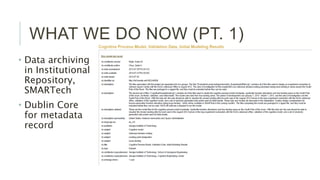
• Data archiving in
Institutional
Repository,
SMARTech
• Dublin Core for
metadata record
WHAT WE DO NOW (PT. 2)
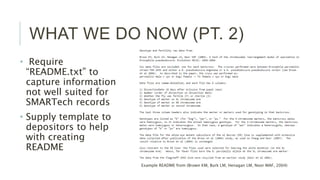
• Require “README.txt” to
capture information not
well suited for SMARTech
records
• Supply template to
depositors to help with
creating README
Example README from (Brown KM, Burk LM, Henagan LM, Noor MAF, 2004)
WHAT WASN’T WORKING
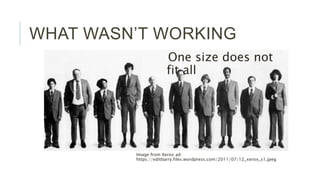
One size does not fit all
Image from Xerox ad: https://editbarry.files.wordpress.com/2011/07/12_xerox_s1.jpeg
PROPOSED SOLUTION
• Disciplinary templates
• Work with subject librarians to
engage community
• Have more specialized
information for depositors
• Accommodate disciplinary
needs, even when using a
generic, one-size-fits-all
repository
Created by iconsmind.com,
from Noun Project
METHODS (PT. 1)
Interviews
 3 Civil & Environmental Engineering
 3 Interactive Computing
 2 Economics
Example Questions
 What sorts of information do you record about your data?
 What would someone else need to know about your data in order to use it themselves?
 If you have used someone else’s data in the past, what sorts of information did you need in
order to evaluate, understand, and reuse those data?
METHODS (PT. 2)
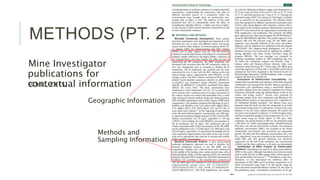
Mine Investigator publications
for contextual information
Geographic Information
(Chao, 2015)
Methods and Sampling
Information
METHODS (PT. 3)
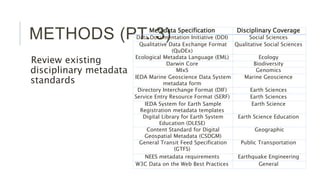
Review existing disciplinary
metadata standards
Metadata Specification Disciplinary Coverage
Data Documentation Initiative (DDI) Social Sciences
Qualitative Data Exchange Format (QuDEx) Qualitative Social Sciences
Ecological Metadata Language (EML) Ecology
Darwin Core Biodiversity
MIxS Genomics
IEDA Marine Geoscience Data System
metadata form
Marine Geoscience
Directory Interchange Format (DIF) Earth Sciences
Service Entry Resource Format (SERF) Earth Sciences
IEDA System for Earth Sample Registration
metadata templates
Earth Science
Digital Library for Earth System Education
(DLESE)
Earth Science Education
Content Standard for Digital Geospatial
Metadata (CSDGM)
Geographic
General Transit Feed Specification (GTFS) Public Transportation
NEES metadata requirements Earthquake Engineering
W3C Data on the Web Best Practices General
FINDINGS
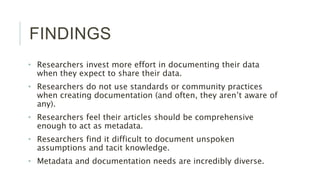
• Researchers invest more effort in documenting their data when they expect
to share their data.
• Researchers do not use standards or community practices when creating
documentation (and often, they aren’t aware of any).
• Researchers feel their articles should be comprehensive enough to act as
metadata.
• Researchers find it difficult to document unspoken assumptions and tacit
knowledge.
• Metadata and documentation needs are incredibly diverse.
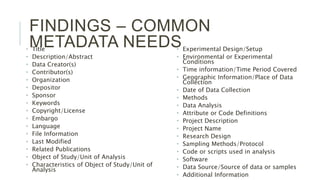
FINDINGS – COMMON METADATA NEEDS
• Title
• Description/Abstract
• Data Creator(s)
• Contributor(s)
• Organization
• Depositor
• Sponsor
• Keywords
• Copyright/License
• Embargo
• Language
• File Information
• Last Modified
• Related Publications
• Object of Study/Unit of Analysis
• Characteristics of Object of Study/Unit of Analysis
• Experimental Design/Setup
• Environmental or Experimental Conditions
• Time information/Time Period Covered
• Geographic Information/Place of Data Collection
• Date of Data Collection
• Methods
• Data Analysis
• Attribute or Code Definitions
• Project Description
• Project Name
• Research Design
• Sampling Methods/Protocol
• Code or scripts used in analysis
• Software
• Data Source/Source of data or samples
• Additional Information
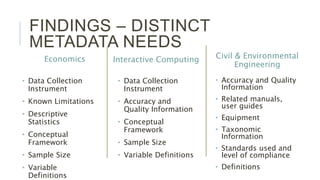
FINDINGS – DISTINCT METADATA NEEDS
Economics
• Data Collection
Instrument
• Known Limitations
• Descriptive Statistics
• Conceptual Framework
• Sample Size
• Variable Definitions
Civil & Environmental
Engineering
• Accuracy and Quality
Information
• Related manuals, user
guides
• Equipment
• Taxonomic Information
• Standards used and level
of compliance
• Definitions
Interactive Computing
• Data Collection
Instrument
• Accuracy and Quality
Information
• Conceptual Framework
• Sample Size
• Variable Definitions
FINDINGS
Begin to build community census
about expectations for
documentation and metadata
NEXT STEPS
• Explore needs of other Schools at Georgia Tech
• Explore differences in data types (qualitative vs. quantitative; simulation vs.
experimental)
• Create web-form to collect information and create “README.txt”
• Evaluate what types of metadata we can support in structured metadata records
• Ask additional researchers to review current templates
REFERENCES
Brown KM, Burk LM, Henagan LM, Noor MAF (2004) Data from: A test of the chromosomal rearrangement model of
speciation in Drosophila pseudoobscura. Dryad Digital Repository. http://dx.doi.org/10.5061/dryad.1150
Chao, T. (2015). Mapping methods metadata for research data. International Journal of Digital Curation, 10(1), 82-
94. doi:10.2218/ijdc.v10i1.347
Dryad. (2015). Frequently Asked Questions. Dryad. Retrieved April 12, 2015 from
http://datadryad.org/pages/faq.
University of Virginia (2015). Datasets. University of Virginia Library. Retrieved April 12, 2015 from
https://pages.shanti.virginia.edu/libra/datasets/.

RDAP 15: Beyond Metadata: Leveraging the “README” to support disciplinary Documentation Needs

  • 1.
    BEYOND METADATA: LEVERAGINGTHE “README” TO SUPPORT DISCIPLINARY DOCUMENTATION NEEDS Lizzy Rolando Georgia Tech Library RDAP 2015
  • 2.
    WHAT WE DONOW (PT. 1) • Data archiving in Institutional Repository, SMARTech • Dublin Core for metadata record
  • 3.
    WHAT WE DONOW (PT. 2) • Require “README.txt” to capture information not well suited for SMARTech records • Supply template to depositors to help with creating README Example README from (Brown KM, Burk LM, Henagan LM, Noor MAF, 2004)
  • 4.
    WHAT WASN’T WORKING Onesize does not fit all Image from Xerox ad: https://editbarry.files.wordpress.com/2011/07/12_xerox_s1.jpeg
  • 5.
    PROPOSED SOLUTION • Disciplinarytemplates • Work with subject librarians to engage community • Have more specialized information for depositors • Accommodate disciplinary needs, even when using a generic, one-size-fits-all repository Created by iconsmind.com, from Noun Project
  • 6.
    METHODS (PT. 1) Interviews 3 Civil & Environmental Engineering  3 Interactive Computing  2 Economics Example Questions  What sorts of information do you record about your data?  What would someone else need to know about your data in order to use it themselves?  If you have used someone else’s data in the past, what sorts of information did you need in order to evaluate, understand, and reuse those data?
  • 7.
    METHODS (PT. 2) MineInvestigator publications for contextual information Geographic Information (Chao, 2015) Methods and Sampling Information
  • 8.
    METHODS (PT. 3) Reviewexisting disciplinary metadata standards Metadata Specification Disciplinary Coverage Data Documentation Initiative (DDI) Social Sciences Qualitative Data Exchange Format (QuDEx) Qualitative Social Sciences Ecological Metadata Language (EML) Ecology Darwin Core Biodiversity MIxS Genomics IEDA Marine Geoscience Data System metadata form Marine Geoscience Directory Interchange Format (DIF) Earth Sciences Service Entry Resource Format (SERF) Earth Sciences IEDA System for Earth Sample Registration metadata templates Earth Science Digital Library for Earth System Education (DLESE) Earth Science Education Content Standard for Digital Geospatial Metadata (CSDGM) Geographic General Transit Feed Specification (GTFS) Public Transportation NEES metadata requirements Earthquake Engineering W3C Data on the Web Best Practices General
  • 9.
    FINDINGS • Researchers investmore effort in documenting their data when they expect to share their data. • Researchers do not use standards or community practices when creating documentation (and often, they aren’t aware of any). • Researchers feel their articles should be comprehensive enough to act as metadata. • Researchers find it difficult to document unspoken assumptions and tacit knowledge. • Metadata and documentation needs are incredibly diverse.
  • 10.
    FINDINGS – COMMONMETADATA NEEDS • Title • Description/Abstract • Data Creator(s) • Contributor(s) • Organization • Depositor • Sponsor • Keywords • Copyright/License • Embargo • Language • File Information • Last Modified • Related Publications • Object of Study/Unit of Analysis • Characteristics of Object of Study/Unit of Analysis • Experimental Design/Setup • Environmental or Experimental Conditions • Time information/Time Period Covered • Geographic Information/Place of Data Collection • Date of Data Collection • Methods • Data Analysis • Attribute or Code Definitions • Project Description • Project Name • Research Design • Sampling Methods/Protocol • Code or scripts used in analysis • Software • Data Source/Source of data or samples • Additional Information
  • 11.
    FINDINGS – DISTINCTMETADATA NEEDS Economics • Data Collection Instrument • Known Limitations • Descriptive Statistics • Conceptual Framework • Sample Size • Variable Definitions Civil & Environmental Engineering • Accuracy and Quality Information • Related manuals, user guides • Equipment • Taxonomic Information • Standards used and level of compliance • Definitions Interactive Computing • Data Collection Instrument • Accuracy and Quality Information • Conceptual Framework • Sample Size • Variable Definitions
  • 12.
    FINDINGS Begin to buildcommunity census about expectations for documentation and metadata
  • 13.
    NEXT STEPS • Exploreneeds of other Schools at Georgia Tech • Explore differences in data types (qualitative vs. quantitative; simulation vs. experimental) • Create web-form to collect information and create “README.txt” • Evaluate what types of metadata we can support in structured metadata records • Ask additional researchers to review current templates
  • 14.
    REFERENCES Brown KM, BurkLM, Henagan LM, Noor MAF (2004) Data from: A test of the chromosomal rearrangement model of speciation in Drosophila pseudoobscura. Dryad Digital Repository. http://dx.doi.org/10.5061/dryad.1150 Chao, T. (2015). Mapping methods metadata for research data. International Journal of Digital Curation, 10(1), 82- 94. doi:10.2218/ijdc.v10i1.347 Dryad. (2015). Frequently Asked Questions. Dryad. Retrieved April 12, 2015 from http://datadryad.org/pages/faq. University of Virginia (2015). Datasets. University of Virginia Library. Retrieved April 12, 2015 from https://pages.shanti.virginia.edu/libra/datasets/.

Editor's Notes

  • #3 Our interest in supporting types of metadata and documentation that diverge from the traditional model of “Library metadata” stemmed from our data archiving services. We archive datasets in our institutional repository, SMARTech, which is a DSpace repository. It was designed for primarily materials like publications, electronic theses and dissertations, and project reports. Accordingly, the repository uses Dublin Core for our cataloging needs. This simply is not comprehensive enough to capture the information needed to describe and document datasets so that they can be used in the future.
  • #4 This is why we started asking depositors to provide a README file (or other supplemental documentation that they may have already created). The README is a plain text file with instructions on how to use or understand a resource. They are very common in computer science and computer programming, and many folks have been advocating or have already adopted its use in other arenas. You can see an example of one of these that came from a dataset in Dryad. To help depositors create a README, we began supplying a template with prompts for relevant pieces of information that wouldn’t typically be included in the repository record. The template we provide to depositors was based largely on the template from the University of Virginia Libraries, Dryad, and specific example READMEs in the Indiana University Bloomington repository. After supplying the template, we did find that both the quantity and quality of documentation provided improved.