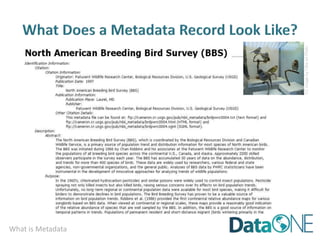
What is Metadata
Lesson 7: Metadata
CC
image
by
bonus
on
Flickr
What is Metadata
• Explanation of metadata
• Illustrate the value and utility of metadata to data users,
data providers, and organizations
• Examine information included in a metadata record
• Examples of metadata standards and how to choose
• Preparing to write metadata
• Tips for writing a quality metadata record
CC
image
by
Alec
Couros
on
Flickr
What is Metadata
After completing this lesson, the participant will be able to:
• Identify and list the types of information typically included
in metadata records for environmental datasets
• Identify 3 reasons metadata is of value to data users, data
developers, and organizations
• List 3 uses for metadata, beyond discovery of data
• Identify and describe factors that may determine which
metadata standards are most appropriate for a given
dataset
• List steps to prepare to write metadata
• Explain how to write good metadata
What is Metadata
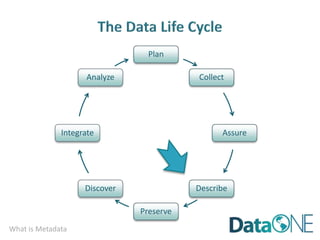
Plan
Collect
Assure
Describe
Preserve
Discover
Integrate
Analyze
What is Metadata
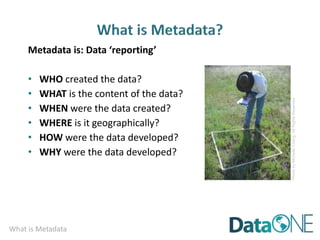
Metadata is: Data ‘reporting’
• WHO created the data?
• WHAT is the content of the data?
• WHEN were the data created?
• WHERE is it geographically?
• HOW were the data developed?
• WHY were the data developed?
Photo
by
Michelle
Chang.
All
Rights
Reserved
What is Metadata
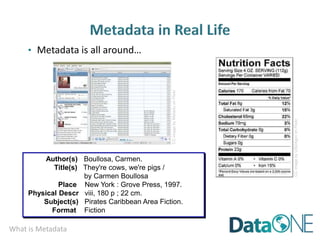
• Metadata is all around…
Author(s) Boullosa, Carmen.
Title(s) They're cows, we're pigs /
by Carmen Boullosa
Place New York : Grove Press, 1997.
Physical Descr viii, 180 p ; 22 cm.
Subject(s) Pirates Caribbean Area Fiction.
Format Fiction
CC
image
by
USDAgov
on
Flickr
CC
image
by
Mskadu
on
Flickr
What is Metadata
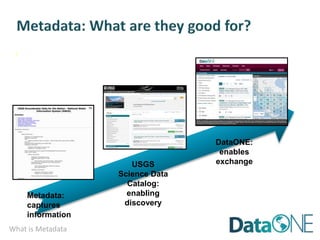
· Data Discovery
Metadata:
captures
information
USGS
Science Data
Catalog:
enabling
discovery
DataONE:
enables
exchange
What is Metadata
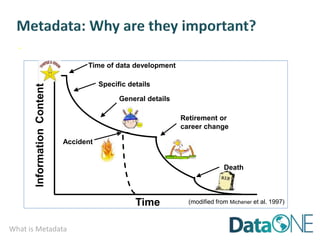
Information
Content
Time
· Scientific Understanding and Reuse
Time of data development
Accident
Retirement or
career change
Death
(modified from Michener et al. 1997)
Specific details
General details
What is Metadata
· Defending policy decisions based on data
• Regulatory decisions based on undocumented data are not
defensible
• Metadata accuracy and details are important as supporting
evidence for the science and policy
Controversies arise when metadata are incomplete and/or
absent
What is Metadata
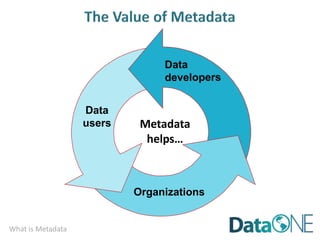
Data
users
Organizations
Metadata
helps…
What is Metadata
Metadata allows data developers to:
• Avoid data duplication
• Share reliable information
• Publicize efforts – promote the work of a scientist and
his/her contributions to a field of study
• Metadata reuse saves time and resources in the long-run
CC
image
by
US
Embassy
Guyana
on
Flickr
What is Metadata
Metadata gives a user the ability to:
• Search, retrieve, and evaluate dataset
information from both inside and outside
an organization
• Find data: Determine what data exists for
a geographic location and/or topic
• Determine applicability: Decide if a
dataset meets a particular need
• Discover how to acquire the dataset
identified; process and use the dataset
• Understand the dataset, including
definitions of column names, or expected
numerical ranges found in the data
CC
image
by
ASEE
on
Flickr
What is Metadata
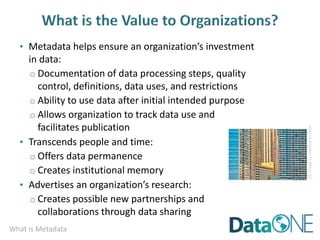
• Metadata helps ensure an organization’s investment
in data:
o Documentation of data processing steps, quality
control, definitions, data uses, and restrictions
o Ability to use data after initial intended purpose
o Allows organization to track data use and
facilitates publication
• Transcends people and time:
o Offers data permanence
o Creates institutional memory
• Advertises an organization’s research:
o Creates possible new partnerships and
collaborations through data sharing
CC
image
by
mambol
on
Flickr
What is Metadata
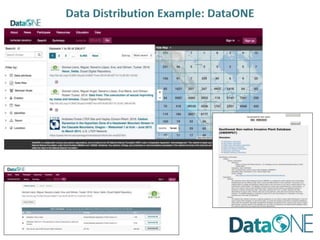
Metadata can support:
data distribution
data management
What is Metadata
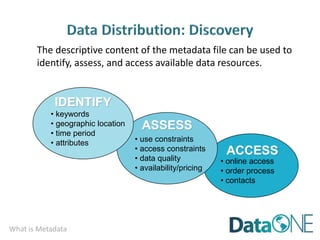
The descriptive content of the metadata file can be used to
identify, assess, and access available data resources.
• online access
• order process
• contacts
ACCESS
• use constraints
• access constraints
• data quality
• availability/pricing
ASSESS
• keywords
• geographic location
• time period
• attributes
IDENTIFY
What is Metadata
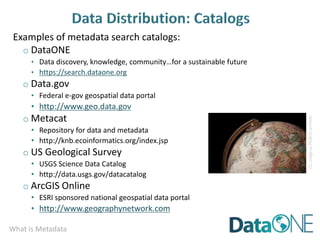
Examples of metadata search catalogs:
o DataONE
• Data discovery, knowledge, community…for a sustainable future
• https://search.dataone.org
o Data.gov
• Federal e-gov geospatial data portal
• http://www.geo.data.gov
o Metacat
• Repository for data and metadata
• http://knb.ecoinformatics.org/index.jsp
o US Geological Survey
• USGS Science Data Catalog
• http://data.usgs.gov/datacatalog
o ArcGIS Online
• ESRI sponsored national geospatial data portal
• http://www.geographynetwork.com
CC
image
by
RGB12
on
Flickr
What is Metadata
What is Metadata
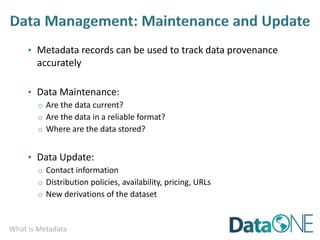
• Metadata records can be used to track data provenance
accurately
• Data Maintenance:
o Are the data current?
o Are the data in a reliable format?
o Where are the data stored?
• Data Update:
o Contact information
o Distribution policies, availability, pricing, URLs
o New derivations of the dataset
What is Metadata
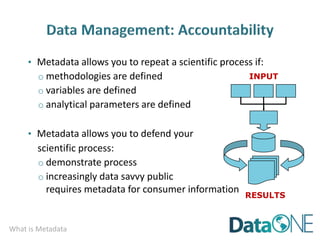
• Metadata allows you to repeat a scientific process if:
o methodologies are defined
o variables are defined
o analytical parameters are defined
• Metadata allows you to defend your
scientific process:
o demonstrate process
o increasingly data savvy public
requires metadata for consumer information
INPUT
RESULTS
What is Metadata
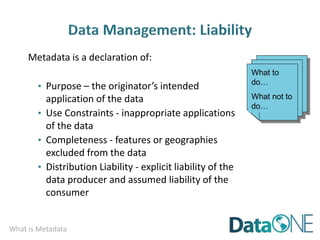
Metadata is a declaration of:
• Purpose – the originator’s intended
application of the data
• Use Constraints - inappropriate applications
of the data
• Completeness - features or geographies
excluded from the data
• Distribution Liability - explicit liability of the
data producer and assumed liability of the
consumer
What to
do…
What not to
do…
What is Metadata
Even if the value of data documentation is recognized,
researchers are often concerned about the effort required to
create metadata that effectively describe their data.
CC
image
by
waterlilysage
on
Flickr
What is Metadata
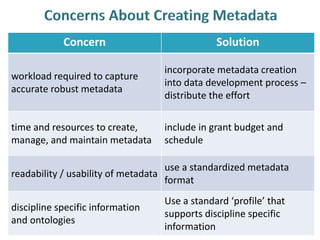
Concern Solution
workload required to capture
accurate robust metadata
incorporate metadata creation
into data development process –
distribute the effort
time and resources to create,
manage, and maintain metadata
include in grant budget and
schedule
readability / usability of metadata
use a standardized metadata
format
discipline specific information
and ontologies
Use a standard ‘profile’ that
supports discipline specific
information
What is Metadata
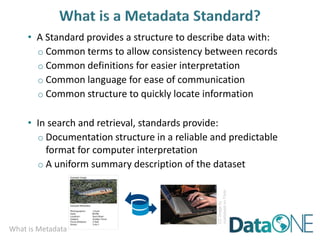
• A Standard provides a structure to describe data with:
o Common terms to allow consistency between records
o Common definitions for easier interpretation
o Common language for ease of communication
o Common structure to quickly locate information
• In search and retrieval, standards provide:
o Documentation structure in a reliable and predictable
format for computer interpretation
o A uniform summary description of the dataset
CC
image
by
ccarlstead
on
Flickr
What is Metadata
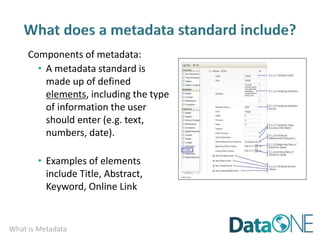
Components of metadata:
• A metadata standard is
made up of defined
elements, including the type
of information the user
should enter (e.g. text,
numbers, date).
• Examples of elements
include Title, Abstract,
Keyword, Online Link
What is Metadata
CC
image
by
I
like
on
Flickr
What is Metadata
Image
courtesy
of
Viv
Hutchinson
What is Metadata
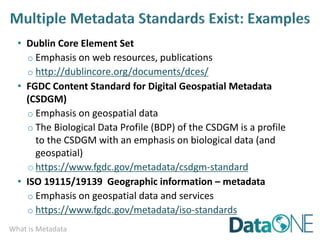
• Dublin Core Element Set
o Emphasis on web resources, publications
o http://dublincore.org/documents/dces/
• FGDC Content Standard for Digital Geospatial Metadata
(CSDGM)
o Emphasis on geospatial data
o The Biological Data Profile (BDP) of the CSDGM is a profile
to the CSDGM with an emphasis on biological data (and
geospatial)
ohttps://www.fgdc.gov/metadata/csdgm-standard
• ISO 19115/19139 Geographic information – metadata
o Emphasis on geospatial data and services
o https://www.fgdc.gov/metadata/iso-standards
What is Metadata
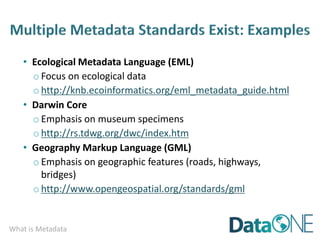
• Ecological Metadata Language (EML)
o Focus on ecological data
o http://knb.ecoinformatics.org/eml_metadata_guide.html
• Darwin Core
oEmphasis on museum specimens
o http://rs.tdwg.org/dwc/index.htm
• Geography Markup Language (GML)
o Emphasis on geographic features (roads, highways,
bridges)
o http://www.opengeospatial.org/standards/gml
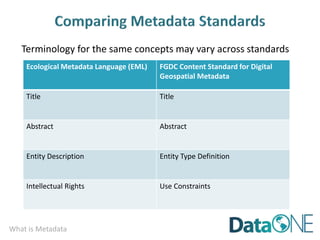
What is Metadata
Ecological Metadata Language (EML) FGDC Content Standard for Digital
Geospatial Metadata
Title Title
Abstract Abstract
Entity Description Entity Type Definition
Intellectual Rights Use Constraints
Terminology for the same concepts may vary across standards
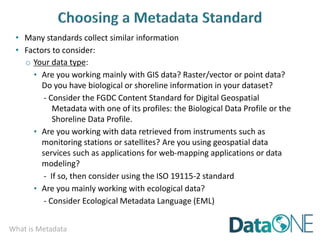
What is Metadata
• Many standards collect similar information
• Factors to consider:
o Your data type:
• Are you working mainly with GIS data? Raster/vector or point data?
Do you have biological or shoreline information in your dataset?
- Consider the FGDC Content Standard for Digital Geospatial
Metadata with one of its profiles: the Biological Data Profile or the
Shoreline Data Profile.
• Are you working with data retrieved from instruments such as
monitoring stations or satellites? Are you using geospatial data
services such as applications for web-mapping applications or data
modeling?
- If so, then consider using the ISO 19115-2 standard
• Are you mainly working with ecological data?
- Consider Ecological Metadata Language (EML)
What is Metadata
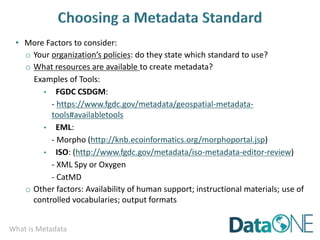
• More Factors to consider:
o Your organization’s policies: do they state which standard to use?
o What resources are available to create metadata?
Examples of Tools:
• FGDC CSDGM:
- https://www.fgdc.gov/metadata/geospatial-metadata-
tools#availabletools
• EML:
- Morpho (http://knb.ecoinformatics.org/morphoportal.jsp)
• ISO: (http://www.fgdc.gov/metadata/iso-metadata-editor-review)
- XML Spy or Oxygen
- CatMD
o Other factors: Availability of human support; instructional materials; use of
controlled vocabularies; output formats
What is Metadata
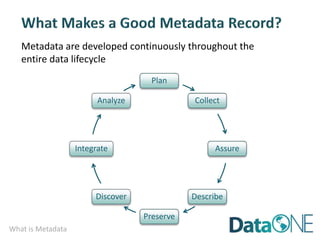
Metadata are developed continuously throughout the
entire data lifecycle
Plan
Collect
Assure
Describe
Preserve
Discover
Integrate
Analyze
What is Metadata
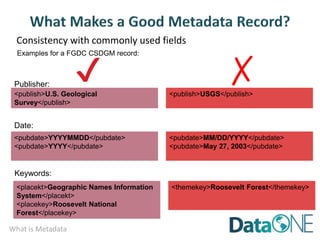
Consistency with commonly used fields
<publish>U.S. Geological
Survey</publish>
<publish>USGS</publish>
✔ ✗
Publisher:
<pubdate>YYYYMMDD</pubdate>
<pubdate>YYYY</pubdate>
<pubdate>MM/DD/YYYY</pubdate>
<pubdate>May 27, 2003</pubdate>
Date:
Examples for a FGDC CSDGM record:
<placekt>Geographic Names Information
System</placekt>
<placekey>Roosevelt National
Forest</placekey>
<themekey>Roosevelt Forest</themekey>
Keywords:
What is Metadata
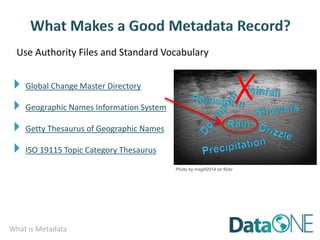
Use Authority Files and Standard Vocabulary
Photo by mxgirl2014 on flickr
 Global Change Master Directory
 Geographic Names Information System
 Getty Thesaurus of Geographic Names
 ISO 19115 Topic Category Thesaurus
✗
What is Metadata
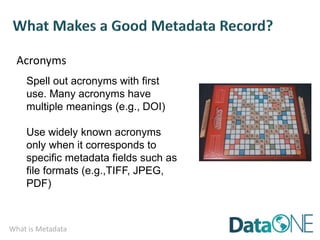
Acronyms
Spell out acronyms with first
use. Many acronyms have
multiple meanings (e.g., DOI)
Use widely known acronyms
only when it corresponds to
specific metadata fields such as
file formats (e.g.,TIFF, JPEG,
PDF)
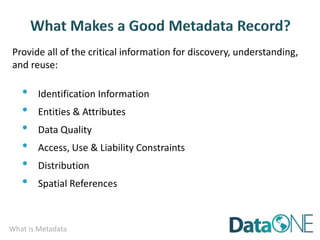
What is Metadata
Provide all of the critical information for discovery, understanding,
and reuse:
• Identification Information
• Entities & Attributes
• Data Quality
• Access, Use & Liability Constraints
• Distribution
• Spatial References
What is Metadata
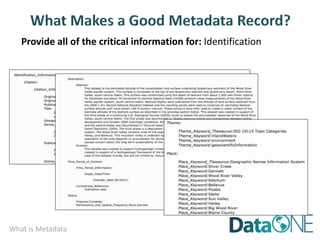
Provide all of the critical information for: Identification
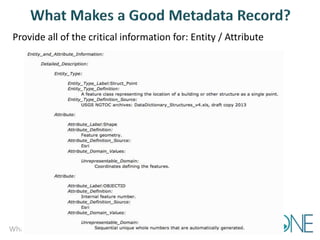
What is Metadata
Provide all of the critical information for: Entity / Attribute
What is Metadata
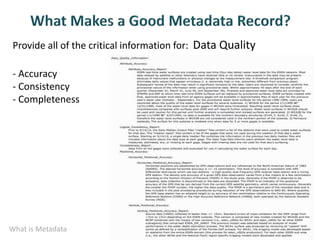
Provide all of the critical information for: Data Quality
Inform
- Accuracy
- Consistency
- Completeness
What is Metadata
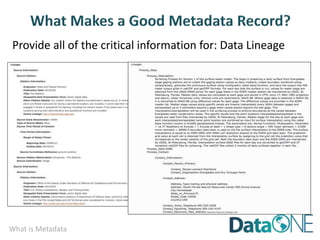
Provide all of the critical information for: Data Lineage
What is Metadata
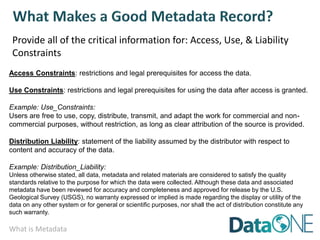
Provide all of the critical information for: Access, Use, & Liability
Constraints
Access Constraints: restrictions and legal prerequisites for access the data.
Use Constraints: restrictions and legal prerequisites for using the data after access is granted.
Example: Use_Constraints:
Users are free to use, copy, distribute, transmit, and adapt the work for commercial and non-
commercial purposes, without restriction, as long as clear attribution of the source is provided.
Distribution Liability: statement of the liability assumed by the distributor with respect to
content and accuracy of the data.
Example: Distribution_Liability:
Unless otherwise stated, all data, metadata and related materials are considered to satisfy the quality
standards relative to the purpose for which the data were collected. Although these data and associated
metadata have been reviewed for accuracy and completeness and approved for release by the U.S.
Geological Survey (USGS), no warranty expressed or implied is made regarding the display or utility of the
data on any other system or for general or scientific purposes, nor shall the act of distribution constitute any
such warranty.
What is Metadata
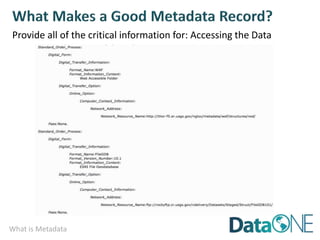
Provide all of the critical information for: Accessing the Data
What is Metadata
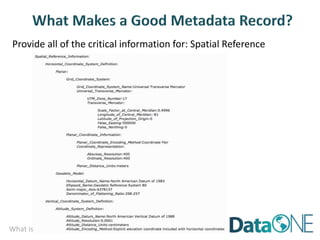
Provide all of the critical information for: Spatial Reference
What is Metadata
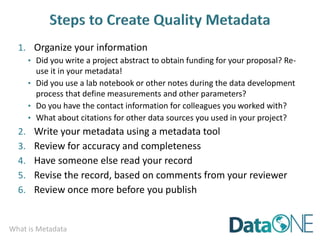
1. Organize your information
• Did you write a project abstract to obtain funding for your proposal? Re-
use it in your metadata!
• Did you use a lab notebook or other notes during the data development
process that define measurements and other parameters?
• Do you have the contact information for colleagues you worked with?
• What about citations for other data sources you used in your project?
2. Write your metadata using a metadata tool
3. Review for accuracy and completeness
4. Have someone else read your record
5. Revise the record, based on comments from your reviewer
6. Review once more before you publish
What is Metadata
Titles, Titles, Titles…
• Titles are critical in helping readers find your data
o While individuals are searching for the most appropriate
datasets, they are most likely going to use the title as the
first criteria to determine if a dataset meets their needs.
o Treat the title as the opportunity to sell your dataset.
• A complete title includes: What, Where, When, Who, and
Scale
• An informative title includes: topic, timeliness of the data,
specific information about place and geography
What is Metadata
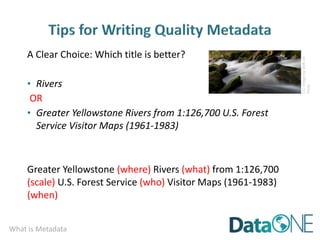
A Clear Choice: Which title is better?
• Rivers
OR
• Greater Yellowstone Rivers from 1:126,700 U.S. Forest
Service Visitor Maps (1961-1983)
Greater Yellowstone (where) Rivers (what) from 1:126,700
(scale) U.S. Forest Service (who) Visitor Maps (1961-1983)
(when)
CC
image
by
dolfi
on
Flickr
What is Metadata
• Be specific and quantify when you can! The goal of a
metadata record is to give the user enough information to
know if they can use the data without contacting the
dataset owner.
Vague: We checked our work and it
looks complete.
Specific: We checked our work
using a random sample of 5 monitoring
sites reviewed by 2 different people. We
determined our work to be 95%
complete based on these visual
inspections.
CC
image
by
PNASH
on
Flickr
What is Metadata
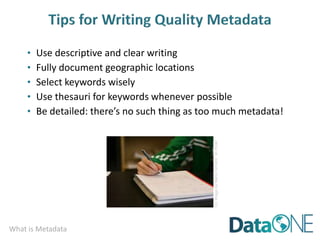
• Use descriptive and clear writing
• Fully document geographic locations
• Select keywords wisely
• Use thesauri for keywords whenever possible
• Be detailed: there’s no such thing as too much metadata!
CC
image
by
Marco
Arment
on
Flickr
What is Metadata
• Remember: a computer will read your metadata
• Do not use symbols that could be misinterpreted by
software: Examples: ! @ # % { } | /  < > ~
• Don’t use tabs, indents, or line feeds/carriage returns
• When copying and pasting from other sources, use a text
editor (e.g., Notepad) to eliminate hidden characters
What is Metadata
• Metadata is documentation of data
• A metadata record captures critical information about the
content of a dataset
• Metadata allows data to be discovered, accessed, and re-
used
• A metadata standard provides structure and consistency to
data documentation
• Standards and tools vary – select according to defined
criteria such as data type, organizational guidance, and
available resources
• Metadata is of critical importance to data developers, data
users, and organizations
• Metadata completes a dataset.
What is Metadata
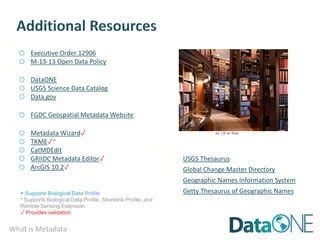
· Federal Policies:
o Executive Order 12906
o M-13-13 Open Data Policy
· Data Catalogs:
o DataONE
o USGS Science Data Catalog
o Data.gov
More about CSDGM & ISO 19115:
o FGDC Geospatial Metadata Website
· Metadata Tools:
o Metadata Wizard✓
o TKME✓*
o CatMDEdit
o GRIIDC Metadata Editor✓
o ArcGIS 10.2✓
by J B on flickr
· Standard Vocabularies
· USGS Thesaurus
· Global Change Master Directory
· Geographic Names Information System
· Getty Thesaurus of Geographic Names
 Supports Biological Data Profile
* Supports Biological Data Profile, Shoreline Profile, and
Remote Sensing Extension
✓ Provides validation
What is Metadata
The full slide deck may be downloaded from:
http://www.dataone.org/education-modules
Suggested citation:
DataONE Education Module: Metadata. DataONE. Retrieved
Nov12, 2016. From
http://www.dataone.org/sites/all/documents/L07_Metadata.pptx
Copyright license information:
No rights reserved; you may enhance and reuse for
your own purposes. We do ask that you provide
appropriate citation and attribution to DataONE.

L07 metadata

  • 1.
    What is Metadata Lesson7: Metadata CC image by bonus on Flickr
  • 2.
    What is Metadata •Explanation of metadata • Illustrate the value and utility of metadata to data users, data providers, and organizations • Examine information included in a metadata record • Examples of metadata standards and how to choose • Preparing to write metadata • Tips for writing a quality metadata record CC image by Alec Couros on Flickr
  • 3.
    What is Metadata Aftercompleting this lesson, the participant will be able to: • Identify and list the types of information typically included in metadata records for environmental datasets • Identify 3 reasons metadata is of value to data users, data developers, and organizations • List 3 uses for metadata, beyond discovery of data • Identify and describe factors that may determine which metadata standards are most appropriate for a given dataset • List steps to prepare to write metadata • Explain how to write good metadata
  • 4.
  • 5.
    What is Metadata Metadatais: Data ‘reporting’ • WHO created the data? • WHAT is the content of the data? • WHEN were the data created? • WHERE is it geographically? • HOW were the data developed? • WHY were the data developed? Photo by Michelle Chang. All Rights Reserved
  • 6.
    What is Metadata •Metadata is all around… Author(s) Boullosa, Carmen. Title(s) They're cows, we're pigs / by Carmen Boullosa Place New York : Grove Press, 1997. Physical Descr viii, 180 p ; 22 cm. Subject(s) Pirates Caribbean Area Fiction. Format Fiction CC image by USDAgov on Flickr CC image by Mskadu on Flickr
  • 7.
    What is Metadata ·Data Discovery Metadata: captures information USGS Science Data Catalog: enabling discovery DataONE: enables exchange
  • 8.
    What is Metadata Information Content Time ·Scientific Understanding and Reuse Time of data development Accident Retirement or career change Death (modified from Michener et al. 1997) Specific details General details
  • 9.
    What is Metadata ·Defending policy decisions based on data • Regulatory decisions based on undocumented data are not defensible • Metadata accuracy and details are important as supporting evidence for the science and policy Controversies arise when metadata are incomplete and/or absent
  • 10.
  • 11.
    What is Metadata Metadataallows data developers to: • Avoid data duplication • Share reliable information • Publicize efforts – promote the work of a scientist and his/her contributions to a field of study • Metadata reuse saves time and resources in the long-run CC image by US Embassy Guyana on Flickr
  • 12.
    What is Metadata Metadatagives a user the ability to: • Search, retrieve, and evaluate dataset information from both inside and outside an organization • Find data: Determine what data exists for a geographic location and/or topic • Determine applicability: Decide if a dataset meets a particular need • Discover how to acquire the dataset identified; process and use the dataset • Understand the dataset, including definitions of column names, or expected numerical ranges found in the data CC image by ASEE on Flickr
  • 13.
    What is Metadata •Metadata helps ensure an organization’s investment in data: o Documentation of data processing steps, quality control, definitions, data uses, and restrictions o Ability to use data after initial intended purpose o Allows organization to track data use and facilitates publication • Transcends people and time: o Offers data permanence o Creates institutional memory • Advertises an organization’s research: o Creates possible new partnerships and collaborations through data sharing CC image by mambol on Flickr
  • 14.
    What is Metadata Metadatacan support: data distribution data management
  • 15.
    What is Metadata Thedescriptive content of the metadata file can be used to identify, assess, and access available data resources. • online access • order process • contacts ACCESS • use constraints • access constraints • data quality • availability/pricing ASSESS • keywords • geographic location • time period • attributes IDENTIFY
  • 16.
    What is Metadata Examplesof metadata search catalogs: o DataONE • Data discovery, knowledge, community…for a sustainable future • https://search.dataone.org o Data.gov • Federal e-gov geospatial data portal • http://www.geo.data.gov o Metacat • Repository for data and metadata • http://knb.ecoinformatics.org/index.jsp o US Geological Survey • USGS Science Data Catalog • http://data.usgs.gov/datacatalog o ArcGIS Online • ESRI sponsored national geospatial data portal • http://www.geographynetwork.com CC image by RGB12 on Flickr
  • 17.
  • 18.
    What is Metadata •Metadata records can be used to track data provenance accurately • Data Maintenance: o Are the data current? o Are the data in a reliable format? o Where are the data stored? • Data Update: o Contact information o Distribution policies, availability, pricing, URLs o New derivations of the dataset
  • 19.
    What is Metadata •Metadata allows you to repeat a scientific process if: o methodologies are defined o variables are defined o analytical parameters are defined • Metadata allows you to defend your scientific process: o demonstrate process o increasingly data savvy public requires metadata for consumer information INPUT RESULTS
  • 20.
    What is Metadata Metadatais a declaration of: • Purpose – the originator’s intended application of the data • Use Constraints - inappropriate applications of the data • Completeness - features or geographies excluded from the data • Distribution Liability - explicit liability of the data producer and assumed liability of the consumer What to do… What not to do…
  • 21.
    What is Metadata Evenif the value of data documentation is recognized, researchers are often concerned about the effort required to create metadata that effectively describe their data. CC image by waterlilysage on Flickr
  • 22.
    What is Metadata ConcernSolution workload required to capture accurate robust metadata incorporate metadata creation into data development process – distribute the effort time and resources to create, manage, and maintain metadata include in grant budget and schedule readability / usability of metadata use a standardized metadata format discipline specific information and ontologies Use a standard ‘profile’ that supports discipline specific information
  • 23.
    What is Metadata •A Standard provides a structure to describe data with: o Common terms to allow consistency between records o Common definitions for easier interpretation o Common language for ease of communication o Common structure to quickly locate information • In search and retrieval, standards provide: o Documentation structure in a reliable and predictable format for computer interpretation o A uniform summary description of the dataset CC image by ccarlstead on Flickr
  • 24.
    What is Metadata Componentsof metadata: • A metadata standard is made up of defined elements, including the type of information the user should enter (e.g. text, numbers, date). • Examples of elements include Title, Abstract, Keyword, Online Link
  • 25.
  • 26.
  • 27.
    What is Metadata •Dublin Core Element Set o Emphasis on web resources, publications o http://dublincore.org/documents/dces/ • FGDC Content Standard for Digital Geospatial Metadata (CSDGM) o Emphasis on geospatial data o The Biological Data Profile (BDP) of the CSDGM is a profile to the CSDGM with an emphasis on biological data (and geospatial) ohttps://www.fgdc.gov/metadata/csdgm-standard • ISO 19115/19139 Geographic information – metadata o Emphasis on geospatial data and services o https://www.fgdc.gov/metadata/iso-standards
  • 28.
    What is Metadata •Ecological Metadata Language (EML) o Focus on ecological data o http://knb.ecoinformatics.org/eml_metadata_guide.html • Darwin Core oEmphasis on museum specimens o http://rs.tdwg.org/dwc/index.htm • Geography Markup Language (GML) o Emphasis on geographic features (roads, highways, bridges) o http://www.opengeospatial.org/standards/gml
  • 29.
    What is Metadata EcologicalMetadata Language (EML) FGDC Content Standard for Digital Geospatial Metadata Title Title Abstract Abstract Entity Description Entity Type Definition Intellectual Rights Use Constraints Terminology for the same concepts may vary across standards
  • 30.
    What is Metadata •Many standards collect similar information • Factors to consider: o Your data type: • Are you working mainly with GIS data? Raster/vector or point data? Do you have biological or shoreline information in your dataset? - Consider the FGDC Content Standard for Digital Geospatial Metadata with one of its profiles: the Biological Data Profile or the Shoreline Data Profile. • Are you working with data retrieved from instruments such as monitoring stations or satellites? Are you using geospatial data services such as applications for web-mapping applications or data modeling? - If so, then consider using the ISO 19115-2 standard • Are you mainly working with ecological data? - Consider Ecological Metadata Language (EML)
  • 31.
    What is Metadata •More Factors to consider: o Your organization’s policies: do they state which standard to use? o What resources are available to create metadata? Examples of Tools: • FGDC CSDGM: - https://www.fgdc.gov/metadata/geospatial-metadata- tools#availabletools • EML: - Morpho (http://knb.ecoinformatics.org/morphoportal.jsp) • ISO: (http://www.fgdc.gov/metadata/iso-metadata-editor-review) - XML Spy or Oxygen - CatMD o Other factors: Availability of human support; instructional materials; use of controlled vocabularies; output formats
  • 32.
    What is Metadata Metadataare developed continuously throughout the entire data lifecycle Plan Collect Assure Describe Preserve Discover Integrate Analyze
  • 33.
    What is Metadata Consistencywith commonly used fields <publish>U.S. Geological Survey</publish> <publish>USGS</publish> ✔ ✗ Publisher: <pubdate>YYYYMMDD</pubdate> <pubdate>YYYY</pubdate> <pubdate>MM/DD/YYYY</pubdate> <pubdate>May 27, 2003</pubdate> Date: Examples for a FGDC CSDGM record: <placekt>Geographic Names Information System</placekt> <placekey>Roosevelt National Forest</placekey> <themekey>Roosevelt Forest</themekey> Keywords:
  • 34.
    What is Metadata UseAuthority Files and Standard Vocabulary Photo by mxgirl2014 on flickr  Global Change Master Directory  Geographic Names Information System  Getty Thesaurus of Geographic Names  ISO 19115 Topic Category Thesaurus ✗
  • 35.
    What is Metadata Acronyms Spellout acronyms with first use. Many acronyms have multiple meanings (e.g., DOI) Use widely known acronyms only when it corresponds to specific metadata fields such as file formats (e.g.,TIFF, JPEG, PDF)
  • 36.
    What is Metadata Provideall of the critical information for discovery, understanding, and reuse: • Identification Information • Entities & Attributes • Data Quality • Access, Use & Liability Constraints • Distribution • Spatial References
  • 37.
    What is Metadata Provideall of the critical information for: Identification
  • 38.
    What is Metadata Provideall of the critical information for: Entity / Attribute
  • 39.
    What is Metadata Provideall of the critical information for: Data Quality Inform - Accuracy - Consistency - Completeness
  • 40.
    What is Metadata Provideall of the critical information for: Data Lineage
  • 41.
    What is Metadata Provideall of the critical information for: Access, Use, & Liability Constraints Access Constraints: restrictions and legal prerequisites for access the data. Use Constraints: restrictions and legal prerequisites for using the data after access is granted. Example: Use_Constraints: Users are free to use, copy, distribute, transmit, and adapt the work for commercial and non- commercial purposes, without restriction, as long as clear attribution of the source is provided. Distribution Liability: statement of the liability assumed by the distributor with respect to content and accuracy of the data. Example: Distribution_Liability: Unless otherwise stated, all data, metadata and related materials are considered to satisfy the quality standards relative to the purpose for which the data were collected. Although these data and associated metadata have been reviewed for accuracy and completeness and approved for release by the U.S. Geological Survey (USGS), no warranty expressed or implied is made regarding the display or utility of the data on any other system or for general or scientific purposes, nor shall the act of distribution constitute any such warranty.
  • 42.
    What is Metadata Provideall of the critical information for: Accessing the Data
  • 43.
    What is Metadata Provideall of the critical information for: Spatial Reference
  • 44.
    What is Metadata 1.Organize your information • Did you write a project abstract to obtain funding for your proposal? Re- use it in your metadata! • Did you use a lab notebook or other notes during the data development process that define measurements and other parameters? • Do you have the contact information for colleagues you worked with? • What about citations for other data sources you used in your project? 2. Write your metadata using a metadata tool 3. Review for accuracy and completeness 4. Have someone else read your record 5. Revise the record, based on comments from your reviewer 6. Review once more before you publish
  • 45.
    What is Metadata Titles,Titles, Titles… • Titles are critical in helping readers find your data o While individuals are searching for the most appropriate datasets, they are most likely going to use the title as the first criteria to determine if a dataset meets their needs. o Treat the title as the opportunity to sell your dataset. • A complete title includes: What, Where, When, Who, and Scale • An informative title includes: topic, timeliness of the data, specific information about place and geography
  • 46.
    What is Metadata AClear Choice: Which title is better? • Rivers OR • Greater Yellowstone Rivers from 1:126,700 U.S. Forest Service Visitor Maps (1961-1983) Greater Yellowstone (where) Rivers (what) from 1:126,700 (scale) U.S. Forest Service (who) Visitor Maps (1961-1983) (when) CC image by dolfi on Flickr
  • 47.
    What is Metadata •Be specific and quantify when you can! The goal of a metadata record is to give the user enough information to know if they can use the data without contacting the dataset owner. Vague: We checked our work and it looks complete. Specific: We checked our work using a random sample of 5 monitoring sites reviewed by 2 different people. We determined our work to be 95% complete based on these visual inspections. CC image by PNASH on Flickr
  • 48.
    What is Metadata •Use descriptive and clear writing • Fully document geographic locations • Select keywords wisely • Use thesauri for keywords whenever possible • Be detailed: there’s no such thing as too much metadata! CC image by Marco Arment on Flickr
  • 49.
    What is Metadata •Remember: a computer will read your metadata • Do not use symbols that could be misinterpreted by software: Examples: ! @ # % { } | / < > ~ • Don’t use tabs, indents, or line feeds/carriage returns • When copying and pasting from other sources, use a text editor (e.g., Notepad) to eliminate hidden characters
  • 50.
    What is Metadata •Metadata is documentation of data • A metadata record captures critical information about the content of a dataset • Metadata allows data to be discovered, accessed, and re- used • A metadata standard provides structure and consistency to data documentation • Standards and tools vary – select according to defined criteria such as data type, organizational guidance, and available resources • Metadata is of critical importance to data developers, data users, and organizations • Metadata completes a dataset.
  • 51.
    What is Metadata ·Federal Policies: o Executive Order 12906 o M-13-13 Open Data Policy · Data Catalogs: o DataONE o USGS Science Data Catalog o Data.gov More about CSDGM & ISO 19115: o FGDC Geospatial Metadata Website · Metadata Tools: o Metadata Wizard✓ o TKME✓* o CatMDEdit o GRIIDC Metadata Editor✓ o ArcGIS 10.2✓ by J B on flickr · Standard Vocabularies · USGS Thesaurus · Global Change Master Directory · Geographic Names Information System · Getty Thesaurus of Geographic Names  Supports Biological Data Profile * Supports Biological Data Profile, Shoreline Profile, and Remote Sensing Extension ✓ Provides validation
  • 52.
    What is Metadata Thefull slide deck may be downloaded from: http://www.dataone.org/education-modules Suggested citation: DataONE Education Module: Metadata. DataONE. Retrieved Nov12, 2016. From http://www.dataone.org/sites/all/documents/L07_Metadata.pptx Copyright license information: No rights reserved; you may enhance and reuse for your own purposes. We do ask that you provide appropriate citation and attribution to DataONE.