Eliminating Conflicts In
Ebook Metadata
NISO Webinar 11/15/17
Presented by: Pat Payton
Agenda
• How NISO is improving metadata
• Top 3 ProQuest ebook metadata issues
• 5 working group examples
• Where else you can find help
How NISO is
improving metadata
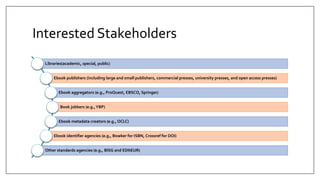
Interested Stakeholders
Libraries(academic, special, public)
Ebook publishers (including large and small publishers, commercial presses, university presses, and open access presses)
Ebook aggregators (e.g., ProQuest, EBSCO, Springer)
Book jobbers (e.g.,YBP)
Ebook metadata creators (e.g., OCLC)
Ebook identifier agencies (e.g., Bowker for ISBN, Crossref for DOI)
Other standards agencies (e.g., BISG and EDItEUR)
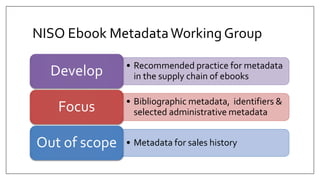
NISO Ebook MetadataWorking Group
• Recommended practice for metadata
in the supply chain of ebooksDevelop
• Bibliographic metadata, identifiers &
selected administrative metadataFocus
• Metadata for sales historyOut of scope
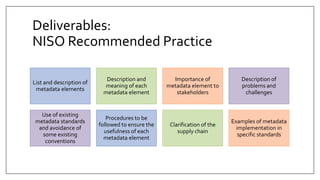
Deliverables:
NISO Recommended Practice
List and description of
metadata elements
Description and
meaning of each
metadata element
Importance of
metadata element to
stakeholders
Description of
problems and
challenges
Use of existing
metadata standards
and avoidance of
some existing
conventions
Procedures to be
followed to ensure the
usefulness of each
metadata element
Clarification of the
supply chain
Examples of metadata
implementation in
specific standards
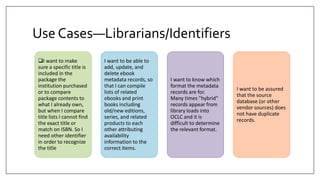
Use Cases—Librarians/Identifiers
I want to make
sure a specific title is
included in the
package the
institution purchased
or to compare
package contents to
what I already own,
but when I compare
title lists I cannot find
the exact title or
match on ISBN. So I
need other identifier
in order to recognize
the title
I want to be able to
add, update, and
delete ebook
metadata records, so
that I can compile
lists of related
ebooks and print
books including
old/new editions,
series, and related
products to each
other attributing
availability
information to the
correct items.
I want to know which
format the metadata
records are for.
Many times "hybrid"
records appear from
library loads into
OCLC and it is
difficult to determine
the relevant format.
I want to be assured
that the source
database (or other
vendor sources) does
not have duplicate
records.
Top 3 ProQuest ebook
metadata issues
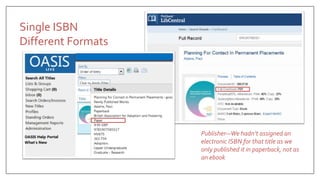
Publisher—We hadn’t assigned an
electronic ISBN for that title as we
only published it in paperback, not as
an ebook
Single ISBN
Different Formats
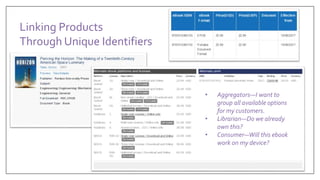
Linking Products
Through Unique Identifiers
• Aggregators—I want to
group all available options
for my customers.
• Librarian—Do we already
own this?
• Consumer—Will this ebook
work on my device?
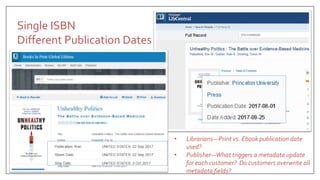
• Librarians—Print vs. Ebook publication date
used?
• Publisher—What triggers a metadata update
for each customer? Do customers overwrite all
metadata fields?
Single ISBN
Different Publication Dates
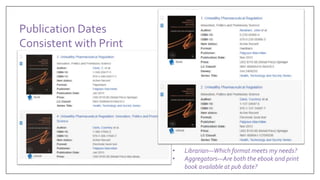
Publication Dates
Consistent with Print
• Librarian—Which format meets my needs?
• Aggregators—Are both the ebook and print
book available at pub date?
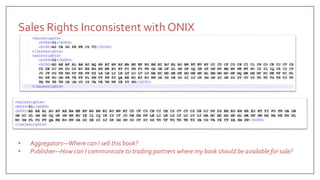
Sales Rights Inconsistent with ONIX
• Aggregators—Where can I sell this book?
• Publisher—How can I communicate to trading partners where my book should be available for sale?
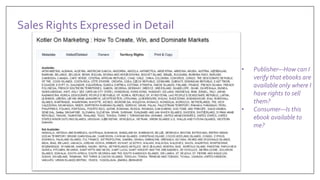
Sales Rights Expressed in Detail
• Publisher—How can I
verify that ebooks are
available only where I
have rights to sell
them?
• Consumer—Is this
ebook available to
me?
5 working group
examples
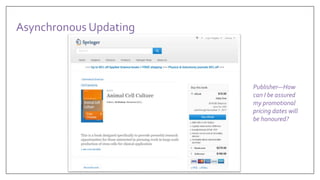
Publisher—How
can I be assured
my promotional
pricing dates will
be honoured?
Asynchronous Updating
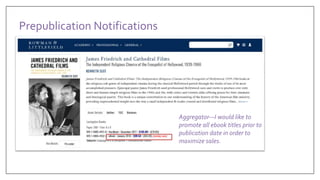
Aggregator—I would like to
promote all ebook titles prior to
publication date in order to
maximize sales.
Prepublication Notifications
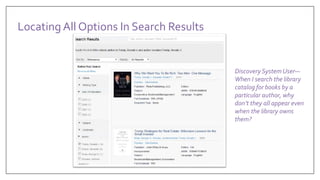
Discovery System User—
When I search the library
catalog for books by a
particular author, why
don’t they all appear even
when the library owns
them?
Locating All Options In Search Results
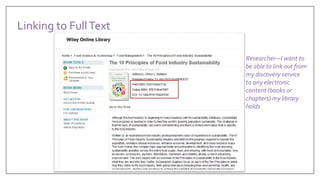
Researcher—I want to
be able to link out from
my discovery service
to any electronic
content (books or
chapters) my library
holds
Linking to FullText
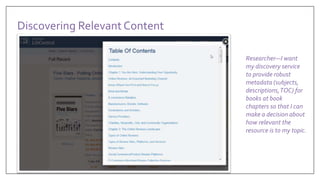
Researcher—I want
my discovery service
to provide robust
metadata (subjects,
descriptions,TOC) for
books at book
chapters so that I can
make a decision about
how relevant the
resource is to my topic.
Discovering Relevant Content
Where else
you can find help
BISG.org
• Product Metadata Best Practices
• BISAC subjects
• Committees and working groups
• Publications, including best-practice guides
• Webinars, programs, and events
• In all cases: Opportunities to be part of the discussion
EDItEUR.org
• Global Best Practices for ONIX 3.0
• Online Code List Lookup
• ONIX standard documentation
• Users and services directory
• ONIX to MARC mapping
• Programs and events
Bowker.com
• SlideshareDiscoverBowker
• BowkerTitle Submissions
Questions
Patricia Payton
Senior Manager, Provider Relations
patricia.payton@proquest.com
ProQuest
Better research. Better learning. Better insights.

Payton Eliminating Conflicts in Ebook Metadata

  • 1.
    Eliminating Conflicts In EbookMetadata NISO Webinar 11/15/17 Presented by: Pat Payton
  • 2.
    Agenda • How NISOis improving metadata • Top 3 ProQuest ebook metadata issues • 5 working group examples • Where else you can find help
  • 3.
  • 4.
    Interested Stakeholders Libraries(academic, special,public) Ebook publishers (including large and small publishers, commercial presses, university presses, and open access presses) Ebook aggregators (e.g., ProQuest, EBSCO, Springer) Book jobbers (e.g.,YBP) Ebook metadata creators (e.g., OCLC) Ebook identifier agencies (e.g., Bowker for ISBN, Crossref for DOI) Other standards agencies (e.g., BISG and EDItEUR)
  • 5.
    NISO Ebook MetadataWorkingGroup • Recommended practice for metadata in the supply chain of ebooksDevelop • Bibliographic metadata, identifiers & selected administrative metadataFocus • Metadata for sales historyOut of scope
  • 6.
    Deliverables: NISO Recommended Practice Listand description of metadata elements Description and meaning of each metadata element Importance of metadata element to stakeholders Description of problems and challenges Use of existing metadata standards and avoidance of some existing conventions Procedures to be followed to ensure the usefulness of each metadata element Clarification of the supply chain Examples of metadata implementation in specific standards
  • 7.
    Use Cases—Librarians/Identifiers I wantto make sure a specific title is included in the package the institution purchased or to compare package contents to what I already own, but when I compare title lists I cannot find the exact title or match on ISBN. So I need other identifier in order to recognize the title I want to be able to add, update, and delete ebook metadata records, so that I can compile lists of related ebooks and print books including old/new editions, series, and related products to each other attributing availability information to the correct items. I want to know which format the metadata records are for. Many times "hybrid" records appear from library loads into OCLC and it is difficult to determine the relevant format. I want to be assured that the source database (or other vendor sources) does not have duplicate records.
  • 8.
    Top 3 ProQuestebook metadata issues
  • 9.
    Publisher—We hadn’t assignedan electronic ISBN for that title as we only published it in paperback, not as an ebook Single ISBN Different Formats
  • 10.
    Linking Products Through UniqueIdentifiers • Aggregators—I want to group all available options for my customers. • Librarian—Do we already own this? • Consumer—Will this ebook work on my device?
  • 11.
    • Librarians—Print vs.Ebook publication date used? • Publisher—What triggers a metadata update for each customer? Do customers overwrite all metadata fields? Single ISBN Different Publication Dates
  • 12.
    Publication Dates Consistent withPrint • Librarian—Which format meets my needs? • Aggregators—Are both the ebook and print book available at pub date?
  • 13.
    Sales Rights Inconsistentwith ONIX • Aggregators—Where can I sell this book? • Publisher—How can I communicate to trading partners where my book should be available for sale?
  • 14.
    Sales Rights Expressedin Detail • Publisher—How can I verify that ebooks are available only where I have rights to sell them? • Consumer—Is this ebook available to me?
  • 15.
  • 16.
    Publisher—How can I beassured my promotional pricing dates will be honoured? Asynchronous Updating
  • 17.
    Aggregator—I would liketo promote all ebook titles prior to publication date in order to maximize sales. Prepublication Notifications
  • 18.
    Discovery System User— WhenI search the library catalog for books by a particular author, why don’t they all appear even when the library owns them? Locating All Options In Search Results
  • 19.
    Researcher—I want to beable to link out from my discovery service to any electronic content (books or chapters) my library holds Linking to FullText
  • 20.
    Researcher—I want my discoveryservice to provide robust metadata (subjects, descriptions,TOC) for books at book chapters so that I can make a decision about how relevant the resource is to my topic. Discovering Relevant Content
  • 21.
  • 22.
    BISG.org • Product MetadataBest Practices • BISAC subjects • Committees and working groups • Publications, including best-practice guides • Webinars, programs, and events • In all cases: Opportunities to be part of the discussion
  • 23.
    EDItEUR.org • Global BestPractices for ONIX 3.0 • Online Code List Lookup • ONIX standard documentation • Users and services directory • ONIX to MARC mapping • Programs and events
  • 24.
  • 25.
    Questions Patricia Payton Senior Manager,Provider Relations patricia.payton@proquest.com ProQuest Better research. Better learning. Better insights.

Editor's Notes

  • #2 Thanks. I am…. Today we will look at how all of us might eliminate conflicts in ebook metadata. I will provide tips to improve your metadata including some understanding as to how others are reading and interpreting the data you send.
  • #3 I will share with you information on our ebook metadata working group, along with real life examples of issues and needs of data recipients. I hope to show you “why” metadata elements are important, not just what to do correctly. At the end I will share some resources with you where you can find out more information to improve your ebook metadata.
  • #4 NISO is bringing key stakeholders together to set best practices for key ebook metadata points.
  • #5 Collectively our working group members represent the supply chain for ebooks. As you can see we include members from…
  • #6 Our task is to….
  • #7 And our deliverables include… List and descriptions of metadata elements leveraging existing standards while avoiding some existing bad practices. Definitions of elements that are important to stakeholders. Procedures to ensure metadata usefulness and aid in clarifying how the supply chain works. Descriptions of problems, challenges, and examples of metadata in specific standards.
  • #8 In order to ensure we are meeting the needs of all stakeholders, we have drafted use cases. Here I am including a small sample of what we have created. This illustration covers Librarian’s needs for identifiers.
  • #9 So to give you an idea of how we might use these use cases in order to recommend best practices, I will share with you some PQ examples. In each of these instances, the working group has not yet supplied a verdict, but all committee members continue to share their pain points during our calls.
  • #10 This book is sold in 2 different formats, paperback and PDF, but it only has 1 assigned ISBN. The publisher indicates that they only published the paperback so they only assigned on Isbn. Since another party created the PDF and sold it, the publisher did not assign a second ISBN.
  • #11 Assigning a single ISBN to multiple formats mistakenly ignores others later in the supply chain. Aggregators and librarians want to identify individual formats in order to understand…. Consumers also need to know if they are purchasing the format they need.
  • #12 In this example we see different publication dates applied to the same title. This could either be driven by the need of a librarian to see original print publication dates related to ebooks or it could be related to subsequent metadata updates not being applied by data recipients.
  • #13 Should we have industry best practices that give guidance, such as publication dates for ebooks should be consistent with print books, users could determine all formats available for purchase at one time. Since this is a PQ example, we will need to see what the final recommendations are from the working group.
  • #14 Another issue we see at PQ, is that sales rights within the metadata do not necessarily match the contract a publisher signed with us. Sample 1 Read only the exclusive rights info and ignore the non-exclusive rights info. Sample 2 Ignore some of the countries listed in the exclusive sales rights info.
  • #15 Expressing sales rights explicitly indicating where a book can be sold and not sold reduces error. All parties of the supply chain know exactly where a book can be sold.
  • #16 Now let’s look at some examples that the working group is dealing with.
  • #17 In Asynchronous updating, how can a publisher be assured that their promotional pricing will be honored and prices will be reset after the promotion? We have discussed issues that arise with data recipients updating data from multiple sources. In addition since, aggregators and resellers often have third party feeds out to their customers, we need to ensure our recommendations cover timeliness of updates.
  • #18 Additionally, aggregators have a desire to market titles prior to publication date, so our suggestions may cover this topic as well.
  • #19 Our recommendations will also include use cases for discovery system users. This need relies on both publisher metadata and link resolvers to point users to all available purchased content.
  • #20 A researcher wants to link out to the actual content of an ebook. By sending a DOI, a publisher can point directly to the content and intermediaries can ensure they are passing along the pointers for linking to the content.
  • #21 Another key factor for the researcher is being able to see robust metadata about the book including subjects, TOC and description, so expect that our working group will publish recommendations on these elements including subject classifications needed by libraries.
  • #22 Since our working group is ongoing, I want to show you what resources are available today. We plan on leveraging these existing best practices so if you spend time reviewing them today, you will have a head start on ensuring your ebook metadata is meeting industry expectations.
  • #23 The Book Industry Study Group publishes a North America Metadata Best Practices for ONIX as well as the BISAC subject scheme. In addition they offer….
  • #24 Editeur is responsible for the ONIX standard and they also publish a global best practices document for ONIX 3.0.
  • #25 At Bowker, we offer insight into metadata practices and pitfalls and our materials can be found here.
  • #26 Thank you.