RDM Discussion Group
How’d that go?
Margaret Janz
Temple University
@MargaretJanz
IT WENT OK
Content
Information Sessions & Discussion Group
• Best Practices Overview
• Documentation
• Storage & Backups
• Sharing & Archiving
Marketing
Information Sessions
• Faculty & Grad students
• Flyers
• Professional language
Discussion Group
• Grad students
• Campus bar
• Seminars
• Hip lingo to relate to the
young people
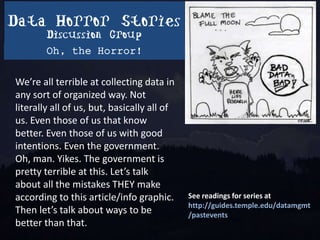
Oh, the Horror!
We’re all terrible at collecting data in
any sort of organized way. Not
literally all of us, but, basically all of
us. Even those of us that know
better. Even those of us with good
intentions. Even the government.
Oh, man. Yikes. The government is
pretty terrible at this. Let’s talk
about all the mistakes THEY make
according to this article/info graphic.
Then let’s talk about ways to be
better than that.
See readings for series at
http://guides.temple.edu/datamgmt
/pastevents
Attendance & Reception
Information Sessions
• Small turn out
• Mix of faculty, librarians,
and students
• Positive feedback
Discussion Group
• Small turn out
• Mostly librarians for most
sessions, some with grad
students, some with faculty
• Positive feedback
“Our lives are data horror stories.”
Hat Tips
Thanks to Cameron Cook from UW for her
amazing image
Thanks to Dorothea Salo and Kristin Briney for
their PinBoards of Data Horror stories
Thanks to all the Twitter peeps who encouraged
me to forge ahead with the full moon bit

RDAP 16 Lightning: RDM Discussion Group: How'd that go?

  • 1.
    RDM Discussion Group How’dthat go? Margaret Janz Temple University @MargaretJanz
  • 2.
  • 3.
    Content Information Sessions &Discussion Group • Best Practices Overview • Documentation • Storage & Backups • Sharing & Archiving
  • 4.
    Marketing Information Sessions • Faculty& Grad students • Flyers • Professional language Discussion Group • Grad students • Campus bar • Seminars • Hip lingo to relate to the young people
  • 5.
    Oh, the Horror! We’reall terrible at collecting data in any sort of organized way. Not literally all of us, but, basically all of us. Even those of us that know better. Even those of us with good intentions. Even the government. Oh, man. Yikes. The government is pretty terrible at this. Let’s talk about all the mistakes THEY make according to this article/info graphic. Then let’s talk about ways to be better than that. See readings for series at http://guides.temple.edu/datamgmt /pastevents
  • 6.
    Attendance & Reception InformationSessions • Small turn out • Mix of faculty, librarians, and students • Positive feedback Discussion Group • Small turn out • Mostly librarians for most sessions, some with grad students, some with faculty • Positive feedback
  • 8.
    “Our lives aredata horror stories.”
  • 9.
    Hat Tips Thanks toCameron Cook from UW for her amazing image Thanks to Dorothea Salo and Kristin Briney for their PinBoards of Data Horror stories Thanks to all the Twitter peeps who encouraged me to forge ahead with the full moon bit

Editor's Notes

  • #2 In the Fall 2015 semester, I led a series of RDM information sessions based largely on the NECDMC and MANTRA materials. They were well received, but I wondered if it might be more fun to do something more interactive. I decided to put together a Data Horror Stories discussion group that I ran in the Spring. So. How’d that go?
  • #3 The discussion group met every full moon in the Libraries’ relatively new Digital Scholarship Center. Ahead of the semester, I picked out Data Horror Stories readings that focused on a theme for each month. The readings were all short and had descriptive titles so that they could still be a jumping off point for discussion even if no one read the articles (which no one did).
  • #4 Because I wanted to compare the info sessions' learning outcomes to the discussion groups', I use the same themes each month. Aside from the format, the main difference in preparing was to limit learning outcomes for the discussion group. I  tried to have one or two main takeaways for attendees but let other issues come up through the discussion. This was a bit difficult for the overview but worked well with the other meetups.
  • #5 For marketing, we did normal things for the traditional workshops: flyers, emails to departments, social media. We used normal, professional language. For the discussion groups, I really wanted to target grad students. I did the normal stuff and but also flyered the campus bar and the coffee carts outside the grad student seminars.
  • #6 I also got to use hip lingo and use this great image by UW Madison's Cameron Cook and put this header in all the emails I sent. You can see the readings and the descriptions at this URL.
  • #7 Despite the rad marketing, the attendance at both types of events was pretty evenly small. The Fall info sessions had pretty steady numbers, though, while the Spring discussion group starter with a good size but dwindled as the weather got nicer. Both types of events had similarly positive feedback and "what I learned" comments. Based on these standard metrics, it doesn't seem like there was any real advantage to doing one type of event over the other. However, the Discussion Groups had, I think, a really important edge
  • #8 Buzz! I would run into faculty and grad students and they'd talk to be about the events. They'd say how their lab mates or their students really needed to attend whichever of the discussions. I'd go to happy hour and they'd talk about data management and I WASN'T THE ONE BRINGING IT UP! They would start telling their own data horror stories.
  • #9 My favorite thing a grad student to me was “Our lives are data horror stories” Even though the conversations weren't happening at the scheduled times, they still allowed the grad students to talk about, reflect on, and commiserate about RDM. I think that's a giant win.