Inna Kouper, Beth Plale, Indiana University
Dharma Akmon, Margaret Hedstrom, University of Michigan
Practical and Conceptual Considerations of
Research Object Preservation
Digital Preservation 2014 Meeting
Washington, DC
July 23, 2014
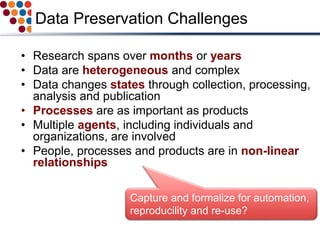
Data Preservation Challenges
• Research spans over months or years
• Data are heterogeneous and complex
• Data changes states through collection, processing,
analysis and publication
• Processes are as important as products
• Multiple agents, including individuals and
organizations, are involved
• People, processes and products are in non-linear
relationships
Capture and formalize for automation,
reproducility and re-use?
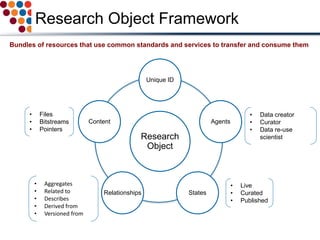
Research
Object
Unique ID
Agents
StatesRelationships
Content
Research Object Framework
• Data creator
• Curator
• Data re-use
scientist
• Live
• Curated
• Published
• Aggregates
• Related to
• Describes
• Derived from
• Versioned from
• Files
• Bitstreams
• Pointers
Bundles of resources that use common standards and services to transfer and consume them
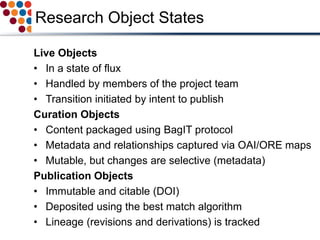
Live Objects
• In a state of flux
• Handled by members of the project team
• Transition initiated by intent to publish
Curation Objects
• Content packaged using BagIT protocol
• Metadata and relationships captured via OAI/ORE maps
• Mutable, but changes are selective (metadata)
Publication Objects
• Immutable and citable (DOI)
• Deposited using the best match algorithm
• Lineage (revisions and derivations) is tracked
Research Object States
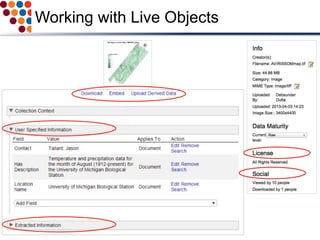
Working with Live Objects
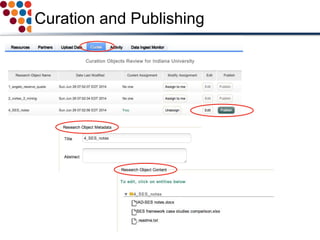
Curation and Publishing
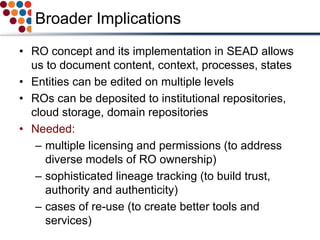
Broader Implications
• RO concept and its implementation in SEAD allows
us to document content, context, processes, states
• Entities can be edited on multiple levels
• ROs can be deposited to institutional repositories,
cloud storage, domain repositories
• Needed:
– multiple licensing and permissions (to address
diverse models of RO ownership)
– sophisticated lineage tracking (to build trust,
authority and authenticity)
– cases of re-use (to create better tools and
services)
Thank you
IU Scholarworks
http://sead-data.net/
@inkouper
@dharmaakmon
@SEADdatanet

Practical and Conceptual Considerations of Research Object Preservation

  • 1.
    Inna Kouper, BethPlale, Indiana University Dharma Akmon, Margaret Hedstrom, University of Michigan Practical and Conceptual Considerations of Research Object Preservation Digital Preservation 2014 Meeting Washington, DC July 23, 2014
  • 2.
    Data Preservation Challenges •Research spans over months or years • Data are heterogeneous and complex • Data changes states through collection, processing, analysis and publication • Processes are as important as products • Multiple agents, including individuals and organizations, are involved • People, processes and products are in non-linear relationships Capture and formalize for automation, reproducility and re-use?
  • 3.
    Research Object Unique ID Agents StatesRelationships Content Research ObjectFramework • Data creator • Curator • Data re-use scientist • Live • Curated • Published • Aggregates • Related to • Describes • Derived from • Versioned from • Files • Bitstreams • Pointers Bundles of resources that use common standards and services to transfer and consume them
  • 4.
    Live Objects • Ina state of flux • Handled by members of the project team • Transition initiated by intent to publish Curation Objects • Content packaged using BagIT protocol • Metadata and relationships captured via OAI/ORE maps • Mutable, but changes are selective (metadata) Publication Objects • Immutable and citable (DOI) • Deposited using the best match algorithm • Lineage (revisions and derivations) is tracked Research Object States
  • 5.
  • 6.
  • 7.
    Broader Implications • ROconcept and its implementation in SEAD allows us to document content, context, processes, states • Entities can be edited on multiple levels • ROs can be deposited to institutional repositories, cloud storage, domain repositories • Needed: – multiple licensing and permissions (to address diverse models of RO ownership) – sophisticated lineage tracking (to build trust, authority and authenticity) – cases of re-use (to create better tools and services)
  • 8.

Editor's Notes