PRESENTED BY:
Halima khatun
ROCKS
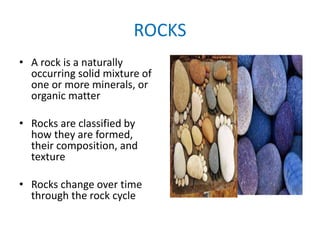
• A rock is a naturally
occurring solid mixture of
one or more minerals, or
organic matter
• Rocks are classified by
how they are formed,
their composition, and
texture
• Rocks change over time
through the rock cycle
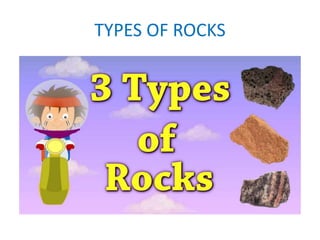
TYPES OF ROCKS
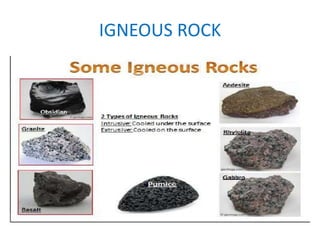
IGNEOUS ROCK
• Igneous rock begins as magma.
• Magma can form:
 When rock is heated
 When pressure is released
 When rock changes composition
• Magma is a mixture of many minerals
ORIGIN— Where rocks are
formed
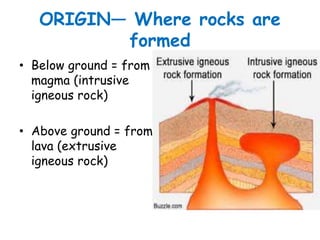
• Below ground = from
magma (intrusive
igneous rock)
• Above ground = from
lava (extrusive
igneous rock)
IGNEOUS ROCK
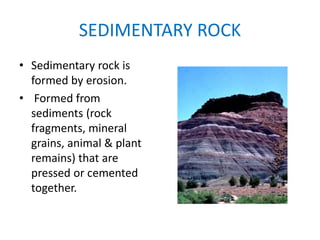
SEDIMENTARY ROCK
• Sedimentary rock is
formed by erosion.
• Formed from
sediments (rock
fragments, mineral
grains, animal & plant
remains) that are
pressed or cemented
together.
TYPES OF SEDIMENTARY ROCK
• Clastic (also called
Detrial)—made of
broken pieces of
other rocks
• Organic—remains of
plants and animals
are deposited in
thick layers
TYPES OF SEDIMENTARY ROCK
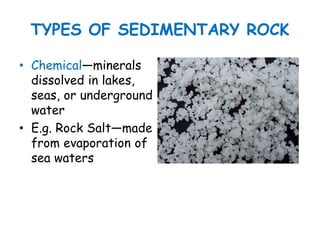
• Chemical—minerals
dissolved in lakes,
seas, or underground
water
• E.g. Rock Salt—made
from evaporation of
sea waters
METAMORPHIC ROCK
• Rocks that have changed due to intense
temperature and pressure
• “Meta” means “change” and morphosis
means “form” in Greek
• Igneous, sedimentary and other metamorphic
rocks can change to become metamorphic
rocks
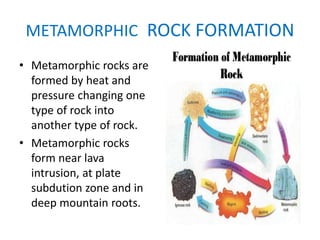
METAMORPHIC ROCK FORMATION
• Metamorphic rocks are
formed by heat and
pressure changing one
type of rock into
another type of rock.
• Metamorphic rocks
form near lava
intrusion, at plate
subdution zone and in
deep mountain roots.
METAMORPHIC ROCK
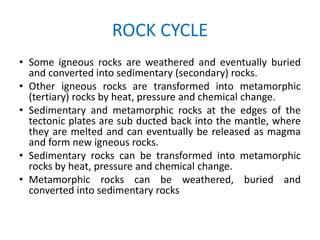
ROCK CYCLE
• Some igneous rocks are weathered and eventually buried
and converted into sedimentary (secondary) rocks.
• Other igneous rocks are transformed into metamorphic
(tertiary) rocks by heat, pressure and chemical change.
• Sedimentary and metamorphic rocks at the edges of the
tectonic plates are sub ducted back into the mantle, where
they are melted and can eventually be released as magma
and form new igneous rocks.
• Sedimentary rocks can be transformed into metamorphic
rocks by heat, pressure and chemical change.
• Metamorphic rocks can be weathered, buried and
converted into sedimentary rocks
ROCK CYCLE
Rocks

Rocks

  • 1.
  • 2.
    ROCKS • A rockis a naturally occurring solid mixture of one or more minerals, or organic matter • Rocks are classified by how they are formed, their composition, and texture • Rocks change over time through the rock cycle
  • 3.
  • 5.
    IGNEOUS ROCK • Igneousrock begins as magma. • Magma can form:  When rock is heated  When pressure is released  When rock changes composition • Magma is a mixture of many minerals
  • 6.
    ORIGIN— Where rocksare formed • Below ground = from magma (intrusive igneous rock) • Above ground = from lava (extrusive igneous rock)
  • 7.
  • 8.
    SEDIMENTARY ROCK • Sedimentaryrock is formed by erosion. • Formed from sediments (rock fragments, mineral grains, animal & plant remains) that are pressed or cemented together.
  • 9.
    TYPES OF SEDIMENTARYROCK • Clastic (also called Detrial)—made of broken pieces of other rocks • Organic—remains of plants and animals are deposited in thick layers
  • 10.
    TYPES OF SEDIMENTARYROCK • Chemical—minerals dissolved in lakes, seas, or underground water • E.g. Rock Salt—made from evaporation of sea waters
  • 11.
    METAMORPHIC ROCK • Rocksthat have changed due to intense temperature and pressure • “Meta” means “change” and morphosis means “form” in Greek • Igneous, sedimentary and other metamorphic rocks can change to become metamorphic rocks
  • 12.
    METAMORPHIC ROCK FORMATION •Metamorphic rocks are formed by heat and pressure changing one type of rock into another type of rock. • Metamorphic rocks form near lava intrusion, at plate subdution zone and in deep mountain roots.
  • 13.
  • 14.
    ROCK CYCLE • Someigneous rocks are weathered and eventually buried and converted into sedimentary (secondary) rocks. • Other igneous rocks are transformed into metamorphic (tertiary) rocks by heat, pressure and chemical change. • Sedimentary and metamorphic rocks at the edges of the tectonic plates are sub ducted back into the mantle, where they are melted and can eventually be released as magma and form new igneous rocks. • Sedimentary rocks can be transformed into metamorphic rocks by heat, pressure and chemical change. • Metamorphic rocks can be weathered, buried and converted into sedimentary rocks
  • 15.