Wh a t is a R o c k ?
• Naturally-
occurring mixtures
of minerals,
mineraloids, glass
or organic matter.
WHAT IS A ROCK?
• Rocks are divided into 3
groups based on how they
were formed:
•IGNEOUS
•SEDIMENTARY
•METAMORPHIC
What is the difference between a
rock and a mineral?
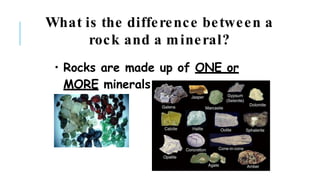
• Rocks are made up of ONE or
MORE minerals.
Once a rock is formed, does it
stay the same rock forever?
• NO!
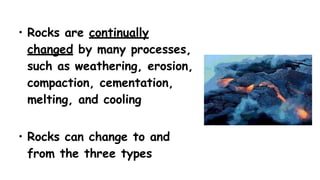
• Rocks are continually
changed by many processes,
such as weathering, erosion,
compaction, cementation,
melting, and cooling
• Rocks can change to and
from the three types
What is the process through
which rocks change?
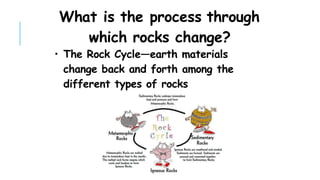
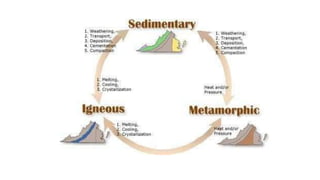
• The Rock Cycle—earth materials
change back and forth among the
different types of rocks
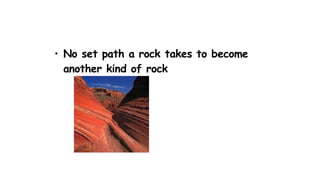
• No set path a rock takes to become
another kind of rock
How are rocks redistributed?
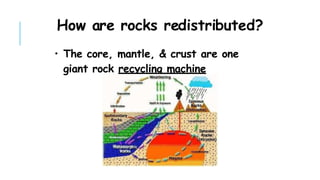
• The core, mantle, & crust are one
giant rock recycling machine
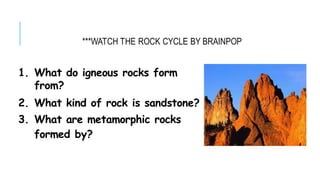
***WATCH THE ROCK CYCLE BY BRAINPOP
1. What do igneous rocks form
from?
2. What kind of rock is sandstone?
3. What are metamorphic rocks
formed by?
• “Ignis” = Latin for “fire”
• Formed from the cooling of either magma
or lava
• The most abundant type of rock
• Classified according to their origin
ORIGIN— FROM WHERE ROCKS
ARE FORMED
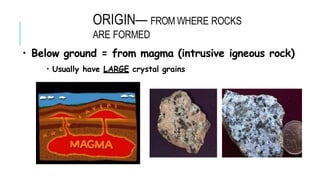
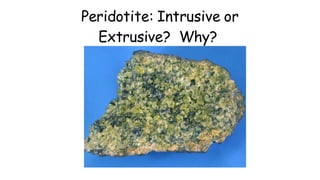
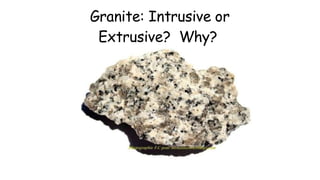
• Below ground = from magma (intrusive igneous rock)
• Usually have LARGE crystal grains
Some have large & small crystals
(called porphyritic)
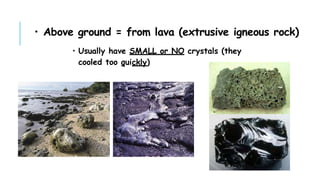
• Above ground = from lava (extrusive igneous rock)
• Usually have SMALL or NO crystals (they
ckly)
cooled too qui
Peridotite: Intrusive or
Extrusive? Why?
Granite: Intrusive or
Extrusive? Why?
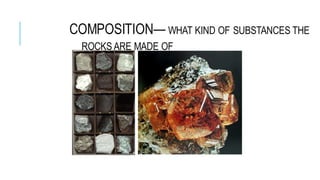
COMPOSITION— WHAT KIND OF SUBSTANCES THE
ROCKS ARE MADE OF
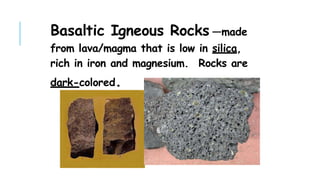
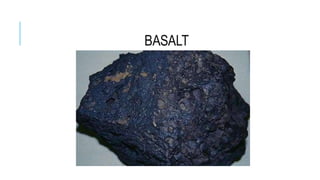
Basaltic Igneous Rocks —made
from lava/magma that is low in silica,
rich in iron and magnesium. Rocks are
dark-colored.
Granitic Igneous Rocks—made
from magma/lava high in
silica and oxygen. Rocks are
light-colored.
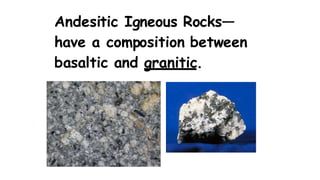
Andesitic Igneous Rocks—
have a composition between
basaltic and granitic.
DIORITE
BASALT
• Formed from sediments
(rock fragments,
mineral grains, animal &
plant remains) that are
pressed or cemented
together or when
sediments precipitate
out of a solution.
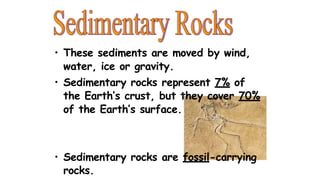
• These sediments are moved by wind,
water, ice or gravity.
• Sedimentary rocks represent 7% of
the Earth’s crust, but they cover 70%
of the Earth’s surface.
• Sedimentary rocks are fossil-carrying
rocks.
What turns sediments into solid rock?
• Water or wind breaks down and
deposits sediment (erosion &
deposition)
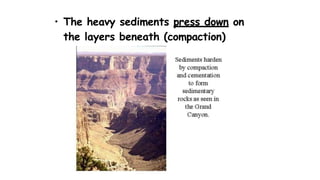
• The heavy sediments press down on
the layers beneath (compaction)
• Dissolved minerals flow between the
particles and cement them together
(cementation)
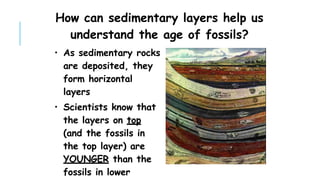
How can sedimentary layers help us
understand the age of fossils?
• As sedimentary rocks
are deposited, they
form horizontal
layers
• Scientists know that
the layers on top
(and the fossils in
the top layer) are
YOUNGER than the
fossils in lower
3 Types of Sedimentary
Rocks:
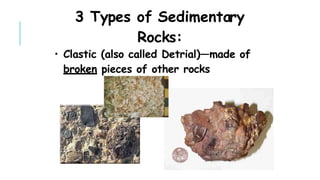
• Clastic (also called Detrial)—made of
broken pieces of other rocks
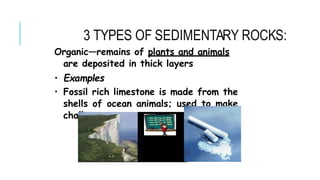
Organic—remains of plants and animals
are deposited in thick layers
• Examples
• Fossil rich limestone is made from the
shells of ocean animals; used to make
chalk
3 TYPES OF SEDIMENTARY ROCKS:
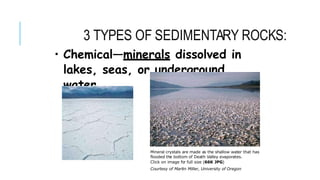
• Chemical—minerals dissolved in
lakes, seas, or underground
water
3 TYPES OF SEDIMENTARY ROCKS:
Mineral crystals are made as the shallow water that has
flooded the bottom of Death Valley evaporates.
Click on image fo
r full size (66K JPG)
Courtesy of Martin Miller, University of Oregon
Examples
• Limestone
made when
calcite
mineral
precipitates
from sea
water
• Rock Salt—
made from
evaporation
of sea
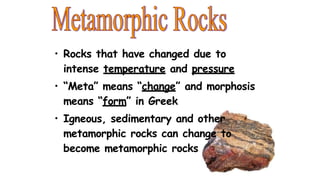
• Rocks that have changed due to
intense temperature and pressure
• “Meta” means “change” and morphosis
means “form” in Greek
• Igneous, sedimentary and other
metamorphic rocks can change to
become metamorphic rocks
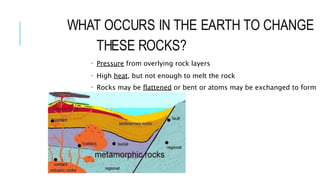
WHAT OCCURS IN THE EARTH TO CHANGE
THESE ROCKS?
• Pressure from overlying rock layers
• High heat, but not enough to melt the rock
• Rocks may be flattened or bent or atoms may be exchanged to form
new minerals.
• *You can think of metamorphic rocks
as a squished peanut butter & jelly
sandwich in your lunch.
How are metamorphic rocks classified?
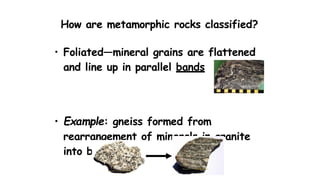
• Foliated—mineral grains are flattened
and line up in parallel bands
• Example: gneiss formed from
rearrangement of minerals in granite
into bands
How are metamorphic rocks classified?
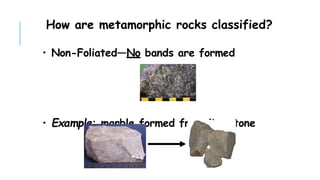
• Non-Foliated—No bands are formed
• Example: marble formed from limestone
WHERE DO METAMORPHIC ROCKS
USUALLY FORM?
• Where magma intrudes relatively
cool rock
• Near colliding plates (near
mountain ranges)
• Places that are covered miles
thick with other rock causing
pressure
• When hot water intrudes rock
• Where a meteorite strikes
Earth (rare)
Rocks Geology Presentation.pptx

Rocks Geology Presentation.pptx

  • 2.
    Wh a tis a R o c k ? • Naturally- occurring mixtures of minerals, mineraloids, glass or organic matter.
  • 3.
    WHAT IS AROCK? • Rocks are divided into 3 groups based on how they were formed: •IGNEOUS •SEDIMENTARY •METAMORPHIC
  • 4.
    What is thedifference between a rock and a mineral? • Rocks are made up of ONE or MORE minerals.
  • 5.
    Once a rockis formed, does it stay the same rock forever? • NO!
  • 6.
    • Rocks arecontinually changed by many processes, such as weathering, erosion, compaction, cementation, melting, and cooling • Rocks can change to and from the three types
  • 7.
    What is theprocess through which rocks change? • The Rock Cycle—earth materials change back and forth among the different types of rocks
  • 10.
    • No setpath a rock takes to become another kind of rock
  • 11.
    How are rocksredistributed? • The core, mantle, & crust are one giant rock recycling machine
  • 12.
    ***WATCH THE ROCKCYCLE BY BRAINPOP 1. What do igneous rocks form from? 2. What kind of rock is sandstone? 3. What are metamorphic rocks formed by?
  • 13.
    • “Ignis” =Latin for “fire” • Formed from the cooling of either magma or lava • The most abundant type of rock • Classified according to their origin
  • 14.
    ORIGIN— FROM WHEREROCKS ARE FORMED • Below ground = from magma (intrusive igneous rock) • Usually have LARGE crystal grains
  • 15.
    Some have large& small crystals (called porphyritic)
  • 16.
    • Above ground= from lava (extrusive igneous rock) • Usually have SMALL or NO crystals (they ckly) cooled too qui
  • 18.
  • 19.
  • 20.
    COMPOSITION— WHAT KINDOF SUBSTANCES THE ROCKS ARE MADE OF
  • 21.
    Basaltic Igneous Rocks—made from lava/magma that is low in silica, rich in iron and magnesium. Rocks are dark-colored.
  • 22.
    Granitic Igneous Rocks—made frommagma/lava high in silica and oxygen. Rocks are light-colored.
  • 23.
    Andesitic Igneous Rocks— havea composition between basaltic and granitic.
  • 25.
  • 26.
  • 27.
    • Formed fromsediments (rock fragments, mineral grains, animal & plant remains) that are pressed or cemented together or when sediments precipitate out of a solution.
  • 28.
    • These sedimentsare moved by wind, water, ice or gravity. • Sedimentary rocks represent 7% of the Earth’s crust, but they cover 70% of the Earth’s surface. • Sedimentary rocks are fossil-carrying rocks.
  • 29.
    What turns sedimentsinto solid rock? • Water or wind breaks down and deposits sediment (erosion & deposition)
  • 30.
    • The heavysediments press down on the layers beneath (compaction)
  • 31.
    • Dissolved mineralsflow between the particles and cement them together (cementation)
  • 32.
    How can sedimentarylayers help us understand the age of fossils? • As sedimentary rocks are deposited, they form horizontal layers • Scientists know that the layers on top (and the fossils in the top layer) are YOUNGER than the fossils in lower
  • 33.
    3 Types ofSedimentary Rocks: • Clastic (also called Detrial)—made of broken pieces of other rocks
  • 34.
    Organic—remains of plantsand animals are deposited in thick layers • Examples • Fossil rich limestone is made from the shells of ocean animals; used to make chalk 3 TYPES OF SEDIMENTARY ROCKS:
  • 35.
    • Chemical—minerals dissolvedin lakes, seas, or underground water 3 TYPES OF SEDIMENTARY ROCKS: Mineral crystals are made as the shallow water that has flooded the bottom of Death Valley evaporates. Click on image fo r full size (66K JPG) Courtesy of Martin Miller, University of Oregon
  • 36.
    Examples • Limestone made when calcite mineral precipitates fromsea water • Rock Salt— made from evaporation of sea
  • 37.
    • Rocks thathave changed due to intense temperature and pressure • “Meta” means “change” and morphosis means “form” in Greek • Igneous, sedimentary and other metamorphic rocks can change to become metamorphic rocks
  • 38.
    WHAT OCCURS INTHE EARTH TO CHANGE THESE ROCKS? • Pressure from overlying rock layers • High heat, but not enough to melt the rock • Rocks may be flattened or bent or atoms may be exchanged to form new minerals.
  • 39.
    • *You canthink of metamorphic rocks as a squished peanut butter & jelly sandwich in your lunch.
  • 40.
    How are metamorphicrocks classified? • Foliated—mineral grains are flattened and line up in parallel bands • Example: gneiss formed from rearrangement of minerals in granite into bands
  • 41.
    How are metamorphicrocks classified? • Non-Foliated—No bands are formed • Example: marble formed from limestone
  • 42.
    WHERE DO METAMORPHICROCKS USUALLY FORM? • Where magma intrudes relatively cool rock • Near colliding plates (near mountain ranges) • Places that are covered miles thick with other rock causing pressure • When hot water intrudes rock • Where a meteorite strikes Earth (rare)