M I S S M I C A H V . P A R A S O
ENDOGENIC AND
EXOGENIC PROCESSES
ENDOGENIC PROCESSES
ENDOGENIC PROCESSES
The process within the Earth.
It is associated with the energy originating in the
interior of the solid Earth. (Thermal Heat)
The ground we live on is moving all the time and the
forces within the Earth that cause the ground to
move are called ENDOGENIC FORCES.
WHERE DOES THE EARTH’S INTERNAL
HEAT COME FROM?
The driving force is the thermal energy of the mantle.
Most of the thermal energy originates from the decay
and disintegration of radioactive elements in Earth’s
core.
The endogenic processes of the Earth are responsible
for earthquakes, development of continents,
mountain buildings, volcanic activities, and other
movements related to Earth’s crust.
MAGMATISM
• Magma is the original material that make up
igneous rocks.
• Magmatism happens when a magma is generated
and develops into igneous (magmatic) rocks.
• The process can take place either under the
surface or on the surface of Earth.
VOLCANISM (PLUTONISM)
• Process that usually happens after the magma is
formed.
• Magma tries to escape from the source through or
existing cracks on the ground.
• As soon as magma reaches the surface of the Earth
it is now called lava. (as the lave solidify, the
extrusive igneous rock are formed)
METAMORPHISM
• Process of changing the materials that make up a
rock.
• Chemical components and geologic
characteristics of the rock changed due to heat
and pressure that are increasing or decreasing.
• Note: Rocks changing due to weathering and
sedimentation are not considered to have
undergone metamorphism.
GEOLOGICAL STRESS
• Compressional
• Tensional
• Shearing
• Confining
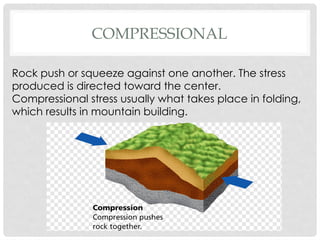
COMPRESSIONAL
Rock push or squeeze against one another. The stress
produced is directed toward the center.
Compressional stress usually what takes place in folding,
which results in mountain building.
TENSIONAL
Rocks are pulled apart. Rocks may separate in opposite
directions or move farther away from one another.
This type of stress is what separated all the continents in
the world.
SHEARING
Some of the portions of a plate at the edges may break
away in different directions, eventually making the plate
smaller in size. The friction caused by this stress can
cause earthquakes.
CONFINING
The crust becomes compact,
making it look smaller. This is
different from shearing as none
of the crust’s edges break
away. This stress can cause
sinkholes where the inside
portion of the ground has
already disintegrated without
being apparent.
EXOGENIC PROCESSES
EXOGENIC PROCESSES
Occur on or near the surface of the Earth. These
processes are usually influenced or driven by gravity,
water, wind, and organisms.
This could be destructive occurrences that leave
significant changes on the landscape and even in
the ecosystem of an area.
In extreme cases, exogenic processes can wipe out
majority of the organisms inhabiting that area
especially the process of mass wasting and erosion.
TYPES OF EXOGENIC PROCESSES
• Weathering
• Erosion
• Mass Wasting
• Sedimentation
WEATHERING
The disintegration of rocks, soil, and minerals together
with other materials through contact with Earth’s
subsystems. Thus process happens even without
movement and transportation.
TYPES OF WEATHERING
1. Physical Weathering
2. Biological Weathering
3. Chemical Weathering
PHYSICAL WEATHERING
The breakdown of rocks by mechanical forces
concentrated along rock fractures. This can occur
due to changes, whether sudden or not, in
temperature, pressure, etc.
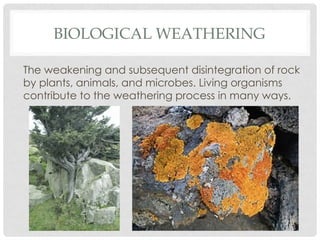
BIOLOGICAL WEATHERING
The weakening and subsequent disintegration of rock
by plants, animals, and microbes. Living organisms
contribute to the weathering process in many ways.
CHEMICAL WEATHERING
The process by which rocks break down by chemical
reactions. New or secondary minerals develop and
sometimes replace the original properties of the
minerals in the original rock or soil.
TYPES OF CHEMICAL WEATHERING
ACID RAIN
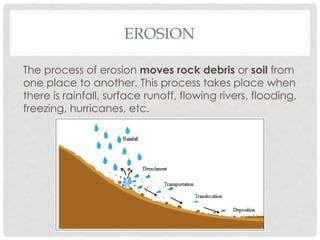
EROSION
The process of erosion moves rock debris or soil from
one place to another. This process takes place when
there is rainfall, surface runoff, flowing rivers, flooding,
freezing, hurricanes, etc.
MASS WASTING
The movement of large masses of materials (rock
debris, soil, and mud) down a slope or a steep-sided
hill or mountain due to pull of gravity. This process is
very destructive in areas with increased water flow.
SEDIMENTATION
The accumulation of materials such as soil, rock
fragments, and soil particles settling on the ground.
This usually occurs in streams and sea erosion. Over
time, the sediment load becomes thick and forms a
new layer of ground.
SEDIMENTATION
“Destruction is not a
bad things, actually it
is a way to create
something”
-J. Celoso, 2019

Endogenic-and-Exogenic-Processes.pptx...

  • 1.
    M I SS M I C A H V . P A R A S O ENDOGENIC AND EXOGENIC PROCESSES
  • 2.
  • 3.
    ENDOGENIC PROCESSES The processwithin the Earth. It is associated with the energy originating in the interior of the solid Earth. (Thermal Heat) The ground we live on is moving all the time and the forces within the Earth that cause the ground to move are called ENDOGENIC FORCES.
  • 4.
    WHERE DOES THEEARTH’S INTERNAL HEAT COME FROM? The driving force is the thermal energy of the mantle. Most of the thermal energy originates from the decay and disintegration of radioactive elements in Earth’s core. The endogenic processes of the Earth are responsible for earthquakes, development of continents, mountain buildings, volcanic activities, and other movements related to Earth’s crust.
  • 5.
    MAGMATISM • Magma isthe original material that make up igneous rocks. • Magmatism happens when a magma is generated and develops into igneous (magmatic) rocks. • The process can take place either under the surface or on the surface of Earth.
  • 6.
    VOLCANISM (PLUTONISM) • Processthat usually happens after the magma is formed. • Magma tries to escape from the source through or existing cracks on the ground. • As soon as magma reaches the surface of the Earth it is now called lava. (as the lave solidify, the extrusive igneous rock are formed)
  • 7.
    METAMORPHISM • Process ofchanging the materials that make up a rock. • Chemical components and geologic characteristics of the rock changed due to heat and pressure that are increasing or decreasing. • Note: Rocks changing due to weathering and sedimentation are not considered to have undergone metamorphism.
  • 9.
    GEOLOGICAL STRESS • Compressional •Tensional • Shearing • Confining
  • 10.
    COMPRESSIONAL Rock push orsqueeze against one another. The stress produced is directed toward the center. Compressional stress usually what takes place in folding, which results in mountain building.
  • 11.
    TENSIONAL Rocks are pulledapart. Rocks may separate in opposite directions or move farther away from one another. This type of stress is what separated all the continents in the world.
  • 12.
    SHEARING Some of theportions of a plate at the edges may break away in different directions, eventually making the plate smaller in size. The friction caused by this stress can cause earthquakes.
  • 13.
    CONFINING The crust becomescompact, making it look smaller. This is different from shearing as none of the crust’s edges break away. This stress can cause sinkholes where the inside portion of the ground has already disintegrated without being apparent.
  • 14.
  • 15.
    EXOGENIC PROCESSES Occur onor near the surface of the Earth. These processes are usually influenced or driven by gravity, water, wind, and organisms. This could be destructive occurrences that leave significant changes on the landscape and even in the ecosystem of an area. In extreme cases, exogenic processes can wipe out majority of the organisms inhabiting that area especially the process of mass wasting and erosion.
  • 16.
    TYPES OF EXOGENICPROCESSES • Weathering • Erosion • Mass Wasting • Sedimentation
  • 17.
    WEATHERING The disintegration ofrocks, soil, and minerals together with other materials through contact with Earth’s subsystems. Thus process happens even without movement and transportation.
  • 18.
    TYPES OF WEATHERING 1.Physical Weathering 2. Biological Weathering 3. Chemical Weathering
  • 19.
    PHYSICAL WEATHERING The breakdownof rocks by mechanical forces concentrated along rock fractures. This can occur due to changes, whether sudden or not, in temperature, pressure, etc.
  • 20.
    BIOLOGICAL WEATHERING The weakeningand subsequent disintegration of rock by plants, animals, and microbes. Living organisms contribute to the weathering process in many ways.
  • 21.
    CHEMICAL WEATHERING The processby which rocks break down by chemical reactions. New or secondary minerals develop and sometimes replace the original properties of the minerals in the original rock or soil.
  • 22.
  • 23.
  • 25.
    TYPES OF CHEMICALWEATHERING ACID RAIN
  • 26.
    EROSION The process oferosion moves rock debris or soil from one place to another. This process takes place when there is rainfall, surface runoff, flowing rivers, flooding, freezing, hurricanes, etc.
  • 27.
    MASS WASTING The movementof large masses of materials (rock debris, soil, and mud) down a slope or a steep-sided hill or mountain due to pull of gravity. This process is very destructive in areas with increased water flow.
  • 28.
    SEDIMENTATION The accumulation ofmaterials such as soil, rock fragments, and soil particles settling on the ground. This usually occurs in streams and sea erosion. Over time, the sediment load becomes thick and forms a new layer of ground.
  • 29.
  • 30.
    “Destruction is nota bad things, actually it is a way to create something” -J. Celoso, 2019

Editor's Notes

  • #4 When we say radioactive elements we are pertaining to unstable elements. When a radioactive elements has undergone decay, it will release an energy as a product of the reaction.
  • #5 In short, magmatism is the formation of magma and development of intrusive or extrusive igneous rocks.
  • #6 The movement of magma from its source is what we call volcanism or plutonism.
  • #7 Because weathering and sedimentation are under exogenic processes, heat, pressure, and stress are the main causes of metamorphism, heat energy is important for many chemical processes because it initiates chemical reaction, extreme heat affects the chemical composition of rocks, pressure exerts two types of stresses on rocks it’s either normal or shear stress – the result of other stresses is to change the shape of the rock without breaking it.
  • #8 We can conclude that endogenic and exogenic processes place an important role in the metamorphosis of rocks. Because of endogenic processes, we have igneous and metamorphic rocks, on the other hand, the presence of sedimentary rocks is because of exogenic processes.
  • #9 Geologic stress is the force from pulling or pushing of plates that acts on the rocks thereby creating different behavior or characteristics. There are four different types of stress that influence rock behavior.
  • #10 The product will be mountains or volcanoes
  • #11 It is speculated that this type of stress is what separated all the continents in the world during breaking of the supercontinent known as the PANGEA.
  • #12 Depending on the condition of the environment, shear stress usually happens at different plates at the boundaries of the plates. Because of the friction of the two rocks, it can cause earthquakes.
  • #13 However, if breaking away happens, it would come from the inside, this meriting the shape of the cross but not its way. In short, nothing may seem to us change in the appearance of the cross because changes have occurred inside that is what we call confining stress.
  • #17 In short, weathering is the breaking down of soil, rocks that happen on the spot.
  • #18 In short, weathering is the breaking down of soil, rocks that happen on the spot.
  • #19 For example, solve cracks because of extreme heat or drought and in some cases, water, wing and ice may abrade or scrape rocks or soil.
  • #20 For example, roots and lichens
  • #24 Hydro – water Lysis – breakdown Chemical breakdown of rocks by water to produce clay and soluble salts. Granite and water = clay
  • #25 Acid rain may cause metals or rocks to corrode auditory and change their properties because of their reaction to acid by some of the minerals.
  • #28 In some small inland waters this sediment layer will eventually dry up the water and become part of the soil. In oceans, the sediment layer can form the ocean basin because geologic processes are constant ocean basins change in size and depth the changes depends on the rate of erosion in their surrounding continental masses.
  • #29 From weathering – erosion – spread across the area (transportation/deposition) The end product of exogenic processes are sedimentary rocks.