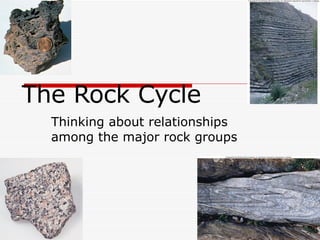
The Rock Cycle Thinking about relationships among the major rock groups
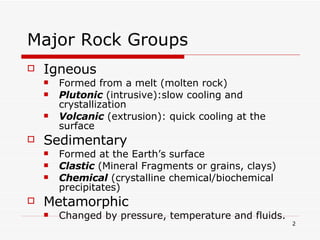
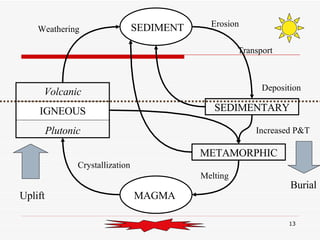
Major Rock Groups Igneous Formed from a melt (molten rock) Plutonic  (intrusive):slow cooling and crystallization Volcanic  (extrusion): quick cooling at the surface Sedimentary Formed at the Earth’s surface Clastic  (Mineral Fragments or grains, clays) Chemical  (crystalline chemical/biochemical precipitates) Metamorphic Changed by pressure, temperature and fluids.
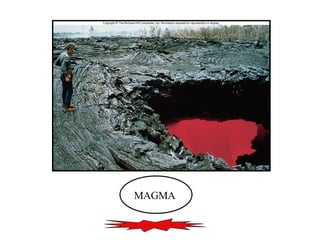
Fig. 2.9 MAGMA
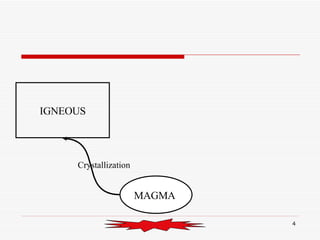
MAGMA Crystallization IGNEOUS
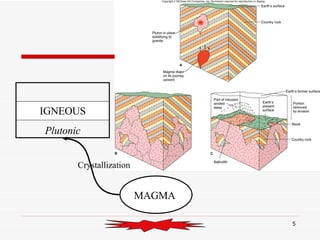
MAGMA IGNEOUS Plutonic Crystallization
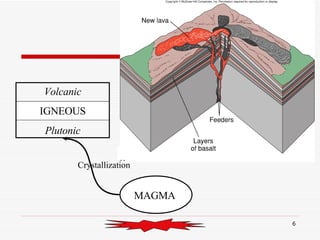
MAGMA Volcanic IGNEOUS Plutonic Crystallization
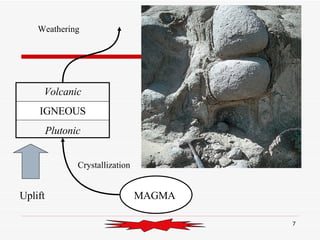
MAGMA Volcanic IGNEOUS Plutonic Uplift Crystallization Weathering
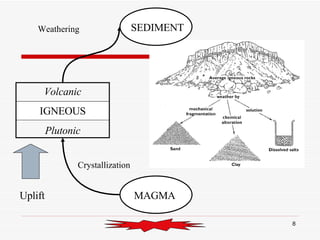
MAGMA Volcanic IGNEOUS Plutonic SEDIMENT Uplift Crystallization Weathering SEDIMENT
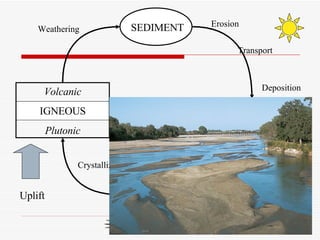
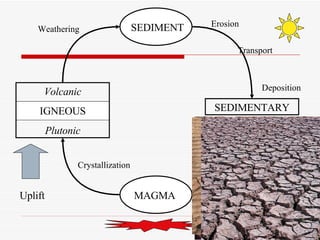
MAGMA Volcanic IGNEOUS Plutonic SEDIMENT SEDIMENTARY Uplift Crystallization Weathering Erosion Transport Deposition
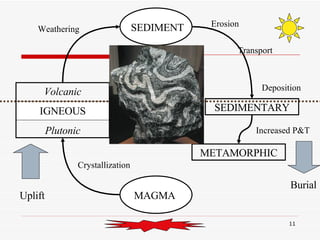
MAGMA Volcanic IGNEOUS Plutonic SEDIMENT SEDIMENTARY METAMORPHIC Uplift Burial Increased P&T Crystallization Weathering Erosion Transport Deposition
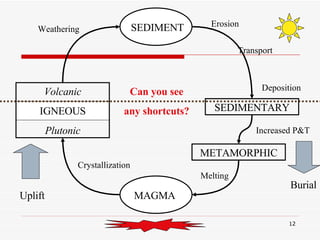
MAGMA Volcanic IGNEOUS Plutonic SEDIMENT SEDIMENTARY METAMORPHIC Uplift Burial Increased P&T Melting Crystallization Weathering Erosion Transport Deposition Can you see any shortcuts?
MAGMA Volcanic IGNEOUS Plutonic SEDIMENT SEDIMENTARY METAMORPHIC Uplift Burial Increased P&T Melting Crystallization Weathering Erosion Transport Deposition
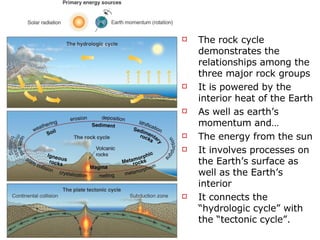
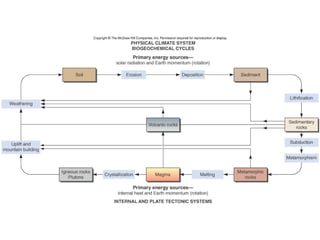
The rock cycle demonstrates the relationships among the three major rock groups It is powered by the interior heat of the Earth  As well as earth’s momentum and… The energy from the sun It involves processes on the Earth’s surface as well as the Earth’s interior It connects the “hydrologic cycle” with the “tectonic cycle”.
 
What is a mineral? Naturally occurring Non-organic Characteristic chemical composition Distinctive physical properties Crystalline structure
Mineral properties Color Luster Habit (Shape) Cleavage & Fracture Streak Hardness Other
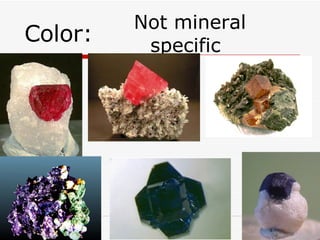
Color: Not mineral specific
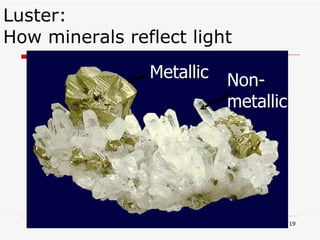
Luster:  How minerals reflect light Non-metallic Metallic
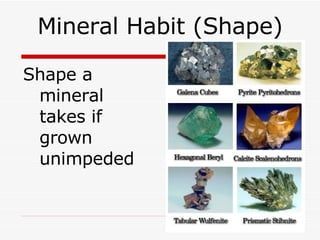
Mineral Habit (Shape) Shape a mineral takes if grown unimpeded
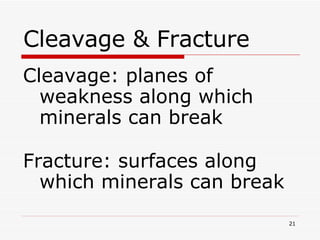
Cleavage & Fracture Cleavage: planes of weakness along which minerals can break Fracture: surfaces along which minerals can break
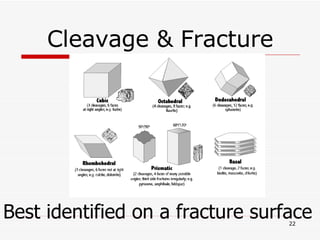
Cleavage & Fracture Best identified on a fracture surface
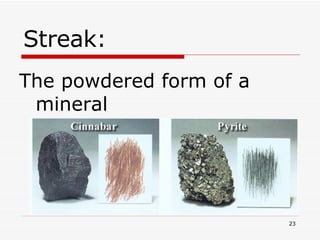
Streak: The powdered form of a mineral
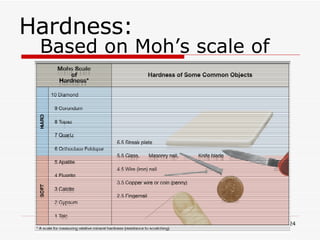
Hardness: Based on Moh’s scale of hardness
Other Properties Specific gravity Reaction to acid Striations Magnetism
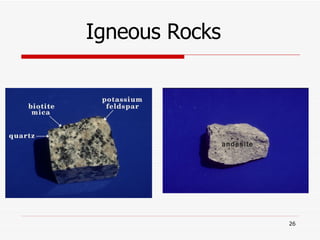
Igneous Rocks
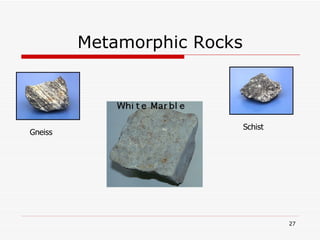
Metamorphic Rocks Gneiss Schist
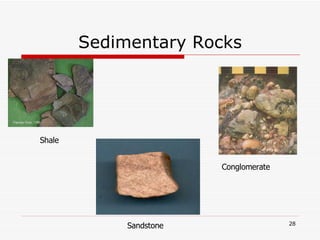
Sedimentary Rocks Shale Conglomerate Sandstone

Rockcyc Mineral

  • 1.
    The Rock CycleThinking about relationships among the major rock groups
  • 2.
    Major Rock GroupsIgneous Formed from a melt (molten rock) Plutonic (intrusive):slow cooling and crystallization Volcanic (extrusion): quick cooling at the surface Sedimentary Formed at the Earth’s surface Clastic (Mineral Fragments or grains, clays) Chemical (crystalline chemical/biochemical precipitates) Metamorphic Changed by pressure, temperature and fluids.
  • 3.
  • 4.
  • 5.
    MAGMA IGNEOUS PlutonicCrystallization
  • 6.
    MAGMA Volcanic IGNEOUSPlutonic Crystallization
  • 7.
    MAGMA Volcanic IGNEOUSPlutonic Uplift Crystallization Weathering
  • 8.
    MAGMA Volcanic IGNEOUSPlutonic SEDIMENT Uplift Crystallization Weathering SEDIMENT
  • 9.
    MAGMA Volcanic IGNEOUSPlutonic SEDIMENT SEDIMENTARY Uplift Crystallization Weathering Erosion Transport Deposition
  • 10.
    MAGMA Volcanic IGNEOUSPlutonic SEDIMENT SEDIMENTARY Uplift Crystallization Weathering Erosion Transport Deposition
  • 11.
    MAGMA Volcanic IGNEOUSPlutonic SEDIMENT SEDIMENTARY METAMORPHIC Uplift Burial Increased P&T Crystallization Weathering Erosion Transport Deposition
  • 12.
    MAGMA Volcanic IGNEOUSPlutonic SEDIMENT SEDIMENTARY METAMORPHIC Uplift Burial Increased P&T Melting Crystallization Weathering Erosion Transport Deposition Can you see any shortcuts?
  • 13.
    MAGMA Volcanic IGNEOUSPlutonic SEDIMENT SEDIMENTARY METAMORPHIC Uplift Burial Increased P&T Melting Crystallization Weathering Erosion Transport Deposition
  • 14.
    The rock cycledemonstrates the relationships among the three major rock groups It is powered by the interior heat of the Earth As well as earth’s momentum and… The energy from the sun It involves processes on the Earth’s surface as well as the Earth’s interior It connects the “hydrologic cycle” with the “tectonic cycle”.
  • 15.
  • 16.
    What is amineral? Naturally occurring Non-organic Characteristic chemical composition Distinctive physical properties Crystalline structure
  • 17.
    Mineral properties ColorLuster Habit (Shape) Cleavage & Fracture Streak Hardness Other
  • 18.
  • 19.
    Luster: Howminerals reflect light Non-metallic Metallic
  • 20.
    Mineral Habit (Shape)Shape a mineral takes if grown unimpeded
  • 21.
    Cleavage & FractureCleavage: planes of weakness along which minerals can break Fracture: surfaces along which minerals can break
  • 22.
    Cleavage & FractureBest identified on a fracture surface
  • 23.
    Streak: The powderedform of a mineral
  • 24.
    Hardness: Based onMoh’s scale of hardness
  • 25.
    Other Properties Specificgravity Reaction to acid Striations Magnetism
  • 26.
  • 27.
  • 28.
    Sedimentary Rocks ShaleConglomerate Sandstone