Earth Science An overview of the Solar System
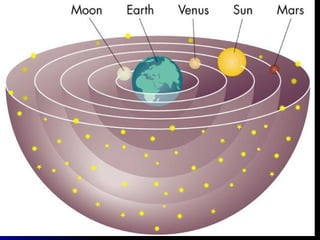
Geocentric Theory  Essentially the belief that the Earth is the center of the universe.  The idea is associated with Aristotle in the 4 th  century BCE. Christianity claims God intentionally placed earth in the center of the universe.
 
Problems with Geocentric If Earth was in a fixed position: Then celestial bodies would move in a constant direction at a standard rate. Copernicus found that celestial bodies were not moving in a standard rate around the Earth. Supporting Heliocentric or sun centered model.
Heliocentric Theory Polish cleric and astronomer Nicolaus Copernicus spent 25 years studying the solar system.  He knew his Heliocentric or sun-centered theory would be rejected.  He only published his works towards the end of his life.
 
Galileo Galileo Galilei studied the work of Copernicus, and found evidence that supported his findings. Eventually Galileo was summoned by the Catholic Church and under threat of torture recanted his findings.
Adding to Copernicus Tycho Brahe spent 25 years documenting planetary movement and positions. Johannes Kepler used this data to construct what would become Kepler’s first law. Planets orbit the sun in an ellipse not a circle. Thus planets are not in a constant distance from the Sun.
Cont. Kepler’s 2 nd  and 3 rd  Laws mathmatically calculate orbital length and patterns of motion.
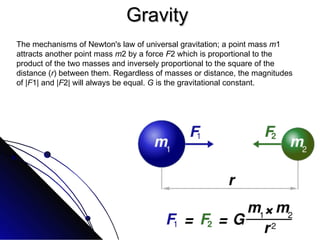
Gravity The mechanisms of Newton's law of universal gravitation; a point mass  m 1 attracts another point mass  m 2 by a force  F 2 which is proportional to the product of the two masses and inversely proportional to the square of the distance ( r ) between them. Regardless of masses or distance, the magnitudes of | F 1| and | F 2| will always be equal.  G  is the gravitational constant.
General relativity General relativity  or the  general theory of relativity  is the geometric theory of gravitation published by Albert Einstein in 1916.  description of gravity in modern physics Unifies special relativity and Newton's law of universal gravitation, and describes gravity as a property of the geometry of space and time, or spacetime.
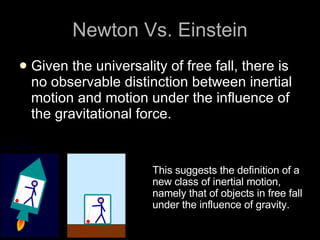
Given the universality of free fall, there is no observable distinction between inertial motion and motion under the influence of the gravitational force.  Newton Vs. Einstein This suggests the definition of a new class of inertial motion, namely that of objects in free fall under the influence of gravity.
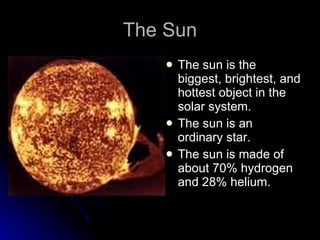
The Sun The sun is the biggest, brightest, and hottest object in the solar system. The sun is an ordinary star. The sun is made of about 70% hydrogen and 28% helium.
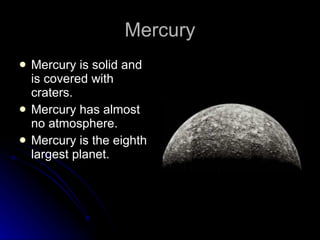
Mercury Mercury is solid and is covered with craters. Mercury has almost no atmosphere. Mercury is the eighth largest planet.
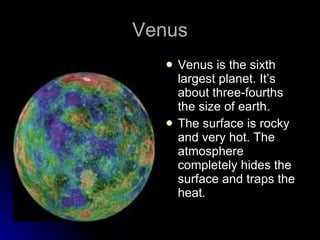
Venus Venus is the sixth largest planet. It’s about three-fourths the size of earth. The surface is rocky and very hot. The atmosphere completely hides the surface and traps the heat.
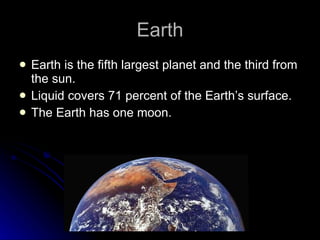
Earth Earth is the fifth largest planet and the third from the sun. Liquid covers 71 percent of the Earth’s surface. The Earth has one moon.
EARTH Age:  At least 4 1/2 billion years Mass:  6,600,000,000,000,000,000,000 (6.6 sextillion) tons (6.0 sextillion metric tons). Surface features:   Highest land —Mount Everest, 29,035 feet (8,850 meters) above sea level.  Lowest land —shore of Dead Sea, about 1,310 feet (399 meters) below sea). Temperature:   Highest,  136 °F (58 °C) at Al Aziziyah, Libya.  Lowest,  -128.6 °F (-89.6 °C) at Vostok Station in Antarctica.  Average surface temperature,  59 °F (15 °C). Chemical makeup of the earth's crust (in percent of the crust's weight):  oxygen 46.6, silicon 27.7, aluminum 8.1, iron 5.0, calcium 3.6, sodium 2.8, potassium 2.6, magnesium 2.0, and other elements totaling 1.6.
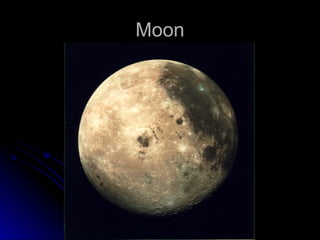
Moon
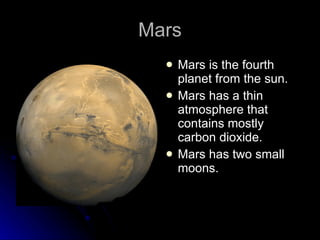
Mars Mars is the fourth planet from the sun. Mars has a thin atmosphere that contains mostly carbon dioxide. Mars has two small moons.
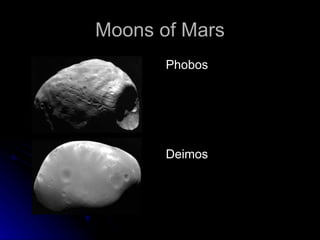
Moons of Mars Phobos Deimos
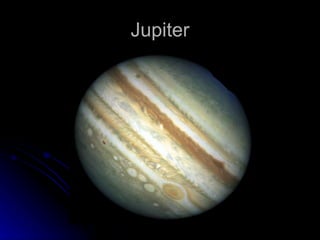
Jupiter
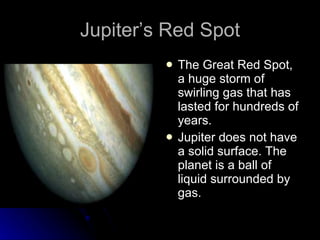
Jupiter’s Red Spot The Great Red Spot, a huge storm of swirling gas that has lasted for hundreds of years. Jupiter does not have a solid surface. The planet is a ball of liquid surrounded by gas.
Moons of Jupiter Jupiter has four large Galilean moons, twelve smaller named moons and twenty-three more recently discovered but not named moons. We’ll take a look at the four large Galilean moons which were first observed by Galileo in 1610.
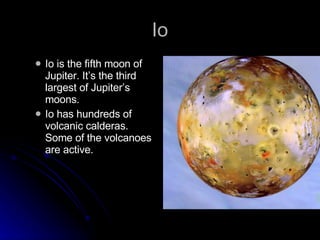
Io Io is the fifth moon of Jupiter. It’s the third largest of Jupiter’s moons. Io has hundreds of volcanic calderas. Some of the volcanoes are active.
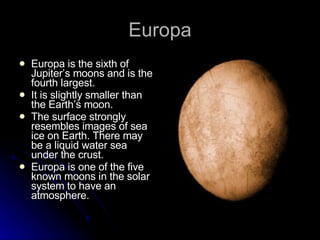
Europa Europa is the sixth of Jupiter’s moons and is the fourth largest. It is slightly smaller than the Earth’s moon. The surface strongly resembles images of sea ice on Earth. There may be a liquid water sea under the crust. Europa is one of the five known moons in the solar system to have an atmosphere.
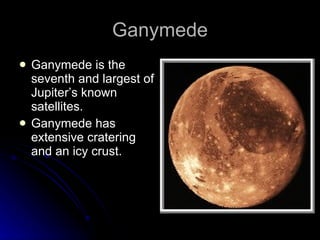
Ganymede Ganymede is the seventh and largest of Jupiter’s known satellites. Ganymede has extensive cratering and an icy crust.
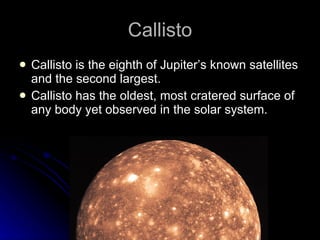
Callisto Callisto is the eighth of Jupiter’s known satellites and the second largest. Callisto has the oldest, most cratered surface of any body yet observed in the solar system.
Saturn Saturn is the second largest planet and the sixth from the sun. Saturn is made of materials that are lighter than water. If you could fit Saturn in a lake, it would float!
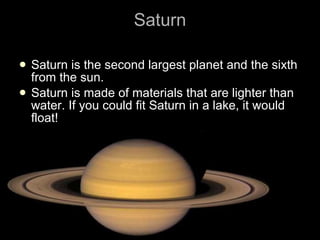
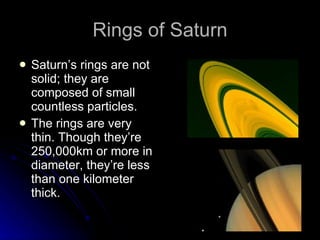
Rings of Saturn Saturn’s rings are not solid; they are composed of small countless particles. The rings are very thin. Though they’re 250,000km or more in diameter, they’re less than one kilometer thick.
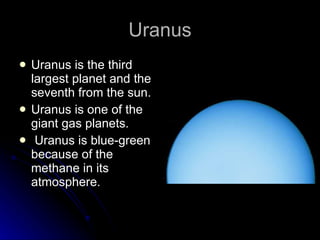
Uranus Uranus is the third largest planet and the seventh from the sun. Uranus is one of the giant gas planets. Uranus is blue-green because of the methane in its atmosphere.
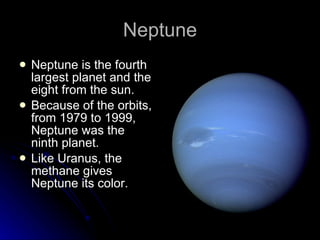
Neptune Neptune is the fourth largest planet and the eight from the sun. Because of the orbits, from 1979 to 1999, Neptune was the ninth planet. Like Uranus, the methane gives Neptune its color.
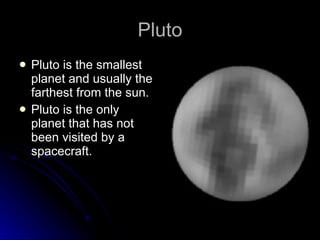
Pluto Pluto is the smallest planet and usually the farthest from the sun. Pluto is the only planet that has not been visited by a spacecraft.
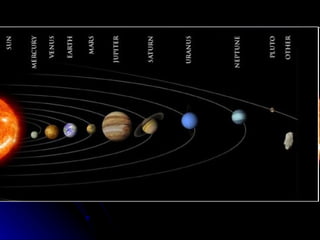
Solar System

  • 1.
    Earth Science Anoverview of the Solar System
  • 2.
    Geocentric Theory Essentially the belief that the Earth is the center of the universe. The idea is associated with Aristotle in the 4 th century BCE. Christianity claims God intentionally placed earth in the center of the universe.
  • 3.
  • 4.
    Problems with GeocentricIf Earth was in a fixed position: Then celestial bodies would move in a constant direction at a standard rate. Copernicus found that celestial bodies were not moving in a standard rate around the Earth. Supporting Heliocentric or sun centered model.
  • 5.
    Heliocentric Theory Polishcleric and astronomer Nicolaus Copernicus spent 25 years studying the solar system. He knew his Heliocentric or sun-centered theory would be rejected. He only published his works towards the end of his life.
  • 6.
  • 7.
    Galileo Galileo Galileistudied the work of Copernicus, and found evidence that supported his findings. Eventually Galileo was summoned by the Catholic Church and under threat of torture recanted his findings.
  • 8.
    Adding to CopernicusTycho Brahe spent 25 years documenting planetary movement and positions. Johannes Kepler used this data to construct what would become Kepler’s first law. Planets orbit the sun in an ellipse not a circle. Thus planets are not in a constant distance from the Sun.
  • 9.
    Cont. Kepler’s 2nd and 3 rd Laws mathmatically calculate orbital length and patterns of motion.
  • 10.
    Gravity The mechanismsof Newton's law of universal gravitation; a point mass m 1 attracts another point mass m 2 by a force F 2 which is proportional to the product of the two masses and inversely proportional to the square of the distance ( r ) between them. Regardless of masses or distance, the magnitudes of | F 1| and | F 2| will always be equal. G is the gravitational constant.
  • 11.
    General relativity Generalrelativity or the general theory of relativity is the geometric theory of gravitation published by Albert Einstein in 1916. description of gravity in modern physics Unifies special relativity and Newton's law of universal gravitation, and describes gravity as a property of the geometry of space and time, or spacetime.
  • 12.
    Given the universalityof free fall, there is no observable distinction between inertial motion and motion under the influence of the gravitational force. Newton Vs. Einstein This suggests the definition of a new class of inertial motion, namely that of objects in free fall under the influence of gravity.
  • 13.
    The Sun Thesun is the biggest, brightest, and hottest object in the solar system. The sun is an ordinary star. The sun is made of about 70% hydrogen and 28% helium.
  • 14.
    Mercury Mercury issolid and is covered with craters. Mercury has almost no atmosphere. Mercury is the eighth largest planet.
  • 15.
    Venus Venus isthe sixth largest planet. It’s about three-fourths the size of earth. The surface is rocky and very hot. The atmosphere completely hides the surface and traps the heat.
  • 16.
    Earth Earth isthe fifth largest planet and the third from the sun. Liquid covers 71 percent of the Earth’s surface. The Earth has one moon.
  • 17.
    EARTH Age: At least 4 1/2 billion years Mass: 6,600,000,000,000,000,000,000 (6.6 sextillion) tons (6.0 sextillion metric tons). Surface features: Highest land —Mount Everest, 29,035 feet (8,850 meters) above sea level. Lowest land —shore of Dead Sea, about 1,310 feet (399 meters) below sea). Temperature: Highest, 136 °F (58 °C) at Al Aziziyah, Libya. Lowest, -128.6 °F (-89.6 °C) at Vostok Station in Antarctica. Average surface temperature, 59 °F (15 °C). Chemical makeup of the earth's crust (in percent of the crust's weight): oxygen 46.6, silicon 27.7, aluminum 8.1, iron 5.0, calcium 3.6, sodium 2.8, potassium 2.6, magnesium 2.0, and other elements totaling 1.6.
  • 18.
  • 19.
    Mars Mars isthe fourth planet from the sun. Mars has a thin atmosphere that contains mostly carbon dioxide. Mars has two small moons.
  • 20.
    Moons of MarsPhobos Deimos
  • 21.
  • 22.
    Jupiter’s Red SpotThe Great Red Spot, a huge storm of swirling gas that has lasted for hundreds of years. Jupiter does not have a solid surface. The planet is a ball of liquid surrounded by gas.
  • 23.
    Moons of JupiterJupiter has four large Galilean moons, twelve smaller named moons and twenty-three more recently discovered but not named moons. We’ll take a look at the four large Galilean moons which were first observed by Galileo in 1610.
  • 24.
    Io Io isthe fifth moon of Jupiter. It’s the third largest of Jupiter’s moons. Io has hundreds of volcanic calderas. Some of the volcanoes are active.
  • 25.
    Europa Europa isthe sixth of Jupiter’s moons and is the fourth largest. It is slightly smaller than the Earth’s moon. The surface strongly resembles images of sea ice on Earth. There may be a liquid water sea under the crust. Europa is one of the five known moons in the solar system to have an atmosphere.
  • 26.
    Ganymede Ganymede isthe seventh and largest of Jupiter’s known satellites. Ganymede has extensive cratering and an icy crust.
  • 27.
    Callisto Callisto isthe eighth of Jupiter’s known satellites and the second largest. Callisto has the oldest, most cratered surface of any body yet observed in the solar system.
  • 28.
    Saturn Saturn isthe second largest planet and the sixth from the sun. Saturn is made of materials that are lighter than water. If you could fit Saturn in a lake, it would float!
  • 29.
    Rings of SaturnSaturn’s rings are not solid; they are composed of small countless particles. The rings are very thin. Though they’re 250,000km or more in diameter, they’re less than one kilometer thick.
  • 30.
    Uranus Uranus isthe third largest planet and the seventh from the sun. Uranus is one of the giant gas planets. Uranus is blue-green because of the methane in its atmosphere.
  • 31.
    Neptune Neptune isthe fourth largest planet and the eight from the sun. Because of the orbits, from 1979 to 1999, Neptune was the ninth planet. Like Uranus, the methane gives Neptune its color.
  • 32.
    Pluto Pluto isthe smallest planet and usually the farthest from the sun. Pluto is the only planet that has not been visited by a spacecraft.