ROBOTICS & AUTOMATION
Prof. Shirish M.Kerur
Department of Mechanical Engineering,
Jain College of Engineering, Belagavi, India
**Viewers are requested to kindly accommodate with the sketches in
the presentation**
ROBOTICS
 “A Robot is a programmable, multi-functional
manipulator designed to move materials, parts, tools
or special devices through variable programmed
motions for performing variety of tasks”
 “Robotics is the field of technology that deals with the
conception, design, construction, operation and
application of robots”
 Elements of a Robotics system are:
 The manipulator, End effectors, Actuators, Transmission
elements
 Control system consisting of Controls [Mechanical,
Electrical, Pneumatic, Hydraulic etc.]
 Sensors and Equipment interfaces
 Computer systems to carry out programming
 Power Source [battery/pneumatic/hydraulic etc]
Robotic Classification based on Physical
Configuration:
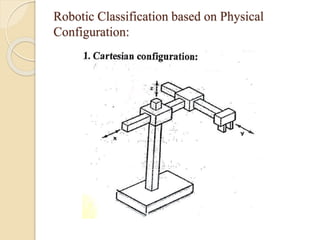
 Cartesian Configuration [Rectilinear]:
 It consists of 3 orthogonal slides namely X, Y & Z axes of the
Cartesian coordinate system
 By appropriate movement, the arm of the Robot can move at any
point in the 3-dimensional rectangular spaced work space
 Advantages:
o Allows for simpler control
o Possesses high degree of mechanical rigidity
o Can carry heavy loads and the lifting capability does not vary within
the work envelop
 Disadvantages:
o Reduced flexibility
o Limitation in the movement of the robotic arm to a small rectangular
work space
 Finds application in assembly, machining, inspection, welding etc.
Robotic Classification based on Physical
Configuration:
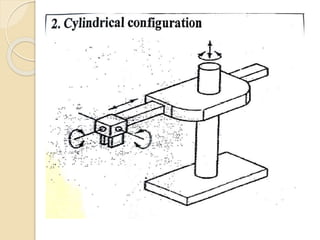
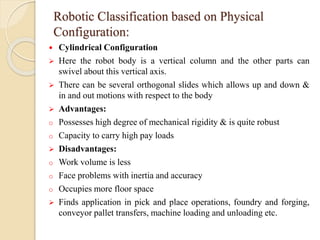
 Cylindrical Configuration
 Here the robot body is a vertical column and the other parts can
swivel about this vertical axis.
 There can be several orthogonal slides which allows up and down &
in and out motions with respect to the body
 Advantages:
o Possesses high degree of mechanical rigidity & is quite robust
o Capacity to carry high pay loads
 Disadvantages:
o Work volume is less
o Face problems with inertia and accuracy
o Occupies more floor space
 Finds application in pick and place operations, foundry and forging,
conveyor pallet transfers, machine loading and unloading etc.
Robotic Classification based on Physical
Configuration:
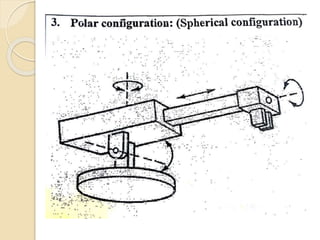
 Polar Configuration [Spherical]
 Here the robot body has a rotary base and a pivot that can be used to
raise and lower a telescopic arm
 Within the workspace, it can move its arm in a partial sphere hence
also termed as using spherical coordinates
 Advantages:
o Long reach capability in horizontal position
o Increased work envelop with increased work lifting capability
 Disadvantages:
o Vertical reach is low
o Lesser rigidity with complex controls
o Problem with inertia and accuracy
 Finds application in die casting, forging, injection molding, cleaning
of parts, dip coating etc
Robotic Classification based on Physical
Configuration:
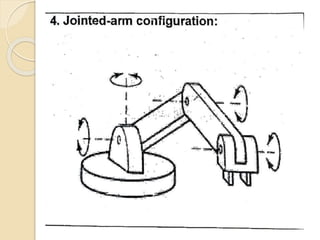
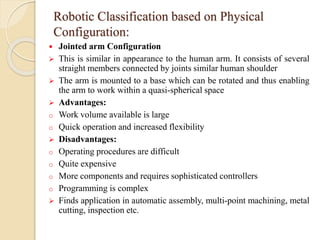
 Jointed arm Configuration
 This is similar in appearance to the human arm. It consists of several
straight members connected by joints similar human shoulder
 The arm is mounted to a base which can be rotated and thus enabling
the arm to work within a quasi-spherical space
 Advantages:
o Work volume available is large
o Quick operation and increased flexibility
 Disadvantages:
o Operating procedures are difficult
o Quite expensive
o More components and requires sophisticated controllers
o Programming is complex
 Finds application in automatic assembly, multi-point machining, metal
cutting, inspection etc.
Application of Robotics:
1. Material/Part handling
2. Processing
3. Assembly
4. Inspection
1. Material/Part handling:
 Pick and place
 Palletizing/de-palletizing[stacking/un-stacking]
 Machine loading and/or unloading
 Stacking and insertion
2. Processing:
 Performs a processing procedure on a part
 Spot welding
 Continuous arc welding
 Spray painting
 Metal cutting and de-burring
 Machining operations like drilling, water jet cutting, riveting
etc.
 Rotating and spindle operations
 Adhesives and sealant dispensing
3. Assembly operations:
 Involves material handling & tool manipulation
 Batch assembly, line assembly etc
 Electronic assembly
 Can assemble large number of products continuously
4. Inspection:
 Inspection work need high precision and patience
 Human judgment may be insufficient to determine whether
a product is with the specified quality limits or not
 Advantages of robots:
 They can increase productivity, safety, efficiency and
improve consistency of products
 Can work in hazardous environment
 No need of environmental comfort
 Can work continuously with no fatigue, illness or needs
 Have repeatable precision
 Have tremendous accuracy
 Better sensor capabilities
 Can do multi tasking
 Have no expectations
 Disadvantages of robots:
 Lack capability to respond during emergencies
 May lead to wrong responses
 Loss of power
 May cause self damage or human injuries
 Limited capacity in terms of real time response
 Are expensive
 High installation costs
 Need for complex programming
 Need for peripherals
 Automation:
 “Automation can be defined as the set of Technologies for
carrying out a process or procedure without human
assistance to achieve superior performance compared to
manual operations”
 Types of automation:
 Fixed or Hard Automation
 Programmable or soft Automation
 Flexible Automation
1. Fixed or Hard Automation:
 It is a system in which the sequence of processing/operations is fixed
by the equipment configuration
 The sequence of operations are usually simple
 If more operations are integrated into a single equipment, then the
system becomes complex
• Advantages of fixed automation:
 The production rates are high
 Due to mass production, the unit costs are low
 No need for special robot intervention as material handling is
automated by specialized equipment
• Disadvantages of fixed automation:
 High initial investment for special purpose equipment
 Not flexible to accommodate product variety / product changes
• Application of fixed automation:
 Automotive industries
 Paint industry
 Distillation industry
 Automatic assembly
 Chemical processes
2. Programmable automation:
 Here the production equipment is designed with the capability to
change the sequence of operations to accommodate different product
configurations
 The sequence of operations is controlled by a program [set of coded
instructions]
 New programs can be prepared and entered into the equipment to
produce new products
• Advantages of Programmable automation:
 Most suitable for batch production
 Flexibility to deal with changes in the product configuration
• Disadvantages of Programmable automation:
 High investment in general-purpose equipment
 Low production rates compared to fixed automation
• Applications: In food processing, foundry, textile using NC
machines and PLC’s
3. Flexible automation:
 Flexible automation is an extension of programmable automation
 A flexible automated system is capable of producing a variety of
products with virtually no time lost for changeover from one product to
another.
 No production time is lost in reprogramming or altering the setup
 Such systems can produce various combinations and schedules of
products with no separate batch production requirement
• Advantages of Programmable automation:
 Continuous production with variable mixture of products
 Flexibility to deal with product design variations
 Improved quality of products
• Disadvantages of Programmable automation:
 High investment for a custom-engineered system
 Medium production rates
 Unit cost of product is high
• Applications: CNC Machine tools, Automatic guided vehicles
 Advantages of Automation:
 Increase in productivity & reduction in manufacturing lead time
 Improvement in product quality
 Increase in accuracy and repeatability
 Improved safety at work place
 Reduction in direct labor costs and expenses with elimination of
manual and clerical jobs
 Carrying out jobs that cannot be done/handled manually
 Disadvantages of Automation:
 Very high initial cost
 Problem of unemployment due to reduced human labor
 May cause security threats due to limited intelligence level
 Additional overhead costs to train personnel, research and
development and preventive maintenance
 Excessive automation leads to too much dependency on machines
rather than human intelligence
 NC/CNC Machines:
 “Numerical control is the method of automating machine tools or
other equipment that are operated through precise programmed
commands containing coded alphanumeric data which are
encoded on a punched paper tape or an alternative storage
medium”
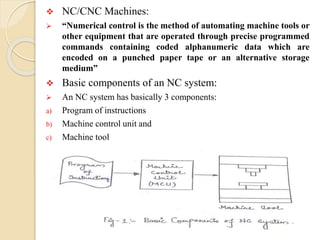
 Basic components of an NC system:
 An NC system has basically 3 components:
a) Program of instructions
b) Machine control unit and
c) Machine tool
 Program of Instructions:
 These are step by step instructions to the machine to perform
operations on a job. Also called as part program
 It is generally prepared by the programmer
 It consists of commands like: positions of cutting tool, selection of
tools, speed, feed, spindle orientation etc.
 When the job changes, the program of instructions also change
 The part program is coded either in numeric or symbolic form which
can be interpreted by the machine
 Various forms of input media are 1” wide punch tape, punched cards,
magnetic tape etc
 Machine control unit:
 MCU consists of a microcomputer with hardware that stores the part
program and executes them command by command
 The hardware includes the components that interface the machine
tool with feedback control elements, control software, calculation
algorithms etc.
 Based on the instructions, the machine tool performs the required
task
 Machine tool:
 The machine tool carries out useful work on the job based on the part
programming
 The machine tool is designed to perform machining operations such
as drilling, milling, boring etc.
 It essentially consists of the worktable on which the job is placed, a
rotating spindle, motors and controls, work fixtures etc.
 Advantages of NC machines:
 High precision with close tolerances that can be met
 Intricate and complex shapes can be machined
 Higher productivity with better and consistent quality
 Reduction in the in-production inventory
 Lesser production cost per unit
 Semi skilled operators can be employed
 Disadvantages of NC machines:
 High investment [NC machines costing 5-6 times the conventional
machines]
 High spares and maintenance cost
 Requirement of special tooling
 Need for initial training of operators and up gradation of knowledge
and software
 Computer numerical control machine [CNC]:
 CNC is an advanced form of NC machine where the machine control
unit is a dedicated microcomputer instead of a hard wired controller
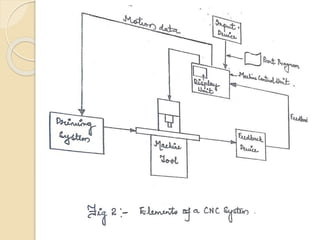
as is in a NC machine. A CNC machine consists of the following:
a) Input device
b) MCU or Machine Control Unit
c) Machine tool
d) Driving system
e) Feedback devices
f) Display unit
1. Input Device: The part program is entered into the CNC control
or MCU through the input device. The various input devices are:
i. USB flash drive
ii. Serial communication port that connects with a computer through an
interface
iii. Ethernet communication which is a more reliable and efficient
means of communication
iv. Conversational programming that allows to enter the program
manually
2. Machine control unit [MCU]: The MCU is the heart of a
CNC system which consists of the following:
a) Central processing unit [CPU] which:
i. Has a control section to fetch the data from memory and generates
signals to activate all MCU components
ii. Arithmetic logic unit [ALU] that performs integer and logical
operations
iii. Immediate access memory that holds the data and programs
temporarily as required at the instant by the control section
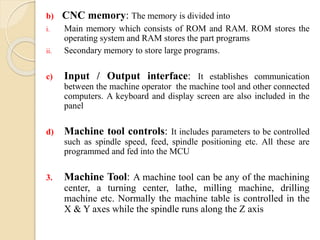
b) CNC memory: The memory is divided into
i. Main memory which consists of ROM and RAM. ROM stores the
operating system and RAM stores the part programs
ii. Secondary memory to store large programs.
c) Input / Output interface: It establishes communication
between the machine operator the machine tool and other connected
computers. A keyboard and display screen are also included in the
panel
d) Machine tool controls: It includes parameters to be controlled
such as spindle speed, feed, spindle positioning etc. All these are
programmed and fed into the MCU
3. Machine Tool: A machine tool can be any of the machining
center, a turning center, lathe, milling machine, drilling
machine etc. Normally the machine table is controlled in the
X & Y axes while the spindle runs along the Z axis
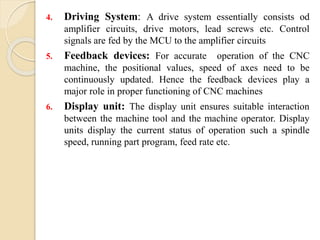
4. Driving System: A drive system essentially consists od
amplifier circuits, drive motors, lead screws etc. Control
signals are fed by the MCU to the amplifier circuits
5. Feedback devices: For accurate operation of the CNC
machine, the positional values, speed of axes need to be
continuously updated. Hence the feedback devices play a
major role in proper functioning of CNC machines
6. Display unit: The display unit ensures suitable interaction
between the machine tool and the machine operator. Display
units display the current status of operation such a spindle
speed, running part program, feed rate etc.
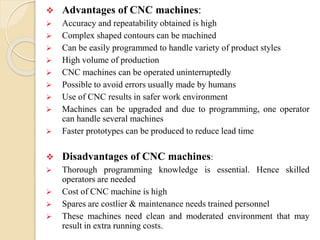
 Advantages of CNC machines:
 Accuracy and repeatability obtained is high
 Complex shaped contours can be machined
 Can be easily programmed to handle variety of product styles
 High volume of production
 CNC machines can be operated uninterruptedly
 Possible to avoid errors usually made by humans
 Use of CNC results in safer work environment
 Machines can be upgraded and due to programming, one operator
can handle several machines
 Faster prototypes can be produced to reduce lead time
 Disadvantages of CNC machines:
 Thorough programming knowledge is essential. Hence skilled
operators are needed
 Cost of CNC machine is high
 Spares are costlier & maintenance needs trained personnel
 These machines need clean and moderated environment that may
result in extra running costs.

Robotics and Automation

  • 1.
    ROBOTICS & AUTOMATION Prof.Shirish M.Kerur Department of Mechanical Engineering, Jain College of Engineering, Belagavi, India **Viewers are requested to kindly accommodate with the sketches in the presentation**
  • 2.
    ROBOTICS  “A Robotis a programmable, multi-functional manipulator designed to move materials, parts, tools or special devices through variable programmed motions for performing variety of tasks”  “Robotics is the field of technology that deals with the conception, design, construction, operation and application of robots”  Elements of a Robotics system are:  The manipulator, End effectors, Actuators, Transmission elements  Control system consisting of Controls [Mechanical, Electrical, Pneumatic, Hydraulic etc.]  Sensors and Equipment interfaces  Computer systems to carry out programming  Power Source [battery/pneumatic/hydraulic etc]
  • 3.
    Robotic Classification basedon Physical Configuration:
  • 4.
     Cartesian Configuration[Rectilinear]:  It consists of 3 orthogonal slides namely X, Y & Z axes of the Cartesian coordinate system  By appropriate movement, the arm of the Robot can move at any point in the 3-dimensional rectangular spaced work space  Advantages: o Allows for simpler control o Possesses high degree of mechanical rigidity o Can carry heavy loads and the lifting capability does not vary within the work envelop  Disadvantages: o Reduced flexibility o Limitation in the movement of the robotic arm to a small rectangular work space  Finds application in assembly, machining, inspection, welding etc.
  • 6.
    Robotic Classification basedon Physical Configuration:  Cylindrical Configuration  Here the robot body is a vertical column and the other parts can swivel about this vertical axis.  There can be several orthogonal slides which allows up and down & in and out motions with respect to the body  Advantages: o Possesses high degree of mechanical rigidity & is quite robust o Capacity to carry high pay loads  Disadvantages: o Work volume is less o Face problems with inertia and accuracy o Occupies more floor space  Finds application in pick and place operations, foundry and forging, conveyor pallet transfers, machine loading and unloading etc.
  • 8.
    Robotic Classification basedon Physical Configuration:  Polar Configuration [Spherical]  Here the robot body has a rotary base and a pivot that can be used to raise and lower a telescopic arm  Within the workspace, it can move its arm in a partial sphere hence also termed as using spherical coordinates  Advantages: o Long reach capability in horizontal position o Increased work envelop with increased work lifting capability  Disadvantages: o Vertical reach is low o Lesser rigidity with complex controls o Problem with inertia and accuracy  Finds application in die casting, forging, injection molding, cleaning of parts, dip coating etc
  • 10.
    Robotic Classification basedon Physical Configuration:  Jointed arm Configuration  This is similar in appearance to the human arm. It consists of several straight members connected by joints similar human shoulder  The arm is mounted to a base which can be rotated and thus enabling the arm to work within a quasi-spherical space  Advantages: o Work volume available is large o Quick operation and increased flexibility  Disadvantages: o Operating procedures are difficult o Quite expensive o More components and requires sophisticated controllers o Programming is complex  Finds application in automatic assembly, multi-point machining, metal cutting, inspection etc.
  • 11.
    Application of Robotics: 1.Material/Part handling 2. Processing 3. Assembly 4. Inspection 1. Material/Part handling:  Pick and place  Palletizing/de-palletizing[stacking/un-stacking]  Machine loading and/or unloading  Stacking and insertion
  • 12.
    2. Processing:  Performsa processing procedure on a part  Spot welding  Continuous arc welding  Spray painting  Metal cutting and de-burring  Machining operations like drilling, water jet cutting, riveting etc.  Rotating and spindle operations  Adhesives and sealant dispensing 3. Assembly operations:  Involves material handling & tool manipulation  Batch assembly, line assembly etc  Electronic assembly  Can assemble large number of products continuously
  • 13.
    4. Inspection:  Inspectionwork need high precision and patience  Human judgment may be insufficient to determine whether a product is with the specified quality limits or not  Advantages of robots:  They can increase productivity, safety, efficiency and improve consistency of products  Can work in hazardous environment  No need of environmental comfort  Can work continuously with no fatigue, illness or needs  Have repeatable precision  Have tremendous accuracy  Better sensor capabilities  Can do multi tasking  Have no expectations
  • 14.
     Disadvantages ofrobots:  Lack capability to respond during emergencies  May lead to wrong responses  Loss of power  May cause self damage or human injuries  Limited capacity in terms of real time response  Are expensive  High installation costs  Need for complex programming  Need for peripherals
  • 15.
     Automation:  “Automationcan be defined as the set of Technologies for carrying out a process or procedure without human assistance to achieve superior performance compared to manual operations”  Types of automation:  Fixed or Hard Automation  Programmable or soft Automation  Flexible Automation 1. Fixed or Hard Automation:  It is a system in which the sequence of processing/operations is fixed by the equipment configuration  The sequence of operations are usually simple  If more operations are integrated into a single equipment, then the system becomes complex
  • 16.
    • Advantages offixed automation:  The production rates are high  Due to mass production, the unit costs are low  No need for special robot intervention as material handling is automated by specialized equipment • Disadvantages of fixed automation:  High initial investment for special purpose equipment  Not flexible to accommodate product variety / product changes • Application of fixed automation:  Automotive industries  Paint industry  Distillation industry  Automatic assembly  Chemical processes
  • 17.
    2. Programmable automation: Here the production equipment is designed with the capability to change the sequence of operations to accommodate different product configurations  The sequence of operations is controlled by a program [set of coded instructions]  New programs can be prepared and entered into the equipment to produce new products • Advantages of Programmable automation:  Most suitable for batch production  Flexibility to deal with changes in the product configuration • Disadvantages of Programmable automation:  High investment in general-purpose equipment  Low production rates compared to fixed automation • Applications: In food processing, foundry, textile using NC machines and PLC’s
  • 18.
    3. Flexible automation: Flexible automation is an extension of programmable automation  A flexible automated system is capable of producing a variety of products with virtually no time lost for changeover from one product to another.  No production time is lost in reprogramming or altering the setup  Such systems can produce various combinations and schedules of products with no separate batch production requirement • Advantages of Programmable automation:  Continuous production with variable mixture of products  Flexibility to deal with product design variations  Improved quality of products • Disadvantages of Programmable automation:  High investment for a custom-engineered system  Medium production rates  Unit cost of product is high • Applications: CNC Machine tools, Automatic guided vehicles
  • 19.
     Advantages ofAutomation:  Increase in productivity & reduction in manufacturing lead time  Improvement in product quality  Increase in accuracy and repeatability  Improved safety at work place  Reduction in direct labor costs and expenses with elimination of manual and clerical jobs  Carrying out jobs that cannot be done/handled manually  Disadvantages of Automation:  Very high initial cost  Problem of unemployment due to reduced human labor  May cause security threats due to limited intelligence level  Additional overhead costs to train personnel, research and development and preventive maintenance  Excessive automation leads to too much dependency on machines rather than human intelligence
  • 20.
     NC/CNC Machines: “Numerical control is the method of automating machine tools or other equipment that are operated through precise programmed commands containing coded alphanumeric data which are encoded on a punched paper tape or an alternative storage medium”  Basic components of an NC system:  An NC system has basically 3 components: a) Program of instructions b) Machine control unit and c) Machine tool
  • 21.
     Program ofInstructions:  These are step by step instructions to the machine to perform operations on a job. Also called as part program  It is generally prepared by the programmer  It consists of commands like: positions of cutting tool, selection of tools, speed, feed, spindle orientation etc.  When the job changes, the program of instructions also change  The part program is coded either in numeric or symbolic form which can be interpreted by the machine  Various forms of input media are 1” wide punch tape, punched cards, magnetic tape etc  Machine control unit:  MCU consists of a microcomputer with hardware that stores the part program and executes them command by command  The hardware includes the components that interface the machine tool with feedback control elements, control software, calculation algorithms etc.  Based on the instructions, the machine tool performs the required task
  • 22.
     Machine tool: The machine tool carries out useful work on the job based on the part programming  The machine tool is designed to perform machining operations such as drilling, milling, boring etc.  It essentially consists of the worktable on which the job is placed, a rotating spindle, motors and controls, work fixtures etc.  Advantages of NC machines:  High precision with close tolerances that can be met  Intricate and complex shapes can be machined  Higher productivity with better and consistent quality  Reduction in the in-production inventory  Lesser production cost per unit  Semi skilled operators can be employed
  • 23.
     Disadvantages ofNC machines:  High investment [NC machines costing 5-6 times the conventional machines]  High spares and maintenance cost  Requirement of special tooling  Need for initial training of operators and up gradation of knowledge and software  Computer numerical control machine [CNC]:  CNC is an advanced form of NC machine where the machine control unit is a dedicated microcomputer instead of a hard wired controller as is in a NC machine. A CNC machine consists of the following: a) Input device b) MCU or Machine Control Unit c) Machine tool d) Driving system e) Feedback devices f) Display unit
  • 25.
    1. Input Device:The part program is entered into the CNC control or MCU through the input device. The various input devices are: i. USB flash drive ii. Serial communication port that connects with a computer through an interface iii. Ethernet communication which is a more reliable and efficient means of communication iv. Conversational programming that allows to enter the program manually 2. Machine control unit [MCU]: The MCU is the heart of a CNC system which consists of the following: a) Central processing unit [CPU] which: i. Has a control section to fetch the data from memory and generates signals to activate all MCU components ii. Arithmetic logic unit [ALU] that performs integer and logical operations iii. Immediate access memory that holds the data and programs temporarily as required at the instant by the control section
  • 26.
    b) CNC memory:The memory is divided into i. Main memory which consists of ROM and RAM. ROM stores the operating system and RAM stores the part programs ii. Secondary memory to store large programs. c) Input / Output interface: It establishes communication between the machine operator the machine tool and other connected computers. A keyboard and display screen are also included in the panel d) Machine tool controls: It includes parameters to be controlled such as spindle speed, feed, spindle positioning etc. All these are programmed and fed into the MCU 3. Machine Tool: A machine tool can be any of the machining center, a turning center, lathe, milling machine, drilling machine etc. Normally the machine table is controlled in the X & Y axes while the spindle runs along the Z axis
  • 27.
    4. Driving System:A drive system essentially consists od amplifier circuits, drive motors, lead screws etc. Control signals are fed by the MCU to the amplifier circuits 5. Feedback devices: For accurate operation of the CNC machine, the positional values, speed of axes need to be continuously updated. Hence the feedback devices play a major role in proper functioning of CNC machines 6. Display unit: The display unit ensures suitable interaction between the machine tool and the machine operator. Display units display the current status of operation such a spindle speed, running part program, feed rate etc.
  • 28.
     Advantages ofCNC machines:  Accuracy and repeatability obtained is high  Complex shaped contours can be machined  Can be easily programmed to handle variety of product styles  High volume of production  CNC machines can be operated uninterruptedly  Possible to avoid errors usually made by humans  Use of CNC results in safer work environment  Machines can be upgraded and due to programming, one operator can handle several machines  Faster prototypes can be produced to reduce lead time  Disadvantages of CNC machines:  Thorough programming knowledge is essential. Hence skilled operators are needed  Cost of CNC machine is high  Spares are costlier & maintenance needs trained personnel  These machines need clean and moderated environment that may result in extra running costs.