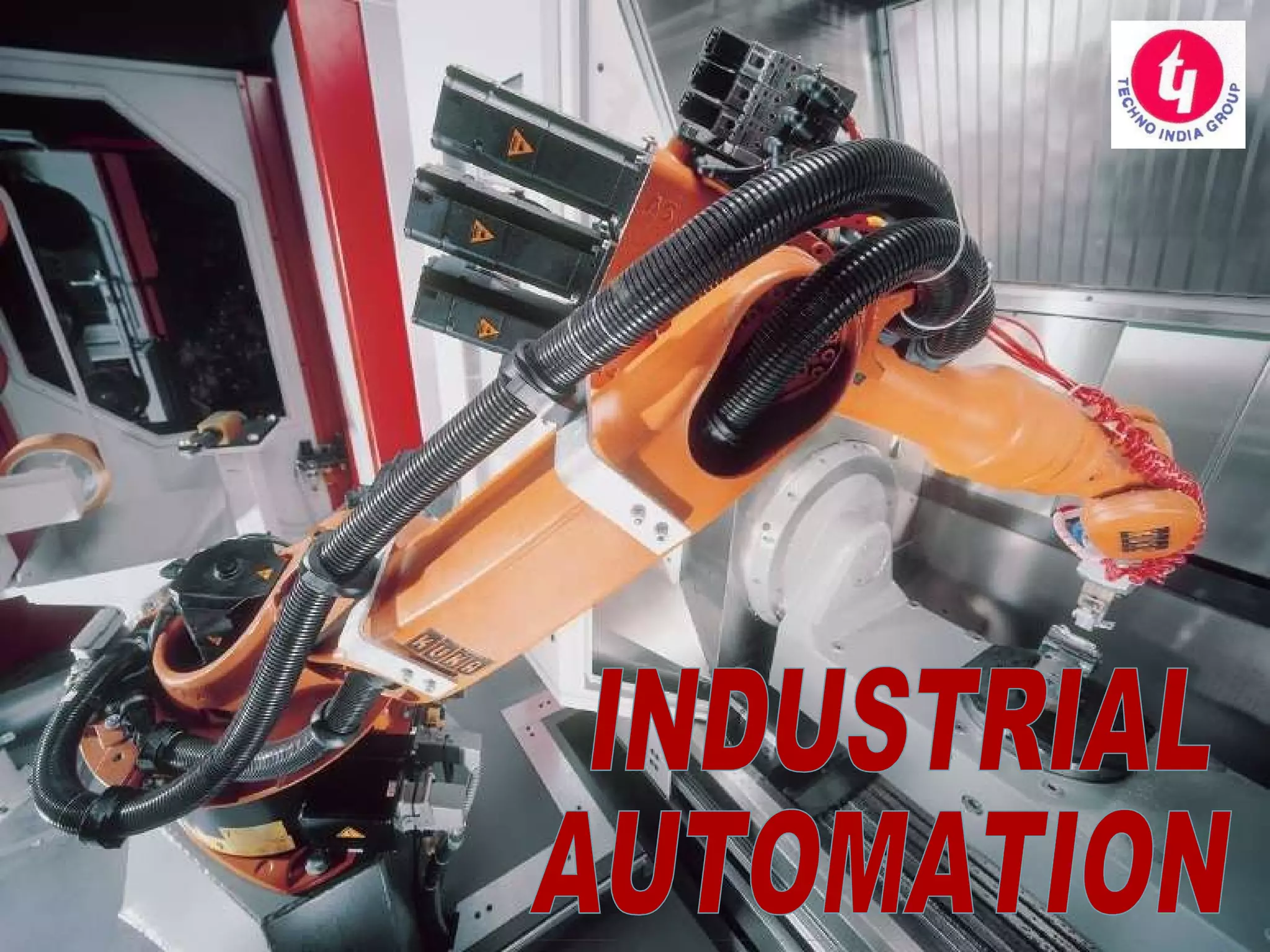
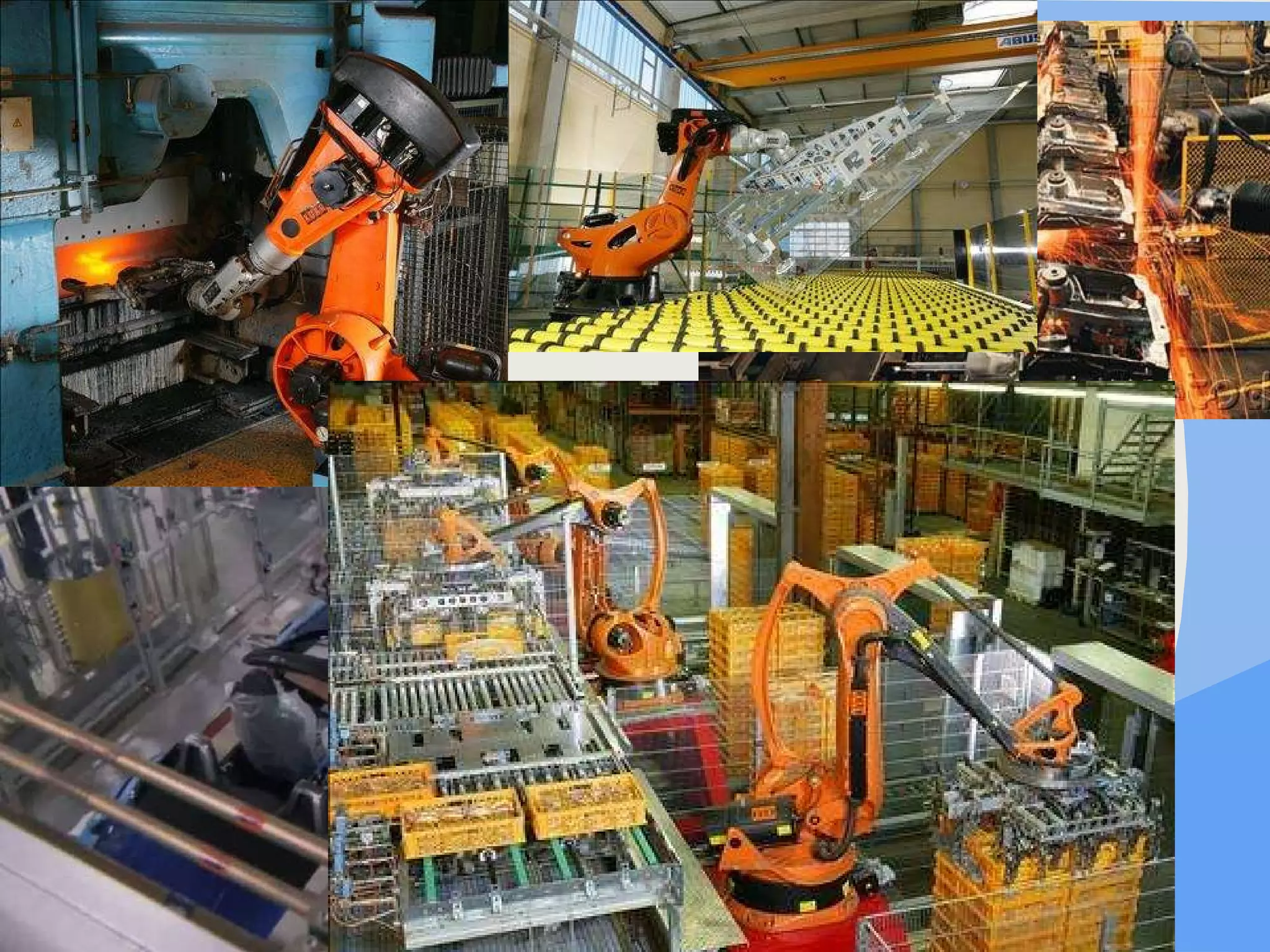
INDUSTRIAL AUTOMATION
INTRODUCTION Automation  is defined as the use of control systems and information technology to reduce the need of human work to produce goods and services Advantages of Automation It replaces mechanization thereby reducing the need for  human mental and physical requirements. Perform tasks beyond human capabilities of  size, weight, speed and endurance. Improves economy of  enterprise, society and country.
HISTORY
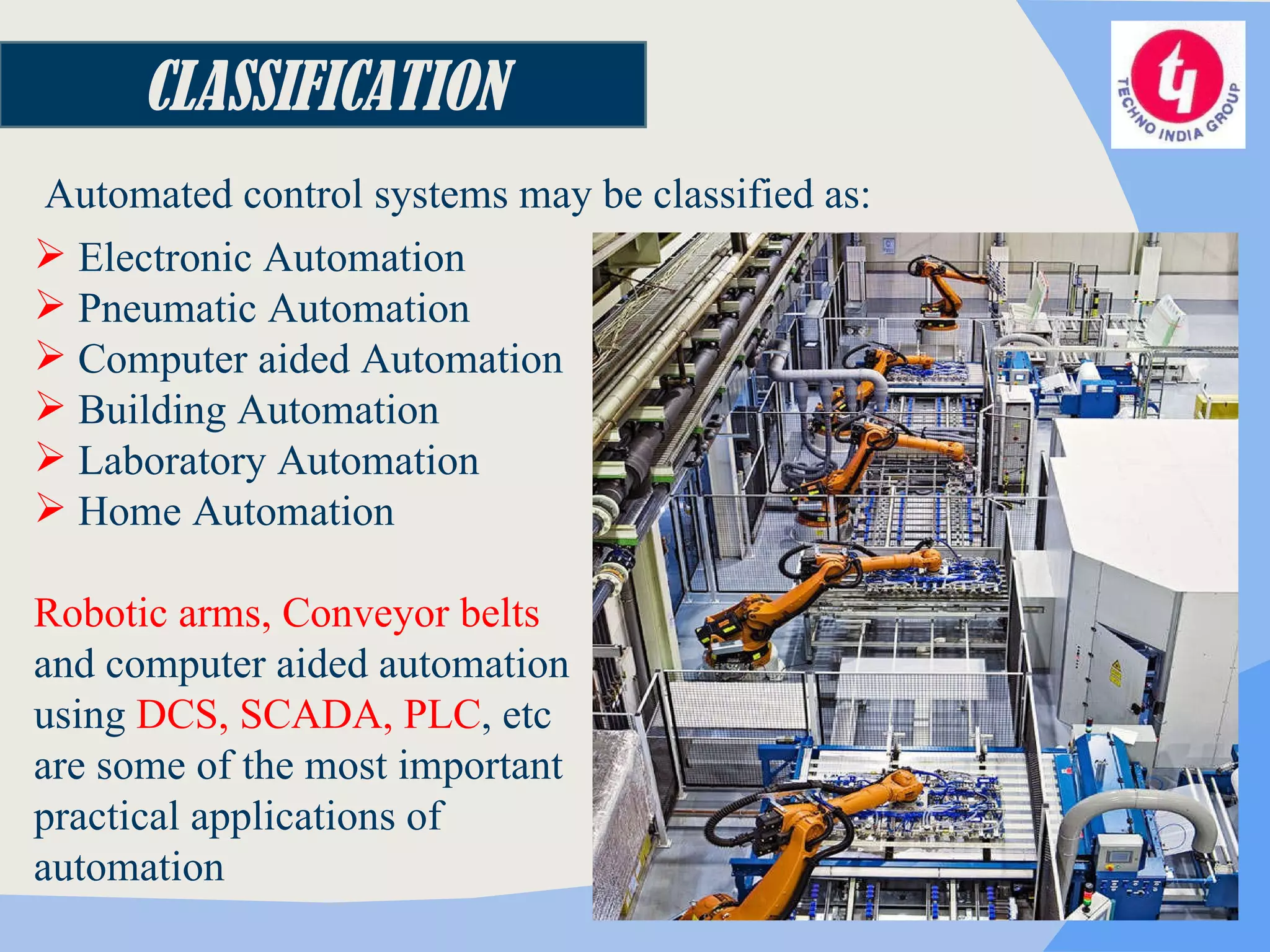
CLASSIFICATION Automated control systems may be classified as: Electronic Automation Pneumatic Automation  Computer aided Automation Building Automation Laboratory Automation Home Automation Robotic arms, Conveyor belts  and computer aided automation using  DCS, SCADA, PLC , etc are some of the most important practical applications of automation
COMPUTER AIDED AUTOMATION Computer aided process control system  is a special type of  numerical control system , that uses predetermined instructions to control a sequence of operations.  Objectivity: It identifies information flow. It manipulates material & energy flow of a process in a desired, optimal way.   Types of Application: Active Application:  deals with manipulation of process. Passive Application:  deals with manipulation of  process data
Types of Computer Aided Process Control System : Batch or Sequential Control. Continuous Control. Supervisory Control. Direct Digital Control . TYPICAL COMPUTER AIDED PROCESS CONTROL SYSTEM COMPUTER AIDED AUTOMATION
DISTRIBUTED CONTROL SYSTEM A  Distributed Computer Control System  refers to a control system in which the controller elements are not centrally located, but are distributed throughout the system, connected by networks for communication and monitoring Components of a DCS: Processor (Controller), I/O modules, Computer or Electrical Buses, Multiplexers & Demultiplexers . A DISTRIBUTED DIGITAL CONTROL ARCHITECTURE
Applications: Electrical Power Grids & Electrical Generation Plants. Metallurgical Process Plants. Chemical Plants. Oil Refining Plants. Sensor Networks. Traffic & Radio Signals. PROGRAMMABLE LOGIC CONTROLLERS Programmable Logic Controllers  are industrially hardened microcomputers used for automation of electromechanical processes and in process plants and factories.  DISTRIBUTED CONTROL SYSTEM
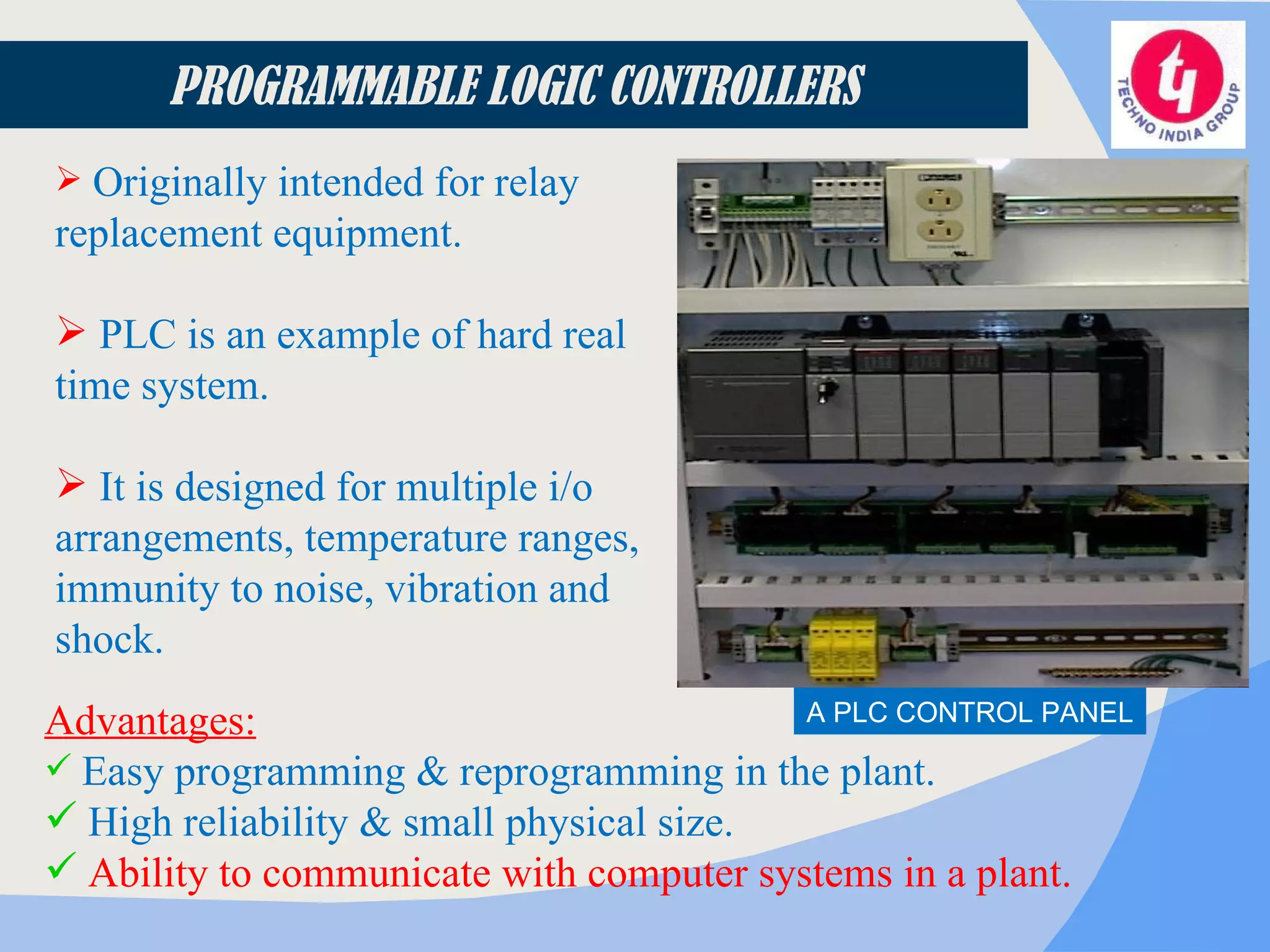
Originally intended for relay replacement equipment. PLC is an example of hard real time system. It is designed for multiple i/o arrangements, temperature ranges, immunity to noise, vibration and shock. Advantages: Easy programming & reprogramming in the plant. High reliability & small physical size. Ability to communicate with computer systems in a plant. PROGRAMMABLE LOGIC CONTROLLERS A PLC CONTROL PANEL
PNEUMATIC AUTOMATION Fluid comprises of liquids and gases,  deforms on the application of shear stress . The technique that uses liquid for power transmission is called  hydraulics  while that using gas for the same is called  pneumatics . The fluid system for power transmission obeys the fundamental Pascal’s law. For proper and reliable working of the hydraulic system the fluid ought to have the properties such as viscosity, oxidation resistance, pour and cloud point, flash and fire point, lubrication, heat generation and transmission, etc
The most fluid system will employ some or all of the following parts: Pump or Compressor : This gives the motion to the fluid which is used to perform useful work  Control Valves : These are used to regulate and control the flow of the fluid  Tubes, pipes and Hoses : These carry the fluid from the pump/compressor to the actuator  Actuator : The actual work is performed by the actuators.  Discharge Tank : The liquid after performing work will be discharged into a tank in case of liquids /gases or will let into the atmosphere in case of air  Seals : These prevent the leakage of fluid into the atmosphere or surroundings  Filter, Lubricator and Regulator Circuit (FRL UNIT) : These circuit are used to remove dirt present in the fluid. They will also lubricate and regulate the flow of fluid  Accumulator : These are used to produce head which can be converted into useful work  PARTS OF FLUID SYSTEM
Power transmission through fluid requires  less mechanical parts , also there is  less possibility of breakage of parts  like cams, gears, belts, etc. Ensures  less noise and vibration  in the system. Forces can be conveyed up and down with  less loss in efficiency . System overload can be prevented by using  automatic relief valves. More economic  compared to other modes of operation. Hydraulic power system is used in different devices like  hydraulic jack, hydraulic brakes, power steering, tractor. ADVANTAGES
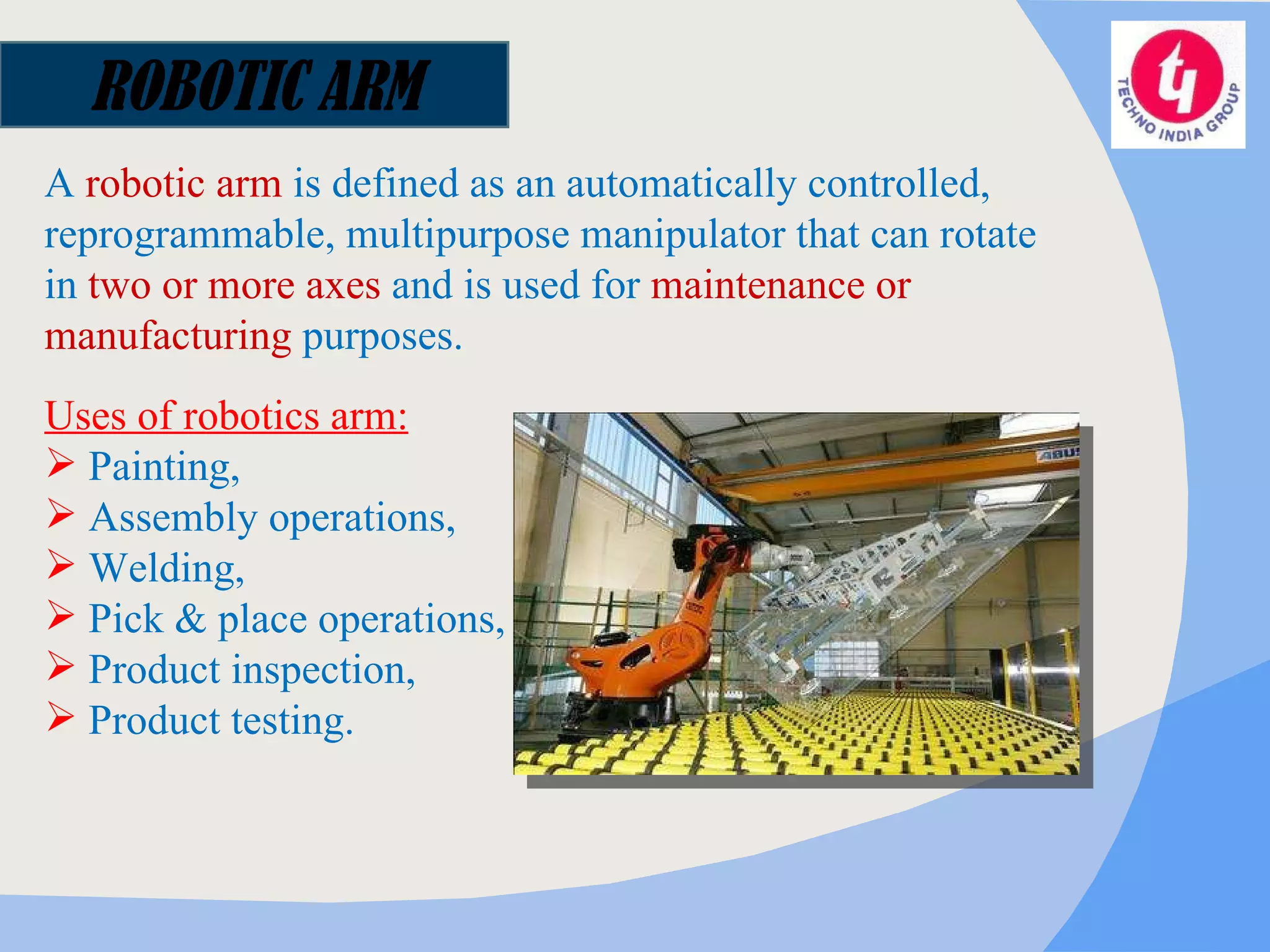
ROBOTIC ARM A  robotic arm  is defined as an automatically controlled, reprogrammable, multipurpose manipulator that can rotate in  two or more axes  and is used for  maintenance or manufacturing  purposes. Uses of robotics arm: Painting,  Assembly operations,  Welding,  Pick & place operations,  Product inspection, Product testing.
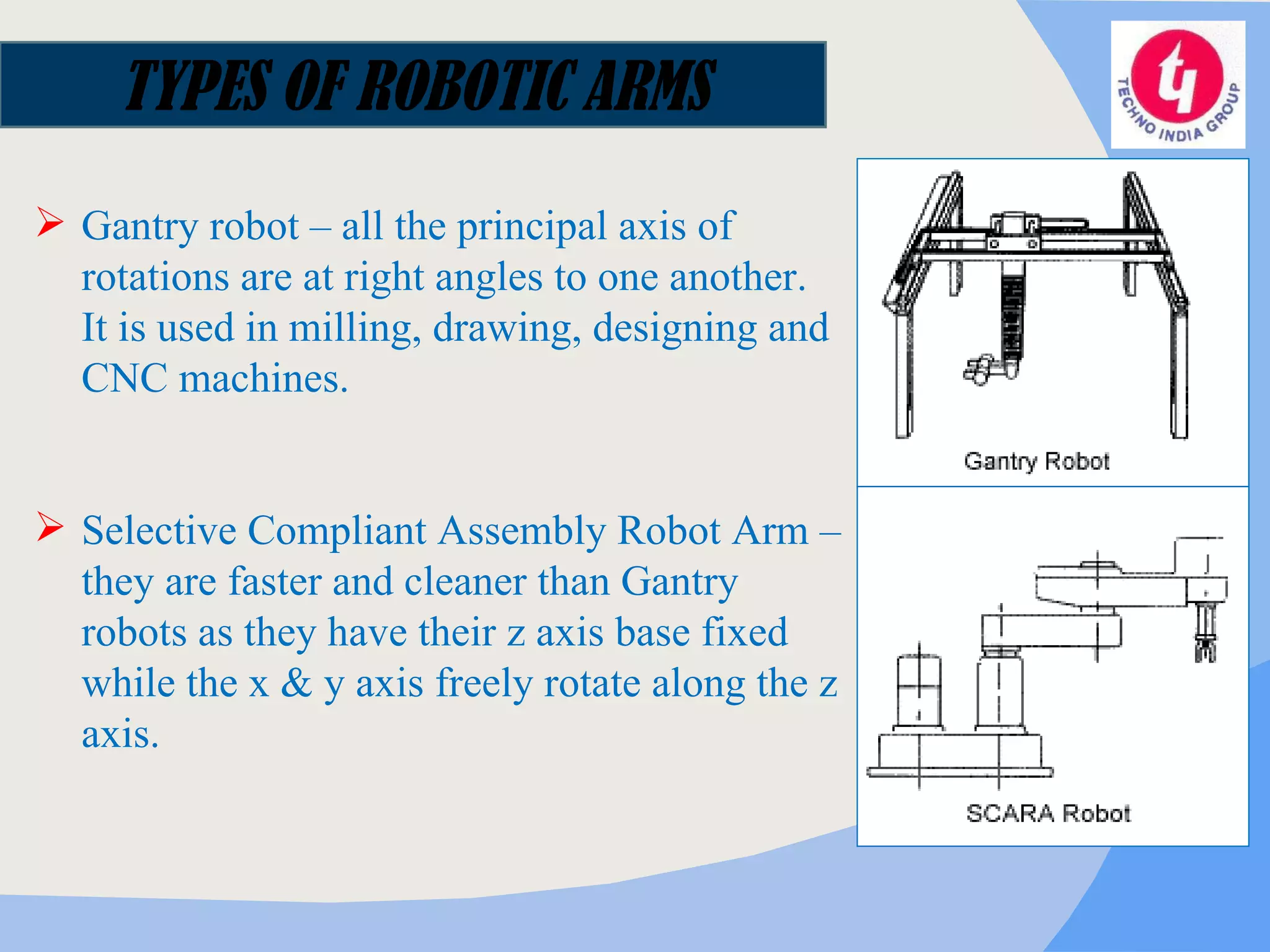
TYPES OF ROBOTIC ARMS Gantry robot – all the principal axis of rotations are at right angles to one another. It is used in milling, drawing, designing and CNC machines. Selective Compliant Assembly Robot Arm – they are faster and cleaner than Gantry robots as they have their z axis base fixed while the x & y axis freely rotate along the z axis.
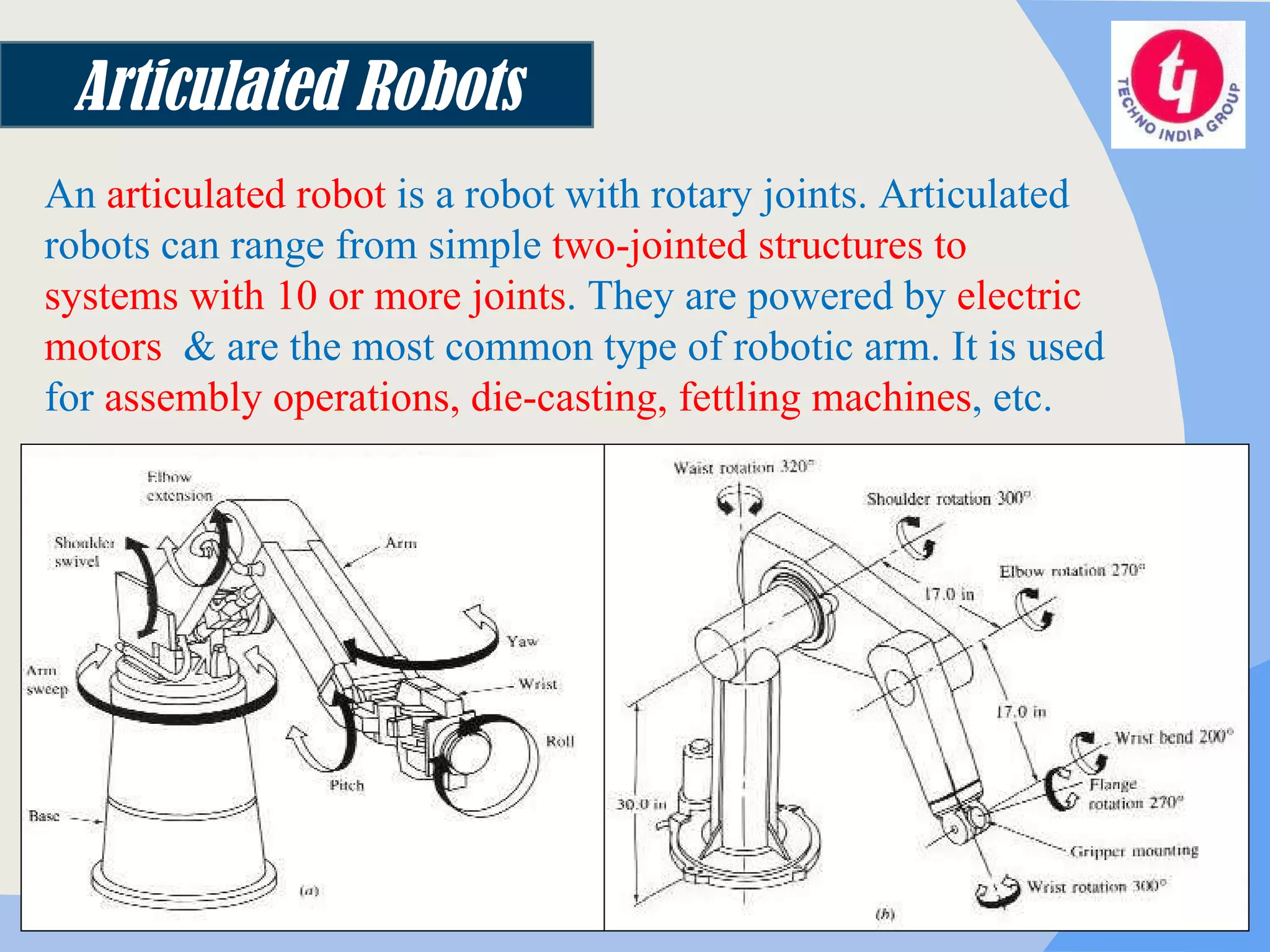
Articulated Robots An  articulated robot  is a robot with rotary joints.  Articulated robots can range from simple  two-jointed structures to systems with 10 or more joints . They are powered by  electric motors   & are the most common type of robotic arm. It is used for  assembly operations, die-casting, fettling machines , etc.
CONCLUSION Though, robotic automation has seen some of the  most advanced and successful use of modern engineering , the demerits of this form of automation should also be considered. Unemployment, heavy initial cost & discouraging labour practices  in countries with cheap labour are the negative impacts of automation.  In most cases, the  AI  of automated systems are monitored by  routine computer programs  & do not operate depending upon all system variables. Having said that, the  precision & speed  of working with heavy equipments have greatly improved  thanks to automation.
 

7th sem final presentation solar tracking system

  • 1.
  • 2.
    INTRODUCTION Automation is defined as the use of control systems and information technology to reduce the need of human work to produce goods and services Advantages of Automation It replaces mechanization thereby reducing the need for human mental and physical requirements. Perform tasks beyond human capabilities of size, weight, speed and endurance. Improves economy of enterprise, society and country.
  • 3.
  • 4.
    CLASSIFICATION Automated controlsystems may be classified as: Electronic Automation Pneumatic Automation Computer aided Automation Building Automation Laboratory Automation Home Automation Robotic arms, Conveyor belts and computer aided automation using DCS, SCADA, PLC , etc are some of the most important practical applications of automation
  • 5.
    COMPUTER AIDED AUTOMATIONComputer aided process control system is a special type of numerical control system , that uses predetermined instructions to control a sequence of operations. Objectivity: It identifies information flow. It manipulates material & energy flow of a process in a desired, optimal way. Types of Application: Active Application: deals with manipulation of process. Passive Application: deals with manipulation of process data
  • 6.
    Types of ComputerAided Process Control System : Batch or Sequential Control. Continuous Control. Supervisory Control. Direct Digital Control . TYPICAL COMPUTER AIDED PROCESS CONTROL SYSTEM COMPUTER AIDED AUTOMATION
  • 7.
    DISTRIBUTED CONTROL SYSTEMA Distributed Computer Control System refers to a control system in which the controller elements are not centrally located, but are distributed throughout the system, connected by networks for communication and monitoring Components of a DCS: Processor (Controller), I/O modules, Computer or Electrical Buses, Multiplexers & Demultiplexers . A DISTRIBUTED DIGITAL CONTROL ARCHITECTURE
  • 8.
    Applications: Electrical PowerGrids & Electrical Generation Plants. Metallurgical Process Plants. Chemical Plants. Oil Refining Plants. Sensor Networks. Traffic & Radio Signals. PROGRAMMABLE LOGIC CONTROLLERS Programmable Logic Controllers are industrially hardened microcomputers used for automation of electromechanical processes and in process plants and factories. DISTRIBUTED CONTROL SYSTEM
  • 9.
    Originally intended forrelay replacement equipment. PLC is an example of hard real time system. It is designed for multiple i/o arrangements, temperature ranges, immunity to noise, vibration and shock. Advantages: Easy programming & reprogramming in the plant. High reliability & small physical size. Ability to communicate with computer systems in a plant. PROGRAMMABLE LOGIC CONTROLLERS A PLC CONTROL PANEL
  • 10.
    PNEUMATIC AUTOMATION Fluidcomprises of liquids and gases, deforms on the application of shear stress . The technique that uses liquid for power transmission is called hydraulics while that using gas for the same is called pneumatics . The fluid system for power transmission obeys the fundamental Pascal’s law. For proper and reliable working of the hydraulic system the fluid ought to have the properties such as viscosity, oxidation resistance, pour and cloud point, flash and fire point, lubrication, heat generation and transmission, etc
  • 11.
    The most fluidsystem will employ some or all of the following parts: Pump or Compressor : This gives the motion to the fluid which is used to perform useful work Control Valves : These are used to regulate and control the flow of the fluid Tubes, pipes and Hoses : These carry the fluid from the pump/compressor to the actuator Actuator : The actual work is performed by the actuators. Discharge Tank : The liquid after performing work will be discharged into a tank in case of liquids /gases or will let into the atmosphere in case of air Seals : These prevent the leakage of fluid into the atmosphere or surroundings Filter, Lubricator and Regulator Circuit (FRL UNIT) : These circuit are used to remove dirt present in the fluid. They will also lubricate and regulate the flow of fluid Accumulator : These are used to produce head which can be converted into useful work PARTS OF FLUID SYSTEM
  • 12.
    Power transmission throughfluid requires less mechanical parts , also there is less possibility of breakage of parts like cams, gears, belts, etc. Ensures less noise and vibration in the system. Forces can be conveyed up and down with less loss in efficiency . System overload can be prevented by using automatic relief valves. More economic compared to other modes of operation. Hydraulic power system is used in different devices like hydraulic jack, hydraulic brakes, power steering, tractor. ADVANTAGES
  • 13.
    ROBOTIC ARM A robotic arm  is defined as an automatically controlled, reprogrammable, multipurpose manipulator that can rotate in two or more axes and is used for maintenance or manufacturing purposes. Uses of robotics arm: Painting, Assembly operations, Welding, Pick & place operations, Product inspection, Product testing.
  • 14.
    TYPES OF ROBOTICARMS Gantry robot – all the principal axis of rotations are at right angles to one another. It is used in milling, drawing, designing and CNC machines. Selective Compliant Assembly Robot Arm – they are faster and cleaner than Gantry robots as they have their z axis base fixed while the x & y axis freely rotate along the z axis.
  • 15.
    Articulated Robots An articulated robot  is a robot with rotary joints. Articulated robots can range from simple two-jointed structures to systems with 10 or more joints . They are powered by electric motors & are the most common type of robotic arm. It is used for assembly operations, die-casting, fettling machines , etc.
  • 16.
    CONCLUSION Though, roboticautomation has seen some of the most advanced and successful use of modern engineering , the demerits of this form of automation should also be considered. Unemployment, heavy initial cost & discouraging labour practices in countries with cheap labour are the negative impacts of automation. In most cases, the AI of automated systems are monitored by routine computer programs & do not operate depending upon all system variables. Having said that, the precision & speed of working with heavy equipments have greatly improved thanks to automation.
  • 17.