U20ECST10
ROBOTICS AND AUTOMATION
UNIT I FOUNDATION FOR BEGINNERS
Introduction - Brief history, Definition,
Anatomy, Types, Classification, Specification and
need based applications; Role and need of robots
for the immediate problems of the society, Future
of mankind and automation-Ethical issues;
industrial scenario local and global, Case studies
on mobile robot research platform and Industrial
serial arm manipulator.
ROBOT
•The term: robot has come from the Czech
word: robota, which means forced or slave
laborer.
•In 1921, Karel Capek, a Czech playwright,
used the term: robot first in his drama
named Rossum’s Universal Robots (R.U.R)
•According to Karel Capek, a robot is a
machine look-wise similar to a human
being
ROBOT - DEFINITION
According to Oxford English Dictionary
A machine capable of carrying out a complex series of
actions automatically, especially one programmable by a computer.
According to International Organization for Standardization (ISO):
An automatically controlled, reprogrammable,
multipurpose manipulator programmable in three or more axes,
which can be either fixed in place or mobile for use in industrial
automation applications.
According to Robot Institute of America (RIA)
It is a reprogrammable multi-functional manipulator
designed to move materials, parts, tools or specialized devices
through variable programmed motions for the performance of a
variety of tasks.
ROBOTICS
• It is a science, which deals with the issues related to
design, manufacturing, usages of robots.
• In 1942, the term: robotics was introduced by Isaac
Asimov in his story named Runaround.
• In robotics, we use the fundamentals of Physics,
Mathematics, Mechanical Engg., Electronics Engg.,
Electrical Engg., Computer Sciences, and others
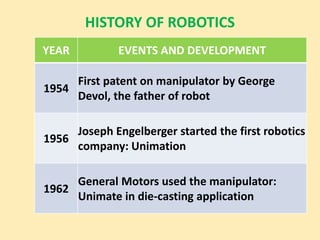
HISTORY OF ROBOTICS
YEAR EVENTS AND DEVELOPMENT
1954
First patent on manipulator by George
Devol, the father of robot
1956
Joseph Engelberger started the first robotics
company: Unimation
1962
General Motors used the manipulator:
Unimate in die-casting application
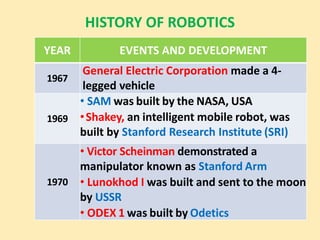
HISTORY OF ROBOTICS
YEAR EVENTS AND DEVELOPMENT
1967
General Electric Corporation made a 4-
legged vehicle
1969
• SAM was built by the NASA, USA
•Shakey, an intelligent mobile robot, was
built by Stanford Research Institute (SRI)
1970
• Victor Scheinman demonstrated a
manipulator known as Stanford Arm
• Lunokhod I was built and sent to the moon
by USSR
• ODEX 1 was built by Odetics
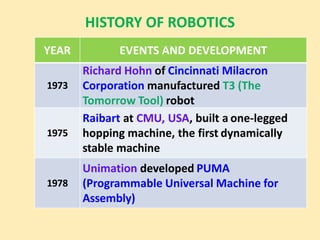
HISTORY OF ROBOTICS
YEAR EVENTS AND DEVELOPMENT
1973
Richard Hohn of Cincinnati Milacron
Corporation manufactured T3 (The
Tomorrow Tool) robot
1975
Raibart at CMU, USA, built a one-legged
hopping machine, the first dynamically
stable machine
1978
Unimation developed PUMA
(Programmable Universal Machine for
Assembly)
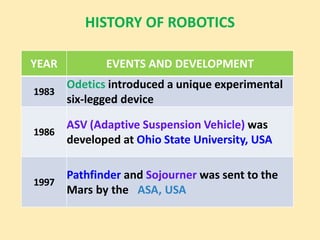
HISTORY OF ROBOTICS
YEAR EVENTS AND DEVELOPMENT
1983
Odetics introduced a unique experimental
six-legged device
1986
ASV (Adaptive Suspension Vehicle) was
developed at Ohio State University, USA
1997
Pathfinder and Sojourner was sent to the
Mars by the ASA, USA
HISTORY OF ROBOTICS
YEAR EVENTS AND DEVELOPMENT
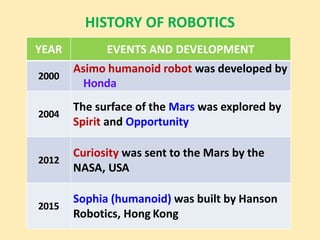
2000
Asimo humanoid robot was developed by
Honda
2004
The surface of the Mars was explored by
Spirit and Opportunity
2012
Curiosity was sent to the Mars by the
NASA, USA
2015
Sophia (humanoid) was built by Hanson
Robotics, Hong Kong
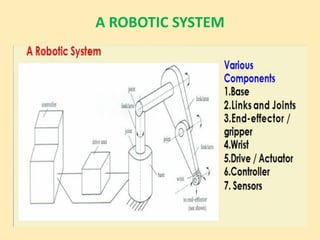
A ROBOTIC SYSTEM
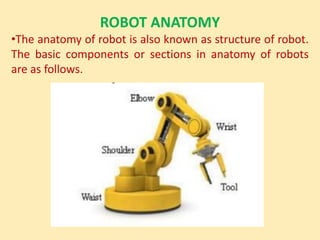
ROBOT ANATOMY
•The anatomy of robot is also known as structure of robot.
The basic components or sections in anatomy of robots
are as follows.
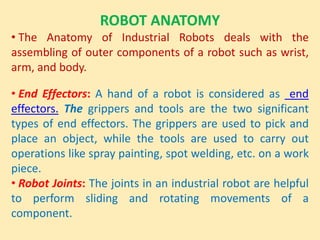
ROBOT ANATOMY
• The Anatomy of Industrial Robots deals with the
assembling of outer components of a robot such as wrist,
arm, and body.
• End Effectors: A hand of a robot is considered as end
effectors. The grippers and tools are the two significant
types of end effectors. The grippers are used to pick and
place an object, while the tools are used to carry out
operations like spray painting, spot welding, etc. on a work
piece.
• Robot Joints: The joints in an industrial robot are helpful
to perform sliding and rotating movements of a
component.
ROBOT ANATOMY
•The Anatomy of Industrial Robots deals with the
assembling of outer components of a robot such as wrist,
arm, and body.
• Manipulator: The manipulators in a robot are developed
by the integration of links and joints. In the body and arm,
it is applied for moving the tools in the work volume. It is
also used in the wrist to adjust the tools.
• Kinematics: It concerns with the assembling of robot
links and joints. It is also used to illustrate the robot
motions.
TYPES OF ROBOTS
GENERAL TYPES :
• Industrial robots. painting and welding robots.
• Medical robot to make surgery.
• Mobile robot with legs or wheel.
• Robotics aircrafts and boats.
• Robotic toys for entertainment .
• Robot for cleaning at home and industry.
CLASSIFICATION OF ROBOTS
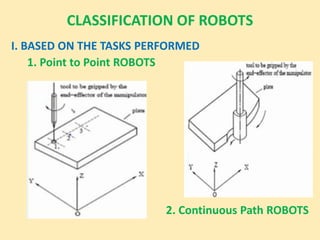
I. BASED ON THE TASKS PERFORMED
1. Point to Point ROBOTS
2. Continuous Path ROBOTS
CLASSIFICATION OF ROBOTS
II. BASED ON THE TYPE OF CONTROLLERS
1. Non Servo Controlled ROBOTS
• Open Loop
• Less Accurate
• Less Expensive
2. Servo Controlled ROBOTS
• Closed loop
• More Accurate
• More Expensive
CLASSIFICATION OF ROBOTS
III. BASED ON CONFIGURATION (Co- ordinate System of robot)
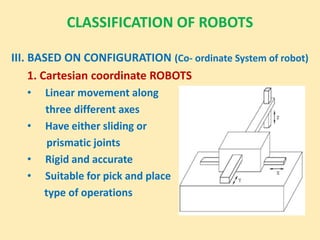
1. Cartesian coordinate ROBOTS
• Linear movement along
three different axes
• Have either sliding or
prismatic joints
• Rigid and accurate
• Suitable for pick and place
type of operations
CLASSIFICATION OF ROBOTS
III. BASED ON CONFIGURATION (Co- ordinate System of robot)
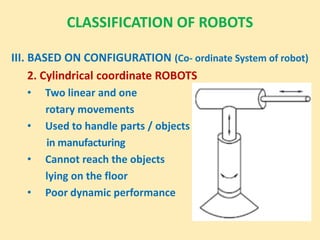
2. Cylindrical coordinate ROBOTS
• Two linear and one
rotary movements
• Used to handle parts / objects
in manufacturing
• Cannot reach the objects
lying on the floor
• Poor dynamic performance
CLASSIFICATION OF ROBOTS
III. BASED ON CONFIGURATION (Co- ordinate System of robot)
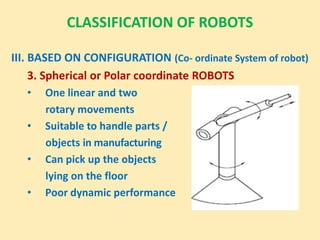
3. Spherical or Polar coordinate ROBOTS
• One linear and two
rotary movements
• Suitable to handle parts /
objects in manufacturing
• Can pick up the objects
lying on the floor
• Poor dynamic performance
CLASSIFICATION OF ROBOTS
III. BASED ON CONFIGURATION (Co- ordinate System of robot)
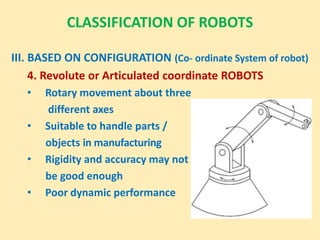
4. Revolute or Articulated coordinate ROBOTS
• Rotary movement about three
different axes
• Suitable to handle parts /
objects in manufacturing
• Rigidity and accuracy may not
be good enough
• Poor dynamic performance
CLASSIFICATION OF ROBOTS
IV. BASED ON MOBILITY LEVELS
1. ROBOTS with fixed base (Manipulators)
• Serial
• Parallel
2. MOBILE ROBOTS
• Wheeled Robots
• Tracked Robots
• Multi-Legged Robots
SPECIFICATION OF ROBOTS
Specification of a robot should contain the following .
• Resolution:
It is defined as the smallest allowable position
increment of a robot.
• Accuracy :
It is the precision with which a computed point
can be reached.
• Repeatability
It is defined as the precision with which a robot re-
position itself to a previous taught point.
SPECIFICATION OF ROBOTS
Specification of a robot should contain the following .
• Control type
• Drive system
• Coordinate system
• Teaching/Programming methods
• Pay-load capacity
•Weight of the manipulator
• Applications
• Range and speed of arms and wrist
• Sensors used
• End- effector / gripper used
APPLICATIONS OF ROBOTS
In MANUFACTURING UNITS
• Robots can work in hazardous and dirty environment.
• Can increase productivity after maintaining
improved quality.
• Direct labour cost will be reduced.
• Material cost will be reduced.
• Repetitive tasks can be handled more efficiently.
• Used in areas like Arc Welding, Spot Welding, Spray
Painting, Pick and Place Operation, Grinding, Drilling,
Milling.
APPLICATIONS OF ROBOTS
In UNDER WATER APPLICATIONS
• To explore various resources
• To study under-water environment
• To carry out drilling, pipe-line survey,
inspection and repair of ships
In MEDICAL APPLICATIONS
• Telesurgery
• Micro-capsule multi-legged robots
• Prosthetic devices
APPLICATIONS OF ROBOTS
In SPACE APPLICATIONS
• For carrying out on-orbit services, assembly job and
interplanetary missions
• Spacecraft deployment and retrieval, survey of outside
space shuttle; assembly, testing, maintenance of space
stations; transport of astronauts to various locations
• Robo -nauts
• Free-flying robots
• Planetary exploration rovers
APPLICATIONS OF ROBOTS
In AGRICULTURE
• For spraying pesticides
• For spraying fertilizers in liquid form
• Cleaning weeds
• Sowing seeds
• Inspection of plants
Some Other Applications
• Replacement of maid-servant
• Garbage collection
• Underground Coal mining
• Sewage-line cleaning and Fire-fighting etc.
ROLE AND NEED OF ROBOTS FOR THE
IMMEDIATE PROBLEMS OF THE SOCIETY
• These machines can interact with people and learn
quickly, making them valuable to many industries.
• They are often used in research or industrial purposes
but have also been increasingly used in entertainment and
military applications.
• These robots are programmed to have human-like
behaviors.
• Humanoid robots can be used for various purposes, such
as job training, industrial and domestic use, entertainment
purposes, medical applications, or military and
governmental use.
FUTURE OF MANKIND AND AUTOMATION
BENEFITS :
• Robots will increase economic growth and productivity
and create new career opportunities for many people
worldwide.
• The future of automation is one in which machines
become increasingly intelligent, adaptable, and
autonomous.
• This will be driven by advances in artificial intelligence,
machine learning, and robotics, which are making it
possible to automate tasks that were once thought to be
the exclusive domain of human workers.
FUTURE OF MANKIND AND AUTOMATION
ETHICAL ISSUES :
• One of the biggest concerns about automation is the
potential for job displacement. As machines become
more capable of performing tasks that were once done
by humans, many jobs will become obsolete.
• This may lead to job losses in certain industries,
particularly for workers in low-skilled, routine jobs.
• However, there are still warnings out there about
massive job losses, forecasting losses of 20 million
manufacturing jobs by 2030, or how 30% of all jobs could
be automated by 2030.
FUTURE OF MANKIND AND AUTOMATION
ADDRESSING THE ETHICAL ISSUES :
• As automation changes the nature of work, workers will
need to be trained in new skills and technologies. This
will require investments in education and training
programs, as well as new approaches to lifelong learning
that enable workers to adapt to changing technologies
throughout their careers.
• In addition, policymakers will need to consider new
approaches to social protection and support like wage
subsidies, income support, and retraining programs to
help workers who are displaced by automation.
MOBILE ROBOT RESEARCH PLATFORMS
• Warthog UGV.
• Husky UGV.
• Jackal UGV.
• Ridgeback.
• Boxer.
• Dingo.
• TurtleBot 4.
• Accessories.
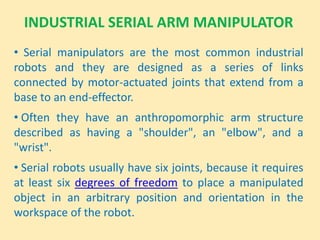
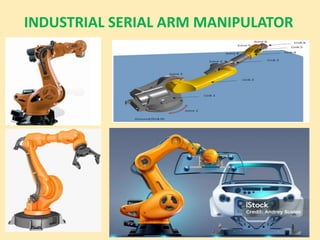
INDUSTRIAL SERIAL ARM MANIPULATOR
• Serial manipulators are the most common industrial
robots and they are designed as a series of links
connected by motor-actuated joints that extend from a
base to an end-effector.
• Often they have an anthropomorphic arm structure
described as having a "shoulder", an "elbow", and a
"wrist".
• Serial robots usually have six joints, because it requires
at least six degrees of freedom to place a manipulated
object in an arbitrary position and orientation in the
workspace of the robot.
INDUSTRIAL SERIAL ARM MANIPULATOR

robotica and automation . robotics introduction

  • 1.
    U20ECST10 ROBOTICS AND AUTOMATION UNITI FOUNDATION FOR BEGINNERS Introduction - Brief history, Definition, Anatomy, Types, Classification, Specification and need based applications; Role and need of robots for the immediate problems of the society, Future of mankind and automation-Ethical issues; industrial scenario local and global, Case studies on mobile robot research platform and Industrial serial arm manipulator.
  • 2.
    ROBOT •The term: robothas come from the Czech word: robota, which means forced or slave laborer. •In 1921, Karel Capek, a Czech playwright, used the term: robot first in his drama named Rossum’s Universal Robots (R.U.R) •According to Karel Capek, a robot is a machine look-wise similar to a human being
  • 3.
    ROBOT - DEFINITION Accordingto Oxford English Dictionary A machine capable of carrying out a complex series of actions automatically, especially one programmable by a computer. According to International Organization for Standardization (ISO): An automatically controlled, reprogrammable, multipurpose manipulator programmable in three or more axes, which can be either fixed in place or mobile for use in industrial automation applications. According to Robot Institute of America (RIA) It is a reprogrammable multi-functional manipulator designed to move materials, parts, tools or specialized devices through variable programmed motions for the performance of a variety of tasks.
  • 4.
    ROBOTICS • It isa science, which deals with the issues related to design, manufacturing, usages of robots. • In 1942, the term: robotics was introduced by Isaac Asimov in his story named Runaround. • In robotics, we use the fundamentals of Physics, Mathematics, Mechanical Engg., Electronics Engg., Electrical Engg., Computer Sciences, and others
  • 5.
    HISTORY OF ROBOTICS YEAREVENTS AND DEVELOPMENT 1954 First patent on manipulator by George Devol, the father of robot 1956 Joseph Engelberger started the first robotics company: Unimation 1962 General Motors used the manipulator: Unimate in die-casting application
  • 6.
    HISTORY OF ROBOTICS YEAREVENTS AND DEVELOPMENT 1967 General Electric Corporation made a 4- legged vehicle 1969 • SAM was built by the NASA, USA •Shakey, an intelligent mobile robot, was built by Stanford Research Institute (SRI) 1970 • Victor Scheinman demonstrated a manipulator known as Stanford Arm • Lunokhod I was built and sent to the moon by USSR • ODEX 1 was built by Odetics
  • 7.
    HISTORY OF ROBOTICS YEAREVENTS AND DEVELOPMENT 1973 Richard Hohn of Cincinnati Milacron Corporation manufactured T3 (The Tomorrow Tool) robot 1975 Raibart at CMU, USA, built a one-legged hopping machine, the first dynamically stable machine 1978 Unimation developed PUMA (Programmable Universal Machine for Assembly)
  • 8.
    HISTORY OF ROBOTICS YEAREVENTS AND DEVELOPMENT 1983 Odetics introduced a unique experimental six-legged device 1986 ASV (Adaptive Suspension Vehicle) was developed at Ohio State University, USA 1997 Pathfinder and Sojourner was sent to the Mars by the ASA, USA
  • 9.
    HISTORY OF ROBOTICS YEAREVENTS AND DEVELOPMENT 2000 Asimo humanoid robot was developed by Honda 2004 The surface of the Mars was explored by Spirit and Opportunity 2012 Curiosity was sent to the Mars by the NASA, USA 2015 Sophia (humanoid) was built by Hanson Robotics, Hong Kong
  • 10.
  • 11.
    ROBOT ANATOMY •The anatomyof robot is also known as structure of robot. The basic components or sections in anatomy of robots are as follows.
  • 12.
    ROBOT ANATOMY • TheAnatomy of Industrial Robots deals with the assembling of outer components of a robot such as wrist, arm, and body. • End Effectors: A hand of a robot is considered as end effectors. The grippers and tools are the two significant types of end effectors. The grippers are used to pick and place an object, while the tools are used to carry out operations like spray painting, spot welding, etc. on a work piece. • Robot Joints: The joints in an industrial robot are helpful to perform sliding and rotating movements of a component.
  • 13.
    ROBOT ANATOMY •The Anatomyof Industrial Robots deals with the assembling of outer components of a robot such as wrist, arm, and body. • Manipulator: The manipulators in a robot are developed by the integration of links and joints. In the body and arm, it is applied for moving the tools in the work volume. It is also used in the wrist to adjust the tools. • Kinematics: It concerns with the assembling of robot links and joints. It is also used to illustrate the robot motions.
  • 14.
    TYPES OF ROBOTS GENERALTYPES : • Industrial robots. painting and welding robots. • Medical robot to make surgery. • Mobile robot with legs or wheel. • Robotics aircrafts and boats. • Robotic toys for entertainment . • Robot for cleaning at home and industry.
  • 15.
    CLASSIFICATION OF ROBOTS I.BASED ON THE TASKS PERFORMED 1. Point to Point ROBOTS 2. Continuous Path ROBOTS
  • 16.
    CLASSIFICATION OF ROBOTS II.BASED ON THE TYPE OF CONTROLLERS 1. Non Servo Controlled ROBOTS • Open Loop • Less Accurate • Less Expensive 2. Servo Controlled ROBOTS • Closed loop • More Accurate • More Expensive
  • 17.
    CLASSIFICATION OF ROBOTS III.BASED ON CONFIGURATION (Co- ordinate System of robot) 1. Cartesian coordinate ROBOTS • Linear movement along three different axes • Have either sliding or prismatic joints • Rigid and accurate • Suitable for pick and place type of operations
  • 18.
    CLASSIFICATION OF ROBOTS III.BASED ON CONFIGURATION (Co- ordinate System of robot) 2. Cylindrical coordinate ROBOTS • Two linear and one rotary movements • Used to handle parts / objects in manufacturing • Cannot reach the objects lying on the floor • Poor dynamic performance
  • 19.
    CLASSIFICATION OF ROBOTS III.BASED ON CONFIGURATION (Co- ordinate System of robot) 3. Spherical or Polar coordinate ROBOTS • One linear and two rotary movements • Suitable to handle parts / objects in manufacturing • Can pick up the objects lying on the floor • Poor dynamic performance
  • 20.
    CLASSIFICATION OF ROBOTS III.BASED ON CONFIGURATION (Co- ordinate System of robot) 4. Revolute or Articulated coordinate ROBOTS • Rotary movement about three different axes • Suitable to handle parts / objects in manufacturing • Rigidity and accuracy may not be good enough • Poor dynamic performance
  • 21.
    CLASSIFICATION OF ROBOTS IV.BASED ON MOBILITY LEVELS 1. ROBOTS with fixed base (Manipulators) • Serial • Parallel 2. MOBILE ROBOTS • Wheeled Robots • Tracked Robots • Multi-Legged Robots
  • 22.
    SPECIFICATION OF ROBOTS Specificationof a robot should contain the following . • Resolution: It is defined as the smallest allowable position increment of a robot. • Accuracy : It is the precision with which a computed point can be reached. • Repeatability It is defined as the precision with which a robot re- position itself to a previous taught point.
  • 23.
    SPECIFICATION OF ROBOTS Specificationof a robot should contain the following . • Control type • Drive system • Coordinate system • Teaching/Programming methods • Pay-load capacity •Weight of the manipulator • Applications • Range and speed of arms and wrist • Sensors used • End- effector / gripper used
  • 24.
    APPLICATIONS OF ROBOTS InMANUFACTURING UNITS • Robots can work in hazardous and dirty environment. • Can increase productivity after maintaining improved quality. • Direct labour cost will be reduced. • Material cost will be reduced. • Repetitive tasks can be handled more efficiently. • Used in areas like Arc Welding, Spot Welding, Spray Painting, Pick and Place Operation, Grinding, Drilling, Milling.
  • 25.
    APPLICATIONS OF ROBOTS InUNDER WATER APPLICATIONS • To explore various resources • To study under-water environment • To carry out drilling, pipe-line survey, inspection and repair of ships In MEDICAL APPLICATIONS • Telesurgery • Micro-capsule multi-legged robots • Prosthetic devices
  • 26.
    APPLICATIONS OF ROBOTS InSPACE APPLICATIONS • For carrying out on-orbit services, assembly job and interplanetary missions • Spacecraft deployment and retrieval, survey of outside space shuttle; assembly, testing, maintenance of space stations; transport of astronauts to various locations • Robo -nauts • Free-flying robots • Planetary exploration rovers
  • 27.
    APPLICATIONS OF ROBOTS InAGRICULTURE • For spraying pesticides • For spraying fertilizers in liquid form • Cleaning weeds • Sowing seeds • Inspection of plants Some Other Applications • Replacement of maid-servant • Garbage collection • Underground Coal mining • Sewage-line cleaning and Fire-fighting etc.
  • 28.
    ROLE AND NEEDOF ROBOTS FOR THE IMMEDIATE PROBLEMS OF THE SOCIETY • These machines can interact with people and learn quickly, making them valuable to many industries. • They are often used in research or industrial purposes but have also been increasingly used in entertainment and military applications. • These robots are programmed to have human-like behaviors. • Humanoid robots can be used for various purposes, such as job training, industrial and domestic use, entertainment purposes, medical applications, or military and governmental use.
  • 29.
    FUTURE OF MANKINDAND AUTOMATION BENEFITS : • Robots will increase economic growth and productivity and create new career opportunities for many people worldwide. • The future of automation is one in which machines become increasingly intelligent, adaptable, and autonomous. • This will be driven by advances in artificial intelligence, machine learning, and robotics, which are making it possible to automate tasks that were once thought to be the exclusive domain of human workers.
  • 30.
    FUTURE OF MANKINDAND AUTOMATION ETHICAL ISSUES : • One of the biggest concerns about automation is the potential for job displacement. As machines become more capable of performing tasks that were once done by humans, many jobs will become obsolete. • This may lead to job losses in certain industries, particularly for workers in low-skilled, routine jobs. • However, there are still warnings out there about massive job losses, forecasting losses of 20 million manufacturing jobs by 2030, or how 30% of all jobs could be automated by 2030.
  • 31.
    FUTURE OF MANKINDAND AUTOMATION ADDRESSING THE ETHICAL ISSUES : • As automation changes the nature of work, workers will need to be trained in new skills and technologies. This will require investments in education and training programs, as well as new approaches to lifelong learning that enable workers to adapt to changing technologies throughout their careers. • In addition, policymakers will need to consider new approaches to social protection and support like wage subsidies, income support, and retraining programs to help workers who are displaced by automation.
  • 32.
    MOBILE ROBOT RESEARCHPLATFORMS • Warthog UGV. • Husky UGV. • Jackal UGV. • Ridgeback. • Boxer. • Dingo. • TurtleBot 4. • Accessories.
  • 33.
    INDUSTRIAL SERIAL ARMMANIPULATOR • Serial manipulators are the most common industrial robots and they are designed as a series of links connected by motor-actuated joints that extend from a base to an end-effector. • Often they have an anthropomorphic arm structure described as having a "shoulder", an "elbow", and a "wrist". • Serial robots usually have six joints, because it requires at least six degrees of freedom to place a manipulated object in an arbitrary position and orientation in the workspace of the robot.
  • 34.