Presentation title 3
Hazards?
Ahazard is a situation in the
workplace that harms the
health and safety of people and
damages plant and equipment.
It could involve a task, chemical
or equipment used. Hazard
management is a process
that can be used to improve the
health and safety of all
workplaces.
4.
Presentation title 4
Whatis
mechanical
hazards?
• A mechanical hazard is a harmful or danger
posing situation that involves machines
mostly in a working environment.
Mechanical hazards are common place in
work industries like, mining, manufacturing,
agriculture and construction.
• A mechanical hazard is any hazard involving
a machine or process. Motor vehicles,
aircraft, and air bags pose mechanical
hazards. Compressed gases or liquids can
also be considered .
• http://wiki.answers.com/Q/
What_are_the_mechanical
5.
Presentation title 5
typesof
mechanical
hazards(1)
Common Mechanical Injury Hazards:
• Cutting and Tearing: contact with a sharp edge,
the seriousness of cutting or tearing the skin
depends on how much damage is done to the
epidermis, dermis, capillaries, veins, arteries,
muscles and even bone.
• Shearing: typically occurred when operators
reached under the shearing blade to make an
adjustment or place materials there and activated
the blade before fully removing their hand.
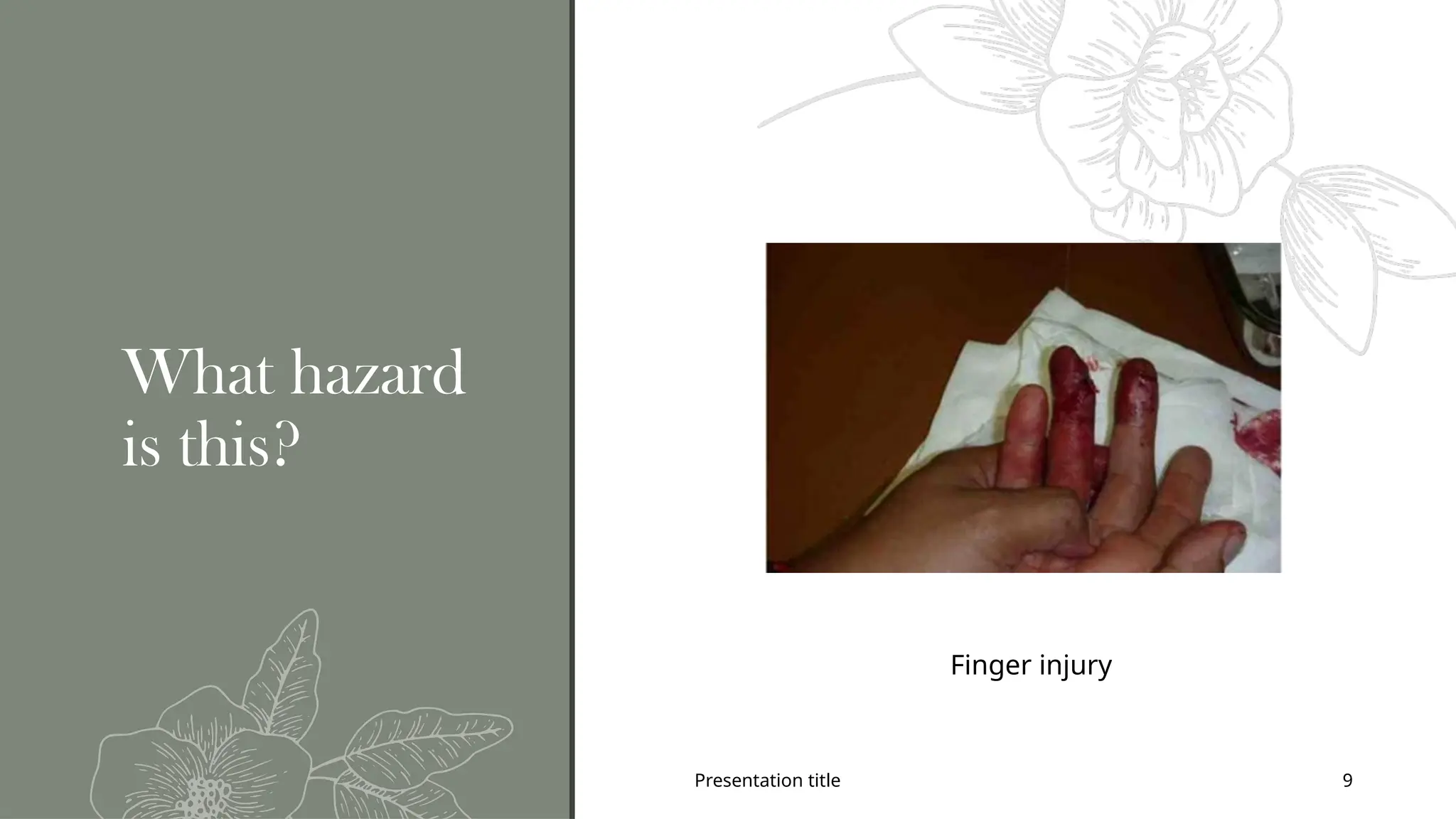
• Crushing: a part of the body is caught between
two hard surfaces that progressively move
together squeeze- point and run-in points.
6.
Presentation title 6
typesof
mechanical
hazards(2)
• Breaking: cause broken bone (fracture,
can be classified: simple, compound,
complete and incomplete or transverse,
oblique, comminuted)
• Straining and Spraining: muscles are
overstretched or torn. Sprain is the
result of torn ligaments in a joint
they can cause swelling.
• Puncturing: a sharp tool penetrates
straight into the body and pulls straight
out and creating a wound in the shape
of the penetrating object.
Presentation title 10
Risk
Assessment
Processof quantifying the level of risk
associated with the operation of a given
machine. It should be a structured and
systematic process that answers the
specific questions:
• How severe are potential injuries?
• How frequently are employees exposed
to the potential hazards?
• What is the possibility of avoiding the
hazard if it does occur?
• What is the likelihood of an injury should
a safety control system fail?
11.
Presentation title 11
Requirements
ofsafeguards
• Prevent contact: safeguards should prevent human
contact with any potentially harmful machine part.
• Be secure and durable: safeguards should be attached
so that they are secure.
• Protect against falling objects: objects falling onto
moving
• machine mechanism increase the risk of accidents,
property damage, and injury.
• Create no new hazard: safeguards should overcome
the
• hazards without creating new ones, e.g. a sharp edge,
unfinished surface or protruding bolts introduces new
hazard.
• Create no interference: safeguards can interfere with
the progress of work if they are not properly designed.
• Allow safe maintenance: safeguards should be
designed to
• allow the more frequently performed maintenance
12.
Presentation title 12
Pointof
Operation
Guards
Fixed guards: provide a permanent
barrier between worker and the point
of operation.
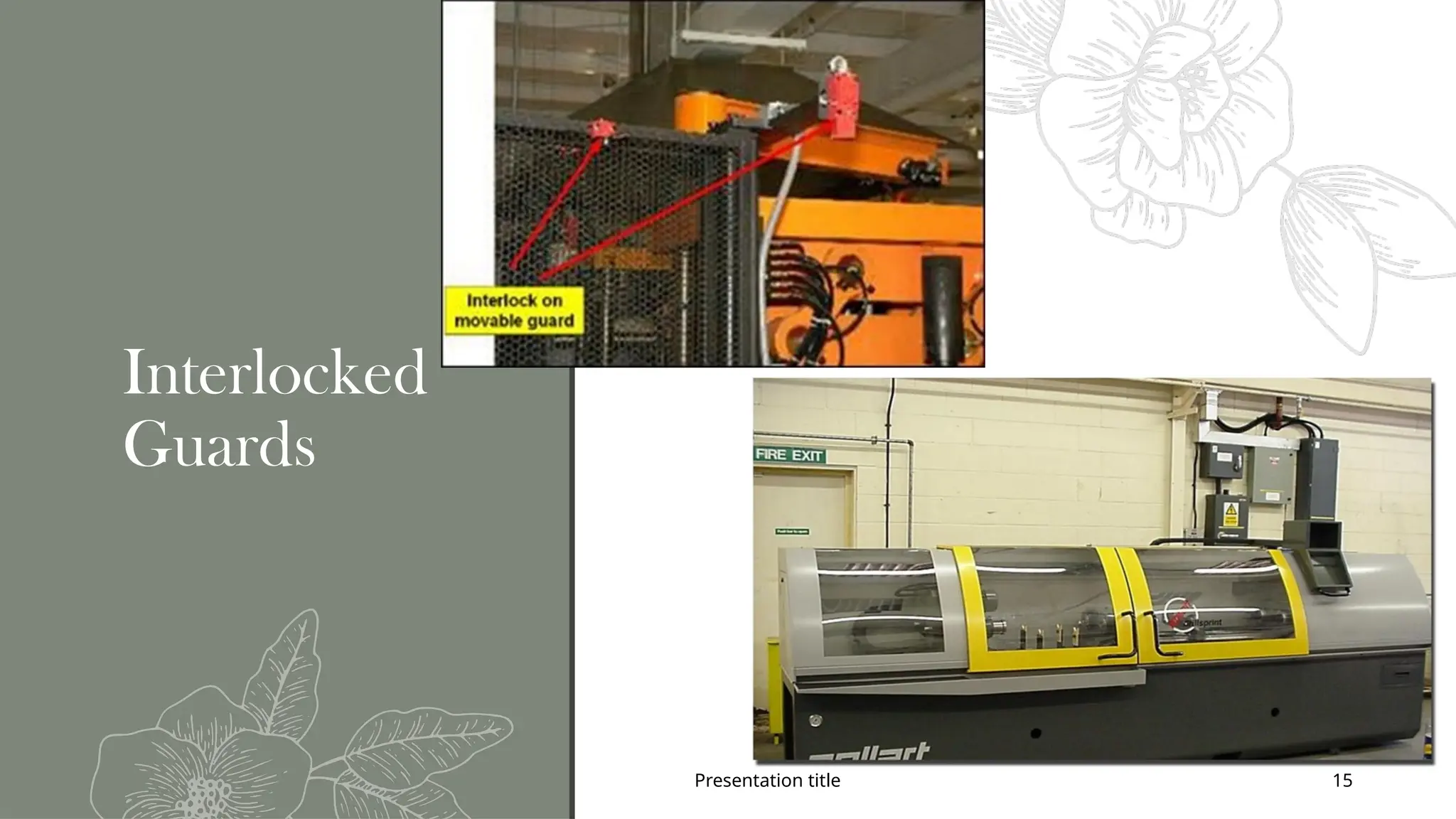
Interlocked guards: shut down the
machine when the guards is not
securely in place or is disengaged.
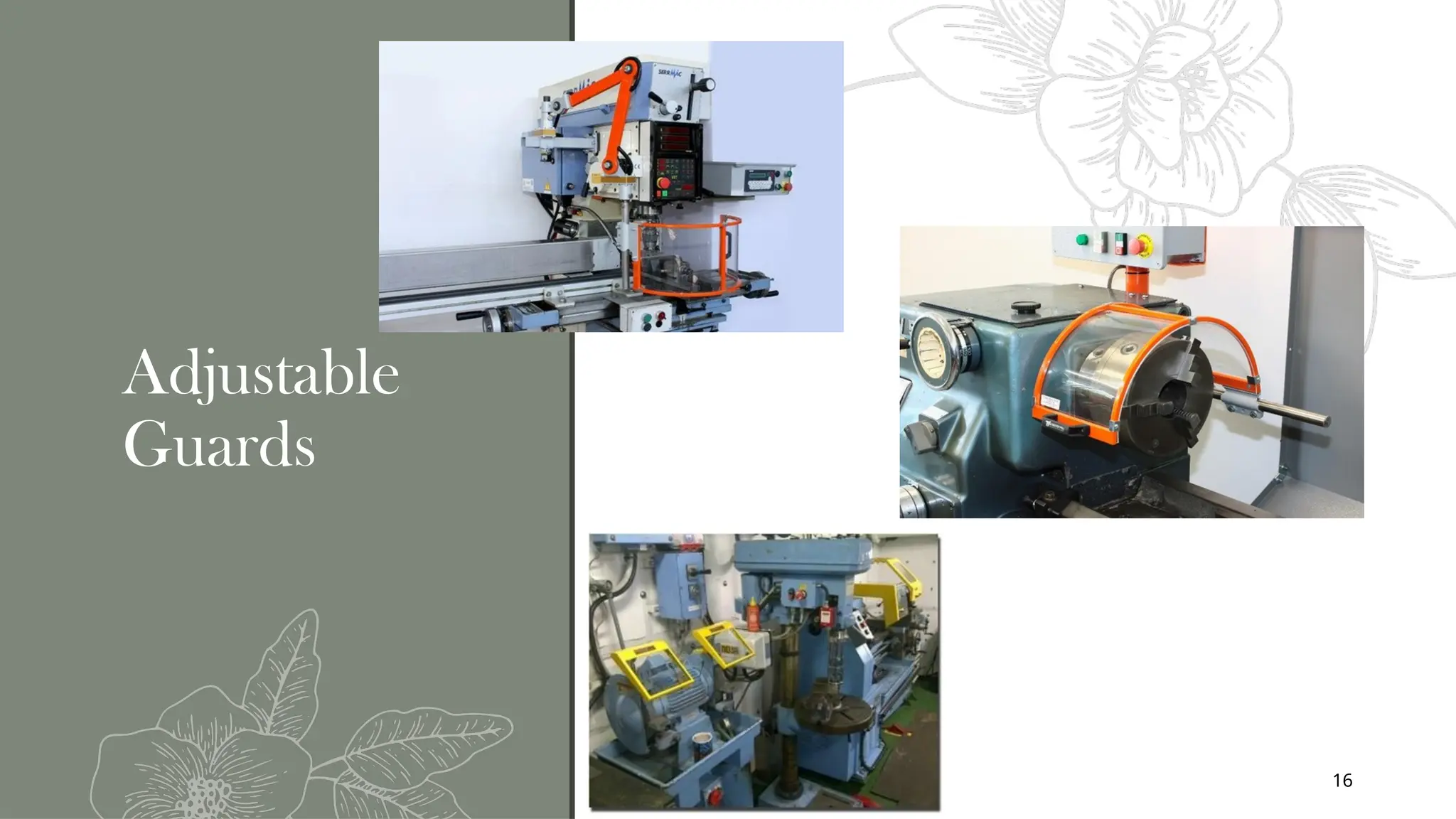
Adjustable guards: provide a barrier
against a variety of different hazards
associated with different production
operations.
Presentation title 17
Pointod
operation
devices
• Photoelectric devices
• Radio-frequency devices
• Electromechanical devices
• Pullback devices
• Restraint devices
• Safety trip devices
• Two-Hand controls
• Gates provide a barrier of the danger zone
18.
Presentation title 18
Feedingand
injection
• Automatic feed: eliminate the need for operators to enter
the danger zone.
• Semiautomatic: use a variety of approaches for feeding
stock to the machine.
• Automatic ejection: eject the work pneumatically or
mechanically, operators don’t have to reach into the
danger zone to retrieve work pieces.
• Semiautomatic ejection: eject the work using
mechanisms that are activated by the operator.
• Robot safeguards is any safety device, control, or
protective measure designed to prevent workers from
being injured while working near or with industrial robots.
Lockout / Tagout (LOTO) systems are safety procedures
used to control hazardous energy in machines or
equipment.Lockout: placing a lock on the energy-isolating
device to ensure the machine cannot be operated.Tagout:
attaching a warning tag to indicate that the equipment is
under maintenance or must not be used.
Presentation title 22
General
Precaution
•All operators should be trained in safe operation
and maintenance.
• All operators should be trained in the emergency
procedures.
• All employees should know how to activate
emergency shutdown.
• Inspection, maintenance, adjustment, repair, and
calibration of safeguards should be carried out
regularly.
• Supervisors should ensure that safeguards are
properly in place when machines are in use.
• Operator teams of the same system should be trained
in coordination techniques and proper use of
devices.
• Operators should be trained and supervised to ensure
that they dress
• Properly for the job (long hair, loose clothing, neckties,
rings, watches, necklaces, chains and ear-ring) can
become caught in equipment.
• Shortcuts that violate safety principles should be
avoided.
23.
Presentation title 23
FiveSteps to
Safety
• Am I physically fit to perform this task?
• Do I understand the risks that I will be
exposed when executing this task?
• Have I taken precautionary measures to
eliminate such risk?
• Am I equipped with correct PPEs for this task?
• Am I equipped with correct tools to do this
task?
If any of your answer is ”NO” Do not do this
Job!
24.
Presentation title 24
Resume
Controlof Mechanical Hazards:
• Prevention: SOP, OHS Promotion,
Safeguards, PPE, and Supervision
• Handling: Emergency Stop Switch,
First Aid, Medical Treatment