Coronavirus
and COVID-19
● Coronaviruses are a large family of
viruses which may cause illness in
animals or humans.
● In humans, several coronaviruses are
known to cause respiratory infections
ranging from the common cold to
more severe diseases such as Middle
East Respiratory Syndrome (MERS)
and Severe Acute Respiratory
Syndrome (SARS).
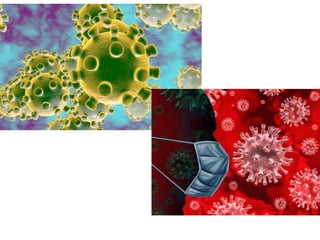
● The most recently discovered
coronavirus causes coronavirus
disease COVID-19.
What is a Coronavirus?
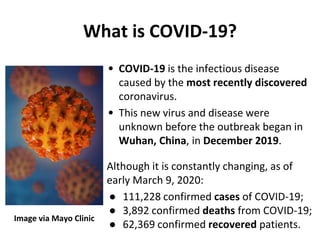
• COVID-19 is the infectious disease
caused by the most recently discovered
coronavirus.
• This new virus and disease were
unknown before the outbreak began in
Wuhan, China, in December 2019.
Although it is constantly changing, as of
early March 9, 2020:
● 111,228 confirmed cases of COVID-19;
● 3,892 confirmed deaths from COVID-19;
● 62,369 confirmed recovered patients.
What is COVID-19?
Image via Mayo Clinic
COVID-19 vs Influenza: Similarities
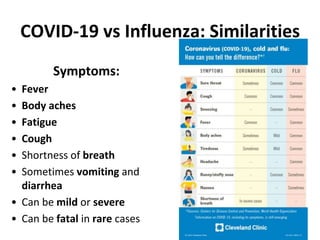
Symptoms:
• Fever
• Body aches
• Fatigue
• Cough
• Shortness of breath
• Sometimes vomiting and
diarrhea
• Can be mild or severe
• Can be fatal in rare cases
COVID-19 vs Influenza: Similarities
Transmission:
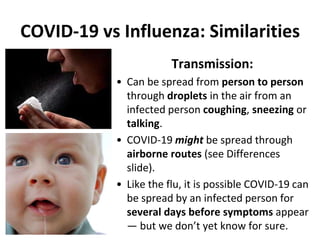
• Can be spread from person to person
through droplets in the air from an
infected person coughing, sneezing or
talking.
• COVID-19 might be spread through
airborne routes (see Differences
slide).
• Like the flu, it is possible COVID-19 can
be spread by an infected person for
several days before symptoms appear
— but we don’t yet know for sure.
COVID-19 vs Influenza: Similarities
Treatment:
• Neither virus is treatable with
antibiotics, which only work on
bacterial infections.
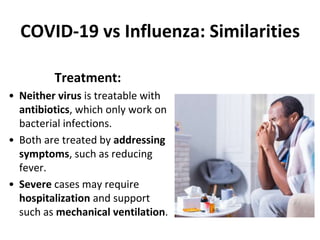
• Both are treated by addressing
symptoms, such as reducing
fever.
• Severe cases may require
hospitalization and support
such as mechanical ventilation.
COVID-19 vs Influenza: Similarities
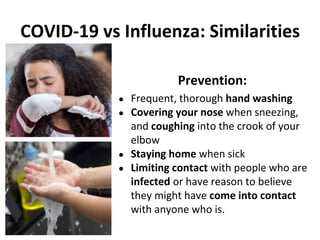
Prevention:
● Frequent, thorough hand washing
● Covering your nose when sneezing,
and coughing into the crook of your
elbow
● Staying home when sick
● Limiting contact with people who are
infected or have reason to believe
they might have come into contact
with anyone who is.
COVID-19 vs Influenza: Differences
Cause:
COVID-19: Caused by one virus, the novel 2019 coronavirus,
now called severe acute respiratory syndrome coronavirus 2, or
SARS-CoV-2.
Flu: Caused by any of several different types and strains of
influenza viruses.
COVID-19 vs Influenza: Differences
Transmission:
While the flu and COVID-19 may be transmitted in similar ways,
there is also one possible difference: COVID-19 might be spread
through the airborne route, meaning that tiny droplets
remaining in the air could cause disease in others even after
the ill person is no longer near.
COVID-19: Incubation
Incubation:
The incubation period for COVID-19 (i.e. the time between exposure to the virus and onset
of symptoms) is currently estimated at between two and 14 days.
COVID-19 Life
Life Cycle:
JHI: COVID-19 can persist on inanimate surfaces like metal, glass or plastic for up to 9 days,
but can be efficiently inactivated by surface disinfection procedures with 62–71% ethanol,
0.5% hydrogen peroxide or 0.1% sodium hypochlorite within 1 minute,
COVID-19 vs Influenza: Differences
Antiviral Medications:
COVID-19: Antiviral medications are currently being tested to
see if they can address symptoms.
Flu: Antiviral medications can address symptoms and
sometimes shorten the duration of the illness.
COVID-19 vs Influenza: Differences
Vaccine:
COVID-19: No vaccine is available at this time, though it is in
progress.
Flu: A vaccine is available and effective to prevent some of the
most dangerous types or to reduce the severity of the flu.
COVID-19 vs Influenza: Differences
● The COVID-19 situation is changing
rapidly.
● Since this disease is caused by a
new virus, people do not have
immunity to it, and a vaccine may
be many months away.
● Doctors and scientists are working
on estimating the mortality rate of
COVID-19, but at present, it is
thought to be higher than that of
most strains of the flu.
COVID-19 Animals
● Health authorities in Hong Kong have
confirmed that a dog belonging to a
person who had contracted the
coronavirus had also tested a 'weak
positive' for the virus.
● It is the first reported case of human-
to-animal transmission of the virus..
Coronavirus Covid March 2020

Coronavirus Covid March 2020

  • 1.
  • 2.
    ● Coronaviruses area large family of viruses which may cause illness in animals or humans. ● In humans, several coronaviruses are known to cause respiratory infections ranging from the common cold to more severe diseases such as Middle East Respiratory Syndrome (MERS) and Severe Acute Respiratory Syndrome (SARS). ● The most recently discovered coronavirus causes coronavirus disease COVID-19. What is a Coronavirus?
  • 3.
    • COVID-19 isthe infectious disease caused by the most recently discovered coronavirus. • This new virus and disease were unknown before the outbreak began in Wuhan, China, in December 2019. Although it is constantly changing, as of early March 9, 2020: ● 111,228 confirmed cases of COVID-19; ● 3,892 confirmed deaths from COVID-19; ● 62,369 confirmed recovered patients. What is COVID-19? Image via Mayo Clinic
  • 4.
    COVID-19 vs Influenza:Similarities Symptoms: • Fever • Body aches • Fatigue • Cough • Shortness of breath • Sometimes vomiting and diarrhea • Can be mild or severe • Can be fatal in rare cases
  • 5.
    COVID-19 vs Influenza:Similarities Transmission: • Can be spread from person to person through droplets in the air from an infected person coughing, sneezing or talking. • COVID-19 might be spread through airborne routes (see Differences slide). • Like the flu, it is possible COVID-19 can be spread by an infected person for several days before symptoms appear — but we don’t yet know for sure.
  • 6.
    COVID-19 vs Influenza:Similarities Treatment: • Neither virus is treatable with antibiotics, which only work on bacterial infections. • Both are treated by addressing symptoms, such as reducing fever. • Severe cases may require hospitalization and support such as mechanical ventilation.
  • 7.
    COVID-19 vs Influenza:Similarities Prevention: ● Frequent, thorough hand washing ● Covering your nose when sneezing, and coughing into the crook of your elbow ● Staying home when sick ● Limiting contact with people who are infected or have reason to believe they might have come into contact with anyone who is.
  • 8.
    COVID-19 vs Influenza:Differences Cause: COVID-19: Caused by one virus, the novel 2019 coronavirus, now called severe acute respiratory syndrome coronavirus 2, or SARS-CoV-2. Flu: Caused by any of several different types and strains of influenza viruses.
  • 9.
    COVID-19 vs Influenza:Differences Transmission: While the flu and COVID-19 may be transmitted in similar ways, there is also one possible difference: COVID-19 might be spread through the airborne route, meaning that tiny droplets remaining in the air could cause disease in others even after the ill person is no longer near.
  • 10.
    COVID-19: Incubation Incubation: The incubationperiod for COVID-19 (i.e. the time between exposure to the virus and onset of symptoms) is currently estimated at between two and 14 days.
  • 11.
    COVID-19 Life Life Cycle: JHI:COVID-19 can persist on inanimate surfaces like metal, glass or plastic for up to 9 days, but can be efficiently inactivated by surface disinfection procedures with 62–71% ethanol, 0.5% hydrogen peroxide or 0.1% sodium hypochlorite within 1 minute,
  • 12.
    COVID-19 vs Influenza:Differences Antiviral Medications: COVID-19: Antiviral medications are currently being tested to see if they can address symptoms. Flu: Antiviral medications can address symptoms and sometimes shorten the duration of the illness.
  • 13.
    COVID-19 vs Influenza:Differences Vaccine: COVID-19: No vaccine is available at this time, though it is in progress. Flu: A vaccine is available and effective to prevent some of the most dangerous types or to reduce the severity of the flu.
  • 14.
    COVID-19 vs Influenza:Differences ● The COVID-19 situation is changing rapidly. ● Since this disease is caused by a new virus, people do not have immunity to it, and a vaccine may be many months away. ● Doctors and scientists are working on estimating the mortality rate of COVID-19, but at present, it is thought to be higher than that of most strains of the flu.
  • 15.
    COVID-19 Animals ● Healthauthorities in Hong Kong have confirmed that a dog belonging to a person who had contracted the coronavirus had also tested a 'weak positive' for the virus. ● It is the first reported case of human- to-animal transmission of the virus..