Robotics
By
What are robots?
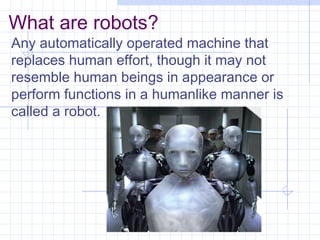
Any automatically operated machine that
replaces human effort, though it may not
resemble human beings in appearance or
perform functions in a humanlike manner is
called a robot.
3 Laws of robotics:
Law Zero: A robot may not injure humanity, or,
through inaction, allow humanity to come to harm.
Law One: A robot may not injure a human being, or,
through inaction, allow a human being to come to
harm, unless this would violate a higher order law.
Law Two: A robot must obey orders given it by
human beings, except where such orders would
conflict with a higher order law.
Law Three: A robot must protect its own existence
as long as such protection does not conflict with a
higher order law.
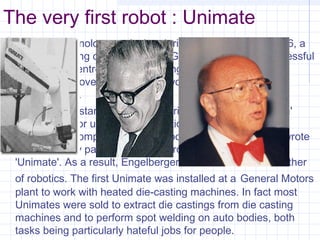
The very first robot : Unimate
After the technology explosion during World War II, in 1956, a
historic meeting occurs between George C. Devol, a successful
inventor and entrepreneur, and engineer Joseph F.
Engelberger, over cocktails the two discuss the writings of
Isaac Asimov.
Engelberger started a manufacturing company 'Unimation'
which stood for universal automation and so the first
commercial company to make robots was formed. Devol wrote
the necessary patents. Their first robot nicknamed the
'Unimate'. As a result, Engelberger has been called the 'father
of robotics. The first Unimate was installed at a General Motors
plant to work with heated die-casting machines. In fact most
Unimates were sold to extract die castings from die casting
machines and to perform spot welding on auto bodies, both
tasks being particularly hateful jobs for people.
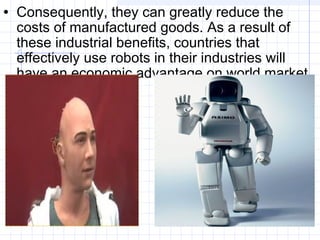
• Consequently, they can greatly reduce the
costs of manufactured goods. As a result of
these industrial benefits, countries that
effectively use robots in their industries will
have an economic advantage on world market.
BENEFITS:
• Robots offer specific benefits to workers, industries
and countries. If introduced correctly, industrial
robots can improve the quality of life by freeing
workers from dirty, boring, dangerous and heavy
labor. it is true that robots can cause
unemployment by replacing human workers but
robots also create jobs: robot technicians,
salesmen, engineers, programmers and
supervisors.
• The benefits of robots to industry include improved
management control and productivity and
consistently high quality products. Industrial robots
can work tirelessly night and day on an assembly
line without an loss in performance.
In the modern world , robots are of great use.
Robots offer specific benefits to workers, industries
and countries. If introduced correctly, industrial robots
can improve the quality of life by freeing workers from
dirty, boring, dangerous and heavy labor.
It is true that robots can cause unemployment by
replacing human workers but robots also create jobs:
robot technicians, salesmen, engineers, programmers
and supervisors.
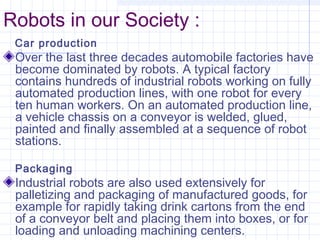
Robots in our Society :
Car production
Over the last three decades automobile factories have
become dominated by robots. A typical factory
contains hundreds of industrial robots working on fully
automated production lines, with one robot for every
ten human workers. On an automated production line,
a vehicle chassis on a conveyor is welded, glued,
painted and finally assembled at a sequence of robot
stations.
Packaging
Industrial robots are also used extensively for
palletizing and packaging of manufactured goods, for
example for rapidly taking drink cartons from the end
of a conveyor belt and placing them into boxes, or for
loading and unloading machining centers.
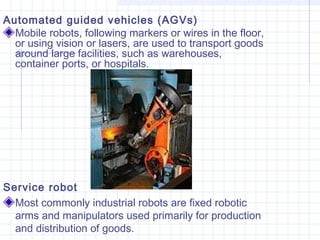
Automated guided vehicles (AGVs)
Mobile robots, following markers or wires in the floor,
or using vision or lasers, are used to transport goods
around large facilities, such as warehouses,
container ports, or hospitals.
Service robot
Most commonly industrial robots are fixed robotic
arms and manipulators used primarily for production
and distribution of goods.
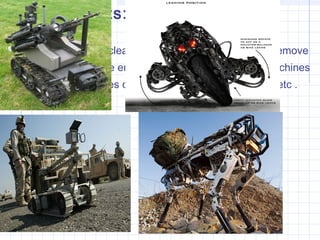
Military robots:
Robots are used to clear landmines from battle fields , remove
Hostile objects from the environment, take bulky heavy machines
to places where vehicles cannot go i.e. rugged mountains etc .
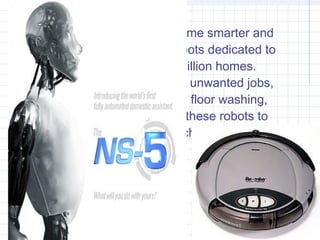
In the home
As prices fall and robots become smarter and
more autonomous, simple robots dedicated to
a single task work in over a million homes.
They are taking on simple but unwanted jobs,
such as vacuum cleaning and floor washing,
and lawn mowing. Some find these robots to
be cute and entertaining, which is one reason
that they can sell very well.
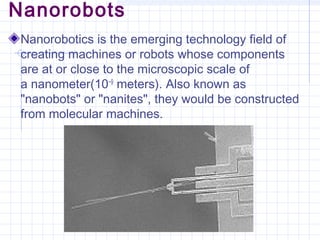
Nanorobots
Nanorobotics is the emerging technology field of
creating machines or robots whose components
are at or close to the microscopic scale of
a nanometer(10−9
 meters). Also known as
"nanobots" or "nanites", they would be constructed
from molecular machines.
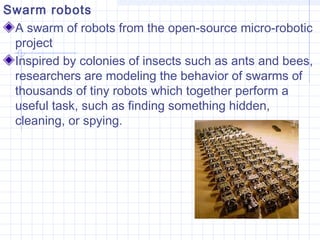
Swarm robots
A swarm of robots from the open-source micro-robotic
project
Inspired by colonies of insects such as ants and bees,
researchers are modeling the behavior of swarms of
thousands of tiny robots which together perform a
useful task, such as finding something hidden,
cleaning, or spying.
DISADVANTAGES
Dangers and human harm
Marauding robots may have entertainment value, but unsafe
use of robots constitutes an actual danger.
A heavy industrial robot with powerful actuators and
unpredictably complex behavior can cause harm, for instance
by stepping on a human's foot or falling on a human.
Most industrial robots operate inside a security fence which
separates them from human workers but not all.
Four robot-caused deaths,. Robert Williams was struck by a
robotic arm at a casting plant in Flat Rock, Michigan on
January 25, 1979.
Many more accidents has happened similarly . . . . . .
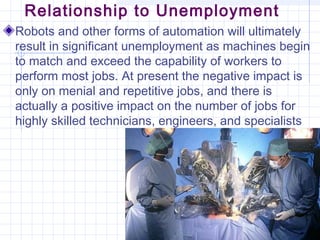
Relationship to Unemployment
Robots and other forms of automation will ultimately
result in significant unemployment as machines begin
to match and exceed the capability of workers to
perform most jobs. At present the negative impact is
only on menial and repetitive jobs, and there is
actually a positive impact on the number of jobs for
highly skilled technicians, engineers, and specialists
Decision making capablity:
Smart missiles and autonomous bombs equipped with
artificial perception can be considered robots, and
they make some of their decisions autonomously. This
represents an important and dangerous trend in which
humans are handing over important decisions to
machines.
POPULARITY:
Robots were first mentioned in the novel Irobot by
Isaac Asimov.
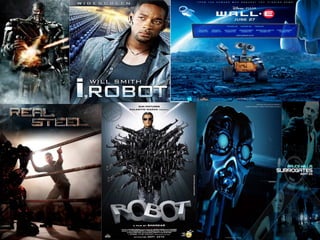
Later robots were popularized to public by using
them in movies like Terminator, Wall E,
Transformers, Surrogates, Irobot , Enthiran
and recently in the Movie Real Steel.
Robotics and Technology

Robotics and Technology

  • 1.
  • 2.
    What are robots? Anyautomatically operated machine that replaces human effort, though it may not resemble human beings in appearance or perform functions in a humanlike manner is called a robot.
  • 4.
    3 Laws ofrobotics: Law Zero: A robot may not injure humanity, or, through inaction, allow humanity to come to harm. Law One: A robot may not injure a human being, or, through inaction, allow a human being to come to harm, unless this would violate a higher order law. Law Two: A robot must obey orders given it by human beings, except where such orders would conflict with a higher order law. Law Three: A robot must protect its own existence as long as such protection does not conflict with a higher order law.
  • 5.
    The very firstrobot : Unimate After the technology explosion during World War II, in 1956, a historic meeting occurs between George C. Devol, a successful inventor and entrepreneur, and engineer Joseph F. Engelberger, over cocktails the two discuss the writings of Isaac Asimov. Engelberger started a manufacturing company 'Unimation' which stood for universal automation and so the first commercial company to make robots was formed. Devol wrote the necessary patents. Their first robot nicknamed the 'Unimate'. As a result, Engelberger has been called the 'father of robotics. The first Unimate was installed at a General Motors plant to work with heated die-casting machines. In fact most Unimates were sold to extract die castings from die casting machines and to perform spot welding on auto bodies, both tasks being particularly hateful jobs for people.
  • 6.
    • Consequently, theycan greatly reduce the costs of manufactured goods. As a result of these industrial benefits, countries that effectively use robots in their industries will have an economic advantage on world market.
  • 7.
    BENEFITS: • Robots offerspecific benefits to workers, industries and countries. If introduced correctly, industrial robots can improve the quality of life by freeing workers from dirty, boring, dangerous and heavy labor. it is true that robots can cause unemployment by replacing human workers but robots also create jobs: robot technicians, salesmen, engineers, programmers and supervisors. • The benefits of robots to industry include improved management control and productivity and consistently high quality products. Industrial robots can work tirelessly night and day on an assembly line without an loss in performance.
  • 8.
    In the modernworld , robots are of great use. Robots offer specific benefits to workers, industries and countries. If introduced correctly, industrial robots can improve the quality of life by freeing workers from dirty, boring, dangerous and heavy labor. It is true that robots can cause unemployment by replacing human workers but robots also create jobs: robot technicians, salesmen, engineers, programmers and supervisors.
  • 9.
    Robots in ourSociety : Car production Over the last three decades automobile factories have become dominated by robots. A typical factory contains hundreds of industrial robots working on fully automated production lines, with one robot for every ten human workers. On an automated production line, a vehicle chassis on a conveyor is welded, glued, painted and finally assembled at a sequence of robot stations. Packaging Industrial robots are also used extensively for palletizing and packaging of manufactured goods, for example for rapidly taking drink cartons from the end of a conveyor belt and placing them into boxes, or for loading and unloading machining centers.
  • 10.
    Automated guided vehicles (AGVs) Mobilerobots, following markers or wires in the floor, or using vision or lasers, are used to transport goods around large facilities, such as warehouses, container ports, or hospitals. Service robot Most commonly industrial robots are fixed robotic arms and manipulators used primarily for production and distribution of goods.
  • 11.
    Military robots: Robots areused to clear landmines from battle fields , remove Hostile objects from the environment, take bulky heavy machines to places where vehicles cannot go i.e. rugged mountains etc .
  • 12.
    In the home Asprices fall and robots become smarter and more autonomous, simple robots dedicated to a single task work in over a million homes. They are taking on simple but unwanted jobs, such as vacuum cleaning and floor washing, and lawn mowing. Some find these robots to be cute and entertaining, which is one reason that they can sell very well.
  • 13.
    Nanorobots Nanorobotics is the emerging technology fieldof creating machines or robots whose components are at or close to the microscopic scale of a nanometer(10−9  meters). Also known as "nanobots" or "nanites", they would be constructed from molecular machines.
  • 14.
    Swarm robots A swarm of robotsfrom the open-source micro-robotic project Inspired by colonies of insects such as ants and bees, researchers are modeling the behavior of swarms of thousands of tiny robots which together perform a useful task, such as finding something hidden, cleaning, or spying.
  • 15.
  • 16.
    Dangers and humanharm Marauding robots may have entertainment value, but unsafe use of robots constitutes an actual danger. A heavy industrial robot with powerful actuators and unpredictably complex behavior can cause harm, for instance by stepping on a human's foot or falling on a human. Most industrial robots operate inside a security fence which separates them from human workers but not all. Four robot-caused deaths,. Robert Williams was struck by a robotic arm at a casting plant in Flat Rock, Michigan on January 25, 1979. Many more accidents has happened similarly . . . . . .
  • 17.
    Relationship to Unemployment Robotsand other forms of automation will ultimately result in significant unemployment as machines begin to match and exceed the capability of workers to perform most jobs. At present the negative impact is only on menial and repetitive jobs, and there is actually a positive impact on the number of jobs for highly skilled technicians, engineers, and specialists
  • 18.
    Decision making capablity: Smartmissiles and autonomous bombs equipped with artificial perception can be considered robots, and they make some of their decisions autonomously. This represents an important and dangerous trend in which humans are handing over important decisions to machines.
  • 19.
    POPULARITY: Robots were firstmentioned in the novel Irobot by Isaac Asimov. Later robots were popularized to public by using them in movies like Terminator, Wall E, Transformers, Surrogates, Irobot , Enthiran and recently in the Movie Real Steel.