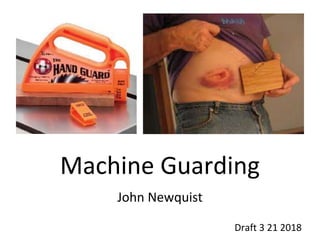
Machine Guarding
Draft 3 21 2018
John Newquist
208
225
273
504
1343
219(d)(1)
215(a)(4)
215(b)(9)
212(a)(3)(ii)
212(a)(1)
Machinery & Machine Guarding
[1910.211 – .219]
2
GENERAL REQUIREMENTS– TYPES OF GUARDING METHODS
ABRASIVE WHEEL – WORK RESTS
POWER TRANSMISSION – GUARDING FOR PULLEYS
GENERAL REQUIREMENTS – POINT OF OPERATION
ABRASIVE WHEEL– TONGUE GUARDS
SUBPARTO
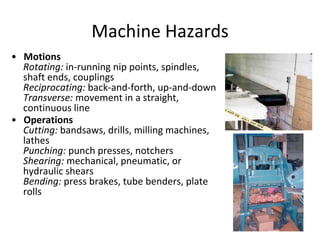
Machine Hazards
• Motions
Rotating: in-running nip points, spindles,
shaft ends, couplings
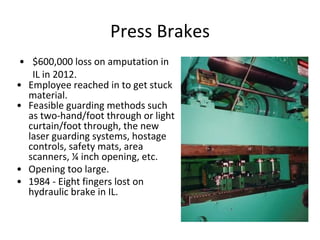
Reciprocating: back-and-forth, up-and-down
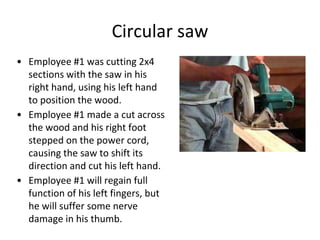
Transverse: movement in a straight,
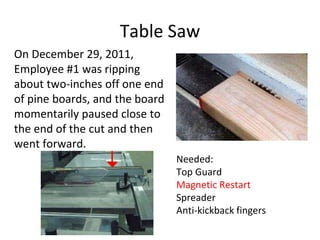
continuous line
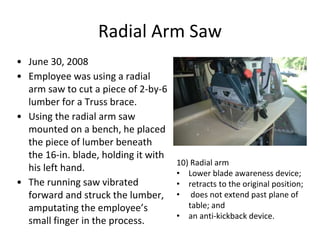
• Operations
Cutting: bandsaws, drills, milling machines,
lathes
Punching: punch presses, notchers
Shearing: mechanical, pneumatic, or
hydraulic shears
Bending: press brakes, tube benders, plate
rolls
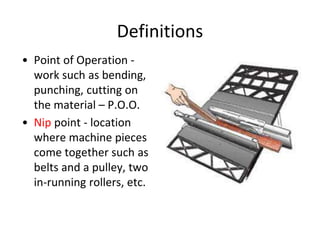
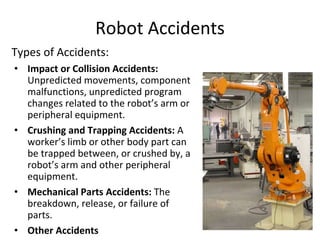
Definitions
• Point of Operation -
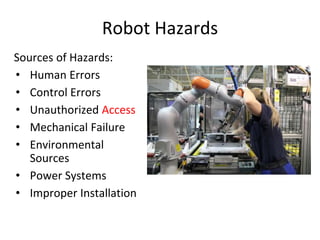
work such as bending,
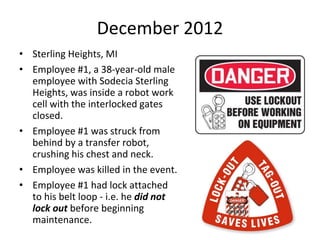
punching, cutting on
the material – P.O.O.
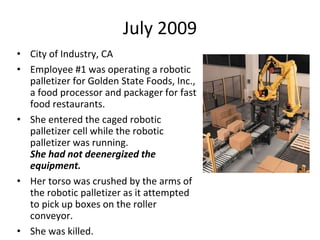
• Nip point - location
where machine pieces
come together such as
belts and a pulley, two
in-running rollers, etc.
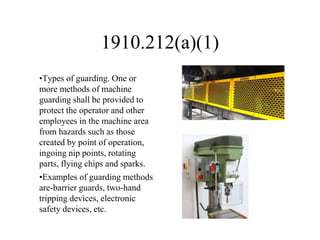
1910.212(a)(1)
•Types of guarding. One or
more methods of machine
guarding shall be provided to
protect the operator and other
employees in the machine area
from hazards such as those
created by point of operation,
ingoing nip points, rotating
parts, flying chips and sparks.
•Examples of guarding methods
are-barrier guards, two-hand
tripping devices, electronic
safety devices, etc.
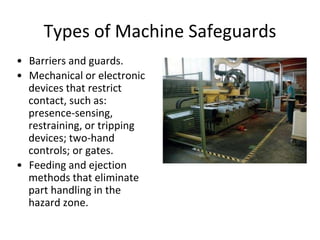
Types of Machine Safeguards
• Barriers and guards.
• Mechanical or electronic
devices that restrict
contact, such as:
presence-sensing,
restraining, or tripping
devices; two-hand
controls; or gates.
• Feeding and ejection
methods that eliminate
part handling in the
hazard zone.
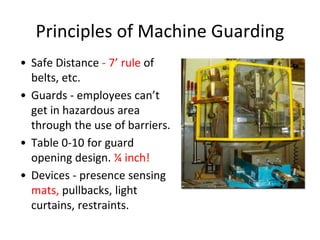
Principles of Machine Guarding
• Safe Distance - 7’ rule of
belts, etc.
• Guards - employees can’t
get in hazardous area
through the use of barriers.
• Table 0-10 for guard
opening design. ¼ inch!
• Devices - presence sensing
mats, pullbacks, light
curtains, restraints.
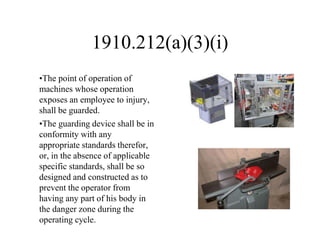
1910.212(a)(3)(i)
•The point of operation of
machines whose operation
exposes an employee to injury,
shall be guarded.
•The guarding device shall be in
conformity with any
appropriate standards therefor,
or, in the absence of applicable
specific standards, shall be so
designed and constructed as to
prevent the operator from
having any part of his body in
the danger zone during the
operating cycle.
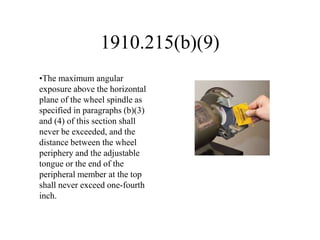
1910.215(b)(9)
•The maximum angular
exposure above the horizontal
plane of the wheel spindle as
specified in paragraphs (b)(3)
and (4) of this section shall
never be exceeded, and the
distance between the wheel
periphery and the adjustable
tongue or the end of the
peripheral member at the top
shall never exceed one-fourth
inch.
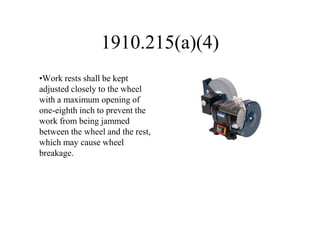
1910.215(a)(4)
•Work rests shall be kept
adjusted closely to the wheel
with a maximum opening of
one-eighth inch to prevent the
work from being jammed
between the wheel and the rest,
which may cause wheel
breakage.
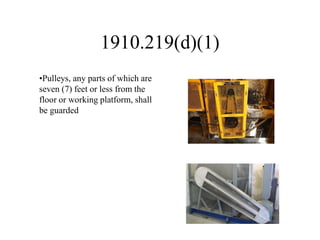
1910.219(d)(1)
•Pulleys, any parts of which are
seven (7) feet or less from the
floor or working platform, shall
be guarded
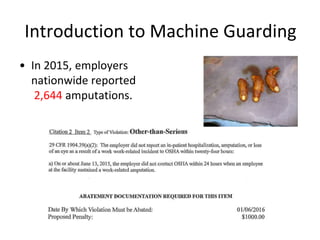
Introduction to Machine Guarding
• In 2015, employers
nationwide reported
2,644 amputations.
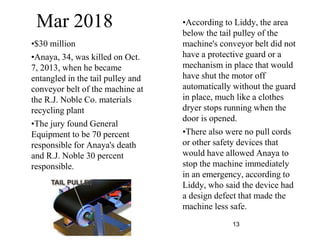
Mar 2018
•$30 million
•Anaya, 34, was killed on Oct.
7, 2013, when he became
entangled in the tail pulley and
conveyor belt of the machine at
the R.J. Noble Co. materials
recycling plant
•The jury found General
Equipment to be 70 percent
responsible for Anaya's death
and R.J. Noble 30 percent
responsible.
•According to Liddy, the area
below the tail pulley of the
machine's conveyor belt did not
have a protective guard or a
mechanism in place that would
have shut the motor off
automatically without the guard
in place, much like a clothes
dryer stops running when the
door is opened.
•There also were no pull cords
or other safety devices that
would have allowed Anaya to
stop the machine immediately
in an emergency, according to
Liddy, who said the device had
a design defect that made the
machine less safe.
13
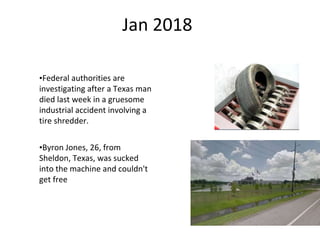
Jan 2018
•Federal authorities are
investigating after a Texas man
died last week in a gruesome
industrial accident involving a
tire shredder.
•Byron Jones, 26, from
Sheldon, Texas, was sucked
into the machine and couldn't
get free
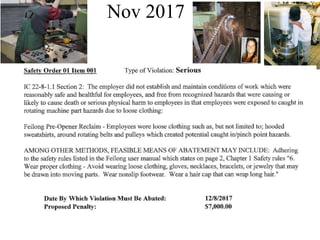
Nov 2017
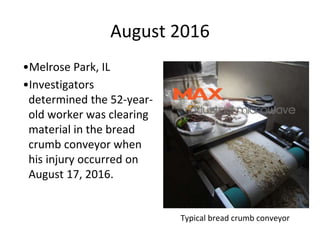
August 2016
•Melrose Park, IL
•Investigators
determined the 52-year-
old worker was clearing
material in the bread
crumb conveyor when
his injury occurred on
August 17, 2016.
Typical bread crumb conveyor
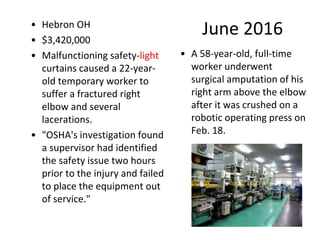
June 2016• Hebron OH
• $3,420,000
• Malfunctioning safety-light
curtains caused a 22-year-
old temporary worker to
suffer a fractured right
elbow and several
lacerations.
• "OSHA's investigation found
a supervisor had identified
the safety issue two hours
prior to the injury and failed
to place the equipment out
of service."
• A 58-year-old, full-time
worker underwent
surgical amputation of his
right arm above the elbow
after it was crushed on a
robotic operating press on
Feb. 18.
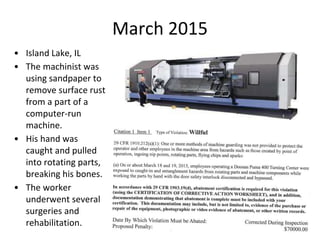
March 2015
• Island Lake, IL
• The machinist was
using sandpaper to
remove surface rust
from a part of a
computer-run
machine.
• His hand was
caught and pulled
into rotating parts,
breaking his bones.
• The worker
underwent several
surgeries and
rehabilitation.
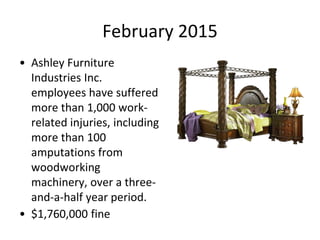
February 2015
• Ashley Furniture
Industries Inc.
employees have suffered
more than 1,000 work-
related injuries, including
more than 100
amputations from
woodworking
machinery, over a three-
and-a-half year period.
• $1,760,000 fine
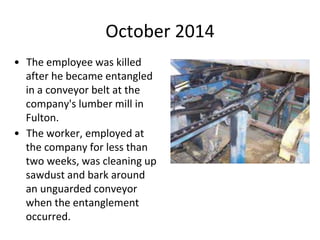
October 2014
• The employee was killed
after he became entangled
in a conveyor belt at the
company's lumber mill in
Fulton.
• The worker, employed at
the company for less than
two weeks, was cleaning up
sawdust and bark around
an unguarded conveyor
when the entanglement
occurred.
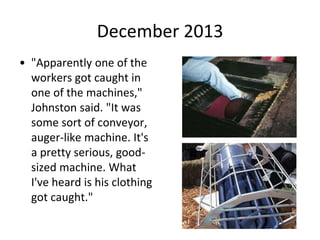
December 2013
• "Apparently one of the
workers got caught in
one of the machines,"
Johnston said. "It was
some sort of conveyor,
auger-like machine. It's
a pretty serious, good-
sized machine. What
I've heard is his clothing
got caught."
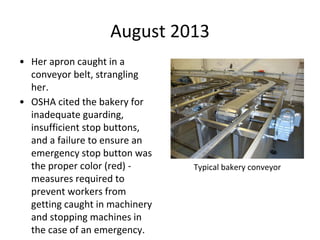
August 2013
• Her apron caught in a
conveyor belt, strangling
her.
• OSHA cited the bakery for
inadequate guarding,
insufficient stop buttons,
and a failure to ensure an
emergency stop button was
the proper color (red) -
measures required to
prevent workers from
getting caught in machinery
and stopping machines in
the case of an emergency.
Typical bakery conveyor
SIGCASE
• $140,000
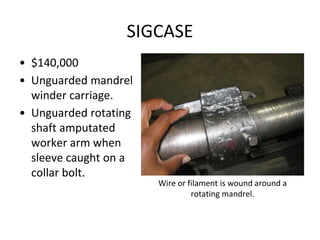
• Unguarded mandrel
winder carriage.
• Unguarded rotating
shaft amputated
worker arm when
sleeve caught on a
collar bolt.
Wire or filament is wound around a
rotating mandrel.
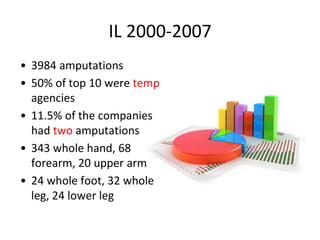
IL 2000-2007
• 3984 amputations
• 50% of top 10 were temp
agencies
• 11.5% of the companies
had two amputations
• 343 whole hand, 68
forearm, 20 upper arm
• 24 whole foot, 32 whole
leg, 24 lower leg
ANSI B Series
• The user shall ensure that
setup and maintenance
personnel and operators
are trained to perform
the functions for which
they are responsible.
Press Brakes
• $600,000 loss on amputation in
IL in 2012.
• Employee reached in to get stuck
material.
• Feasible guarding methods such
as two-hand/foot through or light
curtain/foot through, the new
laser guarding systems, hostage
controls, safety mats, area
scanners, ¼ inch opening, etc.
• Opening too large.
• 1984 - Eight fingers lost on
hydraulic brake in IL.
Circular saw
• Employee #1 was cutting 2x4
sections with the saw in his
right hand, using his left hand
to position the wood.
• Employee #1 made a cut across
the wood and his right foot
stepped on the power cord,
causing the saw to shift its
direction and cut his left hand.
• Employee #1 will regain full
function of his left fingers, but
he will suffer some nerve
damage in his thumb.
Table Saw
On December 29, 2011,
Employee #1 was ripping
about two-inches off one end
of pine boards, and the board
momentarily paused close to
the end of the cut and then
went forward.
Needed:
Top Guard
Magnetic Restart
Spreader
Anti-kickback fingers
Radial Arm Saw
• June 30, 2008
• Employee was using a radial
arm saw to cut a piece of 2-by-6
lumber for a Truss brace.
• Using the radial arm saw
mounted on a bench, he placed
the piece of lumber beneath
the 16-in. blade, holding it with
his left hand.
• The running saw vibrated
forward and struck the lumber,
amputating the employee’s
small finger in the process.
10) Radial arm
• Lower blade awareness device;
• retracts to the original position;
• does not extend past plane of
table; and
• an anti-kickback device.
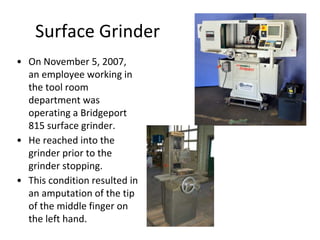
Surface Grinder
• On November 5, 2007,
an employee working in
the tool room
department was
operating a Bridgeport
815 surface grinder.
• He reached into the
grinder prior to the
grinder stopping.
• This condition resulted in
an amputation of the tip
of the middle finger on
the left hand.
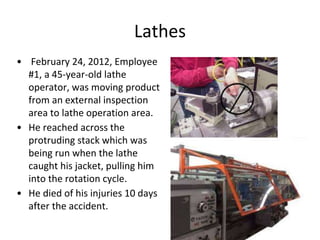
Lathes
• February 24, 2012, Employee
#1, a 45-year-old lathe
operator, was moving product
from an external inspection
area to lathe operation area.
• He reached across the
protruding stack which was
being run when the lathe
caught his jacket, pulling him
into the rotation cycle.
• He died of his injuries 10 days
after the accident.
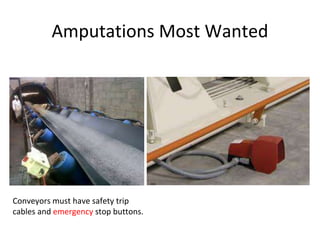
Amputations Most Wanted
Conveyors must have safety trip
cables and emergency stop buttons.
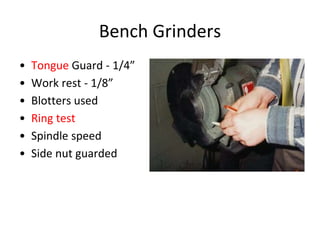
Bench Grinders
• Tongue Guard - 1/4”
• Work rest - 1/8”
• Blotters used
• Ring test
• Spindle speed
• Side nut guarded
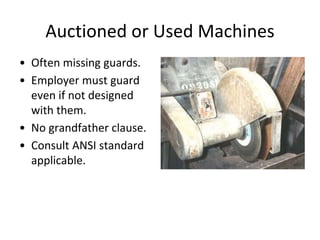
Auctioned or Used Machines
• Often missing guards.
• Employer must guard
even if not designed
with them.
• No grandfather clause.
• Consult ANSI standard
applicable.
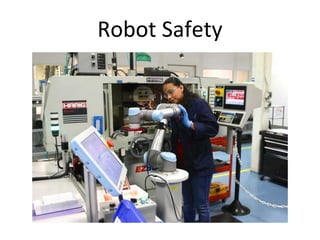
Robot Safety
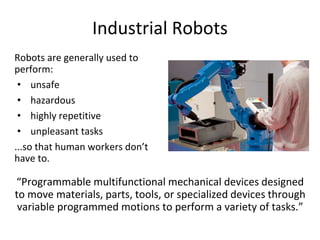
Industrial Robots
Robots are generally used to
perform:
• unsafe
• hazardous
• highly repetitive
• unpleasant tasks
...so that human workers don’t
have to.
“Programmable multifunctional mechanical devices designed
to move materials, parts, tools, or specialized devices through
variable programmed motions to perform a variety of tasks.”
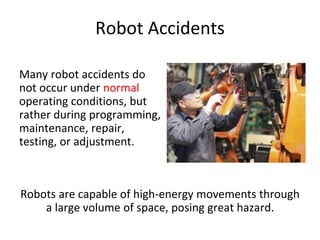
Robot Accidents
Many robot accidents do
not occur under normal
operating conditions, but
rather during programming,
maintenance, repair,
testing, or adjustment.
Robots are capable of high-energy movements through
a large volume of space, posing great hazard.
Robot Accidents
Types of Accidents:
• Impact or Collision Accidents:
Unpredicted movements, component
malfunctions, unpredicted program
changes related to the robot’s arm or
peripheral equipment.
• Crushing and Trapping Accidents: A
worker’s limb or other body part can
be trapped between, or crushed by, a
robot’s arm and other peripheral
equipment.
• Mechanical Parts Accidents: The
breakdown, release, or failure of
parts.
• Other Accidents
Robot Hazards
Sources of Hazards:
• Human Errors
• Control Errors
• Unauthorized Access
• Mechanical Failure
• Environmental
Sources
• Power Systems
• Improper Installation
December 2012
• Sterling Heights, MI
• Employee #1, a 38-year-old male
employee with Sodecia Sterling
Heights, was inside a robot work
cell with the interlocked gates
closed.
• Employee #1 was struck from
behind by a transfer robot,
crushing his chest and neck.
• Employee was killed in the event.
• Employee #1 had lock attached
to his belt loop - i.e. he did not
lock out before beginning
maintenance.
May 2007
• Waverly, NE
• Employee #1 was
troubleshooting a robotic arm
used to remove CD jewel cases
from an injection molding
machine, when the arm cycled
and struck the employee.
• He suffered blunt force trauma
to his head and ribs.
• He was transported to the
hospital, where he died 2 weeks
later.
July 2009
• City of Industry, CA
• Employee #1 was operating a robotic
palletizer for Golden State Foods, Inc.,
a food processor and packager for fast
food restaurants.
• She entered the caged robotic
palletizer cell while the robotic
palletizer was running.
She had not deenergized the
equipment.
• Her torso was crushed by the arms of
the robotic palletizer as it attempted
to pick up boxes on the roller
conveyor.
• She was killed.
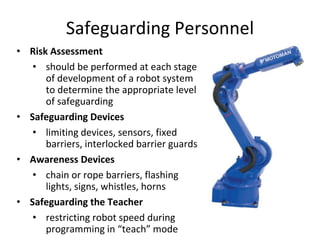
Safeguarding Personnel
• Risk Assessment
• should be performed at each stage
of development of a robot system
to determine the appropriate level
of safeguarding
• Safeguarding Devices
• limiting devices, sensors, fixed
barriers, interlocked barrier guards
• Awareness Devices
• chain or rope barriers, flashing
lights, signs, whistles, horns
• Safeguarding the Teacher
• restricting robot speed during
programming in “teach” mode
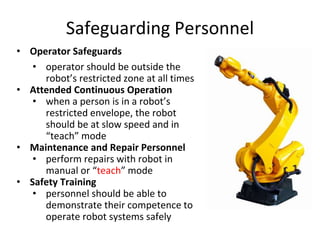
Safeguarding Personnel
• Operator Safeguards
• operator should be outside the
robot’s restricted zone at all times
• Attended Continuous Operation
• when a person is in a robot’s
restricted envelope, the robot
should be at slow speed and in
“teach” mode
• Maintenance and Repair Personnel
• perform repairs with robot in
manual or “teach” mode
• Safety Training
• personnel should be able to
demonstrate their competence to
operate robot systems safely

511 machine guarding

  • 1.
    Machine Guarding Draft 321 2018 John Newquist
  • 2.
    208 225 273 504 1343 219(d)(1) 215(a)(4) 215(b)(9) 212(a)(3)(ii) 212(a)(1) Machinery & MachineGuarding [1910.211 – .219] 2 GENERAL REQUIREMENTS– TYPES OF GUARDING METHODS ABRASIVE WHEEL – WORK RESTS POWER TRANSMISSION – GUARDING FOR PULLEYS GENERAL REQUIREMENTS – POINT OF OPERATION ABRASIVE WHEEL– TONGUE GUARDS SUBPARTO
  • 3.
    Machine Hazards • Motions Rotating:in-running nip points, spindles, shaft ends, couplings Reciprocating: back-and-forth, up-and-down Transverse: movement in a straight, continuous line • Operations Cutting: bandsaws, drills, milling machines, lathes Punching: punch presses, notchers Shearing: mechanical, pneumatic, or hydraulic shears Bending: press brakes, tube benders, plate rolls
  • 4.
    Definitions • Point ofOperation - work such as bending, punching, cutting on the material – P.O.O. • Nip point - location where machine pieces come together such as belts and a pulley, two in-running rollers, etc.
  • 5.
    1910.212(a)(1) •Types of guarding.One or more methods of machine guarding shall be provided to protect the operator and other employees in the machine area from hazards such as those created by point of operation, ingoing nip points, rotating parts, flying chips and sparks. •Examples of guarding methods are-barrier guards, two-hand tripping devices, electronic safety devices, etc.
  • 6.
    Types of MachineSafeguards • Barriers and guards. • Mechanical or electronic devices that restrict contact, such as: presence-sensing, restraining, or tripping devices; two-hand controls; or gates. • Feeding and ejection methods that eliminate part handling in the hazard zone.
  • 7.
    Principles of MachineGuarding • Safe Distance - 7’ rule of belts, etc. • Guards - employees can’t get in hazardous area through the use of barriers. • Table 0-10 for guard opening design. ¼ inch! • Devices - presence sensing mats, pullbacks, light curtains, restraints.
  • 8.
    1910.212(a)(3)(i) •The point ofoperation of machines whose operation exposes an employee to injury, shall be guarded. •The guarding device shall be in conformity with any appropriate standards therefor, or, in the absence of applicable specific standards, shall be so designed and constructed as to prevent the operator from having any part of his body in the danger zone during the operating cycle.
  • 9.
    1910.215(b)(9) •The maximum angular exposureabove the horizontal plane of the wheel spindle as specified in paragraphs (b)(3) and (4) of this section shall never be exceeded, and the distance between the wheel periphery and the adjustable tongue or the end of the peripheral member at the top shall never exceed one-fourth inch.
  • 10.
    1910.215(a)(4) •Work rests shallbe kept adjusted closely to the wheel with a maximum opening of one-eighth inch to prevent the work from being jammed between the wheel and the rest, which may cause wheel breakage.
  • 11.
    1910.219(d)(1) •Pulleys, any partsof which are seven (7) feet or less from the floor or working platform, shall be guarded
  • 12.
    Introduction to MachineGuarding • In 2015, employers nationwide reported 2,644 amputations.
  • 13.
    Mar 2018 •$30 million •Anaya,34, was killed on Oct. 7, 2013, when he became entangled in the tail pulley and conveyor belt of the machine at the R.J. Noble Co. materials recycling plant •The jury found General Equipment to be 70 percent responsible for Anaya's death and R.J. Noble 30 percent responsible. •According to Liddy, the area below the tail pulley of the machine's conveyor belt did not have a protective guard or a mechanism in place that would have shut the motor off automatically without the guard in place, much like a clothes dryer stops running when the door is opened. •There also were no pull cords or other safety devices that would have allowed Anaya to stop the machine immediately in an emergency, according to Liddy, who said the device had a design defect that made the machine less safe. 13
  • 14.
    Jan 2018 •Federal authoritiesare investigating after a Texas man died last week in a gruesome industrial accident involving a tire shredder. •Byron Jones, 26, from Sheldon, Texas, was sucked into the machine and couldn't get free
  • 15.
  • 16.
    August 2016 •Melrose Park,IL •Investigators determined the 52-year- old worker was clearing material in the bread crumb conveyor when his injury occurred on August 17, 2016. Typical bread crumb conveyor
  • 17.
    June 2016• HebronOH • $3,420,000 • Malfunctioning safety-light curtains caused a 22-year- old temporary worker to suffer a fractured right elbow and several lacerations. • "OSHA's investigation found a supervisor had identified the safety issue two hours prior to the injury and failed to place the equipment out of service." • A 58-year-old, full-time worker underwent surgical amputation of his right arm above the elbow after it was crushed on a robotic operating press on Feb. 18.
  • 18.
    March 2015 • IslandLake, IL • The machinist was using sandpaper to remove surface rust from a part of a computer-run machine. • His hand was caught and pulled into rotating parts, breaking his bones. • The worker underwent several surgeries and rehabilitation.
  • 19.
    February 2015 • AshleyFurniture Industries Inc. employees have suffered more than 1,000 work- related injuries, including more than 100 amputations from woodworking machinery, over a three- and-a-half year period. • $1,760,000 fine
  • 20.
    October 2014 • Theemployee was killed after he became entangled in a conveyor belt at the company's lumber mill in Fulton. • The worker, employed at the company for less than two weeks, was cleaning up sawdust and bark around an unguarded conveyor when the entanglement occurred.
  • 21.
    December 2013 • "Apparentlyone of the workers got caught in one of the machines," Johnston said. "It was some sort of conveyor, auger-like machine. It's a pretty serious, good- sized machine. What I've heard is his clothing got caught."
  • 22.
    August 2013 • Herapron caught in a conveyor belt, strangling her. • OSHA cited the bakery for inadequate guarding, insufficient stop buttons, and a failure to ensure an emergency stop button was the proper color (red) - measures required to prevent workers from getting caught in machinery and stopping machines in the case of an emergency. Typical bakery conveyor
  • 23.
    SIGCASE • $140,000 • Unguardedmandrel winder carriage. • Unguarded rotating shaft amputated worker arm when sleeve caught on a collar bolt. Wire or filament is wound around a rotating mandrel.
  • 24.
    IL 2000-2007 • 3984amputations • 50% of top 10 were temp agencies • 11.5% of the companies had two amputations • 343 whole hand, 68 forearm, 20 upper arm • 24 whole foot, 32 whole leg, 24 lower leg
  • 25.
    ANSI B Series •The user shall ensure that setup and maintenance personnel and operators are trained to perform the functions for which they are responsible.
  • 26.
    Press Brakes • $600,000loss on amputation in IL in 2012. • Employee reached in to get stuck material. • Feasible guarding methods such as two-hand/foot through or light curtain/foot through, the new laser guarding systems, hostage controls, safety mats, area scanners, ¼ inch opening, etc. • Opening too large. • 1984 - Eight fingers lost on hydraulic brake in IL.
  • 27.
    Circular saw • Employee#1 was cutting 2x4 sections with the saw in his right hand, using his left hand to position the wood. • Employee #1 made a cut across the wood and his right foot stepped on the power cord, causing the saw to shift its direction and cut his left hand. • Employee #1 will regain full function of his left fingers, but he will suffer some nerve damage in his thumb.
  • 28.
    Table Saw On December29, 2011, Employee #1 was ripping about two-inches off one end of pine boards, and the board momentarily paused close to the end of the cut and then went forward. Needed: Top Guard Magnetic Restart Spreader Anti-kickback fingers
  • 29.
    Radial Arm Saw •June 30, 2008 • Employee was using a radial arm saw to cut a piece of 2-by-6 lumber for a Truss brace. • Using the radial arm saw mounted on a bench, he placed the piece of lumber beneath the 16-in. blade, holding it with his left hand. • The running saw vibrated forward and struck the lumber, amputating the employee’s small finger in the process. 10) Radial arm • Lower blade awareness device; • retracts to the original position; • does not extend past plane of table; and • an anti-kickback device.
  • 30.
    Surface Grinder • OnNovember 5, 2007, an employee working in the tool room department was operating a Bridgeport 815 surface grinder. • He reached into the grinder prior to the grinder stopping. • This condition resulted in an amputation of the tip of the middle finger on the left hand.
  • 31.
    Lathes • February 24,2012, Employee #1, a 45-year-old lathe operator, was moving product from an external inspection area to lathe operation area. • He reached across the protruding stack which was being run when the lathe caught his jacket, pulling him into the rotation cycle. • He died of his injuries 10 days after the accident.
  • 32.
    Amputations Most Wanted Conveyorsmust have safety trip cables and emergency stop buttons.
  • 33.
    Bench Grinders • TongueGuard - 1/4” • Work rest - 1/8” • Blotters used • Ring test • Spindle speed • Side nut guarded
  • 34.
    Auctioned or UsedMachines • Often missing guards. • Employer must guard even if not designed with them. • No grandfather clause. • Consult ANSI standard applicable.
  • 35.
  • 36.
    Industrial Robots Robots aregenerally used to perform: • unsafe • hazardous • highly repetitive • unpleasant tasks ...so that human workers don’t have to. “Programmable multifunctional mechanical devices designed to move materials, parts, tools, or specialized devices through variable programmed motions to perform a variety of tasks.”
  • 37.
    Robot Accidents Many robotaccidents do not occur under normal operating conditions, but rather during programming, maintenance, repair, testing, or adjustment. Robots are capable of high-energy movements through a large volume of space, posing great hazard.
  • 38.
    Robot Accidents Types ofAccidents: • Impact or Collision Accidents: Unpredicted movements, component malfunctions, unpredicted program changes related to the robot’s arm or peripheral equipment. • Crushing and Trapping Accidents: A worker’s limb or other body part can be trapped between, or crushed by, a robot’s arm and other peripheral equipment. • Mechanical Parts Accidents: The breakdown, release, or failure of parts. • Other Accidents
  • 39.
    Robot Hazards Sources ofHazards: • Human Errors • Control Errors • Unauthorized Access • Mechanical Failure • Environmental Sources • Power Systems • Improper Installation
  • 40.
    December 2012 • SterlingHeights, MI • Employee #1, a 38-year-old male employee with Sodecia Sterling Heights, was inside a robot work cell with the interlocked gates closed. • Employee #1 was struck from behind by a transfer robot, crushing his chest and neck. • Employee was killed in the event. • Employee #1 had lock attached to his belt loop - i.e. he did not lock out before beginning maintenance.
  • 41.
    May 2007 • Waverly,NE • Employee #1 was troubleshooting a robotic arm used to remove CD jewel cases from an injection molding machine, when the arm cycled and struck the employee. • He suffered blunt force trauma to his head and ribs. • He was transported to the hospital, where he died 2 weeks later.
  • 42.
    July 2009 • Cityof Industry, CA • Employee #1 was operating a robotic palletizer for Golden State Foods, Inc., a food processor and packager for fast food restaurants. • She entered the caged robotic palletizer cell while the robotic palletizer was running. She had not deenergized the equipment. • Her torso was crushed by the arms of the robotic palletizer as it attempted to pick up boxes on the roller conveyor. • She was killed.
  • 43.
    Safeguarding Personnel • RiskAssessment • should be performed at each stage of development of a robot system to determine the appropriate level of safeguarding • Safeguarding Devices • limiting devices, sensors, fixed barriers, interlocked barrier guards • Awareness Devices • chain or rope barriers, flashing lights, signs, whistles, horns • Safeguarding the Teacher • restricting robot speed during programming in “teach” mode
  • 44.
    Safeguarding Personnel • OperatorSafeguards • operator should be outside the robot’s restricted zone at all times • Attended Continuous Operation • when a person is in a robot’s restricted envelope, the robot should be at slow speed and in “teach” mode • Maintenance and Repair Personnel • perform repairs with robot in manual or “teach” mode • Safety Training • personnel should be able to demonstrate their competence to operate robot systems safely