Presentation
   School of Education
University of Southampton

Goal: sketch my background, my
expertise over last ten years, and
 research themes next five years
Background
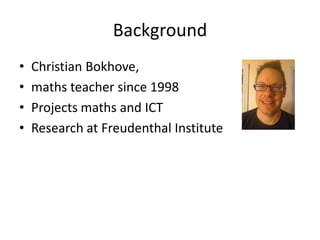
•   Christian Bokhove,
•   maths teacher since 1998
•   Projects maths and ICT
•   Research at Freudenthal Institute
Background
• National projects
  – Wisweb (Freudenthal Institute)
  – WELP (Freudenthal Institute)
  – Galois (Vooruit! grant)
  – Sage (Funded with prize money)
• PhD with Jan van Maanen and Paul Drijvers,
  Freudenthal Institute
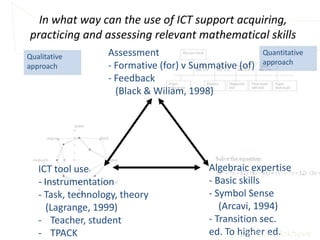
In what way can the use of ICT support acquiring,
practicing and assessing relevant mathematical skills
Qualitative        Assessment                           Quantitative
                   - Formative (for) v Summative (of)   approach
approach
                   - Feedback
                     (Black & Wiliam, 1998)


   ICT tool use                           Algebraic expertise
   - Instrumentation                      - Basic skills
   - Task, technology, theory             - Symbol Sense
      (Lagrange, 1999)                       (Arcavi, 1994)
   - Teacher, student                     - Transition sec.
   - TPACK                                ed. To higher ed.
                                                  Christian Bokhove
Highlighting some features
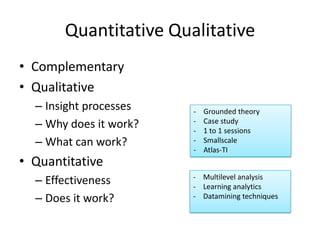
Quantitative Qualitative
• Complementary
• Qualitative
  – Insight processes   -   Grounded theory
  – Why does it work?   -
                        -
                            Case study
                            1 to 1 sessions
  – What can work?      -   Smallscale
                        -   Atlas-TI
• Quantitative
  – Effectiveness       - Multilevel analysis
                        - Learning analytics
  – Does it work?       - Datamining techniques
Theory Practice
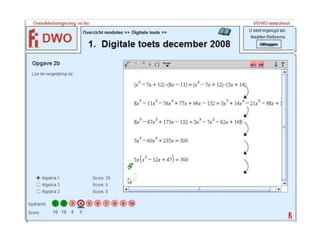
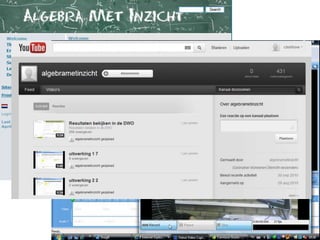
• www.algebrametinzicht.nl
• Practice learns from research
  – What could work?
  – How does it work?
  – Validated intervention
• Theory learns from practice
  – Observe best practices


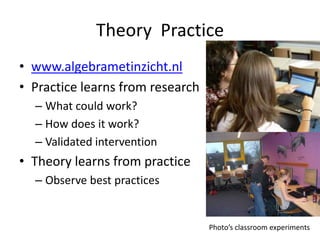
                                  Photo’s classroom experiments
Design Principles
•   Formative scenarios
•   Feedback
•   Crises
•   Store student results
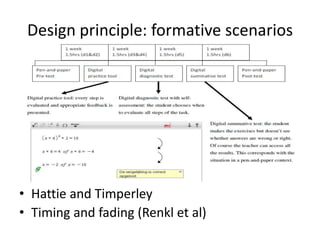
Design principle: formative scenarios


• Hattie and Timperley
• Timing and fading (Renkl et al)
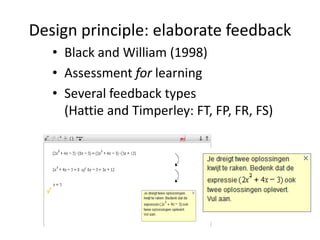
Design principle: elaborate feedback
   • Black and William (1998)
   • Assessment for learning
   • Several feedback types
     (Hattie and Timperley: FT, FP, FR, FS)
Design principle: crises
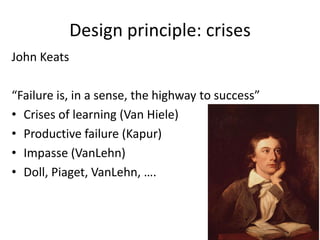
John Keats

“Failure is, in a sense, the highway to success”
• Crises of learning (Van Hiele)
• Productive failure (Kapur)
• Impasse (VanLehn)
• Doll, Piaget, VanLehn, ….
Relation to research themes
Touches on research themes
• School Improvement and Effectiveness
• Design and Utilisation of Digital Technologies
• Research in Mathematics Education SIG
• (Quantitative Methodologies)
Wider research strategy
• Publications in journals
• Networking, conferences (nat. and int.)
• Acquisition projects, collaboration national
  and international, funding/grants
Wider research strategy
Focus on
• Mathematics in the classroom
• ICT tool use: characteristics
• Implementation in classroom
  (e.g. formative scenarios)
• Teachers and students
• Design principles
• Link Computer Science: datamining log files
Questions
• In what way are digital tools best integrated
  into classroom practice?
• What characteristics does a digital tool need?
• What does this mean for students and
  teachers?
• What are the differences between maths with
  pen-and-paper and maths with digital tools?
• How can students acquire a deeper
  understanding of mathematics?
Development teacher programme
• Knowledge
• Knowledge of tools
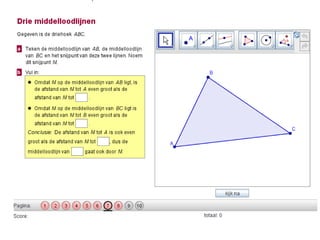
  – DGS
  – Algebra tools
• Bridging theory and practice
Questions
• How can we support teachers in teaching
  mathematics?
• What do recent developments mean for
  Maths education
  – Math Wars
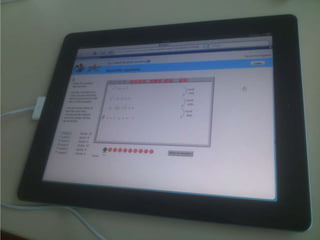
  – Tablets: handwriting recognition
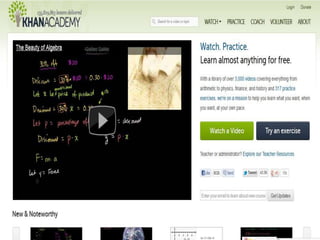
  – Khan academy
Proof of concept
Thank You
Thank You
• Questions
• http://www.fi.uu.nl/~christianb
• cbokhove@stmichaelcollege.nl

Roadmap Southampton

  • 1.
    Presentation School of Education University of Southampton Goal: sketch my background, my expertise over last ten years, and research themes next five years
  • 2.
    Background • Christian Bokhove, • maths teacher since 1998 • Projects maths and ICT • Research at Freudenthal Institute
  • 3.
    Background • National projects – Wisweb (Freudenthal Institute) – WELP (Freudenthal Institute) – Galois (Vooruit! grant) – Sage (Funded with prize money) • PhD with Jan van Maanen and Paul Drijvers, Freudenthal Institute
  • 4.
    In what waycan the use of ICT support acquiring, practicing and assessing relevant mathematical skills Qualitative Assessment Quantitative - Formative (for) v Summative (of) approach approach - Feedback (Black & Wiliam, 1998) ICT tool use Algebraic expertise - Instrumentation - Basic skills - Task, technology, theory - Symbol Sense (Lagrange, 1999) (Arcavi, 1994) - Teacher, student - Transition sec. - TPACK ed. To higher ed. Christian Bokhove
  • 5.
  • 6.
    Quantitative Qualitative • Complementary •Qualitative – Insight processes - Grounded theory – Why does it work? - - Case study 1 to 1 sessions – What can work? - Smallscale - Atlas-TI • Quantitative – Effectiveness - Multilevel analysis - Learning analytics – Does it work? - Datamining techniques
  • 7.
    Theory Practice • www.algebrametinzicht.nl •Practice learns from research – What could work? – How does it work? – Validated intervention • Theory learns from practice – Observe best practices Photo’s classroom experiments
  • 8.
    Design Principles • Formative scenarios • Feedback • Crises • Store student results
  • 9.
    Design principle: formativescenarios • Hattie and Timperley • Timing and fading (Renkl et al)
  • 10.
    Design principle: elaboratefeedback • Black and William (1998) • Assessment for learning • Several feedback types (Hattie and Timperley: FT, FP, FR, FS)
  • 11.
    Design principle: crises JohnKeats “Failure is, in a sense, the highway to success” • Crises of learning (Van Hiele) • Productive failure (Kapur) • Impasse (VanLehn) • Doll, Piaget, VanLehn, ….
  • 16.
    Relation to researchthemes Touches on research themes • School Improvement and Effectiveness • Design and Utilisation of Digital Technologies • Research in Mathematics Education SIG • (Quantitative Methodologies)
  • 17.
    Wider research strategy •Publications in journals • Networking, conferences (nat. and int.) • Acquisition projects, collaboration national and international, funding/grants
  • 18.
    Wider research strategy Focuson • Mathematics in the classroom • ICT tool use: characteristics • Implementation in classroom (e.g. formative scenarios) • Teachers and students • Design principles • Link Computer Science: datamining log files
  • 19.
    Questions • In whatway are digital tools best integrated into classroom practice? • What characteristics does a digital tool need? • What does this mean for students and teachers? • What are the differences between maths with pen-and-paper and maths with digital tools? • How can students acquire a deeper understanding of mathematics?
  • 20.
    Development teacher programme •Knowledge • Knowledge of tools – DGS – Algebra tools • Bridging theory and practice
  • 21.
    Questions • How canwe support teachers in teaching mathematics? • What do recent developments mean for Maths education – Math Wars – Tablets: handwriting recognition – Khan academy
  • 25.
  • 26.
    Thank You Thank You •Questions • http://www.fi.uu.nl/~christianb • cbokhove@stmichaelcollege.nl