

The Future of Math
Education:
A Panel Discussion
of Promising
Practices
Distinguished Panel
• Francis 'Skip' Fennell, professor of education,
McDaniel College, past NCTM, AMTE president
• Cathy Fosnot, professor emeritus of childhood
education, City College of New York, Founding Director
of Math in the City
• Valerie L. Mills, president, National Council of
Supervisors of Mathematics; supervisor and
mathematics education consultant, Oakland Schools,
Michigan
Moderator
• Tim Hudson, Sr. Director of Curriculum Design,
DreamBox Learning
Agenda
• Formative Assessment
• Success for All Students with Common
Core & Learning Resources
• Selecting & Implementing Digital Learning
Resources
• Q&A
Formative Assessment
• How do we ensure it’s not just
―another thing‖ to do?
• How do we ensure it's an integral
component of learning rather than as
another approach to assessment?
Valerie Mills
Embedded Formative
Assessment
Three key elements:
1. elicit evidence about learning to close the gap
between current and desired performance,
2. adjust the learning experience to close the
performance gap with useful feedback, and
3. involve students in the assessment learning
process
Adapted from Margaret Heritage, 2008
Formative Assessment
and Productive Goals
Goals and lessons need to…
• focus on the mathematics concepts and practices
(not on doing particular math problems)
• be specific enough that you can effectively gather
and use information about student thinking
• be understood to sit within a trajectory of goals and
lessons that span days, weeks, and/or years
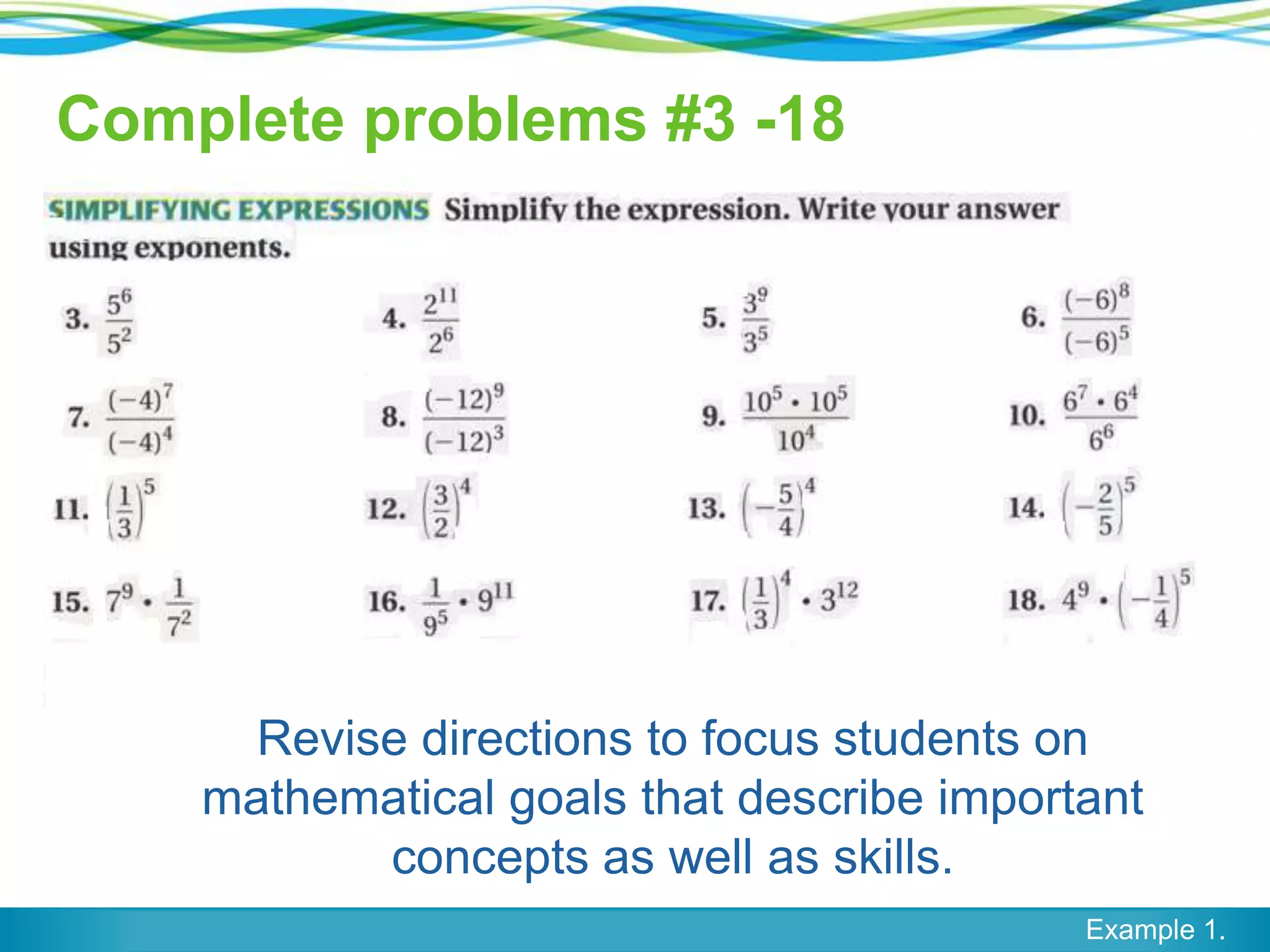
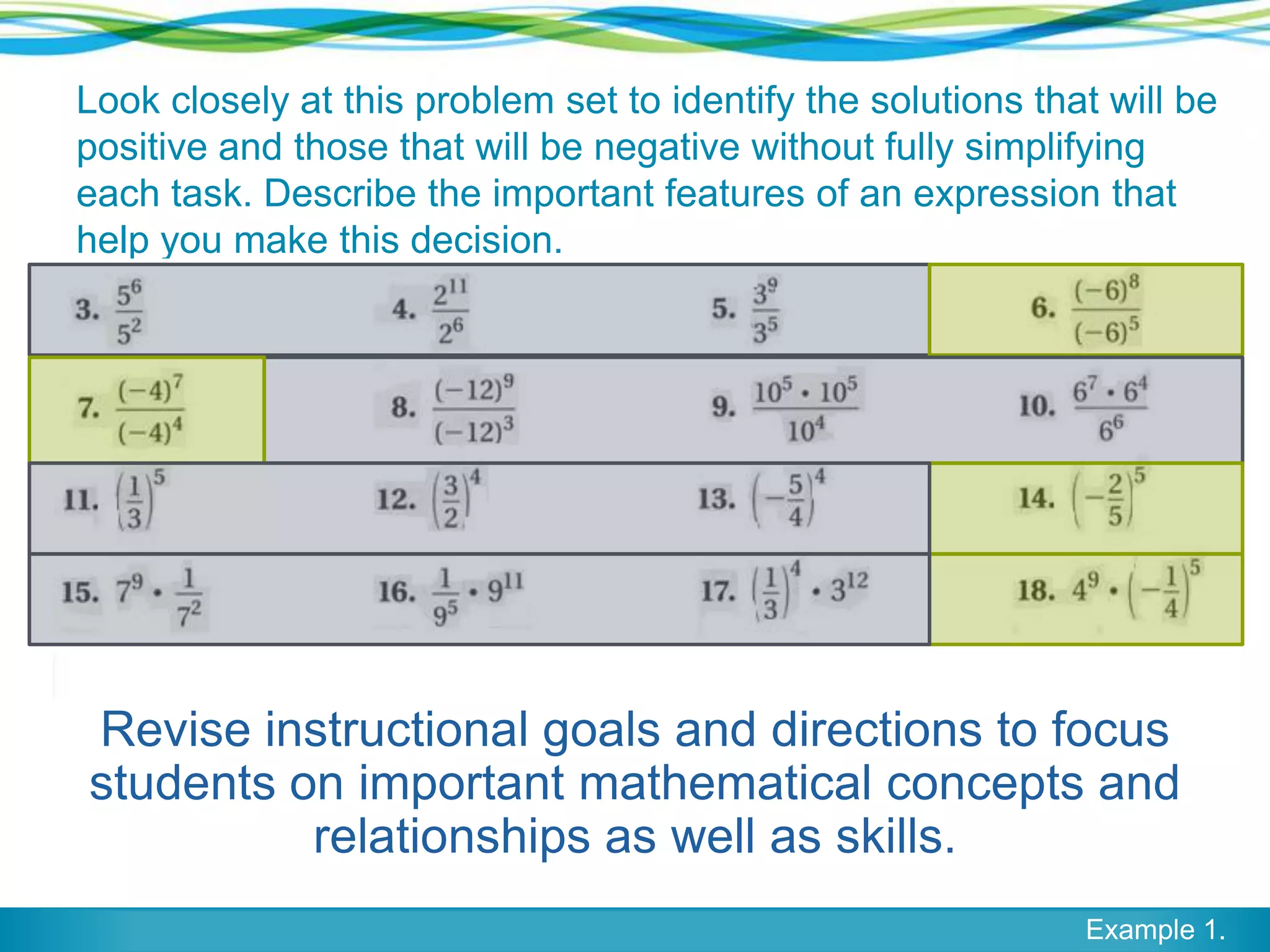
Complete problems #3 -18

Revise directions to focus students on
mathematical goals that describe important
concepts as well as skills.
Example 1.
Look closely at this problem set to identify the solutions that will be
positive and those that will be negative without fully simplifying
each task. Describe the important features of an expression that
help you make this decision.

Revise instructional goals and directions to focus
students on important mathematical concepts and
relationships as well as skills.
Example 1.
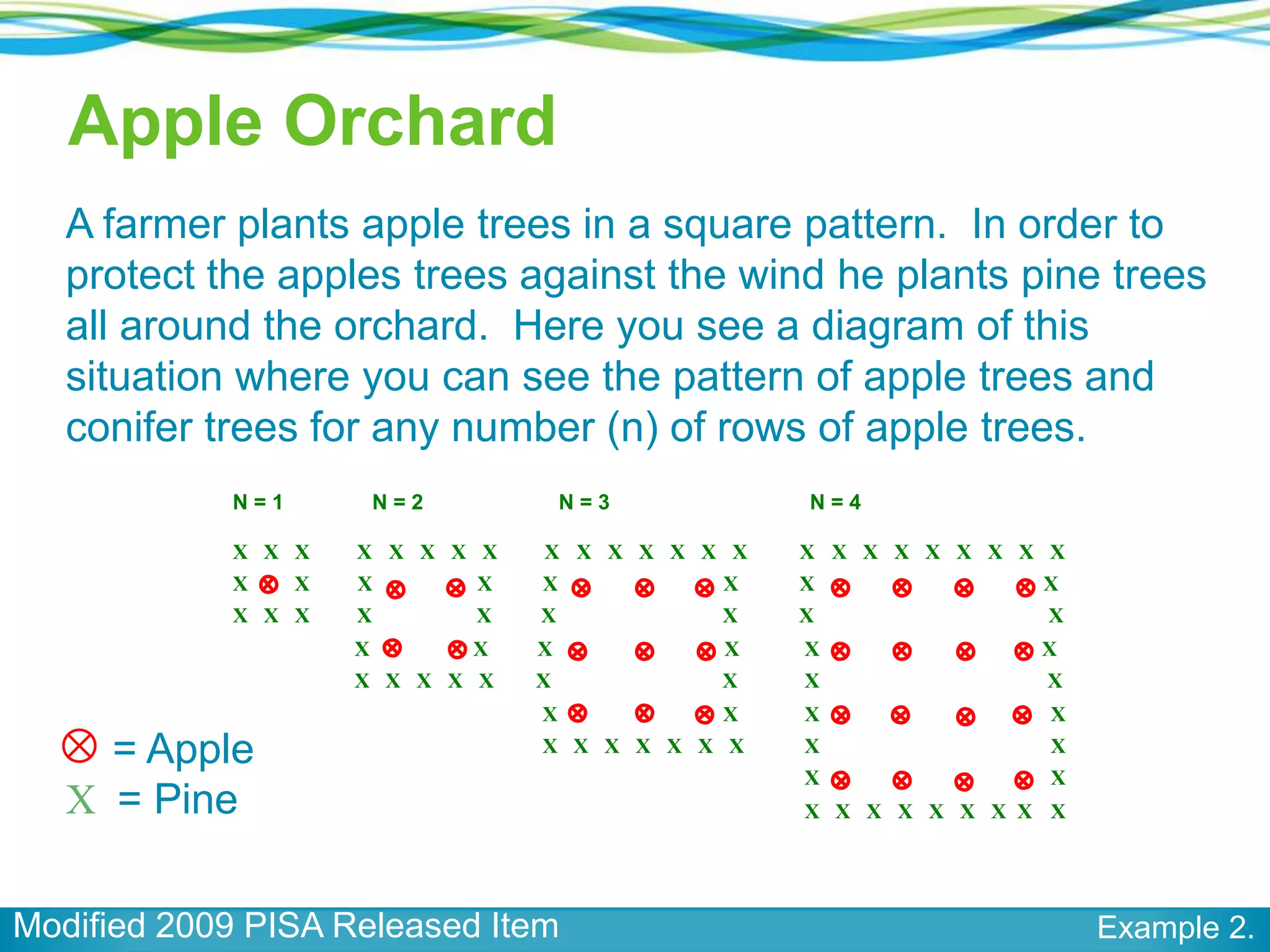
Apple Orchard
A farmer plants apple trees in a square pattern. In order to
protect the apples trees against the wind he plants pine trees
all around the orchard. Here you see a diagram of this
situation where you can see the pattern of apple trees and
conifer trees for any number (n) of rows of apple trees.
N=1

N=2

N=3

N=4

X X X

X X X X X

X X X X X X X

X X X X X X X X X

X

X

X

X

X

X

X

X

X X X

X

X

X

X

X

X

X

X

X

X

X

X

X X X X X

X

X

X

X

X

X

X

X X X X X X X

X

X

X

X

X

= Apple
X = Pine

Modified 2009 PISA Released Item

X X X X X X X X X

Example 2.
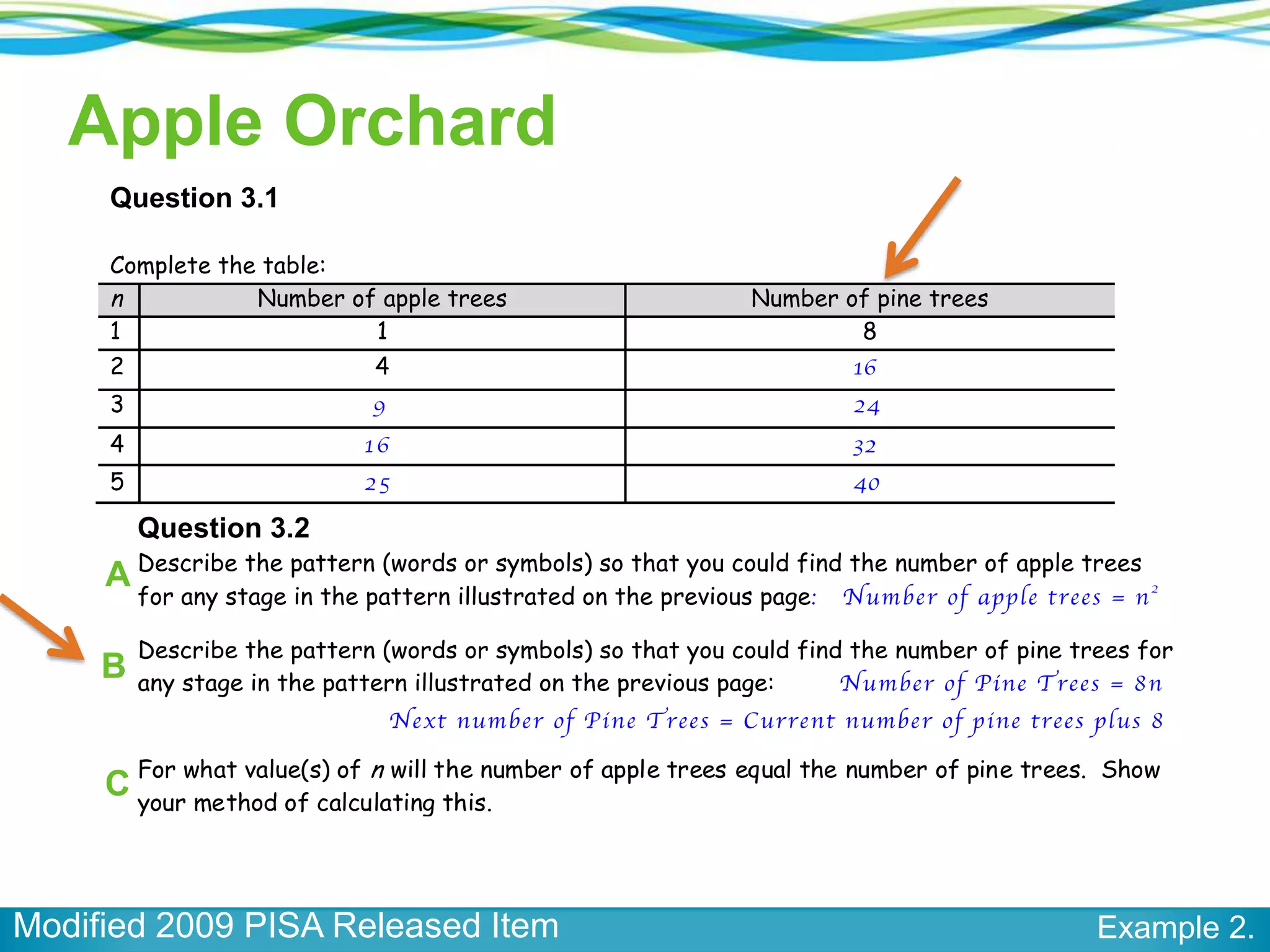
Apple Orchard

A
B
For what value(s) of n will the number of apple trees equal the number of pine trees. Show

C your method of calculating this.

Modified 2009 PISA Released Item

Example 2.
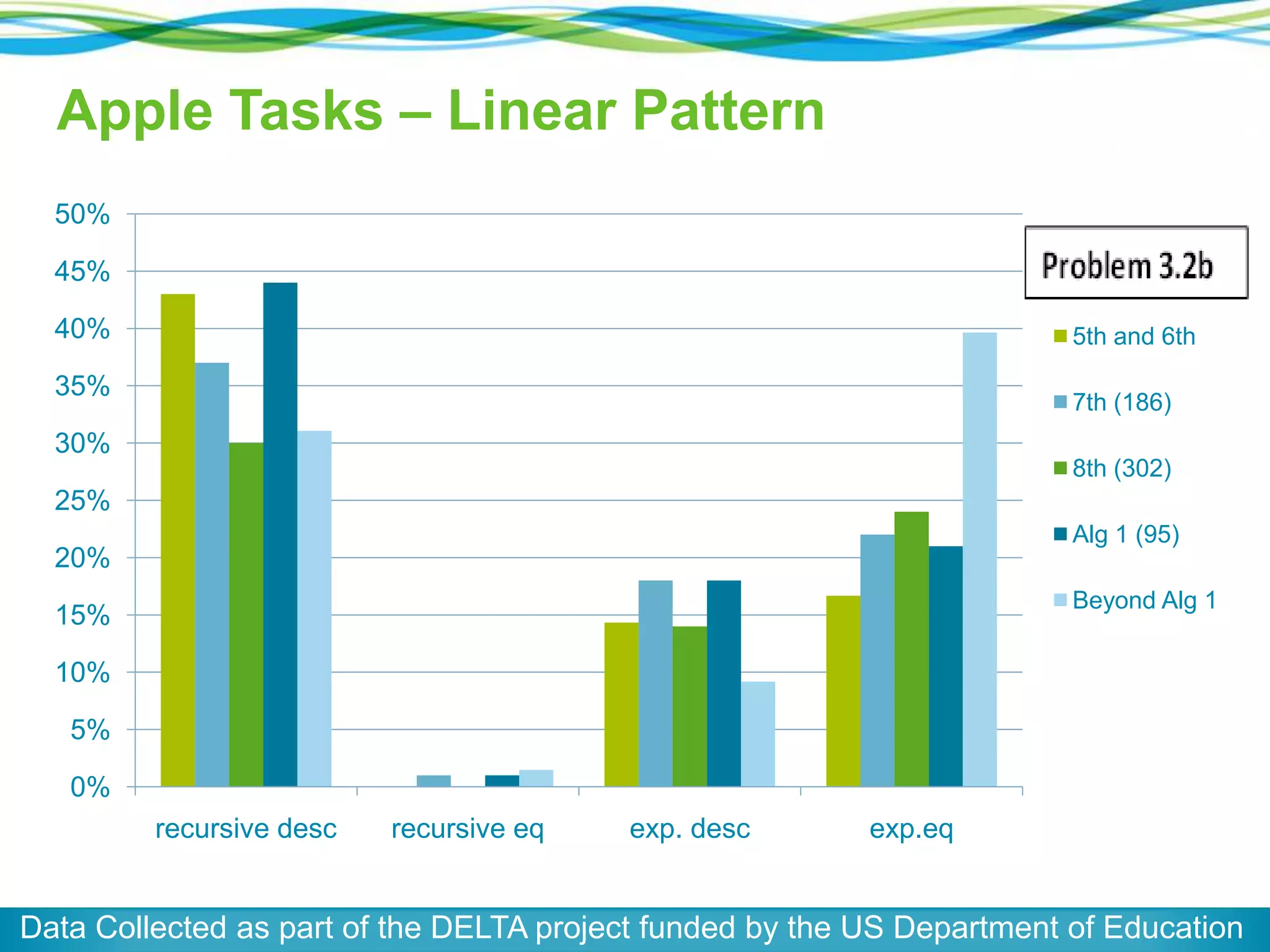
Apple Tasks – Linear Pattern
50%

45%
40%

5th and 6th

35%

7th (186)

30%
8th (302)

25%
Alg 1 (95)

20%

Beyond Alg 1

15%
10%
5%
0%

recursive desc

recursive eq

exp. desc

exp.eq

Data Collected as part of the DELTA project funded by the US Department of Education
Cathy Fosnot
Jennifer James, Anthropologist
―Tapestry is that body of
assumptions, beliefs, customs, and
practices that we accept as foundational.
They define who we are. In this time of great
change, the tapestry is being torn rapidly
and everywhere, and we begin to fall
apart, becoming anxious and losing belief in
who we are. We look backward. We become
pessimistic about the present and the future
because we can’t envision a new tapestry.‖
Heraclitus
―You cannot step twice into the same stream.
For as you are stepping in, other waters are
ever flowing.‖
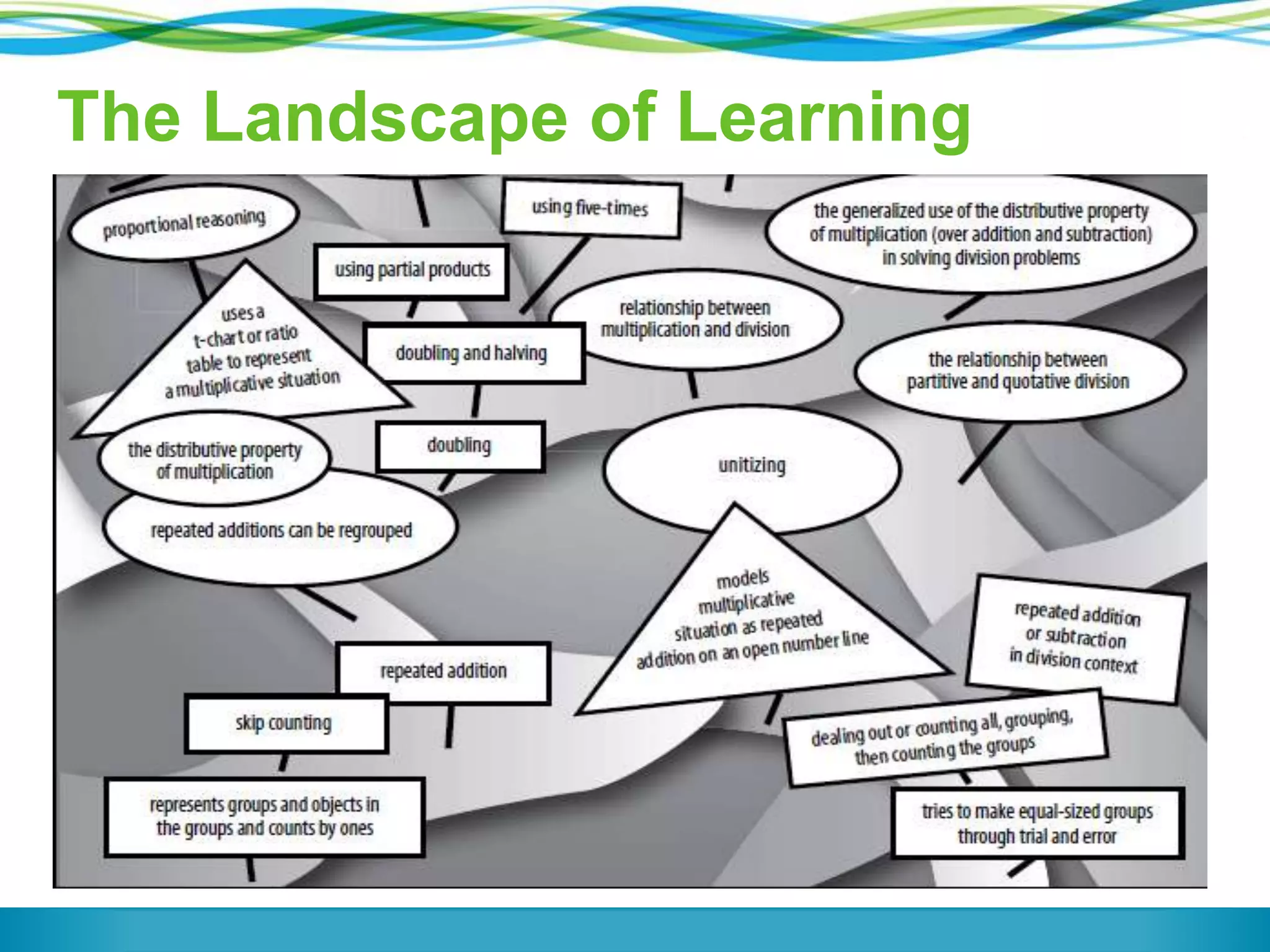
Assessment should guide teaching. It should be continuous and provide
information about the ―zone of proximal development‖ (Vygotsky 1978). To
do so, it needs to foresee where and how one can anticipate that which is
just coming into view in the distance (Streefland 1985). It needs to capture
genuine mathematizing: children’s strategies, their ways of modeling realistic
problems, and their understanding of key mathematical ideas. Bottom line, it
needs to capture where the child is on the landscape of learning—where she
has been, what her struggles are, and where she is going: it must be
dynamic (Fosnot and Dolk 2001; van den Heuvel-Panhuizen 1996).
The Landscape of Learning
Getting continuous data
• In the moment
• when conferring
• analyzing children’s work
• kidwatching as they work
• From digital technology: DreamBox
• Formal items designed to capture more
than answers
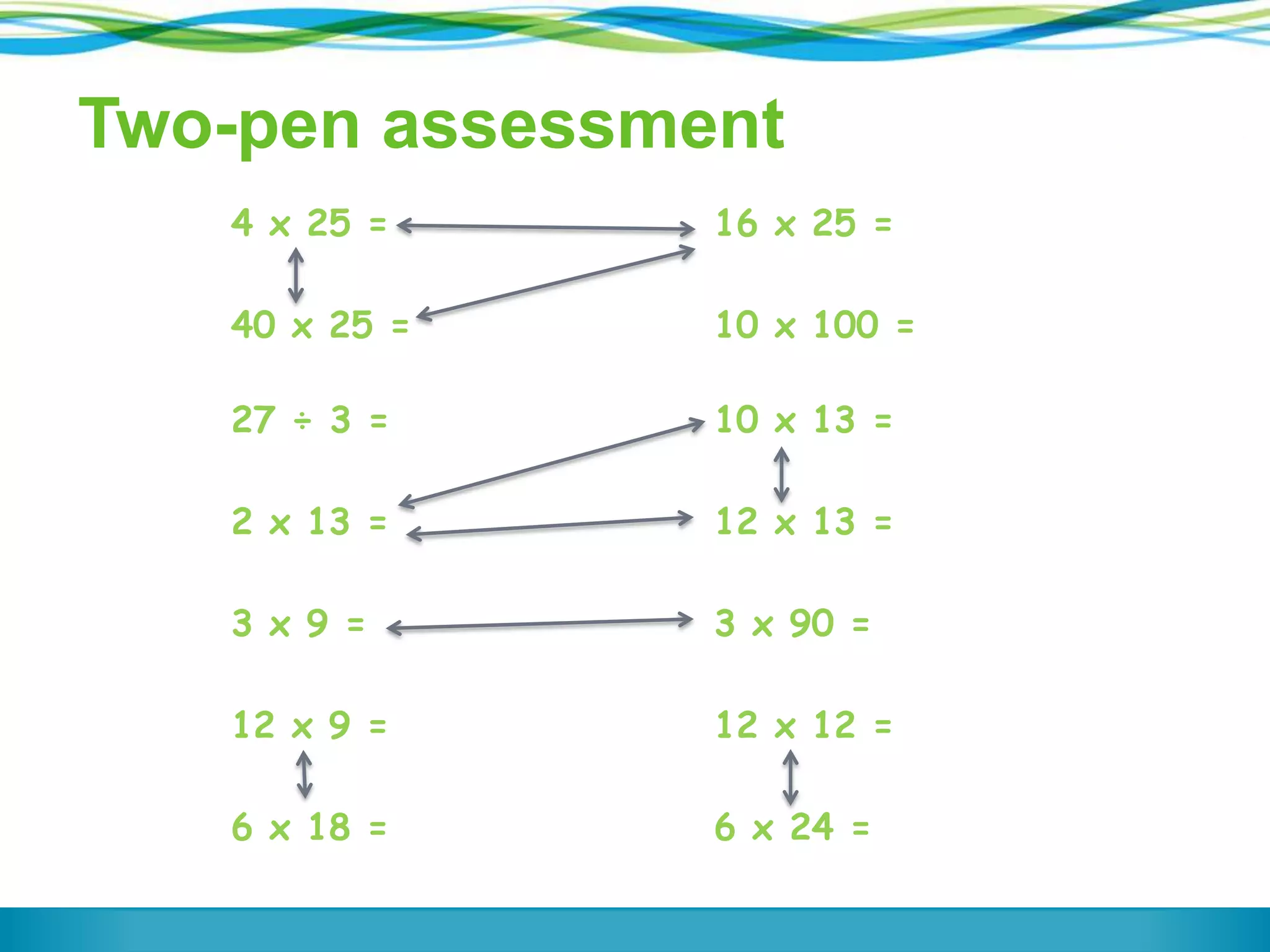
Two-pen assessment
4 x 25 =

16 x 25 =

40 x 25 =

10 x 100 =

27 ÷ 3 =

10 x 13 =

2 x 13 =

12 x 13 =

3 x 9 =

3 x 90 =

12 x 9 =

12 x 12 =

6 x 18 =

6 x 24 =
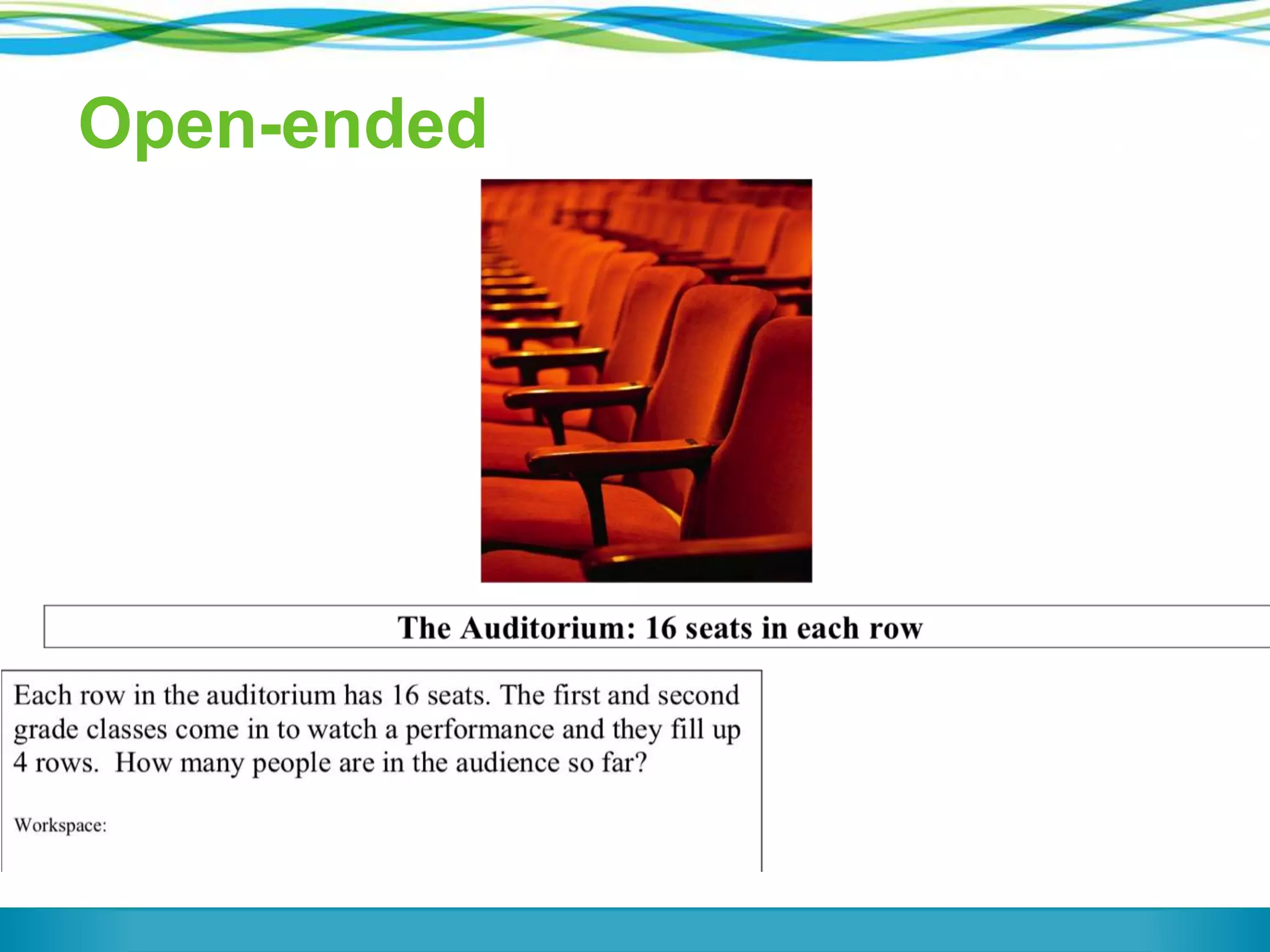
Open-ended
Skip Fennell
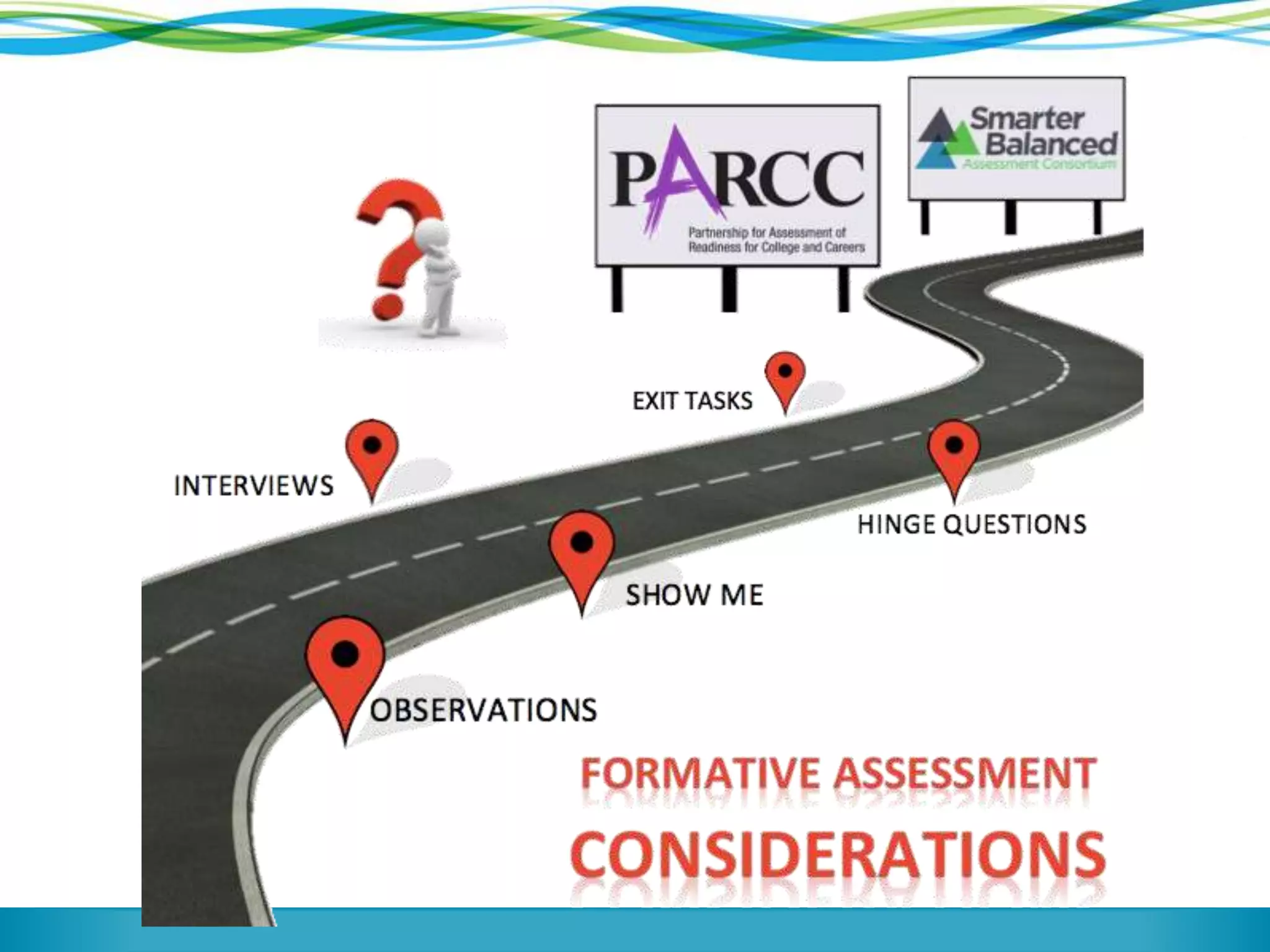
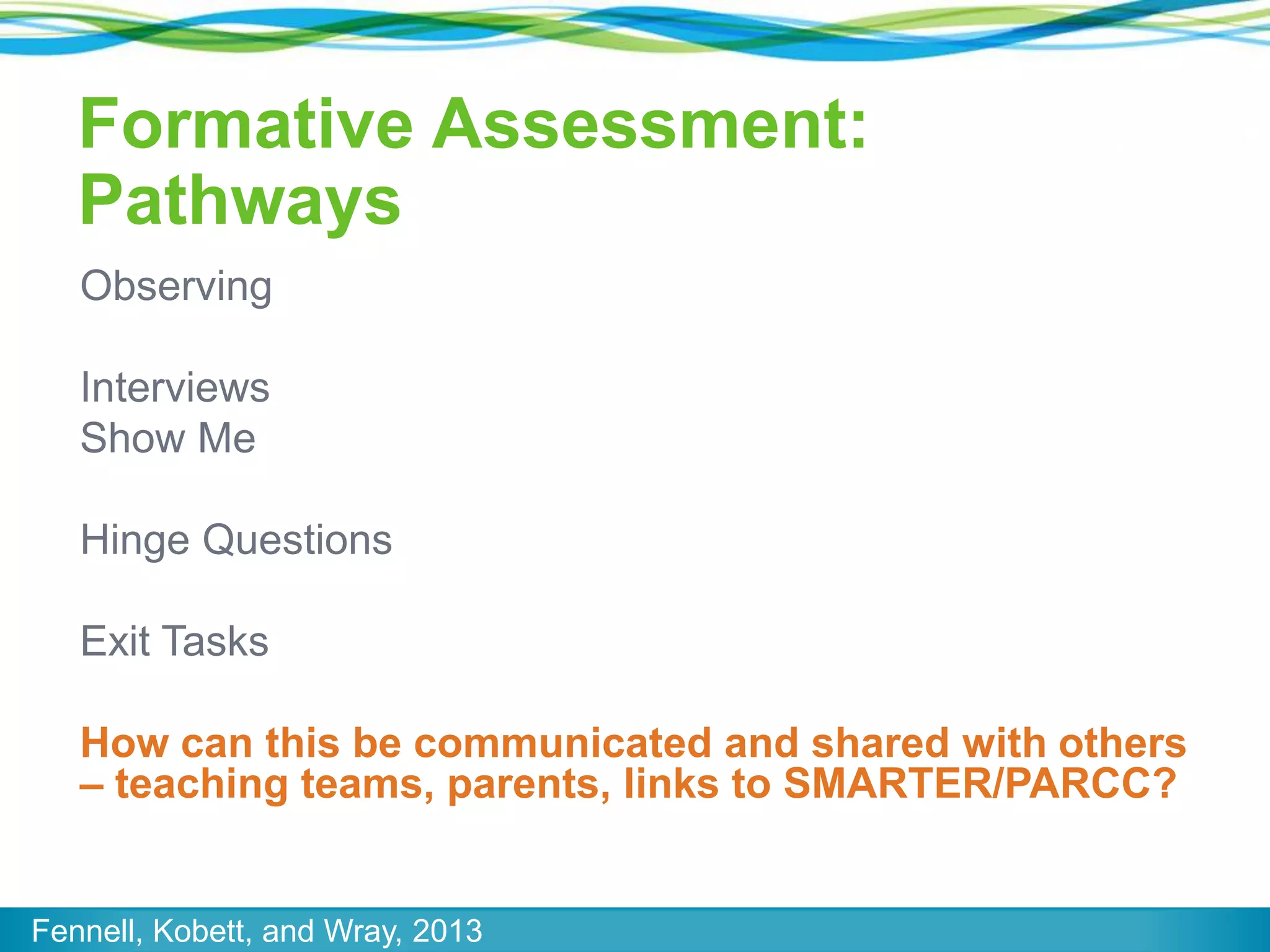
Formative Assessment:
Pathways
Observing

Interviews
Show Me
Hinge Questions
Exit Tasks
How can this be communicated and shared with others
– teaching teams, parents, links to SMARTER/PARCC?

Fennell, Kobett, and Wray, 2013
Success for ALL Students
In the Common Core era…
• How can educators wisely choose and
create resources?
• What can be learned from past initiatives
about standards and resource
implementation?
Skip Fennell
Understanding
•
•

•
•
•

•

4.NBT
Generalize place value understanding for multi-digit whole numbers.
Use place value understanding and properties of operations to
perform multi-digit arithmetic.
4.NF
Extend understanding of fraction equivalence and ordering.
Build fractions from unit fractions by applying and extending previous
understandings of operations on whole numbers.
Understand decimal notation for fractions and compare decimal
fractions.
4.MD
Geometric measurement: understand concepts of angle and
measure angles.
Representation
3.NF.2 – Understand a fraction as a number on the number line;
represent fractions on a number line diagram.
4.NBT.5 – Multiply a whole number…Illustrate and explain…by using
equations, rectangular arrays, and/or area models.
5.MD.4 – Measure volumes by counting unit cubes, using cubic
cm, cubic in, cubic ft, and improvised units.
6.RP.3 – Use ratio and rate reasoning…by reasoning about tables of
equivalent ratios, tape diagrams, double line diagrams or equations.
Here’s the Point

Conceptual understanding is
NOT an option,
It’s an expectation! AND, it’s
about time!!!
Valerie Mills
CCSS Curriculum
Materials Analysis Tools
Financial support for this project was provided by
• Brookhill Foundation (Kathy Stumpf)
• Texas Instruments (through CCSSO)
Development team lead by William S. Bush
(chair), University of Louisville, KY
The toolkit can be downloaded from the NCSM website at:
http://www.mathedleadership.org/ccss/materials.html
CCSS Curriculum Materials
Analysis Tools
•
•
•
•
•

•
•

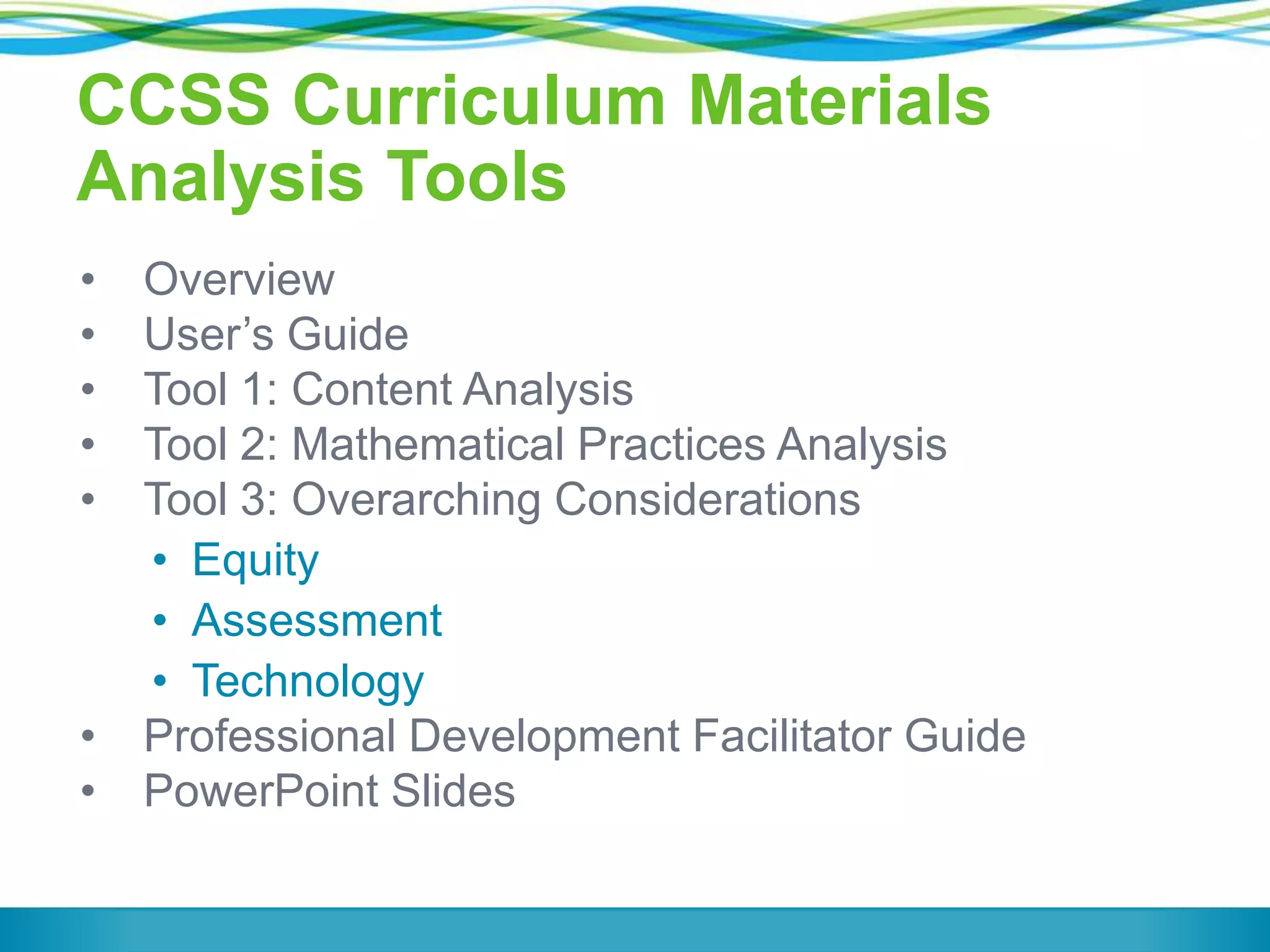
Overview
User’s Guide
Tool 1: Content Analysis
Tool 2: Mathematical Practices Analysis
Tool 3: Overarching Considerations
• Equity
• Assessment
• Technology
Professional Development Facilitator Guide
PowerPoint Slides
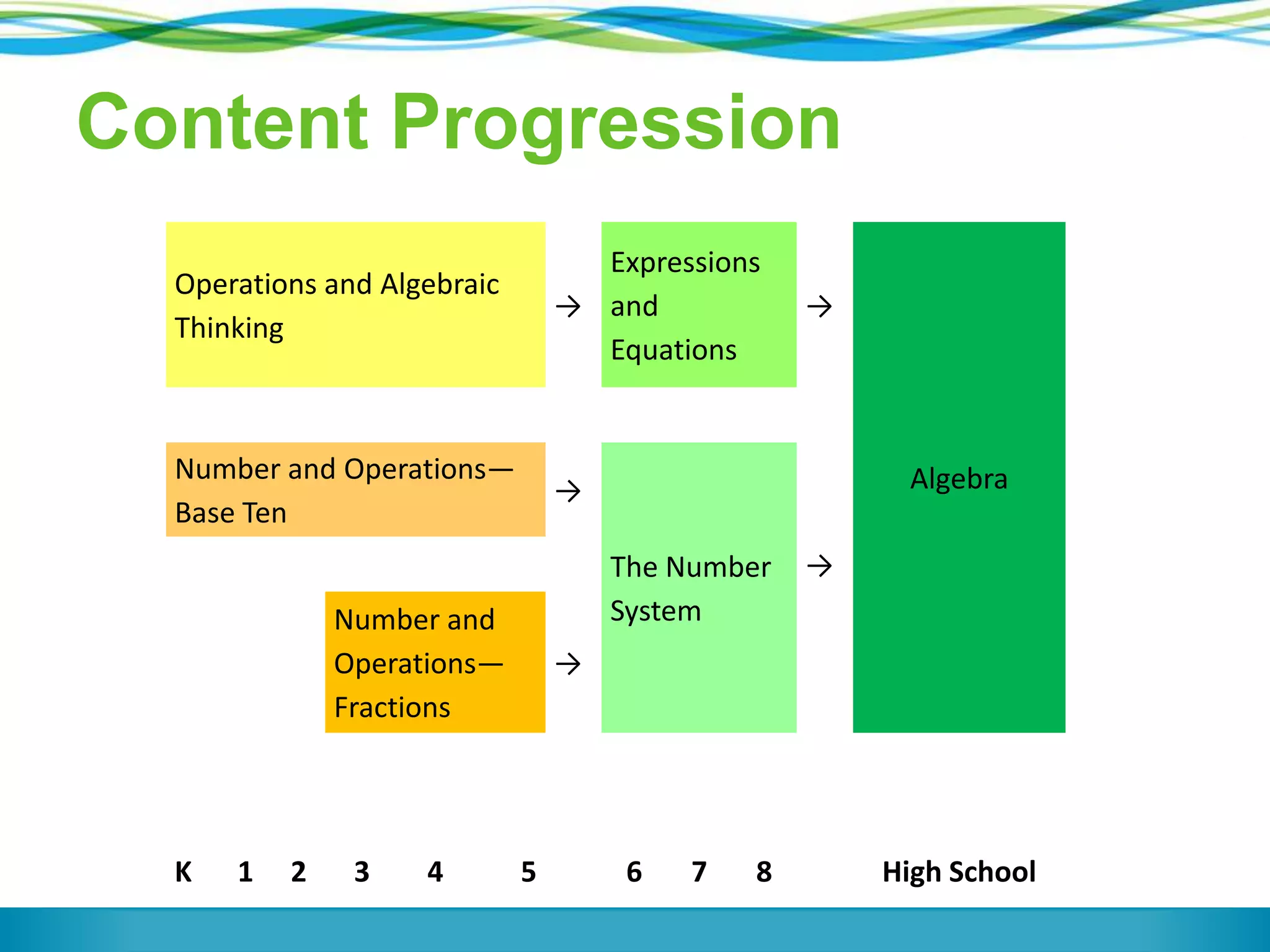
Content Progression
Operations and Algebraic
Thinking

Expressions
→ and
Equations

Number and Operations—
Base Ten

→

K

1

2

3

4

Algebra
The Number
System

Number and
Operations—
Fractions

→

→

→

5

6

7

8

High School
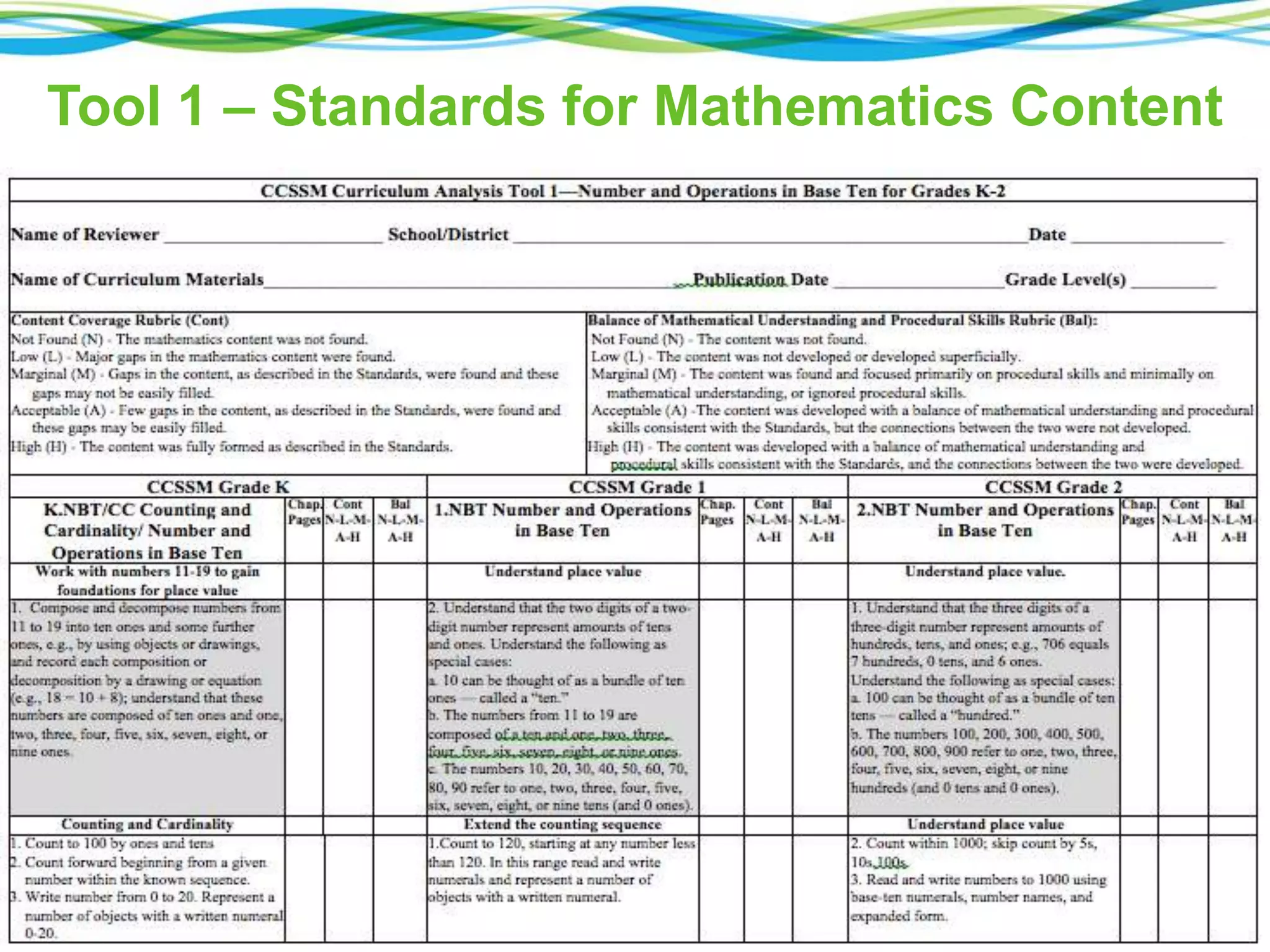
Tool 1 – Standards for Mathematics Content
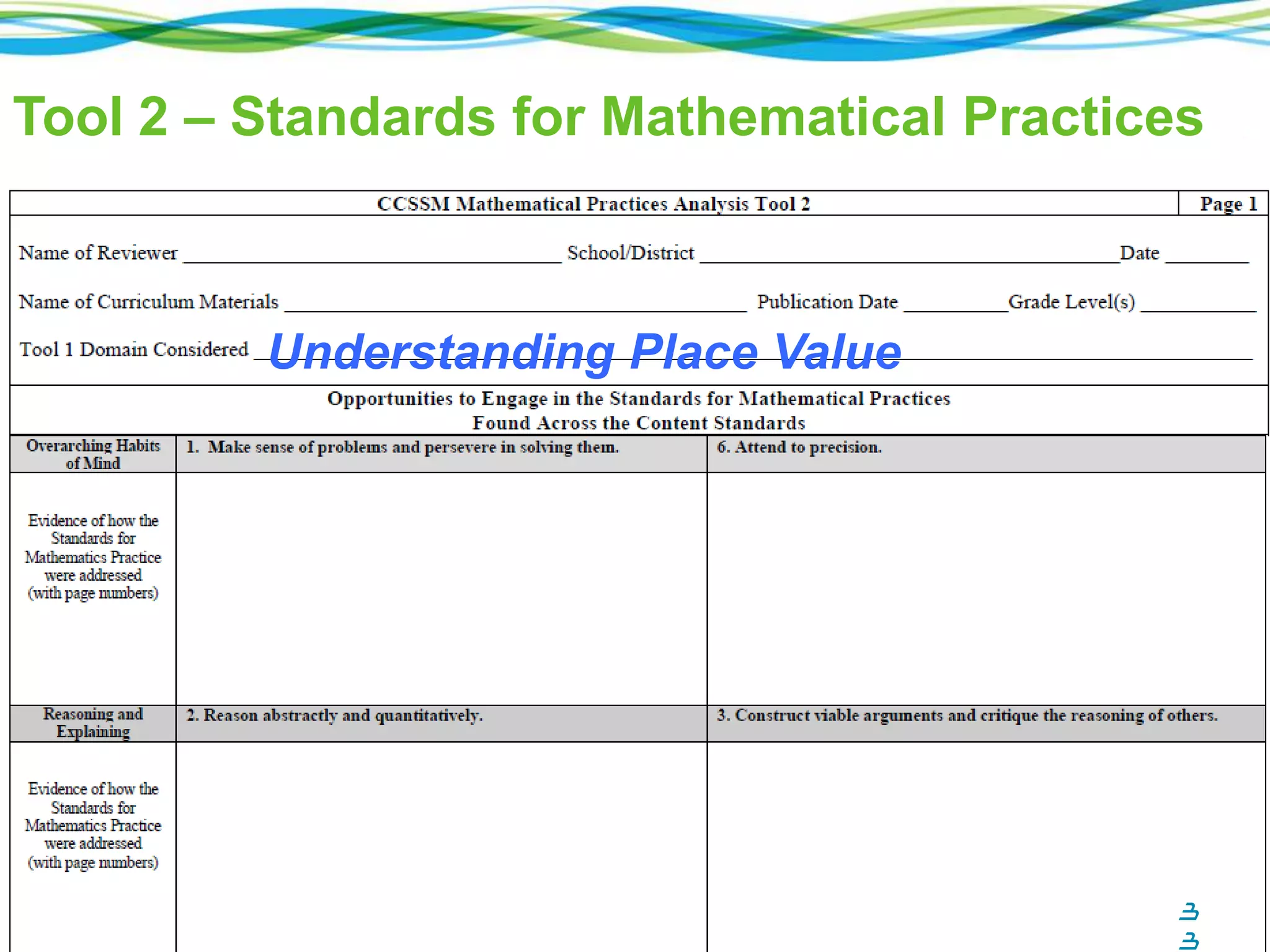
Tool 2 – Standards for Mathematical Practices

Understanding Place Value

3
3
Cathy Fosnot
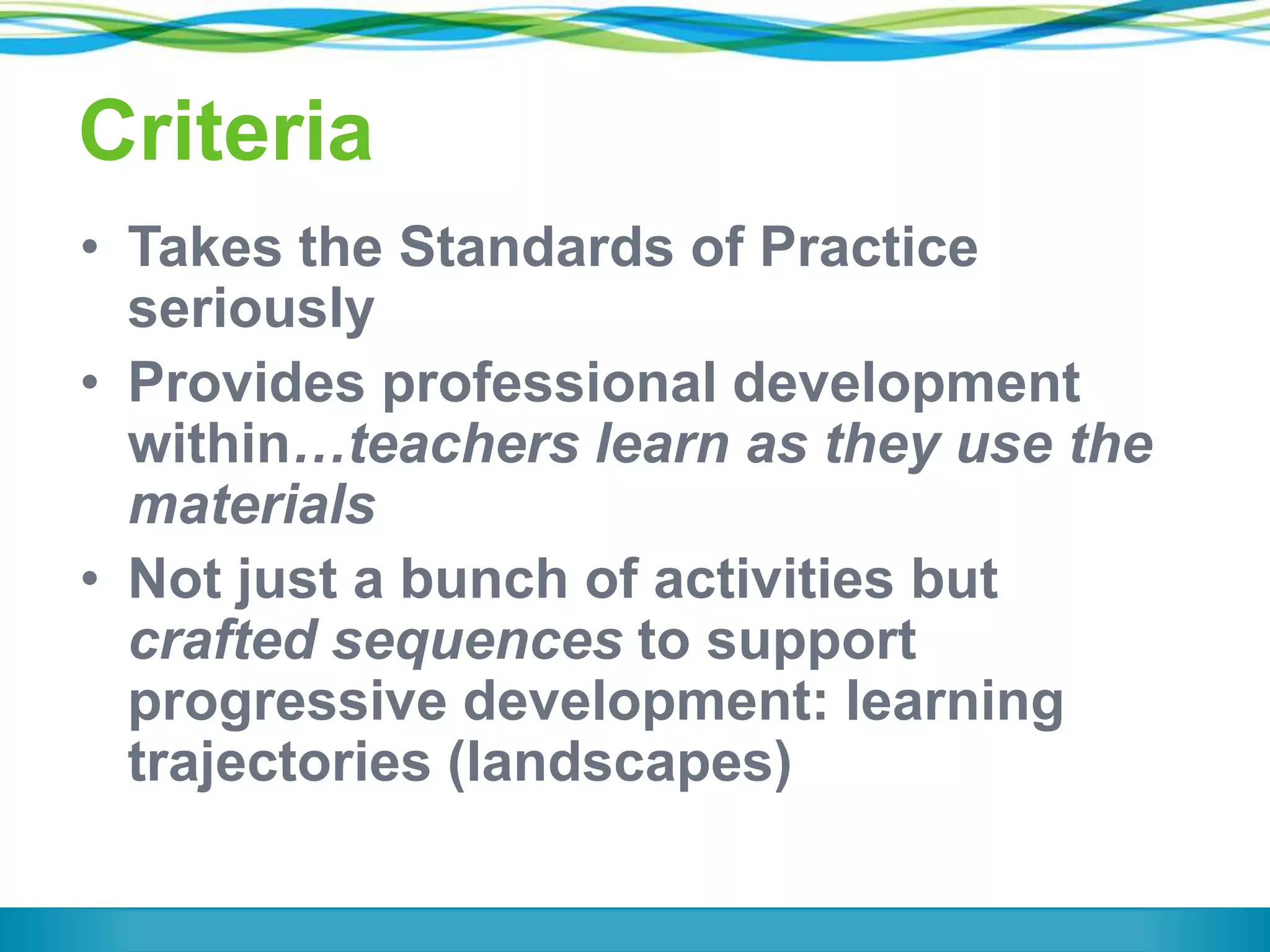
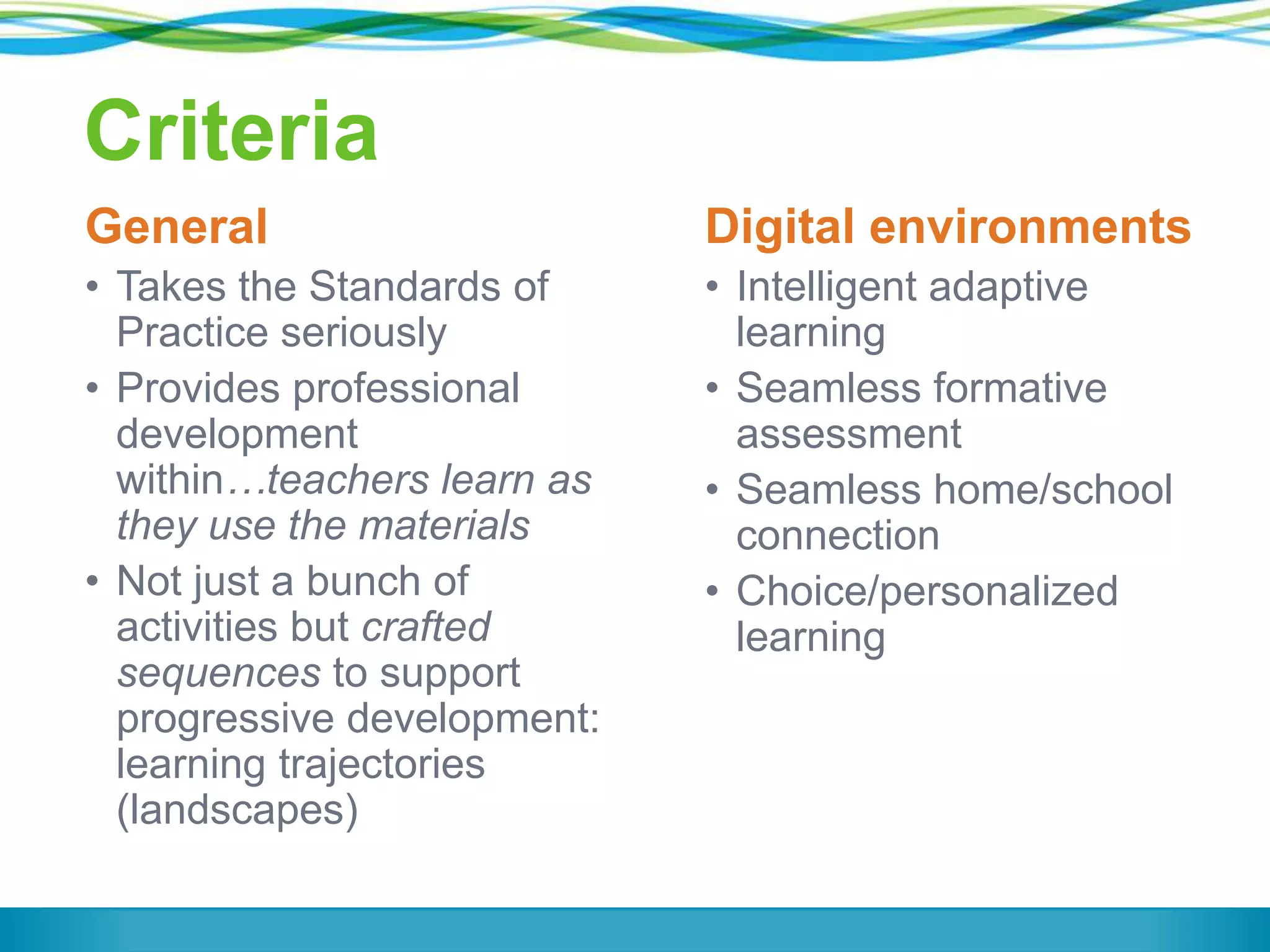
Criteria
• Takes the Standards of Practice
seriously
• Provides professional development
within…teachers learn as they use the
materials
• Not just a bunch of activities but
crafted sequences to support
progressive development: learning
trajectories (landscapes)
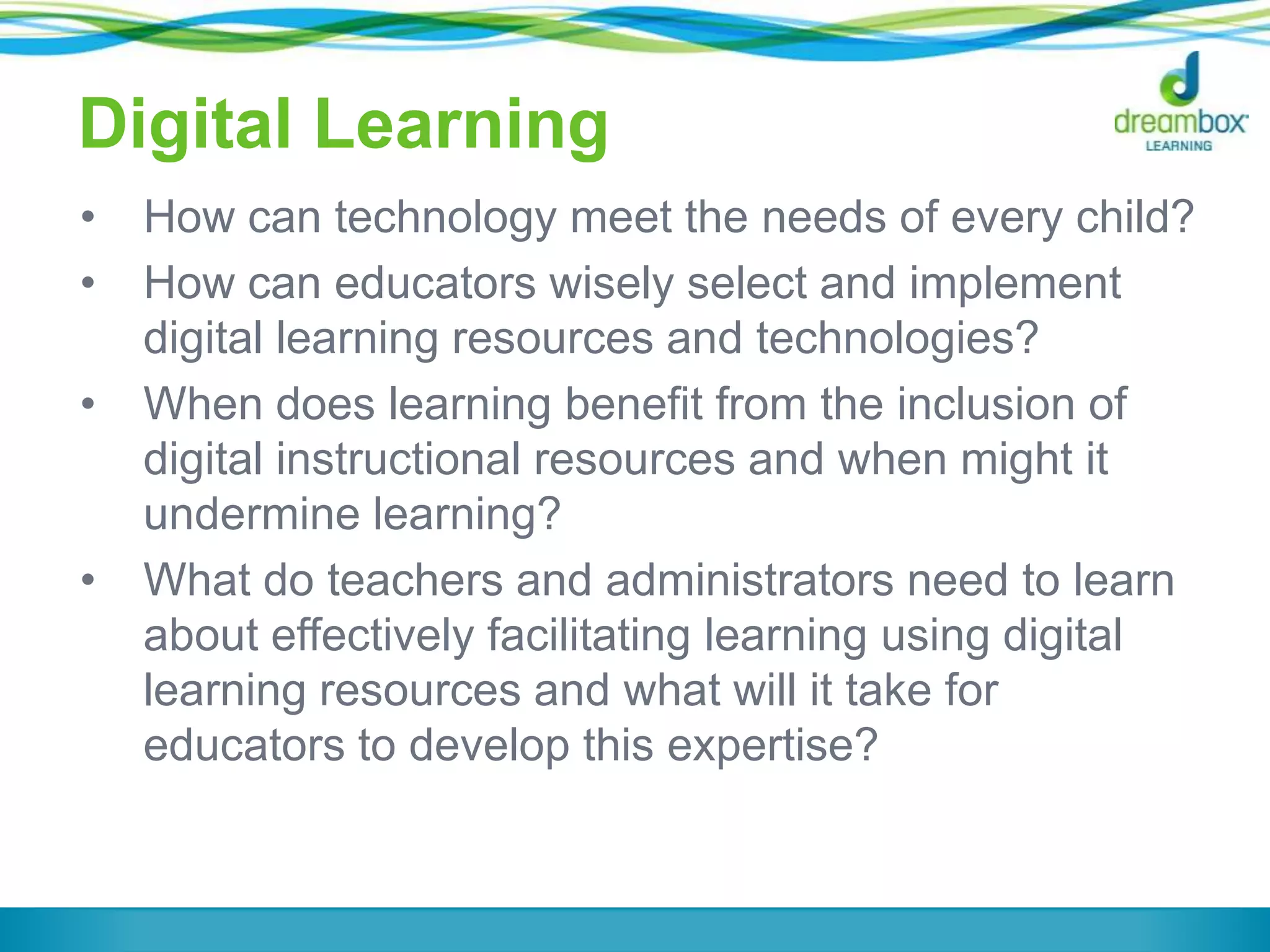
Digital Learning
•
•

•

•

How can technology meet the needs of every child?
How can educators wisely select and implement
digital learning resources and technologies?
When does learning benefit from the inclusion of
digital instructional resources and when might it
undermine learning?
What do teachers and administrators need to learn
about effectively facilitating learning using digital
learning resources and what will it take for
educators to develop this expertise?
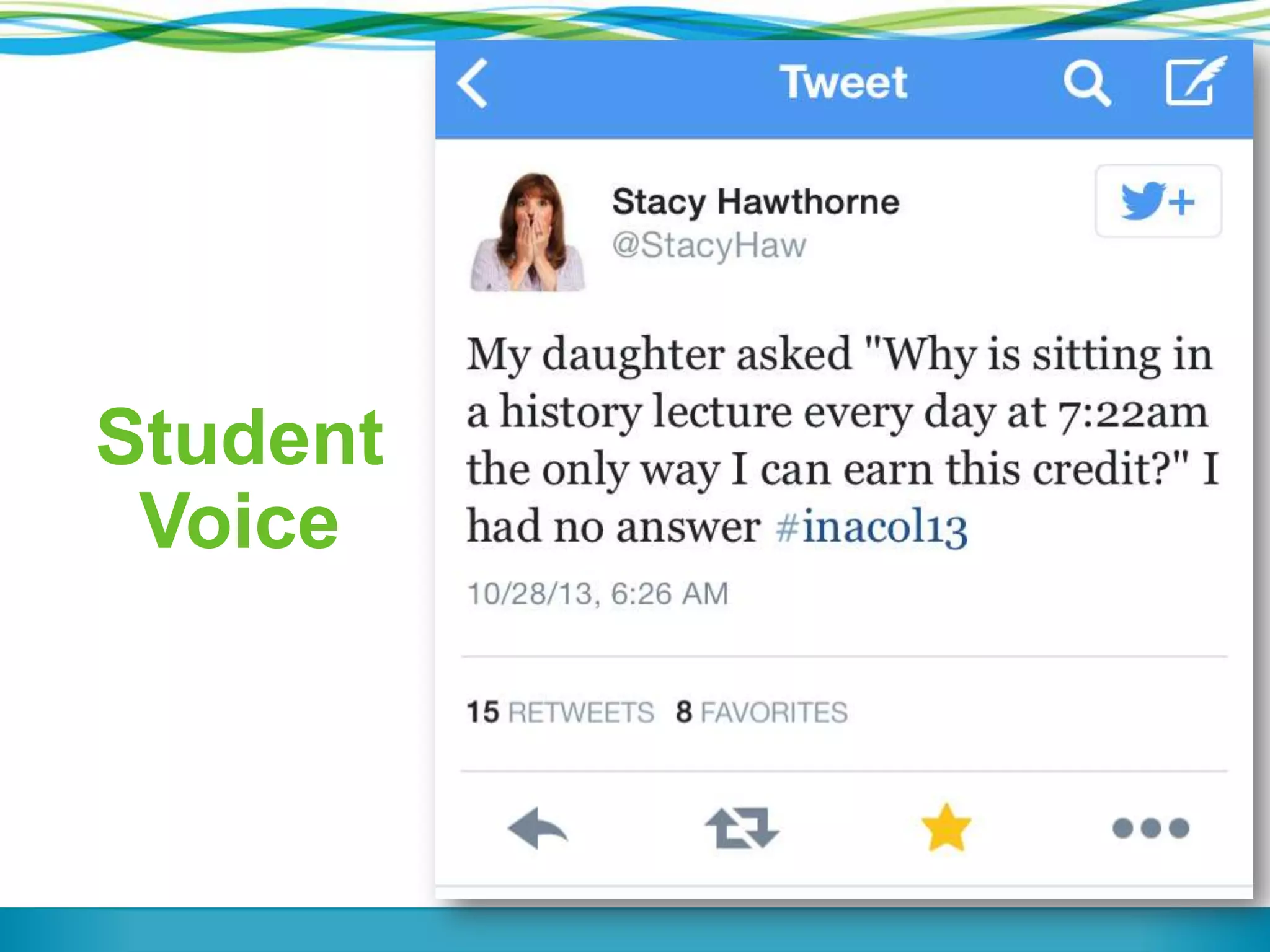
Student
Voice
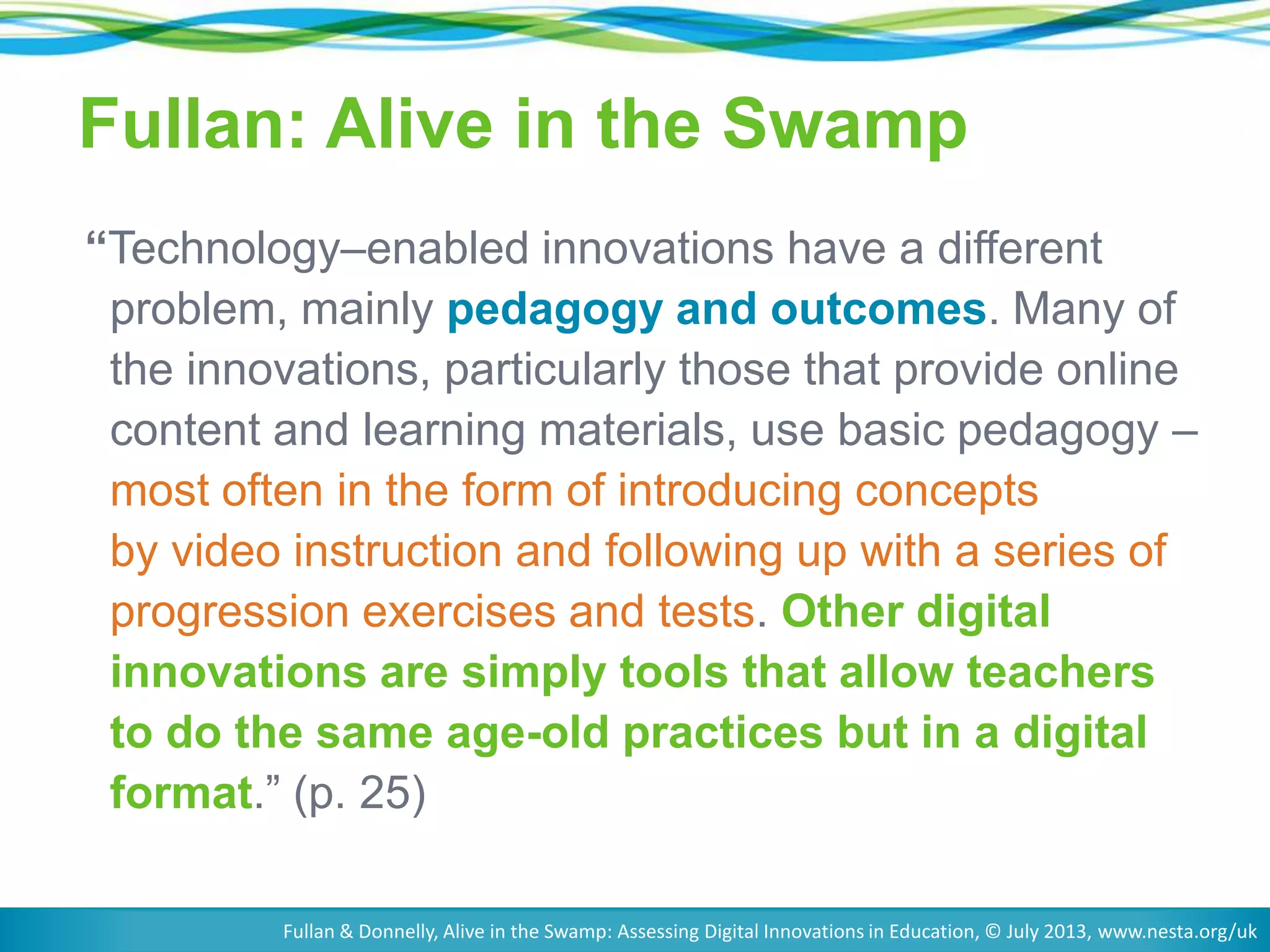
Fullan: Alive in the Swamp
“Technology–enabled innovations have a different
problem, mainly pedagogy and outcomes. Many of
the innovations, particularly those that provide online
content and learning materials, use basic pedagogy –
most often in the form of introducing concepts
by video instruction and following up with a series of
progression exercises and tests. Other digital
innovations are simply tools that allow teachers
to do the same age-old practices but in a digital
format.‖ (p. 25)
Fullan & Donnelly, Alive in the Swamp: Assessing Digital Innovations in Education, © July 2013, www.nesta.org/uk
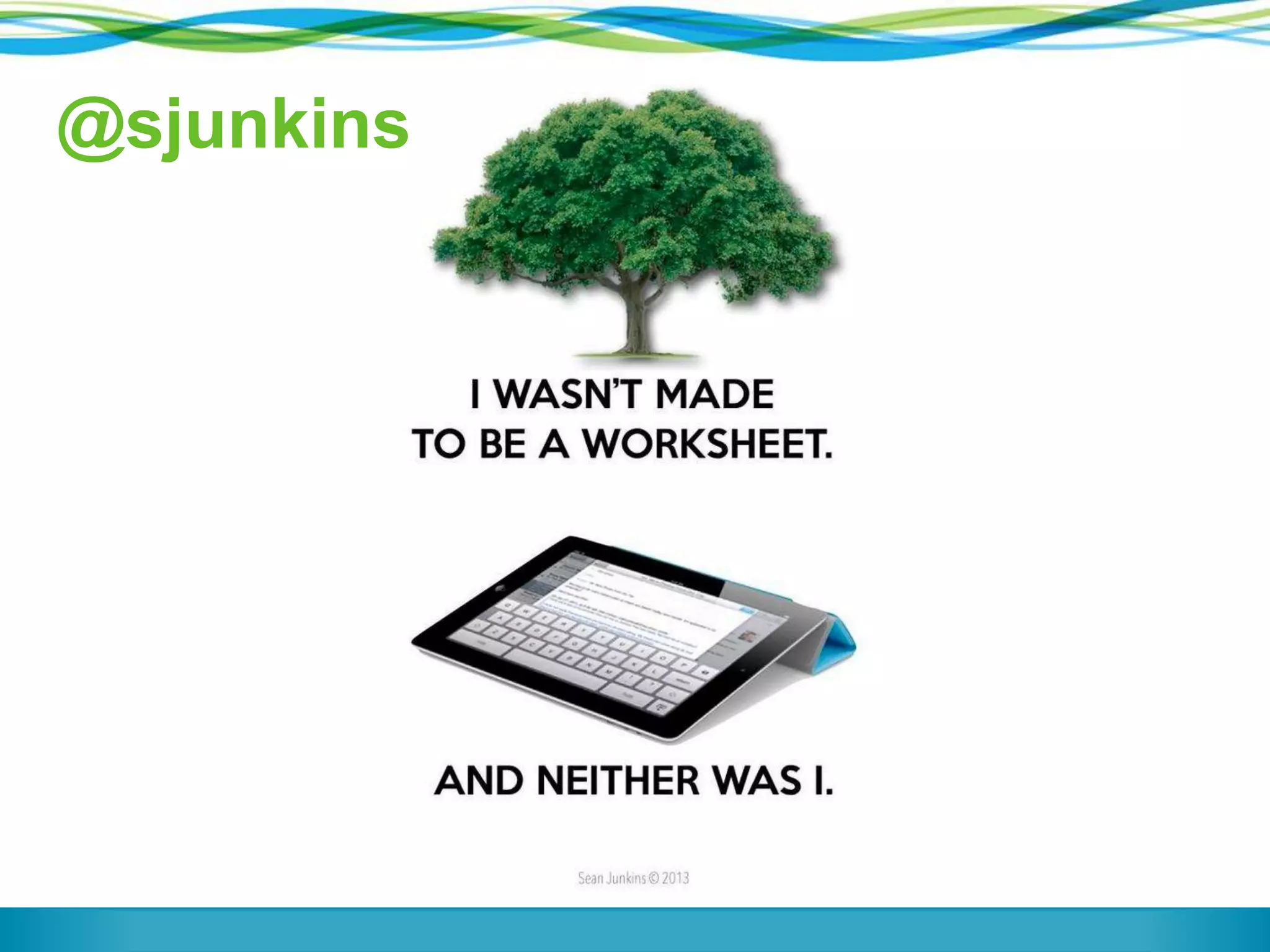
@sjunkins
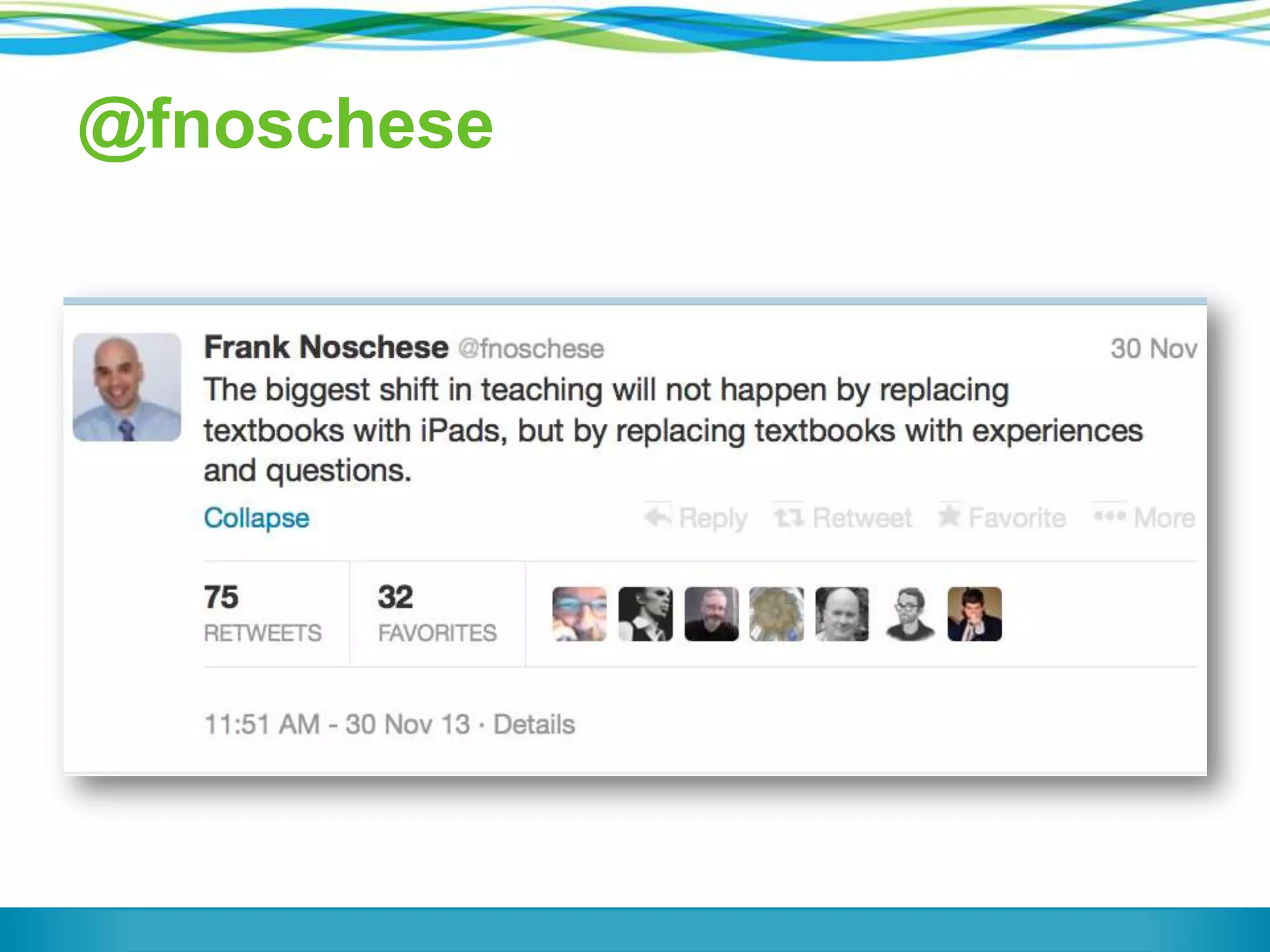
@fnoschese
Cathy Fosnot
Criteria
General

Digital environments

• Takes the Standards of
Practice seriously
• Provides professional
development
within…teachers learn as
they use the materials
• Not just a bunch of
activities but crafted
sequences to support
progressive development:
learning trajectories
(landscapes)

• Intelligent adaptive
learning
• Seamless formative
assessment
• Seamless home/school
connection
• Choice/personalized
learning
Skip Fennell
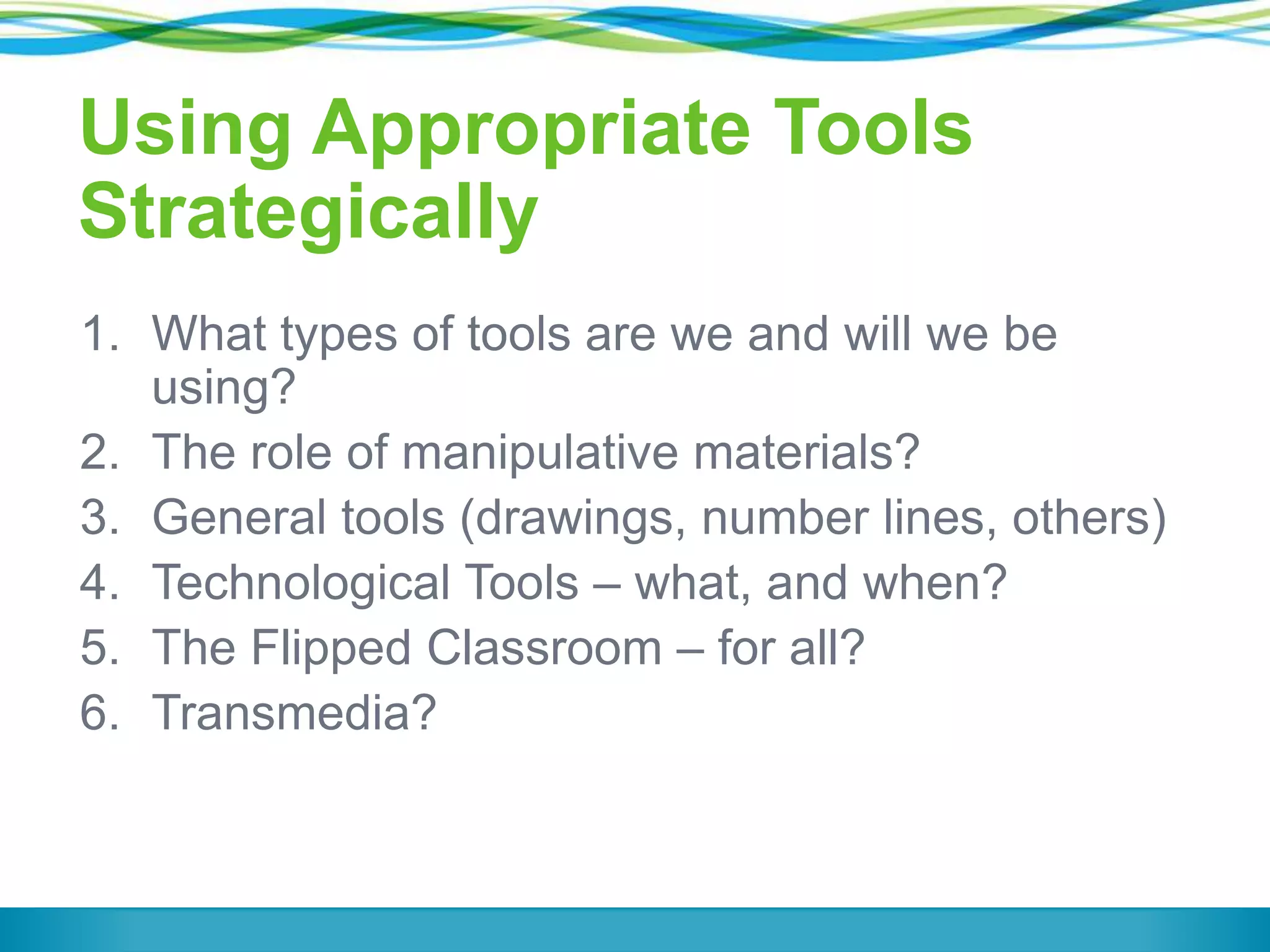
Using Appropriate Tools
Strategically
1. What types of tools are we and will we be
using?
2. The role of manipulative materials?
3. General tools (drawings, number lines, others)
4. Technological Tools – what, and when?
5. The Flipped Classroom – for all?
6. Transmedia?
Valerie Mills
How do educators evaluate
digital learning resources?
Ten Design Considerations
1. Topics are developed with multiple representations (graphs,
tables, and equations) and students are asked to use multiple
representations in sense making.

2. Students are engaged in constructing mathematical
understanding through substantive tasks that maintain a high
level of cognitive demand.
3. Mathematical discourse is valued.
a. Some tasks require written responses.
b. Electronic forums and the like promote interaction between
peers and instructor.
c. Teacher-student and student-student conversations within the
confines of the physical classroom.
How do educators evaluate digital
learning resources? (Continued)
4.

Online tools and resources support the learning environment.
(i.e., Online calculators, graphing tools, journals, hotlinks, etc.)

5.

Mathematical content is delivered or available in a variety of formats
(i.e., Teacher lecture, demonstrations and
applets, games, audio, cooperative problem solving, etc.)

6.

Mathematical experiences are provided to build conceptual
understanding in conjunction with procedural fluency.

7.

Online tutors are available, accessible, and mathematically competent.

8.

Program takes advantage of technology
(animation, color, movement, links).

9.

Program offers suggestions to the teacher for monitoring student
learning, adjusting instruction, and providing possible interventions.

10. Program offers supplemental activities (online and offline) to the teacher
that support students in developing mathematical reasoning.
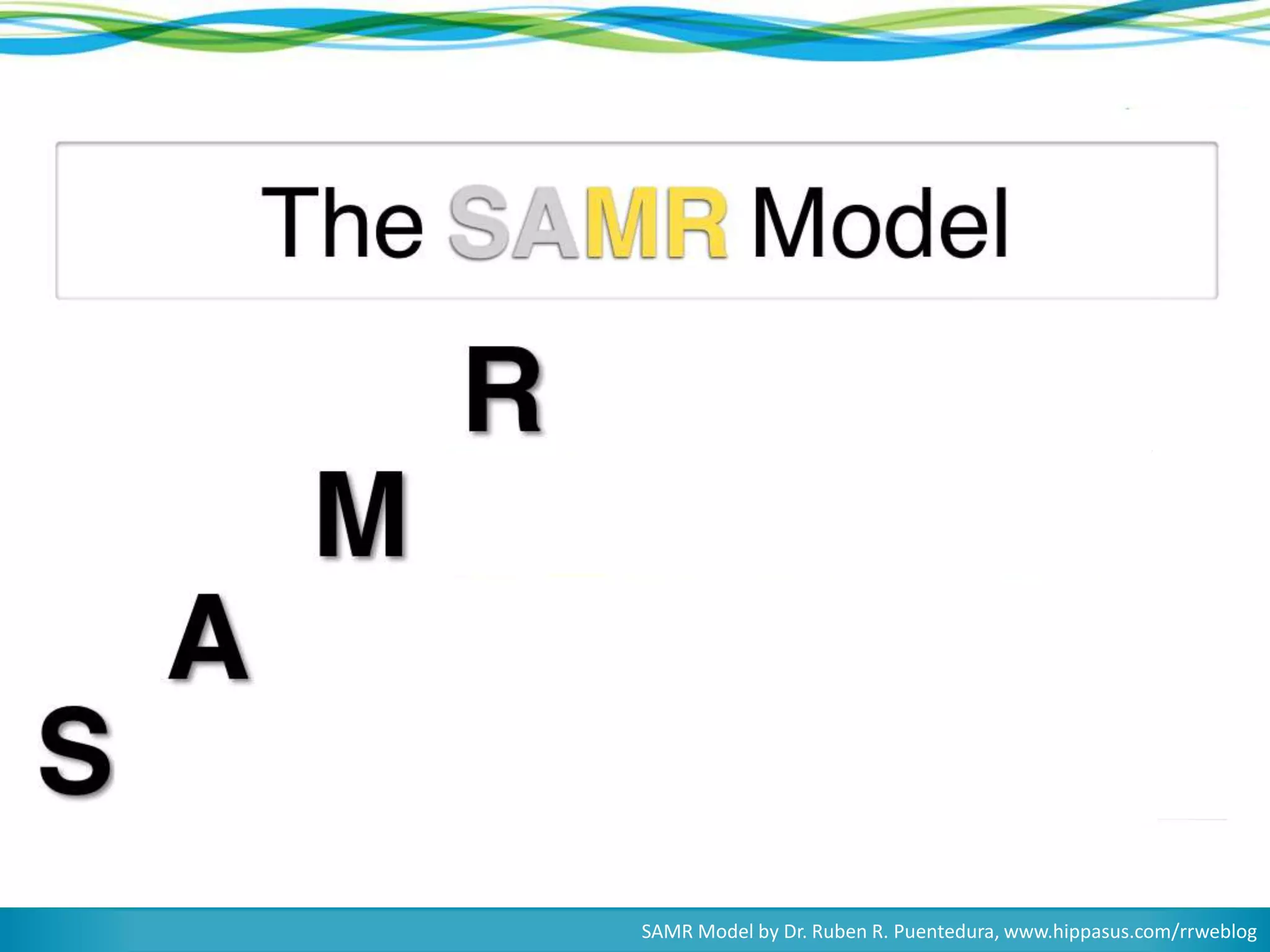
SAMR Model by Dr. Ruben R. Puentedura, www.hippasus.com/rrweblog
Q&A
Contact Information
• Francis 'Skip' Fennell
• @SkipFennell

• Cathy Fosnot
• www.NewPerspectivesOnLearning.com

• Valerie L. Mills
• http://www.mathedleadership.org/

• Tim Hudson
• @DocHudsonMath
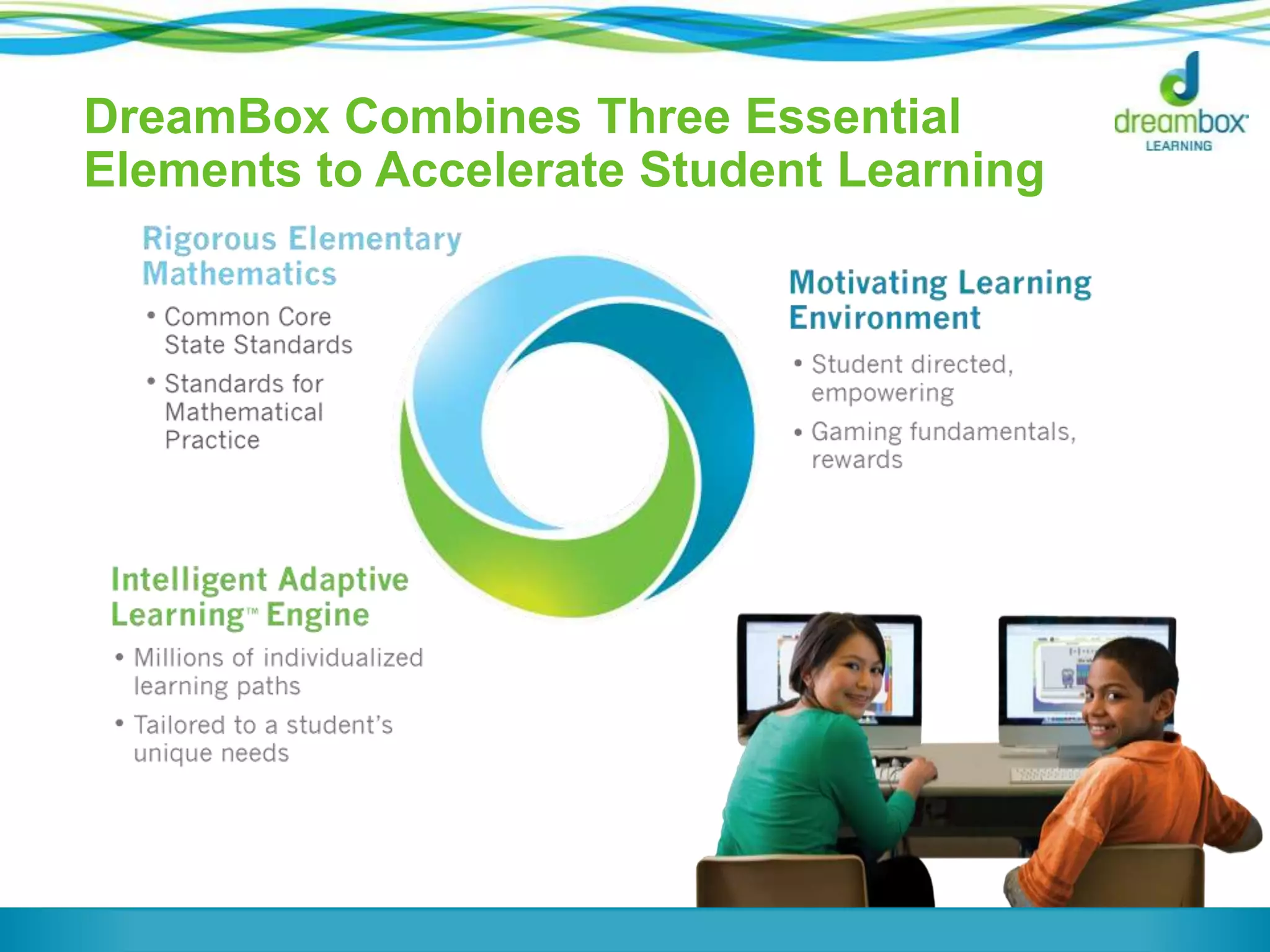
DreamBox Combines Three Essential
Elements to Accelerate Student Learning
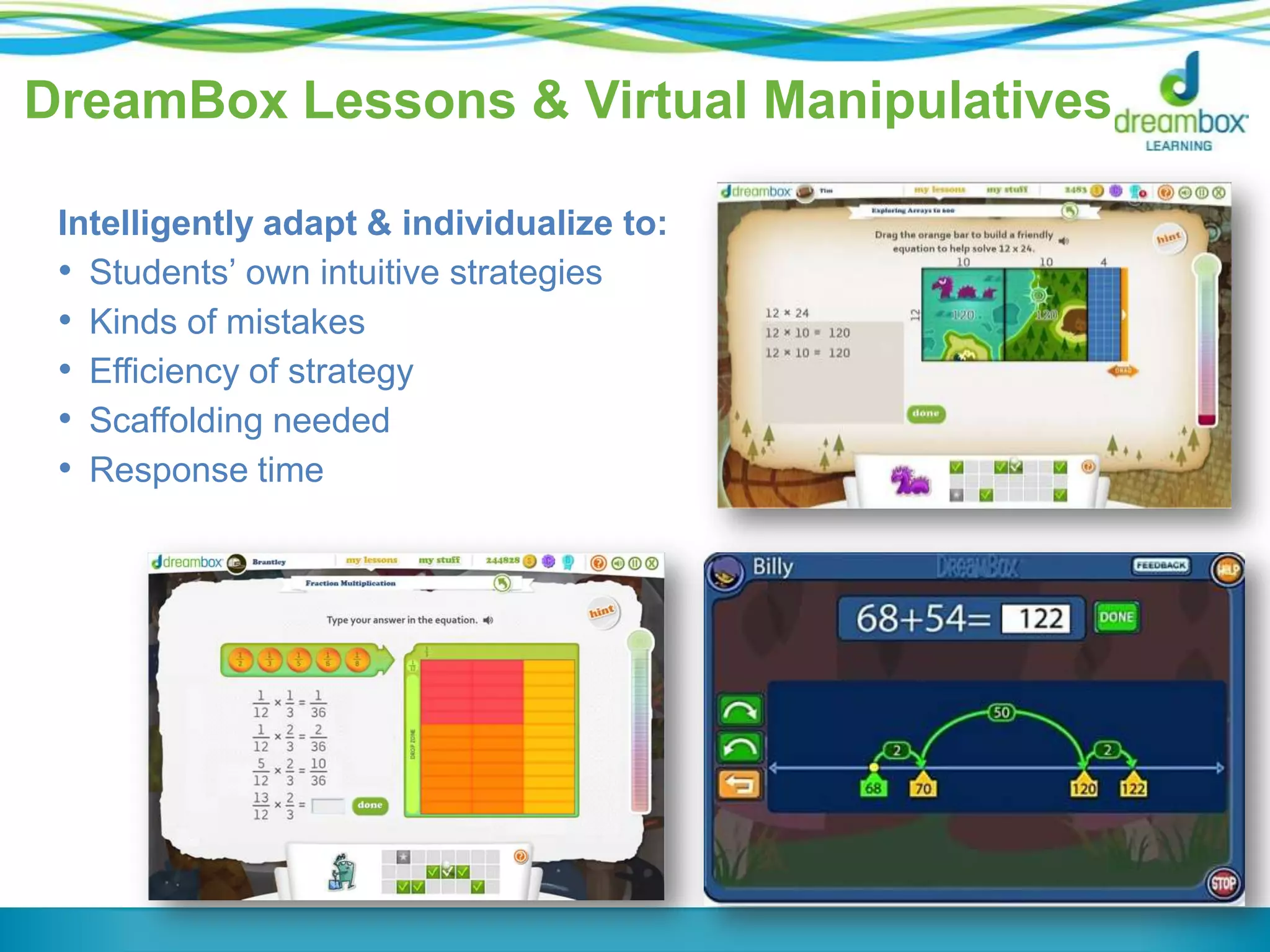
DreamBox Lessons & Virtual Manipulatives
Intelligently adapt & individualize to:
• Students’ own intuitive strategies
• Kinds of mistakes
• Efficiency of strategy
• Scaffolding needed
• Response time
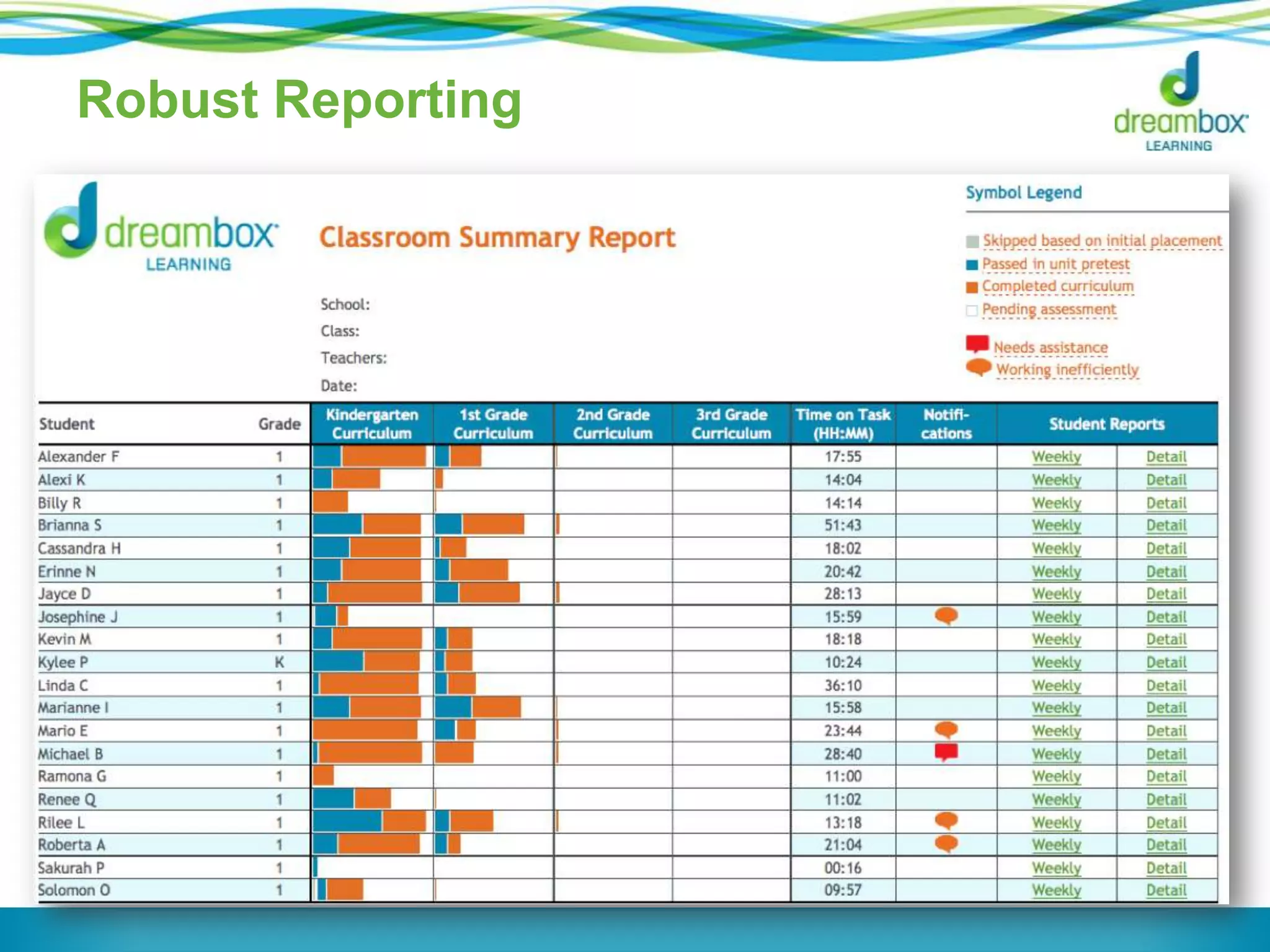
Robust Reporting
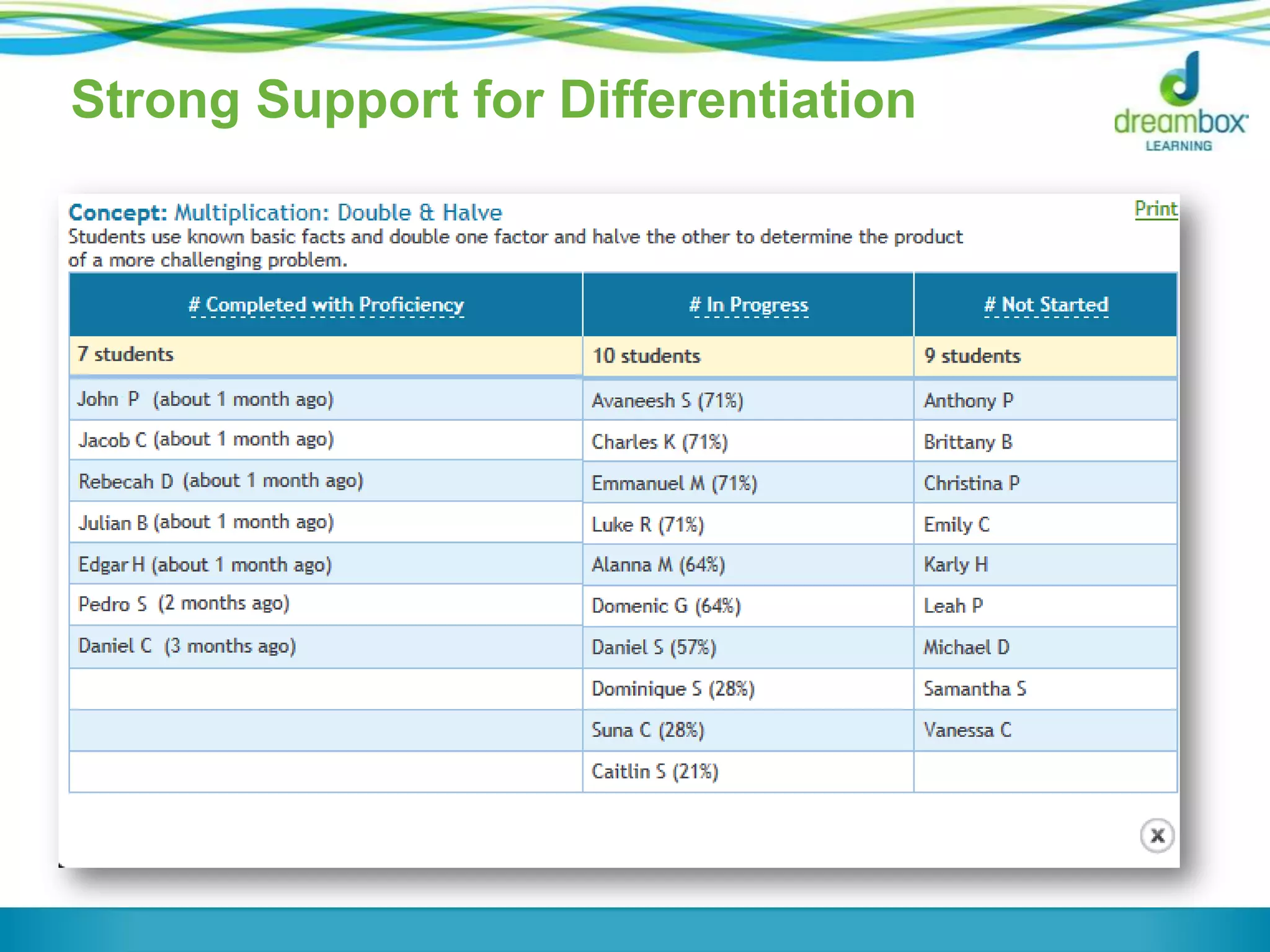
Strong Support for Differentiation
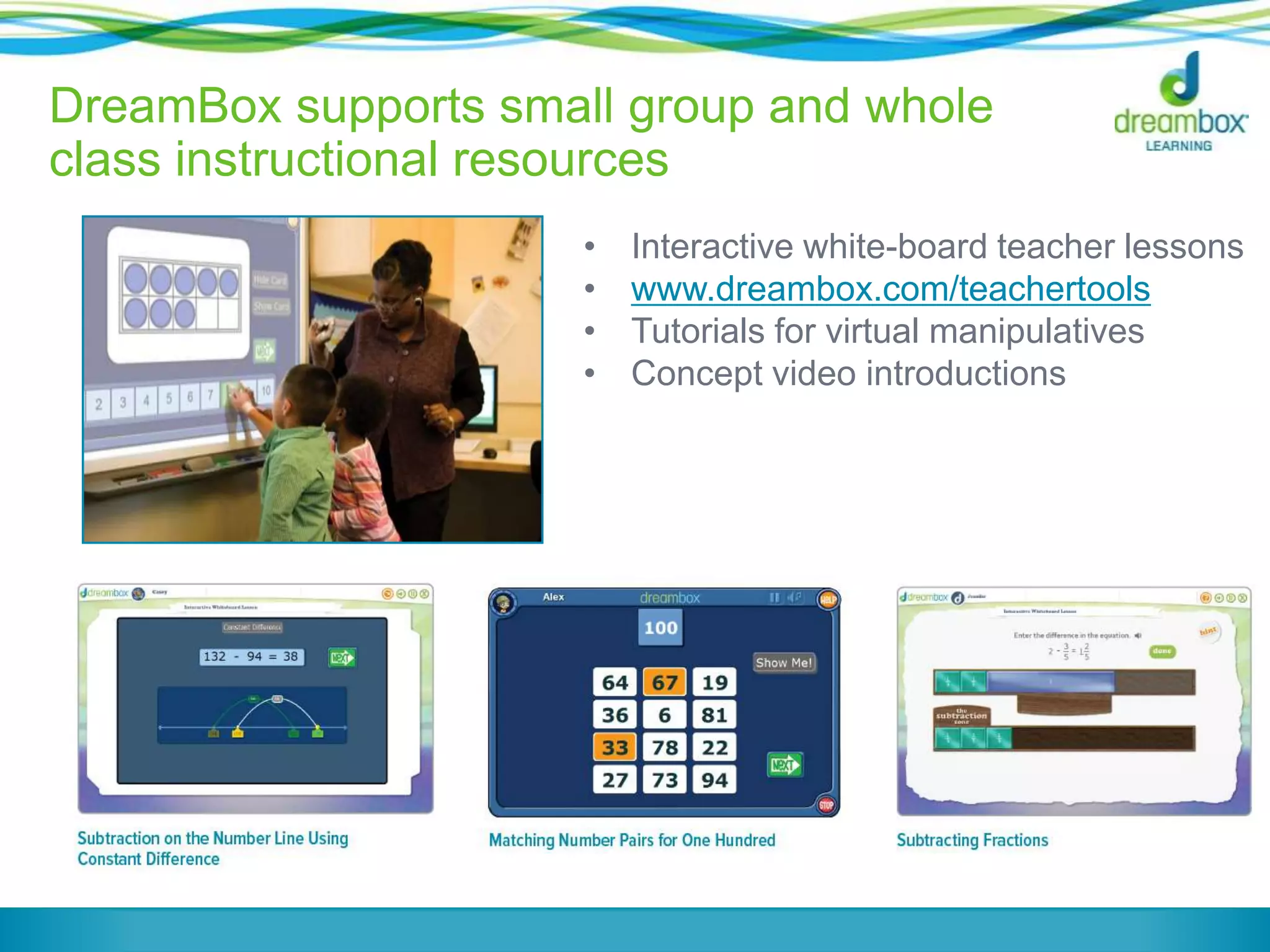
DreamBox supports small group and whole
class instructional resources
•
•
•
•

Interactive white-board teacher lessons
www.dreambox.com/teachertools
Tutorials for virtual manipulatives
Concept video introductions
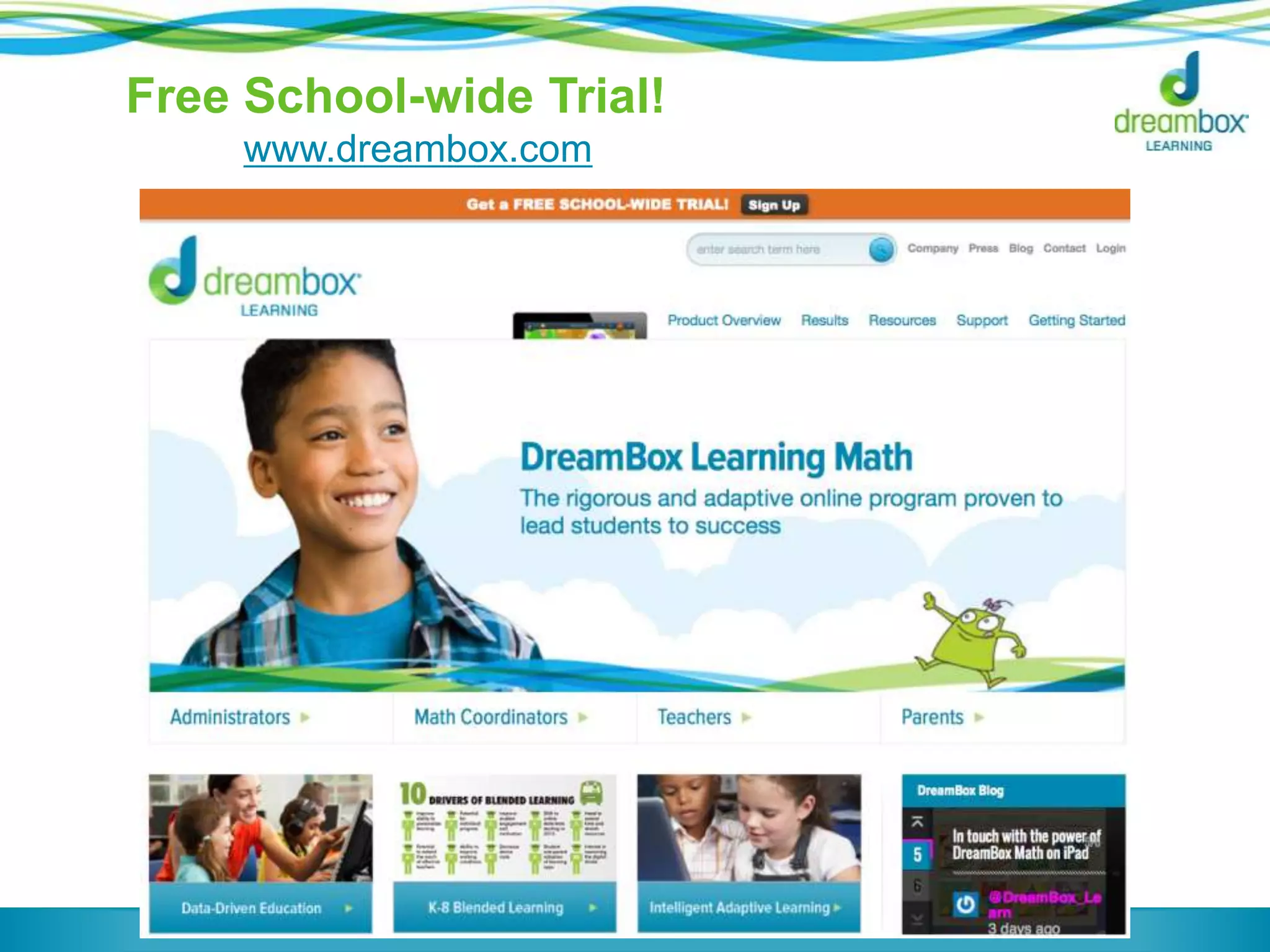
Free School-wide Trial!
www.dreambox.com
Thank you!

Future of Math Learning Panel

  • 1.
    The Future ofMath Education: A Panel Discussion of Promising Practices
  • 2.
    Distinguished Panel • Francis'Skip' Fennell, professor of education, McDaniel College, past NCTM, AMTE president • Cathy Fosnot, professor emeritus of childhood education, City College of New York, Founding Director of Math in the City • Valerie L. Mills, president, National Council of Supervisors of Mathematics; supervisor and mathematics education consultant, Oakland Schools, Michigan Moderator • Tim Hudson, Sr. Director of Curriculum Design, DreamBox Learning
  • 3.
    Agenda • Formative Assessment •Success for All Students with Common Core & Learning Resources • Selecting & Implementing Digital Learning Resources • Q&A
  • 4.
    Formative Assessment • Howdo we ensure it’s not just ―another thing‖ to do? • How do we ensure it's an integral component of learning rather than as another approach to assessment?
  • 5.
  • 6.
    Embedded Formative Assessment Three keyelements: 1. elicit evidence about learning to close the gap between current and desired performance, 2. adjust the learning experience to close the performance gap with useful feedback, and 3. involve students in the assessment learning process Adapted from Margaret Heritage, 2008
  • 7.
    Formative Assessment and ProductiveGoals Goals and lessons need to… • focus on the mathematics concepts and practices (not on doing particular math problems) • be specific enough that you can effectively gather and use information about student thinking • be understood to sit within a trajectory of goals and lessons that span days, weeks, and/or years
  • 8.
    Complete problems #3-18 Revise directions to focus students on mathematical goals that describe important concepts as well as skills. Example 1.
  • 9.
    Look closely atthis problem set to identify the solutions that will be positive and those that will be negative without fully simplifying each task. Describe the important features of an expression that help you make this decision. Revise instructional goals and directions to focus students on important mathematical concepts and relationships as well as skills. Example 1.
  • 10.
    Apple Orchard A farmerplants apple trees in a square pattern. In order to protect the apples trees against the wind he plants pine trees all around the orchard. Here you see a diagram of this situation where you can see the pattern of apple trees and conifer trees for any number (n) of rows of apple trees. N=1 N=2 N=3 N=4 X X X X X X X X X X X X X X X X X X X X X X X X X X X X X X X X X X X X X X X X X X X X X X X X X X X X X X X X X X X X X X X X X X X X X X X = Apple X = Pine Modified 2009 PISA Released Item X X X X X X X X X Example 2.
  • 11.
    Apple Orchard A B For whatvalue(s) of n will the number of apple trees equal the number of pine trees. Show C your method of calculating this. Modified 2009 PISA Released Item Example 2.
  • 12.
    Apple Tasks –Linear Pattern 50% 45% 40% 5th and 6th 35% 7th (186) 30% 8th (302) 25% Alg 1 (95) 20% Beyond Alg 1 15% 10% 5% 0% recursive desc recursive eq exp. desc exp.eq Data Collected as part of the DELTA project funded by the US Department of Education
  • 13.
  • 14.
    Jennifer James, Anthropologist ―Tapestryis that body of assumptions, beliefs, customs, and practices that we accept as foundational. They define who we are. In this time of great change, the tapestry is being torn rapidly and everywhere, and we begin to fall apart, becoming anxious and losing belief in who we are. We look backward. We become pessimistic about the present and the future because we can’t envision a new tapestry.‖
  • 15.
    Heraclitus ―You cannot steptwice into the same stream. For as you are stepping in, other waters are ever flowing.‖ Assessment should guide teaching. It should be continuous and provide information about the ―zone of proximal development‖ (Vygotsky 1978). To do so, it needs to foresee where and how one can anticipate that which is just coming into view in the distance (Streefland 1985). It needs to capture genuine mathematizing: children’s strategies, their ways of modeling realistic problems, and their understanding of key mathematical ideas. Bottom line, it needs to capture where the child is on the landscape of learning—where she has been, what her struggles are, and where she is going: it must be dynamic (Fosnot and Dolk 2001; van den Heuvel-Panhuizen 1996).
  • 16.
  • 17.
    Getting continuous data •In the moment • when conferring • analyzing children’s work • kidwatching as they work • From digital technology: DreamBox • Formal items designed to capture more than answers
  • 18.
    Two-pen assessment 4 x25 = 16 x 25 = 40 x 25 = 10 x 100 = 27 ÷ 3 = 10 x 13 = 2 x 13 = 12 x 13 = 3 x 9 = 3 x 90 = 12 x 9 = 12 x 12 = 6 x 18 = 6 x 24 =
  • 19.
  • 20.
  • 22.
    Formative Assessment: Pathways Observing Interviews Show Me HingeQuestions Exit Tasks How can this be communicated and shared with others – teaching teams, parents, links to SMARTER/PARCC? Fennell, Kobett, and Wray, 2013
  • 23.
    Success for ALLStudents In the Common Core era… • How can educators wisely choose and create resources? • What can be learned from past initiatives about standards and resource implementation?
  • 24.
  • 25.
    Understanding • • • • • • 4.NBT Generalize place valueunderstanding for multi-digit whole numbers. Use place value understanding and properties of operations to perform multi-digit arithmetic. 4.NF Extend understanding of fraction equivalence and ordering. Build fractions from unit fractions by applying and extending previous understandings of operations on whole numbers. Understand decimal notation for fractions and compare decimal fractions. 4.MD Geometric measurement: understand concepts of angle and measure angles.
  • 26.
    Representation 3.NF.2 – Understanda fraction as a number on the number line; represent fractions on a number line diagram. 4.NBT.5 – Multiply a whole number…Illustrate and explain…by using equations, rectangular arrays, and/or area models. 5.MD.4 – Measure volumes by counting unit cubes, using cubic cm, cubic in, cubic ft, and improvised units. 6.RP.3 – Use ratio and rate reasoning…by reasoning about tables of equivalent ratios, tape diagrams, double line diagrams or equations.
  • 27.
    Here’s the Point Conceptualunderstanding is NOT an option, It’s an expectation! AND, it’s about time!!!
  • 28.
  • 29.
    CCSS Curriculum Materials AnalysisTools Financial support for this project was provided by • Brookhill Foundation (Kathy Stumpf) • Texas Instruments (through CCSSO) Development team lead by William S. Bush (chair), University of Louisville, KY The toolkit can be downloaded from the NCSM website at: http://www.mathedleadership.org/ccss/materials.html
  • 30.
    CCSS Curriculum Materials AnalysisTools • • • • • • • Overview User’s Guide Tool 1: Content Analysis Tool 2: Mathematical Practices Analysis Tool 3: Overarching Considerations • Equity • Assessment • Technology Professional Development Facilitator Guide PowerPoint Slides
  • 31.
    Content Progression Operations andAlgebraic Thinking Expressions → and Equations Number and Operations— Base Ten → K 1 2 3 4 Algebra The Number System Number and Operations— Fractions → → → 5 6 7 8 High School
  • 32.
    Tool 1 –Standards for Mathematics Content
  • 33.
    Tool 2 –Standards for Mathematical Practices Understanding Place Value 3 3
  • 34.
  • 35.
    Criteria • Takes theStandards of Practice seriously • Provides professional development within…teachers learn as they use the materials • Not just a bunch of activities but crafted sequences to support progressive development: learning trajectories (landscapes)
  • 36.
    Digital Learning • • • • How cantechnology meet the needs of every child? How can educators wisely select and implement digital learning resources and technologies? When does learning benefit from the inclusion of digital instructional resources and when might it undermine learning? What do teachers and administrators need to learn about effectively facilitating learning using digital learning resources and what will it take for educators to develop this expertise?
  • 37.
  • 38.
    Fullan: Alive inthe Swamp “Technology–enabled innovations have a different problem, mainly pedagogy and outcomes. Many of the innovations, particularly those that provide online content and learning materials, use basic pedagogy – most often in the form of introducing concepts by video instruction and following up with a series of progression exercises and tests. Other digital innovations are simply tools that allow teachers to do the same age-old practices but in a digital format.‖ (p. 25) Fullan & Donnelly, Alive in the Swamp: Assessing Digital Innovations in Education, © July 2013, www.nesta.org/uk
  • 39.
  • 40.
  • 41.
  • 42.
    Criteria General Digital environments • Takesthe Standards of Practice seriously • Provides professional development within…teachers learn as they use the materials • Not just a bunch of activities but crafted sequences to support progressive development: learning trajectories (landscapes) • Intelligent adaptive learning • Seamless formative assessment • Seamless home/school connection • Choice/personalized learning
  • 43.
  • 44.
    Using Appropriate Tools Strategically 1.What types of tools are we and will we be using? 2. The role of manipulative materials? 3. General tools (drawings, number lines, others) 4. Technological Tools – what, and when? 5. The Flipped Classroom – for all? 6. Transmedia?
  • 45.
  • 46.
    How do educatorsevaluate digital learning resources? Ten Design Considerations 1. Topics are developed with multiple representations (graphs, tables, and equations) and students are asked to use multiple representations in sense making. 2. Students are engaged in constructing mathematical understanding through substantive tasks that maintain a high level of cognitive demand. 3. Mathematical discourse is valued. a. Some tasks require written responses. b. Electronic forums and the like promote interaction between peers and instructor. c. Teacher-student and student-student conversations within the confines of the physical classroom.
  • 47.
    How do educatorsevaluate digital learning resources? (Continued) 4. Online tools and resources support the learning environment. (i.e., Online calculators, graphing tools, journals, hotlinks, etc.) 5. Mathematical content is delivered or available in a variety of formats (i.e., Teacher lecture, demonstrations and applets, games, audio, cooperative problem solving, etc.) 6. Mathematical experiences are provided to build conceptual understanding in conjunction with procedural fluency. 7. Online tutors are available, accessible, and mathematically competent. 8. Program takes advantage of technology (animation, color, movement, links). 9. Program offers suggestions to the teacher for monitoring student learning, adjusting instruction, and providing possible interventions. 10. Program offers supplemental activities (online and offline) to the teacher that support students in developing mathematical reasoning.
  • 48.
    SAMR Model byDr. Ruben R. Puentedura, www.hippasus.com/rrweblog
  • 49.
  • 50.
    Contact Information • Francis'Skip' Fennell • @SkipFennell • Cathy Fosnot • www.NewPerspectivesOnLearning.com • Valerie L. Mills • http://www.mathedleadership.org/ • Tim Hudson • @DocHudsonMath
  • 51.
    DreamBox Combines ThreeEssential Elements to Accelerate Student Learning
  • 52.
    DreamBox Lessons &Virtual Manipulatives Intelligently adapt & individualize to: • Students’ own intuitive strategies • Kinds of mistakes • Efficiency of strategy • Scaffolding needed • Response time
  • 53.
  • 54.
    Strong Support forDifferentiation
  • 55.
    DreamBox supports smallgroup and whole class instructional resources • • • • Interactive white-board teacher lessons www.dreambox.com/teachertools Tutorials for virtual manipulatives Concept video introductions
  • 56.
  • 57.

Editor's Notes

  • #8 Effective use of formative assessment strategies depends on well defined goals - So, frame your goals in a way that they not are focused strictly on doing problems, …….you will have a hard time employing formative assessment strategies and capitalizing on potential learning gains. Consider these two examples:
  • #13 If I focus on representation, then I organize my data around which form of representation they choose for this task and this data leads very naturally into next productive instructional steps.
  • #15 Topic 1: This is an opportunity to look at assessment differently: how and what we assess need to be examined. Bottom line assessment needs to be continuous and inform teaching. Leren: teaching and learning cannot be separated.
  • #16 Topic 1: Dynamic versus static assessment: emphasis needs to be on capturing the mathematizing, ie. the structuring, the modeling, the strategies…
  • #17 Topic 1: A framework that is dynamic
  • #31 Three tools in the toolkit, 1. Tool 1 – is organized with the cross grade trajectories clearly labeled 2. Tool 2 – connects the practices to specific content!
  • #36 Topic 2
  • #43 Topic 3