
Maths for Biology
January 9th 2016 ASE
Carys Hughes
Christian Bokhove
Hilary Otter
Rebecca D’Silva
Nicky Miller
Introductions
• Carys Hughes
• Christian Bokhove
• Hilary Otter
• Rebecca D’Silva
• Nicky Miller
This study
• Design a CPD course on Maths for A level
Biology
• Involve teachers in its design
• Implement the day
• Evaluate impact of the two groups of teachers.
Why this day
• Changes in the A level Biology curriculum
• More maths
• Maths used interdisciplinary
• Principles
– Instruction but also hands-on tasks
– Collaborative, doing it together, ask questions
– Want to customise the course to where you need
support
Part I: designing the day (process)
• Communities of Interest and Boundary Objects
• Involve three Biology teachers, and two researchers, one
Maths, one Biology
• Two development sessions of 2 hours
• All the teachers’ contributions will be recorded through notes
and audio.
• After delivery of the day teachers interviewed in a group
interview/focus group.
Research questions:
• In what way can these teachers contribute to the design of the
delivered session?
• What impact does the involvement in the design process have
on their own professional development.
Part 2: delivery of the CPD day (product)
• 20-30 teachers
• Whole day, free
• Focus on exponentials/logarithms and statistics
(came from the design part with teachers)
• Data collection: maths confidence, evaluation,
impact
Research question:
• What impact does a CPD day on maths for the new
Biology A-level curriculum have on participant’s
maths confidence and teaching practice?
• Update and strengthen knowledge on some
topics for the new Biology A level curriculum;
– Exponential growth and decay, logarithms
– Statistical tests
• Hear and discuss ideas for teaching them;
• Want to hear your opinions for improvements;
• You leave with:
– Ideas, knowledge and some resources
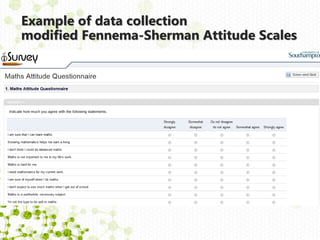
Example of data collection
Focus group questions
• What, in your view, did you manage to contribute to the design of the CPD
session?
• What impact, in your opinion, did the involvement in the design process
have on their own professional development.
– Did have an impact on your confidence in teaching Biology?
– And the maths component in particular? (engagement, confidence,
liking, valuing)
• What impact, in your opinion, did the participation in the whole project
(including the actual CPD day) have on their own professional development.
– Did have an impact on your confidence in teaching Biology?
– And the maths component in particular? (engagement, confidence,
liking, valuing)
• Did you feel the whole process has had an impact on students?
– Engagement with maths? Confidence in maths? Liking maths?
– Valuing maths?
Example of data collection
modified Fennema-Sherman Attitude Scales
Tentative findings: process
• Usefulness of the Community of Interest
• Knowledge acquisition
• Improved confidence in teaching the maths in A
level biology
• Better understanding of the processes involved
in the calculations
Tentative findings: product/day
• Valued content exponentials/logarithms
• More confident statistics but worthwhile to
compare and discuss pedagogy
• On confidence:
– They think they can learn maths
– They think it's important and worthwhile
– They need maths for their work
– But it's hard!
– So need support.
Challenges
• Getting teachers away from school for CPD
– Design phase twilight
– Day was free
– After A-level exams
• Data collection
• Culture clash
– Research v Practice
– Maths v Science
Taster from
the CPD day
Powers and
exponential
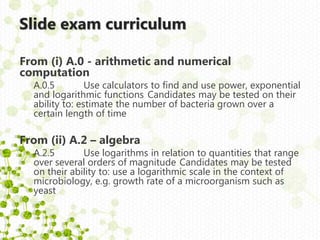
Slide exam curriculum
From (i) A.0 - arithmetic and numerical
computation
A.0.5 Use calculators to find and use power, exponential
and logarithmic functions Candidates may be tested on their
ability to: estimate the number of bacteria grown over a
certain length of time
From (ii) A.2 – algebra
A.2.5 Use logarithms in relation to quantities that range
over several orders of magnitude Candidates may be tested
on their ability to: use a logarithmic scale in the context of
microbiology, e.g. growth rate of a microorganism such as
yeast
Powers of 10
Movie on youtube
ThereisanewerversioncalledCosmicVoyage,narratedby
MorganFreeman.It,however,doesnothavethestandard
notationincluded.
17
ACTIVITY
Exponentials
Take an A4 sheet of paper.
How many times can you fold it in half?
MYTHBUSTERS
Movie on youtube
19
How many layers do you produce? HANDOUT
Number
of folds
(x)
Number
of layers
(y)
Mult Power Heig
ht
(cm)
0 1 0.01
1 2 2
2 2*2
3 2*2*2
4 2*2*2*2 24
5
Table of results
H
20
Plot your values on graph paper:
- 3 - 2 - 1 1 2 3 4 5 6 7 8
- 100
100
200
300
x
y
- 3 - 2 - 1 1 2 3 4 5 6 7 8
- 100
100
200
300
x
y
21
Exponential growth
Imagine you contracted a virus (such as SARS)
where you infected the first five people that
you met, and they each infected the first five
people that they met and so on…. There are
186,701 people living in Southampton. How
many interactions would it take until everyone
was infected?
22
How many infections?
Number of interactions
(x)
Number of infected
people (y)
0 1
1 5
2 25
3
4
5
Table of results
23
General form:
y=bt
where b is the base and x is the power (or exponent)
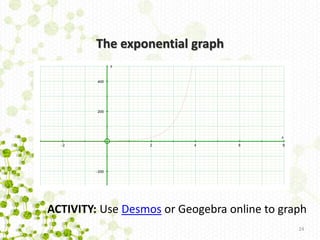
24
The exponential graph
- 2 2 4 6 8
- 200
200
400
x
y
ACTIVITY: Use Desmos or Geogebra online to graph
25
How many layers do you produce?
Number
of folds
(x)
Number
of layers
(y)
Heig
ht
(cm)
0 1 0.01
1 2 2
2 2*2
3 2*2*2
4 2*2*2*2 24
5
Table of results
y=2x
26
Common features of y=bx
all curves pass through (0,1)
exponential growth (and decay) takes
place very rapidly
b > 0
b 0
b 1
b > 1 has a positive gradient (PLOT THIS!)
0 < b < 1 has a negative gradient (PLOT THIS!)


https://www.desmos.com/calculator/auubsaje
fh
Number of
interactions (x)
Number of people with the
disease (y)
0 1
1 5
2 25
3 125
4 625
5 3,125
6 15,625
7 78,125
8 390,625
Statistics
Slide exam curriculum
From (i) A.1 - handling data
A.1.9 Select and use a statistical test Candidates may
be tested on their ability to select and use:
• the Chi squared test to test the significance of the
difference between observed and expected results
• the Students t-test
• the correlation coefficient
A.1.11 Identify uncertainties in measurements and use
simple techniques to determine uncertainty when data are
combined Candidates may be tested on their ability to:
• calculate percentage error where there are uncertainties
in measurement
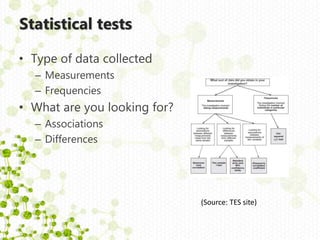
Statistical tests
• Type of data collected
– Measurements
– Frequencies
• What are you looking for?
– Associations
– Differences
(Source: TES site)
(Source: TES site)
Conclusion
• CPD day designed by Community of Interest for
Biology teachers
• Improvement maths confidence
• Now writing up the study
• Questions?
• Thank you for your
attention.
http://is.gd/maths4bio

Maths for Biology

  • 1.
    Maths for Biology January9th 2016 ASE Carys Hughes Christian Bokhove Hilary Otter Rebecca D’Silva Nicky Miller
  • 2.
    Introductions • Carys Hughes •Christian Bokhove • Hilary Otter • Rebecca D’Silva • Nicky Miller
  • 3.
    This study • Designa CPD course on Maths for A level Biology • Involve teachers in its design • Implement the day • Evaluate impact of the two groups of teachers.
  • 4.
    Why this day •Changes in the A level Biology curriculum • More maths • Maths used interdisciplinary • Principles – Instruction but also hands-on tasks – Collaborative, doing it together, ask questions – Want to customise the course to where you need support
  • 5.
    Part I: designingthe day (process) • Communities of Interest and Boundary Objects • Involve three Biology teachers, and two researchers, one Maths, one Biology • Two development sessions of 2 hours • All the teachers’ contributions will be recorded through notes and audio. • After delivery of the day teachers interviewed in a group interview/focus group. Research questions: • In what way can these teachers contribute to the design of the delivered session? • What impact does the involvement in the design process have on their own professional development.
  • 6.
    Part 2: deliveryof the CPD day (product) • 20-30 teachers • Whole day, free • Focus on exponentials/logarithms and statistics (came from the design part with teachers) • Data collection: maths confidence, evaluation, impact Research question: • What impact does a CPD day on maths for the new Biology A-level curriculum have on participant’s maths confidence and teaching practice?
  • 7.
    • Update andstrengthen knowledge on some topics for the new Biology A level curriculum; – Exponential growth and decay, logarithms – Statistical tests • Hear and discuss ideas for teaching them; • Want to hear your opinions for improvements; • You leave with: – Ideas, knowledge and some resources
  • 8.
    Example of datacollection Focus group questions • What, in your view, did you manage to contribute to the design of the CPD session? • What impact, in your opinion, did the involvement in the design process have on their own professional development. – Did have an impact on your confidence in teaching Biology? – And the maths component in particular? (engagement, confidence, liking, valuing) • What impact, in your opinion, did the participation in the whole project (including the actual CPD day) have on their own professional development. – Did have an impact on your confidence in teaching Biology? – And the maths component in particular? (engagement, confidence, liking, valuing) • Did you feel the whole process has had an impact on students? – Engagement with maths? Confidence in maths? Liking maths? – Valuing maths?
  • 9.
    Example of datacollection modified Fennema-Sherman Attitude Scales
  • 10.
    Tentative findings: process •Usefulness of the Community of Interest • Knowledge acquisition • Improved confidence in teaching the maths in A level biology • Better understanding of the processes involved in the calculations
  • 11.
    Tentative findings: product/day •Valued content exponentials/logarithms • More confident statistics but worthwhile to compare and discuss pedagogy • On confidence: – They think they can learn maths – They think it's important and worthwhile – They need maths for their work – But it's hard! – So need support.
  • 12.
    Challenges • Getting teachersaway from school for CPD – Design phase twilight – Day was free – After A-level exams • Data collection • Culture clash – Research v Practice – Maths v Science
  • 13.
  • 14.
  • 15.
    Slide exam curriculum From(i) A.0 - arithmetic and numerical computation A.0.5 Use calculators to find and use power, exponential and logarithmic functions Candidates may be tested on their ability to: estimate the number of bacteria grown over a certain length of time From (ii) A.2 – algebra A.2.5 Use logarithms in relation to quantities that range over several orders of magnitude Candidates may be tested on their ability to: use a logarithmic scale in the context of microbiology, e.g. growth rate of a microorganism such as yeast
  • 16.
    Powers of 10 Movieon youtube ThereisanewerversioncalledCosmicVoyage,narratedby MorganFreeman.It,however,doesnothavethestandard notationincluded.
  • 17.
    17 ACTIVITY Exponentials Take an A4sheet of paper. How many times can you fold it in half?
  • 18.
  • 19.
    19 How many layersdo you produce? HANDOUT Number of folds (x) Number of layers (y) Mult Power Heig ht (cm) 0 1 0.01 1 2 2 2 2*2 3 2*2*2 4 2*2*2*2 24 5 Table of results H
  • 20.
    20 Plot your valueson graph paper: - 3 - 2 - 1 1 2 3 4 5 6 7 8 - 100 100 200 300 x y - 3 - 2 - 1 1 2 3 4 5 6 7 8 - 100 100 200 300 x y
  • 21.
    21 Exponential growth Imagine youcontracted a virus (such as SARS) where you infected the first five people that you met, and they each infected the first five people that they met and so on…. There are 186,701 people living in Southampton. How many interactions would it take until everyone was infected?
  • 22.
    22 How many infections? Numberof interactions (x) Number of infected people (y) 0 1 1 5 2 25 3 4 5 Table of results
  • 23.
    23 General form: y=bt where bis the base and x is the power (or exponent)
  • 24.
    24 The exponential graph -2 2 4 6 8 - 200 200 400 x y ACTIVITY: Use Desmos or Geogebra online to graph
  • 25.
    25 How many layersdo you produce? Number of folds (x) Number of layers (y) Heig ht (cm) 0 1 0.01 1 2 2 2 2*2 3 2*2*2 4 2*2*2*2 24 5 Table of results y=2x
  • 26.
    26 Common features ofy=bx all curves pass through (0,1) exponential growth (and decay) takes place very rapidly b > 0 b 0 b 1 b > 1 has a positive gradient (PLOT THIS!) 0 < b < 1 has a negative gradient (PLOT THIS!)   https://www.desmos.com/calculator/auubsaje fh
  • 27.
    Number of interactions (x) Numberof people with the disease (y) 0 1 1 5 2 25 3 125 4 625 5 3,125 6 15,625 7 78,125 8 390,625
  • 28.
  • 29.
    Slide exam curriculum From(i) A.1 - handling data A.1.9 Select and use a statistical test Candidates may be tested on their ability to select and use: • the Chi squared test to test the significance of the difference between observed and expected results • the Students t-test • the correlation coefficient A.1.11 Identify uncertainties in measurements and use simple techniques to determine uncertainty when data are combined Candidates may be tested on their ability to: • calculate percentage error where there are uncertainties in measurement
  • 30.
    Statistical tests • Typeof data collected – Measurements – Frequencies • What are you looking for? – Associations – Differences (Source: TES site)
  • 31.
  • 32.
    Conclusion • CPD daydesigned by Community of Interest for Biology teachers • Improvement maths confidence • Now writing up the study • Questions? • Thank you for your attention. http://is.gd/maths4bio

Editor's Notes

  • #2 Dear all, We are meeting this week. Because of marking I have not been able to finalise the materials for the CPD day yet. Of course a lot is clear: 1. Intro with standard form/notation. Film powers of 10. 2. Instruction about exponential growth: formulas but particularly graphing. (Card sorting activities integrated). 3. Logarithms as the 'oppositie' of exponential functions. 4. This leads into logarithmic paper. 5. Example questions, a handson section. Making sure that participants leave with knowledge to complete appropriate questions. Break 6. Quick revision of basic statistical terms, incl Normal Distribution. 7. Some biological examples of Normal distribution use. 8. Overview of statistics: Chi, t-test 9. Example questions, a handson section. Making sure that participants leave with knowledge to complete appropriate questions. Teachers will leave with a set of reesources, including a laminated sheet with info and online resources. The latter I will source from TES, NCETM, Khan academy, geogebrabooks (http://tube.geogebra.org/search/perform/search/Exponential%20growth/type/book) and finally some materials I know from my former University.
  • #7 A maximum of 30 teachers will (hopefully) attend a newly developed CPD on maths for the new A level Biology. During the day and one month after the day we will ask them to fill in several questionnaires: The teachers will be given a pre-questionnaire on maths confidence and usefulness at the beginning of the day, two instruments right at the end of the day plus a ‘take home’ questionnaire and a follow-up measurement after summer 2015. In this application the instruments are called A, B, C and D respectively. They are: A modified version of the ‘modified Fennema-Sherman Attitude Scales’. We only use two scales of this instrument called ‘Personal confidence about the subject matter ‘ and ‘Usefulness of the subject's content’. The questions will be implemented in iSurvey. See survey A. A Learning and Evaluation Form which is a standard form that queries immediate learning benefits. See survey B. An after CPD action plan which asks participants to make a plan to maximise their CPD impact. See survey C. A standard CPD evaluation form which asks questions about the quality of the CPD. See survey D.