

Do you....?
Project: How to make surveys
                   José A. Alcalde López
With this project students...

● Will be involved in a real life task
● Will work in teams

● Will use ICT

● Will interact with other people

● Will revise maths (statistics,

percentages, graphs...)
● Will practise some specific grammar

(questions, tenses, frequency adverbs...)
● Will work on specific vocabulary

according to the survey
What is a survey?

        It is a detailed study or
   comprehensive analysis on a
specific topic to know more about it.
     It usually includes different
questions to be answered among a
          definite population.
   Statistics can help a lot when
  showing results, once the survey
          has been conducted.
Why surveys?
Surveys (aka polls) are very frequent
nowadays because they offer
people's opinions and data on
virtually any topic (politics,
consumerism, likes and preferences,
free time...)
Many mass media include surveys on
a regular basis.
Who?

When conducting a survey it is
  important to have in mind a
          target group.
   Variables like gender, age,
origin, education, income, etc.,
    are some possibilities to
            consider.
Questions
They are the simplest straightforward
way to know about people's opinions
and information. We distinguish:

● Yes/No: These questions expect a very
simple answer. Sometimes “Don't know” is
also offered

● Wh-: Now the possibilities are wider
depending on the question form (who,
when, what, where, how often, why...)
New technologies

Today conducting a survey can be
very simple by using some on-line
    polls (some of them free).
We only have to edit the questions,
     possible answers and the
programme will offer all the results
   in varied attractive formats.
Statistics

     “It is the study of the collection,
   organization, analysis, interpretation
 and presentation of data” (Wikipedia).
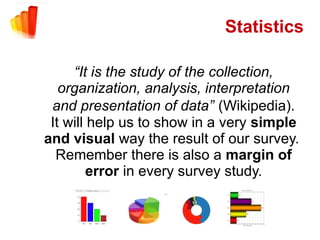
 It will help us to show in a very simple
and visual way the result of our survey.
  Remember there is also a margin of
         error in every survey study.
And now your survey...
● In groups think of an interesting
topic for teenagers
● Write 15 possible questions

(including Y/N, Wh-...)
● Write a paper version and an on-

line one
● Conduct the survey among a

target group
● Get the results

● Present the results to the class
Do you....?
Project: How to make surveys
                   José A. Alcalde López

Project: How to make a survey

  • 1.
    Do you....? Project: Howto make surveys José A. Alcalde López
  • 2.
    With this projectstudents... ● Will be involved in a real life task ● Will work in teams ● Will use ICT ● Will interact with other people ● Will revise maths (statistics, percentages, graphs...) ● Will practise some specific grammar (questions, tenses, frequency adverbs...) ● Will work on specific vocabulary according to the survey
  • 3.
    What is asurvey? It is a detailed study or comprehensive analysis on a specific topic to know more about it. It usually includes different questions to be answered among a definite population. Statistics can help a lot when showing results, once the survey has been conducted.
  • 4.
    Why surveys? Surveys (akapolls) are very frequent nowadays because they offer people's opinions and data on virtually any topic (politics, consumerism, likes and preferences, free time...) Many mass media include surveys on a regular basis.
  • 5.
    Who? When conducting asurvey it is important to have in mind a target group. Variables like gender, age, origin, education, income, etc., are some possibilities to consider.
  • 6.
    Questions They are thesimplest straightforward way to know about people's opinions and information. We distinguish: ● Yes/No: These questions expect a very simple answer. Sometimes “Don't know” is also offered ● Wh-: Now the possibilities are wider depending on the question form (who, when, what, where, how often, why...)
  • 7.
    New technologies Today conductinga survey can be very simple by using some on-line polls (some of them free). We only have to edit the questions, possible answers and the programme will offer all the results in varied attractive formats.
  • 8.
    Statistics “It is the study of the collection, organization, analysis, interpretation and presentation of data” (Wikipedia). It will help us to show in a very simple and visual way the result of our survey. Remember there is also a margin of error in every survey study.
  • 9.
    And now yoursurvey... ● In groups think of an interesting topic for teenagers ● Write 15 possible questions (including Y/N, Wh-...) ● Write a paper version and an on- line one ● Conduct the survey among a target group ● Get the results ● Present the results to the class
  • 10.
    Do you....? Project: Howto make surveys José A. Alcalde López