Using a digital tool to improve students’
algebraic expertise in the Netherlands:
crises, feedback and fading
Christian Bokhove
Southampton Education School
April 17th, 2014, BCME-8
Rationale
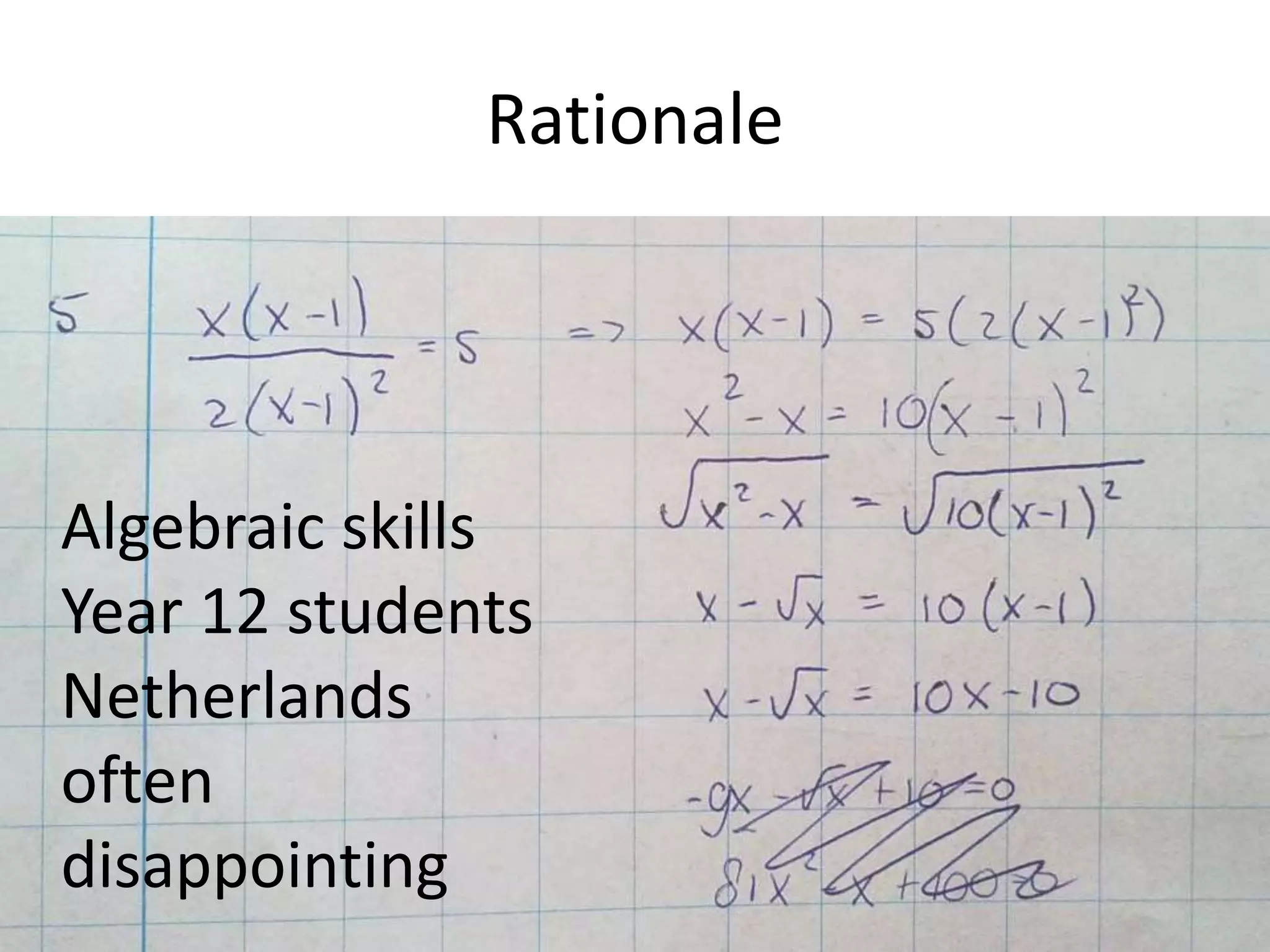
Algebraic skills
Year 12 students
Netherlands
often
disappointing
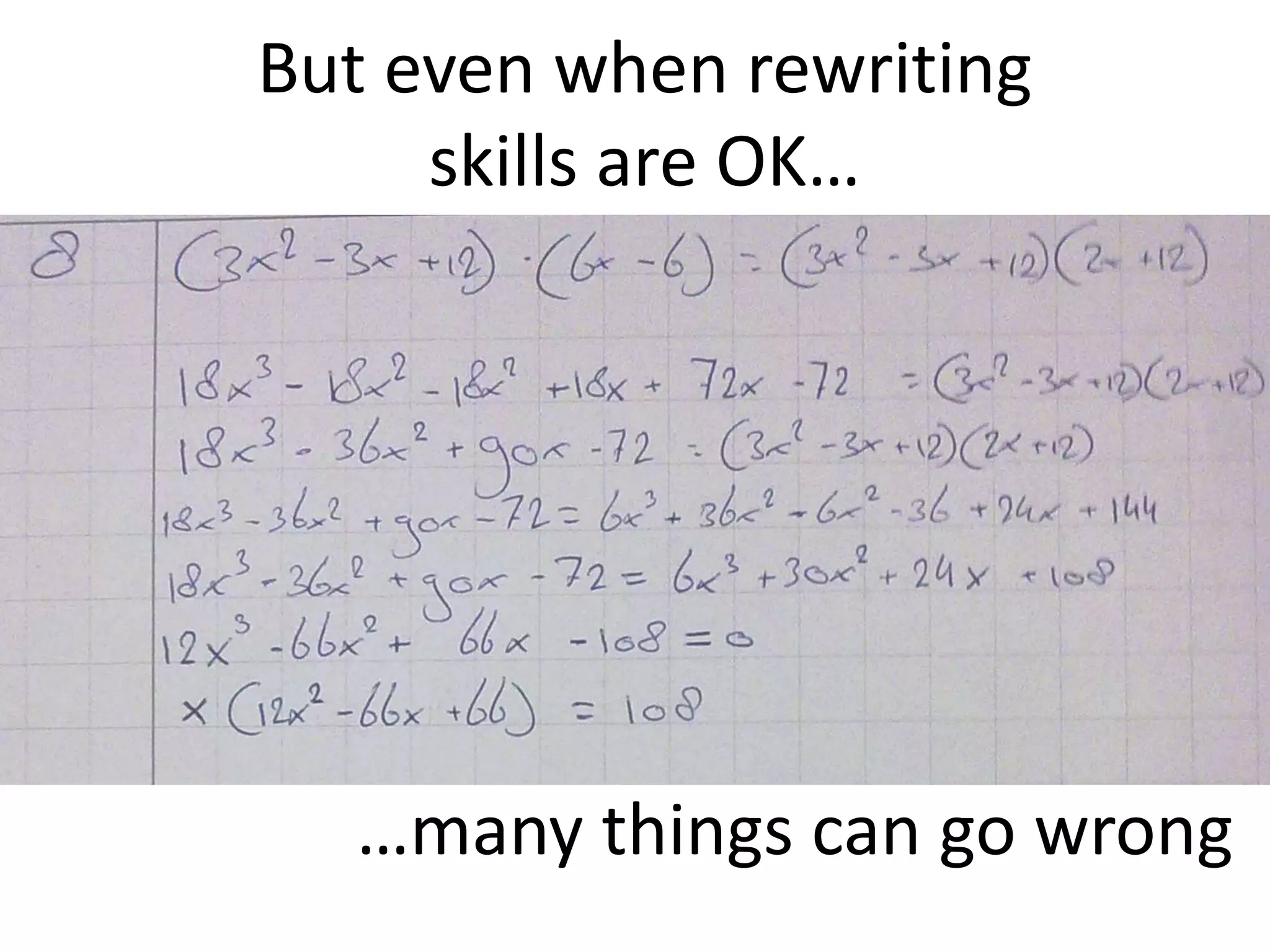
But even when rewriting
skills are OK…
…many things can go wrong
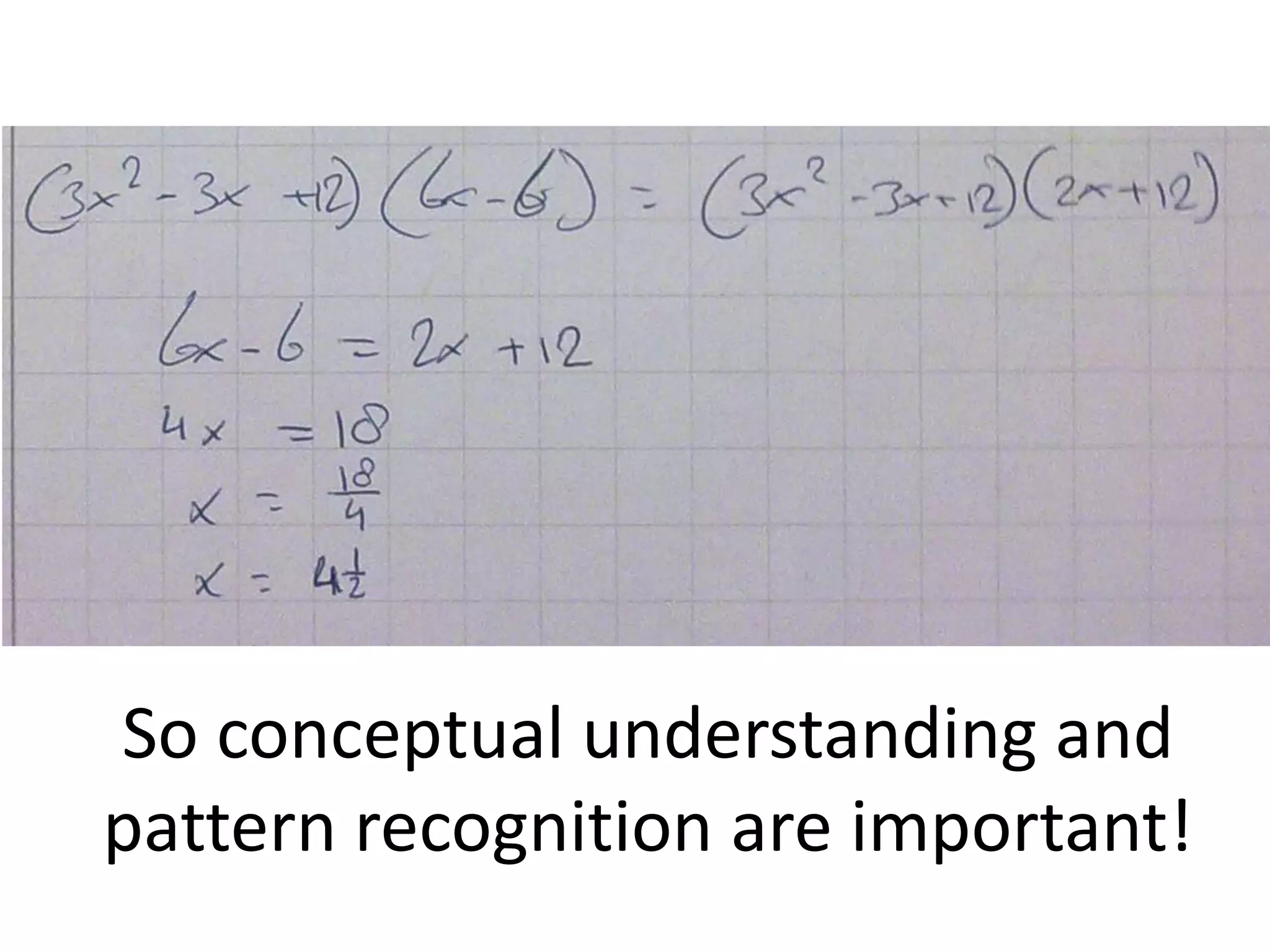
So conceptual understanding and
pattern recognition are important!
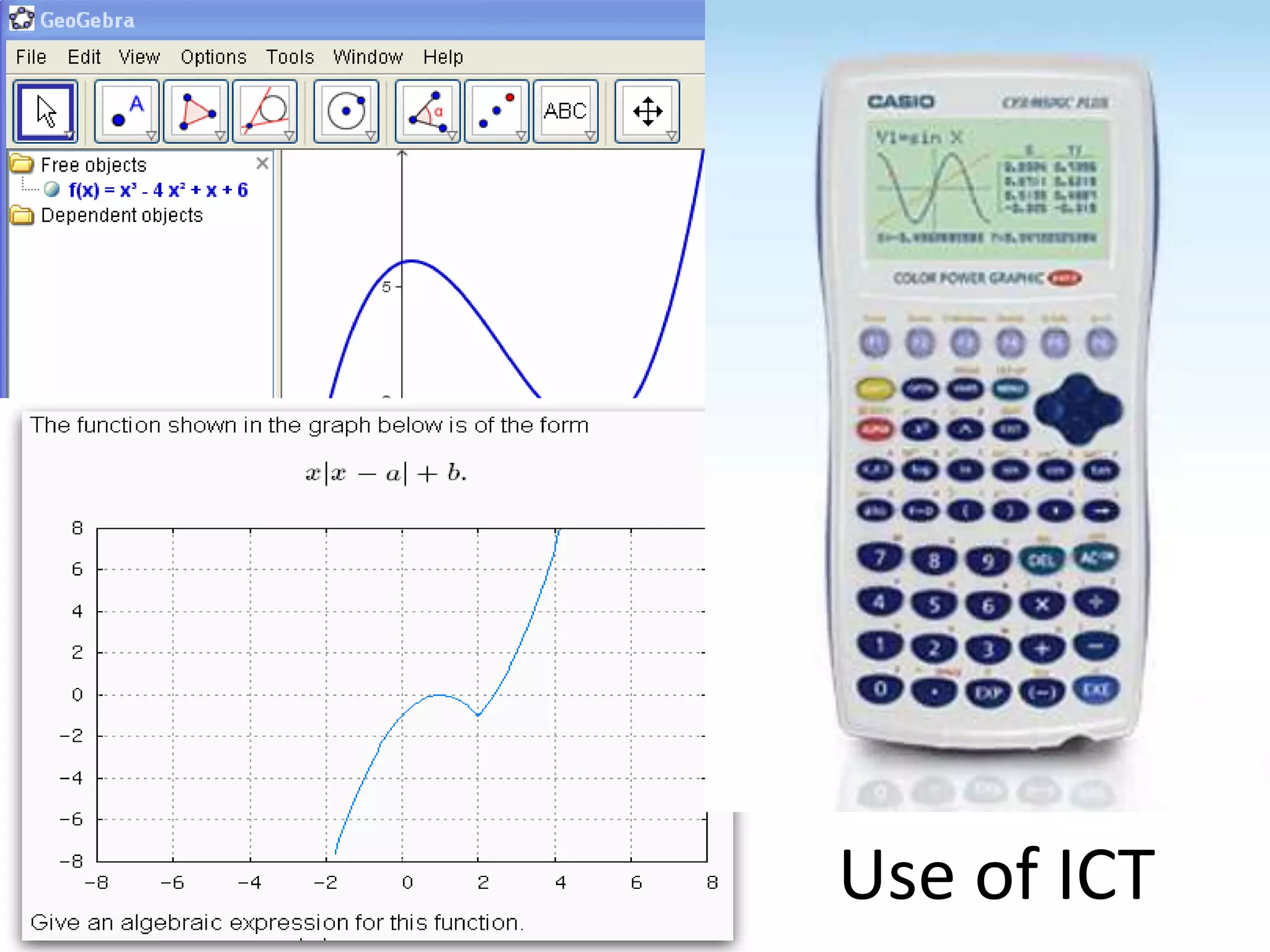
Use of ICT
So can’t we use ICT for acquiring,
practicing and assessing algebraic
expertise?
Research questions:
What is the effect of an intervention on the
development of algebraic expertise,
including both procedural skills and symbol
sense?
Which factors predict the resulting
algebraic performance?
Conceptual framework, elements of:
• Symbol sense – basic skills (e.g. Arcavi)
• Formative – summative assessment
(e.g. Black & Wiliam)
• Feedback
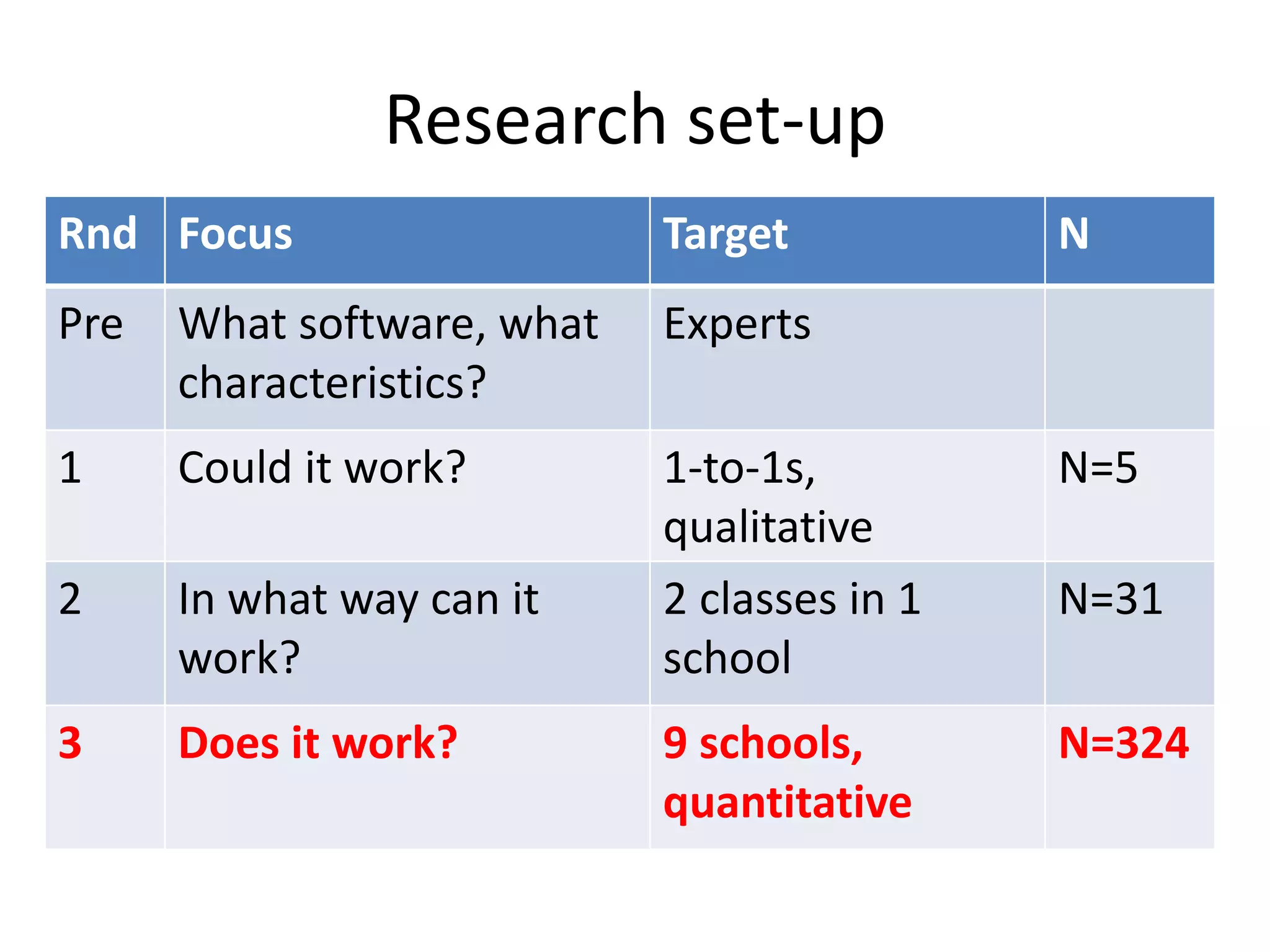
Research set-up
Rnd Focus Target N
Pre What software, what
characteristics?
Experts
1 Could it work? 1-to-1s,
qualitative
N=5
2 In what way can it
work?
2 classes in 1
school
N=31
3 Does it work? 9 schools,
quantitative
N=324
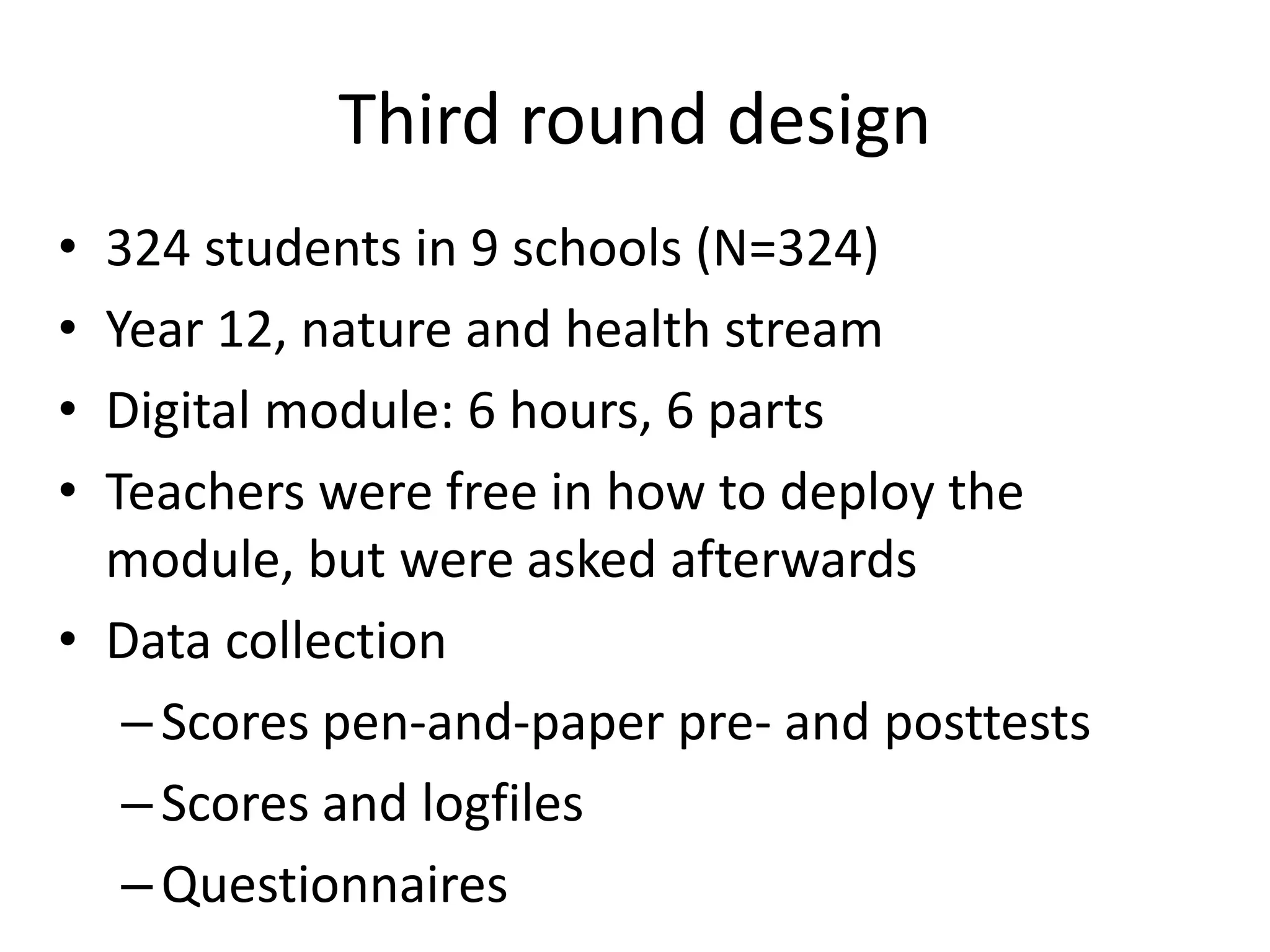
Third round design
• 324 students in 9 schools (N=324)
• Year 12, nature and health stream
• Digital module: 6 hours, 6 parts
• Teachers were free in how to deploy the
module, but were asked afterwards
• Data collection
–Scores pen-and-paper pre- and posttests
–Scores and logfiles
–Questionnaires
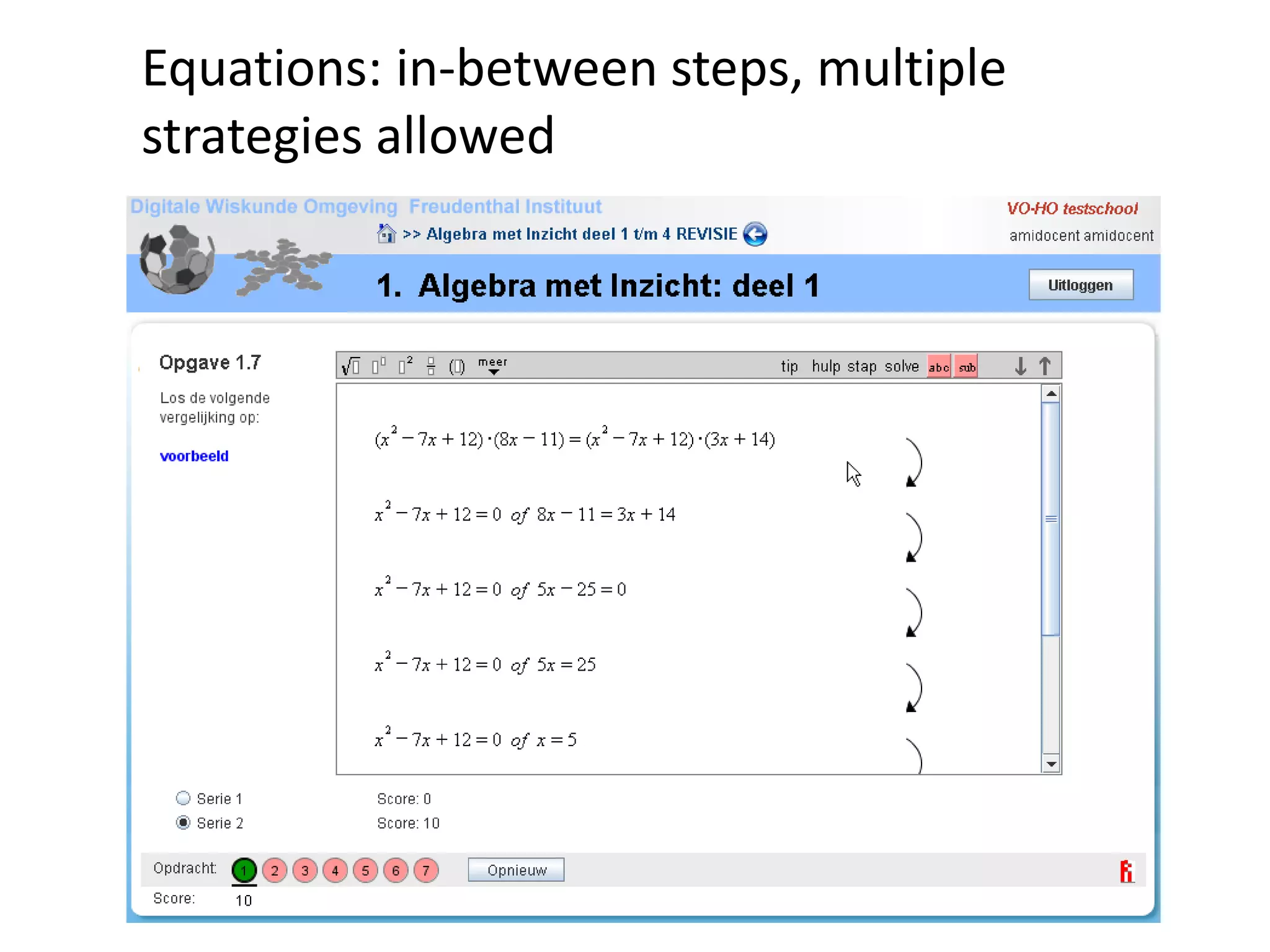
Equations: in-between steps, multiple
strategies allowed
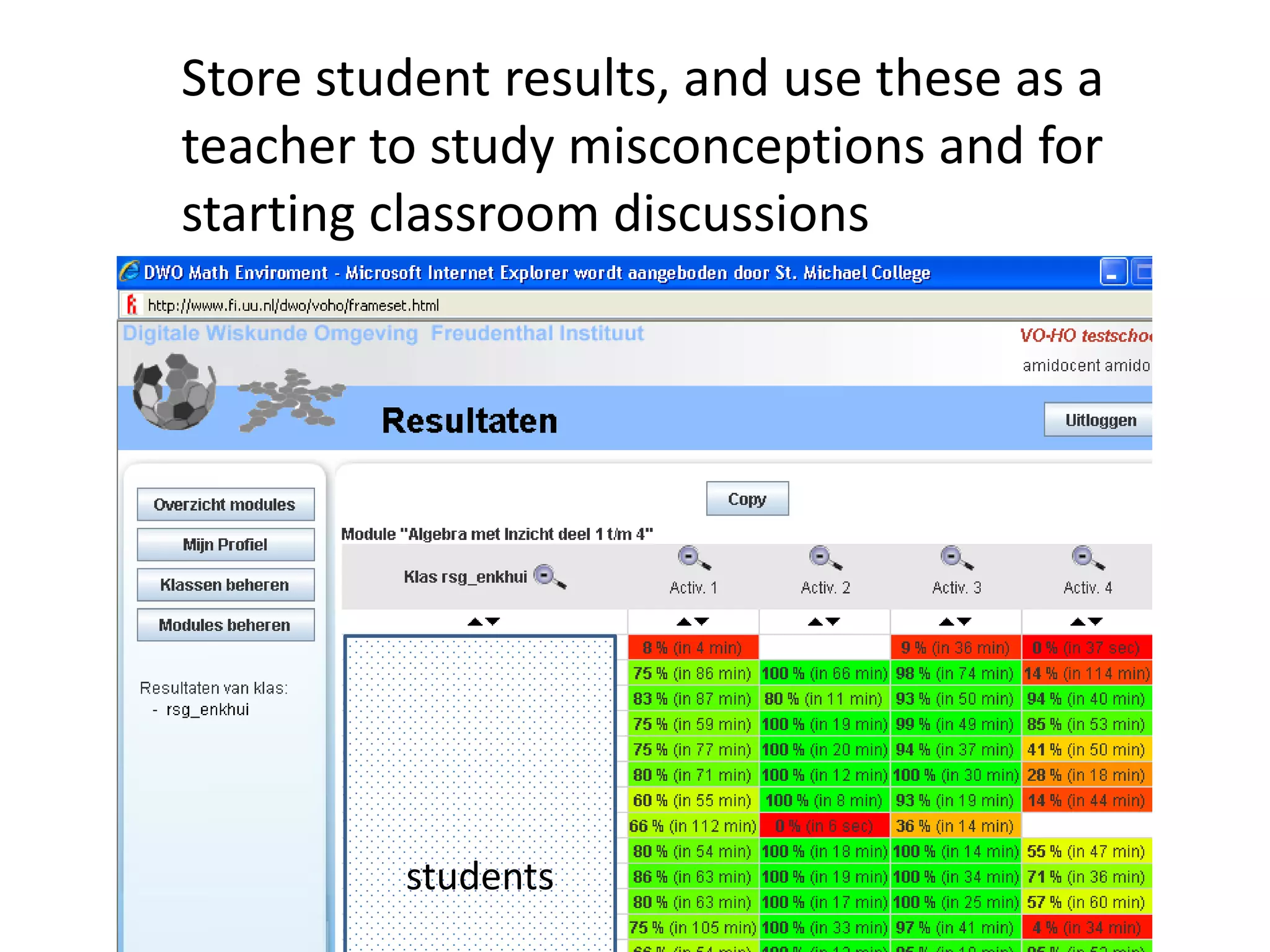
Store student results, and use these as a
teacher to study misconceptions and for
starting classroom discussions
students
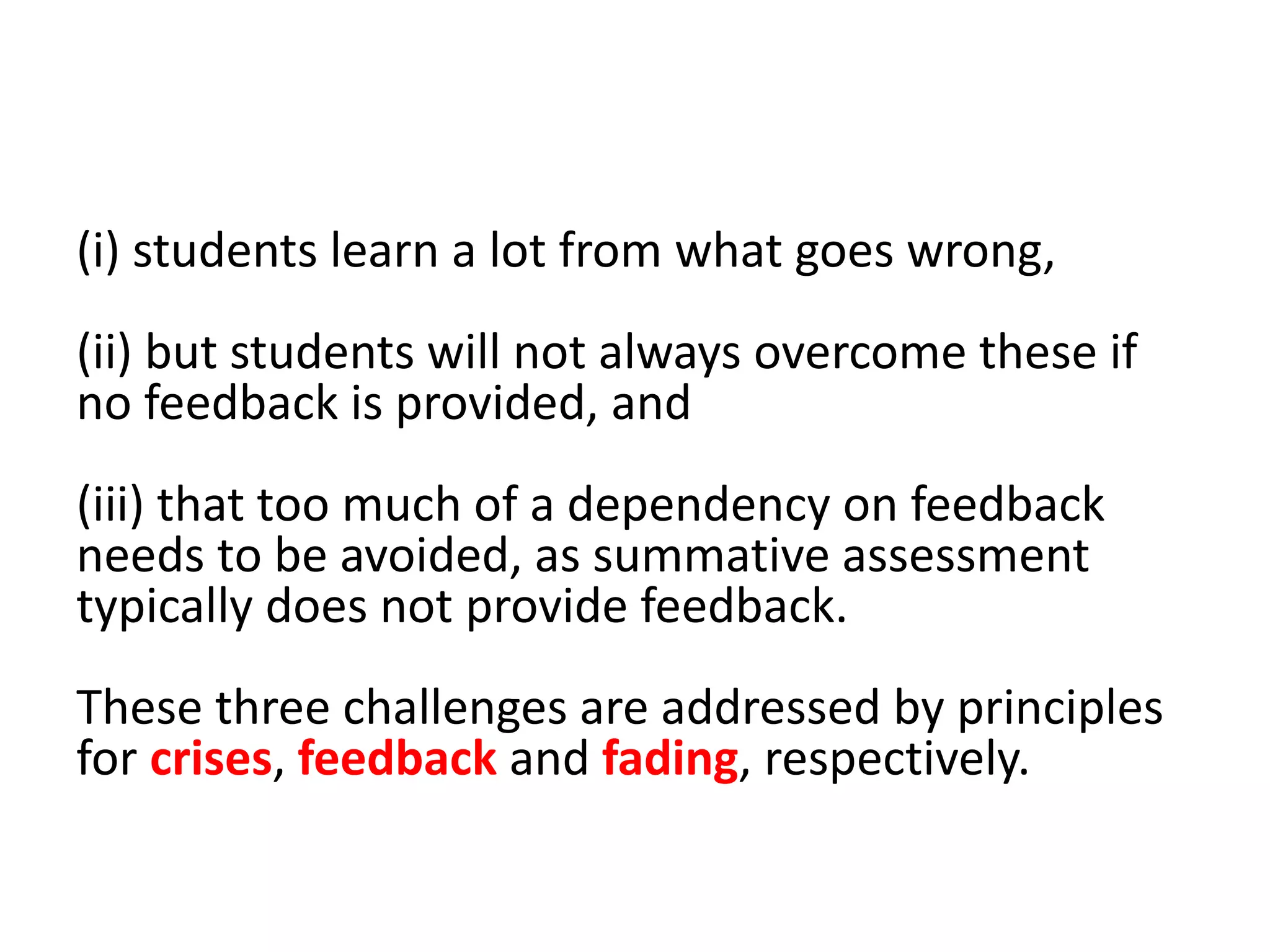
(i) students learn a lot from what goes wrong,
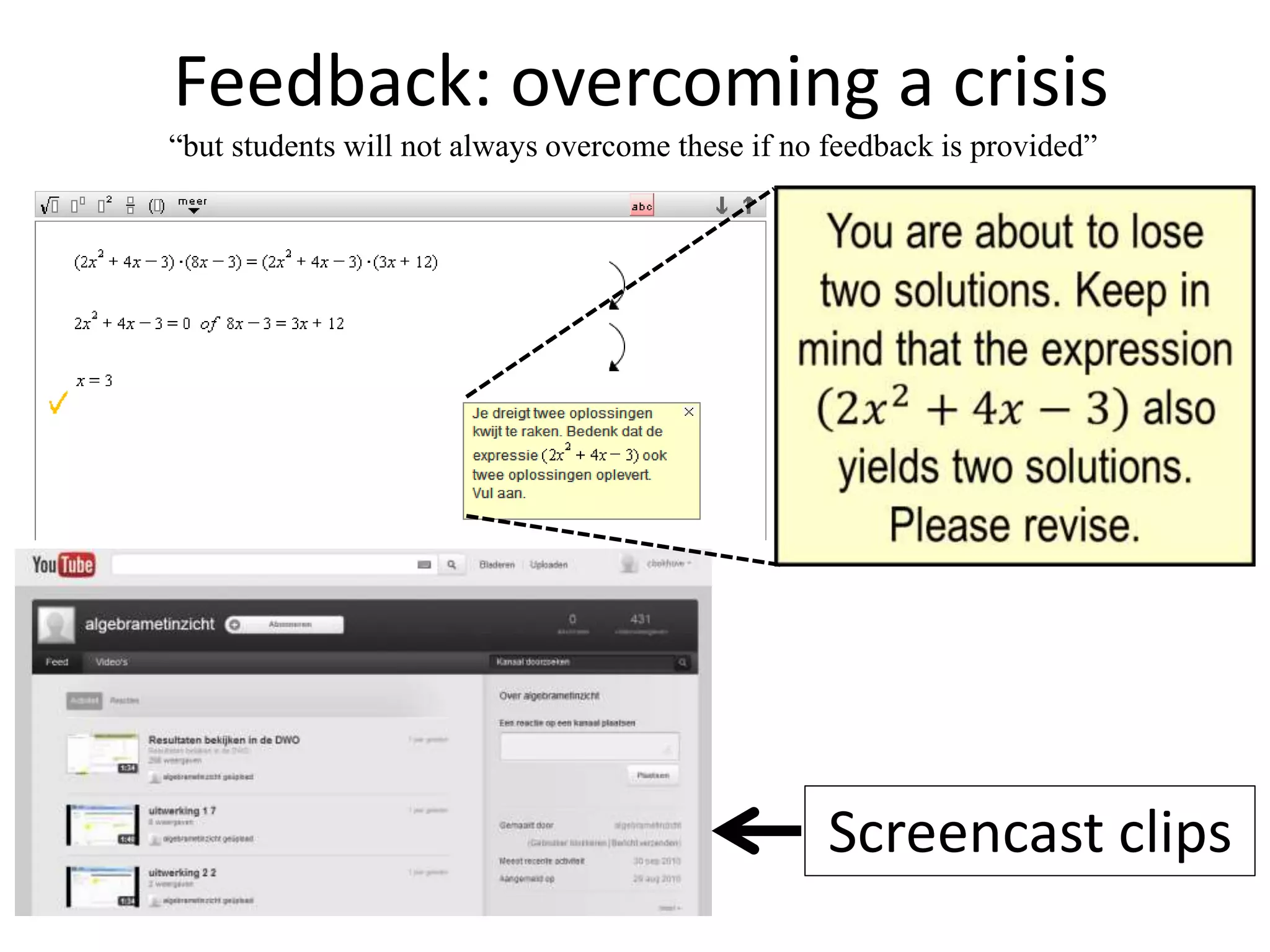
(ii) but students will not always overcome these if
no feedback is provided, and
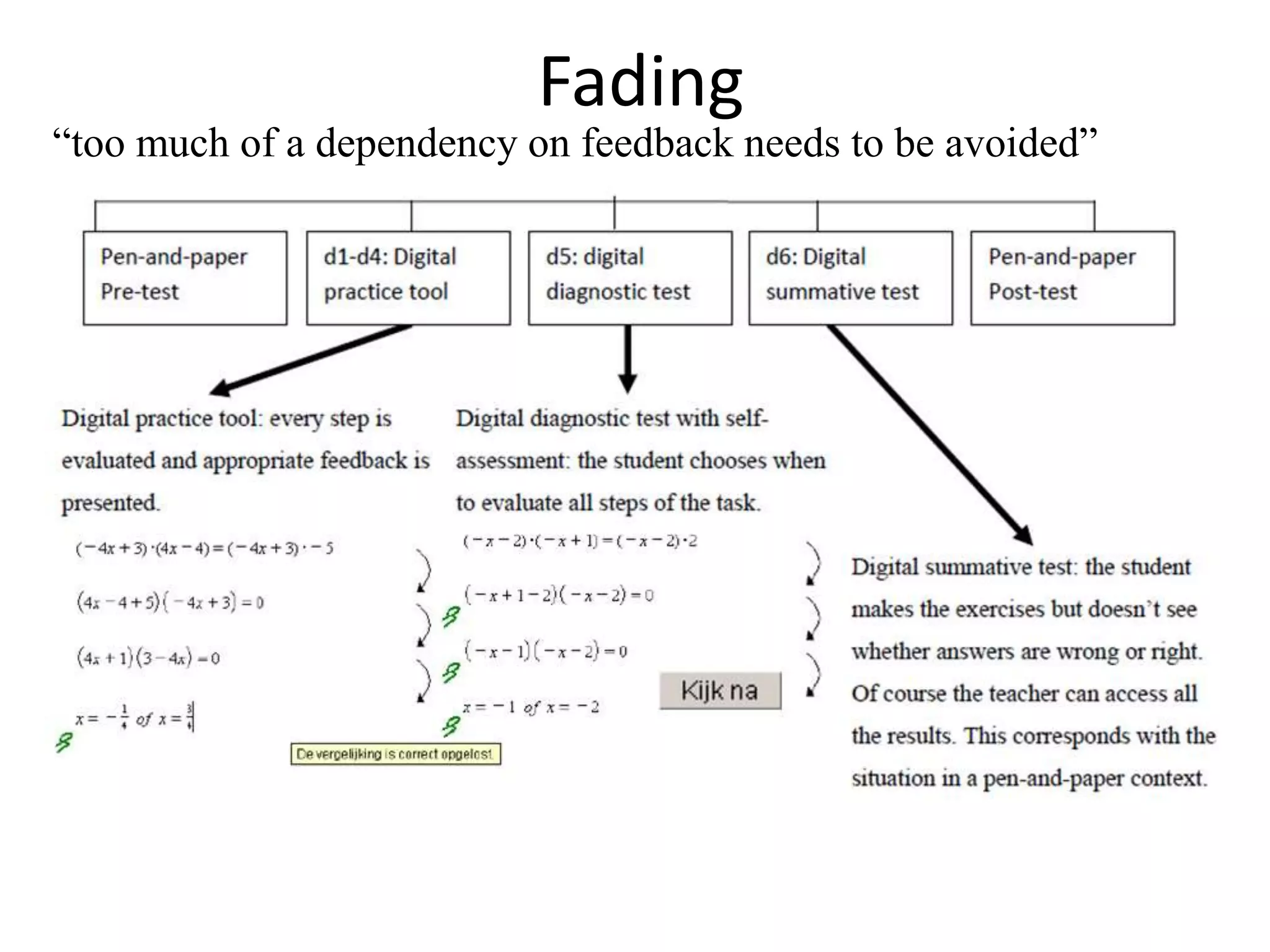
(iii) that too much of a dependency on feedback
needs to be avoided, as summative assessment
typically does not provide feedback.
These three challenges are addressed by principles
for crises, feedback and fading, respectively.
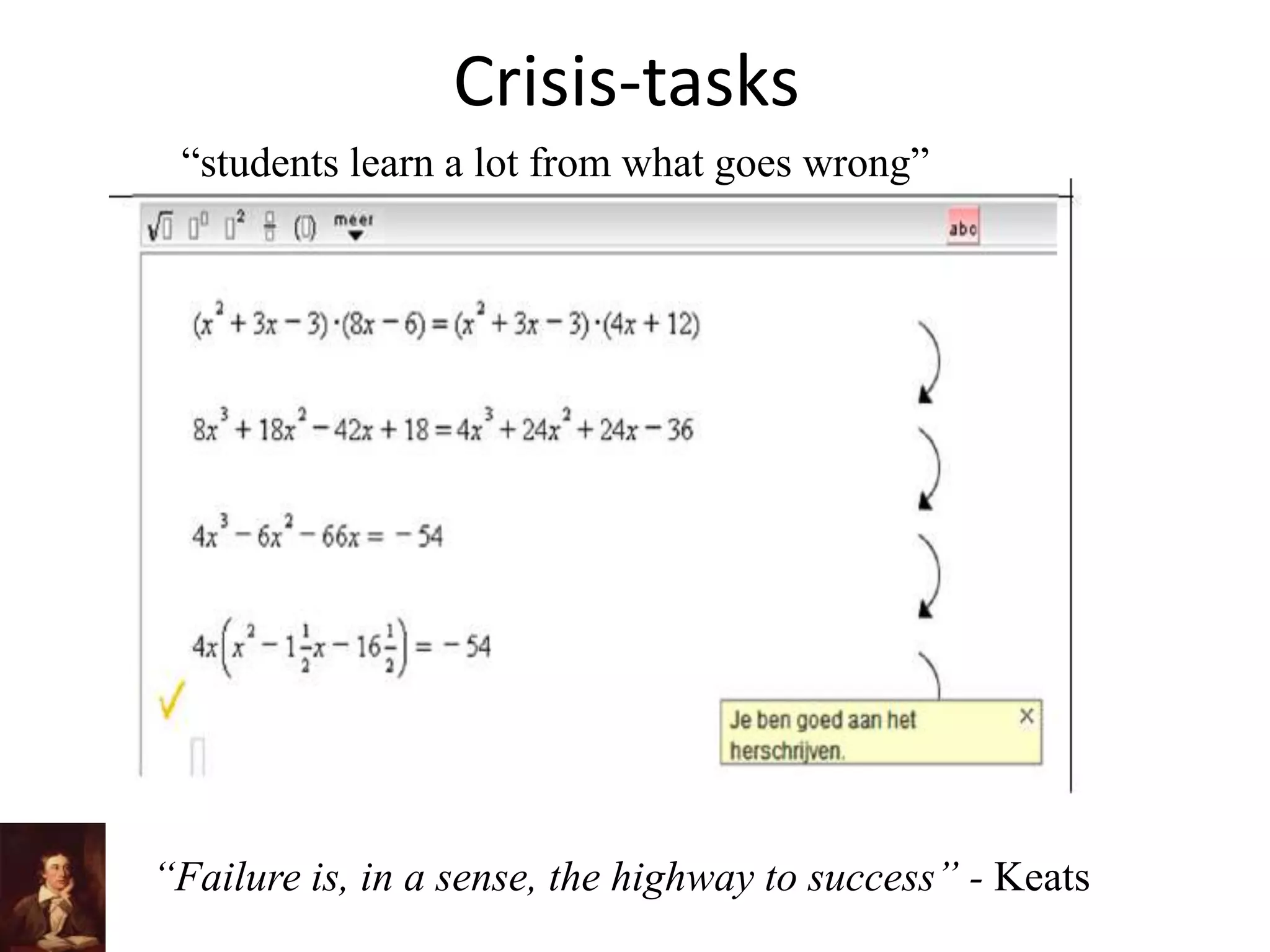
Crisis-tasks
“students learn a lot from what goes wrong”
“Failure is, in a sense, the highway to success” - Keats
Feedback: overcoming a crisis
Screencast clips
“but students will not always overcome these if no feedback is provided”
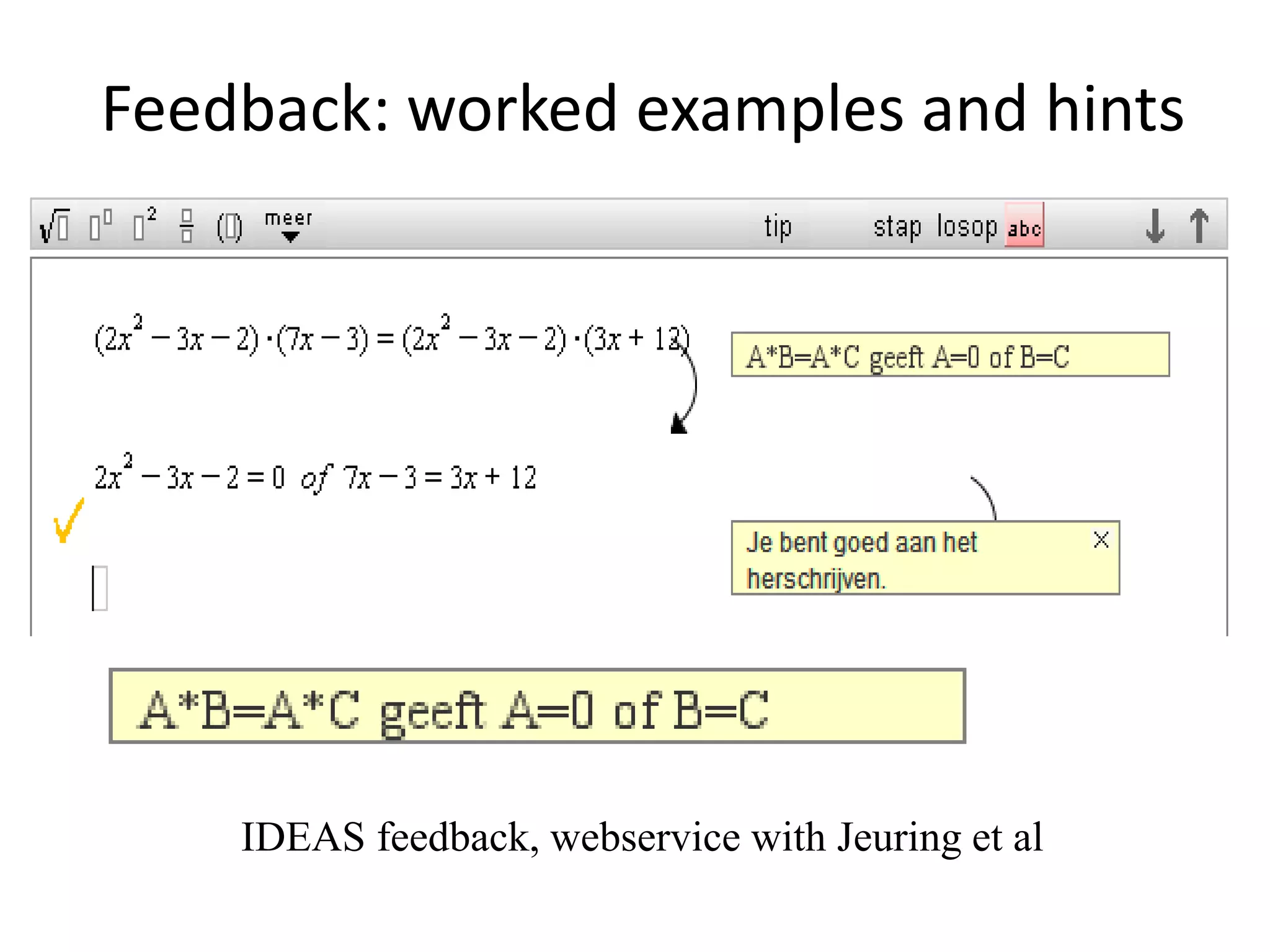
Feedback: worked examples and hints
IDEAS feedback, webservice with Jeuring et al
Fading
“too much of a dependency on feedback needs to be avoided”
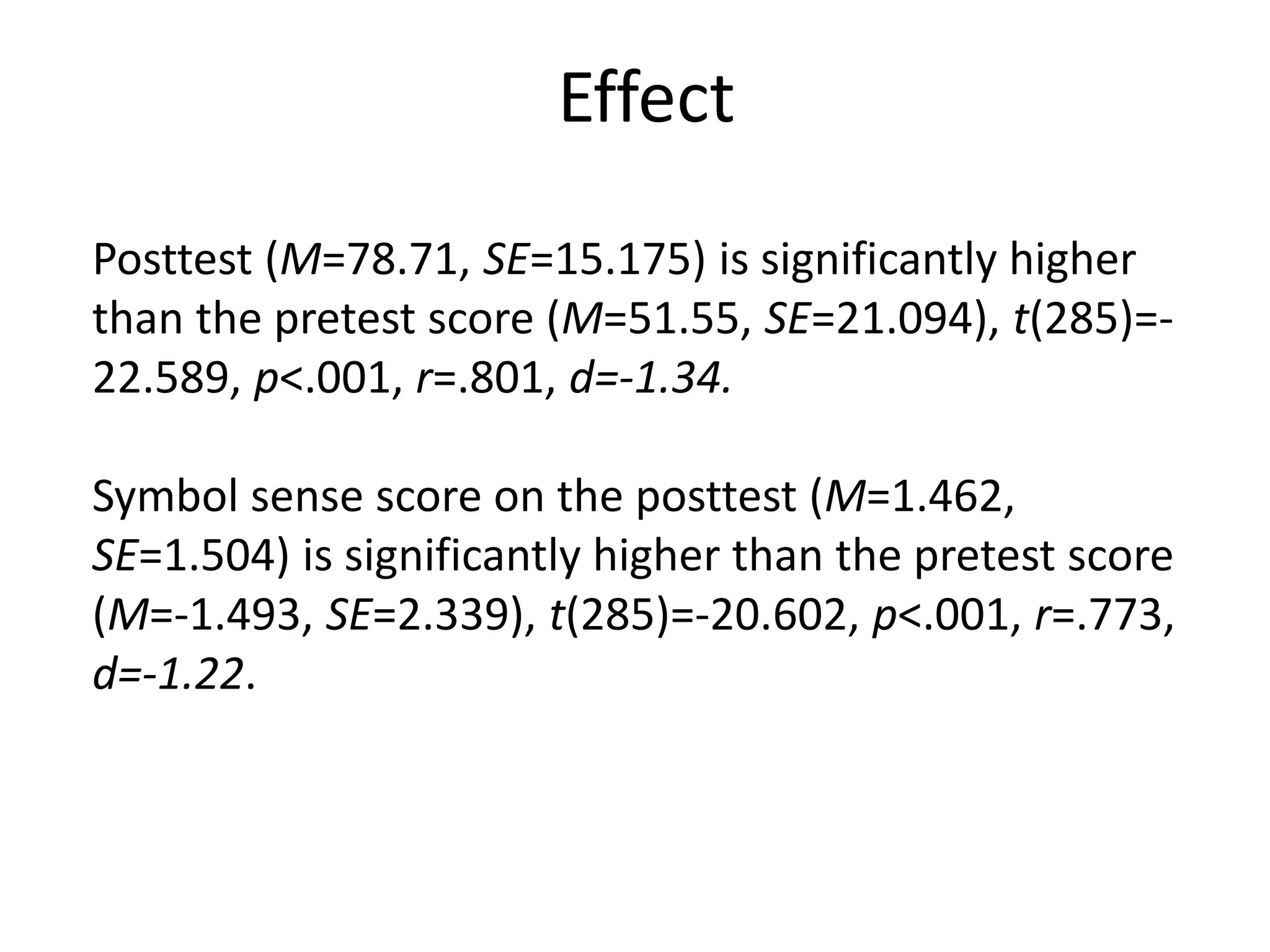
Posttest (M=78.71, SE=15.175) is significantly higher
than the pretest score (M=51.55, SE=21.094), t(285)=-
22.589, p<.001, r=.801, d=-1.34.
Symbol sense score on the posttest (M=1.462,
SE=1.504) is significantly higher than the pretest score
(M=-1.493, SE=2.339), t(285)=-20.602, p<.001, r=.773,
d=-1.22.
Effect
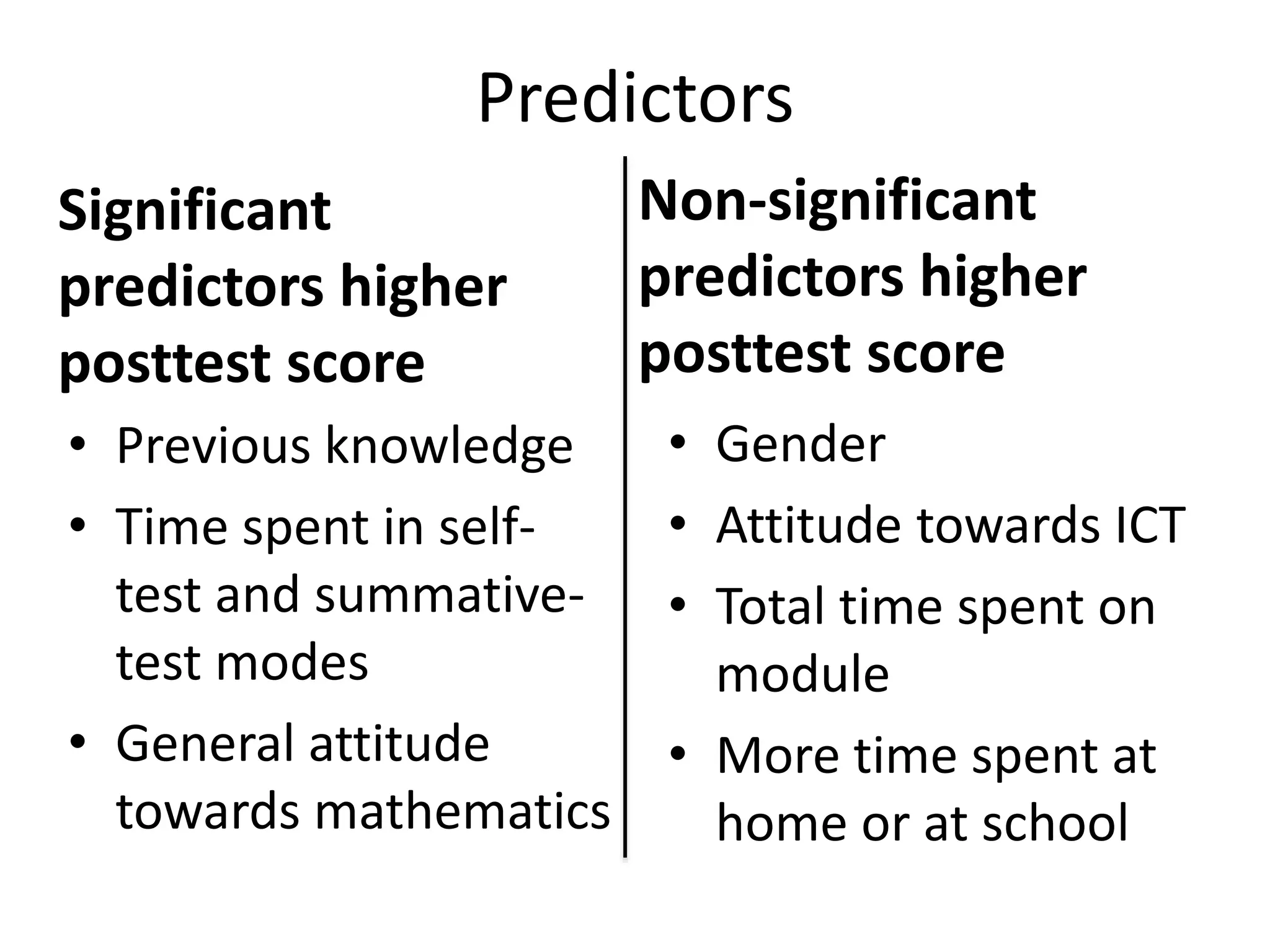
Significant
predictors higher
posttest score
• Previous knowledge
• Time spent in self-
test and summative-
test modes
• General attitude
towards mathematics
Non-significant
predictors higher
posttest score
• Gender
• Attitude towards ICT
• Total time spent on
module
• More time spent at
home or at school
Predictors
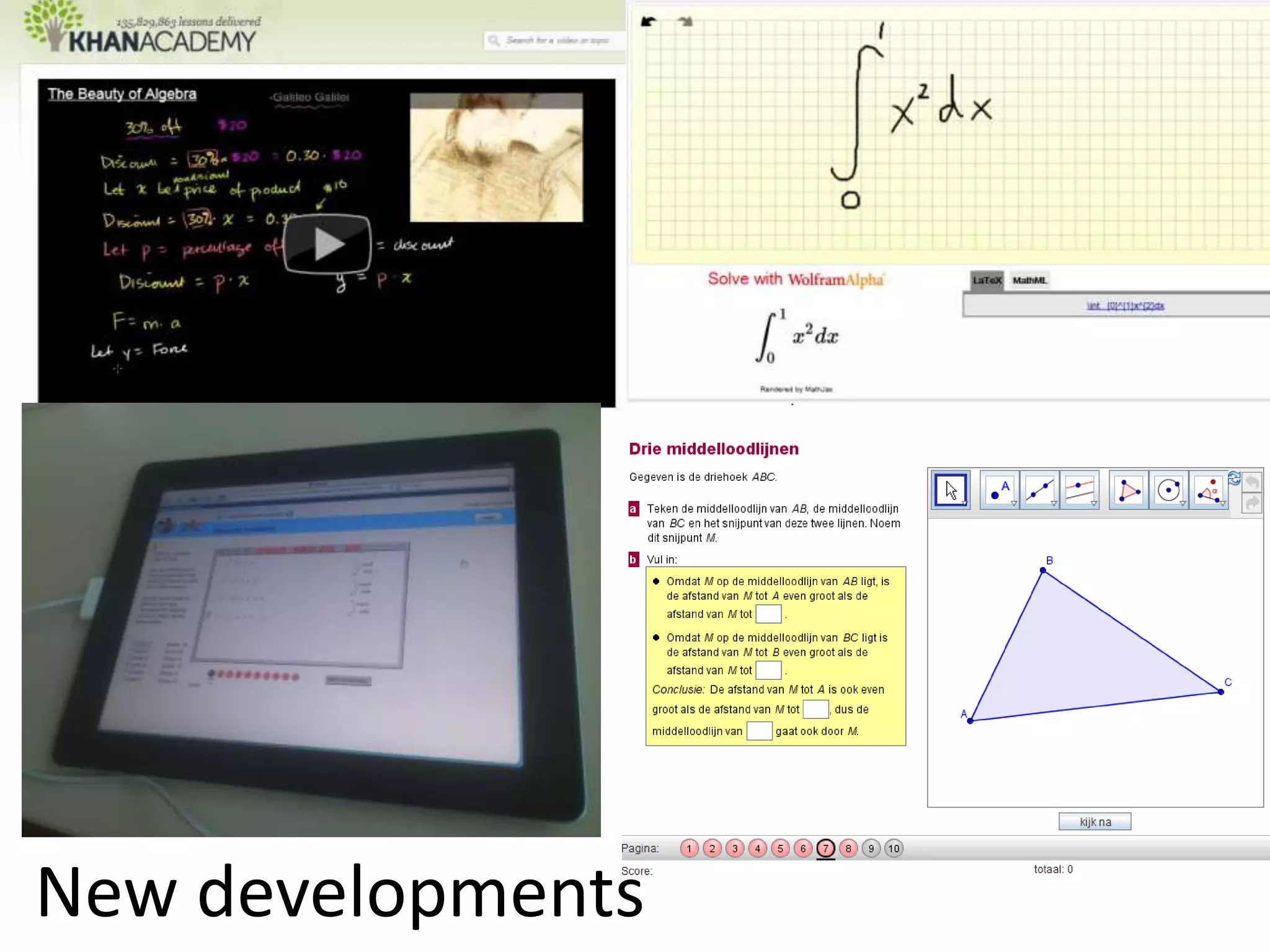
New developments
Christian Bokhove
Twitter: cbokhove
C.Bokhove@soton.ac.uk
www.bokhove.net
Thank you Discussion

Presentation BCME8 April 17th 2014

  • 1.
    Using a digitaltool to improve students’ algebraic expertise in the Netherlands: crises, feedback and fading Christian Bokhove Southampton Education School April 17th, 2014, BCME-8
  • 2.
    Rationale Algebraic skills Year 12students Netherlands often disappointing
  • 3.
    But even whenrewriting skills are OK… …many things can go wrong
  • 4.
    So conceptual understandingand pattern recognition are important!
  • 5.
  • 6.
    So can’t weuse ICT for acquiring, practicing and assessing algebraic expertise?
  • 7.
    Research questions: What isthe effect of an intervention on the development of algebraic expertise, including both procedural skills and symbol sense? Which factors predict the resulting algebraic performance? Conceptual framework, elements of: • Symbol sense – basic skills (e.g. Arcavi) • Formative – summative assessment (e.g. Black & Wiliam) • Feedback
  • 8.
    Research set-up Rnd FocusTarget N Pre What software, what characteristics? Experts 1 Could it work? 1-to-1s, qualitative N=5 2 In what way can it work? 2 classes in 1 school N=31 3 Does it work? 9 schools, quantitative N=324
  • 9.
    Third round design •324 students in 9 schools (N=324) • Year 12, nature and health stream • Digital module: 6 hours, 6 parts • Teachers were free in how to deploy the module, but were asked afterwards • Data collection –Scores pen-and-paper pre- and posttests –Scores and logfiles –Questionnaires
  • 10.
    Equations: in-between steps,multiple strategies allowed
  • 11.
    Store student results,and use these as a teacher to study misconceptions and for starting classroom discussions students
  • 12.
    (i) students learna lot from what goes wrong, (ii) but students will not always overcome these if no feedback is provided, and (iii) that too much of a dependency on feedback needs to be avoided, as summative assessment typically does not provide feedback. These three challenges are addressed by principles for crises, feedback and fading, respectively.
  • 13.
    Crisis-tasks “students learn alot from what goes wrong” “Failure is, in a sense, the highway to success” - Keats
  • 14.
    Feedback: overcoming acrisis Screencast clips “but students will not always overcome these if no feedback is provided”
  • 15.
    Feedback: worked examplesand hints IDEAS feedback, webservice with Jeuring et al
  • 16.
    Fading “too much ofa dependency on feedback needs to be avoided”
  • 17.
    Posttest (M=78.71, SE=15.175)is significantly higher than the pretest score (M=51.55, SE=21.094), t(285)=- 22.589, p<.001, r=.801, d=-1.34. Symbol sense score on the posttest (M=1.462, SE=1.504) is significantly higher than the pretest score (M=-1.493, SE=2.339), t(285)=-20.602, p<.001, r=.773, d=-1.22. Effect
  • 18.
    Significant predictors higher posttest score •Previous knowledge • Time spent in self- test and summative- test modes • General attitude towards mathematics Non-significant predictors higher posttest score • Gender • Attitude towards ICT • Total time spent on module • More time spent at home or at school Predictors
  • 19.
  • 20.