Road  Safety,  By Bimal Chandra Das
Motor Vehicle Act Be aware of other Road users  Communicate  clearly your intentions to turn, change lanes or to stop. Give others time to observe & react to your signal. Maintain safe distance HELMET USE Sec.129, M. V. Act  Every person  driving / riding  a motorcycle of any class shall wear protective headgear of ISI
Motor Vehicle Act 1939 Sec  84 : No vehicle should be parked in such a manner as it may slide down forward or backward all of a sudden on road. Sec 85 : Nobody should be a pillion rider unless there a safe seat for him.
Motor Vehicle Act 1939 Sec. 81 : Driver himself or any other person driving a vehicle will not park his / her vehicle in such a place as to obstruct movement or cause inconvenience to the other road users. Sec 83 : Nobody is permitted to stand, sit or place any material in the vehicle as to cause obstruction to view of the driver
Motor Vehicles Act 1988 and Sections Motor Vehicles Act 1988 Section 3 (Necessity for driving license) - No person shall drive a motor vehicle in any public place unless he holds an effective driving license.
Motor Vehicles Act 1988 and Sections Motor Vehicles Act 1988 Section 4 No person under the age of  18 years  shall drive a motor vehicle in any public place: Subject to the provisions of section 18, no person under the age of  20 years  shall drive a transport vehicle in any public place. No learner's license or driving license shall be issued to any person to drive a vehicle unless he is eligible to drive that class of vehicle under this section.
Motor Vehicles Act 1988 and Sections Motor Vehicles Act 1988 Section 119 (Duty to obey traffic signs) Every driver of a motor vehicle shall drive the vehicle in conformity with any indication given by mandatory traffic sign and in conformity with the driving regulations made by the Central Government, and shall comply with all directions given to him by any police officer for the time being engaged in the regulation of traffic in any public place.
Worldwide toll of road accidents 1.2 million people worldwide are (estimated) killed each year on the roads – that’s around 3,000 deaths daily, 500 of them children  50 million people worldwide are believed to be injured in road crashes each year, 15 million seriously Low- and middle-income countries account for more than 85 per cent of global deaths from road traffic crashes; The global financial cost of road traffic injuries is 518 billion USD each year;
Worldwide toll of road accidents: The cost to low- and middle-income countries is 65 billion USD, more than all development aid income For males aged 15-44, road traffic injuries rank second (behind HIV/AIDS) as the leading cause of premature death and ill health worldwide
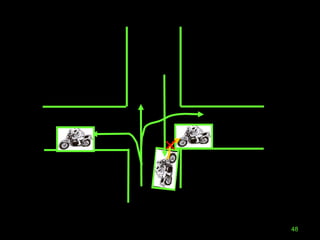
Cross Roads Slow down when approaching a cross road. At intersection between Main  & Minor roads, give way to traffic on the main road.   At junction Look right, then Lt. and the right again before proceeding.
Cross Roads When turning right , signal up your intension and proceed as near as possible to the centre of the  Rd. & complete your turn so as to arrive as near as possible to the Lt. hand side of the Rd. which you are entering.
Cross Roads When turning Left  signal your intension and drive as close as possible to Lt. hand side of Rd. and continue to keep to the Lt. of the Rd. you are interning. Do not swing out immediately to the right either before or after making the turn.
Safe Driving Keep vehicle to left unless while overtaking or turning Care while passing stationary large vehicles - someone may suddenly appear At road intersections give priority to traffic on your  right
Safe Driving Go slow when passing animals & give plenty of space Never overtake when you cannot see road ahead or at crossings Never use more light than needed Talking to pillion riders Do not use mobile phones while driving
Safe Driving (2-Whhelers) Be a good driver not a fast one Wearing crash helmets is a must Drive with your engine not brake No challenge / competition on roads Never accelerate while being overtaken Check vehicle condition. Don't  wait for break-downs
UNSAFE PRACTICES OVERSPEEDING Restrictions  Factory Act 16 / 20 Kmph  - Congested Areas  Rail-Road crossings 30 Kmph  - Free Areas
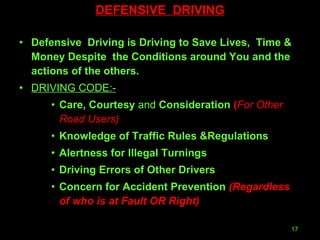
DEFENSIVE  DRIVING Defensive  Driving is Driving to Save Lives,  Time & Money Despite  the Conditions around You and the actions of the others. DRIVING CODE:- Care, Courtesy  and  Consideration  ( For Other  Road Users) Knowledge of Traffic Rules &Regulations Alertness for Illegal Turnings  Driving Errors of Other Drivers Concern for Accident Prevention  (Regardless of who is at   Fault OR Right)
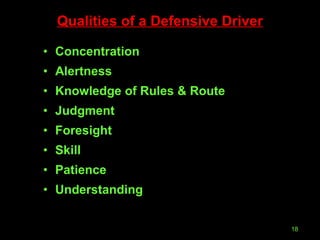
Qualities of a Defensive Driver Concentration Alertness Knowledge of Rules & Route Judgment Foresight Skill Patience Understanding
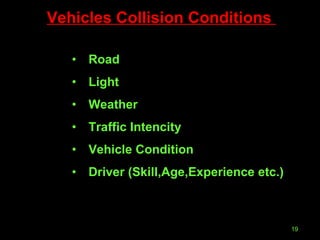
Road Light Weather Traffic Intencity Vehicle Condition Driver (Skill,Age,Experience etc.) Vehicles Collision Conditions
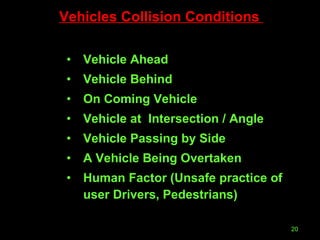
Vehicles Collision Conditions  Vehicle Ahead Vehicle Behind On Coming Vehicle Vehicle at  Intersection / Angle  Vehicle Passing by Side A Vehicle Being Overtaken Human Factor (Unsafe practice of user Drivers, Pedestrians)
Condition of Vehicles Preventive Maintenance:- Brake Tyres Air Pressure Steering Lights Horn
HUMAN FACTORS Attention distracted Driving by one hand  Driving under Fatigue / Tension Driving after alcohol / drugs Spitting while driving Standing on road & gossiping Forceful driving on narrow paths 2 set of vehicle moving parallel
ENVIRONMENTAL FACTORS Dogs & cattle on roads Fog & Mist Dusty atmosphere Children playing on roads  Persons sitting by the side of road Noisy areas Emission of smokes from vehicles
Signals constitute the Language of road. “ SPEAK” it clearly  for your own & other  people’s “SAFETY”
Better Driving Do not expect others to read your mind. Before Moving off, Slowing, Stopping, Changing direction or Overtaking, give clear & bold signals well in advance. Give proper signals well ahead of time  Keep a safe distance from the car ahead of you.
Driving at night is more dangerous than day time. Ninety percent of a driver's reaction depends on vision, and vision is severely limited at night. Depth perception, color recognition and peripheral vision are compromised after sundown.  Better Driving
Don't over drive your headlights. You should be able to stop inside the illuminated area Keep your headlights on low beams when following another vehicle so you don't blind the driver ahead of you. Better Driving
Standard Accident Prevention Formula Recognize the hazard Understand the hazard Act correctly in time Three ‘E’s formula Education Engineering Enforcement
Overtaking On Narrow roads or paths Sufficient space not available Narrow bridge Near corner / bend Near hump On turnings / road crossings & round about When vehicle ahead has slowed prior to turning right
Overtaking Never accelerate while you are being overtaken. Always help the overtaking vehicle to do so safely. Never overtake unless you sure you can do so without danger to yourself or others.
Parking Always park in the direction of the flow of the traffic. Where parking place is provided, use it, even if it is a bit farther away from your point of call.
Don’t park At or near Rd. Jn., bend, corner, bridge. Near pedestrian crossing / traffic lights. Opposite or nearly opposite another standing vehicle on the other side of the Rd., / along a parked vehicle. At the entrance of gates of Bldg., office, hospital etc.
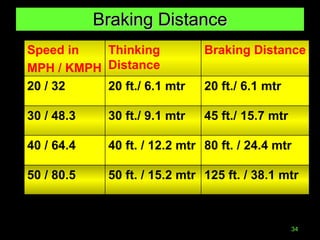
Braking Distance Vehicles can not STOP DEAD without covering sufficient distance.  The distance covered in the THINKING and BRAKING at Different Speeds are shown in the chart.
Braking Distance Speed in  MPH / KMPH Thinking Distance Braking Distance 20 / 32 20 ft./ 6.1 mtr 20 ft./ 6.1 mtr 30 / 48.3 30 ft./ 9.1 mtr 45 ft./ 15.7 mtr 40 / 64.4 40 ft. / 12.2 mtr 80 ft. / 24.4 mtr 50 / 80.5 50 ft. / 15.2 mtr 125 ft. / 38.1 mtr
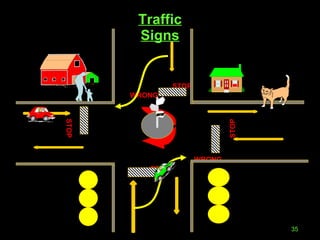
Traffic Signs STOP STOP STOP STOP WRONG WRONG
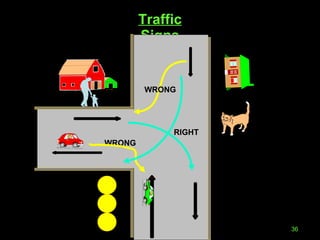
Traffic Signs WRONG RIGHT WRONG
HEAVY VEHICLES Heavy vehicle time restrictions Issue of inspection manuals for private trucks Periodic safety checks Counseling, warning, debarring & fine for erring defaulters
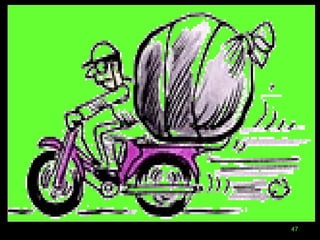
HEAVY VEHICLES Unsecured loads Do not allow persons on loaded materials or footboard Signal before slowing / turning On slope vehicle to be in geared position
Safety for  PEDESTRIANS Awareness-Road environment Use of Facilities Pedestrian lights Footpaths Zebra crossings Overhead bridges Under pass Wear light coloured clothes at night Avoid crossing between two parked vehicles or at bends
Major causes of road accidents  (unsafe practices) Speed During Overtaking . Overtaking in wrong side. Carelessness. Gossiping with others while driving. Thinking of household / other problems while driving.
Causes of road accidents  (unsafe practices) Not in peace of mind while driving. Taking turn without giving signals. Sharp right side turning. Not following the road safety rules. Driving while using mobile phone  without keeping a safe distance. Reversing vehicles without horns.
Causes of road accidents  (unsafe conditions)  Driver’s inability to see side & rear for overtaking vehicles. Improper illumination on road. Poor road condition. L -  turnings / blind corners. Failure of equipments.  Spillage of materials on the road by other vehicle.
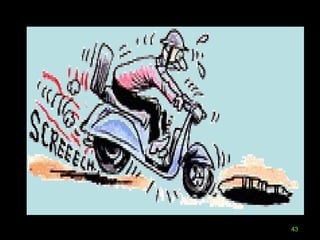
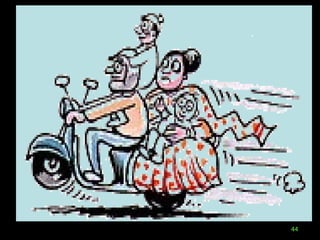
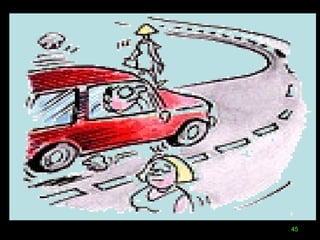
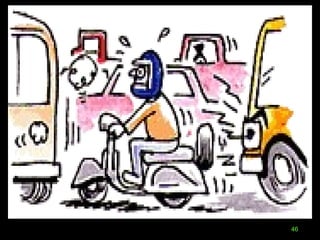
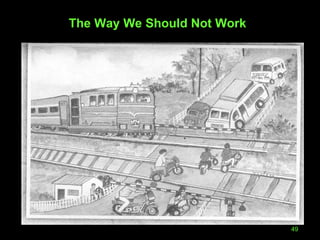
The Way We Should Not Work
Thank You

Road Safety for Two / Four Wheelers, By B C Das

  • 1.
    Road Safety, By Bimal Chandra Das
  • 2.
    Motor Vehicle ActBe aware of other Road users Communicate clearly your intentions to turn, change lanes or to stop. Give others time to observe & react to your signal. Maintain safe distance HELMET USE Sec.129, M. V. Act Every person driving / riding a motorcycle of any class shall wear protective headgear of ISI
  • 3.
    Motor Vehicle Act1939 Sec 84 : No vehicle should be parked in such a manner as it may slide down forward or backward all of a sudden on road. Sec 85 : Nobody should be a pillion rider unless there a safe seat for him.
  • 4.
    Motor Vehicle Act1939 Sec. 81 : Driver himself or any other person driving a vehicle will not park his / her vehicle in such a place as to obstruct movement or cause inconvenience to the other road users. Sec 83 : Nobody is permitted to stand, sit or place any material in the vehicle as to cause obstruction to view of the driver
  • 5.
    Motor Vehicles Act1988 and Sections Motor Vehicles Act 1988 Section 3 (Necessity for driving license) - No person shall drive a motor vehicle in any public place unless he holds an effective driving license.
  • 6.
    Motor Vehicles Act1988 and Sections Motor Vehicles Act 1988 Section 4 No person under the age of 18 years shall drive a motor vehicle in any public place: Subject to the provisions of section 18, no person under the age of 20 years shall drive a transport vehicle in any public place. No learner's license or driving license shall be issued to any person to drive a vehicle unless he is eligible to drive that class of vehicle under this section.
  • 7.
    Motor Vehicles Act1988 and Sections Motor Vehicles Act 1988 Section 119 (Duty to obey traffic signs) Every driver of a motor vehicle shall drive the vehicle in conformity with any indication given by mandatory traffic sign and in conformity with the driving regulations made by the Central Government, and shall comply with all directions given to him by any police officer for the time being engaged in the regulation of traffic in any public place.
  • 8.
    Worldwide toll ofroad accidents 1.2 million people worldwide are (estimated) killed each year on the roads – that’s around 3,000 deaths daily, 500 of them children 50 million people worldwide are believed to be injured in road crashes each year, 15 million seriously Low- and middle-income countries account for more than 85 per cent of global deaths from road traffic crashes; The global financial cost of road traffic injuries is 518 billion USD each year;
  • 9.
    Worldwide toll ofroad accidents: The cost to low- and middle-income countries is 65 billion USD, more than all development aid income For males aged 15-44, road traffic injuries rank second (behind HIV/AIDS) as the leading cause of premature death and ill health worldwide
  • 10.
    Cross Roads Slowdown when approaching a cross road. At intersection between Main & Minor roads, give way to traffic on the main road. At junction Look right, then Lt. and the right again before proceeding.
  • 11.
    Cross Roads Whenturning right , signal up your intension and proceed as near as possible to the centre of the Rd. & complete your turn so as to arrive as near as possible to the Lt. hand side of the Rd. which you are entering.
  • 12.
    Cross Roads Whenturning Left signal your intension and drive as close as possible to Lt. hand side of Rd. and continue to keep to the Lt. of the Rd. you are interning. Do not swing out immediately to the right either before or after making the turn.
  • 13.
    Safe Driving Keepvehicle to left unless while overtaking or turning Care while passing stationary large vehicles - someone may suddenly appear At road intersections give priority to traffic on your right
  • 14.
    Safe Driving Goslow when passing animals & give plenty of space Never overtake when you cannot see road ahead or at crossings Never use more light than needed Talking to pillion riders Do not use mobile phones while driving
  • 15.
    Safe Driving (2-Whhelers)Be a good driver not a fast one Wearing crash helmets is a must Drive with your engine not brake No challenge / competition on roads Never accelerate while being overtaken Check vehicle condition. Don't wait for break-downs
  • 16.
    UNSAFE PRACTICES OVERSPEEDINGRestrictions Factory Act 16 / 20 Kmph - Congested Areas Rail-Road crossings 30 Kmph - Free Areas
  • 17.
    DEFENSIVE DRIVINGDefensive Driving is Driving to Save Lives, Time & Money Despite the Conditions around You and the actions of the others. DRIVING CODE:- Care, Courtesy and Consideration ( For Other Road Users) Knowledge of Traffic Rules &Regulations Alertness for Illegal Turnings Driving Errors of Other Drivers Concern for Accident Prevention (Regardless of who is at Fault OR Right)
  • 18.
    Qualities of aDefensive Driver Concentration Alertness Knowledge of Rules & Route Judgment Foresight Skill Patience Understanding
  • 19.
    Road Light WeatherTraffic Intencity Vehicle Condition Driver (Skill,Age,Experience etc.) Vehicles Collision Conditions
  • 20.
    Vehicles Collision Conditions Vehicle Ahead Vehicle Behind On Coming Vehicle Vehicle at Intersection / Angle Vehicle Passing by Side A Vehicle Being Overtaken Human Factor (Unsafe practice of user Drivers, Pedestrians)
  • 21.
    Condition of VehiclesPreventive Maintenance:- Brake Tyres Air Pressure Steering Lights Horn
  • 22.
    HUMAN FACTORS Attentiondistracted Driving by one hand Driving under Fatigue / Tension Driving after alcohol / drugs Spitting while driving Standing on road & gossiping Forceful driving on narrow paths 2 set of vehicle moving parallel
  • 23.
    ENVIRONMENTAL FACTORS Dogs& cattle on roads Fog & Mist Dusty atmosphere Children playing on roads Persons sitting by the side of road Noisy areas Emission of smokes from vehicles
  • 24.
    Signals constitute theLanguage of road. “ SPEAK” it clearly for your own & other people’s “SAFETY”
  • 25.
    Better Driving Donot expect others to read your mind. Before Moving off, Slowing, Stopping, Changing direction or Overtaking, give clear & bold signals well in advance. Give proper signals well ahead of time Keep a safe distance from the car ahead of you.
  • 26.
    Driving at nightis more dangerous than day time. Ninety percent of a driver's reaction depends on vision, and vision is severely limited at night. Depth perception, color recognition and peripheral vision are compromised after sundown. Better Driving
  • 27.
    Don't over driveyour headlights. You should be able to stop inside the illuminated area Keep your headlights on low beams when following another vehicle so you don't blind the driver ahead of you. Better Driving
  • 28.
    Standard Accident PreventionFormula Recognize the hazard Understand the hazard Act correctly in time Three ‘E’s formula Education Engineering Enforcement
  • 29.
    Overtaking On Narrowroads or paths Sufficient space not available Narrow bridge Near corner / bend Near hump On turnings / road crossings & round about When vehicle ahead has slowed prior to turning right
  • 30.
    Overtaking Never acceleratewhile you are being overtaken. Always help the overtaking vehicle to do so safely. Never overtake unless you sure you can do so without danger to yourself or others.
  • 31.
    Parking Always parkin the direction of the flow of the traffic. Where parking place is provided, use it, even if it is a bit farther away from your point of call.
  • 32.
    Don’t park Ator near Rd. Jn., bend, corner, bridge. Near pedestrian crossing / traffic lights. Opposite or nearly opposite another standing vehicle on the other side of the Rd., / along a parked vehicle. At the entrance of gates of Bldg., office, hospital etc.
  • 33.
    Braking Distance Vehiclescan not STOP DEAD without covering sufficient distance. The distance covered in the THINKING and BRAKING at Different Speeds are shown in the chart.
  • 34.
    Braking Distance Speedin MPH / KMPH Thinking Distance Braking Distance 20 / 32 20 ft./ 6.1 mtr 20 ft./ 6.1 mtr 30 / 48.3 30 ft./ 9.1 mtr 45 ft./ 15.7 mtr 40 / 64.4 40 ft. / 12.2 mtr 80 ft. / 24.4 mtr 50 / 80.5 50 ft. / 15.2 mtr 125 ft. / 38.1 mtr
  • 35.
    Traffic Signs STOPSTOP STOP STOP WRONG WRONG
  • 36.
  • 37.
    HEAVY VEHICLES Heavyvehicle time restrictions Issue of inspection manuals for private trucks Periodic safety checks Counseling, warning, debarring & fine for erring defaulters
  • 38.
    HEAVY VEHICLES Unsecuredloads Do not allow persons on loaded materials or footboard Signal before slowing / turning On slope vehicle to be in geared position
  • 39.
    Safety for PEDESTRIANS Awareness-Road environment Use of Facilities Pedestrian lights Footpaths Zebra crossings Overhead bridges Under pass Wear light coloured clothes at night Avoid crossing between two parked vehicles or at bends
  • 40.
    Major causes ofroad accidents (unsafe practices) Speed During Overtaking . Overtaking in wrong side. Carelessness. Gossiping with others while driving. Thinking of household / other problems while driving.
  • 41.
    Causes of roadaccidents (unsafe practices) Not in peace of mind while driving. Taking turn without giving signals. Sharp right side turning. Not following the road safety rules. Driving while using mobile phone without keeping a safe distance. Reversing vehicles without horns.
  • 42.
    Causes of roadaccidents (unsafe conditions) Driver’s inability to see side & rear for overtaking vehicles. Improper illumination on road. Poor road condition. L - turnings / blind corners. Failure of equipments. Spillage of materials on the road by other vehicle.
  • 49.
    The Way WeShould Not Work
  • 50.