REMEMBER YOUR FAMILY  IS WAITING FOR  YOUR SAFE RETURN
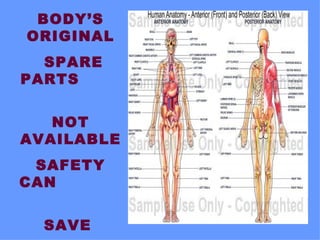
BODY’S ORIGINAL SPARE PARTS  NOT AVAILABLE SAFETY CAN  SAVE  YOU
SAFETY  SAFETY IS THE ART OF TAKING PRECAUTION AGAINST ANY POSSIBLE DANGER FROM EXTERNAL SOURCE   DANGER MAY BE TO  SELF OTHERS MACHINES MATERIALS STRUCTURES
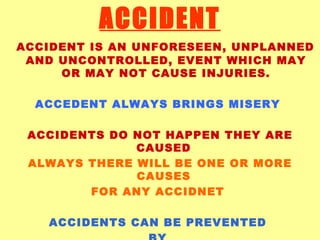
ACCIDENT ACCIDENT IS AN UNFORESEEN, UNPLANNED AND UNCONTROLLED, EVENT WHICH MAY OR MAY NOT CAUSE INJURIES. ACCEDENT ALWAYS BRINGS MISERY  ACCIDENTS DO NOT HAPPEN THEY ARE CAUSED  ALWAYS THERE WILL BE ONE OR MORE CAUSES  FOR ANY ACCIDNET   ACCIDENTS CAN BE PREVENTED  BY  ELIMINATING THE CAUSES
 
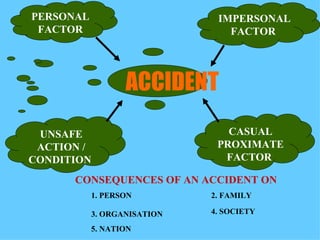
CONSEQUENCES OF AN ACCIDENT ON ACCIDENT 1. PERSON 2. FAMILY 3. ORGANISATION  4. SOCIETY  5. NATION PERSONAL FACTOR IMPERSONAL FACTOR  UNSAFE ACTION / CONDITION   CASUAL PROXIMATE FACTOR
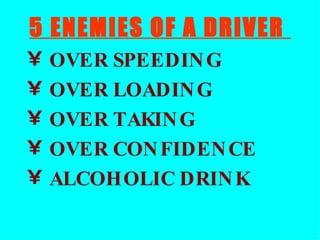
5 ENEMIES OF A DRIVER  OVER SPEEDING OVER LOADING OVER TAKING OVER CONFIDENCE ALCOHOLIC DRINK
9 FRIENDS OF A DRIVER   SHARP EYES SENSITIVE EARS RESPONSIVE SKIN CATCHY NOSE ANALYTICAL TONGUE ROAD SENSE TRAFFIC SENSE COMMON SENSE CAPACITY TO UNDERSTAND OTHER’S NONSENSE
FACTORS DECIDING SPEED LIMITS   ROAD CONDITION / TYPE VEHICLE CONDITION TRAFFIC CONDITION WEATHER CONDITION DRIVERS SKILL REGULATORY RESTRICTIONS
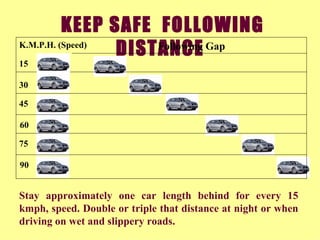
KEEP SAFE  FOLLOWING DISTANCE  Stay approximately one car length behind for every 15 kmph, speed. Double or triple that distance at night or when driving on wet and slippery roads. 30 45 75 60 90 K.M.P.H. (Speed)  Following Gap 15
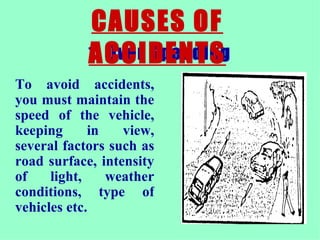
1. Over Speeding CAUSES OF ACCIDENTS To avoid accidents, you must maintain the speed of the vehicle, keeping in view, several factors such as road surface, intensity of light, weather conditions, type of vehicles etc.
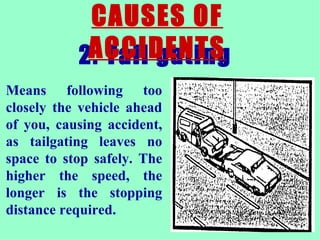
2. Tail gating   CAUSES OF ACCIDENTS Means following too closely the vehicle ahead of you, causing accident, as tailgating leaves no space to stop safely. The higher the speed, the longer is the stopping distance required.
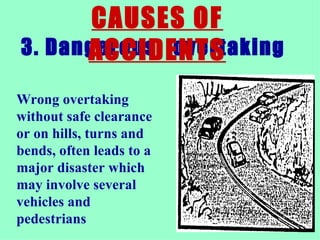
3. Dangerous  overtaking  CAUSES OF ACCIDENTS Wrong overtaking without safe clearance or on hills, turns and bends, often leads to a major disaster which may involve several vehicles and pedestrians
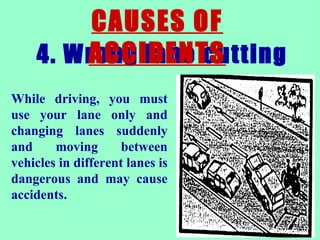
4. Wrong lane cutting  CAUSES OF ACCIDENTS While driving, you must use your lane only and changing lanes suddenly and moving between vehicles in different lanes is dangerous and may cause accidents.
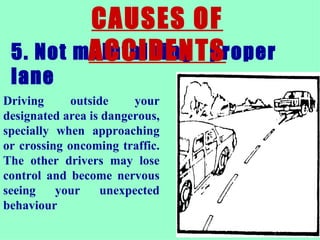
5. Not maintaining  .  proper lane  CAUSES OF ACCIDENTS Driving outside your designated area is dangerous, specially when approaching or crossing oncoming traffic. The other drivers may lose control and become nervous seeing your unexpected behaviour
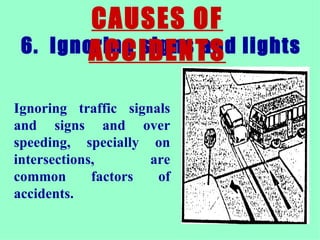
6.  Ignoring signs and lights   CAUSES OF ACCIDENTS Ignoring traffic signals and signs and over speeding, specially on intersections, are common factors of accidents.
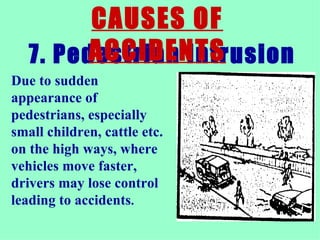
7. Pedestrian intrusion  CAUSES OF ACCIDENTS Due to sudden appearance of pedestrians, especially small children, cattle etc. on the high ways, where vehicles move faster, drivers may lose control leading to accidents .
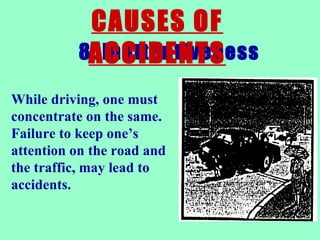
8. Inattentiveness CAUSES OF ACCIDENTS While driving, one must concentrate on the same. Failure to keep one’s attention on the road and the traffic, may lead to accidents.
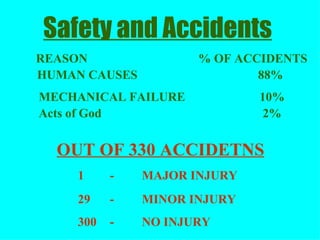
Safety and Accidents     REASON % OF ACCIDENTS   HUMAN CAUSES 88%   MECHANICAL FAILURE   10% Acts of God  2% 1  -  MAJOR INJURY 29  - MINOR INJURY 300  - NO INJURY OUT OF 330 ACCIDETNS
ALCOHOL AND DRIVING   The alcohol goes directly from the stomach into the blood stream. As the level of alcohol in the blood increases, the brain is affected. The part of the brain affected is that which controls judgement and self control. Of course, good judgement and self control are absolutely necessary for safe driving
Driving in the wrong lane. Driving too fast or too slow. Running over the curb. Weaving. Driving between lanes. Quick, Jerky starts. Not signaling, failure to use lights. Ignoring stop lights and red lights.  . Improper passing.  Alcohol causes serious driving errors, such as
The Truth about Alcohol  Alcohol is a drug that will make you less  alert and reduce your ability to drive  safely.  Everyone who drinks it affected by alcohol Food will slow down the effects of alcohol but  will not prevent them.  Only time will help a drinker sober up. Other methods just don’t work. A few beers are the same as a few pegs of whisky or a few glasses of wine
BEWARE Be aware that the chances of crash are much greater for drivers who are habitual drunkards than for drivers who are not .  So for your own safety as well as other’s safety  DON’T  MIX DRINKING WITH DRIVING
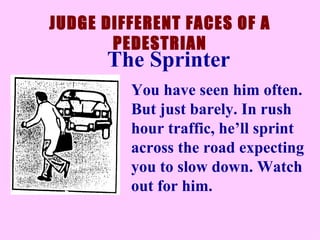
JUDGE DIFFERENT FACES OF A PEDESTRIAN You have seen him often. But just barely. In rush hour traffic, he’ll sprint across the road expecting you to slow down. Watch out for him.  The Sprinter
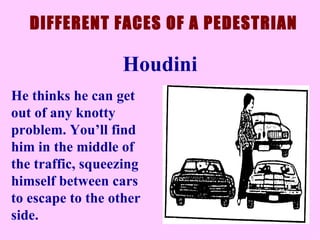
He thinks he can get out of any knotty problem. You’ll find him in the middle of the traffic, squeezing himself between cars to escape to the other side.  DIFFERENT FACES OF A PEDESTRIAN Houdini
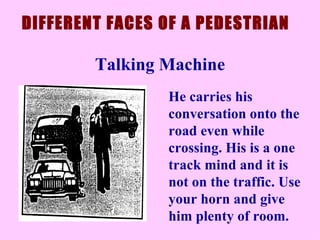
He carries his conversation onto the road even while crossing. His is a one track mind and it is not on the traffic. Use your horn and give him plenty of room.  DIFFERENT FACES OF A PEDESTRIAN Talking Machine
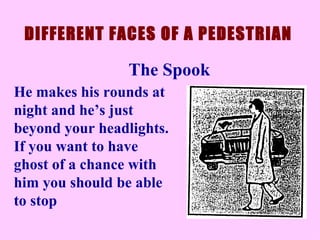
He makes his rounds at night and he’s just beyond your headlights. If you want to have ghost of a chance with him you should be able to stop   DIFFERENT FACES OF A PEDESTRIAN The Spook
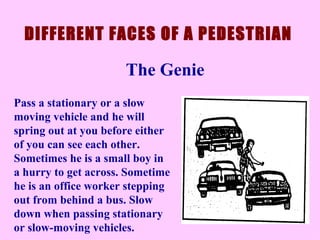
Pass a stationary or a slow moving vehicle and he will spring out at you before either of you can see each other. Sometimes he is a small boy in a hurry to get across. Sometime he is an office worker stepping out from behind a bus. Slow down when passing stationary or slow-moving vehicles.  DIFFERENT FACES OF A PEDESTRIAN The Genie
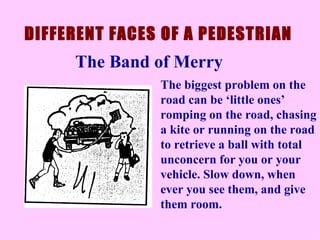
The biggest problem on the road can be ‘little ones’ romping on the road, chasing a kite or running on the road to retrieve a ball with total unconcern for you or your vehicle. Slow down, when ever you see them, and give them room.  DIFFERENT FACES OF A PEDESTRIAN The Band of Merry
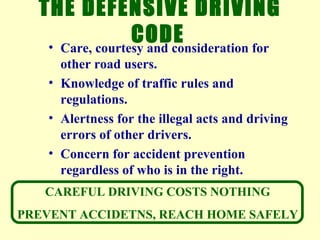
THE DEFENSIVE DRIVING CODE   Care, courtesy and consideration for other road users.  Knowledge of traffic rules and regulations.  Alertness for the illegal acts and driving errors of other drivers.  Concern for accident prevention regardless of who is in the right.  CAREFUL DRIVING COSTS NOTHING  PREVENT ACCIDETNS, REACH HOME SAFELY
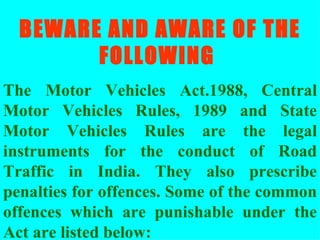
BEWARE AND AWARE OF THE FOLLOWING  The Motor Vehicles Act.1988, Central Motor Vehicles Rules, 1989 and State Motor Vehicles Rules are the legal instruments for the conduct of Road Traffic in India. They also prescribe penalties for offences. Some of the common offences which are punishable under the Act are listed below:
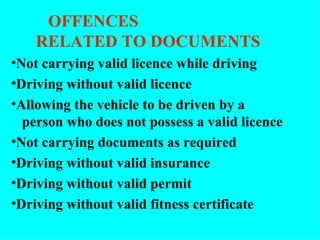
OFFENCES  RELATED TO DOCUMENTS Not carrying valid licence while driving Driving without valid licence Allowing the vehicle to be driven by a  .   person who does not possess a valid licence Not carrying documents as required Driving without valid insurance  Driving without valid permit  Driving without valid fitness certificate
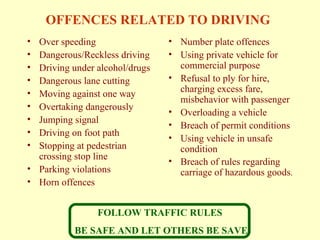
OFFENCES RELATED TO DRIVING   Over speeding Dangerous/Reckless driving Driving under alcohol/drugs Dangerous lane cutting Moving against one way Overtaking dangerously Jumping signal  Driving on foot path Stopping at pedestrian crossing stop line Parking violations Horn offences  Number plate offences Using private vehicle for commercial purpose Refusal to ply for hire, charging excess fare, misbehavior with passenger  Overloading a vehicle Breach of permit conditions  Using vehicle in unsafe condition Breach of rules regarding carriage of hazardous goods . FOLLOW TRAFFIC RULES  BE SAFE AND LET OTHERS BE SAVE
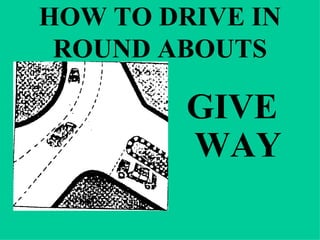
HOW TO DRIVE IN ROUND ABOUTS GIVE WAY
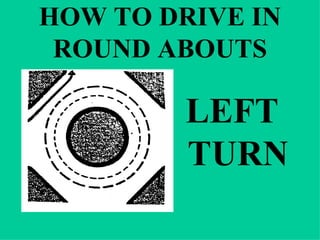
HOW TO DRIVE IN ROUND ABOUTS LEFT TURN
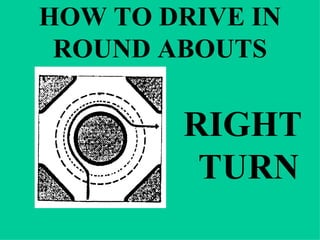
HOW TO DRIVE IN ROUND ABOUTS RIGHTTURN
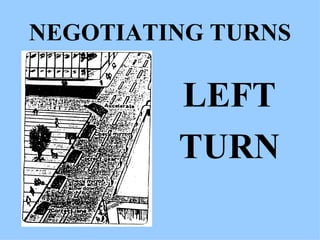
NEGOTIATING TURNS LEFT TURN
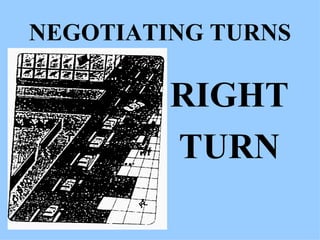
NEGOTIATING TURNS RIGHT TURN
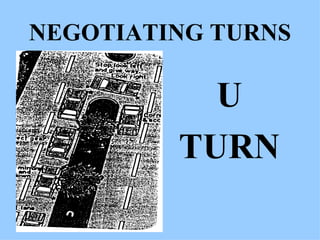
NEGOTIATING TURNS U TURN
NEVER PARK YOUR VEHICLE AT FOLLOWING PLACES   In front of an entrance to a street or a highway.  On a side walk, zebra crossing, bridge or inside a tunnel. In front of entrance to a hotel, theatre, auditorium, office, hospital. Within 10 metres of a non-signalised intersection or corner of a street. Within 50 metres of a signalized junction. Within 15 metres of a bus stop or taxi stand. Nevel leave your vehicle with your engine running.  Always leave parking lights on at night if vehicle is parked on the main road.  Before leaving your vehicle, always put the parking brakes on and the gear in low, reverse, or park position.
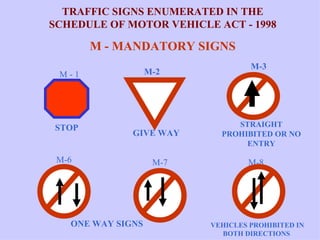
TRAFFIC SIGNS ENUMERATED IN THE SCHEDULE OF MOTOR VEHICLE ACT - 1998 M - MANDATORY SIGNS STOP GIVE WAY   STRAIGHT PROHIBITED OR NO ENTRY M-3 M-2 M - 1 M-7 M-6 M-8 ONE WAY SIGNS  VEHICLES PROHIBITED IN BOTH DIRECTIONS
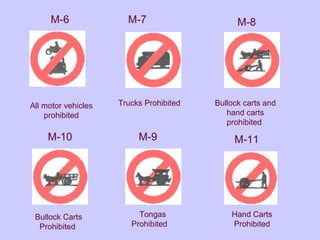
All motor vehicles prohibited Tongas Prohibited Bullock Carts Prohibited  Hand Carts Prohibited Trucks Prohibited Bullock carts and hand carts prohibited  M-6 M-11 M-8 M-9 M-10 M-7
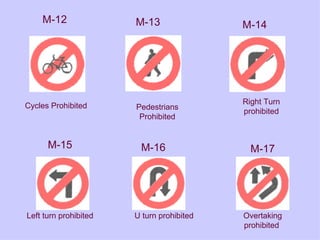
U turn prohibited Right Turn prohibited Cycles Prohibited Pedestrians Prohibited Left turn prohibited  Overtaking prohibited  M-15 M-14 M-13 M-17 M-16 M-12
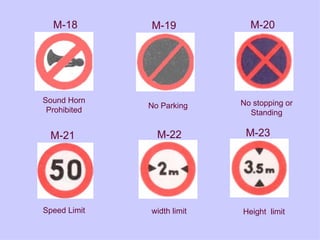
No stopping or Standing M-21 width limit M-20 No Parking M-19 Sound Horn Prohibited M-23 Speed Limit M-18 Height  limit M-22
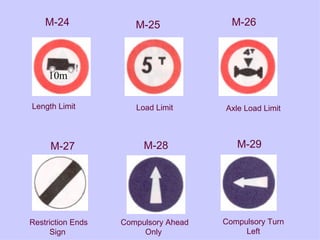
M-24 Length Limit M-27 Restriction Ends Sign  M-28 Compulsory Turn Left M-25 Axle Load Limit M-29 Compulsory Ahead Only  M-26 Load Limit 10m
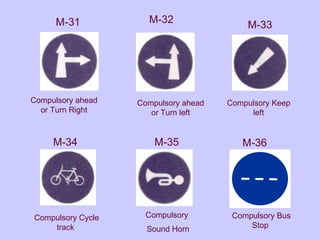
M-32 Compulsory ahead or Turn Right M-31 M-36 Compulsory Bus Stop  M-34 Compulsory  Sound Horn M-35 Compulsory Cycle track  M-33 Compulsory Keep left Compulsory ahead or Turn left
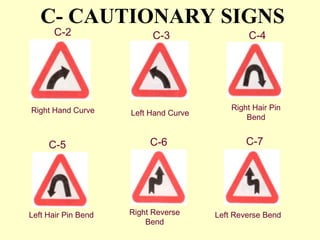
Right Hand Curve  C-2 Left Reverse Bend  C-6 Right Reverse Bend C-5 Left Hair Pin Bend C-7 Left Hand Curve C-3 Right Hair Pin Bend C-4 C- CAUTIONARY SIGNS
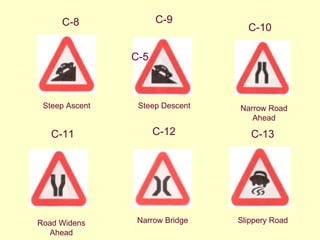
C-9 Narrow Bridge C-8 Road Widens Ahead C-5 Steep Descent  C-11 Steep Ascent C-10 Narrow Road Ahead C-12 C-13 Slippery Road
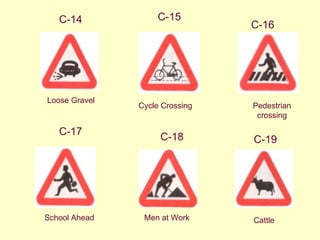
C-14 Cycle Crossing C-17 Loose Gravel  C-15 School Ahead C-18 Men at Work  C-16 Cattle C-19 Pedestrian crossing
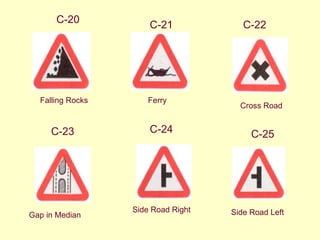
C-20 Falling Rocks C-22 Cross Road C-21 Ferry C-24 Side Road Left  C-23 Side Road Right  C-5 Gap in Median  C-25
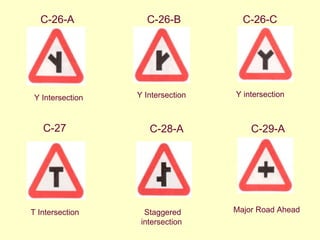
C-27 Staggered intersection  C-26-C Major Road Ahead  C-26-A T Intersection  C-26-B Y Intersection  C-29-A Y Intersection C-28-A Y intersection
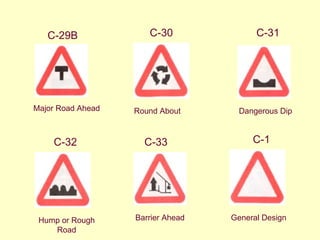
C-31 Hump or Rough Road C-30 Barrier Ahead C-33 General Design C-29B Round About C-1 Dangerous Dip  C-32 Major Road Ahead
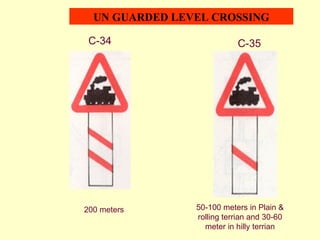
C-34 200 meters C-35 50-100 meters in Plain & rolling terrian and 30-60 meter in hilly terrian UN GUARDED LEVEL CROSSING
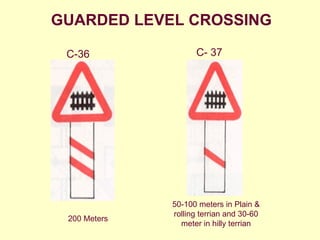
C-36 200 Meters GUARDED LEVEL CROSSING C- 37 50-100 meters in Plain & rolling terrian and 30-60 meter in hilly terrian
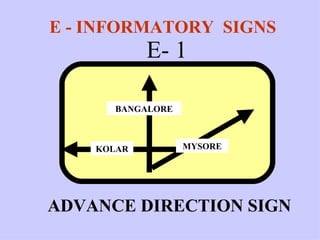
E - INFORMATORY  SIGNS BANGALORE MYSORE KOLAR ADVANCE DIRECTION SIGN E- 1
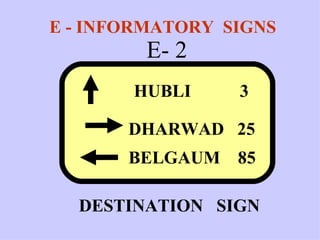
E - INFORMATORY  SIGNS DESTINATION  SIGN E- 2 HUBLI  3 DHARWAD  25  BELGAUM  85
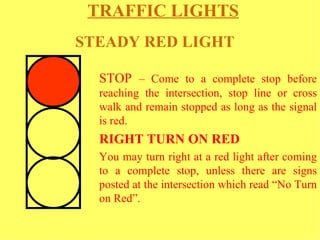
TRAFFIC LIGHTS   STOP  – Come to a complete stop before reaching the intersection, stop line or cross walk and remain stopped as long as the signal is red.  RIGHT TURN ON RED  You may turn right at a red light after coming to a complete stop, unless there are signs posted at the intersection which read “No Turn on Red”.  STEADY RED LIGHT
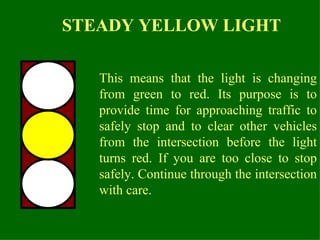
This means that the light is changing from green to red. Its purpose is to provide time for approaching traffic to safely stop and to clear other vehicles from the intersection before the light turns red. If you are too close to stop safely. Continue through the intersection with care.  STEADY YELLOW LIGHT
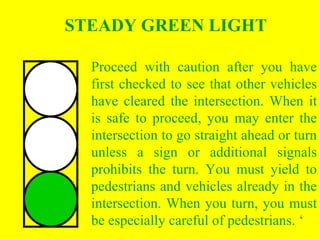
Proceed with caution after you have first checked to see that other vehicles have cleared the intersection. When it is safe to proceed, you may enter the intersection to go straight ahead or turn unless a sign or additional signals prohibits the turn. You must yield to pedestrians and vehicles already in the intersection. When you turn, you must be especially careful of pedestrians. ‘ STEADY GREEN LIGHT
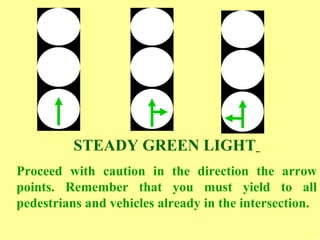
STEADY GREEN LIGHT   Proceed with caution in the direction the arrow points. Remember that you must yield to all pedestrians and vehicles already in the intersection.
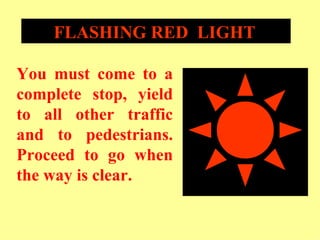
You must come to a complete stop, yield to all other traffic and to pedestrians. Proceed to go when the way is clear. FLASHING RED  LIGHT
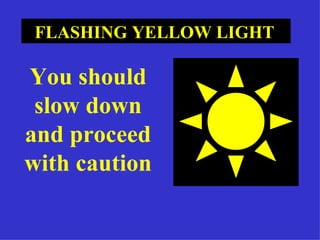
FLASHING YELLOW LIGHT   You should slow down and proceed with caution
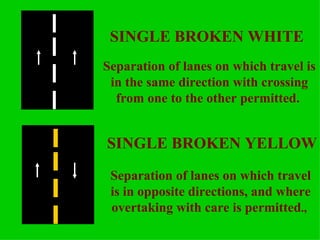
Separation of lanes on which travel is in the same direction with crossing from one to the other permitted.   Separation of lanes on which travel is in opposite directions, and where overtaking with care is permitted .,   SINGLE BROKEN WHITE SINGLE BROKEN YELLOW
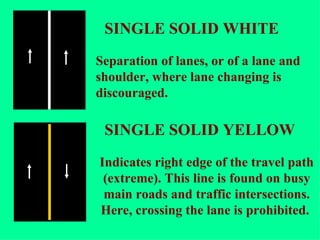
Separation of lanes, or of a lane and shoulder, where lane changing is discouraged.  Indicates right edge of the travel path (extreme). This line is found on busy main roads and traffic intersections. Here, crossing the lane is prohibited.  SINGLE SOLID WHITE SINGLE SOLID YELLOW
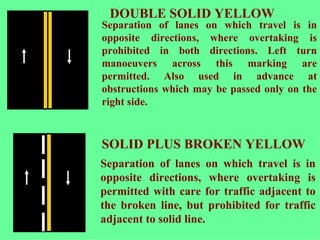
Separation of lanes on which travel is in opposite directions, where overtaking is permitted with care for traffic adjacent to the broken line, but prohibited for traffic adjacent to solid line.   SOLID PLUS BROKEN YELLOW DOUBLE SOLID YELLOW Separation of lanes on which travel is in opposite directions, where overtaking is prohibited in both directions. Left turn manoeuvers across this marking are permitted. Also used in advance at obstructions which may be passed only on the right side.
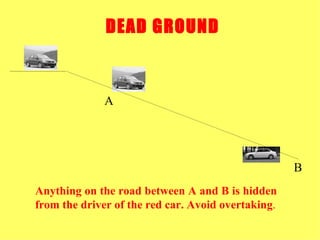
DEAD GROUND Anything on the road between A and B is hidden from the driver of the red car. Avoid overtaking . A B
SAFE DRIVING SUGGESTIONS FOR TWO WHEELERS   WHILE MOVING Wear helmet and drive for safety  Don’t drive zig-zag. Don’t weave between vehicles. Follow lane discipline and keep safe distance. Don’t over speed. Let the limit be 40 kmph Don’t over take form left.  Don’t drive against one way traffic. Don’t drink and drive
Don’t carry more than one pillion rider  Don’t use two wheeler for transporting goods and animals. Don’t use mobile phones while driving. Don’t drive without light during night. During night dip your light.  Use indicators before turning
AT JUNCTIONS AND SIGNALS   Obey red light signals. Don’t jump signals. Don’t cross stop line while stopping. Don’t block lanes and obstruct other drivers. Don’t try to enter a circle before you get green signals.  Don’t use shrilled and musical horns.
RESTRICTIONS FOR USE OF VEHICLES   Check the vehicle thoroughly. Check fuel and brakes. Keep the vehicle always in good condition.  Don’t allow under aged persons to ride vehicle. Don’t allow non-licensees to drive the vehicle. Don’t allow disabled and aged persons to ride. Use vehicle only when needed   PARKING Don’t park at junctions, turnings and prohibited areas.  Don’t park haphazardly .
DEVELOP SAFE DRIVING HABITS   Before starting the vehicle check the brakes, lights, signals, wipers and horn for proper functioning. Follow all the traffic rules strictly. While driving always wear seat belt.  Do not drive the vehicle without the valid driving license. Do not drive when you have taken alcoholic drink.  Slow moving vehicle should move in left lane. Fast moving vehicle should move in central lane.  If you want to turn left move in left lane. If you want to go straight move in center lane.  Do not change the lanes abruptly. Check the tyre condition and air pressure daily. At roundabouts, junctions and circles always give way to your right side traffic
Always give way to pedestrians for crossing the road safely.  Do not stop your vehicle on zebra crossing.  Try to drive the vehicle without using the horns. Use horns only in grave emergencies. Do not use loud, shrill and musical horns.  Do not use horns in silent zones. If necessary stop the vehicle.  Never over take from the left. Know the principle “Over taker has no right of the way”. Do not try to over take when road ahead is not visible. Slow down, horn and pass carefully when cross roads are ahead. Near signal lights stick to your lane. Keep the free left turn clear. Never cross the yellow line. While turning, slow down and give signals before 100 feet.  Don’t overload your vehicle. Carry only prescribed numbers. Never  talk over mobile/cellular phones while driving.
CODE OF ETHICS FOR DRIVERS GET THE KNOWLEDGE OF TRAFFIC RULES.  CHECK VEHICLE REGULARLY. MAINTAIN FIT FOR USE. KEEP YOUSELF IN GOOD HEALTH PHYSICALLY AND  MENTALLY. SHOW CARE, COURTESYFOR OTHER ROAD USERS. WHILE DRIVING USE SEAT BELTS BE ALERT ABOUT THE ERRORS OF OTHER DRIVERS. NEVER MIX DRINKING AND DRIVING. START EARLY, DRIVE SLOWLY, REACH SAFELY. DO NOT OVER SPEED OR OVER LOAD YOUR VEHICLE. GIVE SIGNAL BEFORE TURNING, BRAKING & STOPPI NG.
SLOW DOWN WHILE NEARISNG TURNINGS, JUNCTIONS AND CROSS ROADS.  DO NOT PARK VEHICLE IN PROHIBITED AND NO PARKING AREAS DO NOT OVER TAKE DANGEROUSLY. AT NIGHT DIP YOUR LIGHTS TO ON COMING, FRINTT GOING VEHICLE. DO NOT HORN UNNECESSARILY. NEVER HORN IN SILENT ZONES. KEEP SAFE FOLLOWING DISTANCE. ‘MORE SPEED MORE GAP’. IN ROUND ABOUTS GIVE WAY FOR VEHICLES IN YOUR RIGHT. RESPECT SIGNALS. NEVER JUMP TRAFFIC SIGNALS. ALWAYS KEEP THE REQUIRED DOCUMENTS WITH YOU. GIVE WAY TO AMBULANCE, FIRE ENGINES &  VIP CARRIAGES. DURING ACCIDENT DO NOT RUN AWAY,  INFORM POLICE KEEP YOURSELF CALM AND HAPPY WHILE DRIVING
THANK YOU VERY MUCH WISH YOU ALL THE BEST

Driver Training

  • 1.
    REMEMBER YOUR FAMILY IS WAITING FOR YOUR SAFE RETURN
  • 2.
    BODY’S ORIGINAL SPAREPARTS NOT AVAILABLE SAFETY CAN SAVE YOU
  • 3.
    SAFETY SAFETYIS THE ART OF TAKING PRECAUTION AGAINST ANY POSSIBLE DANGER FROM EXTERNAL SOURCE DANGER MAY BE TO SELF OTHERS MACHINES MATERIALS STRUCTURES
  • 4.
    ACCIDENT ACCIDENT ISAN UNFORESEEN, UNPLANNED AND UNCONTROLLED, EVENT WHICH MAY OR MAY NOT CAUSE INJURIES. ACCEDENT ALWAYS BRINGS MISERY ACCIDENTS DO NOT HAPPEN THEY ARE CAUSED ALWAYS THERE WILL BE ONE OR MORE CAUSES FOR ANY ACCIDNET ACCIDENTS CAN BE PREVENTED BY ELIMINATING THE CAUSES
  • 5.
  • 6.
    CONSEQUENCES OF ANACCIDENT ON ACCIDENT 1. PERSON 2. FAMILY 3. ORGANISATION 4. SOCIETY 5. NATION PERSONAL FACTOR IMPERSONAL FACTOR UNSAFE ACTION / CONDITION CASUAL PROXIMATE FACTOR
  • 7.
    5 ENEMIES OFA DRIVER OVER SPEEDING OVER LOADING OVER TAKING OVER CONFIDENCE ALCOHOLIC DRINK
  • 8.
    9 FRIENDS OFA DRIVER SHARP EYES SENSITIVE EARS RESPONSIVE SKIN CATCHY NOSE ANALYTICAL TONGUE ROAD SENSE TRAFFIC SENSE COMMON SENSE CAPACITY TO UNDERSTAND OTHER’S NONSENSE
  • 9.
    FACTORS DECIDING SPEEDLIMITS ROAD CONDITION / TYPE VEHICLE CONDITION TRAFFIC CONDITION WEATHER CONDITION DRIVERS SKILL REGULATORY RESTRICTIONS
  • 10.
    KEEP SAFE FOLLOWING DISTANCE Stay approximately one car length behind for every 15 kmph, speed. Double or triple that distance at night or when driving on wet and slippery roads. 30 45 75 60 90 K.M.P.H. (Speed) Following Gap 15
  • 11.
    1. Over SpeedingCAUSES OF ACCIDENTS To avoid accidents, you must maintain the speed of the vehicle, keeping in view, several factors such as road surface, intensity of light, weather conditions, type of vehicles etc.
  • 12.
    2. Tail gating CAUSES OF ACCIDENTS Means following too closely the vehicle ahead of you, causing accident, as tailgating leaves no space to stop safely. The higher the speed, the longer is the stopping distance required.
  • 13.
    3. Dangerous overtaking CAUSES OF ACCIDENTS Wrong overtaking without safe clearance or on hills, turns and bends, often leads to a major disaster which may involve several vehicles and pedestrians
  • 14.
    4. Wrong lanecutting CAUSES OF ACCIDENTS While driving, you must use your lane only and changing lanes suddenly and moving between vehicles in different lanes is dangerous and may cause accidents.
  • 15.
    5. Not maintaining . proper lane CAUSES OF ACCIDENTS Driving outside your designated area is dangerous, specially when approaching or crossing oncoming traffic. The other drivers may lose control and become nervous seeing your unexpected behaviour
  • 16.
    6. Ignoringsigns and lights CAUSES OF ACCIDENTS Ignoring traffic signals and signs and over speeding, specially on intersections, are common factors of accidents.
  • 17.
    7. Pedestrian intrusion CAUSES OF ACCIDENTS Due to sudden appearance of pedestrians, especially small children, cattle etc. on the high ways, where vehicles move faster, drivers may lose control leading to accidents .
  • 18.
    8. Inattentiveness CAUSESOF ACCIDENTS While driving, one must concentrate on the same. Failure to keep one’s attention on the road and the traffic, may lead to accidents.
  • 19.
    Safety and Accidents REASON % OF ACCIDENTS HUMAN CAUSES 88% MECHANICAL FAILURE 10% Acts of God 2% 1 - MAJOR INJURY 29 - MINOR INJURY 300 - NO INJURY OUT OF 330 ACCIDETNS
  • 20.
    ALCOHOL AND DRIVING The alcohol goes directly from the stomach into the blood stream. As the level of alcohol in the blood increases, the brain is affected. The part of the brain affected is that which controls judgement and self control. Of course, good judgement and self control are absolutely necessary for safe driving
  • 21.
    Driving in thewrong lane. Driving too fast or too slow. Running over the curb. Weaving. Driving between lanes. Quick, Jerky starts. Not signaling, failure to use lights. Ignoring stop lights and red lights. . Improper passing. Alcohol causes serious driving errors, such as
  • 22.
    The Truth aboutAlcohol Alcohol is a drug that will make you less alert and reduce your ability to drive safely. Everyone who drinks it affected by alcohol Food will slow down the effects of alcohol but will not prevent them. Only time will help a drinker sober up. Other methods just don’t work. A few beers are the same as a few pegs of whisky or a few glasses of wine
  • 23.
    BEWARE Be awarethat the chances of crash are much greater for drivers who are habitual drunkards than for drivers who are not . So for your own safety as well as other’s safety DON’T MIX DRINKING WITH DRIVING
  • 24.
    JUDGE DIFFERENT FACESOF A PEDESTRIAN You have seen him often. But just barely. In rush hour traffic, he’ll sprint across the road expecting you to slow down. Watch out for him. The Sprinter
  • 25.
    He thinks hecan get out of any knotty problem. You’ll find him in the middle of the traffic, squeezing himself between cars to escape to the other side. DIFFERENT FACES OF A PEDESTRIAN Houdini
  • 26.
    He carries hisconversation onto the road even while crossing. His is a one track mind and it is not on the traffic. Use your horn and give him plenty of room. DIFFERENT FACES OF A PEDESTRIAN Talking Machine
  • 27.
    He makes hisrounds at night and he’s just beyond your headlights. If you want to have ghost of a chance with him you should be able to stop DIFFERENT FACES OF A PEDESTRIAN The Spook
  • 28.
    Pass a stationaryor a slow moving vehicle and he will spring out at you before either of you can see each other. Sometimes he is a small boy in a hurry to get across. Sometime he is an office worker stepping out from behind a bus. Slow down when passing stationary or slow-moving vehicles. DIFFERENT FACES OF A PEDESTRIAN The Genie
  • 29.
    The biggest problemon the road can be ‘little ones’ romping on the road, chasing a kite or running on the road to retrieve a ball with total unconcern for you or your vehicle. Slow down, when ever you see them, and give them room. DIFFERENT FACES OF A PEDESTRIAN The Band of Merry
  • 30.
    THE DEFENSIVE DRIVINGCODE Care, courtesy and consideration for other road users. Knowledge of traffic rules and regulations. Alertness for the illegal acts and driving errors of other drivers. Concern for accident prevention regardless of who is in the right. CAREFUL DRIVING COSTS NOTHING PREVENT ACCIDETNS, REACH HOME SAFELY
  • 31.
    BEWARE AND AWAREOF THE FOLLOWING The Motor Vehicles Act.1988, Central Motor Vehicles Rules, 1989 and State Motor Vehicles Rules are the legal instruments for the conduct of Road Traffic in India. They also prescribe penalties for offences. Some of the common offences which are punishable under the Act are listed below:
  • 32.
    OFFENCES RELATEDTO DOCUMENTS Not carrying valid licence while driving Driving without valid licence Allowing the vehicle to be driven by a . person who does not possess a valid licence Not carrying documents as required Driving without valid insurance Driving without valid permit Driving without valid fitness certificate
  • 33.
    OFFENCES RELATED TODRIVING Over speeding Dangerous/Reckless driving Driving under alcohol/drugs Dangerous lane cutting Moving against one way Overtaking dangerously Jumping signal Driving on foot path Stopping at pedestrian crossing stop line Parking violations Horn offences Number plate offences Using private vehicle for commercial purpose Refusal to ply for hire, charging excess fare, misbehavior with passenger Overloading a vehicle Breach of permit conditions Using vehicle in unsafe condition Breach of rules regarding carriage of hazardous goods . FOLLOW TRAFFIC RULES BE SAFE AND LET OTHERS BE SAVE
  • 34.
    HOW TO DRIVEIN ROUND ABOUTS GIVE WAY
  • 35.
    HOW TO DRIVEIN ROUND ABOUTS LEFT TURN
  • 36.
    HOW TO DRIVEIN ROUND ABOUTS RIGHTTURN
  • 37.
  • 38.
  • 39.
  • 40.
    NEVER PARK YOURVEHICLE AT FOLLOWING PLACES In front of an entrance to a street or a highway. On a side walk, zebra crossing, bridge or inside a tunnel. In front of entrance to a hotel, theatre, auditorium, office, hospital. Within 10 metres of a non-signalised intersection or corner of a street. Within 50 metres of a signalized junction. Within 15 metres of a bus stop or taxi stand. Nevel leave your vehicle with your engine running. Always leave parking lights on at night if vehicle is parked on the main road. Before leaving your vehicle, always put the parking brakes on and the gear in low, reverse, or park position.
  • 41.
    TRAFFIC SIGNS ENUMERATEDIN THE SCHEDULE OF MOTOR VEHICLE ACT - 1998 M - MANDATORY SIGNS STOP GIVE WAY STRAIGHT PROHIBITED OR NO ENTRY M-3 M-2 M - 1 M-7 M-6 M-8 ONE WAY SIGNS VEHICLES PROHIBITED IN BOTH DIRECTIONS
  • 42.
    All motor vehiclesprohibited Tongas Prohibited Bullock Carts Prohibited Hand Carts Prohibited Trucks Prohibited Bullock carts and hand carts prohibited M-6 M-11 M-8 M-9 M-10 M-7
  • 43.
    U turn prohibitedRight Turn prohibited Cycles Prohibited Pedestrians Prohibited Left turn prohibited Overtaking prohibited M-15 M-14 M-13 M-17 M-16 M-12
  • 44.
    No stopping orStanding M-21 width limit M-20 No Parking M-19 Sound Horn Prohibited M-23 Speed Limit M-18 Height limit M-22
  • 45.
    M-24 Length LimitM-27 Restriction Ends Sign M-28 Compulsory Turn Left M-25 Axle Load Limit M-29 Compulsory Ahead Only M-26 Load Limit 10m
  • 46.
    M-32 Compulsory aheador Turn Right M-31 M-36 Compulsory Bus Stop M-34 Compulsory Sound Horn M-35 Compulsory Cycle track M-33 Compulsory Keep left Compulsory ahead or Turn left
  • 47.
    Right Hand Curve C-2 Left Reverse Bend C-6 Right Reverse Bend C-5 Left Hair Pin Bend C-7 Left Hand Curve C-3 Right Hair Pin Bend C-4 C- CAUTIONARY SIGNS
  • 48.
    C-9 Narrow BridgeC-8 Road Widens Ahead C-5 Steep Descent C-11 Steep Ascent C-10 Narrow Road Ahead C-12 C-13 Slippery Road
  • 49.
    C-14 Cycle CrossingC-17 Loose Gravel C-15 School Ahead C-18 Men at Work C-16 Cattle C-19 Pedestrian crossing
  • 50.
    C-20 Falling RocksC-22 Cross Road C-21 Ferry C-24 Side Road Left C-23 Side Road Right C-5 Gap in Median C-25
  • 51.
    C-27 Staggered intersection C-26-C Major Road Ahead C-26-A T Intersection C-26-B Y Intersection C-29-A Y Intersection C-28-A Y intersection
  • 52.
    C-31 Hump orRough Road C-30 Barrier Ahead C-33 General Design C-29B Round About C-1 Dangerous Dip C-32 Major Road Ahead
  • 53.
    C-34 200 metersC-35 50-100 meters in Plain & rolling terrian and 30-60 meter in hilly terrian UN GUARDED LEVEL CROSSING
  • 54.
    C-36 200 MetersGUARDED LEVEL CROSSING C- 37 50-100 meters in Plain & rolling terrian and 30-60 meter in hilly terrian
  • 55.
    E - INFORMATORY SIGNS BANGALORE MYSORE KOLAR ADVANCE DIRECTION SIGN E- 1
  • 56.
    E - INFORMATORY SIGNS DESTINATION SIGN E- 2 HUBLI 3 DHARWAD 25 BELGAUM 85
  • 57.
    TRAFFIC LIGHTS STOP – Come to a complete stop before reaching the intersection, stop line or cross walk and remain stopped as long as the signal is red. RIGHT TURN ON RED You may turn right at a red light after coming to a complete stop, unless there are signs posted at the intersection which read “No Turn on Red”. STEADY RED LIGHT
  • 58.
    This means thatthe light is changing from green to red. Its purpose is to provide time for approaching traffic to safely stop and to clear other vehicles from the intersection before the light turns red. If you are too close to stop safely. Continue through the intersection with care. STEADY YELLOW LIGHT
  • 59.
    Proceed with cautionafter you have first checked to see that other vehicles have cleared the intersection. When it is safe to proceed, you may enter the intersection to go straight ahead or turn unless a sign or additional signals prohibits the turn. You must yield to pedestrians and vehicles already in the intersection. When you turn, you must be especially careful of pedestrians. ‘ STEADY GREEN LIGHT
  • 60.
    STEADY GREEN LIGHT Proceed with caution in the direction the arrow points. Remember that you must yield to all pedestrians and vehicles already in the intersection.
  • 61.
    You must cometo a complete stop, yield to all other traffic and to pedestrians. Proceed to go when the way is clear. FLASHING RED LIGHT
  • 62.
    FLASHING YELLOW LIGHT You should slow down and proceed with caution
  • 63.
    Separation of laneson which travel is in the same direction with crossing from one to the other permitted. Separation of lanes on which travel is in opposite directions, and where overtaking with care is permitted ., SINGLE BROKEN WHITE SINGLE BROKEN YELLOW
  • 64.
    Separation of lanes,or of a lane and shoulder, where lane changing is discouraged. Indicates right edge of the travel path (extreme). This line is found on busy main roads and traffic intersections. Here, crossing the lane is prohibited. SINGLE SOLID WHITE SINGLE SOLID YELLOW
  • 65.
    Separation of laneson which travel is in opposite directions, where overtaking is permitted with care for traffic adjacent to the broken line, but prohibited for traffic adjacent to solid line. SOLID PLUS BROKEN YELLOW DOUBLE SOLID YELLOW Separation of lanes on which travel is in opposite directions, where overtaking is prohibited in both directions. Left turn manoeuvers across this marking are permitted. Also used in advance at obstructions which may be passed only on the right side.
  • 66.
    DEAD GROUND Anythingon the road between A and B is hidden from the driver of the red car. Avoid overtaking . A B
  • 67.
    SAFE DRIVING SUGGESTIONSFOR TWO WHEELERS WHILE MOVING Wear helmet and drive for safety Don’t drive zig-zag. Don’t weave between vehicles. Follow lane discipline and keep safe distance. Don’t over speed. Let the limit be 40 kmph Don’t over take form left. Don’t drive against one way traffic. Don’t drink and drive
  • 68.
    Don’t carry morethan one pillion rider Don’t use two wheeler for transporting goods and animals. Don’t use mobile phones while driving. Don’t drive without light during night. During night dip your light. Use indicators before turning
  • 69.
    AT JUNCTIONS ANDSIGNALS Obey red light signals. Don’t jump signals. Don’t cross stop line while stopping. Don’t block lanes and obstruct other drivers. Don’t try to enter a circle before you get green signals. Don’t use shrilled and musical horns.
  • 70.
    RESTRICTIONS FOR USEOF VEHICLES Check the vehicle thoroughly. Check fuel and brakes. Keep the vehicle always in good condition. Don’t allow under aged persons to ride vehicle. Don’t allow non-licensees to drive the vehicle. Don’t allow disabled and aged persons to ride. Use vehicle only when needed PARKING Don’t park at junctions, turnings and prohibited areas. Don’t park haphazardly .
  • 71.
    DEVELOP SAFE DRIVINGHABITS Before starting the vehicle check the brakes, lights, signals, wipers and horn for proper functioning. Follow all the traffic rules strictly. While driving always wear seat belt. Do not drive the vehicle without the valid driving license. Do not drive when you have taken alcoholic drink. Slow moving vehicle should move in left lane. Fast moving vehicle should move in central lane. If you want to turn left move in left lane. If you want to go straight move in center lane. Do not change the lanes abruptly. Check the tyre condition and air pressure daily. At roundabouts, junctions and circles always give way to your right side traffic
  • 72.
    Always give wayto pedestrians for crossing the road safely. Do not stop your vehicle on zebra crossing. Try to drive the vehicle without using the horns. Use horns only in grave emergencies. Do not use loud, shrill and musical horns. Do not use horns in silent zones. If necessary stop the vehicle. Never over take from the left. Know the principle “Over taker has no right of the way”. Do not try to over take when road ahead is not visible. Slow down, horn and pass carefully when cross roads are ahead. Near signal lights stick to your lane. Keep the free left turn clear. Never cross the yellow line. While turning, slow down and give signals before 100 feet. Don’t overload your vehicle. Carry only prescribed numbers. Never talk over mobile/cellular phones while driving.
  • 73.
    CODE OF ETHICSFOR DRIVERS GET THE KNOWLEDGE OF TRAFFIC RULES. CHECK VEHICLE REGULARLY. MAINTAIN FIT FOR USE. KEEP YOUSELF IN GOOD HEALTH PHYSICALLY AND MENTALLY. SHOW CARE, COURTESYFOR OTHER ROAD USERS. WHILE DRIVING USE SEAT BELTS BE ALERT ABOUT THE ERRORS OF OTHER DRIVERS. NEVER MIX DRINKING AND DRIVING. START EARLY, DRIVE SLOWLY, REACH SAFELY. DO NOT OVER SPEED OR OVER LOAD YOUR VEHICLE. GIVE SIGNAL BEFORE TURNING, BRAKING & STOPPI NG.
  • 74.
    SLOW DOWN WHILENEARISNG TURNINGS, JUNCTIONS AND CROSS ROADS. DO NOT PARK VEHICLE IN PROHIBITED AND NO PARKING AREAS DO NOT OVER TAKE DANGEROUSLY. AT NIGHT DIP YOUR LIGHTS TO ON COMING, FRINTT GOING VEHICLE. DO NOT HORN UNNECESSARILY. NEVER HORN IN SILENT ZONES. KEEP SAFE FOLLOWING DISTANCE. ‘MORE SPEED MORE GAP’. IN ROUND ABOUTS GIVE WAY FOR VEHICLES IN YOUR RIGHT. RESPECT SIGNALS. NEVER JUMP TRAFFIC SIGNALS. ALWAYS KEEP THE REQUIRED DOCUMENTS WITH YOU. GIVE WAY TO AMBULANCE, FIRE ENGINES & VIP CARRIAGES. DURING ACCIDENT DO NOT RUN AWAY, INFORM POLICE KEEP YOURSELF CALM AND HAPPY WHILE DRIVING
  • 75.
    THANK YOU VERYMUCH WISH YOU ALL THE BEST