Nat Sci 1 
1
Natural Sciences/Biology Defined 
-Significance of Biology 
-Characteristics of Life 
-History and Theories of Biology 
Scientific Methods 
Concepts of Life 
2
branch of science 
use empirical and scientific methods 
to explain the rules that govern the natural 
world 
3
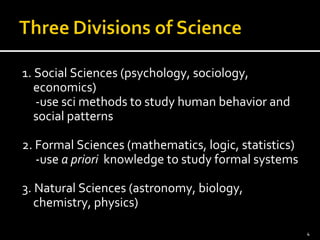
1. Social Sciences (psychology, sociology, 
economics) 
-use sci methods to study human behavior and 
social patterns 
2. Formal Sciences (mathematics, logic, statistics) 
-use a priori knowledge to study formal systems 
3. Natural Sciences (astronomy, biology, 
chemistry, physics) 
4
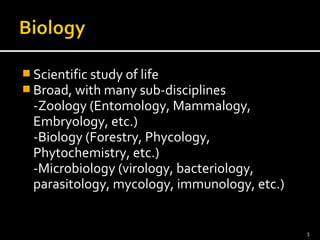
Scientific study of life 
Broad, with many sub-disciplines 
-Zoology (Entomology, Mammalogy, 
Embryology, etc.) 
-Biology (Forestry, Phycology, 
Phytochemistry, etc.) 
-Microbiology (virology, bacteriology, 
parasitology, mycology, immunology, etc.) 
5
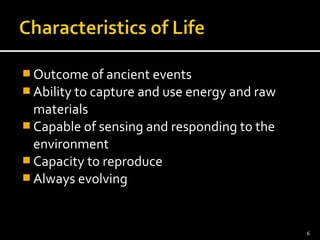
Outcome of ancient events 
Ability to capture and use energy and raw 
materials 
Capable of sensing and responding to the 
environment 
Capacity to reproduce 
Always evolving 
6
Why do you need to study Nat Sci (Biology)? 
What are your expectations of the subject? 
7
Many things and events are related to biology. 
Instructions: 
1. Go over today’s or the previous day’s newspaper 
and chose an article that has direct relevance to 
biology. Read and paste it in a short bond paper 
and submit it the next meeting. 
1. In one or two statements, justify the relevance 
of the article to biology. 
8
Natural Science 1 Lecture Notes 
Available at Dayon Enterprises (in front of USC 
Main) 
9
 Wikipedia: http://en.wikipedia.org/wiki 
 Starr, C. 2003. Biology: Concepts and Applications. 5th ed. Wadsworth Group, 
Brooks/Cole. USA. 799 pp. 
 Miller, S.A. & Harley J.B. 1999. Zoology fourth ed. WCB/McGraw-Hill USA. 
 Nabors, M.W. 2004. Botany an Introductory Approach. Pearson Education South 
Asia Pte. Ltd. 626pp. 
 Myers, P. 2001. "Animalia" (On-line), Animal Diversity Web. Accessed June 19, 
2011 
http://animaldiversity.ummz.umich.edu/site/accounts/information/Animalia.html 
. 
 zoology. (2011). In Encyclopædia Britannica. Retrieved from 
http://www.britannica.com/EBchecked/topic/657959/zoology 
10

Introduction to Natural Science

  • 1.
  • 2.
    Natural Sciences/Biology Defined -Significance of Biology -Characteristics of Life -History and Theories of Biology Scientific Methods Concepts of Life 2
  • 3.
    branch of science use empirical and scientific methods to explain the rules that govern the natural world 3
  • 4.
    1. Social Sciences(psychology, sociology, economics) -use sci methods to study human behavior and social patterns 2. Formal Sciences (mathematics, logic, statistics) -use a priori knowledge to study formal systems 3. Natural Sciences (astronomy, biology, chemistry, physics) 4
  • 5.
    Scientific study oflife Broad, with many sub-disciplines -Zoology (Entomology, Mammalogy, Embryology, etc.) -Biology (Forestry, Phycology, Phytochemistry, etc.) -Microbiology (virology, bacteriology, parasitology, mycology, immunology, etc.) 5
  • 6.
    Outcome of ancientevents Ability to capture and use energy and raw materials Capable of sensing and responding to the environment Capacity to reproduce Always evolving 6
  • 7.
    Why do youneed to study Nat Sci (Biology)? What are your expectations of the subject? 7
  • 8.
    Many things andevents are related to biology. Instructions: 1. Go over today’s or the previous day’s newspaper and chose an article that has direct relevance to biology. Read and paste it in a short bond paper and submit it the next meeting. 1. In one or two statements, justify the relevance of the article to biology. 8
  • 9.
    Natural Science 1Lecture Notes Available at Dayon Enterprises (in front of USC Main) 9
  • 10.
     Wikipedia: http://en.wikipedia.org/wiki  Starr, C. 2003. Biology: Concepts and Applications. 5th ed. Wadsworth Group, Brooks/Cole. USA. 799 pp.  Miller, S.A. & Harley J.B. 1999. Zoology fourth ed. WCB/McGraw-Hill USA.  Nabors, M.W. 2004. Botany an Introductory Approach. Pearson Education South Asia Pte. Ltd. 626pp.  Myers, P. 2001. "Animalia" (On-line), Animal Diversity Web. Accessed June 19, 2011 http://animaldiversity.ummz.umich.edu/site/accounts/information/Animalia.html .  zoology. (2011). In Encyclopædia Britannica. Retrieved from http://www.britannica.com/EBchecked/topic/657959/zoology 10

Editor's Notes

  • #5 Nat Sci: Basis for applied sciences The terms a priori ("from the earlier") and a posteriori ("from the later") are used in philosophy (epistemology) to distinguish two types of knowledge, justifications or arguments. A priori knowledge or justification is independent of experience (for example 'All bachelors are unmarried'); a posteriori knowledge or justification is dependent on experience or empirical evidence (for example 'Some bachelors are very happy'). Wikipedia 112011
  • #7 Outcome of ancient events (lifeless matter-atoms and molecules-became organized to form into the first living cells Always evolving, traits that characterize individuals of a population change from one generation to the next