1
09/03/24 1
Instructor: Suprakash Datta (datta[at]cse.yorku.ca) ext 77875
Lectures: Tues (CB 122), 7–10 PM
Office hours: Wed 3-5 pm (CSEB 3043), or by
appointment.
Textbooks:
1. "Management of Information Security", M. E. Whitman, H. J.
Mattord, Nelson Education / CENGAGE Learning, 2011, 3rd Edition
2. "Guide to Computer Forensics and Investigations", B. Nelson, A.
Phillips, F. Enfinger, C. Steuart, Nelson Education / CENGAGE
Learning, 2010, 4th Edition.
CSE 4482: Computer Security Management:
Assessment and Forensics
2
Objectives
• Upon completion of this chapter you should
be able to:
– Define risk management and its role in the
organization
– Use risk management techniques to identify
and prioritize risk factors for information assets
– Assess risk based on the likelihood of adverse
events and the effects on information assets
when events occur
– Document the results of risk identification
Management of Information Security, 3rd ed.
3
A true story
A local company suffered a catastrophic loss one night when its
office burned to the ground.
As the employees gathered around the charred remains the next
morning, the president asked the secretary if she had been
performing the daily computer backups. To the president’s relief
she replied that yes, each day before she went home she
backed up all the financial information regarding customers,
invoices, order and payments.
The president then asked the secretary to retrieve the backup so
they could begin to determine their current financial status.
“Well”, the secretary said, “I guess I cannot do that. You see, I put
those backups in the desk drawer next to the computer in the
office. ”
M. Ciampa, “Security+Guide to Network Security Fundamentals”, pp 303
4
Risk Management
• Risk management: identification,
assessment, and prioritization of risks
• Managing risk is one of the key
responsibilities of every manager within
the organization
• In any well-developed risk management
program, two formal processes are at
work
– Risk identification and assessment
– Risk control
5
Risk Management
“If you know the enemy and know yourself,
you need not fear the result of a hundred
battles
If you know yourself but not the enemy, for
every victory gained you will also suffer a
defeat
If you know neither the enemy nor yourself,
you will succumb in every battle”
-- Sun Tzu
Management of Information Security, 3rd ed.
6
Knowing Yourself
• Identifying, examining and understanding
the information and how it is processed,
stored, and transmitted
• Armed with this knowledge, one can initiate
an in-depth risk management program
• Risk management is a process
– Safeguards and controls that are devised and
implemented are not install-and-forget devices
Management of Information Security, 3rd ed.
7
Knowing the Enemy
• Identifying, examining, and understanding
the threats facing the organization’s
information assets
– Must fully identify those threats that pose risks
to the organization and the security of its
information assets
• Risk management
– The process of assessing the risks to an
organization’s information and determining
how those risks can be controlled or mitigated
Management of Information Security, 3rd ed.
8
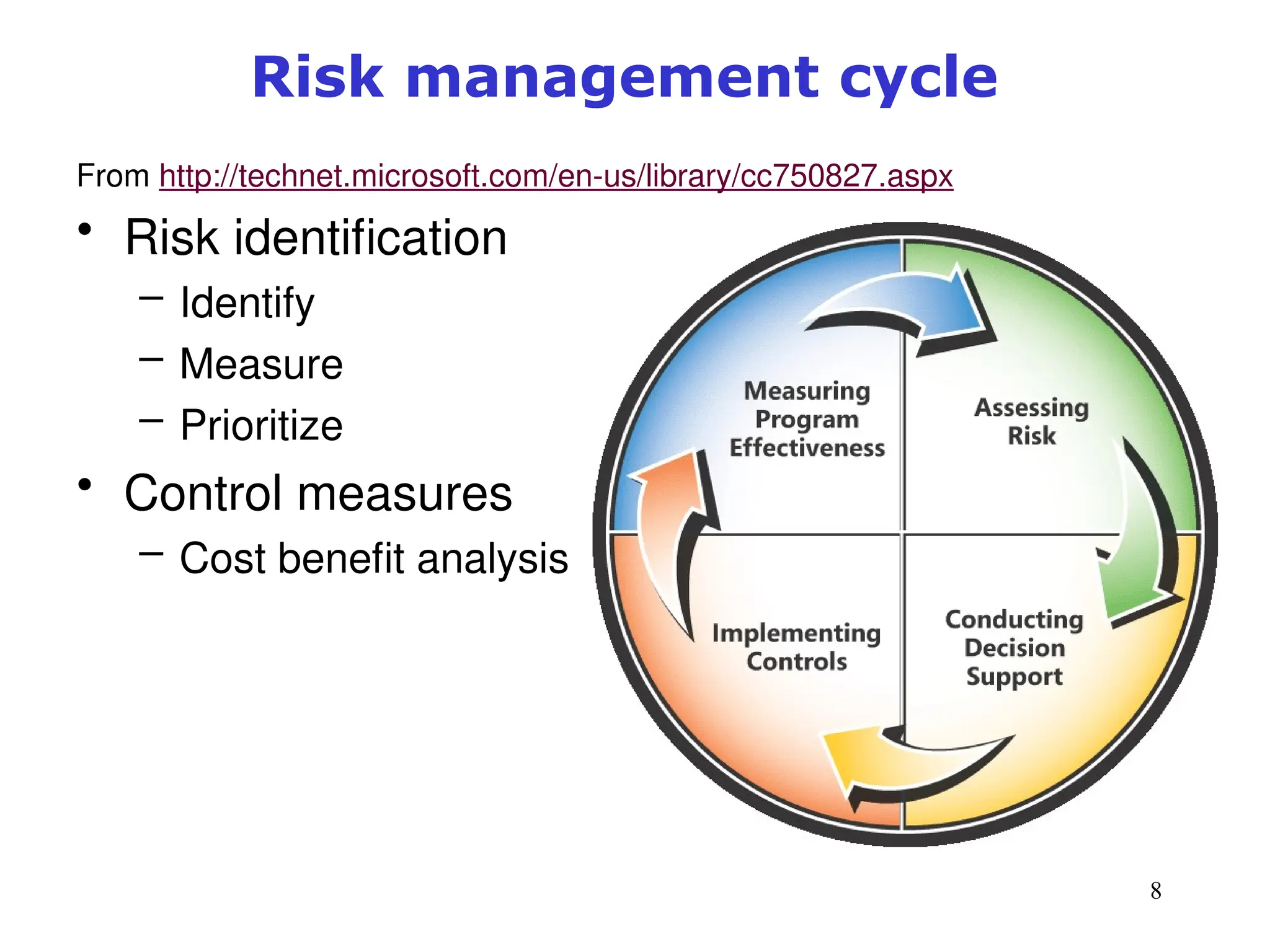
Risk management cycle
From http://technet.microsoft.com/en-us/library/cc750827.aspx
• Risk identification
– Identify
– Measure
– Prioritize
• Control measures
– Cost benefit analysis
9
Accountability for Risk Management
Communities of interest must work together
• Information Security – leadership role in
addressing risk
• Information Technology – role involves
building and maintaining secure systems
• Management – role involves resource allocation
and prioritization of security concerns
• Users – crucial role in (early) detection, and
proper response to threats
Management of Information Security, 3rd ed.
10
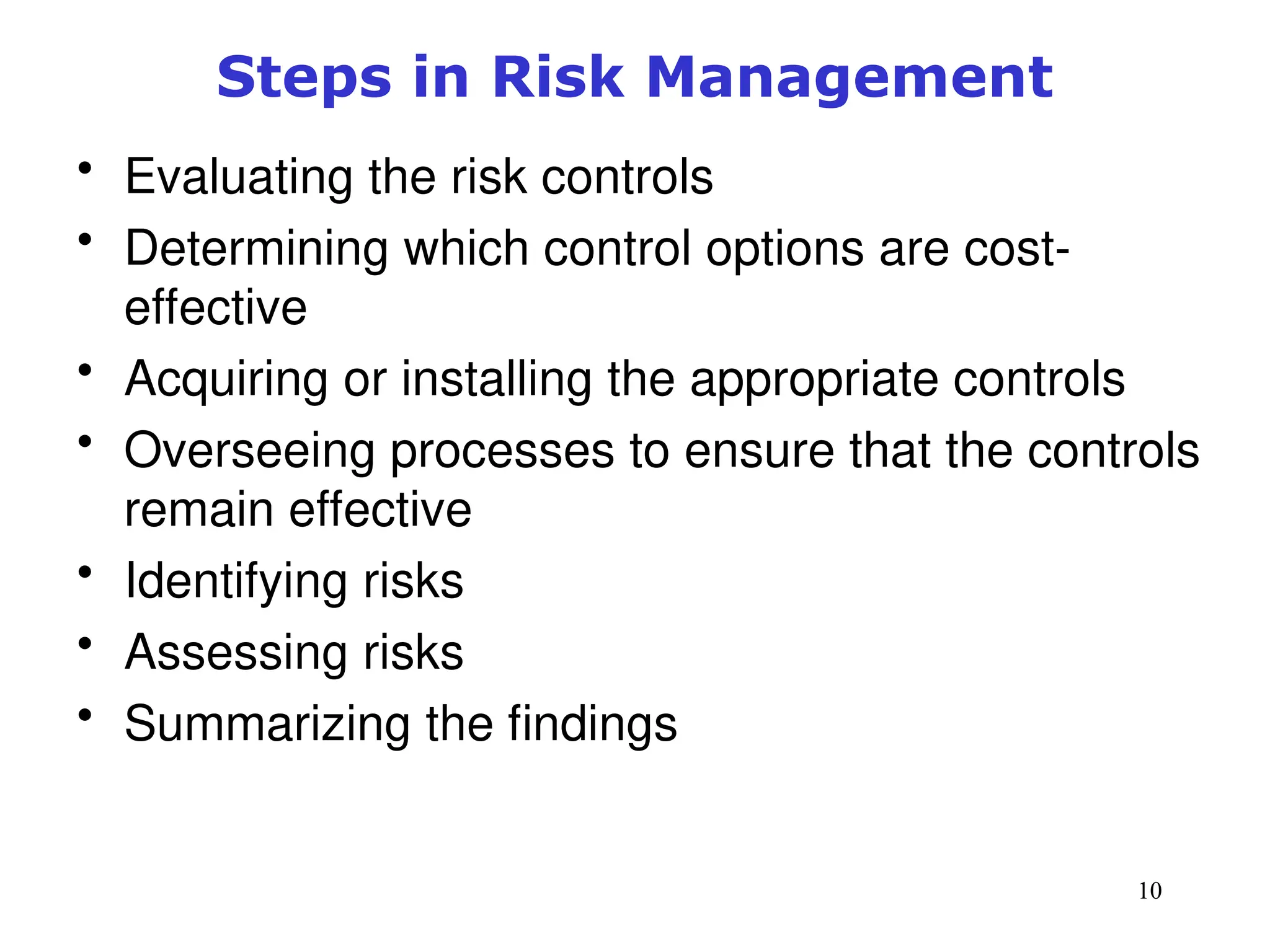
Steps in Risk Management
• Evaluating the risk controls
• Determining which control options are cost-
effective
• Acquiring or installing the appropriate controls
• Overseeing processes to ensure that the controls
remain effective
• Identifying risks
• Assessing risks
• Summarizing the findings
Management of Information Security, 3rd ed.
11
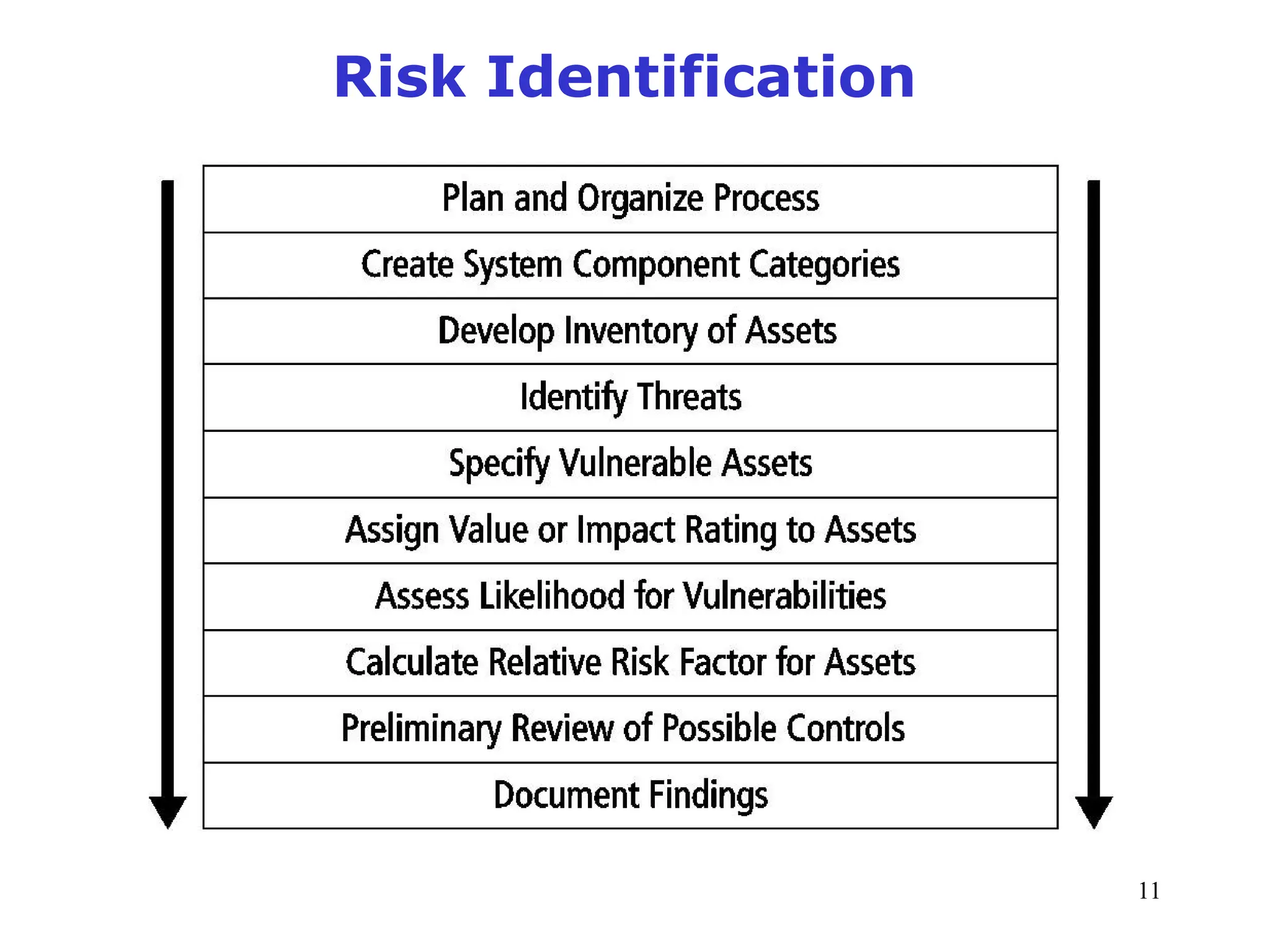
Risk Identification
Management of Information Security, 3rd ed.
Figure 8-1 Risk identification process
Source: Course Technology/Cengage Learning
12
Asset inventory
• Managers identify the organization’s
information assets
– Classify them into useful groups
– Prioritize them by their overall importance
Management of Information Security, 3rd ed.
13
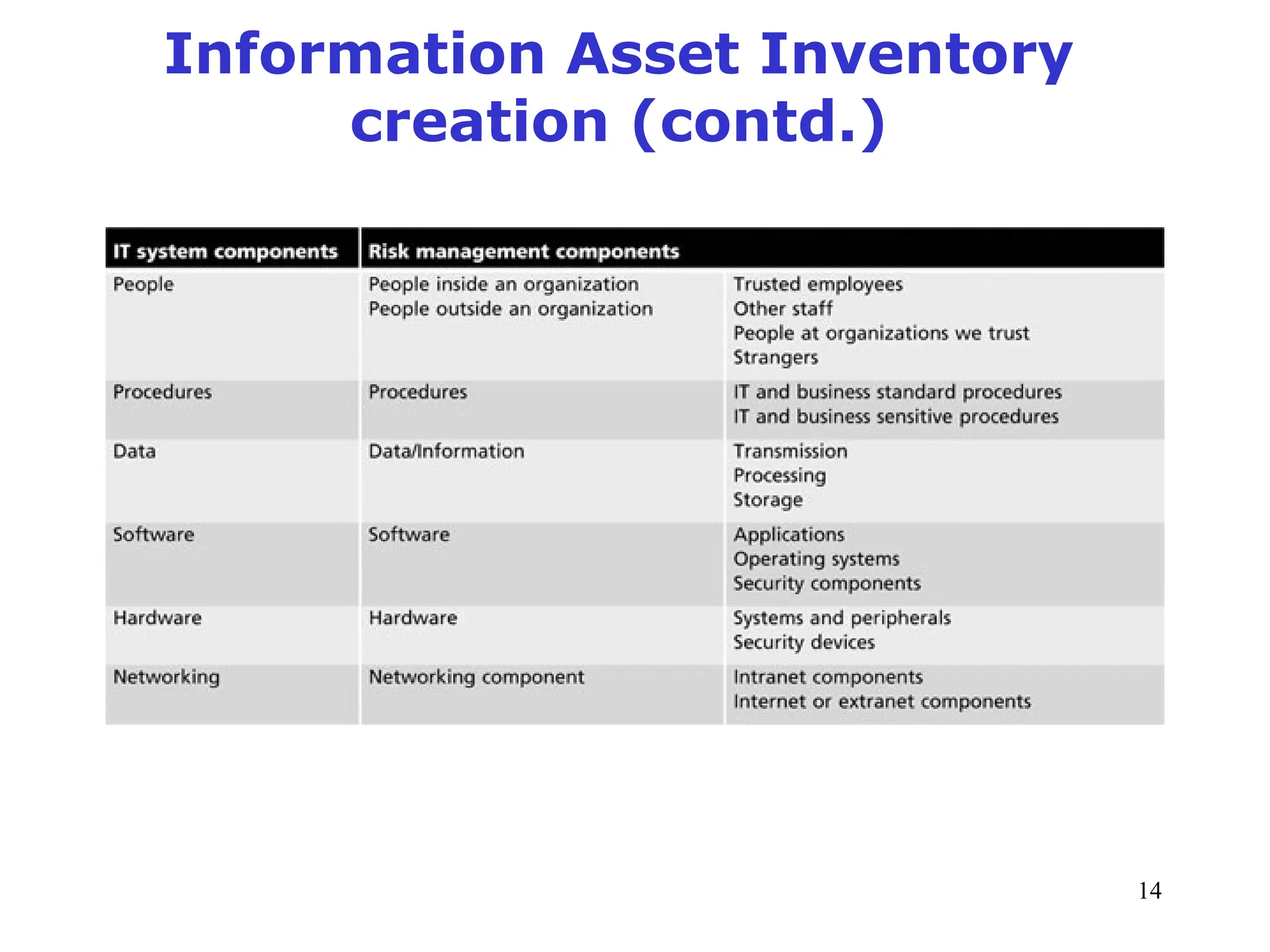
Information Asset Inventory
creation
• Identify information assets
– Includes people, procedures, data and
information, software, hardware, and
networking elements
– This step should be done without pre-judging
the value of each asset
• Values will be assigned later in the process
• Determine which attributes of each
information asset should be tracked
Management of Information Security, 3rd ed.
14
Management of Information Security, 3rd ed.
Table 8-1 Organizational assets used in systems
Source: Course Technology/Cengage Learning
Information Asset Inventory
creation (contd.)
15
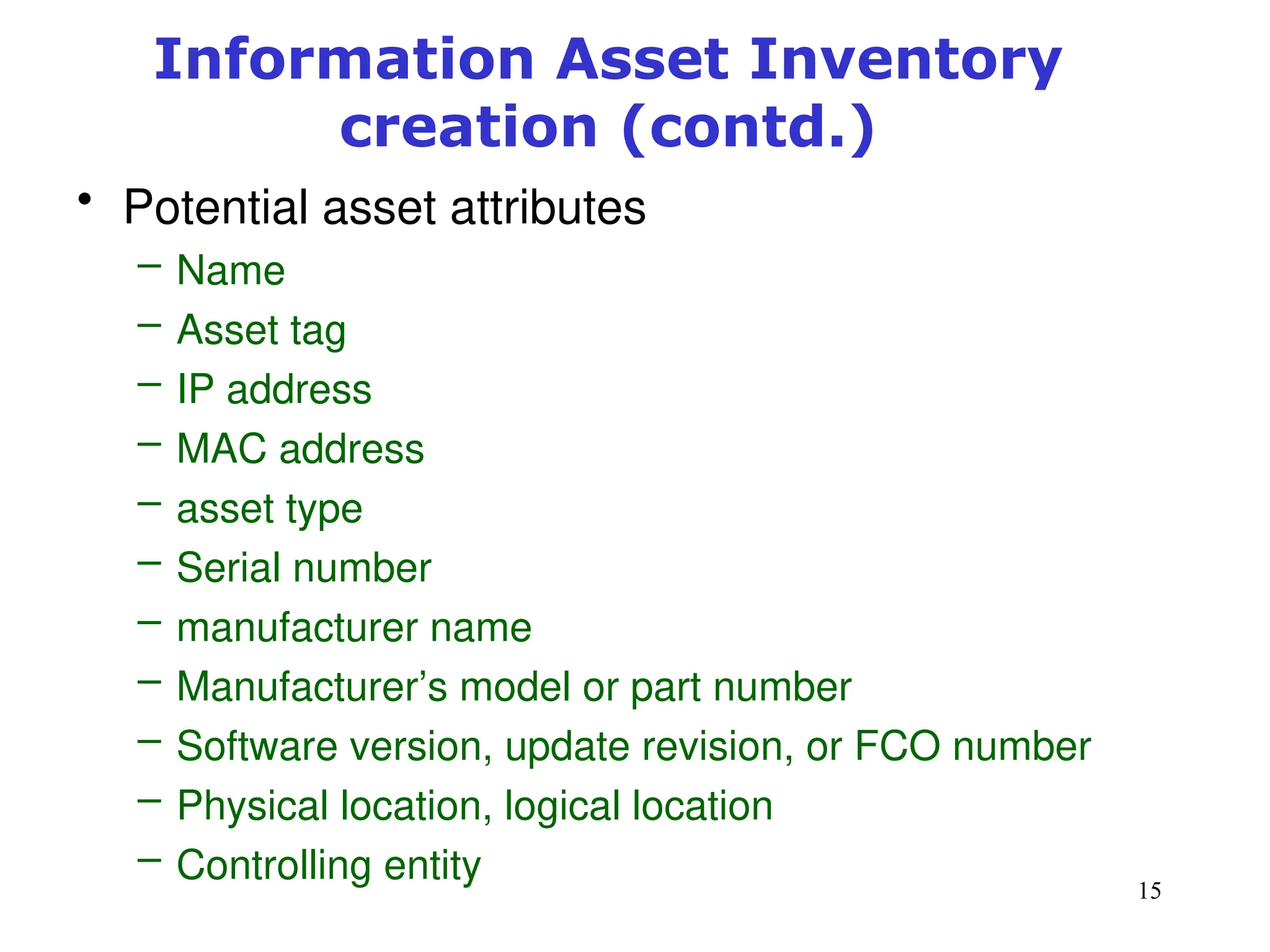
Information Asset Inventory
creation (contd.)
• Potential asset attributes
– Name
– Asset tag
– IP address
– MAC address
– asset type
– Serial number
– manufacturer name
– Manufacturer’s model or part number
– Software version, update revision, or FCO number
– Physical location, logical location
– Controlling entity
Management of Information Security, 3rd ed.
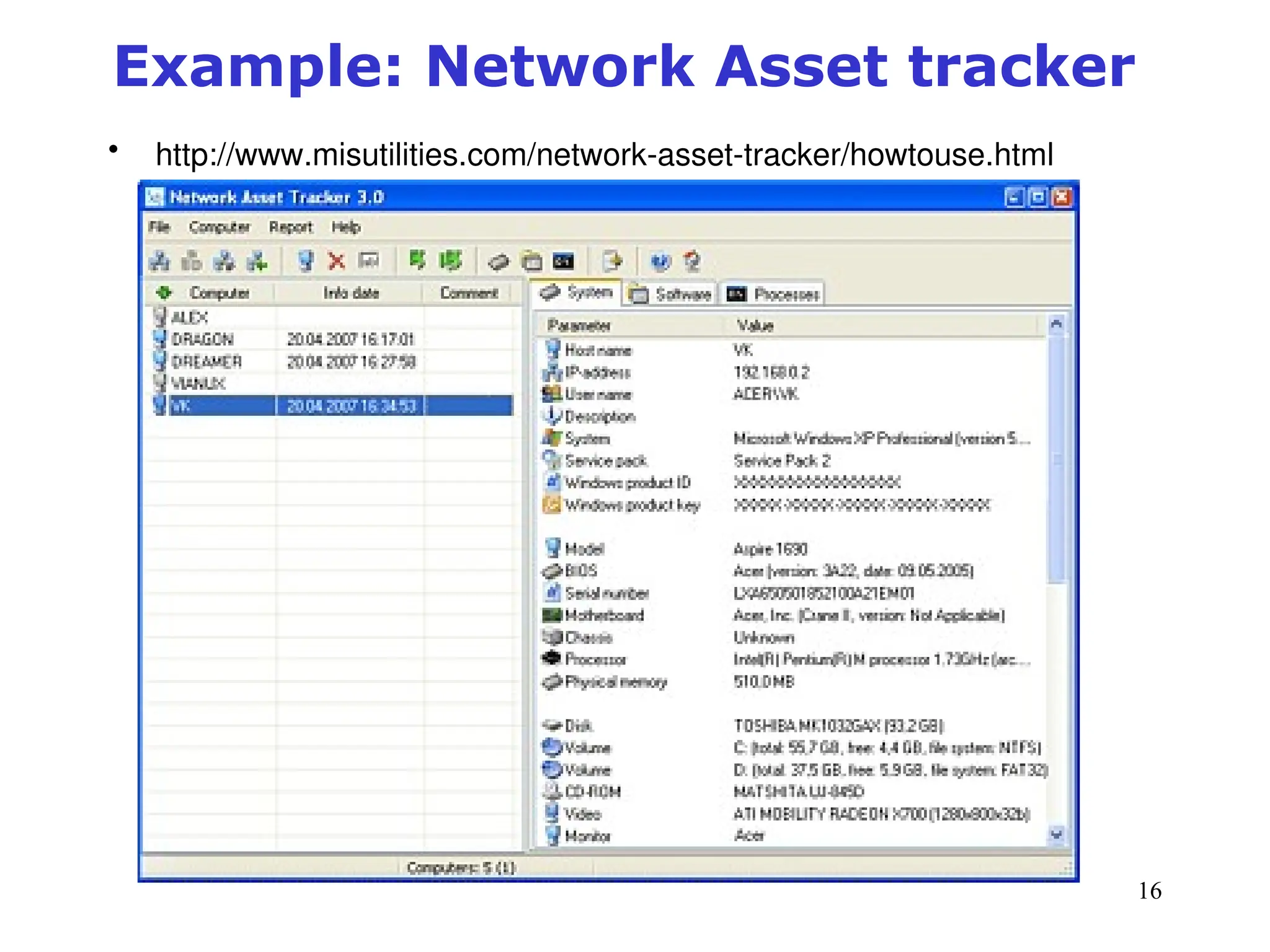
16
Example: Network Asset tracker
• http://www.misutilities.com/network-asset-tracker/howtouse.html
17
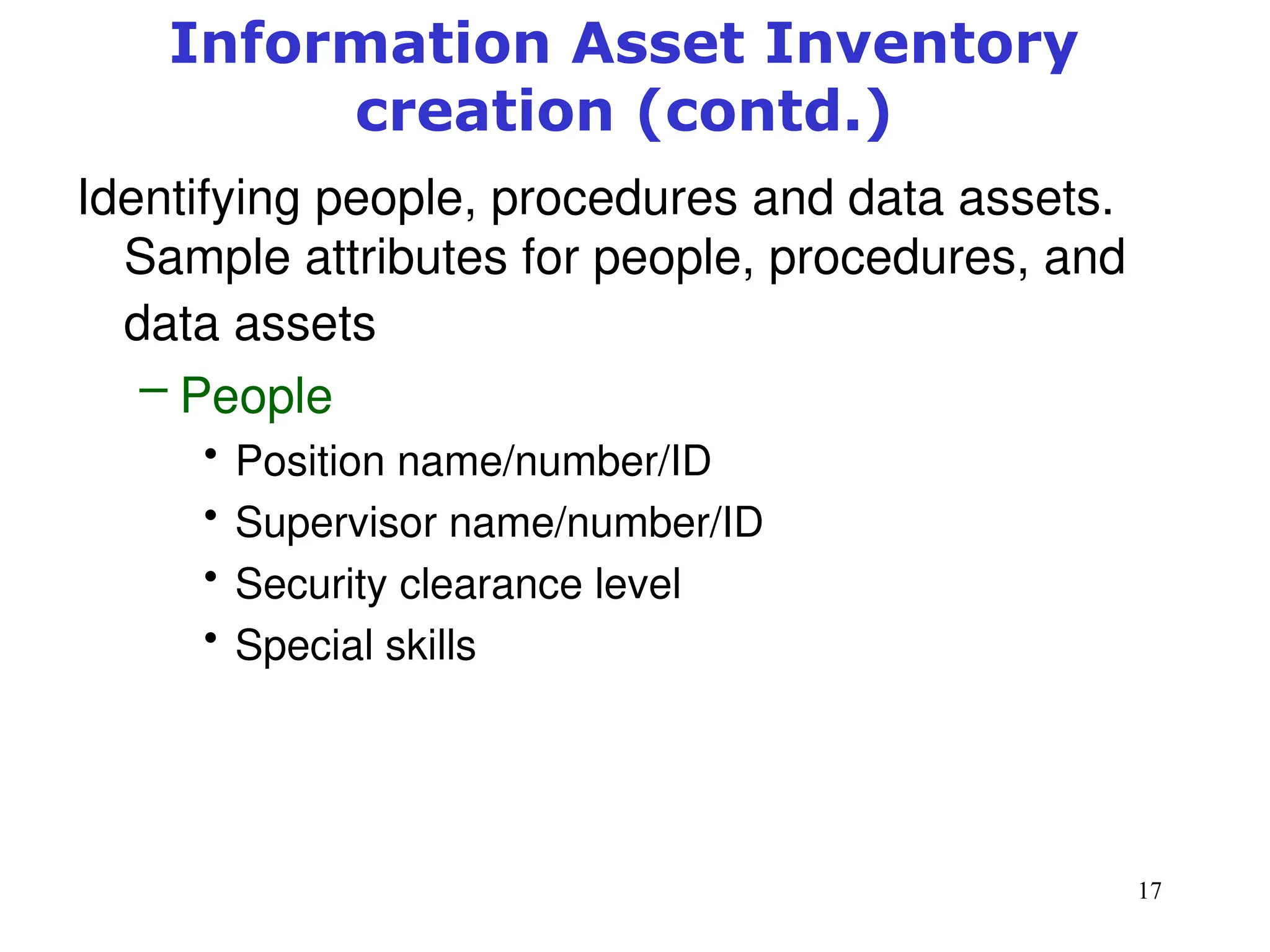
Information Asset Inventory
creation (contd.)
Identifying people, procedures and data assets.
Sample attributes for people, procedures, and
data assets
– People
• Position name/number/ID
• Supervisor name/number/ID
• Security clearance level
• Special skills
Management of Information Security, 3rd ed.
18
• Sample attributes for people, procedures, and
data assets (cont’d.)
– Procedures
• Description
• Intended purpose Software/hardware/networking
elements to which it is tied
• Location where it is stored for reference
• Location where it is stored for update purposes
Management of Information Security, 3rd ed.
Information Asset Inventory
creation (contd.)
19
• Sample attributes for people, procedures, and
data assets (cont’d.)
– Data
• Classification
• Owner/creator/manager
• Size of data structure
• Data structure used
• Online or offline
• Location
• Backup procedures
Management of Information Security, 3rd ed.
Information Asset Inventory
creation (contd.)
20
Next: Asset ranking
• Determine the values of assets
• Prioritize according to value
21
Classifying and Categorizing Assets
• Determine/refine an asset classification scheme
• A classification scheme categorizes information
assets based on their sensitivity, security needs
• Each category designates the level of protection
needed for a particular information asset
• Some asset types, such as personnel, may
require an alternative classification scheme
• Classification categories must be comprehensive
and mutually exclusive
Management of Information Security, 3rd ed.
22
Assessing Values for
Information Assets
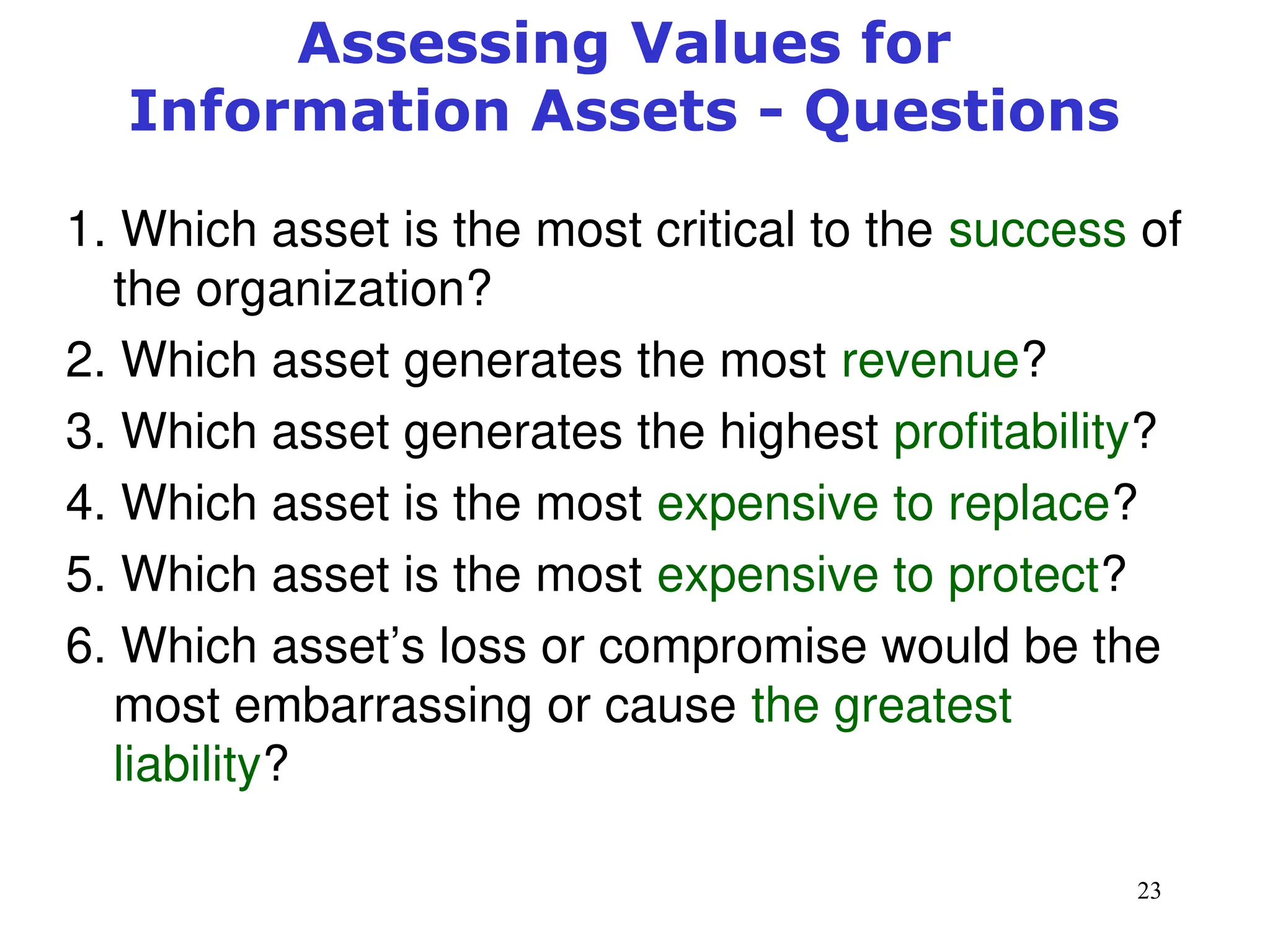
• Assign a relative value: Comparative
judgments made to ensure that the most
valuable information assets are given the
highest priority
Management of Information Security, 3rd ed.
23
Assessing Values for
Information Assets - Questions
1. Which asset is the most critical to the success of
the organization?
2. Which asset generates the most revenue?
3. Which asset generates the highest profitability?
4. Which asset is the most expensive to replace?
5. Which asset is the most expensive to protect?
6. Which asset’s loss or compromise would be the
most embarrassing or cause the greatest
liability?
Management of Information Security, 3rd ed.
24
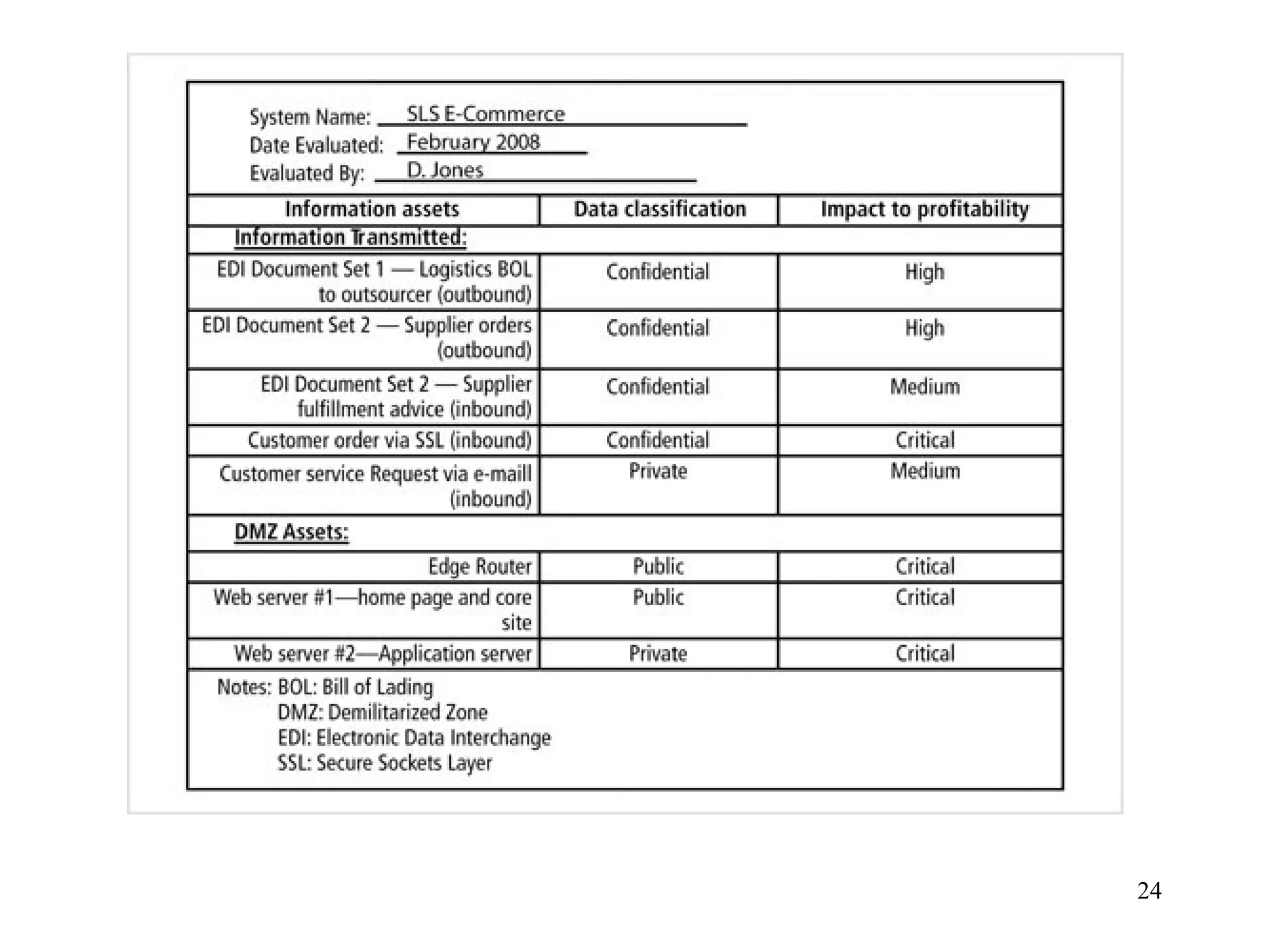
Management of Information Security, 3rd ed.
Figure 8-2 Sample asset classification worksheet
Source: Course Technology/Cengage Learning
25
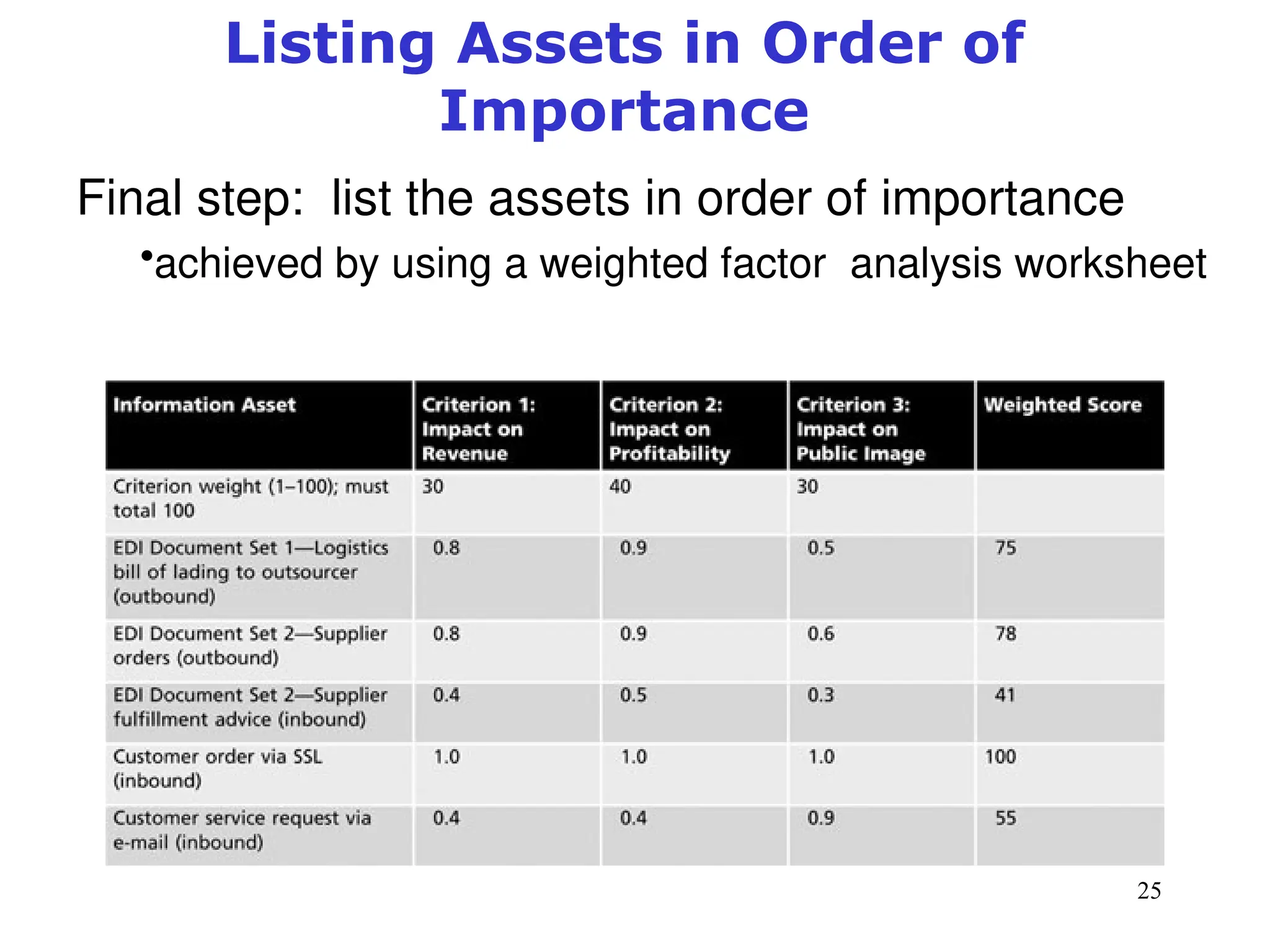
Management of Information Security, 3rd ed.
Table 8-2 Example weighted factor analysis worksheet
Listing Assets in Order of
Importance
Final step: list the assets in order of importance
•achieved by using a weighted factor analysis worksheet
26
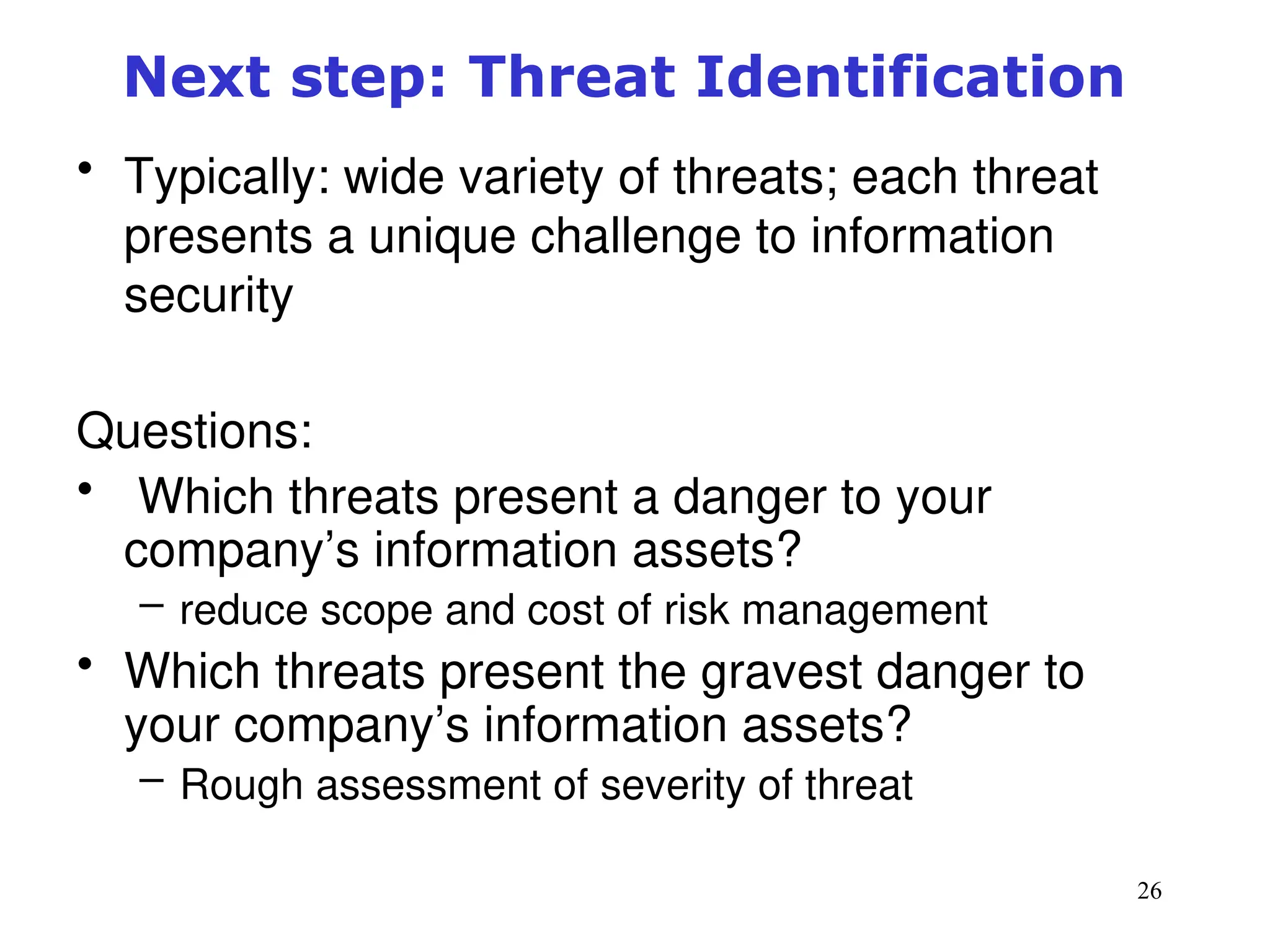
Next step: Threat Identification
• Typically: wide variety of threats; each threat
presents a unique challenge to information
security
Questions:
• Which threats present a danger to your
company’s information assets?
– reduce scope and cost of risk management
• Which threats present the gravest danger to
your company’s information assets?
– Rough assessment of severity of threat
Management of Information Security, 3rd ed.
27
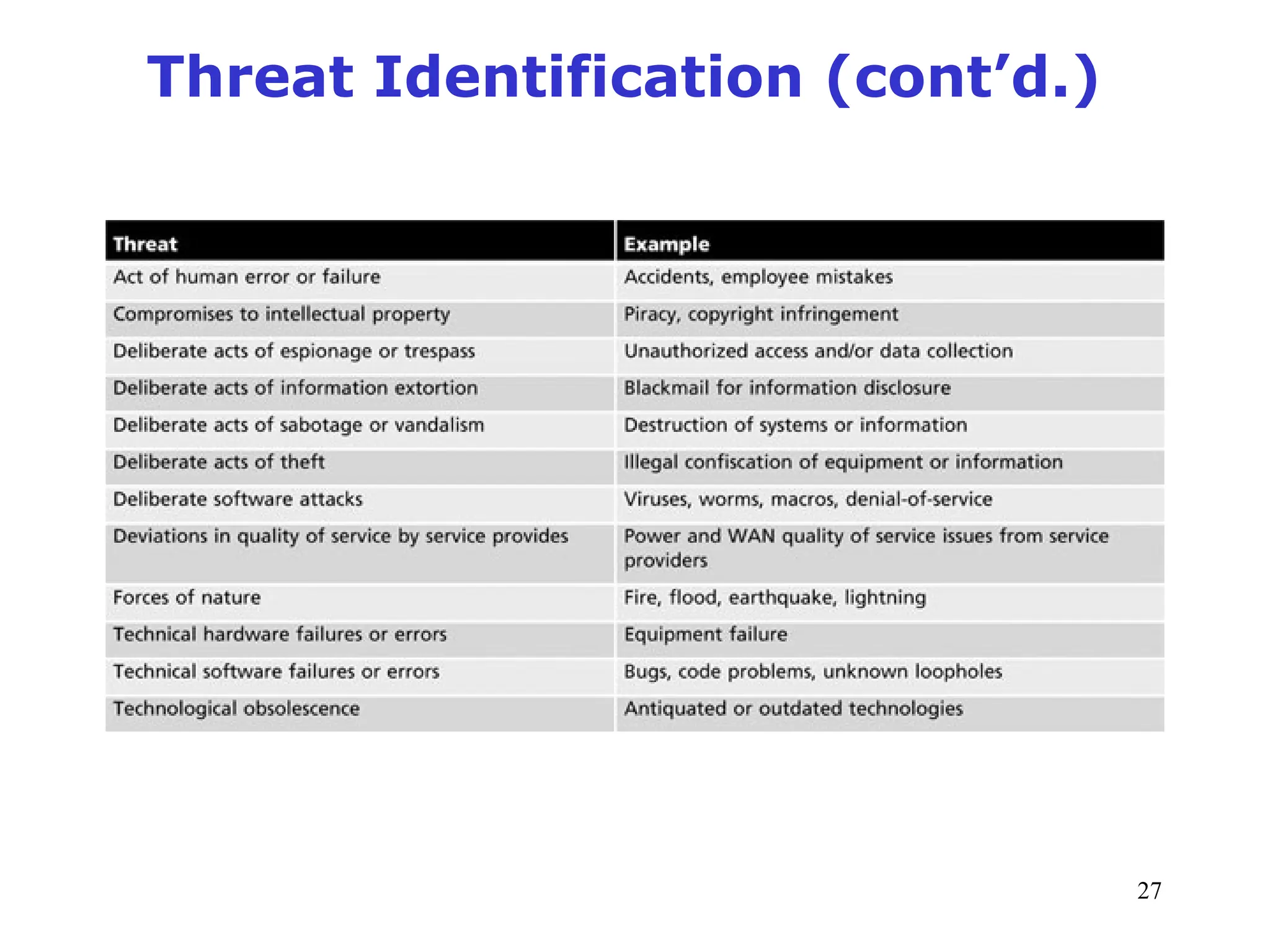
Management of Information Security, 3rd ed.
Table 8-3 Threats to information security
Source: ©2003 ACM, inc., included here by permission
Threat Identification (cont’d.)
28
Management of Information Security, 3rd ed.
Source: Adapted from M. E. Whitman. Enemy at
the gates: Threats to information security.
Communications of the ACM, August
2003. Reprinted with permission
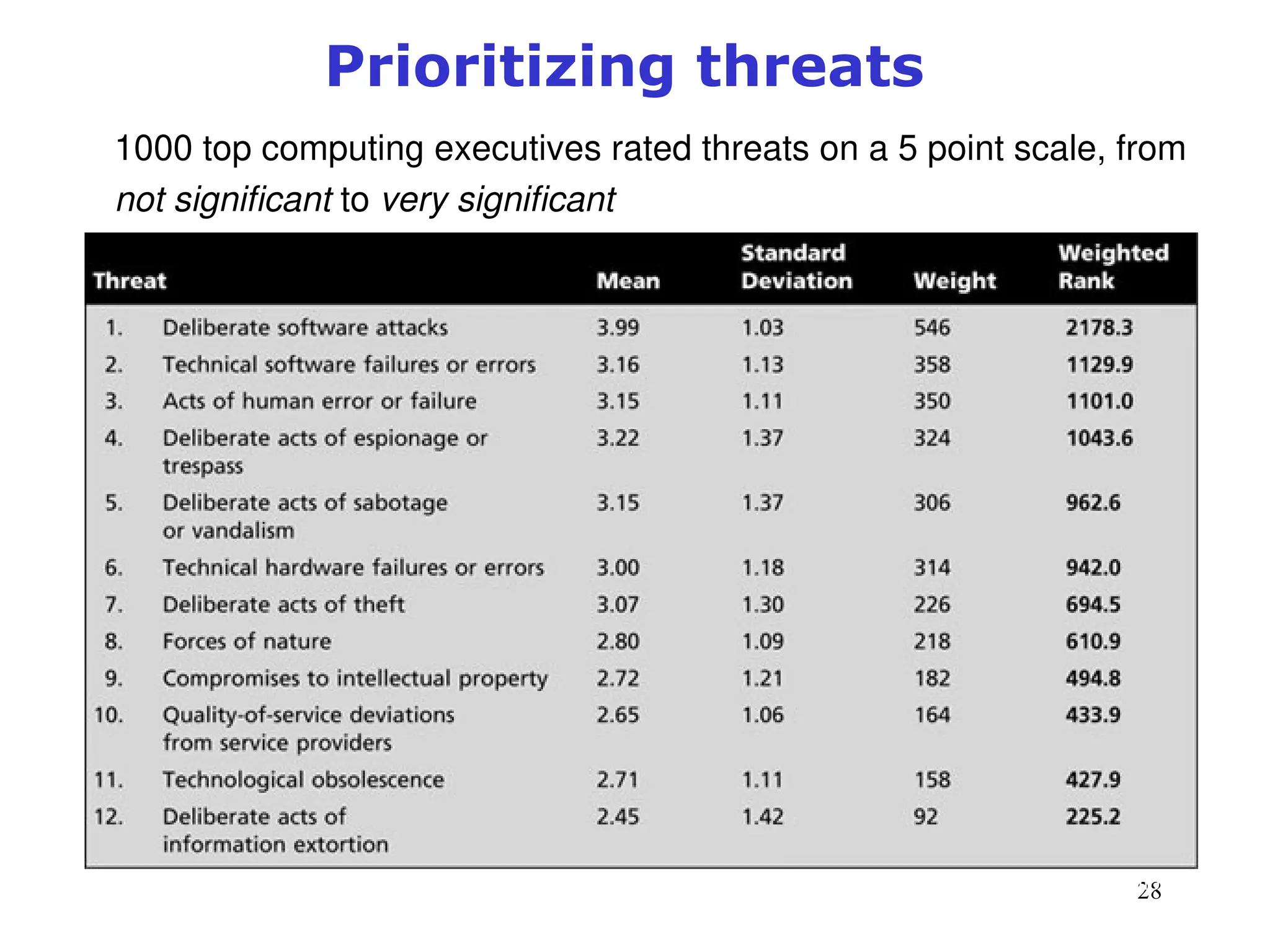
Prioritizing threats
Weighted ranks of threats to information security
1000 top computing executives rated threats on a 5 point scale, from
not significant to very significant
29
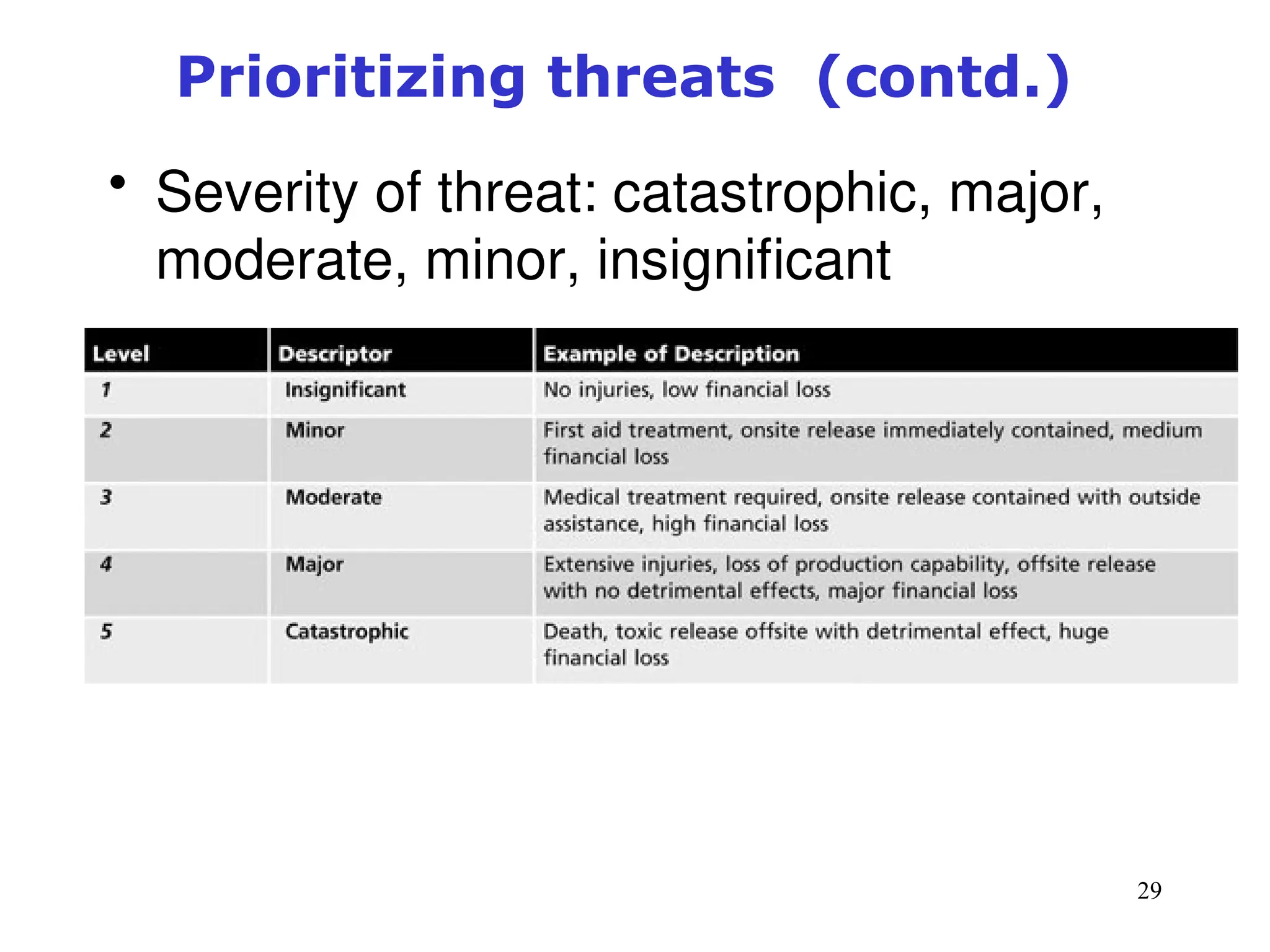
Prioritizing threats (contd.)
• Severity of threat: catastrophic, major,
moderate, minor, insignificant
30
Prioritizing threats (contd.)
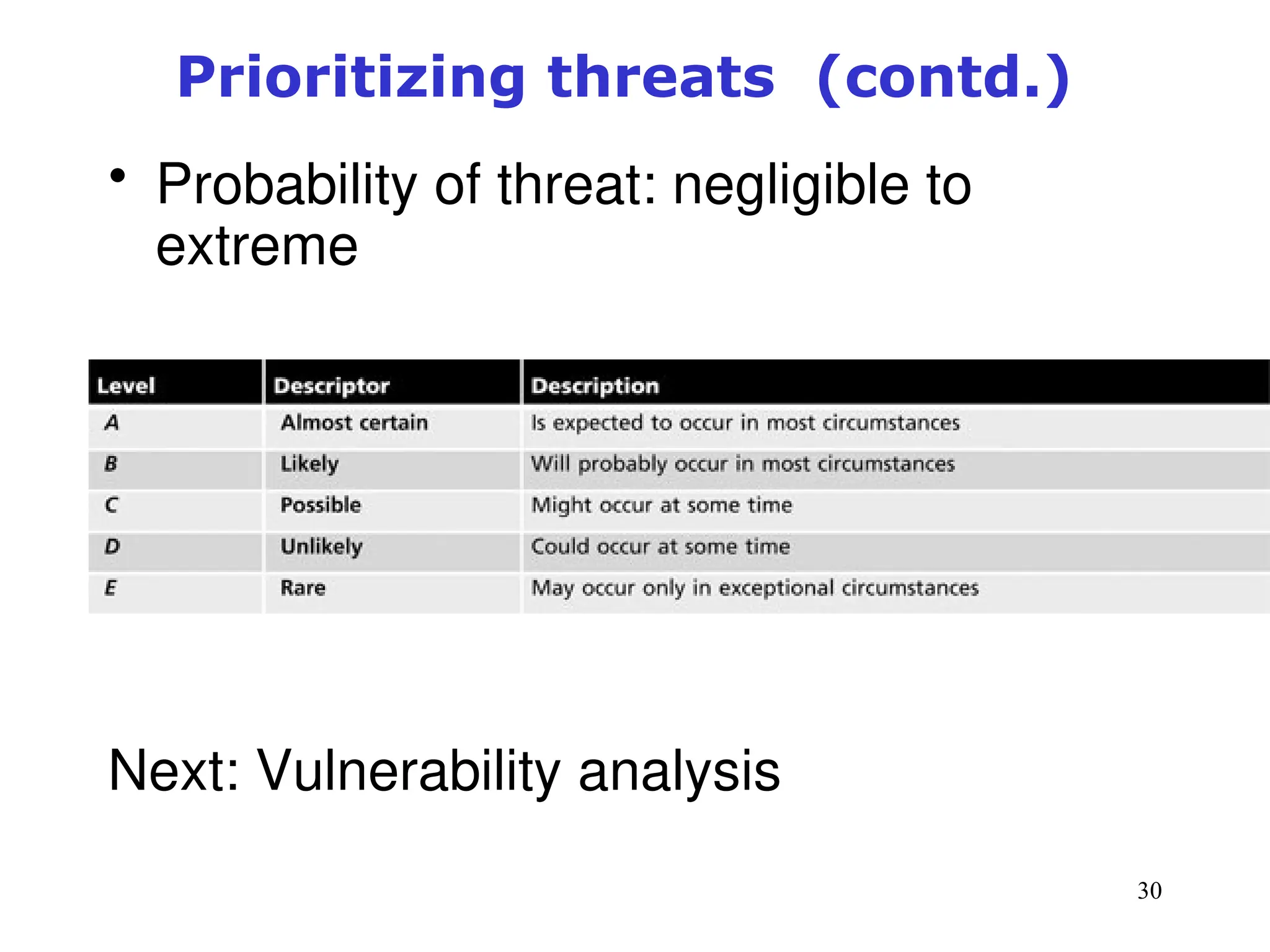
• Probability of threat: negligible to
extreme
Next: Vulnerability analysis
31
Vulnerability Assessment
• Vulnerability: flaw or weakness in an asset that
can be exploited to breach security
– Begin to review every information asset for each threat
– leads to the creation of a list of vulnerabilities that
remain potential risks to the organization
– At the end of the risk identification process, a list of
assets and their vulnerabilities has been developed
– This list serves as the starting point for the next step in
the risk management process - risk assessment
Management of Information Security, 3rd ed.
32
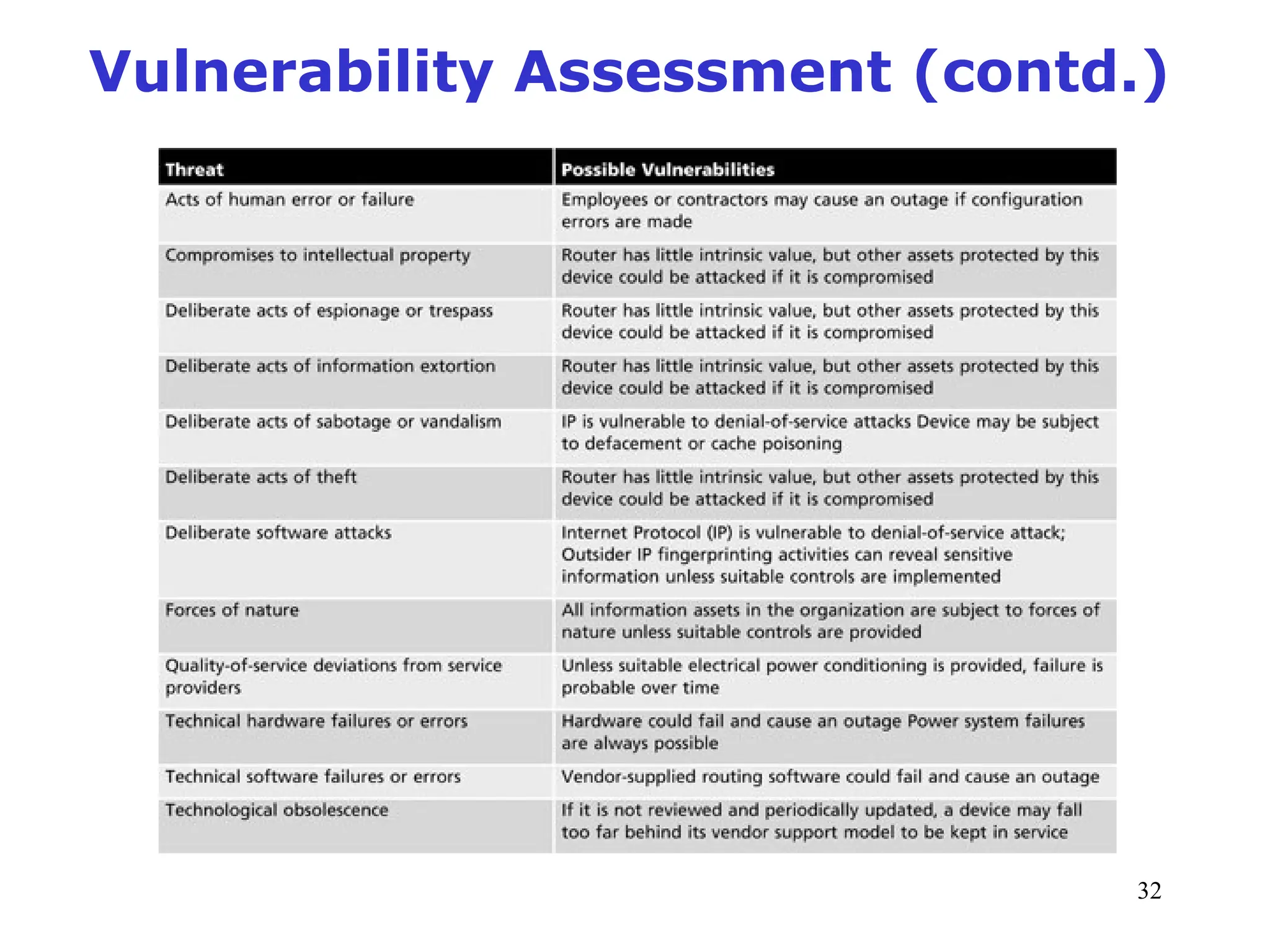
Management of Information Security, 3rd ed.
Table 8-4 Vulnerability assessment of a DMZ router
Source: Course Technology/Cengage Learning
Vulnerability Assessment (contd.)
33
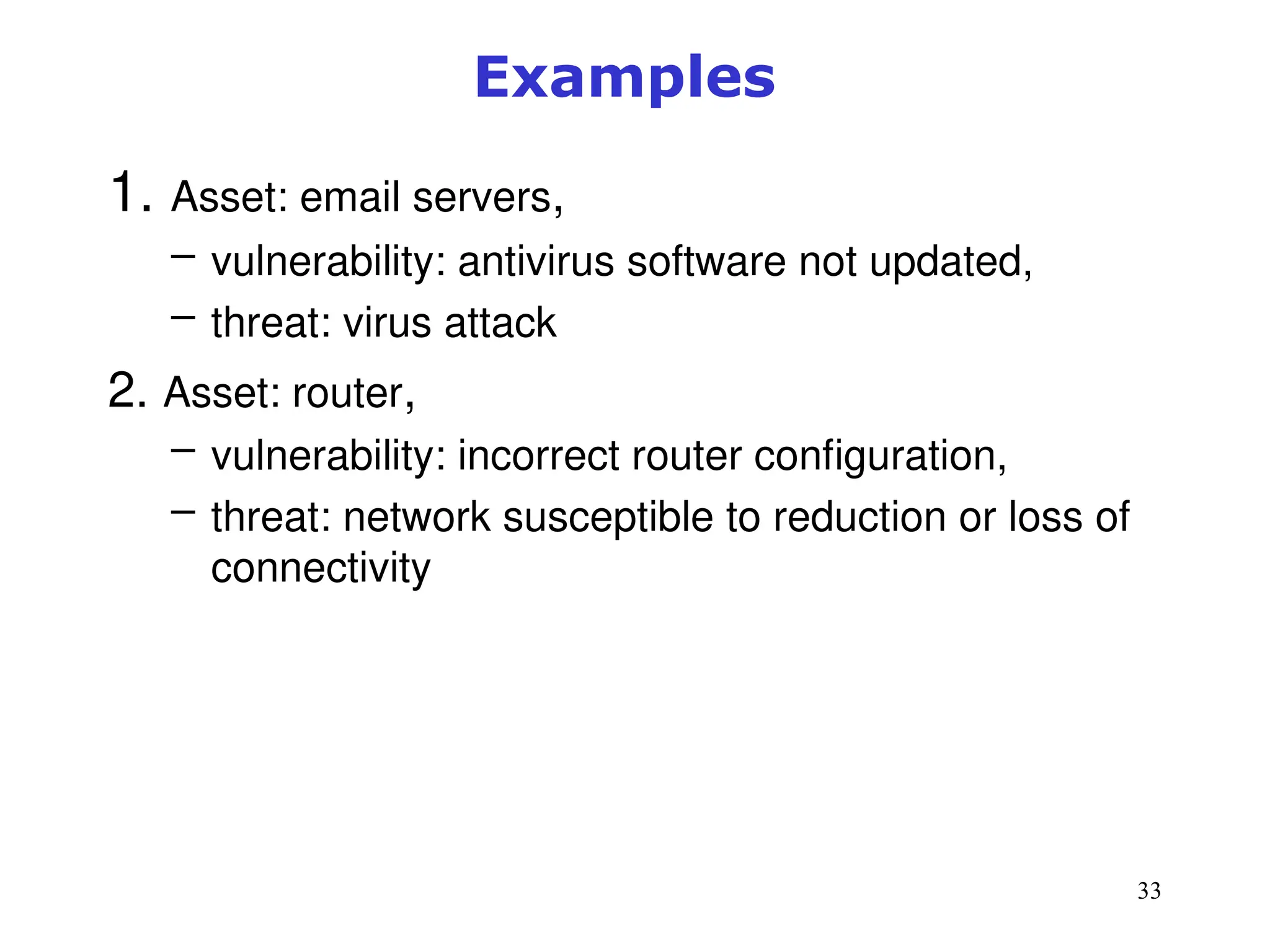
Examples
1. Asset: email servers,
– vulnerability: antivirus software not updated,
– threat: virus attack
2. Asset: router,
– vulnerability: incorrect router configuration,
– threat: network susceptible to reduction or loss of
connectivity
34
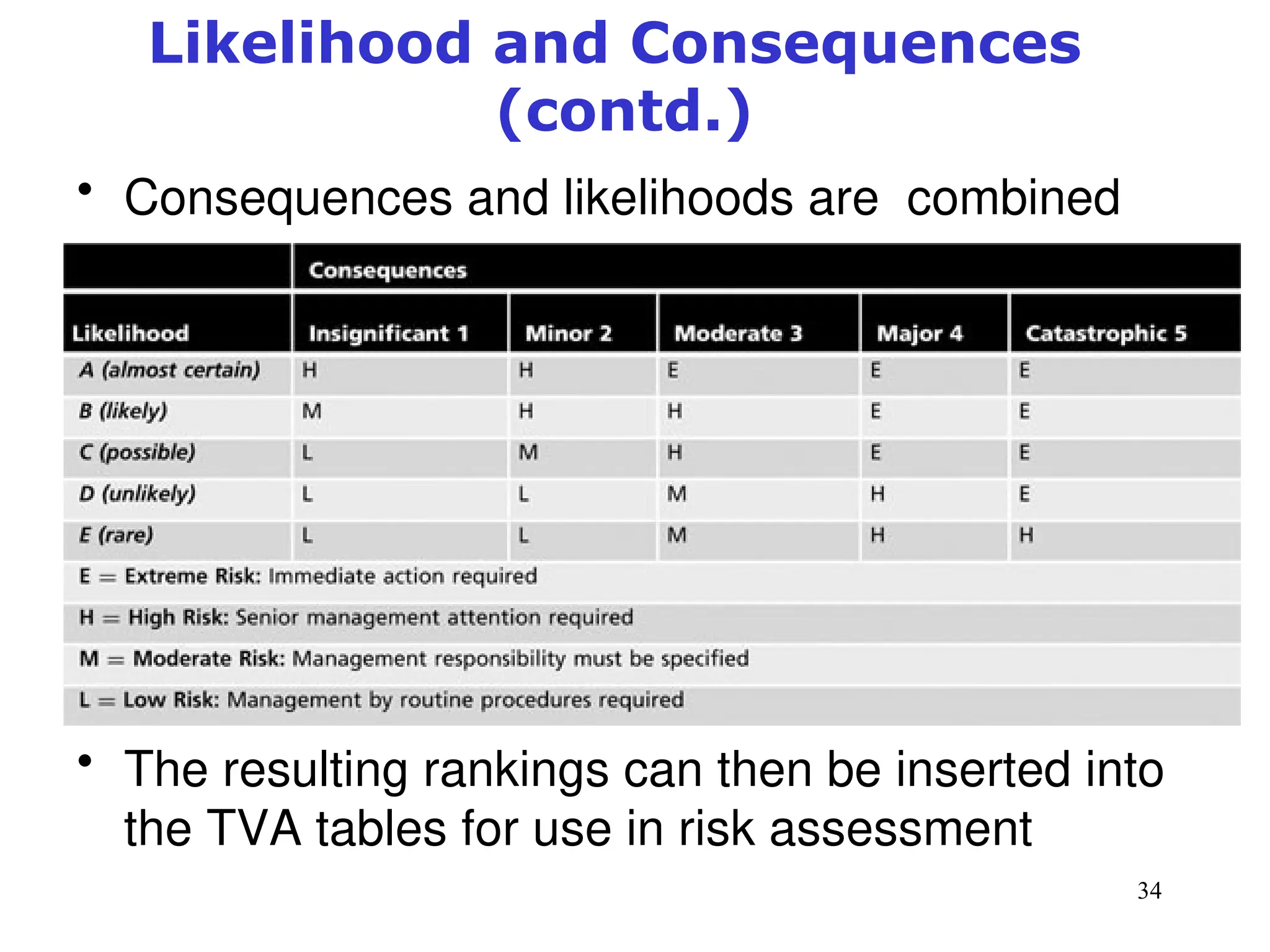
Likelihood and Consequences
(contd.)
• Consequences and likelihoods are combined
• The resulting rankings can then be inserted into
the TVA tables for use in risk assessment
Management of Information Security, 3rd ed.
35
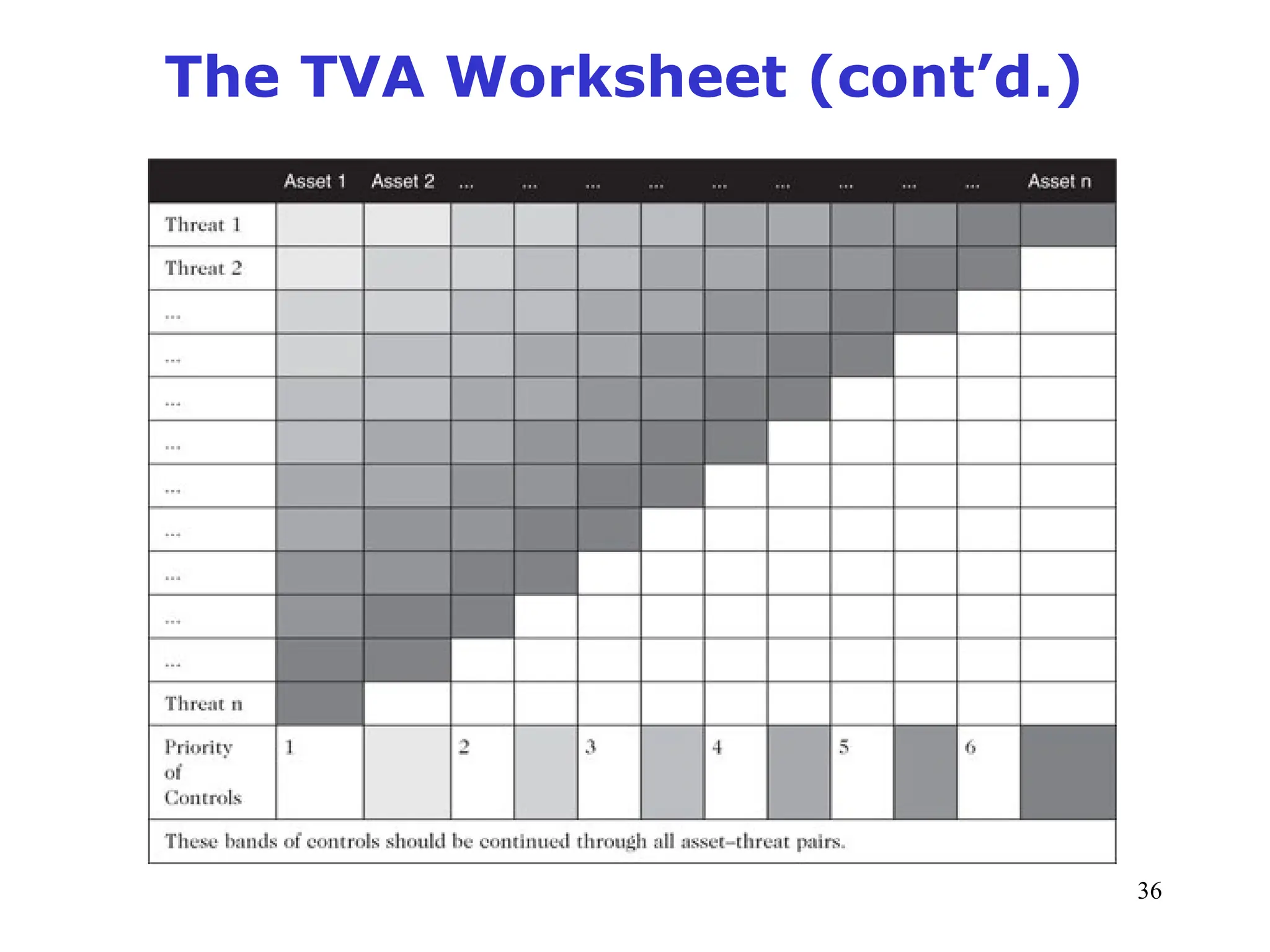
The TVA Worksheet
• At the end of the risk identification process,
a list of assets and their vulnerabilities has
been developed
• Another list prioritizes threats facing the
organization based on the weighted table
discussed earlier
• These lists can be combined into a single
worksheet
Management of Information Security, 3rd ed.
36
Management of Information Security, 3rd ed.
Table 8-5 Sample TVA spreadsheet
Source: Course Technology/Cengage Learning
The TVA Worksheet (cont’d.)
37
Management of Information Security, 3rd ed.
Figure 8-3 Risk identification estimate factors
Source: Course Technology/Cengage Learning
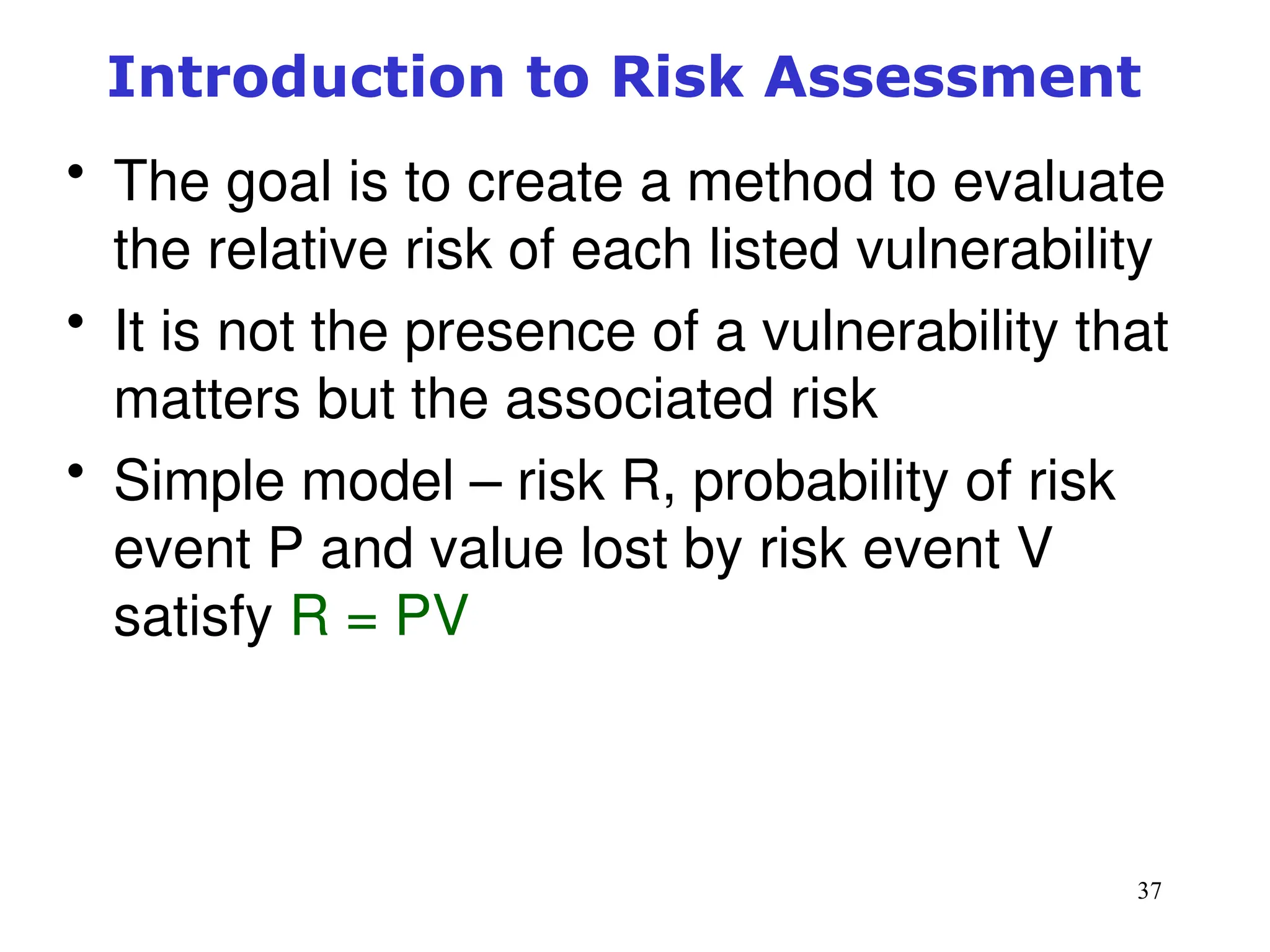
Introduction to Risk Assessment
• The goal is to create a method to evaluate
the relative risk of each listed vulnerability
• It is not the presence of a vulnerability that
matters but the associated risk
• Simple model – risk R, probability of risk
event P and value lost by risk event V
satisfy R = PV
38
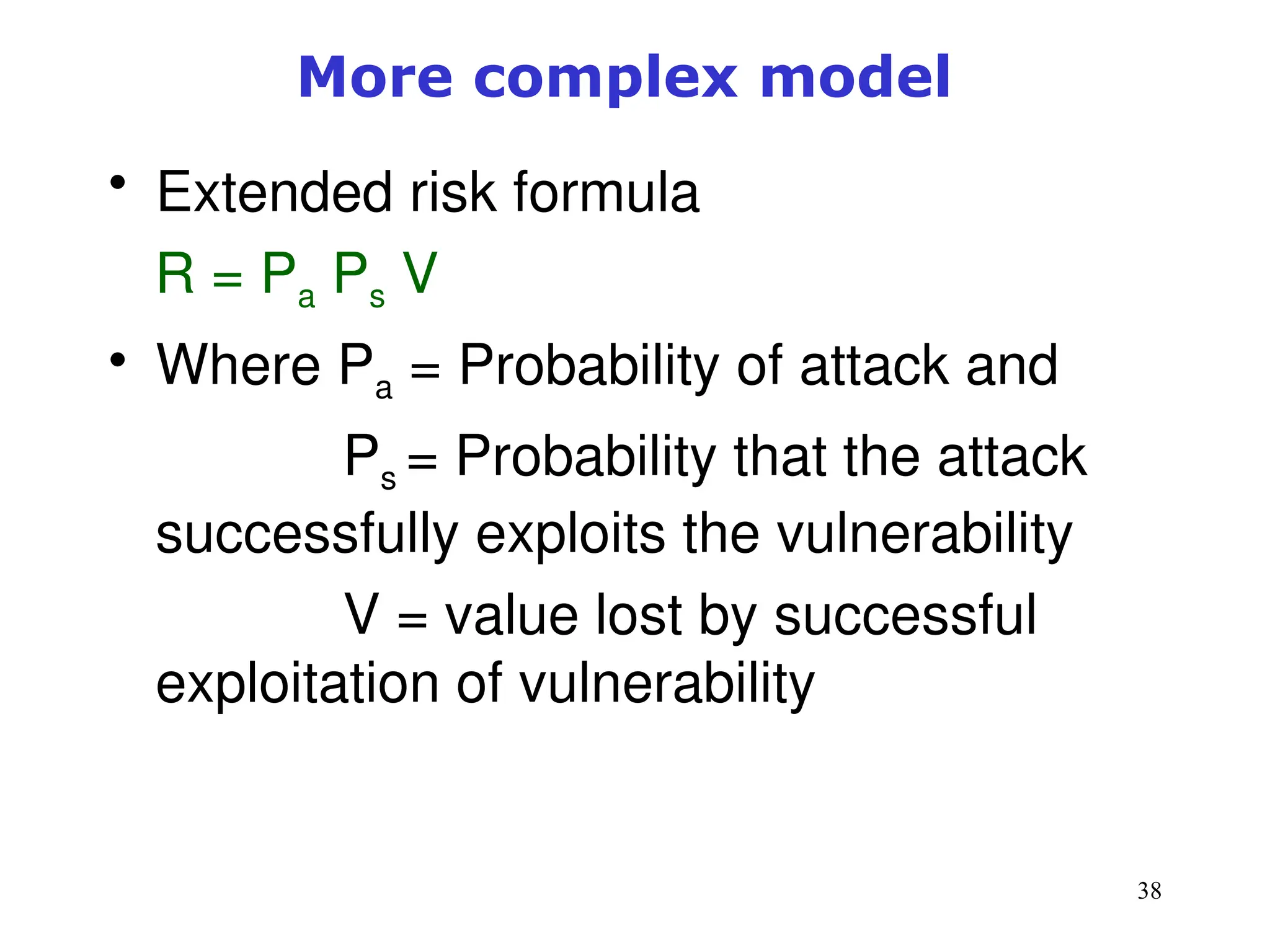
More complex model
• Extended risk formula
R = Pa Ps V
• Where Pa = Probability of attack and
Ps = Probability that the attack
successfully exploits the vulnerability
V = value lost by successful
exploitation of vulnerability
39
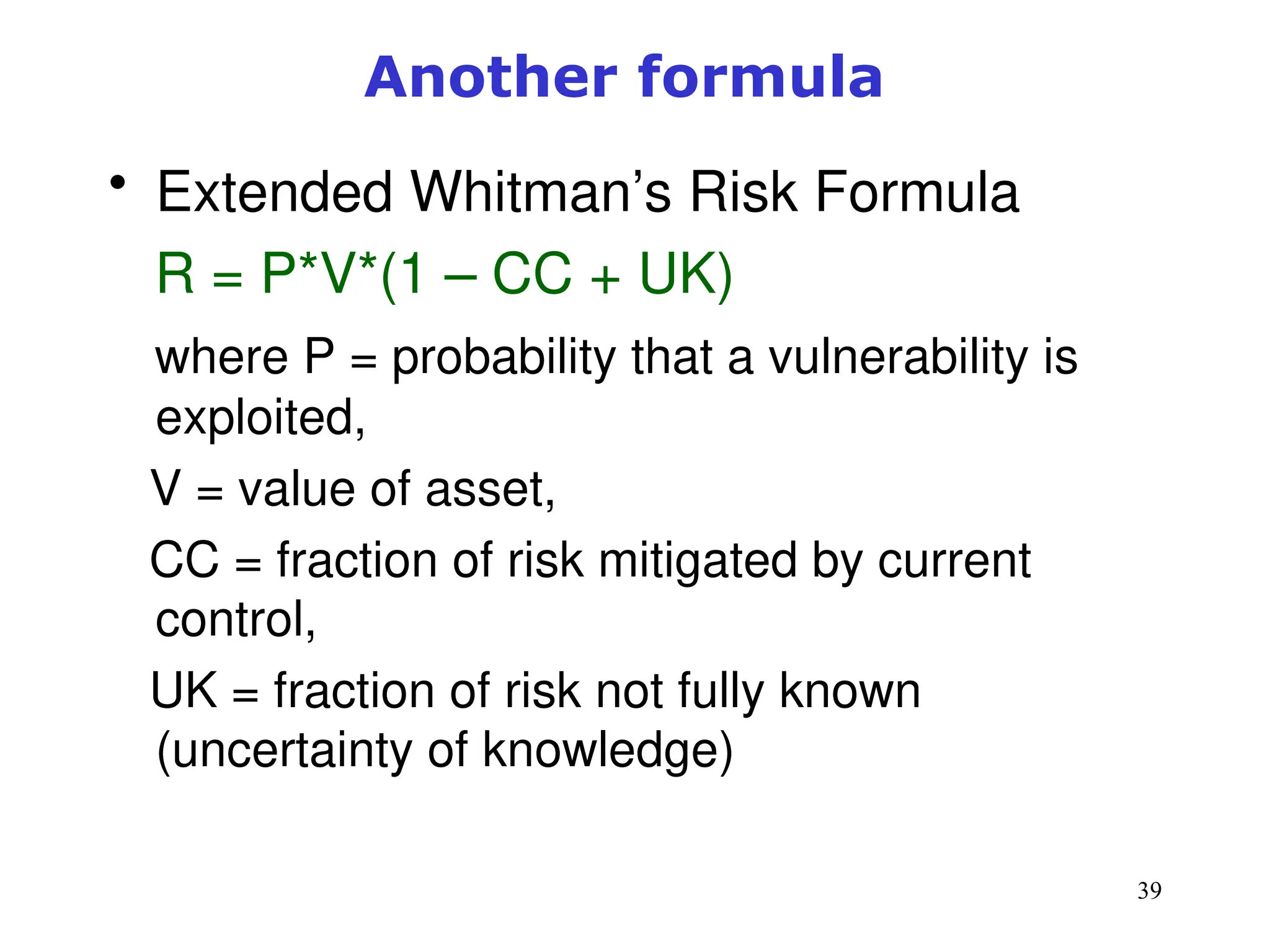
Another formula
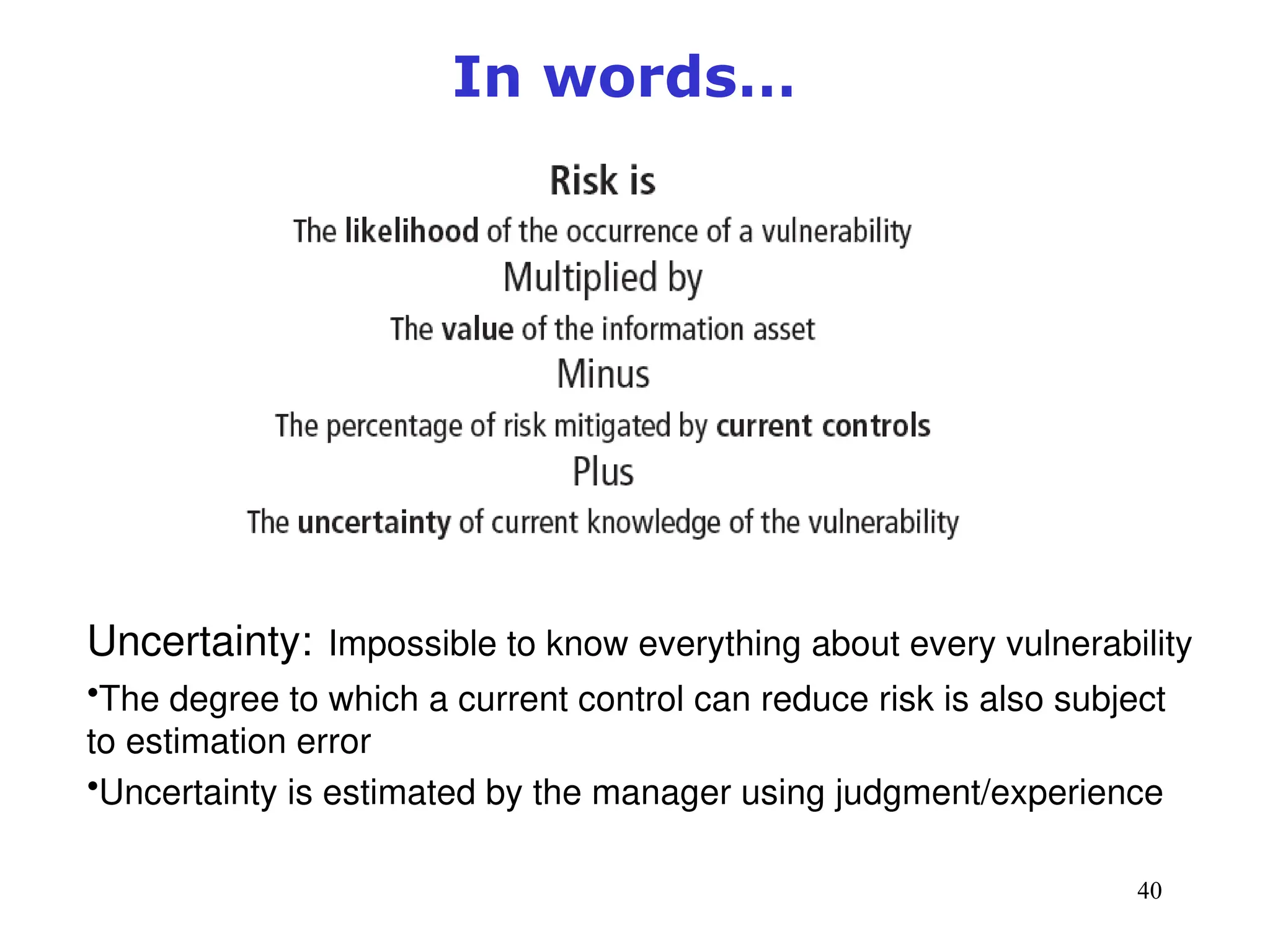
• Extended Whitman’s Risk Formula
R = P*V*(1 – CC + UK)
where P = probability that a vulnerability is
exploited,
V = value of asset,
CC = fraction of risk mitigated by current
control,
UK = fraction of risk not fully known
(uncertainty of knowledge)
40
Management of Information Security, 3rd ed.
Figure 8-3 Risk identification estimate factors
Source: Course Technology/Cengage Learning
In words…
Uncertainty: Impossible to know everything about every vulnerability
•The degree to which a current control can reduce risk is also subject
to estimation error
•Uncertainty is estimated by the manager using judgment/experience
41
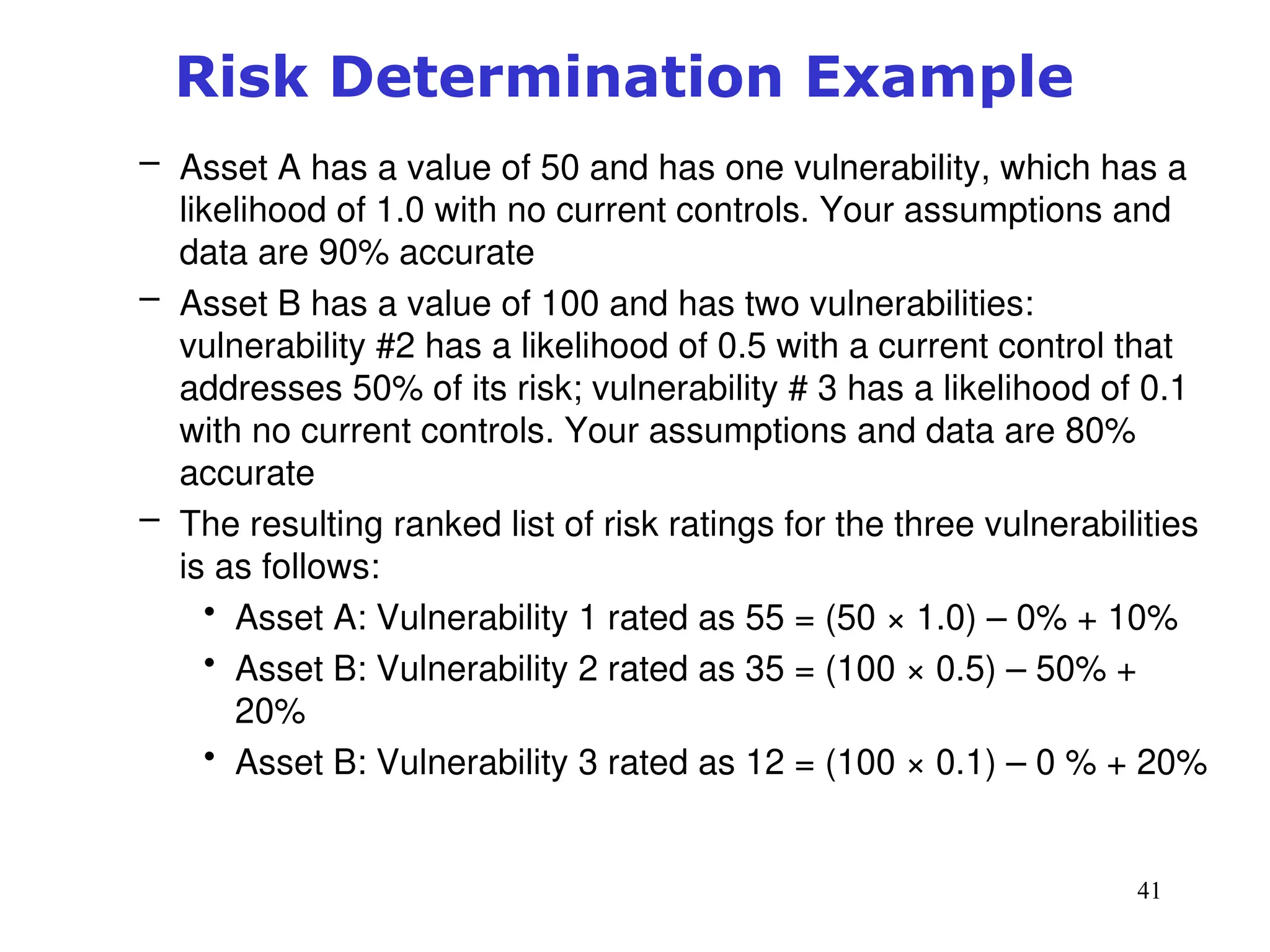
Risk Determination Example
– Asset A has a value of 50 and has one vulnerability, which has a
likelihood of 1.0 with no current controls. Your assumptions and
data are 90% accurate
– Asset B has a value of 100 and has two vulnerabilities:
vulnerability #2 has a likelihood of 0.5 with a current control that
addresses 50% of its risk; vulnerability # 3 has a likelihood of 0.1
with no current controls. Your assumptions and data are 80%
accurate
– The resulting ranked list of risk ratings for the three vulnerabilities
is as follows:
• Asset A: Vulnerability 1 rated as 55 = (50 × 1.0) – 0% + 10%
• Asset B: Vulnerability 2 rated as 35 = (100 × 0.5) – 50% +
20%
• Asset B: Vulnerability 3 rated as 12 = (100 × 0.1) – 0 % + 20%
Management of Information Security, 3rd ed.
42
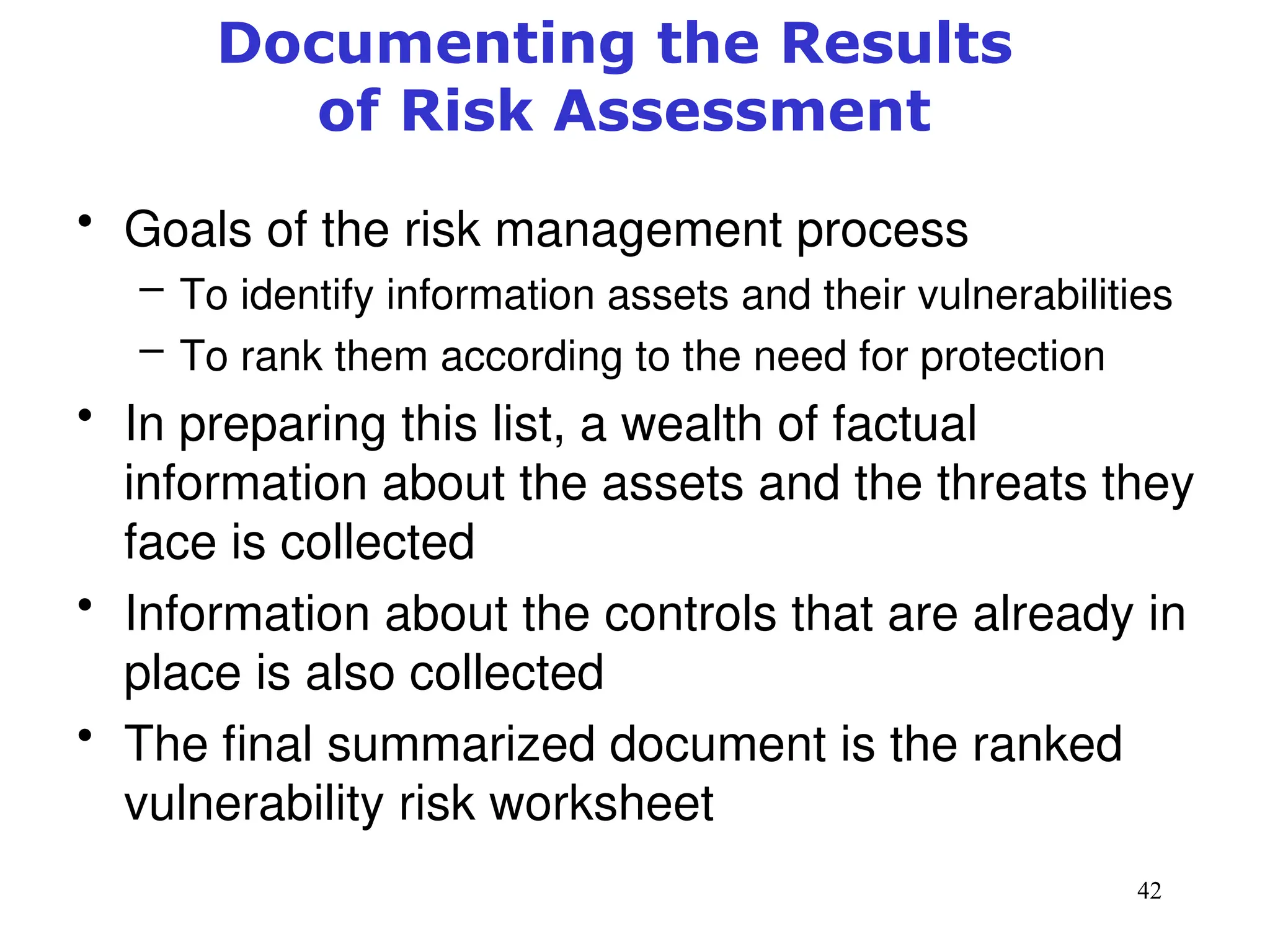
Documenting the Results
of Risk Assessment
• Goals of the risk management process
– To identify information assets and their vulnerabilities
– To rank them according to the need for protection
• In preparing this list, a wealth of factual
information about the assets and the threats they
face is collected
• Information about the controls that are already in
place is also collected
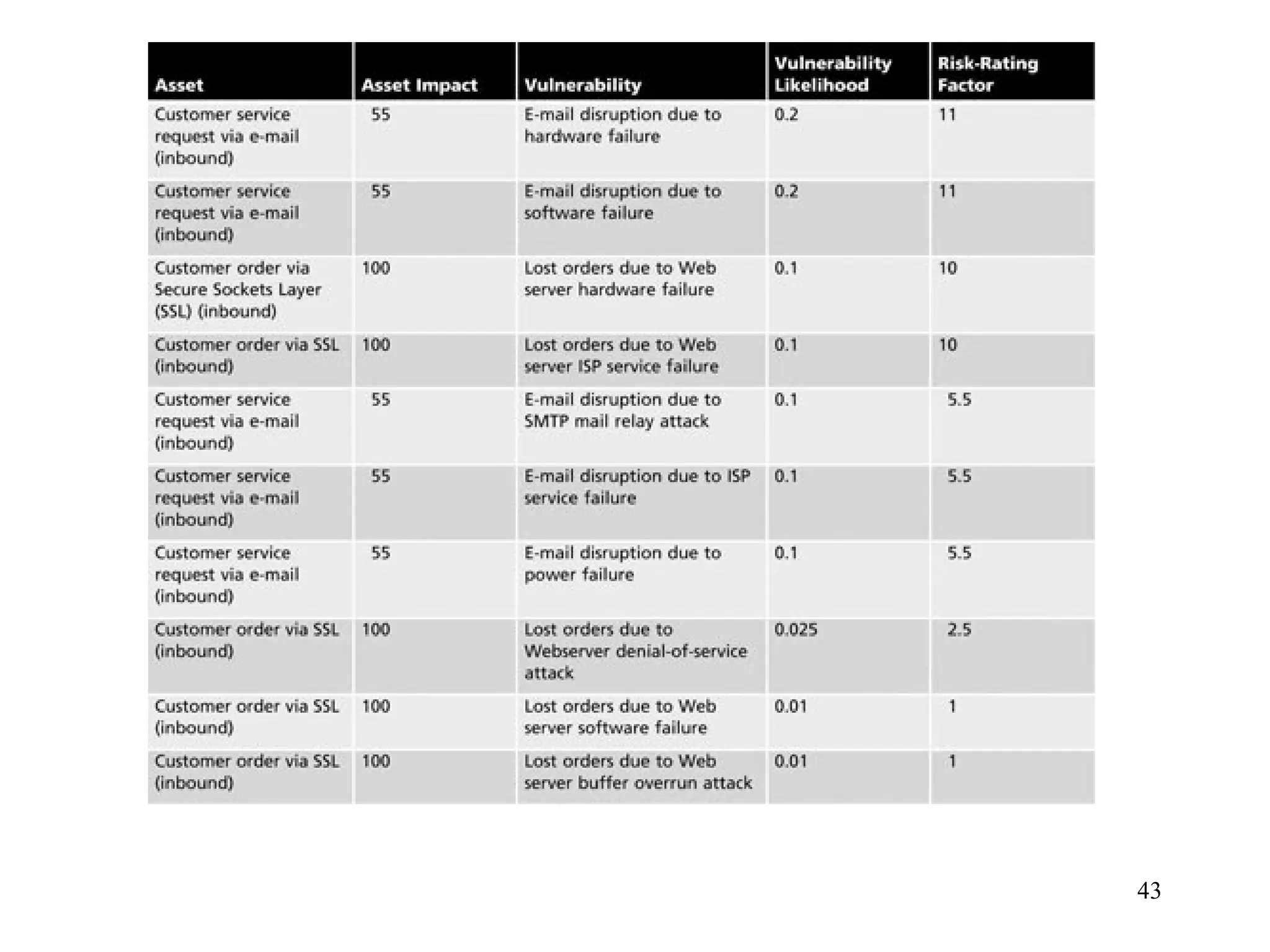
• The final summarized document is the ranked
vulnerability risk worksheet
Management of Information Security, 3rd ed.
43
Management of Information Security, 3rd ed.
Table 8-9 Ranked vulnerability risk worksheet
Source: Course Technology/Cengage Learning
44
Documenting the Results of Risk
Assessment (cont’d.)
• What should the documentation package
look like?
• What are the deliverables from this stage of
the risk management project?
• The risk identification process should
designate what function the reports serve,
who is responsible for preparing them, and
who reviews them
Management of Information Security, 3rd ed.
45
Summary
• Introduction
• Risk management
• Risk identification
• Risk assessment
• Documenting the results of risk
assessment
Management of Information Security, 3rd ed.
46
Risk Control (Ch 9)
Identify Possible Controls
• For each threat and its associated
vulnerabilities that have residual risk,
create a preliminary list of control ideas
• Three general categories of controls exist:
– Policies
– Programs
– Technical controls
Management of Information Security, 3rd ed.
47
Objectives
• Upon completion of this chapter, you
should be able to:
– Recognize and select from the risk mitigation
strategy options to control risk
– Evaluate risk controls and formulate a cost-
benefit analysis using existing conceptual
frameworks
– Explain how to maintain and perpetuate risk
controls
– Describe the OCTAVE Method and other
approaches to managing risk
Management of Information Security, 3rd ed.
48
Introduction
• To keep up with the competition,
organizations must design and create a
safe environment in which business
processes and procedures can function
– This environment must maintain confidentiality
and privacy and assure the integrity and
availability of organizational data
– These objectives are met via the application of
the principles of risk management
Management of Information Security, 3rd ed.
49
Risk Control Strategies
• four basic strategies to control risks
– Avoidance
• Applying safeguards that eliminate or reduce the
remaining uncontrolled risks for the vulnerability
– Transference
• Shifting the risk to other areas or to outside entities
– Mitigation
• Reducing the impact if the vulnerability is exploited
– Acceptance
• Understanding the consequences and accepting the
risk without control or mitigation
Management of Information Security, 3rd ed.
50
Avoidance
• The risk control strategy that attempts to
prevent the exploitation of the vulnerability
• Avoidance is accomplished through:
– Application of policy
– Application of training and education
– Countering threats
– Implementation of technical security controls
and safeguards
Management of Information Security, 3rd ed.
51
Transference
• The control approach that attempts to shift
the risk to other assets, other processes, or
other organizations
• May be accomplished by rethinking how
services are offered
– Revising deployment models
– Outsourcing to other organizations
– Purchasing insurance
– Implementing service contracts with providers
Management of Information Security, 3rd ed.
52
Mitigation
• The control approach that attempts to
reduce the damage caused by the
exploitation of vulnerability
– Using planning and preparation
– Depends upon the ability to detect and respond
to an attack as quickly as possible
• Types of mitigation plans
– Disaster recovery plan (DRP)
– Incident response plan (IRP)
– Business continuity plan (BCP)
Management of Information Security, 3rd ed.
53
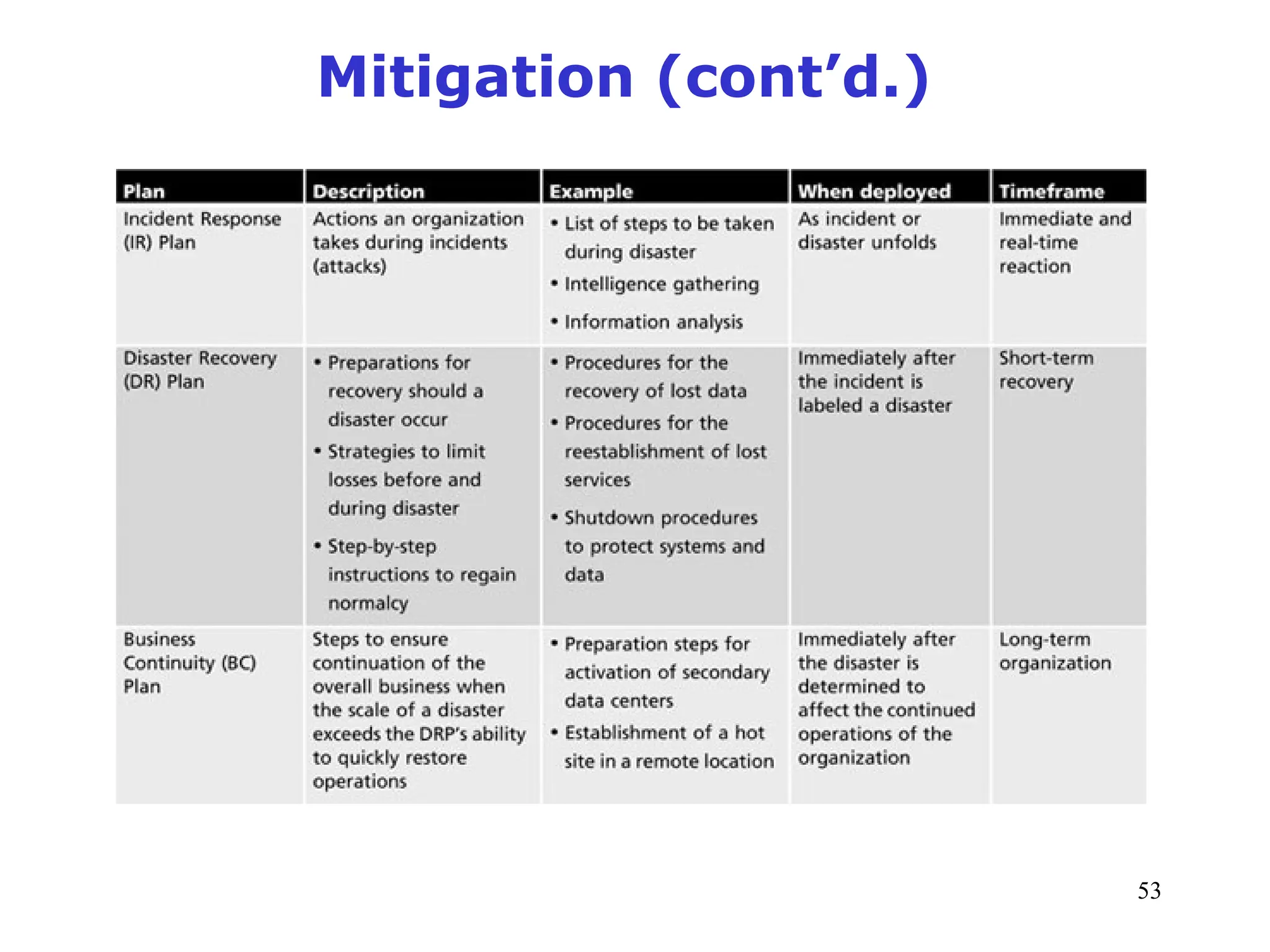
Management of Information Security, 3rd ed.
Mitigation (cont’d.)
Table 9-1 Summaries of mitigation plans
Source: Course Technology/Cengage Learning
54
Acceptance
• do nothing to protect an information asset
– To accept the loss when it occurs
• assumes that it may be a prudent business
decision to examine the alternatives and
conclude that the cost of protecting an
asset does not justify the security
expenditure
Management of Information Security, 3rd ed.
55
Acceptance (contd.)
• the organization must:
– Determine the level of risk to the information asset
– Assess the probability of attack and the likelihood of a
successful exploitation of a vulnerability
– Approximate the ARO of the exploit
– Estimate the potential loss from attacks
– Perform a thorough cost benefit analysis
– Evaluate controls using each appropriate type of
feasibility
– Decide that the particular asset did not justify the cost
of protection
Management of Information Security, 3rd ed.
56
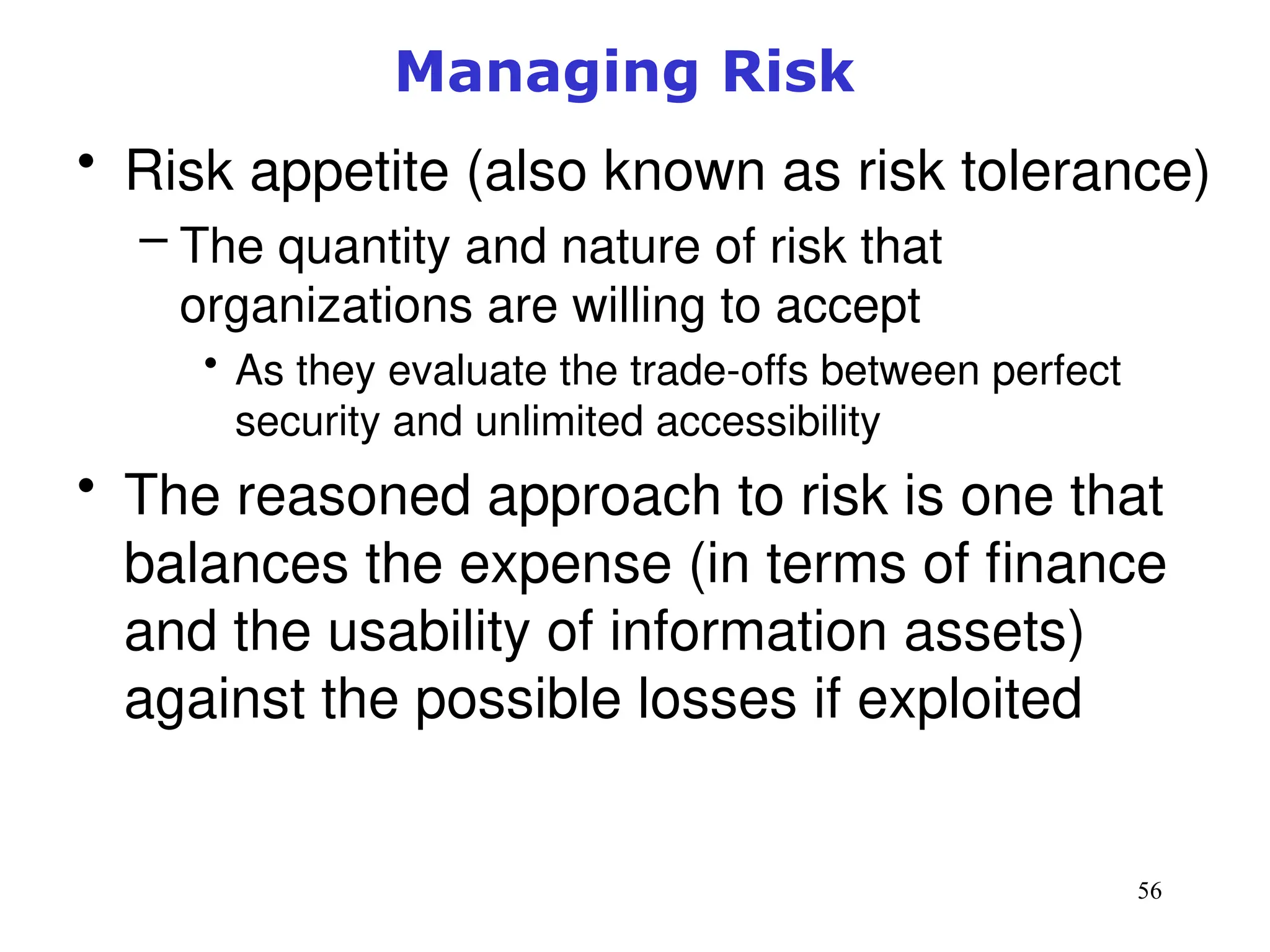
Managing Risk
• Risk appetite (also known as risk tolerance)
– The quantity and nature of risk that
organizations are willing to accept
• As they evaluate the trade-offs between perfect
security and unlimited accessibility
• The reasoned approach to risk is one that
balances the expense (in terms of finance
and the usability of information assets)
against the possible losses if exploited
Management of Information Security, 3rd ed.
57
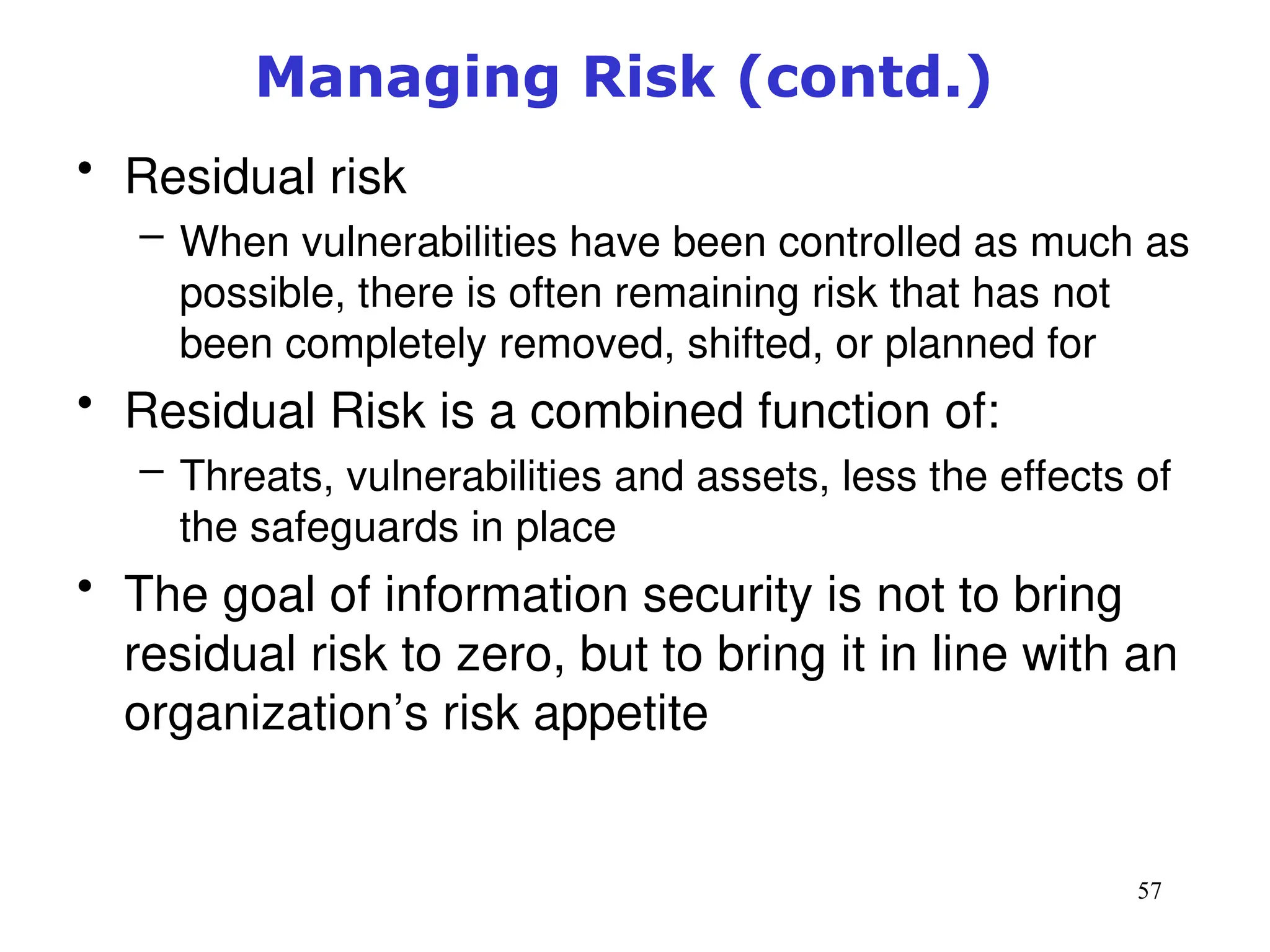
Managing Risk (contd.)
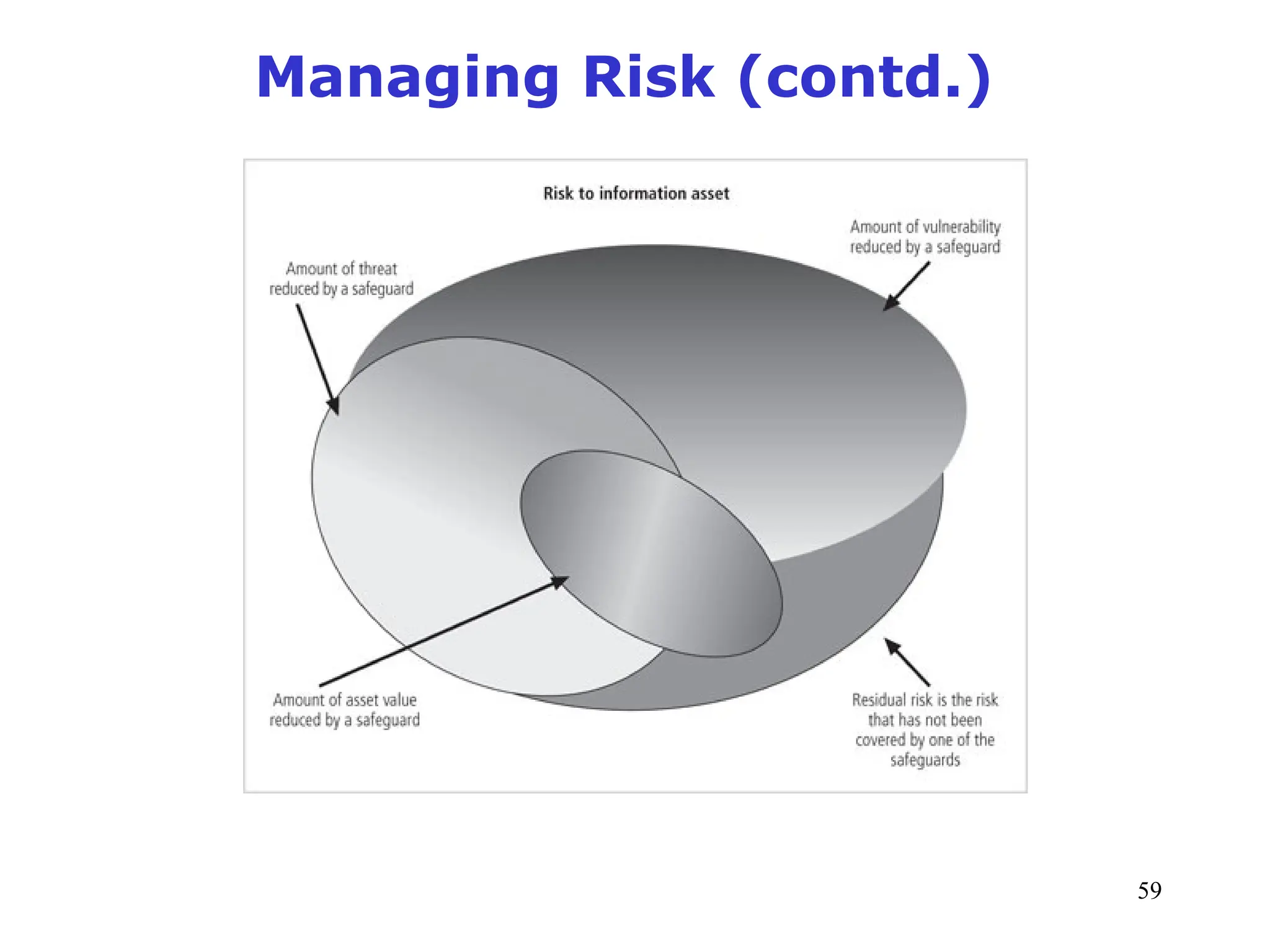
• Residual risk
– When vulnerabilities have been controlled as much as
possible, there is often remaining risk that has not
been completely removed, shifted, or planned for
• Residual Risk is a combined function of:
– Threats, vulnerabilities and assets, less the effects of
the safeguards in place
• The goal of information security is not to bring
residual risk to zero, but to bring it in line with an
organization’s risk appetite
Management of Information Security, 3rd ed.
58
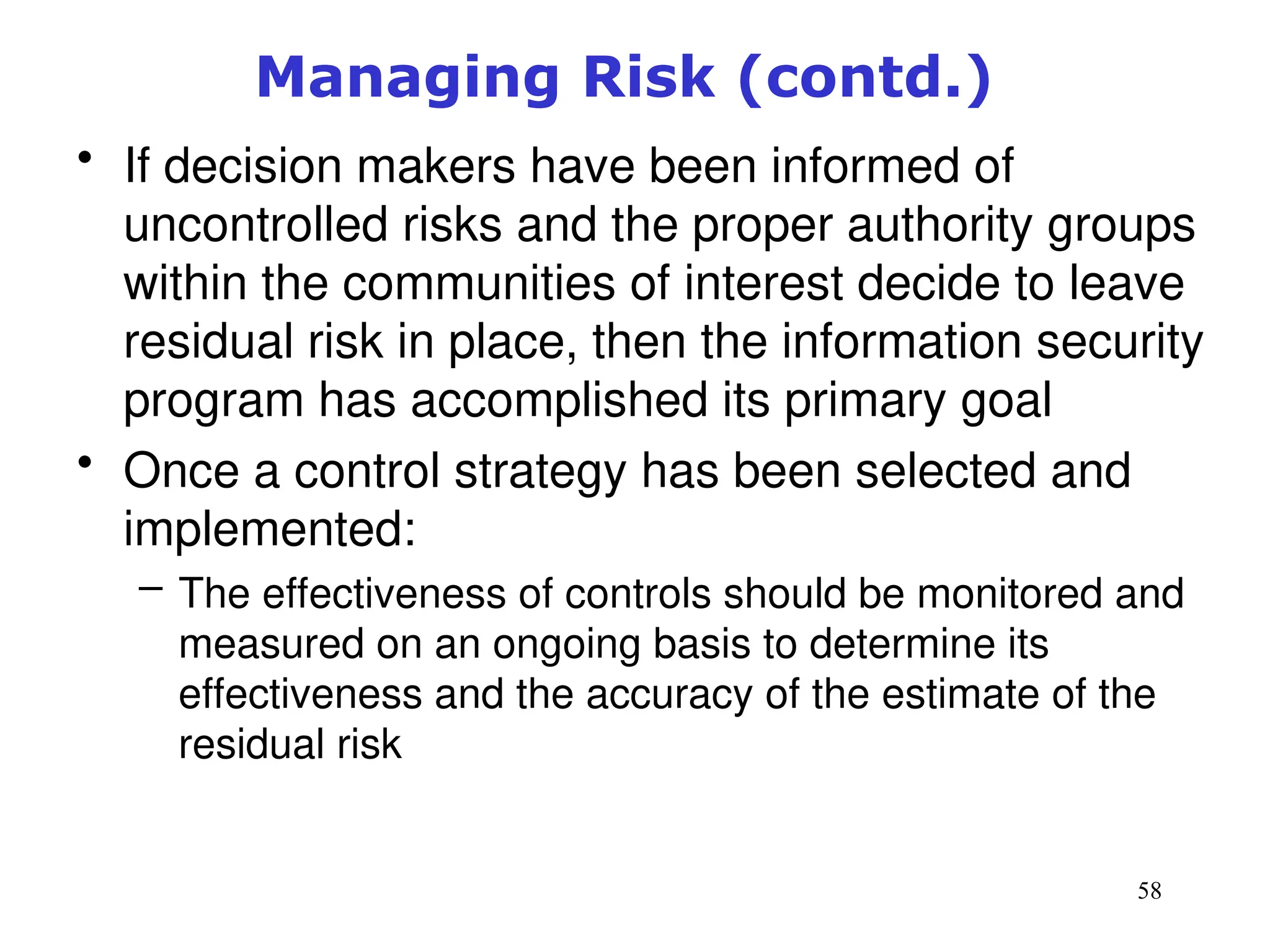
Managing Risk (contd.)
• If decision makers have been informed of
uncontrolled risks and the proper authority groups
within the communities of interest decide to leave
residual risk in place, then the information security
program has accomplished its primary goal
• Once a control strategy has been selected and
implemented:
– The effectiveness of controls should be monitored and
measured on an ongoing basis to determine its
effectiveness and the accuracy of the estimate of the
residual risk
Management of Information Security, 3rd ed.
59
Management of Information Security, 3rd ed.
Managing Risk (contd.)
Source: Course Technology/Cengage Learning
Figure 9-1 Residual risk
60
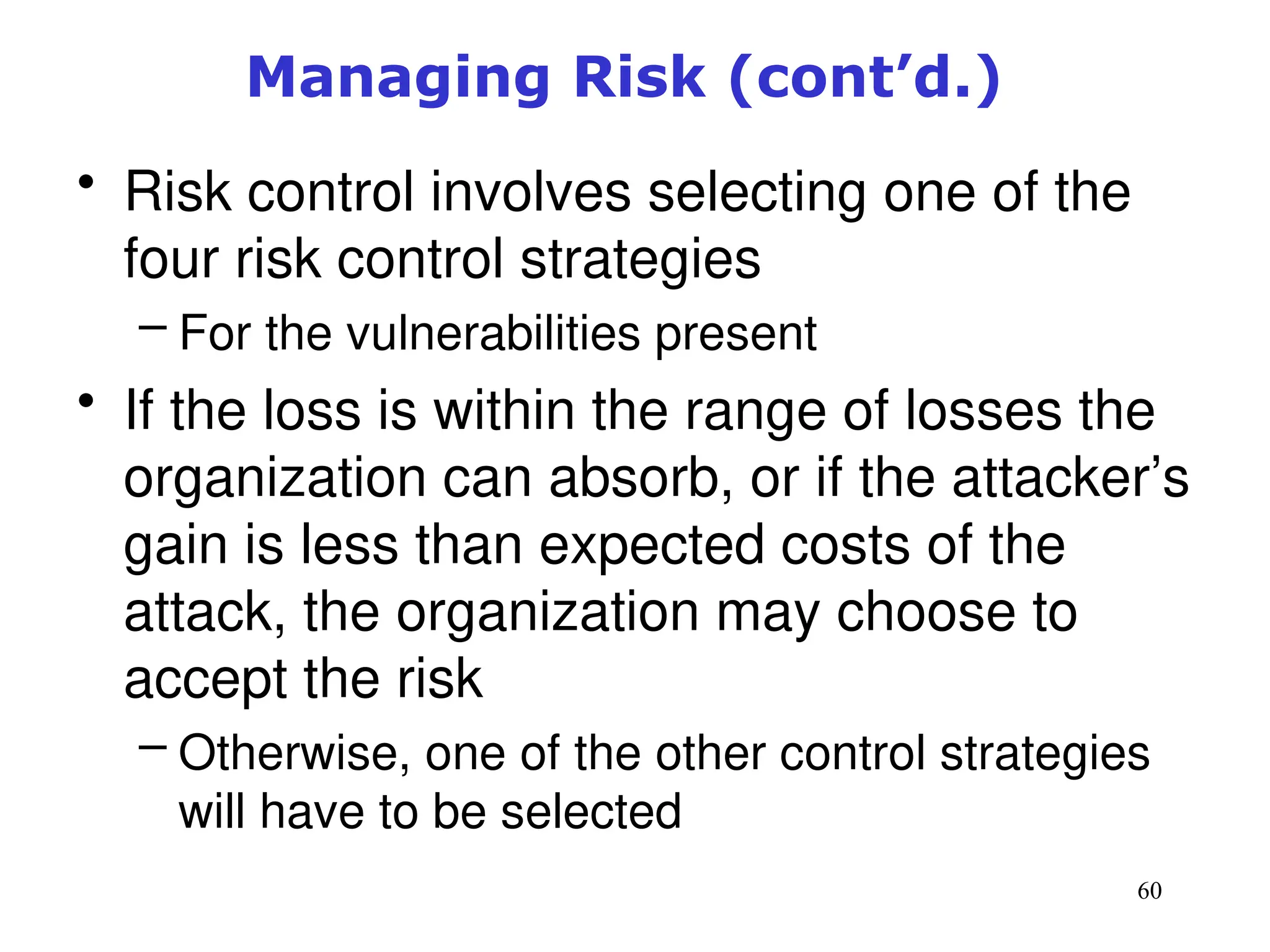
• Risk control involves selecting one of the
four risk control strategies
– For the vulnerabilities present
• If the loss is within the range of losses the
organization can absorb, or if the attacker’s
gain is less than expected costs of the
attack, the organization may choose to
accept the risk
– Otherwise, one of the other control strategies
will have to be selected
Management of Information Security, 3rd ed.
Managing Risk (cont’d.)
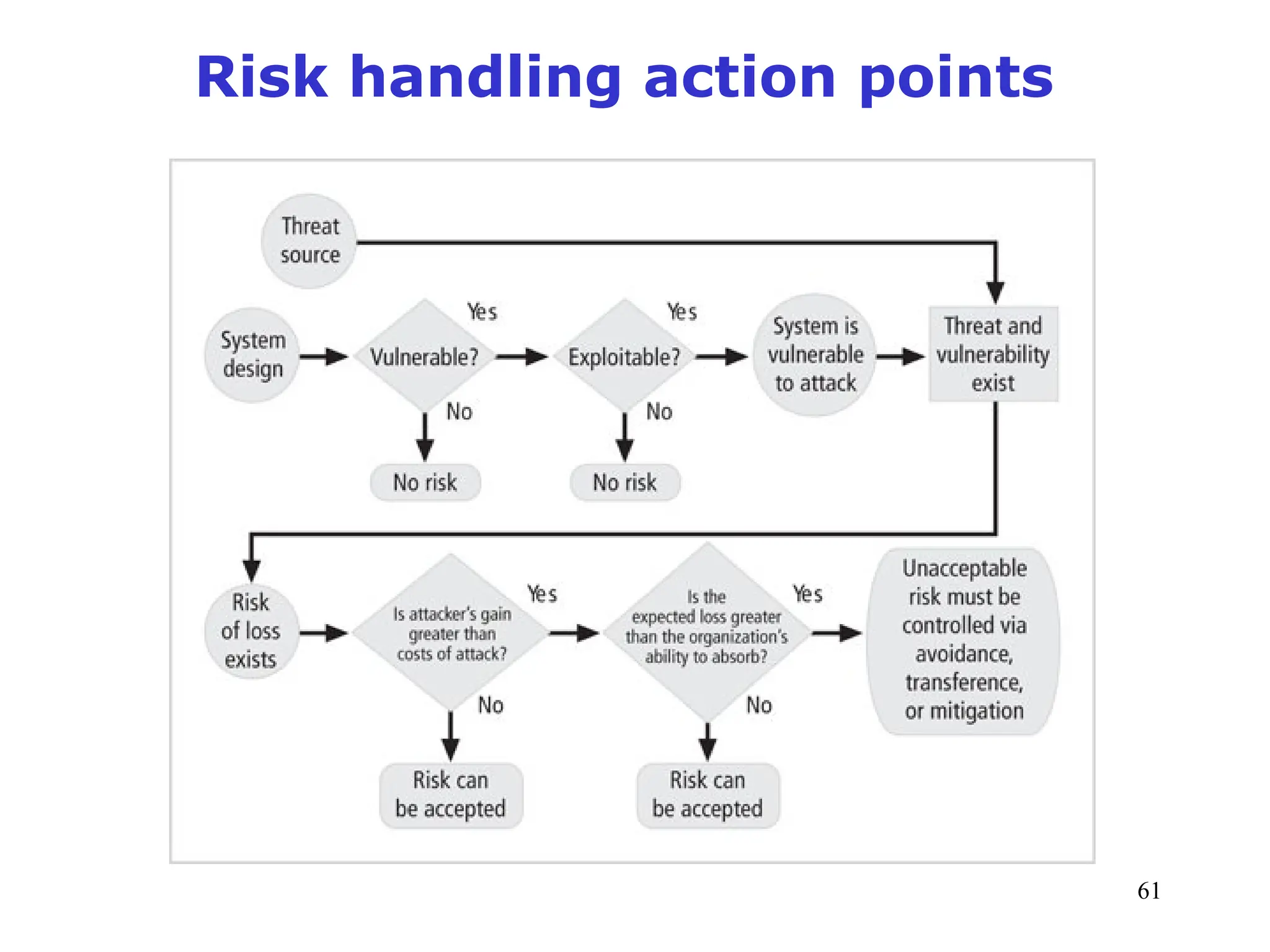
61
Management of Information Security, 3rd ed.
Risk handling action points
Source: Course Technology/Cengage Learning
Figure 9-2 Risk-handling action points
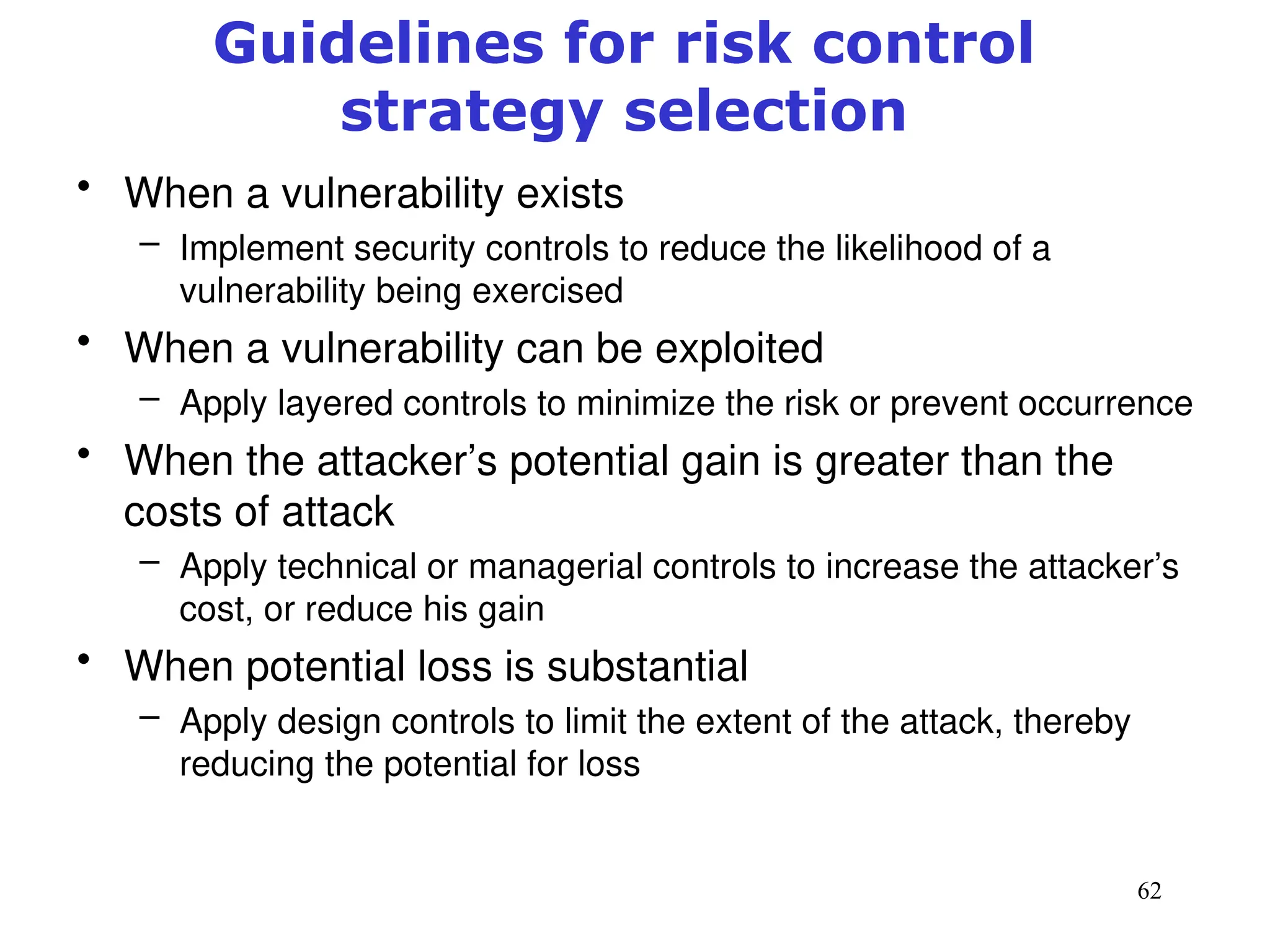
62
• When a vulnerability exists
– Implement security controls to reduce the likelihood of a
vulnerability being exercised
• When a vulnerability can be exploited
– Apply layered controls to minimize the risk or prevent occurrence
• When the attacker’s potential gain is greater than the
costs of attack
– Apply technical or managerial controls to increase the attacker’s
cost, or reduce his gain
• When potential loss is substantial
– Apply design controls to limit the extent of the attack, thereby
reducing the potential for loss
Management of Information Security, 3rd ed.
Guidelines for risk control
strategy selection
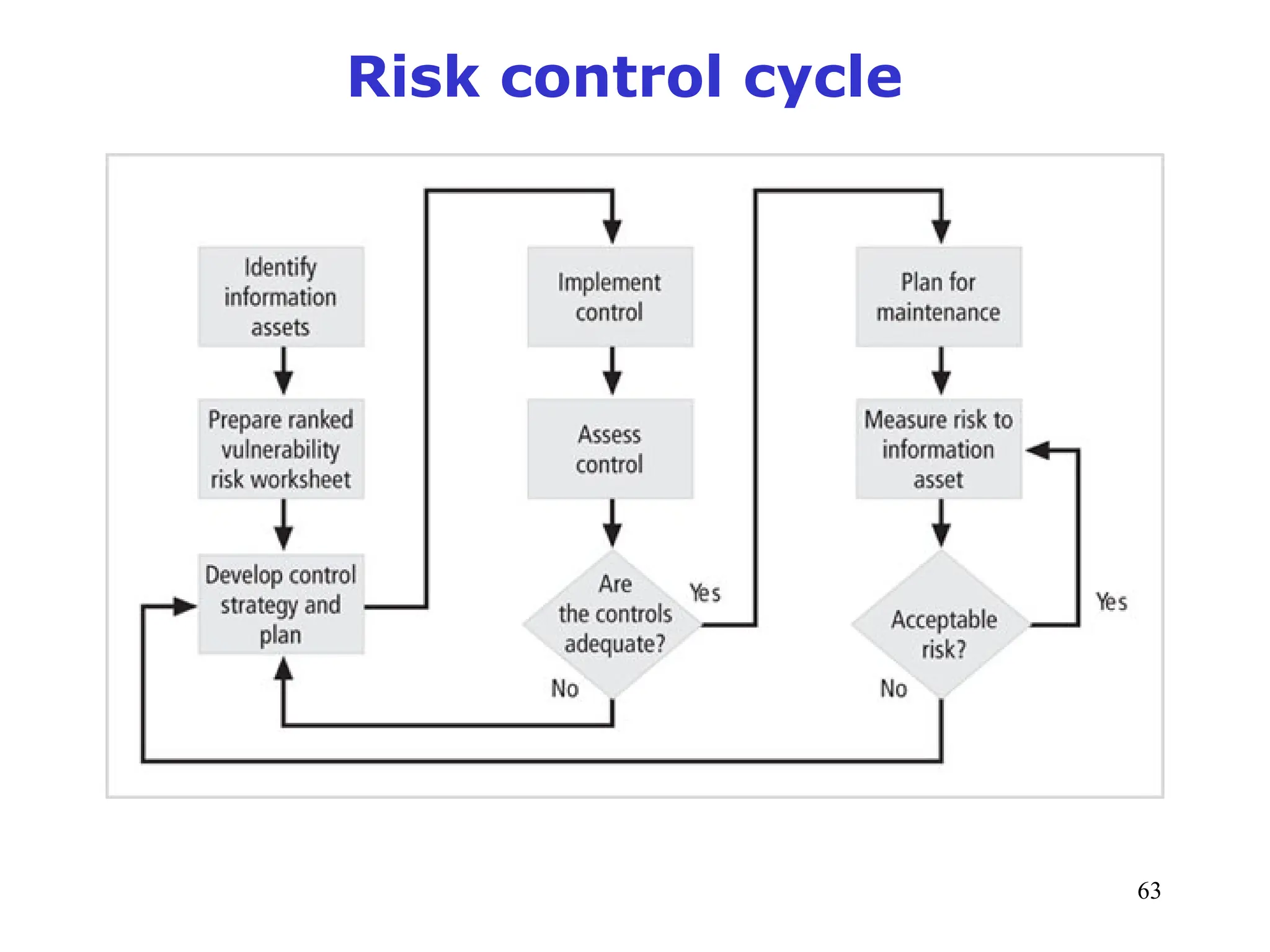
63
Management of Information Security, 3rd ed.
Risk control cycle
Source: Course Technology/Cengage Learning
Figure 9-3 Risk control cycle
64
Feasibility and Cost-Benefit Analysis
• Before deciding on the strategy for a specific
vulnerability
– All readily accessible information about the
consequences of the vulnerability must be explored
– Ask “what are the advantages of implementing a
control as opposed to the disadvantages of
implementing the control?”
• There are a number of ways to determine the
advantage or disadvantage of a specific control
• The primary means are based on the value of the
information assets that it is designed to protect
Management of Information Security, 3rd ed.
65
Cost-Benefit Analysis
• Economic feasibility
– The criterion most commonly used when
evaluating a project that implements
information security controls and safeguards
• It is difficult to determine the value of
information
– It is also difficult to determine the cost of
safeguarding it
Management of Information Security, 3rd ed.
66
Cost-Benefit Analysis (cont’d.)
• Factors that affect the cost of a safeguard
– Cost of development or acquisition of
hardware, software, and services
– Training fees
– Cost of implementation
– Service and maintenance costs
Management of Information Security, 3rd ed.
67
Cost-Benefit Analysis (cont’d.)
• Benefit
– The value to the organization of using controls
to prevent losses associated with a specific
vulnerability
– Usually determined by valuing the information
assets exposed by the vulnerability and then
determining how much of that value is at risk
and how much risk there is for the asset
– This is expressed as the annualized loss
expectancy (ALE)
Management of Information Security, 3rd ed.
68
Cost-Benefit Analysis (cont’d.)
• Asset valuation
– The process of assigning financial value or
worth to each information asset
– The value of information differs within and
between organizations
• Based on the characteristics of information and the
perceived value of that information
– Involves estimation of real and perceived costs
associated with the design, development,
installation, maintenance, protection, recovery,
and defense against loss and litigation
Management of Information Security, 3rd ed.
69
Cost-Benefit Analysis (cont’d.)
• Asset valuation components
– Value retained from the cost of creating the
information asset
– Value retained from past maintenance of the
information asset
– Value implied by the cost of replacing the
information
– Value from providing the information
– Value acquired from the cost of protecting the
information
Management of Information Security, 3rd ed.
70
Cost-Benefit Analysis (cont’d.)
• Asset valuation components (cont’d.)
– Value to owners
– Value of intellectual property
– Value to adversaries
– Loss of productivity while the information
assets are unavailable
– Loss of revenue while information assets are
unavailable
Management of Information Security, 3rd ed.
71
Cost-Benefit Analysis (cont’d.)
• Potential loss is that which could occur
from the exploitation of vulnerability or a
threat occurrence
• Ask these questions:
– What loss could occur, and what financial
impact would it have?
– What would it cost to recover from the attack,
in addition to the financial impact of damage?
– What is the single loss expectancy for each
risk?
Management of Information Security, 3rd ed.
72
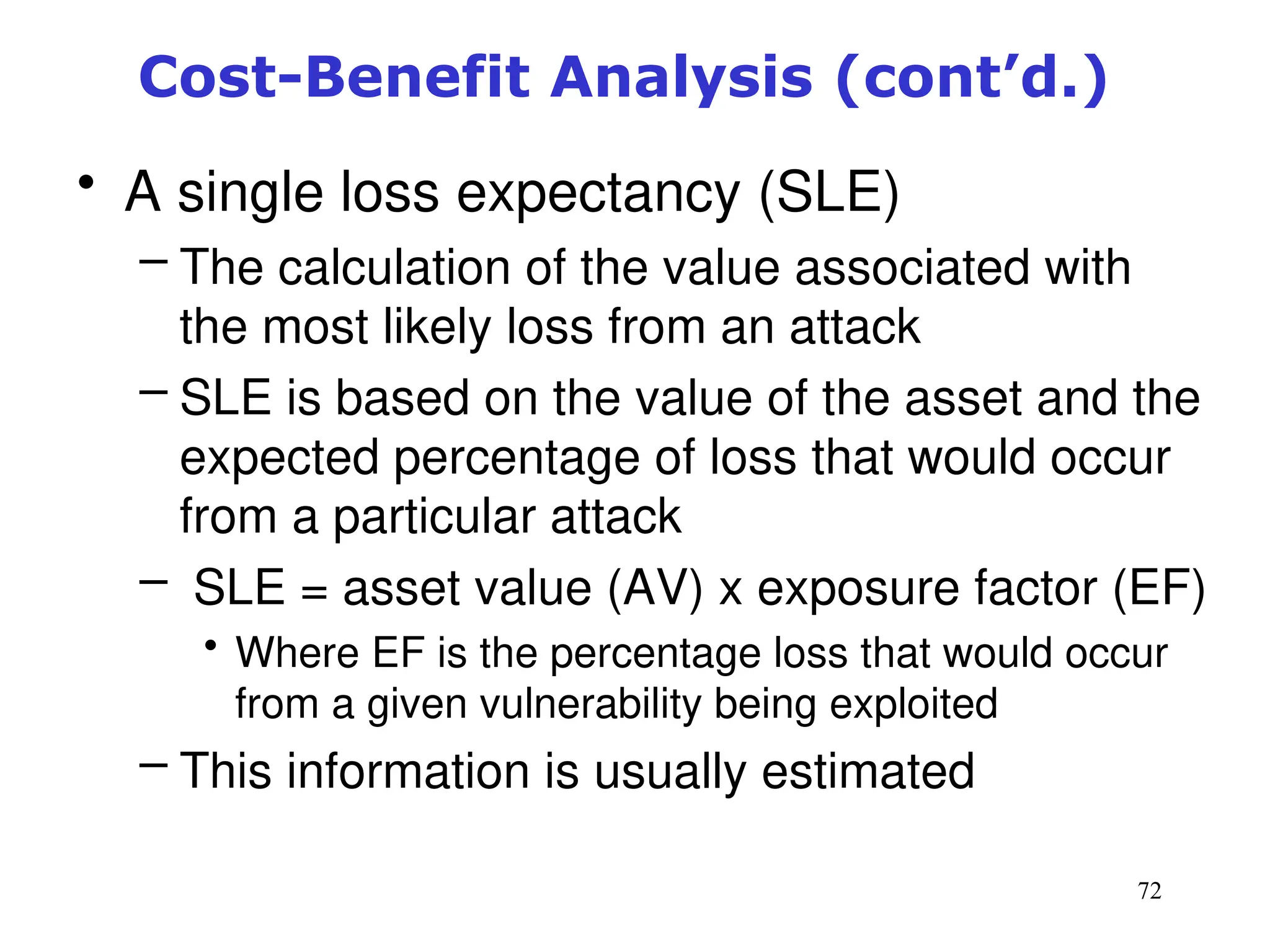
• A single loss expectancy (SLE)
– The calculation of the value associated with
the most likely loss from an attack
– SLE is based on the value of the asset and the
expected percentage of loss that would occur
from a particular attack
– SLE = asset value (AV) x exposure factor (EF)
• Where EF is the percentage loss that would occur
from a given vulnerability being exploited
– This information is usually estimated
Management of Information Security, 3rd ed.
Cost-Benefit Analysis (cont’d.)
73
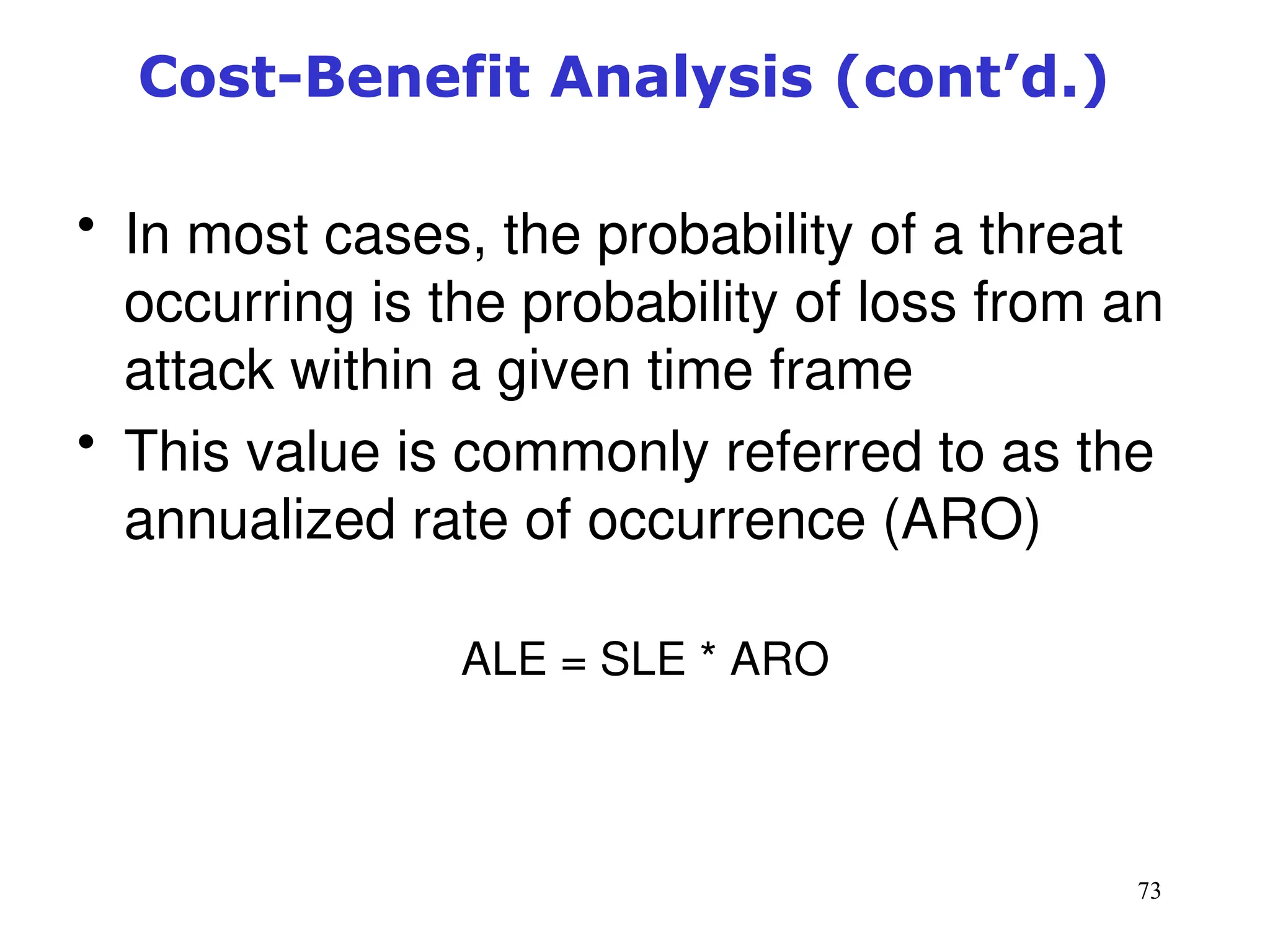
• In most cases, the probability of a threat
occurring is the probability of loss from an
attack within a given time frame
• This value is commonly referred to as the
annualized rate of occurrence (ARO)
ALE = SLE * ARO
Management of Information Security, 3rd ed.
Cost-Benefit Analysis (cont’d.)
74
Cost-Benefit Analysis (cont’d.)
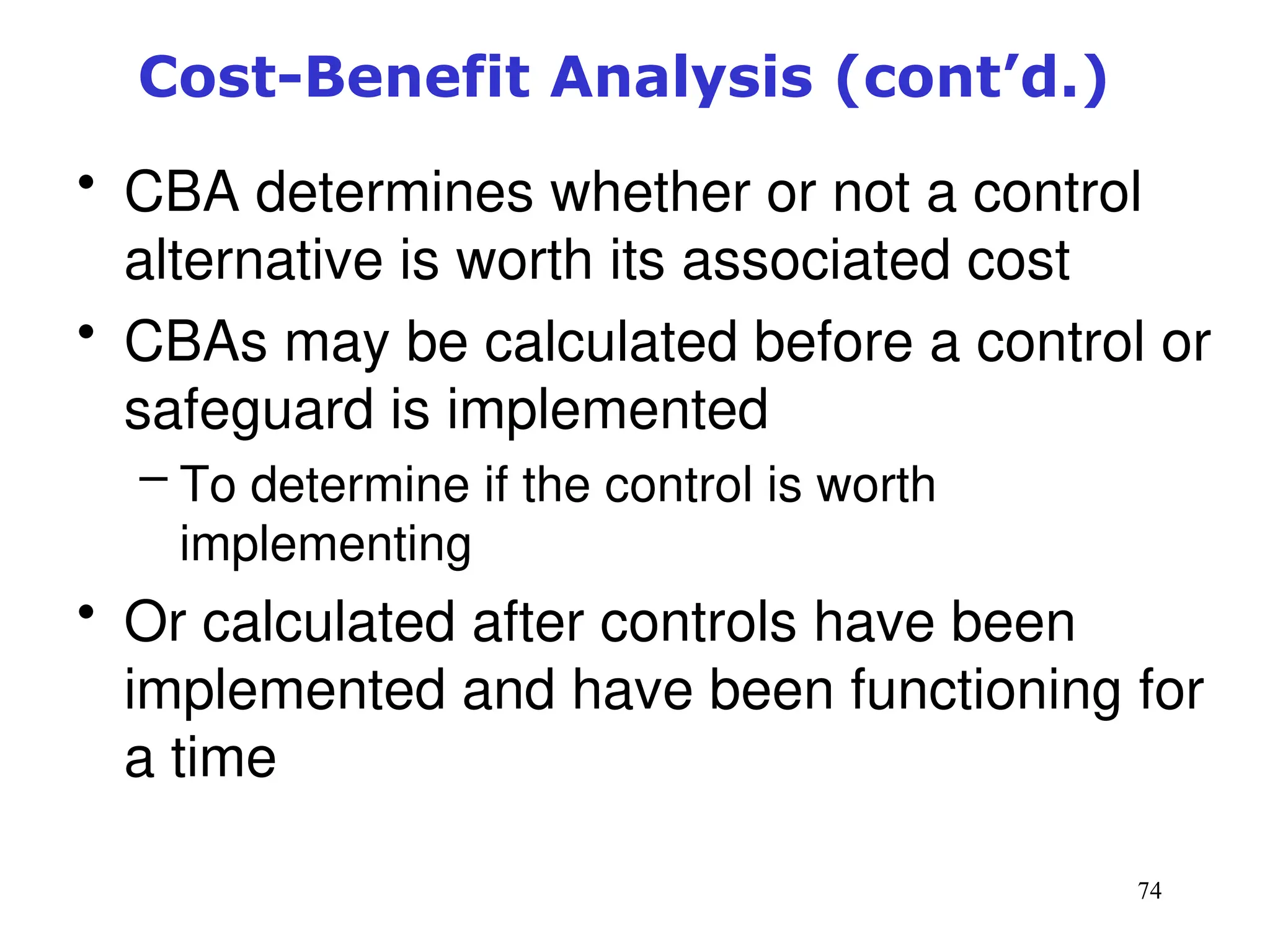
• CBA determines whether or not a control
alternative is worth its associated cost
• CBAs may be calculated before a control or
safeguard is implemented
– To determine if the control is worth
implementing
• Or calculated after controls have been
implemented and have been functioning for
a time
Management of Information Security, 3rd ed.
75
Cost-Benefit Analysis (cont’d.)
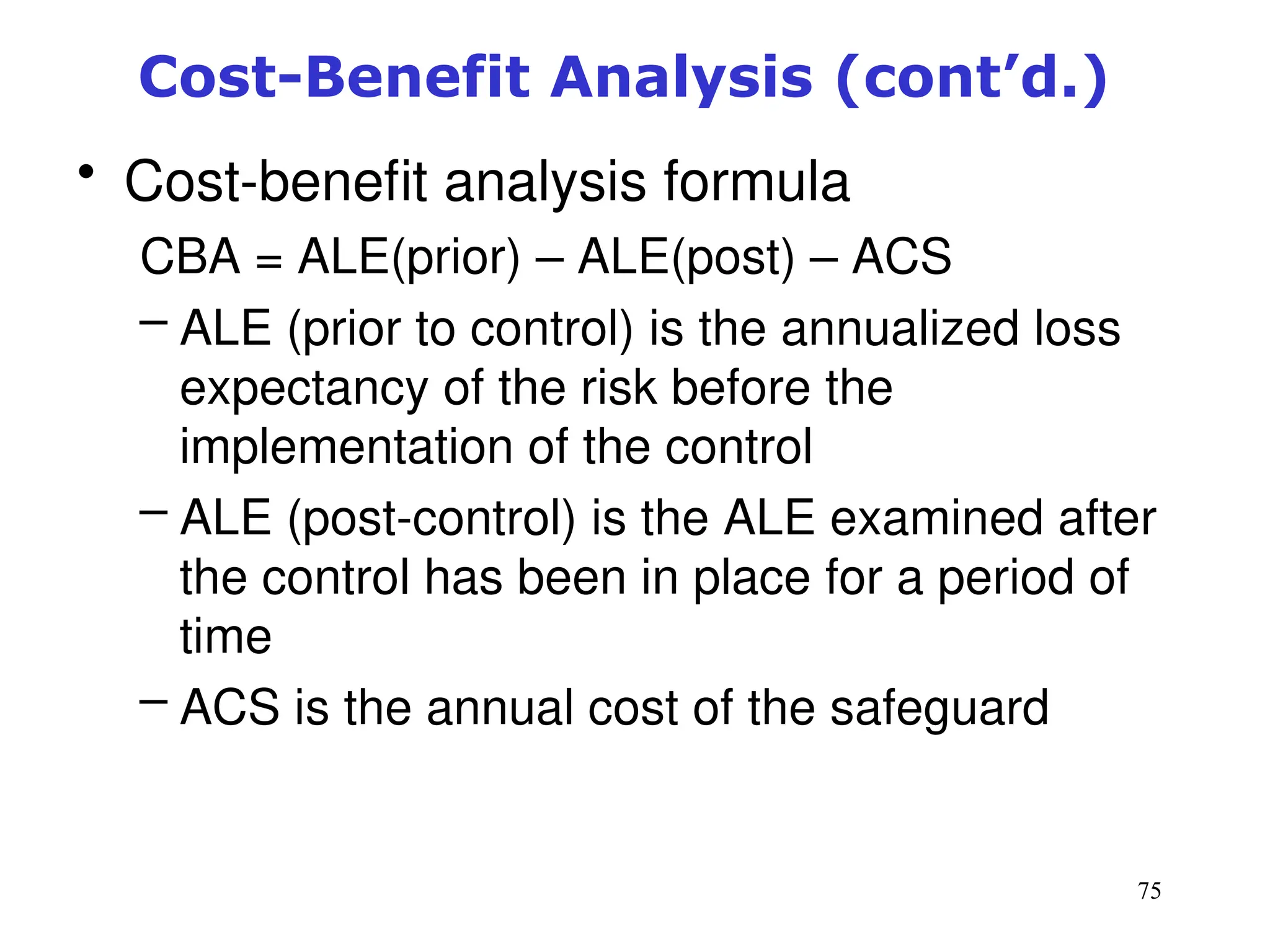
• Cost-benefit analysis formula
CBA = ALE(prior) – ALE(post) – ACS
– ALE (prior to control) is the annualized loss
expectancy of the risk before the
implementation of the control
– ALE (post-control) is the ALE examined after
the control has been in place for a period of
time
– ACS is the annual cost of the safeguard
Management of Information Security, 3rd ed.

cybersecurity risk management - cybersecurity risk management.ppt

  • 1.
    1 09/03/24 1 Instructor: SuprakashDatta (datta[at]cse.yorku.ca) ext 77875 Lectures: Tues (CB 122), 7–10 PM Office hours: Wed 3-5 pm (CSEB 3043), or by appointment. Textbooks: 1. "Management of Information Security", M. E. Whitman, H. J. Mattord, Nelson Education / CENGAGE Learning, 2011, 3rd Edition 2. "Guide to Computer Forensics and Investigations", B. Nelson, A. Phillips, F. Enfinger, C. Steuart, Nelson Education / CENGAGE Learning, 2010, 4th Edition. CSE 4482: Computer Security Management: Assessment and Forensics
  • 2.
    2 Objectives • Upon completionof this chapter you should be able to: – Define risk management and its role in the organization – Use risk management techniques to identify and prioritize risk factors for information assets – Assess risk based on the likelihood of adverse events and the effects on information assets when events occur – Document the results of risk identification Management of Information Security, 3rd ed.
  • 3.
    3 A true story Alocal company suffered a catastrophic loss one night when its office burned to the ground. As the employees gathered around the charred remains the next morning, the president asked the secretary if she had been performing the daily computer backups. To the president’s relief she replied that yes, each day before she went home she backed up all the financial information regarding customers, invoices, order and payments. The president then asked the secretary to retrieve the backup so they could begin to determine their current financial status. “Well”, the secretary said, “I guess I cannot do that. You see, I put those backups in the desk drawer next to the computer in the office. ” M. Ciampa, “Security+Guide to Network Security Fundamentals”, pp 303
  • 4.
    4 Risk Management • Riskmanagement: identification, assessment, and prioritization of risks • Managing risk is one of the key responsibilities of every manager within the organization • In any well-developed risk management program, two formal processes are at work – Risk identification and assessment – Risk control
  • 5.
    5 Risk Management “If youknow the enemy and know yourself, you need not fear the result of a hundred battles If you know yourself but not the enemy, for every victory gained you will also suffer a defeat If you know neither the enemy nor yourself, you will succumb in every battle” -- Sun Tzu Management of Information Security, 3rd ed.
  • 6.
    6 Knowing Yourself • Identifying,examining and understanding the information and how it is processed, stored, and transmitted • Armed with this knowledge, one can initiate an in-depth risk management program • Risk management is a process – Safeguards and controls that are devised and implemented are not install-and-forget devices Management of Information Security, 3rd ed.
  • 7.
    7 Knowing the Enemy •Identifying, examining, and understanding the threats facing the organization’s information assets – Must fully identify those threats that pose risks to the organization and the security of its information assets • Risk management – The process of assessing the risks to an organization’s information and determining how those risks can be controlled or mitigated Management of Information Security, 3rd ed.
  • 8.
    8 Risk management cycle Fromhttp://technet.microsoft.com/en-us/library/cc750827.aspx • Risk identification – Identify – Measure – Prioritize • Control measures – Cost benefit analysis
  • 9.
    9 Accountability for RiskManagement Communities of interest must work together • Information Security – leadership role in addressing risk • Information Technology – role involves building and maintaining secure systems • Management – role involves resource allocation and prioritization of security concerns • Users – crucial role in (early) detection, and proper response to threats Management of Information Security, 3rd ed.
  • 10.
    10 Steps in RiskManagement • Evaluating the risk controls • Determining which control options are cost- effective • Acquiring or installing the appropriate controls • Overseeing processes to ensure that the controls remain effective • Identifying risks • Assessing risks • Summarizing the findings Management of Information Security, 3rd ed.
  • 11.
    11 Risk Identification Management ofInformation Security, 3rd ed. Figure 8-1 Risk identification process Source: Course Technology/Cengage Learning
  • 12.
    12 Asset inventory • Managersidentify the organization’s information assets – Classify them into useful groups – Prioritize them by their overall importance Management of Information Security, 3rd ed.
  • 13.
    13 Information Asset Inventory creation •Identify information assets – Includes people, procedures, data and information, software, hardware, and networking elements – This step should be done without pre-judging the value of each asset • Values will be assigned later in the process • Determine which attributes of each information asset should be tracked Management of Information Security, 3rd ed.
  • 14.
    14 Management of InformationSecurity, 3rd ed. Table 8-1 Organizational assets used in systems Source: Course Technology/Cengage Learning Information Asset Inventory creation (contd.)
  • 15.
    15 Information Asset Inventory creation(contd.) • Potential asset attributes – Name – Asset tag – IP address – MAC address – asset type – Serial number – manufacturer name – Manufacturer’s model or part number – Software version, update revision, or FCO number – Physical location, logical location – Controlling entity Management of Information Security, 3rd ed.
  • 16.
    16 Example: Network Assettracker • http://www.misutilities.com/network-asset-tracker/howtouse.html
  • 17.
    17 Information Asset Inventory creation(contd.) Identifying people, procedures and data assets. Sample attributes for people, procedures, and data assets – People • Position name/number/ID • Supervisor name/number/ID • Security clearance level • Special skills Management of Information Security, 3rd ed.
  • 18.
    18 • Sample attributesfor people, procedures, and data assets (cont’d.) – Procedures • Description • Intended purpose Software/hardware/networking elements to which it is tied • Location where it is stored for reference • Location where it is stored for update purposes Management of Information Security, 3rd ed. Information Asset Inventory creation (contd.)
  • 19.
    19 • Sample attributesfor people, procedures, and data assets (cont’d.) – Data • Classification • Owner/creator/manager • Size of data structure • Data structure used • Online or offline • Location • Backup procedures Management of Information Security, 3rd ed. Information Asset Inventory creation (contd.)
  • 20.
    20 Next: Asset ranking •Determine the values of assets • Prioritize according to value
  • 21.
    21 Classifying and CategorizingAssets • Determine/refine an asset classification scheme • A classification scheme categorizes information assets based on their sensitivity, security needs • Each category designates the level of protection needed for a particular information asset • Some asset types, such as personnel, may require an alternative classification scheme • Classification categories must be comprehensive and mutually exclusive Management of Information Security, 3rd ed.
  • 22.
    22 Assessing Values for InformationAssets • Assign a relative value: Comparative judgments made to ensure that the most valuable information assets are given the highest priority Management of Information Security, 3rd ed.
  • 23.
    23 Assessing Values for InformationAssets - Questions 1. Which asset is the most critical to the success of the organization? 2. Which asset generates the most revenue? 3. Which asset generates the highest profitability? 4. Which asset is the most expensive to replace? 5. Which asset is the most expensive to protect? 6. Which asset’s loss or compromise would be the most embarrassing or cause the greatest liability? Management of Information Security, 3rd ed.
  • 24.
    24 Management of InformationSecurity, 3rd ed. Figure 8-2 Sample asset classification worksheet Source: Course Technology/Cengage Learning
  • 25.
    25 Management of InformationSecurity, 3rd ed. Table 8-2 Example weighted factor analysis worksheet Listing Assets in Order of Importance Final step: list the assets in order of importance •achieved by using a weighted factor analysis worksheet
  • 26.
    26 Next step: ThreatIdentification • Typically: wide variety of threats; each threat presents a unique challenge to information security Questions: • Which threats present a danger to your company’s information assets? – reduce scope and cost of risk management • Which threats present the gravest danger to your company’s information assets? – Rough assessment of severity of threat Management of Information Security, 3rd ed.
  • 27.
    27 Management of InformationSecurity, 3rd ed. Table 8-3 Threats to information security Source: ©2003 ACM, inc., included here by permission Threat Identification (cont’d.)
  • 28.
    28 Management of InformationSecurity, 3rd ed. Source: Adapted from M. E. Whitman. Enemy at the gates: Threats to information security. Communications of the ACM, August 2003. Reprinted with permission Prioritizing threats Weighted ranks of threats to information security 1000 top computing executives rated threats on a 5 point scale, from not significant to very significant
  • 29.
    29 Prioritizing threats (contd.) •Severity of threat: catastrophic, major, moderate, minor, insignificant
  • 30.
    30 Prioritizing threats (contd.) •Probability of threat: negligible to extreme Next: Vulnerability analysis
  • 31.
    31 Vulnerability Assessment • Vulnerability:flaw or weakness in an asset that can be exploited to breach security – Begin to review every information asset for each threat – leads to the creation of a list of vulnerabilities that remain potential risks to the organization – At the end of the risk identification process, a list of assets and their vulnerabilities has been developed – This list serves as the starting point for the next step in the risk management process - risk assessment Management of Information Security, 3rd ed.
  • 32.
    32 Management of InformationSecurity, 3rd ed. Table 8-4 Vulnerability assessment of a DMZ router Source: Course Technology/Cengage Learning Vulnerability Assessment (contd.)
  • 33.
    33 Examples 1. Asset: emailservers, – vulnerability: antivirus software not updated, – threat: virus attack 2. Asset: router, – vulnerability: incorrect router configuration, – threat: network susceptible to reduction or loss of connectivity
  • 34.
    34 Likelihood and Consequences (contd.) •Consequences and likelihoods are combined • The resulting rankings can then be inserted into the TVA tables for use in risk assessment Management of Information Security, 3rd ed.
  • 35.
    35 The TVA Worksheet •At the end of the risk identification process, a list of assets and their vulnerabilities has been developed • Another list prioritizes threats facing the organization based on the weighted table discussed earlier • These lists can be combined into a single worksheet Management of Information Security, 3rd ed.
  • 36.
    36 Management of InformationSecurity, 3rd ed. Table 8-5 Sample TVA spreadsheet Source: Course Technology/Cengage Learning The TVA Worksheet (cont’d.)
  • 37.
    37 Management of InformationSecurity, 3rd ed. Figure 8-3 Risk identification estimate factors Source: Course Technology/Cengage Learning Introduction to Risk Assessment • The goal is to create a method to evaluate the relative risk of each listed vulnerability • It is not the presence of a vulnerability that matters but the associated risk • Simple model – risk R, probability of risk event P and value lost by risk event V satisfy R = PV
  • 38.
    38 More complex model •Extended risk formula R = Pa Ps V • Where Pa = Probability of attack and Ps = Probability that the attack successfully exploits the vulnerability V = value lost by successful exploitation of vulnerability
  • 39.
    39 Another formula • ExtendedWhitman’s Risk Formula R = P*V*(1 – CC + UK) where P = probability that a vulnerability is exploited, V = value of asset, CC = fraction of risk mitigated by current control, UK = fraction of risk not fully known (uncertainty of knowledge)
  • 40.
    40 Management of InformationSecurity, 3rd ed. Figure 8-3 Risk identification estimate factors Source: Course Technology/Cengage Learning In words… Uncertainty: Impossible to know everything about every vulnerability •The degree to which a current control can reduce risk is also subject to estimation error •Uncertainty is estimated by the manager using judgment/experience
  • 41.
    41 Risk Determination Example –Asset A has a value of 50 and has one vulnerability, which has a likelihood of 1.0 with no current controls. Your assumptions and data are 90% accurate – Asset B has a value of 100 and has two vulnerabilities: vulnerability #2 has a likelihood of 0.5 with a current control that addresses 50% of its risk; vulnerability # 3 has a likelihood of 0.1 with no current controls. Your assumptions and data are 80% accurate – The resulting ranked list of risk ratings for the three vulnerabilities is as follows: • Asset A: Vulnerability 1 rated as 55 = (50 × 1.0) – 0% + 10% • Asset B: Vulnerability 2 rated as 35 = (100 × 0.5) – 50% + 20% • Asset B: Vulnerability 3 rated as 12 = (100 × 0.1) – 0 % + 20% Management of Information Security, 3rd ed.
  • 42.
    42 Documenting the Results ofRisk Assessment • Goals of the risk management process – To identify information assets and their vulnerabilities – To rank them according to the need for protection • In preparing this list, a wealth of factual information about the assets and the threats they face is collected • Information about the controls that are already in place is also collected • The final summarized document is the ranked vulnerability risk worksheet Management of Information Security, 3rd ed.
  • 43.
    43 Management of InformationSecurity, 3rd ed. Table 8-9 Ranked vulnerability risk worksheet Source: Course Technology/Cengage Learning
  • 44.
    44 Documenting the Resultsof Risk Assessment (cont’d.) • What should the documentation package look like? • What are the deliverables from this stage of the risk management project? • The risk identification process should designate what function the reports serve, who is responsible for preparing them, and who reviews them Management of Information Security, 3rd ed.
  • 45.
    45 Summary • Introduction • Riskmanagement • Risk identification • Risk assessment • Documenting the results of risk assessment Management of Information Security, 3rd ed.
  • 46.
    46 Risk Control (Ch9) Identify Possible Controls • For each threat and its associated vulnerabilities that have residual risk, create a preliminary list of control ideas • Three general categories of controls exist: – Policies – Programs – Technical controls Management of Information Security, 3rd ed.
  • 47.
    47 Objectives • Upon completionof this chapter, you should be able to: – Recognize and select from the risk mitigation strategy options to control risk – Evaluate risk controls and formulate a cost- benefit analysis using existing conceptual frameworks – Explain how to maintain and perpetuate risk controls – Describe the OCTAVE Method and other approaches to managing risk Management of Information Security, 3rd ed.
  • 48.
    48 Introduction • To keepup with the competition, organizations must design and create a safe environment in which business processes and procedures can function – This environment must maintain confidentiality and privacy and assure the integrity and availability of organizational data – These objectives are met via the application of the principles of risk management Management of Information Security, 3rd ed.
  • 49.
    49 Risk Control Strategies •four basic strategies to control risks – Avoidance • Applying safeguards that eliminate or reduce the remaining uncontrolled risks for the vulnerability – Transference • Shifting the risk to other areas or to outside entities – Mitigation • Reducing the impact if the vulnerability is exploited – Acceptance • Understanding the consequences and accepting the risk without control or mitigation Management of Information Security, 3rd ed.
  • 50.
    50 Avoidance • The riskcontrol strategy that attempts to prevent the exploitation of the vulnerability • Avoidance is accomplished through: – Application of policy – Application of training and education – Countering threats – Implementation of technical security controls and safeguards Management of Information Security, 3rd ed.
  • 51.
    51 Transference • The controlapproach that attempts to shift the risk to other assets, other processes, or other organizations • May be accomplished by rethinking how services are offered – Revising deployment models – Outsourcing to other organizations – Purchasing insurance – Implementing service contracts with providers Management of Information Security, 3rd ed.
  • 52.
    52 Mitigation • The controlapproach that attempts to reduce the damage caused by the exploitation of vulnerability – Using planning and preparation – Depends upon the ability to detect and respond to an attack as quickly as possible • Types of mitigation plans – Disaster recovery plan (DRP) – Incident response plan (IRP) – Business continuity plan (BCP) Management of Information Security, 3rd ed.
  • 53.
    53 Management of InformationSecurity, 3rd ed. Mitigation (cont’d.) Table 9-1 Summaries of mitigation plans Source: Course Technology/Cengage Learning
  • 54.
    54 Acceptance • do nothingto protect an information asset – To accept the loss when it occurs • assumes that it may be a prudent business decision to examine the alternatives and conclude that the cost of protecting an asset does not justify the security expenditure Management of Information Security, 3rd ed.
  • 55.
    55 Acceptance (contd.) • theorganization must: – Determine the level of risk to the information asset – Assess the probability of attack and the likelihood of a successful exploitation of a vulnerability – Approximate the ARO of the exploit – Estimate the potential loss from attacks – Perform a thorough cost benefit analysis – Evaluate controls using each appropriate type of feasibility – Decide that the particular asset did not justify the cost of protection Management of Information Security, 3rd ed.
  • 56.
    56 Managing Risk • Riskappetite (also known as risk tolerance) – The quantity and nature of risk that organizations are willing to accept • As they evaluate the trade-offs between perfect security and unlimited accessibility • The reasoned approach to risk is one that balances the expense (in terms of finance and the usability of information assets) against the possible losses if exploited Management of Information Security, 3rd ed.
  • 57.
    57 Managing Risk (contd.) •Residual risk – When vulnerabilities have been controlled as much as possible, there is often remaining risk that has not been completely removed, shifted, or planned for • Residual Risk is a combined function of: – Threats, vulnerabilities and assets, less the effects of the safeguards in place • The goal of information security is not to bring residual risk to zero, but to bring it in line with an organization’s risk appetite Management of Information Security, 3rd ed.
  • 58.
    58 Managing Risk (contd.) •If decision makers have been informed of uncontrolled risks and the proper authority groups within the communities of interest decide to leave residual risk in place, then the information security program has accomplished its primary goal • Once a control strategy has been selected and implemented: – The effectiveness of controls should be monitored and measured on an ongoing basis to determine its effectiveness and the accuracy of the estimate of the residual risk Management of Information Security, 3rd ed.
  • 59.
    59 Management of InformationSecurity, 3rd ed. Managing Risk (contd.) Source: Course Technology/Cengage Learning Figure 9-1 Residual risk
  • 60.
    60 • Risk controlinvolves selecting one of the four risk control strategies – For the vulnerabilities present • If the loss is within the range of losses the organization can absorb, or if the attacker’s gain is less than expected costs of the attack, the organization may choose to accept the risk – Otherwise, one of the other control strategies will have to be selected Management of Information Security, 3rd ed. Managing Risk (cont’d.)
  • 61.
    61 Management of InformationSecurity, 3rd ed. Risk handling action points Source: Course Technology/Cengage Learning Figure 9-2 Risk-handling action points
  • 62.
    62 • When avulnerability exists – Implement security controls to reduce the likelihood of a vulnerability being exercised • When a vulnerability can be exploited – Apply layered controls to minimize the risk or prevent occurrence • When the attacker’s potential gain is greater than the costs of attack – Apply technical or managerial controls to increase the attacker’s cost, or reduce his gain • When potential loss is substantial – Apply design controls to limit the extent of the attack, thereby reducing the potential for loss Management of Information Security, 3rd ed. Guidelines for risk control strategy selection
  • 63.
    63 Management of InformationSecurity, 3rd ed. Risk control cycle Source: Course Technology/Cengage Learning Figure 9-3 Risk control cycle
  • 64.
    64 Feasibility and Cost-BenefitAnalysis • Before deciding on the strategy for a specific vulnerability – All readily accessible information about the consequences of the vulnerability must be explored – Ask “what are the advantages of implementing a control as opposed to the disadvantages of implementing the control?” • There are a number of ways to determine the advantage or disadvantage of a specific control • The primary means are based on the value of the information assets that it is designed to protect Management of Information Security, 3rd ed.
  • 65.
    65 Cost-Benefit Analysis • Economicfeasibility – The criterion most commonly used when evaluating a project that implements information security controls and safeguards • It is difficult to determine the value of information – It is also difficult to determine the cost of safeguarding it Management of Information Security, 3rd ed.
  • 66.
    66 Cost-Benefit Analysis (cont’d.) •Factors that affect the cost of a safeguard – Cost of development or acquisition of hardware, software, and services – Training fees – Cost of implementation – Service and maintenance costs Management of Information Security, 3rd ed.
  • 67.
    67 Cost-Benefit Analysis (cont’d.) •Benefit – The value to the organization of using controls to prevent losses associated with a specific vulnerability – Usually determined by valuing the information assets exposed by the vulnerability and then determining how much of that value is at risk and how much risk there is for the asset – This is expressed as the annualized loss expectancy (ALE) Management of Information Security, 3rd ed.
  • 68.
    68 Cost-Benefit Analysis (cont’d.) •Asset valuation – The process of assigning financial value or worth to each information asset – The value of information differs within and between organizations • Based on the characteristics of information and the perceived value of that information – Involves estimation of real and perceived costs associated with the design, development, installation, maintenance, protection, recovery, and defense against loss and litigation Management of Information Security, 3rd ed.
  • 69.
    69 Cost-Benefit Analysis (cont’d.) •Asset valuation components – Value retained from the cost of creating the information asset – Value retained from past maintenance of the information asset – Value implied by the cost of replacing the information – Value from providing the information – Value acquired from the cost of protecting the information Management of Information Security, 3rd ed.
  • 70.
    70 Cost-Benefit Analysis (cont’d.) •Asset valuation components (cont’d.) – Value to owners – Value of intellectual property – Value to adversaries – Loss of productivity while the information assets are unavailable – Loss of revenue while information assets are unavailable Management of Information Security, 3rd ed.
  • 71.
    71 Cost-Benefit Analysis (cont’d.) •Potential loss is that which could occur from the exploitation of vulnerability or a threat occurrence • Ask these questions: – What loss could occur, and what financial impact would it have? – What would it cost to recover from the attack, in addition to the financial impact of damage? – What is the single loss expectancy for each risk? Management of Information Security, 3rd ed.
  • 72.
    72 • A singleloss expectancy (SLE) – The calculation of the value associated with the most likely loss from an attack – SLE is based on the value of the asset and the expected percentage of loss that would occur from a particular attack – SLE = asset value (AV) x exposure factor (EF) • Where EF is the percentage loss that would occur from a given vulnerability being exploited – This information is usually estimated Management of Information Security, 3rd ed. Cost-Benefit Analysis (cont’d.)
  • 73.
    73 • In mostcases, the probability of a threat occurring is the probability of loss from an attack within a given time frame • This value is commonly referred to as the annualized rate of occurrence (ARO) ALE = SLE * ARO Management of Information Security, 3rd ed. Cost-Benefit Analysis (cont’d.)
  • 74.
    74 Cost-Benefit Analysis (cont’d.) •CBA determines whether or not a control alternative is worth its associated cost • CBAs may be calculated before a control or safeguard is implemented – To determine if the control is worth implementing • Or calculated after controls have been implemented and have been functioning for a time Management of Information Security, 3rd ed.
  • 75.
    75 Cost-Benefit Analysis (cont’d.) •Cost-benefit analysis formula CBA = ALE(prior) – ALE(post) – ACS – ALE (prior to control) is the annualized loss expectancy of the risk before the implementation of the control – ALE (post-control) is the ALE examined after the control has been in place for a period of time – ACS is the annual cost of the safeguard Management of Information Security, 3rd ed.