IS Security Management
                4/18/2013
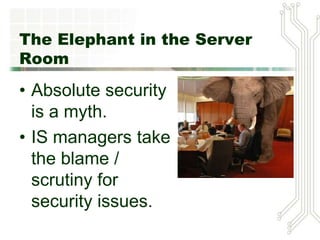
The Elephant in the Server
Room

• Absolute security
  is a myth.
• IS managers take
  the blame.
Risk Management
• Risk management: process of identifying
  and controlling risks facing an organization
• Risk identification: process of examining
  an organization’s current information
  technology security situation
• Risk control: applying controls to reduce
  risks to an organizations data and
  information systems                         3
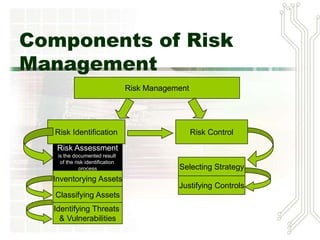
Components of Risk
Management
                                 Risk Management


   Risk Identification                             Risk Control
   Risk Assessment
   is the documented result
    of the risk identification
             process                         Selecting Strategy
  Inventorying Assets
                                             Justifying Controls
   Classifying Assets
  Identifying Threats
    & Vulnerabilities
An Overview of Risk
Management
• Know yourself
  – Understand the technology and systems in your
    organization
• Know the enemy
  – Identify, examine, understand threats
• Role of Communities of Interest
  – Information Security
  – Management and Users
  – Information Technology
                                                    5
Risk Identification
• Assets are targets of various threats
  and threat agents
• Risk management involves identifying
  organization’s assets and identifying
  threats/vulnerabilities
• Risk identification begins with identifying
  organization’s assets and assessing
  their value                                   6
7
Asset Identification and
Valuation
• List all elements of
  an organization’s
  system.
• Classify and
  categorize assets.

                           8
Table 4-1 - Categorizing
             Components & Valuation
              Asset Identification
Traditional System   SecSDLC and risk management system components
Components


People               Employee                Trusted employees
                                             Other staff

                     Non-employees           People at trusted organizations / Strangers


Procedures           Procedures              IT & business standards procedures
                                             IT & business standards procedures

Data                 Information             Transmission, Processing, Storage


Software             Software                Applications, Operating systems, Security
                                             components

Hardware             System devices and      Systems and peripherals
                     peripherals             Security devices

                     Networking components   Intranet components
                                             Internet or DMZ components
Data / People /
Procedural Assets
• Human resources, documentation, and
  data information assets are more
  difficult to identify
• People with knowledge, experience,
  and good judgment should be assigned
  this task
• These assets should be recorded using
  reliable data-handling process          10
Hardware / Software /
Network Assets
•   Name (device or program name)
•   IP address
•   Media access control (MAC) address
•   Element type – server, desktop, etc.
    Device Class, Device OS, Device
    Capacity


                                           11
Hardware / Software /
Network Assets
•   serial number
•   manufacturer name; model/part number
•   software versions
•   physical or logical location
•   Software version, update revision
Information Asset
Classification
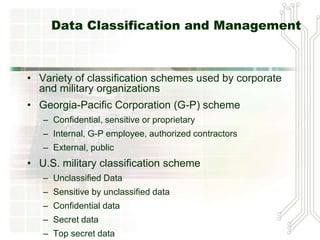
• Many organizations have data
  classification schemes (e.g.,
  confidential, internal, public data)
• Classification must be specific enough
  to allow determination of priority
• Comprehensive – all info fits in list
  somewhere
• Mutually exclusive – fits in one place
                                           13
Information Asset
 Valuation
• What is most critical to
  organization’s success?
• What generates the most revenue?
• What generates the most profit?
• What would be most expensive to
  replace?
Information Asset
 Valuation (continued)
• What would be most expensive to
  protect?
• What would be most embarrassing
  or cause the greatest liability is
  revealed?
Figure 4-3 – Example
Worksheet


                       16
Listing Assets in Order of
Importance
• Weighted factor analysis
• Each info asset assigned score for each
  critical factor (0.1 to 1.0)
• Each critical factor is assigned a weight (1-
  100)
• Multiply and add
Table 4-2 – Example
Weighted Factor Analysis


         CPSC375@UTC/CS    18
Data Classification and
Management
• Information owners responsible for
  classifying their information assets
• Information classifications must be
  reviewed periodically
• Most organizations do not need detailed
  level of classification used by military or
  federal agencies.
Data Classification and
Management
• Organizations may need to classify
  data to provide protection
  – Public
  – For official use only
  – Sensitive
  – classified

                  CPSC375@UTC/CS       20
Data Classification and
Management
• Assign classification to all data
• Grant access to data based on
  classification and need
• Devise some method of managing data
  relative to classification


                CPSC375@UTC/CS          21
Security Clearances
• Security clearance structure: each data
  user assigned a single level of
  authorization indicating classification level
• Before accessing specific set of data,
  employee must meet need-to-know
  requirement
• Extra level of protection ensures
  information confidentiality is maintained
Potential Threats
Threat                            Example
Acts of human error or failure    Accidents, employee mistakes
Compromises to intellectual       Piracy, copyright infringement
property
Deliberate acts of espionage or   Unauthorized access and/or data
trespass                          collection
Deliberate acts of information    Blackmail or information
extortion                         disclosure
Deliberate acts of theft          Illegal confiscation of equipment
                                  or information

Deliberate acts of sabotage or    Destruction of systems or
vandalism                         information
Potential Threats
Categories of Threat                    Examples
Deliberate acts of software attacks     Viruses, worms, macros, denial-of-
                                        service
Forces of nature                        Fire, flood, earthquake, lightning

Deviations in quality of service        ISP, power, WAN service issues from
                                        service providers
Technical hardware failures or errors   Equipment failure

Technical software failures or errors   Bugs, code problems, unknown
                                        loopholes
Technological obsolescence              Antiquated or outdated technologies


                                                                             24
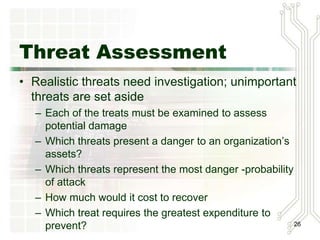
Threat Assessment
• Which threats present a danger to an
  organization’s assets?
• Which threats represent the most
  danger?
• How much would it cost to recover?
• Which threat requires the greatest
  expenditure to prevent?
                                     25
Vulnerability
Identification
• Identify each asset and each threat it
  faces
• Create a list of vulnerabilities
• Examine how each of the threats are
  likely to be perpetrated
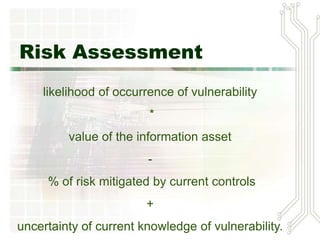
Risk Assessment

• Risk assessment evaluates the
  relative risk for each vulnerability

• Assigns a risk rating or score to
  each information asset


                                         27
Risk Assessment
     likelihood of occurrence
                 *
  value of the information asset
                  -
         percent mitigated
                 +
             uncertainty
Probability Computation
• Assign number between 0.1 – 1
• Data is available for some factors
  – Likelihood of fire
  – Likelihood of receiving infected email
  – Number of network attacks


                                             29
Valuation of Information
Assets
Using info from asset identification
assign weighted score for the value.
  – 1 -100
  – 100 – stop company operations
  – May use broad categories
  – NIST has some predefined
                                       30
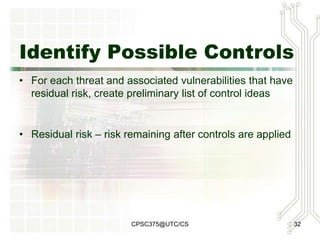
Risk Control Strategies
• Apply safeguards that eliminate or reduce
  residual risks (avoidance)
• Transfer the risk to other areas or outside
  entities (transference)
• Reduce the impact should the vulnerability be
  exploited (mitigation)
• Understand the consequences and accept the
  risk without control or mitigation (acceptance)

                                                    31
Mitigation
• When a vulnerability can be
  exploited -- apply layered
  protections, architectural designs,
  and administrative controls
• When attacker’s cost is less than
  potential gain -- apply protection to
  increase attackers costs
• When potential loss is substantial --
  redesign, new architecture, controls
Conclusion
“The goal of information security is not
to bring residual risk to zero; it is to
bring residual risk into line with an
organization’s comfort zone or risk
appetite”


                                           33

MIS: Information Security Management

  • 1.
  • 2.
    The Elephant inthe Server Room • Absolute security is a myth. • IS managers take the blame.
  • 3.
    Risk Management • Riskmanagement: process of identifying and controlling risks facing an organization • Risk identification: process of examining an organization’s current information technology security situation • Risk control: applying controls to reduce risks to an organizations data and information systems 3
  • 4.
    Components of Risk Management Risk Management Risk Identification Risk Control Risk Assessment is the documented result of the risk identification process Selecting Strategy Inventorying Assets Justifying Controls Classifying Assets Identifying Threats & Vulnerabilities
  • 5.
    An Overview ofRisk Management • Know yourself – Understand the technology and systems in your organization • Know the enemy – Identify, examine, understand threats • Role of Communities of Interest – Information Security – Management and Users – Information Technology 5
  • 6.
    Risk Identification • Assetsare targets of various threats and threat agents • Risk management involves identifying organization’s assets and identifying threats/vulnerabilities • Risk identification begins with identifying organization’s assets and assessing their value 6
  • 7.
  • 8.
    Asset Identification and Valuation •List all elements of an organization’s system. • Classify and categorize assets. 8
  • 9.
    Table 4-1 -Categorizing Components & Valuation Asset Identification Traditional System SecSDLC and risk management system components Components People Employee Trusted employees Other staff Non-employees People at trusted organizations / Strangers Procedures Procedures IT & business standards procedures IT & business standards procedures Data Information Transmission, Processing, Storage Software Software Applications, Operating systems, Security components Hardware System devices and Systems and peripherals peripherals Security devices Networking components Intranet components Internet or DMZ components
  • 10.
    Data / People/ Procedural Assets • Human resources, documentation, and data information assets are more difficult to identify • People with knowledge, experience, and good judgment should be assigned this task • These assets should be recorded using reliable data-handling process 10
  • 11.
    Hardware / Software/ Network Assets • Name (device or program name) • IP address • Media access control (MAC) address • Element type – server, desktop, etc. Device Class, Device OS, Device Capacity 11
  • 12.
    Hardware / Software/ Network Assets • serial number • manufacturer name; model/part number • software versions • physical or logical location • Software version, update revision
  • 13.
    Information Asset Classification • Manyorganizations have data classification schemes (e.g., confidential, internal, public data) • Classification must be specific enough to allow determination of priority • Comprehensive – all info fits in list somewhere • Mutually exclusive – fits in one place 13
  • 14.
    Information Asset Valuation •What is most critical to organization’s success? • What generates the most revenue? • What generates the most profit? • What would be most expensive to replace?
  • 15.
    Information Asset Valuation(continued) • What would be most expensive to protect? • What would be most embarrassing or cause the greatest liability is revealed?
  • 16.
    Figure 4-3 –Example Worksheet 16
  • 17.
    Listing Assets inOrder of Importance • Weighted factor analysis • Each info asset assigned score for each critical factor (0.1 to 1.0) • Each critical factor is assigned a weight (1- 100) • Multiply and add
  • 18.
    Table 4-2 –Example Weighted Factor Analysis CPSC375@UTC/CS 18
  • 19.
    Data Classification and Management •Information owners responsible for classifying their information assets • Information classifications must be reviewed periodically • Most organizations do not need detailed level of classification used by military or federal agencies.
  • 20.
    Data Classification and Management •Organizations may need to classify data to provide protection – Public – For official use only – Sensitive – classified CPSC375@UTC/CS 20
  • 21.
    Data Classification and Management •Assign classification to all data • Grant access to data based on classification and need • Devise some method of managing data relative to classification CPSC375@UTC/CS 21
  • 22.
    Security Clearances • Securityclearance structure: each data user assigned a single level of authorization indicating classification level • Before accessing specific set of data, employee must meet need-to-know requirement • Extra level of protection ensures information confidentiality is maintained
  • 23.
    Potential Threats Threat Example Acts of human error or failure Accidents, employee mistakes Compromises to intellectual Piracy, copyright infringement property Deliberate acts of espionage or Unauthorized access and/or data trespass collection Deliberate acts of information Blackmail or information extortion disclosure Deliberate acts of theft Illegal confiscation of equipment or information Deliberate acts of sabotage or Destruction of systems or vandalism information
  • 24.
    Potential Threats Categories ofThreat Examples Deliberate acts of software attacks Viruses, worms, macros, denial-of- service Forces of nature Fire, flood, earthquake, lightning Deviations in quality of service ISP, power, WAN service issues from service providers Technical hardware failures or errors Equipment failure Technical software failures or errors Bugs, code problems, unknown loopholes Technological obsolescence Antiquated or outdated technologies 24
  • 25.
    Threat Assessment • Whichthreats present a danger to an organization’s assets? • Which threats represent the most danger? • How much would it cost to recover? • Which threat requires the greatest expenditure to prevent? 25
  • 26.
    Vulnerability Identification • Identify eachasset and each threat it faces • Create a list of vulnerabilities • Examine how each of the threats are likely to be perpetrated
  • 27.
    Risk Assessment • Riskassessment evaluates the relative risk for each vulnerability • Assigns a risk rating or score to each information asset 27
  • 28.
    Risk Assessment likelihood of occurrence * value of the information asset - percent mitigated + uncertainty
  • 29.
    Probability Computation • Assignnumber between 0.1 – 1 • Data is available for some factors – Likelihood of fire – Likelihood of receiving infected email – Number of network attacks 29
  • 30.
    Valuation of Information Assets Usinginfo from asset identification assign weighted score for the value. – 1 -100 – 100 – stop company operations – May use broad categories – NIST has some predefined 30
  • 31.
    Risk Control Strategies •Apply safeguards that eliminate or reduce residual risks (avoidance) • Transfer the risk to other areas or outside entities (transference) • Reduce the impact should the vulnerability be exploited (mitigation) • Understand the consequences and accept the risk without control or mitigation (acceptance) 31
  • 32.
    Mitigation • When avulnerability can be exploited -- apply layered protections, architectural designs, and administrative controls • When attacker’s cost is less than potential gain -- apply protection to increase attackers costs • When potential loss is substantial -- redesign, new architecture, controls
  • 33.
    Conclusion “The goal ofinformation security is not to bring residual risk to zero; it is to bring residual risk into line with an organization’s comfort zone or risk appetite” 33