RISK FACTORS
UNDERLYING
DISASTERS
DON BOSCO TECHNICAL INSTITUTE OF VICTORIAS INC.
VICMICO, Victorias City, 6119 Negros Occidental, Philippines
Senior High School Department | School Year 2022–2023
Science, Technology, Engineering, and
Mathematics 11
Chapter 1: Basic Concept of Disaster & Disaster
Risks
Prepared by: Lord William B. Pacurib
COMPETENCY: Differentiate the risk factors
underlying disasters; (DRR11/12-Ia-b-2)
• Identify the risk factors underlying disasters and
describe each of them.
• Utilize the gained knowledge in real life
situations to avoid harm and assure safety
• Appreciate the importance of understanding the
risk factors underlying disasters to mitigate the
effects of disaster and practice mitigation
measures as early as necessary.
OBJECTIVES
Risk Underlying Disasters
DREAM | BUILD | TRANSFORM | INNOVATE
1. Refrain from talking if the teacher is having his
lecture. Talk only if you are called.
2. Quietly remain on your seats while the class is
ongoing (do not roam around the room).
3. Render appropriate courtesy towards the
teacher.
4. Standard handbook rules apply.
5. Violation of aforementioned rules will be reflected
on the violator’s diary.
RULES
DREAM | BUILD | TRANSFORM | INNOVATE
INTRODUCTION
DREAM | BUILD | TRANSFORM | INNOVATE
Disaster can affect everyone. It does not
discriminate between and among social classes,
gender, creed, race, and nationality.
• But certain risk factors put those affected in
a position where they will have graver or
longer-lasting post-disaster stress reactions.
• These aggravating factors contribute to
evident differences in the stress reactions of
certain individuals with certain
characteristics.
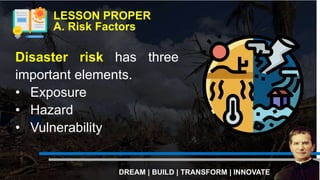
Disaster risk has three
important elements.
• Exposure
• Hazard
• Vulnerability
LESSON PROPER
A. Risk Factors
DREAM | BUILD | TRANSFORM | INNOVATE
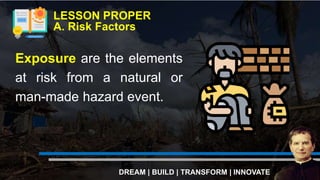
Exposure are the elements
at risk from a natural or
man-made hazard event.
LESSON PROPER
A. Risk Factors
DREAM | BUILD | TRANSFORM | INNOVATE
Hazards are potentially dangerous
physical occurrences, phenomenon
or human activities that may result
in loss of life or injury, property
damage, social and economic
disruption, or environmental
degradation.
LESSON PROPER
A. Risk Factors
DREAM | BUILD | TRANSFORM | INNOVATE
Vulnerability is the condition
determined by physical, social,
economic, and environmental
factors or processes, which
increase the susceptibility of a
community to the impact of hazard.
LESSON PROPER
A. Risk Factors
DREAM | BUILD | TRANSFORM | INNOVATE
Reduction of the level of
vulnerability and exposure is possible by
keeping people and property as distant
as possible from hazards. We can not
avoid natural events from occurring, but
we can concentrate on addressing the
reduction of risk and exposure by
determining the factors causing disasters.
LESSON PROPER
A. Risk Factors
DREAM | BUILD | TRANSFORM | INNOVATE
Risk factors are processes or
conditions, often development-
related, that influence the level of
disaster risk by increasing levels
of exposure and vulnerability or
reducing capacity.
LESSON PROPER
A. Risk Factors
DREAM | BUILD | TRANSFORM | INNOVATE
LESSON PROPER
A. Risk Factors
DREAM | BUILD | TRANSFORM | INNOVATE
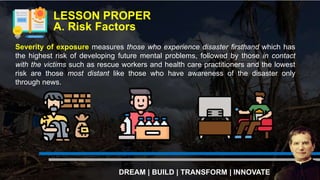
Severity of exposure measures those who experience disaster firsthand which has
the highest risk of developing future mental problems, followed by those in contact
with the victims such as rescue workers and health care practitioners and the lowest
risk are those most distant like those who have awareness of the disaster only
through news.
LESSON PROPER
A. Risk Factors
DREAM | BUILD | TRANSFORM | INNOVATE
Gender and family: The female
sex suffers more adverse effects.
This worsens when children are
present at home. Marital
relationships are placed under
strain.
LESSON PROPER
A. Risk Factors
DREAM | BUILD | TRANSFORM | INNOVATE
Age: Adults in the age range
of 40-60 are more stressed
after disasters. But in general,
children exhibit more stress
after disasters than adults do.
LESSON PROPER
A. Risk Factors
DREAM | BUILD | TRANSFORM | INNOVATE
Economic status of country: Evidence
indicates that severe mental problems
resulting from disasters are more prevalent
in developing countries like the
Philippines. Furthermore, it has been
observed that natural disasters tend to
have more adverse effects in developing
countries than do man-caused disasters in
developed countries.
LESSON PROPER
B. Factors Which Underlie Disaster
DREAM | BUILD | TRANSFORM | INNOVATE
Climate change can increase
disaster risk in a variety of ways –
by altering the frequency and
intensity of hazards events,
affecting vulnerability to hazards,
and changing exposure patterns.
LESSON PROPER
B. Factors Which Underlie Disaster
DREAM | BUILD | TRANSFORM | INNOVATE
Environmental degradation, driven by factors like
deforestation and overconsumption of natural
resources, is a dual-sided catalyst for disasters,
influencing hazard frequency and intensity,
exacerbating vulnerability to events like landslides
and storm surges, and compromising the
environment's ability to provide crucial services,
thereby creating a feedback loop of increased
disaster risk and environmental decline.
LESSON PROPER
B. Factors Which Underlie Disaster
DREAM | BUILD | TRANSFORM | INNOVATE
Globalized economic development
intensifies global wealth disparity, with
heightened exposure of assets in hazard-
prone areas; however, effective risk-
sensitive strategies, including investing in
protective infrastructure and upgrading
settlements, offer an opportunity to
enhance resilience.
LESSON PROPER
B. Factors Which Underlie Disaster
DREAM | BUILD | TRANSFORM | INNOVATE
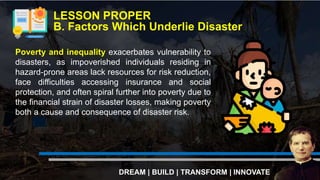
Poverty and inequality exacerbates vulnerability to
disasters, as impoverished individuals residing in
hazard-prone areas lack resources for risk reduction,
face difficulties accessing insurance and social
protection, and often spiral further into poverty due to
the financial strain of disaster losses, making poverty
both a cause and consequence of disaster risk.
LESSON PROPER
B. Factors Which Underlie Disaster
DREAM | BUILD | TRANSFORM | INNOVATE
Rapid and poorly planned urban
development in hazard-exposed
countries poses risks due to the
concentration of people, poverty,
and disaster vulnerability, while
also presenting opportunities for
resilient investment.
LESSON PROPER
B. Factors Which Underlie Disaster
DREAM | BUILD | TRANSFORM | INNOVATE
In areas of weak governance,
characterized by the inability or
unwillingness of public sector actors to fulfill
their roles, disaster risk is concentrated,
particularly in lower-income countries, and
disaster risk governance involves specific
societal arrangements for managing risk
within a broader context of overall risk
governance.
LESSON PROPER
B. Factors Which Underlie Disaster
DREAM | BUILD | TRANSFORM | INNOVATE
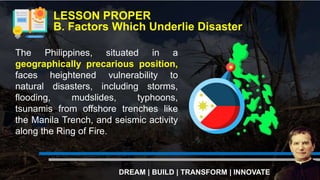
The Philippines, situated in a
geographically precarious position,
faces heightened vulnerability to
natural disasters, including storms,
flooding, mudslides, typhoons,
tsunamis from offshore trenches like
the Manila Trench, and seismic activity
along the Ring of Fire.
LESSON PROPER
B. Factors Which Underlie Disaster
DREAM | BUILD | TRANSFORM | INNOVATE
Certain factors related to a survivor’s background and
recovery is hampered if survivors:
• were not functioning well before the disaster;
• have no experience dealing with disasters;
• must deal with other stressors after the disaster;
• have low self-esteem;
• feel uncared for by others;
• think they exercise little control over what happens to
them; and
• unable to manage stress.
LESSON PROPER
B. Factors Which Underlie Disaster
DREAM | BUILD | TRANSFORM | INNOVATE
More factors contributory to worse outcomes:
• death of someone close;
• injury to self or family member;
• life threat;
• panic, horror, or similar feelings;
• separation from family;
• massive loss of property; and
• displacement

RISK FACTORS - DISASTER READINESS (DRRR)

  • 1.
    RISK FACTORS UNDERLYING DISASTERS DON BOSCOTECHNICAL INSTITUTE OF VICTORIAS INC. VICMICO, Victorias City, 6119 Negros Occidental, Philippines Senior High School Department | School Year 2022–2023 Science, Technology, Engineering, and Mathematics 11 Chapter 1: Basic Concept of Disaster & Disaster Risks Prepared by: Lord William B. Pacurib
  • 2.
    COMPETENCY: Differentiate therisk factors underlying disasters; (DRR11/12-Ia-b-2) • Identify the risk factors underlying disasters and describe each of them. • Utilize the gained knowledge in real life situations to avoid harm and assure safety • Appreciate the importance of understanding the risk factors underlying disasters to mitigate the effects of disaster and practice mitigation measures as early as necessary. OBJECTIVES Risk Underlying Disasters DREAM | BUILD | TRANSFORM | INNOVATE
  • 3.
    1. Refrain fromtalking if the teacher is having his lecture. Talk only if you are called. 2. Quietly remain on your seats while the class is ongoing (do not roam around the room). 3. Render appropriate courtesy towards the teacher. 4. Standard handbook rules apply. 5. Violation of aforementioned rules will be reflected on the violator’s diary. RULES DREAM | BUILD | TRANSFORM | INNOVATE
  • 4.
    INTRODUCTION DREAM | BUILD| TRANSFORM | INNOVATE Disaster can affect everyone. It does not discriminate between and among social classes, gender, creed, race, and nationality. • But certain risk factors put those affected in a position where they will have graver or longer-lasting post-disaster stress reactions. • These aggravating factors contribute to evident differences in the stress reactions of certain individuals with certain characteristics.
  • 5.
    Disaster risk hasthree important elements. • Exposure • Hazard • Vulnerability LESSON PROPER A. Risk Factors DREAM | BUILD | TRANSFORM | INNOVATE
  • 6.
    Exposure are theelements at risk from a natural or man-made hazard event. LESSON PROPER A. Risk Factors DREAM | BUILD | TRANSFORM | INNOVATE
  • 7.
    Hazards are potentiallydangerous physical occurrences, phenomenon or human activities that may result in loss of life or injury, property damage, social and economic disruption, or environmental degradation. LESSON PROPER A. Risk Factors DREAM | BUILD | TRANSFORM | INNOVATE
  • 8.
    Vulnerability is thecondition determined by physical, social, economic, and environmental factors or processes, which increase the susceptibility of a community to the impact of hazard. LESSON PROPER A. Risk Factors DREAM | BUILD | TRANSFORM | INNOVATE
  • 9.
    Reduction of thelevel of vulnerability and exposure is possible by keeping people and property as distant as possible from hazards. We can not avoid natural events from occurring, but we can concentrate on addressing the reduction of risk and exposure by determining the factors causing disasters. LESSON PROPER A. Risk Factors DREAM | BUILD | TRANSFORM | INNOVATE
  • 10.
    Risk factors areprocesses or conditions, often development- related, that influence the level of disaster risk by increasing levels of exposure and vulnerability or reducing capacity. LESSON PROPER A. Risk Factors DREAM | BUILD | TRANSFORM | INNOVATE
  • 11.
    LESSON PROPER A. RiskFactors DREAM | BUILD | TRANSFORM | INNOVATE Severity of exposure measures those who experience disaster firsthand which has the highest risk of developing future mental problems, followed by those in contact with the victims such as rescue workers and health care practitioners and the lowest risk are those most distant like those who have awareness of the disaster only through news.
  • 12.
    LESSON PROPER A. RiskFactors DREAM | BUILD | TRANSFORM | INNOVATE Gender and family: The female sex suffers more adverse effects. This worsens when children are present at home. Marital relationships are placed under strain.
  • 13.
    LESSON PROPER A. RiskFactors DREAM | BUILD | TRANSFORM | INNOVATE Age: Adults in the age range of 40-60 are more stressed after disasters. But in general, children exhibit more stress after disasters than adults do.
  • 14.
    LESSON PROPER A. RiskFactors DREAM | BUILD | TRANSFORM | INNOVATE Economic status of country: Evidence indicates that severe mental problems resulting from disasters are more prevalent in developing countries like the Philippines. Furthermore, it has been observed that natural disasters tend to have more adverse effects in developing countries than do man-caused disasters in developed countries.
  • 15.
    LESSON PROPER B. FactorsWhich Underlie Disaster DREAM | BUILD | TRANSFORM | INNOVATE Climate change can increase disaster risk in a variety of ways – by altering the frequency and intensity of hazards events, affecting vulnerability to hazards, and changing exposure patterns.
  • 16.
    LESSON PROPER B. FactorsWhich Underlie Disaster DREAM | BUILD | TRANSFORM | INNOVATE Environmental degradation, driven by factors like deforestation and overconsumption of natural resources, is a dual-sided catalyst for disasters, influencing hazard frequency and intensity, exacerbating vulnerability to events like landslides and storm surges, and compromising the environment's ability to provide crucial services, thereby creating a feedback loop of increased disaster risk and environmental decline.
  • 17.
    LESSON PROPER B. FactorsWhich Underlie Disaster DREAM | BUILD | TRANSFORM | INNOVATE Globalized economic development intensifies global wealth disparity, with heightened exposure of assets in hazard- prone areas; however, effective risk- sensitive strategies, including investing in protective infrastructure and upgrading settlements, offer an opportunity to enhance resilience.
  • 18.
    LESSON PROPER B. FactorsWhich Underlie Disaster DREAM | BUILD | TRANSFORM | INNOVATE Poverty and inequality exacerbates vulnerability to disasters, as impoverished individuals residing in hazard-prone areas lack resources for risk reduction, face difficulties accessing insurance and social protection, and often spiral further into poverty due to the financial strain of disaster losses, making poverty both a cause and consequence of disaster risk.
  • 19.
    LESSON PROPER B. FactorsWhich Underlie Disaster DREAM | BUILD | TRANSFORM | INNOVATE Rapid and poorly planned urban development in hazard-exposed countries poses risks due to the concentration of people, poverty, and disaster vulnerability, while also presenting opportunities for resilient investment.
  • 20.
    LESSON PROPER B. FactorsWhich Underlie Disaster DREAM | BUILD | TRANSFORM | INNOVATE In areas of weak governance, characterized by the inability or unwillingness of public sector actors to fulfill their roles, disaster risk is concentrated, particularly in lower-income countries, and disaster risk governance involves specific societal arrangements for managing risk within a broader context of overall risk governance.
  • 21.
    LESSON PROPER B. FactorsWhich Underlie Disaster DREAM | BUILD | TRANSFORM | INNOVATE The Philippines, situated in a geographically precarious position, faces heightened vulnerability to natural disasters, including storms, flooding, mudslides, typhoons, tsunamis from offshore trenches like the Manila Trench, and seismic activity along the Ring of Fire.
  • 22.
    LESSON PROPER B. FactorsWhich Underlie Disaster DREAM | BUILD | TRANSFORM | INNOVATE Certain factors related to a survivor’s background and recovery is hampered if survivors: • were not functioning well before the disaster; • have no experience dealing with disasters; • must deal with other stressors after the disaster; • have low self-esteem; • feel uncared for by others; • think they exercise little control over what happens to them; and • unable to manage stress.
  • 23.
    LESSON PROPER B. FactorsWhich Underlie Disaster DREAM | BUILD | TRANSFORM | INNOVATE More factors contributory to worse outcomes: • death of someone close; • injury to self or family member; • life threat; • panic, horror, or similar feelings; • separation from family; • massive loss of property; and • displacement