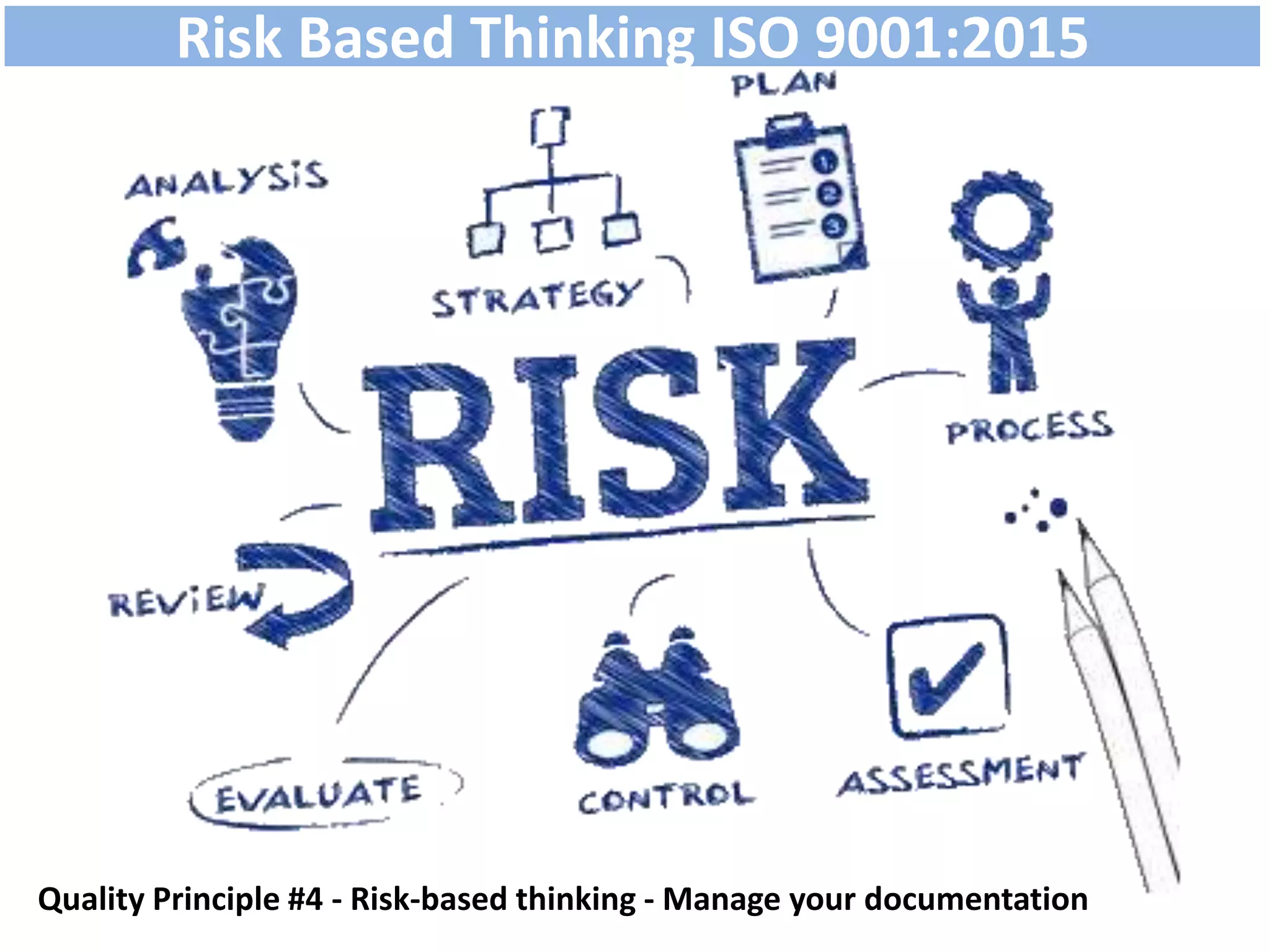

Risk Based Thinking ISO 9001:2015
Quality Principle #4 - Risk-based thinking - Manage your documentation
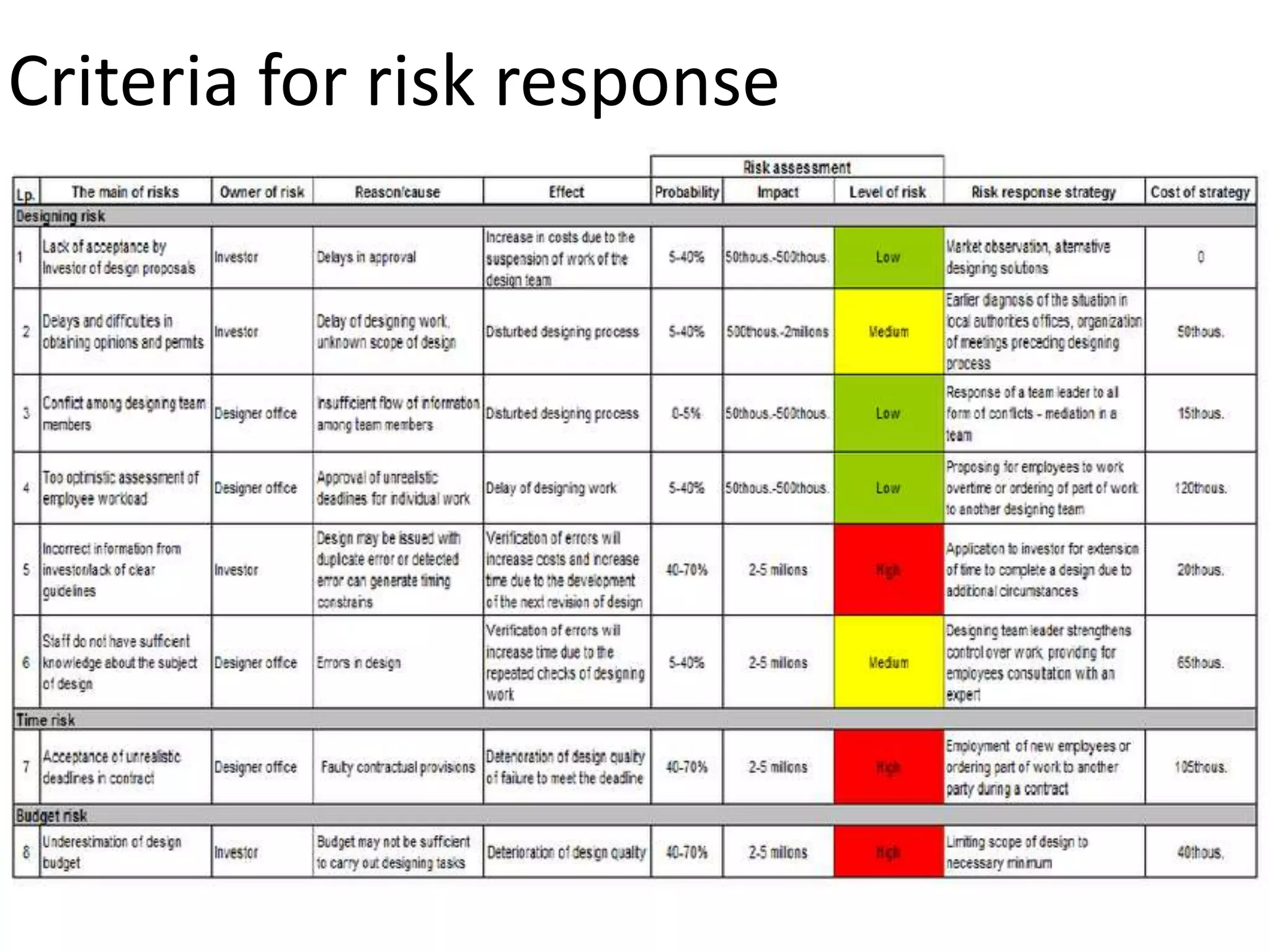
Criteria for risk response
Risk response must be:
 ‰Proportional to the severity of the risk
 ‰Cost effective
 ‰Timely
 ‰Realistic
 ‰Accepted by all parties involved
 ‰Owned by a person or a party
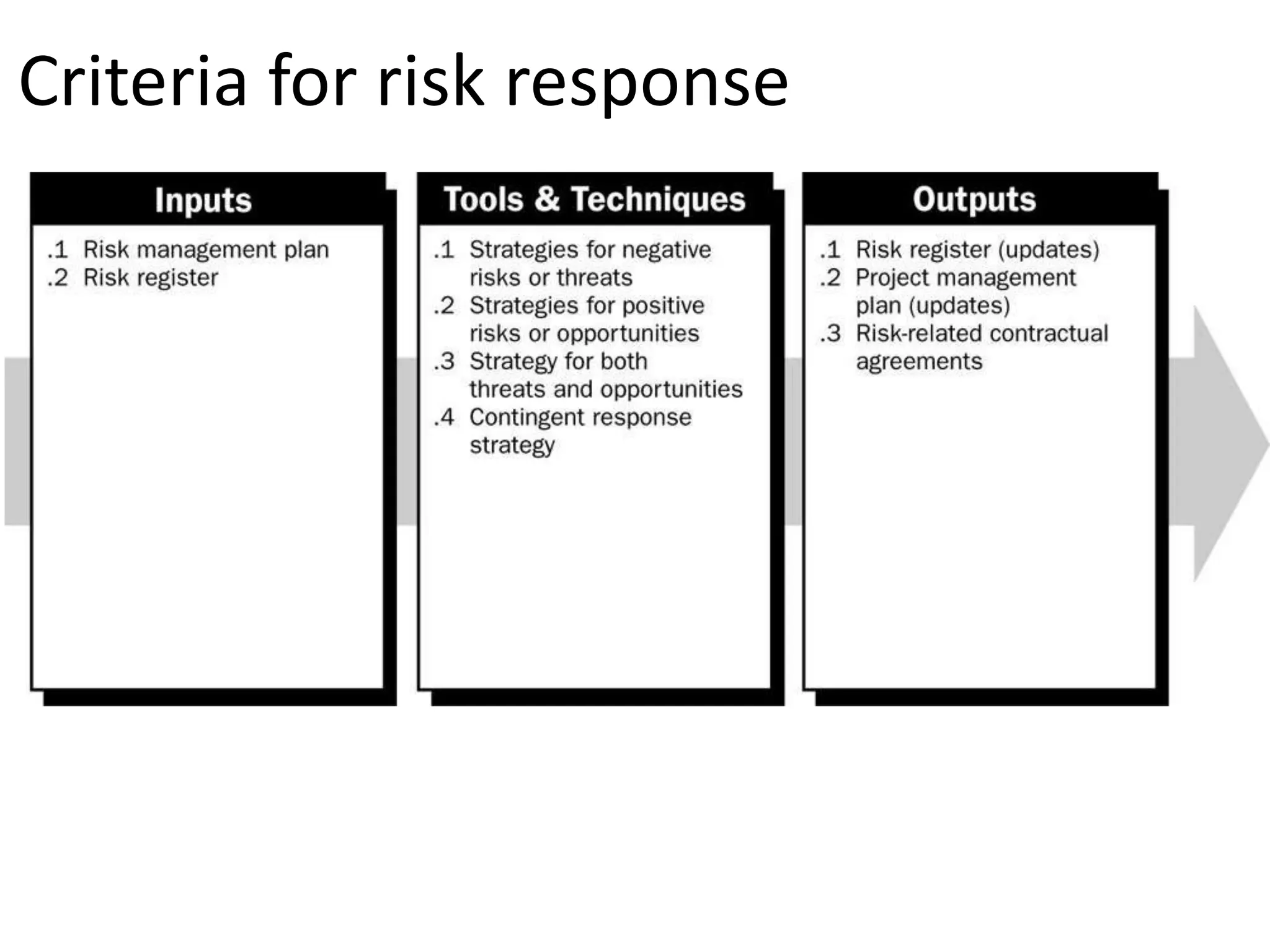
Criteria for risk response
Inputs to Risk Response Planning
1. Risk Management Plan
Major elements from the plan needed include roles & responsibilities, budgets and
schedule for risk management activities, risk categories, definitions of probability &
impact, and the stakeholders ’ tolerances.
2. Risk Register
Reference will be made to:
i. List of prioritized risks. from qualitative and quantitative risk analysis.
ii. Probabilistic analysis of the project. from quantitative risk analysis.
iii. Probability of achieving the cost and time objectives.
iv. List of potential responses. In the risk identification process, actions may be
identified that respond to individual risks or categories of risks.
Inputs to Risk Response Planning
v. Risk thresholds. The level of risk that is acceptable to the organization will
influence risk response planning.
vi. Risk owners. A list of project stakeholders able to act as owners of risk responses.
Risk owners should be involved in developing the risk responses.
vii. Common risk causes. Several risks may be driven by a common cause. This
situation may reveal opportunities to mitigate two or more project risks with one
generic response.
viii.Trends in *qualitative and *quantitative risk analysis results. Trends in results can
make risk response or further analysis more or less urgent and important.
ix. Watch list of low priority risks.
*Qualitative risk analysis is a project management technique concerned with discovering the probability of a risk event occurring and the impact the risk will have if it does occur.
*quantitative risk analysis is a further analysis of the highest priority risks during a which a numerical or quantitative rating is assigned in order to develop a probabilistic analysis of the
project.
Criteria for risk response
Tools & Techniques for Response Planning
1. Strategies for negative risks (Threats)
2. Strategies for positive risks (Opportunities)
Strategies for negative risks (Threats)
„Risk Response may be one of several strategies.
1. Avoid
2. Transfer
3. Mitigate
4. Accept
Risk Avoidance
„Risk avoidance is done by
 Changing the project plan to eliminate the risk or the condition that causes the risk
in order to protect the project objectives from its impact.
 ‰Relaxing the relevant objective (extend the schedule, reduce specification
requirements, reduce scope)
Not all risks can be avoided, but some may.
Examples of Risk Avoidance
 ‰Add resources or time.
 ‰Adopt a familiar approach instead of an innovative one.
 ‰Avoid an unfamiliar subcontractor.
 ‰Clarify requirements.
 ‰Improve communication
 ‰Obtain information
 ‰Acquire expertise.
 ‰Reduce scope to avoid high-risk activities
„Transfer the risk to a third party who will carry the risk impact and ownership of
the response.
„Risk Transfer is most effective in dealing with financial risk exposure.
„Risk transfer nearly always involves payment of a risk premium to the party
acquiring the risk. Examples of risk transfer are:
The use of insurance, performance bonds, warranties and guarantees.
Contracts may be used to transfer liability for specified risks to another party.
„Use of a fixed price contract may transfer risk to the seller if the project’s design is
stable. A cost reimbursable contract leaves more of the risk with the buyer, but it
may help reduce cost if there are mid-project changes.
Risk Transfer
 „Risk mitigation aims at reducing the probability and/or impact of a risk to within an
acceptable threshold.
 „The probability/Impact should be mitigated before the risk takes place. Thus
avoiding to deal with the consequences after the risk had occurred.
 „Mitigation costs should be appropriate given the likely impact and probability of
the risk.
Risk Mitigation
 „Implementing a new course of action that will reduce the problem, e.g. adopting
less complex processes, conducting more seismic or engineering tests, or
choosing a more stable supplier.
 Changing conditions so that the probability of the risk occurring is reduced, e.g.
adding resources or time to the schedule.
 „Prototype development to reduce the risk of scaling up from a bench scale
model.
Examples of Risk Mitigation
Risk Acceptance
Acceptance indicates a decision not to make any changes to the project plan to deal
with a risk or that a suitable response strategy cannot be identified. This strategy can
be used for both negative and positive risks
There are two types of acceptance:
‰Active acceptance: may include developing a contingency plan to execute should a
risk occurs.
‰Passive acceptance: requires no action. The project team will deal with the risk as it
occurs.
„A contingency plan is developed in advance to respond to risks that arise during
the project. Planning would reduce the cost of an action should the risk occur. Risk
triggers, such as missing intermediate milestones, should be defined and tracked.
Share the risk
 Allocate ownership to a third party who has a better chance of achieving the required
results. Examples: joint ventures, partnerships, rewards.
Items in the risk register
 ‰Identified risks, their description, the area of the project (e.g. WBS element)
affected, their causes and how they may affect project objectives.
 Risk owners and assigned responsibilities.
 Results from the qualitative and quantitative risk analysis processes.
 Agreed response strategies
 Specific actions to implement the response plan.
 Budget and schedule activities for responses.
 Symptoms and warning signs for risks’ occurrence
 Contingency plans with triggers
 Contingency reserves.
 Fallback plan for when risk occurs and original response is inadequate
 Residual risks expected to be remaining after the strategy is implemented and accepted risks
 Secondary risks arising directly from implementing a risk response
Risk Register Content
1. Project Management Plan Updates
The project management plan is updated to incorporate response activities including
reflecting impact on cost and schedule.
2. Contractual agreements.
Contractual agreements are prepared to specify each party’s responsibility for
specific risks, should they occur. This include agreements for insurance, services, and
other items as appropriate in order to avoid or mitigate threats.
Results from Risk Response Planning
Thank you!!!

Risk based thinking

  • 1.
    Risk Based ThinkingISO 9001:2015 Quality Principle #4 - Risk-based thinking - Manage your documentation
  • 2.
    Criteria for riskresponse Risk response must be:  ‰Proportional to the severity of the risk  ‰Cost effective  ‰Timely  ‰Realistic  ‰Accepted by all parties involved  ‰Owned by a person or a party
  • 3.
  • 4.
    Inputs to RiskResponse Planning 1. Risk Management Plan Major elements from the plan needed include roles & responsibilities, budgets and schedule for risk management activities, risk categories, definitions of probability & impact, and the stakeholders ’ tolerances. 2. Risk Register Reference will be made to: i. List of prioritized risks. from qualitative and quantitative risk analysis. ii. Probabilistic analysis of the project. from quantitative risk analysis. iii. Probability of achieving the cost and time objectives. iv. List of potential responses. In the risk identification process, actions may be identified that respond to individual risks or categories of risks.
  • 5.
    Inputs to RiskResponse Planning v. Risk thresholds. The level of risk that is acceptable to the organization will influence risk response planning. vi. Risk owners. A list of project stakeholders able to act as owners of risk responses. Risk owners should be involved in developing the risk responses. vii. Common risk causes. Several risks may be driven by a common cause. This situation may reveal opportunities to mitigate two or more project risks with one generic response. viii.Trends in *qualitative and *quantitative risk analysis results. Trends in results can make risk response or further analysis more or less urgent and important. ix. Watch list of low priority risks. *Qualitative risk analysis is a project management technique concerned with discovering the probability of a risk event occurring and the impact the risk will have if it does occur. *quantitative risk analysis is a further analysis of the highest priority risks during a which a numerical or quantitative rating is assigned in order to develop a probabilistic analysis of the project.
  • 6.
  • 7.
    Tools & Techniquesfor Response Planning 1. Strategies for negative risks (Threats) 2. Strategies for positive risks (Opportunities)
  • 8.
    Strategies for negativerisks (Threats) „Risk Response may be one of several strategies. 1. Avoid 2. Transfer 3. Mitigate 4. Accept
  • 9.
    Risk Avoidance „Risk avoidanceis done by  Changing the project plan to eliminate the risk or the condition that causes the risk in order to protect the project objectives from its impact.  ‰Relaxing the relevant objective (extend the schedule, reduce specification requirements, reduce scope) Not all risks can be avoided, but some may.
  • 10.
    Examples of RiskAvoidance  ‰Add resources or time.  ‰Adopt a familiar approach instead of an innovative one.  ‰Avoid an unfamiliar subcontractor.  ‰Clarify requirements.  ‰Improve communication  ‰Obtain information  ‰Acquire expertise.  ‰Reduce scope to avoid high-risk activities
  • 11.
    „Transfer the riskto a third party who will carry the risk impact and ownership of the response. „Risk Transfer is most effective in dealing with financial risk exposure. „Risk transfer nearly always involves payment of a risk premium to the party acquiring the risk. Examples of risk transfer are: The use of insurance, performance bonds, warranties and guarantees. Contracts may be used to transfer liability for specified risks to another party. „Use of a fixed price contract may transfer risk to the seller if the project’s design is stable. A cost reimbursable contract leaves more of the risk with the buyer, but it may help reduce cost if there are mid-project changes. Risk Transfer
  • 12.
     „Risk mitigationaims at reducing the probability and/or impact of a risk to within an acceptable threshold.  „The probability/Impact should be mitigated before the risk takes place. Thus avoiding to deal with the consequences after the risk had occurred.  „Mitigation costs should be appropriate given the likely impact and probability of the risk. Risk Mitigation
  • 13.
     „Implementing anew course of action that will reduce the problem, e.g. adopting less complex processes, conducting more seismic or engineering tests, or choosing a more stable supplier.  Changing conditions so that the probability of the risk occurring is reduced, e.g. adding resources or time to the schedule.  „Prototype development to reduce the risk of scaling up from a bench scale model. Examples of Risk Mitigation
  • 14.
    Risk Acceptance Acceptance indicatesa decision not to make any changes to the project plan to deal with a risk or that a suitable response strategy cannot be identified. This strategy can be used for both negative and positive risks There are two types of acceptance: ‰Active acceptance: may include developing a contingency plan to execute should a risk occurs. ‰Passive acceptance: requires no action. The project team will deal with the risk as it occurs. „A contingency plan is developed in advance to respond to risks that arise during the project. Planning would reduce the cost of an action should the risk occur. Risk triggers, such as missing intermediate milestones, should be defined and tracked.
  • 15.
    Share the risk Allocate ownership to a third party who has a better chance of achieving the required results. Examples: joint ventures, partnerships, rewards.
  • 16.
    Items in therisk register  ‰Identified risks, their description, the area of the project (e.g. WBS element) affected, their causes and how they may affect project objectives.  Risk owners and assigned responsibilities.  Results from the qualitative and quantitative risk analysis processes.  Agreed response strategies  Specific actions to implement the response plan.  Budget and schedule activities for responses.  Symptoms and warning signs for risks’ occurrence  Contingency plans with triggers  Contingency reserves.  Fallback plan for when risk occurs and original response is inadequate  Residual risks expected to be remaining after the strategy is implemented and accepted risks  Secondary risks arising directly from implementing a risk response Risk Register Content
  • 17.
    1. Project ManagementPlan Updates The project management plan is updated to incorporate response activities including reflecting impact on cost and schedule. 2. Contractual agreements. Contractual agreements are prepared to specify each party’s responsibility for specific risks, should they occur. This include agreements for insurance, services, and other items as appropriate in order to avoid or mitigate threats. Results from Risk Response Planning
  • 18.