Dr. Ahmed-Refat AG Refat   www.Slideshare.net/AhmedRefat Risk Management System, 2012


Risk Management System
       In Occupational Health Setting


                              ‫إدارة املخاطر‬
                     ‫يف جمال الصحة املهنية‬


          Dr. Ahmed-Refat AG Refat
               Prof. Occupational Medicine
                    Tibsah University, KSA
                                       2012
                                           1
Dr. Ahmed-Refat AG Refat   www.Slideshare.net/AhmedRefat Risk Management System, 2012


Basic Concepts and Definitions


1- Hazard and Risk


Hazard

    A source of potential harm
    Anything that has the potential to
     cause harm
    A factor or exposure that may
     adversely affect health.
Risk

Risk = The probability that an adverse event will
             occur

Risk = The chance of something happening that
             will have an impact on objectives.

            Risk was measured in terms of
         Consequences and the Likelihood

                                           2
Dr. Ahmed-Refat AG Refat   www.Slideshare.net/AhmedRefat Risk Management System, 2012

2 - Risk Management System " RMS"
    RMS is an ongoing process of identifying,
       quantifying and ranking risks and their
       associated losses, and developing cost
       effective management strategies to
       eliminate or control the risks.


Risk Evaluation = identifying risks, setting
   priorities commissioning and reviewing
                           risk assessment .


   Risk Assessment = combination of Risk
       identification, risk analysis and risk
                                 evaluation


                                           3
Dr. Ahmed-Refat AG Refat   www.Slideshare.net/AhmedRefat Risk Management System, 2012

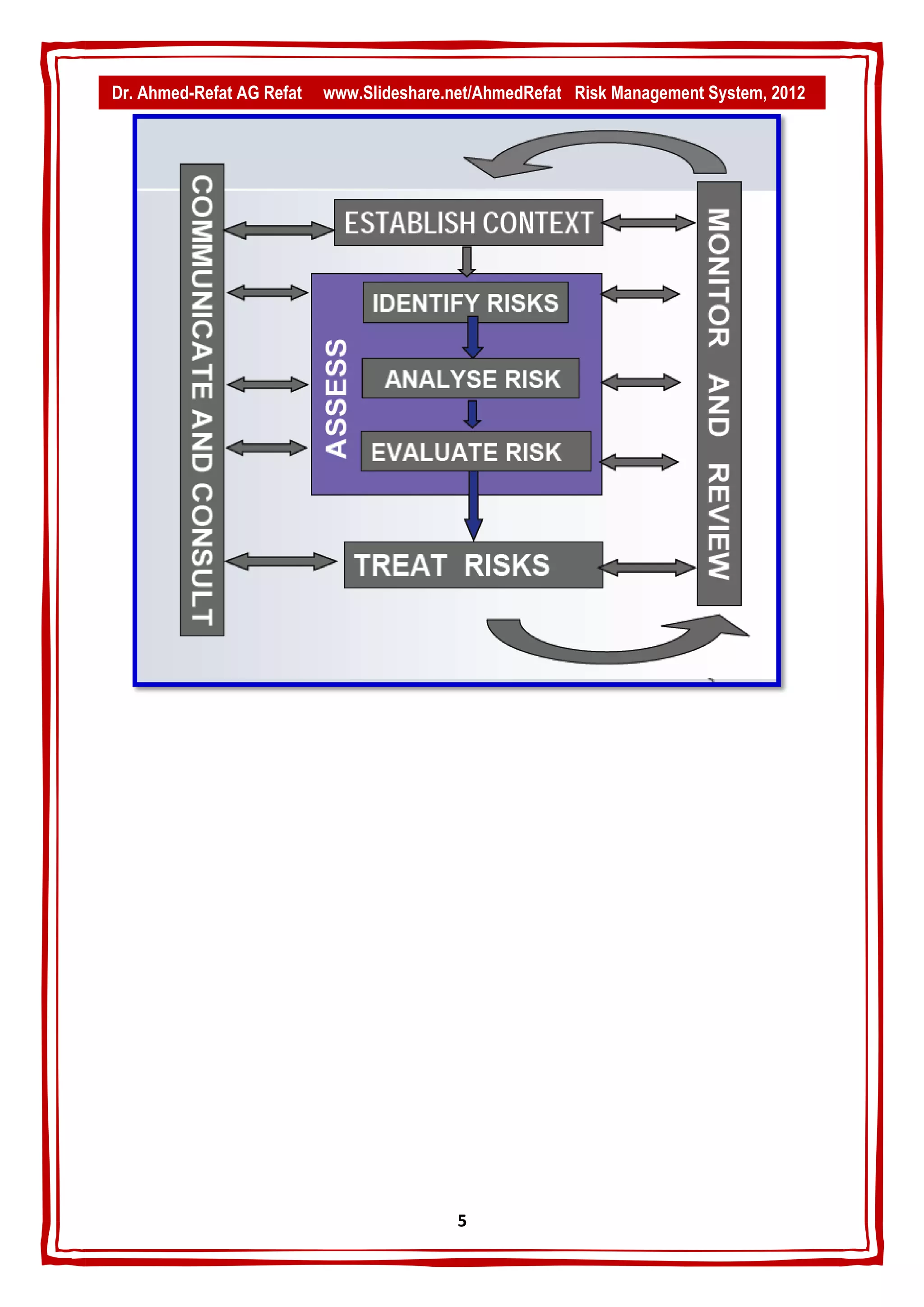
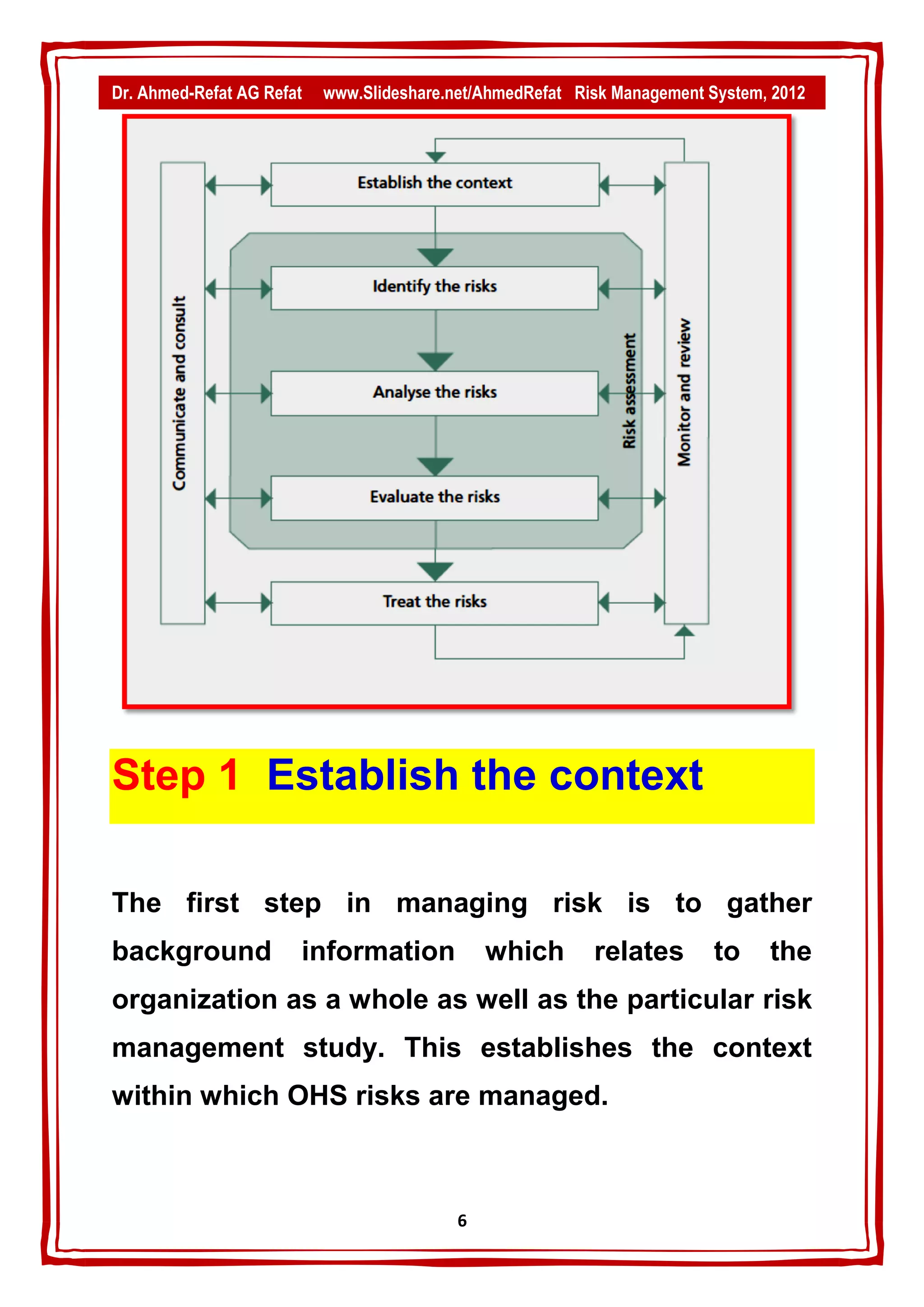
 Steps of Risk Management Process

The risk management process consists of a
series of steps that, when undertaken in
sequence, enable continual improvement in
decision-making.


   1. Establish the context

   2. Identify hazards

   3. Analyse risks that may result because of the
       hazard

   4. Evaluate the risks

   5. Treat the risks

   6. Review and Monitor the risk


                                           4
Dr. Ahmed-Refat AG Refat   www.Slideshare.net/AhmedRefat Risk Management System, 2012


                                           5
Dr. Ahmed-Refat AG Refat   www.Slideshare.net/AhmedRefat Risk Management System, 2012


Step 1 Establish the context

The first step in managing risk is to gather
background             information             which       relates       to     the
organization as a whole as well as the particular risk
management study. This establishes the context
within which OHS risks are managed.


                                           6
Dr. Ahmed-Refat AG Refat   www.Slideshare.net/AhmedRefat Risk Management System, 2012

Step 2 Hazard Identification

Risk cannot be managed unless it is first
identified.
The aim of risk identification is to identify
possible risks that may affect, either negatively
or positively, the objectives of the organization
and the activity under analysis. .


Identifying retrospective risks


Retrospective risks are those that have
previously occurred.


There are many sources of information about
retrospective risk. These include:
• hazard or incident logs or registers
• audit reports
• customer complaints
• accreditation documents and reports

                                           7
Dr. Ahmed-Refat AG Refat   www.Slideshare.net/AhmedRefat Risk Management System, 2012

• past staff or client surveys
• newspapers or professional media, such as
journals or websites.


Identifying prospective risks


Prospective risks are often harder to identify. These
are things that have not yet happened, but might
happen some time in the future.


Identification should include all risks, whether or not
they are currently being managed.
Methods for identifying prospective risks:
• brainstorming with staff
• researching the economic, political,
     legislative and operating environment
• conducting interviews with relevant people
     and/or organisations
• undertaking surveys of staff or clients .
• flow charting a process


                                           8
Dr. Ahmed-Refat AG Refat   www.Slideshare.net/AhmedRefat Risk Management System, 2012


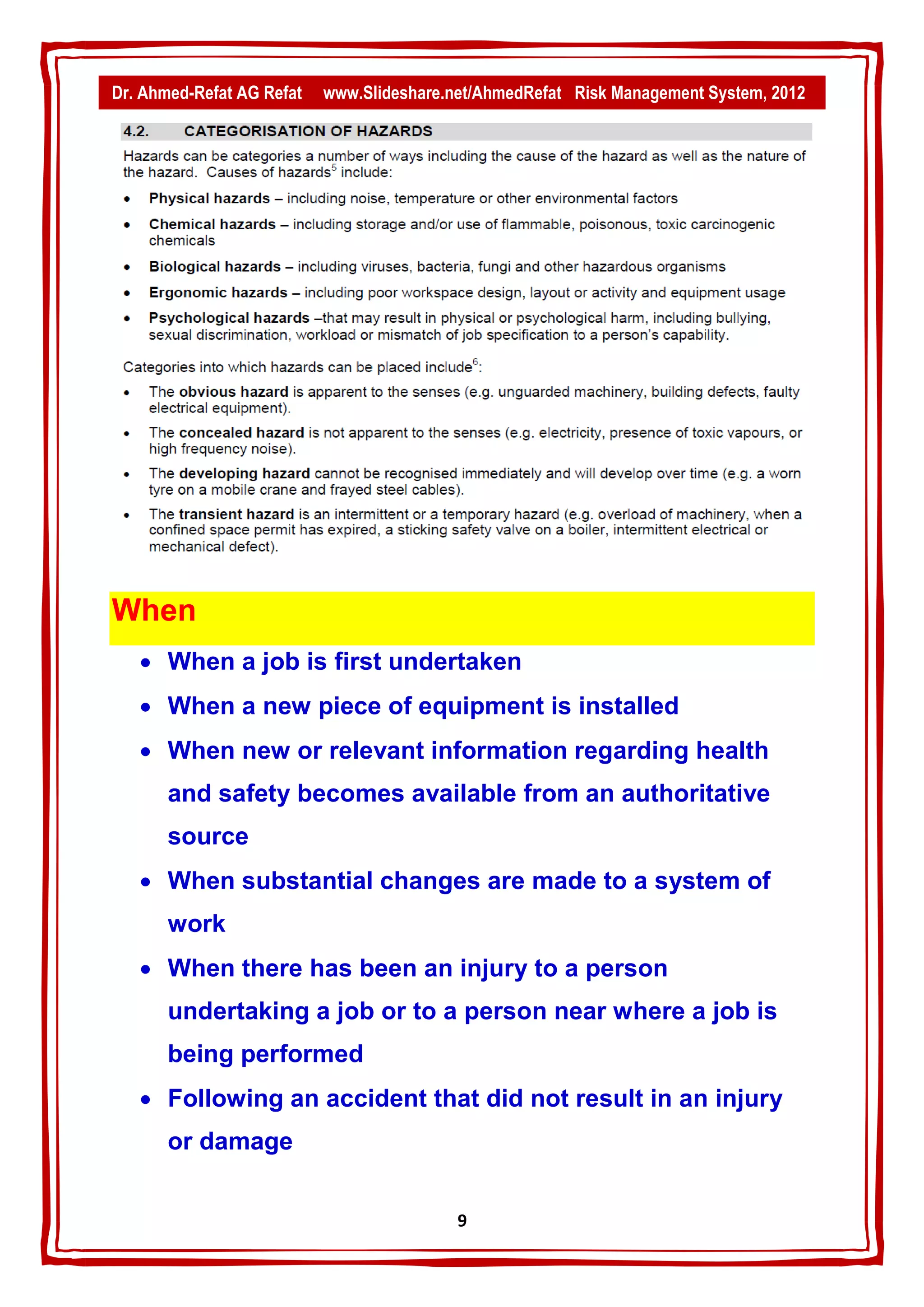
When
    When a job is first undertaken
    When a new piece of equipment is installed
    When new or relevant information regarding health
       and safety becomes available from an authoritative
       source
    When substantial changes are made to a system of
       work
    When there has been an injury to a person
       undertaking a job or to a person near where a job is
       being performed
    Following an accident that did not result in an injury
       or damage


                                           9
Dr. Ahmed-Refat AG Refat   www.Slideshare.net/AhmedRefat Risk Management System, 2012
    When there is evidence to suggest that a current risk
       assessment is no longer valid
    When hazardous substances and/or dangerous goods
       are introduced into the workplace
    As part of the design and construction of a new
       facility
    Prior to conducting an experiment
    As part of developing and designing a new subject,
       unit or course outline
    Prior to conducting a field trip


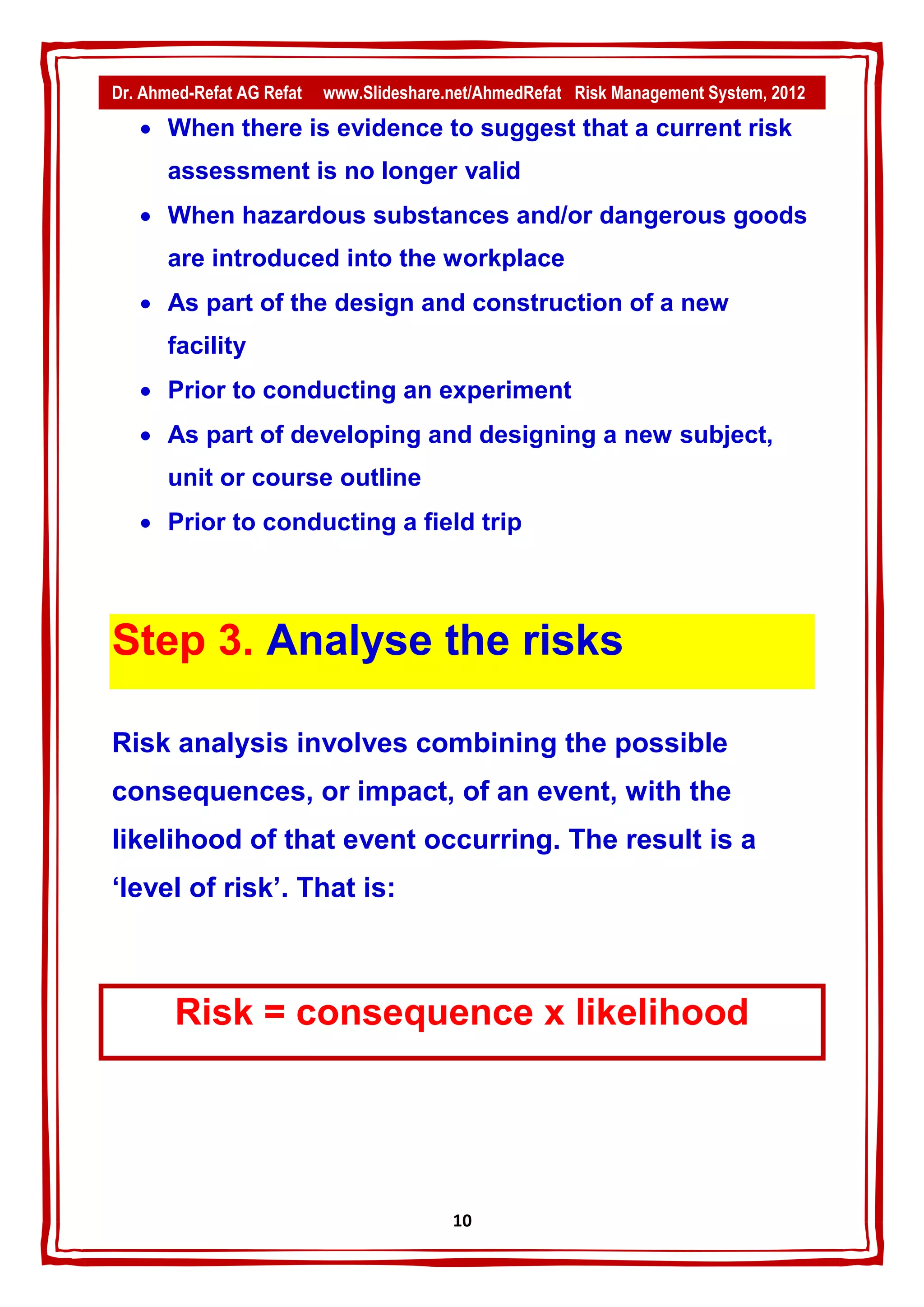
Step 3. Analyse the risks

Risk analysis involves combining the possible
consequences, or impact, of an event, with the
likelihood of that event occurring. The result is a
‘level of risk’. That is:


       Risk = consequence x likelihood


                                          11
Dr. Ahmed-Refat AG Refat   www.Slideshare.net/AhmedRefat Risk Management System, 2012

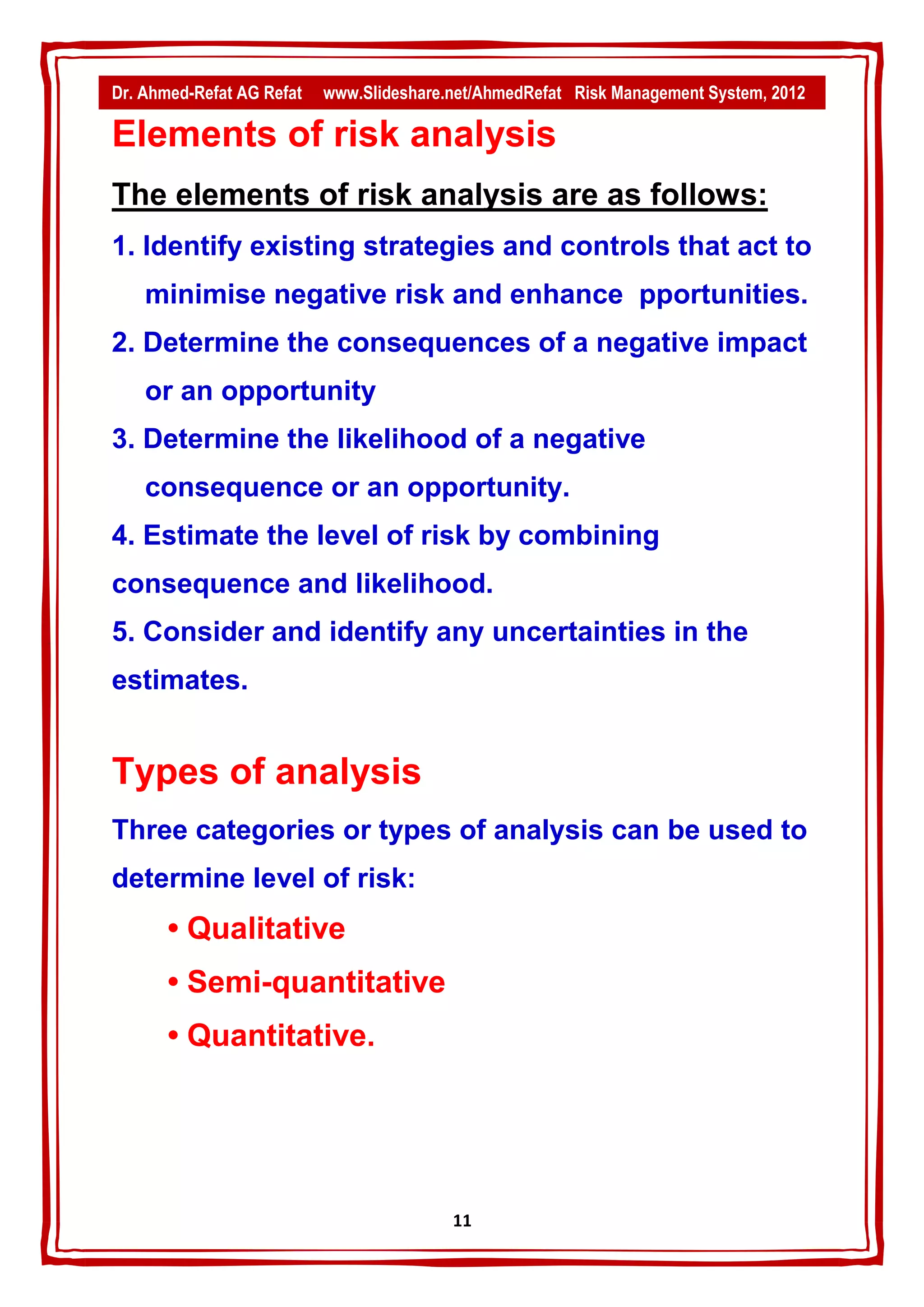
Elements of risk analysis
The elements of risk analysis are as follows:
1. Identify existing strategies and controls that act to
    minimise negative risk and enhance pportunities.
2. Determine the consequences of a negative impact
    or an opportunity
3. Determine the likelihood of a negative
    consequence or an opportunity.
4. Estimate the level of risk by combining
consequence and likelihood.
5. Consider and identify any uncertainties in the
estimates.


Types of analysis
Three categories or types of analysis can be used to
determine level of risk:
       • Qualitative
       • Semi-quantitative
       • Quantitative.


                                          11
Dr. Ahmed-Refat AG Refat   www.Slideshare.net/AhmedRefat Risk Management System, 2012

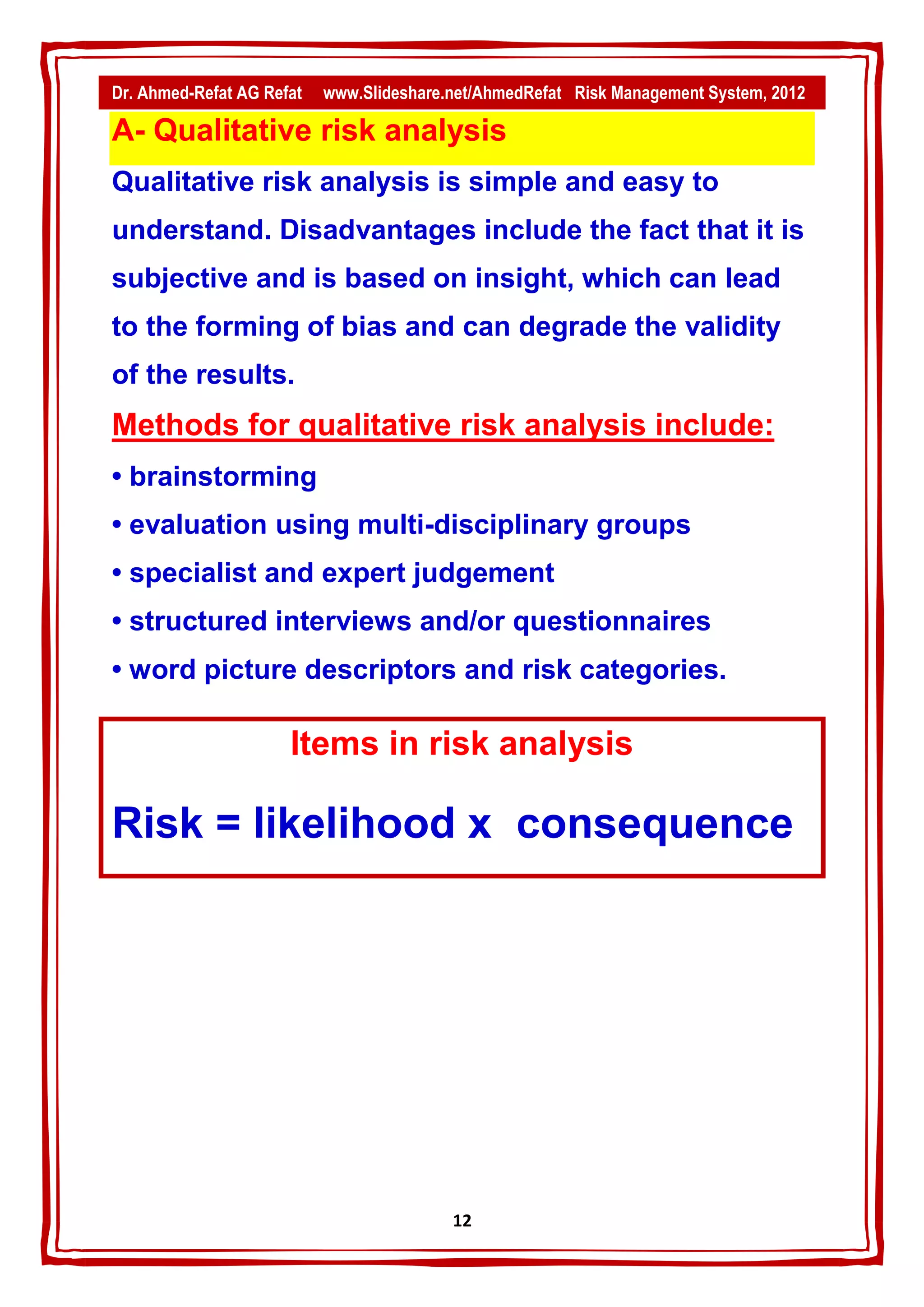
A- Qualitative risk analysis
Qualitative risk analysis is simple and easy to
understand. Disadvantages include the fact that it is
subjective and is based on insight, which can lead
to the forming of bias and can degrade the validity
of the results.
Methods for qualitative risk analysis include:
• brainstorming
• evaluation using multi-disciplinary groups
• specialist and expert judgement
• structured interviews and/or questionnaires
• word picture descriptors and risk categories.

                      Items in risk analysis

Risk = likelihood x consequence


                                          12
Dr. Ahmed-Refat AG Refat   www.Slideshare.net/AhmedRefat Risk Management System, 2012

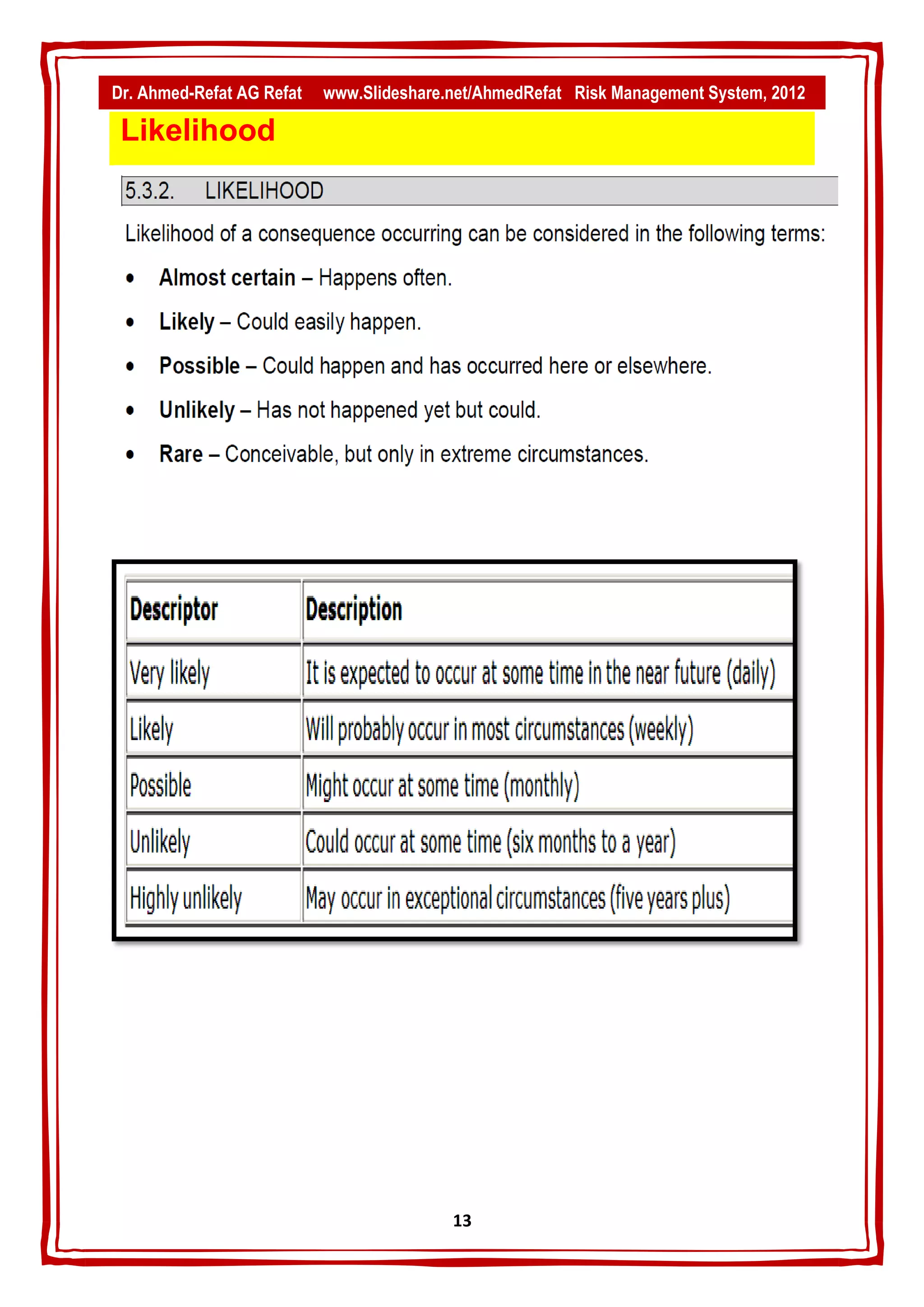
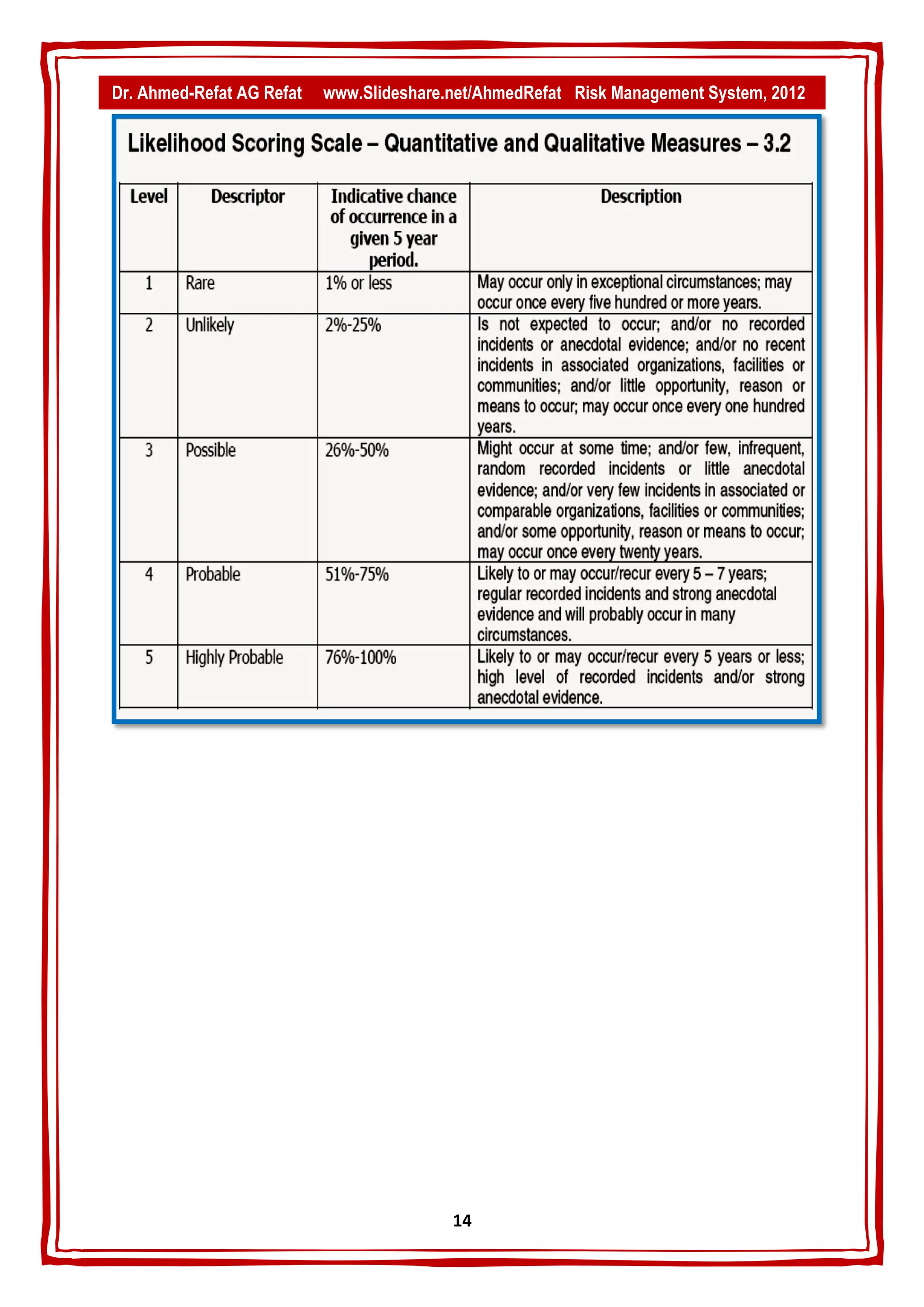
 Likelihood


                                          13
Dr. Ahmed-Refat AG Refat   www.Slideshare.net/AhmedRefat Risk Management System, 2012


                                          14
Dr. Ahmed-Refat AG Refat   www.Slideshare.net/AhmedRefat Risk Management System, 2012

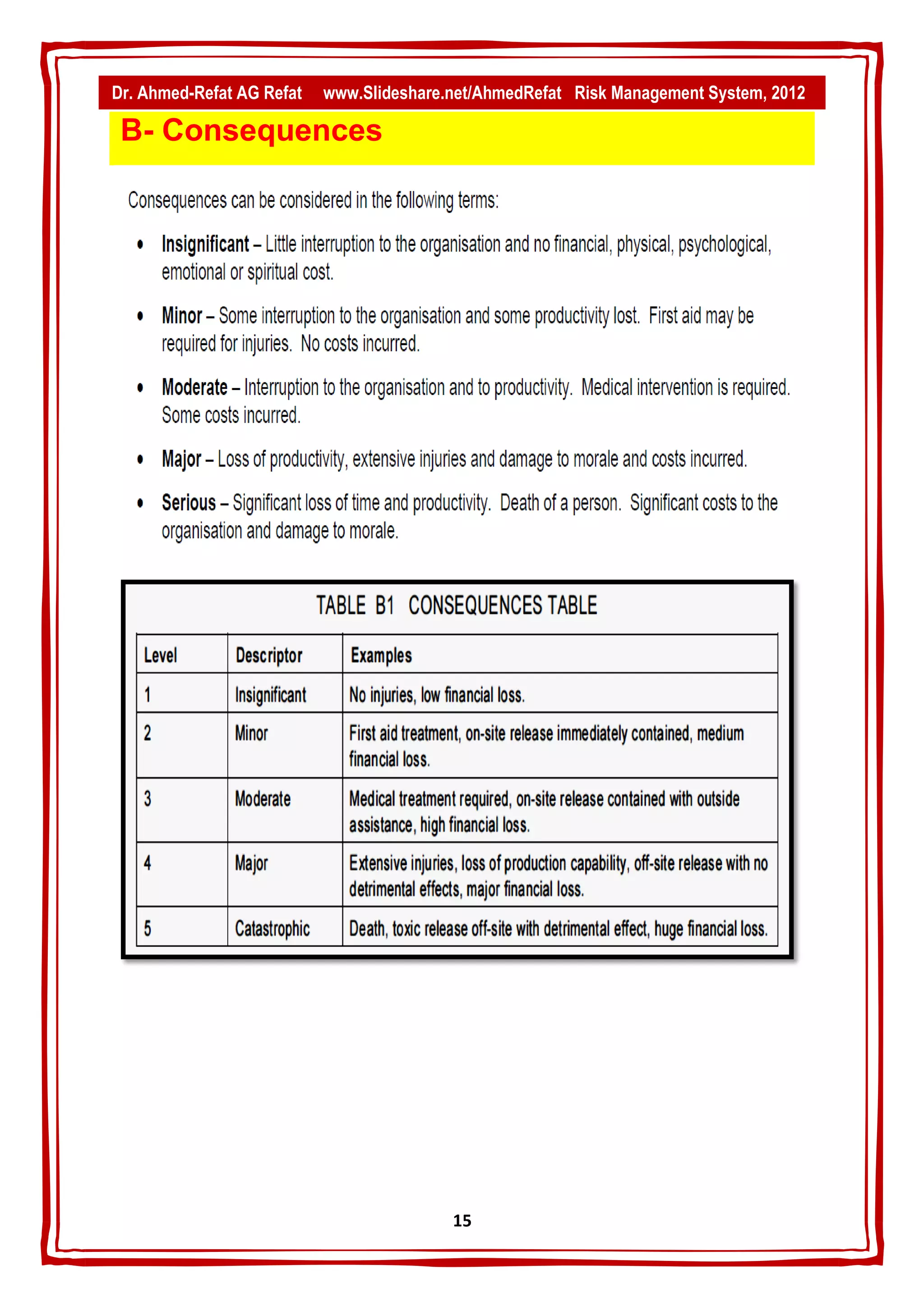
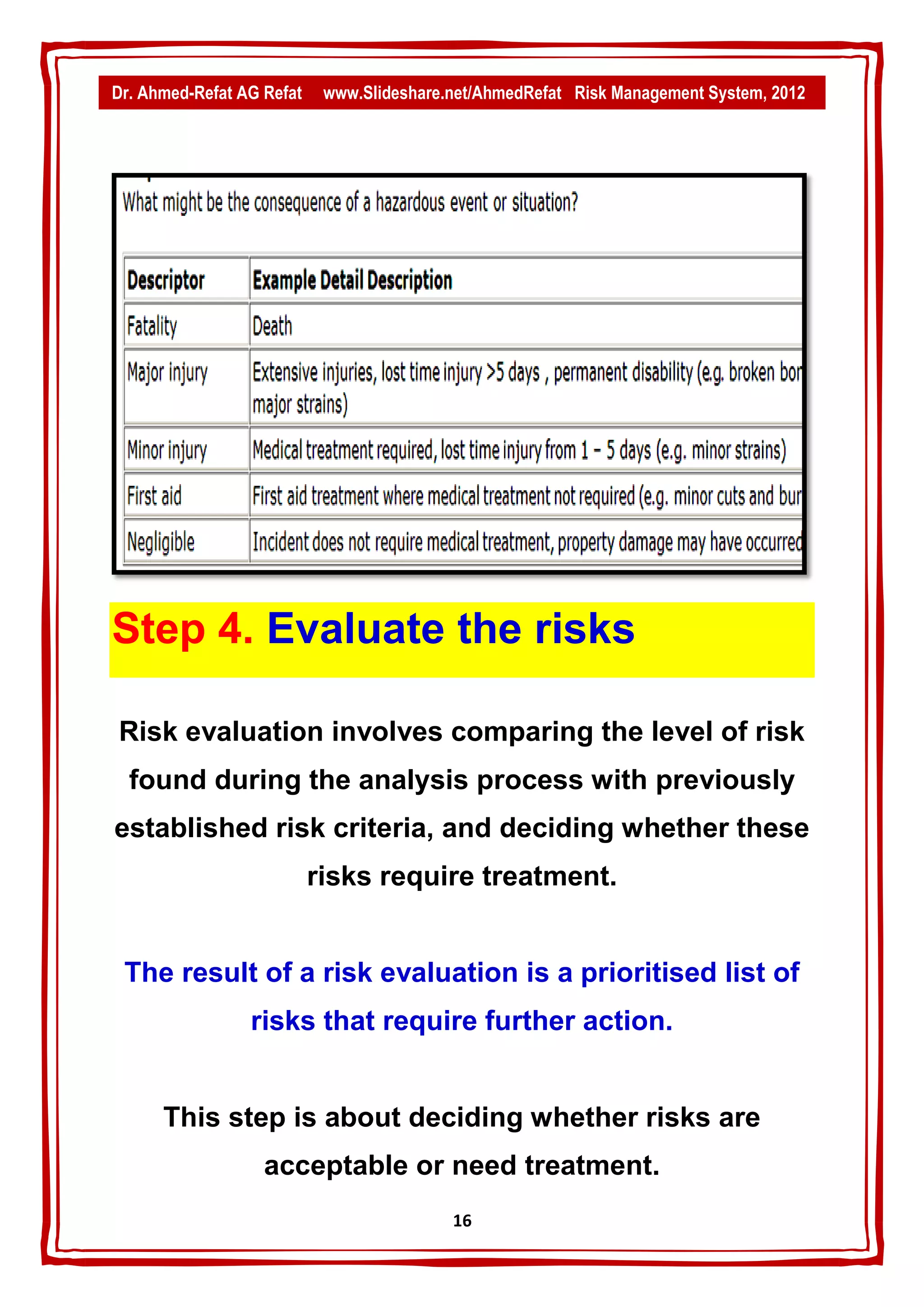
 B- Consequences


                                          15
Dr. Ahmed-Refat AG Refat    www.Slideshare.net/AhmedRefat Risk Management System, 2012


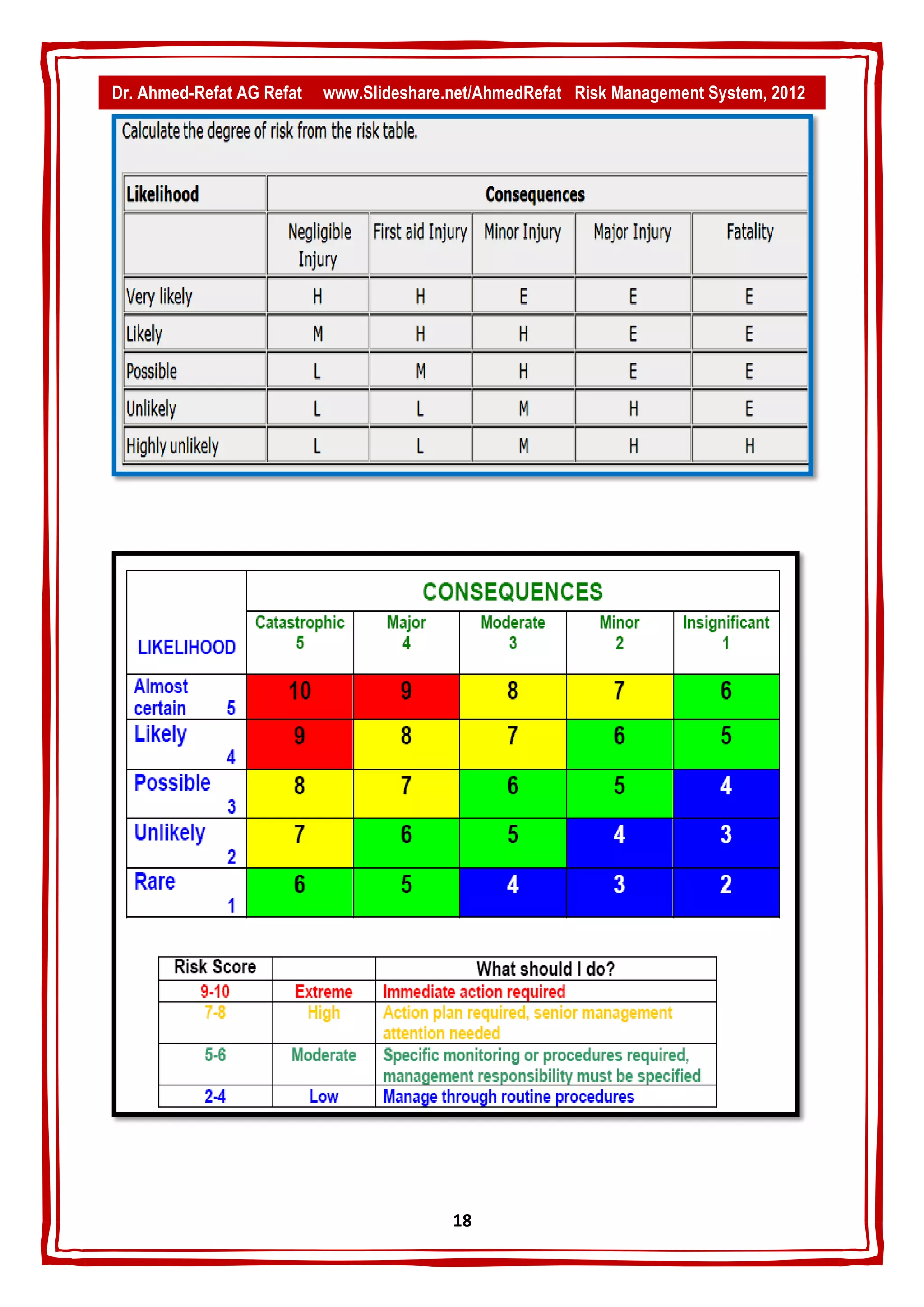
Step 4. Evaluate the risks

Risk evaluation involves comparing the level of risk
  found during the analysis process with previously
established risk criteria, and deciding whether these
                           risks require treatment.


 The result of a risk evaluation is a prioritised list of
                 risks that require further action.


      This step is about deciding whether risks are
                   acceptable or need treatment.
                                           16
Dr. Ahmed-Refat AG Refat   www.Slideshare.net/AhmedRefat Risk Management System, 2012


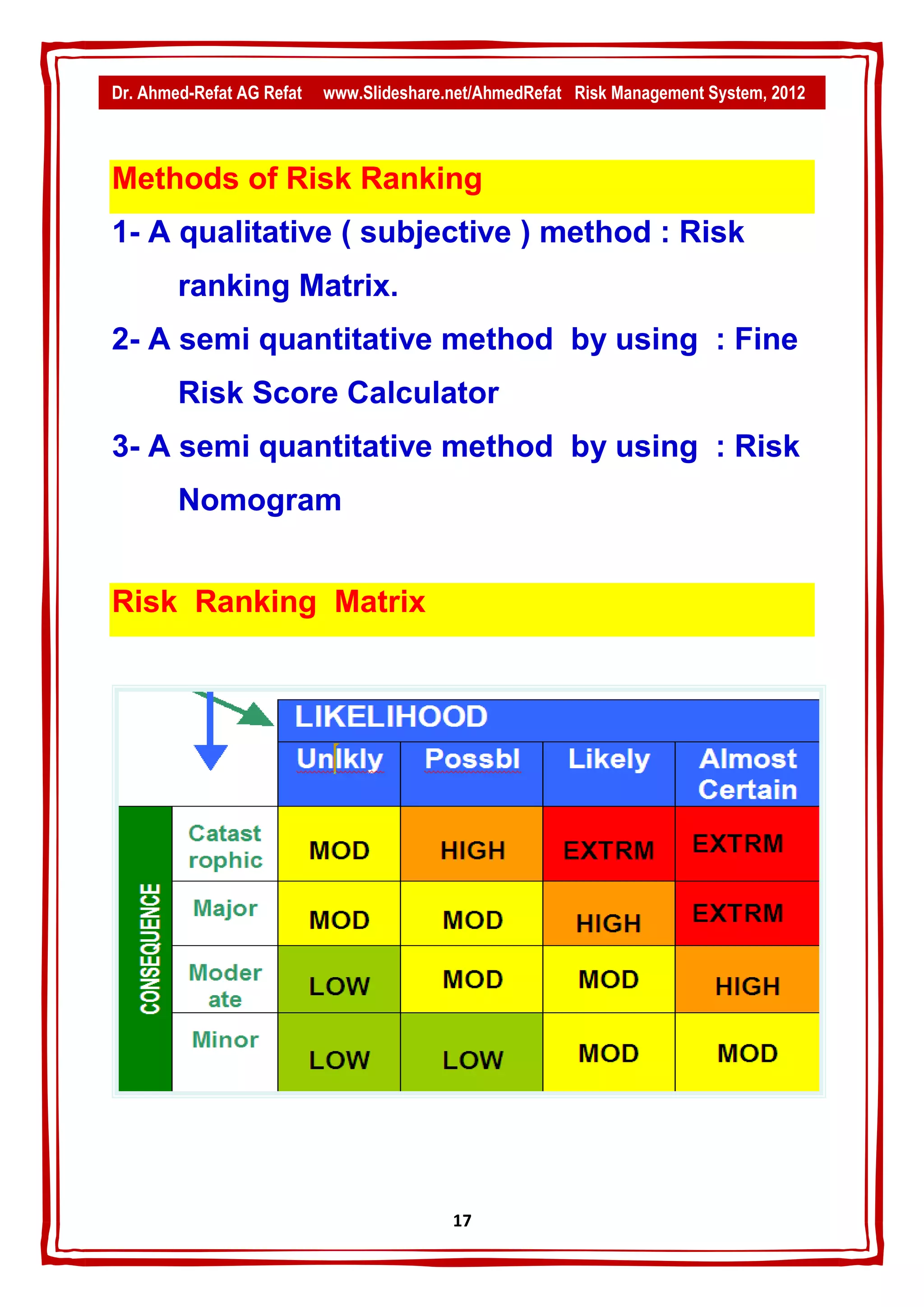
Methods of Risk Ranking
1- A qualitative ( subjective ) method : Risk
        ranking Matrix.
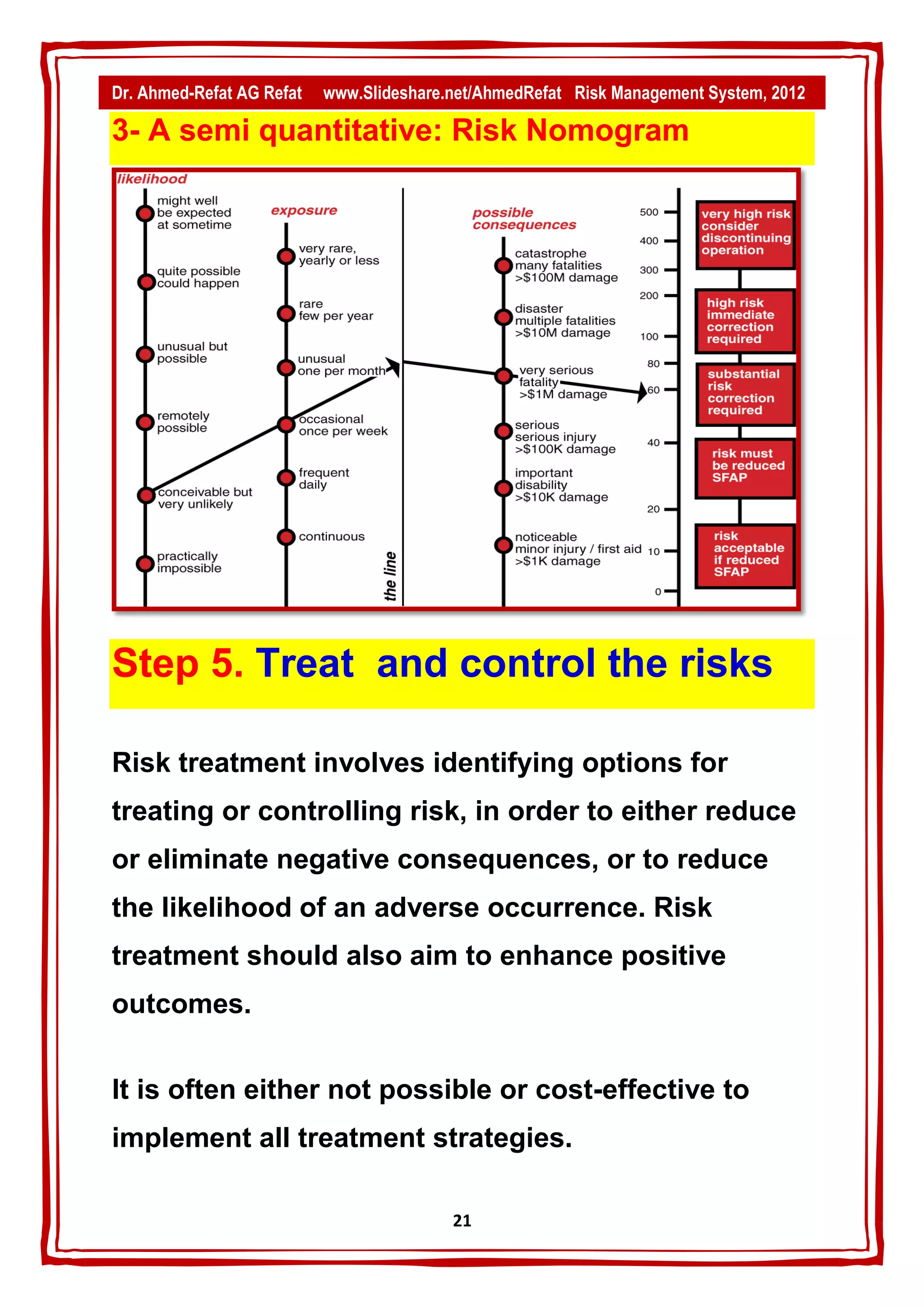
2- A semi quantitative method by using : Fine
        Risk Score Calculator
3- A semi quantitative method by using : Risk
        Nomogram


Risk Ranking Matrix


                                          17
Dr. Ahmed-Refat AG Refat   www.Slideshare.net/AhmedRefat Risk Management System, 2012


                                          18
Dr. Ahmed-Refat AG Refat   www.Slideshare.net/AhmedRefat Risk Management System, 2012

Risk acceptance

Low or tolerable risks may be accepted.
‘Acceptable’ means the business chooses to
‘accept’ that the risk exists, either because the risk
is at a low level and the cost of treating the risk will
outweigh the benefit, or there is no reasonable
treatment that can be implemented. This is also
known as ALARP (as low as reasonably practicable).


A risk may be accepted for the following reasons:
• The cost of treatment far exceeds the benefit, so
that acceptance is the only option (applies
particularly to lower ranked risks)
• The level of the risk is so low that specific
treatment is not appropriate with available
resources
• The opportunities presented outweigh the threats
to such a degree that the risk is justified
• The risk is such that there is no treatment
available, for example the risk that the business may
suffer storm damage.

                                          19
Dr. Ahmed-Refat AG Refat   www.Slideshare.net/AhmedRefat Risk Management System, 2012

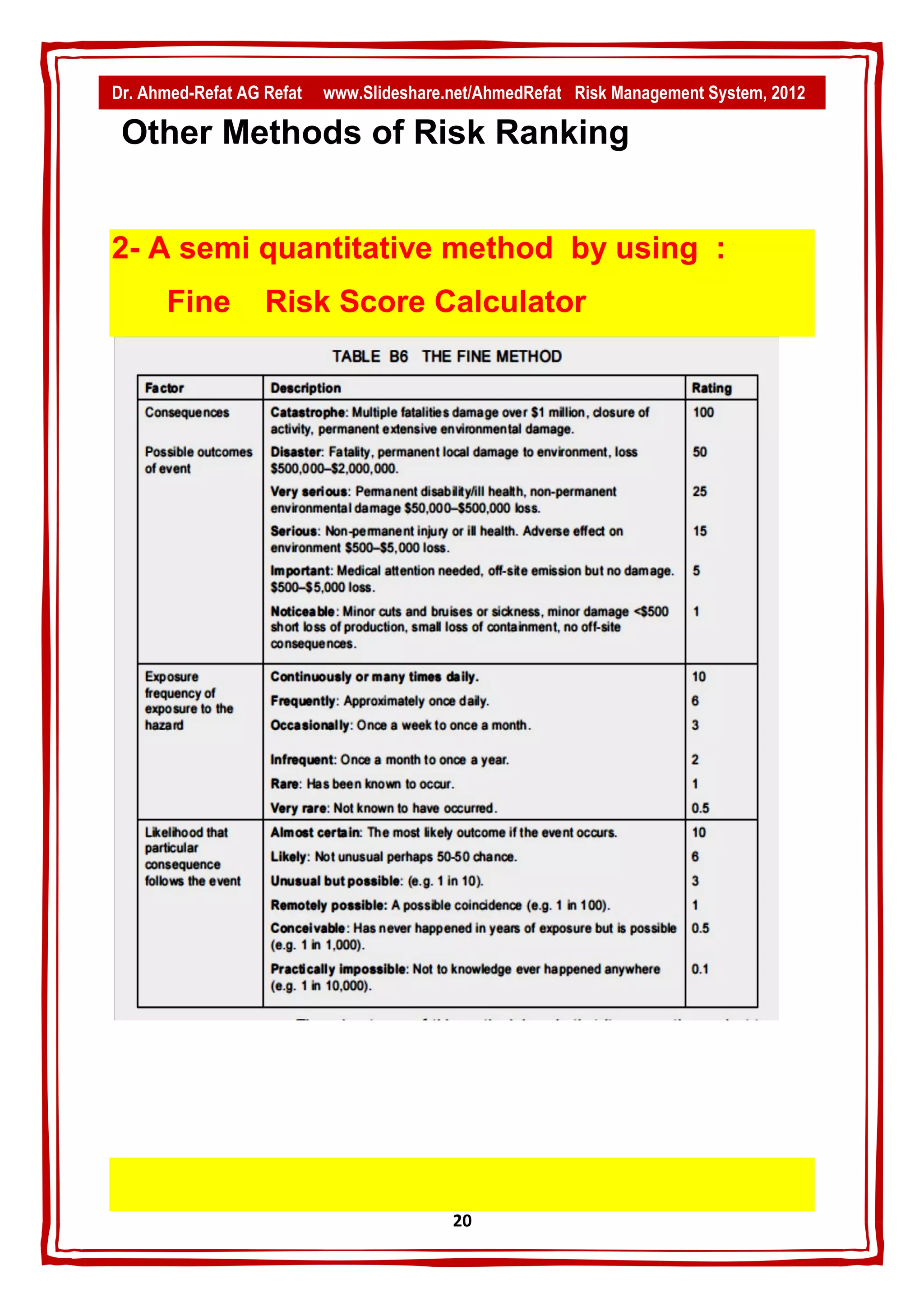
 Other Methods of Risk Ranking


2- A semi quantitative method by using :
      Fine         Risk Score Calculator


                                          21
Dr. Ahmed-Refat AG Refat   www.Slideshare.net/AhmedRefat Risk Management System, 2012

3- A semi quantitative: Risk Nomogram


Step 5. Treat and control the risks

Risk treatment involves identifying options for
treating or controlling risk, in order to either reduce
or eliminate negative consequences, or to reduce
the likelihood of an adverse occurrence. Risk
treatment should also aim to enhance positive
outcomes.


It is often either not possible or cost-effective to
implement all treatment strategies.

                                          21
Dr. Ahmed-Refat AG Refat   www.Slideshare.net/AhmedRefat Risk Management System, 2012

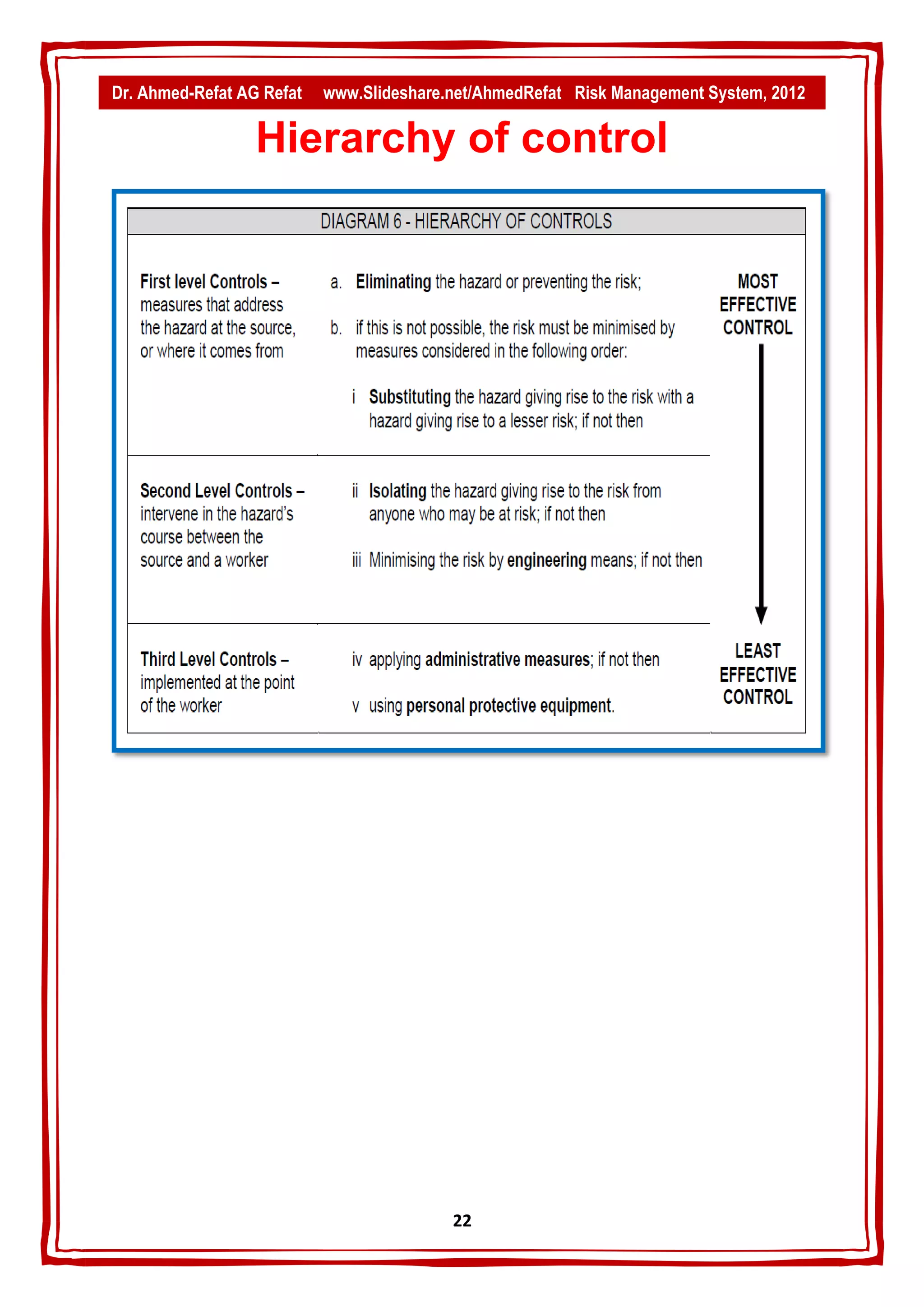
                  Hierarchy of control


                                          22
Dr. Ahmed-Refat AG Refat   www.Slideshare.net/AhmedRefat Risk Management System, 2012

Options for risk treatment

Avoid the risk

One method of dealing with risk is to avoid the risk
by not proceeding with the activity likely to generate
the risk. Risk avoidance should only occur when
control measures do not exist or do not reduce the
risk to an acceptable level.


Change the likelihood of the occurrence


This option enhances the likelihood of beneficial
outcomes and reduces the possibility of loss.


Change the consequences


This will increase the size of gains and reduce the
size of losses. This may include business continuity
plans, and emergency and contingency plans.


                                          23
Dr. Ahmed-Refat AG Refat   www.Slideshare.net/AhmedRefat Risk Management System, 2012

Share the risk


Part or most of a risk may be transferred to another
party so that they share responsibility.
Mechanisms for risk transfer include contracts,
insurance, partnerships and business alliances.


Retain the risk


After risks have been reduced or transferred,
residual risk may be retained if it is at an acceptable
level.

Step 6- Monitor and review

Monitor and review is an essential and integral step
in the risk management process.
Risks need to be monitored periodically to ensure
changing circumstances do not alter the risk
priorities. Very few risks will remain static, therefore
the risk management process needs to be regularly
repeated, so that new risks are captured in the
process and effectively managed.

                                          24

Risk Analysis in Occupational Health Setting

  • 1.
    Dr. Ahmed-Refat AGRefat www.Slideshare.net/AhmedRefat Risk Management System, 2012 Risk Management System In Occupational Health Setting ‫إدارة املخاطر‬ ‫يف جمال الصحة املهنية‬ Dr. Ahmed-Refat AG Refat Prof. Occupational Medicine Tibsah University, KSA 2012 1
  • 2.
    Dr. Ahmed-Refat AGRefat www.Slideshare.net/AhmedRefat Risk Management System, 2012 Basic Concepts and Definitions 1- Hazard and Risk Hazard  A source of potential harm  Anything that has the potential to cause harm  A factor or exposure that may adversely affect health. Risk Risk = The probability that an adverse event will occur Risk = The chance of something happening that will have an impact on objectives. Risk was measured in terms of Consequences and the Likelihood 2
  • 3.
    Dr. Ahmed-Refat AGRefat www.Slideshare.net/AhmedRefat Risk Management System, 2012 2 - Risk Management System " RMS"  RMS is an ongoing process of identifying, quantifying and ranking risks and their associated losses, and developing cost effective management strategies to eliminate or control the risks. Risk Evaluation = identifying risks, setting priorities commissioning and reviewing risk assessment . Risk Assessment = combination of Risk identification, risk analysis and risk evaluation 3
  • 4.
    Dr. Ahmed-Refat AGRefat www.Slideshare.net/AhmedRefat Risk Management System, 2012 Steps of Risk Management Process The risk management process consists of a series of steps that, when undertaken in sequence, enable continual improvement in decision-making. 1. Establish the context 2. Identify hazards 3. Analyse risks that may result because of the hazard 4. Evaluate the risks 5. Treat the risks 6. Review and Monitor the risk 4
  • 5.
    Dr. Ahmed-Refat AGRefat www.Slideshare.net/AhmedRefat Risk Management System, 2012 5
  • 6.
    Dr. Ahmed-Refat AGRefat www.Slideshare.net/AhmedRefat Risk Management System, 2012 Step 1 Establish the context The first step in managing risk is to gather background information which relates to the organization as a whole as well as the particular risk management study. This establishes the context within which OHS risks are managed. 6
  • 7.
    Dr. Ahmed-Refat AGRefat www.Slideshare.net/AhmedRefat Risk Management System, 2012 Step 2 Hazard Identification Risk cannot be managed unless it is first identified. The aim of risk identification is to identify possible risks that may affect, either negatively or positively, the objectives of the organization and the activity under analysis. . Identifying retrospective risks Retrospective risks are those that have previously occurred. There are many sources of information about retrospective risk. These include: • hazard or incident logs or registers • audit reports • customer complaints • accreditation documents and reports 7
  • 8.
    Dr. Ahmed-Refat AGRefat www.Slideshare.net/AhmedRefat Risk Management System, 2012 • past staff or client surveys • newspapers or professional media, such as journals or websites. Identifying prospective risks Prospective risks are often harder to identify. These are things that have not yet happened, but might happen some time in the future. Identification should include all risks, whether or not they are currently being managed. Methods for identifying prospective risks: • brainstorming with staff • researching the economic, political, legislative and operating environment • conducting interviews with relevant people and/or organisations • undertaking surveys of staff or clients . • flow charting a process 8
  • 9.
    Dr. Ahmed-Refat AGRefat www.Slideshare.net/AhmedRefat Risk Management System, 2012 When  When a job is first undertaken  When a new piece of equipment is installed  When new or relevant information regarding health and safety becomes available from an authoritative source  When substantial changes are made to a system of work  When there has been an injury to a person undertaking a job or to a person near where a job is being performed  Following an accident that did not result in an injury or damage 9
  • 10.
    Dr. Ahmed-Refat AGRefat www.Slideshare.net/AhmedRefat Risk Management System, 2012  When there is evidence to suggest that a current risk assessment is no longer valid  When hazardous substances and/or dangerous goods are introduced into the workplace  As part of the design and construction of a new facility  Prior to conducting an experiment  As part of developing and designing a new subject, unit or course outline  Prior to conducting a field trip Step 3. Analyse the risks Risk analysis involves combining the possible consequences, or impact, of an event, with the likelihood of that event occurring. The result is a ‘level of risk’. That is: Risk = consequence x likelihood 11
  • 11.
    Dr. Ahmed-Refat AGRefat www.Slideshare.net/AhmedRefat Risk Management System, 2012 Elements of risk analysis The elements of risk analysis are as follows: 1. Identify existing strategies and controls that act to minimise negative risk and enhance pportunities. 2. Determine the consequences of a negative impact or an opportunity 3. Determine the likelihood of a negative consequence or an opportunity. 4. Estimate the level of risk by combining consequence and likelihood. 5. Consider and identify any uncertainties in the estimates. Types of analysis Three categories or types of analysis can be used to determine level of risk: • Qualitative • Semi-quantitative • Quantitative. 11
  • 12.
    Dr. Ahmed-Refat AGRefat www.Slideshare.net/AhmedRefat Risk Management System, 2012 A- Qualitative risk analysis Qualitative risk analysis is simple and easy to understand. Disadvantages include the fact that it is subjective and is based on insight, which can lead to the forming of bias and can degrade the validity of the results. Methods for qualitative risk analysis include: • brainstorming • evaluation using multi-disciplinary groups • specialist and expert judgement • structured interviews and/or questionnaires • word picture descriptors and risk categories. Items in risk analysis Risk = likelihood x consequence 12
  • 13.
    Dr. Ahmed-Refat AGRefat www.Slideshare.net/AhmedRefat Risk Management System, 2012 Likelihood 13
  • 14.
    Dr. Ahmed-Refat AGRefat www.Slideshare.net/AhmedRefat Risk Management System, 2012 14
  • 15.
    Dr. Ahmed-Refat AGRefat www.Slideshare.net/AhmedRefat Risk Management System, 2012 B- Consequences 15
  • 16.
    Dr. Ahmed-Refat AGRefat www.Slideshare.net/AhmedRefat Risk Management System, 2012 Step 4. Evaluate the risks Risk evaluation involves comparing the level of risk found during the analysis process with previously established risk criteria, and deciding whether these risks require treatment. The result of a risk evaluation is a prioritised list of risks that require further action. This step is about deciding whether risks are acceptable or need treatment. 16
  • 17.
    Dr. Ahmed-Refat AGRefat www.Slideshare.net/AhmedRefat Risk Management System, 2012 Methods of Risk Ranking 1- A qualitative ( subjective ) method : Risk ranking Matrix. 2- A semi quantitative method by using : Fine Risk Score Calculator 3- A semi quantitative method by using : Risk Nomogram Risk Ranking Matrix 17
  • 18.
    Dr. Ahmed-Refat AGRefat www.Slideshare.net/AhmedRefat Risk Management System, 2012 18
  • 19.
    Dr. Ahmed-Refat AGRefat www.Slideshare.net/AhmedRefat Risk Management System, 2012 Risk acceptance Low or tolerable risks may be accepted. ‘Acceptable’ means the business chooses to ‘accept’ that the risk exists, either because the risk is at a low level and the cost of treating the risk will outweigh the benefit, or there is no reasonable treatment that can be implemented. This is also known as ALARP (as low as reasonably practicable). A risk may be accepted for the following reasons: • The cost of treatment far exceeds the benefit, so that acceptance is the only option (applies particularly to lower ranked risks) • The level of the risk is so low that specific treatment is not appropriate with available resources • The opportunities presented outweigh the threats to such a degree that the risk is justified • The risk is such that there is no treatment available, for example the risk that the business may suffer storm damage. 19
  • 20.
    Dr. Ahmed-Refat AGRefat www.Slideshare.net/AhmedRefat Risk Management System, 2012 Other Methods of Risk Ranking 2- A semi quantitative method by using : Fine Risk Score Calculator 21
  • 21.
    Dr. Ahmed-Refat AGRefat www.Slideshare.net/AhmedRefat Risk Management System, 2012 3- A semi quantitative: Risk Nomogram Step 5. Treat and control the risks Risk treatment involves identifying options for treating or controlling risk, in order to either reduce or eliminate negative consequences, or to reduce the likelihood of an adverse occurrence. Risk treatment should also aim to enhance positive outcomes. It is often either not possible or cost-effective to implement all treatment strategies. 21
  • 22.
    Dr. Ahmed-Refat AGRefat www.Slideshare.net/AhmedRefat Risk Management System, 2012 Hierarchy of control 22
  • 23.
    Dr. Ahmed-Refat AGRefat www.Slideshare.net/AhmedRefat Risk Management System, 2012 Options for risk treatment Avoid the risk One method of dealing with risk is to avoid the risk by not proceeding with the activity likely to generate the risk. Risk avoidance should only occur when control measures do not exist or do not reduce the risk to an acceptable level. Change the likelihood of the occurrence This option enhances the likelihood of beneficial outcomes and reduces the possibility of loss. Change the consequences This will increase the size of gains and reduce the size of losses. This may include business continuity plans, and emergency and contingency plans. 23
  • 24.
    Dr. Ahmed-Refat AGRefat www.Slideshare.net/AhmedRefat Risk Management System, 2012 Share the risk Part or most of a risk may be transferred to another party so that they share responsibility. Mechanisms for risk transfer include contracts, insurance, partnerships and business alliances. Retain the risk After risks have been reduced or transferred, residual risk may be retained if it is at an acceptable level. Step 6- Monitor and review Monitor and review is an essential and integral step in the risk management process. Risks need to be monitored periodically to ensure changing circumstances do not alter the risk priorities. Very few risks will remain static, therefore the risk management process needs to be regularly repeated, so that new risks are captured in the process and effectively managed. 24