PRESENTED BY:
POOJA SANALKUMAR
HEALTH INDICATOR is a variable, susceptible
to direct measurement, that reflects the
state of health of the subjects in a
community
 VALID
 RELIABLE
 SENSITIVE
 SPECFIC
 FEASIBLE
 RELEVANT
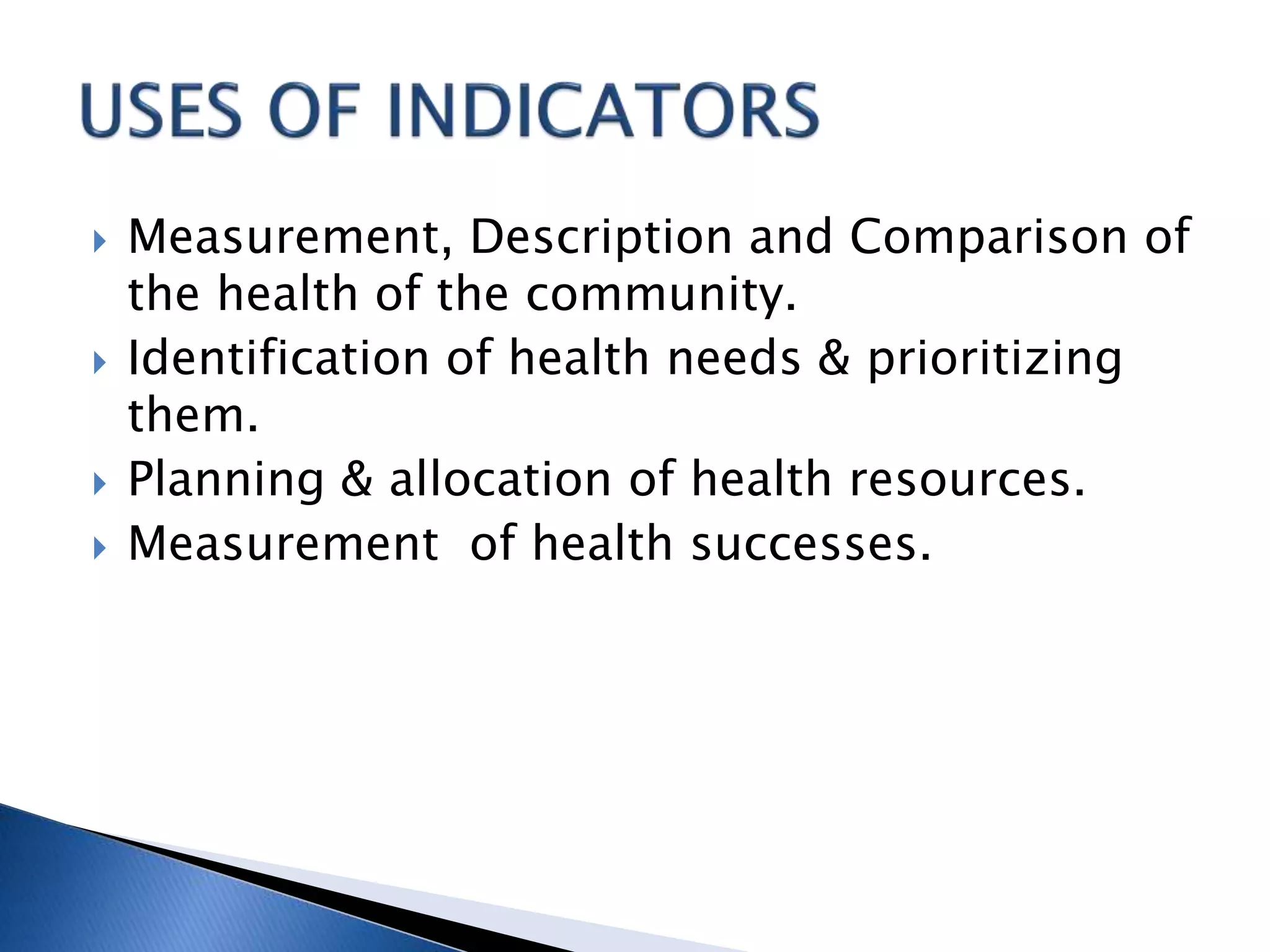
 Measurement, Description and Comparison of
the health of the community.
 Identification of health needs & prioritizing
them.
 Planning & allocation of health resources.
 Measurement of health successes.
Mortality indicators Indicators of social and
mental health
Morbidity indicators Environmental indicators
Disability rates Socio-economic indicators
Nutritional indicators Health policy indicators
Health care delivery
indicators
Indicators of quality of life
Utilization rates Other indicators
 Crude Death Rate
 Expectation Of Life
 Age Specific Death Rate
 Infant Mortality Rate
 Child Mortality Rate
 Under 5 Proportionate Mortality Rate
 Adult Mortality Rate
 Maternal Mortality Rate
 Disease Specific Mortality Rate
 Proportional Mortality Rate
 Case Fatality Rate
 Years Of Potential Life Lost
 Number of deaths per 1000 population per
year in a given community.
 Fair indicator of health.
 ↓ death rate – assesses health improvement
in a community the overall.
 Life expectancy at birth : the average number
of years that will be lived by those born alive
into a population if the current age-specific
mortality rates persist.
 In India,
◦ Male 63.8
◦ female 67.3
65
80
67
76
68
86
69
81
0
20
40
60
80
100
INDIA JAPAN NEPAL USA
Males Females
Source – K.Park, Fertility, Park’s Textbook of
social and preventive medicine, 2015, 23rd
Edition, M/s Banarsidas Bhanot, India
58 60 66.2 67.2 74 69
0
20
40
60
80
Life Expectancy
Source:
http://populationcommission.nic.in
/content/932_1_TablesMapsAndBar
Charts.aspx , accessed on June 2nd
2015
 The ratio of deaths of children under 1 year
of age in a given year to the total number of
live births, in the same year.
 Usually expressed as rate per 1000 live
births.
 Sensitive indicator of availability,
utilisation and effectiveness of
health care, particularly
perinatal care.
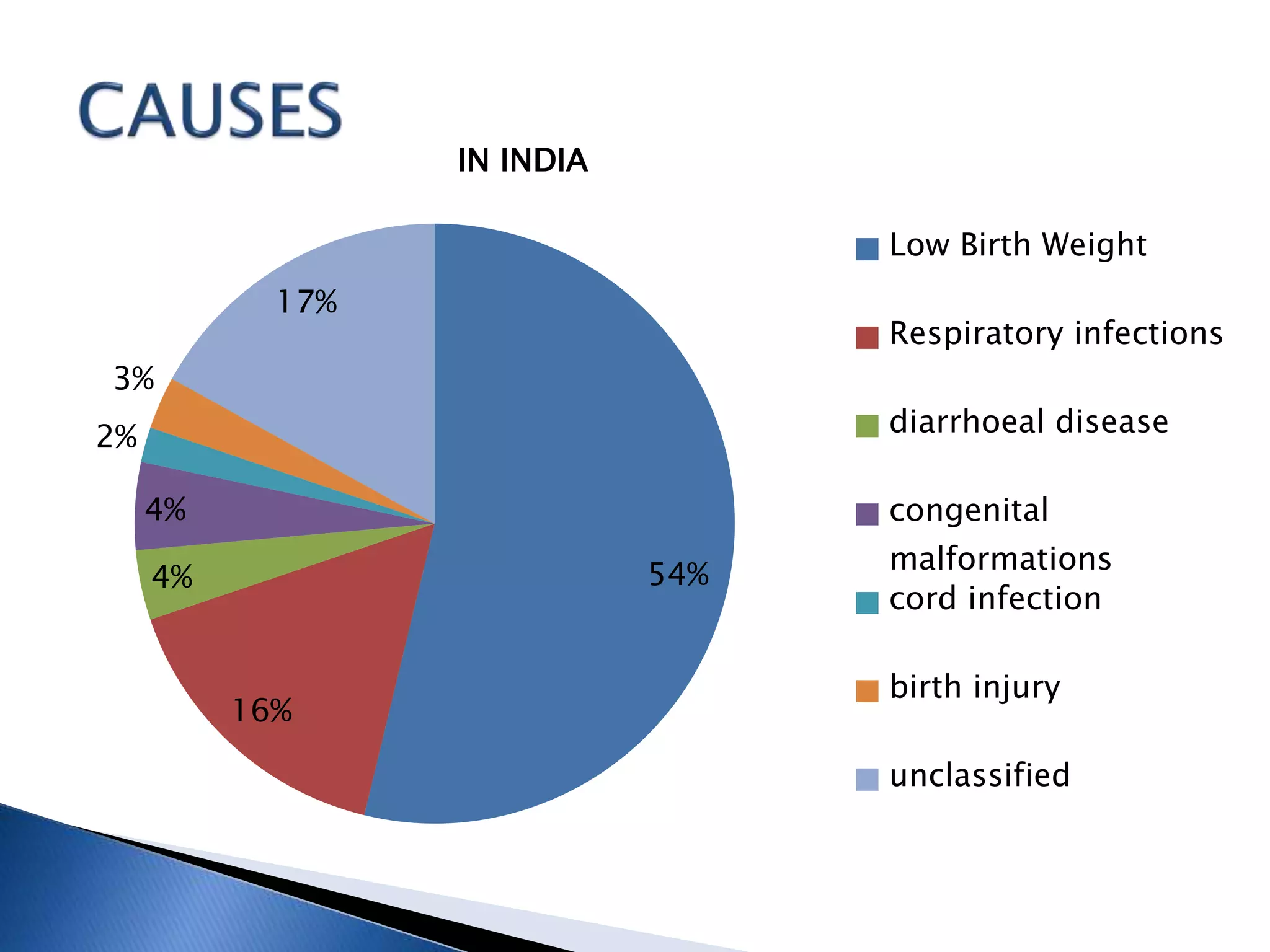
54%
16%
4%
4%
2%
3%
17%
Low Birth Weight
Respiratory infections
diarrhoeal disease
congenital
malformations
cord infection
birth injury
unclassified
IN INDIA
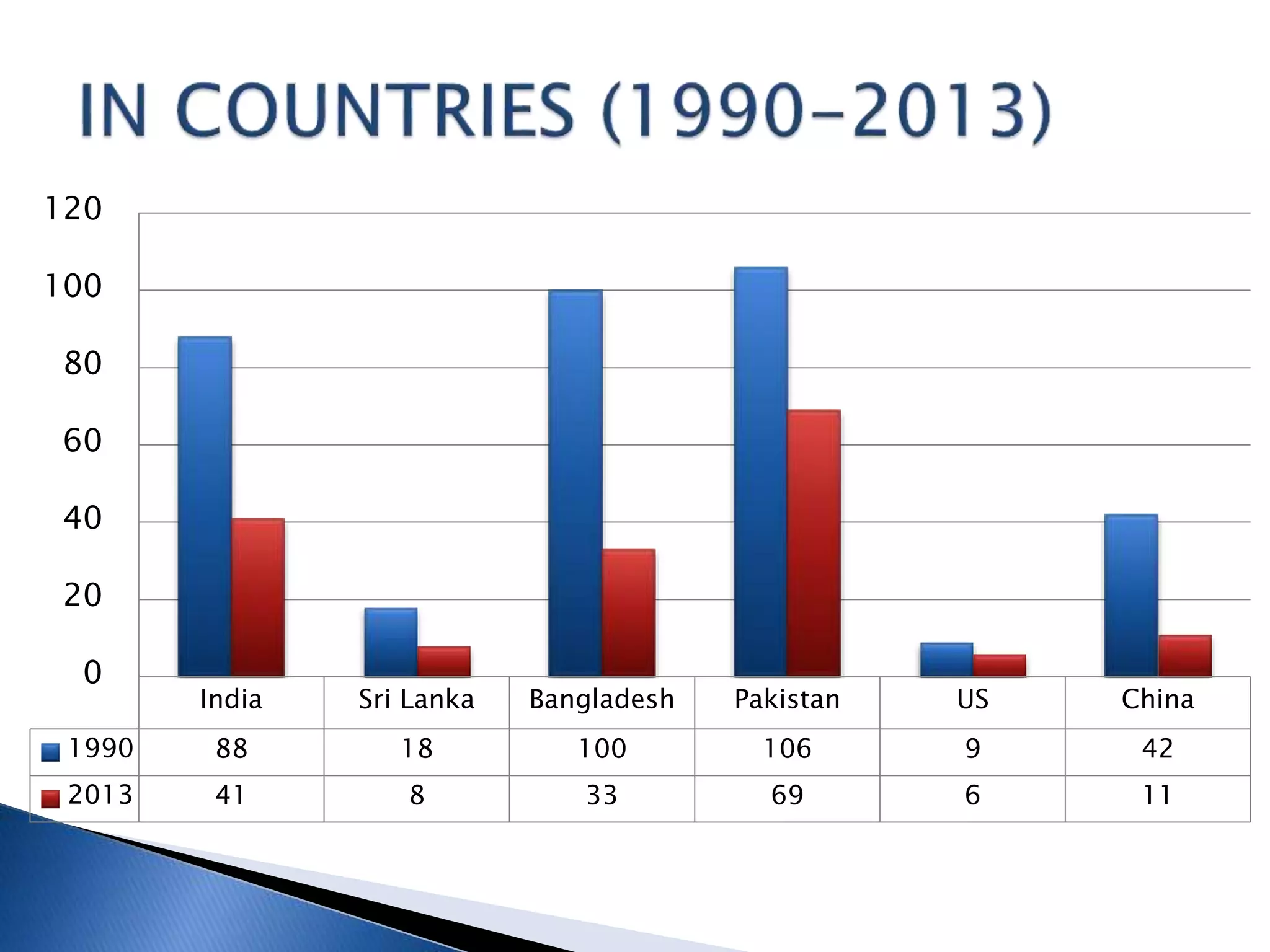
India Sri Lanka Bangladesh Pakistan US China
1990 88 18 100 106 9 42
2013 41 8 33 69 6 11
0
20
40
60
80
100
120
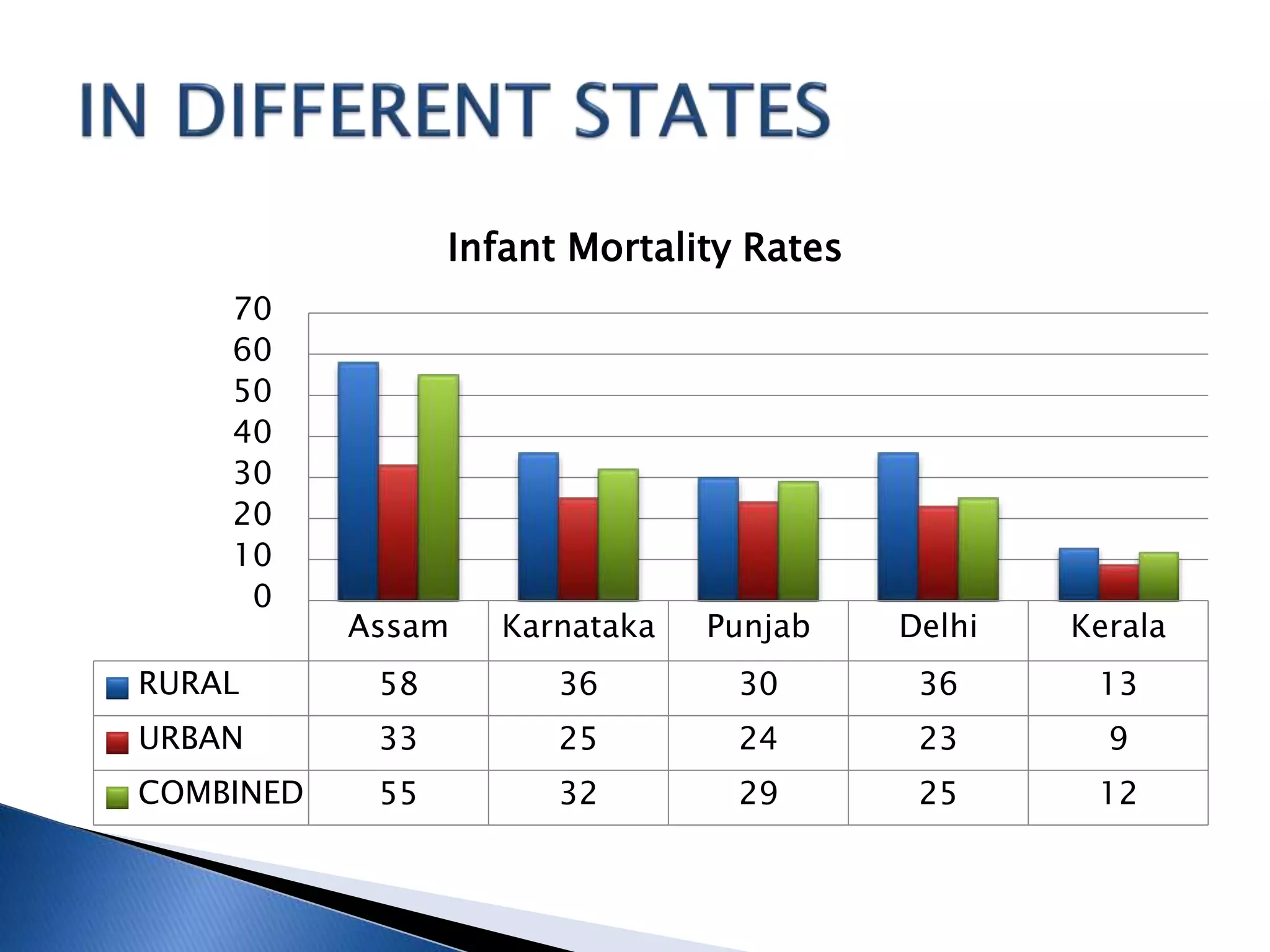
Assam Karnataka Punjab Delhi Kerala
RURAL 58 36 30 36 13
URBAN 33 25 24 23 9
COMBINED 55 32 29 25 12
0
10
20
30
40
50
60
70
Infant Mortality Rates
 Improved obstetric and perinatal care
(availabity of oxygen, foetal monitoring
during labour)
 Improvement in quality of life(social and
economic progress)
 Better control of communicable
diseases(immunisation)
 Better nutrition(emphasis on
breast feeding)
 Family planning(birth spacing)
 Number of deaths at age of 1-4 years in a
given year, per 1000 children in that age
group at the mid-point of the year.
 Correlates with inadequate MCH services, low
coverage by immunisation & adverse
environmental exposure.
 The proportion of total deaths occurring in
the under-5 age group.
 Reflects both infant and child mortality.
 In India, 59/1000
 In China, 18/1000
 Number of maternal deaths in a given period
per 100,00 women of reproductive age
during the same time period.
 Accounts for the greatest proportion of
deaths among women of
reproductive age in most
developing countries.
8%
5%
5%
11%
37%
34%
IN INDIA
Abortion
Obstructed labour
Hypersensitive
disorders
Sepsis
Haemorrhage
28 32
170 178
200
0
50
100
150
200
250
US China Pakistan India Myanmar
Maternal Mortality Rate
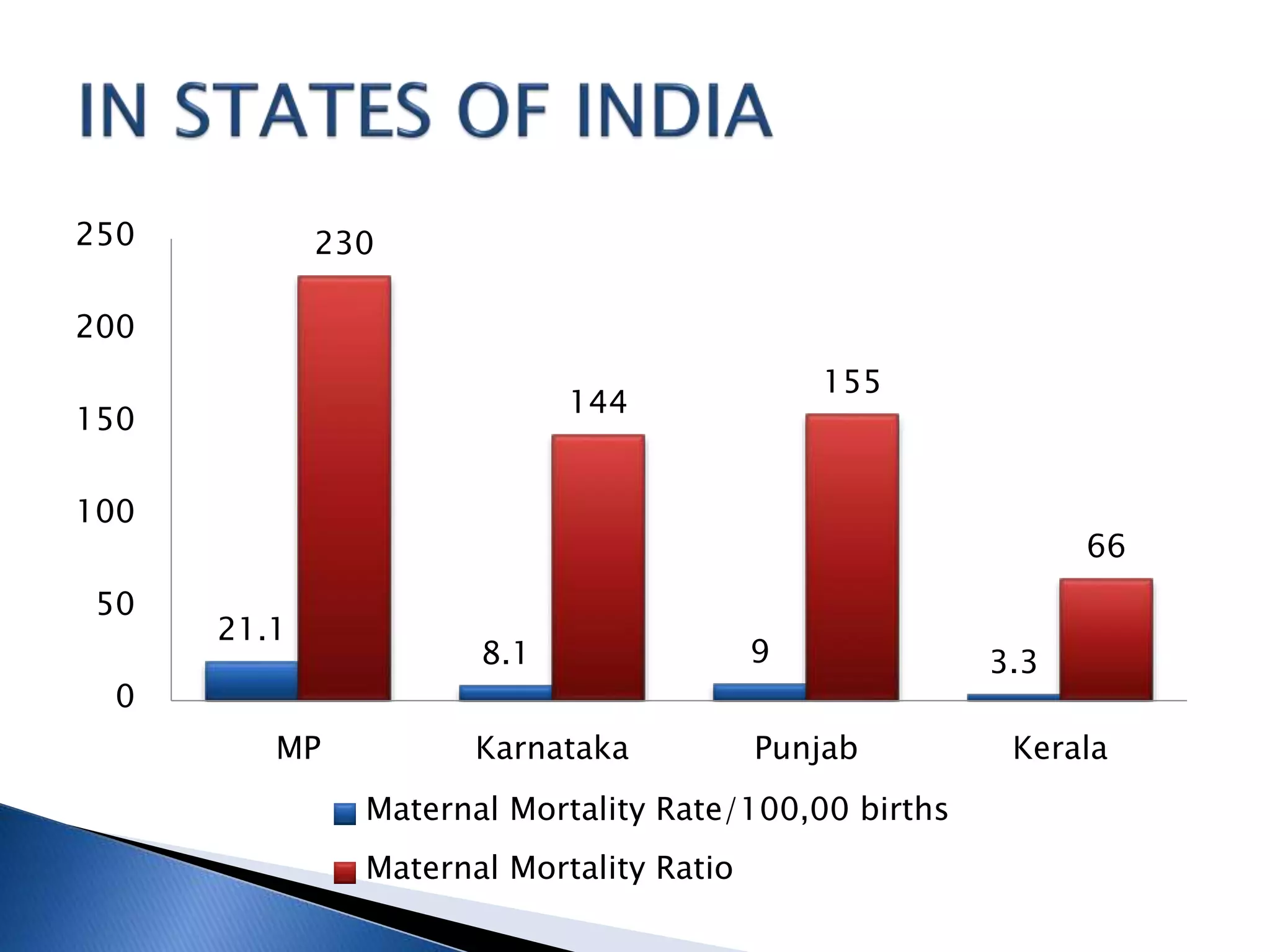
21.1
8.1 9 3.3
230
144
155
66
0
50
100
150
200
250
MP Karnataka Punjab Kerala
Maternal Mortality Rate/100,00 births
Maternal Mortality Ratio
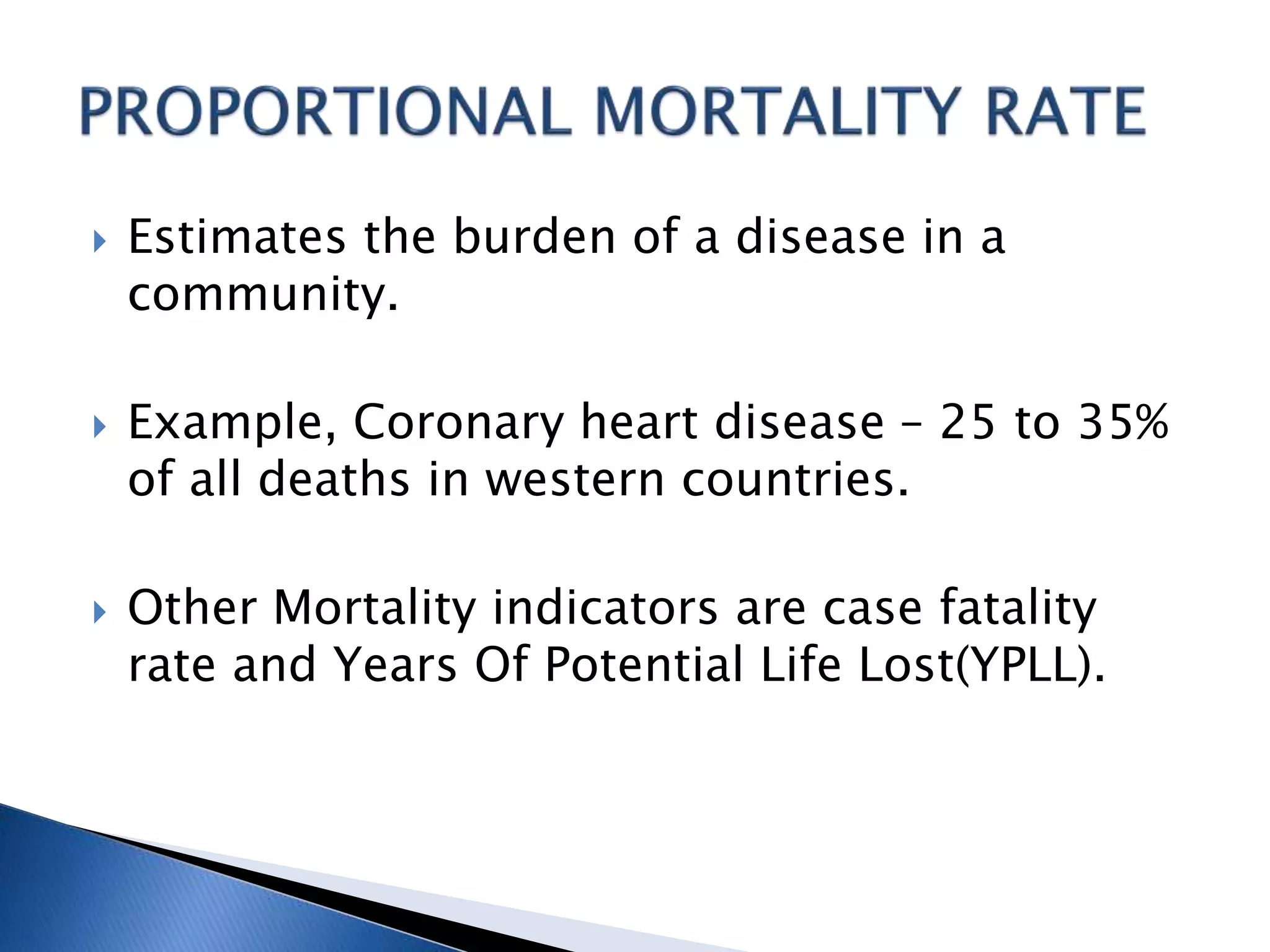
 Estimates the burden of a disease in a
community.
 Example, Coronary heart disease – 25 to 35%
of all deaths in western countries.
 Other Mortality indicators are case fatality
rate and Years Of Potential Life Lost(YPLL).
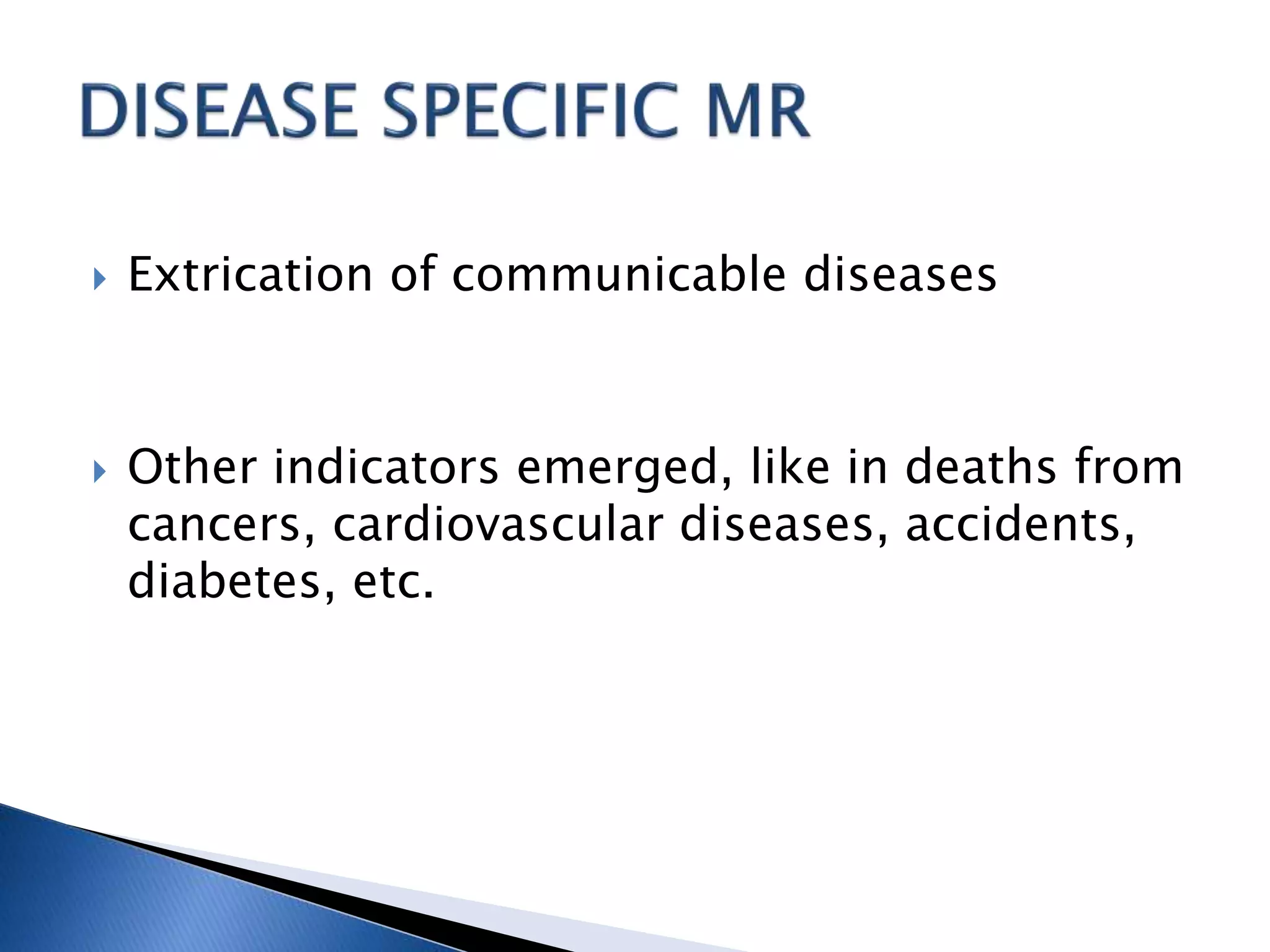
 Extrication of communicable diseases
 Other indicators emerged, like in deaths from
cancers, cardiovascular diseases, accidents,
diabetes, etc.
 Incomplete reporting of deaths
 Lack of accuracy (recording age and cause of
death)
 Lack of uniformity and standardised method
of data collection.
 Any departure, subjective or objective, from a state
of physiological well being.
 Used to supplement
mortality data to describe
the health status of a
population
 Following morbidity rates are used:
◦ Incidence and prevalence
◦ Notification rates
◦ Attendance rate at the O/P dept.
◦ Admission, readmission & discharge dates
◦ Duration of stay in hospital
◦ Spells of sickness/absence from work/school.
 Disability is defined as “any restriction or lack
of ability to perform an activity in a manner
or within the range considered normal for a
human being.”
 Types :
(1)Event type indicators
(2)Person type indicators
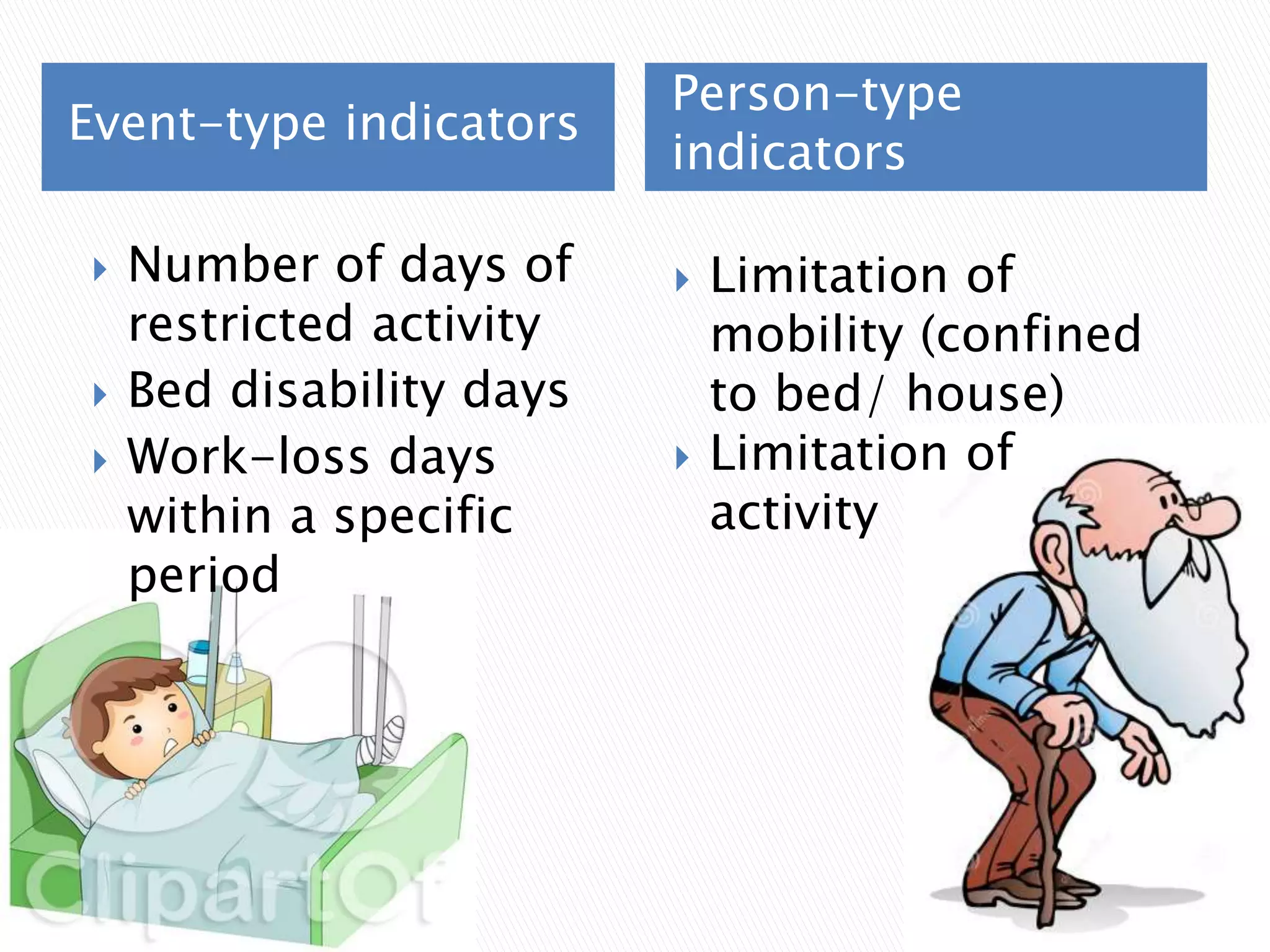
Event-type indicators
Person-type
indicators
 Number of days of
restricted activity
 Bed disability days
 Work-loss days
within a specific
period
 Limitation of
mobility (confined
to bed/ house)
 Limitation of
activity
 Based on life expectancy at birth and includes
an adjustment for time spent in poor health.
 It is the equivalent number of years in full
health a new born can expect to live based on
current rates of ill health and mortality.
 Used for assessing value for money of
medical intervention
 Values : perfect health = 1.0
death = 0.0
Therefore, 1 QALY=1 year of life x 1 unity
value.
 Measure of overall disease burden, expressed
in number of years lost due to ill health or
early death.
 Daly combines: Years of Lost Life (YLL) and
Years Lost to Disability (YDL)
 DALY= YLL + YLD
 3 Nutritional Status indicators considered
important are:
◦ Prevalence of low birth weight (2.5 kg)
◦ Height and weight of children at school entry
◦ Anthropometric Measurement of preschool children
 Reflects the equity of distribution of health
resources in different parts of the country, and of
provision of health care.
 Frequently used indicators:
◦ Doctor-population ratio
◦ Doctor-nurse ratio
◦ Population-bed ratio
◦ Population per health/sub centre
◦ Population per traditional birth attendant
Indicators of health

Indicators of health

  • 1.
  • 2.
    HEALTH INDICATOR isa variable, susceptible to direct measurement, that reflects the state of health of the subjects in a community
  • 3.
     VALID  RELIABLE SENSITIVE  SPECFIC  FEASIBLE  RELEVANT
  • 4.
     Measurement, Descriptionand Comparison of the health of the community.  Identification of health needs & prioritizing them.  Planning & allocation of health resources.  Measurement of health successes.
  • 5.
    Mortality indicators Indicatorsof social and mental health Morbidity indicators Environmental indicators Disability rates Socio-economic indicators Nutritional indicators Health policy indicators Health care delivery indicators Indicators of quality of life Utilization rates Other indicators
  • 6.
     Crude DeathRate  Expectation Of Life  Age Specific Death Rate  Infant Mortality Rate  Child Mortality Rate  Under 5 Proportionate Mortality Rate  Adult Mortality Rate  Maternal Mortality Rate  Disease Specific Mortality Rate  Proportional Mortality Rate  Case Fatality Rate  Years Of Potential Life Lost
  • 7.
     Number ofdeaths per 1000 population per year in a given community.  Fair indicator of health.  ↓ death rate – assesses health improvement in a community the overall.
  • 8.
     Life expectancyat birth : the average number of years that will be lived by those born alive into a population if the current age-specific mortality rates persist.  In India, ◦ Male 63.8 ◦ female 67.3
  • 9.
    65 80 67 76 68 86 69 81 0 20 40 60 80 100 INDIA JAPAN NEPALUSA Males Females Source – K.Park, Fertility, Park’s Textbook of social and preventive medicine, 2015, 23rd Edition, M/s Banarsidas Bhanot, India
  • 10.
    58 60 66.267.2 74 69 0 20 40 60 80 Life Expectancy Source: http://populationcommission.nic.in /content/932_1_TablesMapsAndBar Charts.aspx , accessed on June 2nd 2015
  • 11.
     The ratioof deaths of children under 1 year of age in a given year to the total number of live births, in the same year.  Usually expressed as rate per 1000 live births.  Sensitive indicator of availability, utilisation and effectiveness of health care, particularly perinatal care.
  • 12.
    54% 16% 4% 4% 2% 3% 17% Low Birth Weight Respiratoryinfections diarrhoeal disease congenital malformations cord infection birth injury unclassified IN INDIA
  • 13.
    India Sri LankaBangladesh Pakistan US China 1990 88 18 100 106 9 42 2013 41 8 33 69 6 11 0 20 40 60 80 100 120
  • 14.
    Assam Karnataka PunjabDelhi Kerala RURAL 58 36 30 36 13 URBAN 33 25 24 23 9 COMBINED 55 32 29 25 12 0 10 20 30 40 50 60 70 Infant Mortality Rates
  • 15.
     Improved obstetricand perinatal care (availabity of oxygen, foetal monitoring during labour)  Improvement in quality of life(social and economic progress)  Better control of communicable diseases(immunisation)  Better nutrition(emphasis on breast feeding)  Family planning(birth spacing)
  • 16.
     Number ofdeaths at age of 1-4 years in a given year, per 1000 children in that age group at the mid-point of the year.  Correlates with inadequate MCH services, low coverage by immunisation & adverse environmental exposure.
  • 17.
     The proportionof total deaths occurring in the under-5 age group.  Reflects both infant and child mortality.  In India, 59/1000  In China, 18/1000
  • 18.
     Number ofmaternal deaths in a given period per 100,00 women of reproductive age during the same time period.  Accounts for the greatest proportion of deaths among women of reproductive age in most developing countries.
  • 19.
  • 20.
    28 32 170 178 200 0 50 100 150 200 250 USChina Pakistan India Myanmar Maternal Mortality Rate
  • 21.
    21.1 8.1 9 3.3 230 144 155 66 0 50 100 150 200 250 MPKarnataka Punjab Kerala Maternal Mortality Rate/100,00 births Maternal Mortality Ratio
  • 22.
     Estimates theburden of a disease in a community.  Example, Coronary heart disease – 25 to 35% of all deaths in western countries.  Other Mortality indicators are case fatality rate and Years Of Potential Life Lost(YPLL).
  • 23.
     Extrication ofcommunicable diseases  Other indicators emerged, like in deaths from cancers, cardiovascular diseases, accidents, diabetes, etc.
  • 24.
     Incomplete reportingof deaths  Lack of accuracy (recording age and cause of death)  Lack of uniformity and standardised method of data collection.
  • 25.
     Any departure,subjective or objective, from a state of physiological well being.  Used to supplement mortality data to describe the health status of a population
  • 26.
     Following morbidityrates are used: ◦ Incidence and prevalence ◦ Notification rates ◦ Attendance rate at the O/P dept. ◦ Admission, readmission & discharge dates ◦ Duration of stay in hospital ◦ Spells of sickness/absence from work/school.
  • 27.
     Disability isdefined as “any restriction or lack of ability to perform an activity in a manner or within the range considered normal for a human being.”  Types : (1)Event type indicators (2)Person type indicators
  • 28.
    Event-type indicators Person-type indicators  Numberof days of restricted activity  Bed disability days  Work-loss days within a specific period  Limitation of mobility (confined to bed/ house)  Limitation of activity
  • 29.
     Based onlife expectancy at birth and includes an adjustment for time spent in poor health.  It is the equivalent number of years in full health a new born can expect to live based on current rates of ill health and mortality.
  • 30.
     Used forassessing value for money of medical intervention  Values : perfect health = 1.0 death = 0.0 Therefore, 1 QALY=1 year of life x 1 unity value.
  • 31.
     Measure ofoverall disease burden, expressed in number of years lost due to ill health or early death.  Daly combines: Years of Lost Life (YLL) and Years Lost to Disability (YDL)  DALY= YLL + YLD
  • 33.
     3 NutritionalStatus indicators considered important are: ◦ Prevalence of low birth weight (2.5 kg) ◦ Height and weight of children at school entry ◦ Anthropometric Measurement of preschool children
  • 34.
     Reflects theequity of distribution of health resources in different parts of the country, and of provision of health care.  Frequently used indicators: ◦ Doctor-population ratio ◦ Doctor-nurse ratio ◦ Population-bed ratio ◦ Population per health/sub centre ◦ Population per traditional birth attendant