■Essential Question:
–Who were the major totalitarian
leaders in the 1920s & 1930s?
–What were the basic ideologies of
Fascists, Nazis, and Communists?
■Warm Up Question:
After WWI, many
nations were
struggling to rebuild
A global depression in the 1930s
led to high unemployment &
a sense of desperation in Europe
The Treaty of Versailles created
bitterness among many nations
In this climate of postwar uncertainty,
nationalism increased & citizens turned
to totalitarian dictators to rule the nation
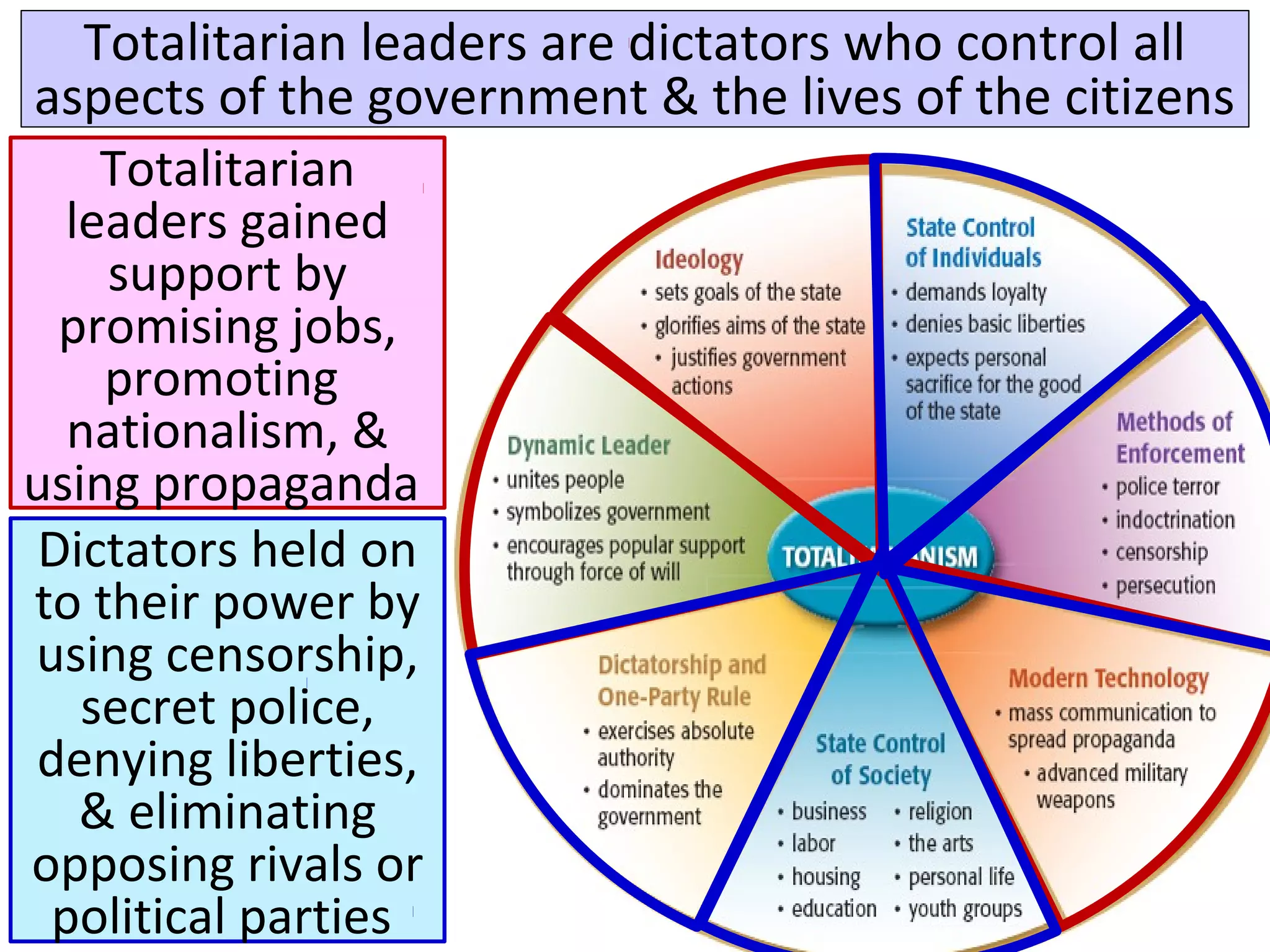
Totalitarian leaders are dictators who control all
aspects of the government & the lives of the citizens
Totalitarian
leaders gained
support by
promising jobs,
promoting
nationalism, &
using propaganda
Dictators held on
to their power by
using censorship,
secret police,
denying liberties,
& eliminating
opposing rivals or
political parties
Among the first totalitarian
dictators was Joseph Stalin
of the Soviet Union
Stalin was Communist &
seized all property, farms,
factories in order to control
the economy & create equality
He used a
secret police &
the Great Purge
to eliminate rivals
Stalin’s Five Year Plans & collective farms improved
the Soviet Union’s industrial & agricultural output
Not all totalitarian
dictators were
Communists
In Italy, Germany, & Spain,
people turned to an extremely
nationalist gov’t called fascism
Fascist gov’ts
were controlled
by dictators who
demanded loyalty
from citizens
Fascists did not
offer democracy &
used one-party to
rule the nation
Unlike Communists,
fascists believed
people could keep
their property
Totalitarian Regimes in Europe & Asia
Mussolini & Hitler believed in fascism: the idea that
nations need strong dictators, total authority by one
party, but that people can keep private property
Stalin was a Communist believed that the
government should control all property & business
Communism vs. Fascism
No gov’t control of laws Total gov’t control of laws
Total gov’t control of economy
No gov’t control of economy
In Italy,
Benito Mussolini
formed the
Fascist Party
Mussolini gained popularity by
promising to revive the economy,
rebuild the military, & expand Italy
to create a new Roman Empire
Mussolini named his Fascist
Party after the fasces, a Roman
symbol of authority & power
Mussolini created the Blackshirts (a secret police
force) to enforce the goals of his Fascist Party
By 1922, Mussolini was popular enough
to lead a “March on Rome” & forced the
Italian king to name him prime minister
As prime minister, Benito Mussolini
was known as “Il Duce” (the chief)
Mussolini ended
democracy & all
opposition parties
Mussolini built up
the military to
create new jobs
He planned to
conquer new
territories in
Africa for Italy
The Nazis were a fascist
group in Germany that
wanted to overthrow the
disloyal Weimar Republic
Hitler was impressed by
Mussolini & used many of
his ideas to make the Nazi
Party strong in Germany
Adolf Hitler was
an early Nazi recruit
& quickly rose to
power in the party
The Nazis created their own
militia called the Brown Shirts
Hitler planned a march on
Munich but he was arrested
& jailed for 9 months
While in jail, Hitler wrote
Mein Kampf which outlined
his plans for Germany
He wrote that Germans
were members of a master
race called Aryans & all non-
Aryans were inferior
He declared that Germans
needed lebensraum (living
space) & should conquer
Eastern Europe & Russia
He called the Versailles
Treaty an outraged & vowed
to regain land taken from
Germany after the war
When Hitler was released from jail in 1924,
he spent years organizing the Nazis into
Germany’s most powerful political party
In 1933, Hitler was
named chancellor
(prime minister)
of Germany
As chancellor,
Hitler used his
power to name
himself dictator
He called his gov’t
the Third Reich to
promote pride &
nationalism
Hitler put Germans to work by building factories,
highways, weapons, & increasing the military
He created the gov’t protection squad called the
SS and a secret police called the Gestapo to
eliminate rivals & control all aspects of Germany
In 1935, Hitler began a series of anti-Semitic laws
called the Nuremburg Laws that deprived German
Jews of the rights of citizens, forbade mixed Jewish
marriages, & required Jews to wear a yellow star
In 1938, Hitler ordered
Kristallnacht (Night of Broken
Glass), a series of attacks on
Jewish synagogues & businesses
After WWI, Japan was the strongest nation
in Asia & was ready to conquer new lands
to provide resources for Japanese industry
Emperor Hirohito, gave
full control of the Japanese
military to Hideki Tojo who
served as a military dictator
In the 1930s, Japan, Italy, & Germany began
aggressively expanding into new territories…
these actions caused World War II in 1939
Japan invaded Manchuria,
northern China; invaded
Indochina & the East Indies
Italy invaded
Ethiopia & Albania
Germany
annexed
Austria &
Czechoslovakia
Closure Activity:
Compare Fascism, Communism, & Democracy
■Use your notes & knowledge of fascism,
communism, & democracy to complete
the chart on the back of the notes
–Define each form of government
–Provide as many differences & similarities
as you can
–Be prepared to share your answers

Rise of totalitarian_dictators

  • 1.
    ■Essential Question: –Who werethe major totalitarian leaders in the 1920s & 1930s? –What were the basic ideologies of Fascists, Nazis, and Communists? ■Warm Up Question:
  • 2.
    After WWI, many nationswere struggling to rebuild A global depression in the 1930s led to high unemployment & a sense of desperation in Europe The Treaty of Versailles created bitterness among many nations
  • 3.
    In this climateof postwar uncertainty, nationalism increased & citizens turned to totalitarian dictators to rule the nation
  • 4.
    Totalitarian leaders aredictators who control all aspects of the government & the lives of the citizens Totalitarian leaders gained support by promising jobs, promoting nationalism, & using propaganda Dictators held on to their power by using censorship, secret police, denying liberties, & eliminating opposing rivals or political parties
  • 5.
    Among the firsttotalitarian dictators was Joseph Stalin of the Soviet Union Stalin was Communist & seized all property, farms, factories in order to control the economy & create equality He used a secret police & the Great Purge to eliminate rivals
  • 6.
    Stalin’s Five YearPlans & collective farms improved the Soviet Union’s industrial & agricultural output
  • 7.
    Not all totalitarian dictatorswere Communists In Italy, Germany, & Spain, people turned to an extremely nationalist gov’t called fascism Fascist gov’ts were controlled by dictators who demanded loyalty from citizens Fascists did not offer democracy & used one-party to rule the nation Unlike Communists, fascists believed people could keep their property
  • 8.
    Totalitarian Regimes inEurope & Asia Mussolini & Hitler believed in fascism: the idea that nations need strong dictators, total authority by one party, but that people can keep private property Stalin was a Communist believed that the government should control all property & business
  • 9.
    Communism vs. Fascism Nogov’t control of laws Total gov’t control of laws Total gov’t control of economy No gov’t control of economy
  • 10.
    In Italy, Benito Mussolini formedthe Fascist Party Mussolini gained popularity by promising to revive the economy, rebuild the military, & expand Italy to create a new Roman Empire Mussolini named his Fascist Party after the fasces, a Roman symbol of authority & power
  • 11.
    Mussolini created theBlackshirts (a secret police force) to enforce the goals of his Fascist Party
  • 12.
    By 1922, Mussoliniwas popular enough to lead a “March on Rome” & forced the Italian king to name him prime minister
  • 13.
    As prime minister,Benito Mussolini was known as “Il Duce” (the chief) Mussolini ended democracy & all opposition parties Mussolini built up the military to create new jobs He planned to conquer new territories in Africa for Italy
  • 14.
    The Nazis werea fascist group in Germany that wanted to overthrow the disloyal Weimar Republic Hitler was impressed by Mussolini & used many of his ideas to make the Nazi Party strong in Germany Adolf Hitler was an early Nazi recruit & quickly rose to power in the party The Nazis created their own militia called the Brown Shirts Hitler planned a march on Munich but he was arrested & jailed for 9 months
  • 15.
    While in jail,Hitler wrote Mein Kampf which outlined his plans for Germany He wrote that Germans were members of a master race called Aryans & all non- Aryans were inferior He declared that Germans needed lebensraum (living space) & should conquer Eastern Europe & Russia He called the Versailles Treaty an outraged & vowed to regain land taken from Germany after the war
  • 16.
    When Hitler wasreleased from jail in 1924, he spent years organizing the Nazis into Germany’s most powerful political party In 1933, Hitler was named chancellor (prime minister) of Germany As chancellor, Hitler used his power to name himself dictator He called his gov’t the Third Reich to promote pride & nationalism
  • 17.
    Hitler put Germansto work by building factories, highways, weapons, & increasing the military He created the gov’t protection squad called the SS and a secret police called the Gestapo to eliminate rivals & control all aspects of Germany
  • 18.
    In 1935, Hitlerbegan a series of anti-Semitic laws called the Nuremburg Laws that deprived German Jews of the rights of citizens, forbade mixed Jewish marriages, & required Jews to wear a yellow star In 1938, Hitler ordered Kristallnacht (Night of Broken Glass), a series of attacks on Jewish synagogues & businesses
  • 19.
    After WWI, Japanwas the strongest nation in Asia & was ready to conquer new lands to provide resources for Japanese industry Emperor Hirohito, gave full control of the Japanese military to Hideki Tojo who served as a military dictator
  • 20.
    In the 1930s,Japan, Italy, & Germany began aggressively expanding into new territories… these actions caused World War II in 1939 Japan invaded Manchuria, northern China; invaded Indochina & the East Indies Italy invaded Ethiopia & Albania
  • 21.
  • 22.
    Closure Activity: Compare Fascism,Communism, & Democracy ■Use your notes & knowledge of fascism, communism, & democracy to complete the chart on the back of the notes –Define each form of government –Provide as many differences & similarities as you can –Be prepared to share your answers

Editor's Notes

  • #9 In some ways, fascism was similar to communism. Both systems were ruled by dictators who allowed only their own political party (one-party rule). Both denied individual rights. In both, the state was supreme. Neither practiced any kind of democracy. However, unlike Communists, Fascists did not seek a classless society. Rather, they believed that each class had its place and function. In most cases, Fascist parties were made up of aristocrats and industrialists, war veterans, and the lower middle class. Also, Fascists were nationalists, and Communists were internationalists, hoping to unite workers worldwide.
  • #16 While in jail, Hitler wrote Mein Kampf (My Struggle). This book set forth his beliefs and his goals for Germany. Hitler asserted that the Germans, whom he incorrectly called “Aryans,” were a “master race.” He declared that non-Aryan “races,” such as Jews, Slavs, and Gypsies, were inferior. He called the Versailles Treaty an outrage and vowed to regain German lands. Hitler also declared that Germany was overcrowded and needed more lebensraum, or living space. He promised to get that space by conquering eastern Europe and Russia.