From the
Philosophical to the
Practical
Balancing the
Philosophical and the
Practical
Books!!
!
C: Compliance
21: Attributes from Schools of the
Future
EF : Executive Function Strength
EF : Executive Function Weakness
SE : Social-emotional strength
SE : Social-emotional weakness
“Imagination is the other end of
Reality”
K. Hari Kumar
e e
Recall a time when you were really
learning…..
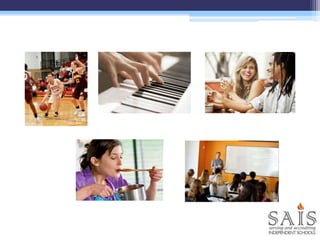
STUDENTS THRIVE
• WHEN THEY:
connect personally and emotionally with the
curriculum
WHEN THEY:
experience and interact with curriculum
• WHEN THEY:
participate and have choice in how they learn
and express
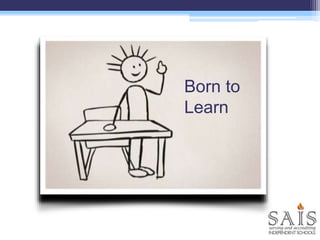
Born to
Learn
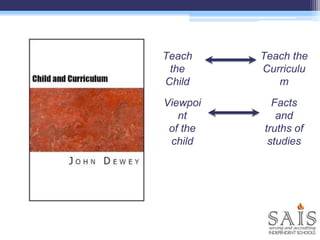
Teach
the
Child
Teach the
Curriculu
m
Viewpoi
nt
of the
child
Facts
and
truths of
studies
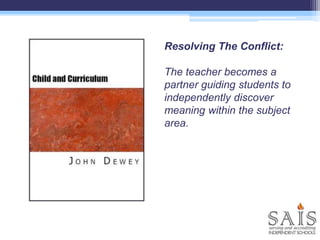
Resolving The Conflict:
The teacher becomes a
partner guiding students to
independently discover
meaning within the subject
area.
Joseph Palermo - Pedagogy of the
Depressed
• Can students really be taught critical thinking,
civics, and citizenship skills in a standardized
format that values conformity?
• Why are the ideals that have long been
associated with public higher education being
scrapped in favor of private special interests that
stand to profit from these changes?
• Most people might want to see a real doctor
instead of going to WebMD
Joseph Palermo - Pedagogy of the
Depressed
• Access does not replace dialogue, critical
thinking, and learning
• Collective student activities are part of the
learning process
• Better success with real human interaction
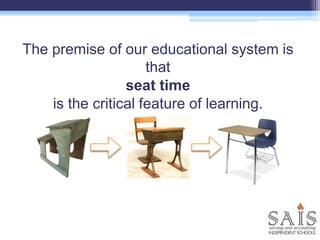
The premise of our educational system is
that
seat time
is the critical feature of learning.
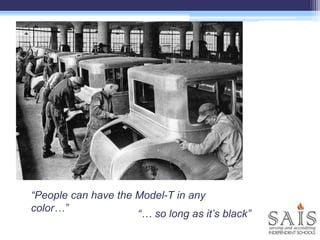
“People can have the Model-T in any
color…”
“… so long as it’s black”
Dare to innovate and take risks
“You will miss 100% of the shots
you don’t take.”
Wayne Gretsky
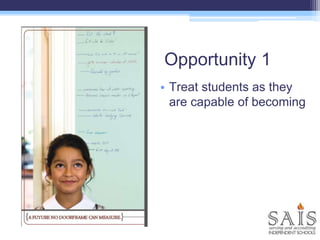
Opportunity 1
• Treat students as they
are capable of becoming
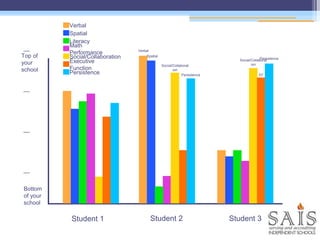
Verbal
Spatial
Literacy
Math
Performance
Social/Collaboration
Executive
Function
Persistence
Top of
your
school
Bottom
of your
school
Student 1
Verbal
Spatial
Social/Collaborat
ion
Persistence
Student 2
Social/Collaborat
ion
Persistence
EF
Student 3
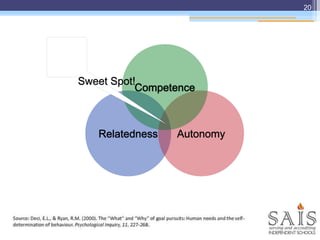
20
Relatedness Autonomy
Competence
Sweet Spot!
Opportunity 2
• Create pedagogical models that are:
▫ Innovative and based on research
▫ But still reflect our past
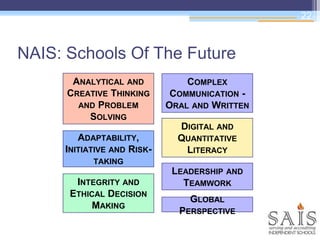
NAIS: Schools Of The Future
22
ANALYTICAL AND
CREATIVE THINKING
AND PROBLEM
SOLVING
COMPLEX
COMMUNICATION -
ORAL AND WRITTEN
LEADERSHIP AND
TEAMWORKINTEGRITY AND
ETHICAL DECISION
MAKING
GLOBAL
PERSPECTIVE
ADAPTABILITY,
INITIATIVE AND RISK-
TAKING
DIGITAL AND
QUANTITATIVE
LITERACY
my personal learning network
webinars
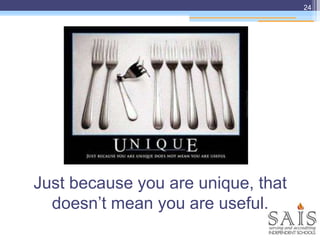
Just because you are unique, that
doesn’t mean you are useful.
24
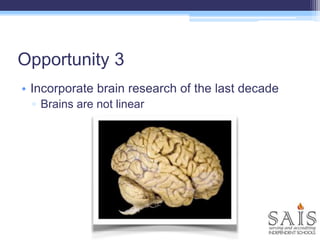
Opportunity 3
• Incorporate brain research of the last decade
▫ Brains are not linear
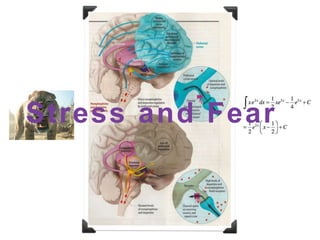
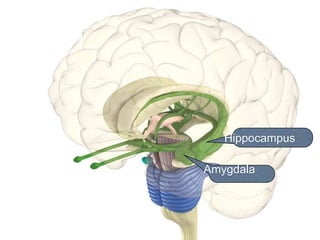
Stress and Fear
Hippocampus
Amygdala
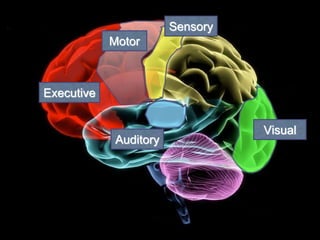
Motor
Sensory
Visual
Auditory
Executive
Processing
Plasticity
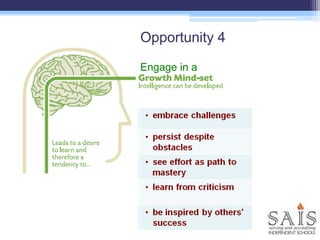
Opportunity 4
Engage in a
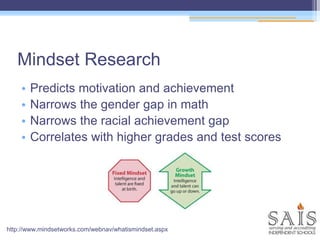
Mindset Research
• Predicts motivation and achievement
• Narrows the gender gap in math
• Narrows the racial achievement gap
• Correlates with higher grades and test scores
http://www.mindsetworks.com/webnav/whatismindset.aspx
Philosophical to practical

Philosophical to practical

Editor's Notes

  • #19 Imagine this scale to be your school’s student population If the student-environment What about the kids who are skilled in the “non=school” items
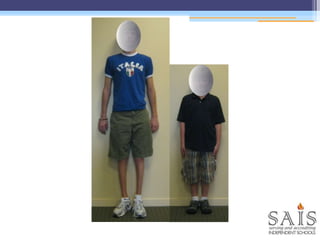
  • #20 No grade levels No science behind the idea brains are just a different in rates of growth as bodies No grade levels: Look at any given age. You see wide range of physical traits. Brain development is just as uneven.
  • #23 Howard Kids can do this
  • #27 Math anxiety Tara study Regulatory skills make the difference Ramped up physiology Response to aversive stimulus Feeling out of Chronic: Deregulates blood pressure Increases stroke or heart attack Depresses immune system Hippocampus has lots of cortisol receptors: blocks neurogenesis
  • #28 Reminder: Emotions connected to learning and memory
  • #29 Considerations beyond the simple senses We see consciously,but also process sight unconsciously Story : Blind sight Story: learning to see Vision is for vision: braille, tongue reading Activity: Hand motions
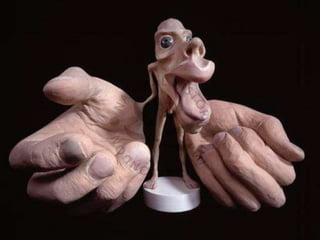
  • #30 Talk about the need for hands on! Thumbs on today’s students must be even larger
  • #31 Do “n” story activity Do pitcher activity if possible
  • #32 The 15 point swing I mentioned was correlated to an increase in the motor areas of speech production (verbal), and the motor areas of hand use (perceptual) London cabbies--Hippocampus makes a map of the external world