■Essential Question:
–What caused World War II?
–What were the major events during
World War II from 1939 to 1942?
■Warm Up Question:
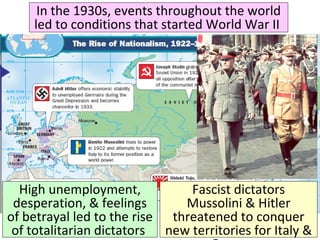
In the 1930s, events throughout the world
led to conditions that started World War II
High unemployment,
desperation, & feelings
of betrayal led to the rise
of totalitarian dictators
Fascist dictators
Mussolini & Hitler
threatened to conquer
new territories for Italy &
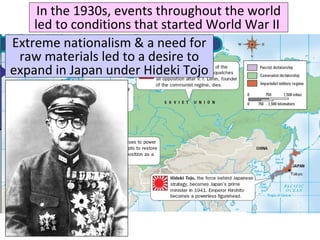
In the 1930s, events throughout the world
led to conditions that started World War II
Extreme nationalism & a need for
raw materials led to a desire to
expand in Japan under Hideki Tojo
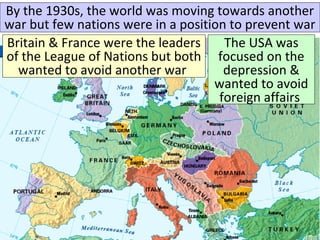
Britain & France were the leaders
of the League of Nations but both
wanted to avoid another war
The USA was
focused on the
depression &
wanted to avoid
foreign affairs
By the 1930s, the world was moving towards another
war but few nations were in a position to prevent war
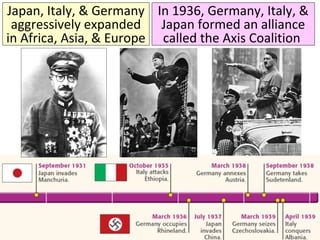
Japan, Italy, & Germany
aggressively expanded
in Africa, Asia, & Europe
In 1936, Germany, Italy, &
Japan formed an alliance
called the Axis Coalition
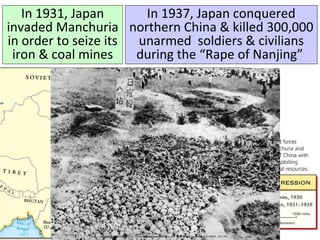
In 1931, Japan
invaded Manchuria
in order to seize its
iron & coal mines
In 1937, Japan conquered
northern China & killed 300,000
unarmed soldiers & civilians
during the “Rape of Nanjing”
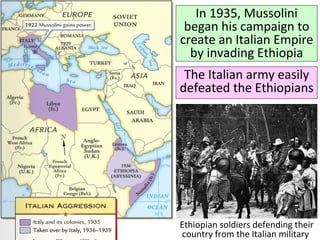
In 1935, Mussolini
began his campaign to
create an Italian Empire
by invading Ethiopia
The Italian army easily
defeated the Ethiopians
Ethiopian soldiers defending their
country from the Italian military
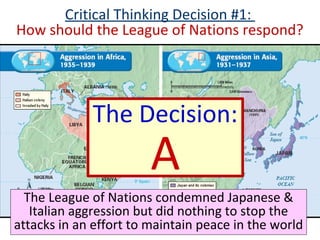
Critical Thinking Decision #1:
How should the League of Nations respond?
The League of Nations condemned Japanese &
Italian aggression but did nothing to stop the
attacks in an effort to maintain peace in the world
The Decision:
A
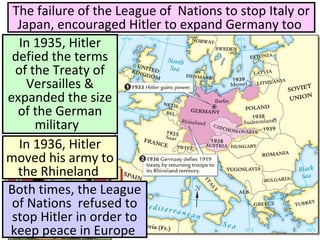
In 1935, Hitler
defied the terms
of the Treaty of
Versailles &
expanded the size
of the German
military
The failure of the League of Nations to stop Italy or
Japan, encouraged Hitler to expand Germany too
In 1936, Hitler
moved his army to
the Rhineland
Both times, the League
of Nations refused to
stop Hitler in order to
keep peace in Europe
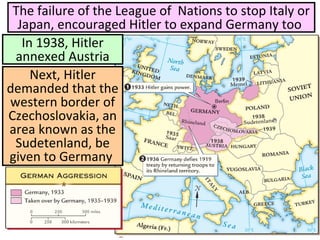
In 1938, Hitler
annexed Austria
The failure of the League of Nations to stop Italy or
Japan, encouraged Hitler to expand Germany too
Next, Hitler
demanded that the
western border of
Czechoslovakia, an
area known as the
Sudetenland, be
given to Germany
Critical Thinking Decision #2:
How should the League of Nations respond?
The
Decision:
B
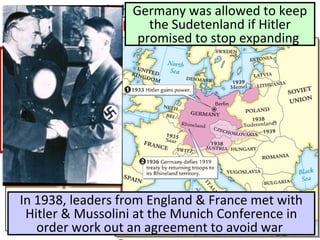
In 1938, leaders from England & France met with
Hitler & Mussolini at the Munich Conference in
order work out an agreement to avoid war
Germany was allowed to keep
the Sudetenland if Hitler
promised to stop expanding
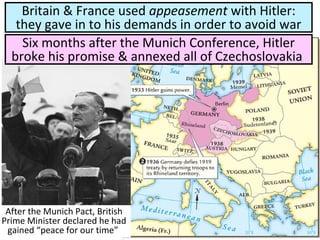
After the Munich Pact, British
Prime Minister declared he had
gained “peace for our time”
Britain & France used appeasement with Hitler:
they gave in to his demands in order to avoid war
Six months after the Munich Conference, Hitler
broke his promise & annexed all of Czechoslovakia
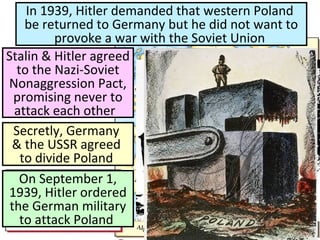
In 1939, Hitler demanded that western Poland
be returned to Germany but he did not want to
provoke a war with the Soviet Union
Stalin & Hitler agreed
to the Nazi-Soviet
Nonaggression Pact,
promising never to
attack each other
Secretly, Germany
& the USSR agreed
to divide Poland
On September 1,
1939, Hitler ordered
the German military
to attack Poland
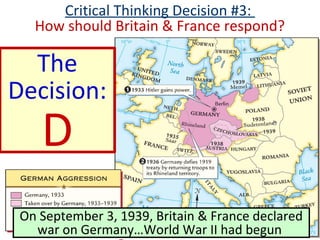
Critical Thinking Decision #3:
How should Britain & France respond?
The
Decision:
D
On September 3, 1939, Britain & France declared
war on Germany…World War II had begun
■Essential Question:
–What were the major events during
World War II from 1939 to 1942?
■CPWH Agenda for Unit 12.3:
–Clicker Review Questions
–Finish “WWII: 1939-1942” notes
–Today’s HW: 32.1
–Unit 12 Test: Wed, April 13
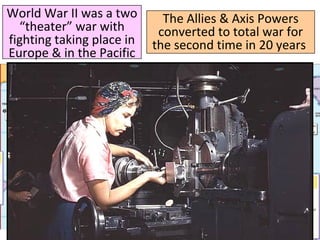
World War II was a two
“theater” war with
fighting taking place in
Europe & in the Pacific
The Allies & Axis Powers
converted to total war for
the second time in 20 years
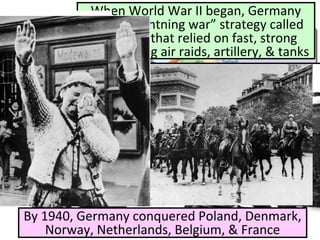
When World War II began, Germany
used a “lightning war” strategy called
blitzkrieg that relied on fast, strong
attacks using air raids, artillery, & tanks
By 1940, Germany conquered Poland, Denmark,
Norway, Netherlands, Belgium, & France
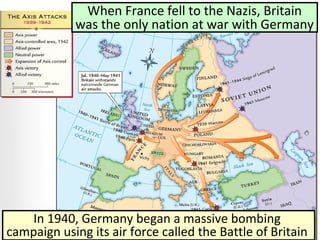
When France fell to the Nazis, Britain
was the only nation at war with Germany
In 1940, Germany began a massive bombing
campaign using its air force called the Battle of Britain
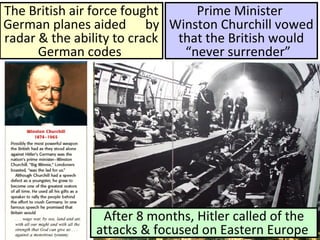
The British air force fought
German planes aided by
radar & the ability to crack
German codes
Prime Minister
Winston Churchill vowed
that the British would
“never surrender”
After 8 months, Hitler called of the
attacks & focused on Eastern Europe
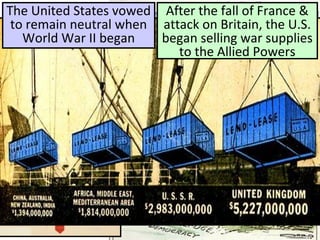
The United States vowed
to remain neutral when
World War II began
After the fall of France &
attack on Britain, the U.S.
began selling war supplies
to the Allied Powers
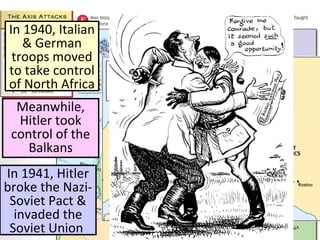
In 1940, Italian
& German
troops moved
to take control
of North Africa
Meanwhile,
Hitler took
control of the
Balkans
In 1941, Hitler
broke the Nazi-
Soviet Pact &
invaded the
Soviet Union
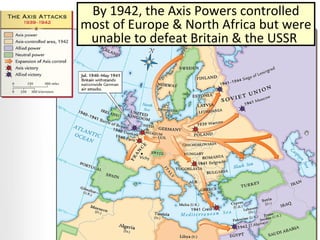
By 1942, the Axis Powers controlled
most of Europe & North Africa but were
unable to defeat Britain & the USSR
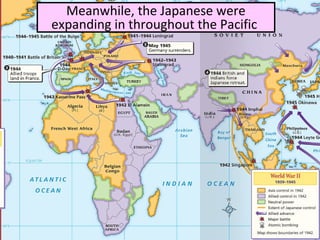
Meanwhile, the Japanese were
expanding in throughout the Pacific
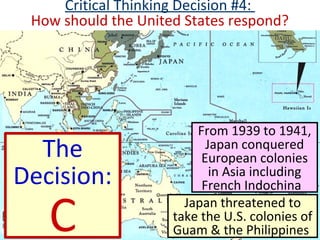
From 1939 to 1941,
Japan conquered
European colonies
in Asia including
French Indochina
Japan threatened to
take the U.S. colonies of
Guam & the Philippines
Critical Thinking Decision #4:
How should the United States respond?
The
Decision:
C
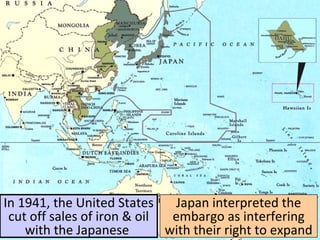
In 1941, the United States
cut off sales of iron & oil
with the Japanese
Japan interpreted the
embargo as interfering
with their right to expand
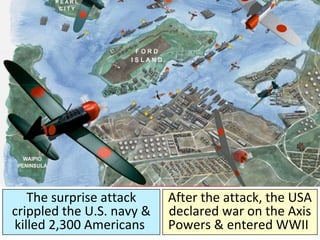
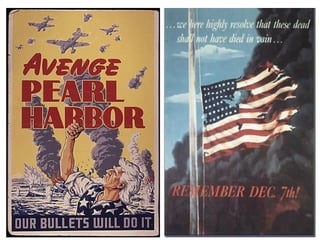
On December 7, 1941
Japan attacked the U.S.
naval base at Pearl
Harbor in Hawaii
The surprise attack
crippled the U.S. navy &
killed 2,300 Americans
After the attack, the USA
declared war on the Axis
Powers & entered WWII
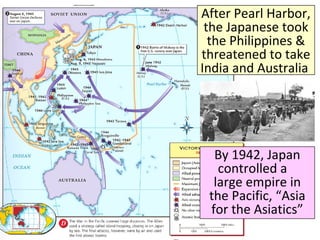
After Pearl Harbor,
the Japanese took
the Philippines &
threatened to take
India and Australia
By 1942, Japan
controlled a
large empire in
the Pacific, “Asia
for the Asiatics”
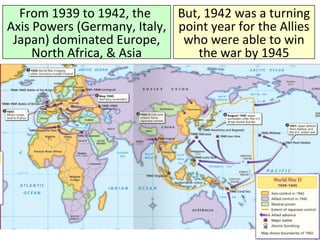
From 1939 to 1942, the
Axis Powers (Germany, Italy,
Japan) dominated Europe,
North Africa, & Asia
But, 1942 was a turning
point year for the Allies
who were able to win
the war by 1945

World war ii_1939-1942

  • 1.
    ■Essential Question: –What causedWorld War II? –What were the major events during World War II from 1939 to 1942? ■Warm Up Question:
  • 2.
    In the 1930s,events throughout the world led to conditions that started World War II High unemployment, desperation, & feelings of betrayal led to the rise of totalitarian dictators Fascist dictators Mussolini & Hitler threatened to conquer new territories for Italy &
  • 3.
    In the 1930s,events throughout the world led to conditions that started World War II Extreme nationalism & a need for raw materials led to a desire to expand in Japan under Hideki Tojo
  • 4.
    Britain & Francewere the leaders of the League of Nations but both wanted to avoid another war The USA was focused on the depression & wanted to avoid foreign affairs By the 1930s, the world was moving towards another war but few nations were in a position to prevent war
  • 5.
    Japan, Italy, &Germany aggressively expanded in Africa, Asia, & Europe In 1936, Germany, Italy, & Japan formed an alliance called the Axis Coalition
  • 6.
    In 1931, Japan invadedManchuria in order to seize its iron & coal mines In 1937, Japan conquered northern China & killed 300,000 unarmed soldiers & civilians during the “Rape of Nanjing”
  • 7.
    In 1935, Mussolini beganhis campaign to create an Italian Empire by invading Ethiopia The Italian army easily defeated the Ethiopians Ethiopian soldiers defending their country from the Italian military
  • 8.
    Critical Thinking Decision#1: How should the League of Nations respond? The League of Nations condemned Japanese & Italian aggression but did nothing to stop the attacks in an effort to maintain peace in the world The Decision: A
  • 9.
    In 1935, Hitler defiedthe terms of the Treaty of Versailles & expanded the size of the German military The failure of the League of Nations to stop Italy or Japan, encouraged Hitler to expand Germany too In 1936, Hitler moved his army to the Rhineland Both times, the League of Nations refused to stop Hitler in order to keep peace in Europe
  • 10.
    In 1938, Hitler annexedAustria The failure of the League of Nations to stop Italy or Japan, encouraged Hitler to expand Germany too Next, Hitler demanded that the western border of Czechoslovakia, an area known as the Sudetenland, be given to Germany
  • 11.
    Critical Thinking Decision#2: How should the League of Nations respond? The Decision: B In 1938, leaders from England & France met with Hitler & Mussolini at the Munich Conference in order work out an agreement to avoid war Germany was allowed to keep the Sudetenland if Hitler promised to stop expanding
  • 12.
    After the MunichPact, British Prime Minister declared he had gained “peace for our time” Britain & France used appeasement with Hitler: they gave in to his demands in order to avoid war Six months after the Munich Conference, Hitler broke his promise & annexed all of Czechoslovakia
  • 13.
    In 1939, Hitlerdemanded that western Poland be returned to Germany but he did not want to provoke a war with the Soviet Union Stalin & Hitler agreed to the Nazi-Soviet Nonaggression Pact, promising never to attack each other Secretly, Germany & the USSR agreed to divide Poland On September 1, 1939, Hitler ordered the German military to attack Poland
  • 14.
    Critical Thinking Decision#3: How should Britain & France respond? The Decision: D On September 3, 1939, Britain & France declared war on Germany…World War II had begun
  • 15.
    ■Essential Question: –What werethe major events during World War II from 1939 to 1942? ■CPWH Agenda for Unit 12.3: –Clicker Review Questions –Finish “WWII: 1939-1942” notes –Today’s HW: 32.1 –Unit 12 Test: Wed, April 13
  • 16.
    World War IIwas a two “theater” war with fighting taking place in Europe & in the Pacific The Allies & Axis Powers converted to total war for the second time in 20 years
  • 17.
    When World WarII began, Germany used a “lightning war” strategy called blitzkrieg that relied on fast, strong attacks using air raids, artillery, & tanks By 1940, Germany conquered Poland, Denmark, Norway, Netherlands, Belgium, & France
  • 18.
    When France fellto the Nazis, Britain was the only nation at war with Germany In 1940, Germany began a massive bombing campaign using its air force called the Battle of Britain
  • 19.
    The British airforce fought German planes aided by radar & the ability to crack German codes Prime Minister Winston Churchill vowed that the British would “never surrender” After 8 months, Hitler called of the attacks & focused on Eastern Europe
  • 20.
    The United Statesvowed to remain neutral when World War II began After the fall of France & attack on Britain, the U.S. began selling war supplies to the Allied Powers
  • 21.
    In 1940, Italian &German troops moved to take control of North Africa Meanwhile, Hitler took control of the Balkans In 1941, Hitler broke the Nazi- Soviet Pact & invaded the Soviet Union
  • 22.
    By 1942, theAxis Powers controlled most of Europe & North Africa but were unable to defeat Britain & the USSR
  • 23.
    Meanwhile, the Japanesewere expanding in throughout the Pacific
  • 24.
    From 1939 to1941, Japan conquered European colonies in Asia including French Indochina Japan threatened to take the U.S. colonies of Guam & the Philippines Critical Thinking Decision #4: How should the United States respond? The Decision: C
  • 25.
    In 1941, theUnited States cut off sales of iron & oil with the Japanese Japan interpreted the embargo as interfering with their right to expand
  • 26.
    On December 7,1941 Japan attacked the U.S. naval base at Pearl Harbor in Hawaii The surprise attack crippled the U.S. navy & killed 2,300 Americans After the attack, the USA declared war on the Axis Powers & entered WWII
  • 28.
    After Pearl Harbor, theJapanese took the Philippines & threatened to take India and Australia By 1942, Japan controlled a large empire in the Pacific, “Asia for the Asiatics”
  • 29.
    From 1939 to1942, the Axis Powers (Germany, Italy, Japan) dominated Europe, North Africa, & Asia But, 1942 was a turning point year for the Allies who were able to win the war by 1945

Editor's Notes

  • #2 46a - examine the impact of the war on science, art, and social thinking by identifying the cultural significance of Sigmund Freud, Albert Einstein and Picasso 46b - determine the causes & results of the Russian Revolution from the rise of the Bolsheviks under Lenin to Stalin's first 5 Year Plan 46c - characterize the social, economic, and political climate of the post-World War I world that led to favorable conditions for totalitarian regimes 46d - describe the rise of fascism in Europe and Asia by comparing the policies of Benito Mussolini in Italy, Adolf Hitler in Germany, and Hirohito in Japan 46e - analyze the rise of nationalism as seen in the ideas of Sun Yat Sen, Mustafa Kemal Attaturk, and Mohandas Ghandi 46f - describe the nature of totalitarianism and the police state that existed in Russia, Germany, and Italy and how they differ from authoritarian governments 46g - explain the aggression and conflict leading to World War II in Europe and Asia including the Italian invasion of Ethiopia, the Spanish Civil War, the rape of Nanjing in China, and the German annexation of the Sudetenland 47a - describe the major conflicts and outcomes including Pearl Harbor, El-Alamein, Stalingrad, D-Day, Guadalcanal, the Philippines, Hiroshima and Nagasaki, and the end of the war in Europe and Asia 47b - identify Nazi ideology, policies, and consequences which led to the Holocaust 47c - explain the military and diplomatic negotiations between the leaders of Great Britain (Churchill), the Soviet Union (Stalin), and the U.S. (Roosevelt/Truman) from Teheran to Yalta and Potsdam and the impact on Eastern European nations
  • #7 46g - explain the aggression and conflict leading to World War II in Europe and Asia including the Italian invasion of Ethiopia, the Spanish Civil War, the rape of Nanjing in China, and the German annexation of the Sudetenland