Assessment and
   Grading
tips, techniques, & strategies
Have a plan
Have a plan

• talk to other teachers in core area
Have a plan

• talk to other teachers in core area
• work with the school’s system and
  expectations
Have a plan

• talk to other teachers in core area
• work with the school’s system and
  expectations

• support your observations
Have a plan

• talk to other teachers in core area
• work with the school’s system and
  expectations

• support your observations
• be deliberate - every question/action serves
  a purpose
Have a plan

• talk to other teachers in core area
• work with the school’s system and
  expectations

• support your observations
• be deliberate - every question/action serves
  a purpose

• NO SURPRISES FOR ANYONE
Stay on top
Stay on top
• avoid letting assignments pile up
Stay on top
• avoid letting assignments pile up
  • plan for when you will be grading when writing lesson
     plans
Stay on top
• avoid letting assignments pile up
  • plan for when you will be grading when writing lesson
     plans

  • know the schedule for your grading periods
Stay on top
• avoid letting assignments pile up
  • plan for when you will be grading when writing lesson
     plans

  • know the schedule for your grading periods
• not every assignment needs assessed
Stay on top
• avoid letting assignments pile up
  • plan for when you will be grading when writing lesson
     plans

  • know the schedule for your grading periods
• not every assignment needs assessed
• know why and what you are assessing
Stay on top
• avoid letting assignments pile up
  • plan for when you will be grading when writing lesson
     plans

  • know the schedule for your grading periods
• not every assignment needs assessed
• know why and what you are assessing
• meaningful assessment provides feedback - not just
  numbers (not all assessment is/needs to be meaningful)
Stay on top
• avoid letting assignments pile up
  • plan for when you will be grading when writing lesson
     plans

  • know the schedule for your grading periods
• not every assignment needs assessed
• know why and what you are assessing
• meaningful assessment provides feedback - not just
  numbers (not all assessment is/needs to be meaningful)

• set and meet expectations for students and parents
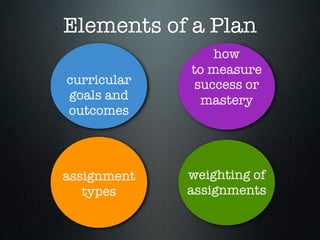
Elements of a Plan
                 how
             to measure
curricular    success or
goals and      mastery
outcomes


assignment   weighting of
   types     assignments
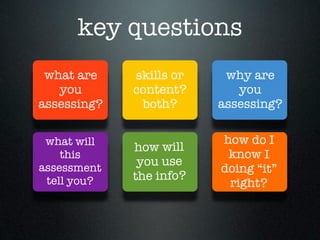
key questions
 what are    skills or    why are
   you       content?       you
assessing?    both?      assessing?

 what will               how do I
             how will
    this                  know I
assessment    you use
                         doing “it”
 tell you?   the info?
                          right?
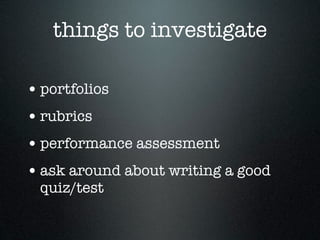
things to investigate

• portfolios
• rubrics
• performance assessment
• ask around about writing a good
  quiz/test
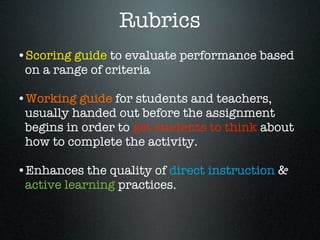
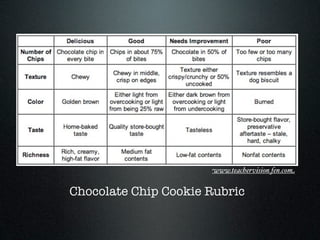
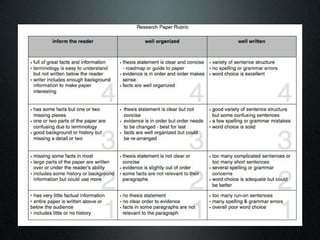
Rubrics
•Scoring guide to evaluate performance based
 on a range of criteria

•Working guide for students and teachers,
 usually handed out before the assignment
 begins in order to get students to think about
 how to complete the activity.

•Enhances the quality of direct instruction &
 active learning practices.
www.teachervision.fen.com


Chocolate Chip Cookie Rubric
music video rubric
     activity
A Million Ways by OK GO
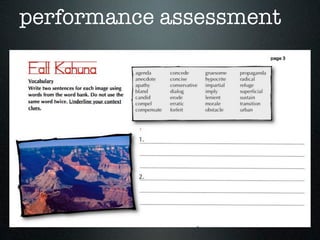
performance assessment
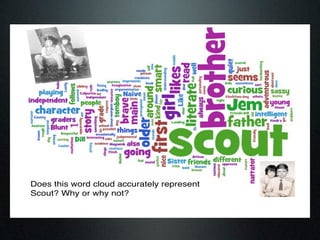
Does this word cloud accurately represent
Scout? Why or why not?
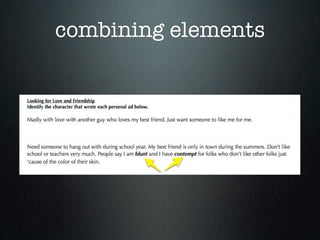
combining elements
Summary
• have a plan and stick with it
• work with school’s system
• support your observations with evidence
• know the “what” and “why” of each
  assessment

• ultimate goal is improved student
  performance & understanding

• set expectations and keep them

Assessment

  • 1.
    Assessment and Grading tips, techniques, & strategies
  • 2.
  • 3.
    Have a plan •talk to other teachers in core area
  • 4.
    Have a plan •talk to other teachers in core area • work with the school’s system and expectations
  • 5.
    Have a plan •talk to other teachers in core area • work with the school’s system and expectations • support your observations
  • 6.
    Have a plan •talk to other teachers in core area • work with the school’s system and expectations • support your observations • be deliberate - every question/action serves a purpose
  • 7.
    Have a plan •talk to other teachers in core area • work with the school’s system and expectations • support your observations • be deliberate - every question/action serves a purpose • NO SURPRISES FOR ANYONE
  • 8.
  • 9.
    Stay on top •avoid letting assignments pile up
  • 10.
    Stay on top •avoid letting assignments pile up • plan for when you will be grading when writing lesson plans
  • 11.
    Stay on top •avoid letting assignments pile up • plan for when you will be grading when writing lesson plans • know the schedule for your grading periods
  • 12.
    Stay on top •avoid letting assignments pile up • plan for when you will be grading when writing lesson plans • know the schedule for your grading periods • not every assignment needs assessed
  • 13.
    Stay on top •avoid letting assignments pile up • plan for when you will be grading when writing lesson plans • know the schedule for your grading periods • not every assignment needs assessed • know why and what you are assessing
  • 14.
    Stay on top •avoid letting assignments pile up • plan for when you will be grading when writing lesson plans • know the schedule for your grading periods • not every assignment needs assessed • know why and what you are assessing • meaningful assessment provides feedback - not just numbers (not all assessment is/needs to be meaningful)
  • 15.
    Stay on top •avoid letting assignments pile up • plan for when you will be grading when writing lesson plans • know the schedule for your grading periods • not every assignment needs assessed • know why and what you are assessing • meaningful assessment provides feedback - not just numbers (not all assessment is/needs to be meaningful) • set and meet expectations for students and parents
  • 17.
    Elements of aPlan how to measure curricular success or goals and mastery outcomes assignment weighting of types assignments
  • 18.
    key questions whatare skills or why are you content? you assessing? both? assessing? what will how do I how will this know I assessment you use doing “it” tell you? the info? right?
  • 20.
    things to investigate •portfolios • rubrics • performance assessment • ask around about writing a good quiz/test
  • 21.
    Rubrics •Scoring guide toevaluate performance based on a range of criteria •Working guide for students and teachers, usually handed out before the assignment begins in order to get students to think about how to complete the activity. •Enhances the quality of direct instruction & active learning practices.
  • 22.
  • 24.
  • 25.
  • 27.
  • 28.
    Does this wordcloud accurately represent Scout? Why or why not?
  • 29.
  • 30.
    Summary • have aplan and stick with it • work with school’s system • support your observations with evidence • know the “what” and “why” of each assessment • ultimate goal is improved student performance & understanding • set expectations and keep them

Editor's Notes

  • #2 \n
  • #3 first year teachers - highly recommend using someone’s else plan - better support & focus on other things\n
  • #4 first year teachers - highly recommend using someone’s else plan - better support & focus on other things\n
  • #5 first year teachers - highly recommend using someone’s else plan - better support & focus on other things\n
  • #6 first year teachers - highly recommend using someone’s else plan - better support & focus on other things\n
  • #7 first year teachers - highly recommend using someone’s else plan - better support & focus on other things\n
  • #8 \n
  • #9 \n
  • #10 \n
  • #11 \n
  • #12 \n
  • #13 \n
  • #14 \n
  • #15 \n
  • #16 bring things forward from last assessment - score for each \n
  • #17 but my thing is just science... no! your new thing is teaching science and the unwritten curriculum \n
  • #18 \n
  • #19 \n
  • #20 \n
  • #21 \n
  • #22 \n
  • #23 \n
  • #24 \n
  • #25 \n
  • #26 \n
  • #27 \n
  • #28 \n
  • #29 \n