KHUSHBOWKHUSHBOW
VIDYANIKETANVIDYANIKETAN
World History fromWorld History from
World War I to World War IIWorld War I to World War II
BYBY
VISHNUVISHNU
Causes of World War ICauses of World War I
1. Balkan Nationalism1. Balkan Nationalism
Causes of World War ICauses of World War I
2. Entangled Alliances2. Entangled Alliances
Causes of World War ICauses of World War I
3. Militarism3. Militarism
• Arms races between nationsArms races between nations
• Built up to intimidate other nationsBuilt up to intimidate other nations
• Russian army had over 1,000,000Russian army had over 1,000,000
• Germany and France had 900,000Germany and France had 900,000
eacheach
Conditions on the Front in WWIConditions on the Front in WWI
1.1. New Weapons UtilizedNew Weapons Utilized
• Machine GunsMachine Guns
• Poison gas (Mustard Gas)Poison gas (Mustard Gas)
• TanksTanks
• Airplanes (Dog Fighting)Airplanes (Dog Fighting)
1.1. Trench WarfareTrench Warfare
• ““No Man’s Land”No Man’s Land”
• Disease and influenzaDisease and influenza
Effects of World War IEffects of World War I
 Treaty of VersaillesTreaty of Versailles
-Establishment of-Establishment of League of NationsLeague of Nations
-German-German reparationsreparations
• Mandate System –British and FrenchMandate System –British and French
WWI - End of EmpiresWWI - End of Empires
 Hapsburg Dynasty (Germany & Austria)Hapsburg Dynasty (Germany & Austria)
 Romanov’sRomanov’s
(Russian Czars)(Russian Czars)
 Ottoman EmpireOttoman Empire
(Middle East)(Middle East)
Family of Czar Nicholas II –
last of the Romanov Rulers of
Russia
The Russian RevolutionThe Russian Revolution
 1917—Workers revolt1917—Workers revolt
against the Czaragainst the Czar
--Bolsheviks take over--Bolsheviks take over
Russia and begin aRussia and begin a
socialist system undersocialist system under
Vladimir LeninVladimir Lenin..
Allied countries (GreatAllied countries (Great
Britain, France, JapanBritain, France, Japan
and the United States)and the United States)
send troops to supportsend troops to support
anti-communistanti-communist
forces, but communistforces, but communist
forces eventuallyforces eventually
prevail.prevail.
The Soviet UnionThe Soviet Union
 1922 --Lenin establishes the Soviet1922 --Lenin establishes the Soviet
Union (USSR)Union (USSR)
The Rise of Joseph StalinThe Rise of Joseph Stalin
 1924—Lenin dies–1924—Lenin dies–
Several leadersSeveral leaders
struggle for powerstruggle for power
including Leon Trotskyincluding Leon Trotsky
andand Joseph StalinJoseph Stalin..
 Eventually, StalinEventually, Stalin
seizes power andseizes power and
becomes a dictatorbecomes a dictator
over USSR—imposingover USSR—imposing
a totalitarian state.a totalitarian state.
 He begins aHe begins a Five YearFive Year
PlanPlan to increaseto increase
industrialization andindustrialization and
collectivize agriculturecollectivize agriculture
in the Soviet Union.in the Soviet Union.
The Red ScareThe Red Scare
 After the Russian Revolution, fear of aAfter the Russian Revolution, fear of a
similar revolution in the United States bysimilar revolution in the United States by
communists from Russia led to a periodcommunists from Russia led to a period
known as theknown as the Red ScareRed Scare..
 Attempted assassinations of AttorneyAttempted assassinations of Attorney
General Mitchell Palmer and John D.General Mitchell Palmer and John D.
Rockefeller led to theRockefeller led to the Palmer Raids—Palmer Raids—inin
which suspected communists werewhich suspected communists were
arrested and more than 500 immigrantsarrested and more than 500 immigrants
deported.deported.
 This led to increase fear of immigrants andThis led to increase fear of immigrants and
restrictions on immigrationrestrictions on immigration werewere
passed by Congress.passed by Congress.
New Leaders EmergeNew Leaders Emerge
 In Italy, a new fascistIn Italy, a new fascist
government emergedgovernment emerged
in 1922 underin 1922 under BenitoBenito
MussoliniMussolini. He rose. He rose
to power usingto power using
propaganda, brutality,propaganda, brutality,
and intimidation—and intimidation—
promoting an ultra-promoting an ultra-
nationalist Italy andnationalist Italy and
himself ashimself as Il DuceIl Duce
(“the Leader”)(“the Leader”)..
Fascism in GermanyFascism in Germany
 In 1921,In 1921, Adolf HitlerAdolf Hitler tooktook
control of the Nationalcontrol of the National
Socialist German Worker’sSocialist German Worker’s
Party—better known as theParty—better known as the
NazisNazis..
 He became chancellor ofHe became chancellor of
Germany in 1933 andGermany in 1933 and
eventually claimed the titleeventually claimed the title
Fuhrer (guide of Germany)Fuhrer (guide of Germany)
and established himself asand established himself as
dictator over thedictator over the ThirdThird
Reich.Reich.
Leadership in JapanLeadership in Japan
 JapaneseJapanese EmperorEmperor
HirohitoHirohito began hisbegan his
reign in Japan inreign in Japan in
1926. He did not1926. He did not
exercise absoluteexercise absolute
control over thecontrol over the
government.government.
 Instead, an armyInstead, an army
general,general, Hideki TojoHideki Tojo,,
assumed the role ofassumed the role of
Japan’s premier –Japan’s premier –
leading it throughleading it through
World War II.World War II.
Authoritarian GovernmentAuthoritarian Government
and Totalitarianismand Totalitarianism
 Authoritarian Government is ruled by aAuthoritarian Government is ruled by a
single person or party interested insingle person or party interested in
political power.political power.
 Totalitarianism is a government whichTotalitarianism is a government which
seeks to control not only political power,seeks to control not only political power,
but the economy, culture, and social life.but the economy, culture, and social life.
 These governments often use terror andThese governments often use terror and
fear--utilizing propaganda and controllingfear--utilizing propaganda and controlling
access to information such as the pressaccess to information such as the press
and education. (Examples: Italy,and education. (Examples: Italy,
Germany, & USSR)Germany, & USSR)
Aggression in AsiaAggression in Asia
 1931—Japan1931—Japan
Invades ManchuriaInvades Manchuria
 Japan leaves theJapan leaves the
League of NationsLeague of Nations
 By 1938, JapanBy 1938, Japan
has control ofhas control of
major cities alongmajor cities along
Chinese coastChinese coast
German ExpansionGerman Expansion
 Hitler begins rebuilding German militaryHitler begins rebuilding German military
and marches troops into the Rhinelandand marches troops into the Rhineland
(lost in WWI)(lost in WWI)
 Germany annexes Austria and claims partsGermany annexes Austria and claims parts
of the Sudetenlandof the Sudetenland
 Great Britain and France pursue policy ofGreat Britain and France pursue policy of
appeasementappeasement—rather than challenge—rather than challenge
Hitler’s aggressionHitler’s aggression
 In 1939,In 1939, Hitler invades PolandHitler invades Poland
 Britain and France declare war onBritain and France declare war on
Germany—thus beginningGermany—thus beginning World War IIWorld War II
The HolocaustThe Holocaust
 Hitler’s policy of Nazi racismHitler’s policy of Nazi racism
targeted Jewish people andtargeted Jewish people and
fed on Europeanfed on European anti-anti-
semitismsemitism
 Hitler viewed Jews as aHitler viewed Jews as a
national enemy and begannational enemy and began
implementing hisimplementing his FinalFinal
SolutionSolution—elimination of—elimination of
Jewish people by sendingJewish people by sending
them to concentration campsthem to concentration camps
as slave laborers and thenas slave laborers and then
executing them in gasexecuting them in gas
chamberschambers
 The extermination of nearly 6The extermination of nearly 6
million Jews, as well asmillion Jews, as well as
Gypsies, Slavs, and otherGypsies, Slavs, and other
people deemed undesirablepeople deemed undesirable
came to be known ascame to be known as thethe
HolocaustHolocaust
World War II --1940World War II --1940
 April, 1940--Germany Invades DenmarkApril, 1940--Germany Invades Denmark
and Norwayand Norway
 May, 1940 – Germany takes control ofMay, 1940 – Germany takes control of
Belgium, Netherlands, and FranceBelgium, Netherlands, and France
 July-October, 1940 – Battle of Britain,July-October, 1940 – Battle of Britain,
German planes bomb Britain inGerman planes bomb Britain in
“blitzkriegs” (night air raids).“blitzkriegs” (night air raids).
 British Royal Air Force help fight offBritish Royal Air Force help fight off
German air assault and prevent invasion.German air assault and prevent invasion.
Axis PowersAxis Powers
 1940,Germany, Italy and Japan form an1940,Germany, Italy and Japan form an
alliance known as thealliance known as the Axis PowersAxis Powers
US Neutrality before World War IIUS Neutrality before World War II
 1935—1935— Neutrality ActNeutrality Act passed bypassed by
Congress to stay out of EuropeanCongress to stay out of European
conflictsconflicts
 1940 -- U.S. imposes1940 -- U.S. imposes embargoembargo onon
Japan after its invasion of ChinaJapan after its invasion of China
 March, 1941– Congress passesMarch, 1941– Congress passes
Lend-Lease ActLend-Lease Act to allow Presidentto allow President
Roosevelt to send aid to Great BritainRoosevelt to send aid to Great Britain
Japan attacks Pearl HarborJapan attacks Pearl Harbor
 Dec. 7Dec. 7thth
1941—Japan launches surprise1941—Japan launches surprise
attack on U.S. Pacific Fleet at Pearlattack on U.S. Pacific Fleet at Pearl
Harbor, HawaiiHarbor, Hawaii
U.S. joins Allies in World War IIU.S. joins Allies in World War II
 After Pearl Harbor,After Pearl Harbor,
the U.S. declaresthe U.S. declares
war on Japan andwar on Japan and
joins Allies (Greatjoins Allies (Great
Britain, USSR, andBritain, USSR, and
French resistance)French resistance)
against the Axisagainst the Axis
PowersPowers
Domestic Wartime Policies of USDomestic Wartime Policies of US
 Roosevelt establishesRoosevelt establishes War ProductionWar Production
BoardBoard –redirecting production of civilian–redirecting production of civilian
consumer goods to war materialsconsumer goods to war materials
 Revenue for funding the war wasRevenue for funding the war was
generated throughgenerated through withholding income taxwithholding income tax
from paychecks and sellingfrom paychecks and selling war bondswar bonds
 The Government beganThe Government began rationingrationing ofof
resources—such as tires and food itemsresources—such as tires and food items
Women join domestic war effortWomen join domestic war effort
 Many women filledMany women filled
industrial jobs thatindustrial jobs that
had been held byhad been held by
men who were sentmen who were sent
overseasoverseas
 A popular symbolA popular symbol
of these womenof these women
waswas Rosie theRosie the
RiveterRiveter
Suspicion of Germans, Italians andSuspicion of Germans, Italians and
Japanese in U.S.Japanese in U.S.
 Since the U.S. wasSince the U.S. was
at war with theseat war with these
countries,countries,
suspicion ofsuspicion of
citizens with originscitizens with origins
in Germany, Italyin Germany, Italy
and Japan led toand Japan led to
their removal totheir removal to
remoteremote
internmentinternment
campscamps..
Allied Powers meet at TehranAllied Powers meet at Tehran
 In 1943, leaders ofIn 1943, leaders of
the three majorthe three major
Allied PowersAllied Powers
(Churchill—Britain,(Churchill—Britain,
Roosevelt--US,Roosevelt--US,
Stalin-- USSR)Stalin-- USSR)
met in themet in the TehranTehran
ConferenceConference toto
discuss plans fordiscuss plans for
defeating Germanydefeating Germany
D-DayD-Day
 At Tehran, theAt Tehran, the
leaders planned anleaders planned an
amphibious invasionamphibious invasion
of Normandyof Normandy
(occupied by Nazis)(occupied by Nazis)
namednamed OperationOperation
Overlord –Overlord –headedheaded
by supreme alliedby supreme allied
commander Dwightcommander Dwight
D. EisenhowerD. Eisenhower
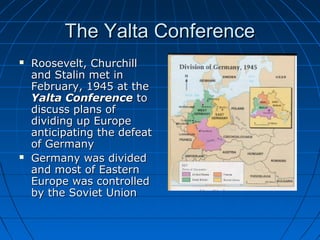
The Yalta ConferenceThe Yalta Conference
 Roosevelt, ChurchillRoosevelt, Churchill
and Stalin met inand Stalin met in
February, 1945 at theFebruary, 1945 at the
Yalta ConferenceYalta Conference toto
discuss plans ofdiscuss plans of
dividing up Europedividing up Europe
anticipating the defeatanticipating the defeat
of Germanyof Germany
 Germany was dividedGermany was divided
and most of Easternand most of Eastern
Europe was controlledEurope was controlled
by the Soviet Unionby the Soviet Union
The Potsdam ConferenceThe Potsdam Conference
 The Allied leaders metThe Allied leaders met
after the defeat ofafter the defeat of
Germany in July,1945 atGermany in July,1945 at
thethe Potsdam ConferencePotsdam Conference
to discuss plans forto discuss plans for
defeating Japan and itsdefeating Japan and its
unconditional surrenderunconditional surrender
 President Truman (whoPresident Truman (who
succeeded Roosevelt aftersucceeded Roosevelt after
his death) learned of thehis death) learned of the
successful tests of thesuccessful tests of the
Atomic bomb while at theAtomic bomb while at the
conferenceconference
The Atomic BombThe Atomic Bomb
 Led by Robert Oppenheimer,Led by Robert Oppenheimer,
thethe Manhattan ProjectManhattan Project
successfully produced twosuccessfully produced two
Atomic bombs atAtomic bombs at LosLos
Alamos,Alamos, New Mexico (calledNew Mexico (called
Fat Man and Little Boy)Fat Man and Little Boy)
 On August 6On August 6thth
, 1945 a B-29, 1945 a B-29
bomber called thebomber called the Enola GayEnola Gay
dropped the first Atomicdropped the first Atomic
bomb onbomb on Hiroshima, JapanHiroshima, Japan
 Three days later, a secondThree days later, a second
bomb exploded overbomb exploded over
NagasakiNagasaki
 Japan surrendered on AugustJapan surrendered on August
1414thth
, 1945—thus ending World, 1945—thus ending World
War II and beginning theWar II and beginning the
Atomic AgeAtomic Age
THANK YOUTHANK YOU

world wars

  • 1.
    KHUSHBOWKHUSHBOW VIDYANIKETANVIDYANIKETAN World History fromWorldHistory from World War I to World War IIWorld War I to World War II BYBY VISHNUVISHNU
  • 2.
    Causes of WorldWar ICauses of World War I 1. Balkan Nationalism1. Balkan Nationalism
  • 3.
    Causes of WorldWar ICauses of World War I 2. Entangled Alliances2. Entangled Alliances
  • 4.
    Causes of WorldWar ICauses of World War I 3. Militarism3. Militarism • Arms races between nationsArms races between nations • Built up to intimidate other nationsBuilt up to intimidate other nations • Russian army had over 1,000,000Russian army had over 1,000,000 • Germany and France had 900,000Germany and France had 900,000 eacheach
  • 5.
    Conditions on theFront in WWIConditions on the Front in WWI 1.1. New Weapons UtilizedNew Weapons Utilized • Machine GunsMachine Guns • Poison gas (Mustard Gas)Poison gas (Mustard Gas) • TanksTanks • Airplanes (Dog Fighting)Airplanes (Dog Fighting) 1.1. Trench WarfareTrench Warfare • ““No Man’s Land”No Man’s Land” • Disease and influenzaDisease and influenza
  • 6.
    Effects of WorldWar IEffects of World War I  Treaty of VersaillesTreaty of Versailles -Establishment of-Establishment of League of NationsLeague of Nations -German-German reparationsreparations • Mandate System –British and FrenchMandate System –British and French
  • 7.
    WWI - Endof EmpiresWWI - End of Empires  Hapsburg Dynasty (Germany & Austria)Hapsburg Dynasty (Germany & Austria)  Romanov’sRomanov’s (Russian Czars)(Russian Czars)  Ottoman EmpireOttoman Empire (Middle East)(Middle East) Family of Czar Nicholas II – last of the Romanov Rulers of Russia
  • 8.
    The Russian RevolutionTheRussian Revolution  1917—Workers revolt1917—Workers revolt against the Czaragainst the Czar --Bolsheviks take over--Bolsheviks take over Russia and begin aRussia and begin a socialist system undersocialist system under Vladimir LeninVladimir Lenin.. Allied countries (GreatAllied countries (Great Britain, France, JapanBritain, France, Japan and the United States)and the United States) send troops to supportsend troops to support anti-communistanti-communist forces, but communistforces, but communist forces eventuallyforces eventually prevail.prevail.
  • 9.
    The Soviet UnionTheSoviet Union  1922 --Lenin establishes the Soviet1922 --Lenin establishes the Soviet Union (USSR)Union (USSR)
  • 10.
    The Rise ofJoseph StalinThe Rise of Joseph Stalin  1924—Lenin dies–1924—Lenin dies– Several leadersSeveral leaders struggle for powerstruggle for power including Leon Trotskyincluding Leon Trotsky andand Joseph StalinJoseph Stalin..  Eventually, StalinEventually, Stalin seizes power andseizes power and becomes a dictatorbecomes a dictator over USSR—imposingover USSR—imposing a totalitarian state.a totalitarian state.  He begins aHe begins a Five YearFive Year PlanPlan to increaseto increase industrialization andindustrialization and collectivize agriculturecollectivize agriculture in the Soviet Union.in the Soviet Union.
  • 11.
    The Red ScareTheRed Scare  After the Russian Revolution, fear of aAfter the Russian Revolution, fear of a similar revolution in the United States bysimilar revolution in the United States by communists from Russia led to a periodcommunists from Russia led to a period known as theknown as the Red ScareRed Scare..  Attempted assassinations of AttorneyAttempted assassinations of Attorney General Mitchell Palmer and John D.General Mitchell Palmer and John D. Rockefeller led to theRockefeller led to the Palmer Raids—Palmer Raids—inin which suspected communists werewhich suspected communists were arrested and more than 500 immigrantsarrested and more than 500 immigrants deported.deported.  This led to increase fear of immigrants andThis led to increase fear of immigrants and restrictions on immigrationrestrictions on immigration werewere passed by Congress.passed by Congress.
  • 12.
    New Leaders EmergeNewLeaders Emerge  In Italy, a new fascistIn Italy, a new fascist government emergedgovernment emerged in 1922 underin 1922 under BenitoBenito MussoliniMussolini. He rose. He rose to power usingto power using propaganda, brutality,propaganda, brutality, and intimidation—and intimidation— promoting an ultra-promoting an ultra- nationalist Italy andnationalist Italy and himself ashimself as Il DuceIl Duce (“the Leader”)(“the Leader”)..
  • 13.
    Fascism in GermanyFascismin Germany  In 1921,In 1921, Adolf HitlerAdolf Hitler tooktook control of the Nationalcontrol of the National Socialist German Worker’sSocialist German Worker’s Party—better known as theParty—better known as the NazisNazis..  He became chancellor ofHe became chancellor of Germany in 1933 andGermany in 1933 and eventually claimed the titleeventually claimed the title Fuhrer (guide of Germany)Fuhrer (guide of Germany) and established himself asand established himself as dictator over thedictator over the ThirdThird Reich.Reich.
  • 14.
    Leadership in JapanLeadershipin Japan  JapaneseJapanese EmperorEmperor HirohitoHirohito began hisbegan his reign in Japan inreign in Japan in 1926. He did not1926. He did not exercise absoluteexercise absolute control over thecontrol over the government.government.  Instead, an armyInstead, an army general,general, Hideki TojoHideki Tojo,, assumed the role ofassumed the role of Japan’s premier –Japan’s premier – leading it throughleading it through World War II.World War II.
  • 15.
    Authoritarian GovernmentAuthoritarian Government andTotalitarianismand Totalitarianism  Authoritarian Government is ruled by aAuthoritarian Government is ruled by a single person or party interested insingle person or party interested in political power.political power.  Totalitarianism is a government whichTotalitarianism is a government which seeks to control not only political power,seeks to control not only political power, but the economy, culture, and social life.but the economy, culture, and social life.  These governments often use terror andThese governments often use terror and fear--utilizing propaganda and controllingfear--utilizing propaganda and controlling access to information such as the pressaccess to information such as the press and education. (Examples: Italy,and education. (Examples: Italy, Germany, & USSR)Germany, & USSR)
  • 16.
    Aggression in AsiaAggressionin Asia  1931—Japan1931—Japan Invades ManchuriaInvades Manchuria  Japan leaves theJapan leaves the League of NationsLeague of Nations  By 1938, JapanBy 1938, Japan has control ofhas control of major cities alongmajor cities along Chinese coastChinese coast
  • 17.
    German ExpansionGerman Expansion Hitler begins rebuilding German militaryHitler begins rebuilding German military and marches troops into the Rhinelandand marches troops into the Rhineland (lost in WWI)(lost in WWI)  Germany annexes Austria and claims partsGermany annexes Austria and claims parts of the Sudetenlandof the Sudetenland  Great Britain and France pursue policy ofGreat Britain and France pursue policy of appeasementappeasement—rather than challenge—rather than challenge Hitler’s aggressionHitler’s aggression  In 1939,In 1939, Hitler invades PolandHitler invades Poland  Britain and France declare war onBritain and France declare war on Germany—thus beginningGermany—thus beginning World War IIWorld War II
  • 18.
    The HolocaustThe Holocaust Hitler’s policy of Nazi racismHitler’s policy of Nazi racism targeted Jewish people andtargeted Jewish people and fed on Europeanfed on European anti-anti- semitismsemitism  Hitler viewed Jews as aHitler viewed Jews as a national enemy and begannational enemy and began implementing hisimplementing his FinalFinal SolutionSolution—elimination of—elimination of Jewish people by sendingJewish people by sending them to concentration campsthem to concentration camps as slave laborers and thenas slave laborers and then executing them in gasexecuting them in gas chamberschambers  The extermination of nearly 6The extermination of nearly 6 million Jews, as well asmillion Jews, as well as Gypsies, Slavs, and otherGypsies, Slavs, and other people deemed undesirablepeople deemed undesirable came to be known ascame to be known as thethe HolocaustHolocaust
  • 19.
    World War II--1940World War II --1940  April, 1940--Germany Invades DenmarkApril, 1940--Germany Invades Denmark and Norwayand Norway  May, 1940 – Germany takes control ofMay, 1940 – Germany takes control of Belgium, Netherlands, and FranceBelgium, Netherlands, and France  July-October, 1940 – Battle of Britain,July-October, 1940 – Battle of Britain, German planes bomb Britain inGerman planes bomb Britain in “blitzkriegs” (night air raids).“blitzkriegs” (night air raids).  British Royal Air Force help fight offBritish Royal Air Force help fight off German air assault and prevent invasion.German air assault and prevent invasion.
  • 20.
    Axis PowersAxis Powers 1940,Germany, Italy and Japan form an1940,Germany, Italy and Japan form an alliance known as thealliance known as the Axis PowersAxis Powers
  • 21.
    US Neutrality beforeWorld War IIUS Neutrality before World War II  1935—1935— Neutrality ActNeutrality Act passed bypassed by Congress to stay out of EuropeanCongress to stay out of European conflictsconflicts  1940 -- U.S. imposes1940 -- U.S. imposes embargoembargo onon Japan after its invasion of ChinaJapan after its invasion of China  March, 1941– Congress passesMarch, 1941– Congress passes Lend-Lease ActLend-Lease Act to allow Presidentto allow President Roosevelt to send aid to Great BritainRoosevelt to send aid to Great Britain
  • 22.
    Japan attacks PearlHarborJapan attacks Pearl Harbor  Dec. 7Dec. 7thth 1941—Japan launches surprise1941—Japan launches surprise attack on U.S. Pacific Fleet at Pearlattack on U.S. Pacific Fleet at Pearl Harbor, HawaiiHarbor, Hawaii
  • 23.
    U.S. joins Alliesin World War IIU.S. joins Allies in World War II  After Pearl Harbor,After Pearl Harbor, the U.S. declaresthe U.S. declares war on Japan andwar on Japan and joins Allies (Greatjoins Allies (Great Britain, USSR, andBritain, USSR, and French resistance)French resistance) against the Axisagainst the Axis PowersPowers
  • 24.
    Domestic Wartime Policiesof USDomestic Wartime Policies of US  Roosevelt establishesRoosevelt establishes War ProductionWar Production BoardBoard –redirecting production of civilian–redirecting production of civilian consumer goods to war materialsconsumer goods to war materials  Revenue for funding the war wasRevenue for funding the war was generated throughgenerated through withholding income taxwithholding income tax from paychecks and sellingfrom paychecks and selling war bondswar bonds  The Government beganThe Government began rationingrationing ofof resources—such as tires and food itemsresources—such as tires and food items
  • 25.
    Women join domesticwar effortWomen join domestic war effort  Many women filledMany women filled industrial jobs thatindustrial jobs that had been held byhad been held by men who were sentmen who were sent overseasoverseas  A popular symbolA popular symbol of these womenof these women waswas Rosie theRosie the RiveterRiveter
  • 26.
    Suspicion of Germans,Italians andSuspicion of Germans, Italians and Japanese in U.S.Japanese in U.S.  Since the U.S. wasSince the U.S. was at war with theseat war with these countries,countries, suspicion ofsuspicion of citizens with originscitizens with origins in Germany, Italyin Germany, Italy and Japan led toand Japan led to their removal totheir removal to remoteremote internmentinternment campscamps..
  • 27.
    Allied Powers meetat TehranAllied Powers meet at Tehran  In 1943, leaders ofIn 1943, leaders of the three majorthe three major Allied PowersAllied Powers (Churchill—Britain,(Churchill—Britain, Roosevelt--US,Roosevelt--US, Stalin-- USSR)Stalin-- USSR) met in themet in the TehranTehran ConferenceConference toto discuss plans fordiscuss plans for defeating Germanydefeating Germany
  • 28.
    D-DayD-Day  At Tehran,theAt Tehran, the leaders planned anleaders planned an amphibious invasionamphibious invasion of Normandyof Normandy (occupied by Nazis)(occupied by Nazis) namednamed OperationOperation Overlord –Overlord –headedheaded by supreme alliedby supreme allied commander Dwightcommander Dwight D. EisenhowerD. Eisenhower
  • 29.
    The Yalta ConferenceTheYalta Conference  Roosevelt, ChurchillRoosevelt, Churchill and Stalin met inand Stalin met in February, 1945 at theFebruary, 1945 at the Yalta ConferenceYalta Conference toto discuss plans ofdiscuss plans of dividing up Europedividing up Europe anticipating the defeatanticipating the defeat of Germanyof Germany  Germany was dividedGermany was divided and most of Easternand most of Eastern Europe was controlledEurope was controlled by the Soviet Unionby the Soviet Union
  • 30.
    The Potsdam ConferenceThePotsdam Conference  The Allied leaders metThe Allied leaders met after the defeat ofafter the defeat of Germany in July,1945 atGermany in July,1945 at thethe Potsdam ConferencePotsdam Conference to discuss plans forto discuss plans for defeating Japan and itsdefeating Japan and its unconditional surrenderunconditional surrender  President Truman (whoPresident Truman (who succeeded Roosevelt aftersucceeded Roosevelt after his death) learned of thehis death) learned of the successful tests of thesuccessful tests of the Atomic bomb while at theAtomic bomb while at the conferenceconference
  • 31.
    The Atomic BombTheAtomic Bomb  Led by Robert Oppenheimer,Led by Robert Oppenheimer, thethe Manhattan ProjectManhattan Project successfully produced twosuccessfully produced two Atomic bombs atAtomic bombs at LosLos Alamos,Alamos, New Mexico (calledNew Mexico (called Fat Man and Little Boy)Fat Man and Little Boy)  On August 6On August 6thth , 1945 a B-29, 1945 a B-29 bomber called thebomber called the Enola GayEnola Gay dropped the first Atomicdropped the first Atomic bomb onbomb on Hiroshima, JapanHiroshima, Japan  Three days later, a secondThree days later, a second bomb exploded overbomb exploded over NagasakiNagasaki  Japan surrendered on AugustJapan surrendered on August 1414thth , 1945—thus ending World, 1945—thus ending World War II and beginning theWar II and beginning the Atomic AgeAtomic Age
  • 32.