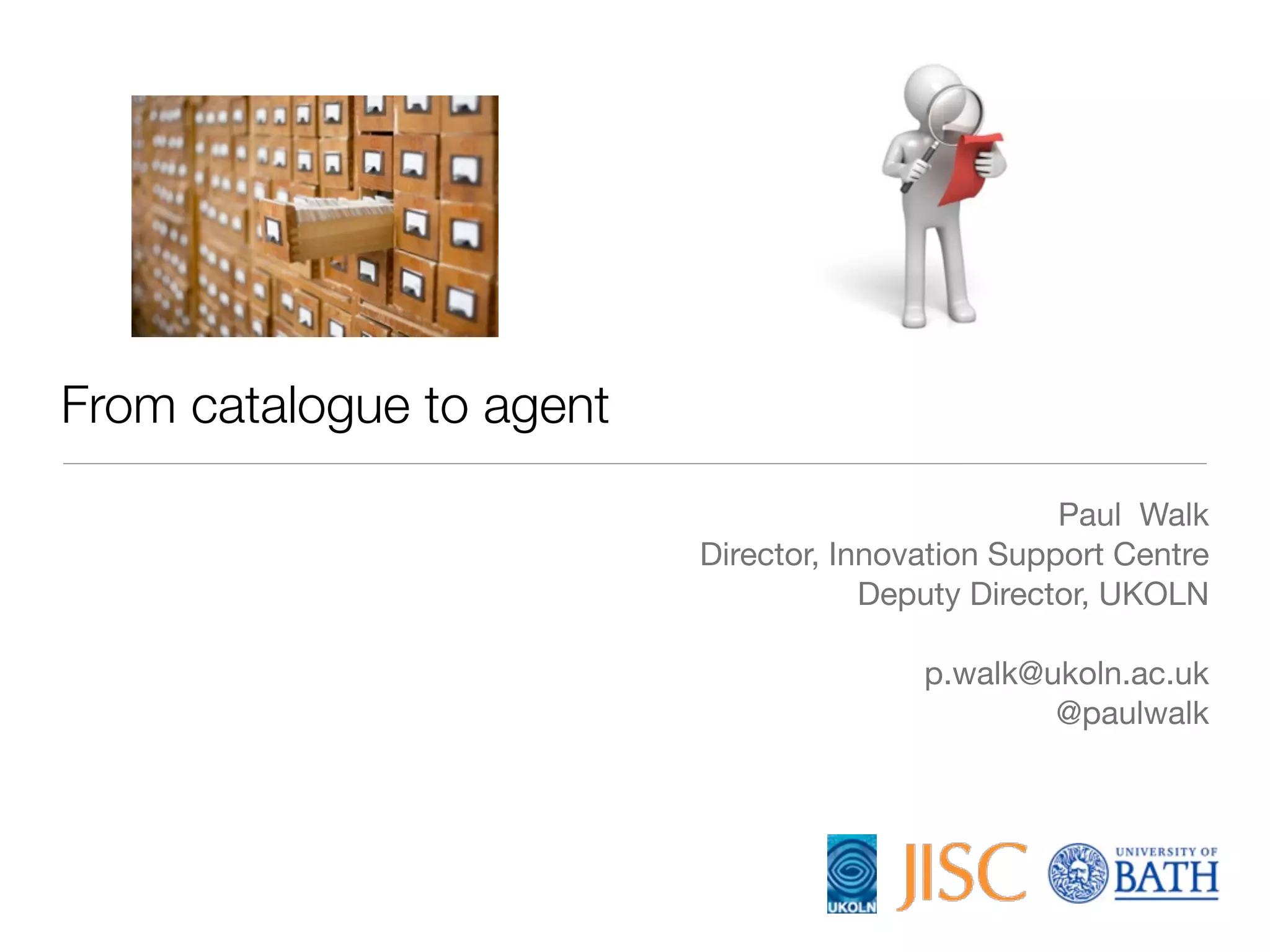
From catalogue to agent
                                                   Paul Walk
                          Director, Innovation Support Centre
                                      Deputy Director, UKOLN

                                         p.walk@ukoln.ac.uk
                                                 @paulwalk
Note - this presentation complements a short “vision”
paper which is available at:

http://blog.paulwalk.net/2012/01/20/library-systems-of-
the-future/
changing contexts....

• always on(line)
   • ubiquitous social networking facilitating academic discourse, research,
     teaching and learning

• expectations of personalisation, recommendations, in all info systems

• new economics
   • unfettered, market-driven HE in a global marketplace
   • dynamic relationships between people and institutions
   • the end of the simple ‘student enrolled at university for 3 years’ model

• copyright, fair dealing, licensing, publishing monopolies etc.
   • either abandoned as unworkable, or solved gradually and systematically
...introduce new challenges

1. massively complex permission tracking problems for any given individual
   with several, varied relationships with institutions and their libraries at any
   one time
   • how can this continue to scale?

2. uncoordinated personalisation everywhere!
   • how can personalisation and recommendation engine parameters be re-
     used across systems?

3. social networking means we can deal with many, many more people on a
   daily basis
    • how can we manage such connectivity?
1. Massively complex permission tracking

• some aspects are re-used in many systems, e.g:
   • does the user have an affiliation with the system?

• one approach is to use tokens/certificates - trusting by proxy

• has been problematic in ‘grid-computing’ because it has been cumbersome

• possible to conceive of an agent which carries the necessary tokens on
  behalf of the user and which has the necessary ‘intelligence’ to know when to
  use them (or not).
2. Uncoordinated personalisation everywhere

• the only place this can really be coordinated in a future-proof way is by the
  client
   • either acting directly as a user

   • or

   • through some proxy which is instructed and trusted by the user

• attention is a valuable currency - sooner or later users are going to want to
  start ‘banking’ it a controlling how it is spent

• Customer Relationship Management becomes Vendor Relationship
  Management (Mike Vizard)
3. Coping with social networks - are friends electric?

• we already understand that the nature of relationships on social networks is
  varied and complex, sometimes in subtle ways
   • ‘friend’?

• software ‘agents’ (‘bots’) already inhabit social networks: they’re not very
  useful yet and they’re barely even semi-autonomous, but crucially, from the
  system’s point of view, they are the same as a human user

• note that in the previous point, ‘the system’ means any system which
  interacts with the bot

• perhaps social networks are where humans are really going to learn how to
  live with semi-autonomous software
the researcher needs APIs....

• agents which can act as the user’s persona
  - presenting a constrained and focussed
  interface to the world

• filters which learn and adapt to changing
  priorities, sources & rules in a chaotic world

• resulting in:

• systems which know about you the moment
  you touch them & which can deliver highly
  personalised services and
  recommendations
implications for the library system

• the notion of ‘visiting’ the library system to find resources will become
  increasingly anachronistic
    • browsing as a human activity will fall away, search is king for now
    • over time, search will gradually become less apparent to the user too

• the ratio of software to human ‘agents’ interfacing with the LMS will shift
  away from the human

• people expect personal service: the library will need to find ways to deliver
  personalised services while at the same time having less direct contact with
  those people - a tough nut to crack!

• the library’s APIs will need to interoperate with the researcher’s APIs....

• CRM might become mediated through software agents
thanks for humouring
me...
p.walk@ukoln.ac.uk

@paulwalk


                       books are good too!

Future of LMS

  • 1.
    From catalogue toagent Paul Walk Director, Innovation Support Centre Deputy Director, UKOLN p.walk@ukoln.ac.uk @paulwalk
  • 2.
    Note - thispresentation complements a short “vision” paper which is available at: http://blog.paulwalk.net/2012/01/20/library-systems-of- the-future/
  • 3.
    changing contexts.... • alwayson(line) • ubiquitous social networking facilitating academic discourse, research, teaching and learning • expectations of personalisation, recommendations, in all info systems • new economics • unfettered, market-driven HE in a global marketplace • dynamic relationships between people and institutions • the end of the simple ‘student enrolled at university for 3 years’ model • copyright, fair dealing, licensing, publishing monopolies etc. • either abandoned as unworkable, or solved gradually and systematically
  • 4.
    ...introduce new challenges 1.massively complex permission tracking problems for any given individual with several, varied relationships with institutions and their libraries at any one time • how can this continue to scale? 2. uncoordinated personalisation everywhere! • how can personalisation and recommendation engine parameters be re- used across systems? 3. social networking means we can deal with many, many more people on a daily basis • how can we manage such connectivity?
  • 5.
    1. Massively complexpermission tracking • some aspects are re-used in many systems, e.g: • does the user have an affiliation with the system? • one approach is to use tokens/certificates - trusting by proxy • has been problematic in ‘grid-computing’ because it has been cumbersome • possible to conceive of an agent which carries the necessary tokens on behalf of the user and which has the necessary ‘intelligence’ to know when to use them (or not).
  • 6.
    2. Uncoordinated personalisationeverywhere • the only place this can really be coordinated in a future-proof way is by the client • either acting directly as a user • or • through some proxy which is instructed and trusted by the user • attention is a valuable currency - sooner or later users are going to want to start ‘banking’ it a controlling how it is spent • Customer Relationship Management becomes Vendor Relationship Management (Mike Vizard)
  • 7.
    3. Coping withsocial networks - are friends electric? • we already understand that the nature of relationships on social networks is varied and complex, sometimes in subtle ways • ‘friend’? • software ‘agents’ (‘bots’) already inhabit social networks: they’re not very useful yet and they’re barely even semi-autonomous, but crucially, from the system’s point of view, they are the same as a human user • note that in the previous point, ‘the system’ means any system which interacts with the bot • perhaps social networks are where humans are really going to learn how to live with semi-autonomous software
  • 8.
    the researcher needsAPIs.... • agents which can act as the user’s persona - presenting a constrained and focussed interface to the world • filters which learn and adapt to changing priorities, sources & rules in a chaotic world • resulting in: • systems which know about you the moment you touch them & which can deliver highly personalised services and recommendations
  • 9.
    implications for thelibrary system • the notion of ‘visiting’ the library system to find resources will become increasingly anachronistic • browsing as a human activity will fall away, search is king for now • over time, search will gradually become less apparent to the user too • the ratio of software to human ‘agents’ interfacing with the LMS will shift away from the human • people expect personal service: the library will need to find ways to deliver personalised services while at the same time having less direct contact with those people - a tough nut to crack! • the library’s APIs will need to interoperate with the researcher’s APIs.... • CRM might become mediated through software agents
  • 10.

Editor's Notes