
Building research data management
             services:
       a data librarian’s view


            Robin Rice
         Online Information
         London: Nov 21, 2012
Overview
• Defining research data management
• Developing a Research Data
  Management Policy at your institution
• Researcher vs institutional responsibilities
• Supporting and training researchers
• Other candidates for library-based RDM
  services
Defining RDM
• An umbrella term to describe all aspects
  of planning, organising, documenting,
  storing sharing, and preserving data.
• It also takes into account issues such as
  data protection and confidentiality.
• It provides a framework that supports
  researchers and their data throughout the
  course of their research and beyond.
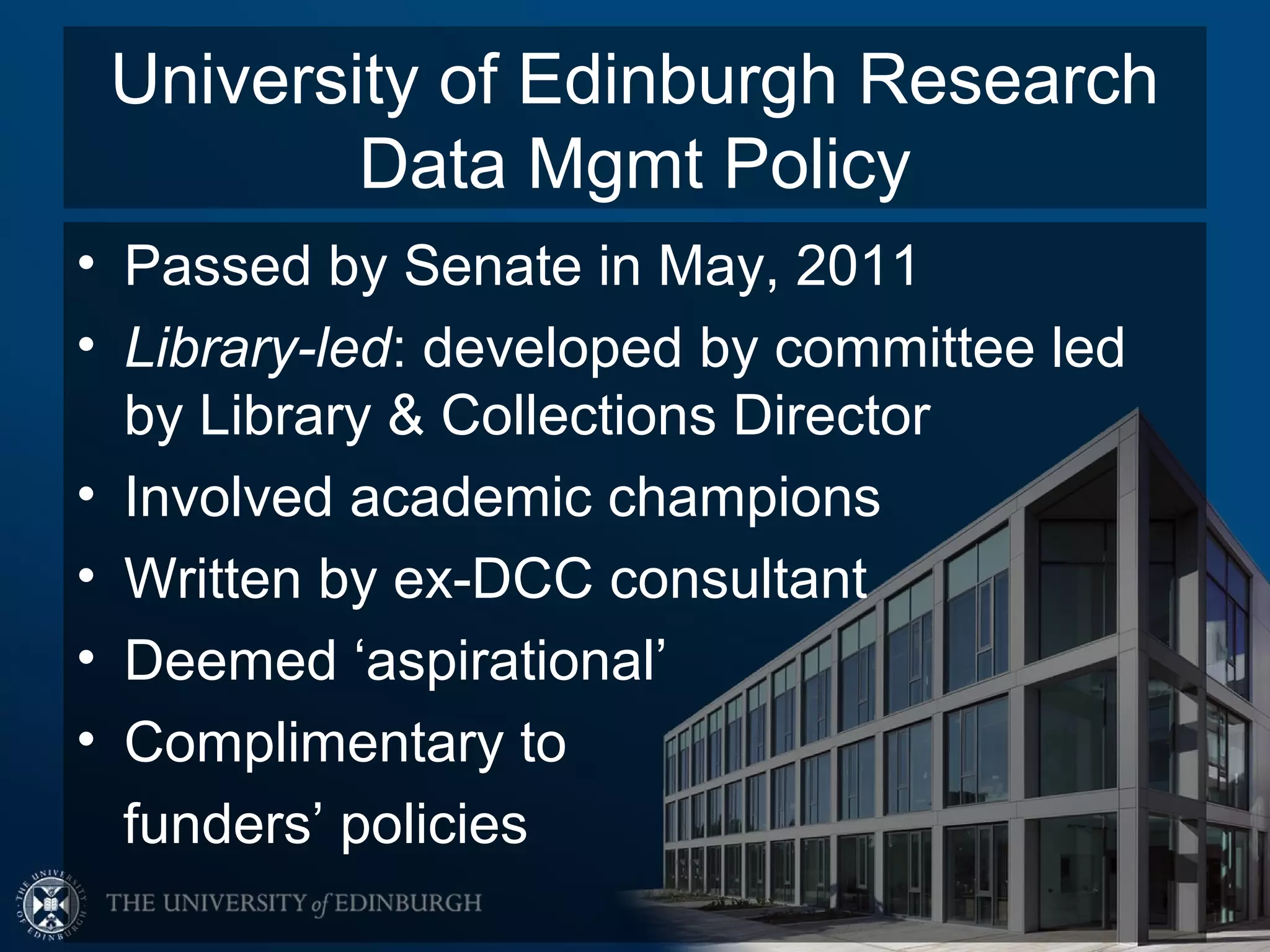
University of Edinburgh Research
         Data Mgmt Policy
• Passed by Senate in May, 2011
• Library-led: developed by committee led
  by Library & Collections Director
• Involved academic champions
• Written by ex-DCC consultant
• Deemed ‘aspirational’
• Complimentary to
  funders’ policies
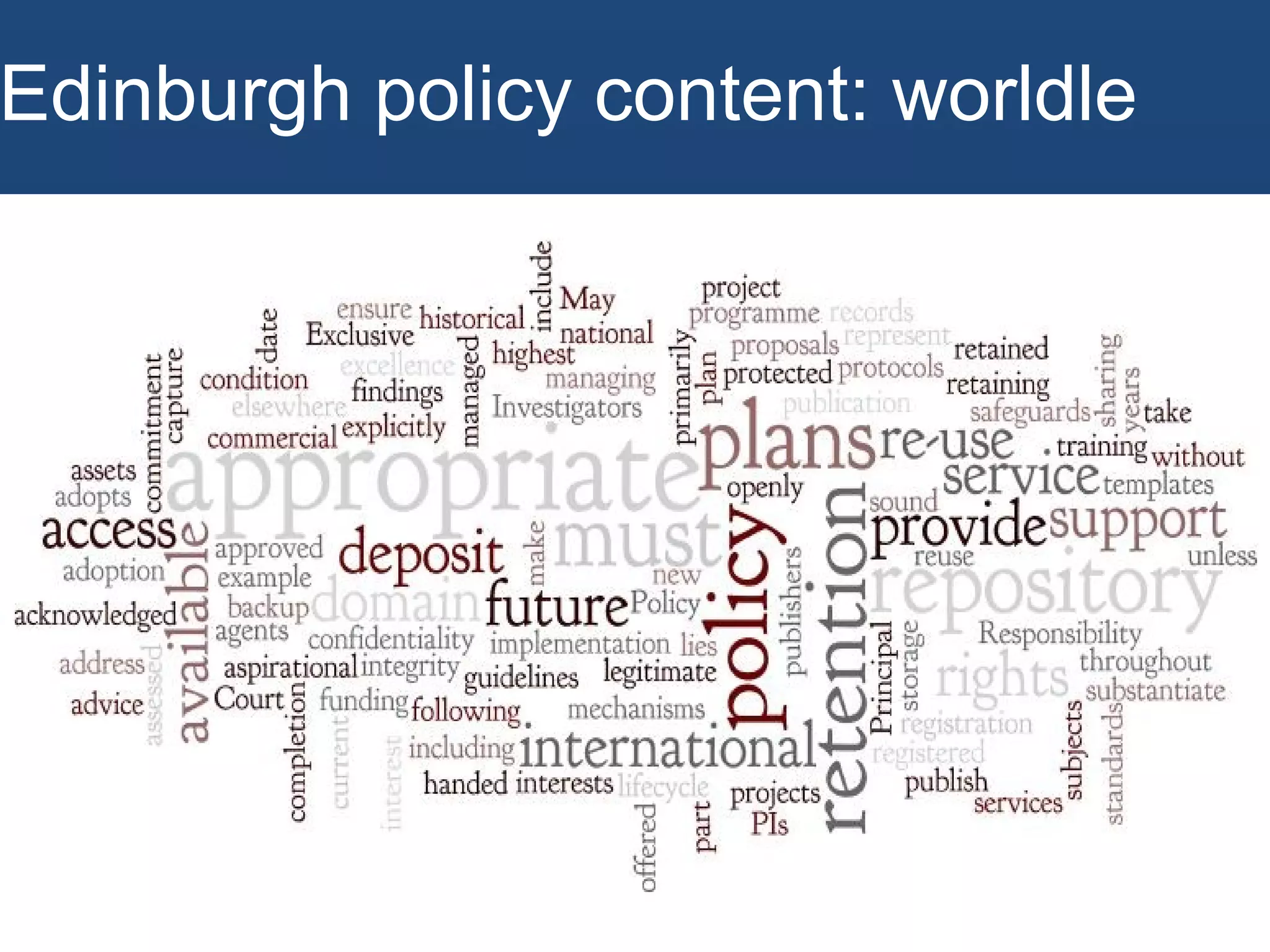
Edinburgh policy content: worldle
Roles & Responsibilities
• Who will support your researchers’
  planning?
• Who has responsibility during the research
  project? Who has archival responsibility?
• Who has rights in the data?
• Are students considered?
Tips for policy development
   Know the drivers for your own institution.
   Practice the art of persuasion.
   How big is your kirk? Seek alliances.
   Who is your high-level champion?
   Agree a style – mandate or enabling?
   Postcard from the future: what will it
    achieve?
Supporting and training
         researchers
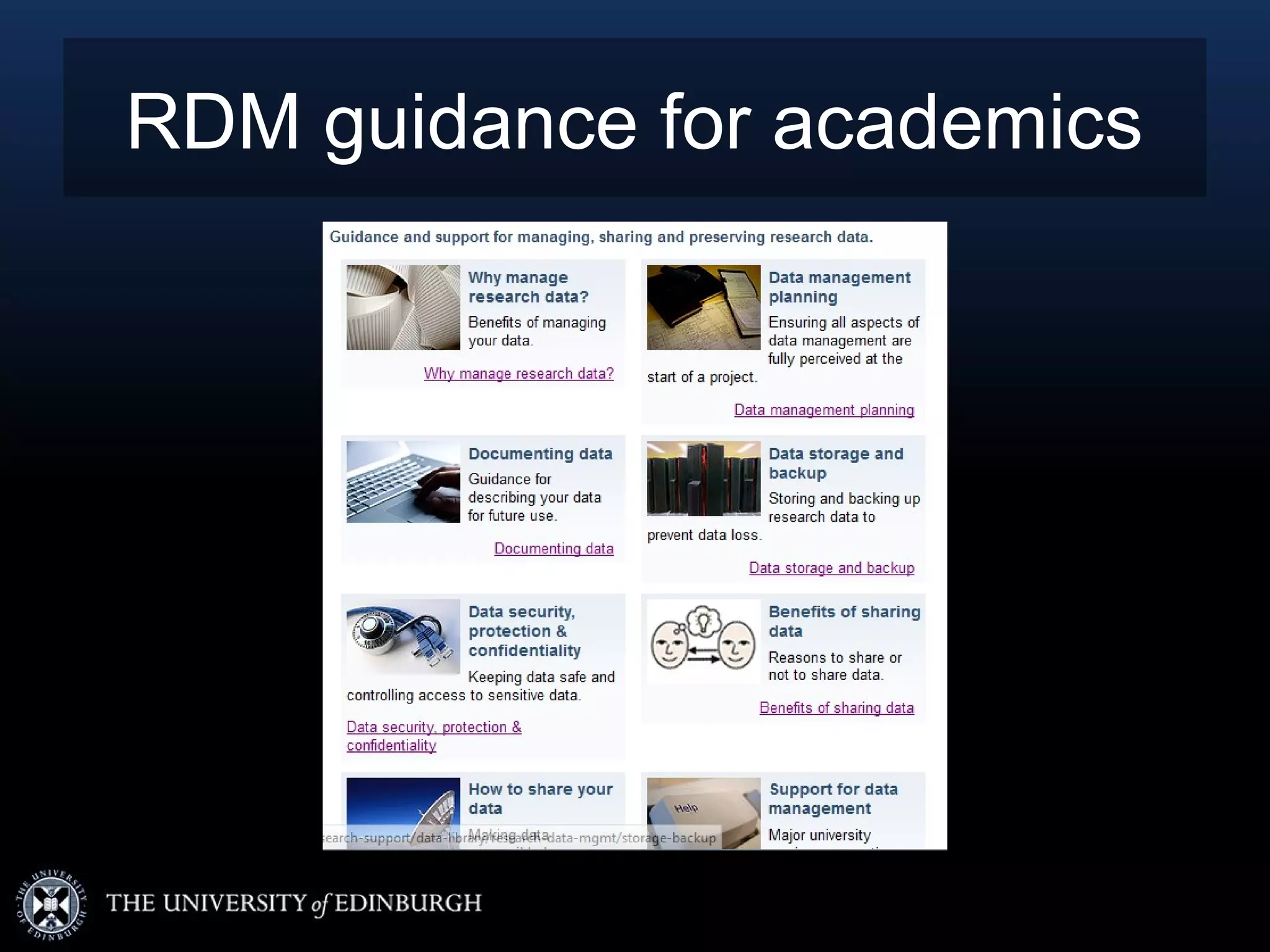
• Online guidance for academic staff
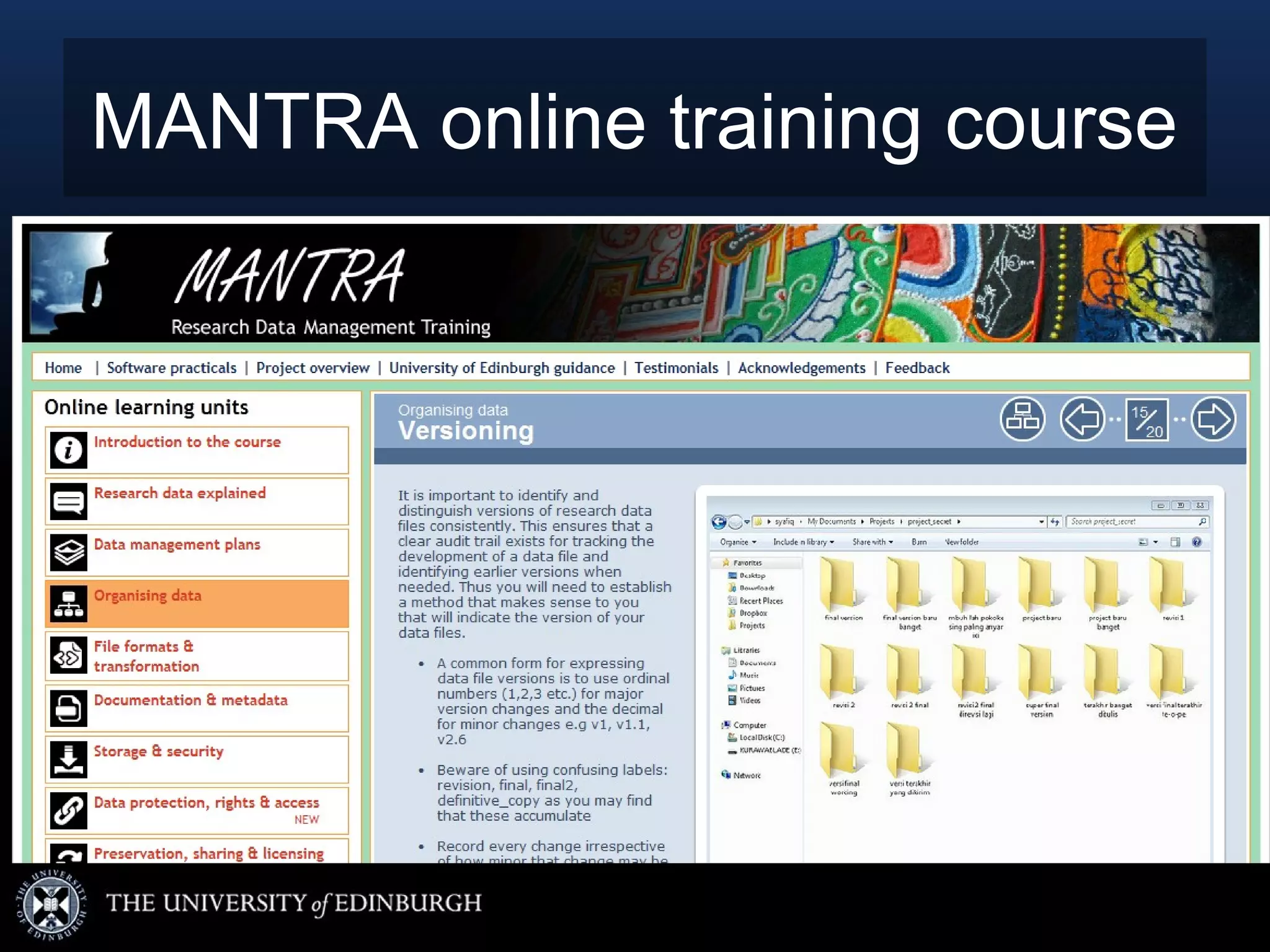
• Embedding RDM training into
  postgraduate programmes (MANTRA)
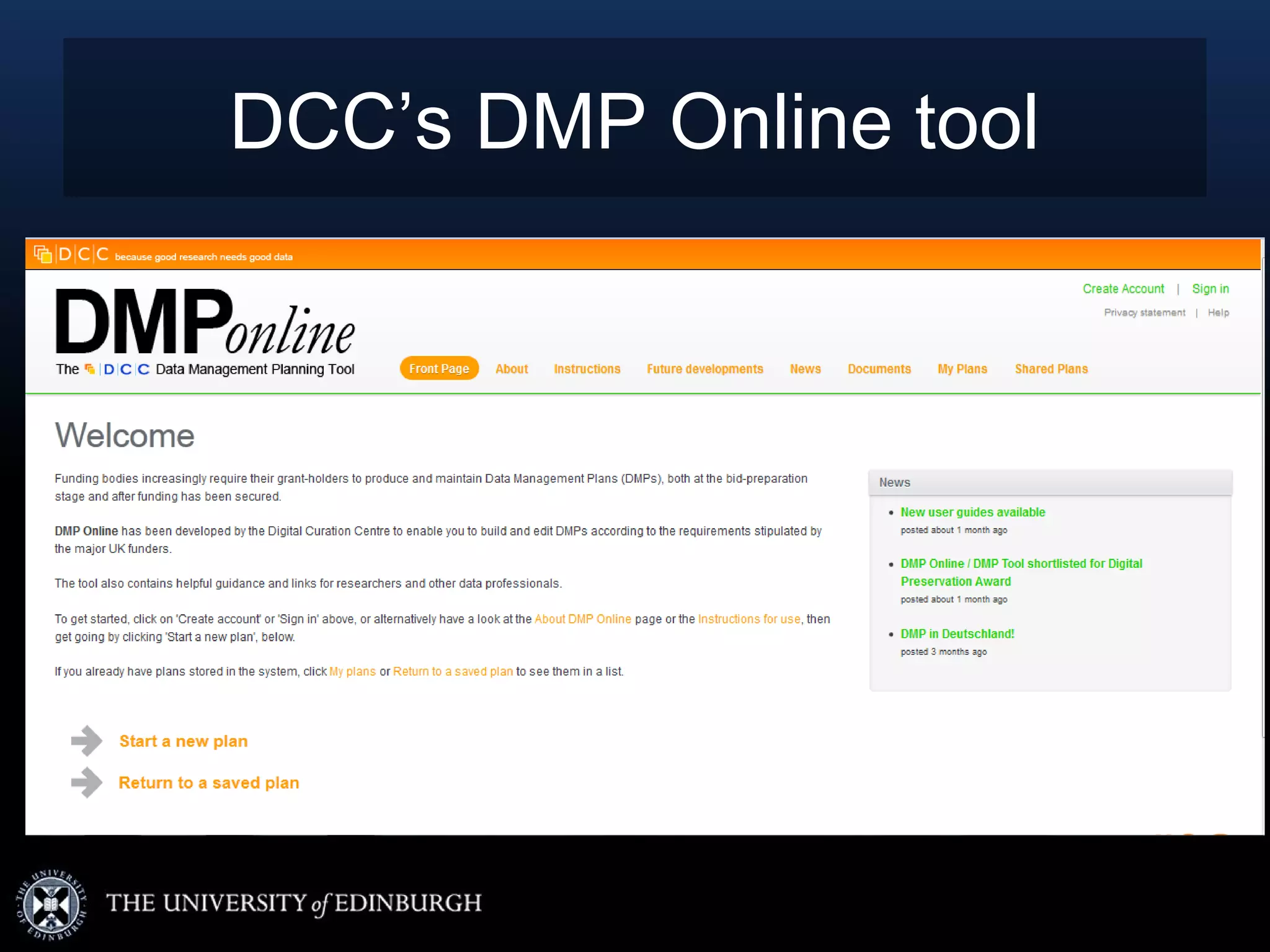
• Tailored support for Data Mgmt Plans
  (customising DMP Online tool)
• Training librarians & IT staff
• Awareness-raising across
  schools and departments
RDM guidance for academics
MANTRA online training course
DCC’s DMP Online tool
Training liaison librarians
• DIY training facilitated by data librarians:
  Topics:
• Data management planning
• Documenting & organising data
• Data storage & security
• Ethics & copyright
• Data sharing
Other candidates for library-based
             RDM services
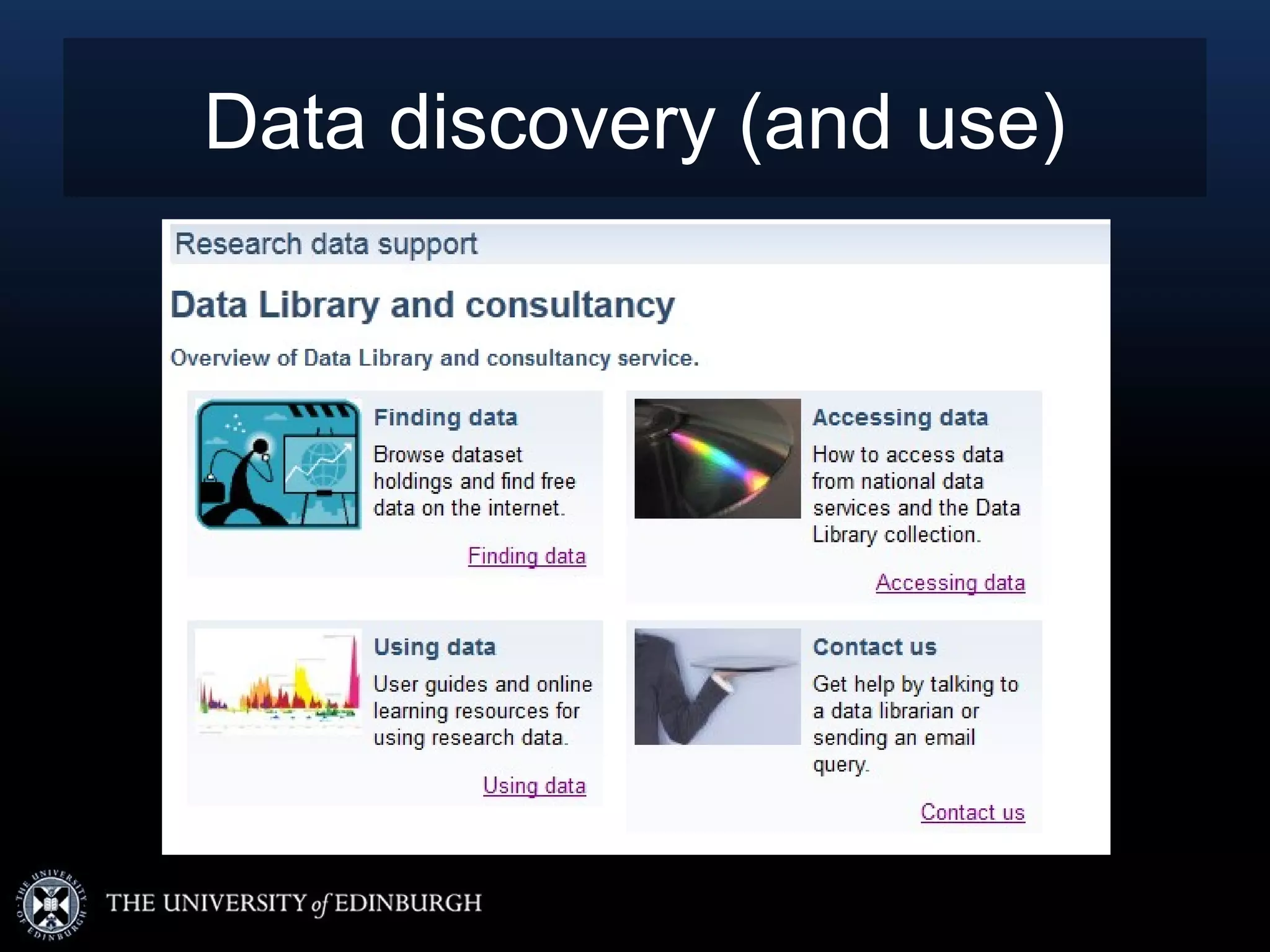
•   Data discovery – portals, catalogues
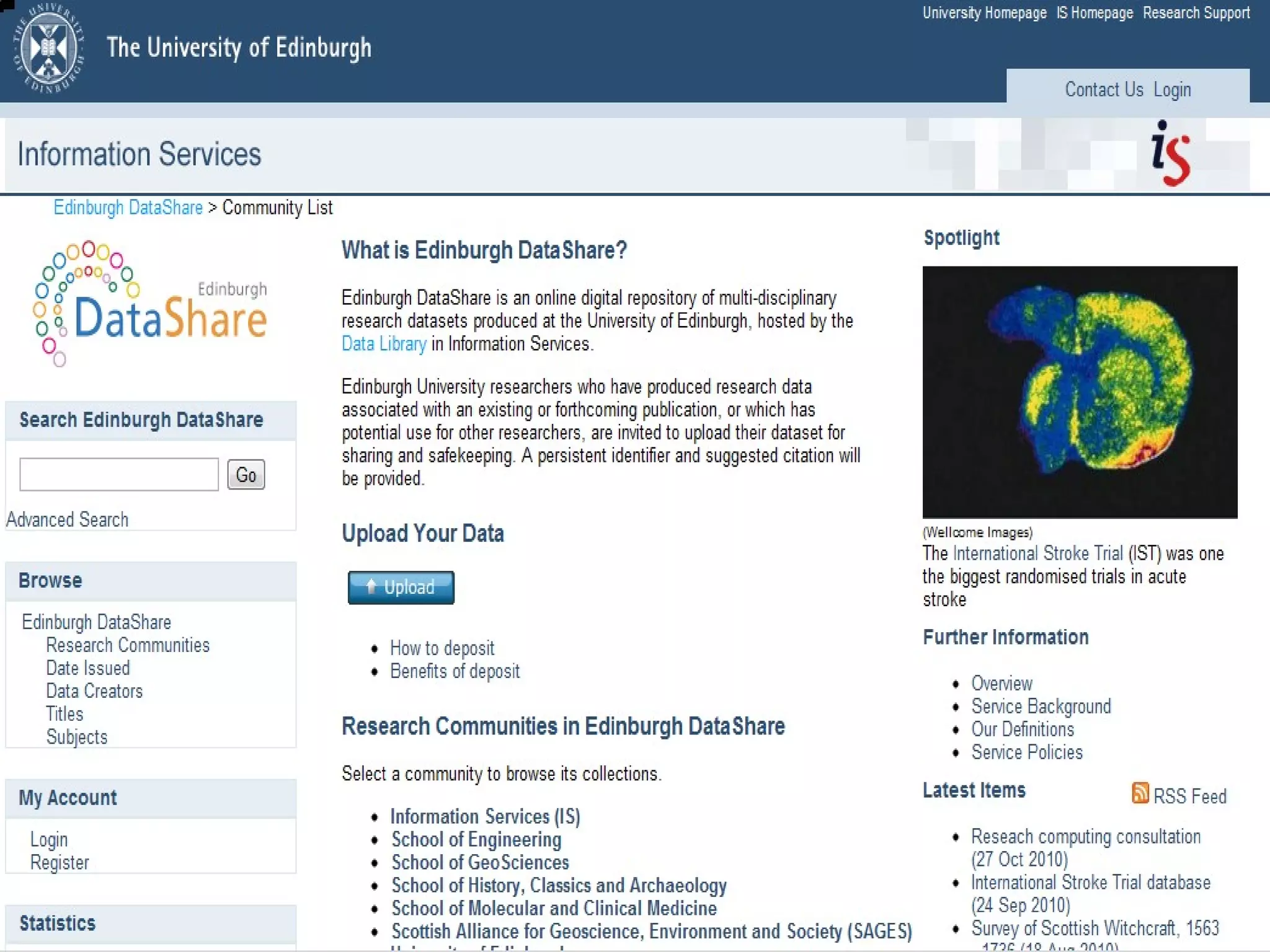
•   Open data repositories
•   Archiving and preservation services
•   Metadata & standards (curation)
Data discovery (and use)
15
Archiving and preservation
    services for research data
• Should the institution be doing this?
  – EPSRC says so
  “Research organisations will ensure that EPSRC-funded research
    data is securely preserved for a minimum of 10-years from the
    date that any researcher ‘privileged access’ period expires or, if
    others have accessed the data, from last date on which access
    to the data was requested by a third party.”

• How to do digital preservation: “Know what
  you’ve got and keep the bits safe.”
• – Tim Gollins, TNA
Metadata & standards (curation)
• Librarians are more interested in (at least
  some kinds of) metadata than
  researchers.
• Librarians are in a position to bring to light
  emerging standards for data types to
  researchers and benefits of use.
• Librarians have a natural ‘cross-
  disciplinary’ viewpoint.
Challenges for Librarians in RDM
• Finding time to pursue new activities
• Developing new kinds of partnerships
• Establishing credibility in a new area of
  expertise
• Learning new skills; ‘getting techie’
• Getting hands dirty with unpublished
  material
• Adapting rapidly to opportunities
Links
• University of Edinburgh policy
    – http://www.ed.ac.uk/is/research-data-policy
• Research data guidance
    – http://www.ed.ac.uk/is/data-management
•   MANTRA online training
    – http://datalib.edina.ac.uk/mantra/
• UoE Data Library
    – http://www.ed.ac.uk/is/data-library
• Edinburgh DataShare
    – http://datashare.is.ed.ac.uk/
Building research data management services at the University of Edinburgh: a data librarian's view

Building research data management services at the University of Edinburgh: a data librarian's view

  • 1.
    Building research datamanagement services: a data librarian’s view Robin Rice Online Information London: Nov 21, 2012
  • 2.
    Overview • Defining researchdata management • Developing a Research Data Management Policy at your institution • Researcher vs institutional responsibilities • Supporting and training researchers • Other candidates for library-based RDM services
  • 3.
    Defining RDM • Anumbrella term to describe all aspects of planning, organising, documenting, storing sharing, and preserving data. • It also takes into account issues such as data protection and confidentiality. • It provides a framework that supports researchers and their data throughout the course of their research and beyond.
  • 4.
    University of EdinburghResearch Data Mgmt Policy • Passed by Senate in May, 2011 • Library-led: developed by committee led by Library & Collections Director • Involved academic champions • Written by ex-DCC consultant • Deemed ‘aspirational’ • Complimentary to funders’ policies
  • 5.
  • 6.
    Roles & Responsibilities •Who will support your researchers’ planning? • Who has responsibility during the research project? Who has archival responsibility? • Who has rights in the data? • Are students considered?
  • 7.
    Tips for policydevelopment  Know the drivers for your own institution.  Practice the art of persuasion.  How big is your kirk? Seek alliances.  Who is your high-level champion?  Agree a style – mandate or enabling?  Postcard from the future: what will it achieve?
  • 8.
    Supporting and training researchers • Online guidance for academic staff • Embedding RDM training into postgraduate programmes (MANTRA) • Tailored support for Data Mgmt Plans (customising DMP Online tool) • Training librarians & IT staff • Awareness-raising across schools and departments
  • 9.
  • 10.
  • 11.
  • 12.
    Training liaison librarians •DIY training facilitated by data librarians: Topics: • Data management planning • Documenting & organising data • Data storage & security • Ethics & copyright • Data sharing
  • 13.
    Other candidates forlibrary-based RDM services • Data discovery – portals, catalogues • Open data repositories • Archiving and preservation services • Metadata & standards (curation)
  • 14.
  • 15.
  • 16.
    Archiving and preservation services for research data • Should the institution be doing this? – EPSRC says so “Research organisations will ensure that EPSRC-funded research data is securely preserved for a minimum of 10-years from the date that any researcher ‘privileged access’ period expires or, if others have accessed the data, from last date on which access to the data was requested by a third party.” • How to do digital preservation: “Know what you’ve got and keep the bits safe.” • – Tim Gollins, TNA
  • 17.
    Metadata & standards(curation) • Librarians are more interested in (at least some kinds of) metadata than researchers. • Librarians are in a position to bring to light emerging standards for data types to researchers and benefits of use. • Librarians have a natural ‘cross- disciplinary’ viewpoint.
  • 18.
    Challenges for Librariansin RDM • Finding time to pursue new activities • Developing new kinds of partnerships • Establishing credibility in a new area of expertise • Learning new skills; ‘getting techie’ • Getting hands dirty with unpublished material • Adapting rapidly to opportunities
  • 19.
    Links • University ofEdinburgh policy – http://www.ed.ac.uk/is/research-data-policy • Research data guidance – http://www.ed.ac.uk/is/data-management • MANTRA online training – http://datalib.edina.ac.uk/mantra/ • UoE Data Library – http://www.ed.ac.uk/is/data-library • Edinburgh DataShare – http://datashare.is.ed.ac.uk/

Editor's Notes

  • #2 © The University of Edinburgh
  • #3 © The University of Edinburgh
  • #4 © The University of Edinburgh
  • #5 © The University of Edinburgh
  • #7 © The University of Edinburgh
  • #8 © The University of Edinburgh
  • #9 © The University of Edinburgh
  • #10 © The University of Edinburgh
  • #11 © The University of Edinburgh
  • #12 © The University of Edinburgh
  • #13 © The University of Edinburgh
  • #14 © The University of Edinburgh
  • #15 © The University of Edinburgh
  • #16 Edinburgh DataShare is an open repository for any research data created by Edinburgh University researchers, based on DSpace. Datasets are discoverable via search engines in order to maximise visibility and impact. Datasets can be licensed using suitable licences such as those from the Open Data Commons. This provides the facility to fulfil funder mandates when data is required to be published openly.   The data submission process creates a permanent record, a persistent identifier, access statistics, and a suggested citation for formal attribution upon re-use. There are customisation options for look and feel (e.g. logos) and metadata fields by community or collection.
  • #17 © The University of Edinburgh
  • #18 © The University of Edinburgh
  • #19 © The University of Edinburgh
  • #20 © The University of Edinburgh
  • #21 © The University of Edinburgh